

Hegemony to Empire: The Development of the Roman Imperium in the East from 148 to 62 B.C.
Robert Morstein Kallet-Marx
To my parents and Lisa
Table of Contents
- ABBREVIATIONS
- ACKNOWLEDGMENTS
- INTRODUCTION
- PART ONE
- 1 Macedonia Provincia
- 2 The Status of Greece after the Achaean War
- 3 Mummius's Settlement of Greece
- 4 The Origins of Asia Provincia
- PART TWO
- 5 Proconsular Administration in the East, 148-89
- 6 Roman Arbitration of Greek Disputes after 148
- 7 Treaties of Alliance
- 8 Rome and Athens from the Achaean War to Sulla
- PART THREE
- 9 Rome and the East between Aristonicus and Mithridates: The Events
- 10 Sulla's Settlement of the East
- 11 From Sulla to Pompey
- CONCLUSION
- APPENDICES
- BIBLIOGRAPHY
- INDEX OF NAMES AND SUBJECTS
- INDEX OF SOURCES
ABBREVIATIONS
A list of commonly cited epigraphical and reference works follows. Abbreviations of ancient authors and works are those listed in the Oxford Classical Dictionary . Full references to works cited in the notes in shortened form may be found in the bibliography; abbreviations of modern serials are generally those recommended by the American Journal of Archaeology . Greek names are given in their traditional Latinized form. Inscriptions are cited by reference to the most convenient corpus in which they appear. Thus, if an inscription can be found in R. K. Sherk's Roman Documents from the Greek East (Baltimore 1969), it will be cited by reference to that collection; if it does not appear there, then it may be cited from W. Dittenberger's Sylloge inscriptionum Graecarum , 3d ed. (Leipzig 1915); and so on. The index of passages cited supplies references to any other major corpora in which a given inscription appears.
|
AE |
L'année epigraphique . |
|
CAH |
Cambridge Ancient History . 1st ed. Cambridge 1923-39. |
|
CAH2 |
Cambridge Ancient History . 2d ed. Cambridge 1970-. |
|
CIG |
Corpus inscriptionum Graecarum . Berlin 1825-77. |
|
CIL |
Corpus inscriptionum Latinarum . Berlin 1863-. |
|
Claros 1 |
L. Robert and J. Robert. Claros . Vol. 1, Décrets hellénistiques . Paris 1989. |
|
EA |
Epigraphica Anatolica . |
|
FD |
Fouilles de Delphes . |
|
FGrH |
F. Jacoby. Die Fragmente der griechischen Historiker . Berlin and Leiden 1923-58. |
|
FIRA |
Fontes iuris Romani antejustiniani . Edited by S. Riccobono, G. Baviera, C. Ferrini, G. Furlani, and V. Arangio-Ruiz. 3 vols. Rome 1940-43. |
|
GGM |
C. Müller. Geographi Graeci minores . 2 vols. Paris 1855-61. |
|
Greenidge and Clay |
A. H. J. Greenidge and A. M. Clay. Sources for Roman History, 133-70 B.C . 2d ed. Revised by E. W. Gray. Oxford 1960. |
|
ICr |
Inscriptiones Creticae . Edited by M. Guarducci. Rome 1935-50. |
|
IDel |
Inscriptiones de Délos . Edited by A. Plassart, F. Durrbach, P. Roussel, M. Launey, et al. Paris 1911-72. |
|
IEph |
Inschriften von Ephesos . Edited by H. Wankel, R. Merkelbach, et al. Bonn 1979-81. |
|
IErythrai |
Die Inschriften von Erythrai und Klazomenai . Edited by H. Engelmann and R. Merkelbach. Bonn 1972-73. |
|
IG |
Inscriptiones Graecae . Berlin 1873-. |
|
IGBulg |
Inscriptiones Graecae in Bulgaria repertae . Edited by G. Mihailov. Sofia 1956-66. |
|
IGCH |
An Inventory of Greek Coin Hoards . Edited by M. Thompson, O. Mørkholm, and C. M. Kraay. New York 1973. |
|
IGRR |
Inscriptiones Graecae ad res Romanas pertinentes . Edited by R. Cagnat. Paris 1911-27. |
|
IGUR |
Inscriptiones Graecae urbis Romae . Edited by L. Moretti. Rome 1968-90. |
|
IIt |
Inscriptiones Italiae . Rome 1931-. |
|
ILLRP |
Inscriptiones Latinae liberae rei publicae . Edited by A. Degrassi. 2d ed. Florence 1963-65. |
|
ILS |
Inscriptiones Latinae selectae . Edited by H. Dessau. Berlin 1892-1916. |
|
IMagnesia |
Die Inschriften yon Magnesia am Maeander . Edited by O. Kern. Berlin 1900. |
|
IPE |
Inscriptiones antiquae orae septentrionalis Ponti Euxini, Graecae et Latinae . Edited by B. Latyschev. St. Petersburg 1885-1916. |
|
IPr |
Inschriften von Priene . Edited by F. Hiller von Gaertringen. Berlin 1906. |
|
ISE |
Iscrizioni storiche ellenistiche . Edited by L. Moretti. Florence 1967-76. |
|
ISmyrna |
Inschriften von Smyrna . Edited by G. Petzl. Bonn 1982-. |
|
IvO |
Inschriften yon Olympia (= Olympia V). Edited by W. Dittenberger and K. Purgold. Berlin 1896. |
|
LSJ |
A Greek-English Lexicon . Compiled by H. G. Liddell and R. Scott. 9th ed. Revised by H. S. Jones. Oxford 1940. |
|
Milet I.3 |
Milet: Ergebnisse der Ausgrabungen und Untersuchungen , vol. 1, pt. 3: Das Delphinion in Milet , edited by G. Kawerau and A. Rehm. Berlin 1914. |
|
MRR |
T. R. S. Broughton. The Magistrates of the Roman Republic . 3 vols. New York 1951-86. |
|
OGIS |
Orientis Graeci inscriptiones selectae . Edited by W. Dittenberger. Leipzig 1903. |
|
OLD |
Oxford Latin Dictionary . Edited by P. G. W. Glare. Oxford 1968-82. |
|
ORF |
Oratorum Romanorum fragmenta . Edited by E. Malcovati. 3th ed. Turin 1967. |
|
RE |
Real-Encyclopädie der classischen Altertumswissenschaft . Edited by A. F. von Pauly, G. Wissowa, et al. Stuttgart 1893-1980. |
|
SEG |
Supplementum epigraphicum Graecum . |
|
Sherk |
Roman Documents from the Greek East . Edited by R. K. Sherk. Baltimore 1969. |
|
Sokolowski |
Lois sacrées de l'Asie Mineure . Edited by F. Sokolowski. Paris 1955. |
|
Syll3 |
Sylloge inscriptionum Graecarum . Edited by W. Dittenberger et al. 3d ed. Leipzig 1915. |
|
TAM |
Tituli Asiae Minoris . Vienna 1901-1989. |
|
Welles |
Royal Correspondence in the Hellenistic Period. Edited by C. B. Welles. New Haven 1934. |
ACKNOWLEDGMENTS
This study grew out of a doctoral dissertation written at Berkeley largely in the fall and spring of 1986-87. Erich Gruen, Raphael Sealey, and Ronald Stroud were the benevolent deifies who presided over that laborious stage of its genesis. To each of them, my teachers all, I owe much more than the conventions of publication will allow me to list here. I shall say only that I am convinced that whatever merit lies in the following pages was inspired or encouraged by them. To Erich Gruen, the supervisor of the dissertation, I owe a special debt of gratitude, not only for all that he has taught me both directly and by example, but for the humor, humanity, and extraordinary generosity he brought to his pedagogical role.
Tradition sanctions in a first book a wider range of acknowledgment than usual. From Boulder to Oxford and Berkeley, I have had many more fine teachers than any student has a fight to expect, and to all I am deeply grateful. One former teacher played such an influential role in the steps that led to this book that he must be thanked eponymously: Peter Derow of Wadham College, Oxford, who gave me my early training in ancient history and sparked my interest in the history of Roman intervention in the Hellenistic world.
My wife, Lisa Kallet-Marx, deserves more than the traditional phrases of thanks for put-upon spouses, for many of the ideas presented here emerged or were refined in the course of conversations with her. I thank her for the love, patience, and unflagging encouragement that gave me the strength to complete this long opus.
Many friends and colleagues lent their assistance to this project at various stages. Arthur M. Eckstein read an early version of the entire manuscript and offered innumerable helpful criticisms and suggestions. Chris-
tian Habicht kindly read and commented on drafts of four chapters. The anonymous readers' evaluations of the manuscript for the Press helped me considerably to improve it. The errors and imperfections that remain are of course wholly my own. I am grateful also to Donald Baronowski for supplying me with a copy of his fine Toronto thesis on Roman treaties of alliance, to Joyce Reynolds for showing me a revised text of the lex Cnidia in advance of publication, and likewise to Charalambos Kritzas for allowing me to see before publication his text of the exciting new Argive dossier of letters concerning the Dionysiac artists. I thank also my former colleague Christopher Jones, who very kindly passed on to me several important pieces of epigraphic news from Turkey, and Ernst Badian, Corey Brennan, and Jerzy Linderski for cheerfully lending an ear to a constitutional query. Joseph Garnjobst and Glenn Mangold gave invaluable assistance in checking references. I am grateful to the UCSB Academic Senate for a grant that facilitated completion of the project.
INTRODUCTION
This book analyzes the nature and development of Roman hegemonial power in the Hellenistic Aegean world, broadly defined—the southern Balkan peninsula and Asia Minor—from the suppression of Andriscus, pretender to the Macedonian throne, in 148, through Pompey's return in 62, following the long struggle with Mithridates VI of Pontus. The central conviction that has informed the project is that the establishment of Roman rule must be traced as a historical process, as something that developed and evolved, rather than something suddenly created whole out of nothing in each region with the successive "creation" of "provinces." I wish to depart from the old tradition which focuses narrowly on the legal structures assumed (often without good evidence) to have been erected by Roman conquerors after the various Eastern wars, and to turn attention rather toward the evolution of imperial structures both as an ongoing process of mutual adaptation on both the Greek and Roman sides and as a reaction to specific historical events. Evidence of the concrete actions of the successive Roman commanders on the spot and the rulings of the Roman Senate that affected Hellas will be the main focus of attention, rather than the legalistic schemata that have so long sufficed as description of "provincialization." Throughout, special attention will be devoted to the following questions. To what extent did Rome's advent and presence alter preexisting political and legal structures and traditional patterns of behavior? To what extent did the new Roman authorities on the spot, or the Roman Senate from afar, administer, govern, or rule? Was Rome's practical domination given formal expression or recognition? Did a conception of mutual responsibilities and obligations between Roman and
Greek emerge? Above all, how did such manifestations of the Roman imperium change over time?
The "epigraphic habit" among the Greek-speakers of the lands encircling the Aegean will allow us to follow the process of the establishment of Roman rule in general more closely here than elsewhere. The result should be a clearer picture of the evolution of a Roman empire in the East—one that gives due emphasis to the inevitably somewhat obscure, but dearly crucial, age of adaptation and creation that followed the great wars of the first half of the second century B.C .
Surprisingly, these questions have not been asked before in a systematic way. The bulk of scholarly inquiry into Rome's conquest of the Greek world halts in 146 (with the Achaean War), or perhaps leaps thence to 129 (the victory over Aristonicus in Asia Minor) before the curtain is finally drawn. E. Badian speaks for many:
The year 146 brings to their inevitable conclusion the developments begun . . . even before the victory over Perseus: it sees the end of proper international relations and proper international law over the Roman world.1
It is not hard to perceive the reasons for this tendency to conclude the story of Roman intervention in the East around the middle of the second century. The great wars of the second century and the diplomatic arrangements that preceded and followed them are rather more dramatic—and more susceptible to traditional narration—than the scattered proconsular judgments, arbitral proceedings, treaties with insignificant states and the like that make up so much of the story we are about to tell. In 146 we lose the intelligent, contemporary account of Polybius, and further investigation must proceed on the basis of scattered, short references in later authors and the painstaking scrutiny of elliptical and often fragmentary inscriptions. But not least, as the quotation above illustrates, the conviction that Hellas had finally and irrevocably lost all vestiges of independence by 146 has discouraged investigation of the succeeding period. If the important part of the story is over, why persist?
The central buttress for the view that the mid-second century is an apt conclusion for the history of the establishment of Roman rule in the East is the prevailing conception, inherited from the great systematizers of the nineteenth century, that provinces were created as distinct and formally recognized legal entities that served to integrate and to annex territory
into an empire. If so, the implication would be that developments thereafter are merely a matter of adaptation to fundamentally changed circumstances, not a formative process in its own right. The effect is to focus interest almost exclusively on the supposedly decisive, constitutive act of "annexation"—thus the debate over Rome's supposed hesitation to "annex" territory, a central controversy in Roman history which has continued uninterrupted since the time of T. Mommsen.2 The most influential proponents of opposing positions on this question are Badian, who in his Roman Imperialism in the Late Republic argued that the Senate, given the choice, avoided annexation well into the first century B.C ., and W. V. Harris, who devoted a chapter to an attack on this thesis in his War and Imperialism in Republican Rome , adopting the view that the employment of alternatives (such as "indirect," "hegemonial" control) by no means establishes that the Senate was hesitant to annex territory.3 Roman historians have tended to go along with the traditional definition of empires "as the formal annexations of conquered territory, marked on maps in red, blue, and yellow."4 But students of modern imperialism have long learned that such a narrow definition excludes too much of the phenomena of imperial control; informal means of controlling the effective sovereignty of other communities require no less attention.5 This not only diminishes the overwhelming traditional emphasis upon annexation but also reduces or eliminates the apparent discontinuity between periods of nonannexation and annexation, as J. Gallagher and J. Robinson showed in 1953 in their seminal article on nineteenth-century British expansion, which first properly stressed the concept of informal empire.6 Formal annexation, in the
second-century Mediterranean world as well as nineteenth-century Africa, is no simple gauge of empire and imperialism.
Indeed, the very concept of annexation as it applies to the Roman Republic receives insufficient examination and definition. Harris devotes a mere paragraph to the matter, Badian less.7 Not even W. Dahlheim's 1977 study Gewalt und Herrschaft , subtitled Das provinziale Herrschaftsystem der römischen Republik , a survey of the entire history of Republican "provincialization," comes fully to grips with the question of what precisely was involved in creating a province.8 That, evidently, has been thought to be well understood. But as we shall see in chapter 1, traditional views on the nature of the province are gradually coming under fire, and recent work has shown that the historical situation has been obscured by legalistic abstraction. Dahlheim, in the book just mentioned, showed in particular through his examination of Sicily and Spain that Roman rule in the provinces was something that underwent a historical development, and that the overseas provinciae had begun as military rather than administrative districts. J. S. Richardson has recently produced an exemplary book-length study of the early evolution of the Spanish provinciae which explicitly challenges the old view of annexation,9 and salutary criticism has appeared of the traditional idea that Romans typically reorganized territory fundamentally upon conquest through so-called leges provinciae (see chap. 1). Scholars had long recognized that the word provincia underwent an important evolution, but the synchronic methods of the juristic scholarship of the nineteenth century have tended to prevent due recognition of a similar and related development of imperial structures.
That the integration of the Hellenistic world into a Roman imperial system was a complex and fluid process, and by no means a steady linear development in the direction of closer Roman control is becoming increasingly dear. Two recent books in particular have stressed the continuity of Hellenistic traditions in the shadow of Rome. In 1984 Erich S. Gruen's The Hellenistic World and the Coming of Rome challenged hasty generalizations about the destruction of Greek independence and stressed the persistence of Hellenic diplomatic and political structures up to and even beyond the "arrival" of Rome. A year later R. Bernhardt in his Polis und römische Herrschaft showed that reports of the death of the polis had been
greatly exaggerated, and presented a strong case for its continued survival as the focus of Greek loyalties and the framework of Greek political consciousness down at least to the age of Augustus. Such studies show that it is insufficient to focus on Rome's emergence as the dominant force in the Greek world as the sole fact of importance. As Polybius himself saw (3.4.1-12), it is not enough simply to note that Rome's power was so great from 168/167 that Roman orders could no longer reasonably be resisted. Even the power to compel submission does not necessarily imply its constant use.
Legalistic schemata, which too often obscure rather than illustrate historical development, will not avail us. Dahlheim in Gewalt und Herrschaft , though rightly stressing the original, strictly military element of Roman provinciae , works at too lofty a level of abstraction to discern the mundane realities of governance in the provinciae . Badian aptly comments that Dahlheim "tends to convert the general theory of Rome's relations with other states into a weird ballet of legal terms, all equally beyond the mental and conceptual horizon of the participants."10 On the other hand, A. M. Eckstein now rightly stresses (Senate and General [1987]) the importance of the activities and decisions of individual Roman commanders in the field over the dubious notion of senatorial "policy." All of this reminds us of the prevalence of ad hoc decision making in Roman governance from beginning to end: even under the Empire, Rome was essentially a reactive and passive ruler.11 Without coming to grips with the individual actions of Romans and Greeks in their specific historical context, abstract ruminations remain devoid of content.12
A few words may be allowed to distinguish my subject and approach from some other work, much of it recent. I have already signaled my chief
difference with the approach of Dahlheim. Gruen's magnum opus, The Hellenistic World and the Coming of Rome , concludes with the settlements of Macedonia, Greece, and Asia, with which I begin. A. N. Sherwin-White's Roman Foreign Policy in the East (1984) concentrates excessively, for my purposes, on Roman policy in the great military crises. Behavior in crisis is often telling, and the evidence of our literary sources is almost wholly restricted to the great wars; but "foreign policy," such as it was in Rome, can be only a fairly narrow part of the larger questions that we are addressing here about the character of Roman rule. R. K. Bulin's "Untersuchungen zur Politik und Kriegführung Roms im Osten" (1983) is a collection of special studies of restricted scope. Bernhardt's admirable Polis und römische Herrschaft , though often germane to my investigation, is primarily concerned with a different subject, the persistence of the Greek polis under Roman domination, as is also J.-L. Ferrary's Philhellénisme et impérialisme (1988), whose subject is the ideological context of Rome's intervention in the East.
Among older studies that substantially overlap with this project, S. Accame's Il dominio romano in Grecia (1946) and D. Magie's magisterial Roman Rule in Asia Minor (1950) are particularly worthy of honorable mention. Both works are monuments of erudition and will remain for the foreseeable future the standard reference works on Roman administration in Greece and Asia Minor. But even if their advancing age alone did not demand some revision, neither pays sufficient attention, for our purposes, to the historical development of Roman rule in the provinces or to its actual mechanics. Magie's sketch of Roman administration of Asia between Aristonicus and Mithridates, for example, is essentially derived from the evidence of Cicero two generations later, with no clear attempt to discern any kind of evolution. Accame abjures a chronological approach altogether and analyzes the structure of Roman rule in Greece largely in terms of legal concepts.
The source material for this investigation is scattered, disconnected, and sometimes intractable. The attention of the literary sources that survive is monopolized by great wars and crises—a part, but not even the greater part, of my project. Even when the literary material is relatively copious, as for the First Mithridatic War (for which we have Appian's Mithridatica and Civil Wars , Plutarch's lives of Sulla and Lucullus, and the beginning of contemporary Ciceronian references), it has very little to say directly about the relations of proconsul and city in peacetime, or mutual duties and responsibilities of ruler and ruled. Many of the most important passages in the literary sources are mere scraps of a sentence or so. Epigraphic
evidence must often bear the weight of the discussion. There is indeed a wealth of relevant inscriptions, often difficult to interpret but sprinkled with highly significant information. Though most of them have received careful scrutiny by epigraphists of the stature of M. Holleaux, A. Wilhelm, and L. Robert (not to mention first-rate scholars at work today), not uncommonly the progress made in readings and interpretation goes unnoticed by the Roman historian, while, on the other hand, the questions I am pursuing have usually not been among the main concerns of the Greek epigraphist. Furthermore, new documents pertaining to this study are emerging continually. The point may be sufficiently illustrated by noting only a few of the most striking epigraphic discoveries: the publication in 1974 of substantial new fragments of a Roman law found at Cnidus; of the honorific inscriptions from Claros for Polemaeus and Menippus, two leading citizens of Colophon, in 1989; and of the Monumentum Ephesianum in 1990—not to mention important inscriptions well known in epigraphic circles but not yet published. With a certain sense of excitement over the constant accretion of knowledge, however, comes humility as well; for anyone who attempts a synthesis such as this must do so in full recognition that the emergence of inconvenient texts in the future can refute with devastating suddenness as well as confirm. Our understanding of the establishment of the Roman Empire is very much in flux, and in many areas this can be only a preliminary report.
It is a central argument of the present study that it was not one of the various "annexations" of territory after 148 but the long, intermittent dash with Mithridates of Pontus that was the decisive event for the consolidation of a concrete and intrusive Roman empire in the Hellenistic East—hence the terminus of the investigation at Pompey's return from his extensive campaigns in the East in 62. Obviously, the story of the development of Roman rule in the East does not end there; but the author's energy and the reader's patience, both limited, do not allow the continuation of the story to Augustus—or to Hadrian and the Antonines. Given the temporal definition of the scope of the work, it is justifiable as well to exclude Egypt, Mesopotamia, and the Syro-Palestinian coast from close consideration, for Rome established a permanent presence in these areas only at the very end of this period or well afterwards, and to concentrate our attention on the Hellenistic heartland on the Greek mainland, in Macedonia and in Asia Minor.
The structure of the study combines thematic and chronological presentation. Part 1 comprises four chapters on the origins of the permanent Roman presence in the East: the settlement of the war with Andriscus
and the beginnings and early history of Macedonia provincia ; the status of Greece after the Achaean War of 146; a comprehensive analysis of L. Mummius's settlement of that war; the crossing to Asia Minor in the war with Aristonicus. There follow in part 2 four chapters of a thematic nature covering the entire period down to the beginning of the Mithridatic wars, in which are treated the activities of the proconsuls of Macedonia and Asia (chapter 5), senatorial arbitration (chapter 6), Roman treaties of alliance with Eastern states (chapter 7), and the background to the conflict with Athens precipitated by the Mithridatic War (chapter 8), a rare occasion when the source material allows Rome's relationship with an individual city to be traced over a significant period of time. With part 3 we resume the history of events: first, the measures taken against the pirates and the diplomatic skirmishing with the kingdoms of Pontus and Bithynia down to the outbreak of the Mithridatic War (chapter 9); then there follow two chapters on the period of the Mithridatic wars, the first (chapter 10) attempting to delineate the impact of Sulla on the Eastern imperium , the second (chapter 11) following the subsequent burst of Roman military activity in the 70s and 60s through Pompey's arrangements and return in 62.
PART ONE
1
Macedonia Provincia
On the traditional view, a few years after the middle of the second century B.C. came two events that together constitute a turning point in the story of Rome's expansion in the East: in 148 or thereabouts Macedonia was converted into a Roman province, and in 146-145, after the Achaean War, much of Greece was appended to, or integrated with, the province of Macedonia.1 What precisely this meant in practice is rarely spelled out for us.2 But the consensus of scholars, with one notable exception to be discussed presently, is that some kind of formal state of subjection was now imposed, and Roman "direct rule" and administration of the now legally subject territories was installed.3 Thus the years 148-146 emerge as the watershed in Rome's eastern expansion; and, indeed, it is customary to conclude discussions of Roman intervention in Greece and Macedonia at this date—not surprisingly, given the assumption that the "creation" of the province of Macedonia brought a fundamental change to Rome's involvement in the East, after which there remained only the necessary adjustments to
the new dispensation. As signaled earlier, the premises on which this view rests, however, seem to me partly wrong, partly misguided. Renewed investigation of the controversy of the "status" of Macedonia and Greece after 146 is therefore necessary in order to dear the foundations for a new view. I hope to show that the intractability of this old controversy derives not from the facts themselves but from our own preconceptions, in particular an excessively rigid and legalistic understanding of the Roman concept of provincia .
Q. Metellus and the "Provincialization" of Macedonia
In 148 Q. Caecilius Metellus crushed the pretender to the Macedonian throne, Philip "Andriscus," who had managed in the previous year or two not only to establish his authority in Macedonia itself (where in 167 the Roman-imposed republican system had replaced the ancient monarchy) but even to make incursions into Thessaly. Metellus proceeded to pacify the area, removing another pretender in the process, and in 146 (probably) returned to Rome to a well-deserved triumph and the triumphal cognomen Macedonicus.4 Was Macedonia now "converted" into a province? It had long been assumed that the presence of Roman commanders and troops in Macedonia after 148 made that conclusion inevitable, but Gruen has recently issued a strong challenge to the traditional view—without full argument for an alternative.5
Certainly we hear nothing of a lex provinciae or of the establishment of boundaries, or even of a senatorial commission to assist Metellus—a man of only praetorian rank—in organizing a province.6 The idea of a
formal reorganization of Macedonia as a province at this time would have to rely on a few scraps of late and rather poor evidence. First, Florus, the epitomator of the second century A.D. , tells us that Metello ordinanti cum maxime †Macedoniae was ordered to punish Critolaus's abuse of the Roman ambassadors at Corinth (1.32.3). Whatever the correct reading of the corrupt passage, it does not imply the creation of a province, only the "settlement" or "pacification" of the area.7 Florus also tells us that [sc. Metellus ] Macedoniam servitute multavit (1.30.5); similarly, Porphyry of Tyre, the polymath of the turn of the third century of our era, is paraphrased by Eusebius as saying that in 148 "the Macedonians were enslaved."8 "Slavery" in such usage is hardly a precise legal term;9 Florus indeed implies that the Macedonians' "enslavement" was merely the restoration of a prior condition thrown off by revolt.10 It is not surprising if, from the distance of more than two centuries, the end of the last Macedonian war with Rome looked this way, but such facile statements will tell us nothing about Macedonia's legal status from 148.11
Indirect evidence for "provincialization" is no stronger. The significance of Porphyry's (or Eusebius's) statement that the Romans now made the Macedonians

have been told if a fixed term had been set to the payment. Moreover, Livy's word for the payment (tributum ) he never appears to use elsewhere for an indemnity, while, on the other hand, we are told that the Macedonians would pay half of what they had paid their kings (to the amount of about 100 talents annually);15 since that was apparently a permanent obligation, so should this have been, unless the contrary had been explicitly stated. Probably Porphyry is simply confused by the anomalous situation and assumes the usual association of tribute with the beginning of a permanent Roman presence.16 Not even the levying of tribute, then, was a novelty of 148, and its continuation implies "provincial status" no more than it had when first levied in 167. Furthermore, as has long been recognized, there is no reason to assume that the "Macedonian era" refers to the date of "provincialization"; rather, it surely celebrated Metellus's victory over Andriscus.17 Finally, the possibility that some cities in Macedonia received or lost guarantees of "freedom" has no dear relevance for the matter of creating a province.18
On the other hand, we have some evidence, to be set beside the absence of signs of major reorganization by Metellus, that at the least major parts of L. Aemilius Paulus's settlement of Macedonia in 167 remained in force.19 The Macedonian Merides, the four republics established in 167, certainly continued to exist in one form or another: it is likely that the first Meris continued its coinage at least into the later second century B.C. ; the first Meris probably appears as a territorial entity in Acts' chronicle of St. Paul's first mission to Macedonia ca. A.D. 49; and the first Meris (perhaps the fourth as well) is mentioned in an inscription from Beroea of Flavian date that testifies at least to the continuing significance of the Merides as political divisions of Macedonia.20 It is likely also that the standing frontier
guard that Paulus had allowed the Macedonian republics to maintain in 167 was still being deployed after 148.21
It appears, therefore, that if we simply accept our evidence at face value, without importing preconceptions, based on hypothetical reconstructions of Roman practice, about what must or should have been, we should con-dude that in all probability no major reorganization of Macedonia followed the war with Andriscus. After all, it was unnecessary for Metellus to reorganize Macedonia: that had already been done quite effectively by Paulus in 167.22 Metellus, of course, pacified the region and presumably imposed terms on the defeated according to their deserts in the usual manner. It is possible that some communities, distinguished by opportune assistance in the war, were exempted from the tribute levied since 167; conversely, others who had actively supported Andriscus may have been made tributary if they had not already been so, and the imposition of an indemnity would be fully in keeping with established Roman practice.23 The details, however, are beyond recovery.24 We have specific information only concerning the treatment of Byzantium—and, alas, it is contradictory. The usual view is that the Byzantines were punished in some way, and that an old alliance with Rome formed against Philip V was now abrogated, but the matter is hardly settled.25
Such ad hoc arrangements may very well have been all the organization that was necessary; they hardly required the attention of a senatorial commission. It has been supposed by one scholar that a major reorganization must have followed the war because of the massive support he supposes Andriscus had won.26 Leaving aside for the present the question of how extensive Andriscus's Macedonian support was, it was surely not some "reorganization" that would have improved matters in that case but the decision—which was the Senate's, not Metellus's—to maintain an army in Macedonia. This brings us to the next step of the argument.
Was Macedonia assigned regularly as a provincia by the Roman Senate to a commander from the time of Metellus's return to Rome in 146?27 To think otherwise one would have to suppose that Roman troops and a commander were sent out only on occasion to Macedonia, perhaps in response to sporadic threats from the Thraco-Illyrian tribes. But if our extremely lacunose praetorian fasti for this period show enough Macedonian commanders to fill approximately three-quarters of the century from 148 to 49 B.C. ,28 that is a "survival rate" no worse than (to take an instructive example) the Sicilian governors enjoyed. For Sicily in the period 148-49 inclusive, I count thirty Roman governors, three of whom are incerti to various degrees. Only thirty-seven years are thereby explicitly accounted for; a proportion of only about half that of the Macedonian imperatores . Even if we are to assume an average term of two years for Sicilian governors over the whole period (in fact, the terms increase from a norm of a single year in the second century to as much as three and four years in
the first),29 the names known to us cannot account for more than three-quarters of the relevant years. The argumentum ex silentio is here disqualified by the extremely lacunose state of our evidence after the loss of the text of Livy, for we are dependent on the random survival of epigraphic documents (never a strong tradition in Macedonia) and the selectivity of Livy's excerptor, who of course mentions only major victories and defeats. Unless one can explain convincingly why new armies might be sent out individually only when we happen to hear of them it is surely better to conclude that magistrates were indeed sent out regularly to Macedonia in succession and that we simply do not know the names of a few (perhaps not many more than about eight) of them.
Other arguments lead in the same direction. The only substantial gap in the Macedonian fasti is between ca. 141 and ca. 119, where only two proconsuls can be placed with certainty. But at some time during that gap the via Egnatia was built,30 surely a sign of a continuing military commitment. If "the Republic accepted responsibility for the defense of Macedonia and of Illyria," as Gruen concedes,31 that task will have been impossible to discharge without a permanent military presence, in view of the ancient problem of the pressure exerted by the Thraco-Illyrian tribes on the Macedonian frontier and the proven instability of the Macedonian republics.32 It is, I think, therefore beyond reasonable doubt that from 148 Roman commanders and their contingents of troops succeeded each other in Macedonia without interruption. These commanders must have been assigned Macedonia provincia , as was the normal practice both earlier and later, even if we have no dear testimony for official titulature at this time.33
Thus, while there is no evidence of a change in Macedonia's legal status in 148, no sign of major reorganization for Roman administration or "direct rule," or of basic structural changes, it seems beyond reasonable doubt that Roman commanders were assigned Macedonia provincia and sent out regularly to Macedonia after Metellus departed in 146. The apparent antinomy between the absence of formal structures for rule and the fact of a Roman presence raises an important question concerning not merely Macedonia but the very nature of the Roman imperium . How far is it justifiable to regard Macedonia from 148 as an annexed territory?
Provincia and Imperium
The study of Republican imperial structures is currently in a state of flux, as much recent research has cast doubt on or even overthrown central points of the received wisdom. As yet no synthesis of the progress made in the last two decades has appeared, and therefore a lengthy digression on the nature of mid-Republican provinciae and imperium is unavoidable here. The reader should not, however, mistake the discussion that follows for an attempt at the sort of comprehensive synthesis that is needed; I have tried to restrict myself to what is needed to set the context in which the changes of the 140s in Macedonia should be placed.
In discussions of Republican imperialism, we hear much of "annexation," "creating" or "organizing" provinces, indeed even of "converting" places into provinces. These phrases imply that areas were reduced to units of a recognized Roman empire by a specific act of organization. This is of course precisely what was envisioned by juristically minded scholars of the last century, who satisfied the overwhelming urge to reduce the chaos of historical reality to order by finding a neat, legal definition of provinciae: a legal enactment of the conquering Roman commander was postulated that served as the charter of the newly founded province; the pseudotechnical term lex provinciae was invented (there is no ancient authority, it seems) to denote it; and the concept passed into the standard handbooks, where it remains to this day, serving as the theoretical underpinning of the phrases mentioned at the beginning of this paragraph.34 But the lex
provinciae is a seriously misleading construct. The absence of ancient authority for the term itself is gravely troubling: at the very least, the ancients' lack of interest in such hypothetical provincial "charters" is likely to be significant. Of the only two ordinances claimed as leges provinciae about which we have substantial information—the lex Pompeia for Bithynia-Pontus to which Pliny refers in his letters to Trajan and the lex Rupilia for Sicily of 132 B.C. —neither can be shown to provide the legal foundation of the province as a whole. To judge from the evidence available to us, the first was concerned with the local constitutions of the cities that Pompey had established in the former kingdoms of Bithynia and Pontus, the latter with judicial arrangements for suits between citizens of different communities.35 There is, then, not one "lex provinciae " that can be proved to perform the wide range of functions attributed to the institution. Rather, important recent work has shown that the construct of a lex provinciae conflates into one measure what was in reality the cumulative result over generations of enactments by a long series of magistrates and decrees of the Senate.36 Moreover, not all provinces should be assumed to have had, at any point in this incremental process, a "comprehensive group of ordinances arranging [their] administration."37 Further, the old notion that a lex provinciae imposed a distinct "subject status" upon those communities that were not "free" was exploded even earlier.38 Nor is Roman
administration something that was simply put in place: recent studies of the early history of the Roman occupation of Sicily and Spain have demonstrated convincingly how gradually the administrative and judicial functions of Roman commanders in these provinciae developed from their originally essentially military duties.39
It seems dear, then, that provincial structures eventually emerged out of a long process of adaptation and experience and were not imposed at one blow by victorious Roman commanders. A conquering Roman general might indeed fix tributary obligations and make certain structural alterations in the pacified territory, but these acts in themselves did not amount to creating a province, as is clearly shown by the example of Paulus's settlement of Macedonia in 168/167, when the former kingdom underwent a drastic constitutional change and half of the traditional royal tribute was diverted to Rome. On the other hand, "for several provinces all that seems to have happened is that at some point the Senate recognized that the territory must henceforth be decreed as the province of a magistrate ... every year."40 Talk of "annexation," "creating," and "organizing" provinces on any single occasion corresponds to nothing in our evidence of the second century B.C. ,41 which helps to explain why we have no reliable explicit testimony to the "creation" of the provinces of Sicily, Sardinia, the Spains, Transalpine Gaul Cilicia, or Cyrene (to take a few prominent examples), and why the attempts to discern precisely when these provinces were "created" seem so many unconvincing exercises of scholarly ingenuity.42 The basic working assumption was ill founded. It may be noted as
well that the Romans themselves stubbornly refused to make the distinction that we find so crucial between provincia as "permanent/formal/territorial province" and as "sphere of command."43 Nor need the use of provincia even in a clearly geographical sense imply official demarcation or a more formal structure.44
The lack of evidence for a comprehensive structural reorganization in Macedonia in the 140s no longer looks therefore like a mere accident of our evidence. But more: we have seen that there was no specific act that answers to the idea of "annexation"; no benchmark that would allow one to say, "Now, and not before, this place belongs to the Roman Empire." The mere assignment of Macedonia to Roman commanders as a provincia ,
even if in regular succession, was of course only a matter of Roman constitutional practice and did not affect the legal status of the area, any more than had previous assignments of Macedonia or even Graecia provincia during Rome's earlier wars in the East. The dear distinctions of the past between territory subject to Rome and the rest blur considerably. These preliminary conclusions raise a larger question of great importance for our understanding of the origins of Macedonia provincia . How did the Romans themselves define their empire in the second century?
Polybius is the sole contemporary source on second-century Rome that is available to us in any significant quantity; Livy cannot be considered a trustworthy guide to a conceptual world a century and a half before his time. Two central Polybian ideas about the nature of Rome's domination of the Mediterranean world stand out in sharp relief. The Romans had in 167 (with the defeat of Macedon and the abolition of the Macedonian kingship) completed the establishment of an arche over virtually the entire

Polybius is not, of course, Roman. Does it follow, as some have suggested, that he cannot be regarded as a useful guide to contemporary Roman perceptions of their supremacy?47 A priori reflections are ultimately indecisive. It is not difficult to impugn some aspects of Polybius's view. It
was perhaps all too easy for a young Achaean of the political class who came of age between the wars with Antiochus and with Perseus to attach inordinate significance to the matter of Roman orders, and in particular to what extent, and with what alacrity, they had to be obeyed. This was indeed the burning question of Greek leaders of the 180s and 170s48 —and nothing may have seemed a more dramatic answer than the Roman deportation to Italy in 167 of all those who had seemed to be waiting on events rather than actively serving the interests of Rome.49 Little wonder that from Polybius's perspective the matter was now dosed. But once the settlement and Rome's reprisals had passed, it was once again debatable whether its orders could be disobeyed or circumvented, and a study of Roman actions and Hellenic responses to them after 167 shows that at the least Polybius's view of the necessity to obey Rome is too starkly drawn.50 But although this was an individual's fallible judgment of the factual situation, that does not diminish the significance of obedience to Roman commands as a basic and broadly understood criterion of empire. As for possible distorting effects of Polybius's Hellenic perspective, we must note that he was after all no ordinary Greek, unaware of Roman ways. During his detention in Rome, Polybius associated closely with prominent Romans for nearly two decades before returning to Greece, especially with P. Cornelius Scipio Aemilianus, the son of the conqueror of Macedon; and one of his main objectives, often explicit, is to explain the Romans to his Greek readership.51 We should therefore need good reason to assume that Polybius so fundamentally misrepresents or misunderstands the Romans' own views about the nature of their arche , the very object of his lengthy and painstaking investigation. It is not enough simply to note that Polybius was capable of misunderstanding. We must be shown that such misunderstanding occurred.
One attempt to do so stresses the absence of Roman legal concepts such as imperium and provincia from Polybius's conception of the arche .52 This line of argument would be valid only if we knew in advance that these concepts played a central role in Roman views of their empire in the middle of the second century, but that is precisely what is under investigation. Appeal to the ideas of Cicero, Strabo, Augustus, and others a century or more later will avail us not at all. Even Livy, who indeed gives much attention to the assignment of provinciae and grants of imperium , nowhere defines the imperium populi Romani as the sum of the provinciae . On the contrary, he can have a speaker say of L. Scipio, without a hint of paradox, that by his campaigns in Asia of 190/189 he had "extended the imperium populi Romani to the limits of the world" (38.60.5), although Livy knew well that not an inch of territory was "converted" into a province. Nor does he balk at having Cn. Manlius Vulso say in 187 that Greece and Asia were then under Rome's ius and dicio , and that the Taurus Mountains had become the finis imperii Romani (38.48.3-4). It will not do to assume that these statements (as well as similar ones that appear in Cicero) are mere oratorical fancies: if by the late Republic the imperium were sharply and strictly defined by reference to the provinces, such statements would simply be odd paradoxes rather than rhetorical extravagances.
Indeed, on the contrary, these statements illustrate well that even at the end of the Republic the imperium populi Romani was not inevitably linked with the provinciae .53 After all, in the Augustan period allied kingdoms, whose legal status as socii et amici was no different from much of the Hellenistic world in the later second century, were regarded as part of the imperium .54 In the Res gestae itself (26.1), Augustus unmistakably implies that there were peoples outside the provinciae who p [arerent imperio nos ]tro (cp. 30.2). If as late as the Augustan principate, when the military frontiers had roughly stabilized, the imperium was not strictly coextensive with the provinces, we should expect Roman conceptions of the imperium to be even more flexible nearly two centuries before, at a
time when the permanent occupation of foreign territory overseas was far less extensive and the limits of Roman power still very much in flux.
An understanding of the imperium populi Romani begins with the phrase itself. It means fundamentally the "sway" or "supremacy" exercised by Rome over others; it does not mean "the Roman empire" in the way we use the term.55 A Roman did not speak of a political community as "in the Roman empire" but as "under Roman sway" (sub imp trio populi Romani ) as a result of a Roman commander's action in "putting it under Roman sway" (subicere/subiungere imperio p. R .). What you do when you are "under Roman sway" (sub imperio p. R .) is "obey" it,56 just as the citizen obeys the imperium of the consul, the son that of his father, the slave that of his master.57 Imperium as "sway" is precisely the power to impose individual imperia or imperata , commands or orders.58 Power and command are thus fundamentally linked in the Roman conception of imperium , a word that expressed above all the concrete relationship of power itself rather than an abstract concept of "empire" as formally and geographically defined. This brings us back to Polybius's stress on the significance of Roman commands and indifference toward concrete exploitation or possession of territory. His idea that the necessity to obey Romans defines and characterizes their arche fits too closely with the root meaning of imperium to be mere coincidence.59 So natural was the link between obedience to any command and submission to the imperium that Livy can easily render Polybius's phrase


Hellenistic Greece as well as in Rome that the necessity to obey the victor's every command is the natural lot of those defeated in war.61
Although no conclusion can be absolutely decisive in view of the paucity of contemporary documentary evidence, those texts of Roman origin we do possess tend to confirm the essential identity of the Polybian and contemporary Roman conceptions of empire. In the Aetolian peace treaty with Rome, ratified in 189, the Aetolians committed themselves to preserve (?)

Roman power in the region would leave the Rhodians sub solo imperio nostro , "under the sway of us alone,"66 although there is clearly no suggestion that Rhodes might be made into a province. For him, as for Polybius, the imperium has no essential connection with provinces but consists in a practical relationship of power and domination that might extend well beyond the confines of Italy and even those areas in which commanders and Roman troops were present.67 In light of these passages there is little temptation and less reason to suppose that Polybius has arbitrarily imposed an alien, Hellenic perspective when he reports Scipio Africanus's declaration in the 180s that the Romans enjoyed "control" (

Nor, I would add, was this exclusively an early phenomenon. A recent study of usage of the phrase has shown that before the first century B.C. an unambiguously "territorial" connotation of imperium populi Romani cannot be traced.71 Notably, only in the late Republic do fines or termini of the imperium receive particular emphasis. Sulla was the first since the
regal period to extend the boundaries of the pomerium , but the claim seems to have rested on territorial expansion in Italy rather than abroad.72 Pompey made the proud claim, echoed by Cicero, that he had made the boundaries of the empire coextensive with those of the earth.73 While it is true that in the prayer for the Secular Games of 17 B.C. the gods were called upon augere imperium , we do not know whether this phrase appeared in earlier versions, and in any case it is misleading to interpret this to mean "extend" rather than simply "increase": Cicero was quite happy in the Fifth Philippic (48) to include Flamininus among those who "increased the imperium of the Roman people" (populi Romani imperium auxerint ), although it was fifty years after Flamininus that Macedonia came to be assigned regularly as a provincia .74 Even in the first century, then, the imperium was not regarded so much as a geographical expanse in which the Roman people exerted a dominant power but as that power itself; all the more so did this apply, we should suppose, in the second century.
These arguments do not commit one to the notion that all Romans had in mind a dear formulation of the nature of the imperium populi Romani , much less that they would all have agreed with Polybius's ideas of precisely when and how far Rome's supremacy was established. On the contrary, perhaps the most important result of the arguments above is precisely that
there was no neat, formal definition of empire for the Romans any more than there is for us.75 The author of the Acilian extortion law of 123 or 122 has no pat phrase at hand to denote Roman-controlled territory and is forced to resort to a long circumlocution, in which provinciae and imperium nowhere appear, perhaps because these were insufficiently specific terms for inclusion in the law.76 Imperium populi Romani was, of course, a phrase both concrete and not easily definable. The view of empire that I have argued was common to Polybius and to Romans in the second century focused on the actual capacity of the "metropole" to enforce its will upon the "periphery,"77 rather than on legal structures (e.g., "provinces"). It was thus by its very nature nuanced and open to interpretation, unlike one that was formally or legally defined. It referred to norms of behavior and concrete means of control—the facts of power and the psychology of dependence—and thus was closely bound up with the real situation at any one time; but the "real" situation could change at any time, depending on precise circumstances. A Roman military presence could, of course, help to secure the imperium in any particular area; but as we have seen from Polybius and other texts, especially Cato, the imperium populi Romani prevailed no less where there were no Roman troops, as long as the dialogue of Roman command and indigenous obedience persisted. Senators in the middle of the second century B.C. will not have thought in terms of "annexations" or "organizing provinces."78 The notion of the imperium as a spatial extent, geographically bounded, was little developed at this time. What counted was rather the maintenance and augmentation of Rome's power and supremacy—the imperium populi Romani in its original sense.
The Military Nature of Macedonia Provincia
We may now return from our lengthy peregrinations to Macedonia. In Polybius's view Macedonia had been subject to the Roman arche since 168/167; and especially in view of the payment of tribute to Rome from that point, there is no good reason to doubt that the Senate wilt have regarded it as well as sub imperio populi Romani (cp. Cato on Rhodes at this time, quoted above). Although the Macedonians had been left "free" in 168/167, they had had no alternative to Roman domination after the elimination of the monarchy. From this standpoint, the change of the 140s—the continuing Roman presence—was not a fundamental alteration of the Roman relationship with Macedonia. Rather, it is likely to have been seen as a move that made more secure, rather than founded, the Roman imperium in the area. It was a radical departure in one sense only: in that, at a time of expanding military commitments elsewhere and de-dining enthusiasm for conscription (already in 151 there had been a domestic crisis over the levy), the Senate was for the first time prepared to maintain a legion east of the Adriatic.79 Its purpose in doing so, and the significance of the change, are the next objects of our investigation.
It seems unlikely that the Senate ever made an explicit decision that henceforth, once and for all, Macedonia provincia would be assigned as a command and held under permanent occupation. Earlier parallels in Spain and Sicily show dearly that permanent occupation typically flowed gradually and insensibly out of the military demands of the moment: "To those who think in purely military terms ..., one danger is followed by another, and what has been won is not lightly abandoned."80 The failed attempt of Scipio Africanus, consul in 194, to prevent the recall of Roman troops from Greece in view of the supposed danger presented by Antiochus, and to have Macedonia provincia assigned to one of the consuls (Livy 34.43), illustrates dearly the general rule that the issue of withdrawal or continued military presence was raised and resolved in a purely ad hoc manner precisely in the context of the senatorial determination of the consular provinces at the beginning of the year.81 Immediate concerns of security were
at issue in such discussions rather than long-term strategic policy.82 Likewise, we should expect, Macedonia provincia was assigned to a commander when Metellus was relieved in 146 not because the Senate consciously resolved upon the permanent occupation of Macedonia but simply because it seemed necessary to do so in view of military concerns of the present; and the assignment of Macedonia to a new commander in 146 need not have been felt to be any more momentous a decision, committing Rome to permanent occupation of the country, than was the senatorial vote on Flamininus's recall in 194. Again we find nothing that reveals any consciousness of "annexation." It is not surprising, on the other hand, if eventually Romans came to regard Macedonia as "ours," as Appian makes Sulla say to Mithridates in a speech whose dramatic date is 85.83 That would hardly be surprising after Roman troops and commanders had succeeded one another for some six decades. What Romans thought in the 140s is not so clear.
What was dear, however, and remains so to us, were the immediate military concerns of the Senate. The story properly begins, of course, with Andriscus himself, who, having seized power in Macedonia ca. 150 and taken the royal name Philip, gave Rome a shock not easily forgotten.84 This "bolt-from-the-blue Philip" (

to defend Thessaly, part of which indeed Andriscus already seems to have conquered.86 Nasica's report to Rome finally induced the Senate to send an army under the praetor P. Iuventius Thalna—which, however, was crushed in 148 upon invading Macedonia, and its commander killed. The army escaped complete annihilation only by slipping away under cover of darkness, and Andriscus again invaded Thessaly.87 The Romans had never suffered such a heavy defeat in all their campaigns against the great powers of the Hellenistic East. We need only recall what an effect the minor cavalry victory of Perseus at Callinicus in 171 had upon the Greeks to gain some appreciation of the likely psychological results of Andriscus's victory.88 Polybius, already astounded at Andriscus's initial conquest of Macedonia, is completely nonplussed by this new event and, after devoting several pages to a discussion of how to explain utterly paradoxical occurrences, can do no more than call it a visitation from heaven.89 Rome quickly saved face: in the very year of Iuventius's defeat, another praetor, Q. Caecilius Metellus, was sent out with a large army and was joined by a Pergamene fleet sent by Attalus II. Apparently aided by treachery in Andriscus's command, Metellus defeated the self-proclaimed king near Pydna.90 It had in the end cost much and required a considerable effort to put down this Philip who had fallen from the skies. If Rome's initial reaction to Andriscus's capture of Macedonia suggests that the Senate was not rigidly committed to maintaining Paulus's arrangements of 168/167 in Macedonia, the sequel, including Thalna's disaster and the harassment of Thessaly, will have made dear not only that Macedonia was incapable of reliably defending itself but also that neglect of Macedonia could have grave repercussions in Greece as well.
But if these broad considerations were not enough to ensure that the troops would not be entirely withdrawn with Metellus, continued instability, hardly to be separated from the old problem of fending off the Thracian, Gallic, and Illyrian tribes that nearly surrounded Macedonia, clinched the matter. Even while Metellus was still in Macedonia one Alexander, claiming to be yet another son of Perseus, collected an army and seized the area around the Nestus River, the ancient border with Thrace.91 Metellus chased him into the land of the Dardani, but only a few years later another "Pseudophilip" or "Pseudoperseus" managed to gather a large army before being defeated and killed by the quaestor Tremellius Scrofa (whom the antiquarian Varro proudly claimed as an ancestor) under the auspices of the praetor Licinius Nerva.92 And in 141 the Scordisci for the first time inflicted a defeat on Roman forces sufficiently memorable to be mentioned in the summaries of the contents of the books of Livy.93
Some scholars, impressed by Andriscus's success in 149-148 and the number of royal pretenders shortly after him, are inclined to understand these facts as evidence of a persistent and, from the Roman point of view, dangerous longing of Macedonians for their ancient monarchy.94 Natu-
rally, that some Macedonians in the 140s remained deeply attached to the greatness of the royal past is plausible enough, but perhaps too much practical significance has been attributed to it. A review of some features of the Andriscan war and its aftermath seems rather to imply that such nostalgic appeals to the glorious past had little concrete effect on the Macedonians; indeed, what has not been sufficiently emphasized is the damning association between the royal pretenders of the 140s and the Thracians, against whom the Macedonian kings had always had to defend their northern and eastern frontiers, and of whom, we are entitled to assume, Macedonians themselves, and certainly the Greeks of the coast, were still hardly fond.95
According to Zonaras, Andriscus had tried to stir up Macedonia once before the famous attempt of ca. 150, apparently without assistance from abroad—and failed.96 In any case, on the better-attested occasion when he was successful, Andriscus did not rely solely on the propagandistic power of his royal claim: he gathered allies from the independent peoples and rulers hostile to Rome and invaded and seized Macedonia.97 Zonaras's use of words implying hostile invasion is no accident: Andriscus's chief allies were clearly Thracians.98 Thracians crowned him with the diadem, gave him his initial forces, invaded Macedonia with him, remained to give him support, took him in after his defeat by Metellus—and, when the game was over, handed him over to the Roman conqueror.99 Nor were Andriscus
and his Thracians given a warm reception. Our manuscript of the Constantinian Excerpts (= Diod. 32.15.7) evidently alludes to an initial defeat suffered by Andriscus and retreat to Thrace before he finally prevailed.100 When Andriscus tried again, after a campaign of some three or four months the Macedonians east of the Strymon met him in battle and were defeated; even so, instead of swarming to the cause of the Macedonian monarchy, the Macedonians west of the Strymon, too, rudely forced their self-proclaimed monarch to defeat them in battle (Polyb. 36.10.4-5). No doubt along the way Andriscus managed to win some voluntary adherence,101 but up to the point of his conquest of all Macedonia there is very little sign in our evidence of his popularity among Macedonians. Victory changes minds, of course, and although Andriscus seems to have been a harsh master, Polybius notes with regard to the defeat of Iuventius that the Macedonians fought very well against the Romans "for his kingship."102 Although Andriscus had been established in Macedonia chiefly by force of arms, his invasion of the ancient vassal state Thessaly, and then the great victory over Thalna, can only have legitimized his power and resuscitated dreams of Macedonian greatness, which older men in 149-148 will still have recalled. By the time of Metellus's campaign Andriscus had managed to transform his bid for personal power into a Macedonian war of independence.103 But we cannot lose sight of the fact that he had
first been fought—and not merely once—as a Thracian-sponsored adventurer while his appeals to a royal lineage had fallen on deaf ears, and that without strong Thracian backing he would never have won Macedonia.
All of this surely makes the picture more complex and warns us against taking more seriously than the Macedonians themselves did the royal claims of the further pretenders mentioned above. The assumption of royal names by rebels as a claim to a kind of legitimacy is an interesting feature of the later second century B.C. , particularly noteworthy among the leaders of the slave revolts in Sicily,104 but it says less about the degree of popular support than about the rebels' methods. Of more significance to Macedonians may have been the Thracian element that can be supposed to have formed the backbone of their bands. It is probably no mere chance that the man who collected a "band" (


plunder (



These pretenders are not to be dissociated from their context: the old story of maintaining the integrity of Macedonia's frontiers on the north
and east against constant pressure. Their adventures are not safely regarded as explosions of popular discontent at the Roman presence. We are entitled to assume, even without good evidence, that Macedonians wished to be independent, that they often looked nostalgically to their glorious past, that they often resented the Romans. The question for us is whether such yearnings were likely to be translated into concrete action and thus presented a threat to Roman domination. There is room for much doubt there, particularly because there was an important convergence of Macedonian and Roman interests in the crucial matter of holding the frontiers against powerful external pressure, a matter of great importance to Macedonians of every type and class. The atrocities committed by the Thracian king Diegylis of the Caeni against Greeks and Hellenizers cannot have gone unmarked by the Greeks of the Macedonian coast.111 All of this will have done much to legitimate the Roman presence.
An inscription set up in the summer of 119 at Lete near Salonica makes the point most vividly.112 "Gauls"—Scordisci, evidently—had, surely that very summer, invaded the area around Argos on the Axius River.113 The praetor Sex. Pompeius (grandfather of Magnus) advanced against them but fell in the battle. Pompeius's quaestor M. Annius brought up reinforcements, defeated the enemy, and gathered the exposed frontier garrisons into his camp.114 But not many days later the "Gallic" horsemen returned, assisted now by a Thracian Maedic chieftain; they were defeated again by Annius, who wins special praise for not calling up a local (Macedonian) levy, and making do with the troops at his disposal.115 For these deeds, and for his otherwise excellent behavior before and after the crisis, Lete voted to honor him with a laurel crown and an annual equestrian competition.116 With all due allowance for honorific extravagance, the Lete inscription reminds us that Thracians were very likely less popular in Mac-
edonia than Romans, and that for many the choice between them will have been clear. Certainly our evidence, which tends to mention only the more significant victories or defeats, gives the impression that there was little letup in the pressure on the Macedonian frontier after 148.117 We have already noted the series of pretenders in the 140s, and Rome's first defeat at the hands of the Scordisci in 141. In 135 or shortly thereafter M. Cosconius avenged this setback with a victory over the Scordisci "in Thrace" (Livy Per . 56). Perhaps it was in connection with this campaign that the city of Cyzicus in northwest Asia Minor, "beleaguered" most probably by Thracians, appealed to Cosconius for help.118 After Cosconius we hear no more of victories or defeats until the catastrophe described by the Lete inscription, in which the praetor Sex. Pompeius was killed in action against the Scordisci in central Macedonia. The fasti triumphales are not extant for most of this period, but they do show that no one triumphed from Macedonia or Thrace from 129 until 111, and the space between the entries for 155 and 129 would not allow for much more than a triumph for Licinius Nerva and Cosconius.119 Still, the via Egnatia , the purpose of which must have been above all to allow the Roman contingent in Macedonia a swift response to threats throughout the province, must have been built before 119;120 so it is precisely in this period that the Romans were making a substantial commitment to the defense of Macedonia. And the Scordiscan invasion of 119 begins a protracted series of Balkan frontier wars, punctuated by severe Roman defeats as well as victories; between 114 and 111 this truculent people posed such a threat that consular commanders and
armies were sent against them. Nevertheless, trouble continued down to the major Balkan offensives of the 70s, including one occasion in the later 80s when the Thracian Maedi took advantage of Sulla's virtual evacuation of the southern Balkans (stripping even the frontier of Macedonia, it seems) to burst into Greece; they even reached Delphi.121 It seems little wonder then that the Macedonians, far from throwing off Rome's yoke (as did its free ally Athens), appear to have displayed signal loyalty when Mithridatic forces, with Thracian allies, invaded in 87.122
The proper conclusion from an examination of Roman activities in Macedonia from 148 is surely that a permanent Roman presence evolved in Macedonia not from a fixed resolve "to secure the final elimination of the recalcitrant" by imposing military occupation and "direct rule" but from the military demands of the defense of the Macedonian frontier.123 That was not altruism. Andriscus had taught the lesson that the Roman supremacy in the southern Balkans established in 168/167 might be won or lost at the Macedonian frontier. Clearly, some more effective force than the local levies, which had failed to stave off Andriscus and his Thracian friends, was needed in order to protect Macedonia from the incursions that, as he and further pretenders showed, were a dangerous source of internal instability and could even cause trouble for Greece.124 Rome had received tribute from Macedonia since 167; now, at a time when its manpower was spread more thinly than ever, Rome was forced to give in return some substantial assistance against external invaders and internal adventurers who might employ their support. On the other hand, the provincial garrison of perhaps one legion could hardly have been intended to police in the Roman interest the area behind the frontier, including Greece, as well as restrain the Scordisci and Thracians, with whom our evidence clearly shows its hands were full. It was not, in short, an army of occupation. The decision (explicit and conscious or not) to oversee the defense of the Macedonian frontier—the central innovation of the 140s—was, I suggest, for
all its apparent novelty, an ad hoc reaction, an attempt to patch up Paulus's settlement by correcting the now-evident problem of the Macedonian republics' weakness. It was a conservative solution, keeping as much as possible unchanged, rather than a complete change of front revealing a new conception of the demands of empire in the East.
That is not to diminish the long-term significance of this innovation. Certainly Roman supremacy, hitherto represented at one remove by the payment of tribute, was now immediate and conspicuous, and at least the possibility of its being backed up with force was less distant. The quartering of even one legion, and the demands, legitimate and illegitimate, of its commander, were an unpleasant burden on those on whom they fell. Macedonians brought their first charge of extortion against a proconsul already in 140 and received the satisfaction of vengeance (the defendant, D. Iunius Silanus, killed himself) if not of restitution.125 The presence of a Roman official would prove an irresistible magnet for appeals from Greeks (and presumably Macedonians as well, although the evidence is lacking) for the settlement of internal disputes, thus unconsciously encouraging the slow erosion of local authority. But that lay as yet in the future: as in Spain and Sicily, the military functions of the Roman commander will have been the primary ones, and Roman administration (such as it was) will have come gradually with time and habituation. In the 140s, points of continuity with the preceding period may have been as striking as any perceived discontinuities: Paulus's arrangements appear to have remained in force; the republics, including perhaps their frontier guard, persisted; tribute at half the royal rate continued to be handed over to the Romans. Macedonians had not changed "status," Macedonia had not been "converted into a province," and the imperium had not expanded.
2
The Status of Greece after the Achaean War
Not only does the more flexible view of Macedonia provincia presented in the previous chapter best fit the evidence for the conclusion of the war with Andriscus, but it also gives us the key to a novel and quite simple solution of the vexed old question of the formal status of Greece after the Achaean War of 146.
In 146 L. Mummius took command of the war against the Achaeans, crushed the forces of the Achaean League at the Isthmus, captured and sacked Corinth, and received the surrender of the Achaean cities. Thebes and parts of Boeotia had sided with the League; they had yielded without a fight to Q. Caecilius Metellus on his lightning march south from Macedonia in the first stage of the war. Mummius settled the affairs of Greece with the help of a decemviral commission in six months of 146-145 and returned to celebrate a brilliant triumph Achaia capta Corinto deleto .1
"Provincialization"?
The traditional emphasis on the notion of "annexation" has engendered a long controversy, dating back to the nineteenth century, over whether Mummius now "converted" Greece into a province. For more than a generation the view of Accame has held the field: part of Greece, consisting specifically of the states that fought Rome in the Achaean War, was formally annexed in 146-145 to the Macedonian province.2 There are, how-
ever, authoritative dissenters.3 Extended discussion is again required. A good deal of negative argumentation will unfortunately be necessary in order first to clear the ground.
The foundation of the prevailing view has been a letter from a Roman magistrate, dating to the second half of the second century, which grants privileges (freedom from taxation, billeting, and special levies) to the Isthmian-Nemean guild of Dionysiac artists.4 It has been supposed that lines 2-3 of the inscription, as restored by G. Klaffenbach (




magistrate of certain traditional privileges of the Dionysiac artists no more implies the assertion of a kind of Roman sovereignty over Thebes, where the inscription was found, or elsewhere in Greece than previous grants by Hellenistic kings or other political authorities of the same or similar privileges.8 The inscription is dearly too fragmentary to be of any independent value in determining the status of Greece from 146.9
Of considerably more weight is a passage from Cicero's Verrine Orations (2.1.55) that refers briefly to Mummius's victory in Greece in terms that suggested to Accame the creation of a province (or provincial appendage) in Greece. But in his eagerness to seize upon nuggets of evidence Accame has ignored the context, which is crucial. The entire passage must be quoted.
You villain, what sort of knavery and madness is this? You entered those friendly and allied cities with the powers and rank of an envoy, but even had you forcibly invaded them as a general at the head of an army, even so, any statuary or works of art that you might take away from them you were surely bound to transport, not to your own town house or the suburban estates of your friends, but to a public place in Romel Need I quote the example of Marcus Marcellus, who captured Syracuse, that treasury of art? Of Lucius Scipio, who conducted the war in Asia and overthrew that mighty monarch Antiochus? Of Flamininus, who conquered King Philip and Macedonia? Of Lucius Paulus, whose energy and bravery overcame King Perseus? Of Lucius Mummius, who destroyed the rich and beautiful city of Corinth, full of art treasures of every kind, and brought so many dries of Achaea and Boeotia under the sway of the Roman People? The houses of these men overflowed with public esteem and moral excellence while they were empty of statues and paintings; and indeed we still see the whole city, and the temples of the gods, and every part of Italy adorned with the dedications and memorials they brought us.10
It is immediately manifest that Cicero's point is to emphasize the dastardly Verres' audacity, not merely in (allegedly) robbing art treasures from the coast of Asia Minor but especially in keeping them for his private delectation rather than setting them up in public. It was, by contrast, the practice of the great conquerors of the past, Cicero tells us, to donate to the enjoyment of the Roman people, the gods, even all Italy, the booty they had won legitimately in warfare. (A marvelous sleight of hand: the invidious comparison of Verres with conquerors not only characterizes his acquisitions as plunder but allows Cicero to blame him for not setting them up in public!) Cicero recalls a series of great and very rich victories: Marcellus's capture of Syracuse, urbs ornatissima ; Scipio's victory over that rex potissimus , Antiochus; Flamininus's "conquest" of King Philip and Macedonia; Paulus's victory over Perseus. So too, when he comes to Mummius, Cicero lays great stress on the wealth of Corinth, urbem pulcherrimam atque ornatissimam . . . plenissimam rerum omnium . He is not, obviously, speaking of the extension, much less the organization of the Roman Empire; his subject is military conquest and the consequent capture of booty.
This should immediately warn us against assuming that urbisque Achaiae Boeotiaeque multas sub imperium populi Romani dicionemque subiunxit refers to a legal act such as the "creation" of a province—a notion that we have already seen ought not to be applied to the second century—rather than the mere fact of conquest and the cities' subjection thereby to Roman power Oust as Polybius wrote of the defeat of Perseus as the act that made the

no more implies the imposition of some formal structure of subjection than his claim two sentences previously that Flamininus Macedoniam subegit . Rather, the point of the phrase is the factual subjection of one party to the other, not necessarily absolute or formally defined, typically following upon defeat, conquest, or surrender.
It is therefore illegitimate to import the notion of the conversion of "many cities of Achaea and Boeotia" into a part of a "province." Had Cicero meant in provinciam redegit he could have used the phrase, which was current at least from his time.12 It is conquest that is relevant to the general theme of winning rich booty through victory, not some putative creation of a province. His choice of phrase is apt for his purposes, since he both stresses thereby the power of discretion (imperium ) over the possessions of the cities and reminds the audience that this power was, after all that of the Roman people, whom Mummius indeed honored with his many public dedications.13 The passage from Cicero's Verrines provides no more support for Accame's view on the formal status of Greece than the Theban inscription. Nor does, incidentally, Polybius's statement (38.3.11) that the Greeks, by foolishly precipitating the Achaean War, received the fasces into their cities. This on the face of it should refer to their surrender to Metellus, Mummius, and Roman arms rather than to reduction to a putative "provincial status."14
The occasional intervention of the Roman commander in Macedonia in Greek affairs after 146 has generally been thought a strong argument that part of Greece at least was a province.15 But that hypothesis is an unnecessary step. We shall shortly consider a few of the more striking examples of the proconsular role in Greek affairs, but for now it suffices to note that appeals to the imperator in Macedonia for arbitration or mediation in disputes such as that between the Isthmian-Nemean and the Athenian guilds of Dionysiac artists in the 110s no more prove that either party was formally subject to Roman jurisdiction than does any of the innumerable appeals of this sort before 146.16 Earlier Roman commanders in Greece had
not shied away from such activity. That earlier proconsul assigned Macedonia, T. Quinctius Flamininus, spent the winter of 195-194 in Elatea, Phocis, engaged in jurisdiction. In 191 the consul M'. Acilius Glabrio granted an appeal from the Achaeans to allow the resettlement of Elatea, while in 189-188 the Senate delegated the consul M. Fulvius Nobilior, then on Cephallenia, to seek out and punish the murderers of some Delphian envoys.17 This last case also shows that a commander with imperium had no need of some underlying legal structure of a province to take drastic punitive action. In 167 L. Aemilius Paulus held a judicial investigation into an Aetolian massacre, and shortly thereafter, conducting further hearings, he executed two Greek political leaders, but no provincial status formally authorized him to do so.18 He and Fulvius were acting by virtue of their imperium , and it mattered not at all that Paulus's provincia was Macedonia, not Greece. If such cases before 146 do not imply the formal underpinning of "provincialization," later ones—induding Q. Fabius Maximus's judicial intervention in the affairs of Dyme ca. 144, in which he sentenced two men to death—should not either.19
We do not need to perform legalistic gymnastics, postulating the formal attachment of Greece to the province of Macedonia, to explain the facts known to us. The apparent contradiction between the influence of Roman commanders in Greek affairs and the absence of a formal structure for it is one created solely by an overly rigid idea of provincia and dissolves upon closer analysis. Previous proconsuls assigned Macedonia provincia —from Sulpicius Galba in 211 through Flamininus and the successive commanders in the war with Perseus—had operated in Greece without affecting the legal status of Greek cities;20 this practice will not have changed in 146.
The last of what passes for positive evidence of Greece's "provincial status" is the so-called Achaean Era used by some former member states
of the Achaean League, of which the year 1 was 145/144.21 Although our evidence never explicitly reveals the significance of the terminus, such eras have often been assumed to commemorate provincial annexations. We have already seen how dubious the notion of "annexation" is in middle Republican Rome, but the most damaging point is that the termini of eras can be shown on other occasions to be associated with some great event in a city's life: what was once regarded as an "Asian era," for example—restricted oddly to Ephesus—has now been persuasively connected not with the establishment of a province in Asia but with the end of the Attalid monarchy and the recovery of "freedom" in Ephesus.22 The "Achaean Era" thus has no certain connection with annexation and may simply have recalled the "freedom" granted by the Romans in the Mummian settlement.23 Obviously, too little is known about this era for it to be used as historical evidence in itself.
Accame's main arguments are thus exhausted. Additional points made recently by his defenders need not detain us long. The notion that a provincial "status" in Greece can be deduced in syllogistic fashion simply from the tide civitas libera apparently held by Sicyon in 60 B.C. (Cic. Att . 1.19.9) can be dismissed.24 No evidence suggests that such "freedom" implied the existence of a bordering province; insofar as it implied a guarantee of non-interference from Roman authorities—not always rigorously observed in practice, and probably not made an explicit feature of the guarantee until the late Republic25 —it was not an empty title anywhere within a Roman
magistrate's potential reach. One might compare the senatus consultum of 169 that specifically instructed Greek communities not to respond to the demands of Roman magistrates unless specially authorized by a decree of the Senate (Polyb. 28.16.2; Livy 43.17.2); this hardly implies that previously they had been formally obliged to do so. But there is no need to pursue this line of argument farther into the controversial question of the nature of the populus liber and its probable evolution, for in any case there is no evidence that Sicyon received this title in 146-145. Nor is one tempted to put any weight on Tacitus's ablative absolute possessa Achaia Asiaque in one sentence, unencumbered by details, of a sweeping survey of the theatrical arts in Rome from the Etruscans to A.D. 60.26 As we have already seen in Cicero, Mummius was of course often thought of later as the conqueror of Greece (cf. Verg. Aen . 6.836-37), and it is no surprise that Tacitus, from a distance of two and a half centuries, thinks of Greece as possessa henceforth; but we shall not try to extract formal structures from such a broad conception.27
Finally, whether any part of Greece was assessed tribute in 146-145, as Pausanias thinks (7.16.9), is a controversial and vexed question, full discussion of which must be left for the next chapter. In my view it is highly improbable. But, in any case, the levying of tribute is not a sufficient condition of "provincialization," as Macedonia between 167 and 148 and, much later, Judaea show.28
Greece and the Proconsul in Macedonia
The traditional view of the status of Greece after 146 therefore has no great claim to our credence. Old notions of "provincialization" and talk of
"annexation" have obscured rather than illuminated historical realities. The apparent contradiction between official freedom and Roman intervention derives simply from the clumsy tools of analysis we have been taught to wield. A new view that assumes less a priori and ventures less widely beyond the limits of our evidence may be considered. We have already had reason to doubt that the presence of a Roman commander in his provincia was typically founded upon a new legal structure, imposed at a specific time of "annexation," and I hope to have shown that there is no good reason to believe that Macedonia provincia was legally defined as a formal entity in the 140s. That conclusion opens up a new approach to the question of the "status" of Greece. The signs of the "conversion" of part of Greece into a "province" have been lacking for the same reason that they have been absent in so many other areas to which Rome's power spread. The question of the "status" of Greece is a nonquestion. Romans of the second century did not think in those terms. As we have already seen, Rome's supremacy was much less clearly defined than has been thought; the reality of the situation was, as usual, complex, and perhaps not always consistent or perfectly clear.
To start with a certainty, it is clear that Graecia or Achaia was not assigned regularly as a provincia until 27 B.C. (with the exception of a brief period ca. 81, and another possible exception in 46-44). Therefore, as has long been known, Pausanias's and Strabo's belief that governors were henceforth sent out to Greece is a gross anachronism.29 Officially Greece was again "freed" in 146 as it had been in 196.30 The debate over what precisely the nature of this "freedom" was seems tiresome and fruitless:31 it was a useful slogan precisely because of its flexibility. It is clear that the Roman commander in Macedonia was the most convenient representative for Greeks to approach when Rome's intervention in some Greek affair was desired;32 likewise, he was the Senate's administrative deputy, carrying
out its instructions in matters involving mainland Greeks, and settling the minor aspects of matters whose crucial issues were resolved in the Senate.33 Finally, the commander in Macedonia might be expected to face any serious threat to Roman interests that appeared in Greece itself, as did Metellus at the outbreak of the Achaean War and C. Sentius at the time of Mithridates' invasion of Greece,34 and it is dear that Romans assigned Macedonia provincia were in no way legally excluded from operating in Greece.35 As before, Greeks could be formally free, and at the same time sporadically appeal and defer to the authority of the Roman commanders who happened to be near. The greater frequency of Roman magisterial intervention in Greece after 148 is due to the simple fact that whereas previously Roman commanders had been present for relatively short periods of time during the prosecution of the various wars, now one was continuously no farther away than Macedonia. Rome's sheer power made its representative and agent, the proconsul of Macedonia, the most authoritative and powerful figure in the vicinity, to whom difficult disputes would naturally be referred. It is not formal structures that account for this but pragmatic calculations of interest. So, about 135, when the city of Cyzicus in northwest Asia Minor wanted Roman help against some enemy, presumably Thracians, it turned to the proconsul of Macedonia (IGRR IV. 134). But no one has yet argued that northwest Asia Minor was actually part of the province of Macedonia; rather, M. Cosconius was dearly the man to see about this problem because he might be able to help.
It is normally supposed that, whatever the formal structures or lack of them, successive Roman commanders assigned Macedonia provincia "oversaw" Greece in addition to their duties in Macedonia itself. But did Greeks in fact conduct their affairs "under the watchful eye of the proconsul of Macedonia"?36
We ought first to note how little evidence we have for even the presence of the proconsul of Macedonia in Greece during the period under our purview. We cannot presume that the presence of Q. Fabius Maximus Servilianus in the Peloponnese, overseeing the Mummian settlement ca. 144,37 was anything but extraordinary, as was the situation. He is, however, the last Roman magistrate (other than those passing to and from Asia Minor) whose presence in Greece is explicitly documented before the Mithridatic War, nearly six decades later. Other evidence that might be adduced for the presence of the proconsul of Macedonia is negligible. An inscription from Messenia that reveals a Roman praetor (?

Paulus's visit to the south, however, Minucius's putative tour would have had an exceptional symbolic and propagandistic purpose and should not be taken to illustrate the norm for proconsuls in Macedonia. And that is all.
Two known cases corroborate the argument from silence. In 118, the complaint of the Athenian guild of Dionysiac artists about their brethren of the Isthmian-Nemean group had to be presented to the proconsul Cn. Cornelius Sisenna at Pella in Macedonia, and there too the parties were subsequently summoned for his mediation. The agreement reached there quickly fell apart upon the return to Greece of the representatives of the two parties, but the commanders in Macedonia played no further role until the matter was finally brought before the Senate in 112. The Scordiscan wars, which began in earnest in 114, make such neglect easily understandable from that point, but the previous history of the case strongly implies that the Roman imperator was not expected to stir from Macedonia for assizes. By contrast, in the law on the praetorian provinces of ca. 100, future proconsuls are ordered to spend no less than sixty days a year in the part of Thrace recently conquered and now made one of their responsibilities.41 The implication of Plutarch's reference to a hearing before the proconsul of Macedonia concerning a charge against his home city of Chaeronea, probably in the 70s, is the same: "The trial was held before the commander of Macedonia; for the Romans did not yet send out commanders to Greece."42 Plutarch surely is not making a rather trivial point about the titulature of the Roman official; the contemporary reader, at a time when the proconsuls of Macedonia certainly did not have jurisdiction in Greece, by then another province altogether, will have understood him to mean that the hearing was in Macedonia itself. Since Plutarch is dearly being careful about details here and is uniquely well informed, as the story is about his home polis, we can exclude the possibility that he is fuddled or unintentionally ambiguous, and draw the obvious conclusion, which accords with all our other evidence, that the Roman commander in Macedonia stayed there as a rule.
It is possible, to be sure, to intervene at a distance. But the evidence we have of his involvement in Greek matters does not imply that the procon-
sul kept a very dose watch over Greece—that is, after the departure of Q. Fabius Maximus Servilianus, whose presence ca. 144 is explained (as noted above) by the extraordinary situation. In numerous cases, some of which have already been mentioned, proconsular arbitration or mediation was requested by one of the parties in a dispute between Greeks, but we cannot suppose that these cases were normally of any great interest in themselves to Rome. The proconsul Sisenna, and after him the Senate itself, need not have been particularly eager to hear the tedious and convoluted story of the squabble between the Athenian and the Isthmian-Nemean guilds of Dionysiac artists—unless for comic relief. The dispute lasted years, and we have no guarantee that the senatorial decree of 112 B.C. preserved for us even brought the sorry affair to its conclusion. Even when (in the other case referred to above) Chaeronea was accused before the proconsul of Macedonia of conniving at the murder of a Roman officer, it was only because Chaeronea's neighbor Orchomenus had hired a Roman lawyer to reopen the case that L. Lucullus, while passing through, had previously satisfied himself was dosed.43 It appears that the proconsul of Macedonia acted as something of a magnet for Greeks who sought to outmaneuver their opponents by enlisting the prestige and power of Rome on their side. Not that he played the game as vigorously as was hoped: Sisenna allowed the settlement he had negotiated of the artists' dispute to be flouted, and the proconsul before whom Chaeronea was denounced dismissed the case brought by Orchomenus's hired patronus after corresponding directly with Lucullus.
We do well also to note occasions when the failure of the commander in Macedonia to play a role in Greek affairs is conspicuous. When Q. Caecilius Metellus, aedile designate, traveled to Thessaly probably around 130 to arrange for a large shipment of grain to Rome, it was a personal matter—a reward for the beneficia conferred by his family—in which the Roman proconsul of Macedonia is not even mentioned.44 That the Roman
commander in Macedonia filled no police function in Greece is shown by the Attic slave revolts ca. 130 and ca. 100 (if indeed there were two).45 The "first" was put down by local Athenian forces (Oros. 5.9.5). In Posidonius's account of the "second" revolt, we are told that many thousands of slaves (


Finally, it is noteworthy that we hear of no charge of extortion brought by mainland Greeks until immediately after the First Mithridatic War.50 It is hardly likely that it took seventy years of magisterial intrusion in their affairs for Greeks to make use of this tool. The absence of Greek extortion charges is a further sign to be set beside others that the proconsul in Macedonia did not make a habit of meddling in Greece.
It is, therefore, improbable that the proconsul in Macedonia kept a close eye on Greece. He was a far-off and unfamiliar figure for the inhabitants of the Greek mainland—at least for those who did not have anything to gain by traveling to Macedonia in order to call his attention to some flagrant injustice being perpetrated by their fellow Greeks. His job was to see to the defense of Macedonia, and to judge from our evidence—in which heavy Roman defeats appear nearly as often as victories51 —this task will have kept him and his legion more than busy enough without having to keep Greece under heel as well. Indeed, as Braetius Sura's late arrival with inadequate forces in 87 shows, if Greeks decided to cause trouble for Rome, there was little the commander in Macedonia, with the Balkan tribes on his flank and back, could do. The Roman commander in Macedonia did not enforce quietude in Greece but presumed it.
The solution presented here to the old puzzle of the status of Greece is quite simple. There was no change of formal status. Traditionally Roman commanders assigned Macedonia provincia had been free to take action in or affecting Illyria and Greece; this was no different after 148, or 146. This freedom had not involved, nor did it now involve, the official subordination of any Greek community to the Macedonian proconsul's imperium ; the idea of "provincialization" or "annexation" of Greece is even less apt than it is for Macedonia. The Roman commander in Macedonia, preoccupied with protecting the northern frontier of his provincia , did not control police, or supervise Greece; his occasional involvement in Hellenic affairs, as a rule without stirring from Macedonia and in response to Greek appeals, is simply a development of a phenomenon well established before 146.
3
Mummius's Settlement of Greece
If the views presented in chapters 1-2 are sound, in order to assess properly the significance of the years 148-145 in the history of Roman power in the East we must focus our attention not on the dubious idea of "annexation" through the "creation" of provinces but on the specific, concrete realities of the settlement of the affairs of Macedonia and Greece. We have already surveyed what little there is to be known about the activities of Q. Caecilius Metellus in Macedonia; now we may turn to L. Mummius's settlement of Greece after the Achaean War, undistracted by the red herring of provincialization.1 To what extent does the Mummian settlement represent a fundamental reorganization and restructuring of Greece's political forms? How far, on the other hand, does it follow in a now mature tradition of Roman settlements in the East, marked by the confiscation of booty, indemnifies, some territorial rearrangements, and a subsequent Roman withdrawal? As before, in pursuing these questions it is paramount to guard against straying beyond what our evidence actually tells us, or beyond the limits of its reliability, merely in order to hold on to cherished preconceptions or deeply ingrained interpretations.
Pausanias 7.16.9-10
The chief evidence for the arrangements of Mummius and the senatorial commission of ten is a passage from the survey of Achaean history in Pausanias's description of Greek antiquities, which dates to the second
century A.D. Since so much of what follows begins from this text, it must be quoted in full:
Mummius destroyed the walls of the cities that had taken the opposing side in the war, disarming the inhabitants, even before the Romans sent out commissioners. When the men who were to advise him arrived, he thereupon set about putting down democracies and appointing the magistrates according to a criterion of wealth. Tribute was assessed upon Greece, and the wealthy were prevented from holding property outside their states. The leagues of each ethnic group—the Achaean, the Phocian, Boeotian, and those of other parts of Greece—had all equally been dissolved. But not many years thereafter the Romans took pity upon Greece: they restored the traditional ethnic leagues and the right to hold property abroad, and they remitted the fine that Mummius had imposed on some. (He had ordered the Boeotians to pay 100 talents to the Heracleans and Euboeans, and the Achaeans 200 to the Lacedaemonians.) The Greeks received these indulgences from the Romans, but a Roman commander has been sent out to them from that time down to the present. The Romans refer to him as the commander of Achaea rather than of Greece because they took hold of Greece by overcoming the Achaeans, who were at that time the leaders of the Hellenic world.2
When giving historical background, Pausanias is more likely to be transmitting his own broad but unspecialized knowledge than reporting original research or faithfully paraphrasing a written source. The controversy as to whether his source for Achaean history was Polybius or some other historian will not, therefore, settle the question of the authority of the passage as a whole, since on any particular point Pausanias may be
introducing other material from memory—perhaps faultily.3 We have already noted that Pausanias is blatantly wrong about one thing: that Roman commanders were sent out regularly to Greece henceforth.4 This error compromises the entire passage, or rather warns us that each item must be judged on its own merits, by reference to what corroborating evidence may be available. Nor is it enough that the account Pausanias gives is broadly "credible"5 —what would be more "credible," did we not possess contrary evidence, than that Roman commanders were sent regularly to Greece after 146? In particular, since the misstep regarding the presence of Roman commanders shows that Pausanias supposed that Greece became a province at this time, we must be especially wary of any item that may be derived from the same line of thought.
Tribute
The most likely example of a hasty judgment by Pausanias is his assertion that "tribute was levied upon Greece," since this would be a natural assumption for a writer of the Principate who believed that Greece was now placed under Roman governors.6 On the methodological principle just stated, without corroboration of this statement we should have to reserve judgment on the matter. It would be a very slender reed indeed if made to stand on its own. But, in fact, closer consideration in light of other evidence only weakens it.7
There is relatively copious evidence of the payment of tribute by various Greek states after the First Mithridatic War. The view, therefore, that no Greeks paid tribute before Achaea was assigned as a separate province from 27 B.C. is untenable.8 The core issue is, however, whether tribute can be
traced before the Mithridatic War, for otherwise it would be most plausible to associate its appearance with Sulla's punitive actions against those who had supported or succored the Pontic forces against Rome. But for the period before 86 B.C. the evidence held to attest to the levying of tribute is—in remarkable contrast to the following period—in very short supply. Indeed, in my view, there is none. Let us review it briefly.
In an inscription of 73 from Oropus concerning a dispute between that city and the Roman publicani over tributary status, two relevant passages from the current lex locationis (the statute regulating state contracts for the collection of revenue) are quoted. The first mentions grants of immunity given by the Senate or Roman commanders (note the plural number of these); the second, grants given by Sulla that were duly ratified by the Senate.9 The assumption of one scholar that the first passage refers necessarily to pre-Sullan grants is quite unfounded; the plural number was presumably intended to cover all past and future cases at the time of the lex locationis , itself of indeterminate date, but not necessarily going back to Sulla.10 These quotations from the lex locationis applicable to Boeotia in 73 B.C. therefore provide no evidence for tributary status before Sulla.
Nor can we draw important conclusions from the grant by a Roman magistrate of freedom from taxation and special contributions (


Some have tried to get around the problem of the lack of actual evidence for tribute by deduction from legal forms: so, it is argued, the title civitas libera or immunis allegedly held by some cities from 146 implies of itself a provincial tributary status in Greece with which it is implicitly contrasted.13 I remain skeptical of such abstract deductions, particularly since
the premises are quite uncertain.14 That various communities held such titles in the middle of the first century B.C. and later—for that is the evidence on which the argument relies—tells us nothing about what was done in 146-145. On the other hand, what explicit evidence we have speaks quite unambiguously of the




In sum, no evidence corroborates Pausanias's bland assertion of the levying of tribute upon Greece in 146. There are, on the contrary, good reasons to believe that Roman tribute was imposed as a punishment upon parts of Greece immediately following the Mithridatic War. The argument must necessarily be one ex silentio , for it is not in the nature of things for
a nonevent to be documented by positive evidence. And yet there are stronger and weaker arguments from silence, and the fundamental criterion for distinguishing between them is whether our evidence would look substantially different if the proposition in question were indeed true. That is precisely my contention with regard to Mummius's alleged imposition of tribute.
The first solid evidence for Greek tribute comes as soon after the Mithridatic War as 78 and 73 respectively, at Carystus on Euboea and the area of Oropus in Boeotia.19 Can this chronological coincidence be mere accident? Euboea was the major Pontic base during the war in Greece, and we know of at least one other punitive measure associated with its behavior in the war: Sulla's gift to Archelaus of 10,000 plethra of Euboean land, evidently confiscated after the battle of Orchomenus (Plut. Sull . 23.2). Boeotia, on the other hand, served mainly as a battlefield but still was too ready to favor whichever side was stronger in the immediate neighborhood. For this Sulla plundered the land and punished Thebes by assigning half of its territory to the Panhellenic sanctuaries as recompense for his appropriation of their treasures.20 Of particular interest for the case of the environs of Oropus, the Boeotian towns along the Euripus, under the eye of the Pontic commander at Chalcis, seem to have remained on the wrong side to the end: Sulla ruthlessly destroyed Anthedon, Larymna, and Halae (Plut. Sull . 26.4), and Oropus probably escaped the same fate only by its association with Amphiaraus.21 Given what we know of the campaigns in Greece in 87-86 the sudden appearance of evidence for the collection of tribute from Euboea and Boeotia so soon after the Mithridatic War hardly looks like a coincidence.
On the other hand, Carystus especially, and perhaps northeast Boeotia too, are not likely candidates for subjection to tribute in 146-145. Our evidence shows that among Euboeans, only Chalcis can be shown to have taken the side of Achaea and Thebes, while, on the other hand, most of the rest of the island, which had been plundered by the Thebans just before
the war, took no part in the hostilities against Rome.22 Thebes alone among Boeotian cities is conspicuous in our evidence on the Achaean side, and there is precious little evidence to support the view that the Boeotian towns along the Euripus rallied against Rome in 146.23
The payment of tribute by Euboeans outside of Chalcis and by northeast Boeotians makes best sense, then, as a result of the campaigns of the Mithridatic War. Now if any communities were assessed tribute for their behavior in the Achaean War, they should have been the member states of the Achaean League. Yet no literary or epigraphic evidence attests unambiguously to the payment of tribute by any community of the Peloponnese before the end of the Republic.24 It is hard to believe that this too
is only coincidence, just as it strains credulity to assume it is only chance as well that almost immediately after the Mithridatic War significant evidence for the payment of tribute in Greece suddenly appears. The silence of our evidence is itself significant, for in no respect is our epigraphic and literary evidence for Roman provincial administration in general fuller than it is regarding the complaints and disputes to which tributary obligations gave rise: we need only compare Asia, where such complaints become quite prominent in our evidence within the first generation after the imposition of Roman tribute by M'. Aquillius.25 And yet the dispute of 73 over whether Oropus was subject to Roman tribute or was exempt because its revenues belonged to a god (Amphiaraus) is the first such case known from Greece26 —over seventy years after tribute was established in Greece on the usual hypothesis.
The exemption from tribute given Elatea in Phocis for its demonstration of loyalty in 86 against Taxilles's Pontic army is no hindrance to the view presented here that tribute was assessed upon Sulla's enemies in the Mithridatic War and not before.27 It is indeed likely at this date that this right implies the levying of tribute elsewhere—but it does not tell us that Elatea had paid tribute previously. Equally plausibly, Elatea was rewarded for its recent loyalty by being explicitly exempted from the first assessment of tribute upon parts of Greece by Sulla after the defeat of the Mithridatic forces.28 We might compare the exemptions given to communities in Illyricum at the same time as the imposition of Roman tribute there in 167 (Livy 45.26.13-14). Sulla's treatment of the cities of Asia certainly shows that he was in a rather vindictive—not to say avaricious—mood.29
Certainly, to judge from the perfectly regular pattern of the past, we should expect Rome to extract some sort of financial indemnity at the end of the Achaean War. (The "fines" levied by Mummius were paid not to
Rome but to Greek victims of the Achaeans and Thebans.)30 This consideration raises the possibility that Pausanias's statement rests on a misinterpretation of his source. In Polybius,

To sum up, the view that Greece was tributary from 146 hangs from one slender thread: Pausanias's assertion in a passage with one blatant error (the assignment of Achaia provincia to a commander from 146) that demonstrates a serious misapprehension of the status of Greece. Given this misunderstanding, and the ease with which a writer of the Principate might associate the presence of provincial governors and tributary obligations, Pausanias's statement about tribute is virtually devoid of authority. It is certainly not corroborated by documentary or other specific evidence. On the contrary, that evidence appears in places where the penalty of tribute would be no surprise as a result of the Mithridatic War but would be a rather awkward consequence of the Achaean; while the part of Greece most obviously culpable in Roman eyes after the Achaean War (the member states of the Achaean League itself) shows no sign of the payment of tribute until a century later. This argument from silence against the assessment of Roman tribute in 146-145 is, to my mind, stronger than Pausanias's bland statement.
Mummius and Greek Democracy
After the assessment of tribute, here rejected, the most weighty of the measures Pausanias attributes to Mummius is that of "putting down" (

standard of wealth.32 Pausanias's statement is both sweeping and vague—what precise actions comprise "putting down" democracies?—and there is no consensus among modern scholars on the extent to which the constitutions of Greece were rearranged by Mummius and the commission of ten.33 Again, in view of the diminished authority of this passage of Pausanias, this stark claim cannot be privileged in any way and must be corroborated, if we are to accept it, by other evidence.
It is clear enough that Mummius did make certain constitutional arrangements, although their scope and character is unclear from the scattered references we have that are of any specificity. Mummius gave the Achaeans laws, indeed a politeia , in 146-145.34 Before the commission of ten departed, Polybius was instructed to take a judicial tour of the cities, settling disputes and helping people to gain familiarity with the new politeia and laws (39.5.2-3); we may conclude that these new regulations had a noticeable impact on citizens. "Laws" (

It is this last measure that Pausanias dearly associates most closely, by means of a

therefore demands our special attention. Certainly, in classical Greek political thought, the selection of magistrates in accordance with a property qualification was something associated with "oligarchy" or "timocracy" and was not consistent with "democracy",37 Pausanias (or his source) was simply following an old tenet of classical political philosophy in interpreting this as an oligarchic change. But we are entitled to question whether in the actual circumstances of the middle of the second century B.C. a standard of wealth for the holding of political office amounted in fact to the suppression of democracy as it was then understood.
First, we should note that we have no second-century comment on the motivation behind such a measure, for which Flamininus's arrangements in Thessaly in 194 provided an important precedent. Livy, to be sure, has an explanation for Flamininus's selection of wealthy councillors and judges on that occasion: "He made stronger that portion of the population of the cities that benefited more from security and stability."38 However, we cannot assume that this comment appeared in Polybius,39 and it cannot safely be treated as anything other than Livy's own interpretation, nearly two centuries after the event. For all that, it is not in my view entirely wrong; I hope to show that it has been misinterpreted precisely because it has fit so well with the preconceptions of many modern scholars.
What practical effect would a census requirement for office have had in Greece in the middle of the second century? It must be emphasized that Pausanias speaks of a criterion of wealth only for selection of magistrates (

belonged to a relatively narrow, wealthy elite.42 Even in Boeotia, in Polybius's view a land characterized by gross demagogy in his day (20.6.1-3), we do not hear of "the masses" holding public office but of the political leaders' pandering to their wishes.
On the other hand, any specific innovation ought to have had some real objective. It is possible that our preoccupation with class as a tool of analysis has obscured for us something that was quite clear to the contemporary observer. Polybius suggests that an endemic ailment of contemporary politics was the prevalence of bribery. When Flamininus chose to treat Philip V better than the Aetolians in particular had anticipated, Polybius comments: "Since by this time bribery and the notion that no one should do anything gratis were so prevalent in Greece—and quite current coin among the Aetolians—they could not believe that Flamininus's complete change of attitude toward Philip could have been brought about without a bribe."43 Polybius was quite interested in the attitude of other societies toward graft and peculation and sees it as a revealing sign of a society's state of health;44 it seems likely that it was precisely its flourishing state in Greece that made him particularly sensitive to this matter. It is of particular interest in this light to note that bribery, or at least allegations of it, played a prominent role on the Achaean side in the diplomatic prelude to the war with Rome. Menalcidas, the Achaean strategos , was said to have been offered a bribe of ten talents to assist the Oropians against the Athenians ca. 151/150;45 Menalcidas supposedly promised to split the bribe with Callicrates in order to win his influential support, but then, after winning in this way the adherence of Callicrates, "a man who could never resist a bribe," he refused to pay him off. Menalcidas, now brought to trial by Callicrates for his conduct in office, gave Diaeus, the new strategos , three of the ten talents to save him. Diaeus (later to lead the Achaeans against Mummius, after Critolaus's death) was rivaled in greed only by Menalcidas, it was said.46 Whether or not the scandalous stories told about the Achaean leadership were true, it seems clear that some thought it had been compromised by a weakness for "gifts." Diodorus, for what it is worth, adds that the Achaean strategoi during the crisis with Rome were themselves indebted (32.26.3). The selection of magistrates (and it is mag-
istrates alone who are mentioned by Pausanias) according to their wealth may well have been intended to exclude men who, though not precisely "poor" and surely not of the lower social class, were under some pressure of personal circumstances, not least because of debt, and might otherwise be thought to be ready to take advantage of their official position to compensate for the expenses of public life.47 Polybius, at least, thought that political leaders' financial embarrassment could induce them to make damaging revisions to the laws (13.1.3). The possible danger from this source was especially great immediately after the recent war, which must have ruined not a few fortunes: aside from the devastations of defeat itself, the war effort in Achaea had included a moratorium on actions against debtors for the duration of the war and enforced contributions from the wealthy, and the ban on landholding abroad already noted will have been a further blow for some members of the social and political elite.48 The inscription from Dyme discussed below gives a good indication of the volatility of the Achaean cities at this time. Men otherwise entitled by their former social and economic standing, but ruined in the recent war, might have caused considerable trouble if they had been permitted to hold public office before conditions had settled.49
A closer analysis of the circumstances of 146-145, therefore, strongly suggests that the selection of magistrates on the basis of wealth was intended above all to assure a smooth transition to the postwar order. Is there any reason to suppose that, as universally supposed, Mummius imposed a permanent property qualification for Greek (or Achaean) magistracies? Not if we take Pausanias precisely at his word. His Greek, strictly read, means not "he established property qualifications for magistracies" but "he appointed magistrates [

property qualification was laid down rather than that such qualifications were used by Mummius in appointing new magistrates. The well-known parallel to Mummius's action, Flamininus's enrollment of councillors and judges "for the most part according to their wealth" in Thessaly in 194,51 tends toward the contrary conclusion. Here unambiguously we hear only of a single instance of the appointment of officials according to a standard of wealth, not the imposition of a lasting property qualification.52 Certainly, property valuations (

We have no direct evidence of any further constitutional tinkering by Mummius.55 Some scholars have supposed that a tilt in the constitutional balance toward the power of the councils can be discerned from 146, and that this can be attributed to Mummius. The change in nomenclature of the councils of many central Greek cities from


Mummius, since it demonstrably predates 146 in certain instances and seems to have spread over the whole of the second century in various parts of Greece; and the common assumption that the Romans had something to do with it is based on nothing more than a rough chronological coincidence.56 In any case such a change in nomenclature has no clear relevance for the relative power of the institutions of government.57 Study of the constitutional bodies mentioned in the epigraphic prescripts of local decrees is another indirect approach. J. Touloumakos noted the declining frequency with which after 146 the people (


decrees in which the people are not mentioned tend to be rather mundane and administrative in nature, therefore perhaps not requiring approval by the assembly. The early first-century publication of an oracle at Argos or the arrangements for a trip to Patrae by the Thurian


In Dyme in northwest Achaea a disturbance broke out ca. 144 which went as far as the destruction of the town's archives; in my view, the local authorities quickly brought the situation under control but appealed to the proconsul Q. Fabius Maximus Servilianus, then in Patrae, to judge and punish those they presented to him as the culprits.61 This affair has often been held to illustrate Pausanias's comment on the suppression of democracies, but in fact this incident is too obscure for us to tell even whether "democracy" was at issue here. We must beware of arguing in a circle here, for the fragmentary and tendentious evidence—Fabius's own letter describing his decision and punishment of the alleged conspirators—is short on specifics, and there is great danger of imposing prior assumptions to make the evidence say what we want it to. Whatever the true nature of the trouble, it does seem clear that Fabius accepted the appeal to his judicial authority with alacrity and decisively favored those he regarded as Rome's friends, just as had L. Aemilius Paulus after the war with Perseus in 167.62 Further it must be stressed that this was an extraordinary situation, fully explained by the internal instability in Achaea and political demoralization
in the immediate aftermath of the war while the Mummian settlement was still at a critical stage. As we have seen, after Fabius's appearance ca. 144 in the Peloponnese Roman commanders will have been a very rare sight indeed; it would be a mistake to conclude from this apparently exceptional event that the proconsul of Macedonia after 146 kept a sharp eye on internal affairs in the cities of Greece and was prepared to intervene decisively to eliminate any democratic stirrings.63 Similarly the harsh actions taken by Paulus and the Roman commission in 167 did not set the conditions for continual meddling; indeed, the contrary seems most likely: these measures were intended to make such dose attention unnecessary.
A summary is in order. Mummius and the commission of ten gave the Achaeans certain laws and a politeia . Pausanias interprets the political effect of these arrangements as the suppression of democracy, citing specifically a qualification of wealth. It remains unclear whether a lasting property requirement was imposed for magistrates or whether this was the criterion Mummius used in 146 to appoint new magistrates; nor can we be sure what the intention behind it was, although I have suggested that, contrary to the usual view, the measure most probably is to be seen as one with no more than a temporary effect, and its purpose was to reinforce the settlement at its most critical time. No other evidence corroborates Pausanias's view of a decisive shift in the Greek states (or at least those defeated in 146) away from democracy as the concept had come to be known by the middle of the second century.
Indeed, much is to be said for the view recently presented that Pausanias's statement about democracy is in fact a contentious rejoinder from an anti-Roman source to the contemporary presentation of the war and its settlement in Roman official policy and by Polybius himself. Polybius's portrayal of Critolaus and his fellows as tyrants, and the references in the inscription from Dyme to the politeia and "freedom" "restored" by the Romans all suggest that, in the official interpretation, the Mummian settlement was a restoration of the traditional democracy after a highly disruptive wave of tyranny.64 It is noteworthy in Polybius's account of the war that he is eager to place the blame squarely on the shoulders of a few irresponsible leaders; the reason is dear: the mass of people can thus be exculpated before the Romans.65 There can be little doubt that this is pre-
cisely the view that Polybius presented to Mummius and the commission of ten, who otherwise showed that they were willing to accept Polybius's interpretations of Achaean history.66 If so, they ought not to have seen the demos as a threat to stability, but its irresponsible leaders. And it is certainly hard to accept the idea that Polybius, who was personally closely associated with the Roman settlement of 146-145, and whose thought even after 146 is dearly committed to the traditional Hellenic ideology of autonomy and independence,67 had a hand in the suppression of his beloved native democracies. It seems likely that Pausanias's source seized upon Mummius's appointment of magistrates on the basis of wealth in 146-145 as a means to refute current official claims that the traditional democratic system was being restored.
The widespread notion that Rome actively sponsored timocracy and was hostile toward Greek democracy in the second century dies hard and will no doubt encourage resistance to the line of argument presented here. This is not the place for a full rebuttal and we must restrict ourselves to what may cast light on the situation in 146. First we must note that while there are dear precedents in 194 and 167 for the establishment by Roman conquerors of political structures where the defeat of an enemy had left a vacuum of public authority, there is no parallel whatever for Roman intervention against democracy as such; nor can any clear instance be cited of Roman activism in establishing the wealthy in power on a permanent basis as opposed to a onetime measure intended to provide a quiet transition to a new political order.68 One does not find in Polybius or indeed in Livy (the author's editorial comments excluded) any evidence of Roman contempt or hostility toward the moderate form of democracy that was virtually universal in Greece at this time. It would be quite unjustifiable to retroject to 146, when Greek cultural superiority was still daunting, the anti-Greek and antidemocratic sentiments voiced in the middle of the next
century, when Hellenic political weakness, after over a century of Roman domination, might indeed be an object of contempt to the rulers of the world.
Nor, on the other hand, does the old notion of Rome's "natural preference" for rule by the wealthy offer the key to understanding.69 This is not the place to respond in detail to this hypothesis, which depends more on a priori assumptions about class solidarity than upon evidence of Roman actions and behavior. We might note at the outset that Mummius's ban on property holding abroad will have harmed only wealthy Greeks, as Pausanias himself explicitly notes;70 so whatever preferences may have existed were readily subordinated in 146-145 to other concerns. In any case we have no evidence from the whole of the preceding period of Roman intervention in the East of any direct action taken in favor of wealthy Greeks against their poorer compatriots. The unsubtle but nevertheless in broad terms surely valid distinction that appears in our sources between the attitude of the general Greek populace toward Rome (unenthusiastic to hostile) and that of political leaders (often sharply divided between those who put a premium on cultivating Rome's friendship and those who resisted all infringement of local independence)71 is based on differences not of class interest or ideology but of assessments of what was to be gained, publicly and privately, by a stand for or against Rome. The fundamental contrast is between a few leaders whose policy of appeasement of Rome was given credibility by the reality of Roman power, and everyone else—leaders such as Philopoemen, Archon, and Lycortas in Achaea as well as in most cases the majority of the populace—united in their devotion to independence and full national sovereignty. The question is not therefore why the poor did not love Rome but why a few political leaders did;72 and the simple answer is that alliance with Rome's interests could translate into power for certain individuals among the political elite—provided only that the Romans made very dear that they were making a point of de-
manding adherence.73 The Romans, for their part, tended to favor those Greeks who supported them, and showed no ideological consistency in doing so.74 In the absence of any indication that Romans of the middle of the second century saw Greek democracy as a threat, or of any precedent for Roman intervention with the object of establishing the wealthy in a permanent position of power, skepticism about Pausanias's claim of the suppression of democracy tout court is warranted.
Mummius and the Greek Leagues
Nothing in Pausanias's description of the results of the Achaean War has generated so much controversy as his statement regarding the dissolution and the subsequent restoration of the Greek leagues.75 Since this assertion immediately follows a list of actions taken by Mummius and the commissioners, scholars have always assumed that this sentence forms part of that list. It then becomes necessary to explain why Rome would have formally disbanded the leagues in 146-145 only to reform them "not many years later" (Paus. 7.16.10). Those who sense an a priori difficulty with a formal abolition of the leagues or interpret other evidence in such a way as to contradict Pausanias's assertion dismiss it as another example of Pausanian historical confusion.76
It is possible, however, that Pausanias has here been misread. The crucial verb is in the pluperfect tense and passive voice (

had been dissolved.77 Strictly speaking, Pausanias simply does not say that Mummius dissolved the leagues. It seems that Pausanias here has stepped back in time and is referring to an event that occurred not as part of, but before, the settlement.
If we are to seek some time before the formal settlement of the war in which to place the dissolution of these leagues, there can be none better than the concluding stage of the war itself. As far as one can reconstruct the story from Pausanias and Zonaras, our fullest sources, after the disastrous battle at the Isthmus the Achaean League simply collapsed: soldiers and commanders fled to their home cities, and the federal strategos Diaeus committed suicide.78 Under such circumstances it is very difficult to imagine that the League was able to cohere sufficiently to surrender en bloc,79 assuming Mummius was even inclined to accept anything but individual deditiones ; and it will have been in the interest of many member cities to attempt to distance themselves from the actions of the League. The Boeotian League, assuming that it existed in 146,80 and the Phocian League, if at least part of it had joined the Boeotians, will have suffered the same fate as Metellus marched through the country.81 It was by military action, and by accepting the surrender of individual cities, not by a formal ban, that Metellus and Mummius caused the collapse of the leagues.
A close historical and linguistic parallel without actual fighting, is provided by the "dissolution" of the Boeotian League in 172/271 as a direct result of the individual deditiones of the Boeotian cities to Q. Marcius
Philippus (Polyb. 27.2.6-7) rather than a formal ban. Using precisely the word Pausanias applies to the Greek leagues in 146, Polybius writes that "The league of the Boeotians was dissolved [

The significant point in all of this for us is that Pausanias 7.16.9 is not good evidence for the formal abolition of the leagues by Mummius. If my interpretation is correct, he and the senatorial commission did not ban the leagues but did nothing to reconstitute them. The Achaean, Boeotian, and Phocian leagues were casualties of the war, not of the settlement; they were not the marked victims of a new senatorial hostility.
T. Schwertfeger has gone farther, rejecting Pausanias altogether and arguing not only that Mummius and the senatorial commission did not dissolve the leagues, but that they reconstituted at least the Achaean League already in 146-145. In his view, the future of the leagues was the crucial question of 146-145, so Mummius and the commission must have done something about it; and their solution can only have been to recon-
stitute the Achaean League, in view of the fact that its existence is attested later.85
Obviously, I hold no brief for Pausanias, but it must be said that the evidence for this view is disappointingly weak: both the inscription from Dyme and Polybius refer to a politeia "given" or "restored" by the Romans to the Achaeans, dearly already in 146-145 rather than a few years later; and an honorary inscription for Damon of Patrae, if dated to 122, used


credit for establishing politeiai (in the plural).91 Q. Fabius Maximus in the Dymaean inscription had good reason to exaggerate the subversiveness of the troublemakers who, he alleges, had tried to overthrow the politeia restored to the Achaeans (not just Dyme). The earliest certain testimony to the existence of the Achaean League after Mummius appears not before early in the first century B.C .92 The evidence is therefore very unclear, but none of it conflicts with Pausanias's view that the leagues did not function for a few years after 146.
The evidence for the Boeotian League after the settlement of the Achaean War is equally unhelpful for assessing Pausanias. Indeed, it is controversial whether the Boeotian League as such was reconstituted after the Third Macedonian War and thus even existed in 146 as Pausanias appears to believe, but let us suppose that it did.93 The first dear attestation of its existence after 146 comes in an inscription dated before 120 by one epigraphist but more usually toward the turn of the second century.94 Only the evidence for the Phocian League provides some support for Pausanias's notion of a lapse for a short period after 146. The disappearance of the name of the Phocian federal strategos from Phocian manumissions at Delphi between ca. 146 and 128, where previously this official had been cited in the dating formula without exception, is suggestive.95 Although this falls short of proof for the nonexistence of the Phocian League between those years (for even after 128 the strategos is no longer regularly cited in the dating formulae), it does suggest an interruption of some kind.96
Other documents mentioning the Phocian League or its officials are too loosely dated to offer any help.97
In sum, Pausanias's statement about the Greek leagues after the Achaean War cannot be decisively confirmed. On the other hand, it receives some small corroboration from the Phocian manumission lists at Delphi, and it is (in contrast to other points discussed above) not likely to be the result of some misapprehension of the status of Greece in 146 or polemical distortion by his source. It may therefore be provisionally accepted. The "restoration" of the leagues will probably have taken the form of a favorable senatorial response to an embassy sent to Rome for the purpose. At the same time, the right to own land abroad was restored—a fundamental element of league structure—and the fines imposed by Mummius were remitted (Paus. 7.16.10). The date of this act is irrecoverable, although it should precede 128 if the Phocian evidence has been read correctly.98 It is tempting to associate the restoration of the leagues and the other signs of Roman "pity" mentioned by Pausanias with Polybius's visit to the Senate sometime after the Mummian settlement had taken root (Polyb. 39.8.1-2). The leagues, when reconstituted, may have been smaller or weaker or both, but this need not be attributed to Roman dictation.99
The central point, for our purposes, is that Pausanias, if accepted on the fate of the Greek leagues, does not imply that Mummius and the senatorial
commission formally abolished them. The prevalent view that the future of Greek leagues was a burning problem which Mummius and the Senate could not avoid confronting in 146,100 and that consequently he set about abolishing some or reconstituting others because they were allegedly a useful means of controlling Greece,101 blows the issue out of all proportion. The Greek federal states were hardly a source of worry to the Romans, given their proven inability to challenge Roman power—least of all now, when the strongest among them, the Achaean League, had been crushed, and the Boeotian and Phocian leagues had pathetically folded. Their fate could safely be left to the chastened Greeks themselves. Indeed, after "not many years" in abeyance, they reappeared: "Hellenic institutions, once the Romans retired, had a way of slipping back into place."102
Further Arrangements
To round out our discussion of political restructuring and formal arrangements of Mummius and the commission of ten, we may note that Mummius heard at least one interstate dispute, the old struggle over ownership of the Denthaliatis region contested by Messene and Sparta.103 The land had been granted to Messene by Philip II and his decision confirmed by Antigonus Doson, but the Lacedaemonians, encouraged no doubt by Rome's recent support against the Achaean League, took advantage of Mummius's presence to resurrect their claim; they were, however, disappointed, for Mummius decided for the Messenians. It is true that Messene had not played an active role in the war, but this remains a noteworthy example of resistance to the temptation of unscrupulously rewarding Rome's loyal friends. The hearing of such disputes as part of a general settlement was a normal task of Roman victors, and we can prob-
ably assume that there were others in 146-145.104 A fragmentary inscription from Nemea has been thought to imply that in 145 Mummius judged the dispute between Cleonae and Argos over the direction of the Nemean games, but the references in the text to laws and Mummius and the commission of ten may rather suggest that the dispute was negotiated not by Mummius himself but in accordance with regulations for such disputes established by him in consultation with the ten commissioners.105
After only six months in Greece, in the spring of 145 the commission of ten returned to Rome; Mummius presumably followed closely, bringing most if not all of his army home for a triumph in 145.106 Greece was declared "free."107 But this did not conclude the work to be done. We have always known that the commissioners instructed Polybius to travel through the cities, settling disputes and helping the transition to the new laws and politeia (39.5.2-3); we now know, however, that a Roman proconsul, Q. Fabius Maximus Servilianus, had taken Mummius's place and was supervising the process of adjustment.108 But soon after ca. 144 (when Servilianus is known to have been at Patrae) Roman troops, we must assume, withdrew from Greece yet again, as they had in 194, 187, and 167.
A very different picture of Mummius's settlement of the Achaean War begins to emerge from a painstaking analysis of the evidence for his acts of reorganization and restructuring. In chapter 2 we saw that there is no reason to posit the reduction of any part of Greece to a province; now we see also that it is most improbable that tribute was levied in Greece in 146-145, and that whatever constitutional modifications Mummius introduced are unlikely to have brought radical change in local governance in the long run. The settlement of Greece of 146-145 no longer appears to signal a break with past Roman behavior; indeed, the continuities are striking. As in the past, the Roman victor "gave laws" (leges dedit ) to the defeated peoples to govern their reconstruction, and then withdrew; some of the measures—the enrollment of officials according to a property valuation,
and provisions for interstate jurisdiction—recall precedents set by Flamininus.109 Financial exploitation of victory in perpetuum was evidently a consideration secondary to others: Rome declined to extend its administrative and military responsibilities, even though they might have been made to pay for themselves through the levying of tribute.110 None of this, of course, implied the abdication of imperium : quite the contrary, as I believe the most notorious Roman action—the destruction of Corinth—shows.
The Destruction of Corinth and Other Punitive Measures
Most of the Corinthians had already abandoned the dry when Mummius captured Corinth on the third day after the battle at the Isthmus.111 After Mummius had performed the solemn ritual of devotio , designating the enemy dry and its population as a sacrifice to the gods of the underworld, Corinth was taken by storm and burned. Those who were unfortunate enough to have remained in the city were slaughtered or enslaved, and the dry was thoroughly plundered.112 This treatment was fully in accordance with traditional Roman terroristic practice toward communities that refused surrender and thereby "forced" their capture by assault.113 Such savage treatment of stiff-necked enemies encouraged surrender in the future and kept the troops happy, for in the middle of the second century, at a time when elsewhere, particularly in Spain, warfare was bitter and unprofitable, the need to satisfy the soldiers' hunger for booty was particularly strong.114 When to these strong motives is added Mummius's own ambition (for the booty from Corinth was a splendid haul that contributed in no small degree to its conqueror's fame throughout the Roman
world),115 Corinth's damning role in the events that led to the war (it was there that Roman envoys had been mobbed and insulted in 147),116 and the accident that it was the first place in the Romans' path to offer real resistance, we have a more than complete explanation for its treatment at the hands of Mummius and his troops.117
After Corinth was thus burned and looted, and its population enslaved or in flight, it is difficult to imagine what more was needed to destroy it physically. The question that remained after the smoke had cleared was above all whether it would be formally extinguished as well, or whether it would be permitted to be reconstituted. Similarly, in the Third Macedonian War, Haliartus in Boeotia had been thoroughly destroyed upon its capture by the Roman troops in 171, after which the Senate refused to allow its restoration as a community and handed over its territory to Athens.118 Most Corinthians had fled,119 apparently to the other towns of the Peloponnese; this was the stock out of which Corinth might again have been resettled.
A distinction should therefore probably be drawn, and some lapse of time be assumed, between the assault on the city, with the attendant sack and fire that must have inflicted enormous damage, and its formal extinction by subsequent senatorial decree, almost certainly brought to Greece by the ten commissioners after news had come of the conclusion of the war.120 Although the ancient sources are not usually careful to draw such a distinction, with an interval of time between the two events, there is some support for it in our texts. The sequence in Zonaras (9.31.6) places the destruction of buildings and walls after the arrival of the ten commis-
sioners, although they will presumably not have left Rome until news came that the war was over, hence not before the capture of Corinth; while Florus dearly distinguishes the sack of the city from its demolition (1.32.6). Roman precedent in the East was dearly to have decem legati bring with them senatorial regulations concerning the major issues of the settlement,121 and we have already noted the parallel of Haliartus for a senatorial decision, subsequent to a city's capture and physical destruction at the hands of the troops, forbidding the reconstitution of a community.
But while the senatus consultum that decreed Corinth's fate is to be seen above all as a negative injunction forbidding the reconstitution of the city and thus extinguishing the state,122 it is dear that it also put the final touches upon its physical destruction. Corinth's buildings—perhaps above all public buildings, an important expression of civic identity—and walls were to be demolished.'123 Archaeological exploration does not appear to reveal methodical demolition so much as massive destruction, much of it perhaps the result of the capture of the city rather than of the subsequent decree; but the walls were certainly breached and thrown down in places.124 In addition, the captive Corinthians (but not those of other states) were to be sold, and Corinth's territory confiscated as ager publicus (Zonar. 9.31). It was not an exaggeration to say that by this decision [Corinthum ] funditus sustulerunt .125 Still, the land was not to go to waste. Confiscated by Rome, it was let out to possessores for a vectigal , and Sicyonians held the greater part of it.126 The vectigal , though perhaps not a great source of revenue, will have been welcome. The idea that the land was cursed in
addition is a misunderstanding of the ceremony of devotio and has perhaps been influenced by the romantic embellishments that have corrupted the modem tradition on the fate of Carthage.127
Already in ancient times there was speculation about why Rome annihilated Corinth in 146. The official justification seems to have been founded on the treatment of the Roman envoys in 147,128 but explanations given distill into two complementary traditions: to deprive Greeks of a useful stronghold in war for the future, and to act as a deterrent by striking terror into other cities and subsequent generations.129 We should note that no ancient source gives substance to the notion favored by an earlier generation of scholars that Corinth's fate was due to the jealousy of Roman capitalists established at Delos.130 That view presumes too much about the amount of leverage exerted by Roman traders on the Senate in foreign affairs;131 furthermore it ignores the copious epigraphic testimony of Delos that Romans were established in force in Delos only after the destruction of Corinth.132 Indeed, it seems that Roman traders were well established in Corinth itself at this time.133 Moreover, if, as argued above, Corinth suffered extensive physical destruction already at the time of its capture and sack, and the subsequent senatorial decree only added the finishing touches, there was no need of its formal extermination as a community in
order to insure that the once-great emporium would be no threat to Delos for a very long time to come.
A number of parallels from past and contemporary practice give greatest credence to the "terroristic" or, if one prefers, the "deterrent" intention behind the destruction of Corinth. Polybius believed that the Romans used ruthlessness strategically. He notes, for example, that it was their habit, upon first capturing a city, to cut to pieces every living thing they met: "They do this, it seems to me, to inspire terror" (10.15.4-5). In Greece the Romans seem on the whole to have avoided such tactics until the war against Perseus, when they were rather liberally indulged. Haliartus was annihilated for its stubborn resistance, and Paulus brutally laid waste to Epirus, plundering some seventy towns and hauling away as slaves some quarter of a million Epirotes, to punish it for favoring the Macedonian king; both punishments were decreed by the Senate.134
On the other hand, the Senate renounced and did what it could to correct the savage treatment meted out by commanders in the field in the same war to Coronea and Abdera, ravaged despite (it seems) their surrender;135 this reminds us that such actions were a matter of policy, not to be indulged in lightly or out of mere passion, and were regarded as harsh but just retribution for hostility to Rome. Outside of Greece, the Roman order in 149 to the Carthaginians to abandon their city, and its eradication when captured in the very year of the destruction of Corinth, 146, gave further examples. In the case of Carthage the punishment seemed so far out of proportion to the crime that some Greeks, Polybius indicates, resorted to the explanation that Rome was turning to a policy of destruction for its own sake (36.9.5-8); yet here too it seems a distinct lesson was being taught concerning the dire results of paying insufficient heed to Rome's demands. Corinth, too, surely was eliminated as a community above all for symbolic effect. The ruins of the ancient, prestigious, and hitherto rich city will have served as a lasting memento, standing beside the most-traveled routes in Greece, of what wrath disobedience to Roman commands could provoke. That the ruins of Corinth did attract considerable attention over the following century, before its Augustan refoundation, is dear from a host of references, including epigrams from the Palatine Anthology.136
The ravages inflicted by Mummius and the Roman army were not entirely limited to Corinth. A considerable amount of booty certainly came from other towns in Achaea and Boeotia.137 Some was given to Attalus's general Philopoemen.138 The lion's share was doubtless sent back to Rome, thence to many towns of Italy and even the provinces.139 Mummius's triumph was renowned for its bronzes and paintings—and actors.140 But some of the booty at least stayed in Greece as dedications at the great Hellenic sanctuaries, especially Olympia, but also Delphi, Epidaurus, Isthmia, and even the smaller sanctuaries at Oropus, Thebes, Thespiae, Aulis, and Tegea.141 The number of noteworthy locations where Mummius's dedications are found probably testifies to a grand tour not unlike Aemilius Paulus's triumphant procession through the major sites of Greece in 168/167, which had a dear propagandistic function.142 But the integration of Rome into the Hellenistic community was not the only message being sent.143 At the most public places in Greece, and at many of the minor centers as
well, could be seen spoils from the cities that had opposed Rome in the Achaean War. The ruins of Corinth were not the only extant symbol of the defeat of 146.
In addition to the haul of booty some alleged ringleaders of the war were executed.144 If Metellus had not already done so, Mummius now punished the Theban boiotarch Pytheas.145 Otherwise we hear only of the execution of certain


For all that, it is a significant point that devastating reprisals were reserved by Mummius and the commission of ten for Corinth alone. Greeks had closely watched the development of the recent crisis with Carthage in 149, and Rome's harsh demand for the elimination of the city had been much discussed, with some passion.148 Polybius movingly describes how after the initial Achaean defeat at Scarphea, people were nearly driven mad with terror; some fled aimlessly through the countryside; others even threw themselves off cliffs and down wells in utter desperation.149 As their dash with Rome developed, the Achaean leadership had held back from
negotiations with Metellus because of their expectation that they would receive no pity from the Romans (Polyb. 38.17.7). But, luckily, in Polybius's retrospection, Greek resistance had collapsed so quickly that Rome's wrath was not allowed to peak: the phrase "had we not been destroyed quickly, we should never have been saved" was on everyone's lips.150 Our survey of Mummius's punitive measures gives point to that assessment and shows it to be no mere apologia. Mummius had imposed indemnities on the defeated, helped himself to much booty, and punished some individuals for their alleged part in inciting the war; but Corinth had borne the brunt of Rome's rage, and the rest of Greece was spared the dire fate that it had feared. Most of those defeated in 146, not to speak of those Greeks uninvolved in the struggle, will have been much relieved by the moderation of their treatment at Mummius's hands.
Therefore when Polybius tells us that Mummius "was honored in every city and received appropriate thanks,"151 he is not speaking as a Roman quisling.152 We have epigraphic evidence of some of these honors, and it seems that something more than cringing flattery lies behind them. The city of Elis, which may have seceded from the Achaean League in the course of the war, honored Mummius in the most conspicuous way possible by setting up an inscribed statue group at Olympia.153 The Argives raised an equestrian statue in Mummius's honor in their agora (SEG XXX. 365). We should recall that the Eleans and Argives were among the prizes won by the Achaean League in the wars of the first part of the century that it had fought as an ally of Rome, and had never played a distinguished role within the confederation since their more or less forced incorporation. The Romans had, indeed, demanded their separation from Achaea in 147, and those who wished to put the best construction on events may have regarded the collapse of the League as the recovery of Elean or Argive independence from Achaean domination. Unfortunately, we do not know the dedicator of the great statue group at Olympia of Mummius and the
decem legati .154 Sparta or Heraclea may be good candidates, for Rome had won them their independence from the Achaean League, and they were now being paid fines by the Achaeans and Boeotians respectively.155 Eretria on Euboea, which instituted a footrace in honor of Mummius, apparently also had good reason to be pleased with him.156 Euboeans had been freed of Theban (and Chalcidian?) harassment and were to be paid a fine by their former tormentors (Paus. 7.16.10). Not a few Greeks, then, positively benefited from Rome's defeat of the Achaeans and their allies, and some of them, as we have just seen, made highly conspicuous public statements of their loyalty to Rome—if not in the war itself, at least in its aftermath. The visitor to the greatest Panhellenic gathering place, Olympia, will have observed in this one sanctuary at least two impressive monuments in honor of Mummius and the senatorial commission erected by Greeks and a number of smaller dedications by Mummius himself of the booty from Rome's enemies in 146. The juxtaposition of extravagant thanks from Rome's friends and the spoils of Rome's enemies virtually cried out Vergil's expression of the moral principle underlying Roman power: parcere subiectis et debellare superbos .
The distribution by Mummius of punishments—especially the exemplary punishment meted out to Corinth—and rewards needs to be set into a broader context for its full significance to be understood. I have argued above that what was essential in the Roman concept of the imperium was the power of the Roman people to command obedience. Our survey of the results of the Fourth Macedonian and Achaean wars has largely substantiated Gruen's thesis of Roman hesitancy (not from altruism, indeed) to take on abiding administrative and governmental commitments in the East, or to exploit the economic consequences of its power to fullest effect. That a small army remained behind in Macedonia after 148 was a military decision to shore up a now obvious weakness in Paulus's settlement, but not a radical about-face in Roman policy toward direct rule. In Greece, the
settlement of 146-145 closely resembled its precedents; particularly worth stressing are the Roman military withdrawal and refusal to extract tribute. Yet we ought not to draw the conclusion from this behavior, which followed a now-traditional pattern, that Rome was indifferent toward the East. Rather, Rome's interest was to restore and maintain its hegemonial position—its imperium —in the East.
As we have seen, Polybius repeatedly stresses that the essence of this power was recognition of the necessity to obey Rome's orders: in his view, from 168 it was "agreed" (

The point, of course, about Rome's imperium had been made before: in Polybius's view the subordination of Greece to Roman power had already been accomplished in 168. His contemporary assessment of the significance of the Achaean War, insofar as it can be reconstructed from the patchy fragments that survive from this portion of the History , bears little resemblance to modern judgments that give it such prominence as a terminus in the story of Roman expansion in the Balkan peninsula.159 In Polybius's
view the Achaean and Andriscan wars together comprised a "common misfortune for all Greece,"160 but it was temporally bounded on both sides: that is, the "misfortune" (

The threads of the argument of these first three chapters may now be drawn together. The settlement of the wars in Macedonia and Greece marks no sharp break in Roman "policy" or practice in its Eastern imperium . The assignment of Macedonia provincia after Metellus's departure in 146 is not to be taken as a change of "status"; it was an ad hoc solution to the emasculation of Macedonia's defenses against the Balkan tribes in 168-167. On the other hand, no part of Greece was made formally subject to Rome and its commander in 146-145, and the presence henceforth of a Roman commander in Macedonia did not in itself affect Greece's legal status. The continuities with past Roman behavior are striking. In Macedonia, tribute had already been imposed in 168-167. In Greece, it appears in the current state of the evidence that tribute was not levied on the defeated states in 146-145; Hellas was once again "freed" and—so it appears—Roman troops withdrawn. While details of Mummius's constitutional arrangements remain obscure, it is improbable that they were particularly invasive and they surely did not extend outside the part of Greece defeated in 146; they do not deserve unique emphasis in the story of the evolution of Greek democracy, whose floruit had long passed anyway. Even the Achaean, Boeotian, and Phocian leagues, which had been crushed by the war, reconstituted themselves not very much later. Contemporaries are unlikely to have thought, as have modern scholars, that in 148—145 Rome had acquired territory for its "empire." Macedonia and Greece had for more than a generation been subject to the imperium of the Roman people in the only sense for which we have contemporary evidence: that they were obliged by the realities of power to obey Roman commands. And yet, in yielding the principle of obedience to Rome the Greeks only acknowledged its hegemonial position; they did not concede formal sovereignty, or effective sovereignty except in special cases. For the mere fact that Rome's orders had to be obeyed did not imply that such orders would be frequent or necessarily onerous. In the absence of major diplomatic or military crises, Roman commands might be as few and sporadic after 146 as they had been previously.
This is not to say that the presence of a Roman commander in Macedonia was not of great historical importance in the long run. Although he appears to have been an extremely rare sight in Greece itself, preoccupied as he was with the ancient problem of the defense of Macedonia's northern
frontier, Greeks would, by a sort of natural magnetism, find him a convenient recourse for the settlement of their various internal disputes—if they were prepared to make the trek to Macedonia, for he could not be expected to come south. Local legal and administrative structures must have been gradually but noticeably eroded over the generations by the tendency to resort to this useful source of power.166 It is, furthermore, possible that the presence of a Roman legion in Macedonia, however burdened by frontier defense, had some deterrent effect on any stirrings of independence south of the Peneus. But it is noteworthy that it seems to have done little to prevent Achaea's break with Rome in 146, and there is no sign that it had much effect on the Athenians in 88-87. The greatest deterrents in Greece must have been a consciousness of Roman invincibility and memory of the exemplary punishment meted out to Corinth. But circumstances could change and memories could fade—and evidently did within sixty years.
4
The Origins of Asia Provincia
In the period of twelve years between Mummius's departure from Greece in 145 and the crisis of the Attalid succession in 133 the Roman Senate betrayed little concern with Eastern affairs apart from maintaining a military presence in Macedonia to preserve the peace there. It would be useful to know more about what occasioned the famous grand tour of P. Cornelius Scipio Aemilianus to the cities and kingdoms of the East (perhaps now to be dated 144/143); in the current state of our evidence the best indication comes from Polybius's mention of a brief to settle the affairs of the kingdoms by ensuring that they were in the hands of the best claimant to the throne.1 The Seleudd and Ptolemaic dynasties were indeed in turmoil in the later 140;2 but since no change of rulers can be traced to the Roman embassy, it seems that it satisfied itself with confirmation of the status quo. Indeed, the most important consequence of the embassy was in the sphere of public relations: the ambassadors renewed Roman friendship with kings and cities alike and won great goodwill toward Rome by their behavior, manifested by a host of embassies from the East praising the Romans for sending such men to them (Diod. 33.28b.4). It would not be too bold to conclude that such diplomatic courtesies, rather than active intervention, were the chief objective of the mission.3
Rome's relations with Attalus II, king of Pergamum between 158 and 138, were dearly excellent. Attalus established Pergamene candidates upon the thrones of Cappadocia, Bithynia, and Syria (for a time) and reasserted Attalid hegemony across the Hellespont in eastern Thrace, all either with Rome's blessing or (in the case of Bithynia) without effective hindrance, ending in Roman recognition of Pergamum's success. If indeed at his accession to the throne he thought it wise "not to do anything without the Romans," he had soon won considerable freedom of action, as his invasion of Bithynia in 149, which overthrew Prusias II shows.4 Timely assistance in the Roman wars with Andriscus and the Achaeans thereafter confirmed the dose ties between the two allies, freeing Attalus of any further worries about Roman suspicions that he may have entertained on his succession.5 Attalus's masterful exploitation of his relationship with Rome was his greatest weapon in his revival of Pergamene power during the 140s.6 There is no reason to think that Pergamene relations with Rome deteriorated under his successor and nephew, Attalus III (138-133).7 The Roman intervention in Asia Minor after the death of Attalus III, leading to a permanent official presence thereafter, thus comes rather from out of the blue and cannot be regarded as anything but a quite sudden reversal of recent policy whose explanation must lie in the unfolding of the events that immediately followed the death of Attalus III. Unfortunately, many of the most important details of those events remain quite obscure to us, and subject to various interpretations. With a warning to the reader that there is little surrounding the Attalid legacy and the war with Aristonicus that
is not controversial and cannot be interpreted in more than one way, let us proceed.
Roman Intervention Against Aristonicus
Attalus Ill died most likely in the spring of 133,8 having made the Roman people his heir not merely to his personal possessions and the royal treasury but to his kingdom.9 Attalus had no progeny; but shortly or immediately after Attalus's death,10 one Aristonicus, alleging to be an illegitimate son of Eumenes II, and thus Attalus's half brother, laid claim to the Pergamene throne, taking the royal name Eumenes (III).11 It has recently been plausibly argued by a number of scholars that Aristonicus's support lay especially among the Greek and Macedonian veterans who had been settled by the Attalid kings in colonies in the interior of northwest Asia Minor and whose interest lay in the perpetuation of that monarchy.12 It has gradually emerged that Aristonicus was no "social revolutionary"; this element in the tradition is probably merely a propagandistic interpretation of certain actions, such as recruitment of slaves, born out of desperate
straits.13 On the other hand, Aristonicus's most determined foes were the Greek cities of the coast.14 Aristonicus was able to rally to his cause some cities that were traditionally subject to the Attalids—of whom we know specifically only of Phocaea and Leucae near Smyrna; for others he had to fight.15 We happen to know, however, that Smyrna withstood Aristonicus's attack, and that Elaea, Pergamum's port, and Bargylia in Carla apparently escaped capture.16 But these setbacks by no means compensated for a wave of victories, including the capture of Myndos, Samos, and Colophon, which began to legitimize Aristonicus's royal claim.17 For a brief period in 132 Aristonicus seems to have won control of much of the Attalid kingdom and significant parts of Ionia.18 The tide, however, quickly turned: the Ephesian fleet defeated Aristonicus off Cumae, forcing his retreat inland, chased by a newly cohesive alliance of cities now joined by the kings of Bithynia and Cappadocia.19 All this had happened (so it would seem from the sequence of events given in our best source, Strabo) before the arrival of the five Roman commissioners sent in response to the news of Attalus's death and the legacy, which cannot be before early 132.20
The strong resistance of many Greek cities to Aristonicus is not difficult to explain. There are some indications—not, to be sure, quite decisive—that Attalus's will recognized many of the cities of his kingdom as "free," as he certainly did Pergamum, if that is the city that produced a famous text found in its theater.21 Livy's epitomator had the impression that the will freed "Asia" (i.e., the former kingdom, soon to be Asia provincia; Per . 59). Ti. Gracchus's declaration that it was not the Senate's business but the people's (as heir)22 to discuss the cities of Attalus's kingdom (Plut. Ti. Gracch . 14.2) strongly implies that some issue regarding their status had to be settled by the Romans, and the context of Gracchus's claim strongly suggests that it involved revenues of the populus Romanus , which would be lost if the cities were "freed." Taking the parallel of the procedure envisioned in the inscription just noted, in which the status of the city conferred by the will remained to be ratified by the Romans (line 7), it is most plausible that Gracchus was intending to have the assembly deride whether or not an Attalid provision for the cities' freedom was to be ratified. A new Ephesian era beginning in 134/133 has been plausibly explained as a reference to a grant of "freedom" in that year under Attalus's bequest, and certainly that city's signal resistance to Aristonicus, culminating in its naval victory off Cumae, which was the turning point of the war, must mean that it had something to lose were the Pergamene monarchy resumed.23 Certainly, the freedom of the Asian cities from tribute at the beginning of Asia provincia is explicitly alluded to by Appian (BC 5.4).
Ephesus and Pergamum, then, had good reasons of their own to resist Aristonicus, which need not therefore be explained, as by Justin, with reference to fear of the Romans (36.4.7): as we shall see, the evidence does not favor the notion that the Senate had as yet taken a side on the issue.
The ideals of freedom, autonomy, and "democracy" (as opposed to royal domination) were by no means dead,24 and they had in any case a hard, practical manifestation: the renunciation of royal tribute. So much the more will cities not formerly subject to Attalus III, like Samos, Smyrna, and Colophon in Ionia, and Myndus in Caria, have viewed with alarm Aristonicus's energetic military expansionism.25 For these cities, Aristonicus's legitimacy or lack of it was not the real issue; he was "breaking the peace" by invading their territory, as the citizens of Halicarnassus claimed in an extant text.26 The significance of Aristonicus's attack on Ionia and Carla has never been sufficiently stressed: it was this that transformed the attempt of a perhaps questionable heir to win the Attalid kingdom into an offensive war against its neighbors. The parallel with Andriscus is striking: in both cases, dubious credentials to the throne were best overcome by offensive military adventures recalling the glory of earlier kings. It is probably no accident that at least two of the cities Aristonicus is known to have attacked, Smyrna and Colophon, were former Attalid dependencies not restored to Pergamum after the peace of 188:27 like Andriscus in his invasion of Thessaly, Aristonicus hoped to justify his assumption of monarchic power by restoring the dynasty's former dependencies.
The Greek cities need not have waited for certain news from Rome of the will's ratification to have taken measures for their protection against Aristonicus. Already in 133, before the Roman reaction to the Attalid legacy was known, the Pergamene assembly decreed the extension of citizenship to resident aliens, soldiers, military colonists, and others.28 Meanwhile, however, we must suppose, in light of prevailing second-century
practice, that a host of embassies descended upon Rome from those Greek dries of Asia Minor that wished to preserve or secure their independence, traditional or newly affirmed by the Attalid legacy; it is incredible that they would have allowed Aristonicus to threaten them without making an effort to enlist Rome on their side. As it happens, even in the very poor state of our evidence some details have survived of this diplomatic effort. Very shortly after Attalus's death, a Pergamene named Eudemus caused something of a sensation in the midst of the Gracchan crisis by bringing the will to Rome (Plut Ti. Gracch . 14.1-2). There can be little doubt about the purpose of this embassy: Eudemus's courting of Ti. Gracchus was an attempt to prod Rome toward acceptance and ratification of the will—for the Attalid inheritance would be very useful in the financing of Gracchus's plans.29 Colophon, too, under attack by Aristonicus, cannot but have appealed to Rome; as it happens, a recently published inscription from Claros recalls two exceedingly important embassies to Rome undertaken around this time by one Menippus "on behalf of the city" (Colophon), in which he managed to preserve its "privileges."30 Colophon's chief privilege was the freedom granted it by the Romans themselves in 188 (see n. 25); it was surely this privilege that was threatened in 133 by Aristonicus. It seems likely that the first of Menippus's embassies belongs to 133 and the second to the conclusion of the war, when Colophon's freedom must have been reaffirmed. Another great man of Colophon, Polemaeus, undertook an important embassy to Rome at a time of great danger by land and sea (thus most likely before Aristonicus was confined to the interior and well before Roman intervention); the friendships he won with important Romans he used to benefit his fellow citizens; he established relations of patronage between the chief men and Colophon.31 Other such embassies
at the beginning of Aristonicus's rising may be alluded to as well in an inscription from Cyzicus and in a recently published decree from Gordos in Mysia.32
It is against this background of the progress of the crisis in Asia in 133-132 that Rome's response must be understood. It must be kept in mind that the question of the Attalid succession was surely quite uncertain in 133, especially viewed from Rome. Attalus III had died, and someone who claimed to be his half brother, and son of Eumenes II, had asserted his right to the throne. Who was to say that he was not the legitimate successor? Unlike the case of the Macedonian pretender Andriscus, our sources are by no means clear on this point; indeed only Velleius Paterculus (2.4.1) explicitly denies the claim of Aristonicus/Eumenes III.33 It was perhaps hardly manifest that Attalus's will had indeed come into effect, for the only precedent, the will of Ptolemy VIII in 155, explicitly made the Roman people his heir only in the absence of other heirs, and Attalus's testament may well have had the same provision.34 This would have made the execution of the will dependent on a judgment upon Aristonicus's royal credentials. In any case, it has been pointed out that royal wills instituting the Roman people as heir seem as a rule to have been produced by kings without successors, at least at the time of writing; the best explanation for them is the king's desire to arrange for a smooth and beneficial succession in the absence of direct heirs.35 Certainly there is no known case of the Roman people inheriting in place of acknowledged heirs to a kingdom. Again, therefore, everything will have depended on whether Aristonicus would be judged the legitimate successor to the throne of the Attalids.
It seems probable that the claims of legality and equity were rather complex and perhaps impenetrable from Rome's distance. Where claims of justice clash, self-interest will often cast the deciding vote—yet even here, arguments did not lead all one way. Those cities granted freedom under the terms of Attalus's will, such as Pergamum at the least, will certainly have had no doubts about whether it had come into effect. To emphasize the point, Pergamum's ambassador Eudemus evidently brought to Rome some of the royal accoutrements.36 In Rome, Ti. Gracchus dearly had political reasons to push for acceptance, but this in itself will have provoked opposition among senators, many of whom will have viewed with alarm the effects this windfall would have for the outcome of the struggle with the tribune. Had Rome not been served well by the Pergamene kings? Would it not send the wrong signal to uproot an allied kingdom on questionable claims of legality? Roman manpower was stretched to its limit already—indeed, this was on any account an important element of the crisis of 133. Could it stand the further strain of a new war in Asia Minor—for assertion of the validity of the will meant war with Aristonicus—and perhaps that of garrisoning western Asia Minor afterwards, while the slave war in Sicily was still raging and the long, harsh conflict in Spain was only just coming to a close? The acquisition of Attalid reserves and revenues may not have sufficiently balanced these counterarguments to intervention in Asia Minor. Pergamum (or another, nearby city) does not appear to have regarded Roman acceptance of the legacy as a sure thing.37
The evidence of the Roman response to the news of Attalus's death is so scarce and lacunose that it must be said in all fairness that it is not grossly inconsistent with diametrically opposed interpretations,38 but, in balance, there seems little doubt that it is more harmonious with the view that the Senate acted with circumspection and hesitancy than the reverse. We hear of a proposal by Ti. Gracchus for the use of the money in the Attalid legacy to assist and outfit the beneficiaries of his lex agraria , as well as his announcement about settling the status of the cities in the assembly, but there is no good evidence that a law was actually passed on either of these matters, and it seems likely that any such usurpation of the
Senate's prerogative concerning foreign affairs would have sparked contentions that would not have escaped notice in our evidence, inasmuch as the mere threat to decide about the cities had the effect it did.39 A Greek translation of a senatus consultum found in Pergamum, which embodies or presupposes the Senate's ratification of the Attalid legacy, is often supposed to date to 133, which would imply that the Senate indeed moved with alacrity. But in fact this date is based simply on the once-unchallenged assumption that the Senate would have accepted the legacy as quickly as possible—a petitio principii for our purposes. Recent discussions of the date of the document make a convincing case against 133; indeed, a date rather closer to M'. Aquillius's return from the East in 126 is in my view most probable.40 In any case, given the uncertainty of its precise date, the senatus consultum Popillianum cannot be used to show that the Senate had determined as early as 133 to take over the Attalid kingdom and maintain a permanent military presence in Asia Minor. Most likely, the issue of the Attalid legacy was simply buried in the strife and subsequent tension that engulfed the city in the latter half of 133.41
In January 132 Asia was not assigned as a provincia to either consul; the first priority for both consuls was dearly the inquest into the Gracchani, after which P. Rupilius left for operations against the rebels in Sicily.42 In early 132, then, immediate military action against Aristonicus was not envisioned, and it is an open question whether hostilities with the claimant to the Attalid throne were seen as imminent.43 The flight of Blossius, Ti. Gracchus's friend and adviser, to Aristonicus after the Gracchan inquest is not a dear sign of growing tension with Rome, for the refuge from Rome's power afforded by a Hellenistic king's court did not presuppose hostility.44 However, it is dear that early in 132 the Senate began to
intervene diplomatically in the Asian crisis. After the Gracchan inquest five envoys were sent to Asia, among them P. Scipio Nasica, who had led the attack on Ti. Gracchus and was now allegedly an embarrassment in Rome.45 By the time they arrived in Asia Minor much fighting had already occurred. Indeed, Aristonicus's offensive against the cities of the coast had been turned back after the battle off Cumae, and he had been driven into the interior; after the cities and kings had sent troops against him, but still before the Roman commission arrived, he had launched further raids (Strabo 14.1.38, C646). Unless we compress unduly the chronology of Aristonicus's campaigns we must assume that the Senate had already known about them at the time the embassy was dispatched. Thus the embassy makes best sense as a mission of investigation sent in response to the appeals of the Greek cities of the coast under attack from Aristonicus.46 Clearly, in the face of Aristonicus's armed assertion of his claim to the Pergamene throne, mere legati without military forces will not have been sent to take over the inheritance or to "organize a province."47 But after the arrival of the envoys in Asia Minor, the pace of senatorial reaction picks up, and at the beginning of 131 one of the provinces decreed for the consuls was Asia and the war against Aristonicus.48 The vigorous contention over the command between them and then with P. Scipio Aemilianus, involving no less than two appeals to the people (Cic. Phil . 11.18), dearly reveals how attractive the command was. That is fully explained by the riches of the Attalids and the apparent imbalance of strength (the tide had already been turned, after all, by tiny Ephesus, and Aristonicus had been thrown back into the interior)—all the more reason for surprise that no action had been taken in 132, when one consul appears to have been free.
The report of the senatorial commission to Asia Minor must have been decisive in tilting the Senate toward action to assert Rome's claim to the Attalid kingdom against Aristonicus.
What motivated the change? I have argued that Rome's initial slowness to act in 133-132 is to be explained by the complexity of the legal and political situation in Asia Minor as well as by the turmoil of the Gracchan crisis at home: the Senate needed to find its way dear in a maze of Hellenistic politics and determine where Roman interest lay. But by the time the envoys arrived in 132, the pace of events in Asia Minor had far outstripped Roman deliberation. As we have seen, they found Aristonicus driven inland and beset by a coalition of Greek cities and the kings of Bithynia and Cappadocia (Strabo 14.1.38, C646).49 Accepting Aristonicus as the legitimate Attalid heir was hardly now a viable option. On the other hand, the end of the Attalids left a vacuum in the configuration of power in Asia Minor that was already being filled by ambitious dynasts without Roman participation; Rome would hardly be able to control the outcome of the collapse of its oldest ally in Asia Minor, long a friendly bulwark of stability, without direct intervention and assertion of its imperium . As it happened, the conclusion of the Numantine War in Spain and the Sicilian revolt freed Roman military resources for use elsewhere. The will of At-talus lay ready to hand as a pretext for intervention; by accepting it Rome could once again pose as the champion of Greek freedom and the defender of its allies.50 The Roman response to the Pergamene crisis of 133-131 is characterized not so much by belligerence, or a hesitation born of indifference, as opportunism and an abiding commitment to maintain its imperium .
The Settlement of the War With Aristonicus
Aristonicus proved a tougher nut to crack than expected. P. Licinius Crassus Mucianus, the consul of 131, actually fell in battle against the Pergamene pretender, while his successor, M. Perperna, died of illness at the moment of victory after capturing Aristonicus. A third consul, M'. Aquillius, had to complete operations with a campaign against holdouts in the interior after his arrival in 129.51 If Strabo is to be taken strictly at his word (14.1.38, C646), it appears a commission of ten senators to arrange the settlement accompanied Aquillius to the provincia already in 129. Aquillius probably did not leave Asia Minor until early in 126, for he triumphed on 11 November of that year (Fasti triumph . an. DCXXVII).
Unfortunately, one of the most obscure and controversial features of the settlement over which Aquillius presided is the extent of the former Attalid realm and its revenues now claimed by Rome. Given the state of our evidence, no reconstruction can be decisive; but we can attempt to reach the conclusion that is most consistent with the evidence.
It is dear from our evidence for Aquillius's territorial arrangements after the war that he gave away a good portion of the prizes of victory to Rome's royal allies, who had provided generous assistance.52 The sons of Ariarathes of Cappadocia, who had fallen in the war, were given Lycaonia and probably the Attalid holdings in Pamphylia and Pisidia as well.53 Besides the Cappadocian kings, Mithridates V of Pontus was the greatest beneficiary of the settlement, receiving as his reward Greater Phrygia.54 Although we hear nothing of rewards for Nicomedes of Bithynia and Pylaemenes of Paphlagonia, both of whom had certainly joined the alliance against Aristonicus, this may mean only that their gains were less spec-
tacular.55 Aquillius's generosity immediately got him into trouble in Rome. A passage in Appian indicates that the Senate actually rejected his acta on the grounds that he had been bribed; specifically, he was alleged to have been bribed by Mithridates for Phrygia, but other, similar charges are suggested in our evidence.56 Subsequently, a rogatio Aufeia of perhaps 124 would apparently have assigned some territory to Mithridates that was also claimed by Nicomedes.57 Embassies from both kings arrived in Rome to strive for and against it. Gaius Gracchus spoke against the proposal, alleging that both kings were freely dispensing bribes; a preserved fragment of his speech suggests that a possible outcome of rejection of the proposal was the assertion of a Roman claim over the territory and its revenues.58 Picking up on his elder brother's attempt to use the Asian revenues to support his project of land distribution, Gracchus stressed that they were a crucial resource both for government and for maintaining the "benefits" (commoda ) of the Roman people.59 Among the commoda alluded to was surely above all the land distribution program itself, which
was stalled by the early 120s.60 Aquillius's diminution of the people's inheritance thus could be represented as a part of a conspiracy to cheat the plebs of its due.
It is hardly likely, in view of Aquillius's evident readiness to distribute portions of the winnings to those who had assisted Rome, that the Greek cities that formerly belonged to the Attalid kingdom but had resisted Aristonicus, and indeed had managed to turn him back before Roman help was sent, were now rewarded for their help by being forced to pay tribute to Rome. That would have been a perverse reversal of normal Roman practice, employed, for example, in Asia Minor in 188, which was to free of tributary obligations those communities that demonstrated their commitment to the Roman side while the issue was still in doubt—-certainly not to punish them. In the cases of Pergamum, Ephesus, and Colophon, we have direct evidence that their "freedom" was recognized.61 Elaea received a treaty of alliance with Rome after the war, an honor hardly consistent with being reduced to tributary status; Tralles as well an Attalid possession since 188, seems to have been "free" in 98, a status that should go back to the conclusion of the war with Aristonicus.62 These, as we saw above, were not the only cities to offer noteworthy resistance to Aristonicus,63 and we must surely conclude that the number of cities "freed," or whose freedom was now confirmed, by Rome was rather larger than the number for which evidence happens to have survived. Perhaps, indeed, most of the Greek cities of the coast belonged to this category.64
As it happens, one text, a speech attributed by Appian to M. Antony in Ephesus in 42/41, explicitly says that originally the Romans had remitted the tribute formerly exacted by Attalus "until the emergence of demagogues among us [sc. Romans] made tribute necessary."65 The passage is not without problems; in particular, what it implies about the origin of tribute from the Greek cities is difficult to understand. Gruen suggests that C. Gracchus, who certainly might be called a demagogue, not only instituted the sale of the Asian tax contracts by the censors in Rome, as is attested in other evidence, but also first imposed Roman tribute in Asia.66 However, it would then be surprising that an innovation of such sweeping significance receives so little attention in our sources for C. Gracchus's tribunate.67 Instead of rejecting the entire passage as a fabrication by Antony or an ill-informed guess by Appian, we might associate it with the evidence already examined for controversy over and revision of Aquillius's settlement. It may be that Aquillius had granted a blanket exemption from tribute to all the former cities of the Attalid kingdom, adhering, it seems likely, to the letter of the will, but that subsequently, in Rome, popular politicians associated with the Gracchan land reform had exploited resentment of such squandering of the populus's possessions and whittled these exemptions down to cover only those cities that had earned their freedom by their conspicuous assistance in the war.68 But even this last category cannot have been small as we have seen, inasmuch as the Greek cities of the coast had offered Aristonicus resistance from the first, and only Phocaea and Leucae (by Smyrna) are known to have yielded to him without
a struggle.69 In any case, of course, Antony/Appian's statement applies only to the Greek cities. Those areas that came into Rome's possession and were not exempted or given away to the allied kings are likely to have been made subject to Roman tribute already at the conclusion of the war. Hence Velleius's flat statement in his survey of Rome's conquests that "M. Perperna made Asia tributary after the capture of Aristonicus" is not entirely mistaken, although he is thinking in very rough categories here ("Asia") and throughout the passage, as here, he sloppily conflates military victory with the imposition of tribute and the establishment of provinces in a way that shows how little this writer of the early Principate understood Roman techniques of domination in the East in the second century.70
Large portions of the former Attalid kingdom, therefore, had been parceled out to allied kings (Phrygia, Lycaonia, probably Pamphylia and Pisidia), and many of the Greek cities will have received their "freedom" and exemption from a tributary obligation. It is important to recognize the limits of Roman control in other directions as well. Toward the south neither Lycia nor Caria had been part of the Attalid kingdom, nor is there any evidence that they came under Roman control in the war; there matters will have continued as before.71 A second-century alliance between Plarasa/Aphrodisias, Cibyra, and Tabae explicitly guarded against actions hostile to Rome as well as to themselves; this is simply another example to be added to others of a "saving clause," useful in a time of predominant Roman might in the Greek world, which would allow an escape from treaty obligations if one's ally had serious trouble with Rome. It certainly does not imply any sort of formal "clientship" or Roman sponsorship of the alliance.72 Cibyra, which enjoyed a treaty of alliance with Rome, remained
under its own tyrants until captured by L. Murena in 83; nor is there good reason to think that Laodicea on the Lycus, not an Attalid possession or a theater of fighting, came under Roman control in the war with Aristonicus.73 Aquillius oversaw the improvement of the major routes of communication both along the coast and inland, one up the Hermus into Lydia, an Attalid domain which must now have come under Roman control and the other up the Maeander to or toward Apamea.74 It has been supposed that this road up the Maeander leading toward the major city of southern Phrygia clashes with our sources' statement that Phrygia Maior was given to Mithridates,75 but that may be drawing lines too sharply. The difficulty of exerting control from the coast over the rough Anatolian inland, where on the upper Caicus Aristonicus had had his stronghold, had played an important role in the war just concluded. The significance of this problem seems not to have been lost on Aquillius, who had followed up Perperna's victory over Aristonicus himself at Stratonicea on the upper Caicus with an arduous campaign in the mountains and forests of Mysia Abbaitis.76 If the roads up the Hermus and Maeander imply that Aquillius wanted to guard against a repeat of Aristonicus's performance based in central Lydia, eastern Caria, or southern Phrygia, this need not imply the assertion of a formal Roman claim equally to all those areas. The road to Apamea in any case may well have been built before Mithridates took occupation of Phrygia.
It appears, then, that the area of Asia Minor subject to Roman tribute was rather a patchwork of communities and regions concentrated chiefly in Mysia and Lydia, with some outposts on the Aegean, such as Phocaea and Leucae, interspersed with the autonomous Greek cities of the coast. Indeed, the two cities in which Roman commanders henceforth spent most of their time in peace—Ephesus and Pergamum—were both autonomous,
and surely now, as well as later, major centers for his judicial activities.77 The seemingly irresistible temptation to presuppose that a contiguous area was marked out with formal boundaries seems in this case particularly inappropriate, for if they meant anything—that is, if they defined a commander's imperium —they would only have gotten in the way of his executing his responsibilities in the region.78
A salutary sign of how the complexities of such a situation had to be worked out and defined by experience is now given by a newly published inscription from Claros. In it we hear that Roman officials had usurped some of Colophon's local jurisdiction, demanding bail from accused citizens for appearance before their court; Menippus of Colophon had gone on an embassy to the Senate at a date probably not far from 120 and succeeded in inducing it to draw an explicit distinction for the purpose of jurisdiction between the provincia and autonomous regions, to pronounce that a proconsul was not to judge or meddle at all outside the provincia , and to guarantee that all trials in which Colophonians were plaintiffs or defendants should be judged in Colophon.79 All this would hardly have been necessary if a relatively recent lex provinciae had given a comprehensive structure to Roman administration in Asia Minor; certainly it is impossible to believe that Roman commanders had been explicitly forbidden to intervene outside the area directly subject to their control. More likely, Colophon had simply obtained recognition of its continued "freedom" at the close of the war with Aristonicus,80 and the details of what precisely this meant beyond nonpayment of tribute were left for time to sort out. In view of this evidence it is surely difficult to suppose that Aquillius and the ten commissioners gave western Asia Minor a new ju-
dicial structure. Certainly the impression one gains from the senatus consultum Popillianum , which enjoins successive praetors to honor all regulations, grants, exemptions, or penalties laid down, given, or imposed by the Attalids, is that as much as possible of previous structures was left in place.81 Much recent work has gone into the early history of the system of judicial assizes, held annually in the praetor's tour of the centers of districts called conventus or

Still, Aquillius and the ten commissioners will have had much to attend to within the area over which Rome now assumed control: a multitude of details had to be taken care of, such as the transformation of royal lands into Roman ager publicus ,83 and arrangements for the collection of revenues from the old Attalid domains, including the inland peoples (


So much seems traceable of the arrangements of Aquillius and the ten legates sent to assist him in the settlement of the Asian war. While Strabo, in a brief survey of Rome's entry into Asia Minor occasioned by his narrative's arrival at Leucae, makes Aquillius the author of the structure of Asia provincia as Strabo found it in his own day,85 it would be unwise to extract from this cursory comment a more elaborate and sweeping settlement than our more detailed evidence suggests. The assertion, certainly, is not strictly accurate. As we have seen, some at least of Aquillius's arrangements seem to have been rejected by the Senate, and major features of the Asian settlement continued to be the subject of proposals and legislation such as the obscure rogatio Aufeia and the crucial lex Sempronia , which introduced censorial sale of the contracts for Asian revenues. Strabo is not only unaware of or unconcerned with these modifications and changes, but also ignores (to restrict ourselves to larger matters about which we happen to know) the major alteration of the tax-farming system by Caesar in 48 and the reduction of many cities to tributary status and more direct proconsular supervision under the Sullan settlement.86 Still, in the broad terms that Strabo is here employing, the statement is doubtless generally correct, inasmuch as it was Aquillius and the ten legates who laid down the basis for Rome's future possession of what was left of the former Attalid kingdom after the grants to the kings and cities.
An important question must now be asked. Since so much of the former Attalid kingdom was not taken over by Rome for reasons of policy—Rome's traditional stance of patronage toward the Greek cities, and the imperative to reward allies in a crisis—how rich were Roman revenues from Asia after Aquillius, and before the catastrophe of the First Mithridatic War and the Sullan settlement? The evidence, derived above all from Cicero, for a staggering annual income from Asia has little relevance for
the period before the catastrophe of the First Mithridatic War and the Sullan settlement, which reduced the number of "free" Greek cities to a handful and brought considerably more territory under Roman control.87 Historians of Roman politics have usually not been sensitive to the possible extent of change over the six or so decades before the evidence of Cicero appears, and have continually presented Asia as an immediate bonanza.88 But on closer analysis was it so?
The question is of course easier to ask than to answer. Ti. Gracchus, as we have seen, was eager to take over Attalus's riches and exploit them for the sake of his program of land redistribution; it seems likely, indeed, that popular expectations of a windfall played a role in the assignment of the war against Aristonicus to P. Licinius Crassus Mucianus in 131. That around this time the possibility of winning wealth in Asia as a publicanus was a subject of conversation in Rome is dearly implied by a fragment of the satirist Lucilius.89 Around 124 C. Gracchus dearly articulates such hopes in his speech against the Aufeian law: revenues ought to be increased in order not only to finance government but to pay for the Roman people's privileges.90 Aquillius, who had solid reasons of foreign policy for sacrificing so much, was nevertheless, and perhaps with some justice, suspected of having lined his pockets with bribes while giving away the people's property. Evidently, then, the Gracchani argued strongly for maximizing revenues and counterattacked sharply. Although Aquillius was acquitted
of the extortion charge laid against him on his return before a jury of his peers—a blow that led directly to C. Gracchus's introduction of equestrian juries—the Senate did not accept Aquillius's settlement without modifications. Some tributary exemptions were very likely removed, among other things, as we have seen. But even so there is at least one indication that the usual view that the sums coming in from Asia Minor were nothing less than staggering is exaggerated. Neither of our main sources for the tribunates of C. Gracchus in 123-122, Appian and Plutarch, so much as mentions the lex Sempronia de censoria locatione , and yet it is accorded considerable weight in modern interpretations.91 When Diodorus claims that Gaius "offered up the provinces [sic ] to the brazen greed of the publicani , thereby drawing forth from its subjects a just hatred of Roman domination,"92 he must be thinking primarily of the introduction of equestrian juries, which he has just mentioned. Diodorus is notoriously hostile to C. Gracchus, and his source, Posidonius of Apamea, was particularly interested in the moral aspect of Rome's financial exploitation of its subjects, which was so rampant in his homeland in his own time;93 it is by no means improbable that Posidonius or Diodorus has illegitimately traced back to its origin the excesses that would ultimately ensue from Gaius's legislation. It is in fact not until around 100—and then quite suddenly—that we hear of specific cases of overreaching by the publicani .94 While the clustering of evidence at that time is surely at least partly due to a new alertness on the part of the Senate to the dangers of allowing the tax
gatherers too much free rein, the complete absence of complaints about the publicani before then is noteworthy. While our evidence is quite sparse in general for relations between the Greek cities and Roman authorities in the generation after Aquillius, the new decrees from Claros now cast some light on this period: they provide a perhaps surprising picture of smooth and cordial relations ca. 120 between Colophon and a solicitous Senate that is ever ready to check the excesses of its officials in the province.95 And it should be noted that the most significant point of conflict with Roman authorities is jurisdictional; none of the many embassies to Roman commanders and the Senate that Polemaeus and Menippus undertook on their city's behalf concerned encroachments of the publicani .
The Claros decrees therefore help to moderate our imaginative reconstruction of an army of Roman tax gatherers straining at the reins of senatorial government and finally unleashed by C. Gracchus. The transferral of the arrangements for tax contracts in Asia from the provincial commander's supervision to that of the censors in Rome was, to be sure, a boon to Roman financiers, but it is very hard to accept the view that it was above all a tactical ploy to win the support of the equestrian order. Not only would it be hard to explain Appian's and Plutarch's silence about such an important development in the Gracchan crisis, but one comes up against the hard fact that the equestrian order was not conspicuously supportive of Gaius and indeed eventually became hostile.96 These reflections give further support to the far more attractive view that Gaius's main object in moving the farming of the tax contracts to Rome was to remove the new revenues from the hands of the proconsuls, who, whether because of corruption or for reasons of policy, might not extract the full sum to which the populus Romanus deemed itself entitled.97
One further point deserves attention. The military contingent regularly supplied to successive praetors of Asia Minor has been estimated at no
more than a legion with its complement of Italian troops, if that much.98 This will not have sufficed to do more than provide praetors with an appropriate escort and a policing capability. Asia provincia was not to be a theater for triumph hunting or for the flexing of military muscle. It offered no real possibilities for military gloria until the conflict with Mithridates,99 and thus it was hardly an easy stepping-stone into the consulate: of the whole period after the departure of Aquillius in 126 until the war with Mithridates, we know of only four proconsuls of Asia who went on to the consulship.100 (Admittedly we are not well informed on Asian proconsuls of the period; but C. Labeo, L. Piso, M. Hypsaeus, C. Egnatius, Cn. Aufidius, C. Billienus, L. Lucilius, and C. Cluvius made no mark in the rest of the evidence we have for Roman politics in this period,101 and C. Caesar's chief distinction was, it seems, to have been the dictator's father.) The occupation of the core of the old Attalid kingdom therefore was not motivated by an atavistic militaristic impulse toward ever-greater control and conquest, nor even were Roman forces sufficient to suppress internal revolt
or fend off external invasion. The farthest outpost of Rome's eastern imperium was also among its weakest.
As in the events of 148-146 in Macedonia and Greece, Rome's response to the crisis of the Attalid kingdom and its result—an abiding Roman presence in Asia Minor—appear at first glance to manifest a new expansionism and a novel policy of exploiting the imperium to the fullest. Yet closer scrutiny demonstrates the superficiality of such a view. The Romans did not seek intervention in Asia Minor in 133 but found their leisurely deliberations overtaken by events; at last, in 132, not to intervene would have thrown the imperium itself into question. Having accepted the Attalid legacy, the Romans did not retire from Asia Minor, perhaps mindful of the likely consequences in a land replete with ambitious dynasts. But the forces they maintained in Asia provincia were obviously insufficient to fend off external invasion or even to suppress internal revolt. That Rome's farthest outpost was so weakly defended bespeaks indeed a remarkable confidence in the imperium . Just as in the southern Balkans, the imperium populi Romani was founded not on military occupation or legal structures but on an image of invincibility and the absence—for the time being—of rivals. Nor does the nature of Aquillius's arrangements in Asia, so far as they are known, suggest that Rome had given up its long tradition of hegemonial imperialism for a new policy of exploitation associated with the Gracchi and their followers. Aquillius relinquished to allied kings and the Greek cities much formerly Attalid territory and revenue, so much indeed that his settlement appears to have excited some opposition in the Senate as well as among the Gracchani. And yet, as Strabo says, his settlement remained largely intact. It is true that from 133 popular politicians began to assert the right of the Roman people to exploit imperial revenues to maintain its commoda . And yet such claims had little concrete effect on the broad outlines of the settlement of Asia provincia in the 120s, and even the innovation of C. Gracchus that was eventually to attract so much attention—the sale in Rome of the contracts for Asian revenue—took nearly a generation for its consequences to be acutely felt. The attitudes that underlay the origin of Asia provincia were rooted in the past, just as new forces were emerging whose impact lay in the future.
PART TWO
5
Proconsular Administration in the East, 148-89
Thanks to Cicero's long pamphlet on the excesses of C. Verres in Sicily in 73-71 and his own copious letters from Cilicia during his own service as provincial governor (51-50) we are apt to think that we have a fairly good idea of what Roman provincial administration was like in the late Republic. The governor was a king in his province, Roman citizen and provincial alike cowered before his crowded tribunals, and even when peace reigned his time was fully occupied with long judicial tours of the major centers of his province to transact the endless business that came before his court. This is fairly intrusive administration, and here, certainly, we are entitled to speak of Roman "rule." Unfortunately, there has long been the tendency to assume that this is the way it had always been, virtually from the moment an area was first assigned as a provincia ; for example, reconstructions of the administration of Asia from the beginning of the Roman presence in the 120s are typically built upon Ciceronian evidence of roughly half a century later, and little if any attempt is made to give due account to development over time. Yet the Ciceronian evidence all derives from the period after the catastrophic First Mithridatic War, which had an effect upon the Roman presence in Asia that would be hard to overestimate. Furthermore, both Cilicia and Sicily had special characteristics that it would be unwise to extrapolate to Greece, Macedonia, and western Asia Minor: Cilicia, outside the Aegean heartland of Hellenistic civilization, had none of the traditional ties of friendship and alliance with Rome of which many of the great poleis of Greece and Ionia could boast; and although Rome gained a foothold here before the First Mithridatic War, for the most part Cilicia was a recent acquisition, won during the burst of eastern imperial expansion in the 70s and 60s. The structures of provincial administration in Cilicia are the product of this phase and cannot be
supposed to have been characteristic of the Roman presence in Asia Minor in the second century or early first. Sicily, on the other hand, had been Roman for dose on two centuries by the time its treatment by Verres was attacked by Cicero. Not only had most of the island been under Roman domination for over a century and a half before the publication of the Verrines , but it was acquired under circumstances very different from those of Macedonia or Asia Minor. Again we must beware of the tendency to transfer Verres' Sicily to Metellus's Macedonia or Aquillius's Asia; equally, we should be open to the likelihood that the methods and activities of Rome's earlier proconsuls1 in the East bore more resemblances to those of its commanders in the field during the wars of the first half of the second century than to those of Verres or Cicero in the middle of the first century.
My purpose in this chapter is not to attempt a survey of provincial administration before the First Mithridatic War: quite simply, the evidence is insufficient for that before the age of Cicero. Rather, my purpose is to ascertain just how far the evidence allows us to say that Rome administered the areas assigned to its magistrates as provinciae . How intrusive and systematic was Roman "rule" in the East before the dash with Mithridates? Indeed, to what extent did Rome "rule" at all?
Judicial Intervention
Aside from the praetor's military duties in a provincia , which officially consisted not only in pursuing the interests of the Republic but also in maintaining the territorial integrity and security of the friends and allies of the Roman people,2 provincial "administration" consisted above all in jurisdiction. In Asia in the 50s, for example, the absence of any military component of the job meant that the praetor's chief administrative task was jurisdiction.3 Jurisdiction, therefore, will be the chief object of our attention in this chapter, by reason of both its prominence among a proconsul's duties and, to be sure, its relative prominence in our scattered evidence.
A Roman commander had comprehensive judicial powers that flowed out of his imperium: imperium gave coercitio , that is, the power to initiate and execute judicial proceedings of both a criminal and a civil nature.4 A passage from the Greek copy of a Roman law recently discovered at Cnidos both confirms this doctrine and, for the first time in our evidence, specifies these powers: a commander who has resigned or been relieved of his duty has the power to initiate judicial proceedings of all types; to judge, give sentence, and punish; to refer the case to external judges, including foreigners; to authorize the seizure of property for compensation (apparently); and to manumit slaves, just as he had while holding his magistracy, until he reaches the city of Rome.5 Arrival at the city of Rome terminates these powers precisely because only there does the commander lose his imperium . It is obvious, then, but must nevertheless be stressed, that a praetor's judicial powers, inasmuch as they were founded on his imperium , did not depend on positive legal acts, such as the leges provinciae , that are regularly postulated. Put simply, no formal rules were required to establish a provincial commander's judicial authority in his provincia .
Whether a provincial commander enjoyed full criminal jurisdiction over Roman citizens is a controversial matter, but the balance of evidence seems to indicate that he did, although he was in practice limited here by customary respect for the person of Roman citizens and the pressures of expediency.6 The provincial commander had equally sweeping powers, as imperator , over foreign peoples, although here he had to take into account
any privileges or guarantees recognized by the Roman Senate and People.7 Thus, as we have seen, when Q. Fabius Maximus Servilianus put to death two men he had found guilty of firing the archives of the city of Dyme in Achaea in 144, this in no way suggests that this part of the Peloponnese had been reduced to the status of a "province," or that the proconsuls of Macedonia exercised some formal Spruchrecht over it, any more than do the executions ordered by L. Aemilius Paulus after the war with Perseus in 167 or M. Fulvius Nobilior's hunt for the murderers of some Delphian ambassadors in 189/188.8
On the other hand, an illuminating example of how vigorously a "free" city might defend its judicial autonomy has now come to light in the recently published inscriptions from Claros in honor of Polemaeus and Menippus of Colophon, dating not much after 120. Menippus especially had exerted himself on behalf of his city's judicial autonomy: when the proconsuls of Asia had begun to usurp judicial authority over citizens of Colophon and in particular forced a Colophonian accused before them to give bail to them, Menippus had undertaken an embassy to Rome (his fourth) and obtained from the Senate a decree that freed the inhabitants of the city from the requirement to give bail to the proconsuls, indeed exempting them from their power altogether, inasmuch as the provincia was now distinguished from the autonomous area.9 Later a Colophonian was accused of murdering a Roman and summoned by order of the consuls to a trial in Rome; Menippus took a fifth trip to Rome and secured the quashing of the prospective trial on the grounds that the Senate had decreed that Colophonian plaintiffs and defendants were entitled to a trial at home even in cases involving Romans.10 The decree honoring Menippus
celebrates this success as an act by which he "maintained the force of the laws regarding every kind of charge even in cases involving the Romans themselves";11 that is, Menippus did not even allow a charge of murdering a Roman—very likely in Colophonian territory itself, for the city itself was under suspicion, as the text tells us12 —to lead to the diminution of Colophon's judicial autonomy. Another great man of the city, Polemaeus, was able to prevail upon a proconsul to set aside his conviction of a Colophonian on an unknown charge before his own tribunal in contravention of the rule that Colophonians be tried in their own city; Polemaeus, like Menippus, is said thus to have "preserved the integrity of the laws."13 On another, rather obscure occasion Menippus managed to obtain from the Senate an explicit statement that the proconsul had no fights, judicial or otherwise, outside the province (i.e., in Colophon)—"a fine response most befitting the democracy."14
This precious evidence conveys very dearly the ideological framework of the struggle now to be carried on by "free" poleis for the integrity of their laws against proconsular intervention and meddling. But the very recurrence of such instances shows that this objective required constant vigilance and repeated efforts. The judicial autonomy of a "free" city was not something simply granted but continually won and rewon; the actual fights of a city would be defined by its success in this struggle. We can justifiably assume that not all "free" cities enjoyed the success of Colophon.15 Much depended on the availability, wealth, and rhetorical capacity of local great men like Menippus and Polemaeus, who were able to prove themselves worthy of the friendship of Roman senators and, by establishing relations of patronage between leading Romans and their city, trans-
ferred to their fellow citizens the profit derived from this friendship.16 Cicero happens to mention in the context of Verres' alleged depredations in Asia Minor an incident that took place at Ephesus, a "free" city before the Mithridatic wars, probably in the 90s, which provides a contrary example of a less successful outcome. A Roman quaestor, M. Aurelius Scaurus, was forcibly barred from entering the shrine of Artemis to recover a slave who had sought sanctuary there; a leading citizen of Ephesus, one Pericles, was regarded as responsible for this insulting treatment and summoned to Rome, apparently by means of a letter from the consuls.17 We do not hear of a Menippus coming to Pericles' rescue in this case, and it would have been embarrassing for Cicero, here concerned to contrast Verres' actions with the appropriate procedure that he should have followed, to bring up a case that gave no satisfaction to the accuser. On the other hand, to judge from the evidence of the Claros inscriptions the Roman Senate tended to be rather an ally than an adversary in this struggle (as also in the friction with the publicani , to be considered later): the corporate body, far removed from the province itself, was not so subject to the pressures or temptations offered by friends and other interested parties as was the lonely proconsul on the spot.
A praetor faced no such limits on his powers when dealing with unprivileged communities, civitates stipendiariae . But we must not deduce the constant or pervasive use of a wide-ranging legal power from its mere existence, any more than the social historian assumes that the notorious patria potestas implies that Roman fathers regularly put their children
to death. In actual practice, then, to what extent were the judicial powers of Roman commanders actually exercised over provincials and local authorities?
It has long been recognized that under normal circumstances local judiciaries maintained their autonomy; even had he wished to, the proconsul, before whom personally judicial business came as a rule, simply had a limited capacity to meddle, and for the most part he had neither the time nor the inclination to usurp functions of local government that were performed quite satisfactorily by the cities themselves.18 This is, admittedly, an a priori argument, although a strong one, and it has been held that it is contradicted by one important piece of evidence that dates to Cicero's proconsulship in Cilicia but may have relevance to Roman Asia Minor before the Mithridatic wars. Cicero writes to Atticus from Cilicia that he has taken over and included in his provincial edict a provision of the edict of Q. Mucius Scaevola Pontifex, commander in Asia ca. 98-97, that suits between Greeks should be held according to their own laws, that is, without reference to the proconsular tribunal.19 If this was an innovation in practice by Scaevola rather than simply in the provincial edict of Asia, the implication would seem to be that before Scaevola the proconsuls in Asia Minor had actually usurped all functions of jurisdiction in their provinces except those of the "free cities," or, alternatively, that all local jurisdiction was "precarious," wholly dependent on its protection in the governor's edict.20 In Cilicia in 51-50 the ruling was regarded by the delighted dries as tantamount to autonomy;21 how far this was true for Scaevola's Asia is unclear. But, rather than leaping to the conclusion that before Scaevola pro-
consuls of Asia had been buried under all the judicial business of their province—and that it was now swept away with a mere stroke of the pen—we should regard this clause of Scaevola's edict as a guarantee only: namely, that the praetor would not intervene in cases that did not involve Romans. This hypothesis brings with it the inference that former commanders had indeed been known to do just this on occasion at least. If so, it would not be difficult to excogitate likely scenarios that would lead to this result. Bribery or friendship might induce a praetor to offer his own court as a refuge for those who doubted the outcome of a local trial or indeed despaired of the endemic delays. Evidence from the period of the Mithridatic wars (78) shows that noncitizen friends of Rome might well find it in their interest to resort to the praetor's court;22 there is no reason to suppose that this possibility had never been raised or exploited before. Certainly the eagerness of those Greeks who could boast of long friendship with Rome to seek advantage by taking their disputes before Roman authorities for mediation or arbitration was not a recent phenomenon.23 A proconsul might feel particularly well justified in considering such a case when the plaintiff and defendant were from different cities, which, in the absence of a federal league or a judicial compact between the cities concerned, might have no other fixed framework for resolution: the lex Rupilia in Sicily gave the praetor the power to appoint judges for such cases, while if both parties belonged to one city, jurisdiction remained local (Cic. Verr . 2.2.32).
In this context we might speculate for a moment, although it may be of only marginal relevance for our period, upon the puzzling question of what Cicero's use of this clause had to do with the use of "foreign judges" (peregrini iudices ), which he presents as the result greeted most enthusiastically by the Greeks in his province.24 Whether these "foreign judges" are judges summoned from abroad to settle local suits (


published in 1974, may offer a third possibility, for it refers explicitly to a praetor's right to institute


suggestion offered above is on the right track, this Prienean may have been a "foreign judge" (peregrinus iudex ) nominated by the proconsul to hear a case involving non-Romans.
The role of proconsuls as arbitrators or mediators of international disputes between Greek communities or societies will be considered below. To anticipate somewhat we may simply note at this point that the arbitral role of proconsuls was minor in comparison with that of the Senate.31
So far we have considered mainly the limitations, either formal or practical, upon a proconsul's degree of judicial intervention in the affairs of the local communities. To gain a proper perspective on his judicial activity, and to understand why such limitations were allowed or even welcomed, we need to invert the question: that is, why should a proconsul have intervened at all in local jurisdiction? We have already given a hint in this direction by mentioning the likelihood that some provincials will have had something to gain by applying to the praetor's court rather than to their local judiciaries. Far more so will this incentive have worked to attract to the praetor's court Roman citizens resident or conducting business in the provinces.
In Cicero's time, certainly, a basic judicial duty of a provincial commander was to provide a court of justice for Romans in the provinces (Cic. Att . 5.21.6; cf. QFr . 1.1.20). Indeed, a glance at Cicero's letters from Cilicia, supplemented by his speech for Murena and other letters to provincial commanders urging them to bring their influence to bear in behalf of friends doing business in their province, gives the clear impression that this was indeed a proconsul's primary judicial responsibility.32 A significant example is provided by Cicero's reference in a letter to Atticus to his sending of a member of his staff to conduct jurisdiction in his place in Cyprus, a part of his provincia : had he altogether neglected Cyprus "the few Roman citizens who do business there" might have claimed that they were denied justice (Att . 5.21.6).33 Cicero could hardly have written these words if he had had judicial responsibilities in Cyprus beyond the provision of justice for Roman citizens alone. There is reason to believe that this had always been the case: as a rule, from which Fabius Maximus's trial of three Dymaeans (Sherk 43) in exceptional circumstances is the sole apparent
deviation, known examples of Roman judicial intervention in Eastern communities involve Roman citizens.34 Even matters well within the competency of the local courts, if they concerned Romans, will have occasionally been brought by an interested party before the proconsul. Romans were expected to obey the local laws,35 but they naturally might seek to override them by an appeal to a friendly proconsul when difficulties arose; and the proconsul's readiness to intervene depended more on his personal inclinations than on any set procedure.36 Badian has aptly commented:
It is dear that even the most elementary principles of protection and justice for the provincial depended on the whim (and probity) of the governor. . . . It is not often recognized how unsystematic and how dependent on the character and purposes of the individual the whole of provincial administration under the Republic really was.37
It is not necessary to surmise that locals were barred from bringing disputes with others before the proconsul's court (some such activity is surely implied by the clause of Scaevola's edict examined above) to accept as a sound hypothesis that, as for Cicero later, the proconsul's central judicial duty was to provide justice for Roman citizens in the provinces whether among themselves or against provincials. The proconsul was, indeed, a combination of praetor urbanus and peregrinus in Rome itself—from which officials his edict was largely derived.
The provision of justice for Roman citizens will have required some structure as their numbers in the provinces increased, for as Cicero's reference to jurisdiction in Cyprus shows, the proconsul had to make himself broadly available lest there be complaints at Rome of his neglect of judicial duties. This is surely the origin of the assize system (best attested in Asia
Minor): the division of a province into districts called conventus , the center of each of which the proconsul would visit in succession to conduct local jurisdiction in the course of a judicial tour.38 Its creation or development into a form like that in which we finally encounter it is variously dated. It certainly existed in a developed form by the time of Cicero, but we have no evidence for how much earlier its origin may be. Although some scholars have attempted on weak grounds to place its genesis quite early, even as early as Aquillius, and to attribute its institution to individuals, it is surely best to assume a process of evolution more or less in step with the increase in the number of Romans in Asia Minor that made such judicial tours necessary.39 There were many thousands of Roman citizens in Asia Minor by the end of the 90s, who will have provided the proconsul with plenty of judicial business at his assizes.40 But the extraordinary expansion of Roman revenues from Asia Minor after the First Mithridatic War and the debt crisis that accompanied it must have caused a quantum leap in the number of Romans resident or doing business there and in the amount of judicial work they generated.41 The maturation, if not the genesis, of the system of assizes in Asia Minor should probably be placed after 84. Very likely the practice of judicial "tours" was also followed in Macedonia during the winters between the campaigning seasons, although we should imagine far fewer Roman residents or businessmen there than in Asia Minor, inasmuch as publicani apparently did not collect the Macedonian fixed tribute (stipendium ), in contrast to the arrangement in Asia. If so, however, it is evident that the proconsul did not normally travel into Greece for this purpose even shortly after the First Mithridatic War.42
Taken as a whole, then, our evidence strongly implies that proconsular jurisdiction was largely a matter of providing a court of justice for Roman citizens: this much was required of the proconsul, but he hardly had time for much else besides, and he was unable to exert dose supervision over details where he was not present. It is a reasonable and economic hypothesis that where a proconsul is seen to have intervened in local jurisdiction it was for the most part in response either to appeals from interested parties (mostly Romans, sometimes Greeks) who saw some advantage in applying to his court. Much, however, ultimately depended on the proconsul's whim, and the arbitrary exertion of power, whether or not for the sake of personal gain, will probably not have been too unusual under such circumstances. The proconsul's judicial authority, which was based above all on his coercive power, had no explicit limitations except those he chose to adhere to in his edict when he chose to exercise it in communities that did not possess special privileges or guarantees from the Roman Senate and People. On the other hand, infringing upon the judicial sovereignty of "free" cities might lead to some embarrassment if a local citizen of the means and authority of Menippus of Colophon was at hand to bring the matter to the attention of the Senate, which for its part appears to have been a consistent defender of the rights of the "free" cities.
It is important to keep in mind that most of the Greek cities of western Asia Minor, as well as those of mainland Greece, appear at this rime to have been "free" (see chap. 4). Before the First Mithridatic War, too, the presence of Roman residents and traders, who provided the chief incentives and opportunities for proconsular intervention in local judiciaries, was on a far smaller scale than after. Our evidence, even if it were more copious, is not of the type to allow us to gauge the degree of Roman intrusion into local judicial structures, but the hypothesis toward which it points is that outside of coastal Macedonia and the interior core of the old Attalid kingdom (i.e., Mysia and Lydia) proconsular intervention can have been only sporadic at this time and of limited lasting effect. The "free" cities of western Asia Minor were in an anomalous position, for the proconsuls of Asia clearly spent much time in their midst (especially in Pergamum and Ephesus), and this must have exposed them, as we have seen in the case of Colophon, to repeated, though not necessarily systematic or extensive, infringements of their judicial autonomy. Yet once again Colophon's fight for its judicial sovereignty, and epigraphic evidence of the continuation of international diplomatic exchanges,43 show that the Greek poleis did not
simply yield themselves to the imperium Romanum upon the establishment of a permanent Roman presence in Asia Minor.
Proconsuls and Publicani
Perhaps the most delicate administrative duty performed by the praetors of Asia, and one that at times must have absorbed much of their attention in lieu of military campaigning, was that of restraining the publicani in the interests of the allies, and hence of the state.
C. Gracchus's two tribunates were ultimately of profound significance for the Roman presence in Asia Minor. His law providing for the sale of contracts for collection of the Asian revenues before the censors in Rome, although probably intended to limit proconsuls' opportunities for peculation and bribery, opened up a brilliant opportunity to Roman tax companies. This alone need not have had a pernicious effect had not, at the same time, the court for cases of extortion in the provinces (quaestio rerum repetundarum ) been transferred to equestrian rather than senatorial jurors. The intention, again, was probably to introduce stricter supervision of the financial administration of provincial governors,44 but the possibility existed of collusion between equestrian jurors and the publicani of the same order because of their personal links and perhaps common sympathies. If so, the system established by C. Gracchus might merely supervise proconsuls in the interest of the tax contractors themselves or, more realistically, encourage collaboration between the two parties, for the possibility existed that a proconsul would pay for any transgressions in his province against the business activities of the publicani in the extortion court upon his return.
It is important, however, not to exaggerate this factor and to impute to C. Gracchus motives that were probably foreign to him. Although it is always possible that the survival of privileged or random pieces of evidence has distorted the picture, what we have clearly suggests that it was only around the turn of the second century that the tension between the search for increased profits on the part of the publicani and the interests of Senate
and proconsul alike to maintain good relations with the "friends and allies of the Roman People" reached a crisis point. It is possible that our view of provincial government has been distorted by taking as the norm the clash between the publicani and Q. Mucius Scaevola's legate P. Rutilius Rufus, who was ultimately convicted by the extortion court after his return from Asia, rather than as evidence for new stresses upon the imperium .
Although Q. Mucius Scaevola Augur (cos. 117) was prosecuted for extortion probably in 119, we have no evidence that his brush with the repetundae court was due to difficulties encountered with the publicani , and the equestrian jurors acquitted him despite ostensibly damning evidence.45 However, in 104, when Marius requested troops from Nicomedes III of Bithynia in accordance with a senatorial decree calling for military assistance from abroad, the king excused himself on the grounds that "most of the Bithynians had been seized by the publicani and were enslaved in the provinces."46 The Senate responded with a decree that provided that no allied free man was to be a slave in a province,47 and that the governors should see to their manumission. It is an attractive conjecture that the 800 Bithynians, Thessalians, and Acarnanians who later turn up among the forces of Nerva's successor in Sicily are the 800 slaves whom Nerva freed before calling a halt to the process (Diod. 36.3.2, 8.1), since it strains the imagination that there had been time to summon troops from those nations, and it would explain the anomaly otherwise of employing Bithynian, Thessalian, and Acarnanian assistance in a slave war. Before we consider the basis of Nicomedes' charge we must take note of just how extraordinary it was for the Roman government to call upon its Eastern allies for military assistance in the West.48 In Rome's darkest hour since the Second Punic War the Senate hoped it could count on the goodwill of its Eastern allies—and in the case of Bithynia at least it was disappointed. Not only that, but the Senate's attempt to rectify the situation by forbid-
ding the enslavement of allies and calling for the manumission of those already enslaved led to a new slave war in Sicily that took four years to put down. The appeal to Nicomedes and its troubling results will have made clear that Rome's hold on the East, resting as it did not on direct coercion but on resignation to Rome's supremacy, was tenuous enough as it was, and that perceived injustices, in particular ill-treatment by the tax contractors, might shake it to its roots. Senators with forethought will have noted that there was a direct link between restraint of the publicani and the security of the imperium in the East.
What exactly the publicani had been up to in Bithynia is not easy to divine. Suggestions of scholars that they were engaged in a Bithynian slave trade "of demographically significant size" or that the Bithynians had come to be seized because Nicomedes had defaulted on a loan borrowed from Romans on security of his subjects' persons are unconvincing.49 Ultimately, of course, the Bithynians must have been traded as slaves in order to arrive in Sicily, but the question is how and indeed whether—for the claim may not be true—the publicani seized them in the first place. Both Nicomedes' complaint and the Senate's reaction are hard to reconcile with the view that this was no more than the legitimate consequence of default on loans. Indeed, nothing is said at all of loans (the experience of Nicomedes' son a decade later, under much straitened circumstances, is of dubious relevance),50 and were they at issue we should expect rather a ban on lending money on the security of the person of free allies. We do know, however, that at least later publicani had the nasty habit of seizing the person of those who could not pay taxes allegedly owed,51 although in such cases they were legally entitled only to the seizure of some property to initiate an action.52 We also know that they were known to encroach upon
territory in which they did not have an indisputable legal right to collect taxes, such as that of the "free cities" or sacred lands, concerning which indeed a number of cases just around this time are known. It is most likely that the Bithynians had been seized by publicani in just such disputed territory along the edges of Nicomedes' kingdom. But we must be wary of gauging the extent of this activity from Nicomedes' patently self-interested exaggeration of the number of its victims.
Around the turn of the second century the publicani had laid claim to the revenues of two lakes south of Ephesus that produced large revenues (from fish?)53 for the patron goddess Artemis; "the kings" (presumably the Attalids, at least) had taken over these revenues, but the Romans themselves had restored them to Artemis, probably as part of the settlement of the war with Aristonicus.54 The native geographer Artemidorus led an embassy to Rome which was successful in urging the restoration of the revenues to Artemis. And in another case involving an important "free city" of Asia Minor before 101,55 the publicani had encroached upon Pergamene land (and probably that of its sanctuaries) to such an extent that an embassy was sent to Rome, and the urban praetor headed an inquiry into the boundaries of Pergamene territory with an unusually large consilium .56 Although the case concerned Pergamene land alone, it would seem, epigraphic copies of the senatorial decree have been found at Adramyttium, Smyrna, and Ephesus; this has led one scholar to propose that in 101 the urban praetor was to undertake the gargantuan job of defining the borders of all the tax-exempt states of Asia.57 That is unwarranted: the embassy that prompted the investigation is from Pergamum alone (line 7), and it is perfectly plausible to suppose that the derision was now or
later published in the major cities of western Asia Minor for maximum visibility.58 We do not strictly know whether the praetor's decision amounted to a victory for Pergamum.59 But the affair is further evidence of encroachment by the tax gatherers on disputable lands around the turn of the century and of the Senate's readiness to hear the complaints of its "free" ally, Pergamum, against them.
A provision of the approximately contemporary lex de Cilicia Macedoniaque provinciis , which expressed, as we shall see further below (chap. 9), a positive image of Rome's solicitude for the communities under its imperium , should perhaps be considered in this context. Among a series of regulations concerning the settlement of the Caenic Chersonese, recently conquered by T. Didius, we read that the proconsul is to "do as seems best to him to ensure that the public revenues in that land are collected in accordance with the law by those who are entitled to collect them."60 The two points of emphasis in this injunction are that only those who are authorized are to collect revenues, and they are to do so according to law. The point is surely to emphasize the proconsuls' role as supervisors of the collection of revenues, in particular to block illegal exactions such as those of which Pergamum, Ephesus, and doubtless others had so recently complained.61 This is not, then, a command "to organize the taxation of the new territory, an interesting indication . . . of Roman priorities,"62 but a pledge, quite in keeping with other evidence we have
surveyed from this period, to enforce the legitimate collection of tribute. In a similar vein, the very next clause orders the Macedonian proconsul to remain in the Caenic Chersonese for at least two months each year before he is succeeded, and "to ensure, as far he is able, that the friends and allies of the Roman People are not thrust from their borders, that no one hinders, or nothing unjust befalls them."63 The proposer of this law was quite in accord with the efforts of the Senate which we have just examined in attempting to counteract the "justified hatred of their hegemony" that Diodorus (34/35.25), probably quoting Posidonius, claimed had been unleashed by C. Gracchus but was only now, in the aftermath of the Bithynian debacle and the crisis of the Teutonic and Cimbric invasions, making an impact.64
Only three to four years after the decision on the Pergamene land, either during his praetorship in 98 or immediately ex praetura in 97,65 Q. Mucius Scaevola Pontifex arrived to take up command of Asia provincia and to set in motion a chain of events that was dearly epochal in the history of Rome's presence in the region. Although our evidence is as usual very fragmentary, consisting above all in some extracts from Diodorus in the Constantinian Excerpts (37.5-6), it will repay our closer investigation.
Diodorus, who is here almost certainly following Posidonius, a contemporary and native of Asia Minor, describes the situation before Scaevola's arrival in dark terms: the publicani had filled the province with their crimes, for they had as allies those in Rome who staffed the standing public courts (i.e., in particular, the extortion court which every returning proconsul might face).66 The lawlessness of the tax contractors, abetted by their manipulation of judicial process, had caused widespread misery and
engendered hatred for Rome's supremacy.67 Above all, according to Diodorus, by meting out strict justice to the publicani and not forcing the provincials to pay his expenses and those of his staff, Scaevola managed to relieve the suffering province, assuage hostility, and, indeed, recapture the goodwill of the allies toward Rome.68 For his behavior, Diodorus notes, he was honored like a god by those he had benefited, and received many rewards for his achievement from his fellow citizens (37.6). Diodorus is here corroborated by other testimony: the cities of Asia instituted a festival in his honor called the Mucieia and—clearly aiming for maximum publicity—erected a statue of Scaevola at the greatest Panhellenic center, Olympia, which bore an inscription attesting to his lofty character, his justice and probity, and awarding him the title, redolent with Hellenistic tradition, of "savior and benefactor."69 The Roman Senate for its part formally commended him on his administration, and Scaevola won an abiding reputation for iustitia, abstinentia , and innocentia that conferred no small authority upon him in his consulship of 95.70
Some details Diodorus provides about Scaevola's behavior in the province deserve special attention. That he brought with him as legatus not a young man on the make but "the finest of his friends," the senior consular and legal expert P. Rutilius Rufus (cos. 105), to act as his special adviser is specially noted as a laudable and wise action.71 Scaevola's reliance on his own funds rather than being a parasite upon the provincial communities
is noted as an exception from the practice of earlier proconsuls. A striking illustration of this is provided now by the Claros inscriptions, which stress the public service of both Polemaeus and Menippus in paying for the entertainment of Roman authorities, thereby saving Colophon a considerable expense. By an amusing coincidence, Scaevola's own homonymous cousin, Q. Scaevola Augur, and his staff are specifically mentioned—with some impatience—as having arrived in the city "more than once."72 On the other hand, a warning against presenting Scaevola Pontifex in simplistic, encomiastic terms is provided by Cicero's admission that Scaevola too had requisitioned grain for the maintenance of his troops, a practice often mentioned as a major burden upon provincial communities.73
But Diodorus gives most attention to Scaevola's strict and incorruptible administration of justice against the tax contractors (37.5.2-4). This passage gives a clear sense of the attention the proconsul of Asia had to devote to jurisdiction involving the publicani .74 Not only did he spare provincials from unjust charges by the publicani ; he even checked their offenses by offering a fair hearing for complaints against them and forcing them to pay financial damages and even to submit to capital punishment. In one famous instance Scaevola crucified a slave who was a leading agent of the publicani and had already arranged with his owners to escape extreme punishment through manumission. With this treatment he "put the publicani into the hands of their victims"—a magnificent reversal.75 This phrase may be only metaphorical. However, in view of the tax contractors' habit of seizing the persons of alleged defaulters, we are entitled to wonder whether this phrase and that which immediately follows suggest that Scaevola handed over the condemned to the provincials for punishment.76 This
was an extraordinary way of treating Romans and their agents in their own imperium: as Diodorus implies, it was one thing to discourage unjust suits from the publicani against alleged defaulters, quite another to exact penalties from Roman purses and persons on behalf of provincial communities. Executions, particularly if performed upon citizens as well as the slave singled out for mention because of the extreme form his punishment took, will have been particularly unpopular in Rome not only, we may suppose, among the tax gatherers. All those with business interests in the provinces—not only equestrian negotiatores but also senators—will have been displeased at the prospect that the opportunities for personal gain that the imperium provided the ruling people, Romans and Italians, might be sacrificed by self-righteous magistrates in favor of the provincials' interest.77 If Scaevola executed citizens as well as slaves, this violation of custom, though not of law, will have exacerbated odium against him.78 The anger of the equestrian order against Scaevola and his legate Rutilius, therefore, is fully explicable in this instance without accepting Diodorus's or Posidonius's notion of a dose alliance between publicani and equestrian judges.79 Scaevola himself was too powerful a target; but the message was gotten across sufficiently by the condemnation of Rutilius, whose stunning isolation at his trial bespeaks the absence of strong senatorial support not only for himself but for the line he and his commander had taken in Asia Minor.80 Rutilius's conviction for extortion, of course, had a special piquancy, inasmuch as it was a standing accusation of hypocrisy.
If my reading of the evidence we have reviewed thus far is broadly correct, it emerges that around the turn of the second century, and most probably as a direct result of the crisis of the Teutonic and Cimbric invasions, influential members of the Senate became alert to the fact that the imperium in the East was dangerously unstable above all because of the aggressive behavior of the tax contractors. Scattered literary and epigraphic evidence shows that the Senate now gave a favorable ear to the complaints of the communities of Asia Minor against the publicani , and finally we
see that Scaevola applied new principles of benevolent administration quite forcefully during his tenure of Asia provincia . But such conscientious governance was not uncontroversial in Rome and Italy, from which vantage point it will have seemed to many an odd perversion of the privileges of empire; and certainly Scaevola's harsh retribution upon the wretched tax contractors will have made further enemies. Rutilius's conviction served notice that he and his commander had gone too far, but we should not conclude that the publicani were once again given an entirely free rein.
Inscriptions from Priene suggest instead that the lesson Asian praetors learned from the hostility that greeted Scaevola and Rutilius was to evade responsibility and pass complaints on to the Senate with relief. During the tenure of Asia by C. Iulius Caesar toward the end of the 90s the publicani attempted to lay claim to the revenues of the saltworks at Priene, which belonged to Athena Polias.81 An embassy was sent to Rome to complain to the Senate, but in the meantime the publicani insisted that they should be allowed to continue to collect the revenues therefrom until the Senate's decision was known. An ambassador of Priene named Crates managed to persuade Caesar to restrain the publicani until the Senate's decision was known; the publicani asserted their claims again;82 Crates undertook another embassy to Caesar, probably with the same result. The dispute continued upon the arrival at Ephesus of the next praetor, one Lucius Lucilius, son of Lucius, whom the publicani again tried to influence; but Crates again persuaded the Roman commander to leave the revenues to Priene until the Senate should decide about them.83 We must suppose that Priene had to wait a considerable length of time for the Senate to rule on its case: when we last hear of the case under Lucilius, the Senate's decision is still not known. A parallel example is instructive: not much less than a year must have passed between the senatus consultum of 74, requesting a con-
sular decision on the revenues of Oropus, and the decision itself on 14 October 73—and to this must be added travel time and doubtless lengthy preliminaries in Rome to the senatorial audience itself.84 But Crates' tireless exertions on his city's behalf seem to have been no less successful than those of Menippus of Colophon which we have reviewed above, for this honorific inscription's stress upon them should bespeak success. It is therefore most probable that Priene was able to stall the tax contractors until a favorable decision was handed down by the Senate.
Rutilius's condemnation, then, had not transformed the Asian praetors into mere allies and agents of the publicani , and the Senate remained ready to support the rights of the Greek communities against encroachment. The Greek cities, too, remained vigilant; one Prienean active around the turn of the century is honored for having served on embassies to no less than three probably consecutive praetors, as well as a quaestor—and King Seleucus VI.85 Probably, as in the other Prienean honorary inscriptions, the embassies to Roman officials chiefly involved disputes with the publicani —the main source of friction for the Greek cities around the turn of the century, in contrast (so it would appear from the Claros inscriptions) to the early days of the province.
Proconsular Supervision of Local Affairs
A kind of "police function" exercised by Roman proconsuls in the East is easy to presume, but here too some caution against sweeping conclusions is necessary. As we have just seen, at least ca. 100 the proconsul of Macedonia held an explicit brief to defend the rights and boundaries of Rome's "friends and allies" of the newly conquered region of the Caenic Chersonese, and perhaps this can be extended over the entire area of his assignment or provincia . But this must have applied above all to Macedonia itself, and as we saw (chaps. 1-3), we should not suppose that he performed such a function in Greece itself, occupied as he was with the defense of the Balkan frontier. The only evidence for the exercise of such a function by the proconsul of Macedonia—the intervention of Q. Fabius Maximus at Dyme—involves an outbreak of stasis during the settlement immediately after the Achaean War and cannot be considered to be representative of a norm; on the other hand, the Attic slave wars, one of them quite severe,
were contained (so it appears from our evidence) without Roman intervention. A proconsul's involvement in such matters was perhaps dependent above all upon his proximity: thus, in the Dyme incident, the councillors led by Cyllanius readily appealed to Fabius because he happened to be nearby at Patrae;86 similarly, presumably, the regular presence of the proconsul of Asia in the Greek cities of the Aegean coast led the Senate, upon appeal from Colophon, to give him and his successors the responsibility of suppressing armed raids upon part of that city's agricultural land.87 Despite the presence of a Roman magistrate in Asia Minor, open friction between or within the "free" cities was then evidently not entirely at an end, as a few other such instances also show, in particular a conflict, seemingly violent, between Sardis and Ephesus mediated by a Roman proconsul not far from the turn of the century.88
This case is an important example of an attempt at mediation by a Roman proconsul, and the diplomatic forms he employs are particularly worthy of note. Had he intervened too forcefully he might have received a rebuke from the Senate, as appears to have happened to the proconsul who meddled in the quarrel between Colophon and Metropolis somewhat earlier.89 Instead, expressing his concern over the animosity between the two cities, he sent a Greek—indeed, an Athenian—to invite each side to accept the proconsul's offer to help bring about a settlement.90 Both cities
accepted the initiative and sent ambassadors to negotiate; from that point on, however, the proconsul fades into the background, because it appears to have been not he but Pergamum, a third city of appropriate status for such an honor, that actually mediated the treaty.91 It would seem that the proconsul referred the matter to Pergamum and confined himself to informing the Sardians and Ephesians by letter of the eventual results.92 The provisions laid down in the treaty for arbitration of future alleged breaches leave no place for either the Senate or Rome's proconsul: rather, within thirty days of any complaint both cities are to send envoys to Pergamum; within five more days Pergamum would conduct a lottery to determine the actual arbitrating city, from among those agreed upon by both parties; and within sixty further days both cities would send representatives to the arbitrating city, which would judge them.93 The compact is entirely Hellenic in character and bears no mark of any basic alteration in political structures since the coming of the Romans; the delicacy with which the proconsul dealt with the Sardian-Ephesian conflict, and his apparent respect for the forms of international diplomacy among autonomous states, are striking.94
Another example of mediation, this time from Macedonia and Greece, illustrates further the limits of proconsular involvement in international disputes. In 118 the Athenian "guild" of Dionysian artists went to Macedonia to complain to the proconsul Cn. Cornelius Sisenna of their treatment at the hands of their Isthmian-Nemean colleagues.95 Representatives
of the Isthmian-Nemeans were not present, so Sisenna wrote to the Isthmian-Nemean



much trouble for the Isthmian-Nemeans.99 In short, the agreement mediated by Sisenna was immediately repudiated by the Isthmian-Nemean "guild" and subsequently ignored for nearly six years, until the Athenian state became involved and took up the matter with the Senate. Far from illustrating the "subject status" of certain Greeks,100 this affair dearly illustrates the minimal interest the proconsul of Macedonia took in "ruling" Greeks: Sisenna accepted the Attic group's request to mediate, but neither he nor his successors cared to play the role of enforcer not only of an agreement over which he presided but even of senatorial decisions. As we shall see in the next chapter, the forms of international diplomacy continued to be maintained by the practice of reserving disputes between communities for the Senate's attention.
Proconsular Grants of Privileges
Before concluding this survey, we should take some notice of the grants by Roman magistrates in the East of privileges, particularly those of the "guilds" of the artists of Dionysus. What is said here can be only tentative, for the imminent publication of an epigraphic dossier from Argos on the privileges of the Isthmian-Nemean "guild" will multiply our information for this practice, regarding which we have, thus far, only two short texts.101 We can, therefore, be brief.
It is dear that by granting privileges such as (typically) immunity from taxation (


attracted disputants to its tribunal.103 In this case, certainly, traditional Hellenic legal structures were not overturned but rather persisted with a new orientation toward the new locus of power and authority.
The first known example of a Roman grant of tax-exempt status not to Dionysiac artists but to Greeks who had performed particular service to Rome belongs immediately after the First Mithridatic War.104 The origins of this practice belong to that era, when loyalty to Rome's hegemony had first become an issue of grave importance.105
The Massacre of 88
The behavior of Roman magistrates in the provinces was not uncommonly marked by arbitrariness, brutality, venality, and other types of corruption.106 Of that there is no doubt; but these sins had not been entirely unknown in the world of the Hellenistic kings. There is perhaps a tendency to stress overmuch the effects of Roman misgovernment particularly in Asia Minor before the Mithridatic War. For example, to quote one scholar, "it is not difficult to understand why the peoples of Asia massacred some eighty thousand Roman citizens in one day at the bidding of Mithridates Eupator; it is less clear why such horrors were not repeated"107 —or, we are left to wonder, why they had been so long in coming. The notorious bloodbath of 88, in which thousands of Romans and Italians, regardless of
age, sex, or status, were slaughtered by the Greeks of Asia Minor,108 is not uncommonly understood as a harsh but in some sense authentic verdict upon Roman imperial conduct in Asia Minor. The massacre is worth our closer attention in connection with this discussion of the impact of proconsuls and publicani on local communities, and of Greek attitudes toward their activities.
The brutality of the massacre makes it easy to interpret the event as a spontaneous outburst that gave vent to hatred pent up over a generation. Although universally noted in passing (as in the quotation above), insufficient weight has been given to the fact that the massacre was carried out in accordance with an order of Mithridates, who had by that time already established his presence in Ionia,109 or to Mithridates' care to lay down severe penalties against those who disobeyed the order and promise of rewards for those who carried it out.110 Appian himself regarded the "fear of Mithridates"—a phrase rarely noted by modem commentators—as a major motive for Greek obedience to the order, although he also believed that the manner in which it was carried out proved that the Greeks' hatred of the Romans was even greater than that fear.111
Yet surprisingly little blame is assigned by our near-contemporary source, Cicero, to the Greek cities that had carried out the massacre. In the speech for the Manilian law the responsibility appears to be Mithridates' alone; Greek complicity is not mentioned even where the orator wishes to stress the hatred aroused in the Eastern provinces by the rapacity of Roman officials.112 Nor does Cicero ever recall the event as an exemplum of the disastrous results of corrupt administration in the long advisory letter to his brother Quintus on the governance of Asia.113 Cicero chooses to take explicit note of the guilt of the Asiatic Greeks on only one occasion, in order to undermine the authority of the testimony of the city of Tralles against his client, L. Valerius Flaccus, in a case of extortion.114 In Plutarch's
account of the settlement of the war, Sulla's soldiers were displeased at the lenient treatment of the man (Mithridates) who had caused the massacre of so many Romans; Greeks are given no share of responsibility for the act (Sull . 24.4). In Appian's version of Sulla's settlement of Asia after the defeat of Mithridates, the Roman general assigns culpability for the atrocity above all to Mithridates and certain individuals in the towns, whom he put to death; the cities in general he blames only for obeying and carrying out the order—sufficient justification in any case, in his view, for the levying of a devastating fine that helped to resolve his financial difficulties.115 Sulla punished the Ephesians particularly severely—not for throwing themselves into the bloody work with special enthusiasm, although we are told that suppliants were dragged from the Artemision to be killed, but for having previously overthrown Roman statues, thus expressing their adherence to the Pontic cause at the time of Mithridates' invasion of Ionia.116 Similarly, it is the Mytilenaeans who are singled out by Velleius for their "treachery"—not indeed for their role in the slaughter but for a previous act, apparently immediately following the Pontic invasion of Asia: their handing over to Mithridates, as a gesture of goodwill and adherence to his cause, the Roman refugees to their city, among them Aquillius himself.117 The lack of strong evidence for abiding Roman outrage against the Greeks of Asia Minor for the massacre of some thousands of Italians and Roman citizens implies just the reverse of Appian's judgment118 : that their complicity in the crime was recognized at the time
to have been due after all more to the "fear of Mithridates" than to "hatred of the Romans."119
Further considerations point in the same direction. Mithridates, having already taken control of Ionia and preparing for the expedition against Rhodes, set a date one month in advance for the carrying out of his order throughout Asia.120 Before that fixed day no conspicuous case is recorded of violent attacks on Romans in the cities of Asia; the worst we hear of is the betrayal of Romans to Mithridates by the Mytilenaeans and Laodiceans upon his first arrival in the west.121 Many Romans and Italian—even the austere Stoic exile P. Rutilius Rufus—who had hitherto advertised their association with the ruling power by wearing the toga quickly shed this badge of hegemony when western Asia Minor fell under the control of Mithridates and his partisans.122 Those who made this concession to discretion seem to have escaped immediate reprisals, and in the intervening time large numbers of Romans were allowed to escape to Rhodes, no doubt in more than one case with the active help of local notables such as Chaeremon of Nysa.123 What was the purpose of the secrecy of the order and its execution on a single day if not to catch the victims unawares?124 It is difficult to reconcile the view of the massacre as a passionate outburst against Roman rule with the fact that no such act is known to have been perpetrated upon Romans and Italians when the defenses of the province first collapsed or even when Mithridates first established himself in Ionia. The evidence is incompatible with the view that the Asian Greeks chafed to avenge themselves upon their Roman masters at the earliest opportu-
nity. That is not to suggest that any great love was lost between the two peoples; the brutality of the slaughter that Appian recounts at Ephesus, Pergamum, Adramyttium, Caunus, and Tralles suggests no surfeit of scruple in at least those places.125 Rather, my point is simply to emphasize that when the massacre came, it was a deliberate act of policy in accordance with an order given by a third party rather than a spontaneous expression of latent but bitter hostility.126
It is presumably because of the modern tradition of emphasizing Greek emotion rather than Mithridatic initiative in considering this event that so little attention has been paid to the Pontic king's purpose in issuing the order. The fact that the order was given during preparations early in 88 for the expedition against Rhodes and not before,127 when the province first had fallen into Mithridates' hands, must be kept in mind. This would suggest that it was motivated by some development since the initial victory over Roman and allied forces. Possibly the order is to be linked directly with the campaign against Rhodes: it might be useful to prevent the Italian contingent on the island from being reinforced with men and resources. On the other hand, now that Mithridates was running up against the first strong resistance to his march, the Italian populations in the Greek cities might encourage defection from the cause after the passing of the first flush of Pontic triumph and the return of sober reflection on the chances of a Roman victory in the end, very likely induced by news of the passing of the Italian crisis.128 Therefore, I suggest, Mithridates determined to secure his hold on the rest of the Greek cities of western Asia Minor and remove all possibility for time-serving prevarication by demanding of them an act that would place them irrevocably in the control of his partisans and preclude all rational hopes for accommodation with Rome in the near future. If that was Mithridates' purpose, he was on the whole successful. The massacre did not, of course, prove an ironclad guarantee against revolt, as subsequently the inevitability of Mithridates' defeat sank in, and the king resorted to increasingly repressive measures against the wretched cities. The Greeks who had participated in the slaughter of 88
might revolt, but they could expect no reward from Rome for doing so. That did not stop Ephesus from trying to restore its link with the now-victorious Romans in late 86 or 85, when the city professed in a public decree its undying loyalty to Rome, tactfully leaving out all mention of the massacre. This shameless revision of history, however, seems to have fallen on deaf ears, and Sulla ultimately punished the Ephesians along with the others, indeed with special severity for Ephesus's early adherence to Mithridates.129
It has recently been argued persuasively, against previous orthodoxy, that the initial adherence to Mithridates of the Greek cities of Asia Minor and, subsequently, of parts of Greece was due on the whole less to anti-Roman sentiment than to calculation of local and individual interest under the conditions of the moment.130 I would suggest a similar interpretation of the massacre of 88. It would be naive to ignore the role of Mithridates and to take it as a clear expression of the attitude of the Asiatic Greeks to Roman hegemony and administration. Appian's view that it revealed the hatred of the Greeks for Rome even more than it did their fear of Mithridates is a debatable interpretation in view of the attribution of overwhelming culpability in our sources to Mithridates (with the easily explained exception of Cicero's Pro Flacco ), whereas Greek complicity is not even noted with regularity. But certainly the timing of the massacre and the lack of prior incidents indicate that it was not the work of a populace driven half-mad by Roman oppression, waiting only for the official nod to wreak its vengeance, but a deliberate act, the initiative for which came from Mithridates and his agents for strategic purposes of their own.
Conclusions regarding the impact of a proconsular presence upon the communities of the East must remain tentative, given the nature of the evidence. Yet certain patterns seem clear and allow the formulation of a number of working hypotheses. Above all, I have tried to show that the impact the presence of successive proconsuls made upon the communities of the East depended above all on various concrete factors—for instance, the presence or absence of Roman officials and semiofficials such as the publicani in a community, the presence of a significant community of
Roman citizens, the military duties of the proconsul, and the specific privileges enjoyed by cities and their readiness to defend them—rather than on comprehensive legal schemata such as leges provinciae , if they even existed in the form often imagined.
By taking such factors into consideration we arrive at a substantially different picture of "provincial administration," depending on where we look. There can be little argument about the degree to which Rome's proconsuls assumed supreme administrative authority over the unprivileged, tributary communities of Macedonia, Mysia, and Lydia, although the proconsul of Macedonia's military tasks must have diminished his direct supervision, and it is worth recalling that the Macedonian republics were apparently not abolished (see chap. 1). It is probably no accident that these were all parts of former kingdoms that were not, on the whole, structured around the polis, a useful locus of self-government. However, outside these core areas of the Eastern provinciae the proconsuls' responsibilities and rights were sharply reduced. We have already noted that although the proconsul of Macedonia was not formally barred from involvement in Greece, particularly when Roman interest demanded it, his primary and normally fairly onerous duties of defending the Balkan frontier must have made him a rare sight indeed south of Macedonia and the line of the via Egnatia . Evidence of Greek appeals to Roman arbitration, to be surveyed in the next chapter, tell the same story: as a rule, with few exceptions, Greek appeals for the settlement of internal disputes went before the Senate, and proconsuls seem typically to have been left only the minor details of the settlement or simply to have passed on the Senate's instructions to foreign authorities (see chap. 6). The limited role of proconsuls of Macedonia in mainland Greece is a sign that there the norms of international diplomacy were still observed. The proconsul of Asia seems to have played a similar role with regard to the "free" Greek cities of Asia Minor. Here, however, certain factors conspired to make Roman encroachment a more persistent and problematic phenomenon. Unlike the proconsul of Macedonia, the Roman commander of Asia had no significant military duties to distract him, while, on the other hand, the substantial numbers of Roman citizens in the provincia and the activities of the publicani meant that much of his business inevitably involved dashes of rights between Romans and provincials. Furthermore, he was quite regularly present in the "free" states themselves, which, as we have seen, will have been at the very least burdensome upon local finances. On the other hand, most Greek cities of the coast that had paid tribute to the Attalid kings were now free of that drain of resources and affront to local pride, and Rome's proconsul may
have given no more offense to local autonomy than the Pergamene


6
Roman Arbitration of Greek Disputes after 148
The role of the Senate in hearing interstate disputes from the Greek world was already well established before 148. Since the Peace of Apamea in 188, a host of Greek states had beaten a path to the Senate in Rome in the attempt to resolve international disputes to their advantage, and an important recent survey of such cases largely before our period has rightly stressed that, far from demonstrating Roman zeal to intervene and decide Greek affairs during the first half of the second century, this phenomenon illustrates above all eagerness on the part of Greeks to exploit Rome's power to their own advantage.1 Do the norms that prevailed before the establishment of a permanent Roman presence in Macedonia and Asia Minor—in particular, initiative from the Greek side, a readiness on the part of the Senate to pass the actual working out of a settlement to Greek third parties, and the absence both of any special Roman interest in enforcing the terms of settlements thus reached and any compulsion to appeal to Rome—continue in our period? Does it appear that the Senate began to exploit its role as arbiter to impose its will or further its power in the East? How much, in short, did the assignment of new Eastern provinciae
actually change Roman attitudes or policy in this respect? A survey of cases involving Rome as arbitrator or mediator after the establishment of a permanent presence in Macedonia in the 140s, or in Asia Minor in the 120s, may cast further light on the nature of Rome's hegemony in the East before the Mithridatic wars.
The Character of Senatorial Arbitration
It is clear that there was no diminution in our period of the "wearisome procession of embassies" from the Greek world demanding senatorial arbitration of interstate disputes.2 As usual, most of those known to us concern territory: we have epigraphic record of such disputes between the Narthacians and Melitaeans of Thessaly,3 and between Magnesia and Priene, both around 140,4 between the Messenians and Lacedaemonians ca. 138,5 between Samos and Priene in 135,6 between Hierapytna and Itanus in Crete in 140 and again in 112,7 between Lato in Crete and one of its neighbors, probably around the same time,8 and between Thronium and Scarphea in Locris around the turn of the century.9 The referral to the Senate of the land dispute between the Athamanians and Ambraciots may
well also belong after 148,10 while that between a Thracian king Cotys and the Greek city of Abdera probably dates to the latter half of the second century.11 A case about which we are particularly well informed, however, concerned not land but the privileges of the Athenian and Isthmian-Nemean "guilds" of Dionysiac artists; this long quarrel came up at least once before the proconsul of Macedonia and at least twice before the Senate.12 We also have record of the referral to the Senate of further disputes between Priene and Miletus in the 90s, at least one of which concerned access to Priene up the increasingly silted-up mouth of the Maeander;13 of a proconsul's initiative in bringing a conflict between Sardis and Ephesus to mediation, at an uncertain date;14 and of an appeal to the Senate probably in the 120s by those Delphians who had been expelled from their city for bringing charges of pilfering Apollo's property before the Amphictyonic Council.15 To round out the picture we should not forget at least two, and perhaps more, requests by Nicomedes III of Bithynia and Mithridates VI Eupator for Roman settlement of their persistent struggle over the Cappadocian succession, an affair treated fully in chapter 9.
A few preliminary observations can be made before we examine some of the cases in detail. First, even with our limited sample it is dear that, just as before 148, appeals for Roman arbitration came above all from Greek poleis and native kings, all of them "friends and allies of the Roman
people." The virtual absence of appeals from the Macedonian heartland and Mysia and Lydia in Asia Minor, formerly core regions of the Antigonid and Attalid kingdoms, is not to be explained by proconsular usurpation of rights previously enjoyed by local inhabitants, but by these regions' lack of a tradition of autonomous foreign policy. Disputes in these areas will probably have been typically settled quietly by the proconsul with little chance of leaving a lasting record. On the other hand, it is worth notice that at a time when a Roman proconsul was available in Macedonia, and after 131 in Asia Minor as well, the forms of international diplomacy continued to be observed not merely for the great poleis of Greece and Ionia but also in treating the troubles of such minor states as Narthacium and Melitaea in Thessaly, the Athamanian and Ambracian nations in north-central Greece, Thronium and Scarphea in Locris, and Hierapytna, Itanus, and Lato in Crete—not to mention the contentions, as complex as they were tiresome, of the Dionysiac artists.
A stele conveying the Senate's decisions, prominently published by the victorious party in its market or major sanctuary, stood not only as a vindication of its rights but as an impressive reminder of a direct and effectual relationship to Rome, the center of power, for Narthacium as well as a city with as conspicuous and illustrious a history as, for example, Priene. Not only Athenians but even the ambassadors from a Thessalian backwater might be addressed honorably in the senatorial decree as "fine and good friends from a people fine and good, our friend and ally."16 The symbolic importance of such public texts is nicely illustrated by the decision of the Athenians, who had dearly made their effective championing of the rights of their "guild" of Dionysiac artists against the Isthmian-Nemeans a point of pride, to adorn the south wall of the Athenian Treasury with a copy of the senatorial decree in their favor, a highly conspicuous location, where it was (and remains) visible to all coming up the Sacred Way to the Temple of Apollo.17 Prominent publication at Delphi was of course important merely for the protection of the rights of the Athenian artists; but it was also a projection of Athens's prestige and its links with the hegemon. It would be somewhat myopic to neglect the symbolic dimension of such an ostensibly pragmatic measure.
The role of the Senate bulks far larger than that of proconsuls in our evidence. The great majority of our documented cases came before the Senate rather than before proconsuls. This is in part no doubt because it was senatorial decrees that tended to be published by the participants, rather than letters of proconsuls; in general, proconsuls, who dearly (as we shall see) did play some part in interstate arbitration, generally merit only peripheral mention, buried in senatus consulta , honorific texts, or other documents of various types.18 The emphasis on the Senate is doubtless also connected with the ideological dimension of the publication of such texts that we have just noted: senatorial decrees will have suggested international diplomacy, while proconsular letters smacked of external intervention. Yet it seems dear enough that while proconsuls might well make efforts at mediation, as a rule they must have passed disputes between states on to other tribunals, above all the Senate, for consideration and usually executed only minor administrative details in connection with them.19 A proconsul who intervened too forcefully in the local disputes of "free" cities risked censure from the Senate:20 there was a danger not only of infringing the privileges of "friends and allies" but also of intruding upon the Senate's prerogative in foreign relations. The emphasis on the Senate as arbiter is therefore surely not merely an illusion created by the self-image of Eastern states. The persistence of the forms of international diplomacy—the proper province of the Senate—long after the arrival of Roman proconsuls in the East is a noteworthy sign of continuity across the traditional dividing line of 148 (or 131).
There is no reason to believe that communities were under any compulsion, legal or moral, to bring their disputes before the Senate.21 When
Rhodes and Stratonicea agreed to bring their quarrel to arbitration, one Posidonius of Bargylia persuaded the parties to refer it to his home city rather than to Rome.22 Other evidence as well suggests that international arbitration by Greeks without Roman involvement was by no means unusual,23 and those cases that actually came before the Senate may well have been only a small minority of the total. The possibility of gaining the sanction of Rome's imperium for possession of disputed territory or some other advantage was surely incentive enough to attract appellants—especially those who hoped to turn cordial relations with Rome to their advantage. It is no accident that parties who could boast of being Rome's "friends and allies" commonly "renewed" the relationship pointedly at the beginning of their speeches in the Senate.24
A certain amount of one-upmanship in respect of Roman friendship was surely at play on not a few occasions. We noted in chapter 5 the collapse of the agreement mediated by Cn. Cornelius Sisenna between the quarreling rival "guilds" of Dionysiac artists. Now, however, the Athenian polis itself became directly involved on behalf of the Attic artists and took the case to the Roman Senate. There Athens, which enjoyed considerable goodwill in Rome after almost a century of excellent relations, won its point and thus demonstrated its importance in a matter touching its honor.25 On the other hand, the tables could be turned, as the case of Abdera and Cotys of Thrace shows. Cotys had appealed to the Senate for possession of some territory that Abdera claimed as well, sending his own son among the envoys to make his plea—an impressive mark of respect, it would seem, whose possible effect on the senators troubled the Abderites.26 The Abderites hoped to improve their chances by enlisting some friends from Teos in Ionia, Abdera's mother city, who could exploit their
home city's store of goodwill in Rome.27 These adroit diplomats set about their business with zeal: they "endured both mental and bodily hardship in meeting with the leading men of the Romans and winning them over with their daily perseverance [?]; and when they had caused the patrons of their dry to assist our people, they made friends of those who favored and urged the interests of our opponent through their exposition of the situation and by daily visits at their atria."28 We can probably conclude that Abdera won its case from the extent of Abderite gratitude evinced in the subsequent honorific decree for the foreign envoys.29
Both of these cases well illustrate what we could otherwise guess, that those who appealed to Roman arbitration will have been those who believed they would gain an advantage over their opponents thereby, while, on the other hand, there had traditionally been considerable pressure for the other party to go along with an offer to submit to arbitration.30 While there is no evidence for the common assumption that only formally "free" cities or peoples had the legal right to appeal to the Senate,31 it is dear that
in practice that would have been the rule, for these were precisely the communities that enjoyed the most friendly relations with Rome. The Abderite inscription also gives a unique glimpse at the preliminary work foreign envoys had to undertake—especially those who were at some disadvantage—in order to lay the ground for a favorable hearing on the derisive day. Haunting the atria of the great in Rome, showing up at every salutatio , was an exhausting business, demanding considerable energy and persistence. One might indeed have to go through this ordeal merely to get a hearing before the Senate, as did, for example, those Delphian exiles who came to Rome to complain of unjust treatment by the Amphictyonic Council ca. 120.32
As we have seen, a proconsul might pass disputes on to the curia , and Roman envoys might encourage appeals to the Senate in a similar fashion. For example, Roman embassies were sent to Crete in ca. 142 and ca. 114 to settle wars on the island, the continual result of the rivalries of Gortyn and Cnossus.33 The embassies investigated disputes on the spot, attempted to compose differences, confirmed some previous accords, and sent the Hierapytnians and Iranians—whose conflict was only one dimension of the wider conflict—-on to Rome to plead their case before the Senate.34 We know that probably around the same time as the Hieraptynian-Itanian appeal to the Senate of 112 a similar case between Lato and a neighbor was sent ex senatus consulto to Miletus for settlement, and it is tempting to imagine the same procedure behind many of the other settlements and territorial delimitations that seem to duster around 111,35 although, obviously, Cretans were able to patch up quarrels on their own as well, and there is no sign that the major participants, Gortyn and Cnossus (which had embarked on a peacemaking initiative of its own, it seems), submitted their differences to Roman arbitration.36 But of course, certainly in the latter case and most probably in the former, the sending of the Roman
embassy to Crete was itself brought on by appeals from involved parties to the Senate for a settlement.37 The picture of initiative from below thus remains valid.
Some broad patterns in the Senate's handling of these appeals are apparent. It seems without exception that where prior decisions by other competent authorities existed the Senate saw its function merely as upholding or choosing one of them.38 Obviously, in some cases these would be prior Roman decisions or the results of procedures laid down by Romans. Thus, for example, the issue that Athens brought before the Senate in championing the rights of its "guild" of Dionysiac artists against the Isthmian-Nemeans was above all whether the Senate would give its sanction to the agreement reached as a result of arbitration by the proconsul Cn. Cornelius Sisenna but afterwards ignored by the Isthmian-Nemeans; it did.39 Similarly Demetrius of Rhenea, priest of Serapis at Delos, appears to have convinced the Senate that the Athenians were acting contrary to a previous senatus consultum —perhaps an earlier ruling affecting the case, or the decree that granted the island to Athens after the war with Perseus.40 It was of course only natural for an appellant who sought the renewed validation of a former Roman ruling to turn to the Senate, which doubtless explains the recurrence of this feature in our evidence. But even an arbitral decision reached in accordance with an earlier senatorial decree was not necessarily sacred, as the reopening of the case involving Hierapytna and Itanus on Crete a generation after an earlier settlement demonstrates.41 Other cases show that what might seem at first glance to be a prejudicial preference for Roman arrangements was in fact above all a reluctance to overturn the rulings of the legitimate, competent authorities. In the dispute between Melitaea and Narthacium, among the numerous rulings cited in their favor by both parties,42 the Senate simply declared that the decisions reached under the laws of Flamininus should be upheld, "for it is difficult to overturn what has been judged in accordance with [the] laws."43
Inasmuch as the laws given by Flamininus are "the laws of the Thessalians, which they use to this day,"44 this derision cannot be reduced to simple partisanship for a prior Roman arrangement: a decision reached in accordance with the laws of the land was not to be set aside in favor of what had been decided by other arbitral procedures. On the other hand, not much later, in the quarrel between Priene and Samos, the Senate upheld a Rhodian arbitral judgment for Priene in preference to a term of the settlement laid down by their own proconsul Cn. Manlius Vulso under the advisement of the commission of ten senators. The words with which the Senate did so closely echo the previous case: "It is difficult for us to alter what the Rhodian people, with the consent of both parties, has decided, and the delimitation it has made."45 The "difficulty" to which the Senate alludes in the formula it repeats in these last two decrees is thus dearly that of overturning any authoritative, legitimate decision, not a Roman arrangement as such. The result of the Priene-Samos case is particularly important, for here the Senate regards a judgment according to Greek arbitral practices—the stress on the mutual consent of the parties is particularly noteworthy—as of higher authority than the decision of a Roman imperator . There could hardly be a better example of the Senate's respect for and encouragement of the Hellenic tradition of international arbitration.46
A further feature of the pattern is that, as a rule, when the Senate could not simply confirm the validity of an earlier ruling, it typically passed the case on to a third party, after laying down the broad principle on which it was to be judged. So the dispute between Hierapytna and Itanus was twice referred by the Senate to Magnesia on the Maeander, after ruling that the land was to be held on the same terms as it was before the war of ca. 144-141.47 The dispute between Magnesia and Priene was referred to Mylasa,
with the instructions that the land was to be awarded to whichever city held it when it established friendly relations with Rome,48 as was that between the Messenians and Lacedaemonians, with the instructions that the land was to be held as it was when Mummius was in Achaea.49 We do not know how the questions were framed when the dispute between the Athamanians and Ambraciots was referred to Corcyra, when that between Lato in Crete and a neighbor was passed on to Miletus, or when those between Miletus and Priene were judged by Erythrae and Sardis.50
The dearest evidence of how these arbitral dries were chosen is given in the decree regarding Priene and Magnesia: in the first place an arbitrator from among "free" communities is to be chosen by mutual consent of the parties, and only if agreement is impossible is the praetor allowed to impose an arbitrator of his own choice.51 Although this procedure is not spelled out for us in other decrees, we can probably assume that it was standard, consistent as it was with the norms of Greek international arbitration. On the whole it is dear that arbitrating cities were usually drawn from relatively near the disputants (for example, the Athamanians and Ambraciots were judged by Corcyra, and perhaps Locrian disputes went to Athens), although the referral of cases from the Peloponnese and Crete to Mylasa, Miletus, and Magnesia on the Maeander seems to indicate a distinct preference for the poleis of western Asia Minor even after the war with Aristonicus.52 We may suppose that the choice of a city to arbitrate an international dispute conferred no small honor upon it; and the inscrip-
tion published at Magnesia that describes its dutiful and painstaking investigation into the claims of Hierapytna and Itanus leaves little doubt that a case of international arbitration was a source of no small civic pride in an age when other means of acting on the world's stage were largely lost in the past.
This factor doubtless helps, although it is not sufficient, to explain the Senate's practice of delegating derision in this way after framing the terms of the dispute in a kind of formula, which was a major departure from the former practice of Greek international arbitration. The procedure of course resembles that employed for property disputes in Roman civil law, with its division between the definition of the issue at law before the praetor (in iure ) and the judgment of the facts before a judge (apud iudicem ) in accordance with the formula laid down by the praetor.53 Senators may well have modeled the procedure on a familiar parallel, but the analogy is, after all, only an analogy. No interdictum uti possidetis assuring the praetor's protection of legitimate possession of property underlay the process; the Senate possessed no imperium or other coercive right with which to execute sentence, nor, as we shall see, the general inclination to do so. In short, the similarity of the procedure to that of the civil law does not imply that senators saw themselves as some correlate to the praetor, dispensing and executing justice in a community embracing the

Yet a significant peculiarity of the Senate's behavior remains in its practice of framing the issue for the arbitrating city beforehand rather than passing on the case as a whole. It is too much to say that this amounts to usurpation of the true power of decision, on the grounds that the arbitrator judged only matters of fact, while the "point of equity at issue" had already been decided by the Senate; on that view, the Senate does no more than preserve forms in delegating the remainder of the case to a third
party.54 Scholars have not been sufficiently appreciative of the amount of leeway given the arbitrating city by the senatorial quasi formula. Typically the formula specified a temporal terminus at which the arbitrating city was to determine the legal status of the land (see below); the arbitrators' job was, however, not the simple one of determining who de facto controlled the land at the date specified, usually only a few years before, although in one case as much as half a century, but who had the legal right to it at that time.55 That the arbitrators judged more than a simple question of fact is most clearly demonstrated by Magnesia's settlement of the Hierapytna/ Itanus dispute—the only case in which we possess a fairly comprehensive account of the arguments and evidence that had weight with the arbitrators. Their interpretation of the injunction to establish in what manner the land was held before ca. 144 required establishing all matters not only of fact but also of law,56 and awarding judgment not simply to the factual possessor at that time but to its rightful owner.57 The point of the Senate's terminus of ca. 144 was simply to annul the legal effect of subsequent developments, including the events and issue of the war itself; for since even military conquest was conceded to be a legitimate basis of ownership, any decision of legality necessarily depended on the temporal limit chosen.58 By establishing as the terminus the beginning of the mid-century war in Crete, the effect of the quasi formula was simply to deny the relevance to the case of Hierapytna's occupation of the land in question as a result of or after that war (hence the request to remove Hierapytnian structures from the disputed land). The senatorial formula did not in fact clinch the verdict in advance, and the scope of Magnesia's responsibilities—which its representatives took up with the greatest seriousness—was not greatly narrowed. Magnesia itself, when its own dispute with Priene was heard by the Senate ca. 140 and was passed on for arbitration to Mylasa, had certainly treated the second stage of the case as the derisive one, for
in its inscribed dossier of documents relating to the case it is the advocates before the Mylasan tribunal, not the ambassadors to the Senate, who are selected for special civic commendation.59
Nor do the quasi formulae we possess seem to be intended to bias the outcome heavily in favor of Rome's friends, as some have thought; on this interpretation, international arbitration under the Romans was a sham, for success or failure depended in fact on the degree of obsequiousness manifested toward the hegemonic power.60 We must be careful here. As we have seen, the very act of appealing to Roman arbitration implied a hope or expectation of thus gaining an advantage over the opposition, and "renewals" of alliances and congratulation for victory are unmistakable signs of efforts to curry favor by stressing past friendly relations and current loyal feeling.61 One would not want to dispute that "a guarantee of the integrity of territorial possessions is a normal feature of Rome's concept of amicitia at the state level,"62 especially now that we know that ca. 100 explicit instructions were given to proconsuls of Macedonia to prevent "friends and allies of the Roman people" from being driven from their borders.63 A hegemonial power that refuses to help its friends is likely to have a short history. But our question is a more limited one: did the Senate exploit its practice of framing the issue to be resolved in a way designed to reduce the question to one of loyalty to Rome rather than justice?
At first glance the appearance of instances in which the point of entry into Rome's friendship is made or suggested as the temporal terminus lends plausibility to this view. But too much has been made of this principle, which is actually adopted by the Senate in only one known case: the Senate's quasi formula regarding Magnesia and Priene ca. 140 ordains that the arbitrating state is to "award the land to whichever of these cities is found to have held this land when it entered into friendship with the Roman people."64 The Melitaeans and Narthacians made hay with this idea around the same time before the Senate, both of them claiming to have
possessed the disputed territory when they entered into friendship with Rome—and yet not a word is wasted on this particular matter by the Senate in its ruling, which chose instead to uphold an earlier arbitral decision according to the laws of the Thessalian League.65 Nor did the Senate make anything of the entry into Roman friendship in the Messenian-Lacedaemonian case or in the case of Hierapytna and Itanus.66 There is no sign, or reason to believe, that the quasi formula of Magnesia vs. Priene was more than exceptional, perhaps chosen faute de mieux . Only a few years later, during Priene's territorial dispute with Samos, the Senate was able instead to uphold a prior Rhodian judgment—over a specific grant of the proconsul and senatorial commission who arranged the settlement of Asia in 188.
Further, it is hard to accept that this formula was designed to bias the case in the favor of the more loyal ally. Neither Magnesia nor Priene lacks signs of Roman favor toward mid-century: Magnesia had been given its "freedom" in 188 as an exception to the principle that governed the settlement, for it had still been in Antiochus's hands at the time of the crucial battle, while Priene had received at least strong verbal support from the Senate in the Prieneans' recent quarrel with King Ariarathes of Cappadocia.67 Inasmuch as there is no evidence for the notion that senators thought that either Magnesia or Priene might deserve admonishment for a lack of zeal toward Rome, this appears to be a singularly poor choice to make a special example of rewarding loyalty and punishing the reverse. Besides, the formula of course did not reward loyalty as a "friend and ally of the Roman people," that is, since the establishment of friendly ties, for it took into consideration as the decisive terminus only the moment at which amicitia et societas was concluded. In fact, despite Priene's apparently excellent relations with Rome, it lost the case to Magnesia; yet far from being discouraged thereby Priene came to the Senate only a few years later for arbitration of its quarrel with Samos.68 Priene, at least, did not understand the formula as a blatant profession of bias that reduced Roman arbitration to a sham.
The formula in the dispute between Priene and Magnesia was evidently less sinister to participants than it may appear to us, and an explanation
might be sought without assuming gross bias. The other two known formulae have in common with this one that they establish a terminus after which no further act—most obviously, subsequent occupation (hence the attested provisions for evacuation by the current occupier)—is allowed to have bearing on the case. Some such terminus had to be chosen.69 We saw that the formula offered for the case of Hierapytna and Itanus called for the status quo ante bellum . That given Miletus for arbitration of the claims of Messene and Sparta is likewise aimed at confirming the legal status quo at the time of Mummius's presence in Achaea. The framing of the present formula similarly was designed to restore the legal status quo at a time in the past, but in this case the time chosen was the moment of entry into Rome's friendship; in effect, the principle "froze" rights to the land at the point of the confusion of amicitia and did not permit a "friend and ally" to lose the good legal title that it had held at that moment. This is presumably a manifestation of the principle noted already that Roman "friends and allies" were entitled to protection of their territorial integrity—a distinct potential advantage of Roman friendship. But of course those who resorted to Roman arbitration were, as a rule, Rome's friends. Were this formula employed in a case involving a party that was not Rome's friend and ally, imputation of bias might be apt, but in this case neither Magnesia nor Priene, "friends and allies" both, is likely to have disagreed with the principle that underlay it.
The Roman novelty of dividing into two parts those cases in which a prior decision by a legitimate authority did not lie ready to hand, limiting the Senate to the establishment of a legal terminus while leaving the investigation of actual rights and facts to Greek cities, is not, therefore, to be explained as a devious procedure designed to reward friends and harm enemies while maintaining some of the forms of traditional Greek international arbitration. On the other hand, it is not to be denied that to frame the legal question in senatorial quasi formulae was not to take an entirely passive role: had the senators' object been simply to dear the floor of such ostensibly minor business, why did they not simply pass entire cases on to arbitrators without even this much intervention? The division of responsibility with Greek arbitrators, and the readiness wherever possible to hold to a prior ruling, suggest that the Senate above all wished to avoid involvement in the tedious details of international disputes; it could, however, with minimal trouble and administrative involvement, maintain a conspicuous "superarbitral" role that allowed it to act the beneficent pa-
tron of its "friends and allies" and dispense honors to "free" cities by leaving them the decisive role in settling interstate disputes, one which, it seems, they eagerly played, inasmuch as it confirmed their status in the Hellenic community.
Itanus vs. Hierapytna: A Case Study
A more comprehensive examination of the affair of Itanus and Hierapytna in eastern Crete, a case that has been singled out as an illustration of the Senate's irresponsible handling of international disputes,70 will give a further basis for judgment of Roman involvement in Greek arbitration. The general outline of events is as follows. In the later 140s a war involving much of Crete flared up, in the course of which the Hierapytnians and Itanians first disputed control of land adjoining the Dictaeum, along with some islands. A senatorial embassy to the island put an end to the war, and Itanus and Hierapytna appealed to the Senate concerning the disputed land; the Senate passed the case on to Magnesia on the Maeander, prescribing that the land should be held on the same terms as it had been immediately before the outbreak of the war. Magnesia awarded the land to Itanus. Yet nearly thirty years later, in 112, after another general war on Crete, Hierapytna and Itanus again appealed to the Senate for determination of ownership tights to the land, and again the Senate referred the case to Magnesia, defining the issue in precisely the same way: the rights to the land were to be those that obtained immediately before the outbreak of the war of the 140s.71 On the face of it, it might seem indefensible that the Senate allowed the case to be reopened at all after the Magnesian tribunal had settled it nearly thirty years before. Further, the Senate's order to the Hierapytnians to remove all buildings that they had built on the disputed land has been regarded as troublingly prejudicial.72
As for the first point, one scholar has rightly noted that Itanus attacked the Hierapytnians "after . . . the Magnesian tribunal had rendered its [first] decision. . . . The Romans could not go further than attempt to stop
the war and bring about a reconciliation."73 For their part, the Hierapytnians never seem to have complied with the Magnesian decision; instead of evacuating the land, they built on it;74 presumably it was this action that incited the Itanians to attempt to seize the land by force, causing the Hierapytnians' appeals to the Senate in 115 and 114 and the dispatch of a senatorial commission of investigation under one Q. Fabius.75 The matter was complex, then, and it is not unlikely that another hearing was justifiable. In the badly damaged portion of the senatus consultum that must have contained the rationale for the reopening of the case we can make out only the fragmentary sentence "[They] were neither present at the decision nor . . ."76 Perhaps further arguments and evidence presented to Fabius on the spot in Crete suggested that the validity of the Magnesian decision was vitiated in some way. Certainly it cannot be maintained that the case was reopened merely out of favor for the Hierapytnians.77 The second hearing may have been initiated by the appeal of the Hierapytnians; but to pass the case on to the same tribunal that had rejected their claims before, with the very formula under which they had been defeated previously, was no way to favor them. As we shall see in a moment, the Magnesians on the contrary convinced themselves that Rome was hostile to the Hierapytnians. Although many crucial details escape us, then, our evidence hardly supports condemnation of the Senate for permitting the case to be reopened.
In favor of the second point—that the Senate prejudiced the case by ordering, at Itanus's request, all buildings to be removed from the land under dispute—we note that the Magnesian judges themselves took this as a sign that the Romans were hostile to the claims of the Hierapytnians, who had built on the land and whose constructions now had to be removed.78 But was the Magnesians' assumption correct? A parallel exists,
already noted: in the territorial dispute between Magnesia and Priene, the Magnesians appear to have been required to evacuate the land in question and indeed to hand it over provisionally to their opponents before the consideration of its legal status was considered by Mylasa.79 That case the Magnesians won.80 Evidently on that occasion the case was not thereby prejudiced. It seems more plausible that the intention of such a preliminary order to evacuate the land was precisely to remove the prejudicial effect on the case of continued occupation by one party. The Hierapytnians will have built the buildings after the terminus stated in the formula, for it was only in the war of mid-century that they had occupied the land.81 Since the legality of that occupation was precisely what was being questioned, the buildings that they constructed, which might have prejudiced the issue, were to be removed in order to return the land to the status quo ante bellum of ca. 144.
The Magnesians may have had reasons of their own for discerning Roman partisanship here. For example, in a different aspect of the case the arbitrators are eager to seize upon a highly dubious indication of Rome's attitude toward the outcome. They note that in the senatus consultum in whose drafting Fabius, the Roman envoy who had actually visited the site, had assisted, the land is not positively affirmed to be sacred; moreover, the Senate in its formula had laid down that the victorious party should "be allowed to hold, occupy, and exploit" it, but since the word "exploit" was not appropriate to sacred land (the Magnesians surmise) Fabius must have rejected the Hierapytnian argument that the land belonged to the Dictaeum, which they controlled.82 This is worse than "un cavillo";83 it is a gross distortion of the intent of a quite open-ended formula. In both cases the Magnesian tribunal found prejudice in the very scrupulousness of the wording of the decree. It should be noted that far from condemning these
supposed signs of Rome's bias, the Magnesians in both cases use them to support their ruling once again in Itanus's favor. An explanation for their zeal to invoke Roman support of their decision lies ready to hand: the city's honor was at stake. The validity of Magnesia's former ruling was now, after the passage of a generation, being challenged by the reopening of the case and the demand for its reexamination under the very same terms as before. Although there is no reason to think that the problem had lain with Magnesia, there will have been a strong inclination for the present Magnesian arbitrators to prove that their city had been right the first time in ruling for Itanus. Indeed, it appears that the second time around the Magnesians did not even bother to visit the disputed territory; they were apparently quite satisfied to divine whether or not the land at issue was sacred from guesses about the attitude of Fabius based upon the wording of the senatus consultum .84 It is Magnesia rather than the Roman Senate that is most exposed to the charge of bias in the case of 112. In short, Hierapytna vs. Itanus does not by any means bear out the charges brought by critics of the Senate's handling of international arbitration, for whom it has been the readiest target.
For the period before ours a general senatorial reluctance actively to enforce Roman decisions on international disputes has been persuasively delineated.85 The evidence from our period suggests no change in this respect even though now Roman decisions might have been enforced more easily, inasmuch as a proconsul was present in Macedonia and (after 131) in Asia Minor. The apparently blithe indifference that the Isthmian-Nemean

combine the view of Rome as ever threatening force as a sanction with awareness of the actual case-history of her patient and politely formal reception of a stream of requests for arbitral services."87 Once again the fine but important distinction between "the power to compel and the actual exercise of compulsion" must not be ignored or blurred.88 The spectacle of hosts of foreign embassies beating the path to the curia and to the atria of Roman principes for consideration of this or that minor dispute was a constant affirmation of the imperium populi Romani . Likewise, by taking on the preliminary hearing of the case and playing a conspicuous prior role in either upholding past rulings or laying down a formula that bound arbitrators to whom the case was then passed, the Senate symbolically confirmed its primacy of decision while passing the tedious details to others. But the full enforcement of senatorial decisions or those of its agents or delegated powers was beyond Rome's administrative resources, and a major effort toward that objective was only worthwhile if Rome's imperium , its power to compel obedience in general was at risk and a point had to be made. In our period that situation arose only in the mid-90s, as Mithridates VI Eupator's aggressive foreign policy awoke the Senate from its apparent complacency regarding the security of its Eastern imperium and King Ariobarzanes was provided with an escort to take up the throne of Cappadocia which the Senate had conferred on him.89 That story is traced elsewhere; it is noted here only as the sole instance in which Rome acted decisively to implement a mediatory or arbitral decision reached by the Senate.
While I have argued that on the whole criticisms of the Senate's record in international arbitration between the Achaean and Mithridatic wars do not convince, a less benign aspect of senatorial adjudication—not, strictly speaking, arbitration—must be noted in order to balance the scale. As in the previous period, when (to choose a conspicuous example) the Senate never scrupled to hear complaints from disaffected elements within the Achaean League and thus to intervene in its internal affairs, the Senate after 148 did not have a religious regard for the sovereignty of its Hellenic allies. We have already noted that the Senate around 120 gave an audience to some exiles from Delphi who had been expelled from the city because of their allegations before the Amphictyonic Council of crimes against the sanctuary, as also to a counterembassy from their opponents. The patres
passed a decree favoring the exiles, which an unnamed proconsul of Macedonia conveyed to the Amphictyonic Council, urging it to judge accusations about pilfering the sacred treasures.90 The Council immediately reversed itself and voted honors for the reinstated exiles, which were inscribed, perhaps pointedly, on the monument of Aemilius Paulus.91 In another case (which may not, however, belong to our period), the Senate decreed that Demetrius, the priest of Serapis at Delos, ought not to be prevented by Athenian officials from caring for that sanctuary.92 There is no sign that Athenians had been present to argue against Demetrius's allegations, and it is hard not to see this as a troubling infringement of Athenian sovereignty even if it was the Senate to which Athens owed its possession of the island.93 While in this case the Senate seems to have maintained the language of mere recommendation ("As far as we are concerned [Demetrius] is permitted to care for [the sanctuary], just as before")94 and the Athenians seem to have debated for some time whether or not to adhere to the Senate's decision,95 there seems little doubt that the Roman decree had considerable, perhaps decisive influence, as it clearly had in the Delphic Amphictyony in the other case. Such meddling by the Senate was, to judge from our evidence, rare indeed, but when it occurred it was even more difficult to check than that of troublesome proconsuls.
This study reinforces the more recent line of interpretation according to which Rome's assumption of a role in Greek international arbitration is seen not as something forced upon unwilling subjects but rather initiated by the appellants who were adapting to the changing focus of power in the Hellenistic world.96 The genesis of a permanent Roman presence in the East from 148 and the assignment of a second provincia in Asia Minor
from 131 do not appear to mark a watershed in Rome's handling of Greek international disputes. Despite the presence of two proconsuls in the East and at least the potential mechanism for replacing the system of Greek international arbitration with a fundamentally new imperial structure, the old Hellenistic norms persisted. As before, initiative came from the Greeks themselves; the choice to resort to the Senate was free, and the alternative of arbitration among Greeks without Roman involvement remained open; hearings took place before the Senate in the context of diplomatic relations between sovereign, foreign powers; the Senate often delegated decision to other Greek states and is not known (outside the context of direct confrontation with a major foreign power, namely, Mithridates of Pontus) to have insisted upon enforcement of a decision reached by it or by a delegated arbitral tribunal. Criticisms of the Senate's handling of the Greek practice of international arbitration do not succeed in showing that it exploited the practice to serve its interests or undermined it through indifference or arrogance. The prominence of the Senate in international arbitration in the later second century, then, was established and assured by a consensus of interest among all parties. Appellants reinforced and renewed their ties to the center of power and attempted to exploit this connection to their advantage, cities to whom arbitration might be delegated gained honor thereby and enjoyed diplomatic prominence, and senators and the Senate as a body received continual confirmation of their hegemonial position in the

7
Treaties of Alliance
A number of treaties (foedera ) of alliance between Rome and various states of the East are attested through the second and into the first century B.C. It is in the nature of the evidence that very few of the attested compacts can be dated with full confidence to the latter half of the second century or early first. Because of the chronological uncertainty, widely divergent views are currently held about when association based on a formal treaty with Rome became a widespread phenomenon.1 If it is a feature of the period that concerns us rather than of the earlier stage, during which the Roman imperium was first extended over Greece and the Aegean, then we must ask what the significance of such treaties was at a time when their ostensible purpose—to provide the framework of a military alliance against threats to Roman imperial security—seems largely obsolete. Recent treatments have stressed the symbolic character of the alliances in our period. For Dahlheim, a treaty was "the visible proof of Rome's good will" and satisfaction with a community's behavior, although he would allow it some concrete significance as a guarantee of local sovereignty.2 Gruen goes farther: the treaties of this period had "a purely honorific character, signaling Roman benevolence, and couched in a formal phraseology whose effect
was symbolic rather than concrete."3 The emphasis on symbolism is surely correct, but the nature of the message deserves closer scrutiny than it has thus far received.
It is necessary to state at the outset of this discussion that I accept the view that mere reference to "alliance and friendship" (



Chronology
The unambiguously attested treaties of alliance with Rome of known date and within our period are those with newly independent Elaea (probably) not long after the conclusion of the war with Aristonicus,10 with Epidaurus about 112/111,11 with Astypalaea, an island city in the Dodecanese, in 105,12 and with Thyrreum in Acarnania in 94.13 These were all places of minor to minimal significance on the military and diplomatic map of the Hellenistic East.
A number of other treaties of alliance between Rome and Greek states whose precise date is uncertain may well belong to the period covered in this study. A treaty with Cibyra in Phrygia has been dated as early as the period between the Antiochene and Third Macedonian wars (188-167), but a fairly wide interval around the middle of the century now seems to be most favored in the absence of any sure chronological indicators.14 A treaty (surely of alliance) with Heraclea in Pontus is mentioned by the local historian Memnon in a brief summary of early relations with Rome.15 While Memnon's placement of the alliance at the conclusion of his narrative of early friendly contacts between Heraclea and Roman generals in
Asia Minor during the Antiochene War has seemed to suggest a date shortly after 189, it is not unlikely that Memnon anticipates a considerably later event, stretching beyond the temporal limit of that book, in order to provide the fitting conclusion for his account of the development of relations with Rome from "friendship" (


Let us now cross the Hellespont to Europe. It is possible that Rome's alliance with Byzantium belongs shortly after the war with Philip Andriscus, presumably in the 140s.18 A recently published inscription gives the text of a treaty of alliance with Maronea on the Thracian coast, which a growing consensus places shortly after 167.19 The year 167 is, however, only a terminus post quem, based on the conjectured identification of the "Lucius" of line 8 of the inscription with Aemilius Paulus, conqueror of Macedon in 168.20 Unfortunately, the arguments for connecting the treaty closely with that date depend on the assumption that Rome used treaties
with minor states in this period as diplomatic and strategic weapons, a view that at the very least must be considered much too doubtful to be made a chronological criterion.21 The letter-forms of the Maronea treaty suit the later second century as well as its middle.22 At some point under the Republic, Callatis on the west coast of the Black Sea also obtained a treaty of alliance with Rome, part of which survives. Again, the evidence for a date is scant and highly problematic.23 The conclusion of such a treaty is difficult to credit during Mithridates' domination of the west shore of the Black Sea from around the turn of the second century until M. Varro Lucullus's campaign of 72,24 nor does that general's conquest of Callatis (Eutr. 6.10) seem an appropriate context for Rome's granting formally equal terms of alliance.25 G. de Sanctis acutely noted that the treaty with Callatis was to be published in Rome in the Temple of Concordia rather than, as in other known cases, in the Temple of Jupiter on the Capitol; but these are insufficient grounds for the conjecture that the treaty must have been concluded between the burning of the Temple of Jupiter in 83 and its restoration in 69.26 Orthography seems to point to the second century,
though the first is not excluded.27 Recent conjectures have focused on the earlier period of Thrace-ward expansion by Rome, between 114 and 107.28
Arguments about the dates of these treaties often employ the unstated assumption that they should be related to the broad outline of Roman expansion. It is sobering to review with this notion in mind the dates of those treaties that are well fixed chronologically. Without the explicit evidence of date in the texts themselves, no one would have divined that Epidaurus and Astypalaea received treaties as late as the last two decades of the second century, or Thyrreum even after the turn of the century. The attempt to connect the known treaties to landmark dates in Roman intervention in the East is clearly misguided in the case of such insignificant powers, whose diplomatic aspirations are normally beneath the purview of ancient authors. The case of Elaea (probably 120s), as well as the much earlier precedent of Rhodes (ca. 164) and, likely rather later, Byzantium (140s?), does show that a not uncommon impetus for seeking alliance with Rome was the need to confirm good relations after a Roman war in the region. But to judge from the date of the treaties with Epidaurus, Astypalaea, and Thyrreum, this was dearly not the only likely occasion for a Hellenistic city to seek a treaty with the imperial center.
The treaties we have surveyed are with minor Hellenistic states, and are, with the exception of the case of Byzantium, known to us largely by chance—through the fortuitious survival of epigraphic documents, or (for Heraclea) due to the patriotic interest of a local historian. There is no strong evidence that Rome bound itself by means of a foedus to any minor Greek state before 148: the Achaean League (whose treaty with Rome was concluded in the late 190s or early 180s), the Aetolian League (bound in alliance to Rome by the peace treaty of 189), and Rhodes (granted a treaty ca. 164) were all noteworthy Hellenistic powers.29 Moreover, the earliest
of the four foedera with minor Greek states whose dates are certain belongs no earlier than the 120s. It seems therefore most likely that most if not all of the alliances surveyed above belong after the middle of the second century. A pattern is then discernible: Rome's policy evolved from the formation of a minimum of formal alliances in the early second century, and those with major powers, to indiscriminate indulgence of the applications of the most insignificant states at century's end.30
The Nature of the Alliances
What is immediately striking about the treaties of which texts are extant is that they are virtually identical.31 The treaty proper typically begins with a declaration of permanent "friendship and alliance" (



of the treaty with the agreement of both parties.35 Finally, arrangement is made for the publication of the alliance: one copy is to be set up in Rome on the Capitol, usually in the Temple of Jupiter; others in local places.36
The standardization of the form of these treaties suggests that the terms themselves were not a matter for discussion or negotiation. But it is equally clear that the initiative for the conclusion of the treaties came from the Greek side. Embassies from the Greek cities went to Rome to request a treaty;37 Rome simply "accepts" them into its friendship and alliance as a reward for loyalty and faithful service. This is well illustrated by a passage in a decree of Elaea.
Since our People, from the beginning preserving their goodwill and friendship with the Romans, have given many other exhibitions of their friendly policy in the most pressing crises, and likewise in the war against Aristonikos have applied themselves with all enthusiasm and have undergone great dangers both on land and on sea, in consequence of which the People of the Romans came to know the friendly policy of our People, accepted our goodwill and have received our People into friendship and alliance.38
The individual Greek states set great store by these treaties. Embassies undertaken by citizens in order to request alliance with Rome are mentioned in honorific inscriptions as major benefactions to the city.39 Archelochus of Epidaurus was honored by his city with a bronze statue in the most conspicuous part of the Asclepieum, tax exemption, and front-row seating in all civic contests for the success of his embassy to Rome to request an alliance.40 The Elaean decree expresses this aspect so well that it is once again worth quoting in extenso:
The stephanophoros and the priests and priestesses and the magistrates on behalf of the citizens are to open the temples of the gods, offer frankincense, and pray: "For the good luck and safety of our People and of the Romans and of the Association of the Artists of Dionysos Our Leader (we pray that) for all time there will remain with us the friendship and alliance with the Romans." And there is to be presented a sacrifice, as fine as possible, to Demeter and Kore, the presiding goddesses of our city, and likewise to Roma and to all the other gods and goddesses. And the day is to be holy, and there is to be an exemption for the children from their studies, and for the household slaves from their work. And there is to be celebrated, after the sacrifice, a parade for the boys and young men, under the direction of the supervisor of the boys' education and the gymnasiarch.41
Why were these treaties of such great import for the cities that requested them? It is difficult to say whether the political leaders of the Greek cities in the later second or early first century expected that a treaty with Rome would assure greater security against external enemies than merely informal recognition as amici et socii . It is not impossible. There is no sign as yet of consciousness of a pax Romana ; piracy was growing, sporadic outbreaks of violence between neighbors still occurred, Thracians and other Danube tribes were still making devastating incursions into Macedonia and even Greece, and perhaps some Asian cities sensed that relations with the dynasts might not always be benign. The destruction or collapse of the great powers of the old Greek heartland along the Aegean shore left Rome as the obvious choice of protector. Under such circumstances it was only natural for the minor Greek states to attempt to provide for their future security by linking their fortunes to Rome. The oaths sworn for mutual defense may well have imparted a sense of security to the minor
states of Hellas.42 Whether in fact these treaties availed them at all, or provided greater protection than mere recognition without a treaty as an amicus et socius , is however open to question. If they did not, this would explain the diminished frequency of treaties after the convulsion of the Mithridatic wars.
But defense can be only part of the story. The dearest example of the nonmilitary context of an alliance between Rome and an Eastern community is that of Rhodes ca. 164. For the Rhodians, a treaty of alliance is regarded as significant, not as an assurance of security against the military designs of a third party but above all as a mark of favor and an official and public recognition of friendship.43 This "honorific" quality of the old form of the mutual defense treaty emerges from the special stress often laid in our texts on the publication of the treaties in Rome and in the home city. In the honorary inscription for Archelochus of Epidaurus to which we have already several times referred it was not enough to say that the embassy succeeded in its object of concluding friendship and alliance with Rome; details of publication must be added:
Friendship and alliance with the Romans were concluded for the city of Epidaurus, and (since) of the decree passed and handed over to the (Roman) treasury and of the alliance put up on a bronze plaque in the Capitolium—of (both) these (documents) copies have been delivered by him to our public archives—it has been decreed by the synedroi and the People to praise Archelochos (son) of Aristophantes.44
And we may note, in Memnon's mention of the alliance with Heraclea, his striking emphasis not only on publication but on the alliance's suggestion of equality in the relationship between the two cities:
And at last there came a treaty for the Romans and Heracleotes, stipulating that they be not only friends of each other but allies, against and in defence of whomever either party requested. And two bronze tablets carrying the pact, which was equal and identical, were nailed up, one in Rome in the Temple of Zeus [Jupiter] on the Capitol, the other in Heraclea, likewise in the Temple of Zeus.45
It emerges clearly that treaties of alliance forged a special link between minor states and the center of power, Rome—a link more tangible and more visible than mere enrollment on a formula amicorum .46 A formal treaty of alliance was something one could point to "in the most conspicuous place" (

What of Rome? Did the treaties have any particular significance for the hegemon? Given that the initiative came from Greeks, and that the treaties were sufficiently motivated by purely Greek concerns, we need not accept the often unexpressed assumption that they were in any sense instruments of Roman policy, a means of control, or of extending influence. Roman commanders made extensive use of local auxiliaries in military campaigns
in Macedonia and Asia Minor during our period,49 and these requests seem to have been understood within a framework of

The large number of treaties with insignificant states that have been preserved for us by mere chance certainly suggests that a very large number eventually possessed treaties. But even by the Ciceronian age this class can hardly have been coextensive with that of "friends and allies," since the civitates foederatae were evidently a considerably smaller class than
even that of liberae .52 Rome did not found its empire in the East upon the treaty relationship.
A final point needs to be made. Even those bound by a treaty seem to have been remarkably free to refuse assistance to Rome, as is shown by a noteworthy incident involving Heraclea Pontica. According to Memnon, Mithridates and L. Murena, preparing to dash in the so-called Second Mithridatic War, each sent embassies to Heraclea requesting military assistance against the other. Heraclea considered Rome's power terrible, Memnon writes, but feared Mithridates' proximity; so the city responded to both embassies that with the outbreak of a war of such magnitude they would hardly be able to protect their own territory, much less assist one or the other.53 Heraclea was able officially to refuse compliance with a Roman request for aid—and apparently did not suffer for it, for when Bithynia was taken over by Rome, Heraclea was apparently at first left free. The city was made to pay tribute eventually only because it had rendered active aid to Mithridates' navy when it sailed the Bithynian coast early in 73.54
Rome concluded treaties of alliance with a host of minor states in the Greek East during the period 148-81, if we may judge from the number of known examples attested only by the chance survival of inscriptions. Around the turn of the century towns as insignificant as Thyrreum and Astypalaea had mutual defense pacts with Rome on formally equal terms. Gruen has rightly stressed Hellenic initiative in this process; Rome's role was more or less to hand out bronze tablets. The alliances were hardly instruments of Roman control, as were those that bound the states of Italy to Rome before the Social War. There is indeed evidence of some sense of mutual obligations between Rome and its amici et socii , but it does not appear that these obligations were based on formal treaties rather than on the loose, unregulated relationship of "friendship and alliance."
Greeks may well have expected some concrete benefits from their treaties with Rome: greater security, perhaps, and more influence at the center of power. But an equally important function of treaties was surely to ex-
press a dose connection to Rome in familiar and flattering terms. Mere enrollment in a formula amicorum was little distinction; a treaty of alliance on equal terms, posted in the Capitolium at Rome and in the most conspicuous place or places at home, was a dramatic expression of a special relationship to the caput imperii .
Rome's apparent lack of interest in use of the treaty of alliance as an instrument of control on the one hand, and at the same time its disinclination to discourage Greek efforts to employ the treaty of alliance to define their relationship with Rome, present a further illustration of Rome's unwillingness to revolutionize the institutions of the Hellenic world. Ostensibly equal alliances of Greek character were by no means incompatible with Rome's imperium , in view of the real disparity of power; indeed, as symbols of loyalty to Rome and of Roman favor they served well to advertise and affirm that imperium .
8
Rome and Athens from the Achaean War to Sulla
Because of the great epigraphic harvest from Athens, the many visits of Roman senators, and Athens's fateful alliance with Pontus in the Mithridatic War, we have more information about this city around the turn of the second century than about any other, and it is possible to trace, albeit sketchily, its relationship with Rome over a significant period of time. Athens was, of course, a special case, a cultural capital that enjoyed excellent relations with Rome during the age of confrontation with Macedon, Aetolia, and Antiochus. But even in the case of Athens, which, in contrast to much of the rest of Greece, has never in recent history been thought to have been subject to the control of the Roman proconsul in Macedonia, many influential scholars have seen frequent and forceful intervention by Rome in the city's internal affairs. That might be difficult to reconcile with the interpretation presented in chapters 2 and 3 of the absence of a direct Roman military, administrative, or fiscal presence in Greece, and of Rome's general indifference to the local affairs of the mainland. An examination of the relationship between Athens and Rome between the war with Andriscus and Sulla's settlement of Athens during the First Mithridatic War will not only test the thesis presented above but will also cast light on Rome's attitude or policy toward the privileged "free" cities under its de facto domination, that is, sub imperio populi Romani .
Between Mummius and Mithridates
Early in this century W. S. Ferguson developed a picture of Athens under Roman domination in the late second and early first century that has remained influential.1 In Ferguson's interpretation, though Athens was out-
wardly independent, in fact the Roman yoke bore heavily upon it, with a constant stream of Roman officials to be flattered and entertained and repeated intervention in Athenian affairs by the proconsul of Macedonia.2 A clique of Athenian "nouveaux riches" with Delian commercial connections, propped up by the "notorious" "partiality of the Romans for an aristocratic government in their dependencies,"3 seized control of the government in an "oligarchical revolution" toward the end of the second century. The "democratic party" remained disaffected, and the state was divided into pro- and anti-Roman parties. With the ascendancy of Mithridates, the anti-Roman party gained the upper hand and threw in its lot with the Pontic king. Athens made its bid "to rid the world of the pascha rule of the proconsuls and the shameless avarice of the Roman corporations."4 When the war was lost, Sulla imposed a new "oligarchic" constitution on Athens. And indeed Ferguson discerned, through subtle changes in epigraphic formulae and administrative procedures described in inscriptions, further constitutional crises and "revolutions" throughout the first century as Athens swung between "oligarchy" and its traditional democracy, upheavals in which one might "detect the will, if not the hand, of Rome."5
Ferguson's thrilling account was so compelling that it began only relatively recently to be challenged in basic points. Badian's "honorable burial" of Ferguson's oligarchic revolution of 103/102 "amid the graves of its relatives among nineteenth-century interpretations," and his interpretation of the crisis of the 90s and 80s as a conflict among aristocrats in which attitudes toward Rome played only a secondary role, constitute a fundamental reorientation whose full implications have probably not yet been entirely worked out.6 S. V. Tracy's analysis of the Athenian political scene around the turn of the second century, too, has discouraged easy generalizations about democratic collapse.7 But other aspects of Ferguson's interpretation, such as the "Sullan constitution" and the constitutional upheavals of the first century, remain more or less unchallenged.8 It is time
for a broad reassessment. Were, in fact, Athenian politics toward the end of the second century and beginning of the first determined by attitudes toward Rome? Did Rome meddle in Athenian affairs directly or indirectly? Were Romans responsible, directly or indirectly, for revolutions or constitutional alterations?
A brief survey of the scarce evidence regarding Athens's relationship with Rome since the Third Macedonian War will help to set the stage. Athens was a major beneficiary of the Roman war with Perseus; in response to its request, the Senate granted Athens control of Haliartus, Delos, and Lemnos.9 In the aftermath of Rome's grant of Delos to Athens, the Senate twice derided in favor of Delian appellants against apparently harsh or arbitrary actions of the Athenian authorities.10 But Roman involvement in these cases, if somewhat deleterious to Athenian sovereignty, was hardly gratuitous, inasmuch as in both cases an earlier senatus consultum , perhaps the original decree that gave Delos to Athens, was at issue.11 In any case, the diplomatic norms proper to independent states were observed: the Senate decreed that as far as it was concerned Demetrius of Rhenea should continue to care for the Serapium. That alone did not settle the matter for the Athenians, however, for the matter was extensively discussed in the council before the Roman request was accepted.12 Early in the 150s, Athens's aggression against its tiny but important neighbor Oropus led to arbitration by Sicyon and a large fine of 500 talents. Disinclined to pay, Athens resorted to the Roman Senate, which in response to a spectacular Athenian embassy composed of the heads of the great philosophical schools lowered the fine to the manageable figure of 100 talents.13 Two other arbitration cases that the Senate probably passed
on to be heard by Athens are further signs of favor.14 A treaty of alliance between Athens and Rome probably belongs in the second century—but whether before or after 146 is quite unknown.15
Athens played no role in the Achaean War of 146. Appian, however, believed that Rome had imposed laws or regulations on Athens "when the Romans previously [i.e., before Sulla] captured Greece."16 This certainly did not happen in 196, for we have relatively copious evidence on the Roman settlement of the Macedonian War.17 The only other time when Rome could be said to have "captured Greece" was in the Achaean War.18 Pausanias, of course, claimed quite sweepingly that Mummius "was putting down democracies" when the senatorial commission arrived (7.16.9), and this might be adduced in support. But as we have seen (in chap. 3), that passage is too problematic to lend support to another equally problematic passage; and for Mummius to have intervened to alter the laws of a city that had remained friendly before and during the war lacks a parallel and is so out of keeping with normal Roman practice that we would need better evidence to accept it than Appian's isolated and vague allusions here. Nor is Appian corroborated by the attempt to extract from archon lists or tribal cycles an alteration in the constitution in 146/145, the evidence for which is so poor that it cannot sustain itself, much less support Appian.19
In Appian's context (Sulla's punishment of Athenian "rebels," and the restoration of the status quo) it is not altogether surprising that the notion has crept in that Aristion and his followers had breached certain specific
terms regulating their relationship with Rome, which simply had to be reinstated. Such a notion would have helped to justify Sulla's punishment of the more conspicuous of Aristion's followers, who could thus be branded as lawbreakers, and also would have provided a convenient precedent for his own settlement. This may therefore be no more than a tendentious fabrication—by Sulla himself, perhaps, or by others who had no sympathy with the regime of Aristion, such as Posidonius.20 Certainly if Appian is indeed thinking of a prior Roman settlement of Athenian affairs, his view simply cannot be accepted in the current state of the evidence.21 It is of course vaguely possible that the reference is to the alliance, whose date we have seen is controversial or even to the less rigid obligations of amicitia ; but that might have been very simply stated, without periphrasis. Perhaps indeed "the terms laid down by the Romans when they conquered Greece" simply refers to "freedom" granted the Greeks, a breach of which could be and was alleged by Romans when the beneficiaries acted in ways they did not like.22
Ferguson once argued that in the wake of the Delian slave insurrection ca. 130 the Italians of Delos unilaterally dissolved the Athenian cleruchy and instituted a cosmopolitan community in which they enjoyed full rights; but this is now long since a dead issue.23 The Roman governor of Macedonia has, however, been a harder specter to exorcise. Ferguson de-dared that "again and again the Macedonian governor and the Roman senate had been called upon in the last half of the second century to settle Athenian affairs,"24 but the only example he rites is Roman arbitration of the dispute between the Isthmian-Nemean and Athenian

Athenian affairs" but very much for their own purposes: to vindicate their rights against the alleged misconduct of the Isthmian-Nemean guild. When Sisenna's arbitral decision in their favor proved to be ineffectual, the Athenian state took an interest in the case for reasons of prestige and took the matter to the highest level. Having won a favorable decree from the Roman Senate on behalf of the Athenian guild, the Athenians proudly published it on the south wall of their treasury at Delphi astride the Sacred Way.26 Roman intervention, such as it was here, was entirely in Athens's favor.
Other evidence gives no indication of any special interest taken by Roman officials in the internal affairs of Athens. We have noted already the absence of good evidence even for the presence of the proconsuls of Macedonia in Greece between the Achaean and Mithridatic wars. The only trace they have left in Athens in this period is a statue of Sex. Pompeius which was erected at some point on the Acropolis (IG II2 .4100). It has been asserted that the statue belongs to the time of Pompeius's proconsulship ca. 119,27 but it may have been erected two generations later, along with the statue of Sextus's son Cn. Pompeius Strabo, to honor their grandson and son respectively, Pompey the Great.28 Athens was far away from the northern frontier where the proconsuls of Macedonia spent most of their time, and their comings and goings will have been along the via Egnatia to Dyrrachium or Apollonia. Of course, the proconsuls assigned to Asia and Cilicia typically passed through Athens, for sight-seeing initiation into the Mysteries, edifying conversation, or merely to await better weather for the crossing to Asia.29 Antonius's legate Hirrus put the fleet into winter quarters there in 102.30 The Athenians were eager to show due honor to the stream of Roman officials—their


cially constructed for the Roman

Ferguson's Roman-backed "oligarchic revolution" in the last decade of the second century, supposedly sparked or encouraged by the opportune presence of M. Antonius on his way to Cilicia, has by now been effectively cleared away.38 The main premise of Ferguson's view—that the archonship
became elective and reiterated tenure tolerated—eventually evoked doubts in its own creator.39 A careful recent study by Tracy concludes that the Athenian government around 100 was working smoothly in the traditional way. Although the Delian connections of the leading men of Athens at this time are clear, Tracy concludes that "the prosperity accruing from the commerce on Delos seems to have been fairly widespread and not limited to only a few very wealthy families."40 However that may be, the hypothesis of Roman intervention in the internal concerns of Athens at this time is quite without foundation in the evidence. We do know a little about M. Antonius's visit to Athens ca. 102: he passed many days there in polite conversation about matters of philosophical and rhetorical import while the sea was too rough for the crossing to Cilicia; while the fleet remained for the winter, Antonius did not lose more time and moved on to Side.41 One scholar's notion that Antonius took the time to suppress an Attic slave war is fanciful.42 All our information about Antonius's military operations refers to the southern coast of Asia Minor, and in any case the slave revolt probably belongs somewhat later.43
The Path to Conflict
Against this background of Roman noninterference in Athenian affairs (or the absence of evidence for such interference) the steps toward conflict between Athens and Rome at the beginning of the Mithridatic War stand out as an aberration rather than the culmination of a long process. In view of the attention that Athens's political crisis at the end of the 90s has recently received there is no need for me to rehearse well-known facts.44
For our purposes the chief issue is the extent to which Rome directly, by intervention, or indirectly, as a potential ally or enemy of certain factions, played a role in the troubles of the Athenian state around the end of the 90s and the beginning of the 80s.
By the end of the 90s, it is apparent, Athens was experiencing grave political difficulties. From 91/90 to 89/88 Medeus held an unprecedented succession of three eponymous archonships.45 Some further information is added by the long fragment of Posidonius referring to the Athenian envoy Athenion's embassy to Mithridates' court and his reception in Athens upon his return in 88. Athenion wrote back from Mithridates' court in 89-88 that he had gained such influence over the king that the Athenians would be able "not only to live in harmony, once freed from the debts that were accumulating, but also to restore the democracy and obtain great gifts, both private and public."46 When he returned in 88 he exhorted the Athenians "not to put up with the anarchia that the Roman Senate had made to prevail until it should deride how we ought to be governed."47 and spoke of dosed sanctuaries, "parched" gymnasia (i.e., without oil), no assembly in the theater, silent law courts, and the Pnyx "taken" from the demos: even the voice of Dionysus was absent, the Eleusinian temple (

The triple archonship of Medeus is intriguing; but it is not dear why, if he was a kind of tyrant, as is often supposed,48 he should have chosen as his instrument the eponymous archonship—hardly the most powerful office—rather than the hoplite generalship, as would Athenion, or even the position of herald of the Areopagus, an office already gaining in importance by the end of the second century.49 Athenion, in his list of civic problems, nowhere complains of a tyranny, Medeus's or anyone else's.
And if Medeus had been tyrant in 89/88, how did Athenion manage to be sent to Mithridates—with public authority, it appears50 —or to be welcomed back with such enthusiasm?51
The debts that were accumulating are represented as preventing civic concord (

What we hear most about, however, is anarchia , which appears to describe a virtual paralysis of political life and civic amenities. This is not, of course, anarchia merely in the technical sense of the lack of an eponymous archon, although there do not seem to have been any incumbent officials at the time of Athenion's return, since he does not have to turn anyone out of office when he and his associates are elected.55 Perhaps officials were simply not being elected any more (anarchia in a very broad sense). Medeus's repeated tenure of the eponymous archonship may represent a pre-liminary stage in this breakdown: possibly he remained in office because no successor was chosen. In this context, Athenion's expression of hope
for reinstating (

Rome's role in all of this is, unfortunately, quite obscure. The talk of parched gymnasia, dosed temples, and the abeyance of the Mysteries—matters with which Rome can have had little to do—suggests troubles far beyond the narrowly constitutional. The only evidence that links Rome to Athens's political troubles is Athenion's complaint that the Roman Senate was maintaining the anarchia until it could decide how the Athenians should be governed. This may mean no more than that the Athenians had
appealed to the Roman Senate for settlement of a political crisis,59 and that typical Roman dilatoriness in considering the matter, aggravated by the distractions of more important matters such as the Italian war, created a strong popular consensus for taking the matter out of the hands of the Romans and offering it to the solicitous king of Pontus. There is no suggestion that this might provoke Roman reprisals. Athens was not entirely in the shadow of Rome; as a "free city" it was certainly capable of taking its own political decisions.
The popular reception of Athenion's rhetoric, and his election as hoplite general, might easily be supposed to have constituted a sharp break with Rome. Clearly this was the impression Posidonius attempted to convey.60 But we should think twice. Early in 88, before Pontic forces had put in an appearance not only in Greece or Macedonia but even in the Cyclades, was a most curious time to provoke war. Even Posidonius does not make Athenion call for War against Rome on his return from Mithridates but only dwell with relish on the collapse of Roman power in Asia and the ascendancy of Mithridates.61 This, on the face of it, is not so much a call to arms as an argument for turning away from Rome and toward the Pontic king for the resolution of Athens's political problems. Scholars have noted with surprise how favorably Athenion was welcomed in 88 by the Dionysiac artists, the beneficiaries of Roman decisions: a sign, therefore, of the depth and breadth of Athenian hostility to Rome by this time?62 —or perhaps an indication that Athenion had not come to represent hostility to Rome. Posidonius indeed admits that Athenion professed to favor Rome in repeated assemblies; but for Posidonius it was all, of course, a pretense.63 It is most probable that Athenion was temporizing.64 Having done nothing
irremediable against Rome, but keeping his options open with regard to Mithridates, Athenion probably hoped to emerge on good, or at least passable, terms with whoever prevailed in the extraordinary contest developing in the Aegean world.
A direct collision with Romans came about only when a certain Apellicon was sent out to take over the treasures of Apollo at Delos, perhaps in order above all to finance the restocking of Athens's dwindling grain reserves.65 That Apellicon had actually expected to encounter hostile action from Romans seems unlikely in view of his failure to take basic military precautions (unless that is only more Posidonian invective). The Athenian authorities had a plausible claim to the Delian treasures and may have had no reason to expect Roman interference; Delos resisted, however, and Apellicon was forced to lay siege. While the large number of Italian resident negotiatores is not to be forgotten, we should also recall that Athenion had made and expelled enemies. Not all of them will have fled to Rome, and those with important Delian connections may have sought to defend them.66
Even after the disaster Apellicon suffered at the hands of a Roman prefect, Athens's position in the larger struggle seems to have remained for a time uncertain.67 Athenion now drops out of sight;68 it may be that
the failure of Apellicon and the shock of the sudden armed dash with Rome brought about his downfall. Next we hear that Mithridates' general Archelaus, having conquered Delos and other strongholds, handed them over to the Athenians and by this act brought them over to side with the king.69 This alone shows that the city had not yet openly sided with Mithridates. But both Pausanias and Plutarch go farther: Pausanias says that Aristion, whom Archelaus had sent on to Athens with 2,000 Pontic soldiers and the sacred treasures of Delos, was the one who "persuaded" the Athenians to choose Mithridates over Rome, while Plutarch goes so far as to say that Aristion as tyrant "forced" them to do so.70 At any rate, it was only with the arrival of Aristion and his Pontic troops that Athens committed itself irreversibly to Mithridates and against Rome.71 Even in 87, after Aristion's arrival in Athens, Piraeus seems to have been briefly open to the Roman legate Braetius Sura.72
The most probable conclusion therefore is that it was the imbalance of power brought about by the crumbling of Rome's position in the East and Mithridates' continued success, not to mention the appearance of Pontic troops while Romans were nowhere to be found, that induced the Athenians finally to make a firm choice, not surprisingly for what seemed at the time the stronger side. But that choice, late as it was, ought not to obscure the signs that Athenian politics were not dominated in 88 by a radical faction bent upon war with Rome in alliance with Mithridates. Athenion and his friends were fishing in dangerous waters, it is true. They played upon resentment at the arrogance of Roman power and popular wonder at the unexpected reversal of fortune it had suffered, and struck a
sufficiently favorable attitude toward Mithridates to allow Athens to emerge unscathed if the Pontic king proved victorious. But that was nothing new and hardly committed them to an anti-Roman course.73 Even in 88 Athenian politics were not dominated by attitudes toward Rome but by the traditional imperative of the polis to preserve its independence and freedom of action.74
The Treatment of Athens After Its Fall
We need not concern ourselves with the military operations during the siege of Athens and Piraeus,75 and so can move on to Sulla's treatment of the vanquished city.
When Athens was taken, around midnight on 1 March 86, the soldiers were given license to slaughter and plunder according to the usual Roman manner of treating recalcitrant cities.76 The immense slaughter was halted the next day in response to the supplications of a Medias (Medeus?) and Calliphon, along with "the senators" in Sulla's entourage.77 The free adult males who survived were then left their freedom (i.e., not enslaved) but lost the right to vote in legislation or elections (App. Mith . 38): the city, then, was to be left in the hands of the exiles from Athenion and Aristion, now restored.78 Interestingly, Appian explicitly tells us that the disability of the "rebels" was not transferred to their children—as would be those of Sulla's enemies in Rome.79 Sulla then left C. Scribonius Curio to blockade the Acropolis, where Aristion and his accomplices had taken refuge, while he himself returned to attack the Piraeus and then moved on to Boeotia for the Chaeronea campaign. Around the same time as Sulla's victory at Chaeronea, Aristion and his men gave themselves up to Curio;
Sulla then returned to Athens to mete out punishment to the ringleaders of the rebellion and to attend to the final settlement.80
The principes seditionis et noxios Sulla immediately put to death, according to Licinianus (35.61 Criniti); this group is specified by Appian as Aristion, his bodyguards, and "those who had held office, or had done anything whatsoever, contrary to the regulations set down for them previously, when Greece was conquered by the Romans."81 This should not mean that all who had held office during the period of Athens's revolt were executed.82 At least the pretense was maintained that those punished were those who were culpable for the "revolt."
Following his description of the punishment of the "rebels," Appian tells us that Sulla imposed laws for the Athenians that were similar to those that the Romans had previously defined for them.83 This statement is almost certainly to be linked with that which comes immediately before it, referring to an earlier Roman settlement at the time of the Roman "conquest of Greece"; if so, it must be regarded as part of the same corrupt tradition which sought to aggravate the Athenians' offense and to enlist the sanction of tradition for Sulla's arrangements.84 However that may be, the central question for us is that of the nature of the Sullan regulations of Athenian affairs and especially of the degree to which they represent a marked alteration in the character of Athenian institutions. Unfortunately, here even recent scholarship has been most reluctant to give up the old approach of Ferguson, which traces every perceived alteration in Athenian institutions in this period to the usually invisible hand of Rome. Appian's brief and not terribly informative statement that Sulla "gave laws" (


from bare epigraphic formulae to haunt us in the pages of the standard works.85 But on closer scrutiny it becomes a very shadowy thing indeed.
The "Sullan constitution" depends on the supposed character and the conjectured dates of two inscriptions: one that recounts the honors voted for the ephebes and the


But the dates alone of these inscriptions are far from secure; and in the absence of any explicit connection with Sulla, chronology is crucial. The first inscription (IG II2 .1039) is regularly set in 79/78: games called Sylleia are mentioned (line 57), which are thought to have ceased after Sulla's death in 78, and since a fragmentary archon list excludes the years 86/85 to 81/80 for the archon named in the decree (Apollodorus), he is placed in 80/79, with the honors voted, therefore, in the following year.88 But the assumption that Athens could not have celebrated Sylleia after Sulla's death is an insecure foundation for weighty conclusions.89 While the prec-
edent of Corinth was before the eyes of Athens and all Hellas, Sulla had stopped short of destroying the dry. The Athenians set up a statue in his honor.90 Are we to imagine that it would have been cast down, or the Sylleia cancelled or renamed, while Sulla's henchmen (including, for example, C. Scribonius Curio himself, cos. 76) were very much in control in Rome and passing through Athens continually? Setting aside the Sylleia, we should note that IG II2 .1039 resembles closely IG II2 .1043, a decree of the boule honoring the ephebes of 38/37, according to which the hoplite general and the herald of the Areopagus were to announce the crown (lines 54-55). Even if, on grounds of letterforms,91 one would not want to move IG II2 .1039 to such a late date, the lacunae in our archon lists would allow a date for Apollodorus as late as 65/64 or even 64/63.92 Indeed, it has recently been plausibly argued that we should identify the Cappadocian princes who appear on the inscription (IG II2 .1039, lines 99-100) with the known sons of Ariobarzanes II who bore the same names: that would favor a late date for the inscription, since Ariobarzanes II acceded to the throne no earlier than 64.93
That leaves the honors voted to the

selected, and the apparent succession of tribes is a jumble. But, working from the premise that the tribal sequence was followed in the first century for priests of Asclepius,95 and from the further hypothesis that a break in the cycle took place in 87/86—necessitated by apparently contradictory evidence in the very same inscription!96 —Menandrus of Erechtheis (I), priest in the archonship of Aeschines (and thus in the year of the inscription whose date concerns us), would date to 75/74. But this seems only a tissue of seductive suppositions; the date of honors to the

We cannot, then, be more precise about these inscriptions' dates than that they belong very roughly to the middle of the first century, probably in the second quarter; but this rather weakens the link with Sulla. Of what significance then is the apparent fact that the boule is able around mid-century to vote certain honors on its own initiative? Must this imply Sullan constitutional tinkering, or the ascendancy of an "oligarchy" without actual institutional changes?97 It might be only symptomatic of a flux in honorific practices and therefore offer no evidence for constitutional revisions. The degree of inconsistency of honorary practices in the first century is indeed noteworthy but need not be taken as evidence for abrupt swings between "democracy" and "oligarchy."98 One interpreter of these documents rightly acknowledges that "the necessity for and the exact nature of the approval or disapproval of the non-decreeing corporation or corporations remains elusive," and notes, for example, that the demos
bestowed a crown upon the ephebes'

The prominence of the hoplite general and the herald of the Areopagus in our first document (IG II2 .1039) is often noted, but the importance of these officials is evident well before Sulla, and they need not be characteristically "oligarchical."103 Athenion made himself hoplite general, and the herald of the Areopagus was apparently a prominent official under his regime in 88/87,104 but no one has suggested that Athenion instituted an "oligarchical" regime.
The "Sullan constitution" is an elaborate modern construction that needs more support than our evidence offers. Rather than emerging from
the evidence, it has been forcibly extracted by scholars guided by a conception of Athenian political history in the first century as a series of repeated oligarchic and democratic revolutions, each one fostered or overthrown by Romans. That view, already weakened elsewhere, especially in the decades before the Mithridatic War, does not deserve such allegiance.
The Sulla imposed certain regulations upon Athens as part of a settlement is of course dear enough from Appian's statement that he "imposed laws (or terms)" (


Sulla's regulations included the renewal of Athens's "freedom and autonomy."109 Presumably it will not therefore have paid a tribute to Rome, and we hear nothing of an indemnity. Formally, Athens's relationship with Rome had not changed. Of Athens's island possessions, Delos remained under its control as well, apparently, as Scyros, Lemnos, and Imbros;110
Salamis, however, may have been made independent.111 Athens's "new style" silver coinage continued, probably without interruption.112 The formal settlement of the war, in contrast to the hideous slaughter that marked the city's capture, was extraordinarily lenient.
I have argued that Rome took no special interest in Athenian internal political affairs through the period covered in this survey, that is, from the Achaean War through the immediate aftermath of Sulla's capture of the city. The attempt to extract dramatic changes in Athens's constitution from often dubious evidence, and to trace each supposed alteration thus discerned to Rome or a pro-Roman party, has at least properly been rejected for the period before the Mithridatic War; the still-prevailing tendency to do the same for the period after Aristion deserves equal skepticism. When Sulla captured Athens, he demonstrated the usual Roman barbarity toward resolute enemies, and, in the subsequent settlement, the equally typical Roman concern to punish individuals on whom blame for hostilities could be fixed. But there is no reliable evidence that he attempted, by constitutional tinkering, to change the nature of Athens's political system.
Athens, like a host of other great Greek poleis in the Aegean world, was caught up in the maelstrom of war and indeed made its own contribution to the development of the crisis. At least from the time of the
ascendancy of Aristion, a declared enemy of Rome, it inevitably attracted Roman attention in consequence. But before this stage was reached Rome lay very much in the background, a presence directly manifested only in the parade of Roman officials, many of them with intellectual pretensions, on their way to other points east. The Senate showed Athens conspicuous honor in its decisions, especially, for example, in the decree of 112 in favor of the Athenian guild of Dionysiac artists, which was seen worthy of publication on the side of the Athenian Treasury at Delphi. Thracian and Macedonian wars were only distant rumblings far to the north; the proconsuls of Macedonia are not known to have set foot in Athens in this period. Whatever was the nature of the Senate's involvement in Athens's internal crisis directly preceding the Mithridatic War, it hardly suffices to alter the picture greatly. To be sure, Athenian politics were a minor matter in comparison with the Italian revolt or the restoration of the kings of Bithynia and Cappadocia. The Republic simply did not possess the necessary administrative capacity to maintain dose control of the internal affairs of communities around the Mediterranean.
Athens, of course, was a special case within Rome's Eastern imperium , as a "free city" but also a revered cultural capital. It would be absurd to extrapolate from Athens's case to that of other communities, even other "free cities" of considerable prestige, such as those on the Aegean coast of Asia Minor. Even so, Athens's treatment by Rome prompts reflection. On the traditional view, Rome's ostensibly meddling and domineering behavior toward Athens could be viewed as particularly noteworthy precisely in view of this polis's clearly privileged position. Now it appears that, on the whole, Rome's hand lay remarkably lightly on Athens—in striking contrast to the behavior of the Hellenistic kings, whose regard for the "freedom and autonomy" of the Greek cities was generally more rhetorical than real. The political life of the Athenian polis does not appear to have been dominated or determined by attitudes toward Rome except when war supervened, making a derision between Rome and its enemy necessary; and at that point the deriding factor seems to have been nothing more profound than the presence of a strong Pontic army and fleet under Archelaus. The persistence of traditional principles of local self-interest and political autonomy even at this stage in the life of the Greek polis is indeed striking.113 The establishment of a permanent Roman presence in the Greek East should not conceal the abiding continuities of Hellenistic political behavior.
PART THREE
9
Rome and the East between Aristonicus and Mithridates: The Events
Now that we have surveyed various aspects of Rome's hegemonial presence in the East between the assignment of Macedonia provincia in 148 and the Mithridatic War, we can pick up the diachronic thread which we left off in the later 120s. Unfortunately, our information about the events between the wars with Aristonicus and Mithridates is scattered and highly fragmentary; but I hope that by bringing together the material for major Roman diplomatic and military activities on both the Asian and the European continents it will be possible to gain a sense of the historical development of the Roman imperium in the East in this period of roughly a generation, and to supplement the picture of its character sketched thus far.
The Balkan Frontier
The death of the praetor Sex. Pompeius (119) in battle against the Scordisci was,1 it shortly became evident, a harbinger of severe difficulties on the northern frontier of Macedonia. Although no military activity is recorded for Pompeius's successor, Cn. Cornelius Sisenna (pr. 119; known to us only for his part in the dispute between the Isthmian-Nemean and Athenian Dionysiac artists), or for his immediate successors,2 in 114 for the first time since 168 a consul, C. Porcius Cato, was assigned Macedonia provincia and sent against the Scordisci—who, however, inflicted a heavy
defeat. The Senate then sent three further consuls in sequence against the Scordisci: after C. Caecilius Metellus Caprarius (cos. 113) and M. Livius Drusus (cos. 112) came M. Minucius Rufus (cos. 110), who stayed in the province into 107 or 106.3 Although Metellus, Livius, and Minucius were all able to celebrate triumphs, the coincidence of the emergence of the Cimbric threat in 113 and the beginning of war with Jugurtha in 111 show that the consuls were not merely triumph-hunting but that the Senate regarded an extraordinary military effort in Macedonia as a stark necessity, of at least as great importance as shoring up the troubles in the West. While Metellus and Drusus appear to have concentrated on the Scordisci, whose natural invasion route was down the Axius River from the central Danube into northwest and central Macedonia,4 Minucius Rufus claimed to have defeated the Bessi "and the rest of the Thracians" as well as the Scordisci.5 However, report of a major winter campaign by the Hebrus6 would seem to suggest that, despite the presence of consuls and consular armies in Macedonia between 114 and 107, the region firmly controlled by Rome had not grown eastward appreciably. Probably the Scordiscan incursions in northwest and central Macedonia had up to now rather monopolized Roman attention.
The imperium populi Romani depended on a consensus that Roman might was unchallengeable; it therefore was based in the last resort upon a perception of the inevitability of Roman victory. The defeat of Cato in 114 had to be corrected, not merely to hold the line in Macedonia but above all to confirm the Roman imperium in the East. Hence the extraordinary commitment of resources to the Scordiscan wars down to ca. 107. That this effort was not merely a matter of frontier security but concerned the hearts and minds of Greeks under Rome's imperium is shown by some curious evidence of what appears to have been something of a public-relations campaign launched by Minucius after he had fully erased the
shame of the defeat of 114. In the Panhellenic center of Delphi two equestrian statues of Minucius were erected in his honor by the citizens, celebrating in their respective Latin and Greek texts the victory over the Scordisci and Thracians.7 Curiously, in 1932 an inscription from Europus in Macedonia was published that carried a text virtually identical with the Greek text from Delphi, a coincidence that can hardly be merely fortuitous.8 A common source must lie behind these honorific texts, and its emergence at two places that had as little to do with each other as Europus in Macedonia and Delphi points to Minucius himself as author. Beyond this point speculation would be idle, but the affair is redolent of propaganda and suggests that the impetus for the Delphian monuments was not entirely spontaneous.9 Of course Delphi in particular provided a fine opportunity for appropriation of the sanctuary's great mythology of the defense of Hellenism against the barbarians: the Scordisci were the new Gauls, last fought off from Apollo's shrine by the Aetolians in 279, and the Romans, by throwing them back, assumed a role appropriate to the champions of Hellas. Although there is no direct evidence that Minucius actually visited Delphi in person, we do know that his brother, serving under him as legate, came and offered a dedication to Apollo; and it is certainly tempting to infer that the proconsul did so as well in a tour of triumph that would have recalled Aemilius Paulus's visit to Greece in 168/167 after defeating Perseus.10
With Minucius the Scordiscan danger subsided; however, the immediately subsequent praetors sent to Macedonia continued the offensive
posture, in this case apparently eastward into Thrace. In 104 a significant victory was won over the Thracians, and not long thereafter (101 or 100) the praetor T. Didius conquered the "Caenic" Chersonese—probably the peninsula running down to the Bosporus—and earned a triumph.11 The lex de Cilicia Macedoniaque provinciis , which immediately followed Didius's victory, evidently signals an end to the Roman offensive in Macedonia and Thrace. The consuls are ordered not to bring before the Senate the question of sending replacements and additional grain to Macedonia; this implies recognition that the war had been successfully concluded.12 Furthermore, it seems clearly implied in the law that one of its provisions was to replace the current commander of Macedonia,13 to whose successor also various orders are given: he is to travel immediately to the Caenic Chersonese, which is to be his provincia as well as Macedonia; he is to spend no less than two months there before he is succeeded, overseeing the legitimate collection of revenues and ensuring that Roman friends and allies are not driven from their borders or attacked.14 The law dearly im-
plies a shift from offensive operations in Macedonia and Thrace; Rome's proconsuls in the north could turn to safeguarding the security of Rome's "friends and allies." There was no better place to advertise this expression of the benevolent use of Roman power pro sociis than from the pedestal of the monument of Aemilius Paulus at Delphi.
After Didius's conquests Macedonia is relatively quiet for nearly a decade.15 But under C. Sentius, proconsul from 93 until at least 87, instability on the frontier was renewed, culminating in the catastrophe of the Mithridatic War. Sentius was defeated by the Maedi in 92 and forced to yield the province to their ravages. In 89 a Thracian king named Sothinus invaded the province and did much damage before being driven back.16 The Thraco-Pontic invasion of Macedonia in 87 then swept away Roman authority in the region, which was not fully reestablished, despite a punitive expedition led by Sulla, until around 80.17
Cilicia
While Rome's main military effort in the East toward the end of the second century was indubitably centered upon Macedonia and Thrace, near the turn of the century and virtually contemporaneous with the last offensive push under T. Didius in Thrace came a naval expedition against the pirates of Cilicia whose significance for the story of the development of Rome's hegemonial presence surpasses its immediate results.18 The measures that the Romans henceforth took—without great success until Pompey's massive campaign in 67-66 under the terms of the lex Gabinia —mark the assumption, however halting at first, of a much-expanded responsibility for maintaining security in the Greek world.
According to Strabo (14.5.2, C668-69), Scipio Aemilianus's famous embassy to the East, as well as other, subsequent embassies, already took note of the problem of piracy off Cilicia, which was flourishing due to the col-
lapse of the Seleucid monarchy and the strong Roman demand for slaves channeled through the nearby market on Delos. The Seleucid pretender Diodotus Tryphon encouraged the Cilician pirates' raids on his rival's base in Syria, while Cyprus, Egypt, and even Rhodes smiled upon the fomenters of trouble for the Seleucid house.19
Whether Rome made any concrete moves to reduce the anarchy in Cilicia is unknown but probably unlikely. That Antiochus VIII Grypos honored the proconsul Cn. Papirius Carbo at Delos ca. 116 may suggest no more than the currying of Roman favor in the internecine Seleucid struggle.20 It is possible that Roman efforts at peacemaking in Crete ca. 114 as well as ca. 142 were at least partly incited by the traditional association between the spread of piracy and instability on Crete, in many ways a natural extension of Cilician waters, but that would have been a highly indirect approach to the problem at best.21 Even on the Aegean coast of Asia Minor, where the problem seems already to have become severe, the "free" cities that lined the coast appear to have been left to their own devices. Toward the end of the second century, for example, when some Ephesians were seized by pirates, the Astypalaeans intercepted the ships and saved the unlucky captives. The inscription that describes this event says nothing at all of Roman intervention.22 There is no evidence, in short, for even a minimal attempt by Roman proconsuls to see to the security of the coast such as we glimpse occasionally after the First Mithridatic War.
Rome's long hesitation to take any significant measures against the pirates is sometimes explained as a result of its reliance on the slave trade whose demand they met.23 Not only does this presume a rather crude economic determinism; it also assumes that piracy was all to Rome's benefit. In fact it must have been a considerable threat to the agents of the
publicani and the negotiatores : in the famous lex de Cilicia Macedoniaque provinciis of ca. 100 the security of Romans, Italians, and Latins on the seas is given precedence.24 But the question should be turned on its head. Rome had since 154 certainly enjoyed no surfeit of manpower and since 114 had seen its resources so stretched to meet the pressures exerted nearly simultaneously by the Cimbri and Teutones to the north, Jugurtha in Numidia, and the Scordisci and other Thracians in Macedonia that in 109, 107 and 104 it had appealed for military assistance in Numidia and Gaul from its allies abroad.25 It can hardly have been eager, or indeed able, to take on new security commitments. To blame the Romans for not acting earlier is to presuppose that they had acknowledged a duty to ensure the general security of their Eastern allies,26 but we have no evidence that suggests that contemporaries recognized this as an obligation before Antonius's expedition against the pirates. Prima facie, it was not Rome but the recognized sovereigns of Cilicia, the Seleucid monarchy, who bore the direct and obvious responsibility for controlling piracy based in its waters. Our surprise at the slowness of Roman reaction to the growth in piracy is based upon the traditional, exaggerated notion of Roman "rule" in the East. The defense of the Thracian frontier had been taken over by Rome after the disaster of Andriscus's coup showed that it was the linchpin of Paulus's settlement; no military functions had been assumed in Asia; and the assumption of administrative and governmental functions had been kept to the minimum. That the Senate did nothing about piracy before the end of the second century is only further confirmation of the limits of its role in the East.
The Senate was finally induced to act in 102, when M. Antonius was assigned after his praetorship a special command against the pirates in Cilicia.27 Antonius's fleet was at least in considerable part collected west of
the Isthmus of Corinth, for he had his fleet hauled across the Isthmus rather than brave the dangerous capes of the Peloponnese late in the sailing season. This we know from a boastful epigram that Antonius's legate Hirrus, temporarily in charge of the operation, erected near the site of ancient Corinth in order to assure his glory—among those who read Latin.28 The collection of a fleet from west of the Aegean (likely assisted by Corcyra and the Greek and Illyrian cities and towns of the Adriatic coast) instead of relying on the considerable naval resources of the cities of the Asian coast and islands, especially Rhodes, shows that the Senate had decided to mount quite an extraordinary effort. While details of the campaign are lacking, it was evidently a success in the short run at least, and Antonius earned a triumph and the consulship for 99.29
What explains this shift from prior Roman indifference toward piracy in the East? It has been suggested that hordes of captives from the victories over the Cimbri and Teutones made Rome less reliant on the Eastern slave trade, which could now be put down with no damage to Roman interests. Chronology provides sufficient refutation: Antonius was sent out probably before the victory at Aquae Sextiae (102) and certainly before the decisive battle at Vercellae (101).30 I should connect the campaign against Cilicia with other evidence we have already reviewed that indicates a nascent sense of imperial responsibility in the East. Nicomedes' rebuff to Marius's plea for military assistance against the Germans in 104 (Diod. 36.3.1), I have argued in chapter 5, demonstrated the tenuousness of Rome's im-
perium in the East at the very moment that support from her Eastern allies was for the first time urgently needed. From this point through Mucius Scaevola's command in Asia ca. 98-97 a number of discrete pieces of evidence strongly suggest that the lesson was taken to heart and a real attempt was made by the Senate and its agents to restore Rome's good name in the East and thus shore up its hegemony.31 Antonius's expedition against the pirates belongs in this context and was perhaps the most conspicuous of such measures.
The concentration of Roman attention on Cilician piracy specifically is not difficult to explain. Among the pirates' chief activities was, as noted above, the enslavement of seafarers and coastal dwellers to supply the burgeoning slave market at Delos; but the affair of Nicomedes in 104 had brought home not only the dangers of allowing the publicani to wreak havoc but also the resentment caused by Rome's toleration of the enslavement of free allied peoples. The Senate had decreed their manumission, although on Sicily at least the decree proved impracticable (Diod. 36.3). Nicomedes had complained about seizure by the publicani , and we have already reviewed evidence of stricter senatorial and proconsular supervision of their activities from this point; but the other leading practitioners of wrongful enslavement must have been the Cilician pirates. The devolution of state authority in the area had continued unchecked and evidently increased ca. 104, when the sporadic dynastic war between the Seleucid brothers, Antiochus VIII Grypos and Antiochus IX Cyzicenus, broke out with renewed intensity; according to Trogus (Prol . 39), the fighting took place in Cilicia as well as Syria.32 At around the same time, the Ptolemaic naval command on Cyprus, which might have exerted some control over the growth of piracy in those waters, disappears from our evidence during a tumultuous period on the island.33 Although Lycaonia and Pamphylia (?) were granted to Cappadocia for its help in the war against Aristonicus, it seems unlikely that its kings ever exerted any authority on the coast, and in any case now chaos had descended upon Cappadocia as well. As political instability became endemic the pirates became more aggressive than ever.34 Rhodes, long the guardian of maritime security in the southern
Aegean but no longer strong enough to face the problem alone, will have been urging Rome to take some action. An embassy from Rhodes was in Rome at the time of the passage of the lex de Cilicia Macedoniaque provinciis a few years later, and the (unfortunately somewhat vague) provisions mentioned there certainly suggest that the island republic had been cooperating closely with Rome against the problem of piracy.35
The Senate's acceptance of the need to take serious action against Cilician piracy is an important novelty in Rome's attitudes toward its Eastern imperium . But we must not overstate the case, for, notoriously, Rome was not yet prepared to commit itself on a scale and to a duration sufficient to put paid to the problem; that step was not taken until the lex Gabinia over three decades later. It is important that no immediate successor was apparently sent out, for at the date of the law on the praetorian provinces ca. 100 the only commanders abroad who were required to swear to the law were the proconsuls of Asia and Macedonia.36 Evidently Rome evac-
uated the Pamphylian-Cilician coast as quickly as it had come and had allowed the pirates to regroup. The lex de Cilicia Macedoniaque provinciis , a Roman law translated into Greek of which large but only partly overlapping fragments were found originally at Delphi, inscribed on the plinth of the monument of Aemilius Paulus, and quite recently as well at Cnidus, affords a glimpse of subsequent Roman measures, but it will require extended discussion for us to assess them.37
The lex de Cilicia Macedoniaque provinciis appears to have taken the important step of assigning a praetor (probably of 99) again to "Cilicia"—probably, as often, in fact Pamphylia and Pisidia. The consul is to announce by letters to various cities that "Cilicia has been made a praetorian province in accordance with this law" in order that Romans, Italian allies, Latins, and friends of Rome abroad might sail in safety.38 The praetor assigned "Cilicia" is to assure that Roman citizens, Italian allies, Latins, and foreign peoples in Rome's friendship "may be able to sail safely and gain justice."39 There is no need to conjure up the familiar images of "organizing provinces" or "imposing Roman rule," of which nothing is said in the preserved portions of the law.40 There is certainly nothing in the preserved
portion of the law to suggest that any tribute was to be levied. The authors of the law are careful to state that the assignment of a praetor to Cilicia is to have no effect on the sovereignty of allied kings and peoples over communities subject to them;41 thus Seleucid and Cappadocian claims to the south coast of Asia Minor are not to be invalidated. Further, the authors of the law took care to repeat clauses of the lex Porcia that forbade operations outside a provincia .42 These provisions probably effectively prevented the praetor of Cilicia for 99 from pursuing the pirates too deeply into Seleucid waters—for example, to their stronghold Coracesium, whose capture was left to another age, when Romans acted with less circumspection. As for the fundamental source of the problem, the pirate nests in harbors of Cilicia proper to the east, which remained under Seleucid suzerainty, the authors of the law contented themselves with a diplomatic half-measure of highly dubious prospects, given the disintegration of governmental authority from the Orontes to the Nile: the consul first elected was to write letters to the Lagid and Seleucid rivals to request that they dose their harbors to pirates and cooperate with the Roman efforts.43 The Cilician praetor was evidently to perform a police function along the southwest coast of Asia Minor; the inland rough country of Lycaonia, on the other hand, was to remain within the Asian proconsul's sphere of operation.44
The lex de Cilicia Macedoniaque provinciis shows that Rome did not wash its hands of the problem of Cilician piracy after Antonius's expedition: Cilicia was again assigned as a provincia for 99 (probably), and polite noises were made about eliciting cooperation from the Eastern kings. The end of the Scordiscan-Thracian wars and return to a defensive posture in Macedonia and Thrace mandated in the law might roughly balance accounts and preclude the commitment of substantial new resources to the East.45 But the limitations of these measures should be given equal attention. Only two years after Antonius's glorious victory the pirates were again a problem that needed attention; and no one can now have believed that Cilician piracy could be eradicated without full military assistance from the kings of Syria and Cyprus (which in turn would presuppose the arrangement of peace between the Seleucid rivals), and active campaigning against the strongholds along the coast east of Pamphylia. Instead the half-measure was taken of sending another praetor to "Cilicia," whose freedom of action was apparently restricted in just the area (eastward) where it was most needed, ostensibly out of respect for friendly and allied kings. While it is not unlikely that Cilicia provincia continued to be assigned at least sporadically after 100,46 it is probably significant that no further naval campaigns are recorded in our evidence before the Mithridatic War; on the contrary, only land operations are reported for the two "Cilician" praetors known before the war.47 It appears that Rome was simply not yet ready to commit sufficient resources to deal with a problem whose dimensions it was just now beginning to comprehend.
The lack of a decisive response to Cilician piracy remains conspicuous, and it is hard to avoid the conclusion that the problem did not touch Roman interests very directly or acutely. It is worth considering whether the step of assigning a praetor to "Cilicia" in 100 was not taken above all simply for reasons of hegemonial prestige. That a Roman law is virtually the whole of our evidence may have distorted the picture by directing our attention almost exclusively to Rome. A Rhodian embassy was in Rome at the time of the drafting and passage of the law, which also provides for a senatorial audience extra ordinem for any future embassies from Rhodes. The consul's letters to the kings were to be given to the Rhodian envoys in Rome to convey to them.48 These indications, taken together, suggest
that the Rhodians were in the midst of a diplomatic campaign to organize a common effort against the pirates, of which the next step, after the mission to Rome, would be the dispatch of embassies to the Eastern kings armed with consular letters bearing Rome's imprimatur for the Rhodian initiative. The assignment of Cilicia provincia in 100 was of more concrete assistance, although, as we have noted, it is unclear in the state of our evidence how long Roman vigilance on the coasts persisted.
The evidence is consistent, then, with the hypothesis that Rome's interest in the campaign against Cilician piracy was not direct but derived chiefly from the need, in order to maintain its imperium , not to neglect the demands put upon it from its ally, Rhodes, and other cities of the coast and islands for the sake of their own security. To this end publicity of Roman solicitude for its allies' welfare was nearly as important as concrete action: hence the consul's letters, making the point that the Roman people's concern for the safety on the seas not only of Romans and Italians but also of foreign amici had induced Rome to assign Cilicia to a praetor;49 hence also copies of the law are to be sent out by the proconsul of Asia to a host of cities and communities to be inscribed on bronze or stone or copied onto whitened boards and to be posted prominently either in a religious precinct or in the marketplace in such a way that they can be read from the ground50 —an extraordinary effort to publicize in Greek cities what was, after all, a Roman law that was not legally binding upon noncitizens and did not mandate in its preserved portions action from anyone other than Roman officials.51 That the intent was above all to publicize rather than to enforce is clearly suggested by the inscribing of the law as well on the most conspicuous Roman monument in the East, that of L. Aemilius Paulus at Delphi—a sanctuary that had little to do with the campaign against piracy but much to do with Hellenic public opinion.52
The publication of the law in Greek cities gave those under Rome's imperium concrete and explicit knowledge of what, according to Roman law, proconsuls were permitted to do or were responsible for doing.53
Much remains puzzling about the lex de Cilicia Macedoniaque provinciis . Who its authors were, why it takes the form of a law rather than a senatus consultum , and what role it played if any in the political crisis of 100 are questions that cannot be convincingly answered with the evidence at our disposal.54 It is certainly dangerous to impute to it a markedly popularis character.55 There is no suggestion in the law that a "great command" is being prepared for Marius or anyone else.56 The Cilician command, which was after all merely praetorian, need not have been "greater" than Antonius's, and the Macedonian was positively to be downgraded. Traditionally, Saturninus and his friends are presumed to have been the authors of the law, because of its allegedly "antisenatorial" tone, and especially the oath of obedience required of magistrates57 —hence the suggestion that, despite the publication of the law in the cities of the East, something not merely called for in the law but confirmed by the survival of our Delphi and Cnidus copies, the law was annulled with the rest of Saturninus's legislation.58 But Saturninus's sanctio for his agrarian law was much stricter than this one, for it demanded an oath from all senators, not merely magistrates and officials—an argument against, rather than for, his sponsorship.59 It was not, surely, uniquely popularis to assign a
praetor to Cilicia and to arrange for the succession of the proconsul in Macedonia,60 or to give the force of law to instructions to provincial commanders that would normally have been contained in a senatus consultum ,61 we will not set much store by the absence of senatorial legati for the settlement of the Caenic Chersonese.62 If anything, the impression of solicitude for the welfare of the allies that the law conveys is far more characteristic of adherents to the traditional norms, such as Q. Mucius Scaevola, than of the popularis chiefs, who had since Ti. Gracchus openly advocated the use of the Empire's resources for the benefit of the Roman people; Saturninus in this very year proposed sending out Roman colonies to Macedonia and "Achaia" (presumably Corinth).63 Conceivably the measures called for in the law were embodied in legislation rather than, as might be expected, a senatus consultum not because they contradicted the will of the Senate but because they were so comprehensive, and because a legal sanction for their enforcement seemed desirable. Saturninus, certainly, was not likely to veto a law before the assembly—usually an anti-popularis last resort, with unpleasant suggestions of suppressing the will of the people.64 But this is of course only speculation.
Whoever the law's authors, however, and whatever its place in the domestic upheaval of 100, the lex de Cilicia Macedoniaque provinciis is invaluable evidence of a developing ideology of empire.65 A theme that runs through the law is Rome's concern for the security and rights of its
allies in the imperium . Not only Roman citizens, Italian allies, and Latins are to sail safely on the seas and enjoy their tights, but also the foreign peoples in the friendship of the Roman people; for this very purpose a praetor has been assigned "Cilicia."66 Rome will lend its good offices to help win the crucial cooperation of the Eastern kings.67 Roman magistrates in the provinces are reminded of the provisions of a recent law that forbade their or their staff's straying outside their provinces except for mere passage through or in the Roman public interest;68 the proconsul of Macedonia is to supervise the legitimate collection of Roman revenues and is to protect the territorial integrity and rights of Rome's friends and allies.69 The copy at Delphi ends with an impressive series of provisions to ensure that Roman magistrates obey the law.70 This positive image of empire was proclaimed from copies posted in markets and sanctuaries of various Eastern titles, but most strikingly at the "center of the world," on the very plinth of L. Aemilius Paulus's spectacular monument of his victory over Perseus. We have already noted how at Delphi only a few years previously the Roman victory over a new Gallic menace had been celebrated; now, on the very monument of the victory that gave Rome its Eastern imperium , was inscribed a text that not only advertised the successful pacification of the northern frontier but also expressed explicitly and implicitly the principles of Rome's benevolent patronage of its "friends and allies" in the East. It was opportune to attempt to restore a Hellenic consensus on Rome's right to power after Minucius Rufus, Didius, and Antonius had restored the Roman name in the East, closing an unpleasant chapter marked by inauspicious defeat at the opening of the Scordiscan war, demoralization inflicted by the German invasions, and an embarrassingly long and checkered struggle against Jugurtha in Numidia.
The Struggle for the Cappadoclan Succession
The Roman presence in western Asia Minor had no noticeable effect on the traditional rivalries and sporadic wars between the dynasts of the peninsula, especially the kings of Pontus and Bithynia, in their attempts to
expand their influence to fill the vacuum caused by the collapse of the Attalid kingdom. Rome's passivity is indeed worthy of note in the face of what one scholar has called the "surprising antics and intrigues of the kings of Pontus and Bithynia,"71 which were carried on without any apparent fear of Roman intervention. For a full discussion of these struggles toward the close of the second century and beginning of the first, I must refer the reader elsewhere.72 The story is full of chronological and source problems that can only be touched on here. I shall give only a summary, with particular emphasis on Rome's reaction.
At some point perhaps shortly after the conclusion of the war with Aristonicus, Mithridates V Euergetes brought Cappadocia under his power by means of a military invasion and a marriage alliance.73 We have no evidence that Rome took any interest in this affair. The notion that Rome was behind Euergetes' subsequent assassination, in the absence of any evidence for the allegation, has rightly been rejected.74 At some time subsequent to Euergetes' death ca. 120, his successor, Mithridates VI Eupator, was by senatorial decree deprived of Greater Phrygia, given his father by Aquillius after the war with Aristonicus. The nature and timing of this event, however, need closer analysis.
The traditional view is that Rome now resumed possession of Phrygia; but Appian puts in Sulla's mouth the claim that the Senate declared Phrygia

evidence contradicts it, and such a decree is paralleled by a host of like senatorial declarations of "freedom" that functioned to deny possession to a third party.76 An inscription found in Arizli, near ancient Synnada in Phrygia, records the Senate's ratification of the acts of a dead king whose name has confidently been restored as Mithridates, although only the final sigma—a rather common termination of Greek or Hellenized names!—was thought to be preserved on the stone. But the discovery of what appears to be a second copy of the text has had an embarrassing result: what was believed to be the final sigma of

The date of the "freeing" of Phrygia has been problematic, more so now in view of the uncertainty surrounding the inscription. It has nor-
mally been supposed that our two sources contradict each other directly on the chronology: Pompeius Trogus, in a speech he composed for Mithridates VI Eupator, seems to assume that the king was still a young man at the time, for he is made to refer to himself as a pupillus ; the event would then have taken place not long after his accession ca. 120. On the other hand, Appian considered the event "recent" around 90 and appears to place it between Sulla's Cappadocian campaign of ca. 95 and the restoration of Nicomedes IV of Bithynia and Ariobarzanes of Cappadocia in 90.79 It has not been noted that Trogus very likely chose pupillus here not as a chronological tag to indicate Mithridates' age at the time (adulescens would have been adequate for that rather mundane purpose) but to suggest rhetorically Rome's violation of the norms of behavior that governed the relationship between Rome and its friendly kings, often represented in authors from the late Republic onward as that between tutor and pupillus , "guardian" and "ward."80 Trogus's word cannot be taken as a chronological indication, and Appian's implied date in the later 90s fits well in the context of other contemporary Roman attempts to block Pontic expansion.81 The declaration of Phrygian "freedom," which belongs a generation later than where it is usually placed (ca. 119), does not affect the picture of benign senatorial indifference toward Pontus in the late second century.82
Eupator's youth, then the campaigns in Scythia, left Asia Minor in peace until 108/107, in which year both he and Nicomedes III of Bithynia invaded and partitioned Paphlagonia, whose king at the time of the war with Aristonicus, Pylaemenes, had assisted Rome, but about whose condition at this date we know nothing.83 The Roman response, according to Justin, our only source, was to send envoys to both kings demanding that
they return Paphlagonia "to its previous state." Mithridates claimed, however, that Paphlagonia was his father's by inheritance, and he wondered why no complaint had been made to his father at the time of the inheritance, but only now to himself. Far from complying with the Roman request, Mithridates went on to occupy Galatia as well (Justin 37.4.6). Nicomedes, on the other hand, said that he would give Paphlagonia to its rightful king, who, not very surprisingly, turned out to be Nicomedes' own son, given for the purpose the dynastic Paphlagonian name Pylaemenes; through him he controlled the kingdom (37.4.7-8). It appears that Nicomedes was eventually able to spread Bithynian control over all Paphlagonia.84 "Thus made sport of, the Roman envoys returned" (37.4.9).
It is not unlikely that Justin has exaggerated the kings' arrogance in this account, but it is abundantly clear that Rome did nothing. Its response was in an old tradition: to send envoys registering disapproval, but to let the matter drop when words had no effect.85 The intrigues and expansion of the Asian dynasts need not have concerned Rome unduly as long as their quarrels were kept more or less harmlessly to themselves and did not degenerate to an open challenge to Rome's imperium . Mithridates' subsequent conquest of much, if not all of Galatia elicited no known response from Rome; in fact we can be reasonably certain that he was not requested to give it up.86 As for Bithynia, Rome's lack of serious concern about the usurpation of Paphlagonia is illustrated by its appeal for military assistance from Nicomedes in 104—which the king felt sufficiently confident to rebuff, with a pointed complaint about the violence done by publicani upon his people.87
Eventually, renewed Pontic intrigues in Cappadocia led to a long struggle between rival factions supported by Mithridates, on the one hand, and Nicomedes, on the other. From the evidence of Justin, it appears that a certain Gordius killed Ariarathes VI, Mithridates' own brother-in-law,
perhaps around 116 but possibly later.88 Nicomedes invaded Cappadocia and tried to forestall Mithridates' reaction by marrying the widowed queen, Laodice, the Pontic king's own sister. Mithridates, however, was not to be put off so easily; expelling Nicomedes and Laodice, he installed on the throne as Ariarathes VII his nephew, Laodice's son. When Ariarathes resisted by force Mithridates' plan to allow his father's murderer, Gordius, to return, Eupator swiftly disposed of him as well and boldly placed on the throne his own eight-year-old son, now dubbed Ariarathes (IX), with Gordius as his regent and adviser.89
What was Rome's reaction to the anarchy in Cappadocia? If our evidence does not deceive, little or nothing. The purpose of an embassy from Mithridates to the Senate perhaps in 103 goes unstated in our only source (Diod. 36.15.1), but we may guess that it was an attempt to bolster the Pontic king's claims to Cappadocia against Nicomedes and other interested parties. Saturninus's abuse of the embassy and the prevailing belief that many senators were in its pay imply that if anything the Senate was perceived to be too favorable to Mithridates, an impression duly strengthened by subsequent harassment of Saturninus in retribution.90
There are tantalizing notices also of diplomatic contacts between Rome and the Temple of the Great Mother in Pessinus in western Galatia in the
years on either side of the turn of the century. The Battaces, the priest of the Great Mother, undertook an embassy to Rome in 102; he brought tidings of a pollution of his goddess's temple and advised the Senate to order a public expiatory sacrifice on Rome's behalf. He also appears to have taken the occasion to report Cybele's prophecy of a Roman victory.91 After his victory over the Germans, Marius in 99 or 98 duly traveled to Cappadocia and Galatia—according to Plutarch, "on the pretext of performing sacrifices which he had vowed to the Mother of the Gods" but really with the secret intention of stirring up the Eastern kings, and especially of inciting Mithridates to war, so that Marius might be chosen to lead an army against him.92 On the face of it, our evidence seems to suggest that the priest at Pessinus had deftly exploited Rome's need for religious support at the moment of crisis against the Germans in order to gain honor and prestige for his goddess. The Great Mother had of course brought decisive assistance to Rome on the eve of victory against Hannibal; her intervention now, in Rome's darkest hour since the Second Punic War, recalled that occasion and will have boosted expectations of an equally felicitous result. Her efficacy was immediately demonstrated to the populace, whose religious sensibilities were at a high pitch on the eve of the war's derision: the tribune A. Pompeius treated her priest with disrespect, contemptuously dismissing him from the rostra, but paid for the sacrilege with his own death only three days later.93 The embassy of 102, in short, makes sense on its own terms without any need to supplement our sources by introducing into the picture Mithridates' recent advance into Galatia. Furthermore, recognition of the importance for Roman morale of Cybele's intervention before the turning of the tide against the Germans induces us to give more credence than is usual to the stated purpose for Marius's visit to Asia Minor immediately after the German wars: to perform sacrifices he had vowed to Cybele, presumably for the victory she had promised. Inasmuch as her priest had called for a public sacrifice on Rome's behalf, and no source suggests that Marius was merely on a private mis-
sion, it is possible that this was no libera legatio but resembled more closely in its formal character the embassy to Attalus in 205 that brought the Magna Mater from Pessinus.94 The man who had saved Rome from disaster and was thus honored as its "third founder" (Plut. Mar . 27.5) now came east to perform a sacrifice of victory over the Germans—a powerful symbol of the revival of Rome's fortunes, and a fitting cap for the recent victories over the Scordisci, Thracians, and Cilician pirates.95
It is sometimes supposed that Marius had a further brief, unmentioned in any of our sources: to investigate the state of Cappadocia, or indeed to convey a senatorial order to Mithridates to evacuate Paphlagonia and Cappadocia.96 We do know that Marius went to Cappadocia as well as Galatia, and also that he met with the Pontic king.97 But there is no evidence of a prior senatorial order to Mithridates to quit Cappadocia, while Paphlagonia seems to have been in the hands of Nicomedes. It would be rash to suppose that Marius was expected to do more in Cappadocia than inform himself on the Senate's behalf of the nature of the recent dynastic conflict (Scipio Aemilianus's embassy to the Eastern kings again provides a useful parallel). Mithridates, of course, was now in control of Cappadocia, a fact that provides the appropriate context for his meeting with Marius. Possibly Mithridates tried to defend his adventures in Paphlagonia, Galatia, or Cappadocia to Marius, for we hear (if we can trust Plutarch) that Marius would not "yield" to his blandishments and bluntly advised him: "Either try to
be stronger than the Romans, O King, or obey commands in silence."98 Plutarch believes that Marius hoped with these words to provoke Mithridates to open war.99 We may wonder how the Chaeronean knew not only Marius's words at this colloquium but his mind as well—very likely from the histories of Marius's bitter enemy P. Rutilius Rufus, a source that he certainly used for other discreditable details in this Life .100 If this anecdote derived from Rutilius, we are entitled to wonder whether the retort deserves credence at all. But even if it is authentic, the interpretation Plutarch puts on it (or found in his source) is too obviously ex post facto, redolent as it is of the events of 89-88, to be accepted without question. With so much uncertain, including the precise context, we may as well conclude (resisting the temptation of hindsight) that Marius's intent was to ward off further adventurism with a blunt reminder to him of the meaning of Rome's imperium . It is dear that it would be dangerous to make too much of this story in reconstructing Roman policy toward the kings in the 90s,101 particularly as Marius's standing in the Senate was quite uncertain at this time.
The next stage of the struggle over the Cappadocian succession finally induced Rome to intervene. The background is given by Justin (38.2.1-3.4): after the Cappadocian opponents of Gordius and Mithridates were defeated in battle while attempting to replace Ariarathes IX with a member of their native dynasty (an exiled brother of Ariarathes VII, thus another son of Laodice, Nicomedes of Bithynia's wife), Nicomedes derided to try his luck with the Roman Senate. Finding a third son of Laodice and Ariarathes VI, although previously only two had been known, Nicomedes sent Laodice to Rome to vouch for his legitimacy. Not to be outdone in the genealogical game, Mithridates sent an embassy led by Gordius that traced the descent of his Ariarathes (IX) one step higher on the dynastic
table, to Rome's ally in the war with Aristonicus, Ariarathes V. But the Senate concluded only that both kings were merely attempting to seize Cappadocia for themselves by championing usurpers,102 as Nicomedes had already managed to do with success in Paphlagonia a few years earlier, and on the grounds that both native dynasties were defunct declared both Cappadocia and Paphlagonia "free."103
What was the meaning of this proclamation? In the first place, of course, it rejected the royal claims both of Mithridates' son in Cappadocia and Nicomedes' son in Paphlagonia and thus undermined the basis of their effective control of those areas (Justin 38.2.6-7). But this was only a pronouncement without any commitment to enforce it. Furthermore, even if it should be obeyed by the major parties, it ensured only further political chaos—as did the virtually contemporaneous declaration of the "freedom" of Cyrene in 96 after the death of Ptolemy Apion.104 The Cappadocians themselves were not satisfied with this solution, which resolved nothing, and requested that the Senate name a king for them.105 The Senate agreed to make king whomever the Cappadocians chose. The candidates with some claim to the throne were Ariobarzanes, who had fled Gordius's partisans and taken refuge in Rome, and Gordius; the choice fell, not surprisingly, given the venue, on Ariobarzanes.106 But now the Senate was prepared to do more than merely assert Ariobarzanes' claim. It not only called upon Mithridates to evacuate Cappadocia and take his son with him but assigned L. Cornelius Sulla the task of escorting Ariobarzanes into Cappadocia and establishing him on his throne. Mithridates duly obeyed the demand, and Sulla marched into Cappadocia in 96 or 95, deafly expecting no substantial
resistance, for he brought only a small Roman force supplemented by levies among the allies (presumably chiefly Cappadocians).107 Nevertheless, Gordius, abandoned by Mithridates, put up some resistance, and "many" of his Cappadocian partisans and his Armenian allies were killed in order to make Ariobarzanes secure in his kingdom. Sulla took care in addition before departing to secure Ariobarzanes' southeastern frontier. He elicited, at a meeting on the Euphrates, Parthian recognition of the new king, apparently in exchange for Roman friendship.108
After years of limiting itself to mere pronouncements, Rome had finally intervened directly in the geopolitical ferment of central Anatolia. Cappadocian politics as such had never held great interest for the Senate; it seems evident that the imposition of a Roman-sponsored, rather than a Pontic, candidate on the throne of Cappadocia was no more than an attempt to roll back the recent gains of the energetic Pontic king. That Mithridates was the focus of Roman attention is dear enough from the fact that following the Senate's proclamation that both Cappadocia and Paphlagonia should be "free," implying as it did that the Pontic and Bithynian puppets who held the thrones had no valid royal claim, Roman action was taken only in Cappadocia; Paphlagonia appears to have been left under Nicomedes III's de facto control.109 The expulsion of Mithridates from Cap-
padocia was probably followed up by the "freeing" of Phrygia, depriving him of what had been a Pontic possession since the war with Aristonicus (above, pp. 240-42). It is hard to avoid the conclusion that the Senate, drawn into the Cappadocian imbroglio by the contending parties, recognized that Mithridates' ambitions were the chief block to a resolution, and had now determined to make a point of demanding concrete demonstration of Mithridates' submission to the imperium populi Romani just as it had in previous generations with other too-independent agents, King Perseus of Macedonia and the Achaean League.110 Rome obviously did not expect defiance: Sulla, as we saw, brought few Roman troops and relied on the military assistance of the allies. Mithridates, for his part, obliged: we have seen that he departed Cappadocia, taking his son with him, without a fight; similarly the Senate's pronouncement had sufficed to remove Phrygia from his patrimony. Having given a lesson in the meaning of imperium , the Senate had every reason to believe that Mithridates would now behave himself and that central Anatolia could once again be left to its own devices. The events of the middle 90s do not demonstrate the emergence of a new, actively interventionist Roman policy toward the region.111
The Coming of War With Mithridates
As it happened, Mithridates' submission to the Roman imperium was short-lived and perhaps specious from the beginning.112 Perhaps in 92 one Socrates Chrestus, backed by Mithridates, wrested Bithynia and Paphlagonia from his half brother Nicomedes IV, who had succeeded to the throne upon the death of Nicomedes III with the approval of Rome against the claims of Socrates. At about the same time the young king of Armenia, Tigranes, now Mithridates' son-in-law, had Ariobarzanes expelled from
Cappadocia and Ariarathes IX reintroduced to the unhappy kingdom. Naturally, both dispossessed kings appealed to Rome, and the Senate's answer was to send in 91 or 90 a commission headed by M'. Aquillius to restore Ariobarzanes and Nicomedes to their thrones.113
From this point events lead in a fairly direct line to war with Mithridates. In such cases it is extraordinarily difficult to escape the distorting effect of our knowledge of the outcome, particularly when the outcome is a disaster that cries out for scapegoats. Our chief source for the origins of the Mithridatic War, Appian's Mithridatica , is dearly susceptible to both historiographic sins. In this account the Roman envoys, under the guise of neutrality, insidiously force war upon Mithridates: after restoring Nicomedes and Ariobarzanes to their thrones, they urge them against their will to start a great war with Mithridates in which Rome would come to their assistance; while Ariobarzanes does nothing, the envoys are able to prod the reluctant Nicomedes into action only by means of the huge debts he owed them for securing his restoration (11). In the subsequent discussions we are reminded again and again that the envoys were attempting to force war upon Mithridates and to assist Nicomedes directly in his developing conflict with Pontus (12, 14); finally, fearing (it is implied) Mithridates' imminent formal complaint to the Senate about their behavior (16), they attacked Mithridates without waiting for the authorization of the Senate to start "a war of such magnitude" (17:


Some preliminary considerations should give pause. It is now clear that the Mithridatic War began in 89 at the worst possible moment for Rome, while the Italian war was still raging; and the tiny Roman military establishment in Asia Minor had evidently not been augmented for action beyond its normal peacetime duties.115 The scapegoating tendency of Appian's source is manifest but deserves a little closer attention. It has been pointed out that the holder of imperium , C. Cassius, under whose auspices the war with Mithridates actually broke out, is lightly passed over while blame is explicitly fixed on M'. Aquillius, "the man most responsible for the embassy and this war."116 He quickly meets a punishment appropriate to an avaricious bribe taker: molten gold is poured down his throat after his capture by Mithridates.117 Curiously, no other source singles out Aquillius's responsibility in this way; and while Roman sources beginning with Cicero imply that Aquillius ought to have killed himself rather than fallen into the hands of his enemies, there is no suggestion that he received harsh but condign punishment; in fact, Cicero once employs Aquillius as a contrary exemplum against the doctrine that the bonus is always happy, even when tormented—which suggests a rather different assessment of Aquillius than that given by Appian.118 Indeed, doubt is cast on Appian's account of Aquillius's end by other evidence that in 85, as part of peace negotiations with Mithridates, Sulla demanded the return of Aquillius as well as of the proconsul Oppius.119 At the very least, then, the story of Aquillius's death
has been moved forward chronologically in order to form an effective coda to the opening chapters, which indict him for causing the war; and whatever end Aquillius actually met, there can be little doubt why Appian's source prefers the draught of gold.120 It has been argued with great plausibility that the ultimate source of Appian's chapters on the opening of the Mithridatic War was P. Rutilius Rufus. Rutilius, much embittered by his allegedly groundless conviction for extortion, will have been glad to pin the blame for the subsequent catastrophe upon a man who, despite a reputation for avarice, had escaped his brush with the extortion court shortly before Rutilius's disaster and was an associate of Rutilius's enemy Marius.121 The portrayal of Aquillius we find in Appian is quite in keeping with Rutilius's historiographical style, well known for its indulgence in personal vendetta.122 Something more than personal enmity may lurk under its surface. Aquillius took refuge after Mithridates overran Asia at Mytilene, but was seized by the Mytileneans and delivered up along with other Romans to the Pontic king. Rutilius, however, a resident of the same city since his conviction some years before, escaped disaster somewhat ignominiously by shedding his toga—not perhaps, to judge from his extended residency, to escape recognition but as a renunciation of Roman allegiance.123 Pompey's Mytilenean friend Theophanes later went so far as
to allege that Rutilius had urged Mithridates to order the massacre (Plut. Pomp . 37.2-3)—an absurd fabrication, but one that suggests that Rutilius's own escape was a sensitive point. It seems unlikely that Rutilius, writing his history, would have let the opportunity pass to explain the curious difference between his fate and that of Aquillius by diminishing the legate's moral standing as much as he dearly enhanced his own. Rutilius presented his exile as the voluntary undertaking of an innocent man disgusted at the moral turpitude of his contemporaries, and underscored the point by refusing Sulla's invitation to return to Rome after the war was over;124 Aquillius could be made into precisely the kind of man he had turned his back on. We cannot pierce the fog of recrimination 2,000 years after the facts; what is important is to recognize its existence and to make allowance for it.
The immediate background of the crisis, in which Mithridates repeatedly retreated from direct confrontation with Rome, is a better due to contemporary perceptions than what lay still in the future: the Senate and the envoys it sent will have had every reason to expect that Mithridates would ultimately yield to Roman pressure rather than fight—hence the lack of formal authorization for war, and the failure to provide the legates with appropriate Roman forces. Aquillius may have been chosen to head the embassy precisely for his connection to Mithridates through their fathers, allies in the war against Aristonicus. Mithridates was even requested to cooperate; according to Appian, he declined, but in Trogus's speech for Mithridates at the outbreak of war he claims to have had Socrates Chrestus, Nicomedes' rival for the Bithynian throne, killed to please the Senate.125 Aquillius and the other legates, with the cooperation of the proconsul of Asia, C. Cassius, whose small Roman contingent was supplemented with a "large" force of Galatians and Phrygians, successfully completed their mission to restore the kings in 90, clearly without meeting resistance from Mithridates.126 Again Rome had been able to work its will without any
great effort and without increasing its manpower commitment to the East, and once again Mithridates had submitted meekly.
But there were more than two players to this game. Nicomedes IV, who had been toppled from the throne after a very short reign, stood much in need of military success to validate and secure his claim to rule. Since Mithridates evidently would not directly challenge the Roman imperium , there could be no better time for a show of strength against Mithridates than before the Roman envoys departed Asia Minor. Nicomedes invaded eastern Paphlagonia, an old bone of contention with Pontus, and plundered territory held by Mithridates as far as Amastris, while the Pontic king, as expected, fell back before him.127 The booty won in the campaign was a precious addition to Nicomedes' empty coffers, drained by his expulsion from the kingdom and further strained by heavy debts to Roman creditors and, we are told, bribes promised to the commanders and legates who had effected his return.128 The insistence of Appian that a reluctant Nicomedes had been forced by the Roman envoys to take this course is both gratuitous, for Nicomedes' own interests sufficiently account for his action, and too closely connected with the scapegoating Tendenz of Appian's account to be accepted without question.129
Mithridates showed his habitual deference to Rome's power by taking care, before responding in kind to Nicomedes, to complain to the Roman envoys and commanders and to request at least Rome's neutrality in the coming showdown on the basis of their friendship and alliance.130 They responded that they "would not wish Mithridates to suffer any harm from Nicomedes, nor will we allow war against Nicomedes, for we do not think that it is in the Roman interest for Nicomedes to be harmed."131 In effect, this was a warning to Mithridates not to counterattack, sugared with insincere regrets for Nicomedes' aggression. If we view this response against
the background of Mithridates' repeated retreats from confrontation with Rome, rather than projecting it against the disaster that still lay in the future, it is difficult to accept the traditional view, based on Appian's hostile account, that it was intended to force Mithridates to fight.132 On the contrary, it seems most probable that Aquillius and Cassius expected this expression of Rome's concern for Nicomedes to leave Mithridates no choice but to patch up his differences with the new king and thereby bring to an end the crisis over the Bithynian succession.
Mithridates, however, perhaps emboldened by the progress of the Italian war and Rome's great difficulties at home, for once would not back down. Avoiding direct confrontation with Rome over Nicomedes' aggression, Mithridates continued the game of brinkmanship by sending his son Ariarathes to drive Ariobarzanes from Cappadocia yet again (App. Mith . 15). It has been thought that this action committed him to war with Rome, and that thereafter Rome "had no option but to fight."133 In Appian's account, however, Mithridates sends again to the Roman envoys, declaring that the seizure of Cappadocia was due to their complicity in Nicomedes' attack on him and announcing his intention to take the dispute to the Senate. The Roman envoys order Mithridates to keep away from Nicomedes and Cappadocia and announce their intention to restore Ariobarzanes, forbidding Mithridates from sending to them again if he did not obey their commands.134 Then, without awaiting ratification from the Senate and people for "such a great war," they began military preparations (Mith . 16-17). We hear nothing more from Appian about Mithridates' stated intention to appeal to the Senate; and yet, inasmuch as Mithridates' friendship and alliance with Rome still persisted, since both sides had refrained thus far from a direct clash, it would indeed be surprising if Mithridates did not send to the Senate to complain of Nicomedes' invasion. As it happens, other sources do mention such an appeal. Dio reports that Mithridates sent envoys to the Senate to complain about Nicomedes' invasion, but the partes for their part demanded that he give back Cappadocia to Ariobarzanes and make peace with Nicomedes, refusing to hear another embassy from him until he obeyed them (F 99.2); and an appeal by Mithridates to the Senate over Nicomedes' invasion is described as well by other, less authoritative sources, although placed before the invasion of
Cappadocia, rather than after, as in Dio.135 It has been urged against the accounts of a senatorial audience on the eve of war with Mithridates that Roman legates would not normally refer back to Rome in the course of carrying out their instructions;136 but what is at issue is not referral by the legates to Rome for "specific approval" of their actions but an appeal from a nominal ally for negotiation to avert a crisis, exactly paralleled by King Perseus's final appeal to the Senate in the winter of 172/171 while Roman legates in Greece were engaged in isolating him politically and making preparations for the eventuality of war.137 Such an appeal is, then, probable a priori and specifically attested by sources other than Appian which have no obvious motive for fabrication, as the embassy effectively shifts responsibility for the disaster from Aquillius to the Senate. We are therefore entitled to suppose that Appian's source has suppressed the final appeal to the Senate in order to strengthen his charge that Aquillius had instigated a great war without authorization.
In either case, the point of Mithridates' invasion of Cappadocia emerges clearly. Avoiding a direct response to Nicomedes' aggression, which at this time would have left Rome little choice but to retaliate, he chose the indirect approach: the diversion to Cappadocia gave him an important bargaining chip for negotiation and put pressure on Rome to restrain its ally and alleged proxy in Bithynia; if it did not do so, Mithridates would not see himself bound to submit to Rome's will in Cappadocia, where he may now have brought home the virtual impossibility of continuously propping up Ariobarzanes, particularly under the present circumstances in Italy. In effect, Mithridates made the point that if he was to restrain his friends Gordius and Tigranes in Cappadocia, Rome would have to restrain its friend Nicomedes. But this would require Rome to back down from a position in which it had by this point invested its international prestige, and would suggest that Mithridates had emerged from sub imperio populi Romani . That could be a dangerous sign of weakness in the East, where the imperium had been upheld hitherto with a bare minimum of manpower and rested ultimately on general resignation to Rome's overwhelming power. Not surprisingly, Rome chose to reaffirm the imperium by forcing Mithridates back into the fold. It did so with a command: the response of the Senate, as I suggest, or of the envoys, if Appian's account be accepted, was framed as an order offering the choice between obedience
to Rome's will and treatment as an enemy. Mithridates was ordered to keep his hands off Cappadocia and Nicomedes, and his ambassadors were to be excluded in the future unless he obeyed. Mithridates had consistently backed down when directly confronted by Roman commands, and without clairvoyance Romans had no reason yet to think that, despite the escalation of tensions, he would not do so again when confronted with firm and decisive action.
The Roman plan, for which Aquillius, a general of some repute,138 was probably responsible, can be divined from its field dispositions. Nicomedes was to renew his harassment of Pontic territory by invading the plain of the Amnias River, thus drawing Mithridates west, while Oppius, the proconsul of Pamphylia or Cilicia,139 slipped into Cappadocia to restore Ariobarzanes while the Pontic king was otherwise occupied. The proconsul of Asia, C. Cassius, and Aquillius stood ready in reserve to assist Nicomedes if he required it with small Roman forces, boosted by a large native levy of Bithynians, Paphlagonians, and Galatians.140 It seems most dubious that Aquillius expected a full-scale war against Mithridates;141 rather, Nicomedes' invasion seems designed precisely to avoid a direct dash between Oppius and Mithridates in Cappadocia, while, on the other hand, the large reserves led by Aquillius and Cassius served as strong insurance for the Bithynian king. Even Appian concedes that Mithridates' victory over Nicomedes at the Amnias was paradoxical, for the Pontic king had been heavily outnumbered; indeed, at first the Bithynians had prevailed (Mith . 18, 19). On the other hand, Aquillius and Cassius had clearly not expected their native levies to see serious fighting. Only once Mithridates had already routed Aquillius's force did Cassius attempt briefly to train the raw, civilian recruits; but he soon gave up the idea of sending such men into
action and dismissed them before withdrawing.142 The plan went all wrong; above all, Aquillius and his colleagues had contemptuously underestimated Mithridates' strength and decision. Mithridates threw back the Bithynian king, crushed Aquillius's reserve force, and pursued the enemy into Phrygia, whence he overran western Asia Minor and the coastal islands, except for Lycia and Rhodes, before year's end.143
The outbreak of war, therefore, was hardly the result of irresponsible adventurism launched by Aquillius and Cassius. Badian is closer to the mark in arguing that the war "arose (it seems) from a miscalculation rather than from deliberate provocation,"144 although even he overestimates the resolution of the Roman legati to engage in a general war. Their actions were directed toward the successful completion of their mission to restore Nicomedes and Ariobarzanes, and they probably did not exceed their authority in attempting to drive Pontic forces from Cappadocia once again. The mission as a whole constitutes an unusually vigorous senatorial response against Mithridates' expansion, a new development perhaps born of exasperation, but not outright belligerence. Mithridates had not hitherto been a major concern in Rome. That was now to change.
Toward the end of the second century, Rome accepted some responsibility for the security of the Eastern seas. This burden was taken on only after the collapse of Seleucid authority made it dear that there was no alternative. A fleet was actually sent from the West in 102; but Roman actions in Cilicia remained sporadic and ad hoc in nature. Cilicia was probably not assigned again to a magistrate until 99, under the law on the praetorian provinces, and thenceforth perhaps only on occasion through the 90s. The Senate was not eager to increase its commitments in the East. The same attitude is apparent in its dealings with the kings of Pontus and Bithynia toward the end of the second century and the beginning of the first. The patres at first satisfied themselves with mere pronouncements, which were ignored or only speciously obeyed more often than not. After
the problem of the Cappadocian succession came to a head again in the mid-90s, Rome added to its verbal blessings for Ariobarzanes the essentially symbolic gesture of a Roman escort headed by Sulla. Soon enough Ariobarzanes had been expelled again, and this time the new Bithynian king, Nicomedes, with him. The Roman legates sent to restore the kings, deceived by Mithridates' pliability in the past, determined this time to drive home a lesson of Mithridates' vulnerability, first by inducing Nicomedes IV to raid Pontus, then by preparing a punitive expedition against Mithridates for his renewed attack on Ariobarzanes; the result was a full-scale war that they, no more than the Senate which had sent them, did not want or expect. The final crisis does not reveal a significant change in Roman policy toward Mithridates but its failure. An ambitious and expansionist Eastern king could not be contained without a commitment of forces and resources that the Senate had hitherto refused to contemplate. The disaster of 89 brings to an end an era during which Rome's supremacy and relatively limited exploitation of the East rested on an almost negligible commitment of manpower and resources, solidly buttressed by the prevailing conviction, confirmed in all previous trials of force, that Roman might was unchallengeable.145
10
Sulla's Settlement of the East
The course of the First Mithridatic War can be followed in a variety of excellent accounts. We need not do more than summarize a few essentials here.1 The substantial time that any Roman reaction to Mithridates' invasion of Asia would in any case have required was of course much lengthened by the civil strife of 88. By the time Sulla crossed the Adriatic in early 87, Mithridates not only held Asia Minor but had sent an army to Greece and won over Athens,2 Euboea, and most of Boeotia. The gains in Greece, however, were lost surprisingly quickly to Sulla's superior generalship and tenacious soldiery: on 1 March 86 Athens fell to the Romans, and the Pontic forces (recently strongly reinforced by another army which marched through Macedonia and Thessaly) lost two disastrous battles at Chaeronea and Orchomenus in the course of the year.3
Meanwhile Mithridates found himself, with depleted resources, fighting for his survival in Asia against a separate Roman army commanded by Sulla's enemy C. Flavius Fimbria. Sulla could not allow Fimbria to win the credit of eliminating Mithridates after he had himself done so much of the bloody work, and he therefore entered into negotiations with the Pontic king which occupied much of 85, as the imperator marched through Macedonia and toward the Hellespont. Terms of peace were agreed upon
at Dardanus in the Troad late in that year.4 Mithridates was forced to give up all but the kingdom of Pontus (hence Paphlagonia, Galatia, Cappadocia), to hand over all prisoners and deserters, to pay an indemnity variously reported as 2,000 or 3,000 talents, and to give up seventy or eighty ships; in return, he was to be confirmed in his possession of Pontus and to be voted again an ally of Rome.5 Memnon mentions an additional pledge by Sulla, promptly broken, not to conduct reprisals against the Greek cities that joined Mithridates.6
Uncertainty about the precise provisions of the Dardanus pact is not surprising in view of its subsequent history, which, anticipating somewhat, it may be useful to review at this point. It was regarded as shameful by Sulla's soldiery, who doubtless hoped to plunder the king's domains; and Sulla, it seems, was careful not to publicize its terms at the time, which later gave his legate L. Licinius Murena a pretext for renewing hostilities.7 At first, immediately following Sulla's departure, Mithridates returned to his old tricks by failing to evacuate Cappadocia entirely before Ariobarzanes: the king, we are told, had decided that his agent Archelaus had given up too much in negotiation.8 Such behavior was not appropriate for an
allegedly conquered enemy. Murena thus attempted to force Mithridates to relinquish all of Cappadocia and so to adhere fully to the terms of the agreement, initiating the "Second Mithridatic War" in 83. Murena's attack is universally condemned by moderns as an irresponsible provocation; on the contrary, it may have represented the best hope of saving face for his commander and of forcing Mithridates to adhere to the agreement that he was undermining. Hence the point of Murena's response to Mithridates' complaint that he was violating the treaty: he saw no treaty.9 But Mithridates revealed that he still had plenty of fight left in him. Murena was repelled. Yet Sulla required a triumph over Mithridates, which was hardly possible while war continued, and therefore sent A. Gabinius to stop Murena and to arrange a settlement between Mithridates and Ariobarzanes. In 81 Gabinius arranged a meeting between the two kings at which Mithridates' four-year-old daughter was betrothed to Ariobarzanes, but this proved to be only a pretext under which Mithridates seized more of Cappadocia.10 Still, the end of hostilities allowed Sulla to triumph over Mithridates on 27-28 January 81, although the king's refusal to be cowed or even to adhere fully to the pact, and indeed a second triumph celebrated over him in the very same year by Murena, did not cast the best light on the claim that Sulla had pacified him.11 Not surprisingly, then, despite his unique position of power once in control of Rome, Sulla did not take the step of having the less-than-honorable terms agreed at Dardanus formally ratified by the Senate and instead let the matter drop as quietly as possible, while at the same time, since he could not of course afford to have another war with Mithridates on his hands, he saw to it that in practice the terms were observed. Significantly, once Sulla was dead the consuls of 78 refused even to consider the matter further.12 The Pact of Dardanus, useful at the time it was concluded, became an embarrassment for the imperator once
he was free of the constraints—Fimbria and the uncertainty of his future in Rome—that had made it attractive.13
Sulla's Arrangements in Asia Minor and Greece
We return, then, to the immediate aftermath of the settlement at Dardanus in 85. Sulla's hands were now free for the elimination of Fimbria.14 That accomplished, Sulla restored Nicomedes to Bithynia, and Paphlagonia was added to his kingdom; Galatia was left to its local dynasts.15 Ariobarzanes was restored to Cappadocia, but as we saw, Mithridates did not entirely relinquish the disputed region, which had been one of the precipitating causes of the war. Sulla's failure to insist on Mithridates' withdrawal while his army was still in Asia Minor clearly indicates how distracted he was from the task of restoring fully the Roman imperium throughout the peninsula.
It remained for Sulla to restore Rome's supremacy in the Greek cities of Asia provincia , and not incidentally to appease his army, which was disgruntled that the wealth of Mithridates was denied them (Plut. Sull . 24.4), by means of an alternative source of loot. The army, it must be noted, was no doubt badly in arrears of pay, for Sulla, having been declared a public enemy, had clearly been reduced to living off the land.16 According to Appian, Sulla "left free, and enrolled as friends of the Roman people, the Ilians, Chians, Lycians, Rhodians, Magnesians, and some others, either in return for their military assistance or for what they had suffered for their support for him"17 —or for what they paid him, for we learn from
Cicero that some communities bought their "freedom" from Sulla.18 He then sent his army round to the rest of the cities, many of which were held by Mithridates' partisans and still offered resistance, particularly after he had repealed the manumissions the Pontic king had ordered. These cities were captured and suffered harsh treatment, especially Ephesus.19 Appian is frustratingly vague here about precisely which cities received rewards or punishment, leaving details forever uncertain, and hardly recovered in the extensive scholarly discussion of these matters.20 We may forego consideration of whether the Magnesia Appian says was "freed" is the town on Mt. Sipylus or the one on the Maeander, or whether Smyrna lost "freedom" at this time.21 What must be emphasized for our purposes is that the freedom from tribute and direct Roman interference that many, perhaps most, Greek cities of Asia had enjoyed since 129 now came to an end except in a very few cases. This inference has textual support in a passage from Appian's final assessment of the Mithridatic wars: "They [sc. the Romans] recovered quickly the areas of which Mithridates had deprived them: Paphlagonia, Galatia, Phrygia and its neighbor Mysia; in addition to these Lydia, Carla, Ionia and the rest of Asia around Pergamum; also old Greece and Macedonia. And they imposed tribute upon the majority of these peoples, who had not yet been tributary to them."22 It is regrettable that we have so little specific information on the basis of which to assess more accurately the extent of territory now made subject to tribute; but in view of the conclusion reached earlier (chap. 4) that relatively few cities became tributary after the war with Aristonicus, it appears probable that the subjection of most of the Greek cities of Asia to
this most concrete manifestation of Roman supremacy, which, as we have seen, by its nature inevitably brought with it the frequent intervention of Roman officials in the local affairs of the cities, is to be dated to the settlement of the Mithridatic War. It would be rash to extrapolate the massive exploitation of Asia and complex financial links with Rome that Cicero describes in his speech for the Manilian law of 66 back to the later second century, without pausing to consider the work of Sulla.23
More painful in the short run was the punishment immediately meted out to the Greek cities for their adherence to Mithridates in the war. The most noxious partisans of Mithridates and those most closely associated with the massacre of the Italians were put to death at Ephesus; Appian notes, however, that the Ephesians were singled out for their destruction of Roman statues and dedications, signaling their early enthusiasm for Mithridates' cause, not as we might expect for their special zeal in obeying Mithridates' order to kill all Italians.24 Sulla then called to Ephesus the leaders of "the cities" (presumably only those that merited punishment, but they would very likely have been the vast majority of Asian cities, so that Appian's sweeping references are not grossly misleading)25 and distributed equally among them a massive fine, which amounted, according to Plutarch, to about 20,000 talents, or some 120 million denarii. This was clearly spent in large part on the troops, who probably received a handsome bonus as well.26 A further bonus for the troops—and an additional, highly unpleasant burden for the cities—was their relatively luxurious urban billeting for the winter of 85-84.27 Licinianus tells us that Mithridates had
been obliged by the terms of the Peace of Dardanus to provide supplies of grain, clothing, and pay for Sulla's army (35.77 Criniti). Possibly Mithridates had reneged on this promise as well and Sulla, declining to force him to fulfill it, obliged the Greek cities of Asia, the only remaining convenient source of supplies, to meet alone the full demands of the Roman army in its midst.
After the conclusion of the fighting in Asia Minor, Sulla, still formally a public enemy, had written to the Senate recounting his services to the res publica , particularly stressing his recent victories against Mithridates and the recovery for Rome of the territory the Pontic king had seized, and raising the issue of the exiles from the Cinnan regime and his own civil status.28 The report on the campaign against Mithridates should be seen in the context of other such reports of victorious commanders to the Senate, which normally resulted in the immediate dispatch of a commission of ten to see to the details of the settlement in concert with the commander in the field.29 It is possible that Sulla's account of the Mithridatic campaign was intended to give the Senate the option of sending such a senatorial commission, which would of course implicitly involve recognition of his status as Rome's imperator . The Senate, moved by a speech by its princeps , L. Valerius Flaccus, did indeed send legati to Sulla, but their discussions with the rebellious proconsul seem not to have gone beyond the question of his status and impunity for the Cinnans.30 Thus the terms of the agreement reached at Dardanus remained without full legal force, while Sulla's
acta regarding individual communities in the aftermath of the campaigns remained without the sanction of a senatorial commission, and the legal status of such grants, conferred by a formally proclaimed public enemy, was open to doubt. The communities of the East were therefore left in a state of considerable uncertainty about the formal status of the Sullan grants until the proconsul himself was safely ensconced back in Rome. Indeed, as noted above, it was known that some of them had paid Sulla good money for his conferral of "freedom",31 all the more reason to protect their investment by pressing immediately for senatorial ratification. Hence it is no wonder that in 81 and 80 a veritable flock of embassies from the East beat a path to Rome to obtain validation of Sulla's arrangements. We know, mainly from the random evidence of preserved inscriptions, of embassies sent in these two years to confirm grants of territory, revenues, and various guarantees, from Stratonicea, Rhodes, the guild of Dionysiac artists of Ionia and the Hellespont, Tabae, Thasos, Oropus, Chios, and Cormi.32
We do not hear of ratification by the Senate of Sulla's Eastern arrangements en bloc. The lex Valeria of 82, which conferred upon him the dictatorship, gave impunity and legal force to his future acts during his tenure of the office; but, contrary to one influential interpretation, we should not suppose that it formally ratified all of Sulla's acta as proconsul.33 Appian,
it is true, says that previously, in the period between Sulla's capture of Rome and his formal election as dictator, his acts as consul and proconsul were voted to be secure and legal.34 But it is hard to reconcile this with more specific evidence concerning Sulla's Eastern arrangements. A quotation of the lex locationis imbedded in a senatorial decree for Oropus implies the contrary when it notes that exemptions made by Sulla for territory possessed by temples and religious sanctuaries needed subsequent senatorial confirmation to be valid.35 Certainly, as we have seen, the peace with Mithridates was never regarded as formally ratified, as it should have been had all of Sulla's acta been regarded as legally binding. Perhaps the evidence only appears to be contradictory. Appian's focus at this point is very much on Rome's internal strife; the decree to which he refers may well have been concerned with the immediately pressing question of legal immunity for Sulla himself and his actions in the civil wars since 88. We may compare Plutarch's version, which speaks explicitly of a grant of immunity (

In addition to the assurance that formal confirmation by the Senate would provide there is sufficient evidence in the texts of the decrees that much remained still to be put into practice, and that a visit to Rome was partly intended to spur movement in that direction. Only as a result of the embassy of the Stratoniceans in 81 did Sulla get around to determining just how much the cities he had assigned to Stratonicea were to pay it in taxes.37 Nor, it seems, had he done more in the case of Thasos than confer benefits on paper. In 80, seven years after a Thraco-Pontic army had swept
through Macedonia, the Thasians had still not got back the land that had been seized from them by Thracians, or taken over Peparethos and Sciathos, both of which had been given to them by Sulla; in that year or the next, the proconsul Cn. Cornelius Dolabella bestirred himself to begin a letter-writing campaign on their behalf.38 Plutarch remarks on the stream of embassies that met Sulla as he marched through Boeotia in 87;39 this pattern doubtless recurred wherever Sulla went during his campaign. On such occasions he will rarely have clone more than write letters conferring certain benefits in rather broad terms;40 it remained to the parties directly involved subsequently to approach the Senate and ensure that the grants were given full formal recognition and actually enacted. For obvious reasons, that could not be done until Sulla was in control of Rome.
These embassies also, naturally, had an eye to the future of their relationship with the ruling power. This explains one striking feature attested among the requests of at least two of the embassies, which doubtless came up more often than appears in our lacunose evidence. Both Stratonicea and Chios asked, in addition to confirmation of the Sullan grants by the Senate, for explicit recognition of the continued validity of their own traditional laws; Stratonicea also asked for confirmation of decrees passed "on account of the war that they declared on King Mithridates," while Chios apparently wanted explicit recognition of the principles that the Romans among them must obey Chian law, and that the city was not to be formally bound by any edict of a Roman magistrate.41 The requests for explicit recognition of rights that would seem to be implicit in the status of a "free" Roman "friend and ally" call for comment. At first glance it would seem to imply an extraordinary degree of Roman interference in local affairs and unprecedented precariousness of local legal autonomy if
one enjoyed the fight to "use one's own laws" (suis legibus uti ) only with Rome's explicit approval; thus, according to Pliny and the emperor Trajan, in Pontus of the early second century A.D. a community without the privilege suis legibus uti was "bound by Roman law" (Romano iure obstrictum ).42 But we are still nearly two centuries from Pliny and Trajan, and better explanations lie ready to hand for these requests than a general debasement of "freedom" at the time of the Mithridatic War.43 The need for confirmation of the local legal autonomy of Chios emerged directly from the peculiar historical circumstances following the recent, catastrophic war.44 The population of the city had been deported by Mithridates, all rights of possession had been thrown into confusion, and it is very likely that Romans, whom we know to have held considerable property on the island, had attempted to make use of Roman officials in the province for the purpose of reclaiming their property. Explicit confirmation of the primacy of Chian law and the principle of legal autonomy did not alter Chios's legal status vis-à-vis Rome but simply made it more difficult in practice for Roman officials to intervene; this case should be compared with the continuous struggle of Colophon, revealed in the honorific decrees for Menippus and Ptolemaeus, for full enjoyment of its autonomy.45 The same applies to the Stratoniceans' request for confirmation of their legal autonomy. Here the impetus for reiterating this principle may have been the danger that Roman officials might be induced, perhaps by Roman citizens, to tamper with the decrees, mentioned in the same breath, that were passed "for the sake of the war." The parallel for such decrees that comes to mind is that of the emergency measures of Ephesus of 86/85 alleviating debts and enfranchising noncitizens,46 which may well have annoyed men who had the ear of Roman officials. The problem of proconsular interference in the affairs of "free" cities was, we have seen, nothing new, but it gained particular urgency in the immediate aftermath of the Mithridatic War as Romans returned to Asia Minor and attempted to regain their
losses or to exploit favorable conditions for their individual interest. Those communities therefore that had managed to preserve good relations with Rome wisely lost no time in obtaining from the Senate explicit acknowledgment of their rights of local judicial autonomy.
Not only were some, perhaps many, of the privileges Sulla had granted yet to be put into practice at the end of the 80s, but much remained unsettled concerning the revenues to be taken in from communities newly reduced to tributary status for their behavior in the war. I have argued (above, pp. 59-65, 264-66) that in the aftermath of the First Mithridatic War there was an enormous increase in the area subject to Roman taxation, which probably now included most of the Greek cities of western Asia Minor, as well as much of central Greece, namely, Boeotia, Phocis, and Euboea. How many of these crucial decisions are to be attributed to Sulla's actions on the spot, and how many to subsequent senatorial decisions, may be questioned. Certainly we have direct testimony of Sulla's grants of "freedom" to a number of cities and communities in Asia Minor and the extraction of a fine from the others; however, we know from a reference in Cicero that the Senate subsequently (presumably soon after Sulla's death in 78) annulled some of the exemptions on the grounds that they had been bought.47 This may suggest that a senatorial review of the new Eastern revenues took place in the early 70s and expanded considerably the area made tributary by Sulla.48 Remarkably, it was not until 74 (probably following upon a sale of contracts in 75) that the question of whether Oropus was subject to Roman revenues was raised: Sulla had merely consigned its revenues to the Amphiareum, without any mention, as is clear from the dispute itself, of Roman taxation.49 This may suggest that at the time of the grant (presumably 86-85) he did not assume that Roman tribute would be levied on Boeotia, and that this was done at some subsequent date. The evidence does not suggest that Sulla did more in the field than grant exemptions on his somewhat dubious authority (which could, as we have seen, yield cash and presumably more active assistance) and levy his great fine; the details could all be worked out at a later stage through the
Senate once the wars were won and enshrined in a lex locationis .50 In any case, as we have seen, the Senate was not entirely bound even by the arrangements Sulla had made.
Asia Minor and Greece in the Aftermath of the Mithridatic War
Much was, therefore, still in flux even in 80. This applies even more to the position "on the ground" in the southern Balkans and Asia Minor. It does not seem to be sufficiently recognized that Sulla had left the East in a state very dose to chaos. Sulla and his legate L. Hortensius had undertaken punitive campaigns against the Illyrians and Thracians in 85 but evidently effected nothing more than to shore up temporarily the northern frontier, which had collapsed in the Pontic invasion of 87.51 When Sulla left for Italy in 83, he virtually stripped Macedonia and Greece of their defenders, taking with him not only the five legions he had brought from Italy but several thousand Macedonian and Peloponnesian auxiliaries; the two Fimbrian legions stayed with L. Licinius Murena in Asia.52 A disastrous invasion of Greece by the Maedi followed; the Thracians raided and plundered as deep as Delphi.53 In the face of the Maedic attack Macedonia must have been temporarily lost once again; as it happens, the senatorial decree for the Stratoniceans in 81 seems to imply that in that year Greece, rather than Macedonia, was assigned as a provincia .54
Meanwhile the imperium in Asia Minor looked only a little more secure. Sulla had left behind Murena "to complete the settlement of Asian affairs."55 The wording is an indication of how incomplete the Sullan dispensation remained at the rime of his departure. Murena's intervention in Cibyra in the southern corner of Phrygia, deposing its traditional dynasty and awarding two dries of the Tetrapolis to the Lycians, Rome's loyal allies in the war, is probably to be related to his task of consolidating the settlement.56 We have already noted Murena's unsuccessful attempt to intimidate Mithridates into full compliance with the terms of the Dardanus agreement. Meanwhile, Mytilene managed to drag out its bitter resistance until 81 or 80, while pirates ravaged the coasts, even capturing Iasus, Samos, and Clazomenae, and Murena's countermeasures, for which he raised a fleet from among the Greek dries of the coast, availed little in the long run, however helpful they may have seemed at the time.57 According to
Cicero, Murena credited the cost of the ships against the cities' tribute; a benevolent, or perhaps only realistic, measure, in view of their financial condition at this time.58
The huge fine levied by Sulla had been a crushing penalty after what the cities had already suffered in the war. The cities had to mortgage their buildings and properties heavily in order to come up with the amount required, at interest rates so unfavorable that (according to Plutarch) in a little over a decade the original debt had grown sixfold to 120,000 talents, though the principal had been paid twice over.59 The money was probably lent initially not by Roman publicani , who will not yet have been present with sufficient resources in the winter of 85-84, but by local magnates or temples. It will not have taken long, however, for the shortage of capital in Asia and consequent extraordinary rates of interest to attract the publicani and other Roman financiers, who presumably provided secondary loans to cover the interest on the original debt.60
On the other end of the scale, many, if not most, of the cities "freed" by Sulla had suffered much in the war. Fimbria had destroyed Ilium after it had committed the crime of surrendering to Sulla rather than to him; the Chians had finally been expelled from their island by Mithridates; Magnesia, Stratonicea, and Tabae had no doubt suffered under Pontic occupation after their initial resistance; and the tenacity of the Rhodians and Lycians had surely been a considerable strain.61 Even those who chose
the winning side in this conflict had not been able to escape paying a heavy price. Where we have evidence, it seems that Sulla as a rule rewarded these communities with grants of territory whose revenues will have assisted the cities' recovery: Rhodes received Caunus, and perhaps other territory on the mainland; Stratonicea received certain forts, villages, and harbors.62 Nevertheless, it seems tolerably dear that in this war there were few winners among the Asian Greek communities. The fighting of 89-88 and 86-85, together with the punitive and repressive measures taken by both Mithridates and Sulla,63 ensured that the consequences of this conflict for western Asia Minor were much graver than those of any other in the previous century since the expulsion of Antiochus III.
Plutarch's description in the Lucullus (20) of the wretched condition into which the cities of Asia subsequently sank is rhetorical and doubtless overdrawn, but perhaps not for all that entirely misleading. The first Pergamene decree in honor of Diodorus Pasparus and a recently published decree of the Koinon of Asia from Aphrodisias, if, as it appears, it belongs at this time, convey the same general impression of shattered civic finances and a miserable existence subject to the publican's rapacity.64 There is scattered evidence of the lapse of certain festivals and sacrifices after the war.65
Evidence that seems to point in a contrary direction, however, serves to remind us of the inherent weakness of sweeping generalizations. Stratonicea took the opportunity in 81 to ask Roman acceptance of


extracted in Asia Minor in the 50s, about which we know a good deal from Cicero's correspondence.70
While it would be wrong, then, to conclude that civic life in the Greek cities of Asia Minor had been swept away, it is clear enough that their Hellenistic splendor was now largely past. They still had great orators to exhibit, of course, to young Romans on their grand tour such as Cicero in 79-77 (Cic. Brut . 315-16). But the contraction of their horizons in comparison with the prewar period is unmistakable. The honorary inscriptions on the North Hall at Priene give evidence of a still-vigorous diplomatic life around the turn of the second century: Prienean embassies rove the eastern Mediterranean and exchange courtesies with Seleucid and Cap-padocian kings. The construction of North Hall itself seems to have been linked with the name of an Ariarathes.71 Rome's imperium and official presence in Asia Minor since 131 had not had an overwhelming impact upon Priene's international standing and participation in an old Hellenistic diplomatic tradition. Further evidence before the Mithridatic wars of such diplomatic vigor among the Greek cities of Asia Minor can be adduced.72 Nothing similar appears in the epigraphic evidence of the generation following the First Mithridatic War. At Priene, the next honorary inscriptions to appear on the wall of the North Hall, probably late in the century, tell only of local civic affairs.73
Mainland Greece, at least, was spared the Sullan fine. Outside of Athens, whose case we have considered in chapter 8, and a few other cities
ravaged in the fighting, such as Anthedon, Larymna, and Halae (Plut. Sull . 26.7), the most significant change brought by the First Mithridatic War to Greece was certainly that large portions of it, very likely most of Boeotia, Euboea, and perhaps Phocis, were now made subject to Roman taxes, to be collected, in the case of Boeotia at least and probably of the others as well, by the publicani , who now at last made their debut in Greece.74 The presence of publicani inevitably brought closer involvement of the proconsul of Macedonia, and so it is no surprise that in the 70s we at last hear of a rash of extortion accusations brought by Greeks of the mainland against Roman officials.75 The larger role that the proconsul of Macedonia might now be required to play in Greece is indicated, for example, in the decree of the Senate of 78 B.C. awarding privileges, including tax exemption, to three Greek ship captains, including one from Greece, Polystratus of Carystus on Euboea. The proconsul of Macedonia was to ensure that Polystratus's immunity was secure, including exemption from any public debts; Polystratus might also, at his own discretion, resort to the proconsul's court.76
Still, such provisions for the settlement of difficulties do not imply that the proconsul was often required to act upon them, and a most interesting account of a series of incidents in Chaeronea about this time, which happens to be preserved only because Plutarch was a native of the place, suggests that in fact the proconsul of Macedonia was by no means a constant and oppressive presence in central Greece. The affair, minor in itself, deserves to be considered at some length because of the light it sheds on our subject.
Probably early in 87 the commander of a cohort wintering in Chaeronea was murdered, together with some of his men, by a band of local youths led by one Damon, who had rejected his sexual advances.77 The gang fled, and the city council of Chaeronea passed sentence of death upon them; but one evening, according to Plutarch, Damon and his men returned, murdered a number of magistrates in the


This story bears closer scrutiny. It is worth stressing that Chaeronea itself, not a Roman imperator , originally judged Damon guilty of murder and sentenced him to death for the killing of the Romans.78 Capital crimes against Romans were not, it seems, according to some explicitly enunciated legal principle the sole preserve of Roman authorities, although of course had Lucullus not found Chaeronea's handling of the case satisfactory we
might well expect some Roman intervention, as in the case we have noted of a Colophonian murder suspect summoned to Rome from Asia in the second century (see pp. 128-29). The case came formally before the proconsul, of course, only when it reemerged as a result of a curious reversal in Chaeronea. When the city lifted the ban against Damon and even went on to honor him with the gymnasiarchy, it opened itself to the suspicion that it sanctioned the murder of the Romans. Even so, of course, it was not a Roman who revived the case but the neighboring, hostile city of Orchomenus (

Behind this unseemly conflict between Boeotian neighbors lie, very likely, varying fortunes in the recent fighting in Greece and at the hands of Sulla. Chaeroneans had been instrumental in turning the flank of the Pontic position in the battle of 86, and Sulla had paid them a great compliment by having the names of the leaders of this operation, Homoloechus and Anaxidamus, inscribed in Greek on the trophy he posted at the point where they had broken through. The trophy, amazingly, has recently been discovered, with the inscription "Homoloechus and Anaxidamus, Heroes."79 The monument itself stood as a powerful reminder that Chaeronea was in Sulla's, and Rome's, good graces. It would be surprising if Chaeronea was not declared "free" for its service in the war, as had been nearby Elatea (Paus. 10.34.2). Very likely, beyond the possibility of punishment for a few individuals, the city now stood to lose that privilege if it were shown to have connived at the murder of the Romans. Orchomenus, whose treatment by Sulla is uncertain but which had been on the wrong side of the battle lines at least once in 86, now perhaps saw an opportunity to raise itself in the estimation of the conqueror at the expense of its neighbor.
It is revealing that the Chaeroneans considered themselves in a position to recall from exile and honor a convicted murderer of Romans, that this occurred without complaint by Roman authorities, and that the case was finally initiated not by Roman authorities but by Orchomenus, which hired a Roman advocate and demanded justice at the tribunal of the proconsul of Macedonia, almost certainly in Macedonia itself, for as Plutarch notes, "the Romans did not yet send out commanders to Greece" (Cim . 2.1).80 These facts reveal how little able the proconsul of Macedonia was to exercise directly or indirectly, through his subordinates, dose supervision of local affairs in Greece even in the aftermath of the First Mithridatic
War, given his chief duty of seeing to the security of the northern frontier—a perennial problem that was now particularly severe. While the extension of Roman taxation into central Greece inevitably involved Roman officials and publicani much more closely than before in local Greek affairs, the degree to which in practice local autonomy persisted should not be underestimated.
The First Mithridatic War and the Imperium Populi Romani
Mithridates and the Greeks who had sympathized with him had delivered a rather heavy shock to the imperium populi Romani in the East. Inevitably the acceptance of that imperium and loyalty to it were now thrown into question in a way they had not been before. This new tension emerges quite dearly even in our, on the face of it, rather austere epigraphic evidence.
Constant emphasis in the texts of this period on the demonstration of loyalty to Rome, expressed in the most obsequious terms, is most striking. The recurrence in these years of the phrase "those who have preserved the Roman friendship" is surely significant.81 Cities that had received from Sulla grants of rights or territory naturally inscribed and conspicuously displayed the senatorial decrees that confirmed them on temples or in the marketplace.82 These texts, prominently displayed, thus by their very nature served to attest to loyal service to Rome, and to its due recognition. In addition, however, they reproduced in abbreviated form the lengthy disquisitions presented in the Senate by the cities' ambassadors on their valiant efforts and sufferings in the Roman cause, and often contained some explicit senatorial acknowledgment of the veracity of these claims. So the embassy of the Stratoniceans speaks at length of their friendship toward Rome in peace and in the recent war, of their alacrity in resisting Mithridates, and of their torments at his hands; the Senate responds by assuring them that it has received word of their faithful assistance from commanders in Asia and Greece, and Sulla in his cover letter adds more
remarks of the same nature.83 Some of the phrases used are indeed remarkable: the Stratoniceans declare that their city had "managed its own affairs according to their [sc. the Romans'] policy"; the Senate that it knows they had "most eagerly protected the Roman public interest with soldiers, grain [?], and great expenditures [?]"; and Sulla adds that they had "accepted eagerly many and various dangers for the sake of our public interest."84 The Thasian embassy elaborated on the theme: "they had sworn oaths among themselves to kill their children and wives and to meet the forces of the enemy in battle, and to die for our [sc. the Roman] public interest in a time of need, rather than to appear in a crisis to have abandoned the friendship of the Roman people"; hence they underwent a siege, full of hardships and dangers.85 We may imagine that the senatus consultum for Chios of 80 expressed like sentiments: it expounded the services the islanders had performed for Rome against Mithridates, and what they had suffered in consequence.86
A similar point was made in dossiers published by some cities after the war that advertised their loyalty or that of their prominent citizens. Nysa in Caria published a series of documents—one letter of the proconsul C. Cassius and two written by Mithridates—that attested to the great services performed by their citizen Chaeremon for the Romans when the tide of war was against them, and to his hostility toward the Pontic king.87 A similar dossier has been found at Aphrodisias attesting to the city's dutiful assistance and that of its citizen Artemidorus during the Roman defeat.88 Although the preserved texts were inscribed in the second century A.D ., they are likely to have been copied from an earlier monument for Arte-
midorus,89 and it seems probable that Aphrodisias, like Nysa, did not let pass the opportunity to advertise its support for Rome in the immediate aftermath of the First Mithridatic War. One of the texts, a decree of the city passed in 89, reminded its readers of how, in response to an urgent request from Q. Oppius for military assistance, the Aphrodisians wished him to be informed immediately through Artemidorus "that the whole population was prepared to risk their lives, together with their wives, children, and property, for Quintus and the Roman interest, and that we do not even choose to live without the hegemony of the Romans."90 A later letter of Oppius, written after his release from captivity probably in 84, was also published. In it Oppius recognized Aphrodisias's services to himself and to the Roman state: when he had requested soldiers from them they had sent them promptly, thus doing "what was incumbent upon good allies and friends of the Roman people to do."91 In return Oppius, who now accepts their plea for him to become their patronus , will look to their interests in the future and will ensure that the Roman Senate and people know of Aphrodisias's services.92
Not surprisingly, the Chaeremon and Artemidorus dossiers stress assistance to Rome precisely at the moment when Roman fortunes were at their lowest ebb: aid offered during the collapse of Asia's defenses in 89-88 gave no impression of timeserving. But even those cities that had taken the lead in declaring allegiance to Mithridates sought now to proclaim their unwavering loyalty to Rome. The Ephesians, who had lost no time in declaring for Mithridates through the symbolic act of overthrowing Roman dedications in their city, and whose slaughter of Italians in the Artemision was one of the most notorious local manifestations of the massacre ordered by the Pontic king, now insisted rather lamely, in the
prescript to a document that dates to 86 or 85 and is clearly intended as much for subsequent Roman readers as for citizens of Ephesus, that
while the people [?] was preserving its long-established [?] goodwill toward the Romans, the common saviors [?] of all, and was enthusiastically receptive [?] to all demands, Mithridates, king of Cappadocia, violated the agreement with the Romans; and, having collected his forces, he attempted to become master of land that in no way belonged to him. After first seizing the cities in front of ours, he captured our city too by treachery [?], overwhelming us by his superiority in numbers and the suddenness of his attack. But our people, preserving from the first its goodwill toward the Romans, has now found an opportunity to help in the common project and has derided to declare war against Mithridates for the sake of the supremacy [hegemonia ] of the Romans and the freedom of all, all the citizens having offered themselves with one accord to the struggle for these goals.93
At Ephesus, however, the decision came too late to serve as a convincing gesture; as we saw, Sulla punished the city despite its professions of loyalty. For us the significant point is that the Greek cities of Asia Minor, however spotty their record in the war, took such pains to stress in their published documents their loyalty to Rome in the recent terrible circumstances. None of Rome's previous Eastern wars had elicited such a highly publicized outpouring of ostensible goodwill; the First Mithridatic War would appear to have been a crisis of allegiance on an altogether novel scale.
Particularly noteworthy is the sudden readiness of both Greek and Roman authorities to speak frankly in official documents of a Roman hegemonia . If Polybius is representative, Greeks had, of course, spoken of Rome's hegemonia for as much as a century,94 but the appearance of the word as part of the formal diplomatic vocabulary, openly declared and inscribed in public records, is nevertheless an important step toward the full acknowledgment of the Roman imperium . As we have just seen, the Aphrodisians declare that "they do not even wish to live without the Roman hegemonia "; while sacrifices were offered, under Sulla's dispensation, at the Amphiareum at Oropus "for the victory and hegemonia of the Roman people."95 The Ephesians present their decision to declare war against Mithridates as one taken "for the sake of the Roman hegemonia
and the freedom of all."96 This sharp juxtaposition of Rome's supremacy with Greek freedom, implying the complete compatibility of the two, is striking and may well have been meant to be so; if we take into account the circumstances of the decree, already noted above, we recognize the distinct possibility that the Ephesians are expressing their hopes more than any realistic expectation. And yet, although the Ephesians for their own rhetorical purposes gave especially sharp expression to the idea that Rome's hegemonia did not preclude their own enjoyment of freedom, the same idea is probably implicit in the Aphrodisians' insistence that life itself was unthinkable without Rome's supremacy, and in the similar phrases we have surveyed above, from the lips of Stratonicean and Thasian ambassadors, about the priority of Roman interests—or rather, the identity of Roman with Greek interests.
Nor did Romans entirely shy away from frank acknowledgment of their hegemonia or, as they will have put it, imperium in the East. Sulla uses the word in his cover letter to the Stratoniceans: "I am quite aware that for generations you have performed all your obligations toward our hegemonia." 97 According to a convincing restoration of an epigraphic lacuna,98 the Stratoniceans in 81 B.C. offered sacrifice on the Capitol not merely in thanks for Rome's victory, as was by now rather traditional,99 but also, for the first time in our evidence, for "the hegemonia of the Roman people." If the restoration is correct, we have further evidence of a significant evolution in the terms in which the imperium was expressed in Rome itself, at the Capitolium, the focus of Roman public pageantry. As it happens, these signs of the full consciousness and the open profession of the existence of a Roman imperium in the East coincide chronologically with what, as Gruen rightly emphasizes, is "the first unequivocal assertion by a Roman that his state holds imperium orbis terrae " in the extant
evidence.100 Perhaps the coincidence of evidence is fortuitous. But we may, on the other hand, justifiably suppose that emergence from the crisis in Italy and successful, if not glorious, confrontation of the first real challenge to the established Roman presence in the East gave a more concrete and more self-conscious conception of Roman world rule than had been expressed hitherto.
More evidence on this point comes once again from the Capitolium, on which was built precisely in these years, on the most probable view, a striking new monument to Roman power in the East.101 On it were inscribed a number of texts, in many cases copied from earlier originals, dedicated on the Capitol by at least fifteen kings and peoples of Asia Minor, attesting to the benefits and security conferred on them by Rome.102 The selection of these dedicatory tablets exclusively from Asia Minor and their publication on a single monument of some grandeur—its perimeter has been estimated at some twenty meters, and some relief sculpture has been attributed to it (though perhaps rashly)103 —can hardly have been a random act just now, after Rome had for a brief period actually lost, then reestablished, its imperium on the Anatolian peninsula. Particularly interesting is the republication on the monument of some rather old dedications, a
few of which seem heavily ironical in view of the same parties' behavior in the recent war. A Lycian dedication that was probably nearly a century old will have harmonized well with that people's resistance to Mithridates in the war; more awkward, however, were a text advertising the "friendship and alliance" that obtained between Mithridates Eupator's grandfather (Mithridates IV) and Rome, and a commemoration by the Ephesians of the "freedom" established for them by the Romans, surely in 133-129.104 The monument reminded Roman viewers of the power and authority their maiores had wielded in Asia Minor, set the recent victory in the context of an abiding tradition—and underscored the treachery of some dedicators' unworthy descendants.
It is further noteworthy that no Roman prescript or superscript has been discovered that might have served as an official commentary on the texts. Instead, the monument speaks, as it were, entirely in the words of non-Romans, the exterae gentes , and makes no explicit claims beyond what was directly and ostensibly spontaneously acknowledged by those subject to Rome's power. The recurring themes of the monument are Rome's high moral character (virtus or


was subject to Roman hegemony, that is, the imperium of the Roman people. Like those texts, which proclaimed in Greeks' words their enthusiasm for the Roman hegemonia , this monument signals, likewise from the testimony of Greeks, that this is all to the good of the weaker parties, for whom the Roman people is the source of benefits, security, and freedom.
It should be noted, of course, that this "official version" of the character of Rome's imperium is a construction on which Greeks and Romans collaborated; indeed, in our documents, the message is even now loudest and most direct in the voices of Greek rather than Roman speakers. But Cicero shows how well these sentiments fit into traditional Roman categories of patronage, while Sulla's cover letter cited above, the drafting of senatorial decrees that stressed the language of loyalty and the imperium , and the construction in the focal point of Rome itself of the Capitoline monument of Asian peoples and kings all conspire to demonstrate dearly enough that Greeks were saying what they knew was expected or desired of them.
The First Mithridatic War and its conclusion are an epochal moment in the history of Rome's Eastern imperium . The Romans came very dose to being expelled from the Greek East altogether. Mithridates had badly shaken the tradition according to which the imperium populi Romani could be upheld without committing more than one or two legions east of the Adriatic on a regular basis and might be reasserted against potential challenges on rare occasions by a consular army or diplomatic bluster. For the moment, Sulla had to leave Eastern affairs in considerable disarray; there was little time for a comprehensive settlement. There can be little question here of the imposition of a grand new design upon the Eastern imperium ; Sulla, the Senate, and the various affected communities muddled through a messy process of ad hoc, piecemeal revisions of the previous status quo. And yet the new emphasis on loyalty to the imperium populi Romani stressed in Greek documents, senatorial decrees, and the monument on the Capitol give a clear sense of the changed atmosphere: a novel consciousness of, or frankness about, Roman domination and the duties on both sides implicit in it. In reality Sulla had not managed to reassert fully the Roman imperium in the East. A convincing response to the disaster of 89-87 came only in the next decade, in the form of an unremitting military offensive on a number of fronts as Sulla's successors attempted to revive Roman power in the East and face down all challengers.
In the meantime, however, one crucial change of wide-ranging importance had been at least initiated by Sulla, if the details remained to be
sorted out in the Senate house over the next few years. If arguments presented in this and earlier chapters are sound, the settlement of the First Mithridatic War vastly increased the area that paid revenues to the Roman people, imposing for the first time vectigalia on the mass of the Greek cities of the Aegean coast of Asia Minor and even on a number of Mithridates' onetime allies in central Greece. Magisterial intrusion would naturally increase in step with financial exploitation, as the spread of the harvest of Roman revenues demanded a wider sphere of supervision by proconsuls, who presided over the settlement of tax contracts (pactiones ) between publicani and individual communities and might act to restrain the gatherers' excesses.107 The increased demands of the Roman state, especially Sulla's harsh fine on the Asian cities, required an infusion of capital ultimately supplied, sometimes at extortionate rates of interest, by an army of Roman financiers and businessmen, who, attracted by the investment opportunities, moved East in far greater numbers than before.108 In the future, mediation between debtor states and Roman creditors would become an increasingly important part of the duties of officials, especially in Asia Minor; eventually, in 60, a senatorial decree had to be passed barring Roman magistrates from intervening in such affairs involving free cities.109 The decisions taken by Sulla and by the Senate immediately following the First Mithridatic War, then, not only created something of a Roman bonanza in Asia both for the res publica and individuals but unconsciously set in motion a process that would greatly increase the administrative burden of Roman officials in the Eastern provinces and bring an intrusive Roman presence to a considerably wider area than before. Roman rule, such as it emerges from the pages of Cicero, is largely the product of the First Mithridatic War.
11
From Sulla to Pompey
The Revival of the Eastern Imperium, 81-70
The clique of Sullan partisans and timeserving latecomers to the Sullan cause that swept into power with its victory in 82 has traditionally received low marks for its turn at the helm of state in the 70s: characterized by a vicious combination of indolence, inefficiency, and corruption, the "Sullan oligarchy" inevitably collapsed in 70 of its own internal failings and inflexibility. But the faults discerned in the Sullani are old acquaintances of the Roman historian that are not met here for the first time and have a long life ahead of them in Augustan or Trajanic splendor; their prominence in the 70s, one senses, is part of the script of an old morality tale that goes back at least to Sallust but possesses great power still for modern interpreters.
Not long ago, however, a sober reassessment presented a very different picture of the 70s, portraying it more plausibly in terms of a gradual and careful return to political normalcy after the grave disruption of civil war, rather than as a process of governmental decline and fall.1 Among the achievements of the post-Sullan era, I wish to argue, must be counted the reassertion of Roman supremacy in the East after the catastrophe of the Pontic attack had demonstrated the weakness of Rome's imperium , and Sulla's too-hasty departure left the job of restoring it incomplete. The decade of the 70s saw an unprecedented commitment of Roman military resources to the East in a succession of campaigns, for most of the period in two, and finally in three, theaters of operations, which marks a watershed in the history of the development of Rome's Eastern empire. While
individual episodes in this massive military effort, notably of course the origins and events of the Third Mithridatic War, have received dose attention, no attempt has been made to put together a more general account of Roman activities in this period not only in Asia Minor but in Thrace, Moesia, and the west coast of the Black Sea, as well as in the Aegean, Crete, and Cyrenaica. The result has been a failure to recognize the full significance of this momentous period in the history of Rome's Eastern intervention. In the sketch that follows I shall attempt to give proper weight to the less familiar campaigns and avoid, except where significant for the broader picture, rehearsal of the well-known narrative of the conflict with Mithridates.
The Restoration of Roman Power in Macedonia, Greece, and Asia Minor
We have noted the rather unsettled state in which Sulla left the East toward the end of the 80s: Macedonia and Greece virtually stripped of defenders and pressed hard by Thracian incursions; Mithridates only moderately chastened and still ready to face Roman arms in the field; the Dardanus pact an embarrassment and not officially ratified; pirates continuing to flourish on the seas. Little could be done to improve the situation until Rome itself was returned to constitutional government and Sulla's "restoration of the state" was complete, although the assignment to Cn. Cornelius Dolabella, one of the consuls of 81, of Macedonia, which had not had a consular commander since Minucius Rufus three decades previously, indicates that the restoration of security in the southern Balkans was recognized as a high priority. Still, nothing is known of Dolabella's military activity, and it seems unlikely that he did much more than consolidate Roman authority in central and coastal Macedonia, where we find him involved in effecting the restoration of Thasian mainland territory seized recently by Thracians.2
However, in 80 Sulla laid down the dictatorship, symbolically returning the res publica to its normal functioning under the consuls.3 Again, there is a dear sign of Roman military priorities: the consular provinces for 79 determined in 80 under the Sempronian law were both Eastern—Mace-donia and Cilicia. The West—so it appeared—was safe: Pompey had ruthlessly put down the Cinnans in Sicily and Africa, while Sertorius, the last remnant of significant opposition, was now a refugee, driven out of Spain
by Sulla's general C. Annius (Plut. Sert . 7), and apparently not long for this world. The maintenance of Macedonia as a consular province is a noteworthy and important sign that the damage done to Roman power by the Mithridatic invasion and Thracian attacks of the previous decade had not yet been undone; but the selection of Cilicia as the destination of a second consular army is perhaps a more surprising move, requiring further explanation.
Cilicia before the Mithridatic War had sometimes been in essence a "piracy command," sometimes a base of land operations in support of Ariobarzanes in Cappadocia, anticipating its later function in the 50s as "the highroad from western Asia to Syria."4 The attempt to pin onto the year 80 or indeed any other the establishment of a "territorial" province—a concept not recognized in Latin usage—seems fundamentally misguided in its assumption that the creation of a province was an event rather than an incremental and gradual process.5 Nevertheless, the dual threats of Pontic meddling in Cappadocia and piracy ensured that Cilicia provincia would continue to be assigned after Murena's departure: an ex-praetor, another Cn. Cornelius Dolabella, was in command there in 80-79.6 But in 80 Cilicia was assigned to a consul of 79; both consuls would go east, an event whose importance has not been sufficiently noted. For the single precedent for operations by two consular armies in the East we need to go back as far as 189-188 at the conclusion of the war with Antiochus and the Aetolians.
What explains this extraordinary commitment of two consular armies, which recalled the height of Rome's military efforts in the East in the early second century? Piracy had once again achieved grave proportions, and operations against the Cilician pirate strongholds did indeed ensue. But a consul had never been sent out solely on an expedition against pirates. As it happens, there was much more than mere piracy to cause concern about southern Asia Minor. Mithridates had still not yielded up all of Cappadocia to Ariobarzanes, who was just now pressing his complaints against the Pontic king before the Senate.7 Mithridates' son-in-law Tigranes, who had helped to set in motion the crisis of the later 90s by expelling Ariobarzanes, had conquered Seleucid Syria, taken the title "King of Kings," and had recently taken over much of Seleucid Cilicia (presumably Pedias), encircling further the exposed Cappadocian king.8 The persistence of the Cappadocian dispute and Mithridates' resumption of empire building around the Black Sea must have given many Romans reason to think that the war had reached only a pause, not an end, and that the Roman position in Asia Minor needed to be reinforced in view of the possibility of a resumption of hostilities.9 Yet, interestingly, the activities of P. Servilius Vatia, who received the province of Cilicia, would show that Rome did not desire war with Pontus. Perhaps a strong demonstration of Roman resolve would encourage Mithridates to yield up all of Cappadocia, which Sulla now ordered (

Mithridates now became docile, recognizing Roman determination and sobered by the failure of his recent attempt to subjugate Colchis. A new Pontic embassy to Rome arrived in 78 to declare that Mithridates had now withdrawn from Cappadocia and asked for ratification of the terms of the agreement at Dardanus.10 Roughly at the same time that this embassy was in Rome, the proconsul Servilius was crossing to Asia Minor with at least
two legions to add to the two already there.11 Sulla, with whose prestige the terms of the agreement at Dardanus was bound up, was now dead and could not give direction. The consuls, distracted by civil discord, refused to admit the Pontic embassy on the grounds that there was more pressing business, in effect making the Dardanus pact a dead letter and leaving much to the discretion of the commander in the field, Servilius.12
The sequel is significant. Servilius turned his attention to operations against coastal strongholds of the pirates in Lycia and Pamphylia, which occupied him probably through 76.13 However, in 78 or 77, while Servilius thus busied himself, the Armenian king Tigranes invaded Cappadocia and is said to have hauled off some 300,000 persons eastward to people his new capital Tigranocerta.14 Although Appian alleges that Mithridates was behind the raid, Tigranes, King of Kings and at the height of his power, had sufficient reasons of his own for undertaking it. It is significant that we hear nothing of Ariobarzanes on this occasion, and that Servilius chose to make no retaliatory move against either Tigranes or Mithridates. The Armenian king's invasion of Cappadocia was not used as a pretext for war either with Mithridates, who apparently made no move himself, or with the Armenian king, despite this second attack in twenty years on the much-abused Ariobarzanes. Rome, therefore, was neither seeking another dash with Mithridates, nor had it accepted a brief to defend the territorial integrity of Cappadocia against all comers. There was good reason for caution: Sertorius had returned to Spain, had caught the Sullan regime off guard, and his rebellion had now turned quite serious. This was no time for a confrontation with Mithridates. Still, one did not want to give the impression of weakness either to a foe who, from Sallust's perspective, was
clearly perceived as still menacing Roman interests in Asia.15 Therefore Servilius's attack in 76/75 on inland Isauria, on the north slope of the Taurus Mountains and far from the coast where he had previously been operating, probably had a higher objective than military glory for the commander and booty for the army. Isauria controlled the strategic route from Pamphylia on the coast—still the heart of Cilicia provincia —through to Cappadocia.16 But if this was a response to Tigranes' attack, it was one that left no room for a direct dash. Servilius returned home probably late in 75 to celebrate a triumph, but Cilicia was assigned again to a consul L. Octavius (cos. 75).17 Mithridates' mere presence, despite the absence of any hostile moves, demanded the maintenance in Asia Minor of a consular army.18
While the guarded peace in Asia Minor persisted under Servilius, his consular colleague, Ap. Claudius Pulcher, began in 77 a major Roman offensive in the southern Balkan region that would persist through the decade, the first extended military effort on the Macedonian frontier since the passing of the Scordiscan crisis in the last decade of the second century. Claudius was detained in Italy by illness and the seditio Lepidana , but once he had arrived in Macedonia provincia he had launched an offensive against the Maedi around Mt. Rhodope and levied tribute on the Dardani settled around the upper Axius River to the northwest.19 In 76, however,
Claudius's fortunes were varied against the Maedi, and in the same year he succumbed to sickness. Despite the Sertorian rebellion and the heightened tension in Asia Minor, C. Scribonius Curio, consul in 76, was sent out to succeed him with no less than five legions.20 While Sallust makes the consul C. Cotta in 75 declare that, among the other ills troubling the Republic, Macedonia was plena hostium (H . 2.47.7 Maurenbrecher), Curio's campaigns fully reestablished Roman power in the southern Balkans after the vicissitudes of the previous two decades. By 73 he had terrorized into submission the Dardani, whose subjection by Claudius had been rather incomplete, became the first Roman commander to reach the Danube, and received a triumph for his efforts, perhaps in 72.21
Yet, although by now Rome was already involved in renewed warfare with Mithridates, Curio too received a consular successor in Macedonia, M. Terentius Varro Lucullus (cos. 73), the natural brother of L. Lucullus. The continuation of the military offensive in Thrace after the victories of Curio may seem surprising at first; its explanation presumably lies in the resumption of war against Pontus. Mithridates held sway over much of the Black Sea region, the northwest and west coast of which was an important source of revenues, supplies, allied contingents, and mercenaries.22 M. Lucullus probably took command of the province already in the course of his consulship, in 73, since his predecessor Curio returned in that year; from the Aegean coast near Aenus he appears to have marched up the Hebrus against the Bessi, whom he defeated severely below Mt. Haemus, then eastward to the Black Sea through the land of the Moesians, capturing their stronghold Cabyle on the way.23 He then captured the Greek cities
of the Euxine coast from Apollonia in the south as far north as Istrus, near the mouth of the Danube, and seems to have shown the flag against the Scythians.24 Returning from the wars already in 71, Lucullus celebrated a triumph de Macedonia .25
M. Lucullus's campaigns in the Dobrudja and Moesia were hardly intended to put the area under firm Roman control. Although the Greek cities of the western coast of the Black Sea were apparently recognized after their capture as "allies,"26 the Moesians, who stood between them and the Roman-dominated portion of Thrace, were not fully conquered until the campaigns of M. Licinius Crassus in 29-28 B.C. , and firm Roman control effectively terminated at Mt. Haemus.27 Nor, further west, did Roman power extend to the Danube: Cicero in 55 still emphasized the indeterminacy of the northern frontier of the province (Pis . 38), which existed only where it could be enforced militarily against peoples who were far from permanently pacified; much work remained for Augustus before the Danube could become a dear terminus of Roman power. But the Balkan offensive of the 70s convincingly reasserted Rome's imperium in Macedonia, restoring thereby the security of Greece that had been badly disturbed from the north twice in the previous decade; and by means of a series of deep thrusts into hostile territory, it gave a clear demonstration of the revival of Roman military vigor. It is remarkable that the post-Sullan regime attempted to do this, let alone managed it, while at the same
time maintaining a consular army in Asia Minor against the threat and subsequently the reality of war with Mithridates and the long operations against Sertorius in Spain.
The Occupation of Bithynia and Pontus
Until mid-decade Roman military efforts in the East had been concentrated on Macedonia provincia , where no less than five legions were active, while four legions in Asia Minor guarded against Mithridates and performed police duties on the Lycian-Pamphylian coast and the routes over the Taurus. Every year since 78 there had been two consular armies in the East. Never had the Roman presence in the East been so massive and persistent. But events in the year 74 escalated Rome's involvement in Eastern parts far beyond even this level.
In that year Nicomedes IV, king of Bithynia, died.28 Nicomedes had named the Roman people as his heir, evidently in case of intestacy.29 Upon his death, the claims of a supposed son by his wife Nysa were asserted before the Senate, but certain Bithynians, who, Sallust notes, came of their own volition, denounced him as a fraud;30 it is clearly implied that a true heir would have blocked Roman inheritance. Nicomedes' reasons for leaving his kingdom to Rome in the absence of an heir are as obscure to us as those of Attalus III, but the guess may be ventured that since he recognized that the kingdom would pass from his line in any case, this seemed the only way to deter Mithridates from seizing it and to ensure that his tra-
ditional protector from Pontus, Rome, would determine its fate rather than his enemy.
The most recent precedents—Cyrene, inherited by the Roman people in 96 but apparently neglected for decades, and Egypt, which according to testamentary terms might have passed to Rome by now—show that the assumption of control by Rome at least in the near future was not by any means inevitable.31 Even the Attalid legacy was hardly accepted with alacrity, as we have seen. In 74, however, no hesitation to commit resources more deeply to the East is evident. Quite the reverse. No sooner was the question of Nicomedes' supposed son taken care of than the proconsul of Asia, M. Iunius Iuncus,32 was sent to establish the Roman presence in the former kingdom, while his quaestor, Q. Pompeius, oversaw the collection of the movable royal property and its transport to Rome, a process that was apparently completed by the time of Mithridates' invasion in the spring of 73.33 (Iuncus was already in Bithynia and, we may suppose, had his hands quite full with more pressing affairs when, probably in the winter of 74-73, an impertinent graduate student named C. Iulius Caesar appeared before him to demand the immediate punishment of some pirates he had rounded up.)34 As we shall see, Bithynia was made a consular province already in the course of 74.
Rome, then, moved with uncharacteristic speed and resolution to take up this royal inheritance. The circumstances that demanded such a firm response seem clear. Mithridates had remained a sufficient threat to require the maintenance in Asia Minor of a consular army of four or five legions since ca. 79. He had a history of meddling in Bithynia, while the news that arrived in Rome around this time of alliance with Sertorius was certainly ominous.35 The Pontic invasion of Bithynia, which indeed came within a year of Nicomedes' death, may well have been regarded as almost inevitable. The Senate seems to have been inclined to ensure that Bithynia's wealth would benefit Rome, whose resources were stretched to the limit around mid-decade, rather than Mithridates—hence the speed with which the royal possessions were laid hold of and spirited out of the country.36 Thus, although the war against Sertorius continued to drag on, dearly hampered by the demands of other theaters,37 and a consular army was operating in Macedonia, it was in Rome's interest to extend its commitments in Asia Minor in order to prevent Mithridates from growing much stronger.
Iuncus's occupation of Bithynia upon Nicomedes' death was only a temporary expedient, and war with Mithridates over the kingdom was dearly expected. Already in 74, when L. Octavius, consul in the previous year, suddenly died in his province of Cilicia, L. Licinius Lucullus, the current consul, eagerly sought and received that province and was given as well not only Asia provincia but also overall command of "the war against Mithridates." His colleague, the pompous and inept M. Aurelius Cotta, was likewise sent east with Bithynia as his province.38 As Cicero makes
clear in a speech delivered in 63, Lucullus was expected to make a pre-emptive strike against Mithridates from the south or southwest while Cotta held Bithynia.39 But Roman plans to seize the initiative were foiled by the aged but energetic king of Pontus, who chose to fight the war on his own terms by invading Bithynia at the opening of the campaigning season in the spring of 73, rather than await Lucullus's strike.
A problematic passage of Memnon of Heraclea may suggest that even before the consular armies appeared early in 73 Bithynia was flooded with publicani , for it seems to say that the Heracleans murdered the tax gatherers among them shortly after the arrival of Mithridates' fleet early in 73 and the Cyzicus campaign.40 This, if true, would be remarkable testimony to the eagerness with which the Romans laid hold of the revenues of Bithynia. However, Memnon probably implies nothing of the kind. It is impossible to suppose (as Memnon has been understood to say) that the publicani swept into Heraclea shortly after Mithridates' fleet had come through and the Romans in Bithynia were in full retreat! It seems fairly dear that Memnon, having mentioned the incident that brought to an end Heraclea's privileged status as free "ally and friend" of Rome (assistance to Mithridates' fleet in 73, despite alliance with Rome), simply moved forward in time in a short digression that traces the direct consequence of that act after the expulsion of Mithridates from Bithynia—the reduction of Heraclea to tributary status, the arrival of publicani , and their murder by the proud Heracleans. If this reading of the text is right, then it is not necessary to suppose that in the short time between Iuncus's occupation of the kingdom and Mithridates' invasion it was somehow decided just which Bithynian cities would pay tribute to Rome. Although some Bithynians at least had not viewed Rome's entry into the inheritance as a catastrophe for themselves, as the rejection of the alleged pretender's claims shows,41 others no doubt were favorable to Mithridates (Plut. Luc . 7.5), or at least hostile to Rome.
For our purposes a detailed narrative of the Third Mithridatic War is unnecessary.42 We need only observe the broad outline of Lucullus's recovery of Bithynia and conquest of Pontus, and to bring this campaign into relation with other contemporary Roman activities in the East.
Mithridates, bursting into Bithynia, took the Romans wholly by surprise. Having quickly blockaded Cotta in Chalcedon, he pushed on into the Roman province of Asia and laid siege to Cyzicus. By capturing Cyzicus Mithridates doubtless hoped to incite a general revolt against the Romans and repeat his successes of 89-88; but the stubborn resistance of its citizens and Lucullus's wise refusal to give battle drained the Pontic attack of its momentum.43 In the winter of 73-72 the besiegers became the besieged, and Mithridates attempted to move off but was heavily defeated on land and sea as he did so. Mithridates swiftly relinquished Bithynia and beat a retreat to Cabira in Pontus, where in 71 he was again defeated by Lucullus, to all appearances derisively. Mithridates abandoned his kingdom and fled for succor to his son-in-law, Tigranes of Armenia. By the end of 70 the last Pontic strongholds at Amisus, Sinope, Amasea, and Heraclea fell, and Mithridates' kingdom was entirely in Lucullus's hands. In 70, returning briefly to Asia provincia , Lucullus threw a great victory celebration at Ephesus for the felicitous conclusion of the war.44
Lucullus, and we may suppose others, believed the war essentially over: only a bit of tough diplomacy (Lucullus's legate Ap. Claudius Pulcher was sent to Tigranes to demand Mithridates' extradition)45 or, failing that, military intimidation would be required to encourage Tigranes to hand over Mithridates for the triumph and a glorious conclusion to a stunning victory.46 It did not seem entirely premature for Lucullus now to inform the Senate of the victorious conclusion of the war, and for the Senate to respond with the appointment of a commission of ten senators to advise the
imperator in making the settlement.47 Lucullus's ostentatiously traditional procedure here contrasted sharply with that employed by Sulla in 85-84 and advertised symbolically not only the dominant position of the Senate in the post-Sullan regime but also the restoration of Roman power in the East (by this time, as we have seen, the war in Macedonia had reached an equally triumphant conclusion). His decision almost immediately thereafter (perhaps already in the winter of 70-69) to invade Armenia, after Ap. Claudius failed to induce Tigranes to hand over the king, eventually undid almost all he had achieved and brought personal humiliation. But at the time he surely expected that some strong arm-twisting would quickly produce the desired result and that his Armenian campaign would only provide a splendid coda to his work. He may have anticipated some criticism by passing along a rumor that the two kings were preparing to invade Asia (Plut. Luc . 23.7), but, like the identical assertion of Cicero in his speech of 66 (Leg. Man . 4, 7), this was a rhetorical point, hardly to be taken too seriously. Only with the benefit of hindsight could it be claimed that Lucullus had begun a major war without proper authority.48
Crete and Piracy
There was one blot on the impressive record of conquest and consolidation in the East enjoyed down to 70: the Cretan campaign of M. Antonius, son of the commander sent against the pirates in 102 and father of the triumvir.49 And yet its failure should not obscure the importance of the fact that despite Rome's heavy commitments in Macedonia, Asia Minor, Spain, and Italy itself after the outbreak of the Spartacus revolt, yet another major military effort in the East was undertaken. The "Sullan oligarchy" was hardly lacking in vigor.
Antonius was given in 74 a novel type of command against the pirates, whose spread throughout the Mediterranean now required an imperium that was not territorially restricted to any of the traditional provinciae (such as Cilicia, his father's province); hence it could be called, perhaps
invidiously, an imperium infinitum .50 It is unclear how far we should take Velleius's vague statement that Antonius's imperium was like Pompey's later under the lex Gabinia (2.31.3). Like Pompey's command, it covered the entire Mediterranean, but we should probably not take Velleius's reference so literally as to conclude that, as (probably) was Pompey, Antonius was expressly given superior (maius ) imperium to that of provincial commanders in the coastal regions; such an extraordinary grant by the Senate without some opposition seems highly implausible.51 Even so, Antonius's command was a striking novelty, and an important step by the Senate toward controlling the pirate epidemic.
As we have seen, the Roman Senate and its commanders had traditionally given only sporadic attention to the problem of piracy in Eastern waters, despite the brave words of the law of ca. 100 inscribed in various coastal cities and on the monument of L. Aemilius Paulus at Delphi.52 Since the expedition of M. Antonius the Elder against the Cilician pirates in 102, they had more recently received attention from L. Murena and his lieutenant A. Terentius Varro and even, only a few years past, from a consular army and fleet under P. Servilius Vatia.53 Still the Senate shrank from committing resources sufficient to solve the problem. Doubtless Roman commanders in Asia Minor were constantly called upon to make do with half-measures, as, for example, the governor of Asia in 80-79, C. Claudius Nero, who ordered up from Poemaneum a dubious guard of ephebes for the protection of exposed Ilium.54 Greek inscriptions indeed leave us in some doubt as to whether Roman-directed efforts achieved more than those undertaken on Greeks' own initiative. The Ephesians received timely help from the Astypalaeans in one incident ca. 100; there is no mention of Rome. An inscription to be dated roughly to this period commemorates
a noteworthy Athenian campaign off Cilicia against the pirates, for which the demos received the gratitude of a series of communities, including the Lycian confederation, Phaselis, and Cythnos; we should not, in view of Rome's record, assume without evidence that the expedition was undertaken on Roman orders or carried out under Roman command.55 Another series of texts of this time commemorates a Lycian expedition led on land and sea by one Aechmon against the pirates. There is no reference to Romans.56 On the face of it, the epigraphic record suggests that local powers of the Aegean did not simply wait for Roman direction in seeing to their security against the pirates.
The record of the Roman Senate against Eastern piracy is one of abiding indifference only rarely punctuated by significant responses. The younger Antonius's mission in 74 is an institutional novelty in the extent of the command given the praetor, therefore implying that the Senate had awakened to the need to take unprecedented steps. But it would be hasty to assume that the Senate was overly concerned about piracy specifically in Eastern waters. For all the difficulties that piracy may have caused in the East during this period, what precipitated this extraordinary mission was rather the spread of rampant piracy to the West and the consequent interruption of Rome's grain supply, a problem that became acute precisely in 75.57 And indeed Antonius's first moves (as Pompey's later) were made in the West and were surely intended to dear the major Roman grain routes in Western waters.58 Yet after a year or two of operations in the Western seas, Antonius's efforts focused on Crete, an objective that was
probably anticipated from the beginning. (Some textual support, for what it is worth, comes from Lactantius, who believes that Antonius's mission was "to pursue the pirates and secure the entire sea," Div. inst . 1.11.32.) Already in 73-72 Antonius's legates were mustering supplies and troops in and from the coastal towns of the Peloponnese.59 Antonius was afterwards blamed for having attacked Crete merely out of lust for conquest (Flor. 1.42.1). This looks like the usual moralistic scapegoating of failed commanders. Crete could not be ignored by anyone charged with the job of checking piracy in the Mediterranean, for the recent troubles had shown how closely linked the maritime security of the West was to that of the East. Antonius formally complained to the Cretans that they favored Mithridates and supplied him with mercenaries against Rome, and that they had supported and provided safe haven for the pirates, perhaps out of favor for Mithridates.60 These charges are not likely to have been entirely fabricated. Cretan pirates in fact took second place in notoriety only to their Cilician neighbors;61 Crete was indeed the richest source of mercenaries in the Hellenistic world (hired by, among other employers, the Romans themselves),62 and, according to Memnon, who, however, has an axe to grind here, Mithridates had actually sent some forty or so ships to Crete early in the war, which were defeated by Lucullus's legate Triarius on their return trip in 71.63
The concentration of Roman attention against Crete in the later 70s needs also to be set against the background of a sudden revival of interest
in Cyrenaica. Cyrene had been left to the Roman people by the testament of its former king, Apion, as far back as 96; yet it was not until 75 that Cyrene was assigned as a provincia , probably in response to a revival of Ptolemaic claims on the traditionally Lagid territory and to the suddenly pressing question of Rome's grain supply.64 One of the great cereal-growing regions of the Mediterranean could supplement the city's stores, but only if the route the grain would travel from Cyrene, across the Mediterranean to the Peloponnese before turning west, could be made secure from piratical attack.65 Antonius's Cretan campaign was likely therefore also in part a consequence of the decision in 75 to act on the will of Apion and exploit Rome's old rights in Cyrene. It was not solicitude for Greek welfare, still plagued after all by Cilician pirates, or a high conception of imperial duty that brought M. Antonius east, but the demands of the center of consumption at Rome, which even the post-Sullan Senate could not ignore.
Two inscriptions from coastal Peloponnese connected with Antonius's preparations for the Cretan campaign illustrate how onerous a task it was, not merely for Rome but also for the Greek cities, to organize a major naval campaign against the pirates: the texts document severe exactions of soldiers, grain, cloaks, and money among other things, as well as Antonius's quartering of troops upon the cities.66 The campaign was notorious even in Rome for the burdens it laid upon the allies: some claimed that Antonius was a remedy more harmful than the disease.67 Gytheum, we know from one inscription, had to borrow the better part of a talent from Roman financiers to meet the demands made of it68 —sobering evidence that even modest exactions might be beyond the capacity of local reserves—and in Epidaurus the introduction of a garrison and its presence over an extended period of time caused a severe shortage of grain, no doubt exacerbated by the requisitions of grain taking place elsewhere.69
Piratical operations out of Cretan harbors were probably beyond the capacity of the island's cities to control, even had they wanted to do so, and when the Cretan response to Antonius's complaints was found to be insolent, the Roman commander made war upon them. The campaign did not go well. Antonius, with significant naval assistance from Byzantium, suffered a heavy defeat against the Cretan Lastbenes, who captured his quaestor. A truce was patched up that Antonius was pleased to present as a victory before he succumbed to illness.70 The Senate was less easily satisfied: rather than exploiting the opportunity to cut back its Eastern commitments, by August of 70 the renewal of war against Crete was being actively contemplated, and Crete may well have been decreed as a consular province for 69 in accordance with the lex Sempronia .71 The Cretans in alarm responded by sending an embassy of thirty of their most eminent men to try to avert conflict and to restore past friendly relations.72 Meanwhile, Creta provincia was assigned to the new consul Q. Caecilius Metellus, for Q. Hortensius, who had received it by lot on 1 January, had chosen to remain in Italy and relinquished the province to his colleague; Metellus was to proceed to Crete to accept its surrender and make war against the recalcitrant.73
The Cretan envoys, who evidently knew well how things were done in Rome, went about their business very effectively, first making the rounds of salutations at the homes of the leading senators and making personal appeals. So vigorously did they press their case that it was found necessary to ban by senatorial decree loans of money to them which were being used to finance bribes. They were finally brought into the Senate auspiciously, probably only in February of 69, the month when foreign embassies were
usually heard at this time.74 The groundwork the Cretan envoys had laid at first paid off, for, reminded by the envoys of the Cretans' past services to the imperium , the Senate voted to absolve them of the allegations against them and restore to them the title of "friends and allies," presumably on the terms settled with Antonius.75 It may be that with the (temporary) easing of the grain shortage in Rome in the later 70s the magnitude of the task of eradicating Cretan piracy had come to seem rather daunting in comparison to the benefits it might bring.76 The wars in Macedonia were over, that in Asia Minor apparently so: a commission of ten was soon to travel east to advise Lucullus on arrangements for a lasting peace. The imperium populi Romani , whose prestige had suffered much in the 80s, was fully restored where it most counted, thanks to the efforts of no less than eight consuls and two consular armies in constant, simultaneous operation since 77; the pleas of the Cretan envoys despite their victory showed that little damage had been done even by Antonius's failure. It might have been an appropriate time to call a halt to Rome's greatest and most extended military effort in Eastern parts and celebrate the victories of the past decade. But at this juncture P. Cornelius Lentulus Spinther, the future consul of 57, "invalidated" the decree, most probably by a tribunician veto—perhaps the first important use of the restored power of the tribunate.77 We are not informed as to whether Spinther's veto implies popular impatience with senatorial inaction toward Crete perhaps exacerbated by continued discontent over the grain supply or merely partisanship in Metellus's favor. In any case, the Cretans returned home without accomplishing anything, and they and their policy were immediately discredited when an ultimatum arrived from Rome demanding the delivery of 300 hostages as well as the victor over Antonius, Lasthenes, and another chief named Panares; 4,000 talents in indemnities; all pirate ships (how
these would be distinguished was doubtless left unclear); and the return of all Roman captives (presumably by now sold as slaves, for the most part). The attempt to appease Rome had failed miserably, and Lasthenes and his supporters were now able to persuade the Cretan people to fight for their traditional freedom.78 The Roman demands went unanswered; finally, probably only early in 68, Metellus began operations against Crete with a force of three legions and quickly blockaded Lasthenes and Panares in Cydonia.79 As during Antonius's campaign, the war on Crete impinged on the Greeks of the mainland: Metellus's legate L. Valerius Flaccus was active in Athens, Sparta, Achaea, Boeotia, and Thessaly.80
There we must leave him for now, noting that despite opposition within the Senate yet another consular army was now committed to a new theater of operations in the East. The hesitancy of the Senate is, however, significant and may reflect a still limited view of Roman Eastern commitments. The restoration of security in Macedonia and Greece had justified a series of vigorous, offensive campaigns; the threat of Mithridates had required an unparalleled military buildup in Asia Minor. These efforts had by 70 met with great success: the imperium had been powerfully reasserted. It appears that a senatorial majority was ready to declare victory and turn back from the offensive against piracy begun in 74. As a body the Senate was even now not ready to commit the necessary resources to a determined effort to dear the Libyan and Aegean seas of the pirates if a face-saving peace settlement could be arranged with the troublesome Cretans. But Spinther's veto of the settlement presages the laws of the tribunes Gabinius and Manilius in 67 and 66 urging novel and dramatic solutions to the remaining problems of the imperium .
Popular Politics and Eastern Empire in the Sixties
The Gabinian Laws
The first of the two leges Gabiniae of 67 replaced Lucullus in command of the war against Mithridates. Discussion of this law must be somewhat
more extensive than its importance might seem to warrant because certain misconceptions have until quite recently clouded the manner of Lucullus's replacement.
Unfortunately for Rome, Lucullus's invasion of Armenia in 70-69 did not produce the expected result—Tigranes' betrayal of his father-in-law. Instead, despite heavy defeats inflicted by the Roman army, and Lucullus's capture of Tigranes' own capital, Tigranocerta, in 69 and Nisibis in 68, the Armenian king hung on doggedly, while Mithridates was able to slip back into his kingdom in 68 with a new army provided by Tigranes. This was a major coup for Mithridates and an inexcusable error on the part of Lucullus, for the resourceful Mithridates, once again in Pontus, was able to disrupt the Roman rear and finally inflict a devastating defeat upon Lucullus's legate Triarius at Zela in 67.81
Our sources tell of growing opposition to Lucullus at home in Rome from as far back as 71-70, when he took measures for debt relief in Asia. The decision in 69 that Cilicia would be a consular province for 68 and, at the beginning of 68, the assignment of Asia to a praetor are presented as attempts to erode Lucullus's position that preface the final stroke, the lex Manilia of 66 transferring the command to Pompey.82 Modern scholars have often accepted this picture without sufficient reflection.83 Already toward the middle of 69, before any bad news arrived from Armenia, the Senate had decreed that Cilicia would be one of the consular provinces for 68.84 Lucullus had, after all declared the war over; the assignment of Cilicia to another—leaving, of course, Lucullus in command of the war against
Mithridates—followed from acceptance of that claim. But, in any case, interference with Lucullus's command was avoided by senatorial authorization to the consul to whom Cilicia was finally allotted in 68, Lucullus's own brother-in-law Q. Marcius Rex, to raise three new legions to take to his province.85 Why a consul in Cilicia? Not to steal Lucullus's thunder. With preparations for war against Crete to the west against piratical colleagues of the Cilicians, and a second offensive in Armenia to the east against the kings, Cilicia had in 69 suddenly become a linchpin of strategic operations in the East, which now were to be conducted by no less than three consular armies.86 Cilicia needed a commander on the spot, not in Armenia. In any case, Marcius did not even leave for Cilicia until 67;87 he was hardly hastening to rob Lucullus's glory. In the event, the function Marcius was to serve was rendered obsolete by Pompey's arrival in Cilicia later in 67, but he may not have been entirely inactive in his province before Pompey appeared, since he was acclaimed as imperator and later laid claim to a triumph.88 Marcius's refusal later to diminish his own forces when Lucullus requested troops from him may not therefore have been due entirely to petty envy.89 Pompey's fame has entirely obscured Marcius's activities in Cilicia, but it is not unlikely that, like Pompey's own legates, Marcius laid much of the groundwork for the great man's success.90
Likewise the significance of the return of Asia provincia to its normal praetorian status at the beginning of 68 has been distorted, following the lead, it is true, of Dio.91 It is hard to see how this affected Lucullus's
position in the war against Mithridates, when the assignment of Asia to praetors in subsequent years evidently in no way undermined Pompey's command under the Manilian law. Again, it is necessary to recall that Lucullus himself had advertised the return of peace in western Asia Minor with his victory celebration at Ephesus; and it was "hardly practicable for a general operating in Armenia to administer provinces to the west."92 Dio's presentation of the provincial assignments in Asia Minor of 69-68 as punishment for Lucullus's allegedly self-interested dilatoriness (36.2.1-2) is, therefore, probably no more than an inference based on hindsight. Both of these assignments were made by the Senate, not the comitia , and the Senate was hardly attempting to sabotage the war against Mithridates and Tigranes. The ground was not being cut from under the feet of the Roman imperator in an insidious popularis or Pompeian prelude to the lex Manilia of 66.
The change came not incrementally, but in one blow. A law proposed by A. Gabinius toward the end of 68 or early in 67 sent the consul M'. Acilius Glabrio to relieve Lucullus in the command of the bellum Mithridaticum —not merely, as it is usually represented, to provide an independent command over Bithynia and Pontus, thereby fragmenting the Roman command and chipping away further at Lucullus's position for Pompey's eventual benefit.93 Glabrio expected to finish off the war easily and snatch the prizes of victory.94 Since he was so sanguine, and Gabinius's law also provided for the discharge of the two Fimbrian legions that had been in Asia nearly twenty years,95 it is dear that the law was voted before
news came of the disaster at Zela in the same year. In Rome, the war was dearly thought to be virtually over, which makes it dear that this lex Gabinia was not part of a subtly orchestrated plan to put Pompey in charge of the war against Mithridates.96
We can infer that the main public complaint against Lucullus was his needless prolonging of the war to satisfy his private greed.97 Lucullus later showed that he was not above gross self-indulgence, and his own huge share of the booty won in the East was dearly sharply contrasted by Gabinius in his contiones with the tight rein he kept on the soldiers under his command.98 Lucullus had taken a considerable risk, both military and political, with his attempt to bully Tigranes into relinquishing Mithridates while announcing that the war was at an end, and two years after his invasion of Armenia it was easy to conclude that that move had been a grave error. In fact, as his offer to Pompey in 66 showed, Tigranes was on the verge of succumbing to the pressure,99 but too late to benefit Lucullus. It is important to recognize that Gabinius's law replacing Lucullus, despite the overturning of the Senate's determination of consular provinces, inspired no opposition worthy of commemoration in our sources: with the war dragging on inconclusively more than two years after Lucullus announced its conclusion, his powerful friends in the Senate could do nothing more to help him.100
The more famous Gabinian law of 67 dealt derisively with the problem of piracy. As in 74, piracy was above all an explosive and "popular" issue because of the havoc it was still playing with the grain supply to the city of Rome.101 This was above all a Western matter; but the failure of Antonius's expedition to have any lasting effect and the swift return of the
pirates to the coasts of Italy despite Metellus's operations on Crete made it clearer than ever that a truly extraordinary effort would have to be mounted against all of their strongholds at once. Now, eight years after the severe grain shortage that had precipitated Antonius's command and despite repeated attempts by the Senate to control the problem, it was if anything even more acute. We can hardly wonder that the urban populace reacted violently against all resistance to Gabinius's proposal, which effectively tapped popular resentment against the Senate's failure to secure the grain supply against the pirates.102 But the resilience and tenacity of the pirates in the face of the Senate's best efforts of the last seven years in particular made the issue something bigger than one concerning the subsistence of the urban populace. The glory of the empire was now at stake: the arrogant depredations of the pirates, who had even attacked a Roman fleet in Ostia, sacked Caietae, and captured two Roman praetors, had at last come to appear a standing refutation of Rome's claim to imperium , above all in the East, where many notable cities had been captured and plundered, including Cnidus, Colophon, Samos, and Delos.103 "Or did you think this was imperium, " Cicero cried in his speech for the Manilian law the next year, "when legates, quaestors, and praetors of the Roman People were being seized, when we were cut off from public and private communication with all the provinces, when all the seas were so completely closed to us that we were unable either to undertake private Or public business abroad?"104 Only with the seas cleared of piracy, Cicero declared, did the Roman people "at last seem truly to command [imperare ] all peoples and races on land and sea."105 Cicero's emphasis in these two passages on the appearance of imperium and the recent failure of Rome to maintain it is striking and significant: he does not, be it noted, say "at last you command" but "at last you seem to command." Plutarch and Appian
similarly stress the symbolic importance of the problem.106 The problem of piracy had become, then, also a problem of image, in effect a standing refutation of Rome's claim to imperium. Imperium was no longer simply a matter of holding supreme power, of commanding the obedience of organized states; the growth of piracy, at first largely ignored because of the limited conception of imperium , finally came to reveal an uncomfortable contradiction between Rome's ability to command the obedience of cities and kings and its inability to enforce the obedience of pirates, mere "brigands" (latrones ).
To deal with this problem Gabinius proposed that extraordinary resources be entrusted to the state's most successful general the double triumphator Cn. Pompeius Magnus and consul of three years before. As passed in its final form, Pompey was granted for three years a provincia that was not territorially but only functionally defined—the war against the pirates—and most likely with imperium superior to all others within fifty miles of the sea. Five hundred ships, twenty legions, and a sum of HS 144,000,000 were to be at his disposal, and he was given the right to nominate personally twenty-four legates to assist him.107 As under the law of ca. 100, all kings, chiefs, peoples, and cities were requested to cooperate in the effort (App. Mith . 94).
As it was for Antonius, Pompey's first and most important order of business was to dear the Western seas around Sicily, Africa, and Sardinia, the three chief sources of grain for the city.108 In the meantime operations in the eastern Mediterranean were left to his legates Cn. Lentulus Marcellinus (off North Africa), M. Terentius Varro (off western and southern Greece), the historian L. Cornelius Sisenna (in the Aegean), M. Pupius Piso, L. Lollius, Q. Metellus Nepos (on the coasts of Asia Minor, from the Propontis to Cilicia), and two Pompeii (off Egypt).109 Pompey accomplished
this most pressing, but on the whole simpler, task in a mere forty days.110 Pompey's legates had done their work well in the meantime: aided, no doubt, by the lack of a safe haven in Crete clue to Metellus's campaigns, they had managed to drive back to their strongholds in Cilicia those pirates whom they did not immediately destroy.111 Pompey could thus set out again from Brundisium, enjoy a trip to Athens and a meeting with Rhodes's main tourist attraction, the philosopher Posidonius, and still win a decisive victory at Coracesium in Cilicia only forty-nine days later.112 The victory at Coracesium finally secured Roman mastery—the imperium populi Romani —over Cilicia Trachea, whose rugged coast had been infested with pirates' bases for the better part of a century. But, as usual, it is necessary once again to stress that this need not imply any legal, organizational activity formally imposing Roman rule, for which, once again, there is no evidence. When Cicero says in the speech for the Manilian law that Pompey "on the forty-ninth day joined all Cilicia to the imperium of the Roman people" he is not talking of the imposition of a provincial structure and the creation of a legal entity—on the very day of Coracesium, the forty-ninth day out of Brundisium!—but simply of the significance of the victory over the pirates, the decisiveness of which is stressed in the immediately following clauses.113 On any account Cicero exaggerates, for Cilicia Pedias was almost certainly at this time still in the hands of Tigranes, whose conquests were not stripped away by Pompey until the settlement late in 66.
Pompey dealt with the captured pirates with unexpected leniency, and even resettled them in numerous colonies, one of which (a resettlement
of Soli) was to bear the name of the imperator himself (Pompeiopolis).114 He was in Pamphylia, probably in the midst of organizing this task, when those Cretans who were still holding out against Metellus in Cnossos and elsewhere in the central and eastern parts of the island, and being handled very roughly, heard of his enlightened policy and, suddenly eager to classify themselves as pirates, offered to capitulate to him rather than to Metellus.115 A famous dash of wills between the Roman commanders ensued. Pompey's legate L. Octavius was sent to accept the Cretans' surrender but found that his presence on the other side of the ramparts in no way deterred Metellus's siege operations against Eleutherna, Lappa, and Hierapytna. When another of Pompey's legates, Cornelius Sisenna, crossed from Greece to Crete with a military force and promptly died, Octavius took over his soldiers and nearly dashed openly with Metellus.
The crisis was finally averted, however, when in 66 news reached Pompey of the transfer to him of command of the Mithridatic War (Dio 36.45.1). Metellus was now left to complete the subjugation of Crete after a bitter three years' conflict.116 Metellus imposed terms on the Cretans that signified the end of their long-lived independence, doubtless including the payment of vectigalia to Rome.117 Crete was "ours," said Cicero in 63.118 Likely enough, after Metellus's return Crete and Cyrenaica were assigned as a single provincia to a quaestor.119 By 66, then, the seas were safe, and
while Pompey received most of the credit, Metellus Creticus deserved a nod as well (Cic. Flac . 30).
The tribune Gabinius's two plebiscites—the lex de bello Mithridatico , transferring command in the war to Acilius Glabrio, and the lex de piratis persequendis , which gave Pompey a special mission in the Mediterranean and enormous resources with which to perform it—were more than simply partisan maneuvers. The two Gabinian laws follow in the direction pointed by Lentulus Spinther's veto of peace with the Cretans and represent a strong assertion of the popular will for a more active, less restrained policy than that currently being followed in the Senate. The law on piracy is of particular importance: the problem of the security of the seas had at last developed from one chiefly affecting provincials and those Romans on public and private business in the provinces to one that directly impinged upon the voting urban populace. Hence, finally, the commitment to clearing the seas decisively—a momentous step that signifies a much broadened sense of the imperial mission. At last, Cicero commented in 66, the Roman people achieved the appearance of universal dominion.120 The Manilian law of the following year continues the trend, and the valuable glimpse we receive of the public debate on the measure from Cicero's speech on it gives an indication of some of its implications.
The Manilian Law
At the beginning of 66, there were no less than four commanders of consular rank (not counting Lucullus) heading armies in the East that now totaled some seventeen legions; now for the fifth successive year since 70 more than half of the mobilized legionary strength of Rome was operating in the East.121 But this massive military effort on a variety of fronts was not yet over. The pirates had been tamed, the war in Crete was at last reaching its end, but in Pontus the Roman defense was paralyzed by Lucullus's lack of authority and the inertia or lack of resources of the new commander, Glabrio.122 Pompey's stunning success against the pirates pre-
sented an irrefutable argument for turning command of the Mithridatic War over to him in the current crisis. Although it was by a law of the tribune C. Manilius that the change of command was effected, this time strong support was forthcoming from within the senatorial leadership: no lesser men than the consulars P. Servilius Isauricus (cos. 79), C. Scribonius Curio (cos. 76), Cn. Lentulus Clodianus (cos. 73), and C. Cassius Longinus (cos. 73) openly supported the proposal, which made it safe for the new man Cicero, praetor in this year, to come forth in its favor and win credit with the urban populace thereby.123 Q. Lutatius Catulus (cos. 78) and Q. Hortensius (cos. 69), who led the opposition as they had against the Gabinian law on piracy the previous year, did not press the point unduly,124 and the law was passed without difficulty. The lex Manilia was not, in fact, overly controversial, for Pompey had convincingly justified the trust put in him the previous year.
Cicero's speech to the people in support of the Manilian law is a valuable document for investigation of Roman attitudes toward eastern empire as expressed in political rhetoric around the middle of the decade. We must not lose sight of the fact, of course, that the arguments employed in it must have been chosen for their appeal to its primary audience: the urban plebs , meeting in an informal assembly (contio ). Among Cicero's arguments for regarding events in Asia Minor with great seriousness, gloria imperil and the defense of allies naturally take their due place (Leg. Man . 4, 6, 11-14)—an important sign that these things did matter even to Roman city dwellers—but Cicero stresses above all the necessity to protect "your revenues" (vestra vectigalia ).125 The theme is struck immediately, when the Mithridatic War is first mentioned (bellum grave et periculosum vestris vectigalibus ac sociis , 4), and the phrase vestra vectigalia is repeatedly stressed (4 bis, 5, 6). "Your revenues" are after all "the sinews of the state" (17), and those in the province of Asia were the richest (maxima , 6, 14) and most reliable (certissima , 6) that Rome possessed.126 Asia, alone among the provinces, Cicero points out, was wealthy enough to pay
substantially more than was needed for its defense alone (14); while, according to the interpretation in chapter 10, revenues from it had increased vastly after the first dash with Mithridates, it had never required a sizable legionary garrison before then, nor indeed after Lucullus's victories over the Pontic king. The loss of Asia's revenues would entail the loss of "the adornments of peace" (pacis ornamenta )—a veiled reference to games, public buildings, and perhaps hoped-for grain subsidies and land distributions—and "the resources for war" (subsidia belli , 6).127 Of course, the war was not being waged in Asia provincia , nor had it been, save for the siege of Cyzicus, which was over as early as 72.128 Cicero needs therefore to stress at some length that in order to assure the flow of crucial revenues, Asia must be defended not merely from armed invasion, but even from any anticipation of one (14-15). A further argument aims more directly at individual interest. Many Romans, Cicero points out—not only equestrian publicani but others of all orders—have invested their fortunes in Asia (16-18; cf. 4). The beginning of the first war with Mithridates, when thousands of Romans were slaughtered and so many fortunes lost in Asia, "taught us" (nos docuit ) that private credit in the city of Rome itself depended on the survival of private investment in Asia (19). The degree to which this point must be elaborated, and the telling words "believe me," dearly imply that this argument is not so familiar to his audience, who are not themselves, for the most part, financiers, and about whose general indifference to the fate of his beloved publicani Cicero has shown himself to be more than a little worried (17-18). But many members of his audience may well have been borrowers, and so Cicero seeks to persuade them that they have a personal stake in the protection of Roman financial interests in Asia by reminding them of the collapse of credit twenty-two years before.
Cicero's arguments for the Manilian law clearly enunciate a new conception toward eastern empire, one that goes well beyond the maintenance of a hegemonial position and emphasizes above all the exploitation of the fruits of conquest not merely to maintain Roman strength in war but for the enjoyment of the Roman people in peace. Its origins can of course be
traced back to the Gracchi, who had first urged the use of Asian revenues to finance "your privileges" (vestra commoda ), as Gaius had put it.129 Yet before 69 the practical impact of such rhetoric was quite restricted. It was the confrontation with Mithridates and the pirates, and the threat that these hostile forces came to pose not merely to the finances of the state but to the direct, material interests of Roman negotiatores, publicani , and the entire urban plebs , that made the argument for exploitation virtually unanswerable. With the recovery of the fun powers of the tribunate the Roman people would permit no scruple of international diplomacy or constitutional tradition to weaken the effort to protect and augment its commoda . The result was a sequence of tribunician interventions into the affairs of the Eastern imperium , from Spinther's veto of peace with the Cretans in 69 through the Manilian law of 66, that at last sprang the latches of the old hegemonic attitude.
Pompey's Settlement in Bithynia and Pontus
A detailed narrative of Pompey's campaigns in Asia Minor, the Caucasus, Syria, and Palestine can be found elsewhere;130 we shall survey them only in the most cursory manner. Mithridates was quickly routed in battle once again by the new Roman commander in 66. Barred by Tigranes himself from taking refuge with him again, Mithridates fled to Colchis on the southeast shore of the Black Sea, one of the last remnants of his empire, presumably in an attempt to rally his fortunes by retaking possession of the Bosporan kingdom in the Crimea, now held by his son Machares, who had come to terms with Lucullus. Pompey, late in 66, left Mithridates to his desperate flight round the Black Sea and invaded Armenia, whose king, already harassed by the Parthian Phraates at Pompey's instigation, quickly came to terms. Throwing himself at Pompey's feet, Tigranes won recognition as king but was stripped of his conquests of the last thirty years, which were now at Rome's disposal as conquered territory, and required
to pay an indemnity of 6,000 talents.131 Pompey followed up this coup with a march into the Caucasus between the Black Sea and the Caspian, which perhaps combined the objectives of pursuing Mithridates and driving him from his last possession of Colchis and of asserting Roman supremacy over former Armenian vassals and dependents in the area, which bordered land relinquished by Tigranes.132 But Pompey turned back without making any attempt to pursue Mithridates to the Crimea and founded a city in part from his wounded and discharged veterans in Armenia Minor. Pompey laid claim to victory over Mithridates with its very name: Nicopolis.133 Mithridates, however, remained beyond Pompey's grasp: he had continued around the Black Sea, expelled Machares, and soon reasserted control of the Crimean Bosporus.134 Possibly it was concern over the direction of Mithridates' flight that led the Senate in 66 to decree Macedonia once again a consular province for 65, and again in 64 for 63.135 But the need to assert Roman control over Tigranes' former possessions gave Pompey the excuse he needed to avoid the dilemma of being forced either to return home or to pursue Mithridates.
In 65 and 64 Pompey's legates and quaestor had entered Syria and Mesopotamia to stake the Roman claim to Tigranes' former southern possessions. Late in 64 Pompey himself marched into Syria, opening a new epoch in the history of Rome's Eastern expansion. His activities in Syria and Palestine in 64-63—his refusal to restore the Seleucid Antiochus XIII to the kingdom from which he had been expelled by Tigranes, in effect abolishing the moribund Seleucid monarchy, and his embroilment in the dispute between Parthia and Armenia over Gordyene and in the struggles
of the Maccabean princes—are outside the bounds of this study.136 Finally, as the imperator marched on Jerusalem in 63, the news came of Mithridates' suicide. Saved from the embarrassment of his main foe remaining at large, Pompey could now prepare to return home. Late in 63 he reappeared in Pontus to spend the winter at Amisus, where Pharnaces, who had finally betrayed his father, Mithridates, in the Crimea, sent him the old king's body, hostages, gifts, and the murderers of M'. Aquillius, in return for which Pompey recognized his kingship over the Crimean Bosporus and later enrolled him as a "friend and ally of the Roman people."137 The Senate, informed by Pompey of the death of the king and the conclusion of the wars, immediately decreed a public thanksgiving of ten days, twice that given Marius for his victory over the Germans (Cic. Prov. cons . 27). The long struggle with the seemingly irrepressible king of Pontus was over.
Pompey spent the winter of 63-62 settling conditions in Pontus and Bithynia. It is unclear how much remained for Pompey to do in Bithynia. Whatever arrangements Iuncus had made in 74-73 were likely swept away with the loss of Bithynia in the following spring and the years of warfare that followed. Bithynia was, of course, entirely in Roman hands by 71, but it is noteworthy that Cicero, in his speech for the Manilian law, lays no stress whatever on possible revenues from Bithynia and notes only its ravaged state in 66 (Leg. Man . 5). We know that Pompey invalidated Lucullus's arrangements in general,138 and that he imposed certain revisions, to be considered below, of the constitutions of the cities of the former kingdom of Bithynia. It seems, therefore, that the settlement of Bithynia was left for Pompey to undertake perhaps already in the latter part of 65 and the subsequent winter before his intervention in Syria. By 63—before Pompey's Eastern arrangements had been ratified—the publicani had certainly returned to Bithynia and were collecting rents from the former royal lands, now public land of the Roman people.139
The chief business, then, that confronted Pompey at Amisus was to settle the condition of the huge expanse of territory he had himself seized from Mithridates, Tigranes, and the hapless Seleucid. Native Icings and chiefs flocked to him as Pompey rewarded loyal allies and friends with a
share of the spoils.140 From the former possessions of Mithridates, Paphlagonia was given to Attalus, Colchis to Aristarchus, and the priestly domain of Comana to Archelaus, son of the former Pontic general who had deserted to Murena after the first war with Mithridates. Pharnaces, Mithridates' son, like Tigranes, formally relinquished his kingdom of Crimean Bosporus and received it back from Pompey along with the title "friend and ally of the Roman people." Pompey, however, "freed" the city of Phanagorea, removing it from Pharnaces' dominion—an instructive example of how even now Roman conferral of the status of "free city" did not necessarily imply a privileged position in relation to Rome but titular freedom from any outside control.141 From Tigranes' former possessions in Asia Minor, the wretched Ariobarzanes, now restored to his kingdom in Cappadocia, received a portion; Armenia Minor was given to some native dynast, perhaps Deiotarus of Galatia; Sophene was granted first to Tigranes' son, and then, when he refused to hand over its treasury to Pompey, given to Tigranes himself; and Tarcondimotus, a native chieftain in Cilicia, was given a domain between Trachea and Pedias.142 Of Tigranes' Syrian and Mesopotamian possessions, and the former Seleucid territory, Pompey also made certain gifts to native kings and dynasts, while Hyrcanus was instated as high priest of Judaea only upon regular payment of tribute to Rome.143 It has been argued that many of the kings to whom Pompey gave rewards of territory were similarly made subject to tribute. This hypothesis seems to rest merely on the parallel of Judaea and the magnitude of additional revenues that Pompey boasted in his triumph to have added.144 It is perhaps unwise to accept the literal truth of Pompey's vaunt. Further, Judaea may well have been a special case: Pompey may have simply claimed for Rome, as heir to the Seleucid possessions, the
obligations once due to that dynasty. There seems insufficient reason therefore to assume that the other territories handed over to loyal local dynasts in the usual fashion were also made subject to Roman tribute. Enough revenues were to come in from the new conquests to make such a novelty unnecessary. Pompey even gave at least one major city within the former area of Roman control the reward of "freedom" from Roman tribute and magisterial interference.145 But what was truly novel about Pompey's settlement is not the extent to which the new conquests were left in the hands of native powers—a time-honored practice, especially in Asia Minor146 —but how much he had expanded Rome's commitments and revenues in the East. In addition to the recent acquisition of Bithynia, Pompey made much of Pontus and Syria-Palestine, as well as eastern Cilicia (Trachea and Pedias), subject to Roman tribute and supervision.
As usual the information we possess about Pompey's leges in the new provinces is highly incomplete,147 dependent as we are on chance citations in the sources. In Cilicia, Pompey may have done little more than settle former pirates in numerous "cities" and extend arrangements for the collection of Roman revenues to Trachea and Pedias, now formally wrested from the Armenian king. Our sources tell us only that Pompey brought Cilicia fully under Roman power.148 What remained of the Pontic kingdom after the awards to Roman allies was joined to the former kingdom of Bithynia to form one province (Strabo 12.3.1, C541). We hear of only two cities freed from Roman tribute and recognized as autonomous entities: Sinope and Amisus, former residences of the kings, both freed by Lucullus in an act evidently upheld by Pompey.149 The formerly free and allied city of Heraclea Pontica had now lost that privilege by its adherence to the cause of Mithridates.150
The most remarkable feature of Pompey's settlement of Pontus was his division of the former kingdom into eleven communities (


The foundation of cities in the East by a Roman commander was not entirely without precedent. Already in 83-82 we hear of the foundation by L. Murena of a city in Cappadocia, called after himself Licinea, to guard against Mithridates' raids—an act remarkably reminiscent of Hellenistic monarchy.157 But nothing more is heard of this place, which was presum-
ably stillborn in the decades of war that followed. But Pompey claimed to have founded, in addition to eight cities of "Cappadocians"—that is, in Pontus and Cappadocia—various colonies (ten?) of Cilicians, as well as others in Coele-Syria and Palestine.158 Like Murena, Pompey did not hesitate to name the new communities after himself: in Pontus, Eupatoria, Mithridates' own unfinished project commemorating himself, appropriately became Magnopolis, and Pompeiopolis and Megalopolis also appear. In contrast to the other cities, which were settled by local inhabitants, Nicopolis in Armenia Minor, a foundation that commemorated victory over Mithridates in the battle of 66, was peopled in part by Pompey's wounded and discharged veterans, and thus became the first foundation of Roman citizens in the East.159
Pompey's city-foundations were motivated by more than self-glorification, however, or, as has been sometimes fashionable to suggest, imitation of Alexander.160 The numerous colonies of Cilicians were the settlements of ex-pirates already noted above, most of them of course in Cilicia itself—among these a resettlement of Soli which received the name Pompeiopolis—but also around the Mediterranean in Achaea, Calabria, and Cyrenaica.161 In Pontus Pompey's establishment of the political forms characteristic of the polis has been explained as an answer to the novel problem of imposing Roman administration in a land formerly organized along tribal and quasi-feudal lines.162 This is plausible and might be elab-
orated somewhat. The Romans had long faced such a situation in Spain; and the Spanish precedent may help explain the Western flavor of the new constitutions, for Pompey had recently spent six years there fighting Sertorius and his Spanish allies.163 Above all, we should note that the new cities played a central, intermediary role in the collection of revenues, as we have just seen. It would have been an exceedingly costly and inefficient business for the publicani to gather the taxes of the Roman people from the myriad of local chiefs and tribal communities that existed before; but by dividing Pontus into eleven poleis, Pompey had provided a structure that could itself assume much of the burden of the collection of revenues. But the likely priority of fiscal considerations in the administrative restructuring of Pontus ought not to obscure the radicalism of Pompey's intervention.
Equally remarkably, Pompey's constitutional arrangements for the new "cities" of Pontus were made operative in Bithynia as well,164 where, unlike Pontus, urban life was well established and highly developed. We need not assume that by extending the lex Pompeia to Bithynia as well the constitutions of the Bithynian cities were revised from their foundations, but at the very least the law provided for a new kind of council unfamiliar to the East, which was enrolled from ex-magistrates and subject to the scrutiny of "censors" (

easily amenable to the demands of the ruling power, and thus the local elites could be encouraged to act as virtual allies of the Roman authorities—often regarded, without good evidence, as a constant in Roman policy toward Eastern communities already from the second century.168 The era subsequent to the First Mithridetic War is rich in novelties. Pompey's reorganization of Pontus, and his regulation of the constitutions of Pontus and Bithynia, are striking evidence of the new readiness of the Romans to resort to sweeping administrative restructuring in order to establish more securely not only their power but their capacity to draw the revenues that maintained it.
Pompey returned in the spring of 62 to Italy, making impressive stopovers at Mytilene, Ephesus, Rhodes, and Athens.169 An inscription from Mytilene which dates to 63 or 62 honors Pompey for "having put an end by land and sea to the wars besetting the world."170 In November of 63 Cicero spoke of the termination of all foreign wars by means of the prowess of one man and repeatedly echoed the theme in subsequent years; the bold claim was even made in the preamble to a Roman law drafted by A. Gabinius in his consulship—the man who had been responsible for conferral of the piracy command on Pompey.171 After twenty-seven years of nearly constant warfare and chronic instability in Eastern lands and seas, Greece and Asia Minor were again able to enjoy relative peace, although preparations for C. Antonius Hybrida's ill-starred campaign against the Dardani in this very year were likely an unpleasant burden on the allies of the Greek mainland and Macedonia.172 The augmentation of the imperium was duly celebrated in Rome. Cicero was inspired in 63 to put a new twist on
an old theme—Pompey had made the imperium coterminous with the orbis terrarum —and liked the formulation so much that he repeated it, with variations, numerous times in subsequent years.173 For his part, Pompey advertised the extent of his conquests on placards carried in his triumph of 28-29 September 61, and on a dedicatory inscription on his temple of Minerva, which, according to Pliny's citation, asserted that Pompey had conquered an expanse from Lake Maeotis to the Red Sea.174 He boasted that Asia, the most distant of the provinces when he had taken charge of it, was now surrounded by others.175 The crisis that had begun with Mithridates' invasion in 89 was declared to be past; the prestige of the imperium populi Romani was at last restored, indeed vastly augmented and extended into exotic lands previously almost unheard-of.
The principle of maintaining the imperium against all challengers was an old one. In the past it had had little to do with territorial occupation, administration, or financial exploitation. But the long confrontation with Mithridates, which required a huge commitment of troops in the East over an extended period of time,176 had brought a permanent change. For Pompey, the increase of Roman revenues was very much at issue. After his Spanish victories, the land grants voted his soldiers could not be carried out because of the weakness of state finances.177 It is clear that the new revenues and Eastern booty gave a boost to the resumption of efforts toward land distribution from 63, and it is surely plausible to suppose that the increase in the urban grain subsidy secured by M. Porcius Cato in 62
was palatable to fiscal conservatives only in view of the fantastic sums anticipated from the East.178 Pompey was of course alert to all of this. Plutarch tells us that, in addition to the placards indicating the wide extent of Pompey's conquests and the cities and ships taken, others contained inscriptions which indicated that
whereas the public revenues from taxes had been 50 million drachmas, they were receiving from what Pompey had conquered for the city 85 million; and that 2,000 talents in coin and gold and silver objects were being deposited in the public treasury, without counting what had been given to the soldiers, of which the smallest portion had been 1,500 drachmas.179
With all due allowance for self-interested exaggeration, Pompey's claim to have added 85 million denarii to the annual revenues of the state and to have nearly tripled its previous income makes clear the extraordinary nature of the increase on any accounting.180 Such explicit reference to nova vectigalia , put on a par with the more traditional elements of a triumphal catalog of conquest, is striking. Cicero, speaking for the Manilian law, had chosen to stress the importance of securing the Asian revenues; Pompey,
returning from the campaign authorized by that very law, boasts of having multiplied the vectigalia populi Romani . The emphasis on exploitation of the imperium is unprecedented in our evidence.
In the roughly two decades after Sulla's departure from the East a combination of factors, mostly already present to some degree, conspired to transform decisively the Eastern imperium . Fundamental were the massive offensives in the Balkans and northern Asia Minor and the more sporadic operations against the pirates conducted by the Sullani in the 70s, a sequence of simultaneous, large-scale campaigns unparalleled in the history of Roman intervention in the East. Successes against the Thraco-Illyrian tribes and Mithridates were not matched by the efforts against the pirates, but Roman supremacy, the imperium in the old, restricted sense, was for the most part not only restored out of the shambles left by the First Mithridatic War but considerably enhanced. But that conflict also had forcefully brought home a new lesson: that the survival of the imperium itself and the material interests of many Roman citizens were directly bound up with the maintenance and indeed expansion of revenues from the East, particularly those from Asia Minor. Already in 88 enough private Roman capital was invested in Asia that its loss caused a collapse of credit in Rome, with unhappy consequences for citizens of all classes.181 The loss to the state treasury of Asian revenues during the anarchy of the 80s must have been acutely felt as well. Sulla's great extension of tributary status in Asia Minor and Greece at the very time when fiscal demands imposed by extensive military commitments on various fronts soared made the Eastern revenues indisputably the foundation not only of the imperium but also of the amenities (commoda ) enjoyed by the Roman people. With the revival of the tribunate in 70, this link between exploitation of the Eastern imperium and the people's commoda became the linchpin of imperial policy, leading under Pompey first to a belated but decisive response to the plague of piracy and then to the greatest single accretion of territory subject to Roman tribute and the commands of Roman magistrates yet seen in the history of the imperium populi Romani .
CONCLUSION
That the age of Sulla was a turning point in the history of Rome's relations with the foreign people of its imperium did not escape contemporaries. Cicero comments in the De officiis :
As long as the imperium of the Roman people was maintained by conferring benefits rather than inflicting harm, our wars were waged either in behalf of our allies or to uphold our imperium , and their conclusion was either moderate or no harsher than necessary. The Senate was a haven of refuge for kings, cities, and tribes, while our magistrates and commanders sought the height of glory in one thing only, the protection of the provinces and allies by treating them fairly and responsibly. Therefore in those days we might more accurately be said to have exercised a guardianship [patrocinium ] over the whole world than imperium . Gradually, however, even before Sulla's time, we began to loosen the old standards of behavior and morality, and after his victory we gave them up altogether. For no act against the allies seems any longer to be unjust after such violence was perpetrated against our fellow citizens.1
In this view, standards of behavior among citizens are inextricably linked with the treatment of the allies, and the shock of Sulla's bloody triumph in civil war marks a sharp change in the nature of the imperium —a change
that, to be sure, had been coming for some time, in Cicero's view—from a commitment to the protection of the allies to a habit of oppressing and exploiting them. Sallust presents much the same view in the Bellum Catilinae , with added pungency: after Sulla's victory, men concentrated on fleecing the allies of what had been left them after the age of conquest; the point of imperium was to do harm.2
The historian is rightly skeptical of such rhetorical flourishes. And yet we should not be deaf even to the historical commonplaces of the generation that witnessed the collapse of the Republic. Cicero and Sallust both thought it evident that Sulla had introduced the "modern" age of empire. Worthy Romans both, they saw the change essentially in moral terms, and implicit in their comments is the usual Roman ancestor worship. But if we abandon the moralizing standpoint and the idealization of the earlier history of Roman imperialism, we are still left with a contemporary consciousness of the emergence in the Sullan age of a harshly exploitative conception of the imperium that represents a landmark in the development of the relationship between Rome and its allies.
The chief objective of this work was to trace, as far as is possible within the limits of our evidence, the development of the Roman imperium in the East as a historical process—a process often obscured by the tendency in traditional accounts to lay great stress on the typically ill-attested formal annexation of a series of territories. Not only does emphasis on the "creation" of individual "territorial" (as opposed to military—a distinction not found in the evidence) provinces systematically suppress the aspect of evolution; it also imposes a simplistic and artificial order on a highly complex reality. From the assumption that the aspect of process and development was fundamental followed a methodological principle that the assumptions and conceptions inherent in evidence later than the events described should not, without careful consideration, be allowed to distort the picture of an earlier age: thus, for example, Cicero's description of conditions in Cilicia in 51-50 ought not casually be employed to amplify, and thus very likely to distort, our much scantier evidence of the Roman presence in Asia Minor in the later second century. Nor, on the same principle, can post-Sullan evidence of the wealth of Roman revenues from the province of Asia allow us to conclude that the initial acquisition of the Asian revenues amounted
to the discovery of an El Dorado for the res publica and its beneficiaries.
This study bridges the gap between two extremely valuable literary sources, Polybius and Cicero, and is consequently necessarily dependent on the random, particularistic evidence of inscriptions, and literary sources of considerably lower quality for the historian, especially Appian and Plutarch. Therefore conclusions cannot be other than tentative. Still, a coherent picture emerges that can serve as a preliminary hypothesis until further evidence surfaces to modify or subvert it.
Down to 148 B.C. —the age of the great wars that extended Roman supremacy over the East—the guiding principle of Roman hegemonial behavior had been the extension and maintenance of the imperium populi Romani , seen essentially as the power of the Roman people to command obedience from foreign kings and nations. The essence of the imperium lay not in legal forms such as treaty obligations, or in financial exploitation such as continual payment of tribute, or in military occupation—all these things might or might not accompany it—but simply in the capacity of the "metropole" to enforce its will upon the "periphery," to use modem terms. This concept of empire did not presume or demand active peacetime exploitation of those subject to this power but aimed simply at the preservation and reinforcement of power itself, upon which Roman security was ultimately based. Naturally, imperium of this type was not "abdicated" by Rome every time it withdrew from Greece in the first half of the second century. Mere military withdrawal, demanded above all by the limits of Roman manpower, did not mean relinquishing imperium when a legate bearing only a senatus consultum could make the Seleucid king stop his invasion of Egypt in its tracks, pledging on the spot to do "everything the Romans requested,"3 or when Philip V of Macedon could be forced by nothing more than verbal demands to relinquish his gains after the Antiochene-Aetolian War and be left with stern warning to "take care not to appear to do anything contrary to the Romans" (Polyb. 23.9.7). Before Cynoscephalae, Hellenistic kings had not been accustomed to obeying orders, and such conspicuous acts of submission to the imperium populi Romani , when performed by scions of the houses of Antigonus and Seleucus, had a symbolic power to which we must not be blind. Such public acts of submission were demanded precisely because they symbolically affirmed and reinforced the imperium , which would otherwise be quite abstract in the absence of any concrete and regular apparatus of domination such as military occupation or tribute payment—hence their extraordinary
importance in the history of Roman intervention in the early second century. The refusal of King Perseus in 172, and the Achaean League in 146, to make a clear gesture of acquiescence in the imperium populi Romani led directly to the catastrophic wars that followed, precisely because the imperium did not exist where it was unacknowledged. Without the formal and informal acknowledgment of Roman supremacy, how was one to say whether there was imperium at all?
The assignment of Macedonia provincia to a Roman praetor after 148 did not alter this fundamental emphasis upon command and obedience. A fault in Aemilius Paulus's settlement of 167 had been revealed by Philip Andriscus's meteoric usurpation: the weakness of the Thracian frontier endangered the status quo, and with it the Roman imperium , in the entire southern Balkan peninsula. That problem was dealt with by the important decision to maintain a small Roman army in Macedonia to guard that frontier. Otherwise, nothing had changed fundamentally—Macedonia had even paid a modest tribute since 167. Nor did the establishment of a Roman presence in Macedonia or the settlement of the Achaean War in 146 alter the relationship between the Hellenistic Aegean world and Rome in any important way. In Greece there is no good evidence for a strong Roman military or magisterial presence—the commander of the Macedonian army, preoccupied with grave military responsibilities and, to judge from the number of Roman defeats recorded, not always able to discharge them with ease, was almost certainly a rare visitor—or for the payment of tribute to Rome, evidence for which is overwhelmingly Sullan or post-Sullan. One cannot speak of Roman "administration" or "rule" of Greece after 146 even in the limited sense one might apply to contemporary Macedonia, where the Roman commander was doubtless chiefly concerned with matters of defense. Greece was no more sub imperio populi Romani than it had been before 146, a relationship manifested in the traditional manner, above all, by obedience to Roman requests, and senatorial hearings of Greek disputes. Perhaps the most potent symbol of Greek subjection to Roman power and of the potential cost of revolt were the ruins of Corinth astride the chief crossroads of Greece. They were to inspire many musings on past glories and modern degeneration.4
The historian despises such intangibles at his peril. Symbolic expressions of the imperium remained crucial after 148 as reassuring, or galling, signs of Roman supremacy where the Realien of tribute, soldiers, or im-
perial officials were absent. The symbolic importance of dead Corinth has just been mentioned. Appeals from the Greek cities of the mainland and Asia Minor to the Roman Senate for settlement of their various quarrels were symbolic of a different aspect. The Senate proved on the whole little concerned with the disputes themselves, without apparent exception passing all more complex matters on to other Greek bodies for resolution. Yet, despite their tediousness, the Senate readily gave an audience on such disputes, which came to it in the first instance in recognition of Rome's preeminent power and authority. The imperium populi Romani was reasserted each time such an embassy entered the Roman Senate, renewing its friendly relations and alliance, if one existed, and recounting all previous services to the Republic. A similarly chiefly symbolic link with the hegemonial power was forged by formal alliances, which appear in this period (after 148) with far greater frequency than before. While strictly equal in form, in practice these treaties were requested by the non-Roman party, not, it is clear, for their military value but for their implication of Roman favor and of a certain standing in the eyes of the Senate. An alliance could come in handy in future negotiations with Rome or disputes with other dries, while, conspicuously inscribed in a public place, it reminded citizens of the responsibilities of the special relationship with the leading power and flattered civic pride.
Roman acceptance of the legacy of Attalus, the details of which were implemented only toward 126 after victory in the war against Aristonicus, was indeed a step toward a new kind of empire, as was stressed some time ago by Badian.5 But it was a largely unconscious step, and its most important consequences lay for the most part over the horizon. It remains uncertain how much of western Asia Minor was made tributary after the defeat of Aristonicus, but the evidence of the freeing of many Greek dries at that time and of Sulla's great extension of tributary status among the Greek cities makes it most likely on balance that the massive exploitation of Asia, revealed above all in Cicero's speech for the Manilian law, is a Sullan and post-Sullan phenomenon. In like vein, Rome's military commitment to Asia Minor was minimal, and its refusal to undertake an effective role in seeing to the security of the Aegean well demonstrates how little the fundamental conception of the imperium had evolved.
Even now that a regular Roman military and magisterial presence was established in western Asia Minor as well as Macedonia the intrusiveness
of the proconsuls outside of the relatively circumscribed tributary areas was sharply limited in practice. In Macedonia the proconsul was kept very busy by the Thraco-Illyrian tribes on the frontier. The history of relations between Rome and Athens before the Mithridatic War demonstrates that here, where our evidence for a single city is richest, there is little reason to presume frequent intervention by Roman officials. In Asia Minor our evidence indicates that the Greek cities bordering Roman tributary lands fought, generally with support in the Roman Senate, a largely successful battle for maintenance of their judicial autonomy against sporadic intervention by proconsuls, which typically emerged from their legitimate role of providing jurisdiction for Romans in the province, and against incursions by the hated publicani .
None of this was altruism. The simple fact was that—as had been the case since Flamininus—Rome did not maintain a military garrison in the East that was sufficient to enforce oppression. The imperium populi Romani and the revenues that it brought in were safeguarded in the last resort—as before 148 or 129—by an impression of the inevitability of eventual Roman victory in any dash of arms, not by a present and effective coercive capacity. Therefore, as before, it was crucial to maintain that impression—hence Roman interventions, few but finally forceful, in the dynastic squabbles of Cappadocia, Bithynia, and Pontus early in the first century and the sending of consular armies to Macedonia toward the end of the second; hence also the attempts, particularly notable toward the turn of the second century, to advertise Roman solicitude for the welfare of its allies. To a very real degree, in the absence of a large complement of Roman troops in the East, the imperium populi Romani had to depend on its acceptance by the allies, as Posidonius and contemporary Romans like Q. Mucius Scaevola saw. This simple fact imposed limits on the degree of exploitation and oppression of provincials that might be accepted by the Senate.
The imperium populi Romani spread over Macedonia, Greece, and well into Asia Minor by the end of the second century, but that its meaning had not developed far beyond that implicit in Polybius is dear above all from Rome's relative indifference to the problem of piracy until it began to impinge upon Rome directly by cutting off the grain supply to the city. True, in 102 M. Antonius was sent on a special mission against the pirates, and a law published on the base of the column of Aemilius Paulus—the monument of Roman power in the Aegean world—advertised publicly the intention to protect Roman allies as well as Roman citizens and Latins. But after Antonius a generation passed before another Western fleet
moved east against the pirates. Before Sulla the Senate was careful to keep its commitment of manpower and resources in the East to a minimum.
The long struggle with Mithridates, together with the straitened circumstances of the res publica as it emerged from the devastation of civil war, brought important changes in the nature of Rome's Eastern imperium . The Pontic king in 89-87 swept the Romans out of Asia Minor and Macedonia, and together with the Athenians, caused considerable trouble in Greece. Although the blame for the massacre of Romans in 88 was fixed almost entirely upon Mithridates, it was only too evident that the minimal military presence of the past had been totally inadequate in view of the indifference or alienation of many of the Eastern allies. This was particularly true in view of the need, finally emphatically demonstrated in 89-88, to tighten the grip on Asian territory in order to ensure the security of its revenues and protect the investment of considerable Roman capital. And it was all the more so after Sulla had imposed tribute on many more Asian cities than before and introduced it in central Greece, increasing by an uncertain but certainly substantial figure the total Roman revenues from the East, and after Roman financiers had dispensed huge loans to the cities of Asia to cover the debt on Sulla's fine.
After Sulla's death there followed therefore an extraordinary Roman offensive on a variety of fronts in the East that lasted for a decade and a half and convincingly established Rome's military domination of the entire region. The powerful military presence not only protected current revenues but increased the demand for further revenues for its maintenance. Thus the post-Sullan Senate seized upon the Bithynian inheritance and began exploitation of Cyrenaica after neglecting its possibilities for two decades. Yet it seems that even now it would have stopped there, patching up the quarrel with Crete on the terms set by Antonius and following Lucullus's lead on Pontus, had not major decisions regarding the East been taken out of its hands by a series of tribunes—Lentulus Spinther (69), Gabinius (67), and Manilius (66)—who, relying on vast popular support for decisive measures to increase and safeguard state revenues and the grain supply, were far less willing than the Senate as a body to allow traditional limitations upon Eastern commitments to influence their plans. Cicero's emphasis upon Roman revenues in his speech for the Manilian law and Pompey's boast of their enormous increase in the placards carried in his triumph strike the keynote of the new age: the systematic exploitation by the Roman people of the material fruits of conquest, formerly checked by what we might call strategic or diplomatic considerations that were now made less pressing by a substantial military presence.
Pompey's campaigns, decisively dealing at last with the problem of piracy and dramatically increasing the public revenues, complete the process of transition from the old imperial attitudes that had been set in motion by the First Mithridatic War. The change came in the generation of Cicero, Pompey, and Caesar and thus was still fairly recent when in the last generation of the Republic adequate literary source material finally emerges (for us) and brings the historian into the light of day. As we noted in our opening remarks, the change did not escape contemporaries, although they, as Romans would, saw it in a different way.
APPENDICES
A. Proconsular Imperium for Praetorian Commanders?
Since the publication in 1950 of W. F. Jashemski's fine study of the early history of imperium pro consule and pro praetore , it appears to have been generally accepted that the proconsular imperium was often or regularly conferred on commanders of praetorian rank sent out to provinciae in Spain, Macedonia, and Asia.1 Yet shortly before Jashemski's book appeared, T. R. S. Broughton had presented cogent arguments against the reality of the construct—the praetor pro consule —that T. Mommsen and Jashemski posited.2 Broughton noted that the title praetor pro consule never appears unambiguously; certainly in the triumphal fasti , there are many commanders of praetorian rank who are designated pro consule , but never praetor pro consule . Mommsen, and later Jashemski, set great store by the fact that praetorian triumphatores from Spain and Macedonia are
so often given the title pro consule . But Broughton rightly noted that praetors could receive the proconsular imperium upon prorogation;3 and the praetorian triumphatores from Spain and Macedonia are hardly likely to have managed to reach their province, win their victories, and enjoy their triumphs all in the year of their praetorship. Therefore the evidence of the triumphal fasti , on which Jashemski and Mommsen chiefly relied, is irrelevant for the question of the level of their imperium on their departure for the province. Broughton concluded: "The indications therefore favor the view that a praetor who received a prorogued command frequently received upon prorogation the imperium pro consule but was unlikely to possess it during his praetorship."4
Two rare cases in which our evidence is a bit more illuminating than usual support Broughton's hypothesis against that of Mommsen and Jashemski. Two praetors sent to Spain in 180, Ti. Sempronius Gracchus and L. Postumius Albinus, were prorogued in 179 with propraetorian imperium , then in 178 with proconsular imperium ; in 178 they triumphed pro consule and are duly counted by Jashemski as praetors with proconsular imperium .5 But here manifestly proconsular imperium came only with their second prorogation. Secondly, in 112 the Senate decreed that a settlement mediated in the winter of 119-118 by a commander in Macedonia, Cn. Cornelius Sisenna, should stand. The decree referred to Sisenna as



Since the list of triumphs does not bear on our question, then, the only significant evidence for the view that praetors sent to certain provinces regularly received augmented imperium is Plutarch's note that as a special
honor L. Aemilius Paulus was sent to Spain in 191 as praetor but with more than the customary six lictors


The lack of any reliable attestation of a praetor in his term of office holding imperium pro consule , combined with the worthlessness of the fasti triumphales for our purposes and the indications in our evidence that associate conferral of proconsular imperium on praetors with prorogation rather than with some occasion before departure for the province, leads me to conclude that in the current state of the evidence Broughton's hypothesis is far more probable than that of Mommsen and Jashemski.
B. The LEG/MAKED ONW N Series of Macedonian Republican Tetradrachms and the War with Andriscus
A short series of otherwise normal Macedonian republican tetradrachms with the curious addition on the reverse of the Roman letters LEG,10 and above them a hand holding a (olive?) branch, has long been brought into connection with the war against Andriscus. H. Gäibler, relying on the evidence of what he took to be recut dies and on his interpretation of the branch as a punning reference to the probable cognomen of the P. Iuventius defeated by Andriscus in 148 (

with the events of the war with Andriscus, interprets LEG as leg (iones ) and imagines their purpose to have been to pay the Roman troops in 148.14 Finally, J.-L. Ferrary, joined by F. W. Walbank, is skeptical of MacKay's view and suggests that the coins were produced by one of the legates defeated by Andriscus ca. 149.15
In fact, we are by no means compelled to believe that the LEG/MAKED ONW N series is to be associated with the Andriscan war. For the date of the series it seems that only two firm pieces of evidence exist: (1) the Siderokastro hoard (IGCH 642), which gives only a terminus ante quem, from its Aesillas coins, of ca. 90 B.C. , if not later;16 (2) a BAS IL EWS F IL IPP OY type from the Imhoof collection in Berlin, which appears to have been struck over a LEG/MAKED ONW N type.17 Boehringer corroborates from autopsy of the coin the traces of LEG/MAKED ONW N under the BAS IL EWS F ILPP OY reverse;18 but while MacKay in his discussion of this coin refutes Gäbler's theory of a recut die, he takes no notice of the traces of LEG/MAKED ONW N that scholar had read. The coin must be an overstrike, though MacKay denies the existence of any overstrikes that would connect the series with any other.19 BAS IL EWS F IL IPP OY struck over a LEG/MAKED ONW N type should refer to Philip Andriscus, the identification Gäbler originally urged, although indeed Boehringer has opted for Philip V.20 In any case, if Andriscus is a terminus ante quem for the LEG/MAKED ONW N series, it cannot be associated with the settlement of the war against him, as MacKay wished, and there is no reason why it could not go back as far as 168, when a senatorial legatio is of course known to have been in Macedonia.
C. The Date of the via Egnatia
At some point after the installation of a permanent Roman military presence in Macedonia, the via Egnatia was built, on a route that had been in use for centuries.21 The construction of a great road is a major undertaking, and therefore it has bearing on the history of Rome's strategic commitments in the East.
Strabo tells us that the via Egnatia was



A milestone recently uncovered near Salonica bearing the name Cn. Egnati<us> C.f. and the title

The purpose of the road was of course strategic.32 The via Egnatia was the direct line of communication between Rome and its legion in Macedonia, and movements along it of reinforcements, supplies, and other military traffic must have been fairly constant, particularly once Asia was being assigned to a proconsul as well. It will have allowed the small Roman
force in Macedonia to respond quickly to Thracian raids from the Axius to the Hermus valleys; furthermore, it will have been the route used for reinforcements and replacements, not only to Macedonia, but after 131 to Asia as well, on occasions when larger bodies of troops were needed there. Its construction—not a cheap undertaking, surely—confirms Rome's acceptance of a permanent commitment to the defense of the southern Balkans and a continuing military presence there.33
D. On the Restoration of Sherk 44 = IG VII.2413, Lines 2-3
I offer a text of IG VII.2413/14, based on R. K. Sherk's edition (no. 44), with the revisions made recently by P. Roesch, and all questionable restorations removed to the apparatus criticus. I was unable to find the stone on three separate visits to the museum at Thebes in 1985-86. The date of the text remains, so far, uncertain, despite Roesch's arguments for Mummius as the author; the texts to be published by Ch. Kritzas (whom I thank for this information) may well support the view that Mummius was the author.34
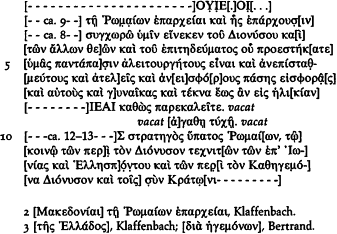
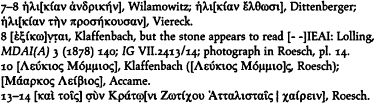
We see at a glance that G. Klaffenbach's restoration of lines 2-3, inserting reference to the province of Macedonia and a strange reference to "rule" of Greece, far from being beyond discussion (so Accame), is quite unwarranted. J.-M. Bertrand puts it nicely: "La tradition érudite s'est abandonnée à une restitution de G. Klaffenbach aussi spectaculaire qu'injustifiable."35 The restoration of proper names that do not appear elsewhere on the stone, and are not recommended by known formulae or certain parallels, is unacceptable epigraphic method. Such restoration certainly does not enjoy the status of evidence. But not only are the restorations uncertain; they are most unlikely.
[








thor was indeed a Roman, the Latin counterpart of the phrase that would have lain behind the Greek would be imperium populi Romani or Romanum ; but the imperium could extend far beyond the provinciae .
Nor does [






Second, a rough calculation from a photograph (the stone is lost, as noted above), which is based on the average size of the letters of line 3 and the reasonably certain width of the lines, shows that it is very unlikely that as many as ten full-width letters stood to the left of the preserved portion of this line. This makes [

Finally,







In sum, there are no parallels with which to restore the opening lines of IG VII.2413 with any kind of certainty, and until one emerges, it is useless to attempt restoration. What is certain is that this inscription is too fragmentary to be of any independent value in determining the status
of Greece from 146. The author of the letter evidently made some reference to the area of Roman control presumably the imperium Romanum , but we cannot base any major conclusions on this, since we do not know the context, nor do we know the subject of the verb

E. On the Date of IG V.1.1432/33
IG V.1.1432/33 was originally dated to the 30s and 40s A.D. by G. Kolbe in the corpus, then brought up first to 39 B.C. by Wilamowitz, and finally as early as the end of the second century B.C. by A. Wilhelm.41 A. Giovannini now returns to Kolbe's date (refined to A.D. 35-44) and is followed by, among others, L. and J. Robert and C. Habicht.42 It is disquieting that the legatus Augusti P. Memmius Regulus, with whom




F. The Consul Cn. Domitius Ahenobarbus of SEG XV.254
The date of SEG XV.254, which has been held to provide evidence of the existence of the Achaean League in 122, depends on the identification of the Cn. Domitius Ahenobarbus, named as consul under whom the Achaeans who set up the dedication served. It has proven all too easy to assume that this Cn. Domitius Ahenobarbus was the consul of 12244 —for we know that he fought in Transalpine Gaul. But this is a very spotty age for Roman prosopography, and it would be rash to assume that this was the only Cn. Domitius Ahenobarbus to fight against Gauls or Gallic peoples (among whom the Scordisci north of Macedonia are to be counted).
For example, the suffect consul of 162, Cn. Domitius Cn. f. Ahenobarbus, must have received one of the two provinces vacated by the ordinarii , one of which was Gaul.45 In the state of our evidence, we do not know what province another Cn. Domitius Cn. f. Ahenobarbus, consul in 96, held, but we do know of military activity in Gaul in the following year.46 The letterforms can probably help only to exclude another date that has found less favor: 192.47 We have no reason to suppose that if we knew as much about the consuls of 162 and 96 as we do about the consul of 1221 the last would be the only candidate; the sad state of our evidence cannot be used to support conclusions of such weight.
G. Notes on the Date of the Senatus Consultum Popillianum (Sherk 11)
This inscription, which has been taken "to record the Senate's ratification of the will of Attalus" as well as what is explicit in the text, "to guarantee his acts and those of his predecessors up to one day before his death,"48 was dated to 133 by T. Mommsen, who prepared the editio princeps.49 More recently, E. Badian and H. B. Mattingly have opted for 132. The date 129 was favored by D. Magie and has also received recent backing from A. N. Sherwin-White and E. S. Gruen.50
It is important that the decree apparently only refers back to the prior senatorial ratification of the acts of the Attalids and is not the act of ratification of the will itself (








This would remove any need to place this text early on in the crisis of the Aristonicus uprising. Gruen is quite right to insist that (



These points make it unlikely that the decree belongs in 133 or indeed at any time before Aristonicus was finally put down and arrangements could finally be made for the settlement of the provincia . To argue, as do J. Hopp and B. Schleub ner, that Rome knew of Aristonicus's revolt at the time but underestimated its gravity is only an attempt to save the hypothesis.55 In any case in 133 an issue of such importance should have been brought before the Senate not by a praetor but by a consul, namely, P. Mucius Scaevola, who was present in Rome for much of the year.56 Mattingly's "correction" of the prescript to make the consul of 132, P. Popillius C.f., the mover of the decree (reading




in lines 3 and 11) remains highly doubtful until the stone itself is found and reexamined; certainly there hardly seems enough space for the addition of

H. Chronological Notes on the Cappadocian Crisis in the 90s: Sulla's Eexpedition and Ariobarzanes' Expulsion
The Date of Sulla's Cappadocian Expedition
In 1959 E. Badian redated Sulla's Cappadocian expedition to 96, against the traditional date of 92. More recently, A. N. Sherwin-White has challenged Badian's chronology and reconstruction of the historical context of this event, and his view seems on the way to becoming the new orthodoxy.59 It is necessary therefore to defend at some length my continued adherence to Badian's view.
i) Put in its simplest terms, the problem is that our main narrative source for Cappadocian history at this time, Justin's epitome of Trogus, leaves
Sulla's escorting of Ariobarzanes to take up the Cappadocia throne entirely out of the picture. Justin does, however, mention two appropriate occasions for the event: when Ariobarzanes is first "named" by the Senate (38.2.8), and, after his subsequent forcible expulsion from Cappadocia by Tigranes, when the Senate decrees his restoration (38.3.3-4). The second of these possible contexts is dearly excluded because the Senate's order in this case went out to the legates M'. Aquillius and Mallius Malthinus (sic ), whose activities ca. 90 are well known inasmuch as they led directly to the outbreak of the Mithridatic War.60 Ariobarzanes' original accession to the throne is therefore the obvious choice prima facie. To assume that Sulla's expedition is not to be connected with any of the events mentioned by Justin, and thus of necessity to postulate yet a further expulsion of Ariobarzanes—not mentioned by Justin or directly attested by any other source—to set the stage for it61 can only be a last resort, to be adopted only if other evidence gives good reason to doubt this reconstruction.62
ii) The sequence of events in Appian's account of Ariobarzanes' peregrinations before the Mithridatic War (Mith . 10) is entirely consistent with Justin's. Ariobarzanes had fled to Rome from Cappadocia, which was under Mithridates' control; the Romans ordered Mithridates to depart in favor of Ariobarzanes, who seemed to have better title to the throne; Mithridates obeyed but then expelled from Bithynia Nicomedes IV, whose succession to his father had been confirmed by Rome; at the same time (


Justin believes that Ariobarzanes was expelled by Tigranes at about the same time as the accession of Nicomedes IV and his subsequent expulsion by Mithridates from the throne of Bithynia; and just as in Appian, it is this dual expulsion of Ariobarzanes and Nicomedes IV that leads directly to the Senate's order of 91 or 90 to M'. Aquillius to restore them to their
thrones.63 (See below for the problem of the date of this event.) Therefore, although Appian names the agents of Ariobarzanes' removal as Mithraas and Bagoas while Justin gives Tigranes, the conclusion must be that the references are to the same event; Mithraas and Bagoas were, likely enough, Tigranes' generals.64 If that is so, however, we are left with direct testimony to only one expulsion of Ariobarzanes from the throne before the arrival of Aquillius ca. 90. It begs the question to claim that Justin at 38.3.3 conflates two Armenian invasions of Cappadocia in the 90s.65
Justin and Appian tell essentially the same story and are mutually supportive. The assumption that one or the other is leaving out further expulsions and restorations of Ariobarzanes seems arbitrary and most dubious. Thus the line of interpretation sketched in (i) above is reinforced—that is, that only one dethroning of Ariobarzanes preceded the arrival of the senatorial commission (that he had been king before receiving Roman recognition is nowhere stated). This single expulsion, however, cannot have led to Sulla's intervention: it is too late, and in any case it was M'. Aquillius, not Sulla, who was given the job of restoring him on that occasion.
iii) Some objections Sherwin-White brings against Badian's reconstruction need to be considered.
First, Sherwin-White believes that the phrase used by Livy's epitomator to describe Sulla's mission (in regnum . . . reductus est ) implies that Ariobarzanes had already lost the throne and was now restored to it.66 To begin with, it is unwise to assume that the epitomator's wording is a reliable indication of the nature of the original: to take one instructive case in which Livy's text survives to refute him, he thinks that Aemilius Paulus created the province of Macedonia (Per . 45). Plutarch, on the other hand, unambiguously states that Sulla installed Ariobarzanes on the throne.67 The choice of Plutarch over Livy's epitomator ought to be easy. But in any case we should not make so much of the Periochae's phrase. Ariobarzanes had
fled to Rome by the time the Senate made its decision about the Cappadocian succession, so in any case he was being "restored"; further, his backers in Cappadocia and Rome certainly thought he possessed the right to the throne.68 Under these circumstances it is not surprising usage to write of restoration to a kingdom that was (allegedly) rightfully his. Similarly, an Athenian decree of ca. 175/174 speaks of the "restoration to the kingdom of his ancestors" of Antiochus IV, although in fact Eumenes II and Attalus had placed the royal claimant on the Seleucid throne;69 and Tigranes himself, sent by the Parthians, among whom he had been hostage, to succeed to the Armenian throne, is said by Justin to be ab eisdem in regnum paternum remissus (38.3.1). (Compare Andriscus, who persuaded the Thracian king Barsabas


Second, many Armenians were killed by Sulla during the operation (Plut. Sull . 5.3). For Sherwin-White, this implies that Tigranes had already conquered Sophene, creating a common border between Armenia and Cappadocia, an event that cannot be earlier than ca. 96/95, the probable date of Tigranes' accession.71 It is noteworthy that Sulla did not bring many Roman troops and relied on the assistance of allies72 —a highly unlikely procedure if Ariobarzanes had been expelled with the help of Tigranes, as Sherwin-White holds.73 But, in any case, does the presence of "many" Armenians indeed suggest a date for Sulla's campaign after 96? Tigranes' conquest of Sophene will indeed have made his own intervention in Cappadocia easier, and if we were to accept the general assumption (made even by Badian) that Armenians who skirmished with Sulla were Tigranes' men, this might force us to revise the absolute chronology downward
slightly, perhaps to ca. 95.74 But it is by no means implausible that Gordius and the other Cappadocians hostile to Ariobarzanes had Armenian friends—or mercenaries—even before Tigranes' accession.75 Nor should Armenia Minor be forgotten—a vassal state abutting Cappadocia, rich in horsemen, and under Mithridates' control by the time of the war with Rome.76 Sulla's engagement with Armenians in Cappadocia, therefore, is open to other explanations and does not by any means force a date later than 96 for the expedition, nor does it create any difficulty for Badian's reconstruction of the sequence of events (i.e., the insertion of Sulla's campaign into Justin's and Appian's narrative).77
Third, Sherwin-White, discussing the apparent regnal years on the Cappadocian royal coinage, concedes that "the coinage evidence remains enigmatic" but still believes it can show that Ariobarzanes ruled only three years before 91.78 However, the numismatic evidence is even more problematic than he allowed, and its interpretation is not yet on a sufficiently secure basis to have much weight in the reconstruction of these events.79 For all that, recent discussions of the question would place the changeover from Ariarathes IX to Ariobarzanes in 96 or 95.80
iv) No evidence, therefore, outweighs the positive arguments in (i) and (ii) above that (a ) Ariobarzanes was toppled from the Cappadocian throne only once, not twice, before the arrival of Aquillius's commission, with its inevitable corollary that (b ) Sulla escorted Ariobarzanes to Cappadocia to assume the throne for the first time after the Senate threw out the rival claims of Nicomedes' and Mithridates' candidates.
Absolute dates are more difficult to assign. While the precise date of Sulla's tenure of the urban praetorship remains uncertain, his evident haste to move up the ladder of the cursus would suggest a date closer to his military exploits in Numidia and Gaul rather than later.81 A praetorship
in 97, the earliest possible date in view of the lex annalis and his repulsa ,82 would be perfectly consistent with a provincial assignment in 96 and 95. At present it appears that the evidence of the Cappadocian regal coinage points toward the installation of Ariobarzanes ca. 96-95,83 although, as noted above, this cannot be pressed. The year 95 was one of pax domi forisque according to Julius Obsequens (50), but it is doubtful that Sulla's killing of numerous Cappadocians and Armenians would have disturbed the pax for Obsequens's purposes.84
The Date of Ariobarzanes' First Expulsion from the Throne
Orosius 6.1.28-2.1 is unhelpful evidence.85 Orosius dates the outbreak of the Mithridatic War to 662 A.U.C. (cf. 5.19.1), which would be 92 B.C. on the Varronian system, but synchronizes it with the outbreak of the civil war in the consulship of Sulla (88 B.C. ). (The same date and account is found in Eutropius 5.4-5.) The expulsion of Nicomedes that he describes is dearly the one with which, in effect, the war opened, also described by Appian at Mithridatica 19-20, not, as Sherwin-White appears to think, the one that preceded the mission of Aquillius (Mith . 10). But Orosius also accepts that the confrontation with Mithridates lasted thirty rather than forty years into the consulship of Cicero in 63—which would imply an opening date of 92. Unless the thirty years are only a round figure (see Pliny HN 7.97), it is tempting to suppose that whoever came up with the number was counting from the year in which Socrates Chrestus expelled
Nicomedes IV, and Mithraas and Bagoas expelled Ariobarzanes "around the same time" (above); but this can only be conjecture.
The Livian Periochae (74) suggest a date in 90 or 89 for the restoration of Ariobarzanes and Nicomedes.86 However, since the beginning of the war should be placed in 89,87 the restoration of the kings probably belongs no later than 90, as the events of Appian Mithridatica 11-19, including two separate attacks by Nicomedes on Mithridates, should be allotted at least two campaigning seasons. It is tempting to associate the senatus consultum of 94 against loans to foreign ambassadors with some appeal to the Senate regarding the quarrels of the kings, notorious for their use of bribery; if so, it is perhaps to be associated with an appeal to the Senate by the sons of Nicomedes Ill over the Bithynian succession.88
I. The Thracian Attack on Delphi and the Expedition of "L. Scipio"
At some time in Olympiad 174 (84/83-81/80 B.C. ), an incursion of Thracians, of whom the Maedi appear to have made up the strongest contingent, was able to penetrate Greece as far as Delphi.89 In Appian's Illyrica , we hear of an otherwise unattested campaign against the Maedi, Scordisci, and Dardani led by one L. Scipio in retaliation for an attack on Delphi. G. Daux's reconstruction has won general acceptance: the only L. Scipio active at the appropriate time is the Cinnan-Marian consul of 83; a praetorship in 86 would allow him to be proconsul in Macedonia and active there in 85 and 84, before his consulship in 83, when he opposed Sulla in Italy. The Thracian raid is thus dated to 84, and Scipio's campaign follows, still in the same year. Appian's reference to the passage of 32 years


spelled out the implications of this reconstruction for the history of Sulla's relations with the Senate during the Mithridatic campaign: L. Scipio, sent out by the Senate and thus "the Roman Government's representative," fought the same tribes that Sulla fought in the same year, without the two Romans coming to blows; before late in 85 Cinna and the Senate appear ready to cooperate with Sulla.91
There are difficulties that have thus far, it seems, escaped notice. Contra Badian, the Thracian raid, and thus "Scipio's" reprisal, cannot be dated before 84. Yet that makes the chronology very tight indeed: we need time in that single calendar year for the Thracians to penetrate into Greece (where was Scipio then?) and for Scipio to appear and respond with a strike into the territory of the Scordisci and yet return to Rome (apparently with his army, which he would hardly have left to Sulla) just ahead of Sulla, now in Greece, in time to take up the consulship for 83. What was the purpose of this extraordinary expedition? Whether it was to cooperate with Sulla or even to block him, why do we hear nothing of any contact between the two? Indeed, it is quite extraordinary that our relatively copious sources on the Mithridatic and Sullan civil wars never so much as mention this campaign, although Scipio and Sulla would on this reconstruction have been barely missing each other in their marches and countermarches in Greece and Macedonia during 85-84; while, on the other hand, our sole source for the campaign, Appian's Illyrica , makes no mention of Sulla or the Mithridatic wars. It is sobering that Appian is at his weakest and least informed in this particular book; and the introduction, where this reference appears, is the worst of a bad lot. Further, lists of the great conquerors of the Balkan tribes appear repeatedly in the epitomators of the Empire, yet L. Scipio is never found among them.92
The emendation of Appian's date of 32 to 302 years, positing that



chapter described the first major dash between the "Celtic" (in his view) Cimbri and Romans, centering on the battle of Arausio in 105 (section 4),95 it seems virtually certain that this campaign, not the capture of Rome in 386 (or 390), which he has not mentioned in this monograph, is to be understood as his reference point. The number may still be corrupt, but the proposed emendation is not attractive.
The supposed campaign of L. Scipio in 84 against the Maedi, Scordisci, and Dardani is therefore too problematic to be accepted. Nor is it easy to see, assuming that Appian is mistaken here, where precisely the confusion lies. Our other sources for the expansion of Roman power to the Danube are clear that after the Mithridatic War the first great push came under Ap. Claudius Pulcher in 77-76. Claudius, intriguingly, undertook an offensive against the Maedi and levied tribute on the Dardani, as Appian's "Scipio" is supposed to have done.96 Subsequently (75-73) C. Scribonius Curio again fought the Dardani and became the first Roman to reach the Danube. As it happens, the Danube plays a role in the Scipio story as well, for Appian says that he drove the remnants of the Scordisci to settle on islands in the river.97 Thirty-two years after Arausio brings us to 74 or 73. Although from C. Curio to L. Scipio is not the easiest of corruptions, it is far from implausible that such a slip occurred at some point in the transmission of the tradition.
In view of the great uncertainty about this supposed campaign, clearly little is gained by identifying the unknown Roman victor over "Galatae" whose campaign is commemorated in an inscribed epigram found in Magnesia (IG IX.2.1135) with L. Scipio.98 Other candidates and dates from the end of the second century B.C. to the first century A.D. have been championed, and no useful resolution of the controversy seems in sight.99
How to make sense of Appian Illyrica remains an open question. But the Thracian expedition of "L. Scipio" has not yet earned a place in Roman
history.100 Consequently, there is no hindrance to placing the Thracian expedition of the 174th Olympiad in a year subsequent to 84.101 It would fit best after Sulla's departure from the East early in 83.
J. Roman Intervention in Cyrenaica in the 70s
The development of Roman interests in Cyrene from the death of its last king in 96, though strictly outside the geographical limits of this study, helps us to understand Roman intervention in neighboring Cretan waters in the later 70s.
As far back as 96 King Apion had left Cyrene to the Roman people as his heir, but at the time the Senate seems to have done little more than to declare the cities of the former kingdom "free."102 Whether in the subsequent two decades Rome made any consistent effort to exploit the new possessions financially is controversial and quite obscure.103 But it is clear that despite the testament of King Apion, no Roman magistrate had been assigned Cyrene as a provincia before 75, when, Sallust tells us, "Publius Lentulus Marcellinus . . . was sent as quaestor to a new provincia , Cyrene" (H . 2.43 Maurenbrecher).104 L. Lucullus had visited Cyrene (as well as Crete and Egypt) on his ship-mustering expedition in 86 and had helped to settle stasis in the city, a festering problem throughout the region, but this had evidently not resumed any Roman claims to the area.105
A recent reexamination of the palimpsest that contains this fragment of Sallust has yielded important information, surprisingly passed over by the investigator himself in his publication. The text, as it is now established, seems to show that in 75 the Senate chose to assign Cyrene as a province only after rejecting the claims of two unidentified men who would be the Ptolemaic princes Auletes, now on the throne of Egypt since 80, and his younger brother, who held Cyprus at this time.106 Cicero mentions incidentally in the fourth Verrine oration an embassy to the Senate at precisely this time undertaken by Cleopatra Selene, probably the mother of Auletes and the Cypriot king, and her children by her Seleucid husband, among them the current claimant to the Syrian throne, Antiochus XIII Asiaticus. Cleopatra and her children attempted to claim the Egyptian throne as well as the Seleucid, but they were snubbed and permitted neither an audience with the Senate nor the privilege of dedicating offerings to Jupiter Optimus Maximus.107 We should note also that Auletes in 76/75 at last underwent his formal coronation, postponed for five years from his assumption of the throne in 80.108 The delay is surely linked to the recent testament of Ptolemy Alexander I (d. 87) or II (d. 80), which conferred the kingdom upon Rome109 ; but the end of Auletes' hesitation coincides intriguingly with the embassy of Cleopatra and the senatorial decision on Cyrene.
It is unlikely that these events are unrelated. I suggest that in the winter of 76-75 the Senate was confronted with a number of claims by rivals for the thrones of Egypt and Cyrene. The beginning of a new fiscal quinquennium in 75 may well have raised the issue of whether the outstanding Ptolemaic legacies—both Egyptian and Cyrenaican—should be accepted, just as it did precisely a decade later. Regarding Cyrene, it is significant that despite its passing to Rome by testament in 96 the Ptolemaic rivals evidently regarded the Roman claim to it still as an open issue. However, they were both disappointed, and now their dispute over its possession served as the impetus for Rome to assume control itself. But as we shall see, the decision was probably motivated by much more than mere determination to prevent Cyrene's falling into others' hands.
The sending of a quaestor to assert Roman control over an area claimed by testamentary fight is a novelty, later to provide a precedent for Cato's mission to Cyprus in 58.110 We do not strictly know whether Marcellinus received a successor in Cyrene; Sallust's reference to Cyrene as a nova provincia need hardly imply that the quaestor organized the "permanent annexation" of the area.111 The first Roman official attested in Cyrene after P. Marcellinus is Pompey's legate in 67, Cn. Cornelius Lentulus Marcellinus, who appears in a series of inscriptions from Cyrene in various, unfortunately mostly obscure, contexts, and after him, M. Iuventius Laterensis, quaestor there ca. 63.112 It has been properly noted that had there been a governor of Cyrene in 67 his name ought to have appeared in the contexts in which we find that of Cn. Marcellinus.113 As usual here again the "organizing" of a "province" at 75, 67, or any other time passes without direct attestation in our evidence, and such a conception is singularly unhelpful for understanding the peculiar character of Roman intervention in Cyrene at this time.114
The sudden concern of the Senate with Cyrene in 75, manifested by P. Marcellinus's quaestorian mission, has not been satisfactorily explained. An older view posits that the objective was above all cash with which to alleviate financial difficulties ostensibly implied by the acute grain shortage of 75.115 But the problem of the mid-70s does not seem to have been one simply of finances: the interruption of the grain routes by the pirates was even more fundamental.116 More recently the "annexation" of Cyrene—I should say rather the exertion of a measure of Roman control, though sporadic—has been interpreted as an attempt to control piracy, which was endemic off its shores as well as in Cilicia and Crete.117 But this may be to put the cart before the horse: sending a quaestor across the Mediterranean to far-off Cyrene was an odd way of combatting a problem that, before Antonius launched his ships in 74, was sorely vexing Italy itself and the Sardinian, Sicilian, Spanish, and North African grain routes. Nor is a quaestor a likely choice as commander of a significant military operation. The most plausible hypothesis is a modification of the first: Cyrene was "reclaimed" in 75 in order to supplement from one of the great cereal regions of the Mediterranean the grain supply of Rome, which, it is surely no accident, was severely strained precisely in 75, when a consul was actually attacked by an angry mob.118 The interest of the Senate in Cyrene was on this view extremely restricted in scope in the 70s and 60s, and it is therefore no surprise that signs of Rome's presence are so scarce and sporadic in subsequent years, for the crisis had receded—due surely to Antonius's efforts in the West as well as to the exploitation of Cyrene—by 73, when the state could again offer subsidized grain.119
K. Publius Cornelius Lentulus Spinther, tr. pl. 69
Despite the obvious and inescapable implication of Diodorus 40.1.2 that Lentulus Spinther blocked peace with Crete in 69 by means of a tribunician veto (

BIBLIOGRAPHY
Abbott, F. F., and A. C. Johnson. Municipal Administration in the Roman Empire . Princeton 1926.
Accame, S. Il dominio romano in Grecia dalla guerra acaica ad Augusto . Rome 1946.
Adams, J. P. "Aristonikos and the Cistophoroi." Historia 29 (1980) 302-14.
———. "Polybius, Pliny, and the Via Egnatia." In Philip II, Alexander the Great, and the Macedonian Heritage , edited by W. L. Adams and E. N. Borza, 269-302. Washington, D.C., 1982.
Alexander, M. C. "The Legatio Asiatica of Scaurus: Did It Take Place?" TAPA 111 (1981) 1-9.
———. Trials in the Late Roman Republic , 149 B.C. to 50 B.C. Toronto 1990.
Allen, R. E. The Attalid Kingdom: A Constitutional History . Oxford 1983.
Ameling, W. "Das Archontat in Bithynien und die lex provinciae des Pompeius." EA 3 (1984) 19-31.
———. "Drei Studien zu den Gerichtsbezirken der Provinz Asia in republikanischer Zeit." EA 12 (1988) 9-24.
———. "Lucius Licinius in Chios." ZPE 77 (1989) 98-100.
Amiotti, G. "I Greci ed il massacro degli Italici nell' 88 a.C." Aevum 54 (1980) 132-39.
Armstrong, D., and J. J. Walsh. "SIC 3 593: The Letter of Flamininus to Chyretiae." CP 81 (1986) 32-46.
Arnold, W. T. The Roman System of Provincial Administration . 3d ed. Oxford 1906.
Astin, A. E. "Diodorus and the Date of the Embassy to the East of Scipio Aemilianus." CP 54 (1959) 221-27.
———. Scipio Aemilianus . Oxford 1967.
———. "Politics and Policies in the Roman Republic." Inaugural Lecture, Queen's University, Belfast, 1968.
Ausbüttel, F. M. "Die Einrichtung der Provinz Gallia Cisalpina." Hermes 116 (1988) 117-22.
Awerbuch, M. "Imperium: Zum Bedeutungswandel des Wortes im staatsrechtlichen und politischen Bewußtsein der Römer." Archiv für Begriffsgeschichte 25 (1981) 162-84.
Badian, E. "The Treaty between Rome and the Achaean League." JRS 42 (1952) 76-80.
———. "Q. Mucius Scaevola and the Province of Asia." Athenaeum 34 (1956) 104-23.
———. "Notes on Provincial Governors from the Social War Down to Sulla's Victory." PACA 1 (1957) 1-18.
———. Foreign Clientelae (264-70 B.C. ). Oxford 1958.
———. "Sulla's Cilician Command." Athenaeum 37 (1959) 279-304.
———. "Forschungsbericht: From the Gracchi to Sulla (1940-1959)." Historia 11 (1962) 197-245.
———.·Studies in Greek and Roman History . Oxford 1964.
———. "M. Porcius Cato and the Annexation and Early Administration of Cyprus." JRS 55 (1965) 110-21.
———. "The Early Historians." In Latin Historians , edited by T. A. Dorey. London 1966.
———. "Notes on Provincia Gallia in the Late Republic." In Mélanges d'archéologie et d'histoire offerts à André Piganiol , edited by R. Chevallier, 2:908-18. Paris 1966.
———.·"The Testament of Ptolemy Alexander." RhM 110 (1967) 178-92.
———. Review of Corpus inscriptionum Latinarum: Auctarium and Inscriptiones Latinae liberae rei publicae: Imagines , edited by A. Degrassi. JRS 58 (1968) 240-49.
———. Roman Imperialism in the Late Republic . 2d ed. Oxford 1968.
———.·"Additional Notes on Roman Magistrates." Athenaeum 48 (1970) 3-14.
———. Titus Quinctius Flamininus: Philhellenism and Realpolitik . Cincinnati 1970.
———. Publicans and Sinners: Private Enterprise in the Service of the Roman Republic· Ithaca 1972, 1983.
———. "Lucius Sulla: The Deadly Reformer." In Essays on Roman Culture: The Todd Memorial Lectures , edited by A. J. Dunston, 35-74. Toronto and Sarasota 1976.
———. "Rome, Athens, and Mithridates." AJAH 1 (1976) 105-28 = Assimilation et résistance à la culture greco-romaine dans le monde ancien: Travaux du VI Congrès internationale d'études classiques, Madrid 1974 , 501-21. Paris 1976.
———. "Two Notes on the Roman Law from Cnidos: Dolus Malus." ZPE 35 (1979) 161-67.
———. Review of Untersuchungen zur Geschichte der letzten Attaliden , by J. Hopp. JRS 70 (1980) 202.
———. "The Death of Saturninus." Chiron 14 (1984) 101-47.
———. "Hegemony and Independence: Prolegomena to a Study of the Relations of Rome and the Hellenistic States in the Second Century B.C. " In Proceedings of the VIIIth Congress of the International Federation of the Societies of Classical Studies , 1:397-414. Budapest 1984.
———. "Q.OPPIVS.PR." ANSMN 29 (1984) 99-102.
———. Review of Roman Foreign Policy in the East , by A. N. Sherwin-White. Times Literary Supplement , August 24, 1984, p. 952.
———. "Three Non-Trials in Cicero." Kilo 66 (1984) 291-309.
———. "Two Notes on Senatus Consulta Concerning Pergamum." LCM 11 (1986) 14-16.
———. "E.H.L.N.R." MH 45 (1988) 203-18.
Bailey, D. R. Shackleton. Two Studies in Roman Nomenclature . Atlanta 1991.
Balsdon, J.P. V. D. "Q. Mucius Scaevola the Pontifex and Ornatio Provinciae." CR 51 (1937) 8-10.
Barlow, C. T. "The Roman Government and the Roman Economy, 92-80 B.C. " AJP 101 (1980) 202-19.
Baronowski, D. W. "Treaties of Military Alliance between Rome and Hellenistic States in the Last Three Centuries B.C. " Ph.D. diss., University of Toronto, 1982.
———. "Greece after 146 B.C. : Provincial Status and Roman Tribute." In


———. "The Provincial Status of Mainland Greece after 146 B.C. : A Criticism of Erich Gruen's Views." Klio 70 (1988) 448-60.
———. "Sub umbra foederis aequi." Phoenix 44 (1990) 345-69.
Baslez, M.-F. "Délos durant la première guerre de Mithridate." In Delo e l'Italia , edited by F. Coarelli, D. Musti, and H. Solin, 51-65. Rome 1982.
Bellinger, A. R. The End of the Seleucids . Transactions of the Connecticut Academy of Arts and Sciences 38, pp. 51-102. New Haven 1949.
Bengtson, H. Griechische Geschichte . 5th ed. Munich 1977.
van Berchem, D. "Les Italiens d'Argos et le déclin de Délos." BCH 86 (1962) 305-13.
Bernhardt, R. "Imperium und Eleutheria." Diss., Hamburg, 1971.
———. "Zwei Ehrenstatuen in Kaunus für L. Licinius Murena und seinen Sohn Gaius." Anadolu 16 (1972) 117-22.
———. "Die Entwicklung römischer Amici et Socii zu Civitates Liberae in Spanien." Historia 24 (1975) 411-24.
———. "Der Status des 146 v. Chr. unterworfenen Teils Griechenlands bis zur Einrichtung der Provinz Achaia." Historia 26 (1977) 62-73.
———. "Die Immunitas der Freistädte." Historia 29 (1980) 190-207.
———. Polis und römische Herrschaft in der späten Republik (149—31 v. Chr.) . Untersuch. ant. Lit. Gesch. 21. Berlin 1985.
Berthold, R. M. Rhodes in the Hellenistic Age . Ithaca 1984.
Bertoldi, M. E. "Un monumento commemorativo sul Campidoglio." In Studi di topografia romana , 39-53. Quad. Ist. Topogr. Ant. Univ. Roma 5. Rome 1968.
Bertrand, J.-M. "Rome et la Méditerranée orientale au premier siècle av. J.-C." In Rome et la conquête du monde méditerranéen, 264-27 av. J.-C ., edited by C. Nicolet, 2:789-845. Paris 1978.
———. "Langue grecque et administration romaine: De


Birks, P., A. Rodger, and J. S. Richardson. "Further Aspects of the Tabula Contrebiensis." JRS 74 (1984) 45-73.
Bleicken, J. "In provinciali solo dominium populi Romani vel Caesaris." Chiron 4 (1974) 359-414.
———. Die Verfassung der römischen Republik: Grundlagen und Entwicklung . Rev. ed. Paderborn 1982.
Boehringer, C. Zur Chronologie mittelhellenistischer Münzserien, 220-160 v. Chr . Berlin 1972.
Böttcher, K. "Die Einnahmen der römischen Republik im letzten Jahrhundert ihres Bestehens." Diss., Leipzig, 1915.
Bourguet, E. "Inscriptions de Delphes V." BCH 35 (1911) 171-76.
Bowersock, G. Augustus and the Greek World . Oxford 1965.
Bradeen, D. W. "Inscriptions from Nemea." Hesperia 35 (1966) 320-30.
Bradley, K. R. Slavery and Rebellion in the Roman World, 140 B.C. -70 B.C. Bloomington, Ind., 1989.
Braund, D. "Royal Wills and Rome." PBSR 51 (1983) 16-57.
———. Rome and the Friendly King . London, Canberra, and New York 1984.
———. "The Social and Economic Context of the Roman Annexation of Cyrenaica." In Cyrenaica in Antiquity , edited by G. Barker, J. Lloyd, and J. Reynolds, 319-25. BAR International Series 236. Oxford 1985.
Brennan, T. C. "Sulla's Career in the Nineties: Some Reconsiderations." Chiron 22 (1992) 103-58.
Briscoe, J. "Rome and the Class Struggle in the Greek States, 200-146 B.C. " Past and Present 36 (1967) 3-20 = Studies in Ancient Society , edited by M. I. Finley, 53-73. London 1974.
———. A Commentary on Livy, Books 34-37. Oxford 1981.
Broughton, T. R. S. "Roman Asia Minor." In An Economic Survey of Ancient Rome , 4:499-916. Baltimore 1938.
——— "Notes on Roman Magistrates, III." TAPA 77 (1946) 35-43.
———. "The Elogia of Julius Caesar's Father." AJA 52 (1948) 323-30.
———. The Magistrates of the Roman Republic . 3 vols. New York 1951-86.
———. "Notes on Roman Magistrates." Historia 2 (1953-54) 209-13.
———. "L. Manlius Torquatus and the Governors of Asia." AJP 111 (1990) 72-74.
Brulé, P. La piraterie crétoise hellénistique . Paris 1978.
Brunt, P. A. "Sulla and the Asian Publicans." Latomus 15 (1956) 17-25.
———. Italian Manpower, 225 B.C.-A.D. 14. Oxford 1971.
———. "Laus Imperii." In Imperialism in the Ancient World , edited by P. D. A. Garnsey and C. R. Whittaker, 159-91. Cambridge 1978.
———. "The Revenues of Rome." JRS 71 (1981) 161-72.
———. The Fall of the Roman Republic and Other Essays . Oxford 1988.
Bugh, G. R. "The Theseia in Late Hellenistic Athens." ZPE 83 (1990) 20-37.
———. "Athenion and Aristion of Athens." Phoenix 46 (1992) 108-23.
Bulin, R. K. "Untersuchungen zur Politik und Kriegführung Roms im Osten von 100-68 v. Chr." Diss., Munich, 1983.
Cagniart, P. F. "L. Cornelius Sulla in the Nineties: A Reassessment." Latomus 50 (1991) 285-303.
Camp, J., M. Ierardi, J. McInerney, K. Morgan, and G. Umholtz. "A Trophy from the Battle of Chaironeia of 86 B.C. " AJA 96 (1992) 443-55.
Candiloro, E. "Politica e cultura in Atene da Pidna alla guerra mitridatica." StudClassOrient 14 (1965) 134-76.
Cardinali, G. "La morte di Attalo III e la rivolta di Aristonico." In Saggi di storia antica a G. Beloch , 269-320. Rome 1910.
Carpenter, R., and A. Bon. Corinth . Vol. 3.2, The Defenses of Acrocorinth and the Lower Town· Cambridge, Mass., 1936.
Carrata Thomes, F. La rivolta di Aristonico e le origini della provincia romana d'Asia . Turin 1968.
Cary, M. "A Roman Arbitration of the Second Century B.C. " JRS 16 (1926) 194-200.
Chapot, V. La province romaine de l'Asie . Bibl. Ec. Hauts-Etudes 150. Paris 1904.
Chiranky, G. "Rome and Cotys, Two Problems·" Athenaeum 60 (1982) 461-81.
Cimma, M. R. Reges socii et amici populi Romani . Milan 1976.
Cloché, P. Thèbes de Béotie . Namur, n.d.
Coarelli, F. "Su alcuni proconsuli d'Asia tra la fine del II e gli inizi del I secolo a.C. e sulla politica di Mario in Oriente." In Epigrafia e ordine senatorio , 1:435-51. Tituli 4. Rome 1982.
Coarelli, F., D. Musti, and H. Solin, eds. Delo e l'Italia . Rome 1982.
Colin, G. Rome et la Grèce de 200 à 146 avant J.-C . Paris 1905.
Collart, P. "Les milliaires de la via Egnatia." BCH 100 (1976) 177-200.
Collins, F., III. "The Macedonians and the Revolt of Aristonicus." AncW 3 (1980) 83-87.
———. "Eutropius and the Dynastic Name Eumenes of the Pergamene Pretender Aristonicus." AncW 4 (1981) 39-43.
Condurachi, E. "Kotys, Rome et Abdère." Latomus 29 (1970) 581-94.
Corbato, C. "Un'iscrizione di Demetriade." RivFil 31 (1953) 132-42.
Cotton, H. M. "A Note on the Organization of Taxfarming in Asia Minor." Latomus 45 (1986) 367-73.
Crawford, M. H. Roman Republican Coinage . 2 vols. Cambridge 1974.
———. "Rome and the Greek World: Economic Relationships." EconHistRev 302 (1977) 42-52.
——— Coinage and Money under the Roman Republic . Berkeley 1985.
———. "Origini e sviluppi del sistema provinciale romano." In Storia di Roma , edited by G. Clemente, F. Coarelli, and E. Gabba, 2.1:91-121. Turin 1990.
Crawford, M. H., and J. Reynolds. "Rome and Tabae," GRBS 15 (1974) 289-93.
Cuq, E. "Le sénatus-consulte de Délos de l'an 166 avant notre ère." MémAcInscr 39 (1912) 139-61.
Dahlheim, W. Struktur und Entwicklung des römischen Völkerrechts . Munich 1968.
———. Gewalt und Herrschaft: Das provinziale Herrschaftssystem der römischen Republik . Berlin 1977.
Danov, C. M. "Die Thraker auf dem Ostbalkan von der hellenistischen Zeit bis zur Gründung Konstantinopels." ANRW II.7.1 (1979) 21-185.
Daux, G. "Notes de chronologie delphique." BCH 57 (1933) 68-97.
———. Delphes au II e et au Ier siècle. Paris 1936.
———. Chronologie delphique . Paris 1943
———. "La milliaire de la via Egnatia au Musée du Louvre." Journal des savants , 1977, 145-63.
Davies, J. K. "Cultural, Social, and Economic Features of the Hellenistic World." CAH 2 7.1 (1984) 257-320.
Day, J. An Economic History of Athens under Roman Domination . New York 1942.
Degrassi, A. "Le dediche di populi e re asiatici al populo Romano a Giove Capitolino." BCAR 74 (1951-52) 19-47.
Deininger, J. Der politische Widerstand gegen Rom in Griechenland, 217-86 v. Chr . Berlin 1971.
De Laet, S. J. Portorium . Bruges 1949.
Delplace, C. "Le contenu social et économique du soulèvement d'Aristonicos: Opposition entre riches et pauvres?" Athenaeum 66 (1978) 20-53.
Deppert-Lippitz, B. Die Münzprägung Milets vom vierten bis zum ersten Jahrhundert v. Chr . Frankfurt 1984.
Derow, P.S. Review of Der politische Widerstand gegen Rom in Griechenland , by J. Deininger. Phoenix 26 (1972) 303-11.
———. "Polybius, Rome, and the East." JRS 69 (1979) 1-15.
———. "Polybius." In Ancient Writers: Greece and Rome , edited by T. J. Luce, 1:525-39. New York 1982.
———. Review of A Historical Commentary on Polybius , vol. 3, by F. W. Walbank. JRS 74 (1984) 231-35.
———. "Rome, the Fall of Macedon, and the Sack of Corinth." CAH 2 8 (1989) 290-323.
———. "Pharos and Rome." ZPE 88 (1991) 261-70.
Desideri, P. "Posidonio e la guerra mitridatica." Athenaeum 51 (1973) 3-29, 237-69.
Dinsmoor, W. B. The Archons of Athens in the Hellenistic Age . Cambridge, Mass., 1931.
Donati, A. "I romani nell' Egeo: I documenti dell' età repubblicana." Epigraphica 27 (1965) 3-59·
Dow, S. "The Lists of Athenian Archontes." Hesperia 3 (1934) 140-90.
———. Prytaneis: A Study of the Inscriptions Honoring the Athenian Councillors . Hesperia Suppl. 1. Athens 1937.
———. "Archons of the Period after Sulla." In Commemorative Studies in Honor of T. L. Shear , 116-25. Hesperia Suppl. 8. Athens 1949.
———. "Corinthiaca." HSCP 60 (1951) 81-100.
Doyle, M. W. Empires· Ithaca and London, 1986.
Dreizehnter, A. "Pompeius als Stäidtegründer." Chiron 5 (1975) 213-45.
Drew-Bear, T. "Deux décrets hellénistiques d'Asie Mineure." BCH 96 (1972) 435-71.
———· "Three Senatus Consulta Concerning the Province of Asia." Historia 21 (1972) 75-87.
———. Nouvelles inscriptions de Phrygie . Zutphen 1978.
Drumann, W., and P. Groebe. Geschichte Roms in seinem Übergabe von der republikanischen zur monarchischen Verfassung . 6 vols. 2d ed. Berlin 1899-1929.
Dubuisson, M. Le latin de Polybe . Paris 1985.
Dunant, C., and J. Pouilloux. Recherches sur l'histoire et les cultes de Thasos: Études thasiennes . 5 Paris 1958.
Ebel, C. Transalpine Gaul: The Emergence of a Roman Province· Leiden 1976.
Eckstein, A. M. "Polybius, Syracuse, and the Politics of Accommodation." GRBS 26 (1985) 265-82.
———. Senate and General: Individual Decision-Making and Roman Foreign Relations, 264-194 B.C. Berkeley 1987.
———· "Rome, the War with Perseus, and Third Party Mediation." Historia 37 (1988) 414-44.
———. "Notes on the Birth and Death of Polybius." AJP 113 (1992) 387-406.
Ehrhardt, N. "Konstanten in den politischen Beziehungen zwischen Thrakern und Griechen auf dem Balkan." Eos 76 (1988) 289-304.
Eilers, C. F. "Cn. Domitius and Samos: A New Extortion Trial (IGR 4, 968)" ZPE 89 (1991) 167-78.
Engelmann, H., and D. Knibbe. "Das Zollgesetz der Provinz Asia: Eine neue Inschrift aus Ephesos." EA 14 (1989) 1-206.
Errington, R. M. The Dawn of Empire . London 1971.
———. "

Etienne, R., and D. Knoepfler. Hyettos de Béotie et la chronologie des archontes fédéraux entre 250 et 171 avant J.-C . BCH Suppl. 3. Paris 1976.
Evans, R. J. "The Denarius Issue of Caldus III VIR and Associated Problems·" AHB 5 (1991) 129-34.
Feger, R. "Cicero und die Zerstörung Korinths." Hermes 80 (1952) 436-56.
Ferguson, W. S. The Athenian Secretaries . Cornell Stud. Class. Phil. 7. Ithaca 1898.
———. "The Oligarchic Revolution at Athens of the Year 103/102 B.C. " Kilo 4 (1904) 1-17.
———. The Priests of Asklepios . U. Cal. Pub. Class. Phil· 1.5. Berkeley 1907.
———. "Researches in Athenian and Delian Documents III." Kilo 9 (1909) 304-40.
———. Hellenistic Athens· New York 1911.
———. Athenian Tribal Cycles in the Hellenistic Age . Cambridge, Mass., 1932.
———. Review of Untersuchungen zur Magistratur in Athen , by U. Kahrstedt. AJP 59 (1938) 229-37.
Ferrary, J.-L. "Recherches sur la législation de Saturninus et de Glaucia." MEFRA 89 (1977) 619-60.
———. "Rome, les Balkans, la Grèce et l'Orient au IIe siècle avant J.-C." In Rome et la conquête du monde méditerranéen , edited by C. Nicolet, 2:729-88. Paris 1978.
———. "Délos vers 58 av. J.-C." In Insula sacra , edited by J.-C. Dumont, J.-L. Ferrary, P. Moreau, and C. Nicolet, 35-44. Rome 1980.
———. "La lex Antonia de Termessibus." Athenaeum 63 (1985) 419-57.
———. Philhellénisme et impérialisme: Aspects idéologiques de la conquête romaine du monde hellénistique . Rome 1988.
———. "Traités et domination romaine dans le monde hellénique." In I trattati nel mondo antico: Forma, ideologia, funzione , edited by L. Canfora, M. Liverani, and C. Zaccagnini, 217-35. Rome 1990.
———. "Le statut des cités libres dans l'empire romain à la lumière des inscriptions de Claros." CRAI , 1991, 557-77.
Feyel, M. Contributions à l'ßpigraphie béotienne . Le Puy 1942.
———. "Paul-Emile et le synedrion macédonien." BCH 70 (1946) 187-98.
Fossey, J. M. "The Cities of the Kopaïs in the Roman Period." ANRW II.7.1 (1979) 549-91.
Foucart, P. "La formation de province romaine d'Asie." MémAcInscr 37.1 (1904) 297-339.
———. "Les campagnes de M. Antonius Creticus contre les pirates, 74-71." Journal des savants , 1906, 569-81.
Frank, T. An Economic Survey of Ancient Rome· Vol. 1. Baltimore 1933.
Franke, P. R.

Fraser, P.M. Ptolemaic Alexandria . 2 vols. Oxford 1972.
Frei, P. "Späte Zeugnisse für frühen römischen Imperialismus?" MH 32 (1975) 73-80.
French, D. H. "The Roman Road-System of Asia Minor." ANRW II.7.2 (1980) 698-729.
Fuks, A. "The Bellum Achaicum and Its Social Aspect." JHS 90 (1970) 78-89.
———. "Social Revolution in Dyme in 116-114 B.C.E. " Scripta Hierosolymitana 23 (1972) 21-27.
———. Social Conflict in Ancient Greece . Leiden 1984.
Gabba, E. "Le origini della guerra sociale e la vita politica romana dopo 1'89 a.C." Athenaeum 32 (1954) 41-114.
———. Appiani Bellorum civilium liber primus . 2d ed. Florence 1967.
Gäbler, H. "Zur Münzkunde Makedoniens, III." ZfN 23 (1902) 141-67.
———. Die antiken Münzen von Makedonia und Paionia . Vol. 3.2. Berlin 1935.
Gallagher, J., and J. Robinson· "The Imperialism of Free Trade." EconHistRev.2 (1953) 1-25.
Gallet, L. "Essai sur le senatus-consulte 'De Asclepiade sociisque.'" RHD 164 (1937) 242-93, 387-425.
Garnsey, P. "The Criminal Jurisdiction of Governors." JRS 58 (1968) 51-59.
Garnsey, P., T. Gallant, and D. Rathbone. "Thessaly and the Grain Supply of Rome during the Second Century B.C. " JRS 74 (1984) 30-44.
Garnsey, P., and D. Rathbone. "The Background to the Grain Law of Gaius Gracchus." JRS 75 (1985) 20-25.
Geagan, D. J. The Athenian Constitution after Sulla . Hesperia Suppl. 12. Princeton 1967.
———. "Roman Athens: Some Aspects of Life and Culture I, 86 B.C.-A.D. 267." ANRW II.7.1 (1979) 371-437.
Gelzer, M. Review of Il dominio romano in Grecia , by S. Accame. Gnomon 21 (1949) 20-25.
———. Pompeius . 2d ed. Munich 1959.
Giovannini, A. Rome et la circulation monétaire en Grèce au II e siècle av. J.-C. Basel 1978.
Giovannini, A., and E. Grzybek. "La lex de piratis persequendis." MH 35 (1978) 33-47.
Giuliani, C. F. "Ricerche per la ricomposizione di un monumento commemorativo sul Campidoglio." In Studi di topografia romana , 55-61. Quad. Ist. Topogr. Ant. Univ. Roma 5. Rome 1968.
Glew, D. "Mithridates Eupator and Rome: A Study of the Background of the First Mithridatic War." Athenaeum 55 (1977) 380-405.
———. "Between the Wars: Mithridates Eupator and Rome, 85-73 B.C. " Chiron 11 (1981) 109-30.
———. "The Cappadocian Expedition of Nicomedes Ill Euergetes, King of Bithynia." ANSMN 32 (1987) 23-55.
———. "Publicans or Sinners? Why the Battaces Came to Rome in 102 B.C. " Klio 69 (1987) 122-37.
Gordon, A. "The Latin Epigram at Corinth." In Corinthiaca: Studies in Honor of D. A. Amyx , 50-53. Columbia 1986.
Gossage, A. G. "The Comparative Chronology of Inscriptions Relating to Boeotian Festivals in the First Half of the First Century B.C. " BSA 70 (1975) 115-34.
Graindor, P. Athènes sous Auguste . Cairo 1927.
Gray, E. W. Review of Roman Documents from the Greek East . by R. K. Sherk CR 22 (1972) 87-93.
Green, P. Alexander to Actium: The Historical Evolution of the Hellenistic Age . Berkeley and Los Angeles 1990.
Greenidge, A. H. J. The Legal Procedure of Cicero's Time· Oxford 1901.
Greenidge, A. H. J., and A.M. Clay. Sources for Roman History, 133-70 B.C. 2d ed. Revised by E. W. Gray· Oxford 1960.
Griffith, G. T. The Mercenaries of the Hellenistic World . Cambridge 1935.
Groag, E. Die Reichsbeamten von Achaia bis auf Diokletian . Vienna 1939.
Gruebner, H.A. Coins of the Roman Republic in the British Museum . 2 vols. London 1910.
Gruen, E. S. "The Dolabellae and Sulla." AJP 87 (1966) 385-99.
———. Roman Politics and the Criminal Courts, 149-78 B.C. Cambridge, Mass., 1968.
———. The Last Generation of the Roman Republic . Berkeley 1974.
———. "Class Conflict and the Third Macedonian War." AJAH 1 (1976) 29-60.
———. "The Origins of the Achaean War." JHS 96 (1976) 46-69.
———. "Rome and the Seleucids in the Aftermath of Pydna." Chiron 6 (1976) 73-95.
———. The Hellenistic World and the Coming of Rome . 2 vols. Berkeley 1984.
———. Culture and National Identity in Republican Rome . Ithaca 1992.
Grzybek F. "Roms Bündnis mit Byzanz (Tac. Ann . 12.62)." MH 37 (1980) 50-59.
Guarducci, M. "Nota di epigrafia Spartana." RivFil 60 (1932) 84-86.
———. "Le offerte dei conquistatori romani ai santuari della Grecia." Rend-PontAcc 13 (1937) 54-58.
Habicht, C. "New Evidence on the Province of Asia." JRS 65 (1975) 64-91.
———. "Zur Geschichte Athens in der Zeit Mithridates VI." Chiron 6 (1976) 127-42.
———. "Makedonen in Larisa?" Chiron 13 (1983) 21-32.
———. Pausanias's Guide to Ancient Greece . Berkeley 1985.
———. "The Eponymous Archons of Athens from 159/8 to 141/0 B.C. " Hesperia 57 (1988) 237-47.
———. "The Seleucids and Their Rivals." CAH 2 8 (1989) 324-87.
Hackl, U. Senat und Magistratur in Rom vor der Mitte der 2. Jahrhundert vor Chr. bis zur Diktatur Sullas . Kallmünz 1982.
Hammond, N. G. L. "The Western Part of the Via Egnatia." JRS 64 (1974) 185-94.
Hammond, N. G. L., G. T. Griffith, and F. W. Walbank. A History of Macedonia· 3 vols. Oxford 1972-88.
Hammond, N. G. L., and M. Hatzopoulos. "The Via Egnatia in Western Macedonia, I." AJAH 7 (1982 [1985]) 128-49.
———. "The Via Egnatia in Western Macedonia, II." AJAH 8 (1983 [1986]) 48-53.
Hansen, E. V. The Attalids of Pergamon· 2d ed. Ithaca 1971.
Harris, W. V. War and Imperialism in Republican Rome, 327-70 B.C. Oxford 1979.
———. "Roman Expansion in the West." CAH 2 8 (1989) 107-62.
Hassall, M., M. Crawford, and J. Reynolds. "Rome and the Eastern Provinces at the End of the Second Century B.C. " JRS 64 (1974) 195-220.
Hatzfeld, J. "L. Calpurnius L. f. Piso, proconsul de Grèce." BCH 33 (1909) 522-25.
———.·"Les Italiens résidant à Délos mentionnés dans les inscriptions de l'île." BCH 36 (1912) 1-218.
———· Les trafiquants Italiens dans l'orient hellénique . Et. Ecole Franç. Ath. Rome 115. Paris 1919.
Hatzopoulos, M. D., and L. D. Loukopoulou. Two Studies in Ancient Macedonian Topography . Meletemata 3. Athens 1987.
Heil, M. "Einige Bemerkungen zum Zollgesetz aus Ephesos." EA 17 (1991) 9-18.
Helliesen, J. M. "Andriscus and the Revolt of the Macedonians, 149-148 B.C. " Ancient Macedonia 4 (1986) 307-14.
Hermann, K. F. Gesammelte Abhandlungen zur classischen Literatur und Alterthumskunde . Göttingen 1849.
Herrmann, P. Ergebnisse einer Reise in Nordost-Lydien . Denkschr. Akad. Wien 80. Vienna 1962.
———. "Antiochus der Grosse und Teos." Anadolu 9 (1965 [1967]) 22-160.
Hertzberg, G. F. Die Geschichte Griechenlands unter der Herrschaft der Römer . Vol. 1. Halle 1866.
Heuss, A. Die völkerrechtliche Grundlage der römischen Aussenpolitik in republikanischer Zeit . Klio Suppl. 31. Leipzig 1933.
Hill H. "Roman Revenues from Greece after 146 B.C. " CP 41 (1946) 35-42.
———. The Roman Middle Class in the Republican Period . Oxford 1952.
Hinrichs, F. T. "Die lateinische Tafel von Bantia und die 'Lex de Piratis.' " Hermes 98 (1970) 471-502.
Holleaux, M. "Epigraphica." REG 11 (1898) 250-78.
———. "Observations sur une inscription de Lébadeia." BCH 30 (1906) 469-81.
———.

———. "Textes greco-romains." REA 19 (1917) 77-97.
———.·"Etudes d'histoire hellénistique X: Le décret de Bargylia en l'honneur de Poseidonios." REA 21 (1919) 1-19.
———. Etudes d'épigrafie et d'histoire grecques . 6 vols. Paris 1938-68.
Hopp, J. Untersuchungen zur Geschichte der letzten Attaliden . Munich 1977.
Horn, H. Foederati . Frankfurt 1930.
Hoyos, B. D. "Lex Provinciae and Governor's Edict." Antichthon 7 (1973) 47-53.
Jacquemin, A., and D. Laroche. "Notes sur trois piliers delphiques." BCH 106 (1982) 191-218.
Jameson, S. "Pompey's Imperium in 67: Some Constitutional Aspects." Historia 19 (1970) 539-60.
Janke, M. "Historische Untersuchungen zu Memnon von Herakleia." Diss., Würzburg, 1963.
Jashemski, W. F. The Origins and History of the Proconsular and the Propraetorian Imperium to 27 B.C. Chicago 1950.
Jolowicz, H. F. Historical Introduction to the Study of Roman Law . Cambridge 1932.
Jones, A. H. M. "Civitates Liberae et Immunes in the East." In Anatolian Studies Presented to W. H. Buckler , edited by W. M. Calder and J. Keil, 103-17. Manchester 1939.
———. The Greek City from Alexander to Justinian . Oxford 1940.
———. The Cities of the Eastern Roman Provinces . 2d ed. Oxford 1971.
Jones, C. P. "Diodoros Pasparos and the Nikephoria of Pergamon." Chiron 4 (1974) 183-205.
———. "Three Foreigners in Attica." Phoenix 32 (1978) 222-34.
———. "A Letter to Aphrodisias in Caria." EMC 29 (1985) 309-17.
Jonkers, E. J. Social and Economic Commentary on Cicero's De Imperio Cn. Pompei . Leiden 1959.
Kähler, H. Der Fries yore Reiterdenkmal des Aemilius Paullus in Delphi· Berlin 1965.
Kallet-Marx, R. M. "Asconius 14-15 Clark and the Date of Q. Mucius Scaevola's Command in Asia." CP 84 (1989) 305-12.
———. "The Trial of Rutilius Rufus." Phoenix 44 (1990) 122-39.
———. "Q. Fabius Maximus and the Dyme Affair." CQ 45 (1995).
Kanatsoulis, D. "


Kapetanopoulos, E. "Salamis and Julius Nikanor." Hellenika 33 (1981) 217-37.
Keaveney, A. "Deux dates contestées de la carrière de Sylla." EtCl 48 (1980) 149-59.
———. "Roman Treaties with Parthia circa 95-circa 64 B.C. " AJP 102 (1981) 195-212.
———. Sulla: The Last Republican· London 1982.
———. "Young Pompey: 106-79 B.C. " AntCl 51 (1982) 111-39.
———. "Studies in the Dominatio Sullae." Klio 65 (1983) 185-208.
———. "Who Were the Sullani?" Klio 66 (1984) 114-50.
———. Lucullus: A Life· London and New York 1992.
Keramopoullos, A.

———. "

Kidd, L G. Posidonius . Vol. 2, The Commentary . Cambridge 1988.
Kienast, D. "Entstehung und Aufbau des römischen Reiches." ZSS 85 (1968) 330-67.
———. "Eine Silbermünze aus der Zeit des Aristonikoskrieges." Historia 26 (1977) 250-52.
Klaffenbach, G. "Symbolae ad historiam collegiorum artificum bacchiorum." Diss., Berlin, 1914.
———. "Sisennas Staathalterschaft von Makedonien." Hermes 51 (1916) 475-77.
Kleiner, F. S. "The Dated Cistophori of Ephesus." ANSMN 18 (1972) 17-32.
———. "Hoard Evidence and the Late Cistophori of Pergamum." ANSMN 23 (1978) 77-105.
Kleiner, F. S., and S. P. Noe. The EarIy Cistophoric Coinage . New York 1977.
Knapp, R. C. Aspects of the Roman Experience in Iberia, 206-100 B.C. Valladolid 1977.
Knibbe, D. "Die Gesandtschaftsreise des jüngeren Scipio Africanus im Jahre 140 v. Chr.: Ein Höhepunkt der Weltreichspolitik Roms im 2. Jahrhundert." JÖAI 45 (1960) 35-38.
Knibbe, D., and W. Alzinger. "Ephesos vom Beginn der römischen Herrschaft in Kleinasien bis zum Ende der Prinzipätszeit." ANRW II.7.2 (1980) 748-830.
Knoepfler, D. "L. Mummius Achaicus et les cités du golfe euboïque: A propos d'une nouvelle inscription d'Erétrie." MH 48 (1991) 252-80.
Kolbe, W. "Das griechische Bundesbürgerrecht der hellenistischen Zeit." ZSS 49 (1929) 129-54.
Kötnig I. Die Meilensteine der Gallia Narbonensis . Berlin 1970.
Kontorini, V. Inscriptions inédites relatives à l'histoire et aux cultes de Rhodes au II e et au Ier s. av. J.-C. Rhodiaka 1. Archeologia Transatlantica 6. Louvain 1983.
Kougeas, S. V.


Koumanoudis, S. N.

Kramolisch, H. Demetrias II: Die Strategen des thessalischen Bundes vom Jahr 196 v. Chr. bis zum Ausgang der römischen Republik . Beiträge zur Ur- und Frühgeschichtlichen Archäologie des Mittelmeer-Kulturraumes 18. Bonn 1978.
Kunze, E. Fünfter Bericht über die Ausgrabungen in Olympia· Berlin 1956.
Laidlaw, W. A. A History of Delos . Oxford 1933.
Lambrino, S. "Inscription latine de Callatis." CRAI , 1933, 278-88.
Laronde, A. Cyrène et la Libye hellénistique . Paris 1987.
———. "La Cyrénaïque romaine, des origines à la fin des Sévères (96 av. J.-C.-235 ap. J.-C.)." ANRW II.10.1 (1988) 1006-64.
Larsen, J. A. O. "Roman Greece." In An Economic Survey of Ancient Rome , edited by T. Frank, 4:239-498. Baltimore 1938.
———. "Representative Democracy in Hellenistic Federalism." CP 40 (1945) 65-97.
———. "Foreign Judges in Cicero ad Atticum vi, 1, 15." CP 43 (1948) 187-90.
———. "Concilium in Livy xlv. 18.6-7 and the Macedonian Synedria." CP 44 (1949) 73-90.
———. "The Araxa Inscription and the Lycian Confederacy." CP 51 (1956) 151-69.
———. Greek Federal States . Oxford 1968.
Lauffer, S. Die Bergwerksklaven von Laureion . 2d ed. Forsch. zur ant. Sklaverei 11. Wiesbaden 1979.
Lemerle, P. Philippes et la macédoine orientale à l'époque chrétienne et byzantine . Paris 1945.
Lewis, D. M. "The Chronology of the Athenian New Style Coinage." NC.7 (1962) 276;-300.
Lewis, R. G. "Sulla and Smyrna." CQ 41 (1991) 126-29.
Liebmann-Frankfort, T. "Valeur juridique et signification politique des testaments faits par les rois hellénistiques en faveur des Romains." RIDA 13 (1966) 73-94.
———. La frontière orientale dans la politique extérieure de la République romaine . Mem. Acad. Roy. Belg. 59.5. Brussels 1969.
———. "La 'provincia Cilicia' et son integration dans l'empire romain." In Hommages à Marcel Renard , edited by J. Bibauw, 2:447-57. Brussels 1969.
Linderski, J. "The Surname of M. Antonius Creticus and the Cognomina ex victis gentibus." ZPE 80 (1990) 157-64.
Lintott, A. W. "Mithridatica." Historia 25 (1976) 489-91.
———. "Notes on the Roman Law Inscribed at Delphi and Cnidos." ZPE 20 (1976) 66-82.
———. "The Capitoline Dedications to Jupiter and the Roman People." ZPE 30 (1978) 137-44.
———. "What Was the Imperium Romanum?" GR n.s. 28 (1981) 53-67.
———. Imperium Romanum: Politics and Administration . London 1993.
Luce, T. J. "Marius and the Mithridatic Command." Historia 19 (1970) 161-94.
MacKay, P. A. "Bronze Coinage in Macedonia, 168-166 B.C. " ANSMN 14 (1968) 5-13.
———. "The Coinage of the Macedonian Republics." In Ancient Macedonia , 1:256-64. Salonica 1968.
———. "Macedonian Tetradrachms of 148-147 B.C. " ANSMN 14 (1968) 15-40.
Magie, D. "Rome and the City-States of Western Asia Minor from 200 to 133 B.C. " In Anatolian Studies Presented to W. H. Buckler , edited by W. M. Calder and J. Keil, 161-86. Manchester 1939.
———. Roman Rule in Asia Minor . 2 vols. Princeton 1950.
Malitz, J. Die Historien des Poseidonios . Zetemata 79. Munich 1983.
Marasco, G. "Roma e la pirateria cilicia." RivStorIt 99 (1987) 122-46.
Marchetti, P. Review of Rome et la circulation monétaire en Grèce , by A. Giovannini. RBN 125 (1979) 189-94.
Marek, C. Die Proxenie . Frankfurt 1984.
Maróti, E. "Der Sklavenmarkt am Delos und die Piraterie." Helikon 9-10 (1969-70) 24-42.
———. "On the Problem of M. Antonius Creticus' imperium infinitum." Acta Antiqua 19 (1971) 259-71.
Marquardt, J. Römische Staatsverwaltung . 3 vols. Leipzig 1881-85.
Marshall A. J. "The Structure of Cicero's Edict." AJP 85(1964) 185-91.
———. "Governors on the Move." Phoenix 20 (1966) 231-46.
———. "Friends of the Roman People." AJP 89 (1968) 39-55.
———. "Pompey's Organization of Bithynia-Pontus: Two Neglected Texts." JRS 58 (1968) 103-9.
———. "Romans under Chian Law." GRBS 10 (1969) 255-71.
———. "The Survival and Development of International Jurisdiction in the Greek World under Roman Rule." ANRW II.13 (1980) 626-61.
Marshall B. A. "The lex Plotia agraria." Antichthon 6 (1972) 43-52.
———. "The Date of Q. Mucius Scaevola's Governorship of Asia." Athenaeum 54 (1976) 117-30.
Martin, D. G. "Greek Leagues in the Later Second and First Centuries B.C. " Ph.D. diss., Princeton University, 1975.
Martin, T. R., and E. Badian. "Two Notes on the Roman Law from Cnidos: A Note on the Text of the Law." ZPE 35 (1979) 153-60.
de Martino, F. Storia della costituzione romana . 6 vols. Naples 1951-72.
———. "Il Senatusconsultum de agro pergameno." PP 210 (1983) 161-90.
Mason, H. J. Greek Terms for Roman Institutions: A Lexicon and Analysis . Toronto 1974.
Mattingly, H. B. "Notes on Some Roman Republican Moneyers." NC 97 (1969) 95-105.
———. "The Two Republican Laws of the Tabula Bembina." JRS 59 (1969) 129-43.
———. "Some Third Magistrates in the Athenian New Style Coinage." JHS 91 (1971) 85-93.
———. "The Date of the Senatus Consultum de agro Pergameno." AJP 93 (1972) 412-23.
———. "L. Julius Caesar, Governor of Macedonia." Chiron 9 (1979) 147-67.
———. "M. Antonius, C. Verres, and the Sack of Delos by the Pirates." In


———. "Rome's Earliest Relations with Byzantium, Heraclea Pontica, and Callatis." In Ancient Bulgaria , edited by A.G. Poulter, 1:239-52. Nottingham 1983.
———. "Scipio Aemilianus and the Legacy of Attalus III." LCM 10 (1985) 117-19.
———. "Scipio Aemilianus' Eastern Embassy." CQ n.s. 36 (1986) 491-95.
McGing, B.C. "Appian, Manius Aquillius, and Phrygia." GRBS 21 (1980) 35-42.
———. "The Date of the Outbreak of the Third Mithridatic War." Phoenix 38 (1984) 12-18.
———. The Foreign Policy of Mithridates VI Eupator, King of Pontus . Mnemosyne Suppl. 89. Leiden 1986.
McGushin, P. Sallust: The Histories . Vol. 1, Books i-ii . Oxford 1992.
Mellano, L. D. Sui rapporti tra governatore provinciale e giudici locali alla luce delle Verrine . Milan 1977.
Mellor, R. Q EA PW MH: The Worship of the Goddess Roma in the Greek World . Göttingen 1975.
———. "The Dedications on the Capitoline Hill." Chiron 8 (1978) 319-30.
Meritt, B. D., and J. S. Traill. The Athenian Agora· Vol. 15, Inscriptions: The Athenian Councillors . Princeton 1974.
———. "Athenian Archons 347/6-48/7 B.C. " Historia 26 (1977) 161-91.
Merkelbach, R. "Hat der Bithynische Erbfolgekrieg im Jahr 74 oder 73 begonnen?" ZPE 81 (1990) 97-100.
———. "Epirotische Hilfstruppen im Krieg der Römer gegen Aristonikos." ZPE 87 (1991) 132.
Meyer, E. Römischer Staat und Staatsgedanke . 3d ed. Zurich 1964.
Migeotte, L. L'emprunt public dans les cités grecques . Quebec and Paris 1984.
Mileta, C. "Zur Vorgeschichte und Entstehung der Gerichtsbezirke der Provinz Asia." Klio 72 (1990) 427-44.
Millar, F. "Politics, Persuasion, and the People before the Social War (150-90 B.C. )." JRS 76 (1986) 1-11.
Mitchell, S. "The Greek City in the Roman World—The Case of Pontus and Bithynia." In Proceedings of the VIIIth International Congress of Greek and Latin Epigraphy, Athens 1982 , 120-33. Athens 1984.
Mitford, T. B. "Roman Rough Cilicia." ANRW II.7.2 (1980) 1230-61.
Mitteis, L. Reichsrecht und Volksrecht in den östlichen Provinzen des römischen Kaiserreichs . Leipzig 1891.
Mommsen, T. Römisches Staatsrecht . 3 vols. Leipzig 1887-88.
———. "Bündnisvertrag zwischen Rom und Methymna." SBBerlin , 1895, 900-901.
———. Römische Geschichte . 4 vols. 9th ed. Berlin 1903.
———. Gesammelte Schriften . 8 vols. Berlin 1905-13.
Moreau, P. "A propos de la publication de la lex Gabinia Calpurnia de Délos (58 av. J.-C.)." In Delo e l'Italia , edited by F. Coarelli, D. Musti, and H. Solin, 91-100. Rome 1982.
Moretti, L. Iscrizioni agonistiche greche . Rome 1953.
———. "Epigraphica." RivFil 93 (1965) 173-85, 278-87.
Morgan, M. G. "Metellus Macedonicus and the Province Macedonia." Historia 18 (1969) 422-46.
———. "The Portico of Metellus: A Reconsideration." Hermes 99 (1971) 480-505.
———. "Pliny, NH III 129, the Roman Use of Stades, and the Elogium of C. Sempronius Tuditanus (cos. 129 B.C. .)." Philologus 117 (1973) 29-48.
———. "The Villa Publica and Magna Mater: Two Notes on Manubial Building at the Close of the Second Century B.C. " Klio 55 (1973) 215-45.
———. "'Cornelius and the Pannonians': Appian, Illyrica 14.41 and Roman History, 143-38 B.C. ." Historia 23 (1974) 183-216.
———. "The Perils of Schematism: Polybius, Antiochus Epiphanes, and the 'Day of Eleusis.'" Historia 39 (1990) 37-76.
Mørkholm, O. "The Classification of Cappadocian Coins." NC 97 (1969) 21-31.
———. "The Chronology of the New Style Coinage of Athens." ANSMN 29 (1984) 29-42.
Mosshammer, A. A. The Chronicle of Eusebius and the Greek Chronographic Tradition . Lewisburg 1979.
Musti, D. Polibio e l'imperialismo romano . Naples 1978.
Neesen, L. Untersuchungen zu den direkten Staatsabgaben der römischen Kaiserzeit (27 v. Chr.-284 n. Chr.) . Antiquitas 32. Bonn 1980.
Nicolet, C. L'ordre équestre à l'époque républicaine (312-43 av. J.-C.) . 2 vols. Paris 1966-74.
———. "Les clauses fiscales" and "Les censeurs de 61 av. J.-C." In Insula sacra: La loi Gabinia-Calpurnia de Délos (58 av. J.-C.) , edited by J.-C. Dumont, J.-L. Ferrary, P. Moreau, and C. Nicolet, 77-:109, 111-25. Rome :1980.
———. "La lex Gabinia-Calpurnia de insula Delo et la loi 'annonaire' de Clodius (58 av. J.-C.)." CRAI , 1980, 260-87.
———. The World of the Citizen in Republican Rome· Translated by P.S. Falla. Berkeley and Los Angeles 1980.
———. "A propos du règlement douanier d'Asie: Dèmosiônià et les prétendus quinque publica Aside." CRAL 1990, 675-98.
———. "Le monumenturn Ephesenum et les dîmes d'Asie." BCH 115 (1991) 465-80.
Niese, B. Geschichte der griechischen und makedonischen Staaten . 3 vols. Gotha 1893-1903.
Nörr, D. Imperium und Polls in der hohen Prinzipätzeit . Munich 1966.
Notopoulos, J. A. "Studies in the Chronology of Athens under the Empire." Hesperia 18 (1949) 1-57.
Oliver, J. H. "Epigramma magni momenti: IG IX, 1135." GRBS 8 (1967) 237-39.
———. "A Peripatetic Constitution." JHS 100 (1980) 199-201.
O'Neil, J. L. "The Political Elites of the Achaian and Aitolian Leagues." AncSoc 15-17 (1984-86) 33-61.
Oost, S. "Cyrene, 96-74 B.C. " CP 58 (1963) 11-25.
van Ooteghem, J. Pompée le grand: Bâtisseur d'empire . Mém. Acad. Roy. Belg. 49. Brussels 1954.
———. Lucius Licinius Lucullus . Mém. Acad. Roy. Belg. 53.4. Brussels 1959.
Ormerod, H. A. "The Campaigns of Servilius Isauricus against the Pirates." JRS 12 (1922) 35-56.
———. Piracy in the Ancient World: An Essay in Mediterranean History . London 1924.
Papazoglou, F. Makedonski gradori u rimsko doba . Skopje 1957.
———. "Notes d'épigraphie et de topographie macédoniennes." BCH 87 (1963) 517-44.
———. The Central Balkan Tribes in Pre-Roman Times· Translated by M. Stansfield-Popovic. Amsterdam 1978.
———. "Quelques aspects de l'histoire de la province de Macédoine." ANRW II.7.1 (1979) 302-69.
———. Les villes de Macédoine à l'époque romaine . BCH Suppl. 16. Paris 1988.
Pappadakis, N. D. "

Partsch, J. "Die Schriftsformel im römischen Provinzialprozesse." Diss., Breslau, 1905.
Passerini, A. "Il testo del Foedus di Roma con Callatis." Athenaeum n.s. 13 (1935) 57-72.
———. "La preparazione della guerra contro Creta nel 70 a.C." Athenaeum n.s. 14 (1936) 45-53.
———. "Le iscrizioni dell'agora di Smirne concernenti la lite tra i publicani e i Pergameni." Athenaeum n.s. 15 (1937) 252-83.
———. "Nuove e vecchie tracce dell' interdetto uti possidetis negli arbitrati pubblici internazionali del II secolo a.C." Athenaeum n.s. 15 (1937) 26-56.
Pédech, P. La méthode historique de Polybe . Paris 1964.
Peek, W. "Ein unbekannter Besieger der Galater." Kilo 42 (1964) 319-27.
———. Neue Inschriften aus Epidauros . AbhLeip. 1972.
Pekáry, T. Untersuchungen zu den römischen Reichsstra b en. Antiquitas 1. Berlin 1968.
Pelekides, C. Histoire de l'ephébie attique . Paris 1962.
Pelling, C. B. R. "Plutarch's Method of Work in the Roman Lives." JHS 99 (1979) 74-96.
———. "Plutarch's Adaptation of His Source-Material." JHS 100 (1980) 127-40.
Peppe, L. Sulla giurisdizione in populos liberos del governatore provinciale al tempo di Cicerone . Pubbl. Facultà di Giurisprudenza Univ. Pisa 104. Milan 1988.
Perdrizet, P. "Le proconsul M. Minucius Rufus vainqueur des Gaulois Scordistes et des Thraces." BCH 20 (1896) 481-96.
Perelli, L. "Questioni graccane." RivFil 118 (1990) 237-52.
Perl G. "Die römischen Provinzbeamten in Cyrenae und Creta zur Zeit der Republik." Kilo 52 (1970) 319-54; 53 (1971) 369-79.
Philipp, H., and W. Koenigs. "Zu den Basen des L. Mummius in Olympia." MDAI(R) 94 (1979) 193-216.
Picard, C. "Le guerrier blessé de l'agora des Italiens à Délos." BCH 56 (1932) 491-530.
Picard, O. Chalcis et la confédération Eubéene: Etude de numismatique et d'histoire (IV e -Ier siècle). Paris 1979.
Pickard-Cambridge, A. The Dramatic Festivals of Athens· 2d ed., revised by J. Gould and D. M. Lewis. Oxford 1968.
Pietilä-Castrén, L. "Some Aspects of the Life of Lucius Mummius Achaicus." Arctos 12 (1978) 115-23.
———. Magnificentia publica: The Victory Monuments of the Roman Generals in the Era of the Punic Wars . Helsinki 1987.
Pippidi, D. M. "Autour de la date du 'foedus' Rome-Callatis." In Polis and Imperium: Studies in Honor of E. T. Salmon , 183-200. Toronto 1974.
———. Scythica minora . Bucharest and Amsterdam 1975.
Pomtow, H. "Die drei Brände des Tempels zu Delphi." RhM 51 (1896) 329-80.
———. "Die Befreiung Delphis durch die Römer." Kilo 16 (1919-20) 149-55.
Potter, D. "Where Did Aristonicus' Revolt Begin?" ZPE 74 {x988) 293-95.
Radke, G. "Viae publicae romanae." RE suppl. 13 (1973) 1417-1686.
Raeder, A. L'arbitrage international chez les Hellènes . Christiania 1912.
Raschke, W. J. "The Chronology of the Early Books of Lucilius." JRS 69 (1979) 78-89.
Raubitschek, A. E. "Sylleia." In Studies in Roman Social and Economic History in Honor of A. C. Johnson , edited by P. R. Coleman-Norton, 49-57. Princeton 1951.
Rawson, E. "The Eastern Clientelae of Clodius and the Claudii." Historia 22 (1973) 219-39.
———. "Cicero and the Areopagus." Athenaeum 63 (1985) 44-67.
Rebuffat, R. "Via militaris." Latomus 46 (1987) 52-67.
Regling, K. "Ein Kistophorenschatz aus der Provinz Brussa." Frankfurter Münzzeitung n.F. 3 (1932) 506-10.
Reinach, A. J. "Delphes et les Bastarnes." BCH 34 (1910) 249-330.
Reinach, T. Mithradates Eupator: König von Pontos . Leipzig 1895.
———. L'histoire par les monnaies . Paris 1902.
Reinmuth, O. W. "An Ephebic Text of ca. 43/2 B.C. " Hesperia 34 (1965) 255-72.
———. Review of The Athenian Constitution after Sulla , by D. J. Geagan. AJP 90 (1969) 473-78.
Reynolds, J. M. "Cyrenaica, Pompey, and Cn. Cornelius Lentulus Marcellinus." JRS 52 (1962) 97-103.
———. Aphrodisias and Rome . London 1982.
Richardson, J. S. "Ea quae fiunt in provinciis." JRS 69 (1979) 156-61.
———. "Polybius' View of the. Roman Empire." PBSR 47 (1979) 1-11.
———. Hispaniae: Spain and the Development of Roman Imperialism, 218-82 B.C. Cambridge 1986.
———. "Imperium Romanum : Empire and the Language of Power." JRS 81 (1991) 1-9.
Rickman, G. The Corn Supply of Ancient Rome . Oxford 1980.
Ridley, R. T. "To Be Taken with a Grain of Salt: The Destruction of Carthage." CP 81 (1986) 140-46.
Rigsby, K. J. "The Era of the Province of Asia." Phoenix 33 (1979) 39-47.
———. "Provincia Asia." TAPA 118 (1988) 123-53.
Robert, L. "Notes d'épigraphie hellénistique." BCH 52 (1928) 426-43.
———. "Notes d'épigraphie hellénistique." BCH 53 (1929) 151-65.
———. "Notes d'épigraphie hellénistique." BCH 54 (1930) 322-51.
———. "Pantomimen im griechischen Orient." Hermes 65 (1930) 106-22.
———. "Inscription hellénistique de Delmatie, appendice—sur une décret d'Abdère." BCH 59 (1935) 507-13.
———. Etudes anatoliennes: Recherches sur les inscriptions grecques de l'Asie Mineure . Paris 1937.
———. "Inscriptions grecques d'Asie Mineure." In Anatolian Studies Presented to W. H. Buckler , edited by W. M. Calder and J. Keil, 227-49. Manchester 1939.
———. "Pergame d'Epire." Hellenica 1 (1940) 95-105.
———. "Villes de la Chersonèse et de la Thrace." Hellenica 5 (1948) 41-54.
———. Villes d'Asie Mineure . 2d ed. Paris 1962.
———. "Enterrements et epitaphes." AntCl 37 (1968) 406-48.
———. Opera minora selecta . 7 vols. Paris 1969-90.
———. "Théophane de Mytilène à Constantinople." CRAL 1969, 42-64.
———. "Les juges étrangers dans la cité grecque." In Xenion: Festschrift für P. J. Zepos , edited by E. van Caemmerer, J. H. Kaiser, G. Kegel, W. Mueller-Freienfels, and H. J. Wolff, 1:765-82. Athens 1973.
———. "Documents d'Asie Mineure." BCH 108 (1984) 457-532.
Robert, L., and J. Robert. La Carie: Histoire et géographie historique avec la recueil des inscriptions antiques . Vol. 2. Paris 1954.
———. Claros . Vol. 1, Dérets hellénistiques , fasc. 1. Paris 1989.
Robinson, E. S. G. "Cistophori in the Name of King Eumenes." NC 146 (1954) 1-8.
Roebuck, C. "A Note on Messenian Economy and Population." CP 40 (1945) 149-65.
Roesch, P. Thespies et la confédération béotienne . Paris 1965.
———. Etudes béotiennes . Paris 1982.
Romiopoulou, C. "Un nouveau milliaire de la via Egnatia." BCH 98 (1974) 813-18.
Rostovtzeff, M. I. "Pontus and Its Neighbours: The First Mithridatic War." CAH 9 (1932) 211-60.
———. The Social and Economic History of the Hellenistic World· 3 vols. Oxford 1941.
Roussel, P. "Le sénatus-consulte de Délos." BCH 37 (1913) 310-22.
Rubinsohn, Z. "The Bellum Asiaticum —A Reconsideration." RendIstLomb 107 (1973) 546-70.
de Ruggiero, E. L'arbitrato pubblico in relazione col privato presso i Romani . Studia juridica 42. Rome 1893.
de Ste. Croix, G. E. M. The Class Struggle in the Ancient World . Oxford 1981.
St. Marin, D. "Il foedus romano con Callatis." Epigraphica 10 (1948) 104-30.
Salomone Gaggero, E. "Relations politiques et militaires de Mithridate VI Eupator avec les populations et les cités de la Thrace et avec les colonies grecques de la mer noire occidentale." Pulpudeva 2 (1978) 294-305.
Samuel, A. E. Greek and Roman Chronology . Müllers Handbuch I.7. Munich 1972.
de Sanctis, G. "Cronache e commenti" RivFil 13 (1935) 418-27.
———. Storia dei Romani . Vols. 4.2-3. Florence 1953-64.
Sanders, G. D. R., and R. W. V. Catling. "From Delos to Melos: A New Fragment of IDELOS 1562." ABSA 85 (1990) 327-32.
Sands, P. C. The Client Princes of the Roman Empire . Cambridge 1908.
Sarikakis, Th. "

———.

Schachter, A. Cults of Boeotia . Vol. 1. London 1981.
Schleußner, B. "Die Gesandtschaft P. Scipio Nasicas im Jahr 133/2 v. Chr. und die Provinzialisierung des Königreichs Pergamum." Chiron 6 (1976) 97-112.
———. Die Legaten der römischen Republik . Munich 1978.
Schwabacher, W. "Contributions to Greek Numismatics." NC 195 (1939) 1-20.
Schwahn, W. "Das Bürgerrecht der sympolitischen Bundestaaten bei den Griechen." Hermes 66 (1931) 97-118
Schweighäuser, A. Lexicon Polybianum . Oxford 1822.
Schwertfeger, T. Der achaiische Bund von 146 bis 27 v. Chr . Munich 1974.
Scramuzza, V. M. "Roman Sicily." In An Economic Survey of Ancient Rome , edited by T. Frank, 3:225-377. Baltimore 1937.
Seager, R. "The Date of Saturninus' Murder." CR 17 (1967) 9-10.
———. Pompey: A Political Biography . Berkeley and Los Angeles 1979.
Segrè, M. "Giulio Cesare e la

Sherk, R. K., ed. Roman Documents from the Greek East . Baltimore 1969.
———. Rome and the Greek East to the Death of Augustus . Translated Documents of Greece and Rome 4. Cambridge 1984.
Sherwin-White, A. N. The Letters of Pliny . Oxford 1966.
———. "The Date of the Lex Repetundarum and Its Consequences." JRS 62 (1972) 83-99.
———. "Rome, Pamphylia, and Cilicia, 133-70 B.C. " JRS 66 (1976) 1-14.
———. "Ariobarzanes, Mithridates, and Sulla." CQ 27 (1977) 173-83.
———. "Roman Involvement in Anatolia, 167-88 B.C. " JRS 67 (1977) 62-75.
———. "The Opening of the Mithridatic War." In

———. "The lex repetundarum and the Political Ideals of Gaius Gracchus." JRS 72 (1982) 18-31.
———. Roman Foreign Policy in the East, 168 B.C. to A.D. 1. London 1984.
Sonne, E. "De arbitris externis, quos Graeci adhibuerunt ad lites et intestinas et peregrinas componendas, quaestiones epigraphicae." Diss., Göttingen, 1888.
Sordi, M. "La legatio in Cappadocia di C. Mario nel 99-98 a.C." RendIstLomb 107 (1973) 370-79.
———. "Silla e lo 'ius pomerii proferendi.'" CISA 13 (1987) 200-211.
Spann, P. O. Quintus Sertorius and the Legacy of Sulla . Fayetteville 1987.
Stamires, G. "Greek Inscriptions." Hesperia 26 (1957) 236-70.
Stern, J. "Le traité d'alliance entre Rome et Maronée." BCH 111 (1987) 501-9.
Stevenson, G. H. Roman Provincial Administration . Oxford 1939.
Stockton, D. The Gracchi . Oxford 1979.
Stuart-Jones, H. "A Roman Law Concerning Piracy." JRS 16 (1926) 155-73.
Stumpf, G. "C. Atinius C.f., Praetor in Asia 122-21 v. Chr., auf einem Kistophor." ZPE 61 (1985) 186-90.
Sullivan, R. D. "The Dynasty of Cappadocia." ANRW II.7.2 (1980) 1125-68.
———. Near Eastern Royalty and Rome, 100-30 B.C. Toronto 1990.
Sumner, G. V. "Proconsuls and Provinciae in Spain, 218/7-196/5 B.C. " Arethusa 3 (1970) 85-102.
———. The Orators in Cicero's Brutus: Prosopography and Chronology . Toronto 1973.
———. "Notes on Provinciae in Spain (197-133 B.C. )." CP 72 (1977) 126-30.
———. "Governors of Asia in the Nineties B.C. " GRBS 19 (1978) 147-53.
———. "The 'Piracy Law' from Delphi and the Law of the Cnidos Inscription." GRBS 19 (1978) 211-25.
———. "Sulla's Career in the 90's." Athenaeum 56 (1978) 395-96.
Swoboda, H. Zwei Kapitel aus dem griechischen Bundesrecht . SB Wien Phil.-Hist. Kl. 199.2. Vienna 1924.
Syme, R. Roman Papers . Vols. 1-3. Oxford 1979.
Täubler, E. Imperium Romanum . Leipzig 1913.
Taylor, L. R., and A. B. West. "Latin Elegiacs from Corinth." AJA 322 (1928) 9-22.
Thompson, M. The New Style Silver Coinage of Athens· New York 1961.
———. "Athens Again." NC 27 (1962) 301-33.
Tibiletti, G. "Rome and the ager Pergamenus." JRS 47 (1957) 136-38.
Tod, M. N. International Arbitration amongst the Greeks . Oxford 1913.
———. "The Macedonian Era." BSA 23 (1918-19) 206-17.
———. "The Macedonian Era II" BSA 24 (1919-21) 54-67.
———. "Further Notes on the Greek Acrophonic Numerals." BSA 28 (1926-27) 151-57.
———. "The Macedonian Era Reconsidered." In Studies Presented to D. M. Robinson , edited by G. E. Mylonas and D. Raymond, 2:382-97. St. Louis 1953.
ToreIli, M. R. "La de imperio Cn. Pompei : Una politica per l'economia dell' impero." Athenaeum 6o (1982) 3-49.
Touloumakos, J. "Der Einfluß Roms auf die Staatsform der griechischen Stadtstaaten des Festlandes und der Inseln im ersten und zweiten Jhdt. v. Chr." Diss., Göttingen, 1967.
———. "Zum römischen Gemeindepatronat im griechischen Osten." Hermes 116 (1988) 304-24.
Tracy, S. V. "Athens in 100 B.C. " HSCP 83 (1979) 213-35.
Triantaphyllos, D.

Tuchelt, K. Frühe Denkmäler Roms in Kleinasien . Vol. 1. IstMitt Beiheft 23. Tü bingen 1979.
———. "Das Grabmal des Scipio Nasica in Pergamon." lstMitt 29 (1979) 309-16.
Twyman, B. C. "The Metelli, Pompeius, and Prosopography." ANRW I.1 (1972) 816-74.
———. "The Date of Sulla's Abdication and the Chronology of the First Book of Appian's Civil Wars' Athenaeum 54 (1976) 77-97, 271-95.
van Effenterre, H. La Crète et la monde grec de Platon . Paris 1948.
van Effenterre, H., and M. Bougrat. "Les frontières de Lato."

Vatin, C. 'Les monuments de M. Minucius Rufus à Delphes." BCH 91 (1967) 401-7.
Vavrinek, V. La révolte d'Aristonicus . Prague 1957.
Veyne. P. "Y a-t-il en un impérialisme romain?" MEFRA 87 (1975) 793-855.
Viereck, P. "Sermo Graecus quo senatus populusque Romanus magistratusque populi Romani usque ad Tiberii Caesaris aetatem in scriptis publicis usi sunt." Diss., Göttingen, 1888.
Vogt, J. Ancient Slavery and the Ideal of Man . Cambridge, Mass., 1975.
Walbank, F. W. Review of Il dominio romano in Grecia della guerra acaica ad Augusto , by S. Accame. JRS 37 (1947) 205-7.
———. A Historical Commentary on Polybius . 3 vols. Oxford 1957-79.
———. Polybius . Berkeley 1972.
———. Review of Der achaiischer Bund , by T. Schwertfeger. CR n.s. 26 (1976) 238-39.
———. "The Original Extent of the Via Egnatia." LCM 2 (1977) 73-74.
———. "Polybius' Last Ten Books." In Historiographia antiqua (Festschrift N. Peremans) , 139-62. Leuven 1977 = Selected Papers , 325-43.
———. "Via illa nostra militaris: Some Thoughts on the Via Egnatia." In Althistorische Studien Hermann Bengtson . Historia Einzelschr. 40. Wiesbaden 1983 = Selected Papers , 193-209.
———. Selected Papers: Studies in Greek and Roman History and Historiography . Cambridge 1985.
Ward, A.M. "Caesar and the Pirates II: The Elusive M. Iunius luncus and the Year 75/4." AJAH 2 (1977) 26-36.
Watkins, O. D. "Caesar solus? Senatorial Support for the Lex Gabinia." Historia 36 (1987) 120-21.
Werner, R. "Das Problem des Imperialismus und die römische Ostpolitik im zweiten Jahrhundert v. Chr." ANRW I.1 (1972) 501-63.
Wilhelm, A. "Urkunden aus Messene." JÖAI 17 (1914) 2-120.
Will E. Histoire politique du monde hellénistique . Vol. 2. 2d ed. Nancy 1982.
Willetts, R. F. Aristocratic Society in Ancient Crete . London 1955.
Williams, C. K., II. "Corinth 1977, Forum Southwest." Hesperia 47 (1978) 1-39.
Williams, R. S. "The Appointment of Glabrio (cos. 67) to the Eastern Command." Phoenix 38 (1984) 221-34.
Williamson, C. "Monuments of Bronze: Roman Legal Documents on Bronze Tablets." ClAnt 6 (1987) 160-83.
Willrich, H. "Alabanda und Rom zur Zeit des ersten Krieges gegen Mithradates." Hermes 34 (1899) 305-11.
Wilson, A. J. Emigration from Italy in the Republican Age of Rome . Manchester 1966.
Wiseman, J. "Corinth and Rome I: 228 B.C.-A.D. 267." ANRW II.7.1 (1979) 438-548.
Wiseman, T. P. "Roman Republican Road-Building." PBSR 38 (1970) 122-52.
Woodward, A. M., and L. Robert. "Four Hellenistic Decrees." BSA 29 (1927-28) 57-74.
Yoshimura, T. "Zum römischen Libertas -Begriff in der Außenpolitik im zweiten Jahrhundert v. Chr." AJAH 9 (1984 [1988]) 1-22.
Ziebarth, E. Beiträge zur Geschichte des Seeraubs und Seehandels im alten Griechenland . Hamburg Univ. Abh. Gebiet der Auslandskunde 30. Hamburg 1929
Ziolkowski, A. "The Plundering of Epirus in 167 B.C. : Economic Considerations." PBSR 54 (1986) 69-80.
Zippel, G. Die römische Herrschaft in Illyrien bis auf Augustus . Leipzig 1877.
INDEX OF NAMES AND SUBJECTS
A
Achaea: treaty with Rome, 189 ;
meetings of Achaean League before Achaean War, 73 n, 85 n, 87 , 93 ;
leadership of Achaean League, 67 -68, 68 -69, 73 -74;
status of, after Achaean War, 44 -46, 61 , 63 -64, 82 n;
pays fine after Achaean War, 64 -65, 92 ;
collapse and revival of Achaean League, 58 , 77 -80, 81 n, 82 , 91 , 352 ;
Mummius's politeia for, 66 , 79 ;
Mummius's booty from, 89 , 91 n;
ciries of, after Achaean War, 69 , 71 n;
military contingents from, 31 , 79 , 139 n;
after First Mithridatic War, 273 n, 311 , 329 .
See also Achaean War; Era, "Achaean"; Greece
Achaean War, 42 , 46 , 76 -78, 90 -91, 93 -94
Acilius Glabrio, M'. (cos. 191), 47
Acilius Glabrio, M'. (cos. 67), 314 , 320
Aemilius Lepidus, M. (cos. 187), 30 n
Aemilius Lepidus Porcina, M. (cos. 137), 162 n
Aemilius Paulus, L., 187 , 345 ;
in Greece, 52 -53, 86 n, 88 , 89 , 225 ;
judges and punishes Greeks, 47 , 72 -73, 128 .
See also Macedonia.
Aemilius Scaurus, M., 146 n, 250 n
Ager publicus , 49 n, 86 , 116 , 238 n, 295 n, 325
Alabanda, 268 n
Albucius, T., 139 n
Alliances. See "Friends and Allies"; Treaties of alliance
Ambracia, 162 , 164 , 171 , 348
Amphictyony, Delphic, 151 n, 152 , 162 n, 163 , 165 n, 168 , 182
Andriscus (Philip), 345 -46;
Macedonian and Thracian support for, 16 , 33 -36, 37 , 102 , 104 , 358 ;
Roman suppression of, 12 , 31 -32;
Polybius on significance of war with, 93 -94
Annius, C. (procos. 81), 293
Annius, M. (q. 119), 15 n, 38 , 195 n
Antiochus VIII Grypos, 121 n, 228 , 231
Antiochus IX Cyzicenus, 231
Antonius, M. (cos. 99) 55 n, 203 , 204 , 205 , 228 n, 229 -31, 239
Antonius Creticus, M. (pr. 74), 63 n, 228 n, 230 n, 304 -9, 310 , 315 -16, 367
Antonius Hybrida, C., 279 n, 298 n, 324 n, 331
Antony, M., 112 -13
Aphrodisias, 113 , 195 , 278 n, 284 , 286
Appuleius Saturninus, L., 49 n, 230 n, 237 , 238 , 244
Aquillius, M'. (cos. 129), 106 , 109 , 195 n, 355 ;
allegedly bribed, 110 , 118 -19, 242 n, 252 n;
and Asian assize-system, 116 , 136 ;
roads of, in Asia, 114 , 348 .
See also Asia: settlement of war with Aristonicus
Aquillius, M', (cos. 101): conjectured proconsulship in Asia, 121 n;
commission of, to restore the kings, 251 , 254 -59 passim , 356 , 357 , 359 , 360 -61;
capture and death of, 155 , 252 -54, 325
Arbitration and adjudication, senatorial: known cases, 16 -64;
factors governing appeals to, 164 , 166 -69;
principles and procedure of, 169 -77;
absence of compulsion, 165 -66, 180 -81;
continuity of, 164 , 165 , 180 , 182 -83;
and sovereignty of allies, 181 -82;
symbolic aspects of, 164 -66, 181 .
See also "Friends and Allies"; Hierapytna, dispute with Itanus; Proconsuls, role in international disputes
Archelaus, 55 , 62 , 211 , 220 , 249 n, 262 , 326
Ariarathes V, 100 , 108 , 109 , 175 , 234 n, 247
Ariarathes VI, 240 n, 243 , 244 n, 247 , 278
Ariarathes IX, 244 , 247 , 248 , 250 , 256 , 356 , 3 .59
Ariobarzanes I: installed on throne, 181 , 248 ;
first expulsion and restoration, 242 , 250 -51, 360 -61;
second expulsion, 256 -57, 258 ;
after First Mithridatic War, 262 -63, 264 , 294 , 295 , 296 n;
after Third Mithridatic War, 326 .
See also Cornelius Sulla, L.: praetorship and Cappadocian expedition
Ariobarzanes II, 215
Aristion, 55 , 201 -2, 211 , 212 -13, 220
Aristonicus: war with, 39 n, 99 -109, 110 n, 114 , 118 , 130 n, 161 n, 195 n, 276 n, 353 -55;
resistance of Greek dries to, 100 -104, 107 , 108 , 111 , 112 , 167 n
Armenia, 249 , 324 , 326 , 358 -59. See also Tigranes
Asia. See also Proconsuls; Publicani
—proconsuls of Asia before Mithridatic Wars, 121 ;
assize-system of, 116 , 135 -36
negligible military duties of, 121 -22;
passage through Athens of, 203 -4
—settlement of war with Aristonicus, 109 -17;
imposition of tribute in, 110 -13, 114 , 116 , 117 -20, 141 -42
—settlement following First Mithridatic War: extension of tributary area, 117 -18, 264 -66, 272 -73, 321 -22;
Sulla's awards to loyal cities, 264 -65, 268 , 269 -70, 272 -73, 276 , 282 ;
Sulla's fine, 155 , 266 , 275 , 277 ;
Sulla's punishment of Greek cities, 155 , 158 , 262 , 266 -67;
condition of Greek cities, 275 -78
Astypalaea, 186 , 189 , 196 , 228 , 305
Athamanians, 162 , 164 , 171 , 348
Athenion, 55 , 206 -10, 211 -12, 217
Athens: Roman grants to, after war with Perseus, 85 , 200 ;
after Achaean War, 66 n, 201 -2;
politics in, before Mithridatic Wars, 198 -99, 201 n, 204 -5, 206 -9;
in First Mithridatic War, 40 , 55 , 96 , 204 , 209 -13, 264 n;
Sulla's treatment of, 201 -2, 212 -13, 218 -19;
"Sullan constitution" for, 213 -18;
and Cretan. campaign of Metellus, 311 ;
Attic slave revolts, 55 , 148 -49,
Cilician expedition of, 306 ;
in international arbitration, 162 n, 165 n, 171 , 200 -201;
proconsul of Macedonia and, 55 , 199 , 202 -3;
Roman "Friend and Ally," 164 , 201 ;
Romans visit, 52 , 55 n, 203 -5, 318 , 331 ;
Sylleia at, 214 -15.
See also Delos; Dionysiac artists
will of, 99 -106, 108 , 353 -54
Aurelius Cotta, C. (cos. 75), 296 n, 297
Aurelius Cotta, M. (cos. 74), 300 n, 301 -2, 303 , 327 n
Aurelius Orestes, L., 232 n
Aurelius Scaurus, M., 130
Auxiliaries, Roman use of Eastern, 195
B
Billienus, C., 121
Bithynia, 98 , 100 , 108 , 241 n, 258 ;
publicani enslave Bithynians, 139 -41, 143 , 195 n, 243 , 276 n;
Rome occupies, 196 , 299 -302, 325 , 327 , 330 .
See also Bithynia-Pontus; Lex Pompeia; Mithridatic War, First; Mithridatic War, Third; Nicomedes II-IV
Bithynia-Pontus, 325 -26, 327 -31
Blossius, 106
in and after Achaean War, 42 , 44 -46, 58 , 62 -63, 65 n, 89 , 92 ;
in and after First Mithridatic War, 60 , 62 , 212 , 270 , 272 , 279 , 280 n, 281 , 311 ;
Boeotian League, 77 -78, 80 , 81 n, 82 , 90 .
See also Chaeronea; Thebes
C
Caecilius Metellus Balearicus, Q. (cos. 123), 54 , 186 n
Caecilius Metellus Caprarius, C. (cos. 113), 224
Caecilius Metellus Creticus, Q. (cos. 69), 309 , 310 , 311 , 316 , 318 , 319 -20
Caecilius Metellus Macedonicus, Q. (cos. 143): defeats Andriscus and Macedonian pretenders, 12 , 32 -33, 34 , 36 , 54 n;
in Achaean War, 42 , 52 , 63 n, 77 , 91 .
See also Macedonia
Caecilius Metellus Nepos, Q. (cos. 57), 317
Caecilius Metellus Numidicus, Q. (cos. 109), 244 n
Caenic Chersonese, 43 n, 142 -43, 148 , 226 , 238
Callatis, 188 -89
Calpurnius Piso, L. (procos.), 121
Calpurnius Piso, Q. (cos. 135), 162 n
Capitol: monument of Asian peoples and kings, 102 n, 287 -89;
temple of Jupiter, 188 , 191 , 193-94, 197 , 287 n
Cappadocia, 98 , 100 , 108 , 138 n, 231 , 234 , 241 n, 245 , 278 ;
struggle for succession, 181 , 243 -44, 246 -50, 256 -58, 355 -61;
after First Mithridatic War, 262 -63, 293 , 294 , 295 , 302 n, 328 ;
after Third Mithridatic War, 326 , 329 .
See also Ariarathes V-IX; Ariobarzanes I-II
Cassius, C. (pr. ca. 90), 156 n, 252 , 254 , 256 , 258 , 283
Cassius Longinus, C. (cos. 73), 321
Cato. See Porcius Cato
Caunus, 149 n, 157 , 274 n, 276
dispute with Orchomenus, 53 , 54 , 135 n, 279 -82
Chios, 128 n, 156 n, 264 , 268 , 270 -71, 275 , 283
Cicero. See Tullius Cicero
Cilicia, 109 n;
ager publicus in, 295 n;
"annexation" of, 20 , 233 , 293 , 318 n;
assignment of, as provincia , 203 , 233 -39 passim , 248 n, 258 , 292 -93, 296 , 301 , 312 -13;
Cilician piracy, 55 n, 227 -36, 293 -94, 295 , 305 -6, 307 n, 308 , 318 , 329 ;
Pompey's arrangements in, 318 , 319 n, 326 , 327 , 329 .
See also Antonius, M. (cos. 99); Lex de Cilicia Macedoniaque provinciis ; Piracy; Servilius; Tullius Cicero
Cimbri, 143 , 146 , 229 , 230 , 363 . See also Germanic invasions
Cistophoric coinage, 277
Civitas libera. See "Freedom"
Claudius Nero, C., 305
Claudius Pulcher, Ap. (cos. 79), 296 -97, 363
Claudius Pulcher, Ap. (cos. 54), 303 , 304
Claudius Pulcher, C. (cos. 92), 364 n
Cluvius, C., 121
Colophon, 145 , 149 , 150 n, 278 n, 316 ;
in war with Aristonicus, 100 , 102 , 103 ;
"freedom" restored, 111 ;
defends judicial autonomy, 115 , 120 , 128 -29, 135 n, 271 , 281
Commoda populi Romani , 110 -11, 323 , 334
Corinth, 93 ;
sack and destruction of, 42 , 44 -45, 84 -88, 92 , 93 , 94 , 96 , 215 , 338 ;
ager publicus at, 49 n, 86 , 238 n;
intended site of colony, 49 n, 238
Cormi, 268
Cornelius Dolabella, Cn. (cos. 81), 270 , 273 n, 279 n, 280 , 292
Cornelius Dolabella, Cn. (pr. 81), 293
Cornelius Dolabella, P. (pr. 69?), 314 n
Cornelius Dolabella, P. (cos. surf. 44), 368 n
Cornelius Lentulus, L. (procos.), 274 n
Cornelius (Lentulus?), P., 150 n
Cornelius Lentulus Clodianus, Cn. (cos. 72), 321
Cornelius Lentulus Crus, L. (cos. 49), 368
Cornelius Lentulus Marcellinus, Cn. (cos. 56), 317 , 366
Cornelius Lentulus Marcellinus, P. (q. 75), 364 , 366
Cornelius Lentulus Spinther, P. (cos. 57), 310 , 320 , 323 , 341 , 368
Cornelius Scipio Aemilianus, P. (cos. II 134), 23 , 26 , 87 n, 151 n;
eastern embassy of, 97 , 227 -28;
and Asian command against Aristonicus, 107 , 110 n
Cornelius Scipio Africanus, P. (cos. II 194), 27 , 30
Cornelius Scipio Asiaticus, L. (cos. 190), 24
Cornelius Scipio Asiaticus, L. (cos. 83), 361 -62
Cornelius Scipio Nasica Corculum, P. (cos. II 155), 31 -32
Cornelius Scipio Nasica Serapio, P. (cos. 138), 32 n, 33 n, 100 n, 107 , 151 n
Cornelius Sisenna, Cn. (pr. 119), 165 n, 344 , 348 ;
and Dionysiac artists, 53 , 54 , 150 -52, 166 , 169 , 202 -3, 223
Cornelius Sisenna, L. (pr. 78), 317 , 319
Cornelius Sulla, L., 83 n, 263 ;
praetorship and Cappadocian expedition, 242 , 248 -50, 355 -60;
as "organizer" of Cilicia, 293 n;
return of, from Mithridatic War, 40 , 203 n, 214 n, 273 , 362 ;
abdication of dictatorship, 268 n, 292 ;
Cicero and Sallust on victory of, 335 -36;
extension of pomerium , 27 -28;
validity of Eastern acta , 267 -69.
See
also Asia, settlement following First Mithridatic War; Athens; Greece, after First Mithridatic War; Mithridatic War, First
Cos, 159 n
Cosconius, M., 39 , 51 , 104 n
Cotys (2), 37
Crete: mercenaries, 139 n, 171 , 307 , 364 ;
second-century wars on, 168 , 173 , 177 , 228 ;
war with Rome, 306 -11, 313 , 319 , 320 , 368 .
See also Hieraptyna
Critolaus, 13 , 48 n, 73 , 73 n
Cumae, 102 n
Cybele. See Magna Mater
Ptolemaic, 228 , 231 , 235 , 365
provincia , 20 , 308 , 319 , 364 -67;
cities of, "freed", 241 n, 248 , 308 , 364 ;
Cythnos, 306
D
Dardani, 17 n, 33 , 296 , 297 , 331 , 361
Dardanus, Peace of. See Mithridatic War, First
Decem legati : sent to advise Mummius, 12 n, 16 n, 42 , 58 , 83 , 85 -86, 91 -92, 345 -46;
sent to advise Aquillius, 109 , 116 ;
sent to advise Lucullus, 303 -4, 310
Delos, 211 , 228 , 246 n, 316 ;
Athenians and, 199 , 200 , 205 , 207 , 210 , 218 ;
Demetrius of Rhenea and Serapium of, 163 n, 169 , 182 , 200 ;
Romans and Italians on, 87 , 202 , 210 ;
slave market on, 202 , 228 , 231
Delphi, 89 , 164 , 203 , 225 , 264 n;
dispute of, with Ambryssus and Phylgonium, 165 n, 171 n;
exiles from, appeal to Senate, 163 , 168 , 181 -82;
monument of Aemilius Paulus at, 162 n, 282 , 225 n, 227 , 233 , 236 , 239 , 305 ;
Thracian raid on, 40 , 273 , 361 -62.
See also Amphictyony, Delphic
Democracy, Greek: late Hellenistic conception of, 208 ;
Didius, T., 142 , 226 , 227 , 238 n, 239
Dionysiac artists, 209 ;
dispute between Isthmian and Athenian guilds, 46 , 51 n, 53 , 54 , 150 -52, 163 , 164 , 165 n, 166 , 169 , 180 , 202 -3;
privileges of, 43 -44, 60 , 152 -53, 268 , 27o n, 349
Dodona, 273 n
Domitius Ahenobarbus, Cn. (incerti ), 119 n, 139 n
Domitius Ahenobarbus, Cn. (cos. surf. 162), 353
Domitius Ahenobarbus, Cn. (cos. 122), 119 n, 352
Domitius Ahenobarbus, Cn.(cos. 96), 119 n, 353
Dyme, 319 n. See also Fabius Maximus Servilianus
E
Egnatius, C. (procos. Asia?), 121 , 133
Egnatius, Cn. (procos. Macedonia), 163 n, 348
Egypt. See Ptolemaic kingdom
Elaea, 100 , 111 , 186 , 189 , 191
Elis, 91
Ephesus, 112 , 114 , 141 , 147 , 149 n, 228 , 305 ;
in and following war with Aristonicus, 48 , 100 , 101 , 107 , 111 , 288 ;
evocatio of citizen of, 128 n, 130 , 135 n;
treaty with Sardis, 141 n, 149 -50, 163 , 165 n;
in and following First Mithridatic War, 155 , 157 , 158 , 265 , 266 , 271 , 277 , 284 -85, 285 -86;
in and following Third Mithridatic War, 303 , 314 , 331 .
See also Era, Ephesian
Epidaurus, 78 , 89 , 186 , 189 , 193, 264 n, 308
Epirus, 86 n, 88 , 109 n, 195 n, 273 n
Equites , 139 , 146 , 312 n, 322 ;
See also Negotiatores; Publicani ; Sempronius Gracchus, C.: judiciary legislation of
Era: "Achaean", 47 -48;
Ephesian ("Asian"), 48 , 99 n, 101 ;
"Macedonian", 14
F
Fabius Q. (leg. 113), 178 , 179 , 180
Fabius Maximus Eburnus, Q. (cos. 116), 151 n, 223 n
Fabius Maximus Servilianus, Q. (cos. 142), 54 ;
judicial intervention in Dyme, 47 , 50 n, 69 , 72 -73, 80 , 128 , 134 , 148 -49;
oversees Mummian settlement, 52 , 83
Flamininus. See Quinctius Flamininus
Flaminius, C., 54 n
Flavius Fimbria, C., 261 , 264 , 275
"Freedom": nature of title, 14 , 48 -49, 60 -61, 241 , 326 ;
and proconsuls, 48 -49, 128 -30, 137 -38, 165 , 220 , 270 -72;
"free" cities in senatorial arbitration, 167 -68, 171 , 177
"Friends and Allies": in senatorial arbitration, 163 -64, 165 , 166 , 174 -76, 177 ;
mutual obligations of, 108 n, 126 , 143 , 148 , 174 , 190 -93, 194 -96, 282 , 284 ;
not necessarily bound by treaty, 108 n, 185 , 189 n, 195 -96;
renew "friendship and alliance", 166 , 185 ;
"Cities and Peoples Judged to be in the Friendship of the Romans", 144 n;
formula amicorum , 194 , 197 .
See also Treaties of alliance
Fulvius Nobilior, M., 30 n, 47 128
Furius Crassipes, L., 306 n
G
Gabinius, A. (cos. 58), 263 , 314 , 315 , 331 , 341 . See also Lex Gabinia
Gabinius, P. (pr. 89?), 273 n, 279 n
Mithridates occupies and relinquishes, 243 , 245 , 246 , 262 , 264 , 265
Gellius Publicola, L., 203 n, 204 , 344 n
Germanic invasions, 239 , 245 , 246 , 325 . See also Cimbri
Gordius, 243 , 244 , 247 , 248 , 249 , 257 , 359
Gracchus. See Sempronius Gracchus
Greece
—status of: non-annexation, 42 -49, 56 , 65 , 83 n, 128 , 349 -52;
payment of tribute, 59 -65, 82 n;
provincial assignment, 50 , 59 , 65 , 273 ;
role of proconsuls of Macedonia in Greece, 46 -47, 49 n, 50 -56, 73 , 136 , 150 -52, 202 -3, 279 -82
—settlement of Achaean War: Pausanias's overview, 57 -59;
constitutional and legal arrangements, 65 -74, 75 , 78 , 79 -80, 83 , 83 -84, 201 ;
extinction of Corinth, 84 -88;
fines imposed, 63 n, 64 -65, 81 , 92 ;
Greece "freed", 48 , 50 , 61 , 73 , 83 , 202 ;
the Greek leagues in, 76 -82;
punishment of individuals, 90 ;
continuity of, with earlier Roman practice, 83 -84;
contemporary perceptions of, 90 -94.
See also Democracy, Greek; Mummius
H
Heraclea (Pontus), 186 -87, 189 , 193-94, 196 , 302 , 303 , 327
Hierapytna, 319 ;
dispute with Itanus, 162 , 164 , 168 -76 passim , 177 -80, 180 -81
Hortensius, L. (leg.), 273
Hortensius Hortalus, Q. (cos. 69), 309 , 321
Hostilius Mancinus, C., 162 n
I
Illyria, 51 n, 64 , 230 , 273 . See also Dardani
Imperium : conception of, populi Romani , 18 -29, 92 -93, 285 -89, 337 -38;
of provincial colanders, 115 , 127 -28;
proconsular, 343 -45
Isauria, 296
Itanus. See Hierapytna
Iulius Caesar, C. (pr. ca. 92), 121 , 147
Iulius Caesar, C. (cos. V 44), 117 , 142 n, 300 , 307 n
Iulius Caesar, L. (cos. 90), 227 n
Iulius Caesar, L. (cos. 64), 151 n, 333 n
Iunius, L. (leg. 167), 187 n
Iunius Silanus, D., 33 n, 41 , 56 n
Iuventius Laterensis, M., 319 n 366
L
Labeo, C., 121
Lacedaemonians. See Sparta
Lappa, 307 n 319
Larisa Cremaste, 163 n
Lato, 161 , 164 , 168 , 171 , 178 n
Law on the praetorian provinces. See Lex de Cilicia Macedoniaque provinciis
Lemons, number off in Asia Minor, 120 -21, 294 -95, 299 , 301 ;
in Balkans, 30 , 40 , 297 , 299 ;
Lentulus. See Cornelius Lentulus
Lete, 38 -39
Lax Acilia , 29
Lax Aufeia . See Rogatio Aufeia
Lex Cnidia . See Lax de praetoriis provinciis
Lex de Cilicia Macedoniaqua provinciis : call for allied assistance in, 235 -36, 317 ;
date of, 232 n;
on judicial powers of proconsuls, 127 , 132 -33;
provisions for "Cilicia", 233 -35, 237 -38, 296 n;
proconsul of Asia in, 43 n, 232 , 296 n;
provisions for Macedonia, 53 , 142 -43, 148 , 174 , 226 , 235 , 237 -38, 239 ;
and Roman politics, 237 -38;
on security of citizens and allies, 229 , 239 ;
symbolic aspects of, 236 -37, 238 -39.
See also Caenic Chersonese
Lex de praetoriis provinciis . See Lex de Cilicia Macedoniaque provinciis
Lex de Termessibus , 313 n
Lex Gabinia on Mithridatic command, 314 -15, 320 , 341
Lex Gabinia on pirate command, 315 -17, 320 , 321 , 341
Lex locationis , 60 , 269 , 272 n, 273
Lex Manilia , 312 , 314 , 320 -23, 341 ;
Cicero's speech for, 266 , 316 , 318 , 321 -23, 333
Lex Plotia agraria , 332 n
Lex Pompeia for Bithynia-Pontus, 19 , 328 , 330 -31
Lex portorii Aside . See Portorium
Lex Sempronia de censoria locations , 112 , 116 n, 117 , 119 , 120 , 122 , 138
Lex Valeria de Sulla dictators , 268 , 269 n
Liberi populi. See "Freedom"
Licinius Crassus, L. (cos. 95), 144 n, 203 n, 204 , 353 n
Licinius Crassus, M. (cos. 30), 298
Licinius Crassus Mucianus, P. (cos. 131), 106 n, 109 , 110 n, 118
Licinius Lucullus, L., 275 n, 315 n, 364 ;
in dispute between Chaeronea and Orchomenus, 54 , 280 ;
measures of, for debt relief, 277 , 290 n, 312 ;
receives Cilicia and Mithridatic command, 296 n,
Licinius Lucullus, L. (continued)
301 -302.
See also Macedonian War, Third
Licinius Murena, L., 264 n, 273 , 274 , 293 n, 326 ;
intervention at Cibyra, 114 , 274 ;
measures against piracy, 274 -75, 305 ;
and Second Mithridatic War, 196 , 262 -63;
founds Licinea, 328
Licinius Nerva (pr. Macedonia), 33 , 39
Licinius Nerva, A. (IIIvir Mon.), 33 n
Licinius Nerva, P. (pr. Sicily), 139
Livius Drusus, M. (cos. 112), 165 n, 224 , 238 n
Loans by Roman creditors, 207 , 275 , 276 , 277 -78, 290 , 308 , 334
Lollius, L., 317
Lucilius, L. (pr. Asia), 121 , 147
Lucullus. See Licinius Lucullus
Lutatius Catulus, Q. (cos. 78), 321
Lycaonia, 43 n, 109 , 113 , 234 , 296 n, 313 n
Lycia, 113 , 234 n, 288 , 295 , 306 ;
in and following First Mithridatic War, 252 n, 259 , 264 , 274 , 275 , 288
M
Macedonia: Aemilius Paulus's settlement of, 13 -14, 14 -15, 20 , 30 , 32 , 41 , 61 , 78 n;
settlement following war with Andriscus, 12 -16;
assigned as provincia , 11 -18, 21 -22, 28 , 30 -31, 40 -41;
ager publicus in, 238 n;
external pressure and internal insecurity of, 17 , 31 -41;
frontiers of, 33 , 224 , 298 , 347 ;
LEG coins of, 345 -46;
proconsular jurisdiction in, 136 ;
revenues from, 13 -14, 15 , 49 , 136 , 142 , 226 , 279 n.
See also Andriscus; Era, Macedonian; Greece, status of: role of proconsuls of Macedonia in Greece; Legions; Lex de Cilicia Macedoniaque provinciis ; Scordisci; Thracians
Maedi, 38 , 40 , 227 , 273 , 296 -97, 361 , 363
Magna Mater (of Pessinus), 98 n, 244 -46
Magnesia on the Maeander, 108 n;
dispute with Priene, 149 n, 162 , 164 n, 165 n, 171 , 174 , 175 -76, 179 ;
as arbitrator, 171 , 172 , 173 , 177 -80;
following First Mithridatic War, 264 , 265 , 275
Magnesia on Mt. Sipylus, 265 . See also Magnesia on the Maeander
Manilius, C. See Lex Manilia
Manlius Torquatus, L., 324 n
Manlius Vulso, Cn., 24 , 30 n, 83 n, 170
Marcius Philippus, L. (cos. 91), 272 n
Marcius Philippus, Q. (cos. II 169), 77 -78
Marius, C., 139 , 230 , 232 n, 237 , 245 -47, 325
Maronea, 187 -88
Melitaea, 162 , 164 , 169 , 174 -75
Memmius Regulus, P., 352
Menalcidas, 68
dispute with Sparta, 82 , 162 , 171 , 173 n, 175 , 176
Metellus. See Caecilius Metellus
Methymna, 187
dispute with Priene, 163 , 165 n, 171 ;
as arbitrator, 168 , 171 , 176
Minucius Rufus, M. (cos. 110), 52 -53, 224 , 239 , 363 n
Minucius Rufus, Q. (leg.), 52 n, 225
Mithridates IV, 288
Mithridates V Euergetes, 109 , 110 , 114 , 240 , 242 n, 243 , 252 n
Mithridates VI Eupator, 209 n, 276 , 283 , 359 ;
Black Sea empire of, 188 , 242 , 294 , 297 , 324 ;
"Friend and Ally" of Rome, 254 n, 255 , 262 ;
and Rome
after First Mithridatic War, 294 , 295 -96, 299 -300, 301 ;
death of, 325 .
See also Athenian; Cappadocia; Galatia; Mithridatic War, First, Second and Third; Paphlagonia; Phrygia; Socrates Chrestus
Mithridatic War, First, 261 -62;
outbreak of, 251 -59;
chronology of outbreak of, 251 -52, 159 n;
massacre of Italians, 153 -58, 253 -54, 266 , 284 , 322 ;
loyalties of Greek cities in, 158 ;
Pontic-Thracian invasion of Macedonia, 37 n, 40 , 55 n, 250 n, 269 -70, 273 ;
negotiations and Dardanus pact, 154 -55, 252 , 261 -64, 267 , 269 , 294 , 295 ;
epochal significance of, 289 -90
Mithridatic War, Second, 196 , 262 -63
Mithridatic War, Third: during Lucullus's command, 301 -4, 307 ;
replacement of Lucullus, 311 -15;
Pompey receives command, 319 , 320 -21;
during Pompey's command, 315 , 323 -25.
See also Bithynia; Lex Manilia ; Pompey
Mucius Scaevola, P. (cos. 133), 354
Mucius Scaevola Augur, Q. (cos. 117), 115 n, 130 n, 139 , 145 , 203 n
Mucius Scaevola Pontifex, Q. (cos. 95), 121 n, 149 n, 231 , 238 , 250 n, 340 ;
provincial edict of, 131 -32, 135 ;
and publicani , 143 -47
Mummius, L., 16 n, 44 -46, 49 , 90 , 171 , 176 , 344 , 349 ;
booty and dedications of, 63 n, 84 -85, 89 -90, 91 n, 92 ;
hears disputes in Greece, 82 -83;
return and triumph of, 42 , 83 , 89 ;
contemporary perceptions of and honors for, 90 , 91 -92.
See also Achaean War;Corinth; Decem legati ; Democracy, Greek; Greece: settlement of Achaean War
Murena. See Licinius Murena
Mysia, 104 , 114 , 137 , 159 , 164 , 265
Mytilene, 155 , 156 , 253 , 274 , 327 n, 331
N
Narthacium, 162 , 164 , 169 , 174 -75
Negotiatores , ROMAN, IN EAST , 136 , 146 , 210 , 229 , 266 n, 290 n, 323 , 328 n
Nerva. See Licinius Nerva
Nicomedes III: declines to assist Rome, 139 -41, 230 -31, 243 ;
See also Cappadocia, struggle for succession; Paphlagonia
Nicomedes IV, 278 n;
expelled and restored, 242 , 250 -51, 356 -57, 360 -61;
and outbreak of First Mithridatic War, 249 n, 251 , 255 -56;
restored after First Mithridatic War, 264 ;
death and testament of, 299 -300
O
Octavius, L. (cos. 75), 296 , 301
Octavius, L. (leg.), 319
Olympia, 89 , 91 -92, 144 , 264 n, 309 n
Oppius, Q., 195 , 252 , 258 , 284
Orchomenus, 93 . See also Chaeronea
Athenian attack on, 68 , 200 ;
dispute over tributary status of, 60 , 64 , 147 -48, 272 ;
P
Pamphylia, 319 ;
given to Cappadocia, 109 , 113 , 231 ;
Roman efforts against pirates in, 55 n, 233 , 234 n, 235 , 258 , 295 , 296
Paphlagonia, 258 ;
contested between Bithynia and Pontus, 242 -43, 246 , 248 , 249 , 255 ;
after First Mithridatic War, 262 , 264 , 265 ;
after Third Mithridatic War, 326
Papirius Carbo, Cn. (cos. 113), 121 n, 228
Patronage, 103 , 119 n, 129 , 167 , 284
Paulus, L. Aemilius. See Aemilius Paulus
Pella, 151
Pergamum, 114 , 117 n, 137 , 157 , 186 n;
in and following war with Aristonicus, 100 n, 101 , 102 , 103 , 105 , 111 , 241 ;
dispute with publicani , 118 n, 141 -42, 355 ;
after first Mithridatic War, 276 , 277
Perperna, M., 109 , 110 n, 113 , 114 , 195 n
Pessinus. See Magna Mater
Phaselis, 306
Phocaea, 100 , 112 , 114 , 161 n, 167 n
Phocis, 47 ;
in Achaean War, 77 ;
Phocian League, 77 , 80 -81, 82 ;
in and following First Mithridatic War, 64 , 272 , 279
awarded to Pontus, 109 , 110 , 113 , 114 , 252 n;
"freed" from Pontus, 240 -42, 249 , 250 ;
after First Mithridatic War, 265 , 274
Piracy: Roman efforts against, 55 n, 227 -39, 274 -75, 293 -94, 295 , 305 -11, 325 -20;
See also Antonius, M. (cos. 99); Antonius Creticus; Cilicia; Crete; Cyrenaica; Lex de Cilicia Macedoniaque provinciis ; Licinius Murena; Pompey; Rome, grain supply of; Servilius
Pisidia, 109 , 113 , 228 n, 233
Plautius Hypsaeus, M., 121
Polybius: his conception of the Roman empire, 5 , 22 -29, 93 ;
in Achaea after Achaean War, 66 , 73 -74, 79 -80, 81 , 83 , 83 n;
on the settlement of the Achaean War, 90 , 91 , 93 -94;
death of, 347 n
Pompeius, A. (tr. 102), 245
Pompeius, A. (leg.), 317 n
Pompeius, Sex. (leg.), 317 n
Pompeius, Sex. (pr. 120?), 38 , 39 , 52 , 203 , 223
Pompeius Bithynicus, Q., 300 , 317 n
Pompeius Strabo, Cn. (cos. 89), 203
Pompey (Pompeius Magnus), Cn., 292 , 301 n;
campaign against pirates, 313 , 317 -20;
and replacement of Lucullus, 314 , 315 ;
his cities and politeiai , 318 -19, 324 , 328 -30;
his settlement of the East, 325 -34;
his new revenues, 326 -27, 332 -34;
contemporary assessment of his conquests, 28 , 331 -34;
visits Athens, 52 , 203 , 318 , 331 .
See also Lex Pompeia ; Mithridatic War, Third
Pomponius Atticus, T., 207 , 214 n, 275 n
Pontus. See Bithynia-Pontus; Lex Pompeia ; Mithridates IV-VI; Mithridatic War, First, Second, and Third
Popillius Laenas, P., 106 n, 354
Porcius Cato, C. (cog. 114), 56 n, 223 -24, 348
Porcius Cato, M., the Elder (cos. 195), 26 -27, 29
Porcius Cato, M., the Younger (pr. 54), 332 -33, 366
Portorium , 116 , 140 n, 145 n, 219 n, 279 n, 300 n
Posidonius, 318 ;
as lost primary source, 36 , 143 , 146 , 202 , 253 n;
on morality of empire, 119 , 340
Postumius Albinus, L. (cos. 173), 344
diplomacy of, 137 n, 148 , 278 ;
dispute with publicani , 147 -48;
in international arbitration, 162 , 163 , 165 n, 170 , 171 , 173 n, 174 , 175 , 176 , 179 ;
after First Mithridatic War, 276 n, 278
Proconsuls: duty to protect allies, 126 ;
jurisdiction of, 126 -38;
and local judiciaries, 128 -34, 137 -38, 270 -72, 280 -81;
and justice for Roman citizens, 127 , 128 -29, 134 -37, 145 -46, 271 -72, 280 -81;
requisition of grain by, 145 ;
"police function" of, 148 -49;
role in international disputes, 149 -52, 165 , 180 ;
privileges granted by, 152 -53;
variables governing the impact of, 158 -60.
See also Asia; "Freedom"; Greece; Macedonia; Publicani
Provinces: boundaries of, 21 n, 114 -15;
"creation" of, 18 -21;
lex provinciae , 18 -20, 47 , 127 , 159 ;
and the imperium , 24 -25, 27 , 29 , 45 -46;
tributary area and, 49 .
See also Asia; Bithynia-Pontus; Cilicia; "Freedom"; Greece; Imperium ; Macedonia; Proconsuls
Prusias II, 98
Pteleum, 163 n
Ptolemaic kingdom, 97 , 228 , 234 , 364 ;
rival claims to, after First Mithridatic War, 300 , 308 , 365 -66.
See also Cyprus; Cyrenaica; Ptolemy VIII, X-XII; Ptolemy Apion; Ptolemy of Cyprus
Ptolemy X Alexander 1, 365
Ptolemy XI Alexander II, 365
Ptolemy XII Auletes, 365
Ptolemy Apion, 248 . See Cyrenaica, cities of, "freed"
Ptolemy of Cyprus, 365
Publicani , 116 , 118 , 228 -29, 245 n, 322 , 323 ;
and legislation of C. Gracchus, 119 -20;
brutality of methods, 139 -41, 143 -44, 276 ;
disputes of, with Greek dries, 60 , 141 -42, 147 -48;
restrained by proconsuls and Senate, 119 -20, 138 -48, 231 ;
pactiones of, 290 ;
and Sullan fine, 275 ;
in Bithynia, 139 -41, 143 , 243 , 302 , 325 ;
in Bithynia-Pontus, 328 , 330 ;
in Macedonia, 136 , 142 n, 279 n.
See also Mucius Scaevola Pontifex; Oropus
Pupius Piso, M., 317
R
Revenues. See Asia; Greece; Macedonia; Pompey; Portorium; Publicani
Rhodes, 26 -27, 274 n, 318 , 331 ;
alliance with Rome, 189 , 193;
in international arbitration, 166 , 170 , 175 ;
and piracy, 228 , 230 , 231 -32, 232 , 235 -36;
Mithridates' attack on, 156 , 157 , 252 n, 259 ;
after First Mithridatic War, 264 , 268 , 275
Rogatio Aufeia , 110 , 117 , 118
Rome, grain supply of, 231 n, 306 , 308 , 310 , 315 -16, 317 , 367
Rupilius, P., 106
Rutilius Rufus, P.: legatio and conviction of, 139 , 144 , 146 , 147 , 148 , 254 n;
S
Salamis, 219
Samos, 275 n;
in war with Aristonicus, 100 , 102 , 108 n;
dispute of, with Priene, 162 , 164 n, 170 , 175 ;
captured by pirates, 274 , 316
treaty with Ephesus, 141 n, 149 -50, 163 , 165 n
Scaevola. See Mucius Scaevola
Scipio. See Cornelius Scipio
Scordisci, 17 n;
Scordiscan wars, 33 , 38 , 39 -40, 52 , 53 , 139 n, 223 -25, 235 , 239 , 348 n, 361 -64.
See also
Scordisci (continued )
Annius, M.; Caecilius Metellus Caprarius; Cornelius Scipio Asiaticus, L. (cos. 83); Cosconius; Iunius Silanus; Livius Drusus; Minucius Rufus, M.; Pompeius, Sex. (pr. 120?); Porcius Cato, C.; Thracians
Scribonius Curio, C. (cos. 76), 212 , 215 , 297 , 321 , 333 n, 363
and Cilician piracy, 227 -28, 229 , 231 ;
Cilician possessions of, 229 , 234 , 294 ;
See also Antiochus VIII, IX, XIII; Priene, diplomacy of; Seleucus VI
Seleucus VI, 148
Sempronius Gracchus, C. (tr. II 122), 112 , 238 n;
and the equites , 120 ;
judiciary legislation of, 128 , 138 -39, 143 ;
new portoria of, 116 n;
on the revenues of Asia, 110 , 118 , 323 .
See also Lex Sempronia de censoria locatione
Sempronius Gracchus, Ti. (cos. 177), 344
Sempronius Gracchus, Ti. (tr. 133), 106 -7: and Attalid legacy, 99 n, 101 , 103 , 105 , 110 , 118 , 238
Senate: tactics of foreign embassies to, 103 , 168 , 309 -10, 361 . See also Arbitration and adjudication, senatorial
Sentius, C., 37 , 51 , 227 , 360 n
Sertorius, Q., 292 -93, 295 , 297 , 301
Servilius Glaucia, C., 237 n
Servilius Rullus, P., 327 n
Servilius Vatia Isauricus, P., 293 n, 294 -96, 305 , 321
Sestos, 39 n
Sicily, 16 , 55 n, 128 , 209 n, 317 ;
development of provincia , 19 , 20 ;
slave revolts in, 36 , 55 n, 105 , 106 , 108 , 139 -40
Sicyon, 48 -49, 86 , 151 , 200
Sisenna. See Cornelius Sisenna
Smyrna, 100 , 102 , 141 , 265 , 277 n
Socrates Chrestus, 250 , 254 , 360
development of provinciae , 20 , 21 n;
disputes with Messene, 82 , 162 , 171 , 173 n, 175 , 176 , 344 ;
"free", 59 n
Stratonicea (Caria), 113 n, 166 ;
after First Mithridatic War, 268 , 269 , 270 -71, 275 , 276 , 277 , 282 n, 283 , 286
Stratonicea on the Caicus, 114 , 116
Sulla. See Cornelius Sulla
Sulpicius Galba, P. (cos. II 200), 47
Sulpicius Rufus, Ser. (cos. 51), 338 n
T
Tabae, 113 , 268 , 275 , 276 n, 282 n, 283 n
Technitai. See Dionysiac artists
Teos, 166 -67
Terentius Varro, A. (leg. 82), 275 n, 305
Terentius Varro, M. (leg. 67), 317
Terentius Varro Lucullus, M., 188 , 297 -98
Teutones. See Cimbri; Germanic invasions
Thasos, 268 , 269 -70, 276 n, 282 n, 283 , 286 , 292
Thebes, 151 ;
in and following Achaean War, 42 , 62 -63, 65 , 89 , 90 , 92 ;
in First Mithridatic War, 62
Theophanes, 253
Andriscus invades, 12 , 31 -32, 35 ;
gives grain to Rome, 54 .
See also Quinctius Flamininus
and the Macedonian frontier, 16 , 17 , 33 ;
assist Andriscus and Macedonian pre-
Thracian wars before First Mithridatic War, 38 -39, 224 -27, 229 , 235 ;
during First Mithridatic War, 37 n, 40 , 55 n, 227 , 250 n, 269 -70, 273 , 362 ;
Thracian wars after First Mithridatic War, 296 -99, 361 -64;
in Roman and Pontic armies, 79 n, 280 n, 297 ;
See also Annius, M. (q. 119); Claudius Pulcher, Ap. (cos. 79); Cotys; Didius; Licinius Crassus, M. (cos. 30); Maedi; Minucius Rufus, M. (cos. 110); Scordisci; Scribonius Curio; Sentius; Terentius Varro Lucullus; Via Egnatia
Thronium (Locris), 162 , 164 , 171 n
Thyrreum (Acarnania), 186 , 189 , 196
accession of, 358 -59;
invasions of Cappadocia, 250 , 295 , 296 , 356 , 357 ;
in and following Third Mithridatic War, 303 , 304 , 312 , 315 , 318 ;
Pompey's terms for, 323 -24, 326
Tigranocerta, 295 , 312 , 314 n
Tralles, 111 , 154 , 157 , 158 n, 277 n
Treaties of alliance: chronology of known examples, 186 -90;
standardized terms of, 190 -91;
limited military value of, 194 -96;
symbolic character of, 184 -85, 192 -97
Tremellius Scrofa, L., 33
Tullius Cicero, M., 203 n, 278 ;
supports Manilian law, 321 -23;
on Pompey's conquests, 331 -32;
V
Valerius Flaccus, C. (cos. 93), 121 n
Valerius Flaccus, L. (cos. 100), 121 n, 232 n, 253 n, 267
Valerius Flaccus, L. (cos. suff. 86), 121 n
Valerius Flaccus, L. (pr. 63), 121 n, 154 , 311
Valerius Messala, M'. (?), 121 n
Verres, C. 44 -45, 130 , 204 n, 293 n
Via Egnatia , construction of, 17 , 39 , 163 n, 203 , 347 -49
INDEX OF SOURCES
The index is divided into two parts: literary texts and epigraphic documents. Inscriptions that appear in numerous collections are normally cited in the text and notes by their lemma in a readily available corpus such as Sherk's Roman Documents from the Greek East or Dittenberger's Sylloge inscriptionum graecarum . But for ease of reference equivalences in other major corpora are given below as well.
I. Literary
A
Acts
16:12: 14
Ad Herennium
Aelius Aristides (Keil)
Ammianus Marcellinus
27.4.11: 297 -98 n. 23
29.5.22: 297 n. 21
Anthologia Palatina
7.297: 88 -89 n. 136
7.493: 88 -89 n. 136
9.151: 88 -89 n. 136
9.284: 88 -89 n. 136
Appian
BC (Bella Civilia )
1.14: 99 n. 8
1.18: 102 n. 24
1.19: 111 n. 60
1.29-31: 237 n. 59
1.35: 238 n. 64
1.77: 248 -49 n. 107, 267 n. 28, 267 n. 30
1.79: 40 n. 121, 195 n. 49, 267 n. 30, 273 n. 52
1.97: 269 n. 34
1.98-99: 268 n. 33
1.102: 265 n. 18
1.120: 298 n. 25
5.4: 101 , 112 n. 65, 118 n. 90
5.10: 324 n. 131
5.27: 362 n. 94
Hisp . (

39: 362 n. 94
Ill . (

3: 363 n. 97
4: 363
Mac . (

3: 362 n. 94
Mith . (

4-7: 98 n. 4
10: 240 n. 73, 248 n. 106, 248 -49 n. 107, 250 n. 110, 251 n. 113, 358 n. 68, 360 , 361 n. 88 356
11: 140 n. 50, 242 n. 79, 254 n. 125, 254 n. 126, 255 n. 127, 255 n. 128, 255 n. 129, 356
11-19: 361
12: 252 n. 117, 254 n. 126, 255 n. 127, 255 n 129 , 255 n. 130
13: 242 n. 81, 251 n. 113, 252 n. 117, 254 n. 126, 297 n. 22
14: 255 n. 127, 255 n. 130, 255 n. 131
15: 242 n. 79, 254 n. 126, 256 , 297 n. 22
16-17: 256
17: 195 n. 49, 258 n. 140, 359 n. 76
18: 258
19: 195 n. 49, 258 , 258 n. 140, 259 n. 142
19-20: 360
21: 155 n. 116, 155 n. 117, 252 n. 116, 252 n. 117
21-22: 154 n. 109, 154 n. 110, 156 n. 120
22: 156 n. 124
23: 154 n. 111, 154 -55 n. 114, 155 n. 116, 157 n. 125
24: 156 n. 123
24-27: 275 n. 61
29: 51 n. 34, 55 n. 49, 62 n. 20, 63 -64 n. 24, 211 n. 72
30: 195 n. 49, 270 n. 39, 273 n. 52
30-40: 212 n. 75
33: 364 n. 105
35: 273 n. 51
39: 201 n. 16, 202 n. 22, 213 , 213 n. 80, 218
46-47: 156 n. 119, 271 n. 45, 275 n. 61
46-48: 276 n. 63
48: 158 n. 129, 265 n. 19, 266 n. 24
51: 62 n. 20
53: 275 n. 61
54-56: 262 n. 4
56: 242 n. 79, 252 n. 117, 347 n. 25
56-57: 240 n. 75
57: 110 n. 56, 121 n. 100, 242 n. 81, 248 n. 107, 252 n. 117, 358 n. 68
58: 31 n. 83, 48 n. 23, 83 n. 107, 155 n. 115, 243 n. 84, 251 n. 113, 262 n. 5, 262 n. 8, 273 n. 51
59: 264 n. 14
61: 155 n. 116, 156 n. 119, 158 n. 129, 264 n. 17, 265 n. 19, 266 n. 24, 266 n. 25, 329 n. 158
62: 99 n. 9, 100 n. 18, 155 n. 115, 276 n. 63
62-63: 266 n. 26
63: 266 n. 25, 274 n. 57, 275 n. 59, 312 n. 82
64: 262 n. 7, 262 n. 8, 263 n. 9, 273 n. 52, 274 n. 55
64-66: 263 n. 10
65-67: 263 n. 12
67: 294 , 294 n. 7, 294 n. 9, 294 n. 10, 295 n. 12, 295 n. 14, 365 n. 107
68: 332 n. 173
69: 297 n. 22
87: 249 n. 108
90: 314 n. 93, 314 n. 95, 315 n. 97
93: 315 n. 101
95: 317 n. 109, 318 n. 110, 318 n. 111
96: 306 n. 57, 318 n. 112, 318 n. 113, 319 n. 114
98: 362 n. 94
109: 297 n. 22
111: 297 n. 22
112: 252 n. 116
113: 252 n. 119, 325 n. 137, 326 n. 141
114: 326 n. 141, 326 n. 142, 332 n. 173
115: 324 n. 133
117: 327 n. 148, 329 n. 158, 332 n. 174
118: 265 n. 22, 324 n. 131, 327 n. 148, 329 n. 158
118-19: 332 n. 173
Pun . (

135: 85 n. 120
Sic . (

6: 307 n. 60, 309 n. 70, 311 n. 78, 311 n. 79, 319 n. 115, 319 n. 116
Syr . (

45: 358 n. 69
49: 324 n. 131
69: 234 n. 41
70: 294 n. 8
Aristotle, Pol . (Politica )
1278a: 67 n. 37
1294b: 67 n. 37
1306b: 67 n. 37
Asconius (Clark)
14-15: 144 n. 70
21: see Cic. Scaur . fr. 1.2
57: 310 n. 74
72: 316 n. 102
84: 279 n. 75
88: 279 n. 75
92: 279 n. 75
Athenaeus
4.168d: 253 n. 121
5.212a: 206 n. 46
5.212d: 207 n. 53
5.212f: 204 n. 32
5.213a: 258 n. 139
5.213a-d: 209 n. 61
5.213b: 156 n. 122, 253 n. 123
5.213c: 157 n. 128
5.213c-d: 206 n. 47
5.213e-f: 207 n. 55, 217 n. 104
5.214a: 218 n. 108
5.214a-b: 209 n. 63
5.214a-d: 210 n. 66
5.214c: 210 n. 65
5.214d-215b: 210 n. 65
5.214e-f: 210 n. 65
6.266e: 275 n. 61
6.272e-f: 55 n. 46
6.273a: 97 n. 1
6.274c: 253 n. 121
Augustus, RG (Res Gestae )
30: 24
C
Caesar
BGall . (Bellum Gallicum )
1.31: 45 -46 n. 11
1.45: 20 n. 41
5.24: 45 -46 n. 11
5.29: 45 n. 11
5.39: 45 -46 n. 11
6.10: 45 n. 11
7.75: 45 -46 n. 11
7.77: 20 n. 41
Cassiodorus, Chron . (Chronica )
484/a.u.c. 670: 266 n. 26
Cato
Orationes (ORF 3 )
Fr. 162 (p. 61 ): 17 n. 32, 61 n. 18
Orig . (Chassignet)
Cicero
Acad . (Academicae Quaestiones )
2.1: 301 n. 38
Ad Brut . (Epistulae ad Brutum )
Amic . (De Amicitia )
Att . (Epistulae ad Atticum )
1.12: 331 n. 172
1.17: 333 n. 178
1.18: 332 n. 177
1.19: 48 , 290 n. 109, 333 n. 178
5.10-11: 203 n. 29
5.17: 144 n. 70
6.1: 131 n. 19, 131 n. 2.1, 132 n. 24, 144 n. 70, 145 n. 74
Balb . (Pro Balbo )
13: 28 n. 73
16: 332 n. 173
35: 26 n. 62
Brut . (Brutus )
85-89: 111 n. 62
102: 139 n. 45
175: 121 n. 101
239: 320 n. 122
306: 210 n. 66
315-16: 278
Cat . (In Catilinam )
2.11: 331 n. 171
3.26: 28 n. 73, 331 n. 171, 332 n. 173
De Or . (De Oratore )
1.45: 203 n. 29
1.82: 55 n. 47, 203 n. 29, 205 n. 41, 229 n. 27, 343 n. 2
2.3: 203 n. 29
2.281: 139 n. 45
Div . (De Divinatione )
2.79: 326 n.142
Div. Caec . (Divinatio in Caecilium )
55: 306 n. 58
64: 279 n. 75
Fam . (Epistulae ad Familiares )
1.9: 146 n. 79
2.8: 203 n. 29
3.5-6: 21 n. 43
4.6: 338 n. 4
6.6: 50 n. 29
7.30: 50 n. 29
Fin . (De Finibus )
1.8-9: 203 n. 29
1.9: 139 n. 45
1.24: 41 n. 125
Flac . (Pro Flacco )
6: 311 n. 80.
32: 266 n. 26
42: 310 n. 74
42-43: 331 n.168
55-61: 121 n. 100
60-61: 154 n. 114
62-63: 311 n. 80
68: 114 n. 73
91: 328 n. 155
98: 252 n. 118, 253 n. 121, 258 n. 138
100: 311 n. 80
Font . (Pro Fonteio )
12: 45 n. 11
38: 254 n. 124
Har. resp . (De Haruspicum Responso )
28: 246 n. 94
43: 231 n. 31
Leg . (De Legibus )
1.42: 268 n. 33
1.53: 203 n. 29, 204 n. 35, 344 n. 3
Leg. agr . (De Lege Agraria )
1, fr. 3: 295 n. 13
1.3: 322 n. 127
1.5: 86 n. 126, 87 n. 127, 238 n. 63, 295 n. 13
1.13: 333 n. 178
2.35-62: 321 n. 125
2.50-51: 238 n. 63
2.51: 87 n. 127, 248 n. 104, 328 n. 154, 364 n. 102
2.52: 327 n. 147
2.53: 327 n. 149
2.54: 327 n. 147
2.56: 321 n. 125
2.61-62: 333 n. 178
2.71: 323 n. 129
3.5: 268 n. 33
Leg. Man . (Pro Lege Manilia )
5: 314 n. 93, 320 n. 122, 321 , 321 n. 1.26, 325
7: 154 n. 108, 153 n. 112, 156 n. 120, 252 n. 115, 304 , 321 n. 126
8: 263 n. 10
11: 85 n. 120, 86 n. 125, 87 n. 128, 154 n. 112, 155 n. 118, 156 n. 120, 252 n. 118, 253 n. 120
11-14: 321
14-15: 322
16-18: 322
17: 321
17-18: 322
19: 290 n. 108, 322 , 334 n. 181
26: 314 n. 93, 314 n. 95, 315 n. 97
33-34: 315 n. 101
34: 317 n. 108
35: 45 n. 11, 318 n. 112, 318 n. 113, 319 n. 115, 327 n. 148
38-39: 266 -67 n. 27
44: 315 n. 101
46: 319 n. 115
51: 321 n. 124
53: 316 n. 103, 316 n. 104, 332 n. 173
65-67: 154 n. 112
67: 308 n. 67
68: 321 n. 123
Mur . (Pro Murena )
11-12: 263 n. 10
15: 263 n. 10
22: 25 n. 56
75: 26 n. 63
ND (De Natura Deorum )
Off . (De Officiis )
2.76: 89 n. 139
Orat . (Orator ad M. Brutum )
232: 89 n. 139
Phil . (Orationes Philippicae )
2.94: 326 n. 142
5.48: 28
10.26: 51 n. 34
11.18: 106 n. 42, 107 , 110 n. 59
11.33: 264 n. 15
Pis . (In Pisonem )
38: 298
40: 348 n. 32
44: 273 -74 n. 54, 298 n. 25, 324 n. 135
61: 226 n. 11
83: 51 n. 35
86: 51 n. 35
87: 279 n. 74
95: 254 n. 124
96: 51 n. 35
Planc . (Pro Plancio )
13: 366 n. 112
33: 146 n. 79
61: 226 n. 11
63: 366 n. 112
64: 306 n. 57
Prov. cons . (De Provinciis Consularibus )
5-6: 266 -67 n. 27
7: 290 n. 109
31: 332 n. 175
QFr . (Epistulae ad Quintum Fratrem )
1.1: 126 n. 3, 134 , 149 n. 88, 154 n. 113, 266 n. 26, 268 n. 32, 275 n. 60, 276 n. 62
Rab. perd . (Pro Rabirio Perduellionis Reo )
26: 230 n. 29
Rab. Post . (Pro Rabirio Postumo )
27: 111 n. 62, 156 n. 122, 253 n. 123
Rep . (De Republica )
1.6: 107 n. 45
1.13: 111 n. 62
3.24: 28 n. 72
Scaur . (Pro Scauro )
Fr. 1.2: 254 n. 124
Sest . (Pro Sestio )
67: 28 n. 73, 331 n. 171, 332 n. 173
93: 315 n. 98
129: 332 n. 173
Tusc . (Tusculanae Disputationes )
5.14: 252 n. 118
5.22: 203 n. 29
Verr . (In Verrem )
2.1.44: 293 n. 5
2.1.45: 204 n. 36
2.1.55: 44 -46, 63 n. 23, 77 n. 81, 85 n. 115, 89 n. 137, 89 n. 139
2.1.57: 296 n. 17
2.1.85: 130 n. 17
2.1.89: 275 n. 58
2.2.27: 144 n. 70
2.2.34: 19 n. 35
2.2.37: 19 n. 35
2.2.38: 19 n. 35
2.2.40: 19 n. 35
2.2.42: 19 n. 35
2.2.51: 144 n. 69
2.2.59: 19 n. 35
2.2.90: 19 n. 35
2.2.125: 19 n. 35
2.2.129: 209 n. 59
2.3.12: 112 n. 67, 119 n. 92, 273 n. 50
2.3.38: 128 n. 9
2.3.82: 268 n. 33
2.3.182: 332 n. 177
2.3.209: 145 n. 73
2.3.213: 305 n. 50, 307 n. 59, 308 n. 67
2.3.213-16: 306 n. 58
2.4.4: 89 n. 137
2.4.61-71: 365 n. 107
Q. Cicero, Comment. Pet . (Commentariolum Petitionis )
2: 279 n. 75
D
De viris illustribus urbis Romae (Vir. ill .)
60: 89 n. 139
64: 99 n. 9, 106 n. 39, 107 n. 45
70: 264 n. 14
78: 300 n. 34
Dio, Cassius
36.2: 312 n. 82, 312 n. 84, 313 n. 91, 314 , 315 n. 97
36.3: 249 n. 108
36.4: 313 n. 85
36.9: 297 n. 22
36.14: 314 n. 93
36.15: 312 n. 84, 313 n. 87, 313 n. 89, 314 n. 95
36.17: 313 n. 89, 314 n. 93, 314 n. 94, 320 n. 122
36.17a-19: 319 n. 115
36.19: 307 n. 60, 319 n. 116, 319 n. 117
36.20: 306 n. 57
36.22: 306 n. 57
36.24: 316 n. 102
36.37: 294 n. 8, 295 n. 14, 319 n. 114
36.43: 304 n. 47
36.46: 325 n. 138
36.50: 324 n. 133
36.50-52: 315 n. 99
36.53: 324 n. 131, 326 n. 141, 326 n. 142
37.1-2: 326 n. 102
37.20: 327 n. 147, 329 n. 158, 333 n. 180
38.5: 332 n. 177
38.10: 298 n. 26, 324 n. 135, 331 n. 272
41.63: 325 n. 137
42.45: 325 n. 137
51.23: 298 n. 27
51.26: 324 n. 135
Fr. 97 : 146 n. 79, 253 n. 123, 254 n. 124
Fr. 99 : 254 n. 125, 255 n. 128, 256
Fr. 101 : 40 n. 121, 154 -55 n. 114, 155 n. 125, 250 n. 112, 273 n. 51, 361 n. 89
Fr. 111 : 309 n. 70, 309 n. 72, 309 n. 73, 310 n. 74
Dio Chrysostomus, Or . (Orationes )
31.116: 219 n. 111
Diodorus
30.6: 88 n. 135
32.9a: 32 n. 87
32.9a-b: 35 n. 102
32.15: 15 n. 25, 34 n. 99, 35 , 37 , 358
32.26: 50 n. 30, 68 -69, 90 n. 144, 94 n. 165
33.14: 226 n. 11
33.15: 38 n. 111
34/35.25: 112 n. 67, 118 n. 90, 119 n. 92, 143
36.3: 119 n. 93, 139 , 139 n. 46, 139 n. 47, 195 n. 49, 229 n. 25, 230 , 231 , 243 n. 87
36.15: 244
37.2: 157 n. 128
37.5: 143 n. 66, 144 n. 67, 144 n. 68, 144 n. 71, 145 , 145 n. 75, 145 n. 76
37.5a: 36
37.6: 144 n. 67, 144 , 144 n. 68
37.8: 144 n. 71
37.26: 258 n. 140
40.1: 103 n. 29, 309 n. 70, 309 n. 72, 310 n. 74, 310 n. 75, 310 n. 77, 311 n. 78, 368
40.1a: 294 n. 8
E
Eusebius, Chron . (Chronica ) (Schoene)
1:239-40: 13 n. 12
1:242: 13 n. 8
Eutropius
4.13: 32 n. 87
4.15: 33 n. 92
4.17: 188 n. 25
4.20: 99 n. 11, 109 n. 52, 109 n. 53, 110 n. 55, 113 n. 71, 188 n. 25, 242 n. 83
5.4-5: 360
5.6: 262 n. 4
6.2: 296 n. 19, 297 n. 21, 362 n. 92
6.6: 299 n. 28
6.9: 314 n. 93
6.10: 297 -98 n. 23, 298 n. 24, 298 n. 25
6.13: 326 n. 142
6.14: 326 n. 142
F
Fenestella (Peter)
Fr. 30: 300 n. 34
Festus, Brev . (Breviarium )
7: 13 n. 11, 50 n. 29, 362 n. 92
9: 224 n. 6, 226 n. 11, 296 n. 19, 297 -98 n. 23, 298 n. 24, 362 n. 92
Florus
1.30: 13 , 13 n. 10, 32 n. 87, 34 n. 99, 35 -36 n. 103
1.35: 99 n. 9, 100 n. 15, 100 n. 17
1.39: 224 n. 4, 224 n. 6, 324 n. 135, 362 n. 92
1.41: 308 n. 65, 317 n. 109, 318 n. 110, 318 n. 112, 319 n. 114
1.42: 307 , 307 n. 60, 309 n. 70, 311 n. 79, 319 n. 115, 319 n. 116
1.46: 249 n. 108
Frontinus, Str . (Strategemata )
1.5.18: 248 n. 107
2.4.3: 52 -53 n. 40, 225 n. 10
3.10.7: 297 n. 23
4.1.43: 297 n. 20
4.3.15: 89 n. 139
Fronto, Ep . (Epistulae ) (Naber)
125: 112 n. 67
G
Gaius, Inst . (Institutiones )
2.7: 19 -20 n. 38
4.28: 140 n. 52
4.32: 140 n. 52
Gellius, NA (Noctes Atticae )
1.13: 113 n. 71
13.14: 28 n. 72
C. Gracchus (ORF )
Fr. 44, pp. 187 -88. Gell. NA .
Herodotus
4.151: 308 n. 65
J
Jerome (Helm)
1492: 226 n. 11
152k: 298 n. 24
Jordanes, Summ. Rom . (De Summa Temporum vel Origine Actibusque Gentis Romanorum )
219: 226 n. 11
219-21: 362 n. 92
220: 296 n. 19
220-21: 297 -98 n. 23, 298 n. 24
Josephus
AJ (Antiquitates Judaicae )
14.114-18: 364 n. 105
BJ (Bellum Judaicum )
1.153-57 (= AJ 14.73-79): 326 n. 143
Julius Obsequens
41: 360 n. 84
43: 226 n. 11
44: 55 n. 47, 229 -30 n. 27, 230 n. 29
50: 360
59: 297 n. 20
61a 331 n. 172
Justin
36, Prol. : 226 n. 11
36.4: 99 n. 9, 100 n. 17, 101 , 110 n. 59
37.1: 100 n. 15, 109 n. 53, 113 n. 69, 167 n. 27, 234 n. 44, 240 n. 75
38.1: 240 n. 73, 243 n. 88, 244 n. 89
38.2: 243 n. 84, 247 n. 102, 248 , 248 n. 103, 248 n. 105, 356
38.2-3: 247
38.3: 251 n. 113, 258 n. 140, 297 n. 22, 356 , 357 , 357 n. 63, 358 , 358 n. 71
38.5: 240 n. 75, 242 n. 79, 242 n. 83, 243 n. 84, 243 n. 86, 248 n. 105, 248 n. 107, 254 n. 125, 255 n. 129
38.7: 242 n. 83
38.8: 97 n. 1
39.5: 319 n. 119
40.1-2: 294 n. 8
L
Lactantius, Div. inst . (Divinae Institutiones )
1.11.32: 305 n. 50, 305 n. 51, 307
Licinianus, Granius (Criniti)
35: 40 n. 222, 213 , 223 n. 80, 251 n. 113, 252 n. 119, 262 n. 4, 262 n. 5, 264 n. 15, 266 n. 24, 266 -67, 273 n. 51, 361 n. 88
36: 263 n. 10
Livy
5.27: 45 -46 n. 11
8.19: 45 -46 n. 11
23.38: 51 n. 35
24-44: 47 n. 20
25.3: 47 n. 20
26.1: 47 n. 20
26.22: 47 n. 20
27.7: 47 n. 20
27.22: 47 n. 20
30.37: 13 n. 14
30.42: 51 n. 35
31.3: 51 n. 35
31.14: 51 n. 35
32.3: 51 n. 35
32.8: 47 n. 20
32.28: 47 n. 20
33.20: 102 n. 25
33.24: 267 n. 29
33.25: 47 n. 20
33.30: 13 n. 14
33.30-35: 201 n. 17
33.42: 54 n. 44
33.43: 47 n. 20
35.23: 51 n. 35
35.33: 75 n. 71
35.50: 189 n. 29
36.2: 45 -46 n. 11, 47 n. 20, 345
36.17: 22 n. 45
36.35: 286 n. 99
37.1: 47 n. 20
37.2: 47 n. 20
37.45: 13 n. 14
37.50: 47 n. 20
37.52: 267 n. 29
37.53: 25 n. 60
37.55-56: 267 n. 29
38.9: 13 n. 14
38.11: 13 n. 14, 26 n. 62, 189 n. 29
38.35: 47 n. 20
38.39: 102 n. 25
38.40: 226 n. 11
38.42: 30 n. 81
38.48: 24
38.54: 45 -46 n. 11
38.60: 24
39.29: 179 n. 81
39.37: 189 n. 29
40.35: 226 n. 12
40.47: 344 n. 5
40.53: 45 -46 n. 11
42.5: 75 n. 71
42.27: 51 n. 35
42.30: 26 n. 65, 67 n. 39, 75 n. 71
42.31: 47 n. 20
42.34: 51 n. 35
42.36: 51 n. 35
42.43: 257 n. 137
42.44: 88 n. 134
42.48: 47 n. 20
42.56: 88 n. 134
42.63: 85 n. 118, 88 n. 134, 200 n. 9
43-4: 88 n. 135
43.5: 47 n. 20
43.12: 47 n. 20
43.25: 47 n. 20
43.17: 49
44.14: 286 n. 99
Livy (continued )
44.17: 47 n. 20
44.19: 47 n. 20
44.45: 267 n. 29
45.1: 267 n. 29
45.3: 267 n. 29
45.18: 13 , 14 n. 15, 15 n. 23
45.27-28: 52 -53 n. 40
45.29: 13 , 14 n. 15, 15 n. 21, 15 n. 23, 61 n. 18, 78 n. 84
45.30: 61 n. 18
45.34: 86 n. 121
Per . 45 15 n. 22, 241 n. 78, 357
Per . 52 : 63 n. 22, 63 n. 23, 85 n. 120, 87 n. 128, 89 n. 139, 90
Per . 54 : 41 n. 125, 56 n. 50
Per. Oxy . 54 : 33 n. 93, 41 n. 125
Per . 58 : 99 n. 8, 99 n. 9, 106 n. 39
Per . 59 : 99 n. 9, 100 n. 18, 101 , 104 n. 33, 106 n. 42
Per . 68 : 55 n. 47, 229 n. 27, 230 n. 29
Per . 70 : 40 n. 121, 146 n. 79, 227 n. 16, 241 n. 76, 248 n. 104, 248 n. 107, 254 n. 124, 360 n. 82, 364 n. 102
Per . 74 : 227 n. 16, 254 n. 126, 361
Per . 83 : 241 n. 78, 262 n. 5, 267 n. 30, 273 n. 51
Per . 97 : 297 -98 n. 23, 307 n. 59, 309 n. 70
Per . 99 : 315 n. 101 318 n. 110, 319 n. 114, 319 n. 115
Per . 100 : 319 n. 116, 319 n. 117
Lucilius (Marx)
55-94: 139 n. 45
671-72: 118 n. 89
M
1 Maccabees
8:9-10: 94 n. 165
8:10: 50 n. 30
Macrobius, Sat . (Saturnalia )
3.9: 84 n. 112
Memnon (FGrH 424 )
F 21: 195 n. 49
F 22: 63 -64 n. 24, 153 n. 118, 156 n. 120, 204 n. 37, 212 n. 77, 215 n. 90, 240 n. 73, 244 n. 89, 251 n. 113, 254 n. 125, 258 n. 140, 259 n. 142, 273 n. 51, 361 n. 88
F 23: 275 n. 61
F 26: 186 n. 15, 195 n. 49, 196 n. 53, 263 n. 10, 328 n. 157
F 27: 196 n. 54, 297 n. 22, 301 n. 38, 302 n. 39, 302 n. 40
F 30: 327 n. 149
F 32-35: 327 n. 150
F 33: 307 n. 63
F 34: 297 n. 22
F 37: 297 n. 22
F 39-40: 327 n. 150
O
Orosius
4.22: 32 n. 87
5.3: 84 n. 112, 86 n. 123, 86 n. 124
5.8: 99 n. 9
5.9: 55
5.17: 254 n. 124
5.18: 227 n. 16
5.19: 360
5.23: 296 n. 19, 297 n. 20, 297 n. 21, 362 n. 92
6.1: 331 n. 172
6.1-2: 360
6.2: 243 n. 84, 249 n. 109, 257 n. 135, 262 n. 4, 264 n. 14
6.3: 297 -98 n. 23
P
Pausanius
1.20: 64 n. 27, 211 n. 70, 213 n. 80, 213 n. 81, 273 n. 51
2.1: 76 n. 75
2.2: 86 n. 126
2.8: 76 n. 75
3.26: 76 n. 75
4.29: 76 n. 75
7.7-14: 76 n. 75
7.11: 200 n. 13
7.11-12: 68 n. 46
7.14: 63 n. 22, 63 n. 23, 67 n. 40, 80 n. 93, 85 n. 116, 92 n. 155, 93 n. 158
7.15: 63 n. 23, 77 n. 81, 90 n. 145, 90 n. 146
7.16: 49 , 57 , 63 n. 22, 63 n. 23, 65 n. 30, 66 n. 36, 68 n. 46, 75 n. 70, 76 -77, 77 n. 78, 84 n. 111, 84 n. 112, 85 n. 115, 89 n. 138, 90 n. 147, 92 n. 155, 94 n. 165, 98 n. 5, 201 , 267 n. 29
7.16-17: 77 n. 81
8.6: 76 n. 75
9.7: 62 n. 20, 264 n. 16, 270 n. 39
10.34: 64 n. 27, 273 n. 51, 281
Phlegon (FGrH 257)
F 12: 311 n. 79, 316 n. 103, 319 n. 115
Plautus
Men . (Menaechmi )
1030: 25 n. 57
Mil . (Miles )
611: 25 n. 57
Pliny the Elder, HN (Naturalis Historia )
4.24: 201 n. 15
4.40: 226 n. 11
4.47: 226 n. 11
4.92: 298 n. 24
7.97: 331 n. 172, 332 n. 174, 360
7.99: 332 n. 175
7.120: 107 n. 45
7.126: 98 n. 5
8.53: 360 n. 82
19.40: 364 n. 103
33.48: 252 n. 117
33.148: 99 n. 9
33.149: 85 n. 115
34.3: 84 n. 112
34.12: 89 n. 137
34.39: 298 n. 24
36.116: 146 n. 77
37.12: 89 n. 140
37.16: 333 n. 180
Pliny the Younger, Ep . (Epistulae )
8.24: 13 n. 7
10.79: 19 n. 35
10.79-80: 328 n. 153
10.92-93: 271 n. 42
10.114: 19 n. 35
Pliny the Younger (continued )
10.114-115: 328 n. 153
10.115: 19 n. 35
Plutarch
Aem . (Aemilius Paulus )
4: 345
28: 14 n. 15
29: 86 n. 121
C. Gracch . (Gaius Gracchus )
9: 238 n. 64
16: 139 n. 48
Caes . (Caesar )
1-2: 300 n. 34
4: 279 n. 75
8: 333 n. 178
10: 368
Cat. Mai . (Cato Maior )
8: 27 n. 70
22: 200 n. 13
Cat. Min . (Cato Minor )
26: 333 n. 178
Cim . (Cimon )
1-2: 280 n. 77
2: 50 n. 29, 50 -51 n. 32, 53 n. 42, 136 n. 42, 281
Comp. Sull. Lys . (Comparatio Sullae cum Lysandro )
5: 218 n. 109
Crass . (Crassus )
11: 298 n. 25
Luc . (Lucullus )
2: 63 -64 n. 24, 306 n. 57, 364 n. 105
4: 155 n. 117, 266 n. 26, 274 n. 57
19: 327 n. 149
20: 140 n. 51, 266 n. 26, 275 n. 59, 275 n. 60, 276 , 276 n. 64, 290 n. 108, 312 n. 82, 312 n. 83
23: 303 n. 44, 304 , 313 n. 86
26: 295 n. 14
29: 295 n. 14
33: 314 n. 93, 315 n. 97, 315 n. 98
33-35: 314 n. 95
36: 325 n. 138
Mar . (Marius )
27: 246
31: 245 n. 92, 246 n. 94, 246 n. 97, 246 n. 98
Mor . (Moralia )
814f-815b: 96 n. 166
Num . (Numa )
Pomp . (Pompeius )
20: 301 n. 37
24: 230 n. 29, 274 -75 n. 57, 316 n. 103, 317 n. 106
25: 306 n. 57, 315 n. 101, 316 n. 102
26: 306 n. 57, 315 n. 101, 318 n. 110
27: 52 n. 39, 306 n. 57, 315 n. 101, 316 n. 102, 318 n. 112
27-28: 318 n. 111
28: 294 n. 8, 295 n. 14, 318 n. 112, 318 n. 113, 319 n. 114
30: 321 n. 124
31: 325 n. 138
32: 315 n. 99
37: 253 -54
38: 326 n. 140
42: 52 n. 39, 325 n. 137, 327 n. 145
45: 329 n. 158, 332 n. 174, 333 n. 179, 333 n. 180
Sert . (Sertorius )
7: 293
24: 322 n. 128
Suit . (Sulla )
5: 195 n. 49, 248 n. 107, 249 n. 108, 250 n. 110, 357 n. 67, 358 , 358 n. 72, 359 n. 81
11: 51 n. 34, 55 n. 49, 273 n. 51, 280 n. 77
12: 62 n. 20, 211 n. 70, 264 n. 16, 270 n. 39
13-14: 212 n. 75
14: 204 n. 37, 212 n. 76, 212 n. 77, 213 n. 80, 215 n. 90
15: 273 n. 51
16: 62 n. 20, 64 n. 28, 195 n. 49
17-18: 62 n. 20, 195 n. 49, 281 . n. 79
24: 155 n. 118, 262 n. 5, 262 n. 7, 264 , 266 n. 27
Ti. Gracch . (Tiberius Gracchus )
9: 27 n. 70
13: 99 n. 8
14: 99 n. 8, 99 n. 9, 101 , 103 , 105 n. 36, 106 n. 39
21: 107 n. 45
Polyaenus, Strat . (Strategemata )
8.23: 300 n. 34
Polybius
1.1: 22 n. 45
1.63: 65 n. 31.
2.12: 65 n. 31.
2.19: 350
2.37: 67 n. 40
3.1: 22 n. 45
3.4: 5 , 22 n. 45, 22 n. 46, 93
3.4-5: 94 n. 163
3.15: 65 n. 31
3.22: 350 n. 39
3.23: 350 n. 39
3.30: 209 n. 59
3.39: 348 n. 31
3.118: 22 n. 45
4.76: 26 n. 61
5.77: 102 n. 27
5.101: 26 n. 61
6.2: 22 n. 45
6.56: 68 n. 44
13.1: 69
15.20: 65 n. 31
18.4: 26 n. 61.
18.34: 68 n. 43
18.35: 68 n. 44
18.44: 65 n. 31.
18.44-48: 201 n. 17
20.6: 68
21.3: 65 n. 31
21.11: 65 n. 31
21.19: 25 n. 60
21.23: 65 n. 31
21.24: 267 n. 29
21.32: 13 n. 14, 26 n. 62, 189 n. 29
21.43 ( = 21.42 Loeb): 351
21.46 ( = 21.45 Loeb): 102 n. 25, 102 n. 27
23.4: 189 n. 29
23.9: 337
23.14: 27 n. 68
24.8-13: 23 n. 48
24.11: 22 n. 45
24.13: 26 n. 61.
27.1: 88 n. 134
27.5: 88 n. 134
27.6: 257 n. 237
27.9: 32 n. 88
27.9-10: 212 n. 73
27.15: 76 n. 74
28.4: 76 n. 74
28.16: 49
29.27: 337 n. 3
30.3: 241 n. 76
30.5: 189 n. 29, 193 n. 43, 241 n. 76
30.6: 26 n. 65
30.10-12: 52 -53 n. 40
Polybius (continued )
30.15: 86 n. 121
30.20: 85 n. 118, 88 n. 134, 200 n. 9
30.28: 241 n. 76
30.31: 14 n. 15, 189 n. 29, 193 n. 43
31.7: 14 n. 15
32.4: 76 n. 74
32.5-6: 76 n. 74
32.7: 200 n. 10
33.2: 200 n. 13
33.6: 175 n. 67
34.12: 347 n. 22, 347 n. 23, 347 n. 24
35-4: 30 n. 79
36.9: 26 n. 61, 88 , 90 n. 148
36.17: 32 n. 89, 35 n. 102, 61 n. 18
38.1: 94 n. 161
38.3: 46 , 63 n. 22, 94 n. 161
38.9: 93 n. 158
38.11: 69 n. 48
38.12-13: 73 -74 n. 65, 85 n. 116
38.14: 63 n. 23
38.15: 69 n. 48
38.17: 91
39.2: 84 n. 112
39.5: 66 , 66 n. 34, 66 n. 35, 79 , 79 n. 86, 80 n. 91, 83 , 83 n. 105, 83 n. 106
39.8: 81
Fr. 76: 97 n. 1
Posidonius (FGrH 87 )
F 35 = F 262 Edelstein-Kidd = Ath. 6.272e-f: 55 n. 46
F 36 = F 253 Edelstein-Kidd = Ath. 5.211d-215b: see Athenaeus
F 38 = F 51 Edelstein-Kidd = Ath. 6.266e-f: 275 n. 61
Pseudo-Asconius (Stangl)
222: 298 n. 25
259: 305 n. 51, 306 n. 58, 307 n. 59, 308 n. 67
262: 144 n. 69
Ptolemy, Geog .
3.11.9: 226 n. 11
S
Sallust
Cat . (Bellum Catilinae )
12: 336 n. 2
30: 313 n. 88
33: 313 n. 88
H . (Historiae )
1.77: 272 n. 47, 296 n. 15, 296 n. 19, 322 n. 127
1.127: 296 n. 19
2.45: 306 n. 57
2.47: 272 n. 48, 294 n. 9, 296 n. 18, 297 , 306 n. 57
2.71: 299 n. 29, 299 n. 30, 302 n. 41
2.80: 297 n. 21
3.5-6: 306 n. 58
3.48: 367 n. 119
3.51: 297 -98 n. 23
4.18: 297 -98 n. 23
4.69: 255 n. 129, 299 n. 29, 299 n. 30
5.14: 313 n. 85, 313 n. 87, 313 n. 89
Iug . (Bellum Iugurthinum )
15: 146 n. 77
42: 120 n. 96
43: 229 n. 25
84: 229 n. 25
Scholia Bobiensia (Stangl)
85: 368
89: 368
177: 298 n. 25
Scholia Gronoviana (Stangl)
316: 299 n. 29
317: 253 n. 120
Scriptores Historiae Augustae Hadrian
Seneca the Younger
Ben . (De Beneficiis )
5.16: 61 n. 15
Brev. vit . (De Brevitate Vitae )
13: 28 n. 72
Servius, Ad Verg. G . (Expositio in libros Georgicon )
4.127: 319 n. 114
Solinus
19: 298 n. 24
Strabo
4.6.3, C203: 348 n. 31
7.6.1, C319: 298 n. 24
7.7.3, C322: 86 n. 121
7.7.4, C322: 347 n. 22, 347 n. 24
8.5.5, C365: 59 n. 8
8.6.21, C379: 86 n. 124
8.6.23, C381: 50 n. 29, 86 n. 126, 89 n. 139
8.7.5, C388-89: 319 n. 114
9.1.10, C394: 219 n. 111
9.1.20, C398: 213 n. 81, 218 n. 109
9.2.30, C411: 88 n. 134, 200 n. 9
10.4.9, C477: 307 n. 61
10.5.4, C486: 87 n. 132
11.1.6, C492: 318 n. 112
11.14.15, C532: 295 n. 14
12.2.11, C540: 248 n. 103, 248 n. 105, 248 n. 106, 358 n. 68
12.3.6, C542: 327 n. 150
12.3.13, C547: 326 n. 142
12.3.28, C555: 324 n. 133, 359 n. 76
12.3.33, C558: 325 n. 138
13.2.3, C617: 327 n. 145
13.4.2, C624: 32 n. 90, 99 n. 9
13.4.3, C624: 98 n. 5
13.4.17, C631: 274 n. 56
14.1.26, C642: 141 n. 54, 147 n. 82, 149 n. 88
14.1.38, C646: 99 n. 10, 100 n. 15, 100 n. 16, 100 n. 19, 101 n. 23, 104 n. 33, 106 n. 42, 107 , 108 , 109 , 110 n. 55, 111 n. 63, 117 n. 85, 267 n. 29
14.2.3, C652 149 n. 88
14.5.2, C668-69: 227
14.5.2, C669: 97 n. 1, 318 n. 112
17.3.22, C838: 308 n. 65
17.3.24, C839: 24 n. 54
FGrH 91 F 7: 364 n. 105
Suetonius
Aug . (Divus Augustus )
48: 24 n. 54
Iul . (Divus Iulius )
2: 274 n. 57
4: 300 n. 34
T
Tacitus
Ann . (Annales )
1.1: 45 n. 11
2.53: 201 n. 15
3.62: 175 n. 67
3.66: 254 n. 124
4.14: 157 n. 125
4.43: 82 n. 103
4.56: 195 n. 49, 265 n. 21, 266 n. 27
12.23: 28 n. 72
12.62: 15 n. 25, 194 n. 48, 309 n. 70
Terence, Ad . (Adelphoe )
65-67: 25 n. 57
Trogus. See Justin
V
Valerius Maximus
1.1.1: 246 n. 94
1.1.3: 353 n. 45
Valerius Maximus (continued )
2.10.5: 146 n. 79, 156 n. 122, 254 n. 124
3.7.9: 228 n. 20
4.1.13: 111 n. 62
4.2.5: 368
4.7.1: 107 n. 45
5.1.9: 326 n. 142
5.2 ext. 3: 99 n. 9
5.8.3: 41 n. 125
6.4.4: 146 n. 79
6.9.15: 300 n. 34
7.6 ext. 1: 319 n. 115
8.15.6: 144 n. 70
9.2 ext. 3: 155 n. 118
9.13.1: 252 n. 118, 253 n. 120
Varro, RR (Res Rusticae )
2.4: 33 n. 92
Velleius Paterculus
1.13: 85 n. 115
2.6: 116 n. 84
2.15: 355 n. 59
2.18: 154 n. 210, 155 n. 117, 253 n. 123, 327 n. 145
2.23: 262 n. 5
2.24: 248 n. 107, 249 n. 108, 264 n. 14
2.31: 305
2.37: 326 n. 142
2.38: 113 n. 70
2.39: 324 n. 131
2.41-42: 300 n. 34
Vergil, Aen . (Aeneid )
II. Epigraphic
A
ABSA 85 (1990) 330: 244 n. 89
AJA 96 (1992) 445: 62 n. 20, 281 n. 79
ArchEph 1927/28, 123: 169 -170 n. 43
B
BCH
5 (1881) 102: 163 n. 15
50 (1926) 437, no. 73 : 62 n. 20
59 (1935) 96-97: 81 n. 97
83 (1959) 683: 89 n. 137, 89 n. 141
98 (1974) 814: see CIL.2 2977
107 (1983) 429-34: 182 n. 90
C
CIG
2501: 102 n. 26
CIL
I2 583: see FIRA 7
I2 585: see FIRA 8
I2 588: see Sherk 22
I2 589: see ILS 38
I2 626 (= VI.331): see ILS 20
I2 627-31: 89 n. 139
I2 638 (= X.6950): see ILS 23
I2 647 (= III.6093 = 7183): see ILS 27
I2 651 (= III.142024 ): see ILS 5814
I2 692 (= III 1420323 ): see Syll .3 710
I2 725 (= VI.372 = VI.30920): see ILLRP 174
I2 725-31: see ILLRP 174 -81A
I2 727 (= VI.373 = VI.30926): see ILLRP 176
I2 730 (= VI.30922): see ILLRP 180
I2 738 (= III, Suppl. 1.7240): see ILS 866
I2 746: 311 n. 79
I2 845 (= III.7241) see ILLRP 343
I2 2500: see IDel 1511
I2 2502: see ILS 8886
I2 2662: see ILLRP 342
I2 2676: see ILLRP 516
I2 2930a: 89 n. 139
F 2952: see ILLRP 178A
I2 2954: 296 n. 16
I2 2958: see JRS 52 (1962) 98, no. 4
I2 2959: see JRS 52 (1962) 99, no. 5
I2 2960: see JRS 52 (1962) 99-100, no. 7
I2 2977 = BCH 98 (1974)
814: 348 n. 27
III.7177: see IGRR IV.880
XVI.11: see Sherk 58
Claros 1
Menippus: 103 n. 29, 103 n. 30, 111 n. 61, 115 n. 79, 115 n. 80, 120 n. 95, 128 n. 9, 128 n. 10, 129 n. 11, 129 n. 12, 129 n. 14, 130 n. 16, 133 n. 28, 135 n. 34, 137 -38 n. 43, 145 n. 72, 149 n. 89, 149 -150 n. 90, 165 n. 20, 278 n. 72, 354 n. 54
Polemaeus: 103 n. 29, 103 n. 31, 115 n. 79, 120 n. 95, 129 n. 13, 129 n. 16, 135 n. 34, 137 -38 n. 43, 145 n. 72, 149 n. 87, 278 n. 72, 354 n. 54
D
Drew-Bear, NIP
2: see SEG XXVIII. 1208
Dunant and Pouilloux, Études thasiennes V: 26 -27, no.
172: 232 n. 35
F
FD
III.1.526: see Syll.3 710
III.2.69: 151 n. 96
III.2.70A: see Sherk 15
III.2.70B-D, H-I (+ Add. p. 294): see Syll .3 7041
III.2.70E-G, 248A: see Syll.3 704K
III.2.97: see Syll.3 704C
III.2.136: 165 n. 19
III.2.142: 165 n. 18
III.4.37: see JRS 64 (1974) 201 -7
III.4.38-41: 162 n. 9
III.4.42: 162 n. 9
III.4.43: 148 n. 84, 163 n. 15, 168 n. 32, 182 n. 90, 182 n. 91
III.4.69: see SEG I.175
III.4.276: see Sherk 42
III.4.277: see Syll 3 826B
III.4.279: 182 n. 90
III.4.284: 182 n. 90
FIRA
7 = CIL.2 583: 29 n. 76, 195 n. 51, 233 n. 37
8 = CIL.2 585: 86 n. 126, 282 n. 81
11: see ILS 38
31: see Sherk 2
34: see Sherk 15
35: see Sherk 22
36: see Sherk 23
55: see Sherk 58
68: See SEG IX.8
H
Hellenika 5 (1932) 5: 224 n. 5, 225 n. 8
Hesperia
Suppl. 8 (1949) 117: 214 n. 88
41 (1972) 128: 296 -97 n. 19
Holleaux, Etudes
2: 180-81 = REA 21 (1919) 2: 113 n. 71, 195 n. 49, 195 n. 50
2:194-95 = REA 21 (1919) 16: 166 n. 22
I
ICr
I.16.3-4: 168 n. 36
II.17.1: 350 n. 39
II.23.14: 319 n. 116
III.4.9: 162 n. 7, 168 n. 34, 173 n. 57, 173 n. 58, 175 n. 66, 177 n. 71, 178 n. 74, 178 n.
75, 178 n. 78, 179 n. 81, 179 n. 82, 180 n. 84
III.4.10: See Sherk 14
IDel
1510: see Sherk 5
1511 = CIL.2 2500: 218 n. 110, 331 n. 171, 332 n. 173
1562: 244 n. 89
1603: 228 n. 20
1679: 121 n. 101
1698: see ILS 866
1699: see ILLRP 343
1710: 121 n. 101
1854: 121 n. 101
IEph
5: see IGRR IV.1029
7: see Sherk 47
8: see Syll.3 742
IErythrae
48: see IGRR IV.1537
IG
II2 844: see Syll .3 535
IF 958: 204 n. 34
II2 1006: 203 -204 n. 31
II2 1008: 203 -204 n. 31
II2 1011: 203 -204 n. 31
II2 1028: 203 -204 n. 31
II2 1029: 203 -204 n. 31
II2 1030: 203 -204 n. 31
II2 1036: 214 n. 85
II2 1039: see SEG XXII, 110
II2 1040: 216 n. 98, 217 n. 102
II2 1041: 216 n. 98, 217 n. 102
II2 1042: 216 n. 98, 217 n. 102, 352
II2 1043: 215 , 217 n. 102, 352
II2 1132: 90 n. 146, 153 n. 103
II2 1134: 150 n. 95, 151 n. 96, 153 n. 103
II2 1134, lines 64-76: see Syll.3 704F
II2 1713: see Syll .3 733
II2 1714: 209 -210 n. 64, 217 n. 104
II2 1944: 215 -16
II2 1960: 217 n. 102
II2 1961: 217 n. 102
II2 1962-2291: 217 n. 102
II2 3218: 306 n. 55
II2 4100: see Syll .3 701
II2 4101: 52 n. 39
II2 4107: 311 n. 79
II2 4109: 296 -97 n. 19
IV.791: 191 n. 37
IV2 1.28: 78 n. 84
IV2 1.63: 71 n. 59, 186 n. 11, 191 n. 36, 191 n. 37, 192 n. 40, 193 n. 44
IV2 1.65: 71 n. 59
IV2 1.66: 71 n. 59, 307 n. 59, 308 n. 69. See also SEG XI.397
IV2 1.306: 89 n. 137, 89 n. 141
V.1.1146: see Syll.3 748
V.1.1379: 72 n. 60
V.1.1390: see Syll.3 735
V.1.1433: 52 n. 38
V.1.1454: 274 n. 55, 274 n. 57
V.2.266: 71 n. 59
VII.20: 70 n. 55
VII.190: 71 n. 59
VII.331: 297 n. 21
VII.411: see Syll.3 675
VII.413: see Sherk 23
VII.433: 89 n. 141
VII.1807: 89 n. 137, 89 n. 141
VII.1808: 89 n. 137, 89 n. 141
VII.2225: see Sherk 2
VII.2413/14: see Sherk 44
VII.2478: 89 n. 141
VII.2478a: 89 n. 137, 89 n. 141
VII.2711: 81 n. 99
VII.2712: 81 n. 99
VII.4135a: see Syll 3 635a
IX.1.32: see Syll.3 647
IX.2.89: see Sherk 9
3IX.2.520: 163 n. 15
IX.2.1135: 363
IX2 1.242: see Syll .3 732
XII.1.48: see Syll.3 745
XII.2.35 (+ Suppl. 11): see Sherk 26
XII.2.163: See Syll.3 752
XII.2.202: see Syll.3 751
XII.2.510: see Syll.3 693
XII.3.171 (= XII Suppl. 1286): see IGRR IV.1029
XII.3.173: see Sherk 16
XII.5.722: 121 n. 101, 133 n. 28
XII.8.260: see IGRR 1.843
XII Suppl. 116: 187 n. 17
XIV.951: see Sherk 22
XIV.986: see ILLRP 174
XIV.987: see ILLRP 180
IGBulg
I2 314a: 298 n. 24
IGRR
I.61: see ILLRP 174
I.62: see ILLRP 180
I.118: see Sherk 22
I.662: see Syll.3 762
I.843 = IG XII.8.260: 274 -75 n. 57
III.34: 303 n. 43
III.607: see OGIS 552-53
III.620: see OGIS 554
IV.2: see Syll.3 693
IV.33: see Sherk 26
IV.55: see Syll.3 752
IV.134: 39 n. 118, 51 , 104 n. 32, 232 n. 35
IV.179: see Syll.3 591
IV.196: see OGIS 443
IV.197: see OGIS 444
IV.264: see ILS 27
IV.292: 100 n. 18, 111 n. 61, 111 n. 63, 140 n. 51, 276 n. 64, 277 n. 69
IV.297: see Sherk 47
IV.300: 276 n. 65
IV.301: see Sherk 11
IV.752: see Sherk 13
IV.880 = CIL III.7177: 348 n. 30
IV.943: see Sherk 70
IV.968: 119 n. 94
IV.1028: see Sherk 16
IV.1029 = IEph 5 = IG XII.3.171 (= XII.3 Suppl. 1286): 228 n. 22, 306 n. 55
IV.1116: 343 n. 2
IV.1537 = IErythrae 48: 39 n. 118
IV.1557: see Sherk 34
IV.1558: see Syll.3 656
IV.1659: see ILS 5814
IV.1692: see Syll.3 694
IGUR
1: see Sherk 22
5: see ILLRP 174
5-6, 9-10: see ILLRP 174-81A
8: see ILLRP 178A
9: see ILLRP 180
IIlion
10: see OGIS 444
ILLRP
174 = BCAR 74 (1951/52) 19, no. 1 = CIL I2 725 = IG XIV.986 = IGRR I.61 = IGUR 5 = ILS 31 = OGIS 551: 102 n. 24, 288 n. 104
174-81a = BCAR 74 (1951/52) 19-47, nos. 1-15 = CIL I2 725-31= IGUR 5-6, 9-10 =ILS 30-34: 287 n. 102
176 = BCAR 74 (1951/52) 23, no. 5 = CIL I2 727 = ILS 34: 102 n. 24, 111 n. 61
178a = BCAR 74 (1952/52) 24, no. 7 = CIL I2 2952 = IGUR 8 = SEG XV.603: 102 n. 24
180 = BCAR 74 (1951/52) 25-26, no. 8 = CIL I2 730 = IG XIV.987 = IGRR 1.62 = IGUR 9 = ILS 30 = OGIS 375: 288 n. 104
333: see ILS 8886
337: see Syll.3 710
342 = CIL.2 2662: 55 n. 47, 203 n. 30, 205 n. 41, 229 n. 27, 230 n. 28, 343 n. 2
343 = CIL.2 845 = IDel 1699: 246 n. 97
ILLRP (continued )
454: see ILS 23
455: see ILS 27
456: see ILS 5814
460a: 348 n. 31
513: see Sherk 22
516 = CIL.2 2676: 188 n. 23, 190 n. 33, 190 n. 34, 191 n. 35, 191 n. 36
1284: see JRS 52 (1962) 98, no. 4
ILS
20 = CIL.2 626: 42 n. 1
23 = CIL.2 638 = ILLRP 454: 106 n. 42
27 = CIL.2 647 = IGRR IV.264 = ILLRP 455: 348 n. 30
30: see ILLRP 180
30-34: see ILLRP 174 -81a
31: see ILLRP 174
34: see ILLRP 176
38 = CIL.2 589 = FIRA 11: 234 n. 42, 237 n. 54, 238 n. 64, 266 -67 n. 27
866 = CIL.2 738 = IDel 1698: 274 -75 n. 57
5814 = CIL.2 651 = IGRR IV.1659 = ILLRP 456: 348 n. 30
8768: see Syll.3 745
8773: 274 -75 n. 57
8886 = CIL.2 2502 = ILLRP 333: 100 n. 18, 107 n. 45
8887: see Syll.3 710
IMag
93a: see Sherk 7
144-46: 121 n. 100
IPE 2
402: 113 -14 n. 72
IPr
27: see Welles 46
41: see Sherk 10a
42: see Sherk 10b
43: 162 n. 6
108: 137 -38 n. 43
109: 137 n. 43
111: 121 n. 101, 147 n. 81, 147 n. 82, 147 n. 83, 163 n. 13, 165 n. 18, 171 n. 50
112: 278 n. 73
117: 147 n. 81
121: 121 n. 101, 133 n. 30, 137 n. 43, 148 n. 85
124: 162 n. 4
204: 278 n. 71
531, IIb: see Sherk 7
ISE
51: see SEG XI.972
55: 47 n. 17
60: see SEG XV.254
ISmyrna
589: see Sherk 12
590: see Sherk 54
IvO
46: 72 n. 60
278-81: 89 n. 141
319: 91 n. 153
320-24: 92 n. 154
328: 63 n. 24, 80 n. 92, 82 n. 101, 308 n. 69
333: 80 n. 92
J
JÖAI 11 (1908) 69, no. 6: 113 n. 71
JRS
52 (1962) 97 -103
no. 2 = SEG XX.730: 366 n. 112
no. 3 = SEG IX.160: 366 n. 112
no. 4 = CIL.2 2958 = ILLRP 1284 = SEG XX.715: 366 n. 112, 366 n. 113
no. 5 = CIL.2 2959: 366 n. 112, 366 n. 113
no. 6 = SEG XX.709: 366 n. 112, 366 n. 113
no. 7 = CIL.2 2960: 366 n. 112
64 (1974) 201-207 = FD III.4.7: 17 n. 33, 53 n. 41,
126 n. 2, 127 n. 5, 133 n. 26, 142 n. 60, 143 n. 63, 174 n. 63, 195 n. 51, 226 n. 11, 226 -27, 229 n. 24, 232 -39, 296 n. 16

O
OGIS
248: 358 n. 69
315a, VI = Welles 61: 98 n. 4
338: 101 , 101 n. 21, 101 n. 22, 102 n. 28, 105 n. 37
351: see Sherk 6
375: see ILLRP 180
435: see Sherk 11
436: see Sherk 13
437 = IEph 7 = IGRR IV.297 = Sherk 47: 141 n. 54, 144 n. 69, 149 n. 88, 149 n. 90, 150 n. 91, 150 n. 92, 150 n. 93, 163 n. 14
438: 144 n. 69
439: 144 n. 69
440: 119 n. 94
441: see Sherk 18
442: see Sherk 17
443 = IGRR IV.196: 305 n. 54
444 = IGRR IV.197 = Illion 10 = SEG IV.664: 151 n. 97, 275 n. 60
455: see Sherk 28b
551: see ILLRP 174
552-53 = IGRR III.607: 306 n. 56
554 = IGRR III.620: 306 n. 56
R
REA
21 (1919) 2: see Holleaux, Etudes 2: 180 -81
21 (1919) 16: see Holleaux, Etudes 2: 194 -95
44 (1942) 34-36: 168 n. 34, 168 n. 36, 178 n. 75
REG
11 (1898) 258-60: 191 n. 37, 268 n. 32
32 (1919) 320: 280 n. 77
Reynolds, Aphrodisias and Rome
2: 195 n. 49, 258 n. 139, 283 n. 88, 284 n. 90, 286 n. 96
3: 195 n. 49, 195 n. 50, 258 n. 139, 283 n. 88, 284 n. 91, 284 n. 92
4: 278 n. 72
5: 276 n. 64
S
SEG
I.149: 81 n. 97
I.151: 81 n. 97
I.152: 48 n. 23
I.175 = FD III.4.69: 64 n. 28
III.367: 80 n. 94
III.451: see Sherk 4
IV.664: see OGIS 444
IX.2: 367 n. 118
IX.8 = FIRA 68: 133 n. 27
IX.160: see JRS 52 (1962) 97 , no. 3
XI.397: 307 n. 59, 308 n. 69. See also. IG IV2 1.66
XI.972 = ISE 51: 71 n. 56, 72 n.60
XIII.279: 214 -15 n. 89
XV.254 = ISE 60: 79 n. 86, 195 n. 49, 352 -3
XV.603: see ILLRP 178 a
XVI.391: 14 -15 n. 20
XX.709: see JRS 52 (1962) 99, no. 6
XX.715: see JRS 52 (1962) 98, no. 4
SEG (continued )
XX.730: see JRS 52 (1962) 97, no. 2
XXII.110 = IG II2 1039: 214 n. 86, 214 -5, 217 , 217 n. 99
XII.266: 71 n. 59
XXII.507: see Sherk 70
XXIII.180: 66 n. 35, 83 n. 105
XXIII.489: 185 n. 5
XXIV.214: 215 n. 90
XXVI.120: 208 n. 57
XXVI.1034: 92 n. 156
XXVI.1817: 364 n. 105
XXVIII.1208 = Drew-Bear, NIP 2 : 106 n. 40, 241 n. 77
XXVIII.1540: 364 n. 105
XXX.80: 208 n. 57
XXX.365: 91
XXXIII.861: 165 n. 19
XXXIII.986: 118 n. 89
XXXIV.558: 54 -55 n. 44, 185 -86n. 9
XXXV.823: 190 n. 32, 190 n. 33, 190 -91 n. 34, 191 n. 35, 191 n. 36
XXXV.929: 274 -75 n. 57
XXXVI.555: 109 n. 51, 195 n. 49
XXXIX.1180: 111 -12 n. 64, 116 -17 n. 84, 117 n. 86, 136 n. 38, 140 -41 n. 52, 145 n. 74, 299 n. 28, 300 n. 33
XL.543: 348 n. 27
Sherk, RDGE
1 = Syll.3 612: 61 n. 17
2 = FIRA 31 = IG VII.2225 = Syll .3 646: 70 n. 54, 162 n. 5, 212 n. 79
4 = SEG III.451: 162 n. 5, 163 n. 10, 171 n. 50, 348 n. 28
5 = IDel 1510 = Syll.3 664: 169 n. 40, 182 n. 92, 182 n. 94, 182 n. 95, 200 n. 10, 200 n. 11, 200 n. 12
6 = OGIS 351: 175 n. 67
7 = IMag 93b = IPr 531, IIb = Syll .3 679, IIb: 108 n. 50, 162 n. 4, 162 n. 5, 164 n. 16, 171 n. 48, 171 n. 51, 174 n. 63, 174 n. 64, 175 n. 67, 179 n. 79, 185 n. 7
9 = IG IX.2.89 = Syll .3 674: 66 n. 35, 162 n. 3, 164 n. 16, 166 n. 24, 169 n. 42, 169 -70 n. 43, 170 n. 44, 174 n. 63, 175 n. 65, 185 n. 6, 185 n. 7, 185 n. 8
10a = IPr 41: 83 n. 104, 108 n. 50, 162 n. 6, 164 n. 16, 166 n. 24, 175 n. 68
10a = IPr 42 = Syll.3 688: 83 n. 104, 108 n. 50, 162 n. 6, 164 n. 16, 169 n. 40, 170 n. 45, 175 n. 68, 185 n. 7
11 = IGRR IV.301 = OGIS 435: 106 n. 40, 238 n. 61, 241 n. 77, 353 -55. See also SEG XXVIII.1208
12 = ISmyrna 589: 111 n. 61, 118 n. 89, 141 n. 56, 185 n. 7, 185 n. 8
13 = IGRR IV.752 = OGIS 436: 106 n. 40, 241 n. 77. See also SEG XXVIII.1208
14 = ICr III.4.10: 150 -51 n. 95, 162 n. 7, 166 n. 24, 169 n. 37, 169 n. 41, 171 n. 47, 171 -72 n. 51, 173 n. 56, 174 n. 61, 175 n. 66, 177 n. 71, 177 n. 72, 178 n. 73, 178 n. 74, 178 n. 75, 178 n. 76, 179 n. 82, 180 n. 84, 185 n. 7
15 = FD III.2.70A = FIRA 34 = Syll .3 705: 50 -51 n. 32, 51 n. 33, 90 n. 146, 150 -51 n. 95, 151 n. 96, 151 n. 97, 151 n. 98, 152 n. 99, 163 n. 12, 164 n. 16, 166 n. 24, 166 n. 25, 169 n. 39, 180 n. 86, 185 n. 8, 203 n. 26, 344 n. 6
16 = IG XII.3.173 = IGRR IV.1028: 164 n. 16, 186 n. 12, 190 n. 32, 190 n. 33, 190 -
91 n. 34, 191 n. 35, 191 n. 36, 193 n. 42, 286 n. 99
17 = OGIS 442: 268 n. 32, 270 n. 41, 276 n. 62, 282 n. 82, 283 n. 84
18 = OGIS 441: 127 n. 5, 174 n. 61, 185 n. 7, 233 n. 39, 268 n. 32, 269 n. 37, 270 n. 41, 273 -74 n. 54, 275 n. 61, 276 n. 62, 277 n. 66, 282 n. 81, 282 n. 82, 283 n. 83, 283 n. 84, 286 n. 97, 286 n. 98, 350 n. 36, 354 n. 54
19: 268 n. 32
20: 40 n. 122, 185 n. 8, 268 n. 32, 270 n. 38, 276 n. 62, 283 n. 85, 288 n. 105
21: 40 n. 122, 268 n. 32, 270 n. 38, 276 n. 62, 282 n. 81
22 = CIL.2 588 = FIRA 35 = IG XIV.952 = IGRR I.118 = IGUR 1 = ILLRP 513: 51 n. 33, 62 n. 19, 132 n. 22, 153 n. 104, 188 n. 26, 195 n. 49, 273 n. 52, 273 n. 54, 279 n. 76, 282 n. 81, 286 n. 99, 350 n. 36, 365 n. 107
23 = FIRA 36 = IG VII.413 = Syll .3 747: 60 n. 9, 62 n. 19, 62 n. 21, 64 n. 26, 148 n. 84, 153 n. 104, 268 n. 32, 269 n. 35, 272 n. 47, 272 n. 49, 273 n. 50, 282 n. 81, 285 n. 95, 286 n. 98
24: 174 n.63
26 = IG XII.2.35 = IGRR IV.33 = Syll .3 764: 185 n. 6, 185 n. 8, 286 n. 99
28b = OGIS 455: 174 n. 63
34 = IGRR IV.1557 = Syll .3 601: 61 n. 17
38 = Syll.3 611: 47 n. 17
42 = FD III.4.276 = Syll .3 826a: 165 n. 19, 182 n. 90
43 = Syll.3 684: 47 n. 19, 48 n. 23, 50 -51 n. 32, 66 n. 34, 67 n. 40, 72 n. 61, 79 n. 86, 134 , 149 n. 86, 151 n. 96, 202 n. 22, 223 n. 2
44 = IG VII.2413/14: 43 -44, 60 n. 11, 152 n. 101, 349 -52
47: see OGIS 437
48 = Syll.3 741,II: 283 n. 87, 284 n. 92
49: 152 n. 101, 268 n. 32, 270 n. 40
52: 142 n. 58
54 = ISmyrna 590: 141 n. 56, 142 n. 58
58 = CIL XVI.11 = FIRA 55: 132 n. 22
70 = IGRR IV.943 = SEG XXII.507 = Syll .3 785: 128 n. 10, 135 n. 35, 156 n. 119, 174 n. 63, 268 n. 32, 270 n. 41, 271 n. 45, 275 n. 61, 283 n. 86
Syll.3
535 = IG II2 844: 307 n. 61
591 = IGRR IV.179: 167 n. 27
601: see Sherk 34
611: see Sherk 38
612: see Sherk 1
635a = IG VII.4135a: 80 n. 94
646: see Sherk 2
647 = IG IX.1.32: 81 n. 97
656 = IGRR IV.1558: 103 n. 29, 148 n. 84, 163 n. 11, 166 n. 26, 167 n. 28, 310 n. 74
664: see Sherk 5
674: see Sherk 9
675 = IG VII.411: 200 n. 13
679, I, IV: 149 n. 88, 171 n. 48, 174 n. 59, 179 n. 80. See also Sherk 7
683: 21 n. 44, 43 n. 7, 82 n. 103, 162 n. 5, 171 n. 49, 175 n. 66, 344
684: see Sherk 43
688: see Sherk 10b
690: 90 n. 146
693 = IG XII.2.510 = IGRR IV.2: 187 n. 17, 190 n. 33, 190 -91 n. 34, 191 n. 35, 191 n. 36, 193 n. 42
Syll.3 (continued )
694 = IGRR IV.1692: 100 n. 16, 111 n. 62, 186 n. 10, 191 n. 36, 191 n. 38, 192 n. 41, 193 n. 44
700: 15 n. 21, 38 -39, 195 n. 50, 223 n. 1
701 = IG II2 4100: 52 n. 39, 203
704b: 150 -51 n. 95
704C = FD III.2.97: 150 -51 n. 95
704F = IG II2 1134, lines 64-76: 50 -51 n. 32
7041 = FD III.2.70b-d, h-i (+ Add. p. 294): 90 n. 146, 151 n. 96, 151 n. 97
704K = FD III.2.70e-g, 248 a: 90 n. 146, 151 n. 96
705: see Sherk 15
710 = CIL.2 692 = FD III.1.526 = ILLRP 337 = ILS 8887: 52 -53 n. 40, 224 n. 5, 225 n. 8, 225 n. 10
732 = IG IX2 1.242: 186 n. 13, 360 n. 82
733 = IG II2 1713: 201 n. 19, 206 n. 45, 207 n. 55, 209 -210 n. 64
735 = IG V.1.1390: 72 n. 60
741,II: see Sherk 48
741,III = Welles 73: 283 n. 87
741,IV = Welles 74: 156 n. 123, 283 n. 87
742 = IEph 8: 158 n. 129, 268 n. 32, 271 n. 46, 285 n. 93, 286 n. 96
745 = IG XII.1.48 = ILS 8768: 274 n. 55
747: see Sherk 23
748 = IG V.1.1146: 63 -64 n. 24, 290 n. 108, 307 n. 59, 308 n. 66, 308 n. 68, 308 -309 n. 69
751 = IG XII.2.202: 327 n. 145, 331 n. 170
752 = IG XII.2.163 = IGRR IV.55: 327 n. 145
762 = IGRR I.662: 324 n. 135
764: see Sherk 26
785: see Sherk 70
826a: see Sherk 42
826b = FD III.4.277: 90 n. 146
T
Tuchelt, Frühe Denkmäler
pp. 153-54: 274 n. 55, 274 -75 n. 57
p. 160: 121 n. 100
p. 161: 121 n. 100
p. 164: 121 n. 100