
Epilogue—
The Poem as Heterocosm
In the fairyland of fancy, genius may wander wild; there it has a creative power, and may reign arbitrarily over its own empire of chimeras.
—Edward Young, Conjectures on Original Composition (1759)
It is an irony almost too appropriate to this study that the first English text to imagine the Muse as steering an actual English poet toward the New World should appear many years after Spenser's death and in a poem that repudiates fairies. Abraham Cowley's "To Sir William Davenant Upon his First Two Books of Gondibert , Finished Before his Voyage to America" (1651) begins by attacking earlier epic poetry while likening Davenant's better efforts to a successful act of "plant[ing]"—that is, of colonization:
Methinks Heroic Poesy till now
Like some fantastic Fairy-land did show,
Gods, Devils, Nymphs, Witches and Giants ' race,
And all but Man , in Man's chief Work had place.
Thou like some worthy Knight , with sacred Arms
Dost drive the Monsters thence, and end the Charms :
In stead of those, dost Men and Manners plant,
The things which that rich Soil did chiefly want.
(1-8)
The depreciation of past heroic poetry as "some fantastic fairyland" unmistakably filters Cowley's generic vision of epic through one medium in particular—The Faerie Queene ; if Davenant is a good "planter," Spenser is clearly a bad one. As the poem proceeds, this talk of colonizing ability becomes literal. Davenant sails to America in the service of Charles I's widow Henrietta Maria, and Cowley
hopes that the pragmatic imagination capable of putting heroic poetry on its feet can do the same for the New World:
Sure 'twas this noble boldness of the Muse
Did thy desire to seek new Worlds infuse,
And ne'r did Heaven so much a Voyage bless,
If thou canst Plant but there with like success.
(37-40)1
Now the implication is that Spenser's Fairyland either failed to encourage colonization or revealed as mere fantasies those colonial ventures it supported.
A later commendatory poem by Nahum Tate, "To Mr. J. Ovington, On His Voyage to Suratt" (1696), tacitly extends the range of Cowley's attack from fairy epic to what Dryden (1691) had recently called "the fairy way of writing"2 generally:
Hard is our Task to Read with fruitless Pain,
The Dreams of ev'ry Cloister'd Writer's Brain:
Who yet presume that Truth's firm Paths they tread,
When all the while through wild Utopia's led,
With Fairy-Feasts, instead of Science fed.
As dreaming Wizards Midnight Journeys take,
And weary with imagin'd Labor wake,
So vain is Speculation's fancy'd Flight:
But search of Nature gives sincere Delight.
(1-9)
For Tate, a literature of utopias, fairies, and wizards seems so far from "search of Nature" that he can use it to stigmatize the "dreams" of writers who have never traveled.
In one respect, this animus against "fairy" literature is almost as old as the literature itself. In The Speeches at Prince Henry's Barriers (1610), for instance, Jonson had advised the prince that, if he intended to quest "beyond the paths, and searches of the sun" in order to win a "world" (ll. 90-91), he must forget
the deeds
Of antique knights, to catch their fellows' steeds,
Or ladies' palfreys rescue from the force
Of a fell giant, or some score to un-horse.
These were bold stories of our ARTHUR'S age;
But here are other acts; another stage
And scene appears; it is not since as then:
No giants, dwarfs, or monsters here, but men.
(167-74)3
Yet where Jonson opposes only the extravagant form of chivalry that did, it seems, encourage Henry to develop the "many strange and vast conceits and projects" reportedly discovered among his papers after his death,4 Tate simply considers fairy writing unreal. In his Preface to Gondibert (1650), Davenant himself wishes that Spenser had chosen "matter of a more natural, and therefore of a more useful kind"; so little relation to the actual world does The Faerie Queene seem to have for Davenant that he too considers it like "a continuance of extraordinary Dreams; such as excellent Poets, and Painters, by being overstudious may have in the beginning of Fevers" (7).5
This reduction of fairy writing to hallucination, something not just politically or spiritually but now also epistemologically unsound, has traditionally been ascribed to the rise of empiricism: in the terms of Cowley's later ode "To the Royal Society" (1667), philosophy, it is said, came to reject "Pageants of the Brain" (stanza 2) in favor of actual "things" (4).6 But when one considers that the philosopher whom Cowley praises for having led England from unworldly "Errors" (4)—Bacon—was himself a utopian, the proclaimed antipathy of the empiricists to poetical chimeras begins to look somewhat misleading. In fact, Bacon's utopia, his New Atlantis (1626), conspicuously adopts topoi from the otherworldly tradition that Bacon supposedly helped to discredit: like aparted England, the utopic Bensalem is an island "beyond both the old world and the new" (Works 3:134), which the narrator of the New Atlantis likens to "a land of angels" (136). In some ways, moreover, the New Atlantis appears even less materialist than Utopia . Pious Christians whose conversion was begun by the miraculous appearance of "a great pillar of light" (137), the Bensalemites are consequently interested in possessing only the knowledge of other countries: "Thus you see we maintain a trade, not for gold, silver, or jewels; nor for silks; nor for spices; nor any other commodity of matter; but only for God's first creature, which was Light " (146-47). Elsewhere in his works, Bacon portrays himself as the explorer of a specifically "intellectual" New World (see figure 10);7 in
New Atlantis he depicts ancient Mexico and Peru as the first imperialists, annihilated for their acquisitiveness by "Divine Revenge" (142), apparently so that he can discredit a potentially materialist or New World construction of otherworldliness and associate antimaterialism with an overtly fictional "new" Atlantis instead.
In other ways, of course, the Bensalemites do look more materialist than the Utopians, since they prize the precious metals and fine linens that the Utopians so pointedly scorn. But like Chapman, Bacon in New Atlantis figures gold as a spiritual matter, bearing the color of the sun (155), and he seems to understand the rich rewards that his utopian inventors receive (166) as providing the necessary substantiation and prestige to a science that his readers would otherwise disdain as trifling. At the start of the volume in which New Atlantis first appeared, Bacon's editor, William Rawley, notes how Bacon worried "that men (no doubt) will think many of the experiments contained in this collection to be but vulgar and trivial, mean and sordid, curious and fruitless" (Works 2:335); according to Rawley, Bacon defended himself by asking "whether he were not a strange man, that should think that light hath no use, because it hath no matter" (336). Even the down-to-earth Cowley feels he must rebut the critics who think empiricism too unworldly:
The things which these proud men despise, and call
Impertinent, and vain, and small,
Those smallest things of Nature let me know,
Rather than all their greatest Actions do.
("Royal Society" stanza 8)
The most striking indication of a continuity between otherworldliness and the empiricism that seems to defeat it, however, is the subversion of utopic fancies even in New Atlantis itself, a subversion that results precisely from Bacon's antimaterialism. By forbidding commerce with other nations and keeping its existence secret, Bensalem has become other-worldly and thus otherworldly, the most "chaste" of nations, "the virgin of the world" (Bacon, Works 3:152). Yet the dedication to "light" that this apartness produces has by the end of the story led a leading Bensalemite to regret his nation's separateness and to violate its rules of secrecy: after his relation of Bensalem's scientific wonders, he tells the nar-
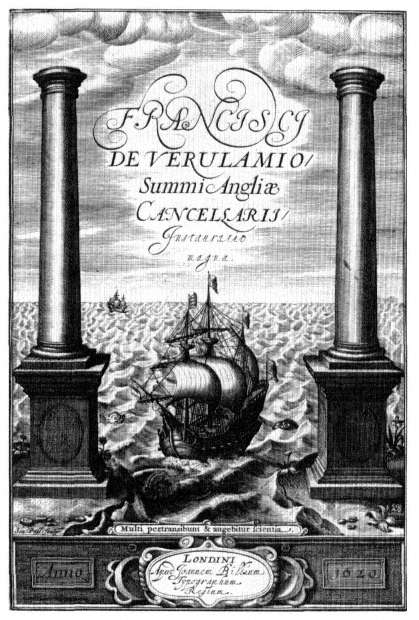
Figure 10.
Frontispiece to Instauratio Magna (The Great Instauration), by Francis Bacon,
London, 1620. Bacon's ship of knowledge sets out past the Pillars of Hercules, or
beyond the known world. (By permission of the Houghton Library, Harvard University.)
rator that "I give thee leave to publish it for the good of other nations; for we here are in God's bosom, a land unknown" (166).
If Bacon's quest to enlarge "the bounds of Human Empire" (156) in part proceeds, then, from the same utopic tradition that produces fairy writing, that tradition also came increasingly under fire in the seventeenth century from other forces beside Baconian empiricism. Taking for granted the self-consuming tendency in utopic imperialism as I have so far outlined it, and narrowly focusing on the post-Jacobean reputation of Utopia, The Faerie Queene , and The Tempest , this epilogue will briefly consider what later religious and political changes caused these otherworldly texts to appear so radically unworldly, and then what new theoretical justifications for the literature developed as a result. Of course, in the manner of the fairy writers themselves, the later opponents of Fairyland may, to a certain extent, often simply extend the tradition when they signal its apparent failure: Cowley, after all, depicts the vanquisher of Spenser as a Spenserian knight, who "with sacred Arms/Dost drive the Monsters thence, and end the Charms"; while the character in Jonson's Barriers who advises Henry to reject romantic chivalry is none other than Merlin. In fact, as I will show, the same critics who denounce fairy writing for lacking "any foundation in truth"8 will often elsewhere extol it as poetry's sublimest achievement—though only when the originally imperialist drift of More, Spenser, and Shakespeare has been not just reformed but forgotten.
I
An opening assertion in the anonymous Golden Coast, or A Description of Guinney (1665) highlights what are perhaps the two primary factors in the decline of otherworldliness as an approved national trait. The author celebrates the English for "being not now as of old, divisi ab orbe Britanni, separatists from the Universe , but commanding the commerce of all Nations; our Negotiation being not limited in a narrower compass than the whole Earth, and our dealing knowing no bounds but those of the world" (1-2). The central claim about English mobility recalls Hakluyt, who in his epistle dedicatory to The Principall Navigations (1589) had declared that "in this most famous and peerless government of her most excellent
Majesty, her subjects through the special assistance, and blessing of God, in searching the most opposite corners and quarters of the world, and to speak plainly, in compassing the vast globe of the earth more than once, have excelled all the nations and people of the earth" (Taylor, Original Writings 2:399). Yet Hakluyt did not feel as the Golden Coast's author dearly does that the boundlessness of English voyaging and the apartness of England's island were mutually exclusive ideals; in fact, the Golden Coast's stigmatization of separateness as separatism would probably never have occurred to him.
Only from the vantage point of the Restoration, that is, would a joke about utopian fanaticism seem pertinent to England generally. And yet the analogy between England and the Separatists was already telling before the Civil War. The Jesuit John Floyd devotes the last chapter of his Overthrow of the Protestants Pulpit-Babels (1612), an attack in particular on the Anglican minister William Crashaw, to proving "the impiety of the Protestant revolt from the Church of Rome , by the same four arguments wherewith M. Crashaw urgeth the Brownists for their Schismatical separation from the Church of England " (306-28). This identification of all Protestants as separatists becomes still more pointed in relation to a Protestant England priding itself on its otherworldliness. Defining his "true visible Church" as "a company of faithful people, by the word of God called out & separated from the world & the false ways thereof, gathered and joined together in fellowship of the Gospel, by a voluntary profession of the faith & obedience of Christ" (Answer , 196),9 the separatist leader Francis Johnson (1600) not only echoes standard celebrations of Elizabethan England but improves upon them by stipulating that one's citizenship in the separatist Elysium is "voluntary" rather than simply an accident of birth. Even earlier in Elizabeth's reign, Protestant extremists may have begun, by association, to make a utopic view of England less attractive: Richard Griff or Griffin (c. 1590), for instance, criticizes "our disciplinaries, being the best name I can give them," who, "as though they lived in Plato's Commonwealth or Sir Thomas More's Utopia," have been emboldened "to desire and imagine a fantastical perfection."10 By the 1640s, the growing strength of both a Puritan opposition and an overt millenarianism appeared to their enemies only to confirm such a charge.11 Charles
I himself called his Puritan enemies Utopian;12 and after Cromwell's death the characterization became a commonplace. The title page of William Prynne's Brief Necessary Vindication (1659), for instance, demands "the restitution of our Hereditary King and Kingly Government , not a Utopian Republic ";13 while Samuel Butler (1680) later describes "a Republican" as "a civil Fanatic, an Utopian Senator" (Characters , 24; quoted in Gibson, Bibliography , 411), whose fellows "were all Free-born in Fairy-Land , but changed in the Cradle; and so being not Natives here, the Air of the Government does not agree with them" (26).14
To some conservatives from Elizabeth's time on, the perfect way to rid England of these disreputable utopians was to send them to the lesser otherworld of America. As the anonymous "Verses on the Puritan Settlement in America" (c. 1631) puts it,
Let all the parisidean [paradisean] sect
I mean the Counterfeit elect
All Zealous bankrupts punks devouts
Suspendent preachers Rabble Rout
Let them sell all out of hand
Prepare to go for new England
To build new babel strong and sure
Now called a Church unspotted pure.
(37)15
Thomas Morton's New English Canaan (1637) reports how, when finally ensconced in their paradisiacal new world, separatists do indeed only realize their penchant for absurdity. In one chapter, for instance, entitled "How the 9. worthies put mine Host of Ma-re-Mount into the enchanted Castle at Plymouth, and terrified him with the Monster Briareus" (288), Morton imagines the separatists seeing themselves not just as romance heroes generally but as Spenserian ones in particular: a tailor-preacher promises to sew his congregation the garment-armor of a Christian man, which will enable the Puritans "(like saint George) to terrify the great Dragon error, and defend truth which error with her wide chaps, would devour" (327-28).16 Yet, while this risible new fairy England helps to register by contrast the solidity of the old (and to explain why the Royalists Davenant and Cowley should associate their attack on fairy poetry with a military action against a Puritan-run colony in America), it also suggests the degree to which English other-
worldliness and consequently English otherworldly poetry have begun to be undermined.
The Golden Coast is, however, more concerned with a positive reason for Restoration England's rejecting separateness as a national ideal: the English no longer simply "search" or "compass" the world, as Hakluyt would have it, but "command" a world trade. Thanks in large part to the success of a trifling expansionism in which commodities previously dismissed as useless had begun to turn huge profits, England's interests in the later seventeenth century could no longer be limited to its little island. The difference that this achieved expansionism made both to England and to English poetry can perhaps best be glimpsed in a later poem celebrating a state of affairs that is otherwise as Elizabethan as possible—peace established by a virgin queen. Alexander Pope published his Windsor Forest (1713) in support of the Treaty of Utrecht, which ended the War of the Spanish Succession and, according to modem historians, secured England's power, even hegemony, in the Atlantic. At the time, however, the Whigs believed that Queen Anne, the treaty's guiding spirit, had only mined England's chance for complete victory. And their opinion of Tory backwardness seems confirmed by the start of Pope's poem (written, Pope claims, more than a decade before the treaty), which appears to celebrate England's renewed insularity under Anne. First, the poem deplores the fact that what Pope tellingly labels the "green Retreats" (1) of Windsor Forest had once been devastated by William the Conqueror—a figure uncannily revived, the poem implies, in the person of the previous monarch, the foreign and Whiggish King William III; and second, Pope tells the sad story of the virgin huntress Lodona, a former votary of Diana and Cynthia, who, "eager of the Chase" (181), leaves the "verdant Limits" (182) of Windsor Forest, is then herself chased by Pan, and escapes only by having Cynthia transform her into the river that flows back into the forest—a fable clearly representing both the threat of reversal in an "ever-increasing foreign war" and Anne's response to that threat.17 Yet, if Pope imagines Anne countering the return of William the Conqueror, ending military excursions, and finally healing the divisions of civil war by resurrecting in herself the virgin protectress Elizabeth, he also sees her as harking back even further than William, and further afield.18 For by formal allusions to Virgil,
particularly at the end of his poem,19 Pope represents his own effort as georgic, and therefore marks his confidence that the peace Anne has established will prove Augustan, imperial.
The apparent contradiction here—Pope's dedication to both an insular and an imperial ideal—is made salient in the poem by the fact that his dual allegiance seems to have rendered a Virgilian georgic thematically untenable. The pastoral bias of Pope's virginal insularism is signaled in minor ways early on, for instance by an epigraph from Virgil's Eclogues and a comparison of the forest to Arcadia (159); or more importantly, by the celebration of Windsor itself, which had already been the subject of Pope's Pastorals (1709).20 Yet the inescapable token of Pope's distance from Virgil's Georgics appears at the end of the poem, the "imperial" section, when Pope celebrates the peacetime activity not of homely agriculture but of expansive commerce.21 Why, then, does Pope even bother to associate a posttreaty England with georgics? Since commerce has at best a kind of metaphoric appropriateness to a literary form that mediates between pastoral and epic, one might say that Pope's praise of commerce and his formal allusions to Virgil identify his interest in georgics as formal. That is, by ignoring the agricultural basis of the georgic, emptying the literary form of its definitive thematic property, Pope seem to think he maximizes its formal property as the site of commerce between pastoral and epic, and therefore honors what is, to his mind, the real beauty of Anne's peace: its refusal to choose between epic and pastoral, between understanding England as either an empire or a pleasance.
The poem's celebration of the forest proper, "Where Order in Variety we see, / And where, tho' all things differ, all agree" (15-16), nicely figures Pope's confidence that such apparently contrary views of England can be reconciled. Entranced as Redcross and Una might be by Windsor's groves, which "like verdant Isles the sable Waste adorn" (28), Pope appears at first to abjure travel: "Let India boast her Plants, nor envy we / The weeping Amber or the balmy Tree" (29-30). Yet this threat of insular complacence proves illusory—we should not envy the Indies only "while by our Oaks the precious Loads are born, / And Realms commanded which those Trees adorn" (31-32). So fluidly does the sheltering forest metamorphose into an intimidating navy that the passage elides
not only the differences between the two but also the georgic labor needed to convert one into the other;22 if the forest "isles" will not prevent expansion, neither will expansion reciprocally exhaust them as England's conqueror once had, by laying the forest "waste" (44, 49, 80). This easy mobility between the woods within England and the world beyond it, between ease and "command," is still more strikingly associated with the issue of English military power in a later passage that marks the transition from a woodland hunt to a foreign conquest by way of the Georgics ' most famous pastoral line (Georgics 4.176; Eclogues 1.23):
Thus (if small Things we may with great compare)
When Albion sends her eager Sons to War,
Some thoughtless Town, with Ease and Plenty blest,
Near, and more near, the closing Lines invest;
Sudden they seize th'amaz'd, defenseless Prize,
And high in Air Britannia's Standard flies.
( Windsor Forest , 105-10)
Controlled by the pastoral-georgic simile, the reversal here—leisurely English hunters (including a spaniel) become the conquerors of a leisurely foreign town is presented as anything but a reversal; indeed, just as the simile's relegation of war to a metaphor for hunting tempers the Lodona-like eagerness of the soldiers it pictures, so their victory seems to depend on the sort of easy abandonment of "Ease" that the simile enacts. By the Treaty of Utrecht, the passage suggests, Anne has replaced mere insularism and mere imperialism with a concept of England far more adaptive and therefore far more secure.
Spenser too had hoped to escape the dualism of island and empire, as he labored to convert English insularity into a trifling index of a more expansive potentiality; but for Pope, the Treaty of Utrecht will make England's expansion so effortless that it will even proceed without war: near the end of the poem, the Thames arises to predict that, after the treaty, "the shady Empire shall retain no Trace / Of War or Blood, but in the Sylvan Chase" (371-72). "The shady empire": with a single phrase, oxymoronically con-joining pastoral and epic, Pope rejects the island imperialism of both Elizabethan complacence and Spenserian disparity in favor of
an imperial concordia discors .23 Yet the phrase also indicates the degree to which, in abandoning Spenser, Pope, like Cowley, proves himself Spenser's inheritor: for the English island itself has been removed from Pope's equation, made positively "waste," like the georgic become a merely formal entity mediating the commerce between the shade of Windsor Forest and the empire that the forest commands. Where Spenser's imperialist celebration of his virgin queen proved unable to dissociate an otherworldly and therefore potentially mobile Englishness from the material separateness of England's otherworldly island, Pope has insularism "retreat" from the island itself to a still more trifling locale, the internal "isles" of Windsor, which "Monarch" and "Muse" (2) idealize into an internalized virginity preserving Englishness from the waste threatened by material ties both at home (complacence) and abroad (adulteration). It is no accident that Pope assigns the perception of England's new fluidity to a local deity who materializes England's island only to distinguish it from its earth—gain, the Thames, whose "alternate Tides" (334) allow "whole Nations" both to "enter" (399) England and, presumably, to leave it.24 Pope's insistence here on alternation is crucial to making sense of him as an anti-Spenserian Spenserian: the English can now internalize their island and therefore transcend it only when they already have somewhere else to go.
Pope wants to maintain, however, that soon the chaste English will no longer have foreign possessions as such, since Anne's treaty will replace conquest with commerce. And this saving substitution, like the reduction of war to hunting, will itself result from commerce, when, by means of the treaty, England will trade its more formal or fluid conception of itself with other nations. Hence the Thames foresees a time when even the least cosmopolitan of peoples, the natives of America's barbarous otherworld, will, in another tempered reversal, learn of England:
Earth's distant Ends our Glory shall behold,
And the new World launch forth to seek the Old.
Then Ships of uncouth Form shall stem the Tide,
And Feather'd People crowd my wealthy Side,
And naked Youths and painted Chiefs admire
Our Speech, our Color, and our strange Attire!
(401-6)
This bravura contraction of the Thames's sights to England (where the Indians, significantly, do not land, but only "crowd" the Thames's "Side") is met by an expansion in the next lines:
Oh stretch thy Reign, fair Peace ! from Shore to Shore
Till Conquest cease, and Slav'ry be no more:
Till the freed Indians in their native Groves
Reap their own Fruits, and woo their Sable Loves.
(407-10)
But this concluding prayer for a millennial end to all disparity between nations belies the specific conditions of the peace Pope celebrates. Wasserman explains: "Although gaining little ground in the West Indies, England was granted the Asiento, or the lucrative monopoly to conduct the slave trade with the entire West Indies, and such valuable trade concessions that she would largely control the maritime commerce of those regions" (Subtler Language , 140); and yet, as if to demonstrate the effectiveness of Pope's casuistry, Wasserman never raises the issue of the Asiento in relation to Pope's peroration on Liberty.25 Facing the problem, Maynard Mack simply assumes that Pope's moral vision surpassed the provisions of the treaty (Pope , 206). But, as we have in part already seen, the end of the poem deals exclusively with "feather'd people," "Peru," and "Mexico" (411-12): that is, with freed Indians , whose enslavement dramatically actualizes the constraints of having lived in a world apart. Commerce will indeed liberate them— by replacing them with England's newly acquired African slaves— but if the "sable" color of the Indians visibly marks the fact of this trade,26 the traded Africans themselves drop from Pope's sight. For, as personifications of "the sable Waste" from which Windsor's "verdant Isles" save the extended nation, the Africans deny English commerce the chaste uncoerciveness that Pope wants to grant it. They show instead that the internalization of English insularity from an island to a state of mind depends on the simultaneous externalization of a foreign people from their own land and to the stigmatized blackness of their bodies; that England's insularity has become a human property only when the English have at the same time come into human property. In short, the suppressed African slaves betray the exclusivity denied by the suppression of England's island, the now expansive dispar-
ity between the shady empire and the world whose "trade" it commands.
II
If, then, a combination of religious divisiveness and imperial expansiveness in post-Jacobean England made celebrations of an England "divided from the world" increasingly less compelling, Pope shows us that English investment in the ideal of an other-world did not for that reason disappear.27 In fact, many of the writers who now resisted labeling England an otherworld simply found their otherworld elsewhere. Comparing his New World settlement to an Old World devastated by religious wars, a separatist such as William Bradford (c. 1654) could sound positively Elizian:
From hence, as in a place secure,
They saw what others did endure,
By cruel wars, flowing in blood,
Whilst they in peace and safety stood.
("A Word to New
Plymouth," 33-36)
Even in England it became popular to think that America could take England's otherworldly place: a famous couplet from George Herbert's "The Church Militant" (1633), for instance, warns its readers that "Religion stands on tip-toe in our land, / Ready to pass to the American strand" (235-36). Indeed, the very same process that to some Elizabethans proved England's otherworldliness providential—the westward course of empire and spirit—is precisely what makes Herbert worry about the future of English religion. Having explained his own apocalyptic theory that "the course of things around must run; / Till they have ending, where they first begun" (Motto , D3v), George Wither (1621) wonders whether the Revelation passage that Walter Brute had applied to England's utmost angle might not instead refer to the new world farther westward:
What if America's large Tract of ground,
And all those Isles adjoining, lately found?
(Which we more truly may a Desert call,
Than any of the world's more civil Pale.)
What then? if there the Wilderness do lie,
To which the Woman , and her Son must fly,
To space [scape?] the Dragon's fury; and there bide,
Till Europe's thankless Nations (full of pride,
And all abominations) scourged are,
With barbarism; as their neighbors were?
(D3v-4r)28
America was, moreover, not the only place in which to locate the otherworld that could seem no longer to fit England: the seventeenth century saw an increasing interest in theories concerning a land truly penitus toto divisus orbe , with no material ties to the earth at all—a world in the moon or the heavens. Thomas Traherne's "Shadows in the Water" (c. 1660s) goes so far as to transfer the language of New World propaganda to outer space:
Within the Regions of the Air,
Compass'd about with Heav'ns fair,
Great Tracts of Land there may be found
Enricht with Fields and fertile Ground;
Where many num'rous Hosts
In those far distant Coasts,
For other great and glorious Ends,
Inhabit, my yet unknown Friends.
(49-56)
As the companion poem to "Shadows," "On Leaping over the Moon," demonstrates, such utopic idealizations of other planets could also reflexively sublimate the earth itself. Where an Elizabethan could figure the English island as "out from the world, yet on the ground," Traherne takes the Copernican liberation of Earth from the drossy center to mean that every human occupies the Elizian's paradoxical position: "On heav'nly Ground within the Skies we walk" (51). And finally, though even a sketchy account of Milton's response to both Spenser and the new astronomy would require another chapter, one can note in passing that Galileo's investigations of other planets inspired Milton (1667) to imagine not England or America but the entire globe a "new world" and "happy Isle."29
But then these developments had, after all, been anticipated by
The Faerie Queene , which in the proem to book 2 associates Fairyland first with America and then with a world in the moon; one might therefore expect that the fairy way of writing, though now lacking "foundation" in England, could still come to seem grounded in these other otherworlds. Later literary theorists, however, began to prize fairy writing more for its lack of reference than for any new reference it gains. The same year that Pope was working on Windsor Forest , Joseph Addison (1712) starts Spectator no. 419 by asserting that
There is a kind of Writing, wherein the Poet quite loses sight of Nature, and entertains his Reader's Imagination with the Characters and Actions of such Persons as have many of them no Existence, but what he bestows on them. Such are Fairies, Witches, Magicians, Demons, and departed Spirits. This Mr. Dryden calls the Fairy way of Writing , which is, indeed, more difficult than any other that depends on the Poet's Fancy, because he has no Pattern to follow in it, and must work altogether out of his own Invention. (Spectator 3:570)
The unnatural difficulty of fairy writing, already half-endorsed by Addison's epigraph from Horace—"mentis gratissimus Error" (Epistles 2.2.140), "the most gratifying delusion of my mind"—becomes by the end of Addison's paper a sublime capability: fairy writing is now said to demonstrate that poetry "has not only the whole Circle of Nature for its Province, but makes new Worlds of its own, shows us Persons who are not to be found in Being, and represents even the Faculties of the Soul, with her several Virtues and Vices, in a sensible Shape and Character" (Spectator 3:573). In The Mirror and the Lamp , M. H. Abrams labels this doctrine of poetry's otherworldly creativity "the poem as heterocosm," a critical topos whose English history Abrams charts from Sidney until the present, though he remains vague about its sources, especially its native ones (272-85). Yet More's self-deprecating joke that Utopia should hide itself away in its own island shows how directly the Tudor conflation of England and America as heterocosms helped to displace trifling poetry into new worlds;30 and then the subsequently weaker and stronger heterocosmic theory that I have outlined weaker because less pertinent to England politically and spiritually; stronger because more radically actualized in extraterrestrial worlds only accentuated the supernatural elements of an
otherworldly tradition already in place. In fact, so entangled with this tradition was later heterocosmic literary theory that even the lapse of interest in an English otherworld did not entirely bar heterocosmic poetry from seeming to play the nationalist role it originally hoped to fill. Addison, for one, continues to think fairy writing a specially English phenomenon: "Amongst all the Poets of this Kind our English are much the best. . .. For the English are naturally Fanciful, and very often disposed by that Gloominess and Melancholy of Temper, which is so frequent in our Nation, to many wild Notions and Visions, to which others are not so liable" (Spectator 3:572). Not just Spenser but now the Shakespeare of The Tempest too is considered a national poet,31 and in such terms as Spenser might almost approve—as the master of an "Error" representing the internalization of England's material detachment from the world; except that where this internal dissociation had formerly been seen as a precondition of empire, it has now been reduced to a national propensity for hallucinations, for "wild" distraction.32
And indeed, as Addison himself demonstrates, the disparity, the trifling grandeur in otherworldly poetry that Spenser had purposefully embraced now inspires a more uncontrolled ambivalence.33 In his Account of the Greatest English Poets (1694), Addison criticizes Spenser for the very immateriality that he himself would later call "gratifying":
We view well-pleas'd at distance all the sights
Of arms and palfries, battles, fields and fights,
And damsels in distress, and courteous knights,
But when we look too near, the shades decay,
And all the pleasing lanschape fades away.
( Miscellaneous Works 1:31-32)
Conversely, in Cowley's "Muse" (1656), the same poet who earlier celebrated Davenant's fidelity to nature can now glorify poetry for its ability to transcend nature, in not just mastering new worlds but creating them:
Whatever God did Say ,
Is all thy plain and smooth, uninterrupted way .
Nay ev'n beyond his works thy Voyages are known,
Thou 'hast thousand worlds too of thine own .
Thou speakst, great Queen , in the same style as He ,
And a New World leaps forth when Thou say'st, Let it be .
(30-35)34
In Spenser, a poetry divided from the world had always seemed at odds with itself; but for the sometimes dismissive, sometimes enthusiastic Cowley, that division has only been exaggerated, into the utopia of either an erring dreamer or a creating god.