
2—
The Institutional Setting
For purposes of health care delivery, Scotland is divided into fifteen regions, each of which is further subdivided into districts (Kane and Kane 1976). Upon arrival in Scotland, I visited geriatric services in three of these regions and decided that an east coast city of 230,000, which I shall call Dunhaven, was best suited to my research goals. My decision to study an institution in Dunhaven was in large measure influenced by the hospitable reception I received from the chief geriatrician in this region. He assured me access to any medical records I wished to see, and he gave permission to observe and visit patients on all hospital wards and in all institutions attached to the geriatric service. He introduced me to key personnel in nursing, medicine, and supportive services (such as occupational therapy, physiotherapy, and social services) and invited me to attend conferences with medical house officers and nursing staffs. Further, he suggested that I accompany him on ward rounds and domiciliary visits. Finally, he informed me that within the geriatric service there was a "model" 96-bed long-term-care hospital. This institution (Scottsdale) proved to be an ideal facility for an intensive study of long-term care, and it was there that I did the majority of my work.
The geriatric service in Dunhaven, established in 1955, is an integral part of a large general hospital that is associated with a university medical center. Approximately 150 of the 650 beds of this geriatric service are located physically in a general hospital. These beds are used for assess-
ment and rehabilitation; simultaneously they permit both medical and nursing students to receive experience in geriatric problems as part of their clinical training in general medicine. Half of the remaining 500 beds, all of which are used for long-term care, are in hospitals in or near the major city in the region; the others are located in small hospitals in six outlying communities. As mentioned earlier, an effort is made by personnel to use the term "continuing care units"; however, in practice the terms "long-stay units," "long-term units," and "continuing care units" are used interchangeably both in the literature and in speaking. These terms refer to those units or beds utilized by the chronically ill (most of whom are aged) who require long-term health care in an institutional setting.
How the Geriatric Service Functions
Three geriatric consultants (or "geriatricians"), all specialists in geriatric medicine, a senior registrar (a physician in the final stage of specialist training that leads to a consultant post), and other junior medical staff members provide the medical care for the geriatric service in this region. The consultants receive approximately thirteen hundred referrals a year from other hospital specialists and from general practitioners throughout the region. Following the request for referral, the patient is visited wither in his home or, if he is already an in-patient, in the hospital to assess both the medical problem and the social situation. Each consultant makes about three hundred domiciliary visits a year. Since there is a shortage of beds for geriatric patients, the home assessment facilitates the geriatrician's setting of priorities for admission to the assessment unit. It is also advantageous for patients since they are seen very quickly, usually on the day the referral request is made. Moreover, the home-assessment visit prevents an unnecessary hospital admission that can be traumatic for the elderly; and the home visit provides an excellent opportunity for the geriatrician to establish rapport with a new patient.
If the patient requires hospitalization, he is admitted to the assessment and rehabilitation unit. In some Scottish geriatric services, these are distinct and separate units; but in the Dunhaven region, they are one and the same. The geriatricians emphasize that many elderly patients suffer from multiple disorders that may require extensive diagnostic procedures as well as the services of a specialist in geriatric medicine. They believe it essential that the assessment and rehabilitation unit be located within a
major hospital that provides all the necessary diagnostic and rehabilitation services.
Following diagnosis, treatment and rehabilitation become the focus of care. In rehabilitating an elderly patient, the aim is to achieve the maximum possible degree of independence in self-care. Geriatric rehabilitation is a complex group effort involving nurses; doctors; social workers; physiotherapists; chiropodists; occupational, speech, and diversional therapists; and voluntary workers and visitors. Each member has an important role in the rehabilitation of the patient: successful rehabilitation requires close communication and cooperation between all.
Since many elderly patients suffer from such problems as arthritis, fractures, and cerebrovascular accidents with resulting hemiplegia, a primary function of the physiotherapist is to assess the patient's condition and help him become mobile and independent. Occupational therapy is closely aligned to physiotherapy. The occupational therapist provides and supervises exercises for specific disabilities, such as crafts and games that exercise hand and finger joints. The occupational therapy department also has innumerable items designed to keep an elderly person as independent as possible, both in the hospital and upon return home. For example, following a cerebrovascular accident that paralyzes a side, an elderly person may have difficulty eating. Thus, a plate guard attached to the rim of the plate will enable the person who has the use of only one hand to eat without pushing food off the plate. There are also forks and spoons with a specific slant designed for patients who cannot rotate their wrists, and other eating utensils with large, thick handles for easier grasping by those who can no longer completely close their hands.
The occupational therapy department also has a small simulated household unit where the therapist can assess the degree of functional disability of aged patients prior to their discharge. Here a patient is observed cooking a meal, dressing, using bathroom facilities, and getting in and out of bed. Some people, for instance, may be able to get into bed without assistance, but perhaps due to arthritis they cannot pull up the covers. Special provision must be made for such people in their homes. Following assessment, the therapist recommends the aids and devices necessary in the home if the patient is to be resettled in the community.
Occupational therapy and physiotherapy treat and rehabilitate the body; equally important is the diversional therapy that treats the mind. A diversional therapist attempts to find meaningful projects to stimulate a
patient mentally and provide some activity of functional value. In diversional therapy, for example, patients make trays, children's toys, knitwear, and other items that are purchased by hospital employees. Finally, the social worker fulfills an important function in working as a liaison between staff and relatives in planning for a patient's future, whether at home or in another institution.
The assessment and rehabilitation unit at Dunhaven admits about one thousand patients a year. Approximately one-half are treated and then discharged to their own homes, to sheltered housing, or to a residential facility. Another quarter die in the hospital, and the final quarter are transferred to a continuing care unit like Scottsdale.
Scottsdale
Many of the institutional facilities in Scotland are very old, and Scottsdale is no exception. A brief history of the facility is in order because the feelings and attitudes toward admission to it today are in part governed by the original intention for which the hospital was founded. Scottsdale was founded in 1857 as a hospital for the "deserving poor," to provide moderate comfort for local persons who, because of incurable illness, could not earn a living. Originally it housed only six patients. Since, by definition, these patients were "deserving," no stigma was attached to their status. This distinction was important at a time when many cities were building poorhouses, when an acceptance of this kind of help carried the stigma of a semi-criminal act (Gilbert 1966:14). Actually, from the outset Scottsdale had a snobbish appeal, and it quickly developed a reputation for being an excellent hospital: today it receives generous endowments that provide amenities for its long-term patients.
As the number of patients requiring long-term care increased over the years, the hospital expanded. In 1882 the present site was purchased and 2 years later a new hospital opened with accommodations for fifty-five patients. In 1891 an additional wing was added, and 10 years later a large recreation hall was built. With the introduction of the National Health Service in 1948, Scottsdale became a government continuing care geriatric hospital. By then its facilities were inadequate, and in 1967 it was completely rehabilitated and a new, 26-bed wing was added. The number of beds in the old wards was reduced simultaneously to make the environment more pleasant and spacious. Today Scottsdale accommodates
ninety-six chronically ill patients, most of whom are over 65 years of age. Surrounded by beautiful gardens, it is situated in a fine residential area on a hill with a grand view of the city and the sea. In summer the gardens supply fresh flowers for the patient wards, and a greenhouse on the grounds provides plants and flowers for the hospital rooms during the long, dark, winter months. Each Friday the gardeners—there are six—cut a variety of flowers and one of the hospital maids makes bouquets to be placed in various locations throughout the hospital.
The hospital is a sturdy, gray, granite, two-story structure divided into four units: one of 18 beds for male patients, and three of 25, 26, 27 beds, respectively, for female patients. Within these four units, there are ten private rooms, one semi-private room and the remaining patient accommodations are in 3-, 4-, and 6-bed wards. The rooms and wards are typical of hospitals, but although parts of the hospital are nearly 100 years old, all hallways and rooms are decorated in pleasant pastel colors. There are large windows in every room and even on rainy days, of which there are many, the inside atmosphere of the hospital is not depressing and dreary, but rather bright and cheerful. The large windows also provide the patients with lovely views of the gardens, the city, and the sea.
The recreation hall is used for the weekly church service, and on rainy days, when patients cannot go out of doors, many gather there for morning coffee. Although this wood-panelled room is large, it is very warm and cozy. Beautiful antique pieces of copper grace the hearth and mantel of the fireplace, and lovely oil paintings hang on the walls. There is a fine organ in the room, some antique pieces of furniture, and always a large bouquet of fresh flowers. The hall has the appearance and ambience that one might find in a private Scottish home rather than in a hospital.
The new wing includes two sun porches on the second floor and a large sunroom on the first floor. These rooms are also warm, cheerful and conducive to interaction among small groups. Another attractive feature of the hospital is a small shop operated by one of the patients; here staff members and patients come daily to purchase snack food, toiletries, and other items for their own use or as gifts for others.
Scottsdale's facilities and surrounding gardens provide patients with a choice of where and how they can spend their day. For those confined to wheelchairs but who still have the use of their upper extremities, ramps on each level provide access to the verandah and the grounds. For example, Mrs. Milne, a 95-year-old woman with a fractured hip, wheels herself out
on the verandah nearly every day; for her it is essential to go outdoors daily for fresh air. She is an independent woman, and despite the admonishment of the staff, can be found on the verandah even on cold days. "Others think it is too cold," she observed, "but I go out to keep myself going." On warm sunny days, dozens of patients are sitting on the verandah, neatly dressed and protected from the sun by wide-brimmed straw hats. Other groups of patients are reading books and visiting with one another over morning coffee in the lounges or sunrooms.
Although few patients ever leave Scottsdale—"This is a hospital for life," said one patient—it is not a depressing or morbid institution. On the contrary, patient morale seems very high. The matron of the hospital explained that staff do not dwell upon the fact that patients will be there for the rest of their lives: "We try to make it as homely as possible, and we have as few restrictions as possible. I think life is sweet to them, whatever the quality, and they do not dwell on death." Staff do not shy away from the subject of death, however; they allow patients to express their feelings. Recently one woman said, "All of my friends are away, and I am ready to go anytime."
Each morning as I entered the hospital, traditional Scottish or modern music flowed into the hallways from record players situated in each ward. There were television sets in every ward and most private rooms, gifts from the "Friends of Scottsdale" (a volunteer group), but they were usually not turned on until midafternoon and evening.
The maids hurried about the hallways, humming softly as they went about their work. Other staff, neatly groomed, all in their respective and appropriate uniforms, industriously performed their duties. There was a sense of order, organization, and purpose to their work; there was also a strong sense of everyone working together. According to one of the kitchen staff, "We are one big family here, and we all work together; everyone is friendly to one another."
Pacific Manor
At Scottsdale all of the patients had been admitted following extensive treatment and rehabilitation in the assessment and rehabilitation unit of the geriatric service. However, in the United States, unlike in Scotland, geriatric medicine is not a specialty; there is no equivalent to the geriatric service for providing medical care for the elderly. As a result the majority
of the elderly in the United States are cared for by private physicians, and the 5 percent who need institutional care are admitted to nursing homes either directly from their own homes or from acute-care hospitals. Although some reports indicate 50-55 percent of patients come to long-term-care facilities from their own or relatives' homes (e.g., Special Committee on Aging: U.S. Senate 1974), at Pacific Manor only 6 percent came directly from their own or a relative's home. The majority—85 percent—were admitted to the nursing home directly from an acute-care hospital, 6 percent were admitted from their home, and 9 percent came from other nursing homes or "board and care" homes (which provide residential care only). Although it is widely believed that many elderly patients were admitted to nursing homes from state mental hospitals during the deinstitutionalization of the late 1960s and early 1970s, only one such patient had been admitted to Pacific Manor.[1]
Pacific Manor is located in an area of the city that is partly commercial and partly residential. It is a high crime area. During my first visit I was carefully warned by the director of nursing services not to visit the facility after 6 P.M., not to carry a purse, and not to leave anything of value locked in my car. If I had to leave after dark, she cautioned, one of the staff should accompany me to my car. At 7 P.M. an orderly places heavy chains with locks on the doors of the institution "to keep the good guys in and the bad guys out."
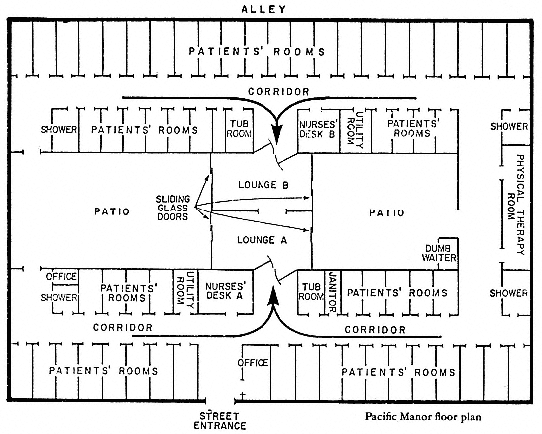
The building, constructed in 1966, is divided into two units of 40-45 beds each (Unit A and Unit B) and is well planned for elderly, often disabled, people. Rooms are designed to accommodate two patients, with a bathroom (a toilet and washbasin) between each pair of rooms. Each patient has a small closet and one drawer for personal belongings. Although rooms are "efficient," they are relatively small and crowded; wheelchair patients have difficulty in moving about in them. And the sliding wooden doors on the closets often come off the track or stick in a half-open position, making it difficult for patients to reach their personal belongings. Some of these problems are avoided, of course, by the few
[1] For further information on deinstitutionalization and decarceration see: Ellen L. Bassuk and Samuel Gerson, "Deinstitutionalization and Mental Health Services, Scientific American 238:2, February 1978, pp. 46-53; Wilma A. Donahue, "What About Our Responsibility Toward the Abandoned Elderly?" The Gerontologist 18:2, April 1978, pp. 102-11; and Andrew T. Scull, Decarceration, Community Treatment and the Deviant: A Radical View , Englewood Cliffs: Prentice-Hall, 1977.
patients willing and able to pay for single accommodations; one bed is removed from a standard room, leaving ample space. At the time of the study, only three patients were so accommodated.
All bedrooms and lounges are on the main floor of the building, an arrangement that enables both ambulatory and wheelchair patients to move about freely. Bedrooms that face the patio, with its flowering plants, are very pleasant; those that face the front street or the rear alley are less so (see accompanying figure for the floor plan of Pacific Manor).[2]
It is noteworthy that although all patients, those who can walk and those confined to wheelchairs, have easy access to the patio few make use of this very pleasant area. Even on warm, sunny days there are never more than three or four patients in the courtyard. One patient, Mrs. Levine, is on the patio every afternoon: "I would go crazy if I had to stay in my room all day." She does not understand why other patients do not join her on the patio. Few ever do.
Even with the hallways carpeted in bright red, the potential feeling of warmth is lost because they are easily soiled and require frequent cleaning. Often from morning until late afternoon hallways are being vacuumed, and the resulting high noise level is disturbing to patients, staff, and visitors alike.
The lounges are the center of activity, and many patients are placed there early in the morning, to remain for the major part of the day. Sofas and chairs line the walls; long tables with plastic tablecloths occupy the center of the room. One of the two lounges has a large color television set, nearly always on. In the other a piano stands in the corner. Color posters and black-and-white photographs of patients, taken on an outdoor excursion the preceding summer, are tacked on the walls. A few old books and some outdated magazines on the bookshelves provide the only reading material for patients. The room is well lighted and sunny, but it is not really pleasant or cheerful. Nor is it tastefully decorated; instead, it appears cluttered and untidy, and there are none of the small comforts or conveniences that one would normally find in a home. On rare occasions a bouquet of fresh flowers, donated to the nursing home, is placed in the lounge or in the front foyer. Each day twenty to twenty-five patients sit in each of the two lounges; however, some refuse to go to the day rooms
[2] It would have been desirable to include a floor plan of Scottsdale. Because of multiple additions to the building, however, the architectural structure is complex and such a plan would have been difficult to prepare.
because of the strong odor of urine and because they find the rooms noisy and unpleasant. "Some days they force me to go in there," complained Mrs. Peterson, "but I would rather stay here alone in my room." Mrs. Levine added, "I went in there for one of the activities last week, but I told them I am never going back again. Some of the patients urinated right on the floor during the entertainment."
Thus, although Pacific Manor is modern and conveniently planned, and although it offers a potentially excellent physical environment for the disabled elderly, it does not compare favorably with the older, less efficient Scottish institution.