
14.
The End of the World
The future of mankind as a whole, the end of the human adventure, and the merging of heaven and earth greatly preoccupied elderly believers in the Ezkioga apparitions in the 1980s, but these themes were entirely absent from the visions in July 1931. The ancient apocalyptic tradition entered the Basque visions only gradually. The vision messages at Ezkioga seemed to evolve according to four principles: (1) they became more universal and less local; (2) they became less fixed in time; (3) they became more dire as the visions became less popular; and (4) they converged on preexisting prophecies.
The apocalypse was the vision theme linked least to time and place. This theme emerged at the end of a sequence that had begun with meanings bound to the social and political climate of the Basque Country and the summer of 1931. The same process occurred at Limpias, where people understood the Christ's motions first as the sign for a shrine for Cantabria, then as a Lourdes for Spain, and then briefly as a new Jerusalem that heralded the social reign of Christ. In both cases, as time passed and people came from farther
and farther away, messages and meanings had to accomodate timelessness and serve distant believers.
For all its dark drama, the apocalypse emerged at Ezkioga only after the church and the great majority of Basques had rejected the visions. In the balance of human hopes and fears among supplicants to the Virgin of Ezkioga in 1931, the healing of a retarded boy, the danger of a civil war, the peaceful afterlife of a sinful father, and the excitement of new movements of piety outweighed notions of catastrophic divine punishment or the imminent arrival of heaven on earth. By isolating apocalyptic messages in this chapter I necessarily distort the variety in any particular vision session. The indications seers provided about last times came along with others about the here-and-now.
Experts at Ezkioga influenced the content of the apocalyptic messages. They did so by asking questions, by giving the seers books, and by transcribing in their own way what the seers said. We can determine when the messages began, which seers produced them, and which believers influenced them. What emerges is a pattern for one particular way people recycle and renew high traditions.[1]
Apolito, Cielo in terra, 139, noted a similar process at Oliveto Citra near Salerno (Campania).
Believers induced millenarian projects in seers who at first felt they had substantially different missions. The inquisitors of the Early Modern period inculcated the peasants in Gipuzkoa and Navarra with learned ideas and converted these people into denouncers and confessants of lascivious, flying witchcraft. In both cases the intelligentsia transmitted their ideas unwittingly. In neither case, however, were those who absorbed the ideas passive. Consciously or not, children and subordinate adults quickly took advantage of the opportunities the new patterns offered.In both apparitions and witchcraft absorption of learned concepts was facilitated by prior beliefs in the receiving rural society. In the seventeenth century rural folk already had knowledge of the ways they could use sorcery to harm or to help one another, and the learned model of witches in covens who served the devil was an extension of that system. At Ezkioga the seers moved from the idea of chastisement of those opposed to the visions to the kind of chastisement of sinners throughout the world that they had learned in catechism and then on to details of the last times.
Apocalyptic Tradition at the Time of the Ezkioga Visions
The Last Judgment is a notion Catholics reaffirm in every mass: "I believe that Jesus Christ rose up to Heaven and is seated on the right hand of God the Father Almighty. I believe that from there he will come to judge the living and the dead." The catechism in use in the diocese of Vitoria provided a reason for the Last Judgement and distinguished it from the judgment of individuals
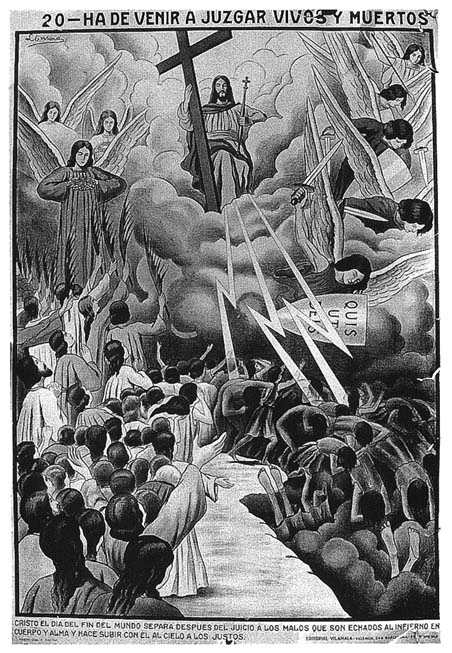
"He will come to judge the living and the dead." Catechism poster by
Ramón Llimona, Barcelona, 1919. Courtesy parish of Taganana, Tenerife
after death, but it provided no specifics about when the Last Judgment would occur.
143.
Q. When will Jesus Christ come to judge the living and the dead?
A. Jesus Christ will come to judge the living and the dead at the end of the world.
144.
Q. What is the trial called in which Jesus Christ will judge all men at the end of the world?
A. The trial in which Jesus Christ will judge all men at the end of the world is called the universal judgment.
145.
Q. Will there be, then, more than one judgment?
A. Yes, there will be two judgments: one individual, right after the death of every person, and another universal, at the end of the world.
146.
Q. Why will there be a universal judgment?
A. The universal judgment will be to confound the bad and glorify the good, and show the triumph of the justice of God.[2]Múgica, Catecismo, 22.
This vagueness about the timing of the Last Judgment, the sensible result of centuries of mistaken predictions, has been difficult for some Christians to accept. They have tried to reconcile the many references in the Old and New Testaments and assemble them into a program for the future. Additional prophecies by "holy" persons have complicated an already confusing task. Prophetic literature proliferated especially in periods of religious trial, political or social revolt, and military defeat.[3]
Carbonero, "Prólogo," vi; Thurston, The War, 189.
In the wake of the French Revolution, prophets in nineteenth-century France like Mlle. Le Normand, the farmer Thomas Martin, Eugène Vintras, the children of La Salette, and Joseph Antoine Bouillan revived medieval traditions of the coming of a great monarch, thus comforting ultraroyalists looking for a return to the Old Regime and ultra-Catholics looking to the pope as a temporal power. Visionaries from other countries like the Lithuanian Pole Andrzej Towianski, the Italian David Lazzaretti, and the Spaniard José Domingo Corbató found comfort and inspiration in France.[4]
For late medieval and Early Modern prophets: Niccoli, Prophecy; Frijhoff, "Prophétie et société"; for nineteeth-century prophets: Caffiero, La Nuova era; Griffiths, Reactionary Revolution; Kselman, Miracles and Prophecies; Boutry and Nassif, Martin l'Archange; Lazzareschi, David Lazzaretti; Peterkiewicz, Third Adam, 63-66. Thurston, The War, lists prophetic literature from the 1870s.
The Voix prophétiques of the Abbé J.-M. Curicque had great success in France because of the fall of the Papal States and the French loss of the Franco-Prussian War in 1870. The prophecies in this book were the main source for similar collections in Spanish by Corbató, in 1904 and the Chilean priest Julio Echeverría in 1932. Padre Burguera used Corbató, and Antonio Amundarain used Echevarría. The Corbató work in turn was the basis for Enrique López Galuá's in 1939, which in turn provided material for the work of Benjamín Martín Sánchez in 1968.[5]
Corbató, Apología; Echeverría Larrain, Predicciones; López Galuá, Futura grandeza; and Martín Sánchez, Los Últimos Tiempos. Curicque himself used the collection Recueil des prophéties les plus authentiques. A Spanish translation of Voix prophétiques with some additional material was published in 1874. For Spanish background on Antichrist see Caro Baroja, Formas complejas, 247-265. Raymond de Rigné used Elie Daniel, Serait-ce vraiment la fin des temps? (Paris: Téqui); for Rigné's other reading see R 104-108, and for that of Burguera see B 469-471.
One strain of this prophetic tradition, the reign of the Sacred Heart, was particularly respectable in twentieth-century Spain, perhaps because the Jesuits
promoted it. Its origin lay in "promises" the French nun Marguerite-Marie Alacoque had received in vision between 1672 and 1675, especially: "This Sacred Heart will reign in spite of Satan and of all those whom he convokes to oppose it." The "social reign of the Sacred Heart of Jesus" became a central theme of the pilgrimages to Paray-le-Monial in Burgundy in the last quarter of the nineteenth century. The idea of this reign spread through international Eucharistic congresses. Padre Bernardo de Hoyos in 1733 had connected this expected reign more specifically to Spain. At the time of the visions of the Christ of Limpias in 1919, commentators inside and outside the country speculated that the Christ's movements were a sign that the reign was approaching. In the twenties and thirties the notion gave a sharp focus to the phrase in the Our Father "thy kingdom come." Amado de Cristo Burguera was counting on the arrival of the reign of the Sacred heart; he had received the idea for his great work at Alacoque's vision site at Paray-le-Monial. And the reign of the Sacred Heart Played a central role in the false prophecies of María Rafols. In the prophecy that María Naya discovered in January 1932 the Sacred Heart himself told Rafols that the document would be found "when the hour of my Reign in Spain approaches." So it is not surprising that Christ's reign—just what that meant was unclear—became part of the Ezkioga visions and the scenarios the seers described for the end of time.[6]
Alacoque was beatified in 1864. Pius XI considered the feast of the Sacred Heart a bulwark against liberalism and made it universal in 1856. On the promises see Ladame, Paray-le-Monial, 237-266. On the reign of the Sacred Heart see Cinquin, "Paray-le-Monial," 269-273; and Christian, Moving Crucifixes, 109-116. For prophecy, Zurbitu, Escritos, 56.
The end of the world was of particular interest for many Integrists or Carlists. La Semana Católica of Madrid recalled that the energetic archbishop and founder of the Claretian order Antonio María Claret had said the world would end around 1930. The magazine also cited an alleged apparition of Pius X in which he said there would be calamities within ten years. In 1923 a canon of Jaéen, who agreed with Claret, thought the growing ascendancy of the devil and the apostasy of nations, including wise men, politicians, writers, spiritists, and "twenty million socialists and communists in international collusion," were signs the end was near. He speculated on the different phases that would take place after the coming of Christ—his reign, the millennium, the Last Judgment. And he hoped the dictatorship of Primo de Rivera would delay the apocalyptic catastrophe so that the rest of the world felt its effects first. Writing in January 1931 about an impending worldwide cataclysm, Antonio Amundarain saw the Aliadas as victims who offered themselves to God to avoid the end.[7]
Predictions in Sarrablo, "Verdades," and La Semana Católica, 4 August 1923, pp. 142-143, and 8 March 1924, p. 306; Morrondo (the canon of Jaen), Proximidad and Jesús no viene; citation from Morrondo's article in La Semana Católica, 8 September 1923, pp. 302-303; on Primo de Rivera see La Semana Católica, 29 March 1924, pp. 402-404. After more on the end of the world in July and August 1924, readers of the magazine were told to disregard the predictions on 6 September 1924, p. 299. Burguera read Morrondo (De Dios a la Creación, 83). Amundarain, LIS, 1931, pp. 9-10.
Short-term prophecies came in tracts, broadsides, and leaflets, such as the prophecies related to World War I and the Spanish military setbacks in Morocco. This literature—the Rafols prophecies are prime examples—received a fresh impetus in 1931 with the burning of convents and the separation of church and state. Apparitions of the Virgin, however, provided a more direct way to know the future. The Integrist newspaper El Siglo Futuro thought that the Virgin appeared at Ezkioga as at La Salette to warn of a civil war that was a chastisement from God: "Here too the Most Holy Virgin prophesied catastrophes, here too,
by means of her faithful servants, male and female, she preached penance to the Spaniards."[8]
On World War I prophecies see Christian, Moving Crucifixes, 185 n. 102. La Semana Católica, 26 July 1924, p. 111, cites a pamphlet by Gil Zarco, Los Milagros y profecías en el momento presente, about the seer/prophet/healer Bernardo Carboneras, who operated in Valencia and Cuenca, and his success in finding soldiers lost in Morocco, El Siglo Futuro, Madrid, 16 January 1934.
The supposed secrets of Mélanie of La Salette, first published in 1871, circulated widely in Spain. The Ezkioga apocalyptic visions eventually converged on this text. The most relevant passage is as follows:
Paris will be burned and Marseilles swallowed by the sea. Many great cities will be leveled and swallowed by earthquakes. It will seem that all is lost, you will see only murders and hear only the sounds of weapons and blasphemies. The just will suffer greatly; their prayers, their penance, and their tears will rise to heaven, and all the people of God will ask for pardon and pity and will ask for my aid and intercession.
Then Jesus Christ, through a miracle of his justice and his great mercy for the just, will order his angels that all my enemies be put to death. Suddenly, the persecutors of the church of Jesus Christ and all the men given over to sin will perish, and the Earth will become like a desert.
Then peace will be made, the reconciliation of God with men. Jesus Christ will be served, adored, and glorified. Charity will flower everywhere. The new kings will be the right arm of the Holy Church, which will be strong, humble, pious, poor, zealous, and imitate the virtues of Jesus Christ. The Gospel will be preached everywhere, and men will make great advances in faith because there will be unity among the workers of Jesus Christ and men will live in the fear of God.[9]
Texts in: Corbato; Curicque, Voces proféticas, 82; R 105; López Galuá, Futura grandeza, 70; and Martín Sánchez, Los Últimos Tiempos, 42-43. For critical issues regarding Mélanie's secret, see Zimdars-Swartz, Encountering Mary, 183.
These macrothemes filtered into the Ezkioga messages in the following sequence: (1) a great miracle; (2) a chastisement, which seers predicted first as local, then as universal; (3) an ever more elaborate program for the end of times that subsumed both miracle and chastisement.
The Miracle
Some observers associated the first visions with the apocalypse because of the bright light around the Virgin and the number of stars around her head. Many seers saw twelve. In October some witnesses mentioned a moon under her feet. The relevant passage is Revelation 12:1: "A great sign appeared in the sky, a woman clothed in the sun, with the moon beneath her feet and a crown of twelve stars above her head." But the resemblance with the woman in Revelation went no farther than this. The woman the seers described at Ezkioga was not pregnant and crying out with the pains of childbirth. The elements they saw were widely available, especially in prints derived from the paintings of Murillo.
Nevertheless, republicans presumed very early that the visions would take an apocalyptic turn. In this assumption they turned out to be better prophets than many of the seers. Writing in his national column for July 19, Antonio Zozaya pointed out that in order to be credible the visions at Ezkioga would have to
develop a general message, as at La Salette or Lourdes. Three days later the deputy for Logroño, Isaac Abeytua, warned that the clergy would manipulate apocalyptic imagery to rouse the peasants:
If we pay heed the preaching of contemporary prophets—Jeremiases and Isaiahs … the end of Spain and the end of the world are at hand. Every day the terrified "rubes" [jebos ] claim this in their pulpits, the Basque social center, or the street. We must be prepared for the day of the apocalypse. The Antichrist is already, now, on the way to the Basque Country, and you have to be armed against him, or against his allies, who are the civil governors, the town councillors, the provincial deputies or those of the Cortes, and all the authorities of the Republic.
The Basque-Navarrese prophets place little trust in the traumatic effects of the angelic trumpet. They need and ask for the protection of fanaticized country folk, the grandsons of those who fought on the Carlist side.[10]
Abeytua, ELM, 22 July 1931.
In late July and August at Ezkioga the visions of angelic hosts holding bloody swords or fighting on the mountain ridges toward Castile did indeed have an apocalyptic flavor. But as Abeytua suggested, this was an apocalypse of a local variety for the benefit of Spanish and Basque Catholics; the seers mentioned no consequences wider or more lasting than the reconquest of Spain from the Second Republic. Nor was there any hint of the end of time in the miracle the seers announced for July. What people expected on July 12, 16, and 18 and into August was the Virgin's sign that the visions were real, a "proof of her power" for all those present. The alternatives people suggested were a vision of the Virgin that everyone could see, some act of God that was counter to nature, or a miracle through a given person.[11]
All 1931: quote is from two girl seers July 17: PV, 18 July; group vision: PV, 14 July, ED, 21 July; act of God: PV, 18 July; miracle through person according to a female seer on July 25 (in Santander, ABC [Madrid], 13 August) and José Garmendia on August 15: autograph, private collection.
Not until early October did the seers offer a more complete scenario for the miracle. Patxi Goicoechea explained the scene first about October 1, and the girl from Ataun repeated it to the Catalan Salvador Cardús four days later.
The Virgin will appear with three angels and with a half moon at her feet and an extraordinary light that will light up everything around, the entire mountain. Twenty meters away will appear walls and from all four sides (or directions) the Virgin will be seen. Saint Michael will come down on a white horse and explain the reason for the appearance in this place. The miracle will begin at a quarter to five in the afternoon and will end at eleven at night. The walls will remain as a sign for what has to be done in this place.[12]
R 14; SC E 13; García Cascón to Vallet, 31 October 1931, AHCPCR 10-A-27/2.
In El Pueblo Vasco Rafael Picavea made fun of the white horse, suggesting that Patxi had confused Saint Michael, patron of Basque Nationalists, generally depicted on foot, with Saint James the Moorslayer, the aggressive equestrian version of the patron of Spain, a disquieting thought for Basque patriots. Raymond de Rigné pointed to another alternative, the first of the four horsemen of the Apocalypse: "I saw, and behold, a white horse, and its rider had a bow; and
a crown was given to him, and he went out conquering and to conquer" (Rev. 6:2). But here too the allusion seems forced, as the seers did not speak of a bow, a crown, or the other three horsemen. Whatever apocalyptic imagery the miracle included was more decorative and dramatic than substantial.[13]
Picavea, PV, 6 and 8 November; R 14n.
The Chastisement
When Patxi began to have overtly political visions at the end of July 1931, he reserved some of what he saw. A Catalan priest at Ezkioga the next week wrote that Patxi "was the keeper of great secrets." Other seers began to have secrets as well, perhaps because after August 1 the priests asked them, "Did she tell you to keep any secrets?" The girl from Ataun "says she speaks with the Virgin, keeping all the secrets to herself." On August 7 Patxi "asserted that he knows many things but will tell them to absolutely nobody." Benita was keeping secrets by mid-August. And by the end of the month the practice was general.[14]
All 1931: for Patxi, ED, 29 July, and Elías, CC, 21 August; Ataun seer, August 6 to 8 in Elías, CC, 19 August; Patxi, ED, 8 August; Altisent, CC, 9 September, with Benita, August 18; García Cascón, La Creuada, 12 September; other children with secrets, PV, 18 October.
My initial reading of this secretiveness was that the seers' reticence was simply a strategy to avoid having to give vision messages and an easy way to gain importance. Seers at La Salette, Lourdes, and Fatima also had secrets, and by August at least some of the Ezkioga seers would have known this. But secrets in visions starting with La Salette were not only "a locus of power" but also "carriers of apocalyptic expectations." It could be that some of the seers were already incubating more apocalyptic themes in the summer of 1931. In any case the mere existence of secrets whetted the appetites of those who hoped to find out about the proximity and dimensions of eternity, and their questions alone would have pushed the seers along.[15]
Zimdars-Swartz, Encountering Mary, 165-244; for one priest the very fact that the seers had and kept secrets, given recent apparitions, was enough; J. B. Ayerbe, "Las maravillosas apariciones," AC 2:6.
Patxi Goicoechea of Ataun was the chief innovator in 1931 for political messages, for physical behavior in visions, and in creating a sacred landscape. He was also the first to put into words the divine chastisement implicit in the vision tableaux. After all, the blood he saw on the swords of the angels belonged to somebody, presumably the wicked people who burned churches. But by early August he was predicting "great calamities for the sins of mankind." A writer for the Pamplona Integrist newspaper was the first to tease this statement from him. The title of the article, "The seers of Ezquioga; are we approaching the beginning of the end?" left ambiguous whether the end was that of the visions or that of the end of the world. Other seers, however, did not follow up this theme immediately. What chastisement they foresaw in the first month seems to have been divine punishment in the form of a civil war or the striking down of individual sinners, not some great winnowing at the twilight of mankind.
Patxi does seem to have been edging toward the larger theme. In his vision on September 5 he saw the Virgin with a sword in one hand drop a ball from the other "that struck against the earth, throwing up sparks when it broke; the angels shuddered when they saw that the Virgin let the ball drop."[16]
Lassalle, PN, 9 August 1931, at Ezkioga August 6 to 8.
He told areporter in late August or early September that within six months some people would be burned to a crisp (carbonizados ) at Ezkioga. Cardús was quick to pick up on this, and when Ramona Olazábal told him people "should have their bags packed" (tener la maleta preparada , in this case meaning be spiritually prepared) at the time of the great miracle, he deduced that the great miracle would involve some kind of punishment for those disbelievers present. In her vision of September 20 María Agueda Aguirre understood that some more general signs—the darkening of the sky, the spinning of towns, and earthquakes—were a part of the miracle, proof of the reality of the apparitions.[17]
Patxi in Delás, CC, 20 September 1931; for bag packed, Rodríguez Ramos, Yo sé. Cardús had heard the rumor of predicted chastisement by October 13 (SC E 72). For María Agueda Aguirre, "Relato por la interesada ...," p. 4, AC 22: "el girar los pueblos en su derredor."
Particular, specific chastisement would befall diocesan and government opponents. Some seers also used these threats against disbelievers in their towns. The town secretary Pedro Balda gave me a rundown of people killed or injured in and around Iraneta in what he considered chastisements for opposing the local seer Luis Irurzun. It included the parish priest, family members of two Iraneta seminarians, and the parish priest of Ihabar.[18]
Pedro Balda, Alkotz, 7 June 1984, p. 11.
But, especially after the church rejected Ramona's miracle, some seers began privately to announce a more general punishment. The Catalan García Cascón wrote on October 31:
Some female seer has said that the Most Holy Virgin has announced a tremendous chastisement of three important cities in Spain, if they do not change their ways. It will consist in the total disappearance of the three cities. That is, they will be reduced to ashes in a moment, in an instant, in a flash. One of these cities appears to be improving, and there is the impression that it may be freed from the punishment. But for now the others will not escape.[19]
García Cascón to Vallet, 31 October 1931, AHCPCR 10-A-27/2. See also visions in Lizarraga, late November, B II 628.
When the Aulina/Gemma group went to Ezkioga in mid-December 1931, virtually all the seers they talked to predicted a more general chastisement. For instance, they found Rosario Gurruchaga pleading to the Virgin in Basque to spare her town, Urrestilla. Cruz Lete was the most insistent.
He told us that the chastisement was imminent; that it hangs by a thread. He told me that it could even begin at that very moment, and he and I could be designated to die. But that for those in the grace of God it will not be a chastisement, but rather a reward, because to go to heaven is always a reward.
Lete pleaded to the Virgin to allow people time to repent and confess, but he implied they would not be so lucky. This lack of a sign was in line with a shift to a chastisement that would come before rather than after the great miracle.[20]
Gurruchaga vision of 14 December 1931, ARB 11; Gratacós, "Lo de Esquioga," 18; Lete vision, 15 December 1931, ARB 12-13.
Lete also said that the entire earth would wear mourning. This was the first hint of another shift: the chastisement would now be worldwide, and hence the
Virgin meant her messages for the world, not just the Basque Country or Spain. There will come a day, Lete reported the Virgin as telling him,
if we do not want to hear her voice, that we will find corpses and more corpses, and I say to you that what makes me most sad is when I think that so very many souls will be damned. As on a day when the snow is falling hard, so will the souls fall into hell.[21]
On mourning, Lete vision, 28 December 1931, SC D 22; quote from Lete vision, December 1931, ARB 64, SC D 11.
Circumstances that favored this dire message included the worsening relations between church and state, the discrediting of the seers in the general public and the church hierarchy, and the presence of a more homogeneous Integrist or Carlist following with a taste for cataclysm.
But the idea was hardly new. Basque verses of the nineteenth-century poet Xenpelar and others about the terrors of the Last Judgment provided a resonance with and perhaps a source for some of the seers' imagery of destruction. People sang these verses during the shucking of corn in the winter. Missioners in sermons described God's chastisement and judgment vividly. There was also a certain amount of loose apocalyptic language in devotional literature, even that destined for children. Writing in March 1931 in the children's magazine that later reported the Mendigorría visions, an educator warned of a chastisement because of lipstick and close dancing:
If these boys do not become more manly and these girls do not make themselves more virginal … to cure and redeem them God has at his disposal fire, plague, famine, and bolshevism, which are scourges to welt the flesh of these wild virgins and to make the eyes pop out of so many degenerate males.[22]
For quote, Siurot, "La Inmaculada," 34. For Xenpelar see Lecuona, Literatura oral, 53-54; Lecuona, AEF, 1924, p. 21; for missions and especially Capuchins see Christian, Moving Crucifixes, 29-50, 142-143, 194 n. 9.
Moreover, there were Basque traditions about the end of the world. The accepted signs were that there would be a store in every house, the roads would all cross, and the threshing board would be in the oven. That is, everything would be out of place. No doubt this is how some people felt things were after the burning of religious houses and the expulsion of the Jesuits. During the Carlist Wars there was a prophet named Hilario de Intxausti in the town of Mendata (Bizkaia). A mysterious old lady revealed the future to him: a victory of the Liberals, a war with the Moors, a civil war, a subsequent war with the Moors, the river of Bilbao red with blood, Bilbao destroyed, the general abandon of Christian doctrine, and then the re-Christianization by rural people led by the pope. Intxausti also announced that the end of the world was at hand with the Second Coming. In 1877 a prophet in Durango proclaimed the Last Judgment imminent and told people to abandon worldly goods and do penance. He said he was Saint Joseph, his wife was Mary, and his boy the child Jesus and he had frequent communication with the angels. His substantial following accompanied him in rosary processions. All of these sources prepared people for the messages
of chastisement at Ezkioga in the winter of 1931–1932. The Catalans quickly mathced the messages with the prophecies of Madre Rafols, which said that 1932 would be a year of persecution and 1933 a year of triumph.[23]
For Basque traditions see Barandiarán, AEF, 1924, pp. 178-183; for Rafols see Pare Rimblas to Cardús, Tàrrega, 25 January 1932, in SC E 286.
In December and January seers began to see particular ways the chastisement would occur. Not surprisingly, it was Benita Aguirre who first drew these elements together. She did so in a matter-of-fact conversation after dinner with a Catalan expedition in the Hotel Urola of Zumarraga on 8 February 1932. When those present pointed out the gravity of her words, she "declared solemnly that the Mother of God expressly authorized her to make this statement."
THE CHASTISEMENT DECLARATIONS OF BENITA AGUIRRE
Viva Jesús
The Virgin does not send the chastisement; rather Jesus does. There will be earthquakes, beginning abroad and then occurring in Spain. During the earthquake in Santiago de Cuba seven persons were martyrs, that is, they offered up their lives. This does not mean that the rest were not saved, but they were not martyrs. Fire will destroy the crops. In the first year, that is, the first stage, there will be famine, in the second year, more famine, and in the third year many people will die of hunger and many will be damned. In the fourth year, that is, in the fourth stage, there will begin to be harvests, and then things will begin to get better.
The smallest children will die in their mothers' arms before the famine. The bad people who do an act of repentance in the moment of death will not be helped—it will not be an act of contrition because it will not be done out of repentance but because of fear of eternal punishment, and if previously they would have gone to purgatory, then they will go to hell and be damned eternally, because in another period which was not the chastisement, that act would have been one of contrition, but now it will be one of attrition [atrición ].
The Virgin has said she will concede everything asked of her, except [that she will not stop] the chastisement, because without chastisement the world cannot be saved.
The day will come in which when we take a step we find a corpse, and when we take another, another corpse, so that they will make paths among cadavers as they make paths when there is snow.
This is the last century.
Paris will be carbonized, Marseilles swallowed by the sea, Barcelona has upon it charges [cargo , here meaning indictments for crimes against God] worse than San Sebastián, so that if the Catalans had not gone to Ezquioga, now the inhabitants of Barcelona would be in heaven, hell, or purgatory, because Barcelona would already be leveled. Catalonia has upon it many charges, Madrid, Barcelona, San Sebastián, and Málaga are those with the most charges. The smallest towns are those that have fewer charges than the big ones.
There will be a war bigger than the European one, in which Saint Michael will cut off the heads of the wicked.
The chastisement is for the good of the good people and the punishment of the bad ones. During the chastisement, the rich will be poor, and the poor richer than before, but no one will be very rich.
There will be a great disease, like a plague, and many people will die, and many friars will take care of the sick and some will die. We should ask to die in the first chastisement.
There will be less than half the number of people that there are now. During the chastisement men will be very bad, will forget God, and the few who are good can be easily counted. Then Christ will reign.
During the chastisement there will be no purgatory.
There will be three chastisements and three great miracles.
The Virgin said, after the chastisement the first sword that pierces my heart will make the earth tremble.
Benita says, "He who dies in the first chastisement will be lucky, and I hope to be one of them."[24]
ARB 243 gives the circumstances of Benita's declaration. These versions are virtually identical: ARB 243-244; SC D 106-111; and the undated printed page "El Castigo" in the papers of Laburu; B 489 is a shortened version. Conchita Mateos memorized the declaration and repeated it verbatim in a vision on 11 December 1932, AC 6, AC 292. Cardús first cited it 2 March 1932 to Pare Rimblas, "One of the seers has said that the chastisement has already begun."
A Catalan present wrote that her "grandiose revelations were in sharp contrast with the learning that a girl nine years old could have, so ingenuous, innocent, and simple." By then it should have been clear that Benita was not to be underestimated. But even for her this was a new turn. This was not a message delivered in trance but a kind of prophecy quite like those in published collections. Benita said to give this message only to believers. Nevertheless, a one-sheet printed version was circulating during Lent. The Jesuit Laburu received one from a family member, who wrote, "I send you this sheet so you can see how they try to frighten the fools who are stupefied by what goes on at Ezquioga."[25]
ARB 243; handwritten note to Laburu undated, unsigned, accompanying vision page in FL.
With its emphasis on the Catalans, Catalonia, and Barcelona, Benita's prophecy reflects her audience. In it the notion of a miracle was almost vestigial. The potpourri of chastisements was made especially grim by sudden death. According to Benita, Jesus, not the Virgin, sent the chastisement. In the Rafols prophecies, spoken by the Sacred Heart of Jesus, it was not Christ who chastised but his Eternal Father. The principle was the same: the divine spokesperson was benevolent; someone else did the punishing.
The secret of La Salette was the source of Benita's phrase "Paris will be burned, Marseilles swallowed by the sea." If the seers did not know about La Salette already, they would have learned about it from pilgrims, such as those from France who in 1932 asked Benita and Evarista if the Virgin had really dictated Mélanie's secret. (Benita said that the Virgin did not respond; Evarista said the Virgin said yes.) There must have been other sources, particularly for the notion of four years or stages. The analogy of corpses with snow reappears in the visions of other seers and may derive from a common origin.[26]
For French pilgrims see Boué, 67; one suspects in the conversion of years to "stages" a scribe trying to head off disprovable propositions.
The message clearly referred to the world as a whole. A world war, not a Spanish civil war, was to be part of this chastisement, and the earthquakes would
begin elsewhere and only later hit Spain, in accord with the idea that Spain had earned a reprieve. The Santiago de Cuba earthquake had occurred six days earlier (2 February 1932), leaving twelve dead. The notion that some of these were martyrs fit the seers' stance as sacrificial volunteers atoning for the sins of the world and preventing the deaths of others.
Benita's prophecy had great impact, and other seers in February, March, and April 1932 began giving specifics of the chastisement as well. Luiz Irurzun offered a variety of chastisements. Most included a military battle led by a sanguinary Saint Michael. One of Luis's versions will stand for many. In this one it appears that the Virgin is speaking.
First there will come darkness, which will last for three days…. People will wear mourning these days … Following the darkness a terrifying huricane will blow out of the northwest, [and] an image of Jesus will appear with a great splendor that will light up all the earth, and great gusts of wind will knock against each other, bringing a storm that will lift people up in the air. That day will be desperate for the bad people, while for my people it will be happy. I will come down with many followers to repent [sic ] those who do not believe and settle things. The hurricane will ravage the earth. People will come out of their houses and go from one place to another as if lost. What will become of those who mock and persecute the faith? The power of Jesus with the sword of Michael will smite the evil and the persecutors of religion. The earth will open for many kilometers to cover and bury the persecutors. Millions will fall crushed like snowflakes in the burning hole. Afterward, the world will be in peace, the people content and blessed, because prayer will reign.[27]
Vision of Luis Irurzun, 11 March 1932, B 657 (ellipses in B).
As the predictions increased in number and variety, listeners and patrons rewarded some and ignored others. Some motifs appeared only once, like this resplendent image of Jesus in a storm, much like that on the masthead of El Siglo Futuro . The hurricane itself was relatively rare as punishment. Conversely, the three days of darkness, which derived from the La Salette secret, the wider apocalyptic tradition, and the Bible itself, became standard content for the chastisement. A rent earth that engulfs the wicked showed up in the visions of other seers; it corresponds to contemporary lithographs.[28]
For hurricane see B 243. The candles were specified by Inés Igoa, 3 December 1932, B 622; poster in Balcells Maso, Manual de la enseñanza gráfica.
One of Irurzun's sources was a French seer known as Bug de Milhas (d. 1848). He had predicted an apocalyptic battle along the Tajo river in Spain, a prediction that Irurzun repeated in February 1932. Luis also had access to a Bible in Spanish. One night in September 1933 a bearded man (barefoot, with red cloak, cold and tired, about sixty years old) supposedly dictated a letter to him. The letter turned out to be the Epistle of Saint Jude, lifted from a Bible complete with the commentaries of the translator, Félix Torres Amat.[29]
For Tajo battle see visions of Luis Irurzun in February 1932, B 658. For Bug see López Galuá, Futura grandeza, 199-221. J. B. Ayerbe later circulated the Bug de Milhas prophecy. José Luis Manzano García (b. Toledo, 1972), who says his visions began in Palma de Mallorca in 1985, claims to be the "Great Warrior of the Tajo." He has established a shrine in Talavera de la Reina (Toledo); see Carrión, El Lado oscuro, 78-100. For bearded man see [Juan Bautista Ayerbe], "Un Caso ináudito," 1 folio, dittoed, n.d., AC 234. Burguera, B 247-248, gave the date of the dictation as 20 November 1933, pointed out the Torres Amat connection, and indignantly asserted that Christ never appeared old or with a red cloak. He concluded that the old man was the devil in disguise. Balda wrote to Ayerbe 21 May 1934: "San Juan in his Apocalypse, what does he say? Many times Luis has repeated in his visions, 'Let them look well at the Gospels and the prophecies and there they will find these warnings'" (AC 247).
Ezkioga seers singled out Paris and Marseilles for special punishment, but also San Sebastián, Madrid, Barcelona, Catalonia, Seville, and Málaga. Here we
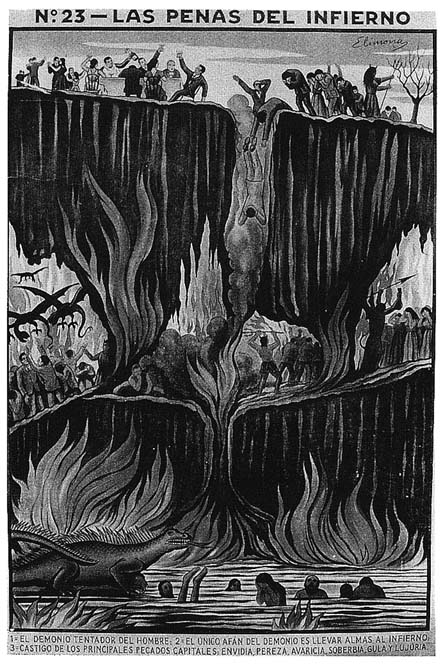
"Suffering in hell." Catechism poster by Ramón Llimona,
Barcelona, 1919. Courtesy parish of Taganana, Tenerife
hear the voice of the rural people of Gipuzkoa, particularly the Carlist or Integrist variety. Theirs would be the notion of the virtue of the smaller towns and the damnation of cities. For the Carlists Paris was Babylon, the "scourage of France." Paris was not just a mythic place. Basques went there. Dolores Nieto's parents bought her bicycle there, and the freethinking neighbor of the first seers worked as a waiter there. Paris was the quintessential city. Much of the chastisement Benita detailed was from a rural perspective. Like that of La Salette, it had to do with femine and harvests. Her reference to healing friars was particularly appropriate coming from a rural culture that produced friars and felt even closer to them than to the priests it also produced. As in the Vendée rebellion in 1793, these antiurban themes were sharpest at the boundaries between the rural area and newly prosperous towns. In the 1930s the reactionary editorials of the Integrist Juan de Olazábal in La Constancia fueled the same antagonisms.[30]
Garmendia, Ideología carlista, 39-40, 191, 215, 246, 259, 453-459; Blinkhorn, Carilism and Crisis, 17-18.
For the Ezkioga seers the local equivalent of Paris was, without doubt, San Sebastián, "focus of evils," epitome of "a life of corruption, vice, and luxury." The seers saw foreigners with red banners invade it, fire ravage it, the sea sweep it away, and a hurricane cleanse it of corpses. Within the generic evil city certain places were especially evil. First and foremost were the beaches. One seer saw Saint Michael "searching the beaches for souls; he has come back without finding a single one." Luis Irurzun accorded special treatment to theaters and cinemas; he saw Saint Michael destroy them with his sword. The Pamplona seer Pilar Ciordia saw the casino of San Sebastián, "cradle of vices and sins … swept out by the water to the angry sea." Another woman saw a dance hall on Mount Igeldo burn ("What screams! Look what is going on there!"). But seers also saw the elegant church of Buen Pastor collapsing in flames at high mass, "because it is nothing but a lot of luxury, and people do not go to mass for God, but for show."[31]
On San Sebastián see vision of Luis Irurzun, 24 February and 12 March 1933, B 657, 659. For beaches see vision of Asunción Balboa, Urnieta, 10 September 1934, 2 pages, AC 211. For theaters see Irurzun vision, 12 March 1932, B 657; for casino see Ciordia vision poem, ca. June 1933, AC 218. For Mount Igeldo see vision of Asunción Balboa, Tolosa, 23 December 1934, 2 pages, AC 213. For Buen Pastor Cathedral: conversation with Ezkioguista women on train recalled by María Angeles Montoya, San Sebastián, 11 September 1983, p. 2.
Seers also singled out Soviet Russia. Even respected churchmen like Canon Carles Cardó in Catalonia were speculating at this time on the role of Russian communism as an agent of divine chastisement of Spain's frivolous and selfish capitalists. María Recalde said the Virgin told her the bad people of France and Russia wanted to destroy the faith of Spain. And in May 1933 both Benita and a seer in Tolosa foretold Red armies invading the country. But the Soviet Union would fall. Saint Michael took Luis to the "immense plains of very fine grass" of the USSR to see it destroyed.[32]
Rimblas to Cardús, Tàrrega, 14 March 1932, reported a talk by Cardó a week before. For Recalde, 8 May 1932, SC D 81; Benita, 22 September 1933, B 516 and B 587-589; Tolosa seer, 30 November 1933, AC 278; Irurzun, 19 March 1932, B 657-658, and Pedro Balda, Alkotz, 7 June 1984, p. 6.
Benita asked for prayers for the conversion of the Jews, but she (or her version of the Virgin) seemed to consider that atheists were the enemy, not Jews.[33]
Benita visions, 22 and 23 October 1932, SC D 116-118. Unlike La Constancia, which carried anti-Semitic articles by Emilio Ruíz Muñoz and others, the seers mentioned Jews infrequently. José Garmendia's vision of 14 January 1934 is an exception ("Yes Mother, why are they so strong? Take them away Mother, take away those Jews. Why not, Mother?) ("Visión del Vidente José Garmendia ...," 1 page, typed, private collection).
The seers barely mentioned Freemasons, the other bugaboo of the clergy. Jews and Freemasons seem to have been far from the experience of our rural seers and do not seem to have struck their imagination, as the USSR did. The United Kingdom and the United States appear to have been completely off their mental map.The last Rafols prophecy said that entire cities would be eliminated but did not say which (at least, the Vatican did not release the names). Many believers badly wanted to know which cities were doomed and asked the Ezkioga seers. Burguera wrote disparagingly of their fascination.
All questions come back to the chastisement—which, and how many, and how, and when, and where they will take place. We laughed at a certain wealthy Catholic of a northern city who, when he asked about the chastisements, was told that the Virgin had announced that the city would be flooded and swallowed by the sea. With deep sorrow he replied, "Now that I've just bought a chalet on the Concha!"
In 1932 worry about the chastisement may have kept people coming to Ezkioga and kept the visions going.[34]
B 480.
News of the coming chastisement did not reach the newspapers. The notion was too unlikely for the general public, so believers were discreet. Only in May 1932, after the last Rafols prophecy had rendered chastisement more plausible, did Cardús, for instance, begin to spread the idea in his letters. As he wrote to his Jesuit friend in India: "All this [the chastisement of Spanish cities, Paris, and Russia] we have almost not been able to speak about, because the people would have been scandalized and would have believed even less in the apparitions of the Virgin."[35]
Cardús to Pou i Montfort, 13 May 1932.
The Reign of Christ
At first the chastisement was an incidental aspect of the great miracle. Seers gradually elaborated more and more on the divine punishment as people showed interest. In the same manner notions of what would happen after the chastisement gradually evolved. The first such statement came from the student seer Cruz Lete when, in late December 1931, almost as an aside, he introduced the notion of an eventual holy regime, telling a Catalan: "The only flag there will be after the chastisement will be the banner you have in your hand [a crucifix]."[36]
Cruz Lete vision, 29 December 1931, SC D 22.
In Benita's and Luis's statements of February and March 1932, the notion went little farther: Christ or prayer would reign.But when Evarista Galdós delivered her "finished" version of the chastisement to the Catalans on April 5, she had clear ideas of an apocalyptic sequence, including the arrival of the Antichrist, which would lead by a given date to the end of time. Unlike Benita or Luis, she was also able to include in the sequence the great miracle the seers had predicted since the summer of 1931, which she adapted to follow the chastisement. Her audience, like Benita's, was a Catalan expedition in the Hotel Urola.
The day of the great miracle, at five in the afternoon, the Virgin will appear on the mountain with a half moon at her feet that gives off light
Image removed -- no rights
Evarista Galdós in vision at Ezkioga, early 1932. Photo by Raymond De Rigné, all rights reserved.
in all four directions. Saint Michael will appear as well and will explain why the world is so lost, who the seers have been, and what it is they have seen. And this vision which began at five o'clock will last until eleven at night. And Saint Michael will appear on a white horse, though people laugh when they hear this. The Virgin told me that four walls will remain on the mountain, which will be those of the basilica, which will have four towers, and this wooden cross that is on the mountainside will be at the altar.
Of those who are at Ezquioga on the day of the miracle, some will see the Virgin, others only her shadow, and others nothing at all. All will see Saint Michael. In the moment that Saint Michael appears, the Virgin told me, everyone will fall down in terror. The miracle will be seen at Ezquioga but will be noted in the entire world.
On the day of this prodigy Saint Michael will bring a statue of the Sorrowing Virgin, which I have seen and which is about one meter high, and will leave it at the place I will show you this afternoon so it will be venerated in the basilica.
The chastisement, the Virgin told me, will be before the miracle. There will be a rain of fire and a cloud of snakes and sudden deaths. The wicked will be as if carbonized, there will be many dead, and the more one walks, the more one will find. This will be in the entire world, and in Spain less than other places. Saint Michael will cut off many heads. He usually carries two swords, one of fire and the other of blood. What a voice he has! It scares me to hear it.
Many of the wicked will die. Between the chastisement and the miracle there will be little time. The Virgin has told me which day the chastisement will be and which day the miracle, and I have declared it in writing to my confessor in sealed letters that he keeps, and on the envelope is indicated the day he may open them. I have permission from the Virgin to tell people eight days in advance. The Virgin told me that in Barcelona there are many people who believe in her apparitions, and in Madrid the chastisement will be terrible.
The Virgin told me how I will die, but not when. She told me that a person will come from Madrid who has already been here once and will kill me right on the platform. This person will also kill María Recalde and other seers, many of whom will die in María Recalde's arms, and when he kills us, a light will appear above the platform, and as a result of this prodigy he and many other souls will be converted. The Virgin told me that almost all of the seers would die martyred.
She also told me that there will be two hundred fifty seers. There are priests who are seers, although they keep quiet about it. The Virgin told me that here in Zumárraga there is one who has seen her, and there are two in Navarra. The Virgin has said that she appears in fourteen places in Spain. In Navarra she appears in four: Bacaicoa, Iturmendi, Lacunza, and Echarri-Aranaz.
The Virgin also told me that there are twenty-six years left until the end of the world and that the Antichrist is at present eight years and eight months old. That is approximate because she told me about two months ago and I do not remember the exact date. The Antichrist will live for thirty-three years and when he is twenty-six he will begin to work miracles. The Virgin told me where he is from, where he lives, and who he is the son of.
The Virgin says that she has come to convert people and give signs that the end of the world is coming. The end of the world will happen after the miracle. And after the miracle Christ will reign until the end of the world.
The text concludes: "Listening to this statement, in addition to about twenty-five people, were the seers Jesús de Elcoro and the child Benita Aguirre, who added, 'The chastisement of Russia and Paris will be more severe than in other places, and in Spain, that of Madrid.'"[37]
ARB 241 gives the setting. I have used the text from SC D 64-69. Not surprisingly, Burguera left this prediction, far too specific and disprovable, out of his book.
In Evarista's statement there are five themes: the miracle; the chastisements; the martyrdom of the seers; the number of seers and vision sites; and events leading to the end of the world. She laid out a chronology perhaps too precise. The world would end in 1958. But before that there would be a chastisement, which would include the martyrdom of the seers; then the miracle, which would confirm the visions, identify the true seers, and leave an image and the walls and tower of a basilica; then Christ would reign; then in about August 1949 the Antichrist, by then twenty-six, would start working miracles. He would die at age thirty-three, that is, about 1956, or two years before the world ended.
Note the similarity between Evarista's chronology for the Antichrist and that which a canon of Mallorca, Rafael Pijoán, and others deduced from the secret of La Salette:
I do not want to recall here all of the revelations of the Most Holy Virgin, which have been coming true, just that which pertains to the end of time. The revelations of La Salette have the Antichrist born about 1924; and as we know that the Antichrist will start his conquest of the world aged about twenty, and that he will take six years to subdue the earth, and that the persecution of the infernal monster should last three and one-half years, it gives us the total of 1953 [and] one-half, the approximate era of the end of the world, and almost exactly the same as Saint Malachy.[38]
Pijoán, El Siglo XX, 194-195. Burguera used the second (1920) edition of El Siglo XX in De Dios a la Creación, 85. Pijoán's pamphlet, "El Gran Triunfo de Leo Taxil" (Biblioteca Antimasónica, Cuaderno XIV, Barcelona, Tip. y Lib. de la Inmaculada Concepción, 1889, 30 pages), ended: "Tu nombre, ¡Oh Taxil! / se cubre de gloria / tu hermosa memoria / eterna será."
Evarista adopted most of the themes in Benita's prophecy but included original aspects like a cloud of snakes, an assassin from Madrid who would kill seers, and María Recalde's care for the martyrs. She continued in this vein with her visions of black corpses and serpents strangling people.[39]
Visions of 15 and 17 April 1932, B 718-719.
The radical expansion of the Ezkioga message to foretell events ever more portentous and grandiose seems to obey an inner dynamic common to other apparitions. The messages at Fatima and Garabandal were a graduated sequence
of ever more consequential and terrible outcomes. At Ezkioga the seers accompanied ever more frightening messages with ever more heartrending and lengthy crucifixions in a kind of emotional escalation; ever stronger feelings seemed necessary to hold onto believers. And a kind of plot tension depended on the Virgin revealing ever more of her program.
By terrorizing people with the prospect of death without the sacraments, by acting out the crucifixion and provoking their compassion and tears, by predicting massive chastisements, Evarista, Benita, and the other seers also performed a service time-honored in Catholicism: they stimulated the feelings required for repentance. In the Early Modern period public flagellants and penitential processions aroused these feelings in a kind of purposeful sacred theater that onlookers welcomed. The seers at Ezkioga did the same thing for their believers. They evoked changes of heart and love of God, and priests heard the results in confessionals throughout the region. If the seers strayed into calculated theatrics, they may have done so in the belief that the cause was good. While they were elaborating scenarios for the end of time, the Jesuit José Antonio Laburu was gathering material to discredit the vision. But although he had a copy of Benita's statement, he never spoke of the psychology of terror or the apocalypse. The apocalyptic predictions of the seers would have given him powerful arguments against them.
The Great Monarch and the Crucíferos
From Girona in the summer of 1933 Benita Aguirre revealed new aspects of the end of the world. By that time she too was speaking of the Antichrist (she too said he was born in 1923). But she introduced elements from the prophecies of José Domingo Corbató. Some Spaniards thought that the Great Monarch of the apocalyptic tradition would be the pretender Carlos VII. In Paris around 1900 Corbató, who had fought in the last Carlist War, became certain that he himself was the Gran Monarca and that his court should be in Valencia. While still in Paris, he and his cousin formed a secret society of priests and laymen, the Hermanos de la Milicia de la Cruz, or the Crucíferos. This group was to be a kind of militia for the struggle against the Antichrist. Mélanie of La Salette had her order of "apostles for the last times," the Italian prophet David Lazzaretti proposed the Milizie Crocifere in 1868, the French ultraroyalists had the Chevaliers de la Foi, and most especially San Francesco di Paola (1436–1507), the founder of the Minims, wrote about the Holy Crucifers. Based on the rules of Third Order Dominicans and that of the Minims, Corbató drew up a detailed rule for his order. When he arrived in Valencia, he published the rule in Latin and Spanish. He also issued an organ, Luz Católica , for the order.[40]
For the Carlist Great Monarch, Garmendia, Ideología carlista, 506, 631, mentions the prophecies of a nun, Sor María Antonia del Señor, and gives references published in 1869. For Mélanie see Zimdars-Swartz, Encountering Mary, 184; for Lazzaretti see Lazzareschi, David Lazzaretti, 59, 83, 119, 181-196; for Martin, Boutry and Nassif, Martin l'Archange, 214. For Corbató see his Regla de la milicia de la cruz, Regla Galatea, and Apología, 2:214-18, and García Miralles, "El Padre Corbató," 361-400.
Corbató soon ran into trouble with the archdiocese, which placed his book El Inmaculado San José on the Index in February 1907 and suspended him from
saying mass in January 1908. It also banned two other of Corbató's journals, La Señal de la Victoria and Tradición y Progreso . When Corbató died on 23 May 1913 at age fifty-one he had numerous followers. They included parish priests in the provinces of Huesca, Castellón, and Girona, some of whom believed, I think mistakenly, that he would rise from the dead. They studied and restudied the apocryphal Fourth Book of Esdra; for three more years those in Blanes (Girona) published another journal, Cruz y Españolismo .[41]
For archdiocesan ban: Boletín eclesiástico de Valencia, 15 March 1907. García Miralles, "El Padre Corbató," 454, 472-487. Corbató may have influenced the La Salle Brother Estanislao José (Olimpio Fernández Cordero, 1903-1926), who had revelations that he himself would be pope and that there would be a Eucharistic kingdom based in Spain with a Eucharistic army. His superiors did not allow him to deliver a secret message for Alfonso XIII, and only his close friends took his visions seriously: Rodríguez, Un Joven heróico, 100-111.
Benita may have met Crucíferos, read their literature in Girona, or obtained Corbató's books from Burguera.At any rate, in July Benita began to refer to the Great Monarch and in early August to the Crucíferos. She was in some confusion as to when they would become active. She said that at the time of the chastisement the believers would go into the desert, where they would meet a great man who would be the king-general of the world. He would be the Great Monarch and would impose the reign of Jesus. The Antichrist, however, would interrupt this reign. Then there would be another period of the faithful in the desert, followed by the end of the world, which would be at hand, she said, "when women cannot be distinguished from men by their manner of dress." After the end of time would come a period of a thousand years of peace in which the saints would live with the just on the earth. In this period there would be no sin, a kind of paradise on earth.[42]
Visions of Benita Aguirre, 23 to 28 July, 7 and 8 September 1933, B 488, 502-503, 513.
She introduced the Crucíferos into this program as follows:
After the chastisements have passed, there will be a single religious order, called the Crucíferos, which will save the entire world by preaching the true faith and conquering souls. The head of the Crucíferos will be a very holy man who, after his apostolate, will die crucified at the gates of Bethlehem. In the last times everyone will speak the same language.
The Crucíferos were the militia of the Great Monarch.
O Holy Crucíferos, you will destroy the damnable Mohammedan sect, you will put an end to all kinds of heresies and sects in the world, and you will be the end of all tyrants; you will impose silence with perpetual peace for the entire universe world; you will make men holy by force or by will. O holy people! O people blessed by the Holy Trinity! The head-founder will be the great captain of holy people, called the Crucíferos of Jesus Christ. They will obtain dominion over the entire world, temporal as well as spiritual. These servants of God will cleanse the world with the death of an infinite number of rebels. The Chief and Founder of this militia will be the great Reformer of the Church of God.
The first members of the order, she said, would come from the city of Seville, "in which there is much iniquity, vices, and sins." Benita's vision of 20 August 1933, much of it bearing on the Crucíferos, betrays her debt to Corbató. She lifted one
section from a prophecy made in 1849 by the Catalan Franciscan, Jacinto Comà, which Curicque published in 1872 and which Corbató took from Curicque.[43]
Benita Aguirre
La Italia, regada con la sangre de tantos mártires, es la esclava de una demagogia diabólica, que ha llegado a constituirse
en consejera del Poder.
Y la pobre España, que, palmo a palmo, ha sido conquistada por la Cruz, se ha convertido en un pueblo de ilotas, que corre al precipicio y lucha por romper con sus tradiciones ysu propia manera de ser.
P. Comá, from Curicque
L'Italie, arrosée du sang de tant de généreux martyrs, est l'esclave d'une démagogie diabolique, qui est arrivée à se constituer
la conseillère du pouvoir....
Et notre pauvre Espagne, qui a été conquise pied à pied par la Croix, est devenue un peuple d'ilotes, qui court au précipice et lutte pour briser avec ses traditions, son histoire et sa propre manière d'être.
Visions of Benita Aguirre 6, 20, 30 August 1933, B 504, 508, 511; Curicque, Voix prophétiques, 2:383. See Staehlin, Apariciones, 109-120, for similar borrowing by Gemma Galgani in 1902 and by the Madrid mystic Josefa Menéndez (1890-1923) in 1920.
None of the other Ezkioga seers mentioned the Crucíferos. But Juan Bautista Ayerbe circulated to the Ezkioga believers messages sent to the Crucíferos from Hermano Pedro, the "Jefe-Fundador" of the order. The earliest date on the messages I have is December 1932 and the last is October 1936. They announce chastisements like those the Ezkioga seers predicted. In one message from September 1934 a visionary addresses "Dear brothers in the Sacred Hearts of Jesus and Mary": "As this enterprise [Obra ] is all very spiritual and secret, you will have to do it in spirit. All under this oath of agreement (which is the equivalent to solemn vows) will be blessed, and if you do not fulfill what you promised, you will be HORRIBLY PUNISHED ."[44]
Ayerbe distributed "¡Cuanto nos ama Jesús! (Relaciones del hermano Crucífero Serafín)," excerpts of four letters from Serafín to Hermano Pedro dated from December 1932 to July 1933 (AC 373-375); another letter to "Mi querido P. from Serafín de Jesús," 5 September 1933 (2 sides, AC 377); and two undated texts (AC 383). The citation is from a page copied by Ayerbe, 18 September 1934, AC 378, beginning "Queridos hermanos en los Sagrados Corazones de Jesús y María" and is part of a message on 1 September 1934 from "el Divino Maestro" via a seer for Hermano Pedro.
Some sort of group apparently existed. In one message Hermano Pedro reported that he had been enlisting soldiers under the banner of Christ the King at Calle Murrieta in San Sebastián. On 16 October 1933, in terms similar to those of the Ezkioga seers, the Chief-Founder announced that the chastisement had begun. He was in correspondence with Ayerbe, who was sending him the vision messages of Luis Irurzun and doubtless those of others as well. There may have been a female seer who guided the group and passed on orders from Christ to the Chief.[45]
Recruiting on 27 August 1935, from "Extracto de una carta a los crucíferos" in ARB 253, with another message dated 13 October 1936; for chastisement see "J. M. J. De una carta del fundador-jefe de los crucíferos 16 octubre, 1935," 1 page, dittoed, AC 380 and ARB 253; and "De Una carta del Hno. Pedro 29 abril 1936" 1 folio, dittoed, AC 381; for female seer María, see "Mensaje de Jesús a sus predilectos Crucíferos" 2 sides, n.d., AC 383.
Before the Civil War Hermano Pedro lived in Barcelona, where he acted as a kind of inspired spiritual director among the same kind of people who believed in Magdalena Aulina and the Catalan mystic Enriqueta Tomás. He induced at least one follower, a woman, to give away her belongings and lead an ascetic life.[46]
According to Josefina Romà, personal communication.
Ayerbe obtained photographs of Hermano Pedro from a Sister of Charity in 1949 and sent one to Sebastián López de Lerena. In this correspondence Ayerbe called himself Hermano Buenaventura and López de Lerena Hermano Nicodemus. It is possible that they had become Crucíferos.[47]Ayerbe to nun, 15 November 1949, AC 427. López de Lerena began his letters with a symbol associated with the Crucíferos, a C with a cross inside it, in mid-1941.
A secret group with a Traditionalist slant or base may have continued after Corbató's death under prophetic leadership in Barcelona through the 1940s. Or, given that Hermano Pedro styled himself the "founder," he may simply have borrowed the name from Corbató and started a new group. The women who cared for Benita in Girona knew about Enriqueta Tomás and may well have known about Hermano Pedro.
In 1984 I asked Pedro Balda who the Crucíferos were. He said he had some of their messages, but he did not know who Hermano Pedro was. He understood that the organization was secret. But he and Luis Irurzun both knew the Crucíferos were a kind of apocalyptic force.
The Crucíferos are those who are ready when the time comes, with the angelic hosts, to confront the major enemies of God and the church.
Where are they?
Well, I do not know where they are. Personally, I do not place great importance in this. But in an ecstasy in 1933 in Huarte Araquil, the seer [Luis Irurzun] took my hand and said to me, "Crucífero. Today you do not have [power]. But the day will come when you will have power not against one nor a hundred, but against many more." And now, I do not even know where they are.[48]
Pedro Balda, Alkotz, 7 June 1984, pp. 1, 9.
Consumers and Interpreters of Prophecies
It is hard to know how many Basque country people were interested in the visions of the end of the world. But people like Padre Burguera, Juan Bautista Ayerbe, and Tomás Imaz dwelled more in the realm of prophecy than in the everyday. We can follow their interest in letters and see how they placed the Ezkioga prophecies in the wider and older tradition, on the one hand, and continually speculated about their applicability to current events, on the other.
Sebastián López de Lerena, the wealthy electrical engineer from Bilbao, wrote a defense of the apparitions in the summer of 1933. For him they announced the end of time:
There [at Ezkioga] and in various other places, the Most Holy Virgin truly appears with the main purpose of preparing the world for the Reign of the Sacred Heart of Jesus, which is imminent and will not come without enormous universal chastisements, apparently inevitable…. Ezkioga is the confirmation of innumerable ancient and modern prophecies of the greatest authority, and in consequence, it is the precursor … of the most transcendental and most moving events of human History…. Hence the unlimited variety of material in the visions: … [including] announcements of great chastisements, of miracles, of what they call the "Great Miracle," of universal application and which will be the occasion for a general conversion, the Great Monarch, an era of peace before the Antichrist, his reign, the end of the world.[49]
López de Lerena, "A propósito de Ezquioga."
A man in Madrid who was "a fervent devotee of the holy apparitions" wrote a long letter to Ayerbe, which I include in the appendix. It shows how these semiprofessional vision consumers, like modern semiologists, could organize into an apparently coherent pattern whatever ideas came down the pike. The letter reveals the subculture of religious excitement that maintained continuity and gave meaning to religious apparitions and linked them with the mysticism of the convents. This kind of audience needed specific dates connecting the general pattern to the here and now. One seer led Ayerbe to believe, for instance, that the Sacred Heart of Jesus would begin his reign on 25 April 1934.[50]
Ayerbe to Cardús, 9 November 1933.
So our seers and their patrons returned to the specific political-historical visions of the first summer of the visions, now rerouted through the complex chronology of the end of times.Some of the Ezkioga seers delivered a professional level of prophecy. Ayerbe circulated a prophetic update of the Chilean priest Echeverría Larrain, who was touring Europe spreading apocalyptic warnings and spoke at a church school in San Sebastián about 1933. It reads much like the output of Benita.
He said that the renovation is coming very soon, is imminent. He did not give the date, but he did say that by the year 1935 the world would be completely reformed, within two years or before. A third of the world will die. The Virgin will come with a legion of angels and many priests at her side will absolve those who want to convert.
That then only the good would remain in the world and there would be peace until the end of time. That the church would triumph more than ever. He said that soon there would be a war or a revolution and that in a moment all the communists and soviets would come out to destroy all the nations, trying to triumph by any means, and then would occur the chastisement that God has prepared for us, and in an instant the world would be transformed in peace with the good people until the end of the world.
He said that there is a prince in the desert doing penance who is the descendant of the ancient Bourbons. No one will know where he comes from and he will live and rule from France, but not from Paris, because Paris will no longer exist. It will be destroyed and burned for its great sins and crimes, and more cities as well. It will be a horrible chastisement never been known before, and it will be terrifying. France and Germany are going to get caught up in a war very soon, and soon after will come the terrible chastisement of this unfortunate mankind for the great sins it has committed.[51]
"Fragmentos de una Carta—Terribles predicciones" and "Profecías de Bug de Milhas," 2 sheets, dittoed, unsigned, n.d., AC 458. After the date 1935 there is a handwritten note: "It appears the chastisement has been delayed."
The similarity of Echeverría's conclusions to those the prophets of the Basque uplands reached deserves attention. López de Lerena contrasted the elevated concepts in the Ezkioga visions and the background of the seers:
These and other transcendent themes are the subject of the daily conversations of the Most Holy Virgin with the seers, very humble country people, all of them honorable, simple, sincere, and with no learning. God loves and takes pleasure in the humble. Nowhere is this so clear as in Ezkioga, and for us it is a new and evident "criterion of certitude."
Such wonder that a peasant or a child knows what she or he could not be expected to know is an ancient commonplace. Thomas Martin, Catherine Labouré, Mélanie, and Bernadette in France and David Lazzaretti and Eusapia Paladino in Italy were recent examples. With the high rates of literacy in contemporary Europe the wonder is often unjustified. Enthusiasts tend to present these adults and children as less tutored, less well-read, and less intelligent than they really were. In my experience persons who have religious visions have a great hunger to understand what is happening to them and they have to respond to insatiable
demands from those around them for more and more heavenly material. Those with little background in these matters can receive a rapid and substantial education by carefully reading the books and pamphlets that enthusiasts or spiritual directors inevitably give them.[52]
López de Lerena, "A propósito de Ezquioga." Staehlin, Padre Rubio, 109-110, for the voracious reading of the seamstress Josefa Menéndez.
At Ezkioga quick studies like Benita, Evarista, Cruz Lete, Luis Irurzun/Pedro Balda, Pilar Ciordia, and Patxi were the seers who could best satisfy those needing to know about the end of time.These messages of crusader-like crucifers and apocalyptic battles might seem to be guarded ways of talking belligerently about the internal enemy in Spain and preparing for a civil war. But the emphasis on the Soviet Union and international communism in the contemporary literature about Ezkioga and even a dozen years earlier in that about Limpias points to the deeper perception that a cataclysm was shaking the very roots of civilization. For many Catholics the Cold War began with the Russian Revolution. For them the threat of communism was nothing less than the devil's dominion of the world. This threat was on a different order of magnitude than that posed by Freemasonry or liberalism. Apocalyptic scenarios existed before, but communism gave them actuality on a global scale. For the Ezkioga believers the chastisement was not, in fact, the Spanish Civil War, and the reign of the Sacred Heart did not begin in 1939 with Franco. Indeed, even after the fall of communism the Ezkioga believers still wait for the chastisement of the immorality they see around them.
This prophetic tradition is the basis on which many people make decisions. Thus it is as important for a statesperson, political scientist, or historian to know this line of belief as it is for an economist to understand unlikely economic theories—not because they correctly predict or represent reality but because others use this tradition to take actions of lasting consequence.
For believers in the visions, especially those who stuck with the seers into 1932 and thereafter, these prophecies were deadly serious. I spoke to families of believers in Ormaiztegi, Urretxu, and Portugalete who for many years had special candles and matches ready for the days of darkness, and two families showed me typed or hand-copied instructions for what to do when the chastisement began. The instructions appear to have come from the Barcelona followers of Enriqueta Tomás, who through the 1930s and 1940s developed the cult of the Virgin of the Twelve Stars—alas, another story. Note the open involvement of Saint James as well as Saint Michael:
On the Dark and Stormy Night (Observations of Another [Female] Seer)
1. Daniel Clairin is the devil.
2. About eleven in the morning it will begin to get dark as if there were an eclipse of the sun.
3. In one or two hours the devils will go out.
4. Shut the doors and windows tight, and whoever gets caught in the street must stay outside. For the devil will take advantage of good
people, like family members who call at the door. If the door is opened the devil will come in with them, and all in the house will be lost. So that, without compassion, once the door is shut, open it for no one. The devil will even imitate the voices of people to gain entrance.
5. There will be sounds like an army on patrol, and it will be San Miguel and Santiago who will come down to earth.
6. With the blood of the dead Santiago will mark the doors that he finds closed, so that the infernal enemy may not enter, as with Moses and the Israelites on the mountain of the forefathers.
7. Prepare five candles and five pictures [estampas ] of the Virgin of the Twelve Stars, and keep them lit for the forty-eight hours that the slaughter, the screams, and the gases produced by the collision of stars that makes fire in the clouds will last.
8. On Sunday the sun will come out brightly, but because of so much death produced by the collision of the stars, one will not be able to go out.
9. On Monday there will be a strong wind that will clear the atmosphere, and on Tuesday people can go out, and they will see a great many dead.[53]
"Sobre la noche obscura y de tempestad," 1 page, dittoed, n.d., AC 14.
Many people I talked to recalled that seers predicted the worldwide triumph of communism. An older woman told me, "Our milk-woman said that there would be a river of blood from Izaga to Ezkioga, and that the Russians would be in control." Those witnessing the visions of chastisements remember them vividly:
They saw balls of fire; they wept; it was a spectacle.
They said there would be fire; they screamed; terrible things. We went away terrified.
They were always promising macabre, lugubrious, apocalyptic things … The Jehovah's Witnesses say the same things.[54]
For river of blood: woman about age seventy in Zumarraga, May 1984. Izaga, the section of Zumarraga closest to Ezkioga, was partial to the visions, and the seer Marcelina Mendívil spent her last years there. Quotes from (1) woman from believing household in Ezkioga, age about fifty, August 1982; (2) woman from Ordizia, age seventy-two, December 1983; (3) man from believing household, Urnieta, June 1984. The overlap of predictions with those of the Jehovah's Witnesses led at least one Ezkioga cuadrilla to defect. Arrinda and Albisu draw the comparison in Jehovatarrak (Jehovah's Witnesses), 11.
Persons in Zaldibia and Urretxu told the same story, which may be apocryphal. Once when seers announced a date for the Last Judgment, a farmer counted up his hens and ate them one by one, so that on the fatal day none would be wasted. The real-estate broker Tomás Imaz gave away all he had. The children of Juan Bautista Ayerbe grew up in Urnieta thinking the end of time could come at any moment. An uncle converted all his money into silver and buried it under a tree. Their mother expected an exodus of Catholics to the desert and had all her valuables in two suitcases ready to leave at a moment's notice. During the Civil War a thief walked off with them.[55]
Daniel Ayerbe, Irun, 13 June 1984, confirmed by his sister Matilde, in San Sebastián the next day.