
Research Since Anastasi's Summary
Since Anastasi's summary, research both in the United States and Europe (some on exceptionally large data sets) has confirmed the inverse relation of sibsize and various measures of ability or achievement (Belmont and Marolla 1973; Breland 1974; Claudy, Farrell, and Dayton 1979; Nisbet 1953a and b ; Nisbet and Entwistle 1967; Davie, Butler, and Goldstein 1972; Douglas 1964; Maxwell
1954, 1961, and 1969a and b ; Scottish Council for Research on Education 1949, 1953, 1958; Illsley 1967; Gille et al. 1954; Vallot 1973).
In a set of unusual research papers, Marjoribanks, and Marjoribanks and Walberg, have made additional contributions to this issue (Marjoribanks 1972a and b ; Walberg and Marjoribanks 1973; Marjoribanks and Walberg 1975; Walberg and Marjoribanks 1976). Controlling for the parents' socioeconomic status, these researchers have measured directly what they call "family environment" variables of school children (pressure for achievement, activeness, intellectuality, and independence, as well as mother and father dominance). The family environment variables were negatively related to sibsize and positively related to ability—particularly verbal ability. The Marjoribanks–Walberg research indicates that sibsize is related to ability through the family environment variables, and that the relation is specific for verbal ability.
However, some recent large-scale studies (notably Velandia, Grandon and Page 1978; Page and Grandon 1979; Galbraith 1982b ) claim not to have found a sibsize effect on IQ and, in some studies, the only child appears to constitute an exception to the linear relationship. First, we will discuss two major cases (Belmont and Marolla 1973; Breland 1974) in which the only child constitutes an exception, and then we will go on to those studies in which sibsize appears to have little effect.
Among the studies listed above, in two major instances (where the inverse relation exists generally), the only child constitutes something of an exception because it performs less well than do children of other small- or medium-sized families. These two cases merit some detailed discussion because they illustrate some of the confounding and selection problems involved in research on sibsize and IQ. These instances are the Dutch data on 19-year-old males analyzed by Belmont and Marolla, and the cohort of National Merit Scholarship test takers (in 1965) analyzed by Breland. The Belmont and Marolla and the Breland results by sibsize are presented in figure 4.1 along with data from the French and Scottish studies of young children that do not indicate an only-child deficit.
In considering the Dutch and American results for only children, we must emphasize that the studies did not control for selective factors peculiarly affecting such youngsters. Regarding the Belmont
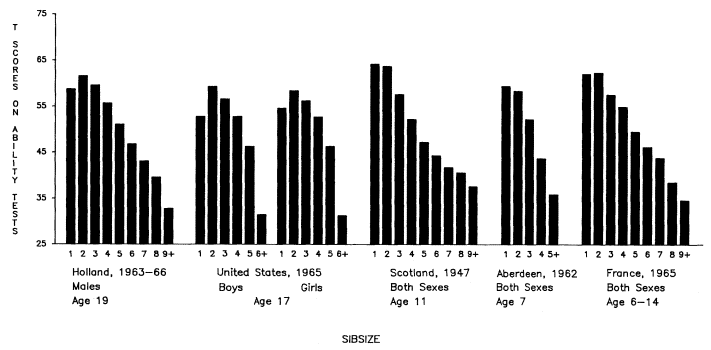
Figure 4.1.
T–Scores on Various Cognitive Ability Tests by Sibsize for 19-Year-Old Dutch Males, 11th-Grade U.S. National Merit
Scholarship Qualifying Test Takers, Scottish, Aberdeen, and French Grade School Children. Data from Belmont and
Marolla (1973); Breland (1974); Scottish Council for Research in Education (1949); Illsley (1967); Vallot (1973).
and Marolla findings on young Dutchmen born during the period 1944 to 1947, probably the most acute selection, as I have discussed in detail elsewhere, concerns the effects of the famine in Holland on all last-born and apparently last-born children, including only children (Blake, 1981a ). In brief, since the famine drastically affected fertility, fetal mortality, and infant deaths, being an only child or other last-born child was a status that would occur selectively in those families worst hit by the famine (those families in which the woman could not become pregnant or stay pregnant to term or in which a next-born child would die). Moreover, since the adult death rate was adversely affected as well, many only and last-born children born during the 1944–1947 period were partially or completely orphaned by the famine and, hence, remained "last-born." Again, on average this adult mortality would occur in those families worst affected by the famine. Since severe starvation in childhood is known to affect intellectual functioning adversely, it is hardly surprising that only and other last-born children in the Dutch data demonstrate an unexpectedly sharp drop in performance on the Raven Progressive Matrices test.
Although the selective effects of the famine were quite probably crucial in the Dutch data, overriding other effects, the fact is that all of the data sets I have analyzed indicate that only children suffer disproportionately from some particular familial handicaps relative to children from other small families. As we have seen, only children invariably come from broken families in higher proportions than do children from other sibsizes. The disruption of their parents' marriages is doubtless the reason, in many cases, that these children are singletons. Moreover, since most of the children reside with their mothers when the family is disrupted, the family's income level is adversely affected compared to children from other small families that remain intact. Additionally, since unusually high proportions of only children are born to older parents (who are from cohorts in which education was not as high as in more recent years), the parents of singletons tend to be somewhat less educated than the parents of children in other small families (the two- and three-child families with which the only child is usually compared). Finally, the incidence of infant and child health problems (particularly low birth weight and its possible sequelae) is greater among only children than among those in two- to three-child families. As
we shall see when we present our own analysis, controls for such characteristics of the parent as educational attainment, income, and intactness of the family affect the results of ability/achievement testing on the sibsize results, and markedly affect the results for only children.
Turning to Breland's findings on the approximately 800,000 participants in the National Merit Scholarship Qualifying Tests in 1965 (figure 4.1), we may note that there were no controls for background characteristics, including race. This point is often misinterpreted in discussions of the Breland article since he also mentions, but does not present, sibsize data for a small sample of finalists in 1962, where some parental background data were apparently available. Thus, the somewhat less distinguished performance of the only child in the 1965 data is easily accounted for by the overrepresentation among only children of broken families, less educated parents, lower income, and a disproportionate number of blacks. Moreover, since only children are being compared with those of other sibsizes, we must remember that singletons are disproportionately likely to finish high school and be encouraged to go to college and, hence, are less selected for academic performance by the age of the NMSQTs than are children from larger sibsizes, among whom many have been weeded out by age 17. It is perhaps unnecessary to add that the NMSQT-takers are then additionally selected out of the population of 17-year-olds in high school.
We may now turn briefly to three recent studies that appear to have failed to show an association between sibsize and IQ or achievement. These are Page and Grandon (1979); Galbraith (1982b ); and Velandia, Grandon, and Page (1978). All three studies are of samples of either high school graduates or college students. Additionally, the samples are of groups among whom other selective mechanisms appear to be important.
Turning first to Page and Grandon, this analysis was based on the second followup of the National Longitudinal Survey of the High School Class of 1972. The original sample, a stratified random sample of U.S. high school graduates in 1972, numbered 22,000 in all. However, what with losses to followup (cases that were never found at later stages of the survey) and missing data, the Page and Grandon analysis is based on 10,662 cases. The Page and Grandon analysis is thus victimized by selection in two ways. One, it is of
high school graduates, among whom (as we have seen from the data on adults) there has been drastic selection by sibsize, but, additionally, losses to followup and missing information have also been very large. We are not told anything about the biases involved in these losses. In any event, it is hardly surprising, knowing what we know about dropping out among those from large families prior to high school graduation, that Page and Grandon do not find a strong relationship between sibsize and ability measures. Page and Grandon also consider an interaction between the sibsize achievement relation and SES which we will discuss in a later section devoted to this interaction.
Galbraith's analysis began with 15,000 students (class undesignated) at Brigham Young University in Utah, a Mormon institution. Data limitations reduced the sample to 10,925. Family size was found to have either neutral or slightly positive effects on ACT (College Testing Program Examination) scores. No N s are included in the tables, but we are told in a footnote that the tables are based only on those respondents for whom information was available on all of the variables—presumably a count lower than 10,925. Thus the analysis is based first of all on college students of unknown year in college (itself a major sibsize selector), the students are Mormons (among whom high fertility is religiously enjoined, whose families are strongly supported in daily activities by the temple and the community, and who are generally exceptionally prosperous and well educated with unusually stable family situations), and we have no idea how many cases are involved in the actual analysis—that is, how selected this highly selected original sample has become due to data problems. Although it could be argued that youngsters from Mormon families are not selected by sibsize for high school graduation and college entry like other American children, we have no empirical reason to believe that Mormons are an exception. Given the above, we cannot be sure what Galbraith's data show.
Velandia, Grandon, and Page's analysis is based on verbal and mathematical aptitude scores of over 36,000 college applicants in 1974 in the country of Colombia. On a bivariate basis, the authors find that students in families of three rank highest, and those from families of one or two children rank somewhat lower. Beyond the three-child family, scores go down continuously up to the largest families of ten children. Why do students in one- and two-child
families rank lower than children in three-child families, and lower than even students in four-child families? A hint is provided by the authors themselves (although not heeded by them) in their description of the sample.
The Colombian educational system, like those of many other countries succeeds with only a minor fraction of the students. . . . For a complex of reasons, most students have dropped out of elementary school by the third grade, and graduates from secondary school number only around 5% of their age-mates. Of those who finish, called bachilleres, virtually all desire entrance into higher education.
In addition to this drastic selection, one may mention as well that there probably are some special reasons why, in a high fertility society, some families have only one or two children. In any event, the importance of selection according to sibsize, is suggested by an additional facet of the authors' own analysis. Here they divide their admittedly upper-class sample into SES quartiles. For the bottom quartile, they find virtually no difference in scores by sibsize, but for the top quartile they find a marked decline of scores with sibsize. For the middle 50 percent of the SES continuum, the authors find a negative relation with sibsize as well after the third child. The authors themselves suggest the interpretation that these results may be due to the fact that young people are much less selected by sibsize at the upper end of the SES continuum, but this interpretation is rejected by them because they do not feel that it is "parsimonious." Thus, this "exception" to the negative relation between IQ and sibsize turns out to be readily explicable in terms of both selection and the fact that most of the family-size continuum is in conformity with expectations.
In sum, a long history of research, based primarily on bivariate relationships between IQ and number of siblings, has found the association to be inverse. Recent work has begun to investigate what aspect of intelligence seems most implicated in the IQ–sibsize association. This work stresses the role of verbal ability, and the principal proponent of this view (Nisbet 1953a, 1953b, 1967) has suggested that children in smaller families have more verbal ability because they spend more time interacting with their parents. We have seen, however, that a number of confounders must be dealt with before we can assume that number of siblings bears a causal
relation to IQ. We need controls for parents' socioeconomic status because this is associated both with their children's IQ and with the number of offspring the parents have. We also need to be assured that the data used to study this relationship are not strongly selected by sibsize (because of school drop-outs) as occurs when late high schoolers and college students are the subjects. Finally, we need to pay some attention to parental IQ as an influence on differential sibsize IQ. We have no evidence that genotypically more intelligent parents have smaller families. We do know, however, that recent heritability estimates for IQ have been greatly lowered and that they provide considerable room for environmental influence. Indeed, methodological examination of heritability estimates does not inspire confidence. We have noted, as well, that controls for parents' education can provide some control for parents' IQ. We have reviewed a number of major recent studies of IQ and sibsize which have shown some anomalies in the inverse relationship. We believe that these anomalies can be explained by an absence of control for parental characteristics and/or a strong selection by sibsize in the samples. We now turn to our own analysis of the sibsize–IQ relationship.