
Tonality and Form
Having examined the thematic style of Pelleas und Melisande in some detail, we can now look again at the larger formal structure in which the themes are placed. Although there is some merit to Berg's analysis of the work as a sonata-symphony Mischform (see table 4), this approach becomes less persuasive the more specific it gets. Schoenberg himself, although he seemed on the whole to approve of Berg's analysis (Berg 1987, 293) and on two occasions referred to the first fountain scene as a "scherzo" (Bailey 1984, 61, 66), nowhere elaborated any sonata-like view of Pelleas (unlike in the case of the First Quartet, op. 7).
Berg's analysis is, as its title implies, almost purely thematic; he gives no tonal references for any of his sections. The sonata-form analogy becomes less plausible when the harmonic dimension is considered, as has been observed by both Philip Friedheim (1963, 207) and Walter Bailey (1984, 72). To be sure, Pelleas begins and ends in D minor, and the opening material is recapitulated in the final section (part IV). From the sonata-form point of view, however, the tonal relationships are odd: Berg's "introduction" is in D minor and the first theme (GOLAUD) in F major; in the "recapitulation" the introduction reappears (which makes one suspicious of calling it an introduction at all) and is not in the tonic, but in

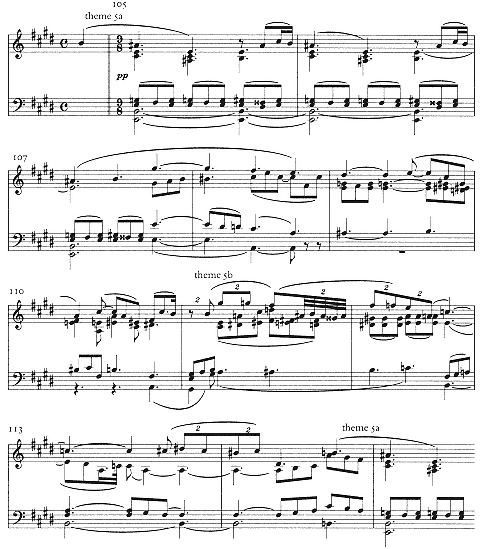
Example 7.7
Verklärte Nacht, theme 5.
| ||||||||||||||||||||||||||||||||||||
Reprise" at the reappearance of GOLAUD in F major at rehearsal number 14, he might more logically begin it seventeen measures earlier with what he calls the Schlußbsatz, the return of the "forest" themes of Melisande (MELISANDE 1 and 2; at 4 after 12 ), which leads into GOLAUD, as at the opening of the work.
If we avoid the urge to cast part I in sonata form and look instead at the tonal and thematic processes with a fresh eye—and an awareness of the programmatic source—a different kind of plan emerges (table 5). By stressing the status of F major, commentators on Pelleas und Melisande have ignored the large role played by A major in part I. The F major in which the GOLAUD theme appears at 5 is only a temporary stopping place on the way to A, whose key signature replaces that of D minor at 6. The GOLAUD theme is presented as a point of tonal repose in A major at 4 after 7, is interrupted by the FATE theme at 8, and is then restored in A at 6 after 8. Particularly in this latter passage, A has the feel of a fully established key area. Indeed, if there is a sonata-like "secondary key" in part I of Pelleas und Melisande, it would have to be A major, rather than F.
Up to the appearance of the PELLEAS theme at 9, then, the tonal scheme of the work is based on a chain of ascending thirds, D-F-A, which outline the tonic triad. The close harmonic association of the keys D, F, and A is programmatically and psychologically appropriate: Golaud has found the wandering Melisande and has "captured" and married her. The appearance of PELLEAS in E major literally breaks apart this scheme; it is intended to be tonally distinct (but not remote: just one notch on the circle of the fifths past A). During the initial presentation of the PELLEAS complex, up to 7 after 11, none of the previous themes is heard (I am ignoring in this context the relationship of the PELLEAS theme to the other themes).
At 4 after 12, MELISANDE 1 and 2 from the opening reappear, followed by PELLEAS and MELISANDE 3 together. Despite the additions, we have a clear sense of some kind of return; and although D minor is even less in evidence than at the actual beginning
of the piece, the distinct A7 harmony at 4-5 after 12 could be said to stand in for the key. As before, this section is followed by GOLAUD in F major (at 14 ), which is then followed by more MELISANDE and PELLEAS material, a climax, a ritardando, and the beginning of the "scherzo" at 16. The scherzo begins in A major and thus replicates the ascent from F to A at 6. Indeed, the A major of the scherzo could be said to fulfill or elaborate the earlier approach to that tonality.
The thematic-harmonic design outlined here suggests at the highest level an ABA ' form (as shown in table 5) whose basic tonal structure tends to override the actual formal boundaries of parts I and II. Even though many aspects of the scherzo-its mood, meter, and primary thematic material—are new, its key provides continuity with (or completes) what has preceded. It bears stressing, too, that the ABA ' structure is no conventional, tidy ternary form, but rather a skeleton, which Schoenberg fleshes out with an intricate layering of thematic and harmonic processes.
One of the harmonic relationships Schoenberg exploits most systematically throughout Pelleas und Melisande is that between the German sixth and the tonic. This tonal nexus, already prominent in Verklärte Nacht and Gurrelieder, can be said to govern many of the major articulation points of part I of the symphonic poem:
|


These cadential patterns, in each case circumventing the traditional dominanttonic resolution, create a distinctive harmonic syntax within part I of Pelleas. The question remains, however, just how these German sixths are actually preceived in context: do we come to hear the German sixth-tonic resolution as normative? Or, for instance at 7, do we hear the F7 clearly as pushing toward

that Schoenberg is working with conventional dominant expectations. The F7 that is (from one point of view) thwarted by the resolution to A at 6, at 4 after 7, and at 8 (here without the seventh), at last resolves normally at 15, where MELISANDE 4 enters in the key of

As was suggested by the scenario outlined in table 4, part II of Pelleas is more episodic, less formally and tonally focused than part I. Despite the scherzoarting opening, it certainly does not conform to a scherzo-trio-scherzo structure. Schoenberg may have intended the somewhat looser construction of part II to give freer rein to his powers of thematic transformation (and to his orchestral prowess). One is struck especially by the reworking of PELLEAS 2 and MELISANDE 4 into the theme that both Schoenberg and Berg refer to as "Golaud's jealousy" (first heard at 23 ) and by the further transformation of MELISANDE 2 into the "flowing hair" figure in the tower scene at 25.
We can pass on to part III, the love scene. The action of part III, in which the lovers meet, attempt to consummate their passion, and are interrupted by Golaud, is very close to that of act II of Wagner's Tristan, where the tryst is similarly broken off by King Mark. One commentator has suggested (but not demonstrated) that Schoenberg's movement is actually modeled on the love duet of Tristan (Nitsche 1974, 15). On the broadest level there may be some truth to this assertion. Schoenberg's love scene, like Wagner's, is based on increasing sexual passion, and the prominent half-diminished seventh chord in m. 12 of the theme (see ex. 7.5) seems an almost direct reference to the "Tristan" chord. But formally Schoenberg's scene has its own distinctive shape that is rondo-like and is also infused, like part I of Pelleas, with sonata-like elements (table 6).
The rondo aspect consists in the twofold return of the LOVE theme and its alternation with sections based on MELISANDE 1. The sonata-like features include the strong dominant reached and sustained before 43, the development-like quality of what follows, and the return (not in E major, however) of LOVE at 44. But both formal models, rondo and sonata, are overridden to a large extent by an ongoing developmental process that builds toward successive climaxes, the most powerful at 46-47. These climaxes are based on three appearances of the thematic-harmonic component introduced in mm. 12-14 of LOVE (see ex. 7.5). The high A in m. 12, supported by the half-diminished chord B-D-F-A, serves to break the sequential pattern of mm. 6 and 9. Underneath the melody, the half-diminished chord now moves in m. 13 through stepwise voice-leading to a diminished seventh on

The model of mm. 12-14 first recurs at 40, where, through overlapping imitation, it now unfolds over five measures. The second recurrence is still more prolonged: at 7 after 46 Golaud appears, but Pelleas and Melisande continue their lovemaking a half-step higher (the half-diminished chord is now on C). The third and final pre-
| ||||||||||||||||||||||||||||||||||||||||

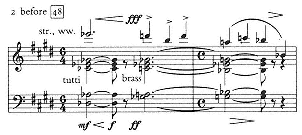
Example 7.8
Pelleas und Melisande, climax of LOVE theme.
sentation, at 2 before 48, deviates strikingly from the earlier ones. The initial harmony is no longer a half-diminished, but a dominant seventh (with ninth and thirteenth) of


Berg suggests that part IV of Pelleas und Melisande serves the dual function of finale

Example 7.9
Pelleas und Melisande, half-step approach to D.
to a four-movement work and "free reprise" of a single large sonata form (Berg 1920, 10). According to this scheme, the reprise begins with the "introduction" (comprising MELISANDE 1), followed by the full GOLAUD melody (Berg's Hauptsatz) and LOVE. The recapitulation is then interrupted at the death of Melisande, which leads to an "epilogue" in ABA' form. A is the original Hauptsatz; B is based on earlier themes, including MELISANDE 1, 2, 3, PELLEAS 1, and LOVE.
As Bailey has rightly pointed out (1984, 73), the large-scale tonal scheme of this "finale" shows Schoenberg recreating almost exactly (although in reverse order) the procedures used in part II of Verklärte Nacht: the tonic D minor is approached first from a half-step below,


The scene of Melisande's death unfolds in
Just as the basic tonal strategy in part IV of Pelleas is similar to that of the sextet, so too is Schoenberg's apparent desire to combine or associate the "twin" approaches to D with the phenomenon of recapitulation. And it is here that he still shows himself less than secure, even three and a half years after Verklärte Nacht. It will be recalled from chapter 5 that in Verklärte Nacht, the recapitulatory part II makes frequent approaches to D and actually culminates twice in the same passage of music. In part IV of Pelleas, where the harmonic language is more complex, the tonic is not implied as often or as directly, but it could be said that there is too much thematic recapitulation, that part IV is overlong.
In this respect it is significant that, just as Bruno Walter picked up on the potentially redundant climax of Verklärte Nacht and requested a cut, so did a conductor of Pelleas. In 1918 Zemlinsky, who was to conduct the work in Prague, apparently
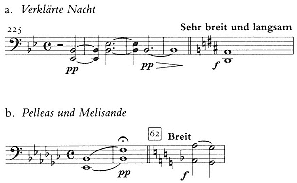
Example 7.10
Verklärte Nacht and Pelleas und Melisande, approaches to D from
wrote to Schoenberg requesting permission to cut from 50 up to 59— that is, from the beginning of the return of the introduction music in
From the viewpoint of tonal balance or symmetry (something Schoenberg does not raise in his letter), the composer was right to veto the cut: it would mean the loss of the approach to D from the half-step below. But despite Schoenberg's clever analytical pleading, it must be admitted that—as in the case of Verklärte Nacht— the conductor was on to something. It does seem redundant to have the GOLAUD/Hauptsatz theme recapitulated four different times in the tonic: at 55, and then three more times after Melisande's death, at 62, at 4 before 67, and at 69. In the first two instances the theme leads similarly to the LOVE theme, at 56 and at 5 after65, respectively. (In the latter case, PELLEAS I intervenes.) The thematic recurrences are not, of course, identical: each time the Hauptsatz theme is given a new bass line/ counterpoint, and the LOVE theme is presented differently. Yet in a work that despite its length has been, up to this point, as taut as Pelleas, the repetitions seem excessive. One could wish, with Zemlinsky, for a swifter denouement.
As in Verklärte Nacht, then, we see Schoenberg grappling with certain fundamental principles of large-scale form. Beneath all the brilliant thematic transformations and development in Pelleas und Melisande lies a basic uncertainty (not confessed by
[3] See Schoenberg 1964, 54-56. Bailey 1984, 67-70, cites and discusses the letter, as well as including portions that were cut from Schoenberg 1964.
Schoenberg, of course) about how much tonic and how much thematic return are enough. It was an issue that had occupied Schoenberg as early as the songs of the mid 1890s and that continued to occupy him as he tried to reconcile the apparent demands of traditional tonal forms with newer impulses coming from within.
Although there are many wonderful moments in Pelleas und Melisande, it is probably the least successful of the large-scale instrumental works of Schoenberg's early period. That it falls chronologically between Verklärte Nacht and the First Quartet seems to have had technical and expressive ramifications. We sense Schoenberg struggling to reconcile programmatic and thematic-formal demands. In the relatively compact dimensions of Verklärte Nacht, problems of this kind tended to be swept away by the bold strokes of inspiration. Despite compositional awkwardnesses, the sextet easily convinces us of its status as a masterpiece. Pelleas und Melisande fails to do so; it seems bloated, its shortcomings (or long-comings) more exposed.
Pelleas und Melisande also shows obvious affinities with Gurrelieder, but here too it suffers by comparison. Gurrelieder represents the very best in Schoenberg's extravagant late romantic style; under its decorated, overripe surface lies a taut synthesis of harmonic, thematic, and formal processes. In Pelleas und Melisande, the lush orchestration and rich harmony, outwardly similar to those of Gurrelieder, are put to different use: they too often become a cloak for intricate contrapuntal experimentation, as in the whole-tone canon based on MELISANDE 2 that begins at 2 after 2. Schoenberg soon came to realize that the cloak fitted such a technique poorly. In the songs of 1903-4, and then in the First Quartet, the contrapuntal preoccupations are laid bare in leaner textures that allowed (or inspired) Schoenberg to recapture something of the vitality of Verklärte Nacht and Gurrelieder.