
| • | • | • |
Bengal in Prehistory
Physically, the Bengal delta is a flat, low-lying floodplain in the shape of a great horseshoe, its open part facing the Bay of Bengal to the south. Surrounding its rim to the west, north, and east are disconnected hill systems, out of which flow some of the largest rivers in southern Asia—the Ganges, the Brahmaputra, and the Meghna. Wending their way slowly over the delta’s flat midsection, these rivers and their tributaries deposit immense loads of sand and soil, which over millennia have gradually built up the delta’s land area, pushing its southern edge ever deeper into the bay. In historical times, the rivers have been natural arteries of communication and transportation, and they have defined Bengal’s physical and ancient cultural subregions—Varendra, the Bhagirathi-Hooghly basin, Vanga, Samatata, and Harikela (see map 1).[1]
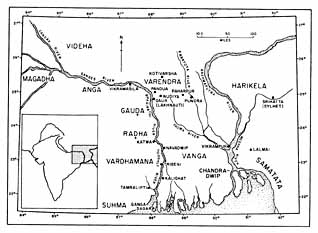
Map 1. Cultural regions of early Bengal
The delta was no social vacuum when Turkish cavalrymen entered it in the thirteenth century. In fact, it had been inhabited long before the earliest appearance of dated inscriptions in the third century B.C. In ancient North Bengal, Pundra (or Pundranagara, “city of the Pundras”), identifiable with Mahasthan in today’s Bogra District, owed its name to a non-Aryan tribe mentioned in late Vedic literature.[2] Similarly, the Raḍha and Suhma peoples, described as wild and churlish tribes in Jain literature of the third century B.C.,[3] gave their names to western and southwestern Bengal respectively, as the Vanga peoples did to central and eastern Bengal.[4] Archaeological evidence confirms that already in the second millennium B.C., rice-cultivating communities inhabited West Bengal’s Burdwan District. By the eleventh century B.C., peoples in this area were living in systematically aligned houses, using elaborate human cemeteries, and making copper ornaments and fine black-and-red pottery. By the early part of the first millennium B.C., they had developed weapons made of iron, probably smelted locally alongside copper.[5] Rather than permanent field agriculture, which would come later, these peoples appear to have practiced shifting cultivation; having burned patches of forest, they prepared the soil with hoes, seeded dry rice and small millets by broadcast or with dibbling sticks, and harvested crops with stone blades, which have been found at excavated sites.[6] These communities could very well have been speakers of “Proto-Munda,” the Austroasiatic ancestor of the modern Munda languages, for there is linguistic evidence that at least as early as 1500 B.C., Proto-Munda speakers had evolved “a subsistence agriculture which produced or at least knew grain—in particular rice, two or three millets, and at least three legumes.”[7]
In the sixth and fifth centuries B.C., dramatic changes that would permanently alter Bengal’s cultural history took place to the immediate west of the delta, in the middle Gangetic Plain, where the practice of shifting cultivation gradually gave way to settled farming, first on unbunded permanent fields and later on bunded, irrigated fields. Moreover, whereas the earlier forms of rice production could have been managed by single families, the shift to wet rice production on permanent fields required substantial increases in labor inputs, the use of draft animals, some sort of irrigation technology, and an enhanced degree of communal cooperation.[8] As the middle Gangetic Plain receives over fifty inches of rainfall annually, over double that of the semi-arid Punjab,[9] the establishment of permanent rice-growing operations also required the clearing of the marshes and thick monsoon forests that had formerly covered the area. Iron axes, which began to appear there around 500 B.C., proved far more efficient than stone tools for this purpose.[10] Iron plowshares, which also began to appear in the middle Ganges region about this time, were a great improvement over wooden shares and vastly increased agricultural productivity in this region’s typically hard alluvial soil.[11] The adoption of the technique of transplanting rice seedings, a decisive step in the transition from primitive to advanced rice cultivation, also occurred in the middle Ganges zone around 500 B.C.[12]