
The Irony and Prose of the NEP
They will throw you out, Parnok, they will definitely throw you out.
OSIP MANDELSTAM, The Egyptian Stamp (1928)
In Mandelstam's poetry, Iurii Tynianov once wrote, "as in Schiller, 'sober concepts dance a Bacchic dance' (Heine)."[73] To illustrate his point he proceeded to quote from "I Have Forgotten the Word." Apparently, Mandelstam's allusive technique was contagious, infecting the critic himself. Instead of addressing Mandelstam's poetic project directly—either his desire for a pandemic anamnesis or his emphasis on the "familial" unity of cultures and words—Tynianov chose a playfully oblique reference to Schiller's "Ode to Joy," Beethoven's Ninth, and Mandelstam's own "Ode to Beethoven"—all seen through one of the most ironic romantic prisms, the eyes of Heinrich Heine.[74] Tynianov's review was entitled "The Space Between" ("Promezhutok") and appeared in 1924, the "transitional" time when the enthusiasm of the civil war years had become diluted with the ironies and the pragmatism of the NEP period. This loss of "intensity," "centeredness," and a
clearly defined direction, so characteristic of the social and cultural life of the country, could not be conducive to Mandelstam's poetic enterprise. For it is not the nature of a martyr or a prophet—a model for Mandelstam's "poet"—to thrive on pluralism, irony, and the general fatigue with grand questions and global themes, including the metaphysics of the fin de siècle and the dawning of a new era. "At the end of an age," Mandelstam wrote in The Noise of Time, indulging in gentle self-parody, "abstract concepts stink of rotten fish."[75] Spoken by the author of the somber and solemn "1 January 1924," a poem meant to provide a cure from self-doubt, these words expressed a sentiment closely resembling, in fact anticipating, Tynianov's friendly sarcasm.[76] Be that as it may, for over five years following "The Space Between," Mandelstam would not be writing any poetry. For even his lifestyle, that of a literary laborer (he was supporting himself and his wife by translating), became incompatible with "charismatic" expectation. According to Weber,
Modern charismatic movements of artistic origin represent "independents without gainful employment" (in everyday language, rentiers ). Normally such persons are the best qualified to follow [and be] a charismatic leader. This is just as logically consistent as the medieval friar's vow of poverty, which demands the very opposite.[77]
Accordingly, even though Mandelstam did not disengage from the poetic enterprise altogether, the poems he included in his 1928 edition (most of his work since 1909) were arranged in a new pattern. The reader was presented with a different design of a "poetic career," one subtly reflecting the emphatically unheroic character of the NEP.
Unlike the 1922 collection, the Tristia of the 1928 Poems (Stikhotvoreniia) concluded with an ironic recapitulation of the career of Mandelstam's poet—from the naive chastity and solemnity of Stone to the lighthearted wisdom one associates with the love poetry of Ovid, Catullus, the early Pushkin, and Pushkin's eighteenth-century French model, Parny. Composed in 1920 but included in The Second Book (1923) rather than Tristia, the poem characteristically relied on the "subtext" provided by two famous poems by Pushkin. The youthful and blasphemous Gabriliad (about the seduction of the Virgin by the Archangel Gabriel) informed the closure, and the somber and serious "The Prophet" (a reworking of Isaiah's call to prophecy) supplied such key lexical items as the "Seraphim" and the burning "coals."[78] Fortuna's "wheel," too, had gained in levity, imparting its pattern not to the ponderous cycles of historical recurrence but to the course of the poet's amorous exploits. Indeed, it would be hard to find another
poem by Mandelstam that could better demonstrate the coexistence and mutual reinforcement of two such diametrically opposed sentiments: an enthusiastic belief in the Word and a deep suspicion that its power might, in fact, be quite tenuous.
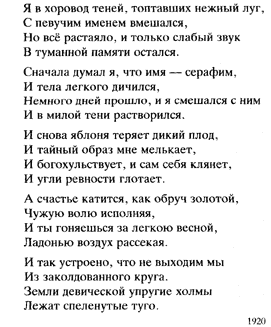
Into the round dance of shadows trampling a tender meadow,
I intruded with a tender name,
But everything dissolved, and only a feeble sound
Remained in misty memory.
At first, I thought: the word is Seraphim,
And I shied away from the light body,
Not many days had passed, and I entwined with it
And dissolved myself in the dear shadow.
And again, the apple tree loses its wild fruit,
And the secret image fleets before me,
And blasphemes, and curses itself,
And swallows the coals of jealousy.
And happiness rolls like a golden hoop,
Fulfilling the will of another,
And you are chasing after the light spring,
Your hand cleaving the air.
And it is set up so that we do not leave
The magic circle.
The taut hills of maidenly earth
Lie tightly swaddled.[79]
The last poem of 1921–1925, the third and final part of Poems, reiterated the same theme (if in a more somber key) in the form of a pledge—a rhetorical pattern encountered throughout 1921–1925.[80] Even if the word was fragile, even if the poet had no audience, he would still remain faithful to his thematic and ethical allegiances—the mnemonic funeral for the dying and the dead. A branch of bird-cherry that had figured next to the moving piston of a steam engine in an early Futurist declaration[81] and had served as a synecdochic reminder of death-in-love for the Mandelstam of Tristia[82] now had a different "frame": a sleek black carriage of bygone clays undulating to the "outmoded" tune of Schubertian sentiments:
I shall be dashing about the gypsy camp of a dark street
After a branch of bird-cherry in a black well-sprung carriage,
After a snow bonnet, after the eternal, the water mill noise.
. . . . . . . . . . . . . . . . . . . . . . . . . . . . . . . . . . . . . . . . . . . . . . . . . . . . . .
And I have no one to whom to say: "Out of the gypsy camp of a dark street."[83]
Here was a declaration of fidelity to the poetics of revival—combined with irony (two parts bitter, one part sweet). Even though the sense of mission was growing increasingly vague—a common occurrence in the unstable "charismatic" universe[84] —the main themes of Mandelstam's poetic career could not be easily abandoned.
Like the collected Poems, The Egyptian Stamp appeared in 1928. It was a novella containing, among other things, a cruel parody on the very self that had animated some of Mandelstam's loftiest poetry in the Tristia period. To the extent that the style is the man, what Mandelstam tried to accomplish in his only essay in narrative prose was to parody the particular mythologies and the related symbolic vocabulary of his self-presentation. To offer one example, the revival of the "inner form of the word," the delicate symbolism of poetic communion and revival of the departed, the journeys through Persephone's domain of memory—the stuff of Tristia and 1921–1925 —now supplied the food for a silly pun: "Telephone has not yet been installed at Proserpine's and at Persephone' s."[85] Another central feature of Mandelstam's poetic project, the gradual "accumulation" of attributes by the protagonist-poet, became the subject of parody in the concluding pages of the novella. "Oh God, do not make me resemble Parnok,"
the clever narrator of stories of Parnok's misfortunes was praying in mock despair,
Grant me strength to distinguish myself from him. For I, too, have stood in that terrifying patient line, which crawls to the little yellow window of the box office—at first in the freezing cold outside, then under the low bathhouse ceilings of the Alexandrinka. For I, too, am terrified by the theater, frightening like a peasant hovel without a chimney, like a village bathhouse in which someone was brutally murdered for the sake of a cutaway fur coat and a pair of felt boots. For I, too, am sustained only by Petersburg, concert-going, yellow, ominous, its feathers ruffled, wintry.[86]
Mandelstam was flaunting before the reader the exorbitant resemblance between himself and his alter ego—the "mosquito-prince" protagonist, the "Collegiate Assessor for the city of Thebes"[87] —who in turn was modeled on a friend: like Mandelstam, a Petersburg Jew, Valentin Parnakh.[88] A poet, a dance critic, the pioneer of jazz in Russia, Parnakh also happened to be the brother of Sophia Parnok, whom Mandelstam had once tried to replace in Tsvetaeva's heart. This "genealogy" should give some idea of how appropriate the metaphor of incest was for the Russian literary milieu of Mandelstam's generation.[89]
Curiously, the story was set in Petrograd in the summer of 1917. This most "pluralistic" summer in Russia's entire modern history was chosen by Mandelstam as a backdrop for a string of events associated with Parnok, events with but one thing in common: grievous injustice. Even in her best hour of true democracy and freedom (one would like to impute such sentiments to Mandelstam), the old Russia could not pull her own weight, nor could Parnok adjust to the new environment. Neither, the author was suggesting, possessed the equipment to cross the seas of history. Like an actual Egyptian stamp, which was designed to become effaced if ever reused,[90] Parnok was unable to preserve his "face" in the world that had replaced the familiar "Egypt." Apart from its obvious Josephian connotations, the choice of the novella's title (it was Parnok's school nickname) echoed Mandelstam's abiding preoccupation with preserving the memory of oneself for future generations: as a mariner does when he throws into the sea a bottle with a message—an emblem for poetry in Mandelstam's 1914 essay "On the Addressee" ("O sobesednikie"). By 1928, the seal had sprung a leak.
Nothing worked for Parnok. His attempt to save a man from a lynch mob ended in failure. His evening coat, "kidnapped" at the very outset "like a Sabine woman," was now owned by a certain junior of-
ficer with a hyper-Christian last name, Krzyzanowski—"man of the Cross." To add insult to injury, the woman he had been assiduously courting "according to the conventional rules of romance" (for "Parnok was a victim of received concepts concerning the course of a romance")[91] fell prey to another plot. She was last seen boarding what might be called the "Anna Karenina Express," bound from Petrograd to Moscow, in the company of the junior officer Krzyzanowski. Petersburg, the magnificent Petersburg of Mandelstam's early poetry, too had gone bad. It now resembled "Nero eating a soup of crushed flies," and the narrator, the creation of the "right fellow traveler Mandelstam,"[92] was now blaming it for the torments of the unfortunate Parnok:
Petersburg, you are responsible for your poor son! For all this confusion, for the pathetic love of music, for every jelly bean in the little paper bag held by a girl from the Bestuzhev College sitting in the top tier of the Noblemen Assembly Hall—you shall answer, Petersburg![93]
Could such a place deserve to survive, let alone be resurrected in the poet's memory? Despite Nadezhda Mandelstam's assertions to the contrary, The Egyptian Stamp was neither a momentary lapse nor an uncommon phenomenon.[94] Together with Iu. Olesha's Envy (1927), K. Vaginov's Goat Song (1928), M. Zoshchenko's Mishel' Siniagin (1930), and B. Pasternak's Spektorskii (1924–1931), it belonged to the genre of samokritika, or self-mockery, that many intellectuals practiced at the fin de siècle for the NEP.[95]
For Mandelstam, the malaise was not entirely new. In 1923 he was already showing signs of weariness, even impatience, with the tight network of correspondences that he, the latter-day Russian Joseph-Hippolytus, had so painstakingly woven. Consider these lines, full of skepticism and disenchantment, from what is the longest poem by Mandelstam, the 1923 "He Who Found a Horseshoe":
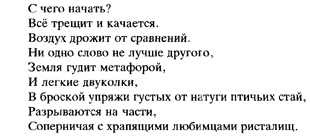
Where to begin?
Everything creaks and sways.
The air is vibrating with similes.
Not one word is better than another,
The earth tolls with metaphor,
And the light two-wheelers,
In the gaudy harness of bird flocks, dense from tension,
Are torn to pieces,
Competing with the snorting favorites of the races.[96]
Keeping in mind the subtitle of the poem, "A Pindaric Fragment," it is not hard to recognize in the "snorting favorites" a metonymy of the horses pulling the charioteers of the new state (Pindar used to extoll their predecessors in Hellas) as well as those who followed the mood of the spectator crowd. A Hippolytus, one who used to harness poetry's "swallows into military legions" ("Twilight of Freedom," 1918), was now finding it very hard to keep up with the other athletes, let alone compete to win. All he could hope for was that one day a future reader would come across the old horseshoe lost by his Pegasus and, having shined it with a piece of wool, nail it—a talisman—over the entrance of his house for good fortune.[97] The narrator of Egyptian Stamp closely resembled this poet: the loss of the coat by his protagonist was not very different from the poet's broken chariot and his expiring Pegasus overstressed by modern poetry's race. Both works originated in the sense of loss, and both made this loss productive. After all, Hippolytus became a hero only after his chariot crashed, Joseph achieved fame only after he had been stripped of his beautiful coat, and the proverbial overcoat of Gogol's Akakii Akakievich—only because it had been stolen from him—was able to serve as womb for Dostoevsky's art.