
PART ONE—
THE UNITED STATES FEDERAL SYSTEM
An analysis of the United States federal system provides a useful framework for an evaluation of domestic budgetary programs. First, Robert Inman describes the Reagan administration's New Federalism, with its implied reallocation of functions between the states and the federal government. Edward Gramlich then addresses the fundamental normative question of federalism: Which levels of government ought to be assigned the right to levy taxes and to utilize other revenue-raising sources? In the Commentary, Henry Aaron discusses arguments for the important fiscal role of intergovernmental grants; George Break argues, against Gramlich, that the federal income-tax deduction for state and local taxes, although it may be less than efficient, does contribute to equity; and Julius Margolis provides a broad sociopolitical perspective on the rapid growth of government in the twentieth century.
Chapter One—
Fiscal Allocations in a Federalist Economy: Understanding the "New" Federalism
Robert P. Inman
From its constitutional beginnings to today, the United States public economy has been committed to the concept of federalism in the provision of public services. The use of multiple layers of government, with each higher level possessing rights of control over a lower level, is a founding principle of our fiscal structure.[1] But while the constitutional commitment to a federalist system is clear, the precise structure and performance of that system are not.
Significant changes have taken place in our federalist fiscal system, both historically and in recent years. Scheiber (1966) has identified four stages of historical development of United States federalism: first, a period of "dualism" (1790–1860) in which states and the federal sector coexisted with essentially equivalent responsibility and powers; second, a time of "centralizing federalism" (1860–1933) as power began to gravitate to the federal level; third, a period of "cooperative federalism" growing out of the social programs to deal with the national crisis of the Great Depression (1933–1964); and finally, the recent period of "creative federalism" in which the federal government has taken an active policy interest in the specific problems of state and local governments. The first three periods can be characterized as times when the states (and their localities) made fiscal policy largely independently of direct federal interventions, while the recent period of creative federalism has involved the federal government directly in state and local fiscal affairs. Federal grants-in-aid and all their spending requirements, as well as the many new federal regulations
| ||||||||||||||||||||||||||||||||||||||||||||||||||||||||||||||||||||||||||||||||||||||||||||||||||||||||||||||||||||||||||||||||||||||||||||||||||||||||||||||||||||||||||
of state-local governments, have deeply affected the budgetary choices of the state-local sector.
In January 1982, President Reagan proposed a significant break with this trend toward federalization of our public economy. As originally presented in his budget message of that year, President Reagan's "new" federalism proposed: (1) that Medicaid become a fully federal program (which the administration hoped to curtail as part of its health-care-reform efforts); (2) that the states and localities assume responsibility for food stamp programs and Aid to Families with Dependent Children (AFDC); and (3) that more than sixty federal programs in education, community development, transportation, and social services be returned to the states, with the states receiving $28 billion a year from a federal trust fund to help pay for their new responsibilities. The trust fund was to be supported by federal excise taxes. Dollars paid from the trust fund would not be restricted to expenditures on the reassigned programs, however. The funds could, if a state so decided, be allocated to other state programs or to state tax relief. The intention of the president's new federalism was clear: to reduce federal influence on state-local fiscal choice.
What is less clear is how state and local governments will react to this restructuring of our current federalist fiscal system, and whether the present federal government will relinquish control and embrace the new federalism. Yet from the perspective of fiscal policy these are the central issues. Changes in federal grants and federal regulations will assuredly affect state and local governments' budgetary decisions. The relative economic and political attractiveness of the new federalism and of the creative federalism it seeks to replace ultimately rests on the actual allocations of resources. This paper offers some first (but considered) guesses as to what might happen under, and to, Reagan's reforms, and concludes that President Reagan and his supporters are not likely to be disappointed in the economic consequences of the new federalism, though they will be unhappy with its political prospects.
Our Current Federalist Fiscal Structure
In order to predict the future under President Reagan's new federalism, it is important to understand our present federalist fiscal structure and how it evolved. The Reagan proposals are a significant challenge to the historical trend toward federalization of United States fiscal policy. Table 1.1 summarizes the federal and state/local government spending patterns
| ||||||||||||||||||||||||||||||||||||
over the past eighty years. As columns 1–3 show, the federal government share has grown steadily; today each sector is responsible for about half of all domestic public spending.[2] The major source of the growing federal share was expansion of social insurance programs—"transfers to persons"—from the mid 1930s to 1950 and again from 1960 to 1980 (Table 1.1, columns 7–9). While the federal government's responsibility for transfers was growing, its responsibility for direct provision of nondefense public goods and services was declining (Table 1.1, columns 4–6); the state-local sector is the primary producer of domestic public services. Overall, the major source of the historical growth in total government activity has been transfer programs, however, and these programs are the financial responsibility of the federal government.
A similar move toward the federal level is observed in the historical trends of government receipts measured as taxes plus contributions to social insurance (see Table 1.2). In 1929, all government receipts were $430.80 per capita (in 1972 dollars), of which 33 percent was raised by the federal government. By 1950 the federal share was 74 percent of all receipts. The federal share has declined slightly in recent years, but a comparison of the 1929 and 1983 divisions of the revenue-raising function shows essentially a reversal of roles between the federal and state-local sectors. In 1929, state-local governments were the main source of public dollars; now the federal government has assumed that role.
| |||||||||||||||||||||||||||||||||||||||||||||||||||||||||||||||||
The federalization of our fiscal structure has manifested itself in other ways as well. The federal government now actively participates in state and local budgetary choices. It does so in two ways: through a carrot called grants-in-aid, and through a stick called regulation. Table 1.3 details the recent growth of federal aid to state and local governments. From a position of very modest absolute and relative importance in 1940, federal aid had grown by 1980 to a sizable real-dollar transfer—a total of $192/capita—and to over 25 percent of state and almost 14 percent of local non-debt revenues. Growth has been particularly dramatic over the last two decades, most noticeably in direct federal-to-local aid. Table 1.4 illustrates the other important features of the aid explosion. The growth has occurred in categorical formula grants and categorical projects grants rather than in block grants. Block grants are federal dollars targeted for broad programmatic missions—e.g., education, employment, community development. Categorical aid is directed at narrow program categories—e.g., school lunches, sewer construction, low-income transfers to fatherless families. Categorical aid can be given to states or localities
| ||||||||||||||||||||||||||||||||||||||||||
according to a well-specified formula (formula grant), or states and localities may submit a specific project proposal for federal funding (project grant). Categorical aid often requires the state or local government to match the federal funds with state or local revenues. Block grants generally do not require such a match; instead, they serve as "free" money to the state-local sector.
Does such aid influence state-local fiscal allocations? The econometric evidence from over twenty years of research is quite unequivocal on the point: it does indeed (see the surveys in Gramlich 1969 and Inman 1979). Federal aid increases state and local spending on the targeted activities, and often on non-targeted activities as well. Categorical matching aid is the greatest stimulus to state-local spending. Block grants and the totally unconstrained, general-revenue-sharing aid induce the least increase in public spending. In the next section I review three recent studies which show that the impact of federal categorical and categorical matching grants on state and local budgets has been sizable. While there has been much political debate about whether these federal aid programs are good or bad for the state-local sector,[3] no one has denied that these programs have been an important influence on state-local budgetary choices.
The federal government also regulates many activities of the state-local sector, now more than ever. Figure 1.1 summarizes the growth of federal regulatory programs. Four types of regulation have been identified: direct orders , which must be obeyed to avoid civil or criminal penalties (e.g., the Equal Employment Opportunity Act of 1972, which bars job discrimination on the basis of race, color, religion, sex, or national origin); crosscutting regulations , broad federal mandates that apply to all forms of federal assistance (e.g., the Civil Rights Act of 1964); crossover regulations , which require performance on one policy dimension under penalty of loss of federal assistance from another, well-specified program (e.g., the 55mph speed limit required under threat of loss of federal highway assistance); and, finally, partial pre-emptions , in which federal law establishes a policy goal which, if not met by the state-local sector, will allow direct federal provision or enforcement (e.g., the Clean Air Act Amendments of 1970). The 1970s saw by far the greatest growth in federal regulation of the state-local sector. The results have been mixed. The Civil Rights Act is an example of significant accomplishment, but most environmental regulations have produced only modest gains in air, water, and land-use quality, yet have imposed large costs on state and local governments (Advisory Commission on Intergovernment Relations n.d., p. 22). Again, while the relative benefits and costs of federal regulation of the
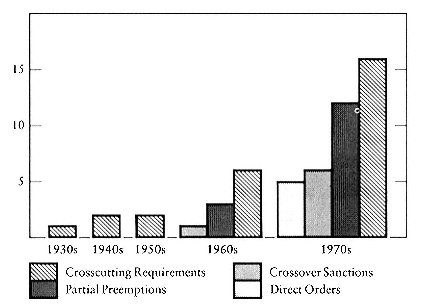
Figure 1.1
Federal Regulation of State-Local Governments, 1930–1979
Source: Advisory Commission on Intergovernment Relations (n.d.), p. 4.
state-local sector can be debated, there can be little doubt that these regulations have significantly influenced the policies and budgets of state and local governments.
We are now a federalized, federalist system. President Reagan's "new federalism" reforms strike at the heart of this centralization process. First, the two major income-maintenance programs now at the federal level—food stamps and AFDC—are to be returned to the state and local sectors. In 1983, these programs were estimated to cost the federal government $16.4 billion. A dollar shift of this magnitude will reduce the federal share of transfer to persons from 87.2 percent in 1983 (Table 1.1, column 8) to 83 percent.[4]
Second, the Medicaid program is to become fully a federal responsibility. On the surface, this adjustment appears to run counter to the defederalization intentions of the Reagan policy. The new federal Medicaid outlays, approximately $19 billion, will increase the federal share in transfers to persons, from 83 percent following the decentralization of welfare, back to 87 percent. Despite this upward adjustment in federal
spending, it can be argued that the offer to take on the state's share of Medicaid is a necessary component of the new federalism package. The states and their congressional representatives will not accept the income-maintenance programs without some form of budget relief to compensate for the additional expense of these programs. Direct grant relief might be more of the same—federally funded aid for federally mandated programs. Relief could, however, be offered in the form of a federal takeover of a state responsibility. But which state responsibility? The state share of the Medicaid program is an excellent choice for three reasons: (1) the state Medicaid outlay is large and growing and a bit more than the federal dollars now spent on food stamps and AFDC, i.e., it is a "fair" trade; (2) the states have been doing a very poor job of controlling Medicaid outlays; and (3) there is a growing desire at the federal level to control federal health care costs, and Medicaid, if federalized, can more easily be included within any new federal regulations. The states do not want the responsibility of Medicaid, and for reasons not entirely related to federalism, the Reagan administration is willing to take it on. From the point of view of the new federalism, the swap of the state share of Medicaid for income-maintenance programs seems the best available trade.
Third and finally, Reagan's new federalism proposes to return to the state-local sector sixty-one existing federal-education, social-service, transportation, and community-development categorical aid programs for state administration and funding. To ease the estimated $30.2 billion financial burden imposed by these new programs, the federal government would make available to the states $27.6 billion from a federal trust fund supported by federal excise taxes. (The states' shortfall between program costs and trust fund transfers equals the states' gain from the welfare/Medicaid swap.) The intention of this exchange is to reduce federal control over state and local spending; categorical aid and its particular expenditure restrictions are dropped and replaced with unconstrained federal assistance. This federal-trust-fund aid is to be phased out, however, over four years beginning in 1988. Thus, the third component of the new federalism is intended first to reduce federal aid restrictions and then, beginning in 1988, gradually to reduce federal government spending and taxes.[5] Overall, the new federalism is: (1) to leave the federal share of transfer outlays largely unaffected but to move to the federal level those redistribution expenditures (Medicaid) that the states have found the most difficult to control; (2) to replace federal categorical aid with lump-sum aid, thereby reducing federal control over state-local spending; and finally, (3) to reduce federal spending and taxes by gradually phasing out
the trust fund and its associated taxes. Or so the proponents of the new federalism hope. Whether the new federalism will in fact have these defederalizing effects is an open question.
Will the "New" Federalism Work?
While the calculations above concerning effects of President Reagan's new federalism on our fiscal system are reasonable first guesses, they are really only that—first guesses. Budget aggregates were simply moved from the federal to the state-local column and back again. Missing from such calculations is any sense that there are governments, and voters, who determine what those budget aggregates will be. Yet an analysis of such a fundamental realignment of fiscal responsibilities as the new federalism proposes must recognize that the state-local sector will react to the reforms. To predict the consequences of new federalism we must first understand the budgetary process of state and local governments.
State-Local Fiscal Choice in a Federalist Economy
Beginning with the early "determinants" studies of state and local spending, economists and political scientists have tried to untangle the causes of decentralized governments' fiscal choices. Analysis has proceeded from simple linear regression models of aggregate state and local spending to sophisticated maximum-likelihood estimation of utility maximization models for decisive voters in individual jurisdictions. But all these models have one element in common: they are economic models, with a central focus on citizen preferences and their budget constraints as causes of governmental expenditures.
Figure 1.2 illustrates the basic, and now familiar, story. A "typical" resident's preferences for public services and private goods are represented by a utility relationship over after-tax private income (y ) and public goods (g ), denoted U(y,g ). The indifference curves in Figure 1.2 rank the relative value of different combinations of y and g as represented by U(g,y ). Combinations of y and g on a higher indifference curve are preferred by the typical resident to those combinations on a lower indifference curve. A budget constraint will restrict the level of services which the typical resident can afford. The constraint is defined by the identity: Î=y +p·g , where Î is the typical resident's "full fiscal income" and p is the resident's "tax price" of local public goods. Full fiscal income is the sum of the resident's before state-local-tax private income (I) and the resident's
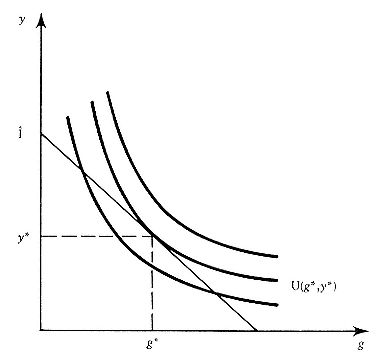
Figure 1.2
The "Typical" Voter's Preferred Budget
share of federal to state/local lump-sum aid per resident (z ). The tax price p equals the resident's share of the tax costs of each unit of the public service, net of federal matching aid.[6]
Given preferences and the budget constraint, the typical resident will wish to buy the level of public goods that maximizes U(y,g ) subject to the constraint. This is point (y*,g* ) in Figure 1.2, where the budget line is just tangent to the highest possible indifference curve. The utility maximization/budget constraint model yields a demand curve for local public goods of the following form:
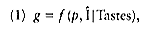
where the theory predicts that ¶ g/¶ p<0, ¶ g/¶ Î>0. The taste variables (Tastes) are unique to the individual resident.
Economists are now quite comfortable with this specification of state-local fiscal choice and have applied it on numerous occasions to estimate local governments' responsiveness to various federal-government aid and tax policies. (Inman 1979 reviews these studies.) One nagging question
has, however, been left unanswered by virtually every application of this approach. Who is the "typical" resident whose demand curve we are estimating? Answers have relied more on hand-waving than hard work. Empirical analyses of state-local fiscal choice have generally lacked any notion that politics, the process of conflict resolution, affects state-local fiscal allocations. Exactly whose preferences and whose budget constraints dictate the final allocations? Is the final allocation a compromise among several players, or just the preferred outcome of a "chosen" one? Who are these players? What is their standing and what are their rights within the political budgetary process? How are disagreements resolved? What happens if there is no agreement? These are political questions, and their answers require political analysis.
Introducing political considerations into the systematic analysis of budgetary choice is not a simple matter. Once we begin to study allocations involving more than one policy dimension—say, education and welfare spending—we confront a fundamental analytic difficulty. If there are more than two interested voters, such allocations will generally not have a stable equilibrium if budgets are decided by a simple majority-rule process, for there is no identifiable median voter in such cases (see Inman 1984). Yet state-local budgetary choices are often very stable; allocations do not change much from year to year. In an important line of new research, Shepsle (1979) has described and analyzed various legislative extensions of simple majority rule that are sufficient to produce stable fiscal allocations. The final allocations—called structure-induced equilibria —are conditioned by the status quo and the constitutional rules that determine legislative structures. Shepsle identifies three central structural features of legislatures: (1) a committee structure that identifies who is allowed to offer proposals for consideration by the full legislature; (2) a jurisdiction structure that defines which proposals may be considered by the committee and the legislature; and (3) an amendment structure that describes how the committee's proposals to the legislature may be altered. Together these structural features can insure a stable allocation. It is important to emphasize, however, and particularly for our purposes here, that a structure-induced equilibrium is a partial equilibrium, conditioned by the starting or status-quo allocation and the detailed rules of fiscal choice. Exogenous changes in the starting allocation or legislative rules because of new federal regulations or aid programs, such as the new federalism, will alter the observed equilibrium allocations.
The political theory of structure-induced equilibria allows us to specify just how such institutional changes will affect budgetary choices. The
theory predicts that final fiscal allocations will be a simple weighted average of the preferred allocations of each voter. The weights depend on the status quo (denoted as g°, a vector of initial service levels) and the political institutional structure (denoted S, a vector of institutional variables). The allocation for service t preferred by each voter or interest group i is defined by the demand curve git = f it (pi , Îi ¦Tastesi ), as specified in equation (1) above, where now pi is a vector of public-good tax prices. The resulting model of budgetary choice is therefore

where

and where there are t = 1 . . . m public services and i = 1 . . . n identifiable voter types or interest groups. Variables that might be included in the vector S of political structure include controlling interests (chairmanship, majority) of the legislative committees that set the agenda, jurisdiction and budgetary and bargaining rules on how dollars can be allocated, size of voting blocs within the legislature or community, political allegiance of those with veto power over final allocations (e.g., governor, mayor), and amendment rules that allow proposals to be submitted from at-large interests. The budgetary model outlined here—once it has been estimated—gives us exactly what we need to begin to analyze the effects of changes in federal dollars and fiscal structures on state-local allocations. Three recent studies (Craig and Inman 1982, Gramlich 1982, and Craig and Inman 1984) have examined President Reagan's new federalism from this perspective; their results are instructive as to the likely budgetary consequences of the proposed Reagan reforms.
The Medicaid-Welfare Swap:
What Will Happen to Low Income Assistance?
Gramlich (1982) and Craig and Inman (1984) have examined the likely consequences of the new federalism's proposed exchange of the food stamps and AFDC programs for Medicaid. Both studies reach essentially the same conclusion: the states will appreciably reduce their support of low income maintenance programs despite federal assumption of Medicaid and the availability of $27.6 billion in trust fund aid.
Employing an analytic framework similar to that proposed in Equation 2 above, Gramlich and Craig–Inman estimate the effects of the current
fiscal structure—categorical matching aid for AFDC and Medicaid, federal provision of food stamps, and the availability of general revenue-sharing and other (nearly) unrestricted, lump-sum aid—on the state decision to provide AFDC benefits (Gramlich) and AFDC plus other low-income assistance (Craig–Inman).[7] Both studies find that dropping federal, categorical matching aid for AFDC and giving states full financial responsibility for the program will reduce spending for AFDC by at least 70 percent and perhaps as much as 95 percent. Gramlich arrives at the larger estimate when he allows for the fact that states are likely to adjust their benefit levels to those of their neighboring, fiscally competitive states. Since high benefit levels are likely to attract low-income families (see Gramlich's paper in this volume) and possibly discourage the location of richer families and firms, no state can afford high benefit levels by itself. Once the federal categorical matching aid, a strong incentive for high benefits, is removed, interstate fiscal competition dominates the allocation process, and AFDC spending is likely to fall dramatically.
Both studies conclude that low-income support from the food stamp program will also be significantly reduced. They find that state officials seem to behave as if food stamp benefits do not exist; in other words, it is a federal program and provides no direct political benefit to state politicians. A program thus ignored in the past will probably be supported only marginally under reform. The net effect of the new federalism's food-stamp transfer will be to reduce this form of assistance drastically, if not totally. Together, the transfer of AFDC and food stamps to the states is estimated to reduce the total spending on these programs by 70 percent or more.
Federal assumption of state Medicaid payments may also reduce the states' contribution to low-income medical assistance. First, as the federal government takes over the program, the previous federal Medicaid matching grant to the states is lost (i.e., the matching rate falls to zero) and state spending for low-income medical assistance declines. Second, the federal government will pay such low-income medical assistance directly to residents within the state, a possible inducement for the states to eliminate any remaining low-income medical-assistance programs. Craig and Inman (1984) estimate that the combined effect of these forces about equals the current level of state expenditures on Medicaid; that is, state welfare spending will fall by the amount of spending assumed by the federal government when it takes over Medicaid (~$19 billion).
The new federalism does offer the states financial assistance, however, and some of this relief may spill over into low income assistance. The
proposed trust-fund account is to pay states $27.6 billion a year initially (less in future years). Craig and Inman estimate that trust fund aid will have no significant effect on low income assistance and may in fact depress welfare spending. Other studies (reviewed in Inman [1979]) also show no major positive effect of lump-sum aid on welfare outlays. It therefore seems safe to assume that trust fund assistance will do little to offset any decline in welfare spending.
What, then, will be the overall effect of the new federalism on state-provided low-income assistance? As we have seen, a conservative estimate is that AFDC and food stamp spending will fall by 70 percent when transferred to the state-local sector. In 1983, the federal and state governments combined spent approximately $24.04 billion on AFDC and food stamps.[8] The new federalism will reduce this total by $16.83 billion. With the Medicaid transfer, state expenditures on medical assistance for the poor will fall by approximately $19 billion, but federal spending is assumed to rise to fill this gap. There is therefore no net effect on low income assistance from the Medicaid transfer.[9] The introduction of $27.6 billion in trust fund assistance is estimated to have no effect on state welfare spending. The combined effect of the new federalism reform is therefore an estimated decline of at least $16.83 billion in aid to low-income families provided by all levels of government. From the perspective of a typical low-income family, the new federalism may mean a loss of $2406 annually, approximately a 44 percent decline in average annual benefits.[10] Clearly, the new federalism is an important fiscal reform affecting low-income households.
The Trust-Fund and Program Turnback:
What Will Happen to Service Provision?
The sixty-one federal categorical-aid programs proposed for transfer to the states include programs in education, social services, transportation, and community development. Also included is the general revenue-sharing program. In their place the federal government will establish a trust fund that will pay to the states a lump-sum grant approximately equal to the costs of transferred categorical-aid programs. This component of the new federalism essentially substitutes unconstrained aid for categorical aid. What will happen to the provision of government services in the affected program areas?
Gramlich's (1982) analysis gives an overview of the likely effects of fiscal reform. He finds that the loss of $1 of federal categorical aid will
lower state-local service expenditures by $0.38; the gain of $1 of federal lump-sum assistance will increase state-local service spending by $0.04. Gramlich's estimates of the state-local sector's response to lump-sum, revenue-sharing assistance is somewhat lower than that obtained by other researchers (see Inman 1979), but it should be pointed out that his sample covers the state-local experience to 1981 and therefore includes those governments' response to the recent pressure for fiscal responsibility and tax relief. Accepting Gramlich's estimates, we can calculate the aggregate effect of the new federalism on service provision. Turning sixty-one federal programs over to the states is equivalent to a loss of $25.6 billion in categorical aid and, since general revenue-sharing is included in the turnback program, a loss of $4.6 billion in lump-sum aid. The loss of $25.6 billion in categorical aid will reduce state-local service provision by $9.7 billion (=0.38 × $25.60). The loss of $4.6 billion in revenue-sharing aid will reduce state-local service provision by $0.2 billion (=0.04 × $4.60). The trust fund, on the other hand, increases federal lump-sum aid by $27.6 billion; the state-local sector's response is to increase state-local provision by $1.1 billion (=0.04 × $27.60). The final net effect of the new federalism is to reduce state-local spending initially by $8.8 billion. This loss is equivalent to a decline of $16 per capita in services (measured in 1972 dollars) or a fall in public-service provision by the state-local sector of 2.1 percent from the 1983 service level of $768.40 per capita (see Table 1.1, column 7).
Craig and Inman's (1984) analysis of the trust-fund exchange shows a similar, though slightly larger, decline in state-local spending. Their equilibrium analysis predicts that the trust fund–program swap will reduce state taxes by 6 percent (due to relaxed matching requirements), lower state education aid and total state welfare spending by 5 percent and 33 percent respectively, and leave other state spending virtually unchanged. The states' human resource budgets seem to bear the full brunt of the spending cuts. Local government spending may rise to offset some of the decline, but the local increase will probably not match the fall in state spending.
A more detailed look at state-local education spending shows that this is exactly what happens. Craig and Inman (1982) have examined the effects of Reagan's new federalism on spending for one of the most important program areas—elementary and secondary education. Their results are suggestive of what may happen to expenditures on the other directly affected services. After estimating an econometric model of state and local school spending, Craig and Inman simulate the effects of the
| ||||||||||||||||||||||||||||||
new federalism in which fourteen categorical education aid programs are consolidated into a single trust-fund, or lump-sum, grant to states. Table 1.5 summarizes their results, where spending in 1977 (the last year of their sample) defines the baseline, or pre-reform, allocation. In the status quo period, the average state allocated $375.58 per public-school enrollee for state aid for education. The average state raised $1,025.86 per enrollee in state taxes, where the difference between taxes and state education aid ($650.28 per enrollee) was allocated to other, non-education state expenditures. Local school districts spent $670.99 per enrollee on education, and raised $286.34 per enrollee in local taxes to support this spending. The remaining $386.65 per enrollee of local spending was financed by state education aid ($375.58) and direct federal-to-local school aid ($9.07 per enrollee). Following new federalism reforms, Craig–Inman estimate that state support for public elementary and secondary education will fall by about 23 percent, to $290.20.
The primary reason for this decline is the same that led to a decline in welfare spending: the new federalism substitutes less constraining lump-sum aid for categorical and categorical matching aid.[11] Left on their own, states do not want to maintain spending on public education. What happens to the money now freed from the state education budget by the new federalism? The released $85.38 per enrollee (=$375.58 – $290.20) is allocated to tax relief; total state tax relief is $101.44/enrollee (=$1,025.86 – $924.42) supported in part by a fall in other (administrative?) state expenses.[12] The fall in state-to-local education aid and federal-to-local education aid reduces local school spending by about 8 percent, or $616.35/enrollee. To maintain this level of spending, local taxes must rise by 14 percent, to $326.15/enrollee. The new spending level is supported entirely by local taxes and state aid (616.35 = $326.15 + $290.20). This detailed analysis of the new feder-
alism's effects on education reveals three important conclusions. First, education itself is not a particularly favored activity of state governments; it is federal categorical aid that keeps state funding at its present levels. Second, as the federal and state governments retreat from a fiscal responsibility for education, local school districts fill the void, somewhat; clearly, with the new federalism, financial responsibility for public education moves downward to the local level. Third, as President Reagan might have hoped, the new federalism will alter the mix of national income allocated between the private and public sectors. State taxation is lowered by $101/enrollee, while local school taxes rise by about $40/enrollee. The net result is a $61/enrollee increase in private income.
Summary
It is hoped by the proponents of the new federalism that the proposed reforms will reverse the trend toward federalization of our public economy and to a large degree shift the activity of government back to the state and local levels. The analysis summarized here suggests that they will not be disappointed. The very nature of the reform reallocates responsibilities from the federal to the state-local sector, and there is nothing in the empirical research reviewed here to suggest that reforms will not be decentralizing. The states, for example, have not been held in line by federal programs so that, now unleashed, they can spend unchecked to replace one bureaucracy with another. Quite the contrary, the evidence indicates that the states will retreat from many of these categorical program areas too and, at least in the case of education, will be eager to pass fiscal responsibility down still further, to the local level.
The empirical analyses of the new federalism reveal another important consequence of reform, one which might please President Reagan even more than the move to decentralization. The new federalism will likely shrink the size of government. The exchange of Medicaid for AFDC and food stamps will markedly reduce spending on income maintenance programs and return those released dollars to state taxpayers as tax relief. The new federalism's exchange of the lump-sum trust fund aid for categorical aid also means tax relief. Craig and Inman (1982) find that, in education at least, the resulting lower level of state education spending is transferred to taxpayers as state tax relief. Local education taxes do rise, but not by enough to offset the decline in state taxation. Again, the overall size of government is reduced and taxpayers' private incomes are increased.
From the point of view of those who wish to decentralize fiscal choice and to decrease the size of government, the answer must be yes to the question: Will the new federalism work?
New Federalism as a Federal Issue
If Reagan's new federalism will check the tide of fiscal centralization and shrink government, why then, in this era of apparent fiscal conservatism has the new federalism not been approved by the federal government? The early debates of the reform raised the obvious questions. There was much discussion about the accuracy of the administration's estimates of program costs, and the states were obviously disappointed about the projected 1988–1991 phase-out of the supporting trust fund. Would the dollar trade really be a fair one? But if a balancing of dollars was all that was at issue, we should have resolved the difference long ago. We have not. The matter runs deeper than that. The new federalism is not simply a realignment of programs between the federal and state-local sectors of government, it is a fundamental challenge to how public policy decisions are now made. Our existing, highly federalized fiscal structure did not just happen. It has evolved, I will argue, as a logical outcome of a changing federal political structure and a growing economic pressure on local governments to redistribute resources. Until the political structure changes again—and in a particular way—or until the demand for redistribution subsides, our fiscal structure will remain largely as it now stands: categorical, regulated, and centralized.
The pressure to use government as a means to redistribute resources among the members of the society is endemic to stable economies. Coalitions of potential beneficiaries form around existing, shared institutions capable of transferring dollars in their direction. Producer or consumer groups form about markets; the religious, the poor, and the ill cluster about churches; and all of us look to government for assistance. Small groups can generally organize more quickly and efficiently than large groups; while the fortunes of individual redistributive coalitions may rise or fall, such coalitions rarely die (see Olson 1982). American economic history is rich in examples of the growth and influence of redistributive coalitions (see, e.g., North 1981; Olson 1982).
With the baby boom and the explosion of home ownership and suburbanization following World War II, a new and fertile ground for the growth of such coalitions appeared—state and, most importantly, local governments. Table 1.1, column 6, illustrates the increasingly important
role of the state and local sector in the provision of domestic public goods and services. The growth was particularly explosive from 1945 to 1960 as the share of the state-local sector in public-good provision rose from 69.3 percent to 84.5 percent. During this same period the number of municipal, township, and special district governments grew from 43,440 in 1942 to 56,417 in 1967.[13] The period from 1945 to 1960 saw the emergence of new redistributive coalitions with their focii almost exclusively on local government. Public employee unionization began in earnest in this period. The National Teachers Association began its slow evolution from a social and professional society to a politically active union, prodded in part by the aggressive, blatantly redistibutive behavior of the newly formed American Federation of Teachers. In our larger cities, downtown business interests began to organize for the development, or redevelopment, of shopping, residential, and business centers. In the suburbs, developers lobbied for new infrastructure (paid for by tax-exempt bonds) and zoning variances. Even the large group of innercity poor had become organized into a politically active redistributive coalition, the National Welfare Rights Organization. Each of these coalitions—public employees, business groups, the poor—turned to local governments for more—more pay, more services, more transfers. Yet the local public sector had only limited resources, and it was severely constrained by the mobility of its tax base. It was only natural that, as the brokers in the redistribution game, local officials should seek more dollars. They organized too, and in the 1960s they went to Washington as the "intergovernmental" lobby.[14] Would Washington respond?
Washington did respond—with creative federalism. The redistributive coalitions collecting about the local public sector had created a new demand for transfers. The supply of those transfers came from a United States Congress that by the mid 1960s found it particularly attractive to be responsive. Domestic policies began to assume a decidedly regional and local focus. The fiscal structure we now call creative federalism, with its extensive use of categorical aid, project aid, and federal regulations, is one consequence of this change.
Two events converged to produce this important shift. First, American voters were becoming better educated and better informed. The old political party labels were no longer sufficient to insure voter loyalty. Nie, Verba, and Petocik (1979) found the 1960s voter to differ in important ways from the 1950s voter. There were more independents, and even those voters who wore a party label found it easy to desert the party leadership when proposed policies did not meet their demands. Second,
as voters became more independent so did their congressional representatives. For exogenous reasons the strong central leadership of Lyndon Johnson in the Senate and Sam Rayburn in the House gave way in the 1960s to the less autocratic styles of Mansfield and McCormack. The 1964 Democratic landslide brought a new and active group of Democratic liberals into the House, many representing urban local coalitions. The old, fabled "conservative coalition" of Republicans and southern Democrats gave way, lost in a flurry of liberal legislation—including Medicaid, federal grants for education, urban poverty programs, and the creation of the Department of Housing and Urban Development. Much of the legislation was a response of a sympathetic Congress to the memory of a president deeply committed to social legislation.
The period 1967–1970 was one of frustration for the Democratic liberals. A fall in their numbers from the peak in 1965–1966, division within their ranks over the war in Vietnam, the election of a Republican president, and the return to importance of the conservative coalition thwarted the efforts of liberal, urban Democrats to introduce further domestic legislation. These three years proved only a temporary setback in the trend toward a more open, more locally focused Congress. Beginning in 1970, a series of procedural reforms initiated by the liberals were enacted by the Democratic Caucus and by the whole House. The intention of the reforms was to open the key leadership positions of the House—committee and subcommittee chairmanships—to more members, not just the senior, select few (for an interesting description of the process by which these reforms were introduced, see Ornstein 1975). The result was a more diffuse, younger, liberal leadership. The incentives within this more decentralized structure no longer encouraged individual representatives to look to the older leadership for signals on how to form policy. Rather, the structure encouraged offering a favored policy and bargaining with other members for its approval. And how should a representative define a policy agenda? Again, not by turning to the central leadership or to the Democratic or the Republican party. Their approval no longer won local congressional elections. The representative's policy agenda came from the local voters, for if local voters were satisfied, reelection was guaranteed (see Fiorina 1977, esp. chs. 4 and 5). The policies and budgets that emerge from such a decentralized political body will themselves be decentralized in their effects, satisfying the needs of each representative and the redistributive coalitions he or she represents.[15] When representatives are chosen from geographically prescribed areas, policies will assume a clear regional or local focus. Creative feder-
alism stands as a telling example of what such a political process will produce.
A decentralized congressional policy process seeking to satisfy the demands of local redistributive coalitions will necessarily design policies that will target federal dollars to local areas. Further, these dollars must be targeted to particular redistributive coalitions in a way that will assure that the congressional representative can claim credit for the transfer. Finally, if the federal dollars can be leveraged from other, non-local revenue sources such as the state, so much the better. What type of federal grants policy will achieve these objectives? The answer is categorical project aid and formula aid that uses the states whenever possible as the administrative agent but that monitors state performance closely with "pass-through" and, ideally, matching requirements. To the extent that local redistributive coalitions do not trust the states to administer the grant in their favor, the federal program will bypass the states and give dollars to local governments, or perhaps to private groups directly. Finally, since there are many congressional districts to be satisfied and each district has a different set of local redistributive coalitions, a wide range of federal grants programs are needed, with, ideally, each program capable of allocating dollars to specific local coalitions.
Not surprisingly, exactly this grants system, which we now call creative federalism, emerged over the decade 1963–1973. Table 1.4 shows the proliferation of project-aid and categorical-formula grants. Project-aid programs, the most flexible form of grant and the most susceptible to congressional direction, nearly tripled in number from 1962 to 1976 (Chernick 1979, Arnold 1981, and Plott 1968 present interesting studies of possible congressional control of project aid). The number of categorical formula grants more than doubled during this period; many of these grants employ state "pass-through" requirements and almost all have a state matching provision of some kind.[16] Further, when the states could not be trusted to target federal aid to local coalitions, direct federal-to-local programs were devised; see Table 1.3. By 1973, direct federal-to-local aid had become nearly 20 percent of all federal categorical assistance. Most of this assistance was for urban areas, bypassing state governments presumably to avoid their rural-suburban bias (see Maxwell and Aronson 1977, tables 3.1, 3.2). Finally, as the analysis predicts, almost all local governments in the country received some categorical aid. A national survey of local governments in 1974 by the Advisory Commission on Intergovernmental Relations (1978) indicated that 73.3 percent of the responding city governments received federal categorical aid, and
80.6 percent of the responding county governments received such assistance. The typical city in the survey obtained money from an average of 9.3 grants; the typical county obtained money from an average of 20.6 grants. By the mid 1970s, we had in place a federalist fiscal structure which stood as the logical outcome of the economics and politics of its time.
One anomaly in the recent history seems to run against this logic—General Revenue Sharing (GRS0. In fact, however, close examination of the GRS history reveals that it was shaped by the same economic pressures and the same political structure that has given us creative federalism. When all the political maneuvering was done, the bill approved in June 1972 looked very little like the first Nixon proposal presented in August 1969. The initial Nixon plan gave 73 percent of the money to states, and those states that paid more federal taxes got more federal GRS aid. The GRS bill that was passed gave most of the aid to local governments (66 percent), aid given to the states contained an implicit match on state taxes, and the final distribution of money across local governments was effectively on the basis of population—i.e., equal funds per capita (see Nathan, Manuel, and Calkin 1975). Lastly, GRS was all new money for local governments; it did not replace any existing categorical aid programs. In effect, the political history of GRS proves to be just another chapter in our story.[17]
President Reagan's new federalism seeks to put an end to this tale called creative federalism. Will he succeed? The answer, I think, is no . The economic pressures and the political structure that produced creative federalism are still in force. The new federalism is too fundamental a change to be embraced by those who now benefit from our present fiscal structure.
Members of the House, for example, now have a wide range of categorical aid programs which direct federal resources to their favored local coalitions. As Representative John Brademas, the author of a number of categorical aid programs, commented concerning the local activities financed by general revenue sharing, "They don't even ask us to the ribbon-cutting ceremonies" (quoted in Beer 1976, p. 185). It is difficult for a member of Congress to claim credit for tax relief and general trust-fund grants—unlike classrooms, roadways, sewers, or jobs—when running for reelection. Congress prefers particularized programs (see, e.g., Mayhew 1974, pp. 53–57).
State and local officials have also shied away from Reagan's new federalism. The states, of course, were eager to give up Medicaid since it meant
freed dollars, but they did not want to take on AFDC and food stamps in return. And for good reasons. State and local officials prefer redistribution to be handled at the federal level. Only in those few states with no significant low-income population will state officials prefer a decentralized welfare system. Those states can neutralize any political pressure from their small low-income group while receiving the spill-in benefits of being a low-transfer, low-tax state. Elected officials in all other states, however, will feel the pressure of having to do something for the poor at the same time that they try to control taxes on firms and mobile upper-income households. The current federal categorical welfare programs make these hard decisions for them and apply them uniformly across all the states. State officials want more lump-sum aid, but not at the price of fewer welfare aid programs and greater interstate competition (see Rose-Ackerman 1981). Local officials fear the loss of regulated, categorical aid, for the simple reason that they see less money coming their way. As Craig—Inman (1982) show for education aid, when the federal strings are loosened, the level of state-to-local support can fall significantly (see the comments of state and local officials in National Journal 1982).
Finally, voters have not risen to demand reform, and there are two good reasons for this. First, many voters are direct beneficiaries of categorical aid; people do not want to lose the flow of dollars to their redistributive coalition. Some voters, however, do not benefit directly from the present federalized fiscal system. They pay taxes but get no return transfers. Craig—Inman (1982) have shown that the new federalism may mean significant tax relief. Why, then, have taxpayers not formed a coalition in support of the new federalism? The answer is simply that low-spending, tax-relief coalitions are hard to put together. We all benefit a little from the hard work of a few. Yet almost no one—elected local representatives or private citizens—can afford to be one of the hardworking few for tax relief. What is required is a national coalition held together by a commitment to the coalition's central objective, even when it is in everyone's best interest to "free-ride" on the group. Such coalitions may occur once in a while—the FY1982 budget and tax cut is an example—but not often.[18]
It is not surprising, then, that the new federalism has not yet won congressional approval. Our current fiscal system is what it is because of political and economic forces which will not be easily reversed. Whether a new economic coalition of taxpayers arises and proves that it can compete effectively within a special-interest political system as another special interest remains to be seen. To date, the proponents of the new federalism have not yet succeeded in fashioning such a coalition.
Conclusion
A federalist fiscal structure is an ever-evolving institution, responding, as will all societal institutions, to changing economic and political pressures. Our present structure, creative federalism, is the logical consequence of a rising pressure on local governments to respond to new local coalitions, and of a congressional political system that rewards those who are most responsive to these local demands. The resulting fiscal system channels federal funds to local governments and organizations via many narrowly prescribed categorical grants closely monitored by Washington. While such a fiscal system can be rationalized historically, there are good reasons to doubt its economic logic. Too much money is being spent on too many marginally inefficient programs.[19] A cutback and a restructuring of our aid program seem in order. Reagan's new federalism is one such proposal and, as we have seen, it is likely to have its intended effects of decentralizing fiscal choice and shrinking the size of government. Gramlich (this volume) has offered a plausible alternative reform package.[20] Neither reform, however, is likely to win congressional approval in the near future, for the simple reason that what is now in place is Congress's preferred response to our present economic and political environment. Only a substantial change in that environment will lead to substantial change in our fiscal structure.
Acknowledgments
This paper was written while the author was a visiting professor of economics at the University of California, Berkeley. It was financed in part by NSF grant SES-8112001 to the author and by a grant from the Center for Real Estate and Urban Economics, University of California, Berkeley. The financial support of these organizations is appreciated. Ken Shepsle, Art Frank, Dan Rubinfeld, and John Quigley were kind enough to read and comment on an earlier version of this paper, for which I am grateful.
References
Advisory Commission on Intergovernmental Relations. 1978. Categorical Grants: Their Role and Design. No. A-52. Washington, D.C.: U.S. Government Printing Office.
———. 1980. Recent Trends in Federal and State Aid to Local Governments. No. M-118. Washington, D.C.: U.S. Government Printing Office.
———. 1981. The Conditions of Contemporary Federalism: Conflicting Theories and Collapsing Constraints. No. A-78. Washington, D.C.: U.S. Government Printing Office.
———. N.d. Regulatory Federalism: Policy, Process, Impact and Reform. No. B-7. Washington, D.C.
Arnold, D. 1981. "The Local Roots of Domestic Policy." Pp. 250-87 in T.E. Mann and N. J. Ornstein, eds., The New Congress. Washington, D.C.: American Enterprise Institute.
Beer, S. 1976. "The Adoption of General Revenue Sharing: A Case Study in Public Sector Politics." Public Policy 24:127-96.
Bowen, H. 1943. "The Interpretation of Voting in the Allocation of Economic Resources." Quarterly Journal of Economics 58: 27-48.
Break, G. 1980. Financing Government in a Federal System. Washington, D.C.: Brookings Institution.
Bureau of the Census. 1975. Historical Statistics of the United States, Colonial Times to 1970. Washington, D.C.: U.S. Government Printing Office.
———. 1983. Statistical Abstract of the United States, 1983. Washington, D.C.: U.S. Government Printing Office.
Bureau of Economic Analysis. 1981. National Income and Product Accounts, 1929-1976. Washington, D.C.: U.S. Government Printing Office.
———. 1984. Survey of Current Business. Vol. 64. Washington, D.C.: U.S. Government Printing Office.
Chernick, H. 1979. "An Economic Model of the Distribution of Project Grants." Pp. 81-103 in P. Mieszkowski and W. Oakland, eds., Fiscal Federalism and Grants-in-Aid. Washington, D.C.: Urban Institute.
———. 1982. "Block Grants for the Needy: The Case of AFDC." Journal of Policy Analysis and Management 1: 209-222.
Council of Economic Advisors. 1984. Economic Report of the President, February, 1984. Washington, D.C.: U.S. Government Printing Office.
Craig, S., and R. P. Inman. 1982. "Federal Aid and Public Education: An Empirical Look at the New Fiscal Federalism." Review of Economics and Statistics 64: 541-52.
———. Forthcoming. "Education, Welfare, and the New Federalism: State Budgeting in a Federalist Public Economy." In H. Rosen, ed., Studies in State and Local Public Finance. Chicago: Chicago University Press.
Filimon, R., T. Romer, and H. Rosenthal. 1982. "Asymmetric Information and Agenda Control: The Basis of Monopoly Power in Public Spending." Journal of Public Economics 17: 51-70.
Fiorina, M. 1977. Congress: Keystone of the Washington Establishment. New Haven: Yale University Press.
Fiorina, M., and R. Noll. 1978. "Voters, Bureaucrats and Legislators: A Rational Choice Perspective on the Growth of Bureaucracy." Journal of Public Economics 9: 239-54.
Gomez-Ibañez, J. A. 1984. "The Federal Role in Urban Transportation." This volume.
Gramlich, E. 1969. "The Effects of Federal Grants on State and Local Expenditures: A Review of the Econometric Literature." Pp. 569-83 in Proceedings of the 62nd Annual Conference on Taxation. Lexington, Ky.: National Tax Association.
———. 1982. "An Econometric Examination of the New Federalism." Pp. 327-60 in Brookings Papers on Economic Activity .
Hamilton, B. 1983. "The Flypaper Effect and Other Anomalies." Journal of Public Economics 22: 347-62.
Inman, R. P. 1978. "Optional Fiscal Reform of Metropolitan Schools: Some Simulation Results." American Economic Review 68: 107-122.
———. 1979. "Fiscal Performances of Local Governments." Pp. 270-321 in P. Mieszkowski and M. Straszheim, eds., Current Issues in Urban Economics . Baltimore: Johns Hopkins University Press.
———. 1981. "Wages, Pensions, and Employment in the Local Public Sector." Pp. 11-57 in P. Mieszkowski and G. Peterson, eds., Public Sector Labor Markets: COUPE Papers on Public Economics , Vol. 4.
———. Forthcoming. "Markets, Governments and the 'New' Political Economy." In A. Auerbach and M. S. Feldstein, eds., Handbook of Public Economics , Vol. 2. Amsterdam: North-Holland.
Jackman, R., and J. Papdachi. 1981. "Local Authority Education Expenditure in England and Wales." Pp. 47-62 in M. J. Bowman, ed., Collective Choice in Education . The Hague: Martinus Nijhoff.
McGuire, M. 1978. "A Method for Estimating the Effect of a Subsidy on the Receiver's Resource Constraint." Journal of Public Economics 10: 25-44.
Maxwell, J., and J. R. Aronson. 1977. Financing State and Local Governments. Washington, D.C.: Brookings Institution.
Mayhew, David. 1974. Congress: The Electoral Connection. New Haven: Yale University Press.
Moffitt, R. 1984. "The Effects of Grants-in-Aid on State and Local Expenditures: The Case of AFDC." Journal of Public Economics 23: 279-306.
Nathan, R., A. D. Manuel, and S. E. Calkin. 1975. Monitoring Revenue Sharing. Washington, D.C.: Brookings Institution.
National Journal. 1982. "The New Federalism." Vol. 14, 27 February 1982.
Nie, N., S. Verba, and J. Petrocik. 1979. The Changing American Voter. Cambridge, Mass.: Harvard University Press.
Niskanen, W. 1975. "Bureaucrats and Politicians." Journal of Law and Economics 18: 617-43.
North, Douglass. 1981. Structure and Change in Economic History. New York: W. W. Norton.
Olson, M. 1982. The Rise and Decline of Nations. New Haven: Yale University Press.
Ornstein, N. J. 1975. "Causes and Consequences of Congressional Change: Subcommittee Reforms in the House of Representatives, 1970-73." Pp. 88-114 in N. J. Ornstein, ed., Congress in Change . New York: Praeger.
Plott, C. 1968. "Some Organizational Influences on Urban Renewal Decisions." American Economic Review 58: 306-321.
Pommerehne, W. W. 1978. "Institutional Approaches to Public Expenditures: Empirical Evidence from Swiss Municipalities." Journal of Public Economics 9: 255-80.
Romer, T., and H. Rosenthal. 1979. "Bureaucrats vs. Voters: On the Political Economy of Resource Allocation by Direct Democracy." Quarterly Journal of Economics 93: 562-87.
Rose-Ackerman, S. 1981. "Does Federalism Matter? Political Choice in a Federal Republic." Journal of Political Economy 89: 152-65.
Russell, L. 1983. "Medical Care." Pp. 111-14 in J. Pechman, ed., Setting National Priorities: 1984 Budget . Washington, D.C.: Brookings Institution.
Scheiber, H. N. 1966. "The Condition of American Federalism: An Historian's View." Subcommittee on Intergovernmental Relations to the Committee on Government Operations, U.S. Senate, 15 October.
Shepsle, K. 1979. "Institutional Arrangements and Equilibrium in Multidimensional Voting Models." American Journal of Political Science 23: 27-59.
Shepsle, K., and B. R. Weingast. 1981. "Political Preferences for the Pork Barrel: A Generalization." American Journal of Political Science 25: 96-111.
Stockman, D. 1975. "The Social Pork Barrel." The Public Interest no. 39: 3-30.
Weingast, B., K. Shepsle, and C. Johnsen. 1981. "The Political Economy of Benefits and Costs: A Neoclassical Approach to Distributive Politics." Journal of Political Economy 89: 642-64.
Chapter Two—
Reforming U.S. Federal Fiscal Arrangements
Edward M. Gramlich
Economists have written any number of articles calling for tax and expenditure reform. There have been briefs for reforming the income tax, integrating it with the corporate tax, switching to a consumption tax, moving away from or toward a more progressive rate structure. There have been just as many normative treatises about expenditures—arguing for constitutional limits on total expenditures, reforming the social insurance trust funds, replacing certain expenditures with negative income taxes or vouchers. In a discipline that is alleged to emphasize the positive over the normative, public finance economists have certainly bucked the trend.
But not in one area. In contrast to many other developed countries, the United States has a very decentralized system of fiscal relationships. Over $180 billion is given as intergovernmental grants from higher to lower levels of government, and many promising revenue sources are left completely to local governments. These arrangements, loosely termed a fiscal federalism system, have not received much normative, reformist attention from economists. Politicians have certainly become aware of the potential of the federalism issue, and presidents Nixon and Reagan have both advanced well-publicized reform proposals.[1] The quasi-governmental Advisory Commission on Intergovernmental Relations (ACIR) has noticed the system and has its own reform proposals.[2] Economists have done a multitude of theoretical and empirical studies on various aspects of federalism, trying to determine optimal governmental arrangements, predicting the effects of grants or taxes, estimating the degree to which
fiscal decisions are "capitalized" into property values, and the like. Unlike studies of other aspects of public finance, however, these analyses have not provided very pointed statements of what is wrong with the present federal arrangements and how they might be changed to further various goals.[3] In this paper I try to come up with such a statement.
There are obvious risks in such an attempt—one person's item to be reformed may be another person's ideal. And the theoretical basis for many of these supposed improvements is, as always, in doubt. However, a number of aspects of the present United States federal system seem unlikely to appeal either to those economists who worry primarily about efficiency or to those who worry primarily about equity. For all the positive papers analyzing the empirical impact of federalism, most of these features have not gotten the criticism they deserve from economists.
Two apologies are necessary at the outset. One is that a complete discussion of all aspects of federalism in need of major or minor reform would require a lengthy treatise. There have been two very extensive reviews of federal theory and present-day arrangements in the past decade—by Oates (1972) and Break (1980). Obviously, in one paper I cannot cover all the ground covered by these books and by countless shorter articles. I am forced to be selective both in choice of topics and in the treatment of arguments bearing on the topics. Readers desiring a more comprehensive, and undoubtedly more balanced, discussion can refer to these earlier sources. I must also mention that none of the items I single out for reform is original. I have made a stronger case for many of these measures than is typically found in the literature, but I am certainly not the first to use the relevant arguments.
The second apology is for the omission of a topic that should be fundamental to any discussion of fiscal federalism—that of reforming the structure of governments themselves. The United States has an extremely eclectic structure, with strong historical roots. Some states are large and diverse, others are small; some states conduct extensive expenditure operations of their own, other states leave these operations to localities or special districts; in some areas cities and counties overlap, in others they do not; in some areas special districts are organized to conduct functions, in others they are not; in some areas there is freedom for cities to annex suburbs, in other areas there is not. In all areas it is quite difficult to change whatever arrangements do exist. Economists such as Buchanan (1965) have developed some theories for understanding these arrangements, but there is as yet a wide gap between these theories and their practical applications. I do not even try to fill the gap here, but—as will
become apparent—the optimality or lack of optimality of a set of budgetary arrangements among existing governments depends very much on the existing structures. The two questions should ideally be studied simultaneously, not separately.
The Theory of Federalism and the United States System:
The Musgrave Trichotomy
Twenty-five years ago Musgrave (1959) advanced his now-famous trichotomy that divided governmental functions into their allocation, distribution, and stabilization components. The Musgrave trichotomy is not always very helpful in making particular decisions—almost every tax has both allocative and distributional implications, and most expenditures do too, but it serves a useful function as an organizing device in the area of federalism.
Allocation
Two separate traditions apply to public spending decisions within a federal system. Tiebout (1956) proposed a consumer choice model, according to which rational consumers would select a jurisdiction, and its menu of public goods, that would maximize consumer utility. Jurisdictions would then be led to provide the optimal menu; if not, residents would move to other jurisdictions until utility was maximized.
The second tradition follows Breton's (1965) notion of "perfect mapping" of jurisdictions. According to this notion, jurisdictional boundaries would be set to include only that set of individuals who obtain benefits from the relevant public good. In principle there could be as many jurisdictions as public goods, though in later work Breton and Scott (1978) rationalized a lesser number of jurisdictions by taking into account the costs of organizing and coordinating jurisdictions, and the costs to consumers of relocating.
These two traditions have been combined in various ways by various authors. Oates (1972) showed how jurisdiction size can be determined by the balance between two competing forces—the welfare loss from taste differences, which would argue for small jurisdictions, and the welfare gain from benefit spillovers, which would argue for large jurisdictions. His "decentralization theorem" called for public goods to be provided by the jurisdiction covering the smallest area over which benefits are distrib-
uted, so that public goods efficiencies are maximized and the effect of taste differences minimized. Breton and Scott worked out a more general theory of public goods benefits and organizational costs, but they did not formulate any general theorems, on the grounds that it might always be possible to reduce total costs by various kinds of intergovernmental transfers. Atkinson and Stiglitz (1980) built a series of models that included mobility, changes in the marginal product of labor as labor crowds into a jurisdiction, and income differences. The "results" they got were again very agnostic. Sometimes large jurisdictions were appropriate, sometimes small; sometimes there was a stable local public-goods equilibrium, sometimes not.
In light of this theoretical indeterminacy, it is no wonder that little progress has been made in attempting to determine which levels of government should provide what public services for allocation reasons. It is first necessary to adopt what seem to be reasonable simplifying assumptions and then derive the implications of the relevant model. A plausible set of such assumptions might be that organizing any new government is expensive, that mobility is costly, that changes in the marginal product of labor are small, and that income differences can be ignored (so as to focus only on considerations of efficiency). In this case one is led to the pragmatic conclusion that allocation responsibility for providing public services should be meted out to jurisdictions in accordance with Oates' decentralization theorem. But one should recognize that this conclusion is rather specialized and pertains at best only to marginal changes in the administrative structure and the pattern of production.
Turning to the actual numbers, the distribution of expenditures by function and level of government (Table 2.1) seems more or less in accord with the decentralization theorem. Those expenditures that appear to provide benefits over a wide area—national defense and energy—are conducted almost exclusively at the national level. Those that appear to provide benefits over a narrow area—elementary and secondary education and civilian safety—are carried out at the local level.[4]
The one mystery in this type of analysis involves state governments. These governments make 60 percent of all government purchases at the national or the local level, but it is not clear what public services convey benefits over as large an area as that covered by most states. I will argue below that at least some of the types of expenditure made by state governments—purchases and transfers for income support and health and hospitals—are better left to other levels of government.
Of the remaining state purchases, transportation is probably the one
| ||||||||||||||||||||||||||||||||||||||||||||||||||||||||||||||||||||||||||||||||||||||||||||||||||||||||||||||||||||||||||||||||||||||||||||||||||||||||||||||||||||||||||||||||||||||||||||||||||||||
public service that does have natural statewide benefits, through the geographical linking of road networks. Education, specifically purchases for higher education by state university systems, may also give benefits statewide, but these benefits do not seem as "natural," since they are strongly influenced by the tuition and admissions policies followed by the state universities. Most such universities offer a large tuition reduction and perhaps relaxed admissions standards to in-state students and then find, unsurprisingly, that in-state students attend in very high numbers. One could argue that the benefits are statewide, but that begs the deeper question of whether the tuition reduction should have been granted in the first place.
To make one suggestive test of the degree of intrinsic statewide benefits, I examined data on University of Michigan (UM) freshmen accepted for admission. The results of this test, in the form of a logit regression explaining students' acceptance probabilities, are given in Table 2.2. They show that once the tuition differential has been eliminated, the probability that in-state residents who were accepted for admission will attend UM is no higher than for the accepted out-of-state residents. That sounds like an example of an unnatural statewide benefit.
Distribution
For this governmental function, the basic theoretical analysis was done by Pauly (1973). The Pauly model determines income distribution by the interdependent utilities of individuals—higher living standards for poor transfer recipients make richer taxpayers better off. In most of his cases Pauly arrives at conclusions close to those of the decentralization theorem—that distributional policies should generally be determined by lower levels of government. Two very strong assumptions must be made to arrive at the result, however, and those assumptions are open to question.
The first assumption involves the geographical linking of utilities. The Pauly model assumes that the welfare of donors can be improved only by raising living standards in the donors' own jurisdictions, as if donors are affected by the sight of, and externalities attendant on, poor people. Some survey evidence analyzed by Ladd and Doolittle (1982) sheds doubt on this assumption. Ladd and Doolittle find that an overwhelming majority of respondents to two separate ACIR polls (1981)—respondents who are assumed to be like those who would ordinarily pay for redistribution programs—believe that the national government should retain an impor-
| ||||||||||||||||||||||||||||||||||||||||||||||||||||||||||||
tant role in supporting needy people. Ladd and Doolittle interpret these results as implying that poor people throughout the nation ought to be the beneficiaries of income support programs, as if donors' preference functions contain no state-line distinction.
The other assumption involves the potential migration of beneficiaries. Even if particular states wanted to be generous, they would not be able to be if prospective beneficiaries of transfer programs were highly mobile. Mobility would raise the tax price of redistribution in all states and would prevent states from following the basic redistribution choices of their donors, for fear of attracting hordes of welfare recipients. The prevailing view seems to be that migration is not, practically speaking, a problem, because only 1 or 2 percent of transfer recipients make interstate moves in a year (see Holmer 1975). But this view is belied by transition matrix calculations given in Table 2.3 which indicate that when transfer recipients (most of whom are not working) do move, they are much more likely to move to states with more generous income-support systems. In the long run, even the low degree of mobility pointed to in the prevailing view can lead to major population shifts among the beneficiary population, as is shown in Table 2.3. This evidence provides another argument for retaining some national interest in income redistribution policies.
But it is not obvious how the national interest should be retained. Tresch (1981) views the federal aspect of redistribution policy as an either/or choice: either the national government would determine an income distribution, or a lower government would. For various reasons he favors having lower governments make the determination, and this leads him to advance a hierarchical redistribution plan. Under this plan, the national government would redistribute income among states, the states among localities, and the localities among households. Legislators at any level could vote for as much or as little redistribution as they wanted. Migration of beneficiaries and positive taxpayers alike could be stabilizing in such a system, if generous localities were entitled to greater transfers from higher levels of governments when low-income families immigrated and high-income families emigrated. But if migration were costly, this system would represent the national interest no better than a fully decentralized system, because there would be no way for national legislators representing national preferences to insure that low-income people were taken care of in particular states. Moreover, even if migration were not costly, the outcome might be socially undesirable, because it could lead to extreme differences in state and local incomes.
An alternative view is taken by Boadway and Wildasin (1984). They
| ||||||||||||||||||||||||||||||||||||||||||||||||||||||||||||||||||||||||||||||||||||||||||||||||||||||||||||||||||||||||||||||
do not see the national-subnational question as an either/or choice but, rather, analyze the question as a matter of benefit spillovers, where the spillover represents both the fact that donors may care about recipients from all states and the fact that when one state raises support levels and attracts migrants, other states benefit. In this logic, taxpayers outside the jurisdiction are willing to contribute to support levels in the jurisdiction, and the appropriate policy would be to allow subnational units to set support levels, partly financed by open-ended matching grants from the federal government. That, as it happens, it close to the present arrangement used in the United States for two of the main general programs for redistributing income, Aid to Families with Dependent Children (AFDC) and Medicaid. Both programs contain the added stipulation that the matching rates are more favorable for low-income states. The third main general redistribution program, food stamps, is a national program with minimum nationwide support levels.[5]
While the structure of income support programs receives extensive criticism, the Boadway—Wildasin analysis suggests that it is not so obviously in need of repair. I disagree. In the Appendix I give an analysis that shows, first, that any inefficiencies caused by migration spillovers are small, and, second, that present matching grants greatly over-correct for these inefficiencies. Yet even with these overly generous matching grants, AFDC support levels are extremely low in the states of residence of slightly more than half of AFDC beneficiaries. The basic reason is that voters in these low-benefit states appear to have little taste for redistribution, as is readily inferred from their low benefit levels in spite of generous federal matching and upward pressure from the higher support levels in other states.
That leads me to a somewhat paternalistic position, carefully spelled out in the Appendix. I would like to see a uniform national minimum standard somewhere near the level that now obtains in the states of residence of slightly less than half of the AFDC beneficiaries, roughly the Health and Human Services poverty living standard. Certainly this minimum standard could be supplemented by states, and perhaps there should even be a slight federal match for supplementation. My reason for desiring minimum standards is the simple one that I am bothered by the fact that support levels in states paying low benefits are so low. Given the numbers, there is no reasonable way to raise these support levels substantially with Boadway—Wildasin-type matching grants, and no reasonable way to justify national standards by resorting to migration inefficiencies.
Stabilization
The prevailing view as of a decade ago was that national governments should try to stabilize the economy by manipulating taxes and expenditures; subnational governments should not attempt to do so. Over the past decade the first statement has come under a series of withering attacks: the criticism of Mundell (1963) and Fleming (1964) that with flexible exchange rates, foreign capital flows will automatically crowd out fiscal changes; the criticism of Lucas (1972) and Sargent and Wallace (1975) that flexible prices and rational expectations render ineffective any systematic macro-policy changes; the criticism of Barro (1974) that households with long horizons expect to pay the cost of government at some point in history, and hence that the actual timing of tax liabilities (and the split between debt and taxes) has no impact on consumption. There are still unreconstructed Keynesians around (like me), but the faith in activist fiscal policy is substantially less than in former times.
Even in the fiscal activist's heyday, Oates (1972) was arguing that subnational fiscal policies were pointless. In part, his argument was based on the belief that national stabilizing fiscal policies presented a realistic alternative to subnational fiscal policy—now not so readily accepted. In part, the argument was based on a belief that the debt of subnational governments was external and that of national governments internal—a distinction now viewed as obsolete. To the extent that debt is floated on a national or worldwide capital market at a predetermined interest rate, bondholders are no better off by virtue of getting a particular interest payment, all debt is effectively external, and there is no differential advantage in having the national government float the debt.[6]
In part, the lack of faith in subnational fiscal policy was also based on a view that either the mobility of labor or goods in a country was very high. If the mobility of goods in response to spending demand was high, movements in aggregate demand throughout a country would be highly positively correlated and demand stimulation in one area would not cause extraordinary income changes there. If the mobility of labor was also high, whatever differential movements in demand might occur would inspire offsetting by changes in labor supply.
The last two rows of the transition matrix (Table 2.3) try to verify the latter of these critical assumptions, the assumed mobility of labor. Here the topic is the movement of unemployed workers, either short or long term, between states of high and low aggregate unemployment. The message is certainly to downgrade the importance of labor mobility for
any but the longest run. As with the transfer recipients discussed earlier, in the short run very few workers, even when unemployed for as long as half a year, move from a high to a low unemployment state.
The upshot of all these considerations is that perhaps the question of subnational fiscal policy should be reopened. If most demand shocks these days are ultimately due to relative price shifts that benefit some areas of the country and hurt others (see Medoff 1983 for some evidence on the importance of these), if these shocks are largely transitory, if labor is immobile across regions of the country in the short run, and if currency value changes weaken national fiscal policies, then use of subnational fiscal policies may present a sensible way to decentralize responsibilities for this function of government. In another paper (Gramlich 1984) I make this argument in more detail. Most states have constitutional provisions that prevent them from running current-account-budget deficits, but they are not prevented from altering taxes and expenditures in response to income changes in their areas, and it appears to me that they should follow such policies.
Tax Assignment
Two basic questions arise in any examination of the federal structure of taxation. The first involves the levels of taxes raised by national and subnational governments; the second, the types of tax used.
National vs. Subnational Taxes
While the presumption on the expenditure side of the budget is that expenditure programs should be conducted by subnational governments whenever possible, there is an opposite presumption on the tax side. Partly because of a belief that the administrative costs of levying taxes are higher for subnational than national governments, partly because of a fear of tax competition, the standard belief is that tax collection should be centralized whenever possible.
As on the expenditure side, this presumption can at least be said to be specialized, perhaps appropriate in some cases but certainly not in general. For one thing, it totally ignores a point brought out by the new "rent-seeking" literature: that inefficiencies due to lobbying for the grants may dwarf conventional economic inefficiencies. When expenditure programs are decentralized and taxes centralized, large-scale general-purpose transfers (which actually exist in other federal countries such as Canada
and Australia) are needed to balance budgets at both governmental levels. These large transfers place a premium on local politicians who can lobby for grants from the federal government and very little premium on those who are effective managers of their governments—a common complaint in countries that rely heavily on tax-sharing grants (Walsh 1983). The rent-seeking literature should then alert us to a competing principle—that, as a rule, those governments that buy government services should impose their own taxes.
Moreover, the administrative cost argument given in favor of tax centralization seems quite weak. Perhaps in less developed countries it may be true that the national government can administer tax laws more effectively than can subnational governments, but there is no research supporting such a proposition in the United States. And it would be strange if such research could be found, since all states have to do to lower their own administrative costs and the compliance costs of their taxpayers is to use the federal tax base and apply their own rate.[7]
The question of competition among various governments for desirable tax bases is more complicated. In a Tiebout model with costless migration, competing governments at the same level should strive to eliminate what Buchanan (1950) called fiscal residuals : the difference between taxes paid to a local government and expenditure benefits received from it. The threat of tax competition among subnational governments will then limit the extent to which any of these governments can tax either industry or well-off individuals in their own community, for if these groups are asked to pay extra costs, they will simply leave the community. There is then relatively little scope for assessing redistributive taxes at any but the national level.
This innate limitation on redistributive taxes at the subnational level does not require fiscal transfers from higher to lower levels of government for redistributive spending, as long as the redistribution is done mainly by the federal government, as I have previously argued that it should be. But it could justify such transfers for spending done for allocation reasons. Gordon (1983) points out that horizontal tax competition eliminates an opportunity for a decentralized government to assess completely nondistorting taxes, if there are some factors that are in highly elastic supply to subnational jurisdictions and completely inelastic supply to the nation. In principle Gordon's point is important, but I would be more worried about it if I could determine what such productive factors are—in today's open-economy models, a routine assumption is that capital and perhaps even entrepreneurship are in elastic supply to the whole
country (called the "small country" assumption, for obvious reasons). Pending illumination on this point, my tentative position on this issue is that while it is theoretically possible that principles of tax assignment would call for having certain taxes levied by national governments and accompanied by grants to the subnational governments actually doing the spending, there is no clear evidence that such an arrangement is appropriate for the United States.
Another form of tax competition would also call for more centralization of the revenue-raising function than the spending function. This form is not very common in the United States, though it exists in resource-rich countries such as Australia. It involves the vertical tax competition among all levels of government that could lay claim to taxing profitable resource deposits. Cassing and Hillman (1982) tell a story about rail freight for coal in Queensland, the most resources-rich Australian state. The federal government tries to gain its return from Queensland coal by imposing an export duty. The state of Queensland tries to gain its own return by charging exploitive rail freight rates. As the federal government raises its rates to gain revenue, the profitability of coal is reduced, as is the monopolistic freight rate Queensland can charge. Similarly, by raising its freight rates Queensland can reduce revenues available to the federal government. If the two were to compete, they would tax coal excessively and generate suboptimal tax revenues for both governments. This is one case where it would make sense to centralize taxes and have one government distribute a share of the optimal tax revenue to the other.
Whatever the resolution of these typically complex normative issues, the previously reported data on general-purpose grants suggest that there is in fact broad adherence to the levy-your-own-taxes principle in the United States. Table 2.1 shows that only $5 billion of the $88 billion in federal grants to state or local governments in 1981 were for general purposes, and only $11 billion of the $93 billion in state grants for local governments.
Types of Taxes
The two basic principles for organizing a tax system are the ability-to-pay and the benefit principles. In a federal system we would expect that migration among subnational jurisdictions would be an important factor in the long run (as the tax competition argument and the evidence on AFDC benefits, described above, suggested), which in turn implies that subnational jurisdictions ultimately have only one feasible taxing ar-
| ||||||||||||||||||||||||||||||||||||||||||||||||||||||||||||||||
rangement, the benefit principle. If they try to make well-off individuals or industry pay taxes that will be spent in the form of programs that benefit others in the jurisdiction, these groups will move out of the jurisdiction.
It follows that in a federal system, most ability-to-pay, or redistributive, taxes will be imposed at the national level, while most benefit taxation will be done at the state or local level. An examination of actual tax data for the United States (Table 2.4) shows this to be generally the case. Income and corporate taxes, the most important ability-to-pay taxes, are imposed mainly at the national level. Contributions for social insurance, used to finance trust funds such as social security, Medicare, unemployment insurance, and the like, are also assessed at the national level. Those state or local contributions that are assessed are for pension systems for the employees of these governments, and should be viewed as a component of the wages of these employees. Those taxes that are mainly benefit taxes, fees and charges and property taxes, are assessed at the local level.[8] As on the expenditure side, the taxes of state government represent a mixed bag, with some ability-to-pay taxes, some benefit taxes, and the state sales tax, which is hard to classify.
Tax Exportation
One important source of inefficiency in this division of taxing responsibility involves the possibility of exporting taxes. A standard claim on the expenditure side of the budget, routinely advanced as a rationale for categorical grants from the federal to lower governments, is that spending can be too low if some benefits from an expenditure program are realized outside the community. There is a similar, though less commonly heard, argument on the tax side (first made by McLure 1967). If taxes can be exported from a jurisdiction to individuals outside the jurisdiction, without a concomitant transfer of expenditure benefits, local citizens are not internalizing all the costs of public services, and they will spend too much on these public services. Just as we have categorical subsidies for those types of expenditures with benefit spillovers, we should in principle also assign public-service excise taxes for whatever spending is financed by exportable taxes.
The difficulties of matching expenditures and the taxes used to pay for them probably make any formal excise-tax scheme impractical, but there may be other arrangements that should be made to deal with tax exporting. One is to have the federal government assume all tax sources that can easily be exported. It is sometimes argued that this is why the federal government should take over responsibility for the corporate tax (as it largely has), but that view does not accord with prevailing views on the incidence of the corporate tax. That tax is now generally considered to be a tax on a mobile factor, capital, which would drive it, and ultimately labor, out of a jurisdiction, leaving the tax to be paid by the locationally fixed factor, land. Hence in general the corporate tax would not be exported. What would be exported are capital taxes on factors within a jurisdiction owned by outsiders (such as on resources) and excise taxes on travelers with a low price elasticity of demand.
As a practical matter, tax exporting inefficiencies do not seem to be of overriding practical importance in the United States. A recent study by Mutti and Morgan (1983) finds the revenue implications of excise-tax exporting to travelers to be very small, even for states, such as Florida, for which tourism is very important. Beyond that, though the decisions have been made on constitutional grounds, a long series of Supreme Court rulings have effectively prevented the taxation of outsiders and have thereby kept down the distortions that could have arisen from exporting (Hellerstein 1977).
Although the Supreme Court is of course concerned with legal tradi-
tions and not economic inefficiencies, there is one way an alleged constitutional restriction does cause tax exportation. As a result of court rulings in the early 1940s, the federal government now does not tax state and local bond interest payments. This treatment lowers state and local bond interest rates to about 80 percent of the rate for comparable-risk corporate securities, and subsidizes state and local investment in all communities affected by cost-of-capital. There seems to be no economic point to such a subsidy—if there are spillover benefits, matching grants can be used—and its elimination would improve the overall allocation of capital in the United States, as well as improving the equity of the federal income tax. If the subsidy really is rooted in constitutional constraints, this distortion will be with us as long as we have an income tax, though it could still be removed by moving to an expenditure tax, which taxes return to capital only when it is consumed. But there is enough confusion about the ultimate origin of the subsidy that one might also argue for another court ruling on the constitutionality of having the federal government tax state and local interest payments.
While the courts have generally tried to limit tax exporting, congressional actions have generally gone the other way. In one significant case, Congress explicitly encourages a form of tax exporting through the income-tax deduction for state and local taxes paid. This federal deduction lowers the marginal tax price for local public goods for those voters who itemize deductions, and represents exactly the sort of tax exporting that should be prevented from the standpoint of efficiency.[9]
An examination of the impact of this tax deduction within a state suggests that its effects might be considerably more pernicious than are commonly supposed. A first point is that not all state and local revenues are deductible—in general, fees and charges, the revenues that most closely conform to the benefits principle and hence cause least deadweight loss, are not deductible, while the less efficient income and sales taxes are. A second point is that only 30 percent of all tax returns claim itemized deductions. If the median, or decisive, voter in a community does not itemize, then the deduction does not affect state or local spending but merely represents an unwarranted tax break for the high-income taxpayers who do itemize.
But that is not the end of it. Although only 30 percent of all tax returns claim itemized deductions, it may still be that a high percentage of the tax returns filed by voters itemize deductions. Table 2.5 presents data from a survey of Michigan voters. The bottom row of the table shows that of all 2001 survey respondents, 862, or 43 percent, claim itemized deductions.
| ||||||||||||||||||||||||||||||||||||||||||||||||||||||||||||||||||
The difference between the 30 percent share from overall statistics and this 43 percent share is apparently due to tax returns filed on behalf of minors and others not likely to appear in a voter survey sample. The bottom row also indicates that among voters, the share of itemizers rises to 49 percent. And some of the disaggregated numbers in the table show that among voters in high-income areas, such as the Detroit and Lansing suburbs, the share rises to 60 percent.
Assume for the moment that the median voter model gives a reasonably accurate picture of how public-spending decisions are made in local jurisdictions. The numbers in Table 2.5 indicate the maximum number of voters who would be swayed by the state-local tax deduction to switch their vote in favor of higher expenditures. Using the overall statistics as an example, say that 49 percent of the voters itemize, and that voting turnout decisions are unaffected by the deduction provision. Then up to 49 percent of the voters could have their desired size of public spending increased by the tax deduction. If not too many of these voters had previously favored big governments (in which case they would have already voted for high spending), public spending would be likely to rise in the community. Reasoning in this way, we can see that the effective tax price for public spending is more likely to fall, and public spending to rise, the richer the community.
The tax price for public spending on such social investment services as education is already relatively low in these richer areas because of their high tax base. Now this basic advantage is compounded by the federal
tax deduction. Indeed, a firm believer in migration will also argue that the tax deduction sets up incentives for rich people to live together so that they can export their taxes to others. It is hard to imagine a consciously designed public-policy measure having worse impacts on both efficiency and equity, in the short and the long run, than the federal income-tax deduction for state and local taxes.
Intergovernmental Grants
The other important financing mechanism in a federal system involves intergovernmental grants. As the previous numbers made clear, the United States has a very extensive grant system at both the national and the state level. While most existing grants are categorical, there are separate rationales for categorical grants and for general-purpose grants.
The Rationales for Grants
Grants from higher to lower levels of government can be of a form that alters relative prices facing the recipient government, or that does not. With general-purpose grants the price structure is not altered: these grants affect community income only, and stimulate local consumption of public services according to the income effect. With open-ended categorical grants the price structure is altered: these grants lower relative prices for certain types of expenditures, have both income and substitution (price) effects, and stimulate local consumption of public services according to the uncompensated price elasticity of demand. Since the substitution effect expands spending, if anything, it is easy to establish that open-ended price reduction grants stimulate more spending on the public service in question per dollar of the federal grant.
Whether one type of grant or the other is appropriate depends on the type of problem being corrected by the grant. If there are externalities that imply that social benefits from public services exceed those realized within a community, open-ended price subsidies are appropriate—just the reverse of the tax exportation argument. If the mismatch of expenditure and revenue responsibilities described above is present, general-purpose transfers are appropriate. Indeed, Breton and Scott (1978) point out that there may be any conceivable mismatch of administrative responsibilities for taxes or expenditures at any level of government, making any set of transfers, from higher to lower governments (as most now are), or from lower to higher governments, appropriate.
But the most commonly discussed rationale for general-purpose transfers, and the one that is potentially most relevant in the United States, involves income differences across communities. Should these exist, there will be one of two outcomes. If benefit taxation is not complete, rich people will be net contributors to the public budget and poor people will receive some transfers through the public budget (in Buchanan's [1950] terms, the rich have positive fiscal residuals and the poor negative ones). If benefit taxation is complete, poor people will gain from the higher demand by rich people for public goods.[10] Either way, the tax price for public services in a community will depend on how many rich people there are or, crudely, on community income.
The argument often stops there, but it should not. Differing tax prices do not necessarily constitute a social ill, though they can if they lead poor communities to under-consume (relative to rich communities) merit public services such as education. One of many ways to eliminate these tax price differences across communities is through general-purpose transfers. But the general-purpose transfers must be compensatory, that is, they must be given in greater per-capita amounts to poor than to rich communities. And it is by no means obvious that general-purpose transfers are the best way to deal with these community income differences. Yinger (forthcoming) points out that two separate notions of equity could be applied in problems such as this: (a) fair compensation, under which all communities would have access to the same bundle of all goods; or (b) categorical equity, under which the expected expenditures on designated public services would be equalized. Under the former notion, general-purpose grants would be appropriate and would have to be given in the amount of income differences among communities. Under the latter, general-purpose grants could be given, but it would be possible to achieve the same end with fewer grant dollars by using Feldstein's (1975) variant of the power equalization approach.
Say that expenditures on public services in the i th community were determined by the linear equation

where Ei is real consumption of public services, Yi is community income (here used as a proxy for community living standards), Gi is general-purpose grants received by the community, Pi is the dollar size of price-reduction (open-ended matching) grants received by the same community, and the residual ui refers to all other reasons why spending might differ across communities. With normal preference functions, a3 >a2 ; that
is, the price-reduction grants would provide an added impetus to spending. If there exist what are known as "flypaper" effects, whereby general-purpose grants stimulate more spending than income, a2 >a1 .[11] To achieve fair compensation through general-purpose grants, ¶ Gi /¶ Yi must equal - 1, that is, all income deviations must be compensated dollar for dollar by larger general-purpose grants. To achieve categorical equity, it is merely necessary to insure that expected spending is equal across communities. This is done simply by taking the total derivative of (1) with respect to income, arriving at ¶ Gi /¶ Yi = - a1 /a 2 if equalization is accomplished through general-purpose grants, and ¶ Pi /¶ Yi = - a1 /a 3 if through open-ended matching grants. The first derivative is greater than or equal to - 1; the second is clearly greater than - 1. In these latter cases, because the price sensitivity is relied on to stimulate public spending, and because the standard is not to eliminate all spending deficiencies but only the public-services spending deficiency, less grant money is needed to achieve categorical equity.[12] Another advantage of this form of matching grants, not shown in the analysis, is that the stimulated public spending could be limited to those public services that really are merit goods.
The upshot of all this is that the usual rationales for general-purpose grants are all quite limited. One rationale could be the assignment-of-responsibilities mismatch described above, though it seems that American subnational governments are able to raise enough revenue to pay for their spending programs without resorting to obviously inefficient taxation. One could be the income-differences argument, though if the categorical-equity standard is used, categorical grants can achieve the same objective with fewer grant dollars.[13]
Actual Grants
Table 2.6 shows real levels of intergovernmental grants at the federal level over the past decade, disaggregated by type of grant. In principle, a similar analysis of state grants to local governments should be done, but I do not show these data because nobody has developed disaggregations based on the type of grant, and those distinctions are crucial in the analysis.
The table shows that a decade ago, in 1972, there were almost no general-purpose grants, fairly large grants for income support, and even larger categorical grants for other, benefit spillover programs. Over the decade, general-purpose grants rose until 1980 because of the introduction of the Nixon administration's general-revenue-sharing program,
| ||||||||||||||||||||||||||||||||||||
then dropped back in real terms when the Carter administration eliminated general-revenue-sharing for state governments. Categorical grants remained stable until 1980, then dropped back when the Reagan administration killed some of them and converted others to what are known as block grants—grants that are nominally categorical (money has to be spent on a designated function), but effectively for general purposes (the designated functions are so broad, and enforcement so limited, that recipient governments can effectively do what they want with the grant money). Income-support grants have grown from 1972 levels due to the exploding costs of Medicaid, offset by a real drop in AFDC grants.
General-Purpose Grants
The present general-revenue-sharing program goes only to local governments, basically on a per-capita formula. There are provisions in the law that have the effect of giving slightly more funds to poorer areas, but the redistribution is minimal and haphazard.[14] Even if the redistribution were effective and systematic, however, there would seem to be little cause to retain general revenue sharing. The program violates the levy-your-own-taxes principle described above, in a way that has never been defended in terms of administrative cost saving. And even if redistribution were a more important objective of the program than it apparently is, open-ended matching grants with federal matching rates depending neg-
atively on community income or positively on needs could accomplish the goals of categorical equity with fewer grant dollars.
Block Grants
These grants appear to represent a political compromise: conservatives would like to kill many categorical grant programs altogether but, lacking the muscle to do that, they settle for converting the grant to block form. As said above, this effectively makes the grant into a general-purpose grant. But the allocation of funds for the grant program is based on whatever categorical program just got cashed out—miles of highway, numbers of dilapidated houses, or whatever. Since the grants now are for general purposes, the random elements in the grant distribution formula make the funds allocation even more haphazard than for general revenue sharing. There are also excess administrative costs to maintain the fiction of the block grant. Finally, as argued above, there is no very good argument for general-purpose grants anyway. For all these reasons, these grants should either be terminated or converted to categorical-equity-matching grants for poorer communities. Block grants may provide a useful political compromise, but it is hard to see why an economist who worries about efficiency and equity would ever favor such programs.
Income-Support Grants
I argued above in favor of replacing federal grants for income support with a national program paying basic income-support levels. This should consist of a basic national benefit level (say somewhat above the present average level of AFDC and food stamps). States should be allowed to supplement this level, perhaps with slight (say 25 percent) federal matching support.
In 1983, federal matching grants for all income-support programs totalled $45 billion (see Table 2.6). States spent another $13 billion of their own funds on Medicaid and yet another $6 billion on AFDC. Were the federal government simply to assume these expenditures, federal costs would rise by about $19 billion. Then there should be some reallocations, with most of the $6 billion going to raise AFDC benefits in low-benefit states in the South. The total amount of funds devoted to AFDC can be greater than $6 billion because of the fact that Medicaid is a program much in need of cost-saving reform apart from the federal aspects focused
on here, and various cost-sharing measures should be able to reduce expenditures on it.
Other Categorical Grants
Until the recent introduction of general revenue sharing, conversion to block grants, and rapid growth of Medicaid, the main form of federal intergovernmental transfer has been categorical matching grants in areas such as transportation, education, community services, environmental protection, and hospital construction. These grants appear to have as their rationale benefit spillovers across jurisdictional lines,[15] but in fact the grants are structured so that they are unlikely to achieve any such objectives.
A first fact about these grants is that legal federal matching shares are very high, averaging 80 percent across the present $29 billion of other categorical grants.[16] While there may be some benefit spillovers, at the margin the ratio of internal to total benefits for these programs seems to be much higher than 20 percent. This gives states an incentive to overspend, and overspend they probably will. To prevent grant levels from becoming very large, the federal government is forced to impose limits on the size of the grant—overall program limits enforced by the Office of Management and Budget, formula limits for individual governments or groups of governments, and agency limits for application grants. Standard indifference-curve analysis next shows that the price reduction is not effective at the margin, and that the grants have effects much like those of general-purpose grants.[17] Then budget-cutters such as David Stockman come along and argue that the grant should be either terminated or converted to block form.
This political cycle is designed to end in the termination of the categorical-grant program. Perhaps many of these grants should never have been passed—that is a question for the benefit-cost analysts. But if there is a valid spillover rationale for categorical grants, a better way to improve the grant than by simply converting it to block form and effectively killing it can easily be found. That better way is simply to lower federal matching shares until the ratio of internal to total program costs at the margin equals the ratio of internal to total program benefits at the margin.
In making such a cavalier proposal, I realize that it will often be difficult, if not impossible, to estimate the critical marginal ratio very precisely. But it should not be difficult to come closer than the 20 percent that is now the standard. My own preference would be to assume an internal
share of 80 percent unless it could be shown to be significantly lower. If this is the appropriate share, a very simple demand analysis indicates that such a change should reduce federal categorical grants by about $11 billion, increase expenditures on public services with benefit spillovers, and eliminate a dead-weight loss that appears to be about 1 percent of the level of expenditures.[18]
The Reform Agenda
Rather than summarize the paper, I will try to maintain its spirit by listing what seem to me to be the major problems with present-day United States fiscal federal arrangements. These problems and the proposed remedies are stated very bluntly, without even trying to list the many compromises and intermediate reforms that could work in the right direction.
1. Given the inability of the national government to stabilize demand shocks, or to stabilize them in different regions simultaneously, states should undertake limited use of stabilization policies. They can do this by creating rainy-day funds, building up these funds (running budget surpluses) in boom years, and running down the funds in recession years.
2. The federal deduction for state and local taxes paid should be abolished. This change will raise federal revenue by an estimated $26 billion (see the summary in Table 2.7), it should affect tax prices and public-spending levels relatively little in rural jurisdictions and central cities, but it should raise marginal tax prices and lower public-spending levels in high-income suburbs. I would have made a similar recommendation, for a similar reason, about the income-tax exclusion for state and local interest, but I am assuming that the provision exists for constitutional reasons, and even my reform proposals do not go that far.
3. Federal grants for income-support programs should be replaced by direct federal income-support programs with uniform national benefit levels and optional state supplementation, perhaps with limited matching support. At today's levels, a reasonable package would raise federal budget expenditures by $20 billion.
4. Federal general-purpose grants and block grants should be replaced by categorical-equity matching grants to poorer communities for merit public services such as education, health, and housing. At
| ||||||||||||||||||||||||||||||||||||||||
today's levels, $17.5 billion of federal grants would be saved, and perhaps $10 billion could be used for the categorical-equity grants.
5. Federal categorical grants should be altered by lowering federal matching shares to a level that better corresponds to the ratio of internal to total benefits and by eliminating limits on the size of the grant. At today's levels, such a change is likely to reduce federal budget expenditures by about $11 billion.
The measures are not advanced as a package—any one of them could be adopted with or without any of the others. If the whole package were passed, Table 2.7 suggests that all changes combined should reduce the federal budget deficit by about $24 billion—a saving equal to about one-seventh of the enormous present level of the deficit. The short-run impact of the package would be to raise income-support levels greatly for low-income people in the South; the long-run impact should be to raise support levels for all low-income people. People in low-income commu-
nities should benefit further through increased consumption of merit public services. But not everybody will be better off. For a change, high-income itemizers will be made worse off.
Appendix:
Decentralization of Income Distribution Responsibilities
In the text I asserted that the twin forces of beneficiary migration and the diverse levels of AFDC benefits desired by different states argue for a more centralized system of income support. In this appendix I give the exact nature of this argument. The appendix uses real numbers and parameters from Gramlich and Laren (1984).
Suppose we had a country consisting of two states, one that preferred to pay relatively generous AFDC support levels (B1 ) and one that preferred to pay very low support levels (B2 ). Each state determines benefits by maximizing the utility function for its decisive voter:

subject to the constraint that

where i indicates the state determining benefits, j indicates the other state, Ui the utility value for the state's decisive voter, Yi this voter's pre-tax income (for which I will use average per-capita income), Ti the proportional state income tax rate to pay for AFDC, Mi the federal matching rate for the state, and Ri for the level of recipients per capita if state i paid the same benefits as state j . If state i benefit levels exceed those in the other state (Bi >Bj ), recipients would rise according to the migration-sensitivity parameter b . There are cross-state transmission effects whenever b >0.
Determination of benefits in this two-state country is shown in the well-known bargaining diagram Figure 2.1. At the Nash point N each state is maximizing utility under the assumption that all federal matching rates are zero and that benefits in the other state are fixed. At this point we have, for state 1,

where u1 is the partial derivative of U1 with respect to B1 , and where the partial derivative of U1 with respect to after-tax income in state 1 has been normalized at unity. At the Nash point there is no first-order impact of changing benefits on utility, because the state has already maximized by
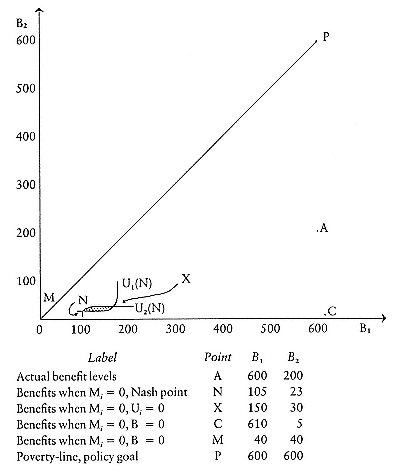
Figure 2.1
Determination of Benefits by Bargaining
equating the marginal value of benefit increases (u1 ) to the marginal cost of income losses (the term in brackets). Hence the indifference curve passing through this point, U1 , is horizontal there.
But we also know that at the Nash point B2 increases will raise U1 , because they attract AFDC recipients into state 2 and raise after-tax income in state 1 for every level of B1 . This can be seen by differentiating the utility function with respect to B2 :

This result shows why the U1 curve is concave from the horizontal axis:
as B1 is, say, raised above its optimal level at N, increasing rises in B2 are necessary to keep the state on its indifference level.
The same results are true for state 2. The equation analogous to (3) shows that the U2 curve is vertical at Nash point N. The equation analogous to (4) shows that benefit increases in state 1 raise utility in state 2. And the curve is concave to the vertical axis because increasing rises in B1 are necessary to compensate for non-maximizing changes in B2 .
The fact that indifference curves cross at N implies that utility can be raised simultaneously in both states by bargaining, or by having the central government simply set benefits in both states at some level that raises utility in one state without lowering it in the other. Such a contract curve solution could be found by maximizing the joint utility function

for some arbitrarily specified weight w , assumed to lie between zero and one. But for reasons that will become apparent shortly, that is not going to be my argument for greater centralization. Another proposition is that the Boadway and Wildasin (1984) solution of federal matching could in principle be used to arrive at a contract curve solution, by effectively externalizing some of the cross-state gains of higher benefit levels in a state. Shortly we will also see that if this is the justification for federal matching, actual matching rates turn out to be far too generous to achieve this limited goal.
The diagram gives the area of possible gains from greater coordination as the shaded area. The northeastern limit of this area, denoted by X, can be approximated by reasoning that U1 becomes vertical when rises in B1 no longer raise utility in the state, that is, when B1 is so high that u1 is zero. Similarly, U2 becomes horizontal when u2 is zero. These points can be located with the equations

where the solution is just as before except that the derivatives are used to solve for the levels of B1 and B2 where the indifference curves become vertical and horizontal respectively. It can be seen from the graph that the exact crossing point is at a B1 value less than that at which U1 is vertical and at a B2 value less than that at which U2 is horizontal. I could locate this point exactly if I were willing to assume a specific form for the utility functions, but we will shortly see that such a step is not necessary.
This is all the positive theory that is required; I now try to find the various points with real-life values. The values for B1 and B2 will be state
monthly AFDC guarantee levels for a family of four in 1981 dollars, assuming food stamps at a standard national level. Given this level, AFDC guarantee levels of about $600 would have been necessary to keep a family out of poverty status in 1981 (labeled P on the diagram).
The first step is to locate actual benefit levels in the presence of federal matching and migration. Data from Gramlich and Laren (1984) show that in typical high-benefit states, covering nearly half of AFDC recipients, B1 ranged from $540 to $720 with a mean close to $600. In low-benefit states, B2 ranged from $115 to $510, with a mean close to $200. These values are indicated on the diagram by point A.
Values at the Nash point N are determined from the equations given in Gramlich and Laren. Equation 9 there shows benefits to be determined in the two states by the relationships

where L(x ) denotes the log of a variable, c is the price elasticity of demand for AFDC benefits, and the Zi terms represent the influence of all other variables. The Nash point is found by using the actual values listed above and reasonable parameter estimates from the paper (b = 0.65, c = 1.8) to evaluate the Zi . Then these figures replace Zi , the Mi are set at zero, and the values at point N are computed: B1 falls from $600 to $105, B2 from $200 to $23. The sharp drops are caused by three factors.
1. There is a sharp change in matching ratios, from M1 = 0.5 and M2 = 0.75 to zero.
2. The estimated price elasticity is high.
3. The estimated migration effect is high, causing the fall in B1 to lower B2 , this to lower B1 , and so forth as in a multiplier.
Whether these estimates are believable is, of course, not as obvious. The paper finds both estimates to be highly significant, and it does confirm the all-important migration parameter with two different bodies of data.
The next step is to locate point X, the approximation for the northeastern crossing point. Because u2 is already found to be very low (that is why the group 2 states pay so little AFDC, even when most costs are financed by the federal government), U2 becomes horizontal when B2 rises to 30; the same type of calculation makes U1 vertical when B1 equals 150. These two values are shown as point X on the graph; the true crossing point is
slightly to the southwest. That these AFDC levels are so low explains why I do not use this lack of coordination argument for greater centralization: the rises in benefits due to improved coordination would not be very high.
Two other points are shown on the graph. Point C, for a closed economy, shows the solution to the model given in Equation 7 when there is no matching and when there is no migration effect. What migration does is to bring benefits in the two states together; when b is set at zero, states diverge to what might be thought of as their true preference benefit levels—close to the actual value for B1 but close to zero for B2 . In this sense the present matching-grant system is about right for preserving the closed economy solution for the B1 states but much more generous than is necessary for preserving the closed economy solution for the B2 states. Finally, the point labeled M goes the other way, showing the equilibrium values for benefits when migration is infinitely sensitive to benefit disparities, as might be assumed in extreme versions of the Tiebout model. In this case benefits must be equal in the two states, by my calculation at about $40.
Hence the results here are dominated by the low intrinsic desire on the part of the group 2 states to pay benefits. These states now pay benefits of only $200 a month for a family of four, roughly one-third of the poverty line. And this in the presence of a price reduction by the federal government that averages 75 percent, a large estimated price elasticity of demand, a large migration sensitivity, and benefits in other states over three times as high. When the federal matching is eliminated to find the Nash point, benefits in these group 2 states fall to very low levels, and in the presence of the migration sensitivity, this pulls down benefits in the other states. With a Nash point anchored at this low a level, none of the normal federal policy measures aimed at improving coordination will have much effect—even at point X, benefits will be less than $30 in the low-benefit states.
To be candid, then, my policy suggestions are not aimed at preserving tastes in these low-benefit states. My goal is that benefits in all states be set at something like the poverty level of $600 per month, which also happens to be the preferred level in the high-benefit states. The much-maligned present system does bring about this result in these high-benefit states; its defects are highly overrated. But it still does fall short of my goal because of the low benefits in the other states. The easiest way to achieve the goal is simply to have the federal government establish uniform national benefit levels, with optional state supplementation.
As a final matter here, one might ask about two types of sensitivity
tests. First, does the low intrinsic "taste" for AFDC benefits among low-benefit states reflect their low income? The answer is no . The Gramlich–Laren paper also estimates income elasticities as part of the model, and even when these are complicated by the fact that low-income states are likely to have more AFDC recipients, other things being equal, the income elasticities are extremely low. Redoing the Figure 2.1 analysis with all incomes standardized would lead to only trivial changes. AFDC benefits are low in low-benefit states for reasons that are not captured in the income term: many of these states have high incomes.
The other type of sensitivity test refers to the migration parameter b . It is already high enough that the Nash point is geometrically closer to M than to C. But it is also true that if b were underestimated for any of a number of reasons (the opposite of the usual criticism of the Gramlich–Laren paper), point X could stretch to cover point A. Unfortunately, it would take a b value close to 10 (15 times the value now estimated) to get X up to A, and close to 26 (40 times the value now estimated) to get X up to P. Theoretically, more sensitive migration could relieve the strain of the paternalistic argument for centralization: realistically, it cannot.
Acknowledgments
I would like to thank the editors of the volume, along with Henry Aaron, Harvey Brazer, Theodore Bergstrom, Paul Courant, Roger Gordon, Wallace Oates, David Wildasin, and John Yinger for helpful comments. Deborah Laren and Marieka Klaiwitter produced some of the numbers, and some of the work was financed by a grant from the Sloan Foundation.
References
Advisory Commission on Intergovernmental Relations. 1981. "Changing Public Attitudes on Governments and Taxes, 1981." S-10. Washington, D.C.
Atkinson, Anthony B., and Joseph E. Stiglitz. 1980. Lectures on Public Economics . New York: McGraw-Hill.
Barfield, Claude E. 1981. Rethinking Federalism: Block Grants and Federal, State, and Local Responsibilities. Washington, D.C.: American Enterprise Institute.
Barro, Robert J. 1974. "Are Government Bonds Net Wealth?" Journal of Political Economy 82: 1095-1117.
Boadway, Robin W., and David E. Wildasin. 1984. Public Sector Economics . Boston: Little, Brown.
Break, George E. 1980. Financing Government in a Federal System . Washington, D.C.: Brookings Institution.
Breton, Albert. 1965. "A Theory of Government Grants." Canadian Journal of Economics and Political Science 31: 175-87.
Breton, Albert, and Anthony Scott. 1978. The Economic Constitution of Federal States. Toronto: University of Toronto Press.
Buchanan, James M. 1950. "Federalism and Fiscal Equity." American Economic Review 40: 583-99.
—––. 1965. "An Economic Theory of Clubs." Economica 32: 1-14.
Cassing, J. H., and A. L. Hillman. 1982. "State-Federal Resource Tax Rivalry: The Queensland Railway and the Federal Export Tax." Economic Record 58: 235-41.
Courant, Paul N., Edward M. Gramlich, and Daniel L. Rubinfeld. 1980. "Why Voters Support Tax Limitation Amendments: The Michigan Case." National Tax Journal 33: 1-20.
Feldstein, Martin S. 1975. "Wealth Neutrality and Local Choice in Public Education." American Economic Review 65: 75-89.
Fleming, Marcus. 1964. Domestic Financial Plans under Fixed and Flexible Exchange Rates. Washington, D.C.: International Monetary Fund Staff Papers.
Gordon, Roger H. 1983. "An Optimal Taxation Approach to Fiscal Federalism." Quarterly Journal of Economics 98: 567-86.
Gramlich, Edward M. 1982. "An Econometric Examination of the New Federalism." Brookings Papers on Economic Activity 2: 327-60.
—––. 1984. "Subnational Fiscal Policy." Mimeo. Ann Arbor: University of Michigan.
Gramlich, Edward M., and Deborah S. Laren. 1984. "Migration and Income Redistribution Responsibilities." Journal of Human Resources 19: 489-511.
Hellerstein, Jerome R. 1977. "State Tax Discrimination against Out-of-Staters." National Tax Journal 30: 113-34.
Holmer, Martin. 1975. "Economic and Political Causes of the Welfare Crisis." Ph.D. dissertation. Cambridge, Mass.: MIT.
Ladd, Helen F. 1982. "Financing Public Services in the Federal System." Pp. 31-44 in Federalism: Making the System Work . Washington, D.C.: Center for National Policy.
Ladd, Helen F., and Fred C. Doolittle. 1982. "Which Level of Government Should Assist the Poor?" National Tax Journal 35: 323-36.
Levin, David J. 1983. "Receipts and Expenditures of State Governments and of Local Governments, 1968-81." Survey of Current Business 63: 25-38.
Lucas, Robert E. 1972. "Expectations and the Neutrality of Money." Journal of Economic Theory 4: 103-124.
McLure, Charles. 1967. "The Interstate Exporting of State and Local Taxes: Estimates for 1962." National Tax Journal 20: 49-77.
Medoff, James L. 1983. "U.S. Labor Markets, Imbalances, Wage Growth, and Productivity in the 1970s." Brookings Papers on Economic Activity 1: 87-120.
Mieszkowski, Peter, and William H. Oakland. 1979. Fiscal Federalism and Grants-in-Aid . COUPE Papers on Public Economics 1. Washington, D.C.: Urban Institute.
Mundell, Robert A. 1963. "Capital Mobility and Stabilization Policy under Fixed and Flexible Exchange Rates." Canadian Journal of Economics and Political Science 29: 475-85.
Musgrave, Richard A. 1959. The Theory of Public Finance: A Study in Public Economy . New York: McGraw-Hill.
Mutti, John H., and William E. Morgan. 1983. "The Exportation of State and Local Taxes in a Multilateral Framework: The Case of Household Type Taxes." National Tax Journal 36: 459-76.
Nathan, Richard P., Allen D. Manvel, and Susannah E. Calkins. 1975. Monitoring Revenue Sharing. Washington, D.C.: Brookings Institution.
Oates, Wallace E. 1972. Fiscal Federalism . New York: Harcourt, Brace, Jovanovich.
Pauly, Mark V. 1973. "Income Redistribution as a Local Public Good." Journal of Public Economics 2: 35-58.
Sargent, Thomas J., and Neil Wallace. 1975. "Rational Expectations, the Optimal Monetary Instrument, and the Optimal Money Supply Rule." Journal of Political Economy 83: 241-54.
Schultze, Charles L. 1974. "Sorting Out the Social Grant Programs: An Economist's Criteria." American Economic Review 64: 181-89.
Tiebout, Charles M. 1956. "A Pure Theory of Local Expenditures." Journal of Political Economy 64: 416-24.
Tresch, Richard W. 1981. Public Finance: A Normative Theory. Plano, Texas: Business Publications.
U.S. Department of Commerce. Survey of Current Business , various issues.
U.S. Office of Management and Budget. Budget of the United States Government , various issues.
Walsh, Cliff. 1983. "Reforming Federal Financial Relations: Some Radical (Or Are They Conservative?) Proposals." Paper presented at the Federal Finances Symposium, Hobart, Australia.
Wilde, James A. 1971. "Grants-in-Aid: The Analytics of Design and Response." National Tax Journal 24: 143-56.
Yinger, John. Forthcoming. "On Fiscal Disparities across Cities." Journal of Urban Economics.
Chapter Three—
Commentary
Henry J. Aaron
Gramlich's and Inman's articles both discuss problems of federalism, but they share only a few elements. Accordingly, I shall comment on them separately.
Gramlich's article is meaty, thought-provoking, and highly professional. No economist I can think of does a better job of integrating economic theory, statistics, and institutional realities to say something useful about practical problems. This encomium is not the prelude to devastating criticisms, but I do have some criticisms.
In the discussion of the various motives for grants, I believe that one motive (to which Inman alludes briefly) is omitted. Higher-level governments often employ lower-level governments as agents, using grants as a means of virtually drafting their administrative services. The responsibility appears to be joint, but the activity is controlled in all essential respects by the higher-level government. Such grants are best explained and appraised, in terms not of spillovers or interregional income redistribution, but of their effects on administrative efficiency. From this standpoint, narrow categories and high matching percentages are entirely rational. Better grounds for criticism would be whether the federal government should be involved in such functions, or whether administration by lower-level governments is truly advantageous.
Economists have almost completely neglected yet another motive for grants. I believe that the political leaders who fashioned the large increase in federal grants during the 1960s and 1970s thought that by offering money to hesitant states and localities on irresistible terms they could
develop interest groups for activities that had previously had none and that by closely supervising how money was spent they could improve administrative processes in backward lower-level governments. In the jargon of our profession, they thought that both the preference functions and the production functions of the lower-level governments were malleable.
Economists have tackled endogenous production functions in models of learning-by-doing, but they have not carried this insight to governmental behavior. And the possibility that utility functions are endogenous to consumption has played little role except in speculations about the role of advertising and in Thomas Schelling's brilliant essays on self-control. I suggest that the history of grants-in-aid in the last quarter of a century is incomplete without both concepts. I suggest also that the endogeneity of state and local production functions and tastes for public services would go a long way toward explaining the fly-paper effect. What I have in mind is the process by which an increase in grants for a particular spending program will alter the tastes of the local politicians toward favoring more spending on that program.
My remaining comments on Gramlich's paper concern specific points. He states that there is little evidence from the distribution of expenditures among levels of government to show that there are gross misassignments of functions among levels of government. That statement is logically correct, but so is the converse—there is little evidence that functions, other than national defense, energy, and a few others, are correctly assigned. How bad are educational spillovers? How many people reside in the school district in which they received their precollege education? Where counties or states finance education, the same question applies with two words changed. Does the particular split of responsibilities for health and hospitals shown in Table 2.2 make economic sense? I do not even know how to go about answering that question.
Gramlich labels personal and corporate income taxes as the most important ability-to-pay taxes; property taxes are listed as benefit taxes; sales taxes are left unclassified, but they must be either benefit taxes or unimportant ability-to-pay taxes. Behind any such taxonomy lie implicit judgments about the value of benefits from public services that accrue to different households. Many years ago Martin McGuire and I showed that you could get virtually any result you wanted regarding the distribution of benefits from public services by selecting among plausible assumptions regarding the income elasticity of utility. For some assumed values, federal taxes were well-matched benefit taxes. For this reason I cannot assign
much meaning to Gramlich's suggestion that ability-to-pay taxes should be levied at the federal level.
Gramlich suggests another principle for assigning taxes, that the federal government should take over easily exported taxes. I am not sure which taxes this rule would exclude, since even taxes borne entirely by the residents of one state may produce migration effects. Given such effects, state income taxes, for example, would have to be stricken from the list of revenue sources appropriate for state administration. The point is that all taxes place states at some disadvantage in competing for labor and capital. The degree of disadvantage depends not only on the type of tax but also on its level and structure. A poorly designed sales tax at a high rate may be more of a deterrent to business than a well-designed and well-administered corporation tax.
Gramlich's jeremiad against federal income tax deductibility of state and local taxes of all kinds is eloquent and justified. He bases his criticism on the damage such deductibility does to rational decisionmaking at the state and local levels. He might also have mentioned that deductibility, along with countless other base-narrowing provisions, raises marginal rates and increases deadweight losses to raise a given amount of revenue.
I am even more pessimistic than Gramlich on the subject of the exclusion of state and local bond interest from the federal tax base. While it is true that the interest differential between taxable and nontaxable bonds of given riskiness and maturity is only about 25 percent, the differential on short-term securities is considerably larger, in substantial measure because banks continue to hold short-term securities, as a result of their financial needs and the quaint and curious way we tax financial institutions. Furthermore, while the spread between taxable and nontaxable bonds has decreased, the volume of tax-exempt issues has mushroomed as they have become available for industrial and housing bonds. The scope for tax exemption to distort investment is thus vastly expanded. It seems safe to say that the total excess burden from the exemption of interest on state and local securities is at an all-time high.
Finally, Gramlich offers a set of recommendations regarding welfare. I found the appendix summarizing the analysis and results of another paper fascinating. The use of a bargaining model to handle migration effects of welfare payments is very clever. The most striking aspect of this analysis is that when he comes to policy recommendations, Gramlich drops the analytical framework and says that he would impose poverty-income-threshold transfer levels on both high- and low-benefit states. I cannot quarrel with the recommendation, although I do think that other
aspects of the welfare program, such as work requirements, job creation, and other administrative rules are so important that benefit levels do not adequately characterize any welfare program. My point is that one can reach Gramlich's recommendation only if in Equation 5, (1 – w ), the weight attached to utility of residents in the low-benefit state in the social welfare function, is zero. In short, in making policy recommendations he drops his economic framework and turns—as I think he should—to value judgments.
That reminds me of two waggish laws of economics. The first states that nothing of importance in economics was ever settled by empirical analysis. The second states that nothing of importance was ever settled by theory either. I hate to think of the corollary.
I now turn the the Inman paper. He gets the big points right. The New Federalism has not been adopted and is not likely to be unless the November 1984 election is to the November 1980 election as the 1980 election was to the 1976 election, a truly awe-inspiring prospect. If it were to be adopted, the New Federalism would result in large but unevenly distributed reductions in spending by state and local governments. I do not trust the precision of his estimates (neither, I think, does Inman), because they derive from data generated by gradual year-to-year changes or from cross-sectional estimates where tastes may not have been adequately controlled. But the qualitative characterizations of those effects on outlays, i.e., big and negative, seem indisputable. The history is incomplete, however, without taking note of the effects of President Reagan's great budgetary leap backward. Even without the New Federalism, things have changed a lot. A fair amount of grant consolidation and budget reduction has occurred.
Inman's results suggest a ranking of motives on the part of the proponents of the New Federalism rather different from those he derives. He claims that the primary motives were to scale back the size of government and of federal intrusiveness, and that the achievement of these objectives was foiled by the political facts of life. States really want matching grants, not unrestricted funds, at least for welfare and other programs that help the poor. That way they can meet the requests of the teeming masses yearning to receive aid at low net marginal cost to the resident middle class. Members of Congress too were reluctant to surrender categorical grants, because each representative had one or more grants that served him or her and only a few others; logrolling did the rest.
Relegated to bit parts in this drama are two other factors to which participants in the negotiations between federal and state officials over
the New Federalism would, I think, assign primary importance. The first is that, quite apart from any incentive effects, the New Federalism was a raw deal for the states. They lost money right away and were promised that after a few years they would lose a lot more. If Reaganauts had been primarily interested in reducing the intrusiveness of government, they could have upped the ante sufficiently to bring state officials on board. Even if federal grants were greatly increased, it appears from both Gramlich's and Inman's calculations that total government spending could have been cut sharply. The necessary offer was not made, because the primary objective was cutting domestic federal spending. That the goal of reducing federal intrusiveness may have been a rhetorical sham is suggested by the Reagan administration's proposals for a massive increase in federal intrusiveness through regulation of state and private behavior with respect to abortion and school prayer and by overriding clinical and parental freedom in the treatment of infants. The fact is that the New Federalism was a federal budget-cutting initiative, first and foremost.
The second factor is best summarized by an ironic comment that Michael Stern, then staff director of the Senate Finance Committee, made to me in 1977. "When it comes to welfare," Stern said, "all members of Congress are statesmen. The welfare lobbies are so weak, most members can and do vote their consciences." I realize that conviction as a motivation for voting has played little role in formal models, but I would suggest that welfare is different in degree, not kind, from many other programs included in the New Federalism proposals. Although they may not understand the Inman—Craig or Gramlich models, many members of Congress do understand that giving less money with fewer incentives will produce fewer effects than does more money with more incentives. Again, I think that the Reagan administration could have swayed enough members of Congress to accept the proposed restructuring of federalism if more money had been put into the deal. But the desire to cut federal spending was overmastering.
Commentary
George F. Break
Gramlich and Inman have both written excellent articles, providing much stimulus to thought and leaving little to criticize. I do have one major disagreement with Gramlich concerning the role played by federal deductibility for state and local taxes. He contends that "it is hard to imagine a consciously designed public policy measure having worse effects on both efficiency and equity counts than the federal income tax deduction for state and local taxes." In my view that feature of the federal individual income tax is both sound in principle and equity-enhancing in practice. Its effects on economic efficiency may well be generally unfavorable, but their quantitative significance has yet to be firmly established. Policy evaluation of federal deductibility is, I believe, much more complicated than Gramlich maintains, involving important, but uncertain, tradeoffs between equity gains and efficiency losses.
My argument begins with the following basic proposition concerning the role of taxes in a federal system of government: when two independent levels of government both make use of ability-to-pay taxes, the proper income tax base for each level is personal income minus the ability-based taxes of the other. This is simply a specific application of the general principle that ability to pay taxes is a function of each person's discretionary income—namely, that part of total income remaining after provision has been made for minimum survival consumption expenditures, unavoidable casualty losses, and so forth. Ability-based taxes, by definition, are compulsory transfers to the government in return for
which no tangible benefits are received. Payment of such taxes to one level of government reduces ability to pay at other levels.
This is not the place to debate the relative philosophical merits of this basic proposition. Instead, let us accept it as a general principle of federal finance and discuss some of its important policy implications. Consider first a dual system of proportional income taxation, the federal rate being f and the state rate s . With no deductibility, the total nominal tax rate is t = f + s , and each component understates the tax rate each level of government is in fact imposing. The effective federal rate is f * = f /(l - s ), and the effective state rate is s * = s /(l - f ). With unilateral deductibility by either level, the total nominal tax rate is
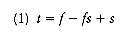
For federal deductibility, which permits deduction of the state income tax from the federal base, it is convenient to concentrate on the second two terms. Taken together, s (l - f ) measures the net cost to state taxpayers arising from the state income tax. Taken separately, s indicates the gross rate of tax received by the state, part of which is provided by its own taxpayers [s (l - f )], and part by the federal government (sf ). In effect, the interaction term, sf , represents an implicit, unrestricted federal grant channeled to the state government through its resident taxpayers.
For state deductibility, on the other hand, it is convenient to concentrate on the first two terms of Equation 1. The term f (l - s ) now measures the net tax rate imposed on federal taxpayers, and fs is an implicit unrestricted state grant to the federal government. Double deductibility, which need not be discussed here, simply combines these two separate patterns.
Suppose, next, that each level of government wishes to operate Musgrave's Distribution Branch by levying progressive ability-based income taxes. In this joint venture the federal government is the senior partner, and states participate because there is no national consensus about the optimal degree of income redistribution to be achieved through the tax system. One would therefore expect to find considerable diversity in state Distribution Branch policies, some wishing to augment and others to offset the redistributive effects of the federal tax system. In such a fiscal environment the tax parameter of major interest to state policymakers is what I have called the incremental burden ratio, that is, the ratio of incremental state tax burdens imposed at each level of personal income to the taxpayers' after-federal-tax incomes.[1] The trouble with that ratio is its low visibility, not only to the general public but also to many state
| ||||||||||||||||||||||||||||||||
policymakers. In public discussions of tax policy it is the nominal state rate, or rates, that are the focus of attention. That being the case, the important question is how good, or bad, an indicator of the redistributive effects of state taxes those nominal rates are.
If there is no deductibility of one governmental level's income tax from the income tax base of the other level, neither tax is being imposed on a correctly defined base, and the nominal state tax rate is a seriously flawed indicator of the true redistributive effects of state taxes. This may be readily seen for the simple case of a proportional state income tax, levied at rate s . The incremental burden ratio at any income level i is then

where fi is the average federal tax rate at income level i
Since fi is higher at higher income levels, the IBR structure will be progressive. Combined with the average federal income tax rates shown in Table 3.1, a flat-rate state tax of 10 percent, for example, would produce incremental burden ratios that increased from 10 1/2 percent at the $10,000 AGI level to 14 percent at the $75,000 level. With no deductibility, in short, a progressive state income tax would be more progressive than its nominal rate structure indicates, a nominally proportional tax would be progressive, and even a nominally regressive tax might be progressive.
Federal deductibility alone, which is the policy at issue here, would improve both the equity of the federal tax and the usefulness of the state nominal tax rate structure as an indicator of state redistributive policies. In this case, the incremental burden ratio is
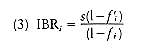
where f'i is the marginal federal tax rate at income level i
It will be recognized that this is simply the nominal state tax rate multiplied by one of the standard measures of income tax progression, namely, the elasticity of after-tax income with respect to before-tax income, commonly called residual income progression .[2]
For federal deductibility the relation between the nominal state tax rate structure and its incremental burden ratio structure may be summarized as follows:
1. si > IBRi , since (l - f'i )/(l - f i ) < 1 for a progressive federal income tax.
2. Over any income range for which federal residual income tax progression is constant, the nominal state tax rate structure will be an accurate indicator of the incremental burden ratio structure. That is, the incremental burden ratio structure will be proportional when the nominal rate structure is proportional, progressive when it is progressive, and regressive when it is regressive.
3. Over an income range where residual income progression is falling—(l - f'i )/(l - fi ) is rising—nominal state rates understate the progressivity of state tax policies, and vice versa.
The incremental burden ratio structure for a proportional state income tax of 10 percent, for example, may be found in the last column of Table 3.1 by moving the decimal point one place to the left.
On equity grounds alone, then, federal deductibility for state and local ability-based taxes has much to recommend it. Its efficiency rating is both more mixed and less favorable. Three main sets of effects need to be considered.
1. By lowering the net cost to federal-income-tax itemizers of state and local ability-based taxes, federal deductibility may stimulate state-local spending beyond optimal levels. Given the loose linkage between ability-based taxation and spending-level decisions and given the many ambiguities surrounding the concept of optimal government spending, this is a very difficult set of effects to evaluate. In general, it appears that policymakers face a troublesome tradeoff between federal deductibility, which may distort state-local Allocation Branch operations, and no deductibility, which, for the reasons
already given, would be likely to distort state-local Distribution Branch operations.
2. Federal deductibility biases the choice of alternative state-local financing instruments away from those that are not deductible from the federal individual-income-tax base. How strong these effects are is not clear. The biases in question could be either eliminated by repealing federal deductibility or moderated by establishing a set of matching, unrestricted federal grants based on state-local use of nondeductible taxes and user charges.
3. Federal deductibility may moderate the distorting effects that high state-local ability-based taxes have on decisions about business and household location. For federal tax itemizers, high-tax states are less unattractive than they otherwise would be, and businesses locating there can, as a consequence, attract such people with offers of lower salaries than might otherwise be needed.
Federal deductibility of state-local ability-based taxes, like most important tax issues, presents policymakers with some very hard choices. Restricting deductibility to fewer taxes (the retail sales tax has in recent years frequently been offered as a candidate for removal from deductibility status) would run the risk of seriously distorting state and local government choices among alternative ability-based taxes. Eliminating deductibility altogether would risk distorting both the operation of state-local redistributive tax policies and the location among states of households and businesses. Keeping federal deductibility intact, because it is regarded as an important structural feature of the federal income tax in a federal system of government, would risk continuation of the other distortions noted above. If deductibility is kept, its significance and equity could be improved by removing it from the official list of federal tax expenditures, thereby recognizing its basic structural function, and by moving it "above the line" into the category of "adjustments to income," thereby making it available to all federal income taxpayers.
Commentary
Julius Margolis
The analysis of fiscal federalism within the framework of comparative statistics has great merit. However, it tells less than the full story. Five mjaor historical trends have affected the multi-level government structure of the United States: the growth of government; technological change; the decline of political parties; the revolution in the household economy, including the women's revolution; and the growth in democratization. These five trends have combined to effect the relative growth of the national government with the expansion of the locals as its agents.
The Phenomenal Growth of Government
All growing governments, whether they are unitary governments, like that of France, or highly centralized, like the Soviet Union's, are confronted by the huge bureaucratic diseconomies of trying to implement policy at a central point. France, the Soviet Union, the United States and, I would guess, almost all other nations, have set up extensive decentralized administrative structures. In the United States the degree of administrative decentralization is cloaked by the federal structure. Instead of regional divisions of federal agencies, the peripheral agencies have been the state and local governments, which are constitutionally independent of the central authorities. We find a modest degree of administrative decentralization of federal agencies and a number of regional organizations which may be created by the states but whose revenues and behav-
ioral rules derive wholly from the federal government. More important is the way the "normal" state and local governments alter their structures and behavior so that they conform to the specifications of the feds. And of course many special districts and authorities were established with taxing powers, but their true role is to contract with the federal government, under terms specified by federal legislation, to perform services demanded by the federal government.
From a fiscal perspective, the federal government is primarily a financial intermediary, levying taxes and then transferring funds to local governments to support services performed by locally elected and controlled governments that have their own taxing and police powers. From a public service perspective, the state and local governments, when receiving federal grants or contracts, appear to be federal agents implementing federal objectives. A principal-agent model would select the federal agency rather than the local electorate as the principal in many of these operations.
When we recognize that a very large part of fiscal federalism is simply a way to adjust administrative decentralization to an American governmental structure, it becomes clear why the matching-grant formula bears no relationship to externalities. Federal loss of interest in a specific categorical program is likely to result in a budget cut rather than a search for a more efficient price.
Increasing government size fostered expertise in formulating and implementing public programs. The federal bureaucracy took the lead in sophistication of techniques and in hiring technically competent personnel. In time, the regional, state, and local bureaucracies hired their own professionals. In formal terms, programs were initiated at the federal and implemented at the local level, but in less formal terms we find a coalition of bureaucrats at all levels formed to administer these programs. Two aspects of this process are of special interest to us: increasing independence from the political process, and increasing reliance on the federal government as financier.
The coalition of bureaucracies became allied with a body of suppliers, much like the military-industrial complex, e.g., the health bureaucracies have allies in the hospitals, nursing homes, medical societies, drug companys, and instruments manufacturers, among others. And just as the military-industrial complex seems to have achieved a charmed independence from the normal political checks and balances, so has the coalition of expanding bureaus. The technical bureaucracies have come to dominate the legislative branch; at the local level they were even more influen-
tial, since they brought their own funds. The organizational power of the bureaucracies was given a powerful political boost by support from the suppliers.
The extent of these complexes of self-interested groups, dedicated professionals, and even some beneficiaries of the services is dependent on the costs of the programs, not the benefits. Herein lies an interesting observation about federalism. The set of input providers are professionalized and organized; the beneficiaries and citizenry are much less so. Of course, the political power of one coalition is not only measured in terms of its influence against the general citizenry and the specific program beneficiaries but is subject to the countervailing power of all the other coalitions competing for the limited resources extracted from the citizenry. Despite the competition among bureaus, the power in the public sector is heavily concentrated in the supply side. Although the elected leaders must eventually act to endorse or check the ambitions of the competitive bureaucracies, this model of federalism is a far cry from response to the median voters.
A second important feature of most public programs is the difference in distribution of cost versus benefits. Even for a public good, such as defense, which is spread throughout the nation, the production of weapons and training of personnel are restricted to a few production centers. Many public services such as health, education, or transportation have a very wide distribution of benefits but the production of the capital equipment is spatially concentrated. If we devised a political benefits-costs ratio, where benefits include gains to input suppliers as well as willingness to pay for outputs, the ratio for a given program would rise as we moved up the hierarchy of governments from local to national. This does not mean that local bureaus want to surrender their autonomy in exchange for a higher budget. On the contrary, there is much evidence that bureaus will resist growth if it means a dilution of independence. However, if the programs have grown due to federal initiative, coalitions already formed will resist returning funding to local levels. However, if this does happen the coalition may be able to keep a program going in the absence of direct federal support—which suggests that programs are overfunded at the federal level because of the political benefits-costs ratio and that a return of allocational decisions to the local or even the state level might bring the public decision makers closer to a social benefits-costs ratio. Another way of expressing it is that it might be of social advantage to "externalize" the costs of a public program: if the inputs of a program could be located outside the jurisdiction, then the only gain offsetting the tax costs of a
program would be the value of the outputs, not the employment gains or the profits on the inputs. It seems paradoxical that even though private market failures may arise from externalities, it might be necessary to create another set of externalities to overcome public failures.
The conditions of growth in the public sector led to an excessive response to the changing trends discussed below. The coalition of suppliers greatly inflated the benefits of a program, and decentralized administration led to excessive growth at the local level. A counter-revolution should not be unexpected.
Technological Change
The rapid technological changes of the past century have had a highly differential effect on local governments, since their boundaries remained relatively fixed while the pattern of land use changed drastically. Some locals became industrial enclaves, others became bedroom suburbs, and the most productive areas of the central cities turned into obsolete and high-cost producers of services for residential or business use. Thriving urban centers with great expectations were abandoned; others were depressed. This is a familiar story, but it is not clear that it had to result in the current huge fiscal disparities.
In the private market, capital equipment, labor skills, even entire industries have become obsolete. When a plant becomes obsolete it remains in productive use in the firm so long as its marginal operating costs are less than the price of the product. The capital declines in value in response to the loss of quasi-rents. Losses are taken by the owners of the capital. In time the obsolescent capital will be replaced by technologically efficient equipment, with the full faith and credit of the firm behind the credit used to finance the new equipment. The process in the public sector is very different. The city (the public plant) is expected to levy taxes sufficient to pay competitive public services (charge the same tax prices) even though the inefficient public facilities cannot attract or hold their old residential or business users. Attempting to charge the same prices (keep the high taxes) leads to abandonment and further decay. It is not surprising that, as in the case of the private firm, a higher level of organization imposes an umbrella of support over the "victims" of technological change. The (inefficient) city's costs (local taxes) are reduced through federal grants—a process similar to a firm's expecting lower quasi-rents from the older plants.
An alternative approach to shifting the problem of support of renewal
of capital and labor to the central government might have been to expand the boundaries of the city containing the obsolescent resources so that the city will contain the new facilities and labor skills. However, the newer suburbs strongly resist such an expansion. Many of them might have been forced to accept annexation since they did not have the resources to support facilities, but federal support programs for new infrastructure construction obviated the need for this. One political response to the historical trend toward democratization represented by the federal support of the suburbs was a huge investment by the federal government in the resources of the central city. Boundary changes and the reassignment of responsibilities within the local units of a "regional government" might have reduced the need for federal fiscal intervention, but the drive to experiment in regional government was frustrated by problems of racial, ethnic, class, and economic differences in the urban population.
The Decline of Political Parties
One major instrument of political decisionmaking is the political party. If a party seeks to rule, then it must be part of a majority coalition, able to influence the agenda of the governing bodies of the central cities and the suburbs. It is the political party that is peculiarly adept at conflict resolution, at compromising among disparate interests. I would argue that we do not have real political parties in the United States at the national level; at the local level, the shadow of a party exists only in the older sections of the country. The local elections are contested by nonpartisan candidates; typically, they run in nonpresidential election years to avoid the taint of party. The ballots are structured to discourage any form of party voting. Therefore, the political capability for boundary changes and functional reassignment of tasks and fiscal resources is very limited.
The New Household Economy
The growth of government is associated with the assumption of power—usually, by the central authority. Analysts have viewed this growth with alarm, especially when it is paired with the growth of the large and now gigantic firms. Opposing this trend has been a surprisingly large burst in economic activity in the household sector—that is, the most decentralized of all entities, the households, have been growing at a more rapid rate than the highly centralized ones. In the quarter-decade after
1950, business reproducible wealth increased by 130 percent and government reproducible wealth increased by 132 percent—while the lowly households' reproducible wealth increased by 220 percent.
A second major resource shift has been the huge decline in the number of hours of paid work over a lifetime and the dramatic increase in labor-force participation by women. The decline in paid work was a combination of a higher average age for leaving school, earlier retirement, and home production using leisure time and household capital instead of market employment. Even more sudden has been the drop in the size of the family, the reduction of the household to the nuclear family, and the woman's role shift from homemaker to fulltime member of the labor force.
Government programs have been an integral part of these changes. The first decades of life are spent in public educational institutions; the last decades of life are spent in publicly supported retirement status, with huge transfer programs to support the aged (and the younger disabled). In the postwar decades, public infrastructure was built to support private investment in suburban housing and cars. In recent decades household investment has shifted away from the house, and less complementary government investment is required. More important, especially for the debate about the new federalism, has been the transformation of women to members of the work force. Now the family pays taxes on this increased income, and the government manages the transfers. The transfer sector of the fiscal government has grown at twice the rate of collective consumption.
Democratization and Egalitarianism
The turbulent decade of the sixties brought into the political system neglected minorities such as the blacks, and broadened of the definition of civil rights. Equality before the law was extended to equality of public services. This revolution broke at the same time as the household revolution that surrendered to the government the role of transfers among generations, and the technological revolution that encouraged firms to locate in the suburbs near a highly skilled work force. The latter weakened the central cities and their capacity to support the revolution. The metropolitan areas had the resources to support the fiscal effects of these changes, but not the organizational structure nor political will. Local governments found it difficult to respond because of tax competition,
boundaries which made it simple to avoid taxes, and a political structure biased toward property interests. We all know the history of the federal government's repeated attempts to resolve the fiscal problems of the cities.
Summary
Our society has been subjected to a set of revolutions that have had a major effect on government at large and on the structure of local governments and the federal system in particular. The burden of change fell on the federal government, which relied heavily on local governments to administer programs designed and financed at the federal level. Each president from Nixon on has sought to reduce the federal role. Revenue-sharing was introduced, but the underlying structure of the relationship was not changed until the Reagan administration. If this administration succeeds in changing the balance, what will happen?
Our explanation implies that the programs will wither. The public has accepted the revolutionary changes and is willing to adopt complementary government programs. However, to continue these programs out of local resources would involve a degree of reorganization of local government that is highly unlikely, for there is no serious movement for regional governments. The federal government may well rescue the programs after the locals have failed to be responsive. There is another option: the states might continue the programs. The states seem to be the favored agency of the Reagan administration. They have been neglected by economic analysts (possibly it has been too difficult to go beyond a two-sector model) but they may be the right compromise between the fractionated locals and the overzealous federal government. The states have a stronger fiscal base, and their bureaucracies have been improved. Possibly they can prevent the counterrevolution in government from going to excessive lengths.