
Defeat of the Great Swamp Proposal
Once the Port Authority decided that a fourth jetport was needed, it proceeded to evaluate fifteen sites on the basis of air traffic, accessibility to the region's core, topography, and availability of land. Fourteen sites were eliminated, leaving Morris County's Great Swamp in 1959 as "the only potential site in the area which . . . meets all the requirements for a new major airport to serve the New Jersey-New York area."[25] In its preoccupation with technical criteria, however, the Port Authority overlooked a requirement that turned out to be crucial: local acceptance, or at least the absence of influential local opposition. Because of suburban resistance, twenty years after the Port Authority's plans for a jetport in the Great Swamp became known, a fourth
[24] See "Interstate Road Will Open in Westchester, Thursday," New York Times, November 15, 1970. The article quotes a Federal Highway Administration brochure extolling the esthetic advantages of the easterly path. FHA support for this alignment was based not only on the opportunity to open a "highly scenic area" to "all the people," but on cost considerations: the easterly route was seven-tenths of a mile shorter and $4.3 million cheaper than the alignment preferred by local groups and officials. See Merrill Folsom, "Conservationists Lose Road Battle," New York Times, April 8, 1966.
[25] Port of New York Authority, A New Major Airport for the New York. New Jersey Metropolitan Area: A Report on Preliminary Studies by the Port of New York Authority (New York: 1960), p. 34.
airport neither was in use nor under construction, and the authority's preferred site had become a national wildlife preserve.
Local opposition developed immediately after the Newark Evening News revealed in early December 1959 that the Port Authority was planning a 10,000-acre jetport in the Great Swamp area, a sparsely settled marshland dotted with estates and surrounded by upper-income residential suburbs. Residents of the affected area were appalled at the thought of their serenity being disturbed by the roar of jets, and their amenity being undermined by 10,000 acres of airport facilities, new roads and traffic, and the other development that the jetport would stimulate. In the weeks immediately following the announcement, more than 2,000 of them wrote Governor Robert B. Meyner to protest the authority's plan. Local political leaders quickly came to the support of their constituents. The day after the story appeared, the proposal was denounced by Congressman Peter Frelinghuysen who lived near the proposed site, both of Morris County's assemblymen, and the mayors of Morristown, Chatham Township, and other municipalities in the vicinity of the site. Two weeks later, Frelinghuysen took the lead in bringing together officials from twenty municipalities to organize the Jetport Action Association (later called the Jersey Jetport Site Association), which during the next two years directed the successful campaign against a Morris County jetport.
Anguished protests from residents, an outcry from local politicians, and the formation of quasi-governmental organizations are routine suburban responses to the threat of adverse actions by outside agencies. But what ensued on the jetport issue was far from normal in contests between suburbs and major development agencies. Within six weeks after the Port Authority's plans became known, the Jetport Action Association had secured overwhelming approval by the state legislature of a resolution opposing a jetport in Morris County. In taking this action, the legislature in effect vetoed the authority's proposal, since the bistate agency needed legislative consent in both Trenton and Albany to extend its boundaries to encompass the Great Swamp. Caught by surprise by the magnitude of the hostile reaction and the nearunanimity of legislative opposition, authority officials backtracked, publicly declaring that the Great Swamp had only been a preliminary choice, and that a more thorough study would be made of it and other possible sites, while privately hoping that the "emotional outburst" would subside with the passage of time.[26]
Seventeen months later, in May 1961, the Port Authority was ready to test the climate of opinion in New Jersey with a second jetport proposal. The new report, after considering everything from noise suppression to the protection of bird sanctuaries, and after analyzing a long list of sites, again concluded that only the Great Swamp in Morris County adequately met all the criteria for the location of a new jetport.[27] The authority quickly learned that the "emotional outburst" had only temporarily subsided, and that the anti-jetport coalition had lost none of its influence in Trenton. By large majorities,
[26] Unnamed Port of New York Authority commissioner, quoted in David D. Gladfelter, "Jets for the Great Swamp?" in Richard T. Frost, ed., Cases in State and Local Government (Englewood Cliffs, N.J.: Prentice-Hall, 1961), p. 317.
[27] Port of New York Authority, A Report on Airport Requirements and Sites in the Metropolitan New Jersey-New York Region (New York: 1961).
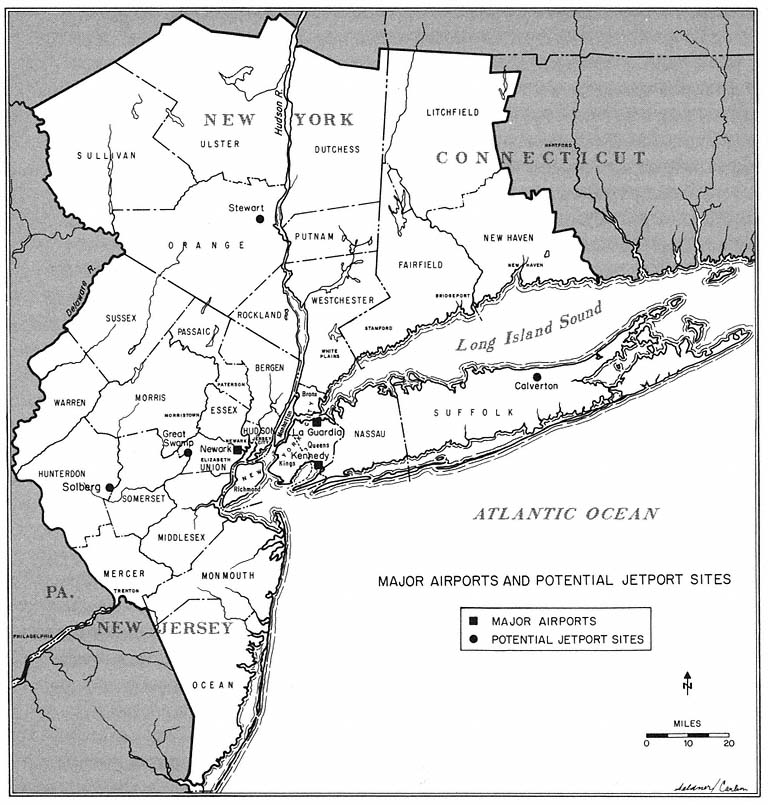
Map 6
both houses of the state legislature passed a bill outlawing the construction of a jetport in any of seven northern New Jersey counties, including Morris. The fact that Governor Meyner vetoed the anti-jetport bill afforded the Port Authority little comfort, as the bistate agency still needed affirmative legislative action to undertake construction in the Great Swamp since the site was outside the port district. Also offsetting Meyner's veto was the success of the Jersey Jetport Site Association in winning promises from both gubernatorial candidates during the 1961 campaign that a jetport would not be built anywhere in northern New Jersey.[28]
By the time the Port Authority had completed yet another comprehensive review in late 1966, the efforts of Congressman Frelinghuysen and his colleagues to protect the area from the intrusion of jetcraft had erected a further barrier. The Great Swamp had been designated a National Wildlife Preserve, and the U.S. Department of the Interior announced its intention of
[28] Meyner was not a candidate for reelection because of a constitutional prohibition against three consecutive terms.
including the Great Swamp in the National Wilderness System, where it would "be forever protected in an unspoiled condition."[29]
Meanwhile, the Great Swamp continued to be well defended in Trenton. Release of the Port Authority's 1966 study, which considered 23 sites before once again concluding that only the Great Swamp met all the criteria for the construction and operation of a jetport, was quickly followed by another legislative resolution opposing the construction of a jetport in Northern New Jersey. And Governor Richard J. Hughes reiterated his "irrevocable" campaign commitments of 1961 and 1965 against the construction of a jetport in the Great Swamp.