
The Hill Lineage and Its Compound
The internal structure and dynamics of the Hill lineage of the Lelahmaharaja clan are representative of the village as a whole, despite the group's marked prestige and power within Bogang. The following discussion will thus serve to elucidate the social entailments and other concomitants of compound residence and lineage membership. In one sense we are moving here from the least public facts and expressions of kinship—as revealed, for example, in eating and sleeping arrangements—to those of a more broadly social nature. For although the affairs of a lineage compound are, in theory, the somewhat exclusive concern of lineage personnel and in-marrying males of senior standing, they often end up being a matter of public record and villagewide interest. The lineage compound, moreover, serves both as the setting for collective exchanges and activities and as an important buffer between the wholly public realms of community life and the relatively private spheres of the domestic domain; its real capacity to mediate between these different interests, however, is ultimately limited by internal cleavages and contested claims to property, productive resources, and personal affection.
In comparison to other lineages and more encompassing descent units, the Hill lineage is extremely aggregated. Excluding those who have left the village altogether, all women and children of the lineage reside in a single compound. The Hill compound is in a centrally located area of Bogang's
"old hamlet," one which is conceptualized in relation to the lineage, and to the adult women of its nine households in particular. Just as this compound constitutes the more or less continuously occupied ancestral homeland of the lineage, so too is it fairly unlikely that any of its inhabitants will relocate to other areas of the village in the immediate future. Indeed, if they were to leave their current homes, these wealthy and upwardly mobile individuals would more likely settle in the state capital, Seremban, or in Kuala Lumpur than elsewhere in the village or in other rural environs.
One striking feature of the Hill lineage is the highly developed sense of group membership and exclusivity, not only among the women and their spouses but also among nonresident children (a good many of whom work and live in cities and return to Bogang only on free weekends and national holidays). The clustering of all lineage households in a single compound obviously contributes to this phenomenon, as does the compound's proximity to the homesteads of certain other groups. On one side is the sister lineage, Valley, with whom Hill has long been embroiled in a bitter feud (see chapter 9); on another, the "upriver" segment of the Biduanda Dagang clan, which tends to be regarded by Hill and gentry clans in general as a sociologically distant and low-status social entity with whom marriage should definitely be avoided. Although at least some Hill women acknowledge a degree of siblingship with one neighboring line of Biduanda Dagang (emanating from a Meccan-born apical ancestress discussed below), the Hill group is essentially surrounded by outsiders, many of whom are either longstanding enemies or the staunch allies of adversaries.
The Hill lineage's sense of group membership and exclusivity is largely a product of political and economic factors. Some of these factors hark back to ancient times and point to various mechanisms whereby prestige and wealth are reproduced over the generations. Elsewhere in this chapter, for example, we will encounter instances of adoption by a nineteenth-century Undang. This man of renown was of the Hill lineage, and in generating clientlike relationships through adoption he increased the lineage's prestige and political clout as well as his own standing as a patron. More generally, the mere fact that he rose to the supreme office of Undang not only renders him the most famous and successful of all human village ancestors, but also translated into considerable prestige and political opportunity for his children. It is far from coincidental that at the turn of the century a
good deal of village land was registered in his son's name, whereas virtually all other local acreage on the books was listed under women's names; that a generation or two later one of his descendants in the Hill lineage attained executive office at the state level; or that today the latter man's sister's son holds a powerful post in the federal government. This individual's brother, I might add, stands as the highest-ranked adat leader in Bogang.
The Hill lineage clearly has an impressive pedigree, and it has been very successful in realizing the capital benefits accruing from its genealogy, vertical ties, and enviable history of political connections. This is not to say, however, that the lineage necessarily acts in unison, with or without the aid of in-marrying males, to achieve economic or other objectives, or that all lineage households derive equal advantage by virtue of their association with the lineage. It is simply to bring into focus a set of political and economic factors that have contributed both to the lineage's prestigious and powerful position in contemporary Bogang and to its understandably well-developed sense of group membership and exclusivity. Regarding the latter point specifically, the notion of "us" versus "them" is more pronounced among members and spouses of the Hill lineage than among any other descent units or household clusters. This is not so much a behavioral or sociological distinction as a conceptual and emotional one; it is nonetheless an important factor in defining, generating, and solidifying political and economic relationships and interests.
The Hill lineage stands as the sole heir to the unique fortunes and legacies of Bogang's most illustrious (though notoriously unpopular) ancestor; yet we need not turn to history, or even to issues of pedigree or economic concentration, to find evidence of its unique placement in the village. Rather, concrete reinforcement of the lineage's separateness and genealogical homogeneity exists, in the form of low, rough-hewn, and partly overgrown fences—of barbed wire, bamboo, large branches, and lengths of old timber—that encircle the compound, setting it off from the fields, abandoned lots, and houseplots of neighbors. One also encounters fences of the same simple construction around certain houseplots belonging to members of the lineage. But these exist elsewhere in the village as well, and should not deflect our attention from the highly unusual occurrence of an entire lineage or lineage branch set off by a makeshift network of fences and occasional gates.
Malays seem to dislike the notion that "good fences make good neigh-
bors." What, then, do the fences mean, and why were they built in the first place? The second of these questions is—at least superficially—the more easily answered. The stock response is that fences keep village domesticates, particularly goats, out of residential areas, which are frequently dotted with stands of flowers and fruit trees, all easily damaged by grazing animals. While this explanation is true in part, it is equally apparent to villagers that the marauding goat population can sooner or later make its way into (or out of) any area of the village. Also, since many village gates are left propped open, goats are not really discouraged by the mere existence of fences. Nor for that matter are intruders in the form of adolescent boys who, especially at night, may surreptitiously enter and lurk about a compound either with the intention of making off with personal items left near the houses (sandals or sheets of rubber, for instance) or in hopes of catching a glimpse of an unmarried girl.
Fences, then, do not really serve the purpose for which villagers claim they are built. They do, however, demarcate domains of relative autonomy and social control—and this, more than anything else, explains why they are constructed and maintained, as well as what they mean to those who live within or outside of them. In short, members of the Hill compound are ultimately concerned with setting themselves apart from and above others. The century-long concentration of wealth, political clout, and prestige within the lineage has given its members and spouses more to lose, not only through theft, malicious mischief, and gossip, but also as a result of shifts in personal allegiances and the distribution of power. Similarly, since the lineage has more to gain by maintaining and, if possible, upgrading its unique position in the village, it must take greater care to demarcate its social and spatial boundaries so as to avoid identification with unrelated neighbors, sister lineages, or the village majority. Although these tensions between kin group and community are evident elsewhere in Bogang, they are especially strong in the case of the Hill group—as the fences indicate.[3]
Thus far the discussion of the Hill lineage and its compound has proceeded in terms of social topography and lineage identity, and on a relatively abstract level. I have focused on its unique history and contemporary standing rather than its basic similarities with units of similar shape and structure. In continuing the discussion of the Hill lineage, I turn to data and issues having broader applicability insofar as they find generally comparable expression elsewhere in the old hamlet. These pertain to how the
lineage is conceptualized (hence, to the vertical scope and overall distribution of a particular segment of genealogical knowledge), where authority resides within the lineage, and what types of relationships obtain among the group's socially active core, adult women of the grandparental generation.
The Hill lineage embraces individuals of four generations and collaterals as distantly related as fourth cousins (see figure 5). All told, the lineage claims 107 living members, most of whom work and live outside Bogang. Of those members currently inhabiting the village, only one, a married man in his fifties, does not reside within the lineage compound. (This individual is the clan subchief, who lives in a separate area of the village among his wife's kin.) The eldest person of the lineage resides in the middle of the compound and is a wizened but still energetic and forceful woman of approximately seventy-five; the youngest is a four-year-old boy. The age structure of the compound's enatic and overall population is markedly skewed (as is that of the village as a whole) owing to out-migration on the part of adolescents and young adults of both sexes. Thus, well over half of the Hill compound's adult enates are fifty-five and over. This skewing is even more pronounced for the compound as a whole, since most of the adult women live with husbands at least a few years their senior.
The most remotely recalled figures and connective links in the genealogy are the sisters Selbiah and Maimunah (see figure 5). Interestingly, when the grandchildren of the one sister describe how they are related to the grandchildren of the other, they point to this tie of sisterhood (although they frequently also specify that their own mothers were first cousins). They do not speak of common descent from the mother of Selbiah and Maimunah, whose name no one seems to know; nor do they refer to her antecedents, who are equally anonymous but further submerged in the amorphous category of "ancestors" (nenek-moyang ).
Precise knowledge of the relationship between Selbiah and Maimunah is not evenly distributed throughout the lineage. Moreover, there is little likelihood (or concern) that such knowledge will be passed on, particularly since "technical" information of the sort necessary for the construction of a lineage genealogy is typically of much greater interest to the anthropologist than to anyone in the village. Consequently, the younger descendants of Maimunah cannot specify their exact connection with their generational counterparts in Selbiah's line, or vice versa. Similarly, since no one in this
[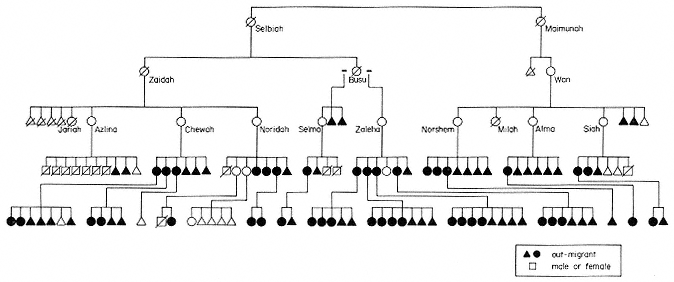
Figure 5.
Genealogy of the Hill Lineage of the Lelahmaharaja Clan, Showing Effects of Out-Migration
generation knows the names of Selbiah and Maimunah, they too will eventually fade into anonymity. When this situation prevails throughout the lineage—and not merely at its lowest generational levels—the members of the Hill lineage will no longer constitute a single lineage branch (pangkal ). Instead, in another twenty or so years we will find two such units. Of greater relevance than this structural distinction—which is recognized but not usually emphasized by villagers—is the underlying fact that the precise relationship of the two lineage lines will not be known. It is not clear how this will affect attitudes and interactions among enates within the compound. Still, it seems reasonable to assume that eventually internal differentiation will be more sharply perceived and that a corresponding decline in the group's sense of unity and common purpose will occur. This is not to suggest that at present no intralineage cleavages or antagonisms exist. As we will see, lineage unity is, to paraphrase the Geertzes' (1975) observations for Bali, something to be achieved and maintained (if sought in the first place), and not a historical or timeless given.
To assess Hill lineage solidarity and the bonds among its consanguines on the whole, we will focus on the relationships of the eleven married (or formerly wed) women who regard the compound as their home, and on the distribution of prestige and authority among them. Eight of these women, ranging in age from forty-five to sixty-three, are of the same (grandparental) generation; further, only one woman is senior to them. Thus, the lineage core, and its most socially active component, is essentially a group of classificatory sisters from three related sibling sets. Wan, the seventy-five-year-old lineage elder, is the widowed mother of three of these women. In relation to others of the core generation, she has the standing of a mother's sister (MMZD) and the additional prestige of being the oldest living member of the lineage. Her status as a haji further reinforces her esteemed position within the lineage and throughout the village community. So, too, do the acquired wealth and largely achieved status of her politically prominent brother, now deceased, and that of her sons, daughters, and sons-in-law. Three of her children, it may be noted, have traveled to Mecca with their spouses, and all three of her sons-in-law enjoy substantial incomes (from pensions or other government monies in conjunction with rubber lands leased out to tenants).
Wan's position within the lineage is, at first glance at least, rather elusive. Like most women of her generation, she maintains a low profile in
the compound and in the more public arenas of village life. She no longer works in the rice fields, for instance, but seems content to spend her time preparing spices, condiments, and sauces for the members of her house-hold and praying either at home or at the nearby village mosque. Aside from going to the mosque and occasional weddings, she rarely ventures outside the homestead area she inherited from her mother. Nevertheless, and although she does not involve herself in the everyday affairs of lineage households, she speaks with authority and exercises considerable influence over the lives of current and former compound residents, and over their interactions with outsiders. Thus, her own children and maternal nieces tend to defer to her wishes and directives, even though they are grandparents in their own right and of enviable social standing and influence in the larger community. The de facto locus of lineage authority, then, evidently need not be coterminous with the lineage core or its most socially active citizens or traditional political representatives. Instead, as in this case, authority may emanate from the eldest woman of the lineage, provided of course that she is not yet senile or otherwise incapacitated by old age. This situation occasionally poses serious problems for those of Wan's children who have extensive and active social networks or are politically well connected. All this will be clear when we consider Wan's role in generating and perpetuating the feud between the Hill group and its sister lineage, Valley, which has involved much of the entire village population.
Wan is the focal point and principal source of authority in the lineage. It is therefore fitting (though by no means inevitable) that her house is in the very center of the compound, allowing for a strategic view of most other residences and thus facilitating knowledge of the daily movements and activities of many of her kin. Moreover, since two of Wan's daughters live on either side of her, while the third and youngest lives with Wan (and will inherit the house), Wan is in constant touch with the most intimate members of her social universe. For this reason, and because she enjoys such easy access to the village mosque, she has refused numerous invitations to resettle in Kuala Lumpur to live with her wealthy son. There, she claims, servants do much of the cooking and other chores and would leave her with nothing to do all day long. The distance from her son's house to the nearest mosque also discourages her from moving, particularly since she sees her days as numbered and feels that old people like herself are best advised to pray conscientiously and to attend the mosque on a regular,
preferably daily, basis. Even if daily mosque attendance in Kuala Lumpur were feasible, Wan would have to depend on the transportation provided by her son or a salaried servant in his household. In Wan's view, such dependence is definitely to be avoided.
Wan's household is distinctive in that neither of its female members actively participates in bilateral food or labor exchanges with other women in the compound. This is wholly acceptable, however, in light of Wan's advanced age and the fact that the adult daughter with whom she lives has long been afflicted with severe emotional disorders (widely attributed to the sorcery of a rejected suitor). Yet Wan's household continues to sponsor ritual feasts (kenduri ) when the occasion demands and has also been actively involved in the informal adoption of children born to other women of the lineage. A brief discussion of these institutions will provide additional insights into the nature of intralineage relations.
Feasting
Whenever Wan sponsors a ritual feast, all women of the lineage assist in the preparations, including the fixing of whatever uncooked food offerings are deemed appropriate by convention or contingency. Her two healthy daughters, as well as any female grandchildren who happen to be home at the time, shoulder the heaviest responsibilities before and during such feasts; all women of the compound, however, share in devoting the better part of a day (or even a few days) to helping out. This participation is less a function of Wan's esteemed position in the lineage than a basic imperative of lineage membership. Hence, whoever else might provide labor before, during, or after a ritual feast, women of the lineage usually show up earlier, work harder, and stay later than anyone else. They never complain, for they know that their efforts will be reciprocated by lineage sisters when the time comes; further, they share in the prestige that the lineage and the compound's population as a whole accrue from such feasts.
The only time that all locally resident members of the lineage and its compound work together and converge in a single locale is during ritual feasts. Although women perform the bulk of the labor involved, unmarried males of the lineage contribute as well. In-marrying men, in contrast, often do little more than pray together beforehand and then share in the feast itself. If the scale of the feast is such that additional dining or cooking
structures are required, however, in-marrying men will gather the bamboo and other construction materials and erect temporary platforms and rain shelters adjacent to the sponsor's house.
Expressed differently, the institution of feasting provides villagers, especially women, a clear sense of who their most immediate and generally responsive kin are. Given the ritual and religious significance of the kenduri complex, and the fact that feasts are the most lively and enjoyable occasions for persons of all ages, it can also be said that the bonds among compound residents, and adult females in particular, are both sanctified and celebrated on these occasions. More generally, kenduri serve the crucial purpose of mobilizing lineage sentiment and galvanizing the group's sense of common purpose, shared destiny, and overall social identity.
Whether these latter concomitants of kenduri were more or less pronounced in decades past is, unfortunately, difficult to gauge. Some villagers claim that invitations to kenduri are more selectively extended now than a few decades ago, and that kenduri have become highly politicized. Although such claims are true, they pertain more to solidifications of cleavages and alliances among lineages (and factions formed around their principal luminaries) than to dissensions within lineages. This fact, too, will become quite apparent when we examine the feud between the Hill and Valley lineages.
By any measure, however, the shape of twentieth-century history has overly burdened the feasting complex; for even though the complex persists, most other traditions conducing toward the same ends have suffered irrevocable devitalization. The institution of feasting is therefore expected to accomplish far more than is in fact possible—especially given the proliferation of criteria for allocating prestige, the larger issue being increased cultural heterogeneity and socioeconomic stratification.
Integrally related to this latter issue, and of more immediate concern, is the relatively pronounced economic independence that women belonging to the same lineage enjoy. No Hill lineage women, for example, cooperated with one another during the 1978–1979 cultivation season. Those who did plant rice or lease out their fields chose to work for or engage as sharecroppers women from other lineages or clans. Similarly, all households in the compound derive their livelihood not from lands classed as ancestral but rather from recently acquired acreage (mostly in rubber) held on full title either individually or by a married couple. Hence, while women
of the lineage do share mutual rights over homestead plots and sawah, these rights no longer entail intralineage bonds of agricultural cooperation or exchange. These dimensions of traditional relatedness used to involve not only an objective economic interdependence among the women of a lineage but also a conscious and ritually celebrated sense thereof. This has virtually vanished, however, and given way instead to atomistic and largely autonomous household units whose outside material support comes, if at all, not from immediate collaterals who are also close neighbors but from nonresident children. Little remains of the prior nexus except comparatively unproductive land rights, which, although a trove of great pride and symbolic significance, can be a source of bitter contention. This is particularly true when economic needs and incentives no longer counterbalance divisive intralineage antagonisms and status rivalries involving sisters, cousins, in-marrying males, and compound households on the whole. In sum, the balance of counterposed forces lying at the heart of lineage dynamics during the 1800s and before has become increasingly tenuous over the past century and at present is highly susceptible to invidious intralineage distinctions and other centripetal forces. We will return to this theme in due course.
We have seen that the Hill group is bound together by a single genealogical and territorial point of origin, allegiance and deference to Wan, relatively dense shared property rights within the lineage, and labor exchanges related to feasting. It remains to examine the other factors that unite these women and set them off from members of other lineages, such as the prevalence of informal adoptions within the lineage.
Adoption
The institution of (informal) adoption[4] serves to redistribute rights over children and enables married couples and formerly wed women to mitigate the social and emotional consequences of sterility, infertility, and infant mortality. It also allows the women of economically hard-pressed households to find "better homes" for some of their children. Of primary concern here, though, is not why adoption exists in the first place, but rather the types of genealogical bonds between natural and adoptive mothers.[5]
Figure 6 depicts the distribution and direction of adoptions in which
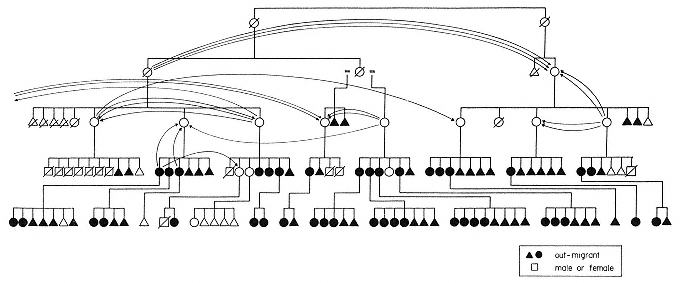
Figure 6.
Genealogy of the Hill Lineage of the Lelahmaharaja Clan, Showing Adoptions Involving Locally Resident Women as Natural or
Adoptive Mothers
Note: Each arrow indicates the transfer of a child from its natural mother to the adoptive mother. Arrows point to adoptive
mothers.
adult women of the Hill lineage have stood as natural or adoptive mothers. Virtually all the transactions occurred between women of the lineage, the majority between women currently associated with one of its two major lines (or future branches). To the extent that sisters and first cousins transfer rights over children with one another more often than do women related more distantly, the institution of adoption also generates a conceptual cleavage within the lineage that is otherwise largely unmarked and generally devoid of explicit sociological correlates. Of perhaps greater structural significance, this line of cleavage will be the most directly affected when all genealogical information pertaining to the uppermost level of the enatic pedigree—that is, the sibling link between Selbiah and Maimunah—is lost. The distinction currently marked primarily by adoption will then assume a qualitatively different hue, for it will simultaneously coincide with and define the existence and boundaries of two separate lineage branches. The clustering of adoptions within analytically isolable segments of a largely undifferentiated lineage thus foreshadows the emergence therefrom of two (or more) less encompassing and structurally discrete units of descent.
Adoptions, then, tend to involve natural and adoptive mothers affiliated with the same lineage, and are typically aggregated within separate descent lines that have the current or impending status of lineage branches. These patterns testify to the pronounced preference—in the transfer of rights over children, but also in most other realms—for dealing with one's closest kin. Thus, and not surprisingly, natural and adoptive mothers are most often related as (natural) sisters. This social fact concretizes another level of distinction within the lineage, just as it engenders differentiation within the lineage branch itself by bounding, isolating, and solidifying sibling sets composed of sisters. Viewed in terms of either genealogical unit, and with respect to clans as well, the tendency for less inclusive groupings to emerge from larger ones that simultaneously constrain various dimensions of their separate identities and activities receives its penultimate expression at this level. The ultimate manifestation of such tendencies appears, of course, in the sibling set itself, most notably in the tensions and dynamics among adult siblings of the same sex.
The extreme modalities of affect and social interaction are most evident precisely in the area of same-sex sibling relations. Of greatest significance here is not that adult women linked as, for example, sisters depend on and
support one another for the satisfaction of innumerable needs—which, in many contexts, could easily be pursued through other social avenues. Rather, this situation of interdependence often exists alongside antipathy, bordering at times on thinly veiled loathing, which is nonetheless almost always submerged—and in any case is effectively denied through feasting exchanges and other public behavior—whenever the moral obligations of female siblingship require it. The sentimental configuration among sisters is thus perhaps best summed up by the notion of hostile dependence. Of course, sisterhood should not be characterized in principally negative terms; even so, the generalized ambivalence that attaches to most interpersonal bonds happens to be exceptionally high in the case of women's attitudes toward their sisters. Hence, whereas the distribution of adoptions within a lineage points to the relative intensity and durability of the different social prerogatives and duties of female kin, it concurrently highlights what could be judged the most problematic and potentially divisive of all kin relations. The more general, theoretical point is that even while sibling ties among same-sex individuals often serve as conduits for the expression of lineage unity and solidarity, they may simultaneously undercut all such unity and positive affect (cf. Kelly 1977).
The ambivalences and tensions among women linked as sisters, and among same-sex adult siblings in general, exist in large part because of the structural equivalence infusing all such parallel-sex relationships. This equivalence has been discussed elsewhere and will be taken up below from a different perspective. Here I need only emphasize that relatedness of this nature gives rise to heavily weighted moral expectations among all parallel-sex siblings, which can be onerous at times as well as exceedingly difficult to fulfill.
I might also point out that sibling tensions of the sort discussed here are far less pronounced among individuals who have never wed, simply because their relationships tend to be mediated indirectly by their parents, especially their mother. These single people, moreover, usually either remain within their natal homes or leave the village altogether. Hence, because they do not establish separate living quarters within the lineage compound or elsewhere in the community, their interests tend to be focused on and defined in terms of a single household. Subsequent to marriage, in contrast, a partial but nonetheless marked divergence of interests occurs among siblings owing to their new conjugal and domestic responsibilities.
The extent to which these may be wholly incompatible with enatic ties is considered in chapter 7. Suffice it to say that marriage and the creation of new household units often aggravate preexisting strains among siblings of the same sex, or in any event create a context conducive to their expression. This despite the fact that lineage continuity and social reproduction on the whole obviously hinge on the bearing of children, which, in this society at least, presupposes legitimate marriage. More generally, the institution of adoption must be viewed against all such dynamics, for, even if only at the conceptual level, adoption helps bridge the structural distance among sisters that is an inevitable consequence of their social reproduction and genealogical aging (cf. Kelly 1977).
Male Lineage Members
The scant attention devoted thus far to the men of the Hill lineage reflects the minimal role they play in most lineage affairs, owing partly to out-migration and the preeminence of female enates in all but a few domains of compound and household activity. As may be recalled from the Hill genealogy, none of the five men of the grandparental generation lives in the lineage compound. In fact, only one of them, who holds the title of clan subchief (buapak ), actually resides in the village. A comparable situation prevails among the married men of junior generational standing, none of whom have settled in Bogang either. Aside from the clan subchief, then, the eldest male of the lineage who lives in Bogang is roughly eighteen years old.
This situation affords little opportunity to discuss sibling antagonisms among adult men of the lineage. It warrants remark, however, that demands for political loyalty underwrite virtually all categories of brotherhood but are frequently honored in the breach (see chapter 7). In this latter connection we should bear in mind that the logic of succession to traditional as well as modern political office makes only partial provision for the structural equivalence of brothers. In the realm of clan titles, for example, rules of succession specify the particular localized clan or lineage that may furnish a candidate for office but usually do not indicate which fully enfranchised adult members merit preferential treatment as potential officeholders. Much of this holds as well for modern political titles, one critical difference being the far greater prestige that attaches to persons
holding positions on certain community councils and, of course, to the village headman. All of this makes for profound resentment on the part of men whose brothers attain roles of leadership while they themselves muddle along as "mere villagers." Here again, then, we see the extreme modalities of same-sex siblingship, which on the one hand engender lineage unity and solidarity but on the other lead to a divisiveness that impedes the realization of common lineage interests.
One further point concerning political offices tied to lineage membership is that the exercise of legitimate sanctions and duties is often necessarily constrained by factors of residence and domestic sentiment. This situation can pose serious dilemmas for politically empowered males who find themselves obliged to conform to the wishes of their mothers or wives, even when this amounts to dereliction of official duties vis-à-vis other lineage members or the clan or village as a whole. Chapter 9 provides ample illustration of these dynamics; I need therefore only cite Wan's position of centrality within the lineage and her profound influence over her adult sons, one of whom is clan subchief. In the course of Bogang's highly charged "adat crisis," this son chose not to censure certain transgressions of his brother, Wan's other son, and in consequence has been boycotted by the other two lineages of the clan. It is difficult to ascertain precisely to what degree the clan subchief's public posture on this matter stemmed from filial loyalties and obligations, as opposed to those associated with immediate brotherhood. Even so, it is clear that narrow kinship loyalties of this sort not only compromise the nature of political representation and leadership more generally, but simultaneously undermine the broad spirit of kinship, and of siblingship in particular, that underlies clanship and village citizenship.
These dynamics all attest to considerable historical continuity. So, too, does the fact that adult males of the lineage still act as guardians over their unmarried sisters and close female cousins, despite that fact that many of these women do not reside in the lineage compound, or even in Bogang. Such guardianship is especially evident in the realm of sexuality, for brothers and enatic cousins continue to be charged with, and to take seriously, the responsibility of safeguarding the virginity and moral standing of unmarried women—upon which rests the honor and prestige of the whole lineage. This situation goes a long way toward explaining the sense of out-
rage and betrayal that young men display when close female enates engage in sexual impropriety. As far as male guardians are concerned, such action amounts to a form of treason, for it constitutes a grave violation of siblingship trust and other sacrosanct norms. Cross-sex siblingship will be further discussed in the following chapter. I need only add here that complementarity rather than equivalence continues to characterize this variant of siblingship, and that this complementarity usually precludes the buildup of antagonisms encountered among adult siblings of the same sex.
The preceding discussion should convey a sense of the structure and dynamics not only of the Hill lineage but also of the other lineages and compounds in Bogang. It is important to recall that Hill constitutes one of three lineages of the Lelahmaharaja clan, which in turn is but one of three major clans represented in Bogang's old hamlet. We will now look at other settlement patterns and household clusters in the old hamlet, both in general and in relation to their new hamlet counterparts.