
Plant Species Composition and Life form Spectra of Tidal Streambanks and Adjacent Riparian Woodlands Along the Lower Sacramento River[1]
John W. Willoughby and William Davilla[2]
Abstract.—Flora and life forms of the tidal streambank plant community along the Sacramento River near Collinsville, Solano County, California are compared to those of adjacent plant communities. The tidal streambank flora has a significantly smaller non-native component than the floras of adjacent riparian woodland and annual grassland communities. All three communities have developed in historically disturbed habitats. Rhizomatous herbs represent the predominant life form of the tidal streambank community. In contrast, the riparian woodland community has a much lower percentage of rhizomatous herbs and higher percentages of annual and woody species. Reasons for these differences are discussed.
Introduction
Plants growing in the intertidal zones of river systems are subjected to rather rigorous growing conditions. Regular, periodic inundation by fresh to brackish waters makes establishment and subsequent growth of vascular plants difficult. Relatively few plant taxa are capable of coping with such conditions. Some plant taxa, however, are totally restricted to intertidal areas of major river systems and are often rare (Ferren and Schuyler 1980).
In some river tidal areas, water salinity (and resultant soil salinity) may be a limiting factor to plant establishment and survival. This is especially true of riverine systems near oceans and bays where substantial volumes of salt water mix with the fresh water of the rivers.
This study examines the life form strategies of the vascular plants in the intertidal zone along the lower Sacramento River (herein referred to as the "tidal streambank" community). This community is compared to the adjacent riparian woodland community. Floristic composition and richness of these two communities and the adjacent annual grassland community are compared.
Study Area
The study area is located on the northern banks of the lower Sacramento River east of Collinsville, Solano County, California. The river at this point becomes part of the Sacramento/San Joaquin estuary. Study plots were located at the mouth of Marshall Cut, extending a distance of 1.0 km. east and 0.3 km. west of the cut along the bank of the Sacramento River. Riverbanks in this area were artificially created by levee construction designed to reclaim natural tidal marshland between 1900 and 1940 (Atwater etal . 1979). Tidal streambank and riparian woodland vegetation has developed on the levees during the short period since their construction. Inland of the levees, artificial landfill has resulted in displacement of former natural tidal marshlands. These recent fill areas now support a disturbed cover of annual grassland composed almost entirely of introduced plant species. An artificially flooded marsh behind the levee east of Marshall Cut is presently managed as a duck club. The flora and elevational zonation of vascular plants in this marsh/grassland mosaic have been considered elsewhere (BioSystems Analysis, Inc. 1979).
Methods
Tidal streambank, riparian woodland, and annual grassland plant communities were subjectively delineated using primarily physiognomic criteria. The riparian woodland community was identified by the presence of tree and shrub strata. In the few cases where these strata were poorly developed or lacking, this community was identified by the presence of herbaceous species
[1] Paper presented at the California Riparian Systems Conference. [University of California, Davis, September 17–19, 1981].
[2] John W. Willoughby is Botanist/Range Conservationist, USDI Bureau of Land Management, Sacramento, Calif. William Davilla is Senior Botanist, BioSystems Analysis, Inc., San Francisco, Calif.
commonly associated with the riparian woodland community.
The criteria used to identify the tidal streambank community were: 1) its position between the river and the riparian woodland community; 2) the absence (with two exceptions) of woody species; and 3) the presence of species which flower in late summer to early fall. Upper limits of the tidal streambank community correspond roughly to the upper level of the levee banks inundated by maximum high tides.
The annual grassland community was recognized by its inland location, the absence of woody species, and the predominance of annual grass and forb species which flower in the spring.
A complete species list was compiled for each of these three plant communities. The life forms of each species were determined using available literature (e.g., Munz 1959; Mason 1957; Robbins etal . 1951) and field observations. Five life forms were recognized: annual, perennial herb (including biennials), rhizomatous perennial herb (including herbs spreading by stolons and creeping root systems), shrub, and tree. In a few cases a species may function as either an annual or a perennial. These facultative species were scored under both the annual and perennial herb categories. Suffrutescent (only obscurely or very modestly woody) plants were scored as perennial herbs. Woody plants which exhibit both a tree and shrub habit (e.g., Salix spp.) were scored as either shrubs or trees based on the principal life form exhibited in the study area.
Results and Discussion
The major environmental variables controlling the distribution of vascular plants in tidal marshes of the northern San Francisco Bay estuary are elevation and water salinity (Atwater and Hedel 1976). Elevation of marsh surfaces relative to tide levels determines the soil moisture content and frequency, duration, and depth of submergence, whereas the salinity of the water flooding a marsh determines the soil salinity (ibid .). Water salinity is an important influence in the regional distribution of tidal marsh plants; high soil salinity causes many plants to disappear toward San Francisco Bay, resulting in tidal marsh communities composed of only 13 or 14 native plant species (Atwater etal . 1979). Where water salinities are rather low, as in the Sacramento/San Joaquin Delta, tidal marsh communities are more diverse, containing some 40 plant species, most of which are relatively salt-intolerant—largely the same species that occur in freshwater marshes in California (ibid .).
Water salinities in the vicinity of the study area vary both seasonally and annually in response to the amount of freshwater flow from the river systems. Figure 1 shows the variation in mean monthly water salinities at Collinsville. Judging from the salinity data for Collinsville, water salinity is probably not a major limiting factor for plants in the intertidal zone there. Except in unusual circumstances (such as the drought of 1976–77) the water in this area varies from essentially fresh to only slightly brackish. Because of the regular flushing action of the tides and the rapid runoff from riverbanks at low tides, soil-salt concentrations resulting from evaporation would not be expected to be significantly higher than the water salinity of the river. That soil salinities are not high in the intertidal zone of this area can be inferred from the absence of salt-tolerant plants such as Distichlisspicata and Frankenia grandifolia from the upper reaches of the intertidal zone.
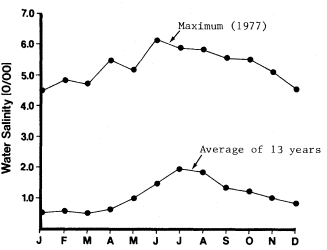
Figure 1.
Mean monthly water salinities (in parts per thousand) of the
Sacramento River at Collinsville, California. The bottom line
averages monthly means over the period 1967–80. The top
line represents monthly means for 1977, the year with the
highest salinities on record (from USDI Bureau of
Reclamation, Tracy Field Division).
The major ecological factor influencing the distribution of plants in the intertidal zone of the study area is considered to be elevation with respect to tide levels. Tidal heights (in decimeters) at the confluence of the Sacramento and San Joaquin Rivers (near the study area) are as follows (based on data in Simpson etal . 1968; definitions from Atwater etal . 1979):
10.1—mean higher high water (average height of the higher of the daily high tides);
–3.4—mean lower low water (average height of the lower of the daily low tides);
18.3—estimated maximum high water;
–7.6—estimated minimum low water.
Plants tolerant of relatively long periods of submergence (e.g., Scirpusacutus , S .
californicus , and Typha spp.) occupy lower sites along the river (below mean higher high water), whereas species less tolerant of long submergence (e.g., Carex barbarae , Hydrocotyleverticillata var. triradiata , and Lythrumcalifornicum ) occur at higher elevations in the intertidal zone (at or above mean higher high water).
A complete list of the vascular plants of the three plant communities considered in this study (tidal streambank, riparian woodland, and annual grassland) is found in Appendix A.
A tabulation of the flora of the three communities is given in table 1. The riparian woodland community contains the largest number of species (78) followed by the tidal streambank (49) and annual grassland (38) communities. The annual grassland community is included here primarily to illustrate the highly disturbed nature of the site. The low total number of species present (38) and the very high percentage of introduced species (82%) attests to its disturbed condition.
| ||||||||||||||||||||||||||||
The riparian woodland community also supports a large non-native component (29 species). Over 30% of species are introduced plants, the majority of which also occur in the adjacent annual grassland community.
The tidal streambank community supports the smallest number of introduced species (8), only 16% of the total species. This figure compares favorably with the proportion of introduced species in the California flora as a whole, but is low compared to most California cismontane areas (table 2). Only the floras of Mount Diablo and Mount Hamilton Range have similar non-native components. The published floras of these two areas, however, are almost 40 years old; the percentages of introduced taxa present in both areas are almost certainly higher today.
| ||||||||||||||||||
The percentage of introduced species present in the tidal streambank community is especially low given the disturbed nature of the site. As previously indicated, this community has developed since the construction of levees between 1900 and 1940. The riparian woodland and annual grassland communities have also developed during this same time period. Their floras, however, exhibit a significantly higher percentage of introduced plant species. Annuals comprise a large percentage of the introduced species in the annual grassland (59%) and riparian woodland (42%) communities. An additional 32% of the introduced species of the annual grassland and 35% of those in the riparian woodland are perennial, non-rhizomatous herbs. Both of these life forms, especially the annuals, appear to be at a competitive disadvantage in the tidal streambank environment. Fifty-eight percent of the tidal streambank flora consists of rhizomatous herbs (fig. 2). Of the 29 species of rhizomatous herbs present in the tidal streambank community, only three (10%) are introduced.
It thus appears that the primary reason for the low number of introduced species in the tidal streambank community (relative to the other two communities) is the restricted capability of introduced plants (most of which are annuals or non-rhizomatous perennials) to establish under conditions of periodic or prolonged inundation. This fact is further emphasized by the relative paucity of introduced species in areas within the intertidal zone which have been more recently disturbed by riprapping. Although cover and density in riprapped areas are far lower than on undisturbed levees, the species which are found in these areas are predominantly native.
The life form spectra of the tidal streambank and riparian woodland plant communities (fig. 2) highlight several differences between these two communities. Almost 25% of the species present in riparian woodland are woody species, as opposed to 4% (2 species) of the total species found in the tidal streambank community. Twentyfive percent of the riparian woodland species are annuals—62% are introduced—while 14% (6 species) of the intertidal flora are annuals—43%
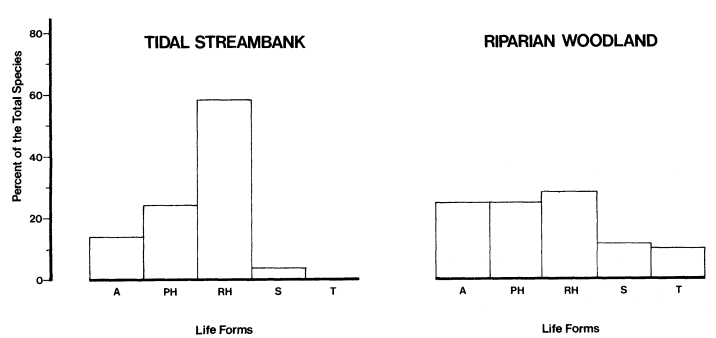
Figure 2.
Life form spectra of the tidal streambank and riparian woodland plant communities. Height of the bars corresonds to the percentage
of the total species in the community represented by each of the five life forms. A—annual; PH—perennial herb (including biennials);
RH—rhizomatous perennial herb (including herbs spreading by stolons and creeping root systems); S— shrub; and T—tree.
are introduced. The percentage contribution of perennial, non-rhizomatous herbs to the floras of both communities is almost identical, 24% for the tidal streambank community and 25% for the riparian woodland (the absolute species numbers are 10 and 21, respectively). Perhaps the most significant difference between these two communities is the much greater proportion of rhizomatous herbs in the flora of the tidal streambank plant community (58% of the total species compared with 28% for riparian woodland community).
Certain life forms enjoy an apparent competitive advantage in the tidal streambank community. Perennials account for 86% of the total flora, suggesting that one major limiting factor is the difficulty of seedling establishment under the ebb and flow of tidal waters. This would put annuals at a distinct disadvantage. The annual strategy may also be a handicap in another way: in an azonal community where water is not limiting, dry season dormancy is not only unnecessary but is probably detrimental. Rhizomatous species are more successful than non-rhizomatous species, a fact which may be at least partially explained by the greater ability of the former to apomictically spread once established. Even the two woody species present in the intertidal zone, Salix lasiolepis and the introduced Rubusdiscolor , are capable of extensive vegetative reproduction. Thus 63% of the tidal streambank flora is capable of vegetative reproduction.
In terms of floristic composition and life form spectra, the tidal streambank community in this rather disturbed area is remarkably similar to that of other, less disturbed areas in the Sacramento/San Joaquin estuary (compare the species list for Browns Island in Knight 1980). However, the plant cover and density of the tidal streambank community of the study area are certainly lower relative to less disturbed examples of this community elsewhere, although this fact is yet to be quantitatively documented.
Many of the species of the tidal streambank community (e.g., Typhalatifolia , Scirpusacutus ) have very wide distributions and occur in several types of moist to wet habitats. However, a few of the tidal streambank species in the study area exhibit restricted distributions and occupy only the intertidal habitat. Asterchilensis var. lentus and Lilaeopsis masonii are both recognized as rare and endangered by the California Native Plant Society (Smith etal . 1980). Both of these taxa and a third, Grindeliapaludosa , formerly considered rare and endangered, are entirely restricted to intertidal areas in the Sacramento/San Joaquin estuary. Although these plants are not particularly rare in the habitats in which they occur, their continued existence may be threatened by human alterations of their narrow habitats. The practice of riprapping streambanks results in a significant loss of habitat; potential increases in water salinity of the estuary as a result of
proposed future freshwater diversions may have deleterious effects on these plants.
Summary
The flora of the tidal streambank plant community along the lower Sacramento River near Collinsville is markedly different from the floras of adjacent riparian woodland and annual grassland communities. Non-native plant components of the latter two communities are significantly larger than that of the tidal streambank community, although all three communities have developed within the last 40 to 80 years. The proportion of introduced plants in the tidal streambank community is low even in areas more recently disturbed by riprapping. Introduced species, most of which are annuals or non-rhizomatous perennials, appear to be at a competitive disadvantage in the tidal streambank zone.
The life form spectra of tidal streambank and riparian woodland communities illustrate several significant differences between these two communities. Rhizomatous herbs are the most important life form of the tidal streambank community, apparently because of their facility to spread under conditions unfavorable to seedling establishment. Annuals are at a competitive disadvantage probably for the same reason, and also due to the handicap resulting from dry season dormancy in an azonal habitat where water is not limiting. In contrast, the riparian woodland community has a much lower proportion of rhizomatous herbs and higher percentages of annual and woody species.
In terms of floristic composition and life form spectra, the tidal streambank community that has developed in this disturbed area is similar to that of other, less disturbed areas. Three rare plant species occur in the intertidal zone of the study area, and are restricted in distribution to the intertidal zone of the Sacramento/San Joaquin estuary. Although not currently rare where they occur, they appear to be very narrowly adapted to this habitat. Additional human alterations of their habitat may threaten their continued existence.
Literature Cited
Atwater, B.F., S.G. Conard, J.N. Dowden, C.W. Hedel, R.L. MacDonald, and W. Savage. 1979. History, landforms, and vegetation of the estuary's marshes. p. 347–385. In : T.J. Conomos (ed.). San Francisco Bay: the urbanized estuary. Pacific Division, American Assoc. Adv. Sci., San Francisco, California.
Atwater, B.F., and C.W. Hedel. 1976. Distribution of seed plants with respect to tide levels and water salinity in the natural tidal marshes of the northern San Francisco Bay estuary, California. USDI Geological Survey Open File Report 76–389.
BioSystems Analysis, Inc. 1979. Potential for mitigation of salt marsh losses and associated adverse impacts on salt marsh harvest mice at the proposed Montezuma powerplant site. Unpublished report prepared for Pacific Gas and Electric Co. 51 p.
Bowerman, M.L. 1944. The flowering plants and ferns of Mount Diablo, California. 290 p. Gillick Press, Berkeley, California.
Ferren, W.R., Jr., and A.E. Schuyler. 1980. Intertidal vascular plants of river systems near Philadelphia. Proc. Acad. Nat. Sciences of Philadelphia 132:86–120.
Howell, J.T. 1970. Marin flora. Second edition with supplement. 366 p. University of California Press, Berkeley.
Howell, J.T. 1972. A statistical estimate of Munz' Supplement to a California Flora. Wasmann Journal of Biology 30:93–96.
Knight, W. 1980. The story of Browns Island. Four Seasons 6(1):3–10.
Mall, R.E. 1969. Soil-water salt relationships of waterfowl food plants in the Suisun Marsh of California. California Department of Fish and Game, Wildlife Bulletin No. 1. 59 p.
Mason, H.L. 1957. A flora of the marshes of California. 878 p. University of California Press, Berkeley.
Mueller-Dombois, D., and H. Ellenberg. 1974. Aims and methods of vegetation ecology. 547 p. Wiley and Sons, New York, New York.
Munz, P.A., and D.D. Keck. 1959. A California flora. 1681 p. University of California Press, Berkeley.
Robbins, W.W., M.K. Bellue, and W.S. Bell 1951. Weeds of California (1970 reprint). 547 p. Documents and Publications, State of California, Sacramento.
Sharsmith, H.K. 1945. Flora of the Mount Hamilton Range of California. Amer. Midl. Nat. 34:289–367.
Simpson Stratta and Associates, and K.H. Baruth. 1968. Suisun Soil Conservation District Master Plan Study II. Suisun Soil Conservation District, Dixon, California.
Smith, G.L., and A.M. Noldenke. 1960. A statistical report on A California Flora. Leaflets of Western Botany 9:117–123.
Smith, J.P. Jr., R.J. Cole, and J.O. Sawyer, Jr. 1980. Inventory of rare and endangered vascular plants of California (in collaboration with W.R. Powell). Special Publ. No. 1 (second edition). 115 p. California Native Plant Society, Berkeley.
Thomas, J.H. 1961. Flora of the Santa Cruz Mountains of California. 434 p. Stanford University Press, Stanford, California.
| ||||||||||||||||||||||||||||||||||||||||||||||||||||||||||||||||||||||||||||||||||||||||||||||||||||||||||||||||||||||||||||||||||||||||||||||||||||||||||||||||||||||||||||||||||||||||||||||||||||||||||||||||||||||||||||||||||||||||||||||||||||||||||||
| ||||||||||||||||||||||||||||||||||||||||||||||||||||||||||||||||||||||||||||||||||||||||||||||||||||||||||||||||||||||||||||||||||||||||||||||||||||||||||||||||||||||||||||||||||||||||||||||||||||||||||||||||||||||||||||||||||||||||||||||||||||||||||||||||||||||||||||||
| ||||||||||||||||||||||||||||||||||||||||||||||||||||||||||||||||||||||||||||||||||||||||||||||||||||||||||||||||||||||||||||||||||||||||||||||||||||||||||||||||||||||||||||||||||||||||||||||||||||||||||||||||||||||||||||||||||||||||||||||||||||||||||||||||||||||||
| ||||||||||||||||||||||||||||||||||||||||||||||||||||||||||||||||||||||||||||||||||||||||||||||||||||||||||||||||||||||||||||||||||||||||||||||||||||||||||||||||||||||||||||||||||||||||||||||||||||||||||||||||||||||||||||||||||||||||||||||||||||||||||||||||||||||||||||||||||||||||||