
Part One
In which we learn of the difficulties of liking anything about a new place, from possible living quarters to its naturally enigmatic nature. In which we also learn how shyness and a respect for others’ privacy have to be overcome to do fieldwork but that when you do get close to people you cannot help but recognize their inviolability. In which finally we hear of problematic guides and methods, of fruitless searches, and of the vast challenge of interpreting anything at all.
1. Physical and Cultural Shocks
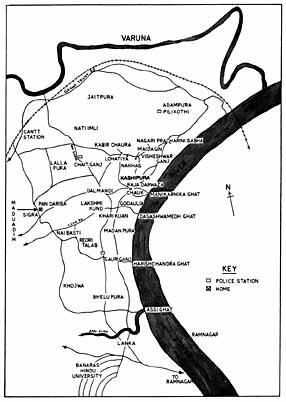
A map of the places I discovered in Banaras. (Compiled with the help of Mr. N. Ravi of the American Institute of Indian Studies in Varanasi.)
Our introduction to Banaras was not a happy one. The drive we undertook from Lucknow—some 180 miles of technically metalled road—was deadening. Because it was monsoon season, I had voted for going by car, thinking that the long drive in the rains would be beautiful. But we had a spell of dry weather at exactly that time, and dust poured into our speeding car. The road, already broken up by the rains (which happens with annual regularity and arouses speculations about dishonest contractors), was full of potholes. What with the bumps and the dust, life did not seem worth living over the eight or so hours that constituted the journey.
Our baby, Irfana, then two-and-a-half months old, was the most cheerful passenger for a long time. Then she got upset as well and would not nurse. We stopped, and I walked her up and down, cooing and singing by the Lucknow-Banaras road for much of an hour. We then gritted our teeth and covered the last lap of the journey. The Banaras we entered seemed part of the general misery we had experienced the whole day. There was not a lonely temple spire or sign of a mighty river to be seen, only more dusty roads and the typical low-lying vista of an unambitious North Indian city.
We stopped at the guest house of the Varanasi Development Authority, a well-equipped, empty, and apparently little-used place. I collapsed with a fever. Sombabu got busy, as he especially does in crises, bathing the baby, washing dozens of diapers, festooning them on our mosquito net poles. The room was air-conditioned, and all slept peacefully except feverish me. I remember the dignified look of my daughter as she lay on her side, wrapped in a white sheet, her fists curled into balls, not budging an inch all night. And such a nice rest did she have, so much had she needed it, that upon awakening the next morning she spent the first hour lying on her back, exercising her limbs up in the air, chirruping and singing with the birds outside. It was the happiest and most vocal that she had been since birth. And so in the months to come: whatever misgivings we harbored about Banaras, she was always sure that she loved it. This was significant for young, first-time parents: a sure test for the acceptability of surroundings is whether the baby responds favorably to them.
As for me, I remember burning with a fever, then swallowing some pills that miraculously cooled me down, so that when the doctor came he didn’t have much to check. He prescribed bananas, yogurt, dry biscuits, and a pale lemon compound called Electral (to become a household word for us, as it was for every other family in the city). A little later marched in a procession: the driver, the guest house watchman, the police sub-inspector who had shown us the place, and an unknown recruit, each carrying one of the prescribed foods. The driver, as befit the head of a procession, looked the most solemn, swinging on a knotted string a clay cup containing a half-pound of yogurt covered with a leaf. I looked at the cup, leaf, and string with aesthetic appreciation, and noted, “This is how they do it in Banaras!”
Our initial trip to Banaras was for the single purpose of finding a place to live. Friends in Chicago who were in different degrees alumnae of Banaras research had given us three names in a city of approximately one million. One of the three contacts was a drugstore owner who directed us to a bank manager who, it was rumored, was having a house built. Our urgency then, and always, was awkward to people in Banaras. They would, one and all, respond to a request with, “Ho jayega” (“It shall be done”). We would counter with an impolitic “When?” or, worse, “How about now?” The bank manager had many visitors, many cups of tea, and many flies in his office. I sat with my permanent little bundle of baby on the only seat available, and Sombabu stood next to me. We looked and felt uncomfortable, out of place, and desperate. The bank manager abandoned his crowded office to show us his house. It struck us as highly desirable judging by its design and its convenient location in the central ward of Bhelupura, on the grounds of the old Vijaynagram estate, which was being partitioned and sold off for commercial development. But the house had many months of work to go, and the owner was not even sure that he didn’t want to live in it himself. Goaded on by our interest, however, he not only promised it to us but assured us that it would be ready by the end of the month. We pretended to believe him; we needed to.
Our initial impression of the city did not change on that visit: dusty, dirty, architecturally unremarkable. One could not readily feel any interest in it, leave aside love for it. Perhaps the only remarkable thing in that trip was that the manager of our guest house turned out to be a Sanskrit scholar whose speech was peppered with syllogisms. He also stands out in my memory because of the prolonged stare he gave us as one of our party (my cousin Manoj from Chicago) asked him for a fresh roll of toilet paper. “Has it all been consumed?” he asked, disturbed. The stress was not on all but on consumed. What disturbed him was the same realization reported by the famed vocalist Subbalakshami, who in the middle of a performance abroad found herself unable to continue singing because the thought suddenly came to her that “all these people in the audience use not water but toilet paper.”
Trivial enough at the time, this exchange was an effective forewarning of two things: one, the cultural importance of water in general and of cleansing in particular; and two, my ambiguous position between two sides, the toilet-paper-using and the water-using sides as it were, which was seen as such. Clear as I had been until then that both sides were valid and that I could empathize with each, I realized then that I did not have the ingenuity to express this position and could only seek to avoid any controversial issue, itself a limitation in inquiry.
When we showed up in Banaras two weeks later, we were no closer to finding a place. More people knew of our search, so we were taken around more regularly to a greater number of progressively unacceptable places. This time we stayed in the guest house of the American Institute of Indian Studies, which had many advantages compared to our first stopping place. Food was cooked on the premises and had a homey flavor. In our previous lodging it had been brought over from the neighboring Ashoka Hotel in covered china bowls, every dish the same and garnished similarly, everything outrageously expensive. But this guest house was in the south of the city, off the main thoroughfare and unconnected to it by a proper road or lane. The monsoon season was much advanced, and instead of dust we had floods. Sombabu took a rickshaw out one day and it promptly overturned in a ditch. I desisted from going out with Irfana for a long time, but when we were loaned a jeep, I began to risk it. I remember the wettest of such trips. It rained continuously and the whole vehicle dripped and leaked. We were looking for a neighborhood called Navapura, but since we did not even reach the ward it was in, we did not find (on that trip) a single person who had ever heard of it. I punched the canvas roof of the jeep to push away the store of water that regularly collected directly over my head. Passionate self-declared lover of the monsoons as I was, I decided, “This is the worst.”
Diapers would not dry in the humidity. We were marooned in the guest house. We had been invaded by monsoon insects and other creatures. All of this made us look harder for a place of our own, but the prospects of finding something remained as distant as ever. We had exhausted our two or three acquaintances (in both senses of the word), the bank manager’s house was of course no closer to completion, and with self-sufficient smugness, Banaras nowhere displayed advertisements or notices for apartments to let.
At this point in the story we have to learn of the mechanisms of the state and local police.
Banaras had eight police stations, or thanas. We were currently staying in the territory of one, Bhelupura, and had earlier been in that of another, Maduadih. Over the inspectors, or station officers (S.O.’s), of these thanas was the Deputy Superintendent of Police, of which there were actually two in the city: Circle Officer (C.O.) I and II. The senior C.O. was more popularly known as the Kotwal, a position that dates from Mughal times or such and one that I instinctively treat with respect (these persons shall figure in our story later). Over them was the Superintendent of Police, and over him the Senior Superintendent, known to all as the Ess Ess Pee (S.S.P.) and equally as the Supri Tandon Sahab, who was the powerful executive and de facto head of the police in the district. He was the man who had arranged for our stay in the first guest house, and Maduadih’s inspector had arranged for the doctor and the unpalatable, expensive food. Over all these officers sat the Deputy Inspector General, the head of the police in the range (there are ten or twelve ranges in Uttar Pradesh). He was the man supplying us with the dripping jeeps.
We had never met nor did we know by name any of these personages. Why were they going out of their way to befriend and assist us? Because we were distinguished scholars from Chicago? No. My father was at that time Inspector General of Police, the head of police in the entire state of Uttar Pradesh. He had one daughter and that was me. We never did figure out to what extent our status as distinguished visitors was due to his explicit directions and to what extent to inherent ideas of service in the different echelons of a government bureaucracy. But judging from the inconsistency and spontaneous nature of the service and from my father’s general ignorance and indifference regarding our activities, I would say the explanation was largely the latter. My father’s mind worked on a grander scale anyway. When I was stuck in Lucknow a year later because of a thirty-hour train delay and was ready to explode with vexation at missing a crucial event in Banaras called Ghazi Mian ka Mela, he calmed me: “Just tell me what you wanted to go and see. I’ll have the event organized for you here.”
We quickly learned of the police hierarchy in Banaras, and responded appreciatively to offers of help. However, all the attentions of all the police officers of Banaras could not alter our basic circumstances: we had no place to live and no idea how to find one; we were isolated by the lack of a telephone in the guest house and physically stranded by the monsoons; and the discomfort of our own damp clothes and lack of clean, dry clothing was only slightly less than the inconvenience of our dozens of permanently wet diapers.
After looking at scores of houses, parts of houses, rooms partitioned and sub-partitioned, we understood a few things about Banaras. One realization was that the taste of the local population—I mean here the middle class—and especially of those who showed us around was appalling. Without batting an eyelid, they would point out impossible bathrooms and kitchens created out of the dirty undersides of staircases, leaving us speechless with agony. The other realization was that my dream of living somewhere on the banks of the river, looking down at its lapping waves and smelling its sweet, rotten smell, had been unrealistic. Somewhere in this dream had been the old narrow galis, the congested lanes, of the city, within which I would do my research all day, even as I shopped for vegetables or turned to go upstairs to our apartment by the riverside. The galis were there, as were houses by the river, together with congestion and age. But living in those parts was a decision I referred to in those days as “fatal.” The ground there was thick with steaming turbans of cow dung, the leaves of plates and shards of clay cups used for fast food, the filthiest and smelliest of domestic refuse, and even, I believe, human excreta. The air was equally thick with flies and those unidentifiable particles occasionally visible in a lone shaft of sunlight, but, deep in the Banaras galis, visible all the time, looking not mysterious and graceful as they can at other times, but positively threatening. To share one’s living space with flies that bred on the refuse littering the streets was a possibility soon rejected, though for months afterwards I continued to feel betrayed by Banaras’s filth.
I had mentally admitted defeat regarding my vague dreams of where to live before we ever found the place we did: the first floor (in Indian parlance) of a solid cement fortress in a nondescript part of the city called Sigra. It was solid because its owner was an engineer in a government concern from which he had diverted all the cement possible; that it was a fortress we discovered as we tried to hammer some nails into the walls for pictures and whatnot. It was painted in one hue and trimmed in a grotesquely contrasting one. With its two dying palm trees, it looked ugly and inhospitable from the outside. Inside it was a daily reminder of the tastelessness of a certain class of Banarasis. Each room had three large wall cupboards with polished wooden doors mounted on the walls, all protruding outward. Two rooms were connected to bathrooms and might have served as bedrooms, except that one also contained the entrance way. What was perhaps the living room had five massive cupboards and could be reached only by going past the kitchen and the other bedroom. The sole explanation for the floor plan was that the owner had intended to rent each room out separately, an explanation confirmed when he showed surprise that we wanted the entire five rooms.
Our main worry was how, particularly with its collection of cupboards taking up all the wall space, to make the place livable for the next eighteen months. The crowning touch was that the central corridor was doorless; if we wished to secure the house, we would have to lock up each room separately. On a practical daily basis, this meant that certain creatures like monkeys had access to every room. We eventually got used to coming upon them, about once a week, cleaning up the food on the dining table, ransacking the fruit basket, sneaking into the kitchen, even playing with toys, as well as destroying whatever was left on the front porch and the back roof, of course. What was unforgivable was that they regularly depleted our water supply by taking elaborate drinks from the tap on the roof and then royally leaving it open. We tried securing the tap by every means short of ball and chain, but their godlike agility (the Bengali part of my family actually called them, to my consternation, Hanumans, or monkey-gods) outmatched our merely human striving. I never even forgave them for their more general sin: to make it impossible for us to have a civilized cup of tea in our own outdoors, to grow plants there, or arrange a sitting space; in short, together with the landlord, to conspire to prevent us from living the way we preferred.
We were perhaps choosy regarding our domestic conditions. We did not care for wet bathrooms or for visitors—of whom we had an unusual assortment—strolling through our bedrooms; we liked to maintain a constant temperature as far as possible through the extremes of the seasons and to keep bugs out. In retrospect, our stay seems to have been a constant fight to achieve all this. At the time, every effort seemed absolutely indispensable, particularly with an infant. When our truckload of possessions arrived and we set up our curtains, stove, refrigerator, desks, and bookshelves, we began a virtual odyssey of experimentation with the rooms. One room was too hot for a study in summer, another too noisy for a bedroom in the monsoons; a third got the wrong winds (which carried the fumes of a neighboring carpet-dyeing yard) in the morning, and so on. The cupboards turned out to be an unexpected boon: they came to be used as dust shields for books, stereo, musical instruments, and toys.
We looked, perhaps unconsciously, for like-minded people to share our feelings of discomfort and injury. But no local visitor, from the poorest of weavers to the S.S.P. himself (he happened to be from eastern U.P.), ever voiced anything but deep appreciation for this crazily designed ugly fortress of a house. It was a matter, then, of both class and culture. I may have thought that charpoys were more Indian than sofa sets or that open windows were essential for some kind of oneness with nature (an idea our landlord also tried to conjure up when we requested a back door for the central corridor). But the issue, I realized once in Banaras, was not an authentic versus an imitative life-style at all, but mosquito screens, hygienic toilets, and proper places for things (our preference) versus disease, discomfort, and lack of control over space and time (the eastern U.P. version). My mind was effectively cleared of all mists regarding Indianness and non-Indianness, and I had no desire to compromise my instincts regarding how to live nor any qualms in characterizing them as being as Indian as any rival instincts.
I also began reflecting on the anthropologist’s “urge to merge” with the native. Many academic friends patronized lodges and guest houses of dubious comfort, studding deep galis never free of garbage. Why did they have such a double standard? Daily they looked upon, and lived surrounded by, refuse they would never tolerate as individuals. Did it not give them a skewed vision of India? One did not have to re-create the Mughal Gardens, but certainly, given the royal stipends of U.S. researchers (mine was being liberally taxed by the Indian government), they could choose a more comfortable life-style than most did. They could afford good Indian cottons for the summer, a refrigerator, a cooler, a servant or two, proper furniture, and space. I saw very few scholars in Banaras who were giving India a fair chance by accepting the adaptations to climate and urban living that were available.
I remember my anger at visiting an American friend in the heat of July. He was clad in his synthetic U.S. clothes, sitting on a string cot and eating warm watermelon; the approach to his guest house stank with the garbage of the whole neighborhood, and he was without a properly cooled room, chilled drinks, suitable utensils, or anything he would undoubtedly consider necessary back home. Well, I thought, they were necessary in India too—if you could afford them. I felt resentful that he was returning to the United States with the notion that filth, discomfort, heat, and sweat were inevitable in India when these things were at worst problematical, and I suppose I resented also that in the process of harboring and then projecting this prejudiced image of India he was also saving so much money.
I perceive my distance from Gandhi, close as I have always felt to his philosophy of service and indigenization. You do not have to live poorly in order to understand or to work for the poor, with a vengeance that implicitly claims that the poor prefer to live that way. From our search for a house, and thanks to our baby, who necessitated direct confrontation with these issues, I realized that I could not choose to live in dirt and discomfort at the expense of productive work and mental peace.
2. The City as Object
Even while all this was being worried over and accomplished, we turned our attention to discovering Banaras. I had started going to the archives within a day of our arrival, a modest and certain project. What was needed now was a feel of the city as a preliminary to fieldwork. We had never seen the river, for example, or any of the ghats, those famous built-up river embankments, indispensable for bathing and rituals. On a cloudy, pleasant monsoon day, we mounted a rickshaw and announced, “Dasashwamedh ghat.” That ritual of swinging over the high step of the rickshaw and proclaiming the destination of the day became for me the pistol shot that started off each day’s work, and it was important to do it in a proper collected mood, as well as to have something fresh and different planned each day.
The rickshaw unloaded us at an unremarkable v-shaped juncture of two roads with parallel rows of shops. These were the two roads that led to Dasashwamedh ghat. One was lined mostly with shops of cloth, clothes, vegetables, and other products recognized as necessities by the people of Banaras, like perfumes, mats, and baskets; the other with pan shops and beggars.
These beggars were different from the ones I was familiar with. They did not crowd you or plead, make you squirm by almost touching you, or sing, or demonstrate sores and amputated limbs. They simply sat in a line all down the steps on one side like normal people going about their jobs. They had their bowls in front of them, which they and donors alike regarded as sufficient declaration of purpose. Some, in fact, were busy cooking, washing, folding clothes, or praying. There are more beggars in Banaras than in any other city its size, and there can be no two ways of thinking about them. It is their lot to beg as it is yours to give. A chance event has placed them there; but for the grace of God, there would be you. There is absolutely no question of brushing them off as undeserving—the common middle-class attitude toward beggars. They do not ingratiate themselves. You can ignore them, as you can ignore an architectural or a natural feature in the landscape, but you do not necessarily feel in the right. They are in the right in being there. It has been sanctioned in the scriptures and confirmed by centuries of social practice.
We were unprepared, however, and dismayed, not merely by the beggars, but even more so by the squalid stalls, by the unlovable cows and bulls ruminating or excreting on the road, and by the whole unexciting, depressed scene and its inhabitants. We walked on to the river, and there it was before us, wide and gray and quite still. And there were the umbrellas on the ghats, a favorite illustration for tourist brochures. Boats lapped at the bank or lazily floated past. All activity was subdued. This was about 11 a.m., the time (I was later to discover) when the riverside takes a break from its early morning and evening peak hours.
As we stood on the top step, clutching our baby in her Snugli, surveying the still water and the umbrellas, I was conscious of not going about this the correct way. Our senses were not alert, our expectations were not readied, our mood was not right. We came perhaps to be wooed, to be surprised and impressed, to be confirmed in our judgment of Banaras as a potentially fascinating place. Instead, here was a scene that didn’t reach out and serve up a feast but waited indifferently to be attended to, if we liked, to be understood and interpreted. At the least, we could have come at a time of characteristic activity, perhaps with a local person who would either communicate or casually let slip his own feelings about the place.
We stood and walked around for some time. We didn’t go down to the water, not only because we could see everything from the top but also because we felt as if we had seen it all. The most interesting thing for us that day was a hawker with a basket of lentils balanced on a bamboo hourglass stand. They were little colorful hills of parrot-green, mustard, brown, and pepper-red dals, and he himself smiled and sang. This active little marionette stood out against the dull, still background as both incongruous and gratifying. We did not note any of the other big or small features that mark Dasashwamedh and other ghats—the Sitala temple, for example, or the Ganga temple, or even people washing clothes—that I was to rhapsodize about later. We were disappointed and bored, and I could sense why. It was a lesson—not very clear, but quite powerful—in the fallacy of tourism. If you want to know a place, start digging to understand it from the first day. Don’t look around as an outsider with the vague notion of “familiarizing” yourself with the surroundings and being charmed by their intrinsic qualities.
We beat a hasty retreat to the covered verandah of the stores, a light drizzle having started. We waited out the drizzle by looking carefully for a sari for our new ayah, or maidservant: not cheap or coarse, but quiet, modest, clean-looking (preferably white), and of course not too expensive. Having made our purchase, we were a little fortified and decided to continue our explorations. We took a rickshaw to Chauk.
The Chauk, or Square, as in every old North Indian city, is the central, crowded, indigenous bazaar area. To me, with the two decades that I have spent in distant Cantonments and Civil Lines, it stands for everything fascinating and glamorous in the Indian city. The Chauk is in fact interesting for everyone, from those seeking bargains and exotic products to those curious about social structure, history, and culture. The Banaras Chauk is on a hill, and to reach its nucleus the rickshawalla had to pull the two of us with our various bundles up a slope of approximately five hundred yards (see fig. 2). Being dragged up the hill by a sweating, undernourished man of unguessable age caught us unprepared and left us with a sense of betrayal and acute discomfort. As with living in filth, it was as if we were suddenly being made to participate in activities not to our taste.
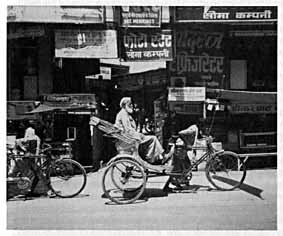
The uphill of Chauk
I should add that those who live in Cantonments never take rickshaws, and New Delhi does not have them at all. We looked around eagerly, but the tourist’s disappointment again awaited us. The shops and signs and people crowded into our vision from all directions but meant absolutely nothing. By the time we reached the top of the hill, the center of Chauk, a drizzle had started again.
That day stands out particularly because we had embarked on two major discoveries: Dasashwamedh ghat, the fabled millennia-old seat of the Ten Horse Sacrifice, and Chauk, nerve center of the city. But most of our early experiences were like that. We had only the vaguest notion of what to expect of places such as, say, Banaras Hindu University. We would pack up baby and baby things and ride away on a rickshaw, falling over ourselves on the way to stare at passing sights. The baby seemed much more in tune with her surroundings, perched high on one of our laps, legs swinging, chortling contentedly. Her world, unlike ours, was limited to warm sun and fresh air and the security of her perch. Ours, or I should say mine, was afloat in boundless space as I strove to construct a map: “What kind of place is this? How shall I understand it?” When we reached our destination, there would be a blank, incomprehensible wall. We would go around, poking at this or that, trying to keep up our enthusiasm. But the truth was that we did not enjoy those early days of discovery. Each trip was a disappointment. There was nothing to make of whatever we saw, partly because of the very nature of the objects of our attention and partly—to be again unfair to tourists—because of our packaged tour approach. But to be fairer, it was more especially because of my lack of preparation as an ethnographer. I had not trained my senses; I had not prepared my questions. That was the missing vital link, a notion of the appropriate questions. I had never read a thick ethnographic account of any Indian city. Having chosen Banaras for its hoary, palimpsest-like venerability, I was discovering that its age did give it an inscrutability which confounded my naive expectation that it would prove alluring and irresistible at first sight. I did not have sufficient information about the place. I could not have had: there was nowhere to get it. I was there to piece it together.
When I compare those early days with later ones, it seems incredible that one can look at so much yet see so little, or want to enjoy and appreciate so intensely yet not be able to do so. Had we by some chance been obliged to leave after one or two months, we would have had practically nothing to report of Banaras, except the aridity of our residential area, the difficulties of survival, the lack of company, and the enigmatic and unattractive nature of ghats and streets.
I carried on my archival work steadily through all this. My first target was the Nagari Pracharini Sabha, the Society for the Spread of Nagari. Nagari in this context was a euphemism for Hindi, not in its literal meaning of the Sanskrit-derived script, but as a cultural-political tool. Located in the northeast, across the city from us, the society’s archives were a clattering, bone-shaking half-hour rickshaw ride away. Luckily for me, the route took me through the heart of the city every day, though the virtues of this route were more evident in the beginning than when my senses became dulled by hundreds of trips. Just as there is an uphill and downhill to the Banaras Chauk, there is an uphill and downhill to fieldwork. Climbing up painfully—pulled up manually by informants, analogous to the Chauk rickshawallas, you might even say—you reach a height of clarity and perception. At a particular point, inevitably, the decline begins, and as you go downhill things become fuzzy again, escaping you, you are worn out, and your experiences are all anticlimactic.
One of the calculations I always had to make as we approached Chauk was, do I leave my rickshaw, walk uphill, and then take another one for the ride down? For I had to negotiate the center of Chauk, from a major crossing called Godaulia at one end to another called Maidagin at the other, and then go a few yards further east. Or, I debated, do I retain my rickshaw but alight and walk alongside it for the steepest part of the climb? I tried each variation several times but never resolved the dilemma. Walking alongside my rickshaw marked me as a fool and a foreigner long after I stopped being these things. Trying to bargain for a new rickshaw in the middle of Chauk, where the rickshawallas were at their most supercilious, was always a doubtful proposition. I would inevitably waste precious minutes, and a trip broken up into two was always more expensive. The days that I refused to make up my mind and sat, dummy-like, on my pathetic little carriage as my man slave inched me up the steep hill were more uncomfortable still. Every moment of the journey was spent in cursing the system, the geography of the place, the quality of the creaking rickshaw, and my own stupid indecision.
Such mental pressures prevented me from thinking positively or imaginatively about the uphill half of Chauk, which was in any case the market for products, such as electrical goods, cloth, timepieces, and eyewear, for which I had no use. I rather despised the large, clean shops and their well-displayed products. The downhill part of Chauk was more subdued and interesting, with a major post office from where you could even make international telephone calls. It ended in the crossing of Maidagin, for which, again, I could not care at all, with its taxi stand, one of the two biggest in the city, displaying rows of, in Banaras, white cars. Who took them and where I couldn’t imagine, seeing that there was barely space to go on foot or by rickshaw in most parts of Banaras. There was also a “tempo” stand—those three-wheeled auto rickshaws that were designed for two and carried, as a rule, six or seven people. I quickly found out who took those. The first time I volunteered to accompany a new informant, Abdul Jabbar and his family on their Thursday trip to the shrine they patronized, we reached the main road and began bargaining with the drivers of different modes of transport. A tempo, at ten rupees, was chosen. Six of us crowded into the vehicle, excluding Abdul Jabbar, who shared the driver’s seat in front. We would have needed at least three rickshaws at five rupees each; I thought, “This is how rickshawallas will be inched out.” At the Maduadih shrine, I had a minor argument with the family when I tried to pay the ten rupees myself. It seemed condescending on my part, but I couldn’t imagine how they could afford so much out of their meager earnings. In fact I was surprised that they argued with me. In their situation, I would have immediately let someone vastly better off than me pay the fare. It was just one of those swift and frequent lessons in their different attitudes toward honor, debt, and equality.
There were two other routes by which I typically arrived at this crossing of Maidagin, and they both deserve to be described here. One went through Pan Dariba, the wholesale market for chewing tobacco, betel nuts, and leaves, and all the related condiments that go into the making of the Banarasi pan. It was a narrow lane fronted by tall attached buildings; on the ground floor was an open store each few square yards. Hills of tobacco, coated with silver, color, or perfume, and baskets of symmetrically arranged pans, accessible only from the central artery, were all displayed to passers-by and were always open to my scrutiny. This extreme openness made for the result that, occasional resolves notwithstanding, I never started a conversation with any of the merchants and never numbered one among my informants. There was not a corner or crevice to take refuge in; to start a conversation there would have meant holding up the traffic and collecting a crowd.
The other route sometimes taken by my rickshawallas was through the locality called Lallapura. The very first time we swung into it, I asked the driver, “Who lives here?” He turned back to gaze at me in skeptical amusement, “Who lives here?!” I explained, “I mean, Hindus, Muslims, artisans, merchants…?” And the rest of the trip was a nice discourse on the social composition of Lallapura, though I have always felt guilty about making rickshawallas talk while pumping. Lallapura had certain features that always struck me as medieval even though I know there is nothing “medieval,” “modern,” or “ancient” about Banaras. There was a large mansion, for example, in which I believe lived elephants, for a sign hanging outside read, “Elephants can be hired here for marriages, processions, etc.” And, true enough, I had seen elephants go to and from that place, clutching large leafy branches in their trunks, grabbing, as it were, a quick snack around the corner. There was no unity to the Lallapura area; sprawling, crisscrossed by lanes, evidently very poor, I could not quite grasp it. I always passed an open workshop where drums of various shapes and of different shades of leather were made and stored. That was medieval.
I was still looking at all this, it might seem, from the vantage point of the tourist. Although I describe my first impressions casually now, even indifferently, I was very serious about everything, and curious to the point of absurdity, though often amused, in spite of my seriousness, not at them but at the confrontation of me and them. I was straining to understand, and I could sense at least how, with every passing day, I had to try less and less hard. One glimpse of something opened up a world of meanings. One comment from a passer-by explained many things. To look into, behind, and under shades and doorways became my second nature. To act swiftly, with question, direction, notebook, or camera became a habit the adeptness of which surprised me.
Both these routes met at Kabir Chaura, a crossing named after the saint Kabir and famous for many reasons. There is something very meaningful about crossings for Banarasis, and they keep referring to their main ones. In a book on Banaras, the old-time resident Vishwanath Mukherjee takes his readers on a trip around the city. All his points of reference are crossings, places where one territory ends and another begins and where cross-movement is possible, a partial reflection of the stable and culturally differentiated constitution of neighborhoods in old cities. Indian crossings are intersections of four roads (chauraha, four paths), hence the hubs of commerce and communication where life at its most intense can be observed. The busiest teashop or pan shop, for example, will be at the crossing, and, with its crowds, serve in turn to make the crossing more packed, impossible, and wonderful.
Kabir Chaura was distinguished by the main public hospital of the city, called by the same name, and by drugstores and fruit vendors for the patients and their families. It was also a “dangerous” crossing, a thought that came to me each time as an involuntary touché to my anthropologist friends with their harping on symbolic and ritual dangers. Here the threat was from the traffic flowing rapidly in all directions, including jeeps, trucks, and bullock carts. The rickshawalla would stick out his arm to signal the direction of his turn and plunge in without further confirmation. Somehow we would always survive, perhaps because everything was proceeding slowly despite the illusion created by the swinging of the rickshaw. I never saw an accident there, although I always clutched my vehicle with all four limbs and noted how I was approximately one inch away from being crushed from the left, the right, and behind.
If Lallapura seemed medieval, then with the next lap of the journey, Lohatiya, we were in the third millennium b.c. of Mohenjo-Daro itself. The road here was of round, polished cobblestones, making rickshaws jerk their passengers roof high. All the stores, again open to the road, sold iron goods, Lohatiya meaning, literally, “place for iron.” The shops looked dark, heavy, and, with all the fat traders and skinny ironmongers, in them, very male. Some of the woks displayed in front were six feet in diameter, the pails four feet high. I tried interviewing here the very first or second day, before I had acquired the necessary techniques or confidence, and was too discouraged by the responses to go back again. I had pressed on bravely with a spate of questions addressed to an ironsmith hammering a metal plate, and our conversation had gone like this:
I: “How [bang] many [bang] hours [bang]…[inaudible]?”
He: “Yahi (Just this)…[bang, bang, bang]”
Some prejudices and mental blocks persist; most, fortunately, are washed away with time. I never made a study of the iron goods industry or of the ironmongers of Lohatiya after my premature and totally unsuccessful initial incursions. But the Lohatiya crossing came to show itself as endlessly fascinating. At the Muslim mourning period of Moharram, the procession called Duldul passed through in its most choking and pushing phase and gave me an intuition about the attractions of crowded places. At Vishwakarma Puja and Durga Puja, and again at Ramlila, there were many stages and canopies for the gods and it was easy to catch the organizers.
To the immediate south of Lohatiya was Nakhas, where carpenters had their workshops. Nakhas led to Kashipura, the locality of the brass workers and coppersmiths. All the neighborhoods bordered on one another, connected by hidden lanes traversable on foot. Every time I was in Lohatiya, the surroundings were less and less opaque. The city was a blank map gradually becoming filled in with lanes, byways, and turnings, dotted with names of localities, individuals, and homes. Because of the proximity of Lohatiya to the archives, it became one of my first exploratory fieldwork sites. On a given day, I would walk hundreds of yards in the galis, with stops to visit a dozen people gradually assuming the status of good friends: a carpenter, a coppersmith, a tea seller, a widow with a pan shop, a policeman yawning on a bench, and so on.
And whatever doubts I may have entertained about informal conversation as a method of fieldwork, upon engaging in it and seeing the incomparable richness of my results I became a total convert. No conceivable questionnaire could have revealed to me the casual details, the ironies, the supremely confident or the hesitant tone embedded in people’s conversations. The pride with which a place was pointed out or an event mentioned, or, on other occasions, the utter indifference, if not downright denigration, of tone and mannerism—these were all prized bits of information to me, and the only way I could have got them was the way I did, by loitering around, adapting to the informant’s pace and inimitable style.
The archives of the Nagari Pracharini Sabha in Visheshwarganj were a few hundred yards further east of Lohatiya, beyond a steady row of teashops. Teashops, around which much of my day revolved, came to figure as pivotal elements in my work. I gave them a fair amount of thought. A tree with a hefty trunk would be taken as the starting point for the construction of a teashop. From one side of this trunk a large stove (say, with four burners) of brick, stone, clay, and cow dung would be built. From the sturdier branches of the tree would be suspended wire baskets of eggs, buns, butter, and cakes. The shady leaves would provide shelter for the customers. A few benches here and there would complete the tea stall. This was its infancy, however. I have seen many teashops at this stage, pleasant and popular enough, but the ones in Maidagin were more elaborate. Walls were hung up on three sides: bamboo frames; discarded matting, jute, and gunny bags; tin canisters hammered out into sheets; even newspapers. These walls were serviceable and were patched regularly. The roof had to have strong beams, but, like the walls, anything might cover the surface. Often tin sheets, still showing off the name of the original canistered or canned products, were used. Inside this cozy room, toasted by the sun in all seasons but always airy and shady, were fitted an amazing number of benches and tables. The teashop became a regular restaurant, and you became oblivious to the composition of the roof and the walls and to the tree that had begun it all. Crockery would clink, little boys darted around to serve and mop, omelets and french toast were created, water was served as you sat down, newspapers were provided, and tips were discouraged.
There was one teashop right next to the gate of the Nagari Pracharini Sabha. It had grown, in fact, not from a tree but from one of the pillars of the gate. Because of its location, it had a rather intense intellectual atmosphere, though all teashops tend to be oriented to discussions of philosophy and politics. I was, typically, the only woman present. Everyone ignored me in a masterly manner, but everyone was aware of me. I began to take a certain amount of protectiveness for granted from this teashop. If a serving boy splashed a little water near me, he was reprimanded. The shopkeeper would inquire, “Biscuits? Sweet? Salty? Bread?” as I placed my order for tea. When I arose to leave, knees would be pulled in and backs straightened on the benches I had to pass. If my way was held up by a person not paying attention, there would be coughs and perhaps a warning announcement. As I brushed past someone with his back to me, the shopkeeper twirled around and barked at him, “Ladies!” No one ever, ever, in my one-and-a-half years of patronage, tried to talk to me. Nor did I speak to anyone. After considering it at length, I decided that in this one case the atmosphere and inner harmony of the place had to be preserved from my active interference.
3. The Library and Its Surroundings
Nagari Pracharini Sabha itself was unrecognizable as a library and invisible as a building. Red, symmetrical, gracious, it stood independently in its compound. Recently the decision had been made to use the land in front for commercial purposes. This meant the construction of a row of two-story shops that sold textiles, dry goods, tea leaves, and medicines. All that was knowable of the Sabha from the road was a gate, half-concealed by the teashop, and a front of modern stores whose owners, if asked, would most likely deny that any library existed in the vicinity. If you did go behind the stores, you came to the large red building, impossible to evaluate immediately because it loomed over you and could not be viewed in perspective as planned. The remaining open land on both sides had been ruined, too, as an aftereffect of the construction: piles of bricks, pipes, and broken-up stone lay around. On each brick was inscribed the word “AGHOR,” a fact that puzzled me until it was revealed that the kiln from which the bricks came was owned by a devotee of the holy men of the sect of that name, a sect I was to pay a great deal of attention to in my research. These small revelations were like gifts of the gods: after seeing those bricks I needed no more evidence that it was a live cult.
Inside the Nagari Pracharini Sabha was a dark hall, fifty yards long, at the center of which stood a massive wooden table for readers. At its head sat five or six officials of the Sabha, some scribbling or turning over pages, most looking out restfully. The whole place was still, uncrowded, unencumbered. On three sides of the hall were verandahs studded with doors to the outside, many of which were open to let in sunlight and air. After you got used to the place, it was pleasant. The hall was too dark for me, but the verandahs were ideal— cool in summer, sunny in winter, perfect for watching the rains in the monsoons. I would pull a broken chair and table to my desired spot, balance my folio of newspapers—twice the size of the table—on one side, and place my notebook on my knee.
I note the use of “broken” here: most public objects in India strike one as broken or in disarray. Only two exceptions shine out as models of orderliness and a state of perfect maintenance, both of which I grew up with (which might explain my alacrity in noticing the broken): official buildings and possessions at a certain level, such as those owned by the police and military, though not those of civil, representative, or other public organizations; and certain religious institutions, such as maths (monasteries), temples, akharas (gymnasiums), and Christian missionary schools. Everywhere else the notion seems to be attuned to total recycling: everything is allowed to crumble uninterrupted back into dust, from which it is built up anew.
Where all the Sabha books and papers were stashed was a mystery in the beginning. At the head of the hall, behind the seated officers, was a stone staircase. No one ever used it, or could, since it had books all over it, this being where loose material was deposited until it was gradually catalogued and shelved. Though never used, the stairs implied that there was another floor. Though the hall itself had a ceiling the height of the building, the verandahs had a second story where the stacks were located. Occasionally, a reader asked for a book, and there would be creaks overhead after an interval. The old newspapers and magazines I was interested in were piled high on dusty shelves along the walls of the very verandah I chose to sit in. I mean literally “piled.” To see what was in the middle of a pile, a team got to work. One man on a stepladder would pass down the volumes, each of considerable weight, to another man on the ground, who then called out the date on the volume, and thus their search progressed as I stood by and fidgeted. I had nothing against the men who ran the place, or even against their system of working, except that it was very bad for the materials. The dust and accompanying spiders and insects obviously damaged the paper. Most of the volumes had too much weight atop them; I gathered they were too oversized to be shelved upright. But because their spines were not marked, the moving around that was required when a scholar needed a particular volume pulled and pounded at the bindings. There is absolutely no doubt that the materials I used were in a far worse condition after I called them. I couldn’t think of a ready reform. I learned gradually of the powerful people of the Sabha, the member of Parliament and the member of the Legislative Assembly who held court in the office and guest rooms in the complex behind the Sabha. I knew they were unconcerned about the condition of old newspapers and could not be motivated to do anything about them unless they became an issue at the level of state or national politics. I don’t want to be unjust. Surely there were other, more academic, members of the Nagari Pracharini Sabha Committee. But they were never mentioned; nor did they make themselves known by signing anything, or coming around, or showing themselves in any other way. I knew only of the politicians at the top and then the foot soldiers at the table in the hall.
I began my work there smoothly enough: entered one day, signed some forms, made a deposit, and started looking through lists. On the first day I made a preliminary note of about twenty journals that would be of interest to me. I looked through the issues of only two journals in detail in the next fifteen months. Then, alarmed at the fast-approaching end of my stay, I quickly scanned a dozen more. But I left feeling that I had barely glimpsed the real treasures of Nagari Pracharini Sabha, and though I have gone back since I continue to feel that way.
The men who sat at the head of the table were a little like the three or four vultures in Jungle Book (the Walt Disney movie version) who seem to be dozing on a branch with their chins on their chests but shake themselves awake every few minutes to ask, “What do you want to do?” “I dunno, what do you want to do?” They did have work—I could see them filing papers, making lists, dealing with readers—but it was probably sufficient work to occupy one person four hours a day. Two of them were young men in pants and shirts, and they were mobile, being the ones who went upstairs. The others never budged, except to go and relieve themselves in the compound. They wore dhotis, those elaborate lengths of white cotton wound around and between the legs, and all they had to do was gather up the cloth and squat— something I firmly believed only women did till I saw them. Their dhotis made me nervous. One of these men, Chachaji, often sat with one knee folded up on his chair—naturally he got tired of sitting still for so many hours—and I was afraid to look at him, not sure how revealing his posture might be.
No one asked me any questions or took notice of me. Or so I thought. Chachaji had his sources of information, however. About a month after I began work there, he suddenly asked me about a cousin who lived in Banaras. Through that connection he established that my father was well known and that I was a pakka, or authentic, U.P. Kayastha, that is, of one of the (ten?) lineages of the Kayastha, or scribe caste, of Northern India (Bengali Kayasthas did not count, though I never gave up trying to include my husband’s Kayastha lineage in the ongoing fight to establish my normality). So, it turned out, was he. I cannot pretend I had not been curious, and we both breathed more easily after that. I had been itching to place all my recent acquaintances and daily companions according to caste, class, occupation, family, and area of residence—for my own reasons of course. But just as they made little sense to me, so I made no sense to them without this positioning. I am fundamentally a shy, retiring person, not a journalist or a socialite by nature, and if I could escape having to make conversation with strangers I would. In the early days of my fieldwork, that side of my personality dominated the professional anthropological one. I wonder now why I remained so subdued and inefficient instead of starting natural conversations with people, asking them who they were, and telling them, of course, who I was. But at that time the dark hall was a precious retreat from my energy-draining “natural” conversations on the street and my psychologically exhausting curiosity. At Nagari Pracharini Sabha I could be myself, not my self as presented to others; I could think my own thoughts and be almost oblivious to the world as I scribbled away.
What did I scribble? The first weeks, as usual, were difficult to comprehend or to justify. I read through the one page on Banaras in every issue of the fortnightly Bharat Jiwan, beginning in 1884, and wrote down whatever seemed of interest. Having no immediate intention of changing the research topic outlined in my proposal—though I thought I might in the long run, since everyone seemed to—I took down mention of all festivals, music performances, other public events, the city itself, politics if they were interesting, and social affairs, that is to say, everything but the strictly accidental: the local thefts, fires, and carriage accidents, which seemed to dominate the news. I wish I could say that I found things about, or even casual mention of, lower classes and artisans. But they might as well not have existed. The world of Bharat Jiwan was one of middle-class, educated babus, interested in world affairs and political analysis, socially competitive and somewhat amused by one another; their city was humming with activity, including the Parsi theater, wrestling matches, balloon-flying demonstrations, the Calcutta circus, in-house parties and receptions at Holi, Diwali, and a dozen other festive occasions of the year. The Banaras of Bharat Jiwan was much like the New York of the New Yorker. It seemed somewhat irrelevant to me, with my stated interest in the lower classes, but I doggedly kept copying.
Within weeks the picture started changing. I knew what the journalists were talking about, not because their reportage changed but because my notions of the city and its life began to fill in and develop. Everything in Bharat Jiwan, for example, was always given a seasonal reference. “Ah, the month of Sawan!” it would rhapsodize. “Babu so and so and party went on a picnic to Sarnath.” Or, “It’s the season for jhulas (swings); there are dark clouds in the sky, and each temple thronged with visitors.” Now I was discovering that my informants, few as they were, would say the same kinds of things. They would always give seasonal references, talk of similar activities, such as going outside and making excursions to gardens, assume the centrality of temples, and so on. The importance of the discovery was not that nothing had changed between 1884 and 1981 but that the upper-class world reflected in this journal was much the same as the street-level world I was getting to know in my fieldwork.
Consider this: the elitist Bharat Jiwan, like all such periodicals, was packed with advertisements, and among the amusing and distressing items was a recurrent ad for books of songs, seasonal songs, accompanied by pronouncements such as “He who has not read this has done nothing in life” or “For the educated, cultivated, and pleasure-loving.” These were the same songs my artisan informants sang out in pan-red-mouthed abandon. I could not have found more convincing evidence of the oneness of Banaras culture than this unsought coincidence of what was important for both the elite and the masses. It gave me a solid handle for investigating change through the issues of location, patronage, social constitution, ideology, and function of cultural events. Upper-class participation in the past gave me both a record of activities I could not have found otherwise and an interpretive insight (regarding, for example, the crucial nature of seasonality) that would have taken ages of labor to develop from field data alone, and even then without relating it to the past. Such discoveries provided thrills beyond compare. I turned to the Bharat Jiwan with fresh interest, taking care not to leave out anything on Banaras. I had hit on the relationship of history and anthropology that I had always expected I would hit upon at some point but had not been sure when and how. I combed volume after volume for such treasured statements, and when I would finally leave—my limit was three-and-a-half hours—it was because of sheer hunger.
Lunch was always a problem in Nagari Pracharini Sabha. I tried bringing some sandwiches, but they tasted awful. Then I made the whole family experiment with having our main meal in the morning, before the day’s work, and tea and snacks in the afternoon. Unused to this, I would stuff myself in the morning and would feel dull and heavy for the next two hours. And the truth is that no matter what you eat in the morning, you get hungry again in the afternoon. There was little choice but to flee to the teashop again, as I did in mid-morning and mid-afternoon. Sometimes the “egg and toast” concoction produced there was quite delectable. At other times I fortified myself with biscuits and buns. Elsewhere in the city finding something to eat was not such a problem. There were fruits a-plenty, as well as corn, cucumbers, peanuts, and so on, according to season; and there were, as far as I was concerned, excellent sweet shops. But in the street from Maidagin to Nagari Pracharini Sabha there was nothing to eat except at the teashops. Once I found a lone hawker selling third-rate guavas, but he must have realized that he had lost his way, because he never appeared again.
One day, driven by my stomach, I decided to go the other way from Maidagin, that is, eastward, toward totally unknown areas. I had walked but a few yards when I found myself in the midst of what seemed a gradually thickening mela, a fair. It must be a special day, I thought greedily, looking left and right for easily collected information. I didn’t venture more than a hundred yards or so, walking in a straight, safe line from Nagari Pracharini Sabha. People swarmed over the road and pavement; hawkers occupied the middle of the road, and buyers crowded behind them to approach the pavement stores. Everyone, of course, proceeded on their business without noticing me. The one interaction I could think of was to join in the buying, which was the idea that had brought me there originally.
I bought voraciously, until it struck me that I had no way of getting my purchases home. I didn’t carry a shopping bag, and the best the larger shops could offer me was a half-page from an old newspaper. The hawkers had not even that, and gestured toward the end of my sari. I might have guessed where I was by reason of the goods being sold: foodstuffs ranging from commodities I was blind to, such as ghi, oil, and jaggery, to fruits, vegetables, and snacks. What particularly attracted me was the range of batashas, crisp white sugar confectionery. I had eaten such sweets in childhood, but as balls about one inch in diameter. Here were ovals and spheres up to eight inches wide. My cloth shoulder bag, in which I carried precious notes, was soon crammed with guavas, batashas, savory lentils, and other odd delicacies rapidly turning to crumbs and pulp. I hastily took a rickshaw and withdrew. The rickshawalla had to walk till he came out of the glutinous mass of human beings.
A simple measure of my ignorance about Banaras, and about Indian city life in general, was the fact that I had thought this was a mela, a special fair, and had failed to recognize it as the city’s main wholesale center for food: the market of Visheshwarganj. Once the northeastern side of the city had been incorporated into my range of activity, I went through Visheshwarganj frequently. Curiously enough, the crowd was never again so overwhelming, nor did the rickshawallas have to disembark to take me across. The products on sale never again seemed so exotic or desirable. I came to see Visheshwarganj as a dirty, chaotic, difficult place with too much hay strewn around and, as a consequence, too many wandering cows and far too much cow dung. There came a time when it was conquered as well, a time when I would go to a house asking for old residents and argue confidently with the neighbors about who had actually lived there; or late at night would turn briskly into a two-foot-wide lane unmarked by any road sign to go to the house of my friend, Pandit Baikunthanath Upadhyaya, to record his singing group; or would crisscross the maze of lanes that lay between Visheshwarganj and Chauk in the early morning or late night—and, better sign of conquest still, would do this in the company of Hindu informants leading me to temples and Muslim companions showing me to mosques.
During these days of refuge in the Nagari Pracharini Sabha, my earliest days in Banaras, I was gathering courage to begin fieldwork in earnest. My first attempts, to approach an impoverished family of brass workers in Luxa and the arrogant ironsmiths in Lohatiya, had proved total failures. The brass workers had in effect requested that I kindly get off their premises and never return, and the ironsmiths had communicated the same invitation by continuing to hammer at their iron sheets while I questioned them. I have one weak genealogy and one page of disconnected notes for each. But those meetings had indeed been undertaken in a tentative way. As with the first visit to the river, I had simply not been ready. All this bungling in the first month of my stay was, upon reflection, partly deliberate. I was not anxious to proceed with a strict professionalism that obtained immediate results at the expense of insights into the complexities of the world I was setting out to construct.
The method of acting like a child in another culture in order to learn its “grammar” suited my predilections. In those first days I was slightly too naive, overly careful to assume I knew nothing and had to learn all. I was scared to impose by mistake my crippled, obnoxious middle-class/upper-class presuppositions on these robust natives. Only they knew what they were doing, and I thought I should be prepared to discover it the slow, painful way, without even the guarantee of success that a child has unless I could pass the test of childlike naivete.
By Diwali, at the end of October, I had made a major breakthrough on all fronts, as they say of battles, and I had the same image of conquest in mind. I knew metalworkers and woodworkers and had visited with a weaver. I also had promises of friendship from a potter and a painter. When I think in wonder at how it happened, I can credit it to nothing else but sheer perseverance, the passage of time, and an incidentally growing realization that I did not need to deprecate myself to appreciate others.
4. Unknown Gods and Life-Styles
The story begins with Vishwakarma Puja (the Worship of Vishwakarma), the first signs of which were idols, wheeled to and fro on cycles, rickshaws, and scooters, of a deity seated cross-legged, with a paternal face framed in a mane of flowing white hair. He looked benign, even harmless, and was supposed to be the original creator. Well, I reflected, that was a difficult being to represent, and this approximation, obviously relying on many venerable traditions glimpsed in “mythological” movies and calendar art, was as good as any. The image was reproduced in the thousands, in sizes ranging from that of a thumb to that of a full-grown man. All the Vishwakarmas looked identical. They were made by the potters of Banaras, who could not face up to my unsubtle inquiry concerning the origin of the iconography, though all agreed that the Vishwakarma icon was not very old. After wandering around their stalls for a while, I wisely decided to avoid them on this, their busiest day. As I discovered slowly, many days were equally busy, and it was impossible to find them in a quiet moment. They were always getting their products ready for the next festival, and they had an unnerving habit of fobbing off the curious intruder with a polite “Do come after Diwali” or whatever the next event on the calendar was. Consequently, the people I got to know on that momentous day, the 17th of September, were not potters at all but a family of copper wiredrawers.
Luxa Road, although close to the center of the city, was a safe place to hang around in, not teeming with objects, people, and impressions like Chauk. It was a modern road, more so than the so-called New Road, crowded enough, but not overwhelming. No one knew where the soapy-sounding name had come from. There was a Theosophical Society office and school within a large, shady enclosed compound, and there was the vast Ramakrishna Mission Hospital, whose name had never suited popular tastes and been replaced by “Kauria Aspatal”—the “Cowries” Hospital, from the age when cowries represented the smallest unit of currency. There were also one or two estates with massive walls and gates, now being subdivided and sold off. Lining the street were new shops—tailors, stores for ready-made clothing and electrical appliances—mostly around the Sikh Gurudwara, the whole compound evocatively called Gurubagh, the Garden of the Guru. At the main crossing on the street were older shops, for sweets, bicycle repairs, baskets, pottery; one had been converted into a video store. Potters obviously lived off the road to the north side; just where the northern lanes joined the main road were little displays of clay toys and other clay products—for sale when painted, for drying in the sun when not. In 1981–1982 Luxa also had a video arcade, and, in the same category as far as I was concerned, two temples, both under spreading banyan trees, that hosted all-night programs once a year. The arcade provided me with one of the most memorable sights I ever encountered in Banaras. One day, on the other side of the road near the arcade, walked a man clearly from another age, with his dhoti, kurta, gamchha (native clothes par excellence), thick slippers of recycled tire, all the evidences of poverty, illiteracy, and—well— absence of modernity. Preoccupied and inattentive, he was muttering something to himself that I discovered was a playful repetition of the sound emanating from the arcade, a kind of zingy “Pow! Wow!! P-o-w! W-o-w!!” He was participating in yet another cultural leap, which, like all such, was obvious only to the observer; he himself was not aware of any incongruity in his behavior.
On Vishwakarma Puja day, I was hanging around the old stalls, observing who was buying the images, waiting to trap a likely person in conversation. An unshaven, slightly built man of perhaps twenty started buying at a potter’s from a long list that included, it seemed, all the ingredients for the devotional ritual of a puja. The length of his list gave me time to think (see fig. 3). Probably the best rule in fieldwork is not to think too much, but rather to act spontaneously and unhesitatingly. But sometimes you absolutely must be sure of what you are going to say, and you should not interrupt someone in the middle of an activity either. When the young man paused to consider whether he had got everything and the shopkeeper tied up his purchases, I approached him with great interest. That was my line, I had decided—not casualness or indifference, but deep interest. “These are all for Vishwakarma Puja, aren’t they? You celebrate Vishwakarma Puja?”
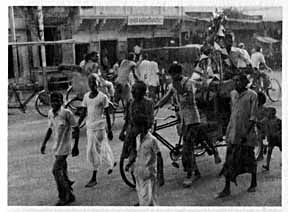
Vishwakarma being taken out for immersion
I am not sure what he answered then or later in the day. The whole event is rather hazy. I was so preoccupied with my own questions, planning them in advance, shaping my reactions, considering the impression I was creating, wondering what on earth I could do next, and so on, that I could hardly be said to have been concentrating on the other, as one ought to. He was positive and encouraging, however, and when I told him I was new in the place and would love to watch Vishwakarma Puja, he led me into a lane south of the road. This, as I was to discover, was the neighborhood of Nai Basti, which also had an instance of every other kind of cultural activity I could want.
It was an exhilarating beginning for fieldwork, though the incident itself did not match the more exciting ones to occur later. The family was “irregular” and difficult for me to figure out. Brothers who lived in a joint family were newly separated, and though I met only one, I became acquainted with the wife and daughter of the other. The brothers lived in rooms opposite each other, shared a common space in between, and pretended not to speak to each other. They referred to each other as “pattidar,” a technical term for co-sharers of ancestral property that was unfamiliar to me and perplexed me for a while. On the ground floor there were three vast wiredrawing machines in a partially covered courtyard and a little room with a string cot and some clothes. This was the kothari, or storeroom, better described as a “room without windows.” Apart from stores, it had the signs of a male using it, but I couldn’t guess who. Maybe those working at the machines—in turn? Another three rooms upstairs, as well as a verandah and terrace, were divided between the brothers, as were the machines, but I was to get to know the upstairs and the women only later.
Kishan, the man who had brought me here, was not one of the family but a day worker. It was a holiday for him, and like all those who worked in a factory, he celebrated at his place of work. He set up his purchases, created a typical puja scenario, and performed the ritual. He was inexpert but unembarrassed and unfaltering. The puja I had sat through at the Vedanta Society in Chicago for a headache-laden two hours, with every flower (or was it every petal?) addressed individually, approached with the ordained twist of the fingers, and moved majestically from place a to place b, had been one extreme; Kishan’s was the other, in its utter simplicity and brevity. I sat on a stool and took photographs. The others stood around and gazed on, not indifferent, but not participating vocally (with “Vishwakarma ki Jai!”—“Hail…” etc.) or in any other way, not, I concluded, because they didn’t know the form of the ritual but because they were not in top spirits. To recite or join in chorus at a celebration specifically yours, you have to feel good about yourself and the course of your life.
Everyone ate prasad, the food blessed by the deity, and the three silent hunks of machines were garlanded and dabbed with vermilion. It was all over in four or five minutes. Kishan said to a co-worker, “Gauri, let’s make a program to go to the cinema.” I was almost sure that what I would do next was to become invisible and accompany them to the cinema, spying all the time on their words and thoughts. In fact, all I did was sit around till the mood of the puja faded, the brief flicker of something special that had been created died away, all of which happened rather quickly. I sat there till everyone else moved off. I didn’t have the heart to pin them down with inquiries about themselves, their work, their lives. It was their holiday after all. I wasn’t a friend yet, and I had been admitted because of my professions of curiosity regarding the ceremony. That part being so clearly over, I could only continue with an apology for extending my project, no matter how I defined it. No one in the quickly disintegrating group helped me by supplying a question, comment, or even expressive gesture.
“At least I know the house,” I told myself—the ultimate argument I became used to giving when I could not bring myself to force what would not yield.
My first real participation may well be said to have been none too dramatic. There was no sudden shock of discovery, no vision of vistas rolling forth. But I had seen Vishwakarma Puja, and if it was brief, trifling, casual—so be it. The informants could not be wrong.
When I came back to this house a month later, package of sweets in hand, seizing upon the occasion of Diwali, none of the people I knew were there, and I met a totally new cast of characters. At a hand pump in the courtyard, right next to the entrance way, a fresh, perky young woman was washing some utensils. “Do you work here?” I asked innocently. “Why, no! This is my house!” she told me. I was not sure whether to believe her, but then she led me upstairs. She was Usha, the older of two daughters of one of the separated brothers. Misjudging her status simply because she had been caught doing domestic chores with her sari tucked up and her hair disheveled gave me such an eloquent example of my narrow, middle-class prejudices that I was almost cured of them. I spent the rest of the day with Usha and Nisha and their mother— ticed across the courtyard in the middle for an hour by their pattidar’s family—and I count that as the beginning of Phase II, when you not merely get acquainted, scribble down basics, and walk away thinking, “At least I know the house”; but rather you participate in your hosts’ activities, recognize each member of the family, feel comfortable in their home, and depart with their exhortations to come again soon.
Usha had attended school, as Nisha was doing now. They shared one school dress, and both had studio photographs of themselves in it. Their full name for school purposes was Verma. This was, for me, the inside view of the schoolgirls in identical uniforms, each with a placeable name, that I had seen all my life. Neither the uniform nor the name “belonged” to the girl, as I had assumed they did all through my school days! Usha must have been about sixteen and had been married a few months. She was spending her first Diwali after the wedding in her natal home, as was the custom. Her father-in-law was expected any time for a meal.
The meal itself was an eye-opener on many counts. The father and father-in-law sat downstairs in the kothari, where they were served; they exchanged not a word with any of the women, including me. The food itself, the flour, ghi, vegetables, and fuel for cooking had all been specially bought for the guest and sufficed only for him and his male host, with some leftovers for the womenfolk. The ghi was enough, for example, for puris for the men; as it got used up, the deep-fried delicacies were replaced by well-greased toasted parathas, then by dry rotis with simply a lingering touch of ghi on one side. Only a taste of vegetable was left over, and this was quietly put aside for Usha and Nisha’s brother, Bahadur. Apart from the segregation of the sexes and the obviously limited resources, the third eye-opener was the sheer frolicking fun of it all, as we, the girls, kept up a bantering, giggling, carefree exchange all through the cooking, serving, and eating. I suppose I must have expected depressed spirits, some explicit signs of deprivation, scarcity, and oppression, some signs of revolt maybe, of the poor against the privileged, of women against men, as one ate dry and the other rich. But these women were having a wonderful time; and I, as one of them, chattering ceaselessly about Usha’s school, their neighbors in Nai Basti, Usha’s father-in-law, and their awful pattidars, felt, too, that life was fun, but kept wondering how to explain it.
Their exhilaration upon the occasion of the festival and the daughter’s return home was matched by mine on the inauguration of Phase II. Having been confined to one small world as a child, I also had a personal need to expand my arena of experience into other worlds. Fieldwork—once it succeeds beyond a point—allows you to do that. I had suddenly, rather magically, become a privileged insider, recognized by some hitherto unknown Usha, Nisha, and family, as one of them.
The poverty of the house was brought home to me only on my later visits. There was never enough to eat. I made gifts under every pretext I could think of till I didn’t need any and developed the technique, later to serve me everywhere, of presenting a box of sweets with the barely audible murmur, “Prasad hai” (“God’s leavings”). I never saw Usha again, because she departed for her in-laws’ home shortly after Diwali. Her father, I discovered, was unemployed, supposed to have gone crazy upon the shock of the partition with his only brother in their hitherto harmonious family. The household was supported by the other male in the family, ten- or twelve-year-old Bahadur, who operated the wiredrawing machine and earned the usual three to four hundred rupees a month. Bahadur looked morose, his father avoided the house altogether, and the mother and daughter took in all kinds of work to keep busy, since there was nothing to do at home in the absence of food to cook and possessions to take care of. They rolled papars, dry lentil cakes, at the rate of one rupee per hundred and hooked chains of artificial beads at eight annas per twelve dozen. I watched them endlessly. I realized how much difference an individual personality makes, and indeed a special event like a festival. With Usha gone and the silly abandon of Diwali over, there was not a trace of the gaiety and lightheartedness that had left me wondering. In that sense, I had been right to wonder.
I had always held my own stern views on the preferential treatment of sons over daughters. But seeing in this case how the mother and daughter together earned thirty rupees a month and were incapable of doing anything else, and how the far younger boy earned twelve times as much and supported them, I could understand the logic of treating him as special and superior. He didn’t drink, gamble, or keep bad company, they said, in the voice of those who would neither control nor interfere, and I could foresee young Bahadur maturing into a gruff, distant, uncommunicative man around whom the womenfolk of the family would flutter, because, after all, he had sacrificed his childhood to keep everyone alive. As for the female protagonist of the tale, his sister Usha, not only had she had a happy childhood but she was still bubbling over with the joy of a child, untouched by any care.
At Nai Basti I had a glimpse from the very beginning of something that was going to confront me directly only later, with Mohan Lal, Tara Prasad, and such close comrades: the dangers of oversimplification regarding, among other questions, the characterization of the poor, the class-specific nature of pleasures, and the passivity of women.
5. Further Pursuit of Informants: The Metalworkers
As September advanced and the monsoons drew to a close, it suddenly became possible to achieve much more in any given day. Even so, I regretted the end of the monsoons. From the moment we had reached Banaras in July, I had realized that there was a lot of “cultural activity” there. If you took one of the two key roads traversing the city from center to south, you passed Durga temple and Tulsi Manas temple. The area around them always seemed festive, with crowds blocking the roads, hundreds of little stores, flowers, sweets, ribbons and trinkets for women, puddles, and monkeys. It was Sawan, the fifth month of the North Indian Hindu calendar, the time of year for fairs and music and small local celebrations.
When I say “local,” I mean it. None of the people we encountered was able to tell me of even two or three of the celebrations, leave aside the whole variety or range of them. I had to discover them for myself over the next few months, fervently hoping that I was searching for, and then looking at, the right thing. It was a depressing, disheartening process. Upon hearing of my research, a police inspector, head of the central, important Chauk thana and an experienced officer with many years in the sector, remarked, “Oh! This is Sawan, so you’ll find plenty of festivities.” I pressed him urgently: “What festivities?” He looked at me as confidently as ever: “Oh! Well, this is Sawan, so, let’s see…in Sawan…well, there are lots of festivities.…” His name, Chandra Bhushan, was pinned on his shirt, but I remember it with difficulty, for after this inauspicious beginning he never evolved into a friend or an informant.
He did assist me in unforeseen ways though. He had helped us buy a refrigerator in Chauk (and received a cut? I could not help wondering later, as I grew to feel uncharitable toward him), and having made his acquaintance through that transaction, I walked into his police station early in my fieldwork. He jumped up from his chair, exclaiming, “You here! Is the refrigerator working all right?” I reassured him, made myself humble, and introduced myself properly—not as the I.G.’s daughter but as a researcher—again. He recovered and made an important and mysterious phone call. As a result of this, an old, frail, but straight-backed man in a dhoti and kurta showed up at the thana. This was Govind Ram Kapoor. It took me a few days to place him properly, but I will sum him up here. He was a businessman who imported and sold silk yarn and some silk fabric. More than that, he was a community leader and the most active member of all the Citizens’ Defence Committees in the city, voluntary organizations set up in every neighborhood to help authorities maintain peace and order. More important still, he was sycophant of all officialdom, a middleman between the public and administrators, and a general meddler in all public affairs. By virtue of having a shop in Chauk, Govind Ram Kapoor knew all about the sari business; by extension, about weavers and their culture. He and the station officer there and then appointed him my guide and mentor.
Wiser after my “What happens in Sawan?” experience, I pinned him down to a time and place. Two days later I was winding my way with him through the cobbled galis of Madanpura, known as the central weaving district of Banaras. The lanes were wonderful— dless and confusing, a traveler’s dream. On all sides rose tall buildings joined by common walls, trapping the sun. From the ground floor windows of these came the sound of handlooms clapping, but the windows were too small to permit hurried observations. It was not a poor locality at all. Roads and houses looked clean and well maintained. Children ran around, and though they were eating the usual two-paisa and one-anna things from hawkers, they were combed and fully clothed.
Two or three less innocent months later I was to discover the reason for this obvious prosperity. Madanpura was not the central weaving district at all but the center of Banarasi sari export, where the Muslim traders had their business establishments (the Hindu businesses were located in Chauk). Govind Ram Kapoor naturally knew them because he had dealt with them for decades, but he knew no weavers whatsoever. Nor did he seem to know that the weavers of Banaras were concentrated in two areas, Adampura and Jaitpura, quite distant from where he had taken me. When I made this discovery and realized how far away these two wards were, I felt such a setback that I didn’t venture back to Madanpura for another few months.
That day we went to Banaras Silk Corporation, or “BSC” as its owners called it. We sat in a comfortable office-cum-showroom on white sheets spread wall to wall, backs resting on bolsters, everyone relaxed but me. Once again my mind was on what the most appropriate questions would be. I interviewed them at top speed, scribbled down whatever they said, and understood almost nothing. I gathered that a huge family ran the BSC, with a dozen brothers and sons either introduced to me or alluded to. Both because the BSC ran powerlooms and hired semiskilled labor from villages outside Banaras and because those I was speaking with were obviously not weavers, I quickly relegated the encounter to the back of my memory, to be resurrected only when I had to formulate an opinion about sari businessmen. Govind Ram knew what he was doing, but his choices in social interaction were different from mine: he liked to mix exclusively with better-off people. A second foray into the galis with him proved equally frustrating. This time he took me to a “museum” of the metal products of Banaras that also served as a clubhouse, meeting hall, and display room for a society of traders in metal goods. It was in the control of one Babu Sharad Kumar Rastogi, head of one of the biggest such trading houses, who had his business downstairs in the adjoining building and his home upstairs. For my enlightenment he had called in two of his craftsmen, who mostly smiled and said “yes” to everything I asked. The other activities that afternoon consisted of feasting on greasy sweets and savories and touring the ceiling-high glass closets stuffed with rather ugly brass, copper, silver, and German silver artifacts. I took down the addresses of the two artisans with adeptness, and as I thanked Govind Ram upon leaving, told him, “Well, now I can go to their homes and see how they live.” He was distraught. “No, no! You should not go to these people’s neighborhoods. It isn’t seemly!” That’s when I realized, belatedly, that his ideas of appropriateness were different from mine, and that I could dispense with his help. As I shook off his offers of further assistance, he gave an engaging smile that left me speechless: “Then you are determined to get rid of me?”
In a day or two, I set off on the trail of the first of the two metalworkers, Master Sita Ram, nakkas (repoussé worker). Raja Darwaza, the area where he had told me he lived, is a legendary place. Whenever old mohallas (neighborhoods) or galis of Banaras are mentioned, Raja Darwaza is included. Of course, the truth is that as soon as you acquaint yourself with a place in your fieldwork, you forget the legend. As I stepped into Raja Darwaza, I was afraid. It seemed only about six feet wide, though rickshaws are able to traverse it and I once even saw an automobile parked in a makeshift garage. Both sides of this narrow street are lined with attached shops, all elevated about two feet and accessible by steps or a jump. Most of the shops are tiny, and their floors are spread with white sheets on mattresses. The first shops in the market sell jewelry, which is mostly kept out of sight, so you don’t see anything inside but one or two owner-salesmen. They seem to fill the tiny shops till you see one with a dozen customers squatting inside and wonder where all the space has come from.
Now the shopkeepers do not have business all the time. Whereas some look down at newspapers, many sit languorously, facing the road and staring at the passers-by, so when you step into Raja Darwaza, it is immediately an unequal battle. You are longing to enquire into the place, the people, and the activities, but dozens of pairs of eyes are already probing you to discover your activity and your purpose. I could not stand the onslaught that first day and hastily withdrew my inquisitive gaze. I looked down and proceeded straight ahead as if I knew exactly where my potential purchase was located.
After a few yards Raja Darwaza becomes a market for other things besides jewelry, primarily jute products and cheap cloth. Then it becomes Kashipura, largely a market for machine parts, and looks grimy, oil-drenched, and heavy with the weight of iron and steel. I had heard from many sources that Kashipura was the home of the braziers and coppersmiths of Banaras, as I knew it to be the home of the one artisan I had met. He had given me his mohalla and had assured me that to find him I need only ask for Master Sita Ram, nakkas, in Kashipura. I asked dozens of people, and no one could tell me where he lived. There are, apparently, plenty of “masters” and plenty of nakkases, and, seemingly, no Sita Rams. So it has been throughout my research. I began to regard with bitterness the myth of personalized, face-to-face contact in the traditional city, where everyone knows everyone else in a mohalla. After my first few weeks in Banaras, I strongly resisted residents’ efforts to present their address as “X, of mohalla Y, ask anyone,” and would insist on having their house number, which every building in Banaras possesses, and a graphic description of how to reach it.
The whole day I searched for Master Sita Ram, my lone contact among metalworkers. Walking back and forth on the road with his vague address in hand, being gazed at speculatively by idle shopkeepers, I felt a trifle more kindly toward Govind Ram Kapoor and a little more tolerant of his protective “It isn’t seemly!” Equally tiresome, I couldn’t fathom the place, with all those machine parts shops lining the streets. Where did all those brass workers and coppersmiths hang out? When I finally saw a shop with metal products prominently displayed, I stopped at it, determined to make this my compensation for the other disappointment.
At the shop sat a beautifully aged man who could neither see nor hear well. For all that, he had time and warmth, and welcomed me. That first day I didn’t care what I asked or what he said, as long as I could get acquainted—or, less euphemistically, ingratiate myself with him. Of course, it was rather easy not to care about what he said, because all he said that first day related to himself as he saw his needs, not to himself as I saw my need of him. He kept repeating, “Babu, if you can get a job for any of my sons…I have four, and there is not enough work for them…Babu, we can make anything, whatever you want to get made…There are twenty-five people in this house, and what else is there to say…poverty, Babu, poverty…There is no market now, no work for us…” And on and on. It was not a beginning full of pleasure and satisfaction, as I had unconsciously anticipated when we started talking. But here was a metalworker at last, an ancient one at that, and here was I, firmly lodged, determined never to relinquish him, and all that he was saying—however limited in scope—was necessarily True and Real. Even if his complaints of poverty had never figured in my calculations as the refrain I would repeatedly be subjected to, I thrilled at the situation itself while feeling abjectly helpless about the content of the conversation.
Mohan Lal, the old man, sat in the shop to occupy his time (see fig. 4). He almost never sold anything. He and his four brothers had been legally separated for about twenty years and had divided the ancestral home along with the business. Each house, sharing a wall with its neighbor, was only about ten feet in width but ten times as deep and five stories high, like a tall chimney. The staircase along one side was extremely narrow and steep. The front room on the ground floor in each house was the workshop, or karkhana, in Mohan Lal’s case with a little shop in front. The workroom had a mud floor, a hearth and fire, a lathe, metals, and tools. The shop had a wall-to-wall dirty white sheet on the floor, a cash box from which coins were always being handed out to the children of the house, a Ramayana that Mohan Lal peered at with his thick glasses when he had no one to talk with, and miscellaneous merchandise. A heavy pair of scales hung from the ceiling because everything was sold by weight.
Mohan Lal
My first impression of life in the place as a hopeless, dismal drudgery rapidly expanded and elaborated in ways that added myriads of dimensions. I confirmed that Mohan Lal was indeed poor and wanted a better life for his family but discovered that that was not all—or even the most important thing—to be said about him. I was put in a quandary regarding the interaction of economic and other controlling conditions of life till I could not in all honesty separate them from each other at all. After I became a regular visitor, had met Mohan Lal at different times of the day, on different days of the year, had eaten with him, laughed with him, heard the story of his life, told him my own, and simply had sat with him for many, many hours—I began to feel that life was a matter of moods and flavors and textures. How and why one did things was as important as what one did. One’s actions were always affected by strong principles and philosophies, not merely by sheer “need” and “necessity.” With Mohan Lal I fully and finally lost my assumptions of determinism. Soon after getting to know him, I was asked by an intelligent woman comrade also working with “people”: “So, what is the basic motivating factor for these poor artisans?” I could sense the range of answers her mind would accept— economic necessity, rest as a compensation for heavy manual labor, caste, religion—and felt a sudden gap open between us as I heard myself express an unpremeditated thought for the first time: “Why, they’re just like us. They’ll go for a walk if they feel like it, chat with friends…take up theater…”
Mohan Lal had taken the seemingly extraordinary step of launching a theatrical group that rehearsed every evening after work. He loved to talk of it, to describe its productions, boast of its repertoire and quality, and particularly of the accolades received in various competitions. Somewhere in the back of my mind lurked disbelief, not full and total, but sufficient to demand some proof. Accordingly I pestered him to let me take photographs of the stage curtains they had used, which (he claimed) were now rolled up and stored near the ceiling of the Kasera (the metalworker caste) community center and clubhouse. I knew the building and its halls, and when I was shown giant rolls of dusty canvas suspended up high, I agreed that it was hardly practical to bring them down. I was accumulating evidence aplenty from other sources meanwhile that Mohan Lal’s toothless chatter was more than the transformed memories of an aged man. Girja Devi, the respected vocalist of all-India fame, mentioned suddenly in the middle of an interview: “The Kaseras of Banaras, they are the best singers of all.” A sophisticated theater group in the city referred respectfully to their productions of past decades. All testified to their amateur talent in Ramlila staging, and it was written of as well in old issues of the Bharat Jiwan.
One can explain certain things as “respected traditional activities that they believe in.” But to say about Mohan Lal’s theater group that “artisans work hard; they like their leisure; they have diverse interests and a love of life,” as I finally did (at greater length, of course, and more analytically), misses the actual flavor of Mohan Lal’s world. As a statement derived from this desperately overworked, underpaid, but independent-minded, passionate old man with his zest for living, it is simplistic and therefore incorrect and objectionable.
Mohan Lal was the first informant to whom I unqualifiedly gave the title “friend,” not only because we became close but also because he lacked certain ideal qualities of an informant. He consistently refused to objectify his values and experiences and to present them coherently for my inspection. His descriptions were always somewhat muddled and incomplete, not because he was incapable of clarity but because he assumed a right to feign fatigue, ignorance, or lapse of memory, to change the subject and inquire about me instead, or to cackle and convert a serious topic into a ludicrous one. The more he did this, the closer we became, for I sensed immediately that he resented being studied, just as any self-respecting person would, just as I would. He had tremendous stores of dignity and taught me the precious lesson that simply because I was the observer and he the object did not mean that he was simpler, easier, more static, more accessible than me. Of course we were miles apart, but it was not age, gender, education, or culture that separated us; our difference could perhaps be summed up in the cliché regarding the rich having more money.
Mohan Lal began a phase of my fieldwork in which, thanks to his complex personality and our strong relationship, I learned to shed the inner lens forever refracting the outer world. I left behind forever most of my comrades and all those eloquent observers of the same confusing world that I was studying, all the Naipauls, Ved Mehtas, Nirad Chaudhuries, and Upamanyu Chatterjees. They were all, it seemed to me, preoccupied with their own feelings about the objects of their gaze, not with the objects themselves. I found it more difficult at that point to talk with someone from my own class and educational background than with my “people” such as Mohan Lal.