
British Rule and the Teng Decline
The decline of the power and property of some Punti lineages in the New Territories may have begun as long ago as the period of immigration after the evacuation, but the appropriation of the New Territories by the British also contributed to their decline. Before the British, there existed a system of land tenure in which dominant lineages claimed ownership rights to much of the land in the New Territories (see R. Watson 1985, 55–59; J. Watson 1983). Members of the dominant lineages pocketed "taxes" from those who farmed land that was not registered with the Chinese government. When the British began to register land, "taxlords" claimed it was their land and that they had collected "rent," not "taxes." Some land was leased in perpetuity to tenants who owned the right to farm the land and who could in turn lease their rights to other tenants. In a variant of the distinction between surface rights and subsoil rights common in southern and central China, the landlord owned the "bottom soil" of the land, which gave him the right to collect rent. Other arrangements included short-term leasing of land (see R. Watson 1985). By 1905, the Hong Kong government had registered all land that had proper ownership deeds. In cases in which no deed could be produced, "the cultivator was usually proclaimed the owner" (R. Watson 1985:59). The Teng of Ping Shan claim they owned more land in pre-British times, but at the time of the British land survey their tenants fraudulently claimed ownership (Potter 1968:100).
According to Faure, with the arrival of the British, the Lung Yeuk Tau Teng lost their control of bottom-soil rights, which "changed the fundamental political situation of the New Territories" (1986:164).
This revised system of land ownership greatly benefited the Hakka at the expense of the Punti landlords. As explained in a speech by the district commissioner of the New Territories in 1955:
In 1899 we found that although the Chinese documents of title were in the name of the Hakka clans, the adjoining Punti clans had the right of paying the land tax and charging the Hakkas a much higher land tax. We [the colonial government] broke that system by issuing Crown leases direct to the Hakkas and compensated the Punti "tax-lords" by grants of vacant land, free of Crown rent for the first five years. Everybody ought to have been happy, but today it is only the older Hakkas who remember clearly how the British enfranchised them, while the Punti clans preserve the tradition of how we robbed them….
Basically therefore, the Hakka are our friends and the Puntis are our enemies. But I naturally have to treat them all alike (Hong Kong Government 1955:4).[6]
The British land policies served not only to undermine the economic power of the Punti but also to ally the British with the Hakka.
Many volumes of land records were destroyed during the Japanese occupation of Hong Kong, but enough exist to make some general statements regarding land ownership in the Shung Him Tong area. Beginning in 1903, Hakka Christians, mostly from Baoan district (later called Xinan, now Shen Zhen) and the areas closest to Hong Kong, arrived in Shung Him Tong (see map 3; see also app. 2). Later, Hakka families also came from Hakka regions further inland; from regions of Meixian (then called Jiaying, or Kaying in Hakka), the town and district of Wuhua (then called Changle, or Tschonglok), and the towns and villages of Zhankeng (Tsim Hang), and Meilin (Moilim), where the main Basel mission churches were located. By the 1930s there were people of eight surnames (Ling, Pang, Tsui, Cheung, Chan, Yao, Tsang, Cheuk) living in Shung Him Tong. Little by little, land that once belonged to the Teng was sold to Hakka immigrants, and the Tengs receded to the northeastern most regions of Lung Yeuk Tau.
The Crown Block Lease shows that by 1905 Pastor Ling, recognized as the founder of the village, and his family owned small plots of land that totaled 20 percent of the land in and around Shung Him Tong (approximately ten and a half acres). That land was presumably bought from the Teng. Teng individuals, families, and corporate groups owned approximately 30 percent or fifteen acres of the land in that area, and the rest was listed as Crown Land. Within
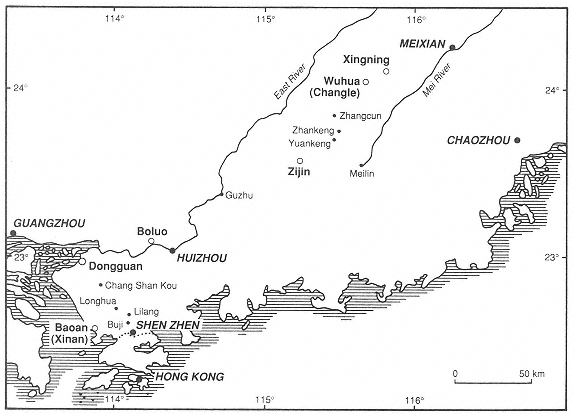
Map 3.
North and South Central Guangdong Province. Adapted from Hashimoto (1973) and Loercher (1879).
the next twenty years, the Teng had sold all their land in Shung Him Tong, and church families owned all the land that did not remain Crown Land. Between 1913 and 1918, another important member of the Shung Him Tong community, Pang Lok Sam, had acquired a total of approximately three acres in Shung Him Tong, mostly at public auction.
Although the specific reasons for the decline in power of the Lung Yeuk Tau Teng would only be revealed by a detailed study, the general description of the process of decline of powerful lineages described by Baker is in accord with the explanations I heard from the people of Shung Him Tong:
The weakening of a lineage by virtue of failing manpower or misspent wealth must have been marked by the gradual collapse inwards of its land-holdings, more distant ones being sold first … There must have been lineages which descended from power to weakness and perhaps extinction. The Teng lineage of Lung Yeuk Tau seems to be a case in point. At one time powerful enough to produce major scholars … and to play the main role in establishing a market town, it has declined during the last century until now its village is no longer sacrosanct. The borders of the territory of such a lineage must gradually have shrunk, retreating little by little to geographic frontiers closer to the village (1968:173).
The people of Shung Him Tong agree, but place the emphasis on what they consider the "moral decline" of the Punti, which they contrast with the moral strength of the Hakka Christians. In the words of one elderly village man:
The Teng had lived in the area for a long time and they didn't like newcomers. We were threatened and treated as aliens, outsiders. We had a hard time…. The Teng were very rich people, but in Chinese we say that a family can never be rich for more than three generations. Perhaps this is because by the third generation the sons have forgotten how to make money and are lazy…. Well the Teng were lazy. Perhaps they smoked too much opium and played mahjong all the time and gambled and lost their money…. Pang Lok Sam and the Lings, they got the land from the Teng through their mortgage company. The Hakka have the reputation of going through China and usurping the land from the wealthy landlords by working very hard.
Another man, a descendant of the village founders, explained that in order to get money for gambling, opium, and concubines, the Teng mortgaged their land to the company that had been started jointly by Pang and Ling. When these Teng could not pay back the mortgages, Pang and others had the opportunity to buy the property. A young woman teacher said that, among other things, the
decline of the Teng was tied to the fact that there were not enough Teng men to work the fields since many had left to work in the city or overseas.
Geomantic features or feng-shui (lit, "wind" and "water") are often cited in the legends and history of the New Territories as factors that help explain the rise and fall of lineages (Faure 1986; Sung 1973, 1974). Even though the people of Shung Him Tong know of feng-shui, they do not tell feng-shui legends as though they believe them to be literal truth. The tales they tell about the past are divided into two types, "history"—assumed by those telling it to be true and correct—and "stories" about outsiders who believe in feng-shui or about the power of Christianity over feng-shui. Feng-shui is discussed in further detail in Chapter 5; here I will limit my discussion to a legend of the founding of the village told to me on separate occasions by two different members of the church, one an older missionary and the other a middle-aged schoolteacher from Shung Him Tong:
The village is set at the foot of dragon mountain and is bordered by Phoenix river. Before the Christians arrived, the Punti farmed some of this land, but no one dared to live here because of the powerful feng-shui. So when the Christians asked to settle here they said "why not let them try?" Shung Him Tong people came and built their houses here and no harm came to them.
The schoolteacher ended the legend by saying, "That [experience] tested the Christians' belief in the strength of Christianity." The missionary said, "The Punti then understood that the power of Christianity was stronger than that of feng-shui. " With such a conclusion, we would expect to find Punti flocking to the church and converting to Christianity, but they did not. Instead they seem to have revised their view of the feng-shui and now consider that the land is ideal for burial sites; several wealthy Cantonese families have attempted to build large auspicious family graves in the area.