
The System of Offices
An overview of the principal relations of authority in Rembau's precolonial polity can be gleaned from part of a customary saying (perbilangan ) that is widely known at present and commonly encountered in the reports of earlier observers as well (e.g., Lister 1887, 43, 44; Hale 1898, 53–54; Parr and Mackray 1910, 87, 116):
The Undang rules the district,
The clan chief governs the clan,
The clan subchief rules his enates,
And the wife's enates prevail over in-marrying males.
These and intermediate relationships are depicted in figure 2, a schematic representation of Rembau's traditional polity and the territorial domains associated with each political office and council.
The Undang sat at the apex of the political hierarchy and was regarded by his subjects as sacrosanct (berdaulat ) and as Allah's caliph or vice-regent (berkhalifah ) within Rembau (Parr and Mackray 1910, 48, 50, 52, 53). This figure not only symbolized and effected the institutional integration
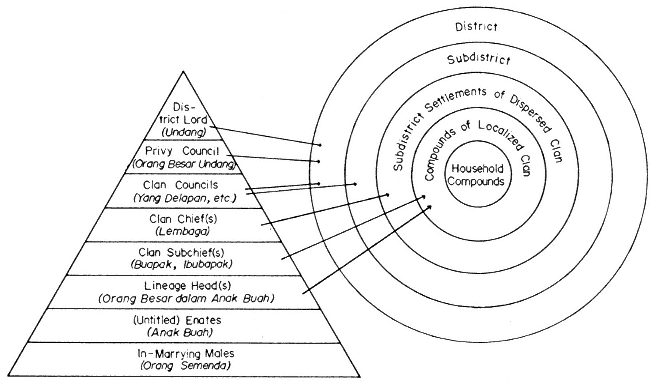
Figure 2.
The Indigenous Political Hierarchy in Nineteenth-Century Rembau, Showing
Territorial Domains of Political Offices and Councils
of adat and Islam, but he also enjoyed rights to conscript male villagers for defense purposes and to make periodic demands on household labor and food resources (Newbold 1839, 2 : 85–86; cf. Lister 1887, 48). The Undang was also entitled to collect annual payments in kind from the proprietors of certain categories of land (see chapter 2), even though he was barred by adat from intervening directly in any clan's affairs unless petitioned to do so by the chiefs of those clans (Parr and Mackray 1910, 48, 58). In a word, adat granted the Undang broad powers and variegated ritual prerogatives but simultaneously imposed quite specific constraints on his authorities. It was in fact as enforcer of such constraints that the four-person Privy Council, or Orang Besar Undang, came into being during the eighteenth century. This body served to check the Undang's comportment vis-à-vis clan chiefs and thus constituted a buffer of sorts between Rembau's highest-ranking leader and the largely autonomous but politically vulnerable heads of dispersed clans (Parr and Mackray 1910, 34).
Succession to any of the foregoing titles presupposed affiliation with one of Rembau's gentry clans, for rights to these offices were vested in the gentry in accordance with mythic alliances and exchanges with aboriginal Jakun, which endowed them with privileged proprietorship over the whole of Rembau and all its inhabitants and resources.
Certain clan councils, for their part, also enjoyed districtwide realms of
jurisdiction. As one example, the council known prior to 1831 as the League of Four, and thereafter as the League of Eight, exercised legitimate powers throughout Rembau, even though the clan chiefs on the council were in most other respects limited in jurisdiction to specific territorial domains, such as Lowland or Upland Rembau (see Parr and Mackray 1910, 25, 26, 40). Succession to the chieftainship of any clan also entailed ascribed status with respect to all clan councils—as a member of certain rank, for example, or as a nonmember. Thus, in most instances rights to an office of clan chief included legitimate claims to a specified role in one or another council, and all such rights not only vested in particular clans (or more precisely, in the Lowland or Upland segments thereof), but also stood as their "ancestral property" (harta pesaka ).
Because there were usually only one or two clan chief titles for any given clan in Lowland or Upland Rembau, responsibilities for regulating a broad range of community affairs typically devolved on the chief's immediate subordinates. I refer here to clan subchiefs (buapak or ibubapak ), each of whom exercised authority over the compounds of a localized clan (Lister 1887, 45–46) and concurrently served to link village residents with extralocal political figures. Clan subchiefs also helped guarantee that the members of their communities received equitable treatment at the hands of clan chiefs, much as the chiefs themselves served to check the activities of the Undang (see Parr and Mackray 1910, 36–39).
Titled individuals occupying the lowest rung of the political hierarchy were also charged with promoting justice in accordance with adat and increasing the likelihood that their immediate superiors did right by their relatives. Deemed to be officials of the clan chief, these lineage heads, or "big men among the kin" (orang besar dalam anak buah ),[17] helped ensure that capricious, partisan, or extortionary behavior on the part of subchiefs either did not occur or resulted in appropriate punishment (Parr and Mackray 1910, 34). If punishment were required, portions of the fine paid by a guilty subchief to the clan head were shared with the lineage heads; apparently these comprised the main income associated with the office (Parr and Mackray 1910, 34). Lineage heads also received direct remuneration in the form of percentages of the fees paid by male clan members in the village who were involved in "irregular marriages"—for example, marriage by abduction (cf. Parr and Mackray 1910, 82–85)—although they were prohibited by adat from levying fines on their own accord.
Of broader concern is that the office system served to encode a model of
"pure matriliny," and yet did so in a larger context of territorial and descent unit alignment where matrilineal idioms provided but one component of the relevant structure (and thus only a partial explanation for its expression "on the ground"). The other nexus of idioms here, and in many other realms of indigenous social theory and practice, was based on notions of siblingship, the behavioral imperatives of which were contextually variable but could be wholly inconsistent with those based on matrilineal descent.
Bear in mind, for example, that rights to each political title were vested in a single dispersed clan, or territorially defined segment thereof, with the partial exceptions of the Undang and two or three other gentry titles. Disregarding these cases, each title was held to be the property of one specific social unit, membership in which was frequently expressed in terms of common matrilineal relatedness and typically ascribed at birth by virtue of ties of matrifiliation with a woman belonging to that same category (or, alternately, by adoption). As in most ethnographic instances of such estates, rights to any given political office were wholly concentrated among the members of a single clan or segment thereof, and could not devolve on persons or collectivities defined as external to the relevant category. Viewed from the other side, an appropriate descent affiliation was a pre-requisite for political succession, even though many other considerations—moral character, verbal skills, charisma, physical well-being, patrilateral connections—also figured.
Further testimony to the prevalence of descent idioms in the system of offices was the convention whereby the term used to designate enatically related kin of junior generational standing, anak buah , was also employed by political leaders in referring to their adherents.[18] Just as a man's sisters' children stood as his anak buah, to take the most relevant example, so too did everyone in Rembau share that designation in relation to the Undang. Conversely, all titled males were defined as mother's brothers in relation to their charges.
We turn now to the logic of succession to political office, in which siblingship serves as a basic ordering, and fundamentally disjunctive, principle. An example drawn from contemporary Bogang provides a useful illustration. Bogang's Lelahmaharaja clan, which comprises three named lineages, holds exclusive rights over four political titles: clan subchief and the three lower-ranking "big men among the kin," or lineage heads. Rights
over these offices pass from one lineage to the next in a set sequence; thus, when any one of these political figures dies, his title will be bestowed on a member of the lineage next in line for that particular title. Stated differently, even though rights to these titles never pass out of the localized clan, neither do they devolve from mother's brother to sister's son, as occurs in many other political systems associated with matrilineal descent. Instead, they pass among structurally equivalent social units held to be related to one another "like sisters."
An analogous logic governed access to the title of Undang, which has been defined as the "ancestral" property of Rembau's two gentry clans ever since its inception during the period 1540–1640. Recall that the mythical genealogies of these clans portray their respective apical ancestresses as unrelated to one another except for the tie of "chiefly brotherhood" between their husbands. That is, although these two men belonged to separate clans and were thus structurally distant in terms of matrilineal calculations, their relationship of "chiefly brotherhood" provided the primary link between both their wives and their wives' enatic descendants. I need only reiterate that rights to the office of Undang have always rotated in theory between Lelahmaharaja and Sediaraja, which implies the same structural equivalence that appears in myth as a particular variant of nonenatic siblingship.
Yet to point out that rights to the office of Undang rotated between Lelahmaharaja and Sediaraja is to oversimplify; it was also the case that rights to provide a candidate for this office passed among each of the senior settlements associated with these clans (Parr and Mackray 1910, 48–49). For example, when an Undang of the Lelahmaharaja clan died or vacated office owing to impeachment or infirmity, the title passed ideally to one of the Sediaraja communities not only endowed with senior standing but also held to be next in line for candidacy in relation to the other three Sediaraja villages of equivalent status. This second circuit of rotation provides additional justification for regarding siblingship as the dominant idiom regulating accession to the office of Undang, for we have already seen that the genealogical bonds among the senior villages of each clan receive mythical expression in terms of sibling ties. So, too, does the existence of a third circuit, which specified that the residentially localized lineages in each of these settlements were to take turns in furnishing nominees whenever their village was eligible for candidacy. Unfortunately, we do not know how such lineages were held to be connected to one another
during the nineteenth century, although present-day residents of Bogang do view them as related like siblings, especially sisters. I suspect that this has always been the case.
This material suggests that all social and territorial units associated with the founding settlements of gentry clans and vested with equivalent, parallel, or essentially complementary rights to the same political title(s) were held to be related as (or like) siblings by virtue of their common relationships to the office(s) in question. The same rules of political succession can be discerned in the case of founding settlements associated with individual commoner clans as well (see Parr and Mackray 1910, 120–141; cf. Lister 1887, 45, 47; Lister 1890, 308–310; Gullick 1958, 77), with an identical logic grounded in siblingship.
It remains to elaborate on my earlier point that principles of siblingship also assumed a disjunctive role in the political system. Consider, for example, that no explicit notion of structural precedence is apparent by which certain adult males within a sibling set, lineage branch, or lineage would merit preferential or exclusive consideration when their lineage was due to provide a candidate for office. That is, while the Rembau schemes of rotation enjoined serial succession at the levels of dispersed and aggregated clans and lineages, they seem not to have ranged beyond these units by specifying a variant of primo- or ultimogeniture, or anything of the sort commonly reported for conical clans (Gullick 1958, 70, 74, 77). This might be interpreted as a mechanism promoting intralineage equality, since distance from a founding line or apical sibling set was not explicitly relevant and candidates could thus be selected instead on grounds of "paternal luster" or some combination of acquired skills or other achievements. The problem, however, was that this might also promote the emergence of invidious intralineage distinctions, based on potential military prowess or some special acquired competence, which could effectively negate the structural equivalence otherwise characteristic of relations among adult male enates (particularly those of the same relative generation). Further, this meant that all males in a particular sibling set, lineage branch, or lineage might well be vying for the same political stakes (Gullick 1958, 70, 74, 77); hence, their competition could well give rise to divisiveness within the very unit they sought to represent.[19] Indeed, in light of the pronounced cultural emphasis on the equivalence of same-sex siblings, one would certainly expect a man to harbor profound resentment toward a
brother who attained political office while he himself simply muddled along as "mere villager." More to the point perhaps is that structurally induced sentiments of this nature continue to provide a context for the expression of myriad variants of fraternal strife.
Other tensions engendered by the structure of the nineteenth-century political system had profound social and cultural significance as well. Many stemmed from the fact that in-marrying males were not only subject to the control of their wives' enates (Lister 1890, 317; Hale 1898, 56–57; Parr and Mackray 1910, 95, 116–117; Caldecott 1918, 36–37) but also owed allegiance to their own enatic relatives, whose interests they were clearly expected to further, especially those of their female kin (see chapter 2). Some of these tensions were realized in the domain of inheritance, in that rights over certain of the proceeds of a deceased man's labor might be divided between his widow and children on the one hand and his sisters and their progeny on the other. The potential for conflict in this situation, where two distinct sets of enatic kin could lodge legitimate claims over the intestate properties of one particular male decedent, is clear.
More important still is the fact that titled males (and subsequent generations of indigenous elite) stood partly outside the system of affinal control that both underlay and made possible the social reproduction of enatic units at all levels of inclusiveness. One reason for this is that they were vested with symbols and bases of authority and prestige generally unknown to their untitled counterparts, and were thus far less vulnerable to the sanctions imposed on them by affines. Elites were therefore ideally situated both to contravene established canons of order and to endow largely unpopular or ambivalently embraced innovations with a modicum of sanctified legitimacy.[20] The implications of these circumstances will be clear after we examine the political elite's critically important role as entrepreneurs during the nineteenth and twentieth centuries (chapters 3 and 4).