
Colonial City Form
Colonial cities did have to attend to self-defense. Most important, they had to have militias, entailing the election of a drummer "to doe all Common service in drumming for the Town on Trayning dayes and watches." Not until the constitutional government of the United States was established did they lose this responsibility. But colonial cities avoided the customary city wall systems that required costly capital outlays in the Old World. Certainly New Amsterdam had its famous wooden palisade, which gave the world a Wall Street. But this wall resembled more the temporary stockade of a military outpost than the full-blown walled cities its Dutch settlers had known. Eighteenth-century St. Louis, which the French fortified in 1780 with a ditch, wooden palisade, and stone gates, had some of the appearance of a walled city, but the wall quickly disappeared when the city began to act
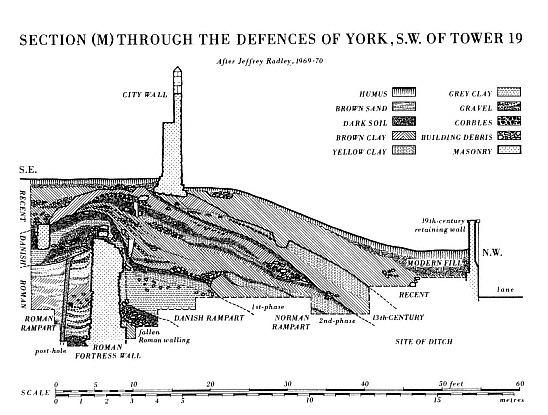
York Wall, Cross Section.
York's impressive wall, in this cross-section, reveals a succession of
fortifications since Roman times. The diagram of York's wall suggests just
how costly and formidable the medieval city wall actually was. It is no
wonder that they stood long after they were no longer needed, even though
their surfacing stone was valuable and thus often hauled away for other
building purposes.
Source: Royal Commission on Historical Monuments, An Inventory of the Historical
Monuments in the City of York, vol. 2, The Defenses (London: RCHM, 1972), 114.
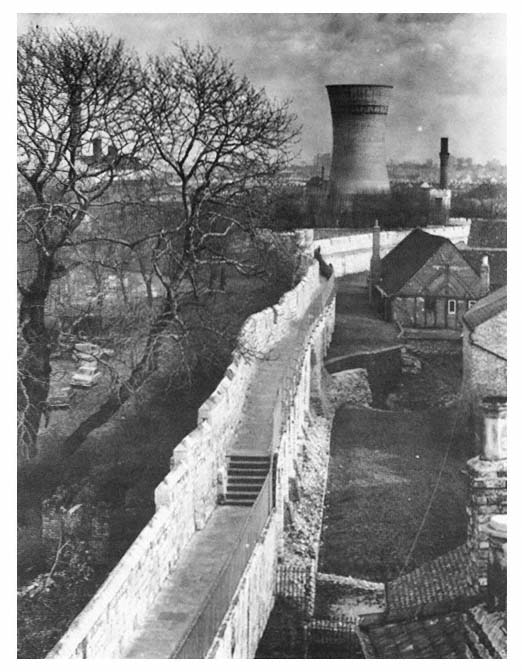
York Wall Today
A tourist attraction in contemporary York, this photograph suggests the
wall's monumental presence in a medieval city.
Source: Royal Commission on Historical Monuments, An Inventory of the
Historical Monuments in the City of York, vol. 2, The Defenses
(London: RCHM, 1972), pl. 41.
an entrepôt rather than as a fortified trading post on the hostile edge of the French empire. Using deliberately loose criteria, one geographer has identified a total of eleven settlements in the United States that had some form of fortification, but after the most generous allowances he concludes that the lack of influence of walls "may be a characteristic feature of cities in the United States."[8] Certainly no American city invested in the enormous capital infrastructure represented by the massive and sophisticated wall systems of British and European cities.
Max Weber in The City argued that the rise of the modern city helped foster a spirit of capitalistic individualism. With this flourishing came a concurrent decline in the distinctive cultures of individual cities and of individual identities tied to these cultures.[9] The liberation of the city from the demanding requirements of defense and autonomous statehood made possible a new and far less responsible role for the individual in the fabric of urban life. American cities epitomized this tendency. Throughout the colonial period cities decreased their demands on the individual as citizen and urban resident and created a laissez-faire economic and social environment. Dubbed "privatism" by Sam Bass Wamer, this spirit made cities the stages on which individuals and interest groups pursued their own private goals.[10] The new freedom from the responsibilities of statehood thus affected the individual within the city as well as the city itself. One result of this increased individual freedom was an inconsistency and irregularity in the appearance of cities.
The absence of traditional city forms made colonial American cities seem ugly, chaotic, and scattered to European visitors. Colonial cities did not even have names for their streets. In addition to their confusingly unconventional appearance, these New World cities were probably even smellier and dirtier than their British counterparts. Poor urban families raised pigs, which wandered the streets. Though prohibited by ordinance by the end of the eighteenth century, at least in Providence and New York City, pigs foraged freely well into the mid-nineteenth century. They thrived on the garbage, and on the animal and human excrement in the streets. In order to promenade, the elites of Boston and New York created special parks in the mid-eighteenth century, where railings excluded the omnipresent pigs, horses, and oxen.[11]
Excepting those few cities that had temporary walls, American
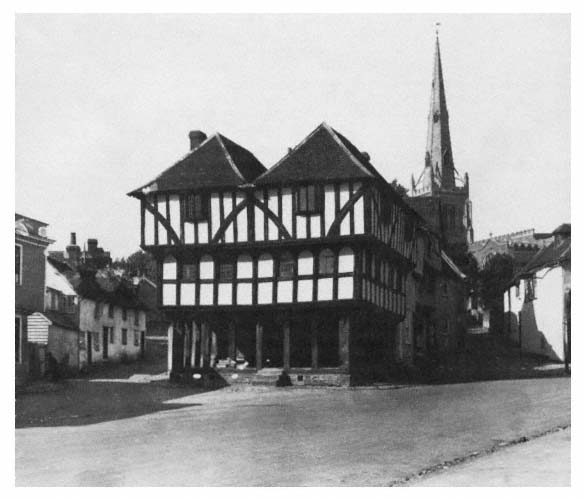
Thaxted Guild Hall, fifteenth century
The Thaxted Guild Hall was used as a market and town hall for this small,
unfortified market town. Market buildings such as the Thaxted Guild Hall
make an appropriate emblem of the city's political and economic functions.
Guilds and other groups of the city's governing bodies met in the
upper rooms, markets could be held in the open areas, and often the
buildings contained a jail.
Source: Royal Commission on Historical Monuments, An Inventory of the
Historical Monuments in Essex (London: RCHM, 1966), 1:313.
cities did not even have proper boundaries demarcating their edges.[12] Ultimately, though, their very formlessness heralded a new era. Try as they might, they could not repeat British or European models. Even though their own image of what a "real" city should look and act like derived from English antecedents, colonial cities had to struggle to maintain even the barest of appearances. At the Newport Town meeting in 1712 it was argued that: "It is a universal and orderly custom for all towns and places throughout the world when grown to Some considerable maturity by Some general order to name the Streets, lanes, and alleys thereof."[13] The city had unnamed streets and to muster support for naming them, it had to appeal to its citizens' sense of world order and propriety. Neither reason nor tradition alone sufficed.
Colonial urban America's most important contribution to future urban development was, in a literal but quite important sense, negative. When the United States expanded in the nineteenth century, it had no ancient patterns of urban political dominance to stifle change and growth. Of the early cities, New York and Boston retained much of their preeminence, but neither retained exclusive rights typical of British and Continental cities. Neither had trade monopolies. Neither had extensive property rights beyond its boundaries. Dissenters of any kind could simply move elsewhere—and they did. Intracity trade competition reflected the cities' lack of broad chartered powers. Just as New England towns could not prevent political splits from turning into literal fragmentation, with dissidents forming new towns, New Yorkers in the early nineteenth century could not stop the upstart new city of Brooklyn.
Even when tradition was consciously followed, modifications created new forms in the colonies. Early city government often took strange turns. One case in point is the justly famous town meeting, which evolved from Boston's government in the 1630s. This new, potentially democratic form of local government derived from congregational church governance. Both mimicked local church and government in England, where the church vestrymen had administered much of the local law, and where the church governance had represented the village oligarchy. The transformation in the New World came from the rejection of the church hierarchy. The basic form of government remained, but the power now rested in the hands of all church members. Thus tradition, when combined with some slight variation in the composition of
the local church, could create a city government quite unexpected in form.[14]