
"True Art Means Seeking to Capture the Unreal"
Corinth had hardly finished the self-portrait when he was already at work on the splendid still life of larkspur (see Plate 37). The bouquet was a birthday gift from Wilhelmine, and the large dimensions of the painting lend the simple flowers an appropriately festive air. As in the Walchensee birthday self-portrait, warm and cool tones complement each other. There is also an unexpected renewed commitment to interior space. The checkered table cloth and the window framed by a white lace curtain convey something of the room's rustic charm. Yet structural ambiguities, as nearly always in Corinth's late works, prevail: the vase leans toward the right, and there is a notable divergence between the left and right corners of the table and between the window-sill and window frames. In the end, however, these instabilities are resolved in the stalks of the flowers radiating outward from the very center of the composition. The result is a dynamic equilibrium that defies the logic of statics.
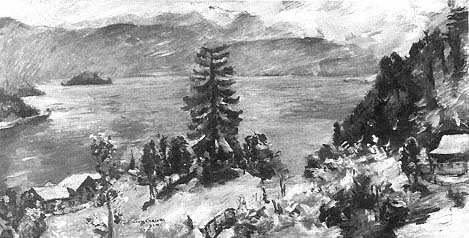
Figure 191
Lovis Corinth, Walchensee: View from the Kanzel , 1924. Oil on canvas, 100 × 200 cm,
B.-C. 955. Wallraf-Richartz-Museum, Cologne.
Photo: Rheinisches Bildarchiv.
During that summer Corinth also painted seven Walchensee landscapes. These included two nocturnes (B.-C. 953, 954), two views of the Jochberg (B.-C. 956, 958), and a view of the lake shrouded in morning fog (B.-C. 959). The most unusual of all is the large panorama (Fig. 191), now in Cologne. Like the preceding birthday self-portrait and the still life of larkspur, the painting conveys a sense of serene detachment. The landscape is actually made up of two views: at left, a corner of the northeast shore, the green island of Sassau, and the Hotel Fischer am See; at right, toward the southwest, the slope leading up to the Herzogstand. On the opposite side of the lake lies the extended chain of the Karwendel, and almost in the center of the canvas, unifying the composition, Corinth's favorite larch tree stands on its own promontory overlooking the water. The brushstrokes are vivid but of a uniformly soft texture that enhances the breadth of the view and contributes to the impression of an all-pervasive calm. One is tempted to call the landscape "classical," so much does the painting depend on both the ordering of human reason and the laws of nature.[50]
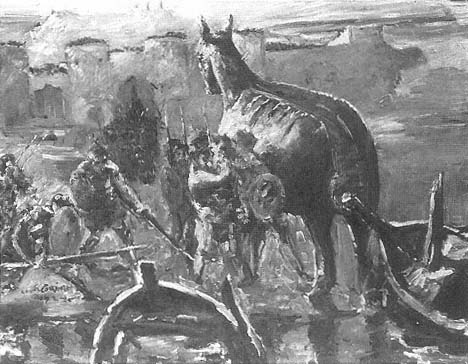
Figure 192
Lovis Corinth, The Trojan Horse , 1924. Oil on canvas, 105 × 135 cm, B.-C. 960.
Staatliche Museen Preussischer Kulturbesitz, Nationalgalerie,
Berlin (West) (NG 1522; A II 488).
Photo: Jörg P. Anders.
Corinth's love of a good story depicted with verve revives briefly in The Trojan Horse (Fig. 192), painted in the fall or early winter of 1924. The subject is rare in art, perhaps because the story lacks a major human character. Corinth, too, was forced to select a subplot of the epic to highlight the drama of deception and folly. Facing the gate of the walled city, the sham animal stands stiffly by the seashore. Two derelict boats, left behind by the Greeks, lie in the shallow water nearby, their prows pointing no less menacingly in the same direction. All the action centers on the lone Greek who professes that he was abandoned by his compatriots on the beach. Having been captured by a small advance troop of Trojans, he tells them the story of the curious idol as Odysseus had instructed him to do. Two armed warriors
watch over him with furious determination, unaware of the real danger at hand. The city gate has already been opened, and from it stream more troops and the dark throng of the curious. The jewel-like colors, pearly grays and sapphire blue augmented with turquoise and touches of red, pink, and pale yellow, lend the story the air of a remote fantasy. Despite the seeming informality of the melee, the pictorial structure is rigorously ordered. The action is contained within horizontal bands formed by the sea, sky, and city walls. Corresponding accents divide the composition vertically, with the main episode, surmounted by the horse's head, occupying the center of the canvas. Historians have interpreted Corinth's choice of this subject, with all its tragic consequences, in the context of both his personal life and the contemporary political situation, fraught with instability and potential upheaval.[51] Even if they are correct, Corinth managed to convey his thoughts in a light-hearted way.
After the serene confidence of this painting and the preceding works from Urfeld, the pessimistic mood of the two Walchensee landscapes (B.-C. 979, 980) Corinth painted in early January 1925 is doubly disturbing. Both paintings are relatively small and show the view to the south, across the lake. Their expressive character suggests a turmoil that goes beyond the wintry melancholy of the scene. The barren branches in the foreground struggle upward; the repoussoir of the larch tree looms above a landscape of near apocalyptic gloom. Equally foreboding is the landscape in a watercolor of the same time (Fig. 193). Here the foreground bears only a vague resemblance to topographical fact. The familiar forms are truncated and shattered. Even the surface of the lake appears fractured in the light of the setting sun. Greater calm pervades a watercolor begun on January 8 (Fig. 194), although the predominantly dark tones give this landscape, too, a haunting character. For some reason Corinth did not finish this watercolor.[52] He left Urfeld the same day. In the context of what turned out to be his last visit to the Walchensee, this view of the lake appears in retrospect like a sad, tender farewell.
After his return to Berlin Corinth's productivity diminished markedly. Perhaps no more than four paintings date from the period between mid-January and early April. His responsibilities as president of the Berlin Secession and two short trips to Hamburg in late January and early February do not entirely explain this sudden reduction in his output. Even his diary remains silent until March 31, when he writes of the favorable reception accorded to his recent Walchensee landscapes, to two views of Lake of Lucerne (B.-C. 950, 951) painted during a trip to Switzerland in May 1924 to attend a large Corinth exhibition in Zurich, and to The Trojan Horse . He goes on to say that he is
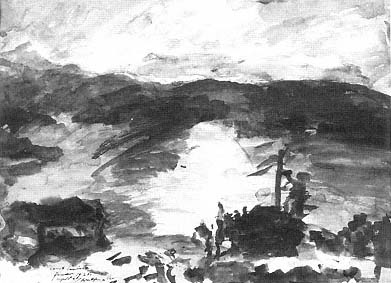
Figure 193
Lovis Corinth, Walchensee , 1925. Watercolor, 50.4 × 67.7 cm.
Staatliche Museen, Berlin (DDR) (27/6129).
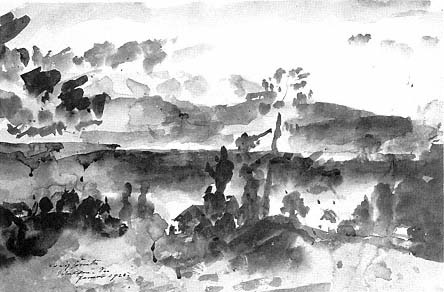
Figure 194
Lovis Corinth, Walchensee , 1925. Watercolor, 32.0 × 48.3 cm.
Private collection, United States.
Photo: Eric Pollitzer, courtesy The Galerie St. Etienne, New York.
emphasizing these works only because he has been depressed of late as perhaps never before in his life:
I could scream. All painting disgusts me. Why shall I keep on working? Everything is trash. This dreadful effort to keep on working is enough to make me sick. I am in my sixty-seventh year and this summer will begin my sixty-eighth. What is there still to come of it? Old age takes hold of me more and more; my physical strength declines. Senility? I always pray that I do not become senile. The fear of it is horrible.[53]
Then, on a more positive note, he begins to speculate on aesthetic matters:
I have discovered something new. True art means seeking to capture the unreal. This is the highest goal! We find "unreality" in Shakespeare's Midsummer Night's Dream , in Hamlet , in all his works. Goethe, too, is a master of it, in Egmont . All art that shows right to the n th degree what everything is supposed to mean is bad. Even Leibl in his detailed works is "unreal"! All . . . realists are bunglers. . . . Only one name glows in the darkness: Rembrandt.[54]
That this "unreality" of which Corinth speaks was not primarily a matter of style is evident from his references to works of literature as well as to the art of Wilhelm Leibl. In his own work he had, at any rate, long ago abandoned conventional verisimilitude. This, for him, could hardly have been a new discovery. "Unreality" was for Corinth rather a matter of conception; it was the inner life of a picture, whatever was susceptive to empathy and interpretation. The evocative language of his late style, tending toward abstraction but never yielding to it, had merely prompted this recognition.
Corinth's productivity resumed at an accelerated rate with the portrait, painted on April 4, of Georg Brandes (Georg Morris Cohen; 1842–1927), the Danish literary historian and early expert on Nietzsche (Fig. 195). Corinth had first met him in October 1900 at the home of Max Liebermann,[55] remembering with relish the animated dialogue between Liebermann and Brandes and, above all, the latter's gift for repartee. He recalled Brandes's personality as "glittering" and "sparkling."[56] The intervening twenty-five years had apparently not diminished his wit and lively intelligence. When a speaking engagement brought him back to Berlin in the spring of 1925, Corinth took advantage of the occasion to paint the scholar in his lodgings at the Hotel Kaiserhof, still at breakfast, dressed in a gold-embroidered robe of black silk.
In the portrait, however, details of costume and physiognomy are of little consequence. All that Corinth sought to capture was the essence of Brandes's lively intelligence. The quivering brushstrokes give credence to the scintillating personality and conjure up an impression of restlessness and tension that is further underscored by the asymmetrical placement of the sitter. Flashes of light to the left of the head are balanced on the right by a shock of white hair. At the same time, the phosphorescent colors suggest decay. The predominantly dark tones are pervaded by strokes of dull green and muted yellow and sparing touches of red and brown, equally subdued. As in the portrait of Bernt Grönvold (see Fig. 181), the sitter seems more like an apparition than a living person.
Only a few days later, on April 13 (it was Easter Monday), Corinth began work on what is generally considered his greatest religious painting, the Ecce Homo (see Plate 38). He wrote in his diary, "I am about to start a large picture. It will be an Ecce Homo. I am going to complete it, for the Easter time has increased my energy. As an artist I feel a profound affinity for the events of the Bible and its feast days."[57] The huge painting—the figures are larger than life-size—was indeed finished in a matter of days. Both form and conception are indebted to the watercolor of 1913 (see Fig. 134), which may have served as the source of inspiration. The heads rise similarly from the left to the right, and Pilate's gesture encourages the viewer's empathic response. The painting is more rigorously structured, however, than the watercolor. Christ's bound wrists and the rod he holds intersect to form a cross in the very center of the canvas, lending stability to the figures emerging from the amorphous ground. The colors reinforce this implied centrality. The bluish white of Pilate's robe darkens in the guard's armor to slate gray, whereas Christ's mantle glows in shades of a dark, rich red.
Following his old practice, Corinth painted the picture with the aid of models. The painter Paul Paeschke took on the role of the guard, the writer Michael Grusemann that of Pontius Pilate; Corinth's former student Leo Michelson was the model for Christ. The costumes, too, were selected in Corinth's typically perfunctory manner. Pilate's robe is nothing more than an ordinary painter's smock; the equally anachronistic suit of armor was apparently always to be found somewhere in the studio; the red of Christ's garment is based on the memory of a similarly colored blanket Corinth had recently encountered on the overnight train from Munich to Berlin. In the final analysis, however, these props do not matter. There is no real distinction of textures, and the brushstrokes have largely divested the ashen faces of their
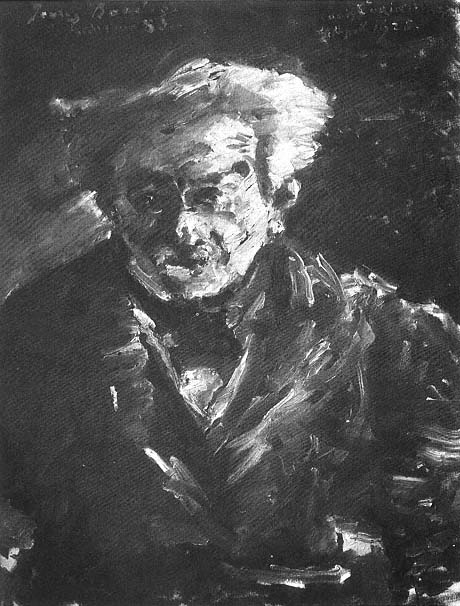
Figure 195
Lovis Corinth, Portrait of Georg Brandes , 1925. Oil on canvas, 90 × 70 cm,
B.-C. 982. Koninklijk Museum voor Schone Kunsten, Antwerp.
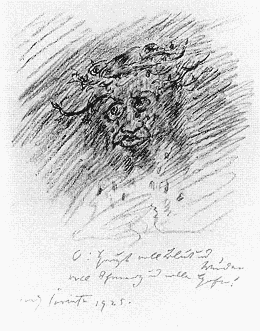
Figure 196
Lovis Corinth, Self-Portrait as the Man of
Sorrows , 1925. Color crayon, 30 × 24 cm.
Private collection.
individualized character. What remains is a poignant evocation of human suffering, not intense and melodramatic, as in The Red Christ (see Plate 32), but resigned and conducive to contemplation.
Corinth repeated the Ecce Homo almost immediately in a drypoint (M. 884). A second drypoint, known in two states (M. 881, 882), depicts the Resurrection. His comments on the latter are of interest, for they indicate how he transmuted the vividly imagined scenario into a work of expressive simplicity. "What fascinated me about this motif," he writes, "is how . . . on this most beautiful spring morning the women come to the sepulcher, bringing spices and annointing oils; how the disciples Peter and John hurry there, filled with curiosity; and especially how John, being quicker than Peter, arrives first at the tomb and looks inside."[58] The print itself shows nothing of the sort. All that can be made out are four, possibly five, indistinct figures, one crouching, in an interior dimly lit by a supernatural light. Apparently a drawing of the head of Christ wearing the crown of thorns (Fig. 196) dates from about the same time. Reproduced on the last page of Corinth's autobiography, this drawing has always been seen as a self-portrait; and there is indeed a resemblance between the bloodstained features of this Jesus and Corinth's own. In the context of the aging artist's repeated outbursts of anxi-
ety and self-pity, the opening lines of Paul Gerhardt's hymn, "O Haupt voll Blut und Wunden voll Schmerz und voller Hohn," written in red crayon across the bottom of the sheet, further underscore the drawing's autobiographical character.
Also autobiographical, but in a different way, is the portrait of Thomas (see Plate 39) in Essen. Painted on May 3, the picture can be understood as a juxtaposition of different generations, a theme Corinth had explored on a number of occasions: in the handsome double portrait of 1919 of Wilhelmine and her grandmother Hedwig Berend (B.-C. V), in an etching of 1924 (M. 847) entitled Old Lovis and Young Thomas , and in a contemporary variation of the print (M. 848). In the Essen portrait the juxtaposition is only implied. Here attention is on the armor that the painter himself had worn so often with pride; it has now been passed on to the son. "I wanted the sword in your hand to gleam like a flash of lightning," Corinth remarked after finishing the picture.[59] Yet twenty-year-old Thomas seems ill at ease in the warrior's role; his posture is awkward and stiff, his gaze full of apprehension. Or could the apprehension be Corinth's own, projected onto the sitter in the knowledge that neither armor nor sword will ultimately protect him against the vicissitudes of life? From a purely technical point of view, the painting is a jewel among Corinth's last paintings, dominated by a harmony of soft grays and pale greens, accented with light blue and brilliant highlights of white. The metallic sheen of the armor dissolves in the frothy texture of the paint. "No spot . . . lacks life," could have been Corinth's own satisfied assessment.
Early in June Corinth also turned his attention once more to the subject of the female nude. In The Fair Imperia (Fig. 197) the proud courtesan of Balzac's Contes drolatiques , flanked by attendants, stands disrobed before the impecunious young suitor who had dared to enter her chamber. Her body glows like a gem amid a myriad of mixed hues—lavender, pink, red, yellow, and white—alluring in its warm, mature sensuality. Yet in the light that falls on her, she also appears transfigured, a remote manifestation of the ideal femininity that had inspired Corinth so often.
About a month earlier, on May 7, Corinth had completed what turned out to be his last self-portrait in oil (see Plate 40). The painting is similar in composition to the self-portrait of April 1, 1924 (Fig. 190), except that instead of the picture on the studio wall, there is now a mirror in which Corinth's face is reflected a second time in profile. The tension of the earlier self-portrait has given way to a quieter expression: the posture is relaxed, the eyes convey profound sadness, the face looks tired but no longer harried. Signaling Corinth's
progressive physical deterioration, the skin has become delicate and thin, giving new prominence to the bone structure. In the reflection in the mirror, however, the face looks not only younger but also more calm. The quiet tonality of the painting, with its pervasive grays and browns, underscores its expressive content.
Sometime between May 5 and May 8 Corinth also wrote the last entry in his diary. The text has all the qualities of a final statement; it is as calm and detached as the last self-portrait. His thoughts are of his early childhood and he dwells at length on the memory of his mother, on her harsh life, and on her death, which he had witnessed at the age of fourteen. With a confession of his deep affection for his father he concludes: "How can I not be satisfied. Unfortunately, my parents never knew. They would have applauded my success. . . . Even the ambition of my mother would have been completely satisfied."[60]
Corinth apparently had a premonition of death when he painted the Ecce Homo . "Perhaps this is going to be my last picture," he told Leo Michelson, his model for the figure of Christ.[61] Yet early in June he was busy making his usual preparations for the summer, ordering and stretching canvases in anticipation of his birthday self-portrait and the landscapes he intended to paint in Urfeld. He even felt enterprising enough to ask Michelson to accompany him to Amsterdam for a fresh look at the paintings of Rembrandt and Frans Hals.
Corinth and Michelson left Berlin on June 16. After stopping briefly in Düsseldorf, they continued by steamer down the Rhine to Holland, taking up residence in the Hotel de l'Europe in Amsterdam. Corinth was eager to explore the city he had last visited more than forty years earlier. His renewed acquaintance with the great masters of the Dutch school seems to have rejuvenated him. In the Rijksmuseum he moved excitedly from picture to picture. He was especially struck by the similarity between Carel Fabritius's Salome and his own painting of the subject. Apparently he had never seen Fabritius's picture, not even in a reproduction. He also found time to make an etching of one of the canals (M. 886) and to record other views of the city in a drawing and three watercolors. But on June 22 Corinth suddenly fell ill with pneumonia. Charlotte and the children were immediately summoned to his bedside. After a few days he rallied enough to persuade Charlotte to go to the museum to look at the paintings of Rembrandt and at Fabritius's Salome . And sometime in early July he was well enough to be transferred to the Grand Hotel in Zandvoort, on the coast near Haarlem, to a quiet room overlooking the dunes, where he could recuperate, perhaps for the rest of the summer. By
July 12, however, he had suffered a severe relapse, and from then on his condition deteriorated irreversibly. He spoke rarely and eventually ceased speaking altogether. He slipped into a coma on July 16 and died peacefully the following afternoon. Four days later—it would have been Corinth's sixty-seventh birthday—a memorial service was held at the Berlin Secession, and his body was cremated. On November 11 the painter's ashes were laid to rest in the forest cemetery at Stahnsdorf, on the outskirts of Berlin.
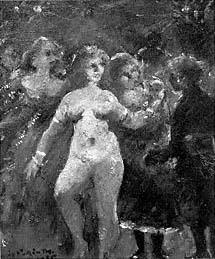
Figure 197
Lovis Corinth, The Fair Imperia , 1925.
Oil on wood, 57 × 48 cm, B.-C. XXIV.
Private collection.