
Metrical Patterns and Melodic Contours
Although Nautanki music resembles other South Asian theatrical music in general ways, it also possesses a distinctive blueprint: a configuration in sound that immediately labels this genre Nautanki, even when compared to neighboring theatres such as Haryanvi Sang or Rajasthani Khyal. This blueprint is the music used for the ten-line stanza known as doha-chaubola-daur , the basic building block of Nautanki composition. It is significant that this identifying unit issues from the narrative level of the text, not the lyric. Nautanki performance freely borrows lyric genres from various sources and incorporates them according to current fashion and the taste of the actors and audience. In older texts we find Hindi folk songs and semiclassical genres such as dadra, savan, holi, thumri , and mand , as well as the Urdu sher, ghazal, qavvali, masnavi , and so forth. Nowadays Bombay film tunes (filmi git or gane ) or film-influenced versions of the above genres tend to predominate. Popular songs are not exclusive to Nautanki; they turn up in many performance contexts classified as "folk." Film-based musical quotations may lend a performance verve and status, but they do not distinguish Nautanki as the old meters doha and chaubola do.
Doha is a reputable Hindi meter with a long history. The doha-chaubola of Svang and Nautanki may be an outgrowth of the established
EXAMPLE 2. METRICAL STRUCTURE OF THE HINDI doha | ||||
(13) | (11) | |||
 |  | |||
(13) | (11) | |||
 |  | |||
(Sultana daku, , Odeon EP recorded disk) | ||||
Scansion code: The symbol | ||||

doha-chaupai pattern of medieval Hindi narrative verse. In any case, nineteenth-century Sangit texts reveal that the doha-chaubola alone dominates Svang composition from about 1850 to 1890. Beginning in the 1890s the six lines of doha-chaubola commonly add on an asymmetrical quatrain called daur to form a ten-line unit; in the Hathras texts this becomes the standard.[13]Doha, chaubola , and daur are scanned according to rules of Hindi prosody, by which every syllable bears either a short (laghu ) or long (guru ) weight or measure, indicated by the symbols


In parallel fashion, the meter chaubola consists of four lines of 28 measures each, ordinarily divided 14 + 14 and rhyming b b b b . The final two syllables of each line are generally weighted - -, and the rhyme occurs on the penultimate syllable (a "feminine" rhyme). The doha and chaubola are often interlinked, the final half-line of the doha being repeated at the beginning of the chaubola . The linkage of doha to chaubola is also one of sense; the chaubola often repeats and expands on the content of the doha . Characteristically following the chaubola is a daur , a Hindi meter of four lines, 13 + 13 + 13 + 28 measures, rhyming c c d d , again on two syllables. Doha-chaubola-daur forms the speech of one character or a descriptive passage by the narrator (kavi ). The daur often
EXAMPLE 3. STRUCTURE OF doha-chaubola-daur | |
Doha : two lines of 24 measures, 13 + 11 each; rhymes a a | |
Chaubola : four lines usually of 28 measures, 14 + 14 each, rhymes b b b b ; interlinks with doha , beginning with repetition of final half-line of doha | |
Daur : four lines, 13 + 13 + 13 +28 measures, rhymes c c d d | |
doha | Elizabeth dvitiya [the second] empress, good gracious strong, |
chaubola | May you live long long, rule beneficent continue, |
daur | Your gracious Majesty, |
Amar simh rathor (Hathras: Shyam Press, 1981). The mangalacharanappears in the text in Devanagari, with the English sounds rendered by their nearest Hindi equivalents. Instead of transliterating it, I restore the words to their standard English spellings without altering the grammar of the passage. | |
moves the action forward by forming an address to another character. Formally it provides for closure by returning to a final line of 28 measures, the same as the chaubola .
Examples 3 and 4 illustrate these meters. The first is an homage (mangalacharan ) to Queen Elizabeth in the English language; the excerpt is from an actual Nautanki text printed in Devanagari script. The overall structure of the ten-line stanza is readily visible here, freed from the technical details of Hindi scansion. Additionally, this passage shows how quickly Nautanki performers adapted to changing patterns of patronage. The choice of English when seeking blessings from the British parallels the use of Sanskrit in invocations addressed to the Hindu deity Narayana, or Perso-Arabic for those uttered to the Islamic god Khuda[*] .. One should, after all, address the gods in their own language. Example 4 is from the All-India Radio version of the Nautanki Rani lakshmibai . In this telling of the story of the famous warrior queen, the dacoits are at first the villains, from whom the people require the Rani of Jhansi's protection. Later Sagar Singh, a dacoit leader, becomes an ally of the Rani in her fight against the British.
Whereas the doha-chaubola-daur carries the weight of narration in
EXAMPLE 4. METRICAL STRUCTURE OF doha-chaubola-daur | |||
doha | (13) | (11) | |
 |  | ||
(13) | (11) | ||
 |  | ||
chaubola | (14) | (14) | |
 |  | ||
(14) | (14) | ||
 |  | ||
(14) | (14) | ||
 |  | ||
(14) | (14) | ||
 |  | ||
daur | (13) | ||
 | |||
(13) | |||
 | |||
(13) | |||
 | |||
 | |||
Khuda Bakhsh became injured, and all the dacoits fled . | |||
The news of this immediately reached the kingdom of Jhansi . | |||
[The news of this] immediately [reached] the kingdom of Jhansi, and the queen summoned her army . | |||
When she heard the message, she didn't delay an instant . | |||
She brought her female companion, who rode with her at the head of the army . | |||
In Barua Sagar, there was an uproar as the queen arrived from Jhansi . | |||
The enthusiasm and delight [of the people] were unprecedented. The queen loved everyone . | |||
She met with the public and heard from Khuda Bakhsh the story of Sagar Singh . | |||
(Rani lakshmibai , AIR-Mathura recording) | |||
Nautanki, a shorter stanza useful for dialogue, known as bahr-e-tavil , was introduced around 1910. This meter is based on Urdu prosody rather than Hindi, indicating the mixed linguistic heritage of this region and the presence of both Hindi and Urdu prototypes in the oral stratum
EXAMPLE 5. METRICAL STRUCTURE OF bahr-e-tavil |
Bahr-e-tavil : two rhyming lines of 24 stresses (not matras ) each, according to rules of Urdu scansion, that commonly occur in feet of long-short-long |
 |
Flexibility exists in determining the short and long stress of syllables, especially for grammatical endings signifying gender and case; ambiguous syllables carry the symbol  |
 |
I request this of you, oh moonfaced one: having given your heart, do not withdraw it . |
Never be unfaithful, no matter what, and if you will love, fulfill your promise . |
(Laila majnun [Hathras: Shyam Press, 1981]) |
from which Nautanki arose. It can be described as two rhyming lines of 24 stresses each (according to rules of Urdu scansion), or four lines of 12 stresses each, arranged generally in feet of long-short-long.[15] The two long lines may be divided between two speakers to create a brisker pace of dialogue. Illustrating bahr-e-tavil is example 5.
Other common meters include bir chhand , also known as alha chhand , because of its use in the Hindi oral epic, the Alha. Bir chhand , as used in Nautanki, consists of two rhyming lines of 16+15 measures each (ex. 6). Bir chhand is employed primarily for narration, as are several varieties of lavani such as lavani langari, lavani chhoti,lavani bari , and others. Additional forms favored for dialogue are shair (or sher), qavvali , and even ghazal , which are essentially couplets or quatrains in various common Urdu meters. As occurring in Nautanki, these terms appear to be somewhat interchangeable and may denote melodic rather than metrical units.
The foregoing description of the metrical patterning of the Nautanki text is essential to an understanding of the musical dimension of performance, because music closely follows meter in this tradition. This is true in two primary senses. First of all, the meter of a passage reliably predicts the tune or type of tune to which it will be sung, within the con-
EXAMPLE 6. METRICAL STRUCTURE OF bir chhand |
Bir chhand (or alha chhand ): a Hindi meter of two rhyming lines of 16 + 15 measures each |
 |
He allowed no one to live who might commit a wrongdoing . |
Consider the defiance of such a tyrant! He avoided no man . |
(Sultana daku [Hathras: Shyam Press, 1977]) |
ventional framework of the genre and the particular school or style of performance. Notably, the melodic rendering of the two most prevalent meter clusters, doha-chaubola-daur and bahr-e-tavil , is consistent in essentials over a wide range of performance examples collected. (Important differences between the Hathras, Kanpur, and more recent styles do emerge. The discussion here focuses on the Hathras singing style, and the next section treats developments in Kanpur and elsewhere.) Their divergent melodies place these two meter groups in sharp contrast. Doha, chaubola , and daur almost always feature a tune based on the major scale, whereas the melody of bahr-e-tavil uses a mode laden with minor tones, similar to the Bhairavi of Hindustani music. Because of this modal contrast, the audience perceives the shift from a narrative portion of the text (characteristically introduced by a doha ) to a dialogue passage (typically composed in bahr-e-tavil ). Furthermore, the contrast gives the performance a sufficient degree of melodic diversity. Both meter types are sung in the antiphonal manner, alternating between vocal and instrumental lines.
Second, music follows meter in the specific way in which the standard tune matches the words. The doha-chaubola-daur and Hindi meters in general are sung in a recitative style corresponding to the weight of syllables, with long syllables receiving roughly twice the duration of short syllables. The rhythmic details of musical execution therefore vary from one line to another, insofar as the arrangement of long and short syllables varies. The meter also prescribes particular resting points where musical elaboration may occur. Syllables at the ends of lines or before
caesuras are often elongated. Beyond the demands of the meter, moreover, Nautanki singing favors an element of interpretive rubato that allows for individual expression. A passage may be slowed down for emphasis or speeded up to usher in the percussion response, usually set at a slightly faster tempo. In the examples with musical notation included here, I generally transcribe the time value of notes in accordance with their metrical weight, although the values attached to notes in ornamental passages are usually arbitrary. For ease of reading and comparison of modes, I transpose all melodies to a tonic of middle C. Similarly, I use the treble clef throughout, although the majority of examples are of male singers whose voices are pitched somewhat lower.
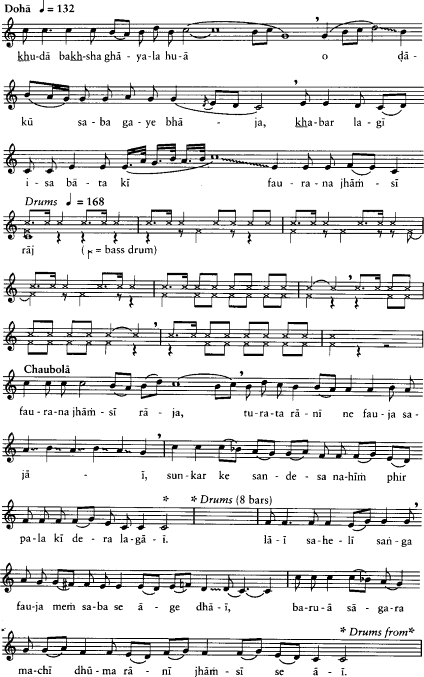
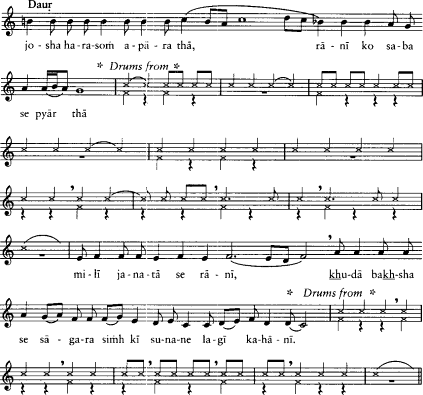
In example 7, the recitatives of the doha-chaubola-daur from Rani lakshmibai (the metrical structure of which is in ex. 4) are transcribed to illustrate the melodies most frequently associated with these meters. This performance was produced for All-India Radio and was broadcast from its Mathura station in 1981. The singers and musicians come from the Braj area in western Uttar Pradesh and belong to the surviving performance traditions associated with the Hathras style.[16]
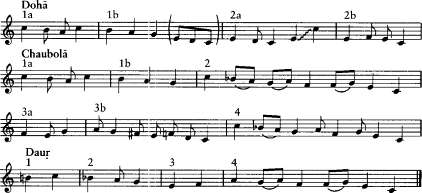
The doha begins in characteristic fashion on the high tonic, and after dwelling there for the first half-line, focuses on the fifth and then, in anticipation, moves down to the lower tonic at the end of the first line. In the second line the tune rises again to the high tonic at the caesura and returns to the lower at its completion. A drum interlude of eight bars follows, commencing at the utterance of the final syllable of the doha . (Details of the drumming patterns will be discussed below.) The chaubola is similarly structured in two-line pairs. The first line of the chaubola echoes the opening of the doha , beginning again on the high tonic. The second line carries the melody down from the high tonic to the lower in almost a purely stepwise descent, introducing a flatted seventh. After an eight-bar drum solo (not notated), the third line dwells on the fourth of the octave and moves down to the tonic after touching the fifth. The fourth line is a repeat of the second, essentially a descending scale with flatted seventh. The chaubola concludes with a single drum beat, perhaps an indication of a solo that was edited out. The daur in its own fashion imitates the chaubola ; the first line focuses on the high tonic and its leading tone, the major seventh, and the second line introduces the flatted seventh. The third line emphasizes the fourth tone of the scale, and the last line utilizes the descent pattern and melodic turns of the fourth line of the chaubola , ending again on the lower tonic.
A schematic notation of the melodic range and contour of these lines is given at the end of example 7. Similar contours occur in a variety of
EXAMPLE 7. Doha-chaubola-daur |
 |
(Continued on next page)
EXAMPLE 7. (continued ) |
 |
Melodic contours |
 |
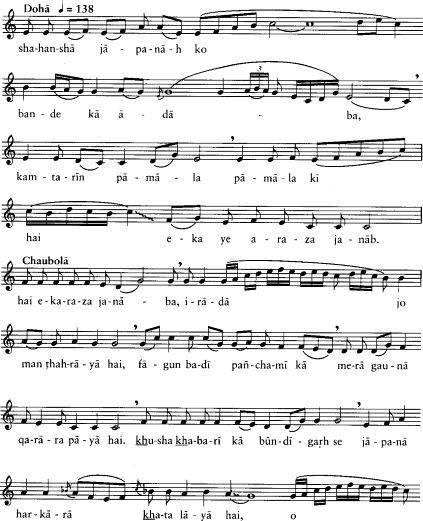
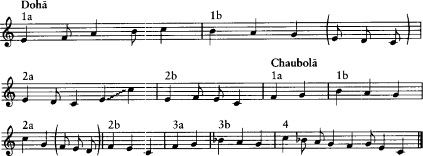
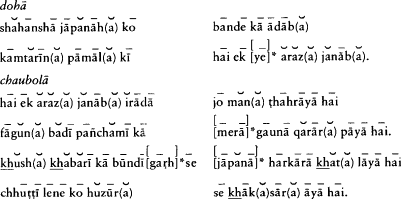
performances, and even when the singing line is highly ornamented, the same melodic orientation and tonal focus can be observed. Example 8 contains a transcription of the voice of Chunnilal, a master singer of the Braj area, singing from Amar simh rathor during an All-India Radio interview; it includes the transcribed, scanned, and translated text. Chunnilal's doha illustrates a common variant, beginning on the middle
EXAMPLE 8. Doha-chaubola |
 |
(Continued on next page)
EXAMPLE 8. (continued ) |
 |
Melodic Contours |
 |
 |
Greetings to the emperor, protector of the world, from your humble servant . |
Your downtrodden slave has one request . |
This one request, my lord, a desire that has lodged in my heart : |
On the fifth day of the dark half of the month of Phagun, my wedding-consummation bas been fixed . |
A messenger brought the good news in a letter from Bundi . |
This miserable slave has come to take leave of his master . |
(Amar simh rathor [Hathras: Shyam Press, 1979]) |
Indicates word supplied by singer, not in printed text
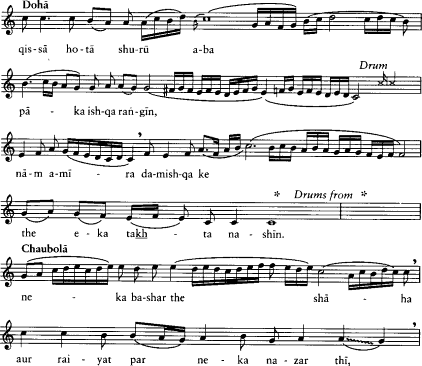
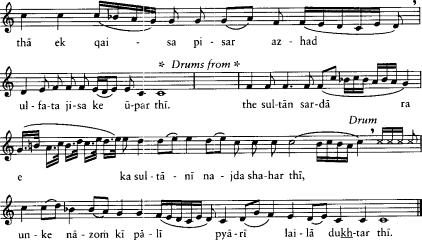
third and working up to the high tonic in the first half-line, but otherwise conforming to the earlier pattern. In the chaubola , both two-line phrases begin on the fourth tone, work to the higher tonic, and then close with a descent to the lower tonic. Example 9 contains a doha and chaubola sung by Giriraj Prasad, another famous Hathrasi singer, in a performance of Laila majnun recorded in the studio of the Sangeet Natak Akademi, Delhi, and its text. Although the excerpt is highly embellished, it too conforms to essentially the same pattern in the doha . In the chaubola , the singer exhibits his virtuosity in the first line by extending the range up to the fourth of the higher octave and dwelling on the high third tone, a phrase he repeats in the third line as well. Otherwise, the tonal emphasis and contour of these phrases corresponds to the earlier model.
EXAMPLE 9. Doha-chaubola |
 |
(Continued on next page)
EXAMPLE 9. (continued ) |
 |
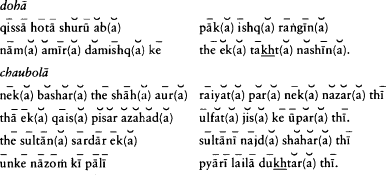 |
Here begins the story of a delightful pure love . |
Once there was a king called Amir of Damascus . |
This king was full of virtue, and he ruled his people well . |
He bad a son, Qais, who was very much in love . |
There was also a chief and his queen in the town of Najd , |
And their beloved daughter, raised in the lap of luxury, was Laila . |
(Laila majnun [Hathras: Shyam Press, 1981]) |
Within the rather fixed bounds of the doha and chaubola , opportunities occur for a substantial amount of stylistic and expressive play. Certain places in the lines provide openings, positions for sustaining a syllable with melismatic ornamentation. These openings typically occur
just before the caesuras in both lines and at the end of the first line. The end of the second line (the final word of the couplet in the case of the doha , or the last two or three syllables in the chaubola ) is never used for melodic play. Its rhyme is anticipated by the first line, and it is therefore a point of closure. Furthermore, this rhyme point coincides with the entrance of the percussion; in practice, the singer often deletes the rhyme word, a maneuver performed with an upward flourish of the hand, indicating that it is up to the audience to supply the missing (but easily guessed) syllable(s) (fig. 22).
In these improvisatory passages, the type of vocal ornamentation varies from singer to singer, but in the main it incorporates embellishments such as short tans (rapidly ascending and descending scalar patterns), murkis (mordents, turns), mind (glissando), and expressive breaks or inflections in the voice. The full repertoire of techniques known to Hindustani classical singing is not found here, nor is there the expansive freedom to improvise because of the exigencies of the text. Nonetheless, in comparison with certain popular ghazal or film songsters of today, the best Nautanki artists are accomplished vocalists with their own considerable powers of expression. Without the benefit of training, they achieve a range of vocal modulation that is stirring and forceful, keeping the listener attuned to their words and endowing the performance with an aesthetic dimension.
In addition to the most frequent doha-chaubola melodies illustrated thus far, several other common types may occur. What is remarkable is that there should in fact be so few melodies available, and that these doha variants should be so similar to one other. A degree of divergence from the most common tune certainly exists, yet any of these doha melodies would still be clearly identifiable as "doha ," especially in contrast to the tunes employed for other meters in the performance.
For the most part, chaubola tunes follow the dohas to which they are attached. Therefore in example 10 1 simply indicate the several varieties of doha melodies alone. Here, for purposes of comparison, the doha melody is rhythmically reduced to common time and each doha fills the space of eight bars. (Actual renditions would dwell on these tones in the recitative style described earlier and employ ornaments.) I label the two types discussed above A and B. In C, the second half of the doha melody is identical to the second and fourth lines of the chaubola illustrated at the end of example 7. The same is true in D, although the first half is unique in beginning on the seventh tone and then dwelling on the high tonic. The melody E is identical to A but rests on the seventh rather than the fifth at the end of the first line, and in its descent in the
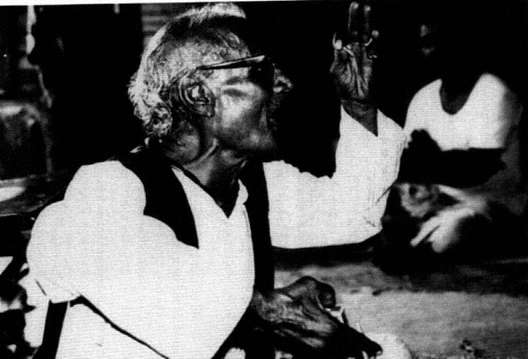
Fig. 22.
Phakkar, former Nautanki actor of Lucknow, gesturing at the end of a vocal line. Photographed
in Lucknow in 1982.
EXAMPLE 10. TYPES OF doha MELODIES |
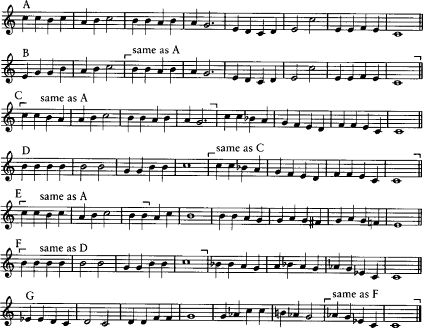 |
second line reaches only the third tone of the scale. Of particular interest are melodies F and G, both of which employ minor modes and seem to occur in narrative passages describing sad events. Though F opens in the same fashion as D, it touches several flatted notes in the descent, notably the sixth and third in addition to the seventh. Melody G rises from the lower tonic to the fifth using a set of flatted tones comparable to Rag Asavari, although in the second half it may use both the flatted and natural seventh. These two "mournful" dohas are rare but significant for the contrast they create with the dominant "happy" sound of the major-scale doha melodies.
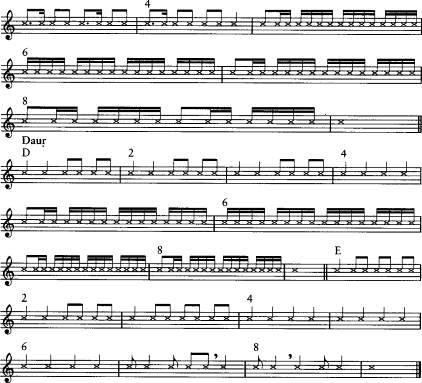
Drumming patterns in the doha-chaubola-daur section help to mark the completion of poetic sentences, giving the singers breathing space and keeping the performance moving vigorously ahead. In general, the percussion patterns follow an implicit eight- or sixteen-beat cycle, which usually breaks into two parts: the first part displays a characteristic motif or pattern, sometimes with variations, and the second part contains a rhythmic cadence.
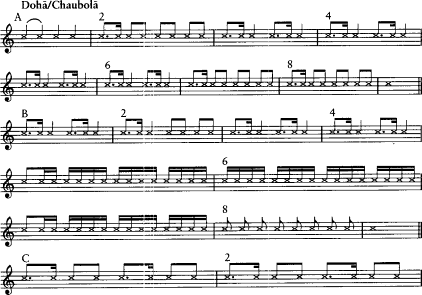
In example 7 the drumming following the doha features a dotted rhythm for the first four bars; this motif reappears in the tihai , a cadence consisting of a six-beat pattern repeated three times, in such a way that the last stroke coincides with the sam or first beat of the next rhythm cycle. The drumming during the daur is different from the drumming during the doha and chaubola . In this example, the first daur drum solo (after the second line of the daur ) lasts eight bars and ends in a tihai The second solo, after the fourth line, contains a cross rhythm, grouping several accented three-beat phrases within four four-beat bars. Example 11 gives additional drumming patterns. Those that are played with doha and chaubola (A, B, C) all feature the dotted rhythmic motif; the daur patterns (D, E) lack it but emphasize longer beat-length strokes with subsequent doubling and quadrupling of speed. The cadences here are often not true tihais but "crown" patterns, where a motif is played in progressively shorter phrases, leading to an anticipation of closure. Thus in pattern C, the phrase

EXAMPLE 11. DRUMMING PATTERNS |
 |
(Continued on next page)
EXAMPLE 11. (continued ) |
 |
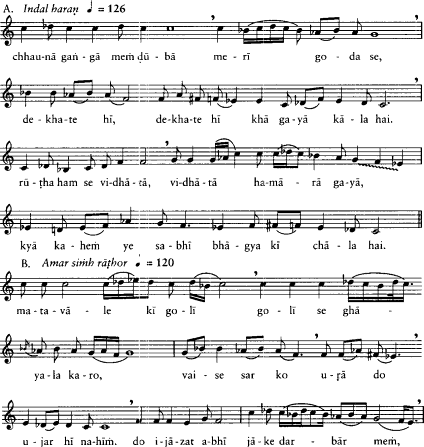
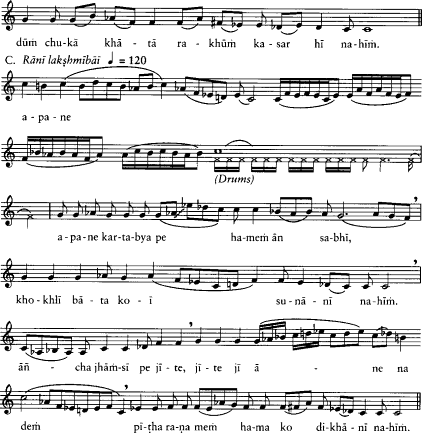
The melody of bahr-e-tavil is distinctive, contrasting sharply with the doha by virtue of its heavily flatted scale. Its supple sweep and dignity must be heard to be appreciated. Here musicality is not a simple matter of scale or pitch; it is often linked to declarations of powerful emotion. In example 12 I illustrate three standard bahr-e-tavil renditions in the Hathras style, along with their texts. Each passage is emotionally charged—the first with karuna ras , the pathetic or tragic sentiment, the second two with vir ras , or valor. In consequence, the singer in each case infuses the line with a high degree of musical expression. The techniques used for this purpose include repeating dramatic phrases, throwing or pushing the voice emphatically, breaking the voice with sighs or simulated tears, or accenting through exaggerated pronunciation. These passages suggest the heights to which Nautanki music can soar.
Unlike the doha with its several variants, the bahr-e-tavil is sung to essentially one tune, with most of the variability occurring during the first phrase. Despite its very different modality, this tune shares the contours of the doha , beginning on the high tonic, moving to the lower tonic at the end of the second phrase, then rising to the fourth tone and again to the high tonic in the third, and A? to the lower tonic at the conclusion. To some extent the recitative style of the doha is also imitated, but the regular pattern of the Urdu meter, based on feet of


EXAMPLE 12. Bahr-e-tavil |
 |
EXAMPLE 12. (continued ) | |
 | |
A. Indal haran (AIR-Mathura) | |
chhauna ganga mem duba meri god se, | |
dekhte hi dekhte kha gaya kal hai. | |
ruth ham se vidhata hamara gaya, | |
kya kahem ye sabhi bhagya ki chal hai. | |
The lad fell from my lap and drowned in the Ganges . | |
Even as I watched, Death [Time] swallowed him up . | |
The Creator is angry with me . | |
What can one say? This is all the course of fate . | |
B. Amar simh rathor (film Yamuna Kinare ) | |
matvale ki goli se ghayal karo, | |
vaise sar ko ura do ujar hi nahim. | |
do ijazat abhi jake darbar mem, | |
dum chuka khata rakhum kasar hi nahim. | |
EXAMPLE 12. (continued ) | |
Shoot the madman and injure him , | |
And if you blow off his head, no matter . | |
Now please give me permission to leave , | |
I'll go to the court and settle the account completely . | |
C. Rani lakshmibai (AIR-Mathura) | |
apne kartabya pe hamem an sabhi, | |
khokhli bat koi sunani nahim. | |
anch jhamsi pe jjte ji anena dem, | |
pith ran mem ham ko dikhani nahim. | |
We all pride ourselves on our sense of duty . | |
No one needs to utter a hollow remark . | |
To the end of our lives, we will defend Jhansi . | |
We are not ones to show our backs in battle . | |
Schematic Notation | |
w 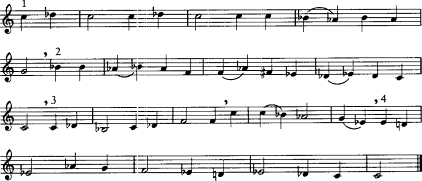 | |
A number of other readily recognizable melodies populate the performances studied, but rather than prepare an exhaustive index I summarize the remaining narrative and dialogue meters by referring to two further examples. Most of these stanzas are structured by their rhyme schemes into either a rondo pattern (a a b a c a , etc.) or rhyming pairs (a a b b c c , etc.). As one might by now predict, the two-line meters are sung to two alternating melodies, distinguished primarily by register. In the meter type rhyming a a b a , a contrast between high and low melodies is created, and a melodic structure similar to the sthayi-antara pattern is used, where sthayi is the melody in the lower register and antara
that in the upper. The alternation is generated by repeating the first line twice; the first time it is sung to the sthayi (A) and the second time to the antara (B). Then line two is sung to the A melody, line three to B, line four to A and so on. This in effect reproduces the high-low contrast found in the previous examples. For an application, see example 13, an unidentified meter of 28 matras (possibly a lavani or qavvali ) sung frequently in the recording of Rani lakshmibai .
In the a a b b instance, each pair would again be rendered melodically by a contrasting set of tunes. The melodic structure for this type
EXAMPLE 13. Sthayi-antara STRUCTURE | |
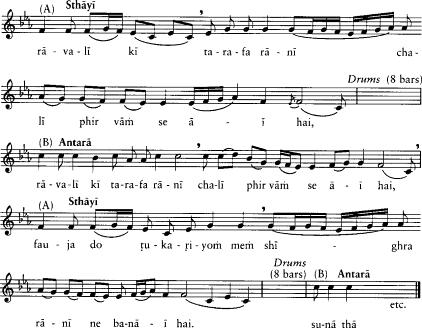 | |
ravali ki taraf rani chali phir vam se ai hai, [repeated ] | |
fauj do tukriyom mem shighra rani ne banai hai. | |
suna tha pas jangal mem paharom mem hai kuchh daku, | |
na kini der rani ne turant sena sajai hai. | |
achanak jo hua hamla to daku bhag kar nikale, | |
chala larne ko sagar to pari rani lakhai hai. | |
EXAMPLE 13. (continued ) |
The queen went toward Ravali and then returned from there . |
She quickly divided her army into two platoons . |
She bad heard that there were some outlaws living in the mountains and in the wilds . |
She made no delay; the queen quickly assembled her army . |
When they were suddenly ambushed, the outlaws ran off and escaped . |
Sagar Singh went to fight, and the queen found him out . |
(Rani lakshmibai ) |
Rhyme scheme:a (a) a b a c a |
Melody scheme: A B A B A B A |
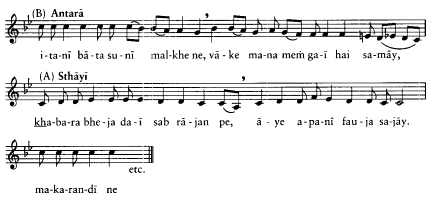
of meter in Nautanki would be B A B A, where B represents a high-pitched melody, and A is in the lower register and ends on the tonic. Example 14 bears out these suppositions with a skeleton of the melody used for bir chhand in Nautanki. This narrative meter tends to be used for long passages, similar to its use in epic recitation. In the Alha singing style, however, the lower melody predominates, and the higher is used only occasionally for contrast; the melodic: structure might be something like AA AA AA BA AA AA, and so forth. The melodies, we note, are essentially the same in the epic and Nautanki renditions, but the meter in Nautanki is sung in the higher register 50 percent of the time: BA BA BA BA. This indicates a process of adaptation, wherein a sung meter molds itself to the features of its musical environment. The direc-
EXAMPLE 14. Bir chhand |
 |
EXAMPLE 14. (continued ) |
itni bat suni malkhe ne, vake man mem gai hai samay, |
kh abar bhej dai sab rajan pe, aye apni fauj sajay. |
makarandi ne mal lut ko rasad sahit dini pahumchay, |
udal ko ghora rakh lino jako bendil nam kahay. |
When Malkhan heard this, he understood [what was needed ]. |
He sent word to all the kings to come with their armies . |
Makarandi distributed the provisions and foodstuffs . |
They procured Udal's horse who was called Bendil . |
(Indal haran ) |
Rhyme scheme:a a a a |
Melody scheme: B A B A |
tion of adaptation, however, is not proven. The tune might have originated with epic recitation, and been embellished by emphasis on the antara when it entered Nautanki; or it could have been simplified in passing from the more musically intricate theatrical tradition to the recitational genre.
Further consideration of the origins of the many melodies and meters that make up the Nautanki performance is beyond the scope of this research. Nonetheless, it is important to reiterate the degree of overlap that exists: many of these meters are found in other North Indian performance traditions and general characteristics may be present throughout South Asia. Musical treatment of the important narrative and dialogue meters so far seems unique to Nautanki; however, definitive comparisons cannot precede research into other theatre music.