
Muslim Sovereigns at the Fairs
The 1867 Universal Exhibition in Paris was marked by important visits from two Muslim sovereigns: Governor Isma'il Pasha of Egypt and, some weeks later, Sultan Abdülaziz of the Ottoman Empire, the first in his dynasty to leave the empire for a purpose other than war (Figs. 14–15). These visits were major events, chronicled in minute detail. Parisians were intensely curious about Isma'il Pasha and Abdülaziz, both of whom traveled with their entourages and were honored guests of Napoleon III. As one newspaper noted at the time, a few days after the sultan's arrival "the Parisian population [was] divided into two very distinct classes: those who had seen the sultan and those who had not."[46] A ceremony at the Palais d'Industrie, where the sultan sat next to Emperor Napoleon III and Empress Eugénie, attracted between "twenty and thirty thousand people."[47]
Isma'il Pasha and Abdülaziz became the highlights of the exhibition. In Abdülaziz's honor, a splendid décor was put up in the Palais d'Industrie. A white drapery studded with golden stars lined the semicircular glass roof, crimson velvet draperies trimmed with gold lace hung from the galleries, and the imperial throne with its towering golden canopy dominated the room. Here, as if on a magnificent stage, the French emperor and empress sat with the sultan while an orchestra of twelve hundred musicians played.[48] The three rulers were as much on display as the different products exhibited on an elevated platform before the throne.
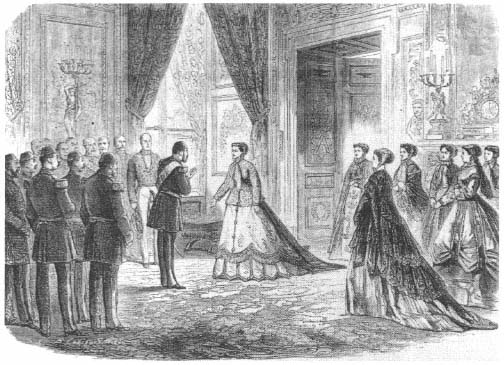
Figure 14.
Reception of Isma'il Pasha by Empress Eugénie at the Tuileries, Paris, 1867 ( L'Illustration, 29
June 1867).
One journalist interpreted the warm welcome Paris gave Abdülaziz as the result of curiosity rather than sympathie .[49] Another, criticizing the widespread perception of the sultan as a dazzling monarch from The Thousand and One Nights, surrounded by odalisques, drunk with perfumes, and adorned with precious stones and gold, argued that the sultan was instead a generous, good man, extremely intelligent and well educated, who valued work, order, and justice above all and who respected the rights of Christians in his empire. "This is the man," he concluded, "without doubt, not as marvelous as we believed, but wiser and more human."[50] Isma'il Pasha was presented as similarly tolerant because all citizens of Egypt, regardless of belief, could be elected to the Egyptian parliament.[51]
In Innocents Abroad, however, Mark Twain depicted Abdülaziz as a "weak, stupid, ignorant [man] who believe[d] in gnomes and genii and the wild fables of the Arabian Nights."[52] Describing the public appearance of Napoleon III
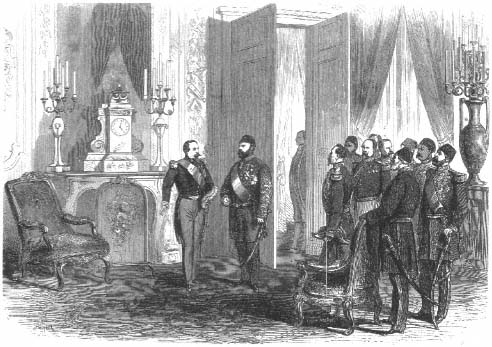
Figure 15.
Sultan Abdülaziz's visit to Napoleon III in the Elysée Palace, Paris, 1867 ( L'Illustration,
13 July 1867).
and Abdülaziz on the Place de l'Etoile, Twain argued that the two men represented opposite worlds:
Napoleon III, the representative of the highest modern civilization, progress, and refinement; Abdul-Aziz, the representative of a people by nature and training filthy, brutish, ignorant, unprogressive, superstitious—and a government whose Three Graces are Tyranny, Rapacity, Blood. Here in brilliant Paris, under the majestic Arch of Triumph, the First Century greets the Nineteenth![53]
The populace were disappointed by the outlook, disposition, and conduct of the Muslim rulers, who, except for the red fez, dressed in European-style clothes. They were socially graceful,[54] and Isma'il Pasha, who had been educated at the Ecole Polytechnique in Paris, even spoke excellent French—"le français le plus pur, sans le moindre accent."[55] They demonstrated their fine
taste by their interests. Abdülaziz, for example, stopped in front of "les plus beaux meubles" and "les bronzes les plus artistiques" in the furniture section of the exhibition before going on to visit the fine arts gallery.[56]
What were the governor's and the sultan's goals in visiting the exposition? According to one French journalist, Abdülaziz intended to tell the world that despite the reputation of his empire as the "sick man of Europe," he played a crucial role as the leader of the Muslims because the people of Asia and Africa still followed the teachings of the Qur'an.[57] As caliph, he was the omnipotent Muslim ruler. Yet Abdülaziz also pursued a Western model of "progress" and wanted to be recognized for his institutional reforms. Similarly, Isma'il Pasha's goal was to demonstrate his alliance with Europe by announcing the modernizing transformations in his own country.
Both Abdülaziz and Isma'il Pasha were intent on reshaping their cities according to European models—a goal reflected most dramatically in the physical transformation of Istanbul and Cairo. In Istanbul, following a fire that destroyed a huge section of the city in 1865, a campaign was launched to replace the irregular urban fabric—crooked streets and dead ends—with straight, regular streets and grid patterns. Modern services such as street lighting and cleaning were introduced at the same time.[58] The new plans were believed to match those of "the most recently designed places in the world,"[59] the reference being to the rebuilding of Paris under Napoleon III and his prefect, Baron Haussmann.
The changes in Istanbul were incremental and eclectic, determined mostly by fires and the rebuilding that followed them. In contrast, city building in Cairo was comprehensive.[60] A new quarter of Cairo, named Ismailiyya after the governor, extended the city to the west with a design that superposed a pattern of radial streets on a grid. Long avenues ended in squares or ronds-points; monuments and public buildings defined the ends of vistas.[61] The model was once again Haussmann's work in Paris. Indeed, French architects, landscape architects, and gardeners were commissioned to beautify Cairo.[62] Nubar Pasha, president of the conseil des ministres and head of the Egyptian Commission to the 1867 exposition, later criticized Isma'il's obsession with the "toilette du Caire" and accused him of misunderstanding the meaning of "progress" by equating it with imitating in Cairo what had been done in Paris—"des boulevards, des jardins, des embellissements de toute nature" (boulevards, gardens,
beautification of all kinds).[63] Because Isma'il Pasha needed to borrow money from European powers to carry out his plans, his purpose in visiting Paris in 1867 went beyond the strengthening of cultural ties between the two countries. In 1868 France loaned Egypt (through the Société Générale) 296 million francs to be paid in thirty years with interest.[64]
The visits of Muslim sovereigns to the 1867 Paris Universal Exposition were significant for several reasons. Both Isma'il Pasha and Sultan Abdülaziz used the opportunity to convince European powers of their commitment to modernization and hence their desire to become part of the European system. Their presence made a difference vis-à-vis the public, shattering romantic beliefs and demystifying certain stereotypes. Moreover, their firsthand look at European life and the externalized forms of European culture helped to consolidate their belief in the radical policies adopted at home. This effect was especially important for Abdülaziz, who was making his first trip to Europe. For Isma'il Pasha, who had lived in France, the expedition was an occasion to catch up with the social and physical transformation of Paris.
Iranian shahs were the next visitors to international fairs. Westerners did not express as keen an interest in Iran as in the Ottoman Empire and Egypt, however, most likely because of Iran's lesser effect on European history. Contacts between Europe and Iran were not significant for Iran either, and European ideas of reform penetrated the country only much later. Not until the 1870s did Shah Nasir ad-Din, stimulated by the technological achievements of the West, begin his modernizing reforms, which were initiated by the diplomatic corps.[65] In fact, when Napoleon III invited Shah Nasir ad-Din to Paris in 1867, it was the Iranian ambassador to Istanbul, Mushir ad-Dawla, who urged the shah to accept the invitation, arguing that the trip would "give new life to the state and nation of Iran and leave the Shah's great name in the history books." But at that point, Nasir ad-Din was not interested in European contacts, and even the example of Sultan Abdülaziz would not convince him. Instead, two years later, he took a trip to holy places.[66] The diplomats ultimately persuaded him to travel extensively in Europe. On his first trip in 1873 he stopped in Moscow and London to establish closer political ties with Russia and England and in Vienna to see the universal exhibition.[67] He visited Europe again in 1878 and 1889 during the Paris expositions. Shah Muzaffar ad-Din traveled to Paris to see the 1900 exposition.
By the turn of the century the novelty of exotic visitors to the expositions had worn off, and Europeans had become accustomed to distant, unfamiliar lands coming to them, complete with their rulers. In tired tones, later accounts repeated the old themes. For example, during Muzaffar ad-Din's visit, the popular press reported on his human qualities, his kindness, his love of children, and especially his simplicity; journalists also described his clothes at length. One gave a full account of his traveling wardrobe, which consisted of costumes for official visits, receptions, and "promenades" and a special cloak. All the glamour of the "Oriental" ruler had dwindled to this cloak, said to be adorned with "about one hundred million precious gems."[68]