
Chapter Four—
Law, Morality, and Justice
On Sunday, 15 November 1914, following the Constitutionalist victory, a lone horseman rode into the El Aguila camp at Potrero del Llano. He identified himself as Maj. Luis A. Ruiz and demanded thirty thousand pesos in the name of Gen. Manuel Peláez. The manager refused. Major Ruiz returned the next day with fifty armed men and instructions from General Peláez to collect the thirty thousand pesos or take it by force. The manager, T.H. Vaughan, explained that the money he had on hand was for the payroll of one thousand men who would riot if they did not receive their wages. After some negotiations, Ruiz agreed to take fifteen thousand pesos, leaving the manager enough for the next payroll. The major made out a receipt. As they left, the partisans of Manuel Peláez also took seven horses and saddles. The rebels displayed a certain commitment to equity in their new movement. The men of Peláez also stopped by the Huasteca oil camp at Casiano, where they obtained ten thousand pesos and all the rifles the American workmen had.
Word soon spread that a local landowner had risen in rebellion. He called himself a villista, the principal elements of whom under Pancho Villa then occupied Mexico City. The Constitutionalists remained in possession of the ports: Tampico, Tuxpan, and Veracruz. In the following two weeks, these local villistas relieved the survey camps of more horses and saddles, sometimes giving receipts and other times not. It embarrassed El Aguila that Peláez led this rebellion, because the British oil company maintained a small oil field on his hacienda, Tierra
Amarilla. Soon, the Peláez group involved El Aguila more deeply in local affairs. They commandeered the company's engine and seven railway cars, in order, they explained, to take their horses to Tierra Amarilla. Instead, they picked up additional men and horses, traveled by El Aguila's train down to the coast, seized one of its motor launches, and raided the small town of Tamiahua on the lagoon. The Constitutionalists took offense. Colonels Zumaya and Benignos confronted Vaughan and accused El Aguila of supporting the enemy villistas. Vaughan assured them such was not the case. "[W]hen armed men rode into the camps, and commandeered trains or launches, we were perfectly helpless," he told the Constitutionalist commanders. He requested their protection for the camp at Potrero del Llano, but the Constitutionalists said they had insufficient troops.
In December 1914, events took a more ominous turn. Another Peláez officer demanded an additional thirty thousand pesos. When refused, he returned to deliver a note from Peláez himself that El Aguila was to turn over one hundred thousand pesos within eight days. Meanwhile, the Constitutionalist forces appeared at El Aguila's terminal camps and rail stations, searching warehouses and cabins for arms and ammunition. They found nothing. They also stopped and searched the company's launches on the Tamiahua lagoon, opening up the mail sacks. The Constitutionalists helped themselves to corn and gasoline. At Tuxpan, the departure of three tankers from the offshore loading terminal was delayed by Constitutionalist port authorities. On 16 December, a town merchant, Alfonso S ánchez, attacked the Constitutionalists at Tuxpan, claiming to have rebelled with General Peláez because of government atropellos (insults or abuses). Sánchez died in the raid, and the local authorities assessed punitive fines on those of his relatives who happened to live in town. A British resident who worked for El Aguila was arrested after he complained that Constitutionalist troops had robbed his house.
Meanwhile, the British consul at Tuxpan advised the company's managers to "temporize" with General Peláez and to settle his demands "at the cheapest possible price." Finally, from his headquarters at the Hacienda Temapache, General Peláez delivered a proclamation to El Aguila. He claimed to be the representative of the First Division of the East of the nationalist army, whose chief was Pancho Villa and whose government was in Mexico City. From then on, the company was to pay their taxes to Peláez, not to the Constitutionalists.[1] Above his signature appeared the motto, "Law, Morality, and Justice."
Aside from Victoriano Huerta and the assassins of Madero and Zapata, no participant of the Mexican Revolution has received such consistent vilification as Manuel Peláez. He is portrayed as the quintessential reactionary, a local terrateniente who formed an army of dependent oil workers and hacienda peons in order to protect the oil companies from Carranza's economic nationalism. On the face of it, the evidence seems incriminating. Peláez consistently fought the troops loyal to the Carranza government and encouraged others to do so as well. Obtaining financial resources from the oil companies, particularly El Aguila and Huasteca, he ran a well-financed and exceptionally disciplined movement in the Tuxpan area. But the pelaecistas did not establish a following or cast much of a shadow in Tampico and the northern fields. His political program fit that of the companies: an end to the 1917 Constitution and especially Article 27, support for the Allies in World War I, and peace and security in the oil zone. His movement endured through the entire Constitutionalist period, that is to say, until the end of the violent phase of the Mexican Revolution. Peláez went into something of a political retirement once Carranza fell. His movement split up. One might easily surmise that with the Constitutionalists out, the companies no longer needed this surrogate opposition and ended it.
Certainly the relationship between Peláez and the oil companies raises some salient questions about foreign investment in Latin America. The coincidence between the oil companies' troubles with Carranza and the Peláez rebellion in the richest oil fields has engendered some juicy interpretations. The tendency has been to use Peláez as a demonstration of the power — and the willingness to manipulate it — of the foreign interests in Mexico.[2] Was not Peláez a creation of the avaricious companies? Did they not willingly provide him arms and money? Did they not conspire with foreign governments to support Peláez in order to combat the economic nationalism and social reforms of the Mexican Revolution? In 1938, when he expropriated the oil industry, President Lázaro Cárdenas cited the companies' alleged support of Peláez as an example of their political meddling.[3]
There is no doubt whatsoever that the oil companies supported Peláez. That is to say, he obtained money, if not arms, from them. Even if the Peláez rebellion were not part of an oil company plan but presented them an opportunity to operate politically and militarily through a surrogate, which opportunity they accepted wholeheartedly, then the foreign interests, indeed, were guilty of political meddling. On the other hand, if the companies were dragged unwillingly into the political fray
as a source of "forced loans" for competing domestic factions, then the judgment should not be so severe. We have already established that the companies were inevitably involved in Mexican politics, even though they may have fancied themselves neutral. Therefore, political involvement will be the least one can expect. Finally, the analysis of the Peláez rebellion should address itself to its actual impact, with a view to ascertaining whether it contributed to the conduct of the oilmen's Mexican business. A final issue also suggests itself. Was Peláez the new Mexican politician, willing to break with backward patterns of behavior? After all, he proclaimed that what Mexico needed most was economic progress, not social reforms. Would Peláez in power have been the sort of man to set Mexico on the road toward unfettered, free-market capitalism? Rule of law? Even electoral democracy?
An Educated Mexican of Spanish Appearance
Manuel Peláez Gorróchtegui, twenty-nine years old when he began his movement, was a member of a prominent family among the Spanish immigrant community in the Huasteca Veracruzana. As one American wrote later, "Peláez is a pleasant mannered educated Mexican of Spanish appearance."[4] In a region made up of mixed-raced inhabitants, the majority of whom were mestizos with some admixture of Negro features, his appearance and family heritage counted for much. Among the non-Anglos, the Spaniards and their (legitimate) progeny had always dominated the commercial, skilled labor, and estate overseer positions. They also owned the largest haciendas in the Huasteca. Land made the second generation of Peláez men — Ignacio, Manuel, and Alfredo — a notable family. Their father had owned Tierra Amarilla, an estate twenty-seven kilometers west of Tuxpan. Their mother, Ana Gorróchtegui de Peláez, may have come from a more distinguished family, also Spanish. The Gorróchtegui owned the Cerro Viejo, whose competing leases to both El Aguila and Huasteca in 1906 had sparked a lengthy dispute, ending in the 1918 compromise.
Manuel grew up amidst all the privileges the local gentry had acquired during the long and peaceful reign of Porfirio Díaz. He and his brothers were educated. His schooling commenced at the academy of Dr. Mariano Molina in Tantoyuca and continued at the Escuela Prepa-
ratoria of San Ildefonso in Mexico City. On the death of his father, Manuel returned home to manage the family's estates, eventually marrying Hermila Florencia of Tamiahua, a town that Peláez would later sack and burn several times over. He produced cattle and tropical products that were marketed through the auspices of the immigrant and Mexican-born Spaniards at Tuxpan. The family leased its oil rights to El Aguila in 1909. The British company annually paid the Peláez family five pesos per hectare for 6,881 hectares of oil claims at Tierra Amarilla, Paloma Real, Llano Grande, and Cuchillo de la Cal. Manuel also used his distinguished position in the community to serve as a labor contractor, when in 1911 and 1912 the companies put in their pipelines. He contracted as many as five thousand peons from the local area, who worked as day laborers in the oil camps.[5] Meanwhile, his elder brother studied for the Mexican bar and in 1909 joined El Aguila's legal staff, concentrating first on perfecting the titles to the company's leaseholds and freeholds. Later, Ignacio graduated into some political work, being dispatched by the company to confer with the state governor, legislators, and bureaucrats about the new regulations and taxes.
Apparently, Manuel was a restless sort. No sooner was construction of the pipelines and railways under way than he organized a local group to fight for Madero against the Díaz regime. The national success of the rebellion gained Pel áez some local benefits. He was elected municipal president of Temapache within weeks of Díaz's going into exile. But Peláez soon fell out with the Madero regime. He disliked having his followers mustered out of the national army, and like General Huerta, he resented the continued social unrest and banditry that seemed to proliferate as the Madero regime approached political paralysis. Manuel eventually joined the anti-Madero rebellion of Félix Díaz. His brother Ignacio was said to have been a longtime felicista. In October 1912, Manuel participated in the occupation of Río Blanco and Orizaba. The felicistas operated briefly in the oil zones, making some forced loans, appropriating supplies and transport, and even threatening to take Tampico. Peláez had as many as eight hundred men under his command.[6] Although Díaz was captured and went on to engage in the events of the Ten Tragic Days, Manuel fled to the United States, where he took up residence in San Antonio until Madero fell.
Peláez and his fellow citizens entertained strong sympathies in favor of Huerta. Given his experience and leadership ability, Peláez was elected by his colleagues to organize a home guard of irregular troops in order to provide for the security of the Huasteca Veracruzana. He
traveled to Mexico City and secured arms and ammunition from Huerta's war ministry. He also received a military commission as major of irregular forces. Peláez, however, was no match for the rebels of Gen. Cándido Aguilar. These Constitutionalist outsiders quickly overran the countryside and took Tuxpan. The collapse of the Huerta government again sent Peláez into exile. He boarded a steamer for Galveston and resumed residence at San Antonio. With the victorious anti-Huerta coalition breaking up, Villa moving toward Mexico City, and Carranza preparing to vacate the capital in October 1914, Peláez had his chance to return to the field. In October he took a, steamer to Veracruz, then in its last days of American occupation. He traveled secretly to his home, gathered his men once again, and attacked a small Constitutionalist patrol.[7] Back in business as a cabecilla, a local military leader, Peláez sent Major Ruiz to the El Aguila camp at Potrero del Llano for his first "tax collection."
In the meanwhile, the Tierra Amarilla oil field was heading for early exhaustion. El Aguila crews had drilled eighteen wells on the Peláez estate, of which eleven were still producing in 1916. The early production merited Tierra Amarilla's connection to the main pipeline going down to the Tuxpan and to the company's telephone line to Tamiahua. El Aguila's light railway to La Peña on the coast, however, passed through the neighboring estate, the Hacienda Horcones. For Tierra Amarilla, the Peláez family had been receiving ten thousand pesos annually, paid on 24 March of each year, in rental fees. If the Peláez received the standard royalty fees, which the private property provisions of the 1884 law permitted, then they were receiving an additional income of ten centavos per barrel of oil produced. The only problem for the family was that Tierra Amarilla's production had peacked in 1913. It fell by 75 percent throughout 1914, at the end of which Peláez took to the field. According to Everette DeGolyer's figures, Tierra Amarilla had yielded the following production:[8]
|
The Peláez family did not rely entirely on Tierra Amarilla for its oil income: other properties were also leased. The renegotiation of these leases in 1918 was a tortured process. By then, the lessor was the head
of a very important armed movement in the oil zone, but his main property of Tierra Amarilla was practically devoid of petroleum. Thomas J. Ryder and Licenciado Robassa spent much time drafting and redrafting the contract, the details of which are not found in the correspondence.[9] There is no doubt, however, that this cabecilla was a wealthy man. When he began his rebellion in 1914, he had already displayed a penchant for local power and military adventure.
If we take Peláez at his word, he began his uprising in the Huasteca because of the depredations and violence brought there from outside — especially in 1913 and 1914 by the forces of General Aguilar. "[T]he aggressions of which the peaceful and hardworking inhabitants of this region were victims," he later stated, "obliged us to resort to force to protect us from violence."[10] Although Manuel Lárraga holds the distinction of being the first general to take money, rifles, and horses from the companies — in May 1913 at El Ebano — Aguilar introduced the system to the Huasteca Veracruzana. He brought an army composed of Santa María Indians, Totonac-speaking inhabitants of the Canton of Papantla, fifty miles south of Tuxpan. In December 1913, while Huerta's troops still held Tuxpan, General Aguilar's troops took command of the countryside. He extracted forced loans of ten thousand pesos from both Huasteca and El Aguila. To convince the manager of El Aguila it was in his interest to cooperate, he stopped the pumps that provided water for the steam that drove the boilers of the pipeline pumphouses. On the advice of American diplomats, Huasteca met Aguilar's demands.[11] Apparently the Constitutionalist forces extracted similar contributions from the Spanish landowners and mestizo small-holders of the region. The documents speak of an especial resentment in the area toward the Santa María Indians, who may have used their military positions on occasion to humble aloof Spaniards and superior mestizos. Oilmen reported Indian raids on small towns. The Santa María troops sacked Tancoco, Amatlán, San Antonio, and Chinampa. By May, Aguilar's troops moved into Tuxpan, where they collected customs duties in a manner that may have annoyed the local Spanish merchants.[12] A man of swarthy visage and an outsider, General Aguilar must have resented the cold treatment the local notables gave him as their Constitutionalist liberator. No doubt these light-skinned Spaniards were all closet huertistas.
The high-handed behavior of poorly trained and ill-paid troops from outside the region — especially Indians — should not be discounted as a factor in bonding big landowners (mostly white) and small-holders
(mostly mestizo). Many of the officers personally loyal to Peláez were called "Spaniards." It is clear that Peláez led a multiclass movement supported by local residents outraged at the incursions of unwanted, detested outsiders. As Peláez himself said, "Several hundreds of residents of this region confided to me the command of the forces organized to defend the flag of law and order from the outrages of those false revolutionaries whose ends and aims are destruction, murder and personal mistreatment."[13] The pelaecistas were not merely an army of dependent hacienda peons led by officers who were also their employers. Many rather independent small-holders, rancheros, were also loyal partisans.
Although Peláez appeared to have had remarkable control over the operations of his troops, there still occurred in the oil zone those seemingly senseless acts of violence for which the Mexican Revolution, indeed any revolution, is known. On 6 June 1915, a band of two hundred villistas belonging to the Peláez group attacked the camp of the La Peña pipeline pump station, located at the mouth of the Tuxpan River. Thirty-two Constitutionalists were garrisoning the site. Before retiring from the engagement, the villistas bombed the wireless station, killed two Mexican pumphouse workers and two tank builders, and escaped with 5,000 pesos from the company's payroll. Vaughan of El Aguila speculated that the money was the reason for the attack. Four British citizens also died, among them a woman and a baby, and several were wounded. Caught in the cross-fire, they had been shot in their homes. Colonel Guillermán of the Constitutionalists immediately apologized for his men having shot at the homes and also for their pillaging.[14] But General Aguilar denounced El Aguila for the attack. He claimed that several employees had assisted in the attack and that the villistas had fired the volleys that killed the British citizens. "El Aguila employees [were] solely responsible for the affair," Aguilar said, "as they had communicated to the Villistas our movements by telephone." Our employees were instructed to be politically neutral, replied El Aguila executives, on penalty of dismissal. British authorities protested the incident to Pancho Villa, who immediately promised prompt reparations to the families of those British subjects killed in action. But as for this Peláez fellow, Villa said, he knew nothing about him.[15]
In the meanwhile, His Majesty's Government ordered its consul at Tuxpan to investigate the incident. Consul George Hewitt found that one El Aguila employee, Santos Travieso, a Spaniard, had led the villista forces. Santos had been engaged as a peon, an "unimportant position," by EI Aguila for two or three years. Furthermore, a British em-
ployee injured in the attack, who had lost his wife and child, gave evidence that the villistas could not possibly have fired the shots that killed them. He claimed the Constitutionalists were culpable. El Aguila mustered evidence from a Constitutionalist naval officer to the same effect and made much of Colonel Guillerín's prompt apology.[16] J.B. Body concluded that the Constitutionalists had fired on the company houses in retaliation for the villista raid — even though no villistas were around at the time. The British consul tried to obtain an agreement between Generals Aguilar and Peláez to consider the oil camps a neutral zone. But the effort failed.[17] Already the Peláez rebellion was costing El Aguila time, money, property, and the lives of Mexican workers and British citizens.
In the next few years, rebels once again wrested the southern fields from the government troops. First it had been the maderistas taking control from the porfiristas, then the felicistas from the maderistas, then the constitucionalistas from the huertistas. Now the pelaecistas constituted the formidable guerrilla force among the oil camps and haciendas of the region. They seldom engaged the better-armed Constitutionalists in open battle, contenting themselves to raid small patrols and garrisons. When pursued, they fled to the bush or into the nearby Sierra Oriental. Constitutionalist troops, stationed at the small ports along the Gulf Coast, traveled among the oil camps at will. Usually, they comman-deered the launches and trains of the oil companies, motivating the guerrillas to destroy the rail bridges on the Huasteca and El Aguila lines.[18] The oil field managers were constantly repairing the rail lines.
At first, the managers at El Aguila asked the Constitutionalist troops for guarantees — to protect the oil camps and keep the pelaecistas from cutting the water lines. The limitations of such a strategy made themselves manifest very early. In January 1915, two months after Peláez began his rebellion, Potrero del Llano No. 4 caught fire, burning for three months. While the company's workmen were busy extinguishing the raging blaze, members of the camp's Constitutionalist garrison robbed the store and warehouse. When manager Vaughan complained, General Aguilar accused El Aguila of supporting the "revolutionists."[19] In the meantime, the raging well caused some burnt oil to foul the Buena Vista River. General Aguilar assessed the company a fine of fifty thousand pesos for pollution. The men of El Aguila considered Aguilar responsible for the fire. His closing of the water pumps had caused the well to be closed in and the gas pressure to break through fissures in the ground, making the well vulnerable to the lightning that eventually set
it ablaze.[20] El Aguila's Vaughan grew exasperated with Peláez too. His troops constantly cut the company's water lines, usually after a demand for money, and threatened the great well. On one occasion, Peláez himself came with his troops to the Potrero camp "uninvited and unwelcome," as Vaughan put it. Returning from an unsuccessful raid on Tuxpan, Peláez was in a foul mood. He snarled when Vaughn handed him only 7,500 pesos instead of the 10,000 he required.
The conflict in the southern fields also disrupted the water communications network that the companies had established between Tuxpan and Tampico. Each time the pelaecistas raided a coastal garrison, such as the 1917 sacking and burning of Tamiahua, the Constitutionalists stopped water traffic on the Tamiahua lagoon for days at a time. Normally, they merely detained the motor launches and rifled through the mail sacks for messages to Peláez.[21] All the Constitutionalist officers were convinced the foreigners were aiding the enemy. How else could Peláez be so successful? Every government commander had a tendency to take out his failures on the foreign oil companies. British consul Cummins at Tampico recounted one such instance:
So far as we can make out [Major] Zumaya made an attack on Saladero and Pelaez gave him a licking and it appears that some Govt. troops under Zumaya also visited San Geronimo and did damage to the Oil Camp there. Zumaya then seems to have taken all the launches he could find and to have retired to Toro Island in the lagoon whence he sent a message to the Camp Supt. at Tanjuijo [sic] to say that he would allow nothing to pass and would shoot any [expletive] "Gringo" who came near.[22]
These games of tit-for-tat continued for years, and the ugliness and brutality of civil war often rose to the surface. Two direct confrontations were recorded at Potrero del Llano in 1916. On 31 January, Peláez sent a raiding party of three hundred men against the forty Constitutionalists stationed at the El Aguila camp. The attack drove out the government forces, who abandoned their arms and ammunition to the rebels. It also set the Mexican employees to flight. Meanwhile, the pelaecistas helped themselves to horses, mules, saddles, and two hundred pesos from the El Aguila paymaster. "During the last two months," lamented one manager, "it has been almost impossible to keep our men, more especially Mexican labour, such as line-riders, telephone lineriders, and watchmen."[23]
In October, 160 green Constitutionalist troops set up defensive positions around Potrero under Major Ruescas. On 12 October, Peláez called Ruescas on the camp phone and told him to get out. Ruescas re-
fused. The pelaecistas attacked next morning, routing the Constitutionalists. Eighty government troops were killed, and Peláez lost only sixteen men. The rebels hung or stabbed to death the Constitutionalist prisoners; they were not shot because Peláez was short of ammunition. One of the foreign workers, who had a box camera, took snapshots. The rebel leader, an educated man, after all, apologized to the management for the massacre. It was necessary to make an example to the carrancistas. He had refrained from such barbarity early on, Peláez said, but he was getting a reputation for being soft because he was "letting prisoners go."[24] So much for Peláez as a humanitarian.
In Tuxpan, a city of less than five thousand inhabitants, there existed deep sympathy for Peláez and loathing for the Constitutionalist troops. The government had a garrison there, numbering from five hundred to eight hundred men, five or six machine guns, and two three-inch cannons. The town's civilian authorities did not like the military commanders, and the poorly paid, undisciplined troops were shunned. Even the school mistresses begrudged the government, which owed them several months back pay. "There are a great many Pelaezistas [sic ] in this town," reported British consul Hewitt, "as he is connected by marriage with most of the families." The Constitutionalist authorities in Tuxpan had become quite paranoid, ordering the British consul not to speak, interview, or treat with Peláez at all.[25] At the time, the Spanish community in Tuxpan was dominant (and still is). The aspect of darker-skinned, underfed Constitutionalist troops panhandling on the streets was certainly not very savory to them.
A number of hometown oil field workers also supported the pelaecistas. Often they served as reserves rather than with the strike forces and provided intelligence for Peláez, even telephoning him at Tierra Amarilla on oil company lines. The managers noted how their Mexican workers scattered when a Constitutionalist patrol approached. Early on, the carrancistas suspected the Mexican oil field workers. They once executed three natives after a skirmish at Potrero del Llano and took away two timekeepers and eight pipeline workers as hostages. A sudden demand for local labor, such as the discovery of Doheny's second giant oil well at Cerro Azul in 1916, enforced a calm over the oil zone. Many pelaecistas were said to have gone to work building pipelines and earthen storage for Huasteca.[26]
Within the home district, where the rebels were able to keep the Constitutionalists at bay from 1915 to 1917, the military discipline maintained by Peláez gained him a broad base of support. It was said
that the farmers were able to attend their crops relatively unmolested. Americans who worked at the oil camps within the territory also grew to appreciate the tranquility, despite its cost to the companies that employed them. Everyone knew that 90 percent of the robberies in the region occurred in the zones controlled by the Constitutionalists.[27] In this period of time, Peláez eliminated the Constitutionalist leadership of many of the towns in his district, appointing his own men to the civil administration. He instructed them on such things as cutting back the undergrowth along the sides of the roads. Peláez warned that if they did not obey, he would return and destroy their property — an oddly autocratic method of encouraging civic pride, to say the least. There is a firsthand description, by an ostensible carrancista correspondent, of the peace reigning in the Huasteca region. It fairly reeks of nostalgia for the pax porfiriana:
Frankly, I tell you that these people [of Peláez] are very orderly and disciplined and after so many years as guerrilleros, they are to be taken very much into account. Commerce flourishes in the territory that they dominate, and life has returned to its old normality. I attended a dance to which whole families went, and there was not a single discordant note. Money circulates, because the companies pay tribute monthly.[28]
The reality of the civil war in the Huasteca Veracruzana was not so idyllic as the pelaecista paradise portrayed here.
Undoubtedly, the incursion of the Santa María Indians played a major factor in uniting the people of the Huasteca behind Peláez. The Indians were feared and hated. The carrancistas such as Aguilar were resented because they had introduced Santa María troops to the area. The Indians of the villages to the south were led by Constitutionalist officers, whites, or like Aguilar himself, mestizos, and occasionally by their own jefes. Some reports mentioned that the Constitutionalists did not pay these Indian troops at all, a strategy that enhanced a certain penchant among them to pillage. The Indians also got some very bad military assignments. When most government troops had withdrawn from the countryside back to the city, they left a few small garrisons, mostly Santa Marians, numbering five to thirty men each in small hamlets like Chicontepec.[29] They became special targets for the pelaecistas. During 1916, Peláez led his men several times into Santa María territory to punish the Indians. His forces sacked Tepezintle, forcing the Indian leader, Enrique Cristóbal, and most of the residents to flee. The pelaecistas killed seventy "male Indians" in that raid, certainly a far larger toll in human life than the Indian troops had ever exacted in the
Huasteca.[30] Obviously, the pelaecistas were observing the differential privileges of the multiracial society: it was acceptable for a lighterskinned Hispanic to exact especially savage revenge on the Indian. Instead of an eye for an eye, it was two or three eyes for one. To a degree, that also applied to persons from outside the home districts. The rebel attacks north to Pánuco were also very destructive.
The King of Paper
Like all guerrilla forces, the strength of the pelaecistas varied considerably. Foreigners who reported on the Peláez rebellion also had their own estimates, all of which differed. Obviously a biased source, Peláez himself in 1916 told the British consul at Tuxpan that his men numbered four thousand. He also said he had five machine guns and "plenty of ammo." He could take Tampico, if he wanted, even though Constitutionalist reinforcements could retake it "within a month."[31] Evidently Peláez wished to exaggerate his strength — and his intentions — hoping that the Constitutionalists might overrate his capabilities. If his forces were well armed and numerous, the Constitutionalists would not want to patrol and garrison his territory. His boasts that he could take Tampico, which would have been a real blow to the government, implied that all available Constitutionalist troops in the area ought to be stationed there. Later, when he was persecuting Germans in hopes of getting British arms, Peláez claimed that he could raise twenty thousand men "if he had the support." The British diplomats in Mexico thought this an exaggeration.[32] Clearly, Peláez was not a reliable authority on his own military strength.
Other sources said his forces were much less numerous. Hewitt in 1917 placed them at two thousand "perfectly armed" and many more as reservists who were "fairly" armed.[33] Equipping his irregulars was always a great problem for Peláez. In 1918, American military intelligence estimated that he had six thousand men, of which less than half were under arms. To quote the intelligence estimate: "The majority of [the pelaecistas ] is armed with machetes. They somewhat resemble a `home guard,' working their little farms and reporting for immediate duty when called to `arms.'"[34] An oilman from the Penn Mex camp at Alamo estimated that Peláez had only one thousand men under arms and two or three times that many subject to call.[35]
Like so many armed men during the Revolution, Peláez's guerrillas were organized in a patriarchal fashion. They looked to Peláez as the nominal chief of the rebel movement. Pelaecista bands numbering in the tens and hundreds operated in the oil zone under the orders of men who had recruited them. Many of the five thousand adherents that Peláez also claimed to be under his leadership were more like allies, commanded by eleven leaders, some of whom were identified as felicistas or as partisans of Guillermo Meixueiro (both groups were operating in Oaxaca and southern Veracruz).[36] No matter the true number of Peláez's forces, they were numerous enough to deny the Constitutionalists from physically securing the southern fields. A British correspondent from Tuxpan estimated that ten thousand "well-armed" Constitutionalists posted in the oil camps would have been necessary to control the Peláez rebellion in its home district.[37]
Typical of guerrilla forces everywhere and at all times, the tactics of the pelaecistas consisted of laying ambushes, concentrating forces for lightning raids, disappearing into normal occupations, but never challenging the full force of the enemy. Peláez and his lieutenants would form up his troops only when they were about to carry out an operation. Otherwise, they dispersed and behaved as pacificos, "noncombatants," going about their daily business. The Mexican geologist Ezequiel Ordóñez witnessed one pelaecista ambush:
One morning, a numerous cavalry force was unexpectedly attacked by soldiers of [Peláez] posted in the jungle growth on both sides of a pipeline right-of-way. The surprise of that group of cavalry could not have been greater before the relentless fire of the pelaecistas. In a matter of minutes, the government soldiers suffered numerous casualties, the inopportune attack causing a great confusion among men and horses.[38]
Generally speaking, the pelaecistas were reasonably disciplined and motivated troops, perhaps sharing a common belief that they were defending su tierra, their "rural homeland," from rapacious outsiders. The following description by a visiting American, who regarded Spanish surnames with great casualness, is instructive of the general state of the pelaecistas in 1919:
All troops that I have ever seen of the Pelias Estas [sic ] outfit are fairly well mounted and armed, considering the class of arms and mounts that obtains in this country. Every man carries a belt full of ammunition furnished by Pelias Esta [sic ]. Rifles are also furnished by Pelias Esta. . . . Condition of troops — much better as to personnel and morale, arms and equipment, comparitively [sic ] speaking, than the Carranzista [sic ] troops in this district.[39]
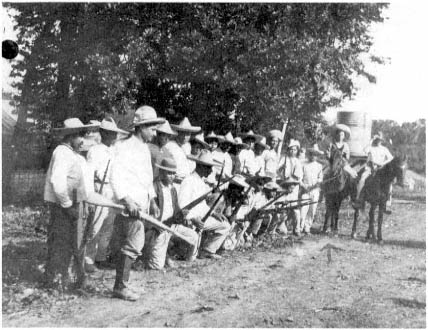
Fig. 12.
The Peláez forces in 1917. on Christmas day, the pelaecistas paid a visit to the oil
camp of the Mexico Gulf Oil Company for a feast and a round of speeches. Said the
military intelligence officer at Fort Sam Houston, Texas, to whom the photograph was
delivered: "It was not known whether this [hospitality] was dictated by affection or
policy." from the National Archives, Record Group 165, Military Intelligence
Division, Washington, D.C.
Within the Huasteca, the pelaecistas seldom engaged in pillaging. No one in the home district paid tribute to Peláez nor were the merchants and hacendados subject to pelaecista demands. His troops did not ride onto the haciendas to demand food, money, and eventually the hacienda itself, as so often happened in Tlaxcala, San Luis Potosí, and Morelos.[40] But Peláez was being more than a little disingenuous when he claimed his young rebellion represented "two years and a half of struggle and of bloody encounters — years during which not one single act of brigandage can be imputed to us."[41] When operating outside the district, pelaecistas behaved much as the Constitutionalists did in the Huasteca: Peláez allowed his subordinates to direct the looting. His troops' behavior when in the Pánuco region and in the Santa María villages cannot be said to have been chivalrous.
The financial strength of the pelaecista movement — over the long-term it was the wealthiest rebel group in the country — contributed to the discipline and its moderate, even reactionary program. The financial liquidity of the Peláez rebellion was good for the individual pelaecista. "The pay of a soldier is one dollar American currency a day, and each morning they are paid in actual cash. The pay of a Captain is four dollars a day American currency," reported an American visitor. "The leaders . . . seem to have all sorts of money and indulge in drinking and gambling to an extent which seems excessive."[42] There were other pay-offs for Peláez's troops too. The periodic forays into Santa María territory or the sacking of Tamiahua and Pánuco provided opportunities for acquisition. Right at home, the oil camps provided perquisites, mounts and meals, to be enjoyed without disrupting the local gentry. "We cannot keep any horses," lamented Lord Cowdray.[43] Pelaecistas were perhaps the best-paid soldiers of the Mexican Revolution.
The method of securing the funds, taking them from foreigners, saved Peláez from having to resort to more revolutionary notions to satisfy his constituents. He did not have to attack large landowners or divide up their land as the price of securing the loyalty of his followers. He did not have to resort to economic nationalism like the Constitutionalists, bewailing the suffering of the common people while the companies enriched themselves. No one was out of work here. Despite liking the pelaecista program, the British consul half-hoped that a Constitutionalist expedition against Peláez would succeed in making the men "lay down their arms, and seek work, of which there is plenty with the oil Companies right now."[44] Obviously, the men and especially the officers were wallowing in the good life, enjoying the rescate, "the taking of material goods," without having to suffer the scarcity that impelled some other movements to lurch leftward to satisfy the desperate masses. The pelaecistas took all they needed without affecting oil production, in itself an unusual feature of the Revolution. Elsewhere in Mexico, of course, revolutionary activities caused severe economic deterioration.
The contributions that the oil companies made to the Peláez rebellion were not voluntary. They did not willingly hand over anything, even to a local movement that promised to protect property. Of course, the carrancistas found it convenient to allege that the companies paid Peláez voluntarily. The allegations demeaned the Peláez rebellion outside the oil zone at least and justified certain other of the government's nationalist policies. Their very first reaction in 1915 to the forced loans
demonstrates how unprepared the oilmen were to handle the initial demands of Peláez. In New York, Harold Walker of Huasteca cautioned against payment. "Don't know what Aguila or Penn Mex are taxed. Latter camp looted on first stop," Walker cabled to Doheny. "My fear is danger from other side if we pay, as Pelaez is now an outlaw, but Carranza unable or unwilling drive Pelaez out permanently. Also Pelaez now desperate and apt to take vengeance on Americans. Believe advisable shut down all developments for present until we are guaranteed protection from Washington."[45] But General Manager Wylie differed and brought Walker around to the importance of not shutting down production. Besides, who knew when Washington would "guarantee protection?" Wylie wired Doheny his recommendation: "Walker and I have discussed your message from Yacht. Do not believe we can do otherwise than pay Pelaez. Not in favor of abandoning camp and anxious to get new developments soon as possible."[46]
Peláez entertained few doubts that he deserved the money he got from the companies. He said he provided them security. "The Country is in a state of anarchy and the fall of the Govt. is imminent," Peláez told the British consul:
I have been able to maintain order in this District and the Cos. have not been molested by me or my men. The paymasters can travel about with all the money they like in perfect safety, a condition that is not to be found in any other part of the Country. The monies I have received from various sources including the oil Cos. have been spent on my men and I have not taken it for myself as so many have done. I could have been a millionaire had I so desired. When the Govt. falls I propose taking charge of this District but it will then become necessary for the oil Cos. to provide me with what I shall need in the way of arms, ammunition, money and supplies.[47]
Note that he was not asking the oil companies (1) if he should continue his rebellion, (2) if they would care to pay him for these services, or (3) how much those donations should be. In the Huasteca, Peláez decided what was in the best interests of the foreign companies.
The companies never made public — nor did they tell each other — how much they were paying. Huasteca manager Green spoke to newspapers in general terms, saying in effect, "We pay Peláez all right, but he receives this money in the form of forced loans."[48] Each time the armed men came calling at Casiano, Green and Doheny were scrupulous to notify the State Department, the Mexican ambassador in Washington, and the Carranza government. Carranza was aware of the payments and the circumstances under which they were made. Since
Huasteca was paying far higher government taxes at Tampico, Ambassador Arredondo in Washington said it was a "good thing" Huasteca paid Peláez, so that the oil flow would not stop.[49]
How much Peláez demanded each month was well known. How much was paid was another matter. Early on, Huasteca and El Aguila adopted a program of strict secrecy — not to inform each other or their governments how much was actually handed out. The only indication of the quantities involved come from what the companies later declared to the claims commission. According to the terms of the 1924 debt agreement, all Americans were to submit their claims of damages and losses due to revolutionary activity. Here is where one learns that Transcontinental paid out a total of fifty-nine thousand dollars in protection money to Peláez.[50] This money represented only the years 1918 to 1920, for Peláez's unique form of tax collection (that is, the cutting of water lines) worked only on those companies that had production that was to be pumped through pipelines. Transcontinental's production in the southern fields — Peláez had no power to tax the northern fields at all — did not commence until February of 1918. El Aguila and Huasteca's payments began in January 1915. The Penn Mex also began paying Peláez shortly after he rose in rebellion, but the managers did not specify how much. They did recount the Peláez threat: "If you don't pay, I will raid your company and destroy your property." The former Penn Mex managers also recalled the words of Constitutionalist General Alemán two days later: "If you do pay, I will shoot you."[51]
The oil companies did reveal the amounts demanded by the Peláez tax collectors. At first he had demanded ten thousand pesos, then twenty thousand. Finally the standard payment came to be thirty thousand pesos each month from each producer. On occasion, when military activity intensified, as in the springs of 1918 and 1920, Peláez assessed additional surcharges and ordered the payments in advance.[52] Col. Daniel Martínez Herrera, a Peláez officer, in 1916 notified Huasteca of his chief's formal communiqué, that henceforward the tax would be increased to thirty thousand pesos monthly. Peláez was courteous enough to point out the reasons:
[I]n view of the fact that for one year and four months the forces under my orders have given ample protection to the different companies that are located in the zone controlled by my forces without paying any contribution to their support, and that the said companies have been paying big sums to the cause of the Constitutionalist Government, I have thought it best in order to save the poorer classes of people from suffering any damage that the said companies
contribute every month to the support of said forces, I have assigned to the Huasteca Petroleum Co. the sum of 30,000 pesos every month, which should be paid without any excuse.[53]
Peláez had first approached the Penn Mex company with the same demand. El Aguila management suspected that he would come to them next with a demand for fifty thousand pesos. Eventually, Peláez asked them for one hundred thousand pesos payable twice monthly, a demand that was forwarded immediately to the Mexican foreign minister. The British company wanted Carranza to know of its handicap.[54] Peláez apparently believed in progressive taxation — the richer companies paying more. When The Texas Company brought in its modest production in the Faja de Oro in December of 1917, the vigilant Peláez taxmen dropped by its camp, assessing two thousand pesos monthly, which was doubled after two months.[55]
How much was the Peláez exchequer getting? In September 1917, Harold Walker said it totaled less than fifty thousand dollars per month. He calculated that El Aguila was paying ten thousand dollars in this protection money, and Penn Mex ten thousand. A number of other companies paid less. He did not state how much Huasteca paid, only what he "calculated" others paid. If Walker based this on what his company actually paid, say ten thousand dollars, or twenty thousand pesos, this represented two-thirds of what Peláez demanded. But Doheny claimed that all the companies combined paid less than "$30,000 per month."[56] At any rate, the companies never paid the entire Peláez tax bill. They successfully dodged his taxes while giving full measure to government customs agents in Tuxpan and Tampico. Doheny's standing instruction to William Green, his field manager, specified: "Pay only what is unavoidable to save property of company and lives of employees."[57]
It is difficult to ascertain the exact extent of Peláez's taxation. One estimate suggests that one company, Huasteca, paid Peláez more and more money as production and exports increased, although not at the same trajectory:[58]
|
"The arrangement was not satisfactory to the oil companies," as one report said, "but was probably the best that could have been made
under the circumstances."[59] This was an exceptionally well-financed movement. If the oilmen were correct, they gave Peláez approximately thirty thousand dollars per month and he was receiving up to 40 percent of what the companies paid Carranza. Assuming that he had one thousand full-time troops, Peláez could have paid up to twenty-five dollars per month to each of his followers and still have one thousand dollars left for "discretionary" expenses. Small wonder his troops were able to stay in the field for six years without demanding social reforms. Peláez gave them a redistribution of income, thereby avoiding a redistribution of property, which the popular forces in other areas had sought when the income ran out. Peláez was the perfect caudillo — his largesse never ran out. The oil companies were the perfect tax base. Their economic growth, at least during the Revolution, never gave out.
Democracy Must Rule
Although they served as the reluctant financial base of the Peláez rebellion, the oil companies found nothing in the political program of their tax collector with which to find fault. His was the blandest, most noncommittal, and shallowest program of any of the revolutionary caudillos. First and foremost, Peláez stood against Carranza, whom he called a usurper, dictator, "farcical liberator," and "false revolutionary." The lives of the people of the Huasteca had been tranquil and peaceful until the Constitutionalists came along. Therefore, Carranza was identified as the person who brought pillage and destruction to the Huasteca Veracruzana, and Peláez was the defender of "the sacred rights of the people against spoilation." What would he substitute for Carranza? A peaceful, democratic rule of law, of course. "As we are convinced that the country must be ruled by the Law and that its progress must not be obtained by violence, and as we are also convinced that the public power must be an institution for the benefit of the people, and that the latter must designate its commanders," he proclaimed, "[then] democracy must rule our country."[60] The general signed this particular proclamation below the motto "Liberty and Constitution."
In other words, the pelaecistas qualify as belonging to Alan Knight's concept of the serrano revolt: reactive to outside intervention and commanded by local notables and landowners. The serrano revolt involved the participation of the rank-and-file as members of a rigid social hier-
archy led by their local social superiors. The guerrilla troops of the serrano revolt are not often led by their own popular leaders and do not necessarily act upon their grievances against the local landowners and bourgeoisie.[61] By "tranquility," for instance, the pelaecistas meant strict law and order and the status quo ante. They did not want to be molested by outside "liberal" authorities bringing in Indian troops. They advocated no redistribution of property.
Politically, Peláez sought a restoration of the Constitution of 1857. In this, Peláez even claimed once to have been a brother-in-arms to Carranza, when the latter was proclaiming the Constitution of 1857 in the fight against Huerta. (This was factually wrong, of course; Peláez had been a huertista. ) Naturally, the earliest proclamations made no mention whatsoever of the constitutional issues involved. Peláez had been in the field for three years before the Constitution of 1917, but beginning that year, comments about its "idiocy" and "insane foolishness" began to leaven the political loaves of Peláez. His denunciation of Article 27 pleased the oilmen exceedingly. Yet, it should not be forgotten that Peláez represented those local landowners who were leasing and selling their subsoil rights as they pleased according to the 1884 legislation and whose property rights were circumscribed by Article 27. Peláez was doubtlessly influenced by the economic interests of his own class as well as by the arguments of his brother, Ignacio, formerly of the El Aguila legal staff.
Meanwhile, he appended to the constitutional questions several general thoughts reflecting nineteenth-century Mexican liberalism. One concerned education: that the masses ought to be uplifted through the magical qualities of literacy. Not that he was the sort of man who established schools for the children of his hacienda peons, but Peláez said the unrest in the country perpetrated by the carrancistas prevented the orderly civil administration from establishing schools. "Public instruction has not been given the attention which a branch of such importance demands," his 1915 proclamation says:
Mexico needs schools in her cities, towns and country; schools to teach reading and writing, cultivation of land and the trades and industries which will develop with the country. Only in this way can the living conditions of the native population be bettered, now rendered worse each day by their pretended redeemers; and prepare them to fulfill their duties as the best means to make their civil and political rights respected.[62]
In other words, education was a substitute for social reforms. Peláez did not suggest that peons be liberated from the tyranny of landowners,
only that they be allowed to go to public schools. Obviously, such rhetoric appealed to his fellow landowners, who knew exactly what he inferred — no social reforms — and to the Americans, who held high the banner of public education. The other nineteenth-century liberal ideal he espoused was that of progress. Economic prosperity was touted as the solution to all problems and the harbinger of the peace and administration of the early Porfirians, although Peláez was careful to give the obligatory (but brief) denunciations of Porfirio Díaz. He welcomed the foreign investor to Mexico (what terrateniente with oil exudes on his land would not?) and also the immigrant (what son of a Spaniard would not?). Such proclamations summoned up the juarista liberals of the 1870s.
As far as his foreign policy was concerned, Peláez criticized Carranza for his pro-German stance. He kicked out all Germans, which probably were not many, and relieved the oil camps of worry about "German sabotage." Peláez said that he was a strong backer of the Allies in the European war. He wanted Mexico to be "absolutely neutral" in the struggle but provide the Allies with all the petroleum they needed to press on to victory. (Apparently Peláez never realized how contradictory his own ideas were.) He also thought that his movement was the best substitute for an American invasion. This last was a malleable idea, as many others also appear to be. While desperately seeking arms, or under Constitutionalist attack, Peláez would have his brother, Ignacio, serving as his emissary to Washington and New York, proposing a joint military occupation of the oil zone. The foreign diplomats might have scoffed at these grandiose plans, but at least they trusted that Peláez would not destroy the oil fields.[63] He couched his support of foreign businessmen in Mexico in terms of the Allied cause:
We do not abandon the interests which the belligerents have in the region which we dominate, and that these interests will be defended by us whoever may be their owners, and that we will permit no one to attack them, not only because it is our duty as Mexicans to grant protection and give hospitality to all foreigners who, attracted by the liberality of our institutions and the richness of our land, have come with their wealth, labor, capital and civilization to take part in our life.[64]
This was language the foreign investor understood. Yet, even Peláez's foreign policy commitments are suspect. Once, in October 1917, because of Wilson's recognition and support for the Carranza government, Peláez was reported to have met with a German agent. He threatened to deal with Germany if the United States did not change its policy.[65]
The historian, basking in the sunshine of hindsight, would do well not to make too much of this pelaecista ideology. His actions spoke louder than his words; that is why he "proclaimed" so infrequently and ruled above the law rather than under it. Anyway, his pronouncements (I have found four) were all alike. In fact, Peláez had been in the field for nearly three years before he bothered to make so much as a "proclamation." He said lamely that he did not want the Mexican people to confuse him with those others who have enriched themselves in rebellion "by exercising the many forms of pillage."[66] This, of course, was not the Mexican tradition. The best and brightest of his class always began their rebellions with high-sounding, fulsome, suitable-for-publication proclamations, usually named after the location where the peripatetic rebels penned them. Madero had his Plan of San Luis Potosí; Zapata had his Plan of Ayala; there was a Plan Orozquista; Carranza wrote the Plan of Guadalupe; and Obregón would have his Plan of Agua Prieta. The Mexican revolutionary landscape was littered with numerous other plans but not with a Plan of Tierra Amarilla.
What mattered most to Peláez was power. And money was power. Even if he did not extend the justice and rule of law he proclaimed to the foreign oil companies, Peláez did support their policies. After all, the oil companies formed the basis for the well-being of his real constituents, the Huasteca landowners, large and small. Peláez vilified the Constitution of 1917, because it removed his property rights and because it had been Carranza's.[67] Also, the timing of his proclamations are most suspect. Peláez was very quiet when his rebellion was going well. On the other hand, the most complete discussion of the pelaecista program comes in his two and one-half-page document of December 1917. Here is where Peláez was most effusive in his praise of the oil companies and the Allies. Why? The Constitutionalists had just announced an all-out offensive against his forces, and brother Ignacio was in Washington and New York meeting with oilmen and diplomats in an attempt to get arms. Peláez was also pro-Allies because he wanted their arms.[68] He touted education, foreign investments, and economic progress because his fellow landowners believed these were preferable to — and substitutions for — the redistribution of property and prerogatives. All of these things, in the true serrano tradition, would keep the central authority out of the Huasteca Veracruzana.
If the Peláez political program, the very antithesis of radicalism, made his alliances appear purely opportunistic, they were. A movement favored by landowners and dominated by sons of Spaniards certainly
could not have been enthusiastic about the program of the villistas, the zapatistas, and their allies in the 1915 convention. Villa had dispossessed some of the biggest landowners in Chihuahua, such as the Terrazas; Zapata was unabashedly dividing up the land of the hacendados; and much of the discussion at their convention in Aguascalientes concerned the need for agrarian reform. Moreover, Villa was self-consciously anti-Spaniard, even going so far as calling his followers indios, in contradistinction to the overbearing immigrant Spanish merchants and overseers of North Mexico. When his troops took Chihuahua and Torreón in 1913, the Spanish residents of the city were persecuted — along with the Chinese, who were massacred as well.[69]
Yet Peláez identified himself as a villista — though not as an indio. The reason is that Villa had broken with the hated Constitutionalists, and his occupation of Mexico City at the end of 1914 appeared to be Carranza's demise. What better way was there for Peláez to be in a position to claim political suzerainty of the Huasteca, of Tuxpan (where many of his relatives lived), and of Tampico — maybe even all of Veracruz — than to climb aboard the Villa train? Did Villa count on Peláez? When American and British diplomats protested to Villa that the villista war taxes on the oil companies in the Huasteca were too high, Villa said he did not know anything about the Huasteca. He did not know Peláez.[70] Peláez became a villista because Carranza was their common enemy, not because villismo attracted a large following in the Huasteca Veracruzana. Wanting autonomy above all, Peláez gambled that Villa would win. His was not the first calculation to go awry during the Revolution.
There was a weakness of the Peláez movement. Once Villa's star had fallen in the north, Peláez could not gain a great deal of allegiance beyond his patria chica, his "little homeland" in the southern fields. As we have seen, he did not espouse a program (protection of property and the foreign interests) that had much appeal in other areas. Only the felicistas, sometimes operating in southern Veracruz, indicated interest in the Peláez program. Félix Díaz, however, always considered that he had rank on the younger Peláez. The two caudillos corresponded. They negotiated, bartered, and planned for the Díaz forces to land on the coast and join with those of Peláez. Constitutionalist gunboats dissuaded Díaz. Rebel leaders wanted arms and ammunitions from Peláez, but he offered them only money, which, of course, was acceptable. Among the anti-Carranza generals of the Eastern Sierras and Gulf Coast, who conferred together in October 1916, Peláez became know as El rey de papel, the King of Paper, the banker.[71]
Despite sharing their common hatred of Carranza, Peláez did not get on with those other anti-Constitutionalists who entered his territory. Early in June 1917, a villista band numbering eight hundred men, lead by a Colonel Reyes, mounted a raid on the oil districts, passing through pelaecista turf and collecting forced loans at Potrero, Alamo, and Papantla.[72] Peláez would have nothing to do with allies tapping his financial resources. Soon thereafter, his old leader, Félix Díaz, brought two hundred of his men to Tierra Amarilla. The British consul heard that Díaz had requested to be given command of the Huasteca. When the rebellion placed Díaz in the presidency, he then would allow Peláez to be in charge of the entire oil district from Furbero to El Ebano. Peláez reported later that they had come to no agreement, and Díaz withdrew his troops.[73] The money that the "King of Paper" had once been sending Díaz was now withheld. In the final analysis, Peláez did not find any particular advantage to serving as financier to a decrepit felicista movement.
His later alliances were much the same — informal, uncoordinated affairs with other anti-Carranza rebels, most of whom had radically different programs. In November of 1917, Peláez concluded an agreement to affiliate with the Cedillo brothers, the land-reforming caudillos of San Luis Potosí. The Cedillos' area of operations began just west of El Ebano. Curiously, the more traditional caudillos of that region, like the De Los Santos and Lárragas, with whom Peláez should have had an ideological affinity, joined the Constitutionalist movement. The popular caudillos such as Saturnino Cedillo joined with Villa. In contrast to Peláez, Cedillo ran a very Spartan operation.[74] Between the cedillistas and pelaecistas were many carrancistas, so that these first two groups promised to fight the third. Ideological differences were ignored.
Alliances between local, independent guerrilla chieftains being a sometime kind of thing, Manuel Peláez exaggerated more than a little in his 1918 manifesto. He claimed then to be the recognized leader of thirty-nine different generals in eastern Mexico, commanding 30,450 troops called the "National Guard." Most of the leaders were definitely of the second rank among the pantheon of the Mexican Revolution. General Meixueiro had the largest contingent of troops, five thousand; Peláez claimed four thousand, and the other thirty-seven generals commanded fewer than six hundred men each. This idea of a national guard led by Peláez expanded (mostly in the mind of the commander himself) in 1919. In a letter to President Wilson denouncing Carranza, Peláez boasted of having another former leader, Pancho Villa, under his command, as well as Felipe de Angeles, the zapatista Gildardo Magaña,
Meixueiro, and Félix Díaz. The document praised the Constitution of 1857 and liberty and property and urged Wilson to cast Carranza aside and favor Peláez's National Guard.[75]
This zapatista alliance too was a bit of a fiction. Emiliano Zapata had declined to join Peláez in 1918 when the latter, through intermediaries in Puebla, had promised to obtain the recognition and a sizable loan from "the White House." But Zapata had been assassinated in April 1919, and Peláez attempted to pick up the pieces. In vain did he offer finances for alliances to several surviving Zapatista chiefs.[76] At this time, Peláez, having been unsuccessful in the field, was actively seeking that the United States lift the arms embargo it had imposed on everyone but Carranza.
A Neutrality Perfect as Possible
Peláez had made himself a fact of life in the oil zones. The question now before the oilmen and their home governments was "What are we going to do about it?" In general, the debate centered on whether to support Peláez or the Constitutionalist government. Among those wishing to support Peláez, there remained specific questions about what kind of support: money, arms, or military intervention? Those actively involved in the debate included the governments of Great Britain and the United States, the top executives of the foreign oil companies, and the local field managers. But we have already seen the great difficulties of fashioning any kind of policy for the foreign interests. The companies themselves were competitive; the U.S. government had a general policy toward the Mexican Revolution that irked the American oil companies; and the British policy of nonrecognition of Carranza differed from that of the United States and the major British oil interest in Mexico. The number of options available and the number of persons concerned, each from their own perspective, endangered the formation of a coherent policy. What resulted was a perfect muddle.
The arrival of Gen. Manuel Peláez on the Mexican revolutionary scene both delighted and consternated the British. On the one hand, the diplomatic community was happy that there existed a challenge to Carranza, at least in the oil zone. His Majesty's Government wished no cessation of oil supplies needed for the war effort and worried that the
Constitutionalists might shut down the industry in order to enforce Article 27. On the other hand, Lord Cowdray and the managers of El Aguila found themselves bankrolling the Peláez movement and having to live daily with military activity among the oil wells. Between the two British perspectives, there developed one shared conclusion: that foreign military invasion of the oil zone would be a disaster. Right away the British eliminated any talk of a U.S. or a British military operation. "The danger to the oil fields has long been known," observed one diplomat at the Foreign Office,
but no one has devised any means of safeguarding them as they could easily be destroyed long before an expeditionary force or land party could drive off the local Mexican forces. The oil district is even now the scene of constant skirmishes between the followers of Villa & Carranza & other stray freebooters. The oil companies have done the best they can do to avert danger by means of arrangements with the local leaders.[77]
Besides, there was doubt about whether Peláez could be relied upon to protect British subjects. In 1916, when there appeared a danger of U.S. invasion during the Pershing expedition, Peláez had told British citizens they would have to leave. He could not guarantee their safety even from his own men. Anyway, the British armies just at that moment were engaged elsewhere, and the Americans did not seem to favor a military solution, although they did have contingency plans. Indeed, J.B. Body of El Aguila had conferred with the American State Department about invasion plans. If the Americans were going to intervene militarily, he wanted to make sure they knew where El Aguila's wells were located. Body only hoped that Peláez could hold his men in check and not allow them to "run amuck."[78] As far as the British were concerned, an armed invasion to protect the oil fields was quite undesirable.
The second issue concerned money; that is, whether to commit British resources to support Peláez. If yes, the Foreign Office would have to secure the permission and cooperation of the Exchequer, involving another participant in the decision making.[79] Among the diplomats, there was much support for this. But Lord Cowdray reminded them that providing Peláez with money would be a waste of British resources. He said that El Aguila was already subsidizing Peláez but that it had yielded no protection at all. Constitutionalist forces still passed through his oil camps at will.[80]
In the final analysis, Lord Cowdray came to loggerheads with his own diplomatic representatives over the very idea of a pro-Peláez policy. Cowdray told his friends at the Foreign Office that he would be
pleased if the pelaecistas retired from the field, as the military uncertainties among the oil wells would be very much relieved. Moreover, Cowdray held out for British recognition of the Carranza government. The diplomats were quite defensive about the idea. They regarded recognition of the Mexican government as a provocation toward Peláez. "I hope Lord Cowdray realizes that if we recognize Carranza we shall have to regard Pelaez as a rebel and withdraw our support for him," said one British diplomat. "Lord Cowdray's cure is recognition of Carranza," replied another.[81] In the end, the Foreign Office realized the difficulties of a pro-Peláez policy: The United States would have to abandon Carranza; Villa must survive in the north of Mexico; Peláez would need "large reinforcements of men"; he would need more munitions; and it would be bad policy to allow the oil company to be involved in an antigovernment movement.[82] What about the British government simply providing arms to Peláez, independent of the companies and the United States? It was an idea that intrigued many a diplomat.
Under the circumstances, was the British import of arms to Mexico possible? Many Mexicans believed it was not only possible but certain that El Aguila and the British government were supplying the Peláez rebellion with arms. Every Constitutionalist commander who could not subdue the pelaecistas insisted that El Aguila, in particular, was helping the opposition.[83] In fact, no one knew better the difficulty of getting arms to Peláez than the oil companies. Certainly, arms could not be shipped to the Huasteca just like any piece of equipment: off-loaded on freight ships, transported on motor launches through the Tamiahua lagoon, then transferred to the company railway at La Peña. "Notwithstanding the fact that each Bill of Lading is approved by the authorities at [Tampico] before the material leaves," said Body, "it is held up by the local and state authorities at various other points when it enters the State of Vera Cruz."[84] But the British government still explored the possibilities of sending arms to Peláez.
The pelaecista foreign policy, simple as it was, was achieving its desired results — or nearly so. Peláez professed himself a devout Ally, persecuted the Germans, and in 1917, played on the heightened fear of German sabotage. Provide me with arms, he said, and the Allies can be assured of oil supplies. Following the interception of the Zimmerman telegram, which suggested a possible alliance between Imperial Germany and Carranza, plans to supply arms to Peláez were actively discussed. Harold Walker of Huasteca expressed some sympathy with the idea, as did Thomas B. Hohler, British chargéd' affaires in Washington. The Foreign Office liked the prospect because it would be the perfect
alternative to a U.S. military invasion, which they considered a plan fraught with "great difficulties." When U.S. diplomats suggested that more arms ought to be sent to Carranza to control Mexican banditry, Sir Cecil Spring-Rice, the British ambassador in Washington, D.C., replied, "Perhaps Pelaez had better be allowed to have some too."[85] But El Aguila's Body looked askance on the proposal and considered Walker "absolutely untrustworthy." Cowdray too was dubious. "[If] we were to supply arms to an unsuccessful revolution, not even a British Government could save us," he commented. "We can supply money and that under duresse [sic ]. The Americans can do this, as, for them, it does not infringe [on] the Monroe doctrine, also the Americans can probably buy arms, whereas we cannot." Even the British diplomats understood that the Americans had to cooperate in the providing of arms to Peláez.[86]
Finally, after years of inaction, the Foreign Office came to a tortured decision, but not until after the European war was over and concerns for oil supplies greatly diminished. The British government decided that the most prudent policy would be not to supply weapons to any Mexican faction. "To send arms to Mexico is merely to add fuel to the fire and it seems a very mistaken policy on the part of the U.S. [to supply arms to Carranza]."[87] In the end, the British formulated no policy toward the Peláez rebellion worthy of the name. In their indecision, divergences of opinion, and inability to help, the British left it up to the United States to handle Peláez.
Did the Americans, in fact, do so? The rebellion in the oil zone also evoked discussion between and among American oilmen and diplomats about what their policy toward Peláez should be. There was also a sharp division of opinion among Americans — only in reverse order from the British. The Wilson administration favored the Carranza government, and the oilmen did not. That made a coordinated, effective policy toward Peláez rather problematic to fashion, let alone implement.
There did exist, however, a contingency plan for the U.S. military occupation of the oil zone. If few Americans wished to use the plan, at least they agreed about what went into it. The oilman and the Wilson administration, especially after the American entry into World War I, shared an equal concern for the continuation of oil supplies. U.S. warships patrolled the Gulf Coast, hovering about the mouths of the Tuxpan and Pánuco rivers. During the Pershing expedition, the warships were the only use of force contemplated, and then only if necessary to rescue the 2,200 Americans in Tampico and the oil fields. Military and diplomatic planners relied on Peláez not to destroy the oil fields. The
State Department justified the lack of plans for an invasion by stating that there was a shortage of marines, who were then occupying the Dominican Republic and Haiti.[88]
Once the United States entered the world war, planning for the security of the Mexican oil fields became more aggressive. Leon Canova of the State Department proposed a military plan having several torpedo boats and destroyers patrolling the coast with enough marines on board to land quickly at both ports and to provide arms for the "loyal" oil workers. Meanwhile, a force of six thousand army troops were to stand by at Corpus Christi to occupy the oil fields, if necessary.[89] Of course, there were some complications. One had to do with the length of time between the initial landing and the actual securing of the oil wells by American troops. Some nervous oilmen and military men suggested that to prevent destruction of the oil fields, the operation had to be completed within two days. The American consul at Tampico said, "If the [Carranza] forces should, unexpectedly, defeat and disperse Pelaez' forces and regain full control of the Huasteca oil fields, the risk of huge damage and loss from willful destruction would be tremendously increased in case of war or intervention."[90]
By 1918, a comprehensive invasion plan was in hand. It called for 207 officers and 5,356 men to be transported to the Gulf Coast on the steam tankers of the oil companies. They were to locate, secure, and hold twenty different objectives throughout the entire oil region, rendering protection to the 2,500 Americans and the approximately 4,000 other foreign residents there.[91] The mere fact of having an invasion plan does not, however, indicate a propensity — or even a remote desire — to use it. Like England, the United States after 1917 had become preoccupied with deploying its troops in France, not Mexico.
That being the case, what planning was made for less drastic measures such as supplying money and arms? These questions provoked conflict between the American oilmen and their home government. For the most part, the Wilson administration clung steadfastly to its policy of supporting Carranza. The British Foreign Office was particularly distressed by the United States' lifting of its embargo on arms shipments to the Constitutionalist government, while still preventing arms shipments to the villistas and the pelaecistas.[92] The American ambassador to Mexico, Fletcher, had the reply for those who protested the U.S. arms policy. "[I]t was difficult on one hand continually to be asking [the] Mexican Government to protect life and property [which the ambassador had been doing on behalf of the oil companies]," he said,
"and on the other to refuse to supply the means of their doing so."[93] In fact, the State Department had always been very careful not to advise the oil companies, at least in an official manner, whether or not they should pay tribute to Peláez. Of course, American diplomats passed along the protests of oilmen, but they scrupulously refused to know the exact amount of these forced loans and who was paying whom.[94] There may have been many different tendencies in U.S. policy toward Mexico — such as aloofness, condescension, occasional disapproval, even disinterest. But support for Peláez was not one of them.
It has already been established that American oilmen — unlike Lord Cowdray — disagreed with the administration's pro-Carranza policy. Does that mean they actually supported Peláez in ways that went beyond the involuntary financial contributions? Never mind their preferences, for they plainly preferred Peláez to Carranza. But in terms of actions, did American oilmen violate the U.S. embargo and send arms to Peláez, as many Constitutionalists had claimed? The American oilmen constantly denied that they aided Peláez with more arms and money than he extorted from them. Doheny admitted that his company had come under pressure, probably from brother Ignacio Peláez, to deliver arms to the rebels in December 1917, when the U.S. government provided Carranza with more arms. "[The company] did not then, it did not before, it has not subsequently ever delivered arms or munitions of any sort to forces in rebellion against the Carranza Government," he told a congressional panel in 1919. Nor had any other company, so far as Doheny knew.[95] The danger of supplying arms to one political faction in the Mexican Revolution was obvious. "From the time General Aguilar occupied Casiano," said Doheny, "its producing fields and its terminal have been controlled by opposing armed factions. It has had to satisfy the exigencies of both, maintaining a neutrality perfect as possible; and it has never in any way favored either side."[96]
Doheny and other executives of the Huasteca Petroleum Company objected strenuously to the U.S. policy of providing arms to Carranza. For one thing, the American oilmen believed that Peláez would take great exception to the U.S. policy, even to the point of increasing his pressure on them — perhaps giving him an excuse for imposing even higher "taxes." They feared that the pelaecistas might interrupt the oil supply. Besides, complained Harold Walker, "Peláez has been the friend of Americans from the start. We have never had an American associate even shot at by a Pelaez soldier in the Jungle."[97] Doheny stated that his company opposed the sending of any arms to Mexico, because
the fighting threatened harm to Americans there. "[W]e have always opposed sending any arms to any faction in Mexico, so far as our opinion has been asked."[98]
Once again, in the public debate over U.S. policy toward Mexico and Peláez, there was a right and left bank to the mainstream view of Doheny and the oil producers' association. Critics such as Samuel Guy Inman, a missionary, denounced Huasteca and other companies for giving tribute to Peláez, even if under duress. Inman said that Carranza most certainly would have been able to take command of the oil fields, if the companies had not supported Peláez. On the other bank stood William F. Buckley, conservative gadfly of the big U.S. companies. "They are paying Pelaez, not because they want to but because Pelaez compels them to," Buckley said. "Pelaez has given them protection . . . but nevertheless, they are so shortsighted that he has to force them to give him the money to support his troops."[99] Considering the division and acrimony between diplomats and oilmen, it is not surprising that the foreign powers could neither formulate nor implement a pro-Peláez policy. Consequently, the day-to-day relations with the pelaecista movement came to be the exclusive work of the managers in the field. We know the local managers had been characteristically interventionist and many had developed colonialist mentalities. Did this mean that the local rebellion, at least, might expect a measure of decentralized assistance from the companies?
For sure, the Americans in the field preferred Peláez to Carranza. American drillers, for example, felt safer with the disciplined, well-paid pelaecistas than with the protection of the poorly paid Constitutionalist troops. Peláez may have been a bandit, they said, but he forced his followers to respect agreements with the oil companies. "If some of his men seize provisions or other property," reported some field managers, "he makes due settlement later and if they have acted contrary to his orders he inflicts immediate punishment upon them."[100] Top executives like J.B. Body of El Aguila avoided coming into Peláez territory, for fear either of offending the Constitutionalists by talking to Peláez or of offending Peláez by refusing to see him. The local managers, therefore, carried on the day-to-day task of dealing with their local military chief and his rivals. Even the British government realized that, barring U.S. support, the oil company field managers would have to take care of protecting themselves.[101]
Just as the oil companies, by their very presence, were involved in national politics, so were the local managers involved in regional political affairs. Foreign managers possessed scarce resources, after all.
Both the Constitutionalists and the pelaecistas made accusations against the oilmen, if only to keep them pliant and on the defensive. The Constitutionalists never wavered from their charges that the oilmen in the field were supporting the rebels with arms as well as money. It was a standard tactic, evidently, and one that Peláez could not resist using when the occasion demanded. He too found it convenient to play off the companies against each other. He would browbeat one firm and praise the other, then reverse the order when it pleased him.
General Peláez, at least, was shrewd enough not to allow foreign interests to gain advantage from within his ranks. In the fall of 1917, Peláez purged from his ranks a man who had helped him draft his first political pronouncements, Dr. Camilo Enríquez. The apparent reason: an article that appeared in the Saturday Evening Post. Playing upon the fear of German sabotage in 1917, the Post had sent reporter Carl W. Ackerman to do a series of pieces on the oil industry at Tampico. Ackerman's portrait of Peláez, a man he had not met, was most unflattering. He called the rebel chief "an ignorant Mexican rancher," an "unlimited monarch." If Ackerman did write something positive about Peláez, it was that he had "a teachable mind." On the other hand, Dr. Enríquez was said to be "the so-called brains of the Pelaez Government because he is the only educated man on the rebel leader's staff." Ackerman credited Enríquez, a Tuxpan druggist who had been driven to revolt after being burned out by the Constitutionalists, with being the one who taught Peláez how to collect monthly taxes from the companies.[102] For his story on the oil zone, Ackerman had interviewed Enríquez himself and several unnamed oil managers.
Peláez's reaction was swift and thorough: he banished his subordinate from the Huasteca Veracruzana. The rebel cabecilla gave up his plans to install Enríquez in the governorship of the state, a post the druggist's father had once held. He also blamed the oil managers of Huasteca for having planted the story. "I harbour no ill feeling against Green and Galvan of the Huasteca Co. or against the Co. itself," he told the British consul at Tuxpan, "and they can consider me a rough uneducated `Ranchero' or what they please as I am satisfied that my actions will bear the strictest investigation. After the Ackerman articles in the Saturday Evening Post inspired by that Co. and the way in which they treated Dr. Enriquez, nothing was left to me but to get rid of him and I have told him that he must leave my District."[103] Rumors suddenly spread in the southern fields that Enríquez was plotting with Félix Díaz to ambush William Green. Quite obviously, Peláez himself had started the rumors. From this point onward, he harbored a personal grudge
against Green.[104] Yet, El Aguila gained little advantage from Huasteca's involvement in the breach between Peláez and Enríquez. Peláez warned the British not to have any delusions about their alleged hold on him. When he gained good control of the district, Peláez said, he would present El Aguila a heavy bill for damages.[105] Like a whirlpool, political rivalries sucked everything, even the powerful oil companies, into its vortex.
The domestic political intensity enhanced the critical role of the local managers in the companies' affairs. El Aguila and Huasteca each devised a policy toward the Peláez rebellion that gave the local managers the widest possible latitude in handling the rivalry between Constitutionalists and pelaecistas. The only instructions were to save the wells and to pay as little as possible. Although Lord Cowdray might have counseled the recognition of Carranza among diplomatic circles, Vaughan at the Potrero camp and Jacobsen at Tampico were repairing water lines and paying pelaecista agents as little as possible to keep them from being cut again. While Doheny spent time at the congressional hearings, Huasteca's William Green was repairing railway bridges and attempting to prevent the Constitutionalist forces from entering the oil zone — sometimes even successfully. There is one curious outcome of this policy. Each company maintained the strictest secrecy about its dealings with the Mexican combatants. The cooperation and united front that the oil producers' association was attempting to construct at the executive level did not have a parallel among local managers. All the managers dealt with Peláez in an ad hoc, one-on-one fashion. And Peláez preferred it that way.
Peláez's nemesis, William Green, the untutored but sharp-witted manager of Huasteca, became something of a master at oil-camp diplomacy, although it was clear that the Mexicans determined the unfolding of events and the managers merely reacted. Green was close to his employees. He said that he preferred visiting his oil camps often, despite the danger of marauding troops, because he thought "my presence lends moral support to employes who feel nervous."[106] Numerous foreigners in Tampico and Tuxpan considered Green something of a loose cannon. The British consul accused him of angling for a U.S. military invasion and even for serving as Peláez's financial adviser in his business deals in New York and Los Angeles.[107] The Constitutionalists also suspected Green. General Diéguez was convinced that he provided Peláez with arms and in January 1918 considered having Green arrested. In the meantime, while assuring the Constitutionalist com-
mander that no arms were getting through to Peláez, the U.S. naval commander at Tampico called Green a "trickster" who was not otherwise to be believed.[108] Obviously, not everyone agreed with Green's tactics.
On the other hand, William Green was not in a profession for the faint of heart. When the military competition in the oil zone was intensified, as in 1918, Green found himself spending more time placating the Constitutionalists and dealing with Peláez's demands. Green's personal meeting with Peláez elicited a promise that the pelaecistas would stop cutting the water pipes.[109] Nonetheless, the disruption continued. The pelaecistas returned and threatened to shoot the Huasteca pump man, named Pritchard, if he started the water again. Frustrated, Green contacted General Caballero, the Constitutionalist commander, requesting that he garrison the pump station with enough men to prevent the disruptions of the pelaecistas. Green feared that if the oil pipeline were shut down for longer than twenty-four hours, the flow from Huasteca's giant well, Casiano No. 7, would have to be released onto the ground. No sooner had the Constitutionalists under General Lárraga arrived at Tancochín camp, than seven men deserted. They traveled to the Casiano camp and robbed the cashier of five thousand pesos. The incident forced Green to return to Casiano and request Colonel Melgoza, commander of the Santa María Indians, to apprehend the deserters. Melgoza was shown where the men were hiding, but he refused to go after them. Once again, the pelaecistas made off with pump parts, and Green gave up on the protection of government troops. Green determined to deal directly with Peláez.
Going to El Aguila's terminal station at La Peña, Green telephoned directly to Peláez and arranged to meet him at the El Aguila camp at Tanhuijo. Peláez denied ordering his troops to cut the water line or burn railway bridges, for that matter. Many among his followers, however, Peláez told Green, had hoped to provoke the United States into invading the oil zone and scattering the Constitutionalist forces. Green informed him that the U.S. government was not likely to invade; it would instead furnish Carranza with enough arms for his men to defeat Peláez. The rebel leader replied coolly that Green had better stay in Tampico for the time being. He believed that Constitutionalist troops might shoot Green "from the bush" and blame it on his men.[110] Preoccupied by these political maneuvers, Green admitted "that the work has not been occupying my mind much lately."[111] So was the affair of the pump station's water line cleared up?
It was not. Back in Tampico, Green received word that the pelaecistas, under orders from their chief, had disabled the pump station once again. This time, they removed the pipe in the water line at ten different places and prevented the Huasteca crews from fixing it. Green immediately dropped everything, went over to the El Aguila headquarters, and called Peláez at Tierra Amarilla. Peláez evaded Green's complaints and asked him about the "other proposition," the pelaecista demand for a fifty-thousand-peso loan. Green told him he was ready to deal, and they agreed to meet again at Tanhuijo. In the meanwhile, Green had been improving his relationship with the Constitutionalist commanders. "There have been no threats of hanging and no insults offered myself or my men for the last couple of weeks," said Green, "and they are more considerate regarding our launches, at least lately they do not demand them at the point of a pistol."[112] Green was selling the Constitutionalists commissary goods at Casiano, which was preferable to their stealing them. With the proceeds, his camp paymasters paid the workers, saving the inconvenience of sending the payroll through the Chijol Canal, where it was frequently held up. Meanwhile, Green needed the cooperation of the Constitutionalist commanders to pass through the checkpoints on his way to meet Peláez, which he obtained by promising not to report General Acosta to his superiors for not having been able to protect the water lines.[113]
Huasteca's William Green negotiated like Metternich and made intricate deals worthy of Bismarck. Although few of his compacts ever stuck for long, he did succeed in "Keeping the Oil Flowing" for the war effort. "Huasteca employees have been practically free of all abuse," Green wrote to Wylie. "I have tried to keep my time honored position on the fence as regards participation in the affairs of the different factions, and I have had to play to both sides as conditions seemed to dictate. I have gone to the extent of conniving with bandits not belonging to either side to avoid the troubles experienced by most companies." Green's problems, perhaps solved for a few months, would crop up again anytime government troops entered the southern fields in force. When fresh troops arrived in September 1918, Peláez once again cut the telephone lines, burned the railway bridges, and broke up the water lines.[114] The pelaecistas needed extra money whenever the Constitutionalists threatened.
While handling the emergency of 1918, when Constitutional troops invaded the southern fields, Green finally began to coordinate local policy with Jacobsen of El Aguila. They conferred together nearly by accident, while Green was at El Aguila's Tampico headquarters, phoning
Peláez about the fifty-thousand-peso advance. At any rate, the telephone call gave Jacobsen and Green an opportunity to break their code of silence. Here is Green's description of the chance meeting with El Aguila's Jacobsen:
I pointed out that we ought to act together in this case, and stated that it would be easy enough for Pelaez to tell me that the Aguila had paid the full amount, which would leave me without an argument, and if he could do the same to me, the same argument could be put to the Aguila; in other words, that he could play one company gainst the other . . . but if we went together and put up a bold front and told him we were authorized to do only so much, I was sure we could bring Pelaez to time. In answer to Jacobsen's questions as to why I was interested in knowing what they did about the matter, I stated that Pelaez needs just so much money to run his business; . . . that if both companies made equal payments, the load would be divided and correspondingly light for both companies; that the Huasteca Petroleum Co. has shown itself ready to pay a reasonable insurance tax, but that we did not intend to pay for the protection afforded the Aguila and the rest of these companies; that it was the Aguila's business if they wanted to pay Pelaez any money for his personal use, but that we did not intend to allow any favor they did him in this respect to operate to our detriment; that we should come to an agreement in regard to this matter, as I did not intend to pay one five-cent piece of the recent demands of Pelaez until I knew the Aguila was paying an equal amount.
Jacobsen . . . agreed with me regarding the stand we should make with Pelaez; that to supinely come across with the 50,000 [pesos] were nothing more or less than to invite disaster, in that if we paid without a kick, he would be convinced that all he had to do in the future was to ask for other moneys, accompanied by some threat.[115]
The experience of Green and other local managers does not lend itself to an interpretation that the local managers were enthusiastic partisans of the Peláez rebellion. Clearly, the pelaecistas had an independent agenda beyond the managers' control, and they extorted financial support from the foreigners. To the companies, Peláez's demands amounted to "oilmail," the disruption of pipeline operations for the purpose of collecting a second tax on the industry. Not fond of paying the first echelon of taxes to the government, these oilmen did not like the second echelon of Mexican taxation any better. No matter what Constitutionalist commanders may have said at the time, I have found no evidence that the oilmen, whether company owners or local managers, imported arms for the movement.
Then how did Peláez acquire enough to stay in the field for six years? First of all, despite the fact that the pelaecistas were reasonably well paid, they were not particularly well armed. A rebel group during the Mexican Revolution, however, did not have to be armed to the teeth,
so to speak, to carry out guerrilla operations. This was the case of the zapatistas as well as the pelaecistas. That the government could not subdue either rebel group had more to do with the internal weaknesses of the Constitutionalists than the military effectiveness of the rebels. Esprit de corps did help, and both zapatistas and pelaecistas, despite their ideological differences, were fighting in their home territory. But government forces suffered because there was too much rivalry between Constitutionalist commanders, too much corruption among their junior officers, and too little pay for government troops.
Various foreign sources, especially American military intelligence, all emphasize the limitations of the weapons available to the Peláez rebellion. Reports estimated that his troops were armed mostly with 30-30 Winchesters and a few Mausers and that they were always short of ammunition. He had no cannon whatsoever. In 1917, facing their first serious Constitutionalist offensive, the pelaecistas were said to have only one-third belt of ammunition per man.[116] The British consul at Tuxpan, who often traveled through Peláez's territory, reported, "It is obvious that he has no large supply as he has no regular store, and when he travels has no ammunition mules. The few men I saw carried from 100 to 200 cartridges apiece."[117] The lack of arms certainly explains why Peláez never held terrain, why he did not wish to engage in a pitched battle, why he never mounted a sustained campaign outside su tierra, and why Constitutionalist forces wandered through the oil camps at will. His followers remained a lightly armed, mobile guerrilla force.
Not that Peláez had not attempted to create a more formidable force with fresh arms. He certainly had the money to do so, but his rebellion was constrained by the U.S. embargo on all factions but the carrancistas. The U.S. decision in 1915 to provide arms only to the Constitutionalists accounted in part for the ultimate defeat of the villistas.[118] The halt in the delivery of arms to Carranza in 1916 certainly contributed to giving the pelaecistas a reprieve. Carranza had his own munitions industry, modest as it may have been, yet the U.S. government decision of 1917 once again to permit shipments of ammunition to the government forces was a serious blow to Peláez. Given his pro-Allied and anti-Article 27 political positions, Peláez had expected U.S. and British support. He felt double-crossed and threatened the oil fields sufficiently to warrant an explanation from the State Department. The special message, delivered by George Paddleford, the Huasteca superintendent in Tampico, assured Peláez that the arms shipments to Carranza included only 2.8 million rounds of ammunition and no new
weapons. Peláez could not have been mollified. The Constitutionalists immediately organized their first serious military campaign against his rebellion, with which we will deal shortly.[119] The Constitutionalists were better armed than Peláez.
The pelaecistas also engaged in the smuggling of arms, the exact scale of which cannot be gauged. The word was out that Peláez was prepared to pay up to five hundred dollars for one thousand cartridges of ammunition for his Winchesters, Mausers, and 45-caliber pistols. His agents wanted them dropped off at convenient locations along the Gulf Coast.[120] Brother Ignacio took leave from his legal position at El Aguila and, after the Constitutionalists had mounted their 1918 oil field campaign, traveled to Washington and New York speaking with businessmen and diplomats about Peláez's pro-Allied viewpoints and his need for arms. A sympathetic British ambassador in Washington, Sir Cecil Spring-Rice, listened intently but gave the standard diplomatic put-off: he would think the matter over most carefully.[121] Ignacio may have established contact with arms smugglers in New Orleans who had connections to the Félix Díaz movement. From 1917 to 1920, American military intelligence personnel attempted to track reputed arms shipments aboard oil tankers from New Orleans to Progreso, on the Yucatán peninsula, of all places. Carranza's agents and the Mexican newspapers too reported rumors of arms smuggling, and Mexican consuls throughout the United States reported suspicious ships to be inspected thoroughly by Mexican customs officials.[122] U.S. customs agents were able to seize twenty thousand rounds of small-arms ammunition — but no arms — early in 1920. The problem for smugglers had been that Tuxpan and Tampico were the only major ports in the oil region and both were controlled by the government. Moreover, government patrols regularly searched the small craft of fishermen along the coastline between these ports.[123]
In the final analysis, the U.S. military intelligence agents could not discover a single case of an illegal arms shipment to the Peláez forces. There was also some doubt that the arms going to Progreso were actually destined for the pelaecistas. "[I]t should be remembered that Pelaez is in the Tampico-Vera Cruz oil districts, where he has a very poorly organized army," reported one of the U.S. agents, "while the shipments in question are destined to Progreso, the Port of Yucatan, which is 450 miles from Vera Cruz and 550 miles from Tampico by water."[124] Smuggling may not have been any answer at all to Peláez's perennial problem of arming his troops.
The steadiest and surest source of arms for the pelaecistas was, in fact, the enemy. Peláez was able to capture arms and ammunition by overrunning small outlying garrisons, ambushing enemy patrols, and raiding towns like Tamiahua and Pánuco, which he did several times each. An ambush might catch the Constitutionalists off guard, as on one occasion in which enemy troops cut loose the ammunition packs in order to ride the pack mules to safety.[125] A brief roll call of the results of some of the pelaecista raids would suffice to indicate how they acquired fresh supplies. Ozuluama fell briefly to Peláez in November of 1916, yielding some fifty rifles and a quantity of ammunition. In November of 1917, his men attacked Tamiahua and took more than eighty rifles and a number of horses. Early in 1920, they attacked Ozuluama again and captured more equipment. Doheny believed that the capture of rifles and ammunition from the enemy had given Peláez enough to equip nearly three thousand men.[126]
Moreover, his access to money taken directly from the oil companies permitted Peláez to take advantage of the enemy's second major weakness — the lack of money. He bought arms and ammunition directly from poorly paid Constitutionalist soldiers and corrupt officers. Best of all, they delivered; no need for transport; no danger of interdiction. Deserters joined the pelaecistas with their weapons. When their pay was slow in arriving, they sold their ammunition to local inhabitants.[127] On occasion, the Constitutional officers conspired with pelaecistas to sell government arms and ammunition in bulk. In February 1918, government forces advanced to Casiano and engaged the pelaecistas in a very brief firefight. They then withdrew, abandoning whole cases of arms and ammunition, the officers exaggerating the severity of the battle to higher-ups. Thus, junior officers earned hard cash "even though a few soldiers have to be sacrificed."[128] A guerrilla leader from first to last, Peláez survived on the weaknesses of his enemy, even though he was never able to broaden his military base of operations.
Every Train Bringing a New Contingent
Nonetheless, despite chronic problems of securing arms, Peláez survived repeated Constitutionalist incursions into his guerrilla domain. Reinforced with new arms and ammunition, a succession of top Constitutionalist commanders — although never the most able,
Gen. Alvaro Obregón — mounted a series of offensives against the pelaecistas beginning in October 1917. None were successful in tracking down the elusive cabecilla or in destroying his guerrilla forces. Neither did negotiations work. Apparently the larger political interests of the government commanders diverted their attentions from defeating Peláez. But the pressure of these military incursions brought greater strain on the oil installations and greater demands from Peláez on the resources of the producing companies. This was a desperate time of survival for Peláez, and it was not beneath him to increase the "sacrifice" of the oil companies on his behalf.
A series of campaigns began auspiciously in the fall of 1917, following Carranza's election and the delivery of U.S. ammunition to his armed forces. In September, the newspapers reported that Gen. Heriberto Jara would lead the campaign against Peláez. Instead, Jara spent his entire time in the Huasteca trying to control his unruly troops. They deserted and resorted to brigandage when government payrolls did not arrive. Rather than fight Peláez under these circumstances, Jara attempted to negotiate him into submission. Then reports circulated to the effect that Carranza's representatives had been meeting with the caudillo of the Huasteca Veracruzana. Finally, in October 1917, word arrived that Constitutionalist generals were meeting in San Luis Potosí to plan the campaign against the pelaecistas. The diplomatic community remained calm in the belief that neither Peláez nor Carranza wanted to destroy the oil fields.[129] Finally, General Diéguez arrived in the oil district in November, amidst the usual hoopla, accusations of oil company support for the rebellion, and predictions of a short and successful campaign. Even though Diéguez took to the field, mostly moving troops and officers up and down the coastline aboard oil company launches, word soon leaked out that the government was proposing an amnesty for Peláez. He was to give up the rebellion for a large sum of money and the government's recognition of his military rank. Peláez suspected duplicity. After all, Diéguez's commanders were surrounding Peláez's territory with troops, machine guns, and cannons.[130]
The Diéguez offensive continued into January 1918. Every time the Constitutionalist forces approached the oil camps, the Mexican workers, especially from El Aguila, abandoned their work and disappeared, Diéguez's assurances notwithstanding. Soon, it became obvious that the Constitutionalist commander preferred negotiations rather than battle with Peláez. It was said that Diéguez had been angling for Carranza's appointment as secretary of war. Nonetheless, the
Constitutionalist general, confronting Jara's old problem of the lack of discipline of underpaid soldiers, could not consummate the campaign. His Constitutionalist troops turned their hands — and their weapons — to robbery. Peláez slipped out of his hiding place in the rugged mountains astride the oil zone and raided Pánuco and Topila again. On one raid, the pelaecistas marched a La Corona employee through the streets of Pánuco with his neck in a noose until he paid them a ransom of one thousand pesos.[131] The attention of Diéguez, in the meanwhile, was diverted by simultaneous military actions against the cedillistas in San Luis Potosí and banditry in Tamaulipas.
Another military commander with additional troops and an ambition to win the Tamaulipas gubernatorial election then decided to neutralize Peláez once and for all — and thereby enhance his own political career. Gen. Luis Caballero's first act, in January 1918, was to call together the foreign oilmen and induce them to get Peláez to lay down his arms in exchange for the usual government guarantees and money. The news spread that the Constitutionalists now had six thousand men in the oil zone. Most, however, were still commanded by General Diéguez. Caballero warned the oilmen that the coming campaign might result in the loss of the lives and properties of foreigners, and — who else? — William Green volunteered to take the message to Peláez. Green was particularly concerned about the government's cannons firing into the boilers at the pump houses. Believing the oil fields in grave danger, the managers of El Aguila also decided to do all in their power to convince the pelaecistas to lay down their arms.[132] Peláez remained suspicious of government assurances, and the campaign continued quite desultorily. Both sides cut telephone lines in the oil zone, the pelaecistas stole horses from government troops near Tuxpan, some government troops deserted to Peláez, and General Acosta was reported to have confiscated cattle belonging to Peláez supporters and selling them in Tampico on his own account. Meanwhile, General Caballero expressed disagreement with a fellow Constitutional officer, Gen. Pablo González, and began to divert his attention to the Tamaulipas gubernatorial contest, in which President Carranza favored General López de Lara.[133]
The large number of government troops tended to increase the payroll robberies and the depredations in the oil zone. By now, it had become clear that Caballero and Peláez seemed to agree not to fight too hard. Some ammunition changed hands as government forces retreated here and there.[134] Caballero led six hundred troops up the Huasteca railway, requisitioning food and supplies from the companies along the
way, while the pelaecistas were cutting the water lines and burning the railway bridges. Huasteca representatives still attempted to negotiate between Caballero and Peláez.[135] The really juicy piece of information, however, had to do with Constitutionalist politics. Caballero's bid for the governorship was faltering, and he let it be known that he might join with Peláez if he lost the election. Moreover, Caballero became annoyed that Carranza had not been sending him money for his troops. Carranza had a habit of disciplining his military commanders, or at least those out of favor, by denying them supplies. The president reportedly ordered General Caballero to return to Mexico City and Caballero refused, saying that the oil field campaign was too important. It was at this moment that Peláez was renegotiating the oil leases on his properties and making El Aguila pay dearly. Some El Aguila managers, nevertheless, were convinced that Peláez was through.[136] They of all people should have known the Constitutionalists better.
The pelaecistas not only held out but even counterattacked, eventually exhausting the Constitutionalist's advance. In fact, Peláez mounted a bold attack on Tampico in March. Huasteca's William Green describes the action:
The town of Tampico is in an uproar at this moment. Yesterday at noon 350 Pelaezistas [sic ] arrived at Tampico Alto, just about 15 kilometers from here. They gobbled up the Constitutionalist outpost at La Rivera on their way, having passed at a quarter to twelve through Garrapatas [a Huasteca pump station], where they cut the [telephone] line and told Eddie Price not to repair it until this morning, when they would send him orders. Eddie took a chance and connected the line for a few moments, and called me up to tell me what was going on. . . .
[T]he Palaezistas have attacked Pueblo Viejo [three miles from Tampico] and . . . lively fighting is now going on. I have also been advised that another bunch of Pelaezistas passed Tankville [a Huasteca tank farm] en route to Pueblo Viejo.
Some Government troops have been as far south as Cerro Azul. Pelaez cut the water-line again near Tancochin. Government troops have been in Casiano, and Pelaezistas stole their supplies at that camp. Government troops have headquarters in Tampico. Pelaez' men attack Pueblo Viejo, three miles south, occupy Tampico Alto, 9 miles south, and overpower the garrison at Ribera, about 11 miles south. Pelaez' headquarters are at Tierra Amarilla, to which the Aguila Oil Co. has a telephone. Cerro Azul is about six miles away. There is no frontier, no battleline, and the troops of both parties mix up in each other's territory. it is not war.[137]
The Constitutionalist campaign in the oil zone may not have been war, but it was part of a revolution in which military commanders vied
among themselves for political advantage. Caballero's gubernatorial ambitions aided Peláez immeasurably in surviving the Diéguez offensive. When the Carranza government denied him the election, Caballero revolted. The catalyst was the assassination of the Tampico garrison commander, General Nafarrete (he was reputedly killed in a whorehouse by an assistant police chief). Diéguez had to divert still more troops, cavalry, artillery, and machine guns to march north and retake Ciudad Victoria from his erstwhile brother-in-arms, General Caballero. There were reports of extravagant promises of money and military assistance from Peláez to Caballero, but none was forthcoming.[138] Caballero's revolt quickly collapsed, but the pelaecistas in the meantime attacked the government garrison back in Saladero, killing seventeen and wounding forty-three soldiers. The guerrillas counted only seven dead. A group of seventy-five pelaecistas also raided several ranches in southern Tamaulipas and made off with a quantity of cattle and horses. At their wits' end, the oilmen of the northern fields complained that because of the abuses committed by both sides, they could hardly operate in the oil camps.[139]
The scene was equally chaotic in the southern fields, where Peláez traded guerrilla tit for government tat. General Acosta sacked Tierra Amarilla, the family home and headquarters of Peláez, leaving German propaganda everywhere after looting the estate. Acosta also accused El Aguila of warning the pelaecistas of the Constitutionalist attack, for his attack had met no resistance and captured no guerrilla fighters. At the same time, Constitutionalist troops pulled out of the southern fields, except for the coast line, and declared that the Peláez rebellion had been crushed.[140] The real truth could not be hidden. The Diéguez campaign of 1917-1918 had not succeeded because of the inability of undisciplined troops to find Peláez in the hills and because of the disruptive political ambitions of the government's commanders.
While Peláez surveyed his burned-out hacienda and the pelaecistas regrouped, the government tried again to regain control of the Golden Lane. General López de Lara, fresh from having been deprived of the governorship of Tamaulipas by the Caballero revolt, became the fifth general officer in charge of the oil zone in one year, all under Diéguez, now in Monterrey. López de Lara's outspoken views in favor of the government's position on Article 27 caused the foreign oilmen some jitters, but his troops committed no more than the normal amount of hold-ups. They did not chase Peláez.[141]
López de Lara also suffered from Carranza's neglect. In September 1918, he was left with only three hundred troops with which to garrison the strategic town of Tampico. Peláez decided on a second surprise invasion of this major oil port. As usual, because so many government troops were stationed along the coast, the pelaecistas moved north via the overland route. They took Pánuco once again, then headed east straight toward Tampico, cutting telegraph wires and tearing up railway track along the way. Genuinely alarmed, López de Lara called in additional troops, and General Diéguez soon arrived from Monterrey with some four thousand troops. Peláez withdrew his men, complaining later that he could have taken Tampico if the town had done "its part." Perhaps he was anticipating a rebellion of the tampiqueños, who might have been given pause by the behavior of the pelaecistas on numerous occasions at Pánuco. "The public pulse is just about down to normal in Tampico this morning," reported William Green, "and the gloom becomes more pronounced as the number of government soldiers in Tampico increases. Every train brings some new contingent."[142] The oilmen were gloomy because they knew well the penchant of Constitutionalist soldiers to commit depredations against their properties in the oil zone.
López de Lara now received renewed resources with which to undertake a second coordinated government offensive against Peláez. Among the troops arriving at Tampico were contingents of six hundred Yaqui Indians. The amassing of government troops might have been a propaganda operation rather than actual fact, in order to convince Peláez of the wisdom of a negotiated settlement. The reputation of the Yaquis certainly impressed Green, among others. "They say these Yaqui Indians are bad hombres and conditions might become very interesting," reported Green. "Americans, and especially the employees out in the country, have taken just about all the abuse they can stand, and if these Yaquis are any worse than the ordinary Constitutionalists I say we are in for a hoodlum holiday."[143] Yet, no battles were fought.
Instead, López de Lara sent emissaries to Peláez to negotiate a settlement. Knowing that representatives had been ambushed by one or the other side before in the oil zone, both General López de Lara and General Peláez declined to be present at the negotiations, held at a point on the road from Los Naranjos to Cerro Azul. The details of this particular negotiation merit attention, in view of Peláez's hostility to previous (and subsequent) deals and because of his constituency. The government offered Peláez the rank of general, retention of his present
troops, command of the southern fields, and federal equipment and pay for his forces. For his part, Peláez was to agree to recognize the Carranza government, refrain from interfering with the enforcement of the oil decrees, and receive no additional subsidies from the oil companies. The guerrilla chieftain rejected the settlement. He refused to accept Article 27 of the 1917 Constitution.[144] Perhaps one might infer from his refusal that Peláez, in fact, was acting on the advice of the oil managers, who loathed Article 27. Such a conclusion defies logic. The struggle against Article 27 was diplomatic and political, not military. The companies suffered more from the continuation of the Peláez rebellion, in depredations and double taxation — not from his capitulation to the Constitution of 1917. Consider the oilmen's eager participation in earlier negotiations for the end of the rebellion. Peláez represented the landowners and leaseholders of the southern fields, first and foremost. Carranza's tax decrees, especially the as-yet-to-be-enforced measure taxing rent payments and royalties, would have had to be paid by these Mexican landowners too, whether large or small. Anyway, the companies' actual payments to Peláez were equal to what they would have had to pay to Carranza for the land taxes. But they did not pay Carranza, and they were forced to pay Peláez. If the oilmen really had a choice of taxmen, perhaps they would have chosen Carranza. But Peláez was not about to give them a choice; he had more important constituents to satisfy. At any rate, with negotiations at an end, the López de Lara campaign terminated with a whimper.
The government launched yet another campaign in the oil zone beginning in January 1919. General Diéguez returned personally to command and decided once again to surround the Peláez stronghold with strong garrisons in order to starve him out. Tuxpan was reinforced with two thousand government troops; San Gerónimo was guarded by five hundred men; and smaller garrisons were stationed at Ozuluama, Tampico Alto, Pueblo Viejo, Topila, El Higo, Tempal, Tantoyuca, and other locations. Even Tierra Amarilla was held for a short time. As usual, the campaign had more hype than potential, and the pelaecistas harassed the garrisons, capturing three machine guns at Tierra Amarilla. The Mexican government claimed its troops in the oil zone, including the Yaquis, numbered between six thousand and ten thousand men. U.S. military intelligence reports placed the real troop strength at three thousand men. The padding of muster rolls and the officers' collection of pay for fictitious soldiers accounted for the difference.[145] Meanwhile, the usual dragged-out Constitutionalist maneuvers and pe-
laecista raids now caused little excitement in U.S. and British diplomatic circles. The war in Europe was over, and the flow of Mexican oil no longer seemed all that strategic. "These campaigns have been of such frequent occurrence and hitherto have had so little result," noted one British diplomat, "that there seems no cause at present for undue anxiety."[146] He was right. For the oil companies, business continued in spite of the political standoff. The carrancistas collected taxes at the ports, and the pelaecistas collected their taxes at the oil camps. Yet, events outside the oil zone soon put an end to the Peláez rebellion.
On 23 April 1920, General Alvaro Obregón, the one-armed hero of the Battle of Celaya, called for an armed rebellion against the regime of President Venustiano Carranza. He happened to be on the run, but his friends at Agua Prieta drafted a political diatribe against Carranza's plan to impose his chosen successor, Ignacio Bonillas, as president in the coming national elections. Eleven months earlier, Obregón had declared himself a candidate for that job. Since then, he had been trailed by Carranza's secret service agents and dogged by summons to Mexico City courts as a witness in the trial for treason of another general. At one point, early in April, Obregón had to escape Mexico City and threats to his safety disguised as a railway worker. The problem for Carranza was that Obregón's candidacy had caught hold of the public's imagination. General Obregón was perceived as being the strong man needed to restore order to a country grown weary of ten years of rebellions, loss of life, military depredations, and economic decline. The Plan of Agua Prieta would split the Constitutionalist army. Some generals, like Diéguez and Cándido Aguila, remained loyal to Carranza, while others, such as Pablo González and Arnulfo Gómez, pledged their support for Obregón. Moreover, the remaining pockets of rebels also declared for Obregón — the zapatistas without their fallen leader, the cedillistas in San Luis Potosí, Meixueiro in Oaxaca, and Villa in the mountains of Chihuahua.
Manuel Peláez of the Huasteca Veracruzana also decided to cast his support for Alvaro Obregón. Approached by Obregón's emissaries, Peláez agreed to combine his activities with those of General Arnulfo Gómez, garrison commander at Tuxpan, and with those of the twenty-four-year-old Col. Lázaro Cárdenas, the government commander at Papantla. Obregón appointed Peláez as his commander in the oil zone. The game was afoot. Two days before the Agua Prieta declaration, Arnulfo Gómez revolted against Carranza in Tuxpan, taking the three-hundred-man Tuxpan garrison with him. Peláez was more cautious.
Waiting for Obregón's call to rebellion (and then a few days more, perhaps to see which way the political winds were blowing), the pelaecistas finally moved into Port Lobos on the national holiday of Cinco de Mayo. The Constitutionalist garrison there also celebrated the nation's holiday by denouncing Carranza. Peláez announced that he was the legitimate authority in the entire oil zone and that, henceforward, the oil companies would pay all their export taxes to him and not to the Constitutionalists. The oil companies now had to choose sides too. They were in a quandary whether to pay the remaining carrancistas, in Tampico for example, or the rebels in Port Lobos and Tuxpan. As usual, the U.S. State Department advised everyone to pay whoever had de facto control of customs.[147] The oilmen's discomfiture did not last long.
In confusion appropriate to the crisis, elements of the Tampico garrison revolted on 9 May. Gen. Pablo González, who was close by, had thrown his lot in with the obregonistas, although not with the decisiveness that brought Col. Carlos Orozco, the highest-ranking Constitutionalist officer in Tampico, along with him. The Tampico revolt, therefore, was led by a confused lieutenant colonel named Lucas González (no relation to Pablo). The loyal carrancistas under Colonel Orozco retreated to the customshouse and awaited their fate. In the meantime, Peláez contacted the lieutenant colonel to inform him he was Obregón's chosen commander in the oil zone. Peláez promoted González to general and the latter, apparently delighted, submitted to the orders of General Peláez. The foreign community received immediate assurances of its safety and property, and the two American gunboats and two destroyers sent to the Pánuco River were relieved of their obligation to remove endangered foreign citizens. The remaining Constitutionalists in the customshouse soon surrendered after their commander, Colonel Orozco, escaped aboard a departing steamer. General Pablo González arrived outside of town with one thousand men to pledge his support for the new order of things. He must have felt considerably abashed that the erstwhile bandit, Peláez, was reinforcing the garrison with seven hundred of his pelaecistas. A few unrepentant Constitutionalist troops looted and burned parts of Tuxpan before they cleared out, producing the only destruction of the takeover.[148] The disintegration of Carranza's control of the oil zone had proceeded rapidly and virtually without bloodshed.
The fate of Carranza himself took a bit longer, but the denouement, considered from a national standpoint, proceeded every bit as rapidly. The collapse of his regime and especially his control of the military, al-
ways a factious entity, forced Carranza to evacuate the capital. He boarded a train headed for Veracruz, where he thought of holding out once again as he had against Villa in 1914. Forces loyal to Obregón cut the train line, and Carranza and a loyal cavalry troop set off for the rugged mountains of Puebla. There, early in the morning of 21 May, in the village of Tlaxcalantongo, far from Peláez in Tampico, a band of rebels shouting "Viva Obregón!" shot up the houses where the carrancistas were sleeping. President Carranza died of his wounds. The rebel band had been led by an associate of Peláez (who was also a follower of Félix Díaz), Rodolfo Herrera, who was operating in the same mountains that had so often given refuge to the pelaecistas. Alfredo Peláez, Manuel's younger brother, had reported that Herrera had been ordered to kill the president, but he declined to say by whose orders.
Before concluding the story of Manuel Peláez, it is well to return to the original questions about the complicity of the oil companies in his rebellion against Carranza. Any assumption that the oilmen "created" the Peláez rebellion for their own ends should be laid to rest. In the first place, the rebellion in the southern fields began in November 1914, at a time when the oil companies had been looking forward to the end of turmoil. The Huerta regime had been eliminated. No matter how the oil companies may have liked Huerta's internal policies, they had not appreciated his increased taxation. General Aguilar's imposition of double taxation had already ended, as had the confusion of authority in the oil zone. Moreover, in spite of Governor Aguilar's early manifestations of economic nationalism, the Constitutionalist authorities at the national level had not yet shown themselves inclined to place restrictions on the companies. In November of 1914, the oilmen had little reason to be unhappy with the Constitutionalist regime.
At its inception, it is more likely that the Peláez revolt was a matter of a regionally conservative serrano reaction against the imposition of outside authority. The local inhabitants — in particular, the dominant hacendados — had reason to resist the outsiders. The region was prospering. The hacendado class was quite European in social origin and resented the exactions of the mestizo and Indian troops from the mountains and from Central Veracruz. Even to local rancheros, the Constitutionalist troops were outsiders. Late in 1914, it seemed that the Constitutionalists' presence was going to be institutionalized. Their general, Aguilar, was now governor; their troops were still in Tuxpan; and their representatives held public offices in the towns of the Huasteca Veracruzana.
But the local citizens were given an opportunity to strike back in October and November. Villa and Zapata were taking the capital, and the anti-carrancistas had established a rival government at Aguascalientes. Never mind that his political programs might have been anathema to the hacendados of the Huasteca Veracruzana, Pancho Villa was far off. The Constitutionalists were close at hand. A local rebellion in alliance with the villistas, effected at a moment when the Constitutionalists were vulnerable, had a good chance of succeeding. And success would regain that measure of autonomy that the local notables thought they had recently lost when the Constitutionalists triumphed in their territory. Therefore, Manuel Peláez, veteran rebel in the service of Madero and Félix Díaz, made himself the popular leader, the cabecilla, of his home region and of his dominant landowning class.
What complicity did the oil companies have in the origins of the Peláez rebellion? They happened, by chance, to be operating in his area. They were the basis of his region's prosperity, which the rebellion had hoped to protect. They had also shown themselves, as demonstrated during General Aguilar's struggle against the huertistas, to be an effcacious source of revenue for a rebellion. But Peláez in 1914 intended to fight over Mexican issues, on Mexican soil. He needed no more permission from the foreigners to begin his important work than did Aguilar a year earlier.
The second hypothesis of the relationship between the oilmen and Peláez has to do with their subsequent encouragement of his rebellion, even if they had not created it. Did the oilmen ultimately support the rebellion because the pelaecistas brought peace to the oil zone? Because they prevented the Constitutionalists from enforcing Article 27? No doubt, the reader will have noticed the several instances in which the oilmen cooperated to negotiate a settlement between various government generals and Peláez. There existed very good reason for this: the Peláez rebellion did not bring peace to the oil zone but in fact prolonged and intensified the fighting. If it had not been for the local rebellion, the bulk of the Constitutionalist army, with its regiments of Santa Maria and Yaqui Indians, would have settled down to the humdrum life of garrisoning Tuxpan and Tampico and the more active life of hunting down rebel zapatistas, villistas, felicistas, cedillistas, and dozens of other rebel groups in far-off places. Instead, reinforcements of outside troops were constantly sent through the oil zones after Peláez. Unpaid and alienated, they committed undisciplined acts; ate in the cafeterias of the oil camps; committed payroll robberies; murdered a
few foreigners; chased off Mexican workers; hounded weak-kneed foreign workers out of the oil zone; commandeered oil company launches; and took animals, money, and supplies from the oil camps. Peláez himself was not innocent of such tactics. When operating outside of his home district — in the northern fields near Pánuco, for example — he looted and robbed foreigners and Mexicans as if he were a law unto himself. It is not surprising that the depredations increased when the military contest grew most intense, from mid-1917 to mid-1919. And to think that for all this the oil companies paid Peláez close to 1.5 million pesos between January 1915 and May 1920.[149]
Finally, did the Peláez rebellion prevent Carranza from enforcing Article 27 on the oil companies? The answer has to be no. When ordered, Constitutionalist troops could enter the oil camps and shut down the oil wells. If it had been in Carranza's interests to do so, he could have halted all production and export of the northern fields simply by preventing the oil barges from moving crude oil down the Pánuco River. He could have stopped production in the southern fields by closing the oil terminals in Tuxpan and Tampico. Carranza could have shut down the refineries at Minatitlán and Tampico anytime he thought expedient. The truth was simple. If Carranza could not enforce Article 27, it was because his financial straits during a time of extreme political instability did not allow him to forego oil revenues. The Peláez rebellion certainly did not prevent the government from collecting greater increments of taxes from the oil industry. Besides, Peláez made the oil companies pay additional taxes over and above the government's. The greater the government pressure on Peláez, the more the companies were forced to pay him. It is true that Peláez might not have lasted so long and cost the companies so much if they had not had the resources for his taking. The oil companies kept Peláez in the field, but they paid dearly for it — and unwillingly.
A Pelaecista Postscript
It will appear odd to the reader that Manuel Peláez came in out of the cold for Alvaro Obregón. After all, back in 1915, Obregón had defeated his ally, Pancho Villa, upon whom Peláez had relied to gain the local autonomy that he and his serrano constituents had desired. The hero of Celaya had also been present, though not
actually a constituyente, at the Constitutional convention that wrote Article 27. Obregón supported the 1917 Constitution, while Peláez still advocated the 1857 model. Of course, if Peláez had really been the puppet of the oil companies, he would not have submitted to Obregón at all. Just what did Peláez expect to gain from this new national leader in 1920? Local autonomy. The agreement under which the cabecilla of the Huasteca joined the Plan of Agua Prieta was his appointment as military commander in the oil zone. Peláez had expected that such a position would make him the supreme political arbiter of the region stretching from Tampico to Furbero. And he was willing to give up all his other cherished, though shallow, political ideals to get it. Thus, in a meeting in mid-May with Alvaro Obregón, Peláez accepted the latter's national program in exchange for Obregón's (perhaps reluctant) confirmation of Peláez as zone commander. Peláez had apparently really desired the governorship of Veracruz — like his old rival, Cándido Aguilar.[150] But he did not get it.
It cannot be said that Peláez was an ardent obregonista. Even before he traveled to meet Obregón in mid-June 1920, he had voiced reservations about the new regime's "radicalism," which he defined not in terms of its positions on labor and agrarian reform and on economic nationalism but in terms of the appointment of non-pelaecista public officials in Tampico and Tuxpan.[151] Already, the zone commander was feeling some constraints on his cherished autonomy. Well he might. Unflattering articles soon began to appear in the nation's newspapers about the money that Peláez had received from the oil companies during his days as a rebel in the Huasteca. The news stories made him appear a venal tool of the foreign interests.[152] Some persons in high places wanted Peláez out of the way. In September 1920, after having faithfully collected for the government the oil taxes at the old carrancista levels, General Peláez took leave of his position. He traveled to San Antonio and Los Angeles for the standard political reason: he needed to seek medical attention for an old war wound. He remained in the United States and was feted everywhere he went. Chicago hailed Peláez as "the man who saved the oil industry in Mexico."
Manuel Peláez was not yet discredited with the new regime, but another serrano rebellion among his former followers finally vaulted him over the pale. In July 1921, Gen. Daniel Martínez Herrera revolted against the Obregón government in the old pelaecista districts around the Potrero del Llano. Obregón ordered Peláez from the United States to Mexico City, where the latter repudiated the rebellion, which had
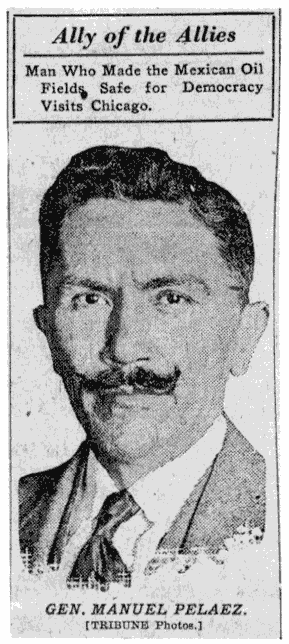
Fig. 13.
General Peláez, 1921. This photo of the cabecilla
of the Huasteca Veracruzana appeared in the
Chicago Tribune while Peláez toured the United
States after another of his periodic retirements. His
reputation was greater in the United States than in
Mexico, judging from the Tribune's caption. from
the Albert B. Fall Collection, courtesy of the
Huntington Library, San Marino, California.
embarrassingly invoked his name. Peláez told Mexican journalists that Huasteca's William Green was behind the rebellion, apparently settling a grudge with an old antagonist in the oil industry. Back in the Huasteca, after a brief flurry of taking supplies and money from The Texas Company and the International Petroleum Company, the small rebel force was quickly surrounded by loyal troops under Gen. Arnulfo Gómez. Martinez Herrera gave up, but the harm was done. No one in the Obregón regime would trust Peláez any longer as a military commander. Peláez found it expedient to head back to the United States for additional medical treatment. Obregón's agents tailed him throughout what amounted to a political exile. They linked him with a number of plots with other revolutionary castoffs. Subsequently, Peláez returned at a most inauspicious time — or perhaps he had planned it that way. Peláez moved back to his hacienda at Tierra Amarilla in time for the antigovernment rebellion of Adolfo de la Huerta in December 1923. The government forces immediately imprisoned Peláez, first in Tampico and then in Mexico City. As fate would have it, Carranza's assassin found rehabilitation in the De la Huerta revolt. Rodolfo Herrera, who had lost his military commission after killing the former president, regained his rank and pension by retaking Papantla for the government. With the rebellion subdued, Peláez gained his freedom, retiring to Tierra Amarilla and surviving into his seventies.[153] By the time he died, in 1959, the oil industry had passed from the hands of the foreign interests to the national government. But the Huasteca Veracruzana endured, and so did the dominant families of Spanish heritage that he had represented in his rebellion. Who can say that Peláez lost his struggle?