
26—
Yorick's World, or the Universe in a Single Skull
In what follows I shall explore a set of ideas formerly important in the history of philosophy—ideas that seem on the face of it quite implausible, as so many philosophical ideas do—to see whether in the light of recent developments in science they may not contain significant truths. The central idea, briefly put, is this: that when we look at the world it is not the case, as physicists are thought to claim, that light strikes the seen objects and is reflected into our eyes; on the contrary the seen objects are themselves the products, not the causes, of perception; they are in fact objects in a kind of private and extremely detailed 3-D movie that is playing inside our heads—quite literally inside our skulls. Hence the appeal to Yorick.
I need Yorick only for exemplary purposes, because his is the most obvious skull in the commonly available literature. While I am at it I should confess that there is another common point of reference that echoes in my title, namely Thomas Eakins's Max Schmitt in a Single Scull, one of his Schuylkill River paintings and an old favorite of mine. The connection started out merely as a bad pun, but like all good works of art this one lends itself to interpretation, and I will draw at least this much from it: that it represents an individual entrusting himself to an elegant bit of machinery. (For reasons that may become clear later on I want to block the Freudian reading that would have him afloat on the unconscious, or anything of that sort.)
Yorick appears in act 5, scene I of Hamlet—it is the gravedigger scene, and that too may seem appropriate, since as I go on I shall be unearthing philosophical skeletons some might think best left in peace.
Hamlet is with Horatio, the Stoic, who lacks philosophical imagination—everyone remembers the remark in act 1, scene 5: "There are more things in heaven and earth, Horatio, than are dreamt of in your philosophy." But here Hamlet himself is in a thoroughly materialistic mood. It is not just that death is a social leveler, but that the dust it reduces us to persists, serving perhaps humbler functions in the end: Hamlet speculates that the noble dust of Alexander might be found, in the imagination, stopping a bung-hole. Alexander, like Yorick, was a material object, his skull was full of real physical stuff. What made him Alexander was not the stuff but its arrangement as Alexander. The stuff of which we are made is in fact just about as old as the universe (and some of it probably formed part of Alexander on its way from the Big Bang to the present day).
Two questions, then: how does the stuff we are made of have to be arranged in order for us to have the life we do in the world we know, to perceive, to act, to feel and so on? And when it returns to dust, how much of that world perishes with it? What dies with Yorick? This question can be put in another way: what required Yorick for its existence when he was alive? Or more precisely still, what depended for its being on Yorick's knowing it? To start with, everything private to him—the secrets, as we might say, that "died with him"; his own desires, his memories, his consciousness, his subjectivity. But then also his perspective on the world, his way of seeing, his associations—and his associations in another sense, the social entities of which he formed a part. Suppose he had had a passion for one of the scullery maids—the clown had been his rival for her affection; that is why he poured the Rhenish—suppose even that they were secretly married. Then the couple, the marriage, depended on him and came to an end with his death. Suppose he had been the last surviving member of the Danish Jesters' Association: then the Association died with him.
In fact it would not be unreasonable to say that what dies with Yorick is Yorick's world. This assumes a general distinction between the world as an objective totality, on the one hand, and particular people's worlds—yours, mine, Yorick's—as the total contents of our individual experiences, on the other. When I die my world will come to an end, but the world will, I take it, survive, or at any rate persist. I believe that it was there before I was born and that it will outlast me. Certainly the castle of Elsinore was still there after Yorick's death, and so was the state of Denmark, rot and all. But now let us raise the stakes a bit. Suppose all the Danskers, as Shakespeare calls them, had died? The castle would have survived them too, but how about the state of Denmark?
The direction of this bit of argument will by now be clear enough, so
I will skip several steps and propose a provisional conclusion: the social world, I shall say, is mind-dependent. There are two levels on which this proposition can be sustained, one of them involving a stronger claim than the other. It is possible to make a rough division of things in the world into objects of the social sciences and objects of the natural sciences by asking of each object whether or not human intentions were involved in its production. The weak claim is that social objects are mind-dependent in this sense, as having been brought about through human action, in which we can suppose that human intentions were at work (although it is not necessary to claim that any particular human intended any particular outcome, such as the arms race or inflation, since as Engels once remarked, "What each individual wills is obstructed by everyone else, and what emerges is something that no one willed").[1] The stronger claim is that social objects are not only produced but also sustained by human intentions, and are therefore mind-dependent in the sense that if everyone's mind stopped sustaining them they would, as social objects, cease to exist.
It follows from this stronger claim that idealism is the appropriate philosophy for the social sciences, and it is about philosophical idealism that I now want to speak. The idealist everyone knows about is George Berkeley, Bishop of Cloyne, who thought that the category of "material substance" in philosophy was just a mistake. John Locke had recently developed an empiricist philosophy that said that the qualities—shape, color, hardness, warmth, and so on—which make up things we know (and they do make them up, in the sense that having all the qualities of an object together can't be distinguished by us from having the object) inhere in material substance. When asked, however, what substance was, he quoted the story of the Indian who was asked what the earth rested on: it rested, he said, on the back of a great elephant, which rested on the back of a great tortoise, which rested on "something, he knew not what."[2] Substance, said Locke, was something, but he knew not what. Berkeley got a good laugh out of this and brought some very sophisticated arguments to bear, one of which I want to spend a little time on.
Berkeley puts the argument in the mouth of Philonous, the mind-lover, who is trying to convince Hylas, the materialist, that his position is untenable. Philonous keeps pointing out that in order for us to perceive something it has to be perceptible, and he claims that we can't know that something is perceptible unless we actually perceive it. In order to perceive it we have to be there. I am obliged because of its notoriety to refer here to the lone tree that has so often fallen in the deserted forest, and to the noise it does or doesn't make. Berkeley would have thought that a silly question: if the tree is there, of course
it makes a noise—but it isn't, unless someone is watching it or listening. Berkeley thought, as he believed (correctly, it seems to me) good Christians were obliged to think, that God automatically looked after falling trees as well as falling sparrows; and if God omnipotently holds qualities together in objects we don't need to call on material substance for that service. Two of the three really good philosophical limericks I know—by Ronald Knox and "Anon," respectively—together sum up this side of Berkeley's views (we will get to another side later):
There once was a man who said "God
Must find it exceedingly odd
When he sees that this tree
Continues to be
When there's no one about in the quad."
"Dear Sir, Your astonishment's odd;
I am always about in the quad—
And that's why the tree
Continues to be
Since observed by, yours faithfully, God."
I hope I may be forgiven all this familiar stuff—we are on the way to more serious matters.
During the course of the argument between Hylas and Philonous, Philonous makes an offer and Hylas thinks he has given the whole game away. Philonous says, in effect, "If you can conceive of a tree existing without [i.e., outside] the mind, I'll give up." Hylas says gleefully, "Nothing easier—I do now conceive a tree existing after that manner." "Hold!" says Philonous, "Haven't you forgotten your own mind?" "Oh bother," says Hylas, "what a silly mistake—I thought of this tree all by itself but of course it was I who was thinking about it the whole time," and so on.[3] Now a brief consideration of Philonous's formulation: "conceive of a tree existing without the mind," shows that Hylas gives in too easily. Construe this as "conceive of a tree existing / without the mind," and we have to admit that one can't conceive of anything , existing or not, without a mind; but construe it as "conceive of/ a tree existing without the mind," and it is clear that some of the things one can conceive of with the mind can themselves, as so conceived, quite well be "without" any mind at all.
If we can conceive of a tree in a mindless world idealism fails, at least where trees are concerned. And I think we can conceive of trees, and oceans, and planets, and Big Bangs, and all the apparatus of physical existence, as existing without minds. We can, in other words, conceive of a world without us. But could we conceive of a joke in a
mindless world? or a purchase? or an argument? or a friendship? Or even a book (as something read) or a meal (as something enjoyed) or a war (as something suffered) or a nation (as something governed or defended)? The implied answer to these questions, at least as far as the social world is concerned, is: All these things depend on our knowing them; if there were no one to know them, they wouldn't exist.
Now I might leave the matter there, but the perversity of the profession drives me on. I said just now that we could conceive of a tree in a mindless world, could conceive of a world in which we didn't exist. But what would that tree and that world be like? I am tempted to say, what would they look like? but the mistake in that would be too obvious. If we replace "conceive" by "perceive" in our text no tricks of segmentation will help; we can't conceive of anything's being perceived in a mindless world, so the tree we conceive there can't be a perceived tree. But all the trees we've actually been acquainted with have been perceived ones. How shall we proceed with the argument? Well, it might help to look at what some philosophers have thought about perception, and particularly about the paradigm case of perception that we call vision.
The standard scientific account of vision is that light is reflected from surfaces, strikes the eye, is refracted and focused, activates the rods and cones of the retina, and produces nervous impulses that somehow translate into the experience of sight. It is important for my present purposes to realize that most of that account is very recent. A few hundred years ago nobody understood even reflection in any detail at all, and as to rods and cones and nervous impulses, they were as yet unthought of in anything like their present form. Still, people had theories of vision, often quite elaborate ones. Given the available evidence, some of these theories amounted to pure genius, and we have to admit that their proponents were at least as intelligent as the best of us and a good deal more imaginative. It is often instructive to try to think oneself into the frame of mind of some earlier philosopher, and sometimes the enlightenment that comes from that exercise is genuine.
The perception-as-movie notion in fact goes back at least as far as Plato, so I will begin this part of the argument with something familiar again, his doctrine of the cave (fig. 2). In Plato this is just an image, although he really does believe that the reality of things belongs to a world other than the world of appearance in which we live. He describes this cinematic space in Book VII of the Republic in these terms:
Behold! human beings living in an underground den . . . here they have been from their childhood, and have their legs and necks chained so that they cannot move, and can only see before them, being prevented by the
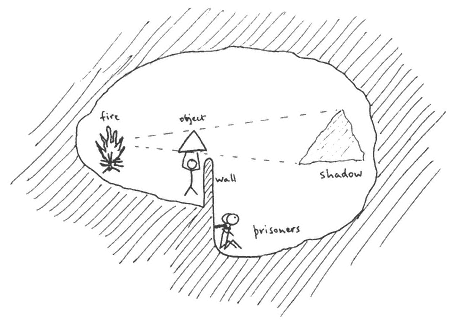
Figure 2
chains from turning round their heads. Above and behind them a fire is blazing at a distance, and between the fire and the prisoners there is a raised way; and you will see, if you look, a low wall built along the way, like the screen which the marionette players have in front of them, over which they show the puppets.
I see.
And do you see, I said, men passing along the wall carrying all sorts of vessels, and statues and figures of animals made of wood and stone and various materials, which appear over the wall? . . . And of the objects which are being carried . . . they [the prisoners] would see only the shadows? . . . And if they were able to converse with one another, would they not suppose that they were naming what was actually before them?
Very true.
And suppose further that the prison had an echo which came from the other side, would they not be sure to fancy when one of the passers-by spoke that the voice which they heard came from the passing shadow?
No question, he replied.
To them, I said, the truth would be literally nothing but the shadows of the images.[4]
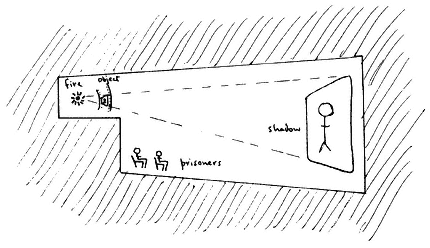
Figure 3
If in doubt about my description of the cave as a cinema, look carefully for a moment at the relations between the fire, the prisoners, the original objects, and their shadows in figure 2, and compare them with the same relations in figure 3.
Now all this is external to the prisoners, and there are many of them in the same cave. Let me now invoke the third-century Neoplatonist Plotinus, who changes the situation a bit and makes it into a serious theory of perception, not just an allegory. Plotinus is about as far from a causal theory, in which existing things cause us to see them, as it is possible to get; in his view, on the contrary, we help to cause them to exist. His world is as it were turned inside out: we think that what we see is the outer surface of material things; he thinks it is the inner surface of a world of light. You will get some idea of this inversion if you think metaphorically of turning on the light in a room, as we normally conceive of it and as Plotinus might. We think the room is already there and that the light just bounces off the walls. Plotinus might say that the light creates the room, blowing it up, as it were, from the lamp as an infinitely thin balloon that assumes exactly the room's shape, bulging inwards where the furniture is, perhaps poking out into the hall if the door is open. The difficulty with this metaphor is how we get into the room. Plotinus's answer is to turn us into the lamp: instead of having the projector make images and the prisoners look at them, the projector projects through the eyes of the prisoners. Figure 4 is an attempt to picture Plotinus's system.
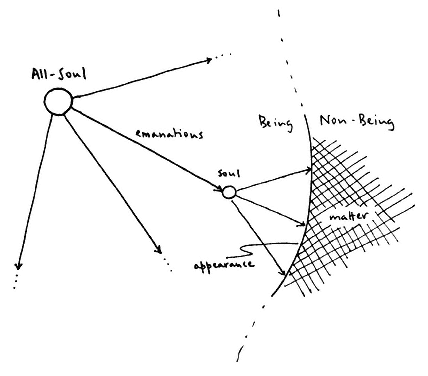
Figure 4
In Plotinus Plato's Idea of the Good has become a single self-generating and sustaining entity, which he calls The One. The One is perfect, so full of perfection indeed that it overflows, emanating Being in all directions. I cannot do better than cite from The Enneads of Plotinus a series of brief quotations that give the essentials of the theory:
Seeking nothing, possessing nothing, lacking nothing, the One is perfect and, in our metaphor, has overflowed, and its exuberance has produced the new; this product has turned again to its begetter and been filled and has become its contemplator and so an Intellectual-Principle. Soul arises as the idea and act of the motionless Intellectual Principles. . . .[5]
Ever illuminated, receiving light unfailing, the All-Soul imparts it to the entire series of later Being which by this light is sustained and fostered and endowed with the fullest measure of light that each can absorb. It may be compared with a central fire warming every receptive body within range. . . .[6]
. . . the All-Soul [has] produced a Cosmos, while the particular souls simply administer some one part of it. . . .[7]
. . . so far as the universe extends, there soul is. . . .[8]
. . . the Soul's operation is not similarly motionless; its image is generated from its movement. It takes fullness by looking to its source; but it generates its image by adopting another, a downward, movement. This image of Soul is Sense and Nature.[9]
Matter, for Plotinus, is as good as nonexistent. In the words of his translator, Stephen McKenna:
Matter is the last, lowest, and least emanation of the creative power of the All-Soul, or rather it is a little lower than that even: it is, to speak roughly, the point at which the creative or generative power comes to a halt; it is the Ultimate Possible, it is almost Non-Being; it would be NonBeing except that Absolute Non-Being is non-existent, impossible in a world emanating from the bounty of Being: often no doubt it is called Non-Being but this is not in strict definition but as a convenient expression of its utter, all-but-infinite remoteness from the Authentic-Existence to which, in the long line of descent, it owes its origin.[10]
Particular bits of matter, for instance, are under the administration. whenever attention is being paid to them, of the particular souls who see them, who participate in their emanation from the One via the Intellectual-Principle and the All-Soul; in this particular case, us. Nature and everything in it is, as we have just learned, "the image of the soul." The words of Plotinus rendered by this summary formula would be done better justice, I think, if instead of reading, "Nature is the image of the soul," we were to read, "Nature is an appearance belonging to the soul." The soul to whom my appearances belong, or in whose charge they are, is of course my own—this is an individual and not a collective matter, even if we all draw our emanations in the end from the same source.
In what follows, I want to hang on as well as I can to this Plotinian view. It has a kind of crazy plausibility; the attempt to see the surfaces of things as the screens on which our own projections terminate is quite feasible, as it turns out, and a fine challenge to the intellectual imagination. Why did Plotinus need such a bizarre doctrine? Why couldn't he have accepted the notion that light is reflected from objects, etc.? But do we realize, I wonder, just how bizarre that doctrine, in its turn, really is? What physics asks us to believe is that space is full of trillions upon trillions of photons, shooting this way and that at the
speed of light (which is their speed), in such prodigious numbers that wherever I put the pupil of my eye, however dim the illumination may be, enough of them are coming from every direction to that very point for me to see what is there if I turn my eye in that direction, all this happening so fast that statistical fluctuations are flattened out and I see things steadily. Such an account would no doubt have seemed to Plotinus to require a simply inconceivable prodigality of fuss and bother, and wildly implausible quantities of things. He does in fact entertain the idea that it may be something coming from the object, through the air, that enables us to see it, but he has an answer to that:
For the most convincing proof that vision does not depend upon the transmission of impressions of any kind made upon the air, we have only to consider that in the darkness of night we can see a fire and the stars and their very shapes.
No one will pretend that these forms are reproduced upon the darkness and come to us in linked progression; if the fire thus rayed out its own form, there would be an end to the darkness. In the blackest night, when the very stars are hidden and show no gleam of their light, we can see the fire of the beacon-stations and of maritime signal-towers.[11]
We would say, of course, that even from the distant signal-tower photons are streaming by the billions, second after second, in every direction of space. I wish to underline this point—the astonishingly large number of things that the scientific account requires—because I shall need it later on.
I now jump fifteen centuries, back to Berkeley's time, with first however a quick quotation from Leibniz to show that Plotinus's view was not just a Neoplatonic aberration. Leibniz was puzzled by the fact that each of us lives in his or her own world, and had a lot of difficulty in seeing how we could manage to have a world in common; he concluded that everyone was as it were shut in, but that God arranged for each enclosed world to agree with every other in mirroring the whole. God for Leibniz is, as can be seen in these quotations (from the Monadology ), rather in the position of the One in Plotinus.
Thus God alone is the primitive unity or the original simple substance; of which all created or derived monads are the products, and are generated, so to speak, by continual fulgurations of the Divinity. . . .[12]
Now this connection, or this adaptation, of all created things to each and of each to all, brings it about that each simple substance has relations which express all the others, and that, consequently, it is a perpetual living mirror of the universe.
And as the same city looked at from different sides appears entirely different, and is as if multiplied perspectively; so also it happens that, as
a result of the infinite multitude of simple substances, there are as it were so many different universes, which are nevertheless only the perspectives of a single one, according to the different points of view of each monad.[13]
Still there remains something a bit odd about this. I return to Berkeley, in his New Theory of Vision , to give the argument a more modern twist.
Berkeley is much preoccupied, as we can understand an idealist's being, with the question of why we think that the perceived world is outside us rather than inside. He concludes that it is because of the fact that part of our experience of that world is what we might call depth of field, a sense of distance or "outness," as he puts it. Once again his own words will convey the ideas best:
From what hath been premised it is a manifest consequence that a man born blind, being made to see, would at first have no idea of distance by sight; the sun and stars, the remotest objects as well as the nearer, would all seem to be in his eye, or rather in his mind. The objects intromitted by sight would seem to him (as in truth they are) no other than a new set of thoughts or sensations, each whereof is as near to him as the perceptions of pain or pleasure, or the most inward passions of his soul. . . .[14]
Upon the whole, I think we may fairly conclude that the proper objects of vision constitute an universal language of the Author of nature, whereby we are instructed how to regulate our actions in order to attain those things that are necessary to the preservation and well-being of our bodies, as also to avoid whatever may be hurtful and destructive of them. It is by their information that we are primarily guided in all the transactions and concerns of life. And the manner wherein they signify and mark unto us the objects which are at a distance is the same with that of languages and signs of human appointment, which do not suggest the things signified by any likeness or identity of nature, but only by an habitual connexion that experience has made us to observe between them.[15]
With this last point we are really on the contemporary scene, since language is one of the dominant philosophical preoccupations of our century. It is to be noticed that we don't share language, or inhabit the same linguistic space; language is something we each severally have. And we each have a whole language—it isn't that I have some and you have some more, but insofar as we are able to communicate, my language duplicates yours; I carry mine around with me and you do the same, so that when we meet we can speak and be understood. The same thing is true with respect to social institutions. Each of us in academic life has, for example, a whole University, and it is our carrying it around with us that makes the University—the institution, not the buildings—exist.
The idea that emerges from Leibniz and Berkeley is that we each have a perceived world; we don't live in the same one. It was popular in the seventeenth century to speak of the perceived or sense world as a "sensorium," a space full of things sensed, as an auditorium is a space full of things heard. Newton used to say that space as a whole was the sensorium of God. The point to which the argument has so far brought us is that we can imagine, if Berkeley is correct, that each of us has a private sensorium and that its contents bear no necessary resemblance to what there actually is in the world, nor to what is in other sensoria. Is there any reason to think that he is correct? We might balk at the bit about the Author of nature, and not be willing to follow Berkeley in saying, as he does, that what there actually is in the world is a lot of ideas in the mind of God, but is there some other way of interpreting the position he takes?
Suppose that instead of Berkeley's God or Plotinus's One we postulate simply "the world without us," however it may turn out to be, and suppose that instead of emanations passing through the soul or messages coming from the Author of nature we postulate the physical effect that world has on us, however that goes. But suppose we keep, from Plotinus, the notion that what we then perceive is something that proceeds from us, and from Berkeley the notion that its contents indicate to us, but do not reproduce or represent, what there is in the world without us. Suppose, in other words, we hold that something in us generates (under suitable stimulation) a sensorium and its contents, corresponding sometimes partially at least, and in some way yet to be specified, to the world there is but not necessarily being in any obvious way like it. Is this a conceivable view?
What might make it difficult to accept, or even inconceivable? One of the most implausible things about it is that it would require something in us, rather than something in the external world, to provide (in response, to be sure, to detailed instructions from without) the visible detail of the perceptual field, and that field is so rich, so nuanced, so finely grained, so charged on examination with minute and unexpected curiosities, that it seems silly to think of us as having anything to do with its production . But before jumping to conclusions let us remember all those photons, and how inconceivable it would have seemed to anyone more than a few hundred years ago—if indeed it does not still seem inconceivable—that they are really all there, rushing invisibly about; and let us also remember Yorick and his skull. When Yorick was alive, what did his skull materially contain?
The answer we can now give, although Shakespeare could not have given it, is: thirty billion neurons . A few months ago I like everyone else would have said ten billion, but recent neurological research has
given us a bonus.[16] At all events we begin with thirty billion, though they start dying before we are born and no new ones are produced, so it is downhill all the way. However, at birth their interconnections are pretty primitive, and the epigenetic development of the brain produces networks of unbelievable complexity. The information carried in the visual field, however minutely detailed, can be handled with a tiny fraction of the available computational resources. As far as that goes, the input that triggers the generation of that field has to be handled by a mere ten million rods and cones. The fact that the number is finite means that the field ought to be grainy, and it would be if it were not for the fact that the projecting mechanism smooths that over, a spatial effect not unlike that of the smoothing-over in time that we automatically perform on the flickering images in ordinary movies.
When we look at an object, a white pitcher, for example—something that gives us a feeling of quiet and simplicity—there are actually all sorts of busy transactions going on: photons rushing and bouncing, cells in the retina firing, impulses tearing along nerves and exploding packets of chemical transmitters at synapses—but the visual field projects for us something quite different: a stable, continuous, firm entity. We might be meditating on perfection in total tranquillity, and all that frenzied activity would still be churning inside the skull. There seems to be pretty good evidence that the brain puts together the sensorium we experience from sequences of inputs that it stores and processes. We have the steady sense of being in a more or less peaceful enclosed space, relatively large and enveloping, but our eyes are darting here and there all the time, picking up bits of information and feeding them into the neural machinery, as studies of saccadic eye movement have shown.
A further reinforcement of the thesis comes from some early structuralist or protostructuralist work by Ernst Cassirer, who proposed that just as in linguistics, where we infer grammatical constants from groups of utterances or even groups of languages, we infer perceptual constants from groups of experiences.[17] My final point is from an eccentric English cybernetician called Oliver D. Wells, who in his book, HOW COULD YOU be so naive! , borrows from Gibson the idea of an integration of overlapping contents as part of the mechanism of generating the sensorium, although he does not use that term. Gibson imagines someone sitting in a chair and looking around a room, taking in one part of it and then another and thus assembling a representation of the whole room. Wells takes the process to a more fundamental level and says simply, in effect, The brain computes the world.[18]
Where does all this leave us with respect to our original questions? What liberated us from Plotinus's theory of vision, we might say, was
the development of a physical account of the propagation of light, the realization that the burning of the signal fire, most of whose products are wasted as heat, really does generate sufficient energy to fill the universe, locally and temporarily, with sufficiently generous numbers of photons to activate any eye within reach. What restores the theory to us, in revised form, is the development of a physical account of the operation of the brain, the realization that the complexity of the interrelations of the neurons really is great enough to provide each of us, in his or her private bony screening room, with a complete picture of the world. It is an incidental virtue of this view that it makes dreams, hallucinations, intoxication, and so on, not to mention imagination and indeed thought itself, perfectly and immediately intelligible as the functioning of the projection mechanism under other than perceptual stimuli. It remains to answer the final question—how much of the world there really is can we really know?—and to fit our possession of this apparatus into an account of ourselves: who we are, where we come from, how if enclosed in our own sensoria we can make contact with one another.
Perceptual consciousness does not always convince us of the existence of an outer world. Consider a room in which one of the walls is a mirror: we can't see the place in space, away from the edges at any rate, where the real room merges into the mirrored one, but we still don't believe there are two rooms. If we have to operate in the mirror world—as dentists sometimes do, or people backing up their cars—that doesn't pose any serious problem after a bit of practice. Experiments have been done with the total inversion of the visual field by the use of special prismatic glasses bolted to the head, and after a bit of stumbling the field rights itself (only to reverse again, with more stumbling, when the glasses are taken off). There isn't time to pursue this point, but it lends weight to Berkeley's remark that by vision "we are instructed how to regulate our actions in order to attain those things that are necessary to the preservation and well-being of our bodies, as also to avoid whatever may be hurtful and destructive of them." Perception, in other words, helps us to locate the icebox and not to bump into the furniture. (I mean of course the real icebox and the real furniture, not just their perceptual counterparts.)
As such it clearly has survival value, and while we cannot say that the perceptual apparatus was developed in order to be used in this way, we can say that to some degree at least the remarkable progress human beings have made in understanding what happens in the world is due to their ability to project perceptual models of it. The final question has to do with what knowledge of the "world without us" the evidence of perception allows us to claim. This falls into two problems again: other
people, and the physical world. We have reason to think (on the basis of perceptual evidence) that other people live in worlds similar to our own; nothing is lost, indeed everything is to be gained up to a point, by living practically as if we had a sensorium in common, even though we couldn't, given the physical and neurological facts, possibly do so. It might be that if your neurological impulses could be fed into my brain I would experience them as a horror movie, or it might be that I would feel at home. I think in fact the former is more likely to be the case, since I have spent fifty idiosyncratic years getting used to my world, and my strategies for being comfortable in it are very likely, in their details at least, to be very different from yours. But the latter is a more friendly thought. I could at all events expect to know the language, as it were, since the chances are that our brains were programmed in roughly similar ways, although even that is not by any means certain. Thirty billion neurons, loaded since well before birth with nonstop inputs from all five senses, will have evolved some of their own programs, and it may well be that you store the instructions for saying (or recognizing) "blue" where I store the instructions for saying or recognizing "salami." This might have interesting though uncomfortable consequences should we ever get our wires crossed.
As to the physical world, that is a different story. Everything we have learned about science suggests that away from the normal macroscopic center of things we can't form a perceptual model of it at all. We have grown up in what I call the "flat region"—a metaphor I take from the fact that the earth seems flat where we live and we need to go off into space, or make geographical inferences of one sort or another, to conclude that it is round. So in the direction of the very large, the very fast, the very distant, the very small, we can only have mathematical models of how it really is. Science began in the familiar world with the mathematical formulation of perceptual relations, and for a while we could imagine that the extensions of perception by means of instruments—microscopes, telescopes—gave us access to its remoter parts. But we know now that what is really going on, not "beneath" perception but in the world of which perception gives us only an approximate and sturdy model, suitable for our macroscopic purposes, consists of events we can't in principle perceive, among them the very events that make perception possible.
It follows from this—and I will conclude with perhaps the most preposterous claims of this essay and the ones that will seem philosophically the most uncomfortable—that the microevents to which I allude aren't happening in the world we vividly know at all. There aren't any photons in the perceptual room, and no perceptual event causes another, just as David Hume realized. So where are the photons and
the microevents in general? Why, in the real world. And what is the status of our knowledge of it? This is where we have to hold on to our seats, because nothing protects us from the conclusion that we have no direct knowledge of it whatever, that all we can ever allege about it is purely and massively hypothetical. Berkeley might be right: God might be doing it all by the word of his power, and there be no such thing as material substance. There is no reason whatever to think that this is actually the case, and anybody who claimed it was wouldn't have any better evidence than we do, in fact would have great difficulty in even tackling a lot of questions that within our hypothesis we have adequate answers for. But only within the hypothesis. There is in fact no worked-out alternative, which is why we have come to have such confidence in science. But Hume's skepticism remains unrefuted.
There is one respect, however, in which there may be a way out of our ignorance, and that is through mathematics. It seems likely that certain structural relations, such as "between," "greater than," etc., must have formal counterparts in the real world, and that we might therefore learn to speak its language—to speak at any rate with its grammar, although we would still have to use our own vocabulary. The supplementary point that needs to be made here is that to say the real is hypothetical or mathematical does not mean, as some fanciful popularizers of science have suggested, that it evaporates into formulae, is merely an idea in our heads, etc. We attribute hypothetically to the real just the kind of materiality it needs in order to sustain us, just the relations among its real parts whose mathematical expression we are able to divine. The fact that we don't know it any better doesn't mean that it doesn't exist; our knowledge or lack of it is a matter of complete indifference to it; it is , and has no need of us. Our proper attitude to it, it seems to me, should be one of gratitude for sustaining us as perceiving and feeling beings.
The real we hypothesize can have devastatingly nonhypothetical effects, of which some of the most notorious and most troubling occur in the domain of nuclear physics. The apparatus of our sensorium is adapted to flat-region phenomena, and our imagination is limited to plausible extensions of those phenomena. We can observe many chemical reactions, or their perceptual counterparts, and, horrendous as warfare is, it counted, until 1945, as a component of the familiar. One of the things that makes nuclear explosions horrific is that they constitute such a violation of the scale of possible imagined causal relations; they draw on forces we can't experience, even by courtesy, as it were. This fact may account for the automatic horror-movie feeling of their perceptual consequences. I am not sure that any good antinuclear argument could be constructed on this basis, because it looks as if it would
rule out benign uses like radiation therapy, and the like, but it might be worth working on. It seems silly to let the existence of these fragile sensoria—and they are fragile, requiring as they do the coincidence of thousands of small determinations for their perpetuation—be threatened by default. Save the Sensorium sounds like a pretty good motto. Even if I inhabit mine alone, as you do yours, we keep showing up in each other's, and it is too good a life to give up without a struggle.