
13.
The Living and the Dead
The Household Dead
From the first days at Ezkioga the dead appeared in the visions. Those who appeared were almost always close family members, whether of the seer, of those around the seer, or of people in the seer's town. Rarely were the dead unidentified. In spiritist sessions the dead of other nations, races, or religions turned up, but at Ezkioga the deceased were those for whom the seers or their followers were responsible.
As with the visions as a whole, so with visions of the dead: more than two-thirds of the seers were women and girls. But the dead persons the female seers saw were likely to be males. As in other religious matters, women or girls were representing their families when dealing with the other world. Slightly more than half of the dead relatives seen were brothers, sisters, spouses, or children of the seers; so they were seeing those who had died relatively young, not parents or older relatives. Eventually the seers progressed from reporting on the dead to interceding for them. And after Ezkioga
became an underground cult, some of the seers helped the dead to heaven as a profession.[1]
Dead persons seen or learned about in Ezkioga visions, 1931-1950:
Relatives of seers: 19 (grandparents: 3; aunts: 2; parents: 4; spouse: 1; siblings: 6; children: 2; others: 2)
Relatives of believers: 22 (parents: 7; spouses: 2; siblings: 4; children: 3; in-law: 1; other or unspecified: 5)
Other: 30 (members of village: 13; someone connected with an onlooker: 6; seer's associates: 3; deceased seers: 4; deceased believers: 2; deceased notables: 2)
Gender of the dead seen: total males: 42; total females: 26; males and females together: 4; gender not specified: 6. Women and children tended to see children; men tended to see (or be asked about) adults. Ezkioga seers who learned about the dead, 1931-1950, by gender and age:
|
For the first two months of the visions the seers tended to see their own dead, especially those who had died prematurely. On July 18 a gentleman from Madrid saw next to the Virgin his only child, killed in a railroad accident. On July 30 a girl from Bergara, aged fourteen, learned that her father and little brothers and sisters were in heaven and she would join them there. On the same day Benita Aguirre saw her baby sister as an angel, and the next day José Garmendia followed the trend, learning that his mother was in purgatory and needed two masses to get to heaven. In August a seven-year-old boy from Zumarraga saw his baby brother in heaven and a teenage girl from Albiztur saw her brother carrying the flag of his sodality at the foot of a crucifix. The youth had died recently from a fall from a moving truck when he was returning from a meeting of the San Luis Gonzaga sodality.[2]
All 1931: Madrid man: Manuel Sánchez del Río, ED, 21 July, p. 8; Bergara girl: N., "Anduaga-mendiko"; Benita: B 486-487, and LC and PV, 31 July; Garmendia: PV, 4 August; Zumarraga boy: García Cascón, "Algo más"; Albiztur girl: Luistar, A, 23 August.
At the end of August, as the crowds dwindled and individual seers were reduced to helping their own loyal followers, the visionaries began to see the dead of others. During her first vision at Ezkioga María Agueda Antonia Aguirre, aged forty, a poor farm woman living in Bidegoyan, had been cured after being partially crippled for four years. The Virgin instructed her to say the rosary daily and go to Ezkioga every week. She did so with a stable group of friends and neighbors. Her third vision, on August 31, included the dead:
When reciting the second rosary, she saw an intense brightness between the trees of the woods on the left side and the tree that holds the cross. In the midst of this brightness appeared the Most Holy Virgin in a black mantle and a white tunic with her hands crossed in front of her. At her feet there appeared three little angels and three more were above her head. She is sure that of the three little angels who were at the feet of the Virgin, two were her own deceased children and the third was a two-month-old girl who died eight years ago on a farm near hers. These three children were looking at the Most Holy Virgin. Their robes were the same as the angel costumes in which they had been buried.[3]
AC 22: "Relato por la interesada de la curación prodigiosa y primeras visiones de Doña María Agueda Antonia Aguirre Aramendía, domiciliada en la casería 'Berantegui' de la villa de Vidania" (4 pages, written after 20 September 1931, possibly typed and titled by J.B. Ayerbe after fall 1932 from an account written down in 1931), p. 3.
She returned on September 15 and identified the other three angels as well.
At the feet of the Virgin were the three angels she saw August 31, and above the Virgin's head three more angels whom this time she recognized. She is sure that they were three children who were her relatives, one six years old, another six months old, and the third two months old. These too wore the same angel clothes in which they had been shriven. At the feet of the Virgin she saw as well, dressed as San Luis Gonzaga, a son of Señor Lasquibar of Albiztur, who died twenty-two years ago at age twenty-three.[4]
Ibid., p. 4, sixth vision, 15 September 1931.
The dead were just one element of María Agueda's visions. Like other seers she also saw the crucified Jesus and Saint Michael and other angels with swords.
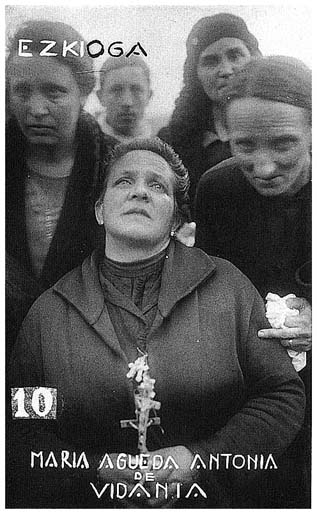
María Agueda Antonia Aguirre in vision
at Ezkioga, 1932. Photo by Joaquín Sicart
She worried about the political situation in Spain, and the Virgin said she would appear in many places and work signs that all would experience. The dead were not the highlights. Rather, seeing them seemed to show that the partition between earth and heaven was down. It was no great surprise to María that her young children were there; she had shrouded them as angels because she knew that they would inevitably go there, baptized as they were and below the age of sin. The important news of the visions of the dead was that the Virgin stood with the living as well as the dead in the seer's family, clan, cuadrilla, locality, and nation.
María Agueda reported no contact with the children—it was enough to have recognized them with the Virgin. She would have known already that they were interceding for her. As the church bells tolled when they were dying, she would
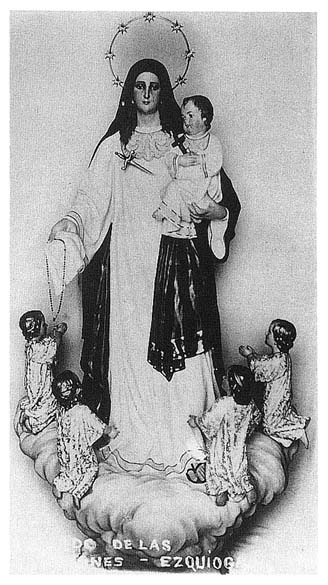
Children as angels around the Ezkioga image made in 1932. Photo by
José Martínez. Courtesy Arxiu Salvador Cardús i Florensa, Terrassa
have recited the Bidegoyan prayer: "If for any sin committed in this world you find yourself suffering in purgatory, let the beloved Jesus receive you now free of suffering, and when we ourselves are in need, be our intercessor."[5]
Mendizábal, AEF, 1923, pp. 104-105. Martín Ayerbe gained credibility from his detailed descriptions of five dead Zegama children as angels. He also saw his baby sister and, exceptionally, she spoke to him, telling him that he would see her often and she would help him (visions, 13 and 15 October 1931, B 624-625).
Young Lasquibar was the deceased son of the wealthy town secretary of Albiztur (the seer's place of birth). He was not the only dead person a visionary saw dressed as San Luis Gonzaga. About the same time, in one of a series of visions in and around the town of Ormaiztegi, seven-year-old Matilde saw her
grandfather like the saint in a black habit, a surplice, and a clerical hat, holding a crucifix. That is how the family had laid him out in 1900. The grandfather was but one of the dead Matilde and a friend identified for those around them.
[The girls] say they see a very wide road. In the center is the Virgin. On both sides there are long lines of dead persons. Those on the right are already in heaven; those on the left, in hell. The girls read the name on each coffin. Among them are many from Ormáiztegui, some of them recently deceased, but others who died many years ago, before the girls could have known them…. Finally the angels take to heaven the dead on the right and those on the left disappear in flames as if in a great hole that opens in the earth.[6]
Visions of about 1 September 1931, as told to Matilde's parents and Luisa Arriola and recounted by them to Rodríguez Ramos, Yo sé, 21.
The file of coffins with identifiable dead going off to hell reflects both what children might surmise about the Last Judgment and what they knew for sure about Ormaiztegi. The town had both church people and a Republican minority; the Republicans had a social center, sent articles to La Voz de Guipúzcoa, and complained about the power of the parish priest. Beatriz of Unanu also identified the dead of her town as they went by in procession.[7]
Juaristi, DN, 25 October 1931.
Just which dead the seers saw seemed to depend on their listeners. In Navarra, where children performed before neighbors, news of the town dead was a central feature of the visions. The names of the dead meant something to everyone present. The visions were a devout nightly spectacle for the townspeople, for whom the children narrated a kind of heavenly theater of the town dead. A boy in Arbizu exclaimed in surprise when he saw the deceased wife of a neighbor up in the sky, "Coño, aquí está la Bárbara! [Hey, here's Barbara!]"
In contrast, at Ezkioga each vision cuadrilla would be surrounded by onlookers who did not know the core people or one another. The seers might see the dead they knew, those of the core followers. But they generally did not see the dead of onlookers, whom they would not have recognized; instead, they heard about them from the Virgin. The Catalan Salvador Cardús described how a woman from Terrassa learned that her father was in heaven. The seer was the girl from Ataun.
The wife of my friend Joan, who was there on Monday, October 5, told the seer to ask the Virgin about the fate of her father, who had died almost instantly and for whom they were worried. The seer went down to the road after the rosary and waited until she saw the woman, to whom she said that the Virgin had told her that her father had been saved. And she added, speaking to the couple, "The Virgin told me to tell you that she is very pleased with the life that you lead, and that you should continue the same way."
Six days later Cardús heard from Ramona Olazábal that his father too was in heaven. In both cases the fate of the dead, unlike the fate of the child angels, was
seriously in doubt, and this news gained the seers loyal followers. There must have been pressure on others to provide similar information.[8]
Vision for Terrassa woman: 5 October 1931, SC E 14-15; for Cardús, SC E 53-57.
The members of the first Gemma trip in mid-December 1931 also made these requests.
Some ask [the Virgin through José Garmendia in trance] about dead persons. Sometimes she makes no response, other times she smiles, and sometimes she weeps. One man asked about a dead person. The Virgin wept as her only response. When the man asked Garmendia what her reply was, Garmendia could not bring himself to disappoint him. "The Virgin said nothing and simply gave a blessing." He did not say the whole truth, and he had a scruple about it, so in another vision he asked Mary, in his simple and rustic manner, "Did I sin, Mother?" She told him no, since he had done it out of charity.[9]
Gratacós, "Lo de Esquioga," 13-14.
By 1932 the Catalans' habitual seers—Benita Aguirre, María Recalde, and José Garmendia—were helping the dead to heaven by specifying which devotional acts the survivors should perform. Benita would often ask for masses. When I asked her brother if any money came into the house because of the visions, he said none at all, except that occasionally Benita would ask her mother to solicit money for a mass for a given soul in purgatory, saying, "So-and-so is suffering in purgatory and asks that you order a mass."[10]
Jesús Aguirre, Madrid, 4 April 1994.
Benita would see the souls ascend. A French journalist described the audience response to one such vision:
Often the pilgrims want to know the fate of the soul of a deceased person. They exclaim when in a collection of yellowed pictures [by this time the Catalans routinely brought photographs of deceased relatives to help the seers with their identifications] a little girl picks out one, saying she recognizes someone she had noticed in the flames of purgatory. Little Benita astounded in this way a group of Catalan pilgrims by specifying exactly how many days one of their dead relatives had been awaiting pardon. The relative had been dead 72 days, and the date was easy to verify. Those present said the Our Father that he needed to enjoy eternal peace, and the seer made his entire family break out in transports of joy when she guaranteed that she had seen the deceased go up to paradise in her séance.[11]
Ducrot, VU, 16 August 1933, p. 1292.
On 17 May 1932 during a vision with eight or ten believers, Benita
suddenly said loudly, "Pray three Hail Marys for each of the souls who are about to leave purgatory." With utmost devotion those present prayed what the seer had ordered, and she exclaimed, "They are entering heaven." One of them was the Cura Santa Cruz, well known in the region, a combatant in the Carlist Wars who died in Latin America as a tremendous and exemplary missionary.
This was no run-of-the mill soul. Manuel Ignacio Santa Cruz y Loidi was a local Carlist hero and a nationwide symbol for clerical involvement in reactionary rebellion.[12]
ARB 144; Olazábal, Santa Cruz.
For the Ezkioga defender Mariano Bordas, Benita Aguirre's vision of a particular soul entering heaven was proof for the apparitions as a whole. At Ezkioga in April 1932 the Terrassa wool merchant Rafael García Cascón had learned that one of two relatives in Extremadura had died, but he did not know which. He told Benita and Recalde, and later at the vision site while the two seers were in vision, he asked for an Our Father for the deceased. After the prayer
the little seer transformed her face in an expression of angelic happiness and spoke in Basque that her countrymen, especially her mother, translated; apparently the Virgin told her that the deceased had died at 4:00 A.M. and that at that very moment (it was 5:30 P.M. ) [the Virgin] had taken Marcelino out of purgatory. The girl saw an angel put a halo on his head and saw him enter heaven dressed in the habit of Saint Francis and belted with a Franciscan cord. A little later during the vision of the girl Marcelino appeared again, and Benita said that Marcelino thanked Señor García Cascón and all who accompanied him in the Our Father.
María Recalde backed up Benita, saying the Virgin had told her the soul had entered heaven at the moment of the Lord's Prayer.[13]
Bordas Flaquer, La Verdad, 35.
Heaven, the Believers' Reward
When believers and seers themselves died, other seers saw them in purgatory or heaven. In September 1932 those around Benita asked her to ask the Virgin if the seer María Celaya, who was gravely ill, would recover. Benita seemed to see María in purgatory.
I saw the seer but only her head. Her face was very disfigured, and she seemed to be suffering a lot. I do not know where she was, since the place was so dark. After the vision, which was about six o'clock in the evening, they told me that she had died that morning.[14]
B 491. Boué, 143, gives a more complex version.
José Garmendia reported that the servant seer Carmen Visa, who died two weeks after María Celaya, spent only a few moments in purgatory before going to heaven.
In January 1934 Martín Ayerbe learned that the sister of the parish priest of Zegama was in heaven. Three weeks later Conchita Mateos in vision spoke to the dead woman, before about twenty people in Beasain. Juan Bautista Ayerbe described how Conchita made the connection.
Next, and with the desire I had not mentioned to anyone, not anyone, to know if the late Ramona Oyarbide, a very fervent devotee of the Holy Aparitions
of Ezkioga who died in Cegama last January 21, was in heaven, I gave the girl a death card I had received from the parish priest of that village, the brother of the deceased. The girl, without opening the card, became very excited, "Is that Ramona? You must be better there than here! You left this earth, for you were so sad, and now you are in delight for eternity! How many times would you say, 'When will I be in heaven?' Well, now you are in the heaven you so desired. There you are together with Gemma and Mama [Amatxo , referring to Mary]." (When the vision was over the seer responded to my questions by saying she had seen the deceased together with Gemma and the Most Holy Virgin, and that she had never met her in real life.)
Then in the same trance the girl replied in writing to three letters, one of which, with four questions for the Virgin, was mine. Her answers fit the questions EVEN THOUGH THE GIRL HAD NOT READ THEM . She distributed flowers as directed by the Most Holy Virgin, had certain objects blessed, and began to dictate to me the following while not losing sight of the vision.
The Virgin's subsequent message as relayed by Conchita put the vision of Ramona Oyarbide in perspective, for in fact it did not refer to the woman at all. The Virgin told those who still believed in Ezkioga (it was only ten days after the Vatican backed Bishop Múgica's September 1933 decree denying that the visions were supernatural) how lucky they were. Through Conchita the Virgin asked those present if they led better lives since they learned of the apparitions. When they answered that they thought they did, the Virgin praised their loyalty and pointed out that when she first appeared many thousands came by bus, train, and on foot, and "many of the little angels came down from heaven as well."
The Virgin described for the believers the spirit in their little community, a spirit I still felt in the 1980s and 1990s when speaking to its last original members.
"Look how happy you are together at this moment! How many such happy moments you have had together since I appeared! Above all, how often you get together to tell stories to each other! Even if they are always the same, you never tire of hearing them. You are told them, you are told them, and you always want to hear them. You ask each other if you have more stories. And if you do, you are all happy; and if you don't, then you go back to repeating the previous ones!"
Conchita said to the Virgin, "You must laugh at us, Mother! Because what can we do? We like your things so much! We are always talking about you, so we are always wanting you to come so we can hear your stories. Keep on, keep on, for we do not tire of them!"
Juan Bautista Ayerbe's sister-in-law made an aside to him, "Others from Urnieta would have wanted to be here." Whereupon the Virgin said something
to Conchita, who replied, "Yes, Mother, that is true, and many who are nearby do not want to come and hear you. Jesus says, 'I come to you and you reject me.'" Finally, after a vision that lasted forty-five minutes, the Virgin departed.[15]
Juan Bautista Ayerbe, "Visión de la Niña Conchita Mateos, en Beasain 10 Fbro. 1934," 2 pages, dittoed, signed by Conchita Mateos, AC 307 and 308.
This account shows us two phases of the presence of the dead at Ezkioga. In the first the dead came down with the Virgin as little angels while the great public visions were taking place, and the angels were one more factor among many that authenticated the visions. In the second, with the visions discredited and the believers on the defensive, heaven was a reward for continued belief. By the end of October 1931 the Catalans knew that those who came from far away believing in the apparitions would go straight to heaven without passing through purgatory. In this phase appearances by the dead helped maintain the morale and loyalty of the living. Believers led lives of heavenly joy, enriched by heavenly stories brought to them by the Virgin. In both phases the dead were benign spectators at the visions.[16]
For Catalans see García Cascón to Vallet, 31 October 1931, AHCPCR 10-A-27/2. Garmendia told García Cascón, José María Boada, and Manuel Esquisabel on 9 December 1931 that if they kept on as they were then [leading a good life], they would not go to purgatory (SC E 237).
But there was an obverse, dark side to the believers' assurance: doubters would go to purgatory, unbelievers to hell. Seers saw some people in purgatory for not believing enough—the brother-in-law of a fervent believer in Ormaiztegi, because he was skeptical about the visions and did not attend the local sessions, and Juan José Echezarreta, for giving in to government pressure and removing the image from the holy place. José Garmendia warned a man from Sabadell who had asked for a blessing that the Virgin of Ezkioga had said "they have to believe in her, and if they do not believe now, at the end they will not have time to believe in her. It will be useless to ask for forgiveness at the last hour. He who does not believe in her does not believe in God Our Lord." Hell was considered a sure punishment for those active in suppressing the visions.[17]
Garmendia in SC E 241-242. Condemnation of nonbelievers: López de Lerena to Burguera, 26 July 1933, private archive; B 690-693; Albiztur girls told Gregorio Aracama, Juan Celaya, Albiztur, 6 June 1984, pp. 29-30; Pío Montoya, San Sebastián, 7 April 1983, p. 13; of governor of Gipuzkoa, PV, 4 November 1932.
The people of the Goiherri at this time took sudden death when not in a state of grace to be divine punishment and almost certain damnation. Writing about Ataun in 1923, the Basque ethnographer Jose Miguel de Barandiarán observed: "We have never had a homicide, but we have had deaths by accident at work. In these cases one of the things that most torments the family is that the deceased was not able to receive the last rites."[18]
Barandiarán, AEF, 1923, p. 113; Patxi Goicoechea of Ataun claimed to see in hell a worker who had once been his friend and who had died suddenly (Boué, 143). For long history see Schmitt, Les Revenants, 257.
When the vicar general Justo de Echeguren died in an automobile accident on 16 August 1937 without last rites, Ezkioga believers felt the dire prophecies had come true (as did believers in the visions at Garabandal in Cantabria when the bishop Vicente Puchol died in a traffic accident on Saint Michael's Day 1967). But by the same token others read Patxi's sudden death in a fall from scaffolding as proof that the visions were not authentic. The most frightening aspect of the chastisement seers predicted for unbelievers is that death would be so sudden as to preclude repentance.But believers could be sure of their place. Conchita Mateos, who had witnessed other believers in heaven, was seen there herself after her death. Esperanza Aranda saw a host of deceased seers and believers in heaven, including Tomás Imaz, Soledad de la Torre, Juana Aguirre, Juliana Ulacia, Patxi, Cruz Lete, and
a number of relatives of her followers. In a vision message narrated by Juan Bautista Ayerbe on 8 December 1950 Aranda was given a glimpse of heaven, and at the request of Conchita's mother, who was present, the deceased Conchita even spoke.
Now [Aranda] feels herself transported to heaven, and she exclaims, "But Mother, where am I, in heaven or on earth? What music! The angels and saints are singing as a choir 'Tota Pulcra est María.'" At this moment something surprising happens, for one of those present, the mother of the former Conchita Mateos (who died in a Franciscan convent as Madre Sor Ana María), exclaims, "Since today is her saint's day, let Conchita speak to us."
And then the seer says, "I see a dwelling where the glorious souls are carrying what seem to be palm fronds, and one of them comes forward. It is Conchita! Now she prostrates herself at the feet of the Mother and Queen of Heaven and kisses her hands and feet. Conchita is now about to speak: 'Two words for my parents. Mother and father, now you see that I am in heaven. I wait for your arrival here soon. So continue to be models of sanctity, setting a good example everywhere … The same goes for my brothers. Be holy, which is the only thing you should desire in this world. In heaven I never forget you. I intercede so you will be happy not bodily but spiritually, which is much greater. You will never be in need of bread, and as until now, peace will never be lacking in your household. From heaven I contemplate you and help you, and I see you are happy, for which I give thanks to my Lord and Master. Do not worry. You will get the warning that in due time I will bring to you. You will be protected against all harm by your dear Mother until one day we will be able to see each other and embrace each other for always, dear parents, in the heavenly land.'"[19]
"Mensaje de la Stma. Virgen. 8 Dic. 1950 ¡La Inmaculada! Grandiosa vision. Consoladoras manifestaciones de nuestra amorosísima Madre del Cielo. Al final, sorprendente mensaje familiar de una alma gloriosa, que fué vidente y murió en un convento en olor de santidad," 2 pages, AC 159.
From heaven Conchita could provide a valuable service, a warning of impending death so that her relatives could prepare themselves, and could live in the meantime without anxiety.
This vision, however rudimentary, of a heavenly space was unusual for the Ezkioga seers. Another seer who described heaven was connected only indirectly with Ezkioga. Anna Pou i Prat was a servant about twenty years old on an estate in Tona in the province of Barcelona. From Tona two bus excursions had gone to Ezkioga in November 1931, and two women from nearby Vic had had visions on the Aulina trips.[20]
A salesman from Vic happened on the crowd at Ezkioga 17 October 1931: Vigatà, Gazeta de Vich, 22 October. The first trip from Tona and Vic went October 19-23 and another was planned for a week later (Gazeta de Vich, 24 October; EM, 8 November). There was a favorable lecture in Vic by Joaquim Soler i Tures on 11 April 1932 (Gazeta de Vich, 9 and 13 April; EM, 13 April).
Pou i Prat was orphaned at a young age. On 31 January 1933 she experienced what seemed to be a miraculous cure of an infected ankle. The cure occurred during a novena to Our Lady of Lourdes and after prayers at a local shrine to the Virgin. An Ezkioga enthusiast described the cure in a local newspaper, possibly enhancing the matter for Anna herself, and she saw the Virgin for the first time a week later.[21]
SC E 555-777 (22 February to 10 June 1933) and Cardús's correspondence with the enthusiast Paulí Subirà of Vic, the Galobart family of Mas Riambau, and Miguel Fort of Santa Eulàlia de Riuprimer (21 February 1933 to 5 October 1933, ASC). Subirà, Gazeta de Vich, 6 February 1933; there was a Lourdes chapel next to the estate; Anna Pou had prayed at Our Lady of La Gleva.
The Vic enthusiast alerted Cardús, who visited the new seer on February 26. Subsequently Anna's visions became more complex and tortured. Although her employers first believed her, they fired her on March 20, and she went back to her aunt's house, where she claimed to suffer the Passion on Fridays and receive mystical Communion. She also felt the devil was after her. One of her aunts believed that Anna was mentally ill and that reading Galgani's Letters and Ecstasies, a gift from Cardús, had made her worse. No one besides Cardús and his friends heeded the girl, and even they stopped coming in June 1933 after threats from Anna's neighbors.
Five days after her first vision Anna claimed to visit heaven. In the presence of other servants she fell on the floor as if her soul had departed and she had died, and later she said the Virgin had taken her up higher than the stars. As Cardús told it:
She entered heaven, and the Virgin let her see her mother, who was very resplendent, and then the Crucified Jesus, from whose wounds blood dripped. Heaven seemed to her like immense, grandiose vaults, with a very brilliant, slightly bluish, light. After a little while there, the Virgin said to her, "Come, go back to earth, for your body [left behind on earth] will get cold."[22]
SC E 581-583.
Like most of the Ezkioga visionary dead, Anna Pou's mother did not speak. When Conchita Mateos spoke from heaven, Juan Bautista Ayerbe was surprised, because it is virtually the only time that a seer relayed to him a dead person's words.
Ama Felisa, Courier for Souls
The connection between the living and the dead was especially strong for children whose mothers had died young (the case of Anna Pou), for mothers whose children had died young (the cases of María Agueda and the mother of Conchita Mateos), and for those whose close relatives had died suddenly in accidents (the cases of the girl from Albiztur and the man from Madrid). These deaths came outside the normal pattern of things and interrupted intense relations, which were left unresolved.[23]
This kind of vision has many parallels elsewhere, from the dream visions of Giovanni Pagolo Morelli in fifteenth-century Florence (Trexler, Public Life, 161-186) to my acquaintances in the present day.
After the church banned public vision sessions, people's ongoing desire to maintain contact with the dead permitted some of the seers to work as intermediaries with the other world. In 1944 Juan Bautista Ayerbe described the seer Marcelina Mendívil: "No longer does she beg door-to-door for her house, which burned down in such an unusual fashion, but she does circulate a lot, we have learned, to take messages from the Virgin and from the souls in purgatory with whom, above all, she is much in contact."[24]
J. B. Ayerbe to an abadesa, 1 July 1944, 10 pages, p. 3, AC 423.
Mendívil formed part of an extensive consulting service about the dead which depended largely on the incessant activity of one woman. For many in the Goiherri Felisa Alcorta Goenaga, variously known as the Bread Lady from Zumarraga, Ama Txikixa [Little Mother], or Ama Felisa [Mother Felisa], came to personify the Ezkioga cult from the late 1930s until her death in 1954. Born about 1882, Ama Felisa operated a bakery from a farm to the north of Zumarraga. For four years her family employed as a servant the woman whose children were later the first seers at Ezkioga, so Ama Felisa took a special interest in the visions. We see her in photographs raptly observing and caring for seers and proud at the ground-breaking of the chapel. After the cult went underground, she led prayer sessions at Ezkioga at night. It may have been through her that several other bakers in the zone converted and attended visions in Ordizia and Ormaiztegi.[25]
The first seers' mother was the niece of a neighbor in Ama Felisa's hamlet. For Ama Felisa see her son Domingo Plazaola Goenaga and wife, Zumarraga, 8 April 1983.
Believers, including her own family, thought Ama Felisa had a gift of second sight that enabled her to see things happening elsewhere—she saw the youth from Azkoitia who was posted elsewhere in the Civil War, and she saw one of her own sons in Jaca. She also seemed to foresee events—that a farm building would burn down if its owner did not install an image of the Miraculous Mary in a window, that an anti-Ezkioga priest would be deposed (he went crazy in late 1934), or that Spain would once again be a monarchy. But she herself saw neither the Virgin nor the souls in purgatory, and so she had recourse not only to Mendívil but also to Luis Irurzun, Cándida Zunzunegui, Juliana Ulacia, and above all María Recalde.
Ama Felisa circulated among a regular network of clients, gathering questions for the Virgin or the dead, delivering answers from seers, and collecting alms. Leaving the bakery to her family, she would be gone on foot, by bus, or by train for weeks at a time, staying in the homes of believers. Her regular route included the towns adjacent to Zumarraga as well as Azpeitia, San Prudentzio, Legazpi, Oñati, Aranzazu, Durango, Ordizia, Zaldibia, Tolosa, and San Sebastián. Occasionally she went to Bergara and Mondragón. Her son told me that nothing stopped her, including the Civil War. One nonbelieving observer claimed to me that she or the seers she spoke for coerced peasants into giving money with threats that their houses would burn or their cattle would die. Be that as it may, initiative also came from the believers, who had sons missing in action, problems with farming in hard times, and dead who needed care.
Accompanied by her sister-in-law or other friends, Ama Felisa also paid regular visits to the church of Santa María in San Sebastián and the shrines of Our Lady of Liernia in Mutiloa, Saint Martin of Loinaz, and Saint Anthony of Urkiola in Bizkaia. She would enter the shrine of Our Lady of Aranzazu with a lighted candle and leave many lighted candles behind her. A friar of Aranzazu remembered her visits on the first Saturday of each month and said the students referred to her and her friends as "las iluminadas." Women described her to me
"lighting rolls of wax [for the souls in purgatory], mortifying herself with prickly holly under her knees as she prayed, and on the orders of the Virgin wearing the Passionist habit of Gemma Galgani."[26]
For visits to San Sebastián, Juan María Amundarain, San Sebastián, 3 June 1984, p. 4; for her route, Juana Urcelay, Pamplona, 18 June 1984, p. 2; for Aranzazu, Franciscan keeper of San Martintxu, Beasain, 4 April 1983; older women, Zumarraga, 29 May 1984, p. 8.
Ama Felisa also played a prominent role in the vision sessions in Ordizia. A Passionist who attended one of them described her in 1950:
There is a female apostle, dressed something like a priest, with a shoulder cape and everything, in the old style of rural clergy. She is advanced in years [by then she was in her late sixties], and they call her "La Ama X." She displays a white silk handkerchief, on which are seen big dark-red spots, which she claims is the blood of Christ.[27]
Beaga, "O locos o endemoniados," 155. He may be describing a session Juan Bautista Ayerbe attended on 29 October 1947: Ayerbe to "Felipe" (probably his brother in Bergara), Urnieta, 27 November 1947, AC 424.
We get a glimpse of how Ama Felisa worked from a local doctor. Curious about her system, he asks her about the afterlife of a brother who, he said, had died in Bizkaia in the war. She returned after several days saying that a seer had learned that the brother was in purgatory and would go to heaven if the doctor received Communion for nine days with Ama Felisa present. The doctor was a daily communicant anyway, so they went together for nine days. She then checked again with the seer, who claimed to have seen the brother leave purgatory and go straight to heaven while the doctor and Ama Felisa were receiving Communion in the ninth mass. In fact, there was no dead brother.[28]
Dionisio Oñatibia, Urretxu, 7 April 1983, p. 1.
Ama Felisa cannot have had time to sit in on all the believers' masses and novenas. But by all accounts she was dedicated to helping others and kept none of the alms. Antonia Etxezarreta, the milk-lady, told me that once when she was sick Ama Felisa came to visit, predicted that Antonia's son would have the grace of the Virgin, and seemed to have a vision looking out a window. Ama Felisa was like a pastor to the believing community, looking after their physical and spiritual needs and caring for their souls after death.
There was general agreement that the money Ama Felisa collected went to the needy. Her role as collector of alms and votive money corresponds with an ancient one in Basque and European society—that of the questors for shrines. The woman shrine-keeper (serora ) at the little shrine of Our Lady of Liernia circulated in a wide area. Much of what she collected would have been pledges for prayers that people felt the Virgin had answered. In the years 1928–1929 she gathered about eight hundred pesetas per year in money or in eggs, chickens, or other produce; she could keep half for herself. Questors also circulated for the construction of churches, like that of Urkiola. With portable images that all members of a farm would kiss, questors provided a home delivery of grace probably related, like home delivery of bread, to a multiplicity of sacred places and competition between them. Ama Felisa, the bread-lady, was delivering personalized grace that the Virgin or the holy dead had certified.[29]
For Our Lady of Liernia see ADV Denuncias, Mutiloa, 1928-1929; for questor visits see Sukia, "El ambiente religioso," 364.
Ama Felisa's son and daughter-in-law told me that she sent some of the alms to a convent in Palencia, where masses for the dead were especially cheap and
she could liberate more souls. Ama Felisa would redistribute some of the alms to the sick and the poor on her route. But believers could also choose to have their money go to missions; she brought this money to María Recalde, in sums of five hundred to one thousand pesetas. María told Ama Felisa that angels took this money away at night from a bedside table for use in a place where missionaries never went. By one account it was a place where people dug for potatoes with their hands. Another believer told me the money was "for places where there was no religion, for example, for the missions. Away. Like to India. For you know there are many places where there is no religion." In 1983 older Zumarraga believers were wondering whether that remote place might have been the moon. In any case where the Ezkioga money went was a mystery.[30]
For the place of potatoes see Juliana Urcelay, Pamplona, 18 June 1984, p. 1; for India: elderly woman, Zumarraga, 10 May 1984, p. 8; for moon: older believers, Zumarraga, April 1983.
María Recalde was secretive about financial matters, even with her husband and children. She would closet herself with three or four women believers to pray in an improvised chapel. The family knew that Ama Felisa came with the alms, but no one knew what María did with them. On different occasions in Madrid and Mexico, however, María's granddaughter, Mariví Jayo, met people who, when she said she was from Durango, remembered her grandmother well. It seems that María, who belonged to a Basque Nationalist family, generously helped the family members of prisoners in the Durango jail for enemies of the Franco regime. The Durango prison may have been "the place where missionaries had never been." Before she died in 1950 María told her husband that she had twenty thousand pesetas still unspent, a fortune at the time. Mortified, her husband told no one, until on his deathbed he had his children give the money to the Durango priests for masses.[31]
Lorenzo and Mariví Jayo, Durango, 31 December 1984 and 23 July 1986, and Tafira Baja, 15 June 1985 and 8 December 1989.
Other seers continued to provide news of the dead. As far as I know, the last two of the seers from the 1930s to do so were Luis Irurzun, who settled in San Sebastián, and Rosario Gurruchaga, who settled in Bergara. A believer from Bergara told me, "If they brought a photograph, she would answer where the dead person was." She would also deliver messages or tokens from the dead to the living. In 1980, for instance, she gave flowers to Leonor Castillo from Leonor's deceased brother, Vidal, the operator of the Ezkioga souvenir stand. These semiprofessional intermediaries with the dead were not new with the Ezkioga visions. Specialists in many parts of Spain, known as ánimas or animeros and in Languedoc as armièrs , had long claimed to be able to make such contacts.[32]
Bergara believer, 12 June 1984, p. 8; Leonor Castillo, Bermeo, 7 May 1984, p. 5; for similar specialists Bethencourt, Costumbres populares, 285-288, at the turn of the century describes a man in Icod de los Vinos (Tenerife) and a woman on the island of Hierro; for Asturias see Cátedra, This World, Other Worlds, 264-268, and for the armièrs of Languedoc see Kselman, Death and the Afterlife, 60.
Old Ghosts and New Spirits
For the Basques dying was a communal enterprise—families needed neighbors to help the dead through the afterworld. Just eight years before the Ezkioga visions started, the Eusko-Folklore Society made a survey of death beliefs and rituals. For most of the rural Basque-speaking area, apparitions of the dead were
well known and there was a pattern and an etiquette for dealing with them similar to that in use in medieval France. The report by the society's correspondent from Bedia (Bizkaia) laid out the pattern.
The village believes the apparition of the dead is a real and frequent phenomenon. They appear in the air just above the ground and dressed with the same garments in which they were buried. Their purpose is typically to reveal that they have some unfulfilled promise that keeps them from entering heaven. The dead appear in any place or time, and always to persons they know (ezagunai ); but those to whom they appear must be in a state of grace.[33]
William Douglass has carefully described the communal aspect of death in rural Bizkaia in Death in Murelaga. For Bedia see Ispitzua, AEF, 1923, pp. 17-22.
While other reports for other towns gave instances of apparitions in the more distant past, that for Bedia recounts one whose seer was still alive. The apparition led many in the community, including the parish priest, to go to the shrine of Begoña for a mass to liberate a soul in purgatory. A beggar woman, they believed, had died when a relative had had a mass said in order to kill her. The beggar's spirit had approached a good woman, Francisca de Muguertzu, to request a mass at the shrine of Our Lady of Begoña, near Bilbao. After the mass the spirit offered Francisca her hand. Counseled by the priest, Francisca extended her handkerchief instead, and where the beggar-soul touched it, the cloth was marked with the oily imprint of fingers. "Even today," the report from 1923 concluded, "Francisca de Muguertzu keeps this handkerchief in a little bottle."[34]
A girl saw a ghost who left burn marks on a handkerchief in Itziar in the mid-1940s, according to Rodríguez Ramos, PV, Bilbao, 12 May 1949, and Joseba Zulaika, personal communication.
The Eusko-Folklore survey uncovered similar patterns elsewhere in the Basque Country: the dead always took the initiative and the living consulted the parish priest about how to respond. As at Ezkioga, what the dead wore varied because different towns had different customs for shrouding—habits of different religious orders for the married, uniforms of sodalities for the unmarried, wedding clothes or simply the deceased's best clothes for adults, and white for children. The dead in hell who wore religious habits appeared to the living to request that their habits be removed, because with them on they suffered more.[35]
Gorrochategui and Aracama, AEF, 1923, p. 111; Sáez de Adana, AEF, 1923, pp. 59-60.
Such apparitions did not happen just to Basques. That the dead needed help was church doctrine and that they occasionally asked for it was general knowledge. In the seventeenth century Spanish theologians Onofre Manescal and Juan de Palafox collected similar evidence. And in 1915 the Jesuit from Mallorca Juan Mir wrote: "It is not open to doubt that God permits the souls of purgatory to visit people in order to show their terrible punishment … asking for help and thanking for prayers."[36]
Manescal, Miscellanea, 160-187; Palafox, Luz; and Mir, El Milagro, 2:692.
The dead had left signs on handkerchiefs and other objects for hundreds of years. In 1894 an enterprising Missionary of the Sacred Heart, Victor Jouët, began to collect instances of these visions and their relics as evidence that purgatory existed and the supernatural could be tangible. In Rome he founded a brotherhood to help the souls in purgatory and a museum for evidence of their
marks. In 1904 Pius X went to see an initial group of twelve objects from France, Germany, Belgium, and Italy. Among the many apparitions of the dead Jouët reported in his bulletin was one in Deusto, not far from Bedia, where another spirit left the imprint of a finger on a handkerchief.[37]
Koch, I Contabili dell'Aldilà, 132. The Deusto apparition was reported in the August 1909 issue of Il Purgatorio visitato dalla pietà dei fedeli. The bulletin had a Spanish as well as French and English editions, but there were few members of the brotherhood in Spain.
The clientele of the bulletin understood two kinds of dead. The first kind, like those in the Basque survey, actively provoked encounters with the living in order to alleviate suffering in the afterlife. These dead needed the help of the living, and for them people prayed and ordered masses. These dead, however, although they might mean well, were considered dangerous. Evarista Galdós fled her first vision of the Virgin, she said, because at first she tought it a soul in purgatory, presumably of the frightening variety. But the bulletin is also filled with news of the beneficent dead, those who on demand interceded for the living. Grateful clients listed their favors—cures, jobs, apartments—in every issue. In Spain it was common for people to pray to the souls of the dead as intercessors, and in prayer manuals there were novenas and prayers not for the dead but to the dead on behalf of the living.[38]
Koch, I Contabili dell'Aldilà, 80. In 1969 three out of the fourteen villages I surveyed in Cantabria had as their active patron saints the souls in purgatory: see Christian, Person and God, 68, 93-96, 142.
Although the Ezkioga visions include few instances of the dead interceding for the living, the dead that the seers saw were generally this benign kind.In the Eusko-Folklore survey a Meñaka (Bizkaia) man told of a farmer in the old days who lived near the church and cemetery and witnessed a nocturnal procession of the dead holding candles. In the 1931 visions only child seers in Ormaiztegi and Unanu admitted to seeing processions of the dead. In 1923 the priest of Galarreta, a hamlet in Alava, wrote, "In the old days people commonly believed in the apparitions of the dead; today only children talk about them." It could be that by then people believed in apparitions less in areas like Alava where traditional beliefs were not protected by a special language. In contrast, people in Basque-speaking zones still gave credence to visions of the dead, and most Ezkioga seers who saw the dead were Basque speakers.[39]
For Meñaka see Marcaida, AEF, 1923, pp. 35-36; for Galarreta in Alava see Sáez de Adana, AEF, 1923, p. 59. For antecedents of these ghost processions, see Schmitt, Les Revenants, 115-145, Kselman, Death and the Afterlife, 58-60, and Redondo, "La Mesnie Hellequin." People remembered such processions at Oliveto Citra in 1985: Apolito, Cielo in terra, 71-73. In Galicia in the 1960s adults as well as children saw the dead in processions; there language protected the belief as well (Christian, "Apparitions and the Cold War").
Rural people consulted azti , diviners, in the larger towns and the cities to find lost animals, objects, and missing persons, as well as to learn the fate of the dead or the outcome of disease.[40]
Etxeberria, AEF, 1923, pp. 94, 98. In the 1930s there was a woman from Girona operating in Irun (VG, 21 December 1934, p. 8) and a famous woman diviner in Mundaka (see Erkoreka, Medicina popular, 302).
Probably some people in the Goiherri also consulted mediums, who in most Spanish cities were also seeing the dead at this time. Spirit mediums who served rural folk in Spain were a modern form of azti. For the mid-nineteenth-century folk traditions of ghosts and philosophical and religious speculation about reincarnation took a new turn as spiritism progressed from city to city in Western Europe. The new technique offered contact of an active, verbal kind with the dead. In France spiritism promoted "personal immortality, reincarnation on earth, and the transmigration of souls to other planets." In Spain specialized publishing houses put out the works of major French authors. And as in Italy, spiritism became a specialty of the bourgeois commercial class, often in tandem with Freemasonry. The mediums, however, could be from the servant class and, like Eusapia Paladino in Italy, could have relations with promoterssimilar to those we have seen for the most convincing visionaries at Ezkioga.[41]
There is no good history of spiritism in Spain. For spiritism: at origin, Braude, Radical Spirits; in France, Kselman, Death and the Afterlife, 143-162; in Italy, Gallini, "Eusapia."
Whether or not Ramona acted as a medium, as one reporter claimed, there were spiritist sessions at this time in San Sebastián, Pamplona, Bilbao, and Irun.[42]On Ramona as a medium (she denied the charge), see Juan de Urumea, El Nervión, 21 October 1931. Maritxu Güller and others told me about spiritism in Pamplona: one middle-class commercial family held small, private séances; a butcher woman from Sangüesa did divining at night; adepts set up ad hoc sessions for visiting mediums. Even after the war priests and prominent citizens held experiments in thought transmission in the residence of a new religious institute.
Spiritist ideas also circulated in the countryside. About 1909 a man from Ataun returning from Argentina tried to spread spiritist doctrines with pamphlets arguing against Catholicism and the clergy. And in 1924 fishermen from Santander brought spiritism to the Basque seaport of Bermeo. There people sat around tables that replied to questions by knocks. Those present would begin with prayers and then call up a deceased person and ask questions like those put to ghosts in the region—how long had they been dead; where were they (almost always in purgatory); did they need alms; did they have promises pending and if so to what shrine; did they want masses and if so how many. Some who went to such séances were not regular churchgoers, and some questions indicated that the procedure, as in France, cut out the established church. When asked, the Bermeo soul said there was no hell and it was not good to give money to priests or order masses. People also asked where to fish, but fishermen following these tips tended to come back empty-handed.[43]
Barandiarán, AEF, 1924: for Ataun, pp. 216-217, for Bermeo, pp. 197-199.
Catholic experts on spiritism disagreed on how to explain the phenomenon. A few thought spiritist phenomena real and the effect of good, but as yet unidentified, spirits. Others thought them outright fraud. Many thought them real but diabolical. This was the position of the parish bulletin of Pamplona, which described for its readers a typical spiritist session. But whatever spiritism was, by the time of the Bermeo outbreak the church had forbidden Catholics to engage in the practice. Printed examinations of conscience might include questions like "Have you consulted diviners, hypnotists, or spiritists?" or "Have you gone to meetings of hypnotists or spiritists?"[44]
For positive opinion of spiritism see Thurston, Spiritualism, and his "Communicating with the Dead"; for a measure of the confusion in France, see the exchange between Louis Gérold and O. Kardec, La Croix, 25 October 1931, p. 3, and 29 December 1931, p. 3. For fakery see Heredia, Los Fraudes. For devilry see Mir, El Milagro, 3:473-514, and La Verdad, 13 March 1932, p. 2; Ugarte de Ercilla suspended judgment on spiritism in Razón y fe, 1923, pp. 105-108. For church prohibitions see Koch, I Contabili dell'Aldilà, 98, and M. D. Griffin, "Spiritism," New Catholic Encyclopedia 13 (1981): 576-577; the Congregation of Inquisition on 30 July 1856 condemned the evocation of departed spirits. On 24 April 1917, the Holy Office (and two days later Benedict XV) forbade attendance at sessions even if no medium was present. Questions in Rayos de sol, n.d., nos. 148-149.
The first to compare the Ezkioga visions and spiritism in print was Agapito Millán in El Liberal (Bilbao) in September 1931. After a skeptical account of three seers he had watched, he set out his own idea of the spirit world. There were, he said, natural or high apparitions, which were those that occurred at the initiative of ghosts, suffering souls, and "high entities of the astral world," and also artificials or low ones, which humans initiated. The high, natural apparitions, he held, always occurred for a good reason, one important either for the spirit or the visionary. For the spirit they might serve to attain liberty, tranquillity, or even happiness in the other world. For the living they might serve as a warning of imminent danger. Here we seen a congruence between the traditional belief in the apparitions of the dead and the new beliefs of the spiritsts. Millán merely added to traditional notions the idea that "higher astral bodies" might appear. He claimed that low, artificial apparitions were
provoked by experimenters by means of hypnotism, magnetism, and somnambulism, who put their subject sensitives to sleep, and once they are pro-foundly
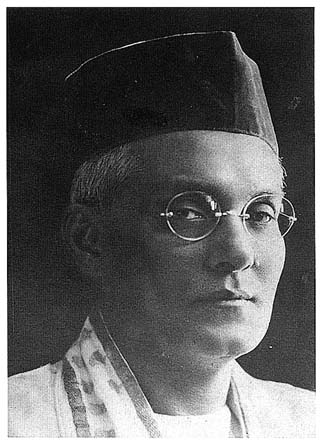
A photograph of Agapito Millán Estefanía pasted on a souvenir
of his Masonic lecture, "My childhood, my life, my ideal," 1934.
Courtesy Archivo Histórico Nacional, Guerra Civil, Salamanca
so, double them and project their "double," or astral body wherever or as far as they want. In 1918 a good "subject," put to sleep in Bilbao, sent [his or her] double, in a few instants, to Paris and places on the French front, where it talked with soldiers and was visible to them.
This kind of experiment was going on throughout Europe and the Americas in an attempt to apply positivist methods to the spiritual realm. Scientists like the Nobel Prize winner Santiago Ramón y Cajal had participated in Spain, and Millín though the sessions could explain what was going on at Ezkioga:
Why could this same result not be produced now, having a "double" with the appearance of a Saint, the Virgin, or a farmer appear in Ezquioga or anywhere else, so that those present would see and even hear them?… The Ezquioga events appear to be sessions of low spiritism.[45]
Millán, ELB, 9-10 September 1931; J. V. Ibarz Serrat, "La Psicología en la obra de Santiago Ramón y Cajal," doctoral thesis, Facultat de Psicologia, Universitat de Barcelona, 1988 (I thank Antonio Cano for this reference).
Interest in the afterlife, sensitives, and astral projection was not unusual for
republicans. For instance, El Heraldo de Madrid reported in August 1931, when it was ignoring the visions at Ezkioga, that a waiter in a Madrid café who was a "seer, astrologer, and a reader of palms" claimed that his body "doubled" while he was asleep or in trance and traveled across the world and into the future. Similarly, the republican Voz de Giupúzcoa , which mocked the Ezkioga visions, found a book entitle Revelation of the Mystery of the Beyond "impressive" and recommended enthusiastically a "wise professor of occultism and spiritism." The professor, Hadji Agaf, had settled in Irun where he received about two hundred letters a day requesting his help in matters of "luck, health, love, business, etc." Even the Voz de Navarra accepted advertisements from a personal magnetist.
Agapito Millán epitomized this cultural experimentation. He was born in 1893 and as a child in the minefields of eastern Bizkaia peddled clothes, made scapulars for sale in religious fiestas, and cleaned ore. A novel by Tolstoy inspired him at age seventeen to join a revolutionary republican party in Bilbao and struggle against "the oppression of the regime and of the sinister clergy." But he soon turned from violence toward "more humane and spiritual" pursuits. During World War I he tried to interest the French and British embassies in his esoteric powers. He became a vegetarian, a Freemason, and a leader of theosophy. In his travels throughout the north as the salesman of heavy machinery, camomile, and postcards, he handed out broadsides about spiritism and against the death penalty and promoted a sideline as professor of occult science who could find buried treasure, locate lost relatives, give business advice, and avoid the attacks of enemies. In June 1931 he was also a leader of the Radical Socialist Republican Party in Bilbao.[46]
Marqués, HM, 18 August 1931; Meromar, Revelación, reviewed in VG, 17 May 1933, p. 6; for Hadji Agaf, who came from South America, see VG, 13 September 1934, p. 4. Millán moved from Bilbao to Eibar in the early 1930s. For his letters, broadsides, and essays, see AHN GC Teosofía 25/851 and Masonería 174/A/27 (pseudonym Tolstoi), wherein the 1934 speech, "Mi niñez, mi vida, mi idea," I cite in text. In 1943 a Franco court sentenced him in absentia to twelve years in prison for Freemasonry.
In 1934 Spaniards read about the duende of Zaragoza, a female voice that answered questions through a stovepipe. From the first days attention centered on a servant girl, Pascuala Alcobet, who observers suggested might be a spiritist medium. Both the head of the Zaragoza insane asylum and the son of Ramón y Cajal gave credence to the capacity of mediums for psychokinesis. For two weeks in late 1934 the press of all stripes, even the Times of London and Fox Movietone News, featured the Zaragoza spirit. Famous psychics visited the site; theosophists went from Madrid and Barcelona; priests sprinkled holy water; the residents of the building went to the shrine of El Pilar to confess, just in case; and a whole busload of observers went from Bilbao. The civil governor eventually judged that the servant girl had produced the voice as "unconscious, hysterical ventriloquism." El Pueblo Vasco did not fail to compare the Zaragoza duende with the apparitions at Ezkioga. "The spirits in each case take a different form and use a different technique. But almost never does it turn out that the spirit exists."[47]
All 1934: the duende was fully reported in PV, VG, and ED from November 23 until December 8; for psychokinesis see PV, 24 November, p. 3; for visitors in November see VG, 25 November, p. 5, and PV, 27 November, p. 3, and 30 November, p. 3; for governor see VG, 4 December, p. 5. La Voz de Aragón and the flat's owner thought the servant girl was not involved at all (PV, 8 December, p. 2); for duende and Ezkioga see Axari-Beltx, PV, 15 December. For similar poltergeist in Italy, see Gallini, "Storie di case."
But just as freethinkers made fun of Catholic apparitions, Catholics mocked the esoterica of the freethinkers. The correspondent of Euzkadi from Orio liked the enthusiasm Ezkioga aroused and contrasted the piety of the Basques with the
"dissolute ideas, hatred of the church, impiety, and irreligion" of the Spaniards. The impious, he wrote, "pretend not to believe in God or his church, and at the same time lower themselves in their beliefs and practices to the most absurd black magic and the most extravagant monstrosities and aberrations." Similarly, Rafael Picavea in El Pueblo Vasco pointed out the inconsistency of an anticlerical who opposed the Ezkioga prayer sessions yet attended the spiritist séances of a barber in Irun.[48]
EZ, 19 July 1931, p. 9; Picavea, PV, 11 November 1931.
Both Catholics and spiritists were searching for meaning in death as well as contact with dead relatives and friends. Both believed in apparitions of the dead and both admitted access to higher entities. According to a Spanish Dominican, spiritism was popular because of "the natural desire to explore the mysteries of the afterlife and to communicate with dear ones that death has taken away." The English Jesuit Herbert Thurston pointed to the convergences, citing persons who converted to Catholicism after séances with saints as spirit guides. Spiritist writers held that what passed for seers among Catholics, including Christ himself, were powerful emissaries who came to help the living from the land of the dead. A French spiritist held that Jeanne d'Arc was a medium and a messiah, one of those who "always come at moments of crisis."[49]
For Catholic attitudes, Koch, I Contabili dell'Aldilà, 100; Dominican quote from Barbado, "Boletín de psicología"; Thurston, Spiritualism, 16, 54-55, 368-384; Denis, Joan of Arc, 214, citing one of his spirit guides, "John, disciple of Peter," June 1909.
The similarity between Catholic and spiritist beliefs meant that spiritism was an easy way either to explain the Ezkioga phenomena or to dismiss them. A priest in rural Catalonia thought that Salvador Cardús and his wife were spiritists, "very bad people" who had "magnetized" Anna Pou i Prat. Villagers vandalized their automobile for provoking the girl's madness. Another priest lumped spiritists and Masons together with Ezkioga and Soledad de la Torre as part of a conspiracy. When Padre Burguera was forced to address the question, he distinguished the willful tapping of the devil's powers in spiritist or Masonic sessions from the almost routine, unbidden tempting of the seers by the devil in the course of their visions. He invited those who believed that Ezkioga was spiritism to compare the spiritist sessions at the Club Náutico in San Sebastiín with an Ezkioga vision.[50]
On accusation of spiritism see Cardús notes, 27 June 1933; for spiritism and Masonry see Tusquets, Masonería, 65-66. B 105-107.
The assertion of the Bermeo soul in 1924 that there was no hell points up a basic change in ideas about the other world. In the nineteenth and early twentieth century on both sides of the Atlantic there was a concerted challenge to rigorist notions of a vengeful God. The spiritists denied that hell existed at all. Generous Catholic theologians argued that God was merciful and good and sent very few people to hell. The Sacred Heart of Jesus itself was at its origin a message that God was merciful. Marie Thérèse Desandais, "Slamitis" placed love at the center of her revelations.[51]
For the appeal of spiritism to the more optimistic American Protestants, see Braude, Radical Spirits, 34-55. For the shift toward optimism in France, from Paris in the 1830s to the countryside in the second half of the century, see Kselman, Death and the Afterlife, 82-83; for a generous theologian, Alonso Getino, Del gran número, first published by Urbano in Rosas y espinas and Contemporánea.
Liberal commentators reacted sharply to the dire and grim side of the visions at Ezkioga. And the people of the Goiherri had radically differing reactions when told by child seers that so-and-so was in hell or would go there. A split between followers of a relatively severe deity and followers of a relatively benign deity
seems to have run right through Catholic society from top to bottom. A disposition toward mercy or justice, generosity or rigor, was probably one of the key ways people were (and are) different from one another. Juan de Olazábal of La Constancia published a notorious editorial explaining the disastrous floods of 1934 as God's punishment on farmers who worked on Sunday. He was a kind of captain of the rigorist side; Rafael Picavea of El Pueblo Vasco could not believe that "his" Virgin would frighten people in visions. He was a leader of the more liberal contingent. Antonio Amundarain was on the former side, his assistant Miguel Lasa on the latter. Padre Burguera was clearly a rigorist, but Raymond de Rigné and Marie-Geneviève Thirouin, who advertised her poems as "dedicated to all the souls who seek God in love and not in fear," were on the generous side.[52]
Olazábal, LC, 17 June 1934, and subsequent polemic, especially LC, 24 and 28 June, 1 and 2 July; VG, 18 June; ED, 20 June; and PV, passim.