
Epilogue
The Framing of Critical Theories in Cross-Cultural Context
Interreflection
A true theorist should always be fully aware of the double edges of his proposal: At the moment he insists upon the centrality of his theoretical claims, he has already exposed his negativity. His theory, being only one among a thousand others formulated, can never claim to be absolute, authoritative and final. Eventually, it will be seen only as a working notion, a hypothesis even, based upon one orientation toward the total aesthetic sphere. For, what are we to understand from centuries and centuries of reformulations or redefinitions if they are not acts of shifting from one center of significance to another, if they are not attempts to replace certain dominant forms with those once regarded as marginal?
A little reflection would further disclose to us that our existential experiences in the phenomenal world and in our contact with other human beings are endless and protean. As such, they will forever defy any human attempt to encase them in definitive forms. They are often filtered through language with preconceived rubrics such as those that might be summed up in Althusser's two phrases "mechanistic causality" (a transitive, analytical effectivity) and "expressive causality" (which involves isolating and privileging one element among many in order to achieve the so-called sense of unity).[1] For these rubrics to be operative, certain inevitable procedures of selection, discrimination, and closure are preferred in which the so-called relevant are differentiated from the irrelevant; these are then connected according to some predetermined relationships into definable
shapes, which, in turn, are promulgated as absolute or complete. But are they?
We need only a moment to realize that these orders, systems, or critical frameworks are nothing but partial truths or presences and that the extent of their meaning has to depend upon the simultaneous presence of other orders or systems excluded by historical accidents or wilful neglect. To put it bluntly, all theories are provisional because none can unhesitatingly claim to have authenticated existential experiences, which are ongoing and forever changing. All theories are culturally and historically restricted, and thus their universal applicability is never beyond doubt.
Immediately, these questions are apt to arise: Can there be a "common poetics" underlying all literatures? If yes, how are we to establish the common aesthetic grounds upon which we can proceed with a fair degree of certainty to discuss literatures from different cultural systems? These are, no doubt, central questions in comparative literature, in particular in East–West studies and comparative studies of written and oral literatures, but these should also be central questions for all proponents of critical theories, since critical theories are models by which writers and readers alike have been consciously and unconsciously directed or conditioned. To seek some grounds for constructing a workable common poetics, we must, therefore, first recognize the impossibility of arriving at such common grounds if we restrict ourselves to only one cultural model. As I have argued in chapter 1, we must avoid privileging a monocultural perspective. To take the aesthetic assumptions of one cultural model as universally valid and indiscriminately applicable to any other is to behave like the fish in the fable. When the fish heard the frog describe the man, the bird, and the car he had seen on land, the fish imagined them in the form of a fish having a hat and a stick, wings, or four wheels. For decades, either in literary or cultural studies, critics and scholars have too often imposed the cultural-aesthetic assumptions and values of one system upon the literature of another, without realizing that they have significantly changed and distorted the perceptual horizon of the other culture.
As we now look back upon the translations and comparative studies done between Eastern and Western literatures and between oral and written traditions, examples of gross distortions abound. I have pointed out in chapters 2 and 6 a whole array of unforgivable misfits and mismatches both in Western approaches to Chinese literature and in Chinese studies of Western literary and cultural problems.
The grossest of these misfits is found in many translations of Chinese poetry in which, as I have detailed in chapter 2, the paratactic and coextensive mode of presentation in the originals have been destroyed by being recast in unnecessarily discursive, analytical, and syntactical structures.
Similar distortions are found in the translation of Chinese novels. Take The Dream of the Red Chamber . All the earlier translations have omitted the myth portion and a few other incidents before we come to the so-called main story to fit in with the so-called logic of relevance. Almost all of them have decided to forgo the some 200 poems therein. In doing so, they have turned the largely lifelike non-matrixed novel into consciously matrixed and goal-directed presentation, paring off the so-called irrelevant incidents without knowing that a peony (i.e., the protagonist's story) needs green leaves (i.e., all the surrounding stories and incidents) to bring out its true-to-life total existence, without knowing that the exchanges in poems are not embellishments but essential markers of the speakers' actual life activities and their various personal and social temperaments. Only very recently do we find this novel vindicated by David Hawkes's full translation. There is also this for us to ponder: the tyranny of written poetics over oral compositions.
Non-Western cultures such as those of American Indians, Africans, and Oceanic peoples, a great number of which still retain their oral format and charm, have suffered no insignificant loss in the process of being recorded or translated into written form by early anthropologists and poets, all of whom came to them with preoccupations and preconceptions totally alien to the indigenous outlooks and aesthetic functions of the people they studied. The early anthropologists quite often ignored the total oral event and abstracted from it only a "message" to the exclusion of a whole spectrum of expressive strategies and priorities uniquely inherent in the oral act. These oral strategies, as disclosed in a homogeneous ritualistic event in which singing, clapping, miming, dancing, drumming, and "sounded" words (with an extended vocal horizon or incantatory dimensions) help to accentuate and complement one another, are not to be viewed as mere embellishments to some major messages in a closed system of written words; they are themselves primary form as well as substance, all aspects interpenetrated, indivisible, inseparable. The poets and literary scholars have often come to these events of recorded materials with creative concerns and theoretical models based on written poetics, and, as a result, they have not been able to view the
sounding of the voice, the improvisational function, the nonclosure of text, and so on properly and have tended to see them as peripheral, marginal, and even irrelevant. As revealed in translations, a long two-day ritualistic event with choric arrangements and incantatory expletives has often been grossly reduced to a simple poem of only a few lines divested of all the repetitions; only a few so-called major motifs are retained, and these are then restrung according to a model of linear development typical of the mechanistic or expressive effectivity of Western poetics.[2]
Thus, to avoid this kind of unwarranted reductionism and distortion of native aesthetic horizons, or, to put it in more precise terms, to break the monocultural perpetuation of certain critical and theoretical hypotheses as being the sole authority on the subject of literature, we must philosophically question the bases of theories from different cultural systems, understand how and from where they evolved, and try to understand their potentialities and limitations as well as their ramifications in monocultural and cross-cultural contexts, before working out a series of methodological guidelines toward the possibility of constructing a common poetics.
This investigation, which must involve comparing and contrasting several different cultural models from their indigenous sources, attempts to achieve what might be called an interillumination or inter-recognition to replace the principle of dominance currently used by many cross-cultural comparatists and monocultural theorists. It will allow Western readers to be aware of the fact that there are millions of literary works in the world that do not proceed from the aesthetic assumptions of the Platonic-Aristotelian constructs. It will also allow Oriental readers to realize that outside the Confucian-Taoist-Buddhist frameworks, there are many other perceptual modes and judgmental perspectives equally sensible within their indigenous systems. The true meaning of the interflow of cultures is, and must be, a mutually expanding, mutually adjusting, and mutually containing activity, an effort to push the boundary of our understanding toward a wider circumference.
Am I suggesting, then, a different idea of totality? The answer cannot be a yes, a no, or an either-or. The word "totality" belongs to the rhetoric of power employed to perpetuate a certain type of expressive priority, a certain type of ideological center that excludes other types of activity. For me, totality is an impossible concept. As I have argued in chapter 6, we stop certain things in the flow of concrete history
and lift them out of their forever changing environments for scrutiny and analysis. Meanwhile, the flow goes on in its continuous, totalizing process, invalidating any claim of wholeness. Totality, which is often treated in terms of serial orders broken away from millions of disjointed, dispersed, untidy, ill-adjusted fields of actual experience (e.g., historical periods, literary movements, etc.), always comes to us prepackaged. As such, each of these claims invariably comes to us as a version , merely a version, incomplete and always partial, because only certain facts, believed to be significant, are chosen and highlighted as if they could, indeed, represent the entirety of history and culture. This concept of totality is restrictive, not only in the sense that it does not comprehend all aspects of actual experience but also in the way in which it is packaged within one dominant ideology only.
My proposal to proceed simultaneously with two or three cultural models will immediately break this myth, revealing and confirming the simple fact, stated earlier, that all forms of "presences" and all the "models" we are working with are, in the final analysis, provisional, inconclusive, and open for revision. It is only in this sense of seeing all such formulations as provisional that we can keep in constant touch with the forever changing totality, for totality is a circle without circumference. It is also through this open consciousness that we can understand better the recent efforts to unseat the deep-rooted circling and centering activities of the West. The challenge comes from both the creative and the theoretical camps. This is no place to enumerate all the creative efforts that have been made over the last century. The list is very long. For my purpose, two passages will be adequate. First, Jean Dubuffet:
If there is a tree in the country, I don't bring it into my laboratory to look at it under my microscope. Because the wind which blows through its leaves is necessary for the knowledge of the tree . . . also the birds . . . in the branches . . . the song of these birds. My turn of mind is to join with the tree always more things surrounding the tree, and further, always more of the things which surround the things which surround the tree.[3]
Like many of his contemporaries, Dubuffet challenges the centrality of reason, logic, and analysis in the deliverance of experience. He advocates nonintervention so as to allow elements to imprint their traces immediately upon us in their preinterpretation modes.[4] This attitude comes directly from the distrust of the circling and centering
activities of the West; hence his attempt to diffuse the center by not defining the circumference.
In a similar manner, the postmodernist American poet Robert Duncan, in calling for a "Symposium of the Whole" to reinclude those orders excluded by a dominant ideology, also appeals to the metaphor of center by not defining the circumference. He says in his "Rites of Participation" that Western society has lost
the ambience in which all things of our world speak to us and in which we in turn answer, the secret allegiances of the world of play. . . . It was not only the Poet, but Mother and Father also that Plato would exclude from his Republic. In the extreme of the rationalist presumption, the nursery is not the nursery of an eternal child, but a grownup, a rational man. Common sense and good sense exist in an armed citadel surrounded by the threatening countryside of fantasy, childishness, madness, irrationality, irresponsibility, — an exiled and despised humanity. In that city where Reason has preserved itself by retreating from the totality of self, infants must play not with things of imagination, nor entertain the lies of the poets, but play house, government, business, philosophy or war.[5]
Duncan calls for a reactivation of those aspects of aesthetic activities that are still prominent in those oral and other non-Western cultures that do not proceed with the same form of exclusion.
Not to reach out from a preordained center but to disperse it into several points; to travel along the circumference, the endlessly stretching circumference, occasionally glimpsing the not always certain center; and, together with this orientation, to resurrect the enigmatic and the aporia , which leaves the reader-viewer trembling, as it were, at the boundary of meanings — these have been some of the strategies attempted by such modernists and postmodernists as Pound, Williams, Borges, and Guillên, to name just a few. The so-called marginal or supplementary cultures or points of view are not just the other ; the other is the indispensable partner of the proclaimed normative this .
In the realm of philosophical and critical explorations, the deconstructionists and poststructuralists, following Kierkegaard, Nietzsche, Heidegger, and Merleau-Ponty, attempt to overturn and displace existing centers and presences. The movement is well known and is still going strong in the Euro-American scene. While I am not necessarily championing their cause, this must be said: Deconstruction and
poststructuralist thinking began precisely by philosophically questioning the bases of the models according to which circling processes were made. But the unburdening of traditional systems, like the birth throes of postmodernist poetry, has to take the form of "displacements" that, like a maze, are often twisting, tortuous, and extremely intertwining, and in the process of which traces in multifarious webbing overwhelm the attempt at erasures.
The investigation of the bases of our critical models, if it proceeds from comparison and contrast between two or three cultural systems in the way I have mentioned, will perhaps help us bypass this painful labyrinth. Take one issue among many as an illustration: the question of text. A text is never an enclosed entity with definable meanings, self-sufficient, self-present, but a constantly changing activity, infiltrated by a mirage of other texts and voices with infinite traces. But this polyphonic activity outside the text has always been emphasized in ancient Chinese poetics (as, for example, in Liu Hsieh's theory of secret echoes and complementary correspondences, developed from the ancient text of the I Ching )[6] and in oral poetics in which the text is often the springboard of a much larger aesthetic activity.
I must hasten to add here, however, that by saying this I have no intention of equating deconstruction and poststructuralism with everything Oriental and oral poetics have to offer, for the act of equivalence is also an act of power or dominance that must be avoided. At root, we will find many differences between them, in both Derridean senses, and these differences can only become illuminated by a comparative examination of the grounding of each of these systems. To juxtapose the Oriental or the oral with traditional Western aesthetic systems in an interilluminating, interdefining, interrecognizing manner will give us a larger circumference whereby we can view better the contributions and limitations of deconstructive and poststructuralist criticism.
Interreflection is indeed the key for resolving some of the major critical issues because it allows us to raise questions that monocultural theorists are not inclined to ask. Take, for example, the literary genre called tragedy. It is interesting to note that certain dominant features that have been used to define tragedy (e.g., the hero's courage in facing an overpowering challenge and the hubris that causes the hero's inevitable defeat) are found to be either absent or neglected in Chinese counterparts. We might want to ask: Do the
Chinese have the kind of tragedy prescribed by Aristotle? If not, why not? Could it be that the Chinese emphasis on humanity's well-tuned correspondence with nature and their view of undifferentiated time help to eschew the linear, antagonistic relationship with reality that underlines the making of the tragic hero of the West? Is heroism possible in China, or rather, what is the Chinese concept of heroism?[7] How do the facts that traditional China did not have epics and that drama as a significant literary form did not emerge in China until the thirteenth century, after many centuries of brilliant flowering of the lyric, compare with the fact that, in the West, drama almost began as the primeval genre and that epic was the first dominant poetic form? While the ancient texts in China, such as the oracle bone inscriptions, reveal that ancient China, like the West and other cultures, had her share of ritualistic activities, we must then ask: What cultural or philosophical occurrences had taken place to have deterred rituals from developing into full-fledged dramas? What socio-cultural factors accounted for the absence of epics or long narratives that celebrated heroes' will to power? Lacking dramas and epics as genres for theoretical elaboration the way ancient Greek plays had furnished models for Aristotle's Poetics , ancient China had concentrated her theorizing on the lyric form. How much has this historical phenomenon conditioned the critical temperament of the Chinese, and what role did it play when, for example, they turned toward the genres of the novel and the drama? Or, to reverse the question, how has Aristotle's Poetics , which was founded heavily upon dramatic — mainly diachronic — structure, set certain straitjackets upon the conception of the lyric from which later theorists have been trying, not without difficulty, to liberate themselves?
Or consider the interrelatedness of language and perception, discussed in chapter 2. There I raised questions about how a language of rigid syntactical rules (such as Indo-European languages) could successfully approximate a mode of presentation whose success depends upon freedom from syntax and how an epistemological world view developed from Platonic and Aristotelian metaphysics — which emphasize the ego in search of knowledge of the nonego and attempt to classify being in concepts, propositions, and ordered structures — how such a world view could turn around to endorse a medium that belies the function and process of epistemological elaboration.[8]
The dialogue should not stop here. For example, we should continue to ask: What philosophical or cultural conditions led the ancient Greek thinkers to proceed the way they did? What other
orientations did the ancient Chinese provide both in terms of perception and in terms of expression? To investigate both simultaneously with equal attention is what we must do. But the full investigation of the trajectories of both cannot be undertaken here.[9] Here I will focus on one key point in the question of perceptual priorities.
We open our eyes; we see things, or things offer themselves to our eyes, transparent, concrete, real, complete in themselves. They do not need our explanations to be what they are. And yet, these questions have been constantly asked: Who are we (i.e., the perceiver)? What is seeing (the perceiving act)? What are things (the perceived)? When these questions were asked, they implied that the inquirers (the sophisticated men) did not trust their primary intuitions of (their natural responses to) things as they are. The asking, in fact, raised this question: Under what conditions does reliable knowledge occur? From Plato to Kant to many post-Hegelian thinkers, all kinds of answers have been advanced through a series of reinspections, redefinitions, and reformulations of the originally transparent notions, and in doing so these philosophers or critics have each created new verbal substitutes for the concrete objects. This process, in turn, has affirmed the centrality of (1) the perceiver as the agent of order, the knower of truth; (2) reason and logic as the reliable tools; (3) a priori synthesizing principles (Platonic intelligence; Kantian transcendental ego) possessed by the subject; (4) serial order and dialectical movement toward a higher absolute; and (5) abstract system over concrete existence.
The ancient Chinese, in particular the Taoists, accepted the natural perception of things as they are but questioned instead the act of questioning itself as well as the subsequent acts of naming, classification, and categorization; they also rejected the premises that language (as intellectual conceptions and linguistic formulations) can adequately represent reality and that humankind is the primary paradigm of orders. The questioning, then, leads to the Taoist proposal to retrieve the prepredicative moment of the given by using "words that are not words," by leaving them in an "engaging-disengaging" relationship with the reader, and by having the poet retreat immediately after presenting the vibrating objects so as to let the reader directly witness the workings of these objects and participate in completing the aesthetic moment.
These philosophical and aesthetic positions resulted from different steps taken toward the same ground. Once we recognize this fact, it will be possible for the West to endorse the position of the other, as
Heidegger and others have done. I am not suggesting that phenomenology parallels Taoism in every aspect, but this interreflection makes it possible for us to identify at least one important line of convergence, namely, their questioning of previous acts of questioning the givenness of things in the original, real-life world.
In this way, interreflection promotes an open dialogue between and among cultures. In this way, different critical and aesthetic positions will have a chance to look at each other frankly, to recognize among themselves potential areas of convergence and divergence as well as their possibilities and limitations as isolated theories and as cooperative projects to extend each other. Thus, when we turn to the numerous existing theoretical perspectives or orientations, such as some of those outlined in Figure 4[10] , a similar set of inquiries will arise to force us to reexamine the historical morphology of each of these positions and to mark afresh the ways in which the contours of their applicability have been drawn. Whether they are pre/text theories related to perceptual positions and activities that include modes of apprehending reality, choices of "object/s" for artistic re/presentation (real objects, fictive objects, language as "world," subjectivity as objectivity, etc.), or an author's psychological archive and horizons of imaginative activities; whether they are theories related to the actualization of the text (the question of art versus nature; modes of selection from experience; genre theories; technical considerations; language strategies, etc.); whether they are theories related to the contact and contract with the text (theories of communication: function, effect, social and linguistic contract, rhetoric, hermeneutics, reader's perception); or whether they are theories of seeing the literary work as an autonomous system or seeing language as a complete communicative machine with an elaborate system of signs — under the interreflective scheme, we must conduct bilateral or multilateral investigations into the triple complex of language, history, and culture (the center portion in the chart) of two or three systems. It is with this complex that an author begins his or her perceptual-expressive activities; it is through this complex that a literary work achieves its existence; and it is upon this complex that readers construct, reconstruct, or deconstruct their understanding of the literary work. As we look back on the development of literary histories of different cultural systems, we find many discrepancies between the given and the perceived, between the perceived and the expressed, between the expressed and the received. These discrepancies already occur frequently within a monocultural system; this is due to the fact that the
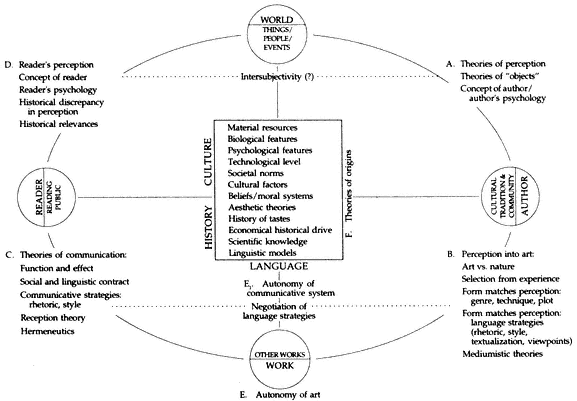
Figure 4
Scheme for a multicultural discussion of critical theories. I am indebted to suggestions in M. H. Abrams's
The Mirror and the Lamp and Arnold Berleant's The Aesthetic Field for some of the items in this scheme.
addresser and the addressees are both locked inside different hermeneutical domains rooted in specific socio-cultural milieus. They always miss each other's centers, so to speak. This kind of mutual crossing is infinitely greater between or among different cultures. Therefore, intercognition of the indigenous ways in which each of these historic-linguistic cultural complexes provides for different modes of perception, expression, and recognition should be promoted as the primary road to reconsidering the framing or deframing of critical theories.
A Possible "Narrative"
It is clear that the scope of this paper cannot accommodate a full exposition of all the theoretical orientations listed in the chart. What I can do is to focus on the various trajectories of the perceptual object and follow their critical implications in broad outline.[11] We can begin by asking this: How would a perceiver choose from all natural phenomena, the events and human beings to (re)present? What are some of the consequences of these choices? The choices will, no doubt, be as many and varied as the perceivers, but, for the sake of illustration, I will limit them to seven. The perceiver can focus aesthetic attention upon (1) natural phenomena as they are; (2) human beings in harmony with natural phenomena; (3) human beings at odds with natural phenomena; (4) humans in harmonious relationship with society (or other humans); (5) humans at odds with society; (6) the individual as a self-sufficient entity; and (7) language as an autonomous world.
In the first case — that is, viewing natural phenomena as they are, as concrete particulars, as self-generating, self-transforming, self-regulating, self-conditioning, and self-sufficient forms of being — the avoidance of intellectual interferences is immediately called for because natural phenomena, by definition, need no human supervision or explanation to be what they are. Each form of being has its own nature, its own place and rhythmic activity and has existed independently as it is outside conceptual and linguistic territorializations. The transparence of this simply given condition of things will necessarily put language and thinking into question. This we find in Taoist philosophy and aesthetics; this we also find in parts of Heidegger, Merleau-Ponty, William James, and A. N. Whitehead.[12] Several modern and postmodern poets (e.g., William Carlos Williams, Gary Snyder) have approached this orientation when they attempt to resurrect the immanence of things as the grounding for truth.[13]
Understanding that language is always dangerous in the sense that its use (under the pretexts of naming, defining, and clarifying) always comes with a certain form of eclipsing that which is given to us, both the Taoists and Western philosophers and poets concerned with this perceptual priority are forced to give language only a provisional function (Lao-tzu: "I willy-nilly call it Tao"; Chuang-tzu: "Get the fish and forget the fish-trap; get the sense-of-things and forget the words"; Ch'an Buddhist advice: "To sweep away [words] immediately after [they are] spoken"; Heidegger: "destruction"; Derrida, with a twist: "erasure"[14] ) and attempt to find ways to diffuse language's normal functions. Likewise, poets who want to return to "a natural measure" with things in their prepredicative condition, consciously or unconsciously, have to adjust their syntactical structures, creating empty spaces as revolving entrances into the indeterminate, multiple relationships implicit in the prepredicative condition of things as things.[15]
We must not consider this moment of convergence of two cultures a simple form of identity. The overlapping segment of two circles of culture is only part of the story; we must investigate the historical trajectories that have led each culture to this awareness. When Plato and Aristotle were privileging an artificially created eternal outline to centralize and rationalize everything, at the expense of the so-called irrational elements in the mind, and proposed verbal surrogates to replace the so-called illusory appearances, Lao-tzu and Chuang-tzu proclaimed the inadequacy of humans and their language, exposing the tyrannical nature of humankind's conceptual and linguistic formulations. In the West, it was in reaction against centuries of heavy doses of Platonic-Aristotelian discourses that Heidegger and others proposed a rethinking of language and knowledge. The questions that need to be asked here are: Why had Plato and Aristotle taken such a turn? Why were the Taoists questioning thinking and language at such an early date? Were they reacting against a form of tyranny, similar to that of the West, in Chou or pre-Chou dynasties? If so, what was it and in what way or on what level can that form be claimed to parallel, if at all, discourses rooted in or prepared by Plato and Aristotle? Most scholars would agree, though, that whatever it was that had provoked Lao-tzu and Chuang-tzu to preach the priority of natural phenomena as well as the natural self, it was quite different from the cultural condition and form in which we find Plato and Aristotle. What are we to make of this fact? Later, we will have occasion to briefly suggest a way of looking at this curiously complex
cultural interchange. For the time being, it is important to remember: Convergence points toward possible new syntheses, but both its trajectories and current relevances may be very different.
When the perceiver turns with wonderment toward the harmonious, cooperative design in the total compositional activities of natural phenomena, humankind is seen as a component in this grand design, and the perceiver's expressions attempt to reenact this relationship. These expressions range from a simple, apostrophic "Ah!" to a ritualistic reenactment of the phenomena at work, direct, dramatic, and concrete, in which music, dance, song, and gestures interpenetrate one another as one homogeneous form.
As we can see, much early oral poetry began as a fully integrated, performance-oriented activity in an attempt to emulate, as well as to participate in, the (w)holistic lifeworld as it unfolds itself. In this perceptual priority, human beings as the orderers of things have no place, nor has the soul cry of the individual; instead, the ego is diffused with the nonego. In this perceptual priority, goal-directed historical time is submerged into, or subsumed by, mythic time, or "dream-time."[16] In a sense, this position has also privileged the mythic origin as the final blueprint of all our present actions, making it a utopian schema against which all presumably deviant courses and discourses can be measured.
Many philosophers and poets have been obsessed with this mythic origin and have attempted to pinpoint the so-called Great Break. The Taoists blamed it on the system of naming, as though to say that as soon as language was invented, Tao was destroyed. For the West, the most common themes have been, of course, the Fall of Eden and the Tower of Babel, after which the human race is doomed to be separated permanently from its original harmony.
Many other projects pointing toward a cultural coherence vaguely recalling that of the mythic origin have also been advanced by modern artists and philosophers: the intensive manifold of T. E. Hulme, the "radiant world where one thought cuts through another . . . a world of moving energies" of Ezra Pound, the Dantean world of unified sensibility of T. S. Eliot,[17] the pre-Socratic world of Heidegger, and many others.[18] None of these projects has produced working dynamics comparable to those we find in the performance poetics of the early oral traditions; after all, their ideal cultural moments — Renaissance, the medieval world, or even the pre-Socratics — are still far removed from the so-called mythic origin. And yet, the sense of the increasing threat of disintegration of an originally interweaving,
interdependent, and interdefining manifold of things into countless separated, individualized, and mutually exclusive disciplines or self-referential orders has led postmodern poets and artists to search in oral traditions for a semblance of (w)holistic feeling. I am referring to the different sets of mock performance strategies advocated in post-Happening multimedia and multisensory art events and lifelike activities. These artistic activities attempt to evoke a sense of connectedness to a sacramental lifeworld suppressed by centuries and centuries of instrumental reductionism and rationalism.
Having said this, I must mention the fact that the assumed harmony between human beings and natural phenomena is at root mythic in nature, and thus all versions of this mythic harmony will remain rooted in the ideology and historical necessity of the period in which a certain project is proposed. Again, the case of convergences and divergences must be critically and dialectically differentiated.
When attention is turned toward the conflict between humankind and natural phenomena, such as when humans doubt and fear the catastrophic powers of nature, two obvious choices can be made. Human beings can mythologize these powers and turn them into objects of idolatry, which in turn would become power-wielding instruments for rulers. Fearing natural phenomena, humans can also attempt to control them and bring them into some manageable form of order according to their interests. Under this perceptual orientation, what humans want to learn from nature is how to use it to wholly dominate it, to make the various phenomena serve their purposes and values rather than seeing them in their self-so-ness. Distrusting the innate completeness and adequacy of things as things, and seeing them as illusory and without permanent values as such, humans first set themselves apart from them and then, with the rationalizing processes of naming, definition, classification, and clarification, they privilege one form of being as more paradigmatic (humans), one form of consciousness as more significant (reason, logic), and one locus as more correctly the seat of truth (the logos, the metaphysical abstract realm). This prioritization not only alienates humankind from nature but has also territorialized nature according to the subjective interests of humankind and thus has further alienated things in nature from themselves as things. Ignoring the richness of things in their multiplicity, humans sort them out according to their use and order them into various serial sequences before proclaiming these artificially demarcated orders as independent, complete, and even autonomous. As William James commented on
this perceptual orientation, "[we ignore the real order] which we break . . . into histories . . . into arts . . . into sciences. . . . We make ten thousand separate serial orders of it, and on any one of these we react as though the others did not exist."[19]
I hardly need to point out here that this perceptual orientation is diametrically opposed to the first position in which the real world is taken as real and concrete in its indeterminate multiplicity, in which linguistic formulations are seen as provisional and humankind as only a component of the totalizing composition of things. By affirming an abstract system over concrete existence, by continually validating notions of truth as absolute truths (i.e., verbal surrogates in place of "appearances"), this perceptual priority often indulges in the territorializations of language activities and thus becomes removed from the "inalienable presence" of things as things.
A Ch'an Buddhist story may be illuminating here. "On one full moon night, an old man called the children to the courtyard and pointed his finger at the moon. Some children saw the moon and not the finger, but some children saw only the finger and not the moon." In an extreme form of this perceptual orientation under discussion, many theorists in the West have indulged themselves in the finger (verbal surrogates or signifiers) rather than in the moon (the signified, which has recently been pronounced either dead or never existing).[20]
Now, the perceiver can also focus on the relationships between human beings, in particular, upon the events involving the relationship between self and society. Two schemes parallel to the harmony and the conflict between human beings and natural phenomena emerge.
Like the search for mythic origin, the harmony sought in the relationship between human beings is also utopian in color. The kind of utopian society advocated may be either modeled after the cooperative design in nature or of human design. Either utopia demands the loss of self into a larger communal purpose very much the way the individualistic voice is replaced by the communal voice in early tribal poetry. There is also a preference for mythic time over historical time, although quite often this mythic time is placed in the future rather than in the past. Indeed, most social reforms and revolutions are made by appealing to a golden future that will presumably reinscribe all the features of the mythic golden past. The rhetoric used in such campaigns is, like the ecstatic poetry of celebration, apostrophic and prospective, being immersed in the belief that a utopia is realizable in
the future. Like the various projects advanced to approximate the lost harmony discussed earlier, utopias prescribed both in literature and in revolutionary movements are, in the final analysis, also responses to specific historical conditions; they cannot be seen as identical to one another except that they always appeal to a feeling of the (w)holistic qualities of the mythic past. This is true of utopias both in the West and in the East. The so-called golden age is hardly a master model that can explain all the narratives for all the utopias. It is evoked only because of some imminent socio-historical crisis. Thus, the mythic past is nothing but inscriptions from contemporary social needs. Quite often, we would find a utopia reminiscent of the society the proponent sets out to abandon. (Robinson Crusoe's Island contains rules that are mostly England's.) Thus, all utopias must be studied, not by matching them with some master blueprint, but by grounding them within the dialectical tensions found in each respective historical moment.
If the utopia proposed in society is a refraction of the natural measure sought by human beings, the conflict between self and society emerges as a parallel to humankind's pose against nature. The principle of domination is now transferred to the human realm, where human beings are gauged, not according to the potentials of their natural selves, but according to use value, or, as in postindustrialized period, production potentials. In this way, certain aspects of humanity are territorialized as norms and paradigms at the expense of distorting the total self.
In delineating the conflicts between self and society, both the portrayal of characters and the depiction of events often follow the tension between the oppressing class (whose aggressive acts are directly evolved from the desire to protect and consolidate its special privileges) and the oppressed. But the tension is not a flat confrontation between two classes as such but comes out of something much deeper.
What is at stake eventually is how the natural or impulsive self is constantly being distorted by social institutions. As we can now see, the narrative centered on the conflict between self and society is not exactly free from utopian color, for to judge and criticize the destructive powers of social institutions, to mark out the stratifications of society as forms of tyranny over the self, one must first have some sense of an ideal relationship between self and society, some utopian vision, however vague it may be. When I say that the tension is not a flat confrontation between classes, I also mean this: We must avoid
black and white depiction of fictional characters, depiction such as that proposed by the following statement: "If you tell me his material possessions, I can tell you his thoughts and actions." The truth often is that "the natural self" can surface from the oppressor just as "destructive powers" are found in the oppressed. The oppressor is not born an oppressor; his actions have been framed for him by a whole web of institutional codes. Likewise, the oppressed. The suppressed memories of an oppressor's own "natural self" may be awakened through a series of unusual events. To ignore this possibility is to submit oneself to the falsifying influence of types and formulas.
All the above perceptual orientations are directed outward, although events in nature or in society are often invested with the subjective interests of the perceiver. But we also find human beings turning their backs on nature and on society, embarking on an inward journey, seeking, searching, questing, and questioning. This often happens when people are driven into some form of existential extremity or crisis, such as when they are in exile, finding themselves cut off from a center of coherence, lost among shattered pieces, hesitating between the disintegrated past and the uncertain future. Solitary, anxious, and nostalgic, overwhelmed by a sense of futility and desperation, human beings turn inward to seek for a new raison d'être by attempting, through creativity, to come up with a new world (even if it were only aesthetic!) of coherence. An extreme case is found in the modern, industrialized era, when humanity, under the accelerated fragmentation and reification that has broken knowledge into numerous isolated self-referential "worlds," finds itself in double jeopardy: the existence of human beings' natural selves is in danger, as is the authenticity of their language. Writing now becomes an odyssey through the senses, the only mechanism, as it were, with which he can reclaim his felt existence or resurrect that which culture, now an industry aided by new myths of technocracy and commercialism, has completely shattered. Writing now becomes an odyssey through language with full attention on language as it is, because language, now stripped of all the holistic correspondences it once had, must reclaim itself, albeit in a tour-de-force manner, by freeing itself from its instrumental characteristics.
Perhaps it is time to question the "narratives" thus far presented and ask in what way they can operate as modes of discourses for intercultural reflection. More than once, as we journey through these highly abbreviated "narratives," we sense a clear polarization be-
tween the choices made by Eastern and Western poets and philosophers, although we also see convergences of sorts resonating across time and space.
Both East and West have been seeking a new master code or grand narrative, a new sense of unification, so to speak, to explain the incompatible and slippery diversity. (In this sense, both East and West have been driven — by different forces — into a profound cultural crisis.) But is such a master code or grand narrative possible? It is intriguing, for example, to find that in breaking away from Platonic and Aristotelian discourses, modern Anglo-American poets have promoted a syntactical structure resembling that of classical Chinese poetry. If expression and culture are inseparable, how is this possible? If the asyntactical structures found in classical Chinese poetry and in certain Anglo-American poetry represent projection into some common aesthetic ideal, what would be their shared cultural specifics? Suddenly, the convergence or commonality threatens to break down. But perhaps we are coming to this phenomenon with a "narrative" embedded in an already pre-determined set of expectations framed within a special kind of poetic economy.
I would like to propose a different or, rather, an alternative "narrative," within the language I have been using, without resorting to some externally imposed metalanguage. This possible "narrative" has no claim of becoming a master code. It will be like any "narrative," except that it attempts to open up spaces or gaps through which different cultures can move about to look at each other's similarities and dissimilarities. To do this, I will begin with a paraphrase of some "recent" voices about language.
Recently, critics argue that all verbal artifacts are forms of interpretations, which in turn become forms of rewriting. As such, they are grounded in specific cultural conditions and framed by specific ideologies as hidden structures of power. In other words, all discourses are power-wielding, and all aesthetic facts must, in the final round of negotiations, be realigned with their political underpinnings.[21] In regard to the linking of language to power, it might be profitable to unfold a "narrative" suggested by Lao-tzu's Taoist project.
Most of us are by now aware of the Taoist distrust of language — the gist of which can be briefly summarized as follows: No conceptions or linguistic formulations will be able to comprehend the totalizing process of the Great Composition of things in Phenomenon,
which is changing and ongoing; all conscious efforts to name, to generalize, to classify, and to order this process will necessarily result in some form of restriction, reduction, and distortion. But the Taoist distrust goes deeper and can be traced to its clearly historically grounded response to the territorializations of power in the naming activities of the feudalistic Chou Dynasty. As Lao-tzu puts it: "With the beginning of Institution, there emerge Names."[22]
Since I have two long Chinese essays on this subject, I will present here only a broad outline of its implications.[23] A quick illustration of the territorialization of power in language use can be seen in the attempt to name the Chinese emperor the "Son of Heaven" and the medieval adoption in the West of the geocentric conception of the universe, by which Christianity laid the hermeneutical foundation of its hierarchical structures.
In the Chou Dynasty before the rise of Taoism, names or norms were invented to delineate hermeneutical structure and activity out of the need and desire to legitimitize and solidify a power structure by separating out determinable attributes such as privileges and duties. In order to facilitate feudalistic rule, the clan system was rationalized according to various class stratifications with well-defined duties and rights; hence the concept of the "Son of Heaven," various orders of dukes, relationships between lords and subjects, fathers and sons, husbands and wives, the investment of special privileges in first males, whose power over other males, not to mention females, came in complex forms and matrices as well as clearly demarcated sets of rituals and directives. The system of names or norms was invented as the cement that held the feudalistic power structure together. As a result, the birthrights of humans as natural beings were restricted and distorted. Lao-tzu began his project with full awareness of this restrictive and distortive activity of names and words and their power-wielding violence. It was this awareness that opened up the Taoist reconsiderations of language and power, both an aesthetic and a political project. By questioning the limits of language, the Taoists suggested a decreative–creative dialectic as part of an aesthetic project for repossessing the prepredicative concrete world by dispossessing the partial and reduced forms the process of abstract thinking has heaped upon us. A series of strategies was advanced, including asyntactical structures, the diffusion of distances, negative space as departure for retrieval of the undifferentiated, and the use of paradox and other off-norm words, phrases, or events.
But these aesthetic strategies have also political implications. When Lao-tzu said, "Tao, told, is not the Constant Tao. Name, named, is not the Constant Name" and proposed to return to the Su P'u (Uncarved Block) or the "Great Undivided Institution," he intended to implode the so-called kingly Tao, the heavenly Tao, as well as the naming system of the feudalistic ideology of the Chou Dynasty, so that memories of the repressed, exiled, and alienated natural self could be fully reawakened. The Taoist project, from the point of view of the naming system, is a negating, abandoning, and even escapist act; but from the point of view of "no naming" (that is, before the territorializations of power) and that of the Uncarved Block, it helps to break the myth of the reductive and distortive naming activities, affirm the concrete total world that is free from and unrestricted by concepts, and move toward reclaiming the natural self as well as Nature as it is. Thus, we can say that the Taoist project is a counterdiscourse to the territorialization of power, an act to disarm the tyranny of language; it is not, as most superficial readers believe, a passive philosophy.
At this point, a possible "narrative" seems to have emerged. The dialectical relationship between language and power, as understood in the above sense, is clearly working at the core of both Eastern and Western cultures. Perceptual priorities traced out earlier can be seen as being made by various philosophers and poets in direct proportion to the degree of their commitment or resistance to the ideology inscribed in the territorializing functions of language. The so-called closed and open systems, predicative and prepredicative views of the world, or noetic and noematic strategies can also be measured against this spectrum. It is interesting to find, for example, that at about the time Lao-tzu and Chuang-tzu were questioning names, Plato, through the mouth of Cratylus, affirmed the importance of names and the myth of the connectedness of words to things. While this affirmation did not lead immediately to feudalistic ideology, the dominatory, exclusionary, and repressive functions of language ordained by Plato and Aristotle, together with the latter's logically deducted model of the universe, had prepared for medieval Christianity's cosmology, leading to hierarchical structures of power, very much the way the Confucian System of Rectification of Names had prepared for Tung Chung-shu of the Han Dynasty (ca. 179–104 B.C. to use the same functions of language to territorialize a whole cosmic system of correspondences that served, at root, to legitimitize existing power hierarchies.
It is clear that for East–West comparative studies, the concept of periodization must be radically revised, even abandoned, for periodization makes sense only within each respective cultural paradigm and cannot be used across all cultures. The responses to the dominatory and exclusionary functions of language occurred at very different junctures of history for the West and for the East. The major challenge to the territorializations of power in the West came with Copernican and Galilean discoveries (for which Galileo was put on trial precisely because his affirmation of Copernicus's heliocentric premises threatened to shatter the power hierarchy cemented by the hermeneutical justifications — the Great Chain of Being, etc. — of medieval cosmology). Thus, John Donne said, "All coherence gone . . . all relation: Prince, subject, father, son." It is intriguing to find that both cultures used almost identical modes of legitimatizing the hierarchies of power (the doctrine of the God-ordained ruler in medieval and Elizabethan ideology and that of the Son of Heaven in ancient China; the concept of the Great Chain of Being in hierarchical orders and body politics and Tung Chung-shu's notions of the "Institution Modeled after Heaven" and "Men Correspond to the Measure of Heaven"), in spite of the different religious or mystical projections of each culture. Although these modes of legitimizing the hierarchies of power occurred at quite different periods of time (almost thirteen centuries apart), they emerged in manners in which similar curves and patterns can be identified. Indeed, when considered in this light, the coding activities in the caste system in India and the shogunate system in Japan disclose rather similar curves and patterns.
There is also this to consider: how the timing of the said implosions in each respective culture have affected the complexity of its morphological traces. While Taoism did not literally overturn the Confucian orthodoxy as it was deified in the Han Dynasty, as a counterdiscourse at such an early date, it continually challenged the orthodoxy to question and modify itself, where possible, to become a cultural force with new syntheses from the Taoist project. Indeed, the Taoist counterdiscourse, which continues to resist the divisive functions of language so as to evoke the return to the Uncarved Block, has been playing a pivotal role in balancing the dominatory and exclusionary activities of the dominant ideology. We see a continuous readjustment and expansion of Confucian positions in the ancient classics — from the Appendices to the Book of Change and others such as Chung Yung , to the neo-Confucianism of the Sung and Ming Dynasties (which was in response to the challenges of Taoism,
as well as Buddhism, particularly Ch'an Buddhism, which had incorporated within it major premises of Taoism). In Chinese aesthetics and poetics, Taoism assumed a primary rather than secondary role as it played off the Confucian-dominated institutions. Most interesting of all is the fact that almost all the scholar-statesmen in China assumed two roles simultaneously: A Confucian statesman and a Taoist poet converge into one person, who keeps the two roles apart and together at the same time, allowing one to define the other.
Although the Platonic-Aristotelian discourses had been challenged and revised before the Copernican revolution (by critics such as Longinus, Plotinus, and Lucretius), these challenges had not seriously questioned the tyrannical activities of the Platonic and Aristotelian hermeneutical models. Even after the Copernican revolution, sediments of their abstract systems, including the systematic theology of the Middle Ages, rational concepts, standardized methods of scientific experimentation, a rational sense of balance, symmetry, and restraint in art and music, bureaucratic conduct of organized spheres, as well as pursuit of economics dictated by instrumental reason, continued to have a strong grip upon Western intellectuals. Although one witnesses the rise of a new search for knowledge (as seen in Shaftesbury and others) to come up with a new framework to explain the world, to rechart humankind's relationship to nature, and to question the authenticity of language (in other words, to move out from a closed system to an open system), the search has taken perhaps the most complex, most tortuous, and one of the longest courses. Modern and postmodern attempts to break away from and to deconstruct the now proverbial logocentric thinking are one of the most agonizing and labyrinthine, because most philosophers and poets are still haunted by the "ghosts" of texts of the past. Thus, although we find many echoes of other non-Western cultures in modern literature and art, they are still not speaking the same language, for a William Carlos Williams has said, "Unless there is/a new mind there cannot be a new/line." But it is precisely this awareness, shared by many contemporary philosophers and poets, that will make the inscription of a new mind, or shall we say, the creation of a new line, possible.