
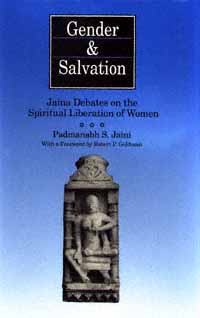
Gender and Salvation: Jaina Debates on the Spiritual Liberation of Women
Padmanabh S. Jaini
Table of Contents
- Foreword
- Preface
- Introduction
- Chapter I The Sutraprabhrta (Suttapahuda ) of the Digambara Acarya Kundakunda (C. A.D. 150)
- Chapter II The Strinirvanaprakarana with the Svopajnavrtti of the Yapaniya Acarya Sakatayana (c. 814-867)
- Chapter III The Nyayakumudacandra of the Digambara Acarya Prabhacandra (c. 980-1065)
- Chapter IV The Tatparyavrtti of the Digambara Acarya Jayasena (c. 1180) A Commentary on the Pravacanasara of Kundakunda
- Chapter V The Tarkarahasyadipikavrtti of the Svetambara Acarya Gunaratna (c. 1343-1418) A Commentary on the Saddarsanasamuccaya of Haribhadra
- Chapter VI The Yuktiprabodha with the Svopajnavrtti of the Svetambara Upadhyaya Meghavijaya (c. 1653-1704)
- Appendix: Sanskrit Text of the Strimoksa Section of the Nyayakumudacandra
- Notes
- Concordance and Glossary of Sanskrit and Prakrit Words
- Bibliography
- Index of Names
Foreword
ROBERT P. GOLDMAN
One of the great desiderata of humanistic scholarship is a full-fledged and detailed social history of the Indian subcontinent. South Asia is, after all, not only the home of roughly one-third of the world's population but also the source of one of the world's most ancient and enduring civilizations, which has given rise to many of the great religious, philosophical, literary, and artistic traditions. It is, moreover, a region that has long been and continues to be of enormous interest to scholars in many disciplines including the humanities, the social and natural sciences, and professional fields.
That no such social history exists is not, therefore, for lack of interest on the part of scholars. It does not exist chiefly because the documents upon which it would have to be based are largely unavailable and only partially to be reconstructed. The reasons for this are several and include those that complicate the effort to achieve a social history of any ancient civilization, such as the loss and deterioration of documents and artifacts of material culture. One obstacle to our developing a broader sense of early South Asian social history, however, is in some ways peculiar to India and to the kinds of orientalist scholarship that have traditionally been brought to bear upon it. This is the fact that for the ancient and much of the medieval period our understanding of the nature of polity and society, of power relations among the social classes and between the genders, has been largely derived from the surviving texts created by and for a literate and dominant group of elites which set forth a remarkably consistent social ideology that has long been
accepted, often uncritically, by contemporary scholarship as derived from actual observation of a largely unchanging society. The vision of the social order derived from these texts, the normative texts of Brahmanical culture, was not merely adopted at face value by scholars; it was embraced by colonial administrators who in many ways revalorized the texts and enforced them as the basis for land settlement, law codes, and administrative systems from the eighteenth century onward. Indeed the ancient period's only surviving fully articulated divergence from this dominant ideology which claimed to derive its authority for the enforcement of its fundamental social vision—that of an immutable and eternal set of hierarchical class divisions—from the vedas , a body of texts that predated history itself, were the competing texts of the so-called heterodox systems, Jainism, Buddhism, and Ajivikism.1 These traditions, however, couple their radical critique of Brahmanism, along with its metaphysics and their sociological consequences, with at least an implicit critique of all society save that of the monastic order and so, with a few interesting exceptions, provide us with only a somewhat indirect means of access to the early social history of South Asia. Moreover these systems became either extinct or marginalized by the early modern period, and so the force of their social vision such as it was tended to be diffused if not entirely blunted except in a few regions.2
In the modern period, the British colonial administration and its representatives, partly under the influence of their reconstruction of South Asia as a region of timelessness, tended to infuse its dominant social and historical discourse with its own self-serving vision, which serves to obscure much of what must have been the complexity of the social reality it faced. Colonial historians, bound as they were on the one hand by the ideological framework of post-Enlightenment Europe, including both the pragmatic positivism of the British and the romantic idealism of continental Indology and, on the other, the pressures to articulate an intellectual justification for the imperial enterprise and its efforts to redefine the political and economic structures of India, created a set of normative conceptions of the social life of ancient and modern India whose consequences are with us to this day.
The principal articles of faith of the colonial historians were that India's political life tended ineluctably toward chaos and its social life toward the degradation and abuse of specific segments of the society, especially the so-called untouchables and women, the latter generally being condemned to such social evils as child marriage, domestic slavery, and the institution that came to be known as "suttee." Enlightened and impartial intervention in the form of British rule was necessary to eliminate these evils and prevent their recurrence. At the same time a somewhat countervailing notion—
deriving largely from the romanticism of the "Oriental Renaissance"—held that ancient India, and to some extent modern rural India, were examples of a pure, simple, and virtuous stage of human civilization that only in the modern urban setting had somehow been subject to degeneration. This notion was picked up by exponents of the so-called Hindu Renaissance and developed into a theory of ancient India as a place of social and gender equality that only in relatively modern times—under the pernicious influences of foreign, that is, Islamic and European, rule—had put forth, originally as defensive strategies, the structures perceived as the evils of caste and the degradation of women.
In the light of this somewhat unpromising historiographical situation it is small wonder that the enterprise of reconstructing the social history of premodern India has been a difficult one. Some progress has been made more recently, however, in the task of reconstructing a somewhat more complex description of Indian society at least during the British colonial period. A group of social historians, calling themselves the Subaltern Group, has gathered around Ranajit Guha and, by subjecting available documents to a species of discourse analysis, has made some progress in recovering and representing the ideologies, attitudes, and responses of groups that have been hitherto marginalized by the colonial historians. Through efforts such as these we have been able to revise somewhat our understanding of those segments of South Asian society—low-caste groups, tribals, the peasantry, and women—who have, until very recently, lacked access to the production and dissemination of the sorts of texts that have chiefly concerned historians.
But even with such contributions our view of the social history of premodern India has been exceedingly limited. For one thing the techniques of the newer historians, with a few exceptions,3 have not provided us with greatly enhanced access to the social history and the social theories of the various subcultures of South Asia in the millennia of their recorded history. There are in fact few early Indian texts that can be genuinely regarded as historiographical no matter how much historical information we derive or claim to be able to derive from them. Aside from the body of epigraphical evidence from ancient and medieval India, the vast majority of the enormous corpus of texts that have survived from precolonial India are, insofar as we may impose upon them our set of alien genres, largely confined to the areas of religion, philosophy, science, aesthetics, grammar, and so on—that is, the vast body of texts classified as sastra ;, belles-lettres (sahitya ;), and of course the massive texts on traditional law, social relations, and legendary history (dharmasastra, itihasa-purana ;). These
texts, although they continue to be extensively mined for what they can tell us about the state of social and power relationships in precolonial and pre-Islamic India, must be read for such purposes with extreme caution.
In the first place these texts are almost all, to a greater or lesser extent, polemical in some way. At the very least they articulate the worldview of a dominant, literate elite derived almost entirely from the Brahman and Ksatriya classes and those that were able to ally themselves with these ancient elites or effectively displace them. Although it has rarely been understood by the orientalists and their followers, these documents define and reinforce a set of views devised by and in the political and economic interests of a small but dominant interlocking directorate of landowning classes. They are not the views of a society at large although, as in any case of dominance and subordination, the dominated may identify with and appropriate the ideology of their masters. A particular device of the authors of these elite documents has been to bolster the claims of these texts to authority by attempting, in most cases, to remove them from the conditioned world of historical reality. In this their ultimate models were the Vedas, texts that, the Brahmanical tradition asserted, were apauruseya ;, produced by no human agency. These texts, which form the basis of the traditional schools of Brahmanical and Hindu thought and ideology, are thus explicitly ahistorical, existing eternally and in fact preexisting the world. Other traditional Brahmanical textual traditions trace their origins to superhuman seers or rsis ; who, like the Vedic seers, had, at least by implication, access to similarly unconditioned texts that lend the tradition an aura of inerrancy.
These traditional texts have relatively little to say about the nonelite segments of Indian society, and what little they do say is of a general and normative type prescribing the nature and duties of the subordinate elements in the social universe: the lower classes and women. Members of these groups are often, when they conform perfectly to the subordinate and even servile roles allotted them, held up for praise and even idealized.4 When they do not, they serve as negative examples by the terrible fate and universal contempt that is their lot.5
While the texts of the political and priestly elites either ignore the lower orders of society or define them in terms of their own elaborate and divinely ordained paradigms, these orders, whether the peasantry, the tribal populations, the groups defined as outside the pale of ritual purity of the Brahmanical social order, or women, generally lacked access to the means of creating, disseminating, and preserving similar documents. If they had a clearly different worldview than that articulated by the elites, it has not been
recorded and preserved for our study. On the other hand, as suggested above, there was, in the texts and practices of the so-called heterodox or sramana ; monastic religious movements, especially Buddhism and Jainism, the articulation of autonomous and powerful voices that sharply challenged the Brahmanical view of social ordination especially as it grounds itself in the rigidly hierarchical and functionalist model of the varnasrama ; system, a social model deriving its authority from the Vedas and such widely disseminated and prestigious Sanskrit texts as the epics, the Bhagavad-Gita ;, and the principal dharmasastras ;.
But while the heterodox traditions challenge and even ridicule the Brahmanical system of ritual and its social correlate, a community composed of classes set apart by impermeable boundaries and ranked hierarchically by their predetermined functions and degree of ritual purity, they are, for the most part, far less interested in subjecting the powerfully patriarchal ideology of the traditional culture to any very penetrating critique. Each of them has, however, struggled with what, given the traditional Brahmanical ideology concerning the nature and functions of women, must present itself as a problem especially to monastic communities whose doctrines and rhetoric place great stress upon the avoidance of family ties, emotional bonds, and, most particularly, sexuality and the pleasures of the senses—all of which are associated with women. The problem is then constructed in terms of the degree to which women can make the same sort of renunciatory commitment and spiritual progress as men. It is a problem precipitated by the somewhat reformist tendency of the heterodoxies that derives naturally from their attack on Brahmanical privilege and pretensions.6 Yet, although Buddhist and Jaina thinkers are willing to reject the notion of a hierarchical social order, the power of the patriarchal doctrine of male supremacy in all matters proved harder for them to escape. Indeed, with their obsessive concern with renunciation, withdrawal from the secular social universe, and avoidance of the sensual life, the texts and sermons of Buddhism and Jainism often stress so virulently negative a view of women—particularly the female anatomy—as to make even the gynophobic elements in most Hindu texts seem rather mild.7
Indeed the status of women and its implications for their access to the spiritual life is one of the most interesting, informative, and neglected areas of the study of traditional Indian culture and society. An examination of the traditional literature, the writings of both colonial administrators and Indian reformers, and the contemporary press and feminist writing in India suggests that an understanding of the traditional attitudes toward and
treatment of women in South Asian society is central to an understanding of Indian culture in general.
While the recent extension of women's studies to South Asia has been one of the most important and stimulating undertakings of contemporary scholars working on the region, the value of much of their scholarship tenets to be vitiated by an inadequate understanding of the profound role the social construction of gender has played in the formation of Indian social and religious life. This inadequacy is not, however, the fault of social scientists and feminist scholarship. Researchers in these areas rarely have direct access to the primary sources of the Indian tradition, as few can work independently with the languages—Sanskrit, Pali, the Prakrits, and Apabhramsa—in which they are written. For an understanding of these texts they have had to depend upon the translations and scholarly writing of philologically oriented Indologists. These latter, however, whether through obliviousness or outright hostility, have been notoriously uninterested in the social implications of the documents with which they concern themselves. Indeed most Indologists, whether in the East or West, appear to have imbibed much of the Brahmanical ideology of ahistoricism and are far, in their published works, from contributing to a penetrating analysis of gender and power relations in the social history of India.
Within the past decade or so, however, a new generation of Sanskrit scholars has begun to bring the insights and methods of the social sciences—psychology, sociology, anthropology, and women's studies—fruitfully to bear on the ancient texts of India and the impact of the ideologies they put forward upon the cultures and societies of South Asia as they exist today. Interesting work has been done on some of the most deeply influential texts of traditional India, works like the Mahabharata ; and the Ramayana ;, but much more needs to be done.8 In addition a body of scholarly literature exists for the study of the role of women and attitudes toward sexuality in Indian Buddhism.9 Most urgently needed, however, are studies of texts and traditions that have been either inadequately treated or wholly ignored. Into this last category must be placed virtually the whole of the copious and important body of texts, in Sanskrit and Prakrit, produced by the various schools of Jainism over the last two and a half millennia.
Scholarly studies of the ancient and fascinating tradition of Jainism are far fewer than those of Hinduism and Buddhism. Still fewer—in fact, nonexistent—are studies that seek to place the teachings and concerns of the various Jaina sects in the context of a broad social history of South Asia. This lack may be understandable, but it is nonetheless serious. For, as I have suggested elsewhere,10 Jaina texts often present us with ideologies and
praxes associated with the other indigenous systems but represented in extreme and even radical formulations. Thus the Jaina insistence on ahimsa ;, or noninjury to living things, expresses a general cultural value in radical form. Similarly the Jaina formulation of the pan-Indian theory of karma and rebirth is far more simply stated than in any tradition of Hinduism or Buddhism and, I would argue, sheds important light on the origins and significance of these concepts. Then too, the Jaina, especially Digambara, strictures on the monastic community are far more rigorous and constraining than those that govern, say, the Buddhist sangha ;, and thus can teach us a great deal about the deeply ingrained concerns with renunciation and self-control that underlie much of South Asian religious and social consciousness.
In much the same way, a close reading of the Jaina texts that deal with the question of spiritual liberation for women provides us with significant insight into the nature and the sources of the characteristic view of gender and sexuality in traditional India. A careful study of the fundamental and most influential religious, scientific, legal, and literary texts of traditional India provides us with a wealth of material on the culture's profound concern with questions of gender and sexuality and its powerfully ambivalent attitude toward women and their bodies. Yet despite a generalized perception that women, especially when construed as creatures of the passions, are portrayed as both less suited than men for the spiritual life and as the most powerful obstacle to men's pursuit of it, and despite the tendency to err on the side of copiousness and elaboration that is one of the most noteworthy features of all traditional Indian literature, we can find nowhere outside the Jaina texts translated here by Jaini any systematic effort to come to grips with the question of women's spiritual capacity that appears to have troubled religious thinkers so greatly. Only in these texts recording the prolonged and bitter debate over the issue do we we find both a concerted attempt on the part of the Digambaras to derive the alleged spiritual incapacity of women scientifically from a combination of scriptural authority, empirical observation, and logical reasoning and, radically opposed to this, the Svetambara/Yapaniya defense of the position that, regardless of their social and political status relative to that of men, women are as capable as men of achieving spiritual liberation. Moreover, the detailed argumentation of the two sides of this issue provides us, as is typical of Jaina texts, with the clearest possible insights into the ways in which the indigenous culture of India trained people to regard gender and sexuality, as well as the attitudes and anxieties this culture fostered regarding the biological and anatomical differences between the sexes. In addition these
texts provide us with virtually the only coherent scientific explanation of the question of sexual orientation to be found not only in South Asia but anywhere in the premodern world. In other words these documents are genuinely unique, and it is no exaggeration to state that without some awareness of their contents it is impossible to form a clear sense of the social construction of gender in traditional as well as modern India.
Let me now turn to the specifics of the Jaina texts that Professor Jaini has placed before us and discuss them in the context of the broad indigenous Indian tradition concerning women, gender, sexuality, and the respective capacities of the two sexes to attain the highest degree of spiritual advancement, as this tradition is to be adduced from the major documents of Hinduism and Buddhism. The question of the role and capacities of women in spiritual life is an ancient one in India. As has often been noted, women, specifically the wives of religious thinkers, are depicted as early as the Upanisads as engaged in metaphysical debate with their husbands.11 In the epic literature such women are frequently shown as the spiritual companions of their husbands, the forest sages or rsis ;. In a few instances, individual women ascetics are mentioned and occasionally they play independent roles in the epic narratives and may even be shown to attain spiritual liberation.12 In general, however, little systematic attention is given to the spiritual potentiality of women. For one thing, the Vedic and Hindu traditions do not develop in the earliest period the institution of communal monasticism. Great emphasis is placed upon renunciation of the world anti on spiritual praxis and meditation, but the central institution for this in the early period was the ashram, which, in keeping with its characterization as a spiritualized family (gurukula ) under the guidance of a spiritual father, the guru , and his wife, was not, although it might require celibacy of some or all of its members, in any meaningful sense a monastery. It is not until the time of the Adisankaracarya, much of whose work appears to have been intended to counteract the influence of Buddhism, that Hinduism seems to have developed formal and centralized monastic communities. These communities appear to have been closed to women until, in quite recent times, parallel communities of women have emerged.
The Theravada Buddhist attitude toward the admission of women to the sangha ; or monastic community in early India is well known. In the Cullavagga the Buddha is said to have made no mention of the issue of the admission of women to the order until he was approached by his widowed relation, Mahapajapati Gotami, leading a deputation of women who wished to leave the world and pleading for permission on their behalf. The Buddha is said to have rejected their petition three times. His disciple
Ananda then took up their cause and pleaded the women's case before his master. Once again the Buddha refused three times and relented in the end only with the observation that his doctrine, which would otherwise have endured for a thousand years, would now, with the creation of an order of nuns, last only half that long.13 Interesting here is the admission on the part of the founder of the order that women are as capable as men of leading the contemplative life and, as is made clear elsewhere in the canon, as capable of attaining nirvana 14
The reasons for the Buddha's reluctance to admit women to the sangha and his prophecy that this admission would halve the life of the Buddhist dharma are never really made explicit, but it is very probable that he is voicing an implicit cultural prejudice concerning women's allegedly greater susceptibility to the passions and a partially articulated suspicion that, given the traditional construction of women as seducers of male spiritual aspirants, the coexistence of an order of nuns with that of monks would inevitably lead to a decline.15
The attitude toward women's capacity for the attainment of the greatest spiritual advancement in the Mahayana texts is, typically, diverse. Diana Paul argues that the various Mahayana sutras ; present essentially three positions: (1) that women cannot enter the Buddha realm, (2) that women can be lower-stage Bodhisattvas, and (3) that women can become advanced Bodhisattvas and imminent Buddhas.16 The first of these positions is analogous to the position of the Digambaras, while the third more or less parallels that of the Svetambaras. Still, as Jaini points out in his introduction to the present volume (#43), the theoretical possibility of a female Buddha held out by some Mahayana sutras is not supported in practice by the inclusion of a female in any of the lists of Buddhas.
It is only among the Jainas that this question is the subject of prolonged and significant debate, a debate that, far from ever being resolved, remains enshrined in an irreducible sectarian schism. For the major sects of Jainism, the Digambara and the Svetambara, remain to this day deeply divided not only on the question of the propriety of a woman's taking up the monastic life but on a more fundamental question—that of the possibility of a person entering the state of spiritual liberation or nirvana immediately after a life in a female body. Nor is the question merely an intellectual one. For the Svetambaras not only believe that women can adopt the mendicant life as the path to spiritual advancement; they have put this belief into practice. Indeed today, as in ancient times, Svetambara and Sthanakavasi nuns (sadhvis ;) considerably outnumber their male counterparts (munis ).17 Even the Digambaras have a small number of "nuns" (aryikas ; and ksullikas ;),
although, as we shall discuss further below, they are not accorded the same spiritual status as the munis.
The question, then, of the possibility of a woman's living the life of a renunciant, which the Jains believe is the only path to spiritual liberation,18 is not a purely theoretical one. On the contrary it is of the greatest significance to the two major communities of Jainism and indeed comes to dominate intersectarian discourse from at least the second century A.D. to the eighteenth century, the period spanned by the texts Jaini has collected and translated, and in fact down to the modern era. This dispute, as we shall see, continues to have significant ramifications beyond the surface level of its content, but of more immediate interest are the specific terms upon which the debate hinged.
The traditional literature of India, whether Vedic, Hindu, Buddhist, or Jaina, is filled, as noted above, with passages denigrating women and their moral, physical, and spiritual capacities. As early as the Rgveda ; itself there are negative allusions to them as fickle and treacherous.19 In the Mahabharata ; it is shown that a man who is turned into a woman is barely able to ride his horse.20 In an often quoted passage from the influential Manava Dharmasastra ; it is laid down as a basic social law that at no point in her life from infancy to old age may a woman be independent of a male guardian nor merit autonomy even in the kitchen.21 In another famous passage, the great poet-saint of the Hindi-speaking world Tulsi Das observes that, along with donkeys, drums, and people of the lower social orders, women sometimes need to be beaten.22 The number of such passages in the religious and legal literature of traditional India is enormous, and there is no need to treat the matter at length here.
What is unique about the Jaina debates on the spiritual liberation of women is not the attitude they display toward the female sex but rather their systematic focus on the question of gender, their extension of the general debate, and to some degree their rooting it specifically in the biophysical nature of the human female. This is not to say that other textual traditions do not exhibit and indeed encourage a virtually pathological revulsion for those organs and processes that are unique to the female. Indeed they do.23 But nowhere else do we find female reproductive physiology cited as itself a principal reason for the alleged incapacity of women to achieve spiritual liberation.
The arguments brought forth by the Digambara authors to support their position that there can be no spiritual liberation for women are quite diverse and attack the question, as is typical of traditional Indian sastraic argumentation, from a number of directions. As usual, appeal is made on
both sides of the debate to scriptural authority, logical inference, linguistic interpretation, and direct observation. And much of this argumentation—such as that recorded in several of the texts translated here dealing with the question of whether the word "woman" in scriptures asserting the possibility of moksa ; for women really means "a man with the sexual feelings of a woman"24 and whether the two sects' agreement that a woman, no matter how wicked, can fall no lower than the sixth of Jainism's seven hells logically implies that she can, by the same token, not rise to the highest spiritual state (nirvana )25 —may seem baffling to the reader unfamiliar with the canons of traditional Indian debate.
Some argumentation on the Digambara side derives from postulates that echo the generally misogynistic and patriarchal attitudes of the society as a whole. It is argued, for example, that women are not only physically weaker than men, and hence unable to endure the harsh asceticism regarded as necessary for liberation, but are intellectually, ethically, and morally inferior as well. Thus Sakatayana cites, as his purvapaksa ;, the arguments that women are excessively devious and fickle (Chapter II, #78), that they lack the intellectual, forensic, and supernatural powers of advanced male spiritual adepts (#21-25), and that they lack the physical, moral, and spiritual courage of men (#85). In several passages the general cultural attitude that women have less control of their sexual passions than men is brought forward as at Jayasena's Tatparyavrtti ; (Chapter IV, #4-5). Several of the authors, including Sakatayana and Prabhacandra, refer to what must be seen as social factors in a patriarchally structured monastic order and ambient society, rather than as natural endowments of gender. Thus we have the arguments, repeated by several authors on both sides of the debate, that the inferiority of women is demonstrated by the fact of nuns having to show deference even to monks who may be far junior to them and even by the fact that they are subject to sexual harassment and assault by men.26
It is worthy of note in connection with these disputes that the Svetambaras, although they steadfastly argue for the possibility of women entering the mendicant life and attaining nirvana, rarely categorically refute the misogynistic claims of the Digambaras per se. Although they may tend to soften these claims by, for example, pointing out famous women from literature and scripture who showed great spiritual or moral courage, or by asserting that men too may share some of the moral defects charged to women, they seem generally willing to accept the negative characterizations, contenting themselves merely with asserting that these do not in and of themselves preclude the possibility of moksa for all women.
Interesting though this type of argumentation is for those desirous of
understanding the nature and development of attitudes toward gender in traditional cultures and societies, it is through their detailed and elaborate discussion of the biological and psychological aspects of female gender and sexuality and their development of the notion of specific types of libido or sexual orientation (veda ) that the Jaina texts stand out as unique and of particular importance.
The concept of veda, sexual orientation that is not necessarily related to biological gender, appears to be unique to the Jaina texts in traditional India and to constitute the only consistent theoretical attempt in this culture, and perhaps any premodern culture, to explain the phenomena of heterosexuality and homosexuality. The latter phenomenon in particular is all but ignored in the sastraic literature associated with the Hindu tradition.27 As is made clear from a reading of the texts on the spiritual liberation of women, Jaina thinkers understood that there were three kinds of sexual feeling, which they called striveda, pumveda ;, and napumsakaveda ;, or the sexual feelings normally appropriate to a woman, a man, and a hermaphrodite respectively. However, they argued, these feelings need not in all cases correspond to the biological gender of the person who entertains them. Thus a person can, for example, be biologically and anatomically male (dravyapurusa ;) while at the same time emotionally or psychologically female (bhavastri ;). The most elaborate formulation of this theory of sexuality independent of biology is given by Meghavijaya (Chapter VI, #1-8), but it is addressed by most of the writers—either (for the Digambaras) as part of their demonstration of the impossibility of moksa for women or (for the Svetambaras) as part of the argument of their opponents. In both cases the issue is the Digambara attempt to argue that where scripture appears to permit spiritual liberation for women, it is in fact using the word "woman" in a secondary sense to mean a biological male with the sexual orientation of a female, that is, a male homosexual. Nonetheless, the argumentation is intrinsically interesting and sheds significant new light on the construction of human sexuality in premodern societies.
But beyond even the elaborate and learned disputations summarized above, a reading of the Jaina texts translated by Jaini shows clearly that the Digambaras' principal argument against the liberation of women rests on their perception of and profound anxieties about the anatomy of the human female in general and her reproductive system in particular. As one might expect, a good deal of the negative attitude toward the female body in this strictly patriarchal system is focused upon the phenomenon of menstruation. Thus Meghavijaya, representing the Digambara position, remarks
that "she has an impure body as is evident from the flow of menstrual blood each month." He goes on to reinforce the sense of disgust this causes him by quoting Kundakunda and the Bhartrhari verse cited above.28 This sort of negative focus or taboo on menstruation has been widely observed in many traditional cultures both in India and elsewhere. The Jaina texts, however, take patriarchal anxiety and phobic representation of the female body and its natural processes to heights almost unknown elsewhere. For in addition to their revulsion for the actual reproductive organs and processes of women, the Jaina authors have created an entirely imaginary feminine microbiology that is, so far as I can tell, unique in world literature.
According to the unanimous Jaina view, certain portions of a woman's body, particularly orifices and indentations such as the genitals, the space between the breasts, the armpits, and the navel, give rise to vast numbers of minute and subtle living organisms, known as aparyaptas ;. These creatures, sometimes seen as arising specifically from menstrual and other bodily fluids,29 are, the argument goes, destroyed in vast numbers by the ordinary activities of the woman whose body is their host and so she is seen as inevitably the agent of massive involuntary himsa ;, or injury to living beings.30 Moreover, it is thought that the activities of these microscopic beings in the genitals are perceived by women as a sort of "itching" that can be relieved only through intercourse.31 As a result of this, Digambara authors such as Kundakunda argue that a woman is, by virtue of her very anatomy, incapable of fully adopting the great vows incumbent on an aspirant to liberation for, as a consequence of her inevitable infestation with these aparyaptas, she is, on the one hand, constantly violating the cardinal Jaina precept of ahimsa, or noninjury to living beings, and, on the other, never free from the sexual desires that block spiritual progress.
Finally, the Digambaras' attitudes concerning women's reproductive physiology and alleged deficiencies in morality and self-discipline must be seen as focused upon the critical and defining feature of their monastic praxis: nudity. For it is the Digambara requirement that a true mendicant must abandon clothing that, with this doctrinal question of women's capacity for spiritual liberation, most clearly and bitterly divides the two major sectarian traditions of Jainism. Both sects agree that there can be no question of women adopting nudity for a variety of reasons ranging from the supposed revulsion the sight of naked (and possibly menstruating) women would arouse to the inevitability of their provoking and living with a constant fear of sexual attack that would, in any case, be inimical to the peace of mind necessary for the true spiritual path.32 Moreover, the Digambaras argue, women are more given to feelings of shame and modesty
than are men and could never overcome them sufficiently to wander publicly in the nude.33
Since, for all of these reasons, the Digambaras posit the impossibility of nuns going naked, they ipso facto deny them any hope of spiritual liberation. For the Digambaras argue that a sense of modesty indicates the failure to suppress all sexual feelings and that the wearing of clothing is but one form of keeping nonessential possessions, two factors that are absolutely out of keeping with the life of a true renunciant. Thus nudity is, for the Digambaras, an absolute requirement for a genuine mendicant. Since women cannot undertake this practice it follows that they cannot be true nuns and hence one cannot attain spiritual liberation immediately following a life in a female body.
The Svetambaras, for whom the donning of white robes is both a symbol and a requirement of the monastic life, cannot accept this position, and one is often moved, in reading these debates, by the feeling that despite the very real animus toward women expressed by both parties to the debate and the amount of effort and time invested in it, it harbors a powerful and only occasionally explicit subtext. In other words, one feels that in their virulent attacks on the minds, souls, and bodies of women, the Digambaras are also, perhaps chiefly, attempting to undercut the spiritual bona fides of their Svetambara rivals, while in their somewhat grudging defense of the possibility of moksa for women the Svetambara and Yapaniya monks are really defending their own entitlement to the term "muni." For just as the Digambaras regard their own ksullikas and aryikas only as particularly pious laywomen, so they are inclined to treat Svetambara monks themselves as pious if pretentious laymen, referring to them sometimes contemptuously as jainabhasas , or pseudo-Jainas. Indeed given the very attitudes expressed in the Jaina literature and in the other Indian traditional texts toward women, it is difficult to believe that the monkish authors on both sides of the issue could have regarded women in and for themselves as sufficiently interesting to sustain so intense a debate for so many centuries. More likely, this debate on the question of the possibility of strimoksa ; was at least to some extent a kind of protracted metaphor for a struggle over the spiritual validity of the two paths of Jaina mendicancy themselves.
But this is not to say that the issues and attitudes about women anti gender raised in these texts are not intrinsically of interest and even vital to our understanding of the conception of women as "the Other" in patriarchal societies in South Asia and elsewhere. For in the Jainas" characteristic peeling of social and psychological constructions back to some radically constructed core, we see, I think, with unusual clarity some
of the roots of misogyny in traditional as well as modern male-dominated cultures. For here, along with the usual stereotyping abuse about the "weaker sex," the fickleness of women, and their alleged sexual voracity, we have a perhaps more fundamental set of attacks deriving unambiguously from powerful and deep-seated phobic anxiety about the "uncanny" physiology of the female reproductive system. The Jaina conception of a woman inhabiting a body infested with hosts of tiny beings that, through her incessant desires and biological processes, she both creates and annihilates, a body at once alluring and repulsive that makes of a man both a lecher and mass murderer, and so leads him from the spiritual path directly to hell, is virtually unique in its construction and explicitness.
My feeling is that these attitudes, far from being the quaint or bizarre obsessions of a fringe religious sect, in fact lie close to the heart of the sexism that has served as a rationale for the disempowerment of women in all spheres of life, secular and spiritual, in societies of the ancient East and the modern West. It is for this reason that I believe these Jaina debates on the liberation of women deserve to be read not only by scholars of Eastern religion but by thoughtful people in all areas of scholarship including anthropology, sociology, social history, psychology, and women's studies. Particular attention to these texts and what they tell us about the profoundly misogynistic attitudes that lie at the heart of the major religions originating in the Near East and South Asia should, I think, also be given by the authors of contemporary feminist studies of these religions and their organizational structures.34
Notes
1. For concise introductions to the three heterodoxies in ancient India see, for Jainism, Jaini (1979); for Buddhism no adequate single volume exists, but an excellent understanding of the legends, doctrines, and monastic rules of early Indian Theravada Buddhism can be gotten from Warren (1896, pp. 60-61); for Ajivikism see Basham (1951). In the areas with which they were chiefly concerned—metaphysics, the existence, nature, and destiny of the human soul, the usefulness of bhakti , the efficacy of Vedic ritual, and the authority of the Vedas themselves—these schools were well positioned to make a powerful critique of Brahmanism and Hinduism. For, as Ranajit Guha puts it (1989, p. 215), "no criticism can be fully activated unless its object is distanced from its agency." Nonetheless, as will be shown below, this distance in the case of the heterodox systems was only partial. In critical areas, such as the understanding of gender and the role of women both in temporal society and in the religious communities whose very raison d'être is the renunciation of temporal society, these schools shared and even bolstered the ideological presuppositions of Brahmanism.
2. Thus, for example, it has often been argued that Gandhi derived his concerns with vegetarianism and especially the technique of nonviolence as a political instrument from his formative years in Gujarat, an area whose culture is thought to have been heavily influenced by the Jainas, who have been concentrated there in the modern period. See, for example, Erikson (1969, pp. 162-163).
3. Guha, for example, applies his analysis of historiographical materials to premodern Indian texts. Thus he turns his attention to the Rajatarangini ;, a well-known history of Kashmir by the twelfth-century poet-historian Kalhana. The problem here, however, is that texts even as "historical" as Kalhana's are a great rarity in premodern India and Guha's analysis even of this text, although provocative, is filled with anachronisms. See Guha (1989, pp. 217-219).
4. Typical figures of this type would be Sita and Savitri, examples of perfectly devoted wives in the epic and popular literatures, and Guha (the Nisada chief, not the historian), who, although of low, even despised, class, ennobles himself through service and devotion to the Ksatriya god-man, Rama.
5. Examples of this type would be Kaikeyi, the insufficiently subordinated queen of King Dasaratha, whose name is still used in India as a pejorative term for a shrewish wife or one who puts her own interests before those of her husband, or Sambuka, the lowly sudra ;, or peasant, who dares to appropriate a function of the upper classes, religious penance, and is summarily executed for this offense by the king in the last book of the Ramayana ;. See Valmiki Ramayana , VII, 65-67.
6. A degree of egalitarianism, which includes women only insofar as it extends to them the possibility of spiritual liberation, becomes characteristic not only of the heterodox groups but of the various traditions of devotional Hinduism that, collectively, become the dominant religious tradition in South Asia with the waning of Buddhism and Jainism. Even as early as the Bhagavad-Gita ; (ix, 32), the authors find it prudent, in making the case for bhakti, to have Krsna observe that women, along with members of the lower social orders, may through this method attain salvation. For a detailed discussion of the Brahmanical position on liberation for women and the significance of the Gita ; passage, which is even cited by one Jaina author, see the Introduction (#40) and Chapter VI (#82 and n. 43).
7. The Hindu literature, rooted as it is mainly in the social life of the community and containing a considerable body of texts on erotics, both poetic and technical, is thus only partially concerned with overt attacks on women as a class. As for Buddhism, it should be remembered that although it is his encounter with the four visions that arouses in the Bodhisattva his desire to leave the world, it is the sight of the partially clothed bodies of the beautiful dancing girls sent to divert him that provides the immediate impetus for him to leave his family and become a mendicant. See Warren (1896, pp. 56-61). Compare the elaborate treatment of this episode in Asvaghosa's poetic rendering of the Buddha's career, the Buddhacarita (v, 47-65), in Johnston (1936). The Jaina attitude toward women and the female body is discussed at length below.
8. For examples of this approach see Masson (1974, 1975), Ramanujan (1972), Goldman (1978, 1985), and Sutherland (1989, Forthcoming). Aside from these and a few other studies, mostly by the same authors, most scholarship on the role of women in ancient Indian literature and society has consisted of catalogs of references in specific texts or the literature as a whole (e.g., Meyer, 1930),
traditionalist apologia attempting to demonstrate that negative attitudes toward women in contemporary India are the result of a post-Islamic degeneration of a very different situation in ancient times, or religious-historical studies of "the Goddess" (e.g., Kinsley, 1986). This last type is of little use in reconstructing the sociology of gender in premodern India.
9. For Theravada Buddhism the most useful work is Horner (1930). For the Mahayana schools see Paul (1979). For a study of the treatment of homosexuality in Buddhism, see Zwilling (1989).
10. Goldman (1984, p. 55, n. 107).
11. Brhadaranyaka-upanisad ;, Ill, 8, 1-12; IV, 5, 1-15. Passages such as these have, however, been frequently used as the basis for claiming that there was complete social equality for women in vedic India. This is highly unlikely.
12. See, for example, the stories of Sabari at Ramayana ;, iii, 70, and of Svayamprabha (iv, 49-51).
13. This famous passage is discussed in the Introduction (#41). A lengthy treatment is given in Horner (1930, pp. 95-117).
14. See Horner (1930, pp. 103-104).
15. See Horner (1930, pp. 110-112).
16. Paul (1979, p. 169).
17. For a discussion of the tradition concerning these numbers in ancient times see Jaini (1979, p. 37) and Horner (1930, pp. 101-102). For an indication of the relative numbers of monks and nuns in modern times see Jaini (1979, p. 246, n. 8).
18. According to the Jainas a layman, however pious, cannot, since he or she does not practice the necessary vows of the monastic orders in their most rigorous form, attain nirvana ;. See Jaini (1979, p. 160). Of course it should be noted that so restricted is the Jaina view in the matter of the attainment of true spiritual release that it is held that in the current degenerate period of the Jaina cycle of time, no one, not even the most pious monk, can attain nirvana ;. See the Introduction (#44).
19. At Rgveda ;, X, 95, 15, for example, it is stated that there can be no friendship with women as they have the hearts of wolves or jackals ("na vai strainani sakhyani santi salavrkanam hrdayany eta"). The great commentator Sayanacarya explains that such friendships are like those fatal ones formed by trusting creatures such as calves.
20. Mahabharata ;, XIII, 12, 11-15.
21. Manusmrti , v, 148.
22. Ramcaritmanas ;, V, 58, 6 (p. 736).
23. As mentioned above, Buddhist texts often refer unpleasantly to the female genitalia as a way of cultivating aversion to the life of the senses. Although this attitude runs counter to the fetishistic focus on the female anatomy and its constituent parts in the courtly erotic and romantic literature as well as the textbooks on erotics, some of the Hindu literature shares this phobic attitude toward the female body. One well-known verse from the collection attributed to the courtier-turned-ascetic Bhartrhari is quoted by Meghavijaya. See Chapter VI (#10 and n. 10).
24. See, for example, the extensive linguistic argumentation on this point in Chapter II (#95-141).
25. Compare, for example, the logical argumentation in Chapter III (#8-11).
26. See Chapters VI (#18) and II (#64-72).
27. Compare the sketchy and uncertain references to homosexuality in Meyer (1930). The phenomenon is all but ignored in the copious epic and dharmasastra ; literature, which otherwise tends to be filled with prescriptions and prohibitions on virtually every aspect of human behavior. Even the texts on sexual behavior, the kamasastra , which delight in detailed cataloging of the varieties of human sexual response, have little to say on this subject beyond some discussion of the sexual activities of "napumsakas " without making it quite clear whether these are true hermaphrodites, eunuchs, or biologically normal males whose sexual desires are aroused by other males. See, for example, Vatsyayana's Kamasutra ;. Other than this, homoeroticism is mentioned in Hindu texts mainly in the context of powerful devotion, as in passages where Krsna's lovers, in the grief and madness of separation from him, make love with one another. In one interesting passage, the Ramayana ; commentator Govindaraja, attempting to explain the sense in which Rama is said to be "pumsam drsticittapaharinam ," or "one who ravishes the sight and hearts of men," quotes a verse in which women, watching the princess Draupadi at her bath, "mentally become men," that is, conceive a (male) sexual passion for her. See Govindaraja on Ramayana ; 2.3.29 (Gujarati Printing Press edition, p. 429). In the rules of conduct for Buddhist monks the question of male homosexuality is discussed and the practice condemned, but so far as I can determine no theory is put forth to explain it. See Zwilling (1989).
28. Chapter VI (#10).
29. See, for example, Chapter VI (#11).
30. In response to the Svetambara objection that the male body too must support such life-forms, the Digambaras reply that it does but in such relatively small numbers as not to present an insuperable obstacle to the full adoption of the mendicant vows and practice. See, for example, Chapter IV (#7).
31. Interestingly, the intimate association the Jainas make between sexuality and violence is rendered still more explicit by their objection to sexual intercourse not merely in the usual terms of morality and control of the senses but in terms of their preoccupation with ahimsa. For if, as they argue, the vaginal canal is infested with vast swarms of minute beings, then it follows that the powerful friction of the sexual act must slaughter them in huge numbers. Indeed the Jaina authors frequently cite verses to the effect that with each "blow" hundreds of thousands perish. This, coupled with the loss of equally large numbers of beings in the discharge of semen, makes, in the Jaina view, each act of sexual intercourse a kind of massive holocaust of living beings. For an illustration of these views see Chapter VI (#69).
32. See, for example, Chapter III (#49-52).
33. See, for example, Chapter VI (#11).
34. There are a number of such studies now available. See, for example, Boucher (1988); for Christianity see Weber (1987). A study of the feminist challenge to patriarchal religious authority and the resistance that it meets is to be found in Weaver (1985). Similar works exist for Judaism and so on.
Preface
I became aware of the importance of the vast literature on this central controversy between the two major Jaina sects during the preparation of my earlier work, The Jaina Path off Purification (1979). Muni Jambuvijayaji's (1974) publication of Sakatayana's two texts, the Strinirvanaprakarana ; and the Kevalibhuktiprakarane , together with their newly discovered Svopajnavrttis —"Autocommentaries," that is, commentaries by the author of the verse (karika ) text—under the title Strinirvana-Kevalibhuktiprakarane , seemed to provide in a single volume the entire Yapaniya literature on the twin controversies. He referred to three major Svetambara works on these twin topics: the Tarkarahasyadipikavrtti ; by Gunaratna, the Sastravartasamuccaya-tika ; by Yasovijaya, and the Yuktiprabodha-Svopajnavrtti ; by Meghavijaya. He also reproduced in an appendix shorter selections bearing upon the topic of strimoksa ; from the following (Sanskrit) works of the Svetambara authors: Haribhadra's Lalitavistara ; (Caityavandanasutra-vrtti ;); Abhayadeva's Sanmatitarka-vrtti ; Vadivetala-Santisuri's Uttaradhyayanasutra-brhadvrtti ; Santisuri's Nyayavataravartika-vrtti ; Hemacandra's Yogasastra-Svopajnavrtti ; Malayagiri's Prajnapanasutra-vrtti ; and Ratnaprabha's Ratnakaravatarika ; (Pramananayatattvaloka-tika ;). This appendix also contained a portion from the Digambara author Prabhacandra, but only the purvapaksa ;, that is, the Svetambara position as outlined by that author (corresponding to Chapter III, #1-33) in his Nyayakumudacandra ;. Since it is rather unusual for the two sects to publish from each other's religious literature, I was not
surprised to see Prabhacandra's refutation of the Svetambara position omitted in this edition.
It is at this point that I first conceived an idea of producing a comprehensive volume that would bring together the Yapaniya as well as the Svetambara and the Digambara texts on the topic of strimoksa and also to undertake a translation of this material. Unfortunately, with the single exception of Gunaratna's work (see Chapter v), none of the works cited above has been translated even into Hindi, let alone into a Western language. In 1980, on a Fellowship of the American Institute of Indian Studies, I visited India to consult with the Jaina mendicants and pandits of both sects and to search for copies of the above-mentioned texts in the Jaina libraries (bhandaras ;). To my great disappointment there were few scholars who could claim any familiarity with these texts and fewer still who had read the texts originating from the rival sect. Nevertheless, I managed to obtain clarification on a great many doctrinal points pertaining to this particular controversy from the scholars of each sect. I could not find new manuscript material from the Jaina bhandaras, but I was able to obtain microfilms of a single palm-leaf manuscript of an unpublished work entitled Bhukti-Muktivicara ; (see Jaini, 1986) by the Digambara author Bhavasena (c. 1275) from the Bibliothèque Nationale, Strasbourg. As one would expect, there is a great deal of mutual borrowing between these works and also tiresome repetition. Instead of pruning the repetitions and thus giving small selections from each one of these dozen or so texts, I have chosen for this volume six works—five complete and one abridged—notable for their originality as well as for the lucidity of their presentation. They have been arranged in chronological order, beginning with eight Prakrit verses from the Suttapahuda ; of the Digambara author Kundakunda (c. A.D. 150) and ending with the voluminous polemics of the Svetambara author Meghavijaya (c. 1700), an arrangement that helps us to trace the emergence of new arguments through the centuries in this sectarian debate.
The choice of Kundakunda (Chapter I) was obvious, for, as noted earlier, he is the initiator of the strimoksa debate and the first to challenge the legitimacy of clothed mendicancy. Of the remaining authors, the ninth-century Yapaniya author Sakatayana (Chapter II) must be accorded the foremost position as the first known defender of women's ability to attain nirvana. His treatise (prakarana ;) specifically entitled Strinirvana ;, coupled with an "Autocommentary," is the first known work devoted to this topic in the Jaina tradition. There he examines critically the scriptural passages that were held by opponents to support the thesis that womanhood is not:
compatible even with full mendicancy, let alone with moksa. The Yapaniyas meet their adversary in the eleventh-century Prabhacandra (Chapter III), who puts forth a forceful defense of the Digambara position against strimoksa, not by citing the appropriate scripture or by reinterpreting it, but through formulating a string of logical arguments called prayogas in his Nyayakumudacandra ;. He is supplemented by the twelfth-century Jayasena (Chapter IV), who reintroduces the biological reasons for denying mendicancy to women—reasons that had received scant notice by Prabhacandra—through his commentary the Tatparyavrtti ; on Kundakunda's Pravacanasara ;. The Yapaniyas have disappeared by this time, but as the fifteenth-century Gunaratna's short but elegantly written Tarkarahasyadipikavrtti ; demonstrates, the Svetambaras have carried the debate forward. Gunaratna (Chapter V) represents a long line of Svetambara authors who had successfully employed the Yapaniya arguments anew, not only to defend the women's ability to attain moksa but to uphold the legitimacy of the clothed monks' mendicancy against the attacks of the Digambara sect. Meghavijaya (Chapter VI) in his Yuktiprabodha-Svopajnavrtti ; summarizes the works of all the preceding authors; he takes up the challenge of Kundakunda, systematically refutes Prabhacandra's arguments, examines Jayasena's observations, and responds to the attacks of his contemporary neo-Digambaras. Moreover, since no new writing on this controversy appears in either sect after his time, he indeed can be said to have had the last word in this extraordinary debate.
Fortunately, all of these texts had been critically edited by eminent scholars with many helpful footnotes on variant readings and suggested emendations. As was indicated above and will become clear from the brief introductions to the authors preceding the translations of their texts, only the work of Sakatayana (Chapter II) constitutes an independent work; the rest form small sections within their larger volumes. These editions have long been out of print and little known in the West, especially the volume containing the work of Meghavijaya, of which only a single fragile copy of the edition of 1928 could be located at the L. D. Institute of Indology in Ahmadabad. With no prospect in sight of these voluminous texts being reprinted, I had prepared romanized versions of the one Prakrit and five Sanskrit texts on strimoksa to accompany their translation in this volume. Limitations of space, however, have made the inclusion of all six texts impossible. I therefore include, as a representative sample, the text from the Nyayakumudacandra ; of Prabhacandra (Chapter III) in the Appendix. For the purpose of this volume I have taken the liberty of occasionally breaking
the Sanskrit sentences and numbering the portions with section marks (e.g., #1) to indicate the two sides of the debate (known as the purvapaksa ; and the uttarapaksa ;). I have also identified the sect of the proponent of a given argument, a practice seldom followed by the traditional Indian authors. These names, as well as the titles of works to which the original quotations are traced, being additions, are placed in brackets; a question mark within brackets [?] shows that the source has not been traced.
Translation of Sanskrit texts such as these, which are full of technical terms and for which there is no established precedent, is no easy task. There are no satisfactory renderings possible even for such well-known words as moksa, mukti , or nirvana ; (tentatively translated here as "spiritual liberation" or "salvation"), let alone for the strictly Jaina technical terms such as bhava ; ("internal; mental"), darsana ; ("perception; view; faith"'), dravya ("external; physical"), kasaya ; ("passion"), maya ("deceitfulness; crookedness"), parigraha ; ("attachment; property; possession"), sadhu ; ("monk"), sadhvi ; ("nun"), sattva ("strength; courage; fortitude"), veda ("libido; sexual desire"), yoga ("activity; vibration"), to mention only a few. For the most part I have followed the translation of these terms in my earlier work, The Jaina Path of Purification (abbreviated as JPP ), the various sections of which have also been often cited for doctrinal explanations to avoid repetition. Similarly, I have retained the practice here, which proved to be extremely useful in that work, of not using italics for the romanized Sanskrit texts and italicizing and defining the Sanskrit technical terms only at the point of their initial appearance in the work. Thereafter the reader is referred to the Concordance and Glossary of Sanskrit and Prakrit Words at the back of the book, which provides brief definitions and page references for such terms.
The translation of these texts with the necessary annotations was made possible through a Text and Translation Grant during 1983-1985 from the National Endowment for the Humanities. I wish to thank several of my colleagues at Berkeley and elsewhere, notably Robert Buswell for helping me to organize the material and Bimal Krishna Matilal and Mushashi Tachikawa for elucidating several intricate points of Indian logic that occur in these texts. Thanks are due especially to my esteemed friend and colleague Robert Goldman for patiently reading with me the final draft of the translation. His many valuable insights on the place of the Jaina debate in the social history of India are embodied in his Foreword to the present volume. I am also very grateful to my friend Hemant Chimanlal Broker of
Ahmadabad for obtaining a fine illustration of a Jaina nun for the dust jacket. Finally, I should like to express my gratitude to Lynne Withey of the University of California Press for her unfailing support in seeing the work through publication.
UNIVERSITY OF CALIFORNIA, BERKELEY
Introduction
Background of the Jaina Sectarian Debate
#1 The salvation or spiritual liberation of women (called stri-nirvana , stri-moksa , or stri-mukti ) has been a matter of great controversy between the two major sects of Jainism, the Digambaras and the Svetambaras. The former vehemently have insisted that one cannot attain moksa, emancipation of a soul from the cycles of birth and death (samsara ), as a female, while the latter have steadfastly refused to claim exclusively male access to the liberated state (Arhat or Siddha ) of the soul. The beginnings of the feud between the two sects—which eventually split Jaina society into two hostile camps—is itself shrouded in mystery; no one has yet been able to ascertain with any precision either the direct cause of the division or the dates of the initial controversy. Both traditions agree, however, that the final breach took place around 300 B.C. during the time of the Venerable Bhadrabahu, a contemporary of Emperor Candragupta, the founder of the Mauryan dynasty. Since that time, the two sects have refused to accept the validity of each other's scriptures; indeed, the Digambaras have even claimed that the original words of Mahavira were irrevocably lost.1 In addition, the adherents of both sects refuse to recognize their rival's religious as true mendicants (muni or sadhu ), setting up a debate that tears at the very fabric of the entire Jaina community.
#2 One of the major issues dividing the two sects was the acceptability of ordained persons wearing clothes. While this might seem to us moderns a trivial issue on which to base what was to become a major sectarian dispute,
the debate masked basic concerns in Jaina soteriology that were hardly frivolous. On one point there was unanimity: the last great teacher (known by the title of Jina, or a spiritual victor) of their religion, Vardhamana Mahavira, who lived, according to the tradition, from 599 to 527 B.C. , had been a naked ascetic (acelaka sramana ), and some of his early adherents had been similarly "sky-clad" (digambara ) and hence came to be known as jinakalpins (i.e., similar to the Jina).2 But this was the extent of the consensus. The Digambaras, who went naked (nagna ) following Mahavira's example, claimed that a mendicant must renounce all property or possessions (parigraha ), including clothes; the only exceptions they allowed were a small whisk broom (rajoharana ) for brushing insects away from one's seat and a water gourd (kamandalu ) for toilet purposes. They therefore accepted only naked monks as the true mendicant adherents of the Jina and regarded the Svetambara monks, who continued to wear white clothes (sveta-ambara ) after ordination, as no better than celibate laymen (brahmacari-grhastha ). Nudity thus became for the Digambaras the fundamental identifying feature (muni-linga ) of the mendicant life, and they maintained that without undertaking at least that modicum of practice, one could not hope to attain the most exalted of states, moksa or nirvana.
The Svetambaras, of course, conceded that Mahavira adopted the practice of nudity (acelaka ), but they regarded the renunciation of clothes as optional for monks, somewhat similar to the practice of austerities such as fasting, which, although entirely commendable, was hardly mandatory. The Svetambara position became increasingly intransigent, however, until the leaders of that sect came to claim that clothes were an integral part of the holy life and that they were the only true mendicants because they wore clothes. As the debate became even more inflammatory, the Svetambaras even resorted to eschatological arguments to justify their claim: the practice of nudity, while commendable during the time of Mahavira himself, was no longer advisable in this degenerate age. Their scriptures related that soon after Mahavira's death the practice of nudity became extinct. Its revival was deemed inappropriate during the subsequent period, in a fashion reminiscent of the kalivarjya practices—or those practices once legitimate but now condemned—in the Hindu law books. Svetambaras therefore considered the Digambaras heretics for rejecting the authenticity of their canon (agama ), especially for defying the canonical injunctions against nudity, and for showing disrespect to the large mendicant order of the white-clad Svetambara monks who were following the prescribed practice of the sthavirakalpa , that is, being clothed and being a member of the ecclesiastical community.
#3 With the overriding importance that the Digambaras attached to nudity, it is no surprise that clothes came to occupy a central position in the debates on the possible salvation of women as well. For reasons that are never specifically stated, even the Digambaras did not grant women permission to practice nudity under any circumstances and insisted that women wear clothes. This injunction effectively barred women from ever renouncing all "possessions" and, accordingly, from attaining moksa in that life. Female mendicants, although called noble or venerable ladies (aryikas or sadhvis ), were technically not considered mendicants at all but simply celibate, albeit spiritually advanced, laywomen (utkrsta-sravika )—a status similar to that which the Digambaras were willing to accord to the Svetambara monks. The Svetambaras, on the other hand, did not consider clothes a possession (parigraha) but rather an indispensable component of the religious life (dharma-upakarana ). Therefore, even though nuns wore clothes in strict accordance with the prohibition against nudity, they were on an equal footing with monks and were granted the full status of mendicancy. More important, however, women were thus considered eligible to attain moksa in that very female body—a prospect possible to any nun who was sufficiently adept spiritually. Moksa was therefore based not on biological condition but on spiritual development alone.
#4 The Digambaras, however, refused to accept any possibility of a person, whether male or female, attaining moksa without renouncing one's clothes, for the retention of clothes implied residual sex desire (expressed through lajja or shame); when coupled with their prohibition against women ever renouncing their clothes, this refusal led to the formulation of the doctrine that a person could not attain moksa while having a female body. Strangely, this development is neither attested in the pre-Mauryan canon, the Dvadasanga-sutra —admittedly recognized only by the Svetambaras—nor discussed in the earliest stratum of postcanonical literature of the Digambara sect (e.g., the Satkhandagama-sutra , c. 150). The earliest indication that there was such a controversy in the Jaina community of mendicants (sangha ) is to be found in the Prakrit Suttapahuda of the Digambara mendicant Kundakunda (c. second century A.D. ). While explaining the true nature of renunciation (pravrajya ), Kundakunda observes that one becomes a Jaina mendicant when one renounces not only internal attachments but also all forms of external possession, including one's clothes, and assumes the state of complete nudity (nagnabhava ). He then states, rather casually, that a woman's renunciation is not comparable to that of a man:
There is also the emblem [linga , i.e., order] for women: a nun is called aryika [a venerable lady]. . .. She wears a single piece of cloth and eats only one meal a day.
In the teaching of the Jina a person does not attain moksa if one wears clothes. . .. Nudity is the path leading to moksa. All others are wrong paths.
The genital organs of the woman, her navel, armpits, and the area between her breasts, are said [in the scriptures] to be breeding grounds of subtle forms of life. How can there be [full] renunciation for a woman?
Their minds are not pure and by nature they are not firm in mind or in body. They have monthly menstruation. Therefore, for women there is no meditation free from fear.3
#5 Kundakunda does not identify the school which might have claimed that a nun's renunciation was as complete as that of a monk. One would expect his opponents to be the Svetambaras, who have traditionally held that view. Yet the earliest extant work dedicated to a systematic refutation of the Digambara position does not originate in the Svetambara camp. Rather, this honor belongs to an obscure Jaina sect known as the Yapaniya, which probably came into existence around the second century and was extinct by the twelfth.4 Sakatayana, a ninth-century mendicant of this order, is credited with a work called the Strinirvanaprakarana , a short treatise in some fifty verses, together with a commentary (the Svopajnavrtti ), that establishes him as the first known Indian expounder of a woman's (i.e., a nun's) ability to attain moksa.
#6 The Yapaniya sect seems to have combined in its practices elements drawn from both of the two major Jaina sects. Following the Digambaras, their male mendicants went naked; but, like the Svetambaras, the Yapaniyas acknowledged the authority of the Svetambara canon and professed that nudity was prohibited for women because in their case that practice was not necessary to achieve moksa. For the Yapaniyas, a modicum of clothing was not a hindrance to the attainment of moksa in the present life for a woman or even for a man who, after becoming a monk, developed inflammations such as fistulas that needed to be covered by clothing. The Svetambaras, who had close affinities with the Yapaniya sect, appear to have subsequently adopted the Yapaniya arguments in favor of the possibility of women attaining moksa and challenged the Digambaras on this issue. The controversy spanned a thousand years and was carried forth in the works of such Svetambara mendicant writers as Haribhadra (c. 750), Abhayadeva (c. 1000), Santisuri (c. 1120), Malayagiri (c. 1150), Hemacandra (c. 1160), Vadideva (c. 1170), Ratnaprabha (c. 1250), Gunaratna (c. 1400), Yasovijaya (c. 1660), and Meghavijaya (c. 1700)5 The Digambara responses probably begin with Virasena (c. 800) and continue in the works of Devasena (c. 950), Nemicandra (c. 1050), Prabhacandra (c. 980-1065), Jayasena (c. 1150), and Bhavasena (c. 1275). Notwithstanding the continued attempts made by scholars of both schools to refute their
rival's position, the lines of argument remained fundamentally the same and the sectarian battles became increasingly acrimonious.
#7 As is well known to students of Indian philosophy, the basic texts of the six philosophical schools (darsanas ) have one common goal: establishing the validity of their conception of moksa or nirvana—synonymous in Jainism—the classical ideas of salvation in India, which bring an end to the cycle of rebirth (samsara). It is extraordinary indeed that no other school except the Jaina ever questioned the inherent capacity of a woman to attain moksa in her present body, in her present life. The Jainas are conspicuous, therefore, in introducing what is basically a sectarian dispute into their philosophical texts. It should be remembered that both Digambaras and Svetambaras are almost unanimous in their approach to refuting the doctrines of the non-Jaina philosophical schools (darsanas). However, once authors affiliated with either of the two main Jaina schools finish their discourse on the true nature of moksa, there inevitably appears a dispute over the physical prerequisites necessary to attain that state: the Digambaras claim that moksa is attainable only by males, while the Svetambaras maintain that having a female body is no obstacle to salvation. One might expect the Jainas to settle this matter through recourse to their scriptures; but, as noted above, the sects do not always share the same body of texts. They do, however, share a common belief system and in many cases their positions are identical regarding the status of women vis-à-vis men within the ecclesiastical order or with reference to the laws of karma that apply to male and female rebirth processes.
The syllogistic formulas (of the traditional Indian type called prayogas ) employed by both schools, when examined from the standpoint of the significance of their shared beliefs and doctrines, thus provide interesting examples of the sectarian disputes that racked the medieval Jaina church in particular, as well as the attitude of Indians in general toward women, both in the religious and social spheres. I propose here to compile briefly some of the major arguments used by the Jainas in their treatments of the possibility of women attaining moksa and will focus in particular on those inferences that are presented in syllogistic form. This examination will also enable us to draw out the implications of that controversy for the wider problem of religious salvation for women.
Format and Substance of the Debate
#8 The general format of the initial series of argumentation is the Digambara's denial of moksa for women, the Svetambara's affirmation of women's capacity to achieve salvation, and the Digambara's rebuttal. The
Digambara makes the opening statement:
There is moksa for men only, not for women;
because of the absence of valid evidence to support that claim;
as is the case with congenital hermaphrodites (napumsaka ) [who are considered unfit to attain moksa in both sects].6
#9 The Svetambara answers:
There is moksa for women;
because there is no deficiency in the causes [called ratnatraya , or the "Three Jewels"] that lead to moksa for them;
as is the case for men.
In their refutation of the Digambara claim, the Svetambaras retort that the Digambaras must cite an adequate piece of evidence that would prove the absence in women of the conditions that lead to moksa. Surely, say the Svetambaras, such insufficiency in women cannot be proved by perception (pratyaksa ); nor can it be established via a valid inference (anumana ), since such an inferential mark (linga ) that has invariable concomitance (vyapti or avinabhava ) with what is inferred (sadhya ) cannot be found. Nor is there any scope for resorting to scripture (agama ) in this case, for they find no passage in the texts which would conclusively prove that one cannot attain moksa in a female body. On the other hand, they can prove that a woman is free from those deficiencies which prevent her from attaining moksa. For what is the primary condition for attaining moksa As described in a treatise accepted as authoritative by both schools, the Tattavarthasutra , the path to moksa consists of Three Jewels (ratnatraya)—right view (samyak-darsana ), right knowledge (samyak-jnana ), and right conduct (samyak-caritra )—and all three of these jewels are to be found together in women. Women therefore have no deficiency in regard to the attainment of moksa.
#10 The Digambara rebuttal to the Svetambara position may be paraphrased as follows. We of course admit that the Three Jewels are to be found in women, as you mentioned, but only in an inchoate form. Merely possessing the rudiments of the Three Jewels, however, does not qualify them to attain moksa, for otherwise all religious persons in the moment immediately following their initiation into mendicancy would necessarily attain moksa. But this, of course, is not the case. Moksa is possible only when the aspirant attains to the absolute perfection of the Three Jewels, especially of right conduct, and that perfection, we maintain, is impossible for a woman.
#11 The Svetambara objects to this stand by challenging the Digambara to show how one would ever perceive this perfection of the Three
Jewels. Surely, the Svetambara maintains, the point at which such perfection occurs is the penultimate moment of one's life, immediately preceding the attainment of moksa, and that moment is imperceptible. But is its imperceptibility sufficient cause to deny its existence? If you have any other logical means to prove your argument, then let us hear your arguments.
#12 The answers to this challenge given by the Digambara sum up the basic arguments of the debate. The Digambara says that, of course, there are valid proofs which support our own claim that women cannot attain moksa, because they are inherently inferior to men (hinatvat ). This can be proved by the following reasons, all of which include appropriate syllogistic inferences (prayoga):(1) the inability of women to be reborn in the seventh and lowest hell, unlike men; (2) their inability to renounce all possessions, including clothes; (3) their inferiority in such skills as debating; (4) their inferior position in both general society and the ecclesiastical order.7
#13 Before turning to a consideration of the first reason, it is appropriate to explain initially a few cosmological details pertaining to the Jaina beliefs about an individual's rebirth in the lowest hell. The Jaina universe consists of three spheres: the upper heavenly abodes (svargaloka), the lower hellish abodes (narakaloka), and the tiny area in between called the middle abode (madhyaloka, the earth), wherein dwell human beings and animals.8 There are a variety of heavens situated one above the other, abodes of ever increasing happiness. The highest heaven, called Sarvarthasiddhi (lit., Accomplishment of All Desires), was considered the highest point of worldly happiness and was achievable only by the highest kind of meritorious (punya ) deeds. Similarly, there are seven successive hells, their misery increasing as one descends. The lowest hell, called Mahatamahprabha (lit., Pitch Darkness), was attained only by those beings who commit the most inauspicious (apunya or papa ) actions. Beyond the heavens but within the habitable universe (called lokakasa , beyond which movement was not possible) was an area where the Jainas believed that emancipated souls called Siddhas, once freed from their karmic burden and all other forms of embodiment, rose automatically and abided forever in their omniscient glory. The summit of the universe was called the Siddha-loka.
The Jainas also had stringent restrictions on the process of rebirth between the three spheres. A being born into one hell, for example, could not be reborn into another hell or into a heaven. By the same token, a heavenly being could not be reborn into a different heaven or into one of the hells. The destiny of both hell and heavenly beings was, therefore, in the
Madhya-loka as a human being or an animal. The middle realm was thus the center of gravity of the rebirth process and the springboard to rebirth in any other sphere. In agreement with general Indian beliefs, the Jainas also believed that moksa could be achieved only from a human existence.
#14 What is of particular interest for our controversy is the fact that the Digambaras and the Svetambaras, who both accept this cosmology and the rules pertaining to rebirth, agree further that women, unlike men, are incapable of experiencing the most extreme form of unwholesome volitions; consequently, they are incapable of being reborn in the lowest, the seventh, hell. However, while the Svetambaras did allow women to experience extreme purity of moral consciousness and therefore attain rebirth in the Sarvarthasiddhi, this possibility was denied by the Digambaras. The Digambaras used their belief in the disparity between the moral consciousness of men and women as justification for their dogma that women—who cannot fall into the lowest hell or rise to the highest heaven—are inherently incapable of achieving the Siddha-loka, a realm beyond the highest heaven at the summit of the Jaina universe.
#15 The rationale behind this argument was the mutually accepted doctrine that the intensity of a given volition determined the character of the action it catalyzed. The Jainas used the word "dhyana " (concentration) to refer to both evil and good volitional impulses. Evil concentration was twofold: arta (sorrowful) and raudra (cruel), of which the most extreme forms of the latter led to rebirth in the seventh hell. Wholesome concentration was similarly twofold: dharma (righteous) and sukla (pure). The cultivation of the former led to wholesome destinies, culminating in the highest heavens. Only by pure concentration (sukladhyana), however, could one attain moksa after having completely eliminated all karmic bonds. The Digambaras maintained that only those who were capable of entertaining the most impure forms of concentration were similarly fit to entertain the purest types of concentration. They therefore argued that the inability of a woman to be born in the seventh hell was a sure indication of her incapacity ever to be born in the highest heaven. Even if, for the sake of argument, the Digambaras were to regard the attainment of the Sarvarthasiddhi heaven as immaterial to the debate about moksa, they still would have argued that the abode of the Siddhas—which represented cosmologically the highest extreme of the universe, in contradistinction to the seventh hell—could be attained only by those who were able to perfect that sukladhyana.9 Should the Svetambara, however, insist that the female body was no obstruction to attaining not only Sarvarthasiddhi but even the Siddha-loka, then they perforce would also have to admit that women could
be reborn in the seventh hell—a position that was against their own scripture and therefore false. The Digambara syllogism used to prove this point is as follows:
The excellence of knowledge and so forth, required for moksa, is not found in women;
because such excellence and so forth must have absolute perfection;
just as women lack the ultimate extreme of demerit, which is the immediate cause of rebirth in the seventh hell. [They therefore also lack the absolute perfection required for attaining moksa.]10
#16 The Digambara position, based as it is on the alleged mediocrity of women and especially on their inability to experience the most evil forms of action, is countered by the Svetambaras in the following argument, which recognizes the fallacy of absence of invariable concomitance (vyapti ) in the Digambara syllogism. The Svetambaras maintain that there is no invariable concomitance between the fact that women cannot fall into the seventh hell and their presumed inability to attain moksa. The Svetambaras advocate that when there is invariable concomitance between two things, the presence or absence of one thing would always be accompanied by the presence or absence of the companion item. Fire and smoke are so related, so that whenever there is smoke there is fire; this is because there is a causal relationship between smoke and fire. The species of tree simsapa is also invariably associated with trees, so that whenever there is an absence of trees, there would always be an absence of simsapa: thus there is a relationship of (noncausal) pervasion (based on identity) between tree and simsapa. But, the Svetambaras advocate, the fall into the seventh hell and the inability to attain moksa are neither causally related—as were fire and smoke or the Three Jewels and moksa—nor noncausally pervasive, as were tree and simsapa. Hence to propose an invariable concomitance between the fall into the seventh hell and the inability to achieve moksa is fallacious. Because of this lack of causal connection, the Digambara argument remains inconclusive.
#17 On the face of it, the Svetambara argument seems conclusive enough. But the Digambara response, which I have found in only a single text, the Nyayakumudacandra of Prabhacandra (c. eleventh century), is worth noting.11 Prabhacandra rejects the Svetambara indictment of the Digambara claim, based as it is on the inherent problems involved in establishing a cause-and-effect relationship between falling into the seventh hell and going to moksa. He instead advocates a different type of relationship: that of indicator (gamaka ) and indicated (gamya ). Prabhacandra rejects the fault shown by the Svetambara of the absence of
invariable concomitance between going to the seventh hell and going to moksa, because the law of concomitance does not necessarily depend on a cause-and-effect relationship or on a relationship of pervasion based on identity. Invariable concomitance is possible even if the relationship pertaining between those things is merely that of a single cognition invariably linking two disparate things (gamya-gamaka-bhava ). In the cognition of the rise of the asterism Krttika (the Pleiades), for example, the following rise of the constellation Sakata ("the Cart," the five stars forming the next asterism Rohini) can invariably be inferred, even though there is no causal relationship (or identity relationship) between the two asterisms. A similar relationship of indicator/indicated exists between falling into the seventh hell and attaining moksa; thus the mutually accepted fact that women do not fall into the seventh hell is a valid condition for inferring that women do not attain moksa. Any attempt to claim otherwise would yield the undesirable consequence of denying the valid relationship pertaining between the rise of Krttika and the rise of Sakata.
Prabhacandra is careful to point out here that the two capacities of going to the seventh hell and going to moksa are in no way directly related. However, he proposes a certain inherence (samavaya ) of these two capacities in a single whole, the soul of the individual person. Hence if a single soul has the capacity to fall into the seventh hell through extremely demeritorious action, that same soul must have the similar capacity to attain moksa through extremely pure actions. Thus the Digambaras are merely claiming that the inability of women to perform such extremely impure actions as would result in falling into the seventh hell allows one to infer that women are equally incapable of performing those perfectly pure actions—that is, to achieve the absolute perfection of the Three Jewels—which allow one to attain moksa. Without the absolute perfection of the Three Jewels, moksa will be impossible, for the law does not allow a result to follow without an initial cause. Therefore, the Digambaras reject the Svetambara claim that there is no association between falling into the seventh hell and attaining moksa.
#18 The Siddha-loka—the abode of the emancipated soul, wherein the soul remains eternally at the summit of the universe in all its omniscient glory—provides the next occasion for investigating a relevant scriptural passage that seems to allude to the possibility of a woman's attaining moksa. In an aphorism appearing in the tenth chapter of the Tattvarthasutra —the only Jaina treatise accepted by both the Digambaras and Svetambaras (including the Yapaniyas)—the author, Umasvati, lists the types of liberated souls from the standpoint of their worldly status prior
to becoming Siddhas.12 Some Siddhas, for example, attained moksa from the continent of Jambudvipa, while others attained it from elsewhere; some attained Siddhahood at the time of a Tirthankara's appearance in the world, whereas others attained it in their absence. The controversial point in this aphorism is that the category of linga, literally "sign" but ordinarily referring to biological gender, is also listed.
The Jaina texts refer to three biological genders: male (pumlinga ); female (strilinga ); and indeterminate (napumsakalinga ), which roughly corresponds to a hermaphrodite in that its gender sign is not strictly male or female. By the last gender, Jainas understood only those who were born with features not explicitly male or female and not such beings as eunuchs, who might be neutered after birth. Both sects believed that these three gender signs were the results of nama-karma , that is, a karma which projects the appropriate bodies whereby one can distinguish a being as heavenly, infernal, animal, or human and recognize its sex within this destiny. It was also further believed by both sects that a hermaphrodite may not receive ordination, as its physical condition produced an incurable restlessness of mind that prevented it from the kind of concentration required for spiritual exercises. Its physical gender thus created mental indecision as to the objects of its sexual desire, which produced in turn an eternal insatiability of mind.
Corresponding to these three lingas, which were permanent physical features of one's given life, the Jainas also proposed three psychological sexual inclinations. Called vedas , these were the products of deluding (mohaniya ) karma, which was responsible for the arousal of sexual desires (veda, i.e., libido). A male's desire for a female would thus be known as pumveda , or male libido; a female's desire for a male as striveda , or female libido; and a hermaphrodite's desire for both male and female as napumsakaveda , or the hermaphrodite libido.13 Regardless of their biological gender (linga), all human beings were believed capable of experiencing any of the three vedas. These libidos, however, must be totally annihilated by means of righteous meditation (dharmadhyana) before a person could practice the purest meditation (sukladhyana), a precondition for the attainment of Arhatship. The Siddha—a designation the Jainas applied exclusively to the totally disembodied soul of an Arhat after his death—was thus evidently free from both physical linga and psychological veda; yet, in a conventional manner, he could still be described as a Siddha who was formerly male or female (by gender) or a Siddha who experienced formerly, as he climbed to the summit of the spiritual path, any of the three libidos. The word "linga" that appears in this sutra of Umasvati is used by the
Svetambara to corroborate his contention that the scriptures allow moksa not only for males but also for females and even certain hermaphrodites (the noncongenital type).
#19 The Digambaras, who admit the appearance of the word "linga" in this sutra, contend, however, that the word should be interpreted instead as the psychological veda, whether of the male, the female, or the hermaphrodite. They cling to their belief that only a person who is physically male (i.e., a monk) is intended by the sutra. According to them the terms "stri" and "napumsaka" are used there (i.e., in the terms "strilinga-Siddha " and "napumsakalinga-Siddha ") to refer not to a former woman or a former hermaphrodite but to the past state of that kind of a monk who had started to climb the spiritual ladder (gunasthana , culminating in his Arhatship) with either a female libido (striveda) or a hermaphrodite libido (napumsakaveda). Such a monk may be called metaphorically female or hermaphrodite in view of this strange orientation, giving rise to such expressions as strilinga-Siddha or napumsakalinga-Siddha. Physically, however, he is male and had to destroy all forms of veda long before he could arrive at the stage of the Arhat (the thirteenth gunasthana) and finally become a Siddha (who is even beyond the gunasthana ladder).
#20 Although the Yapaniya author Sakatayana rejected the very idea of distinguishing libido along the lines of biological gender, arguing that sex desire, like anger or pride, is the same in man, woman, or hermaphrodite, this seems to be his personal view, for the scriptures of both the Svetambara and the Digambara sects accept the theory of three libidos. The Svetambaras therefore reject the Digambara interpretation of the scriptural passage on a different ground. They retort that if a man may be allowed to attain moksa even when he had previously experienced striveda (which was unnatural to him), then there are no grounds for denying moksa to a woman when she also similarly experienced striveda (which was, of course, natural to her). Moreover, if indulging in a sexual inclination that is contrary to his nature does not prevent a man from attaining moksa, then surely that option should be available to a woman also, and thus she too should be able to attain moksa if she has experienced pumveda.
#21 The Digambara reply to this objection appears in the following syllogism:
A being who is unable to attain moksa because of its physical body must necessarily be unable to attain it mentally also;
as, for example, animals and other nonhuman beings [who are barred from attaining moksa];
a woman is unable to attain moksa because of her female body; therefore she is unable to attain moksa even by experiencing the male libido.14
The Digambaras thus propose that, regardless of the type of sexuality a person may entertain internally, only a person who is physically male has the ability to destroy all karmas through the perfection of sukladhyana. The Digambaras' contention therefore follows from their fundamental idea that a female body is somehow inferior to a male body, as is expressed in the following syllogism:
Women are not worthy of attaining moksa;
because they are inferior to men (hinatvat );
as are hermaphrodites.15
#22 This fundamental inferiority of females is enunciated in the following argument used by the Digambaras:
A female body is not able to destroy the hosts of karmas;
because it is produced in association with that evil karma called wrong view (mithyatva );
as is the case with the bodies of hell beings and so forth.16
The significance of this syllogism is very grave. The Digambaras have maintained that a person who generates the Jaina view of reality (samyaktva or samyak-darsana ) may never again be reborn a female, regardless of whether at that time the person was male or female.17 Although being born a man does not invariably mean that the person is endowed with samyaktva, birth as a woman is a sure indication that the soul inhabiting that body was endowed with mithyatva at the moment of birth. This rule applies invariably to all women, according to the Digambaras, including even the mothers of the Tirthankaras. Of course, there is nothing to prevent a woman from generating samyaktva at a subsequent moment in her life but, unlike men, she is considered incapable of perfecting it in her present body.
This lack of perfection proceeds as a direct result of her female body. As Kundakunda pointed out, her genital organs and the area between her breasts are a breeding ground of minute forms of life. (This leads the Svetambara author Meghavijaya to conclude: "For this reason, women suffer from constant itching caused by these beings, which does not allow them ever to have any cessation of sexual desire"; see Chapter VI, #12.) Menstruation is seen as a source of injury (himsa) to infinite numbers of submicroscopic lives, the demise of which inevitably disturbs the woman. Her body in general and menstruation in particular cause in her extreme forms of anxiety and mental restlessness (from which males by the very nature of their bodies are always free), thus preventing her from focusing her mind firmly on the holy path. It is even believed that the flow of
menstrual blood is not an involuntary (i.e., natural) function of a woman's body but the result of a sexual volition (veda, a variety of mohaniya-karma responsible for the emergence of sexual passion), a phenomenon comparable to a man's emission of semen (virya ) during a dream.18 Her menstrual cycles are thus constant reminders to her as well as others that she is sexually desirable. This awareness begets shame (lajja ), which in turn leads to dependency on wearing clothes in order to shield herself from the lurid glances of men. It also makes her subject to the constant fear of being sexually assaulted by males thus making her dependent on society at large for protection. These two constant factors of shame and fear, which the Digambaras believe men may overcome, render a woman unfit to undertake the higher vows (mahavratas) of a mendicant or to pursue the upper reaches of the meditational states through which alone one may extirpate the libido (i.e., the veda) and thereby climb to the summit of the purest meditation (sukladhyana), which must terminate in moksa. For all these reasons, the Digambaras believe that the body of a woman is itself enough to render a woman incapable of attaining moksa.
#23 Strange as it may seem, the Svetambaras concur with the Digambara view that a person who has samyaktva at the time of his (or her) death may never again be reborn as a female. All the same, the Svetambaras have claimed there is one exception to this rule. This exception is described as an ascarya , or an extraordinary event, indeed a miracle; it applies to the person of Malli, the nineteenth Jina, the only female of the twenty-four Jinas of our time, of whom Mahavira was the last.19 It may be of some interest for us to look into the legend of this female Jina, as it provides a rare insight into the factors thought to lead to rebirth as a woman.
#24 According to Svetambara legend, the soul that later became the female Malli was in a former (third from the last) life a king named Mahabala.20 King Mahabala renounced the world together with seven friends, and they all became Jaina mendicants. It is customary for Jaina monks to engage in special austerities, such as fasting. All eight monks made a solemn agreement to undertake an identical number of fasts as part of their austerities. Now, Mahabala was by nature deceitful and constantly found excuses (such as ill health) to skip meals and thus broke the agreement by deviously accumulating a larger number of fasts than his friends. His conduct was otherwise faultless, and as a consequence of his great exertions in leading a holy life he generated such karmic forces as would yield him rebirth as a would-be Jina—that is, one whose conception (garbha ), birth (janma ), renunciation (diksa ), enlightenment (kevalajnana ), and death (nirvana) would be celebrated as auspicious events (kalyana ) by gods and
men. Even according to the Svetambara canon a Jina must possess a male body, but because of the cunning of the monk Mahabala he was, after completing a long period in a heaven, reborn among the humans not as a male Jina but as Malli, a female. Since it is inconceivable that a would-be Jina could be devoid of samyaktva at birth, the Svetambaras conclude that Malli was an exception to both karmic rules of rebirth—that a Jina must not be a female and that a woman may not be endowed with samyaktva at birth.
The legend tells us that whereas the monk Mahabala was born as a princess named Malli (lit., jasmine flower—because of her great beauty), the other seven monks were reborn as men, members of the warrior caste, rulers of neighboring kingdoms. They all sought Malli's hand in marriage and even went to war over her. Disgusted to be regarded as a sexual object and to be the cause of violence, she renounced the world while still young and, having gained kevalajnana or omniscience on the very day of her renunciation, became a Jina, thus attaining the status equal to that of Mahavira. The Yapaniyas appear to be unaware of this legend; the Digambaras vehemently reject it as blasphemy and consider it a Svetambara fabrication to support their theory that a nun can attain moksa. According to them Malli (or rather Mallinatha as he is called) was male, a member of a royal family, and pursued the career of a would-be Jina in the same manner as did the other Jinas, that is, by strictly observing the vows of a Digambara monk. Notwithstanding these two versions of the story, we may note that all Jainas share in the belief that such vices as cheating and crookedness (called maya in Jaina texts) are the fundamental causes of rebirth as a woman.21
#25 Returning to the Digambara argument that a person with samyaktva may not be reborn as a woman, the Svetambara contends that this karmic rule in itself should not hinder a woman's attaining moksa, since, as even the Digambaras admit, samyaktva can be generated at a subsequent time in a woman's life; thus an initial presence of mithyatva need not prevent a woman from later attaining the same goal as a male. With respect to the oft-repeated Digambara objection concerning a woman's dependence on wearing clothes—which allegedly stands in the way of her perfecting right conduct (samyak-caritra) to the same level as a naked male mendicant—the Svetambaras say that clothes are not to be considered possessions (parigraha) for a nun but rather aids to leading the holy life; they therefore are comparable to the small whisk broom (rajoharana or pinchi , a bunch of peacock feathers allowed even for a Digambara monk.
#26 This brings us to what is probably the worst stumbling block in reconciling the Digambara and Svetambara positions: the dispute over the permissibility of a monk's wearing clothes, on the one hand, and the prohibition against nudity for women, on the other, which virtually precluded women from moksa. The following syllogism is proposed by the Digambaras:
The holy conduct of women is insufficient to attain moksa;
because that conduct is dependent upon possessions [i.e., clothes];
as in the case of householders [who are also barred from attaining moksa because of their property and other possessions].22
#27 The Svetambara answer to this argument is, as pointed out earlier, that clothes should be considered an aid to the attainment of moksa, as are such requisites as the whisk broom, and should not be called property (parigraha). The Svetambaras accept the Digambaras' assertion that a householder may not attain moksa, but the cause they cite is his attachment to possessions, which nuns are presumed to have overcome. The Tattvarthasutra (vii, 12) declares that "Possession means attachment" (murccha ); for the Svetambaras, therefore, attachment, not possession, is the issue. In the absence of such attachment, a nun's wearing clothes should be considered conducive to her keeping the precepts as well as indicative of her obedience to the injunction against nudity. The Digambaras might still insist that, despite her lack of attachment, a nun remains infatuated with clothes simply because she is compelled to continue wearing them. But the Svetambaras reject this claim, raising the comparison of a Digambara mendicant seated in meditation on whom clothes are forced: if the Digambaras believe that that monk, because of the continued presence of nonattachment in his mind, has not broken the vow of nonpossession (aparigraha ) even though he is "wearing" clothes at the time, they would also have to admit that a nun is similarly not rendered unfit for moksa just because she too is compelled to wear clothes.
#28 The Digambara counters this apparently unassailable argument by demonstrating the crucial difference between the nun and the monk in the example. In the case of the Digambara monk on whom clothes are forced, the Digambara maintains that the monk will certainly discard those clothes once he rises from his meditation. Even more important, once those clothes fall from his body, he will not entertain the thought of picking them up—certain proof of his being truly unattached to clothes. In the case of a nun, however, if clothes fall off her, she will deliberately pick them up—a sure sign of her continued attachment to those clothes. This point can be proved in the following manner:
If something that has fallen is deliberately picked up, this proves there is no absence of attachment in the person who so picks it up;
as in the case of gold and so forth [being picked up].
Women do deliberately pick up clothes [when fallen];
therefore, there is no absence of attachment for nuns, since they deliberately pick up [things that have fallen].23
#29 The Svetambara rejoinder is simply that a nun is merely obeying the injunction to remain clothed. But the dilemma over whether attachment is present in her remains unresolved. The Svetambara reply to this argument is that a nun's picking up clothes is comparable to a naked monk's picking up his whisk broom when he rises from his meditation, an act that is also deliberate and yet considered blameless.
#30 The Digambaras' answer leads us back to their original premise that clothes are not appropriate requisites for keeping the precepts. They maintain that the monk uses the whisk broom to protect the lives of small insects that might alight on his seat; it is, therefore, a legitimate requisite for keeping his precept of ahimsa. Clothes, on the contrary, are a breeding ground for lice and their eggs; they also give rise to many anxieties and further one's dependence on the lay people who produce them. Precisely for these reasons the Tirthankaras have declared that clothes are possessions which should be renounced by an aspirant, in the same way that he should renounce such internal possessions as wrong views and passions. The following syllogism is offered in defense of this position:
Clothes are not conducive to moksa;
because their renunciation is enjoined;
as [is the renunciation of] wrong views.24
The Digambara position in this regard does not allow any compromise. The Digambara therefore insists that a woman wears clothes not so much to guard her precepts as to hide her shame (lajja, a form of passion born of mohaniya-karma) and to protect herself from possible attack.
#31 The Svetambara admits that washing and wearing clothes may entail some superficial harm. But he maintains that the great spiritual benefits that accrue to women from wearing clothes—without which they would be unable to lead the holy life—more than outweigh the slight amount of injury (himsa ) that those clothes engender. Clothes, therefore, should not be considered an impediment to moksa for women.
#32 The Digambara answer to this rejoinder is that they too prefer, indeed require, that nuns wear clothes; they too are not blind to the spiritual advantages that accrue to women who try to follow in the footsteps of the mendicant monks. But they insist that the paths of those male mandicants
who go without clothes (acelaka ) and those female religious who wear clothes (sacelaka ) are fundamentally different and do not lead to the same goal. By logic, paths that begin separately cannot end in the same goal; therefore the Digambara rejects the equivalence of these two paths. The holy life of a nun falls a great deal short of complete renunciation and thus. is ultimately comparable to the religious life of a layperson. Therefore, like the householder, she may be admitted to heaven, but she will be unable to attain moksa in her present life. If the Svetambaras nonetheless continue to insist that a man's wearing clothes does not violate the precepts concerning nonpossession (aparigraha) or noninjury (ahimsa), then they must also admit that one of these two kinds of moksa is inferior to the other—a position their own scripture does not support.
#33 The significance of the scriptural passages cited above by the Digambaras and Svetambaras concerning the inability of women either to fall into the seventh hell or to renounce clothes completely is debatable. But the adherents of the two sects have not relied entirely on scriptural testimony in advocating their beliefs. The Digambaras in particular have sought to strengthen their arguments by taking recourse to the inferior position of women both within Indian society as a whole as well as within the ecclesiastical order.
Although the Upanisads attest to the debating abilities of Brahmanical women like Gargi Vacaknavi (Zaehner, 1966, pp. 55-57), it is a lamentable fact of Indian monastic life that although technically women were not denied the study of the scriptures, it was certainly not their forte. There must, of course, have been learned women both in the Jaina and Buddhist orders of nuns, and they would probably have been allowed at one time to take part in the debates commonly held between adherents of rival schools, as witnessed by such texts as the Jaina Uttaradhyayana-sutra and the Buddhist Therigatha . But in the postcanonical period of both religions, the role of women gradually receded until ultimately they were allowed to study only the most rudimentary texts pertaining to conduct, not the rival philosophical doctrines that men publicly debated. Participation in such debates was not merely a matter of scholarship; it also demanded demonstrable occult powers, whereby the guardian deities (sasana-devata ) of one's own school—for example, the goddesses Cakaresvari for the Jainas and Tara for the Buddhists—could be summoned to help defeat one's rival.25 Such powers, called labdhis , were deemed the prerogative of males only, who generated them through the impetus of their austerities and yogic powers. The laity, of course, was considered incapable of developing
such powers, but society at large regarded nuns equally powerless, barred by their sex from invoking these deities or from indulging in any form of Tantric practices to call up these "guardians." For the Digambaras, the incompetence of nuns in such mundane matters as the ability to engage in debates or to generate occult powers indicated that they were equally incapable in such supramundane concerns as attaining that omniscience which is produced through extraordinary moral purity.
#34 The Svetambaras' rejoinder is to the point: women may not participate in debate or develop occult powers; but there is no proof that such things are invariably linked with moksa. Even the Digambaras must admit that countless souls, known as muka-kevalins (or silent Omniscient Beings) have attained moksa without uttering even a single word. Therefore, unless the Digambaras are able to prove an invariable concomitance between engaging in debate and attaining moksa, their point is moot and actually reflects social prejudice, which is totally out of place in serious discussion.
#35 While the Digambaras cannot demonstrate any invariable concomitance between the two factors, their rebuttal falls back on their central thesis: women cannot achieve the perfection of holy conduct and hence are unable to attain moksa. Their inference is again based on the indicator/indicated relationship: this imperfection is proved, they say, by women's inability to participate in debate or generate psychic powers, which allegedly result not so much from learning as from the rigors of austerities (tapas ) and the purity of conduct. According to them, the latter are possible only to a Digambara monk, not to a nun, who fails to achieve purity of conduct.
#36 The disparity between the status of nuns and monks within the Svetambara order provides the Digambaras with still another point on which to reassert their original claim that women are inherently inferior to men and thus may not attain moksa. As was observed above, in the Digambara sect a woman may rise no higher than to the status of an advanced laywoman (uttama-sravika ), even though she is given the title "nun" (aryika) out of courtesy. Her position, therefore, both technically and in practice, is inferior to that of a monk, though superior to that of lay people. But this is not so in the Svetambara sect. There women are considered the equals of men in leading the holy life, since both assume the same mendicant precepts and may possess the same degree of perfection in conduct. Technically, therefore, there is no disparity between them, although in practical terms a Svetambara nun fares little better than her
Digambara counterpart. This is manifest from the Svetambara mendicant law, which stipulates that:
Even if a nun is ordained for a hundred years she must pay homage to a young monk, even if that monk has been ordained that very day, by going forth to meet him and by greeting him in reverence.26
She may, moreover, confess to monks and be admonished by them but is prohibited from assuming those duties herself. The Digambaras seized on this discrepancy between the technical and practical status of Svetambara nuns and asserted that the nuns' inferior status in the rival ecclesiastical order proves their inherent inferiority in reaching the required perfection without which moksa would be impossible.
#37 The Svetambaras' reply to this challenge is virtually identical to the previous one: there is no logical connection, let alone any invariable concomitance, between having one's greetings returned and attaining moksa. They use the example of a teacher and his disciple to illustrate this point: the teacher may not greet the disciple, but the disciple can still attain moksa. The Digambaras' rebuttal is also a restatement of their earlier position. Agreed, there is no concomitance between being greeted and going to moksa; however, the Svetambaras must not forget that only those disciples who first attain perfection will attain moksa, and attaining perfection is not a universal occurrence. Otherwise, the Svetambara would have to admit that all disciples, regardless of their preparation, may attain moksa.
In support of their claim, the Digambaras offer a counterexample of the sons and daughters of a king. According to Indian laws of primogeniture only the eldest son may inherit the throne; however, the disenfranchised princes do not then become equal in status to the princesses. Princes may be considered for kingship under different circumstances; princesses, however, are never entitled to inherit the throne. In the same way, whether a disciple is greeted by a teacher or not, he may attain moksa only if he achieves the required moral perfection; it is therefore invalid to compare him to women, who are inherently ineligible for that achievement.
#38 In continuation of the same argument, the Digambara shows the inferiority of women with regard to worldly status as well. The inference is syllogistically framed:
There is no attainment of the higher status [i.e., moksa] by women;
because they are unworthy of the higher status desired by yogins, householders, or gods;
as is the case with hermaphrodites.27
The Digambaras assert that the highest status attainable by a layman is that
of the cakravartin (universal) king, while the highest status attainable by a heavenly being is that of Sakra (Indra), the king of the gods. No female is ever known to have attained either of these two most exalted states. Since even these worldly statuses are denied to women, it follows that they would certainly not be able to attain the supramundane status of Siddhahood. In every household as well, the man, not the woman, is master of the house. This situation also indicates to the Digambaras the inherent inferiority of women.
#39 The sectarian dispute between the Digambaras and Svetambaras concerning the salvation of women might never have taken place if the Svetambara scriptures had not affirmed that Mahavira himself (unlike Gautama the Buddha, for example) had practiced nudity and that women could not be reborn in the lowest hell (a matter on which all other Indian schools are also silent). The debate between the two sects, as outlined above, hinges on the significance of these two factors for understanding the Jaina attitude toward the position of woman as mendicant and her ability to attain that perfection (allegedly attained by men) without which moksa is not possible. For the Digambaras, it is a woman's anatomy that prevents her from observing the highest precepts of mendicancy (inclusive of nakedness), which in turn accounts for her lack of moral perfection. For the Svetambara, possession denotes not the material things themselves but mental attachment to them. The crucial point of the controversy would thus appear to be the definitions of the words "parigraha" and "vitaraga"—that is, what constitutes a possession and what is its relationship to the absence of passions? Given the entirely literal interpretation of the term "parigraha" by the Digambaras, and the Svetambara claim that clothes per se do not constitute possessions whether for a man or a woman, it is not surprising that the Jainas could not resolve the problem of a nun's moksa. Furthermore, to non-Jainas the whole argument would appear to be fallacious, since it is not possible to prove a person's freedom from passions from his lack of possessions. This was in fact pointed out by the great Buddhist logician Dharmakirti, who used the Digambara argument to illustrate a logical fallacy called "uncertainty" (sandigdha ). To quote Dharmakirti, the following Digambara statements are wrong:
Kapila [the Samkhya teacher] and others are not free from passions;
because they are subject to the acquisition of property.
and
One who is free from passions is not subject to acquisition;
for example, Rsabha, the Jaina teacher.28
This Jaina argument, says Dharmakirti, is fallacious because the relationship between the lack of freedom from passions and acquisitions, as well as their absence in Rsabha, is dubious. Hence this is a case of the negative example being defective inasmuch as one can doubt the absence of both the thing to be proved (sadhya ) and the reason thereof (hetu ).29 This dubious relationship itself is the only thing that allows the contrary claims of the two Jaina sects to stand—the Digambara view that a woman cannot achieve the perfection of pure conduct (samyak-caritra) and the Svetambara contention that clothes do not constitute parigraha and therefore do not prevent a woman from attaining perfection equivalent to that of a male.
Non-Jaina Traditions of Mendicancy and Salvation for Women
#40 The Jaina debates on the salvation of women summarized above are indeed unique in the history of the religious literature of India. There is nothing even remotely parallel to this discussion in the whole Brahmanical tradition, whether in the Vedic scriptures, the epics, or the law books (the Dharmasastras ). Traditional Brahmanical society certainly does uphold the fourfold system of asramas culminating in sannyasa , or renunciation, but unlike the Jainas, it never claimed that to be the exclusive path to moksa. Even when asceticism was the preferred path, Brahmanical society never approved of mendicancy for women and made marriage mandatory for all women. After the death of her husband, a woman of the Brahman caste might to all appearances lead the life of a nun by observing chastity, shaving her head, and sleeping on the floor, yet she was not free to leave the household and join a mendicant order composed of other women like her. However pure the life of a widow, the law books promise her nothing more than a rebirth in heaven, implying that that is the highest goal a woman can reach.30 Probably the Bhagavad-Gita is the first sacred text that even mentions a para-gati (highest goal, i.e., moksa) in connection with women. Here too the author of the Gita shows his disdain for women by bracketing them with members of the two lower castes, namely the Vaisyas and the Sudras, all described as base-born (papa-yonayah , lit., born from the very womb of sin) and declares that they too may attain para-gati through devotion to the Lord.31 It is not absolutely clear, however, whether such a woman will attain the "highest goal" in her present body and present life, a matter of contention in the Jaina debates discussed above.
#41 A comparison with Buddhism on this point is far more instructive. It is well known that Gautama, the Buddha, agreed only reluctantly, and only toward the end of his lifetime, to the establishment of an order of nuns
(bhiksunisangha ). The Buddha is noted for his refusal to answer a great many philosophical questions, but fortunately he was quite specific on the question of a woman's ability to attain nirvana in her present life. It is told that the Buddha thrice rejected his aged aunt's implorings to become a nun. At this point the venerable Ananda intervened to ask the Buddha if women were capable of attaining nirvana. The Buddha's answer was unhesitatingly affirmative and led immediately to the ordination of Mahaprajapati Gautami, his aunt, as the first member of the Buddhist order of nuns.32 Had the Jainas also asked a similar question of Mahavira, himself a contemporary of the Buddha, the Jaina debates discussed above might not have taken place. But then the Buddha categorically condemned nudity, whereas Mahavira practiced it himself and even advocated it for his disciples. The Jainas were thus left with a legacy of debating the status of a "sky-clad" versus a "cloth-clad" mendicant (who claimed clothing as an option) and especially the status of a nun who was left with no choice but to remain clad like a householder and thereby was liable to forfeit her right to attain moksa.
#42 Notwithstanding the Buddha's categorical admission that a Buddhist nun can attain the same goal of Arhatship attainable by a monk, the Buddhists were not able to grant equal status to a nun within the mendicant order. In fact, the first of the Eight Major Rules (gurudharma ) that applied only to a nun as a condition of her entering the sangha reads:
A nun, even if a hundred years old [by ordination] must pay respect to a monk even if he has been ordained just the day before.33
This rule, as seen above, is almost identically applied to the nuns in the Svetambara order. The Svetambara position on the status of a woman appears very similar to that of the early Buddhists. Both believed that a woman was capable of attaining Arhatship, yet was inferior to a man in the matter of ecclesiastical organization. Both saw no contradiction in this dual standard, since a woman's status in the sangha only reflected her standing in lay society.
#43 The Digambara position, by contrast, appears to correspond to another Buddhist view according to which a woman may attain Arhatship but may not become a Buddha. Being born male (pumlinga-sampatti ) was a precondition of being a Buddha.34 No female Buddhas have ever been mentioned in the Buddhist texts, either in Pali or in Sanskrit. The prejudice against the female sex must have been deep-rooted in the popular mind. In the Pali Jataka , for example, which narrates the stories of five hundred and forty-seven past lives of the Bodhisattva Gautama, there is not a single
instance of his birth as a female, not even in his animal rebirths.35 The Mahayana texts also are not exempt from the belief that a Buddha must be male. Witness, for example, the story in the Saddharmapundarika-sutra of the eight-year-old Bodhisattva maiden Sagara-Nagaraja-duhita, whose sex changes when a prophecy is made that she will become a Buddha.36 Notwithstanding the Prajnaparamita-sutra proclamations that matters of sex and physicality fall in the realm of convention, or similar grand utterances in such texts as the Vimalakirtinirdesa ,37 there has been no change in the belief that only males can become Buddhas. Add to this belief the singular doctrine of the Saddharmapundarika-sutra that nirvana was attainable only by becoming a Buddha, and that the Hinayana Arhats were wrong in presuming that they had attained nirvana, and we are led to the stark conclusion that only a male (i.e., a Buddha) was capable of attaining nirvana.38 This doctrine of the Saddharmapundarika-sutra , designated sometimes as Ekayana, affords a certain parallel with the Digambara position. For both, being male is a necessary but not sufficient condition for attaining nirvana. In the Ekayana, the female Bodhisattva is transformed into a male Bodhisattva prior to attaining Buddhahood; in the Digambara view, the nun's deficiency in assuming the great vow (mahavrata) of total aparigraha (inclusive of nudity) must result in her eventual rebirth as a man to qualify for the attainment of moksa.
Contemporary Relevance of the Debate Among the Jainas
#44 It would be appropriate to ask if these debates, interesting as they are for understanding the sectarian differences within Jainism, have any relevance for those men and women who are actually engaged in practicing the Jaina mendicant discipline. For unlike Ajivikism, which became extinct, and Buddhism, which disappeared from India a long time ago, the Jaina sramana (ascetic) tradition has not only survived but continues to flourish in its motherland. And although the present-day Jaina community consists of no more than some six million people (of which the Digambaras probably constitute a third), the total membership of the Jaina mendicant order can still be counted in the thousands. The precise number of monks and nuns within the two Jaina sects is not known. Modern attempts to tabulate their number—by counting the groups of mendicants in their various residences for the duration of the rainy season—has yielded a figure of some twenty-five hundred monks and as many as six thousand nuns. The percentage of Digambara mendicants is quite small: no more than a hundred naked monks (munis) and probably even fewer nuns (aryikas). The remainder are
all within the Svetambara community, including their reformist (i.e., non-idol-worshiping) subsects, namely, the Sthanakavasi and the Terapanthi. If the figure of six thousand for the modern-day community of nuns (for the entire Jaina community of only six million adherents) sounds staggering, consider the canonical claim that at the death of Mahavira his sangha consisted of fourteen thousand monks and thirty-six thousand nuns.39 If this belief is based on fact (and there is no basis to doubt this since both sects agree with this figure), then even if the number of nuns has decreased since the time of Mahavira, their ratio to the munis has not changed significantly. The inferior status of the nuns in the Svetambara mendicant community notwithstanding, the numerical superiority they have enjoyed through the ages must have contributed tremendously in shaping the Jaina community. Their impact is especially evident in their ability to promote the individual asceticism of the Jaina laywomen who routinely undertake severe dietary restrictions and long periods of fasting and chastity. No sociological research of any depth has been done on these women to tell us about their family backgrounds or their personal reasons for renouncing the household life. A casual inquiry I conducted a few years ago among small groups of these nuns in the areas of Kathiavad in Gujarat and the Marwad in Rajasthan revealed that a great majority of them came from the affluent merchant castes, such as the Srimalis or the Oswals. Almost half of them were unmarried and had entered the mendicant life at a very young age (some even at the age of nine), and in many cases they were recruited into the order by a female member of their own family, such as an aunt or sister, who had been ordained earlier in a similar manner.40
#45 It is a moot question whether the Svetambara approval of moksa for women has contributed in any way to the survival of Jaina nuns as a sangha, especially in a country like India, where no other religious community claims a similar group of women freed from the bondage of the household life. Apparently approval of strinirvana and the survival of a sangha of nuns are not connected, since the Theravadin Buddhists of the Union of Myanma (formerly Burma), Laos, Thailand, and Sri Lanka, who also grant Arhatship to nuns and count thousands of Buddhist monks in their present mendicant ranks, cannot claim even a single nun. The reasons for the demise of the bhiksunisangha, even in the Buddhist kingdoms of Southeast Asia, are shrouded in mystery. The Buddha's own dire prediction that because of the admission of women to the sangha the "true dharma" would last only five hundred years (instead of a thousand) could not but have contributed to the indifference of Buddhists to the survival of the order of nuns.41 All attempts on the part of Sri Lankan Buddhist laywomen called
Dasasilamattawa to revive the bhiksuni order in modern times have failed because of lack of support from the community of monks.42
The Buddhists' ambivalence to their own sisters aspiring for mendicancy has no place in Jainism, which has in recent years reported great increase in the membership of their orders of nuns. Significant gains have been made, for example, by the relatively modern reformist Jaina sect known as the Terapanthi (a subsect of the Sthanakavasi sect, founded in Marwad in 1760), which has five hundred fully ordained nuns—more than three times the number of monks in that order. This sect has even introduced an organizational innovation of female novices called sramanis , currently under training to join the order of nuns. The number of such sramanis who have taken the vows of poverty and celibacy runs to the hundreds, and almost all are unmarried and well-educated women of the affluent Oswal community of Rajasthan.43 Enthusiasm to lead a religious life at so young an age is probably fostered by the self-esteem that the enhanced status of the nun in the family and in the Jaina community at large bolsters. One ventures to think that a sense of self-esteem, so conspicuous among these young women, probably derives from their being treated as equal to men in the spiritual realm, a possible consequence of the Svetambara doctrine of strimoksa. By contrast one can see the extremely small and declining number of nuns in the Digambara community. Most of them were widows before entering the order and with a few notable exceptions are less effective as guides and teachers in their lay communities than their Svetambara sisters. One cannot fail to conclude that the rejection of strimoksa might in some way have led to a lack of enthusiasm for asceticism among the Digambara women, discouraging them from actively pursuing the vocation of nuns.44
These notions are purely speculative, however, since all Jainas, regardless of their sectarian affiliations, believe that neither a man nor a woman can attain moksa during our degenerate times of the so-called kaliyuga (the age of vice), the fifth stage of time (pancamakala ) in Jaina cosmology, which will last at least for another twenty thousand years. Moksa will be possible only when the next Jina, called Mahapadma (who will be a contemporary of the future Buddha Maitreya),45 will appear—and that will be millions of years hence, at the beginning of a new era. In the meantime the Jainas, whether male or female, are instructed to lead a righteous life, one that will prepare them for renunciation under the new Jina. Here the Svetambara nun has a lead over her Digambara sister, since she may realize moksa in her female body. But the Digambara woman's priority will be to overcome her
femininity, since according to the doctrine of that sect moksa is a male prerogative, attainable only by the "sky-clad" monk.
Notes
1. On the canonical literature of the two Jaina sects, see JPP , chap. 2.
2. The word used for the Jaina monks in ancient times is nirgrantha and not "Digambara" or "Svetambara"; see Chapter II (n. 12). For a discussion on the nature of the jinakalpa in the two traditions, see Chapter II (n. 35).
3. See Chapter I (#1-8) and a commentary on these verses in Chapter IV (#6-8).
4. For various traditions concerning the origin of the Yapaniyas, see Chapter II (#3).
5. Selections from the Sanskrit texts on strimoksa from some of these Svetambara works appear in the Strinirvana-Kevalibhuktiprakarane (app. II).
6. For this argument and its counterargument at #9, see Chapters III (#1) and V (#1 and n. 1).
7. For a longer list of arguments against strimoksa, Chapter VI (#25-41).
8. For a diagrammatic representation of the Jaina universe and a description of the abode of the liberated souls, see JPP , pp. 128 and 270.
9. On the sukladhyanas that are gained only toward the very end of the Jaina spiritual path, see JPP , pp. 257-270.
10. See Chapter III (#34).
11. See Chapter III (#36-45).
12. "The perfected souls can be differentiated with reference to the region, the time, the basis of birth, the gender, the mendicant conduct, and so forth" (ksetrakalagatilingatirthacaritrapratyekabuddhabodhitajnanavagahana'ntarasamkhya'lpabahutvena sadhyah; Tattvarthasutra , x, 7).
13. For details on these vedas or "libidos," see Chapter VI (#1-6).
14. See Chapter III (#84).
15. See Chapter V (#1 and n. 1).
16. See Chapter II (#89).
17. See Chapters II (n. 57) and IV (#13).
18. See Chapter VI (#89).
19. Birth of a female Tirthankara (itthitittham ) is listed among the ten extraordinary events that take place once in an "infinite" time cycle: uvasaggagabbhaharanam itthitittham abhaviya parisa, Kanhassa Avarakamka uttaranam camdasuriyanam. [1] Harivamsakuluppatti Camaruppao ya atthasayasiddha, asamjayesu pua dasavi anamtena kalena. [2] Sthananga-sutra , #1074 (Suttagame , p. 314).
20. For the Svetambara account of Malli, see Nayadhammakahao , chap. viii; Roth (1983); Trisastisalakapurusacaritra , vol. IV, chap. 6. For the Digambara version, see Uttarapurana , chap. 46.
21. The Svetambara account of Malli ends with an exhortation that cunning, even if employed in matters of piety, leads to the calamity of rebirth as a woman: uggatavasamjamavao pagitthaphalasahagassavi jiyassa, dhammavisaye vi suhuma
vi hoi maya anatthaya. [1] jaha Mallissa Mahabalabhavammi titthayaranamabamdhe 'vi, tavavisayathevamaya jaya juvaittahetutti. [2] Nayadhammakahao , I, viii, 85.
22. See Chapter III (#60).
23. See Chapter III (#57).
24. See Chapter III (#70).
25. For the story of the Jaina logician Akalanka being helped by the goddess Cakresvari against the Buddhists who were being helped by their goddess Tara in a debate, see Nyayakumudacandra , pt. 1, intro., p. 36.
26. See Chapter VI (#18).
27. See Chapter VI (#34).
28. sandigdhobhayavyatirekah, yatha—avitaragah Kapiladayah, parigrahagrahayogad iti. atra vaidharmyodaharanam . . . yo vitarago na tasya parigrahagrahah, yatha Rsabhader iti. Rsabhader avitaragatvaparigrahagrahayogayoh sadhyasadhanadharmayoh sandigdho vyatirekah. Nyayabindu-tika , #132.
29. Commenting on the above, Dharmottara says: yatha Rsabhader iti drstantah. etasmad Rsabhader drstantad avitaragasya parigrahagrahayogasya ca sadhanasya nivrttih sandigdha. Rsabhadinam hi parigrahagrahayogo 'pi sandigdho vitaragatvam ca. yadi nama tatsiddhante vitaragas ca pathante tathapi sandeha eva. Nyayabindu-tika , #132. "Now, it is doubtful whether really in the case of this Rsabha both the predicate and the reason, both the fact of being subject to passions and having the instinct of property are absent. Indeed, it is not certain whether Rsabha and consorts are really free from the instinct of propery and from passions. Although in their own school they are declared to be such, but this is nevertheless, very doubtful"; Stcherbatsky's translation of the Nyayabindu in Buddhist Logic , II, p. 246.
30. nasti strinam prthag yajño na vratam napy uposanam, patim susrusate yena tena svarge mahiyate; Manusmrti , v, 155. pita raksati kaumare bharta raksati yauvane, raksanti sthavire putra na stri svatantryam arhati; ibid., ix, 3. nasti strinam kriya mantrair iti dharmavyavasthitih, nirindriya hy amantras ca striyo 'nrtam iti sthitih; ibid., ix, 18. The theme of strimoksa is conspicuous by its absence in P. V. Kane's voluminous History of Dharmasastra with the exception of a single reference to the possibility of women securing knowledge of moksa (in the absence of their access to the Vedic scripture) on p. 921, n. 1468a (vol. V, p. II). Several ancient literary works (e.g., the Kadambari of Banabhatta, p. 80) refer to parivrajikas (female wandering religious mendicants of the Brahmanical tradition). These seem to be individuals who practiced asceticism without forming a community, unlike the Jaina or Buddhist nuns who invariably were members of a sangha (community of mendicant orders).
31. mam hi Partha vyapasritya ye 'pi syuh papayonayah, striyo vaisyas tatha sudras te 'pi yanti param gatim; Bhagavad-Gita , ix, 32. See Chapter VI (#82, n. 43).
32. alam Ananda, ma te rucci matugamassa tathagatappavedite dhammavinaye agarasma anagariyam pabbajja. . . . bhabbo, Ananda, matugamo arahattaphalam pi sacchikatum . . .; Vinaya Pitakam, Cullavagga , x, 1.
33. For these rules in the Pali Vinaya Pitakam and the Sanskrit Bhiksuni-vinaya , see Chapter VI (n. 17).
34. manussattam limgasampatti hetu sattharadassanam, pabbajja gunasampatti
adhikaro ca chandata; atthadhammasamodhana abhiniharo samijjhati. [1] manussattabhavasmim yeva hi thatva Buddhattam patthentassa patthana samijjhati, . . . manussattabhave pi purisalimge thitass' eva patthana samijjhati, itthiya va pandakanapumsaka-ubhato byanjanakanam va no samijjhati . . .; Jataka , I, p. 14.
35. For an apocryphal story (called the Padipadanajataka ) of Gautama's last female incarnation, see Jaini (1989).
36. pancasthanani stri adyapi na prapnoti. katamani pañca? prathamam brahmasthanam, dvitiyam sakrasthanam, trtiyam maharajasthanam, caturtham cakravartisthanam, pañcamam avaivartikabodhisattvasthanam. . . . atha tasyam velayam Sagara-Nagarajaduhita sarvalokapratyaksam . . . tat strindriyam antarhitam, purusendriyam ca pradurbhutam, bodhisattvabhutam catmanam samdarsayati; Saddharmapundarika-sutra , chap. xi.
Loss of a female rebirth is also considered to be one of the fruits of reading the Saddharmapundarika-sutra : sacet matrgrama imam dharmaparyayam srutva . . . dharayisyati, tasya sa eva pascimah stribhavo bhavisyati; ibid., chap. xxii.
37. Translated by Thurman, chap. 7. For a discussion on the significance of the sex change as described in the seventh chapter (The Goddess) of the Vimalakirti-sutra , see Paul (1979, chap. 6).
38. Saddharmapundarika-sutra , chap. v, verses 59-83.
39. For the number of monks and nuns in the mendicant community of Mahavira and that of the two earlier Jinas, namely Parsva and Nemi, see Kalpasutra (Jacobi's trans. 1884, pp. 267-285). For a detailed survey of the mendicants of the Svetambara sect, see John Cort's forthcoming article "The Svetambar Murtipujak Sadhu."
40. Of the thirty-four nuns interviewed in the area of Kutch, for example, fifteen (with ages varying from 16 to 45) were widows, three (ages 23, 32, and 36) were married but had been permitted by their husbands to become nuns, and the remaining sixteen (between the ages of 9 and 23) were unmarried at the time of their ordination (diksa ). For a brief account of the lives of a few leading Jaina nuns, see Shanta (1985, pp. 437-518).
41. sace, Ananda, nalabhissa matugamo . . . pabbajjam, ciratthitikam, Ananda, brahmacariyam abhavissa, vassasahassam saddhammo tittheyya, . . . . pañc'eva dani, Ananda, vassasatani saddhammo thassati; Vinaya Pitakam, Cullavagga , X, ii, 2.
42. On the state of nuns in the Theravada tradition, see Falk and Gross (1980). For a history of the Dasasilamattawas seeking the status of a nun, see Bloss (1987).
43. See Shanta (1985, pp. 358-361).
44. It may be useful in this connection to draw attention to the legend of a sectarian debate on strimoksa reported by the Svetambara author Merutunga in his Prabandhacintamani , pp. 66-69. According to this narrative, during the reign of Siddharaja (twelfth century) in Gujarat, a great Digambara mendicant named Kumudacandra from the Deccan arrived in his capital city Anahillapura and challenged the Svetambara monks to engage in a debate on this question. The Svetambara acarya Deva (later to be known as Vadideva) accepted his challenge and defeated him in a public debate held at the court of Siddharaja. The Digambara Kumudacandra died of humiliation and shock, and the Digambaras in the city were made to leave the country in disgrace. It is said that Siddharaja's chief queen
Mayanalladevi (probably because she also hailed from Karnataka) initially favored the Digambara monk and even openly urged him on to victory. When she was told that the Digambaras opposed liberation for women while the Svetambaras upheld it, however, she shifted her allegiance to the latter. This debate is not attested in the Digambara tradition, but it is not unlikely that it is based on historical fact. This is probably the only extant literary evidence that openly declares a prominent woman's conversion to the side which upheld the spiritual liberation of women in preference to the one which had denied this privilege to her. This supports my assumption that the great disparity in the number of nuns in the two sects is a reflection of women's response to the more supportive attitude taken by the Svetambara tradition toward them.
45. On Maitreya and the future Jina, see Jaini (1988).
Chapter I
The Sutraprabhrta (Suttapahuda ) of the Digambara Acarya Kundakunda (C. A.D. 150)
Introduction
(i) The status of the acaya (the head of a Jaina monastic community) Kundakunda (also known by his monastic name Padmanandi, Kundakunda being the name of his place of birth in Andhrapradesh) in the Digambara hierarchy is very high, probably next only to that of the acarya Bhadrabahu I (c. 300 B.C. ). It was during the time of Bhadrabahu that the once united Jaina mendicant community of Mahavira (traditionally 599-527 B.C ), known in ancient times as Niganthas (Skt. Nirgrantha, lit. "bond-free"), split into two sects that later came to be designated as the Digambaras ("sky-clad," those who adopted nudity following the example of Mahavira) and the Svetambaras ("white-cloth-clad," those who wore white clothes claiming that the practice of nudity was not obligatory) and began to have separate scriptures and different mendicant rules for their respective groups. For the Svetambaras this lineage begins with acarya Sthulabhadra, a direct disciple of Bhadrabahu. Sthulabhadra not only inherited a large group of mendicants under his rule but also received a considerable portion of the scripture (agama ) consisting of the twelve Angas that contained the words of Mahavira and his immediate disciples, the ganadharas . This scripture was preserved orally in his tradition for several centuries until it was finally revised and committed to writing nine hundred and eighty years after the death of Mahavira (i.e., in A.D. 453), under the supervision of the acarya Devarddhi Ksamasramana at Valabhi in modern Gujarat. The Digambara account of the post-Bhadrabahu events, however, is not quite so clear. Their
lineage begins with acarya Visakha, also an immediate disciple of the acarya Bhadrabahu. But unlike his Svetambara counterpart Sthulabhadra, acarya Visakha did not succeed in receiving the original scriptures, barring a few remnants of the Purva , which, as its name indicates, was believed to have predated even Mahavira. The mendicants of his lineage were thus left with no scripture that could be traced to Mahavira himself and hence maintained that the original words of Mahavira had been irrevocably lost. They rejected the authenticity of the Svetambara canon and set out to create a new body of a secondary scripture of their own called the Anuyogas . The earliest such extracanonical work based on the then extant Purva is called the Sat-khanda-agama (Scripture in Six Parts) and deals almost entirely with the doctrine of karma. It was compiled in an aphoristic (sutra) style by the acaryas Dharasena and Puspadanta, around the beginning of the second century A.D ., and remained accessible only to a few highly learned mendicant teachers within that order. (For the history of the Jaina canonical literature, see JPP , chap. 2.) Although revered as the most ancient scripture (siddhanta ), it was hardly a substitute for the original sermons of Mahavira or the exegesis by his ganadharas that could be employed to challenge the rival sect's claim to legitimacy. Kundakunda's singular contribution consists in his compiling a number of liturgical tracts and creating several masterly doctrinal works of his own, which provided a parallel canon for the destitute Digambara tradition. This earned him the everlasting gratitude of the Digambaras, who have for centuries invoked his name together with that of Mahavira and his chief ganadhara Indrabhuti Gautama, placing him ahead even of Bhadrabahu, Visakha, and some forty other elders (sthaviras ) in the lineage, thus making him virtually the founder of the Digambara sect, as illustrated by the following verse:
mangalam bhagavan Virah, mangalam Gautamo ganih,
mangalam Kundakundadyah, Jainadharmo 'stu mangalam.
(Pravacanasara , intro., n. 1)
(ii) The works attributed to Kundakunda, all of them in Prakrit, can be divided in three groups. The first group is a collection of ten bhaktis (devotional prayers), short compositions in praise of the acaryas (Acaryabhakti ), the scriptures (Srutabhakti ), the mendicant conduct (Caritrabhakti ), and so forth. They form the standard liturgical texts used by the Digambaras in their daily rituals and bear close resemblance to similar texts employed by the Svetambaras, suggesting the possibility of their origin in the canonical period prior to the division of the community. The second group comprises four original works described as "The Essence" (sara )—
namely, the Niyamasara (The Essence of the Restraint, or the mendicant discipline, in 187 verses), the Pancastikayasara (The Essence of the Five Existents, in 153 verses), the Samayasara (The Essence of Self-Realization, in 439 verses), and the Pravacanasara (The Essence of the Teaching, in 275 verses), all of which, because of their nonconventional or absolute (niscayanaya ) approach, have exerted a tremendous influence not only on the Digambara psyche but, as will be seen in Chapter VI, even on some of the leading members of the Svetambara community, both old and new. The last group consists of eight short texts called Prabhrta (Pkt. pahuda , i.e., a gift or a treatise), probably compilations from some older sources, on such topics as the right view (Darsanaprabhrta , in 36 verses), right conduct (Caritraprabhrta , in 44 verses), the scripture (Sutraprabhrta , in 27 verses), and so forth. Dr. A. N. Upadhye in his critical edition of the Pravacanasara has examined at great length the problems concerning the date and author-ship of these and other works attributed to Kundakunda and has placed him in the middle of the second century A.D.
(iii) The selection presented here is taken from the Prakrit Suttapahuda (Skt. Sutraprabhrta ). It is of special importance as it is the first extant Jaina text that not only challenges the mendicant status of the clothed (sacelaka) mendicants but also denies women access to the holy path explicitly on account of their biological condition. We do not know how old this controversy is or who might have initiated it prior to the time of Kundakunda. Both sects provide for the institution of the community (sangha) of nuns and admit that at the death of Mahavira there were more nuns (all of them clothed) in his mendicant order than monks—the number given is 14,000 monks and 36,000 nuns, the latter headed by the chief nun (ganini ) Candana. (See Intro., n. 39, and JSK II, p. 387.) There are many passages in the extant Svetambara canon that praise an acelaka (lit., "one without clothes") monk (see JPP , p. 13); but there is no evidence of any attempt to portray a clothed monk, and more importantly a nun, as deficient in ability to attain moksa (see note 3) on account of the clothing. In the absence of an older Digambara scripture to counter the Svetambara evidence, one can assume that Kundakunda is merely voicing an ancient belief held by the acelaka faction of Mahavira that women do not qualify for the full mendicant status accorded to a naked monk. But it is also possible to argue that the prohibition of moksa to women is of a later date and derives from the acelakas' denial of full mendicant status to monks who chose to remain clothed. Since both sects agree that women may never adopt nudity, the mendicant status denied to the clothed monks must necessarily be denied to them also. Since moksa is to be achieved only by
those who have attained to full mendicancy, women according to the acelaka view came to be seen as unfit to achieve spiritual liberation. In the: course of time this attitude may have grown sufficiently strong to emerge by the time of Kundakunda as one of the major dogmas of the Digambaras.
It should be noted, however, that there is as yet no categorical denial of moksa to a woman in this or other works of Kundakunda. But his words reproduced here provide the necessary scriptural authority for the Digambaras to conclude that since a woman is unable to assume the higher vows available to a man (see #7) she must be considered disqualified from attaining moksa as well. The controversy on the moksa of women thus begins in the present text, as the Digambara Kundakunda postulates the biological condition of women as the primary ground for his thesis. The ensuing debate provides repeated opportunities for an examination of this view and its consistency with the rest of the Jaina teachings. It also permits us to determine whether the two Jaina sects can resolve this problem through arguments presented in a "syllogistic" form (prayoga ) in accordance with the rules of Indian logic.
(iv) The translation of the eight verses of the Sutraprabhrta (Pkt. Suttapahuda ) is based on the text included in the Satprabhrtadisangrahah ., edited by Pandit Pannalal Soni and published in 1920. The printed edition also includes a Sanskrit commentary (tika ) by the Digambara bhattaraka (cleric) Srutasagara (c. 1500) that I have used in providing some of the notes.
Translation of Verses #1-8
#1 The supreme Lords of the Jinas1 [i.e., the highest authorities] have taught that there is only a single path of moksa (salvation)2 [characterized by] total nudity3 and hands [alone used] as bowl4 for receiving alms. All other [modes of mendicancy] are not [true] paths.5 [10]
#2 A mendicant whose emblem [linga , i.e., the outward sign]6 consists in accepting possessions (parigraha)7 whether they be few [e.g., a piece of cloth] or many [e.g., begging bowl, stick] is condemned in the Teaching of the Jina, since only one who is free from all possessions is free from household (niragara) 8 life. [19]
#3 Only one who has undertaken the five great vows (mahavrata)9 and [is guarded by] the three protections (gupti )10 is called "restrained," that is, a mendicant (samyata) 11 He alone is on the path of moksa that is free from bonds (nirgrantha)12 and so is praiseworthy. [20]
#4 The second [i.e., next to the monk] emblem is said to be of the
[advanced] "listeners" [sravaka , i.e., the lay people] comprising the higher [utkrsta , called ailaka ] and the lower [avara , called ksullaka ].13 [The latter], well controlled in his gait and speech, wanders silently for alms with a bowl. [21]
#5 The [third] emblem is that of women. She is called arya 14 [Noble Lady, i.e., a nun] and eats only one meal a day and wears a single piece of cloth. [But the ksullika, a female novice, who keeps two pieces of clothing] wears only one while eating.15 [22]
#6 According to the Teaching of the Jina, a person wearing clothes cannot attain moksa even if he be a Tirthankara.16 The path of moksa consists of nudity (nagna ); all other paths are wrong paths. [23]
#7 In the genital organs of women, in between their breasts, in their navels, and in the armpits, it is said [in the scriptures that] there are very subtle living beings. How can there be the mendicant ordination (pravrajya )17 for them [since they must violate the vow of ahimsa]? [24]
#8 Women have no purity of mind; they are by nature fickle-minded. They have menstrual flows. [Therefore] there is no meditation for them free from anxiety. [25]
Notes
1. Jinavarendra, literally the supreme Lord of the Jinas. The word "Jina" is derived from the root ji to conquer and means a spiritual victor. This is the designation of a monk who has attained omniscience (called kevalajnana , knowledge isolated from karmic bonds) but who is still alive and leads the normal life of a mendicant. In Jaina terminology such a person is also called a Kevalin (one who is endowed with kevalajnana) or an Arhat (one who is worthy of worship). Unlike the Theravada Buddhist Arhat, however, a Jaina Arhat must be an Omniscient Being. But not all Arhats engage in teaching; rather it is considered to be the prerogative of a few souls (comparable to the Bodhisattvas in Buddhism) like Mahavira who acquire, by practicing various perfections, those faculties that confer upon them the status of a Tirthankara (lit., one who builds a ford to cross the river of transmigration, samsara ). They are therefore called the Lords of the Arhats or Jinendra. In practice, however, the word "Jina" has been applied to the Tirthankaras as well, the followers of whom are called the Jainas. (For a discussion on the role of Tirthankaras, see JPP , pp. 29-35. For a comparison between a Bodhisattva and a Tirthankara, see Jaini, 1981.)
2. The word "moksa" is derived from the root muc , to release, and means emancipation of the soul from the state of embodiment. The initial stage of this state is reached when the soul becomes a Kevalin as described in note 1. The state of embodiment will, however, continue for the duration of the Kevalin's life. At his death the Kevalin's soul becomes totally free from all bonds of corporeality, and thus released it instantly rises like a flame to the summit of the universe (loka ) and abides
there forever endowed with perfect purity and omniscience. Henceforth this soul will be called a Siddha, the Perfected Being. This is the final goal of a Jaina and is called moksa.
3. Niscela , (lit., "without clothes"). The terms Digambara and Svetambara discussed in note 1 are conspicuously absent both in the extant Svetambara canon and in the most ancient Digambara texts including those by Kundakunda. The canonical word that comes closest in meaning to the term Digambara is acelaka , "without clothes." Both sects agree that Mahavira after renouncing his household had adopted total nudity, but they do not agree on whether this practice was required of all those who followed his path. The Svetambara texts explicitly state that the mendicant followers of the Tirthankara Parsvanatha (c. tenth century B.C. ), the predecessor of Mahavira, wore clothes as did the majority of Mahavira's own disciples including his ganadharas (see JPP , p. 14). Thus while the Svetambaras do not dispute the fact of Mahavira's nudity they assert that the conduct of the clothed monks is in full accordance with his teachings and leads to the same goal of moksa. The Digambaras, however, as noted above, do not accept the authenticity of the Svetambara scripture and insist that the vow of nudity is a necessary, although certainly not the only, condition of Jaina mendicancy. They therefore do not recognize the claim of the Svetambara monks to the status of mendicancy and view them as heretics, apostates from the true mendicant path of Mahavira. The Svetambaras for their part maintain that although nudity was allowed during the time of Mahavira, its practice was proscribed for our degenerate times (see Chapter II, #23) and hence those who still adhere to nudity are in violation of the scriptural injunctions and cannot be considered the true mendicant followers of Mahavira.
4. Panipatra . A Digambara mendicant carries no begging bowl but instead uses his joined palms to receive morsels of food and hence is called a panipatra (lit., "one who uses his hands as a bowl"). He is allowed to eat or drink only once and only during the daytime, for which he visits a Jaina household and eats, while standing, the food that has been placed in his palms. In contrast a Svetambara monk must not eat or drink after sunset but may partake of food more than once during the day. Like his Buddhist counterpart, he must keep a set of wooden bowls for collecting food and water from different, and if necessary even from non-Jaina, households. He must bring the food gathered to his residence and consume it seated in the company of his fellow mendicants. The Digambaras have claimed that the habit of eating in one's palms greatly reduces the dependence on the householder and is a mark of true renunciation of all attachments to such worldly possessions as bowls and the like. A Digambara monk is, however, required to carry a gourd (kamandalu ) for keeping water that may not be used for drinking but only for toilet purposes.
5. Amarga . Kundakunda does not specify the paths that he calls "the wrong paths"; but it is evident that he is referring here to those who wore clothes and carried begging bowls, a description that characterizes perfectly the Svetambara monks, in addition of course to the mendicants of the Brahmanical and Buddhist orders.
6. Linga . The word "linga" means an outward sign by which the identity of a mendicant's order is indicated. A staff (danda ), for example, is the sign of a certain group of Brahmanical wanderers (parivrajakas ), while the Buddhist monks (bhiksus ) are recognized by their orange-colored robes (raktapata ). In the case of
the Svetambara monks their white clothes (svetapata ) and the whisk broom made of woollen tufts (called rajoharana ) would be considered the outward signs of their sect. By contrast a Digambara monk is totally naked and is not allowed anything whatsoever that could be designated as his distinctive mark. Kundakunda is suggesting here that those who carry such marks are not free from attachments to these possessions and hence are not true mendicants. It should be remembered, however, that even a Digambara monk carrries (in addition to the kamandalu) a small whisk broom made of molted peacock feathers (called pinchi ) by which he can gently remove insects from his seat. This can certainly be called a linga, but the Digambaras have contended that it is not indispensable and hence only his nudity would distinguish his renunciation from that of the other ascetics. For a discussion on the use of the word "linga" to indicate the emblem of a renouncer, see Olivelle (1986, pp. 26-29).
7. Parigraha . The literal meaning of parigraha is physical property, anything one possesses by right of ownership. A layman is said to possess his property, which includes his relatives and his wealth. When he renounces the household he is said to have renounced this parigraha. Aparigraha , the absence of such possession, is thus considered by all Jainas as a prerequisite of a Jaina monk and constitutes one of his most important mendicant vows. The term "parigraha," however, is not restricted only to the external possessions. In the scriptures it is applied also to passions such as anger, greed, and pride, and hence it is defined as murccha , delusion (of ownership), the true cause of attachment. Whether everything other than one's body (e.g., the clothes one wears or the bowls in which one collects the alms) is also a parigraha is a matter that will figure prominently in these debates (see Chapter II, #33-39).
8. Niragara . The word agara means a household; hence niragara is one without a home, namely, a renouncer. The context suggests that Kundakunda is using this term to demonstrate that the sacelaka monks have not truly renounced the household life and hence can only be called householders (sagara).
9. Mahavrata (lit., the great vows). These constitute the basic vows of both the Digambara and the Svetambara mendicants and are believed to have been laid down by Mahavira himself and appear in the first canonical text called the Acaranga-sutra . An aspirant seeking initiation (diksa ) into the mendicant order utters the following vows (Kalpasutra , Jacobi's trans. 1884, pp. 202-210) in front of his acarya:
Ahimsa-mahavrata : [Savvam panaivayam paccakkhami . . .] I renounce all killing of living beings, whether subtle or gross, whether movable or immovable. Nor shall I myself kill living beings [nor cause others to do it, nor consent to it]. As long as I live, . . . in mind, speech, and body.
Satya-mahavrata : [savvam musavayam paccakkhami . . .] I renounce all vices of lying speech arising from anger or greed or fear or mirth. I shall neither myself speak lies, nor cause others to speak lies, nor consent to the speaking of lies by others. . . .
Asteya-mahavrata : [savvam adinnadanam paccakkhami . . .] I renounce all taking of anything not given . . . living or lifeless things. I shall neither take myself . . . nor cause others . . . nor consent to their taking it.
Brahmacarya-mahavrata : [savvam mehunam paccakkhami . . .] I renounce all sexual contacts, either with gods or men or animals. I shall neither . . .
Aparigraha-mahavrata : [savvam pariggaham paccakkhami . . .] I renounce all parigraha [i.e., possessions or attachments to all possessions], whether little or much, small or great, living or lifeless; neither shall I myself form such attachments, nor cause others to do so, nor consent to their doing so, and so forth.
The term "mahavrata" means that the rules are applied without any exceptions whatsoever and are in force for the duration of one's life. In contrast, the householder's vow of ahimsa does not require him to refrain from harm done to one-sensed beings (ekendriya ) such as vegetable life and hence is designated an anuvrata or a "minor vow." In the case of the monk, however, even the ekendriyas must not be harmed. Similarly a layman's brahmacarya is called svadara-santosa or fidelity within marriage and his aparigraha consists not in the total renunciation of all belongings but in parigraha-parimana , that is, placing voluntary limits on one's property. The anuvratas of the laity are thus vastly reduced versions of the global restrictions applied to the monks. (For a detailed survery of the anuvratas, see Williams, 1963, pp. 55-99). The mahavratas of the Jainas are comparable to the yamas of the Yoga school: ahimsasatyasteyabrahmacaryaparigraha yamah; jatidesakalasamayavacchinnah. sarvabhauma mahavratam; Patanjala-Yogadarsanam , ii, 30-31. Both are probably derived from some common source.
10. These refer to the guarding (gupti) of the three doors of action: mind, speech, and body.
11. The word "samyata " (lit., restrained) is a synonym for a mendicant who is restrained by the five mahavratas. A layman who assumes the anuvratas is therefore called desasamyata (partly restrained).
12. Nirgrantha (lit., free from bonds). This is the designation by which originally the followers of Mahavira were known in ancient times, and it is attested to in the Buddhist scripture where Mahavira himself is referred to as Nigantha Nataputta (his clan name; see Malalasekera, 1960). The word "grantha " (derived from grath , to bind) refers to the internal and external parigrahas by which the soul is bound. Since for the Digambaras both the attachments as well as the objects of attachments are parigraha, even the clothes are binding (grantha). This is because freedom from clothes implies for him freedom from the residual sexual feelings, expressed by such words as shame or bashfulness, that one seeks to overcome by wearing clothes. In the opinion of the Digambaras a naked person need not necessarily be free from sexual desires, but anyone who wears clothes must be considered subject to such desires and hence not a true nirgrantha.
13. Sravaka (lit., the "hearer," i.e., one who listens to the sermons, a layman). Unlike the Buddhists who apply this term only to their Arhats, the Jainas use this term for a layman who has assumed the five anuvratas. A laywoman is similarly called a sravika . In the case of the mendicant his vows are total and hence there is no progression toward a higher set of vows but only the task of perfecting those that have been assumed at the beginning of his career. Since the layman's vows are only partial, the Jaina teachers have drawn a progressive path of widening the scope of his initial vows. This path is called pratima (lit., a statue in meditational posture) and consists of eleven stages through which a layman cultivates those spiritual observances that will bring him to the point of renouncing household life. These are
called (1) the stage of right views (darsana ), (2) the stage of taking the vows (vrata ), (3) the stage of practicing meditation (samayika ), (4) the stage of keeping four fasts in a month (posadha ), (5) the stage of continence by day (ratribhakta ), (6) the stage of absolute continence (brahmacarya ), (7) the stage of renouncing uncooked food (sacitta-tyaga ), (8) the stage of abandonment of all professional activity (arambha-tyaga ), (9) the stage of transferring publicly one's property to a son or other relative (parigraha-tyaga ), (10) the stage of leaving the household and refraining from counseling in household matters (anumati-tyaga ), and (11) the stage of not eating food especially prepared for oneself, that is, the stage of seeking alms through begging like a monk (uddista-tyaga ). (For full details and variations in stages in the Digambara and the Svetambara texts, see Williams, 1963, pp. 172-181.) Very few sravakas or sravikas reach as far as the sixth stage of celibacy. But those who do so are encouraged to lead the life of a renunciant and give up their property and take their residence in a public place (called upasraya ) especially maintained for such purposes by the community. Among the Digambaras the person at the tenth stage is called a ksullaka , a novice. He wears three pieces of clothing and either collects his food in a bowl or may eat by invitation at a Jaina household. He is called here the avara or the "lower layman." At the eleventh stage he wears only a loincloth and does not use even the begging bowl. Instead he visits, only once a day, a Jaina household in the manner of a monk but takes the food he is offered in his joined palms, seated on a wooden plank. Traditionally he has been called an ailaka (probably an Apabhramsa form of the Skt. alpacelaka (one with little cloth), see JSK I, p. 499). He is not a monk yet, as he is still wearing a loincloth and thus cannot qualify to be called a nirgrantha or a Digambara. As stated by Kundakunda, his status is that of the highest (utkrsta ) sravaka, the most advanced layman, fully qualified to renounce the world and assume the mahavratas of a monk.
14. Aryika (lit., a noble lady). An advanced laywoman (sravika) of the Digambara tradition on the eleventh pratima is called an arya or an aryika and also occasionally sramani and sadhvi words that indicate her exalted status as a nun. She wears a single article of clothing, namely a white cotton sari Despite this apparent "parigraha," at her initiation as an aryika she assumes the mahavratas of a monk, albeit in a conventional sense (upacara ), since technically her status is still that of an "advanced laywoman" (uttama-sravika ). In this respect her status is that of an ailaka, or probably a little better, since the latter's vows cannot even conventionally be called mahavratas but must bear the designation of anuvrata until he renounces his loincloth. Nudity is forbidden to women, and the Digambaras contend that since this is the highest stage of renunciation she may aspire to reach in the body of a woman her vows may be called mahavratas by courtesy (upacara; see Chapter IV, #11). Nudity for women is forbidden among the Svetambaras also; but since they do not require nudity even for men, their nuns are administered the same mahavratas as their monks and thus their status is technically speaking one of equality, as far as the vows are concerned.
15. Ksullika , a female novice. Kundakunda does not use this word, but the commentator Srutasagara supplies it in his gloss on the second line. She is the female counterpart of the ksullaka described above. In addition to her sari, she covers the upper part of her body with a long shawl that she removes while taking her meal (and thus conducts herself like an aryika for the duration of the meal).
16. A Tirthankara, as noted above, is a person who in addition to being an Omniscient Being is also a teacher and becomes the founder of a new community of mendicants. He is thus distinguished from the Arhats by certain extraordinary events that attend his conception, birth, and renunciation—such as the appearance of gods, the shower of wealth, and so forth. Since for the Digambaras there is no mendicancy without total nudity, all Tirthankaras must traverse the same mendicant path without exception. The Svetambara texts have claimed, however, that of the twenty-four Tirthankaras of our time, only the first and the last, namely Rsabha and Mahavira, had assumed the vow of nudity whereas the other twenty-two were clothed (see JPP , p. 14, n. 28). Kundakunda seems to be rejecting here such a heresy; or alternatively he may be alluding here to the case of Malli, the nineteenth Tirthankara, who is claimed by the Svetambaras as a female (see Chapter IV, #13, and Chapter VI, #77), an anathema to the Digambaras according to whom a woman does not even qualify to assume the total vows of a monk for the reasons so graphically described by Kundakunda in verses #7 and #8.
17. Pravrajya , lit. going forth from home (to become a mendicant). It should be noted that Kundakunda denies the mendicant ordination (pravrajya) to a woman, technically a sravika, not only on the grounds of her wearing clothes as in the case of the Svetambara monks but also and more fundamentally on the grounds of her biological gender. According to him a woman can never be totally free from harm (himsa) to the subtle forms of life that her body inevitably produces. Thus in Kundakunda's view it is not the possession of clothes as much as the himsa. inherent to her body that is the primary reason for a woman's inability to pursue the highest path of renunciation that alone can lead to moksa. It should be noted that although the Svetambaras also share the notion that a woman's body engenders subtle life-forms (see Chapter VI, #69), they do not thereby conclude that the unintentional destruction of these beings constitutes an obstacle to her assuming the mahavratas. As for the clothing, the Svetambaras do not regard it as a parigraha, whether for a monk or a nun, and hence it should not prevent her from attaining the same goal available to a monk.
Chapter II
The Strinirvanaprakarana with the Svopajnavrtti of the Yapaniya Acarya Sakatayana (c. 814-867)
Introduction
(i) It is to be expected that Kundakunda's challenge to the legitimacy of the clothed monk's status within the Jaina tradition would be met with a counterattack from the adherents of that group. The first such response comes from the sixth-century Svetambara acarya Jinabhadra (489-593), who in his celebrated work the Visesavasyaka-bhasya led a spirited defense of the rules that permitted the use of clothes and begging bowls to Jaina monks (verses 3057-3088). But, strangely, Jinabhadra is silent on Kundakunda's most provocative statement (Chapter I, #7-8) in which he questioned the very ability of women to assume the mendicant vows on account of their biological condition. The conflicting positions must have generated a great deal of discussion in both Jaina sects, but it is not until the middle of the ninth century that we find a scholarly response in the form of an authoritative work called the Strinirvanaprakarana (A Treatise on the Nirvana of Women), a short treatise in some fifty verses (together with a prose commentary, the Svopajnavrtti ), dedicated solely to the defense of women's ability to attain moksa. Even this belated response, however, did not originate from the Svetambaras but from an obscure sect called the Yapaniyas and from one Sakatayana (c. 814-867) whose name does not even appear in the lists of the mendicant lineages of either sect but who is revered by both as a great grammarian, a Jaina Panini as it were, the author of the Sabdanusasana (also called the Sakatayana-Vyakarana ) and a voluminous commentary on it called the Amoghavrtti .
(ii) The origin of the Yapaniya sect, which became extinct by the fifteenth century, is shrouded in mystery to such an extent that the tenth-century Digambara chronicler Devasena in his Darsanasara (Upadhye, 1934) calls it an offshoot of the Svetambaras, while the fifteenth-century Svetambara author Gunaratna in his commentary on the Saddarsanasamuccaya (p. 161) characterizes it as a Digambara subdivision. Research into the history and literature of this sect is fairly recent and can be limited to the works of N. Premi (1956, pp. 56-86), D. R. Birwe (1971), and A. N. Upadhye (1974). Upadhye has made a comprehensive chronological survey of the inscriptions (from the fifth to fourteenth centuries A.D. ) that record the names of scores of mendicants and a few laymen affiliated with the Yapaniya sangha. It can be deduced from these inscriptions that the lay members of this community were quite affluent and also that its mendicants were very much active in installing images of the Jinas (all of them depicted naked like those of the Digambaras) in richly endowed temples in the area of northern Karnataka, especially in the present-day districts of Belgaum, Dharwar, and Gulburga. They seem to have flourished in that region for over a thousand years until their mendicants were gradually assimilated with the surrounding Digambaras, probably becoming the forerunners of those who later came to be known as the bhattarakas (clerics; see Johrapurkar, 1958) in that tradition and lost their identity as a separate Jaina group.
(iii) There is doubt about the correct spelling and the possible meaning of the term "Yapaniya." In the inscriptions the word also appears under various spellings at different times (Japaniya, Yapuliya, Javiliya, Javaligeya, and so on). Upadhye (1974, p. 12) has suggested that the term is probably an incorrect Sanskritization of the canonical Prakrit javanijje (*yamaniya , as in imdiya-javanijje , i.e., those who control their senses). On the other hand the Pali form yapaniya (from ya + ape ) means "sufficient for supporting one's life," an adjective applied to the provisions (such as food, clothing, and shelter) for a monk. But we do not even know of any particular emblem by which the monks of this community were identified, let alone any particular "provision" that might have led to the designation Yapaniya. It is, however, certain that the images of the Jinas they worshiped were naked like that of the Digambaras, and in one inscription (Upadhye, 1974) a Yapaniya monk has even been described as jatarupadhara (lit., having the same form as when one is born, i.e., naked). This agrees with the Svetambara acarya Gunaratna's description of the Yapaniyas as Digambaras, since the two would be indistinguishable for want of an emblem. But the Digambaras shunned them as if they were a mixed breed, calling them
pseudo-Jainas (Jainabhasa) and accusing them of imitating both sects. Thus the sixteenth-century commentator Subhacandra says: Yapaniyas tu vesara ivobhayam api manyante, ratnatrayam pujayanti, Kalpam ca vacayanti, strinam tadbhave moksam, kevalijinanam kavalaharam . . . ca kathayanti; Satprabhrtadisangrahah , p. 11. That is to say: while the Yapaniya monks might have appeared as Digambaras, they also accepted certain scriptures of the Svetambaras, especially the texts on the mendicant discipline (the Kalpa , i.e., the Brhatkalpa ) that laid down rules on such mendicant necessities as clothes, begging bowls, food, medicine, and so forth. Most important, they shared the two Svetambara beliefs that the Digambaras had condemned as heretical—namely, that women can, despite their clothes, attain moksa in that very body and that a person may continue to partake of food and water even after becoming an Omniscient Being (see note 3 on kevali-kavalahara ). These assertions about the Yapaniyas, found in the works of their opponents and hence liable to be incorrect, have been confirmed, however, by Sakatayana's treatise the Strinirvanaprakarana (and its companion treatise the Kevalibhuktiprakarana ).
The Yapaniya thus would seem to represent an ancient ecumenical movement that tried to combine some of the major features of the acelaka and sacelaka factions, but as it has so often happened in India, it was rejected by both and was reduced to the fate of becoming just one more Jaina sect that disappeared in the course of time. Nevertheless, the term "Gopya" (causative from gup , to hide) used by Gunaratna as a synonym for the Yapaniyas (Gopya Yapaniya ity apy ucyante; see Chapter V, ii) probably provides a clue to the original emblem or linga of the mendicants of this group that could have once distinguished them from those of the other two sects. Certain rather late Digambara narratives trace the origin of the Svetambaras to a group of monks called the Ardhaphalaka (lit., those with half a strip of cloth). According to one such version preserved in the Brhatkathakosa of the tenth-century Digambara author Harisena, these were originally Digambara monks (under the acarya Bhadrabahu of Ujjain in central India) who, during a period of drought that lasted twelve years, were unable to sustain themselves through the prescribed method of visiting a single house and eating food offered in their joined palms (see Chapter I, n. 5). They therefore were persuaded by some of their lay followers to adopt the practice of using begging bowls to collect food bit by bit from various households during the night—instead of daytime so as to avoid the crowds that might follow them—and eat the gathered alms at their residence during the day. One night a certain emaciated monk visited a Jaina household with his bowl in hand, and the sight of that naked monk in the
dark caused such a fright to a young pregnant woman that she aborted the fetus. Seeing that tragedy the Jaina laymen approached the monks next day and said: "O Sages, as long as this drought lasts you cannot practice your vows [of nudity and eating from one's joined palms] properly. Therefore for the duration of this calamity you should visit the households at night covering yourself with half a piece of cloth (ardhaphalaka ) held in your left arm and the begging bowl in the right. You may undertake the necessary expiation (prayascitta ) when normal times return." This, the narrative adds, is the origin of the "Yapana-sangha," the monks of which, unable eventually to return to the vow of nudity, became fully clothed. (yavan na sobhanah kalo jayate sadhavah sphutam, tavac ca vamahastena purah krtva 'rdhaphalakam; [58] bhiksapatram samadaya daksinena karena ca, grhitva naktam aharam kurudhvam bhojanam dine. [59] Brhatkathakosa [Bhadrabahu-kathanaka, no. 131], p. 319).
Sectarian accounts of the origins of one's adversaries are always suspect and this one fares no better. Even so, the legend may have preserved a kernel of truth in describing the "Yapana" monks as those who tried to "bide" their time, that is, who remained naked according to the vows and yet concealed their nudity in public—for whatever reason—not by wearing a loincloth but by the clever device of the ardhaphalaka, an act that could have earned them the crude title Gopya. Archaeological evidence from the excavations made at Mathura confirms this conjecture. This consists of three sculptures of Jinas (Shah, 1987, intro., p. 7; figs. 12, 15, 21) datable to the Kusana period, on the pedestals of which are carved standing Jaina monks each holding on his left forearm a short piece of cloth held in such a way as to conceal his nudity exactly as described in the ardhaphalaka narrative in the Brhatkathakosa . It is significant that this motif was never again repeated in the Jaina iconography, indicating the possibility that the "Ardhaphalakas" or the Yapaniyas who had formed a major group of Jaina monks in the second century A.D. declined after their migration to the Deccan and probably discarded the practice, thus becoming indistinguishable from the Digambaras, or may have merged fully with the Svetambaras of western India.
(iv) The Digambara writer Subhacandra's statement that the Yapaniyas, unlike the Digambaras, read (i.e., accept) the (Brhat ) kalpa , the Svetambara canonical texts of mendicant discipline, is confirmed by the works of Sakatayana, who quotes from them in support of strimoksa (see, for example, #26, #37, #42). This would indicate that the Yapaniyas did not share the Digambara view of the loss of the canon and probably possessed the same scriptures, albeit with variant readings, that were extant in the
Svetambara tradition. The earliest evidence that the Yapaniyas had their own secondary scripture is provided by the eighth-century Svetambara acarya Haribhadra's commentary (vrtti ) called the Lalitavistara on the Caityavandana-sutra , a Prakrit liturgical text. It is said in the third verse of this text that even a single reverential greeting (namaskara ) to the Jinas from Rsabha to Mahavira carries one across the ocean of samsara, whether the person be a man or a woman (ekko vi namokkaro jinavara Vasahassa Vaddhamanassa, samsarasagarao tarei naram va narim va). Commenting on the word "narim ," Haribhadra says that the inclusion of women is to show that even they can attain the destruction of samsara in that very life, that is, without being born as males (strigrahanam tasam api tadbhava eva samsaraksayo bhavatiti jnapanartham), and then quotes a long Prakrit passage in support of the doctrine of strimoksa from a text that he calls the Yapaniya-tantra . This work, of unknown date and authorship, is no longer extant; and the title "tantra" applied to it is also quite unusual for a Jaina work. But judging by the content of the portion quoted by Haribhadra, the term "tantra" probably means no more than a sastra or a polemical treatise in prose written most probably against the Digambaras like Kundakunda who, as we have seen, had opposed the mendicant vows to women. In this passage, no longer than a few lines, the Yapaniya author seems to have been able to compile almost all the scriptural reasons, presented in a rather disorganized sequence, for not denying the attainment of the excellent dharma (i.e., moksa) to women. This Yapaniya-tantra thus probably served as the forerunner of Sakatayana's Strinirvanaprakarana and possibly for that reason was not mentioned by him. Hence the portion quoted by Haribhadra may be reproduced here:
yathoktam Yapaniyatantre : no khalu itthi ajivo, na yavi abhavva, no yavi damsanavirohini, no amanusa, no anariuppatti, no asamkhejjauya, no aikuramai, no na uvasamtamoha, no na suddhacara, no asuddhabomdi, no vavasayavajjiya, no apuvvakaranavirohini, no navagunatthanarahiya, no ajoga laddhie, no akallanabhayanam ti kaham na uttamadhammasahigatti?
See Strinirvana-Kevalibhuktiprakarane , app. 2, pp. 58-60. This also contains Haribhadra's long commentary on this passage as well as a subcommentary (panjika ) by the fifteenth-century Svetambara author Municandra.
Without going into the technical details which will be taken up in the debates) this passage could be rendered:
It is not the case that a woman is nonspirit [i.e., matter], or one who is predestined never to attain moksa (abhavya ), or one who is opposed to the right
view [darsana ; see n. 4], or a nonhuman being [i.e., a god or an animal; see #3] or a non-Aryan [i.e., a mleccha , a species of human beings with animal faces; see JSK Ill, p. 356], or one who lives for countless years [like gods, etc.], or one who is invariably of cruel mind, or one who may never totally pacify her passions, or one whose conduct is never pure, or one whose body is invariably impure, or one who is devoid of exertion, or one who is inherently opposed to the apurvakarana [see n. 12], or one who is devoid of the [capability to reach the] ninth gunasthana [see n. 12], or one who is unworthy of attaining [certain] yogic powers, or one who is the begetter of the inauspicious only [since she gives birth to the Tirthankaras also]; so how can it be said that she may not attain the excellent dharma [i.e., the mendicant vows or moksa]?
We have seen that the Digambaras were the first to initiate the debate on the mendicant status of women, but we do not know precisely who their adversaries were, for Kundakunda is silent as to their identity. The fact that the highly reputed eighth-century Svetambara scholar Haribhadra should quote rather casually a text in support of strimoksa, not from his own tradition but from that of the Yapaniyas, can only mean that until his time the Svetambaras themselves had not dealt seriously with the Digambara challenge on that point. The name "Digambara" is conspicuously absent from the works of Haribhadra or from the Yapaniya-tantra quoted by him and also from the works of Sakatayana. It is evident, however, from the portion of the Yapaniya-tantra quoted above that the initial opponents of the Digambaras were the Yapaniyas and that they were the first to formulate logical arguments in support of strimoksa and had by the time of Haribhadra become closely allied with the Svetambaras.
(v) One other ancient work that probably once belonged to the Yapaniya sect may be mentioned here. It is called the Siddhiviniscaya and is attributed to one Sivasvamin by Sakatayana, who quotes two of its verses in his Vrtti (see #36). This text is also no longer extant, but from the title—Determination of (the Nature of) Siddhi , i.e., moksa—it too appears to have been a work that dealt with the topic of strimoksa. Nothing more is known about this Sivasvamin, whom Sakatayana has referred to as bhagavad (lord) acarya , a highly distinguished title for a Jaina monk. Premi (1956, pp. 67-73) has suggested the possibility that this Sivasvamin is identical with the acarya Sivarya (c. A.D. 2007), author of the Bhagavati-aradhana (also called Mularadhana ). This is a work of 2,279 Apabhramsa verses traditionally revered by the Digambaras as their book of mendicant discipline (together with another Prakrit text called the Mulacara of the acarya Vattakera, c. A.D. 150). Premi has conclusively proved that Srivijaya (also called Aparajita, c. eighth century), the author of a Sanskrit
commentary called the Vijayodaya on the Bhagavati-aradhana , must have been a Yapaniya, because this commentary contains a great many passages that deal with such items as clothes, begging bowls, and so forth, in a manner that is totally inconsistent with the Digambara tradition but also not entirely in agreement with the Svetambara texts. His critical study of the Vijayodaya commentary has led Premi to surmise that the Bhagavati-aradhana also must have once belonged to the Yapaniyas before it was assimilated with the Digambara tradition and that its author Sivarya was none other than the bhagavad-acarya Sivasvamin mentioned by Sakatayana.
(vi) This brings us to the only two extant texts of the Yapaniya school, namely the Strinirvanaprakarana and the Kevalibhuktiprakarana , together with a commentary (vrtti ) on each, all four works attributed to the same author, Sakatayana. Although the name Yapaniya does not appear in them, a comparison of the contents of the Strinirvanaprakarana with the Yapaniya-tantra discussed above leaves no doubt about the sect where these could have originated. That the author was Sakatayana is known from the colophon of a manuscript of the Strinirvana-Kevalibhuktiprakarane (krtir iyam bhagavadacaryaSakatayanabhadantapadanam iti; p. 12). It is now accepted, thanks to the researches of D. R. Birwe (1971, intro.), who has examined at length the views of N. Premi, K. B. Pathak, and A. N. Upadhye among others, that this Sakatayana is identical with the Sakatayana who is known as the author of the Sabdanusasana and its commentary the Amoghavrtti . Whether he was the follower of the Yapaniya or some other sect is not quite clear from the latter works. At the beginning of the Amoghavrtti he describes himself only as "Sakatayana, the most venerable acarya of the great sangha of the sramanas" (sastram idam mahasramanasanghadhipatir bhagavan acaryah. Sakatayanah prarabhate . . .; Sakatayana-Vyakarana , p. 1), which only indicates his exalted status within the Jaina community but does not name the sect of which he was the spiritual head. This is a serious omission since traditionally among the Jainas, divided as they have always been among rival sects, an acarya is invariably the head of only one ecclesiastical group and not of all the mendicants of the entire community. But in the colophons appearing at the end of each section (pada ) of each chapter (adhyaya ) Sakatayana is called "Srutakevalidesiya-acarya," a title that, according to Upadhye (1974), confirms his affiliation with the Yapaniyas prevalent in Karnataka. There he was contemporaneous with the Rastrakuta King Amoghavarsa I (c. 814-877), after whom he named his commentary on the Sabdanusasana
the Amoghavrtti . This date is in keeping with the internal evidence provided by the Svopajnavrtti , namely, a quotation from the Pramanavarttika (see #91) of the seventh-century Buddhist logician Dharmakirti. The upper limit is provided by the tenth-century Digambara acarya Prabhacandra, who quotes a verse from the Strinirvanaprakarana (no. 30; see #87) in his Nyayakumudacandra (see Chapter III, #26).
These two Yapaniya treatises, consisting respectively of 46 and 37 verses, were published for the first time by Muni Jinavijayaji under the title of Strimukti-Kevalibhukti-prakaranayugmam in 1924 and were republished as an appendix to the 1971 edition of the Sakatayana-Vyakarana , intro., pp. 121-127. The credit for discovering the Svopajnavrttis ("Autocommentaries") goes to the veteran Jaina scholar Muni Punyavijayaji, who found in 1963 a single palm-leaf manuscript of it in the Santinatha (Svetambara) Jaina temple library of Khambhat, Gujarat. This manuscript was copied and collated by Muni Jambuvijayaji with three other manuscripts, two only of the verses and one a small fragment of the Vrttis , the main sources for his critical edition, which was published in 1971 by the Jaina Atmananda Sabha of Bhavanagar, Gujarat. Muni Jambuvijayaji's edition is remarkable for the accuracy of his reconstructed verse portions and is enriched by his many critical footnotes as well as the appendixes, which provide selections from the works of later Svetambara authors on the topics covered. The appendix on strimoksa (pp. 58-84) is extremely valuable as it reproduces complete sections on this topic from the Caityavandanasutra-vrtti by Haribhadra (c. 750) and a Panjika upon it by Municandra (c. 1410), the Sanmatitarka-vrtti by Abhayadeva (c. 1050), the Uttaradhyayanasutra-brhadvrtti by Vadivetala Santisuri (c. 1100), the Nyayavataravartika-vrtti by Santisuri (c. 1120), the Yogasastra-Svopajnavrtti by Hemacandra (c. 1160), the Prajnapanasutra-vrtti by Malayagiri (c. 1160), the Pramananayatattvalokatika by Ratnaprabha (c. 1250), and finally the prima facie portion (stating the Svetambara position only) appearing in the Nyayakumudacandra of the Digambara author Prabhacandra (c. 980-1065).
My translation of the Strinirvanaprakarana-Svopajnavrtti is based entirely upon this edition of Muni Jambuvijayaji (pp. 13-38), with only two minor changes as indicated in n. 28. Muni Jambuvijayaji's scholarly footnotes have been invaluable to me in preparing this work. I have been unable to reproduce his textual footnotes for want of space, but I hope readers will consult them for greater appreciation of this scholarly edition. In the following translation, the verses of the Strinirvanaprakarana appear in boldface type, to enable the reader to easily distinguish the original text from the prose commentary (the Svopajnavrtti ).
Translation
#1
Having reverentially greeted the Arhat1 who preaches the stainless dharma that confers happiness and salvation, I will discuss in brief the spiritual liberation (nirvana)2 of women (stri) as well as whether an omniscient one (Kevalin) eats.3 [1]
There is nirvana for women, because, like men, they are fully endowed with the causes [that bring about that condition]. For the cause of nirvana is the Three Jewels (ratnatraya), and this is not incompatible with womanhood. [2]
#2 Nondeficiency of the [Three Jewels of] right view,4 knowledge, and conduct is the cause for freedom from the fever of the cycle of birth and death (samsara, i.e., transmigration).5 In those people where there is perfection, there is release from samsara. Moreover, it is not proved that any of these [Three Jewels] are incompatible with womanhood to the extent that there is in women insufficiency of the cause for nirvana and that thus there is no nirvana for women.
#3 [The opponent:]6
The Three Jewels are incompatible with womanhood just as with gods, and so forth.
Now, one [the opponent] might argue that the Three Jewels are unattainable by women precisely because of their being women; for is it not the case that there is no [scriptural statement to the effect] that the Three Jewels are attainable by everyone. This is because it is acknowledged [by both parties] that there is such incompatibility between the [perfection of] Three Jewels [i.e., attaining nirvana] and gods [i.e., beings born in heavens], hell denizens, animals, and humans born in earthly paradise (bhogabhumi ), and so forth.7 [A similar case can therefore be made regarding women.]
#4 [Yapaniya:]
But this is mere verbiage, for it [is not supported] by a valid means of verification, a scripture derived from a reliable person, or any other [form of proper reasoning]. [3]
The claim just made is mere verbiage and is not supported by any valid means of verification. Even when the completion of causes is present, your claim [that there is opposition between women and nirvana] because something else [e.g., godhood] is incompatible with nirvana is wrong. The absence [of a woman's capacity for nirvana] has to be proved by some means of verification.
#5 That means of verification would have to be either perception,
inference, or scriptural testimony. [But] this [incompatibility] is neither perceived by perception nor by inference, because of the nondiscernment of a sign that would establish invariable concomitance [between womanhood and the absence of the Three Jewels].
#6 Nor do we find a single scripture [stating this] that proceeds from ecclesiastical leaders who compile the scriptures (ganadhara ),8 the independently Omniscient Beings (pratyekabuddha ),9 scriptural masters (srutakevalin )10 , or those who know the ten Purvas .11 While for gods and others the following statement applies, "Gods and hell denizens have four [gunasthanas , i.e., stages of spiritual development],12 whereas animals have five"13 [Pancasangraha , iv, 10], there is no such statement whereby it can be determined that there is such incompatibility with women.
#7 Just because there is absence [of liberation for gods, etc.] does not prove that there is also such absence [for women as well]; for just because there is absence of blackness in cranes does not mean that there is such absence in crows. Surely it is impossible to accept something without: its being established by verification, for it would be absurd.
#8
A nun understands the Jina's words, believes in them, and practices them faultlessly; [therefore there is no incompatibility between being a woman and the Three Jewels].
Right knowledge is the proper understanding of the words of the Jina. Right view is the faith in those [words, as illustrated by the statement,] "It is indeed like this." Right conduct is putting these words into practice appropriately. And these are precisely the Three Jewels. When these are perfected, there is moksa, which is characterized as total emancipation from all karmas [matter that binds the soul to corporeality]; as it is said, "Right insight, knowledge, and conduct [together] are the path to moksa" [Tattvarthasutra , i, 1]. All these three are found in women [such as nuns;
therefore women must be capable of moksa].
#9
Nor can you claim that these are impossible for a woman.
It is never perceived that there is the impossibility of these three [Jewels being present] in women whereby it could be acknowledged that they are incompatible with women.
#10 [Opponent:] Let us admit the possibility of these [Three Jewels] in women. Even so, moksa is not possible by that alone, because [if that were the case] then everyone would achieve moksa immediately after initiation into mendicancy. However, [moksa is attained] only when there is
attainment of the extreme excellence of the Three Jewels, and since that attainment is not to be found in women, it [i.e., moksa] is not possible [for them].
#11 [Yapaniya:]
There is no recognition of incompatibility with something that cannot be seen. [4]
The extreme perfection of the Three Jewels is the last moment of inactivity (ayoga ),14 immediately after which there is moksa. That moment [of extreme perfection] is not perceived by us, and we cannot comprehend the incompatibility [of something which] in that manner [is not preceptible]. In the absence of perception of such incompatibility, it is improper to assert the absence [of moksa for women]; for unless opposition is established, its presence cannot be denied.
#12 [The opponent] may say that women do not attain nirvana [for the following reasons]: (1) because they do not go to the seventh hell; (2) because they lack supernatural powers (labdhis ) such as that of winning debates and so on; (3) because their learning of scriptures is limited; (4) because they are not subject to jinakalpa ;15 (5) because they lack the direct awareness of the thought forms of others (manahparyayajnana );16 (6) because they are devoid of power to enforce [the mendicant disciplines like] expulsion and expiation. Just as those who [are subject to the foregoing conditions] do not attain nirvana, such as beings born from moisture [insects], so, in the same way, women are also [subject to these] conditions [and do not attain nirvana].
#13 [Opponent:] [Regarding women's inability to go to the seventh hell], there is the following scripture:
Beings born of moisture can go as far as the first hell; beings who crawl on their shoulders go as far as the second; birds go as far as the third; quadrupeds go as far as the fourth; snakes go as far as the fifth; women go as far as the sixth; fish go as far as the seventh.17 [?]
#14 [Yapaniya:] That is not true. The learned say:
The absence of such qualities as the ability to go to the seventh hell is considered to have inadequate pervasion with the inability [to attain] nirvana .
#15 Inherence [vyapi ; pervasion; invariable concomitance] is the presence of the middle term (sadhana ) in the major term (sadhya ) [such that] whenever the major term is present, the middle term is also present. When that inference is proved by a means of verification, then the reason (hetu ) is said to be in inherence with the major term, and that reason is
proved to be present in the major term. In that case, it indicates whether the similarity is present or absent. For example: (1) there is fire here, because there is smoke; (2) this is a tree, because it is a simsapa tree; (3) there is no pot here, because of the nonobtainment of anything which possesses that characteristic of attainment; (4) there is no cool touch, because of fire; (5) there is no simsapa tree here, because of the absence of trees; (6) an object is neither absolutely permanent nor impermanent, because it performs an explicit function.
#16 Nor can something that has no inherence [with the major term], nor that is of indeterminate inherence, be considered an [appropriate] reason, because of the fallacy of absurdity. In the cases previously cited, there is no inherence, since things such as going to the seventh hell are in no way a cause leading to nirvana, nor are they in extensive inherence with it. Nor is going to the seventh hell and so forth a cause leading to nirvana as are the Three Jewels, nor is there extensive inherence between the two as there is between moksa and the eight qualities of a Perfected Being (Siddha),18 whereby it could be said that the absence of [going to hell] would be indicative of an absence of [attaining] nirvana.
#17 You cannot definitely assert the absence of nirvana just because in the absence of one thing that is neither a cause, nor in inherence with it, nor indeterminate, there is the absence of the other thing. For example, you cannot say that he possesses cows just because he has no horses, or that he is an expounder [of dharma] because he has no attachments. Thus, there is no definite absence understood because of the absence of inherence.
#18 The major terms listed above are not only of doubtful inherence, but their reasoning is definitely fallacious. For example:
Those beings who have no next body do not go there [the seventh hell]. [5]
Those for whom there is no body after the present one are called those who are in their final body; they are those who are destined to attain liberation in that very birth. They cannot go to the seventh hell, because there is an opposition between [rebirth in hell] and having no next body; nevertheless, they do attain moksa. Therefore, this reason—"because they do not go to the seventh hell"—involves the fallacy of the undistributed middle.
#19 Your premise is certainly incorrect—that is, [the opponent's claim that] the absence of going to the seventh hell is indeed due to [a woman's] inability to commit the actions which are capable of bringing about that result of [rebirth in the seventh hell]. Just as a woman who is incapable of such accomplishment is incapable of producing mental states that are
excessively impure, she must be similarly incapable of producing mental states that are extremely pure—and it is well known that liberation is possible only through an extremely pure state. This premise is indeed vain, for we have already rejected the alleged incapacity [in verse 5].
#20 Moreover:
Although [the classes of beings listed previously] have unequal destinations when going downward [to hell], when going upward [those same beings] can go without distinction as far as the Sahasrara heaven. Therefore, what you have said about [a woman's] incapacity to go downward is not a reason [for her not going upward to moksa]. [6]
Just because men and women have unequal capacities with reference to falling into the hells, it does not prove that there is no parity in their upward passage into a pure state of existence. This is because impure mental states do not serve as a cause for pure mental states. This is the same as for such animals as crawlers, birds, quadrupeds, snakes, and fish who have unequal downward destinations [i.e., possibility of rebirth] but equal celestial destinations, because all are beings who are spontaneously reborn as far as the Sahasrara heaven.19 As a scriptural passage says:
Animals who are endowed with spiritual discrimination (samjnis )20 may be born as gods in heavens as far as the Sahasrara; humans, however, are born in all the heavens. [?]
Therefore, just because there is a deficiency regarding birth in lower existences, it does not follow that women have any similar deficiency regarding the pure destiny, namely, nirvana. Just as [all] animals have the same [maximum possible] destination in heaven, so do men and women have the same [maximum possible] pure destination, that is, nirvana.
#21
There is no nonattainment of siddbi[i.e., moksa] even in cases where there is nonattainment of such supernatural powers as skill in debate or transformation of the body and so forth, or if one is inferior in scriptural [understanding], or if one does not undertake the jinakalpa or have direct mental perception [which are all points agreed upon by both sides]. [7]
"Skill in debate" means the ability to expound the doctrine by successfully pointing out [such fallacious practices of one's opponent in debate] as preverting the sense of terms (chala ), or [engaging in] self-refuting replies (jati ), even when the opponent is a teacher as great as Brhaspati [the teacher of gods] or the arena is the court of Indra [the king of gods] himself. "Transformation of the body" is the power that enables one
to assume the forms of Indra and other [gods]; it is also known as the supernatural power to transform oneself. The words "and so forth" include such supernatural powers as walking in the air; women do not have these powers. "Scriptural [understanding]" [involves texts both] included in the [twelve] divisions [of the canon, i.e., texts attributed to the Jina himself and compiled by the ganadharas] and not included therein (i.e., texts composed by the later acaryas, leaders of the mendicant order]. Among these, such texts as the tenth Purva and so forth are not taught to nuns. "Jinakalpa" is the mendicant restraint that is not dependent upon [anyone else for confessions, etc.]. "Direct mental perception" is divided into a "straightforward" type [which is restricted in both time and space] and a "curved" type [which can extend through innumerable births and into all human abodes]. [Direct mental perception] is possible only to a monk who has taken the total vows of a mendicant; it is the knowledge of the objects that are within the minds of both animals and human beings who reside within the confines of the Manusottara range of mountains. Women do not possess it. Thus, even though women are incapable of these powers that are produced through excellence in knowledge, conduct, and austerities, this does not mean that they are incapable of moksa. Moksa is not dependent upon these alone, for:
It is known that an infinitude of beings have become Siddhas through only a single formula called samayika .21 [Tattvarthasutra-sambandhakarika , 27cd]
#22 Moreover:
If an inability to attain such supernatural powers as skill in debate and so forth [correspondingly proves an inability] to attain moksa also, then the scripture would have expressly excluded that moksa just as it excluded the possibility of anyone living after the time of [the Venerable] Jambu. [8]
If, as you maintain, women will not attain moksa for the same reason that the miraculous powers of skill in debate and so forth—which are produced through excellence in austerities—are not found in them, then surely this would have been expressed in the scripture, as was [the inability of women to attain] the miraculous powers of skill in debate and so forth. For we see no reason why [mention of their inability to attain moksa] would have been excluded from the listing.
#23 Nor is it the case that nonattainment of nirvana is never [mentioned in the scriptures under particular circumstances]. For example, there is a statement of the impossibility of attaining nirvana: "After [the Venerable] Jambu, the attainment of Siddhahood is cut off" [?].22 If it were
indeed the case that women do not attain nirvana, it would have said, "Women never attain nirvana." But this is not said. Therefore, we submit that nirvana is possible for women.
#24 Now [the opponent] might assume that [nirvana for women] would be prohibited only if women were capable of assuming the restraints of a mendicant that enable the attainment of nirvana. However, since nirvana is impossible where those [restraints] are not assumed [as is the case for women], there is no [need for an explicit statement prohibiting] nirvana for them.
#25 [Yapaniya:] This is not so, for if this were the case, then the scriptures would not have denied the possibility of [women] attaining such powers as skill in debate and so forth, which are produced through excellence of asceticism [which we both agree they do not have]. In the same way, such [prohibition] is enjoined even for those who do not accept the restraints. Therefore, it is known that there is mendicant restraint [for women and thus they can attain moksa].
#26 Moreover:
If being a woman alone were to obstruct the dharma [of accepting the mendicant restraints], then the twenty defects that prevent ordination would have included "being a woman," as it did "being a child" and so forth, and would not merely have said "being pregnant" or "having a young child." [9]
A child, an old man, a hermaphrodite, a retarded person, an impotent person, a diseased person, a thief, a rebel, a lunatic, a person with a wrong view, a slave, a vicious person, a stupid person, a debtor, a cripple, an ill-mannered person, a foul-mouthed person, a person who rejects the teachings, a pregnant woman, a woman with a young child: such people should not be initiated into mendicancy. [Nisithabhasya , verses 3506-3508]23
Thus, there are these twenty types of people who cannot be initiated into the mendicant order. If merely being a woman were to be an obstruction [in receiving the mendicant restraints], then instead of listing "a child, an old man," and so forth, it should have given just "being a woman" and merely said that "women are not to be initiated" rather than specifying "a pregnant woman" or "a woman with a young child." This is because rejection of one subtype is proper only when the whole class is accepted. If none of that class is to be included, then merely a generic term would have [been sufficient to] proscribe [all of them]. Therefore, there is no obstruction of the dharma [of accepting the mendicant restraints] merely because of being a woman. Therefore it is said that being a woman is not sufficient cause for the nonattainment of nirvana.
#27
If women cannot attain moksa because [they wear] clothes. . .
Now, [the opponent] might claim that because women possess clothes, they cannot attain moksa. People such as householders, who are involved with possessions, do not attain moksa. If it were not the case [that wearing clothes is tantamount to having possessions], then even males [i.e., monks] could wear clothes and renouncing them would be meaningless [for attaining moksa].
#28 [Yapaniya:] This is not so.
[Then] they may abandon them .
If [as you maintain] nirvana is unattainable because of [wearing] clothes, and by renouncing them nirvana is attainable, then surely it would be permissible [for women] to renounce [those clothes]. Clothes are not necessary to maintain life, and even [one's own] life itself can be abandoned [in the pursuit of nirvana]—how much more so in the case of mere clothes? If moksa is attained only in the absence of those [clothes], then what foolish person striving for moksa would lose moksa just to keep clothes?
#29
But surely it is not permitted to abandon them .
[The opponent]24 might say: Now it is said in the scriptures—"It is not permitted that a nun may go without clothes" [Brhatkalpa , v, 26]. Thus, the authorities [the Arhats] forbid the renunciation of clothes by women. Hence, even though clothes can be renounced, since women are not permitted such renunciation they cannot attain nirvana.
#30 [Opponent:] Now, should she disregard the words of the authorities and renounce clothes], then, in contravening the scriptures, she would not be fulfilling [her incumbent] conduct—for surely [good] conduct means to act according to the injunction of the authorities. Thus [for a woman who renounces her clothes there is, on the contrary,] absolutely no attainment of nirvana.
#31 [Yapaniya:] Thus:
[Let clothes be considered] a requisite formukti[i.e., moksa], like a whisk broom .
Since the Lord Arhats, the guides on the path to moksa, enjoined that women should wear clothes and prohibited them from renouncing clothes, then it must be admitted that clothes are a requisite for moksa, like a whisk broom (pratilekhana ).25
#32
Otherwise, the Teachers would be at fault. [10]
If, however, [clothes] are not requisite for moksa but are instead a possession (parigraha), then they are an obstacle to moksa—and renunciation of that possession would surely be proper, just like the renunciation of wrong views and so forth. A person who would then prevent [the renunciation of clothes] and force someone to wear them would be like someone who advocates committing injury (himsa) and so forth, which is admittedly an obstruction to moksa. Whether it were the Arhats, the ganadharas, or other elders, anyone who gave such an injunction would be at fault. And if it were the case [that the teachers, i.e., the Arhats, etc., were at fault,] then no one would ever attain moksa.
#33 Now [in order to prove that the Arhats are not at fault, the opponent] might assume:
The teacher allows clothes for nuns, even though they are a possession, because in abandoning clothes there would be a total abandonment [of all the mendicant restraints], whereas in wearing clothes there is only a minor defect .
If clothes were abandoned by women, it would be tantamount to the abandonment of the entire aggregation of the mendicant restraints. This is because it is well known that, as a general rule, women are overpowered by men whose thoughts are agitated by the sight of their naked body and limbs, just as mares, who are naturally unclothed, are overpowered by stallions. Among cattle as well as horses, as a general rule, the nature of the female is to be overpowered while the nature of the male is to overpower.
#34 Moreover, [the opponent might say:] women from good families are extremely bashful by nature and if [there were a rule that one must] renounce clothes [in order to lead the nun's life], they would refuse to be initiated [as nuns]. Because clothes are a possession, there is a [minor] defect in wearing them, but at least thereby the entire mendicant regimen is well protected. Thus, determining that there is more benefit and less of a defect in wearing clothes than in abandoning them, the holy Arhats ordered that nuns should wear clothes and forbade them from renouncing them. Hence, while the teachers are not at fault, [at the same time] it must be emphasized that women cannot attain nirvana, for possession itself is a defect.
#35 [Yapaniya:]
This [objection] can apply to food and so forth. [11]
[Your argument] applies equally to food and so forth, for it is possible to
say the same thing about alms, implements [e.g., kamandalu , a water pot for toilet purposes], and seats. Since alms, whisk brooms, and seats are considered to be possessions, just like clothes, they would have to be accepted [bearing in mind that] there is small defect as well as great benefit [accruing] from them. Therefore, [by the opponent's argument] if even the implements of the mendicant life that are prescribed by the scripture are possessions, even men [i.e., monks] who accept alms and so forth would be incapable of attaining moksa. It is impossible, therefore, to admit that the requisites of mendicant living—which are prescribed in the scriptures and accepted in accordance with the scriptures—are possessions.
#36 In this connection, we quote two verses from the Siddhiviniscaya 26 of the venerable acarya Sivasvamin, which conforms with this reason:
A requisite (upakarana ) is that which is conducive to the mendicant restraints, for it is an instrument for keeping the mendicant conduct. All else has been declared by the Arhat to be a possession.
Thus is the rule pertaining to the keeping of external requisites [such as a whisk broom or a water pot], namely, objects that are not worthy of being stolen, alms that are connected with judicious regulation of activities, and so forth; for this is the injunction pertaining to requisites that are not to be labeled possessions.
#37 Moreover:
The titlenirgranthi[a woman without possessions], which appears throughout the scriptures [referring to a nun], would not be appropriate if her requisites were considered to be possessions .
Everywhere in the scriptures, including the Brhatkalpa , [there appears this passage]:
It is not allowed for a nirgranthi to receive a shoot of a wine palm when it is tender, regardless of whether it is broken or not. [Brhatkalpa , ii, 1]27
Thus, the title nirgranthi is applied to a woman [i.e., a nun]. If [the clothes that are] the requisites [of a nun] were considered to be a possession [as you allege], then, because they are a possession, such a title as nirgranthi would be inappropriate for her, just as it would be inappropriate for a householder.
#38
By the same token, even a male could not be called anirgrantha[a man without possessions]. [12]
If, indeed, the requisites (upadhi ) that are implements of restraint: are considered to be possessions, then it would be inappropriate to apply the
title nirgrantha [one without possessions] even to a monk, since he too uses the three requisites, namely, a whisk broom, a water pot, and a mat.
#39 The following Collected Verses28 [also clarify the true meaning of a possession]:
Even though a man be adorned with clothes and ornaments, if he is free from a sense of possession he would indeed be considered possessionless. But, even though naked, a man who retains a sense of possession would be considered one with possessions.
Therefore, a woman who is desirous of moksa does not wear clothes because of attachment or her own [will] but, rather, because she has been so charged by her teacher. Clothes are not a possession for her, just as clothes thrown [upon a naked monk] in order to disturb him [would not be considered possession].29
A person who has a sense of possession regarding even his own body is considered to have possession: [even if he is naked, such a one] cannot attain moksa. But just as [a real monk] has no sense of possession even if the body is still attached to him, so are clothes [to be considered in the case of a nun]. Even though a monk be constantly absorbing karmic matter that sustains the body and the senses (nokarma ) when he enters a village or a house, he is not considered to be a possessor; there is no other sense in which one can be regarded as devoid of possession.
#40 [Opponent:] Even [assuming for the sake of argument that clothes are not a possession for a nun, which means there is no violation of the fifth mendicant vow of not keeping possession (aparigraha)], as small creatures (jantu ) will be born in those clothes, there inevitably will be injury to those beings when [a nun] sleeps on her bed and so forth. In that case, the first vow, which is specified as noninjury (ahimsa), would not be observed [by the nun]; how then would there be moksa?
#41 [Yapaniya:] If this is the claim [then we say]:
Even though there be contact [with small creatures], the noble woman (arya, i.e., a nun] is not implicated in injury because of her careful efforts [as ordained by the scripture]. Thus, in this world which is full of life, just like a male mendicant, she will not be the perpetrator of an injury. [13]
It is not certain that merely by the act of wearing clothes there necessarily is contact [with small creatures]. [This is because] it is known that, within a period of forty-eight moments (antarmuhurta ), an infinite number of beings can come into existence [inside even freshly cleaned clothes]; [therefore, there must be some point during that period when no beings were living in her clothes and she would not be culpable]. Nor is it the case that, merely because there is contact with those beings, they will die then and there. And even should they die, just as the death of a small creature living on the body [of a naked monk] does not mean that there was willful taking of life, in the
same way, there would be no killing due to these clothes either. And even should there be loss of life, a nun who is free from carelessness perpetrates no injury, because she conducts herself according to the efforts laid down by the Arhat; this is because carelessness itself is injury. As it is said, "Injury (himsa) is the severance of vitality due to activity caused by carelessness" [Tattvarthasutra , vii, 8]. Otherwise, how can a mendicant [receive] food, requisites, and a bed; [or engage in such bodily activities as] standing, lying, walking, contraction, expansion, rubbing, and so forth, and thus experience his body, his immediate environment, and the world at large? [As has been said:]
There are beings in water, beings in soil, beings in space; how can a monk not commit injury in a world teeming with infinite life? [?]
Hence, even if he commits injury, activities undertaken according to the injunctions of the Arhat do not cause bondage; bondage would occur when there is activity without carefulness.
#42 As it is said:
Whether a being lives or dies, there is certainly bondage for a person who behaves in an uncontrolled manner. One who is careful has no bondage, merely because one is the cause of injury. [?]30
A mendicant who leads an uncontrolled life, and thereby commits injury to various kinds of beings, is bound by evil karmas that have bitter fruit. [?; cf. Dasavaikalikasutra , iv, 24]
But a mendicant who leads a mindful life, watching with compassion, is not bound by new karmic matter and shakes off the old. [?]
Therefore, just as one does not become culpable [for injuring] those beings in the three worlds who are constantly dying and being reborn, in the same way a nun who is exerting herself and who is free from a sense of possession [is not culpable for killing small creatures that might be living in her clothes].
#43 [Opponent:] If it is admitted that moksa is possible even when one wears clothes, then why would not moksa be possible for laymen as well [as for nuns]?
#44 [Yapaniya:]
Because a householder has a sense of possession, and because he does not wear [clothes] as a means of restraint [unlike the nun who wears them as part of incumbent discipline], he consequently leads a life without [total] restraint, deficient in proper conduct; therefore, he cannot attain moksa. [14]
A householder does not have the same conduct as a nun, for he is not free
from sense of possession in regard to that matter [of wearing clothes], nor does he accept clothes as a means of practicing restraint, nor is he a person who is engaged in activities that are enjoined in the scriptures; moreover, because he indulges in the wrong view and so forth [see #50], he does not attain moksa. If a householder were to be as diligent as a nun, he would not remain a householder but would become a monk. As it is said: "[A householder] who suffers from feelings of shame might renounce the world by wearing a single piece of cloth and so forth."31 [?]
#45 [The opponent might claim here that, in such an instance, that layman would still not be considered a mendicant, because in fact he is still wearing clothes. To this the Yapaniya replies that, in certain circumstances, even monks can wear clothes]:
The scripture mentions three shortcomings [in a monk] that allow him to wear clothes under the following three conditions —the inability to bear afflictions ( parisaha ) [arising from nudity, such as extreme heat or cold, the bite of insects, etc.]; a sense of shame [at being totally nude]; disgust produced for the [naked] body .32 [15]
#46 [Opponent:] If moksa is possible even when wearing clothes, then why is nudity enjoined for men [as the following passages specify]?
[A monk should keep the following rules:] Nudity; not accepting food especially prepared for him; restrictions in obtaining a dwelling place; not accepting food from a royal palace; fixed rituals. [Mulacara , verse 909]
There are these four compulsory rules pertaining to one who is marked as a mendicant: nudity; pulling the hair out by the fistfuls; assuming the "abandoning the body" posture [i.e., standing erect with hands hanging down]; observation [of the rules] for removing insects [from one's seat and so forth]. [Mulacara , verse 908]
It is not allowed for a nirgrantha to wear clothes or to accept a curtain [with which to hide his nudity]. [?]33
#47 [Opponent:] If it were to be admitted that women can attain moksa even while wearing clothes, then it should be equally possible for men as well. [Therefore, why have these special rules enjoined that men always remain naked?] Furthermore, if men cannot attain moksa while wearing clothes, then it should be denied to women as well; for what is so special about women that clothes have been enjoined for them but prohibited for men?
#48 If this claim is made, the [Yapaniya] reply is:
The Arhat has prescribed that, for women, conduct [that is conducive to moksa] is impossible [to maintain] unless she wears clothes. But, for men, even without
[wearing clothes, such conduct is possible]; therefore, he prohibited [them from wearing clothes] .
The Lord has enjoined that women wear clothes and has prohibited them from abandoning them. As far as men are concerned, however, the Lord prohibited the acceptance of clothes by those who were capable of undertaking religious practice without clothes, [because they] were not subject to these three conditions; however, he prescribed [clothes] for those men who were still subject to the same three conditions. Indeed, the Lord prescribed clothes to those men for whom it could serve as a valid means of religious practice. Otherwise, the Lord would not prescribe something as acceptable when it is, in fact, either useless or antithetical to religious practice; for if he did that, then he would not be a spiritual authority (apta ). [The Lord] has prohibited [clothes] to those for whom they are useless or would be an impediment to the mendicant rule; and surely the Lord would not prohibit something if it were a means of religious practice. There is no rule that what is conducive to religious practice for one individual is conducive for all, or that what is not conducive for one is not conducive for all, as can be seen with regard to such practices as fasting and so forth.
#49 [Opponent:] How can there be an identical result [i.e., the same type of moksa] when you admit differences in the cause [that leads to that moksa]? This partaking of contradictory properties is indeed the cause of differences and must be considered to be the cause for the difference in the effect.
#50 If this claim is made, [then the Yapaniya answer is]:
In such a situation, there would be moksa as in the case of one who follows thesthavira [kalpa] and so forth. [16]
In this regard, although the path—which consists of the right view and so forth, which prevent wrong views (mithyatva ), nonrestraint (asamyama ), carelessness (pramada ), passions (kasaya ), and activities (yoga ) of mind, speech, and body34 —is distinguished according to cause—that is, between wearing and not wearing of clothes—the moksa that is attained by the application of that path is the same, because those aspects of that path are similar. This is just like [those mendicants] following the sthavirakalpa who have taken the qualified restraints (sapeksa-samyama ) and those mendicants following the jinakalpa who have taken complete restraint (nirapeksa-samyama ); [both attain the same moksa].35 It is also like those mendicants who [on the approach of death] undertake gradual reduction of food but allow themselves to be nursed by others, those who fast to death
without accepting nursing from others but still nurse themselves, or those who fast to death without permitting nursing even by themselves [but still all attain the same moksa]; it is also the same for those who skip six, eight, ten, or twelve meals at a time, or [undertake fasting for even longer, or at irregular intervals as described by such terms as] Garland of Jewels (ratnavali ),36 or who do not fast at all [and yet all still attain the identical moksa]. [Hence, your argument is not valid.]
#51 [Yapaniya:] Furthermore, if you make a rule that moksa is not possible if clothes are accepted, then [you should have to admit that]:
A mendicant who accepts clothes [as a dressing for] hemorrhoids and [anal] fistulas will not attain moksa .
Accepting a cloth is permitted [as a dressing for] diseases like hemorrhoids or [anal] fistulas from which pus oozes, for otherwise there is a possibility of nonrestraint [due to killing insects that might be attracted to the wounds]. Therefore, [according to your argument,] in that state even a fully restrained male who accepts clothes will not be released from the bonds of samsara. As one whose desire for emancipation is extremely strong approaches progressively higher stages of purity, it is only proper that he should attain Siddhahood; and surely you cannot say that a bandage prevents his purity of mind.37
#52 It is similar to
a piece of cloth that is used to cause an obstruction
as in the example of the monk Mrgadhvaja,38 who, while seated in meditation, had clothes placed on him in order to annoy him; [by your argument] he should not have attained moksa.
#53 [The opponent] might say: Surely moksa is possible in that case, because that piece of cloth was not willingly accepted by him; rather, it was placed on his body by force. Something is not a possession merely because it is in contact with the body; in fact, it is attachment (murccha ) that makes for possession.39
#54 [Yapaniya:] If that is so, then because she has renounced all attachments, the nun too is desirous of moksa, has prepared herself for [the attainment of] moksa, and has surrendered herself to the authority of her teacher and conducts herself according to his orders; hence, it would not be proper to claim that she accepted clothes herself out of attachment, abandoning thereby the goal of moksa. On the contrary, her acceptance of clothes is in accordance with the injunctions of the Arhat and, therefore, cannot be called possession.
#55 Moreover:
And at the time of death, the body [and, consequently, all her other possessions] are renounced. [17]
"[The householder] courts [voluntary] ritual death by fasting (sallekhana ) at the point of death"40 [Tattvarthasutra , vii, 17]. According to this statement, at the time of death all attachments, beginning with the body [and including such requisites as the whisk broom and so forth], are renounced. When a nun who is desirous of moksa is living in complete seclusion and thereby has contact between her body and those clothes, how can the clothes be an obstacle to moksa for her? Surely [if she is able to give up even her attachment to her body] that [attachment to clothes] can be abandoned. Therefore [you cannot assert] that women are incapable of attaining moksa simply because of wearing clothes.
#56 Now [the opponent] might say:
Nudity must be considered a prerequisite for moksa; if this were not so, it would not be obligatory for males also. Being unfit for nudity, a woman must be considered unfit for Siddhahood, like anyone who is unfit to receive initiation. [18]
Nudity is a precondition for moksa, since it is enjoined upon those who are intent on moksa as something that is to be undertaken—similar to the abandonment of wrong views and so forth. Otherwise, being useless for attaining moksa, it would not be enjoined upon those men as well who are desirous of attaining moksa—just as abandoning the right view and so forth [is not so enjoined]. A woman is considered unfit to undertake that nudity which is the precondition for moksa, because it has been prohibited to her. Therefore, a woman who is unfit for the condition of moksa—and thus like a child and so forth, is not allowed to take full ordination—
cannot attain moksa.
#57 [Yapaniya:]
This argument that one is unfit [for moksa] because one cannot receive the jinakalpa initiation [that requires nudity] can have undesirable consequences [for the opponent]: according to this rule, an eight-year-old boy and so forth [who is considered by tradition to be capable of attaining moksa] would be barred from attaining it merely because the mendicant rule prevents adoption of nudity [at that age]. [19]
[Moreover] this sort of claim leads to undesirable consequences for you, because the same rule would equally apply to the jinakalpa and similar modes of mendicancy. The three modes, namely the jinakalpa, the time-
bound course (yathalandavidhi ), and the purificatory course (pariharavisuddhi ), are considered as leading to moksa.41 These have been enjoined as practices to be undertaken by a person who is intent on moksa, as is the right view and so forth. Otherwise, that [restraint] would never be enjoined upon a person intent on moksa because it would be useless for moksa, as would be, for example, the abandonment of the right view and so forth. A boy eight years of age is unfit for the jinakalpa and so forth,42 which is the prerequisite for moksa, as are other [similar practices]. As it is said:
Only a man who is thirty years of age, or who has adopted mendicancy for at least nineteen years previously, deserves to undertake [such] total renunciation [i.e., one of the three modes described above]. [?]43
This being the case, it would appear to be a universal rule [for the Digambara] that moksa cannot be attained by anyone under thirty years of age, because he cannot be initiated in jinakalpa as he is incapable of fulfilling the preconditions of moksa. But such impossibility of moksa [is not admitted in all cases], because moksa is allowed for a person at least eight years of age.44 Therefore, it is not a universal rule [that without assuming the jinakalpa mode of mendicancy a person cannot attain moksa].
#58 Nor is there any absolute rule that moksa is possible only for those who have taken the total renunciation of the jinakalpa, and so on, and not for those mendicants who have followed the qualified restraints of the sthavirakalpa; nor vice versa. Similarly, you should abide by the scripture which states that even those wearing clothes [can attain moksa, not simply naked ascetics].
#59 [Opponent:] If, according to your interpretation, both those who wear and do not wear clothes and those who accept the qualified and total restraints are equally capable of attaining moksa, then why would the scriptures enjoin the difficult path [like nudity, when the easier path is just as effective]? Surely it is not logical that a painful path be enjoined to attain something that is obtainable by an easy path.
#60 If this claim is made, the [Yapaniya] answer is:
In the scriptures, there are [mentioned] a variety of austerities that are conducive to preventing karmic influx and removing karmic accumulations. It is like the application of an appropriate medicine to cure a specific disease —a certain cure is beneficial to a certain person in a certain manner. [20]
This is similar to scriptures pertaining to medicinal cures prescribing that particular types of medicinal applications are beneficial to a certain person in a certain manner. In all these cases, although the objective is one and the same—namely, the restoration of health—the possible prescriptions are
manifold, because the cure varies according to the type of disease, its causes, and the timeliness of its use, and because the properties of medicine are manifold, depending on their substance [i.e., whether they are herbal or unguents, etc.], range of application, timeliness, and condition. It is the same for a scripture pertaining to spiritual well-being. While it discusses various types of austerities that are distinguished by both the ability of the person undertaking it as well as the activities involved, these all have the same nature; that is, they remove karmic accumulations and prevent future karmic influxes.
#61 [Yapaniya:] We have established that there is no proof to support the claim that women cannot attain nirvana; how can the opponent now say that women do not achieve nirvana?
We have comprehensively stated that there is no impossibility of moksa [to a nun] simply because of [wearing] clothes. Moreover, it is taught by the virtuous that there are no other prerequisites of moksa besides the Three Jewels. [21]
The argument [of the opponent] has been refuted—that is, that clothes are a possession and [due to the injunction that they must wear clothes] women are not able even to accept the full restraints, let alone achieve moksa. Now [we Yapaniyas say that] whatever else is accepted as being: an aid to the attainment of moksa for men is equally possible for women as well, and this specifically refers to the Three Jewels. No shortcomings in regard to these are found in women. Anything else than that, such as the fact of being a male, is certainly not the cause of moksa. This is because the noble ones have said that the Three Jewels alone are the means of moksa: "The path of moksa consists of right view, knowledge, and conduct" [Tattvarthasutra , i, 1].
Knowledge is the lamp that illuminates the right path. Right faith helps one not to turn away from that path. Conduct is that which stops the influx of karmas. Austerities are the fire that destroys the karmas. [?]
Knowledge illuminates, austerities purify, the restraints protect [the soul]. When all these three work in tandem, moksa is seen in the Teaching of the Jina. In this way, [the path of moksa] is complete. [Avasyaka-niryukti , verse 103]
#62 [Opponent:] If merely by this much [i.e., by the Three Jewels] there is moksa, then why are certain people—such as thieves, traitors to the king, or uneducated bumpkins—who are capable of the Three Jewels, still prohibited [in your tradition] from receiving initiation [into monkhood]? Let them also, having accepted the kind of initiation that leads to moksa, go to moksa. Why should you begrudge them this? Therefore, we conclude that there must be some other prerequisite to moksa in addition to the Three
Jewels, in the absence of which, even were those who are prohibited from [receiving] initiation finally given initiation, they would still not be able to attain moksa.
#63 As to this claim, [the Yapaniya] replies:
On some occasions, for the sake of the promotion of the Teaching (sasana), even when the Three Jewels are present, initiation has been prohibited [to certain types of people] by those who perceive loss to the Teaching [in allowing such people to be ordained] and gain for the Teaching [in prohibiting them]. [22]
If certain people—such as thieves, traitors, and so on—are initiated, then injury may be incurred by those who have been ordained, by those who give ordination, and by the entire community. If the uneducated bumpkins and servants were initiated, then the influential people in the community would look down upon the Jaina monastic order thinking that all the monks are like them. Thereby, out of disdain, no one from a good family would undertake to practice [Jaina mendicancy]. Thus, in this way, there is loss to the Teaching itself, whereas if these are avoided there is gain. Thus the Lords, the venerable teachers who perceived loss and gain, proscribed initiation [for such people]. Nevertheless, apart from the Three Jewels, there is nothing else—including being a male—that is a means to moksa. But if there should be any other means [which, apart from the Three Jewels, is incumbent for the attainment of moksa], then let it apply only to those who were previously specifically excluded from ordination, and not [in other nonspecified cases, such as all women], for otherwise there would be overextension of logical possibilities.
#64
If [an argument is made that] nuns cannot attain moksa because their reverential greetings are not returned equally by the group of mendicants. . .
The opponent might now think: if both men and women are equally worthy of moksa and are both equal in their virtues because they are restrained [by the same mendicant vows], then why is it that even women [i.e., nuns] who have over a hundred-year vocation must still reverentially greet monks who have been ordained only for one day and not have their reverential greetings
returned?45 This fact leads us to believe that they cannot attain moksa.
#65 [Yapaniya:]
[If they are inferior just because of that, then] greet them yourself. [23]
If you maintain that, even when the Three Jewels are complete, nuns do not attain moksa merely because their reverential greetings are not returned, then [this would mean that] greeting is also a prerequisite of moksa, like the
right view and so forth. Then, surely, you [the opponents] who believe this should go ahead and respectfully greet them [so that they will be able to attain moksa]. This is because it is not proper for you to deny them moksa merely by this insignificant point of [not returning their] reverential greetings. There is no loss to you merely by performing this insignificant act. We, however, do not believe that having one's reverential greetings returned is a prerequisite for moksa; to the contrary, we believe that nuns can achieve moksa precisely because they reverentially greet the group of mendicants—a greeting that causes the removal of karma—and not because they are greeted in return. Surely if it were otherwise, the Lord would not have stipulated [that rule pertaining to the greetings between monks and nuns] . . . [text missing].
#66
The argument that nuns are inferior to those monks who resemble the Lord Tirthankaras in that [they perform the duties] of admonishing [a disciple] and preventing [an unlawful act] is not sufficient to prove that [nuns] are incapable of attaining moksa. [24]
[Moreover] the Arhat does not greet anyone; similarly, the jinakalpa monks do not greet [the sthavirakalpa; see n. 35]. Would you argue then that the ganadharas [and the sthavirakalpa monks] cannot attain moksa ?46
[text missing] . . . Thus women can attain nirvana.
#67 [Yapaniya:] The ganadharas reverentially greet the Arhat [i.e., the Tirthankara], but the Arhat does not return their greetings. It is well known that, even while still living the householder's life, the Tirthankaras do not worship anyone except the Siddhas, and they achieve the [initiation into] mendicancy merely by saying, "Obeisance to the Siddhas." Similarly, it is well known that the jinakalpa mendicants, as well as those who have adopted a meditative posture, are reverentially greeted by others but do not return those greetings. Thus [your assumption] would result in the undesirable consequence of denying any possibility of attaining moksa to the ganadharas and to the sthavirakalpa monks. Thus, only the Tirthankaras and [the jinakalpa monks] would attain moksa, [which is not the case].
#68 Now [the opponent] might assume: It is well known that the Arhat's position is superior to that of the ganadharas, and also that the jinakalpa monks are superior to the sthavirakalpa monks . . . . [text missing] . . . It is for this reason that the Arhats and [the jinakalpa monks] do not return greetings.
#69 [Yapaniya:] If this position is maintained, then it would mean that moksa is possible only for those who are greeted [the Tirthankaras
and the jinakalpa], and not to those who are not greeted in return [the ganadharas and the sthavirakalpa; since this is not the case, your argument is] faulty. As is said in the Collected Verses:
Even those people who, although worthy of greeting, are not greeted [by others] do nevertheless attain moksa. In their case there is no question of greetings being returned. Thus also [it is proved that] there is no absence of moksa merely because of the absence of greeting.47
#70 [Yapaniya:] Moreover,
The status of men and women [regarding the vows] is equal. [25]
#71 [Opponent: Not so.] As far as men and women are concerned, it can be said that men have superior status, while women are inferior. As it has been said [in your own scriptures]:
Admonishing, preventing [unlawful acts] and inspiring [for renunciation etc.] are undertaken by men [i.e., monks]. [?],48
#72 [Opponent: Moreover,]
In all worldly matters, it is observed that women are inferior to men in worldly status. Why not apply the same rule for [attaining] moksa also ?
#73 [Yapaniya:]
If one were to disparage [women] with these words ,
Some fools might say that women are perceived as being inferior to men in this world, in the same way that [only males can have] that great glorious status of Indra which is found in heaven; that worldly eminence found on earth, such as being a cakradhara [i.e., a cakravartin or a universal monarch, e.g., Bharata], a baladeva [e.g., Balarama], a vasudeva [e.g., Krsna],49 or having royal or imperial power; as well as because of the fact that, in each household, authority is exercised by men and not by women. They [then ask]: why can you not admit that women must be inferior with regard to the glory of moksa also? This is because in that matter [of moksa] also, women's inferiority is obvious, because it has been observed to be so. Hence, for this reason women cannot attain nirvana.
#74 [Yapaniya:] All this has already been rejected by our argument concerning the [possibility of attaining] moksa by the ganadharas and [the sthavirakalpa monks who are both inferior to Tirthankaras and jinakalpa monks, respectively] and yet attain moksa. If, indeed, moksa is impossible for one who has not attained the highest glory, then the ganadharas, and so on, are deprived of the great glory of the Tirthankaras [and would not
attain moksa], and the imperial glory of the cakravartins, and so on, is not available to Brahmans (brahmana ) and merchants (vaisya ), but only to the members of the warrior (ksatriya ) caste. [The scriptures also say:]
Beings who have been reborn in the human existence from the seven hells, beginning with the Ratnaprabha hell, can become a cakravartin, a rama [i.e., a baladeva], a kesava [i.e., a vasudeva], a Jina [i.e., Tirthankara], a Kevalin [one who attains moksa without being a Tirthankara], a monk, a layman, or one who only has the right view [but does not take the vows of a householder], without an intervening birth [i.e., in that very life]. [?]
In this passage, moksa is taught even for those reborn as human beings from [immediately previous rebirths in] the Pankaprabha [the fourth] hell,50 but they do not have the glory of the Tirthankaras and so on. Thus [by your argument] there would be the undesirable consequence of denying moksa to [all of] them.
#75 Just as [you admit] that moksa is possible for those ganadharas who have not achieved the highest fortune [of the Tirthankaras], in the same manner women still can attain moksa [even though their worldly status is inferior to that of men]. Being worthy of such fortunes is not the path of moksa; it instead is the right view, knowledge, and conduct. If these are perfected, what more is necessary? Thus, moksa is possible [even without such fortunes], for causes that have matured do not remain dormant, failing to produce their result. If you want to bring up deficiencies you should only mention deficiencies [in these Three Jewels]; what is the point of all other useless talk?
#76 Moreover:
The Siddhas are neither male nor female .
Your statement that a woman's status is inferior to that of a man is valid only so long as the body exists as either male or female in the world. [This view] is not valid in a new state of the soul where both these genders have been abandoned. The state of a Siddha is neither male nor female. Thus,
your argument amounts to nothing.
#77 Moreover:
[There is] equality in their being free from disease. [26]
The glory of moksa is total health, which is emancipation from the fever of worldly existence. It is not some external wealth that arises as a result of some meritorious act produced by the wholesome acts of charity and renunciation. And just as, in this world, that health which is characterized as complete freedom from fever, and so forth, is equal for both men and
women, it should be the same for moksa too, because the causes [for attaining moksa] are identical [for both men and women].
#78 [Opponent:] But are not women excessively crooked [maya , deceitful, fickle] and so on? For that reason, they should not be able to attain nirvana.
#79 (Yapaniya:] To this argument, we say:
Men too are crooked [deceitful] and so on .
Men too are deceitful, because there is no distinction between men and women regarding the production of [karma resulting from] delusion [of which deceit and passion are examples]. Just as men have [access to] a path that has the nature of renunciation and is the antidote to all the defects, so also do women. Therefore, on that account, you cannot claim that women cannot attain nirvana. Otherwise, men too should not be able to attain nirvana, because deceitfulness, and so forth, are to be found among them as well.
#80 [Opponent:] If, as you claim, women can attain nirvana, then why is it that the holy places associated with their sojourns, the places where they attained omniscience, the places where they attained final death (nirvana), as well as the times of these events, are never heard of, as they are for men—as, for example, Mount Sammeta, Ujjayanta, Vada [?], Rajagrha, and such constellations as Svati and so forth?51 Therefore women do not attain nirvana.
#81 [Yapaniya:]
As for the argument that there are no famous sites [dedicated to women]: such an argument might also apply to men who share [with women] the six types of bodily configurations and the three caste-related social orders. [27]
There is no invariable concomitance between the attainment of nirvana by women and knowledge of the place [and time of their liberation]. Thus, the possibility of women attaining nirvana cannot be rejected simply because of the absence of such things. This claim should be rejected just as is [the Mimamsaka contention that] the Vedas are not created by any agency because there is no memory of their composition. Moreover, certain holy places associated with women are well known in the world, as, for example, Ramaka(u)lya.52
#82 [Opponent:] But these are not even heard of by those of us who do not accept the doctrine of nirvana for women.
#83 [Yapaniya:] We respond that [your nonrecognition of these places does not render the argument invalid for, as you well know,] the Mimamsakas and Lokayatikas also do not recognize the places associated
with the nirvana of men either [since they do not recognize the possibility of anyone attaining moksa]. Therefore, nonrecognition of the [place and time of a woman's moksa] is not a valid argument against the possibility of her attaining nirvana.
#84 Moreover, the [argument of] nonrecognition of places, and so forth, is equal to the six bodily configurations (samsthanas )53 and [membership in one of] the three types of caste-related social orders (varna ). It is not true that the places of moksa of those who have attained nirvana are all well known, because there is no invariable concomitance between the two. If you were to assert that there is no nirvana just because of a lack of knowledge of such places of moksa, then this would be an overextension of logical applicability, for there are plenty of places that remain unknown even though nirvana has been attained there. This is because complete information is not available concerning those who have attained nirvana—that is, pertaining to this or that person's [attainment of nirvana] in this or that place, or which of the six configurations he was born with, or to which of the three caste-related social orders he belonged. If men are able to attain moksa even in the absence of any knowledge of these things [i.e., places etc.], then what is your reason for such hostility toward nuns? Therefore, it is proved that when the appropriate causes are present, no one will be powerful enough to prevent the emergence of the effect. This being the case, you should demonstrate only the deficiency in women of those causes which bring about nirvana, and that is impossible.
#85 [Opponent:] To this we say:
Women are indeed deficient in strength (sattva) and thus they lack the full complement of the prerequisites of moksa .
Women are indeed deficient in sattva [physical and spiritual strength, courage, steadfastness, and so forth]. Unlike men, they do not have a surplus of strength. Those who are deficient in strength [are judged according to the rule,] "Everything is based on strength." Thus how can the Three Jewels, which are difficult to penetrate by those who are fainthearted, be brought to perfection by them?
#86 [Yapaniya:]
How can that be? For [women] who have reached the shore of the ocean of good conduct have plenty of steadfastness. [28]
In the context of moksa, we advocate that sattva is the acceptance of vows and undertaking of austerities, and nothing more, for nothing else would be a prerequisite [of moksa]. That power of steadfastness is of no little amount, as is seen among nuns who bear the vows and austerities,
which are extremely difficult to maintain. Nuns are famous for their sattva, as is recorded in the scriptures:
The chief nuns —namely, Brahmi, Sundari, Rijimati, and Candana 54 —were worshiped even by gods and demons and are famous on account of their good conduct and sattva. [29]
Pure conduct which surpasses that of the whole world is well known for the venerable ladies Brahmi and so forth, as well as other nuns who were worshiped by the whole world of men and gods. From this we can infer their great sattva also.
#87
Even in the household life, there were ladies like Sita and others who were the best of those having good conduct and were known for their great sattva. How could such women be deficient in sattva for performing austerities ( tapas) and lacking in holy conduct [after they have become nuns]? [30]
Even in the world, it is well known that there were such women as Sita,55 and so forth, who were unswerving in good conduct and endowed with great sattva even when they remained in the household life. Once those same women accepted the noble initiation [into mendicancy]—which removes without remainder the fever of samsara, where there is the total abandonment of all worldly pleasures, which is the path that has been practiced by all great men, and which increases one's strength—how could they be devoid of sattva or conduct?
#88 Moreover:
Having abandoned the royal fortune, as well as their relationship with husband, sons, brothers, and relatives, Satyabhama56and others have borne renunciation. How can you say that this is being devoid of sattva? [31]
The example we submit is that of the wives of Narayana [Krsna], whose greatness in renouncing the world is well known and who have valiantly borne the weight of mendicant restraint. This being the case, since you are not able to give an example in support of your imagination concerning their weakness, we reject the assumption that women are lacking in strength.
#89 [Opponent]:
Only a person who has committed some great evil accompanied with wrong views may be reborn as a woman .57 But not a person [who dies] with the right view. Therefore, in the body of a woman there cannot be the total annihilation of karma .
The karma that produces a woman's body is the result of great evil. [Objection by a student: Even a person who holds the right view can be
reborn as a woman; for example, a person on the second rung of the gunasthana ladder called sasvadana-samyagdrsti can be reborn as a woman.]58
[Answer:] He is in fact the holder of the wrong view, because he is tending toward the wrong view [the first gunasthana called mithyadrsti]. Since he inevitably will forsake the right view [in the very next moment], such a person [in spite of the word "samyagdrsti " employed in describing this stage] is designated as a holder of the wrong view, not one who has the right view. As for those who are at the transitional stage between the right and wrong views [the third gunasthana called samyagmithyadrsti], and who are therefore assured to possess the right view at the next moment, even they do not earn rebirth as females. [If this is so, then] why must we speak of the person who is endowed with the right view? [For, should he die in that state, he will not be reborn as a female in any kind of rebirth.] [This is because of the karmic rule that] a soul which is reborn as a woman must perforce come to possess the wrong view [as is said in the following text]:
A samyagdrsti [i.e., one endowed with the right view] is precluded from rebirth in the following destinies: women; female animals; hells from the second level downward; demigods [such as ghosts etc.]; and females of gods. [?]59
Thus, in this female body that is derived as a result of great evil, just as are the hell bodies and so forth, it is not possible to bring about the total destruction of karma [which alone yields moksa].
#90 [Yapaniya:]
This [claim] is without a proof. [32]
If this claim is made, it is invalid, for there is no means of verifying that the destruction of karma is not possible in a woman's body. Moreover, the destruction of karma is accepted [for men] in the physical configurations (samsthana), which are similar to those of women and which are equivalent in sustaining one's life. It is not the case that a woman's body is any different from the symmetrical (samacaturasra ) configuration that characterizes the other [i.e., the male] bodies, and if the Three Jewels—which have the sole function of uprooting the totality of karmas—have been perfected by a woman, then those [Three Jewels] cannot remain inactive on the heap of karma, just as a fire would not sit quietly on a heap of straw.
#91 Moreover:
The moment the fight view is attained, all karmas are reduced to a maximum duration of one kotikotiof the "ocean" (sagara) of time. Thus, the attainment of the fight view alone is the path that destroys totally the entirety of karma. [33]
The moment a soul [person] turns toward the right view through the increased purity of its self, then even before it has attained to the right view proper its karmas—which can have a maximum duration of seventy kotis [crores] of "oceans" of time—are reduced to a period of less than a single koti of one "ocean" of time [i.e., a seventyfold reduction].60 When, however, that very path which is capable of burning the entire tree [mass] of karma without remainder will have eclipsed wrong views, lack of renunciation, and the passions [the three primary causes of bondage] through its development—then what need would there be to explain that there would be the complete destruction of karma without any residue? It is not the case that the right view can arise without removing wrong views; that right knowledge can arise without removing wrong knowledge; or that right conduct can be manifest without overcoming wrong conduct: rather, while one is passing through [progressively purer] states [of the fourteen gunasthanas], these [Three Jewels] cannot arise without removing non-restraint, passions, carelessness, and activities [which are the causes of bondage]. Nor is it possible [to accept that] a person who has uprooted wrong views, nonrestraint, passions, carelessness, and activities would continue to accrue further rebirths. This has been set down [in the scripture]: "The causes of bondage are the wrong view, nonrestraint, passions, carelessness, and activities" [?; cf. Tattvarthasutra , vii, 1]; "The path of moksa involves the right view together with right knowledge and right conduct" [Tattvarthasutra , i, 1]. Others [non-Jainas] also say:
The causes of bondage are craving and perverted opinions regarding [the causes of] suffering; a person born in this world who does not possess these two [causes] will not undergo further rebirth. [Pramanavarttika , i, 83]
The world is devoid of light [knowledge] and is filled with desires for sense pleasures and the activities full of craving. They in whom wrong conduct has thus arisen are denied access to your doctrine. Alas, such a person wanders in the forest of continuous rebirth because of his delusion. He does not attain you, Siva, the savior, the source of immortality. [?]
[What is meant by these passages is that] the Three Jewels [are the cause of moksa]. If it is impossible for women [to achieve these Three Jewels], then say so; why discuss all these other things? But that is impossible, for there is no valid proof for such [statements].
#92 [Opponent:] Objection: Granted that there is no valid proof of the impossibility of nirvana for women. But on the other hand what proof is there of its possibility? Surely this matter cannot be resolved merely by recourse to that path which is now available [in your own sect, i.e., the presence of the so-called nuns in your order does not prove that such nuns
can attain nirvana]. This is so, because the cause [i.e., their being nuns] is so remote as to be virtually unassociated with the expected result [i.e., their going to moksa]. Otherwise, at this very moment, anyone [who is anywhere along the path to moksa] would attain moksa. [In fact] you do not have any proof whatsoever of a woman [i.e., a nun] attaining the extreme limit of perfection—that state immediately after which moksa is attained—because of the interminable abilities [infinite variety of grades or modes of operation] possible to each soul.
#93 [Yapaniya:] Should someone make such a claim, we would ask: What proof is there then that even men can attain nirvana, for it can also be said concerning them [that their souls have infinite modes of operation]? Furthermore, if there is such a possibility of men achieving the extreme limit of perfection, then there should be the same possibility for women as well. Moreover, we have scriptural authority concerning this—an authority, turning away from which a being sinks into the ocean of birth and death. Because of our faith in this scriptural authority, we conclude [that women can attain nirvana].
#94 [Opponent:] And what is this scripture?
#95 [Yapaniya:] It is the following:
This is the principal scripture regarding Siddhahood, which says that in any one moment eight hundred men attain moksa and [twenty] women .
[Also:]
It has been declared that, in one moment, [a maximum of] eight hundred men and twenty women [strilingena lit., of female gender] and ten of the remaining [gender, i.e., the hermaphrodites] attain nirvana. Thus the rule [pertaining to the number of souls attaining moksa] should be understood. [?]61
These and other scriptures are proof that women can attain nirvana
#96 [The opponent] might say: True, there does indeed exist [such a scripture] that mentions the nirvana of women; we do not reject this.62 We submit, however, that the word "woman" here refers not to a woman physically endowed with breasts and the birth canal, but instead to a particular type of male who [temporarily] possesses a woman's sexual desire [for a man].63 Moreover, the word "woman" is used conventionally by people for a man who has the nature of a woman. For example, seeing a eunuch who is devoid of manliness, people say that he is a woman, not a man.
#97 [Yapaniya:] This is improper because:
A secondary meaning is not to be applied where the primary meaning is appropriate .
"Male" is a secondary meaning of the word "woman"; "female" is its only primary meaning. And given this primary meaning, the impossibility of nirvana is not proved for women who are endowed with breasts and birth canals. In this context, the following rule is applicable: "Where both the primary and secondary meanings are possible, the primary meaning should be accepted." Therefore, it is inappropriate to construe "woman" in its secondary meaning.
[Even if the secondary meaning were to be applicable, it would still not be proper] to abandon the primary meaning. [33]
Even if you adopt the secondary meaning in the absence of a context where the primary meaning is inapplicable, it is still inappropriate to accept only this secondary meaning and reject the primary meaning.
#98 [Opponent:] Why is the secondary meaning [inappropriate] when the primary meaning is also possible?
#99 [Yapaniya:] To this our answer is:
Meaning is implicit in a word. When, however, because of certain associations [in time and space], the primary meaning is not applicable, then it may take on a meaning that is not inherent in the word. But if the primary meaning is applicable, then how can the other [secondary meaning] of that word be construed? [35]
A word [is associated with] the meaning that is perceived to be primarily implicit, because, according to ancient linguistic convention, by universally excluding [all things not implicit in the word] and by invariably including [everything indicated by the word], it is expressive of a particular object. Thus, one may say that the meaning is inherent in the word. For example, the meaning of the word "bull" is that [animal] which possesses a dewlap and so forth. This is because a word cannot be expressive of its object unless it has its relationship established [by convention]. Otherwise, every word would express all meanings, as there would be neither association nor dissociation [between a particular word and a particular meaning]. This is what is meant by the primary meaning of the word. The knowledge [of the object] derived from this word is legitimate, because there is a relationship pertaining between the word and its ability to express a fixed object. However, where this is not applicable, then the word is not to be construed in its primary meaning. But since this [word] is used by a person deliberately [and not at random], then it must have a meaning. Moreover, it is perceived in the world that, in such words, a different meaning is imagined because of proximity and other associations. Although such a meaning is not necessarily inherent [in that word], it does not, however, transgress
associations conventionally accepted in the world. For example, [the following usages are found:] "This Vahika [a man of a country of that name] is a bull"; "the cowherds' village on the Ganges"; "a hundred arrows [archers] run"; "a mix of curds and cucumbers is fever incarnate." These are all secondary meanings, which arise on account of similarity and other such [conventions]. This secondary meaning cannot be construed unless the primary meaning is inappropriate because [the secondary meaning] is construed only when the primary meaning is inapplicable.
#100 Moreover:
The primary meaning [of a word] is invariably associated [with its referent]. It is unimpaired, specific, and inherent, while the secondary meaning is the contrary. Where the primary meaning is applicable, how would one assume the secondary meaning? [36]
It is never the case that the primary meaning of the word "bull" [ever indicates] anything other than bull. The referent of the word "bull" is always a bull, because of the invariable association of the characteristic indicated by the word, which is "bullness." Even when the object [of the word "bull"] is referred to by some other name—as, for example, "that [bull] is an elephant because of being white, large, and extremely strong"—it still remains a bull. It is not the case that at such a time there is no awareness of its being a bull. It is, therefore, proved that the primary meaning of the word is invariably associated [with its object], while the secondary meaning is variable. For example, in reality the defining characteristic of a bull [namely dewlap and so on] is not to be found in the word "Vahika" and so on; therefore, when the word "bull" is employed [with reference to a Vahika], it requires the superimposition of certain characteristics [of the bull on a Vahika]. That person [i.e., the Vahika] becomes the referent of the word "bull" when and only when bullness is superimposed on him by perceiving in him such characteristics as urinating while standing, eating while walking, and so forth—characteristics that are inherent in the word "bull." When, however, there is the imposition of "elephantness" on him at the time one wishes to refer to his excessive strength, then it would be said that "this Vahika is an elephant" or "this Vahika is a horse." On those occasions, he is not called a bull because there is no superimposition of bullness on him.
#101 The [applicability of the] primary meaning is never impaired, for when the primary meaning [is construed], there is never any impairment of the characteristics that convey [the true meaning of] the word. The secondary meaning, however, accords only with one aspect of the true
meaning of the word and comes to be [identical with the primary meaning] only through superimposition; therefore, it is deficient in those characteristics that convey [the true meaning of] the word.
#102 The primary meaning is specific [to its own particular referent], for the primary meaning [of a bull] is "bull," never "elephant" or "horse." However, secondary meanings of the word "bull," like Vahika, can be construed as "elephant" or "horse." Therefore, this [secondary meaning] shares common elements with various other words, but this is not the case with the primary meaning.
#103 The primary meaning is inherent [to its referent], for it does not denote other objects. When the word "bull" is used, it is not the case that it denotes any other object [other than its own referent]. When the secondary meaning is also employed, however, it depends upon the understanding of the primary meaning, since it connotes only part of the primary meaning; therefore, it is noninherent.
#104 [Conventionally] in the world, whenever a word produces comprehension, [such comprehension] is achieved only with reference to that object which is derived from the word by such means of knowledge as invariability and so forth. As is evident, there is knowledge derived from the word, and when both the secondary and primary meanings [are understood], there is a conception of the primary meaning. Therefore, in the present context, due to the word "woman" when the primary meaning—which is "one who has breasts and the birth canal"—is applicable, it is inappropriate to construe it in its secondary meaning, as a "man" characterized as "one who has a beard and penis and so forth."
#105 [Opponent:] How do you know that [the word "woman"] has the primary meaning of "one who has breasts and the birth canal" and not that of "a man who has a feminine nature [i.e., the female libido]"?
#106 [Yapaniya:] To this we respond:
The word "woman" is unknown in any other sense except that of one who is endowed with the physical characteristics of breasts and the vagina .
In the world, the only recognized usage of the word "woman" is in the meaning of a female who has such physical characteristics as breasts and the birth canal; it is never applied similarly to a male possessing the physical characteristics of beard and penis. Words of which the meanings are well known in the world should be understood, wherever possible, as referring to their appropriate referents; otherwise, there would be an overextension [of the possible referents of a word].
#107
Any other meaning [of the word "woman"] is secondary, as in the expression "fire-boy" [i.e., haughty]. [37]
The usage "he is a woman, not a man" when applied to a male who is devoid of manliness is only due to a certain similarity pertaining between the two. This is like the example "fire-boy" [to indicate a haughty boy], where there is the application of the word "fire" to the boy. It is not the case, however, that [when a man is called a woman] the world considers that male to be a female, who is invariably perceived as being endowed with breasts and the birth canal. Nor is it the case that, in the [Jaina] scriptures, the word "woman" has been given this particular technical meaning—as, for example, the word vrddhi [increase] has the technical sense of at and aic in the grammar of Panini, because of the aphorism: "vrddhi is at and aic " [Astadhyayi , I,i,1]. Rather, this meaning is understood by deduction. There is no such technical meaning for the word "woman" whereby one could have imagined [the word to mean "man"], whereas in the scriptures [the meaning of the word "woman"] is known to be none other than one who is endowed with breasts and so forth.
#108 For example, [in the scriptural passage which says that]
a woman can fall as far as the sixth hell, a woman with such physical characteristics as breasts and so forth is meant .
"Women go as far as the sixth hell": in this and in all other scriptures,, the word "woman" always refers to one who has breasts, and so forth, and this word "woman" is unknown in any other meaning. Therefore, if you were to imagine some other meaning for the word in the absence of any indication to the contrary [i.e., that is contrary to this primary meaning], then it would be the same for it also [i.e., that secondary meaning would also have to be set aside. But this is not advocated by you]. In this regard, there is a verse from an anthology that says:
The word "woman" has not been used in a technical sense in the scriptures, nor is it understood in any other way in worldly parlance. This being the case, you cannot raise any objections on the basis [of the argument that "woman" is used in a technical sense]. How, then, can you claim that women cannot attain nirvana? [?]
#109 [Opponent:] Objection. Surely in the expression where it refers to "striveda," the word "woman" appears in a meaning other than that of one who is endowed with breasts and so forth; [instead, it is used in the sense of] the bhava [internal passions]. Sexual desire (veda) is that which is produced
as a result of the arising of the [effect of] mohaniya-karma; it is a transformation of the mind [i.e., the soul],64 which has the nature of sexual desire.
#110 [Yapaniya:] If you argue in this manner, we reject this claim:
[The word "striveda"] simply means the sexual desire of a woman [as opposed to a woman's desire for a man, as you had advocated.]
If the compound "striveda" were to be construed as a compound in which there is case agreement between "woman" and "sexual desire," then it would be possible to take the word "woman" in a meaning other than that [of one who has breasts and so forth]. But there is no authority for assuming that there is case agreement in [this compound]. The more reasonable analysis of this compound is to construe it as a genitive tatpurusa where striveda means the sexual feelings of a woman—that is, of a woman who has breasts and so forth. [Construing this compound as a genitive tatpurusa is preferable to the earlier karmadharaya analysis, because] when a meaning is properly ascertainable that does not violate the most accessible meaning, to go ahead then and violate it nonetheless does not fulfill the objectives of those who know the grammatical laws. The karmadharaya [is not rejected outright] but may be understood in a secondary [attributive] sense.
#111 [Opponent:] In the scriptures, there is a sentence that says: "The state of being a woman, however, can last for hundreds of palyas ."65 Even in this passage, the word "woman" is used in a nonphysical sense. In a single body, womanhood cannot be said to last for a period of a hundred palyas, because of the phrase "at the most, [a goddess] can live for a maximum of fifty-five palyas" [?]. It follows from this quote that, in the first quotation, the continuous feminine sexual feeling, which has its basis in several bodies [regardless of gender], can continue for this length of time [not that the physical body of a woman who is endowed with breasts and so on lasts this long].
#112 [Yapaniya:] If you argue thus, then we reject this claim because:
The statement that it lasts for a hundred palyas refers to the continuity of [the physical body of] a woman. [38]
Although there is the destruction of a given manifested form of a woman, [when that life comes to an end] it does not follow that it is the end of those karmas that produce a female body. Immediately after [a woman's death], she may again assume a female body and thus continue to be reborn as a female without any intervening male or hermaphrodite rebirths. Thus the statement—"The state of being a woman can last for hundreds of
palyas"—is properly understood. This being the case, [the word "stri" in this passage does not refer to anything but a woman's body, though not necessarily the same female body].
#113 Moreover, even if the foregoing passage means that womanhood lasts for one hundred palyas through the support of the internal [female sexual feelings, and not the physical body of a woman as you allege], then:
There is no proof [for your claim that] the female sexual desire can arise in a male .
For you the internal state (bhava) [in this passage] means the arousal of female sexual feeling. But there is no proof that female sexual desire exists in a male body. Therefore, based on the scriptural passage pertaining to the nirvana of women, nirvana is proved only for those who have breasts, the
birth canal, and so forth.
#114 Moreover:
Internal feeling (bhava) is a means for attaining Siddhahood .
If, as you admit, the sexual feelings of a woman can also occur to a man and such a man can attain moksa thereby, then it follows that the internal feeling of a female [i.e., striveda] does not obstruct moksa. Furthermore, we all agree that internal feeling is the direct cause of moksa, for beings are released through their purity of thought. Anything else [such as the physical body] is merely conducive to the attainment of that internal purity and is, therefore, used only indirectly in attaining moksa. Thus, in the same way that a man's internal feeling [is instrumental in his attainment of moksa], so also is a woman [because of her internal feeling] worthy of moksa. You have yet to prove by either inductive or deductive approaches that a woman's physical form is capable of preventing her from attaining moksa, as, for example, fire can prevent cold; [and only by proving this] can her incapability of [attaining] moksa because of that [female] form be established.
#115 Although you maintain that the destruction of karma is impossible in the case of female sexual feeling [which is implicit in a female body], you still uphold the doctrine that the same [female] sexual feeling, if found in a body which is contrary to that [female body, i.e., a male body, can engender moksa]; thus, even that argument does not support the impossibility of women attaining nirvana. This is because:
Just as a man can become "woman" [by having female sexual feelings, and thus could be called "woman"], so also a woman .
Just as a man can have female sexual feeling, so too can a woman
experience male sexual feeling. There is nothing in even your doctrine which demonstrates that a woman may not have male sexual feeling. Hence, even while remaining in a female body, a woman may become a "man" and thus attain moksa. Moreover, you consider male strength (sattva) to be superior to female energy, and strength is the internal feeling (bhava). If, as you maintain, a man may attain moksa even having experienced female sexual feeling, then why should not a woman who entertains male sexual feeling also attain moksa? Thus, the possibility of woman attaining nirvana is proved.
#116 [Opponent:] But suppose in the scriptural passages referring to nirvana for women the word "women" is employed not in the sense of female gender but in the sense of female sexual feeling?
#117 [Yapaniya:] It would not be correct, since:
There is no sexual feeling [at the time] when one attains Siddhahood [or Arhatship].66 [39]
The destruction of [all three types of] sexual feeling takes place on the ninth gunasthana when the aspirant climbs the ladder leading to destruction (ksaya) where the gross types of passion are removed.67 Therefore, at the time of attaining Arhatship, the use of those three types of sexual feeling in that text to designate [female, male, and hermaphrodite] respectively is not correct.
#118 [Opponent:]
If a person [i.e., a monk] begins the ascent on the ladder of destruction of the mohaniya-karma [i.e., at the seventh gunasthana] with female sexual feeling (striveda) [and becomes an Arhat], then that [Arhat] can be called a "woman" in the sense of "a mode of description with reference to past status ."
It may be said that, although at the time of attaining Arhatship there is no sexual feeling (veda) because such feelings were eliminated at the ninth gunasthana, a person [i.e., a monk] beginning to ascend the ladder [at the seventh gunasthana] leading to the destruction [of the mohaniya-karma] may ascend it while experiencing female sexual feeling; hence, he comes to be called a "woman." Because of this, even when he has attained nirvana such a person may be called a "woman" with reference to his previous state [i.e., the seventh gunasthana]. Such a description of the soul substance (dravya ) with reference to its previous state is permissible, for the soul encompasses many states. This is similar to calling a pot a "pot of ghee," even long after ghee has been emptied from that pot.
#119 [Yapaniya: The interpretation of the word "stri" as referring to a past state is permissible]
in the secondary meaning only when it is not allowable in the primary meaning, and not otherwise. [40]
Oh, how futile it is to attempt to dig through something that is impenetrable! This is because only when the primary meaning of the word "stri"—namely, a being endowed with breasts, vulva, and so forth—is inapplicable can one apply [to the word "stri"] the characteristics of masculinity—namely, one endowed with a mustache and penis. But this is not possible, since [according to the Yapaniya doctrine] female sexual feeling is, first of all, impossible in a male. You had claimed that there was no inherent identity between the masculine biological gender and male sexual feeling; but even granted this, there would be even less inherent identity between the masculine biological gender and female sexual feeling.
#120 Moreover, it is not the case that anger and so forth [i.e., pride, crookedness, and greed], which appear in a male or a female without any distinction, could be distinguished as "female" anger and so forth merely because of their association with women; [hence, there should also be no distinction between "male" sexuality and "female" sexuality, for both are just sexuality]. For the sake of argument, even if it were admitted that female sexual feeling could arise in a male, it does not follow that one could then apply the word "female" to a male body, since the male body lacks such characteristics as breasts and the birth canal, which are the cause for the usage of the word "female."
#121 In the world too [in conventional usage], the word "female" is used only with reference to the appearance of the female physical form, not with reference to sexual feelings: [for example,] portraits [are explicitly either male or female] without any reference to sexual feelings. Even you who claimed that women cannot attain nirvana had in mind only a woman [who possessed breasts and so forth] because you accepted that nirvana was possible with [female] sexual feelings.
#122 Moreover, [concerning that female sexual feeling with which you admit a male can attain moksa, we must point out that] the expression "female sexual feeling" in that male is itself a conventional usage, since it has the appearance of being similar to that of a female; but when [striveda itself] is absent [at the time of attaining Arhatship or moksa], it is to pile one convention upon another to say that [the man] is then female, by referring to his previous condition. As far as the word "stri" is concerned, to take it to mean "male" in the conventional sense is itself inappropriate, since the
primary meaning is not inapplicable; and the second convention [i.e., applying the designation female to a man by reference to a previous condition] is taking it to extremes, for even if you resort to such a convention, each usage is proper only with reference to the specific object with which it exists.
#123 [Yapaniya:] We offer the scripture itself as authority for the nirvana of women:
That authoritative scripture for the moksa of nuns is the statement that there are fourteen gunasthanas available to both women (manusi) and men ( manusya) .
Fourteen gunasthanas are laid down separately for both women and men. Now, if [as you claim] the word "women" [manusi in this passage] meant only "men" (manusya), then it should have been enough merely to say that fourteen gunasthanas are available for men. It is not the case that those men you have identified as "women" are not already included among men [i.e., of the male gender]! Therefore, the word "women" in the preceding passage must mean "nonmale" women only, who are endowed with such gender-specific features as breasts and the birth canal. Just as in the word "men," the [male gender] is what is meant. Thus, the teaching that the fourteen gunasthanas are available for both men and women, as stated in the foregoing chapter on the states of the soul (jivasthana ), is scriptural proof that nuns can attain nirvana.
#124 If, however, it is claimed [by the opponent] that the expression "men and women" is delimited by the application of the sexual feeling (bhava), then we [Yapaniyas] say:
That [sexual feeling] was already terminated in the former gunasthanas .
That internal feeling (bhava) which you characterize as sexuality (veda) is already terminated at the entrance to the ninth gunasthana, which is designated anivrttibadarasarnparaya [i.e., the stage of nonreversible destruction of gross passions]. It does not exist at all beyond that stage; so how then can the scriptural statement which says that the fourteen gunasthanas are available [for both men and women] be explained?
#125 [Opponent:] The terms "manusya" and "manusi" do not refer to the sexual feelings; rather, the referent of these words is the soul (dravya) characterized by the sexual feeling. There, with reference to the soul, fourteen gunasthanas are available.
#126 [Yapaniya:] To this claim, we answer:
This sexual feeling (bhava) is transient, and hence [the application of] a figurative meaning is also not invariably available. [41]
We both agree that the state [of being male or female] is not fixed forever in a soul to the end of samsara, because we know [from the scriptures] that males can be reborn as females, and females as males. If, however, you propose that, in a single body [lifetime], femininity is to be found throughout the whole of a male's lifetime [by virtue of thus entertaining female sexual feeling], then you should present your proof. This is because we know of no proof via perception, inference, or scriptural authority through which one could figuratively make the assertion that femininity is found in a male. And even if one may figuratively call such a man a "woman," such an association is not fixed for his entire life. A man who is figuratively called a "woman" because of some sort of similarity to a woman, such as impotence, might be called a "lion among men" at some other time when his masculinity has been demonstrated. For surely those very people who are sometimes cowardly have later proved to be brave. Therefore, since femininity is undetermined in a male, that alleged femininity will not persist for his entire lifetime, because the particular state [that led to the suggestion of femininity, i.e., impotence] is transient and will not last for his entire lifetime; rather, that contrary [male sexual feeling] may also take place. Therefore, merely because of impotence you could not determine that such a man has female sexuality. Even when he experiences male sexuality, it is still possible conventionally to call him "female" by virtue of some similarity [with femininity]; but even should he have [female sexuality] it would be only transient.
#127 [Opponent:] There are two major types of sexuality, male and female, which are the results of the [mohaniya] karma. A [bound soul being a] substance must possess one of these two [modifications]; consequently, the sexuality of that being [as either male or female] will be determined as either one or the other.
#128 [Yapaniya:] To this claim, we answer that it is absurd.
Having seen a cow mounted by a bull or68 < a cow mounting a bull, this does not allow us to determine the sexual feeling (veda) of those animals as either male, female, or hermaphrodite. This is because such behavior is not fixed [i.e., it is transient]. [42]
[The scriptural use of the term "manusi" under the following topic (margana ) of humans must mean a person who is of female gender and not a male with female libido. This is because under this topic all fourteen gunasthanas are mentioned.]
If this treatment in the margana69 on the humans were considered incorrect, then one would expect to see the fourteen gunasthanas enumerated also in the case of
the topic of the heavenly beings, as well as in the treatment of the topic of anger and other passions. Moreover, in no other margana is a secondary meaning applied to the term "manusi ."
Also, in the margana dealing with sexuality (veda) proper, the scriptural approach is different from the one you have adopted> [i.e., there the scripture speaks only of nine gunasthanas beyond which there is no sexuality]. [43]
There [in other marganas] also fourteen gunasthanas would have to be enumerated, as was the case in the gati-margana. But such is not the case. In no other margana treatment is this practice seen [i.e., of applying a secondary meaning to the word "manusi"]. Everywhere the rule is to [go by the] actual state (bhava) of the soul. What is so special [in the case of the sexuality (veda) ] that even when it is destroyed [on the ninth gunasthana] it is nevertheless said [by you] to be referred to [even in the fourteenth gunasthana], and why is this rule not applied in the case of other marganas? Therefore, the purport of the scripture should also be applied [in understanding the term "manusi"]. In the veda-margana [i.e., the topic of examination with reference to sexuality] only nine gunasthanas are enumerated. Therefore, it is proved that the statement "fourteen gunasthanas are available for both men and women" is not based upon an examination of the internal sexual feelings, but is instead founded upon the external physical form [such as male or female]—and this physical form is available on all the fourteen gunasthanas [while internal sexual feeling is not].
#129 Moreover, all conventional usage would be impossible if we distinguished men and women on the basis of sexual feeling [instead of biological gender].
If a "woman" were to exist in a male body and a "man" in a female body, then it would be possible to have marriage between people of the same sex. Furthermore, monks would not be able to live together .
If a person who is a woman according to external physical features can become a man internally, or a man become woman because of the rise of female sexual feeling, then there would be loss in [i.e., there would be no meaning to] mundane linguistic conventions or in supramundane activities. [And were that to happen] there would be the occurrence in the world of such conventions in regard to marriage as women marrying women or men marrying men. Furthermore, such supramundane [i.e., monastic] activities as monks living together with one another would not be permissible, for according to the monastic regulations it is not allowable for men to live together with "women" [i.e., monks who might experience "female"
sexuality]. Therefore, it is proved [that female sexual feeling is not possible in a man or male sexual feeling in a woman].
#130 [Opponent:] The internal sexuality of a person cannot be known; therefore, the sex of a person is to be known by the physical gender, and that is sufficient to allow conventional usage to continue.
#131 [Yapaniya:] To this claim, we answer:
If indeed [internal sexuality] cannot be known, then that which you desire to prove [namely, that "woman" in the foregoing passage means "a man with female sexuality"] is without validity. [44]
If this claim is made, then your assertion that female sexuality may arise in a male body, or vice versa, is without proof, because [by your own admission] internal sexuality cannot be perceived. In this case, there is no scripture [acceptable to us both] to prove your point. However, perception and inference, which are common to the whole world, also have no access [to internal sexual feeling]. [If the world could in fact see the mind], then there would indeed be the undesirable consequence of marriage [between people of the same gender].
#132 [Opponent:] Objection. Surely we both agree that nama-karma [which is a completely different sort of karmic matter] is responsible for producing the gender, whereas [the three types of] sexuality (veda) are the result of the [mohaniya] karma that produces the passions. How can you therefore make such a rule restricting a particular type of sexuality to a particular gender, rather than allowing any type of sexuality in any gender?
#133 The [Yapaniya] answer is:
[Just as the nama-karma] is responsible for producing the five sense organs (indriyas), so is it responsible for producing different kinds of births in different abodes such as heaven, hell, and so forth. Sexuality is also an aspect of the physical bodies one is born with in these various births. [For example,] there is a rule that in the hell abodes there is only hermaphroditic sexuality. [45]
Although a different type of karmic matter is responsible for producing the sense organs (angopanga-nama-karma ) on the one hand and the destinies [gati-nama-karma, i.e., realms of existence] on the other, there is nevertheless a rule that such rebirths as those of heavenly beings and humans cannot be attained in the absence of those karmas that will yield all the five senses (pancendriya-nama-karma ). If this were not the case, it would be possible for beings like the gods or the hell denizens to be born with less than [the incumbent] five sense organs, or even with only a single sense organ [which is impossible]. In the same way, there is a rule for sexuality also: [for example,] where the destiny of hell is produced, only
hermaphroditic sexuality will arise. In the heavenly abodes also, there is a rule that there are only two types of sexuality, male and female. In [the higher heavenly abodes called] Ahamindra [where each being enjoys autonomous power and where there are no females whatsoever], only male sexuality exists. So also is it the rule that among the lower beings with only one sense organ or with incomplete development of their sense organs, there is only hermaphroditic sexuality. [From these rules] we may similarly conclude that it should be possible to assert that male, female, and hermaphroditic sexuality among humans [is conditioned by their physical genders] and can arise only in a male, female, and hermaphrodite body, respectively, because this is what is observed. The "u " in the foregoing verse is inserted for metrical reasons.
#134 Just as
the nama [-karma] produces ( nirvrtti) the sense organs that correspond to the obtainment of the internal capacity (labdhi) of the senses for functioning [as seeing, hearing, etc.], so it can be argued that [the same nama-karma] would produce the genders of male, and so forth, which correspond to the arising of the appropriate sexual feeling. Thus, we argue that the sexual feeling would not arise in an inappropriate [i.e., contrary] gender. [46]
The nama-karma produces the various sense organs only upon the obtainment of the sense faculties that are produced on account of the suppression-cum-elimination of those karmas that prevent their origination.70 In the same way, it is possible to assert that the nama-karma will produce such bodies as male and female which correspond to the sexual feelings [generated by the mohaniya-karma] that are consonant with it—that is, the sexualities of male, female, and so forth. Because such a rule [of a correspondence between sexual feeling and physical gender] is valid, it is incorrect to say that male sexuality will arise in bodies that are not male and so forth.
#135 [Opponent:] If, as you maintain, male sexuality arises only in a male body and so forth, and not otherwise, then how is it that we observe that men behave like women toward other men?
#136 [Yapaniya:] To this claim, we answer:
If there would be a man who behaves like a woman toward another man, or a woman [who behaves like a man] toward another woman, [in both cases, such sexual behavior] is the result of one's own sexuality. This is just as, in the absence of a lusty female, a human being might approach an animal. [47]
This male sexual behavior would be the result of the arising of their own male sexuality, and not because of the arising of female sexuality. In the
absence of a sexually aroused woman, cowherds and other human beings might engage in sexual activities with animals out of lust; that perverted behavior, however, cannot be said to be due to the presence of bestial sexuality (tiryak-bhava ), but is instead a [perverted expression] of their human sexuality. The same thing would apply here also [in the case of a man behaving like a woman toward another man], for the arousal of sexual feelings can take various forms. Therefore, based solely on your presumption concerning the manifestation of a different type of sexuality in a man whose behavior is of that type, it is not proper to assert that the scriptural passage relating to the nirvana of women should be so construed as to say that the word "women" there refers not to women but to men who experience female sexuality.
#137 Moreover:
The scriptural authority for the Siddhahood of women, just as for men, would be in the statement, "In a human birth, [all] fourteen gunasthanas are possible." Nor is there any injunction prohibiting [the nirvana of women], as there is for beings whose physical formation is never completed ( aparyapta) and so forth. [48]
These and other passages are proof of the nirvana of women:
Fourteen gunasthanas are possible in the human destiny; fourteen gunasthanas are possible for beings endowed with five senses; fourteen gunasthanas are possible for beings who are mobile [trasa , i.e., those with more than one sense organ]; those who are capable of attaining Siddhahood (bhavasiddhika ) also have access to all the fourteen gunasthanas." [?]71
This is because, like men, women too are included in the human birth and so forth [i.e., among those beings who are endowed with the five senses, are mobile, and are capable of attaining Siddhahood].
#138 [Opponent:] Objection. Surely these statements are referring to humans (manusya) in general; what proof do you have that ["human" in this passage] should be construed specifically with reference to women? Although the word "human" is a general term, it has the specific meaning of "man," since the word "man" may include a male who experiences female sexuality also.
#139 [Yapaniya:] To this claim, we anwser: If this is so, then you would not be able to say that men either [can attain moksa], because this [word "man"] is also a specific meaning [of the general term "human"]. But if you do admit this sort of specific meaning, then why do you begrudge [nuns the possibility of attaining moksa by not allowing such a specific meaning to apply to females also]? Surely an expression [like "human"] is
meaningless if it has only a general sense and does not apply to a specific object. Furthermore, it is wrong to suggest that the meaning of the word "human" in this passage applies only to men and not to women, for this would lead to the logical fallacy that the reverse proposition would be equally valid [i.e., this would contradict the law of the excluded middle]. Therefore, without implying any exclusive meaning, this scriptural passage states only that fourteen gunasthanas are possible to women as well as men and, consequently, is proof that women can attain nirvana.
#140 In addition, [if this interpretation is accepted] it would not lead to the undesirable consequence of admitting the possibility of attaining nirvana for humans whose physical formation is never completed (aparyapta) or for gods, hell denizens, and animals; this is because the passage has no bearing on them. The reason for this is that exceptions are removed from consideration when a general rule is enjoined; otherwise, no rule would ever have any applicability. The following text spells out these exceptions:
Human beings whose physical formation is never completed (aparyapta) have only the [first gunasthana of] wrong views. [?]
Heavenly beings and hell denizens may have [up to] four gunasthanas, animals
only [up to] five. [Pancasangraha , iv, 10]
There is no similar [specific] statement or proof pertaining to nuns that would set aside the general rule [concerning humans, as given above]. And in the absence of a specific exception to a general rule, there is no justification for setting it aside. Therefore, let these scriptures that support the nirvana of women remain explicitly as proof of the possibility of women attaining nirvana. Although this particular scriptural passage refers to humans in general, it is proof that, in the absence of something which obviates its applicability, women can attain nirvana, just like men.
#141 [Yapaniya:] Summarizing the foregoing discussion:
There is no teaching or scriptural passage that would oppose moksa for women. A secondary meaning [of the word "manusi"] is not valid when the primary meaning is possible. Thus is proved [the possibility of nirvana] for nuns. [49]
It is not possible to hold to the doctrine that women cannot attain nirvana, because there is no proof to the contrary, and a negative statement [such as this] would require a contrary proof. We have stated the proofs appearing in the scriptures pertaining to [the nirvana of women].
Furthermore, in the absence of any valid reason to the contrary, the word "woman" in the scriptures [we have quoted above] cannot be construed as
anything other than a woman. This is because the secondary meaning can be applied only when the primary meaning is invalid, and the meaning "man [with female sexual feeling]" is a secondary meaning of the word "woman."
Consequently, those who desire the state of spiritual liberation and follow the unperverted sense of the scriptures will perforce accept that women can attain nirvana.
Thus is completed the Section on the Nirvana of Women.
Notes
1. Arhat (one who is worthy of worship, i.e., holy) is a synonym for a Kevalin or a Jina as described in Chapter I (n. 1).
2. The terms "nirvana," "moksa," and "mukti" are employed synonymously in all Jaina texts, and all have the meaning of total liberation or emancipation of the soul from all forms of karmic bondage leading immediately to the status of the Siddha as described in Chatper I (n. 3). The term "nirvana" is additionally employed by the Jainas to indicate the death of a Jina-comparable to the use of the term "parinirvana " among the Buddhists-an event regarded as a kalyanaka (an auspicious occasion, together with his conception, birth, renunciation, and the attainment of kevalajnana), and the places associated with this event are called nirvana-bhumis (see n. 51), common pilgrimage sites for both the Digambaras and the Svetambaras.
3. Kevalibhukti is the title of the second treatise (in thirty-seven Sanskrit verses) composed by the Yapaniya acarya Sakatayana together with an autocommentary (svopajnavrtti ) edited by Muni Jambuvijayaji in his volume entitled the Strinirvana-Kevalibhuktiprakarane (pp. 39-52). Whether a person may continue to eat (bhukti ) after attaining to the status of a Kevalin, that is, an Omniscient Being, is a major controversy between the Yapaniyas (who shared this view with the Svetambaras) and the Digambaras. The latter have held that desirelessness (vitaragata ) and the accompanying omniscience (sarvajnata ) that characterize an Arhat are not compatible with the mundane practices of eating and drinking that can proceed only from some form of residual desire. Accordingly they have maintained that the Jina Mahavira ceased to partake of food and water (and consequently ceased also to perform such bodily functions as sweating, answering the calls of nature, and even sleeping) the moment he attained kevalajnana at the age of forty-two and yet lived the normal life of a teacher for thirty more years, for the duration of his life, without becoming weak or subject to any disease. The same rule applied to all other Arhats whose bodies underwent a similar miraculous change at the attainment of kevalajnana. The Yapaniyas and the Svetambaras have refuted the Digambara position by the counterargument that hunger and thirst exist independent of desire and cannot be abated merely by removing desire for food and water-unlike anger, for example, which can be overcome by cultivating its opposite, friendship. They have therefore argued that even a Kevalin must be considered subject to the laws of nature and hence his partaking of food could not detract from his desirelessness or his omniscience. No Yapaniya biography of Mahavira is extant; but the Svetambara
accounts of Mahavira (as preserved in the canonical Bhagavatisutra and the postcanonical Kalpasutra ) show that although no one saw him eating or answering the calls of nature he did eat food procured for him and also that he suffered from diseases and partook of medicine to cure himself. (See JPP , p. 23, n. 56.) The Digambaras have rejected these accounts as blasphemous and have maintained that, simultaneously with the attainment of kevalajnana, the body of a Kevalin (whether he be a Tirthankara or an ordinary Arhat) undergoes a miraculous change. His ordinary body (audarika-sarira , lit., the gross body) that had hitherto depended upon morsels of food (kavalahara ) is automatically transformed into a supremely pure gross body (parama-audarika-sarira ; see Chapter VI, n. 28), and the impure bodily fluids such as blood, urine, and semen change into a milklike substance. This body of the Kevalin neither decays nor needs replenishment and is not subject to the normal laws of nature including digestion and evacuation. Instead, it is sustained for the duration of the remainder of his life by the influx of the most auspicious kind of karmic matter alone, called the nokarma-vargana , which ordinarily accounts for the involuntary biological functions suitable to the nature of each species. The Svetambaras, while they assert that the Arhat's body is purer than that of the ordinary human being, emphatically reject the notion of such a miraculous body and contend that it runs counter to the doctrine of karma. For a Digambara rebuttal, see Nyayakumudacandra , II, pp. 852-865. For a critical discussion on the nature of the Kevalin with particular reference to this controversy, see Dundas (1985).
4. The Three Jewels together constitute the path to moksa as stated in the Tattvarthasutra (i, 1): samyagdarsanajnanacaritrani moksamargah. Of these the first, namely the samyagdarsana , is defined as tattvarthasraddhana , faith (sradhhanam ) in the existents (tattva ), which in fact amounts to holding the Jaina worldview and hence is translated here as the "right view." The Tattvarthasutra (i, 2) speaks of seven existents:jivajivasravabandhasamvaranirjaramoksas tattvam: (1) jiva (infinite number of souls); (2) ajiva (nonsouls), which comprise the following five dravyas (substances):pudgala (the infinite number of physical matter), dharma (the principle of motion), adharma (the principle of rest), akasa (infinite space), kala (infinite time); (3) asrava (influx of subtle karmic matter into the space occupied by the soul within a given body); (4) bandha (bondage of the soul by that karmic matter); (5) samvara (stopping of the new influx by the soul); (6) nirjara (dissociation of the soul from the accumulated karmic matter); and (7) moksa (total emancipation of the soul from all karmic matter and thus freedom from all forms of embodiment). A person who believes in the manner in which these seven tattvas are described by the Jina is said to be a true Jaina endowed with the right view. Conversely, lack of faith in them or faith contrary to the teachings of the Jina is called mithyadarsana , the wrong view. The second Jewel, the right knowledge (samyagjnana ), is not a new variety of knowledge but merely the knowledge of these seven knowables accompanied by the right view. Worldly knowledge, even if correct from the conventional point of view, is therefore considered mithyajnana or wrong knowledge if it is not accompanied by the right view. The third Jewel, the right conduct (samyakcaritra ), is the holy conduct of a person with the right view. The partial holy conduct begins with the five minor vows (anuvratas) prescribed for the laity. These lead to the five great vows (mahavratas) of the mendicants, which are gradually developed through meditational practices and culminate in the perfect
holy conduct of the Arhat. Conduct that is devoid of the right view, even if it is apparently in keeping with the Jaina lay and mendicant practices, is considered wrong conduct, mithyacaritra , as it is not conducive to moksa.
5. For details on the Jaina doctrine of samsara, a beginningless transmigration of souls in such abodes as the heavens, hells, and human and animal existences, including the most subtle vegetable forms of life, see JPP , chap. 4.
6. Sakatayana does not identify the sect against which this treatise is written. One cannot discount the possibility that the Yapaniya author may be disputing with a faction within his own sect, but in the absence of any supporting evidence one can fairly assume that his real opponents are the Digambaras who, as we know from the words of Kundakunda, rejected a woman's ability to assume the five great vows of a mendicant. Although no pre-Sakatayana Digambara work devoted to the topic of strimoksa that might have served as the source for Sakatayana's prima facie view (purvapaksa ) is extant, his presentation corresponds in many ways with the authoritative Digambara position as found in the subsequent works of Prabhacandra and Jayasena, as will be seen in Chapters III and IV.
7. All Jaina sects agree that moksa can be attained only by human beings and only from the regions called the karmabhumis ("the regions of action") as opposed to the bhogabhumis ("the realms of enjoyment"). The bhogabhumis are parts of the human abodes in the Jaina cosmology (see JPP , chap. 4) where conditions like paradise prevail. The beings there are believed to be free from all strife and subsist on wish-fulfilling trees without any control or competition. Because of the ease that they enjoy without interruption, they (like devas , the beings in the heavenly abode) are said to be incapable of assuming any vows and hence unable to attain moksa in that life. The karmabhumis (which incidentally include our planet earth) undergo great fluctuations in the climatic and other conditions and hence are suitable for the pursuit of moksa. Even in the karmabhumis the attainment of moksa is possible only during certain specified times when the Jinas may appear and establish the Jaina mendicant order. For details on the appropriate times for these events, see JPP , chap. 1.
8. Ganadhara (lit., a leader of the gana , i.e., a group [of mendicants]) refers to the immediate mendicant disciples of a Jina, responsible for compiling his sermons into organized scripture (agama ). For details on the eleven ganadharas (all Of whom were Brahmans by birth) of the twenty-fourth Jina, Mahavira, see JPP , chap. 2.
9. Pratyekabuddha is a mendicant who attains omniscience without the direct aid of a teacher. He is comparable to the recluse known by the same designation in the Theravada canon because he was able to achieve nirvana during the period when a Buddha was not around.
10. Srutakevalin is a mendicant who has mastered the entire Jaina canon comprising both the Purva and the Anga . He is not an Omniscient Being, but ranks just below the ganadhara in the Jaina hierarchy. Bhadrabahu, the great acarya of the Jaina mendicant community prior to the sectarian division described in Chapter I (i), is regarded by the Digambaras as the last Srutakevalin of our era.
11. The Purvas constitute an ancient, now nonextant, part of the Jaina canon. See JPP , pp. 49-51. The tenth book of this collection is said to have contained instructions on controlling various occult powers and their presiding deities (vidya-devatas ) that an advanced mendicant might encounter in his yogic pursuit. A
dasapurvin (one who mastered the tenth Purva ) was therefore considered a most holy mendicant, next in authority to the Srutakevalin in all matters of doctrine. See JSK IV, p. 55.
12. The Jaina texts speak of gunasthanas (lit., stages of spiritual quality) as a ladder of fourteen rungs that an aspirant must climb in order to reach the status of a Siddha, the Perfected Being. The following fourteen stages mark the progress of the soul as it gradually overcomes the various causes of bondage: (1) mithyadrsti : the lowest stage, the stage of wrong views. (2) sasvadana : the stage of "mixed taste," reached only when the soul falls from the fourth stage. (3) samyak-mithyadrsti : a mixed state of the right and wrong views, a transitional stage from the first to the fourth. (4) samyagdrsti : the stage of the right view, the first step in the direction of moksa. (5) desavirata (lit., the stage where one refrains partially from evils): the state attained by a samyagdrsti when the partial vows (anuvrata and so forth) prescribed for the laity are assumed. (6) sarvavirata (lit., the stage where one renounces all evils): the state attained when a layperson assumes the great vows (mahavratas) of a mendicant. This stage indicates that such a person has fully overcome the wrong views as well as all gross forms of passions (kasaya ) such as anger (krodha ), pride (mana ), crookedness (maya ), and greed (lobha ). (7) apramattavirata (lit., the stage of refraining from carelessness, pramada ): the stage of complete mindfulness, a prerequisite for engaging in meditational activities. (8) apurvakarana . (lit., the stage of unprecedented meditational activity; (9) anivrttikarana (lit., the stage of irreversible meditational activity); (10) suksma-samparaya (lit., the stage where only the most subtle passions remain): three meditational stages called the "ladder" (sreni ), in which the aspirant may progressively suppress (upasama ) even the subtle passions (including the sexual desires called the vedas) or destroy (ksaya ) them completely. (11) upasantamoha (lit., the stage where passions, moha , are suppressed): this stage is reached only if one climbs the ladder of suppression, a fall from which is inevitable. (12) ksinamoha (lit., the stage where all passions are destroyed): this stage is possible only to those who have climbed the ladder of destruction and thus succeeded in totally eliminating all forms of passion. This is an irreversible stage, and the aspirant now proceeds immediately to the next stage called (13) sayoga-kevalin (lit., Kevalin with activities). This is the state of enlightenment, where the aspirant will become an Arhat or a Kevalin, endowed with infinite knowledge (kevalajnana ), infinite perception (kevala-darsana ), infinite bliss (ananta-sukha ), and infinite energy (ananta-virya ). Yoga is a Jaina technical term that means activities of mind, speech, and body. The Kevalin because of his omniscience has no use of the senses or the mind that coordinates their functions; but he still is not free from the vocal and physical activities such as preaching and moving from place to place. Even this last vestige of embodiment is removed during the few final instants immediately preceding his death. When these activities are also brought to cessation, the aspirant reaches the last stage called (14) ayoga-kevalin (lit., Kevalin without activities). Freed from the totality of the bonds of karma the Arhat's soul rises automatically and instantaneously to the summit of the Jaina universe and resides there eternally in the state of the Siddha, the Perfected Being.
This is a brief outline of the gunasthana scheme common to all Jaina sects. For further details and a chart, see JPP , p. 273.
13. The second line of this verse reads: manuyagadiye vi taha. caudasa gunanamadheyani. The purport of this passage (found in the Digambara text Pancasangraha ) is that of the four possible births according to the Jaina doctrine, the beings in hell and beings in heaven can have no more than the first four gunasthanas. Animals can have one more, namely the fifth gunasthana, as certain samjni animals (those possessing the mind and the five sense faculties, e.g., elephants and lions) may even assume certain minor vows of the laity. (For a discussion on this spirituality of animals, see Jaini, 1987.) The animals may not go beyond the fifth stage, but all fourteen gunasthanas are possible for human beings. The Yapaniya argues that if women, as the Digambaras allege, could not rise to the sixth stage then this scripture would have said so explicitly as it does in the case of animals. Therefore women must be considered capable of possessing all the fourteen gunasthanas that the text says are available to "human beings." See notes 69 and 71.
14. The "last moment of inactivity" is the fourteenth gunasthana, called ayogakevalin, described above in note 12.
15. On the jinakalpa, see note 35.
16. The manahparyayajnana is not to be confused with ordinary telepathy. It is rather a special type of supernatural knowledge that is gained only by the Jaina mendicants of the highest purity, and it is believed that its acquisition also carne to an end with the death of the venerable Jambu (see #23). It must be noted, however, that one can achieve moksa even without attaining such knowledge. For details, see Sarvarthasiddhi , i, 23-25.
17. For the corresponding Digambara scripture, see Chapter III (#11). In the Jaina cosmology the hellish region (called naraka ) occupies the lower part of the universe (adholoka ), immediately below the terrestrial level (madhyaloka ) inhabited by animals and human beings, and consists of seven tiers each darker than the one above. (For a chart of the Jaina universe, see JPP , pp. 128-129.) Rebirth into the hells is not available to a heavenly being (deva ) or to one who is already an infernal being (naraki ). The scripture quoted above therefore gives rules only with regard to the species in the animal and human existences who alone may be reborn in the hellish abodes. The text does not provide any rationale for the differences in the destinies available to the species mentioned. It is generally agreed that rebirth in a particular abode is determined by the soul's intensity of volition, which to a great extent is determined by the amount of physical strength and mental vigor (virya or sattva) innate to a given state of embodiment. Thus it is explained that quadrupeds may go to a lower hell than the birds and that snakes-presumably thought to be more cruel because of their venom-may go to a still lower level. By the same token it is believed by all Jaina sects that women because of their lack of strength, and the consequent weakness of their volition, may not fall into the seventh, the lowest hell. That is the prerogative of men alone, a proof of their physical and volitional strength-and, for the Digambaras, a sure indication that men alone may reach the other extreme of the cosmos, the Siddhaloka, the abode of the Perfected Beings.
One can understand the disparity between snakes and humans (because of which the former were denied rebirth in hells lower than the fifth) and even grant that women may be constitutionally weaker than men and thus incapable of committing the most evil deeds deserving retribution in the lowest hell. What is truly baffling, however, is the singular exception the Jainas make of fish by admitting the
possibility of their rebirth in the seventh hell, a fate denied even to women because of their alleged lack of mental vigor.
The belief that fish can be extremely wicked is quite old and is attested to in the Bhavaprabhrta of the acarya Kundakunda, where the author illustrates the importance of volition by the story of a fish called Salisiktha: maccho vi salisittho asuddhabhavo gao mahanarayam (86a). ("The fish called Salisiktha [lit., 'Rice Grain'] of impure intensions went to the great hell." (Kundakunda does not give the story, but it appears in the tenth-century Brhatkathakosa (no. 147, Salisikthakathanakam) of the Digambara Harisena and was probably the source of the sixteenth-century Srutasagara's narrative in his commentary on the Bhavaprabhrta , which may be briefly summarized here. In the city of Kakandipura there was a king named Saurasena born in the family of a Jaina layman (sravakakula ). According to the tradition of his religion he took the vow of not eating meat. But implored by his Saivite physician he conceived a desire to consume meat. Fearful of people knowing his weakness, he called his favorite cook named Karmapriya ("Work Lover") and secretly informed him of his desire. Although the cook procured meats of animals on land as well as in the water, the king did not get an opportunity to eat those dishes. Karmapriya, the cook, died and was reborn as the Great Fish (Mahamatsya) in the great ocean called the Svayambhuramana (which circles the middle region of the Jaina universe). King Saurasena died craving for meat dishes and was born in the same ocean as a fish called Salisiktha (Rice Grain) because of its tiny size. Sa1isiktha took his residence in the ear of the Great Fish living on the dirt that accumulated there. One day Salisiktha saw the Great Fish sleeping and the multitude of small and large schools of fish moving in and out of its wide-open mouth and thought: "Alas! How unfortunate of this Great Fish! It cannot eat them even when they fall into his mouth! If fate had given me as large a body as his, I would have rendered this entire ocean empty of all life!" Thinking thus he died and by the force of his mental agitation was reborn in the seventh hell. The great Fish also died and was also reborn in the same hell as a consequence of his devouring the multitude of beings in the ocean (Satprabhrtadisangrahah , pp. 235-237). It seems possible that Kundakunda was referring to the story of the fish only to illustrate the primacy of volition (bhava ) over action, but his words "gao mahanarayam" were understood by the later storytellers literally to mean the seventh hell.
18. The eight siddhagunas : (1-3) perfection of the Three Jewels; (4) infinite energy (ananta-virya ); (5) invisibility (suksmatva ); (6) ability to occupy the same space (at the summit of the Jaina universe) with other Siddhas (avagahanatva ); (7) freedom from expansion and contraction of the soul's space points (agurulaghutva ); and (8) freedom from both pleasure and pain (avyabadhatva ). The former four are attained when one becomes an Arhat; the latter four are attained when the Arhat dies and is forever released from the bondage of embodiment and thus becomes a Siddha. For details on the last four qualities, see JPP , pp. 124-127.
19. Sahasrara is the twelfth heavenly abode in the Jaina cosmology. See Sarvarthasiddhi , iv, 19.
20. For a discussion on the definition of a samjni, see Sarvarthasiddhi , ii, 24.
21. The samayika here probably refers to the single mendicant restraint assumed by Mahavira himself when he renounced the world saying, "No evil actions are to be committed by me." See JPP , p. 17.
22. Muni Jambuvijayaji notes (p. 17, n. 1) that this is a very old verse and is quoted by the Svetambara acarya Jinabhadra in his Svopajnavrtti on the Visesavasyakabhasya . The complete verse reads as follows:
mana-paramodhi-pulae aharaga-khavaga-uvasame kappe,
samjamatiya-kevala-sijjhana ya Jambummi vocchinna. [verse 3076]
The Jaina tradition unanimously believes that the mendicant Jambu was the last person to attain moksa in the current time called the avasarpini-pancama-kala (the fifth period of the descending half of the time cycle) in the Jaina cosmology. He was the disciple of Sudharman, one of the two ganadharas (the other being Gautama) who survived Mahavaira. The Svetambara tradition believes that Sudharman relayed the twelvefold Jaina canon (as received from Mahavira) orally to the mendicant Jambu, who thus became the chief preserver of the holy scripture. Jambu is believed to have died in 463 B.C. , sixty-four years after the nirvana of Mahavira. According to the fifth-century acarya Jinabhadra's Visesavasyakabhasya , referred to above, with the death of Jambu the jinakalpa (see note 35)-suggested by the term "kappa " in the verse quoted above-ceased to exist, as also the attainment of moksa by anyone, whether a monk or a nun. Jainas are unanimous in their belief that moksa cannot be attained by either a monk or a nun until the present time cycle is completed and a new era begins and a new Jina appears here (after a lapse of several thousand years). In view of this belief the controversy over women's ability to attain moksa would appear to be irrelevant, aimed rather at asserting the validity of the sectarian position on the true definition of a mendicant. It should be remembered, however, that the path of moksa is not altogether closed, since it is open for human beings who are reborn in an area called Videha-ksetra. Tirthankaras are believed to exist at all times in this blessed region inhabited by human beings but lying far outside our known earth and inaccessible to humans except through transmigration. The earth we inhabit forms part of the area known as the Bharata-ksetra (the Land of Bharata, named after the first Jaina universal monarch or cakravartin of our time cycle) in the Jaina cosmology. See JPP , chap. 1. For further details on Jambu, see Mehta (1970-1972).
23. The verses quoted are to be found in the Nisithabhasya , a Svetambara text. No Digambara text corresponding to this is to be found, and the Svetambara texts are not authoritative to them. One wonders, therefore, if the Yapaniya author may be confronting a faction within his own mendicant community or if the \ had once accepted the scriptures quoted by him.
24. It is doubtful whether the "opponent" here also is a Digambara, since the scripture quoted is found in the Svetambara Brhatkalpa only. To the best of my knowledge there is no extant Digambara scripture that specifically forbids the vow of mendicant nudity to a woman. But such a prohibition must have obtained in their tradition, as can be deduced from the following statement of the Digambara acarya Virasena (c. 817) in his commentary called the Dhavala on the Satkhandagama (quoted in JSK Ill, p. 597, from the Dhavala , xi, 4, 2.6-xii, 114, 11): na ca davvatthinam niggamtham atthi, celadipariccaena vina tasim bhavaniggamthabhavado. na ca davvatthinavumsayavedenam celadiccago atthi, Chedasuttena saha virohado. ("There is no state of total mendicancy [the state of a nirgrantha] for a person who is biologically female, since there is absence of internal freedom from all
bonds without the abandonment of such external properties as clothes and so forth. Nor is the abandonment of clothes and so forth [allowed] for those who are biologically female or hermaphrodite, as this [nudity] is contrary to the Chedasutra [the Digambara book of mendicant discipline, which is no longer extant].")
It may be mentioned in this connection that the twelfth-century Digambara layman Asadhara, in his manual for the laity called the Sagaradharmamrta , states that a nun (whom he also considers only to be an advanced laywoman and not a "mendicant") may, if she so wishes, be allowed to assume the vow of nudity, like a man, at the last moments of her life, as part of her sallekhana ritual (voluntary fasting to death, see JPP , p. 227-233): yad autsargikam anyad va lingam uktam jinaih, striyah pumvat tad isyate, mrtyukale svalpikrtopadheh (viii, 38). Asadhara is undoubtedly following here a very old tradition preserved in the ancient Bhagavati-aradhana : itthivi ya jam limgam dittham ussaggiyam va idaram va, tam taha hodi hu limgam parittam uvadhim karemtie (verse 81). I am informed by Digambara scholars that this verse should not be construed as a sanction for nudity as the dying nun must remain in strict privacy and, moreover, that her vows do not thereby become the mahavratas of a Digambara monk for the biological disabilities associated with the female body cannot be removed. Furthermore, acarya Sivakoti, the author of the Bhagavati-aradhana , is, as seen above in section (v), probably a Yapaniya mendicant and hence does not necessarily represent the traditional Digambara position as expressed in the Sutraprabhrta (see Chapter I above) of Kundakunda and the Dhavala of Virasena.
25. In modern times, this whisk broom is made of tufts of wool (called rajoharana ) or peacock feathers (called pinchi ); these are used by mendicants of the Svetambara and Digambara sects, respectively.
26. This work is not extant, but the title Siddhiviniscaya ("Determination of Siddhahood," i.e., the attainment of moksa) indicates that it too dealt with the topic of strimoksa. For a discussion on the identity of this acarya Sivasvamin with the acarya Sivakoti, the author of the Bhagavati-aradhana , see Premi (1956, pp. 67-73).
27. This quotation is also found only in the Svetambara Brhatkalpa . The tala-palamba , however, is mentioned in the (Yapaniya?) Bhagavati-aradhana (verse 1124) as an illustration to show that the word "tala " stands not only for the palm tree but also for all trees (shoots of which are also forbidden for monks). Similarly, it is said, the word "cela " (clothes) in the compound "acelaka" (lit., free from clothes) stands for other possessions as well that must be given up by a mendicant. See JSK I, p. 39.
28. The following four verses as well as the verse beginning with the words "ye yan na bhuktibhajah" (see #69) are called sangraha-aryas (collected verses) in the Svopajnavrtti and yet are counted as original verses (nos. 13-16 and 30, respectively) in Muni Jambuvijayaji's edition. In explaining this he notes (p. 1, n. 1) that in the manuscripts of the Strinirvanaprakarana the verses were not numbered at all, except in one incomplete manuscript where only the last three verses were numbered respectively 52, 53, and 54. Assuming therefore that the text originally might have consisted of fifty-four verses he decided to count these five sangraha-aryas (numbering them as 13-16 and 30) also as the original verses of the Strinirvanaprakarana . I have treated these five verses as quotations only, and hence the total number of the Strinirvanaprakarana verses here is forty-nine instead of the fifty-four
in his edition. In this regard I am following the earlier edition of the Strinirvanaprakarana (published by Muni Jinavijayaji as reprinted in the Sakatayana-Vyakarana , intro. app. II, pp. 121-124), which does not contain these five verses.
29. For a Digambara reply to this point, see Chapter III (#58).
30. See the Pravacanasara of Kundakunda, iii, 17.
31. Compare this with the following passage from the Svetambara Acaranga-sutra , II, 5, 1: je niggamthe tarune jugavam balavam appayamke thirasamghayane se egam vattham dharejja, no bitiyam. ("If a monk be youthful, young, strong, healthy, and well set, he may wear one robe, not two"; Kalpasutra , Jacobi's trans. 1884, p. 157.) Because of the difference between the two passages Muni Jambuvijayaji (p. 103, n. 4) has suggested that the present passage is not taken from the extant Acaranga-sutra but can be traced to a non-Svetambara source. This is the famous Vijayodaya commentary by the Yapaniya Aparajita on the Bhagavati-aradhana of Sivakoti (who as noted above could have been a member of the Yapaniya sect). In this commentary on verse 421 dealing with the rule of nudity a questioner asks: Acara syapi dvitiyadhyayo Lokavicayo nama, tasya . . . vatthesanae vuttam: tattha je(?) se hirimane segam vattham va dharejja (Bhagavati-aradhana , p. 611). This shows that the Yapaniyas had a different recension of this canonical text and had interpreted the rules pertaining to clothes in a manner quite different from that of the Svetambaras who advocated the use of clothes not as a concession to weakness but as a requirement for all Jaina mendicants.
32. Muni Jambuvijayaji notes (p. 21, n. 2) that this verse is missing from two manuscripts and suggests that as there is no commentary on it by Sakatayana it is probably a quotation from some unknown text. He gives the following parallel passages from the Svetambara Sthananga-sutra : tihim thanehim vattham dharejja, tam jaha, hiripattiyam dugumchapattiyam parisahavattiyam (iii, 3, 171).
In this connection the explanation given by the Yapaniya acarya Aparajita in his commentary on the Bhagavati-aradhana on the requirement of nudity for a mendicant is worth noting. Commenting on the verse (no. 421) that dealt with nudity (acelakatva ), Aparajita gives a long discourse (in some forty lines) on the virtues of nudity and the defects inherent to wearing robes. A questioner, who could be a proto-Svetambara, raises at this point a pertinent question as to why the scripture directs a monk to seek robes and so forth (as quoted above in note 31) and how this command can be reconciled with the vow of nudity (evam sutranirdiste cele acelata katham). In reply to this question Aparajita says: atrocyate, aryikanam agame 'nujnatam vastram, karanapeksaya bhiksunam-hriman ayogyasariravayavo duscarmabhilambamanabijo va parisahasahane va 'ksamah sa grhnati. ("The scripture enjoins clothes for nuns and for monks for the following reasons: a monk who is full of shame, or whose body and limbs are not suitable because of genital deformities, or one who is unable to bear the afflictions [such as cold], takes clothes"; Bhagavati-aradhana , p. 612.) It is noteworthy that Aparajita does not give any reason for enjoining clothes to nuns, an omission that leaves room for the Digambaras to question women's ability to assume the great vows of the monks. As for the concessions made to certain males, it must be noted that they run counter to the Digambara rules of mendicancy and hence are not admissible to them. I am informed that a person suffering from genital or other defects is not eligible to receive initiation into the Digambara mendicant order, and should he develop them
subsequently he will be enjoined to return to the lower status of a layman. This Digambara position thus appears to be consistent with the position taken by the opponent in #46.
It should be noted, however, that the Digambara tradition has occasionally shown the ability to make concessions (subject to expiations, etc.) under difficult political conditions. In late medieval times, public nudity was proscribed in areas ruled by Muslims, making it difficult for Digambara monks to move freely. The sixteenth-century commentator Srutasagara has left one record of a situation where the Digambara monk Vasantakirti (of unknown date) of Mandapadurga (in modern Rajasthan?) allowed his monks an exceptional garb or appearance (apavadavesa ), namely, to cover themselves with a mat or a piece of cloth for the duration of their outings for meals and the like: kalau kila Mlecchadayo nagnam drstva upadravam yatinam kurvanti, tena Mandapadurge sri Vasantakirtina svamina caryadivelayam tattisadaradikena sariram acchadya punas tan muncatity upadesah krtah samyaminam ity apavadavesah; Satprabhrtadisangrahah , p. 21. Srutasagara, while reporting this incident, does not fail to comment that such an apavadavesa is nevertheless heretical (mithyavesa eva; ibid.). Pandit Premi (1956, p. 66) has suggested that this was the beginning of the Bhattaraka tradition among the Digambaras, a new group of resident (and clothed) "monks" who in medieval times presided over a large number of temples and libraries, remnants of whose seats (called mathas and administered by the laymen of the ksullaka rank) can still be found in parts of Rajasthan, Maharashtra, and Karnataka.
33. Muni Jambuvijayaji notes (p. 103, n. 1) a countertext in the Svetambara scripture: kappai niggamthana va niggamthina va celacilimiliyam dharittae va pariharittae va; Brhatkalpa , i. 18.
34. Compare: mithyadarsanaviratipramadakasayayogah bandhahetavah; Tattvarthasutra , viii, 1. For a discussion on the nature of these five causes of bondage, see JPP , pp. 157-159.
35. The words "sapeksa " (qualified) and "nirapeksa " (unqualified or total) samyama (mendicant restraint, i.e., vows), purportedly used here to describe the sthavirakalpa (lit., Course of the Elders) and the jinakalpa (lit., Course of the Victors), respectively, do not adequately express the precise distinctions between the two courses of mendicancy as understood by the Yapaniyas. Both the Digambaras and the Svetambaras accept these different courses, but they disagree on the meaning of the terms.
According to the Svetambaras, jinakalpa is the course of a monk who leads a life in the manner of the Jina Mahavira, including the adoption of the practice of nudity; he is not bound by the rules of the ecclesiastical community. He is not obligated to abide by the rules of congregation or engage in such activities as preaching. Leading an isolated life (probably because of his nudity) is thus the major characteristic of a jinakalpa monk. The sthavirakalpa, by contrast, is a course which requires that the mendicant wear the prescribed number of clothes (no more than three) and keep begging bowls, the whisk broom, and other such signs of mendicancy. He is subject to the ecclesiastical laws and must remain loyal and obedient to his spiritual masters, the acaryas. Propagation of the Teaching is one of his duties, and he is encouraged to initiate his own disciples and to impart the law among the laity as well. While the Svetambaras thus uphold the jinakalpa as a legitimate and even a superior mode of
mendicancy (since it was practiced by Mahavira himself), they nevertheless believe that it is totally unsuitable and hence forbidden to women and also to the majority of men, for whom only the sthavirakalpa is recommended. Nudity is not an essential characteristic of mendicancy for them, and hence they believe that both courses are equally capable of achieving the goal of moksa. They have furthermore maintained that the jinakalpa came to an end with the death of the Venerable Jambu (see #23 and n. 22), the last Jaina monk to have attained nirvana in the mendicant lineage of Mahavira, and that what survives now is only the sthavirakalpa. For them the option of the jinakalpa, or most important the practice of nudity associated with it, is no longer available, and hence they question the legitimacy of the current Digambara order of monks.
The Digambara definitions of these two terms, as can be expected, are strikingly different. For the Digambaras, nudity is the essential characteristic of mendicancy, without which a monk's vow of total nonpossession (aparigraha) is not complete. Therefore, in their tradition, monks of both jinakalpa and sthavirakalpa courses must adopt nudity. The true distinction between the two is that a monk of the jinakalpa order leads a solitary life without belonging even formally to an ecclesiastical community; he could thus be described as an anchorite, engaged in his own austerities and meditation. Mendicants of the sthavirakalpa order are distinguished by the fact that they live in a group directly under the supervision of their acaryas and engage in such activities as the study of the scripture or preaching the law to the laity; they are cenobites. They also believe that as a consequence of the declining morality associated with the pancamakala, the jinakalpa ended with the death of the Venerable Jambu, but they declare that it did not spell the end of monkhood, which of course cannot be separated from the practice of total nudity. The Digambaras thus claim that they are the true followers of the sthavirakalpa tradition, which has continued uninterrupted since the days of Mahavira, and also that it may be expected to last until the very end of the pancamakala, an event that will not take place for some seventeen thousand years. Since there can be no mendicancy without total nudity, and since the latter is forbidden to a woman, a "nun" in the Digambara tradition belongs neither to the jinakalpa nor to the shavirakalpa. Her status in their tradition is that of an advanced laywoman (uttamasravika), as pointed out by Kundakunda (see Chapter I, #7-#8). But she is honored by the term "aryika" (noble lady), as she has reached the highest status available to a woman, equivalent to that of a Digambara monk among men, and may therefore be conventionally said to belong to the sthavirakalpa.
As for the Yapaniyas, it is evident from the text under study that they, like the Svetambaras, identified the practice of nudity with the jinakalpa only and approved of the status of the sthavirakalpa to clothed mendicants, whether nuns or monks. Probably they too considered the jinakalpa to be superior to the other mode, since the jinakalpa monks did not even return the greetings of the sthavirakalpa monks as shown in #67. The major difference between the Svetambara and the Yapaniya seems to lie in the Yapaniya rule that clothes may be allowed to men not as a regular practice (as was claimed by the Svetambaras, for which see Chapter V, #9) but as an exception, applicable only to those who suffered from the three defects pointed out in Sakatayana's verse 15. But if the Yapaniyas, as indicated above (in #23), also believed that the jinakalpa came to an end after the time of the Venerable Jambu, then they will have no option but to declare all men desirous of becoming
mendicants as "exceptional cases" and consider their use of clothes not as a concession to weakness but as the only legitimate practice. This could result in removing any essential difference that might have existed between the monks and nuns, as claimed by the Digambaras, and render them equal—a position that they currently enjoy, at least in theory, in the Svetambara tradition.
For further details on the jinakalpa and the sthavirakalpa in the Svetambara and the Digambara traditions, see, respectively, Tatia and Kumar (1981, pp. 41-69) and Jnanamati (1982, pp. 186-189).
36. For different varieties of these fasts, see JSK III, p. 405.
37. I understand from Digambara scholars that such a person will cease to be a monk if he accepts the bandages and will revert to the position of a layman. His case will be somewhat similar to the one described by Srutasagara as quoted above in note 32.
38. This story of the monk Mrgadhvaja cannot be traced in extant Jaina literature. For a Digambara response to this argument, see Chapter III (#58).
39. Compare: murccha parigrahah; Tattvarthasutra , vii, 17. "What is murccha? Murccha is activity relating to the acquisition or safeguarding of possessions such as the cow, the buffalo, jewels, pearls, and so on, and also inward thoughts like desire and so on. . .. Infatuation or attachment is at the root of all evils. If a person has the idea 'this is mine,' he has to safeguard it. In safeguarding it, violence is bound to result. For its sake he utters falsehood. He also commits theft and attempts copulation. And this results in various kinds of pain and suffering in the infernal regions"; Sarvarthasiddhi , vii, 17, translated by S. A. Jain, p. 199.
40. On the Jaina practice of voluntary death by fasting called sallekhana, see JPP , pp. 227-233.
41. For a discussion on these two courses, which are differently described in the Svetambara scriptures and in the Vijayodaya commentary of the Yapaniya author Aparajita (Bhagavati-aradhana , pp. 352-367), as Tatia and Kumar (1981, pp. 69-78); see also Caillat (1965, pp. 52-55).
42. If by the term "jinakalpa" in this passage the Yapaniya understands the practice of nudity (in addition to other requirements), then it would follow that the vow of nudity could not be administered to a boy of eight and, as the following quotation states explicitly, to anyone under the age of thirty. I am unaware of a Digambara text that stipulates the minimum age requirement of a person eligible to assume the vow of nudity. I understand from my informants that it is customary to give this initiation only to men in their advanced age and only to those who have spent years practicing the anuvratas and other vows of a layman. As a rule, only a ksullaka or an ailaka would be allowed to become a Digambara monk, and therefore the custom of child initiation (baladiksa ) that openly prevailed among the Svetambaras in medieval times was totally unknown among them. For details on this practice, see The Life of Hemacandra (Bühler, 1899).
43. This verse, the source of which cannot be traced and the meaning of which is obscure, merits comparison with the following verse in the Gommatasara (and its Hindi commentary), which seems to preserve certain ancient rules applicable to a mendicant of the jinakalpa in the Digambara tradition:
tisam vaso jamme, vasapudhattam khu titthayaramule,
paccakkhanam padhido, samjhunadugauyaviharo.
("Commentary: A person who is thirty years old and has after his initiation as a monk spent eight years in the study of the ninth book of the Purva under a Tirthankara comes to possess the conduct called pariharavisuddhi . Such a person travels every day, that is, he is not subject to the rules of mendicant retreat during the rainy season and yet remains pure in his conduct"; Gommatasara (Jivakanda ), verse 473).
44. I have been unable to find a scriptural authority to support the Yapaniya statement that an eight-year-old person may attain moksa. It is, however, agreed by the Digambara that only a person over the age of eight may become eligible to receive the anuvratas of the laity. (gabbhado nikkhamtapadhamasamayappahudi atthavassesu gadesu samjamaggahanappaogo hodi, hettha na hodi tti eso bhavattho; quoted in JSK (from the Dhavala ), IV, p. 141.) Compare in this context the Buddhist belief that a boy must be at least eight years of age to attain Arhatship. The Dhammapada-Atthakatha (II, p. 248; Burlingame, 1921) contains the story of an eight-year-old boy named Samkicca who attained Arhatship during his ordination as a novice (samanera ). Although I am unaware of a similar story among the Jainas, the tradition is unanimous that Prabhasa (whom the Digambaras claim to be a naked monk), the youngest of Mahavira's eleven ganadharas, was only twenty-four when he attained Arhatship. (See JPP , p. 44.) Accordingly, the "thirty-year-old" age requirement for becoming a naked monk as stated above in note 43 was not recognized in ancient times—or, more probably, the age requirement applied only for undertaking additional austerities allowed to a (naked) monk who had chosen the mode of jinakalpa.
45. In the Digambara community the question of monks returning the greetings of the nuns does not arise, as the latter, being only advanced laywomen, will not be treated as equals of the monks. In the Yapaniya and the Svetambara communities they should be treated as equals, yet the monks there do not return the greetings of their nuns. The Yapaniya Aparajita in his Vijayodaya commentary gives the following reasons for the inferiority of the nuns and the superiority of monks over them: pancamahavratadharinyas cirapravrajitaya 'pi jyestho bhavaty adhuna pravrajitah puman. ity esa saptamah sthitikalpah purusajyesthatvam. purusatvam namopakaram raksam ca kartum samarthah. purusapranitas ca dharma iti tasya jyesthata. tatah sarvabhih samyatabhih vinayah kartavyo viratasya. yena ca striyo laghvyah, paraprarthaniyah, pararakso(a)peksinyah, na tatha pumamsa iti ca purusajyesthatvam. ("A man who renounces the household life only today is senior to a nun who keeps the five mahavratas and has renounced the household life a long time ago. . .. Manhood means the ability to protect. Moreover the dharma is taught by a man [i.e., the Tirthankaras are men only] and thus his superiority. Therefore it is the duty of all nuns to respect a monk. Women are inferior because they are objects of men's lust and require protection from others, but not so a man; this is the reason for his superiority"; Bhagavati-aradhana , p. 614.) It will be noticed that the reasons provided are primarily of a social nature and reflect the social attitudes prevalent in India in ancient times. Aparajita makes no reference to the physiological disabilities stressed by the Digambara Kundakunda in his Sutraprabhrta . For this reson the Yapaniya (and the Svetambara) Jaina rule about greetings of monks by the nuns bears comparison with the rules laid down by the Buddha for the initiation of women into his community of nuns (bhiksuni-sangha), for which see the Introduction (#41-42, n. 33).
46. Muni Jambuvijayaji notes (p. 25, n. 5) that a complete folio is missing at this point and that he has reconstructed these two verses (24 and 25abc) from the Svopajnavrtti .
47. This verse appears as no. 30 of the Strinirvanaprakarana in Muni Jambuvijayaji's edition. See note 28 above. I have also reordered the sequence of the text by placing this verse ahead of verse 25d to maintain the continuity of argument pertaining to the rules of greeting.
48. This quotation also appears in the Nyayakumudacandra ; see Chapter III (#76).
49. Baladeva (or balabhadra ), narayana (or vasudeva ), and pratinarayana (or prativasudeva ) are three Jaina literary types together with cakravartins (universal monarchs) and Tirthankaras and are called the great illustrious beings (salakapurusas ). A baladeva is the elder brother and companion of a narayana. The narayana is a hero, the chief destroyer of the villain called pratinarayana. The Jaina Puranas narrate the exploits of these great Jaina laymen who periodically appear when a cakravartin is not ruling the earth. These three categories are modeled on the Brahmanical epic and Puranic heroes, namely, Rama (of the Ramayana ) and Balarama (of the Mahabharata-Harivamsaparva ), Laksmana, the brother of Rama, and Krsna, the brother of Balarama, and Ravana and Jarasandha, the chief villains of the two epics, respectively. For details on these illustrious Jaina heroes, see Helen Johnson's translation (1962) of the Trisastisalakapurusacaritra of Hemacandra.
50. The Jaina Puranas have maintained that Krsna and Laksmana as well as Ravana and Jarasandha were reborn, as a result of the violence they perpetrated, in the fourth hell. They are all destined to be reborn as human beings in their next life and, having renounced the world in the manner of the Jaina monks, will attain moksa in that very life. See Trisastisalakapurusacaritra , vol. v.
51. All Jainas believe that of the twenty-four Jinas of our time, the first (Rsabha), the twelfth (Vasupujya), the twenty-second (Nemi), and the twenty-fourth (Mahavira) attained nirvana respectively at Mount Kailasa, Campa (in Bihar), Ujjayanta (also called Giranar in Gujarat), and Pava (in Bihar). The remaining twenty attained the nirvana from the holy Mount Sammeta (called Parasnath Hills) near the city of Patna in Bihar. Rajagrha was the ancient capital of Magadha where Mahavira preached his first sermon after becoming the Jina. For details on these pilgrimage sites sacred to both the Digambaras and the Svetambaras, see the Vividhatirthakalpa by the fourteenth-century Jinaprabhasuri and also Jain (1974).
52. The identity of Ramaka(u?)lya is not known. Probably the author has in mind some holy springs, called Sitakunda, or Ramakunda, which are located at various Hindu pilgrimage spots.
53. Six configurations (samsthanas) refer to the physical conditions or structures of the human body: (1) perfectly symmetrical body (samacaturasra-samsthana ), meaning symmetry of both the upper and lower parts of the body; (2) upper body symmetry (nyagrodhaparimandala-samsthana ); (3) lower body symmetry (svatisamsthana ); (4) hunchback (kubja ); (5) dwarf (vamana ); (6) deformed (hunda ). The heavenly beings have only the first and the hell beings only the last samsthana, whereas humans and animals can have any of the six. See also Chapter VI (#85 and n. 48).
54. Brahmi and Sundari were two daughters of the first Tirthankara Rsabha, who became nuns without entering the household life. Rajimati was the fiancée of
the twenty-second Tirthankara, Nemi; on the eve of their wedding, her fiancé renounced the world, and Rajimati followed him into mendicancy. Candana was the head of an order of thirty-six thousand nuns in the mendicant order of Mahavira (see Mehta, 1970-1972, I, p. 246). It is to be noted that the Yapaniyas, while mentioning the names of several women appearing in the Puranic literature, have omitted the name of Tirthankara Malli, considered the only female Jina by the Svetambaras. Her story appears in the Svetambara canonical text Nayadhammakahao , which is rejected by the Digambaras, who declare Malli to be a male Jina (see Introduction, #24). The omission here could signify that her story in the extant Svetambara canon was not accepted as authentic in the Yapaniya tradition. See also Chapters IV (#13) and VI (#77, n. 38).
55. Unlike her ultimate suicide in the Ramayana (of Valmiki), in the Jaina version of the epic, Sita, the wife of the Rama, eventually becomes a Jaina nun. See Trisastisalakapurusacaritra , iv, 10.
56. Satyabhama, the wife of Krsna, also became a Jaina nun according to the Jaina Harivamsa-purana : Rukmini Satyabhamadya mahadevyo 'sta sasnusah, labdhanujna Hareh stribhih sapatnibhih pravavrajuh (chap. 61, verse 40).
57. Both traditions agree that a person who is in possession of samyagdarsana (the right view) will not be reborn into a female body, whether in the human or the deva realms. While it is admitted that such rebirth might be possible for the upasama-samyagdrsti , whose wrong view (mithyadarsana) is only temporarily suppressed, it is declared absolutely impossible for the ksayika-samyagdrsti , whose wrong view has been permanently obliterated. In either case, however, if a person dies while still endowed with samyagdarsana, he or she will not be reborn as a female.
According to this rule, therefore, at the time of their birth, all women would have to be considered as having wrong views, although this would not preclude them from developing the samyagdarsana during their lifetimes. The tradition is unanimous in declaring that the surest way to avoid rebirth as a female is to be in possession of samyagdarsana at the time of death. By this same rule, even women who are destined to become the mothers of the Tirthankaras would have to be considered mithyadrstis at the time of their conception as a female embryo.
58. The debate here focuses on the question of whether a person on the second gunasthana, the sasvada-samyagdrsti—who has left behind the fourth stage of samyagdrsti and is hurtling inexorably toward the lower stage, the mithyadrsti—or the person on the third stage, the samyagmithyadrsti—who has left the mithyadrsti stage and is on the transition stage to samyagdrsti—would be reborn as a woman. The discussant declares that the second gunasthana is, in fact, a state of wrong view, and a person on that level should be treated identically to the one on the first gunasthana, the mithyadrsti. The third gunasthana is, however, a state where the right view is not yet firm; even so such a person can be regarded as if he were a samyagdrsti. Hence, a person on the second gunasthana would be reborn as a female, while a person on the third would not.
59. This compares well with the following Digambara text: samyagdarsanasuddha narakatiryannapumsakastritvani, duskulavikrtaipayurdaridratam. ca vrajanti napy avratikah. ("Those who are pure on account of the right view, even if they are without the vows of a layman, will not be reborn in the hells, in animal existences, or
as hermaphrodites, or as females; nor will they be born with deformed bodies, nor in families that are poor or low"; Ratnakarandasravakacara , verse 30.)
60. For these Jaina designations for various units of time, see JSK I, p. 217.
61. This verse is also quoted in the Nyayakumudacandra ; see Chapter III (#27).
62. This is one more occasion where one doubts that the opponent here is a Digambara. As will be seen below, the Digambara author Prabhacandra rejects this evidence as unauthentic. See Chapter III (#81).
63. Both Jaina sects agree that there is no necessary correlation between the biological gender (called linga or dravyaveda ) of a person and that person's sexual desires, or libido (called bhavaveda or only veda ). The Jainas have classified sexual desire into three types, which are not physical but mental states: (1) striveda , the desire of a female to mate with a male; (2) pumveda , the desire of a male to mate with a female; and (3) napumsakaveda , the desire of a hermaphrodite to mate with another hermaphrodite. At one extreme, according to the Jaina doctrine of karma, the heavenly beings, who are distinguished only as male or female, have only the libido appropriate to their gender. At the other extreme, all denizens of hell are only hermaphrodites and may have the hermaphroditic libido only. Humans and animals, however, can be born with any one of the three biological genders, which they will retain for the duration of their lifetime, but their libidos are not fixed. They may experience, at different times, any of the three libidos, irrespective of their physical gender. Because of this doctrine, the opponent claims that the word "stri" (woman) in this passage refers to a man (purusa) at the moment of his experiencing the female libido (striveda), who can therefore be called, psychologically, a "woman" although biologically he is a man. As will be seen below, the Yapaniya, or at least Sakatayana, the author of this text, seems to hold a view that is not shared by the mainstream Jaina tradition—that one's libido cannot be contrary to one's biological gender. For further discussion on this problem, see Chapter VI (#2-7).
64. Citta-vikara: citta is a synonym for manas (mind). The physical basis of manas consists of subtle atoms of matter and is therefore called dravya-manas . The nonphysical basis of manas, however, through which the soul experiences happiness or unhappiness, is a faculty of the soul itself and is called the internal mind (bhava-manas ). The citta-vikara in this passage would therefore indicate the modification of the soul that induces sexual desire.
65. Palya : According to the Jaina doctrine of karma, a woman can continue to be reborn as a female for from three to nine hundred palyas—an immense length of time stretching into millions of years. The Digambara is attempting to show here that because no physical body can possibly last this long, the word "female" in this passage cannot refer to a woman's body but to the internal sexual feeling.
66. Although Siddhahood is a state achieved after the final death of an Arhat, the word here refers to the thirteenth gunasthana, where that Arhat is still alive.
67. The ninth gunasthana can be characterized by either suppression (upasama) or destruction (ksaya). The destruction of all three types of sexual desire—namely, striveda, pumveda, and napumsakaveda—along with the other subtle passions takes place only when the aspirant enters the path leading to destruction. Hence, attainment of this path, where gross passions are destroyed, engenders a state of nonretrogression.
68. Muni Jambuvijayaji notes (p. 36, n. 4) that an entire folio is missing at this
point and that he has reconstructed the portion which appears here in angle brackets (i.e., verses 42 and 43).
69. Margana refers to a Jaina method of examination of the states of the soul by focusing on the following fourteen aspects during its state of embodiment: destiny, that is, birth (gati ), senses (indriya ), body (kaya ), activity (yoga), sexual desire (veda), passions (kasaya), cognition (jnana ), restraint (samyama ), perception (darsana ), mental colorings (lesya ), the capacity to attain moksa (bhavyatva ), right view (samyaktva ), mental faculties (samjna ), and intake of food (ahara ). In examining these aspects, the texts ask such questions as, which gunasthanas are possible for a being in a particular birth? The answer here, for example, is that the beings born in hell and heaven can have only the first four gunasthanas, as they are unable to assume any of the restraints. In the animal births, it is possible to attain even the fifth gunasthana. All fourteen gunasthanas are possible, however, for human beings. This same analytical method is employed in examining the remaining thirteen marganas.
70. This refers to the jnanavaraniya (the knowledge-obscuring) and the darsanavaraniya (the perception-obscuring) karmas. See JPP , p. 115.
71. These texts can be compared with the following sutras of the Digambara Satkhandagama : manussa coddassu gunatthanesu atti micchaitthi . . . ajogikevalitti (i, 1, sutra 27); manusinisu micchaitthi-sasanasammaitthitthane siya pajjattiyao siya apajjattiyao (sutra 92); sammamicchaitthi-asamjadasammaitthisamja-dasamjadatthane niyama pajjattiyao (sutra 93); quoted in JSK III, p. 285.
Chapter III
The Nyayakumudacandra of the Digambara Acarya Prabhacandra (c. 980-1065)
Introduction
(i) The next text in the debate on strimoksa is drawn from the concluding portion of the Nyayakumudacandra (lit., The Moon [That Causes] the [Night] Lotus of Logic [to Bloom]) of the Digambara Acarya Prabhacandra and is based on the edition by Mahendra Kumar Nyayacarya, pp. 865-878. The Nyayakumudacandra , although it has the magnitude of an independent work, is technically called a commentary (alankara ; lit., an ornament) on the Laghiyastraya and its vivrti (lit., an exposition) by the Digambara logician Akalanka (c. 640-680). The Laghiyastraya , as the title indicates, is a collection of three short manuals. These are treatises on Jaina logic (nyaya ) called Pramanapravesa, Nayapravesa , and Pravacanapravesa , comprising a total of eighty-eight verses. These verses and their vivrtis serve as the table of contents for Prabhacandra's work. He is also the author of an earlier work called Prameyakamalamarttanda (lit., The Sun [That Causes] the [Day] Lotus of the Knowables [to Bloom]), also edited by Mahendra Kumar Nyayacarya, where a shorter version of this debate appears on pp. 328-334. The editor in his critical introduction to the Nyayakumudacandra has examined all available evidence and has proposed the dates 980-1065 for the author of these two works.
(ii) Prabhacandra is thus separated from Kundakunda by more than seven hundred years. Strange as it may seem, there is during this long period of time not a single Digambara work devoted to strimoksa—either to reject it on the basis of arguments vaguely foreshadowed in the Suttapahuda (Skt.
Sutraprabhrta ) of Kundakunda or to dispute its validity as claimed in the Yapaniya-tantra mentioned above (Chapter II, #4). But the controversy was certainly known to the Digambaras, as is evident from several passages in the Dhavala commentary of the acarya Virasena (c. 800) on the Satkhandagama-sutra (c. 150). Notable in this context are the two sutras (manusinisu micchaitthi-sasanasammaitthitthane siya apajjattiyao [i, 92]; sammamicchaitthi - asamjadasammaitthi - samjadasamjada - samjadatthane niyama pajjattiyao [i, 93]) that categorically affirm through the word "samjadatthana " (samyatasthana , i.e., the gunasthana stages from the sixth to the fourteenth a woman's (manusini) ability to attain moksa, contrary to the Digambara dogma that women may not go beyond the fifth gunasthana, the stage of the laity. Virasena's answers to the hypothetical questions raised in his commentary on these two sutras may be reproduced here. They not only prove his acquaintance with the controversy but also provide, probably for the first time, the scriptural authority for the subsequent Digambara authors like Prabhacandra:
Q : This scripture supports the moksa of a person who is of female gender [dravya-stri , i.e., a woman].
A : Not so. Because of their clothes women can reach up to the fifth gunasthana only; the mendicant vows are not available to them.
Q : What objection can there be in allowing those with clothes the possibility of mentally (bhava ) assuming the mendicant vows?
A : That is not possible, since such internal mendicancy is invariably inconsistent with the donning of clothes.
Q : How do you then reconcile your position with the sutra text [no. 93] which says that all fourteen gunasthanas are possible for a woman?
A : The word "manusini" in the sutra means a man who is characterized as psychologically female (bhavastrivisista-manusya ); he may be called a woman because he experiences the female libido (striveda).
Q : But libido does not exist beyond the ninth gunasthana, while the sutra is talking about fourteen gunasthanas, and hence your interpretation should not apply.
A : Not necessarily, since in this context libido is not the most important factor but birth as a human being (manusya-gati ), and that aspect is not destroyed earlier [than the end of the fourteenth gunasthana].
Q : In that case, why characterize the human being in this sutra as experiencing a particular libido?
A : Even when a particular qualifier is inapplicable beyond a certain stage [i.e., the adjective "with libido" cannot be applied beyond the ninth gunasthana], one may yet conventionally say that all fourteen gunasthanas are available to human beings [and thus the sutra is consistent with the position that only men go beyond the fifth gunasthana].
[asmad evarsad dravyastrinam nivrttih siddhyed iti cet, na, savasatvad apratyakhyanagunasthitanam samyamanupapatteh. bhavasamyamas tasam
savasasam apy aviruddha iti cet, na tasam bhavasamyamo 'sti, bhavasamyamavinabhavivastradyupadananyathanupapatteh. katham punas tasu caturdasa gunasthanani, iti cet, na, bhavastrivisistamanusyagatau tatsattvavirodhat. bhavavedo badarakasayan nopary astiti na tatra caturdasagunasthananam sambhava iti cet, na, atra vedasya pradhanyabhavat, gatis tu pradhana na sarad vinasyati. vedavisesanayam gatau na tani sambhavantiti cet, na, vinaste 'pi visesane upacarena tadvyapadesam adadhanamanusyagatau tatsattvavirodhat. [Dhavala , i, sutras 92-93, quoted in JSK III, p. 597; see also Satprarupanasutra , pp. 62-63.]
As Virasena is the first known author to make such a pronouncement on this topic, it is not possible to ascertain whether he was merely presenting here the traditional Digambara exegesis on these two ancient sutras or offering his own interpretations to counter the newly developing heresy of strinirvana as propounded in the Yapaniya-tantra quoted by Haribhadra (c. 750; see Chapter II, iv). It should be noted, however, that even the Digambaras have not found it possible to accept this interpretation without some reservation. In the 1940s when the Dhavala commentary was published for the first time, there was a faction among the Digambara pandits and monks that found Virasena's interpretation of this particular sutra unsatisfactory. They had even urged that the word "samjada" be deleted from the Satkhandagama-sutra , for it seemed to them to support strimoksa and hence was probably a tendentious interpolation committed by a non-Digambara scribe. For this lengthy debate (three volumes in Hindi) see the Digambara-Jaina-Siddhanta-Darpana , edited by the leading pandit Ramprasad Sastri (1944-1946).
Since Virasena (c. 792-853) and the Yapaniya author Sakatayana (c. 814-867) are near contemporaries, it is difficult to assert that the latter had access to these words of the Dhavala . But there is no doubt that in his lengthy repudiation (see Chapter I, #97-108) of the use of the secondary meaning of the word "stri" (in the sense of "a man" in the place of its primary meaning of "a woman"), Sakatayana was responding precisely to this kind of attempt of his opponents to deny scriptural support for strinirvana. Although the Yapaniyas declined after his time, the controversy on strinirvana came to occupy the central stage in the sectarian disputes between the Svetambaras and the Digambaras, challenging the latter to respond to the arguments contained in the Strinirvanaprakarana . Another hundred years were to pass before a forceful Digambara repudiation of this work would emerge in the Nyayakumudacandra of the logician Prabhacandra.
(iii) Even a casual reading of the section dealing with the debate on strimoksa in the Nyayakumudacandra will show that Prabhacandra was
using the Strinirvanaprakarana with its commentary as the primary target for his scholarly rebuttal. Two of his verse quotations (see #26 and #27) can be directly traced to the Strinirvanaprakarana , and quite a few half-lines of this text form part of his prose. He also borrows heavily from the text of the Svopajnavrtti in preparing the prima facie view (the purvapaksa ; see #1-27), without of course mentioning even once the name Sakatayana and his Yapaniya sect or the text that he is committed to refute point by point in the remainder of his work (#28-75). Only once does he refer to the opponent by name as Sitambara (i.e., the Svetambara; see #39)-a sure indication that by his time the Svetambaras had so appropriated the Yapaniya position that the latter had lost its individual identity.
Prabhacandra in the course of his refutation introduces some new examples and several novel arguments that had either escaped the notice of Sakatayana or had not yet been presented by anyone else. He is probably the first to provide the example (udaharana ) of the hermaphrodite (napumsaka), a necessary component of the argument without which the logical statement (prayoga; see #1) concerning a woman's inability to attain moksa would not have been complete. It proved to be a valid example-congenital hermaphrodites are forbidden mendicant initiation among the Digambaras and the Svetambaras-and was thus an acceptable example to both sides.
One can detect a similar originality in his answer to the persistent objection of the Yapaniya author that there was no invariable concomitance (vyapti) between a woman's inability to go to the seventh hell, or to acquire yogic powers (labdhis) and so forth, and her attaining moksa. Prabhacandra clearly saw the fallacy in the argument of concomitance based on the relationship of causality (karya-karana ) or that of pervasion (vyapya-vyapaka ) and came up with the novel idea of the gamya-gamaka-sambandha (see #36) by which it could be argued that a woman's inability to attain moksa can be logically implied by her inability to be reborn in the seventh hell. His responses to the opponent's claim that the nun's clothes are similar to the whisk broom (rajoharana) of a naked monk (and hence not a possession), or to the comparison of the nun's clothes to the clothes thrown on the head of a naked monk (a proof of her nonattachment), are equally ingenious. Moreover, he should be credited for examining in detail the nature of shame or bashfulness (lajja ; see #64-67), which was admitted even by the Yapaniya and the Svetambara as the real reason for denying the vow of nudity to women. For the Digambaras, lajja is invariably associated with sexual desire and, as is evident from the statements of Kundakunda (Chapter I, #7-8), it is essentially connected with a woman's biological condition including the menstrual flow. Prabhacandra strongly articulates
this peculiar Digambara perception of the female sex and argues that clothes are a sure proof of a woman's congenital inability to eradicate sexual passion, that is, to become vitaraga (see #67), a prerequisite for attaining moksa.
(iv) Unfortunately Prabhacandra does not respond to all the arguments raised by the Yapaniya author. One would have liked to find an answer, for example, to the question whether the jinakalpa mode of mendicancy can be allowed for an eight-year-old boy (see Chapter II, #57). Prabhacandra does not even use the terms "jinakalpa" and "sthavirakalpa"; instead he employs a single expression, namely acela-samyama (restraint without clothes), to cover both modes of mendicancy and calls the "alternative" mode, namely sacela-samyama (restraint with clothes; #68), fit only for the laity in the traditional Digambara manner.
Equally disappointing is his silence over the interpretation of the scriptural passages quoted by Sakatayana in defense of strinirvana. Only once does Prabhacandra categorically declare a certain passage (which gives the maximum number of men, women, and hermaphrodites that may attain moksa at a given moment) as inauthentic (see #81) and thus unacceptable to the Digambaras. It should be noted that in Sakatayana's work the opponent does not reject that text but strives only to prove that the term "woman" there was used to describe metaphorically a man who had experienced the female libido. Sakatayana refutes this interpretation at great length (see Chapter II, #96-108) by showing how absurd it is to apply the secondary meaning when the primary meaning is available and how especially inappropriate it is in the present context. Prabhacandra could have chosen to accept the scriptural passage and argue against Sakatayana, but he simply ignores the entire discussion (about the word and its meanings) as if it were irrelevant to the debate on strinirvana. As pointed out earlier, Sakatayana was merely following the lead supplied by Virasena, the author of the Dhavala , who had applied precisely this secondary meaning to the word "manusini." Prabhacandra, for whatever reasons, chooses not to resort to this manner of interpretation but instead finds a more suitable passage (see #82) that quite effortlessly conforms to the Digambara view. It would not be an exaggeration to say that by writing the Prameyakamalamarttanda and the Nyayakumudacandra he succeeded in supplanting Virasena as the authoritative spokesman for the Digambara sect. All subsequent Svetambara writers have treated him as the most formidable rival and the seventeenth-century author Meghavijaya (see Chapter VI, #92) even condemns his two works as the forked tongues of the deadly Digambara snake.
(v) My translation corresponds to the text of the Strimuktivada chapter of the Nyayakumudacandra , edited by Pandit M. K. Nyayacarya (1941), pt. II, pp. 865-878. The Sanskrit text is reproduced in the Appendix.
Translation: The Debate on the Moksa of Women
#1 [Digambara:] Moksa having the characteristics [of the Four Infinities, knowledge, perception, bliss, and energy]1 is possible only for men and not for women. This is because, like the hermaphrodite, she is unfit for it and because of the impossibility of establishing any proof for the existence of that moksa.
#2 [Yapaniya:]2 Objection. The following syllogism establishes it:
There is nirvana for women;
because all the necessary conditions [for moksa] are found there [lit., there is no lack of the appropriate conditions];
as in the case of men.3
The conditions for attaining nirvana are the Three Jewels, as described in the aphorism: "Right view, right knowledge, and right conduct constitute the path to moksa" [Tattvarthasutra , i, 1], and those are found in women. Right view is faith [of the sort] "it is exactly like that" regarding the existents pointed out by the Omniscient Being. Right knowledge is the understanding of those existents as they truly are. Right conduct is the appropriate practice of the restraints laid down [by the Omniscient One]. These are the Three Jewels.4 Since all three are found in women, it proves that they are capable of [attaining] moksa, which is characterized as a total emancipation from all karmas. This is because there is no opposition in any manner whatsoever between being women and the Three Jewels, whereby one could disprove their capacity for salvation [lit., that the totality of conditions is not available].
#3 [Digambara:] We maintain that women are [inherently] in opposition to [the perfection of] the Three Jewels, because they are different from men, as are the gods, [animals, and the denizens of hell, who also are incapable of attaining moksa]. It is well known that heavenly beings, hell beings, animals, and men born in the paradise realms (bhogabhumi) are inherently opposed to the Three Jewels, because they are gods, and so forth. In the same manner, being a woman is itself in opposition to [the perfection of] the Three Jewels.
#4 [Yapaniya:] Your claim is not well considered, since the insufficiency of those conditions that are required to attain moksa in one [being, i.e., heavenly beings, etc.] does not automatically apply to another [i.e.,
women]. Hence, how can you support [this claim that] there is opposition [between a woman and moksa] merely because of the absence [of it in the heavenly beings, etc.]?5
#5 Moreover, how would you ascertain the absence of the Three Jewels in a woman: by perception, inference, or scriptural testimony? Surely it cannot be ascertained by perception, since the Three Jewels are not accessible to the senses. It cannot be ascertained by inference either, since there is no sign invariably associated with the absence [of the Three Jewels in a woman] that would lead to such an inference. It also cannot be ascertained by scriptural testimony, since there is no scripture that would declare that the Three Jewels are not found in a woman comparable to the scriptures that establish this in the case of heavenly beings and the denizens of hell. This is because there is no scriptural passage that describes the impossibility [of moksa for women] like those that have been declared for the heavenly beings and the denizens of hell.6
#6 [Digambara:] Objection. We of course do not reject the mere presence of the Three Jewels in a woman; rather, [we claim that the mere presence of those Three Jewels] is not itself enough to bring about moksa, since we maintain that only when the Three Jewels have been completely perfected will they produce moksa. Such perfection is not found in women and, consequently, moksa is impossible for them.7
#7 [Yapaniya:] This is not proper, because of the impropriety of denying [the existence of] something that is inaccessible to the senses. The complete perfection of the Three Jewels [i.e., an Omniscient Being in whom these are perfected] is of course not visible to us, and it is not possible to determine the absence of something that is not accessible to the senses, because of the resulting absurdity. By the same token, it is not possible to ascertain the absence of [the complete perfection of the Three Jewels in a woman]-and to deny something that has not first been ascertained [to exist or not exist] is improper, because of the same logical fallacy.8
#8 Here [the Digambara] might contend: it is not proper to assert the presence of nirvana in women, since it is possible to ascertain via inference the absence of nirvana in women. For example:
There is no nirvana for women;
because they cannot be reborn in the seventh hell;
like moisture-born beings and so forth [who also cannot be reborn in the seventh hell or attain moksa].9
#9 [Yapaniya:] Such a statement is inconsistent, since the negative concomitance (vyatireka-vyapti ) between the two is not proved-that is to say, there is no pervasion of [the domain of] the absence of the falling into
the seventh hell by [the domain of] the absence of nirvana. Here [in this world], when one thing is invariably related to something else, the latter's absence implies the absence of the former. For example, when [the domain of] fire pervades [the domain of] smoke, [the domain of] the absence of smoke pervades [the domain of] the absence of fire. Similarly, when [the domain of] treeness pervades [the domain of] simsapaness, [the domain of] the absence of simsapaness pervades [the domain of] the absence of treeness. Such negative concomitance between the two absences is not found in this case. The absence of nirvana [in women] is not proved, because the ability to be reborn in the seventh hell, and so forth, is not the cause of nirvana and does not pervade [the domain of the absence of nirvana]. Falling into the seventh hell is not the cause of nirvana, as are the Three Jewels, nor does it pervade [the nirvana], as in the case of the eight qualities [of omniscience etc.],10 which are invariably associated [with nirvana]. [Hence, there is no means] whereby, in the absence of being reborn in the seventh hell, you might prove the absence of nirvana. In the absence of that which is not the cause of something, it is wrong to deny that which is not its effect. Similarly, in the absence of that which does not pervade the other, it is wrong to deny the absence of that which is not pervaded, for otherwise there is an overextension of logical convention. Therefore, the reason given by you is subject to doubt whether it is excluded from vipaksa [i.e., those who are capable of attaining moksa].11
#10 Moreover, [the relationship that you seek to establish between the two] is absolutely violated with respect to those who are in their last life [and destined to attain moksa]. They attain moksa in that very life without
being reborn in the seventh hell [i.e., they are nevertheless liberated].12
#11 Moreover, [as has been said:]
Although [the classes of beings listed previously] have unequal destinations when going downward [to hell], when going upward [those same beings] can go without distinction as far as the Sahasrara heaven. Therefore, what you have said about [a woman's] incapacity to go downward is not a reason [for her not going upward to moksa]. [Strinirvanaprakarana , verse 6]13
This proves that [your reasoning that there is a correlation between rebirth in the seventh hell and attaining moksa] is invalid; for merely because the potential of males and females to be reborn in hellish abodes is dissimilar, that is not itself enough to conclude that they are not equal in their capacities to attain the good destinies as well. This is because an impure attitude of the soul is not the cause of a pure state. [The scriptures] state, for example, that creatures such as crawlers [e.g., lizards], birds, quadrupeds, snakes, and fish are dissimilar in their downward destinies. Beings crawling
on their chests that have five sense faculties and mind, for example, may fall as far as the first hell; birds as far as the third; quadrupeds as far as the fifth; snakes as far as the sixth; and fish as far as the seventh. But all these beings are equal with respect to their births in auspicious heavens, since they all may be reborn [in heavens as high as] the Sahasrara heaven.14
#12 One also cannot assert women's incapacity for moksa merely because of their lack of skill in debate and so forth, for there is no rule that only [through the presence of such skills] is moksa possible. There is a text that states:
It is well known that infinite numbers of souls have attained to moksa merely by assuming the samayika vows.15 [Tattvarthabhasya-sambandhakarika , verse 27]
#13 If women are indeed said to lack excellence in debate-which is considered to be a result of extraordinary austerities-and because of that are rendered incapable of attaining moksa, then the scriptures would have explicitly declared as much, as indeed they declare their lack of excellence in debate. We do not see any reason why the scriptures would not explicitly exclude them [from nirvana] if such were the case.16
#14 [Digambara:] Women cannot attain moksa because of the presence of possessions-that is, clothes.17
#15 [Yapaniya:] [If, as you allege, their clothes were a possession,] then why would they who are desirous of moksa have not abandoned that possession? Surely clothes are not life, and people desirous of moksa would abandon even their own lives, let alone clothes!18
#16 [Digambara:] Scripture, of course, is opposed to a woman's relinquishment [of clothes]:
It is not permitted for a nun to be without clothes. [Kalpasutra , section 2]19
#17 [Yapaniya:] Well, in that case, their clothes must be considered an aid to moksa, like such requisites as the whisk broom and so forth. Omniscient Beings, the preachers of the path to moksa, have prescribed [use of] the whisk broom, and it is therefore not a possession but an aid to moksa; in the same way should clothes be considered, since there is no difference [between the two].20 If things that are conducive to the holy path and prescribed by the scriptures were to become "possessions," then you must admit that, like clothes, the alms, medicines, and a sleeping place [obtained from a layperson] would all become possessions too.21 This would then result [in the acceptance of the wrong theory], and that would imply the impossibility of moksa for all those who receive such things [including men].
#18 [Digambara:] If you admit moksa even while wearing clothes, then what would restrict a householder as well from attaining moksa?22
#19 [Yapaniya:] [A householder may not attain moksa] because of [the presence of an] attachment [to his clothes]. A householder is not free from attachment to clothes, and attachment itself is possession. Even a naked person comes to have possessions if he has attachment. In the case of a nun, however, her clothes are not possessions because of her lack of attachment, like a naked monk upon whom clothes have been thrown [but who remains yet unattached and thus without possessions].23
#20 Moreover, even in the case of a [naked] monk, when he enters a village or a house, his freedom from possessions cannot be asserted without recourse to the argument that he remains detached from those places. This is analogous to his [continued] freedom from possession of the karmic matter that flows into his soul on account of his actions and the variety of subtle karmic matter that sustains the body and the senses (nokarma).24
#21 [Digambara:] But surely insects are born in clothes and violence [i.e., injury] toward them is inevitable [on the part of the nun who wears those clothes]. Because of this violence, there is no possibility of [a woman developing perfect] conduct; so how can she attain moksa?25
#22 [Yapaniya:] This is not correct, since [such incidental] violence does not result from carelessness. Carelessness itself is violence; as the scripture says: "Violence is taking the life of a being on account of careless actions" [Tattvarthasutra , vii, 13]. If this were not the case, then even a [naked] monk would be committing violence in [receiving] alms, medicines, and a dwelling place.26
#23 If it is maintained that the monk is not guilty of violence because he is abiding by the rules prescribed by the Arhat, and is therefore free from carelessness, then nuns too must be considered to be engaging in nonviolence, for their case is not different [from that of the monks].27 As it is said:
Whether a being lives or dies, violence is inevitable for one who is of unrestrained conduct. For a restrained person there is no bondage, since he has restrained himself from all forms of injury. [Pravacanasara , iii, 17]28
#24 Women [i.e., nuns] also cannot be said to be incapable of moksa merely because they are not greeted by men [i.e., monks]; for if this were to be the case, then the ganadharas would also not be able to attain moksa, as they too are not greeted by the Tirthankaras.29 Since they do attain moksa, it is clear that being greeted or not greeted is not a condition for moksa. Rather, only the possession of the Three Jewels is [a condition for moksa].
#25 It also cannot be said that women will not attain moksa because of excessive deceitfulness, because such excessiveness is also to be found in men.30 Deceitfulness is caused by the arising of the mohaniya-karma, and such karma is found in both [sexes] without distinction.
#26 It also should not be claimed that women are of little strength (sattva) and therefore do not attain moksa. This is because, in [a religious] context, strength should be understood as the ability to undertake austerities and keep the precepts [of mendicancy]. No other type of strength is implied, since that would not be conducive to nirvana. The former type of strength is well known to exist in nuns. As it has been said:
Even in the household life, there were ladies like Sita and others who were the best of those having good conduct and were known for their great strength. How could such women be deficient in strength for performing austerities and lacking in holy conduct [after they have become nuns]? [Strinirvanaprakarana , verse 30]31
#27 Moreover, it is said:
In one moment, [a maximum of] eight hundred men (purusa) and twenty women [strilingena ; lit., of female gender] and ten of the remaining [gender, i.e., the hermaphrodites] also attain nirvana. [Cf. Strinirvanaprakarana , verse 34]32
This and other scriptures are the authority for the [presumption that] nirvana [is possible] for women.
#28 [Digambara:] But the word "women" (stri) in this passage refers to [a male experiencing] female sexuality.33
#29 [Yapaniya:] How can that be construed to deny nirvana to women? It cannot be, because, just as a man may attain Siddhahood having [at the start of the ascent of the gunasthana ladder] experienced female sexuality, so too can women attain [moksa having similarly experienced male sexuality], for the cause of attaining Siddhahood is the inner state of the soul [and not the external state of the body].34
#30 Moreover, just as a person who is of male gender but is internally female and hence comes to be considered a "woman" may attain nirvana, so too may a person who is of female gender but internally male [be able to attain nirvana]. Why should she not attain nirvana, since [the two situations] are indistinguishable?35
#31 In fact, sexuality is irrelevant to the state of the Perfected Being (Siddha), since sexuality in any form [whether as male, female, or hermaphrodite] is totally eliminated at the [ninth spiritual stage called the] anivrttibadarasamparaya.36
#32 [Digambara:] [The verse quoted above, which cites the numbers of each sex that attain moksa at a given time, describes the liberation of males] with reference to the initial state of sexuality with which they began to climb the [gunasthana] ladder leading to the extinction of the karmas. But this is a conventional description of a liberated soul by referring to a condition that is long past.37
#33 [Yapaniya:] But why resort to such interpretation applying a secondary meaning when this verse can be construed literally as referring to a woman who is physically endowed with breasts and the birth canal? Hence, nirvana is possible for women.38
#34 [Digambara:] Now begins the author's rebuttal [to the opponent's position]. First, concerning the statement "[women are able to attain moksa] because they do not lack any of the sufficient conditions [for attaining moksa] and so forth," we respond that this particular reasoning concerning the sufficiency of conditions is not proved.
The [immediate] condition of moksa is undoubtedly the Three Jewels, but [the crucial point is] whether this means merely any [degree of development] of the Three Jewels or only [Three Jewels] when they have achieved absolute perfection. If it is maintained that mere possession [i.e., the lowest grade of the Three Jewels] is sufficient, then you must admit that even householders [who possess only the rudiments of good conduct] could also [immediately] attain nirvana. But if it is maintained that the Three Jewels become a sufficient condition only when they have attained absolute perfection, then a woman cannot [be said to attain moksa], because womanhood is incompatible with the state of attaining to absolute perfection. This can be described in the following syllogistic manner:
The absolute perfection of knowledge, and so forth, which is the immediate condition of nirvana, is not found in women;
because [that nirvana requires] absolute perfection;
just as [women] lack the ultimate extreme of demerit, which is the immediate cause of rebirth in the seventh hell.
#35 Similarly, it is equally wrong to claim that "a refutation is not admissible with reference to something that cannot be seen" and so forth. As far as a thing that is invisible is concerned, we also admit that a refutation by means of perception about such things cannot be proved. But this does not legitimately deny the applicability of inference [in the cases where perception is not possible]. Otherwise, how else would you admit the possibility of refuting a woman's rebirth in the seventh hell, which is the result of the ultimate extreme of demerit?
#36 Concerning the statement, "The absence of falling into the seventh
hell does not imply the absence of nirvana," and so forth, this also is not correct, because in two things that are not in the relationship of cause and effect, a cognition [linking] these two things is possible. This is [due to the invariable relationship pertaining between them]—as, for example, [the cognition relating] the rise of [the asterism] Krttika [the Pleiades] with the rise of Sakata [the five stars forming the asterism Rohini]. An invariable relationship is a condition in which two things not causally related are related as indicator [e.g., Krttika] and indicated [e.g., Sakata].39 Such a relationship does exist in the example [of not falling into the seventh hell and not reaching the abode of the Siddhas; therefore, we can accept the fact that women do not fall into the seventh hell as being a valid condition for inferring that they do not attain nirvana].
It also cannot be said that such an invariable relationship is ascertainable only between things that are either identical [as were tree and simsapa] or causally related [as were smoke and fire]—for, if this were so, there would be the undesirable consequence of [denying] the indicator/indicated relationship between the rise of Krttika and the rise of Sakata. We have discussed this matter at great length in our examination of the Buddhist theory of concomitance (vyapti).40 Thus is answered your contention that "falling into the seventh hell is unrelated to the attainment of nirvana, because it is neither causally related nor related by means of pervasion."41
#37 How does the opponent, who refuses to accept the indicator/indicated relationship based on invariable concomitance, explain the absence of the latter part when there is an absence of the former part? Especially [in this case,] the [temporal] relationship pertaining between the former and latter parts is based neither upon identity [as were tree and simsapa] nor upon cause and effect [as were smoke and fire].
#38 [Opponent:] In this example [of the temporal relationship between Krttika and Sakata], there obtains a relationship called inherence (samavaya ) with reference to a single whole. Therefore, on this account, that [inherence] alone serves to explain their relationship of the indicator and indicated.
#39 [Digambara:] Objection. But this [doctrine of inherence] is surely the view of the [heretic] Naiyayika,42 not that of the Sitambara ["White-Clothed," i.e., the Jaina of the Svetambara sect]?43 Without establishing the [validity] of inherence [as an independent category of existence (padartha )], it is improper for [the Svetambaras who profess to be Jainas] to advocate the argument of the inherence of parts in the whole; for this argument [of inherence in a single whole] is workable only when the argument via inherence has first been established.
#40 Let us grant [for the sake of argument] validity [to the view that there is inherence of both parts in a single whole]; even then, [the Svetambara] must admit the validity of the indicator/indicated relationship that pertains between the two [parts]. If that is admitted, then you must also admit that the same relationship of indicator and indicated exists between the two parts under discussion [namely, the capacity to fall into the seventh hell and the ability to attain moksa]. This is because, in the case of these two [capacities], there is inherence in a single whole [which is the soul of the individual aspirant]. Surely, in the same soul where the capacity to fall into the seventh hell is inherent the capacity to attain moksa would also be inherent.
#41 We [the Digambaras] do not wish to establish the incapacity of women to attain nirvana merely on the grounds of their incapacity to fall into the seventh hell. So you cannot fault us on that [for all we are claiming is that there is an indicator/indicated relationship pertaining between the two, not a causal one].
#42 [Svetambara:] What are you trying to prove, then?
#43 [Digambara:] We wish to establish that there is an absence of the causes leading to nirvana a [in women]—namely, their inability to attain the absolute perfection [of the Three Jewels]. This [lack of achieving the ultimate extreme in anything] is equally applicable in the example [of falling into the seventh hell] and in the goal [of attaining moksa]. In the absence of that [cause leading to nirvana, which is the absolute perfection of the Three Jewels], the impossibility [of women attaining] nirvana will perforce be proved, for if the result were to appear without an initial cause, there would be the overextension of logical applicability. Therefore, your claim that "falling into the seventh hell is not the cause of nirvana, unlike the Three Jewels" is incorrect.
#44 Concerning the earlier statement, "The concomitance between going to the seventh hell and attaining moksa is absolutely violated with respect to those who are in their last life" [see #10], the expression "the absence of falling into the seventh hell" actually refers to the absence of the capacity to accumulate those kinds of karmas that are capable of producing such [a rebirth]. That absence surely exists only in women and not in those who are in their last state of embodiment. It is well known that such cakravartins as Bharata,44 and so forth, who were in their last state of embodiment [i.e., who attained moksa in that body] still had the capacity to accumulate karmas that could have led them to the seventh hell at the time of their marching out on military campaign. It is equally well known that [when they engaged in wholesome actions like] worshiping the Jina [they
had the capacity to accumulate karmas that could have resulted in a rebirth] in the highest heaven, called Sarvarthasiddhi. This is because the extreme form of both the meritorious and demeritorious states of the soul is that with which [a person] undertakes an action and this results, respectively, in extremely meritorious or demeritorious rebirths. The capacity to initiate [such extreme] states of the soul is found only in men, not in women. Just as a woman lacks that capacity for extremely demeritorious states of the soul, so too is she incapable of extremely auspicious states; and since moksa is possible only by means of the most auspicious [subha , i.e., pure]45 state of the soul, [a woman] is inherently incapable of attaining moksa.
#45 By this [response] is also answered the [Yapaniya] statement: "Although there is inequality in the downward destinies of animals, [such inequality does not affect their potential upward destinies, which are identical]."46 This is because the capacity to attain moksa is possible only for a person who is able to accumulate those actions that will be conducive to bringing about the most extreme forms of destinies, and not for one who is incapable thereof.47 What we maintain is that only the person who has the capacity to attain to the most auspicious form of upper destiny [of a Siddha, i.e., moksa] has the concomitant capacity to fall to the most inauspicious lower destiny [i.e., the seventh hell], as is possible for a man. You who wish to admit the capacity of women to attain to the most auspicious state [of moksa] must also acknowledge their capacity to attain to the most inauspicious state of existence as well. But if you admit this, you will be in conflict with your own scripture, which says, "Women are not reborn lower than the sixth hell."48
#46 Moreover, you also said: "Moksa cannot be denied to [women] merely because they lack the powers of skill in debate and so forth."49 This too is frivolous talk. Where there is not even the special kind of purity gained through restraint that serves as the direct cause of such worldly powers as skill in debate, transformation of the body, and moving [through the air], what intelligent person would believe that they would be capable of that [restraint] which is conducive to moksa? Ability in debate is the talent to expound one's doctrine even in a court presided over by Indra and in the presence of opponents as learned as Brhaspati. By exposing the deceitful practices perpetrated by one's opponent—such as fallacious reasoning (chala) and self-confuting replies (jati)—one demonstrates the ability to expound one's doctrine.50 The power of transformation refers to the ability to assume a form like that of Indra, the king of the gods.51 The ability to move [through the air] is the talent to walk through the sky. The words "and so forth" include such yogic powers as the ability to create a kitchen
where there is an unlimited quantity of food.52 The Jaina scriptures do not refer to that kind of extraordinary conduct on the part of women which could serve as the cause of such powers; [therefore, if women cannot even attain these mundane powers, how can they ever hope to attain moksa]?
#47 It also was said: "The scriptures would have explicitly referred to the impossibility of moksa for women if such were the case, as indeed they refer to the absence of skill in debate and so forth."53 This too is sheer verbosity, since by denying a specific type of restraint, the scripture can be proved to have refuted in kind the attainment of moksa. It is well known that the scriptures ordain that specific kinds of restraints which lead to moksa, such as nudity, can be prescribed only for men and not for women. Surely, there can be no effect [moksa] without a cause [the restraints], for otherwise there would be an overextension of logical possibility. Admittedly, women may be capable of some degree of restraint, but this is not enough to bring about moksa [in that very life], as is also the case for the restraints assumed by animals and householders.54 Thus, it can be concluded that women are incapable of attaining moksa because they have possessions, like the householders.
#48 It was also said: "Clothes are conducive to moksa, as is the case with the whisk broom and so forth."55 This statement is also incorrect, since the whisk broom is enjoined by the Lord for the sake of protecting one's mendicant restraints [that is, the vow of nonviolence by guarding against the inadvertent killing of small insects]. For what purpose are clothes enjoined?
#49 [Yapaniya:] We maintain that clothes are also stipulated in order to protect one's mendicant conduct. For example, generally speaking, women who are unclothed are overcome by men whose minds are aroused by passions incited at the sight of the nude parts of a woman's body, as a mare is overcome by stallions.56
#50 [Digambara:] Pray tell us, then, how only nude women are overcome by men and not nude men overcome by women.
#51 [Yapaniya:] Women are overcome because they possess only a little strength. It is well known that there is such a division between male and female. It is seen even among animals like cattle and horses, for example, that it is the nature of the female to be overcome and that of the male to overcome.57
#52 [Digambara:] If so, it is surely great delusion to assume that females who can be overcome even among animals because of their deficiency in strength should be able to attain moksa—a state that is characterized by the total destruction of the heap of karmas that have
overcome the whole three worlds and is achievable only by [those endowed with] great strength.
#53 As for what was said, "If those things that serve as aids in keeping the dharma (righteousness; precepts) are to be considered possessions and so forth,58 then what is this dharma that is attained by wearing clothes? Is that [dharma] a type of merit or a type of restraint? If it is the first [i.e., a type of merit], then how can merit be the cause of moksa? Clothes that are accepted according to the rule set down by the scriptures can only be the cause for merit, as is the case for householders. If the cause of merit were also to be the cause of moksa, then one could attain moksa even by such acts as charity [which are undertaken only by householders].59
#54 It is hard to demonstrate that [clothes] serve as an instrument in supporting specific kinds of [mendicant] restraints. The [mendicant] restraints refer actually to the renunciation of internal possessions [such as passions] and external possessions [such as clothes]. How is such [restraint] possible if one accepts clothes, which invariably cause agitation of mind because of the need to beg for them; to stitch, wash, and dry them; to lift them up and put them down; and be anxious about them being stolen? On the contrary, clothes are destroyers of the [mendicant] restraint, since they are the adversaries of that state of mendicancy (nairgranthya ) that is free from both internal and external possessions.
#55 [Yapaniya:] Objection. Surely then, [by your argument,] even accepting food and medicines and so forth would have to be considered as [accepting] possessions. If so, how could there be moksa for those who receive such things?60
#56 [Digambara:] This [argument] too has no substance, since food and medicines, when they are accepted without incurring any of the blemishes attached to their origins, become means for the increase of the Three Jewels. Being received according to the rules prescribed by the scriptures, those [food and medicines] do not bring about the destruction of the cause of moksa. On the contrary, if food and medicines are not accepted, then death may result before its time, which would amount to suicide. But no such blemish accrues in the nonacceptance of clothes. Indeed, even the intake of food is reduced by devout aspirants of moksa in a gradual manner, by restricting themselves to eating only once every third or fourth day. And some mendicants who have attained to the highest form of detachment even give up carrying the whisk broom also.61 But it is never permitted for a woman to relinquish her clothes.
#57 Nor should it be said that nuns are practicing nonpossession when they receive clothes because they do not entertain such thoughts as "this is
mine." This is inconsistent. A woman who intentionally picks up a fallen piece of cloth and wears it could not be without attachment (murccha) toward it. This is because:
Whenever a person intentionally picks up anything that has fallen, that picking up cannot be devoid of attachment toward that object;
as with [the picking up of] a piece of gold and so on;
such is the case with women [i.e., nuns] who accept clothes [and, hence, arc not free from attachment toward them].62
#58 By this [argument] has been refuted the [Yapaniya] statement, "Clothes are not possessions [for women], because they are like the clothes that have been forced upon [a naked mendicant in meditation]."63 This is because, in the latter case, where the clothes have been thrust it is impossible that [those clothes] when fallen will be picked up intentionally by that monk.
#59 [The Yapaniya] might say: "If you insist that women must also abandon clothes [in order to receive the mendicant restraints], then women from good families who are full of shame and modesty would never want to be initiated [into the mendicant order]. If they are allowed to keep their clothes, however, such women could be held culpable of only the small defilement [i.e., blemish] of keeping clothes, but [at the same time] the virtue of keeping the complete precepts would result. Thus, by observing the relative advantage and little disadvantage in accepting clothes rather than discarding them, the Lord has prescribed clothes for women."64
#60 [Digambara:] This very thing is advocated by us also; we do not disagree with [the Yapaniyas] in this matter. Our dispute is only over whether women are actually capable of attaining moksa. All we maintain is that:
Their moral restraint (sila ) is not sufficient to achieve moksa;
since it is based on possession;
as is the moral restraint of a householder.
The Lord indeed has prescribed a [partial renunciatory] conduct suitable for the householders, having considered the relative advantages to them in [allowing certain] possessions over the disadvantages of not giving up any possessions at all. But [the householder's partial renunciation] is not considered to be able to accomplish moksa, as is also the case for the matter under discussion.65
#61 [Yapaniya:] Objection. The moral restraint of the householder is tainted by violence; it is, therefore, unable to bring about moksa.66
#62 [Digambara:] But this applies equally well to the conduct of the
nun. Is it not the fact that the restraint associated with the nuns is tainted by violence since, like the restraint of the householder, it is founded upon the acceptance of clothes, which are the abode of lice and their eggs? If you contend that, despite the fact that clothes harbor insects born of moisture, they are not conducive to injury, then you must admit that [the obligatory practice of] removing the hair from the scalp [of a monk to prevent the breeding of insects there] is also not necessary.
#63 It was also claimed [by the Yapaniya], "As there is no carelessness [in nuns] there is no [cause for the] rise of violence and so forth."67 This also is not felicitous, because diligence [i.e., freedom from carelessness] is not possible for [women] because [there is the inevitable] transformation of the soul by the passion of covetousness [associated with the wearing of clothes]; indeed, carelessness is nothing other than this coming under the influence of those [passions]. As it is said:
Idle talk as well as passions, sense [activities], sleep, and sexual activity: respectively four, four, five, one and one. These are fifteen forms of carelessness.68 [Pancasangraha , i, 15]
From the fact that [the nuns] intentionally accept clothes, it can be determined that they come under the influence of the passion of covetousness.
#64 Now, [the Yapaniya might claim] that while remaining free from such [alleged] desires, it is still possible for them to accept clothes solely in order to dispel shame (lajja); 69 it is not therefore proper to conclude that they come under the influence of covetousness.
#65 [Digambara:] Objection. Surely, then, why not also allow them to take a lover in order to combat the torment of concupiscence, for there is no distinction [between dispelling shame and dispelling sexual desire]?70
#66 [Yapaniya:] But when such torment is present, they would not be free from attachment; for [such concupiscence] is contrary to their freedom from desire.
#67 [Digambara:] The same can be said about the presence of shame. It is not proper to say that shame is compatible with freedom from desire, for it is the nature of shame to wish to cover the loathsome parts of the body when one is aroused by desire.71
A person who is free from desire will not feel shame;
like a child;
you consider nuns to be free from desire.
[However, since you maintain that nuns wear clothes in order to dispel shame, they therefore cannot be free from desire.]
#68 If [in spite of this] you still insist that for a male his [mendicant] restraint consisting of nudity is a means of attaining moksa, but in the case of women that restraint must be with clothes, then you must admit that this would result in the undesirable consequence of [there being a qualitative] difference between the types of moksa that each achieves, because the causes [necessary for the achievement of moksa] would be different [for the two sexes]. That mendicant restraint [of nuns] which differs from another type of mendicant restraint [i.e., that of monks] must yield an effect that is also of a distinctly different nature. For example, the restraint assumed by a householder leads to heaven and so forth [i.e., rebirth in good abodes] while the restraint of a renunciant leads to moksa; thus their respective goals are totally distinct from one another. The mendicant restraint that is intended by you to serve as the cause of moksa for monks differs from that of nuns: the latter demands the wearing of clothes; the former does not.
#69 Nevertheless, you refuse to accept that there is any qualitative difference between the moksa of the two, since you acknowledge that both the monk and the nun attain the same moksa—that is, that which is characterized by the total destruction of all the karmas. [Surely, this is inconsistent.]
#70 Moreover, if it is admitted that the mendicant restraint which involves the wearing of clothes also serves as a cause of moksa [as you claim to be the case for women], then there would surely be no point in enjoining the compulsory renunciation of clothes [to those men who] are desirous of moksa. But since it is so enjoined, clothes must be assumed to be not conducive to moksa.72 This can be shown via a syllogism:
Clothes are not conducive to moksa;
because renunciation of clothes is compulsory for those who desire moksa;
likewise wrong views [are to be abandoned and] cannot therefore be a condition for moksa.
You do admit that abandoning clothes is laid down as compulsory for those [who wish to attain moksa]. Conversely, that which is conducive to moksa is not to be abandoned and is compulsory to those who desire[moksa], as, for example, right views.
#71 It was also said: "The argument of [women's incapacity for attaining moksa because of the fact that she] is not reverentially greeted by men is inapplicable, as in the case of the ganadharas [who similarly are not greeted by the Tirthankaras]. . . ."73 This statement too is irrelevant, since the Arhats [i.e., the Tirthankaras] have attained to that extremely exalted state known as "attaining the body of a Tirthankara" [which is characterized by various auspicious marks and attended by assorted miracles]; hence,
it is only fitting that they should be reverentially greeted by all other people [such as the ganadharas] while not returning those greetings. There is no one in this world whose status is worthier than theirs and therefore no one whom the Tirthankaras may greet. On the other hand, the ganadharas do not attain that high status because of the absence of that sort of [supreme] merit; therefore, they do not have that status which is worthy of being reverentially greeted by the entire world, as do the Tirthankaras. As far as the conditions leading to moksa are concerned, however, there is no distinction whatsoever in the type of moksa achieved, whether that person is a Tirthankara or otherwise. But in the case of nuns, there is such a distinction, since they do not possess any of the causes leading to moksa—namely, the [perfection] of the Three Jewels.
#72 Therefore [we propose the following syllogism]:
Women do not attain the state of nirvana;
because they are unworthy of that status which is deserving of the reverential greetings of mendicants, householders, and gods;
as in the case of hermaphrodites.
There are, for example, two statuses that are worthy of the reverential greetings of mendicants: the primary and the secondary. In the case [of mendicants], the primary status is that of the Tirthankaras, while the secondary status is that of the acaryas [leaders of the mendicant order] and so forth [i.e., the preceptors (upadhyayas ) and other monks (sadhus)]. Both these statuses are said to be assigned to men alone, not women. Similarly, there are also two statuses—primary and secondary—that are worthy of the greetings of householders and gods: respectively, the primary status is that of cakravartins [earthly rulers] and indras [kings of the gods]; the secondary is that of provincial governors and [gods] of equal rank. But even these are known to be only for men, not women.
#73 Furthermore, the authority in each and every household resides in men and not women:74 as is well known, whether the father is alive or not, in all matters the authority of a son alone prevails, even if he is younger and ugly, and never of a daughter, even if she is older and beautiful. Therefore, it is truly astonishing to assume that those [women] who do not even have authority over mundane fortunes would have any mastery over [the supramundane] fortunes of moksa.
#74 [Yapaniya:] Objection. If women do not attain moksa merely because they are unworthy of great mundane fortunes, then, as there would be no difference in the logic, you must also admit that the ganadharas and other mendicants could not attain moksa because they too are unworthy of attaining to the great glory of Tirthankarahood.75
#75 [Digambara:] That assertion too is not felicitous. This is because what is permitted or prohibited in one case does not necessarily apply to another. [Or, in this case, specific individuals within a group cannot be used to form a universal rule.] It is the prerogative of the male sex [to enjoy] the great glory [of Tirthankarahood], not of the female sex. Hence, moksa should be admitted only for the male sex, and females should be excluded.
[The opponent rejects this claim and says:] This claim of variability [i.e., that a specific individual of the male sex may attain moksa and yet remain incapable of attaining to the glory of a Tirthankara] does not hold, since even without enjoying the glory exclusive to the Tirthankaras, a ganadhara may attain moksa.
[Digambara:] It is not proper [for you] to bring up this fault of variability and claim that women are the equal of the ganadharas. [For example,] surely when the eldest prince inherits the kingdom and the other princes do not, one may admit that the latter are inferior to the former; even so, it would be wrong to then claim that those other sons are the equals of the princesses. [Similarly, the ganadharas may not enjoy the glory of the Tirthankaras, but that does not make their position equal to that of the nuns.] It is well known that, in all activities in the world, sons are totally different from daughters. Therefore:
Women do not attain moksa;
for they are inferior to men;
like hermaphrodites.
Nor is it that this inferiority of women has not been proved, for this [inferiority] was just now established.
#76 Moreover, this [inferiority] is also proved by the fact that it is the men who remind [them of their duties], prevent [them from committing wrongs], and exhort [them to abide by their responsibilities]; women do not do these things for men. Moreover, it is a male who becomes endowed with the body of a Tirthankara, not a female.76 As it has been said:
Men remind, prevent, and exhort, not women.77 [Oghaniryukti-tika , verse 448]
#77 [Yapaniya:] Objection. Such superiority and inferiority are not a means of attaining moksa; it is instead the endowment with the Three Jewels, as in the case of a disciple and a teacher. For example, disciples are inferior to teachers and teachers are superior to disciples, but both may attain moksa. Similarly, both monks and nuns may attain [moksa irrespective of the inferiority of the nuns].
#78 [Digambara:] This is nothing but wishful thinking, for if it could
be proved that the Three Jewels, which are undoubtedly the cause of moksa, can be attained by women to the same extent as they are attained by men, then both men and women could attain moksa, just as disciples and teacher [can both attain moksa] in spite of their respective inferiority and superiority. However, such [attainment of the Three Jewels to the same extent as men] is not found in women, because that which is the cause of attaining the Three Jewels [i.e., total restraints of a monk] has been rejected in detail with respect to women. Of course, the mere existence of the Three Jewels [in their rudimentary form] in women [which is not disputed] is not a sufficient cause for moksa. Otherwise, you would have to admit that householders [who also possess the rudiments of the Three Jewels] also could attain moksa. It is impossible even in a dream to imagine that a lamp can have the capacity to accomplish something that is possible only to the blazing sun.
#79 Moreover, concerning the foregoing statement, "Even in their household life [Sita and the other women] were endowed with great sattva [strength],"78 even that suggestion is felicitous only so long as it is not critically examined. This is because only in men does that great strength exist which, by virtue of its capacity to bear manifold and severe afflictions, is capable of uprooting the totality of karmas. Even in a dream, women cannot have such great strength. As for [the description of] Sita and the other ladies as being "possessed of great sattva," this was spoken only with reference to their ability to attain the highest degree of strength possible to women; in no activity whatsoever do they have the excellence in strength as is found among men. Being thus deficient in that kind of excellence of strength, how can women have that cause of moksa—that is, the total perfection of the Three Jewels—that is possible only to one who has the supreme strength? Therefore:
A female body is not the support of a soul that can be considered to be endowed with the totality of the Three Jewels, which is the cause of moksa;
because it has been produced by great evil [i.e., by the aid of wrong views];
like the bodies of hell denizens and so forth.
#80 Moreover, only that body by the support of which one can begin the total destruction of the totality of karmas can be considered a means for attaining moksa; and it is not the case that a female body can be a means for beginning such a destruction of karmas.79 This can be stated syllogistically:
A female body is not a fitting means of even beginning the destruction of the totality of karmas;
because that body is earned by the assistance of great evil [i.e., wrong views];
like the bodies of hell denizens and so forth.
The karma that produces a female body is extremely evil, since [a female body] is not earned by anyone except a person on the [first rung of the gunasthana ladder called] mithyadrsti, the wrong view. Although [technically speaking, even a person dying] in the [second gunasthana called] sasvadana-samyagdrsti may also attain a female body, in actuality he must be considered a person endowed with wrong views, since he is in the process of forsaking the right view. He is, therefore, designated as "one who is endowed with wrong views," since he is tending toward the first gunasthana, called mithyadrsti. A female body is not attained even by a person who is in the transitory stage—namely, the third gunasthana called samyagmithyadrsti—let alone by one who is well established in the fourth gunasthana called samyagdrsti. A soul that has been born as a female must by necessity be born possessed of wrong views (mithyatva). As has been said:
One endowed with right views is not reborn in the six lower hells nor in the [lower] heavenly existences, namely, Jyotiska, Vyantara, and Bhavanavasi; nor in any female bodies; nor in the twelve kinds of lower animal births that are [invariably] associated with wrong views.80 [Pancasangraha , i, 193]
What great skillfulness in reasoning is required to maintain that women who cannot even attain the highest heavenly stages of extremely long duration can, nevertheless, attain moksa!
#81 Moreover, so far as the statement "eight hundred in one moment . . ." being a proof for the moksa of women is concerned,81 that too is a manifestation of considerable ignorance. This is because the text that you cite is not authoritative for us.82 Indeed, its lack of authority is well known, because it advocates materials that are contradicted by all means of verification. [Specifically,] we have already demonstrated in detail how the nirvana of women is opposed to any means of verification.
#82 [Yapaniya-Svetambara:]83 Objection. But surely there is the following verse:
Those men (purusah) who have climbed the ladder of the destruction of the karmas while experiencing male sexuality (pumvedam), as well as those in whom other sexualities arise (udaya), also will attain to Siddhahood if they engage in [the requisite] meditation. [Prakrta-Siddhabhakti , verse 6]
This is an authoritative text that advocates the moksa of women. How can you therefore state that the former text ["eight hundred at a time"] advocates something that is invalidated by the means of verification? How can you make a flat claim that the nirvana of women is impossible according to all scriptures?
#83 [Digambara:] This too is wishful thinking, because it is impossible that the text you referred to ["Those men who . . . while experiencing male sexuality"; #82] would declare that women may attain nirvana. That text indeed mentions moksa only with reference to males, since it not only speaks of the rise of male sexuality in those who are males by gender but also states that the remaining two types of sexuality [of females and hermaphrodites] also arise only in one who is of male gender. As should be apparent, the word "males" (purusah) in the foregoing verse is connected with both [of the other two types of sexuality]. This is because "sexuality" (veda) refers to a specific type of desire and a passion of the mind, either of which are born due to the rise of the mohaniya-karma. As is well known, the expression "rise" [udaya in the foregoing verse] can be applied only to mental states, not to the gender [of the aspirant].
#84 [Digambara:] It also was said: "Just as a person who is male by gender [but internally female comes to be considered a "woman" and may attain nirvana, so too may a person who is female by gender but psychologically "male" attain moksa],"84 this too is unsubstantiated talk. As we have already expounded upon the inability of a person who is of female gender to attain moksa, how could it be admissible that such a female could attain moksa through experiencing "male" sexual feelings?
A being that is unable to attain moksa because it is physically unfit to do so must necessarily be unable to attain it mentally also;
as, for example, animals and [other nonhuman beings];85
and a woman is unable to attain moksa because of her female body. [Therefore, she cannot attain it mentally either.]
Consequently, regardless of the type of sexuality a person may experience psychologically, only a person who is male by gender at the time of ascending the ladder of the path [from the seventh gunasthana onward] may be admitted to have the ability to vanquish the totality of the hosts of karma. This is in conformity with worldly usage also. As is well known even to children, a man who is endowed with great strength, having mounted whatever mount is available to him, whether elephant, horse, and so forth, and having taken hold of some superhuman weapon in the battlefield, defeats the entire host of enemies; this is not done by a woman, who is appropriately called "powerless" [abala , a synonym for woman]. Similarly, only a person who is of the male gender, having experienced one of the three internal sexual feelings and having taken hold of the incomparable weapon called "purest meditation" (sukladhyana ),86 eradicates the host of karmas and experiences the highest glory.
#85 [Digambara:] It was also said: "Sexuality (veda) is irrelevant to the attainment of Siddhahood and so forth."87 We too do not admit that one attains moksa while still in possession of sexuality; we advocate that the former and latter moksas88 are both made possible only through the intense fire of the purest form of meditation (sukladhyana), which alone is able to burn completely the totality of karmas.
Notes
1. Prabhacandra commences the topic of strimoksa at the end of his refutation of kevali-kavalahara (see Chapter II, n. 3) on the ground that it is inconsistent with the Arhat's possession of the Four Perfections—namely, infinite knowledge (ananta-jnana ), infinite perception (ananta-darsana ), infinite bliss (ananta-sukha ), and infinite energy (ananta-virya ). He now makes the further claim that the state of moksa, characterized by these four infinite qualities, is possible only to men and not to women. Technically speaking, moksa is achieved only at the end of the Arhat's life at the time of attaining Siddhahood; but the term can be applied to the earlier stage of the Kevalin also when these four qualities are perfected. See also Chapters I (n. 2) and II (n. 19).
2. Prabhacandra does not mention the Yapaniya by name, but as was seen above (section iii) he certainly draws very heavily upon the Strinirvanaprakarana and its Svopajnavrtti in writing this section of the Nyayakumudacandra . The word "Sitambara" does appear once in the text (see #39), but Prabhacandra probably uses that designation as a genetic term that would include the Yapaniya also, the chief proponent of strinirvana. Hence it is possible to identify the opponent in this section as the Yapaniya.
3. See Chapter II (#2).
4. On the Three Jewels, see Chapter II (n. 4).
5. See Chapter II (#7).
6. See Chapter II (#5-6).
7. See Chapter II (#10).
8. See Chapter II (#11).
9. See Chapter II (#12).
10. See Chapter II (#19).
11. See Chapter II (#15).
12. See Chapter II (#18).
13. See Chapter II (#20).
14. See Chapter II (#20).
15. See Chapter II (#21).
16. See Chapter II (#26). It should be noted that Prabhacandra here ignores both the reference to the jinakalpa mode of mendicancy, which came to an end after the time of Jambu (Chapter II, #23), and the Nisitha-bhasya scripture (Chapter II, #26), which lists twenty cases unfit for mendicancy including "a pregnant woman" and "a woman with a young child."
17. See Chapter II (#27).
18. See Chapter II (#28). On the Digambara rule allowing nudity for a nun on her deathbed, see Chaper II (n. 25).
19. See Chapter II (#29). The rule quoted here is from a Svetambara scripture, yet Prabhacandra allows it to be placed in the mouth of the Digambara, suggesting the possibility that this sutra was once common to both sects. In the Prameyakamalamarttanda , however, he merely states that the naked mendicancy for women is neither enjoined in the scripture nor witnessed in the world (na hi strinam nirvastrah samyamo drstah pravacanapratipadito va), p. 329.
20. See Chapter II (#31).
21. See Chapter II (#35 and #38).
22. See Chapter II (#43).
23. See Chapter II (#44). Prabhacandra ignores here the Yapaniya argument that a nun's case is similar to that of the monk who is allowed clothes because he is subject to one of the three defects recognized as valid grounds for not going naked (see Chapter II, #45-47). He also passes in silence the entire argument (Chapter II, #50-60) that the jinakalpa is not suitable for all—for an eight-year-old boy, for example—and that the sthavirakalpa (i.e., mendicancy with clothes, as understood by the Svetambaras) is an equally valid mode available to women.
24. Compare Chapter II (#39); see the sangraha-arya quoted.
25. See Chapter II (#40).
26. See Chapter II (#35).
27. See Chapter II (#41).
28. See Chapter II (#42).
29. See Chapter II (#66).
30. See Chapter II (#79).
31. See Chapter II (#85).
32. See Chapter II (#95).
33. See Chapter II (#96). Prabhacandra ignores the entire discussion (Chapter II, #97-113) on the relationship between word and meaning in determining the true meaning of the word "stri," as well as the Yapaniya doctrine that the sexual desire (veda) must correspond to the biological gender (linga); see Chapter II (#108-113).
34. See Chapter II (#114).
35. See Chapter II (#115).
36. See Chapter II (#117).
37. See Chapter II (#118).
38. See Chapter II (#119-126).
39. Prabhacandra appears to be the first to present the argument of the invariable relationship derived from the gamya-gamaka relationship in the context of strimoksa; it is not found in the works of Sakatayana.
40. This examination of the Buddhist theory on concomitance is found on pp. 446-448 of the Nyayakumudacandra .
41. See Chapter II (#16).
42. In the Naiyayika view, independent parts are related to a whole by the separate element known as inherence (samavaya ). The Jainas reject samavaya as being a separate entity, for in their view there is merely a "qualified identity" between the part and the whole.
43. The word "Sitambara" is not found in the earlier work, the Prameyakama-
lamarttanda , and this is the only time it is mentioned in the Nyayakumudacandra . I have been unable to identify the particular Svetambara writer who might have raised this so-called Naiyayika argument. Most probably Prabhacandra himself anticipates such an objection and puts it in the mouth of the opponent.
44. Bharata, the eldest son of Rsabha, the first Tirthankara, is the first of the twelve cakravartins who ruled the earth during the current half of the time cycle according to the Jaina cosmology. See Chapter V (n. 18). Bharata is said to have attained moksa in that very life. For the legend of Bharata, see JPP , p. 204.
45. The word "subha" (auspicious) must be understood here as suddha (pure). Both sects have maintained that auspicious (i.e., meritorious) deeds take one to heaven but do not lead to moksa. Spiritual liberation is possible only through pure actions—that is, actions which do not generate new karmas. In the popular literature the word "subha" has often been used to represent both the subha and the suddha categories of action. For a discussion on these two categories, see Jaini (1985).
46. See Chapter II (#20).
47. A passage in the text (#45, lines 3-8) that correlates in detail which beings are reborn in which hellish or heavenly abodes is omitted in the translation.
48. See Chapter II (#13).
49. See Chapter II (#21-22).
50. See Chapter II (#21).
51. A Jaina monk may exercise such supernatural powers in order to protect other Jaina mendicants from calamities wrought by cruel kings or demigods. See, for example, the story of the Digambara monk Visnukumara in the Brhatkathakosa (no. 11).
52. This is presumed to be the result of such good deeds as giving alms to monks who have performed great austerities. It is said that such a person's alms vessel will never run out of food, even if a cakravartin's army were to feed from it for an entire day. For details on this and other yogic powers attained by Jaina monks, see JSK I, pp. 475-487.
53. See Chapter II (#21).
54. The Jainas believe that animals possessed of reasoning power and the five senses (samjni) are capable of realizing the right view (samyagdarsana) as well as assuming specific types of minor restraints (anuvrata), such as refraining from killing. Animals are thus considered to be able to attain the fifth gunasthana, a status identical to that of the Jaina laity. See Chapter II (n. 13).
55. See Chapter II (#31).
56. See Chapter II (#33).
57. See Chapter II (#33, last line).
58. See Chapter II (#35).
59. Most Indian religious schools agree that the acts of charity only lead to rebirth in auspicious existences. Meritorious actions themselves are never the direct cause of moksa; cumulatively, however, they may enhance one's opportunities to assume the mendicant restraints, thus indirectly helping the achievement of moksa.
60. See Chapter II (#35-36).
61. The Digambara tradition maintains that the whisk broom is given up by Kevalins, as well as by monks in meditation. There was also a (heretic) Digambara
sect based in the city of Mathura (Mathurasangha) called nispicchika (see Chapter V, ii) that gave up the use of the whisk broom in the belief that it was not essential for leading the life of a mendicant. See JSK I, p. 346.
62. This argument of a Digambara monk not lifting the fallen piece of cloth (thrown over him) is new. Compare in this connection the Svetambara story of Mahavira that after his renunciation he had carried a single piece of cloth on his shoulders for a year but did not care to pick it up when it fell on thorns and thus he happened to become a naked (acelaka) monk. See JPP , p. 13.
63. See Chapter II (#52).
64. See Chapter II (#34).
65. See Chapter II (#34, last line).
66. See Chapter II (#44).
67. See Chapter II (#41).
68. The four types of idle talk include conversation about family and so forth. The four passions are anger, pride, deceitfulness, and covetousness. See Gommatasara-Jivakanda , verse 34.
69. See Chapter II (#34). In the Strinirvanaprakarana , it is the Digambara and not the Yapaniya who argues that women are required to wear clothes in order to dispel shame and hence the Jina is not to be faulted for forbidding nudity to them.
70. In the corresponding section of the Prameyakamalamarttanda (pp. 331-332) Prabhacandra quotes eight verses that ridicule the claim of the clothed monks that they are free from desire (virakta ) despite the wearing of clothes. The eighth verse sums up the Digambara position: only those who are broken by the afflictions arising from women and those who are bound by attachment to the body accept clothes. It is proved thereby that they are not free from either the internal or external bonds. (striparisahabhagnais ca baddharagais ca vigrahe, vastram adiyate yasmat siddham granthadvayam tatah.)
71. The Digambaras maintain that shame (lajja) is a virtue for lay people (being, in their case, the basis for appropriate modesty) but a hindrance for those following the higher path of mendicancy. They do not consider nakedness to be invariably associated with freedom from desire, but assert only that the wearing of clothes always indicates the presence of desire. Those made uncomfortable by public nudity might argue, therefore, that the mendicant should retain his clothes until he is free from all desire (i.e., until he actually becomes vitaraga at the twelfth gunasthana), since the external act of going naked does not itself make one free from internal desire. The Digambaras would answer that while discarding one's clothes is not equivalent to abandoning one's shame (the latter involves eradication of the libido itself), taking the vow of nudity at the initial stages of mendicancy is nevertheless important as it amounts to a total renunciation of the household life and its worldly possessions.
72. See Chapter II (#48).
73. See Chapter II (#64-66).
74. See Chapter II (#73).
75. See Chapter II (#69).
76. All Jainas have traditionally believed that only a man can become a Tirthankara. An exception to this rule is to be found in the Svetambara belief that the nineteenth Tirthankara, Malli, was a female. See Chapter II (n. 54).
77. See Chapter II (#71). It should be noted that Prabhacandra is using this Svetambara text (quoted also by the Yapaniya author) to make the point that nuns are equal to monks.
78. See Chapter II (#87).
79. See Chapter II (#89). Both sects believe that the process of the destruction of karmas begins at the eighth gunasthana, which is not accessible to anyone but a mendicant. (For exceptions to this rule in the Svetambara tradition, see Chapter VI, n. 13.) From this doctrine flows the Digambara claim that a woman who is barred from taking the mendicant vows—that is, from reaching the sixth gunasthana—cannot rise to the eighth gunasthana. Thus in their view a woman's anatomy itself is obstructive in initiating the process of the destruction of karmas.
80. Compare the verse quoted in Chapter II (#89).
81. See #27 and Chapter II (#95).
82. The reason for rejecting the authenticity of this verse is evidently the word "linga," which can only mean the physical sign of gender (as opposed to the word "veda" in #82, which can mean both the gender as well as the internal sexual feeling) and hence is not acceptable to the Digambaras. For an alternative text, see Chapter VI (#8 and n. 8).
83. The Prakrit Siddhabhakti is attributed to Kundakunda (see Pravacanasara , intro., p. 25) and is daily recited by the Digambara monks. It should be noted that this verse was not quoted by Sakatayana, but Prabhacandra offers it as an alternative text to support the Digambara theory that only men can attain moksa.
84. See Chapter II (#115). For an additional argument that women do not have the necessary samhanana (joints of the bones) to achieve the higher states of meditation, see Chapter IV (#10).
85. Both sides agree that animals—who can also experience any of the three kinds of sexuality regardless of their biological gender—are incapable of attaining moksa, since they do not possess the necessary human body.
86. According to the Digambaras, one cannot attain sukladhyana, a necessary antecedent to moksa, in a female body. For additional qualifications, see Chapter VI (#79 and n. 21). For details on the sukladhyana, see JPP , pp. 255-259.
87. See Chapter II (#117).
88. The former and the latter moksas refer to the attainment of Arhatship and Siddhahood, respectively. See note 1.
Chapter IV
The Tatparyavrtti of the Digambara Acarya Jayasena (c. 1180)
A Commentary on the Pravacanasara of Kundakunda
Introduction
(i) Although Prabhacandra's treatment of the strimoksa topic is quite comprehensive, it cannot be denied that the scriptural evidence provided by the Dhavala (see Chapter III, ii) on this issue was anything but conclusive. This must have led to the general perception even among Digambaras that they needed a more authoritative scripture with which to support that doctrine. The Tatparyavrtti (i.e., A Commentary Entitled "The Purport") of the twelfth-century acarya Jayasena (see Pravacanasara , intro., pp. 97-99) would seem to be an attempt to reinforce Prabhacandra's conclusions with the requisite scripture that would once and for all dispel any doubts about the official Digambara view. The Tatparyavrtti is a commentary on Kundakunda's Pravacanasara (Pkt. Pavayanasara ), a work of some two hundred and seventy-five verses divided into three chapters. In the twenty-fifth verse of the third chapter (which deals with the mendicant law) Kundakunda states that the only "requisite" (upakarana ) prescribed for a Jaina mendicant is his nudity, the condition that characterized him at birth (yathajatarupam ). In Jayasena's Tatparyavrtti , this twenty-fifth verse (see #19) is preceded by twelve Prakrit verses that purport to be the original verses of Kundakunda, all of them devoted to "the explicit refutation of moksa for women as propounded by those of the Svetambara sect" (see #1). However, these twelve verses do not appear in an earlier commentary, entitled Tattvadipika , by the Digambara author Amrtacandra (c. tenth century). A. N. Upadhye, the editor of the Pravacanasara (intro., p. 95) has
therefore suggested that these twelve Prakrit verses are probably "later accretions" (praksipta ) to the recension of that text used by Jayasena for his commentary. Regardless of who might have added these verses to the original text of the Pravacanasara , it is evident that they were presumed to supplement another text of Kundakunda, the Sutraprabhrta (see Chapter I, #7-8), which had initially declared that women were unworthy of mendicant vows but had stopped short of saying that there is no moksa for women. Two of the twelve additional verses in Jayasena's text (#7 and #8) are directly lifted from the Sutraprabhrta , and they are the ones that describe the bodies of women as breeding places for subtle forms of life. As we saw in the comments of Sakatayana, the Yapaniyas (or the Svetambaras) had no dispute with this description but did not consider it an obstruction in women's assuming the mahavratas and achieving moksa. The additional verses in Jayasena's version make explicit what was only implicit in the earlier work of Kundakunda by openly declaring (#2) that there is no moksa for women in that very life and therefore the Lord Arhats have prescribed for them a mendicant emblem with clothes appropriate to their biological gender (#18).
(ii) Jayasena's commentary is interesting for certain additional information that is not found in earlier works. Sakatayana had stated that a woman's biological condition can be compared to an ailing monk's body (Chapter II, #51), which also can be infested with worms, and hence there should be no difference in the rules applied to them. Jayasena admits that even the body of a man is not exempt from being the breeding ground for vermin and so forth, but he maintains (#7) that in the case of man this is insignificant—like a drop of poison compared to that of a woman whose entire body is suffused with poison. Sakatayana had also tauntingly asked that if a man (according to the Digambaras) can attain moksa even if he had experienced the female libido (striveda, i.e., desiring a man), then why cannot a woman who has experienced the male libido (pumveda, desiring a woman) be granted the same privilege (Chapter II, #115)? Jayasena argues that the cases are not equal, because unlike the woman the man can have the best physical structure (samhanana ; see #10) with which alone moksa can be attained. But the traditional works on the doctrine of karma, which are accepted by both sects, do not contain such a rule and the Svetambara pointedly asks for Jayasena's evidence. Jayasena quotes a verse that restricts the best samhanana to women born only in the bhogabhumi (#10), rendering it useless for attaining moksa (see Chapter II, n. 7). As will be seen below, the Svetambara author Meghavijaya will reject it as spurious and hence unacceptable (see #85).
(iii) Finally, Jayasena's commentary is remarkable for his question to the Svetambaras: if the Tirthankara Malli was indeed a woman, as they allege, then why do they worship a male image of her? This is an important piece of evidence for the study of Jaina iconography which confirms that the Svetambara practice of using a male image for the female Malli is not of modern origin and conforms to the Svetambara canons of decency in iconic representation as explained by Meghavijaya in Chapter VI (#77).
(iv) My translation corresponds to the text of the Tatparyavrtti in Upadhye's edition (1964) of the Pravacanasara , pp. 275-280. The verses of the Pravacanasara appear in boldface type in the translation, to enable the reader to easily distinguish the original text from the prose commentary (the Tatparyavrtti ).
Translation
#1 [p. 275, line 3] Now the commentator explains this verse by emphasizing the prohibition of nirvana to women. The disciple who follows the views of the Svetambaras offers this prime facie assertion:
The Dharma preached by the Lord of the ascetics [Jina] does not seek this world or the next. Why is it, then, that [in the same Teaching] a different kind of mendicant emblem (linga) [i.e., that of wearing clothes] has been advocated as an option for women? [*6]1
This Teaching does not seek this world—that is, such things as fame, honor, and gain, which bring about the destruction of that practice through which one obtains forever one's own pure consciousness that is freed from all passions. Except for the attainment of moksa, which is one's own nature, this dharma preached by the Lord of the Jinas, the Tirthankara [does not seek] even the heavenly world, let alone this one. This means that both heaven and the means for obtaining pleasures in the next life are also not desired. Separate from the mendicant emblem of total nonpossession [i.e., nudity], there has been established [another emblem], which is that women are to be covered by clothes. Why is this? This verse has put forward the prima facie assertion.
#2 In answer to this it is said:
In reality, moksa for women is not perceived to occur in this very life. Therefore, an optional mendicant emblem [allowing her to wear clothes] has been enjoined, because it is appropriate for them. [*7]
[Moksa] is not possible for those [women in that very body] because it is opposed to such destinies as hell and to the nature of infinite happiness and
so forth. For this reason, a mendicant emblem has been enjoined separately that allows the wearing of clothes and is therefore different from the emblem of nudity. For whom? For women.
#3 Now the author shows that women have excessive negligence (pramada ) that prevents the attainment of moksa:
The nature of women is full of negligence, and hence they are designated as pramada; therefore these women are said to be excessively negligent. [*8]
By nature women are born full of negligence. Their mental transformations lend women the appellation pamada (Skt. pramada), which is found in lexicons as a synonym for women. Therefore, women are said to be those in whom are destroyed those practices by which one attains that highest state which is free from all negligence.
#4 The author now explains the excessive delusion and so forth that women have:
There is no nirvana for women because they are invariably subject to the following: delusion, anger, fear, and disgust; and their minds are filled with various forms of crookedness (maya). [*9]
There invariably exist in women such passions as delusion and so forth, which are obstructions to the causes leading to moksa—namely, the realization of one's own nature consisting of infinite bliss, which arises only when one is freed from delusion and so forth. There also exists in women various forms of maya [e.g., feminine guile], which are contrary to the transformation of the soul that leads to the highest knowledge which is free from such defects as crookedness and so forth. The purport of the verse is that women cannot have nirvana, that state which is the support for such qualities as infinite bliss free from all suffering.
#5 The author reinforces the same view:
In the whole world, there is not a single woman who is without even one of those [passions]. Women's limbs are not covered [at birth]; therefore, they need to cover themselves [with clothes]. [*10]
Among those various passions described above that destroy the realization of the highest self freed from all impurities, there is not one that is not to be found in women. Manifestly their bodies or limbs are not covered [at birth]. Therefore, it is enjoined in their case that they be covered with clothes.
#6 The author again explains the impurities inherent in women that prevent their attainment of nirvana:
Women are subject to the sudden oozing of blood [i.e., the menstrual flow] ,
which brings about both fickleness of mind as well as weakness of body and generates extremely subtle human organisms. [*11]2
There exists in women that kind of moistness of mind, as it were, which is produced by the flow of desire. This is because of their excessive libido, which destroys the mind that is capable Of experiencing the pure consciousness of the self freed from all desires. Women also have that fickleness of mind which is a state lacking in the mental strength and firmness that make one worthy of attaining moksa in that very life. They also are subject month after month to the oozing of blood in the form of menstrual flow, which can start suddenly and last for three days; it is capable of destroying their purity of mind. [During that time,] their bodies generate subtle organisms capable of reaching completion of their potential as human beings [under certain circumstances].
#7 The author describes the places where these organisms are born:
It is said [in the scriptures] that subtle organisms grow in the female's organ of generation, in between her breasts, and in her navel and armpits. How can she observe the mendicant vows? [*12]
According to the scriptures, the production of subtle human organisms and so forth takes place in the woman's organ of generation, in between her breasts, and in her navel and armpits.
Q : Are not men also subject to the same faults [in that similar organisms may also be generated in similar places in their bodies]?
A : One should not say so, because such organisms are born in excessive quantities in women. There is no equality between the two sexes just because these organisms are found also in men. In the case of [men], there is only a speck of poison; but for the others [i.e., women], that poison is ubiquitous. So how can equality exist between them? Moreover, because of the strength of the first [three] joints (samhanana) in the case of men, these blemishes may be removed; therefore, they have those [mendicant] restraints that result in the attainment of moksa [in that very life]. This being the case, how can women practice similar restraint?
#8 Now the author rejects any possibility of women destroying the totality of karmas, which alone can bring about moksa in that very life:
Even if women are in possession of pure faith, engage in scriptural study, and practice a severe course of conduct, [the scriptures] do not mention their ability to bring about the complete exhaustion of karmas. [*13]
Although women are pure by virtue of having the right view and engage in studying the canonical texts [the Anga-sutras ], or even if they practice
severe austerities, such as fasting for a fortnight or two and so forth, even so, the scriptures do not proclaim that women have the ability to exhaust the karmas completely in that very life.
#9 Moreover, just as women are not reborn in the seventh hell on account of the absence of the first samhanana, so [for the same reason] they do not attain moksa.
Q : But what about the following verse, according to which you admit that nirvana is possible for [a male] who is psychologically female (bhavastri) [i.e., a male who experiences female libido and desires a male]?
Those who have climbed the ladder of destruction of the karmas while experiencing male libido, as well as those in whom the other libidos occur—they too, engaged in meditation, will attain moksa. [Prakrta-Siddhabhakti , verse 6]
A : Those [males] who are psychologically female can attain nirvana because they possess the first type of samhanana [the vajra-vrsabha-naraca-samhanana , i.e., the adamantine or perfect joint of bones noted for extraordinary sturdiness and strength]. In the absence of biologically female bodies they are not subject to the severe manifestations of sexual desire that obstruct the attainment of moksa in that very life.
#10 (Svetambara:] Why is it not stated in the scriptures that a person with a female body does not possess [the first type of] samhanana?3
[Digambara:] [It is so stated as], for example, in the following verse:
It has been declared by the Jinas that women born in the karmabhumi have only the last three samhananas; they cannot have the first three samhananas. [Gommatasara-Karmakanda , verse 32]4
#11 [Svetambara:] If indeed there is no moksa for women, then how do you account for the fact that the nuns (aryikas) of your sect assume the mahavratas?5
[Digambara:] Answer: Women assume mahavratas in only a conventional sense (upacara), in order to establish them in the "family" [i.e., the group of those who renounce the world]. Surely a conventional usage does not deserve to be taken as an absolute one, as, for example, in the sentence "This Devadatta is fire," which can only mean that [Devadatta] is cruel [and not that Devadatta is literally fire]. Moreover, it is said that a conventional meaning prevails in the absence of the primary meaning and when that is the intention of the speaker.
#12 Moreover, if indeed [as the Svetambaras believe] a nun may attain moksa in that very life, then how is it that in your mendicant order a monk who has been ordained only that very day is worthy of being reverentially
greeted by a nun who was ordained a hundred years earlier? Why is it that she is not to be reverentially greeted first by him?6
#13 In your doctrine, it is also said that the Tirthankara Malli was female.7 But that too is not proper. One becomes a Tirthankara by having first practiced in a former life the sixteen practices8 beginning with the purification of the right view (darsanavisuddhi ) and not otherwise. A person who possesses the right view can never bind those karmas that will produce a female body.9 Such being the case, how can a Tirthankara be born as a female?
#14 Moreover, if indeed the Tirthankara Malli or anyone else attained moksa while having been born as a female, then why is it that you do not worship a female image of her?10
#15 [Svetambara:] If indeed, as you allege, the foregoing blemishes do exist in women, then what about [the statement in the scriptures that] such women as Sita, Rukmini, Kunti, Draupadi, Subhadra, and others were ordained as Jaina nuns, practiced extraordinary austerities, and were born in the sixteenth heaven?11
#16 [Digambara:] Answer: This is not a problem. Having returned from that heaven, such women will be reborn as males and then will attain moksa in that life; it is just that there is no moksa for a woman in that very life. But if women attain moksa in some other life [when they are reborn as men], then what fault would there be?
#17 This is the purport of the discussion. One should understand the true nature of things for oneself and should not engage in disputes with others. Why so? In disputes there arise attachment and aversion, which destroy the contemplation on the pure self.
#18 Now, as a conclusion, the author presents the definitive position [on this topic]:
Therefore, the Jinas have prescribed a mendicant emblem (linga) for women that is appropriate to them [i.e., that they must wear clothes]. Those women will be called female ascetics [sramani, i.e., nuns] who have [good] family, [proper] form and age, and who practice the vows. [*14]
Since women cannot achieve moksa in that very life, the Tirthankaras have declared an appropriate mendicant emblem for them—that is, covering their bodies with clothes. By the word "family" is meant that which is not considered disreputable in the world; hence, she is worthy of being initiated as a nun. The word "form" means the external features [of body] that show no blemishes—that is, that which conveys the purity of mind that is born of internal freedom from passions, or that which is free
from any deformities of the body. "Age" means that which is free from such inadequacies as being too old, too young, or mentally deficient. A nun should therefore be one who has proper family, form, and age. Such women are called nuns because they practice the conduct that has been laid down in the books of mendicant discipline as being appropriate for them. . .. [*p. 278, line 23-p. 279, line 14]12
#19 Now the acarya [Kundakunda] describes in specific terms the exceptions made to the general proposition regarding possessions:
In the path of the Jina [i.e., in the Jaina mendicant order], the acceptable ascetic requisites are said to be the emblem consisting of the physical form in which one was born, namely, total nudity. Similarly, the words of the teachers [i.e., the scriptures], the appropriate deference to the teachers [i.e., performing the formal rites], as well as scriptural study, are also to be considered the requisites for the mendicant life. [Pravacanasara, iii, 25]13
Notes
1. The editor of the Pravacanasara uses an asterisk to indicate that these verses are later accretions (praksipta ) to the original text. See section (i).
2. Verses 11, 12, and 13 are probably taken from the Sutraprabhrta of Kundakunda. See Chapter I (#6-8).
3. The Jaina karma texts speak of six types of bone joints (samhanana). The first is the perfect joint (called vajra-vrsabha-naraca-samhanana), noted for its adamantine quality of great sturdiness and strength. The remaining five are progressively weaker. Each human being is born with one of these six samhananas, which remain the same for the duration of one's life. Human beings born with one of the first three samhananas are said to be capable of joining the mendicant order. But moksa is possible only for those who are born with the first samhanana. This is because only persons endowed with such adamantine joints are said to be capable of withstanding the rigors of austerities that lead to the highest form of meditation called the sukladhyana (see Chapter Ill, n. 86) without which moksa cannot be achieved. It should be noted, however, that birth in the seventh hell is also possible only to those beings (namely, men and fish; see Chapter II n. 18) who are endowed with the first samhanana. For details see JSK II, p. 321, and Tatia and Kumar (1981, p. 83).
4. The question of the opponent here is that if women too can have the first three samhananas, then the Digambara prohibition against their assuming the mendicant vows or even attaining moksa is not supported by their own scripture. Jayasena therefore cites this verse as the authority in support of the Digambara view. The verse declares that the first three samhananas are available only to the women born in the bhogabhumi (see Chapter II, n. 7) and not to those who are born in the karmabhumi. Both sects have believed that beings born in the bhogabhumi cannot be reborn in hells or practice mendicancy or attain moksa; these are possible only from a birth in the karmabhumi. Thus according to this verse women are barred from entering mendicancy and from attaining moksa, and hence it serves as
scriptural evidence for the Digambara view. Jayasena is here quoting from the eleventh-century Nemicandra's Gommatasara-Karmakanda (verse 32). As will be seen, the Svetambara writer Meghavijaya (see Chapter VI, #85) rejects this quotation as unauthentic and hence unacceptable to his sect. For further discussion on this passage see Vakil (1965), who has argued that this verse could be an interpolation to justify the Digambara position on strimoksa.
5. See Chapter I (nn. 9 and 14).
6. See Chapter II (#64).
7. For the legend of Malli, see the Introduction (#24).
8. For a list of the sixteen observances leading to rebirth as a Tirthankara, see Tattvarthasutra , vi, 24. For a comparison with the Buddhist doctrine of the practice of paramitas (perfections), see Jaini (1981).
9. See Chapter II (n. 57).
10. For a discussion on the iconography of Malli, see Chapter VI (#77).
11. Since the possibility of a woman's going to heaven is not disputed, this objection is probably spurious.
12. Verse [*15] deals with ordination of men and hence is omitted here.
13. This is Kundakunda's original verse and serves as the scriptural authority for the Digambara claim that nudity is a prerequisite for a true member of the Jaina mendicant order. It may be noted that Kundakunda does not even mention the whisk broom (pinchi) or the water gourd (kamandalu) as the requisites, although in practice these serve to identify a Digambara monk and distinguish him from the Svetambara mendicants who in addition wear clothes and keep bowls for collecting food as well as carry a wooden staff.
Chapter V
The Tarkarahasyadipikavrtti of the Svetambara Acarya Gunaratna (c. 1343-1418)
A Commentary on the Saddarsanasamuccaya of Haribhadra
Introduction
(i) The next selection is from the Tarkarahasyadipikavrtti (i.e., A Commentary entitled "The Illuminator of the Secret of Arguments") by the fourteenth-century Svetambara acarya Gunaratna on the Saddarsanasamuccaya of the eighth-century Svetambara acarya Haribhadra (see Chapter II, iv). In this compact work of only eighty-seven verses, Haribhadra, for the first time, organized the doctrines of the six philosophical schools (darsanas )—namely, the Buddhist, the Naiyayika, the Samkhya, the Jaina, the Vaisesika, and the Jaiminiya, in that order—truly a forerunner of the Brahmanical Sarvadarsanasangraha of the fourteenth-century Madhava. Gunaratna's commentary thus amounts almost to an independent work consisting of a vast amount of descriptive as well as polemical material, purportedly an elaboration on the themes listed in the verses of Haribhadra. On many occasions, however, Gunaratna, in the true tradition of the Indian commentator, takes on the additional task of covering many controversial topics that might have been ignored by the original author as only of sectarian interest and therefore of little value in a manual of philosophy. Strimoksa may be considered one such topic that is not mentioned in Haribhadra's text but owes its treatment to Gunaratna's initiative. It gives Gunaratna an opportunity to respond to the Digambara examination of the strimoksa theory as contained, for example, in the Nyayakumudacandra and to establish the Svetambaras as the true representatives of the Jaina tradition.
(ii) Gunaratna's work is also distinguished for being the first Jaina work of this genre to provide information on the contemporary Jaina sects and their essential characteristics. Introducting the "Jainamata," or the tradition of the Jainas, he says:
First we will describe the monastic emblems [linga; see Chapter I, n. 6], the dress (vesa ) and the mendicant conduct (caritra), and so forth, of those who belong to the Jaina tradition. Jainas are twofold: the Svetambara and the Digambara. The emblem of the Svetambara [mendicants] consists of the rajoharana [the whisk broom; see Chapter I, n. 6], the mukhavastrika [a piece of cloth held in front of the mouth while preaching or reading], and loca [the plucking out of one's hair by hand], and their dress consists of [three] long, unstitched pieces of cloth. Their mendicant conduct consists of five samitis [carefulness in walking, speech, eating, lifting and laying down, and depositing waste products] and three guptis [curbing the activities of body, speech, and mind]. Their guru [monastic teacher] is the nirgrantha (see Chapter I, n. 12], one who has control over the five sense faculties (indriya ), has conquered anger and so forth, and is endowed with the mendicant vows [Chapter I, n. 9] of nonviolence, truthfulness, nontheft, celibacy, and nonpossession [akincanya , lit. nothingness]. Their food consists invariably of alms collected [from different households] in the manner of a bee [which gathers honey from different flowers] and which is pure in nine ways [not prepared by oneself or got prepared by others, or prepared with the consent of the receiver, each multiplied by the three modes of action, namely, the body, speech, and mind]. They wear clothes and carry the patra [bowl for collecting food] only for the sake of maintaining their vows, and when greeted [by the lay people] they respond by saying "dharma-labha " [may there be gain of righteousness].
The Digambara [mendicants], however, are characterized by nudity (nagnya ) and use only their joined palms to receive food [panipatra; see Chapter I, n. 4]. The Digambaras are fourfold as they are divided into the four mendicant lineages called the Kasthasangha, the Mulasangha, the Mathurasangha, and the Gopyasangha.
In the Kasthasangha the whisk broom is made of the hair of the yak tail, in the Mulasangha and the Gopyasangha it is made of peacock's feathers, while the Mathurasangha has from the beginning [of their lineage] not kept any whisk broom. The first three groups when reverentially greeted by others [i.e., the lay people] respond [by the words] "dharma-vrddhi " [may there be increase in righteousness]. They do not believe that a woman can attain moksa, or that a Kevalin eats food, or that a clothed person even if he has assumed the great vows [e.g., a monk of the Svetambara sect] can attain moksa. But the Gopyas [like the Svetambaras] when greeted respond by saying "dharma-labha " and believe that women can attain moksa and also that the Kevalin eats food. The Gopyas are also called Yapaniya [see Chapter II, iii]. All these [Digambara] monks stop wandering for food or eating that day when confronted by any of the thirty-two kinds of obstructions [antaraya ; e.g., the sight of a dead animal] or fourteen kinds of dirt [mala ; e.g., a strand of hair found in food]. [For details on these see Saddarsanasamuccaya , p. 161, nn. 4-5.]
As for the rest, in all matters pertaining to the teachers (guru) as well as the Deity [deva, i.e., the Lord Jina], they are comparable to the Svetambaras; there is no distinction in their doctrinal (sastra ) or logical (tarka ) treatises. [Saddarsanasamuccaya , pp. 160-161]
(iii) Gunaratna's account of the Jaina sects agrees with the one provided by the sixteenth-century Digambara bhattaraka Srutasagara, a follower of the Mulasangha, which traced its lineage to the acarya Kundakunda himself. Srutasagara declares that only the Mulasangha is the original (mula ) path of moksa and cites a verse that condemns the following five as pseudo-Jainas (Jainabhasa): the Gopucchika (i.e., the Kasthasangha), the Svetambara, the Dravidasangha (a South Indian group not noticed by Gunaratna), the Yapaniyaka, and the Nispiccha (i.e., the Mathurasangha). (uktam ca—Gopucchikah Svetavasa Dravido Yapaniyakah, Nispicchas ceti pañcaite Jainabhasah prakirtitah; Satprabhrtadisangrahah , p. 11.) Of the four non-Svetambara sects mentioned here only the Mulasangha survives today, but the inscriptional evidence (see Johrapurkar, 1958) shows that the Kasthasangha (named after Kastha, a place near Delhi) and the Mathurasangha (named after the city of Mathura near Agra) continued to exist almost to the end of the nineteenth century. As for the Yapaniyas, it is not clear whether Srutasagara counted them among the Digambaras; but as discussed earlier (Chapter II, #3) by his time they were probably assimilated with the Digambaras, a conclusion that is supported by Gunaratna's account. But this does not prevent Gunaratna, as was the case with several of his predecessors (Abhayadeva, Santisuri, Hemacandra, Malayagiri, and Ratnaprabha; see Chapter II, #6), from using the so-called Digambara-Yapaniya arguments in favor of strimoksa against the other Digambaras who rejected it as a heresy. Gunaratna's strimoksa section opens with a declaration that "the Digambaras display their line of reasoning" and begins with the syllogistic statement (prayoga) offered by Prabhacandra (without mentioning his name), but the rest of his debate is heavily indebted to the (unacknowledged) Yapaniya author Sakatayana's Strinirvanaprakarana and its Svopajnavrtti .
(iv) My translation corresponds to the text of the Tarkarahasyadipikavrtti in the edition of the Saddarsanasamuccaya , pp. 301-308, by Pandit Mahendra Kumar Jain (1970).
Translation
#1 Here the Digambaras display their own line of reasoning: we agree on your definition of moksa, but we maintain that this is possible for men
but not for women. Accordingly we state the following argument:
Women are not eligible for moksa;
because they are inferior to men;
like a hermaphrodite.1
#2 Here we [the Svetambaras] ask: why do you consider women inferior? Is it because you think: (i) they are incapable of undertaking the highest form of renunciation; (ii) they are deficient in physical and mental vigor; (iii) they are devoid of [yogic] powers of engaging in debates and so forth; (iv) they are not greeted by men [e.g., the monks do not greet nuns]; (v) they lack the ability to teach and guide others; (vi) they lack the splendor and majesty [such as one associates with kings]; (vii) or because they are considered excessively cunning [because of their innate feminine guile and so forth]?2
#3 Of these, the first argument cannot stand up to scrutiny. Is this alleged lack of [total] renunciation due to her wearing clothes? Or is it because her nature has a deficiency [that prevents her from assuming the vows of total renunciation]?
#4 If it is because of the first, that is, because she wears clothes, then we must ask you whether the clothes themselves merely by being worn are a cause for such inability to attain renunciation, or do they become a cause only when they are cherished as possessions [as in the case of a layman]?
#5 If they become a cause merely by their use, then do the nuns [having abandoned everything else] retain their clothes because they are unable to abandon them altogether, or because they use them as an aid to their holy life?
#6 The first alternative, that they are unable to renounce clothes, is not admissible, since nothing is dearer than life, and one can see these women abandoning even their lives; why even talk of their [insignificant] clothes?3
#7 If, however, clothes are worn as an aid to a holy life, then we maintain that they are no worse than our monks [who wear clothes and still—because they are male—are able to attain moksa].4
#8 [Digambara:] [But surely the cases are not identical.] For women are powerless and [if they are not clothed] vulnerable to attack and rape by men. Their lack of clothes can, therefore, be a hindrance to their leading a holy life. Such is not the case, however, with men. We maintain, therefore, that a man does not need clothes at all and must abandon them [in order to attain moksa].5
#9 [Svetambara:] We do not accept the position that clothes, per se, are
detrimental to moksa. On the contrary, we consider them to be helpful, just like, for example, food and so forth [i.e., dwelling, begging bowl, and so on].6
#10 As for your argument that clothes, when worn, must become cherished possessions, [we must ask your reasons for holding such a view]. Is it because of attachment? If so, is merely wearing them cause for attachment or is even just contact with them also cause for attachment? Or is it because you consider clothes to be a source for the growth of vermin [thus leading to the necessity of harm (himsa) being done to them by the wearer]?
#11 If the first—that is, you think that clothes per se are a cause for attachment—then you must also admit that the body, also, is a cause for attachment.7
#12 [Digambara:] We maintain that such is not the case, since body and clothes are not identical, because one is internal and difficult to obtain and the other is external and easily obtained.
#13 [Svetambara:] That is all the more reason to believe that the body will be a greater source of attachment!
#14 If the body is a source of attachment, then why is it not forsaken to start with? Is it because, like clothes, it is difficult to abandon, or is it because it is considered an aid to attaining moksa?
#15 If the first alternative, then is it difficult for everybody to abandon his body or only for some people?
#16 Certainly it is not difficult for all. You will admit that there are many [non-Jaina ascetics] who abandon their lives by self-immolation and so forth.8
#17 If, therefore, it is only difficult for some people to abandon their bodies, then likewise you must admit that it is only difficult for some people to abandon their clothes.
#18 [Digambara:] Surely the body is a source of attachment, but it is also a means of living a holy life, leading to moksa. [Therefore it should not be discarded.]
#19 [Svetambara:] If so, we submit that even clothes, for some people who lack that kind of strength [needed for total nudity], are a means to leading a holy life, since they [the clothes], like the body, sustain them in their study and so forth.
#20 [Svetambara:] Returning to the second alternative—namely, that one becomes attached to clothes merely by wearing them—imagine a situation in which a naked monk [of your sect] is seated in meditation during a cold winter and a pious man comes across him in that position,
thinks that it is too cold, and throws a piece of cloth over him. Surely you would not, at this point, consider him to be attached to that garment?9
#21 Moreover, if one becomes attached to something merely by contact, then you must admit that even the Tirthankara, the holy Jina, would be guilty of such attachment [because he constantly comes into contact with the earth, and so forth, because he moves from place to place to preach the Law]. Thus, desiring profit, you have truly squandered your capital!10
#22 As for the last argument, that clothes are liable to become the breeding ground of vermin and so forth, who does not know that the body is the breeding ground of countless lice, crab lice, and so forth, and therefore must also be considered a possession [that would prevent the attainment of moksa]?
#23 [Digambara:] We admit that the body is the breeding ground for insects, but [since it cannot be literally discarded] we cultivate extreme detachment toward it, and therefore it ceases to be a source of impediment to the monk.
#24 [Svetambara:] But why does this rule suddenly disappear when it comes to clothes? [Literally, Has the rule been eaten by crows?] It is certainly possible to prevent the growth of vermin and so forth by carefully stitching and washing the clothes. Therefore it cannot be maintained that complete renunciation is not possible for women because they wear clothes.
#25 [Svetambara:] Nor can you say that they are deficient in physical and mental vigor (sattva), since by vigor we understand the ability to take on vows and austerities, and plenty of that vigor is to be found in those women who are endowed with great virtues and have undergone severe austerities [such as fasting].11 Therefore it is wrong to say that they are inferior due to lack of [mendicant] restraints.
#26 [Digambara:] We admit that women are capable of assuming ordinary [i.e., minor] restraints [or vows such as are assumed by the lay-men], but not the restraint that has reached its peak and is known as yathakhyata. 12 Its absence in a woman is proof of her inferiority to men.
#27 [Svetambara:] As for this alleged absence of the highest form of holy conduct in women, what is it due to? Is it due to the total absence of conditions conducive to its presence, or is it due to adverse factors that prevent its realization? The first alternative will not do, since the highest form of pure conduct depends on none other than the lower forms of religious and ascetic practices, which you have just admitted women can fulfill. As for the actual attainment of the yathakhyata-caritra [the purest form of the holy conduct], surely who of us can be judge of that? [That is, it
is not verifiable by anyone except the Omniscient Jina.] We therefore reject your claim that women are inferior because they lack the purest conduct.
#28 [Digambara:] [They must be considered inferior and incapable of attaining the highest conduct] because they are devoid of the special capability [i.e., they are mediocre].
[Svetambara:] Do you hold this view because of their inability to gain rebirth in the seventh, the lowest, hell, or because they are devoid of such [yogic] powers [that enable a man] to engage in debates and so forth, or because of their little erudition [in the scriptures—all three points over which there is no dispute between the two sects]?13
#29 [Svetambara:] The first reason does not support your position, since the absence of women's ability to go to the lowest hell is spoken with reference to that life in which they attain moksa—or is it merely a general statement?
#30 If the first alternative, then men also who are destined to attain moksa in a particular life lack [in the same life] the ability to be reborn in the seventh hell, and hence they too, lacking that ability, will not attain moksa!
#31 If the second alternative, then probably this is what you [the Digambaras] think: The attainment of any extreme state [whether good or evil] is possible only by highest endeavor. Now there are only two such extreme states, namely, the seventh hell, the abode of the most extreme form of pain, and moksa, the abode of the most extreme form of happiness. Just as the rebirth for women in the seventh hell is prohibited in the scriptures, because of the absence in them of that kind of [impure] mental strength which is capable of leading to that extremely unhappy abode, similarly, moksa will not be possible for them, since they lack that perfect wholesome strength [which alone brings about the attainment of moksa]. To present it in syllogistic form:
The highest form of the purest mental strength, which is the cause for moksa, is not found among women;
because it is the highest extreme;
as in the case of their lacking the highest extreme of the most impure mental strength, which [alone] leads to the lowest, namely, the seventh, hell.14
#32 [Svetambara:] This is incorrect, because of the absence of invariable concomitance [between attaining moksa and being born in the lowest hell]. A reason does not become conclusive merely by extrinsic pervasion but by [the presence of] an intrinsic pervasion; otherwise a reason similar to "[A is black] because he is the son of him [i.e., B ]" will also be conclusive! The intrinsic pervasion is proved only by the force of the invariable concomitance, and in this case there is none of it. Therefore your foregoing reason [i.e., a woman's inability to go to the seventh hell] is of a
dubious nature, since it is doubtful whether or not it is excluded from all dissimilar instances.
#33 [Svetambara:] Your reason, moreover, definitely goes against those cases of beings who are in their final incarnation [i.e., those who must attain moksa after their death]. They have the energy to produce conditions required for attaining salvation, but they do not have the kind of energy that will lead them to the seventh hell.15 Conversely, the scripture speaks of a species of fish which is credited with that extreme form of [unwholesome] mental energy which can cause rebirth in the seventh hell,16 and yet they do not have that extreme form of wholesome mental energy which leads to attainment of moksa [in that life].
#34 Nor is there a rule that beings whose capacity to be reborn in the lower worlds [i.e., in the hells] is small must necessarily possess a similar small capacity for rebirth in upper abodes [i.e., in the heavens], since such a presumption is contrary to the scriptural passage that reads:
Those beings that crawl on their shoulders may be reborn in the second hell and no further; birds as far as the third; quadrupeds as far as the fourth; snakes as far as the fifth [hell]. And yet all these beings may be reborn in all the heavens, up to the Sahasrara heaven.17
Therefore the absence of [women's] ability to go to the seventh hell does not prove the absence [in them] of the excellence of that particular capacity [essential for the attainment of moksa].
#35 [Svetambara:] Nor is the argument that women are devoid of the [yogic] powers [of control over demigods and so forth] with which to engage in debates or in preaching and so forth [prove that they are inferior to men], since the assumption [that there is a correlation between preaching and attainment of moksa] goes contrary to the class of Omniscient Beings who prefer to remain silent, that is, do not preach (muka-kevalins ) [and yet attain moksa].
#36 [Svetambara:] As for the argument that women have little learning [and hence are inferior to men], it should not even be mentioned. It will be at variance with the case of those [liberated] monks who [merely by] seeing the difference between chaff (tusa ) and grain (masa ) were able to distinguish between the body and the soul.18 One can certainly infer that they had the requisite capacity to attain moksa [despite their little education].
Thus your arguments to prove that women lack the special capacity to attain moksa are not valid.
#37 Nor can the argument of not being greeted by men prove the inferiority of women. Are you [i.e., the Digambaras] making this a general statement [that no man ever greets a woman with reverence] or are you
saying that only men who are of higher rank by virtue of their pure conduct [do not greet women with reverence]?
#38 As for the first alternative, that is patently wrong, since the mothers of the Tirthankaras are worshiped not only by men but even by the kings of gods and so forth [who it is believed descend to earth at the time of the birth of a Tirthankara].
#39 Nor is the second alternative viable. Consider the example of the chief [male] disciples of the Tirthankara, the ganadharas. They are not greeted by their superior, the Tirthankara; by your argument the ganadharas also being inferior [to the Tirthankaras] should not attain moksa!
#40 Moreover, it is not really true that nuns are not greeted by their superiors. For it is an established fact that the Tirthankaras [while they do not worship any particular individual] do, [however,] greet the fourfold assembly of the Jaina order (sangha), which by definition includes the nuns [together with monks, laymen, and laywomen]. Since the nuns are thus greeted by the Tirthankaras, how can you maintain that women are inferior [to men because they are not greeted by their superiors]?
#41 [Svetambara:] Furthermore, if you consider women [i.e., the nuns] to be inferior [and hence unable to attain moksa] because they cannot receive confessions [from monks] and admonish [them], then only the learned teachers of the monastic order (acaryas) will attain moksa, and not the [unfortunate] disciples [who neither teach nor guide]!
#42 [Svetambara:] As for the argument that [women are inferior because] they lack splendor and majesty [which are found among men], that too is ill considered, since it is well known that sometimes even the poorest, most miserable people attain moksa, while even the most prosperous persons and such dignitaries as the cakravartins do not.19
#43 [Svetambara:] The argument that women cannot attain moksa because they are excessively cunning and so forth is also not proper, since it cannot be applied to men such as the Sage Narada20 and King Drdhapraharin,21 who attained moksa [despite the fact that the former was extremely treacherous and the latter excessively violent.]
#44 [Svetambara:] Thus it is clear that the reason of inferiority you have employed [for denying moksa to women] cannot be established. Therefore, without further ado, you should accept the same possibility of moksa for women as you do for men. In conclusion we offer the following logical statement:
There is moksa for women;
because there is no lack of the causes necessary for its attainment;
as in the case of men.
The causes of moksa are right view, right knowledge, and right conduct, and all these in their perfect form are found in women.
#45 Thus it has been properly established that, like men, women too can attain moksa.
Notes
1. This syllogistic argument, as well as the counterargument that appears at the end (#44), can be traced to the Nyayakumudacandra (Chapter III, #2 and #75) and hence it is conceivable that Gunaratna had access to Prabhacandra's work.
2. The Yapaniya is no longer the defender of strimoksa as he was in Chapter II. By the time of Gunaratna the Svetambaras have become the champions of this doctrine and are using the Yapaniya arguments almost verbatim as they were presented by Sakatayana in the Strinirvanaprakarana and the Svopajnavrtti . Compare the items listed here with Chapter II (#12).
3. Compare Chapter II (#28).
4. This seems to be a Svetambara attempt to claim that there is no basic difference between men and women in their reason for wearing clothes. Sakatayana, however, restricts clothes only to those men who are subject to the three defects elaborated in Chapter II (#15).
5. See Chapter 11 (#33).
6. See Chapter II (#35). Once again Gunaratna ignores the Yapaniya restrictions that applied to the use of clothes by men.
7. See Chapter II (#39).
8. The only method of voluntary death approved by the Jaina scriptures is by fasting called sallekhana (see Chapter II, #55). The Jainas have condemned all other forms of death, including those practiced by Brahmanical yogins such as entering fire, or drowning in water, or jumping from a hill. See JPP , p. 154.
9. See Chapter II (#39). Gunaratna ignores Prabhacandra's response to this argument as in Chapter III (#58).
10. See Chapter II (#41). For a counterargument with the use of this metaphor, see Chapter VI (n. 16).
11. See Chapter II (#85-88).
12. The yathakhyata-caritra , the highest form of mendicant conduct, is achieved only by those who have reached perfect purity with the destruction of all forms of mohaniya-karma. Hence it is possible only for those beings who have attained the twelfth and the thirteenth gunasthanas. The Sarvarthasiddhi (ix, 18) explains it as that conduct the description of which conforms to the true nature of the self (yathatmasvabhavo 'vasthitas tathaivakhyatatvat).
13. See Chapter II (#12).
14. This seems to be in response to Prabhacandra's argument in Chapter III (#34).
15. See Chapter II (#18). Gunaratna ignores Prabhacandra's response to this argument in Chapter III (#44).
16. For the story of the fish that went to the seventh hell, see Chapter II, n. 17.
17. Compare Chapter II (#20).
18. Gunaratna is probably referring here to the story of a Digambara monk named Sivabhuti mentioned in Kundakunda's Bhavaprabhrta : tusamasam ghosamto bhavavisuddho mahanubhavo ya, namena ya Sivabhui kevalanani phudam jao [53]. Srutasagara, commenting on this verse, narrates the following story. There was a certain monk called Sivabhuti of pure heart. Due to weak memory he could not remember the technical terms used for soul and body (namely, jiva and sarira ) that were necessary for distinguishing them according to the Jaina teaching. One day he saw a woman washing lentils and asked her what she was doing. Her answer that she was separating lentils (masa ) from the chaff (tusa ) made him repeat the formula "pulses are separate from chaff," which led him to the realization, even without using the technical terms, of the separation of his soul from the body and he instantly achieved kevalajnana; Satprabhrtadisangrahah , p. 201. Gunaratna is using this Digambara story of the "Masatusa" monk to prove the point that the lack of formal learning of the sacred texts need not prevent women from attaining moksa. For a discussion on the relevance of the study of the Purva texts (forbidden to women) in attaining moksa, see Chapter VI (n. 41).
19. Of the twelve cakravartins who ruled during the current half of the Jaina time cycle, ten attained moksa at their death while two (Subhauma, no. 8, and Brahmadatta, no. 12) were reborn in the seventh hell. See JSK IV, p. 12.
20. This is probably a reference to Narada (a contemporary of Krsna the "narayana"; see Chaper II, n. 49) who is said to have attained moksa in the Harivamsapurana of the eighth-century Digambara acarya Punnata Jinasena: Narado 'pi narasresthah pravarajya tapaso balat, krtva bhavaksayam moksam aksayam samupeyivan; sarga 65, verse 24. It should be noted, however, that the term "narada " appears in the Jaina Puranas as a designation of a literary type, an imitation of the Brahmanical sage Narada, who with his cunning nature brings about the conflict between the narayana and the pratinarayana (see Chapter II, n. 49). The Digambara tradition describes the naradas as contemporaries of the vasudevas, fond of quarreling but also occasionally leading righteous lives; they are worthy of attaining moksa, but due to the defect of violence (which they help to perpetrate) they are reborn in hell: kalahappiya kadaim dhammaraha vasudevasamakala, bhavva nirayagadim te himsadosena gacchamti; Trilokasara , verse 835, quoted in the Harivamsapurana , p. 800, n. 1. In view of this text, Pandit Pannalal Jain, the editor of the Harivamsapurana , has questioned the accuracy of the statement that Narada attained moksa (ibid.). For various entries under this name in the Svetambara canon, see Mehta (1970-1972, 1, 321).
21. Hemacandra in his Yogasastra-svopajnavrtti narrates at length the story of Drdhapraharin (lit., One Who Hits Hard). He was a chieftain of the thieves and had killed a cow, a Brahman, and his pregnant wife and thus deserved to be reborn in the seventh hell. However, he repented his evil deeds, became a Jaina monk, practiced severe penances, and attained moksa in that very life: brahma-stri-bhruna-go-ghata-patakan narakatitheh, Drdhaprahariprabhrter yogo hastavalambanam; i, verse 12. For other references, see Mehta (1970-1972, I, p. 355). His story is not found in the extant Digambara literature.
Chapter VI
The Yuktiprabodha with the Svopajnavrtti of the Svetambara Upadhyaya Meghavijaya (c. 1653-1704)
Introduction
(i) This final selection is taken from the Yuktiprabodha by the seventeenth-century Svetambara author upadhyaya (preceptor) Meghavijaya, together with his commentary Svopajnavrtti , published in 1926. This is truly a comprehensive work expressly written for the refutation of a whole range of Digambara positions; the strimoksa topic occupies nearly fifty of the total two hundred and twenty pages (pp. 76-125). The work is also known by another title, Varanasiya-Digambaramata-khandana , that is, a refutation of the Digambara views held by the followers of Pandit Banarasidas (1586-1644). In the concluding portion of this work, Meghavijaya (c. 1653-1704; see A. P. Shah's introduction to his other work, the Digvijayamahakavya ) gives a brief account of the reasons that led him to undertake this polemic against the Digambaras. Banarasidas (see Rath, 1981) was a Svetambara Jaina layman whose family had traditionally been devotees of Meghavijaya's spiritual lineage, which was called Tapagaccha. He came under the influence of the works of the Digambara acarya Kundakunda through his friends residing in the city of Agra. He abandoned his faith and became a propagator of Kundakunda's teachings contained in the Samayasara (translated by Chakravarti, 1971), notable for its emphasis on the niscaya-naya (nonconventional point of view). He wrote a Hindi poetical composition entitled Samayasara-nataka (a kind of "drama" in which the aspiring soul plays the role of hero and defeats the enemy called karma). This work attracted a great many Svetambaras to the Digambara
faith. Meghavijaya set out not only to correct what he termed the "one-sided" (ekanta ) view of Kundakunda on the nature of the soul but also to demonstrate the fallacious character of the Digambara views on as many as eighty-six doctrinal points, of which strimoksa was the most debated topic. This explains the choice of his title, Yuktiprabodha (Teaching Through Arguments), and a reason for presenting it as a "drama" (nataka; e.g., the entry of the Digambara in #1). The victorious hero represents, of course, the Jaina Teaching as propounded by the Svetambara order (see #92, verse 4), and the villains are the "misguided" Digambaras, both old and new.
(ii) In his lengthy exposition of the Svetambara position on strimoksa, which is fundamentally identical with that of the Yapaniyas, Meghavijaya matches almost all the rival arguments put forth by Prabhacandra and Jayasena (as contained in Chapters III and IV). Prabhacandra, his main target, is referred to twice by name, and his twin works, the Prameyakamalamarttanda and the Nyayakumudacandra , are alluded to as the forked tongue of the deadly Digambara snake (paksam dvijihvabharanasya manda-Prabhendudustasya Digambarasya; #92). Prabhacandra had responded vigorously to the major issues of the debate initiated by the Yapaniya author Sakatayana against the Digambara position on strimoksa. However, he had also chosen, quite deliberately it would seem, not to reexamine, in light of the Yapaniya criticism, the traditional Digambara interpretation of the term "manusyini" (a "woman" in its secondary meaning as a "man"; see Chapter II, #97-109 and #123). The Svetambara successors to the Yapaniyas—notably the twelfth-century Ratnaprabha (who mentions Prabhacandra in his Ratnakaravatarika , reproduced in the Strinirvana-Kevalibhuktiprakarane , pp. 78-81), the fifteenth-century Gunaratna (Chapter V), and the seventeenth-century logician Yasovijaya, who examines several of Prabhacandra's "prayogas" in his Sastravartasamuccayavrtti (pp. 425-430) and the Adhyatmamatapariksa (pp. 431-461)—had concentrated more on Digambara syllogistic arguments than on the validity of that school's interpretation of the term "manusyini." Meghavijaya takes up this unfinished task in earnest and devotes a major portion of his work to prove that the Digambara interpretation contradicted their own position on the doctrine of karma and gunasthana, as explained in the authoritative work, the Gommatasara , of the eleventh-century Nemicandra. The opening portion of the strimoksa section of the Yuktiprabodha-Svopajnavrtti is thus replete with a large number of lengthy quotations and charts (of the gunasthana scheme) from the Gommatasara and its commentary. He then makes an inventory of all the known Digambara arguments (fifteen in all; see #25-39) and sets out to refute them one by one.
These are of course reformulations of the same counterarguments, albeit presented with additional details, that had appeared earlier in the works of Sakatayana and Gunaratna discussed above. Lack of space and my wish to avoid tiresome repetition have led to the omission of both the lengthy quotations and the refutations of the old arguments. But his new arguments, or significantly new formulations of the old arguments, have been retained in a slightly abridged form and add considerably to the ongoing debate on strimoksa.
(iii) Meghavijaya's presentation of the Digambara view of strimoksa is masterly. He cannot be accused of misrepresenting the opponent's view, although occasionally he does employ worldly observations (of non-Digambara origin), especially on the fickleness of women and so forth, to strengthen the purvapaksa. He not only reproduces Kundakunda's verses describing the impurity of a woman's body (#10) but furnishes further details, found only in the Jaina scripture, on the millions of beings (with two or three senses) that inhabit the birth canal or on the millions of sperm that are destroyed in a single act of coitus (#69). He even makes a suggestion-not ventured even by the Digambaras-that the menstrual flow is not merely a biological function but is directly connected with a woman's libido (see #89), comparable to the seminal discharge of a man.
(iv) Meghavijaya is also uniquely informative on the Jaina position regarding the hermaphrodite (napumsaka), who is introduced into this debate as an example (udaharana ) since such a person shares the same disability the Digambaras attribute to a woman in attaining moksa. The Svetambaras cannot reject this example, for they too believe that a hermaphrodite does not qualify to be a mendicant. But Meghavijaya takes this opportunity to point out that this disability is not so much due to the physical gender of the hermaphrodite as to the insatiability of his libido, and hence he argues (#60) that this case is quite dissimilar to that of a woman whose libido is comparable to that of a man. He also excludes from this category those who are not congenitally hermaphrodites (e.g., the eunuchs; see n. 35), as well as those who may be born with deformed bodies (hunda , n. 48), and allows them entry into the Jaina mendicancy, a privilege denied by the Digambara sect, thus deemphasizing the physical requirements for attaining moksa. His refutations of the syllogistic arguments are precise and methodical, but he is selective in choosing to respond to the opponent's suggestion on a variety of points highly relevant to the debate. He is silent, for example, on the Digambara argument of concomitance based on the relationship of the indicated and indicator (gamya-gamaka-sambandha; Chapter III, #36). He also fails to examine Prabhacandra's observation that
a woman is incapable of overcoming shame (lajja), and thus sexual desire, and hence is unfit for mendicancy (Chapter III, n. 70). At the same time he has no hesitation in defending the Svetambara practice of worshiping their female Tirthankara Malli's image in a male form (#77) on the grounds that showing her breasts would be against the code of decency.
Meghavijaya may finally be credited for offering a new syllogistic argument (prayoga) for strimoksa based on the ability of a woman to undertake the vows of the eleven pratimas (#90). It is quite significant that his discussion concludes with the statement that "clothing and other requisites of monks are not possessions" (#91). The Yapaniya acarya Sakatayana sought only to establish the mendicant status of women against the Digambara claim that they cannot progress beyond the stage of "advanced laywomen." The Svetambara authors, over the centuries, as seen earlier in the portion from Gunaratna's work, not only endorsed the Yapaniya position but strengthened it to fight against their sectarian rivals, the Digambaras. Meghavijaya, the last author to explore the topic of strimoksa in either tradition, can be said to have had the last word in the debate as he finally employs the strimoksa arguments to legitimize the mendicant status of the Svetambara order, a status that was first challenged by the Digambara acarya Kundakunda in his Suttapahuda (Chapter I, #1-3).
Translation: Arguments for Moksa of Women
#1 [*pp. 1-75, p. 76, lines 1-21]1
Now the Digambara enters the stage:
He believes that there is no attainment of moksa for women, that the Omniscient One does not eat or drink, and that there is no possibility of moksa for a householder or a mendicant whose emblem is other [than that of nudity]. ( Yuktiprabodha, verse 21]
[Digambara:] Women, namely, those beings who have the physical sign of the human female, do not attain moksa in that very life, for their souls do not manifest that pure transformation which is called "a Perfected Being" (Siddha). The specific use of the word "dravyatah " [i.e., biologically] indicates that males who possess the female libido (bhavatah ) [and thus can be considered psychologically, female] are not inherently opposed to the attainment of moksa. [*p. 76, line 6-p. 78, line 5]2
#2 [Question by a student:] What do you mean by a person who is biologically female or psychologically female? How are these to be
distinguished from one another? On what grounds do you maintain that a person who is biologically female may only attain five gunasthanas, but a person who is [biologically male but] psychologically female may attain [all] fourteen gunasthanas?
#3 [Digambara:] There is no [room for doubt here], since the term "veda " has been explained in both ways [namely, as both biological gender and libido]. For it has been said in the Gommatasara :3
When there is the rise of the male, female, or hermaphrodite libido, there is the internal (bhava) state called male, female, or hermaphrodite, respectively. But when there is the rise of the karma responsible for producing the body, then it means biological (dravya) gender. There is a direct correlation between the biological gender and libido in most cases, but there are cases where the two may differ. [verse 259]
The three libidos (veda), namely, the male, the female, and the hermaphrodite, are produced by the coming into fruition of that karmic variety of minor passions, comprised under the rubric of caritramohaniyakarma , that prevent proper conduct.4 The psychological transformation thus derived designates that person as [psychologically male, female, or hermaphrodite]. Similarly, the biological gender of a person, whether male, female, or hermaphrodite, is a particular physical transformation of the material that forms the body. This happens as a result of the fruition of several specific types of karmas, notably the nirmana [general bodily shape] and angopanga [primary and secondary signs, such as male and female], which are comprised under the category called the nama-karma.
#4 Thus, a person can be called psychologically male (bhavapurusa ) when his mind is overcome by that sexual desire which is desirous of a woman due to the arising (udaya) of the male libido (pumveda). Similarly, a person can be called psychologically female (bhavastri ) when that person is overcome by that sexual desire which is desirous of a man due to the arising of the female libido (striveda). In the same manner, when there is the sexual desire for both due to the arising of the third type of libido (napumsakaveda), and there is the [simultaneous] sexual desire for both [males and females], that person is said to be psychologically hermaphrodite (bhavanapumsaka ).
#5 Similarly, a person is called biologically male (dravyapurusa ) when a soul acquires a body marked by such male signs as mustache, beard, and male member as a result of the fruition of pumveda-mohaniya and the nirmana and angopanga nama-karmas; this is a biological gender that remains the same from the first moment of one's given existence to the last moment of that life. A person is called biologically female (dravyastri ) when
a soul acquires a body marked by such female signs as hairless face, breasts, and the birth canal, as a result of the fruition of the striveda-mohaniya and the nirmana and angopanga nama-karmas; this is a biological gender that remains the same from the first moment of one's given existence to the last moment of that life. A person is called biologically hermaphrodite (dravyanapumsaka ) when a soul acquires a body marked by a gender that is different from both [male and female] as a result of the fruition of the napumsakaveda and the nirmana and angopanga nama-karmas; this is a biological gender that remains the same from the first moment of one's given existence to the last moment of that life.
#6 These biological and psychological differences for the most part remain in exact correlation to each other among the gods, hell beings, and all the animals and human beings of the realm of pleasure (bhogabhumi) [i.e., the libido corresponds to the biological gender].5 But in other places, namely among those human and animal beings found in the realm of action [karmabhumi, which includes our earth], the biological gender and the libido can be either identical or different. Thus the following combinations are possible: the biologically male person can be either psychologically male, female, or hermaphrodite; the biologically female person can be either psychologically male, female, or hermaphrodite; the biologically hermaphrodite person can be either psychologically male, female, or hermaphrodite. Thus there is no invariable correspondence between the biological gender and the libido with reference to men and women [and the hermaphrodite] in the karmabhumi.
It has been said in the holy scriptures that a person who is biologically male may have all tree types of libidos, until such time as he eliminates all of them by reaching the [ninth gunasthana called] anivrttikarana [via the process of climbing the ladder of destruction (ksapaka-sreni ) of the libido and other passions:]
In the same manner, those [males] who are subject to the fruition of the other [female and hermaphrodite libidos] may also attain moksa if they continue in meditation. [Prakrta-Siddhabhakti , 6; see #8 below]
This verse shows the possibility [that a male mendicant may experience even female or hermaphrodite libidos at the commencement of the climbing of the ladder of destruction]. [*p. 79, line 11-p. 8, line 8]6
#7 [Clarification sought by a student: As I understand it, this text that you quoted implies that even a female and a hermaphrodite may also attain moksa in the same manner as do men.] That being the case, a female must also be able to attain fourteen [gunasthanas]. [Given your stated view that women do not attain moksa,] how then can this be so?
#8 [Digambara:] O lotus [i.e., best] among those who aspire for moksa and who are desirous of knowing the true doctrine! You have indeed asked a very pertinent question. In this particular context [i.e., in the passage from the scripture quoted above], the words "may also attain (sijjhanti) the fourteen gunasthanas" were spoken with reference to a person who was [biologically male but] psychologically female. But a person who is biologically female may only attain the first five gunasthanas, beginning with the first, mithyadrsti [wrong views].
If it is asked how this can be so, we say that the occurrence of the term "manusyini"7 [lit., female of the human species] in the scripture [describing those who can have fourteen gunasthanas] is applied to a person who is biologically male but who experiences female libido when he begins to climb the ladder [of destruction, i.e., the eighth gunasthana]. As has been said in the Siddhabhakti :
Those men who have climbed the ladder of destruction while experiencing male libido will attain to Siddhahood if they maintain their meditation. The same is true of those [men] who experience the other two libidos as well.
[*p. 81, line 13-p. 83, line 5] Similarly, [in the following text too the words "woman" and "hermaphrodite" should be understood to refer to males who experience that type of libido]:
In one moment, twenty persons with hermaphrodite libido, forty with female libido, and forty-eight with male libido will attain Siddhahood.8 [?]
The meaning of this verse becomes consistent only if we take it refer [to persons who are biologically males, for how could one account for such a large number of biological hermaphrodites who in reality constitute only a negligible percentage of humanity]? We therefore maintain that there is no moksa possible for those persons who are biologically female, because crookedness (kautilya) is their very nature.9 [*p. 83, lines 7-9] As it is often said in the world:
Falsehood, rashness, deceitfulness, foolishness, excessive greed, lack of affection, and pitilessness are the innate faults of women. [?]
#9 [Svetambara:] This argument of yours [that these faults are to be found in a person who is biologically female] is of no consequence, since they can also be found with equal frequency in males who are psychologically females as well. And yet you maintain that even though faults are found in such men, they are nevertheless worthy of attaining moksa in that very life. [*p. 83, line 12-p. 84, line 6]
#10 [Digambara:] This should not be said, for although crookedness may be common to both the biologically female and [male but] psychologically female, the biologically female is distinguished [from a male having female libido] by the fact that she has an impure body, as is evident by the flow of [menstrual] blood each month. For that very reason it has been said in the Sutraprabhrta by [the Digambara] acarya Kundakunda:
Women have no purity of mind; by nature they are fickle. They have monthly [menstrual] flows. [Therefore] there is no meditation for them free from anxiety. [25] [See Chapter I, #8.]
Elsewhere too it has been said:
The genitals of a woman, flowing [with blood] and wet with urine, are like the oozing tip of an elephant's trunk. Alas, this despicable form has been made much of by certain distinguished poets!10 [Bhartrhari-Satakatrayam , iii, 21cd]
#11 Similarly, women are excessively bashful. As is said in the Gommatasara :
She is called stri ["woman," as derived from the root str , to cover] because she is herself covered with blemishes and covers others [i.e., men] with the same. Since it is her very nature to cover over, she is called stri. [Jivakanda , verse 274] [*p. 84, lines 10-11]
This being the case, women by their very nature are prone to guileful crookedness. How can they engage in any [mendicant] conduct when their very nature is contrary to moksa?. . . And in the absence of mendicant conduct, whence can there be kevalajnana or moksa [in that very life]? [*p. 84, lines 12-13]
#12 Moreover, it is said in the scriptures that on account of the constant flow of the menstrual blood, various types of minute beings are generated in the genitals of women; this also occurs on other parts of her body, such as her breasts. For this reason, women suffer from constant itching caused by these beings [which does not allow] them ever to have any cessation of sexual desire. Harm also occurs to those minute beings due to the destruction brought upon them. How therefore can a woman assume the mahavratas [of a mendicant when she cannot be totally free from sexual desire or causing injury to living beings]? As has been said by Kundakunda in the Sutraprabhrta :
In the genital organs of women, in between their breasts, in their navels, and in the armpits, it is said [in the scriptures that] there are very subtle living beings. How can there be the mendicant ordination (pravrajya) for them? [24] [See Chapter I, #7.]
#13 [Student:] If indeed mendicant initiation is not allowed for women, then how do you explain the fact that they are administered the five mahavratas at the time of their initiation as nuns [just as are male mendicants]?11
#14 [Digambara:] True, the mahavratas are administered to nuns, but only conventionally to indicate that they belong to the holy family [of mendicants]-that is, it is a symbolic act. The requisites of a monk, such as the peacock broom and water gourd, are also given to her as a symbol of that status. But in fact there is no attainment by a nun of the fruits accruing from the assumption of the mahavratas, such as the overlordship of the gods [in the next life, a status that is said to be possible for male mendicants].12 If indeed the vows a nun assumed were truly mahavratas, then she should be able to attain that status too; but this is not the case. Hence, her vows are not the true mahavratas [of the monks]. If indeed they were truly the mahavratas then the nuns should also be able to attain that status; this is the argument which destroys the position that women have mahavratas.
#15 Moreover, when the mahavratas are assumed, possessions [i.e., property] even as little as can fit on the tip of a hair must be renounced. However, because women must wear clothes, it is easy to prove that they can have no total renunciation. For that reason, [we maintain that such famous] women as Marudevi13 and Draupadi14 did not attain moksa [as is alleged by the Svetambaras] but attained heaven only.
#16 If it is admitted that women attain moksa, then this would lead to the [undesirable] consequence that a [Jina] image in a female form would become as worthy of worship as an image in a male form.15
#17 In the same way, female nudity would bring about an attitude of disgust in the world. Finally, many other faults would arise, such as the destruction of the right view (bodhi ), the demise of celibacy, and slander of the [Jaina] Teaching. Therefore, it is only proper that nuns should wear clothes, according to the rules laid down by the Arhat. [Of course, women would still not be able to attain moksa in that life,] since the wearing of clothes generates lice and their eggs, as well as beings with three sense faculties [touch, taste, and smell]. Harm would come to those beings with each step, by the acts of washing the clothes or placing them down somewhere. It follows from this that the mahavratas of the nuns are not real [mahavratas, but are so designated only as symbolic of their status]. So too would it be for the Svetambara monks [who also wear white clothes like the nuns], and this [Svetambara argument claiming the mahavrata status for the vows of nuns] would be like the loss of capital invested in order to gain profit.16
#18 Moreover, when nuns and other women greet a monk, a blessing is uttered by him in such words as, "Let there be meditation; let your karmas be destroyed"; they do not engage in the etiquette of mutual reverential greeting that takes place between monks. If indeed, as you believe, nuns do assume the mahavratas, then how is it that between your monks and nuns there is no mutual reverential greeting of one another according to rank [as there is between monks]? Indeed, this has been prohibited even in your scripture. As is said in the Upadesamala :
Even if a nun were initiated for a hundred years and a monk were initiated just this day, he is still worthy of being worshiped by her through such acts of respect as going forward in reverential greeting, salutation, and bowing down.17
#19 By this is also rejected the Svetambara belief that in the teaching of the second through the twenty-third Tirthankaras [i.e., from Ajita to Parsva] the Tirthankaras wore clothes of any color and their disciples wore [similar clothes]. [This also counters their belief that] the first and last Tirthankaras and their mendicant disciples wore white clothes of measured length and yet were considered acelaka, that is, without clothes.18 This is because the mahavratas do not admit of any variation [as would be the case were your beliefs true].19
#20 Similarly, in the verse beginning with the words "acelakkuddesiya ,"20 which lays down the rules of conduct for a monk, nudity alone is set forth [not the wearing of white clothing]. It is not proper, as has been alleged by the Svetambaras, to take the word "acelaka" in this verse as supportive of a secondary meaning [i.e., alpacelaka ("few clothes") as opposed to the literal meaning of acelaka ("no clothes")]. Such figurative meanings are inapplicable when one discusses the true nature of things [i.e., the path of moksa], especially when there is clear opposition between nudity and the wearing of clothes. [*p. 86, lines 1-3]
#21 Thus, it is clear that women are heedless, vain, filled with pride, of fickle senses, and weak. How can they be fit for moksa? As it is said in [your own] Visesavasyaka-bhasya [verse 549]:
Women are vain, full of pride, of fickle senses, and weak in body and mind. They should be taught only the minor texts and not the Purvas [e.g., the Drstivada ].21
It is also said elsewhere in the world [cf. Yogasastra-Svopajnavrtti , II, 105, verse 30]:
If, by some divine miracle, lightning were not to flash and the wind were not to blow, even then the minds of women would forever remain unstable.
#22 Similarly, women are not worthy of attaining to the highest state [moksa] because of their excessive sexual desire; because their birth [as a woman] is the result of heaps of demerit; and because they are unable to attain to those extraordinary states such as that of becoming a Tirthankara or cakravartin or to the supernatural powers attained by such beings. As is said in the world:
Women eat twice as much as men do and sleep four times as much; sixfold more are their activities and eight times stronger is their sexual desire. [Cf. Canakyaniti , verse 76]
The [Jaina] scriptures also say:
O Gautama, a person is born as a woman only when an unlimited amount of evil karmas comes to fruition. Know this well! [?]
#23 Even in your own tradition women are not allowed to attain certain supernatural powers (labdhis). As is said in the Labdhistotra :
Women, who are capable of attaining moksa, may still not gain those ten labdhis.
By the words "ten labdhis" in this verse we should understand the attainments given in the following verse:
The supernatural powers available to a cakravartin, a Jina, a narayana, a baladeva,22 the power of moving in the sky, studying the Purvas , being a ganadhara, a pulaka [one of speedy gait], and an aharaka [a monk who can project an astral body]. [?]
#24 Moreover, because of the fickleness of their nature, it is impossible for women to have any [perfection] of meditation and, consequently, they cannot be reborn in the Sarvarthasiddhi, the highest of the heavenly abodes [which is attained only through meditation]. This being the case, how could it be that women would ever attain the abode of the Siddhas,23 which is even higher than that heaven? Even should such attainment of moksa be considered possible [merely for the sake of argument], then surely the names of the places where such women attained kevalajnana or nirvana would be attested in some scriptures.24
#25 Similarly, the following inferences (anumana ) support our point of view:
There is no moksa for women;
because of the absence of valid proof.
[Svetambara:] Surely your reasoning is invalid, because we have such proof in the following [inference]:
There is moksa for women;
because of the absence of any deficiencies in the conditions [that lead to moksa];
as is the case with men.
[Digambara:] Your reasoning is invalid, because femininity is itself opposed to [perfect mendicant] conduct. This is due to the fact that women cannot renounce clothes, because their minds are overcome by excessive bashfulness and thus they are inherently opposed to [perfect conduct]. Similarly, as has been shown earlier, women do not totally refrain from all forms of harm (himsa), since there is the destruction of those life-forms that are born in their reproductive organs, as well as of lice and their eggs that are generated in their clothes.
#26
There is no moksa for women;
ecause they are inferior to men;
as is the case with hermaphrodites.
#27
There is no moksa for women [i.e., nuns];
because they are not reverentially greeted by men [i.e., monks];
as is the case with animals and so forth [also not greeted by men].
#28
There is no moksa for women;
because they are not reborn in the seventh hell;
as is the case with lower life-forms born of moisture.
#29
The supreme perfection of that knowledge, and so forth, that leads to moksa is not found in women;
because moksa [involves] supreme perfection;
as is the case with their inability to attain that extreme form of demerit which is capable of leading to the seventh hell or that extreme form of merit which is capable of leading to rebirth in the Sarvarthasiddhi heaven.
#30
There is no moksa for women;
because of their possessions;
as is the case with lay people.
#31
There is no absence of attachment to clothes in women [i.e., nuns];
because they deliberately pick up clothes that have fallen.
There is no lack of attachment in deliberately picking up something that has fallen;
as is the case with gold [being picked up] and so forth.25
#32
The holy conduct of women [i.e., nuns] is insufficient to bring about moksa;
because that conduct depends upon possessions [such as clothes];
as is the case with the conduct of laymen.
#33
The two types of holy conduct [namely, that of monks and nuns] that are alleged to lead to moksa involve nudity and the wearing of clothes, respectively, and they engender totally different results;
because those two types of holy conduct are completely contrary;
as is the case with the holy conduct of a monk and a layperson, which engender two different goals, namely moksa and heaven, and so forth, respectively.
#34
Clothes are not a means of attaining moksa;
because those who aspire to moksa are enjoined to renounce clothes;
as is the case with [the renunciation of] wrong views.
#35
Women do not attain the highest state [i.e., moksa]:
because they are unworthy of attaining any of the most exalted states;
as is the case with hermaphrodites.
#36
A female body is not conducive to moksa;
because the Three Jewels are not perfected in that biological state;
as is the case with the body of a denizen of hell.
#37
A female body is unable to destroy the karmas totally;
because the female body has been generated through the accompaniment of wrong views, the most evil [of karmas];
as is the case with the body of a denizen of hell.
#38
A woman is unable to achieve moksa, even if she experiences male libido [and thus becomes psychologically "male"];
because her biological state is incompatible [with moksa];
as is the case with animals.
#39
Women [i.e., nuns] cannot attain moksa;
because [nuns] are considered to be unfit either to admonish [monks] or to participate in such mendicant disciplinary actions as suspension [from the sangha, unlike monks] or expiations.
These and other such arguments should also be considered.
#40 The neo-Digambaras add this further point.26 It is accepted by both [sects] that when the liberated souls arrive [instantaneously after their death] at the abode of the Siddhas [at the summit of the universe], they remain [forever] a size that is one-third that of the mass of their final physical body. Women, however, have two large holes in their earlobes (for earrings), two breasts, and genital cavities. Since such protuberances and cavities would have to be taken into account in the space points (pradesa ) occupied by the souls of [alleged] female Siddhas,27 you [Svetambaras] may have to admit that, even in the Siddha abode, the male and female characteristics would remain. But this is contrary to scriptural authority, which says that the Siddha has the shape of a man (purusa).
#41 Similarly, according to your view, a woman may attain kevalajnana anytime after the age of eight. At that age, it would be possible for there to be sexual development of her fleshy parts and breasts, and even for such a [female] Kevalin to have menstrual periods. This being the case, people may feel disgust even toward a Kevalin [because she would menstruate. Such an undesirable consequence could be mitigated] if you had, like us Digambaras, believed that the ordinary (audarika) body of a person attaining kevalajnana invariably comes to possess a supremely pure gross [i.e., the biological] body (parama-audarika-sarira)28 at that moment. However, since you profess that the body of a Kevalin remains the same as the gross body as it was before, you cannot escape the fault shown by us [namely, the disgust felt by the world toward a menstruating Kevalin].
#42 Moreover, if women do attain the state of a Kevalin, then we should expect to find such usages as female Kevalin, a female Siddha, a female sayoga-kevalin ["with activities," the thirteenth gunasthana], and a female ayoga-kevalin ["without activities," the fourteenth gunasthana]. But such usages are not proper.
#43 By this is also answered the Svetambara claim that the Lord Malli was female, since this would compel us either to call her a female Tirthankara or to worship her in the form of a male image, which would be inappropriate. But even leaving this argument aside, our experience does not indicate that a person [such as a woman] who is a vessel of impurity is
worthy of being worshiped as a Kevalin or that she could be considered celibate even while being touched by males—gods, titans, and men—in the course of worship [that is customarily offered to a Tirthankara at the time of birth and other auspicious (kalyanaka) occasions].
#44 [*p. 88, lines 5-7]
A woman's mere smile on her lotuslike face brings about the enslavement of the Lords of the Earth. Merely by obsession toward her a person is driven to love, fear, immorality, calamity, and folly. In association with her the entire world of beings comes under the sway of lust, anger, and hostility and loses its senses. A slut whose intentions are in this wise cruel may not attain the glories of auspicious moksa. [2.]
As long as the world remains awake by virtue of the luminous rays [i.e., words] of [the acarya] Prabhacandra [lit., Shining Moon], which reflect all existents according to the scriptures of the Digambaras, which have searched out and destroyed all faults [found in non-Digambara texts], and which are like the rays of the moonlight spreading throughout the eastern firmament, how then can one believe that a woman who is always exhausted by constant erotic indulgence may attain moksa [forsaking her assured rebirth in the heavenly abodes] unless one were to assume that the diligent protector of heavens, the god Dhana [i.e., Kubera], would not look at her lovingly and would not wed her?29 [3]
#45 Now follows the counterstatement [of the Svetambaras].
As to what was said above, "A woman, that is, a female by biological gender, is unworthy of attaining moksa in that life," this statement stands refuted because it goes against [the Digambara's] own scriptures, which state that a manusyini [lit., a "woman"] may attain fourteen gunasthanas.
#46 It is incorrect to claim that the term "manusyini" here means a male by biological gender who is psychologically female. This is because such [experience of any kind of libido, including that of the female libido] can exist only up to the ninth gunasthana and not beyond. [*p. 88, line 12-p. 91, line 13]30
#47 If, throughout her life, a woman will never ascend beyond the fifth gunasthana [i.e., the status of the laity] because of her afflicted nature, as [the Digambara] claims, then you must explain how it is possible that a male [i.e., a monk] who experiences female libido [striveda—and thus becomes psychologically female] may ascend past the fifth gunasthana; for surely he would be more afflicted in nature [than a woman, because of experiencing a libido that is at variance to his biological gender]?31 [*p. 91, line 15-p. 92, line 1]
#48 [The foregoing examination] makes it clear that your [Digambara] interpretation of the word "manusyini" as meaning a male who is psychologically female is wrong. This being the case, your further claim that
this scripture was describing the former state [of that soul at the eighth gunasthana] through recourse to the descriptive style called bhutapurvanyaya is also wrong.32 This [forced] interpretation of yours is dogmatic and shows that you are not free from bias. [*p. 92, line 2-p. 98, line 4]
#49 Nor does there exist a separate species of man that could be construed as having the nature of being biologically male but psychologically female. [*p. 98, line 5-p. 102, line 1]
#50 [Digambara:] Females by biological gender cannot attain moksa, because we have direct experience of their excessive crookedness, impurity, and bashfulness. Therefore we interpret the word "manusyini" in that text to have a secondary meaning [i.e., not an actual female but a male who is psychologically female].
#51 [Svetambara:] This is not correct. Crookedness and so forth are words that are conventionally used to describe the nature of a person. From a strictly technical point of view, what you call crookedness is derived from the passion known as maya; impurity is the result of the karma that has produced the gross body; excessive bashfulness too is derived from a variety of mohaniya-karma [and thus is only a temporary result of karma] and is not born from the nature of the soul. If these afflictions were all born from the feminine nature [as you maintain], then a male who has not yet attained samyagdarsana [the right view] would be inferior to a female who has the right view, since he has not yet destroyed the first grade of maya and the rest of the passions (kasaya).33 Are you going to suggest that he too will not attain moksa in that life because he has excessive deceitfulness?
#52 [Digambara:] We maintain that as long as a man experiences crookedness, he may not attain moksa; rather, through various meditational processes, that crookedness and other passions can be totally eliminated in that very life by him. Then he would be able to attain moksa.
#53 [Svetambara:] Then it would be the same in the other case [of women] as well.
#54 [Digambara:] But men have the ability to bring about the destruction [of those passions], while women do not.
#55 [Svetambara:] There are no valid grounds [for your claim]; just stating your premise does not mean you have proved it. You admit that a woman has the ability both to destroy (ksaya) and to suppress (upasama) the first and second grades of passions, and since she practices such severe forms of austerities as accompany the most advanced stage of lay discipline—namely, the eleventh stage (pratima), which is allowed of a nun even by the Digambara—she may attain to a purity [of no mean order], as is perceived by us from the fact that women attain and assume the lay vows
[anuvratas, pratimas, and so forth]. [It stands to reason that] those women who have absolute excessiveness of feminine guile will not assume those vows, as would be the case as well with a person who is incapable of ever attaining moksa (abhavya).34 It is undoubtedly difficult here to have the ability [to surpass the stage of the lay vows] and then gradually to develop the ability to overcome the third or fourth grade of the passions of maya and so forth. But you yourself accept the position that even a male who experiences female libido might be able to overcome them. If such a male could have the ability to destroy the excessive and more severe form of maya, then women [who experience a female libido] must also have a similar ability to destroy a maya that is comparatively less and mild [being consistent with her biological gender]. This can be stated in a syllogistic manner:
The excessiveness of maya generated by the third and fourth grades of passions, under discussion here, can be destroyed by women in that very life;
because that excessiveness of maya is not invariably concomitant with being congenitally a hermaphrodite [or a female];
it is the same with the excessiveness of maya produced by the first and second grades of that passion [which can be destroyed according to both schools by either hermaphrodites or by women].
The same rule will apply to the excessiveness of the remaining passions as well, namely, anger, pride, greed, bashfulness, and so forth.
#56 [Digambara:] Conditions are found in women that prevent the destruction of these two higher grades of passions [and thus prevent them from assuming the mendicant vows].
#57 [Svetambara:] If so, tell us what such a condition might be. Could it be a birth [in a given existence], such as among the gods, that prevents it? Or could it be a lack of discrimination [between good and evil], as would be the case with lower animals? Or is it rather the afflictions of their minds born of excessive sexual desire, as is the case as well with a congenital, hermaphrodite (jatikliba )?
#58 It cannot be the first alternative, since a woman is a human being [and not a god], and her physical and mental maturation is complete. It is not the second, since we perceive that women, like men, are able to engage in the religious activities that are associated with the eleventh pratima and so forth, and such discrimination is not found in animals. It is finally not the third alternative either, since there is a great difference between [a hermaphrodite who] desires both sexes [simultaneously] and [a woman who] desires only one.
#59 [Digambara:] We must ask you in this regard what it is that
determines that a congenital hermaphrodite has the ability to overcome the passions to such an extent that he may assume the partial vows of the layman (anuvrata), and yet he may not have the ability to destroy those passions [of the higher grade] that prevent him from receiving the greater vows (mahavrata) [of the mendicant]. The condition of birth and the absence of discrimination are not the reasons for this, since these reasons are eliminated by the very arguments just put forth in connection with women. In the absence of any other alternative, you must admit that the biological gender of that hermaphrodite is the determining factor [in denying him the mendicant initiation]. The same rule should apply to women also.
#60 [Svetambara:] It is not the case [that there is any comparison between a hermaphrodite and a woman]. A hermaphrodite is like an animal, which may in certain rare circumstances assume a modicum of the anuvratas through having a memory of its past lives thanks to specific temporal conditions [such as the presence of a teacher, etc.]. But even in those cases, we do not accept that the reason for his inability to ascend any higher rungs of the ladder of vows is due to his biological gender [as you Digambaras suggest]; rather, it is because of his afflicted mind, which has a consuming desire for both sexes, just as a fire rages through a city. This may be proved by perception. You certainly cannot say that this is the same in the case of women, for even in your doctrine a woman is considered to be worthy of practicing the conduct incumbent to the eleventh pratima, which is possible only to those with the highest aspirations. And you admit: too that it is proper to administer the mahavratas to a woman, albeit conventionally. For this reason it is said in [the Digambara text] Jnanarnava :
Surely, there are in this world of human beings certain women who are endowed with purity, morality, and restraint; who have become the crest jewel of their families, and who have accomplished both knowledge and veracity. [xii, 57]
And there are some women who are ornaments to this world by virtue of their chastity and magnanimity and their vows, modesty, and discrimination. [xii, 58]
Women have been censured by those men who have had enough of transmigration, who are learned in scriptures, entirely free of desires, with peace alone as their wealth, and who adhere to the vows of celibacy. But even then they have not censured women who have been the very embodiment of purity in this world, who are characterized by stainless study and conduct that is continuously maintained, and who lead a meritorious life, inspired by dispassion and passivity. [xii, 59]
#61 However, no such congenital hermaphrodite [similar to those women] has been either seen or heard of; he does not ascend the ladder of
the gunasthanas any higher [than the fifth rung], because of his inability to pacify his sexual desires. Even your own doctrine proclaims that his sexual desire is always smoldering, just as is the slow heat of a brick kiln. As is said in the Gommatasara :
There are beings who are without those libidos that are comparable to a fire of grass [the male libido, which burns swiftly], a dung heap [the female libido], and a brick oven [the hermaphrodite libido] and are thus souls who no longer experience sexual desire. Such beings attain to that perfect and infinite bliss that is produced in oneself. [Jivakanda , verse 276]
The meaning of this text is that beings who attain moksa because of the absence of these three kinds of sexual desire are endowed with the infinite bliss that is produced in oneself. [Therefore, the position of women is not the same as that of the congenital hermaphrodite.] In fact, it is perceived that women surpass men even in such good conduct as celibacy. Therefore, commenting on the verse [beginning with the words] "she covers" [chadayati , #11], the Gommatasaravrtti makes this clarification:
Even though such women as the mothers of the Tirthankaras and others who are endowed with the right view are free from these faults [described in this verse], since such women are rather rare as compared to the majority of women, it is valid to call these characteristics of women in general.
#62 The following syllogism [is therefore offered]:
The women under dispute [i.e., the nuns] are worthy of assuming the mendicant vows (mahavratas) in that very life;
because they are considered to be fit to receive those vows that lead them to the eleventh stage of the lay discipline (pratima) in that very life;
as is the case with laymen.
Our argument is not vitiated in the case of a noncongenital hermaphrodite (krtrimakliba), 35 because in our doctrine such a person is also allowed to assume the mendicant vows. In your doctrine, however, both the thing to be proved [i.e., the mahavratas for women] and the example [of the krtrimakliba] do not apply.
#63 [Digambara:] Objection. If you admit that a congenital hermaphrodite may not ascend to the higher gunasthanas because of his insatiable sex desire, then a noncongenital hermaphrodite must be subject to the same destiny also. So how would he be able to attain moksa?
#64 [Svetambara:] This is not a problem, because of the varied nature of the mental capacities of beings. For the most part, noncongenital hermaphrodites experience the male libido alone. We are unaware of any reason that would prevent the noncongenital hermaphrodite from attaining
the same status of destroying the karmas that is permitted to a male by biological gender who experiences psychologically the hermaphrodite libido. [*p. 104, lines 6-8] As for the congenital hermaphrodite, it is easy to establish the absence of the mahavratas for him due to his unworthiness to participate in the mendicant rituals [e.g., confessions] as agreed by both parties to the dispute.
#65 [Digambara:] [Even were women to assume the mendicant vows,] surely the impurity inherent in women would corrupt her mahavratas?
#66 [Svetambara:] That is not so, since that impurity would be either psychological or biological. But [the impurity] cannot be the former, because it is born of defiled states of mind in the presence of excessive passions [the first two grades of the kasayas], and these are not present [when the mahavratas are accepted].
Furthermore, is biological impurity that which is produced in the birth canal, and so forth, or through some [evil actions]? It could not be the former, because the destruction of the internal mahavratas cannot: be brought about by external impurity. This is comparable to the impurity of a monk that is brought about by such diseases as diabetes or an excess of phlegm, which occur on account of his advanced age [but which do not invariably lead to the destruction of the mahavratas]. It is not the case that monks are free from impurities, because during sickness these are bound to be present. [*p. 104, line 12-p. 105, line 3]
#67 As regards the menstrual flow in the vagina of a female and the birth and destruction of many lower forms of life therein, surely this is something that is impossible to avoid and therefore cannot be considered an impediment to her initiation as a mendicant. This is the same as the case of a monk who may also begin to bleed [due to hemorrhoids?], or the flow of phlegm when there is an excess of phlegm [due to a sinus condition], or the flow of pus due to boils; despite [those conditions, however,] that monk remains heedful in treating those illnesses in a proper manner. [*p. 105, lines 3-6]
#68 Moreover, tapeworms and so forth are born and die in the stomach of a monk as well, but that fact does not cause the destruction of his vows. In the same manner, women too should be treated equally. Otherwise, it would be impossible even to consider that women truly practice the lay vows of the eleventh pratima, because at that stage one refrains from all forms of injury (himsa), as is the case with a monk [although not from all parigraha]. [Any injury that may occur at that stage] can be compared to a monk who is walking mindfully but suddenly tramples an insect underfoot. Although injury has occurred in that case, the mendicant vows are not
broken thereby. This we have already noted above [and the same analogy holds good for a nun as well].
#69 This same rule should apply [in the following matter as well]:
The Omniscients have said that when a man is overcome by sexual passion and engages in sexual activity, he kills 900,000 minute beings [i.e., the sperm cells in the ejaculate]. One should always trust these words. [?]
In the vagina of a woman also, beings with two or more senses [i.e., able to touch, taste, etc.] are born, numbering from 100,000 to 200,000, up to a maximum of 300,000. [?]
When a man and a woman unite sexually, these beings in the vagina are destroyed, just as if a red-hot iron were inserted into a hollow piece of bamboo [filled with sesame seeds].36 [?]
These beings are considered to be two-sensed when they are in the outer genital area. But beings who are born from the contact of the sperm and the menstrual blood may be even five-sensed [i.e., able to touch, taste, smell, hear, and see]. As has been said:
In the uterus of a woman who has been once united with a man, as many as 900,000 five-sensed human beings can be conceived at any one moment. [?]
Of these 900,000, only one or two will be successful in being born as fully developed human beings, whereas all the rest will simply perish then and there. [?] [Cf. verses quoted in the Syadvadamanjari , verse 23]
The destruction of living beings that takes place [in the vagina of a woman during menstruation] should also be treated as above [in that it too is unavoidable injury]. Women [i.e., nuns] have themselves renounced all such [sexual] activities, have refrained from encouraging others in those actions, do not support anyone who engages in such conduct, and maintain extreme skillfulness and presence of mind. Thus what was said above in the verse "citta sohi " [see #10], and so forth, should be understood in this manner.
#70 [Digambara:] Clothes are essential for women, and therefore there is no total freedom from possessions [aparigraha, leading to nudity] in their case.
#71 [Svetambara:] This is not so, because your argument does not stand up to scrutiny. Let us consider the following alternatives. Are women born with clothes [so that it would be impossible for them to abandon them]? Or are their clothes intended to protect their vow of celibacy? The first alternative is not true, since it is contradicted by perception. As for the second alternative, that which is conducive to the maintenance of vows is not a possession, as is the case with feather brooms [used by the Digambara monks]. This has been dealt with in detail before.
#72 Moreover, is the fact that women wear clothes due to the impossibility of abandoning them or because [clothes] cause the production of worms and thus destroy the vow [of ahimsa] ? The first alternative is not true, because even now we see both women who are desirous of abandoning their lives and naked female yogins who aspire to the attainment of absolute bliss.37 It cannot therefore be believed that it is impossible for women to abandon clothes. The second alternative is also not correct, since by that argument even food would have to be considered a destroyer of vows, for worms are born in the stomach [of a mendicant] due to food that is eaten. Similarly, the assumption that a nun's clothes are a cause of attachment should be discarded by the same argument, for if the body is not a cause of attachment, then clothes are not either. [*p. 106, line 6-p. 107, line 2]
#73 Furthermore, [if women may] not receive the mahavratas, [the Digambaras] will not be able to account for the fourfold community (caturvidha-sangha ) [of Jainas, i.e., monks (sadhu), nuns (sadhvi or aryika), laymen (sravaka), laywomen (sravika )].
#74 [Digambara:] We maintain that laywomen who are advanced to the eleventh pratima stage are to be called aryikas [i.e., nuns] because they have attained to the highest status [possible for women]. The other three groups [monks, laymen, and laywomen] are of course well known.
#75 [Svetambara:] This is not so, because in the classification the brahmacarins [laymen in the seventh pratima] are not included. They are not accepted as mendicants. Although these brahmacarins are on the pratima ladder, they are nevertheless called laymen (sravaka). By the same token, the aryikas are only laywomen [despite being on the eleventh pratima]. As for their attaining the highest state, you do not accept that they attain the condition of a Kevalin. The most you admit is that they can become leaders (ganini ) of similar nuns. Not all nuns come to be referred to by the title ganini [and thus all other nuns would be excluded from any category whatsoever]. Moreover, if the aryikas were the same as the sravikas, then in the tradition of all the Tirthankaras, their separate enumeration would become untenable.
#76 [Svetambara:] As for the argument that was set forth, that women do not attain the state of sovereignty and lordship among heavenly beings, we do not accept that view. As was said by the great acarya Hemacandra, the delighter of the whole world, in the first chapter of his Nemicaritra :
Having undertaken at the end of his life the vow to fast unto death, that Monk Sankha was reborn in the Aparajita heaven [where each heavenly being is a sovereign being]. Similarly, the nuns headed by Yasomati, performing similar austerities, were born in the same Aparajita heaven [as male gods]. [?]
Similarly, in the texts entitled Prthivicandracaritra and Vijayacandracaritra , the attainment of the Sarvarthasiddhi heaven by women is attested. [*p. 107, lines 9-13]
#77 As for [the female Tirthankara] Malli, it is not the case that there was appearance of breasts in her childhood, nor when she attained the state of a Kevalin. She had received her initiation [as a nun] while still very young (balye ) and attained kevalajnana on the very day of her initiation, and therefore it would be impossible [to depict her as a fully grown woman at the time of her becoming a Kevalin].38 Moreover, there would be a loss of decency also [in showing her breasts]; this case is similar to that of the images of the male Tirthankaras who are depicted devoid of beard, mustache, and [in the Svetambara tradition]39 the male member. [*p. 108, line 1-p. 110, line 14]
#78 [As regards the practice of reverential greetings (see #18)] it is not customary in our tradition to greet nuns according to the seniority of initiation [as it obtains between monks]. Rather, it is a rule that even on the day of his initiation into mendicancy a monk will be reverentially greeted first by a nun, even if she has been initiated for a hundred years. This is the rule and not vice versa. This is because a nun may become conceited as a result of being greeted by a monk and thus greeting in itself might become a cause of her accumulating more karmas. However, this is purely a tradition and not an absolute law, because even nuns are reverentially greeted [by monks] with such phrases as "I [greet reverentially] all the members of the mendicant community [which includes nuns]," and for that very reason eulogies of virtuous nuns are recited by monks after rising in the morning.
#79 [Svetambara:] Similarly, the adjectives [used by the Digambaras] to describe women as of little intelligence, and so forth, also do not prohibit moksa for nuns. This is so because there is no invariable concomitance between the ability to attain moksa and the ability to study the Drstivada [see #21]. Let us examine the question of women's not studying the Drstivada . Are they forbidden to study the text itself, or only its meaning [i.e., to read it in vernacular form], or both? In both of these cases, are they forbidden to study it in entirety or only in part? The latter alternative does not apply, since they are allowed a partial reading of the text of the Drstivada as well as its meaning-such as the chapter on the parisahas [the hardships to be borne with equanimity], a portion of which is extracted from the ninth Purva -or the text known as the Paryusanakalpa 40 [Mendicant Rules to Be Observed During the Rainy Season]. The other alternative [not reading at all] does not apply since it exempts such cases as that of the [uneducated] Masatusa monks. They cannot read the Drstivada
at all since they lack the intelligence [required to read it and yet attain moksa].41
#80 [Digambara:] The deficiency of intelligence in the case of the Masatusa monks cannot be cited as a valid example here. In the case of a nun, even if she has intelligence she is unfit to attain moksa [because she is a woman].
[Svetambara:] This is not correct. The deficiency of the Masatusa monks is not so much the lack of ability to memorize as it is the lack of intelligence to understand the text. In the world also, when somebody is said to be of little intelligence, this adjective is used to indicate his lack of intelligence [and not of memory]. Since this is the case, to say that a monk, even if he is not intelligent enough [to understand a sacred text], is worthy of attaining moksa but that a nun, in spite of her possession of that intelligence, is not worthy of it is [to make a statement reaching] the highest degree of rashness! If it is believed that [such an unintelligent] monk is worthy of moksa because he is male, then [by the same token a female too is worthy of it] because both male and female belong to the human species; humanness alone should be considered the determinant of the ability to attain moksa. In actuality, however, the distinction between the two is of no importance at all. [*p. 111, lines 8-14, to p. 113, line 1]
#81 [Svetambara:] As for the argument that the places where women have attained nirvana are not well known, this argument is set aside by such general statements as "Infinite numbers of beings attained moksa from [the holy mountains of] Satrunjaya and Raivata and so forth" [?].42 There are also some specific places mentioned in reference to sites where nirvana was attained by such nuns as Marudevi, Rajimati, and others. Even in the case of those nuns for whom there is no specific mention of such places their situation is not different from that of monks who have attained moksa without anything being known about the places where they attained nirvana. Moreover, if a statement becomes acceptable merely because it is well known, then in Magadha, near the place called Vatagrama, there is a place called Mine of Sages; you should accept that also. Thus your argument amounts to nothing.
#82 [Svetambara:] Even the non-Jainas claim that women go to moksa, as, for example, it is said in the Bhagavad-Gita , chapter nine, verse thirty-two:
O Partha! whosoever takes refuge in me, even if they be of evil births (papayonayah), namely women, artisans, and even serfs, they too will attain the highest goal. [ix, 32]43
#83 Now we begin the refutation of the inferences [put forth by the Digambaras]. [p. 113, line 7-p. 123, line 6]44
#84 [Svetambara:] As for the argument that the two spiritual restraints, namely the sthavirakalpa and the jinakalpa, do not lead to the same goal, namely moksa,45 and that therefore nuns [since they are not permitted to practice jinakalpa] may not attain moksa, this argument too is invalid. It is faulted by the fact that both these practices have moksa as their goal, and the distinction between them is merely that the mendicants who practice sthavirakalpa teach disciples and share a communal residence, whereas those who practice jinakalpa do not. In fact there is no substantial difference between the modes of restraint for monks and those for nuns. It must not be stated by the Digambaras that there is an absolute distinction between the two modes because the monk's restraint is total and the nun's restraint is partial, as it is not proper for the adherents of the doctrine of syadvada [conditional assertion] to advocate an absolute distinction between the two. Moreover, we have already established through logical means that the vows of nuns are the same as the great vows (mahavratas) of monks. What then is the use of pointless discussion?
#85 [Svetambara:] As for the alleged lack of strength in women, is this caused by the absence of a particular type of samhanana ["joint of bones"] of her body,46 or lack of fortitude, or lack of firm adherence to their vows? [*p. 123, line 9]
Not the first alternative, because it is possible for women to possess the first samhanana, as it is said in the Avasyaka-niryukti : "The first kind of joint . . ." Hence your contention [based on your scripture that the karmabhumi women do not have the first three samhananas] is not acceptable to us.47
Nor the second alternative, since women's fortitude can be perceived directly in such acts as entering fire [in the non-Jaina act of climbing the funeral pyre of her husband, etc.]. As for physical prowess, that is of no use in [the context of] attaining moksa, since even men who are lame, dwarfish, or subject to extreme illness are not prevented thereby from attaining moksa. It should not be imagined [by the Digambaras] that these men also are not capable of attaining moksa,48 for there is no fixed rule concerning their incapability. Merely having deformed limbs is not determinative in this matter, since [we believe] that moksa is possible even for those who have the samsthana ["bodily structure"] of a hunchback or a dwarf. [*p. 123, line 13-p. 124, line 6]
#86 As for the neo-Digambara objection [see #25] that [the state of the
Siddha will be] similar to that of the former state of embodiment because of the holes in the ears of women, and so forth, that is equally applicable to those men who wear earrings and therefore may have holes in their ears. [*p. 124, line 9]
#87 As for the argument that the shape of their breasts [would be retained in the state of a Siddha], this is no defect. Their case is similar to that of hunchbacked or obese men, who have similar characteristics. Moreover, the space points of the soul in the state of a Siddha are not affected by such [protuberances]. Nor is there [the alleged] impropriety of describing the woman's shape in the Siddhahood, because the same thing can be said about the shape of a man also. You cannot say that the male shape is permitted, because it is said in the Pravacanasara [ii, 80d]: "The [pure] soul . . . has no definable shape." Your point is not proved merely because [the texts say that] "the Siddhas are of the shape of men," since [the purport of the quotation] is only to exclude the shape of animals anti so forth. For this reason it is said in the Dravyasangraha-vrtti :
The shape of the Siddha is like the shape of the shadow of a man. In the shadow there is no shape that can be considered unmentionable. [verse 51, quoted in JSK Ill, p. 340]
#88 As for the argument that people may feel disgust [toward nuns who are menstruating], that too does not prevent their attaining moksa as it is similar to the case of men who suffer from unpleasant voice, awkward gaits, or who have totally deformed or hunchback bodies. This is similar to the case of those [non-Tirthankara] Kevalins who have dark complexions compared to the extraordinarily amiable bodies of the Tirthankaras; their dark complexion does not obstruct the attainment of the state of a Kevalin.
#89 As for the [Digambara] argument [that a nun cannot attain moksa] because of the flow of the [menstrual] blood (rudhirasrava ), we point out that this flow, generated by the presence of the libido (veda), is impossible in her case [when she attains Arhatship],49 since the libidos are totally absent in that state. If such were not the case, then it would be difficult for you [the Digambara] to deny the possibility of there being a [nocturnal] discharge of semen (viryasrava ) in the case of a male [Arhat] as well. As for your contention that an Arhat is endowed with an extraordinarily pure body [i.e., free from blood, semen, urine, etc.], [we reject this and] will respond to it shortly.50
#90 [Svetambara:] [*p. 125, lines 1-4] Thus all our arguments are well established. We therefore present the following syllogism:
The women under dispute [i.e., the nuns] are worthy of attaining moksa in that very life;
because they are capable of undertaking specific kinds of austerities and the minor vows (anuvratas) of the layperson.
Whosoever is so [capable] is similar to the other, namely the male human being, who is admitted to be capable of attaining moksa.
Whosoever is not so [capable of keeping the lay vows] is not similar to the other [i.e., the human male].
For example, the heavenly beings [who cannot undertake any vows at all] and so forth.
#91 Furthermore:
Clothing and such other requisites of monks (sadhus) are not possessions (parigraha);
because they are conducive to the keeping of mendicant restraints;
for example, the water gourd and the peacock-feather broom [carried by the Digambara monks] or one's own body and the food [taken to sustain it].
#92
Sri Jinadharmabhupa [i.e., The King, namely, the Teaching of the Jina], the advocate of the reasons [to establish] nirvana for women, shines brightly after having defeated the thesis of his adversary, the Digambara Prabhacandra, as rendered in his two treatises,51 whose gemlike brilliance is thereby made dim. [1]
Women are of such a [good] nature that they are not born in the seventh hell and as a rule are not inclined to take up arms in battle. They also do not take rebirths as visnus or prativisnus ,52 who are the subjects of sinful tales, and thus are free from such miseries. Because of their virtues women are born with pure and soft bodies. Which wise man, unless his intentions are blameworthy, would not admit moksa for women, who thus carry less burden of karmas? [2]
That noble mother who at the celebration of the birth of the Tirthankara is praised by the king of the gods for her world-purifying virtues, who even in her youth does not resort even in the slightest manner to the wrong path, who is the support of compassion and meritorious deeds, who as a queen brings great happiness and incomparable glory to her Lord by her [tranquil] heart, [how could it be said that] such a beautifully pleasing woman is not worthy of attaining the greatest glory and happiness [of moksa]? [3]
For those men whose glory expands like an ocean, whose views agree with the doctrine of the Svetambaras, may this treatise be pleasant as ambrosia, bringer of the greatest happiness. Or may it be for arresting the view of the Digambaras; may it produce faith in the attainment of moksa by women endowed with the right view. [4]
Thus ends the chapter called Arguments for Moksa of Women. [p. 125, line 13]
Notes
1. An asterisk followed by the number of the pages and lines indicates the portion omitted here from the original edition of the text of the Yuktiprabodha-Svopajnavrtti (1928).
2. The text at this stage (p. 76, line 6, to p. 78, line 5) cites verbatim a long passage from the Gommatasara-vrtti (verses 694-701) dealing with the gunasthanas attained by a soul in a given state of existence. (See Chapter II, nn. 12 and 13, for a summary.) Human beings born in the realm of action (karmabhumi) alone may attain all fourteen gunasthanas (i.e., may attain moksa in that very life). The author here draws attention to the scripture in which all human beings, and not only males, are said to be able to attain the fourteen gunasthanas (an argument first put forth by the Yapaniya author Sakatayana in Chapter II, #137) and hence, even according to the Digambara scripture (see Chapter II, n. 70), women can attain moksa.
3. Meghavijaya is consistent in referring to this text as Gomattasara instead of Gommatasara , its traditional title. This error has been corrected throughout.
4. For this variety of the mohaniya-karma, see JPP , pp. 117-121.
5. On the concepts of the realms of pleasure and action, see Chapter II (n. 7).
6. The ladder of destruction of karmas (ksapaka-sreni, for which see Chapter II, #118 and n. 67), which can be commenced with any libido by an aspirant, begins at the eighth gunasthana. In the ninth stage all three libidos are totally destroyed. Only a subtle variety of the passion called lobha (desire for life) remains, which is also destroyed at the twelfth gunasthana. This is an irreversible course and the soul must proceed immediately to the stage of Arhatship (the thirteenth gunasthana) and must attain moksa at the end (fourteenth gunasthana) of that life. For details, see JPP , chap. 8.
7. Manusyini is the Sanskritized form of the Prakrit manusini employed in the oldest (C. A.D. 150) Digambara text Satkhandagama (sutras 92 and 93) for a female (as opposed to Pkt. manussa , Skt. manusya , i.e., male). In describing which human being may have which gunasthanas, this text mentions both manusya and manusyini separately and states that both can attain all fourteen gunasthanas. (See the text quoted at Chapter II, n. 71.) Since the thirteenth and fourteenth gunasthanas are attained only by a Kevalin (who must attain moksa at the end of that life), this Digambara text allowing the attainment of these gunasthanas by manusyini goes against the professed Digambara doctrine that women cannot attain moksa in that life. The Digambara commentators as seen above (Chapter III, ii) have concluded that the term "manusyini" refers not to a biological female but to a biological male who is psychologically female. Prabhacandra, as we saw earlier, ignores this whole discussion, but Meghavijaya is persistent in his examination of the Digambara interpretation of this term, which has evaded resolution even to this day.
8. Both sects believe that at one instant (samaya ) a minimum of one and a maximum of one hundred and eight souls attain moksa (samkhya-jaghanyena ekasamaye ekah siddhyati, utkarsenastottarasatasamkhyah; Sarvarthasiddhi , x, 9; see JSK Ill, p. 339). Since the Digambaras do not believe in the moksa of anyone but a male, the number of one hundred and eight is not further divided to show the physical gender as is clone in the verse quoted by Meghavijaya. This verse is therefore not authoritative for the Digambaras; nor is the one quoted by the Yapaniya author
Sakatayana (at Chapter II, #95), which was expressly rejected by Prabhacandra (see Chapter III, #81 and n. 82).
9. That women have excessive crookedness (maya or kautilya) is not necessarily an exclusive Digambara argument based on any significant karma theory applying only to women; rather, it reflects a general attitude of Indian men shared by the Svetambaras and the Yapaniyas alike.
10. There is perhaps an allusion here to the great poet Kalidasa, whose hero, the Yaksa, makes a haunting reference to the jaghana of a beloved woman in Meghaduta , verse 45.
11. It may be noted that in the Jaina order only monks can administer the mahavratas to a woman, after which she is handed over to a nun (who had sponsored her) for supervision. For a detailed account of the initiation (diksa ) of a nun in the Svetambara sect, see Shanta (1985, pp. 343-364). In Buddhism the Buddha is said to have allowed the first nun, Mahaprajapati Gautami, the privilege of ordaining a nun, a custom that is said to prevent the monks of such Theravada countries as Sri Lanka, the Union of Myanma, and Thailand from ordaining women to revive the extinct order of nuns in present times. Since women may not initiate themselves, they must apparently await the arrival of the new Buddha to reestablish the bhiksuni-sangha. See the Introduction (#45).
12. It is universally believed by the Jainas that, during those times when moksa is not possible (such as the present age), both monks and nuns who keep their vows properly and attain peaceful death through the holy practice of sallekhana (see Chapter II, #55) are first born in heaven and then reborn as humans to resume their holy career. Although nuns may thus be reborn in heavens, both sects believe that they may not be able to achieve the status of the king of gods (Indra or Ahamindra), a position reserved for monks only.
13. Marudevi was the mother of the first Tirthankara Rsabha. The Svetambaras believe that she attained kevalajnana and died immediately (i.e., achieved Siddhahood), while still a laywoman, at the sight of the omniscient glory of her son. Of course, the Digambaras reject this belief since in their doctrine neither a woman nor a householder can attain moksa. For further discussion on this controversy, see JPP , p. 204.
14. Draupadi, the heroine of the Mahabharata and wife of the five Pandava brothers, also appears in the Jaina Puranas (e.g., Trisastisalakapurusacaritra , V, p. 198) as the wife of the five Pandavas and becomes a Jaina nun when her husbands are initiated as Jaina monks. The Digambaras reject the claim that Draupadi (as well as Marudevi and other women) attained moksa, believing that they were born in heaven and will eventually attain moksa later in a future life when reborn as men. Subhacandra (c. 1600) in his Pandavapurana (sarga xxv) stresses this point in the following Digambara account of Draupadi and other nuns: Rajimati tatha Kunti Subhadra Draupadi punah, samyaktvena samam vrttam vavrire ta vrsodyatah. [140] svayurante ca samnyasya svaradhanacatustayam, muktasavah samaradhya jagmus tah sodasam divam. [143] suratvasamsritah sarvah pumvedodayabhajinah, samanikasura bhutva tatratyam bhunjate sukham. [144] te nrloke nrtam etya tapas taptva sudustaram, dhyanayogena setsyanti krtva karmaksayam narah. [147]
15. For the Svetambara story of Malli, see the Introduction (#24), Jayasena's arguments (Chapter IV, #14), and Meghavijaya's rejoinder at #77 and note 38 below.
16. The specific mention of the white-clad monks (svetavaso bhiksunam, i.e., the Svetambaras) in this context is significant. The opponents of the Digambaras here are not the Yapaniya monks, who adhered to the rules of nudity but sought to make an exception of their nuns so that they could continue to wear clothes but still attain moksa in that very life; as a rule, however, they did not claim this concession for male mendicants (other than for those who were subject to three defects; see Chapter II, #45). The Svetambara monks did not observe the rules regarding nudity, which were incumbent, according to the Digambaras, on all mendicants. In the opinion of the Digambaras, they were worse than nuns, because while nuns wore clothing in accordance with the rules of the discipline, monks had no such dispensation. Hence the Digambaras remind their Svetambara opponents here that by using this (false) argument to claim moksa for women despite the use of clothes, they run the risk of denying the true status of their own monks and their mahavratas. For the earlier use of this metaphor (a popular one among the mercantile communities to which the Jainas have traditionally belonged) of the loss of capital in search of profit, see Chapter V (#21).
17. Compare this Jaina rule with the first of the eight gurudharmas of the Buddhist law pertaining to the nuns: (a) vassasatupasampannaya bhikkhuniya tadah' upasampannassa bhikkhuno abhivadanam paccutthanam anjalikammam samicikammam katabbam. ayam pi dhammo sakkatva garukatva manetva pujetva yavajivam anatikkamaniyo. Vinaya, Cullavagga , x, 2. (b) varsasatopasampannaye Ananda bhiksuniye tadahopa [sam] pannassa bhiksusya sirasa pada vanditavya. ayam Ananda bhiksuninam prathamo garudharmo yo bhiksunihi yavajjivam satkartavyo yava anatikramaniyo vela-m-iva mahasamudrena. Bhiksuni-Vinaya , p. 17.
18. For this Svetambara tradition, see Devendra (Kalpasutra , app. I, nn. 7-10), who quotes the following in support of these beliefs: "acelatvam sri Adinatha-Mahavira-sadhunam manapramanasahitam jirnaprayam dhavalam ca kalpate. sri Ajitadivimsatitirthakarasadhunam tu pancavarnam (Kalpa-sutrakalpalata ); acelukko dhammo purimassa ya pacchimassa ya jinassa; majjhimagana jinanam hoi sacelo acelo ya (Kalpasamarthana )."
19. For a discussion on the variation of the mendicant rules under different Tirthankaras, see JPP , pp. 12-20.
20. For the verse "acelakkuddesiya " see Chapter II (#46).
21. This verse should be read with the verse 548: jati vi ya Bhutavade savvassa vayogatassa otaro, nijjuhana tadha vi hu dummedhe pappa itthi ya. [548] jati gaha. yady api Drstivade samastavanmayavataras tathapi durmedhasam ayogyanam strinam canugrahartham anyasrutavisesopadesah, sravakanam ca. Visesavasyakabhasya , verse 548. It should be noted in this connection that the first two sukladhyanas, attained immediately prior to attaining the kevalajnana, are possible only to those who know the Purvas (according to the rule: sukle cadye purvavidah, Tattvarthasutra , ix, 39). The Svetambaras nevertheless claim that a nun who is forbidden the study of the Purvas may yet attain kevalajnana. For further discussion on this problem, see #79.
22. On narayana and baladeva, see Chapter II (n. 49).
23. The Jaina cosmology locates the abode of the Siddhas at the summit of the universe, immediately above the Sarvarthasiddhi heaven. See Chapter II (n. 18) and JPP , p. 127.
24. See Chapter II (n. 51).
25. This syllogism was first put forth by Prabhacandra (Chapter III, #57) in response to the Yapaniya argument at Chapter II (#39).
26. These neo-Digambaras are the followers of Banarasidas mentioned in my introduction (i).
27. For the concept of the space (pradesa) occupied by material atoms and immaterial substances (including souls), see JPP , pp. 98-100.
28. In the discussion on the audarika and the parama-audarika-sarira (Chapter II, n. 3) it was seen that the Svetambaras, together with the Yapaniyas, reject the Digambara theory of the ordinary body turning into the parama-audarika-sarira at the moment of attaining Arhatship. They believe that the Arhat must continue to take food and water as before, subject to the same physical needs (such as the necessity to eat and drink and respond to calls of nature) as any other human being. As for women, the Digambaras do not admit that they may attain kevalajnana, and hence in their doctrine women are automatically excluded from having a parama-audarika body. Since the Svetambaras do admit that women may attain kevalajnana, they must account for the way in which female Kevalins would cope with their menstrual periods, which, in the absence of the theory of a parama-audarika-sarira, must occur in all mature females. For the Svetambara reply to this question, see #89 and note 49 below.
29. Meghavijaya is obviously referring here to Prabhacandra (see #92), the exponent of the Digambara doctrine. The last line, which says that Dhana (i.e., Kubera) would continue to look upon women with loving eyes, is a figurative way of saying that a woman must remain content with a rebirth in heaven rather than attaining moksa in that very life.
30. The text at this stage (from pp. 88, line 12, to p. 91 line 13) cites large passages from the Gommatasara-vrtti and the Pancasangraha regarding the various kinds of gunasthanas attained by different souls through the process of gradually eliminating various types of karmas. This is an attempt to show that the Digambaras are wrong in taking the word "manusyini" to mean a biological male who has temporarily become psychologically female by experiencing the female libido.
31. Whether a woman who desires a man is more or less perverted than a man who desires a man is a crucial question in this debate but is never addressed by the Digambaras. The Svetambara line of questioning implies that they feel such a man (i.e., a homosexual) would be inferior to a woman or, at very least, should not fare better than a woman in following the spiritual path. The Digambara answer would appear to be that the presence of female libido in a monk at the eighth gunasthana is not of any significance, since all three libidos must be destroyed at the ninth gunasthana, before that monk's progress toward the state of a Kevalin. See the verse from the Prakrta-Siddhabhakti quoted by the Digambara in #8 above.
32. The Digambara applies the same method, namely the recourse to the past state (bhutapurvanyaya), in describing the twelve kinds of Siddhas mentioned in the Tattvarthasutra , x, 9. For example, a question is asked: With what gender (linga) can a person attain Siddhahood? Answer: Physically, only with male gender. Or one can take the word "linga" in the sutra to mean the mendicant emblem. One attains Siddhahood by the emblem of a nirgrantha. By the emblem of one with property (sagrantha) also, if one were to answer by taking into account only the past state of that person. (lingena kena siddhih? . . . dravyatah pullingenaiva. athava nirgrantha-
lingena. sagranthalingena va siddhir bhutapurvanayapeksaya. Sarvarthasiddhi , x, 10; quoted in JSK III, p. 338.)
33. This first grade of the passions (kasaya) is called anantanubandhi , which is overcome when the fourth gunasthana of the right view has been attained. The second grade is called apratyakhyanavarana (that which prevents the assumption of the vows of the laity); it is overcome in the fifth gunasthana. The third grade is called pratyakhyanavarana (that which prevents the assumption of the vows of the mendicant); it is overcome on the sixth gunasthana when the mendicant vows are accepted. The final grade, samjvalana , includes the three kinds of libido (pumveda, striveda, and napumsakaveda) as well as the most subtle kind of attachment for life. The libido is eliminated in the ninth stage, and the remaining passion is totally overcome in the tenth through twelfth gunasthanas. The Digambaras claim that a woman is incapable of ascending any farther than the fifth gunasthana-that is, she is unable to assume the mendicant vows. In technical terms, this would mean that a woman is unable to overcome the third grade of passions, a claim that is evident to the Digambaras on account of her continued bashfulness and so forth. The Svetambaras reject this claim. For details see JPP , chap. 4.
34. Souls who lack all possibility of ever attaining moksa and are thus destined forever to remain in samsara are called abhavya; those who may attain receive the designation of bhavya. For a discussion on this Jaina theory of "predestination," see Jaini (1977).
35. Krtrimakliba (lit., one who has been rendered a hermaphrodite). Since the word is employed in distinction to a congenital hermaphrodite (jatinapumsaka ), it appears that the word is used to refer to a person who is born male but was rendered a "hermaphrodite" by such means as castration, as in the case of a eunuch. The Svetambaras, as maintained by Meghavijaya, will have no difficulty in admitting such a person (essentially a male) to their mendicant ranks as he will be clothed according to their rules. Although the Digambara response to this Svetambara statement is not clearly set forth, it is well known that a noncongenital hermaphrodite, on account of his genital deformity, would not be allowed to become a Digambara monk, who must go nude. This position clearly emphasizes the aspect of biological gender in the assumption of the mahavratas and the attainment of moksa, regardless of what libido might be entertained. In this respect, the status of a noncongenital hermaphrodite in the Digambara tradition would be similar to that of a woman. For a discussion on the krtrimakliba in the Buddhist texts, see Zwilling (1989).
36. According to another passage it is not a bamboo tube alone but one filled with sesame seeds that is compared to the vagina filled with minute beings. Compare: yad vedaragayogan maithunam abhidhiyate tad abrahma, avatarati tatra himsa vadhasya sarvatra sadbhavat. [1] himsyante tilanalyam taptayasi vinihite tila yadvat, bahavo jiva yonau himsyante maithune tadvat. [2] Purusarthasiddhyupaya , verses 107-108. Compare: yoniyantrasamutpannah susuksma janturasayah, pidyamana vipadyante yatra tan maithunam tyajet. Yogasastra-Svopajnavrtti , I, ii, 79. Hemacandra quotes a passage from the Kamasastra in support of the Jaina belief: yonau jantusadbhavam samvadena dradhayati-jantusadbhavam Vatsyayano 'py aha. Vatsyayanah Kamasastra karah anena ca Vatsyayanasamvadadhinam asya pramanyam iti nocyate, na hi Jainam sasanam anyasamvadadhina-
pramanyam, kintu ye 'pi kamapradhanas tair api jantusadbhavo napahnuta ity ucyate. Vatsyayanasloko yatha—raktajah. krmayah suksma mrdumadhyadhisa-ktayah, janmavartmasu kandutim janayanti tathavidham. Ibid., I, ii, 80. This verse with a slight variation appears not in the extant Kamasutra but in the Jayamangalatika on it by Yasodhara. See the Kamasutram of Vatsyayana, p. 78.
37. By naked female yogins our author probably has in mind certain Saivite female ascetics who are known to have practiced nudity. One such example is the Virasaiva saint Mahadeviyakka; for details see Nandimath (1965, vol. I, pp. 7, 8, 13, 215).
38. On the Svetambara legend of the female Tirthankara Malli, see the Introduction (#24). As was seen earlier (Chapter II, n. 54), Sakatayana refrains from any allusion to Malli, a curious omission which indicates the possibility that the Yapaniyas, like the Digambaras, did not consider Malli to be a woman. For further discussion on this legend see Shah (1987, pp. 159-160). Plate LVII in that work illustrates a headless stone image (from the Lucknow museum) of a woman seated in the yogic posture similar to that of a male Tirthankara and presumed to be the only extant image of the female Malli. The image bears no inscription, but the front side shows prominent breasts without the trace of a halter while the reverse side shows the braided hair reaching the bare hips. No Jaina sect, however, allows a nun to be naked or permits her to retain braided hair. While there is no doubt that this is a Jaina image, further evidence is required for establishing the true identity of the person it depicts.
39. Pleasing countenance (subhagatva ) is a characteristic resulting from the meritorious kind of body-producing, that is, the nama-karma. Both sects believe that with the attainment of the kevalajnana, the hair on the head and other parts of the body as well as nails of an Arhat stop growing forever, because of this subhaganamakarma. For this reason the Jina images of both sects are depicted without mustache and beard and with only small curly hair (except that of the first Jina, who is depicted with long hair falling on his shoulders). The Svetambara images, even of Mahavira, who according to their own texts went totally naked, still depict him with a loincloth in order to preserve the decency of the image. The Digambara images, as is well known, are always made to show the nude figure complete with the male member, since according to them holy nudity is not opposed to decency and reflects the true state of the Jina's perfected mendicancy. The oldest standing Jina images invariably depict the state of nudity. In the case of the seated images (such as found in Mathura) the male members were naturally covered by the folding of the legs in the lotus posture; these images were probably worshipped by adherents of both the Digambara and the Svetambara sects. It is only when the sectarian dispute reached a point of total separation of the two mendicant communities that the Svetambaras, sometime in the early Gupta era (c. fifth century) appear to have begun carving exclusively Svetambara images draped in stylized loincloths. For further discussion on the development of the Svetambara iconography, see Shah (1987, intro.).
40. Paryusanakalpa would appear to be the text known as Samayari (Rules for Ascetics), which forms part of the Kalpasutra and contains rules for monks and nuns for the period of the retreat during the rainy season. See Jacobi's translation of the Kalpasutra (1884, pp. 296-311).
41. Gunaratna first introduced this argument and referred to the story of the
monk who had realized moksa through the metaphor of the lentils and chaff (Chapter V, #36). In the Digambara version of this story (Chapter V, n. 17) of the "Masatusa" monk Sivabhuti, he was not said to be unintelligent, as maintained by Meghavijaya, but only lacking memory. Whether he had received any instruction in the Purvas is not clear from the Digambara text. Since the first two sukladhyanas are not possible without the knowledge of the Purvas (see n. 21 above), one would have to assume that the Digambaras would not agree with Meghavijaya's contention that such monks could have attained moksa without study of the Purvas .
42. For the temples on Mount Satrunjaya, see Burgess (1869).
43. The verse quoted from the Bhagavad-Gita tells only that women (together with men of such low castes as the Vaisyas and Sudras) can attain moksa but it does not assert, as Meghavijaya seems to claim, that they attain it in that same life. It should be noted further that the Svetambara is not quoting this heretical text in support of his thesis but rather to ridicule the Digambara claim that just because something is believed by somebody or is well known to some people (e.g., the places of nirvana of certain monks), it should be accepted by all as authoritative. Neither the Digambaras nor the Svetambaras believe that the highest goal (para gati ) spoken of in the Gita is identical with the Jaina concept of moksa.
44. [* p. 113, line 7-p. 123, line 6] Meghavijaya's refutations of the Digambara arguments (which were given above from #25 to #39) are omitted here as they are almost identical, albeit presented in a more detailed form, with those found in the Strinirvanaprakarana (Chapter II) and the Tarkarahasyadipikavrtti (Chapter V) discussed above. Only new arguments or significantly new formulations of the old arguments are reproduced in sections #84 through #92.
45. Here Meghavijaya seems to be responding to Prabhacandra's argument in Chapter III (#68), which drew a contrast between the sacelasamyama of a nun and the acelasamyama of a monk. It should be noted that Prabhacandra does not use the terms "sthavirakalpa" and "jinakalpa" to describe these two practices. For the variation in the meaning attached to these two modes in the Svetambara and the Digambara sects, see Chapter II (n. 35).
46. On samhanana, see Chapter IV (n. 3).
47. Meghavijaya is rejecting here the scripture quoted by Jayasena at Chapter IV (#10).
48. On the six kinds of samsthanas or structures of a human body see Chapter II (n. 53). It is believed that the entirely unsymmetrical or deformed body (hundasamsthana) is the result of extremely evil karmas. However, having a deformed body of this kind is not considered by the Svetambaras to be an impediment to attaining moksa in that very life. It should be noted that the Digambaras do not agree with this view. They have maintained that a man with a deformed body may not be initiated into mendicancy and hence may not attain moksa in the same life. See Pravacanasara , iii, 25 [* 15] for the physical qualifications of an aspirant seeking initiation as a Digambara monk.
49. As described in note 28 above, the Digambara believes that the Arhat's body, being pure (parama-audarika) and able to sustain itself without food or water, is totally free from such impure substances as blood, semen, or urine. Since in their doctrine a woman may not attain Arhatship, she cannot escape the impurities that must result from the ingestion of food and water. The Svetambaras reject the theory
of the "pure body" claimed by the Digambaras for the Arhat and maintain that the latter's body continues to function as before. The presence of semen in a male Arhat's body and its discharge, however, present a problem for the Svetambaras. They cannot deny the existence of semen in a young male body, but they must deny the possibility of its discharge in an Arhat because it is believed that seminal discharge cannot occur without experiencing the veda or libido. Since libido, which is the result of the mohaniya (i.e., the passion-generating) karma, is eliminated prior to the attainment of Arhatship, the Svetambaras believe that no discharge of semen is possible for an Arhat. By the same token, it is argued by the Svetambaras that the menstrual flow of a female Arhat, even if she is young, will cease to exist because, like the male Arhat, she will also have eradicated the libido that is said to be the primary cause for the existence of the menstrual flow. Whereas the invariable connection between the seminal discharge and libido is evident to all, only the Svetambaras seem to connect the menstrual flow with libido.
50. Meghavijaya discusses this point at great length in his treatment of the controversy over the kevali-kavalahara (from p. 157, line 6, to p. 159, line 10).
51. Since the word "prabhendu " undoubtedly refers to the Digambara author Prabhacandra, the adjective "dvijihvabharana ," in addition to signifying a villainous or double-tongued person, probably refers to the two famous works of Prabhacandra, namely, the Prameyakamalamarttanda and the Nyayakumudacandra , which contain the most forceful defense of the Digambara position on strimoksa.
52. Visnu and prativisnu are synonyms for narayana and pratinarayana, the personifications of a hero and a villain respectively. They are born enemies and both are destined to be reborn in hell at the end of that life as a consequence of their warfare. Both sects agree that visnu and prativisnu must be males. See Chapter II (n. 49).
Appendix: Sanskrit Text of the Strimoksa Section of the Nyayakumudacandra
Prabhacandraviracite
Nyayakumudacandre Strimuktivadaparicchedah
#1 tallaksana ca muktih pumsa eva na striyah, tasyah napumsakavat tadayogyatvat, tanmuktiprasadhakapramanasambhavac ca.
#2 nanv idam asti tatprasadhakam pramanam—asti strinam nirvanam, avikalakaranatvat; pumvat nirvanasya hi karanam ratnatrayam,
samyagdarsanajnanacaritrani moksamargah [Tattvarthasutra , i, 1]
ity abhidhanat. tac ca strisu vidyate, tathahi—sarvajoktarthanam idam ittham eveti sraddhanam samyagdarsanam, yathavad avagamah samyagjnanam, taduktavratasya yathavad anusthanam samyakcaritram, etad ratnatrayam. ere ca strisu siddhyat sarvakarmavipramoksalaksanam moksam sadhayati. nahi strisu ratnatrayasya kenacid virodho 'sti yato 'vikalakaranatvasiddhih syat.
#3 athocyate—striyo ratnatrayaviruddhah, pumso 'nyatvat; devadivat. supra-siddho hi devanarakatiryagbhogabhumijanam pumso 'nyesam devaditvena ratnatrayasya virodhah, evam strinam stritvenaivasya virodhah siddha iti.
#4 tad asamiksitabhidhanam, yato 'vikalakaranasya bhavato 'nyabhave bhavat virodhagatir bhavati.
#5 stritvasadbhave ca ratnatrayabhavah pratyaksatah, anumanat, agamad va pratiyeta? na tavat pratyaksatah, ratnatrayasyatindriyatvat. napy anumanatah, tadabhavavinabhavino lingasya kasyacid abhavat. napy agamat, tatra tadabhavavedinas tasyapy asambhavat. nahi suranarakadivat tatra tadabhavapratipadakam kiñcit pravacanavacanam sambhavati.
#6 nanv astu ratnatrayamatram tatra, na tad asmabhir nisidhyate, tasya moksaprasadhakatvat. yat tu moksaprasadhakam prakarsaparyantapraptam tasya tatrabhavat moksbhavah, iti.
From the Nyayakumudacandra , II, pp. 865-878, ed. M. K. Nyayacarya (Bombay: Manikacandra Digambara Jaina Granthamala, 1941). Reprinted with permission of the Trustees of MDJG.
#7 tad ayuktam, adrste virodhapratipatter anupapatteh. na khalu prakarsaparyantam praptam ratnatrayam asmakam drsyam, na cadrsyasya virodhah pratipattum sakyah, atiprasangat. na capratipannavirodhasya tasya tatrabhavo grahitum sakyah, atiprasakter eva.
#8 atha matam—anuminatah strinam nirvanabhavapratiter na tatra tatsadbhavabhyupagamo yuktah. tathahi—nasti strinam nirvanam, asaptamaprthivigamanabhavat; sammurchimadivad iti.
#9 tad asangatam, viparyayavyapter asiddhitah, tadgamanabhavasya nirvanabhavenavyapteh. iha yad yatra niyamyate tadviparyayena tadvipaksasya vyaptau niyamo drstah, yatha 'gnina dhumasya vyaptau dhumabhavena agnyabhavasya; simsapatvasya ca vrksatvena vyaptau vrksatvabhavasya simsapatvabhavena vyaptih. na caivam atra viparyayavyaptir asti; tadabhavas ca saptamaprthivigamanadeh nirvanam pratyakaranatvad avyapakatvac ca siddhah. nahi saptamaprthivigamanam nirvanasya ratnatrayavat karanam siddham, gunastakavad va vyapakam, yena tadabhave nirvanabhavah syat. na cakaranavyapakasya nivrttav akaryavyapyasya nivrttih, atiprasangat.
#10 caramadehaih niscitavyabhicaran ca—te hi tenaiva janmana muktibhajo na saptamaprthivim gacchanti, atha ca mucyante.
#11 kiñca,
visamagatayo 'py adhastat, uparisthat tulyam aSahasraram,
gacchanti ca tiryancah, tad adhogatyunata 'hetuh. [Strinirvanaprakarana , 6]
nahy adhogatau stripumsayor atulyam samarthyam iti sugatav apy atulyatvam yuktam, asubhaparinamasya subhaparinamam praty ahetutvat. tathahi—bhujagakhagacatuspatsarpajalacaranam visama 'dhogatih. bhujaganam samjninam prathamayam, khaganam trtiyayam, catuspadam pancamyam, sarpanam sasthyam, jalacaranam saptamyam adhobhumav utpadat, subhagatis tu sama sarvesam evaisam Sahasrarantasyopary utpadasya sambhavat.
#12 na ca vadadilabdhyabhavat tasam moksbhavah, ittham eva moksa iti niyamabhavat.
sruyante hy anantah samayikamatrasamsiddhah, [Tattvarthabhasyasambandhakarika , 27]
#13 yadi ca strinam yatha vadadyatisayah tapovibhavajanmano na sambhavanti tatha mokso 'pi na syat, tada "game tadatisayabhavavat moksabhavo 'py ucyeta. na hy asya parisesane kiñcin nibandhanam pasyamah.
#14 atha strinam vastralaksanaparigrahasadbhavan na moksah,
#15 tarhi moksarthitvat kin na tat tabhih. parityajyate? na khalu vastram pranah, te 'pi hi muktyarthina parityajyante, kim punar vastram?
#16 atha
no kappai niggamthie acelae hottae [Kalpasutra , v, 20]
ityagamavirodhas tasyah tatparityage,
#17 tarhi pratilekhanavan muktyangam eva tat syat. yathaiva hi sarvajnaih moksamargapranayakair upadistam pratilekhanam muktyangam bhavati, na punah parigrahah, tatha vastram apy avisesat. yadi ca dharmasadhananam sutravihitanam parigrahatvam syat, tatha ca tadupayinam moksabhavah syat.
#18 saty api vastre moksabhyupagame grhinam kuto na moksah, iti cet,
#19 mamatvasadbhavat. nahi grhi vastre mamatvarahitah mamatvam eva ca parigrahah. sati hi mamatve nagno 'pi parigrahavan bhavati. aryikayas ca mamatvabhavad upasargadyasaktam ivambaram aparigrahah.
#20 nahi yater api gramam grham va pravisatah karma nokarma cadadanasyaparigrahatve 'mamatvad anyat saranam asti.
#21 atha vastre jantutpatteh himsasadbhavatas caritrasyaivasambhavat katham moksapraptih?
#22 tan na, pramadabhave himsa'nupapatteh. pramado hi himsa.
pramattayogat pranavyaparopanam himsa [Tattvarthasutra , vii, 13]
ity abhidhanat. anyatha pindausadhisayyadau yater api himsakatvam syat.
#23 arhaduktena yatnena sañcarato 'sya pramadabhavad ahimsakatve aryikaya apy ahimsakatvam syad avisesat. tad uktam—
jiyadu ya maradu a jivo ayadacarassa nicchida himsa,
payadassa natthi bandho himsamettena samidassa. [Pravacanasara , iii, 1]
#24 na ca purusair avandyatvat strinam moksabhavah, ganadharadibhir vyabhicarat. re hi narhadadibhir vandyante, atha ca mucyante. tato ratnatrayam eva tatkaranam, na vandyatvam avandyatvam va.
#25 na ca mayabahulyat tasam nirvanabhavah, pumsam api tadbahulyasadbhavat. mohodayo hi tatkaranam, sa ca ubhayor apy avisistah.
#26 na ca hinasattvah. striyah, tato na nirvantity abhidhatavyam; yatah sattvam tapahsilasadharanam ihaistavyam nanyat, tasya nirvanam praty anangatvat. tac caryasu suprasiddham eva. uktañ ca—
garhasthye 'pi susattva vikhyatah silavattaya jagati,
Sitadayah katham tas tapasi visila visattvas ca. [Strinirvanaprakarana , 30]
#27 tatha,
atthasayam egasamaye purusanam nivvudi samakkhada,
thilingena ya visam sesa dasakatti boddhavva. [?]
ityady agamas ca strinirvane pramanam.
#28 athatra strisabdena strivedo grhyate.
#29 katham evam api strinam nirvananisedhah? yathaiva hi strivedena pumsah siddhis tatha strinam api syat, bhavo hi siddheh karanam.
#30 kiñca, dravyatah purusah bhavatah strirupo bhutva yatha nirvati, tatha dravyatah stry api bhavatah puruso bhutva kin na nirvati, avisesat?
#31 na ca siddhyato vedah sambhavati, anivrttibadarasamparaye evasya pariksayat.
#32 atha bhutapurvagatya ksapakasrenyarohanam yena vedena karoti tenasau mukta ity ucyate.
#33 nanu kim anenopacarena? striya eva stanaprajananadharmadimatya nirvanam astv iti.
#34 atra pratividhiyate. yat tavad uktam "avikalakaranatvat" ityadi, tatravikalakaranatvam asiddham. tatkaranam hi ratnatrayam, tat kim paramaprakarsapraptam sat tatkaranam syat, tanmatram va? yadi tanmatram, tada grhinam api
nirvanaprasangah. atha paramaprakarsapraptam, tan na; tatra tasya paramaprakarsatvanupapatteh. tathahi—nirvanakaranajnanadiparamaprakarsah strisu nasti, paramaprakarsatvat; saptamaprthivigamanakarana'punyaparamaprakarsavat.
#35 tatha cedam ayuktam "adrste virodhapratipatter anupapatteh" ityadi. pratyaksato hy adrsyasyarthasya virodhah pratipattum asakyo na tv anumanadito 'pi, anyatha katham saptamaprthivigamanakarana'punyaparamaprakarsasyapi tatra virodhapratipattih syat?
#36 yad apy uktam "saptamaprthivigamanabhavasya nirvanabhavenavyapteh" ityadi, tad apy ayuktam. akaryakaranasyapi Krttikodayat Sakatodayadeh pratipattidarsanat. avinabhavo hi gamyagamakabhave nibandhanam, na karyakaranatvadi, sa catrasty eva. na khalu tadatmyatadutpattyor evavinabhavo niyatah, Krttikodayadeh Sakatodayadikam praty agamakatvaprasangad iti. etac ca Saugatopakalpitavyaptivicaravasare saprapancam prapañcitam. atas ca "saptamaprthivigamanadeh nirvanam praty akaranatvad avyapakatvac ca" ityadi pratyuktam.
#37 katham caivamvadino arvagbhagabhavat parabhagabhavo nisciyeta, anayos tadatmyatadutpattilaksanapratibandhasambbavat?
#38 athatra ekarthasamavayah. sambandho 'sti, tasmad evanayor gamyagamakabhavo bhavisyati.
#39 nanu Naiyayikasya matam etan na Sitambarasya? na khalu samavayasiddhau tasya ekarthasamavayasiddhir upapadyate, tatsiddhipurvakatvat tasyah.
#40 astu va tatsiddhih, tathapy atas tayor gamyagamakabhave prakrtayor api so 'stu, tatrapy ekarthasamavayasadbhavat. yatraiva hy atmani saptamaprthivigamanayogyata samaveta, tatraiva muktigamanayogyata 'pi.
#41 na ca saptamaprthivigamanabhavat strinam nirvananisedhah sadhayitum
istah, yenoktadosanusangah syat.
#42 kim tarhi?
#43 paramaprakarsatvadd hetoh drstante siddhasadhyavyaptikat nirvanakaranibhavas tatra sadhayitum istah. tadabhavac ca nirvanabhavah svayam eva tatra setsyati. na khalu nirhetuka karyasyotpattih, atiprasangat. taro 'yuktam uktam "saptamaprthivigamanam na nirvanasya ratnatrayavat karanam" ityadi.
#44 yad api "caramadehair niscitavyabhicaram" ityady uktam, tad apy ayuktam. yatah saptamaprthivigamanabhavas tannirvarttanasamarthakarmarjanasamarthyabhavah. sa ca strisv evasti, na caramasaririsu. sruyate hi Bharataprabhrticakravarttinam caramasaririnam api prayanakasamaye saptamaprthivyam gamanayogyakarmarjana, devarcanasamaye tu Sarvarthasiddhav iti. utkrsto hi subhaparinamah yathakramam utkrstayah subhagater asubhagater va hetubhutam karma arabhate, tatparinamaprarambhe ca purusasyaiva samarthyam na striyah. yathaiva hi tasyas tivratarasubhapariname samarthyabhavah, tatha utkrstasubhapariname 'pi, utkrstasubhaparinamena ca muktih.
#45 etena "visamagatayo 'py adhastat" ityady api prativyudham, prakrstagatiprarambhahetubhutakarmoparjanasamarthasyaiva muktiyogyatopapatteh, na tadviparitasya. sruyate hi pratiniyatavantaragatiprarambhakakarmavasat pratiniyatotpadasthananam api narakanam ksapitakarmanam tiryagloke sarvesam api niyamatah samjnipancendriyesu tiryaksu manusyesu cotpadah, devanan ca tathavidhakarmavsat pratiniyatopapadasthanotpannanam tiryagloka eva tesv ekendriyesu ca niyamenotpada iti. na ca tathavidhakarmoparjanasama-
rthyena muktiyogyata sambhavati iti na muktiyogyatavicaravasare kiñcid anena prayojanam. yasya tuparistat prakrstasubhagatiprasadhane samarthyam tasyadhastat prakrstasubhagatiprasadhane 'pi tad asti, yatha pumsah. iti strinam prakrstayam subhagatau samarthyam abhyupagacchata 'subhagatav api tathavidhayam tad abhyupagantavyam. tatha ca
itthi chatthio aho na uppajjamti [?]
ityadibhavadiyagamavirodhah.
#46 yac canyad uktam "na ca vadadilabdhyabhavat tasam moksabhavah" ityadi, tad apy uktimatram. yatah, yatraihikavadavikriyacaranadilabdhinam api hetuh samyamaviseso nasti tatra moksahetur asau bhavisyatiti kah sudhih sraddadhita? vadalabdhih khalu Indradyasthanesu Brhaspatyadisv api pratibandhakesu satsu chalajatyadipariharena svatattvapratipadanasamarthyam. vikriyalabdhir Indradirupopadanasaktih. caranalabdhir gaganagamanasamarthyam. adisabdad aksinamahanasadilabdhiparigrahah. taddhetus ca samyamaviseso na strinam pravacane pratipadyate.
#47 yad apy abhihitam "agame vadadilabdhyatisayabhavavat moksabhavo 'py ucyeta" ityadi, tad apy abhidhanamatram; samyamavisesanisedhad evagame tasam moksabhavapratipadanaprasiddheh. suprasiddho hy agame pumsam moksahetor acelakyadisamyamavisesasya vidhih, strinam tu nisedhah. na ca karanabhave karyotpattih, atiprasangat. samyamamatram tu sad apy asam na moksahetuh, tiryaggrhasthadisamyamavat. tatha—nasti strinam moksah, parigrahavattvat; grhasthavat.
#48 yad apy uktam "pratilekhanavat muktyangam eva vastram" ityadi, tad apy acaru; yatah pratilekhanam tavat samyamapratipalanartham bhagavatopadistam, vastram tu kimartham upadistam iti?
#49 tad api tatpratipalanartham iti cet. tathahi—abhibhuyante prayena vivrtangopangasandarsanajanitacittabhedaih purusair angana 'krtapravaranah ghotikeva ghotakair iti.
#50 tatra kutas tas tair abhibhuyante, na punas te tabhir akrtapravaranatvavisese 'pi? iti vaktavyam.
#51 tasam alpasattvopetataya abhibhavyatvat cet, suprasiddho hy ayam vibhagah gavasvadau striprakrtir abhibhavya purusaprakrtir abhibhavika iti.
#52 tad etan mahamohavijrmbhitam! yasam atitucchasattvanam pranimatrenapy abhibhavah, tah sakalatrailokyabhibhavakakarmarasipraksayalaksanam moksam mahasattvaprasadhyam prasadhayantiti!
#53 yad apy uktam "yadi dharmasadhananam parigrahatvam syat" ityadi, tatra ko 'yam dharmah yatsadhanatvam vastrasya syat, punyavisesah samyamaviseso va? prathamapakse katham tan muktihetuh? agamavihitavidhina grhyamanasya grhasthavat punyasyaiva hetutvat. punyahetos ca muktihetutve danader api taddhetutvaprasangah.
#54 samyamahetutvam tu tasya durupapadam. bahyabhyantaraparigrahaparityago hi samyamah, sa ca yacanasivanapraksalanasosananiksepadanacauraharanadimanahsamksobhakarini vastre grhite katham syat? pratyuta samyamopaghatakam evaitat bahyabhyantaranairgranthyaparipanthitvat.
#55 nanv evam pindausadhyadinam api parigrahatvaprasangat katham tadadayinam api moksah syat?
#56 ity apy asaram, tesam udgamadidosapariharenopadiyamananam ratnatrayopabrmhanahetutvat. na hi te siddhantavihitavidhinopadiyamana moksahetor apakarttarah. tad agrahane capurne 'pi kale vipatter apatteh, atmaghatitvam syat; vastragrahe tu nayam dosah. sasthastamakadikramena ca mumuksubhih pindadikam api tyajyate, paramanairgranthyabhagbhis taih pratilekhanañ ca, na tu stribhih kadacid vastram.
#57 na ca grhite 'pi vastre mamedambhavasyasam asambhavad aparigrahatvam vacyam, virodhat. buddhipurvam hi patitam vastram hastenadaya paridadhanaya murccharahitatvanupapatteh. yad buddhipurvam patitam apy adiyate na tatra murccha'bhavah, yatha suvarnadau; tatha adiyate ca stribhir vastram iti.
#58 etena "upasargadyasaktam ivambaram aparigrahah" ityadi pratyakhyatam, upasargadyasakte vastre patite buddhipurvagrahanasambhavat.
#59 athocyeta—strinam vastratyagabhyupagame kulastrinam lajjabhuyisthatvat diksagrahanam eva na syat, vastre tu sati tatparigrahamatram dosah, sakalasilaparipalanam tu gunah; iti tyagopadanayor gunadosalpabahutvanirupanena bhagavata vastram upadistam tasam iti.
#60 tad etad asmakam abhistam eva, nahi atrarthe vayam vipratipadyamahe; moksa evasmakam vipratipatteh. na ca tacchilam moksaprasadhanaya prabhavati, parigrahavad asritatvat; grhasthasilavat. na hi grhasthasilam tyagopadanayor gunadosalpabahutvanirupanena bhagavatopadistam api moksaprasadhanaya prabhavati, evam prakrtam api.
#61 atha tac chilam, himsasabalitatvan na tatprasadhanaya prabhavati.
#62 tad anyatrapi samanam. na khalu strisambandhisilam himsasabalam na bhavati, yukaliksadyanekajantusammurcchanadhikaranavastrasamanvitatvat, grhasthasilavat. tatsammurcchanadhikaranasya ca vastrasya himsanangatve murdhajanam apanayananarthakyam syat.
#63 yad apy abhihitam "pramadabhave tasam himsa 'nutpatteh" ityadi tad apy apesalam, lobhakasayaparinatau tasam apramattatvanupapatteh. tatparinater eva pramadatvat. tad uktam—
vikaha taha kasaya imdiya nidda ya taha ya panayo ya,
cadu cadu pana egege humti pamada hu pannarasa. [Pancasangraha, i, 15]
iti. lobhakasayaparinatis ca strinam buddhipurvam vastrasvikarad astity avasiyate.
#64 atha vitaragatve 'py asam lajjopanodartham tatsvikarasambhavat, natas tasam tatparinatisiddhih.
#65 nanv evam kamapidapanodartham kamukadisvikaro 'py asam kin na syad avisesat?
#66 atha tatsadbhave vitaragatvam tasam virudhyate,
#67 tad etal lajjasadbhave 'pi samanam. na khalu vitaragasya lajjopapadyate, sati rage bibhatsavayavapracchadaneccharupatvat tasyah. yo vitarago nasau lajjavan, yatha sisuh; vitaraga ca bhavadbhir abhipreta aryika, iti.
#68 yadi ca pumsam acelah samyamo mukter hetuh, strinam tu sacelah, tada karanabhedan mukter apy avasyam anusajyeta bhedah. yo 'tyantabhinnah. samyamah so 'tyantabhinnakaryarambhakah; yatha yatigrhisamyamo 'tyantabhinnasvargadyarambhakah; atyantabhinnas ca sacelacelarupo muktihetutayabhipreta aryaryikasamyamah, iti.
#69 na canayor muktibhedo 'sti, sakalakarmaksayalaksanaya mukter ubhayor bhavadbhis tulyatayabhyupagamat.
#70 kiñca, sacelasamyamasya muktihetutve muktyarthinam na vastrades tyagah. karttavyatayopadisyeta, upadisyate casau [vastratyagah] tesam tatha, ato vastrader muktyangata 'nupapattih. prayogah—vastram mukter angam na bhavati, muktyarthinam tattyagasya karttavyatayopadisyamanatvat. yattyago muktyarthinam karttavyatayopadisyate na tat mukter angam, yatha mithyadarsanadi; karttavyatayopadisyate ca tesam vastratyaga iti. yat punar mukter angam na tattyagas tadarthinam karttavyatayopadisyate, yatha samyagdarsanader iti.
#71 yac canyad uktam "purusair avandyatvasya ganadharair vyabhicarah." ityadi, tad apy asampratam. yato 'rhatam tirthakaratvanamapunyatisayavasat paramamahattvapadapraptatvenakhilajanair vandyatvam eva, na vandakatvam. nahi kascit tatpadadhikapadarho jagaty asti yasya te [tirthakarah] vandaka bhavisyanti; ganadharanam tu tathavidhapunyabhavat tatpadaprapter abhavan na tadvandyatvam. muktisamagri tu tirthakaretaresam siddhyatam na visisyate. aryikayas tu visisyate, taddheturatnatrayabhavat.
#72 tatha strinam na nirvanapadapraptih, yatigrhidevavandyapadanarhatvat; napumsakadivat. yatinam hi vandyam padam dvividham, param aparam ca. tatra param tirthakaratvalaksanam, aparam acaryadilaksanam. tad ubhayam api pumsam evopadisyate, na strinam. tatha grhinam devanan ca vandyam padam dvividham, paraparabhedat. tatra tesam. vandyam param padam cakravarttitvam indratvam ca. aparam mahamandalikadi samanikadi ca. tad api pumsam eva sruyate, na strinam.
#73 pratigrham ca prabhutvam pumsam eva, na strinam. tatha pitari saty asati ca putrasyaiva laghoh virupakasyapi sarvatra karye 'dhikaro na putrinam mahatinam api. ato yasam samsarikalaksmyam apy adhikaro nasti tasam moksalaksmyam adhikaro bhavisyatiti kim api mahadbhutam!
#74 nanu yadi mahatyah sriyo 'narhatvat tasam amuktih, tada ganadharadinam apy amuktih syat, mahatyas tirthakaratvasriyas tesam apy anarhatvavisesat?
#75 ity apy asundaram, vyaktibhedasyatra vidhinisedhayor anangatvat. purusavargo hi mahatyam sriyam adhikrto na strivargah; atas tatpariharena tasyaiva muktir abhyupagantavya, na punah kascid vyaktau tathavidhasriyo 'sambhave 'pi muktyupalambhad vyabhicaram udbhavya muktim prati strinam tatsamanata "padayitum yukta. na khalu ekasya rajaputrasya rajyapraptav anyatatputranam tad apraptitas tato hinatve 'pi putrya samatvam yuktam; putravargat putrivargasya sakalavyavaharesu loke 'tyantavilaksanataya prasiddheh. tatah, strinam na moksah, purusebhyo hinatvat; napumsakavat. na ca tebhyo hinatvam asam asiddham, anantaram evasya samarthitatvat.
#76 itas ca tat siddham yatah saranavaranaparicodanadini strinam purusah kurvanti na striyah purusanam, tirthakarakaradharas ca purusa na striyah. uktam ca—
saranavaranaparicoyanai purisa karei nahu itthi. [Oghaniryukti-tika , 448]
#77 nanu na hinatvam adhikatvam va mukter angam, kintu ratnatrayam sisyacaryavat, tathahi—sisya acaryebhyo hinah te tu tebhyo 'dhikah, atha cobhayesam muktih, tadvad aryanam aryikanam ca sa bhavisyati,
#78 iti ca sraddhamatram, yatah sisyacaryavat hinadhikatve 'pi stripurusayor
muktir avisesatah syat, yadi tadvat tayor api muktihetubhutam ratnatrayam avisesatah syat; na ca strisu tad asti, taddhetubhutasyasya prapañcatas tasu prag eva pratisiddhatvat ratnatrayamatram tu tatra sad api na tadd hetuh, grhasthader api muktiprasangat. nahi pracandamarttandaprasadhye karye pradipasya svapne 'pi samarthyam pratiyate.
#79 yad apy uktam—"garhasthye 'pi susattvah" ityadi, tad apy avicaritaramaniyam. nahi yatha 'nekadurdharaparisahasahatvenakhilakarmanirmulanasamartham mahasattvam pumsam prasiddham tathavidham svapne 'pi strinam asti. strivargapeksayaiva Sitadinam sattvaprakarsasambhavat "mahasattvah" ity ucyante. nahi tasam pumsam iva sattvadhikyam asti kvapi karye. tathavidhasattvavikalanan ca tasam katham mahasattvasadhyamuktiheturatnatrayasamagrata syat? tathahi —na strisariram muktiheturatnatrayasamagratopetatmasrayah mahata papena nirvarttitatvat, narakadisariravat.
#80 kiñca, akhilakarmaksapanaprarambhahetos tasya tadasrayatopapadyate. na ca strisarirasya tatprarambhahetutopapadyate. tathahi —na strisariram sakalakarmaksapanaprarambhahetuh, mahata papena mithyatvasahayenoparjitatvat; narakadisariravat. strinirvarttakam hi karma mahatpapam, na mithyadrster anyenoparjyate. yady api sasadanasamyagdrstir api tad uparjayati tathapy asau samyagdarsanam avasadayan mithyadrstir eva, mithyadarsanabhimukhasyasya mithyadarsanenaiva vyapadesat. samyanmithyadrstir api hi tat tavan narjayati, kimanga punah samyagdrstih? stritvenotpadyamano 'pi jivo mithyatvaparinata evotpadyate. tad uktam—
chasuhetthimasu pudhavisu joisavanabhavanasavvaitthisu,
varasa micchuvavade sammaitthi na uppayadi. [Pancasangraha , i, 193]
yasan cotkrstasthitikadevapadapraptir api nasti ta moksapadam prapsyantiti mahan nyayakausalam!
#81 yad apy uktam "atthasayam egasamaye" ityady agamas ca strinirvane pramanam ityadi, tad apy analpatamovilasitam; asyagamasyasmatpraty apramanatvat. tadapramanatvan ca pramanabadhitarthapratipadakatvat suprasidddham. yatha ca strinirvanalaksano 'rthah pramanabadhitas tatha prapancatah prak pratipaditam eva.
#82 nanu
pumvedam vedamta je purisa khavagasedhim arudha,
sesodayena vi taha jhanuvajutta ya te du sijjhamti. [Prakrta-Siddhabhakti , 6]
ityader api pramanabhutagamasya tannirvanapratipadakasya sadbhavat katham praktanagamasya pramanabadhitarthapratipadakatvam, agamat strinirvanasiddhir va?
#83 ity api manorathamatram, tasya tannirvanavedakatvasambhavat. sa hi pumvedodayavat sesavedodayenapi pumsam evapavargavedakah, ubhayatra "purusah" ity abhisambandhat. veda iti hi mohaniyodayajanma cittavikaro 'bhilasarupo 'bhidhiyate, udayas ca bhavasyaiva, na dravyasya.
#84 yad apy uktam—"dravyatah purusah" ityadi, tad apy acarcitabhidhanam. dravyatah strivedasya moksaprasadhanasamarthyabhavasya pratipaditatvat katham dravyatah stry api bhavatah puruso nirvasyati? yad dravyato moksaprasadhane 'samartham tad bhavato 'pi tatprasadhane 'samartham eva, yatha tiryagadi; dravyato moksaprasadhane 'samartha ca stri, iti. ato dravyatah pu-
rusasyaiva bhavato vede yatra kutracid arudhasya nihsesato nikhilakarmaratinirjayanasamarthyam abhyupagantavyam, lokavat. yathaiva hi loke puruso mahasattvopeto gajaturagadau yatrakutracid arudhah kiñcid divyam astram adaya ranarange nikhilasatruvargam unmulayan paramaisvaryam anubhavatity abalam prasiddham, na punar yatharthanama 'bala, tatha dravyatah purusa eva bhavato vedatrayanyatamavedadhirudhah sukladhyananupamastram adaya karmarativargam unmulayan paramaisvaryam anubhavatiti.
#85 yad apy abhihitam "na ca siddhyato vedah" ityadi, tat satyam eva; nahy asmabhir vedat muktir abhyupagamyate, karmanicayanirdahanasamarthativratarasukladhyananalat paraparamukter abhyupagamad iti.
Concordance and Glossary of Sanskrit and Prakrit Words
A
abala (powerless, a synonym for woman): III, #84
abhavya (one who is incapable of attaining moksa): II, iv; VI, #55, n. 34
acarya (head of a mendicant group, spiritual leader; monk-scholar): I, i; II, vi
acelaka (a Jaina mendicant without clothes): Intro. #2, #32; I, n. 3; II, n. 31; VI, #19
adharma-tattva (the principle of rest): II, n. 4
adholoka (the lower part of the universe; the hellish abode): II, n. 17
agama (scripture; the Jaina canon): Intro. #2; I, i
agurulaghutva (a quality of the Siddha: freedom from expansion and contraction of the soul's space points): II, n. 18
ahara (food; intake of food): II, n. 69
aharaka (a monk who can project an astral body): VI, #23
ahimsa (nonharming, the first mahavrata): Intro. #32; I, #7; II, #40; VI, #72
ailaka (the highest state of a Digambara layman, wherein he retains only one piece of clothing): I, #4
ajiva (nonsouls): II, n. 4
akasa (space): II, n. 4
akincanya (nothingness; a synonym for aparigraha): V, ii
alpacelaka (one who wears few clothes): VI, #20
anatanubandhi-kasaya (the first grade of passions, which prevents the attainment of samyagdarsana): VI, n. 33
ananta-virya (infinite energy): II, n. 18
angopanga-namakarma (karmic matter responsible for producing primary and secondary signs—e.g., the gender signs—in a given body): II, #133; VI, #3
anivrttibadarasamparaya (a synonym for anivrttikarana): II, #124; III, #31
anivrttikarana (the ninth gunasthana where all sexual feelings are overcome): VI, #6
antaraya (obstruction): V, ii
antarmuhurta (a period of up to forty-eight minutes): II, #41
anumana (inference): Intro. #9; VI, #25
anuvrata (minor vows pertaining only to lay people): I, n. 9; II, n. 4; VI, #55, #59, #90
aparigraha (nonpossession; the fifth mahavrata binding a Jaina monk): Intro. #27, #32; I, n. 9; II, #40; VI, #70
aparyapta (beings whose physical formation is never completed): II, #137, #140
apavadavesa (exceptional garb allowed for monks in times of famine): II, n. 32
apratyakhyanavarana-kasaya (the second grade of passions, which prevents the assumption of anuvratas): VI, n. 33
apta (spiritual authority): II, #48
Ardhaphalaka (a mendicant who covers himself with half a piece of cloth): II, iii
Arhat ("worthy of worship"; an epithet of one who has attained kevalajnana; a synonym for a Kevalin and occasionally for a Jina): I, n. 1; II, #1, #67, #68
arta-dhyana (sorrowful meditation): Intro. #15
arya ("noble woman"; an epithet of a Jaina nun): II, #41
aryika (a synonym for arya): Intro. #3; VI, #74
asamyama (nonrestraint): II, #50
ascarya (an extraordinary event; a miracle): Intro. #23
asrava (influx of karmic matter): II, n. 4
asteya (nontheft; the third mahavrata binding a Jaina monk): I, n. 9
audarika-sarira (the "gross" body of human and animal beings): II, n. 3
avagahanatva (quality of a Siddha: ability to occupy a common space with other souls): II, n. 18
avinabhava (invariable concomitance; a synonym for vyapti): Intro. #9
avyabadhatva (quality of the Siddha: freedom from pleasure and pain): II, n. 18
ayoga-kevalin (the fourteenth gunasthana, attained by the Kevalin when, in the instant before death, all activities cease): II, #11, n. 12, n. 14
B
badarasamparaya (the ninth gunasthana): II, #124
baladeva (a Jaina literary type; the hero and companion of narayana): II, #73, n. 49; VI, #23, n. 22
baladiksa (initiation of a child into mendicancy): II, n. 42; VI, #77
bandha (bondage): II, n. 4
bhakti (devotional prayer): I, ii
bhattaraka (clergy; an advanced lay administrator of Jaina temples): II, n. 32
bhava (volition; internal or psychological state; sexual feeling): II, #109, #113, #114, #126, n. 17; VI, #4
bhavanapumsaka (one who is "psychologically" hermaphrodite; i.e., one who desires a hermaphrodite): VI, #4
bhavapurusa (one who is "psychologically" male; i.e., one who desires a female): VI, #4
bhavasiddhika (one who attains moksa in the present life): II, #137
bhavastri (one who is "psychologically" female; i.e., one who desires a male): IV, #9; VI, #4
bhavya (one who may attain moksa): VI, n. 34
bhiksunisangha (the Buddhist order of nuns): Intro. #41, #45
bhogabhumi (earthly paradise; an earthly realm of enjoyment from which moksa is not possible): II, #3; VI, #6
bodhi (right view; a synonym for samyagdarsana): VI, #17
brahmacarin (celibate; one who has reached the seventh pratima): Intro. #2; VI, #75
brahmacarya (renunciation of all sexual acts, the fourth mahavrata): I, n. 9
brahmana (a member of the priestly caste): II, #74
C
cakradhara (a synonym for cakravartin): II, #73
cakravartin (universal monarch): II, #73; III, #44, #72
caritramohaniya (karma that prevents proper conduct): VI, #3
chala (fallacious reasoning; perverting the sense of a term): II, #21; III, #46
D
darsana (a philosophical school; right view; perception): Intro. #7; I, n. 13; II, n. 69
darsanavaraniya (perception-obscuring karma): II, n. 70
darsanavisuddhi (purification of samyagdarsana): IV, #13
Dasasilamattawa (advanced Buddhist laywomen who assume the precepts of nuns in Sri Lanka): Intro. #45
desasamyata (partially restrained; i.e., one who assumes the anuvratas): I, n. 11
deva (heavenly being): II, n. 7
dharma (righteousness; precepts): III, #53; IV, #1
dharma-dhyana (righteous meditation): Intro. #15
dharma-labha (gain in righteousness, a blessing uttered by Jaina monks): V, ii
dharma-tattva (the principle of motion): II, n. 4
dharma-upakarana (things that aid in keeping the precepts): Intro. #3; II, #36
dharma-vrddhi (increase in righteousness, a blessing uttered by a Jaina monk): V, ii
Digambara (sky-clad; naked; a synonym for nagna; name of the Jaina sect whose male mendicants practice ascetic nudity): Intro. #2; VI, i, #40, n. 26, n. 28
diksa-kalyana (the auspicious event of leaving the household life and assuming the mendicant vows by a Tirthankara): Intro. #24; VI, n. 11
dravya (substance): II, #118, #125, n. 4; VI, #1
dravyanapumsaka (hermaphrodite by gender): VI, #5
dravyapurusa (male by gender): VI, #5
dravyastri (female by gender): VI, #5
G
gamya-gamaka-sambandha (relationship between the indicator and the indicated): Intro. #16, #17; III, #36, #40
ganadhara (the first mendicant disciple of a Tirthankara who compiles the scriptures; the principal leader of the Jaina mendicant community): II, #6; III, #71; VI, #23
ganini (the chief nun): VI, #75
garbha-kalyana (the auspicious event of conception of a Tirthankara): Intro. #24
gati-margana (the topic of births as human, animal, and so forth, where a soul may be reborn): II, #128
gunasthana (the fourteen stages of spiritual development): Intro. #19; II, #6, #91, n. 12; VI, #45
gupti (protections; restraint): I, #3
gurudharma (the eight major rules applied to the order of Buddhist nuns): Intro. #42; VI, n. 17
H
hetu (reason): Intro. #39; II, #15
himsa (injury; harmful violence): Intro. #31; II, #32, #41; VI, #25
hunda (deformed): II, n. 53; VI, n. 48
I
indriya (sense organ): II, #133, n. 69
J
Jaina (lit., a follower of the Jina; a member of the Jaina community): 1, n. 1
Jainabhasa (a false Jaina): II, iii
Jainamata (the Jaina tradition): V, ii
janma-kalyana (the auspicious event of birth of a Tirthankara): Intro.#24
jantu (small creatures such as vermin): II, #40
jatarupadhara (one who has the form at birth; i.e., a naked mendicant): II, iii
jati (self-refuting replies in a debate): II, #21; III, #46
jatikliba (congenital hermaphrodite): VI, #57
Jina (spiritual victor; a synonym for Tirthankara): Intro.#2; I, #1, #6; II, #74; VI, #23
jinakalpa (lit., the "Course of the Victors (i.e., Jinas)"; a monk who leads a solitary life): II, #12, #57, #58, n. 35; VI, #84, n. 45
jiva (soul; sentient): II, n. 4
jivasthana (states of the soul; a synonym for gunasthana): II, #123
jnana (cognition): II, n. 69
jnanavaraniya (knowledge-obscuring karma): II, n. 70
K
kala (time): II, n. 4
kaliyuga (the age of vice): Intro. #45
kalyanaka (the five auspicious events in the career of a Tirthankara): Intro. #24; VI, #43
kamandalu (water pot for toilet purposes carried by mendicants): II, #35
karma (action; a form of matter): II, #8
karmabhumi (realm of action): II, n. 7; IV, #10
kasaya (passion—a cause of bondage): II, #50, n. 69; VI, #51, #55, n. 33
kautilya (crookedness, a synonym for maya): VI, #8
kavalahara (eating morsels of food): II, n. 3
kaya (body): II, n. 69
kesava (a Jaina literary type; a synonym for narayana, vasudeva, and visnu): II, #74
kevalajnana (enlightenment; knowledge isolated from karmic obstruction; infinite knowledge; omniscience): Intro. #24; I, n. 1; VI, #24, #77, n. 13
kevalajnana-kalyana (the auspicious event of attaining kevalajnana): Intro. #24
Kevalin (one who has attained kevalajnana): I, n. 1; II, #I, #74; VI, #41, #42, #43
krodha (anger): II, n. 12
krtrimakliba (noncongenital hermaphrodite): VI, #62, n. 35
ksapaka-sreni (the gunasthana "ladder" leading to the destruction of karmas): VI, #6
ksatriya (member of a warrior caste): II, #74
ksaya (destruction): VI, #55
ksayika-samyagdrsti (one whose wrong view has been destroyed forever): II, n. 57
ksullaka (an advanced Jaina layman; a male novice): I, #4, n. 13
ksullika (an advanced laywoman; a female novice): I, #5, n. 15
kubja (hunchback): II, n. 53
L
labdhi (supernatural powers): II, #12; VI, #23
labdhi-namakarma (karma that produces the capacity of sense organs): II, #134
lajja (shame, bashfulness): Intro. #4, #22, #30; III, #64, n. 71
lesya (mental colorings): II, n. 69
linga (outward sign or emblem of a mendicant; gender; an inferential mark): Intro. #4, #9; I, #2; II, #95; VI, #32
lobha (greed): II, n. 12
loca (the plucking out of one's hair by hand): V, ii
lokakasa (the inhabited universe): Intro. #13
M
Madhyaloka (the middle abode; i.e., the earth): Intro. #13
mahavrata (the five great vows of a mendicant): I, #3, n. 9; II, n. 4; VI, #17, #59, #84
manahparyayajnana (direct awareness of thought forms of others without the aid of mind or senses): II, #12, n. 16
manusi (woman, a synonym for stri): II, #123, #125, #128
manusya (man, a synonym for purusa): II, #123, #125
manusyini (woman, a synonym for stri): VI, ii, #8, #45, #46, #48, #50, n. 7, n. 30
margana (topic; a method of examining a certain aspect of the soul): II, #128, n. 69
maya (deceitfulness; crookedness; cunning behavior; a synonym for kautilya): Intro. #24; II, #78; III, #25; VI, #51
mithyadrsti (wrong view of reality, the first gunasthana): III, #80
mithyatva (holding a wrong view, a synonym for mithyadrsti): II, #50; III, #80
mleccha (a species of human beings with animal faces in Jaina cosmology): II, iv
mohaniya-karma (karma that prevents the purity of the soul by generating passions and other causes of bondage): Intro. #18, #30; II, #109; III, #25; VI, n. 49
moksa (salvation, spiritual liberation, emancipation of the soul from the state of embodiment; a synonym for mukti and nirvana): I, #1, n. 2; II, #8, n. 4
muka-kevalin (a Kevalin who does not preach): Intro. #34; V, #35
mukhavastrika (a piece of cloth held in front of the mouth while speaking): V, ii mukti (a synonym for moksa): II, #31
muni (mendicant; sage): Intro. #1, #44
muni-linga (the identifying feature of a mendicant; e.g., a whisk broom): Intro. #2
murccha (delusion of ownership; attachment to objects; a synonym for parigraha): II, #53; III, #57
N
nagna (naked): Intro. #2; I, #6; VI, #20
nairgranthya (the state of Jaina mendicancy): III, #54
nama-karma (karma that determines body types as human, animal, male, female, etc.): II, #133, #134
namaskara (reverential greeting): II, iv
napumsakalinga (hermaphrodite gender): Intro. #18
napumsakaveda ("hermaphroditic" libido; i.e., simultaneous sexual desire for both males and females): Intro. #18; VI, #4
narada (a Jaina literary type notorious for cunning and deceitful activities): V, n. 19
narakaloka (hellish abodes): Intro. #13; II, n. 17
narayana (a Jaina literary type; the companion of baladeva and slayer of the villain; a synonym for kesava, vasudeva, and visnu): II, #88, n. 49; VI, #23, n. 22
niragara (without a household, i.e., a renouncer): I, #2, n. 8
nirapeksa-samyama (the unqualified mendicant restraint of a Jinakalpa monk): II, #50
nirgrantha (unattached; without possession; designation of a Jaina monk): I, #3, n. 12; II, #38
nirgranthi (a female nirgrantha; designation of a Jaina nun): II, #37
nirjara (dissociation of karmas): II, n. 4
nirmana-namakarma (karmic matter responsible for producing the general bodily shape): VI, #3
nirvana (a synonym for moksa and mukti): II, #1, n. 2
nirvana-bhumi (a place where a Tirthankara has attained nirvana): II, #80; VI, #81
nirvana-kalyana (the holy event of the death of a Tirthankara): Intro. #24
niscela (without clothes, a synonym for acelaka, Digambara, and nagna): I, n. 3
nokarma (karmic matter that sustains the body and the senses): II, #39; III, #20
nyagrodhaparimandala-samsthana (shape of the body where only the upper part is symmetrical): II, n. 53
P
padartha (category of existence): III, #39
pahuda (Prakrit for prabhrta): I, ii
palya (a measure of time): II, #111
pancamakala (the fifth stage of time in Jaina cosmology): Intro. #45; II, n. 22, n. 35
pancendriya-namakarma (karma that produces the five sense organs): II, #133
panipatra (a mendicant who uses his hands as a bowl): I, n. 4
papa (inauspicious or demeritorious karma): Intro. #13
papayoni (of evil birth; base-born): Intro. #40; VI, #82
para-gati (the highest goal; a synonym for moksa): Intro. #40
parama-audarika-sarira (supremely pure gross body): II, n. 3; VI, #41, n. 28, n. 49
parigraha (attachment to worldly possessions; property; a synonym for murccha): Intro. #3, #27, #39; II, #32; VI, #91
parigraha-parimana (placing limits on one's property): I, n. 9
pariharavisuddhi (the purificatory course followed by a mendicant): II, #57
parisaha (afflictions): II, #45; VI, #79
parivrajaka (a Brahmanical mendicant): I, n. 6
parivrajika (a Brahmanical female mendicant): Intro., n. 30
patra (bowl for collecting food): V, ii
pinchi (a whisk broom made of molted peacock feathers): Intro. #25; I, n. 6
prabhrta (Sanskrit for pahuda: gift; treatise): I, ii
pradesa (space points occupied by a soul): VI, #40
prakarana (treatise): Preface
pramada (carelessness, negligence, lack of concentration, apathy): II, #50
pratilekhana (whisk broom; a synonym for rajoharana): II, #31
pratima (the eleven stages of renunciation for a layman): I, n. 13; VI, #55, #62, #68
pratinarayana (a Jaina literary type; the villain; a synonym for prativisnu): II, n. 49
prativisnu (a synonym for pratinarayana, the villain): II, n. 49; VI, #92
pratyakhyanavarana-kasaya (the third grade of passions, which prevents the assumption of mahavratas): VI, n. 33
pratyaksa (perception): Intro. #9
pratyekabuddha (one who attains kevalajnana independent of a teacher): II, #6
pravrajya (mendicant ordination): I, #7, n. 17
prayascitta (expiation): II, iii
prayoga (a syllogistic formula): Intro. #7, #12; V, iii; VI, ii
pudgala (matter): II, n. 4
pumlinga (male gender): Intro. #18, #43
pumveda ("male" libido or sexual desire for a female): Intro. #18; III, #82; VI, #4
punya (meritorious or wholesome karma): Intro. #13
purusa (male; man): III, #83; VI, #40
purvapaksa (the first or objectionable argument; the prima facie view): Preface; VI, iii
R
rajoharana (a whisk broom made of woolen tufts): Intro. #2, #25; I, n. 6
rama (an abbreviated form of balarama): II, #74
ratnatraya (Three Jewels: right view, right knowledge, right conduct): Intro. #9; II, #1, n. 4
raudra-dhyana (cruel thinking; meditation on the perverse pleasure of causing injury to others): Intro. #15
rudhirasrava (menstrual flow of blood): Intro. #22; VI, #89
S
sacelaka (a mendicant with clothes): Intro. #32; I, iii
sadhana (the middle term in a logical syllogism): II, #15
sadhu (monk; a synonym for muni): VI, #73, #91
sadhvi (nun; a synonym for arya or aryika): Intro. #3; VI, #73
sadhya (the major term in a logical syllogism): Intro. #9, #39; II, #15
sagara ("ocean": a measure of time in Jaina cosmology): II, #91
salaka-purusa (an illustrious being in Jaina mythology): II, n. 49
sallekhana (ritual death by fasting): II, #55, n. 24; VI, n. 12
samacaturasra-samsthana (perfectly symmetrical body): II, n. 53
samanera (a Buddhist novice): II, n. 44
samavaya (inherence): Intro. #17; III, #38
samayika (avoiding all evil action, identical to the assumption of the five mahavratas): II, #21, n. 21; III, #12
samhanana (six types of joints of bones): IV, #7, n. 3; VI, #85
samjni (beings with five senses and mind and hence capable of making spiritual progress): II, #20
samjvalana-kasaya (the fourth grade of passions, which prevents the total destruction of sexual desires): VI, n. 33
samsara (cycle of birth and death; transmigration): Intro. #7; II, #2, #87, n. 5
samsthana (six bodily configurations): II, #84, #90, n. 53; VI, #85, n. 48
samvara (restraint): II, n. 4
samyagdarsana ( = samyak-darsana, Jaina view of reality; right view; faith in the teachings of the Jina): Intro. #9, #22; II, n. 4
samyagdrsti ( = samyak-drsti, the fourth gunasthana, in which one attains samyagdarsana: II, #89, n. 12; III, #80
samyagjnana (= samyak-jnana, correct knowledge; knowledge associated with samyagdarsana): Intro. #9; II, n. 4
samyagmithyadrsti (= samyak-mithyadrsti, the third gunasthana in which both correct and incorrect views are present): II, #89, n. 12; III, #80
samyakcaritra (right conduct): Intro. #9; II, n. 4
samyama (restraint): II, n. 69
samyata (mendicant): I, #3, n. 11
sandigdha (uncertainty; a logical fallacy): Intro. #39
sangha (the fourfold Jaina community consisting of the order of monks, nuns, laymen, and laywomen): I, iii; II, vi; V, #40; VI, #73
sapeksa-samyama (the qualified mendicant restraint of a sthavirakalpa monk): II, #50
sarira (body): V, n. 17
sasana (the Jaina Teaching): II, #63
sasana-devata (guardian deity of the Jaina religion): Intro. #33
sasvadana-samyagdrsti (state of "mixed taste"; the second gunasthana): II, #89, n. 12; III, #80
sattva (physical and spiritual strength): II, #85-88, n. 17; III, #26, #79
satya (truthfulness, renunciation of all lying speech, the second mahavrata binding a Jaina monk): I, n. 9
sayoga-kevalin (a Kevalin still possessed of the activities of body, speech, and mind; the thirteenth gunasthana): II, n. 12; VI, #42
Siddha (a Perfected Being; i.e., a being who has attained moksa): Intro. #1, #18, #19; II, #16, #56, #67, #76; VI, #40
siddhagunas (the eight qualities of a Siddha): II, n. 18
Siddhaloka (the permanent abode of the Siddhas): Intro. #13; II, n. 17; VI, #24, #40, n. 23
siddhanta (the ancient Jaina scripture; a synonym for agama): I, i
siddhi (a synonym for moksa): II, v, #21
sila (moral restraint, the vows taken by a layman or a mendicant): III, #60
Sitambara (a synonym for Svetambara): III, #39
sraddha (faith): II, n. 4
sramana (a non-Vedic mendicant, usually a Jaina or a Buddhist): Intro. #2
sramana-sangha (the order of Jaina mendicants): II, vi
sramani (nun; a synonym for arya or sadhvi; sometimes applied to a female novice): Intro. #45; IV, #18
sravaka (a listener; i.e., a layman): I, #4, n. 13; VI, #73
sravika (a female listener; i.e., a laywoman): VI, #73
sruta-kevalin (a Jaina mendicant who memorizes the entire agama): II, #6
sthavira (an elder; a synonym for sadhu): I, i
sthavirakalpa (lit., the "Course of Elders"; a mendicant who lives in an ecclesiastical community): Intro. #2; II, #50, #58, n. 35; VI, #84, n. 45
stri (woman): II, #1, #95, #112, #122, n. 45; III, #27, #28
strilinga (female gender): Intro. #18; II, #95; III, #27
striveda ("female" libido or sexual desire for a male): Intro. #18; II, #109, #110, #118; VI, #4
subha (auspicious; pure): III, #44, n. 45
subhagatva (pleasing countenance): VI, n. 39
sukladhyana (the purest form of meditation): Intro. #15; III, #84, #85, n. 86; VI, n. 21
svadara-santosa (fidelity within marriage): I, n. 9
svargaloka (heavenly abode): Intro. #13
svati-samsthana (a shape of the body where the lower part is symmetrical): II, n. 53
Svetambara (clad in white cotton; name of the Jaina sect whose mendicants wear white garments): Intro. #2; III, iii; IV, #1; VI, #17, n. 16
syadvada (the Jaina method of conditional assertion of a view): VI, #84
T
tapas (austerity): Intro. #35; II, #87
tattva (existent): II, n. 4
Tirthankara (the omniscient spiritual teachers of the Jainas; a synonym for Jina): I, #6, n. 16; II, #67; III, #71, #74-76; VI, #75, #77
tiryak-bhava (bestial sexuality): II, #136
U
udaya (arising; fruition of karma): III, #82, #83
upacara (conventional usage): I, n. 14; IV, #11
upadhi (requisites, e.g., a water pot, used by mendicants): II, #38
upadhyaya (preceptor): III, #72, VI, i
upakarana (requisites used by mendicants; a synonym for upadhi): II, #36
upasama (suppression): II, n.57, n. 67
upasama-samyagdrsti (one whose wrong view is temporarily suppressed): II, n. 57
uttama-sravika (advanced laywoman, a synonym for a nun in the Digambara tradition): Intro. #6; II, n. 35
uttarapaksa (refutation of the purvapaksa): Preface
V
vaisya (merchant): II, #74
vajra-vrsabha-naraca-samhanana (the perfect joint of bones): IV, #9, n. 3
vamana (dwarf): II, n. 53
varna (social order): II, #84
vasudeva (a Jaina literary type; a synonym for narayana and visnu): II, #73, n. 49
veda (libido, sexual desire): II, #109, #128, n. 69; III, #83, #85; VI, #3, #89
viryasrava (discharge of semen): Intro. #22; VI, #89
visnu (a Jaina literary type; a synonym for narayana and vasudeva): VI, #92
vitaraga (one who is free from passion): Intro. #39
vrtti (commentary): II, vi
vyapti (invariable concomitance): Intro. #16; II, #15; III, #9, #36
Y
Yapaniya (name of a Jaina sect now extinct): II, n. 35; V, n. 2; VI, n. 16, n. 25
yathakhyata-caritra (mendicant conduct conforming to perfect purity): V, #26, n. 12
yathalandavidhi (the "time-bound" course followed by a mendicant): II, #57, n. 41
yoga (activities of mind, speech, and body): II, #50; n. 12, n. 69
yogini (a non-Jaina female who practices meditation): VI, #72, n. 37
Bibliography
The following abbreviations are used in the notes and bibliography:
BJP Bharatiya Jnanapitha Publications (Varanasi)
JAOS Journal of the American Oriental Society
JJG Jivaraja Jaina Granthamala (Sholapur)
JPP The Jaina Path of Purification
JSK Jainendra Siddhanta Kosa
LDS Lalbhai Dalpatbhai Series (Ahmadabad)
MDJG Manikacandra Digambara Jaina Granthamala (Bombay)
PTS Pali Text Society (London)
RJS Rajacandra Jaina Sastramala (Agas)
SJS Singhi Jain Series (Bombay)
Texts And Translations
Acaranga-sutra . Ed. H. Jacobi, The Ayaramga Sutta of the Svetambara Jains . London: PTS, 1882.
———. Trans. H. Jacobi in Jaina Sutras , pt. 1, 1-213. Sacred Books of the East, vol. XXII, London: Oxford University Press, 1884.
Adhyatmamatapariksa of Yasovijaya. Sanskrit text with Gujarati, trans. Muni Bhuvanabhanusuri. Bombay: Divyadarsana Karyalaya, 1986.
Adipurana of Jinasena, pts. 1-2. Sanskrit text with Hindi, trans. Pannalal Jain. Varanasi: BJP, 1963-1965.
Astadhyayi of Panini. Ed. and trans. S. C. Vasu. Delhi: Motilal Banarsidass, 1962.
Astasahasrikaprajnaparamita-sutram . Ed. P. L. Vaidya. Buddhist Sanskrit Texts, no. 4. Darbhanga: The Mithila Institute, 1960.
———. Trans. Edward Conze, The Perfection of Wisdom in Eight Thousand Lines and Its Verse Summary . Bolinas, Calif.: Four Seasons Foundation, 1973.
Avasyaka-niryukti . Text with Malayagiri's commentary. Bombay: Agamodaya Samiti, 1928-1936.
Bhagavad-Gita . Sanskrit text, trans. F. Edgerton. 2 vols. Cambridge: Harvard University Press, 1946.
Bhagavati-aradhana (or Mularadhana ) of Sivakoti with the Vijayodaya-tika by Aparajita and the Mularadhana-darpana by Asadhara. Ed. with a Hindi commentary by Jinadasa P. Phadakule. Karanja: Balatkaragana Jain Publication Society, 1935.
Bhagavatisutra (Vyakhyaprajnapti ). See Suttagame , pp. 384-939.
Bhartrhari-satakatrayam . Ed. D. D. Kosambi. (SJS, no. 29). Bombay: Bharatiya Vidyabhavan, 1959.
Bhiksuni-vinaya: Manual of Discipline for Buddhist Nuns . Ed. Gustav Roth. Tibetan Sanskrit Works Series, vol. XII. Patna: K. P. Jayaswal Research Institute, 1970.
Brhadaranyaka-upanisad . In Eighteen Principal Upanisads , vol. 1. Ed. V. P. Limaye and R. D. Vadekar. Poona: Vaidika Samsodhana Mandala, 1958.
Brhatkalpasutra . Ed. Muni Kanhaiyalal, Sribrhatkalpasutram . Rajkot: Akhila Bharatiya Svetambara Sthanakavasi Jain Sastroddharasamiti, 1969.
Brhatkathakosa of Harisena. Ed. A. N. Upadhye. SJS, no. 17. Bombay: Bharatiya Vidyabhavan, 1943.
Canakya-rajanitisastram . Ed. Ishvara Chandra Sastri. Calcutta Oriental Series, no. 2. Calcutta: B. N. Dutt, 1926.
Dhavala-tika . See Satkhandagama and Satprarupana-sutra .
Digvijayamahakavya of Meghavijaya. Ed. Ambalal P. Shah. SJS, no. 14. Bombay: Bharatiya Vidyabhavan, 1945.
Dravyasangraha of Nemicandra. Sanskrit text, trans. S. C. Ghosal. Sacred Books of the Jainas, vol. L Arrah: Central Jaina Publishing House, 1917.
Gommatasara-Jivakanda of Nemicandra. Prakrit text with Hindi commentary, Khubchandra Jain. Agas: RJS, 1959.
Gommatasara-Karmakanda of Nemicandra. Prakrit text with Marathi, trans. Nemchand V. Gandhi. Solapur: N. V. Gandhi, 1939.
———. Trans. (pt. I) J. L. Jaini. Sacred Books of the Jainas, vol. VI. Lucknow: Central Jaina Publishing House, 1927.
Harivamsapurana of Punnata Jinasena. Sanskrit text with Hindi, trans. Pannalal Jain. Varanasi: BJP, 1962.
Jataka . 7 vols. Pali text, ed. V. Fausbøll. London: PTS, 1962.
Jnanarnava of Subhacandra. Sanskrit text with Hindi, trans. Bombay: RJS, 1907.
Jnatrdharmakathah . Prakrit text with Hindi, trans. Shobhacandra Bharilla, Srimad Jnatadharmakathanga-sutra . Ahmadnagar: Sthanakavasi Jain Dharmik Pariksa Board, 1964. See Suttagame , pp. 941-1125; also G. Roth, Malli-Jnata .
The Kadambari of Banabhatta . Ed. P. V. Kane. Bombay, 1911.
Kalpasutra . See Suttagame, II, app. I, 1-42.
———. Lives of the Jinas, List of the Sthaviras, and Rules for Yatis . Trans. H. Jacobi in Jaina Sutras , pt. 1, 217-311. Sacred Books of the East, vol. XXII London: Oxford University Press, 1884.
Kamasutram Vatsyayanapranitam Jayamangalakhyaya tikaya sametam . Ed. Pandit Kedarnath. Bombay: Nirnayasagara Press, 1900.
Mahabharata . Ed. V. S. Sukthankar et al. Poona: Bhandarkar Oriental Research Institute, 1933-1958.
Manusmrti . Sanskrit text, ed. Vasudeva Lakshmana Sastri. Bombay: Nirnayasagara Press, 1909.
Meghaduta of Kalidasa. Sanskrit text, English trans. M. R. Kale. 7th ed. Delhi: Motilal Banarsidass, 1969.
Mulacara of Vattakera with Vasunandi-tika . Bombay: MDJG, 1921-1924.
Nayadhammakahao . See Jnatrdharmakathah .
Nisitha-sutra . Prakrit text with Bhasya and Visesa-nisiha-curni by Jinadasa, ed. Vijayapremasuri. 4 vols. Agra: Sanmati Jnanapith, 1957-1960.
Nityanaimittika-pathavali . Sanskrit and Prakrit texts. Karanja: Kamkubai Pathyapustakamala, 1956.
Nyayabindu-tika of Dharmottara (with the Nyayabindu of Dharmakirti). Sanskrit text, Hindi trans. Shrinivasa Sastri. Merath: Sahitya Bhandar, 1975.
Nyayakumudacandra of Prabhacandra. Ed. Mahendra Kumar Nyayacarya, 2 vols. Bombay: MDJG, 1941.
Nyayavataravartika-vrtti of Santisuri. Ed. Dalsukh Malvania. SJG, no. 20. Bombay: Bharatiya Vidyabhavan, 1949.
Oghaniryukti . Bombay: Agamodaya Samiti, 1919.
Pancasangraha . Ed. Hiralal Jain. Varanasi: BJP, 1960.
Pandavapuranam of Subhacandra. Sanskrit text, Hindi trans. Jinadasa P. Sastri. Sholapur: JJG, 1954.
Patanjalayogadarsanam . Sanskrit text with the Vyasabhasya and the Tattvavaisaradi of Vacaspati Misra. Ed. Rama Shankara Bhattacharya. Varanasi: Bharatiya Vidya Prakasana, 1963.
Prabandhacintamani of Merutunga. Ed. Muni Jinavijaya. SJS, vol. I. Shantiniketan: Singhi Jain Jnanapith, 1933.
Prakrta-Siddhabhakti . See Nityanaimittika-pathavali (Dasabhaktyadisangrahah ), p. 11.
Pramanavarttikam of Dharmakirti (with the Vrtti of Manorathanandi). Ed. Dvarikadas Sastri. Varanasi: Bauddhabharati Granthamala, 1968.
Prameyakamalamarttanda of Prabhacandra. Ed. Mahendra Kumar Nyayacarya. Bombay: Nirnayasagara Press, 1941.
Pravacanasara of Kundakunda (with Amrtacandra's Tattvadipika , Jayasena's Tatparyavrtti , and Pande Hemaraja's Balavabodha-bhasatika ). Ed. with English trans. of Pravacanasara by A. N. Upadhye. Agas: RJS, 1964.
Purusarthasiddhyupaya of Amrtacandra. Sanskrit text, trans. Ajit Prasada. Lucknow: Central Jaina Publishing House, 1933.
Ramayanaof Valmiki , with three commentaries (called Tilaka, Shiromani, and Bhooshana Govindaraja). 7 vols. Ed. S.K. Mudholkar. Bombay: Gujarati Printing Press, 1914-1920. (See also The Valmiki Ramayana .)
Ramcaritmanas by Tulsi Das. Gorakhpur: Gita Press, 1965.
Ratnakarandasravakacara of Samantabhadra. Ed. Jugal Kishor Mukhtar. Bombay: MDJG, 1925.
Ratnakaravatarika of Ratnaprabhasuri (commentary on the Pramananayatattvaloka of Vadidevasuri). Ed. Dalsukh Malvania. 3 pts. LDS, nos. 6, 16, 24. Ahmadabad: L. D. Institute of Indology, 1965, 1968, 1969.
Sabhasya-Tattvarthadhigama-sutra of Umasvati. Sanskrit text, Hindi trans. Khubchandra Siddhantasastri. Agas: RJS, 1932.
Saddarsanasamuccaya of Haribhadra (with Gunaratna's Tarkarahasyadipikavrtti ). Sanskrit text, Hindi trans. Mahendra Kumar Jain. Varanasi: BJP, 1970.
Saddharmapundarika-sutra . Ed. P. L. Vaidya. Darbhanga: Buddhist Sanskrit Texts, 1960.
Sagaradharmamrta of Asadhara. Sanskrit text, Hindi trans. Mohanlal Jain. Jabalpur: Saral Jain Granth Bhandar, 1957.
Sakatayana-vyakarana (Sabdanusasanam ) of Sakatayana (with the Amoghavrtti commentary). Sanskrit text, ed. Shambhunath Tripathi (with Introduction by D. R. Birwe). Varanasi: BJP, 1971.
Samavaya-sutra . See Suttagame , pp. 316-383.
Samayasara of Kundakunda. Prakrit text, trans. A. Chakravarti. Varanasi: BJP, 1971.
Sarvadarsanasangraha of Madhavacarya. Sanskrit text, Hindi trans. Umashankar Sharma. Varanasi: Chowkhambha Vidyabhavan, 1964.
Sarvarthasiddhi of Pujyapada (with Tattvarthasutra of Umasvati). Sanskrit text, Hindi trans. Phoolchandra Sastri. Varanasi: BJP, 1971.
———. Trans. S. A. Jain, Reality . Calcutta: Virasasana Sangha, 1960.
Satkhandagama of Puspadanta and Bhutabali (with Virasena's Dhavala-tika ). 16 vols. Prakrit and Sanskrit text, Hindi trans. Hiralal Jain. Amaravati: Jain Sahityoddharak Fund, 1939-1959.
Satprabhrtadisangrahah of Kundakunda. Prakrit texts with Srutasagara's Sanskrit tika , ed. Pannalal Soni. Bombay: MDJG, 1921.
Satprarupana-sutra . Hindi trans. Kailashchandra Sastri. Varanasi: Varni Granthamala, 1971.
Sthananga-sutra . See Suttagame , pp. 183-315.
Strinirvana-Kevalibhuktiprakarane of Sakatayana (with Svopajnavrtti ). Sanskrit text, ed. Muni Jambuvijaya. Bhavanagar: Jaina Atmananda Sabha, 1974.
Suttagame . Prakrit texts, ed. Puppha Bhikkhu. Gurgaon-Delhi: Sutragamaprakasaka-samiti, 1953.
Syadvadamanjari of Mallisena (with Hemacandra's Anyayogavyavacchedika ). Sanskrit text, Hindi trans. Jagdish Chandra Jain. Agas: RJS, 1970.
Tattvarthasutra of Umasvati. See Sabhasya-Tattvarthadhigama-sutra .
Tattvarthasutra-sambandhakarika . See Sabhasya-Tattvarthadhigama-sutra .
Therigatha . Pali text, ed. R. Pischel. London: PTS, 1883.
———. Trans. C.A.F. Rhys Davids, Psalms of the Sisters . London: PTS, 1909.
Trisastisalakapurusacaritra of Hemacandra. Ed. Muni Caranavijaya. Bhavanagar: Jaina Atmananda Sabha, 1933.
———. Trans. Helen M. Johnson, The Lives of Sixty-three Illustrious Persons . 6 vols. Baroda: Oriental Institute, 1962.
Upadesamala of Dharmadasa with tikas . Indore: Rsabhadevaji Kesarimalaji, 1936.
Uttaradhyayana-sutra . Prakrit text, ed. Muni Punyavijaya. Jaina Agama Series, no. 15. Bombay: Shri Mahavira Jaina Vidyalaya, 1977.
———. Trans. H. Jacobi in Jaina Sutras , pt. 2, pp. 1-232. Sacred Books of the East, vol. XLV. London: Oxford University Press, 1895.
Uttarapurana of Gunabhadra. Sanskrit text, Hindi trans. Pannalal Jain. Varanasi: BJP, 1954.
The Valmiki Ramayana . 7 vols. Critically edited by G. H. Bhatt et al. Baroda: Oriental Institute, 1960-1975.
Vimalakirtinirdesa-sutram . Trans. Robert A. F. Thurman, The Holy Teaching of Vimalakirti . University Park: Pennsylvania State University Press, 1976.
Vinaya . Ed. Hermann Oldenberg, The Vinaya Pitakam . 5 vols. London: Williams and Norgate, 1879-1883.
———. Trans. I. B. Horner, The Book of Discipline . 5 vols. London: Sacred Books of the Buddhists, 1940-1952.
Visesavasyakabhasya of Jinabhadragani (with Svopajnavrtti ). Ed. Dalsukh Malvania. 3 pts. LDS, nos. 10, 14, 21. Ahmadabad: L. D. Institute of Indology, 1966, 1968.
Vividhatirthakalpa of Jinaprabha. Sanskrit text, ed. Muni Jinavijaya. Bombay: SJS, 1934.
Vyavahara-sutra with Niryukti, Bhasya , and Malayagiri's tika . Ed. Keshavlal P. Modi. Ahmadabad, 1929.
Yogasastra with Svopajnavrtti of Hemacandra. Sanskrit text, ed. Muni Dharmavijaya. Bibliotheca Indica, new series, no. 1181. Calcutta: Asiatic Society of Bengal, 1907-1921.
Yogasastram Svopajnavrttivibhusitam (of acarya Hemacandra). Sanskrit text, ed. Muni Jambuvijaya. Vol. l (chaps. I and II). Bombay: Jaina Sahitya Vikasa Mandala, 1977.
Yuktiprabodha of Meghavijaya (with Svopajnavrtti ). Ed. Muni Anandasagara. Ratlam: Rsabhadevaji Kesarimalaji Svetambar Samstha, 1928.
Modern Works
Alsdorf, Ludwig
1973
"What Were the Contents of the Drstivada?" German Scholars in India , vol. I, pp. 1-5. Varanasi: Chowkhambha Sanskrit Series Office.
Basham, A. L.
1951
History and Doctrine of the Ajivikas . London: Luzac.
Bechert, Heinz, and Heinz Braun
1981
Pali Niti Texts of Burma: Critical Edition and Study . Text Series, no. 171. London: PTS.
Birwe, D. R. See Sakatayana-vyakarana (Introduction).
Bloss, Lowell W.
1987
"The Female Renunciants of Sri Lanka: The Dasasilamattawa." Journal of the International Association of Buddhist Studies , vol. 10, no. 1, pp. 7-31.
Boucher, Sandy
1988
Turning the Wheel: American Women Creating the New Buddhism . San Francisco: Harper and Row.
Bühler, J. G.
1899
Über das Leben des Jaina-Monches Hemacandra . Translated by M. Patel as Life of Hemacandra (Vienna, 1936).
Burgess, James
1869
The Temples of Satrunjaya . Bombay: Sykes & Dwyer. Reprinted in Jain Journal , XI, April 1977, Calcutta.
Burlingame, E. W.
1921
The Buddhist Legends . Translated from the original Pali text of the Dhammapada commentary. Harvard Oriental Series, vols. 28-30. Cambridge: Harvard University Press.
Caillat, Colette
1965
Les Expiations dans le rituel ancien des religieux Jaina . Series IN-8, fasc. 25. Paris: Publications de l'Institut de civilisation indienne. Translated as Atonements in the Ancient Jaina Ritual of the Jaina Monks , Ahmadabad (LDS, no. 49), 1975.
Cort, John
Forth-coming
"The Svetambar Murtipujak Sadhu." Man .
Devendra Muni
1968
Kalpa-sutra . (Hindi trans.) Shivana: Amara Jaina Agama Sodhasthana.
Dundas, Paul
1985
"Food and Freedom: The Jaina Sectarian Debate on the Nature of the Kevalin." In Religion , vol. 15, pp. 161-198. London: Academic Press.
Erikson, Erik H.
1969
Gandhi's Truth . New York: Norton.
Falk, Nancy A., and Rita M. Gross
1980
"The Case of Vanishing Nuns: The Fruits of Ambivalence in Ancient Indian Buddhism." In Unspoken Words , pp. 191-207. New York: Harper & Row.
Goldman, R. P.
1978
"Fathers, Sons and Gurus: Oedipal Conflict in the Sanskrit Epics." Journal of Indian Philosophy , vol. VI, pp. 325-392.
1984
(ed. and trans.) The Ramayana of Valmiki: An Epic of Ancient India . Vol. 1, Balakanda . Princeton, N.J.: Princeton University Press.
1985
"Karma, Guilt, and Buried Memories: Public Fantasy and Private Reality in Traditional India." JAOS , vol. 105, no. 3, pp. 413-425.
Guha, Ranajit (ed.)
1989
"Dominance Without Hegemony and Its Historiography." In Subaltern Studies VI: Writings on South Asian History and Society . Delhi: Oxford University Press.
Horner, I. B.
1930
Women Under Primitive Buddhism: Laywomen and Almswomen . London: Routledge & Kegan Paul. Reprint. Delhi: Motilal Banarsidass, 1975.
Jain, Balabhadra
1974
Bharat ke Digambara Jaina Tirtha . (In Hindi.) Bombay: Digambara Jaina Tirthaksetra Committee.
Jaini, Padmanabh S.
1977
"Bhavyatva and abhavyatva: A Jaina Doctrine of Predestination." In Mahavira and His Teachings (2,500 Nirvana Anniversary Volume ), ed. A. N. Upadhye, pp. 95-111. Bombay: Mahavira Nirvana Mahotsava Samiti.
1979
The Jaina Path of Purification . Berkeley: University of California Press.
1981
"Tirthankara-prakrti and the Bodhisattva Path." Journal of the Pali Text Society (London), vol. IX, pp. 96-104.
1985
"The Pure and the Auspicious in the Jaina Tradition." In Journal of Developing Societies , vol. I, pp. 84-93. Leiden: E. J. Brill.
1986
"Muktivicara of Bhavasena: Text and Translation." Indologica Taurinensia (Turin), vol. XIII, pp. 168-182.
1987
"Indian Perspectives on the Spirituality of Animals." In Buddhist Philosophy and Culture: Essays in Honour of N. A. Jayawickrema , ed. David J. Kalupahana and W. G. Weeraratne. Colombo: R. A. De Mel Mawatha.
1988
"Stages in the Bodhisattva Career of the Tathagata Maitreya." In Maitreya, the Future Buddha , ed. Alan Sponberg and Helen Hardacre, pp. 54-90. Cambridge: Cambridge University Press.
1989
"Padipadanajataka : Gautama's Last Female Incarnation." In Amala Prajna: Aspects of Buddhist Studies (Professor P. V. Bapat Felicitation Volume) , ed. N. H. Samtani and H. S. Prasad, pp. 33-40. Delhi: Sri Satguru Publications.
Jinendra, Varni
1970-1973
Jainendra Siddhanta Kosa . (In Hindi.) 4 vols. Delhi: BJP. Jnanamati, Ariyka
1982
Digambara Muni . (In Hindi.) Hastinapur: Digambara Jaina Trilokasodha Samsthana.
Johnson, Helen M. See Trisastisalakapurusacaritra in Texts and Translations.
Johnston, E. H. (ed. and trans.)
1936
The Buddhacarita or Acts of the Buddha . Lahore: University of the Panjab.
Johrapurkar, V. P.
1958
Bhattaraka-sampradaya . (In Hindi.) Sholapur: JJG.
Kane, Panduranga Vamana
1946-1962
History of Dharmasastra . 5 vols. Government Oriental Series. Poona: Bhandarkar Oriental Research Institute.
Kinsley, David
1986
Hindu Goddesses: Visions of the Divine Feminine in the Hindu Religious Tradition . Berkeley: University of California Press.
Malalasekera, G. P.
1960
Dictionary of Pali Proper Names , 2 vols. London: Luzac.
Masson, J. L. [J. Moussaieff Masson]
1974
"The Childhood of Krsna: Some Psychoanalytic Observations." JAOS , vol. 94, no. 4, pp. 455-459.
1975
"Fratricide Among the Monkeys: Psychoanalytic Observations on an Episode in the Valmiki Ramayana." JAOS , vol. 95, no. 4, pp. 672-678.
Mehta, Mohanlal (with K. Rishabh Chandra)
1970-1972
Prakrit Proper Names . 2 pts. LDS, nos. 28 and 37. Ahmadabad.
Meyer, Johann J.
1930
Sexual Life in Ancient India . London: Routledge & Kegan Paul. (Reprinted 1952 and 1953.)
Nandimath, S. C.
1965
Sunyasampadane . Vol. I. Dharwar: Karnatak University.
Olivelle, Patrick
1986
Renunciation in Hinduism: A Medieval Debate . 2 vols. Institute of Indology, University of Vienna. Leiden: E. J. Brill.
Patel, M. See Bühler, J. G.
Paul, Diana Y.
1979
Women in Buddhism: Images of the Feminine in Mahayana Tradition . Berkeley: Asian Humanities Press.
Premi, Nathuram
1956
Jaina Sahityaka Itihasa . (In Hindi.) Bombay: Hindi Grantha Ratnakara.
Ramanujan, A. K.
1972
"The Indian 'Oedipus.'" Transactions of the Indian Institute of Advanced Studies , vol. 16, pp. 127-137.
Rath, Mukund
1981
Half a Tale: A Study in the Relationship Between Autobiography and History . Jaipur: Rajasthan Prakrit Bharati Sansthan.
Roth, Gustav
1983
Malli-Jnata: Das achte Kapitel des Nayadhammakahao im Sechsten Anga des Svetambara Jainakanons . Monographs on Indian Archaeology, Art, and Philology, no. 4. Wiesbaden: Franz Steiner.
Sastri, Kailashacandra
1971
Satprarupanasutra . (In Hindi.) Varanasi: Varni Granthamala.
Sastri, Ramaprasad
1944-1946
Digambara-Jaina-Siddhanta-Darpana (Professor Hiralalji ke aksepom ka nirakaran) , 3 pts. Bombay: Digambara Jaina Pamcayat.
Stcherbatsky, T.
1958
Buddhist Logic . Indo-Iranian Reprint IV. 2 vols. The Hague: Mouton.
Shah, Umakant P.
1987
Jaina-Rupa-Mandana (Jaina Iconography ). Vol. I. New Delhi: Abhinava Publications.
Shanta, N.
1985
La voie jaina: Histoire, spiritualité, vie des ascètes pèlerines de l'Inde . Paris: OEIL.
Sutherland, S. J.
1989
"Sita and Draupadi: Aggressive Behavior and Female Role Models in the Sanskrit Epics." JAOS , vol. 109, no. 1, pp. 63-79.
Forth-coming
"Seduction, Counter-Seduction, and Sexual Role Models: Bedroom Politics and the Indian Epics." Journal of Indian Philosophy .
Tatia, Nathmal, and Muni Mahendra Kumar
1981
Aspects of Jaina Monasticism . Ladnu: Jaina Visva Bharati.
Upadhye, Adinath N.
1933
"Yapaniya Sangha: A Jaina Sect." Journal of the University of Bombay , vol. I, no. 4, pp. 224-231.
1934
"Darsanasara of Devasena: Critical Text." Annals of the Bhandarkar Oriental Research Institute , vol. XV, parts 3-4, pp. 198-206.
1974
"More Light on the Yapaniya Sangha." Annals of the Bhandarkar Oriental Research Institute , vol. LV, parts 1-4, pp. 9-22.
Vakil, Surajbhanu
1965
Strimukti . (In Hindi.) Gudgaon (Punjab): Sutragama Prakasaka Samiti.
Warren, Henry Clark
1896
Buddhism in Translations . Boston: Harvard University Press. Reprint. New York: Atheneum, 1963.
Weaver, Mary Jo
1985
New Catholic Women: A Contemporary Challenge to Traditional Religious Authority . San Francisco: Harper and Row.
Weber, Christin Lowe
1987
Womanchrist: A New Vision of Feminist Spirituality . San Francisco: Harper and Row.
Williams, R.
1963
Jaina Yoga: A Survey of the Mediaeval Sravakacaras . London: Oxford University Press.
Zaehner, R. C.
1966
Hindu Scriptures . London: Everyman's Library.
Zwilling, Leonard
1989
"Homosexuality as Seen in Indian Buddhist Texts." In Amala Prajna: Aspects of Buddhist Studies (Professor P. V. Bapat Felicitation Volume ), ed. N. H. Samtani and H. S. Prasad, pp. 79-85. Delhi: Sri Satguru Publications.
Index of Names
A
Adinatha, 188
Adisankaracarya, xiv
Amoghavarsa, 47
Amrtacandra, 139
Anahillapura, 29
Andhrapradesh, 31
Anuyoga, 32
Aparajita, 46 , 47 , 100 , 103 , 104 , 180
Asadhara, 99
Asvaghosa, xxii
Avarakamka, 27
B
Banabhatta, 28
Belgaum, 42
Bhadrabahu, 1 , 31 , 32 , 43 , 94
Bhadrabahu-kathanaka , 44
Bharata-ksetra, 98
Bhavanavasi, 131
Bhavaprabhrta , 97
Bhutavada , 188
Bihar, 105
Brahmadatta, 158
Brahmanical, viii , x , xi , xxii , 18 , 22 , 28 , 36 , 105 , 148 , 157 , 158
Brahmanism, xxi
Buddha (Gautama), xiv , xv , xxii , 21 -24, 29 , 96 , 104 , 187
Buddhism, viii , xi , xii , xiv , xxii , 92 , 187
Buddhist, xiii , xv , xvi , xxiii , xxiv , 18 , 21 , 23 , 25 , 28 , 35 , 36 , 38 , 48 , 92 , 104 , 135 , 148 , 187 , 188 , 190
Burma, 25
D
Dasaratha, xxii
Delhi, 150
Devarddhi Ksamasramana, 31
Dharasena, 32
Dharmottara, 28
Dharwar, 42
Digambara, xiii , xv -xx, xxiv , xxv , 1 -22, 24 , 26 , 27 , 29 -34, 36 -48, 65 , 92 -98, 100 -115, 117 -20, 122 , 124 -27, 130 , 133 -39, 144 -56, 158 -63, 165 -67, 170 -93
Draupadi, xxiv , 145 , 167 , 187
Dravidasangha, 150
G
Gandhi, M. K., xxii
Ganges, 78
Gargi Vacaknavi, 18
Gautami Mahaprajapati, 23 , 187
Girnanar, 105
Gopucchika, 150
Gopyasangha, 149
Gotami, xiv
Govindaraja, xxiv
Guha (Nisada), xxii
Gujarat, xxii , 25 , 29 , 31 , 48 , 105
Gulburga, 42
Gunaratna, xxv -xxvii, 4 , 42 , 43 , 148 -50, 157 , 158 , 159 -62, 191
H
Hari, 106
Haribhadra, xxv , 4 , 45 , 46 , 48 , 111 , 148
Harivamsa, 27
Hemacandra, xxv , 4 , 48 , 103 , 105 , 150 , 158 , 180 , 190
Hinayana, 24
Hindu, ix -xiv, xvi , xviii , xxi -xxiv, 105
Hinduism, xiii -xiv
I
India, vii -xii, xvi , xviii -xix, xxiii , 25 , 34 , 104
Indra, 21 , 53 , 54 , 123 , 187
J
Jaiminiya, 148
Jaina, viii , xii -xvi, xviii -xxiv, xxvi , xxviii , 11 , 13 -15, 18 , 21 , 22 , 23 , 25 , 26 -29, 32 -39, 41 -44, 47 , 48 , 67 , 75 , 80 , 92 -98, 102 , 104 -8, 121 , 135 -37, 141 , 146 -50, 152 , 157 , 158 , 160 -61, 167 -68, 180 , 183 , 187 -88, 190 -91
Jainamata, 149
Jainism, xi , xii , xv -xvii, xxi , xxii , 26
Jambu/Jambu, 54 , 96 , 98 , 102 , 134
Jambudvipa, 10
Jambuvijaya, Muni, xxv , 48 , 92 , 98 , 99 , 100 , 101 , 105 , 107
Japaniya, 42
Jarasandha, 105
Javaligeya, 42
Javiliya, 42
Jayasena, xvii , xxvii , 4 , 94 , 139 -41, 146 , 160 , 187 , 192
Jinadharmabhupa, 185
Jinaprabhasuri, 105
Judaism, xxiv
Jyotiska, 132
K
Kaikeyi, xxii
Kailasa (Mount), 105
Kakandipura, 97
Kalhana, xxii
Kalidasa, 187
Kanha, 27
Karmapriya, 97
Kashmir, xxii
Kastha, 150
Kasthasangha, 149 -50
Kathiavad, 25
Krsna, xxii , xxiv , 69 , 73 , 105 -6, 158
Kumudacandra, 29
Kundakunda, xix , xxiv , xxvii , 3 , 4 , 13 , 31 -34, 36 , 37 , 39 -41, 45 , 94 , 97 , 99 , 100 , 102 , 104 , 109 , 110 , 112 , 138 -40, 146 , 147 , 150 , 158 -62, 166
Kusana, 44
Kutch, 29
M
Madhava, 148
Mahadeviyakka, 191
Mahamatsya, 97
Mahapadma, 26
Mahapajapati, xiv
Maharashtra, 101
Mahatamahprabha, 7
Mahavira, 1 , 2 , 14 , 21 , 23 , 25 , 29 , 31 -33, 35 -38, 40 , 45 , 92 -94, 97 , 98 , 101 , 102 , 104 -6, 137 , 188 , 191
Malayagiri, xxv , 4 , 48 , 150
Malli, 14 , 15 , 27 , 28 , 40 , 106 , 137 , 141 , 145 , 147 , 162 , 172 , 187 , 191
Mallinatha, 15
Mandapadurga, 101
Manusottara, 54
Masatusa, 158 , 181 , 182 , 192
Mayanalladevi, 29
Meghavijaya, xviii , xxiii , xxiv , xxvi , xxvii , 4 , 13 , 113 , 140 , 141 , 147 , 159 -62, 186 , 187 , 189 , 190 , 192 -93
Merutunga, 29
Mimamsaka, 71
Mleccha, 101
Muslims, 101
N
Narayana, 73
Nayapravesa , 109
Nemicaritra , 180
Neo-Digambara, xxvii , 172 , 183 , 189
Nigantha Nataputta, 38
Nirgrantha, 31
Nispiccha, 150
P
Padmanandi, 31
Pandava, 187
Pankaprabha, 70
Parasnath Hills, 105
Parsvanatha, 36
Patna, 105
Pava, 105
Prabhacandra, xvii -xxvii, 4 , 9 , 10 , 48 , 107 , 109 , 111 -13, 134 -39, 150 , 157 , 160 , 161 , 173 , 185 -87, 189 , 192 -93, 195
Prabhasa, 104
Prabhendu, 160
Pramanapravesa , 109
Pravacanapravesa , 109
Prthivicandracaritra , 181
Punnata Jinasena, 158
Punyavijaya, Muni, 48
Purva , 32 , 50 , 54 , 94 , 95 , 104 , 158 , 168 , 169 , 181 , 188 , 192
Puspadanta, 32
R
Raivata, 182
Rajasthan, xxii , xxiv , 25 , 101
Ramakunda, 105
Rastrakuta, 47
Ratnaprabha, xxv , 4 , 48 , 150 , 160
Ratnaprabha, 70
Ravana, 105
S
Sabari, xxiii
Sagara-Nagaraja-duhita, 24 , 29
Sahasrara, 53 , 97 , 116 , 117 , 155
Sakata, 121
Sakatayana, xvii , xxv , xxvi , xxvii , 12 , 41 , 44 -47, 92 , 94 , 100 , 102 , 107 , 111 -13, 138 , 140 , 150 , 157 , 160 -62, 186 , 187 , 191
Sakra, 21
Salisiktha, 97
Salisikthakathanaka , 97
Sambuka, xxii
Sankha, 180
Santinatha, 48
Sarvarthasiddhi, 7 , 8 , 123 , 170 , 181 , 188
Saurasena, 97
Savitri, xxii
Sayanacarya, xxiii
Siddharaja, 29
Siddhiviniscaya , 58
Sita, xxii , 73 , 106 , 131 , 145
Sitakunda, 105
Sitambara, 112 , 121 , 134 , 135
Siva, 75
Sivarya, 46
Srimali, 25
Srivijaya, 46
Srutakevalidesiyacarya, 47
Srutasagara, 34 , 39 , 97 , 101 , 102 , 150 , 158
Subhauma, 158
Sudharman, 98
Svati, 71
Svayambhuramana, 97
Svayamprabha, xxiii
Svetambara, xiii -xviii, xx , xxiv -xxvii, 1 -23, 25 -27, 29 -37, 39 -48, 92 -94, 98 , 100 -106, 111 , 112 , 121 , 122 , 132 , 135 -40, 144 , 145 , 147 -57, 159 -62, 165 , 167 -69, 172 -85, 187 -93
Svetavasa, 150
T
Tantra, 45
Tantric, 19
Tapagaccha, 159
Tattvadipika , 139
Terapanthi, 25
Theravada, xiv , xxi , xxiii , 25 , 29 , 35 , 94 , 187
Tulsi Das, xvi
V
Vada, 71
Vaddhamana, 45
Vadivetala-Santisuri, xxv , 48
Vaisesika, 148
Valabhi, 31
Vardhamana (Mahavira), 2
Vasaha, 45
Vasupujya, 105
Vatagrama, 182
Vattakera, 46
Veda, viii , x , xiv , xxi , 71
Videha-ksetra, 98
Vijayacandracaritra , 181
Vira, 32
Virasaiva, 191
Virasena, 4 , 98 , 99 , 110 , 111 , 113
Visakha, 32
Visnukumara, 136
Vyantara, 132
Y
Yaksa, 187
Yapana-sangha, 44
Yapaniya, xiii , xx , xxv -xxvii, 4 , 12 , 15 , 27 , 41 -49, 51 , 55 -69, 71 , 72 , 74 , 76 , 77 , 79 , 81 , 83 -86, 88 , 89 , 91 , 92 , 94 , 96 , 98 , 99 , 100 , 106 , 107 , 111 -14, 117 -20, 123 -27, 129 , 130 , 132 , 134 -38, 140 , 149 -50, 157 , 160 , 162 , 186 -89, 191
Yapaniyaka, 150
Yapaniya-tantra , 11 , 45 , 46 , 110 -14
Yapuliya, 42
Yasodhara, 191
Yasomati, 180
Compositor: Thomson Press (India) Limited, New Delhi
Text: 10/13 Sabon
Display: Sabon
Printer: Braun-Brumfield, Inc.
Binder: Braun-Brumfield, Inc.
1. For concise introductions to the three heterodoxies in ancient India see, for Jainism, Jaini (1979); for Buddhism no adequate single volume exists, but an excellent understanding of the legends, doctrines, and monastic rules of early Indian Theravada Buddhism can be gotten from Warren (1896, pp. 60-61); for Ajivikism see Basham (1951). In the areas with which they were chiefly concerned—metaphysics, the existence, nature, and destiny of the human soul, the usefulness of bhakti , the efficacy of Vedic ritual, and the authority of the Vedas themselves—these schools were well positioned to make a powerful critique of Brahmanism and Hinduism. For, as Ranajit Guha puts it (1989, p. 215), "no criticism can be fully activated unless its object is distanced from its agency." Nonetheless, as will be shown below, this distance in the case of the heterodox systems was only partial. In critical areas, such as the understanding of gender and the role of women both in temporal society and in the religious communities whose very raison d'être is the renunciation of temporal society, these schools shared and even bolstered the ideological presuppositions of Brahmanism.
2. Thus, for example, it has often been argued that Gandhi derived his concerns with vegetarianism and especially the technique of nonviolence as a political instrument from his formative years in Gujarat, an area whose culture is thought to have been heavily influenced by the Jainas, who have been concentrated there in the modern period. See, for example, Erikson (1969, pp. 162-163).
3. Guha, for example, applies his analysis of historiographical materials to premodern Indian texts. Thus he turns his attention to the Rajatarangini ;, a well-known history of Kashmir by the twelfth-century poet-historian Kalhana. The problem here, however, is that texts even as "historical" as Kalhana's are a great rarity in premodern India and Guha's analysis even of this text, although provocative, is filled with anachronisms. See Guha (1989, pp. 217-219).
4. Typical figures of this type would be Sita and Savitri, examples of perfectly devoted wives in the epic and popular literatures, and Guha (the Nisada chief, not the historian), who, although of low, even despised, class, ennobles himself through service and devotion to the Ksatriya god-man, Rama.
5. Examples of this type would be Kaikeyi, the insufficiently subordinated queen of King Dasaratha, whose name is still used in India as a pejorative term for a shrewish wife or one who puts her own interests before those of her husband, or Sambuka, the lowly sudra ;, or peasant, who dares to appropriate a function of the upper classes, religious penance, and is summarily executed for this offense by the king in the last book of the Ramayana ;. See Valmiki Ramayana , VII, 65-67.
6. A degree of egalitarianism, which includes women only insofar as it extends to them the possibility of spiritual liberation, becomes characteristic not only of the heterodox groups but of the various traditions of devotional Hinduism that, collectively, become the dominant religious tradition in South Asia with the waning of Buddhism and Jainism. Even as early as the Bhagavad-Gita ; (ix, 32), the authors find it prudent, in making the case for bhakti, to have Krsna observe that women, along with members of the lower social orders, may through this method attain salvation. For a detailed discussion of the Brahmanical position on liberation for women and the significance of the Gita ; passage, which is even cited by one Jaina author, see the Introduction (#40) and Chapter VI (#82 and n. 43).
7. The Hindu literature, rooted as it is mainly in the social life of the community and containing a considerable body of texts on erotics, both poetic and technical, is thus only partially concerned with overt attacks on women as a class. As for Buddhism, it should be remembered that although it is his encounter with the four visions that arouses in the Bodhisattva his desire to leave the world, it is the sight of the partially clothed bodies of the beautiful dancing girls sent to divert him that provides the immediate impetus for him to leave his family and become a mendicant. See Warren (1896, pp. 56-61). Compare the elaborate treatment of this episode in Asvaghosa's poetic rendering of the Buddha's career, the Buddhacarita (v, 47-65), in Johnston (1936). The Jaina attitude toward women and the female body is discussed at length below.
8. For examples of this approach see Masson (1974, 1975), Ramanujan (1972), Goldman (1978, 1985), and Sutherland (1989, Forthcoming). Aside from these and a few other studies, mostly by the same authors, most scholarship on the role of women in ancient Indian literature and society has consisted of catalogs of references in specific texts or the literature as a whole (e.g., Meyer, 1930),
traditionalist apologia attempting to demonstrate that negative attitudes toward women in contemporary India are the result of a post-Islamic degeneration of a very different situation in ancient times, or religious-historical studies of "the Goddess" (e.g., Kinsley, 1986). This last type is of little use in reconstructing the sociology of gender in premodern India.
9. For Theravada Buddhism the most useful work is Horner (1930). For the Mahayana schools see Paul (1979). For a study of the treatment of homosexuality in Buddhism, see Zwilling (1989).
10. Goldman (1984, p. 55, n. 107).
11. Brhadaranyaka-upanisad ;, Ill, 8, 1-12; IV, 5, 1-15. Passages such as these have, however, been frequently used as the basis for claiming that there was complete social equality for women in vedic India. This is highly unlikely.
12. See, for example, the stories of Sabari at Ramayana ;, iii, 70, and of Svayamprabha (iv, 49-51).
13. This famous passage is discussed in the Introduction (#41). A lengthy treatment is given in Horner (1930, pp. 95-117).
14. See Horner (1930, pp. 103-104).
15. See Horner (1930, pp. 110-112).
16. Paul (1979, p. 169).
17. For a discussion of the tradition concerning these numbers in ancient times see Jaini (1979, p. 37) and Horner (1930, pp. 101-102). For an indication of the relative numbers of monks and nuns in modern times see Jaini (1979, p. 246, n. 8).
18. According to the Jainas a layman, however pious, cannot, since he or she does not practice the necessary vows of the monastic orders in their most rigorous form, attain nirvana ;. See Jaini (1979, p. 160). Of course it should be noted that so restricted is the Jaina view in the matter of the attainment of true spiritual release that it is held that in the current degenerate period of the Jaina cycle of time, no one, not even the most pious monk, can attain nirvana ;. See the Introduction (#44).
19. At Rgveda ;, X, 95, 15, for example, it is stated that there can be no friendship with women as they have the hearts of wolves or jackals ("na vai strainani sakhyani santi salavrkanam hrdayany eta"). The great commentator Sayanacarya explains that such friendships are like those fatal ones formed by trusting creatures such as calves.
20. Mahabharata ;, XIII, 12, 11-15.
21. Manusmrti , v, 148.
22. Ramcaritmanas ;, V, 58, 6 (p. 736).
23. As mentioned above, Buddhist texts often refer unpleasantly to the female genitalia as a way of cultivating aversion to the life of the senses. Although this attitude runs counter to the fetishistic focus on the female anatomy and its constituent parts in the courtly erotic and romantic literature as well as the textbooks on erotics, some of the Hindu literature shares this phobic attitude toward the female body. One well-known verse from the collection attributed to the courtier-turned-ascetic Bhartrhari is quoted by Meghavijaya. See Chapter VI (#10 and n. 10).
24. See, for example, the extensive linguistic argumentation on this point in Chapter II (#95-141).
25. Compare, for example, the logical argumentation in Chapter III (#8-11).
26. See Chapters VI (#18) and II (#64-72).
27. Compare the sketchy and uncertain references to homosexuality in Meyer (1930). The phenomenon is all but ignored in the copious epic and dharmasastra ; literature, which otherwise tends to be filled with prescriptions and prohibitions on virtually every aspect of human behavior. Even the texts on sexual behavior, the kamasastra , which delight in detailed cataloging of the varieties of human sexual response, have little to say on this subject beyond some discussion of the sexual activities of "napumsakas " without making it quite clear whether these are true hermaphrodites, eunuchs, or biologically normal males whose sexual desires are aroused by other males. See, for example, Vatsyayana's Kamasutra ;. Other than this, homoeroticism is mentioned in Hindu texts mainly in the context of powerful devotion, as in passages where Krsna's lovers, in the grief and madness of separation from him, make love with one another. In one interesting passage, the Ramayana ; commentator Govindaraja, attempting to explain the sense in which Rama is said to be "pumsam drsticittapaharinam ," or "one who ravishes the sight and hearts of men," quotes a verse in which women, watching the princess Draupadi at her bath, "mentally become men," that is, conceive a (male) sexual passion for her. See Govindaraja on Ramayana ; 2.3.29 (Gujarati Printing Press edition, p. 429). In the rules of conduct for Buddhist monks the question of male homosexuality is discussed and the practice condemned, but so far as I can determine no theory is put forth to explain it. See Zwilling (1989).
28. Chapter VI (#10).
29. See, for example, Chapter VI (#11).
30. In response to the Svetambara objection that the male body too must support such life-forms, the Digambaras reply that it does but in such relatively small numbers as not to present an insuperable obstacle to the full adoption of the mendicant vows and practice. See, for example, Chapter IV (#7).
31. Interestingly, the intimate association the Jainas make between sexuality and violence is rendered still more explicit by their objection to sexual intercourse not merely in the usual terms of morality and control of the senses but in terms of their preoccupation with ahimsa. For if, as they argue, the vaginal canal is infested with vast swarms of minute beings, then it follows that the powerful friction of the sexual act must slaughter them in huge numbers. Indeed the Jaina authors frequently cite verses to the effect that with each "blow" hundreds of thousands perish. This, coupled with the loss of equally large numbers of beings in the discharge of semen, makes, in the Jaina view, each act of sexual intercourse a kind of massive holocaust of living beings. For an illustration of these views see Chapter VI (#69).
32. See, for example, Chapter III (#49-52).
33. See, for example, Chapter VI (#11).
34. There are a number of such studies now available. See, for example, Boucher (1988); for Christianity see Weber (1987). A study of the feminist challenge to patriarchal religious authority and the resistance that it meets is to be found in Weaver (1985). Similar works exist for Judaism and so on.
1. On the canonical literature of the two Jaina sects, see JPP , chap. 2.
2. The word used for the Jaina monks in ancient times is nirgrantha and not "Digambara" or "Svetambara"; see Chapter II (n. 12). For a discussion on the nature of the jinakalpa in the two traditions, see Chapter II (n. 35).
3. See Chapter I (#1-8) and a commentary on these verses in Chapter IV (#6-8).
4. For various traditions concerning the origin of the Yapaniyas, see Chapter II (#3).
5. Selections from the Sanskrit texts on strimoksa from some of these Svetambara works appear in the Strinirvana-Kevalibhuktiprakarane (app. II).
6. For this argument and its counterargument at #9, see Chapters III (#1) and V (#1 and n. 1).
7. For a longer list of arguments against strimoksa, Chapter VI (#25-41).
8. For a diagrammatic representation of the Jaina universe and a description of the abode of the liberated souls, see JPP , pp. 128 and 270.
9. On the sukladhyanas that are gained only toward the very end of the Jaina spiritual path, see JPP , pp. 257-270.
10. See Chapter III (#34).
11. See Chapter III (#36-45).
12. "The perfected souls can be differentiated with reference to the region, the time, the basis of birth, the gender, the mendicant conduct, and so forth" (ksetrakalagatilingatirthacaritrapratyekabuddhabodhitajnanavagahana'ntarasamkhya'lpabahutvena sadhyah; Tattvarthasutra , x, 7).
13. For details on these vedas or "libidos," see Chapter VI (#1-6).
14. See Chapter III (#84).
15. See Chapter V (#1 and n. 1).
16. See Chapter II (#89).
17. See Chapters II (n. 57) and IV (#13).
18. See Chapter VI (#89).
19. Birth of a female Tirthankara (itthitittham ) is listed among the ten extraordinary events that take place once in an "infinite" time cycle: uvasaggagabbhaharanam itthitittham abhaviya parisa, Kanhassa Avarakamka uttaranam camdasuriyanam. [1] Harivamsakuluppatti Camaruppao ya atthasayasiddha, asamjayesu pua dasavi anamtena kalena. [2] Sthananga-sutra , #1074 (Suttagame , p. 314).
20. For the Svetambara account of Malli, see Nayadhammakahao , chap. viii; Roth (1983); Trisastisalakapurusacaritra , vol. IV, chap. 6. For the Digambara version, see Uttarapurana , chap. 46.
21. The Svetambara account of Malli ends with an exhortation that cunning, even if employed in matters of piety, leads to the calamity of rebirth as a woman: uggatavasamjamavao pagitthaphalasahagassavi jiyassa, dhammavisaye vi suhuma
vi hoi maya anatthaya. [1] jaha Mallissa Mahabalabhavammi titthayaranamabamdhe 'vi, tavavisayathevamaya jaya juvaittahetutti. [2] Nayadhammakahao , I, viii, 85.
22. See Chapter III (#60).
23. See Chapter III (#57).
24. See Chapter III (#70).
25. For the story of the Jaina logician Akalanka being helped by the goddess Cakresvari against the Buddhists who were being helped by their goddess Tara in a debate, see Nyayakumudacandra , pt. 1, intro., p. 36.
26. See Chapter VI (#18).
27. See Chapter VI (#34).
28. sandigdhobhayavyatirekah, yatha—avitaragah Kapiladayah, parigrahagrahayogad iti. atra vaidharmyodaharanam . . . yo vitarago na tasya parigrahagrahah, yatha Rsabhader iti. Rsabhader avitaragatvaparigrahagrahayogayoh sadhyasadhanadharmayoh sandigdho vyatirekah. Nyayabindu-tika , #132.
29. Commenting on the above, Dharmottara says: yatha Rsabhader iti drstantah. etasmad Rsabhader drstantad avitaragasya parigrahagrahayogasya ca sadhanasya nivrttih sandigdha. Rsabhadinam hi parigrahagrahayogo 'pi sandigdho vitaragatvam ca. yadi nama tatsiddhante vitaragas ca pathante tathapi sandeha eva. Nyayabindu-tika , #132. "Now, it is doubtful whether really in the case of this Rsabha both the predicate and the reason, both the fact of being subject to passions and having the instinct of property are absent. Indeed, it is not certain whether Rsabha and consorts are really free from the instinct of propery and from passions. Although in their own school they are declared to be such, but this is nevertheless, very doubtful"; Stcherbatsky's translation of the Nyayabindu in Buddhist Logic , II, p. 246.
30. nasti strinam prthag yajño na vratam napy uposanam, patim susrusate yena tena svarge mahiyate; Manusmrti , v, 155. pita raksati kaumare bharta raksati yauvane, raksanti sthavire putra na stri svatantryam arhati; ibid., ix, 3. nasti strinam kriya mantrair iti dharmavyavasthitih, nirindriya hy amantras ca striyo 'nrtam iti sthitih; ibid., ix, 18. The theme of strimoksa is conspicuous by its absence in P. V. Kane's voluminous History of Dharmasastra with the exception of a single reference to the possibility of women securing knowledge of moksa (in the absence of their access to the Vedic scripture) on p. 921, n. 1468a (vol. V, p. II). Several ancient literary works (e.g., the Kadambari of Banabhatta, p. 80) refer to parivrajikas (female wandering religious mendicants of the Brahmanical tradition). These seem to be individuals who practiced asceticism without forming a community, unlike the Jaina or Buddhist nuns who invariably were members of a sangha (community of mendicant orders).
29. Commenting on the above, Dharmottara says: yatha Rsabhader iti drstantah. etasmad Rsabhader drstantad avitaragasya parigrahagrahayogasya ca sadhanasya nivrttih sandigdha. Rsabhadinam hi parigrahagrahayogo 'pi sandigdho vitaragatvam ca. yadi nama tatsiddhante vitaragas ca pathante tathapi sandeha eva. Nyayabindu-tika , #132. "Now, it is doubtful whether really in the case of this Rsabha both the predicate and the reason, both the fact of being subject to passions and having the instinct of property are absent. Indeed, it is not certain whether Rsabha and consorts are really free from the instinct of propery and from passions. Although in their own school they are declared to be such, but this is nevertheless, very doubtful"; Stcherbatsky's translation of the Nyayabindu in Buddhist Logic , II, p. 246.
30. nasti strinam prthag yajño na vratam napy uposanam, patim susrusate yena tena svarge mahiyate; Manusmrti , v, 155. pita raksati kaumare bharta raksati yauvane, raksanti sthavire putra na stri svatantryam arhati; ibid., ix, 3. nasti strinam kriya mantrair iti dharmavyavasthitih, nirindriya hy amantras ca striyo 'nrtam iti sthitih; ibid., ix, 18. The theme of strimoksa is conspicuous by its absence in P. V. Kane's voluminous History of Dharmasastra with the exception of a single reference to the possibility of women securing knowledge of moksa (in the absence of their access to the Vedic scripture) on p. 921, n. 1468a (vol. V, p. II). Several ancient literary works (e.g., the Kadambari of Banabhatta, p. 80) refer to parivrajikas (female wandering religious mendicants of the Brahmanical tradition). These seem to be individuals who practiced asceticism without forming a community, unlike the Jaina or Buddhist nuns who invariably were members of a sangha (community of mendicant orders).
31. mam hi Partha vyapasritya ye 'pi syuh papayonayah, striyo vaisyas tatha sudras te 'pi yanti param gatim; Bhagavad-Gita , ix, 32. See Chapter VI (#82, n. 43).
32. alam Ananda, ma te rucci matugamassa tathagatappavedite dhammavinaye agarasma anagariyam pabbajja. . . . bhabbo, Ananda, matugamo arahattaphalam pi sacchikatum . . .; Vinaya Pitakam, Cullavagga , x, 1.
33. For these rules in the Pali Vinaya Pitakam and the Sanskrit Bhiksuni-vinaya , see Chapter VI (n. 17).
34. manussattam limgasampatti hetu sattharadassanam, pabbajja gunasampatti
adhikaro ca chandata; atthadhammasamodhana abhiniharo samijjhati. [1] manussattabhavasmim yeva hi thatva Buddhattam patthentassa patthana samijjhati, . . . manussattabhave pi purisalimge thitass' eva patthana samijjhati, itthiya va pandakanapumsaka-ubhato byanjanakanam va no samijjhati . . .; Jataka , I, p. 14.
35. For an apocryphal story (called the Padipadanajataka ) of Gautama's last female incarnation, see Jaini (1989).
36. pancasthanani stri adyapi na prapnoti. katamani pañca? prathamam brahmasthanam, dvitiyam sakrasthanam, trtiyam maharajasthanam, caturtham cakravartisthanam, pañcamam avaivartikabodhisattvasthanam. . . . atha tasyam velayam Sagara-Nagarajaduhita sarvalokapratyaksam . . . tat strindriyam antarhitam, purusendriyam ca pradurbhutam, bodhisattvabhutam catmanam samdarsayati; Saddharmapundarika-sutra , chap. xi.
Loss of a female rebirth is also considered to be one of the fruits of reading the Saddharmapundarika-sutra : sacet matrgrama imam dharmaparyayam srutva . . . dharayisyati, tasya sa eva pascimah stribhavo bhavisyati; ibid., chap. xxii.
35. For an apocryphal story (called the Padipadanajataka ) of Gautama's last female incarnation, see Jaini (1989).
36. pancasthanani stri adyapi na prapnoti. katamani pañca? prathamam brahmasthanam, dvitiyam sakrasthanam, trtiyam maharajasthanam, caturtham cakravartisthanam, pañcamam avaivartikabodhisattvasthanam. . . . atha tasyam velayam Sagara-Nagarajaduhita sarvalokapratyaksam . . . tat strindriyam antarhitam, purusendriyam ca pradurbhutam, bodhisattvabhutam catmanam samdarsayati; Saddharmapundarika-sutra , chap. xi.
Loss of a female rebirth is also considered to be one of the fruits of reading the Saddharmapundarika-sutra : sacet matrgrama imam dharmaparyayam srutva . . . dharayisyati, tasya sa eva pascimah stribhavo bhavisyati; ibid., chap. xxii.
37. Translated by Thurman, chap. 7. For a discussion on the significance of the sex change as described in the seventh chapter (The Goddess) of the Vimalakirti-sutra , see Paul (1979, chap. 6).
38. Saddharmapundarika-sutra , chap. v, verses 59-83.
39. For the number of monks and nuns in the mendicant community of Mahavira and that of the two earlier Jinas, namely Parsva and Nemi, see Kalpasutra (Jacobi's trans. 1884, pp. 267-285). For a detailed survey of the mendicants of the Svetambara sect, see John Cort's forthcoming article "The Svetambar Murtipujak Sadhu."
40. Of the thirty-four nuns interviewed in the area of Kutch, for example, fifteen (with ages varying from 16 to 45) were widows, three (ages 23, 32, and 36) were married but had been permitted by their husbands to become nuns, and the remaining sixteen (between the ages of 9 and 23) were unmarried at the time of their ordination (diksa ). For a brief account of the lives of a few leading Jaina nuns, see Shanta (1985, pp. 437-518).
41. sace, Ananda, nalabhissa matugamo . . . pabbajjam, ciratthitikam, Ananda, brahmacariyam abhavissa, vassasahassam saddhammo tittheyya, . . . . pañc'eva dani, Ananda, vassasatani saddhammo thassati; Vinaya Pitakam, Cullavagga , X, ii, 2.
42. On the state of nuns in the Theravada tradition, see Falk and Gross (1980). For a history of the Dasasilamattawas seeking the status of a nun, see Bloss (1987).
43. See Shanta (1985, pp. 358-361).
44. It may be useful in this connection to draw attention to the legend of a sectarian debate on strimoksa reported by the Svetambara author Merutunga in his Prabandhacintamani , pp. 66-69. According to this narrative, during the reign of Siddharaja (twelfth century) in Gujarat, a great Digambara mendicant named Kumudacandra from the Deccan arrived in his capital city Anahillapura and challenged the Svetambara monks to engage in a debate on this question. The Svetambara acarya Deva (later to be known as Vadideva) accepted his challenge and defeated him in a public debate held at the court of Siddharaja. The Digambara Kumudacandra died of humiliation and shock, and the Digambaras in the city were made to leave the country in disgrace. It is said that Siddharaja's chief queen
Mayanalladevi (probably because she also hailed from Karnataka) initially favored the Digambara monk and even openly urged him on to victory. When she was told that the Digambaras opposed liberation for women while the Svetambaras upheld it, however, she shifted her allegiance to the latter. This debate is not attested in the Digambara tradition, but it is not unlikely that it is based on historical fact. This is probably the only extant literary evidence that openly declares a prominent woman's conversion to the side which upheld the spiritual liberation of women in preference to the one which had denied this privilege to her. This supports my assumption that the great disparity in the number of nuns in the two sects is a reflection of women's response to the more supportive attitude taken by the Svetambara tradition toward them.
45. On Maitreya and the future Jina, see Jaini (1988).
1. Jinavarendra, literally the supreme Lord of the Jinas. The word "Jina" is derived from the root ji to conquer and means a spiritual victor. This is the designation of a monk who has attained omniscience (called kevalajnana , knowledge isolated from karmic bonds) but who is still alive and leads the normal life of a mendicant. In Jaina terminology such a person is also called a Kevalin (one who is endowed with kevalajnana) or an Arhat (one who is worthy of worship). Unlike the Theravada Buddhist Arhat, however, a Jaina Arhat must be an Omniscient Being. But not all Arhats engage in teaching; rather it is considered to be the prerogative of a few souls (comparable to the Bodhisattvas in Buddhism) like Mahavira who acquire, by practicing various perfections, those faculties that confer upon them the status of a Tirthankara (lit., one who builds a ford to cross the river of transmigration, samsara ). They are therefore called the Lords of the Arhats or Jinendra. In practice, however, the word "Jina" has been applied to the Tirthankaras as well, the followers of whom are called the Jainas. (For a discussion on the role of Tirthankaras, see JPP , pp. 29-35. For a comparison between a Bodhisattva and a Tirthankara, see Jaini, 1981.)
2. The word "moksa" is derived from the root muc , to release, and means emancipation of the soul from the state of embodiment. The initial stage of this state is reached when the soul becomes a Kevalin as described in note 1. The state of embodiment will, however, continue for the duration of the Kevalin's life. At his death the Kevalin's soul becomes totally free from all bonds of corporeality, and thus released it instantly rises like a flame to the summit of the universe (loka ) and abides
there forever endowed with perfect purity and omniscience. Henceforth this soul will be called a Siddha, the Perfected Being. This is the final goal of a Jaina and is called moksa.
3. Niscela , (lit., "without clothes"). The terms Digambara and Svetambara discussed in note 1 are conspicuously absent both in the extant Svetambara canon and in the most ancient Digambara texts including those by Kundakunda. The canonical word that comes closest in meaning to the term Digambara is acelaka , "without clothes." Both sects agree that Mahavira after renouncing his household had adopted total nudity, but they do not agree on whether this practice was required of all those who followed his path. The Svetambara texts explicitly state that the mendicant followers of the Tirthankara Parsvanatha (c. tenth century B.C. ), the predecessor of Mahavira, wore clothes as did the majority of Mahavira's own disciples including his ganadharas (see JPP , p. 14). Thus while the Svetambaras do not dispute the fact of Mahavira's nudity they assert that the conduct of the clothed monks is in full accordance with his teachings and leads to the same goal of moksa. The Digambaras, however, as noted above, do not accept the authenticity of the Svetambara scripture and insist that the vow of nudity is a necessary, although certainly not the only, condition of Jaina mendicancy. They therefore do not recognize the claim of the Svetambara monks to the status of mendicancy and view them as heretics, apostates from the true mendicant path of Mahavira. The Svetambaras for their part maintain that although nudity was allowed during the time of Mahavira, its practice was proscribed for our degenerate times (see Chapter II, #23) and hence those who still adhere to nudity are in violation of the scriptural injunctions and cannot be considered the true mendicant followers of Mahavira.
4. Panipatra . A Digambara mendicant carries no begging bowl but instead uses his joined palms to receive morsels of food and hence is called a panipatra (lit., "one who uses his hands as a bowl"). He is allowed to eat or drink only once and only during the daytime, for which he visits a Jaina household and eats, while standing, the food that has been placed in his palms. In contrast a Svetambara monk must not eat or drink after sunset but may partake of food more than once during the day. Like his Buddhist counterpart, he must keep a set of wooden bowls for collecting food and water from different, and if necessary even from non-Jaina, households. He must bring the food gathered to his residence and consume it seated in the company of his fellow mendicants. The Digambaras have claimed that the habit of eating in one's palms greatly reduces the dependence on the householder and is a mark of true renunciation of all attachments to such worldly possessions as bowls and the like. A Digambara monk is, however, required to carry a gourd (kamandalu ) for keeping water that may not be used for drinking but only for toilet purposes.
5. Amarga . Kundakunda does not specify the paths that he calls "the wrong paths"; but it is evident that he is referring here to those who wore clothes and carried begging bowls, a description that characterizes perfectly the Svetambara monks, in addition of course to the mendicants of the Brahmanical and Buddhist orders.
6. Linga . The word "linga" means an outward sign by which the identity of a mendicant's order is indicated. A staff (danda ), for example, is the sign of a certain group of Brahmanical wanderers (parivrajakas ), while the Buddhist monks (bhiksus ) are recognized by their orange-colored robes (raktapata ). In the case of
the Svetambara monks their white clothes (svetapata ) and the whisk broom made of woollen tufts (called rajoharana ) would be considered the outward signs of their sect. By contrast a Digambara monk is totally naked and is not allowed anything whatsoever that could be designated as his distinctive mark. Kundakunda is suggesting here that those who carry such marks are not free from attachments to these possessions and hence are not true mendicants. It should be remembered, however, that even a Digambara monk carrries (in addition to the kamandalu) a small whisk broom made of molted peacock feathers (called pinchi ) by which he can gently remove insects from his seat. This can certainly be called a linga, but the Digambaras have contended that it is not indispensable and hence only his nudity would distinguish his renunciation from that of the other ascetics. For a discussion on the use of the word "linga" to indicate the emblem of a renouncer, see Olivelle (1986, pp. 26-29).
7. Parigraha . The literal meaning of parigraha is physical property, anything one possesses by right of ownership. A layman is said to possess his property, which includes his relatives and his wealth. When he renounces the household he is said to have renounced this parigraha. Aparigraha , the absence of such possession, is thus considered by all Jainas as a prerequisite of a Jaina monk and constitutes one of his most important mendicant vows. The term "parigraha," however, is not restricted only to the external possessions. In the scriptures it is applied also to passions such as anger, greed, and pride, and hence it is defined as murccha , delusion (of ownership), the true cause of attachment. Whether everything other than one's body (e.g., the clothes one wears or the bowls in which one collects the alms) is also a parigraha is a matter that will figure prominently in these debates (see Chapter II, #33-39).
8. Niragara . The word agara means a household; hence niragara is one without a home, namely, a renouncer. The context suggests that Kundakunda is using this term to demonstrate that the sacelaka monks have not truly renounced the household life and hence can only be called householders (sagara).
9. Mahavrata (lit., the great vows). These constitute the basic vows of both the Digambara and the Svetambara mendicants and are believed to have been laid down by Mahavira himself and appear in the first canonical text called the Acaranga-sutra . An aspirant seeking initiation (diksa ) into the mendicant order utters the following vows (Kalpasutra , Jacobi's trans. 1884, pp. 202-210) in front of his acarya:
10. These refer to the guarding (gupti) of the three doors of action: mind, speech, and body.
11. The word "samyata " (lit., restrained) is a synonym for a mendicant who is restrained by the five mahavratas. A layman who assumes the anuvratas is therefore called desasamyata (partly restrained).
12. Nirgrantha (lit., free from bonds). This is the designation by which originally the followers of Mahavira were known in ancient times, and it is attested to in the Buddhist scripture where Mahavira himself is referred to as Nigantha Nataputta (his clan name; see Malalasekera, 1960). The word "grantha " (derived from grath , to bind) refers to the internal and external parigrahas by which the soul is bound. Since for the Digambaras both the attachments as well as the objects of attachments are parigraha, even the clothes are binding (grantha). This is because freedom from clothes implies for him freedom from the residual sexual feelings, expressed by such words as shame or bashfulness, that one seeks to overcome by wearing clothes. In the opinion of the Digambaras a naked person need not necessarily be free from sexual desires, but anyone who wears clothes must be considered subject to such desires and hence not a true nirgrantha.
13. Sravaka (lit., the "hearer," i.e., one who listens to the sermons, a layman). Unlike the Buddhists who apply this term only to their Arhats, the Jainas use this term for a layman who has assumed the five anuvratas. A laywoman is similarly called a sravika . In the case of the mendicant his vows are total and hence there is no progression toward a higher set of vows but only the task of perfecting those that have been assumed at the beginning of his career. Since the layman's vows are only partial, the Jaina teachers have drawn a progressive path of widening the scope of his initial vows. This path is called pratima (lit., a statue in meditational posture) and consists of eleven stages through which a layman cultivates those spiritual observances that will bring him to the point of renouncing household life. These are
called (1) the stage of right views (darsana ), (2) the stage of taking the vows (vrata ), (3) the stage of practicing meditation (samayika ), (4) the stage of keeping four fasts in a month (posadha ), (5) the stage of continence by day (ratribhakta ), (6) the stage of absolute continence (brahmacarya ), (7) the stage of renouncing uncooked food (sacitta-tyaga ), (8) the stage of abandonment of all professional activity (arambha-tyaga ), (9) the stage of transferring publicly one's property to a son or other relative (parigraha-tyaga ), (10) the stage of leaving the household and refraining from counseling in household matters (anumati-tyaga ), and (11) the stage of not eating food especially prepared for oneself, that is, the stage of seeking alms through begging like a monk (uddista-tyaga ). (For full details and variations in stages in the Digambara and the Svetambara texts, see Williams, 1963, pp. 172-181.) Very few sravakas or sravikas reach as far as the sixth stage of celibacy. But those who do so are encouraged to lead the life of a renunciant and give up their property and take their residence in a public place (called upasraya ) especially maintained for such purposes by the community. Among the Digambaras the person at the tenth stage is called a ksullaka , a novice. He wears three pieces of clothing and either collects his food in a bowl or may eat by invitation at a Jaina household. He is called here the avara or the "lower layman." At the eleventh stage he wears only a loincloth and does not use even the begging bowl. Instead he visits, only once a day, a Jaina household in the manner of a monk but takes the food he is offered in his joined palms, seated on a wooden plank. Traditionally he has been called an ailaka (probably an Apabhramsa form of the Skt. alpacelaka (one with little cloth), see JSK I, p. 499). He is not a monk yet, as he is still wearing a loincloth and thus cannot qualify to be called a nirgrantha or a Digambara. As stated by Kundakunda, his status is that of the highest (utkrsta ) sravaka, the most advanced layman, fully qualified to renounce the world and assume the mahavratas of a monk.
14. Aryika (lit., a noble lady). An advanced laywoman (sravika) of the Digambara tradition on the eleventh pratima is called an arya or an aryika and also occasionally sramani and sadhvi words that indicate her exalted status as a nun. She wears a single article of clothing, namely a white cotton sari Despite this apparent "parigraha," at her initiation as an aryika she assumes the mahavratas of a monk, albeit in a conventional sense (upacara ), since technically her status is still that of an "advanced laywoman" (uttama-sravika ). In this respect her status is that of an ailaka, or probably a little better, since the latter's vows cannot even conventionally be called mahavratas but must bear the designation of anuvrata until he renounces his loincloth. Nudity is forbidden to women, and the Digambaras contend that since this is the highest stage of renunciation she may aspire to reach in the body of a woman her vows may be called mahavratas by courtesy (upacara; see Chapter IV, #11). Nudity for women is forbidden among the Svetambaras also; but since they do not require nudity even for men, their nuns are administered the same mahavratas as their monks and thus their status is technically speaking one of equality, as far as the vows are concerned.
15. Ksullika , a female novice. Kundakunda does not use this word, but the commentator Srutasagara supplies it in his gloss on the second line. She is the female counterpart of the ksullaka described above. In addition to her sari, she covers the upper part of her body with a long shawl that she removes while taking her meal (and thus conducts herself like an aryika for the duration of the meal).
16. A Tirthankara, as noted above, is a person who in addition to being an Omniscient Being is also a teacher and becomes the founder of a new community of mendicants. He is thus distinguished from the Arhats by certain extraordinary events that attend his conception, birth, and renunciation—such as the appearance of gods, the shower of wealth, and so forth. Since for the Digambaras there is no mendicancy without total nudity, all Tirthankaras must traverse the same mendicant path without exception. The Svetambara texts have claimed, however, that of the twenty-four Tirthankaras of our time, only the first and the last, namely Rsabha and Mahavira, had assumed the vow of nudity whereas the other twenty-two were clothed (see JPP , p. 14, n. 28). Kundakunda seems to be rejecting here such a heresy; or alternatively he may be alluding here to the case of Malli, the nineteenth Tirthankara, who is claimed by the Svetambaras as a female (see Chapter IV, #13, and Chapter VI, #77), an anathema to the Digambaras according to whom a woman does not even qualify to assume the total vows of a monk for the reasons so graphically described by Kundakunda in verses #7 and #8.
17. Pravrajya , lit. going forth from home (to become a mendicant). It should be noted that Kundakunda denies the mendicant ordination (pravrajya) to a woman, technically a sravika, not only on the grounds of her wearing clothes as in the case of the Svetambara monks but also and more fundamentally on the grounds of her biological gender. According to him a woman can never be totally free from harm (himsa) to the subtle forms of life that her body inevitably produces. Thus in Kundakunda's view it is not the possession of clothes as much as the himsa. inherent to her body that is the primary reason for a woman's inability to pursue the highest path of renunciation that alone can lead to moksa. It should be noted that although the Svetambaras also share the notion that a woman's body engenders subtle life-forms (see Chapter VI, #69), they do not thereby conclude that the unintentional destruction of these beings constitutes an obstacle to her assuming the mahavratas. As for the clothing, the Svetambaras do not regard it as a parigraha, whether for a monk or a nun, and hence it should not prevent her from attaining the same goal available to a monk.
1. Arhat (one who is worthy of worship, i.e., holy) is a synonym for a Kevalin or a Jina as described in Chapter I (n. 1).
2. The terms "nirvana," "moksa," and "mukti" are employed synonymously in all Jaina texts, and all have the meaning of total liberation or emancipation of the soul from all forms of karmic bondage leading immediately to the status of the Siddha as described in Chatper I (n. 3). The term "nirvana" is additionally employed by the Jainas to indicate the death of a Jina-comparable to the use of the term "parinirvana " among the Buddhists-an event regarded as a kalyanaka (an auspicious occasion, together with his conception, birth, renunciation, and the attainment of kevalajnana), and the places associated with this event are called nirvana-bhumis (see n. 51), common pilgrimage sites for both the Digambaras and the Svetambaras.
3. Kevalibhukti is the title of the second treatise (in thirty-seven Sanskrit verses) composed by the Yapaniya acarya Sakatayana together with an autocommentary (svopajnavrtti ) edited by Muni Jambuvijayaji in his volume entitled the Strinirvana-Kevalibhuktiprakarane (pp. 39-52). Whether a person may continue to eat (bhukti ) after attaining to the status of a Kevalin, that is, an Omniscient Being, is a major controversy between the Yapaniyas (who shared this view with the Svetambaras) and the Digambaras. The latter have held that desirelessness (vitaragata ) and the accompanying omniscience (sarvajnata ) that characterize an Arhat are not compatible with the mundane practices of eating and drinking that can proceed only from some form of residual desire. Accordingly they have maintained that the Jina Mahavira ceased to partake of food and water (and consequently ceased also to perform such bodily functions as sweating, answering the calls of nature, and even sleeping) the moment he attained kevalajnana at the age of forty-two and yet lived the normal life of a teacher for thirty more years, for the duration of his life, without becoming weak or subject to any disease. The same rule applied to all other Arhats whose bodies underwent a similar miraculous change at the attainment of kevalajnana. The Yapaniyas and the Svetambaras have refuted the Digambara position by the counterargument that hunger and thirst exist independent of desire and cannot be abated merely by removing desire for food and water-unlike anger, for example, which can be overcome by cultivating its opposite, friendship. They have therefore argued that even a Kevalin must be considered subject to the laws of nature and hence his partaking of food could not detract from his desirelessness or his omniscience. No Yapaniya biography of Mahavira is extant; but the Svetambara
accounts of Mahavira (as preserved in the canonical Bhagavatisutra and the postcanonical Kalpasutra ) show that although no one saw him eating or answering the calls of nature he did eat food procured for him and also that he suffered from diseases and partook of medicine to cure himself. (See JPP , p. 23, n. 56.) The Digambaras have rejected these accounts as blasphemous and have maintained that, simultaneously with the attainment of kevalajnana, the body of a Kevalin (whether he be a Tirthankara or an ordinary Arhat) undergoes a miraculous change. His ordinary body (audarika-sarira , lit., the gross body) that had hitherto depended upon morsels of food (kavalahara ) is automatically transformed into a supremely pure gross body (parama-audarika-sarira ; see Chapter VI, n. 28), and the impure bodily fluids such as blood, urine, and semen change into a milklike substance. This body of the Kevalin neither decays nor needs replenishment and is not subject to the normal laws of nature including digestion and evacuation. Instead, it is sustained for the duration of the remainder of his life by the influx of the most auspicious kind of karmic matter alone, called the nokarma-vargana , which ordinarily accounts for the involuntary biological functions suitable to the nature of each species. The Svetambaras, while they assert that the Arhat's body is purer than that of the ordinary human being, emphatically reject the notion of such a miraculous body and contend that it runs counter to the doctrine of karma. For a Digambara rebuttal, see Nyayakumudacandra , II, pp. 852-865. For a critical discussion on the nature of the Kevalin with particular reference to this controversy, see Dundas (1985).
4. The Three Jewels together constitute the path to moksa as stated in the Tattvarthasutra (i, 1): samyagdarsanajnanacaritrani moksamargah. Of these the first, namely the samyagdarsana , is defined as tattvarthasraddhana , faith (sradhhanam ) in the existents (tattva ), which in fact amounts to holding the Jaina worldview and hence is translated here as the "right view." The Tattvarthasutra (i, 2) speaks of seven existents:jivajivasravabandhasamvaranirjaramoksas tattvam: (1) jiva (infinite number of souls); (2) ajiva (nonsouls), which comprise the following five dravyas (substances):pudgala (the infinite number of physical matter), dharma (the principle of motion), adharma (the principle of rest), akasa (infinite space), kala (infinite time); (3) asrava (influx of subtle karmic matter into the space occupied by the soul within a given body); (4) bandha (bondage of the soul by that karmic matter); (5) samvara (stopping of the new influx by the soul); (6) nirjara (dissociation of the soul from the accumulated karmic matter); and (7) moksa (total emancipation of the soul from all karmic matter and thus freedom from all forms of embodiment). A person who believes in the manner in which these seven tattvas are described by the Jina is said to be a true Jaina endowed with the right view. Conversely, lack of faith in them or faith contrary to the teachings of the Jina is called mithyadarsana , the wrong view. The second Jewel, the right knowledge (samyagjnana ), is not a new variety of knowledge but merely the knowledge of these seven knowables accompanied by the right view. Worldly knowledge, even if correct from the conventional point of view, is therefore considered mithyajnana or wrong knowledge if it is not accompanied by the right view. The third Jewel, the right conduct (samyakcaritra ), is the holy conduct of a person with the right view. The partial holy conduct begins with the five minor vows (anuvratas) prescribed for the laity. These lead to the five great vows (mahavratas) of the mendicants, which are gradually developed through meditational practices and culminate in the perfect
holy conduct of the Arhat. Conduct that is devoid of the right view, even if it is apparently in keeping with the Jaina lay and mendicant practices, is considered wrong conduct, mithyacaritra , as it is not conducive to moksa.
5. For details on the Jaina doctrine of samsara, a beginningless transmigration of souls in such abodes as the heavens, hells, and human and animal existences, including the most subtle vegetable forms of life, see JPP , chap. 4.
6. Sakatayana does not identify the sect against which this treatise is written. One cannot discount the possibility that the Yapaniya author may be disputing with a faction within his own sect, but in the absence of any supporting evidence one can fairly assume that his real opponents are the Digambaras who, as we know from the words of Kundakunda, rejected a woman's ability to assume the five great vows of a mendicant. Although no pre-Sakatayana Digambara work devoted to the topic of strimoksa that might have served as the source for Sakatayana's prima facie view (purvapaksa ) is extant, his presentation corresponds in many ways with the authoritative Digambara position as found in the subsequent works of Prabhacandra and Jayasena, as will be seen in Chapters III and IV.
7. All Jaina sects agree that moksa can be attained only by human beings and only from the regions called the karmabhumis ("the regions of action") as opposed to the bhogabhumis ("the realms of enjoyment"). The bhogabhumis are parts of the human abodes in the Jaina cosmology (see JPP , chap. 4) where conditions like paradise prevail. The beings there are believed to be free from all strife and subsist on wish-fulfilling trees without any control or competition. Because of the ease that they enjoy without interruption, they (like devas , the beings in the heavenly abode) are said to be incapable of assuming any vows and hence unable to attain moksa in that life. The karmabhumis (which incidentally include our planet earth) undergo great fluctuations in the climatic and other conditions and hence are suitable for the pursuit of moksa. Even in the karmabhumis the attainment of moksa is possible only during certain specified times when the Jinas may appear and establish the Jaina mendicant order. For details on the appropriate times for these events, see JPP , chap. 1.
8. Ganadhara (lit., a leader of the gana , i.e., a group [of mendicants]) refers to the immediate mendicant disciples of a Jina, responsible for compiling his sermons into organized scripture (agama ). For details on the eleven ganadharas (all Of whom were Brahmans by birth) of the twenty-fourth Jina, Mahavira, see JPP , chap. 2.
9. Pratyekabuddha is a mendicant who attains omniscience without the direct aid of a teacher. He is comparable to the recluse known by the same designation in the Theravada canon because he was able to achieve nirvana during the period when a Buddha was not around.
10. Srutakevalin is a mendicant who has mastered the entire Jaina canon comprising both the Purva and the Anga . He is not an Omniscient Being, but ranks just below the ganadhara in the Jaina hierarchy. Bhadrabahu, the great acarya of the Jaina mendicant community prior to the sectarian division described in Chapter I (i), is regarded by the Digambaras as the last Srutakevalin of our era.
11. The Purvas constitute an ancient, now nonextant, part of the Jaina canon. See JPP , pp. 49-51. The tenth book of this collection is said to have contained instructions on controlling various occult powers and their presiding deities (vidya-devatas ) that an advanced mendicant might encounter in his yogic pursuit. A
dasapurvin (one who mastered the tenth Purva ) was therefore considered a most holy mendicant, next in authority to the Srutakevalin in all matters of doctrine. See JSK IV, p. 55.
12. The Jaina texts speak of gunasthanas (lit., stages of spiritual quality) as a ladder of fourteen rungs that an aspirant must climb in order to reach the status of a Siddha, the Perfected Being. The following fourteen stages mark the progress of the soul as it gradually overcomes the various causes of bondage: (1) mithyadrsti : the lowest stage, the stage of wrong views. (2) sasvadana : the stage of "mixed taste," reached only when the soul falls from the fourth stage. (3) samyak-mithyadrsti : a mixed state of the right and wrong views, a transitional stage from the first to the fourth. (4) samyagdrsti : the stage of the right view, the first step in the direction of moksa. (5) desavirata (lit., the stage where one refrains partially from evils): the state attained by a samyagdrsti when the partial vows (anuvrata and so forth) prescribed for the laity are assumed. (6) sarvavirata (lit., the stage where one renounces all evils): the state attained when a layperson assumes the great vows (mahavratas) of a mendicant. This stage indicates that such a person has fully overcome the wrong views as well as all gross forms of passions (kasaya ) such as anger (krodha ), pride (mana ), crookedness (maya ), and greed (lobha ). (7) apramattavirata (lit., the stage of refraining from carelessness, pramada ): the stage of complete mindfulness, a prerequisite for engaging in meditational activities. (8) apurvakarana . (lit., the stage of unprecedented meditational activity; (9) anivrttikarana (lit., the stage of irreversible meditational activity); (10) suksma-samparaya (lit., the stage where only the most subtle passions remain): three meditational stages called the "ladder" (sreni ), in which the aspirant may progressively suppress (upasama ) even the subtle passions (including the sexual desires called the vedas) or destroy (ksaya ) them completely. (11) upasantamoha (lit., the stage where passions, moha , are suppressed): this stage is reached only if one climbs the ladder of suppression, a fall from which is inevitable. (12) ksinamoha (lit., the stage where all passions are destroyed): this stage is possible only to those who have climbed the ladder of destruction and thus succeeded in totally eliminating all forms of passion. This is an irreversible stage, and the aspirant now proceeds immediately to the next stage called (13) sayoga-kevalin (lit., Kevalin with activities). This is the state of enlightenment, where the aspirant will become an Arhat or a Kevalin, endowed with infinite knowledge (kevalajnana ), infinite perception (kevala-darsana ), infinite bliss (ananta-sukha ), and infinite energy (ananta-virya ). Yoga is a Jaina technical term that means activities of mind, speech, and body. The Kevalin because of his omniscience has no use of the senses or the mind that coordinates their functions; but he still is not free from the vocal and physical activities such as preaching and moving from place to place. Even this last vestige of embodiment is removed during the few final instants immediately preceding his death. When these activities are also brought to cessation, the aspirant reaches the last stage called (14) ayoga-kevalin (lit., Kevalin without activities). Freed from the totality of the bonds of karma the Arhat's soul rises automatically and instantaneously to the summit of the Jaina universe and resides there eternally in the state of the Siddha, the Perfected Being.
This is a brief outline of the gunasthana scheme common to all Jaina sects. For further details and a chart, see JPP , p. 273.
13. The second line of this verse reads: manuyagadiye vi taha. caudasa gunanamadheyani. The purport of this passage (found in the Digambara text Pancasangraha ) is that of the four possible births according to the Jaina doctrine, the beings in hell and beings in heaven can have no more than the first four gunasthanas. Animals can have one more, namely the fifth gunasthana, as certain samjni animals (those possessing the mind and the five sense faculties, e.g., elephants and lions) may even assume certain minor vows of the laity. (For a discussion on this spirituality of animals, see Jaini, 1987.) The animals may not go beyond the fifth stage, but all fourteen gunasthanas are possible for human beings. The Yapaniya argues that if women, as the Digambaras allege, could not rise to the sixth stage then this scripture would have said so explicitly as it does in the case of animals. Therefore women must be considered capable of possessing all the fourteen gunasthanas that the text says are available to "human beings." See notes 69 and 71.
14. The "last moment of inactivity" is the fourteenth gunasthana, called ayogakevalin, described above in note 12.
15. On the jinakalpa, see note 35.
16. The manahparyayajnana is not to be confused with ordinary telepathy. It is rather a special type of supernatural knowledge that is gained only by the Jaina mendicants of the highest purity, and it is believed that its acquisition also carne to an end with the death of the venerable Jambu (see #23). It must be noted, however, that one can achieve moksa even without attaining such knowledge. For details, see Sarvarthasiddhi , i, 23-25.
17. For the corresponding Digambara scripture, see Chapter III (#11). In the Jaina cosmology the hellish region (called naraka ) occupies the lower part of the universe (adholoka ), immediately below the terrestrial level (madhyaloka ) inhabited by animals and human beings, and consists of seven tiers each darker than the one above. (For a chart of the Jaina universe, see JPP , pp. 128-129.) Rebirth into the hells is not available to a heavenly being (deva ) or to one who is already an infernal being (naraki ). The scripture quoted above therefore gives rules only with regard to the species in the animal and human existences who alone may be reborn in the hellish abodes. The text does not provide any rationale for the differences in the destinies available to the species mentioned. It is generally agreed that rebirth in a particular abode is determined by the soul's intensity of volition, which to a great extent is determined by the amount of physical strength and mental vigor (virya or sattva) innate to a given state of embodiment. Thus it is explained that quadrupeds may go to a lower hell than the birds and that snakes-presumably thought to be more cruel because of their venom-may go to a still lower level. By the same token it is believed by all Jaina sects that women because of their lack of strength, and the consequent weakness of their volition, may not fall into the seventh, the lowest hell. That is the prerogative of men alone, a proof of their physical and volitional strength-and, for the Digambaras, a sure indication that men alone may reach the other extreme of the cosmos, the Siddhaloka, the abode of the Perfected Beings.
One can understand the disparity between snakes and humans (because of which the former were denied rebirth in hells lower than the fifth) and even grant that women may be constitutionally weaker than men and thus incapable of committing the most evil deeds deserving retribution in the lowest hell. What is truly baffling, however, is the singular exception the Jainas make of fish by admitting the
possibility of their rebirth in the seventh hell, a fate denied even to women because of their alleged lack of mental vigor.
The belief that fish can be extremely wicked is quite old and is attested to in the Bhavaprabhrta of the acarya Kundakunda, where the author illustrates the importance of volition by the story of a fish called Salisiktha: maccho vi salisittho asuddhabhavo gao mahanarayam (86a). ("The fish called Salisiktha [lit., 'Rice Grain'] of impure intensions went to the great hell." (Kundakunda does not give the story, but it appears in the tenth-century Brhatkathakosa (no. 147, Salisikthakathanakam) of the Digambara Harisena and was probably the source of the sixteenth-century Srutasagara's narrative in his commentary on the Bhavaprabhrta , which may be briefly summarized here. In the city of Kakandipura there was a king named Saurasena born in the family of a Jaina layman (sravakakula ). According to the tradition of his religion he took the vow of not eating meat. But implored by his Saivite physician he conceived a desire to consume meat. Fearful of people knowing his weakness, he called his favorite cook named Karmapriya ("Work Lover") and secretly informed him of his desire. Although the cook procured meats of animals on land as well as in the water, the king did not get an opportunity to eat those dishes. Karmapriya, the cook, died and was reborn as the Great Fish (Mahamatsya) in the great ocean called the Svayambhuramana (which circles the middle region of the Jaina universe). King Saurasena died craving for meat dishes and was born in the same ocean as a fish called Salisiktha (Rice Grain) because of its tiny size. Sa1isiktha took his residence in the ear of the Great Fish living on the dirt that accumulated there. One day Salisiktha saw the Great Fish sleeping and the multitude of small and large schools of fish moving in and out of its wide-open mouth and thought: "Alas! How unfortunate of this Great Fish! It cannot eat them even when they fall into his mouth! If fate had given me as large a body as his, I would have rendered this entire ocean empty of all life!" Thinking thus he died and by the force of his mental agitation was reborn in the seventh hell. The great Fish also died and was also reborn in the same hell as a consequence of his devouring the multitude of beings in the ocean (Satprabhrtadisangrahah , pp. 235-237). It seems possible that Kundakunda was referring to the story of the fish only to illustrate the primacy of volition (bhava ) over action, but his words "gao mahanarayam" were understood by the later storytellers literally to mean the seventh hell.
18. The eight siddhagunas : (1-3) perfection of the Three Jewels; (4) infinite energy (ananta-virya ); (5) invisibility (suksmatva ); (6) ability to occupy the same space (at the summit of the Jaina universe) with other Siddhas (avagahanatva ); (7) freedom from expansion and contraction of the soul's space points (agurulaghutva ); and (8) freedom from both pleasure and pain (avyabadhatva ). The former four are attained when one becomes an Arhat; the latter four are attained when the Arhat dies and is forever released from the bondage of embodiment and thus becomes a Siddha. For details on the last four qualities, see JPP , pp. 124-127.
19. Sahasrara is the twelfth heavenly abode in the Jaina cosmology. See Sarvarthasiddhi , iv, 19.
20. For a discussion on the definition of a samjni, see Sarvarthasiddhi , ii, 24.
21. The samayika here probably refers to the single mendicant restraint assumed by Mahavira himself when he renounced the world saying, "No evil actions are to be committed by me." See JPP , p. 17.
22. Muni Jambuvijayaji notes (p. 17, n. 1) that this is a very old verse and is quoted by the Svetambara acarya Jinabhadra in his Svopajnavrtti on the Visesavasyakabhasya . The complete verse reads as follows:
mana-paramodhi-pulae aharaga-khavaga-uvasame kappe,
samjamatiya-kevala-sijjhana ya Jambummi vocchinna. [verse 3076]
The Jaina tradition unanimously believes that the mendicant Jambu was the last person to attain moksa in the current time called the avasarpini-pancama-kala (the fifth period of the descending half of the time cycle) in the Jaina cosmology. He was the disciple of Sudharman, one of the two ganadharas (the other being Gautama) who survived Mahavaira. The Svetambara tradition believes that Sudharman relayed the twelvefold Jaina canon (as received from Mahavira) orally to the mendicant Jambu, who thus became the chief preserver of the holy scripture. Jambu is believed to have died in 463 B.C. , sixty-four years after the nirvana of Mahavira. According to the fifth-century acarya Jinabhadra's Visesavasyakabhasya , referred to above, with the death of Jambu the jinakalpa (see note 35)-suggested by the term "kappa " in the verse quoted above-ceased to exist, as also the attainment of moksa by anyone, whether a monk or a nun. Jainas are unanimous in their belief that moksa cannot be attained by either a monk or a nun until the present time cycle is completed and a new era begins and a new Jina appears here (after a lapse of several thousand years). In view of this belief the controversy over women's ability to attain moksa would appear to be irrelevant, aimed rather at asserting the validity of the sectarian position on the true definition of a mendicant. It should be remembered, however, that the path of moksa is not altogether closed, since it is open for human beings who are reborn in an area called Videha-ksetra. Tirthankaras are believed to exist at all times in this blessed region inhabited by human beings but lying far outside our known earth and inaccessible to humans except through transmigration. The earth we inhabit forms part of the area known as the Bharata-ksetra (the Land of Bharata, named after the first Jaina universal monarch or cakravartin of our time cycle) in the Jaina cosmology. See JPP , chap. 1. For further details on Jambu, see Mehta (1970-1972).
23. The verses quoted are to be found in the Nisithabhasya , a Svetambara text. No Digambara text corresponding to this is to be found, and the Svetambara texts are not authoritative to them. One wonders, therefore, if the Yapaniya author may be confronting a faction within his own mendicant community or if the \ had once accepted the scriptures quoted by him.
24. It is doubtful whether the "opponent" here also is a Digambara, since the scripture quoted is found in the Svetambara Brhatkalpa only. To the best of my knowledge there is no extant Digambara scripture that specifically forbids the vow of mendicant nudity to a woman. But such a prohibition must have obtained in their tradition, as can be deduced from the following statement of the Digambara acarya Virasena (c. 817) in his commentary called the Dhavala on the Satkhandagama (quoted in JSK Ill, p. 597, from the Dhavala , xi, 4, 2.6-xii, 114, 11): na ca davvatthinam niggamtham atthi, celadipariccaena vina tasim bhavaniggamthabhavado. na ca davvatthinavumsayavedenam celadiccago atthi, Chedasuttena saha virohado. ("There is no state of total mendicancy [the state of a nirgrantha] for a person who is biologically female, since there is absence of internal freedom from all
bonds without the abandonment of such external properties as clothes and so forth. Nor is the abandonment of clothes and so forth [allowed] for those who are biologically female or hermaphrodite, as this [nudity] is contrary to the Chedasutra [the Digambara book of mendicant discipline, which is no longer extant].")
It may be mentioned in this connection that the twelfth-century Digambara layman Asadhara, in his manual for the laity called the Sagaradharmamrta , states that a nun (whom he also considers only to be an advanced laywoman and not a "mendicant") may, if she so wishes, be allowed to assume the vow of nudity, like a man, at the last moments of her life, as part of her sallekhana ritual (voluntary fasting to death, see JPP , p. 227-233): yad autsargikam anyad va lingam uktam jinaih, striyah pumvat tad isyate, mrtyukale svalpikrtopadheh (viii, 38). Asadhara is undoubtedly following here a very old tradition preserved in the ancient Bhagavati-aradhana : itthivi ya jam limgam dittham ussaggiyam va idaram va, tam taha hodi hu limgam parittam uvadhim karemtie (verse 81). I am informed by Digambara scholars that this verse should not be construed as a sanction for nudity as the dying nun must remain in strict privacy and, moreover, that her vows do not thereby become the mahavratas of a Digambara monk for the biological disabilities associated with the female body cannot be removed. Furthermore, acarya Sivakoti, the author of the Bhagavati-aradhana , is, as seen above in section (v), probably a Yapaniya mendicant and hence does not necessarily represent the traditional Digambara position as expressed in the Sutraprabhrta (see Chapter I above) of Kundakunda and the Dhavala of Virasena.
25. In modern times, this whisk broom is made of tufts of wool (called rajoharana ) or peacock feathers (called pinchi ); these are used by mendicants of the Svetambara and Digambara sects, respectively.
26. This work is not extant, but the title Siddhiviniscaya ("Determination of Siddhahood," i.e., the attainment of moksa) indicates that it too dealt with the topic of strimoksa. For a discussion on the identity of this acarya Sivasvamin with the acarya Sivakoti, the author of the Bhagavati-aradhana , see Premi (1956, pp. 67-73).
27. This quotation is also found only in the Svetambara Brhatkalpa . The tala-palamba , however, is mentioned in the (Yapaniya?) Bhagavati-aradhana (verse 1124) as an illustration to show that the word "tala " stands not only for the palm tree but also for all trees (shoots of which are also forbidden for monks). Similarly, it is said, the word "cela " (clothes) in the compound "acelaka" (lit., free from clothes) stands for other possessions as well that must be given up by a mendicant. See JSK I, p. 39.
28. The following four verses as well as the verse beginning with the words "ye yan na bhuktibhajah" (see #69) are called sangraha-aryas (collected verses) in the Svopajnavrtti and yet are counted as original verses (nos. 13-16 and 30, respectively) in Muni Jambuvijayaji's edition. In explaining this he notes (p. 1, n. 1) that in the manuscripts of the Strinirvanaprakarana the verses were not numbered at all, except in one incomplete manuscript where only the last three verses were numbered respectively 52, 53, and 54. Assuming therefore that the text originally might have consisted of fifty-four verses he decided to count these five sangraha-aryas (numbering them as 13-16 and 30) also as the original verses of the Strinirvanaprakarana . I have treated these five verses as quotations only, and hence the total number of the Strinirvanaprakarana verses here is forty-nine instead of the fifty-four
in his edition. In this regard I am following the earlier edition of the Strinirvanaprakarana (published by Muni Jinavijayaji as reprinted in the Sakatayana-Vyakarana , intro. app. II, pp. 121-124), which does not contain these five verses.
29. For a Digambara reply to this point, see Chapter III (#58).
30. See the Pravacanasara of Kundakunda, iii, 17.
31. Compare this with the following passage from the Svetambara Acaranga-sutra , II, 5, 1: je niggamthe tarune jugavam balavam appayamke thirasamghayane se egam vattham dharejja, no bitiyam. ("If a monk be youthful, young, strong, healthy, and well set, he may wear one robe, not two"; Kalpasutra , Jacobi's trans. 1884, p. 157.) Because of the difference between the two passages Muni Jambuvijayaji (p. 103, n. 4) has suggested that the present passage is not taken from the extant Acaranga-sutra but can be traced to a non-Svetambara source. This is the famous Vijayodaya commentary by the Yapaniya Aparajita on the Bhagavati-aradhana of Sivakoti (who as noted above could have been a member of the Yapaniya sect). In this commentary on verse 421 dealing with the rule of nudity a questioner asks: Acara syapi dvitiyadhyayo Lokavicayo nama, tasya . . . vatthesanae vuttam: tattha je(?) se hirimane segam vattham va dharejja (Bhagavati-aradhana , p. 611). This shows that the Yapaniyas had a different recension of this canonical text and had interpreted the rules pertaining to clothes in a manner quite different from that of the Svetambaras who advocated the use of clothes not as a concession to weakness but as a requirement for all Jaina mendicants.
32. Muni Jambuvijayaji notes (p. 21, n. 2) that this verse is missing from two manuscripts and suggests that as there is no commentary on it by Sakatayana it is probably a quotation from some unknown text. He gives the following parallel passages from the Svetambara Sthananga-sutra : tihim thanehim vattham dharejja, tam jaha, hiripattiyam dugumchapattiyam parisahavattiyam (iii, 3, 171).
In this connection the explanation given by the Yapaniya acarya Aparajita in his commentary on the Bhagavati-aradhana on the requirement of nudity for a mendicant is worth noting. Commenting on the verse (no. 421) that dealt with nudity (acelakatva ), Aparajita gives a long discourse (in some forty lines) on the virtues of nudity and the defects inherent to wearing robes. A questioner, who could be a proto-Svetambara, raises at this point a pertinent question as to why the scripture directs a monk to seek robes and so forth (as quoted above in note 31) and how this command can be reconciled with the vow of nudity (evam sutranirdiste cele acelata katham). In reply to this question Aparajita says: atrocyate, aryikanam agame 'nujnatam vastram, karanapeksaya bhiksunam-hriman ayogyasariravayavo duscarmabhilambamanabijo va parisahasahane va 'ksamah sa grhnati. ("The scripture enjoins clothes for nuns and for monks for the following reasons: a monk who is full of shame, or whose body and limbs are not suitable because of genital deformities, or one who is unable to bear the afflictions [such as cold], takes clothes"; Bhagavati-aradhana , p. 612.) It is noteworthy that Aparajita does not give any reason for enjoining clothes to nuns, an omission that leaves room for the Digambaras to question women's ability to assume the great vows of the monks. As for the concessions made to certain males, it must be noted that they run counter to the Digambara rules of mendicancy and hence are not admissible to them. I am informed that a person suffering from genital or other defects is not eligible to receive initiation into the Digambara mendicant order, and should he develop them
subsequently he will be enjoined to return to the lower status of a layman. This Digambara position thus appears to be consistent with the position taken by the opponent in #46.
It should be noted, however, that the Digambara tradition has occasionally shown the ability to make concessions (subject to expiations, etc.) under difficult political conditions. In late medieval times, public nudity was proscribed in areas ruled by Muslims, making it difficult for Digambara monks to move freely. The sixteenth-century commentator Srutasagara has left one record of a situation where the Digambara monk Vasantakirti (of unknown date) of Mandapadurga (in modern Rajasthan?) allowed his monks an exceptional garb or appearance (apavadavesa ), namely, to cover themselves with a mat or a piece of cloth for the duration of their outings for meals and the like: kalau kila Mlecchadayo nagnam drstva upadravam yatinam kurvanti, tena Mandapadurge sri Vasantakirtina svamina caryadivelayam tattisadaradikena sariram acchadya punas tan muncatity upadesah krtah samyaminam ity apavadavesah; Satprabhrtadisangrahah , p. 21. Srutasagara, while reporting this incident, does not fail to comment that such an apavadavesa is nevertheless heretical (mithyavesa eva; ibid.). Pandit Premi (1956, p. 66) has suggested that this was the beginning of the Bhattaraka tradition among the Digambaras, a new group of resident (and clothed) "monks" who in medieval times presided over a large number of temples and libraries, remnants of whose seats (called mathas and administered by the laymen of the ksullaka rank) can still be found in parts of Rajasthan, Maharashtra, and Karnataka.
31. Compare this with the following passage from the Svetambara Acaranga-sutra , II, 5, 1: je niggamthe tarune jugavam balavam appayamke thirasamghayane se egam vattham dharejja, no bitiyam. ("If a monk be youthful, young, strong, healthy, and well set, he may wear one robe, not two"; Kalpasutra , Jacobi's trans. 1884, p. 157.) Because of the difference between the two passages Muni Jambuvijayaji (p. 103, n. 4) has suggested that the present passage is not taken from the extant Acaranga-sutra but can be traced to a non-Svetambara source. This is the famous Vijayodaya commentary by the Yapaniya Aparajita on the Bhagavati-aradhana of Sivakoti (who as noted above could have been a member of the Yapaniya sect). In this commentary on verse 421 dealing with the rule of nudity a questioner asks: Acara syapi dvitiyadhyayo Lokavicayo nama, tasya . . . vatthesanae vuttam: tattha je(?) se hirimane segam vattham va dharejja (Bhagavati-aradhana , p. 611). This shows that the Yapaniyas had a different recension of this canonical text and had interpreted the rules pertaining to clothes in a manner quite different from that of the Svetambaras who advocated the use of clothes not as a concession to weakness but as a requirement for all Jaina mendicants.
32. Muni Jambuvijayaji notes (p. 21, n. 2) that this verse is missing from two manuscripts and suggests that as there is no commentary on it by Sakatayana it is probably a quotation from some unknown text. He gives the following parallel passages from the Svetambara Sthananga-sutra : tihim thanehim vattham dharejja, tam jaha, hiripattiyam dugumchapattiyam parisahavattiyam (iii, 3, 171).
In this connection the explanation given by the Yapaniya acarya Aparajita in his commentary on the Bhagavati-aradhana on the requirement of nudity for a mendicant is worth noting. Commenting on the verse (no. 421) that dealt with nudity (acelakatva ), Aparajita gives a long discourse (in some forty lines) on the virtues of nudity and the defects inherent to wearing robes. A questioner, who could be a proto-Svetambara, raises at this point a pertinent question as to why the scripture directs a monk to seek robes and so forth (as quoted above in note 31) and how this command can be reconciled with the vow of nudity (evam sutranirdiste cele acelata katham). In reply to this question Aparajita says: atrocyate, aryikanam agame 'nujnatam vastram, karanapeksaya bhiksunam-hriman ayogyasariravayavo duscarmabhilambamanabijo va parisahasahane va 'ksamah sa grhnati. ("The scripture enjoins clothes for nuns and for monks for the following reasons: a monk who is full of shame, or whose body and limbs are not suitable because of genital deformities, or one who is unable to bear the afflictions [such as cold], takes clothes"; Bhagavati-aradhana , p. 612.) It is noteworthy that Aparajita does not give any reason for enjoining clothes to nuns, an omission that leaves room for the Digambaras to question women's ability to assume the great vows of the monks. As for the concessions made to certain males, it must be noted that they run counter to the Digambara rules of mendicancy and hence are not admissible to them. I am informed that a person suffering from genital or other defects is not eligible to receive initiation into the Digambara mendicant order, and should he develop them
subsequently he will be enjoined to return to the lower status of a layman. This Digambara position thus appears to be consistent with the position taken by the opponent in #46.
It should be noted, however, that the Digambara tradition has occasionally shown the ability to make concessions (subject to expiations, etc.) under difficult political conditions. In late medieval times, public nudity was proscribed in areas ruled by Muslims, making it difficult for Digambara monks to move freely. The sixteenth-century commentator Srutasagara has left one record of a situation where the Digambara monk Vasantakirti (of unknown date) of Mandapadurga (in modern Rajasthan?) allowed his monks an exceptional garb or appearance (apavadavesa ), namely, to cover themselves with a mat or a piece of cloth for the duration of their outings for meals and the like: kalau kila Mlecchadayo nagnam drstva upadravam yatinam kurvanti, tena Mandapadurge sri Vasantakirtina svamina caryadivelayam tattisadaradikena sariram acchadya punas tan muncatity upadesah krtah samyaminam ity apavadavesah; Satprabhrtadisangrahah , p. 21. Srutasagara, while reporting this incident, does not fail to comment that such an apavadavesa is nevertheless heretical (mithyavesa eva; ibid.). Pandit Premi (1956, p. 66) has suggested that this was the beginning of the Bhattaraka tradition among the Digambaras, a new group of resident (and clothed) "monks" who in medieval times presided over a large number of temples and libraries, remnants of whose seats (called mathas and administered by the laymen of the ksullaka rank) can still be found in parts of Rajasthan, Maharashtra, and Karnataka.
33. Muni Jambuvijayaji notes (p. 103, n. 1) a countertext in the Svetambara scripture: kappai niggamthana va niggamthina va celacilimiliyam dharittae va pariharittae va; Brhatkalpa , i. 18.
34. Compare: mithyadarsanaviratipramadakasayayogah bandhahetavah; Tattvarthasutra , viii, 1. For a discussion on the nature of these five causes of bondage, see JPP , pp. 157-159.
35. The words "sapeksa " (qualified) and "nirapeksa " (unqualified or total) samyama (mendicant restraint, i.e., vows), purportedly used here to describe the sthavirakalpa (lit., Course of the Elders) and the jinakalpa (lit., Course of the Victors), respectively, do not adequately express the precise distinctions between the two courses of mendicancy as understood by the Yapaniyas. Both the Digambaras and the Svetambaras accept these different courses, but they disagree on the meaning of the terms.
According to the Svetambaras, jinakalpa is the course of a monk who leads a life in the manner of the Jina Mahavira, including the adoption of the practice of nudity; he is not bound by the rules of the ecclesiastical community. He is not obligated to abide by the rules of congregation or engage in such activities as preaching. Leading an isolated life (probably because of his nudity) is thus the major characteristic of a jinakalpa monk. The sthavirakalpa, by contrast, is a course which requires that the mendicant wear the prescribed number of clothes (no more than three) and keep begging bowls, the whisk broom, and other such signs of mendicancy. He is subject to the ecclesiastical laws and must remain loyal and obedient to his spiritual masters, the acaryas. Propagation of the Teaching is one of his duties, and he is encouraged to initiate his own disciples and to impart the law among the laity as well. While the Svetambaras thus uphold the jinakalpa as a legitimate and even a superior mode of
mendicancy (since it was practiced by Mahavira himself), they nevertheless believe that it is totally unsuitable and hence forbidden to women and also to the majority of men, for whom only the sthavirakalpa is recommended. Nudity is not an essential characteristic of mendicancy for them, and hence they believe that both courses are equally capable of achieving the goal of moksa. They have furthermore maintained that the jinakalpa came to an end with the death of the Venerable Jambu (see #23 and n. 22), the last Jaina monk to have attained nirvana in the mendicant lineage of Mahavira, and that what survives now is only the sthavirakalpa. For them the option of the jinakalpa, or most important the practice of nudity associated with it, is no longer available, and hence they question the legitimacy of the current Digambara order of monks.
The Digambara definitions of these two terms, as can be expected, are strikingly different. For the Digambaras, nudity is the essential characteristic of mendicancy, without which a monk's vow of total nonpossession (aparigraha) is not complete. Therefore, in their tradition, monks of both jinakalpa and sthavirakalpa courses must adopt nudity. The true distinction between the two is that a monk of the jinakalpa order leads a solitary life without belonging even formally to an ecclesiastical community; he could thus be described as an anchorite, engaged in his own austerities and meditation. Mendicants of the sthavirakalpa order are distinguished by the fact that they live in a group directly under the supervision of their acaryas and engage in such activities as the study of the scripture or preaching the law to the laity; they are cenobites. They also believe that as a consequence of the declining morality associated with the pancamakala, the jinakalpa ended with the death of the Venerable Jambu, but they declare that it did not spell the end of monkhood, which of course cannot be separated from the practice of total nudity. The Digambaras thus claim that they are the true followers of the sthavirakalpa tradition, which has continued uninterrupted since the days of Mahavira, and also that it may be expected to last until the very end of the pancamakala, an event that will not take place for some seventeen thousand years. Since there can be no mendicancy without total nudity, and since the latter is forbidden to a woman, a "nun" in the Digambara tradition belongs neither to the jinakalpa nor to the shavirakalpa. Her status in their tradition is that of an advanced laywoman (uttamasravika), as pointed out by Kundakunda (see Chapter I, #7-#8). But she is honored by the term "aryika" (noble lady), as she has reached the highest status available to a woman, equivalent to that of a Digambara monk among men, and may therefore be conventionally said to belong to the sthavirakalpa.
As for the Yapaniyas, it is evident from the text under study that they, like the Svetambaras, identified the practice of nudity with the jinakalpa only and approved of the status of the sthavirakalpa to clothed mendicants, whether nuns or monks. Probably they too considered the jinakalpa to be superior to the other mode, since the jinakalpa monks did not even return the greetings of the sthavirakalpa monks as shown in #67. The major difference between the Svetambara and the Yapaniya seems to lie in the Yapaniya rule that clothes may be allowed to men not as a regular practice (as was claimed by the Svetambaras, for which see Chapter V, #9) but as an exception, applicable only to those who suffered from the three defects pointed out in Sakatayana's verse 15. But if the Yapaniyas, as indicated above (in #23), also believed that the jinakalpa came to an end after the time of the Venerable Jambu, then they will have no option but to declare all men desirous of becoming
mendicants as "exceptional cases" and consider their use of clothes not as a concession to weakness but as the only legitimate practice. This could result in removing any essential difference that might have existed between the monks and nuns, as claimed by the Digambaras, and render them equal—a position that they currently enjoy, at least in theory, in the Svetambara tradition.
For further details on the jinakalpa and the sthavirakalpa in the Svetambara and the Digambara traditions, see, respectively, Tatia and Kumar (1981, pp. 41-69) and Jnanamati (1982, pp. 186-189).
36. For different varieties of these fasts, see JSK III, p. 405.
37. I understand from Digambara scholars that such a person will cease to be a monk if he accepts the bandages and will revert to the position of a layman. His case will be somewhat similar to the one described by Srutasagara as quoted above in note 32.
38. This story of the monk Mrgadhvaja cannot be traced in extant Jaina literature. For a Digambara response to this argument, see Chapter III (#58).
39. Compare: murccha parigrahah; Tattvarthasutra , vii, 17. "What is murccha? Murccha is activity relating to the acquisition or safeguarding of possessions such as the cow, the buffalo, jewels, pearls, and so on, and also inward thoughts like desire and so on. . .. Infatuation or attachment is at the root of all evils. If a person has the idea 'this is mine,' he has to safeguard it. In safeguarding it, violence is bound to result. For its sake he utters falsehood. He also commits theft and attempts copulation. And this results in various kinds of pain and suffering in the infernal regions"; Sarvarthasiddhi , vii, 17, translated by S. A. Jain, p. 199.
40. On the Jaina practice of voluntary death by fasting called sallekhana, see JPP , pp. 227-233.
41. For a discussion on these two courses, which are differently described in the Svetambara scriptures and in the Vijayodaya commentary of the Yapaniya author Aparajita (Bhagavati-aradhana , pp. 352-367), as Tatia and Kumar (1981, pp. 69-78); see also Caillat (1965, pp. 52-55).
42. If by the term "jinakalpa" in this passage the Yapaniya understands the practice of nudity (in addition to other requirements), then it would follow that the vow of nudity could not be administered to a boy of eight and, as the following quotation states explicitly, to anyone under the age of thirty. I am unaware of a Digambara text that stipulates the minimum age requirement of a person eligible to assume the vow of nudity. I understand from my informants that it is customary to give this initiation only to men in their advanced age and only to those who have spent years practicing the anuvratas and other vows of a layman. As a rule, only a ksullaka or an ailaka would be allowed to become a Digambara monk, and therefore the custom of child initiation (baladiksa ) that openly prevailed among the Svetambaras in medieval times was totally unknown among them. For details on this practice, see The Life of Hemacandra (Bühler, 1899).
43. This verse, the source of which cannot be traced and the meaning of which is obscure, merits comparison with the following verse in the Gommatasara (and its Hindi commentary), which seems to preserve certain ancient rules applicable to a mendicant of the jinakalpa in the Digambara tradition:
tisam vaso jamme, vasapudhattam khu titthayaramule,
paccakkhanam padhido, samjhunadugauyaviharo.
("Commentary: A person who is thirty years old and has after his initiation as a monk spent eight years in the study of the ninth book of the Purva under a Tirthankara comes to possess the conduct called pariharavisuddhi . Such a person travels every day, that is, he is not subject to the rules of mendicant retreat during the rainy season and yet remains pure in his conduct"; Gommatasara (Jivakanda ), verse 473).
44. I have been unable to find a scriptural authority to support the Yapaniya statement that an eight-year-old person may attain moksa. It is, however, agreed by the Digambara that only a person over the age of eight may become eligible to receive the anuvratas of the laity. (gabbhado nikkhamtapadhamasamayappahudi atthavassesu gadesu samjamaggahanappaogo hodi, hettha na hodi tti eso bhavattho; quoted in JSK (from the Dhavala ), IV, p. 141.) Compare in this context the Buddhist belief that a boy must be at least eight years of age to attain Arhatship. The Dhammapada-Atthakatha (II, p. 248; Burlingame, 1921) contains the story of an eight-year-old boy named Samkicca who attained Arhatship during his ordination as a novice (samanera ). Although I am unaware of a similar story among the Jainas, the tradition is unanimous that Prabhasa (whom the Digambaras claim to be a naked monk), the youngest of Mahavira's eleven ganadharas, was only twenty-four when he attained Arhatship. (See JPP , p. 44.) Accordingly, the "thirty-year-old" age requirement for becoming a naked monk as stated above in note 43 was not recognized in ancient times—or, more probably, the age requirement applied only for undertaking additional austerities allowed to a (naked) monk who had chosen the mode of jinakalpa.
45. In the Digambara community the question of monks returning the greetings of the nuns does not arise, as the latter, being only advanced laywomen, will not be treated as equals of the monks. In the Yapaniya and the Svetambara communities they should be treated as equals, yet the monks there do not return the greetings of their nuns. The Yapaniya Aparajita in his Vijayodaya commentary gives the following reasons for the inferiority of the nuns and the superiority of monks over them: pancamahavratadharinyas cirapravrajitaya 'pi jyestho bhavaty adhuna pravrajitah puman. ity esa saptamah sthitikalpah purusajyesthatvam. purusatvam namopakaram raksam ca kartum samarthah. purusapranitas ca dharma iti tasya jyesthata. tatah sarvabhih samyatabhih vinayah kartavyo viratasya. yena ca striyo laghvyah, paraprarthaniyah, pararakso(a)peksinyah, na tatha pumamsa iti ca purusajyesthatvam. ("A man who renounces the household life only today is senior to a nun who keeps the five mahavratas and has renounced the household life a long time ago. . .. Manhood means the ability to protect. Moreover the dharma is taught by a man [i.e., the Tirthankaras are men only] and thus his superiority. Therefore it is the duty of all nuns to respect a monk. Women are inferior because they are objects of men's lust and require protection from others, but not so a man; this is the reason for his superiority"; Bhagavati-aradhana , p. 614.) It will be noticed that the reasons provided are primarily of a social nature and reflect the social attitudes prevalent in India in ancient times. Aparajita makes no reference to the physiological disabilities stressed by the Digambara Kundakunda in his Sutraprabhrta . For this reson the Yapaniya (and the Svetambara) Jaina rule about greetings of monks by the nuns bears comparison with the rules laid down by the Buddha for the initiation of women into his community of nuns (bhiksuni-sangha), for which see the Introduction (#41-42, n. 33).
46. Muni Jambuvijayaji notes (p. 25, n. 5) that a complete folio is missing at this point and that he has reconstructed these two verses (24 and 25abc) from the Svopajnavrtti .
47. This verse appears as no. 30 of the Strinirvanaprakarana in Muni Jambuvijayaji's edition. See note 28 above. I have also reordered the sequence of the text by placing this verse ahead of verse 25d to maintain the continuity of argument pertaining to the rules of greeting.
48. This quotation also appears in the Nyayakumudacandra ; see Chapter III (#76).
49. Baladeva (or balabhadra ), narayana (or vasudeva ), and pratinarayana (or prativasudeva ) are three Jaina literary types together with cakravartins (universal monarchs) and Tirthankaras and are called the great illustrious beings (salakapurusas ). A baladeva is the elder brother and companion of a narayana. The narayana is a hero, the chief destroyer of the villain called pratinarayana. The Jaina Puranas narrate the exploits of these great Jaina laymen who periodically appear when a cakravartin is not ruling the earth. These three categories are modeled on the Brahmanical epic and Puranic heroes, namely, Rama (of the Ramayana ) and Balarama (of the Mahabharata-Harivamsaparva ), Laksmana, the brother of Rama, and Krsna, the brother of Balarama, and Ravana and Jarasandha, the chief villains of the two epics, respectively. For details on these illustrious Jaina heroes, see Helen Johnson's translation (1962) of the Trisastisalakapurusacaritra of Hemacandra.
50. The Jaina Puranas have maintained that Krsna and Laksmana as well as Ravana and Jarasandha were reborn, as a result of the violence they perpetrated, in the fourth hell. They are all destined to be reborn as human beings in their next life and, having renounced the world in the manner of the Jaina monks, will attain moksa in that very life. See Trisastisalakapurusacaritra , vol. v.
51. All Jainas believe that of the twenty-four Jinas of our time, the first (Rsabha), the twelfth (Vasupujya), the twenty-second (Nemi), and the twenty-fourth (Mahavira) attained nirvana respectively at Mount Kailasa, Campa (in Bihar), Ujjayanta (also called Giranar in Gujarat), and Pava (in Bihar). The remaining twenty attained the nirvana from the holy Mount Sammeta (called Parasnath Hills) near the city of Patna in Bihar. Rajagrha was the ancient capital of Magadha where Mahavira preached his first sermon after becoming the Jina. For details on these pilgrimage sites sacred to both the Digambaras and the Svetambaras, see the Vividhatirthakalpa by the fourteenth-century Jinaprabhasuri and also Jain (1974).
52. The identity of Ramaka(u?)lya is not known. Probably the author has in mind some holy springs, called Sitakunda, or Ramakunda, which are located at various Hindu pilgrimage spots.
53. Six configurations (samsthanas) refer to the physical conditions or structures of the human body: (1) perfectly symmetrical body (samacaturasra-samsthana ), meaning symmetry of both the upper and lower parts of the body; (2) upper body symmetry (nyagrodhaparimandala-samsthana ); (3) lower body symmetry (svatisamsthana ); (4) hunchback (kubja ); (5) dwarf (vamana ); (6) deformed (hunda ). The heavenly beings have only the first and the hell beings only the last samsthana, whereas humans and animals can have any of the six. See also Chapter VI (#85 and n. 48).
54. Brahmi and Sundari were two daughters of the first Tirthankara Rsabha, who became nuns without entering the household life. Rajimati was the fiancée of
the twenty-second Tirthankara, Nemi; on the eve of their wedding, her fiancé renounced the world, and Rajimati followed him into mendicancy. Candana was the head of an order of thirty-six thousand nuns in the mendicant order of Mahavira (see Mehta, 1970-1972, I, p. 246). It is to be noted that the Yapaniyas, while mentioning the names of several women appearing in the Puranic literature, have omitted the name of Tirthankara Malli, considered the only female Jina by the Svetambaras. Her story appears in the Svetambara canonical text Nayadhammakahao , which is rejected by the Digambaras, who declare Malli to be a male Jina (see Introduction, #24). The omission here could signify that her story in the extant Svetambara canon was not accepted as authentic in the Yapaniya tradition. See also Chapters IV (#13) and VI (#77, n. 38).
55. Unlike her ultimate suicide in the Ramayana (of Valmiki), in the Jaina version of the epic, Sita, the wife of the Rama, eventually becomes a Jaina nun. See Trisastisalakapurusacaritra , iv, 10.
56. Satyabhama, the wife of Krsna, also became a Jaina nun according to the Jaina Harivamsa-purana : Rukmini Satyabhamadya mahadevyo 'sta sasnusah, labdhanujna Hareh stribhih sapatnibhih pravavrajuh (chap. 61, verse 40).
57. Both traditions agree that a person who is in possession of samyagdarsana (the right view) will not be reborn into a female body, whether in the human or the deva realms. While it is admitted that such rebirth might be possible for the upasama-samyagdrsti , whose wrong view (mithyadarsana) is only temporarily suppressed, it is declared absolutely impossible for the ksayika-samyagdrsti , whose wrong view has been permanently obliterated. In either case, however, if a person dies while still endowed with samyagdarsana, he or she will not be reborn as a female.
According to this rule, therefore, at the time of their birth, all women would have to be considered as having wrong views, although this would not preclude them from developing the samyagdarsana during their lifetimes. The tradition is unanimous in declaring that the surest way to avoid rebirth as a female is to be in possession of samyagdarsana at the time of death. By this same rule, even women who are destined to become the mothers of the Tirthankaras would have to be considered mithyadrstis at the time of their conception as a female embryo.
58. The debate here focuses on the question of whether a person on the second gunasthana, the sasvada-samyagdrsti—who has left behind the fourth stage of samyagdrsti and is hurtling inexorably toward the lower stage, the mithyadrsti—or the person on the third stage, the samyagmithyadrsti—who has left the mithyadrsti stage and is on the transition stage to samyagdrsti—would be reborn as a woman. The discussant declares that the second gunasthana is, in fact, a state of wrong view, and a person on that level should be treated identically to the one on the first gunasthana, the mithyadrsti. The third gunasthana is, however, a state where the right view is not yet firm; even so such a person can be regarded as if he were a samyagdrsti. Hence, a person on the second gunasthana would be reborn as a female, while a person on the third would not.
59. This compares well with the following Digambara text: samyagdarsanasuddha narakatiryannapumsakastritvani, duskulavikrtaipayurdaridratam. ca vrajanti napy avratikah. ("Those who are pure on account of the right view, even if they are without the vows of a layman, will not be reborn in the hells, in animal existences, or
as hermaphrodites, or as females; nor will they be born with deformed bodies, nor in families that are poor or low"; Ratnakarandasravakacara , verse 30.)
60. For these Jaina designations for various units of time, see JSK I, p. 217.
61. This verse is also quoted in the Nyayakumudacandra ; see Chapter III (#27).
62. This is one more occasion where one doubts that the opponent here is a Digambara. As will be seen below, the Digambara author Prabhacandra rejects this evidence as unauthentic. See Chapter III (#81).
63. Both Jaina sects agree that there is no necessary correlation between the biological gender (called linga or dravyaveda ) of a person and that person's sexual desires, or libido (called bhavaveda or only veda ). The Jainas have classified sexual desire into three types, which are not physical but mental states: (1) striveda , the desire of a female to mate with a male; (2) pumveda , the desire of a male to mate with a female; and (3) napumsakaveda , the desire of a hermaphrodite to mate with another hermaphrodite. At one extreme, according to the Jaina doctrine of karma, the heavenly beings, who are distinguished only as male or female, have only the libido appropriate to their gender. At the other extreme, all denizens of hell are only hermaphrodites and may have the hermaphroditic libido only. Humans and animals, however, can be born with any one of the three biological genders, which they will retain for the duration of their lifetime, but their libidos are not fixed. They may experience, at different times, any of the three libidos, irrespective of their physical gender. Because of this doctrine, the opponent claims that the word "stri" (woman) in this passage refers to a man (purusa) at the moment of his experiencing the female libido (striveda), who can therefore be called, psychologically, a "woman" although biologically he is a man. As will be seen below, the Yapaniya, or at least Sakatayana, the author of this text, seems to hold a view that is not shared by the mainstream Jaina tradition—that one's libido cannot be contrary to one's biological gender. For further discussion on this problem, see Chapter VI (#2-7).
64. Citta-vikara: citta is a synonym for manas (mind). The physical basis of manas consists of subtle atoms of matter and is therefore called dravya-manas . The nonphysical basis of manas, however, through which the soul experiences happiness or unhappiness, is a faculty of the soul itself and is called the internal mind (bhava-manas ). The citta-vikara in this passage would therefore indicate the modification of the soul that induces sexual desire.
65. Palya : According to the Jaina doctrine of karma, a woman can continue to be reborn as a female for from three to nine hundred palyas—an immense length of time stretching into millions of years. The Digambara is attempting to show here that because no physical body can possibly last this long, the word "female" in this passage cannot refer to a woman's body but to the internal sexual feeling.
66. Although Siddhahood is a state achieved after the final death of an Arhat, the word here refers to the thirteenth gunasthana, where that Arhat is still alive.
67. The ninth gunasthana can be characterized by either suppression (upasama) or destruction (ksaya). The destruction of all three types of sexual desire—namely, striveda, pumveda, and napumsakaveda—along with the other subtle passions takes place only when the aspirant enters the path leading to destruction. Hence, attainment of this path, where gross passions are destroyed, engenders a state of nonretrogression.
68. Muni Jambuvijayaji notes (p. 36, n. 4) that an entire folio is missing at this
point and that he has reconstructed the portion which appears here in angle brackets (i.e., verses 42 and 43).
69. Margana refers to a Jaina method of examination of the states of the soul by focusing on the following fourteen aspects during its state of embodiment: destiny, that is, birth (gati ), senses (indriya ), body (kaya ), activity (yoga), sexual desire (veda), passions (kasaya), cognition (jnana ), restraint (samyama ), perception (darsana ), mental colorings (lesya ), the capacity to attain moksa (bhavyatva ), right view (samyaktva ), mental faculties (samjna ), and intake of food (ahara ). In examining these aspects, the texts ask such questions as, which gunasthanas are possible for a being in a particular birth? The answer here, for example, is that the beings born in hell and heaven can have only the first four gunasthanas, as they are unable to assume any of the restraints. In the animal births, it is possible to attain even the fifth gunasthana. All fourteen gunasthanas are possible, however, for human beings. This same analytical method is employed in examining the remaining thirteen marganas.
70. This refers to the jnanavaraniya (the knowledge-obscuring) and the darsanavaraniya (the perception-obscuring) karmas. See JPP , p. 115.
71. These texts can be compared with the following sutras of the Digambara Satkhandagama : manussa coddassu gunatthanesu atti micchaitthi . . . ajogikevalitti (i, 1, sutra 27); manusinisu micchaitthi-sasanasammaitthitthane siya pajjattiyao siya apajjattiyao (sutra 92); sammamicchaitthi-asamjadasammaitthisamja-dasamjadatthane niyama pajjattiyao (sutra 93); quoted in JSK III, p. 285.
1. Prabhacandra commences the topic of strimoksa at the end of his refutation of kevali-kavalahara (see Chapter II, n. 3) on the ground that it is inconsistent with the Arhat's possession of the Four Perfections—namely, infinite knowledge (ananta-jnana ), infinite perception (ananta-darsana ), infinite bliss (ananta-sukha ), and infinite energy (ananta-virya ). He now makes the further claim that the state of moksa, characterized by these four infinite qualities, is possible only to men and not to women. Technically speaking, moksa is achieved only at the end of the Arhat's life at the time of attaining Siddhahood; but the term can be applied to the earlier stage of the Kevalin also when these four qualities are perfected. See also Chapters I (n. 2) and II (n. 19).
2. Prabhacandra does not mention the Yapaniya by name, but as was seen above (section iii) he certainly draws very heavily upon the Strinirvanaprakarana and its Svopajnavrtti in writing this section of the Nyayakumudacandra . The word "Sitambara" does appear once in the text (see #39), but Prabhacandra probably uses that designation as a genetic term that would include the Yapaniya also, the chief proponent of strinirvana. Hence it is possible to identify the opponent in this section as the Yapaniya.
3. See Chapter II (#2).
4. On the Three Jewels, see Chapter II (n. 4).
5. See Chapter II (#7).
6. See Chapter II (#5-6).
7. See Chapter II (#10).
8. See Chapter II (#11).
9. See Chapter II (#12).
10. See Chapter II (#19).
11. See Chapter II (#15).
12. See Chapter II (#18).
13. See Chapter II (#20).
14. See Chapter II (#20).
15. See Chapter II (#21).
16. See Chapter II (#26). It should be noted that Prabhacandra here ignores both the reference to the jinakalpa mode of mendicancy, which came to an end after the time of Jambu (Chapter II, #23), and the Nisitha-bhasya scripture (Chapter II, #26), which lists twenty cases unfit for mendicancy including "a pregnant woman" and "a woman with a young child."
17. See Chapter II (#27).
18. See Chapter II (#28). On the Digambara rule allowing nudity for a nun on her deathbed, see Chaper II (n. 25).
19. See Chapter II (#29). The rule quoted here is from a Svetambara scripture, yet Prabhacandra allows it to be placed in the mouth of the Digambara, suggesting the possibility that this sutra was once common to both sects. In the Prameyakamalamarttanda , however, he merely states that the naked mendicancy for women is neither enjoined in the scripture nor witnessed in the world (na hi strinam nirvastrah samyamo drstah pravacanapratipadito va), p. 329.
20. See Chapter II (#31).
21. See Chapter II (#35 and #38).
22. See Chapter II (#43).
23. See Chapter II (#44). Prabhacandra ignores here the Yapaniya argument that a nun's case is similar to that of the monk who is allowed clothes because he is subject to one of the three defects recognized as valid grounds for not going naked (see Chapter II, #45-47). He also passes in silence the entire argument (Chapter II, #50-60) that the jinakalpa is not suitable for all—for an eight-year-old boy, for example—and that the sthavirakalpa (i.e., mendicancy with clothes, as understood by the Svetambaras) is an equally valid mode available to women.
24. Compare Chapter II (#39); see the sangraha-arya quoted.
25. See Chapter II (#40).
26. See Chapter II (#35).
27. See Chapter II (#41).
28. See Chapter II (#42).
29. See Chapter II (#66).
30. See Chapter II (#79).
31. See Chapter II (#85).
32. See Chapter II (#95).
33. See Chapter II (#96). Prabhacandra ignores the entire discussion (Chapter II, #97-113) on the relationship between word and meaning in determining the true meaning of the word "stri," as well as the Yapaniya doctrine that the sexual desire (veda) must correspond to the biological gender (linga); see Chapter II (#108-113).
34. See Chapter II (#114).
35. See Chapter II (#115).
36. See Chapter II (#117).
37. See Chapter II (#118).
38. See Chapter II (#119-126).
39. Prabhacandra appears to be the first to present the argument of the invariable relationship derived from the gamya-gamaka relationship in the context of strimoksa; it is not found in the works of Sakatayana.
40. This examination of the Buddhist theory on concomitance is found on pp. 446-448 of the Nyayakumudacandra .
41. See Chapter II (#16).
42. In the Naiyayika view, independent parts are related to a whole by the separate element known as inherence (samavaya ). The Jainas reject samavaya as being a separate entity, for in their view there is merely a "qualified identity" between the part and the whole.
43. The word "Sitambara" is not found in the earlier work, the Prameyakama-
lamarttanda , and this is the only time it is mentioned in the Nyayakumudacandra . I have been unable to identify the particular Svetambara writer who might have raised this so-called Naiyayika argument. Most probably Prabhacandra himself anticipates such an objection and puts it in the mouth of the opponent.
44. Bharata, the eldest son of Rsabha, the first Tirthankara, is the first of the twelve cakravartins who ruled the earth during the current half of the time cycle according to the Jaina cosmology. See Chapter V (n. 18). Bharata is said to have attained moksa in that very life. For the legend of Bharata, see JPP , p. 204.
45. The word "subha" (auspicious) must be understood here as suddha (pure). Both sects have maintained that auspicious (i.e., meritorious) deeds take one to heaven but do not lead to moksa. Spiritual liberation is possible only through pure actions—that is, actions which do not generate new karmas. In the popular literature the word "subha" has often been used to represent both the subha and the suddha categories of action. For a discussion on these two categories, see Jaini (1985).
46. See Chapter II (#20).
47. A passage in the text (#45, lines 3-8) that correlates in detail which beings are reborn in which hellish or heavenly abodes is omitted in the translation.
48. See Chapter II (#13).
49. See Chapter II (#21-22).
50. See Chapter II (#21).
51. A Jaina monk may exercise such supernatural powers in order to protect other Jaina mendicants from calamities wrought by cruel kings or demigods. See, for example, the story of the Digambara monk Visnukumara in the Brhatkathakosa (no. 11).
52. This is presumed to be the result of such good deeds as giving alms to monks who have performed great austerities. It is said that such a person's alms vessel will never run out of food, even if a cakravartin's army were to feed from it for an entire day. For details on this and other yogic powers attained by Jaina monks, see JSK I, pp. 475-487.
53. See Chapter II (#21).
54. The Jainas believe that animals possessed of reasoning power and the five senses (samjni) are capable of realizing the right view (samyagdarsana) as well as assuming specific types of minor restraints (anuvrata), such as refraining from killing. Animals are thus considered to be able to attain the fifth gunasthana, a status identical to that of the Jaina laity. See Chapter II (n. 13).
55. See Chapter II (#31).
56. See Chapter II (#33).
57. See Chapter II (#33, last line).
58. See Chapter II (#35).
59. Most Indian religious schools agree that the acts of charity only lead to rebirth in auspicious existences. Meritorious actions themselves are never the direct cause of moksa; cumulatively, however, they may enhance one's opportunities to assume the mendicant restraints, thus indirectly helping the achievement of moksa.
60. See Chapter II (#35-36).
61. The Digambara tradition maintains that the whisk broom is given up by Kevalins, as well as by monks in meditation. There was also a (heretic) Digambara
sect based in the city of Mathura (Mathurasangha) called nispicchika (see Chapter V, ii) that gave up the use of the whisk broom in the belief that it was not essential for leading the life of a mendicant. See JSK I, p. 346.
62. This argument of a Digambara monk not lifting the fallen piece of cloth (thrown over him) is new. Compare in this connection the Svetambara story of Mahavira that after his renunciation he had carried a single piece of cloth on his shoulders for a year but did not care to pick it up when it fell on thorns and thus he happened to become a naked (acelaka) monk. See JPP , p. 13.
63. See Chapter II (#52).
64. See Chapter II (#34).
65. See Chapter II (#34, last line).
66. See Chapter II (#44).
67. See Chapter II (#41).
68. The four types of idle talk include conversation about family and so forth. The four passions are anger, pride, deceitfulness, and covetousness. See Gommatasara-Jivakanda , verse 34.
69. See Chapter II (#34). In the Strinirvanaprakarana , it is the Digambara and not the Yapaniya who argues that women are required to wear clothes in order to dispel shame and hence the Jina is not to be faulted for forbidding nudity to them.
70. In the corresponding section of the Prameyakamalamarttanda (pp. 331-332) Prabhacandra quotes eight verses that ridicule the claim of the clothed monks that they are free from desire (virakta ) despite the wearing of clothes. The eighth verse sums up the Digambara position: only those who are broken by the afflictions arising from women and those who are bound by attachment to the body accept clothes. It is proved thereby that they are not free from either the internal or external bonds. (striparisahabhagnais ca baddharagais ca vigrahe, vastram adiyate yasmat siddham granthadvayam tatah.)
71. The Digambaras maintain that shame (lajja) is a virtue for lay people (being, in their case, the basis for appropriate modesty) but a hindrance for those following the higher path of mendicancy. They do not consider nakedness to be invariably associated with freedom from desire, but assert only that the wearing of clothes always indicates the presence of desire. Those made uncomfortable by public nudity might argue, therefore, that the mendicant should retain his clothes until he is free from all desire (i.e., until he actually becomes vitaraga at the twelfth gunasthana), since the external act of going naked does not itself make one free from internal desire. The Digambaras would answer that while discarding one's clothes is not equivalent to abandoning one's shame (the latter involves eradication of the libido itself), taking the vow of nudity at the initial stages of mendicancy is nevertheless important as it amounts to a total renunciation of the household life and its worldly possessions.
72. See Chapter II (#48).
73. See Chapter II (#64-66).
74. See Chapter II (#73).
75. See Chapter II (#69).
76. All Jainas have traditionally believed that only a man can become a Tirthankara. An exception to this rule is to be found in the Svetambara belief that the nineteenth Tirthankara, Malli, was a female. See Chapter II (n. 54).
77. See Chapter II (#71). It should be noted that Prabhacandra is using this Svetambara text (quoted also by the Yapaniya author) to make the point that nuns are equal to monks.
78. See Chapter II (#87).
79. See Chapter II (#89). Both sects believe that the process of the destruction of karmas begins at the eighth gunasthana, which is not accessible to anyone but a mendicant. (For exceptions to this rule in the Svetambara tradition, see Chapter VI, n. 13.) From this doctrine flows the Digambara claim that a woman who is barred from taking the mendicant vows—that is, from reaching the sixth gunasthana—cannot rise to the eighth gunasthana. Thus in their view a woman's anatomy itself is obstructive in initiating the process of the destruction of karmas.
80. Compare the verse quoted in Chapter II (#89).
81. See #27 and Chapter II (#95).
82. The reason for rejecting the authenticity of this verse is evidently the word "linga," which can only mean the physical sign of gender (as opposed to the word "veda" in #82, which can mean both the gender as well as the internal sexual feeling) and hence is not acceptable to the Digambaras. For an alternative text, see Chapter VI (#8 and n. 8).
83. The Prakrit Siddhabhakti is attributed to Kundakunda (see Pravacanasara , intro., p. 25) and is daily recited by the Digambara monks. It should be noted that this verse was not quoted by Sakatayana, but Prabhacandra offers it as an alternative text to support the Digambara theory that only men can attain moksa.
84. See Chapter II (#115). For an additional argument that women do not have the necessary samhanana (joints of the bones) to achieve the higher states of meditation, see Chapter IV (#10).
85. Both sides agree that animals—who can also experience any of the three kinds of sexuality regardless of their biological gender—are incapable of attaining moksa, since they do not possess the necessary human body.
86. According to the Digambaras, one cannot attain sukladhyana, a necessary antecedent to moksa, in a female body. For additional qualifications, see Chapter VI (#79 and n. 21). For details on the sukladhyana, see JPP , pp. 255-259.
87. See Chapter II (#117).
88. The former and the latter moksas refer to the attainment of Arhatship and Siddhahood, respectively. See note 1.
1. The editor of the Pravacanasara uses an asterisk to indicate that these verses are later accretions (praksipta ) to the original text. See section (i).
2. Verses 11, 12, and 13 are probably taken from the Sutraprabhrta of Kundakunda. See Chapter I (#6-8).
3. The Jaina karma texts speak of six types of bone joints (samhanana). The first is the perfect joint (called vajra-vrsabha-naraca-samhanana), noted for its adamantine quality of great sturdiness and strength. The remaining five are progressively weaker. Each human being is born with one of these six samhananas, which remain the same for the duration of one's life. Human beings born with one of the first three samhananas are said to be capable of joining the mendicant order. But moksa is possible only for those who are born with the first samhanana. This is because only persons endowed with such adamantine joints are said to be capable of withstanding the rigors of austerities that lead to the highest form of meditation called the sukladhyana (see Chapter Ill, n. 86) without which moksa cannot be achieved. It should be noted, however, that birth in the seventh hell is also possible only to those beings (namely, men and fish; see Chapter II n. 18) who are endowed with the first samhanana. For details see JSK II, p. 321, and Tatia and Kumar (1981, p. 83).
4. The question of the opponent here is that if women too can have the first three samhananas, then the Digambara prohibition against their assuming the mendicant vows or even attaining moksa is not supported by their own scripture. Jayasena therefore cites this verse as the authority in support of the Digambara view. The verse declares that the first three samhananas are available only to the women born in the bhogabhumi (see Chapter II, n. 7) and not to those who are born in the karmabhumi. Both sects have believed that beings born in the bhogabhumi cannot be reborn in hells or practice mendicancy or attain moksa; these are possible only from a birth in the karmabhumi. Thus according to this verse women are barred from entering mendicancy and from attaining moksa, and hence it serves as
scriptural evidence for the Digambara view. Jayasena is here quoting from the eleventh-century Nemicandra's Gommatasara-Karmakanda (verse 32). As will be seen, the Svetambara writer Meghavijaya (see Chapter VI, #85) rejects this quotation as unauthentic and hence unacceptable to his sect. For further discussion on this passage see Vakil (1965), who has argued that this verse could be an interpolation to justify the Digambara position on strimoksa.
5. See Chapter I (nn. 9 and 14).
6. See Chapter II (#64).
7. For the legend of Malli, see the Introduction (#24).
8. For a list of the sixteen observances leading to rebirth as a Tirthankara, see Tattvarthasutra , vi, 24. For a comparison with the Buddhist doctrine of the practice of paramitas (perfections), see Jaini (1981).
9. See Chapter II (n. 57).
10. For a discussion on the iconography of Malli, see Chapter VI (#77).
11. Since the possibility of a woman's going to heaven is not disputed, this objection is probably spurious.
12. Verse [*15] deals with ordination of men and hence is omitted here.
13. This is Kundakunda's original verse and serves as the scriptural authority for the Digambara claim that nudity is a prerequisite for a true member of the Jaina mendicant order. It may be noted that Kundakunda does not even mention the whisk broom (pinchi) or the water gourd (kamandalu) as the requisites, although in practice these serve to identify a Digambara monk and distinguish him from the Svetambara mendicants who in addition wear clothes and keep bowls for collecting food as well as carry a wooden staff.
1. This syllogistic argument, as well as the counterargument that appears at the end (#44), can be traced to the Nyayakumudacandra (Chapter III, #2 and #75) and hence it is conceivable that Gunaratna had access to Prabhacandra's work.
2. The Yapaniya is no longer the defender of strimoksa as he was in Chapter II. By the time of Gunaratna the Svetambaras have become the champions of this doctrine and are using the Yapaniya arguments almost verbatim as they were presented by Sakatayana in the Strinirvanaprakarana and the Svopajnavrtti . Compare the items listed here with Chapter II (#12).
3. Compare Chapter II (#28).
4. This seems to be a Svetambara attempt to claim that there is no basic difference between men and women in their reason for wearing clothes. Sakatayana, however, restricts clothes only to those men who are subject to the three defects elaborated in Chapter II (#15).
5. See Chapter 11 (#33).
6. See Chapter II (#35). Once again Gunaratna ignores the Yapaniya restrictions that applied to the use of clothes by men.
7. See Chapter II (#39).
8. The only method of voluntary death approved by the Jaina scriptures is by fasting called sallekhana (see Chapter II, #55). The Jainas have condemned all other forms of death, including those practiced by Brahmanical yogins such as entering fire, or drowning in water, or jumping from a hill. See JPP , p. 154.
9. See Chapter II (#39). Gunaratna ignores Prabhacandra's response to this argument as in Chapter III (#58).
10. See Chapter II (#41). For a counterargument with the use of this metaphor, see Chapter VI (n. 16).
11. See Chapter II (#85-88).
12. The yathakhyata-caritra , the highest form of mendicant conduct, is achieved only by those who have reached perfect purity with the destruction of all forms of mohaniya-karma. Hence it is possible only for those beings who have attained the twelfth and the thirteenth gunasthanas. The Sarvarthasiddhi (ix, 18) explains it as that conduct the description of which conforms to the true nature of the self (yathatmasvabhavo 'vasthitas tathaivakhyatatvat).
13. See Chapter II (#12).
14. This seems to be in response to Prabhacandra's argument in Chapter III (#34).
15. See Chapter II (#18). Gunaratna ignores Prabhacandra's response to this argument in Chapter III (#44).
16. For the story of the fish that went to the seventh hell, see Chapter II, n. 17.
17. Compare Chapter II (#20).
18. Gunaratna is probably referring here to the story of a Digambara monk named Sivabhuti mentioned in Kundakunda's Bhavaprabhrta : tusamasam ghosamto bhavavisuddho mahanubhavo ya, namena ya Sivabhui kevalanani phudam jao [53]. Srutasagara, commenting on this verse, narrates the following story. There was a certain monk called Sivabhuti of pure heart. Due to weak memory he could not remember the technical terms used for soul and body (namely, jiva and sarira ) that were necessary for distinguishing them according to the Jaina teaching. One day he saw a woman washing lentils and asked her what she was doing. Her answer that she was separating lentils (masa ) from the chaff (tusa ) made him repeat the formula "pulses are separate from chaff," which led him to the realization, even without using the technical terms, of the separation of his soul from the body and he instantly achieved kevalajnana; Satprabhrtadisangrahah , p. 201. Gunaratna is using this Digambara story of the "Masatusa" monk to prove the point that the lack of formal learning of the sacred texts need not prevent women from attaining moksa. For a discussion on the relevance of the study of the Purva texts (forbidden to women) in attaining moksa, see Chapter VI (n. 41).
19. Of the twelve cakravartins who ruled during the current half of the Jaina time cycle, ten attained moksa at their death while two (Subhauma, no. 8, and Brahmadatta, no. 12) were reborn in the seventh hell. See JSK IV, p. 12.
20. This is probably a reference to Narada (a contemporary of Krsna the "narayana"; see Chaper II, n. 49) who is said to have attained moksa in the Harivamsapurana of the eighth-century Digambara acarya Punnata Jinasena: Narado 'pi narasresthah pravarajya tapaso balat, krtva bhavaksayam moksam aksayam samupeyivan; sarga 65, verse 24. It should be noted, however, that the term "narada " appears in the Jaina Puranas as a designation of a literary type, an imitation of the Brahmanical sage Narada, who with his cunning nature brings about the conflict between the narayana and the pratinarayana (see Chapter II, n. 49). The Digambara tradition describes the naradas as contemporaries of the vasudevas, fond of quarreling but also occasionally leading righteous lives; they are worthy of attaining moksa, but due to the defect of violence (which they help to perpetrate) they are reborn in hell: kalahappiya kadaim dhammaraha vasudevasamakala, bhavva nirayagadim te himsadosena gacchamti; Trilokasara , verse 835, quoted in the Harivamsapurana , p. 800, n. 1. In view of this text, Pandit Pannalal Jain, the editor of the Harivamsapurana , has questioned the accuracy of the statement that Narada attained moksa (ibid.). For various entries under this name in the Svetambara canon, see Mehta (1970-1972, 1, 321).
19. Of the twelve cakravartins who ruled during the current half of the Jaina time cycle, ten attained moksa at their death while two (Subhauma, no. 8, and Brahmadatta, no. 12) were reborn in the seventh hell. See JSK IV, p. 12.
20. This is probably a reference to Narada (a contemporary of Krsna the "narayana"; see Chaper II, n. 49) who is said to have attained moksa in the Harivamsapurana of the eighth-century Digambara acarya Punnata Jinasena: Narado 'pi narasresthah pravarajya tapaso balat, krtva bhavaksayam moksam aksayam samupeyivan; sarga 65, verse 24. It should be noted, however, that the term "narada " appears in the Jaina Puranas as a designation of a literary type, an imitation of the Brahmanical sage Narada, who with his cunning nature brings about the conflict between the narayana and the pratinarayana (see Chapter II, n. 49). The Digambara tradition describes the naradas as contemporaries of the vasudevas, fond of quarreling but also occasionally leading righteous lives; they are worthy of attaining moksa, but due to the defect of violence (which they help to perpetrate) they are reborn in hell: kalahappiya kadaim dhammaraha vasudevasamakala, bhavva nirayagadim te himsadosena gacchamti; Trilokasara , verse 835, quoted in the Harivamsapurana , p. 800, n. 1. In view of this text, Pandit Pannalal Jain, the editor of the Harivamsapurana , has questioned the accuracy of the statement that Narada attained moksa (ibid.). For various entries under this name in the Svetambara canon, see Mehta (1970-1972, 1, 321).
21. Hemacandra in his Yogasastra-svopajnavrtti narrates at length the story of Drdhapraharin (lit., One Who Hits Hard). He was a chieftain of the thieves and had killed a cow, a Brahman, and his pregnant wife and thus deserved to be reborn in the seventh hell. However, he repented his evil deeds, became a Jaina monk, practiced severe penances, and attained moksa in that very life: brahma-stri-bhruna-go-ghata-patakan narakatitheh, Drdhaprahariprabhrter yogo hastavalambanam; i, verse 12. For other references, see Mehta (1970-1972, I, p. 355). His story is not found in the extant Digambara literature.
1. An asterisk followed by the number of the pages and lines indicates the portion omitted here from the original edition of the text of the Yuktiprabodha-Svopajnavrtti (1928).
2. The text at this stage (p. 76, line 6, to p. 78, line 5) cites verbatim a long passage from the Gommatasara-vrtti (verses 694-701) dealing with the gunasthanas attained by a soul in a given state of existence. (See Chapter II, nn. 12 and 13, for a summary.) Human beings born in the realm of action (karmabhumi) alone may attain all fourteen gunasthanas (i.e., may attain moksa in that very life). The author here draws attention to the scripture in which all human beings, and not only males, are said to be able to attain the fourteen gunasthanas (an argument first put forth by the Yapaniya author Sakatayana in Chapter II, #137) and hence, even according to the Digambara scripture (see Chapter II, n. 70), women can attain moksa.
3. Meghavijaya is consistent in referring to this text as Gomattasara instead of Gommatasara , its traditional title. This error has been corrected throughout.
4. For this variety of the mohaniya-karma, see JPP , pp. 117-121.
5. On the concepts of the realms of pleasure and action, see Chapter II (n. 7).
6. The ladder of destruction of karmas (ksapaka-sreni, for which see Chapter II, #118 and n. 67), which can be commenced with any libido by an aspirant, begins at the eighth gunasthana. In the ninth stage all three libidos are totally destroyed. Only a subtle variety of the passion called lobha (desire for life) remains, which is also destroyed at the twelfth gunasthana. This is an irreversible course and the soul must proceed immediately to the stage of Arhatship (the thirteenth gunasthana) and must attain moksa at the end (fourteenth gunasthana) of that life. For details, see JPP , chap. 8.
7. Manusyini is the Sanskritized form of the Prakrit manusini employed in the oldest (C. A.D. 150) Digambara text Satkhandagama (sutras 92 and 93) for a female (as opposed to Pkt. manussa , Skt. manusya , i.e., male). In describing which human being may have which gunasthanas, this text mentions both manusya and manusyini separately and states that both can attain all fourteen gunasthanas. (See the text quoted at Chapter II, n. 71.) Since the thirteenth and fourteenth gunasthanas are attained only by a Kevalin (who must attain moksa at the end of that life), this Digambara text allowing the attainment of these gunasthanas by manusyini goes against the professed Digambara doctrine that women cannot attain moksa in that life. The Digambara commentators as seen above (Chapter III, ii) have concluded that the term "manusyini" refers not to a biological female but to a biological male who is psychologically female. Prabhacandra, as we saw earlier, ignores this whole discussion, but Meghavijaya is persistent in his examination of the Digambara interpretation of this term, which has evaded resolution even to this day.
8. Both sects believe that at one instant (samaya ) a minimum of one and a maximum of one hundred and eight souls attain moksa (samkhya-jaghanyena ekasamaye ekah siddhyati, utkarsenastottarasatasamkhyah; Sarvarthasiddhi , x, 9; see JSK Ill, p. 339). Since the Digambaras do not believe in the moksa of anyone but a male, the number of one hundred and eight is not further divided to show the physical gender as is clone in the verse quoted by Meghavijaya. This verse is therefore not authoritative for the Digambaras; nor is the one quoted by the Yapaniya author
Sakatayana (at Chapter II, #95), which was expressly rejected by Prabhacandra (see Chapter III, #81 and n. 82).
9. That women have excessive crookedness (maya or kautilya) is not necessarily an exclusive Digambara argument based on any significant karma theory applying only to women; rather, it reflects a general attitude of Indian men shared by the Svetambaras and the Yapaniyas alike.
10. There is perhaps an allusion here to the great poet Kalidasa, whose hero, the Yaksa, makes a haunting reference to the jaghana of a beloved woman in Meghaduta , verse 45.
11. It may be noted that in the Jaina order only monks can administer the mahavratas to a woman, after which she is handed over to a nun (who had sponsored her) for supervision. For a detailed account of the initiation (diksa ) of a nun in the Svetambara sect, see Shanta (1985, pp. 343-364). In Buddhism the Buddha is said to have allowed the first nun, Mahaprajapati Gautami, the privilege of ordaining a nun, a custom that is said to prevent the monks of such Theravada countries as Sri Lanka, the Union of Myanma, and Thailand from ordaining women to revive the extinct order of nuns in present times. Since women may not initiate themselves, they must apparently await the arrival of the new Buddha to reestablish the bhiksuni-sangha. See the Introduction (#45).
12. It is universally believed by the Jainas that, during those times when moksa is not possible (such as the present age), both monks and nuns who keep their vows properly and attain peaceful death through the holy practice of sallekhana (see Chapter II, #55) are first born in heaven and then reborn as humans to resume their holy career. Although nuns may thus be reborn in heavens, both sects believe that they may not be able to achieve the status of the king of gods (Indra or Ahamindra), a position reserved for monks only.
13. Marudevi was the mother of the first Tirthankara Rsabha. The Svetambaras believe that she attained kevalajnana and died immediately (i.e., achieved Siddhahood), while still a laywoman, at the sight of the omniscient glory of her son. Of course, the Digambaras reject this belief since in their doctrine neither a woman nor a householder can attain moksa. For further discussion on this controversy, see JPP , p. 204.
14. Draupadi, the heroine of the Mahabharata and wife of the five Pandava brothers, also appears in the Jaina Puranas (e.g., Trisastisalakapurusacaritra , V, p. 198) as the wife of the five Pandavas and becomes a Jaina nun when her husbands are initiated as Jaina monks. The Digambaras reject the claim that Draupadi (as well as Marudevi and other women) attained moksa, believing that they were born in heaven and will eventually attain moksa later in a future life when reborn as men. Subhacandra (c. 1600) in his Pandavapurana (sarga xxv) stresses this point in the following Digambara account of Draupadi and other nuns: Rajimati tatha Kunti Subhadra Draupadi punah, samyaktvena samam vrttam vavrire ta vrsodyatah. [140] svayurante ca samnyasya svaradhanacatustayam, muktasavah samaradhya jagmus tah sodasam divam. [143] suratvasamsritah sarvah pumvedodayabhajinah, samanikasura bhutva tatratyam bhunjate sukham. [144] te nrloke nrtam etya tapas taptva sudustaram, dhyanayogena setsyanti krtva karmaksayam narah. [147]
15. For the Svetambara story of Malli, see the Introduction (#24), Jayasena's arguments (Chapter IV, #14), and Meghavijaya's rejoinder at #77 and note 38 below.
16. The specific mention of the white-clad monks (svetavaso bhiksunam, i.e., the Svetambaras) in this context is significant. The opponents of the Digambaras here are not the Yapaniya monks, who adhered to the rules of nudity but sought to make an exception of their nuns so that they could continue to wear clothes but still attain moksa in that very life; as a rule, however, they did not claim this concession for male mendicants (other than for those who were subject to three defects; see Chapter II, #45). The Svetambara monks did not observe the rules regarding nudity, which were incumbent, according to the Digambaras, on all mendicants. In the opinion of the Digambaras, they were worse than nuns, because while nuns wore clothing in accordance with the rules of the discipline, monks had no such dispensation. Hence the Digambaras remind their Svetambara opponents here that by using this (false) argument to claim moksa for women despite the use of clothes, they run the risk of denying the true status of their own monks and their mahavratas. For the earlier use of this metaphor (a popular one among the mercantile communities to which the Jainas have traditionally belonged) of the loss of capital in search of profit, see Chapter V (#21).
17. Compare this Jaina rule with the first of the eight gurudharmas of the Buddhist law pertaining to the nuns: (a) vassasatupasampannaya bhikkhuniya tadah' upasampannassa bhikkhuno abhivadanam paccutthanam anjalikammam samicikammam katabbam. ayam pi dhammo sakkatva garukatva manetva pujetva yavajivam anatikkamaniyo. Vinaya, Cullavagga , x, 2. (b) varsasatopasampannaye Ananda bhiksuniye tadahopa [sam] pannassa bhiksusya sirasa pada vanditavya. ayam Ananda bhiksuninam prathamo garudharmo yo bhiksunihi yavajjivam satkartavyo yava anatikramaniyo vela-m-iva mahasamudrena. Bhiksuni-Vinaya , p. 17.
18. For this Svetambara tradition, see Devendra (Kalpasutra , app. I, nn. 7-10), who quotes the following in support of these beliefs: "acelatvam sri Adinatha-Mahavira-sadhunam manapramanasahitam jirnaprayam dhavalam ca kalpate. sri Ajitadivimsatitirthakarasadhunam tu pancavarnam (Kalpa-sutrakalpalata ); acelukko dhammo purimassa ya pacchimassa ya jinassa; majjhimagana jinanam hoi sacelo acelo ya (Kalpasamarthana )."
19. For a discussion on the variation of the mendicant rules under different Tirthankaras, see JPP , pp. 12-20.
20. For the verse "acelakkuddesiya " see Chapter II (#46).
21. This verse should be read with the verse 548: jati vi ya Bhutavade savvassa vayogatassa otaro, nijjuhana tadha vi hu dummedhe pappa itthi ya. [548] jati gaha. yady api Drstivade samastavanmayavataras tathapi durmedhasam ayogyanam strinam canugrahartham anyasrutavisesopadesah, sravakanam ca. Visesavasyakabhasya , verse 548. It should be noted in this connection that the first two sukladhyanas, attained immediately prior to attaining the kevalajnana, are possible only to those who know the Purvas (according to the rule: sukle cadye purvavidah, Tattvarthasutra , ix, 39). The Svetambaras nevertheless claim that a nun who is forbidden the study of the Purvas may yet attain kevalajnana. For further discussion on this problem, see #79.
22. On narayana and baladeva, see Chapter II (n. 49).
23. The Jaina cosmology locates the abode of the Siddhas at the summit of the universe, immediately above the Sarvarthasiddhi heaven. See Chapter II (n. 18) and JPP , p. 127.
24. See Chapter II (n. 51).
25. This syllogism was first put forth by Prabhacandra (Chapter III, #57) in response to the Yapaniya argument at Chapter II (#39).
26. These neo-Digambaras are the followers of Banarasidas mentioned in my introduction (i).
27. For the concept of the space (pradesa) occupied by material atoms and immaterial substances (including souls), see JPP , pp. 98-100.
28. In the discussion on the audarika and the parama-audarika-sarira (Chapter II, n. 3) it was seen that the Svetambaras, together with the Yapaniyas, reject the Digambara theory of the ordinary body turning into the parama-audarika-sarira at the moment of attaining Arhatship. They believe that the Arhat must continue to take food and water as before, subject to the same physical needs (such as the necessity to eat and drink and respond to calls of nature) as any other human being. As for women, the Digambaras do not admit that they may attain kevalajnana, and hence in their doctrine women are automatically excluded from having a parama-audarika body. Since the Svetambaras do admit that women may attain kevalajnana, they must account for the way in which female Kevalins would cope with their menstrual periods, which, in the absence of the theory of a parama-audarika-sarira, must occur in all mature females. For the Svetambara reply to this question, see #89 and note 49 below.
29. Meghavijaya is obviously referring here to Prabhacandra (see #92), the exponent of the Digambara doctrine. The last line, which says that Dhana (i.e., Kubera) would continue to look upon women with loving eyes, is a figurative way of saying that a woman must remain content with a rebirth in heaven rather than attaining moksa in that very life.
30. The text at this stage (from pp. 88, line 12, to p. 91 line 13) cites large passages from the Gommatasara-vrtti and the Pancasangraha regarding the various kinds of gunasthanas attained by different souls through the process of gradually eliminating various types of karmas. This is an attempt to show that the Digambaras are wrong in taking the word "manusyini" to mean a biological male who has temporarily become psychologically female by experiencing the female libido.
31. Whether a woman who desires a man is more or less perverted than a man who desires a man is a crucial question in this debate but is never addressed by the Digambaras. The Svetambara line of questioning implies that they feel such a man (i.e., a homosexual) would be inferior to a woman or, at very least, should not fare better than a woman in following the spiritual path. The Digambara answer would appear to be that the presence of female libido in a monk at the eighth gunasthana is not of any significance, since all three libidos must be destroyed at the ninth gunasthana, before that monk's progress toward the state of a Kevalin. See the verse from the Prakrta-Siddhabhakti quoted by the Digambara in #8 above.
32. The Digambara applies the same method, namely the recourse to the past state (bhutapurvanyaya), in describing the twelve kinds of Siddhas mentioned in the Tattvarthasutra , x, 9. For example, a question is asked: With what gender (linga) can a person attain Siddhahood? Answer: Physically, only with male gender. Or one can take the word "linga" in the sutra to mean the mendicant emblem. One attains Siddhahood by the emblem of a nirgrantha. By the emblem of one with property (sagrantha) also, if one were to answer by taking into account only the past state of that person. (lingena kena siddhih? . . . dravyatah pullingenaiva. athava nirgrantha-
lingena. sagranthalingena va siddhir bhutapurvanayapeksaya. Sarvarthasiddhi , x, 10; quoted in JSK III, p. 338.)
33. This first grade of the passions (kasaya) is called anantanubandhi , which is overcome when the fourth gunasthana of the right view has been attained. The second grade is called apratyakhyanavarana (that which prevents the assumption of the vows of the laity); it is overcome in the fifth gunasthana. The third grade is called pratyakhyanavarana (that which prevents the assumption of the vows of the mendicant); it is overcome on the sixth gunasthana when the mendicant vows are accepted. The final grade, samjvalana , includes the three kinds of libido (pumveda, striveda, and napumsakaveda) as well as the most subtle kind of attachment for life. The libido is eliminated in the ninth stage, and the remaining passion is totally overcome in the tenth through twelfth gunasthanas. The Digambaras claim that a woman is incapable of ascending any farther than the fifth gunasthana-that is, she is unable to assume the mendicant vows. In technical terms, this would mean that a woman is unable to overcome the third grade of passions, a claim that is evident to the Digambaras on account of her continued bashfulness and so forth. The Svetambaras reject this claim. For details see JPP , chap. 4.
34. Souls who lack all possibility of ever attaining moksa and are thus destined forever to remain in samsara are called abhavya; those who may attain receive the designation of bhavya. For a discussion on this Jaina theory of "predestination," see Jaini (1977).
35. Krtrimakliba (lit., one who has been rendered a hermaphrodite). Since the word is employed in distinction to a congenital hermaphrodite (jatinapumsaka ), it appears that the word is used to refer to a person who is born male but was rendered a "hermaphrodite" by such means as castration, as in the case of a eunuch. The Svetambaras, as maintained by Meghavijaya, will have no difficulty in admitting such a person (essentially a male) to their mendicant ranks as he will be clothed according to their rules. Although the Digambara response to this Svetambara statement is not clearly set forth, it is well known that a noncongenital hermaphrodite, on account of his genital deformity, would not be allowed to become a Digambara monk, who must go nude. This position clearly emphasizes the aspect of biological gender in the assumption of the mahavratas and the attainment of moksa, regardless of what libido might be entertained. In this respect, the status of a noncongenital hermaphrodite in the Digambara tradition would be similar to that of a woman. For a discussion on the krtrimakliba in the Buddhist texts, see Zwilling (1989).
36. According to another passage it is not a bamboo tube alone but one filled with sesame seeds that is compared to the vagina filled with minute beings. Compare: yad vedaragayogan maithunam abhidhiyate tad abrahma, avatarati tatra himsa vadhasya sarvatra sadbhavat. [1] himsyante tilanalyam taptayasi vinihite tila yadvat, bahavo jiva yonau himsyante maithune tadvat. [2] Purusarthasiddhyupaya , verses 107-108. Compare: yoniyantrasamutpannah susuksma janturasayah, pidyamana vipadyante yatra tan maithunam tyajet. Yogasastra-Svopajnavrtti , I, ii, 79. Hemacandra quotes a passage from the Kamasastra in support of the Jaina belief: yonau jantusadbhavam samvadena dradhayati-jantusadbhavam Vatsyayano 'py aha. Vatsyayanah Kamasastra karah anena ca Vatsyayanasamvadadhinam asya pramanyam iti nocyate, na hi Jainam sasanam anyasamvadadhina-
35. Krtrimakliba (lit., one who has been rendered a hermaphrodite). Since the word is employed in distinction to a congenital hermaphrodite (jatinapumsaka ), it appears that the word is used to refer to a person who is born male but was rendered a "hermaphrodite" by such means as castration, as in the case of a eunuch. The Svetambaras, as maintained by Meghavijaya, will have no difficulty in admitting such a person (essentially a male) to their mendicant ranks as he will be clothed according to their rules. Although the Digambara response to this Svetambara statement is not clearly set forth, it is well known that a noncongenital hermaphrodite, on account of his genital deformity, would not be allowed to become a Digambara monk, who must go nude. This position clearly emphasizes the aspect of biological gender in the assumption of the mahavratas and the attainment of moksa, regardless of what libido might be entertained. In this respect, the status of a noncongenital hermaphrodite in the Digambara tradition would be similar to that of a woman. For a discussion on the krtrimakliba in the Buddhist texts, see Zwilling (1989).
36. According to another passage it is not a bamboo tube alone but one filled with sesame seeds that is compared to the vagina filled with minute beings. Compare: yad vedaragayogan maithunam abhidhiyate tad abrahma, avatarati tatra himsa vadhasya sarvatra sadbhavat. [1] himsyante tilanalyam taptayasi vinihite tila yadvat, bahavo jiva yonau himsyante maithune tadvat. [2] Purusarthasiddhyupaya , verses 107-108. Compare: yoniyantrasamutpannah susuksma janturasayah, pidyamana vipadyante yatra tan maithunam tyajet. Yogasastra-Svopajnavrtti , I, ii, 79. Hemacandra quotes a passage from the Kamasastra in support of the Jaina belief: yonau jantusadbhavam samvadena dradhayati-jantusadbhavam Vatsyayano 'py aha. Vatsyayanah Kamasastra karah anena ca Vatsyayanasamvadadhinam asya pramanyam iti nocyate, na hi Jainam sasanam anyasamvadadhina-
pramanyam, kintu ye 'pi kamapradhanas tair api jantusadbhavo napahnuta ity ucyate. Vatsyayanasloko yatha—raktajah. krmayah suksma mrdumadhyadhisa-ktayah, janmavartmasu kandutim janayanti tathavidham. Ibid., I, ii, 80. This verse with a slight variation appears not in the extant Kamasutra but in the Jayamangalatika on it by Yasodhara. See the Kamasutram of Vatsyayana, p. 78.
37. By naked female yogins our author probably has in mind certain Saivite female ascetics who are known to have practiced nudity. One such example is the Virasaiva saint Mahadeviyakka; for details see Nandimath (1965, vol. I, pp. 7, 8, 13, 215).
38. On the Svetambara legend of the female Tirthankara Malli, see the Introduction (#24). As was seen earlier (Chapter II, n. 54), Sakatayana refrains from any allusion to Malli, a curious omission which indicates the possibility that the Yapaniyas, like the Digambaras, did not consider Malli to be a woman. For further discussion on this legend see Shah (1987, pp. 159-160). Plate LVII in that work illustrates a headless stone image (from the Lucknow museum) of a woman seated in the yogic posture similar to that of a male Tirthankara and presumed to be the only extant image of the female Malli. The image bears no inscription, but the front side shows prominent breasts without the trace of a halter while the reverse side shows the braided hair reaching the bare hips. No Jaina sect, however, allows a nun to be naked or permits her to retain braided hair. While there is no doubt that this is a Jaina image, further evidence is required for establishing the true identity of the person it depicts.
39. Pleasing countenance (subhagatva ) is a characteristic resulting from the meritorious kind of body-producing, that is, the nama-karma. Both sects believe that with the attainment of the kevalajnana, the hair on the head and other parts of the body as well as nails of an Arhat stop growing forever, because of this subhaganamakarma. For this reason the Jina images of both sects are depicted without mustache and beard and with only small curly hair (except that of the first Jina, who is depicted with long hair falling on his shoulders). The Svetambara images, even of Mahavira, who according to their own texts went totally naked, still depict him with a loincloth in order to preserve the decency of the image. The Digambara images, as is well known, are always made to show the nude figure complete with the male member, since according to them holy nudity is not opposed to decency and reflects the true state of the Jina's perfected mendicancy. The oldest standing Jina images invariably depict the state of nudity. In the case of the seated images (such as found in Mathura) the male members were naturally covered by the folding of the legs in the lotus posture; these images were probably worshipped by adherents of both the Digambara and the Svetambara sects. It is only when the sectarian dispute reached a point of total separation of the two mendicant communities that the Svetambaras, sometime in the early Gupta era (c. fifth century) appear to have begun carving exclusively Svetambara images draped in stylized loincloths. For further discussion on the development of the Svetambara iconography, see Shah (1987, intro.).
40. Paryusanakalpa would appear to be the text known as Samayari (Rules for Ascetics), which forms part of the Kalpasutra and contains rules for monks and nuns for the period of the retreat during the rainy season. See Jacobi's translation of the Kalpasutra (1884, pp. 296-311).
41. Gunaratna first introduced this argument and referred to the story of the
monk who had realized moksa through the metaphor of the lentils and chaff (Chapter V, #36). In the Digambara version of this story (Chapter V, n. 17) of the "Masatusa" monk Sivabhuti, he was not said to be unintelligent, as maintained by Meghavijaya, but only lacking memory. Whether he had received any instruction in the Purvas is not clear from the Digambara text. Since the first two sukladhyanas are not possible without the knowledge of the Purvas (see n. 21 above), one would have to assume that the Digambaras would not agree with Meghavijaya's contention that such monks could have attained moksa without study of the Purvas .
42. For the temples on Mount Satrunjaya, see Burgess (1869).
43. The verse quoted from the Bhagavad-Gita tells only that women (together with men of such low castes as the Vaisyas and Sudras) can attain moksa but it does not assert, as Meghavijaya seems to claim, that they attain it in that same life. It should be noted further that the Svetambara is not quoting this heretical text in support of his thesis but rather to ridicule the Digambara claim that just because something is believed by somebody or is well known to some people (e.g., the places of nirvana of certain monks), it should be accepted by all as authoritative. Neither the Digambaras nor the Svetambaras believe that the highest goal (para gati ) spoken of in the Gita is identical with the Jaina concept of moksa.
44. [* p. 113, line 7-p. 123, line 6] Meghavijaya's refutations of the Digambara arguments (which were given above from #25 to #39) are omitted here as they are almost identical, albeit presented in a more detailed form, with those found in the Strinirvanaprakarana (Chapter II) and the Tarkarahasyadipikavrtti (Chapter V) discussed above. Only new arguments or significantly new formulations of the old arguments are reproduced in sections #84 through #92.
45. Here Meghavijaya seems to be responding to Prabhacandra's argument in Chapter III (#68), which drew a contrast between the sacelasamyama of a nun and the acelasamyama of a monk. It should be noted that Prabhacandra does not use the terms "sthavirakalpa" and "jinakalpa" to describe these two practices. For the variation in the meaning attached to these two modes in the Svetambara and the Digambara sects, see Chapter II (n. 35).
46. On samhanana, see Chapter IV (n. 3).
47. Meghavijaya is rejecting here the scripture quoted by Jayasena at Chapter IV (#10).
48. On the six kinds of samsthanas or structures of a human body see Chapter II (n. 53). It is believed that the entirely unsymmetrical or deformed body (hundasamsthana) is the result of extremely evil karmas. However, having a deformed body of this kind is not considered by the Svetambaras to be an impediment to attaining moksa in that very life. It should be noted that the Digambaras do not agree with this view. They have maintained that a man with a deformed body may not be initiated into mendicancy and hence may not attain moksa in the same life. See Pravacanasara , iii, 25 [* 15] for the physical qualifications of an aspirant seeking initiation as a Digambara monk.
49. As described in note 28 above, the Digambara believes that the Arhat's body, being pure (parama-audarika) and able to sustain itself without food or water, is totally free from such impure substances as blood, semen, or urine. Since in their doctrine a woman may not attain Arhatship, she cannot escape the impurities that must result from the ingestion of food and water. The Svetambaras reject the theory
of the "pure body" claimed by the Digambaras for the Arhat and maintain that the latter's body continues to function as before. The presence of semen in a male Arhat's body and its discharge, however, present a problem for the Svetambaras. They cannot deny the existence of semen in a young male body, but they must deny the possibility of its discharge in an Arhat because it is believed that seminal discharge cannot occur without experiencing the veda or libido. Since libido, which is the result of the mohaniya (i.e., the passion-generating) karma, is eliminated prior to the attainment of Arhatship, the Svetambaras believe that no discharge of semen is possible for an Arhat. By the same token, it is argued by the Svetambaras that the menstrual flow of a female Arhat, even if she is young, will cease to exist because, like the male Arhat, she will also have eradicated the libido that is said to be the primary cause for the existence of the menstrual flow. Whereas the invariable connection between the seminal discharge and libido is evident to all, only the Svetambaras seem to connect the menstrual flow with libido.
50. Meghavijaya discusses this point at great length in his treatment of the controversy over the kevali-kavalahara (from p. 157, line 6, to p. 159, line 10).
51. Since the word "prabhendu " undoubtedly refers to the Digambara author Prabhacandra, the adjective "dvijihvabharana ," in addition to signifying a villainous or double-tongued person, probably refers to the two famous works of Prabhacandra, namely, the Prameyakamalamarttanda and the Nyayakumudacandra , which contain the most forceful defense of the Digambara position on strimoksa.
52. Visnu and prativisnu are synonyms for narayana and pratinarayana, the personifications of a hero and a villain respectively. They are born enemies and both are destined to be reborn in hell at the end of that life as a consequence of their warfare. Both sects agree that visnu and prativisnu must be males. See Chapter II (n. 49).