
Seals of State
As a second example of a related phenomenon also recently transformed consider contrasts in official seals. A consistent presence on this century's texts of state, Ottoman, imamic, and republican, state seals have differed markedly in their significative technologies. Imams of the
early nineteenth century did not use seals and simply signed their correspondence;[13] the later use of seals by the Hamid al-Din imams coincided with the Ottoman presence. As an element of "tradition," this seal usage was not inherited from time immemorial but was of relatively recent adoption.[14] Imams Yahya and Ahmad utilized round seals about the size of a silver dollar, applied in red ink in the space at the beginning of official texts.[15] In a letter, the khatm al-sharif , the royal seal, was placed just under the basmala , and above the beginning of the text proper, like the eye of the spiral (see fig. 10). When used elsewhere, such as on judgments and attestations, a seal was typically accompanied by a few words of affirmation, written at a slant and sometimes in the imam's own hand.[16] Following the completion of the writing and the fixing of the seal, a red powder (called hamura ) was applied by the imam himself. This red dusting left a long-lasting trace indicating the document's lofty source. Anthropologist Carleton Coon, on a visit to Yemen in 1933, witnessed the process one afternoon in Imam Yahya's sitting room. The imam was working with al-Qadi 'Abd Allah al-'Amri.
He and the Imam had little heaps of papers in front of and between them, and after we were seated went back for a while to their discussion of these documents. Some of them the Imam signed, and dipped his fingers in a pot of red pigment to smear diagonally across them. This is the Imam's official sign, and is as important as his seal or his signature. Every document we received from him was crossed by four of these rosaceous smirches.[17]
It is of relevance for what follows regarding detailed changes in seal usage that, contrary to what Coon reports, there were in fact no signatures by the imam.[18]
Twentieth-century imamic seals are composed internally of off-center circles or ovals, with the largest of the crescent-shaped spaces thus created bearing the title "Commander of the Faithful" together with the imam's personal title, chosen and assumed upon accession. The next crescent within contained the imam's name and family name (e.g., Yahya Hamid al-Din); in Ahmad's seal this is preceded by "the Imam" and followed by "God make him victorious" (see fig. 15). This last phrase appears in the smallest circle in Imam Yahya's seal, whereas in that of Imam Ahmad there is the basmala . Like the silver currency minted in San'a' after 1926,[19] which they closely resemble in design, imamic seals were composed entirely of writing. As with the flourishes of the old registers, this was calli-graphy, beautiful writing, elegantly interwoven and sensuously curved to fit the crescent spaces. It also carried authority as the mark of the ruling imam.
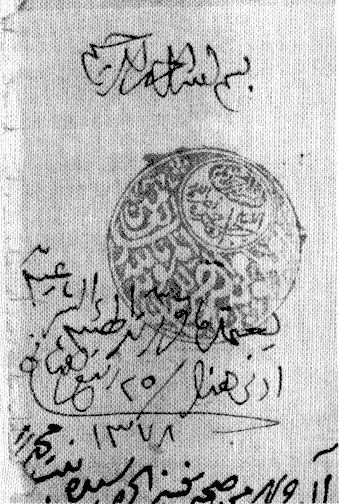
Figure 15.
Seal of Imam Ahmad on Appeal Court ruling, 1958 [A.H. 1378].

Figure 16.
Republican seal printed on official stationery, 1974.
Official seals continued in use after the Revolution of 1962, but both the seals themselves and their methods of employment were different. Aside from the shift from imamic red to republican blue, the most apparent of the semiotic changes is from script to emblem. The new seal of state bears the image of an eagle (nasr ), head in profile and wings spread, together with the national flag and the legend "Yemen Arab Republic." According to one republican writer, this emblem "represents the power of the people."[20] While the imamic seal bore the personal name of the imam, the living embodiment of the patrimonial state, the republican seal bears a symbol and the name of the nation-

Figure 17.
Signature and seal of republican official.
state. In use on official texts, the imamic seal, as was noted, was applied without a signature, or rather, it was itself the mark of the patrimonial imamic ruler. Aside from their appearance at the top of official stationery (see fig. 16), republican seals implement a separation of office and officeholder (and an interchangeability of incumbents) and are always accompanied by signatures: the official signs first, then the seal is placed over the signature (see fig. 17). In imamic states, the name of the state and, potentially, even the location of its capital, the imamic "seat," could change with each new ruler (e.g., the move from San'a' to Ta'izz in this century). In the nation-state conception, by contrast, the name of the state and the location of its capital are not normally subject to such alteration.
The recent appearance in the highlands of the notion of an emblem that is meant to "stand for" the state is traceable to the Ottoman period. In the year 1901, for example, according to the historian al-Wasi'i (1928: 180), the Ottoman governor of Yemen had a tall column

Figure 18.
Old and new city, Tunis. From L. C. Brown, ed., From Madina to
Metropolis (Princeton: Darwin Press, 1973), p. 29.
erected outside the main gate of San'a'. "At its top he had placed the image of a crescent moon, like those put atop minarets, made of copper plated with gold." It was the same symbol that appeared on the printed forms used at telegraph offices. The historian goes on to say that it was the governor's intention that the column with the crescent should serve as "a memorial for the government" (tadhkaran lil-hukuma ).