
An Offering of Dead Bees
Two poems from the later Tristia are exemplary of a central theme of Mandelstam's poetry, what he called the "golden care to lighten the burden of time" ("Sisters—heaviness and tenderness"). The first centers around a simple—but, in the Petrograd of 1920, precious—gift of honey. This poem (belonging to the "Arbenina" cycle) [ 35] is written in an approximation of Dante's terzina: an endecasyllabic line, even though all the endings are feminine and unrhymed.
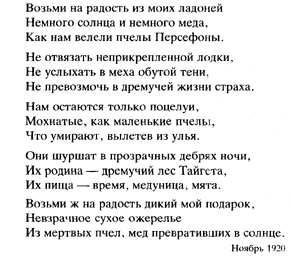
Take for the sake of joy out of my hands
A little sun and a little honey,
As the bees of Persephone have commanded us.
Not to untie the untied barque,
Not to hear the sound of a fur-shod shadow,
Not to overcome, in life's thicket, fear.
All we are left with is kisses,
Furry, like little bees
That die, flying out of the beehive.
They rustle in the transparent thicket of the night,
Their native home is the thick forest of Taygetos,
Their nourishment is time, honeysuckle, mint.
So take for the sake of joy this wild gift of mine,
This plain dry necklace
Of dead bees who turned their honey into the sun.[36]
There is no single aspect of the poem that determines its effectiveness, whether we look at it through the eyes of the contemporary reader living in fear and hunger and excitement in the world of civil war Petrograd (late fall or winter 1920) or through the eyes of a modern admirer of Mandelstam who is aware of the century's subsequent history and who experiences a particular modern fascination before the erotic, literary, mythological, and biographical suggestiveness of a poem composed by a "martyred" poet. As a structuralist critic might tersely put it, "Take for the Sake of Joy" works on many levels. I would like to discuss it from a particular angle—as an instance of Mandelstam's use, or imitation, of sympathetic magic. I will look at it as a verbal structure in which the theme of transformation and rebirth is recapitulated in the paronymic play with the magical effect of transferring the mnemonic attributes of the word, its capacity to reactivate the "inner form," onto the mortal, "amnesiac" aspect of living.[37]
Thematically, the poem is transparent. Its mere juxtaposition with the opening declaration in "Pushkin and Skriabin," where Mandelstam compared the symbolic significance of a poet's death with the shining "sun," should suffice to contextualize the paradox elaborated in the poem. But let us take a closer look, as readers unaware of "Pushkin and Skriabin" (which Mandelstam never made public anyway). Whatever deep and hidden meanings the poem might possess, it is apparently about love, death, and rebirth (Persephone), and of course about poetry (bees and honey as traditional topoi of verbal art). But above all, the poem is about gift-giving, which supplies not only a theme but also a pattern enclosing the other thematic items in a frame of perpetual return, or "prestation," to use Marcel Mauss's term (see Chapter 4).
The gift of this poem becomes transformed in substance in the course of the poem, which itself represents an offering: the gift of "a little sun and a little honey" becomes in the end a "wild gift" (intimations of primitivism, violence, and ordeals) consisting of an unprepossessing "dry necklace," in fact, a string of "dead bees.[38] A decoration, this necklace is also an amulet, a more common object then, perhaps, than now.[39] Its magical power has been generated in the course of the poem, and, like the poet's gift, it will be able to transform "honey" into "the sun" in the hands of the recipient. The power itself seems to derive from its likeness to and association with other magically endowed objects, and ultimately from its mythic origins—in the
underworld, in the "elemental soul of the kingdom of bees" [40] —which set in motion the pattern of rejuvenation and eternal recurrence. According to Jakobson, the process by means of which an object magically absorbs the properties of other objects (sympathetic and contagious magic) corresponds to the basic tropological operations: metaphor and metonymy.[41] Mandelstam's "necklace of dead bees" combines both operations. It is circular; it is an artifact composed of dead matter and therefore is like the cyclical kingdom of the Corn Goddess (metaphoric "magic"); and it is part of and originated in that kingdom and relates to it as microcosm to macrocosm (synecdochic "magic"). I am not implying that a poetry reader, contemporary or modern, would analyze the poem in this fashion; rather, the method of analysis produced by Jakobson, Mandelstam's contemporary, had to be roughly compatible with the range of readings possible at that time. Indeed, it was then that the theory itself was being formulated.[42]
To make all of this magic at least minimally effective, the Shamanistic poet Mandelstam had to design his poem so as to establish a string of homological situations fitting his description of the rites of Persephone's bees, namely, the reversal of the linear flow of time by its repatterning according to the archetype of death and revival. As a result, the ordinary progression, "the sun—herbs—bees—honey—death of bees," was enlarged to include "honey—death of bees—the sun," becoming cyclical rather than linear. One who accepts this amulet will have to participate in, indeed perpetuate, this reversal, as the rules of gift-giving dictate.
The poet's "magic" was especially effective in its paronymic play, for the poem was skillfully orchestrated around such clusters as PCHOLy —Po TSelui —S oLnTSe (bees—kisses—the sun). The penultimate tercet ends with a tour de force of such wordplay, encompassing paronymic, folk-etymological, and allusive homologies: vreMia, Medunitsa, Miata (time, honeysuckle, mint). The first two homologies speak for themselves. The last, particularly the seemingly out of place "mint," had a powerful allusive and "magical" significance. Not only was it an herb sacred to Persephone and Adonis (Mentha),[43] but more important, it also pointed to the programmatic declaration of modernism, Verlaine's "Art poétique," where it played the role of an amulet of true poetry (italics are mine):
Que ton vers soit la bonne aventure
Eparse au vent crispé du matin
Qui va fleurant la menthe et le thym . . .
Et tout le reste est littérature.[44]
But who was the speaker of the poem, and who the recipient of his magic gift?
Whatever the personal history surrounding this poem, Mandelstam no doubt intended it for the reader unaware of the details of the poet's love life. That is, the first-person plural of the poem places the reader on an equal footing with the speaker. The common denominator that the poem defines for the two is most vividly expressed in the second stanza, where death, life, and love are fused: the erotic "untying" combines a topos of wedding folklore with Charon's barque, the shadow of death, quiet as a thief in the night, and the fear that cannot be escaped in a life resembling Dante's "selva oscura."[45] It is mortality, the proximity of death—or, in the intense expressiveness of the poem, the underworld itself, where eros, regeneration, and death are as inseparable as they are in the myth of Persephone.[46] Mandelstam, of course, is stressing the somber, chthonic aspect of life's paradox, positioning both the speaker and the reader to admit a resigned acceptance of death and forcing them to look at life itself through the eyes of a departed soul. That intense awareness of death, that Shestovian "perhaps," is what prepares the climactic resolution with its sudden paradox of immortality achieved through dying. "With death, He has vanquished death": so goes a formula of the Russian Orthodox Easter liturgy, an important item in the contemporary reader's repertoire, from which the closure drew much of its power.[47] Thus, the recipient of the magical amulet was obligated to recapitulate not only the Mandelstamian "mnemonic" poetry but the Gospel drama as well. He was to reproduce in the future what the speaker of the poem had already accomplished.
The magic of "Take for the Sake of Joy" should be most effective among those who had been nurtured on "great Russian literature" and had no particular trouble maintaining on occasion that "everything began with the Word and would end with the Word" (N. Gumilev) or that the "Russian language was the ringing and speaking flesh" (Mandelstam) or, on a less shrill note, that all the material needed for the biography of a Russian intelligent was a history of his reading:
I have never been able to understand the Tolstoys, the Aksakovs, the Bagrov grandchildren enamored of family archives with their epic recollections of home life. I repeat—my memory is hostile, not loving, and its purpose is to distance, not reproduce, the past. A middle-class intelligent [raznochinets ] needs no memory; for him, it will suffice to tell us about the books he has read—and his biography is done and ready. [48]
Those who happened not to share these views and were insensitive to the multiple versions of Mandelstam's "poetics of the Eucharist" might have found suggestive the endecasyllabic tercets in which the poem was composed. This feature was enough to associate the poet with Dante—the poet, and one whose very name means charis, or gift. Those familiar with contemporary Russian poetry would relate "Take for the Sake of Joy" to Gumilev's "Word" and, beyond that, to the many "bees and honey" poems by Konstantin Bal'mont, Viacheslav Ivanov, and Maksimilian Voloshin. Those more at home with French Symbolist poetry would make enough sense of Mandelstam's "gift" by recalling Mallarmé's "Don du poème" and especially Verlaine's "Art poétique." Opera lovers would find subtle references to Wagner's Tristan, admirers of Nietzsche to Zarathustra's "honey sacrifice." Finally, a reader unversed in any of these areas but aware of the comparative study of myth could find considerable satisfaction in being admitted into the chthonic world of Mandelstam's poem with the aid of Frazer's "golden bough." In short, many roads led to Rome and its environs. In this sense, Mandelstam's very modern poem, his reputation as a difficult poet notwithstanding, was as simple as it was complex—"as intricate as it was naive," in Mandelstam's own words—or, if we compare it to dream work, "overdetermined." Because it had something for everyone, the poem's "magic"—even when much of the poem remained murky—could not be missed by a reader willing to accept the poem's gift. If anything, the murkiness itself, as Russian modernists believed, constituted a major factor in the effectiveness of a verbal charm, whether a folk spell or a sophisticated riddle-incantation produced by a Symbolist, a Futurist, or an Acmeist poet.[49]