
FIVE
Running Out of Matter: The Body Exercised in Eighteenth-Century Fiction
Carol Houlihan Flynn
To save Samuel Richardson from his hypochondriac tendency "to Rotundity and Liquor," the tireless and by now notorious Dr. George Cheyne prescribed a wonderful machine called "a chamber horse." Actually a chair "set on a long board, which must have acted like a joggling board, supported at both ends and limber in the middle, with hoops to brace the arms and a footstool to support the feet," the horse promised "all the good and beneficial Effects of a hard Trotting Horse except the fresh Air." Since the horse "rides double better than single," Cheyne suggested that Richardson hire "an Amenuensis and dictate to him riding on the new Chamber Horse."[1] The image of plump Richardson, that sentimental traveler of the imagination, jogging cautiously back and forth in a motion designed to get precisely nowhere is a fascinating one.
[1] T. C. Duncan Eaves and Ben D. Kimpel, Samuel Richardson: A Biography (Oxford: Oxford University Press, 1971), 63-64; The Letters of Doctor George Cheyne to Samuel Richardson (1733-43), ed. Charles F. Mullett (Columbia, Mo., 1943), 26-27. In "Mysticism and Millenarianism: The 'Immortal Dr. Cheyne,'" in Millenarianism and Messianism in English Literature and Thought, 1650-1800, ed. Richard Popkin (Leiden: Brill, 1988), 81-126, G. S. Rousseau considers the shape of Cheyne's life as England's leading "nerve doctor" in light of his millenarian and mystical activities. Lester King finds Cheyne to be the "Mirrot of Eighteenth-Century Medicine," in the Bulletin of the History of Medicine 48 (1974): 517-539.
I would like to thank Sheila Emerson, Miriam Hansen, Peter Linebaugh, Felicity Nussbaum, and Claude Rawson for their readings of this essay. Richard Wolfe and his staff at the Countway Library, Harvard Medical School were especially helpful to me. I am particularly grateful to George Rousseau for his careful interest in this subject, and his bibliographic and critical advice.
The chamber horse, a most material hobbyhorse designed to exercise the all too solid flesh as well as the "hyppish," depressed spirits, would appear to be just the thing to satisfy the writer's need to escape from himself. ("As to my health," he confessed in a letter, "I write, I do anything I am able to do on purpose to carry myself out of myself; and am not quite so happy, when, tired with my peregrinations, I am obliged to return home.")[2] The exercise would also provide a physical stimulation, a pleasant sensation accompanying the imaginary peregrinations. As Francis Fuller, a passionate advocate of the "Power of Exercise," noted, riding increases the velocity of circulation and exalts the spirits while it "gives the Solid and Nervous Parts a grateful Sensation, which in some cases is not contemptible," as well as a "Sence of Tingling and Heat."[3]
Cheyne also recommended an "imaginary" vehicle to exercise Richardson's generally low spirits. Since Richardson was a "hyp" who exacerbated his physical disorders by worrying, he needed a "hobbyhorse" to occupy and divert his tortured mind. Diversion, mental as well as physical, was essential to the treatment of nervous disorders. "It seems to be absolutely impossible," Cheyne argued in The English Malady, "without such a Help, to keep the Mind easy, and prevent its wearing out the Body, as the Sword does the Scabbard; it is no matter what it is, provided it be but a Hobby Horse, and an Amusement, and stop the Current of Reflexion and intense Thinking, which Persons of weak Nerves are aptest to run into."[4]
[2] Correspondence of Samuel Richardson, ed. Anna Laetitia Barbauld (London, 1804), 3: 190-191.
[3] Francis Fuller, Medicina Gymnastica: or, A Treatise Concerning the power of Exercise, with Respect to the Animal Oeconomy; and the Great Necessity of it in the Cure of Several Distempers (London, 1705), 43-44, 260. Fuller's book went through nine editions by 1777. Addison recommends him in The Spectator, no. 115, 12 July 1711 (ed. Donald F. Bond [Oxford, 1965], 1: 473-474), for his description of the mechanical effects of riding, adding that "for my own part, when I am in Town, for want of these Opportunities, I exercise my self an Hour every Morning upon a dumb Bell that is placed in a Corner of my Room, and it pleases me the more because it does every thing I require of it in the most profound Silence." George Cheyne mentions Fuller in The English Malady; or, A Treatise of Nervous Diseases of All Kinds (London, 1733), 176.
[4] The English Malady, 181-182. Cheyne is using the word "hobbyhorse" to denote "a favorite pursuit or pastime," but the word itself also suggests more literal, physical play as "a stick with a horse's head which children bestride as a toy horse" and as the figure of a horse employed in morris dancing or on the stage. The word was also used throughout the seventeenth century to suggest foolish, wanton, and lustful behavior, and connoted wanton prostitution (see the Oxford English Dictionary ). Michael DePorte, in Nightmares and Hobbyhorses: Swift, Sterne, and Augnastan Ideas of Madness (San Marino, Calif.: Huntington Library, 1974) writes at length on the idea of the hobbyhorse.
Cheyne's faith in both machines, material and imaginary, testifies to a widespread interest in the ways body and spirit intersect. While investigating the possibility of treating disorders of the soul mechanically and externally, writers against the spleen approached the body as a physical space affected by a spirit in need of diversion. Cheyne and his numerous medical colleagues set out to treat a disease known as the English Malady, that psychosomatic disorder also known as the Hypochondriack Disease, the Hyp, Hysteria, Melancholy, and the Spleen.[5] Their theories, however, had significant implications not only for medical and psychiatric practitioners but for creative writers in the process of developing the novel. Medical theorists and early English novelists were committed in their different ways to sustaining, and at times inventing, modes of feeling to sustain vitality and to cheat, if not conquer, death.
Writers against the spleen concentrate on the necessity for provocation, stimulation, and diversion in their ironically fatal battles against closure. In his recent study of narrative "design and intention," Peter Brooks argues that "plot is the internal logic of the discourse of mortality." Like so many commentators on the novel form, Brooks prefers to begin his studies with the "golden age of narrative," when "the advent of Romanticism and its predominantly historical imagination"[6] ex-
[5] An early helpful survey of literature of melancholy is C. A. Moore's "The English Malady," in Backgrounds of English Literature, 1700-1760 (Minneapolis: University of Minnesota Press, 1953), 179-235. L. J. Rather provides an excellent discussion of the idea of hypochondria in Mind and Body in Eighteenth-Century Medicine: A Study Based on Jerome Gaub's De Regimine Mentis (London, 1965). In his edition of John Hill's Hypochondriasis: A Practical Treatise on the Hypo (London, 1776; reprint, Los Angeles: William Andrews Clark Memorial Library, University of California, 1969, as no. 135 of the Publications of the Augustan Reprint Society), George Rousseau provides a useful introduction to the melancholy disease and makes significant connections between "nerves" and the discourses of sensibility in "Nerves, Spirits, and Fibres: Towards Defining the Origins of Sensibility," in Studies in the Eighteenth Century, III, ed. R. F. Brissenden and J. C. Eade (Toronto and Buffalo: University of Toronto Press, 1976. Reprinted in The Blue Guitar (Messina) 2 (1976): 125-153; continued by Rousseau's invaluable theoretical study of "Discourses of the Nerve," in Literature and Science as Modes of Expression, ed. Frederick Amrine (Dordrecht: Kluwer, 1989), 29-60. John Mullan productively discusses the relationship between melancholy and the cult of sensibility in "Hypochondria and Hysteria: Sensibility and the Physiclans," The Eighteenth Century: Theory and Interpretation 25 no. 2 (1984): 141-177.
[6] Peter Brooks, Reading for the Plot: Design and Intention in Narrative (New York: Alfred Knopf, 1984), 22, xii. Swift proleptically treats the "modern" condition of the writer who cannot stop writing in A Tale of a Tub, where his hack confesses to be "now trying an Expcriment very frequent among Modern Authors; which is, to write upon Nothing; When the Subject is utterly exhausted, to let the Pen still move on; by some called, the Ghost of Wit, delighting to walk after the Death of its Body. And to say the Truth, there seems to be no Part of Knowledge in fewer Hands, than That of Discerning when to have Done .... The Conclusion of a Treatise, resembles the Conclusion of Human Life, which hath sometimes been compared to the End of a Feast; where few are satisfied to depart." Not ready to leave his reader, Swift's writer will only agree to "pause awhile, till I find, by feeling the World's Pulse, and my own, that it will be of absolute Necessity for us both, to resume my Pen" (ed. A. C. Guthkelch and D. N. Smith [New York, 1968], 208, 210). The classic "modern" discussion of closure can be found in Frank Kermode, The Sense of an Ending (Oxford: Oxford University Press, 1966). More to the point of the "providentially patterned" eighteenth-century novel is Melvyn New's "'The Grease of God': The Form of Eighteenth-Century Fiction," PMLA 91, no. 2 (1976): 235-243.
pressed itself through relatively well made plots. By determining the nineteenth-century novel with its emphatic devotion to regularized form as the model, the critic can then read into the twentieth century's suspicion of plot and its short-circuiting of the satisfying ending a tragicomic progress toward the modern condition. A reading of the eighteenth-century novel, however, makes such an analysis highly problematic, for from the start, the novel resisted the sort of determinancy, the "sense of an ending" modernists like to depart from.
Early novelists, like medical writers against the spleen, were searching for ways to come to terms with a mortality becoming all too pressing in a secularized world. While the medical therapists warn against the dangers of solidification, for to allow one's juices to grow stiff and solid is to harden into death itself, the writers of fiction resist ending their narratives, often fictionalized peregrinations, with digressions, anachronistic disruptions, parodic tailpieces that turn upon themselves, and metaleptic misspellings. In novels and treatises alike, their authors frequently locate themselves in their texts as sufferers of the malady they are trying to control; indeed, the writing becomes the cure as long as it goes on. And since to end it is textually, and sometimes literally, to die, writers against the spleen are most reluctant to lay down their pens. Sterne most notoriously refuses to end his Sentimental Journey, which doesn't even get his narrator to Italy and collapses his Life and Opinions of Tristram Shandy into a "COCK and a BULL," but he merely exaggerates a tendency for strategic digression shared by his less obvious colleagues. Cheyne issues and reissues compulsive directives designed to alter most radically his reader's diet, Nicholas Robinson rewrites his prescription against consumption to cure the spleen, while Smollett resumes his adventures of picaresque Ferdinand Count Fathom within the sentimental pages of Humphry Clinker. Richardson, when not astride his hobbyhorse, writes and rewrites the longest works of fiction in his language, taking each new edition of his novels as an occasion to "improve" most compulsively novels that by virtue of their fluid state never really end.
This essay will first examine the protean nature of "the Spleen" itself, both organ and condition, and follow this exploration with a discussion of the therapeutic "Power of Exercise" so celebrated by most writers on the spleen. I will then consider in some detail the significance of mental and physical exercises in the work of Smollett and Sterne, while intimating the broader theoretical implications of their literary attempts to run, jump, and swing out of matter. Usually regarded as formidable opposites, the splenetic Dr. Smelfungus provoking sentimental Yorick into postures of sweet benevolence, they both address the same problem, the dilemma of the spirit being contained by matter that will inevitably betray. Their narrative strategies are designed to frustrate the logical end of their discourse, fictional closure that represents physical death. Since both writers suffered from the same fatal condition, consumption, their attempts to run out of matter take on an urgency less obviously shared by their contemporaries. Attempting to escape the logic of plot, they pushed metaphors into a reality charged with an all-too-under-standable desire.
In his Essay of Health and Long Life, George Cheyne announces "The Grand Secret and Sole Mean of Long Life." It is
to keep the Blood and Juices in a due State of Thinness and Fluidity, whereby they may be able to make those Rounds and Circulations through the animal Fibres wherein Life and Health consist, with the fewest Rubs and least Resistance that may be.
Unfortunately, Cheyne complains, in spite of all effort, in a process “Mechanical and Necessary "
Time and Age will fix and stiffen our Solids. Our original Frame and Make renders this unavoidable and necessary. As in the greater World, the Quantity of the Fluids is Daily lessening and decreasing; so in our lesser World after a limited Time, the Appetite and Concoctions failing, the Fluids are lessened and spent on the continual Repairs of the Solids, and thereby lose their Nature, and become firm and hard.[7]
Cheyne's model man, contained by the limitations of his own frame, is a familiar one to readers of eighteenth-century medical texts. Radical practitioners would try to revitalize the fluids themselves through blood transfusions. In his History of Health and the Art of Preserving It, James MacKenzie reports tales of "old, decrepid and deaf animals" that "had their hearing, and the agility of their limbs, restored by the transfusions
[7] George Cheyne, An Essay of Health and Long Life (London, 1724), 220-221.
of young and healthy blood into their veins," and cites the cure of a young man "of an uncommon lethargy" restored to health by the blood of a iamb. Another thirty-four-year-old man was cured "of an inveterate and raging phrenzy" by transfusions of calves' blood, but when the bowels of Baron Bond, son to the first Minister of State in Sweden, mortified after a transfusion, MacKenzie's enthusiasm dwindles. Let us cheerfully submit to "that happy state for which we were originally intended," he suggests, echoing the necessarily philosophical conclusions other physicians were drawing. In his attempt to understand the "hardening process," Claude-Nicolas Le Cat decided that our growth turned inward. The only way to escape solidification would be to continue to grow outward, becoming in the process a giant. It is growth itself, Marat acknowledged, that destroys life.
It is one thing to be philosophical, to shrug with grudging acceptance at the wisdom of Buffon's aphorism that "La vie est un minotaure... elle devore l'organisme,"[8] but it is another thing entirely to be human—that organism being devoured. All the while medical writers chasten themselves for seeking relief from their impossible condition, they tend to play, nonetheless, at improving it. To do this effectively, they need the proper material, a place that allows room for at least imaginary relief. The spleen provided just the place: that shadowy mysterious organ with no obvious function offering a locus of anxiety and of hope, a place both real and unreal to theorize over, a place to exercise the imagination. The spleen's significance depends upon its obscurity, its subtle texture "remote not only from the Senses but likewise from the Reach of human Understanding... Eternally hid[den] from us."[9] Just this obscured quality lends to the subject of melancholy its fascination. Its remote inaccessibility creates poetic license for fantastic speculations about the true nature of the cave of the spleen. Not until the time of Freud's unconscious would a place both imaginary and real receive such attention.
Bernard Mandeville, a physician as well as moral philosopher, is most blunt about the instability of the "meaning" of the spleen in his Treatise on Hypochondria. His dialogue format opens up his discourse to the con-
[8] James MacKenzie, The History of Health and the Art of Preserving It (Edinburgh, 1758), 432-436; John McManners, Death and the Enlightenment (Oxford: Oxford University Press, 1981, 113-114. Gerald J. Gruman discusses the century's interest in blood transfusions m A History of Ideas about the Prolongation of Life: The Evolution of Prolongevity Hypotheses, Transactions of the American Philosophical Society, vol. 56, pt. 9 (Philadelphia, 1966), 82-83.
[9] B. Mandeville, M. D., A Treatise of the Hypochondriack and Hysterick Diseases in Three Dialogues, 3d ed. (London, 1730; 1st ed. 1711), v.
tradictory opinions about a disease that he purports to treat. Thus, when his melancholy sufferer Misomedon, inspired by the works of Thomas Willis, compares his model of the body to a still that "exalts in the nature of a Ferment" the earthy and muddy part of the blood that must be "cooked" in the spleen before it rises to circulate, his physician Philopiro listens to his theory only to deride it. "These Similes ...are very diverting for People that have nothing else to do," he sneers. "We are altogether in the Dark, as to the real use" of the spleen, he argues, quite sensibly, but then contradicts his skepticism by offering his own rather poetic theory of animal spirits to explain Misomedon's attacks of hypochondria. Nimble, volatile messengers "fly through all the Mazes and Meanders " and "beat through all the Paths, and hunt every Enclosure of the Brain in quest of the images we want." Philopiro can almost feel their labors as he calls them up in his own imagination, those obliging sylphs darting between mind and body sometimes bewildered in the search until they light by chance upon the looked-for image. Overly active spirits produce too much cogitation, causing scholarly melancholia and a bad case of indigestion.
Philopiro's airy discourse irritates Misomedon, who reminds his doctor that animal spirits are just as metaphoric as his own disparaged model of the body and as Willis's still. Hedging at first, arguing that their existence has never been "controverted," Philopiro suddenly gives up his argument by acknowledging that truth is not the point. The animal spirits are not necessary "real," but they are useful metaphorically "to express the Instruments of Motion and Sense." As long as the body guards its secrets, the abstraction of body can be manipulated through a discourse that actually depends upon speculation and ambiguity.[10]
Just this ambiguity complicates medical treatment of a condition both imaginary and real. The disease manifests itself physically in palpably understood symptoms; yet these symptoms, also attributed to the mind, become part of a larger system that defines its sufferer's idea of his or
[10] Mandeville, Treatise, 95-98, 115, 136, 160-162. In Ideas of Life and Matter: Studies in the History of General Physiology (Chicago: University of Chicago Press, 1969), Thomas Hall discusses Thomas Willis's idea of "Life as a Subjugated Flame" (1: 312-325). Cheyne expresses a similar, rather pragmatic skepticism about the existence of the animal spirits in The English Malady, seeming to dismiss the likelihood of their being more than an idea based upon "the readiest Resemblance the Lazy could find to explain Muscular Motion by.... On such a slender and imaginary Similitude, the Precarious Hypothesis of Animal Spirits seems to be built." Cheyne ultimately suggests that "the Notion of animal Spirits is of the same Leaven with the substantial Forms of Aristotle, and the colelestial System of Ptolemy " (74-75, 85).
her culture. The spleen becomes for the eighteenth century the inevitable disease resulting from the complexities of urban, "civilized" life that literally makes people sick. It becomes part of the neurotic discontent Freud would find impossible to disconnect from the civilization he would not be able to live without. Even as he enumerates the pains of London, that "greatest, most capacious, close, and populous City of the Globe, " stinking with the "Ordure of so many diseased, both intelligent and unintelligent Animals; the crouded Churches, Church-yards and Burying-places, with putrifying Bodies, the Sinks, Butcher-Houses, Stables, Dunghils, & c., " Cheyne nonetheless depends upon the impossible system that makes his profession necessary. As he observes, it was, after all, the luxury and disease of the Egyptians, Greeks, and Romans that provoked them to study sacred Physick to remedy their own evils. Once a people cultivate the polite and ingenious arts, they follow by developing "Physick to any tolerable Degree of Perfection" to cure their most civilized ills.
Melancholy becomes therefore a responsibility, but also a privilege, a sign of the status of its sufferer. It is not even clear that melancholy can—or should—be resisted. "Virtue and Happiness are literally and really Cause and Effect,"[11] Cheyne remarks, suggesting that health is something the gentle reader can achieve through labor and learning. Yet ironically, most treatises insist upon the over-determined nature of the melancholy "type." Lively, quick-witted, acutely sensitive, profoundly obsessive sufferers of the spleen are cursed with imaginations that certify their worth. Even while the reader is exhorted to break out of the splenetic condition, the end result, health, looks at best dull and unattractive. Naturally "healthy" people are the laborers, the poor, doltish owners of "callous" organs of sensation, "Ideots, Peasants and Mechanicks, " incapable of wit.[12] "Slow and heavy thinking" secures "drowsy thick-scull'd Fellows... from becoming hypochondriacal, as those, who cannot Write, from being pillory'd for Counterfeiting other People's Hands,"[13] Mandeville suggests, making melancholy a condition as natural and as personal as one's signature, a privileged symbol of class. To lose the morbid sensitivity in question is to lose a certificate of worth. Cheyne, celebrating his own delicate sensibility, wonders how "One shall suffer more from the Prick of a Pin, or Needle, from their extreme Sensibility, than others from being run thro' the Body; and the first Sort,
[11] Cheyne, The English Malady, 55-56, 26.
[12] Cheyne, Essay of Health and Long Life, 160.
[13] Mandeville, Treatise, 237-238.
seem to be of the Class of...Quick-Thinkers. " More ominously, he believes that "some rational Creatures" of the hardy variety "would suffer less in being finely butcher'd than a strong Ox, or red Deer. "[14]
Cheyne, particularly, in tract after tract, edition after edition, seems dedicated to dwell on the condition that he resists yet calls up each time he describes it. His own personal story, "The Case of the Author," borden on farce as he painstakingly describes his own fall into and out of varying degrees of health always precarious. Cheyne's narrative violently alternates between complacency and self-loathing as his body "swell'd to an enormous size" when it was not "melting away like a Snow-ball in Summer." Cheyne seems driven to illustrate the irremediable nature of a body he is still determined to cure as he keeps trying to find an impossible balance between states of excess. Wasted away by fever, he suffers from an appetite so insatiable that "I suck'd up and retained the Juices and Chyle of My Food like a Sponge," growing in the process "plump, fat, and hale to a wonder; but indeed too fast." An "extreme Case," Cheyne balloons up at one point to over thirty-two stone and is "forced to ride from Door to Door in a Chariot even here at Bath; and if I had but an Hundred Paces to walk, was oblig'd to have a Servant following me with a Stool to rest on," while he is curing others of his own radically unstable disease. Cheyne considers himself recovered through "extraordinary Remedies," but his discourse, lurching between states of extremity, dwelling obsessively upon the times that his body became "tumified, incrusted, and burnt almost like the Skin of a roasted Pig, " suggests a fundamental instability that preoccupies writer and reader alike. Characteristically, in closing his "case," to demonstrate his sound health, Cheyne describes exultantly his latest disaster. After being thrown out of a chariot and falling on his head, suffering a dreadful wound in the temple, after his eyebrows are shaved off, after being bled, Cheyne reports with enthusiasm his miraculous recovery, an event that barely survives the violence of his prose.[15]
In writing their attacks against the spleen, our authors almost guarantee their splenetic states, for axiomatically those most prone to attacks of melancholy are scholars, those weak, sedentary, and studious martyrs who wear away their eyes and their digestive tracts in their pursuit of
[14] Cheyne, The English Malady, 366; George Cheyne, Essay on Regimen (London, 1740), 71.
[15] Cheyne, "The Case of the Author," in The English Malady, 330, 342-343, 351, 360-361.
phantom truth.[16] Ramazini, a physician who carefully categorized the industrial diseases typical of professions as various as the cleaners of jakes, the bearers of corpses, nurses and footmen, horse coursers and midwives, addressed with great seriousness the diseases of "learned Men," as "slothful and idle in their Body, as they are active in their Mind and Brain." Suffering from bad digestion and constipation, "hard students... by Reading and Writing with their Head and Breast bent, compress the Stomach and Pancreas," strain their eyes, cripple their hands, and deprive their brain of its tone.[17] Forgetful of their bodies, scholars abuse it through neglect while they spend too much time thinking on subjects—like melancholy—that seize their imagination. While "People of lower Fortunes labour under such a Variety of Necessities... that they have not time stedfastly to think on one thing," scholars, relieved from tedious "Necessity," demonstrate "strong Symptoms of a labouring Imagination" as they "revolve long upon the same Ideas."[18]
To cure the spleen, practitioners prescribed diets, vomits, purges, and empiric courses of physick. One course of advice often contradicted another, but most treatises agree on one principle: the power of exercise. To move the animal spirits, to open up the great sensorium, one must move the body itself. "The difference between the lowest, most abject, and the highest, most elevated natural Capacities must depend upon the different Degree of Motion coming to the Seat of the common Sensorium," Nicholas Robinson argued. Robinson wonders just why the solids need to be roused, why they grow sedentary and effete, incapable
[16] In The History of Health MacKenzie advises the studious and contemplative to "endeavour to repair by their temperance, regularity, and care, what is perpetually impaired by their weakness, situation and study" (416-417). In Essay of Health and Long Life, Cheyne suggests that the "Weak, Sedentary and Studious, should frequently shave their Head and Face, wash and scrape their Feet, and pare the Nails of their Toes" (228). In "The Art of Preserving Health," John Armstrong advises the scholar "to stand and sit by turns / As Nature prompts," warning that "o'er your leaves / To lean for ever, cramps the vital parts, / And robs the fine machinery of its play" (bk. IV, 11. 80-83, Poetical Works [Edinburgh, 1781], 67).
[17] Bern. Ramazini, A Treatise on the Disease of Tradesmen, to which they are subject by their particular Callings, trans, and ed. Dr. James (London, 1740), 269, 273. Ramazini finds that mathematicians, "abstracted from the Senses, and cut off in a manner from all Commerce with the Body," are "almost all stupid, slothful, lethargic, and perfect Strangers to human Conversation, or the Business of the World," while writers tend to suffer most from constant sitting, "perpetual motion of the Hand in the same manner," and constant attention and application of the mind (286, 400).
[18] Mandeville, Treatise, 220; Nicholas Robinson, A New System of the Spleen, Vapours, and Hypochondriack Melancholy: Wherein All the Decay of the Nerves, and Lowness of the Spirit, are Mechanically Accounted for (London, 1729), 22.
of sending the precious fluids to the extreme parts of the body, and decides that it all has to do with the Fall. God makes good in every case "that Sentence he pronounc'd against disobedient Man, that in the Sweat of his Face, he should eat his Bread."[19] Since "civilized" melancholics do not literally need to labor for food that their servants gather and prepare, they needed to be forced into a course of bodily exercise.
Mandeville presents a typical course of exercise in his prescription for a greensick, melancholy maiden. After being awakened before 6:00 A.M.,
let her be swung for half an Hour, then eat her Breakfast and get on Horseback for at least two Hours, either gallopping or trotting as much as her Strength will permit her. Immediately after this let her be undrest, and by some Nurse or other chafed or dryrubb'd for a considerable time, 'til her Skin looks red and her Flesh glows all over: Let her begin to repeat the same Exercise about Three in the Afternoon, and after supper keep upon her Legs two Hours before she goes to Bed. The Swing I speak of may be made after what manner your Daughter fancies most; that which they call a Flying-horse, makes a very agreeable motion, but if she be apt to be giddy, she may swing in a Chair, or other Seat to which she is fasten'd; otherwise a Rope tied with both Ends to a Beam is sufficient.[20]
Mandeville outlines here the course of exercise promoted by Francis Fuller, M.A., author of Medicina Gymnastica, once a sufferer from "giddiness" but now grown hale and hearty after following Dr. Sydenham's regimen of exercise.[21] Fuller argues that the body "improves by Exercise, and acquires by frequent Motion an Ability to last the longer." Exercise particularly increases the animal spirits, aids the digestion, enriches the blood, and stimulates an increased velocity of the circulation.
The idea of exercise was not in itself new or startling for the eighteenth-century reader. Considered one of the six "non-naturals" fundamental to proper health, it, like civilization and its discontents, went back at least to the Greeks. Fuller defers to Hippocrates and Galen
[19] Robinson, System of the Spleen, 32-33; see also Nicholas Robinson, A New Method of Treating Consumptions: Wherein all the Decays Incident to Human Bodies, are Mechanically Accounted for (London, 1727), pt. l, 202. In Primitive Physick: or, An Easy and Natural Method of Curing Most Diseases (London, 1747), John Wesley argued that exercise was "intimated by the Great Author of Nature, in the very Sentence that intails Death upon us. 'In the Sweat of thy face shalt thou eat bread till thou return unto the Ground'" (v). John Dussinger provides an excellent introduction to the idea of the sensorium in "The Sensorium and the World of A Sentimental Joumey, " Ariel 13 (1982): 3-16.
[20] Mandeville, Treatise, 305
[21] Fuller reported that he suffered from "Giddiness," and in an attempt to recuperate drank Bath Waters so long that he was "scarce able to go about without Staggering like a Drunken Man" (Medicina Gymnastica, 256).
when he recommends his "modern" method to lovers of the ancients, and alludes to Asclepiades, inventor of the "Lecti Pensiles," hanging beds, which served as swinging cradles to soothe ancient hysterics.[22] But while the benefits of exercise had become a commonplace, once the body became matter difficult if not impossible to transcend, exercise itself offered a more urgently sought solution to the problematic mortal condition. Emphasizing the mechanical nature of the body, theories of exercise could appeal to a materialistic sensibility, while at the same time offering a way to achieve "Sympathy betwixt the Soul and Animal Spirits." Thus a therapist like Richard Browne, in his Medicina Musica: Or a Mechanical Essay on the Effects of Singing, Musick, and Dancing, on Human Bodies, might argue for mechanical results, but he promises as well a rhapsodic response to the "mighty Power and Energy of Musick" and movement that should displace fears of bodily containment. Fuller more prosaically, but no less confidently, prescribes horseback riding for the vigorous victim of melancholia. The "true Hysterick Colick" is best soothed by the "Use of a Chaise, or light Calash... convenient for Women... wherein the sick Person may at once enjoy the Convenience of a Cradle, and the Vehemence of Exercise."[23] Cold baths, swinging, and applications of the "flesh-brush"—wielded by a vigorous servant—should enliven the most debilitated.
The ideal goal of exercise is to strengthen the constitution. By stimulating the "animal spirits," one "may come to the strength of a Tartar. "[24] But in fact, most of the exercises recommended depend more upon the health and vigor of surrogate bodies "moving" their master or mistress. Motion becomes that which is done to one's body by the agency
[22] Fuller, Medicina Gymnastica, 13-21, 236-237. As James Work notes in glossing Sterne's use of the term, "Non-Naturals" is "A term formerly used by physicians to indicate the six things which because they do not enter into the composition of the body are not 'natural' yet which are essential to animal life and health and which by accident or abuse often cause disease: air, meat and drink, excretion and retention, sleep and waking, motion and rest, and the affections of the mind" (Laurence Sterne, The Life and Opinions of Tristram Shandy, Gentleman, ed. James Work [New York: Odyssey Press, 1940], 76). Melvyn New's note on the non-naturals is very helpful: The Life and Opinions of Tristram Shandy, Gentleman, ed. Meivyn New and Joan New (Gainesville: University Presses of Florida, 1978-1984), 2:121-122. (All further quotations will be from the Florida edition.) In "The 'Six Things Non-Natural': A Note on the Origins and Fate of a Doctrine and a Phrase," Clio Medica 3 (1968): 337-347, L. J. Rather suggests that by the eighteenth century the term itself would seem inappropriate, certifying Tristram's own complaint that "the most natural actions of a man's life should be call'd his Non-Naturals" (TS 1:84).
[23] Richard Browne, Medicina Musica (London, 1729), 7, 121; Fuller, Medicina Gymnastica, Fuller, 50-52.
[24] Fuller, Medicina Gymnastica, 118.
of another. Adam's curse, to earn daily bread by the body's daily sweat, seems to have been redistributed to fall more often than not upon the stronger, coarser backs of his poorer children. As the proverb went, We are all Adam's Children, but Silk makes the Difference.[25] While exercise was valued for its benefits, it was also distrusted for its coarsening, often debilitating side effects. In An Account of the Effects of Swinging, James Carmichael Smyth, measuring the effect swinging has on pulmonary cases, makes a clear distinction between exercise and motion. Exercise is muscular action, an exertion of the locomotive powers of the body "to increase the force and frequency of the heart's contraction, the velocity and momentum of the blood, the quickness of the breathing, and the heat, irritability and transpiration of the whole body." While exercise may temporarily increase strength and vigor, "when continued beyond a certain time, [it] induces lassitude, debility, and languor."[26] (Ramazini had earlier observed the running footmen's tendency to "have a Swelling in the Spleen: for the loose Substance of this Organ receives more Blood, upon the violent Motion, than it discharges." Even more alarming was the tendency for "Horse-Coursers or Grooms, and those who ride Post" to become frigid and impotent: "the Strength of the Loins and the genital Parts is dissolved by the continual Shaking and Jogging.")[27] Motion, however, rather than exercise, can provide the benefits of exercise without the "agitation, or succession of the body." Smyth considers three sources of motion beneficial to pulmonary patients: sailing, swinging, and aerostation. The last-named is "a method of conveying an animal with great velocity through the atmosphere, without the smallest exertion of its own powers, or even consciousness of motion." The advantage of this violent form of transportation is that it would provide the maximum opportunity for a "change of air," since a quick succession of air so necessary to health depends upon the "velocity with which the body moves through it." But Smyth prudently forbears catapulting pulmonary patients through the air: as "the expence and hazard attending such experiments precludes this from being applicable to the
[25] A London Proverb of 1732 as cited by Peter Linebaugh in his forthcoming study of eighteenth-century social and criminal history, The London Hanged.
[26] James Carmichael Smyth, An Account of the Effects of Swinging, Employed as a Remedy in the Pulmonary Consumption and Hectic Fever (London, 1787), 17-18. Smyth argues that swinging offers the benefits of sailing recommended so highly by the ancients in cases of consumption, without the detrimental effect of sea air. "The change of air... a quick succession of air, owing to the velodty with which the body moves through it, is best obtained by swinging" (12).
[27] Ramazini, Disease of Tradesmen, 224 (misnumbered 252), 229.
purposes of medicine or of common life, they must always remain more a matter of curiosity than of use."[28]
When Fuller and Smyth prescribe their jogging and swinging machines, they are attempting to work externally on the spirit as well as the body, by diverting and disrupting the natural tendency of their patient's progress toward depression, toward "solidification," toward, not just metaphorically, death itself. If, as Robinson suggested, "the labouring [melancholic] Imagination revolve[s] long on same Ideas," it must be interrupted from its obsessive revolution. As Fuller noted, briskness of motion "must take a Man off from close Thinking," for "there is nothing like Hurrying the Body, to divert the Hurry of the Mind." Even "the Perception of a Pain, may be in some Measure interrupted by a swift Motion, for that Perception cannot strike so strong at such a time." Motion becomes displacement, a way of staving off perceptions that turn morbid, since "a Man that should set himself to Muse on a full Gallop, would think but very incoherently."[29] Just this planned incoherence generates narrative strategies of digression, disruption, and disjunction in the eighteenth-century novel.
Eighteenth-century novels are, as a rule, scrambled, jogging, rocking narratives that resist interiority while refusing to end. They tend, in fact, to embarrass critics dedicated to the rise of a more regularized generic form. Sterne is the greatest violator of what formalists like to think of as generic imperatives to close a matter that has been opened. But he just makes obvious what Defoe, Richardson, Smollett, Cleland,
[28] Smyth, Effects of Swinging, 17-19.
[29] Fuller, Medicina Gymnastica, 162-163, 272. Sterne provides a good example of the therapeutic benefits of equestrian diversion in Sentimental Journey when Yorick, pensively considering the dead ass he has just seen on the road, is jostled out of his lamentation by his postillion, who will "go on tearing my nerves to pieces till he has worked me into a foolish passion, and then he'll go slow, that I may enjoy the sweets of it. The postillion managed the point to a miracle: by the time he had got to the foot of a steep hill about half a league from Nampont,—he had put me out of temper with him—and then with myself, for being so" (A Sentimental Journey through France and Italy by Mr. Yorick, ed. Gardner Stout [Berkeley and Los Angeles: University of California Press, 1967], 143).
[30] Answering his own provocatively posed question, "Did Sterne Complete Tristram Shandy ?" Wayne Booth argued that Sterne consciously and coherently completed his text, carefully tying his major episodes together: Modern Philology 48 (1951): 172-183. R. F. Brissenden disagrees with his argument in "'Trusting to Almighty God': Another Look at the Composition of Tristram Shandy, " in The Winged Skull: Papers from the Laurence Sterne Bicentenary Conference, ed. Arthur H. Cash and John M. Stedmond (Kent, Ohio: Kent State University Press, 1971), 258-268.
Goldsmith, and even Fielding were doing.[30] Various "sources" of the novels are often successfully invoked to explain the road trips that most fictional characters seem to be taking. Pilgrimages, heavenly and familial, picaresque assaults on bourgeois sensibility, romance quests, post-Edenic forced marches through life into death are all, with good reason, appreciated for their bearing on the early English novel. I would like, however, to consider the disruptive principle of motion itself as prod and brake, as a principle of narrative progression sustaining a movement whose logical ending is narrative closure, physical death. Like medical theorists writing against the spleen, the novelists are grappling with the same materiality, the same "limitations of frame" that force the most well-plotted life to end.
This principle of motion disallows sustained interiority. To avoid closure, one must keep moving and keep on the superficies of things. Inside is where the maggots lurk, where the vital spirits solidify, harden, and die. Do not loll in bed too long, warns Robinson writing on the spleen, for "these overlong Interruptions with Self, so weaken the Springs of the finest Animal Fibres, on which the Exercise of [intellectual] Faculties depend."[31] To escape and to conquer self, one must keep moving, but ironically to move with purpose is to reach one's destination. Enter the swing, the chamber horse, the journey itself as disruptive agents of motion that exercise the body and soul physically and sentimentally, extending feeling to text that sustains vitality and displaces matter.
Swinging doesn't get you anywhere. That is its point, illustrated with great delicacy by Fragonard,[32] whose erotic appreciation of that moment of desire when all is possible, when body itself has not inserted its own unidealized and often contradictory demands, makes clear just what the swing can and cannot do. In a swing, one enters new air only to be drawn back into the old, and while it is theoretically possible to escape the power of gravity itself between states of up and down, the swinger is nonetheless forced into another just as demanding rhythm that only looks effortless. A certain urgency enters into the most idyllic scene of swinging from the awareness that to stop moving is to fall into the matter at hand.
[31] Robinson, System of the Spleen, 335. In Essay of Health and Long Life, Cheyne also warned against the dangers of "lolling and soaking in Sheets, anytime after one is distinctly awake." The practice “thickens the Juices, enervates the Solids, and weakens the Constitution" (84).
[32] "The Swing," The Wallace Collection.
After Mandeville's physician prescribes his course of exercise to cure the greensick maiden, her father asks, quite sensibly, "But might not Marriage be as effectual as all these Exercises?"[33] His question gets to the masturbatory point of swinging, its eroticized avoidance of conjugal connections that indeed get you somewhere, get you married, get you pregnant, get you tied to complications of matter itself. When Fragonard's lady of the swing stops moving between yes and no, she will fall into that matter which is, pictorially, her destiny, just as when Smyth's pulmonary patients step down from their swings, their pulses will reassert their tedious talent at measuring an illness better evaluated on the ground. Fuller compared quite tellingly the motion of the soothing chaise to that of a cradle, for the cradle, simulating the undulating motion of the womb itself, keeps its fragile occupant safe from the real motion outside that will, naturally, propel it into life leading into death. To swing is figuratively not to die.
The swinger also engages in a mock death, by flirting with the idea of falling off. Recall Mandeville's warning against giddy daughters mounting their lofty flying horses, as well as Fuller's appreciation of the "Vehemence of Exercise" the undulating chaise could provide.[34] Even as therapists describe the safety features of their apparatus, they seem to be introducing elements of danger. And on occasion, the apparatus is designed to be dangerous, to induce—therapeutically—terror.
Jerome Gaub discusses the therapeutic uses of pain in his two essays on regimen, De regimine mentis. In the first essay (1747), he refers obscurely to the power of stimulants "that stir up the humors, excite the nerves, and inflict pain," and calls attention to the benefits of water therapy in hysterical cases. "The frightful torment that the near loss of life from suffocation inflicts on the mind" might be a "terrible remedy indeed but one hardly to be exceeded in efficacy by any other when an unsound mind is to be helped by the effects of a bodily change." Gaub becomes more specific in his prescription of "Terror as a Therapeutic Agent" in his second essay (1763), where he calls for "a machine that will inspire extreme terror, and submersion of such duration and frequency that life itself is put in hazard and doubt arises when the man is withdrawn whether he is quite dead or can still be revived." Even arthritis can be relieved by terror. A certain gouty patient "whose hands
[33] Mandeville, Treatise, 307. Philopiro answers, Yes, but adds that the marriage might fail, making two people unhappy instead of one, and "may but half Cure the Woman, who lingering under the Remainder of her Disease, may have half a dozen Children that shall all inherit it."
[34] Mandeville, Treatise, 305; Fuller, Medicina Gymnastica, 50.
and feet had been covered with poultices of milk, flour and turnips in order to relieve the pain," was left unattended. Disastrously, a pig forced its way into the patient's room, and "Attracted by the odor it began to devour the poultice." This rough assault "threw the man to the floor, not without the greatest emotional disturbance but with the result that his pains abated from then on and shortly thereafter entirely disappeared, never to return again."[35] As Fuller noted, "Torture will rouse the Spirits for some time very much,"[36] while Robinson cited with approving wonder the case of an idiotized woman in Cheshire "that had been subject to Fits of Lunacy for near twenty Years," who recovered "the perfect Use of all her Senses" after fortuitously slipping 150 feet "from the Ridge of a steep Hill."[37]
Through the power of exercise, in bouts of swinging, jogging, bouncing, more radically through shock therapy designed to divert depressed spirits by dunking, whirling, and plunging mad matter into consciousness, writers against the spleen work to create irritation to stimulate the spirits into action, forming "those vivifying secretions" so necessary to sexual and mental vigor.[38] The benefit of irritation is invoked parodically
[35] Quoted in Rather, Mind and Body, 109-110, 188-189. Rather's commentary is particularly valuable. He cites many examples of remarkable therapeutic procedures. Boerhaave, for instance, described the practice of a practitioner in Holland "so successful that some of the highest men in the country were committed to his care." The patient was treated with consideration and leniency, "but the moment the disorder asserts itself he is seized and soundly beaten…. at last his fear of a beating is so great that he puts his mad-ness aside" (193).
[36] Fuller, Medicina Gymnastica, 9.
[37] Robinson, System of the Spleen, 67.
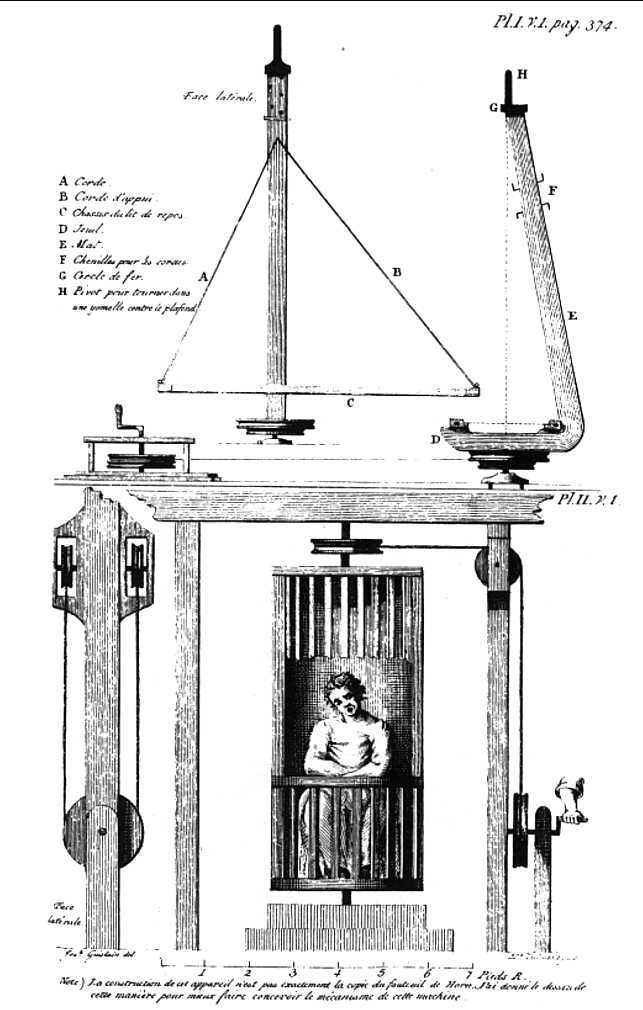
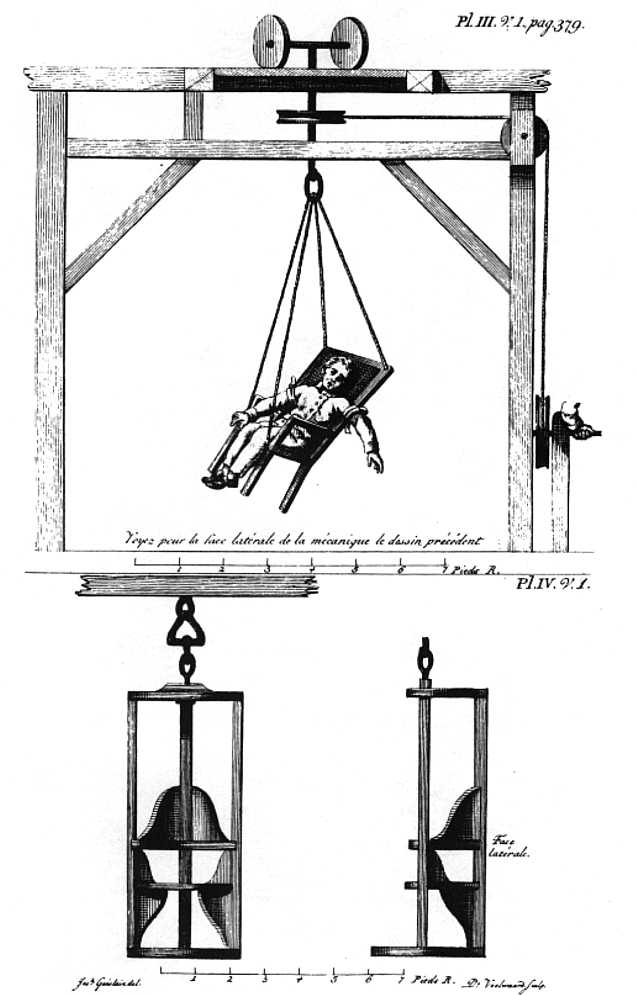
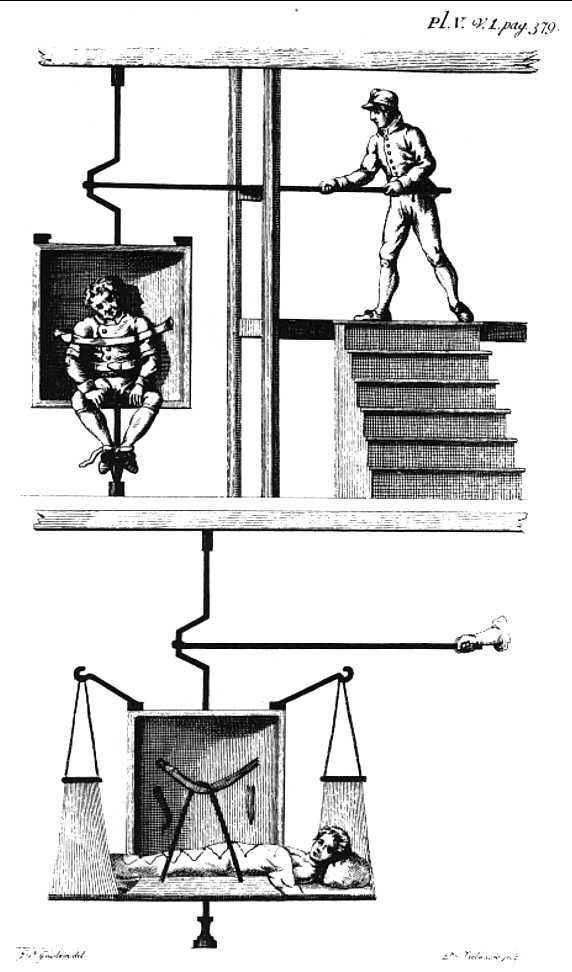
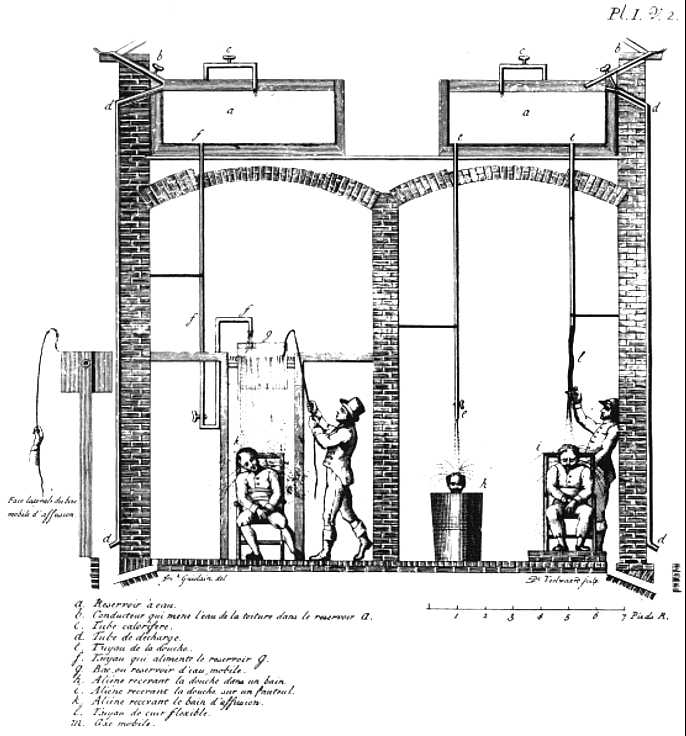
[38] Wesley recommended that the deranged suffering from raging madness "Keep on the Head a Cap fill'd with Snow, for two or three Weeks." Alternatively one could "Set the Patient with his Head under a Great Water-Fall, as long as his Strength will bear" (Primitive Physick, 79). Illustrations of Joseph Guislain's more orderly methods of shocking his patients into consciousness dramatically extend these earlier ideas, especially those found in Traité mr l'aliénation mentale et mr les hospices des aliénes (Amsterdam, 1826). The idea of "irritability" and "sensibility" was particularly significant in the work of Albrecht yon Hailer, who reported experiments with hundreds of animals to determine which parts were irritable and which sensible. He decided that a part was irritable if it contracted when stimulated, and sensible, if when stimulated the organism demonstrated that it felt pain. Hailer concluded that only nerves or organs containing nerve endings were sensible. The preface to the English translation of Hailer (taken from Simon Tissot's French translation) discusses the extreme irritability of hysterics and refers the reader to the Medicinae compendium (Leiden, 1735-1737) and the Praxis medicae systerna (Padua, 1752) of "the celebrated Dr. Gorter, to whom the practice of physic is so much obliged," and "the first who has treated expressly of mobility, a disease so frequent and so little known" (On the Sensible and Irritable Pans of Animals [London, 1755], xv). Thomas Hall discusses the debate over Haller's concept of irritability (Ideas of Life and Matter 1:396-404). R. F. Brissenden considers Haller's influence on the sentimental movement in Virtue in Distress: Studies in the Novels of Sentiment from Richardson to Sade (New York: Barnes and Noble, 1974). In her forthcoming study of sensibility, Ann Van Sant makes compelling connections between the language of scientific experimentation and the language of the sentimental novel.
by Sterne in his definition of "True Shandeism." Quizzing the readers on the state of their heads—"my own akes dismally"—Tristram boasts that Shandeism "opens the heart and lungs, and like all those affections which partake of its nature, it forces the blood and other vital fluids of the body to run freely thro' its channels, and makes the wheel of life run long and chearfully round" (1:401).[39] Less sanguine, but cursed with the same "akeing head," bent on opening up the same heart and lungs, Smollett notes in a letter to Dr. William Hunter, foremost surgeon of the age as well as Smollett's physician and friend, that were it not for the "Stings" of his Grub Street Friends, his "Circulation would have stopped of itself" to leave him "stupefied with ill Health, Loss of memory, Confinement, and Solitude."[40] Eager to "increase the motion of the machine, to unclog the wheels of life and now and then to take a plunge amidst the waves of excess,"[41] Smollett clarifies more than Sterne the mixed nature of "excess" and motion in his delineation of a search for health that depends as much upon cranky irritation as it does upon Sterne's voyeuristic sentimental moments. But significantly, in their sentimental quests, both writers disrupt, digress, and mobilize narratives to "move" readers into keeping their fictions, through the exercise of reading, alive.
Their desire to extend their lives through paper into a community of feeling readers is not surprising. Both suffered from consumption, a physical condition often connected specifically to the melancholia feared
[39] Roy Porter discusses Sterne's medical history as a consumptive in "Against the Spleen," in Laurence Sterne: Riddles and Mysteries, ed. V. G. Myer (London: Vision; Totowa, N. J.: Barnes and Noble, 1984), 84-98. Porter's extensive footnotes are particularly helpful. Max Byrd is sensitive to Sterne's splenetic race against death in his critical study, Tris tram Shandy (London, 1985). Sterne specifically discusses his method of writing "against the spleen" in volume 4, "in order, by a more frequent and a more convulsive elevation and depression of the diaphragm, and the succussations of the intercostal and abdominal muscles in laughter, to drive the gall and other bitter juices from the gall bladder, liver and sweet-bread of his majesty's subjects, with all the inimicitious passions which belong to them, down into their duodenums" (TS 1:360).
[40] The Letters of Tobias Smollett, ed. Lewis M. Knapp (Oxford: Oxford University Press, 1970), 133.
[41] The Expedition of Humphry Clinker, ed. Lewis M. Knapp (Oxford: Oxford University Press, 1966), 339.

Pl. 1. From Joseph Guislain, Traité sur l'aliénation et sur les hospices des aliénés (Amsterdam, 1828).
Pl. 2. From Joseph Guislain, Traité sur l'aliénation mentale et sur les hospices des aliénés (Amsterdam, 1828).
Pl. 3. From Joseph Guislain, Traité sur l'aliénation mentale et sur les hospices des aliénés (Amsterdam, 1828).
Pl. 4. From Joseph Guislain, Trait é sur l'aliénation mentale et sur les hospices des aliénés (Amsterdam, 1828).
Pl. 5. From Joseph Guislain, Trait é sur l'aliénation mentale et sur les hospices des aliénés (Amsterdam, 1828).
to depress the necessary animal spirits;[42] both wrote, in critically different ways, against the spleen; and both died of their "natural" condition shortly after completing (or rather refusing to complete) their most obvious attempts to run out of the matter that finally contained them. It is time to look at their fictional strategies.
"Fabricating at great rate" his Sentimental Journey, Sterne guarantees a correspondent that the work "shall make you cry as much as ever it made me laugh—or I'll give up the Business of sentimental writing—& write to the body."[43] He reveals in this boast the edgy, nervous relationship he has to a method of writing that ironizes the tears he wrings from his subject, the body he is always displacing in language. To write "to the body" is to approach it directly and follow its course into death. Its progress is sure, Sterne makes clear as he quantifies the blood he coughs up while tracing the source of his discontent. Engaging in "hectic watchings" (1:104) (the term is a tubercular one), born into a "scurvy world" (1:8), Sterne turns body into a text that must be interrupted to keep it from ending, for the straight plot line of gravity can only lead into closure most fatal.
The act of writing itself creates physical communion with problematic flesh. Preparing to describe Walter Shandy's grief over Tristram's crushed nose, the writer enters this part of his story "in the most pensive and melancholy frame of mind, that ever sympathetic breast was touched with," his "nerves relax" and he feels "an abatement of the quickness of [his] pulse." His cautious composure, so different from "that careless alacrity with it, which every day of my life prompts me to say and write a thousand things I should not," seems to be associated with the seriousness of his subject. More typical are
the rash jerks, and harebrain'd squirts thou art wont, Tristram, to transact it with in other humours,—dropping thy pen,—spurting thy ink about thy table and thy books,—as if thy pen and thy ink, thy books and thy furniture cost thee nothing. [1:254]
Is the ink Sterne's blood, costing indeed something, sign of his tran-substantiated text? Or merely ink? Flesh and blood, paper and words
[42] Nicholas Robinson seems to treat the two conditions as one, offering the same advice to sufferers of the spleen that he gives to consumptives. Most works addressing the melancholy condition make continuous connection between "low" spirits and consumption, while often linking the psychosomatic attacks of the spleen to the physical manifestations of scurvy and consumption.
[43] Sentimental Journey, 19-20.
commingle violently as Sterne throws fair sheets of text into the fire and, for relief, "snatch[es] off [his] wig" to throw it perpendicularly upward, defying the gravity he writes against (1:350).
Writing against the spleen to extend, in the process, his own life, Sterne, through exertion, comes up against the very problem he is trying to solve, for in exercising his vital animal spirits, he is also, in his rash transactions, spurting his ink, his energy, his life's blood about the room. "In writing," Ramazini noted, "the whole Brain with its Nerves and Fibres are highly tense, and a Privation of their due Tone succeeds."[44] Writing, like study, is, after all, bloody work. Witness the trials of Uncle Toby, displacing his wound through hard study guaranteed to feed the flames of melancholia as he pursues the intricate mazes of the labyrinth promising "this bewitching phantom, KNOWLEDGE... O my uncle! fly—fly—fly from it as from a serpent.—Is it fit, good-natur'd man thou should'st sit up with the wound upon thy groin whole nights baking thy blood with hectic watchings?" (1:103-104). And how can Toby fly from the knowledge threatening to consume him, a knowledge, not of javelins and bridges and sentry boxes, but the deeper knowledge of "whole nights baking thy blood with hectic watchings" after death? In the text, the answer is clear. Toby must mount his hobbyhorse and ride away from the wound itself.
A hobbyhorse. Not an overlooked vehicle to be sure, but one, I think, more directly connected to Sterne's narrative strategies and one closer to Cheyne's chamber horse than to "hobbies" emptied of the physicality they promise. Sterne employs his hobby to move, lurch, jerk, and jog the matter of his text across a page that is alarmingly substantial, and he does so to exercise spirits that are too active for a badly decomposing "real" body.
Sterne's own mythologized equestrian escapades suggest a violent propensity for movement, just what, after all, the doctors prescribe. Writing from Montpellier, he complains that the "Thiness of the pyrenean Air brought on continual breaches of Vessels in my Lungs, & with them all the Tribe of evils insident to a pulmonary Consumption—there seem'd nothing left but gentle change of place & air." "Gentle," however, is a word that becomes altered by the movement itself, and once Sterne puts himself into motion, "having traversed the South of France so often that I ran a risk of being taken up for a Spy, I... jogg'd myself out of all other dangers."[45] Wildly excursing with a mad wife who thinks she
[44] Ramazini, Disease of Tradesmen, 401.
[45] The Letters of Laurence Sterne, ed. Lewis Perry Curtis (Oxford: Oxford University Press, 1965), 205.
is the Queen of Bohemia, demoniacally racing across Crazy Castle sands,[46] he violates therapeutic prescriptions for moderate exercise just as thoroughly as his morbidly energetic race against death flaunts Nicholas Robinson's sound admonition to his consumptive patients. "All the dejecting Passions should be banish'd," Robinson advises, "and Objects only admitted that may create gay, merry and chearful Scenes.... I should think it highly detrimental, too much to play with the gloomy Prospects of Death, unless manifest Symptoms appear of his approaching Dissolution."[47] It would be, I imagine, difficult not to gag on such banal bromides. Sterne shows no signs of swallowing the discourse of cheerful moderation. His gaiety will crack at its edges as he perversely calls up "gloomy Prospects of Death" (37-38), two of them, impenetrable black monuments to Yorick's mortality, only to flaunt them, to exorcise their spirit through a brisk, cracked energetic course of exercise.

Resurrecting "poor Yorick" at will, Sterne jerks his invincible because already dead—character across fictive landscapes that strain beneath the weight of curvetting, frisking hooves. Sentimental travelers "Crack, crack—crack, crack—crack, crack," across France (2:599), and on domestic ground are prone to take "a good rattling gallop," to risk routinely life and limb in order to arouse the appropriate spirit:
Now ride at this rate with what good intention and resolution you may,—'tis a million to one you'll do some one a mischief, if not yourself—He's flung—he's off—he's lost his seat—he's down—he'll break nis neck—seel [1:356]
[46] In Scrapeana (York, 1792),John Croft reports that Elizabeth Sterne imagined herself the Queen of Bohemia. To amuse her, "and induce her to take the air," "Tristram, her husband... proposed coursing, in the way practised in Bohemia; for that purpose he procured bladders, and filled them with beans, and tied them to the wheels of a single horse chair. When he drove madam into a stubble field, with the motion of the carriage and the bladders, rattle bladder, rattle; it alarmed the hares, and the greyhounds were ready to take them" (22, as cited in David Thomson, Wild Excursions: The Life and Fiction of Laurence Sterne [New York: McGraw-Hill, 1972, 123). Arthur Cash finds this to be "one of the least trustworthy stories about Sterne" (Laurence Sterne: The Early and Middle Years [London: Methuen, 1975], 286), but something in it rings true. Wilbur Cross states that of all the pastimes that "took Sterne out of doors, none pleased him quite so much" as "racing chariots along the sandy beach" near Crazy Castle "'with one wheel in the sea'" (The Life and Times of Laurence Sterne [New Haven: Yale University Press, 1925], l:121).
[47] Robinson, Consumptions pt. 2, 48.
Motion, not ripeness, is all. Ripeness must, in fact, be interrupted, for to ripen is to rot. Growth becomes in nature death—unless the natural channels are diverted. Tristram knows that, as he compulsively displaces his origins, pushing them always beyond his own comprehension, short-circuiting in the process his logical narrative end.
To escape the real problems of body, the quarts and gallons of blood that Tristram decides not to measure, Sterne sets up several diversionary strategies. To escape being "killed" by kind questions addressed to the nature and location of his wound, My Uncle Toby displaces his corporeal state through military maneuvers. Trim, his surrogate, in love and war, one of those accommodating "body servants" so necessary to exercise the vital spirits, makes it possible for Toby to swing between states of benevolence and bloody gore as he races his hobbyhorse from the Bowling Green to Dunkirk and back again without getting anywhere at all. Walter, less tactile, depends upon auxiliary verbs to move the soul, that great sensorium of verbal connections:
Now the use of the Auxiliaries is, at once to set the soul a going by herself upon the materials as they are brought her; and by the versability of this great engine, round which they are twisted, to open new tracks of enquiry, and make every idea engender millions. [1:485]
Aided by the auxiliary yet active parts of speech not unlike accommodating servants willing to administer brisk rubbings of the flesh-brush for their mistress's own good, Walter sets the great white bear dancing across the page to not quite end another book:
A WHITE BEAR! Very well. Have I ever seen one? Might I ever have seen one? Am I ever to see one? Ought I ever to have seen one? Or can I ever see one?
Would I had seen a white bear—(for how can I imagine it?) If I should see a white bear, what should I say? If I should never see a white bear, what then?
If I never have, can, must or shall see a white bear alive; have I ever seen the skin of one? Did I ever see one painted?—described? Have I ever dreamed of one?
Did my father, mother, uncle, aunt, brothers or sisters, ever see a white bear? What would they give? How would they behave? How would a white bear have behaved? Is he wild? Tame? Terrible? Rough? Smooth?
—Is the white bear worth seeing?—
—Is there no sin in it?
Is it better than a BLACK ONE? [1:487]
Waiter's final question exposes the absurd limits to his own system, promising endless discourse, newly opened tracks of inquiry that would "make every idea engender millions" of words going absolutely nowhere, ending up in tautological exercises that, nonetheless, "set the soul a going by herself" and keep, in the process, the wheel of life running "long and chearfully round" (1:401).
Tristram compulsively pursues motion for its own sake. "So much of motion, is so much of life, and so much of joy... that to stand still, or get on but slowly, is death and the devil," he claims, rejecting Bishop Hall's desire for heavenly rest. "Make them like unto a wheel " becomes not a "bitter sarcasm" made against the restless spirit of fallen man, but a benediction allowing, however mechanically, transcendence. "I love the Pythagoreans... for their... 'getting out of the body, in order to think well. ' No man thinks right whilst he is in it" (2:592-593).
Tristram travels by coach, by hobbyhorse, and by sentimental chance, depending, when particularly weary, upon sturdy surrogates to move his dangerously hardening soul. To get out of the body, Sterne depends upon moving his and his reader's soul mechanically, but also pathetically, by allowing a sentimental escape from the hard realities of life. Auxiliary agents of feeling, body servants as indispensable as Trim, will become in Sentimental Journey necessary for the sentimental commerce Yorick conducts.[48] Just as the White Bear carried into and out of Waiter's discourse calls attention to the arbitrary, fragmentary nature of any discourse, so the isolated, often inconclusive sentimental tales filling both novels emphasize their transitory, yet necessary, quality. Tristram, in fact, highly recommends the pitiful Maria piping her sorrows as a good sentimental side trip to Yorick, the sentimental traveler in search of emotional and motional diversion. Maria's madness and pathos is just the thing to exercise the spirits and rouse the soul.[49] Feelings, the property of patients genteel enough to suffer from the spleen, are expensive to sustain and will continue to depend, sentimentally, largely upon the sufferings of other, hardier souls valued for their compliance and visibility.
[48] In his "Preface" written in the Desobligeant, Yorick decides that "the balance of sentimental commerce is always against the expatriated adventurer: he must buy what he has little occasion for at their own price—his conversation will seldom be taken in exchange for theirs without a large discount—and this, by the by, eternally driving him into the hands of more equitable brokers for such conversation as he can find, it requires no great spirit of divination to guess at his party" (Sentimental Journey, 78-79).
[49] The pitiful condition of LeFevre also serves to rouse Toby from his sickbed. Most of the sentimental incidents in both TS and SJ seem designed to elicit a short, strong response that will invigorate its feeling spectator.
All these side trips, all this openness to the pleasing sensation of disruption, prohibits narrative coherency. That is, in fact, the point. Tristram "so complicate[s] and involve[s] the digressive and progressive movements, one wheel, within another, that the whole machine, in general, has been kept a-going;—and what's more, it shall be kept a-going these forty years, if it pleases the fountains of health to bless me so long with life and good spirits" (1:82). In the hectic spirit, he sets out to move through time and space Dr. Slop, Obadiah, Uncle Toby, Corporal Trim, Yorick, Walter, and himself—and on occasion, that inveterate lover of coach travel, Aunt Dinah, players all in his "dance... song... or... concerto between the acts" of birth and death.
Compulsively calling attention to the seams and struts of his narrative, Sterne makes clear with cloying irritation the effort it takes not to be splenetic. If I were to choose a kingdom, Tristram muses, let it be filled with "hearty laughing subjects." The Rabelaisian dream of a "body politick as body natural" as body laughing is poignantly undermined by his salute to the reader he takes leave of "till this time twelve-month, when (unless this vile cough kills me in the meant time) I'll have another pluck at your beards" (1:402). Not only does his own body natural intrude upon his vision of "subjects" with the "grace to be as WISE as they were MERRY," but his assertion of authority reveals even more the unlikely nature of his fictional structure. His hearty subjects must laugh, humorists subject to a regimen of joy that strains against its impera-five. Crack, crack—crack, crack—crack, crack—watch the "characters" prance and paw as they course across a narrative designed to get them nowhere. The less nimble need to be occasionally carted off the stage, for movement, not direction, is all. "Getting forwards in two different journies together, and with the same dash of the pen," playing parlor tricks with time and space as he walks across the marketplace of Auxerre with my father and my uncle Toby just as he enters Lyons with a "post-chaise broke into a thousand pieces... moreover this moment" rhapsodizing on the banks of the Garonne (2:621-622), Sterne exhausts the reader with his frantic attempts at capering in the Shandy manner.
By denying his vehicle, his text, stability, by "breaking it up into a thousand pieces," Sterne collapses it finally in a "COCK and a BULL." Strategies of interruption and digression energize—hectically—a discourse that can even mobilize "auxilary verbs" to "open new tracks of enquiry, and make every idea engender millions." But in the case of the wonderful dancing bear, such multiplication is essentially nongenerative. The bear moves through the text, but doesn't get anywhere—he doesn't even make sense. New tracks of inquiry lead to dead ends that require yet another detour. Thus Tristram multiplies his own activity
textually: "I have three hundred and sixty-four days more life to write just now, than when I first set out; so that instead of advancing, as a common writer, in my work with what I have been doing at it—on the contrary, I am just thrown so many volumes back" (1:341). Advancing, and then "thrown back," the writer swings back and forth between birth and death, between those "acts" that threaten closure. The swinger escapes time, escapes death, as long as he can sustain movement ultimately as sterile as Waiter's recalcitrant bull. For there is, within the text itself, a resistance to the cracks and jerks and jogs and pokes that creates a hectic, masturbatory exhaustion of the "animal spirits" Sterne tries to resuscitate. The irritability that Sterne wants to transform into "good humor" reveals the strains of sublimation. Smollett, less rarefied, makes more apparent the pains and pleasures of exercising a body resisting inevitable consumption.
As a practicing physician as well as a splenetic patient, Smollett knew too well his "bad state of health." Smollett describes his condition in terms that would be found in most texts dealing with not only "the spleen" but "consumption." He suffers from "an asthmatic cough, spitting, slow fever, and restlessness, which demands a continual change of place, as well as free air, and room for motion."[50] It may very well be that his professional knowledge inspired his most professional defenses against his own disease. His desire for displacement, his attempt to turn matter into text, can be seen most vividly in his letter to Dr. Fizes, noted professor of medicine at the University of Montpellier. Although he was actually staying at Montpellier, Smollett, however curious to "know the opinion" of the celebrated doctor, could not bring himself to consult the local "Boerhaave" in the flesh. The "great lanthorn of medicine is become very rich and very insolent; and in proportion as his wealth increases, he is said to grow the more rapacious," he reports, deciding that such unsavory demonstrations of both character and deportment "left [him] no desire to converse with him." Instead, Smollett resolved "to consult with him on paper" (88). On paper, Smollett retains control of his case, his story of a disease that can be only what he allows into his
[50] Tobias Smollet, Travels through France and Italy, ed. Frank Felsenstein (Oxford: Oxford University Press, 1981), 64. Further references will be cited in the text. Felsenstein suggests that the "the abrasiveness and bad temper which characterize many of Smollett's remarks seem to have had a more immediately therapeutic effect than the medicinal remedies proffered him. There is something positively curative to be found by venting his spleen" (xi). John Sena considers "Smollett's Persona and the Melancholic Traveler," Eighteenth-Century Studies 1 (1965): 353-369.
text. Body disappears altogether while Smollett anachronistically resists the growing medical practice of hands-on examination.[51] By refusing to see—and be seen by—his physician, Smollett hides behind words to remain free to invent his adversary's response to his condition. "The professor's eyes sparkled at the sight of the fee," he reports (93), imaginatively invading the consulting room he refuses to visit.
Smollett scrupulously reports the symptoms of his hectic, perhaps consumptive constitution—in Latin. The language of medical discourse is perfectly appropriate, but its utilitarian generality is precisely what allows him to quibble about Fizes's diagnosis. For when Fizes answers Smollett's letter—in French—to diagnose Smollett's condition as a slow fever with probable tubercules in suppuration on the lungs, "a circumstance which we should have ascertained, had the nature of the spitting been described in the case" (96), suggesting a consumptive condition, the patient turns a medical consultation into a linguistic contest. Forget Smollett's ailing body, the professor does not "understand Latin." Promising not to make any remarks upon "the stile of his prescription, replete as it is with a disgusting repetition of low expressions," Smollett nonetheless feels the need to "point out to [Fizes] the passages in my case which he had overlooked" in his original Latin descriptions. His objections reveal his understandable desire to arrest in prose the course of his disease.
I cannot think there are any tubercules on my lungs, as I never spit up purulent matter, nor anything but phlegm or pituita in colour and consistence like the whites of eggs. Sputum albumini ovi simillimum. I imagine, therefore, that my disorder was originally owing to a sudden intermission of bodily exercise, intense application of the mind, and a sedentary life which hath relaxed the whole fibrile system, and that now it may be called a pituitary, not a purulent consumption. [English italics mine]
Imaginings aside, Dr. Fizes read Smollett's revised description, stood by his diagnosis, and invited him to come the next morning to his house "if [he] had any doubts... and he would resolve them." Still avoiding contact, Smollett sent in his place twelve livres wrapped in a note most equivocal:
[51] Stanley Reiser, Medicine and the Reign of Technology (Cambridge: Cambridge University Press, 1978), discusses the ways that the modern medical technology affected the patient's sense of autonomy. Once the physician was able to examine the patient's body as material disconnected from its owner's narrative, the patient became less the subject than the object of examination.
It is not without reason that Mons.r Fizes enjoys such a large reputation. I have no doubts remaining; thank Heaven and monsieur Fizes. [98-101]
Not surprisingly, the doctor pocketed the livres, proving to Smollett his venality, allowing him even further room to rage against the diagnosis. Besides, Fizes did not prescribe exercise, Smollett's favorite remedy against the spleen. For that lapse in therapy alone, Fizes's interpretation of Smollett's shadowy, Latinized body could be disregarded.
Smollett's real body was another matter. "I was not at all pleased with the famous statue of the dead Christ in his mother's lap, by Michael Angelo," he reports, projecting onto a statue the symptoms he vigorously denied at Montpellier. "The figure of Christ is as much emaciated, as if he had died of a consumption" (255). Consumption must be resisted with energetic jolts of motion triggered by jerks, jolts, and splenetic bursts of irritation. Searching for health, Smollett follows a course of exercise violently charged. His travelers seldom jog along complacently. Here is his description of the difficulty he encounters "pulling off" a companion's boots after a day on the road:
the marquis's boots... were... so loaded with dirt on the outside, and so swelled with the rain within, that he could neither drag them after him as he walked, nor disencumber his legs of them, without such violence as seemed almost sufficient to tear him limb from limb. In a word, we were obliged to tie a rope about his heel, and all the people in the house assisting to pull, the poor marquis was drawn from one end of the apartment to the other before the boot would give way: at last his legs were happily disengaged, and the machines carefully dried and stuffed for next day's journey. [306]
Reducing body to mechanized matter, Smollett turns his subject man into the objectified "homme machine,"[52] an entity possessing, and being possessed by, detachable parts that need to be "dried and stuffed" overnight. In the process, he also calls attention to the pains of movement, and paradoxically, the pleasures those pains afford. He seems to delight in such fleshly battles. Sentimental battering only increases the animal spirits. Here he is splenetically approaching Florence, certain he is being waylaid by villainous servants to a solitary, "bad" house only five miles from his appropriate destination. Enraged, he and his wife, "up to the ancles in mud," set out against prudent advice to walk to Florence:
[52] The classic discussion of man the machine can be found in Aram Vartanian's edition of Julien Offray de La Mettrie, L'Homme Machine: A Study in the Origins of an Idea (Princeton: Princeton University Press, 1960).
Behold us then in this expedition; myself wrapped up in a very heavy great-coat, and my cane in my hand. I did not imagine I could have walked a couple of miles in this equipage, had my life been depending; my wife a delicate creature, who had scarce ever walked a mile in her life.... The night was dark and wet; the road slippery and dirty; not a soul was seen, nor a sound was heard: all was silent, dreary, and horrible. I laid my account with a violent fit of illness from the cold I should infallibly catch, if I escaped assassination, the fears of which were the more troublesome as I had no weapon to defend our lives. While I laboured under the weight of my great-coat, which made the streams of sweat flow down my face and shoulders, I was plunged in the mud, up to the mid-leg at every step; and at the same time obliged to support my wife, who wept in silence, half dead with terror and fatigue.
Not only does Smollett reach Florence, but he arrives "with great saris-faction... from a conviction that my strength and constitution were wonderfully repaired... fully persuaded that the hardships and violent exercise... had greatly contributed to the re-establishment of my health" (286-289).
When Smollett "increase[s] the motion of the machine, to unclog the wheels of life; and now and then take a plunge amidst the waves of excess in order to case-harden the constitution" (HC, 339), he practices a harder version of the sentimentality Sterne plays at. His sentiments can, indeed must, hurt to be felt, and provoke in the process a motion that depends upon irritability. "It was happy for me that I had a good deal of resentment in my constitution, which animated me on such occasions against the villainy of mankind," Roderick Random crows, "and enabled me to bear misfortunes otherwise intolerable." His, and Smollett's other frequent travelers could not drag their bodies across his pages without "inveigh[ing] with great bitterness" and "boiling with indignation."[53]
The spleen pushes traveler Smollett across France, invigorating his discourse on the trials of hazarding "cold, damp, dark, dismal, and dirty" inns where one inevitably encounters "disobliging and rapacious... awkward, sluttish and slothful... lazy, lounging, greedy, and impertinent" churls along the way. His version of "sentimental commerce" works on the principle of underpayment. While Sterne explains complacently that properly distributed livres smooth the roughest, stoniest path, Smollett provokes the hardships that reward his notorious resistance to accommodation.
[53] The Adventures of Roderick Random, ed. P. G. Boucé (Oxford: Oxford University Press, 1979), 242.
The best method I know of travelling with any degree of comfort is to allow yourself to become the dupe of imposition, and stimulate their endeavors by extraordinary gratifications. I laid down a resolution (and kept it) to give no more than four and twenty sols per post between the two postillions; but I am now persuaded that for three-pence a post more, I should have been much better served, and should have performed the journey with much greater pleasure. [328-329]
But what is the point of comfort and pleasure? Resentment, not pleasure, animates and "case-hardens" the constitution.
The animating principle of irritation and hardship is most vividly illustrated in Roderick Random's encounter with the marching regiment of Picardy. He meets a party of soldiers and their wives and children dancing together, "unbending and diverting themselves... after the fatigue of a march."
I had never before seen such a parcel of scare-crows together, neither could I reconcile their meagre gaunt looks, their squalid and ragged attire and every other external symptom of extreme woe, with this appearance of festivity.
Random joins their band only to learn that it is the hunger, thirst, and fatigue that drives them forward. "So much chased with the heat and motion of my limbs that in a very short time the inside of my thighs and legs were deprived of skin," he proceeds "in the utmost torture." The plumpness of his constitution inhibits his progress, and he envies the withered condition of his comrades "whose bodies could not spare juice enough to supply a common issue, and were indeed proof against all manner of friction." The "miserable wretches, whom a hard gale of wind would have scattered through the air like chaff," bear toil that his softer, juicier flesh cannot endure. Literally marching and dancing "out of matter," the soldiers have refined their flesh into an efficient marching machine that runs not on the "onions, coarse bread, and a few flasks of poor wine,"[54] but on motion itself.
Smollett's texts depend upon this principle of motion. His heroes are notorious for pushing through episodes so random that endings, when they turn up, seem suspiciously parodic. Even Humphry Clinker, with its "country dance" of weddings, moves past closure toward an unstable text studded with "turds," "crutches," "mattermoney," slick with the "grease of God" (333, 335, 352). Tabitha and Win have the last words
[54] Roderick Random, 244-245. Significantly, when Yorick witnesses a farmer's family dance after their simple meal of lentil soup, bread, and wine, he beholds "Religion mixing in the dance" of "Grace" (Sentimental Journey, 283-284).
in language that unravels the "fatal" conjugal knots (346) ostensibly designed to tie up loose ends. Matthew Bramble begins his first letter to his physician "as lame and as much tortured in all my limbs as if I was broke upon the wheel" (5), and ends, like Sterne's sentimental wheel, rolling through a narration designed to circulate the spirits and strengthen the constitution. Such exercise, however, depends upon agents of exercise and feeling to free Bramble from his sedentary, vaporous, claustrophobic state.
Searching for health, Bramble struggles for strategies against the melancholia threatening to overwhelm him. Bramble suffers from a spleen that does not animate so much as it depresses his failing spirits. "When his spirits are not exerted externally," Jery notes, "they seem to recoil and prey upon himself" (49-50). The narrative by prescription demands exteriority, and, as Robinson, Cheyne, and Fuller recognized, depends upon a constant disruption designed to displace morbid consciousness. Painfully aware of the therapeutic benefits of exercise, Bramble nonetheless cannot free himself from the "vapour-pit" of his "inchanted" condition. If he "take[s] the air a-horseback" the way Fuller would have him do, he will be "stifled with dust or pressed to death in the midst of post-chaises, flying machines, waggons, and coal-horses," while climbing the Downs would only fatigue him to death. Having "made divers desperate leaps at those upper regions," he always falls "backwards," swinging dangerously between states of nervous despair (64).
Enter Humphry Clinker, physical surrogate, whose bare—lily-white—posteriors guarantee his physical strength while testifying to his ultimate gentility as well as Matthew Bramble's potency. As bastard auxiliary, Clinker literally moves Bramble through the text. An invigorated Bramble becomes persuaded "that in a raw, moist climate, like this of England, continual exercise is as necessary as food to the preservation of the individual" (327). To reach this point, however, Bramble must be taken up in the faithful Clinker's arms "as if he had been an infant of six months," carried ashore out of a violent stream, and bled "farrier style" back into life (313). A firm believer in the efficacy of cold-water baths and plunges into the sea,[55] Smollett, in spite of his own muscular assertions, falls back on the agency of a sentimental agent of feeling, a "staunch auxiliary,"
[55] Felsenstein discusses Smollett's "pet theory" of the benefits of cold-water bathing, expressed in An Essay on the External Use of Water (1752), in his introduction to the Travels, xi. G. S. Rousseau considers Smollett's interest in cold-water bathing in his chapter "Smollett and the Eighteenth-Century Sulphur Controversy," in Tobias Smollett: Essay s of Two Decades (Edinburgh, 198 2), 144-157.
who rouses him into sensibility. Yes, "plunge amidst the waves of excess," yes, "unclog the wheels of life, " but whilst moving the constitution, be sure to have a hardy surrogate standing by to resuscitate waterlogged bodies and repair broken chaises. Affirmation swings back into an ironic awareness of the cost of living, of assigning the body and mind to a course of exercise that requires two bodies—one to be moved and one to do the moving.
In this last novel, close to death, Smollett splits himself into various characters designed to displace his own end. Mr. S., for instance, a sweeter Smollett, dispenses solid tokens of benevolence to a circle of dependents that only certify his patience and tolerance. His remarkable presence extruding from the real matter of Smollett's historically doctored reality disrupts the narrative almost as violently as Ferdinand Count Fathom's appearance, an extraliterary event that breaks out of the confines of Smollett's last novel. Both characters radically confuse conventions of narrative order as they insist upon their right to invade fictional time and space. Dr. S. forces his reader to regard Smollett the writer of splenetic fictions as a man of feeling; Ferdinand Count Fathom interrupts the narrative of HC to unsettle in the process the fictional notion that novels actually have a beginning and an end, for if their heroes keep turning up, where is the form designed to contain them?
Of all of Smoilett's last characters, Lismahago, the disaffected Scot who cannot go home again, seems to speak for the once and perhaps always Scottish Smollett exiled to die in Leghorn from the disease he would not name. He is alienated not only from his homeland but from his body, representing most violently an attenuated physicality, pieced together as he is with parts not worn down but pared away by Indians after his scalp. A "caricatura" of his mortality, "the limbs and the muscles—every toe denot[ing] terror" (300), Lismahago enters the novel so dead to the present that his Scottish relations think he is an ancestral ghost. Yet through sheer, relentless energy enlivened by splenetic argumentation for and against almost every opinion Matthew Bramble holds dear, he triumphs over death itself in tableau. Adopting "the impressions of fear and amazement so naturally, that many of his audience were infected by his looks," he plays Pierot pursued by a Harlequin Skeleton, his horror endowing him "with such praeternatural agility as confounded all the spectators" in "a lively representation of Death in pursuit of Consumption" (347). In this dramatization, running out of matter becomes comically, and triumphantly, imperative.
The imperative, however, costs something, the cost of the spectacle of irritations that must be "felt" by the reader if it is to be sustained.
Sentimentality seems to require larger and grander "theatres of pain" on which to exercise the vital animal spirits necessary to set the soul in motion. Sterne's voyeuristic contemplation of spectacles of suffering, Smollett's splenetic dependence upon irritation, suggest a need for pain sensationally realized that becomes even more excessively apparent in more intentionally erotic texts. Richardson's teasing, extended modesty in offering over the course of one thousand pages Clarissa's rape to his reader only to withhold for almost two hundred pages more the victim's own shadowy version of the spectacle itself is completely and almost immediately overturned by Cleland's use of Fanny Hill's body as an always reliable theater of pain and pleasure, and culminates in the mass tableaux of orgiastic mayhem Sade designs to provoke the most exquisitely numbed feelings. The more spectacular the sexual encounters, the more fragmented and episodic their diverting, provocative representations. Experience becomes in these narratives something essentially incomplete, depending upon the instantaneous force of a feeling that becomes so painful that it must be denied, for to be experienced fully, it kills. Ironically, the sentimental quest for feeling may interrupt and divert the "natural" process leading into death only to offer more dramatically felt alternatives that might prove fatal. The dangers implicit in attempts to move the soul can be seen in two last sentimental episodes, one fictional, one factual, both dedicated to the sensationalism required to rouse the animal spirits.
The first sentimental episode comes from Cleland's Memoirs of a Woman of Pleasure. Fanny Hill and her friend Louisa, "loitering away the time," in search of stimulation, come across the gentle idiot, "Goodnatur'd Dick, " selling his nosegays for a livelihood. Dick is such a perfect changeling that he can only stammer out "animal ideas." The women, ostensibly testing the rule that idiots are the most well-endowed, enter into a teasing relationship with the idiot Dick that reveals their own desires to provoke consciousness passionately and mechanically. Dick reveals a member astonishing enough to surprise his mistresses, "its enormous head seem'd in hue and size, not unlike a common sheep's heart." More significantly, the idiot Dick, entering the compliant Louisa, feels "the sting of pleasure so intolerable" that he assumes a character of furious consciousness:
his countenance, before so void of meaning, or expression, now grew big with the importance of the act he was upon... his face glowing with ardours that gave all another life to it... his whole frame agitated with a raging ungovernable impetuousity, all sensibly betraying the formidable fierceness with which the genial instinct acted upon him.
While he awes the onlooking Fanny into respect, he rends the "torn, split, wounded" Louisa into "the utmost extremity" with "nothing either to fear, or to desire," until she goes "wholly out of her mind... now as meer a machine as much wrought on, and had her motions as little at her own command, as the natural himself." Once the "delicious delirium" has past, the idiot loses consciousness to take on an air of "droll, or rather tragi-comic... air of sad, repining foolishness, superadded to his natural one of no meaning, and ideotism."[56]
Consciousness, for a time, is made acessible through pain, in this case, Louisa's, transferred—terribly—to the idiot Dick. Cleland would seem here to be extending earlier theories of the therapeutic value of terror into an exchange that is both reciprocal and exploitative. While the lady from Cheshire regains her lost senses after falling 150 feet off a cliff, while Gaub's theoretical patients should benefit from the terrors of water therapy applied to their own minds and bodies, Louisa's idiot Dick gains consciousness from experiencing the pain he inflicts upon a mistress who "true to the good old cause" suffers "with pleasure" and enjoys "her pain." A veritable flesh-brush, an auxiliary designed to move her partner into consciousness of his pleasure, she extends the sentimental moment that depends upon her own pain, more palpably demonstrating the pliability that Sterne would exploit in his portrait of the mad Maria, an only slightly more decorous agent of feeling. Cleland makes even more obvious the role of the flesh-brush in Fanny's adventure with Mr. Barvile, a gentleman "under the tyranny of a cruel taste... not only of being unmercifully whipp'd himself, but of whipping others." In this painful encounter in which Fanny is "like a victim led to the sacrifice," Fanny becomes a "theatre of [Barvile's] bloody pleasure," feeling the lashes that Barvile requires to experience potency. Fanny, written into a role of compliance that threatens to be, ultimately, ironic, bears witness to the exertions required to exercise the animal spirits.[57]
Both Barvile and the idiot Dick require strong measures to rouse their sluggish animal spirits, to be provoked into escaping a state of "no meaning" that Dick eventually, with a "droll, or rather tragi-comic" air,
[56] John Cleland, Memoirs of a Woman of Pleasure, ed. Peter Sabor (Oxford: Oxford University Press, 1985), 160-66. Sabor discusses Cleland's depiction of the "physiology of sexual reactions" in his introduction, particularly mentioning Leo Braudy's study of the connections between Cleland and La Mettrie, "Fanny Hill and Materialism," Eighteenth-Century Studies 4 (1970): 21-40. The use of the female body as feeling agent is not surprising in the light of Mandeville's rather early discussion of its particularly sensible properties. He found women "more capable Both of Pleasure and of Pain" (Treatise, 246).
[57] Cleland, Memoirs, 143, 152. I consider this phenomenon at length in "What Fanny Felt: Cleland's Experiment in Sentimental Form," Studies in the Novel, 19, no. 3 (1987): 284-295.
resumes. The fear of falling into such a sluggish state generated enthusiasm for the most radical therapies. By the late eighteenth century, the auxiliary proved, with a certain degree of danger, to be completely mechanical. In 1791 Franz Kotzwara was discovered "hanging in a house of ill fame in Vine Street, Covent Garden," suspected of having "been making experiments in hanging in the company of some half-drunken women." An anonymous pamphlet, apparently inspired by his predicament, Modern propensities; or, An essay on the art of strangling, & c., warns against, yet celebrates, a mechanical strangulation device designed to stimulate the animal spirits in elderly and antiquated males who might otherwise suffer the disagreeable effects of their mortal condition. Since the natural fear of death vitalizes lagging animal spirits, the author of the pamphlet offers an "external expedient," to suspend his clients "near death" until certain vital emotions are awakened. Promising relief, the advocate of strangulation almost parodies the tracts written against the spleen. In all cases, the vital spirits must be aroused, the great sensorium must be stimulated, and motion becomes a principle of redemption, for to sit still is to die. What is desired is
that everything which produced irritation in the lungs and thorax [from the sensation of strangulation] produced also titulation in the generative organs: that the blood by such means being impeded in its regular velocity, rushed to the centre, and there formed, by sudden and compulsive operations, a redundancy of those vivifying secretions which animate an invigorate the machinery of procreation.[58]
When the practice of mechanically induced strangulation proved fatal to at least one seeker after vital juices, public curiosity and outrage prompted the trial of the prostitute, Susannah Hill, who was found with Kotzwara's all too material body. (She was acquitted.) Swinging between life and death, fullness and emptiness, motion and closure, Kotzwora violently and radically illustrates the dangerous temptations of the sentimental movement, and reason enough why, at least in the narratives, the motion must never cease. The blood must be kept circulating, the vital vivifying secretions rushing, but if the machinery truly works, animation can lead directly into death. Sterne knew this in his masturbatory deferral of sexual experience, and Smollett seems to have suspected as much as he parodically unravels "fatal" knots to disrupt an inevitably mortal progress. For the uninterrupted narrative becomes, fatally, closed, producing that ultimate end of the plot that must be resisted. At least on paper.
[58] Richard J. Wolfe, "The Hang-up of Franz Kotzwara and Its Relationship to Sexual Quackery in Late 18th-Century London," Studies on Voltaire and the Eighteenth Century, no. 228 (1984): 53.