
Visual Structures
The visual adherence of the frontispieces to the definitions and diagram emphasizes the paradigmatic character and function of these prominent illustrations. The use of an alternating and contrasting red and blue color scheme for the geometric backgrounds of the three registers of each miniature reinforces and sets off such parallelism. While the illustration for Book VII in D shares a three-register, full-page format (Fig. 75), Figures 46–47 and 48–49 are the only instances of a bifolio arrangement that draws together visual definitions summarizing basic concepts and terms of the entire text.
The representation of Bad Government (Fig. 46) is an outstanding achievement of the Master of Jean de Sy, who was entrusted with the most important miniatures of the cycle. The soft draperies, expressive gestures, and convincing movements of the figures depicted in the overall red, blue, gold, and gray color scheme enliven the diagrammatic character of the scene. The smaller Good Government
miniature by the same master on the opposite folio (Fig. 47) shares the lavish use of gold with its counterpart and extends the architectural motif of arcades to the two lower registers. Yet the illustration lacks the liveliness of Figure 46. Despite the Jean de Sy Master's attempt to introduce variety in the poses and gestures of the seated figures on all three levels, the composition remains more static. As in representations of heaven and hell, the prevailing peace and harmony of the morally excellent is less arresting than the disorder and tortures of the morally corrupt. Emphasis on the grotesque and terrible as an aid to distinguishing and remembering the ethically negative perhaps accounts for the exceptional attention given to the various tortures. Furthermore, the artist may well have taken particular pleasure in their depiction.
The miniaturist who executed the bifolio frontispiece of D (Figs. 48 and 49) is the Master of the Coronation Book of Charles V. As in the miniatures of C , the figures are executed in grisaille enhanced with color washes. Nevertheless, the abundant use of gold and the brilliant tones of the geometric backgrounds contribute an effect of richness. With some minor changes, the miniaturist follows the compositions of B . For example, the tortures on the first and second registers of Figure 48 are varied from those of Figure 46: the scenes of flaying and burning a victim with hot pincers are shifted from the punishments inflicted on the hapless subjects of Tyranny to those of Oligarchy. In the respective scenes of Good Government (Figs. 47 and 49) the attendant figures in Aristocracy and Timocracy are reduced from three to two. Although the nude forms of the tortured prisoners are lively and expressive, in general, the dry style of the Master of the Coronation Book tends to emphasize the schematic, diagrammatic aspect of the program.
Principles of parallelism and contrast order the paradigms. For one thing, the placement of the bad forms on the left of the bifolio conforms to medieval practice in assigning position on the left of the picture field to negative values or associations; placement on the right, therefore, connotes positive ones.[13] Juxtaposition of the two folios promotes the reader's understanding of the paradigms represented. First, the design encourages the reading of each miniature vertically from top to bottom. Two organizing principles correspond to Oresme's definitions and diagram. The first is the number of people who hold political power in both the good and the bad forms of government. In contrast, the horizontal comparison of the two types of regimes reinforces the analogies on each level among the three categories according to ethical values and goals. On the right in both sets of illustrations (Figs. 47 and 49), kingship (Royaume ) occupies the top register. Among the three good forms, Royaume represents political power held by one person; in the middle zone, Aristocracy (Aristocracie ), power held by a few; and in the lowest, Timocracy or Polity (Tymocracie or Policie commune ), power held by many.
Reading from the top down also corresponds to a descending hierarchy of value. Kingship is the best of the good forms; Aristocracy, the next; and Timocracy, or Polity, the least good. In a reverse but related sequence among the three bad forms, tyranny (Tyrannie ) on top is the worst form; oligarchy (Oligarchie ) in the middle, less bad; and Democracy (Democracie ), the least bad. One index of this order is the types of tortures inflicted on the subjects of the three bad regimes.
While disfiguration and death are the fates of the victims of Tyranny and Oligarchy, the pillorying, beating, and expulsion of the victims in Democracy are not so dire.
This system of relationships conveys the notion that among the three good forms debate and deliberation encourage peaceful communication among the rulers and the ruled. Instead of such communication, the images of the three bad forms show orders issued by the central authorities without consulting their subjects. In these regimes gestures of command authorize tortures and other punishments.
Costume and other accessories are key signifiers distinguishing between good and bad regimes. For example, the money bags of the tyrant and the oligarch demonstrate that personal gain motivates their rule. In contrast to the civilian dress of the three ranks of the good governors, the armor and weapons of the bad rulers indicate that they hold power by force. The verbal equivalent of these notions is the phrase "par puissance" (by force) in Oresme's diagram (Fig. 50), which explains both the ethical goals and methods by which the corrupt systems maintain power.
Another visual accent emphasizes that the apex or culmination of the three good forms of government is kingship. Highlighted by the enframing central tower, a gold cloth spread behind the monarch in B and a red one in D (Figs. 47 and 49 and Pl. 8) accentuate the position of honor at the top of the hierarchy. The monarch's blue-and-gold fleur-de-lis mantle in Figure 47 promotes the association of the French monarchy with the best form of government.[14] Oresme's judgment follows one strand of the medieval interpretation of Aristotle's model of the communitas perfecta , the Greek city-state, as the culmination of the hierarchy of social communities formed to assure the good life.[15] Although not always consistent, Oresme tries to extend and associate Aristotle's ideal community with the royal rule of the emerging nation-state. Such a position is supported by his statement that "the royal form of government is the best possible one and is also the rule and measure of the other."[16] Although the king in Figure 49 does not wear a fleur-de-lis mantle, the frontispieces clearly evaluate Royaume with the best form of government.
The architectural settings of the frontispieces not only have mnemonic and paradigmatic functions but also promote associations with deliberative and judicial chambers in which the rulers exercise their sovereignty. As noted above, the consultative character of the good regimes is characterized by communication among the rulers and the ruled. In all three registers of the bifolio frontispieces of B and D (Figs. 47 and 49) the latter sit on stone benches placed on a level lower than those of the former. The seating arrangement and composition of the figures on all three levels convey the ideas that ongoing discussion typifies the good regime as an association of citizens based on friendship and the goal of working together for the common good. The idea of the common good developed in the Politics was as eagerly taken up by medieval interpreters as the hierarchy of communities.[17] Implied also from the exchanges among the ruled in Figures 47 and 49 is the notion that decisions are made with the consent of the governed.[18] The grouping
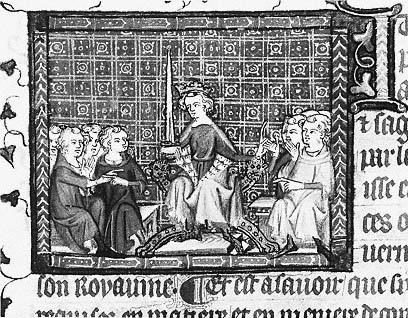
Figure 51
A King and His Counsellors. Avis au roys.
of the figures and their communication by turns of the head and gestures associated with speech are two visual means that transmit these concepts. In D (Fig. 49), even more than in B (Fig. 47), the figures communicate vigorously. The king turns his body toward his officers, whose close seating promotes their animated interaction.
The composition also reflects Aristotle's view of a constitution "as the arrangement of magistracies in a state, and especially of the highest offices. The nature of the constitution depends on the seat of authority."[19] Thus, in Figure 49 the higher benches of the rulers of the three forms indicate their political sovereignty. But the position of the ruled on either side of the sovereign power demonstrates that as citizens they participate actively in the life of the state. On each register at least one member of a group communicates with the central authority.[20]
Costumes and attributes also suggest that different social classes participate in deliberations as officeholders. For example, in the upper two registers of Figures 47 and 49 men holding falcons are associated with the aristocracy; those with tonsures, the clergy; and those wearing long cloaks with fur lappets, lawyers. It is difficult to decide if a contemporary institution is specified, particularly in the cases of Aristocracie or Tymocracie, where the numbers of rulers and costumes are not differentiated. The case of Royaume, however, may allude to the king's council.[21] The miniature representing a king communicating with his counsellors in the Morgan Avis au roys offers an iconographic precedent of the treatment of the theme in the two frontispieces (Fig. 51). The compositions, architectural set-
tings, and accessories of Figures 47 and 49 allude to the function of the state to secure justice by the rule of law. Such an association accords with Aristotle's conviction that the good forms of government will seek justice in distributing "the offices of the state among its members on a plan or principles."[22] An even broader association identifies the three good constitutions with the rule of law. Oresme follows Aristotle in stating that the laws of the state must serve the public good.[23] Both the rulers and the ruled participate in the judicial process. One confirmation of this association lies in the evidence to be found in miniatures of French manuscripts of Gratian's Decretals dating from the thirteenth and fourteenth centuries that depict judges of both civil and ecclesiastical courts seated on benches.[24]
A comparison with the opposite scene of the three bad forms (Figs. 46 and 48) reinforces these visual paradigms. For example, the ruled do not participate in the processes of government. Instead of communication and deliberation, unilateral orders issue from those who hold authority. Indeed, all decisions made for the profit of the rulers result in horrible injustices to, and punishment of, their subjects.