
Scribal Registers
These small techniques of notation, of registration, of constituting files, of arranging facts in columns and tables that are so familiar to us now, were of decisive importance in the epistemological "thaw" of the sciences of the individual.
M. Foucault, Discipline and Punish
Consider now the example of the property and accounting registers kept by the old agrarian state bureaucracies. This apparently dry material—the "ignoble archives" of bookkeeping, files, lists—is given
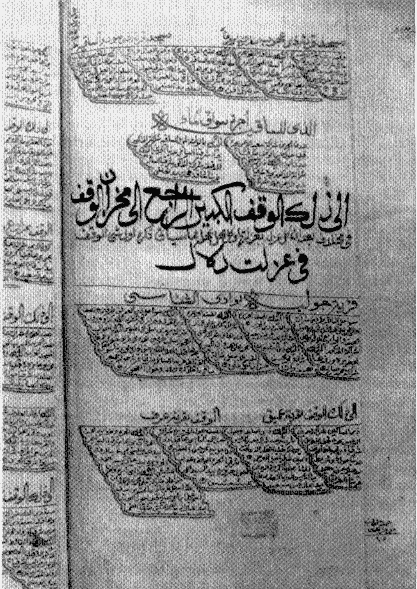
Figure 14.
Register (musawwadat al-'abbasiyya ) of endowment land pertaining to
the Great Mosque of Ibb.
pride of analytic place in the work of Weber,[5] Goody,[6] and Foucault. In some details of textual procedures, the local record-keeping tradition[7] exhibits a history of recent transition parallel to the shift from spiral to straight texts. By the turn of the century the Ottomans had introduced new "international" (duwali ) bookkeeping methods in all the Ibb offices except the endowments (awqaf ) administration.[8] There an older format continued until reorganization efforts of the late 1940s and 1950s.
A typical page in an old-style endowments register, made (as a copy) in 1928 (see fig. 14),[9] reveals a form determined by content relation similar to that found in spiral texts. Although the pages as a whole are ruled, individual entry texts are hemmed in, after the fact, by curved and scalloped lines. Instead of the physical regularity that results from filling in the standardized, printed entry forms currently in use, here each page, even each entry is particular in appearance. Scalloped form follows content: it is the physical extent of the writing, generated by the substantive detail on tenants and tenancy, area measurements, property names and boundaries, that determines the final shape of entries and, cumulatively, the overall appearance of register pages. In their layered arrangement, the property entries in such registers resemble nothing so much as the physical appearance of the curved and stepped terraces they refer to.
Subdivisions in the body of the register are marked by headings done in large decorative script in red and black ink. Together with literary embellishments such as the rhymed prose (saj' ) found in introductory sections, this sort of calligraphy is absent in the more austere and "business-like" contemporary land registers. Similarly, the rounder hand of the old katib contrasts with the sparse, specialized, and more standardized administrative (diwani ) script introduced by the Ottomans and the angular Egyptian-influenced hand that has now become the norm. Although individual items in the old foundation register are separated by scalloping, they are linked grammatically. The register reads continuously, using conjunctions and connecting phrases, from the fancy headings, into and through a series of entries to the next heading, and so on, from the opening basmala to the last word. In addition to the scalloping, a register's integrity was physically ensured by such protective marking devices as small nucleated circles or pairs of dashes, inserted to plug gaps. In the bottom corner the total number of entries on the page is stated in script and in numerals, and the first word of the next page is given.
The writer certified that upon completion the register was free of smudges or other signs of alteration and that his copy was an exact, word-for-word replica of the original. Attestations are included in the original register text, and others are added to the copy. These also bear witness to an exact agreement of copy and original (mentioning the muqabala comparison procedure),[10] specify the total number of entries, and quote the first and last entries. An important attestation of this volume is by Imam Yahya and includes his seal over a brief, physically slanted statement written by a secretary. It reads (referring initially to the previous attestation):
In the Name of God, the Merciful and Compassionate. What the Judge of the Endowments, the distinguished scholar Qasim bin Ibrahim bin Ahmad bin al-Imam may God protect him, has stated is attested to. The copy has taken on the authority of the original and is to be used accordingly. This register is to be kept free of alteration and erasure as it is on this date, the 19th of the month of Ramadan the honored, the year thirteen hundred and forty-six Hegira [1928].
The phrase "has taken on" is my rendering of the pivotal verb sar , encountered in connection with the sale instrument of the preceding chapter. Translated there as "became," it was central to the discursive enactment of a transfer of property. Here the register copy becomes equivalent to the thing itself, a fragile and authoritative original in its own right. Aside from the necessary avoidance of alteration, the register's integrity hinged on the physical and hermetic contiguity of its text and on the indication of a scribal presence, conveyed by a distinctive script. As a "copy" it is virtually the same thing as the original, not because it "looks like" the original in the photo-identity sense accomplished by mechanical reproduction (cf. Benjamin 1968), but because it has passed through an authoritative process of human reproduction and collation. Although they apparently accomplish the same task, manuscript copies and print copies work with differing technologies and epistemologies.
Like the sale instruments of the period, old registers bore the personal mark of a particular katib and displayed the artistry of his scribal craft. The text was suffused with the human presence, the haiba , the prestige, dignity, and awe-inspiring quality of specific men who concretely embodied the state. This was reinforced and perpetuated by kinship relations of descent and marriage among functionaries and officials (see Messick 1978). While the haiba of such a register was highly personalized, the authority of new bureaucratic texts is relatively de-
personalized. Like that of the nation-state to which it pertains, a new register's authority rests on its diffused formal abstractness, implemented through the standardized printed forms now available for all official acts. Like the displaced notary in relation to the new registered documents, the contemporary functionary lends little of his person to the forms he fills.
Forms, that is, documentary blanks to be filled in, appeared in Ibb with the Ottomans. At the local telegraph office, for example, one of the earliest of these forms had a crescent seal at the top, headings in Ottoman Turkish and French, boxes for office use, and lines to contain the message.[11] Such blank forms proliferated in the Ottoman bureaucracies as they would later under the republicans. The commercial receipt, another type of printed form to be filled in, was introduced via Aden. Prior to the "order form" itself, the written purchase-requests Ibb merchants sent to Aden were connected narrations by a scribe (concluding with qala , "said," and then the writer's name).[12] Their internal arrangements were similar to the scalloped entries of the old foundation register. Existing apart from and prior to any particular written content, forms are the mechanical templates of the new age of writing.
As with the Ottomans earlier in the century, the principal goal of the Egyptian advisors attached to Ibb offices in the late 1970s was to facilitate a bureacratic movement in a new direction, to assist functionaries in separating what had formerly been lumped together, to itemize what had been recorded whole. While old accounting registers were predominantly horizontal (written) in orientation, the new exhibited a more vertical (numerical) alignment. Thus while the pages of a tax collector's manual from early in the century contained entries strung across the page like laundry on a line, a comparable manual from circa 1955 had two prominent axes, one of grain types, the other of terrace names, creating a grid for entering the relevant figures. Vertical orientations facilitate whole-page summations and are associated with a new emphasis on the efficient extraction and display of numerical data, which used to be embedded in written text.