
Seeing the Unseen
Pictorial Problematics and Victorian Images of Class, Poverty, and Urban Life
Susan P. Casteras
The representation of poverty in Victorian art—and how audiences responded to the subject—subtly shifted in some respects during the queen's long reign. The urban poor were not a new theme in British art, but the blending of this underclass with middle-class personages and preoccupations in Victorian narrative art made for some decidedly compelling pictorial results. Added to this were the demands and popularity of narrative painting, which was a dominant art form in the 1850s and 1860s especially. The anecdotal and sentimental content of Victorian depictions of so-called everyday life, however, was undercut with ideological as well as iconological meaning, as attested to by the evolution of the treatment of the city and its poor and the polarization of classes and behavior that it sometimes represented. While the general urban setting has been studied in various contexts in scholarship by Ira Nadel and F. S. Schwarzbach, H. J. Dyos and Michael Wolff, and Julian Treuherz, for example, there remains other uncharted territory to be scrutinized in the visual representation of class conflict and anxiety in a selective strand of imagery to be explored in this essay.[1] Thus, the latent voyeurism of artistic "gazing" into the face of the city and its denizens especially how Victorian art often erected invisible barriers between personages of different classes, reveals the complex, underlying attitudes of many middle-class viewers toward urban subject matter.
The idea of life in the contemporary city—not a real public event but the artist's construction of a scenario—permeated Victorian genre painting from mid-century through the 1880s. During this long period, the experiences of urban life were visually encoded so as to acknowledge both the visible and invisible city and its denizens. Although literary and
historical studies have addressed numerous aspects of this crucial urban site, little has been written about images that document one of the basic paradoxes of urban congestion and psychological isolation—from the perspective of the middle and lower classes—or about the distribution of the power of looking in Victorian depictions of the metropolis. This essay investigates that distribution of power in urban images of seeing, touching and not touching that were often imbued with meanings of social authority and control by the artist and audience alike. Because the subject is vast, however, only selected examples will he analyzed that "map" or "refigure" city life as a response to urban chaos and explore the impact of encroachments on an individual's sense of personal dignity or privacy, notably the social and physical discomfort manifested in body language, expression, and psychological state. The interactions and tensions between classes are tangibly evident in the visual details, socially coded messages, and class and psychosexual dynamics of this group of paintings. In each case, the presence of the middle class as viewer—depicted or implied—injects considerable additional meaning into the conceptual framework of urban visuality offered in this essay and testifies to some of the main social transformations and crises faced by Victorians.
Not surprisingly, there was no single notion of the city to define its multiple facets and personalities. Victorian artists, like their literary counterparts, tried to convey the contemporaneity of city life by organizing and arranging the complexities of urban experience, not as reportage, but rather as an aesthetic and necessarily artificial construct and pictorial composition. The images examined in this essay chronicle how the city overwhelmed people of all types and classes, how art reflected a flux of fragmented impressions—of traffic, movement, crime, disorder, danger, anxiety, and social differences. Viewers responded to this onslaught of impressions by looking at yet overlooking human beings, by touching and not feeling—in some instances by seeing only what they wanted to see in art as in real life. In other words, they processed and selectively "saw" not only what art represented, but also what the actual city presented as part of its daily fare of hard-to-take realities.
A fairly benign pictorial encapsulation of some common Victorian middle-class attitudes toward the urban poor can be discerned in John Everett Millais's parody of a "battle of the pavements" in his 1853 drawing The Blind Man (Fig. 79). Here a charitable voting lady leads across a busy street a blind beggar wearing a placard inscribed "pity the blind." The turmoil her noble efforts cause shocks the lady behind her, who registers fear that someone will be trampled by the traffic. Normally, the
young woman might navigate the street tentatively and genteelly, perhaps arm in arm with a companion of her rank, averting her gaze and pressing her handkerchief to her nose to avoid noxious smells and persons. But in this picture she is emboldened to do a good deed. Amid the clot of carriages and people, this naive young woman, rather like a modern female gladiator in skirts, attempts to halt a rearing horse merely by holding her dainty parasol aloft. The horses, with their blinders on, perhaps represent society's response to the indigent. As all this commotion takes place, another beggar, a crossing sweep, vies for attention—a cheeky, scruffy young lad, right out of the pages of Punch, who takes this opportunity to panhandle. He stretches out his hand in almost comic contrast to the blind man's dog, straining in the opposite direction to lead his master across the busy street. With her gloved hand the young lady touches and guides her companion. She does not look at him or at anyone else, however, but only at her animal adversary; nor does she respond to the grotesquely grinning sweep, who may actually be expediting the pair's crossing. The inclusion of a stationer's shop in the background may serve ironically as a reminder that neither the blind man nor the boy, undoubtedly illiterate, can read or write; the blind man must rely on others to produce his pitiable placard and lead him out of danger, while the child must also depend on the kindness of strangers. The man's very blindness, however, may be what enables the young woman to act so forcefully. He cannot see her, and to lead him she need not look directly at him; although he is a stranger, she can, moreover, take his hand precisely because he cannot see, cannot, indeed, stare at her inappropriately or entreatingly. This canceling out of gazes seems to liberate the young lady to ignore her fear of strangers and perform an act of charity. The drawing is entitled The Blind Man, but it also suggests the blindness of spectators to the reality of street paupers.
Middle-class apprehensiveness about the city, its busy streets, menacing denizens, and interminable hubbub is pointedly expressed in William Maw Egley's Omnibus Life in London (1859; Fig. 80), which incisively represents the paradox of seeing without seeing, touching without feeling.[2] In it, middle-class riders are pressed together in an omnibus, a recent innovation in transportation that created, in effect, a spectacle that moved through the streets bearing colorful advertisements. The spectator is placed inside this claustrophobic conveyance as if one end had been cut off to provide a voyeuristic slice of life. With the exception of one child on an adult's lap, no one looks out at the viewer. Every occupant, however, looks uncomfortable; the result is the
essence of busy mercantile London—its middle-class tradesmen, shoppers, gentlemen crowded into a single conveyance—all in a state of collective discomfort. The access to omnibuses was egalitarian (if one could afford the fare), but this equality created a tangible awkwardness, for the purchase of a ticket could not bridge class differences. Egley's fictional crowd is mixed and highly self-conscious about what would now be termed body language and territoriality.[3] Each person seems acutely aware of the presence and body of other passengers, and the painting is replete with awkward and uncomfortable angles, glances, and positions.
For example, the older woman in the foreground, left, leans slightly forward to pick up a nosegay atop a large hatbox. She also juggles a large umbrella as she looks toward the child opposite her. The man beside her, inconvenienced by her paraphernalia, seems to have contorted and pressed himself as far back as possible to gain some room and perch a basket on his knees. Next to him another top-hatted gentleman folds his long body and legs, apparently peering at the prettily demure girl in the foreground. One rather weary-looking woman sits near the door; beside her a young man in dapper dress fixes his eves upon the young lady opposite him, the end of his walking stick touching his lips (a rather autoerotic gesture). The beautifully delicate veiled young woman reads a book, her veil a transparent harrier between her and others; her decorum, her lowered eyes, and her absorption in her book serve a similar purpose. Her deliberate avoidance of unwanted gazes does not deter the gentleman opposite her from staring. The bench on the right also includes a woman with a child sprawled on her lap and a girl with elaborate curls, hat, and dress. (A man on the bench is visible only by his hat.) No one aside from the man with the cane and possibly the older woman seems openly to acknowledge the other people—those on the omnibus even seem to ignore the arrival of new passengers, notably a handsome voting woman with an open parasol. The females in particular try to maintain their reserve and territoriality. The older woman's gloves "protect" her from touching, but she is apparently oblivious to the advertisement for men's trousers above her head that for the viewer seems both indecorous and amusing. (The advertisement nearly seems to kick her in the head, and although one can hardly imagine the lady talking about men's trousers in polite public conversation, her shawl does touch her male neighbor's legs.) The veiled woman takes refuge in her reading, while the woman with the children looks down at them protectively. The men generally look physically but not psychologically uncomfortable—with the possible exception of the "forward" young man, who
may be wishing he could sit next to the lady he admires. The women try to be inconspicuous and invisible, despite their voluminous dresses and accessories.
The anxiety of being looked at and approached by strangers is communicated throughout the work—from the old woman's gloved hand to the insular family grouping to the defensive activity of reading. As subsequent examples will confirm, this middle-class aloofness and avoidance of contact is very different from the numbed pain and look of the poor. However, in Omnibus Life the passengers can hurtle through the streets, past the poor and sights that bother them, to the safety of home or other destinations—they need not stop for long to confront unpleasant urban realities. If their privacy is invaded and they seem temporarily trapped in a crowded vehicle, it is not for long; nor is their uneasiness akin to that of the poor, for whom the city looms like a prison. The carriage itself, furthermore, functions as a theater of both personalities and commodities, with its advertisements. Omnibuses were typically covered with advertisements and their occupants were susceptible consumers, especially unmarried women, who were ironically commodities in their own way on the marriage market.[4]
With its images and bodies, commercial as well as human, the painting offers a visual catalogue of city sensations, middle-class personages, and acquisitiveness. The well-off are defined by their possessions as well as by their social position, and the carriage is appropriately crammed with things as well as people. While other examples in this essay primarily explore class differences, Omnibus Life portrays sexual tensions too, thus forming part of the unspoken vernacular of the city way of looking and ignoring inappropriate behavior or, for women, the invading glances of the opposite sex.[5] In Egley's painting, the women passengers' anxieties about social mingling and contamination, their social dis-ease, even within their own class, are almost palpable. Given that women without chaperones increasingly went out on their own by means of public transportation, this social withdrawal is understandable. For on the omnibus there was a great deal of unavoidable body contact, more touching than on the ballroom dancing floor, and confrontations with strangers still required control of eye contact and posture and demeanor; such bourgeois images stand in contrast to the postures of defeat and shame in depictions of the lower classes in other paintings to be discussed.
The middle and upper classes often register visually the social discomfort of randomly encountering people whom Pip in Great Expectations described as mere faces in the streets. In William Powell Frith's For
Better, for Worse (1881; Fig. 81), for example, the "better off" and "worse off" awkwardly mingle in the street after a wedding that occasions an opulent display of costume, posing, and ritual. Girls on a balcony bid adieu to their newly married friend, while flower girls and family below enact their own good-byes.[6] The partygoers ignore the uninvited "lower orders" who witness the leave-taking; even the girl with a basket of flowers and the boy in the sailor suit seem amazingly unaware of the ragged children only a few inches away from them. The bridegroom acknowledges his surroundings only by doffing his hat (whether to the pretty girls above or as a general response to the hail of good wishes, hats, and slippers is unclear), but his new wife walks into the carriage and her new life without looking behind her or to either side. The other wealthy wedding guests seem equally oblivious to the poverty-stricken souls around them, from the wistful maid behind the bridegroom to the crowd of figures in the distance who press forward. The bobby maintains symbolic order, perhaps necessary because of pickpockets, and keeps the classes separate as the rich enact their "private" celebrations and farewells. However, in the shadow of this event, yet in the very foreground behind the carriage—urban reality again intrudes, in the form of both a shoeshine boy watching someone else's good fortune and an impoverished family gazing at the wedding party from behind the brougham. This family is closely bound together despite their barefoot state (old shoes, meanwhile, are tossed at the newlyweds). The father touches his son and the mother cradles the baby, but the upper-class members of the drama seem not to notice them. They provide an ironic, grim contrast between the "haves" and "have nots," perhaps underscoring how the marriage vows alluded to in the title include loyalty to one's spouse even in dire circumstances. The contrast between the gaunt, dirty family and the elegant couple and their well-wishers is psychological as well as physical; the gap between the two sides is further highlighted by the setting: this representation of a lack of human charity and compassion takes place in the very shadow of a church.
This theme seemed to haunt Frith, who had pursued it earlier in Poverty and Wealth (private collection), which, as the Art Journal commented in 1888, "shows a carriage and pair, containing ladies and children, who are being stared at by the ragged crowd around a fishmonger's shop."[7] As in For Better, for Worse, a private carriage waits to transport the affluent away from whatever might frighten or disturb them. But much more is going on in this painting than the Art Journal recorded, especially from a modern perspective. The children in the carriage are well-dressed, if not overdressed; safe in their mother's arms
and elevated from passersby in a conveyance that will shortly remove them from this scene, they can afford to be curious about what the "other half" is doing nearby. In fact their interest—whether curiosity, or charitable impulses, or a combination—has roused one mother to turn her head slightly in response to a question asked by a child, who points toward the fishmonger's stall. Another woman in the carriage tends to a toddler and does not look up at all, while a third turns her back entirely on the matter as she prepares to enter the carriage (the driver also has his back to the scene). This lady is followed by a male servant who carries a large toy Noah's ark (a Christian plaything suitable even for the Sabbath), purchased from a nearby store. The boy standing in the carriage already seems to have benefited from the woman's generosity: he holds a toy horn rather imperiously like a scepter in one hand. As the carriage prepares to depart, a group of mostly children gathers at a fishmonger's with baskets to fill with food they will sell or eat. The men in the stalls do not even look up at the children, some barefoot, one an orphan clad in black. The children themselves, except for one cheeky boy, do not look at their rich counterparts—they seem too busy trying to survive. Two older women stand at the end of the queue, one in rags looking up and scowling at the carriage.
No real rancor, hostility, or radicalism is depicted here or in other images of the "have nots"—just penury and hopelessness. Whether or not the wealthy lady with an open parasol is gazing at a specific group—for example, at the widowed mother and children in the foreground—is unclear. But it is evident that the children of privilege in this painting lead sheltered lives, with adults to guide and indulge them, in obvious contrast to the poor child leading a younger one or the children supporting themselves on the streets. The physical gap between the classes present in For Better, for Worse is less marked in this composition, where two groups slightly overlap on the sidewalk. The power of looking is nonetheless carefully balanced, with the two classes ultimately going in opposite directions. Moreover, in Poverty and Wealth the presence of the comfortable class seems to bother only two figures, a child and an old woman who gaze back at their social superiors. In both of Frith's paintings, the carriage gives some of the safety and security of a home; it is an emblem of prosperity as well as a means to literally distance protagonists from scenes of stark penury. More than Frith's 1881 painting, Poverty and Wealth reflects a social dis-ease among classes, which here do not merely ignore one another but seem disturbed by their proximity, a point driven home especially by the innocent children who take note of what adults have presumably learned not to see.
The paradox of seeing but not seeing and the concomitant fears of the underclasses were expressed not only in Victorian images of the city but also in other contexts, as in Thomas Faed's poignant From Hand to Mouth (1879; Fig. 82), subtitled "He Is One of the Few That Would Not Beg." The main character is an unemployed veteran, who, rather than rely on charity, makes a meager living, aided by two exhausted children by his side, by entertaining passersby with a monkey and music. Here too there is a palpable gap between the social classes. The veteran stands, proud but gaunt, wearing rags and worn shoes. His eyes are lowered as he digs for a coin to buy a few paltry items in a shop. The girl beside him is so weary that she crumples to one side, bent over—or shamed—by her hunger, fatigue, and status. The boy, equally dolorous, repeats to some extent the man's pose; he holds a string attached to the group's livelihood, a scruffy little monkey who actually bridges the space between the "haves" and "have nots." The background, right, is occupied by some men glimpsed through a doorway as they talk and read. Their very self-sufficiency contrasts directly with the stark plight of the veteran.
The left side of the canvas is occupied by a lady, who has deferentially been seated and is the center of a very different vignette of comfort and ease. Perched on a chair (in contrast to the girl slumped on a dirty basket), she seems overembellished, almost upholstered, with fabric and accessories. Behind her a black page boy stands with a pet dog, both symbols of conspicuous consumption. The page is as much enslaved by the economic system—and dependent upon the largesse of those well-off—as the boy beside the veteran, who, also like him, is in charge of an animal, but one that is neither a pet nor a status symbol but instead an integral contributor to the poor family's wage earning. It is unclear whether the black child watches his counterpart; the dog he monitors, however, clearly maintains its distance from those less fortunate, and the affluent little girl instinctively turns her back on them, looking to her mother for solace or counsel. The mother does not look directly at the group either, but her tender reassurance of her child and her thoughtful expression perhaps suggest some inward compassion.
On the other side of another barrier, the store counter, a young woman—perhaps a member of the shopkeeper's own family—adjusts a curtain, her status as a worker in contrast to the sedentary leisure of the privileged female customer. The objects at this end of the counter (flowers and trinkets) suggest frivolity or decoration, whereas those at the other end are essentials: tools and food. All these objects reinforce the stark differences between the two sets of people, their class, and the
invisible barrier between them. Only the monkey bridges this gap, and while the dog registers some curiosity, no one moves to break through the class barriers, so to speak. Interestingly, the only visual link between the two polarized sides is provided by the shopkeeper behind the counter, whose suspicious frown oddly allies him with the little dog's askance expression. Behind the shopkeeper a woman carries out her duties without reacting to the situation and "wears" a tray, not a fancy hat, on her head.
The shopkeeper's suspiciousness—almost hostility—punctuates the composition, whose overall somber mood is created by the mother's averted glance, her daughter's anxiety, the tradesman's contempt (perhaps mixed with pity) for the vagrant, and the stoicism of the veteran. Arguably, the shopkeeper represents the belief that only the "deserving" poor should be aided, a common distinction Victorian audiences and readers made about the needy.[8] All in all, From Hand to Mouth reverberates powerfully, a trenchant microcosm of class attitudes and the symbolic zones they occupy in a composition, socially as well as psychologically and physically.
The phenomenon of neglecting the "lower orders" as invisible human "debris" on the streets was represented in many outdoor vignettes of specifically urban distress besides those by Frith. Another revealing picture is Edward Clegg Wilkinson's Spring, Piccadilly (1887; Fig. 83), which depicts a site near Hyde Park Corner where women peddle their wares to passersby. Some of these street sellers have already settled into attitudes of withdrawal; the figure slumped at bottom left, for example, seems to have at least temporarily ceased peddling and to have yielded to depression and despair. The expression of the older, seated, woman is hard to read, but her younger companion seems affected by the scene before her, in which the standing figure offers a posy to a well-off mother and child with their backs literally to her. The mother appears to urge her child along and seemingly shuns the pleas of the woman selling flowers; but all that is really known of the two affluent strollers is their elegant attire, hats, and accessories. Only one figure in the painting is shown actively looking. She watches the pair walk by and appears aware of the tangible gap between the classes, rendered here by a column of air and by the contrast between the flower seller's extended bare arm and the mother's covered arm. The rigidity of the little girl's pose parallels that of the mother, and this unmoving quality is further reinforced by the alignment of the mother's arm with the line of vertical lampposts beyond her and the posts at right. Here, as in From Hand to Mouth and other examples, the invisible wall the artist has erected be-
tween the classes acknowledges the one that exists in contemporary urban life.
When the representative of the middle or upper class is removed from a composition and poverty itself is the focus, the pictorial results could be even more intense. One of the most gripping visual validations of the sense of defeat and utter loss of self-worth among the lower class is undoubtedly Frank Holl's large Newgate: Committed for Trial (Royal Holloway and New Bedford College) of 1878. This painting captures an almost cinematic moment, complete with an unforgettably trenchant depiction of a battered wife at the mercy of her Rasputin-like, violent, almost feral husband, whose hands and crazed face seem barely contained behind prison bars. In response to his gesture, his wife grasps her baby tighter, and her own hands, convulsively clutching and fearful (ironically punctuated by the gleam of her wedding ring) are far more expressive than her blank face, which suggests that she is beyond pain and incapable of reacting any longer to the threats of an abusive spouse. Her protective maternal instincts have clearly been aroused, but she looks at neither her victimizer nor the viewer; this kind of seeing/not seeing ultimately constitutes as powerful a statement as any narrative might achieve.
In Egley's paintings the middle class can prevent the invasion of its privacy and bypass the realities of the city itself, and in Frith's the affluent class is programmed to overlook the urban crisis, but the works of other artists record incursions into the underworld of the city. Sometimes these artists produced illustrations for contemporary periodicals like Once A Week . In 1869, for example, the talented George John Pinwell drew "A Seat in the Park" (Fig. 84) for this magazine, an image in which various levels of society come together in a public place. In the center sits a top-hatted gentleman, who, unlike other similarly clad men striding purposefully in the background, sits forlornly in self-absorbed despair, his stooped shoulders and unfocused eyes conveying his dejection. Around him others interact: a soldier flirts with a woman (perhaps a nursemaid) at left, and an impoverished mother and child at right take temporary refuge on this park bench. These two are street musicians, the woman holding a violin and her son, nearly collapsed, gaunt, and sickly, a tambourine. Another indigent mother and child (still another broken family adrift in the city) at far left counterbalance the one on the bench; a differrent kind of "mothering" is perhaps represented by the well-dressed girl who tends a pram and its occupant while her nurse-maid evades the attentions of her soldier admirer. Except for this attempt at flirtation, no one in these groups regards anyone else, thereby
forging another link in the pattern of urban dissonance and social disease so commonly found in Victorian imagery. All seek repose and comfort, yet neither the bench, the bleak day, nor the "neighbors" nearby offer any solace.
Gustave Doré's illustrated book London, a Pilgrimage, published in 1872, conveys an even gloomier, almost sinister, urban existence. Doré produced not documentary illustrations but imaginative visions of the city, the result of his desire as an artist to explore the mysterious recesses of London and to enter regions allegedly traversed by few outsiders. Modern historians have suggested that the poor creatures represented by Doré, as well as those in the pages of the Graphic, the Illustrated London News, and other periodicals, were not, in fact, exaggerated; but whether the subject was "real" or not, it was probed increasingly in the 1870s by journalists, artists, and others for whom the city was a laboratory in which to study social problems and pathology. In Doré's illustration "The Bull's Eye" huddled, wasted souls react like wounded animals to the piercing scrutiny of a lantern "gaze" trained upon them by a London bobby and the authority figures and interlopers he represents. Such images make the reader a voyeur, who by the very act of looking at Doré's illustrations joins forces with the authority figures and even with the crusaders for reform who scrutinized and judged lower-class lives. Yet Doré also produced illustrations for this project that created a sense of distance between himself and what he saw, an aesthetic distance readers and viewers were invited to share. One such image is "Asleep under the Stars" (Fig. 85), which, according to Doré's collaborator Blanchard Jerrold, was triggered by something Doré personally observed: "He had been deeply impressed with the groups of poor women and children we had seen upon the stone seats of the bridge one morning. . . . By night it appears in his imagination the scene would have a mournful grandeur."[9] Unlike some of the pain and dislocation conveyed in "A Seat in the Park" and other examples, this image seems aesthetically drained of the suffering and upheaval of the city. The calm sky above, the starry night creating a canopy over the hard stone "bed," the sense of cosmic order, the lack of intervention by outsiders, all these elements tend to isolate and minimize the dislocation and distress of the homeless. In addition, by showing all the figures asleep, Doré lessens their possible threat, for in sleep they are rendered vulnerable and powerless, unable to stare at viewers and make them feel guilty (or curious). Moreover, with their somewhat generalized features, they seem anonymous and unintimidating.
The role of Doré and his reader/viewer was that of amateur sociolo-
gist, explorer, or crusader, but the city Doré delineated seemed more ghoulish and alien than savage. In contrast, perhaps the most complex and profound encoding of the pathology of the city, its fragmentation, and demoralization, is Luke Fildes's commanding 1874 Royal Academy entry entitled Applicants for Admission to a Casual Ward (Fig. 86). It is not known whether Fildes knew Doré's or other contemporary artists' friezes of urban humanity, but in his own tragic panorama Fildes chose to remove almost entirely the element of middle-class self-consciousness. Instead, he concentrated on the human aggregate of urban dislocation and dehumanization. Moreover, this tour de force synthesizes most of the points made thus far about the psychology of seeing and being seen in an urban context and must have evoked for contemporary viewers similar scenes they had witnessed on the streets of London. In fact, as various reviewers remarked in 1874, this work seemed almost single-handedly to usher in a new era and a new way of looking at urban reality.[10]
The image began as a small illustration entitled "Houseless and Hungry" for the inaugural issue of the Graphic in 1869, but when it was painted nearly life-size and shown at the Royal Academy in 1874, its authority as an urban icon was magnified and its mood intensified by the visual language of the figures and their postures, which communicated the confusion, destructiveness, ugliness, facelessness, and hopelessness of the city experience. Indeed, the authenticity of feeling and looking embodied in this painting endow it with an almost epic quality that transcends the sentimentality, didacticism, and voyeurism of most other Victorian depictions of city life. As the Art Journal reminded its readers, "a little while ago it would not have occurred to any of our painters to make such an effort" to portray this difficult subject and to penetrate the density of sordid urban life and crowds.[11] Fildes captured these invisible and random faces, people, and acts in a carefully constructed scene of human "untouchables" and debris, a mélange of words, signs, and bodies that have been consummately orchestrated, seemingly for a purpose larger than that of high art alone. Fildes explained that an actual scene had inspired the original engraving, although he used models for various figures in the composition.
The setting is a drab subterranean corridor of modern hell, peopled by nearly life-size unsmiling figures with the scale, posture, and smell of the distressed, disenfranchised, and doomed. In this gritty mono-chromatic collage of impressions of urban poverty, the "untouchables" confront viewers and trigger reactions of shock as well as pity, with protagonist and spectator alike assaulted to varying degrees by the
overwhelming intensity of city life. The painting owes its most arresting effect to the glut of painful details that underscore the isolation, the vulnerability, and the numbed withdrawal of almost every figure. Beyond illness, deprivation, or disease, the forces of demoralization have wrought their indelible effects on these applicants for charity, whose body postures alone convey their awareness that they are anonymous and invisible and that their dire poverty has made them no better than human refuse in the London streets.
In Fildes's powerful fatalist vision, none of the degraded, depressed figures really looks at the others. According to contemporary interpretations, the gentleman at far left has just arrived from the country; a police officer helps him in his effort to find his errant son. He is the sole adult to register a reaction to this scene, and his look of astonishment presumably reflects how viewers might respond as well. The policeman is attentive and helpful to the man precisely because he is a respectable gentleman and not one of the "great unwashed" in line for charity. In the foreground an evicted woman braving the falling snow with her children bends her body downward somewhat like a fallen woman type. The text accompanying Fildes's "Houseless and Hungry" engraving of this scene described her as a battered wife married to a man now in prison for his mistreatment of her.[12] Like her counterpart in Holl's Newgate canvas, she grips her baby tightly, her splayed hands a reminder of the rough treatment she has received. Her little girl, clad in rags and ill-prepared for the cold (like the other little girls in this picture), stares uncomprehendingly out toward the spectator. This child is the only person who does so, presumably because she has not yet learned that she is not respectable and thus, to the Victorians, not worthy of notice. Other wasted, debased souls cloak themselves in invisibility. At the far right stands a group of men, one a veteran on a crutch evoking comparison with his proud counterpart in Faed's From Hand to Mouth . Next to these men plotting criminal acts is a mechanic's family; they stand squarely beneath a notice board (above them a sign advertises a twenty-pound reward for a pug dog) and cling to one another. All the members of this family of paupers lower or hide their faces (the sick mother weeps into a handkerchief) and close their eyes against their pain. An orphan boy, said to have been "bred in tile gutter," stands between them and the group of men at far right; in the cold he twists and turns like an agonized animal.[13] There is no adult with him to notice or care—no one to whom he can turn, and his tortured, starving eyes look to one side, not out at the viewer. Beside the mechanic's family a drunkard sleeps standing up, his hat nearly falling off. Other unfortunates and broken families
huddle near the doorway, from which various bobbies emerge to do their jobs. Ironically, the only nonhuman in the composition, the dog at far right, is the sole creature (like the dog in Millais's drawing) to respond reasonably to these conditions of despair and privation: he contorts his emaciated body violently (like the unprotected boy), snarls, and gnaws on a bone he has somehow managed to procure. The passive humans, by contrast, are beyond pain or hostility (like the battered wife in Newgate ) and have retreated into psychological and physical numbness. Having learned that their voices will not be heard, they cumulatively form a lugubrious human frieze, an oppressed mass, of painted who almost deferentially accept their invisibility. Despite the small, rather fragmented groups into which they band (more powerfully than in Pinwell's illustration), the figures form a united front, partly because they touch out of necessity—they have herded together like animals, and presumably also move closer together to generate body warmth. Seeking shelter in a charity ward, they attempt to ease their internal pain by turning inward physically and mentally, but nonetheless on some levels they are shown as psychologically "naked."
The psychological distance of these passive figures in Fildes's masterpiece was partly complemented in the Royal Academy 1874 catalogue by a description accompanying the work, written by Charles Dickens about workhouse applicants: "Dumb, wet horrors! Sphinxes set up against the dead wall, and none likely to be at the pains of solving them until the general overthrow." As contemporary reviews affirm, this painting caused a considerable sensation at the Royal Academy precisely because it offered viewers a new kind of empathetic closeness to the poor—not face-to-face, but in the realm of fine art. Some critics rejected the subject of this work as repulsive while others admired its emotional veracity. The Athenaeum commentator, for example, assessed the subject as "grim . . . , sad beyond measure. . . . Here is a view of a street near, and really under, a lofty archway, like those by which so many railways span . . . all in a drizzle of rain, and foul with smoke." Here stand various groups of people
of all ages and states of health, but all wretched and forlorn,—the undergrown, the half-starved London urchin . . . , the mournful widow, the man of ailing age, the sot. . . . It is a dismal, pitiable set of folks that Mr. Fildes has put before us, and not a few will see the miseries of their fellow-beings for the first time in these personations. From the burly, kindly-looking policeman . . . to the most completely lost wretch who stands on the pavement or leans against the grimy walls, there is not a figure that is not genuine in design or faithful and true in sentiment. . . . Few men will
turn away without long study of this mournful presentation of the debris of London life, and many will not fail to say, "What can I do to better this state of things?"[14]
Such heartfelt responses to Fildes's moral and social mise-en-scène of the cityscape suggest the mixture of Victorian middle-class compassion, anxiety, and selective awareness of the grim poverty that existed and was documented in other realms. The shift in tone in Victorian perceptions of the city in art from the 1850s to the 1880s is acute and generally reflected in the differences between the limited vision of Millais's "lady bountiful" and the social avoidance of looking, touching, and feeling in Egley's omnibus and later images of almost operatic intensity by Faed, Doré, Holl, and Fildes. By the 1870s, and especially in the searing psychological truth of Applicants for Admission to a Casual Ward, the numbed powerlessness and the sense of dislocation and depression reverberated convincingly for critics and viewers alike. Rarely is there any sign in Victorian art, however, of insurgent or revolutionary protest or action by the poor; instead, the victims are humiliated and made passive and silent by their circumstances. Whether or not spectators' consciences were aroused, they undoubtedly learned something from these outsiders and their graphic representation in art. The middle-class traveled often by omnibus, carriage, and other means, shutting their eyes at least partly to what they saw; and the message of their selective vision was not lost on the underclasses fictionalized in art, where they are shown as closing their eyes as well so as not to see or be seen. Nonetheless, their "unseeable" qualities and slumped body postures confirmed shame, self-loathing, and sense of nullification as they attempted to resist succumbing to the ravages of urban life. As Fildes's tour de force reminds viewers even today, there is no escape for the poor from the horror vacui, merely an endless queue of waiting, being watched, and enduring judgment by real-life viewers on the street and visitors to the art gallery alike.
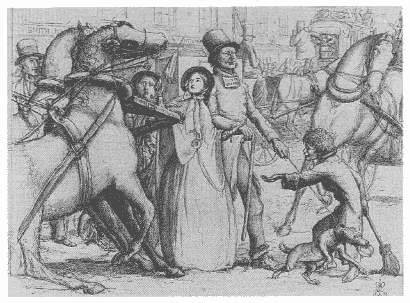
Fig. 79.
John Everett Millais, The Blind Man, 1853. Pen, pencil, sepia ink, and wash.
Yale Center for British Art, Paul Mellon Collection.
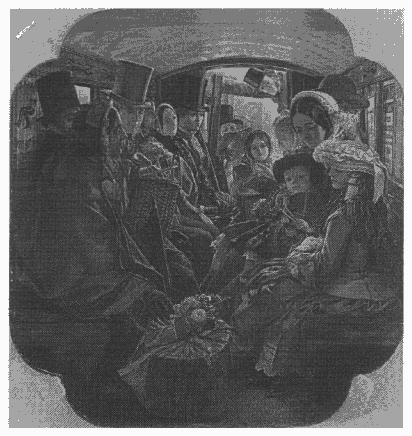
Fig. 80.
William Maw Egley, Omnibus Life in London, 1859. Oil on canvas. The Tate Gallery,
London/Art Resource, New York.
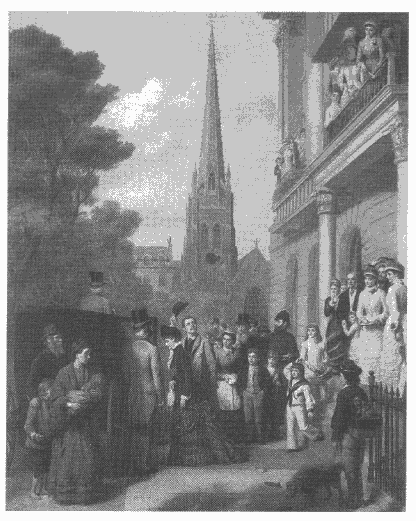
Fig. 81.
William Powell Frith, For Better, for Worse, 1881. Oil on canvas. The Forbes
Magazine Collection, New York.
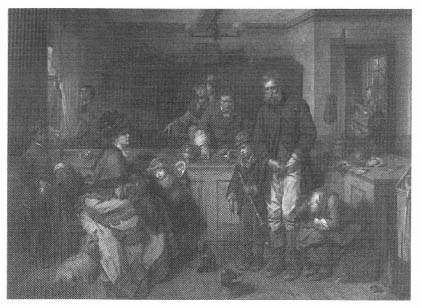
Fig. 82.
Thomas Faed, From Hand to Mouth, 1879. Oil on canvas. Wadsworth
Atheneum, Hartford, Ella Gallup Sumner and Mary Catlin Summer Collection.
Photograph by Joseph Szaszfai.
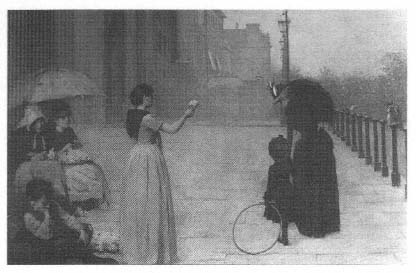
Fig. 83.
Edward Clegg Wilkinson, Spring, Piccadilly, 1887. Oil on canvas. Laing Art
Gallery. Newcastle upon Tyne. Photograph courtesy Witt Library,
Courtauld Institute of Art.
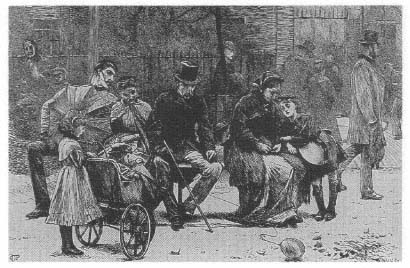
Fig. 84.
George John Pinwell, "A Seat in the Park." Wood engraving from
Once a Week, 26 June 1869. Photograph courtesy Yale Center for British Art.
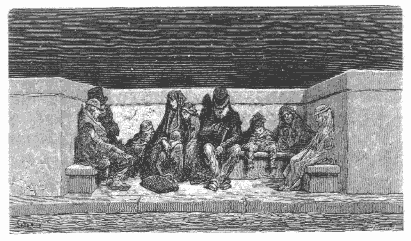
Fig. 85.
Gustave Doré, "Asleep under the Stars," 1872. Wood engraving from
Gustave Doré and Blanchard Jerrold, London: A Pilgrimage (1872).
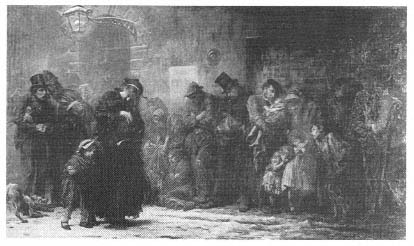
Fig. 86.
Luke Fildes, Applicants for Admission to a Casual Ward, 1874. Oil on canvas. Royal
Holloway and Bedford New College. Photograph courtesy Witt Library, Courtauld Institute of Art.