
Visnu-Narayana[*] And His Avatars
Visnu[*] is usually referred to in Bhaktapur by one of the names historically associated with Visnu[*] , Narayana[*] (Newari, Narayan). Visnu[*] (as we will here refer to this divinity for comparative convenience) belongs centrally to what we will call the "moral interior" of Bhaktapur. Although other gods may be addressed on their special days or for particular unusual problems, Visnu[*] and Laksmi, his consort, are at the loci of ordinary household prayer. Visnu[*] is that fragment of divinity that dwells in individuals as their soul or atma , in the Newar version of the ancient South Asian correspondence of soul and cosmic divinity.
Although there are several and conflicting ideas about the possible fates of the soul after death and about various heavens, and a number of theories as to what determines a person's postdeath state, the focus of most belief and action in regard to personal fate after death centers on Visnu[*] . In the ceremonies devoted to dying, attention is focused on Visnu[*] , and the dying person must pray to Visnu[*] , meditate on him, and address his or her last words to him. In the kingdom of the Lord of the Dead, Yama Raj, it is Visnu's[*] representative who argues the case for the deceased in front of King Yama. This case is based on the individual's merits and sins, virtues and vices, in relation to his following or violating the moral law, the Dharma. Those who follow the Dharma can expect to go to Visnu's[*] heaven. To get to Siva's heaven one must make Siva a focus of meditation, another and radically different path to salvation from the moral path of following the social Dharma. In Visnu's[*] heaven one keeps one's social identity and is joined with one's family in reward for one's social virtue. The salvation associated with Siva and the Tantric gods, moksa[*] , has, in contrast, a problematic and uncanny relation to the social self.
Visnu[*] is represented in Bhaktapur by idealized, princely human forms. Occasionally he is represented in the forms of one of his incarnations, or avatars . He is also represented occasionally by small, rounded stones, locally called salagrams.[5] In contrast to other places in South Asia, Visnu's[*]avatars (Sanskrit, avatara ) in Bhaktapur have minimal cultic significance in themselves and are of major importance only as aspects of Visnu[*] .[6] In contrast to Visnu's[*] twenty-nine active temples and shrines in Bhaktapur, only two temples are actively devoted to Krsna[*]
and three to Rama and his consort Sita (see fig. 12). One of the two Krsna[*] temples is in Laeku Square, and was one of the temples built by the Malla kings for their personal merit. It is attended by a Rajopadhyaya Brahman and contains a portable god image, which is carried around the city once a year. The other temple, in the northern part of the city, has no priest and is used in a casual way by some local people or passersby. Both of the active Rama temples are outside the city boundaries at places where roads meet the river. One of them is part of a complex of temples built by the potter thar , the Kumha:s, living in the southern half of the city, and is attended by Kumha:s and people living in nearby areas. The other, to the southwest, is of some general importance once a year, in connection with the worship of one of the Eight Astamatrkas[*] , Varahi.[7] There are two Hanuman temples associated with the southwestern Rama temple that are visited by many people on the same day of the annual festival calendar as that temple. Hanuman, a divinity in monkey form associated with Rama in the Hindu epics, is also represented in other Visnu[*] temples. Newari art represents still other of Visnu's[*] avatars (particularly Vamana, and Narasimha[*] ), as it also represents Visnu[*] in relation to his cosmogenic aspect,[8] but these representations have no contemporary uses.
The conception of Visnu's[*] avatars is closely related to the idea of Visnu[*] as the divine portion, the atma , of each individual. The avatars represent the incarnation of a portion of Visnu[*] into the ordinary world, as part of a mixture that is in part human (or animal) and part divine.[9] Visnu's[*]avatars are not only incarnated in human or animal forms, but by and large they lead recognizable social lives, albeit with legendary heroic powers.[10] The lives of the incarnations were furthermore located in real space and historical time. These lives were lived for the purpose of reestablishing some desirable social order for humans or for the gods after that order's derangement through some antisocial force usually personified as a "demon" or antigod, an Asura . This is in marked contrast to the case of Siva, whose transformations, such as Bhairava and the Goddess, are emanations in which Siva's identity is transformed and lost, and which are themselves "demonic" forms of the same sort as Asuras . Rather than exist through a unique lifetime, as Visnu's[*]avatars do, Siva's transformations appear and are "reabsorbed" in some contexts or, in others, are as eternal as Siva himself. Although they can defeat the Asuras and other forces of disorder, they are, in themselves, dangerous and problematic to the orderly social world, and must be controlled in turn. In another significant contrast, while Siva's emana-
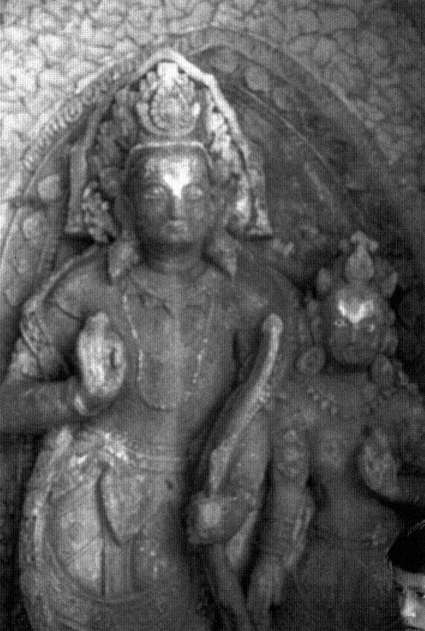
Figure 12.
Rama and his consort Sita. Note the difference in size.
tions (or in some versions the emanations of Parvati herself) defeat other demons through brute magical force, Visnu's[*]avatars characteristically restore order through cunning and other social skills allied to their divine power.
In Bhaktapur's stories it is Siva in his wanderings and absent-mindedness who is either sometimes dangerous himself, or who allows some devotee to accumulate through meditation and austerities some god-like power, which he then uses in defiance of the gods' order for his own selfish purposes. Visnu[*] must undo the damage, calm Siva, overcome the magic power of Siva's devotee, and restore order. In this contrast Siva is the passionate, romantic dreamer for whom social propriety is a burden. Visnu[*] represents sobriety, decency, and order. The pair represent a familiar universal tension within societies and within individuals.
The twenty-nine Visnu[*] temples and shrines are distributed around the city in close proximity, for the most part, to the city's main processional route. Of these, two are large temple complexes—one immediately south of the upper-lower city axis, and the other in the eastern part of the upper city. Although these two largest temples are located in the lower city and upper city, respectively, they are not considered representative of these city halves in the way that other space-marking deities represent spatial units, and there is no special religious activities that tie them to the halves as such. All these temples are attended optionally by people in their vicinities, sometimes for casual prayer, sometimes in quest of support in some undertaking. Usually Visnu[*] is worshiped not in a temple or shrine but at home. Visnu[*] , along with his consort Laksmi, is, as we have noted, the usual focal god of the household, the focus of most of the ordinary household puja s. They represent the ordinary relations, the moral life of the household, in its inner life. As we will see, for the family Visnu[*] contrasts with another quite different kind of deity, the lineage deity, most often a form of the Dangerous Goddess, which binds the households of the phuki group into a unity and protects them against the dangers of the outside (chap. 9).
Visnu[*] resembles Siva in not being used, in contrast to certain other gods, to mark off the city's important spatial units. He is, as we shall argue, not the proper kind of a divinity for this for Bhaktapur's purposes. Visnu[*] has no major festival in the public city space. He is a major focus of household worship throughout the year, and of special household and temple worship and of out-of-the-city pilgrimages on some
annual occasions, particularly during the lunar month of Kartika (Newari, Kachala, October/November) as he is elsewhere in South Asia at this time.
In recent decades the worship of Visnu-Narayana[*] at the two major temples with music and dancing and without the mediation of a priest in expression of an individual direct devotion to the god free from the spatial, temporal, and social orderings of Bhaktapur as a city, has been growing. Visnu[*] and his avatars have become the object of bhakti , loving devotion, a focus for private salvation and private emotion. Here he is not functioning as a component in a complex system of urban order, but as the kind of personal god who arises when such a city-based system begins to break down. This is no longer the Visnu[*] who is Siva's complement. This is, to recall our conceits of chapter 2, a transcendent "postaxial" Visnu[*] .