
Chapter Three
The Sacred Landscape
Ii, you are very ill. You are about to die. If you eat me, you will recover, because it is from this, from your eating everything, eating dead humans, eating everything reptilian, and rattlesnakes, it is from this that you are sick. You will eat me. Prepare well, with a keyom-dipper, pound me up, put me into it. Then, talk to me. You will get well from that, even though you are weak now and have no flesh. Look at yourself!
A plant spoke thus to Buzzard as he was walking along the ridge of the Bald Hills. From a Yurok formula for stomach sickness as spoken by Domingo of Weitchpec in 1907
(Kroeber 1976:313)
It would be virtually impossible to list every feature of the natural environment which was regarded as a spiritual entity according to aboriginal belief. All of nature was thought to have been shaped through incidents that occurred in the period before humans existed, and in their modern form not only the plants and animals but even the trails were believed to have "feelings" and power to influence human life.
This chapter describes some of these early Indian beliefs concerning nature and the human condition, and readers should note from the outset how sharply these ideas differ from Judeo-Christian thought. In Western civilization, the idea that man is created in the image of God seems to have been associated historically with a drive to control and regulate the physical environment through science and technology. By contrast, the Yurok viewed humans as the main contaminating element in a world that was otherwise perfect. Far from seeking to control nature he tried to purify himself, hoping that he could share in the miracles of the wo'gey if he were "clean" enough.
Sacred Places
As noted in chapter 1, these were among the last North American Indians to have their aboriginal civilization altered by contact with outsiders, and it was probably due to this that spoken narratives and other information collected shortly after the turn of the century reveals such a close correspondence between mythology and practical knowledge. The degree of congruence is most strikingly demonstrated in Waterman's "Yurok Geography" (1920), which contains thirty-four annotated maps of Yurok territory and is certainly one of the most detailed studies of its kind ever made.
Waterman begins by telling us that aboriginal Yuroks conceived the world as a flat body of land, roughly circular, and surrounded by ocean, with the Klamath River running down the center.[1] Thus, it was believed that if a person left the mouth of the river and went far enough upstream, he would reach the water again. The land, with all its forests and mountains, was thought to float upon the ocean, constantly rising and falling as it heaved and settled in a rhythm too vast to be perceived by human beings (see diagram 1, p. 44).
Roughly in the center of the world lies the village of Kenek. Here, a being called "World-Maker"[2] made the sky, which was woven like a fish net. Upon finishing this, he heaved it aloft where it became solid, stretching over the world as the great blue sky. Above this ceiling, there was another region called "sky country," which could be reached by climbing an invisible ladder located just downstream from Kenek. In this conception the solid sky formed a sort of canopy that came down to meet the ocean on all sides. If one paddled far enough out to sea, it was theoretically possible by timing the rise and fall of the waves to slip through underneath, and thus one could leave the world. It was thought that Geese left the world regularly through their own special "sky hole."
Far across the ocean, well beyond the edge where the sky came down to touch it, was the home of Nepewo (the headman of the salmon) and of Dentalium Shell Money, both of whom lived there in wooden houses much like those the Indians occupied. Wohpekemeu also made his home there, and it was believed that these and other godlike beings visited the human world on a regular basis despite the terrific distances involved.
Within that part of the physical environment which was actually inhabited by humans were many places where mythic beings had left evidence of their presence. There was, for instance, a certain cliff by the seashore where Wohpekemeu had lain on his back, singing and slapping himself on the chest. When the tide was out, one could still see the marks that Wohpekemeu's feet had made as he kicked them about against the vertical face of the cliff (Waterman 1920:231). Not far from there, the Indians also showed Waterman an offshore rock that was known by a Yurok word meaning "refuse," as this was the place where Chickenhawk had thrown the guts of an enemy he had killed (1920:233). The number of similar examples in Waterman (1920) suggests that any natural configuration might come to have mythic relevance in Yurok thought.
These connections with the prehuman world were especially close at the village of Kenek, near the mouth of Tuley Creek on the Klamath River. Besides being the place where "World-Maker" made the sky, this was where Wohpekemeu first emerged from the earth, and the Indians who lived there during Waterman's visits (circa 1902-1909) could actually point to the pits where there had been houses occupied by deities such as Thunder, Porpoise, and Earthquake only a few generations before. Waterman also mentions that Kenek was regarded with special reverence by Indians of other villages.
Ordinary people do not dare step around in Kenek. Visitors used to come as far as the place where the trail crosses Tuley Creek and call. Then the people who belonged there would come down and get them, and show them around, so that they might not inadvertently step on some supernatural being's "place" and get into trouble. (Waterman 1920:252)
Not just at Kenek, but all over the region, walking trails were regarded as conscious beings, and in traveling the Indian had to observe certain rules in order to avoid insulting them. It was considered wrong, for example, to step out of a trail and in again without making some gesture of respect, and indeed the traveler had to observe many such customs. There were certain places where it was expected that a person would stop and rest while using a trail, whether he was tired or not, and there the Indian was often supposed to speak a prayer. The following example was recited by Sam Brown (Hupa) in 1927 and translated by Edward Sapir.
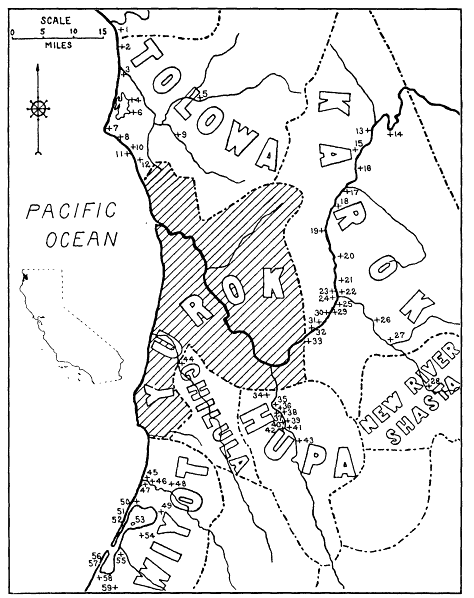
Key to Map 1
|
Map 1.
(left) Northwestern California, showing distribution of Yurok place
names outside Yurok territory. Inset map: California, showing the l
ocation of Yurok territory (shaded). (From Waterman 1920)
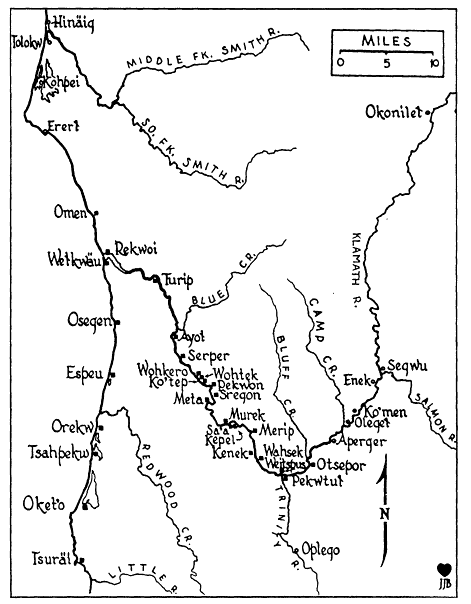
Map 2.
(above) Principal Yurok towns, indicated by black squares, along
the Klamath River and the northern California coast. Towns of the
Tolowa, Hupa, and Karok are indicated by circles. The names shown
for these are the Yurok ones. (From Spott and Kroeber 1942)
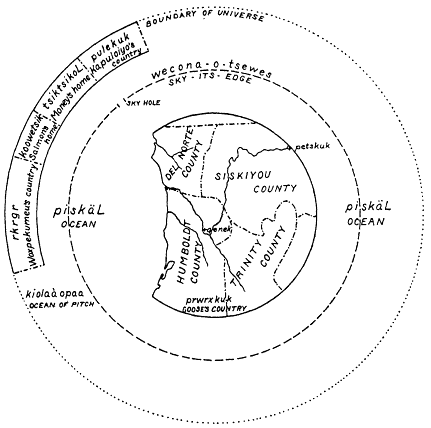
Diagram 1.
Waterman's map depicting the Yurok conception of the world (1920:192).
[You] lie here still. Let me go about without criticism. Let me grow old doing things this way. Let me keep coming back along this trail only with something good. Let me live happily. You have plenty of power, they say, oh [resting place]. May you look on me. May I live happily. May I grow old in the way I'm telling you. May you preserve my body. (Golla, in press)
There were other places where the traveler was expected to make a certain offering. In some instances, this meant dropping a
twig or branch where trails crossed one another, while in others the Indian was supposed to shoot an arrow into certain sacred trees so as to assure good luck.
The twig dropping is best described by Powers, who writes,
They have a curious custom of dropping twigs and boughs at the junction of trails, which sometimes accumulate in heaps several feet high, like the nests of woodrats. Every Indian who passes deposits a twig on the pile, but without observing any method that a white man can discover. No one will explain the custom, though it is probably observed, like so many other things, merely "for luck." (Powers, 1877 [1976]:58)
The custom of offering arrows to a sacred tree is described by Waterman, who explains that the arrow was a valuable piece of property in precontact times, since much time and effort were required to produce one. He also notes that the custom became distorted after the introduction of firearms, as the trees were then sometimes shot with bullets, leaving them scarred and stripped of bark (Waterman 1920:230-231).
The annotated maps in Waterman (1920) identify a number of special locations that were known as places where a Yurok person could pray or ask for help, and the following examples give an indication of their character:
1. A certain place on Bald Hills where there is an echo. One goes there to shout for help and the response tells whether or not the spirit will help (1920:197).
2. A rock offshore from Wilson Creek (False Klamath Rock). One of the wo'gey came to live in this rock, and he invites people to cry and ask for money while looking at the place (1920:230).
3. A place on the coast near the village of Omen. People would look around in the saltwater here for rocks to make arrowheads. After shaping them, they would "cook" the points by speaking a formula over them, after which they would be strong enough to shoot right through an elk (1920:233).
4. A submerged rock in the Klamath River (Posir Rock), just upstream from Ah Pah Creek. This rock was a "charm" for snaring deer. The hunter would dive underwater to touch it, and then
he rubbed his hands upon the snares, which guaranteed a catch (1920:238).
5. A large rock in the Klamath River below Pekwan. Pelintsiek ("Great Dentalium") used to live in the water here. In passing the rock by canoe, one stops alongside it in midstream, there clapping the hands and speaking a short prayer for luck (1920: 243).
6. A certain rock formation near the village of Merip. Arrowheads were placed in a cleft in the rock, and there they became "rusted" or covered with a poison that made them certain to kill (1920:250).
7. A point of rocks on Trinidad Head. The Yurok name for this rock formation is translated "He Sits Forever." A man went there to cry for luck and ask for money. Then he saw dentalium shells in the water, numerous as sardines. He sat there looking and refusing to leave until he gradually turned to stone (1920:270).
8. A cave at Trinidad Head. Its Yurok name has been translated "Where it Drops (or Trickles)." People went inside this damp cave to pray for money. If one drop fell on a person, then he would soon become wealthy. But if two fell upon him, then the rock would close up and he would never escape (1920:270).
Waterman felt that the Yurok had an unusually large number of named places within their territory, by comparison with other North American Indians, and he said that his monograph contained only about one half the places that might have been indicated if there were adequate time or space to include them clearly on the maps (1920:195). This very intensive view of the surrounding landscape was something which also impressed Powers, who commented on the care with which this information was transmitted from one generation to the next.
The boundaries of all tribes . . . are marked with the greatest precision, being defined by certain creeks, canyons, boulders, conspicuous trees, springs, etc., each of which has its own individual name. Accordingly, the squaws teach these things to their children in a kind of sing-song. . . . Over and over, time and again, they rehearse all these boulders, etc., describing each minutely and by name, with its surroundings. Then,
when the children are old enough, they take them around . . . and so faithful has been their instruction, that [the children] generally recognize the objects from the descriptions given them previously by their mothers. (Powers 1877 [1976]:109-110)
These teachings relating to geography were expressed in mythic terms, and mythic tales were also loaded with useful knowledge about the landscape. We learn, for example, from one Yurok narrative that Wohpekemeu used to fish at a place near the village of Kenek, just below the mouth of Tuley Creek (Kroeber 1976:110), but any fisherman could see why this is a good spot. Just above there is a very strong rapid, and this is the first real barrier that salmon and other species encounter on moving upstream from the mouth of the river. In this fashion, mythic belief and practical or scientific knowledge were woven into a single fabric.
Heroic Beings
In this and the sections that follow, the multitude of spiritual beings which animated the environment are divided into categories for descriptive purposes. This is only a convenience and does not reflect a classification that Indians themselves would be likely to express. The discussion focuses mainly on characters of Yurok mythology, but similar beings were also known by the Hupa and Karok. For example, Wohpekemeu figures in several Hupa myths, where he is identified as Yumantuwinyai. In Karok mythology Wohpekemeu is sometimes equated with Coyote, as shown by a text in which Coyote invents childbirth (Harrington 1932:25-27), and other times equated with a character called Yeruxbihii (Kroeber and Gifford 1980:288-289).
While Wohpekemeu is generally portrayed as having the physical appearance of a human being, another heroic figure called Pulekukwerek ("At the North End of Creation Sharp One") was a monstrous creature, covered with horns or spines, who smoked tobacco but never ate food. Like Wohpekemeu, he lived across the ocean, but Pulekukwerek avoided females altogether and spent all of his time in the sweathouse. Thus, as character models, these two superheroes seem to represent opposing tendencies toward virility
on the one hand and asceticism on the other. In Yurok mythology, Pulekukwerek is mainly known for having killed off the sea serpents who inhabited the estuary at the mouth of the Klamath (Waterman 1920:228). The physical characteristics of these beings often seem fantastic and contradictory from a modern American perspective. Thus, for example, Pelintsiek ("Great Dentalium") was conceived as a dentalium shell as large as a sturgeon, but in narrative texts he is also able to speak and walk like a man (Kroeber 1976:200-204).
Other Yurok deities included Megwomits, the bearded dwarf known mainly as a provider of acorns and other vegetable products, and imposing natural entities such as Sun, Moon, Earthquake, and The Thunders. Like Pelintsiek, each of these awesome beings had human qualities despite the apparent contradictions this sometimes implied, and each was responsive to the thoughts and deeds of human beings. The Thunders, for example, were known as patrons of men who wanted to become stronger and more fearsome. To obtain their help, one would go to a mountain lake in the dead of night; he would dive to the bottom, holding his breath until he nearly lost consciousness, and then the man would not only obtain power for fighting but would also get luck for obtaining wealth (Spott and Kroeber 1942:163).
While the heroes described here are identified in narratives collected early in this century, not all were mentioned by Yuroks I knew during the 1970s. Wohpekemeu is by far the most important heroic figure in mythic tales or anecdotes told by modem Yuroks.
Monsters and Creek Devils
The most awesome beings in this category were the sea monsters who raised havoc in the estuary at the mouth of the Klamath River. There were twelve monsters there, each different in type, and they not only seized canoes but also caused a terrific turbulence so that people often drowned. The estuary was an important ferrying point in aboriginal times, as it was part of a major trail that Indians had to use in moving north or south along the coast. Fortunately, Pulekukwerek managed to kill the monsters so that the water became quite calm (Waterman 1920:228). In another account Pulekukwerek used a song to make the water still, and this became a
form of medicine that travelers could use whenever they were using a boat in rough water (Kroeber 1976:423-424).
Smaller monsters were sometimes adopted as "pets" by the wo'gey , and narratives collected from Wets'owa of Pekwon (Yurok) around 1900 mention two of these creatures: a giant bird known as an erl'erm and a type of water serpent called knewollek ("long one") in Yurok. In the first of these texts, a spirit-person brought the erl'erm into his house, where it began to dance around and then vomited up some bulbs. Later the man got married, and the erl'erm did not like this and left. The family began eating the bulbs, but they proved to be poisonous and made the baby sick, because the man should not have used the bulbs after he had taken a wife. This mythic incident became the basis of a formula for curing, and the text is also significant for illustrating the concept of sickness as a penalty for a spiritual offense (Kroeber 1976:409).
The text involving the knewollek ("long one") has a similar theme: A hunter found one of these water serpents, and he decided to take it home, though he didn't know what it was. He kept it hidden from his wife and always gave it a share of the deer he took. This became his "pet" and gave him tremendous luck in hunting deer. However, one day the man's wife noticed the serpent as it reached out to snatch a piece of meat. She struck it with a stick and it ran away. The hunter never did find out why his "pet" had left. This story also serves as the basis of a spoken medicine formula, in this case one used for a baby with cramps. The cramps were said to be caused by the knewollek , who was causing pain by holding the child in a tight grip (Kroeber 1976:410).
Both of these texts depict a male whose "pet" comes into conflict with his domestic life, and in the latter the knewollek is explicitly a creature that gave the hunter good luck. This theme that a man's luck or spiritual interactions are corrupted by contact with females or sexuality is pervasive in the texts of spoken medicine formulas to be described later, especially in those collected from men.
Aside from beasts such as these, the Yuroks interviewed by Kroeber shortly after 1900 also believed that ghosts of dead could haunt the living and corpses sometimes came back to life (1925:47). This was not discussed in conversations I had during the 1970s, but Indians I knew often mentioned a creature known by the Yurok
word uma'a and called "devil" or "Indian devil" in English. The uma'a were thought to live in dark, bushy thickets, and they had magical arrows of burning flint with which they could kill someone who passed nearby. The arrows (which come in sets of twelve or more) sometimes fell into the hands of humans, and then they could be used for sorcery.[3] A person who does this is also called an "Indian devil" and some are accused or suspected of practicing this form of black magic even today. Waterman cites at least one location that was known to have been frequented by uma'a around the turn of the century (1920:238).
Animals
All of the animals were thought to have been more like people in the prehuman period, and the transformation of animals is described in one Yurok narrative in which several animals join forces to kill a giant bird in order to obtain the feathers and fur that they would need when humans arrived. This happened somewhere near Shelton Butte (Kroeber 1976:329).
Mythic narratives involving animals are particularly important as vehicles for expressing cultural values, and Erik Erikson mentions several animal stories which were used in the education of Yurok children. In one example, Buzzard is described as a greedy character who got his ugly pinkish head by scalding himself when he plunged into a bowl of soup before it had time to cool. Then he became afraid to eat anything warm, and that is why he flies around waiting until his food gets so old that it stinks (Erikson 1943:287). Another story involved Negenich the Mouse. She was pretty, but boys did not want to marry her because she stole things all the time. Her sister Frog did not steal, so she got married and raised a nice family despite being rather plain (Erikson 1943:288).
Some of these animal tales are sung or dramatized. While used mainly for entertainment today, these animals songs were previously also used for medicine making. All of them involve an element of impersonation or mimicry, and they are not "sung" but delivered in a form of heightened speech which is supposed to represent the thoughts or speech of an animal spirit-person. The songs are all rather brief and each contains much hidden meaning or relies upon knowledge of things not mentioned in the song itself.
One excellent example is an Elk Song that was performed by Frank Douglas (Yurok) during an interview on March 8, 1979. Using a tense and nasalized voice which is supposed to represent that of the female elk, Frank intoned Yurok words which could be translated,
It hurts me. It hurts me.
I hope it gets daylight soon. I hope it gets daylight soon.
Then he switched to a lower pitch level and imitated the masculine voice of her mate, who said (in a modern translation quite characteristic of Frank),
I hope it don't get daylight too damn quick.
In this example, the sexual connotations of the song are not explicit, and this is precisely what makes it clever or amusing from a Yurok perspective. Most important, Frank emphasized that the song was not only for entertainment, but could also be used as a hunting song.
In a Dog Song performed during the same interview, the practical function was much more evident. In this case, Frank prefaced the song with an explanation, and instead of being humorous and slightly vulgar, this song had the darker character of a curse.
A dog was a person at one time, according to the Indian. One fellow's dog was barking all the time. He got tired of that, and he put him outside rough-like. And the dog sang this song. If you're mean to your dog, that's the worse thing you can do, and the dog will say:
Osh-a-la-moy . . . Key-ku-wen
Osh-a-la-moy . . . Key-ku-wen
Osh-a-la-moy . . . Key-ku-wen
And that means, "I hope that person dies, because he's mean to me."
Here was a song that a person could use to wish harm on someone who had treated him unfairly. In later chapters we shall examine more songs of the same general type, most of which were collected between 1900 and 1927, but many of these ancient songs were still known by Frank Douglas and other Indian persons whom I interviewed during the 1970s.
Animals upon which the Indians depended for sustenance, especially deer and salmon, were regarded with special reverence. In
aboriginal times, it was believed that the most effective means of attracting salmon was to imagine their presence, visualizing the fish as they moved into the net underwater. Then, if you lived correctly they would indeed come and fill your net. But no matter how many were taken, their number was never diminished, and the species was viewed (collectively) as a single immortal being. Nepewo, the "headman" of the salmon, lived across the ocean with Wohpekemeu and other deities, and Nepewo spoke for all salmon when he declared the following:
I shall travel as far as the river extends. I shall leave my scales on nets and they will turn into salmon, but I myself shall go by and not be killed. (Kroeber 1925:68)
One might say that the Indians excused their violating the salmon's flesh by viewing the species in this manner, and a description of the First Salmon Ceremony reveals the extent to which indigenous attitudes toward the salmon were basically conciliatory or apologetic.[4] The ceremony was performed at the beginning of the spring salmon run, and it was forbidden for anyone to take salmon before it was done. A formulist prepared for the ritual by praying and gathering sweathouse wood for ten days. During this period he was not allowed to drink water, nor indeed could he drink water until the fall. There was also a taboo against his having sex, and this extended for an entire year after he conducted the ceremony.
In the ritual itself, the fish was prepared and eaten according to strict guidelines. The medicine man was not supposed to use his hands to lift the salmon from his net, but rather he fashioned a twine of green hazel bark and threaded it through the gills for handling. Next, he lay the fish on its belly and held his breath while drawing a stone blade along the backbone from head to tail. It was believed that the spirits on either side of the river watched very closely while this was done, in order to make sure that the proper etiquette was observed. If a modern hafted knife were used, for example, or if the salmon were lifted carelessly by its tail, then this would make for poor fishing all year long and would also "ruin the world."
Before eating the salmon, the medicine man spoke a formula in which he consulted with the leader of the salmon and obtained his permission to be eaten. Like many prayers of this kind, this text
had the form of a dialogue but was spoken by one person. In asking and answering the questions, the medicine man also outlined the proper guidelines for consumption of salmon. He asks if it would be all right for a person to eat salmon and then eat bear meat afterwards, and then he describes how the fish just lay still in the water, signifying assent. Then he asks if it were all right to eat trout afterwards, and the fish also allowed this. Finally, he asks what the salmon would do if eaten by a woman who had a miscarriage, and he describes how the fish floated belly up as if dead. After this dialogue was enacted, the medicine man cooked and ate the first salmon, and it was considered good luck to eat the whole thing. He would not be permitted to eat salmon again until the fall, but through his actions the community received permission to do so.
Hunters were also careful to obtain the good will of deer, which were also regarded as immortal beings. It was believed that the deer only gave their flesh to those who observed proper manners in eating, and it was even thought that they compared notes in this regard.
"How do you like that house?" the elder [deer] would ask. "I do not like it," [the younger one] says. "He does not wash his hands, and his women shift their feet while they sit at the meal." Or it answers: "He is good. He acts rightly. Smell my hand." They sniff it, like [the smell of] the pep-perwood, and frequently go into that man's snares. (Kroeber 1925:68)[5]
While eating the deer, the hunter saved the bones and other offal, and he returned these to the spot where the deer was taken so that the deer would rise again. This practice was described by Aileen Figueroa (Yurok) in a relatively recent interview conducted by Charlotte Heth.
Every time we'd eat a deer we'd have a basket or a can or something. We'd throw all our bones in there, all our bones, until we got the whole deer used up, and then we'd either go up in the mountains or out in the brush and [we] take the whole bunch of bones and [we] dump it. And then, as you dump it, the deer takes off. If you just throw your bones here and there, well the deer doesn't have all the bones together [laughs]. This way you put all your bones together and there goes your deer, ready for another catch. (Bommelyn et al. 1976)
The propitiatory attitude toward deer is evident in other beliefs and customs relating to deer hunting and consumption of venison.
For example, deer hunting was thought to be incompatible with sex, and the successful hunter had to abstain or use a medicine formula to counteract the effects of intercourse, otherwise the deer would not allow themselves to be found. Besides being a prominent theme in hunting narratives to be described later, this belief is documented in Powers (1877 [1976]).
Before going out on a chase the Karok hunter must abstain three days from touching any woman, else he will miss the quarry. Mr. A. Somes related an incident which happened to himself when hunting in company with a venerable Indian. They set out betimes and scoured the mountain-tops with diligence all day, and were like to return empty-handed, when the old savage declared roundly that the white man was trifling with him, and that he must have touched some woman. No ridicule could shake his belief, so he withdrew a few paces, fell on his knees, turned his face devoutly toward heaven, and prayed fluently and fervently for the space of full twenty minutes. Somes was so much impressed with the old savage's earnestness that he did not disturb him. Although able to speak the language well, he understood nothing the white-haired petitioner uttered. When he made an end of praying he rose solemnly, saying they would now have success. They started on, and it so fell out that they started upon a fine pricket in a few minutes and Somes picked him off. (Powers 1877 [1976]:31-32)
It was also believed that having sex after eating venison (or sea lion flesh) could cause a person or one of his children to get sick (Kroeber 1925:69). And finally, Valory notes that it was considered repulsive to eat the portion of the game that had been struck by the arrow (1970:83).
Plants and Herbs
Plants were also thought to have been more like human beings in the period before humans arrived. Acorns were the most important vegetable food in aboriginal times, and a story about acorns told by Phoebe Maddox (Karok) in 1926 and recorded by Harrington (1932:5-6) provides another example of the manner in which practical knowledge was cast in the form of a mythic narrative.
The acorns are depicted as a group of young ladies. They are told to weave nice hats, because human beings are about to arrive, and the girls will soon be transformed into acorns. Thus, the story
is based on a resemblance between the woman's traditional woven hat and the woody cup which holds the hard acorn seed. The girls begin to weave, but their work is abruptly interrupted when humans appear sooner than expected. As a result, one of them does not finish her hat, and she wears a woven bowl instead. Another one (Tan Oak Acorn) finishes her hat, but without completely trimming away the straws that projected toward the inside. She just turned it wrong side out and wore it that way. Finally, the last one finished her hat perfectly.
After being transformed, Tan Oak Acorn got so angry about this that she cursed the others.
Tan Oak Acorn wished bad luck toward Post Oak Acorn and Maul Oak Acorn, just because they had nice hats. She was jealous of them. . . . [That is why] nobody likes to eat Post Oak Acorn. And Maul Oak Acorn does not taste good either, and is hard. [Their] soups are black. And Maul Oak Acorn is hard to pound. They were all painted when they first spilled down. Black Oak Acorn was striped. When one picks it up on the ground it is still striped nowadays. But Tan Oak Acorn did not paint herself much, because she was mad. (Harrington 1932:6)
Plants and herbs were especially prominent in doctoring, and the effectiveness of a given plant substance was expressed mainly in terms of its mythological significance. Wallace described the work of Hupa herb doctors as follows:
Lesser disorders like an upset stomach or headache were treated with spoken formulas, almost always accompanied by herbal medicines. The medications were administered in such minute quantity or in such a way as to have little or no effect. Relief was supposed to stem from the words uttered rather than the plant substances. Medicine formulas, handed down in family lines, represented a valuable form of property, since a stiff charge was made for their recital. (Wallace 1978a :175)
In many cases, the formula was to be spoken as the plant substance was being collected. For example, a formulist would actually speak to a cluster of madrone leaves while plucking them from the tree. The leaves themselves were not medicine, but rather it is believed that they become medicine after they were "talked to" in this fashion. The spoken formulas describe a previous cure that was successful in the period before humans. In some cases the mythic cure was effected by a wo'gey who used a certain plant substance,
but often the plant itself was regarded as a conscious being, as shown in the narrative quoted at the head of this chapter.
The Wo'gey and Human Beings
Of all the spiritual beings recognized by the Yuroks, none was more important than the wo'gey , for it was they who had originated nearly every form of medicine making and whose continued help the Indians needed if public and private rituals were to be effective. While heroic beings, monsters, animals, and plants all have a certain importance in mythic narratives that were collected from Yurok speakers, the wo'gey are the primary characters in this literature and figure in virtually every text. Because of this, we shall be learning more about the wo'gey and their lives in chapters to follow, but it seems useful to make some preliminary comments here.
Erikson states that the Yurok conceived the wo'gey as being rather small, and he emphasizes the belief that they were always "clean" because they did not know sexual intercourse (1943:260-261). While Erikson may indeed have been told this by one of the individuals he interviewed, this is a rather specialized view and does not reflect Yurok religious conception in general. Indian persons whom I interviewed said that they were not necessarily small but "just different." In mythic narratives the wo'gey are generally portrayed as being very much like human beings, and in many cases the literature in translation is likely to be confusing because it is not always explicit as to whether the characters involved are supposed to be wo'gey or human beings. In these texts they often have sex and do other polluting things, and this is one reason why they needed to invent medicine in the first place.
Kroeber and Waterman both note that the time frame of Yurok mythology is compressed into a very brief span. Bather than depicting the prehuman world as something ancient, the narratives that Kroeber and others collected generally relate something that happened in the last few days before human beings were to arrive. A sense of immediacy is repeatedly expressed in passages such as the following, which describes two wo'gey discussing how to build a sweathouse to be used in the Jump Dance ritual. And one says,
I wanted to know, before making my sweathouse, what sort I should have, and I waited for you. Now I shall make it quickly because I know that there are [human] people all along that [Trinity] river and that [Klamath] river. I want everything to be made when they arrive. I know now that we shall not remain here. There will be another kind of people in this world. We must hurry. (Kroeber 1976:29)
Rather than believing that they had a human history, Indians of the precontact period thought they had inherited their world from the wo'gey relatively recently. Thus the nearness of humans and wo'gey in time was emphasized even further, and the speaker of the text quoted here actually showed Kroeber a pit where the sweathouse in question had existed, only a few generations before.
The use of medicine formulas and other rituals was also supported by a belief that the wo'gey had invented these things mainly in order to help human beings, and this is mentioned in several texts describing medicine formulas. One reason they wanted to help, according to Yurok thought, is because they felt sorry for humans, particularly because humans had to grow old and die while the wo'gey themselves were immortal. These sentiments are illustrated in the following comment, which was made by Johnny Shortman (Yurok) of Rekwoi in 1901.
Now the woge are always glad when one calls on them in a formula. In all formulas a name has to be called upon, then they are glad that they are talked to. They always pity the people because they are so few. If they had let old people become young, as they wanted to, if [Jerusalem Cricket] had not done wrong and brought death, there would be many people. That is why the woge are sorry. (Kroeber 1976:443)
When Indians came, the wo'gey took refuge in trees, rocks, springs, and other places. Because humans built homes along the river, many of the spirit-persons went into the upper ridges to live, and this is why Indians traditionally go to the high country to make medicine. The sweathouse was another special place for communicating with the wo'gey , and early customs involving these two sacred locations are discussed in the next chapter.