
Household Size and Composition
Bogang's current population of 476 inhabitants is distributed among 106 separate households; the mean household thus consists of 4.5 individuals (see table 12). Households range in size from one to ten persons, although over three-quarters (78.3 percent) of these domestic units have six or fewer residents. Indeed, over half (57.5 percent) of the village's occupied houses claim from two to five members. The most common household size is five, accounting for 17.9 percent of all households. It should be noted, however, that these calculations and percentages reflect a focus on the cline of households in terms of size rather than the distribution or clustering of individuals in different-sized households. Specifically, twelve separate households in the village consist of a single individual, and sixteen others consist of only two members; the data are thus skewed in the direction of the smallest households. The final column of the table shows that
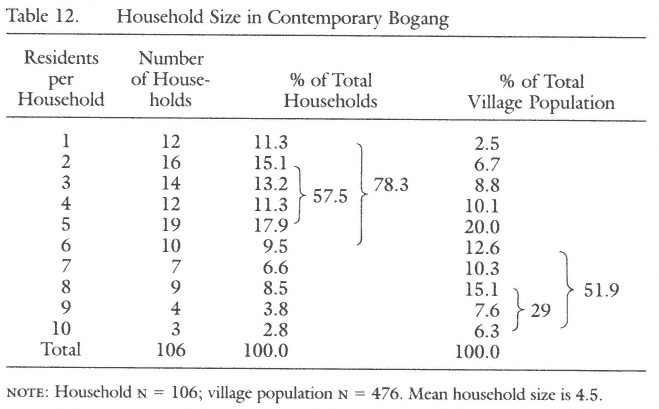
over half (51.9 percent) of Bogang's people live in households with six or more members, and that an impressive 29 percent of the entire village population can be found in houses having 8–10 residents.
While virtually all single-person dwellings are associated with the lowest income quadrant, so too are some of the largest households. Interestingly, the elders of these latter households are regarded as fortunate in light of the emotional riches and social capital they gain through coresidence with children, grandchildren, and other kin—however economically productive or draining they may be. The underlying sentiment is suggested by a local expression that, in this context, can be translated as "the more, the merrier" (makin, ramai, makin sedap ); that is, almost all adult villagers prefer to eat, sleep, and live in the company of their children rather than under a separate roof.[1]
Household composition can be broken down into four basic patterns, three of which contain further internal subdivisions (see table 13). Each type, moreover, can be seen as a developmental variation on a single set of themes.
My typology of households based on interpersonal ties—that is, nuclear, conjugal, consanguineal, and individual—has no native counterpart in the sense of like indigenous categories. Nevertheless, the major analytic distinctions are useful for ordering the data. They also serve to emphasize features of domestic variation that are of considerable local relevance. Above all, however, they underscore the critical fact that a domestic unit consisting of a married (or formerly wed) woman and her dependent children is of far greater functional significance than is the same group plus the woman's husband. In short, while the term nuclear household (or nuclear family ) is typically associated with the latter configuration, I follow Goodenough (1970, 18–19) in restricting its use to domestic units consisting only of women and their resident dependents (that is, their sociological children, whether natural or adopted). The addition of the husband/father to the group does make a difference, of course, especially today. But this man's presence or absence may be—and in Negeri Sembilan definitely is—relatively unimportant to the jural standing, socialization, and overall development of children. Therefore, the "nucleus" of kinship consists of mother-child bonds and ties among siblings, and not the conjugal pair and progeny that Murdock (1949), Lévi-Strauss ([1949] 1969), and others regard as both the nuclear family and a cultural universal.
| ||||||||||||||||||||||||||||||||||||||||||||||||||||||||||||||||||||||||
In any event, 24.5 percent (26 of 106) of Bogang's households are what I would term nuclear. Most are headed by divorcées or widows, as opposed to women whose current husbands live elsewhere owing to military service, distant employment, or cohabitation with a second wife. Aside from having no paternally elaborated counterpart (that is, consisting solely of a man and his children), this arrangement occurs in extended form only in terms of links through women. Hence, historical continuity in domestic arrangements is considerable.
Conjugal households, in contrast, account for 60.4 percent (64 of 106) of the village's domestic units. Most of these—or 47.2 percent (50 of 106) of the entire village—involve a married couple and their children, which also represents a common pattern of earlier times. It is historically very interesting that the twelve conjugal households consisting solely of a
| ||||||||||||||||||||||||||||||||||||||||||||||||||||||||||||||||||||||||||||||||||||||||||||||||||||||||||||||||||||||||||||||||||||||||||||||||||||||||||||||||||||||||||||||||||||||||||||||||||||||
married couple appear unlikely to include any children in the future. These are mostly elderly individuals past the age of reproduction; their children have either settled elsewhere in Bogang or, more often, migrated to rural development schemes or urban areas. Such two-person households were of course typical in previous decades and centuries, but they were mainly of temporary duration, consisting of newly married couples who had yet to bear or adopt children. More striking still, recently married couples are largely absent from the local community, as are natal residents of the village and in-marrying males in their twenties and thirties in general (see table 14). Consequently, we encounter both a greater percentage of single-person households than has probably ever before existed, and a bimodal age distribution that is undoubtedly far more pronounced than at any stage in history.
Even allowing far more single-person households at present, there is no
major break with the past as regards the gender, age grade, and marital status of those who reside by themselves, for most are formerly married women aged fifty-five and over.
Single-person households and conjugal households inhabited solely by a woman and her husband share a basic feature in common: they span but a single generation. The relatively large number of such households, twelve and sixteen respectively—or 26.4 percent of Bogang's domestic units—testifies to a villagewide trend toward the generational retraction of domestic groupings (despite lower infant mortality rates and greater longevity), and represents an appreciable shift from previous decades. The larger issue, referred to above, is the increasingly polarized age structure of the village population, due to accelerated rates of out-migration involving virtually all youth over the age of eighteen, regardless of socioeconomic standing.[2]
In light of the great value placed on children and the profound dread of solitary existence, it is ironic that so many parents encourage their offspring to make lives for themselves outside the village. I recall one woman in her early fifties explaining forthrightly that she did not want any of her children (all of whom were males) to settle down to a rural existence. As she put it, "only the stupid ones stay in the village" (orang bodoh saja duduk kampung ). Unfortunately for her and others of her generation, many formerly resident children will probably never return to the village to live. This situation arouses considerable ambivalence and misgiving among parents, many of whom feel "left behind," if not abandoned, and also express anxious concern that their homes and compounds might stand empty, and their rice fields fallow, after their deaths.
Perhaps the most striking pattern in domestic group composition and variation in Bogang is the marked skewing in favor of females and links through women, which prevails at all levels. This skewing is most evident in the large percentage of households without any ever-married males—a full 29.2 percent (31 of 106), as compared with only 2.8 percent (3 of 106) for households without ever-married women. Expressed differently, more than ten times the number of households have no adult males than have no adult females. This situation highlights a basic social fact: women can and do live well enough without husbands and other adult males; men, in contrast, cannot really survive without wives or apart from other female kin.
As a result, whereas formerly wed women are in many instances committed to remaining single, their male counterparts invariably remarry as quickly as possible.