
Given: The Delayed Snapshot
An oeuvre by itself doesn't exist. It's an optical illusion.
—Marcel Duchamp
To make a painting or sculpture as one would wind a reel of cinematic film.
—Marcel Duchamp
Having examined the nude and its function in Given , I will now focus on the illusionistic landscape that frames it, on its "startlingly naturalistic and eerily unreal character," to evoke Anne d'Harnoncourt and Walter Hopps's description.[37] The background landscape in Given is a photograph retouched by hand, which is yet another ready-made alluding to the general photographic illusionism of the work. Duchamp's references to photography, and particularly chronophotography, in works such as Nude Descending a Staircase, Nos. 1 and 2 (figs. 9 and 7), express his interest in the ready-made character of photography. This interest is already manifest in Pharmacy , a commercial print of a winter landscape retouched through the addition of red and green dots. When seen through special red and green glasses, these dots tend to overlap and produce the illusion of relief. Considered as an early instance of Duchamp's experiments with anaglyphic vision, Pharmacy anticipates both the photographic aspects of Given , as well as its anaglyphic character: its play with the illusion of relief, and thus, an implicit allusion to sculpture.
This double allusion to photography and sculpture can also be seen in
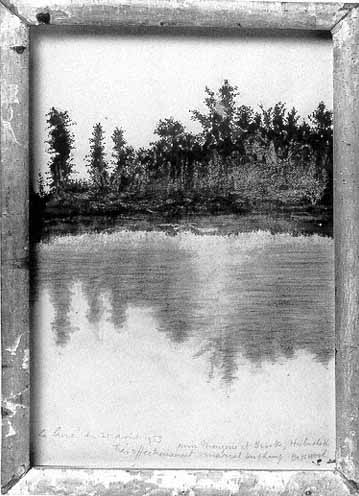
Fig 83.
Marcel Duchamp, Moonlight on the Bay at Basswood (Clair De
Lune Sur La Baie A Basswood), 1953. Pen, pencil, talcum powder,
and chocolate on blue blotter, 10 3/8 x 7 1/4 in.
Courtesy of The Philadelphia Museum of Art.
another of Duchamp's later works. Moonlight on the Bay at Basswood (Clair de lune sur la bale a Basswood ; 1953) (fig. 83), a work contemporary to Given , which is partly drawn from life and partly from a photomural, so that two different gestures are simultaneously conflated in one image. The traditional role of painting as a mimetic rendering of reality is subverted, since this drawing also takes a photomural as its point of reference. Photography undermines painterly traditions, since it substitutes itself for them. It displaces artisanal production through mechanical
reproduction (its "ready-made" nature), and thus redefines artistic creation. Moreover, Moonlight is no ordinary drawing, since it includes a variety of materials—ink, pencil, crayon, talcum powder, and chocolate on blotting paper. The addition of such unusual materials as talcum powder and chocolate to the drawing of this landscape modifies our painterly and photographic expectations.[38] Their inclusion suggests the intrusion of material ingredients from everyday life. Both the talcum powder and the chocolate are associated with molds: talcum powder can be applied to the body, like the plaster of a mold, and chocolate is often molded into different shapes. The landscape of Moonlight thus presents the allusion to relief, inscribed this time not visually (anaglyphically) but literally, insofar as these elements are constitutive of the image. They inscribe anamorphically the trace of the body into the image, like the negative imprint of a body in a mold.
This inscription of photography, which is also an indirect allusion to sculpture in the landscape of Given , is echoed by Duchamp's own gesture of drawing a landscape into the Large Glass in Bedridden Mountains (Cols Alités ; 1959) and in his literal association of ready-mades and photography in his note entitled "Without glue" (Sans colle ): "/Make an assembly of/ 'ready mades' balanced/ one on top of the other/ and photograph them/ (Jackstraws so to/ speak)" (Notes ) 167). This statement clarifies the contextually assembled, photographically superimposed, and ready-made character of both the nude and the landscape in Given . The reference to "jackstraws" provides a clue to the game that Given sets up. It tells us that no element in the scene can be picked up and singled out without disturbing all the others.[39] Duchamp's reference to "jackstraws" suggests that Given can only be deciphered strategically, so as to preserve the contextual nature of the elements, since each element of the assemblage is merely a "hinge."
Likewise, the photographic and sculptural references in Given do not provide stable frames of reference as distinct modes of artistic representation. Their instability is prefigured in Tu m' (1918) (fig. 84), Duchamp's "assemblage" of his ready-mades in a painting. In Tu m' Duchamp does not reproduce the ready-mades directly; instead, he casts their elongated shadows on a canvas (the bicycle wheel and the hat rack). Instead of a depiction of Bottle Rack (fig. 37, p. 93), however, we only find its
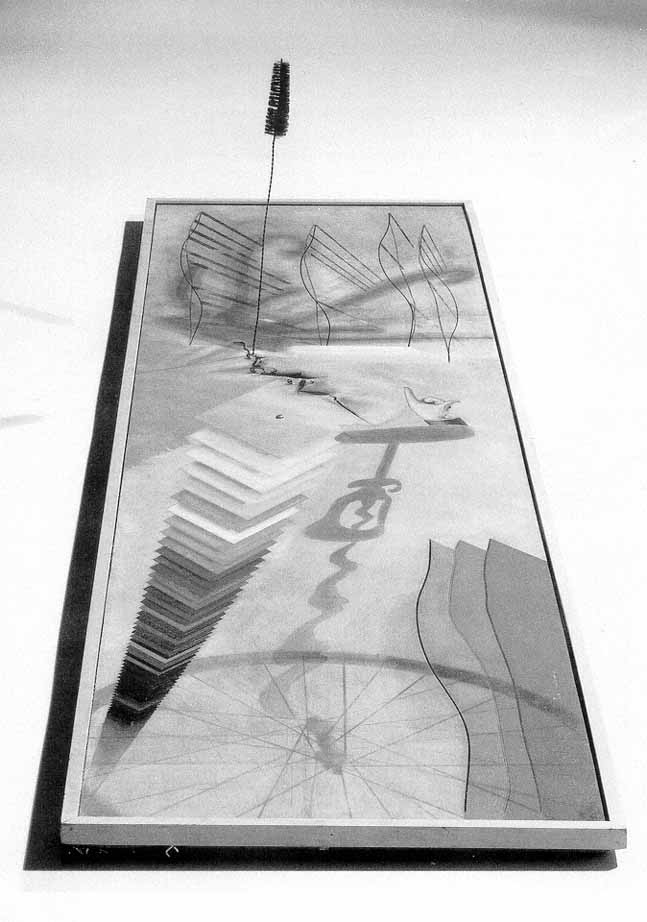
Fig. 84.
Marcel Duchamp, Tu m', 1918. Oil and pencil on canvas with bottle brush, three safety pins,
and one bolt, 27 1/2 x 10 ft., 2 3/4 in.
Courtesy of Yale University Art Gallery, New Haven, gift from the Estate of Katherine S. Dreier.
metonymic displacements: the projection of a corkscrew on the canvas and a brush (used to clean bottles, or lamps) sticking out, perpendicular to the field of vision of the viewer.[40] As if to further underline the pointed nature of this work, a painted hand (signed by the commercial artist A. Klang) points its index finger to the brush and to a series of strips of commercial paint samples (copied from a catalog of oil paints, according to Schwarz).[41] At the center, the canvas is slashed and held together by safety pins. Rosalind Krauss interprets the cast of the shadows as "signifying these objects by means of indexical traces." Her argument relies on the pointing finger as evidence of the indexical character of the image, which she interprets as a photographic allusion.[42]
Tu m' , however, cannot be reduced to a photographic allusion, since the photographic character of the ready-made is also equated by Duchamp with the act of nomination. Although he summarizes his operation on the ready-made in photographic terms, as a matter of timing, this "snapshot" effect is also equated with the temporal and performative dimension of nomination: "The important thing is just/ this matter of timing, this snapshot effect, like/ a speech delivered on no matter/ what occasion, but at such and such an hour ."[43] The analogy between the photograph and the ready-made involves a "snapshot effect" triggered either by the push of a button or by the shutter (stutter) of language. In both of these cases the indexical gesture is undermined, since the pointed hand and the ability of language to point are turned back on themselves. This reflexive gesture is alluded to by the title Tu m .' The photograph and the ready-made thus present the reification of the artist's hand: they negate its intervention in the creation of the object.
Duchamp summarizes the ambivalent nature of his artistic intervention when he comments in his interviews to Cabanne: "It's fun to do things by hand. I'm on guard, because there's the danger of the 'hand' (la patte ) which comes back, but since I'm not doing works of art, it's fine" (DMD, 106.) The danger of the "hand" (literally, the paw, but also a homonym of paste, an allusion to the mold, in French) brings together references to the indexical character of the hand, only to suggest the erasure of its imprint (the mold). The ready-made is marked by a process analogous to both photographic impression and the sculptural mold, both of which, however, paradoxically derealize the object by pointing to it (indexically).
The gesture of pointing (demonstration) thus signifies their ambiguity as modes of representation. The indexical character of Tu m ' and of Given points to their ready-made reality as artistic objects, the fact that their "completed illusion negates the process that went into its artistic creation."[44] The pointing hand is erased by the ambiguous indexical inscription of the ready-made, which points toward the object, photographically and sculpturally, only to elide the intervention of the hand through verbal intervention. This play on the index is already suggested in the text of the Preface to the Large Glass (fig. 85), which also establishes the major formal elements of Given .
For Krauss, this language of rapid exposures that produces a state of rest as an isolated sign is the language of photography. She finds this process implied in the subtitle of the Large Glass , which is Delay in Glass .[45] However, this insight is complicated, as shown earlier, by the ambiguous nature of the indexical sign in Duchamp's Tu m' and in Given . The photographic illusion of Given is merely an appearance, the construct of the index, as a mode of determination. Given can no more be reduced to a photograph than to a ready-made.
The impossibility of reducing Given to a photographic allusion is prefigured in the ambiguity of indexical gestures in Tu m .' The index finger in Tu m ' points toward pictoriality, to the bottle brush and painting samples, only to redirect the viewer's gaze to their commercial, ready-made character. Thus the gesture of pointing to painting corresponds to pointing away from it. By alluding literally to the ready-mades (the brush sticking out of the painting), Duchamp also undoes the very gesture of painting, since the brush (a sculptural ready-made object) points to itself as the instrument constructing the appearance of objects in painting. Tu m ' thus stages the play of painting, photography, sculpture, and language as different modes of "impression." Painting as a retinal imprint is mimicked by the photographic negative, which, as the cast of shadows and the brush, constitutes a kind of "shadow sculpture" or mold. As a sculptural mold, however, Tu m ' lapses into language, capturing its deictical fold. Tu m ' inscribes both literal allusions to Given (the brush stands in as the indexical mark of the gas lamp) and formal allusions to its mixed-media character as an assemblage of painting, photography, sculpture, and language.
However, neither painting nor photography nor sculpture nor language
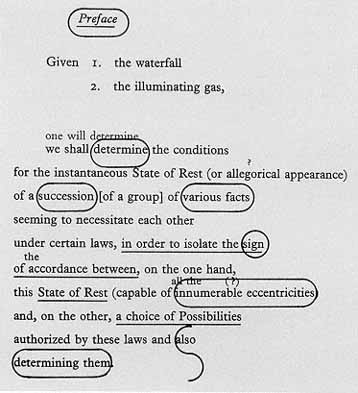
Fig. 85.
Marcel Duchamp, Preface to The Large Glass, from The Bride Stripped
Bare by Her Bachelors, Even: A Typographic Version by Richard
Hamilton of Marcel Duchamp's Green Box, trans. George Heard
Hamilton. Stuttgart: Hansjörg Mayer, 1976.
functions traditionally. In each of these cases the hand of the artist is elided by a mechanical procedure. The painter's brush is displaced by the camera, the photograph as a negative imprint or mold threatens to become sculpture, sculpture is undermined by the ready-made object, and the object is derealized through its title. Visual meaning thus dissolves into linguistic pun. This movement through the visual arts into language and back in Tu m ' and in Given demonstrates that all lifelike illusion is captured through mechanical procedures. Both visual and discursive reproductions suppress the artist's hand, the artisanal intervention, only to draw attention to it, a gesture analogous to the ready-made.
The "assembled" character of Tu m ' suggests that Given does not function as an individual work but as a context for the entire Duchampian corpus. While Duchamp expresses the reservation regarding Tu m '
that "summarizing one's works in a painting is not a very attractive form of activity," this does not stop him from later assembling his works in Box in a Valise and reassembling them in Given , his testamentary work.[46] When Duchamp mentions his desire to have all his works assembled in one museum, we begin to see that this preference expresses a fundamental aspect of his work: "I had a certain love for what I was making, and this love was translated in that form" (DMD , 74). This inscription of eroticism in the gesture of assemblage suggests Duchamp's particular understanding of his own work as a corpus: "I wanted the whole body of work to stay together" (DMD , 74). This assembled body of work stages an eroticism that "hinges" on the strategic play of different artistic contexts and media. As such, it reiterates the eroticism of the nude in Given as referring not to the anatomical body but to its assembled character as a set of visual and artistic determinations. The "appearance" of the nude, like that of Given , is but the "effect" of the contextualized media of painting, photography, sculpture, and language. The active play of visual and linguistic puns elucidates the status of eroticism in Given as a transitive moment, generated by shifts in the position of the body acting as a punning "hinge." Like Duchamp's Door: 11, rue Larrey (fig. 78, p. 214), which is open and closed at the same time, the body in Given, like the assembled structure of this work, becomes an undecidable frame of reference for eroticism. Given is but an "allegorical appearance," a work whose anamorphic and anagrammatic character is "eccentric." It is a work whose meaning cannot be situated analogically (put to rest), but which is constituted through movement, the delayed collision (or even assault, to use Duchamp's terms in the "Avertissement" following the "Preface") of all determinations.