
Late Graphics and Graphic Cycles
The homogeneity of form and expression in Corinth's paintings, drawings, and prints of this time ushered in yet another phase in his graphic output. Almost as if he intended to measure the distance he had traveled, or—more likely—propelled by a compulsive need to recast his earlier extroversive art into the emotive pictorial language of his late style, he resumed the habit, first noted in his graphic production from 1914, of reworking some of his earlier paintings in his late drawing style. A cycle of thirteen etchings of 1919, entitled Ancient Legends (Schw. 351), includes nine such repetitions. Among the four additional repetitions of the same year are new versions of the very early Swimming Pond at Grothe (B.-C. 72) of 1890 (Schw. 363) and the successful Salome (see Plate 12) of 1900 (Schw. 367). Corinth's prints of 1920 include new renditions of his two Salon entries, Susanna in Her Bath (see Fig. 34; M. 465) and the prize-winning Pietà (see Fig. 33). In the print after the Pietà (Fig. 171) he virtually tore to shreds the "corpse of Christ on a red tile floor" that for so long had not satisfied him with respect to "form." The climax of this compulsive revision of earlier work was reached in 1921–1922, when Corinth published a group of ten etchings under the title Compositions (M. 553–565), each based on one of his typical earlier exhibition pieces, including the painting Entombment (see Fig. 95) of 1904. His new approach to this particular work
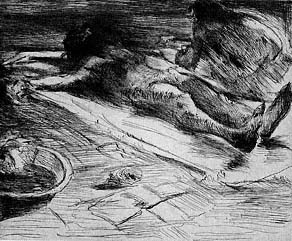
Figure 171
Lovis Corinth, Pietà ,, 1920. Drypoint, 26.5 × 32.7 cm,
M. 472. Hamburger Kunsthalle, Hamburg (1929/138).
Photo: Ralph Kleinhempel.
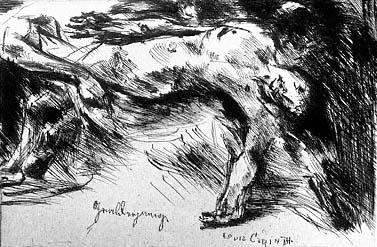
Figure 172
Lovis Corinth, Entombment , 1920–1921. Drypoint, 21 × 31 cm., M. 556.
Landesmuseum Mainz, Graphische Sammlung.
is of special interest because as his point of departure for the print (Fig. 172) he selected not the finished painting but the life-size cartoon that had preceded it (see Fig. 97). Nothing could reveal Corinth's intention more clearly, for, having singled out this particular drawing, surely one of the most idealized human figures in his entire oeuvre, he proceeded to repudiate the academic nude that had preoccupied him for so many years.
The maturing of Corinth's late graphic style coincides with an impressive output of illustrations for biblical, historical, biographical, and other literary texts. As a result of the publication of Karl Schwarz's catalogue in 1917, a general appreciation for Corinth's printed graphics had developed. Several subsequent publications by the same author,[17] culminating in 1922 in a second, much enlarged, edition of the catalogue, stimulated interest in Corinth's graphic production still further. As the attention of print collectors grew, so did the business acumen of publishers of print portfolios and illustrated books. The Fritz Gurlitt Press and the Propyläen-Verlag in Berlin, F. Bruckmann in Munich, and E. A. Seemann in Leipzig were among the firms with which Corinth signed contracts for a variety of projects. In addition to individual prints and such series as the Walchensee views, the Ancient Legends, Compositions , and the Dance of Death cycle already mentioned, he completed between 1919 and 1923 no fewer than twenty other print portfolios and illustrated books comprising nearly four hundred etchings and lithographs. Among these are Anne Boleyn (Schw. L428, L429) and a sequel of prints illustrating scenes at the court of Henry VIII (Schw. L430). Although the Anne Boleyn series was for a text by Herbert Eulenberg, much of the inspiration for both cycles came from the filming of the story—with Henny Porten and Emil Jannings in the leading roles—which Corinth was invited to watch at the Babelsberg Studios in Potsdam.[18] Illustrations for three poems, Friedrich von Schiller's Der Venuswagen (Schw. L383), Gottfried August Bürger's Die Königin von Golkonde (M. 499–511), and the Dafnislieder of Arno Holz (M. 733–743), revive memories of Corinth's earlier sensuous art. Like the contemporary Love Affairs of Zeus (Schw. L401), they include captivating scenes of lovers locked in rapturous embrace. The provocative character of the actions depicted in the illustrations to Schiller's poem (Fig. 173) is underscored by pithy inscriptions.
Corinth also illustrated some of the great classics: Shakespeare's King Lear (M. 491–498) and Schiller's Wilhelm Tell (M. 775–796), Die Räuber (M. 797–808), and Wallensteins Lager (M. 809–814). Twice he turned to the story of Götz von Berlichingen, first in 1919, when he made illustrations to Franz von Steigerwald's 1731 biography (Schw. L399), which had already inspired the young Goethe, and again in 1920–1921, when he illustrated the text of Goethe's
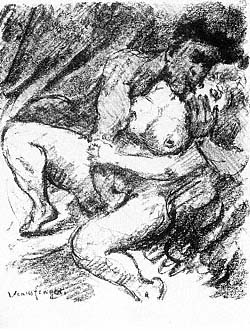
Figure 173
Lovis Corinth, Venus Finger , from Der
Venuswagen: Ein Gedicht von Friedrich
von Schiller, 1781 , 1919.
Photo courtesy Hans-Jürgen Imiela.
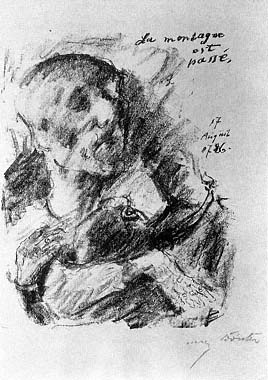
Figure 174
Lovis Corinth, Frederick the Great on His
Deathbed . Color lithograph, 32.3 × 25.3 cm, M.
618; from the cycle Fridericus Rex , 1922 (M.
593–640). Staatliche Museen Preussischer
Kulturbesitz, Kupferstichkabinett, Berlin (West).
Photo: Jörg P. Anders.
drama (M. 512–538). The life of Martin Luther, with a text by Tim Klein (Schw. L444), also dates from 1919. In 1922 Corinth completed his most extensive single cycle, Fridericus Rex (M. 593–640), a set of forty-eight color lithographs published in two portfolios.[19] The engaging narrative tone of this cycle and the whimsical exaggerations of physiognomy and gesture—as in Corinth's illustrations of 1923 for Jonathan Swift's Gulliver's Travels (M. 641–666)—are reminiscent of Corinth's earlier parodic Tragicomedies (see Figs. 42–50).
At the same time, the choice of such protagonists as Luther, Götz, and Frederick the Great implies again a measure of self-identification with embattled German heroes. This is further supported by several more self-portraits in armor, one decorating the title page of the Anne Boleyn series (Schw. L428, II), a Flagbearer of 1920 (Schw. 396) and a Victor of 1920–1921 (M. 564), the latter two done after earlier paintings (see Figs. 105, 106). The first Götz cycle begins with a repetition of the painting of 1917 (see Fig. 153), showing the aged warrior seated at his desk, writing his memoirs (Schw. L399, III). In the next-to-last print Götz has laid aside his armor and halberd (Schw. L399, XVI); the inscription beneath the illustration reads in translation: "Everyone will know what pain I have suffered." For the episode in the second cycle where Götz resists his captors (M. 530), Corinth drew on his earlier portraits of Rudolf Rittner in the role of Florian Geyer (see Plate 16, Fig. 127).
The first portfolio of Fridericus Rex emphasizes Frederick's endurance in the face of misfortunes: the traumatic conflicts between the young prince and his father; the First Silesian War; and Frederick's severest test, the Seven-Year War against the coalition of Austria, Russia, and France. The next-to-last print, inscribed "La montagne est passé/ 17 August 1786," shows the monarch on his deathbed (Fig. 174), a subject often depicted by other artists, usually to preserve a historical record of the dying king surrounded by attendants and members of his court. Corinth's only interest, however, is the deceased monarch, stripped of the accoutrements of the royal household. The dead king's face is based on the death mask in the Hohenzollern Museum that Corinth had drawn as early as September 1908.[20] During the war, in 1915, he had painted a picture of the death mask, starkly contrasting light and shade (B.-C. 653). The motif recurs in the second portfolio of Fridericus Rex (M. 637), followed by illustrations of the empty sedan chair in which the ailing king was carried (M. 638) and Frederick's disembodied uniform and hat, supported by the lifeless armature of a mannequin (M. 639). In 1923 Otto Gebühr, who played the title role in the hugely successful Fridericus films produced at about that time, gave Corinth a copy of Frederick's death mask, which the painter promptly displayed in his studio.[21]
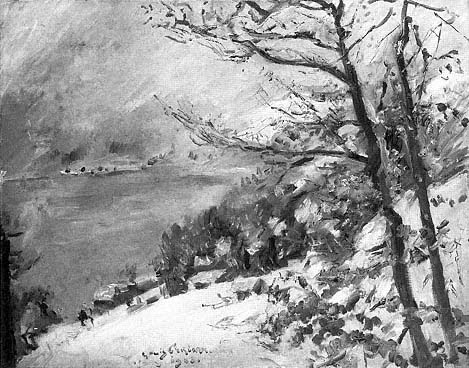
Figure 175
Lovis Corinth, The Walchensee in Winter , 1923. Oil on canvas, 70 × 90 cm, B.-C. 897.
Städelsches Kunstinstitut, Frankfurt (SG 1132).