
2—
Outside the Scene
At an elementary formal and historical level, the origins of canonical register composition are not hard to find. On expansive plane surfaces, like a rock, a swathe of cloth, or an interior plastered wall of a tomb, the prehistoric artist was free to dispose his figures quite freely—and so he did, scattering them evenly across the plane (Figs. 3, 4, 5).[1] When designs were made on surfaces more restricted or contracted than the wide planes of a rock face or a plastered wall, there was an impetus toward a repetitive, rectilinear, sequential formal order. Thus on the decorated vessels of the Nagada II/III period (so-called Gerzean Decorated Ware), the motifs or compositions are ordered so that a viewer must turn the vessel to unfold the image or images wrapped around it (see Fig. 6 for views of a painted vessel and compare Fig. 7 for examples of modern, possibly misleading "unrollings" of the designs). Although I do not consider painted pottery further in this study (see Raphael 1949; Williams 1988a; Davis 1989: 120–24), it forms an important historical and visual context for the images I examine.
On the even more restricted surfaces available for decoration on small objects like combs, knife handles, scepters, incense burners, spoons, and cosmetic palettes—generally intended to be lifted and grasped with one hand—artists came increasingly to carve figures in deeper relief in neat rows,[2] conforming naturally to the shape and edges of the support and its available space, usually no greater than the palm of a human hand. There may well be a conceptual relation between this space of and for representation and what would become the fundamental module of proportional design in canonical art, the "fist" (Iversen 1975; Davis 1989: 20–27; see also Chapter 9, note 1).
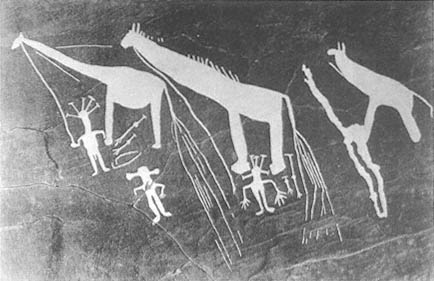
Fig. 3.
Rock drawing, southern Upper Egypt, probably fifth- fourth millennium B.C .
Courtesy Winkler Archive (formerly in Egypt Exploration Society,
London), Frobenius Institute, Frankfurt-am-Main.
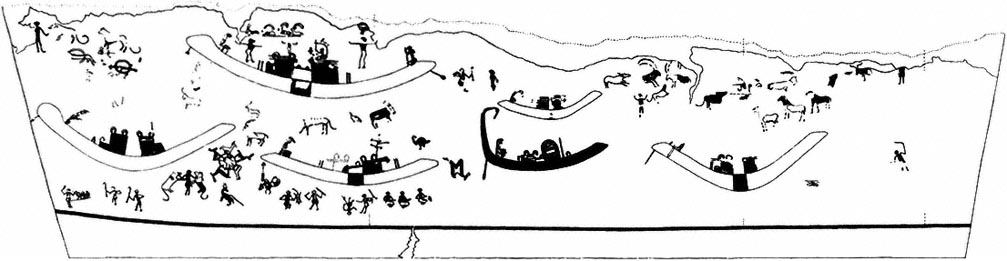
Fig.5.
Painted wall from Decorated Tomb (Tomb 100) at Hierakonpolis, late predynastic (Nagada IIc).
Copy by J. E. Quibell and F. W. Green, Petrie Museum, University College, London.
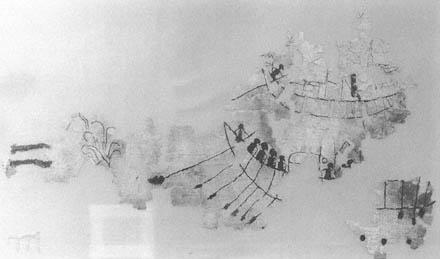
Fig. 4.
Fragment of painted linen from Gebelein, Upper Egypt, late predynastic (Nagada IIc/d).
Courtesy Egyptian Museum, Turin.
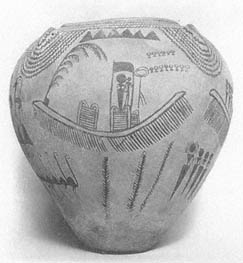
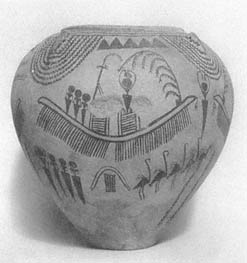
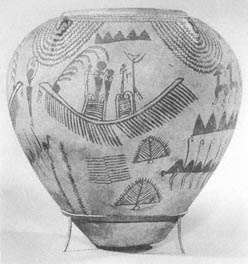
Fig. 6.
Nagada II (Gerzean) Decorated Ware vessel,
probably Nagada IIc/d.
Courtesy Metropolitan Museum of Art, New York.
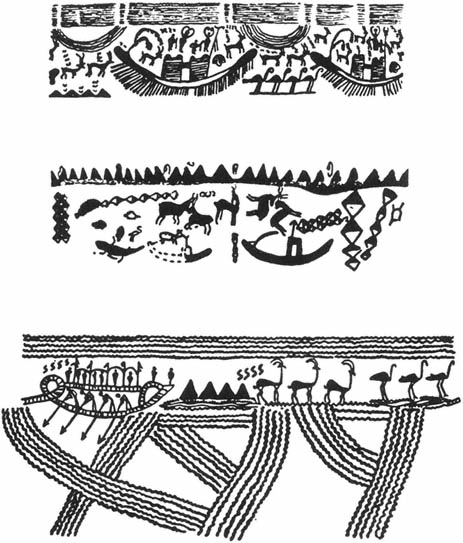
Fig. 7.
Designs on three Nagada II (Gerzean) Decorated Ware vessels.
After Smith 1949.
The small design field was handled by the late prehistoric artist with tremendous virtuosity. For example, on the Brooklyn knife handle, 9.5 cm. long by 5.6 cm. wide (Fig. 8), the sculptor carved ten rows of animal figures on both sides, each presenting ten or more creatures, usually all of the same species, walking in the same direction (storks, lion, cattle, and so on)—nearly three hundred tiny figures in all. Bearing fewer figures, the Pitt-Rivers knife handle, 10-5 cm. long (Fig. 9), the Davis comb, 4 cm. across (Fig. 10), the Gebel el-Tarif knife handle, 9 cm. long (Fig. 20), the Carnarvon knife handle, 5 cm. across (Fig. 23), and several other late prehistoric decorated objects exhibit essentially the same formal organization. At least in the Nagada IIc/d-IIIa period—including the Brooklyn, Pitt-Rivers, Carnarvon, Gebel elTarif, University College (Fig. 21), and Berlin knife handles (Fig. 22) and the Davis comb—no ground lines were used to anchor the rows of figures. The Metropolitan (Fig. 11) and Gebel el-Arak knife handles, dated to the Nagada IIIb—that is, "to the end of the tradition of carved ivory knife handles" (Williams and Logan 1987: 250–51)—also lack ground lines. These latter objects, however, are contemporary with the Narmer Palette (Fig. 38), the Scorpion mace head (Fig. 52), and some of the earlier Hierakonpolis ivories, which do have ground lines.
Despite a number of attempts, no commentator has plausibly explained the late prehistoric artists' selection—an act taking place within what I call the scene of representation—of particular species for inclusion in these images or image-making systems. Georges Bénédite (1918) may have been on the right track in seeing the various animal species as emblems of geographic or social territories in late prehistoric Egypt. Unfortunately his hypothesis is too ad hoc in the details to be fully convincing; although the animals may be territorial emblems, some have no documented associations with localities, shrines, towns, or regions (at least, Bénédite does not provide them), and many of the particular associations that he does suggest rest on anachronisms. Furthermore, even if we could show that every animal species depicted was the emblem of some geographic territory or social group, we have understood only one element of the scene of representation—namely, that representation of geographic or social territories was carried out by way of animal emblems. But the images on the
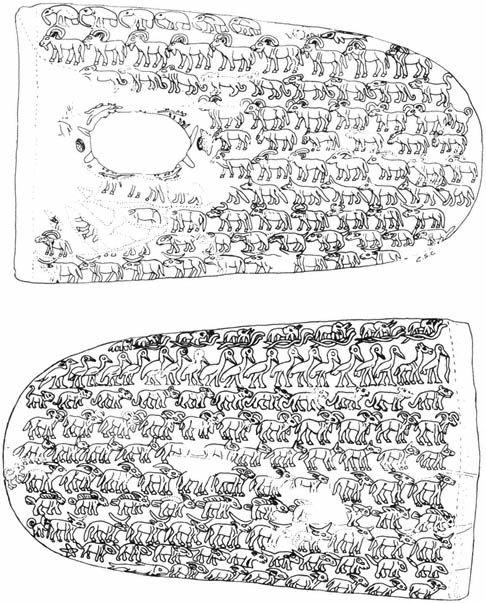
Fig. 8.
Brooklyn handle: carved ivory knife handle from Abu Zeidan, late predynastic (Nagada IIc/d).
Brooklyn Museum. From Needler 1984.
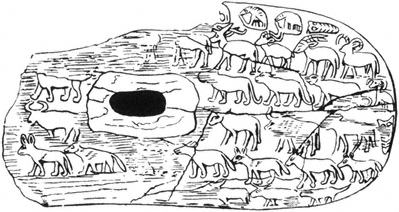
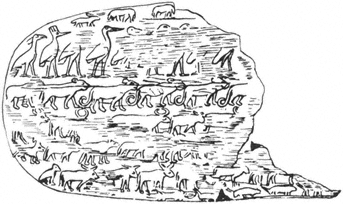
Fig. 9.
Pitt-Rivers handle: carved ivory knife handle, late predynastic (Nagada IIc/d).
Pitt-Rivers Museum, Farnham, Dorset. From Asselberghs 1961.
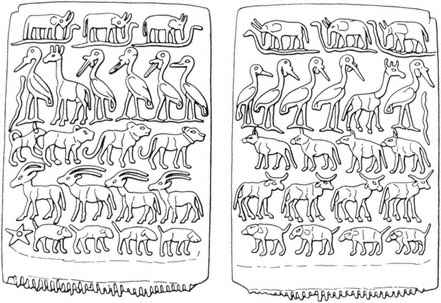
Fig. 10.
Davis comb: carved ivory comb, late predynastic (Nagada IIc/d).
Metropolitan Museum of Art, New York (ex-collection Theodore M. Davis).
From Hayes 1953.
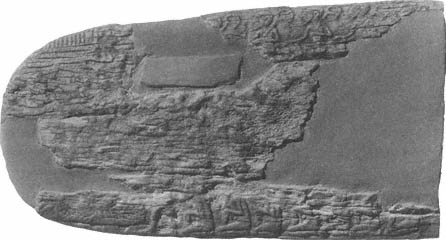
Fig. 11.
Metropolitan handle: carved ivory knife handle, late predynastic (Nagada III?).
Courtesy Metropolitan Museum of Art, New York.
objects make reference to or depict this representation. Why, for example, is there more than one member—often ten or more—of the species, or more than one example of the supposed emblem, depicted in the image? And why are they arranged in long rows filling up all the available space on the field?
If we canvas the surviving artifacts, it seems that all the various domains of the Egyptian natural world make an appearance in the images. We find, for example, fish, stork, and heron associated with the Nile River; cattle associated with the tilled fields and pasturage; badgers and porcupine associated with heavier scrub brush or low forest; dogs associated with the margins of the village; and wild oxen (Bos ), antelope and gazelle species, giraffes, wild dogs (Cape hunting dog) or hyenas(?), jackals, leopards(?), and lions associated with the extant savannah and with the desert steppe.[3] It has often been remarked, however, that some species we might expect to see are not depicted, such as the crocodile or the falcon, both central symbols in later Egyptian mythology and iconography (see Bénédite 1918: 226). As yet, then, it remains unclear what "world" is depicted in the animal-row designs. But the profusion or plurality of individual figures from different species initially suggests an all-encompassing plenitude of nature—in Bénédite's (1918: 2, 234, 236) perceptive words, an excessive multiplicity" or "entirely unabridged representation"—with the quality of a pictorial encyclopedia.
A closer inspection of the designs reveals that the figures are ordered selectively and tightly according to specific "rules" (Bénédite 1918: 235) or to a "very definite conception" (Vandier 1952: 545), perhaps even "a [mental] model the elements of which are scattered" throughout the images made on the entire series of objects (Bénédite 1918: 228). Although a few of Bénédite's (1918) identifications of depicted species are erroneous, and a proper specification of their ordering must sometimes differ slightly from his, we owe to him the most complete description of these rules. Bénédite showed that all figures belonging to one species are confined to the same single row throughout the entire series, except for the cattle (Bos taurus ), which on two examples extend through two rows (Brooklyn and Pitt-Rivers knife handles). A pair of herons always closes the row of storks (Brooklyn, Pitt-Rivers, Carnarvon knife handles; Davis comb); a five-rayed star twice closes the row of badgers (Brooklyn knife handle, flat
side, row 9, left; Davis comb, obverse, row 5, left); rows of carnivores and noncarnivores tend to alternate.[4] No two rows in sequence are carnivores. Lions appear in the third row (Brooklyn and Pitt-Rivers knife handles; Davis comb) and jackals in a lower one.
With somewhat more room available for the design than on the knife handles and small comb, the more complex images on the carved cosmetic palettes bring the carnivores and ruminants directly into relation with one another in scenes of animals being hunted by their predators. The sculptor of the Brooklyn knife handle (Fig. 8) imagined this possibility without fully developing it; small details of his image may be both the conceptual and the historical context for the magnified depictions of the chase, attack, and kill on the palettes. The Brooklyn sculptor closed rows of oryx, cattle, and sheep with an attacking (or herding?) dog (Canis familiaris; flat side, rows 6, 8, left; boss side, row 4, right). Likewise the Carnarvon knife handle (Fig. 23), now greatly abraded, includes a lion pursuing(?) bull oxen (flat side, bottom row, left). The badly preserved boss side of this handle should not be regarded as a row arrangement at all but is more like a hunt scene (it has an anomalous order to be considered shortly). As a third example of a similar detail, there is on the Davis comb (Fig. 10), a dog pursuing(?) the lions (obverse, row 3, left), as on the boss side of the Carnarvon handle (top left corner?). (Apparently because he wants to interpret the dog as "herding," Churcher [1984] incorrectly identifies these clearly leonine creatures as "bovids.")
In addition to its orderly rows with a few anomalous interventions, the "formula" for these images includes three types of groupings—that is, sets of different creatures that invariably accompany one another as a single unit. The first is an elephant trampling on a pair of serpents (pythons?) acting as its ground line (Brooklyn handle, flat side, row 1; Pitt-Rivers handle, flat side, row 1; Carnarvon handle, flat side, row 2, right; Davis comb, both sides, row 1 [the serpent is single]; Seyala scepter [Fig. 24]). The second is a trio consisting of a snake (sand boa), a stork, and a giraffe (Brooklyn handle, flat side, row 2, right; Davis comb, both sides, row 2, left and right; Carnarvon handle, flat side, row 1, right [snake missing]; Seyala scepter [snake missing]; the Pitt-Rivers handle edge, where we would expect to find this motif, is missing). The
third is a vulture plucking at prey (a snake?) grasped in its talons (Brooklyn handle, boss side, row 1; Pitt-Rivers handle, boss side, row 1).[5]
The iconographic import of these groups of linked animals is unknown (see Churcher 1984: 164, 166). The way they appear in the representation, however—exhibiting what Bénédite (1918: 240) called the "jeu d'esprit, " or even the "satiric humor" of the artist—introduces a crucial discontinuity into the uniformity and continuousness of the many rows of identical figures. Driving a wedge, as it were, into the scene, the artist forced apart the neat, "natural" rows of identical animals to insert transnatural representations. These groupings figure and perhaps even denote the artist's power to represent nature in a scene offered as a legible transcription of plenitude merely responding to the constraints of the support. The artist's power is present throughout these images, often unnoticed at first glance. For example, where space to complete a row begins to run out, an anomalous figure is inserted to fill up the available area. Thus the artist maintained the un anomalous order of the overall design, felt first and foremost as an uninterrupted whole plenitude: the viewer does not immediately encounter an interruption or gap in the row because it is subtly, almost surreptitiously revised so as to avoid appearing incomplete or, precisely, as a blank—framing, interrupting, or encroaching on the row of animals as such. On the Brooklyn handle (Fig. 8) two long, thin fish appear where space is tightest (flat side, row 10, left; boss side, row 1, right). Several parallel efforts can be found on the Pitt-Rivers handle (Fig. 9; boss side, row 1, right [fish?]; row 4, right [another species of fish?]; row 3, right [ram?]; flat side, row 1, left [ram?]; bottom row, left [bird]).
Where space on the surface exceeds what is smoothly filled by the rows of figures with their heads, legs, tails, and so on, oriented in particular ways, the artist actively spread the representation into it by interrupting and revising the standard rendition of the animals' bodies. Here again, however, the unanomalous or uninterrupted quality of the whole—presumably, then, as a depiction of a complete plenitude—is preserved by making revisions or inserting anomalies, which have the effect of preventing the encroachment of spatial blanks or gaps on the plenitude. On the Pitt-Rivers handle a ram is inserted at the end of a row of ungulates (boss side, row 2, right) so that its horns can fill up the curve
of the edge. On the Brooklyn handle one lioness's tail points up, rather than down as usual, for the same reason (boss side, row 3, right), a device adopted also on the Carnarvon handle (Fig. 23; boss side, bottom row, right).
These interventions are evidently determined by considerably more than a mundane horror vacui, for at least one anomalous array cannot be explained even in part by such a lowly decorative motivation to fill up the available space. On the Pitt-Rivers handle a gazelle (G. dorcas ?) appears playfully in the middle of the row of oryx (boss side, row 2, fourth from right), where no spatial pressures exist. (Churcher [1984: 167–68] identifies deer, hartebeests, oryx, and Barbary sheep in this row, although it would be more in keeping with the organization of the images to identify only one anomalous creature in the row; the other variations among the figures probably result from chance in drawing and are not significant.)
In sum, the entire design in these works, with its orderly rows, fulfills an ambition to fill the available space for depiction with the represented plenitude—to the extent that representation itself appears absent. The intervention of anomalous and revisionary details in the whole therefore reintroduces the representation that the whole image seems to exclude from the plenitude of nature.
Roughly two hundred years later the canonical artist used a deceptively simple device to organize these neat rows of animals. From the early First Dynasty onward, all figures in the frieze are linked in a continuous band with an underlying ground line (Figs. 12–19).[6] In an intervention already imagined in the anomalous details we have noted in animal-row designs, the canonical artist established his representation as grounded in nature, for the ground line seems to follow along behind or underneath, literally to underline, the preexisting species and numbers, the connections and intervals, of what is naturally there to be represented.
But despite the way it seemed to be advanced as an underlining—a fillip in grounding a legible depiction—like the anomalous details we have noted, the ground line completing a row of animals masked the composing blow creating the very order to be represented. For the ground line of canonical art (Figs. 1, 2) was the skeleton and armature of the entire composition; drawn
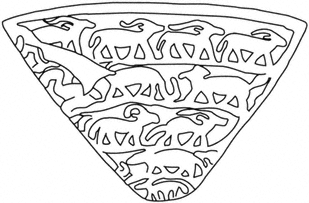
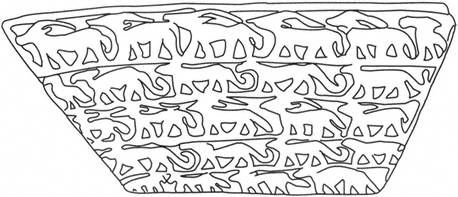
Fig. 12.
Carved ivory spoon from Tarkhan, early First Dynasty. Petrie Museum,
University College, London. After Petrie 1913.
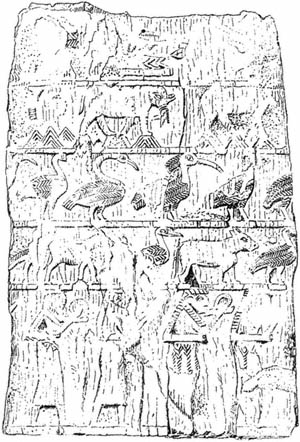
Fig. 13.
Carved ivory plaquette from Hierakonpolis, early First Dynasty(?).
Petrie Museum, University College, London.
From Quibell and Green 1900–1901.
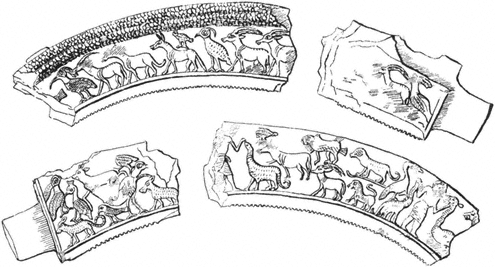
Fig. 14.
Carved ivory rod from Hierakonpolis, early First Dynasty(?).
Petrie Museum, University College, London.
From Quibell and Green 1900–1901.
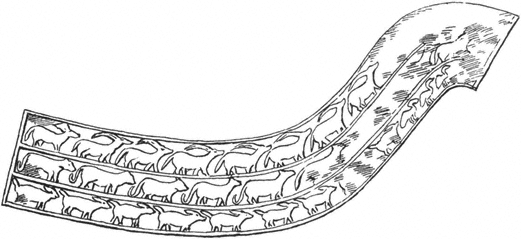
Fig. 15.
Carved ivory tusk from Hierakonpolis, early First Dynasty(?).
Petrie Museum, University College, London.
From Quibell and Green, 1900–1901.
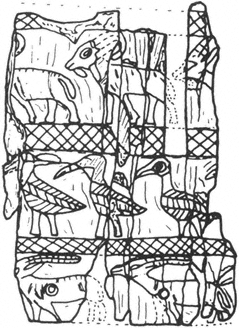
Fig. 16.
Carved ivory plaquette from Hierakonpolis,
early First Dynasty(?).
Petrie Museum, University College, London.
From Adams 1974 by permission of the author.
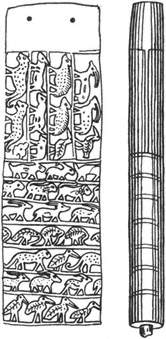
Fig. 17.
Carved ivory tube, early First Dynasty(?).
Egyptian Museum, Berlin. From Scharff 1929.
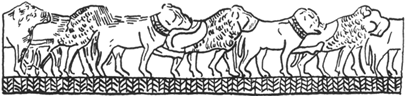
Fig. 18.
Carved steatite scepter head from Hierakonpolis, early First Dynasty.
Petrie Museum, University College, London.
From Quibell and Green 1900–1901.
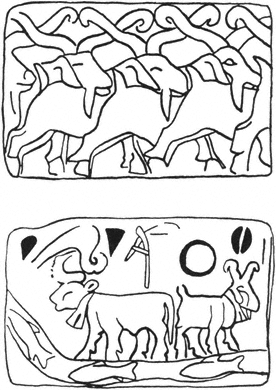
Fig. 19.
Carved shell plaquette, early First Dynasty(?).
Egyptian Museum, Berlin.
From Smith 1949.
first, not last, it was not an underlining at all but an initial and wholly determining ruling .
In other words, the late prehistoric and the canonical scenes of representation-at the one end, the small decorated knife handles and combs of Nagada IIc/d (Figs. 8–10) and, at the other, the compositions of Old Kingdom art (Figs. I, 2)—are divided by a complex revision of image making. As we will see, the human presence will be introduced obliquely into the depicted world of nature, entering from the edge or side. In the scene of representation this human presence is both within depicted nature, setting out to master it, and outside the depiction altogether, setting out to interpret it. From the point of view of represented nature itself, the oblique or curving progress of the human presence is unnatural for it. When the side entrance is provided in the scene of representation with a straight ground line, however, its reality as oblique is masked and its unnaturalness disguised. Although nature is mastered in and by human image making, the image itself produces a fiction of the absence of a masterful interpretation of the world, a fiction of its own grounding in nature rather than the work of representation.