
9—
The Production and Reproduction of Inequality:
A Theoretical Cultural Analysis
Richard Münch
Structures of social inequality are a traditional object of sociological research and theory building and have always received a good deal of attention. In the relatively recent past, empirical studies have been able to provide increasingly subtle insights into the changes occurring in these structures. This makes social inequality a well-researched sociological subject. Yet theoretical explanation has now been left behind by developments in empirical research. In many cases, the same tools that were most used during the 1950s and 1960s are still being bandied about: functionalistic approaches vie with conflict-theoretical ones or some combination of the two is used. However, the development of sociological theory has changed since the 1950s and 1960s. What is lacking is a link between the two developments. To change this latter situation is the purpose of a project upon which this paper reports. The objectives in carrying out the project are as follows:
—To formulate a sociological theory of the production and reproduction of structures of social inequality (by this I also mean the transformation of such structures).
—To formulate ideal-typical models of the various processes in which structures of social inequality are produced and reproduced.
I am grateful to Neil Johnson for his help in translating the German original of this article. Many thanks also to Claudia Flümann and Willy Viehöver for the bibliographical work.
—To clarify the ideal-typical models by taking selected societies as examples.
I begin with the premise that social structures of inequality, in terms of income, power, education, and prestige, are produced, reproduced, and transformed in interaction with the cultural code of a society, which entails the language, values, and norms used in discourses on questions of equality and inequality. This interaction is where culture meets social structure, exerts its influence on it, and is itself influenced by it. The cultural code sets the frame within which structures of inequality are produced, reproduced, and transformed into legitimate ones. The social structure of inequality, which exists at a certain place and time, sets the conditions from which any reproduction and transformation of inequalities starts.
The effects of the cultural code and of the existing social structure of inequality on each other are set in motion and mediated by processes of social interaction, which I differentiate analytically into four basic types according to my interpretation of the Parsonian AGIL-schema as an action space composed of four fields: market exchange (A), political struggle (G), processes of communal association (I), and cultural legitimation (L).[1]
An action space can be construed in terms of the interrelation of two basic elements: symbols (meaning constructions, norms, expressions, cognitions) and actions guided by these symbols. The sphere of symbols can be more or less ordered according to the number and interrelations of symbols: their complexity. The sphere of actions can be more or less ordered according to the number of actions that could possibly occur: their contingency. The complexity of symbols and the contingency of actions vary independently of each other. This makes possible four extreme combinations:
A. Adaptation. Opening of the scope for action. High symbolic complexity and high contingency of actions. In market exchange no limit to the wishes and actions could be imagined.
G. Goal attainment. Specification of the scope for action. High symbolic complexity and low contingency of actions. In political struggle the application of power restricts actions to what is commanded, though an unlimited set of alternatives could be imagined.
I. Integration. Closing of the scope for action. Low symbolic complexity and low contingency of actions. In communal association
the horizon of imagination and the alternatives of action are limited to a self-evident life-world. Within the field of communal association solidarity relationships exert the greatest closing effects on action. Beliefs and life-styles provide for generalization, rites for opening, and cults for specification within the boundaries of the closed life-world of communal association. Generalization is extended by defining the legitimacy of beliefs and lifestyles, opening by the change of associations, and specification by the settling of group conflict.
L. Latent pattern maintenance. Generalization of the scope for action. High symbolic complexity and high contingency of actions. In discursive cultural legitimation a broad set of different actions is subsumed under one single value or a small set of general values.
There are the basic fields of social interaction in which corresponding processes of interaction link the cultural code with existing structures of inequality. The latter are located in the solidarity relationships, the association and dissociation of people in society. The structure of inequality is a structure of solidarity relationships that initially limits access to associations and then to income, power, education, and prestige.
As indicated, this structure of inequality is reproduced and transformed in interaction with the cultural code of society. The latter provides the language for legitimating and delegitimating equality and inequality. Its relation to the structure of inequality is primarily one of symbolization, which is guided by the law of symbolic abstraction. This means that talking about structures of inequality in terms of the language of the cultural code tends toward abstraction in the sense of defining concrete inequalities in more general terms, for example, in terms of general rights to equality instead of particular wishes for equality. The more the reproduction and transformation of structures of inequalities is guided by symbolic abstraction, that is, by a system of general ideas, the more the particular interests will be channeled into the frame of general rights.
In addition to being guided by symbolic abstraction, the reproduction and the transformation of existing structures of inequality are also guided by cultural legitimation according to the law of discursive generalization, by market exchange according to the law of economic achievement, by political struggle according to the law of political accumulation, and by communal association according to the law of inertia and
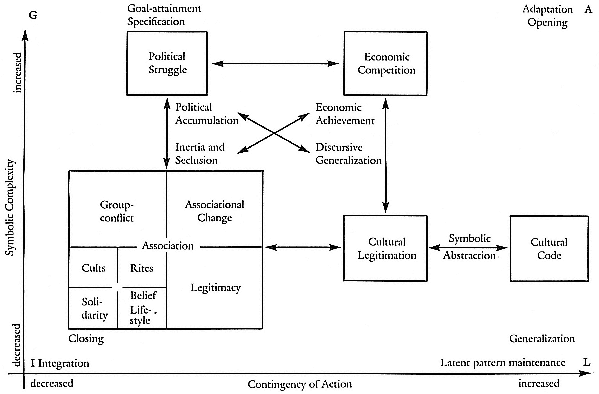
Figure 9.1.
The production and reproduction of structures of inequality.
seclusion. The processes of communal association, political struggle, and market exchange are related to the cultural code via processes of cultural legitimation and symbolic abstraction, which are closest to the cultural code. The processes of symbolic abstraction, cultural legitimation, market exchange, and political struggle are related to social structures of inequality via processes of communal association, which are also closest to the cultural code (see figure 9.1).
Communal association is governed by the law of inertia and by communal exclusiveness:
The more people are linked together in a community, the more they will confine the circle in which they live to that community, and the greater will be the barriers that are reciprocally erected between different self-contained life-circles.
This communal exclusiveness then leads to a corresponding cultural exclusiveness reflected in common cultural symbols, ideas, and lifestyles, in the regular renewal of these via common rituals, and in their orientation to common goals via common cults. In turn, these common symbols, rituals, and cults also contribute to the reproduction of social exclusiveness. If the law of inertia and social exclusiveness were to be the only factor having an effect on society, its structure of classes, strata, social groupings, and social milieu would continually reproduce itself in the same way. This would be a traditionalistically determined society in which nothing ever changed.
The process of market exchange is governed by the law of market success (achievement):
The more people seek economic success and enter into market exchange and competition with one another, the more they will change the circles in which they live to suit changing degrees of success and the lower will be the barriers between different circles.
Because market success is the factor that decides to which life-circle one will belong and because it is a factor relatively prone to change, the membership of different life-circles changes rapidly, but this does not mean a change in the way society is differentiated according to variations in market success. Society is constantly characterized by inequality between those who are more successful and those who are less, yet a person's particular position of success is subject to continual change as long as market success is the only law in operation.
A precondition for the operation of the law of market success, however, is the existence of ideal market conditions, that is, of equal competitive opportunities for all. Yet because in practice market successes can be
converted into advantageous starting positions for the continuing competition, there is a tendency for the successful to form an exclusive circle. This is the law of economic accumulation:
The more success someone has, the more successful he/she will be in future, and the converse for anyone who is less successful, provided that the available resources are deployed optimally.
Despite these conditions, the market is where the greatest mobility is permitted compared with any other social field, because the race to success is run afresh day after day, even if the starting conditions are not actually equal. In comparison with the market sphere, the communal, political, and cultural spheres are characterized by greater inertia, a greater tendency toward persistence, or a slower rate of change.
The process of political struggle is governed by the law of political accumulation:
The more people are determined to reach one particular goal and the more any one individual's actions have consequences for others, the more frequently one person's goal attainment will be at others' expense, or, in other words, the more frequently the various individuals come into conflict and the more frequently they have to mobilize power in order to achieve their aims.
In the event that the goal involved is to attain or retain a relatively high position within society, under these conditions the result will be a political struggle for the higher societal positions. Persons and groups higher up the scale use the power available to them to keep others away from their positions, while persons and groups occupying lower positions mobilize power (by forming coalitions of the relatively weak to confront the strong, for example) in a bid to gain access to the higher positions. Under these conditions, the law of political accumulation comes into effect:
The more power people already possess, the more they are able to augment their power in the political struggle.
Consequently, one can expect structures of social inequality to become proportionately more stable as the powerful become still more powerful and the weak still weaker. This naturally only applies to the extent that social inequality truly is reproduced by political struggle and other laws do not come into play. If the weaker parties make more intelligent use of the power available to them and/or if they form coalitions, they may succeed in overcoming the stronger ones after all. This is the point where changes can be made in social inequality, and these then take the form of revolutionary upheavals and shifts in power.
The process of cultural legitimation is governed by the law of discursive generalization:
The more the allocation of a position is subject to discursive reasoning, the more likely the allocation of a position is considered legitimate only if it is justified by generally valid principles.
Any person's or group's possession of more income, power, cultural competence (in the sense of "authoritativeness"), or prestige than others is no longer taken without question but has to be justified on generally accepted grounds. This means that inequality of income is only counted as legitimate if it flows from a corresponding inequality in achievement. Likewise, inequality of power is only taken to be legitimate if it is necessary for the attainment of common goals, inequality of competence or authoritativeness only if it is based on unequal levels of knowledge, and inequality of prestige only if it derives from the unequal realization of common values. These ideas—the apportionment of income according to achievement, power according to the need for leadership in order to attain common goals, cultural competence according to knowledge, and prestige according to the realization of common values—are the universal ideas through which inequalities need to be justified in modern society.
To the above must be added justification by the idea of equality. In a radical interpretation, this would give all inequalities the taint of illegitimacy. In a less radical view which acknowledges the previous requirements of the unequal allocation of positions, the idea of equality is narrowed down to the idea of equality of opportunity. If income is to be differentiated according to achievement, everyone must then be given an equal chance to achieve. If power is to be differentiated according to the need to attain common goals, everyone should be offered the same chance to be a candidate for the corresponding positions of power. If cultural competence (authoritativeness) is to be attributed with knowledge as the decisive standard, everyone should have the same opportunity to acquire that knowledge. If prestige is to be apportioned in line with the realization of common values, everyone should have the same opportunity to participate in realizing those values. In this sense, the effect of the compulsion to legitimate social inequality in modern society is the dismantling of inequalities of opportunity. This must not be confused with dismantling social inequality itself. It does not change the differentials in income, power, cultural competence, or prestige in the slightest. Moreover, the pressure of legitimation working toward reducing inequality of
opportunity need not necessarily or immediately signify any actual reduction in such inequality. The wrong measures are often taken, and many attempts fall short of the goal or lose their effectiveness over time because the other sets of laws—the laws of inertia and social exclusiveness, of market success, and of political accumulation—act as countervailing forces to the equality of opportunity. However, this in its turn does not mean that the law of discursive generalization remains completely ineffective. Had it not exerted its effects, we would still be in a pre-Enlightenment society in which traditionally established inequalities of opportunity would be taken as self-evident. Modern society can at least be distinguished from such a situation insofar as inequality of opportunity now bears a stigma of illegitimacy.
The four laws discussed above that govern the production and reproduction of social inequality are ranked with different priorities in different societies and are combined in different ways. This gives rise to a complex structure composed of both basic laws and derived laws resulting from combinations of these laws. For example, in the struggle between classes and strata, the law of political accumulation combines with the law of inertia and social exclusiveness, whereas in the struggle for legitimation the former law combines with that of discursive generalization, and in the competitive struggle it combines with that of market success.
The four basic laws dominate to different degrees in different societies, taking the lead from and working in conjunction with the remaining basic laws in each case. That is, no society is determined exclusively by the working of one law; rather, a society is determined by a set of laws interrelated in a specific ranking. The ranking of laws may change during the historical development of a society. However, if we contrast societies to each other, then we may discern the primary effects of a specific leading law and the secondary effects of the other laws in a specific rank order in particular societies over the period of historical development since the onset of industrialization. In the following section, I illustrate the workings and interrelationships of the above laws with an example of the development of structures of inequality in German society since the nineteenth century, when the basic formation of its cultural code and social structure and their unique interrelationship took shape.
In doing so, I briefly describe the cultural code that underlies the structure of inequality and that, via the value conceptions and the language it embraces, represents the basis for processes that legitimate social inequality. Then follows a description of the structure of inequal-
ity and the symbols and life-styles, rituals and cults belonging to it, this being complemented by an identification of the unique characteristics of the legitimacy, change, and conflict associated with that structure of inequality. Finally, the structure and its unique characteristics are explained with reference to one particular law and the interplay between it and the other laws.[2]
A Historical Illustration:
German Society
The cultural code of German society took shape during the nineteenth century under the leadership of the cultured, educated middle class (Bildungsbürgertum ), comprising professors, teachers, and clergy, and its alliance with the state.[3] In this process, three ideas took on an especially significant role: the classical idea of education, the idea of a person's office, and the idea of synthesis, the latter two as an attempt to close the split between established bourgeois society and industrial society and as a specific form in which the postulate of equality established during the Enlightenment could be realized. Social rank is determined by the type and level of education people have received and the level of responsibility attached to the offices people hold within society. The differentiation of society into classes, strata, and groups is supposed to be overcome by a synthesis that leads to a new unity. Hegel saw this synthesis embodied in the state, Marx saw it in Communist society, the revisionists saw it in the social welfare state (Sozialstaat ), and the National Socialists saw it in the popular state (Volksstaat ). Following World War II, the role of synthesis has been played by the concepts of the social market economy, the leveled middle-class society and affluence for all.
By tradition, the structure of inequality in German society is characterized primarily by the differentiation of classes and status groups according to the type and level of education they have received.[4] In accordance with this tradition, which dates back to the nineteenth century, it has never been possible for those rising socially through economic or political success to claim the same legitimacy as those rising by way of education. The second traditional criterion for the allocation of status is the vesting of a person with an "office." The closer this office is located to the center of the state, the higher its rank. In the nineteenth century, the alliance between the cultured, educated middle class and
the state allowed the well-read professor, the grammar school (Gymnasium ) teacher, the pastor, lawyer or doctor, the civil servant, and the officer to emerge as and to remain for a long period the best respected status groups. In contrast, the classes and strata belonging to the business, industry, technology, and agriculture spheres were valued unfavorably because they possessed neither a classical education nor any kind of office. Officialdom itself is again differentiated according to the level of education attained, the categories being top-level, senior, middle-level, and junior officials. From the 1870s on, however, the alliance between heavy industry and the state, together with the overall economic and political ascendancy of the commercial, industrial, and technical strata, began to question the claims to higher status of the Bildungsbürgertum and officialdom, creating a situation of status insecurity.
In the postwar period, the flourishing of material consumption has encouraged the social advancement of higher-earning commercial, industrial, and technical strata.[5] Status today is no longer acquired solely via education or tenure of office, but it is also a function of the food, dress, living accommodations, furniture, automobiles, and vacations that people can afford. In this sense, society in West Germany has moved closest—among the European societies—to the principle of market success and the demonstrative consumption this implies, and hence it has also achieved the closest resemblance to U.S. society. In this situation, we see the traditional apportionment of status via education and office tenure existing side by side with the apportionment of status according to economic success and demonstrative consumption.
That is not to say, then, that the criterion of education has become totally insignificant. Rather, it also has penetrated the commercial and industrial strata as they have grown in importance and it determines internal differentiation within these strata. Training and academic certificates also determine social status here: occupational schools, technical schools, and technical degree colleges, together with advanced training and informational courses of all kinds, ensure that members of these strata are better trained and qualified than ever.
The manual working population, too, is typically divided into groups of unskilled, semiskilled, and skilled workers. Both trends—the greater significance of qualification in training overall and the constant increase in the level of consumption—have led to the traditional differentiation of society being replaced by a society in which the large majority of households can participate both in a relatively high level of consumption and in a constantly rising level of education and training. In comparison with
other Western European countries, Germany exhibits the least hierarchical differentiation of society. Status is granted according to four criteria, with the first two increasingly pushed into the background by the latter two: (1) classical education before technical training, (2) civil service or "official" positions placed before self-employed, employees, and workers, (3) level of qualification within one's occupation, including technical training, and (4) level of consumption.
As more and more households attain relatively high levels of training and consumption, the society increasingly corresponds to what Schelsky termed the leveled middle-class society (nivellierte Mittelstandsgesellschaft ).[6] This would appear to be the synthesis that has always been sought in Germany. It is now a society with a highly diffuse social structure in which, as a result of the change in criteria for the apportionment of status, one no longer really knows who belongs where. The place of collective groupings on different levels of rank is taken instead by individual destinies: factors such as occupational or economic failure, illness, divorce or separation, and unemployment influence the course of life far more than social stratum class does. A broadly cast center is taking shape that includes all those able to participate in consumption and education or training. It is surrounded by a periphery of marginal groups either unwilling or unable to participate in consumption and/or education and training. The term the two-thirds society has been coined to depict this situation.[7]
The same diffusivity found in the overall social edifice also characterizes general attitudes to life and life-styles. Whereas one might traditionally have relied on a clear differentiation between attitudes to life and life-styles, the lines have become increasingly blurred over time. The pride taken by the government official in serving the state, by the Bildungsbürgertum in its level of education, by the self-employed in their independence, by white-collar employees in the services they provide, by the industrial and technical strata in the usefulness of their work, by manual workers in the value of their physical effort, and by farmers in their tilling of the soil has since given way to an overall relativizing of these values and to efforts, regardless of the stratum to which one belongs, to reach a satisfying level of education or training, to work with a likeable team of people, and to enjoy a good life with time for consumption, vacations, and leisure activities. The same is true of the interpretational patterns with which people view society. The workers' dichotomous view of society is blurred by the diffuse notion that they, too, can join in the general process of consumption. Anyone who can
afford the things that all others can afford will not have the feeling of being near the bottom of any social scale.[8]
Life-styles have converged to a tremendous extent, primarily because of the general improvement in education and income levels. This emerging cult of upgraded consumption may seem surprising for those who know Germany from its traditional class hierarchy. However, tremendous changes have occurred that began in the fifties and attained a very high level in the eighties. The recent literature on consumption styles and the "individualization" of life chances now pays overwhelming attention to this development.[9]
It is now so thoroughly widespread for people to participate in consumption of more "luxurious" goods and services—the home itself, household appliances, furniture, television, stereos, videos, personal computers, automobiles, good food, clothing, entertainment, sporting activities, vacations, and so on—that hardly any difference is visible between the household of a skilled worker couple, who between them may have monthly earnings of about DM 6,000, and the households of teachers, clergy, professors, business people, technicians, and engineers, for their disposable income will frequently not be so much higher. All of these groups share the same pleasure in consuming semiluxury and luxury goods.[10] Those who are unable to participate in this celebration of consumption are students, young trainees and apprentices, senior citizens with low pensions, those dependent on social assistance, low-income families with a single earner, the unemployed, and those who have consciously chosen an alternative, less materialistic life-style. These are the marginal groups who are unable or, in some cases, unwilling to be included in the overall celebration of consumption.[11] On the other hand, the ideals of high culture have also become part of widespread demonstrative consumption. Wherever they do still fulfill a demarcating function, they represent the life-style of marginal academics who are no longer able to claim any higher status for their love of literature, theater, or art. Therefore, there is no longer a hierarchical differentiation of value attitudes, worldviews, and life-styles, but there is the dominance of one broad and central complex of relatively luxurious consumption and a narrow periphery of marginal groups comprising poor and/or nonconforming people. This peculiar quality of value attitudes, worldviews, and life-styles has feedback effects on the apportionment of status. An ever-broader center develops when the internal differentiation of status becomes less pronounced because everyone has a similar opportunity to participate in education and consumption. Marginal groups
remain excluded and, because they abstain from consumption either intentionally or unintentionally, are denied the status of belonging by the two-thirds majority.
An examination of the rituals that serve to renew the social structure shows developments similar to those that can be observed among value attitudes, worldviews, and life-styles. The tradition dating back to the nineteenth century gave rise to numerous rituals for the inward unification and outward demarcation of social classes, strata, and groups. A visit to the theater, the opera, or a classical concert, eating in restaurants, shopping in large stores, playing golf or tennis, riding, playing football, going on vacation, dinner parties—these are all activities in which particular classes, strata, or groups would stay among their own kind. In this sense, they did represent rituals of inward unification and outward demarcation. Though it is still possible to observe these rites today, they are on the decline. Engaging in these activities more frequently involves stepping beyond the confines of one's own class, stratum, or group. They are less often reserved for members of any particular class, stratum, or group, which in turn means that they rarely can function as demarcation rituals. Instead, they tend to serve as rituals of unification across a broader front. Other rituals in which class, stratum, or group boundaries are unknown can be added, such as strolling down the shopping streets and visiting a supermarket or shopping complex.[12] This decline in demarcation rituals, coupled with a simultaneous increase in rituals of unification beyond class, stratum, or group boundaries, is a development stemming from the changes in social structure, but it also has a positive feedback effect on those changes toward increasing diffusivity in the social structure. Traditionally, rituals of synthesis have made a decisive contribution to unification independent of class, stratum, or group, including large-scale events such as the German Festival of Gymnastics, the biannual national congress in the Lutheran church, choral festivals, and carnival processions in the main Rhineland centers. All of these events are open to anyone to take part.
Cults lend a specific identity to classes, strata, and groups, and to society as a whole. The cult that has traditionally fulfilled this function is that of education. Abitur ceremonies (the highest examination in secondary education), master's ceremonies in the craft trades, and graduation ceremonies of whatever kind publicly document the identity of the corresponding educational stratum. The modern cult is that of semiluxurious and luxurious consumption. To belong, it is essential to join in this cult. By this means, the vast majority of the population confirms
its membership not in any particular stratum, but in the mainstream, the center of society.
The traditional basis for the legitimacy of the structure of inequality described was the unequal distribution of educational certificates. Given this tradition, any status differential has to be justifiable in terms of different educational levels. Anyone with a poor education attaining a higher position or earning a higher income, or conversely anyone well educated taking up a low position or earning very little, will awaken doubts as to his or her legitimacy. This criterion for legitimacy has been accompanied increasingly by the criterion of participation in semiluxurious or luxurious consumption. The latter is normally a precondition for attaining prestige in the neighborhood.
In light of the idea of equality, the legitimacy of unequal access to educational institutions has increasingly been questioned. This situation, combined with a widespread desire for advancement, has led to a tremendous increase in the number of people with advanced educational qualifications. Hence, we are a little closer to the synthesis we had always dreamed of now that the number of higher educational qualifications has grown, but there has also been a counteracting consequence: the traditional link between a high degree of educational qualification and a higher status is being loosened. There is a growing number of people who, although they have achieved advanced educational qualifications, have not attained any higher status. This phenomenon is felt to represent, and is criticized as, status inconsistency and gives rise to doubts as to the legitimacy of existing status differentiation in light of traditional ideas. Yet as these developments continue, the old idea of status being accorded in terms of educational qualification will be undermined. Together with the general increase in the level of consumption, the vast number of people with advanced educational qualifications is leading to the differentiation of status being broken down in its entirety. The market, and hence the short-term allocation of status and income, is gradually replacing the long-term allocation of the two on the basis of having attained a given level of education.[13]
Traditionally, people's association in neighborhoods, political communities, and group leisure activities was differentiated along class and status-group lines. Accordingly, the cities are divided into workers' neighborhoods and those for the middle and upper strata. However, this picture has been substantially changed by the enormous growth in residential areas on the edges of the cities and outside the cities altogether. The groups mix together to a far higher degree in these new
residential areas. Business people, various grades of white-collar employees or civil servants, and skilled workers all live next door to each other. The same can be increasingly said of sporting and other leisure activities. Thus, there is an increase in the number of associations that form as a result of the coincidental convergence of private interests and private decisions, and these associations accordingly introduce a greater dynamism into the structure of classes, strata, and groups and act as a countervailing force to the traditional differentiation of associations along status lines.[14]
Beginning with social legislation enacted during Bismarck's time, attempts have been made to solve the conflict between classes, strata, and groups by achieving a synthesis. However, Bismarck's policy of persecuting the socialists prevented the inclusion of the working class into society. Following the approaches to inclusion made during the Weimar Republic, which granted the Social Democrats access to government, and by the National Socialists, with the synthesis inherent in their idea of the popular state (Volksstaat ), the inclusion of working people has progressed further in the Federal Republic of Germany, with the development of the social welfare state and the idea of social partnership, than in most comparable industrial nations. The class struggle has been displaced by class synthesis on a scale that surpasses even the dreams of the revisionists within the early socialist movement.[15] Together with the synthesis achieved by the welfare state and social partnership, the continual increase in the number of advanced educational qualifications has led to a growing educational synthesis. The decline in individual attachment to class or stratum and the traditionally high value placed on education indicate that more and more people have set out to gain a higher level of educational qualifications. As a consequence, competition to gain better occupational positions is greatly intensified. Even to belong to the center that comprises those able to participate in more luxurious consumption, it is absolutely essential to strive for higher educational qualifications. The traditional class struggle has long since been displaced by a universal struggle for educational and training certificates and for the qualified jobs that have now become so scarce. Traditionally, the three-class secondary education system—comprised of the Hauptschule, which is the most elementary form of secondary schooling, the Realschule, which provides a more thorough preparation for technical and practical careers, and the Gymnasium, with its classical academic education to prepare future university students—had the effect of securing the perpetuation of the old hierarchical status
differentiation because family background exerts a major influence on students' success at school at the age of eleven years, when pupils are allocated to the various types of secondary schools. With the broadening of access to the Realschule, the Gymnasium, and later to universities and other institutions of further education, this tradition has been counteracted, but one consequence has undoubtedly been intensified competition in the labor market and a corresponding devaluation of advanced educational qualifications as a prerequisite to higher-placed careers. The struggle to gain educational qualifications and then qualified jobs is something that embraces the whole of society.
The law that primarily explains the production and reproduction of the structure of social inequality described above and its specific hallmarks is the law of discursive generalization. This law states that discourse on the legitimacy of social structures leads to a process in which the ideas underlying those structures are increasingly generalized, and this gives rise to increasing pressure on social structures to approach the more comprehensively interpreted ideas. Since the establishment of the alliance between the Bildungsbürgertum and the state in the nineteenth century, the ideas that have been used as a standard against which to measure structures of inequality in Germany are those of education and the holding of an "office." These ideas were used in societal discourse to justify social status. In light of these ideas it is only when there is a congruence between education and the responsibilities of office on the one hand and cultural competence (authoritativeness), power, income, and prestige on the other that this can be considered legitimate.
The Bildungsbürgertum's alliance with the state gave these ideas and the discourse associated with them such a priority that they decisively influenced the approach of the entire social structure during the nineteenth century as to what was conceived to be an ideal hierarchy of education and office. However, the economic and political ascendancy of the commercial, industrial, and technical strata, as well as the working class, also gave the value attitudes of these strata and classes a place in societal discourse. This meant that increasing significance was attached to the usefulness of education and material consumption when it came to the legitimation of status differentials. Advanced education in the classical sense then had to compete with the most varied, utility-oriented educational qualifications and could no longer claim higher status as a right. In this way, the understanding of education became discursively generalized: whereas education was traditionally under-
stood in terms of classical education, it currently embraces everything from training received by skilled workers via the master's certificate and various technical schools and college diplomas to university degrees. Insofar as any hierarchy is still visible in this spectrum, it would appear to be a relic of classical education's traditional claim to élite status. However, this tradition has been so revised that society no longer has the appearance of being clearly divided according to an educational hierarchy, but it now contains a diffuse complex of improved educational qualifications that represent a broad center from which marginal groups without such qualifications are set apart.
Another effect of discursive generalization derives from the idea of equality as interpreted during the French Revolution, which was understood as a form of synthesis in nineteenth-century Germany and, hence, as a solution to the division of society into classes, strata, and groups. The idea of synthesis was in accordance with the worldview of an educated stratum allied with the state. Thus Hegel saw a synthesis of society's dissipation into particularized interests as being achievable by pledging the state to the general good. Through various stages of development, this idea of synthesis has retained its significance. It is possible to see the synthesis of present-day society in the constant broadening of education and in the integration of many educational qualifications into a more general understanding of the term education . A wider interpretation of the postulate of equality requires that the entire population be involved via a comprehensive concept of education.
The law of discursive generalization exerts strong pressure to change upon the structure of classes, strata, and groups, and it restricts the effectiveness of the law of inertia and social exclusiveness. The social structure began by developing a hierarchy of education and office tenure in the nineteenth century, which was later displaced more and more in the current century, especially since 1945, by a societal pattern in which a broad center where all kinds of educational qualifications exist is surrounded by a narrow periphery where the level of education is low. The consolidation of the hierarchy of education and of office tenure in the nineteenth century was made possible by the secondary role played by the law of inertia and social exclusiveness. The different educational levels formed delineated social milieus, each with its own type of school. Later on, however, the law of inertia and social exclusiveness was increasingly pushed into the background. While the hierarchy of education and office tenure is still supported by delineated value attitudes,
worldviews, life-styles, rites, and cults, these are now being increasingly replaced by ones that at least embrace society's broad center.
The combination of the law of discursive generalization with that of market success has made a major contribution to the change from a society of education to one of both education and consumption. Through the commercial and industrial strata, material consumption has been admitted to the cultural horizon of values. This trend has evolved into the principle of "affluence for everyone" by the process of discursive generalization. Accordingly, a unique, generally high level of consumption has developed in Germany. Moreover, the higher value now placed upon market success has been accompanied by the trend for associations to form on the basis of individual interests rather than on the basis of any collectivity to which those individuals might belong. Because it is more and more usual to choose one's companions according to one's current interests, changes in the overall edifice of the social structure are being infused with a growing dynamism.
In conjunction with political processes, the law of discursive generalization has assigned to the state the task of bringing peace to the class struggle by removing class distinctions. Typical of the ideas with which this synthesis has been expressed are those of the Kulturstaat (Kultur in the sense not only of "culture" but also of education), the Rechtsstaat (state of law and justice), and the Sozialstaat (state of social welfare). To the extent that these ideas have been successfully realized, the law of political accumulation has been relegated to its proper place. The apportionment and deployment of power are only determined by the law of political accumulation within the limits marked by the above types of order. Now that the social welfare state and the concept of social partnership in industry have been developed, the class struggle has been led into peaceful channels governed by annual negotiations over pay and conditions. The broadened access to advanced education and the overall increase in the level of educational qualification have replaced the class struggle by a universal struggle to obtain educational certificates.
This chapter was written during a time when German reunification was inconceivable. Reunified Germany is now struggling with a new type of inequality between the affluent western Germans and the poorer eastern Germans. The country is attempting to correct this inequality as soon as possible. Such rapid transformation produces new strains and conflicts, which display an overall tendency toward the model of market success. This transformation, however, is an entirely different subject matter and is not elaborated on here.
References
Abelshauser, W. 1987. Die langen Fünfziger Jahre. Wirtschaft und Gesellschaft der Bundesrepublik Deutschland 1949-1966. Düsseldorf: Schwann.
Beck, U. 1983. "Jenseits von Stand und Klasse? Soziale Ungleichheit, gesellschaftliche Individualisierungsprozesse und die Entstehung neuer sozialer Formationen und Identitäten." In Soziale Ungleichheiten. Soziale Welt , special issue 2, edited by R. Kreckel, 35-74. Göttingen: Schwartz.
———, 1986. Risikogesellschaft. Auf dem Weg in eine andere Moderne. Frankfurt am Main: Suhrkamp.
Blossfeld, H. P. 1983. "Höherqualifizierung und Verdrängung--Konsequenzen der Bildungsexpansion in den siebziger Jahren." In Beschäftigungssystem im gesellschaftlichen Wandel , edited by M. Haller and W. Müller, 184-240. Frankfurt: Campus.
Bolder, A. 1978. Bildungsentscheidungen im Arbeitermilieu. Frankfurt and New York: Campus.
Bolte, K. M., and S. Hradil. 1984. Soziale Ungleichheit in der Bundesrepublik Deutschland. Opladen: Westdeutscher Verlag.
Dahrendorf, R. 1963. Bildung ist Bürgerrecht. Hamburg: Nannen.
———. 1965. Gesellschaft und Demokratie in Deutschland. Munich: Piper.
Datzer, R. 1981. Urlaubsreisen 1980. Starnberg: Studienkreis für Tourismus.
Erd, R. 1978. Verrechtlichung industrieller Konflikte. Normative Rahmen-bedingungen des dualen Systems der Interessenvertretung. Frankfurt and New York: Campus.
Eurich, C., and G. Würzberg. 1983. 30 Jahre Fernsehalltag. Wie das Fernsehen unser Leben verändert hat. Reinbek and Hamburg: Rowohlt.
Franz, H. W., W. Kruse, and H. G. Rolff, eds. 1986. Neue alte soziale Ungleichheiten. Berichte zur sozialen Lage in der Bundesrepublik. Opladen: Westdeutscher Verlag.
Frevert, U. 1986. Frauen-Geschichte. Zwischen bürgerlicher Verbesserung und neuer Weiblichkeit. Frankfurt: Suhrkamp.
Glaser, H. 1986. Kulturgeschichte der Bundesrepublik Deutschland. Zwischen Grundgesetz und grosser Koalition 1949-1967. Munich and Vienna: Hanser.
Handl, J., K. U. Mayer, and W. W. Müller. 1977. Klassenlagen und Sozialstruktur. Frankfurt and New York: Campus.
Hardach, G. 1985. "Die Wirtschaftsentwicklung der fünfziger Jahre. Restauration und Wirtschaftswunder." In Die Füfziger Jahre. Beiträge zu Politik und Kultur, edited by D. Baensch, 57ff. Tübingen: Narr.
Hauser, R., H. Cremer-Schäfer, and U. Nouvertne. 1981. Armut, Niedrig-
einkommen und Unterversorgung in der Bundesrepublik Deutschland. Frankfurt: Campus.
Hradil, S. 1983. "Die Ungleichheit der 'Sozialen Lage.'" In Soziale Ungleichheiten. Soziale Welt, special issue 2, edited by R. Kreckel, 101-118. Göttingen: Schwartz.
Kleining, G. 1975. "Soziale Mobilität in der Bundesrepublik Deutschland. Part 2. Status und Prestigemobilität." Kölner Zeitschrift für Soziologie und Sozialpsychologie 27:273-292.
Klemm, K., and H. G. Rolff. 1986. "Ungleichheit der Bildungschancen in Schule und Hochschule." In Neue alte Ungleichheiten, edited by H. W. Franz, W. Kruse, and H. G. Rolff, 249-261. Opladen: Westdeutscher Verlag.
Klingemann, H. D. 1984. "Soziale Lagerung, Schichtbewußtsein und politisches Verhalten. Die Arbeiterschaft in der Bundesrepublik im historischen und internationalen Vergleich." In Das Ende der Arbeiterbewegung in Deutschland, edited by R. Ebbinghausen and F. Tiemann, 593-621. Opladen: Westdeutscher Verlag.
Knilli, F., ed. 1972. Die Uterhaltung der deutschen Fernsehfamilie. Ideologiekritische Kurzanalysen von Serien. Munich: Hanser.
Kreikebaum, H., and G. Rinsche. 1961. Das Prestigemotiv in Konsum und Investition. Berlin: Duncker & Humblot.
Krieger, L. 1957. The German Idea of Freedom: History of a Political Tradition. Boston: Beacon Press.
Kudera, W., K. Ruff, and R. Schmidt. 1982. "Soziale Lage und Bewußtsein von Arbeitern." In Einführung in die Arbeits und Industriesoziologie, edited by W. Littek, W. Rammert, and G. Wachtler, 269-283. New York: Campus.
Kührt, P. 1982. Das Armutssyndrom. Die Entstehung und Verfestigung von Sozialhilfebedürftigkeit in der Bundesrepublik Deutschland. Weinheim and Basel: Beltz.
Lepsius, M. R. 1974. "Sozialstruktur und soziale Schichtung in der Bundesrepublik." In Die zweite Republik, edited by R. Löwenthal and H. P. Schwartz, 263-288. Stuttgart: Seewald.
———. 1978. "Soziale Ungleichheit und Klassenstrukturen in der Bundesrepublik Deutschland." In Klassen in der europäischen Sozialgeschichte, edited by H. U. Wehler, 166-209. Göttingen: Vandenhoek & Ruprecht.
Maase, K. 1983. "Freizeit." In Die Bundesrepublik Deutschland. Geschichte in drei Bänden . Vol. 2, Gesellschaft, edited by W. Benz, 209-233. Frankfurt: Fischer.
Mooser, J. 1983. "Die Auflösung proletarischer Milieus. Klassenbindung und Individualisierung vom Kaiserreich bis in die Bundesrepublik Deutschland." Soziale Welt 34:270-306.
Müller, W., A. Willms, and J. Handl, 1983. Strukturwandel der Frauenarbeit 1890-1980. Frankfurt: Campus.
Müller-Jentsch, W. 1986. Soziologie der industriellen Beziehungen. Frankfurt and New York: Campus.
Münch, R. 1986. Die Kultur der Moderne. Vol. 1, Ihre Grundlagen und ihre
Entwicklung in England und in Amerika. Vol. 2, Ihre Entwicklung in Frankreich und Deutschland . Frankfurt: Suhrkamp.
———. 1987. Theory of Action. Toward a New Synthesis Going beyond Parsons. London and New York: Routledge.
———. 1988. Understanding Modernity. Toward a New Perspective Going beyond Durkheim and Weber. London and New York: Routledge.
Niethammer, L., ed. 1979. Wohnen im Wandel. Beiträge zur Geschichte des Alltags in der bürgerlichen Gesellschaft. Wuppertal: Hammer.
Pappi, F. U. 1978. "Sozialer Status und Konsumstil. Eine Fallstudie zur Wohnzimmereinrichtung." Kölner Zeitschrift für Soziologie und Sozialpsychologie 30:87-115.
Picht, G. 1964. Die deutsche Bildungskatastrophe. Freiburg: Walter.
Plessner, H. 1959. Die verspätete Nation. Stuttgart: Kohlhammer.
Ringer, F. 1969. The Decline of the German Mandarins. The German Academic Community, 1890-1933. Cambridge, Mass.: Harvard University Press.
Roth, J. 1979. Armut in der Bundesrepublik. Reinbek and Hamburg: Rowohlt.
Schäfers, B. 1985. Sozialstruktur und Wandel der Bundesrepublik Deutschland. Stuttgart: Enke.
Thränhardt, D. 1986. Geschichte der Bundesrepublik Deutschland. Frankfurt: Suhrkamp.
Uffelmann, U. 1982. "Wirtschaft und Gesellschaft in der Gründungsphase der Bundesrepublik Deutschland." Aus Politik und Zeitgeschichte 1-2:3-27.
Weymar, T. 1983. "Ein Volk auf Achse." Wechselwirkungen 19:25.
Wilensky, H.L. 1986. "Wird ökonomische Ungleichheit durch staatliches Handeln reduziert? Eine international vergleichende Analyse." In Soziale Ungleichheit und Sozialpolitik. Legitimation, Wirkung, Programmatik, edited by J. Krüger and H. Strasser, 143-169. Regensburg: Transfer.