
Array Operation in the 1980s
The hallmark of array seismology is the intimate link between research progress and easy access to data of superior quality. In the 1980s, with research emphasis on observations in the local (0–10°) and regional (10–30°) distance ranges, array observations from the 1960s and 1970s were not adequate in bandwidth or dynamic range. The very first step was, naturally, to reexamine the array concept vis-à-vis high-frequency seismic signals at relatively short distances. Basic data for this problem were easy to obtain, at least in the case of NORSAR, by using the existing cable infrastructure. That is, a subarray could easily be reconfigured to sensor spacings ranging from 100 to 1,200 m without costly field work. The analysis of these and similar observations focused upon parameters critical for array design, namely, noise and signal levels and spatial noise and signal correlations as functions of frequency. The most significant results were that the noise level outside the microseismic band of 0.5–2.5 Hz decreased at a rate of about f–4 up to about 10 Hz, and that the noise correlation function exhibited negative values of around 0.05 to 0.15 at certain station separations. Furthermore, for local and regional phases, the signal-to-noise ratios peaked in the 3–8 Hz band, while signal correlation decreased rapidly beyond 6–8 Hz. These noise and signal characteristics were built into the design of the new regional array NORESS (fig. 6) in that not all array elements were used because the close spacing of A- and B-ring elements would otherwise have entailed partly positive, that is, constructive, noise interference. For details see Mykkeltveit et al. (1983), Ingate et al. (1985), Bungum et al. (1985), and the NORSAR Semiannual Technical Summaries (editor L. B. Loughran, NORSAR).
As mentioned above, the NORESS design is aimed at optimizing signal-detection capabilities, but the penalty is a certain lack of spatial resolution, which naturally affects the array's event location capabilities (see Harris, 1982; Ruud et al., 1988). Even the much larger NORSAR and LASA arrays were not well suited for precise locations using standard epicenter estimation techniques. Using two arrays jointly for event locations would, of course, improve performance (Jordan and Sverdrup, 1981), but significant progress here would depend on the ability to extract more information from the array records. An interesting development in this context is the deployment of an additional regional array, ARCESS, in northern Norway (Karasjok, operational in October 1987), planned to be operated in tandem with NORESS for exploring expert system techniques to realize these goals.
The success of NORESS and the general availability of relatively cheap digital data technology have led to a revival of array research programs in several countries, notably Australia, Canada, Germany, UK, and Sweden. Such arrays, with apertures mostly 10 to 30 km, are somewhat larger than NORESS, but the research problems are much the same, with an emphasis on automated operation and interactive analysis workstation design.
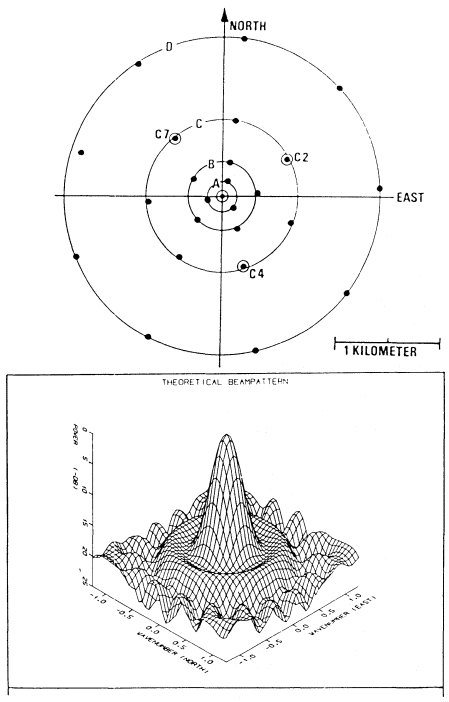
Figure 6
The NORESS array located near NORSAR site 06C (fig. 3). Three-component
stations are marked by small circles. The center vault also contains a Geotech
KS-36000-04 broadband bore-hole seismometer and a high-gain high-frequency
(125-Hz) three-component seismometer. The array response in the f -k domain
is also shown; contour levels are in dB down from the maximum.
Not only classical array seismology has benefited from recent advances in the fields of microcomputers and telecommunications. The same technology can easily be adapted to single-site three-component station operations, and of particular interest here is the development of flexible analysis techniques for handling this kind of data. For example, Christoffersson et al. (1988) have demonstrated a novel approach to decomposing three-component wavefield records using their phase information. A practical application of this technique to event location has been demonstrated by Ruud et al. (1988). In terms of performance, a single three-component station does not compare unfavorably with a small-aperture array, at least at local distances.
Detectors for picking P and S (Lg) phases at local distances have also been designed (see Magotra et al., 1987), thus supporting the feasibility of operating single-site three-component stations in ways similar to those of an array. Note that networks of such three-component stations with a centralized hub for joint analysis of data from many stations would indeed be a most powerful tool for monitoring compliance with a potential CTB.
To summarize, the 1980s have seen a revival of array seismology, particularly in developing new, small arrays and "digitally" upgrading previously deployed arrays. Most work has been aimed at automating array operation and designing interactive workstations for analyst screening of final results, tied mainly to bulletin preparation. Regarding data analysis, hardly any progress has taken place in the field of array processing and signal estimation techniques. Of some importance in this context is the novel analyzing technique of three-component recordings (Christoffersson et al., 1988; Magotra et al., 1987), which is likely to strongly upgrade the signal information retrievable from individual stations. Interestingly, the current U.S. Geological Survey (USGS) deployment of a national 150-station three-component broadband seismograph network, with near-real-time parameter and waveform event data transmitted by satellite to NEIC/USGS headquarters in Golden, Colorado, is providing a practical test of these developments (R. Massé, personal communication).