
Chinatown
To see clearly is Poetry, Prophecy, and Religion, all in one.
John Ruskin, Modern Painters
I have been asking how we read cities. Now I must ask whether we ever really do. Can there be such a thing as "reading" when the text itself is so problematic, so complex, so overlain with the multiple screens of our own perceptions? Can we look at New York without seeing Los Angeles, or Santa Cruz, or Woody Allen's films? Could the Victorians look at London without seeing other places, real or imagined,[11] as close as a remembered countryside or as far away as exotic colonial capitals halfway around the world? The last question becomes increasingly important as the century progresses: it is difficult to focus on any point of the map when one has been schooled to think internationally. How can one read a city in an imperial century? The Albert Memorial imports colonial imagery into a monumental urban grid derived in part from other responses to subjected native peoples abroad—themselves first "seen" in terms of models originally conceived in En-
gland. The city we think we see is already contaminated by those we think we have forgotten.
The same complex circuit of perception and memory recurs throughout the various nineteenth-century efforts to "know" the city and its inhabitants. Even photography—the art form that seems to be most simply and directly representational, most radically innovative, least mediated by the human operation of its technologies[12] —participates in this process, and only "reveals" a city that had been discovered and defined elsewhere, in prior traditions of representation. I will close by considering briefly the complex, global, matrix of perception that structures one of the most important examples of early urban photography, a volume that makes explicit claims to a radical realism (claims that have been reasserted by virtually all subsequent photographic historians and commentators on the book). Street Life in London —a socio-journalistic collection of texts and photographs examining the poorest corner of the city—was published in 1877, just after the completion of the Albert Memorial. The book presents the collaborative work of Adolphe Smith and John Thom(p)son[13] —the first providing a text in the tradition of Mayhew and perhaps Dickens, the second (although, as we will see, he wrote some of the text as well) supplying the powerful images that gave the book its celebrity as a classic of sociological photography and reformist sympathy. The photographic historian Roy Flukinger writes of Thomson's "serious commitment to his subjects and his art . . . his compassion."[14] The preface to Street Life makes the point first, in case we miss it in the rhetoric of images alone: "as our national wealth increases," we cannot "be too frequently reminded of the poverty that nevertheless still exists in our midst." "The Authors" acknowledge their debt to Mayhew but insist that the "facts and figures" of London Labour and the London Poor are "necessarily ante-dated," above all by the "precision of photography. The unquestionable accuracy of this testimony will enable us to present true types of the London Poor." And to present them in true settings as well: "We have selected our material in the highways and the byways, deeming that the familiar aspects of street life would be as welcome as those glimpses caught here and there, at the angle of some dark alley, or in some squalid corner beyond the beat of the ordinary wayfarer" (Thomson, 1969, preface). Street Life alters London Labour by shrinking the role of text while expanding that of illustration, and by replacing Richard Beard's simple woodcuts of isolated figures (themselves based on daguerreotypes) with photographs showing people in surroundings we can see in detail (Fig. 76). Here, perhaps for the first time, we actually see street figures, figured on the streets. As
one modern reprint insists, "Thompson's photographs seem designed to let the reality of London speak for itself, as if the photographer felt these facts were drama enough, needing no theatrical touches from his hand."[15] Flukinger makes a similar assessment: "Thomson captured his subjects in situ, arranged in a naturalistic manner and looking as if they were depicted instantaneously from everyday life. By keeping the people in their day-to-day context and by having them relate to each other and to their environment, he brought Realism [sic] into the documentary photograph" (Flukinger, 83).[16] My own response to these images is more qualified: they express a powerful sense of social reality while also suggesting the presence of the camera and photographer in explicitly dramatic "scenes," arranging bodies and commanding attention. The fixity needed for a long, clear exposure also produces a sense of artificiality, and with it a sense of social hierarchy. Thus, even with the democratizing aim of journalistic exposé, the authority of the camera intrudes itself—organizing bodies, controlling action, creating distance. Standing behind the camera, we remain outsiders, tourists. It is as if we are seeing "foreigners"—and the effect would be the same even if "we" were nineteenth-century Londoners seeing the images when they first appeared. These photographs, despite or because of their self-proclaimed politically sympathetic impulse, exoticize London, as if the East End were a distant corner of the world—as if it were Chinatown. And if this perspective seems in part a function of our own associations with the camera—the invariable companion in our travel and leisure activities—that "modern" notion of socio-photographic perspective also has a history, one that begins to emerge in this volume of Thomson's and from its antecedents.
In the early 1860s John Thomson left Edinburgh for Asia, setting up photographic studios on the island of Penang and later Singapore, where he photographed "a broad variety of races, including 'descendants of the early Portuguese voyagers, Chinese, Malays, Parsees, Arabs, Armenians, Klings, Bengalees, and Negroes from Africa.'" He soon tired of studio work, concluding that "the most interesting subjects for his photographs lay in the streets and countryside outside his studio."[17] Thomson produced nine books of photographic exploration in eastern and southeastern Asia, India, and Cyprus, developing a technique that attempted to fit his Western background to the special demands of Eastern experience. His essays acknowledge a real difference in Eastern and Western aesthetic principles, and at least claim to take it seriously. The result, according to Stephen White, the photographic historian who is his main biographer, is a method that expresses the tension between the
two perspectives. Thomson thought of composition in Ruskin's terms: "literally and simply, putting several things together, so as to make one thing out of them" (White, 40). He insisted that his own "share in the composition is very very small indeed; I have only permitted nature to do what she is always willing to do, if photographers do not stand in her way."[18] For White, one consequence is an avoidance of the "traditional Western view of nature as subordinate to man. Thomson's own view of the relation of man and nature is more Eastern than Western. In seeing himself as the medium or interpreter of a scene to be photographed, he does not set himself above his subject." The same principle is visible in his photographs of people (Fig. 77): "the poorest farmer, or simplest beggar, has a dignity which he seeks to capture. Thomson portrays his subjects just as they lived in their own worlds" (White, 41). Hence, in Street Life in London, "The hopes and aspirations, values and needs of those portrayed were recognizeable to readers of other classes. . . . Through his China work, Thomson had become so adept at posing people in a natural way that the scenes appeared entirely spontaneous" (White, 31).
Those are loaded terms, and hardly new ones. The emphasis on spontaneity restates an ideology that had been part of the history of photography since the publication of Fox Talbot's pioneering collection with its revealing oxymoronic title, The Pencil of Nature .[19] Thomson's title makes a parallel assertion of realism, yet perhaps also hints at a qualification. The phrase "Street Life" itself suggests a category of pictorial convention, something like "living genre scenes." Part of the fascination of these images—all the more powerful for being set in the recognizable, random activity of modern urban life—is the juxtaposition of formality and the accidental, the palpable illusion of spontaneity. The reality is just stagy enough to unsettle our first impulse to offer a straightforward socio-moral reading. Much as in Nicholas Nickelby, thecity is overlain by the theater, and simple "seeing" replaced by what Jonathan Crary has called techniques of the observer. Similarly, Thomson's sympathetic humanitarian politics are articulated by the machinery of a new technology, a modern art that (much as in the case of the Albert Memorial) is defined partly in relation to the imperial globe. For to a significant extent Thomson's celebrated urban realism derives from the methodology of his Asian documentaries;[20] these sympathetic glimpses into familiar daily life grow out of a highly developed colonial gaze, embedded in the relations of class and racial types. Once again, "reading" the city involves an exercise of power—a power first defined elsewhere and always understood as international in its reach. Thomas
Prasch, who examines the same "mirroring" effect, has shown that Thomson's account of Asian peoples imposed "the social categories applied to the working class of Victorian England."[21] No wonder, then, that in Thomson's London pictures all the figures become "examples" of something, "true types" as in Mayhew: the very formality of the photographic iconography suggests that to respond to them requires some larger set of generalizations, those, for example, of the sociologist or anthropologist.[22] In this sense, our apparent proximity to the poor in early documentary photography simultaneously involves a new distance—and a new technique of distancing—related to, but not wholly derived from, the technological possibilities of the medium itself. Street figures must be refigured—or disfigured. We see them through a particular lens, and from a particular angle, as Others and in terms of other Others still.
Thomson's own written contributions to Street Life in London refer to his Asian experiences at several points; Prasch suggests that the comparison of Mongolians with the "London Nomades" who form the subject of the first plate prepares the way for an anthropological racial politics that recurs throughout the book (15–16). At times the allusions seem far more innocent. In his most extended and most curious reference to Asia, Thomson compares the popular reaction to floods in Lambeth and China to argue (perhaps with both Mayhew and Dickens in mind) that
The Chinese, who are eminently an agricultural people, turn the dust and refuse collected within their abodes to better account than we do in London. . . . If a body of Chinese emigrants had to deal with the garbage of a city so vast as London, we should find many of the poorest lands around the metropolis transformed into gardens and markets stocked with even a more abundant supply than we already possess of the choicest fruits and vegetables.[23]
The traveler measuring the commercial possibilities of urban conditions discloses the vantage point from which he views these London natives, a position of superiority we are invited to occupy as well.[24] In part, then, this nineteenth-century anticipation of Margaret Thatcher's Victorian social theories assesses the potential "value" of the poor to the nation. The glance toward China effectively classifies the London poor as a discrete national/racial unit, whom we are to evaluate according to their collective contribution to "the rest of us." Street Life in London implies the same stance, depicting its gallery of human curiosities with a starkness that almost compels us to regard them as foreign. The allusions to other people in other places, other "subjects," only intensify the effect:
the documentary close-up creates its own form of distance. A Thomson photograph, like the Albert Memorial, is an urban time machine that moves us simultaneously nearer to and farther from the streets. Equally important, it helps define a new methodology of urban perception and representation, an iconography of social realism that has stayed with us. These apparently transparent images structure the world they represent and the way we view it. Surveying London through this lens, we learn what it means to "see" the city through the representations of it in the most radically modern art. We learn, that is, to see locally and think globally, to locate the "realism" of urban photography in a complex circuit of information, a highly articulated structure of perception and allusion.
In this sense, documentary photography did not so much transform as replicate the basic conditions of Victorian urban art and nineteenth-century realistic representation more generally.[25] If there is a common thread linking all the modes we lump under the category of realism, perhaps it is a reflexive insistence upon their own limits as realism, upon our own limited access to the real. Cities may have been the most familiar sites for early realist works precisely because they were so closely associated with that reflex of double vision, that sense of what we can and cannot see, can and cannot represent directly. Victorian urban iconography repeatedly reminds us of our position within, and distance from, urban life, repeatedly insists that the city is a simultaneously familiar and foreign world.[26] Typically, then, the Victorian urban artist struggles to be in but not of the city, to find a way to keep vivid close-ups at arm's length. The very idea of a more direct representation, of a pure, simple urban artist remains suspect, too closely implicated in the world one seeks to depict: a figure like Miss La Creevy is symptomatic of what Dickens regards as the power of London to miniaturize our lives and our work, and we find similar suggestions in other places and other forms of art. Thomson's image of the urban photographer suggests a related discomfort with a role not unlike his own—one of several "Clapham Common Industries," as the accompanying text is captioned, in which the artist becomes another proprietor "Waiting for a Hire" (that is the phrase attached to the donkey keeper shown here in Fig. 78). The very existence of a volume like Street Life in London is predicated on the value of putting art to work in the city; yet the conjoined texts and images cannot avoid acknowledging—or else, do not manage to repress—an uneasy recognition that all city work can be reduced to the same level, that even the arts can be compromised by excessive lingering on the streets. Is that the hidden warning behind the threadbare group
of Italian street musicians huddled in awkward poses? It is as if all urban artists become foreign artists, alien and impoverished, as if urban art and the urban artist operate under an inescapable threat. No wonder Nicholas Nickleby concludes with another imagery, in another world—a dreamy, pastoral setting deliberately located outside the territorial ambitions of realism—where urban conditions are only a memory, where texts are always stable and benign, and where no street life exists to complicate the way we look, the way we live, or the way we see.
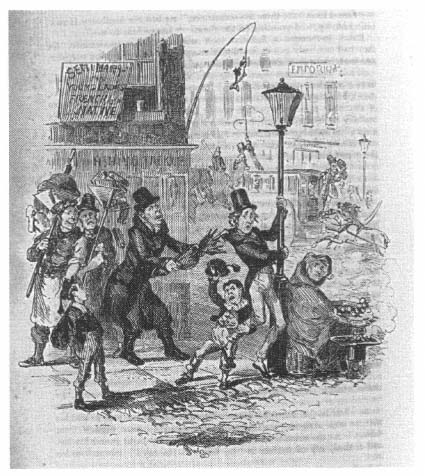
Fig. 70.
Phiz (Hablot K. Browne), "A Sudden Recognition, Unexpected on Both Sides,"
from Nicholas Nickleby, 1838-39. Photograph courtesy Department of Special
Collections, Knight Library, University of Oregon.
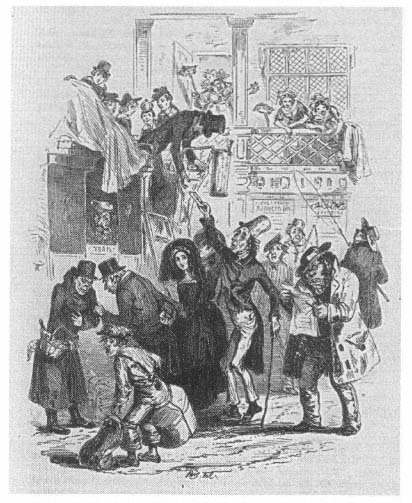
Fig. 71.
Phiz (Hablot K. Browne), "Nicholas Starts for Yorkshire," from Nicholas Nickleby,
1838–39. Photograph courtesy Department of Special Collections, Knight Library, University of Oregon.
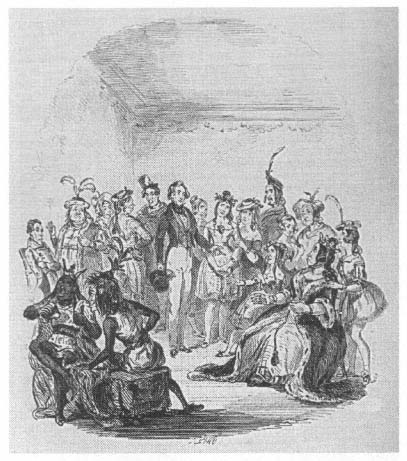
Fig. 72.
Phiz (Hablot K. Browne), "Nicholas Hints at the Probability of His Leaving
the Company," from Nicholas Nickleby, 1838–39. Photograph courtesy
Department of Special Collections, Knight Library, University of Oregon.
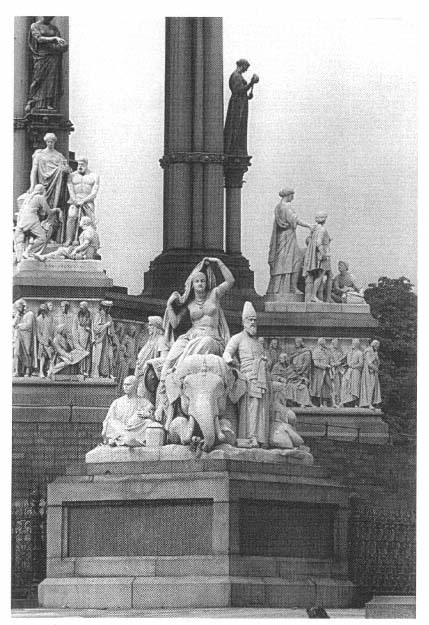
Fig. 73.
Gilbert Scott et. al., Albert Memorial, 1872. Photograph courtesy Conway Library,
Courtauld Institute of Art.
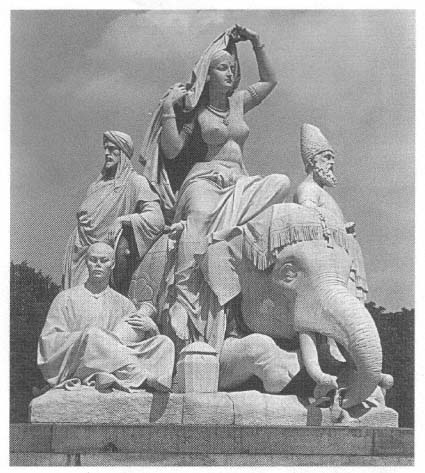
Fig. 74.
J. H. Foley, Asia, Albert Memorial, 1872. Photograph courtesy Conway
Library, Courtauld Institute of Art.
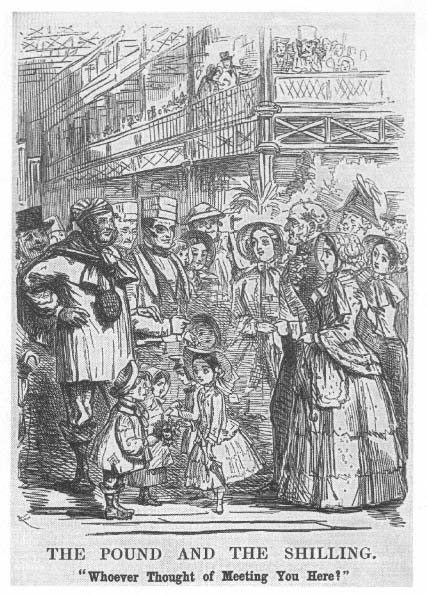
Fig. 75.
John Leech, "The Pound and the Shilling," from Punch 20 (14 June 1851).
Photograph courtesy The Department of Special Collections, The Knight Library,
University of Oregon.
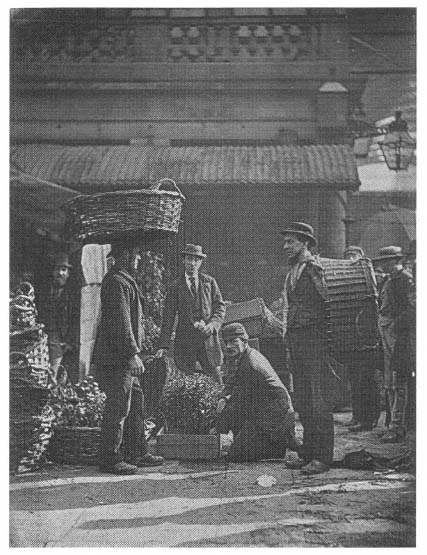
Fig. 76.
John Thomson, "Covent Garden Labourers," from Street Life in London, 1877.
George Eastman House.
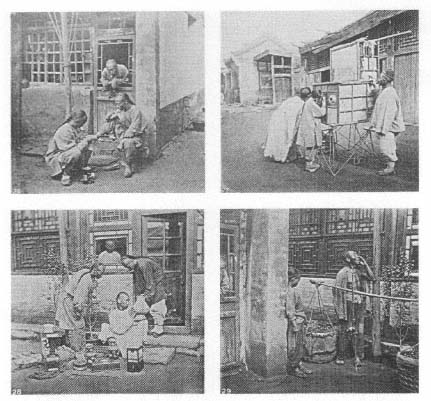
Fig. 77.
John Thomson, "Street Amusements and Occupations, Peking," from
Illustrations of China and Its People, 1873–74. George Eastman House.
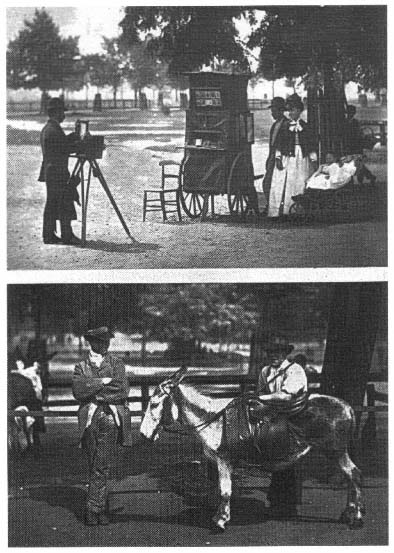
Fig. 78.
John Thomson, "Clapham Common Industries: 'Photography on the
Commons' and 'Waiting for a Hire,"' from Street Life in London, 1877.
George Eastman House.