
The Results of the Maximizing Strategy
The fact that most suburbs seek to maximize internal benefits does not mean that all are successful. As the preceding discussion illustrates, political and planning skills, timing, homogeneity, areal scope, amount of vacant land, nature of previous development, location, and topography all affect the ability of a particular jurisdiction to influence development within its boundaries. In the New York region, many suburbs have had relatively little influence on market forces, whose net effect is to undermine the municipal political economy. In much of the area settled during the first decade after World War II, land-use controls were adopted in the wake of rather than in advance of intensive suburbanization. Maximizing the profits of individual landowners rather than net internal community benefits often was the guiding principle in these areas. Also, in some developing areas—especially where location, topography, and other factors have not been favorable to low-density, high-cost development—economic pressures and the lure of profits have broken down the barriers erected by land-use controls, or prevented them from being erected. Because the stakes for landowners, speculators, and developers are high, the pressures on local officials often are intense and the temptations substantial. For example, in the past twenty years, land values in Wayne have risen from $700 to well over $100,000 an acre, and charges concerning the "profitable relationship between politics, land speculation and zoning" in the Passaic County suburb have filled the air.[55] Conflicts of interest on the part of suburban officials in a position to profit from land-use changes are common, and bribery has been a factor in the turbulent land-use politics of a number of suburbs.
Although some suburbs are successful in their efforts to maximize internal benefits, it might be argued that in suburbia the public sector as a whole has little impact on the pattern of development. The successful suburbs might be too few in number to influence the overall trend. Or their success might be counterbalanced by the failures of other jurisdictions, leaving the overall thrust of the marketplace unaffected. This is the position of Wood in 1400 Governments:
Not one of these strategies . . . has important implications for the private sector of the Region taken as an entity. An industry barred from one locality can in all probability find a hospitable reception in another with
[54] One of those who testified was Kenneth Patton, New York City's Economic Development Administrator; another was Frank Allen, chairman of the Plainfield chapter of the NAACP. See also the discussion below in the section, "Excluding the Less Affluent."
[55] See Richard Reeves, "Land Is Prize in Battle for Control of Suburbs," New York Times, August 17, 1971.
equivalent economic advantages. High-income families take refuge in Westchester, southern Putnam, and Fairfield, while mass developers make breakthroughs in Nassau or Monmouth or Rockland to provide middle-class housing. With so many different constituencies, many options are open for firms and households alike, and though the process of industrial and population diffusion may occasionally be skewed, the forces are not, in general, thwarted, turned aside, or guided.[56]
Wood argues that the cumulative impact of suburban governments is negligible, in contrast to the private market forces he sees as determining the shape of urban growth. The logical corollary of this position seems to be that the overall pattern of suburban development would be about the same if there were no suburban governments seeking to maximize internal benefits. If the policies of suburban governments rarely "thwarted, turned aside, or guided" the forces of the marketplace, it would be reasonable to expect commercial enterprises with the greatest stakes in the marketplace for, say, suburban housing, to be relatively satisfied with the existing pattern of public policy. But this is not the case. Home builders, landowners, real estate brokers, financing institutions, and prospective home buyers are highly critical of suburban development policies that decrease the opportunities for home building, reduce the prospects of profits based on more intensive land use, and help to prevent a growing majority of the region's families from obtaining new housing in the suburbs. Thus, a New Jersey builder attacks large-lot zoning as "devastating" and speaks of the need for suburban development policies geared to meet the needs of all groups in our population, while a Long Island banker urges suburban governments to shun "localism and pettiness" in order to meet housing problems in the suburbs.[57]
The private sector is critical of the public sector in suburbia because suburban governments, in fact, do often "thwart, turn aside, or guide" the forces of the marketplace. The primary concern of developers and large landowners in the suburban housing market is the maximization of profit. In general, profits to landowners and developers correlate directly with intensity of development. Because of the region's income structure, family-size patterns, and the nature of the existing housing stock, the potential suburban market for moderately priced housing on small lots and for multibedroom apartments is larger than the market for expensive homes on large lots and for one-bedroom apartments.[58] But private actions to meet this demand are not in the interest of local governments, whose revenues and expenditures are extremely sensitive to the nature and intensity of land use. And in the process of thwarting moder-
[56] Wood, 1400 Governments, p. 112.
[57] Nazario Paragano, president of the Home Builders Association of Metropolitan New Jersey, quoted in "Large Lot Zoning Declared Handicap," Newark News, February 28, 1964; and Arthur T. Roth, chairman of the board of directors, Franklin National Bank, quoted in Ronalo Maiorana, "Changes Urged in L.I. Land Tax," New York Times, February 16, 1964.
[58] A Regional Plan Association study of housing needs in the New York State portion of the region concluded that 83 percent of the households in the region whose head was in the "prime" home-buying age bracket (30 to 34 years old) could not afford the average single-family house on the market in Putnam, Rockland, and Orange Counties, 89 percent could not afford housing in Nassau and the two western towns of Suffolk, and 92 percent were priced out of the market in Westchester County; see "Housing Opportunities," Regional Plan News (September 1969), p. 7.
ately priced residential development and encouraging more expensive housing, suburban governments have influenced the pattern of development in the New York region in a number of significant ways. Their cumulative actions tend to accelerate the outward growth of the region, to discourage innovation, and to restrict the housing opportunities (and thus the employment opportunities) of a substantial proportion of the region's residents.
Accelerating Spread
Much of the confusion over the influence of suburban governments on development arises from the rapid outward growth of metropolitan areas. The coexistence of strong market forces pushing development outward and suburban policies that foster decentralization has led many observers to conclude that suburbia's public sector primarily responds to the private sector. But the fact that two components of the urban system have similar effects does not necessarily mean that one is wholly dependent on the other. Instead, as pointed out in Chapter One, both may be responding to the same set of pressures, and in so doing they may reinforce one another. This appears to be what happened in most of the suburbs of the New York region during the initial postwar decade. The private and the public sectors both responded to the demand for a vast increase in suburban housing generated by the growing number of families with the resources to satisfy their desire for space, privacy, and mobility. The marketplace supplied land, federal and state governments provided mortgage subsidies and major transportation facilities, the private sector constructed housing, and the public sector (especially local governments) provided a variety of services for the new residents. By and large, these were complementary activities, each influencing the other, and all reinforcing the basic outward trend.
Since the mid-1950s, however, land development policies have increasingly modified rather than reinforced the thrust of the marketplace. As the interests of residents, rather than entrepreneurs, have come to dominate more and more suburban governments, and as planning techniques and resources have become more widely available, the newer suburban strategies have promoted a more rapid rate of decentralization than would have occurred if market forces, coupled with the governmental service-providing roles noted just above, determined the pace of outward movement in the region.[59] A similar conclusion emerges from the Regional Plan Association's study entitled Spread City :
the effect of the mosaic of the Region's local zoning ordinances is to spread the population far from the present and projected jobs which are likely to be relatively concentrated toward the center. First, because vacant land is zoned for such large lots that the cumulative effect of developing these lots would be to consume vast areas, hence to push residences great distances outward. Second, because small lots zoned
[59] While these trends have become increasingly important in the 1960s and 1970s, they were present and gathering force during the previous decade, the period examined by Wood and analysed in 1400 Governments . Therefore, our differences with Wood with respect to the impact of suburban land-use policies on the overall pattern of regional development do not result simply from the fact that we examined a longer period of time than did Wood.
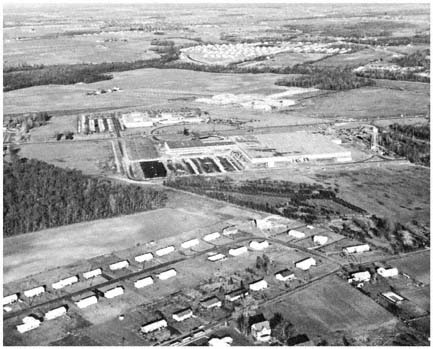
What the Regional Plan Association has termed "spread city"
is illustrated in this view of suburban development
in lower Middlesex County in 1970. Large amounts of open
land separate scattered single-family housing developments,
garden apartments, a factory, and a shopping center.
Credit: Louis B. Schlivek, Regional Plan Association
for the outer fringes of the Region are likely to attract people who cannot afford or do not like large lots.[60]
In short, the land-use policies of suburban governments produce lower residential densities than would result if the market were unconstrained. Suburbs adjacent to employment centers and to major transportation arteries have not been settled as intensively as they would have been, while those at the fringe of the region have been developed more rapidly than would have been the case if suburban governments permitted housing development to be determined solely by market forces. Scatteration is also enhanced by the irregular pattern of local regulation. Multiple dwellings may be built in one community, but not in another. One-acre lots prevail on one jurisdiction, while a neighboring municipality permits half-acre lots but requires a minimum house size of 1,200 square feet. As a result, developers move out to the far corners of the region in search of local governments that are agreeable to their plans, bypassing attractive sites in communities whose zoning ordinances are unsuitable.
While suburban residential zoning policies have played a primary role in accelerating spread, the industrial strategies of local governments also have
[60] Regional Plan Association, Spread City, p. 13.
influenced the diffused pattern of development. The widespread suburban quest for attractive taxable property has opened areas to industrial development that probably would not have been available under a different revenue system. Were it not for their heavy dependence on local property taxes, many residential suburbs would no doubt use their land-use controls to exclude industry rather than to attract it. Instead, the imperatives of their reliance on the property tax force many suburbs to compete for industry despite locational disadvantages and the opposition of residents. The result is more industrial scatteration in the newly developing areas than would be likely to occur in the absence of the pervasive suburban competition for industry.
By accelerating decentralization, these residential and industrial policies affect a wide range of other development issues at both local and higher levels. In fostering the outward movement and scatteration of residences and jobs, suburban governments contribute to the tremendous rise in demand for highway facilities, as well as to the incidence of conflict over the location of new roads in settled areas. Their actions also play a part in diluting the concentrations of riders essential for the economical operation of public transportation systems. On the local front, the sprawling pattern of development entails higher infrastructure costs than more intensive modes of suburban settlement. Longer water and sewer lines, more land for local schools and other public facilities to accommodate the automobile, and extensive street systems to serve low-density communities mean higher per capita costs. These in turn require higher property taxes, which of course stimulate renewed local efforts to exclude more intensive, less "profitable" forms of development.
Discouraging Innovation
Local government policies also have a strong conservative impact on development practices in the suburbs. Zoning ordinances and building codes are essentially negative instruments—they prevent developers from doing things. Moreover, since a basic objective of these regulations increasingly is to prevent the construction of moderately priced housing, they tend to discourage innovations that might cut costs significantly. The residential developer who seeks to depart from the conventional grid pattern of building lots, or to substitute major prefabricated components for traditional on-site construction methods, invites endless negotiations with local officials, organized protests from residents, lengthy and expensive litigation, and failure a good deal more often than success. The multiplicity of jurisdictions, each with its own regulations and modes of applying them, also works against the emergence of suburban development firms large enough to achieve economies of scale and to introduce industrial methods into home building. Consequently, the private sector, whatever its inclinations, is forced to adapt to the prescribed public patterns of land use and home construction.
It is possible, of course, that the conservative bias of suburban development policies merely reflects the orientation of the market that the local governments seek to regulate. Certainly many developers are content to work within the context of single-family checkerboard lots and to employ traditional construction methods and materials, even though they chafe at the bit of zoning restrictions that limit their market. But some builders have not been
satisfied with the status quo. In suburban locations throughout the region, efforts have been made to introduce cluster or planned-unit developments that depart significantly from the traditional manner of subdividing suburban land for residential purposes. Under the cluster concept, detached houses or townhouses are grouped together on a tract, with the unused land reserved for common residential usage or for green space. Even when densities are no higher than would have been the case with traditional lots, clustering cuts costs by reducing site preparation expenses, shortening utility lines, and requiring fewer streets. At Twin Rivers, a cluster development of 3,000 homes located on 700 acres in Mercer County, the developer had to put in "only 25 acres of roads, or three per cent of the total land use, compared to close to ten per cent in the standard subdivision." In addition, "at least 60 per cent of the quantity of collector mains—sewer, water, storm drainage—[was saved] because of the concentration of the housing."[61] Clustering also is more likely than conventional techniques to spare trees, preserve interesting topographical features, and produce a distinctive community setting.
Despite its attractions, cluster development won little acceptance in the suburbs of the New York region during the period of rapid growth between 1950 and 1970. Unless changed, local zoning ordinances and subdivision regulations pose an insuperable obstacle to clustering since they almost universally prescribe minimum sizes for individual lots rather than maximum densities for tracts of land. Efforts to secure an amendment or variance to local land-use regulations to permit cluster design are often resisted by local officials and residents who equate clustering with more people and higher taxes. Projects calling for townhouses are particularly vulnerable because the average suburbanite sees little difference between a townhouse and a four-bedroom garden apartment. Resistance to change in many communities has also been prompted by the fact that some developers have sought zoning changes—under the guise of cluster design or planned-unit development—that would in fact greatly increase overall residential densities.
As a result, few builders were able to break through the nearly solid wall of local resistance to clustering prior to 1970. Even the region's largest developer, Levitt & Sons, was forced by local opposition to substitute conventional single-family housing for cluster design in Manalapan Township in Monmouth County. During the 1970s, however, suburban communities became more receptive to cluster development. By 1977, about a third of New Jersey's suburbs were permitting cluster housing. In part, this change reflected greater public concern with environmental protection and the preservation of open space. It also resulted from suburban awareness that clustering need not entail higher densities or lower-cost housing.[62] Thus innovation which ad-
[61] Herbert J. Kendall, quoted in Alan S. Oser, "Planned Community Is Rising," New York Times, February 22, 1970. Twin Rivers is located in East Windsor, a rapidly growing suburb adjacent to an exit of the New Jersey Turnpike. The project was begun in 1969, following enactment of a special planned-unit development ordinance by the local government. For an examination of the political history of the Twin Rivers development, see Lucy Hackney, "A Political Analysis of the Development Process in East Windsor Township," Senior Thesis (Princeton University, 1975).
[62] See the comments of Stuart Bressler, New Jersey Division of State and Regional Planning, quoted in Carter E. Horsley, "In Suburbs, Quest for Space Pits 'Have-Nots' Vs. 'Haves,'" New York Times, February 6, 1977.
vances traditional suburban interests has become acceptable, although the suburbs continue to resist innovative techniques that might bring more people or higher local tax burdens.
Excluding the Less Affluent
Almost by definition, suburban efforts to maximize internal benefits influence the distribution of moderate and low-income families in the region. Families who cannot "pay their way" are the primary target of suburban development controls that foster higher housing costs. During the past twenty years suburban land-use policies have combined with the general rise in construction and mortgage costs to price the vast majority of the region's families out of the new suburban housing market. An analysis of housing opportunities in the region's northern and eastern suburbs by the Regional Plan Association in 1969 concluded that 80 percent of the region's population was priced out of this housing market.[63] During the 1970s, housing prices rose faster than income in the region, thus further reducing the proportion of families able to afford new housing. By 1977, the minimum cost of a new single-family home built within 50 miles of Manhattan was $55,000. The rapid rise in housing costs has led many suburban owners to defer the purchase of new homes, thus slowing the "trickle down" process that traditionally has been the major source of improved housing for less affluent families in metropolitan areas.
Suburban land-use policies affect housing costs in a variety of ways. Larger lots are more expensive than smaller ones. Moreover, by reducing the supply of land available for more intensive settlement, large-lot zoning generates greater demand for the limited land available for smaller lots, thus contributing to higher prices for such lots. Higher costs also result from building codes that prohibit mass production and discourage the use of new materials and techniques. Minimum building-size requirements have an even more direct effect on housing costs since in practice they become a minimum cost requirement. Assuming construction costs of $35 per square foot and a conservative $15,000 for land and improvements, a 1,200 square foot minimum mandates a $57,000 house.[64] And because of the higher investments required for utility connections and other infrastructure, low-density settlement itself increases housing costs.
Of course, suburban land-use policies are not the only major factor in the rapid rise of housing costs. It is extremely difficult to measure with precision the relative weight of increased building costs, tighter money, rising land prices, and local land-use controls on suburban housing costs.[65] But certainly
[63] "Housing Opportunities," Regional Plan News (September 1969), p. 1. Racial discrimination is also an important factor in structuring housing opportunity in the region; see "Segregation and Opportunity in the Region's Housing," Regional Plan News (July 1979).
[64] Long Island builders estimated that required improvements for streets, sidewalks, curbs, and drainage cost $5,000 per lot in 1977; see William Tucker, "Why Production in Region Lags," New York Times, May 29, 1977.
[65] The problem has two main facets: first, the problem of separating the impact of zoning and building codes from the other factors causing rises in the costs of construction and land; and second, the question of what would have been built on a particular parcel if the land's use had not been constrained by local regulations.
zoning and building codes contribute significantly, particularly since they raise the base cost of housing, which in turn is escalated further by the rising cost of land, labor, materials, and money. Housing built on Staten Island, where local land-use controls were essentially nonexistent during the 1960s, cost 10 to 20 percent less than similar new construction on Long Island. Moreover, almost every suburb in the region bans mobile homes, the one kind of housing priced within reach of families with modest incomes. In short, it seems safe to conclude that if suburban governments did not seek to maximize internal benefits, there would be more moderate and lower-income families in the suburbs, as well as more elderly people and young couples, and, of course, more blacks and Puerto Ricans.
One of the most important consequences of the absence of inexpensive housing in the suburbs is the growing separation of the residences of lower-income families in the core from expanding job opportunities in the suburbs. The Tri-State Regional Planning Commission estimated in 1971 that the gap in the suburbs between middle- and low-income jobs and housing within the price range of the holders of these jobs was almost 700,000 dwellings.[66] As the Regional Plan Association noted in its 1971 plan for Westchester County, "Westchester is adding to the Statue of Liberty message: 'Give me . . . your poor: but only during the day to man the factories, clean the houses and maintain the hospitals.'"[67]
The mismatch between housing and jobs in the suburbs reduces employment opportunities for lower-income families, particularly for blacks and other minorities most concentrated in the core. Because of the inadequacy of public transportation in linking inner-city residences with suburban industry, those without automobiles are isolated from more and more blue-collar and service jobs. For those with access to automobiles, journeys-to-work of an hour or longer are common in a region as large as New York. And the growing travel between suburban jobs and lower-income residential areas augments the demand for additional highway facilities in the region.
Moreover, as a result of the lack of moderately priced housing in the suburbs, many suburban employers encounter labor shortages, particularly in recruiting for lower-paid jobs. In Somerset County, for example, over half the major employers were unable to meet their labor needs in 1970 because of residential restrictions. And almost 60 percent of the companies believed that inadequate housing would restrict their plans for expansion within the county. Despite these concerns, business interests have not been willing to bring pressure on suburban governments to lower housing barriers. Typical of the attitude of most corporations was the response of Western Electric to suggestions that the company had an obligation to insure that housing was available for its employees if it were to move to Bedminster: "Western Electric is not against low- or middle-income housing for anyone. But we do think that this is a matter that local zoning officials have to decide for themselves. . . . [We] don't think this is something we as a company can properly go to a community and say we want changed." In fact, in its effort to persuade Bed-
[66] See Tri-State Regional Planning Commission, "Jobs and Housing in the Tri-State Region," Interim Technical Report 4240–2223 (New York: June, 1971), pp. 5–7.
[67] Regional Plan Association, Westchester County Supplement to the Second Regional Plan (New York: 1971), p. 64.
minster to alter the local zoning code to permit the construction of a corporate facility, Western Electric emphasized not the need for more moderately priced housing, but the argument that its impact on the area would be very modest—since only about 25 of the 1,500 new employees would become residents of Bedminster or Far Hills, a nearby exclusive suburb.[68]
Fear that industrial or commercial development might open the way to a modest flood of lower-income residents has fueled opposition to nonresidential development in some suburbs, such as that mounted by the Citizens Continuing Committee for Conservation against the construction of executive offices by the RCA Corporation in New Canaan in the Connecticut portion of the region. In some instances, opponents of industry (and of moderately priced housing) have argued that business development and lower-cost housing are part of the same package. State Assemblyman John H. Ewing, a Bedminster resident, opposed the Western Electric proposal because: "If we accept the ratables, we have the responsibility of providing adequate housing. If people want the offices, they have to take the housing problem with it."[69] As it turned out, Bedminster wanted neither housing nor industry, and rejected the corporation's plea.
But most suburbs cannot afford to reject an attractive addition to the tax base such as Western Electric. Moreover, given the logic of maximizing internal benefits—as well as class and racial prejudices—most communities refuse to make any connection between the acquisition of industry and the easing of residential restrictions. The arrival of more than forty new industries between 1965 and 1971 brought no significant reduction in the zoning barriers of Nassau County's Oyster Bay. Similarly, despite the presence of a large Ford Motor Company assembly plant and lower taxes than neighboring communities, Mahwah in Bergen County rebuffed requests for zoning changes necessary to permit the United Auto Workers Housing Corporation to build federally assisted housing within the price range of Ford's 5,200 workers—40 percent of whom were black. In neighboring Franklin Lakes, which welcomed a large IBM installation but not garden apartments, the local beneficiaries of the taxes generated by nonresidential development are equally unwilling to provide housing for workers: "There is lots of empty land and cheap housing further out—there's no reason why people should feel that they have to live in Franklin Lakes just because they work here."[70]
Because there is very little moderately priced housing in the suburban areas settled during the past quarter-century, most of the lower-income families who live outside the New York region's core are concentrated in a few older suburbs and smaller cities of the inner ring. Largely settled at relatively high densities before the advent of the automobile, these suburban jurisdictions contain most of the older housing stock in suburbia. And during the past twenty-five years these communities—such as Yonkers and Mr. Vernon in Westchester, Plainfield and East Orange in New Jersey—have attracted almost
[68] See David K. Shipler, "Western Electric Rebuts City on Relocation to Jersey Town," New York Times, November 11, 1970.
[69] Quoted in John L. Davnar, "Bedminister Committee Will Decide on Office Project," Newark Sunday News, November 15, 1970.
[70] See National Committee Against Discrimination in Housing, Jobs and Housing (New York: March 1970), p. 116.
all of suburbia's low-income migrants, an overwhelming majority of whom were black. Affluent white families, on the other hand, have been deserting these older suburbs for the newer or more expensive areas where the market and public policy combine to exclude the less fortunate. Thus, in addition to keeping the less affluent out of the suburbs in general, the individual suburb's quest to maximize internal benefits tends to concentrate lower-income groups in a relatively small number of jurisdictions that have to bear the primary burden of servicing the needs of an important component of the suburban population.
The exclusion and concentration of lower-income groups also means that most suburban jurisdictions lack a significant lower-income constituency. Few residents in the typical suburb question policies based on the desire to avoid the costs that come with lower-income residents. Almost everywhere in suburbia, constituency pressures for programs designed to improve housing conditions for the poor are weak. Moreover, proposals for low-income projects meet overwhelming opposition from residents who fear reduced property values, higher taxes, and neighborhood changes in the wake of an influx of poor black families into their suburb. All of the lower-income housing proposals developed in the early 1970s by the Suburban Action Institute—a public advocacy group located in Westchester County—were rejected by suburban governments.[71] Because of the intense local opposition, few suburbs in the New York region have sought to participate in federal or state housing programs aimed at low- and moderate-income families. An exception in some jurisdictions has been subsidized housing for the elderly, which serves a local need and does not threaten a community with "outsiders"—by which suburbanites usually mean low-income blacks.
As a result, very little subsidized housing for low-income families has been built in the suburbs. Suffolk County, for example, had 48 family units and 100 elderly units in 1977, a far cry from the 27,000 low-income units the county estimated it needed. Moreover, almost all of the little low-income housing built in the suburbs since 1950 has been located in areas that already had concentrations of lower-income and black families. Even in these communities, the lower-income suburbanites rarely have a major influence on local development policies. In very few suburban communities are the concentrations of poor or black residents sufficiently large to produce an authoritative role for their spokesmen in the local political system. Moreover, as in the larger cities, ethnic and racial conflicts undermine the prospects for concerted action by the less affluent. And like their brothers in the inner-city ghettos, until recently suburban blacks have been unable to mobilize their political resources for an effective challenge of local development policies. As a result of the political weaknesses of these groups and the desire of their more affluent and influential neighbors to maximize internal benefits, older suburbs have been more interested in getting rid of low-income families and preventing more from coming than in improving conditions for (and thereby probably attracting even more) residents who are widely perceived as community liabilities.
[71] Suburban Action Institute proposed large-scale housing developments in Brookhaven, N.Y., Mahwah, N.J., New Fairfield, Conn., Readington, N.J., and Ridgefield, Conn. For a discussion of Suburban Action's program and the reaction of suburbanites, see Danielson, The Politics of Exclusion, pp. 118–123.
Like many of the region's cities, the older suburbs relied heavily on the federal urban renewal program in their efforts to maximize internal benefits at the expense of their low-income residents. The typical suburban redevelopment plan has sought to replace deteriorated commercial or industrial structures and adjacent low-income residences with attractive tax sources. In Morris County, for example, Morristown proposed an urban renewal program to replace a low-income residential neighborhood with two department stores, a shopping mall, movie theatre, motel, office tower, 100-unit apartment complex, and a 2,300-car parking deck. Englewood initially sought federal renewal assistance to clear for industrial reuse a tract of sixty houses occupied by poor blacks in the Bergen County community. Rarely is sufficient housing provided in the older suburbs for the low-income families displaced by commercial and industrial redevelopment schemes. In Westchester, the urban renewal programs of thirteen municipalities in 1967 called for the demolition of 1,200 housing units and the construction of only 700 low-rent dwellings.[72]
As in the cities, low-income blacks pay the heaviest costs and receive the fewest benefits from urban renewal plans implemented in the suburbs. Blacks are most likely to have their homes bulldozed. For example, 50 percent of the dwelling units scheduled for clearance in Port Chester were occupied by blacks, as were 70 percent of those demolished in Huntington Station, and all of those in the target area in Englewood. Blacks also have the bleakest prospects when it comes to relocation, both because of the scarcity of low-rent housing in the suburbs, and because racial discrimination drastically reduces the suburban housing opportunities of blacks at all income levels. Consequently, urban renewal has been a major cause of racial tension in the older suburbs. Local black leaders and civil rights groups have denounced suburban redevelopment programs as "Negro removal," demanded more low-income housing, and insisted that such housing be dispersed throughout the community.
Few older suburbs, however, want urban renewal if the price includes dispersing low-income housing into areas currently white. Throughout suburbia, redevelopment schemes have been delayed or halted whenever implementation has been conditioned on the construction of public housing in white neighborhoods. In Port Chester, 2,400 signatures were collected in 1967 opposing "subsidized" housing for those displaced by redevelopment. During the same year, residents of one section of the sprawling Westchester town of Greenburgh sought to incorporate as a village in order to foreclose the construction of low-income housing for blacks.
In each instance, the arguments against low-income developments are the same as those heard in the white neighborhoods of Queens or Staten Island when City Hall proposes to scatter public housing. A resident of a $50,000 home near a proposed low-income site in Yonkers assured reporters that "it is not that I don't believe in racial or social integration, [but] really those people . . . would feel so out of place here," while the local councilman for the area never mentioned race in terming the proposal "outrageous" because it would increase crime, decrease land values, and "aggravate school
[72] Urban League of Westchester County, Housing Council, "Urban Renewal in Westchester County: Its Effect on the General Housing Supply and on the Housing Occupied by Negroes," (White Plains, N.Y.: November 1967), p. 3.
problems for the neighborhood."[73] But as White Plains' Mayor Richard Hendy pointed out in discussing his city's urban renewal problems in 1965, "the crux of our . . . trouble is that residents just don't want colored people moving into their neighborhoods from the slum we have to raze."[74] The attitudes of White Plains' white residents are shared by the vast majority of public officials, realtors, home builders, and private citizens—in suburbs large and small, rich and poor, from one end of the region to the other. Racial bias and a desire to maximize internal fiscal benefits work together to ensure that suburban blacks will be concentrated in a small number of jurisdictions. While 13 percent of the residents of Essex County outside of Newark were black in 1970, 89 percent of these black suburbanites lived in three municipalities—East Orange, Orange, and Montclair—where they accounted for 42 percent of the population. In the other 18 suburban communities in Essex, only two percent of the population was black. The Suffolk County Human Relations Commission concluded in 1967 that "about 95 percent of available housing [in the county was] closed, in effect, to Negro customers."[75] In words that could be applied to almost every suburb in the region during the past two decades, a Bergen County fair housing committee found in 1965 that "discrimination is an ugly fact of life in Dumont and Bergenfield, practiced by many real estate agents, apartment owners, and homeowners."[76] A decade later, these practices were still prevalent in much of Bergen County, prompting civil rights groups to file a sweeping antidiscrimination action in federal court.[77]
By and large, suburban governments have been responsive to the views shared by so many of their constituents. Local officials typically have tacitly endorsed exclusionary practices in the private sector. Few have been eager to adopt fair housing ordinances, or otherwise assure blacks equal access to housing opportunities within their boundaries. Instead, as the previous discussion illustrates, they have fostered exclusion by bulldozing black neighborhoods and ignoring the housing needs of those displaced. In addition, suburban governments have rezoned for commercial use land adjacent to black neighborhoods; school officials have frozen and manipulated school boundaries in order to foster and preserve segregated schools; and welfare agencies in some suburban counties have concentrated black welfare recipients in suburbs with large black populations, thus accelerating the flight of whites and further concentrating suburban blacks. As a result of public policies that encourage discrimination and segregation and the fact that the maximization of internal benefits has a disproportionate impact on nonwhites, the behavior of suburban governments has an even greater influence on the settlement patterns of the region's blacks than on the distribution of less affluent families in general.
[73] City Councilman Nicholas Benyo, Jr., Yonkers, Westchester County, N.Y., quoted in Samuel Kaplan, "Yonkers Debates Slum Integration," New York Times, May 5, 1965.
[74] Quoted in Merrill Folsom, "Renewal Is Near for White Plains," New York Times, June 7, 1965.
[75] George B. Pettengill, executive director, Suffolk County Human Relations Commission, quoted in Francis X. Clines, "L.I. Housing Plan Stirs Fears of Bias," New York Times, April 30, 1967.
[76] Fair Housing Committee of Dumont, Bergenfield and New Milford, "Discrimination in the Twin Boroughs," May 1965.
[77] See Ronald Sullivan, "Sales of Homes by Race Alleged in a Bergen Suit," New York Times, March 8, 1976.
Suburbanization Without Maximization: The Case of Staten Island
Any discussion of the impact of public actions on the process of urban development inevitably is handicapped by our uncertainty about what would have happened if government had acted differently or not at all. Unfortunately, the events of a quarter century of suburban development cannot be rewound and replayed without local controls over residential densities, apartment sizes, and land use generally. Nor, given the great similarities in suburban political systems and development goals, is it easy to find a large suburbanizing area which has been settled under a different set of rules. During the 1960s and 1970s, however, one section of the New York region—Staten Island—was rapidly suburbanized in the absence of public policies which seek to maximize internal benefits for the local community. And on Staten Island, a largely unfettered private sector has produced a different pattern of residential development than that which occurred elsewhere in the region under much more stringent public regulation.
Staten Island (the Borough of Richmond) contains 18 percent of New York City's land area but in 1960 its 222,000 residents accounted for less than three percent of the city's population. About half its fifty-seven square miles were vacant, and the borough encompassed 60 percent of New York City's undeveloped acreage. Underlying Staten Island's lack of development was its relative isolation from the remainder of the city. No direct surface links with the other boroughs were available until 1964 when the Verrazano-Narrows Bridge was opened.[78] The bridge unleashed a building boom that led to the rapid suburbanization of much of Staten Island's vacant acreage. Approximately 2,500 housing units, most of them single-family dwellings, were built annually between 1964 and 1979, adding 130,000 new residents to the borough during the 1960s and 1970s.
Compared with the region's typical suburb, Staten Island has been a paradise for the home building industry. Land use has been controlled by a distant city government with a city-wide tax base, rather than by a small-scale political system whose financial prospects were closely linked to local land use. As a result, City Hall has been far more responsive than suburbia to the pressures of the private sector and potential home owners. Minimum lot sizes on Staten Island are so small—40 by 100 feet, or less than a tenth of an acre—as to constitute virtually no regulation, since market considerations would prevent most builders from constructing "suburban" housing on plots any smaller. During most of the decade, other public constraints on development were virtually nonexistent. The city had no master plan for the borough. Subdivision regulations were not employed. And in many instances, building permits were issued for the construction of homes on unmapped land where neither street access nor water or sewer service were available. In fact, far from constraining the private sector, the city government fueled the boom by
[78] Before 1964, residents of Staten Island could reach the rest of New York City via ferries to lower Manhattan and Brooklyn, or via the Bayonne Bridge joining Staten Island to Hudson County, and then via bridge or tunnel to Manhattan.
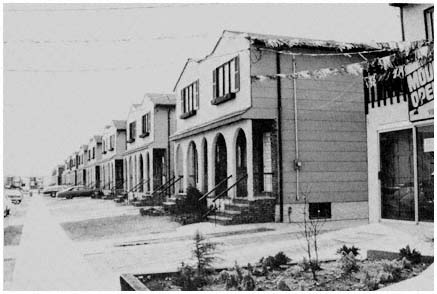
New housing on Staten Island constructed in the mid-1970s
demonstrates the relatively high residential densities
that result when private builders are not restrained by
restrictive local zoning codes. Credit: Michael N. Danielson
selling city-owned land to private developers. About one-third of the borough's vacant land came into city hands because of nonpayment of taxes after the Staten Island land speculation bubble burst in the 1920s. Eager to raise money from any source, the hard-pressed city government sold $50 million of its holdings between 1960 and 1965, thus forfeiting a golden opportunity to guide development on Staten Island.
Freed from the constraints imposed by local government's typical strategy for maximizing internal benefits, the private sector has produced housing on Staten Island that is smaller, less expensive, more crowded, and less attractive than that built during the same period in the suburbs of the New York region. With eight or more houses to an acre, residential densities are far greater than in any of the suburbs developed in recent years. Small lots also mean lower land costs and moderately sized units, which together permitted Staten Island builders in the mid-1960s to construct single-family homes in the $15,000 to $25,000 range. At the same time, an unfettered private sector has sought with great success to maximize profit in exploiting Staten Island's undeveloped land. In practice, the minimum lot size became the maximum, and the 40-by-100-foot grid has been imposed indiscriminately on Staten Island's hills and dales. New housing has been scattered through the borough's 13,000 acres of vacant land, often with no consideration given to drainage, access, or the availability of city services. As for the housing itself, the City Planning Commission calls much of it "ticky-tacky housing [of the ] crackerbox variety," while the New York Times architec-
tural critic, Ada Louise Huxtable, writes contemptuously of the "jerry-built, rubber-stamp rowhouses."[79]
What has been called the "sack of Staten Island" outraged planners, civic leaders, conservationists, editorial writers, and some top officials in City Hall, particularly in the administration of Mayor John Lindsay (1965–1973).[80] During the Lindsay years, efforts were made without much success to enhance and coordinate city controls over the island's development, to encourage cluster and other innovative techniques, and to use urban renewal funds to build a planned community on 1,080 acres in the largely undeveloped Annadale-Hugenot section of Staten Island's south shore. None of these approaches aroused much enthusiasm among the moderate-income families who flocked to Staten Island from Brooklyn because a largely unregulated housing industry offered a reasonable facsimile of space, privacy, and "the country" at cut-rate prices. As Steven V. Roberts pointed out, "if better planning means larger lots, bigger houses, and increased costs, many people who want to find a better life on Staten Island would be priced out of the market."[81] Just as clearly, if large sectors of postwar suburbia had been developed under the conditions prevailing on Staten Island during the past two decades, rather than under a system designed to maximize internal benefits, residential densities would be higher in the inner and outer suburban rings, housing costs would be lower, and moderate-income families would be more evenly dispersed throughout the region.
Maximization and the Passage of Time
For those who see the private sector as having the primary role in shaping suburban development, the analysis presented here may appear shortsighted. Demands from developers and potential suburban residents will continue to mount in the suburbs, they argue. As the pressures for more intensive development intensify, zoning restrictions will collapse, be subverted, or be swept away by higher levels of government more responsive to the interests of those groups who are disadvantaged by local policies. For example, in discussing the prospects for redevelopment at higher density in Nassau County, Edgar M. Hoover argues that "zoning regulation in most types of communities seem in the past to have been quite pliable in the face of really strong private incentives and fiscal and political pressures."[82] Thus,
[79] New York City Planning Commission, Staten Island Development: Policies, Programs and Priorities (New York: 1966), p. 26; and Ada Louise Huxtable, "Staten Island's Beauty Losing to Builders," New York Times, August 9, 1965. In order to maximize housing supply and builder profits, some of the developments were semiattached units, with each unit on a 25-by-100-foot lot. By 1977, cost pressures had led developers on Staten Island to cut lot size further, with semiattached units now on 20 by 100 foot lots; see Alan S. Oser, "Soaring Costs Shrinking Homes," New York Times, February 13, 1977.
[80] The quotation is from a New York Times editorial entitled "Staten Island Down the Drain," January 22, 1966.
[81] "The Development of Staten Island: Will It Become Another Queens," New York Times, April 23, 1967. For a recent discussion of these issues, see Alan Richman, "A 'Forgotten' Staten Island Concentrates on Its Future," New York Times, March 9, 1979.
[82] Edgar M. Hoover, "Introduction: Suburban Growth and Regional Analysis," in Dieter K. Zschlock, ed., Economic Aspects of Suburban Growth (Stony Brook, N.Y.: Economic Research Bureau, State University of New York at Stony Brook, 1969), p. 3.
Hoover echoes Wood and Vernon in implying that suburban land-use controls are ineffective, or at least have no lasting impact on the distribution of people and jobs.
The passage of time, of course, will bring changes to all jurisdictions in the region. Market forces undoubtedly will continue to play an important role in the continuous process of urban growth and change, as housing demand increases, land values mount, structures age, neighborhoods rise and fall, and jobs move. Inevitably, these changes will have an effect on local land-use controls. But many local governments will be no more susceptible to pressures in the future than they have been in the past. Nor are the hundreds of local governments that control land likely to make uniform changes in their policies, unless local control over land is drastically altered by the state legislature or the courts, which seems unlikely. Moreover, unless the higher levels of government radically revise the rules of the development game, changes in land-use policies will not occur simultaneously throughout the region. Thus, local governments can be expected to respond to the market forces as in the past, but not everywhere in the same way at the same time. This differential pattern of local response will continue to exert considerable influence on the distribution of people and jobs.
Of course, even in the unlikely event that all local controls were swept away, the fact that they existed would leave an indelible mark on the distribution of people and jobs in the New York region. For example, the moderately priced housing that private developers were prevented from constructing by local restrictions cannot be built today without substantial governmental assistance because housing costs have risen much faster than family income. As a result, a permanent gap in the supply of such housing in the region is likely to persist, regardless of future changes in land-use control policies in the coming decades.