

Revolution and History: The Origins of Marxist Historiography in China, 1919–1937
Arif Dirlik
To My Parents
Süleyman and Sakine Dirlik
Table of Contents
- PREFACE
- PART I— INTRODUCTION
- 1— The Problem
- 2— The Context
- PART II— THE SOCIAL HISTORY CONTROVERSY AND MARXIST ANALYSIS OF CHINESE HISTORY
- 3— Revolution and Social Analysis
- 4— Feudalism in Chinese History
- 5— Kuo Mo-jo and Slavery in Chinese History
- 6— The Periodization of Chinese History
- PART III— CONCLUSION
- 7— Revolution, Marxism, and Chinese History
- 8— Epilogue: Social Change and History
- BIBLIOGRAPHY
- INDEX
PREFACE
In the following pages I may seem occasionally harsh in my criticism of some Marxist historians, but it should be remembered that the criticism is intellectual and historiographical, based on my evaluation of the relative merits of their work. I have made an effort to give credit wherever credit is due, and those with whom I have the greatest personal sympathy are not necessarily those whose historiographical contributions I admire the most. Given the hostility often invoked by the simple mention of Marxism, especially in countries where those in power do not hesitate to use violence against ideological opponents, simply to engage in such historiographical activity has often demanded a great deal of personal courage. Marxists have been hounded, censored, jailed, and even tortured for publishing the ideas discussed in this book. If I ignore these aspects of Chinese Marxist historians' experiences, it is not because I consider them unimportant but because they would require an entirely different kind of study. Within the context of this study, I evaluate their contributions as I think all works of history should be evaluated, for these works were written as histories. This is the only way to extend to them serious recognition for their undertaking. If Marxism is to claim its due as a major contribution to historical understanding, it cannot afford the pretense of some Marxists that Marxist historical work, because of its extrahistoriographical implications, is immune to the evaluative criteria of critical historical judgment.
The existence of this book owes a great deal to members of the Department of History at the University of Rochester as it was in 1964–1965, when I was admitted there as a graduate
student. Had they not been as open-minded about curricular prerequisites as they were, and willing to take chances with a foreign student who had little prior training in history and none whatsoever in Chinese studies, this work, whatever its-merits, would probably never have been produced. Two former members of that department, Harry Harootunian and Sidney Monas, have special claims on my gratitude for guiding me into the discipline. The department was always generous with funds to enable me to study elsewhere when my needs could not be met at the university. To Ralph Croizier, who joined that department later and, with characteristic insight, suggested this topic to me (it was initially intended as a study of T'ao Hsi-sheng), I owe not only the sentiments of a graduate student toward an advisor but also the appreciation of a friend.
My friend Larry Schneider, who was the only person to read the whole manuscript before publication, was generous with his time and encouragement. His enthusiastic response was much appreciated. Benjamin Schwartz was kind enough to take time off from the many demands on him to read my dissertation and to encourage its publication. I would also like to thank Ed Friedman and Chang Hao, who read the original introduction, for their comments and suggestions. Samuel Baron of the Department of History at the University of North Carolina at Chapel Hill was generous with information on contemporary Soviet discussions of the problem of Asiatic society.
I would like to thank Ms. Dorothy Sapp of the Department of History at Duke University and my graduate student, Ms. Patricia Hampshire, for their help in the preparation of the manuscript. Last but not least, my wife Carol and my children, Nedim and Murat, deserve my gratitude for their tolerance of my idiosyncracies, which no doubt multiplied while I was at work on the writing.
PART I—
INTRODUCTION
1—
The Problem
"Marxism," a critical commentator has observed, "represents an historiographical turning point, the revolutionary effects of which we are only now coming to appreciate."1 When historical materialism (or "the materialist conception of history," as Marx described his view of history) entered Chinese thought in the second and third decades of this century, its impact on Chinese historiography was no less profound for its sources being exogenous to Chinese thought. In the Marxist theoretical system Chinese intellectuals encountered perhaps the most comprehensive "sociology of change" to issue from nineteenth-century European thought,2 one which unequivocally posited society to be the starting point of historical inquiry and sought in social processes the forces that shaped history. In its new context, Marxist historiography represented an unprecedented undertaking to root history in social structure, revolutionizing the conceptualization of China's past. The proliferation of socialeconomic history of an unmistakably Marxist bent by the 1930s pointed to the ascendancy of historical materialism in Chinese historical studies. This trend continues to the present in the People's Republic of China where, now under official aegis, the materialist conception of history monopolizes historical scholarship and, equally significantly, infuses the historical consciousness of great numbers of people. Historical materialism, in short, represents the counterpart in the intellectual realm to the
revolutionary changes communism has wrought in Chinese society in the twentieth century.
The radical reinterpretation of Chinese history made possible by the introduction of Marxist historical theory to China after 1919 provides the subject of the present study. The substantive portion of the discussion here is devoted to examining Marxist interpretations of the past in the years after 1927 when Marxist historians produced their first major historical analyses. While Chinese intellectuals became acquainted with Marxist historical theory as early as the 1910s, they initially displayed only a marginal interest in its application to Chinese history. Their grasp of historical materialism remained superficial through the early twenties, when knowledge of Marxist theory was derived largely from a spotty selection of primary and secondary, especially Japanese, sources. The few authors who applied it to the analysis of Chinese history at this time employed it eclectically, without clearly distinguishing the materialist conception from other socioeconomic approaches to history. For reasons to be discussed here, Marxist historiography did not appear as a distinct trend until after 1927 when, with the so-called "social history controversy," it emerged rapidly as possibly the most dynamic and stimulating current in Chinese historiography. Seminal works produced at this time left a visible imprint on historical work in the thirties; the questions they raised also laid the foundation for much of the historical inquiry Marxist historians in China have undertaken in subsequent years. In fact, Marxist historians were responsible for first demonstrating the importance of questions that have since come to serve the more social science oriented historians of China, Chinese or non-Chinese, as points of departure for the resolution of the most fundamental problems of Chinese history.
The present study departs from previous studies of Marxist historiography in China in regarding these questions as direct offshoots, rather than incidental correlatives, of the political and therefore historical consciousness Marxism engendered in China. Whether or not later research has upheld the specific conclusions of Marxist historians is not as crucial to the evaluation of the Marxist contribution as the simple fact that their
conceptualization of Chinese history from the perspective provided by historical materialism endowed them with a deeper awareness of the complexity of historical problems than had existed until then. This new awareness, moreover, reached beyond the realm of historical inquiry in its effects. Intense Marxist historiographical activity during the decade after 1927 disseminated Marxist sociohistorical concepts widely so that the materialist conception of history came to shape the views on the past, the present, and the future of significant numbers of Chinese intellectuals. Important as this problem is to understanding the mood of the Chinese intelligentsia in the thirties, it is beyond the scope of the present study, which takes account of it only marginally in speculating on the appeals of Marxism to Chinese intellectuals after 1927. The main task undertaken here is to analyze the origins and nature of Marxist interpretations of the past during the thirties, to elucidate the problems Marxist historians encountered in applying Marxist theory to Chinese history, and to examine the ways in which their preoccupation with broader questions of revolutionary change in contemporary China shaped their treatment of both theory and history.
Marxist historiography is approached here through the perspective provided by intellectual developments in modern China, in other words, as a subject of intellectual history. In adopting this approach, I do not mean to reduce the work of Marxist historians to a mere datum of intellectual history that is devoid of historiographical validity; on the contrary, I believe that despite culpable defects in their scholarship, and their often crude handling of Marxist concepts, Marxist historians made lasting contributions to the study of Chinese history. Nevertheless, Marxist historiography was shaped by its intellectual and political context. For the same reason, it offers clues to understanding intellectual developments in China at this time; in its genesis and development, Marxist historiography was bound up with social and intellectual currents in the period following the New Culture Movement.
As I shall endeavor to demonstrate, it is essential to take note of the contemporary revolutionary scene that provided the
backdrop to the writing of history to fully appreciate the complexity of Marxist historiography or to assess its role in modern Chinese thought. History to the Marxist historians was neither a mere pastime nor a scholarly enterprise; it was both functional and eminently practical. Marxists wanted urgently to understand the past because it held within it, they believed, the secret of the dynamics of contemporary society, a society whose destiny they wished fervently to shape. For the same reason, the changes they envisioned for the future shaped significantly their views of history. In this particular sense, Marxists differed from their predecessors and contemporaries only to the extent that they announced openly the political intention underlying their historical efforts. Theirs represented the latest in a series of efforts dating back to the early twentieth century to rewrite Chinese history so as to bring it into conformity with the requirements of change in the present. It is not surprising to discover that as the problem of change assumed new dimensions, the shifts were reflected in modifications in the problem of history. The rise of the Marxist view of history, and its increasing popularity among Chinese intellectuals in the late twenties, suggests another such shift. On the one hand, I think, historical materialism owed a good deal of its appeal among Chinese intellectuals at this time not to its virtues as historical method, but to its relevance to the problem of revolutionary change, as that problem came to be perceived in the twenties. On the other hand, the spontaneous diffusion of Marxist historical theory in whole or in some attenuated form in the field of Chinese historical studies indicates that its appeal was not due merely to its political implications. Though history per se was initially only of secondary interest in Marxist historiography, the materialist conception of history offered a sorely needed methodology for rewriting Chinese history at a time when modernist iconoclasm had undermined the authority of traditional interpretations without, however, offering substitutes of its own. With all the defects in its application to Chinese history, therefore, historical materialism alleviated what was in effect a crisis in Chinese historical consciousness.
Three premises guide the evaluation of Chinese Marxist historiography in this study. These premises relate to the nature of the Marxist contribution to Chinese historical thinking, the relationship between politics and history in Marxist historiography, and the place of the materialist conception of history in modern Chinese thought. A discussion of these premises here will provide a better sense of the arguments to be pursued later and also will indicate the ways in which this study departs from earlier studies of Marxist historiography in China.
The Marxist contribution to history was primarily conceptual, even though the new conceptualization of the past had important ramifications for historical inquiry as well as for problems of methodology and explanation. The impact of Marxism on history is more readily appreciable if historical materialism is viewed as a "paradigm theory" as used by Thomas Kuhn in explaining the advance of scientific knowledge.3 Kuhn has argued that scientific inquiry does not proceed by the random accumulation of data but rather is organized in accordance with a paradigmatic theory that the scientific community takes for granted at any one time in formulating problems and selecting the means to resolve them. The scientific community, according to Kuhn, abandons a paradigm gradually, and with reluctance, only as mounting evidence reveals the existence of important problems that cannot be accounted for within the boundaries of the existing paradigm. The "crisis" in scientific thought created by repeated challenges to the accepted paradigm is resolved ultimately by a "scientific revolution," which is realized when a new paradigm is assimilated by a significant portion of the scientific community. The new paradigm accomplishes "the reconstruction of prior theory and the re-evaluation of prior fact," as well as providing criteria for
"choosing problems that, while the paradigm is taken for granted, can be assumed to have solutions."4 This is what the materialist conception of history achieved in the realm of history, both in the original context within which Marx formulated his theory and when it was applied to the analysis of China's past in the twenties.5
It might be noted that historical materialism owed its basic emphases, and even some of its essential concepts, to the expanded consciousness of the social roots of historical change, which was reflected in the increasingly sociological orientation of European historical thought in the nineteenth century. What distinguished historical materialism as a paradigm, however, was its bold definition of the relative significance of the sociological factors that went into the making of history and, therefore, its view of what constituted a significant historical problem: The materialist conception of history, more than any other contemporary theory of history, moved society to the center of historical inquiry and asserted the logical priority of those aspects of society which were most intimately linked to economic activity. The resulting conception of history yielded a radically different
view of the interrelationship between historical phenomena and the dynamics of historical change than had existed until then.
In evaluating the significance of the impact of historical materialism on historical thinking in China, therefore, it is necessary to bear in mind the departure of the materialist conception of history from previous modes of historical thought. The radical break of Marxist historians with their predecessors becomes evident when their conceptualization of Chinese history is contrasted to the inherited view of history represented by the Confucian historical tradition which, though undermined by radical break of Marxist historians with their predecessors becomes evident when their conceptualization of Chinese history
The Marxist outlook on Chinese history inverted the traditional Confucian view of the past. While it is possible to draw parallels between the two views on the basis of their common aspirations to universalism and their perception of history in terms of its practical, political consequences, the more significant consideration is that the substance of the Marxist conception of politics and, therefore, history was the diametrical opposite of the Confucian, as is clearly evident in the different historiographical consequences of the two outlooks.
Chinese political theory regarded politics as a function of the virtues of political leaders; the evaluation of the performance of past leaders in order to provide present and future leaders with precedents from which "to extract political and moral lessons" was, therefore, a central function of history.6 History was for the most part officially sponsored and "served an essentially moral purpose 'for aid on government,' for guiding administrative action, encouraging virtue and deterring vice."7 The conception of history that resulted from this premise was individual-centered and one that visualized history not as an autonomous realm but as the field upon which eternal principles guiding human behavior played out their fate: "The reverence
for history as a storehouse of precedent" went hand in hand with "the interpretation of history from a standpoint of permanence (rather than process)."8 Chang Hsueh-ch'eng, one of the few premodern Chinese thinkers to address directly what might be termed questions of the philosophy of history, regarded history as the account in time of the fate of the ultimate principles, the Tao. Tao was, in Nivison's words, "the basic potential in human nature for living an ordered, civilized life, a potential that gradually writes itself out in history, and actualizes itself in what man must come to regard as right and true."9
It followed from this attitude that the traditional evaluation of history was guided by the desirability of order and harmony and a distaste for chaos and conflict, for conflict represented an aberration, the breakdown of morality.10 The historical outlook that resulted from the confluence of these attitudes shaped the writing of history and the nature of historical explanations. The Chinese historian did not make an effort "to analyze and classify his facts for presentation in that logical sequence which shall seem to his individual brain best calculated to expose, not merely their order in time, but also the concatenation of cause and effect."11 Within the limits imposed by their outlook, traditional historians made an admirable effort to achieve accuracy and developed sophisticated methods of empirical investigation. The conception of history as a realm where individual behavior manifested the success or failure of morality, on the other hand, obviated the need to search for historical explanation within the inner workings of history. Even the writers of universal political and institutional histories (rather than the more common dynastic histories) did not supplement their recognition of change in history with explanation in terms of
historical process.12 Chinese historians in general stopped short of "binding events together in a causal nexus and treating them as connected wholes."13
The Marxist conception of history departed radically from this view. The premise that the dynamics of historical development could be discovered only in the interaction of forces immanent in the socioeconomic structure altered the scope of historical inquiry and expressed a new awareness of the complexity of historical explanation. Where previous historians had marked time according to political (whether individual, dynastic, or institutional) or intellectual changes, Marxist historians turned to transformations in the socioeconomic structure as the criteria for determining significant historical change. This new conception of historical time also transformed the scope of history, as it focused attention on the social space that bound and shaped political and intellectual phenomena. As long-term socioeconomic processes achieved primacy in the attention of the historian, explanations based on suprahistorical notions of morality gave way to explanations of history in terms of historical processes themselves; to the Marxists, historical explanation was valid only to the extent that it was able to take account of these basic processes. They saw history in terms of a series of dynamically related wholes which not only yielded a completely different picture of the past than the Confucian but also reduced individual behavior and morality to a mere component, or reflection, of the social whole. Society now emerged as an autonomous realm which contained within it the source of its own progress and shaped all other aspects of human behavior. Furthermore, the same conception stressed, even glorified, the
role of conflict as the prime mover of history. This view yielded a more dynamic and integrated explanation of the past than had been available in Confucian historiography. More important, it endowed society with a supreme status in historical consciousness as the starting point of history.
As I shall note in the next chapter and again in the conclusion, some of these ideas had gained currency in Chinese historical thought prior to the rise of Marxist historiography, as Chinese thinkers became increasingly aware of the complexity of historical change in the twentieth century. Historians from Wang Kuo-wei and Liang Ch'i-ch'ao in the early part of the century to Ku Chieh-kang in the twenties had implicitly or explicitly challenged the sufficiency of the scope and/or the empirical basis of Confucian historiography. Without downplaying the importance of their work to the twentieth-century revolution in Chinese historiography, it seems fair to point out nevertheless that their contributions remained restricted to uncovering previously hidden or ignored facets of Chinese history or, as in the case of Ku, demolishing the claims of crucial Confucian traditions to empirical validity. While their work justifiably provided later historians with models of historical inquiry, they were unable to substitute for the Confucian view a comprehensive theory of history that could account for the interrelationship of historical phenomena or the dynamics of historical change. The materialist conception of history provided just such an urgently needed theory. It not only substituted for the Confucian vision of the past a secular view of history that recognized history as an autonomous realm, but also provided a theory that could serve as the starting point for achieving a longstanding dream of twentieth-century intellectuals: the creation of a "new history."
The methodological consequences of this new conception were evident both in its implications for the critical treatment of historiographical problems and in the potential it offered for systematic inquiry into the past. The application of Marxist socioeconomic theory to China's past instigated changes in Chinese historiography not dissimilar to the impact of Marx's formulations on the development of the modern sociological
approach to history in the West. In both cases, the result was to expand consciousness of the forces that went into the making of history, which led to the fundamental reformulation of historical problems and stimulated efforts to devise new methodologies and concepts to cope with a whole range of basic problems that had been at best of marginal concern in earlier historical thought.
From their new perspective, Chinese Marxist historians redefined the relative significance of historical phenomena and turned to the reexamination of historical sources to uncover data relevant to the understanding of the economic and social forces that had operated in Chinese history, to clarify the significance of the interaction between economic and social institutions and their implications for political and intellectual phenomena. Their assumption of a hierarchical relationship among historical phenomena (ranging from basic economic to cultural phenomena) engendered a critical attitude toward the treatment of facts and explanations in history. It is quite obvious in their interpretations of Chinese history (and in their theoretical statements) that they considered it insufficient to simply determine the accuracy of historical facts and to arrange them along a temporal and/or spatial dimension to get at the truth of history; it was also necessary, they believed, to take into account the relative significance of different facts relevant to the explanation of an historical phenomenon. They introduced into Chinese historiography, in effect, the fundamental sensitivity of the Marxist theory of history to the ideological determinants of the choice of facts and, therefore, explanations in history. It is not difficult to argue, as I shall do in the analysis of their works, that the Marxist historians themselves cavalierly ignored data that did not fit in with their preconceptions, and were so infatuated with their new explanations as to dismiss the need to utilize different kinds of data and conceptions to deal with different kinds of historical problems. Such defects in their treatment of history were partially consequences of ambiguities within Marxist theory, and partially due to the interference of extrahistoriographical considerations with their use of history; but these defects only point to ways in which Marxist historical
theory and its application require qualification, they do not negate its seminal insights into problems of history or the potential for critical inquiry which is worked into its basic assumptions. With all its defects, the Marxist historians' awareness of the complexity of historical explanation was certainly a great deal more sophisticated than the naive positivism of contemporary academic historians who believed, in the words of Fu Ssu-nien, then president of the Institute of History and Philology of the newly founded Academia Sinica, that it was sufficient "to put materials in order for facts to become naturally evident"; Fu, in fact, denied the process of interpretation a place in history, the scope of which he limited to textual criticism and collation.14
On the positive side, the materialist conception of history offered a methodology for the writing of universal histories (t'ung-shih ), which Chinese intellectuals, beginning with Liang Ch'i-ch'ao and Chang Ping-lin around the turn of the century, had deemed essential to the creation of a "new history." The universal history was, of course, not a new form in Chinese historiography, but its modern advocates demanded the devising of causal explanations to reveal historical processes which differentiated their idea of universal history from the stringing together of historical facts that had characterized, they believed, traditional universal histories.15 They themselves were unable, however, to offer a viable methodology for writing universal histories mainly because their approach to the problem was overly inductive. Their plans assigned priority to the accumulation of monographic studies which would ultimately provide the building blocks for universal history.16 What they failed to provide was a well-defined starting point and a coherent principle of organization that could guide investigation and
explanation. Again, the Marxist view of hierarchy among historical phenomena helped resolve the problem: Historical materialism pointed to socioeconomic phenomena as the starting point of analysis and revealed in social-economic processes the links which joined together vast stretches of history, thereby providing a foundation upon which to build universal history. Chinese historians did indeed produce a number of important universal histories in the thirties. It is difficult at this point to tell the extent to which Marxist methodology can claim credit for the achievement, for the writers of universal histories included non-Marxists as well. But Marxist historians were prominent among the authors of the most impressive universal histories, and almost all important Marxist work took this form. These works served to organize the multifarious data of Chinese history into coherent and systematic analyses and opened new channels of inquiry into China's past.
The second methodological problem relevant to the analysis of Marxist historiography in this study concerns the relationship between history and politics in Marxist historiography. The basic political motivation underlying historical materialism has led many to reject its validity as a theory of history. There are, of course, other reasons for objection to historical materialism, especially among historians. The most important of these is the professional historians' disdain for generalizing approaches to history. It should be obvious from my preliminary remarks here that only historians who agree with E. H. Carr's statement that "the more sociological history becomes, and the more historical sociology becomes, the better for both,"17 would be willing to consider the value of Marxist historiography. This problem, which involves definition of the tasks of history, is not peculiar to historians' reactions to historical materialism but rises out of attitudes on the general question of the relationship between history and the other social sciences. It need not be dwelt on, therefore, except to note that such objection has become less tenable as the social scientific approach to history has demonstrated its usefulness in explaining the dynamics of historical change.
The more telling criticisms leveled against the materialist conception of history have focused on the explicitly political intention which guides its treatment of history. Marxists, of course, have never denied that political assumptions, theirs or other historians', shape historical interpretation. It does not follow, however, that the materialist conception of history posits a uniform relationship between politics and history. Marxist historiography has, on the one hand, treated history simply as an extension of politics, the passive legitimizer of a predetermined notion of political change, or even of a short-term political policy. This has been the case especially when history has been subjected to the needs of political movements or Communist regimes in power. In these cases, historical interpretation has also tended to stress the teleological conclusions and the deterministic view of history which Marx himself imposed on his historical theory to support his political assumptions.18 On the other hand, however, history is equally important in historical materialism as the source of a critical perspective on the present and as an autonomous field of forces in the interaction of which the revolutionary discovers the guide to correct political action. In this case, the Marxist political outlook has demanded that historical analysis, armed with critical judgment of the present, dig beneath the surface phenomena of history to grasp its dynamics. The political motivation is central in either case, but it is nevertheless important whether the Marxist historian, starting from the critique of existing society, turns to the examination of its contradictions to demonstrate its inevitable demise or transformation, or whether the same historian seeks to prove the legitimacy of the political goals of particular movements or regimes; in the one case, the result is the critical comprehension of history, while in the other, it leads to the molding of history in the image of political goals and assumptions. As these questions are of crucial significance both in the evaluation of Marxist historical theory and its applications in China, they will be examined in detail in Chapter 7 within the context of Marxist historiography in the thirties, which provides insights into the
effects of Marxist political assumptions on the interpretation of history. Suffice it to note here that this study presupposes a more complex relationship between politics and history in Marxist historiography than has been assumed in previous studies, which have concentrated on past-1949 historiography and therefore have judged the Marxist contribution to Chinese historiography by its manifestations under the Communist regime. How this choice has colored the evaluation of Chinese Marxist historiography is evident in the following statement from one of the most influential studies to date on Marxist historiography in China.19
Yet it was recognized that there was promise in the new methodology as well, for behind the egregious claptrap of Marxist ideology and language is evidence of an acceptance of new ideas, new techniques in the writing of history. It has been through Marxism-Leninism, in fact, that, sometimes in a blurred form to be sure, much of the new historical technique and methodology developed in the modern West came to China. Notwithstanding its cramped ideological boundaries, Marxism does in some directions border upon the modern social sciences, the fruits of which illicitly but undeniably penetrate into her confines.
The portrayal of Marxist historiography in this passage, which begrudgingly recognizes the Marxist contribution to Chinese history only to explain it away as incidental to Marxist theory, may be unusual in tone but is otherwise indicative of the attitude of many historians on this question.20 In evaluating this attitude, it behooves us to ask how much "modern social science" existed when Marx and Engels formulated their theory; it is also noteworthy that seminal figures in social science as well as prominent social scientists, and not just leftist ones, have acknowledged the debt of their disciplines to the challenge of Marx's ideas on historical change.21
The more immediate question here concerns the ideological affiliations of historical materialism which, though undeniably a component of Marxist historical theory, bear a more complex relationship to history than is suggested by statements such as the one quoted here. The political motivations of historical materialism, while they have invited abuse by its practitioners, have also been a source of the critical attitude which pervades Marxist historical theory. On the whole, however, studies of Marxist historiography have concentrated on the former to demonstrate the subjection of Marxist historiography to rigid political ends and to denigrate the Marxist contribution to history. In the case of China, the neglect of pre-1949 Marxist historiography has had two negative effects on the evaluation of the impact of historical materialism on Chinese history. First, it has obscured the contributions of historical materialism to Chinese historiography. The most original contributions of Marxist historians to Chinese historiography predated the establishment of the Marxist orthodoxy in historical studies after 1949. Marxist historians continued to make contributions to the study of Chinese history after 1949, but their task was now of a more pedestrian nature, involving the elaboration, refinement, and revision of questions that had been raised earlier. Second, concentration on post-1949 historiography has created the impression that Marxist historiography in China is significant chiefly for the political function it performs. Since 1949 an officially promoted view of history has narrowed the range of interpretations available to historians. By contrast, the study of Marxist historiography in the thirties, when history was free of official direction if not oppression, reveals considerable diversity in the understanding of the materialist conception of history and its application to Chinese history. While the political and ideological commitments of Marxist historians were crucial in shaping their analyses, the interplay between politics and history was a great deal more complex than after 1949, and so were the implications of politics for historical work.
The third, and final, problem to be addressed in this study concerns the evaluation of the appeal of the materialist conception of history to Chinese intellectuals and its consequences for twentieth-century thought. The significance of historical materialism in the evolution of the modern Chinese historical outlook was first pointed out by J. Levenson in his highly stimulating study of the problem of history in modern China.22 Levenson regarded Marxist historicism to have provided the means whereby Chinese intellectuals resolved the tension between "history and value" created by the Western intrusion into China. Marxist historicism, in his view, enabled Chinese to come to terms with the need to abandon the basic values of traditional culture by historicizing those values (thereby salvaging them as historical relics); at the same time, it alleviated the sense of inferiority before the West which this situation created by demonstrating the equally time-bound nature of modern Western values (now reduced to bourgeois values).
The interpretation offered here differs from Levenson's by stressing the social, revolutionary implications of the materialist conception of history. Although the problem Levenson identified was a crucial one, he wen. t too far in treating ideas qua ideas, abstracted from their historical context, which in turn reflected his conviction that Sino-Western cultural confrontation provided the ultimate datum of modern Chinese history. The function of historical materialism, however, was not simply, or most importantly, to alleviate the psychological-intellectual crisis created in China by the clash between Western and Chinese values. This clash was serious enough, but undue emphasis on values ends up disguising, whether or not so intended, the material roots and consequences of the confrontation between China and the West — the revolutionary transformation of Chinese society under the impact of Western capitalism. If the only function historical materialism served in China was the historicization of Chinese values, it is difficult to see why Marxist historicism and not some other alternative was chosen to play the part.23 The materialist conception of history, it
must be remembered, is not merely a historicism but an explanation of the dynamics of historical change in terms of basic socioeconomic processes, in particular the historical changes instigated by the rise of the market economy. It is not coincidental that historical materialism proved to be appealing to Chinese under social conditions reminiscent of the conditions of European society which shaped Marx's own formulations on history, conditions of rapid change when the revolutionary transformation of society was daily becoming evident both in the breakdown of the old order and in the emergence of new social forces. An overriding concern with values and ideas was possibly the case with Chinese intellectuals in the first two decades of this century, especially the period of the New Culture Movement around 1920; it is misleading to take these two decades as the paradigm for the whole of modern Chinese history. As the revolutionization of Chinese society progressed, it created shifting constellations of internal and external problems of which the intellectual confrontation between China and the West was only one aspect. By the mid-twenties, when Chinese politics took a social revolutionary course, social problems had acquired prominence in Chinese consciousness. Marxist historiography, in fact, grew directly out of efforts to explain the social dimensions of contemporary revolutionary change; it also expressed in the realm of history the new, revolutionary paradigm of change. It is noteworthy that Marxist historians in the thirties paid relatively little attention to traditional thought and culture in their work — except, of course, to the extent that it affected their social analyses.24 Their primary concern was to understand the past so as to carry out the task of revolution in the present.
2—
The Context
The diffusion of Marxist political ideas among Chinese intellectuals in the mid-twenties facilitated the assimilation of historical materialism in Chinese social historical thought. In the early twenties important advances had been made in familiarity with theory, but Marxism did not have an immediate impact on Chinese thought. Understanding of the materialist conception of history remained formulaic; the few authors who attempted to apply Marxist analysis to Chinese society ignored the complications raised by Marxist historical concepts and failed to come to grips with essential premises of the theory. Only after developments in Chinese politics in the middle of the decade demonstrated the relevance of Marxist theory to the problems of Chinese society was there a significant upsurge of interest in Marxist analysis.
Acceptance of Marxist theory, nevertheless, did not necessarily imply acceptance of the appeals of communism. Though the recognition of at least theoretical validity to the basis premise of class opposition as the determinant of social and political structure was a prerequisite to the assimilation of materialist theoretical formulations, such recognition did not demand commitment to a particular political strategy or even to a single model of social change. The distinction is crucial not only to elucidate the autonomous appeals of theory, but also to explain why, in spite of a common starting point, Marxist social analyses differed widely in their conclusions. Much of the disagreement among Chinese Marxists did in fact revolve around the question of whether or not the political premises that informed Marxism bound theory in such a way as to predetermine the conclusions of theoretical analysis. The first serious Marxist
analyses of Chinese society were undertaken to refute, not to bolster, the Communist strategy of revolution, which was predicated on the assumption that Chinese society was shaped by class divisions similar, if not identical, to those Marxism had uncovered in Europe. In the late twenties, many Chinese intellectuals were drawn to the Marxist theoretical system for its efficacy in articulating the problems of Chinese society, yet they rejected the proposition that unmodified Marxist political premises were applicable to China.
It is possible to identify roughly three phases in the introduction of Marxist theory to Chinese social thought in terms of the intensity and the nature of Chinese interest in Marxism. Between 1899, the date of the first reference to Marx in Chinese,1 and the late 1910s, interest in Marxism was highly restricted and Marxism made no significant impact on Chinese thought or politics. Between 1918 and the mid-twenties, interest in Marxism expanded steadily. During this period, the impact of Marxism on Chinese politics was much more conspicuous than its impact on Chinese thought. While the establishment and growth of communism transformed the language of political expression in these years, in terms of theory the period represented a time of gestation. The third phase started with the revolutionary movement of the mid-twenties, which spread Marxist ideas among large numbers of Chinese intellectuals and prepared the ground for the flourishing of Marxism after 1927. The revolutionary movement converted class conflict in China from an abstract into a concrete question and compelled Chinese Marxists to confront Marxist theory as a totality. Ironically, in the years when the fortunes of communism in China were at their lowest ebb, Marxism emerged as the most dynamic current in Chinese social thought.
Marxist Theory in the May Fourth Period
For the purposes of this study, the first of these phases does not call for much elaboration. If those radicals who showed an
interest in socialism in the first decade of the century were cognizant of the historical outlook that underlay Marxism, they did not make use of their knowledge in their polemics on Chinese society and politics. When Liang Ch'i-ch'ao and T'ungmeng hui theoreticians debated the relevance of socialism to China, they did not even refer to historical or dialectical materialism.2 On the contrary, they concurred that Marxist analysis was not very relevant to China.3 Nevertheless, the first materialist analysis of Chinese history was undertaken a dozen years later by Hu Han-min, one of the major spokesmen for the T'ung-meng hui in 1905–1907, and Hu's interpretation of early Chinese society as "primitive communist" provoked the first controversy on Chinese social history triggered by Marxist historical ideas.4
If historical materialism entered Chinese historical vocabulary before 1918, it failed to make any significant impact on the conceptualization of Chinese history. In terms of intellectual significance, its origins go back to 1918, when Chinese intellectuals undertook the first serious discussions of Marxist theory in the wake of the Russian Revolution. Thereafter, interest in and knowledge of Marxist theory expanded without interruption. Even though Chinese intellectuals remained dependent on secondary sources for their knowledge, the proliferation of publications on historical materialism reflected the new interest. Until the mid-twenties when students educated in the Soviet Union and Europe began to undertake translations of Marxist texts into Chinese, Japanese writers served as the conduit through which knowledge of Marxist theory (as distinct from its political applications) reached Chinese intellectuals, continuing a trend that had started in the first decade of the century. Some of the texts central to materialist theory were translated into Chinese from their Japanese versions, and Japanese names were more conspicuous than any others in the interpretive discussions of materialist theory as well as in the references of Chinese
writers. Without doubt the most frequently encountered name was that of Kawakami Hajime, one of the most prolific writers on materialist theory in Japan.5 Translations from Kawakami were an important source of Marxist texts, and the interpretations he placed on those texts were accepted by many Chinese writers. Other Japanese authors whose works were translated into Chinese were Yamakawa Hitoshi (b. 1880), Kuwaki Genyoku (1874–1946), Kushida Tamizo (1885–1934), and Takahata Motoyuki (1886–1928), who had translated Capital into Japanese.6
Through these authors, Chinese Marxists became familiar with those writings of Marx and Engels that outlined the formal ideas of historical materialism. The preface to A Contribution to the Critique of Political Economy (hereafter, the Critique ), which is Marx's most cogent statement of his historical ideas, was made available as early as 1920 in an article by Kawakami translated in the Chien she (The Construction).7 As this was a text that Kawakami deemed especially important, it was included in many of his articles translated into Chinese and printed in a variety of journals.8 Kawakami's article in Chien she also contained copious quotations from Capital that were relevant to history. The Communist Manifesto , parts of which had been translated into Chinese in the first decade of the century, was translated in whole at this time. Chinese Marxists also had access to Engels's ideas on Marxism through his Socialism: Scientific and Utopian , which had been translated in part in 1912.9 Hu Han-min, in his 1920 article "Wei-wu shih-kuan ti
p'i-p'ing ti p'i-p'ing" (Critique of Critiques of Historical Materialism), quoted extensively from passages on history in The Holy Family, The Poverty of Philosophy, The Communist Manifesto, Wage-Labor and Capital, The Eighteenth Brumaire of Louis Bonaparte , the Critique , and Capital .10 These works were referred to over and over again in the writings of the period and were accessible to all who were interested in Marxist historical ideas.
By the middle of the decade, examples of applications of materialist theory, as well as treatises on historical materialism by later Marxists, had been introduced to China. Around 1920 Yun Tai-ying translated Karl Kautsky's Class Struggle , and Tai Chi-t'ao published in Chien she the same author's Oekonomische Lehren under the title "Ma-k'o-ssu tzu-pen-lun chiehshuo" (Explanation of Marx's Theory of Capitalism) based on a Japanese translation.11 Wang I-ch'ang, who provides considerable information on the status of Marxism at this time, reported that Engels's The Origin of the Family, Private Property and the State was translated into Chinese around 1925.12 More significant because of their impact on Chinese materialist thought were exegeses on materialism by Russian Marxists. Li Yu-ning found out through interviews with early socialists that Bukharin and Preobrazhensky's The ABC of Communism , which represented the official Soviet view, was a popular source of information on Marxism at this time.13 Especially relevant to materialist theory was Bukharin's Historical Materialism , which was adapted into Chinese by Ch'u Ch'iu-pai under the title She-hui k'o-hsueh kai-lun .14 Bogdanov's Outline of Economic Theory
was also translated into Chinese in part between 1925 and 1927, and some Chinese authors attempted to apply Bogdanov's ideas to China, but the real effects of the work were not felt until after 1927.15 In its May 1926 issue, the Hsin Ch'ing-nien published the introduction to Pokrovsky's Russian History in the Briefest Outline, which provided one of the rare instances of the discussion of historical formations published before 1927.16 Finally, one non-Marxist author worth mentioning here because of his popularity with Chinese Marxists was E. R. A. Seligman, whose Economic Interpretation of History informed many Chinese interpretations of historical materialism at this time.
This broad, if fragmentary, selection of material imparted a fairly good notion of the outlines of materialist theory. In contrast to their predecessors, Chinese writers of the early twenties appreciated the importance of history to Marxist theory and were much impressed by the implications of historical materialism for social analysis, even though their interest was at first expressed at a philosophical level. Materials on Marxism available to Chinese intellectuals at this time drove home the centrality of history to social analysis. Kawakami had written the article cited previously to demonstrate the inseparability of economic analysis from historical analysis and repeatedly stressed this point throughout his essay. An article by Kushida Tamizo, after surveying the role history occupied in Marx's works, concluded that "Marxist theory stands and falls with historical materialism."17 Among Chinese authors, the most
prolific writer on history was Li Ta-chao. Li not only stressed the centrality of history to Marxism but he regarded historical materialism as Marx's single most important intellectual achievement.18 Marx, he pointed out, had done more than anyone else to weld together history and sociology and by doing so had for the first time demonstrated the autonomy of history. Before Marx, history had been restricted to the study of great men or politics, and political and theological concerns had dominated historical studies.19 Marx had pointed to the social roots of historical change and had encompassed all phenomena of life within history. Li waxed poetic when he described the success of historical materialism in demonstrating the unity of life which, for the first time, promised the liberation of mankind by offering a genuine explanation of history and the ties that bound together the past, the present, and the future.20
The new appreciation of historical materialism was also evident in the immediate, if short-lived, attempts to examine current problems of Chinese society from the Marxist perspective. The first historical analysis to claim Marxist inspiration appeared in the aftermath of the Russian Revolution. In September 1919, Chien-she published Tai Chi-tao's "An Economic Analysis of the Origins of Disorder in China."21 During the next few months, the same journal also published two long articles by Hu Han-min on the history of Chinese thought and the evolution of kinship organization in China, which were the most ambitious, and impressive, attempts in this period to apply historical materialism to Chinese history.22 An essay by Li Ta-chao published in 1920 applied Marxist analysis to recent
intellectual changes in China.23 These essays exhaust the list of Marxist analyses of Chinese history during the New Culture Movement period.
Despite divergent themes and the widely different interests of the authors, these initial attempts to apply historical materialism to Chinese history shared two salient characteristics. First, they used Marxism eclectically, freely blending Marxist concepts with socioeconomic concepts derived from other sources. Second, they concentrated mainly on the question of the relationship between economic dislocation and institutional and intellectual change. They all bypassed fundamental problems of Marxist historical theory, especially the role of class relations in history and their structural expression, social formations corresponding to particular class relations.
The eclectic use of concepts provides one reason why, despite their authors' formal professions of loyalty to Marxism, these analyses were not readily recognizable as Marxist. Tai stated the necessity of using Marx's methods for understanding the crisis in Chinese society, and his article referred to Marx, Engels, and Kautsky to bolster specific arguments. But he also advocated the combination of Darwin's methods with those of Marx, and among the hodgepodge of ideas he drew on, those of Sun Yat-sen on livelihood were the most conspicuous in his explanation of the sources of disorder in China as well as in the remedies he offered for its alleviation.24 Li, who was expressly committed to Marxism by 1920, was even more eclectic than Tai in the concepts he employed, and freely blended Marxism with the social Darwinism of Spencer and the geographic determinism of Montesquieu and Buckle.25 The same was the case
with Hu Hanomin. Hu explicitly stated his adherence to the materialist view of history, but his analysis did not preclude the use of other sociological theories. In his study of the family in particular, he relied more on the German sociologist Grosse than on Marx and freely utilized theoretical insights derived from late-nineteenth-century social theories that were only remotely, if at all, Marxist.26
Neither were these writers primarily interested in testing the validity for Chinese society of Marxist theoretical formulations; rather they sought in historical materialism confirmation of the convictions that dominated the New Culture intellectual scene. Tai Chi-t'ao concentrated on the relationship between "people's livelihood" (min-sheng ) and order. His essay was devoted to demonstrating that both in the past and in contemporary China disorder (which he equated with revolution, ko-ming ) arose from the destabilization of livelihood by the emergence of excessive differences of wealth due to extreme circumstances of unduly harsh exploitation or natural disasters.27 Li Ta-chao's primary interest lay in the fate of the Chinese family which he regarded, as did other New Culture intellectuals, as the soil which nurtured and perpetuated Confucian thought and values. His essay viewed the patriarchal family as an offshoot of the agrarian economy and predicted that as industrialization progressed in China this type of family would disappear and with it the hold of Confucianism over Chinese thought. The premise that "economic change was the cause of all intellectual change" represented the extent of the materialist contribution to his analysis.28
The same premise was echoed in Hu Han-min's statement that "changes in the method of material production [wu-chih sheng-ch'an ti fang-fa ] initiated changes in all social relations" as well as the intellectual and attitudinal components of culture.29 Hu's studies of Chinese philosophy and the evolution of the Chinese family deserve lengthier treatment not only because they were a great deal more sophisticated than the other analyses, but also because they represented the first genuine applications of the materialist method to Chinese history. Unlike Tai and Li, whose interests lay primarily in contemporary society, Hu extended his analyses over the length of Chinese history. And whereas Tai and Li barely mentioned historical materialism, Hu's preface to his essay on Chinese philosophy explicitly stated his acceptance of the materialist interpretation of history and offered a methodological outline which enumerated the principles that, he believed, constituted the essence of the materialist method. His analyses also were considerably more attentive to the details of the interrelationship between economic change and social organization and philosophy. Nevertheless, Hu's essays had a good deal in common with those of Tai and Li both in subject matter and in his understanding of historical causation in Marxism. His essay on philosophy was designed to demonstrate that while periods of instability instigated intellectual diversity as thinkers turned to the search for new principles of social organization, periods of stability curtailed intellectual creativity by subjecting thinkers to political authority and thought to political exigency.30 His essay on the family tied the various forms of kinship organization throughout history to the division of labor demanded by the prevailing economic system.31 While his analyses were highly perceptive and original, the interpretations offered were not peculiarly Marxist. His observation that social change arose from the "disharmony" between social relations and material production caused by economic change was a highly diluted expression of
Marx's premise that the contradiction between the mode and the relations of production lay at the source of the social revolutions that guaranteed historical progress. More importantly, in stressing economics as the motive force of change in history, Hu's interpretation disguised the dialectical relationship between the mode of production and the relations of production, which is one of the most problematic aspects of Marxist historical theory. By ignoring the dialectical nature of this relationship, Hu denied the relations of production an independent role as a source of change in history.
Indeed, in these early analyses, historical materialism appeared as a variant of evolutionist theory based on economic change. All three authors stressed the importance of economic to social, political, and ideological stability and change; they paid little attention to the question of class relations in history and, therefore, displayed little appreciation of the difficulties involved in applying Marxist categories to Chinese history. These attitudes reflected, in part, the interpretation of Marxism in the sources available to Chinese intellectuals. They also pointed to the limitations on the Chinese interest in Marxist theory in the early twenties.
Chinese Marxists were familiar with the fundamental ideas of historical materialism through the works just cited, in particular the preface to the Critique . Their formulaic phraseology, however, imposed a mechanical and even diagrammatic quality on those ideas.32 The following statement of the basics of historical materialism by Shih Ts'un-t'ung, one of the more active Marxist writers and translators of the period, gives an impression of the flavor that pervaded contemporary expositions of materialist theory:
In order to discuss the application of historical materialism to China, we must first understand historical materialism. The essence of historical
materialism is as follows: (1) Economic organization (method of production and distribution) is the foundation of social organization; all aspects of spiritual culture such as law, politics, religion, art, philosophy, etc. constitute a superstructure built upon this foundation. (2) When the material forces of production in society advance to a certain level, they come into conflict with the existing relations of production. Society can advance only after this conflict has been resolved. Social revolution resolves this question. Once the conflict has been resolved and the economic basis changes, the superstructure changes accordingly. (3) The basis of all spiritual revolution (whether in law, politics, religion, art, philosophy, etc.) is the conflict between the forces of production and the relations of production (or property relations); spiritual revolution emerges to resolve that conflict. All "dangerous thought" [wei-hsien ssu-hsiang] reflects the economic situation. (4) All revolutionary class struggle (whether political, economic or intellectual) originates in the conflict between the relations and the forces of production. The greater the consciousness of such conflict, the greater the effort to resolve it and the sooner the revolution. (5) When the material conditions are ripe, all questions are resolved.33
This step-by-step textbook approach, reminiscent of Hu's outline of materialist method, established a tight hierarchy of causation and abolished the dynamic tension between economy and society which in historical materialism supplies the motive force of historical development. Chinese Marxists were aware of the importance of society as a component of equal status to the economy in the dialectic of development,34 but the feature of historical materialism that most impressed them seemed to be "the economic interpretation of history." In their descriptions of the social manifestations of economic modes, Marxist writers rarely referred to class relations, more commonly employing the broader term social organization (she-hui tsu-chih ), which did not necessarily exclude classes but did not give any hint of their primary role in historical dynamics either.
This attitude mirrored the interpretation of historical materialism in the secondary works available to the Chinese at this
time. Kawakami Hajime, even with his appreciation of the complexity of the Marxist theory of historical dynamics, almost completely ignored the role social relations played in historical development and concentrated mainly on the causative function of productive forces which he identified with technology.35 Even when he discussed the relations of production explicitly, he referred only to "social organization" in the abstract and dwelt on whether or not relations of production included communications, exchange, and distribution, without once mentioning classes.36 Kawakami was taken to task for his lack of attention to social relations by his Japanese critics, and one Western historian of Japanese thought has remarked significantly that Kawakami's approach to historical development was closer to that of E. R. A. Seligman than to that of Marx.37 The same attitude was echoed in Bukharin's treatment of historical dynamics in his Historical Materialism , the only formal treatise of European origin available at the time, and was even more forcefully stated in Ch'u Ch'iu-pai's adaptation of that book. The so-called "tool view of history" (kung-chu shih-kuan ) dominated Ch'u's book, which presented a scheme of historical development based entirely on technological accretions to labor that advanced productivity through history.38
These works left the overall impression that historical materialism was a version of evolutionist theory based on technological progress, and Chinese writers not infrequently remarked the parallelism between Marxism and evolutionist theory.39 They
displayed little awareness of the differences between historical materialism and European sociological and anthropological studies of the second half of the nineteenth century that stressed the economic basis of society.40 The work that went the farthest in reducing historical materialism to its economic component was, however, that of Seligman. There is direct evidence of Seligman's influence on Chinese materialist thought only in the case of one important Marxist author — Li Ta-chao — who was not only a Marxist but a confirmed Communist by this time, but the approach taken by many of the Chinese authors at this time recalled Seligman's view of historical materialism.41 Li Ta-chao's evaluation of historical materialism was derived almost in its entirety from Seligman's Economic Interpretation of History . Seligman not only played down the importance of class analysis in historical materialism; he even regarded it as coincidental that Marx the socialist and Marx the economic historian were one and the same person.42 In his view, Marx's greatest contribution was in formulating a unitary perspective on social organization with economics as its fundamental motive force. Marx appeared in Seligman's work as one of the outstanding exponents of an historical approach that infused European and American sociology in the second half of the nineteenth century.43 These ideas were echoed by Li, who even agreed with Seligman that the phrase economic interpretation of history described Marx's theories better than the more vague historical materialism , which did not indicate the distinction between Marxist materialism and other materialistic explanations of society.44 Although Li formally emphasized the importance of sociological explanation in Marxist theory, he did not dwell on
the social mechanisms that served as the propelling forces of history in his theoretical discussions or in the analysis just discussed.
Even if available sources inclined Chinese intellectuals to interpret Marxism as an economic theory of evolution, it was obviously not lack of familiarity with the sociological concepts of Marxism that led Marxists such as Li Ta-chao, Tai Chi-t'ao, and Hu Han-min to ignore the importance of class analysis. The first Marxists who turned to historical analysis after 1927 were not much more sophisticated than these early Marxists in their familiarity with Marxist literature, yet they had a considerably more comprehensive grasp of the complexities of the theory. Li was a leader of the Communist party, where the issue of class struggle was presumably a matter of daily debate. Hu Han-min and Tai Chi-t'ao were among the best-informed Marxists of the early twenties. Their uses of Marxism in the analyses discussed here suggest that classes were simply not the issue of the day, as is confirmed by other Marxist writings from the period. The response to Hu Han-min's studies yields an illuminating insight in this regard.
Hu in his analysis referred to classes only to dismiss class conflict as an important datum of Chinese history, as did Tai in his article.45 This is significant in itself because it came to characterize a basic premise of Kuomintang Marxists' analyses of Chinese history in the late twenties. In this case Hu did not elaborate on his reasons for dismissing class in Chinese history but even more interesting, his statement did not stir any significant response among other Marxists. Similar statements by Kuomintang Marxists after 1927 were largely responsible for triggering the Social History Controversy. The only response Hu's article evoked was a letter from Hu Shih to the editor of Chien-she , criticizing Hu Han-min for his unquestioning acceptance of the existence of the well-field system as the basis of Chou economy.46 Hu Shih questioned the veracity of historical records pertaining to the well-field, and attributed the latter to
the utopian imagination of Mencius. Hu Han-min, and the Kuomintang theoreticians who rushed to his defense, did attempt a defense on the grounds that this kind of system was characteristic of the early period of human history; their arguments in terms of sociological validity were overshadowed, however, by their not-so-successful defense of the empirical basis of Hu Han-min's argument.47 In the so-called "controversy over the well-field" that followed, the debate was conducted mostly on the grounds delineated by Hu Shih and, in a larger sense, by the intellectual preoccupation of the New Culture period with the veracity of received traditions. Within the decade, the grounds for controversy would change as a new generation of Marxists discovered the ideological implications of historical documents. Then it would be up to Hu Shih to prove that the well-field system had no bearing on historical reality and represented simply a utopian dream rather than nostalgia for a passing social system.
If the political tracts devoted to the defense of communism are excluded, Marxists in this period mainly sought in historical materialism answers to questions that dominated the New Culture intellectual scene. The political analyses produced at this time contained little social analysis but rather transferred to China Lenin's views on class structure and political organization in non-European societies under imperialist penetration, defending communism and Bolshevik organization against anarchists and liberal socialists (see Chapter 3).48 The few applications of Marxism to social analysis addressed contemporary intellectual preoccupations; the relationship between intellectual change and material change, voluntarism and determinism, the nature of morality, and the basis of kinship organization were the dominant themes which provided contemporary Marxists with their subject matter and overshadowed the rare expression of interest in class relations or social formations in history. Chinese intellectuals discovered in Marxism functional explanations of
ideas, values, and social organization which augmented New Culture arguments on the insufficiency of traditional values and institutions for contemporary China. The new standpoint enabled a more plausible and deterministic rejection of the trans-historical claims of Chinese tradition than was available in liberal attacks on tradition in the name of values of Western origin: The materialist argument rendered the conflict between East and West superfluous by arguing the historicity of tradition. Marxist authors consigned traditional values and institutions to the superstructure of society and predicted their "natural" extinction as a new economic structure replaced the old ones. Values, they argued, represented the projection into spiritual life of particular social-historical needs; as the material basis of life was transformed, old values lost their function and yielded to values more suitable to the sustenance of the new society.49 The immediate effect of Marxism in the May Fourth period was to confirm and enrich the more prevalent Darwinian views of change by providing social evolution with an economic dimension.
At the same time, the Marxist argument represented a departure from New Culture thought in introducing a sense of the burden of history and society into the dialogue on change that was missing in the writings of contemporary non-Marxist thinkers. While Marxists such as Li Ta-chao and Hu Han-min were reluctant to accept the deterministic implications of historical materialism, their arguments implicitly challenged the New Culture faith in social transformation through general public enlightenment.50 If economic change was ultimately responsible
for dooming traditional society, the creation of a new society had likewise to await changes in material conditions and could not be achieved through education alone, as New Culture liberalism suggested. Materialism introduced into political discourse an awareness of historical and material factors as the preconditions as well as the limiting conditions of change, as was to become clear in the course of the decade.
Social Politics, Sociology, and Marxist Theory in the Mid-Twenties
The revolutionization of Chinese society, which became increasingly evident as urban mass movements assumed a radical character in the mid-twenties, led to a reorientation of Chinese thought on change. The sudden expansion of literature on society and social problems served as the clearest indication of the sociological turn Chinese thought took at this time. Liberal sociologists joined Marxists in exposing the deterioration of Chinese society. They believed the tenuous ties holding China together would snap if the deterioration remained unchecked. Although the Liberals, unlike the Marxists, regarded social conflict as an evil to be eliminated rather than as the harbinger of universal political liberation, they did much to diffuse consciousness of society among Chinese intellectuals. The generation that came of political age in the twenties was much more concerned with social change than the preceding one and, as it turned out, more attuned to the message of Marxism. It was with this generation that Marxist theory was assimilated in Chinese social thought.
The fundamental question that impelled the new generation of Chinese radicals had been formulated by their predecessors around the turn of the century: how to constitute China as a
nation or, as it was referred to at the time, the "Chinese question" (Chung-kuo wen-t'i ). This generation departed from earlier radicals, however, in their perception of the dimensions of the question. To put it somewhat schematically, whereas the first generation of radicals had concentrated on political institutions and the second on the values inherited from the past, the third generation of radicals looked to the social substructure for the resolution of all other problems.51 Earlier radicals had agonized over the implications for "Chineseness" of abandoning native traditions, and political debate had revolved around the consequences of change in institutions and values. The present generation, having absorbed victorious modernist arguments in the course of its coming of age, relegated the concern with tradition or national identity to a secondary position, turning instead to the social causes that underlay the failure of attempts to change China.52 The consciousness of society and social forces was greatly magnified in the twenties by general social mobilization which brought the "social question" (she-hui wen-t'i ) to the center of attention by the middle of the decade. This shift in the grounds of political debate had important consequences for Marxist thought among Chinese intellectuals.
The emergence of the "social question" both as political reality and intellectual concern was a by-product of the New Culture-May Fourth movements. This is not to say that earlier radicals had been oblivious of the social dimensions of political change. Anarchists had insisted on the necessity of social change in the first decade of the century, though in their case social
change was not an aspect of, but a substitute for politics.53 Liang Ch'i-ch'ao and T'ung-meng hui radicals debated the "social question" about the same time but, significantly, the debate was mostly over programs rather than immediate issues, and both sides agreed on the absence in China of social problems that required urgent attention.54 It was ironically New Culture thinkers who, in their insistence on the priority of individual liberation from society, demonstrated the importance of the "social question." The main thrust of the New Culture Movement was that the minds of people had to be transformed before any significant and lasting changes could be achieved in the political organization of the country,55 and it set itself the task of creating through education a new liberated youth as a first step in that direction. The question of values led New Culture thinkers inexorably to the social organization that perpetuated those values. The social problems of greatest concern to New Culture intellectuals were the organization of the family and the status of women, two problems of immediate relevance to the liberation of youth. Even this limited concern, however, created a greater consciousness of the need to change social institutions. It was not fortuitous that Chinese intellectuals,
including liberals and later Communists, hailed the Russian Revolution of 1917 as the harbinger of a future wave of social revolutions throughout the world.56 This development also lay at the roots of the conflict that after 1919 produced the split between those who continued to insist on the priority of intellectual change to achieve limited social change and those who gradually shifted their priorities to the immediate realization of social change.57
As urban mass movements forced a social consciousness onto the political thinking of Chinese intellectuals, the relevance of general problems of social organization to political problems became more apparent and the social question assumed a much wider scope and greater urgency. Social mobilization also strengthened the hands of those who preferred rapid, social revolutionary means against the advocates of gradual change through education. The emergence of mass movements with the May Fourth Movement, but especially after the May Thirtieth Incident of 1925, altered the nature of politics in China and, among intellectuals, the conceptualization of political change.58
After the middle of the decade, the dominant paradigm of politics was sociological; both liberals and radicals agreed that political change was contingent on social change and took society as the common starting point of political analysis.59
The new outlook was reflected in the upsurge of interest in sociology and social science which was shared alike by radicals, liberals, and foreign scholars and social workers in China. After 1925, courses on sociology and social problems were incorporated into university and even middle-school curricula.60 Governmental authorities and the new sociological associations undertook extensive social surveys which not only provided concrete information on Chinese society but also revealed the depth of its social problems.61 At the same time, there was a boom in the availability of sociological literature. One contemporary author, Y. T. Wu, described "the increased publication of what was called the New Social Sciences" as "the most significant trend after the May Thirtieth Incident of 1925."62 The new trend reached its height in the late twenties. Wu noted that "among the 400 new books produced between the Spring of 1928 and the Summer of 1930, eighty percent were translations and twenty percent original works, seventy percent were books on social sciences and twenty percent of general and literary interest such as novels, poetry, short essays, etc."63 More recently, Chang Ching-lu concluded from his survey of
Chinese publications that 1929 was a "turning point" in the history of social science in China.64
Interest in sociology and social problems was very much a response to the revolutionary situation in China. It is not surprising, therefore, that as the revolutionary movement intensified, there was a corresponding shift to the left in the perception of social problems which enhanced the appeal of Marxist sociology over its liberal competitors. The two distinct attitudes toward social problems at this time can be viewed as extensions of the two standpoints that were first articulated in the debate between Hu Shih and Li Ta-chao over "problems and isms."65 In the liberal-positivist view social problems appeared as a series of separate problems, which was also Hu's position in that debate.66 The solution was consonant with liberal academic proclivities, calling for sociological analysis followed by gradual corrective measures by the government to alleviate those problems.67 The radicals took the various problems as manifestations of a fundamental structural infirmity in the social makeup of China and advocated total social transformation through revolutionary measures. Through 1925–1927 many young intellectuals gravitated toward the latter solution. This trend became even more pronounced after 1927. "When the leftist writers began to clamor for revolutionary literature," Leo Ou-fan Lee has written of the literary movements of this time, "revolution was at its lowest ebb."68 The same observation holds for the Chinese intellectual scene in general. The suppression of revolutionary activity in 1927, when the Kuomintang turned to the right, intensified intellectual interest in the question of revolution which was manifested in the proliferation of leftist publications at this time.69 Once the initial shock at the rapid dissolu-
tion of revolution was over, Chinese intellectuals turned, on the one hand, to the support of leftist intellectual movements such as the movement for proletarian literature and, more importantly, to the investigation of the causes responsible for the failure of revolution. The events of 1927 discredited both the Kuomintang and the Communist party but did nothing to lessen the commitment to the social revolutionary goals that had animated the revolution and mobilized youthful intellectuals between 1925 and 1927. Y. T. Wu described the prevailing mood as follows:
There is now a change in the atmosphere. The social aspect of our life has come to the forefront and now dominates the whole outlook of students. It is not such social problems as family and sex relations, illiteracy, narcotics, and the reform of certain time-worn customs, matters in which students were once intensely interested, but the problem of the fundamental reconstruction of society . The lesser problems still occupy people's attention, but in quite a different setting. The emphasis is on the change of the whole social structure, rather than minor changes within the old framework [emphasis mine].70
Marxist solutions to China's problems, which presupposed the integration of social and political phenomena in a structured whole, were more attuned to the propensities of this intellectual climate. Liberal solutions also lost their credibility as the threat of social conflict drove most liberals closer to the conservative stance of leaders who, in their betrayal of revolution, confirmed the Marxist view of the inseparability of political and social struggles.71
If the diffusion of Marxist political ideas among Chinese intellectuals contributed to the deepening awareness of social problems and the importance of social change, sociology now provided a medium through which Marxist social theory reached
the attention of many. Historical materialism was one of three important currents in sociological curricula in Chinese universities.72 Marxist premises and concepts permeated social analyses to the extent that many Chinese intellectuals seem to have made little distinction between "social thought" (she-hui ssuhsiang ) or "social science" (she-hui k'o-hsueh ) and socialism, between social history and historical materialism.73 Sun Penwen, a prominent sociologist, complained in 1927 of the prevailing confusion of sociology with socialism, which was confirmed by Wu in his 1931 essay.74 Works on Marxism were published simply as works on sociology and propagated the necessity of structural transformation as the only way to resolve China's problems.75 According to Wu's report, five-sevenths of the works on social science published from 1928 to 1930 (or one-half of the four hundred books published)were "related in one way or another to Marxism and dialectical materialism."76 The interest in Marxism was of such magnitude that between 1928 and 1935, according to Kuo Chan-po, Marxism or dialectical materialism, as it was commonly referred to, emerged as the defining feature of Chinese thought.77
Though secondary interpretations continued to occupy an important place in Chinese knowledge of Marxism, the flourishing interest in Marxist social theory instigated a desire to know Marx's works at first hand and resulted in a far more sophisticated appreciation of the complications of Marxist theory than had existed earlier. It is difficult to say to what extent Communist inclinations before 1927 paved the way for the popularity Of Marx's theories. All that can be asserted with any degree of certainty is that most Chinese intellectuals who participated
in the revolutionary movement between 1925 and 1927, including the later Marxist historians, did so without a firm grasp of the theoretical foundations of communism.78 In the confident days before 1927, few intellectuals displayed a tendency, and even fewer commanded sufficient knowledge, to engage in theoretical discussions on Marxism. Until 1928, most radicals seemed content to rely on Russian leaders or Japanese intermediaries for their knowledge of Marxist theory, just as they relied on Russian social analyses in the formulation of revolutionary strategy. The works of Marx and Engels remained inaccessible to all but those who could read a foreign language. One compilation of works by leading Marxists available to Chinese intellectuals indicates that before 1927 translations from Lenin and Stalin outnumbered those of works by Marx and Engels.79 These translations, moreover, were poorly executed, partial, and reflected the whims or individual inclinations of the translator in their selection.80 This situation changed dramatically after 1927. If in the earlier period intellectuals had been drawn to Communist ideas of revolution with only the slightest familiarity with Marxism, many now renounced Communist policies while embracing Marxism as their intellectual guide. As the table in footnote 79 indicates, there was a rapid growth after 1927 in the translation into Chinese of works by Marx and Engels. By 1937, all the important works of Marx and Engels, as well as of other European Marxists such as Plekhanov and Kautsky, had been translated into Chinese, some of them in more than one edition.81
The period also witnessed the maturation of Marxist thought in China and a growing freedom from dependency on Soviet guidance, as Chinese Marxists began to apply Marxism to the analysis of Chinese society. Interest in Russian discussions of Marxism continued to grow in the thirties, not however because of a willingness to follow Russian leadership blindly but as the result of a critical attitude that had been missing before 1927.82 Disappointment with Comintern strategy which had led to the disaster of 1927 did much to awaken a desire to go to the sources of theory, as it did to create the contemporaneous trend toward autonomy in the Chinese Communist movement. Awakened to the complexity of Marxism, the Chinese now proved unwilling to bow before the dictates of Soviet leadership and even used their newly acquired appreciation of Marxist theory to challenge the official version of Marxism propagated out of Moscow.
At the same time, Chinese writers clearly enunciated the differences of historical materialism from kindred sociological theories. Marxist writers of the late twenties, in contrast to their predecessors, were highly sensitive to questions of social structure and class relations. Especially important was the issue of class. While earlier writers had barely shown interest in the question of classes in China, the appearance of social conflict as the characteristic of Chinese politics compelled Chinese radicals to take a stand on this issue. The political crisis of 1927 made class an urgent issue that required immediate resolution. It was then that Chinese radicals abandoned the imported slogans of an earlier day to engage in serious analysis of Chinese social structure. The effects were felt throughout the Chinese intellectual world as the political conflicts which resulted from different views of the Chinese revolution spilled out into the open. The so-called "Social History Controversy" that followed was the most exciting intellectual phenomenon in China for the next decade.83 The excitement the controversy generated indi-
cates the sense of urgency attached to the issues discussed.84 The Social History Controversy owed much of the enthusiastic reception it was extended to the current interest in Marxism among Chinese intellectuals; in turn, it contributed to the intensification of that interest and, in the issues it raised, to the maturation of Marxist thought in China.
Marxist Historians and the Origins of the Social History Controversy
The first Chinese Marxist historians were products of the developments already discussed.85 The participants, with one or two exceptions, were born between 1900 and 1910 and ranged from twenty to thirty years of age at the time of the Controversy. In 1911, at the inception of the Republic, they had been children; at the time of the May Fourth Movement of 1919, they ranged in age from early adolescence (at least one of them had not yet reached his teens)86 to college age. Some observers have stressed the psychological implications of their youthfulness for their intellectual and political commitments.87 Like all psychologically
reductionist arguments, however, this view ignores the sociological factors that shaped the perceptions and education of the Marxist historians. If they are viewed collectively rather than as isolated individuals, the greater significance of their age lay in the fact that they represented the third generation of Chinese radicals, and the first to be nourished on the intellectual fare provided by the New Culture Movement after 1915.88 They were successors to the generation that came into prominence with the May Fourth-New Culture movements and, to a large extent, those movements provided their point of departure. The revolutionary movement which flourished with the mass mobilization of 1925–1927 provided a turning point in their lives. T'ao Hsi-sheng expressed the impact of these movements on his career:
The May Fourth Movement stimulated the awakening of individual [awareness] among youth and intellectuals. All varieties of social thought and political theory spread among students and the masses without giving rise to conflict. The interest [possibly] reflected the closeness of youth to problems of clan and marriage. At the same time, the main current of social problems, the labor problem, entered the realm of actuality from the realm of fantasy. The labor problem was the link between society and politics, and the May Thirtieth Movement the key to this link. The May Thirtieth Incident did not only lead from the awakening of youth and intellectuals to the awakening of the urban laboring masses; it also transported the Chinese revolution from its political and intellectual center in Canton to Shanghai and led to the emergence of Shanghai as the center of social thought and of the labor problem. In 1919, as a student, I participated in the May Fourth Movement in Peking. Now in 1925, as an independent professional, I encountered the May Thirtieth Incident in Shanghai. That these two events had a great influence on my scholarly career, my thought, and my life was natural and inevitable.89
Yen Ling-feng, in a more private vein, recalled how it was at this time that, impressed with the importance of the social problems that China faced, he finally decided to turn to social scientific studies. To that end, he went to Canton, the Mecca for revolutionaries after the May Thirtieth Incident, and in the following year to Moscow.90 Between 1925 and 1927, in fact, most of the future Marxist historians joined the revolutionary movement in some capacity or other, first in Canton and with the northern expedition, in the seat of the revolutionary government in Wuhan.91 For the majority of them, active participation in political life coincided with an abrupt intensification in the social revolutionary complexion of the Chinese revolution. Their exposure to post-May Fourth intellectual and political currents during the formative years of their lives, as T'ao affirms for his case, was for most a crucial, if intangible experience that shaped their political as well as historical outlooks.92
When these young intellectuals turned to writing history after 1927, they did so not as professional historians but as revolutionaries who sought in history answers to practical problems of revolution.93 The Social History Controversy owed its origins to the conflicts over revolutionary strategy that broke out in 1927 pursuant to inter- and intraparty divisions within the United Front. The first response to political disintegration was to articulate the divergent revolutionary goals and strategies
that had hitherto been subsumed under the facile slogans of the United Front. Dissidents within the Kuomintang and the Chinese Communist party, convinced that revolution had run into a dead end, hoped to revive the revolution by analyses that would reveal the causes of failure. Ho Kan-chih observed in 1937 that "the controversy on the nature of Chinese society appeared after China's national liberation had come to a temporary standstill."94 The participants in the discussion conceded freely that the rejuvenation of revolution was their primary aim. T'ao Hsi-sheng, whose historical interpretations did much to shape the issues in the Controversy, prefaced his History of Chinese Feudal Society (published 1929) with a call to "reevaluate" (hui-hsiang ) the events of the preceding years in order to overcome the obstacles the revolutionary movement had encountered.95 Wang I-ch'ang, who was a participant in the Controversy as well as its first historian, confirmed the generality of this attitude when he labeled the years 1928–1930 the "period of reevaluation" in the evolution of social history.96 The preoccupation with revolution persisted into the later phase of the discussion when, according to Wang, it had supposedly entered its "scientific" or "research" stage.97 Wang Li-hsi, the editor of Tu-shu tsa-chih , proclaimed in his introductory article announcing the initiation of the Controversy in that journal that the discovery of a revolutionary strategy remained the foremost goal of the discussion: "By now, the aimless pursuit of revolution has encountered obstacles. The hidden forces of revolution cannot be destroyed by tyrannical pressures; nevertheless, [we] need a firm and precise theory of revolution to lead it onto a new course."98 The theory that Wang referred to here was social theory or, more accurately, social analysis.
The dissidents explained the failure of revolution in social terms: The counterrevolutionary social forces they had in-
tended to eliminate had successfully gained power in the movement and subverted its goals because revolutionary leaders, due to their mistaken assessment of the configuration of social forces in China, had pursued the wrong strategy. They in turn cast their evaluation of alternative revolutionary strategies in the form of analyses of contemporary society. Given their theoretical premises, the question of contemporary society provided the link which connected revolution to history. Wang Li-hsi concluded the statement just quoted with the assertion that a correct "theory" of revolution could be formulated only after the determination of the historical "stage Chinese society had reached." Many of the works produced during the initial phase of the Controversy in 1928–1930 freely blended the discussion of history, back to its earliest period, with prescriptions for revolution purportedly derived from their analyses.99 A comprehensive, if historiographically slanted, statement linking revolution, the present, and the past was provided by Ho Kan-chih in his 1937 description of the goals of the Social History Controversy:
We can say that the controversies on social history, the nature of contemporary society, and the nature of the village are investigations of the many aspects of a single question. To recognize clearly the Chinese society of the present and to determine its future course, we could not but eliminate the demands of past society. The controversies on the nature of Chinese society and on social history were preparatory tasks for the comprehension of the past and the present and the search for the future. The questions that this Controversy dealt with were very complex: to start with contemporary China, to reach back from that to China before the imperialist aggression, to trace the history of the Chinese feudal system, from the feudal system to go back to the slave system, and, finally, to reach the period of the Asiatic Mode of Production. All was in order to expurgate the demands of the past and the present and to ascertain our future direction.100
The revolutionary dissenters kept alive the debate over revolution even after their ability to influence political events had
vanished. The persisting concern with the discovery of an appropriate revolutionary strategy through history, at least until 1933, distinguished the Marxist historical discussion from other currents in Chinese historiography.
Marxist historians sought in history arguments to bolster their various standpoints and gain for them ideological supremacy in the revolutionary movement. And some have, with hindsight, claimed victory for their historical interpretations, which they contend prepared the ground for the political victory of one revolutionary strategy over the others.
Notwithstanding the fact that they, that is "the Marxist historical workers" might have some differences in assessing the social characteristics of some dynasties in history and might have some views that are unilateral [sic] or fail to conform entirely to the historical reality, nevertheless they were unanimous in upholding the Marxist-Leninist principle and position, in dealing serious blows to the pseudo-Marxists and in undertaking the arduous task of defending Marxism and revolution. They mercilessly exposed the "fake materialists" of the "New Life School" and the Trots-kyites who tainted "historical materialism" by publicizing their "ignominous conduct of confounding the masses. . . . " By the eve of the national anti-Japanese War the reputation of the "New Life School" and the Trotskyists among the Chinese people had also become fraught with odium and with such labels as "Plekhanovism," "Trotskyism," and the "New Life School"; and the "Trotskyists" became synonymous with anti-Communism and anti-Marxism. . . . Through the above-mentioned struggle it has become possible for rank-and-file Marxist historical workers to be steeled and enhanced, thus making specific [sic] achievements.101
Others, dissatisfied with the ultimate outcome of political developments in China, have attributed to the Controversy the causes of their defeat. Cheng Hsueh-chia argued in his 1965 study that the Controversy exposed Marx's poor comprehension of Chinese society and would have destroyed his popularity among Chinese intellectuals had the war with Japan not intervened.102 Hsu Wen-shan, another author from Taiwan, agrees with Cheng that the Controversy was an extension of May
Fourth nihilism but endows it with even more sinister consequences:
Therefore, in the Chinese historical sphere, there were people who, following them [Westerners], started to talk about all kinds of slave societies, feudal societies, capitalist societies, etc. There also came one after the other, the idealist view of history, the materialist view of history, and so on and so forth. Without any regard for whether or not such things existed in history, they filled the air with confusion. As a result, they not only distorted facts, but also harmed the country and helped the Communists.103
It is impossible to speak of winners and losers among the alternative interpretations of Chinese history offered at the time. It is obvious that those who provided the most thorough and insightful explanations of Chinese history did not draw the winning conclusions from their analyses, nor was the revolutionary strategy that ultimately emerged triumphant backed by the most satisfactory historical analyses (as distinct from revolutionary analysis). It is more accurate to say that once the revolution had entered a new course, alternative strategies became irrelevant, and the political victors themselves chose as the victor in the realm of history the interpretation that corresponded best to their view of their historical achievement.
These authors are no doubt correct in tying the Social History Controversy to the Chinese Revolution and pointing out its impact on Chinese thought; the Controversy did contribute to perpetuating the radicalism of Chinese intellectuals by keeping alive the issue of social revolution in Chinese thought in the thirties. It is the practical significance of the Controversy for the course the revolution took that they exaggerate. It is highly simplistic to encompass the causes and the consequences of the Chinese Revolution within the realm of intellectual activity, when it is obvious that the fate of ideas was closely tied in with the outcome of fundamental social changes and conflicts. The more tangible long-term impact of the Controversy was in the realm of thought, in particular, historical thought. In the course of their efforts to rationalize their political commitments, Marxist historians went beyond immediate issues of revolution.
Though commitment to different revolutionary perspectives continued to color historical analyses, by the early thirties, when the Controversy reached the height of its intensity, the past had become a subject of debate in its own right. With the Controversy, a new view of history entered Chinese historical thought with irrevocable effects on the comprehension of the past.
PART II—
THE SOCIAL HISTORY CONTROVERSY AND MARXIST ANALYSIS OF CHINESE HISTORY
3—
Revolution and Social Analysis
The revolutionary movement of 1925–1927 marked a turning point in the development of Marxist thought and politics in China. Until 1925, Marxists had done little more than grope their way around materialist concepts. They showed little success in utilizing historical materialism in social analysis, confirming Wang I-ch'ang's observation that they had simply looked at Chinese society from the outside, without much interest or success in penetrating its inner workings. After 1928, when Marxists reenacted the practical experiences of the previous two years in verbal "battles" over revolutionary policy, they not only expressed an unquestioning faith in the efficacy of Marxist social analysis to reveal the path to China's future but also, at least until the early thirties, their concern with social-historical analysis — "the practice of dialectical materialism," as Wang Li-hsi put it — overshadowed all interest in the theoretical and philosophical implications of materialist theory. The turn to social analysis was an outgrowth of the problems encountered in the course of the revolutionary movement. The conflicts that arose at the time revealed the insufficiency of the premises that guided the United Front, while the practice of revolution required a more thorough accounting of the social configuration the revolutionaries faced than had been necessary when the revolution was still an abstraction. Although the first detailed analyses appeared in 1926–1927, the issues raised by the revolution were not fully articulated until 1928.1
Revolutionary Analysis before 1927
In the few years following the Russian Revolution of 1917, the number of Chinese intellectuals who saw in communism the means to deliver China from its present plight expanded rapidly and resulted in the formal establishment of the Communist party in July 1921. Communists or prospective Communists of the time devoted their efforts mainly to defending communism against those who argued that communism was unsuitable to China or, conversely, that China was not yet ready for communism. The collection of essays published in 1922 under the title She-hui chu-i t'ao-lun chi (Collection of Discussions on Socialism) dealt exclusively with the question of the relevance to China of communism in its Bolshevik version.2 Although the contributors shared the belief that communism would inevitably engulf China, only a rare author suggested at this time that China was ready for socialism.3 The majority took the position that China must move toward socialism for contingent reasons; only socialism could guarantee the country's independence and development. They conceded that capitalism (and with it the proletariat) was in its infancy in China. But, as Lenin had pointed out, the dynamics of historical development within the imperialist environment differed from that in the period before the rise of imperialism. Since Chinese capitalism had emerged as an adjunct to imperialism, its growth benefited China little while it deepened the imperialist penetration of the country. It would be suicidal for China to await the full maturation of its
productive forces through capitalist development, for as capitalism advanced so did the economic hold foreigners had on the country. Besides, imperialists would never permit the full development of Chinese capitalism because that would undermine their own advantages in exploiting China. Socialism, by securing Chinese control over the economy, would both guarantee political independence and promote the urgently needed development of productive forces.4
There was little analysis in these writings that was recognizable as distinctly pertinent to Chinese society; the authors, in fact, did little more than discover in China's circumstances the conditions that Lenin had described for colonial and semicolonial countries in his theses on national liberation.5 The same trend continued after 1923 in defense of United Front policies or, as Wang I-ch'ang observed, to propagate the idea of China as a "feudal society" and a "weak nation" that underlay United Front policies. Between 1923 and 1925, Chinese revolutionaries in the United Front — whatever their persuasion — agreed that the revolution was directed at feudal forces and imperialism, with the latter as the major enemy since it not only exploited the country economically but also perpetuated the political power of backward elements to preserve its own benefits. They
concurred, moreover, that feudal forces consisted of warlords and bureaucrats, although their agreement on this definition proved to be rather tenuous.6 The writings of this period differed from those before 1923 only slightly in the greater attention they paid to Chinese class structure because of its implications for the United Front. Social "analyses" confirmed official party policies by "demonstrating" that all Chinese but a minority whose interests were allied to those of imperialists (warlords, bureaucrats, and compradores) were revolutionary by their very circumstances and should be included in the United Front toward a "national revolution."7
It was the tensions within the United Front, however, that finally brought the concern with classes to the forefront of social analysis. Wang I-ch'ang, in his 1932 analysis, regarded the 1925–1927 period merely as an epilogue to the preceding years when Marxists had continued to support in analysis the slogans of the United Front. The period was as much a prologue to post-1928 revolutionary analyses. Revolutionary examinations of Chinese society that have survived from these years justify Ch'u Ch'iu-pai's statement in spring 1926 that while "in the May Fourth period everyone spoke of socialism, since 1925 they all have talked of classes."8 Although the slogans of the United Front were kept alive in official policy statements, many among the revolutionaries were moving in this period toward a more radical social transformation than those slogans allowed for. And in the process they turned their attention increasingly to explaining the clash of interests that they encountered in the course of practical revolutionary activity.9
The initial cause of disappointment was the conflict within the Kuomintang over the issue of admitting Communists into the party, which dated back to the very beginnings of the alliance but sharpened in intensity after Sun Yat-sen's death in the spring of 1925 and especially after the May Thirtieth Incident in the same year which resulted in an unprecedented growth in the popular basis of the Communist party.10 The expansion which increased Communist confidence and threatened Kuomintang leadership of the United Front led to the first open split when the Kuomintang right decided to reject the authority of the leftist party leadership.11 This incident was followed by the appearance in print of suggestions that predicted the imminent break-away of the "bourgeoisie" from the ranks of the United Front and demanded proletarian leadership in the struggle for national liberation.12
More importantly, as the revolutionary movement got under way in earnest in 1926, the targets of the struggle were expanded beyond the political oppressors of the people in China to include those strata of the population whose interests ran counter to those of workers and peasants and who, therefore, obstructed the development of the revolution. In other words, while the revolution was conceived of as predominantly. political until 1925, after the May Thirtieth Movement it increasingly assumed a social dimension — class struggle — that ultimately destroyed the fragile ties that held together the two parties in the United Front. The bourgeoisie was the first to come under attack but more important was the change that came about in
the understanding of the term feudal .13 Frequently, those who wrote of "feudal forces" in the revolutionary analyses of the period no longer referred only to warlords and their bureaucratic cohorts but included under that term the "foundation" that perpetuated and secured warlord power — the landed rural elite.14 Although many writers of the time alluded to the necessity of fighting landlords and redistributing land among the peasants, the primary emphasis was on the gentry and their organizations in the countryside that undermined the efforts of revolutionaries to organize the peasantry. This latter accounted for the increasing frequency in the mention of "classes" and "class struggle" in the literature of the period. Admittedly, there was still some confusion as to the precise meaning of the term class which, depending on the usage of the particular author, might refer to the political or the economic elite with no clear lines drawn between the two.15 Nevertheless, the
greater awareness of conflict led to the appearance of more detailed and complex analyses of Chinese social structure than had been necessary before.16
As long as the political leadership preserved a semblance of unity, however, these currents did not emerge to the surface with full force. It was only after serious conflicts at the upper levels of leadership exposed the vulnerability of the alliance beginning in 1926 that a serious reconsideration of United Front policies was undertaken first in Moscow and then in China. Significantly for our purposes, social analyses that sought to bolster the various alternatives accompanied the debates over revolutionary strategy. These analyses which broke out into public view in 1927 marked the transition from cliché-ridden rationalizations of a stereotyped revolutionary policy to serious revolutionary analyses that attempted to account, if not always successfully, for the peculiarities of Chinese society.
Comintern Leadership and the Chinese Revolution
From 1926 onward, with signs of serious tension between the two parties, the facile description of the goals of the Chinese revolution in the United Front slogans was challenged by Trots-kyites in Moscow. It is not clear how the various factions in the Comintern reacted to the first coup d'état by Chiang K'ai-shek after the Chungshan incident in March 1926, but it seems likely that some disagreement was responsible for the restatement of the Comintern position on China in the seventh plenum of the executive committee of the Comintern in December 1926, a few months before Trotsky's opposition to Stalin's China policy broke out into the open. This plenary session recognized Chiang
as a representative of the grande bourgeoisie but decided nevertheless to continue the United Front.17
With the launching of the Northern Expedition in mid-1926, it became increasingly evident that the Communists and the Nationalists had different ideas on what constituted "feudal forces" in China. When the Communists began to encourage extensive land reform and class struggle in the captured areas, the KMT reaction was swift. On April 12, 1927 Chiang, with the acquiescence of the bourgeoisie and the foreigners, massacred all the Communists and Communist sympathizers he could lay his hands on in Shanghai. The debacle of the United Front was completed with the split in Wuhan in July 1927 between the Communists and the left-wing KMT under Wang Ching-wei. It was in this period that the Comintern controversy on China policy flared up and was soon carried over into China.18
Trotsky's challenge to Stalin's policies was based on his own analysis of the Chinese social structure. He argued that, in China, power was not in the hands of "feudal forces," personified by militarists or even landlords, but lay with the bourgeoisie. Rural leadership was in fact indistinguishable from the bourgeoisie:
Large and middle class landownership (as it exists in China) is most closely intertwined with urban, including foreign, capitalism. There is no landowning caste in China in opposition to the bourgeoisie. The most widespread, generally hated, exploiter in the village is the usurious wealthy peasant, the agent of urban banking capital. The agrarian revolution has therefore as much of an anti-feudal as it has of an anti-bourgeois character in China.19
If the urban and rural elite were inextricably bound together, the relationship between the composite Chinese bourgeoisie and
imperialists was no less intimate. In a comprehensive statement on the bonds between imperialism and Chinese society, Trotsky wrote,
Imperialism, which violently hampers the economic development of China by its customs, its financial and military policy, condemns the worker to beggary and the peasant to the cruelest enslavement. The struggle against the big landlords, the struggle against the usurer, the struggle against the capitalists for better working conditions is thus raised by itself to the struggles for national independence of China for the liberation of its productive forces from the bonds and chains of foreign imperialism. There is the principal and the mightiest foe. It is mighty not only because of its warships, but also directly by its inseparable connections with the heads of the banks, the usurers, the bureaucrats and the militarists, with the Chinese bourgeoisie, and by the more direct but no less intimate ties with the big commercial and industrial bourgeoisie.20
Hence, Trotsky continued, the anti-imperialist struggle for national liberation in China was also a class struggle. If China were to achieve national liberation and the progress of its productive forces, the proletariat must lead the rest of the laboring masses in a struggle against imperialists and the Chinese economic and political elite.21
Summarizing Trotsky's ideas in his debates with Stalin and his supporters, of whom the most eminent at this time was N. Bukharin, Trotsky held that (1) although China had a powerful bourgeois class, this class was not capable of carrying the burden of the bourgeois-democratic struggle because of its economic dependence on foreign imperialism (in spite of certain divergent interests) and also because it was not a fully developed industrial bourgeoisie; (2) the leadership of the national liberation struggle, therefore, devolved upon the proletariat, who must simultaneously conduct class struggle with the
bourgeoisie; (3) China's productive forces were backward (and imperialism did not help their development but hampered them) in spite of the existence of a bourgeois class; (4) the Chinese revolution should take the noncapitalist path of development.22
Stalin's reaction to Trotskyite critiques of his policies was to reiterate the feudal nature of Chinese society and to reaffirm the correctness of the antifeudal, anti-imperialist strategy of the Chinese revolution. In his own "Problems of the Chinese Revolution," written in response to the events of April 1927, he described the features of the Chinese revolution as follows: (1) China's semicolonial status and the economic and financial dominance of imperialism, (2) the dead weight of feudal survivals in Chinese society, whose effect was aggravated by militarist and bureaucratic oppression, (3) the growing power of the working class and the peasantry in the struggle against feudal-bureaucratic oppression, militarism, and imperialism, (4) the political weakness of the national bourgeoisie, its dependence on imperialism, and its increasing fear of the masses, (5) the existence of the proletarian dictatorship along China's northern borders.23
It has been noted in earlier studies of this period that the Stalinist leadership came very close to Trotsky's suggestions concerning China after the disaster of 1927 but had to resort to many face-saving devices to prove the opposition wrong while coopting its policies.24 This was the case on the issue of the goals of the Chinese revolution. In an article published in Pravda on July 28, 1927, Stalin described the aims of the Chinese revolution in terms that came strikingly close to Trotsky's while seemingly rejecting them:
The opposition forgot that the revolutionary struggle of the Chinese people against imperialism is to be explained above all and in the main by
the fact that in China imperialism is that force which supports and inspires the direct exploiters of the Chinese people — the feudalists, the militarists, the capitalists, the bureaucrats, etc., that the Chinese workers and peasants cannot conquer these exploiters of theirs without waging at the same time a struggle against imperialism.25
Stalin here pits the workers and peasants against all members of a variegated ruling class in alliance with imperialists. In other statements, however, he made clear that the chief internal enemies of the Chinese revolution were the "feudal forces." These forces he described as the militarists and bureaucrats as well as "feudal and medieval methods of exploitation and oppression of the peasantry," which later became the basis of Chinese Marxists' arguments that China was a "feudal" society. Furthermore, without denying that mercantile capital played an important role in China (an effective weapon in the Trotskyite arsenal), Stalin argued that this situation existed side by side with and, presumably, served and intensified feudal exploitation (rather than transforming the feudal mode of production, as the Trotskyires suggested), as the Chinese Marxists also concluded later. Stalin's elaboration of the nature of Chinese society is worth quoting at some length to demonstrate the convoluted nature of the argumentation which he bequeathed to his followers in China.
The opposition had heard that the mercantile bourgeoisie had penetrated into the Chinese countryside and had rented land to the propertyless peasants. The opposition knows that the merchant is not feudal. Hence the ready-made formula: the remnants of feudalism — meaning also the struggle of the peasantry against the survivals of feudalism — has no serious significance in the Chinese revolution, that the main thing in China at the present is not the agrarian revolution but the question of the state-customs independence of China from imperialist countries.
But the opposition does not see that the peculiarity of Chinese economy does not consist in the penetration of mercantile capital in the Chinese countryside but in the combination of the domination of feudal survivals and the existence of mercantile [sic] capital in the Chinese countryside with the preservation of the feudal and medieval methods of exploitation and oppression of the peasantry.
The opposition does not understand that the entire present/day military bureaucratic machine in China, which despoils and oppresses the Chinese peasantry inhumanly, is in essence the political superstructure over this combination of the domination of feudal survivals and feudal methods of exploitation with the existence of commercial capital in the countryside. And, indeed, facts showed later that the great agrarian revolution developed in China which was directed, above all and in the main, against the small and the big feudalists of China. . . . Facts showed that the feudalists not only exist in China but also hold power in their hands in a whole number of provinces. They are subjecting to their will the leadership of the Kuo-mintang [sic] and are dealing blow after blow to the Chinese revolution.
After this to deny the presence of feudal survivals and the feudal system of exploitation as the main form of oppression in the Chinese countryside, not to admit after this the agrarian revolution as the main fact of the Chinese revolutionary movement at the present moment, would mean going against obvious facts.26
The confusing nature of the opposing positions in the Comintern debates as they pertained to revolutionary strategy has been discussed elsewhere. The casual use of social and historical categories such as capitalist, feudalism, the bourgeoisie, the feudalists, in these discussions of the Chinese revolution created comparable difficulties when the terms were taken literally as concepts of social-historical analysis. Since the context in which they employed these terms did not demand rigorous definitions, neither Trotsky nor Stalin made clear whether the "bourgeoisification" of Chinese society or the "dominance of feudal survivals," as the case might be, implied that Chinese society had already entered the capitalist stage of historical development or that the feudal system still persisted. In the case of Trotsky, it seems clear that he took the presence of imperialism to mean a change in the nature of the mode of production. Even though China's productive forces were not (and could not be) developed under existing circumstances, imperialist activity and support increased the power of the native bourgeoisie and spread the effects of the bourgeois mode of production (he might have said market economy!) throughout Chinese society. Some of his followers in Russia and China, however, deduced
from his observations that capitalism as a system was already the dominant feature of Chinese economic and social organization.27 Stalin, on the other hand, did not say the Chinese social and political system was a feudal system in the sense that medieval Europe was feudal; he only alluded to the power of feudal survivals or remnants (which might refer to anything from economic or political power to ideological survivals such as the persistence of kinship values) in obstructing the progress of revolution. Nevertheless, the casual use of such categories, combined with the belief in rigid schema of history, created obstacles to social and historical analysis in the next few years and continue to do so in Chinese historiography.
The Debates on Revolution in China
News of Comintern debates apparently reached Chinese revolutionaries in the course of 1927 and induced similar debates there which no doubt fed upon the prevalent uncertainty and conflict over the course the Chinese revolution should take. We are familiar with the nature of those debates only in the form they were expressed from 1928.28 The controversy in China was complicated from the beginning by the presence of a left KMT position which disagreed with that of the Communists and, presenting an alternative, instigated the further elaboration of the two Communist standpoints. Moreover, all three groups, perceiving the problem not from Moscow but from China, shifted the emphases of the Comintern leaders in new directions.
In his 1932 history, Wang I-ch'ang identified three positions on Chinese society in the "reevaluation period" that lasted from
1928 until 1932. According to Wang, two of these positions were represented by journalistic clusters while the third one lacked an organizational focus and found expression in the works of individual authors.29 Wang I-ch'ang's classification — which has also been accepted by other authors of historical materialism in China — was not free of fault but it provided an accurate description of the divisions over the problem of revolution among revolutionary intellectuals following the debacle of 1927.30
According to Wang, the first standpoint represented the radical KMT position on Chinese society and was publicized in journals of the "New Life Group" (Hsin sheng-ming p'ai), which included the journal whose name identified the group, Hsin sheng-ming yueh-k'an (New Life Monthly) as well as the Tung-fang tsa-chih (Eastern Miscellany), Ko-ming p'ing-lun (Revolutionary Critic), and a number of lesser and short-lived journals such as the Shuang shih (Double Ten) and Ch'ien-chin (Forward).31 The contributors to these journals included some of the most eminent members of the KMT left such as Ch'en Kung-po, who edited the Ko-ming p'ing-lun, and Ku Meng-yu, who was the editor of Shuang shih .32 But the name that acquired the greatest prominence in the defense of the left KMT position through his social-historical analyses was T'ao Hsisheng. His own name came to describe this position among its opponents, who frequently referred to "T'ao Hsi-shengism" (T'ao Hsi-sheng chu-i ) in their critiques of left KMT view of Chinese society and history.33
Wang described the journals which represented the official Communist party position as the "New Thought Tide Group" (Hsin ssu ch'ao p'ai) after the journal of that name which provided the most rigorous analyses (especially in a special issue often referred to in the Controversy). Other journals in this group were Ssu-hsiang yueh-k'an (Thought Monthly), Shih-chieh yueh-k'an (The World Monthly), and Mo-teng ch'ing-nien (Modern Youth). The most prominent names to appear in these journals were those of Kuo Mo-jo, Li Li-san, P'an Tung-chou, and Wang Hsueh-wen.34 These authors all defended the official Stalinist line on the Chinese revolution, which the Communist party accepted after 1927. Briefly, according to Wang I-ch'ang, they argued the position that Chinese society was a "special" society, but they quickly turned to the defense of the view that China was feudal.35 Their views were opposed by the Trotskyires, who were relatively quiet in print until 1929, when they were finally expelled from the Communist party. Following their expulsion, the Trotskyites began to publicize their own analyses of Chinese society. The two authors that provided the most thorough analyses (though they were also opposed to each other!) were Jen Shu and Yen Ling-feng.36 The Trotskyites also
published a short-lived journal of their own, Tung-li (Der Motor) in 1930, but their most important contributions to historical analysis appeared after 1931 in the Tu-shu tsa-chih, which many of them supported in opposition to the Communist party.
The opposing views of these three groups defined the limits of controversy after 1927. China was predominantly feudal, with imperialism supporting (or perpetuating) the feudal social structure in China; or China was predominantly capitalist, with imperialism, by its very nature, helping the development of capitalist forces in Chinese society (or, more often, of the bourgeoisie); or China was neither feudal nor capitalist but a society where the ambiguity of the class structure had enabled parasitic political forces of a feudal nature to retain their power, with these forces, at the same time, serving the cause of imperialists.
The debate was initiated by supporters of the third view — left KMT radicals associated with Wang Ching-wei after the autumn of 1927, who felt that the revolutionary promises of the 1924 party reorganization and the United Front had been betrayed both from the right and the left in 1927.37 These non-Communist radicals started to wage a theoretical struggle from 1928, purportedly in a final effort to keep the revolution alive against rightist encroachment and to prevent its dissolution into anarchy under leftist pressure. It was the challenge of their social analysis, which dominated the scene at the end of the decade, that gradually forced the Communists to define their own position. Their evaluation of the various strategies of revolution in terms of social structure, even if rigid, raised revolutionary polemics to a new level of sophistication.
Kuomintang Dissenters and the Chinese Revolution: KMT leftists continued after 1927 to describe the dominant powers of
Chinese society as "feudal." Unlike the Communists but very much in the spirit of pre-1927 premises, they relegated the "feudal forces" to the superstructure of society. They argued that the feudal system in China had disappeared long ago, from about the middle of the Chou dynasty (1122-255 B.C .) under the impact of commerce.38 But though feudalism had come to an end as a system at that time, China, unlike Europe at the end of the medieval period, had never completed the transition to the next historical stage of capitalism and had remained suspended in a transitional stage. The economy throughout this period had been dominated by agriculture, subject to the chronic disintegrative function of commercial capital. The major characteristic of Chinese society in this long transitional period had been the ambiguity of its class structure. The developments in Chou that had brought about the downfall of feudalism had led to the fusion of landed wealth and commercial capital so that a new economic elite had arisen which simultaneously invested in land and engaged in mercantile and usurious activities. Commerce, an impetus to capitalist development in the West, had subsisted in China on the exploitation of land and the mediation of regional specialization, with little incentive for the development of productive forces. This had produced pernicious results. Commercial capital, constantly encroaching on land, had served to periodically concentrate landownership and impoverish the peasants, leading to the disorders of dynastic changes. It had furthermore perpetuated disunity, as it had a stake in regional differences of production.39
The Marxist theory of society expects the political superstructure to reflect the interests of the dominant class in society — at least on ordinary occasions. KMT Marxists were well
aware of this requirement but devoted themselves to proving that such had not been the case in China over most of Chinese history. They argued that since Chinese society had not had a clearly dominant economic class, no one group, such as land-owners or capitalists, had been able to establish its control over the state. At the end of the Chou period, the concentration of economic and political power in the same group that had characterized feudal society had come to an end. While the new landowner-merchant class had established its dominance over the economy, political power had passed to bureaucrats recruited from the gentry (shih-tai-fu ), which was an educational and political elite rather than an economic one. The interests of the bureaucrats often coincided with those of landowners against the peasants, and the two constantly encroached on each other's spheres (bureaucrats buying land to become landowners and merchant-landowners entering office), but a distinction nevertheless remained between the political and the economic elite.40
The bureaucrats and the military, which overshadowed the bureaucracy in times of disorder, constituted the political elite of imperial China. This political elite, which did not engage in productive activities and on the whole led a parasitic existence, was feudal in nature.41 "Feudal" in this sense ranged from military-bureaucratic localism to patriarchal family organization and to the dominance of Confucian thought, itself a product of the feudal period. Confucian emphasis on agriculture as the backbone of society was not a result of altruism, as the Confucians claimed, but a reflection of the subsistence basis of the political elite who feared the effects of mercantile activities on their position in society. Merchants, suppressed by this political elite, were never able to develop into an independent class, establishing instead a symbiotic relationship with the landlords.
The net result of these characteristics was the confusion of the class structure.
This situation continued into the present century with the addition of a major new external force — imperialism. Whereas the dominant political elite of the past had served the interests of landlords, now this same elite of bureaucrats and militarists, traditionally lacking in national consciousness,42 served the imperialists and their agents, the compradors who were themselves shih-tai-fu that had managed to develop new skills. Chinese capitalism was still weak in spite of new economic pressures.
Because of the intermediacy of the shih-tai-fu , the capitalist class has a strong shih-tai-fu nature and finds it very easy to ally with military groups. Also, since the development of capitalism was not internal to the Chinese economic structure but was enforced from the outside, the result is that although one sees the establishment of a capitalist class, one does not see the destruction of feudal thought or the success of the democratic revolution.43
Not only did capitalism have difficulty growing roots in Chinese soil, but the effects of imperialism, ironically, aggravated the existing situation. China's growth under Western pressure was lopsided; appendages of modern industrialism preceded the establishment of an industrial basis — for example, railroads were introduced before the building of factories and contributed more to China's centrifugal tendencies by increasing the mobility of warlords than they did to the growth of economic activity. The large feudal state of the imperial period now appeared to be divided into many smaller feudal municipalities.44
In addition, imperialism augmented the exploitative nature of commercial capital in China. Contemporary imperialism was primarily financial. During the present period, native commercial capital was subordinated to imperialist finance, helping the latter in its exploitation of China. Where once it had been tied to interregional trade, this capital now served to link the
Chinese village with the outside world. The exploitation of the Chinese peasant, the worst sufferer, stretched from the remotest corners of China to the bankers in New York and London.45
While they regarded foreign and Chinese finances as fused together, the KMT Marxists made a distinction between Chinese and foreign industries. They argued that the available finance and the rapidly growing labor force, two preconditions of capitalism, helped only foreign industries, not Chinese ones.46 As the foreign industries continued to grow, Chinese industries stagnated and, occasionally, even regressed.47 The causes of stagnation were numerous: the destruction of native handicrafts due to the spread of foreign commodities; the outflow of China's wealth through opium, indemnities, and so on; and the impoverishment of the people, which contracted the market and also increased disorder by providing militarists with manpower. The major causes, however, were competition from foreign industries, the strength of commercial and finance capital, and the disunity caused by the activities of bureaucrats and militarists.
Competition from foreign industries limited Chinese enterprises to light industry while foreigners controlled the more strategic sectors. Chinese industrial development was further hampered by the importation of commodities from abroad. Foreigners who had technical advantages over their Chinese competitors in the abundance of their capital, their expertise in labor and management, and their technological superiority controlled finances and transportation. Added to these were political advantages such as tariff limitations and extraterritoriality, which made foreigners immune to the many exactions that Chinese entrepreneurs suffered at the hands of political authorities.48
Finance capital not only worked through Chinese merchants to impoverish Chinese society, it also encouraged the flow of capital to unproductive investments. Since industrial growth was slow and erratic, many people preferred to invest in land or engaged in urban speculation where the returns were faster and higher. These were all unproductive, and the capital that flowed into the cities ended up in the hands of foreigners. That which went to the countryside, as of old, furthered the exploitation and the expropriation of the peasant, who was the biggest loser, as was obvious from the decline of agriculture.49
Finally, this whole sorry situation was made worse by the disunity of China caused by the uneven development of the Chinese economy, for which commerce had been chiefly responsible. KMT writers, though they isolated the state from social classes, stressed the interdependent nature of the political and economic problems in China.50 The Chinese economy had a regionally splintered organization. This not only helped commercial capital but also provided the foundation for the political and military power of warlords, who, products themselves of disunity, became its agents. Some writers compared China to Germany and Italy in the nineteenth century where the primary task had been unification and not, as in the case of France and Russia, revolution.51 Given this situation, KMT theoreticians argued, the most suitable strategy for the Chinese revolution was that devised by Sun Yat-sen. Chinese revolution had two tasks, destructive and constructive. The destructive aspect was to be aimed at the traditional exploiters of society, bureaucrats
and militarists, who still dominated the political superstructure, as well as imperialists. Destruction should not extend to class struggle for several reasons. First, because of the ambiguity of class structure, there was no dominant class. Capitalists were weak and suffered themselves from foreign oppression and warlords. Landlords were subject to the ill effects of commercial capital, their only advantage being their ability to pass on their exploitation to the shoulders of peasants; they were not a ruling class as such.52 Second, China's greatest need was integration. Class struggle would only undermine efforts to achieve political and economic integration, making China more vulnerable than before. As for imperialism, most urgent was the achievement of tariff autonomy and the abolition of extraterritoriality, which were the prime weapons of the imperialist penetration of China.53
The task of construction, on the other hand, was to consolidate the gains of revolution and establish the foundations of true socialism. Most important in this respect was to develop productive forces and advance the industrial sector of the Chinese economy. This would establish the dominance of the cities over the countryside (or of the industrial sector over agriculture) and subordinate commercial capital to industrial capitalism, eliminating the harmful effects of the former and leading it into productive channels. Charging the Communists with "consumer socialism" much in the fashion of the Confucian bureaucracy, KMT writers argued that true scientific socialism could be founded only upon an advanced industrial economy. Not class struggle but the cooperation of all patriots to develop China's productive forces was the means to that goal.
Finally, KMT theoreticians, aware of the problem of classes in society, argued after Sun Yat-sen that China's backwardness diminished the significance of classes in Chinese society but that the party should nevertheless take measures to prevent this becoming a problem in the future. The KMT should preserve itself as a mass party, thus not only to guarantee its revolution-
ary purity against militarists and bureaucrats, always ready to sneak into the party as they had been doing since 1926, but also to curb the risk of future class conflict.
Communists and the Nature of Contemporary Chinese Society: Communist disagreement with the ideas of the KMT writers just described revolved around the issue of class. While the latter regarded class struggle as unnecessary and inimical to national integration, Communist writers saw class struggle as a precondition to such unification. The Communists, however, differed among themselves as to the nature of the ruling class in Chinese society and, hence, on the targets of revolution.
The new leadership of the Community party after 1927, in accordance with Stalinist policy, continued to insist that the Chinese revolution was still antifeudal and anti-imperialist in nature.54 Writers representative of this position in the controversy argued that Chinese society was feudal or, more commonly, semifeudal and that imperialism strengthened feudal forces in Chinese society. Unlike KMT writers who relegated "feudal forces" to the political superstructure, they saw feudalism as the essential characteristic of the Chinese socioeconomic structure, or the relations of production. Mindful of the differences between contemporary China and medieval Europe, they justified their use of the term feudal by arguing that, though superficially there was no resemblance between the two societies, the basic exploitative structure (po-hsiao hsing-shih ) was the same in both.55 Many conceded, however, that feudalism
had been eliminated from the feudal superstructure, and hence that semifeudal was the more appropriate term for describing Chinese society (pan-feng-chien ).56
On the other hand, CCP writers did not reject the existence of capitalism in China altogether but restricted it to the foreign-controlled sector of China's economy, in similar fashion to KMT theoreticians. The European section of the industrial and commercial sector continued to flourish; few Chinese were involved in that sector, and even those few were confined to insignificant enterprises which were stagnating if not deteriorating. The transforming effect of imperialism, the highest stage of capitalism, did not extend beyond a few coastal, urban areas which themselves had become the exploiters of the vast majority of the Chinese nation.57
The dilemmas involved in describing, in Marxist developmental categories, a society modernizing under outside pressure and the inherently conflicting activities of imperialism in such a situation are most obvious in the case of this group of writers, who literally had to qualify every one of their statements with some concession to arguments of an opposite nature. Chinese society in the 1920s was suffering from severe economic and social dislocations. To many, economic breakdown in the Chinese countryside, under way for a century, appeared not as a strain created at least partially by economic modernization, but wholly as the consequence of imperialist aggression and native ruling-class subversion. This impression was magnified by the relative stagnation of Chinese industrial enterprises in the 1920s, after a brief period of rapid growth during the First World War when European activities had been diverted elsewhere. Added to this was the support of foreign powers in the 1910s and 1920s for one or other of the warlord-bureaucratic
cliques that dominated political life in China at this time. The latter, engaged in constant internecine strife, plundered and destroyed the countryside as well as making life difficult for the budding Chinese bourgeoisie by their numerous extortions and exactions. Whatever the precise contribution of these activities to economic stagnation and breakdown, they certainly contributed to social disorder and confusion, and helped to create an atmosphere unconducive to economic progress. Imperialism, supporting the warlords, appeared paradoxically as the supporter of backward "feudal" forces in Chinese society which, theoretically, it should have eliminated.
The dilemma is evident in the tortuous arguments offered by CCP writers who theoretically accepted capitalism and imperialism as historically progressive but had difficulty in reconciling this abstract conviction with their resentment of the effects of these forces in Chinese society. Their effort to deal with a complex transitional society was encumbered further by their categorical manner of thinking. They sought to explain what was happening to Chinese society in terms of Marxian historical categories derived from the European experience. One of the most illustrative examples of the efforts to deal with these contradictions is provided in the following statement by P'an Tung-chou, which was often quoted by historians of the Controversy as representative of this position:
Because China is a backward agricultural country, the superiority of semifeudal forces within agriculture means that they hold a superior position within the whole of China's economy. . . . When we speak of the totality of economic relations in China, urban capitalism definitely holds a leading [ling-tao ] position; the tendency of the development of the whole economy is toward capitalism. But in their relative weight [pi-chung ] within the whole country, semifeudal relations are still superior [yushih ]. . . . We are only saying that feudal relations are superior in China's economy; we are definitely not saying that China does not have capitalism. China has not only been subjected to control by finance imperialism in the cities, but even in the villages, [class] divisions [fen-hua ] have appeared. But no matter what, in the national economy of the whole country (to be distinguished from the foreign sector) feudal relations still hold an extreme degree of superiority. Speaking of capitalism, we cannot but note that
imperialism is absolutely superior. Imperialism, using the power of its abundant finances, increasingly assaults the whole of China's economy.58
Thus, while capitalism might be the "leading," dynamic force in China's economy, the backward "feudal forces" carried more weight, a seeming play on words vehemently objected to by the Trotskyites who were quick to note the inconsistency and to point out that what is "leading" is also "superior" and that to claim otherwise was to play into the hands of the reactionary bourgeoisie.59 An ambivalence toward imperialism was also evident in the statement. P'an could not but agree that imperialism drove China toward capitalism, a more progressive stage than feudalism in the historical scheme of things, but he also seemed to complain that it "assaulted" China's economy, appearing simultaneously as a regressive force.
What these writers referred to as "feudal relations" can be described as the traditional agrarian features of Chinese society, ranging from social-economic structure to customary practices. The quotation by P'an, and other similar references, cited the very existence of a backward agrarian economy conducted by primitive methods as evidence of "feudalism." A concomitant of backwardness was the regionally uneven development of the Chinese economy or, in other words, the lack of a national market. But the cornerstone of the argument that China was feudal was the mode of exploitation that prevailed in the Chinese village. Most of the arguments along this line followed the formulation of the problem in the manifesto of the Fifth Congress of the CCP in May 1927.60 This manifesto mentioned the following specifically as examples of the feudal mode of exploitation: high rate of tenancy; arbitrary and exorbitant rent; political and economic subjection of peasants to landlords; control of rural China by militarists and bureaucrats, subject to merchant's capital and usury which, being in the hands of landlords, was regarded as a tool of feudal exploitation. P'an
elaborated these as rents which exceeded 50 percent of the yield, high taxes and miscellaneous exactions, and the power of local despots,61 while Chu P'ei-wo, a prolific writer who subscribed to the view that China was feudal even though he had parted ways with the CCP at this time, added to the list rent-in-kind, forced labor, tribute obligations (in luxury items such as poultry and wine), the use of coercion by the landlord against the peasant which equaled in severity the violence of the feudal lord against the serf, and persisting status differences.62 All of these comprised the definition for this group of Marx's reference to feudal exploitation as "extraeconomic" or "non-economic."63
The landlord in this view was far from being the innocent victim of imperialism and Warlords that KMT authors made him out to be. The landlord provided the support for warlord and military oppression of the people and colluded with imperialists to exploit the peasants economically and shared the spoils of peasant misery. He was, in fact, the active agent of imperialist exploitation:
The method employed by imperialism in obtaining raw materials from the Chinese peasant is to ally itself with the feudal landlords and commercial capital in the village. They use their compradors [commercial capital] to purchase raw materials from the landlords, raising the hopes of the latter and leading them to even deeper exploitation of the peasant. Furthermore, [the landlord] taking advantage of the peasant's plight, uses interest and money to force down the prices of the [peasant's] products. With all these ties, imperialism uses landlords and commercial capital to make the exploitation of the peasant harsher under the old methods and relations of production.64
Imperialism, while by its very nature propelling China toward capitalism, itself benefited from the feudal mode of exploitation and strove to perpetuate it against the wishes of the more
progressive forces in the country.65 But the problem did not consist simply of imperialists dumping surplus commodities in the Chinese market or their rape of China's resources. Even the developing sector of the economy was under total imperialist control, so that any further advances would accrue to their benefit. In other words, while China could have developed economically under such circumstances, it would have been at the cost of political enslavement. As Wang Hsueh-wen expressed it,
Speaking from the viewpoint of its major forces and its direction of development, the Chinese economy is one that preserves strong feudal forces but has entered the path of capitalism in a colony. This is to say, on the one hand, China has already started developing toward capitalism under the control of international imperialism which is propelling it toward semicolonialism, while, on the other hand, she preserves very strong feudal forces.66
Such a view ruled out a revolution led by the bourgeoisie (a bourgeois-democratic revolution under bourgeois leadership) or the development of capitalism in China. The revolution would have to be accomplished by the proletariat leading the peasantry, and it would be directed at feudal forces (which included more than the KMT writers envisioned) and the imperialists, the two forces obstructing China's development. Furthermore, since the alliance of these two forces depended on the perpetuation of the feudal mode of exploitation, China's revolutionary aims could not be achieved unless such exploitation were abolished: national liberation could be achieved only through social revolution (or, in this case, land revolution, as it was referred to).
China would then embark on a course of "noncapitalist" (fei tzu-pen chu-i ) development toward socialism. One important consequence of this strategy should be noted. Although the native bourgeoisie was deemed incapable, by its very situation, of leading the national revolution, it was not included among the targets of revolution, as it was by the Trotskyites. The bourgeoisie itself, as the native/foreign capitalism distinction implied, was subject to oppression by feudal forces and imperialism, and might yet join the revolution in a future realliance!
The Trotskyite View of Chinese Society: This issue of the bourgeoisie was an important factor in the split of the Communist party in China after 1927, resulting in the expulsion of Trotskyites from the party in late 1929. The Trotskyites differed from both of their rivals in the debate in their insistence that the Chinese bourgeoisie could not be distinguished from the foreign and must be included among the targets of the revolutionary struggle for liberation. With greater theoretical consistency, if not political prescience, they contended that imperialism, being the most advanced form of capitalism, had the historical mission of destroying feudal forces and supporting the spread of capitalism everywhere.67 China was now part of a world dominated by capitalism; it was ludicrous to make distinctions between native and foreign capitalism and to declare China feudal on those grounds.
More so than Trotsky himself, the Chinese Trotskyites were quick to deduce from bourgeois dominance in China that Chinese society was already a capitalist society, or at least a transitional society with capitalist forces shaping social relationships. As has been noted, Yen Ling-feng criticized P'an Tungchou vehemently for his distinction of "superior" versus "leading" forces, pointing out that if capitalist forces were the "leading" forces in Chinese society, they were also "superior" and hence the chief target of revolution.
The Trotskyites rejected the question on the nature of contemporary society as it was posed by their rivals. In their opinion, the either/or form of question (that is, feudal or capitalist) characterized formal, not dialectical logic and led to unorthodox hybrid categories such as "transitional" or "Asiatic" society. In place of this "static" and "mechanistic" way of looking at history, they suggested the identification of the dynamic progressive forces of historical development. If several forms coexisted in Chinese society, analysts needed to stress the "leading" forces of history, not its condemned remnants as the CCP theoreticians were doing.68 Injecting an explicitly political note, they pointed out that to equivocate on this issue was tantamount to support for "reactionaries," who wanted to take advantage of the persistence of traditional remnants to enhance their own power. The Trotskyites themselves differed in their evaluation of the complexity of the Chinese economy. At the one extreme were Jen Shu and Liu Kuang, who uncompromisingly denied any role whatsoever to the backward aspects of the Chinese economy and assigned capitalism in China the same role that it was playing in advanced capitalist societies.69 At the other extreme was Liu Ching-yuan, who recognized the bourgeoisie as the dominant class in Chinese society but argued nevertheless that the Chinese bourgeoisie flourished on feudal methods of exploitation.70 In the middle of these two positions was Yen Ling-feng. Yen made a distinction between the "leading" forces and the social structure. While there was no doubt that the leading dynamic forces in China were capitalist, he conceded that the social structure was complex and contained elements of different modes of production.71
The Trotskyires further disagreed with their opponents in their definition of feudalism and in their evaluation of the role imperialism played in Chinese society. They all agreed in reject-
ing the mode of exploitation as a valid criterion for deciding whether or not China was feudal. In their opinion, selfsufficiency versus dependency on a market economy provided the surest test for distinguishing a feudal from a capitalist economy: A feudal society consisted of self-sufficient economic units where any involvement in the market was incidental.72 With less agreement, they pointed to the further distinguishing feature between the two modes. (1) There were differences in class relations (in contrast to exploitative relations) which determined the nature of exploitation (in contrast to the form that the exploitation took). Under feudalism, relations were not purely economic; other factors such as political privilege molded the nature of the exploitation.73 (2) In consequence, relations to the means of production also differed. The capitalist landlord did not have the same relationship to the land as the feudal landlord. In China, where land had been an alienable commodity for a long time, the landlord was not a feudal landlord.74 (3) Commercial capital did not serve the feudal economy, therefore, but represented the primitive accumulation of capital.75
Second, the Trotskyires interpreted the role imperialism played in China differently from their rivals. They accused their
opponents of a "village standpoint" that drew lines between village and city, between the national and the international economy. The Trotskyite argument ultimately hinged on the assumption of the insignificance of national boundaries and the oneness of the world and the national economy in the period of imperialism. Hence they regarded the development of capitalism in China as not only inevitable but an accomplished fact from which there could be no return. Jen Shu was once again the most unequivocal in this respect. Yen Ling-feng took the position that while imperialism "absolutely" (chueh-tui ti ) encouraged the growth of capitalism in China, it "relatively" (hsiang-tui ti ) retarded its development, just as feudal forces obstructed capitalist development while their own basis was being eroded by it. Liu Ching-yuan reversed Yen's estimate and stated that imperialism "relatively" encouraged capitalist growth while it "absolutely" opposed it.76
In a more positive vein, the Trotskyires used the manifestations of a modern economy in China to prove their point that China was capitalist. Dependency on the market and the advance of industrial technology provided the main props for their arguments. Their works were loaded with statistics on consumption and production, and on the increase of steamships and of the mileage of railroads in China to show that capitalism was making headway in China daily, rather than regressing as their rivals claimed. But they used statistics without much regard for significance and were often more mechanical than their rivals in explaining away the complexity of the situation in China.77
But they did challenge their opponents effectively with their argument that self-sufficiency had disappeared in China with the subjection even of the rural economy to worldwide market forces. Of course, commercial capital played an important role in this situation but, as already noted, Trotskyites regarded commercial capital as a feature of capitalism — primitive accumulation (yuan-shih tzu-pen ti chi-lei ) — not an independent or a feudal element of exploitation.
While the Trotskyites differed from the other two groups in their evaluation of what was happening to the structure of Chinese society and economy, their predictions as to China's future were barely distinguishable from those of their opponents. Since imperialism was the dominant factor in the dynamics of world society, China must inevitably be drawn under greater imperialist control as its economy advanced — that is,
the greater the advance, the deeper China's colonization. Where the Trotskyites differed from their rivals most radically was in their inclusion of the bourgeoisie among the targets of revolution. The Chinese bourgeoisie were indistinguishable from the foreign; hence, as Trotsky had argued, the anti-imperialist struggle for national liberation was also a class struggle against the Chinese bourgeoisie, urban and rural, which seemed to include all but the proletariat and the peasantry. It was this uncompromising alienation of all except the proletariat and the peasantry from revolutionary ranks which earned the Trotskyites the sobriquet "liquidationists" (ch'u-hsiao p'ai ) and made their strategy less popular than it might otherwise have been.
The Debate and Its Significance
The groups participating in the controversy on the nature of contemporary Chinese society all believed in the efficacy of Marxism as a tool of analysis, and their revolutionary analyses showed greater sophistication and variety in the use of materialist social concepts than had been true in the period before 1927. Their explanations, and hence the remedies they offered, differed nevertheless in accordance with their political proclivities. They all agreed that China's present plight arose out of a complex relationship between imperialism and Chinese society but disagreed on the nature of the relationship. KMT radicals located the relationship in the association between imperialism and China's political superstructure, which they isolated from the social structure as the remnant of a bygone day; the relationship of the political leadership to society was taken as an antagonistic one. This argument justified the KMT position that China's most urgent need was a political revolution to achieve the goals of national independence and political integration.
The Communists, in spite of their internal differences, concluded from their analyses that the rift in China was not between state and society but within society itself, among
classes with antagonistic interests; the political leadership could continue to exist only as long as it represented the interests of the ruling class. This ruling class, whether the "feudal" land-lords or the bourgeoisie, was allied with the imperialists in the exploitation of the people. Hence to the Communists, Marxism promised, through class struggle against internal oppressors, to end the disintegration of the country and to liberate it from foreign control.
These analyses created problems similar to those that were noted with respect to Stalin's and Trotsky's analyses of the strategy of the Chinese revolution; that is, the relationship of the dominance of a certain class to the socioeconomic structure of society or, in more familiar Marxist terms, the relationship of the relations to the mode of production. Did the continuing dominance of a certain class indicate that the mode of production historically necessary for the existence of such a class still persist in China? In this particular case, it was the characterization feudal that created the problem. Revolutionaries had been speaking rather loosely of "feudal forces" through the decade; did the dominance of "feudal forces" mean that Chinese society was still feudal as the term had been applied to European history?
The variation in the responses to this question grew partly out of a continuing failure to grasp materialist concepts, but there was more to it since increased familiarity in the next few years did not lead to any significant changes in the interpretation of contemporary society. As in the case of their Soviet guides (including Lenin), Chinese Marxists stressed certain materialist premises over others — and historical materialism contained sufficient ambiguity to permit such selective use. The advocates of feudal China stressed the mode of exploitation as the determining feature of society, whereas the advocates of capitalist China put their emphasis on exchange and to a lesser extent on the relationship to the means of production. For those who argued for a special society, on the other hand, the role of commerce and its effects on the relationship of super-structure to basis was the crucial point. The participants, always
anxious to accuse their opponents of ignorance or deviation, never precisely articulated these premises, but their failure to do so does not mean that there were no premises to be articulated.
An attempt by Sun Chuo-chang a few years later to harmonize all these premises into a unified argument illustrates the problem of evolving a coherent analysis of a transitional society such as China while remaining faithful to materialist historical formulations. Sun has been criticized by Cheng Hsueh-chia for being "illogical" and for being inconsistent in his Marxism.78 But on the contrary, Sun's "illogicality" and his seemingly warped Marxist analysis were both consequences of his efforts to be consistent with all aspects of materialist theory while explaining the complexity of Chinese society.
Sun's first distinction was between the economic basis and the social-political superstructure erected upon it. These two, he posited, changed at different rates. A change in the basis inevitably brought about changes in the superstructure, but the pace of change differed according to circumstances. In China, before the coming of imperialism, both basis and superstructure had been feudal. Since then the feudal economic basis had been destroyed (he agreed with the Trotskyites that self-sufficiency was the test for feudalism), but the superstructure still pre-erved the dominant element of feudalism; hence, although capitalist relations had replaced economic feudalism, China was still feudal in its politics: "From this we can see that at the basis of Chinese society at the present, feudal economy has been destroyed. But politics, law, and all forms of consciousness, [all of which] belong to the superstructure, still preserve very powerful feudal forces."79
Sun identified the failure to realize this problem as the cause of controversy in China. One group looked at the economic basis of society and, seeing that feudalism had been overthrown, concluded that the superstructure had also changed, whereas
another noticed only the lack of change in the superstructure and decided that nothing had changed. Both, however, made the mistake of expecting simultaneous change in the basis and the superstructure.
If Sun had stopped here, there would be little reason to distinguish his position from that of the Trotskyites, especially since he agreed that contemporary China was essentially capitalist — albeit a "modified" form of capitalism (pien-t'ai tzu-pen chu-i ). But he went a step further and made a distinction that only some of the Trotskyites made (he criticized Yen Ling-feng for failing to note it) — that between property and mode of exploitation. For Sun, the first was capitalist while feudal exploitation still characterized the latter.80
Property relations were capitalist because land was a commodity like any other commodity;81 investment in land, like investment in any other enterprise, depended on the prevailing market rates of interest (that is, land rent was no more than interest the landlord got for his capital). In China the movement of capital controlled the exchange of land, which was evident in the increased mobility of land.82 However, Sun continued, negating this argument, rent relations were feudal because rural exploitation was much more severe than the exploitation of the worker by the capitalist.83 Besides, he argued from Chu P'eiwo, the form of exploitation had not changed much over the past hundred years and still followed traditional practices.
In Sun's valiant effort to bring together within the frame-work of the problems of the Chinese revolution all the questions of means and relations of production, property, and exchange, and basis and superstructure, one observes the arguments outlined in this chapter in defense of various
revolutionary strategies. The participants in the debate were aware of the questions their analyses raised, and both in the Soviet Union and in China they further attempted to bolster their positions with arguments drawn from China's past. In the process, they produced the first serious materialist analysis of Chinese history.
4—
Feudalism in Chinese History
As the controversy on Chinese social history grew directly out of revolutionary analyses, so the issue of feudalism provided its starting point and remained at the heart of the debate. To bolster their own arguments against the Stalinist view of contemporary Chinese society as feudal, critics of the Communist party's position turned to Chinese history to prove that China had traversed the feudal stage of history deep in the past: It was only due to certain peculiarities in the dynamics of Chinese society, they argued, that traces of feudalism had never been eradicated and China had not made the transition to the next, capitalist, stage of history; these remnants, however, were not significant enough to justify the use of the term feudal to describe contemporary society. Viewing Chinese society as suspended in a postfeudal, precapitalist transitional stage for most of its history, these authors stressed the role commerce had played in China's socioeconomic structure. Over the next decade, commercial capital, its role in social evolution, and its status in Chinese history persisted as a focal point of contention. The social historians concentrated most of their attention on the changes wrought by commerce in the late Chou period when, they assumed much in the fashion of their Confucian and New Culture predecessors, Chinese society had taken the form which had endured until the nineteenth century. They also engaged in acrimonious, if often tedious, infighting over views that did not differ significantly from one another in content but had important differences in their implications for revolutionary strategy. Beneath the seeming anarchy of interpretation, the controversy followed a number of paths delineated by the more influential participants.
The controversy over the past appeared simultaneously with the revolutionary debates discussed in the last chapter. Kuomintang Marxist arguments in particular required a historical perspective to enhance their plausibility: If China were a special society that did not readily fit available Marxist historical categories, the specialness could be demonstrated only through the peculiarities of its historical development. Kuomintang theoreticians argued that the source of China's ills was not the "feudal system" (feng-chien chih-tu ), which had disappeared long ago during the Chou period, but "feudal forces" (feng-chien shih-li ) which survived in the political superstructure of society.1 This, however, created certain problems. Kuomintang Marxists, like all others in the controversy, adamantly insisted on the validity of the basic premises of Marxist social theory, one of which was that the political superstructure was an outgrowth of the economic basis of society. The Kuomintang interpretation, giving this idea a deft twist, suggested that the superstructure could exist independently even though it must owe its origins to the appropriate economic basis; the surviving superstructure could even become an obstacle to the further development of the foundation itself. The authors of this view, chief among them T'ao Hsi-sheng, proceeded to back it up with historical analyses. It is not surprising, therefore, that the Hsin sheng-ming took the lead in publishing the first major materialist analyses of Chinese history.
Until 1930–1931, the discussion of history attended the needs of current revolutionary analysis; only then did some of the participants shed the preoccupation with the present to turn to the study of history in its own right. By the mid-thirties, when political developments had rendered the question of revolutionary strategy superfluous, Marxist historians concentrated
almost exclusively on historical problems. This change was probably what prompted Wang I-ch'ang to divide materialist historiography after 1928 into two periods.2 Nevertheless, Wang's metaphysical-scientific (research) distinction underestimates the importance of the initial years of controversy and abolishes the essential unity of Marxist historical inquiry through the post-1928 decade. While there was considerable diversification after 1930, these interpretations for the most part addressed questions that had been raised in the period immediately after 1927 and, at least in the early thirties, remained tied to the problem of revolution.3
A more fruitful way of examining the historical trends after 1928 is by way of some of the major authors whose works introduced new interpretations of the past and launched controversies within the framework of the larger discussion.4 The earliest and one of the most challenging interpretations was that of T'ao Hsi-sheng, whose studies of Chinese history dominated the initial years of controversy and continued to fuel debate for the rest of the decade; most of the writing on imperial China in the controversy was inspired by Tao's ideas or motivated by the desire to refute him.5 T'ao's view of Chinese history may have owed its original inspiration to Karl Radek's interpretation of
China's historical development, but T'ao emerged as the foremost proponent in China of the view that China's historical experience had been conditioned by the operation of commercial capital and the participants in the controversy associated the view with his name (T'ao Hsi-sheng chu-i ). His two earliest books, Chung-kuo she-hui chih shih ti fen-hsi (The Analysis of Chinese Social History) and Chung-kuo she-hui yu Chung-kuo ko-ming (Chinese Society and the Chinese Revolution), compiled from articles in the Hsin sheng-ming, met with immediate acclaim, went through a number of printings (including Japanese), and received constant attention in the controversy.6 Non-Marxist historians, and even his most fervent opponents, acknowledged the influence of these books, which contained the core of T'ao's interpretation.7
Equally significant as a landmark in the controversy was Kuo Mo-jo's Chung-kuo ku-tai she-hui yen-chiu (Research in Ancient Chinese Society), which launched the discussion on slavery in China.8 The significance of Kuo's work, of course, reached beyond the period under discussion here; the view he presented still dominates historical interpretation in the People's Republic of China.9 Kuo's historical studies were first published as articles after 1928, but it was not until they were compiled into book form in 1930 that they made an impact on the controversy, instigating the turn to the study of the past in its own
right.10 While T'ao had been concerned mainly with the changes in Chou society and their implications for the present, Kuo was concerned exclusively with the early stages of Chinese civilization in the Shang and early Chou periods.
The contributors to the Tu-shu tsa-chih, while they debated the issues raised by these works, introduced interpretations of their own which drove the controversy in still different directions. Most notable among these interpretations were Li Chi's11 view of imperial China as a "precapitalist" (ch'ien-tzu-pen chu-i ) society and Wang Li-hsi12 and Hu Ch'iu-yuan's13 application to imperial China of Pokrovsky's concept of "despotism" (chuan-chih chu-i ). Li Chi's long article in the Tu-shu tsa-chih, expanded and published as a book in 1933, represented the foremost Trotskyite contribution to the discussion of history.14 Wang and Hu were possibly inspired, on the other hand, by contemporary debates in the Soviet Union over the validity of the concepts Asiatic society and despotism, although Hu Ch'iu-yuan in particular had evinced an interest in these ideas earlier through the work of Plekhanov.
The discussion involved debates over specific periods as well as over alternative schemes of periodization. An overview of the controversy indicates disagreement between two basic structures of periodization. The first of these, referred to as "four-stage development" (ssu-tuan lun ), was represented by Kuo Mo-jo, Wang I-ch'ang, and T'ao Hsi-sheng, after he had revised
his earlier views in 1932.15 The scheme offered by these authors differed from the second scheme, "three-stage development" (san-tuan lun ), in its acceptance of the slavery stage of development.
Second, the periodization of Chinese history in terms of Marxist social formations largely corresponded to the historical divisions that had characterized traditional historiography: pre-Chou, Western Chou, Spring-Autumn and Warring States, and the imperial period. For most of the participants in the discussion, the dividing lines along the course of Chinese history were not fundamentally different from traditional ones — with the exception of dynastic divisions which many in the controversy disregarded, although some did try to explain them through the general socioeconomic characteristics of the imperial period. The period that received the greatest attention was the late Chou, which was taken to be the formative period of China's social development. The social historians paid little attention to imperial Chinese society, taking it as a unit of two thousand years' duration; their observations on the imperial period mostly represented extrapolations from the social-political structure that, they claimed, had come into being in the late Chou and the early imperial periods. Some of them, frustrated with the course the controversy was taking, turned in the early thirties to more detailed studies of the later phase of Chinese history, stimulating the production of an increasing number of monographic studies on various aspects of the imperial period by the middle of the decade.
The Chou period was regarded as the last time in pre-nineteenth-century history that Chinese society had embarked on a transition from one historical stage to another, although only a few suggested at the time that the transition had been completed. Agreement on the nature of the changes stood in striking contrast to disagreement on the extent of change; in other words, while most agreed on the basic features of the transition (T'ao's explanations set the model here), there was
strong disagreement on its results. Their evaluation of the transition depended on what they perceived to be the nature of early Chou and imperial Chinese societies. The major alternatives for the Western Chou period were feudalism and slave society.16 For the imperial period, the participants were divided between a feudal or "semifeudal" society versus a "special" or "transitional" society. The proponents of the latter view were them-selves divided over the definition of "special" and generally subscribed to one of the following alternative descriptions.
1. A commercialized society corresponding to the postfeudal, precapitalist society of Europe, in one of the following variations:
a. A protocapitalist society dominated by feudal forces (feng-chien shih-li chih-p'ei chih hsia chih ch'u-ch'i tzu-pen chu-i she-hui ) advocated by T'ao Hsi-sheng and the Hsin sheng-ming group .
b. A precapitalist society (ch'ien-tzu-pen chu-i she-hui ), as expounded by Li Chi-Tzu.
c. A despotic society (chuan-chih chu-i she-hui ), as postulated by Hu Ch'iu-yuan and Wang Li-hsi.
2. A special Asiatic society (ya-hsi-ya sheng-ch'an fang-shih ). The major proponents of this view were foreign theorists such as Madgyar, Varga, and Wittfogel, with Madgyar the most influential author at this time. This view was not popular in China and the reactions to it were mostly negative. Most Chinese who argued for "special" development took "special" as a variant of one or the other forms of production, as in a special feudal society suggested by Ho Kan-chih.
These views of the boundaries of the Eastern Chou period conditioned the social historians' explanations of the changes that had taken place during that period. In the discussion, there were four major opinions on the nature of the late Chou transition. (1)The first was from one form of feudalism to another, usually referred to as semifeudal.17 Outstanding names
associated with this view were G. Safarov in Russia and Li Li-san in China. Chu P'ei-wo, the most fervent advocate of this position, went farther than anyone else in minimizing the significance of the changes that had taken place.18 (2) A second view was from feudal to one or another of the postfeudal, precapitalist transitional forms just listed. In this case, the late Chou was taken as the formative phase of a transitional period that lasted over two thousand years. (3) A third view on the transition was from slave to feudal. Kuo Mo-jo and Wang I-ch'ang were the chief proponents of this view, although they also disagreed on the timing of the transition. (4) Fourth was from gens to slave society. This view, suggested by T'ao Hsi-sheng after 1932, did not make much impact on the controversy.
The sharpest debates on Chou transformation in the discussion centered on the first two alternatives. This issue was most conspicuous in the initial years of the controversy, after T'ao Hsi-sheng challenged Communist formulations on the subject. T'ao's major antagonist was Chu P'ei-wo who, although he was alienated from the Communist party by this time, stuck to the view that Chinese society had been feudal for nearly three thousand years. Chu's main interest was in contemporary society, and this position remained the most sparsely defended one in the controversy; nevertheless, his arguments, brief though they were, indicate the premises that underlay this description of Chinese society.
T'ao Hsi-Sheng, Chu P'ei-wo, and Feudal Society in China
In criticizing T'ao Hsi-sheng's emphasis on the role of commercial capital in Chinese history, Wang I-ch'ang accused T'ao of having introduced "Bogdanov's poison" into the discussion, causing it to deviate from scientific materialism.19 It is difficult to estimate in the absence of more concrete evidence the extent to which Bogdanov's theoretical formulations shaped T'ao's analysis of Chinese society or the importance of T'ao's role in disseminating Bogdanov's ideas within China. T'ao himself did not refer to Bogdanov to any noticeable extent, and the internal structure of his periodization bore only the remotest resemblance to Bogdanov's periodization of history. Wang himself attested, on the other hand, to the popularity of Bogdanov's A Short Course of Economic Science from the moment it was first translated into Chinese in the mid-twenties, long before T'ao gained any kind of a reputation as a historian.20
The controversy over the role of commercial capital was ultimately a consequence of certain ambiguities in the statements of Marx himself and not one between "true" Marxists and "false" Marxists. It is nevertheless possible to speculate on the reasons for Bogdanov's appeal to Chinese Marxists without becoming enmeshed in the polemics of the period. In his study of the social history controversy in 1954, B. Schwartz remarked that if imperial Chinese society resembled any period in European history, it was the period following the demise of feudalism, when the pressure of the rising market economy had forced the conversion of land from a monopolistically held subsidiary of feudal privilege to a commodity regulated by the market, undermining the economic buttress and, with it, the political
power of the nobility.21 The social historians reflected their awareness of this process in their descriptions of imperial China as a postfeudal, precapitalist society. Bogdanov's typology of historical development provided a certain flexibility in dealing with this type of society which the more rigid Marxist periodizations did not. In A Short Course of Economic Science, Bogdanov divided societies into two types, "natural self-sufficing" and "commercial."22 Capitalism in this scheme was relegated to a mere subdivision of commercial societies and was itself divided into three phases — commercial capitalism, industrial capitalism, and finance capitalism. This scheme multiplied the possibilities of categorizing societies such as the Chinese, which did not obviously fit either the feudal or the capitalist formations of the more rigid Marxian schemes of development.
It is possible, therefore, that Bogdanov's views informed the application of the concept of commercial capitalism to Chinese history, even though no one at this time openly subscribed to his scheme of periodization.23 Those involved in the debate quickly turned to the work of Marx to furnish their advocacies with the requisite authority, and the dispute revolved largely about Marx's statements on the subject. The most important of Marx's various references to the relationship between commerce and structural changes in society was his explanation, in the third volume of Capital, of the disintegrative impact of commerce on self-sufficient societies.
Commerce, therefore, has a more or less dissolving influence everywhere on the producing organization which it finds at hand and whose different forms are carried on with a view to use-value. To what extent it brings about a dissolution of the old mode of production depends on its stability and internal structure. And whither this process of dissolution will lead, in other words, what new mode of production will replace the old, does not depend on commerce, but on the character of the old mode of production.24
This statement, frequently quoted in the discussion, is indicative in microcosm of certain ambiguities in Marx's approach to the function of commerce in social change which permitted conflicting interpretations of its role in Chinese history. Commerce here is taken by Marx to be a dynamic factor in a self-sufficient society that is capable of dissolving the existing social structure. Yet what follows the dissolution is determined not by commerce but by the old mode of production, which is in keeping with Marx's general ideas about the mechanism of social development. He confirms this in a subsequent statement, when he explains that in the ancient world commerce and merchant's capital led to slavery, in contrast to the "modern world" where it has led to "the capitalist mode of production."25
The statement, however, raises immediate questions about the role of commerce in the transition from one social formation to another: How much dissolution is necessary before the old mode of production disappears? At what point does a new mode of production arise? Can the features of this new mode of production be isolated from the effects of commerce which, to say the least, were catalytic in the whole process of transformation? Marx himself recognized the problem — the major aim of Capital would seem to be to delineate the dissolution of feudalism and the emergence of capitalism in Europe and the preceding statement, coming in the third volume of Capital, was in some ways the result of those very investigations.
We will return to this problem at the end of the present chapter; it should be noted here, however, that the latent ambiguities in this statement were not apparent to the social historians, who accepted it as a universal rule with but a single interpretation. The difficulty of applying this interpretation to Chinese society was compounded by their commitment to schemes of periodization derived from another (European) history. The assumption that capitalism inevitably followed the dissolution of the feudal system in a society where this pattern had not occurred made the questions of how much dissolution constitutes dissolution and what follows the dissolution extremely
important, and the focus of passionate disagreement. The social historians agreed that late Chou society had experienced the rise of commerce and that commerce had persisted through-out imperial times; they differed vehemently in the significance they attributed to the effects of commerce on social structure. The group who insisted that imperial China had been feudal relied on Marx's statement to declare commerce incidental to social formations; not only could commerce not create a new mode of production but even the dissolution of the old mode was independent of commerce, depending mainly on its own "internal structure." Chinese society during late Chou had experienced the impact of commerce, but this had not been sufficient to change the nature of society since no new mode of production (capitalism by definition) had come into existence. Opponents of the feudal view, with the lone exception of Li Chi, argued that even though commerce could not create a new mode of production, it definitely had the power to dissolve the old, which it had accomplished in China. Feudalism had disappeared even though a new mode of production (capitalism) had not arisen to take its place. China had embarked on the long trek in the direction of capitalism, by historical necessity, but it had not arrived there because of certain historical factors.
The most complete and provocative account of the changes in this period was offered by T'ao Hsi-sheng, and many in the discussion agreed with his version of the process even though they disagreed with the conclusion he drew from it. By the time T'ao formulated his ideas, he was familiar with Marx's ideas on commercial capital; he was responsible, in fact, for introducing to the reading public the chapter from Capital that contained the important passage just cited.26
Nevertheless, there is still some question as to whether T'ao evolved his analysis of Chinese history independently or whether he owed the inspiration, and even some of his argu-
ments, to Karl Radek who, in his lectures in Sun Yat-sen University in Moscow in 1927, had offered the original interpretation of Chinese history using the concept of commercial capital.27 T'ao did not refer to Radek in his own work, and it was not until 1930 that he offered any public acknowledgment of his familiarity with Radek's interpretations.28 Furthermore, Radek's lectures were not translated into Chinese until 1928, about the same time that T'ao was formulating his own ideas. On the other hand, both Wang I-ch'ang in 1932 and, more importantly, T'ao, in the interview previously referred to here, have testified that Chinese radicals were familiar with Radek's lectures in 1927 and debated some of the same issues them-selves. Also, from the perspective adopted in this study — that the interest in history was an outgrowth of revolutionary analysis — it seems likely that Radek's interpretation would have appealed to T'ao if for no other reason than their common intention to refute Stalinist interpretations of Chinese society. Finally, T'ao's analyses bore some resemblance to Radek's even though the two authors disagreed in their conclusions concerning the class structure of Chinese society in accordance with their differences over the most appropriate revolutionary strategy for China; on occasion, authors in the controversy conjoined T'ao and Radek in their critiques of this view of Chinese history.29 In the absence of more concrete evidence, however, one can do no more than suggest that the implications of Radek's analysis for revolution, combined with the appeal of
commerce as an explanation for the history of Chinese society, may have impressed T'ao and others sufficiently to undertake similar analyses of their own.30 It is worth looking at Radek's interpretation briefly here because it offered for the first time a view of Chinese history that occupied a crucial place in Marxist historiography at this time.
Radek proposed two questions as central to understanding the nature of Chinese society before the imperialist intrusion in the nineteenth century:31 What was the basis of landownership in imperial China, and what was the nature of the Chinese village economy: The answers he offered rejected the idea that a feudal economy still prevailed in China. With respect to the first question, he argued that land was under private ownership with the market regulating distribution; the existence of sizable landholdings, on the other hand, indicated the existence of a powerful landlord class, contrary to the opinion of those who held that landlordism was a negligible problem in China.32 On the second question, he answered that a flourishing commerce had long ago done away with the natural economy, making both production and consumption in the village dependent on an outside market.33 Cash economy, in fact, had characterized Chinese economic life since the beginning of the Christian era.
According to Radek, China had gone through the feudal stage early in the Chou dynasty. Nomadic pressure on sedentary Chinese society at the time had led to the emergence of military protectors of the farming communities, who subsequently established their power over those communities in a feudal political arrangement.34 Over the next few hundred years, infighting among the lords had depleted their power and undermined the
feudal state, but ultimately it was the advance of crafts and the cash economy due to improved productive tools and communications that had sealed the fate of the feudal system.35 Nevertheless, Radek continued, the transformation had never been completed because of the limitations placed on commercial expansion by the restricted nature of the market in China. There had been crucial changes in social and political structure such as the subjection of property relations to market regulation, the replacement of feudal lords by a class of landlords and merchants who acquired their power through participation in the market economy, and the emergence of a centralized despotic state built upon the new classes and expressing their interests. But China had been unable to move on to the stage of industrial capitalism, and the potential for the recurrence of feudalism had not been eliminated.36 The Pax Mongolica had expanded the scope of operation of Chinese merchants in the thirteenth century with the result that Chinese industries had taken a major leap forward. The expansion had been cut short before it could stimulate industrial capitalism, however, when Mongol power declined and the international market collapsed. The net effect of the Mongol interlude had been to consolidate merchant-landlord power and to augment the absolutism of the monarchy. China on the eve of Western intrusion, Radek concluded, had been at a stage of development that corresponded to Europe in the eighteenth century, on the eve of the industrial revolution.37
Hsin sheng-ming analyses followed similar reasoning, although they 'did not show as much confidence in placing Chinese society and, for the most part, disagreed with Radek's views on the class basis of the imperial state.38 This is evident in the work of T'ao Hsi-sheng.
T'ao described the dynamics of the institution of feudalism in the early Chou period in terms derived from Franz Oppenheimer's theories on the historical evolution of the state.39 Oppenheimer regarded the feudal state, the first form of the state, as the product of the conquest of a sedentary society by nomadic herders who took advantage of their military superiority to impose political dominance on the conquered farmers and to extract the fruits of their labor, or what has been described elsewhere as "superstratification."40 According to T'ao, the political system that had arisen when the nomadic Chou conquered the more advanced S.hang state was identical to the feudal system of medieval Europe: "The feudal system of Chinese antiquity was very similar to the feudal system in Europe and differed from the latter only in minor details. These differences were comparable in degree to the regional differences within European feudalism."41 He offered a full description of the general features of this system in a book he wrote in 1930:
The feudal system is founded upon agriculture and handicrafts conducted within the boundaries of the local collective [ti-fang kung-t'ung-t'i ]. A single village or a number of villages constituted the local collective which possessed in common forest and pasture land, water resources, and arable land. In this local collective, the common land and the fields which were distributed among the peasant households provided the necessities of life; for instance, the fields, hunting and fishing, and domestic animals [provided the necessities for consumption] while materials such as timber and sheep wool provided the raw materials for household industries. This kind of local collective was ordinarily a self-sufficient economic organism and had little economic interchange with the outside world . The local lord nurtured within the collective awe for his powers. The king was only an elevated lord and did not have the power to subject other lords to his will;
hence the feudal state had an extremely loose organization. [Emphasis in the original.]42
Working through traditional sources, T'ao proceeded to argue that the feudal system that had emerged from the Chou conquest of the Shang displayed all these features of feudalism. The main characteristics of the Chou system were as follows. (1) The economic organization of society based on the manor (chuang-yuan ), which in China was represented by the "wellfield" (ching-t'ien ) system. The manor was made up of farming land, pastures, and hunting grounds surrounding the fortress of the lord. Part of the land was divided among the serfs and constituted their private holdings; the rest was public land. The serf had three obligations to the lord: rent in the form of a fraction of the produce (rent-in-kind), forced labor, and occasional tributes of diverse articles of consumption such as wine or poultry. (2) The hierarchical nature of land rights — that is, the determination of the size of landholding by the political rank of the holder. Theoretically, all land was the property of the king and the lords held their land in trust; practically, military power and rank were the chief determinants of power over land. (3) The existence of a class of free peasants and landlords who did not pay rent to the lords but owed only military obligations. (4) A rigid adherence to the hierarchical system with periodic enforcement of its rules.43
It is worth reiterating the elements that T'ao perceived to be essential to feudalism, for the absence of these elements provided him with the basis of his rejection of feudalism in imperial China. Economically, he stressed the self-sufficient manorial organization as the foundation of the feudal system. Agriculture and cottage industries constituted the primary economic activity in such a society and labor devolved upon the shoulders of peasants attached to the manor, in other words, the serfs. The owners of property were those who also monopolized the
functions of government, the feudal lords who were organized in a hierarchical structure of power. The latter, a feature peculiar to feudalism, also accounted for the decentralization of power under the feudal system. T'ao emphasized repeatedly the concentration of economic and political power in the same group in society as a feature of feudalism. These economic, social, and political characteristics, he believed, characterized both medieval European and early Chou society.
The Chou system was in disarray by the Spring-Autumn period, due to the advance of production, which created population pressures on the system and at the same time contributed to the rise of trade. During the Western Chou period there had been only slight changes in productive techniques but, with the use of iron from the Spring-Autumn period, deep plowing came into practice and increased efficiency and productivity, resulting in a surplus population both among the serfs and among the nobility.44 The more important technical improvement that undermined feudal organization was the application of irrigation to agriculture. Irrigation systems required the concentration of labor and a precise demarcation of field boundaries that conflicted with the loosely structured manorial organization; at the same time, the scale of organization required led to increasing consolidation of power in the central government. "The spread of irrigation," according to T'ao, "was one of the decisive causes of the overthrow of the feudal system."45 The need for greater organization and the pressure of population increase generated strife over land, within and between the states, which eventually destroyed the nobility, liberated serfs, and facilitated the concentration of land in the hands of a new group of landlords: "According to what we have narrated above, we can see the disintegration of the manor. The nobles were trans-
formed into landlords and landless rovers. Serfs were transformed into free peasants, slaves, tenants, and laborers. The knights [shih ] became landlords or lost their employment. Feudal rent changed into state tax and land rent. Land rights went to landlords, governing rights to the states."46
The most conspicuous evidence of these changes was the rise of urban centers. As commerce advanced, cities expanded and began to dominate the countryside. Commerce had existed in China from the earliest times but it had been negligible in volume. Most of the population of early Chou lived in a natural economy where trade was restricted to the provision of luxury items for the nobility or exchange in surplus articles left over after consumption. The rise of production and improved communications resulted in a greater volume of trade, which in turn intensified the disintegration of the system through the spread of money economy. This, above all, adversely affected the independent producers, thereby aggravating the displacement of the surplus population already underway in rural China. This surplus now flowed into the cities, providing the labor force for the new industries emerging under the impact of commerce; conversely, capital flowed into the countryside, transforming property relations: Land became subject to the new market economy and was transmuted into a commodity.47
Changes in property relations transformed the social and political structure of early Chou. The particular direction the changes took, however, aborted the fulfillment of the revolution they had promised. These changes ultimately led to the fusion of capital with land: Merchants who accumulated capital purchased land while landlords marketed their surplus product, becoming merchants. At the same time both used their capital in usurious activities. As a result, by the end of the period, landlordism, trade, and usury had become indistinguishable.48 This phenomenon retarded the growth of a new progressive class by inhibiting the maturation of the nascent bourgeoisie
into an independent class capable of asserting its economic and political dominance of society. The beneficiary of the consequent class ambiguity was the newly emerging political elite.
It was this issue of the separation of political from economic power at the end of Chou that divided the social historians, even though they agreed on the basic mechanism of change just outlined. T'ao concluded from his observations that the feudal system of early Chou had disappeared by the third century B.C. The overthrow of the feudal nobility in the economic sphere was paralleled by the entrance of a new group into the political vacuum left by the destruction of the nobles. This new group was composed of three major elements: the nobles who had lost their positions, the shih who had been the independent "warrior farmers" of the feudal period, and commoners who had benefited from upward mobility. Together they constituted a group that engaged in a number of intellectual and political activities, becoming social and political theorists as well as retainers of large families and bureaucrats of the new states — a sort of floating intelligentsia that moved where fortune drove them. They were economically nonproductive and had little uniformity (as witness the different ideologies that they produced) except in the common characteristic of "parasitic" existence. They were not landlords themselves, but since land was their source of revenue, their interests coincided with those of landowners.
The social structure that assumed its final form in the imperial period manifested feudal features but was not a feudal system as such.49 In the economic basis of society the new landlord-merchant-usurer group dominated the primary source of wealth, land, which was now a commodity unlike its prior status under the feudal system when it had been allocated according to political criteria. In the political superstructure, those governing the country were not an economic but an educational-political elite, the shih-tai-fu who, in a manner of speaking, had one foot in landownership and another in the
state bureaucracy as a "status" (shen-fen ) group that intermediated between the economic elite and the state. The landlords and the gentry constantly encroached upon each other's spheres but their interests, though coincidental, were not identical. The function of the gentry that T'ao emphasized implied the "dual role" for the gentry that some recent studies have argued for: That is, while in the bureaucracy, the gentry represented state interests; once out of office, they gravitated to the defense of local power against central government interference.50 The emergence of this group abolished one central feature of feudalism — the concentration of economic and political power in the same group in society. Hence T'ao's celebrated, and to his opponents, notorious, statement on imperial Chinese society: "The feudal system has disappeared, feudal forces remain."51
Whatever the resemblance in other areas, this view distinguished T'ao's analysis from that of Radek and his other rivals in the controversy. Radek had also noted the confusion of classes in imperial Chinese society; he insisted nevertheless on the class basis of the state which owed its foundation to the bourgeois-landlord economic stratum in which the bourgeoisie was the superior factor — "as must happen everytime there is such an alliance."52 T'ao separated political from economic power and regarded the former as an independent element that was above classes. By his own admission, he owed this distinction to Franz Oppenheimer, whose The State he translated into Chinese about this time and whose views he described as corresponding very closely to his own.53 Oppenheimer criticized Marx (whom he otherwise admired) for having confused the distinction between political and economic means to power. He himself took the "economic impulse" as the "principal force" of development but distinguished the means used to achieve economic ends: "Economic means" were the use of "one's
own labor and the equivalent exchange of one's labor for the use of others," while "political means" represented the "unrequited appropriation of the labor of others" for the satisfaction of needs that were still basically economic.54 The foremost example of the latter was the domination of land by private interests, which found its best expression in the feudal system. This distinction dominated T'ao's analyses from the beginning. The gentry, according to T'ao, used political means to extract for themselves the benefits of the labor of others (hence their "parasitic" nature), retaining, therefore, a highly feudal trait even though they occupied a position in social and political organization that was vastly different from that of their predecessors in power.55 At one point he even suggested that while the gentry did not resemble the feudal lords in their surface appearance, the distinction was a moot one in terms of their respective relationships to the peasantry.56
T'ao finally returned to the question that had provided the starting point of his historical inquiry and underlay all of his historical analysis: If feudalism had disintegrated in Chinese society, how was it that China had not progressed to the next step of development, capitalism, and instead had remained suspended in a transitional state for two thousand years? He offered a mixture of economic and political factors to explain China's historical failure.
In the economic sphere, T'ao discovered the answer in the general features of commercial capital: Commercial capital was destructive of the natural economy of feudalism but was incapable on its own of establishing a new mode of production; in the case of China, the very operation of commerce had been an important element in stunting economic growth. Taking his cue from Marx, T'ao argued that the "independent development" of commercial capital (that is, divorced from production) obstructed the development of productive forces by diverting surplus capital to unproductive uses.57 Since the overall back-
wardness of the Chinese economy and the poverty of the peasantry impeded the maturation of commerce into a force capable of fusing the various regions into an organically integrated national market governed by a network of urban centers, commerce (and cities) were themselves condemned to play a negative role as parasitic exploiters of the countryside. In the absence of a high internal demand for commodities or foreign economic intercourse of any significance, merchants had little motivation to invest in manufactures and restricted their operations to the limited but profitable trade between regional markets; hence, rather than serving to stimulate the specialization of production which in Europe had given birth to industrial capitalism, commerce in China remained attached to interregional specialization. Merchants, who served as go-betweens among regions or between cities and villages, led a parasitic existence, exploiting the producers and consequently threatening social stability. Commercial capital (in the synthetic combination of merchant's capital and usury) impoverished the peasantry and, even more seriously, undercut agrarian livelihood by encroaching upon land. Since commerce was marginal to the economy, merchants never acquired sufficient power to demand the establishment of an economic environment conducive to the conduct of business or even to defend their interests or wealth against arbitrary confiscation by the political elite. In response, they resorted to investing in land to guarantee and perpetuate their financial security, thereby causing the periodic concentration of land. Land concentration not only deprived large numbers of peasants of their livelihood, stirring unrest in the country; it also ate into government revenues as landlords exploited their legal and illegal privileges to take their hands off the tax rolls. When the state was in the greatest need of revenue in the face of increasing social instability, therefore, it found itself to be without the financial means necessary to exert its control over society.
T'ao discerned in this process the dynamics of the chronic disintegration of political power in Chinese history as manifested in dynastic changes. Peasant rebellions and the recurrent nomadic invasions, both of which became acutely threatening at
such times, resulted in the change of dynasties; given the persistence of the basic economic features of Chinese society, however, such changes remained superficial in their effects on the social-political structure. Moreover, he pointed out, as the economy retained its insular structure, the potential for the reemergence of feudalism was never totally eliminated; China, in fact, had reverted back to a feudal state on a number of occasions (such as during the Period of Disunity, third to sixth centures, A.D. ) when the nomadic herders of the north had invaded the country.58
If commerce and the economy in general did not generate the requisite forces to transform Chinese society, it is clear from T'ao's argument that the political and ideological superstructure of society constituted the greatest obstacle to the realization of the potential suggested by the rise of a commercial economy. The subsistence of the political and military leadership depended on the exploitation of peasant labor, for which they competed with the central government. Hence the shih-tai-fu not only idealized peasant society but also actively sought to suppress the merchants and trade whenever it flourished (as during the Han and again during the Sung dynasties). This anticommercial attitude, which found its expression in Confucian political philosophy, was one of the important "feudal forces" that persisted in the empire.59 So was the patriarchal tsung-fa, which reaffirmed the centrality of family power and discouraged individual initiative in order to secure social stability. These forces proved so resilient that even in contemporary China they retained sufficient power to hinder the development of Chinese society, albeit in fusion with new forces. As T'ao summed it up in one of his essays, "Combining what we said above, the agricultural and handicraft economy of China, as well as the products of such an economy such as poor communications, unreliability of the money supply (literally shortage and overabundance), the exploitation [of the peasants] by
landlords and usurers, the centrifugal activities of officials and militarists all combined to prevent the development of capitalism in China. China, all the way to the Ch'ing, remained a feudal society and its politics remained that of a military feudal state."60
T'ao, then, saw the economic changes in the late Chou period as catalysts to a significant transformation of the social and political structure of Chinese society. In this new structure, economic power remained largely separated from political, a position that created difficulties in light of the Marxist commitments of the author and his opponents. This dichotomy, combined with the inability to find a Marxist category in which to fit the new society, resulted in the rather unfortunate description of a major portion of Chinese history as transitional. In the case of T'ao's own explanation of the problem, his dilemma was conspicuous in his inability to avoid reverting back to the description of China as feudal notwithstanding his rejection of the persistence of the feudal system and, equally significantly, in his apparent inability to determine whether or not the gentry constituted a class or a status group. This confusion, which is reminiscent of the confusion among the Chung-kuo nung-min authors referred to in the last chapter, led to serious criticism of T'ao's theoretical and analytical premises by his opponents.
T'ao's critics focused on his use of sociological concepts in their polemics against his views. Marxists who held more radical views on the problems of the Chinese revolution were quick to perceive the political implications of T'ao's arguments and, conversely, to attack his historical interpretations on the basis of his reliance on "bourgeois" sociologists such as Franz Oppenheimer, which, they claimed, led him to reject the central Marxist premise of the class basis of politics.61 Li Chi blamed the shortcomings of T'ao's interpretations on his restricted familiarity with Marx's writings; T'ao's lack of confidence on this score, he averted, was evident in his stubborn refusal to give
up certain historical concepts in spite of the inconsistencies such rigidity created in his argumentation.62 These inconsistencies, which other authors noted as well, related to T'ao's use of the concept of feudalism and his approach to the question of classes in imperial Chinese society. Li Chi pointed out that in spite of all his protestations to the contrary, T'ao believed imperial China to be a feudal society in its essence since he held that "feudal forces" had determined the course of Chinese history; the spurious distinction between the feudal system and feudal forces only betrayed T'ao's reluctance to recognize the changes in late Chou society for what they were — the disappearance of feudalism in China.63 Li was even more vehement in his criticism of T'ao's confusion of rank, status, and class in social analysis. Combing through T'ao's writings, he counted thirty-four instances where T'ao used the term class to refer variously to landlords, gentry, nobility, intellectuals, urban residents, and a number of other groups that were not at all defined by their economic position in society. With such confusion, Li pointed out, it was not difficult for T'ao to mistake the disappearance of social and political ranks in Chou for the elimination of the class basis of politics.64
Li criticized T'ao from a standpoint which rejected altogether the survival of feudal traces in imperial China. The defendants of the feudal view approached T'ao's interpretations from the opposite perspective, accusing T'ao of formalism in his treatment of the problem of social change; T'ao's analysis, they complained, concentrated on the form of social and political organization to the point where he overlooked basic economic relations.65 The most extensive arguments in favor of the persistence of feudalism in imperial China were advanced by Chu P'ei-wo, who included many of his own views in his
prolonged polemics against T'ao's interpretations. Chu's theoretical rejection of a significant role for commercial capital in the dynamics of Chinese history was based on the same section in Marx (quoted here) employed by T'ao. Chu argued that commercial capital was powerless in the creation of a new society which depended on changes in the mode of production; T'ao was really suggesting, he pointed out, that the opposite was true even if he tried to cover his real position by calling the new society transitional. Chu conceded the undeniable existence of commercial capital in traditional Chinese society but minimized its disintegrative power: Commercial capital had existed in China and had even infiltrated the village economy, but its disintegrative effects had worked so slowly that at the end of two thousand years of disintegration, China had still not experienced the transformation of its feudal basis.66 Besides, Chu contended, commercial capital was itself not a mode of production but assumed the features of the social formation within which it functioned. The presence of commerce in feudal society did not signify change in that society, rather commercial capital in feudal society served the feudal mode of production, intensifying feudal exploitation.67
Second, Chu denied that the changes in the pattern of landownership and political superstructure added up to a transformation of feudal society since neither of these signified a change in the mode of production and exploitation.68 Land may have changed hands, but neither the method by which it was worked nor the exploitation of the peasant by the landlord had changed. As for the separation of political from economic power, this was illusory because the officialdom which had replaced the nobility could hardly be distinguished from landlord interests.
At the basis of these arguments lay a definition of feudalism Chu derived from Marx. Feudalism as he interpreted it had two
essential features, a natural economy (self-sufficient, noncommodity) and the noneconomic (fei ching-chi ti ) or extraeconomic (ch'ao ching-chi ti ) exploitation of the peasant, with the latter foremost in his mind.69 In dealing with the relationship between Western Chou feudalism (which he did not elaborate on) and imperial China, two questions guided his inquiry: (1) Did the nominal owner of the land use noneconomic exploitation against the direct producers after the Warring States period? and (2) did natural economy remain dominant in the post-Ch'in period? The answer to the first of these disposed of the difference between the feudal lord of Western Chou and the landlord of imperial China; the answer to the second implied a rejection of any important role to commercial capital.
Evidence of noneconomic exploitation, according to Chu, were (1) high rents equalling 50 to 80 percent of the yield; (2) tribute obligations of the peasant to the lord; (3) coercive legal and political power of the landlord over the peasant; (4) status differences (hierarchical relations) between the two. With respect to land rent, Chu also took the persistence of rent-in-kind as further evidence of the persistence of feudal relations.70
Primary evidence of the dominance of natural economy was to be found in the primitive development of a cash economy and the continued use of barter in trade.71 Ironically, using facts unearthed by T'ao Hsi-sheng, Chu argued that although the low development of a cash nexus did not mean the absence of trade, it demonstrated that trade was small in volume and restricted to commodities locally unavailable. Such trade was not capable of motivating the accumulation of capital and the improvement of production.
With land as the economic foundation of society, one would expect the dominance of landed interests in the political superstructure. Chu argued in support of this position that the suppression of merchants by the Chinese government and the primacy given to agriculture in government ideology were the
most conspicuous manifestations of this power balance. The Chinese government did not emphasize agriculture out of altruism but only in order to perpetuate feudal exploitation of the peasants as its needs demanded.72 Aside from landlord control of the government, the feudal superstructure displayed two additional features, decentralization and hierarchy. The imperial government did not differ from the Chou state in these respects either. Centrifugal forces persisted into the Ch'ing period; Ch'ing governors and viceroys commanded such financial and political power over their localities that the authority of the emperor was only nominal. As for hierarchy, it continued intact, the only difference between the two periods being the change in the titles employed.73
Chu regarded imperial Chinese society and the feudal state of Chou as essentially similar. Curiously enough, the key to China's nonemergence from feudalism in Chu's analysis was the stagnation of commerce, a factor he theoretically assumed to be of little consequence in social development. In Europe, capitalism had developed through the primitive accumulation of capital and the need to expand production in order to supply the foreign markets commerce opened up. The search for new markets itself was not accidental; the internal markets of European countries were limited and proved to be of insufficient scope with the advance of handicrafts, which produced a saleable surplus, and of exchange. China's "curse," on the other hand, had been her natural wealth! The various regions of the country had been largely self-sufficient, and the national market was capacious enough to absorb whatever trade there had been. A major motivation for improving the forces of production, the need for foreign markets, had been absent. Also, since the Chinese soil was rich, the peasants had been able to survive despite heavy exploitation; an unemployed labor force, the second condition for the growth of capitalism aside from capital, had never come into being.74 Characteristically, Chu could simultaneously reject the importance of commerce in China on
general theoretical grounds and still use it as the central factor in explaining European development!
Chu justified his rejection of all significant change in Chinese history by a reductionist interpretation of Marxist ideas on feudalism. While it is true that certain statements of Marx and Engels encouraged the belief that natural economy and "extraeconomic" exploitation were defining characteristics of feudalism, a closer examination of the context of those statements reveals that the two criteria are not sufficient to define feudalism as a distinct historical category — at least not in the sense that Chu and other advocates of this view took them to be.
Marx's remarks on feudalism were scattered throughout his work within the context of his discussion of capitalist development.75 As such, they were not meant to define a universal social type but only to describe the process whereby European feudalism was transformed into European capitalism.76 These remarks, at the very most, express where he thought feudalism differed from capitalism within the European context; they are not exclusive enough to distinguish feudalism from other precapitalist formations. This ambiguity is apparent in what is apparently a definition of the feudal mode of production in the first volume of Capital :
Peasant agriculture on a small scale and the carrying on of independent handicrafts which together form the basis of the feudal mode of production and after the dissolution of the system continue side by side with the capitalist mode, and also form the economic foundation of the classical communities at their best after the primitive form of ownership of land in common has disappeared and before slavery has seized on production in earnest.77
It is clear that even here Marx refers not to the feudal mode as such but to the basis which it shares with previous economic formations and which survives feudalism to exist "side by side" with the capitalist mode of production.
Nevertheless, advocates of the feudal view in China ignored altogether the question of the mode of production (agriculture could hardly denote a mode of production in the technical sense) and stressed the natural economy and the form of exploitation as the characteristics of feudalism.78 The works of Engels and Bogdanov that were popular in China were possibly the sources for the idea that self-sufficiency was a feature of feudalism.79 Chu, like the Trotskyites discussed in Chapter 3, resorted to Engels to back up this criterion. The same point was magnified even more in Bogdanov's periodization, where feudalism was placed in self-sufficient society before the rise of commerce. Bogdanov's feudalism, however, had little to do with the European feudalism of the medieval period that Marx discussed. He distinguished feudalism from serfdom and placed it at the origins of history; slavery and serfdom in his scheme were the two routes whereby this primeval feudalism was transformed into capitalist society.
Engels's version is the more relevant in the present context. Self-sufficiency or the natural economy, according to Engels, meant that in feudal society production was geared to consumption, for the immediate use of the producer and his lord, rather than to the market. Within the Marxist framework, this amounts to a truism since the whole of Capital is devoted to the discussion of how the power of the market came to direct all economic activity with the rise of capitalism — that is, the conversion of production for use value into production for exchange value (the rise of a commodity economy, including the transformation of labor into a commodity).80 The important point for our purposes is that production for the market characterizes the capitalist economy alone; conversely, a low level of involvement in the market is a feature not only of feudal society but of all precapitalist societies, with the possible exception of slave society. It is clear that Marx in Capital and
Engels in his later amplification of this point stressed the absence of commodity production in feudal society to contrast it to the capitalist economy, not to other social formations.81 When he discusses production for use, Marx in one paragraph refers to the feudal mode of production and in the very next one to the economic activities of the patriarchal family.82 The absence of production for exchange also characterized "ancient Asiatic and other modes of production" where commodities played a minor role in economic life.83 In short, when the advocates of the feudal view in China invoked these passages to prove that self-sufficiency was a criterion for judging feudalism, they were saying only that imperial China was not a capitalist society. The self-sufficiency argument certainly did not prove — in purely Marxist terms — that imperial China was feudal.
Possibly cognizant of this problem, Chu and others who held this view placed the greater weight on the relations of exploitation which, not incidentally, also lay at the heart of the antifeudal revolutionary analysis. Chu admitted the primacy of this criterion when he stated that to understand an economic system, "we must first examine the exploitative relations of that system."84 The feudal relationship of exploitation he described as that were "the nominal owner of the land, using noneconomic oppression, extorts the surplus labor of the independent producer." Chu and contemporary party documents invariably identified "noneconomic" or "extraeconomic" with the unduly harsh oppression of the peasant by the landlord. Harshness of exploitation, however, gives few clues to the nature of the social formation, and this particular interpretation of "extraeconomic" distorted the sense in which Marx employed the term.85 It is clear from the original context in Capital, which provided Chu with the statement on feudal exploitation quoted here, that Marx once again had in mind the contrast between
the exploitation of labor according to the mechanism of the market under capitalism and the exploitation of labor through other than purely economic means:
The direct producer, according to our assumption, is to be found here in possession of his own means of production, the necessary material labor conditions required for the realization of his labor and the production of his means of subsistence. . . . Under such conditions the surplus-labor for the nominal owner of the land can only be extorted from him by other than economic pressure, whatever the form assumed may be.86
This passage simply distinguished the feudal serf from the proletariat who had only their labor to sell, for the serf at least retained the instruments of production necessary for his subsistence. Marx begins the passage with reference to the direct producer under feudalism — the serf — but in the course of the discussion he also applies the same characteristic to the "natural production community in India," where the exploitative relationship differed from that under feudalism only in that "in Asia" it was the state that was the supreme landlord so that land rent there appeared as land tax.87 As in the case of self-sufficiency, therefore, this second criterion defined not feudal society as such but characterized more than one precapitalist form.88 In this particular context, moreover, Marx's concern was not with the question of social formations but with the nature of labor rent as a form of ground rent. The point he stressed was that when the producer possessed the means of production (which he took to be the case in all societies except the slave and capitalist), "the property relationship must simultaneously appear as a relationship of lordship and servitude" in order for the nominal owner of the land to expropriate the surplus labor of the peasant.89 This constituted the content of extraeconomic coercion or extortion — meaning that it was some legal-political privilege that entitled the owner to the
surplus rather than economic competition in the market which would constitute economic exploitation. This distinction obviously does not differ significantly from that drawn by Oppenheimer.
Chu justified his reductionism by dismissing all the politicallegal adjuncts of feudalism in Europe as mere superstructural trappings that had no bearing on the essential nature of the social formation. This "cavalier" attitude toward property relations, as Schwartz has remarked, was hardly warranted by Marxist theory where property relations were the "legal expression" of the relations of production which lay at the heart of economic-social organization, even though Marx himself was occasionally vague on the subject.90 I will take up this question of the relations among various aspects of society in Chapter 7. It is worth reiterating in this context, however, that those who claimed China to be feudal ignored all aspects of the social structure but the question of exploitation in an agrarian economy, which obviously does not suffice to distinguish social formations since through most of the historical period agriculture has provided the basis of economic existence and the degree and nature of exploitation has depended on a number of contingent factors that were not necessarily products of agriculture itself.91 "There is nothing in petty peasant production," Left has noted, "which of itself gives rise to the property relations of serf and lord."92 What distinguished feudal society from others founded upon an agrarian economy was the unique social organization that tied the peasant to the land as a serf dependent on the lord. The legal-political system of feudalism expressed and enforced this relationship. To reject all these relations as mere aspects of the superstructure resulted in an obscurantism that ruled out all change in Chinese history and
eliminated all distinctions between Chinese society and other agrarian societies.
Feudalism, Commerce, and Social Change
The debate over feudal society involved two interrelated problems with theoretical implications: What was feudalism, and what were the dynamics of the transition from feudalism to capitalism? The protagonists in the debate accepted the validity of Marxist propositions with regard to these questions; the complexity of those propositions, on the other hand, afforded them some choice in the priority they assigned to the characteristics Marx and later Marxists had associated with feudal society and its evolution into capitalism.
The definition of feudalism was crucial to the whole debate because on it hinged the question of the placement of the feudal stage in Chinese history and, therefore, the question of China's historical development as a whole. T'ao Hsi-sheng's definition, which included legal-political criteria as well as economic ones in distinguishing feudal society from other social formations, led to the conclusion that feudalism as a system had disappeared in Chinese history with the establishment of imperial social-political organization; the definition employed by Chu P'ei-wo, by reducing feudalism to a "basic" mode of exploitation, obviated the need to take account of such institutional changes and enabled Chu to argue that feudalism had persisted throughout Chinese history.
The difference between the two positions, however, was not simply that the one emphasized the organizational "superstructure" and the other the economic basis; T'ao was able to account for the economic changes in Chinese history more successfully than Chu, who formalistically declared all economic changes inconsequential as long as they did not alter the "degree" of exploitation of the peasant by the owner of the
land.93 Although T'ao stressed the primary significance of the political component of feudalism, he did so not to downgrade the economic basis but to elucidate the role political power played in determining feudal property relations and exploitation, in the words of Oppenheimer, the use of "political means" to extract from the producers their surplus product. This position was not inconsistent with Marx's view on feudal property relations — contrary to that of his opponents who charged that T'ao overlooked the economic basis or that he interpreted Marx formalistically (in his emphasis on the form of rent and the manorial organization). Marx's analysis in the section on "ground rent" in Capital justifies the inference that when he wrote of the extortion of surplus labor from the peasantry by "other than economic pressure," he was referring to the use of political-legal and military means of exploitation. The example he used in his footnote to that particular statement specified military conquest as a route to such exploitation: "Following the conquest of a country, the immediate aim of a conqueror was to convert its people to his own use."94 In his most general statement on this type of exploitation, he remarked that political and economic relationships coincided indistinguishably under feudalism: "It is furthermore evident that in all forms in which the direct labourer remains the 'possessor' of the means of production and labour conditions necessary for the production of his own means of subsistence, the property relationship must simultaneously appear as a direct relation of lordship and servitude , so that the direct producer is not free" [emphasis mine].95
Engels was even more emphatic about the political-military nature of the feudal method of expropriating surplus labor from the peasantry; the conversion of the free peasant into the serf,
according to Engels, originated in military conquest, much in the same fashion in which Oppenheimer described the origins of the feudal state.96 Serfdom or the political-social relations of dependence were not, according to Marx and Engels, trivial appendages to the feudal mode of exploitation but the very conditions without which feudalism devolved into "small commodity production."97 T'ao's views, from this perspective, were much closer to those of Marx and Engels than those of his opponents who accused him of formalism.
These alternative views of feudalism conditioned the two protagonists' evaluation of the impact of commerce on Chinese society in the post-Chou period. To Chu P'ei-wo, who identified feudalism with harsh exploitation, commerce represented only one more factor that contributed to exacerbating feudal exploitation; T'ao, who viewed feudalism in more precise structural terms, saw in commerce a force that had transformed economicsocial relations and, therefore, marked the end of feudalism in China. It was here that the priority T'ao assigned to the political means of exploitation led him to downplay economic exploitation. T'ao's differentiation of imperial Chinese from early Chou society in terms of the devolution of political and economic power into different hands resulted in the denial of significance to class exploitation and struggle in Chinese history, in spite of the fact that he compromised his argument with ambiguous references to classes and "feudal forces." When he argued that the primary exploiters of society were the gentry, he was, in effect, claiming (as he did in the case of contemporary China) that the exploitation of the peasant by the landlord or the merchant was insignificant when compared to the exploitation of society as a whole by the state and its functionaries. This, in the eyes of his opponents, was what made T'ao's Marxist commitments tenuous. While it is true that Marx and Engels did not rule out the possibility of political power existing independently of and above classes, notably in transitional periods and,
more importantly, in the notion of Asiatic society, the transitional periods in their case referred to temporary instances of social-political upheaval and Asiatic society comprised a special historical case.98 T'ao's transitional period, by contrast, covered two thousand years of history, and he was reluctant to acknowledge that there was anything "special" about Chinese society; T'ao, as Li Chi observed, regarded the imperial period as a continuation of the feudal period with the gentry substituting for feudal lords and with a partial commodity economy in place of the self-sufficient feudal economy.
Beyond the issue of political versus economic exploitation, however, T'ao's portrayal of the economic basis of imperial society bore a striking resemblance to that of the advocates of feudalism, which was attested to by Chu's ability to employ for his arguments the evidence that T'ao had adduced in favor of his analysis. Although T'ao distinguished the imperial from the feudal economy by the flourishing of commodities and exchange under the former, he was careful not to exaggerate his claims for economic change; he hedged his statements in this respect by observing that the commodity economy had never been able to abolish local self-sufficiency and that the resurgence of feudalism had remained a possibility throughout the period. What he did claim, however, was that "production for exchange" had come to exist side by side with "production for use" and, undermining the feudal economic system, had also overthrown feudal political and social relations.
The question of the nature of imperial Chinese society was bound up with the theoretical problem of the transition from feudalism to capitalism. Regardless of all their differences, T'ao and Chu shared an important premise that shaped their view of imperial society: that the fall of feudalism must be accompanied by the emergence of capitalism. As this change had not occurred in China, they faced a common dilemma in explaining
the development of post-Chou society. Chu bypassed this dilemma by denying that any change of significance had occurred in the transition from Chou to the imperial period; T'ao, on the other hand, resorted to the idea of transitional society to cover the two-thousand-year gap between the feudal and the capitalist stages. The issue in both cases revolved around the role commerce had played in bringing about the change from feudalism to capitalism. It does not do, as Wang I-ch'ang did, to lay the burden for these questions on the heterodoxy of T'ao Hsi-sheng or of his alleged mentor, Bogdanov. As suggested here, T'ao followed Radek in introducing this concept to the analysis of Chinese society. Both authors, furthermore, could count on the blessings of no less an authority than Lenin who, in his only major analysis of Russian history, used commerce to explain the development of capitalism in Russia.
The question of the role of commerce in historical development is ultimately traceable to Marx's attempts to deal with the function of commerce in explaining the evolution of capitalism in Europe. Marx recognized the pervasiveness of commerce historically, but assigned to it different functions in different historical epochs. It is clear from chapter 20 of the third volume of Capital, which offers the most integrated discussion of this problem, that commerce (1) has existed since the beginning of mankind; (2) that it has a dissolving influence on self-sufficient society; (3) that its function changes according to the nature of the society within which it operates; (4) that it does not autonomously determine the new mode of production; and (5) that it is parasitic unless it serves industry, which is its function only in bourgeois society. Of these items, opponents of the view that China was feudal employed the second and the fifth, whereas its proponents used the first and the third to defend their position; both agreed on the validity of the fourth. The advocates of the feudal view also argued that Marx spoke only of "modes of production" and that commercial capital represented no mode; hence it was subsidiary to whatever mode prevailed at a given time (that is, commercial capital under feudalism represented a means of feudal exploitation while under capitalism it represented capitalist exploitation). Both of
these positions were defensible by resorting to the ambivalent attitude Marx himself adopted toward the role of commerce in different contexts of his work.
Beyond his recognition of the disintegrative effects of commerce on self-sufficient society, Marx made a further distinction between different forms of trade that was pertinent specifically to the emergency of capitalism out of feudal society. In The German Ideology, he distinguished commerce confined within a small area from commerce extending over large territories; the former remained negative and parasitic in its effects but the latter played a crucial role in historical development:
It depends purely on the extension of commerce whether the productive forces achieved in a locality, especially inventions, are lost for later development or not. As long as there exists no commerce transcending the immediate neighborhood, every invention must be made separately in each locality, and mere chances such as irruptions of barbaric peoples, even ordinary wars, are sufficient to cause a country with advanced productive forces and needs to have to start right over again from the beginning. . . . Only when commerce has become world-commerce and has as its basis big industry, when all nations are drawn into the competitive struggle, is the permanence of the acquired productive forces assured.99
In another context, Marx was even more explicit in the instrumental role he assigned to commerce:
There is no doubt — and it is precisely this fact which has led to wholly erroneous conceptions — that in the 16th and 17th centuries the great revolutions, which took place in commerce with geographic discoveries and speeded the development of merchant's capital, constitute one of the principal elements in furthering the transition from feudal to the capitalist mode of production.100
Chu and T'ao agreed that commerce in China had never expanded to a volume comparable to that in early modern Europe. To Chu, this was reason enough to discount the transforming significance of commerce altogether; T'ao, on the other hand, argued that even small-scale commerce had been powerful enough to disrupt the feudal system although he conceded,
much as Marx did in his statement on localized commerce, that such commerce had not been capable of revolutionizing the forces of production and setting Chinese society on an irreversible course to capitalism.
The issue of the role of commerce in historical development is one of the most problematic aspects of Marxist social theory.101 If, as the Chinese Marxists suggested, the maturation of capitalism in Europe had been a consequence of the flourishing of international commerce, which in turn had been contingent on favorable environmental circumstances, then it could no longer be argued that capitalism was a necessary, universal stage of historical development. Furthermore, unless it could be demonstrated that large-scale commerce was a necessary consequence of the peculiarities of feudal socioeconomic structure, it was impossible to avoid the conclusion that factors extraneous to the prevailing mode of production had affected a momentous change in history, a conclusion that subverts a commonly held materialistic premise that contradictions inherent in socioeconomic structure provide the sole motive force of history. The analysis of imperial Chinese society pointed to some of these questions but Chinese Marxists, rather inflexibly committed to certain schematic notions of Marxism, refused to draw the obvious conclusions. Chu, even though he recognized the importance of environmental factors when he attributed the emergence of capitalism in Europe to commerce which grew out of Europe's need to obtain commodities from the outside, insisted on the primacy of the mode of production when he dismissed the significance of commerce in China. T'ao was more willing to allow factors external to the mode of production a greater influence in shaping historical development but proved reluctant to face the conclusion that the divergence between Chinese and European historical development pointed to — the diversity of historical development.
The two interpretations of imperial Chinese society, therefore, differed on two general issues: the universality of class oppression and conflict in history, and the relative importance
of factors internal and external to the mode and relations of production in determining historical development. T'ao denied the importance of class conflict in Chinese history and emphasized, or at least conceded, the significance of external factors in China's historical development. Chu, whose position was more consistent with "orthodox" Marxist views on these questions, insisted that the mode and relations of production bore the sole responsibility for historical development and affirmed the prevalence of class oppression in China's past. It was not accidental that these two interpretations of Chinese history corresponded to the analyses of contemporary Chinese society by the two authors and the larger groupings they represented. Those who believed that China required a social revolution because class oppression impoverished the people and obstructed development sought to justify the revolutionary strategy they advocated by discovering in the past the root of the very conditions that they claimed existed in the present. T'ao and other Hsin sheng-ming writers, who opposed class struggle and gave priority to political revolution, rationalized their position by arguing, much as the first KMT Marxists had done in the early twenties, that not class conflict but political oppression had characterized post-Chou Chinese history. These arguments supported the alternative revolutionary strategies, but they also displayed certain important theoretical and interpretive inconsistencies in the treatment of Chinese history which instigated still other attempts to resolve the question of China's historical development in the next round of controversy.
One of the major weaknesses of the controversy in its first few years was the uncritical reliance on traditional materials. The picture T'ao evolved of early Chou feudalism was derived from materials dating back to the late Chou dynasty, many of which had been rendered suspect by modern textual studies. The next important step in the development of Marxist historiography was the publication in 1930 of Kuo Mo-jo's research which, utilizing a new set of materials, offered a picture of early Chinese society that differed radically from all previous interpretations and raised questions which deepened the Marxist examination of Chinese history.
5—
Kuo Mo-jo and Slavery in Chinese History
The discussions over feudalism outlined in the preceding chapter had a direct bearing on the problem of change in contemporary China. Even where they restricted their analyses to early Chinese history, the protagonists in these discussions viewed the past through the prism of the present. As the debates proceeded into the thirties, there was a noticeable shift in their content toward greater emphasis on the past. Marxist historians continued to insist that the need to understand the present remained the most urgent goal of historical analysis. Nevertheless, the past came to hold a place in its own right in the discussions, and by the middle of the decade when memories of 1927 had faded away, interest in the past overshadowed concern with the present in Marxist historical writing.
No single work contributed more to stimulating interest in early Chinese history than Kuo Mo-jo's Chung-kuo ku-tai she-hui yen-chiu (Research on Ancient Chinese Society). Kuo's portrayal of late Yin-early Chou society (circa 1000 B.C. ) as a slave society comparable to Greek and Roman societies in the West matched in its seminal status in Marxist historiography T'ao Hsi-sheng's provocative analyses of the nature of imperial society. Kuo's studies were first published as articles in 1928–1929, but it was not until they were compiled and published in book form in March 1930 that they made a serious impression on the discussions. The book sold out immediately and went through three printings in as many months. By fall 1931 there were seven thousand copies in print. Moreover, its audience extended beyond the circle of Marxist historians. Ku
Chieh-kang, who had little personal or ideological reason to exaggerate the significance of Kuo's contribution, observed in his 1947 survey of modern Chinese historiography that the Research had for the first time "delineated the contours of the true visage of ancient society."1 Kuo's interpretation provoked prolonged debates over ancient history in and outside of China throughout the thirties.2 Some of the issues he raised at the time continue to enliven contemporary Chinese historiography, with his active participation.3
It is possible that the response the Research generated was at least partially due to Kuo's stature as a writer. In spite of his protestations about the contemporary relevance of historical study,4 Kuo's book lacked immediate political implications, in contrast to T'ao Hsi-sheng's analyses of Chinese society. Kuo himself did not encourage controversy; the polemical tone that pervaded much of the Marxist historical writing at this time was absent from his works, and even the view that Chinese society had gone through the stage of slavery found more vocal champions in the thirties. On the other hand, as a major figure of the Chinese literary scene in the 1920s, Kuo was the only Marxist historian who enjoyed a reputation that predated the debates. His literary experience, moreover, stood him in good stead both in the type of research he conducted — which included deciphering and analysis of archaic materials — and in the effectiveness with which he presented his arguments. The prosaic and tedious bickering that detracted from the effectiveness of many of the Marxist analyses at this time gave way in his writings to a warm and sensitive tone which endowed his work with a living quality. Occasionally, as in his analysis of the Shih Ching or his study of Ch'u Yuan, his writing left a striking impression of
communion between author and subject across the centuries. Not all appreciated his dramatic style, of course, and one of his critics was inspired to observe sarcastically that Kuo derived his theories from "songs of flowers and the moon."5
Beyond his literary reputation and abilities, however, two features of Kuo's work deserve credit for the influence he exerted on Chinese historiography. One was his innovative use of historical sources. Kuo was the first author in the discussions to make use of evidence on ancient society unearthed by recent archeological discoveries. In fact, the lasting value of his work resided in his skillful deciphering of oracle bone and bronze inscriptions. His rigid commitment to Marxist categories occasionally led to tendentious interpretations of these materials; otherwise, it provided him with insights that illuminated the meaning of ancient inscriptions.6
More significantly for Marxist historiography in particular, Kuo's views on ancient society raised certain important questions about the Marxist periodization of Chinese history. The discussions on feudalism had questioned the relevance of Marxist social formations to Chinese history. Until the appearance of the Research , however, Marxist historians had restricted their queries by and large to the question of whether or not capitalism had made inroads in Chinese society comparable to its progress in modern Europe. Kuo's was the first significant effort to extend the analogy with European development over the whole of Chinese history. Kuo cast his analysis of the origins of Chinese civilization within a scheme of periodization he derived from the list of social formations Marx had enumerated in the preface to A Contribution to the Critique of Political Economy as the four "progressive epochs" in historical development: Asiatic, ancient, medieval, and modern bourgeois modes of production. The assumption of universal validity for this scheme was integral to Kuo's justification of his analysis of
early Chinese history; conversely, objections to his discovery of slave society in early China raised questions by implication about the status of slavery in the Marxist periodization of history and threw doubts on the universality of the scheme of progress Marx had offered in the Critique . The emergence of the debates over slavery coincided with the issue of "Asiatic society" which filtered through to China at this time from contemporaneous debates in the Soviet Union. These two issues combined to transform the hitherto peripheral interest in the general problem of periodization into a central concern of Marxist historiography in the thirties.
Although the post Western-Chou period received little attention from Kuo at this time, it is worth discussing his overall periodization of Chinese history briefly, not only to place his analysis of early society in perspective but also to elucidate its seminal role in the controversy in the thirties and in later Chinese Marxist historiography. Kuo's transplantation of Marxist categories into Chinese history seems crude and mechanical in retrospect when compared to the more flexible adaptations of Marxism achieved by some of his contemporaries. Nevertheless, the scheme which he popularized achieved the status of orthodoxy by the late thirties and has presided over Chinese Marxist historiography since then.
Kuo's Periodization of Chinese History
Chung-kuo ku-tai she-hui yen-chiu was thoroughly infused by Engels's ideas on historical development as presented in The Origin of the Family, the State, and Private Property (1884) and, through Engels, Lewis H. Morgan's categorization and periodization of primitive societies in his Ancient Society (1877).7 Kuo imprudently acknowledged his own research to be the continuation in Chinese history of Engels's work on early soci-
ety, evoking considerable sarcasm among his opponents, who readily responded with facetious jibes at "China's Engels." He followed the suit of his intellectual mentors, especially Morgan, in restricting his research almost exclusively to the early period of Chinese history when Chinese society had first emerged into civilization. Marx's own works played no significant role in his analysis beyond the periodization he offered in the introductory chapter.
Kuo's periodization synthesized the social formations Marx had identified in the Critique with the technological view of progress that figured prominently in the analyses of Morgan and Engels. It is important to note in evaluating Kuo's approach to the problem of historical development that while he eagerly accepted Marx's social formations as stages in a universal scheme of development, he ignored altogether Marx's formulation of the dynamics of historical progress in terms of the periodic contradiction between the mode and the relations of production. Technological innovation appeared in his work as the unilateral motive force of historical evolution. In his own words, "the development of the economy of mankind [was] premised on the development of tools."8 It is almost certain that Kuo acquired this view of historical dynamics from Morgan and Engels, but he outdid both of those authors in endowing technology with a causative significance. Morgan and Engels had been content to indicate a correspondence between technological and social change without deliberating on causation. Morgan considered it "probable that the successive arts of subsistence [that is, technological accretions to the means of securing livelihood] which arose at long intervals will ultimately, from the great influence they must have exercised upon the condition of mankind, afford the most satisfactory bases for the division [of social evolution]." But, he admitted, "investigation has not been carried far enough in this direction to yield the necessary information." He added further that "it is difficult if not impossible, to find such tests of progress to mark the commencement of these several periods as will be found absolute in
their application, and without exceptions upon all the continents."9
It must be remembered, moreover, that all of the periods Morgan referred to belonged in the primitive, precivilized phase of historical development, when the impact of technological innovation on society appeared to be more pronounced than in later times as increasing social complexity introduced other sources of historical dynamics. This may also account for Engels's ready acceptance of the primary significance of technology as a motive force of development. The "precivilized" phase of society corresponded to the stage of primitive communism in Marxist periodization which, as both Marx and Engels agreed, was the classless phase of history. Rightly or wrongly, it was possible to deduce from this premise that the forces of production eclipsed the relations of production as the motive force of social progress at a time when humanity existed in a precarious relationship with nature and the ability to cope with the problem of physical survival rendered social conflict trivial by comparison as a datum of history. This position characterized historical materialists such as Bukharin, who stated explicitly that different criteria should be employed in explaining social development in the primitive and civilized stages of history.10
In the case of Kuo, however, the causative role technology played in history was not restricted to primitive society but was extended over the whole historical period. Kuo employed social structure to distinguish the various stages of Chinese history, but he ignored it when it came to questions of historical dynamics and placed his emphasis exclusively on technology. Accordingly, he correlated the social formations he derived from the Critique with technological innovations. He associated stone tools with the stage of primitive communism (or Asiatic society), which in China corresponded to the period before the Chou dynasty.11 The discovery of metals — with iron as the turning point — had led to the emergence of slavery around the time of the Chou conquest of Shang. He was less clear about the
technological innovation that accounted for the transition from slavery to feudalism and ascribed it to advances in the technique of iron-smelting.12 In the case of capitalism, he resorted to the authority of a statement Marx had made in the Poverty of Philosophy : "The handmill [in other translations, the wind-milli gives you society with the feudal lord; the steam-mill, society with the industrial capitalist."13 Capitalism, Kuo concluded from this statement, originates with the use of the steam engine; China had never made the transition from feudalism to capitalism because the Chinese had failed to discover the steam engine.14 Similarly, Kuo cited a casual remark Marx had thrown out on seeing an electric locomotive in a Regent Street exhibition to infer that electric power heralded the age of socialism.15
Kuo described the various stages in terms of the prevalent modes of subsistence and the dominant social relations.16 In the primitive communist stage, production was based on the use of stone and, later, copper (t'ung ) instruments. The basic mode of subsistence was hunting and fishing with some domestication of animals. Socially, the characteristic organization was the matrilineal gens.
Primitive society was transformed into slave society with the discovery of iron, which marked the commencement of fullscale agriculture based on slave labor. This stage constituted a revolutionary turning point in human history. For one thing, the agrarian economy and increasing commercial intercourse necessitated the division of labor (handicrafts-agriculture and urban-rural) which led to the emergence of classes, private property, and the state. The gens organization persisted as the collective owner of property, which now included the class of
slaves, but politically it was subjected to the power of the state. Second, the agrarian-herding economy altered the relationship between the sexes; their function in the new economy enhanced the status of males in society and enabled them to subject women to their power within the clan organization.
Feudalism, the third stage of development, followed upon advances in iron technology and, therefore, productive power. As previously noted the technological change which was responsible for the emergence of feudalism did not mark as clear a break with the past as in the case of the other formations. Likewise, Kuo minimized the distinction between the slave and the feudal social organizations:
There is definitely not much difference between society under the feudal system and society under the slave system. The slave system grew out of gens society and retained many features of consanguity; the feudal system, on the other hand, was. [essentially] a slave system shaped by greater regionalism [literally, "containing an abundance of regionalism"]. Peasants contra landlords, apprentices contra masters within the guild system, officials and peasants contra feudal lords in administration all represented no other than metamorphosed slaves [pien-hsiang ti nu-li ].17
This distinction was widened a few years later, either because Kuo had a deeper understanding of the categories by that time or because, as we shall see, he revised some of his views on the technological dividing line between slavery and feudalism: "In the new conception, the feudal system is based upon the relationship between landlord and serf [nung-nu ]. The differences between serf and slave [nu-li ] are that the former is physically free while the latter is not, the former is at least a semi-person [pan-ko jen-ko ] while the latter is purely a means of production; the former emerges out of the latter." Nevertheless, possibly with those who rejected slavery as a historical stage in mind, he maintained the existence of a necessary relationship between the two systems: "If [society] did not go through the slave system following gens society, serfdom could not emerge."18
He continued to hold that serfs were in essence slaves who had commandeered the means of production and gained a measure of independence. In feudal society as a whole, tribes merged with the weakening of blood ties and proximity rather than consanguinity-shaped social relationships. In social-economic organization, the manorial organization in the countryside and guilds in the cities replaced the gens in importance. Politically, all power now resided with feudal lords.
Finally, the invention of the steam engine had made possible the transition to capitalism. The unprecedented increase of production and the accumulation of capital in this stage propelled capitalists toward the expansion of the market available for their enterprises and pushed capitalism to its final stage of imperialism.
Kuo, after discussing these premises within the context of Chinese society, offered the following table in summary of his periodization of Chinese history.
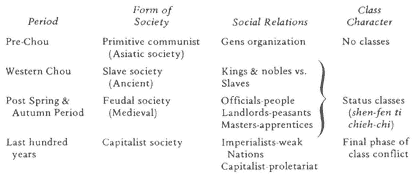
Of these various periods, the ones that became the subjects of controversy were the slave system of early Chou and, to a lesser extent, the pre-Chou period. Some of the Marxist historians objected to Kuo's identification of Asiatic and primitive communist societies. As this debate involved alternative interpretations of the concept "Asiatic mode of Production" which I will consider later, it seems best to postpone its discussion. The more important controversy to grow out of Kuo's periodization
in the years 1931–1933 revolved around the issue of slavery. In the rest of this chapter, I will look at Kuo's statements on early Chou society, the objections they aroused, and Kuo's revisions of his view in the thirties.
The Case for Slavery
The essays incorporated into the Chung-kuo ku-tai she-hui yen-chiu were devoted to the single end of demonstrating that in its ascent to civilization Chinese society had traversed a course identical to the one Morgan and Engels had discovered in the case of other societies at a comparable level of development. Kuo concentrated his attention on the period covering the latter half of the Shang dynasty and the first half of the Chou dynasty (roughly 1500–500 B.C. ), when Chinese society had experienced the only two revolutionary transformations it was to undergo prior to the modern age. He described the nature of these changes in Marxist categories: "Broadly speaking, before Western Chou [Chinese society] was a so-called 'Asiatic' primitive communist society. Western Chou corresponded to the slave society of Greece and Rome. With Eastern Chou, especially after Ch'in [255–206 B.C. ], China truly entered the feudal period."19 It was the first of these changes in China's evolution from a primitive to a civilized society that interested Kuo the most and occupied the dominant portion of his research. Combing through historical sources that included venerated classics — which purportedly were products of this period (the I ching the Shih ching , and the Shu ching ) — as well as oracle bones and bronzes that had been discovered in recent archeological excavations, Kuo set himself the task of documenting this transition.
The period Kuo's research embraced, in particular the Western Chou period (roughly the twelfth to the eighth centuries B.C. ), was widely held to have been the feudal period of Chinese history in contemporary historiography. In his earlier
essays, Kuo ignored this alternative interpretation. It is quite possible that since he left China in early 1928 and spent most of the remainder of the decade in Japan, he was out of touch with developments in Marxist historiography in China. He addressed the question of feudalism directly for the first time in late 1929 and when he did so, he aimed his rejoinders more at traditionalistic views of Chinese history than at contemporary Marxist interpretations.20
Kuo blamed the persistence of the view that Western Chou was a feudal society on the verbal confusion created by the Chinese term feng-chien chih-tu , used both to describe the social formation that prevailed in medieval Europe and to depict Chou society. This confusion, he pointed out, originated in the initial Confucian distortion of feng-chien . The two components of the term had existed in the early Chou dynasty. In their archaic usage, however, feng and chien carried concrete meanings that did not anticipate the systematic significance with which later usage endowed the composite term. Feng originally denoted either rows of trees utilized to draw boundaries of estates or simply mounds of earth; chien meant to set up or to establish. The two characters used in conjunction designated variously the planting of trees to delineate boundaries or the religious ceremony that involved the transplantation of a clump of earth from the ruler's ancestral altar on the land of the recipient of a land grant to affirm his title to the endowment.21 The significance of this vestige from a primitive period had been blown out of all proportion by Confucian thinkers toward the end of the Chou dynasty when they read back into the early Chou their vision of ideal society. Fengchien , and the ceremony to which it referred, became bound up at this time with the elaborate system of political ranking and a corresponding system of land distribution according to rank
that Confucians claimed existed in the Western Chou period.22 Following this tradition, the term had been employed in Confucian historiography to depict not just the ceremony but the complete sociopolitical system ascribed to early Chou. The recent Chinese discovery of the medieval European feudal system had compounded the traditional distortion. The external resemblance of the alleged Chou system to the European had resulted in the application of feng-chien to Western feudalism; the term, on the other hand, had acquired additional connotations from the association.
The majority of scholars, Kuo complained, overlooked the evolution of feng-chien and used it as if it had meant the same thing in the early Chou dynasty as it did in medieval Europe. To bolster this argument, Kuo challenged the historical reality of two phenomena that had provided the mainstay of the Confucian view of the past and were also important criteria in contemporary evaluations of the period (such as in the work of T'ao Hsi-sheng): the "well-field" (ching-t'ien ) system of land distribution and the rationalized hierarchy of ranks and land patterns (wu-teng wu-fu ).23 He used archeological materials to repudiate the veracity of classical records of the past. He pointed out, first, that in spite of their many references to land grants, bronze inscriptions did not once employ the term well-field . Second, although these inscriptions mentioned noble titles, the use of the titles did not indicate anything like the rationalized hierarchy that Mencius had attributed to the Western Chou.24 Kuo did not conclude, as a Western scholar recently has, that the traditional portrayal of early Chou was a product of Mencius's "lively, not to say creative, imagination,"
but he considered the lack of evidence in the bronzes sufficient to deny the existence of a feudal system during that period.25
Nevertheless, there was more to Kuo's rejection of feudalism in the Chou than the lack of archeological evidence to verify traditional accounts of a sophisticated system for allocating political and economic power — especially as he himself did not hesitate to evolve a highly systematic picture of Chou society. More significantly, his views on the period were informed by an understanding of historical evolution that precluded the possibility of feudalism at this particular stage of Chinese history: "Chou society has historically been regarded as a feudal system but this view does not accord with the order [ch'eng-hsu ] of social development. The fall of gens society must be followed by the stage of the slave system — which is also when the state emerges — before society can proceed to feudalism."26 Consequently, aside from his brief digression to challenge traditional interpretations, Kuo devoted his major effort to adducing evidence to prove that Western Chou was a slave society.
Kuo's assumptions on the nature of slave society directed his inquiry into the early Chou period. These assumptions remained implicit in the Research ; unlike most other Marxist historians at this time, Kuo eschewed prolonged excursions into questions of theory and definition. Even his references to Morgan and Engels were few and far between and were restricted to specific informational points rather than to the problematic of the concept of slavery. Except for his brief discussion in the introductory chapter, he did not spell out the criteria that qualified a society as a slave society. It is nevertheless possible to discern from the themes he pursued the characteristics which he considered to be the defining features of the slave stage. It is evident from his periodization that he took the completion of the transition from the primitive to the slave mode of production to be contingent upon the progress of the means of subsistence to
agriculture, which in turn presupposed technological break-through to the use of iron tools. Iron technology, the existence of advanced agrarian production as the basis of subsistence, and slave labor as the dominant form of labor, therefore, provided the "basic" (used in the double sense of essential and pertaining to the material base) components of the slave system. The emergence of the state in the political superstructure and of the patriarchal family as the unit of social organization attended the maturation of the slave mode of production. Finally, these changes were reflected in the realm of consciousness in the transition from animistic-polytheistic to ancestral-monotheistic notions of divinity and in the increasing stress on values that encouraged obedience to authority and moderation. These economic, social, political, and ideological features of slave society provided Kuo with a variety of avenues that he explored in different essays to prove his contention that Western Chou had been a slave society.
Kuo was explicit on the economic conditions of slavery: "The transition of primitive gens society to slavery begins with the discovery of herding: [it] reaches completion with the advance of agriculture."27 On the basis of evidence from the Shih Ching and the Shu Ching , he traced the origins of agriculture in China to the time of Hou Chi, the legendary founder of the Chou house who was presumed to have lived sometime around the twenty-third century B.C. and who bore all the characteristics of a mythological god of agriculture (the name literally meant Lord Millet). The Chou people had advanced continuously thereafter, and by the time of Wen Wang (twelfth century B.C. ) agrarian economy was flourishing in the Chou domain.28 The Shang — the ruling house at the time — had become familiar with agriculture about the time of P'an Keng (fourteenth century B.C. ), but agriculture there had remained primitive and secondary to herding as a means of subsistence.29 This difference in the mode of production had given the Chou
the edge in their competition for power with the Shang rulers and accounted for their final victory.30 By the time of the Chou conquest of Shang (1122 B.C. ), in short, China had realized the prerequisites to the maturation of the slave mode of production.
The discovery of iron, according to Kuo, was responsible for the surge in the status of agriculture in the economy. Even though his remarks on iron remained speculative and highly uncertain, he asserted with confidence that "the discovery of iron is required by theory to date back to the beginnings of the Chou [dynasty]; otherwise there would be no way to explain the causes of the advance of agriculture or the great revolutionary changes in Chinese society at this time."31 The application of metal to agriculture dated back to the Shang dynasty. The metal used then, however, had been bronze and throughout the dynasty stone and bronze implements coexisted.32 The Chou continued to use bronze; in fact, Kuo was compelled to conclude at one point that there was no trace of iron in the Chou and in another context he described the Chou dynasty as the Bronze Age in Chinese history.33 Nevertheless, in spite of his inability to uncover evidence of iron in contemporary sources, he insisted on inferring from theory that iron existed in the Chou and had played a crucial role in agrarian production.34
These changes in the economy induced revolutionary changes in Chinese society and politics by the time of the Shang-Chou succession. The most significant of these was the division of the hitherto classless society into two hereditary classes of aristocrats and slaves. Kuo approached the question of social bifurcation from two directions. One was to identify evidence for the existence of slaves in contemporary sources; the other was to
trace the evolution of kinship structure to demonstrate the transition at this time from the communal gens (shih-tsu ) organization to the nuclear family founded on private property.
According to Kuo, slavery in China originated during the Shang dynasty. In the oracle bones he identified at least three terms that were used interchangeably to refer to slaves. The form of the characters also indicated that the first slaves in China were members of alien tribes taken prisoner during war. The Shang period saw only the infancy of slavery, however, and the full value of slave labor went unappreciated; although slaves performed some productive duties in households and were even employed for military purposes, the majority were slaughtered in sacrifices.35
The economic changes China underwent toward the end of the period created the potential for the productive use of slaves and the conquered Shang provided the Chou with a ready supply of slave labor. It was the Duke of Chou who recognized the significance of slave labor and incorporated it into the economic foundation of the Chou political system. Kuo observed with bitter irony that the real sagacity of this venerated sage of Confucian historiography lay in his formalization of the slave system; his professions of virtue were comparable to those of the Japanese in contemporary China, Kuo thought, and only represented attempts to "con" the Shang people into believing that their enslavement was a heaven-sent act of grace.36 His reforms officially sanctioned the divisions of Chinese society into two classes of aristocrats and slaves. The division was reflected in the literature of the period: the ta-jen and chun-tzu of Western Chou texts referred to the nobility; hsiao-jen and hsing-jen denoted slaves; with a few exceptions, the so-called commoners (shu-jen ) were all slaves at this time.37 Slaves served the nobility on largely self-sufficient estates. Since life in the Chou was still relatively simple, with industrial production and exchange close to their primitive levels, agrarian labor consti-
tuted their single most important function. Their involvement in other productive activities such as crafts or in military duties remained seasonal or occasional. In fact, Kuo placed Western Chou society in the precivilized phase of social development, between the middle and upper levels of "barbarism" in the scheme Morgan had evolved.38
The other approach Kuo employed was to trace these social changes through the evolution of kinship structure. It should be noted that kinship held a more exalted place in Kuo's analysis than that of a mere analytical instrument used to demonstrate the transition from communal to class society. As befitted a disciple of Morgan, Kuo believed the family to contain within it a dynamic force that was an autonomous source of historical change. In his survey of the development of the Chinese family, Kuo adopted verbatim the evolutionary scheme Morgan had provided in Ancient Society . According to Morgan, following the lowest stage of savagery when mankind was indistinguishable from beasts and "promiscuity" characterized intercourse between the sexes, the family had developed through a number of progressive stages which corresponded to stages of social development universal to all mankind: the consanguine, the Punaluan, the Syndasmian, the Patriarchal (a transitional stage), and the monogamian stages.39 Sometime in the "middle status of savagery" the gens organization had come into being, possibly in conjunction with the Punaluan family which had for the first time abolished incestual relations between the sexes. The significance of the gens organization extended beyond its implications for the family, for once it had come into being, it served as the organizational matrix of all social relationships until the emergence of "political society," or the state, with mankind's rise to civilization. The greater part of Ancient Society was devoted to tracing the evolution of gentes among different peoples. Between the middle status of savagery and the emergence of civilization (when the monogamian family had rendered the gens irrelevant), the gens underwent two major
changes: the change from matrilineal to patrilineal descent, made possible by the Syndasmian family, and the change in "the inheritance of the property of a deceased member of the gens from his gentiles, who took it in the archaic period, first to his agnatic kindred, and finally to his children."40 The last stage in the evolution of inheritance corresponded to the maturation of the monogamous family dominated by the male, and the attendant rise of private property and the state during the upper status of barbarism, which was the highest stage of precivilized society.
Tracing these kinship forms in early Chinese history, Kuo assigned the stages of promiscuity and consanguinity as well as the origins of the Punaluan family to the pre-Shang period (which placed the sage emperors and the Golden Age of tradition in the period of savagery).41 The Punaluan family, which "was founded upon the intermarriage of several brothers to each other's wives in a group; and of several sisters to each other's husbands in a group,"42 persisted to the end of the Shang dynasty. Kuo adduced as evidence of the Punaluan family in the Shang traces in the oracle bones of the acceptance of "multiple mothers" (tuo-mu ) and "multiple fathers" (tuo-fu ) and the persistence of agnatic inheritance of kingship. Furthermore, matrilineality continued to dominate kinship relations, as evidenced by the worship of female ancestors and the reckoning of agnatic inheritance through females.43 This conclusion on the nature of inheritance accorded with the views of Morgan, who had inferred from his research that in the Punaluan family, "descent would necessarily be traced through females because the paternity of children was not ascertainable with certainty."44 Finally, the prevailing social organization was the gentile (shih-tsu she-hui ), based on common ownership of property. Kuo found evidence for all of these characteristics of early
Chinese society in the famous classical passage from the Li Chi (ascribed to the late Chou or the Han dynasty!), which described the "universal commonwealth" (ta-t'ung ) that had supposedly existed in antiquity.45
This system was on the decline by the end of Shang as a result of the transition from communal to private ownership of property which accompanied the rise of the monogamous family. Although the kings and nobles of early Chou could not be considered wealthy by later standards, they did control private property, which signaled the end of primitive communism. The emergence of trade, however miniscule in volume, was another manifestation of the change in property relations.46 These economic changes were bound up with changes in kinship structures. In his study of the I Ching , Kuo discovered "unmistakable" symptoms of the Syndasmian or pairing family, which consisted of "the pairing of a male with a female under the form of marriage but without an exclusive cohabitation" (temporary monogamy — ou-hun or i-shih ti i-fu-i-ch'i , as Kuo translated it). The practice of males leaving the household to get married and the continued existence of female household chiefs indicated the persistence of matrilinealism, but there were also signs of patrilinealism in the cases of females leaving the household to get married, in the practice of polygyny, and the emergence of inheritance through male offspring.47 Whatever the case, the breakdown of gens society led to the emergence of inequality in all aspects of society: economic and political relations and relations between the sexes. The subjection of
females to males in the family paralleled the emergence of class oppression in the economy and politics. Given Kuo's view of social development, with slave society following primitive communist-gens society, the appearance of inequality inevitably pointed to the transition to the slave mode of production.48
With the rise of private property and the monogamous family — albeit in the primitive form of the Syndasmian family — the stage was prepared for the emergence of the state. As the gens broke down, the gentile organization of society yielded to the political. Up to the end of Shang, political authority had been concentrated in gens or tribal assemblies which indicated a primitive form of democracy; with the Chou political power shifted to the ruler and the nobility, as did property in the economy. The state now took over the functions of administration, war, and the distribution of justice. Nevertheless, Kuo pointed out, society in early Chou was still not distant from its tribal origins; the kuo (states) were still much like tribes, and "political society" was more a tendency than an accomplished fact.49
Finally, Kuo turned to the ideological changes that had taken place during the Western Chou period to round off his argument. He averred that social and political tranformation during this period were reflected in contemporary literature, religion, and thought. The proliferation of status terminology in works of the period pointed to the intensification of class consciousness. The very flourishing of literature and the arts was indicative of the emergence of a leisure class.50 Especially significant were the changes in religious conceptions. T'ien (Heaven) and Shang Ti (Sovereign-on-high) emerged at this time as supreme deities, paralleling the concentration of power in politics; conversely, rulers used. these concepts as imperial propaganda to bolster their claims to power. In society in general, the polytheism of the primitive period gave way to ancestor worship as private property gained in social and economic significance.51
The most profound changes, and the most subtle part of Kuo's analysis, however, related to changes in world view. From his analysis of the I Ching , Kuo concluded that the transplantation of dialectical change in nature to society in that work discouraged ideas of progress, curtailed radical thought, and obviated efforts to change society. Since the notion of change in the I Ching posited that one extreme always led to another, it propagated the belief that wisdom rested with the pursuit of the "middle way" (chung-hsing ), thereby creating an ethic that served the wishes of the ruling class to perpetuate its power by discouraging demands for change. The I Chuan , which Kuo regarded as the product of the ensuing period when the slave mode of production was being replaced by the feudal, took this tendency a step further — this time consciously. The Confucian authors of that work transported the idea of change beyond the social to the metaphysical realm by portraying a Taoist creation, the Tao or the Way, as the source of all change that preceded society and was, therefore, beyond the reach of human influence. They consciously used the ethic of the "mean" or the "middle way" to undercut the social radicalism that was on the rise at the end of Western Chou. Kuo never said why this body of thought was particularly suitable to slave or to feudal society, but his message was clear otherwise: With Western Chou, Chinese thought had come to stress the hopelessness of efforts to achieve progress and thereby served the ruling class by enjoining people to think that contentment with the status quo — which now included the oppression of one class by another — was the ultimate wisdom.52
This summary distorts Kuo's argument by endowing it with a cohesiveness it did not have. The essays that constituted Chungkuo ku-tai she-hui yen-chiu were written as separate works and did not permit an integrated argument. Kuo made no effort to evaluate the relative weight of his various criteria as defining features of slave society. Whether this omission was intentional or not, the absence of a clear definition of slave society in particular detracted from the coherence of his presentation.
Furthermore, he was unable to demonstrate that the conditions which he took to be the universal prerequisites of slave society had been realized in early Chou. His observations on crucial points often contradicted one another, and it was only through the tautological interpretation of circumstantial evidence that he was able to build a case for his view of Chou society. Most embarrassingly for a Marxist, he was on the whole compelled by the lack of direct evidence to deduce the mode and the relations of production in Chou society from the characteristics of its organizational and ideological "superstructure." His opponents were quick to catch on to these weaknesses in his argument.
Kuo's Critics and His Revision of His Views on Early Chinese History
The criticism directed at Kuo's work was of two types. The more theoretical critiques concentrated on Kuo's periodization of history, his understanding of social formations, and his use of Morgan's categories. The critiques of this type inevitably bore the stamp of the particular author's views on the Marxist periodization of history. The other type of criticism spoke to Kuo's interpretation of the data of Chinese history. Although most of Kuo's critics did not separate these two categories or simply treated them as 'two faces of the same coin, such a distinction is necessary to correctly evaluate Kuo's achievement as well as the validity of the criticism to which it was subjected.
One widespread charge brought against Kuo was his "mechanistic" (chi-hsieh chu-i ) handling of Marxist categories. His critics argued that Marx had suggested the list of social formations in the preface to the Critique as a general typology of societies without claiming universality for all the formations or stipulating a necessary order of succession. Kuo's analysis, con-
trarily, was predicated on the assumption of identical evolution for all societies.53 These authors, in particular the Marxist ones, focused on the questions of Asiatic and slave societies to criticize Kuo's periodization of Chinese history. With respect to Kuo's identification of primitive, gens, and Asiatic societies, his critics accused Kuo of ignorance of the evolution of Marx's ideas on historical development. They conceded that Marx had viewed these societies as historically identical in his earlier work but argued that he had changed his mind and distinguished them as different categories after he had found out about Morgan's research. Kuo, oblivious of this shift, used a periodization that was obsolete in Marx's own eyes.54 Li Chi, who offered the most detailed criticism of Kuo's analysis, argued further that the outstanding characteristic of Asiatic society was the existence of a strong state. Kuo's use of the appellation "Asiatic" for the period before the emergence of the state only betrayed his profound lack of comprehension of what constituted Asiatic society.55
More significant were the criticisms of Kuo's view of early Chou society as a slave society. The critics attacked Kuo variously for having converted slavery into a universal stage of history, for his reversal of the order of historical development, and for his inability to cope with the definition of the slave mode of production. Ting Ti-hao rejected categorically that slavery constituted a necessary stage of history in Marxist periodization.
Kuo, he argued, ignored the inner workings of Chinese society and simply imposed upon early Chou the characteristics associated with slavery in Greece and Rome.56 Ch'en Pang-kuo and Wang Po-p'ing, who criticized Kuo in the same vein but were themselves more ambivalent on the question of slavery, described slave society as a transitional phase between primitive and feudal societies that did not deserve to be treated as an independent stage of history.57 Other authors, while accepting slavery as a universal stage, criticized Kuo for having transposed the order of slave and feudal societies. Li Mai-mai argued that slavery was historically posterior to feudalism by virtue of the fact that the slave mode of production was more advanced than the feudal. The reversion to feudalism after the classical period in Europe represented a regressive development which could not be generalized to other societies. The true feudal stage was the one between gentile and slave societies in early history.58 Finally, some authors pointed out that Kuo never defined his criteria for slave society. Ting Ti-hao averred, first, that the mere existence of slaves did not constitute proof for the slave mode of production. Slavery had existed throughout history; were that criterion to be adopted as the defining feature of the slave mode of production all society would have to be described as slave society.59 Furthermore, he argued, Kuo did not make a distinction between household slaves and a slave class which provided the labor force in society; most of the slaves he described in China belonged in the first category. For lack of evidence of slave production, Ting noted pointedly, Kuo deduced slavery from inequality between the sexes.60 Inevitably one author observed that Kuo's whole argument was shaped by his "belief" that slave society necessarily followed primitive
society; to those who did not share this faith his argument was transparently devoid of substance.61
Aside from the question of periodization, Kuo was also attacked in the theoretical sphere for his interpretation, or more accurately, misinterpretation of Morgan's views on the evolution of kinship structure. Li Chi charged that Kuo confounded the relationship between kinship groups and deviated from Morgan's scheme in his treatment of the evolution of the family. His particular reference was to the overlap in Kuo's work of the periods of promiscuity and the Punaluan family and his extension of promiscuity over the whole period of savagery. Second, Li pointed out that Kuo erroneously took the gentile organization of society to be conterminous with the Punaluan family. This was contrary to Morgan's ideas, since Morgan had suggested only that the Punaluan family had prepared the ground for the germination of the gens without tying the fate of the latter to any specific type of family: Within the limits set by the Punaluan family in the middle stage of savagery and the monogamous family in the upper stage of barbarism, the gens had encompassed different types of familial organization in different societies. More crucially, furthermore, in its various manifestations the gentile organization had contained both matrilineal and patrilineal systems of inheritance. Kuo's identification of the gens with matrilinealism was simply a distortion of Morgan's views. Equally serious was Li's charge that Kuo had used Morgan's stages of the development of precivilized society arbitrarily. Kuo, he argued, claimed universality for the stages but showed no compunction in skipping over those that did not suit his purposes. The case in point was Kuo's description of the Shang as the middle stage of barbarism and Western Chou as slave society. Where, Li wondered, had the stage of upper barbarism disappeared to if Morgan's periodization was valid as Kuo proclaimed it to be! Or if Western Chou was in the middle stage of barbarism, as Kuo suggested at one point, had Chinese society then entered the upper stage of
barbarism with the next change, the empire, and remained in that stage until recently?62
I will discuss the questions raised by the scheme of periodization Kuo employed in the context of the general problem of the Marxist periodization of Chinese history in Chapter 7. It is necessary here to say a few words about the justifiability of the charges Kuo's critics brought against him in the light of Morgan's work. At least the first two of the criticisms Li directed at Kuo's interpretation can be substantiated by evidence from Ancient Society . In the case of promiscuous intercourse, for instance, Morgan identified "this . . . lowest conceivable stage of savagery" with the period when man "could scarcely be distinguished from the mute animals by whom he was surrounded" and when even the notion of the family did not yet exist.63 Kuo, however, identified promiscuity (tsa-chiao ) with the totality of the period of savagery (meng-mo ) which encompassed the first three stages in man's rise to civilization after mankind had transcended its beastlike existence or, in Morgan's words, lasted from the "infancy of mankind all the way to the invention of the art of pottery." Morgan observed, furthermore, that the transition to the Punaluan family occurred deep in the period of savagery.64
Kuo's conclusion that promiscuity had persisted in China until the third millenium B.C. was made possible by assigning to promiscuity a much longer share of human history than Morgan had intended. Even more serious was Kuo's confusion of gentile organization and matrilineality, for he employed the transition from matrilineality to patrilineality as one of the indications of the breakdown of the gens and the emergence of slave society. Kuo's tabulation of Morgan's developmental scheme in the Research provided irrefutable evidence that he had indeed misread Morgan's ideas. In his table (and the analysis based on the table) Kuo subsumed gentile society under the broader category of matrilineality whereas, as Li pointed out, the relationship
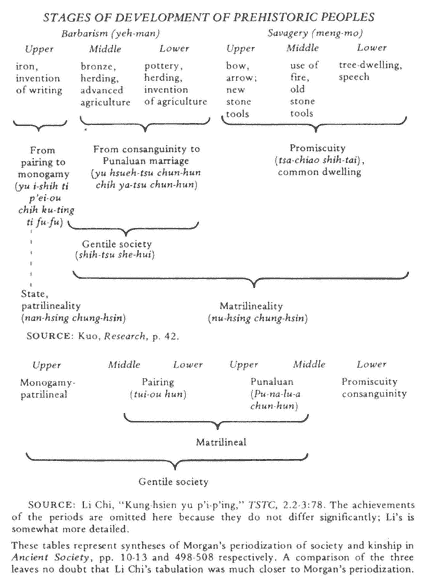
was the other way around in Morgan's formulation.65 Ancient Society left little doubt that Morgan regarded the gens in its
later development in the upper stage of barbarism (such as in Greece and Rome) as a patrilineal organization. Nevertheless, this confusion was not as subversive of Kuo's argument as some of his critics claimed. Morgan took the rise of the patrilineal family to be a consequence of the emergence of private property and to coincide with the appearance of "systematic slavery."66 There was, therefore, an ambiguity in his treatment of the relationship between the gens and patrilineal descent that Kuo, had he defended himself, might have used to advantage. The gens, according to Morgan, could contain patrilineal descent, but it could also be concluded from his treatment of the subject that the emergence of patrilineal inheritance eventually undermined the gentile organization by strengthening the monogamous family and giving birth to class differences in economic and political power. The stage of upper barbarism, when these phenomena allegedly first appeared, was also the period of decline of the gentile organization of society.67 The ambiguity of the developments in this period was also responsible for Kuo's telescoping of the period of middle barbarism with the stage of slavery. As this was a problem that grew out of Engels's fusion of Marxist periodization with Morgan's views on precivilized society, I will delay its discussion until the next section when this question will be taken up.
The second major area of criticism involved Kuo's use of evidence, especially the way he employed classical sources. H. Maspero, the eminent French Sinologist, expressed the views of many when he pointed out that Kuo disregarded all problems of authenticity when he used these texts as sources.68 It must be noted that Kuo displayed greater conscientiousness on this issue than many other Marxist historians, including those who criticized him on this count. His analyses of ancient texts were invariably prefaced by an evaluation of their historical veracity
and dating. Nevertheless, he held with other Marxist historians that even though these texts and the myths they contained could not be accepted as historically accurate, they offered clues to the nature of archaic Chinese society.69 He arbitrarily designated some texts to be genuine, while he rejected as forgeries those that did not support his position.
Another criticism directed at the Research questioned the sufficiency of archeological materials as sources on early society. Calling to mind a charge that had been brought against Ku Chieh-kang in the twenties, some critics protested that the oracle bones and bronzes provided only limited data and that in most cases Kuo was forced to argue from absence; that is, these materials did reveal certain features of ancient society but where they were silent on a phenomenon, this lack of reference did not constitute proof that the phenomenon in question had not existed.70 Finally, the critics argued that the evidence Kuo proffered did not disprove the existence of feudalism in Western Chou or prove that the slave mode of production had prevailed at this time. Ch'eng Ching pointed out that the basic flaw in Kuo's reasoning was his either/or approach to society: "If it is not feudal society, it must be slave society." Furthermore, he continued, the refutation of the existence of the "well-field" system or the systematized system of ranks did not disprove feudalism for feudalism was not contingent on either of these elements; rather the status of labor was the decisive factor in this regard. Some of Kuo's own statements proved that the peasants of early Chou had a great deal of freedom in the use they made of their lands, which was more characteristic of the feudal serf than of the slave. With respect to slaves, Ch'eng, like Ting Ti-hao, contended that the existence of slaves was not necessarily inconsistent with the feudal structure of society.71 Li Chi and Ch'en Pang-kuo added that Kuo rejected feudalism
because he identified feudalism with the guild system and, not finding guilds at this time, decided that Western Chou could not have been feudal.72
It is somewhat surprising that Kuo's critics did not place greater emphasis on the inconsistency of some of his data with the conditions that he deemed to be the universal prerequisites of slave society. His inability to discover any evidence of iron or sufficient evidence for the use of slaves in production as well as his conclusion that agriculture was still primitive in early Chou negated the assumption that Chinese society at this time had realized the necessary conditions for the establishment of the slave mode of production. As a consequence, he could claim with "certainty" only that in its social and political features did Western Chou society manifest those theoretically universal characteristics that appeared in the stage of slavery — that is, his argument was highly circumstantial.73 In the final analysis, Kuo inferred the existence of the slave mode of production from the emergence of the state, the patriarchal family, and inequality between the sexes. His efforts to find direct evidence for slavery yielded some fruit, but even there he had to deduce the slavery of peasants largely from their slavelike existence; he was unable to verify that the peasantry was held in bondage as slaves.
The reason Kuo's critics overlooked his inability to prove the existence of the material conditions of slavery was that they were too busy trying to prove that he had erred on the side of portraying the Western Chou society as a society not far advanced beyond the primitive. For one thing, they argued from Morgan that the existence of writing as early as the Shang dynasty proved that China had entered the period of civilization earlier than the Chou period.74 More to the point, most agreed that the agrarian economy was much more advanced in early
Chou than Kuo proposed.75 Li Chi, who was a great deal more unscrupulous than Kuo in the reliance he placed on ancient myths, traced the origins of both civilization and the centralized state to the third millenium B.C. He insisted, despite the lack of archeological evidence, that iron must have existed in China as early as this time.76 Others argued that China had evolved out of gentile society and matrilineality long before Chou; the existence of an aristocracy during the Shang proved that private property, patrilineal inheritance, and the state had all come into being by this time.77 While it is possible (though there is no evidence for it) that some were disturbed out of national pride by Kuo's description of this traditionally venerated period as primitive or precivilized, it must be remembered that many foreign specialists then and later agreed with Kuo's critics on many of these points. Maspero was one who criticized Kuo for picturing Western Chou agriculture as primitive.78 There was sufficient evidence incorporated into Kuo's own work, moreover, to indicate that Kuo, in his attempt to be loyal to a schematic view of history, downplayed the complexity of the Shang social and political organization.79
It is difficult to say if these criticisms of the Research motivated Kuo's revision of his views in the late thirties and the early forties. He occasionally referred to those who described early Chou as feudal without naming names. It is also possible, as previously noted, that he was oblivious of the criticism directed at his work for the simple reason that he did not return to China until 1937. His revision may have been, therefore, simply the product of the deepening of his research; by the mid-thirties he had secured a name for himself as one of the
foremost authorities on oracle bones and bronzes.80 His general tendency during these years was to move away from theoretical issues toward traditional-style textual analysis (k'ao-cheng ). He increasingly placed more value on archeological materials than classical sources; he continued to use the latter but declared openly that where they conflicted with archeological sources they had no value whatsoever.81 Also, references to Marxist authorities became even more inconspicuous in his writings than they had been earlier. He refused to alter the scheme of periodization he employed in 1928–1930; the substantial revisions in his analysis were restricted to the timing of the periods in China and the refinement of his argumentation that grew out of his research in ancient sources.82 Nevertheless, these changes were not inconsequential for his views on early China and obviated many of the criticisms that had earlier been directed at his work.
The most important change to take place in Kuo's views concerned the duration of the stage of slavery. By 1937 at the latest, he decided that this stage occupied a much longer portion of early Chinese history, extending from about the middle of the Shang dynasty (circa 1400 B.C. ) to the Spring-Autumn and even the Warring States period.83 The slave mode of production had reached its zenith in the transition from Shang to Chou and began its decline soon after. This change of timing had far-reaching implications for his views of early Chinese society. In the first place, Kuo was now more willing to acknowledge a much higher level of development in the Shang dynasty than he had been in his earlier work. He still insisted
that the Shang had been nomadic — as evidenced by the frequent shift of capitals — until the end of the fifteenth century but conceded the full development to agriculture after that period. His references to matrilineality and gentile society, accordingly, also became extremely sparse. In his new view, the Chou had been backward until the reigns of kings Wen and Wu and had inherited the higher culture of the Shang people only after the conquest. He now attributed the Chou victory over the Shang to the use of slaves in the Shang armies, which had diminished the fighting spirit of the Shang military before the more unified Chou.84
Second, he conceded that he had earlier exaggerated the profundity of the changes in the transition from Shang to Chou. This, he explained, had been due to his uncritical acceptance of the interpretations of Wang Kuo-wei, who had regarded this dynastic change as one of the most radical in Chinese history.85 Finally, Kuo's treatment of slavery in his later work was a great deal more precise than it had been in his previous work. He now made a clear distinction between the mere existence of slaves and the slave mode of production: "Clearly, household slaves do not make a slave system; unless there is large-scale slave production, there can be no slave system."86 His efforts to prove the existence of large-scale slavery were aided by archeological materials (bronzes) that provided evidence for the sale and purchase of slaves in early Chou. The veracity and timing of these documents aside, there is no doubt that Kuo now made a methodological distinction between direct and circumstantial evidence.87
Kuo's drift away from theory and circumstantial evidence was also visible in his treatment of iron, which he had earlier
considered essential to slavery. He now resigned himself to the absence of evidence for the existence of iron is Shang and even in early Chou. The earliest evidence for iron, he conceded, was in the late Spring-Autumn and the Warring States periods. The appearance of iron weapons at this time, he still argued, pointed to its anterior use in agricultural implements, but he was unwilling to push back its origins beyond Western Chou. Whatever the case, he now identified the transition to iron with the change from slave to feudal society with the establishment of empire.88
Perhaps the most symbolic of Kuo's departures from his earlier views was his acceptance of the existence of the well-field system in early Chou. He concluded that Mencius's statements on early Chou erred only in the attribution of common ownership to the Chou system of land distribution; otherwise, there was good basis for the historicity of the well-field system. The most important evidence for it was the character for the word field (t'ien ), which was a pictograph for well-field. But, Kuo interjected, it was a mistake to conclude, as some historians had, that the well-field was the equivalent of the manor in the feudal system. All land belonged to the state in early Chou and private property was still insignificant; t'ien (or ching-t'ien ) was only the unit utilized for purposes of land distribution.89
Kuo also elaborated on his objections to the description of this period as feudal. The source of confusion, in addition to the terminological one, he suggested, was the confounding of slave and serf on the basis of personal freedom. Many argued that since the peasants of early Chou had some freedom, they could not be slaves. In fact, Kuo countered, this was not a valid criterion, for agrarian slaves had greater freedom than their counterparts in crafts or trade simply because their placement on land of itself limited their mobility. In this sense, serfs and agrarian slaves did not differ significantly and were thus confused by most historians.90 Nevertheless, it was obvious that
Kuo's rejection of feudalism was still based on reasons other than his conviction that he had found sufficient evidence to prove that Chou peasants were slaves and not serfs. He continued to insist that ranks were not systematized in Shang and Chou, but he was unable to refute their existence. He worked his way out of this dilemma by resorting to a definition of feudalism that rendered the nobility and even serfdom irrelevant. This definition foreshadowed the handling of the concept of feudalism in later Chinese historiography. As in the case of Chu P'ei-wo's definition of the term, this usage had little to do with the use of the concept in its application to medieval Europe and even with Marx's own approach to the problem, although it was in keeping with the development of the term in later Marxist historiography:
My feudalism is a stage that has evolved out of slave society. The producers are no longer slaves but liberated peasants and artisans [nung kung ]. The important means of production in agriculture is the formally divided land which is now under the private ownership of an exploitative class of landlords. Crafts and trades are free of official control and organized according to guild enterprises. The state that is founded upon these classes subsists on the taxes paid by landlords, craftsmen, and merchants. This is the feudal society we speak of now [emphasis mine.] 91
By the time Kuo had revised his views, the controversy of the 1930s had abated. In his 1937 history, Ho Kan-chih noted that although many historians had objected to Kuo's interpretations at first, the number of those who concurred in his views had been on the increase over the last few years. Irrespective of its merits, therefore, Kuo's views of early Chinese society pointed to the dominant trend in future Chinese historiography.
Morgan, Engels, and Kuo Mo-jo
Kuo's Marxism, one of his critics in the Tu-shu tsa-chih remarked, was skin deep; he used sociology merely as an
embellishment for traditional-style textual analysis.92 One might argue back from the same metaphor that the "skin" is not to be scorned, for it shaped the data from the past into a corpus that was clearly Marxist in its physiognomy. Nevertheless, the point was well taken with regard to the depth of familiarity with Marxist theory Kuo displayed in the Research . If he was aware at this time of alternative interpretations of social development in Marx's work, he did not show it in his study of Chinese society.93 Furthermore, whether out of disdain or simply due to oversight, Kuo ignored foreign scholars' interpretations of early Chinese society.94 The only two authors whose works played important roles as guides to Kuo's analysis were Morgan and Engels. As far as it is possible to tell from the book, Kuo acquired his understanding of Marx from Engels's interpretations in The Origin of the Family, Private Property, and the State (hereafter, The Origin ).
The Origin consisted essentially of an abridgement of Ancient Society supplemented by Engels's commentaries. Engels saw no need to evaluate Morgan's work from a Marxist perspective, for he believed that "Morgan rediscovered in America, in his own way, the materialist conception of history that had been discovered by Marx forty years ago, and in his comparison of barbarism and civilization was led by this conception to the same conclusions, in the main points, as Marx had arrived at."95 Nevertheless, his incorporation of Morgan's work into historical
materialism introduced new ambiguities into Marx's ideas on social dynamics and the nature of early society. Some of the views for which Kuo was faulted by his opponents were in fact traceable to the fusion of Marx and Morgan in The Origin .
This was the case with respect to the role sexual relations and kinship structure played in historical development. Eric Hobsbawm, who refuses to distinguish the work of Engels from that of Marx, has observed that "pre-class society forms a large and complex historical epoch of its own, with its own history and laws of development, and its own varieties of socio-economic organization, which Marx tends now [that is, in his later work] to call collectively 'the archaic Formation' or 'Type.' "96 In The Origin , Engels adopted for Marxism the dynamics of development of primitive society Morgan had outlined in Ancient Society . He was, if anything, more direct than Morgan in assigning kinship structure a central role in this respect:
According to the materialist conception, the determining factor in history is, in the last resort, the production and reproduction of immediate life. But this itself is of a two-fold character. On the one hand, the production of the means of subsistence, of food, clothing and shelter and the tools requisite therefore; on the other, the production of human beings themselves, the propagation of the species. The social institutions under which men of a definite historical epoch and of a definite country live are conditioned by both kinds of production: by the stage of development of labour, on the one hand, and of the family, on the other. The less the development of labour, and the more limited its volume of production and, therefore, the wealth of society, the more preponderatingly does the social order appear to be dominated by ties of sex [emphasis mine.]97
In other words, it was only with the increase in productivity that economic forces came to serve as the primary motive force of progress. Throughout the prehistorical period, it was the refinement of sexual practices that accounted for changes in the form of the family and, therefore, social organization. Following Morgan, Engles observed that the prohibition of sexual intercourse between parents and children had eliminated
promiscuity in the beginning of the period of savagery while the prohibition of marriage between siblings had marked the transition from the consanguine to the Punaluan family during savagery. The gentile organization which "arose directly" out of the Punaluan system had given further impetus to the narrowing of the circle of permissible sexual relations. The result was the rise of the "pairing family" at the beginning of the period of barbarism. It was at this time that economic factors began to play their important role in social development. Until the period of barbarism, according to Engels, descent was matrilineal (as it had to be in group marriage), and inheritance was not in the family but the communistic gens. With the advance of production property had gained in value, encouraging the growth of patrilineal descent and inheritance by the middle stage of barbarism. This new development had reinforced the tendencies implicit in the evolution of familial relations. The two combined signaled the ultimate dissolution of the gens and the concurrent emergence of class society.98 Engels, even more than Morgan, saw in the rise of sexual inequality implicit in the patrilineal family the first instance of "class antagonism" in history and the paradigm for social inequality in general: "Thus in the monogamous family, in those cases that faithfully reflect its historical origin and that clearly bring out a sharp conflict between man and woman resulting from the exclusive domination of the male, we have a picture in miniature of the very antagonisms and contradictions in which society, split up into classes since the commencement of civilization, moves, without being able to resolve and overcome them."99
Furthermore, in adopting Morgan's view of precivilized history, Engels pushed slavery back into the prehistory of mankind. He agreed with Morgan that slavery had appeared first in the period of middle barbarism and reached its full development with the flourishing of production in upper barbarism.100 From the viewpoint of the scheme of periodization in the
Critique , this fusion of gentile society and slavery altered the dividing line between prehistorical and historical society, since slave labor stretched over both periods. Or, to look at it differently, the distinction between prehistory and civilization no longer corresponded to the distinction between "primitive communism" and "slavery"; "primitive communism" constituted only the early part of prehistory, the latter part being absorbed into class (slave) society.
Nevertheless, in writing the Origin Engels utilized Marx's notes on Ancient Society, and there is no reason to believe that his treatment of slavery distorted Marx's views on the subject. Marx did not stipulate that slave society was confined within the limits of classical society at its zenith, even though it is true that when he discussed slavery he referred mostly to the highly advanced Roman society. In a narrow sense, the defining feature of the slave mode of production in Roman society was the concentration of slave labor in large agrarian and industrial enterprises to produce commodities for the market: Flourishing commerce was, according to Marx, a precondition of slave society.101 The economically primitive phase of slavery that Morgan and Engels spoke of (and on which Kuo based his formulations of early Chou history) appears at first sight to be a far cry from Marx's slave mode of production. Closer examination of Marx's work reveals, however, that, as in the case of Morgan and Engels, Marx regarded the mature slave society of Rome to be the product of a long process of development.102 His notebooks on Ancient Society , moreover, contain no indication that he disagreed with Morgan's views on the origin and evolution of slavery.103
As Marx discovered Morgan's work in the last years of his life, Engels related, he was unable to work Morgan's findings into his own ideas on the transition from gentile to slave society, and it was left to Engels to undertake this task. It is
evident, at any rate, that it was Marx, tacitly, and Engels who telescoped the middle stage of barbarism and the slave stage of history and not, as Li Chi charged, Kuo Mo-jo. What Kuo did was to treat early Chou society, which by his own admission was economically backward, as the high point of the slave mode of production in China. The innovation that marked the advent of civilization, under the circumstances, had little to do with production but lay in the realm of culture: the invention of writing. Engels accepted this criterion, which had been suggested by Morgan,104 but possibly because he recognized the problem it created within historical materialism he did not assign it a significant place in the book. When he discussed the emergence of civilization in the last chapter, he confined himself to describing the economic and political changes registered at this time: increased complexity of the division of labor, explosive progress in productive power, the conversion of primitive barter into full-scale commerce, the development of slavery to its "fullest" maturity, and the substitution for gentile organization of the "territorial" state administered from new urban centers. Whatever the case, the transition to civilization was not marked by any fundamental break in the economic structure of society but simply represented the further development of forces generated in prehistorical society.105
Engels's modification of the place of slavery in Marxist periodization presented Kuo with a dilemma he was unable to resolve. According to the scheme of periodization Kuo adopted, the slave mode of production constituted the first stage in the period of civilization — the "ancient" mode which corresponded to the highly developed societies of classical Greece and Rome. Engels stretched slavery from the middle period of barbarism, when mankind had taken the first steps toward the conquest of nature, through the first stage of civilization preceding feudalism and capitalism. Rather than recognize that the slave mode to which Engels referred represented a departure from Marx's "ancient" mode of production in the Critique , Kuo
in his first work tried to overcome the inconsistency between the two versions of slavery by squeezing the long and complex developments Engels described into the initial phase of civilization. This accounts for the confusion, noticed by Li Chi, that marked his treatment of Western Chou, which was supposedly comparable to classical Greece and Rome and yet was primitive and which he described on different occasions variously as the middle stage of barbarism, the upper stage of barbarism, and the initial stage of civilization. It also explains the inconsistencies in his handling of the kinship categories he had derived from Morgan.
Nevertheless, Kuo parted ways with Engels (and Morgan) on other crucial points. Most important was his assumption of universality for the process of development described earlier in this chapter. While it is true that Engels and Morgan posited the evolution of mankind to be unidirectional, they conceded that such development was only a general trend and did not represent the actual historical experience of all peoples. Societies had evolved differently in the different physical environments of the eastern and western hemispheres. Also, they developed at varying rates according to circumstances, and only exceptional ones had managed to move out of primitive society into civilization. Morgan treated different societies separately and noted their divergences as well as their similarities. Universality entered into his analysis only in his placement of different societies on successive rungs of a universal ladder of progress.106 Engels followed Morgan in this respect, but he also raised a challenging question in his treatment of the relationship between Roman society and the Germanic tribes that had inherited Rome's
political power in Europe: What did the existence of a society that had already entered civilization imply for its more backward neighbors? In other words, what was the role of cultural diffusion in history? The Germanic tribes, having stepped into the vacuum left by the declining Roman empire, proceeded directly from gentile organization to the feudal state without going through slavery. While it is true that Engels regarded the conditions for serfdom to have been prepared in the decline of Rome, this did not change the fact that the Germanic tribes did not on their own follow a path of development identical to that of Greece and Rome, but found themselves in a more advanced stage of progress by virtue of the conditions prepared by Rome. This development, of course, creates problems within the scope of historical materialism; it is nevertheless significant that Kuo denied the possibility of divergence altogether, even though The Origin implicitly pointed to at least one important instance of its occurrence.
Another intriguing aspect of Kuo's analysis involved the transition from slavery to feudalism. It will be recalled that Kuo minimized the distinction between the two formations and suggested that the major difference was the dominance of consanguinity in one and territoriality in the other. In Morgan's formulation, this distinction applied not to the slavery-feudalism transition but to the replacement of gentile organization by political society at the threshold of civilization; territoriality was not the characteristic of any social formation but of the state throughout the period of civilization. The direct transition from consanguinity to territoriality coincided with the transition to feudalism only in the case of the Germanic tribes, which had bypassed the slave mode of production; in the case of Greece and Rome, the emergence of the territorial state corresponded to the rise of slavery. To the extent that consanguinity was associated with slavery, it was in its initial phase in precivilized society.
In the absence of elaboration by Kuo, we can only speculate on the reasons underlying the misapplication of this very prominent point in both Ancient Society and The Origin . Kuo, in his treatment of the Chou period, could not but observe that
aristocratic clans gained in political power at a time when, according to his premises, they should have been disappearing. The clans did not begin to disintegrate until the late Spring-Autumn and the Warring States periods, and it was only with the establishment of the empire that the central government crushed these organizations which had supplied the basis of localized aristocratic power.107 Since in Kuo's periodization of Chinese history the establishment of empire corresponded to the transition to "feudalism," it appeared in China's case that consanguinity was associated with slavery and the territorial state with feudalism. In employing the distinction he did, Kuo was in effect generalizing China's experience (and that of the Germanic tribes) into a universal characteristic of feudalism. His association of feudalism with territorial political organization was nevertheless of variance with Morgan and Engels. His association of consanguinity with slavery, on the other hand, contradicted his own observation that gentile organization had yielded to the state in late Shang or early Chou. Possibly out of his awareness of this problem Kuo was silent on Chou clans even though they formed an important facet of social-political organization in that period.
Kuo Mo-jo has revised his views a number of times since 1930. These revisions, however, have been restricted to matters of timing; his periodization of Chinese history retains the basic outline he first devised in Chung-kuo ku-tai she-hui yen-chiu .108 In spite of the fact that references to Morgan and Engels, sparse to begin with, gave way after 1949 to quotations from Stalin and Mao Tse-tung as sources of authority, the view of historical development that he derived from those authors has shaped the structure of his historical thought since he first turned to the writing of history.
6—
The Periodization of Chinese History
As Marxist historians concentrated their attention on the past, the issue of periodization moved to the center of the debates. As long as the problem of contemporary society preoccupied Chinese Marxists, the question of periodization had remained on the periphery of discussion, with only an occasional author expressing direct interest in the overall periodization of Chinese history. Kuo Mo-jo's work was partially responsible for provoking interest in the question by drawing the attention of Marxist historians to early history. Equally, if not more important in this respect were the disputes over historical periodization that got under way in the Soviet Union in 1928 in response to the problems encountered in the course of the Chinese revolution.
It will be remembered from Chapter 3 that some Comintern China experts blamed the fate of the revolutionary movement in the 1920s on the failure to recognize China as an "Asiatic society," with features that distinguished it from European society and, therefore, called for special considerations in the formulation of revolutionary strategy. This view was rejected by the political leadership in 1928 on the grounds that it denied the necessity of an antifeudal agrarian revolution, but the conflict instigated a major historical controversy over the status of the Asiatic mode of production in Marxist historiography which lasted until 1931, when a special conference convened in Leningrad to discuss the issue officially rejected "Asiatic society" as a
social formation in its own right.1 In the course of the discussions, the Marxist periodization of history was subjected to an unprecedentedly thorough reexamination.
Chinese Marxists were very much cognizant of the disputes in the Soviet Union, and the issues being discussed there, in particular the issue of China's historical particularity, loomed large in their writings in the thirties; one of their major aims in periodizing Chinese history was to demonstrate that Chinese society had obeyed the universal "laws" of development Marx had discovered in his studies of Europe. As Chinese Marxists welcomed the decisions of the Leningrad conference, it might be added, they also became more prone in the thirties to follow the Soviet lead in the interpretation of Marxist periodization; by the end of the decade, the most important Chinese Marxist historians, who differed in their background from those who had initiated the Marxist debates, accepted the view of historical periodization that dominated Soviet historiography after 1931.2
This tendency toward uniformity in historical interpretation was tied in with developments in the Marxist debates in China in the thirties. Marxist historiography went through two phases after 1930. The first years of the decade witnessed proliferation of Marxist writing with the intensification of controversy, which reached its high point in the "social history controversy" in the Tu-shu tsa-chih in 1931–1933. As the debates intensified, they degenerated progressively into an intellectual free-for-all where social and historical issues, and even political ones, were lost sight of as the participants engaged in exaggerated historiographical squabbles over minor differences of historical interpretation for no apparent reason other than asserting the distinctiveness of their analyses from those of authors whom they
considered to be their "opponents."3 In some cases nevertheless, the contributors succeeded in bringing forth new perspectives on Chinese history, which enriched the diversity of Marxist interpretations of the past, even though their analyses did not altogether justify their claims to originality.
Due to a combination of factors which will be discussed further on, Marxist historiography entered a more placid academic phase after 1933. During the remainder of the decade, the names of most of the revolutionaries who first undertook historical analyses disappeared from the publications that continued to publish Marxist works. These publications, many of them with academic ties, abandoned the concern with contemporary problems that had characterized the journals of the revolutionaries and stressed detailed research over controversy. By the end of the decade, many of the earlier interpretations of Chinese history had disappeared from sight, along with those who had advocated them, yielding the field to the new historical "orthodoxy" from the Soviet Union.
Through all these changes Marxist historians were bound together by the questions that guided their analyses. The historical theses of T'ao Hsi-sheng and Kuo Mo-jo provided the point of departure for much of the Marxist historical writing in the thirties and it is possible, if not very charitable, to regard most of the contributions in the 1930s as footnotes to the works of these two historians. Wang Li-hsi's introduction to the social history controversy recognized their stimulating influence on the discussions and acknowledged openly that the Tu-shu tsa-chih would continue basically the same type of historical inquiry as had been pursued earlier in other journals, in particular, the Hsin sheng-ming :
This battle is getting hotter and hotter. If we were to combine the drafts [this magazine has received], they would add up to over eighty thousand words. Because of limitations of space, we have decided to publish this short piece first. In case we receive more [essays], it will do no harm to publish a special issue on this question; indeed, it would be worth publish-
ing ten special issues on this question! The contents of the third issue will constitute a call to battle; the essays to be published will cross arms on every aspect [of the problem] with the works of the following authors:
(1) Ku Meng-yu, (2) T'ao Hsi-sheng, (3) Mei Ssu-p'ing, (4) Ch'en Tuhsiu, (5) Kuo Mo-jo.
The questions raised will cover the following:
(1) Did Chinese feudal society disintegrate in the Spring-Autumn period or not ?
(2) Should the gentry class be given special emphasis?
(3) What kinds of societies were Yin and Chou societies?
(4) What kind of society is contemporary Chinese society ?
We do not care at the moment what the conclusions will be, but we would like them to be objectively derived; we do not want subjective and arbitrary conclusions. We hope for the participation of those in broader and more universal areas of history.4
The authors Wang named and the questions he specified as guidelines to the controversy indicate clearly the role earlier works, in particular those of T'ao and Kuo, played in instigating historical inquiry; the increase in the intensity of debate after 1930 was partially a result of the existence of antecedents in the application of Marxism to Chinese history, which provided ready-made "targets" for the controversialists. The issues that had been raised in the initial discussions, moreover, remained alive during the more academic phase of the discussions, although they were less frequently attached to the names of the authors who had first raised them.
However, there were two important factors which contributed to sharpening the debates after 1930, that had little to do with the historical issues per se. The first of these was the effect on the discussions of the Tu-shu tsa-chih which, in its open encouragement of controversy, was responsible for stimulating Marxist historical writing. For two years between 1931 and 1933, the Tu-shu tsa-chih served as a lodestar which attracted to it all radicals interested in questions of society and history. As was the case with all the Marxist journals in these years, the Tu-shu tsa-chih was a product of the revolutionary movement. Its editors were associated with the social democratic "third
force" which opposed both the Kuomintang and the Communist party and sought a strategy of revolution that fell somewhere between the two extremes provided by the major contenders for power, one that would avoid the betrayal of the revolution by the Kuomintang without resorting to the tactical excesses of the Communists. The journal closed down in late 1933, when its editors were forced to go undergound in the wake of Ch'en Ming-shu's abortive rebellion in Fukien. It was indicative of the Tu-shu tsa-chih's impact on the discussions that when the journal closed down, and no comparable forum that could serve as an arena of theoretical conflict arose to take its place, the controversies among Marxists lost much of their intensity.
The vitality of the Tu-shu tsa-chih undertaking was itself nourished by the swelling number of frustrated revolutionaries around the turn of the decade. A good number of the contributors to the controversy were Trotskyites and other Communist dissidents who abandoned, or were expelled from, the party as a result of the internal conflicts of the late twenties. Unlike those revolutionaries with clear-cut political affiliations who had initiated the first theoretical discussions after 1927, the participants in the controversy were individuals or members of splinter revolutionary factions who, as far as it is possible to tell from the positions they adopted, lacked a clear ideological or political focus; their conflicts were often motivated more by a vague animosity against all rival revolutionaries than by any real differences over goals or strategy. Their revolutionary activities frustrated, they now poured into historical debates the energies they had been unable to channel in the cause of revolution. The warlike metaphors, "battle," "battlefield," "warrior" (and even the term for controversy which literally means "war of essays"), that pervaded their references to the debates provide constant reminders to the reader of the extent to which frustrations born out of the failure of revolution were injected into the writing of history at this time. The uncompromising attitude the participants adopted toward one another revealed the utter delusiveness of the desperate hope — which served as the outward justification for their participation in this metamorphosed revo-
lutionary activity — to fashion a revolutionary strategy that could once again unify all revolutionaries. The fate of the Fukien Rebellion, which as the last major attempt by non-Communist leftists to recreate the broad-based revolutionary movement of the 1920s, extinguished any lingering hopes in the rejuvenation of the revolution and, with them, the interest of the revolutionaries in history as the fountainhead of oracular wisdom.
Cheng Hsueh-chia has suggested that interest in historical materialism dwindled after 1933. The extensive, and futile, attempts to apply Marxism to Chinese history during the controversy, in his view, demonstrated to Chinese intellectuals Marx's ignorance of China, leading to a loss of confidence in the relevance of Marxist theory to Chinese society.5 While there was a definite decline in the intensity of discussion after 1933, and possibly in the density of Marxist writing as well, it is somewhat misleading to ascribe such changes to the disappearance of interest in historical materialism. In the first place, Cheng overlooks the fact that an important forum such as the Tu-shu tsa-chih did not close down for lack of interest but in the face of political repression. Even more importantly, a close examination of periodical literature after 1933 shows that interest in historical materialism did not disappear but rather assumed a more respectable, and for the same reason less conspicuous, academic guise. Marxist historiography lost a good deal of its distinctiveness as the questions first raised by Marxist historians, or their more refined offshoots, were absorbed into the flourishing social-historical research of these years, while many of the authors who continued to employ the formal structure of historical materialism turned from theoretical discussions to detailed historical research.
What disappeared after 1933 was not the interest in historical materialism as such, but the belief that historical analysis had an immediate relevance to revolutionary action, which had motivated Marxist historians in the early years of the discussions as it had heightened general interest in their work. The case of
T'ao Hsi-sheng, whose career as a historian spanned the whole decade, illustrates this shift. In 1928, T'ao turned to the study of history to resolve the questions aroused by the direction the revolutionary movement had taken, hoping thereby to bring the revolution back on a correct course. In 1934, in his opening editorial to the Shih huo pan-yueh-k'an (Food and Commodities Semimonthly), which was to become one of the foremost forums of social history as well as Marxist historiography over the next four years, he declared that the time had come to separate the study of history from the concerns of the present if a deeper understanding of Chinese history were to be achieved.6 Not all agreed with him, of course, but in the ensuing years the historians whose work raised Marxist historiography to a new level of sophistication were precisely those who, without openly admitting to it, followed the new trend toward the separation of the past and the immediate present.7
The table here offers an overview of the various periodizations suggested by Marxist authors in the years 1928–1937. It confirms the thesis that most of the periodizations represented variations on the schemes suggested in the early years of the discussions. This chapter will focus on the more significant, and original, contributions to the social history controversy and the few conspicuous splinter controversies that lasted till the end of the decade. These contributions took as their starting point the critique of the interpretations first proposed (or most ably defended) by T'ao Hsi-sheng and Kuo Mo-jo and, in the process, offered alternatives of their own. First, however, it is necessary to look briefly at the question of Asiatic society. This view did not evoke any significant enthusiasm among Chinese Marxists; nevertheless, the repeated attempts to refute or to bypass it
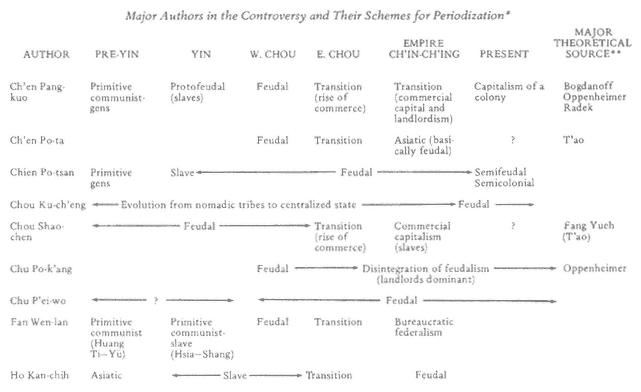
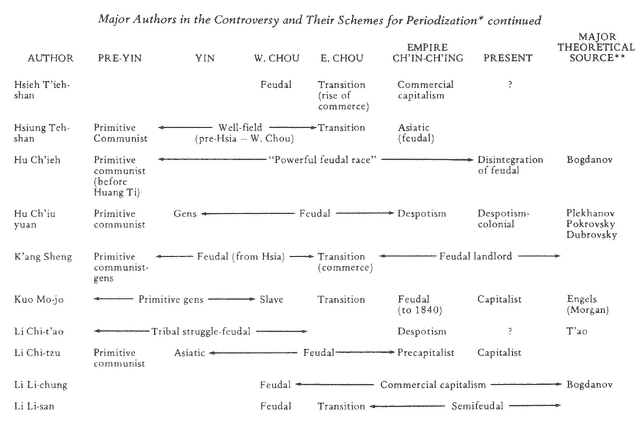
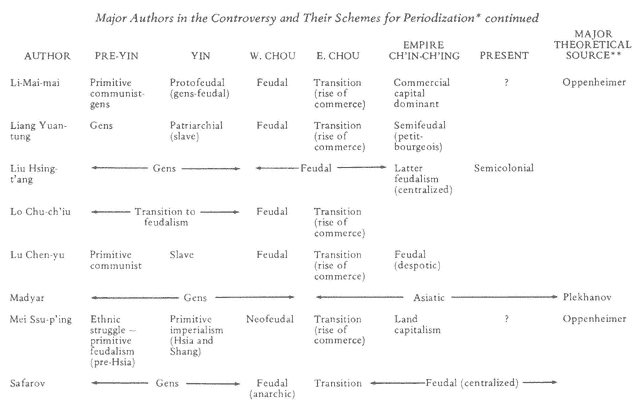
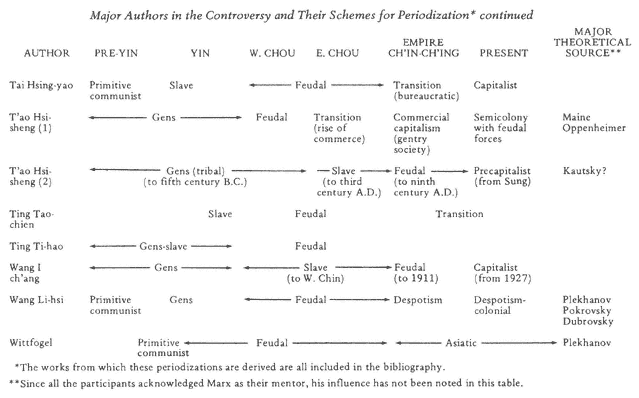
indicate clearly that it touched a sensitive chord in the consciousness of many of the Marxist historians and had a stimulating impact on the discussions.
Chinese Society and the Asiatic Mode of Production
The appearance of the first discussions of "Asiatic society" in China coincided with the debates in the Comintern. In 1928, Chung-kuo nung-ts'un ching-chi yen-chiu (Analysis of Chinese Village Economy) by L. Madgyar, the leading theoretician of the view at the time, was published in China, supplemented by an introductory essay by the publishers expressing disagreement with Madyar's views.8 In 1929, the Hsin sheng-ming published articles by Madyar and K. Wittfogel which applied the concept to Chinese history.9 The same year the views of a third important advocate of "Asiatic society," E. Varga, were introduced to the Chinese public.10 Nevertheless, references to Asiatic society by Chinese authors remained sparse until the time of the controversy in the Tu-shu tsa-chih , when a number of authors launched attacks on the concept, using arguments against it that followed closely the ones employed by Soviet critics of the Asiatic modes of production. In the remainder of the decade, occasional publication of discussions on Asiatic society by Russian and Japanese authors continued to appear in print. Chinese authors remained relatively quiet on the issue and tended on the whole to reject the validity of the concept in the form suggested by its major advocates.
The question of Asiatic society appeared in two different historical guises.11 One version, taking its cue from Marx's list of social formations in the Critique , placed it in the context of early society. This version found a number of adherents among Chinese Marxists, chief among them Kuo Mo-jo and Li Chi, who agreed on the validity of Asiatic society as a primitive social formation even though they disagreed in placing it in early Chinese history. The other version, the one advocated by the major foreign theorists, regarded Asiatic society as a postprimitive, precapitalist social formation that provided the counterpart in Asia to slavery and feudalism in European history. In the writings of Chinese Marxists, most of whom rejected the notion that there was anything peculiar or unique about China's historical evolution, this version was most conspicuous for the negative reactions it evoked. The few authors who used the term treated the Asiatic mode of production as an Asian variant of one of the other social formations, which accorded with the conclusions of the Leningrad conference in 1931.12
The authors who viewed China as an Asiatic society agreed that stability or stagnation was the outstanding feature of Chinese history, but disagreed in placing Asiatic society with respect to other social formations. According to Madyar, the period of the Asiatic mode of production in China stretched from the breakdown of gentile society during the Chou era all the way to Western capitalist intrusion in the nineteenth century and represented a more backward stage than the feudal, at least in the extent to which the concept of private property had
emerged.13 In contrast, Varga regarded it as a more advanced social formation than the feudal, and Wittfogel saw it as having developed in China out of an early feudal phase.14 It is not clear from these analyses what the authors believed would have been the future of Chinese society had it not been for the impulse to development provided by the Western intrusion; even Madyar conceded, however, that imperial Chinese society had manifested incipient tendencies toward the development of those elements that went into the making of capitalism in the West, surplus capital and labor. Now under Western pressure, Chinese society was undergoing a transition to capitalism, although traces of its Asiatic heritage still persisted and retarded its development.
State domination of society, according to these authors, was the universal feature of the Asiatic mode of production which eclipsed all the variations "Asiatic" societies displayed otherwise.15 Madyar discounted the significance of some of the criteria that were popularly employed to distinguish Asiatic society from other social formations: the low level of development of a commodity economy and currency of exchange, significance of merchant's and usury capital, rent-in-kind as the form ground-rent assumed, fusion of agriculture and industry in the household, and the communal organization of the village. All precapitalist societies' he pointed out, bore strong resemblances in these respects; conversely, identical social formations exhibited important variations with regard to these elements under different spatial and temporal conditions.16 The basic criterion for distinguishing one social formation from another, accordingly, was to be sought in property relations. In the case of Asiatic society, the predominance of the state stunted the growth of private property.
Madyar did not deny that private property had become pervasive in Chinese society from the late Chou onward, when the rise of an exchange economy had dissolved gentile society; nor did he claim that private property had matured fully under any precapitalist society. His distinction lay in the sphere of ideology: Although private ownership of property had existed in China from the earliest times, and the accumulation of property in the hands of individuals had reached impressive levels, the concept of private property had remained underdeveloped, with the consequence that there had been no strong pressure for the establishment of legal-political institutions to guarantee the right to ownership. A clear concept of private property, Madyar suggested, had not appeared in China until after the arrival of the West. This distinction may seem to be a moot one, and it certainly made the advocates of Asiatic society vulnerable to the charge that they argued from the superstructure of society to its economic basis: nevertheless, it effectively served its intended purpose of refuting the argument that China was a feudal society.
The concept of private property, Madyar conceded, had not achieved a dominant status in any society until the emergence of modern capitalism, but Western feudalism had institutionalized the idea of individual rights and privileges, which had prepared the ground for the maturation of the concept of property; in the case of China, by contrast, the existence of a strong state had curtailed the emergence of the notion of private rights into open rivalry with public power as represented by the organs of the state.17 Varga, even more explicitly, pointed to the state as the main distinguishing feature between imperial Chinese and feudal European societies when he argued that medieval Europe was characterized by the decentralization of political power in contrast to China where all power was concentrated in the hands of the state.18 The effects of a strong centralized state, in this view, had shaped all social and political
relations within Chinese history, and accounted for the divergence between the evolution of Chinese and European societies.
The proponents of Asiatic society traced the roots of political power in China to the essential function the state performed in the economic subsistence of society. In contrast to the "dry" agriculture of Europe, Chinese agriculture was "wet"; that is, agrarian production in China (and other areas where the Asiatic mode of production prevailed) was heavily dependent on the regulation of water resources.19 This condition produced what Wittfogel has since described as a "hydraulic society."20 The organizational requirements of water control, according to all of these authors, were such that only a centralized government with a far-flung bureaucracy could have undertaken its management. Madyar added that that need for organization in the case of China was exacerbated by the perpetual threat of nomadic incursions into China from the north, which called for constant military preparedness.21 These two factors combined had created a situation where the political superstructure dominated society completely.
The advocates of Asiatic society, however, were unwilling to draw from their analyses the obvious conclusion that the Chinese state had led an existence above classes or, at the very least, that state power over society had dwarfed all social divisions in determining social and economic relationships. Madyar denied the possibility of state power existing independently of and above classes, and averred that the intimate ties between officialdom and the landlord-merchant elite in China led the state to behave in the interests of the ruling economic class.22 Varga went even further when he suggested, much as T'ao Hsi-sheng had done, that the officials of the Chinese government exhibited a feudal nature in their exploitation of society.23 To their opponents, however, such statements appeared
as mere window-dressing. They recognized correctly that the main thrust of the arguments in favor of Asiatic society was to down play the role of classes and class conflict in the name of a deeper bifurcation between state and society. This view had certain implications for Marxist social theory, as well as for revolutionary strategy in China, that accounted for the opposition it provoked both in the Soviet Union and among Chinese Marxists.
The "pluralism" of historical development implied by the concept of the Asiatic mode of production was its most significant feature within the context of Marxist historiography.24 The crucial distinction between this view and others which allowed for some differences between Chinese and European development resided in the dissimilarity of the conception of historical development that informed them. The opponents of feudalism in China shared with its proponents the belief that historical development was uniform the world over, with differences restricted to the rate, not the nature, of development. The advocates of Asiatic society, on the other hand, held that historical development could, and did, follow different courses depending on the physical environment in which societies were placed; that multiplicity, rather than uniformity, characterized history. This view, which is seemingly at odds with the monist conception of history implicit in Marxism, has been the source of much disputation within Marxist historiography, mainly over the question of whether the distinction was first drawn by Marx or represented a distortion of Marx's views by later exegetes of historical materialism.25 The Marxist theoretician whose name
has been most intimately associated with the view is G. Plekhanov, "the father of Russian Marxism," who was the first to systematically articulate Marx's vague references on the subject, and whom the advocates of Asiatic society in the 1920s openly adopted as their mentor.26
Plekhanov argued that historical development followed one of two major paths. In the first path, followed by European society, the dissolution of gentile society was followed by the emergence of slave society and, following that, the evolution into feudalism and capitalism, in that order. The other path was the one followed by "Asiatic" societies which proceeded from gens society to the Asiatic mode of production, characterized by a strong state organization and lacking the internal dynamics characteristic of European society. Plekhanov made no effort to conceal that the distinction he was making (or, as he saw it, Marx had made originally) was ultimately traceable to the differences between the geographical environments of European and "Asiatic" societies: The characteristic features of "Asiatic" societies were necessary consequences of the economic dependence of these societies on the regulation of water resources.27 His view, though he did not admit to this aspect of it openly, was in essence "geographical determinist." It hardly mattered whether he conceived of geography as cause or condition since, in either case, the geographical environment prescribed the course of history. Regardless of how one evaluates the virtues of this view, it obviously contravened a basic Marxist premise that the interplay of forces internal to society provided the basic motive power of social development. This was the important theoretical element in the criticism which Plekhanov's interpretation of historical materialism, and its application to Chinese history by his ideological progeny, provoked in the late twenties.28
The work that signaled the launching of the attack on the Asiatic mode of production in the Soviet Union was S. M. Dubrovsky's On the Question of an "Asiatic" Mode of Production, Feudalism, Serfdom, and Merchant Capital , published in Moscow in 1929. During the next few years, the controversy in the Soviet Union revolved around the theses Dubrovsky, director of the Agrarian Institute under the Communist Academy, put forward in this book; his theses also proved to be very influential among Chinese Marxists seeking arguments against Asiatic society.29 Dubrovsky avoided dealing with the specific evidence the advocates of Asiatic society had adduced to prove their contentions concerning Chinese society; nor did he deny the lack of private property and the existence of a supraclass state that derived its power from hydraulic activities in certain societies. Rather, using "abstract deductions," he attempted to demonstrate that those phenomena belonged to the "superstructure" and were not sufficient to define a social formation, since they could be found to have existed widely under different historical circumstances. Nevertheless, to accommodate the characteristics associated with the Asiatic mode of production within more "orthodox" Marxist social formations, Dubrovsky was himself compelled to stretch "orthodoxy" by multiplying the number of social formations beyond the orginal five or six enumerated by Marx: On the basis of references in Marx, Engels, and Lenin, and possibly inspired by the earlier interpretations of such Marxist theoreticians as Bogdanov and Pokrovsky, he enumerated a total of ten social formations to encompass historical development in Europe and elsewhere.30
The debates in the Soviet Union revolved mainly about the social formations Dubrovsky had suggested, in particular his
chopping up of feudal society into feudal, serf-holding, and small producer phases. In the course of these debates, Soviet historians reached a tacit consensus that Asiatic society was not an independent mode of production but a variant of one of the other social formations; the majority took it to be a variant of feudalism, but there were also those who held that it was a modified form of slavery.31 After 1931, this interpretation dominated Soviet historiography, first tacitly and, following Stalin's exclusion of Asiatic society from the list of acceptable social formations in 1938, officially; it was not until the 1960s that the concept was once again revived in Soviet historiography.32
Chinese Marxists who objected to the application of the concept Asiatic mode of production to Chinese society followed the lead of Soviet historians in the arguments they employed. They, too, accepted the validity of the crucial observations on the peculiarities of Chinese society drawn by the proponents of Asiatic society; but they refused to acknowledge that these characteristics marked China as a special historical case. Their efforts, as in the case of their Soviet counterparts, were devoted to demonstrating that those characteristics could be explained as manifestations of a society under transition from feudalism to capitalism.
The Social History of Controversy
The majority of the contributions to the Tu-shu tsa-chih were important primarily for the critical perspectives they brought to bear on earlier Marxist writings. Since many of these criticisms have already been mentioned in earlier chapters, the present discussion will be restricted to those works published in the journal that introduced significantly new views on Chinese
history and will emphasize the aspects of these works that added to the complexity of the Marxist understanding of the past. It should also be remembered that these views were formulated by their authors in conscious efforts to refute the interpretations of those they considered to be their antagonists; many of these views were presented piecemeal as the polemics evolved. For the sake of clarity and brevity, they will be treated more systematically here than was the case with their original presentation.
Li Chi-tzu and Precapitalist Society : Li Chi was, by the common appraisal of his colleagues, one of the most knowledgeable Chinese Marxists at the time of the controversy and commanded an impressive knowledge not just of Marxist theoretical literature but also of German historical literature in general (he had studied in Germany in the twenties). None of the important Marxist historians, and only a few of the unimportant ones, escaped his criticism which, if somewhat petty and distempered on occasion, was always theoretically well-founded. Nevertheless, Li's success in applying Marxist theory to Chinese history did not match his critical acumen at detecting flaws in the works of others. His self-assurance enabled him to stretch theory to fit China's circumstances, an undertaking that most of the other Marxists shied away from; otherwise, he was no less selective in his use of Marxist theory than those whom he criticized on the same count.
As the table indicates, Li divided Chinese history into five major periods: (1) primitive communism to the time of P'an Keng (1402 B.C. ), (2) Asiatic society during Yin, (3) feudal society during Chou, (4) precapitalist (ch'ien-tzu-pen chu-i ) society from Ch'in to the Opium War, (5) capitalist society since the Opium War.33 Li's most original and controversial contributions to Marxist historiography were in his interpretation of the
second and the fourth periods, to which he devoted most of his attention.
Li believed that social formations had overlapping features but that they were distinguishable with respect to the dominant form property relations and, therefore, class structure assumed in different periods. He did note at one point that the mode of production (sheng-ch'an fang-shih ) was the only proper standard to employ in historical periodization: nevertheless, it is clear that he took the mode of production to include more than technology, incorporating within its compass the organization of labor and, by implication, property relations. Although he recognized the significance of technology to social development, especially in early history, he deemed it insufficient to account for the progress from one social formation to another; in the case of capitalism, he rejected specifically the idea that the use of machines could explain the capitalist mode of production.34
Li described the "content" of social formations in terms which gave primacy to the ownership of the means of production and its consequences for the organization of labor. Under primitive communism, he argued, land belonged to the communal kinship organization, and all members cooperated in production. The outstanding feature of the next, Asiatic, stage of history was state ownership of land; while the communal village survived the transition, it no longer owned the land, and production devolved onto the shoulders of individual peasant households which became the units of combined agrarian and industrial activities. Under the "ancient" (Greek and Roman) mode of production, land belonged to the aristocracy. Labor here took the form of slave labor within the boundaries of large estates (latifundia), and the products of labor were commonly destined for the market rather than for immediate use. With feudalism, landownership passed into the hands of the feudal nobility. Here production, which once again combined agriculture and crafts, reverted to small peasant production on feudal
estates, with immediate consumption as the objective. Peasants under feudalism owned the tools necessary for production; their subservience to the nobility, therefore, could be guaranteed only by attaching them to the land as serfs. This relationship of compulsory personal dependency provided the paradigm for social and political organization under feudalism. The rise of exchange within feudal organization led to the displacement of the feudal nobility by new-style landlords and a petite bourgeoisie. This new class, which owned both the land and the capital, liberated the peasantry but at the same time steadily reduced it to a mere laboring class. This relationship embodied the content of precapitalist society. Finally, as production took the form of large-scale production for the market and exchange of commodities flourished, precapitalist society was transformed into capitalism wherein the bourgeoisie established exclusive control over all the means of production and labor was transmuted into proletarian labor, that is, labor that was totally deprived of the means of production.35 Li noted in another context that it was only when property relations took an exclusively economic form, as they did under capitalism, that it was proper to speak of "classes."
As in the case of Kuo Mo-jo, Engels and Morgan provided the starting point of Li's inquiry into ancient history. Nevertheless, he differed from Kuo on the criteria of interpretation he adopted and, consequently, in evaluating available materials on early history. In the first place, he pushed the origins of Chinese civilization much farther into the past than Kuo was willing to do. He was highly critical of historians such as Ku Chieh-kang who, he believed, had been seduced by "positivism" and "empiricism" and cast doubts on the veracity of traditional records.36 He maintained that such records, though not history, reflected society as it had existed at the time and could, with the appropriate theoretical apparatus, be utilized to reveal historical reality. The theoretical apparatus, as it were, proved to
be the models derived from the comparative study of social development; Li was more than willing to discover in early Chinese history characteristics for which there was no evidence on the grounds that the experience of other societies indicated the "probability" of such characteristics.37
The theoretically controversial aspect of Li's views on early Chinese society concerned his interpretation of the Yin period (later from Hsia to Yin) as the stage of "Asiatic Society" in China. As was the case with Kuo, Li adopted Marx's periodization in the Critique and placed the Asiatic mode of production in early history, but he disagreed with Kuo's equation of Asiatic and primitive (or gentile) societies since he took state ownership of land to be the outstanding feature of Asiatic society; that stage, he argued, could only have been realized after society had advanced beyond the primitive communist stage of history. He agreed with Plekhanov's observation that Marx had changed his views on the evolution of early society after he had found out about Morgan's research and had subsequently placed Asiatic society in the postprimitive phase of history. Li also employed Plekhanov's authority to argue that, in the new view, Marx had taken Asiatic society as an alternative path of development to that followed by Greek and Roman societies. Chinese society, he concluded, had never gone through the stage of slavery but instead passed directly from Asiatic to feudal society at the end of the Yin period.38 Rather conveniently, Li ignored the fact that Plekhanov had regarded Asiatic society not merely as an alternative to slavery but to the evolution of European society in general, which included feudalism as well as slavery. It was quite obvious from Li's writings that this omission was due not to oversight but to his rejection of Asiatic society as a stage that directly preceded capitalism.39
Li Chi's treatment of feudalism in China did not differ in its basic features from that of T'ao Hsi-sheng, and neither did his views on the demise of the feudal system in late Chou, except
perhaps in the greater function he ascribed to the use of iron in increasing productivity and, therefore, stimulating the flourishing of an economy of exchange. Li was loath to give up the possibility of the use of iron as early as the third millenium B.C. , but he conceded that iron did not become a significant element in production until mid-Chou, after which it hastened the dissolution of the feudal system and the emergence of "precapitalist" society.40 This concept was Li's most significant contribution to Marxist historiography. Li, at least as he saw it, differed from T'ao Hsi-sheng and the advocates of feudal society most radically in his interpretation of the significance of commercialization for subsequent Chinese history — although, as Wang Li-hsi pointed out later, he exaggerated his differences from those authors, in particular T'ao Hsi-sheng, who was the target of some of his most virulent criticism.41
Li Chi described imperial China from Ch'in to Ch'ing as a "precapitalist society," using the term not in the generic sense of a society that preceded capitalism but in the specific sense of a social formation that occupied a place between feudalism and capitalism and was a precondition of the latter. European history, he argued, had passed through a similar stage between the medieval and the modern periods, but whereas this phase had been of relatively brief duration in Europe, it had persisted without significant change in China for two thousand years.42 The precapitalist mode of production, as he defined it, was "a kind of transitional mode of production which contained within it the remnants of all the modes of production that had preceded it."43 Power in this society still resided with landlords, but the landlords of precapitalist society were not to be con-
founded with feudal landlords. Precapitalist society followed upon the breakdown of the self-sufficient economy of feudalism under the pressure of merchant's capital and commodity exchange; the "extraeconomic" dependency relations of feudalism, therefore, gave way in the precapitalist phase to social relations that were at least partially economic. Such a shift pointed to a crucial change in property relations and, therefore, the character of social classes and the dynamics of society. It was on this point that he distinguished his position from that of T'ao Hsi-sheng: "If we get to the essence of his [T'ao's] argument, we see that there is nothing in common between his precapitalist period and ours. His society of the precapitalist period is a feudal society, or at best a postfeudal [hou-feng-chien ] society. What we call precapitalist society is neither feudal nor postfeudal; rather it is a society where the precapitalist mode of production has taken hold following the demise of the feudal mode of production."44
This distinction seems at first sight to be a moot one since Li's precapitalist society, as he described it, appeared to have the same general features as T'ao's commercial society: (1) the fusion of agriculture and home industries, with economic activity revolving around a number of local markets, (2) importance in the economy of merchant's and usury capital, (3) domination of commerce over industrial production, (4) existence of landlords and "other upper classes," (5) existence of independent artisans, (6) persistence of the production methods that had existed earlier, (7) concentration of the means of production in a few hands with a consequent impoverishment of peasants and artisans.45 There is no reason to believe that T'ao would have disagreed with the existence of these characteristics in imperial society. Nevertheless, the two authors stressed different aspects of imperial social structure: Where T'ao emphasized the continued predominance of political relations (or, following Oppen-heimer, political exploitation for economic purposes), Li held that social relations had come to revolve around a primarily
economic matrix by the time of the imperial period. The most significant consequence of this divergence concerned the problem of classes in imperial China. T'ao's views led him to conclude that the bifurcation between the political and the economic elite had overshadowed class divisions as the determinative datum of imperial Chinese history; Li, on the other hand, took class divisions within society as the starting point of his analysis. In fact, one might deduce from Li's distinction among rank (fa-yueh ), status (shen-fen ) and class (chieh-chi ), with the connotations respectively of basically political, social, and economic differentiation in society, that class divisions had become autonomous sources of social dynamics only with the onset of the imperial period, when economic relations had come to replace political relations as the foundation of social organization.46
Finally, these differences resulted in divergent views of the dynamics of imperial China. Li had good reason to charge that T'ao, although he took imperial China to be postfeudal, regarded the retrogressive "feudal forces" or remnants as having determined the fate of Chinese society by holding back its progress. Li's concept of precapitalism, by contrast, implied a progressive, and necessary, stage falling between feudalism and capitalism without which capitalism, in China or Europe, would have been impossible.
Li was not able to overcome the proclivity most Chinese Marxists displayed to tailor Chinese history to fit the model provided by European history. Yet he was more flexible than most in the way he handled Marxist social formations and was willing to shift the relative significance of some of the ideas he found in historical materialism, the most important instance of which was his acceptance of precapitalist society as a social formation rather than as a mere transitional period. This view, along with his rejection of slavery, suggests that he came closer than most of his Marxist colleagues to treating social formations as "types" rather than as consecutive stages of historical devel-
opment. Li himself, finally, boasted of his willingness to change Marx where necessary when he criticized T'ao and Chu for their reluctance to depart from the letter of Marx's writings, which he characteristically attributed to the ignorance of those authors of the basics of historical materialism.47
Wang Li-hsi, Hu Ch'iu-yuan, and Despotic Society : Wang Li-hsi and Hu Ch'iu-yuan not only shared the editorial management of the Tu-shu tsa-chih but also held nearly identical views on Chinese history. Their most important contribution to Marxist historiography lay in their argument that imperial Chinese society had been a "despotic" or "absolutist" society (chuan-chih chu-i she-hui ). This idea was not unique to them, but they emerged in the course of the controversy as its most avid proponents.
It is evident from the journal discussion that the question of the nature of the state and its relationship to society emerged from the beginning as one of the fundamental concerns of Marxist historiography. Radek was the first to address the question of despotism and, thereafter, the question repeatedly intruded into the debates in various guises. It was not until the appearance of the analyses by Wang and Hu, which were clearly inspired by the debates in the Soviet Union, that the concept of despotism (as distinct from "Oriental despotism") acquired visibility. In their polemics against other Marxist interpretations, the two authors reserved their harshest criticism for the proponents of Asiatic society, following the lead of the opponents of Asiatic society in the Soviet Union, in particular that of Dubrovsky. Although Wang and Hu objected to some of Dubrovsky's theoretical formulations, they concurred in his view that Marx had not conceived of Asiatic society as a peculiar social formation and held the "geographical determinism" of Max Weber and Plekhanov responsible for this "deviation." In rejecting the idea that the Asiatic mode of production had prevailed in China, or anywhere else for that matter, Wang
and Hu discovered the most appropriate substitute for explaining the features of imperial Chinese society in the concept of a postfeudal, precapitalist "despotism," which Pokrovsky had utilized to explain the development of premodern Russia.48
The two authors agreed that after having passed through the primitive communist, gens, and feudal stages, Chinese society had evolved by the end of the Chou period into a transitional form that was the product of the dissolution of feudal society by commerce.49 As Wang described the mechanism of the changes at the end of Chou,
The natural economy was dissolved by commodity economy so that "old capitalism" [lao tzu-pen chu-i ] could be nourished within the womb of feudal society. Landlords, in order to undertake large-scale commodity production [for the market], began to forcefully annex land, that is, land concentration got under way. Once landlords and commercial capital were allied, commercial capitalists often became landlords and landlords engaged in commerce, with the result that feudal exploitation was deepened. The concentration of commercial capital undermined localized political power and prepared the circumstances in which despotism could arise.50
Hu portrayed despotic society in greater detail. (1) The progress of commodity economy and commercial capitalism within feudal society undermined the power of the nobility and enabled monarchs to concentrate power in their hands. (2) The monarchy now took over as the protector of the nobles and the merchants, and served as the intermediary which harmonized their essentially conflicting interests; this complicated but did not negate the class nature of the state since (3) one of the duties of the state was to suppress peasant unrest which became more widespread as the oppression of the peasantry increased. (4) As the cash economy flourished, the extravagant demands of the rulers multiplied, increasing the exploitation of the
people through taxes which were now instituted to meet the state's needs for funds. (5) The stability of state power was guaranteed by the use of bureaucrats and mercenary armies. (6) Peasant rebellions occasionally overthrew the monarchs but, with the low level of peasant political consciousness, power always reverted back into the hands of landlords, merchants, and bureaucrats, and the monarchy was invariably reestablished.51 According to Hu, the bureaucracy, standing armies, and cash rent and tax were the most important features of despotic society, and pointed to its essentially antifeudal nature, even though the system tolerated and perpetuated remnants of feudalism and feudal exploitation.52
These features of imperial Chinese society described by Hu and Wang were essentially deductions from Pokrovsky's premise that "the absolute monarch, as a form of the state system, arose on the basis of commerical capitalism."53 Pokrovsky had argued that the centralized despotic monarchy could arise only in a commercial (in contrast to a natural) economy: In the natural economy of feudalism, the monarch remained dependent on his vassals for the exercise of power and, therefore, had to share power with them in order to guarantee their cooperation; only after the rise of commercial (and, presumably, directly taxable) economic activity could the monarchy financially afford to replace vassals by hired officials and armies. Once such a source of income had been guaranteed, the monarchs were quick to turn against feudal lords to enhance their own power.54 Furthermore, as Pokrovsky saw it, despotism not only sealed the fate of feudalism but also contributed dynamically to the emergence of capitalism.
Hu and Wang agreed with Pokrovsky's view of "merchant or commercial capitalism . . . as a lower stage of capitalism" and
took the absolute monarchy founded on such an economic basis to be "an active participant in and organizer of primitive capitalist accumulation."55 Advocates of this view in China stressed the affinity of the despotic state with the urban commercial class and even suggested that the initial unification of China under the Ch'in had been made possible by merchant support for the dynasty; the dynasty had in return expressed its gratitude, they claimed, by permitting merchants (of whom the most outstanding was Lu Pu-wei) to gain access to the highest levels of power.56 Nevertheless, the despotic state extended its protection to the whole economic elite composed of landlords and merchants against the oppressed lower classes. Its mercenary armies were used to suppress peasant insurrections while its bureaucrats, serving as intermediaries between landlords and merchants, forestalled disruptive conflicts within the elite.
How did the view of imperial China as "despotic society" differ from the other views discussed here? The advocates of this view distinguished themselves not only from the proponents of Asiatic society but also from T'ao Hsi-sheng and Li Chi, whose analyses bore a great deal of similarity to their own. Wang claimed that both T'ao and Li had argued in essence that imperial China had been a postfeudal society whereas he argued for a society beyond that. There is no doubt that, like many other participants in the controversy, Hu and Wang exaggerated the originality and uniqueness of their analyses. Their views of the origins of the imperial economic structure, the composite elite based on that economic structure, the existence of a powerful state, and the transitional society that blended features of different modes of production did not differ significantly from those of T'ao and Li. In their treatment of the dynamics of imperial society, they were in fact closer to T'ao hsi-sheng's position than they were willing to admit. Even though Wang and Hu, like Li Chi, conceived "despotic society"
to be a phase in the development from feudalism to capitalism that paved the way for the emergence of the latter, they could not ignore the weight of the past in shaping imperial China; Hu in particular stressed the feudal aspects of this transitional phase, and his statement of its dynamics did not differ significantly from T'ao's views on the subject: "In the womb of feudalism, the existence of commodity economy is at first exceptional but becomes progressively more conspicuous; the former obstructs the development of the latter while the latter dissolves the former, at first slowly but, as time passes, with increasing rapidity."57 This was no more than a rephrasing of T'ao's views, except perhaps in the increase he saw in the speed of transition in time; the latter was, however, a moot distinction since, in either case, there had been no significant change until the twentieth century.
There were, nevertheless, some differences in emphasis between this view and kindred ones proposed by other authors. Wang and Hu, in contrast to the advocates of the Asiatic view, stressed the class basis (or at least connections) of the despotic state. They also viewed despotic society as a postfeudal precondition to capitalism rather than as a stagnant special society. Finally, as in the case of Pokrovsky with respect to Russian history, they attempted an economic explanation of the existence of a strong state without resorting to explanations based upon peculiar geographical features. Their views contrasted to those of T'ao and Li, in premise if not in demonstration. While Li had regarded the state in precapitalist society as the protector of a protocapitalist landlord class, Wang and Hu emphasized the affinities of the despotic state with the urban, commercial classes. This also distinguished their views from those of T'ao, who emphasized state protection of landlords. Furthermore, they differed from T'ao in their view of the relationship between the monarch and the political elite, or the gentry. While
T'ao emphasized the feudal, centrifugal aspects of gentry power, Wang and Hu saw the gentry primarily in their persona as officials and regarded them as functionaries in service of the absolute monarch.
Wang I-ch'ang, T'ao Hsi-sheng, and an Alternate View of Slavery in China : Wang I-ch'ang, joined after 1932 by T'ao, went beyond all the other Marxist historians in the effort to establish an exact parallelism between the evolution of Chinese and European societies. The periodization proposed by these authors was remarkable for the equivalence in historical development it suggested: They viewed the nature and order of social formations as having been identical in the two areas and also as having coincided almost exactly in time. The scheme they adopted was based on the list of social formations provided in the Critique : gens (primitive communist), slave, feudal, and capitalist societies, in that order. Wang I-ch'ang, openly, and T'ao Hsi-sheng, implicitly (through his analysis), suggested that Chinese and Western societies had proceeded through these formations at roughly the same points in time.58
Wang, the original advocate of this view, argued that Chinese society had made the transition from gentile to slave society during the Western Chou period. The latter stage had lasted through the Period of Disunity (third-sixth centuries A.D. ) when, as a consequence of the barbarian invasions of China, slave society had been transformed into feudalism. Feudalism had lasted until 1911, when China had entered the capitalist stage of history.59
In 1932, T'ao publically repudiated his former views on the development of Chinese society and proposed a new periodization that bore a remarkable resemblance to Wang's, and even
went further in the parallelism with Europe it suggested. T'ao gave two reasons for the change in his views. He admitted, first, that his former approach, which had treated imperial China as a society that had not changed for two thousand years, did not accord with historical data. Second, he noted, he had come to see recently that kinship had played a far more important role in the Chou period than he had recognized earlier; he felt obliged, therefore, to modify his views on Chinese feudalism.60 Another plausible explanation may have been T'ao's increased familiarity with Marxist literature, which led him to change his views on periodization; this would account for, as the two reasons he offered did not, his new emphasis on slavery in Chinese history. Earlier, his interest had been restricted to the relationship between feudalism and capitalism. The interpretation of Chinese antiquity by Kuo and other Marxist historians may have turned T'ao's attention to aspects of early history he had overlooked in his initial studies and led him to consider the question of slavery in China. His approach to slavery also showed the influence of Karl Kautsky, whose Foundations of Christianity made a significant impression on T'ao's thinking in the early thirties and left its imprint on the works he produced at this time.61
Whatever the case, his new periodization of Chinese history broke radically with his earlier views, at least with respect to early Chinese history. He now suggested that Chinese society had been a gens society until the Spring-Autumn period, at which time the commercialization of society due to advances in production techniques had led to the rise of private property
and slavery. The slave system, which reached its apogee during the Han dynasty, had lasted till the Three Kingdoms period (third century A.D. ). Barbarian invasion of China at this time had led to the emergence of feudalism, which lasted for the next five centuries. Finally, a second wave of commercialization of society had gotten under way with the Five Dynasties in the tenth century. From the Sung dynasty onward, China had been a "protocapitalist" (hsien-tzu-pen chu-i ) society, with a brief reversion to feudalism during the Mongol Yuan dynasty.62
Wang and T'ao both believed that slave society had been the product of the impact of commerce on gentile society. Wang placed somewhat greater emphasis on ethnic conquest in the origination of slavery, tracing its beginnings to the Chou conquest of the Shang.63 Nevertheless, the difference was not of major significance, for Wang himself located the emergence of the slave mode of production in the Spring-Autumn period and pointed to the state of Ch'i as the earliest among Chinese states to have made the transition from gens to slave society. Ch'i's advantage over other states, according to Wang, was its favorable maritime environment, which gave it access to commercial resources, as had also been the case with the city states of the ancient Aegean basin in Europe: In other words, it was the flourishing commerce between the coast and the interior which Ch'i mediated that had enabled it to progress to a new stage of development before other states.64 Once progress had gotten under way, commerce and production based on slave labor became forces that impelled each other toward the full maturation of the slave system. The process reached its culmination in the Ch'in-Han societies when slave production became the dominant mode both in agriculture and the production of industrial
commodities. Han society, especially Eastern Han society, differed little, according to these accounts from the slave society of Rome. Slaves were enclosed in large estates ("latifundia") under the ownership of patriarchal families (the "Great Families"), which had replaced the gens and set to work on production for the market.65
This organization of labor became the basis for feudalism once barbarian invasions had triggered the reversion to natural economy. The consequence of the invasions was to convert latifundia into self-sufficient manors (the "heart" of the feudal system) and slaves into semifree peasants, or serfs. With the need for self-sufficiency, the specialization of production that had characterized the latifundia gave way to the production of agricultural and industrial products for use on the manor, a characteristic, according to both authors, of the feudal mode of production.66 Wang I-ch'ang pushed the parallelism with Europe beyond the economic structure to the ideological superstructure of society, when he compared the Chinese acceptance of Buddhism at this time to the spread of Christianity in Europe during the medieval period.67
The two authors agreed that another phase of commercialization set in with the T'ang dynasty, but disagreed on its consequences. Wang argued that due to the absence of an "inland sea" in China, commerce never reached full development and feudalism persisted until the coming of the West. T'ao, on the other hand, saw in the resurgence of commerce the beginning of a protocapitalist society in China: With the Sung period, the
economic center of gravity once again moved from the countryside to urban centers, which also set in motion the centralization of political power; Chinese society after the Sung was not only much more urbanized than it had been before, but also a great deal more centralized and stable in its political organization.68 Unfortunately, T'ao explained, the political elite undermined the growth of capitalism by imposing on China an isolationism that stultified the growth of productive forces until the coming of the West in the nineteenth century. It is interesting to note that although T'ao's new periodization represented a radical departure from his earlier views, it left intact his observations on the nature of contemporary Chinese society.
While Wang and T'ao could be (and were) faulted for the absurdity of their claims concerning the temporal coincidence of Chinese and European historical development, their periodization was superior to others discussed here in two important ways. First, theirs was the only systematic interpretation of the past to abandon the view that imperial Chinese history represented one undifferentiated unit; they were able, therefore, to take account of the significant reversion to a decentralized political organization following the Han dynasty and, in the case of T'ao in particular, of the important changes in Chinese society and politics after the Sung dynasty. Second, their placement of slavery within the context of the commercialized economy of late Chou and the Han dynasty conformed more closely to Marx and Engels's views on the historical preconditions of the slave mode of production than Kuo's discovery of the slave system under the primitive economic circumstances of early Chou. Unlike Kuo, whose evidence for slavery was sparse and extremely vague, Wang was able to uncover a considerable body of evidence concerning the existence of slaves and slave labor during the Han dynasty.
The problem in Wang's case lay with the evaluation of available evidence; as his critics pointed out, and as recent research has shown, slaves in the Han did not constitute more than a fraction of the total population and their labor was restricted mostly to domestic service. As for the "latifundia" of the "Big
Families" of Eastern Han, detailed investigation indicates that labor on these estates assumed a form that was more reminiscent of serf than of slave labor.69 These problems spun off further debate over Wang's work in the next phase of controversy.
The Devolution of Controversy
The contumacious mood that surrounded the social history controversy precluded the resolution of differences over interpretations of the past. Marxist historiography in 1934 still faced the task of resolving the questions that had instigated the controversy: the question of the existence of a postfeudal, precapitalist "commercial society," the question of the universality of the slave mode of production, and the question of Asiatic society.70 In the ensuing years, Marxists continued to debate the issues arising from these questions in splinter controversies; when the war with Japan broke in upon China, those questions had still not been resolved and, judging by the tendencies of the discussions, would probably have never been resolved even if circumstances had permitted continued debate.
It would serve little purpose to trace these controversies in detail. The arguments and counterarguments the various protagonists exchanged were mostly repetitions of earlier views on the same issues. A brief overview of the more conspicuous controversies will be sufficient to describe the dénouement of the first phase of Marxist historiography in China.
One relatively sustained discussion after 1933 concerned slavery. This discussion, a direct offshoot of the social history controversy, flared up when several authors, independently, criticized the application of that concept to Chinese history. In critiques directed mainly at Wang I-ch'ang but also including
the historical interpretations of T'ao Hsi-sheng and Kuo Mo-jo, these authors argued on theoretical grounds that slavery was not a universal stage of history and that, in the case of China, commerce, which was a precondition of the slave mode of production, had never expanded to a volume sufficient to induce the full maturation of the slave system. Some authors added that at no time in the past had slaves constituted a significant enough portion of China's population to dominate labor and, hence, to justify the use of the term slave mode of production .71 Wang I-ch'ang was the only one of their targets to rise to the challenge of this criticism. In a series of articles, he defended his position both on theoretical grounds and by adducing detailed evidence that, he believed, supported his contention that slaves had existed in China in large numbers and that they had played a crucial role in production all the way to the end of the Han dynasty.72 Briefly in 1934, these disagreements grew into an animated controversy between Wang and two of his chief critics, Liu Hsing-t'ang and Ting Ti-hao, involving the anti-Communist leftist journal Wen-hua p'i-p'an (Cultural Critic), where Wang and Liu published most of their essays, and the Li-shih k'o-hsueh (Historical Science) of the National Normal University in Peking, which published a special issue on slavery where Ting stated his views on the subject in two long detailed articles.73 The fervor of debate petered out rapidly, but the authors involved continued to resurrect their differences on and off until the very eve of the Sino-Japanese War in 1937.74
The second one of the "minicontroversies" that persisted beyond 1933 involved the question of commercial society, which once again came to the fore in 1935, long after the idea had been disavowed by its original proponent, T'ao Hsisheng.75 In this case, the controversy was occasioned by an article by Li Li-chung in the Shih huo where Li contended, going beyond anything T'ao had dared to claim openly during the earlier phase of the discussions, that the Ch'in-Ch'ing span in Chinese history represented the period of commercial capitalism, which was not a mere transitional phase but a mode of production in its own right.76 In the following issues of the journal, a number of authors published refutations of Li's views, arguing, as others had argued against T'ao earlier, that commerce served only the "counterfunction" (fan-tso-yung ) of dissolving a mode of production but did not constitute such a mode itself and could not, therefore, be utilized to define a historical stage.77
Li eventually retracted some of his more extravagant claims and offered a compromise solution, identifying commercial capitalism as the transitional (primitive accumulation) first phase of capitalism which corresponded to what Marx had described as the "manufacture period" (shou-kung-yeh shih-tai ), or the premachinery phase, of capitalism.78 However, even this concession, which brought Li quite close to T'ao's earlier position, did not mollify some of his opponents, who continued to attack his views; the last such piece was published in May 1937, only a month before the Shih huo stopped publication with the outbreak of war in July of that year. The one interesting aspect of this discussion was Li's willingness to endow "commercial capitalism" with the status of an independent stage in history;
otherwise, the discussion, unlike the one on slavery, was highly theoretical, with the authors placing greater value on quotations from Marx than on historical evidence, and contributed little that was new to Marxist historiography.
As noted, the third issue that had been inherited from the earlier phase of the discussions, the question of Asiatic society, was revived in an occasional essay but, so far as I have been able to determine, it did not become the subject of any sustained controversy. The majority of these essays, whether the authors were Chinese or foreign, rejected the concept on the grounds that have already been discussed.79 One compromise solution that came to the fore in the late thirties is of interest because it took account of the concept and its relevance to China without having to concede that China had departed from the universal laws of historical development. As explained by Ho Kan-chih, one of the proponents of this view, Chinese society before the Western intrusion was essentially feudal, but feudalism coexisted with remnants of previous modes of production; in other words, Chinese society had represented a blend of all the precapitalist modes of production. China, he argued, had gone through all the stages that the West had, but none of these stages had grown to maturity because of the persistence of elements of former stages: Thus, slave society had never reached completion because of the persistence of primitive elements, and feudal society had never matured because of the persistence of elements of primitive and slave societies. The dead weight of the past had held back social development and gave China the appearance of a peculiarly stagnant or "Asiatic" society.80 At one sweep, Ho was able to rationalize the problem of "Asiaticness" as well as to resolve the problem of why feudal society in China had never made the transition to capitalism, all the time retaining the basis for the antifeudal revolution he believed to be necessary to China's future progress.
Academic Marxism and Marxist Historiography
The more dominant, and in the long run more significant, trend after 1933 was the cooptation of historical materialism into academic history. An inadvertent statement T'ao made in 1935 provides a clue to the imperceptible shift in the temper of Marxist historiography. Calling for a revival of debate on periodization and social history in the July 1, 1935 issue of the Shih huo , T'ao remarked that now that the summer holidays were approaching, people could take time off from their curricular duties to concentrate on the writing and discussion of history.81 Marxist history, which had been a task of the utmost urgency to revolutionaries before 1933, now passed into the domain of academics as an "extracurricular" activity! Historiography in this period was academic in two senses. First, it was written mostly by academics or was published in journals with academic affiliations (this was true even of the "minicontroversies" discussed in the preceding section). Second, the major thrust of Marxist historiography was in the direction of detailed research and monographic study with only a minimal concern for the theoretical questions that had occupied Marxist historians earlier.
Academic Marxist historiography manifested three tendencies. The first of these was represented by T'ao Hsi-sheng and the social-economic historians gathered around him at Peking University and the Shih huo . T'ao emerged in these years as one of the foremost Chinese social historians, was one of the most popular teachers at Peita, and exerted considerable influence on his students and colleagues.82 One eminent Chinese historian, who started his career during this period, lauded T'ao's contribution: "Mr. T'ao Hsi-sheng is a man versed in Chinese political and social institutions. . . . T'ao's achievement is in his revelation
of the true conditions of Chinese social history as a whole."83 The emphasis of this group was on the investigation of historical sources and the production of specialized monographs. T'ao himself produced a number of monographs in the mid-thirties that were offshoots of his earlier speculations on Chinese history and represented significant contributions to social and political history.84 The Shih huo rapidly became a major forum of social and economic history; its contributors included a number of young historians who were later to achieve eminence as social-economic historians.85 The journal did not ignore theoretical issues, as the controversy on social formations shows, but partially as a consequence of editorial policy, treated theoretical speculation and historical investigation as related but largely separate spheres of inquiry.
The second tendency in academic Marxism was the eclectic use of historical materialism in conjunction with other sociological theories in the analysis of Chinese history. The foremost representative of this trend was Chou Ku-ch'eng, whose Chung-kuo t'ung-shih (A Comprehensive History of China), first published in 1939 and reprinted nine times by 1947, found its way into use as a textbook in a number of universities in the forties.86 Chou, who had published his first Marxist-inspired studies of China during the early phase of the discussions,
utilized Marxist concepts for heuristic rather than prescriptive purposes, with due regard for evidence and a minimal preoccupation with questions of theory.87 He adopted the attitude, from his very first studies, that historical materialism represented a "historical outlook" (shih-kuan ) that guided inquiry and interpretation but should not be confused with history per se. In his introduction to the History, he drew distinctions among history, historical materials (shih liao ), and historical outlook; the goal of the historian, he argued, was to synthesize historical outlook and historical materials to produce a "living portrait" of the past, which was history.88 The History was written in this spirit. Chou addressed himself to much the same questions as occupied other Marxists, adopted as the framework for his history a periodization that was clearly Marxist in inspiration, and used Marxist concepts (especially class) extensively in his inquiry into the past. Nevertheless, his periodization was more precise than most in its sensitivity to change, his explanations took account of historical exigencies that had influenced the course of Chinese history, and he remained conscious of the need for evidence to the extent that one non-Marxist historian complained of his overuse of quotations.89 Whatever its specific successes or failures, his ambitious History provided an example of possibly the most fruitful way to use historical materialism in organizing and interpreting historical data.
The final trend in academic Marxist historiography was manifested in the works of historians whose names read like a roster of prominent historians in post-1949 China: Chien Po-tsan, Fan
Wen-lan, Ho Kan-chih, Lu Chen-yu.90 With the exception of Lu Chen-yu, the names of these historians began to appear in print from the mid-thirties onward and did not become conspicuous in the historical field until the forties. Their interpretations of the past shared in common a scheme of periodization which foreshadowed the orthodoxy that was to be adopted in post-1949 historiography — the so-called five-stage view of history that was endowed with the status of orthodoxy among Communists when Stalin stamped it with his approval in his History of the Communist Party of the Soviet Union in 1938: primitive communism, slavery, feudalism, capitalism, socialism.91 It is less clear whether a tacit consensus underlay the adoption of a uniform scheme of periodization by these historians. One clue is provided by Fan Wen-lan's Chung-kuo t'ung-shih chien-p'ien (A Condensed Comprehensive History of China), published in 1947. This work, although it was edited by Fan, was the product of a joint effort by several historians and, more significantly, it was sponsored by the China Historical Research Association (Chung-kuo li-shih yen-chiu hui).92 The authors adopted the five-stage scheme of periodization; in the absence of disavowals to the contrary, it seems safe enough to conjecture that this periodization represented the consensus of the association and, therefore, that by the forties Chinese Marxist historians were well on their way toward some agreement on the most appropriate way of periodizing Chinese history.
The significance of this trend will be discussed in the next chapter. It will suffice to note in the present context that this trend toward uniformity in historical interpretation was not the unmitigated evil it might seem and, in some respects, represented an improvement over earlier Marxist historical work. Assuming one scheme of periodization as the valid one, these historians were able to lay aside theoretical questions on period-
ization and social formations, on which their predecessors had expended an inordinate amount of their energy, and to proceed to the pursuit of historical research to back up their claims. In the process, they, like other academic historians, made valuable contributions to uncovering and explaining significant areas of Chinese history that had been ignored by earlier historians. In the long run, however, the stubborn insistence on the exclusive validity of a single scheme of history has obscured the problematic aspect of the Marxist analysis of Chinese history, which had become evident earlier in the possibility of constructing conflicting interpretations of the past, all of them defensible in Marxist terms. The incongruity between this scheme of periodization and China's historical evolution, moreover, created strains which have been manifested since 1949 in the many disagreements over the timing of transitions and the incipient tendencies of Chinese society.
PART III—
CONCLUSION
7—
Revolution, Marxism, and Chinese History
In spite of stubborn conviction and nearly two decades of effort, Marxist historians failed to discover an all-embracing model with which to explain China's historical development without distorting the data of Chinese history, the concepts of historical materialism, or, more commonly, both. Those who transferred Marxian models directly from European to Chinese history did so at the cost of reducing Marxist socioeconomic concepts to nominal categories that did not bear an organic relationship to the substance of Chinese history, or ended up with generalities that glossed over the most obvious peculiarities of China's social development. Historians who were more sensitive to the intricacies of Chinese history, on the other hand, stretched Marxist models out of shape, raising serious doubts among fellow Marxists about the faithfulness of their analyses to the basic principles of historical materialism.
By the late 1930's there were signs that a consensus was emerging among Marxist historians over the model most consistent both with Chinese history and historical materialism. In subsequent years, the interpretation of the past prescribed by this model achieved the status of orthodoxy in Chinese Marxist historiography. This was, however, a consensus by default, due to the disappearance of dissenting views, and did not imply the resolution of the problems created by the incongruence between the formal demands of Marxist historical theory and the evolution of Chinese history. If anything, it served only to conceal the problems which had been apparent in the conflict-
ing applications of historical materialism to Chinese history in the thirties.
Critics, both Chinese and Western, have pointed to Marxist historians' preoccupation with universal models to discredit Marxist historiography.1 It is evident from the discussions in the thirties that the use of models was not in itself inimical to historical understanding and inquiry. Marxist historians produced a substantial amount of original research from the new perspective on Chinese history provided by Marxist models. The existence of alternative models, on the surface a source of futile conflict, instigated in-depth research into aspects of Chinese society whose importance had gone unnoticed previously. To return to the analogy with the concept of paradigms, the new paradigm of history stimulated inquiry which, by the mid-thirties, had considerable impact on "normal" historical research.
Nevertheless, Marxist historians' inability to agree on the basics of a Marxist framework for Chinese history detracted considerably from their claim that they possessed an infallible scientific theory of history. Their endless argumentation over formal models disguised their more significant contribution to history in China. More seriously, their rigid adherence to models restricted their ability to deal creatively with the data they uncovered.
The intellectual failures of the Marxist historians as individuals are not sufficient to account for the shortcomings of Chinese Marxist historiography. Though there were indeed Marxists who wrote history with only a minimal appreciation of theory and/ or Chinese history, even those historians who were fully versed in theory and meticulous in research failed to overcome the obstacles to analysis their own assumptions placed in their path. Chinese Marxists, as have Marxists elsewhere, resorted to the convenient but obscurantist expedient of blaming the existence of such problems on the failure of fellow Marxists to understand Chinese history or Marxist theory, dogmatism or revisionism, or even ideological dishonesty arising from insidious politi-
cal motivations, while all the time reserving for their own version of Marxism or Chinese history the status of ultimate truth. Such explanations, however, only blinded them to the issues their historiographical difficulties raised concerning the applicability of historical materialism to Chinese history. In the final analysis, the problems that plagued Marxist historiography resulted from the Marxist historians' efforts to remain loyal both to the letter of Marxist historical explanations and the empirical demands of Chinese history. The alternative interpretations of the past they offered were legitimately justifiable in terms of theory, and yield clues to the ambiguities built into Marxist historical theory as well as the problems that arise inevitably when it is applied to non-European societies.
Ultimately, what vitiated the effort to rewrite Chinese history from a Marxist perspective was the evolutionist assumption that historical materialism provided a universally applicable model of progress, "a single ladder which all human societies climb rung by rung, but at different speeds, so that all eventually arrive at the top."2 This is an assumption that has been widely held by Marxists and has been endorsed by "official Marxism" both in the Soviet Union (until recently) and in the People's Republic of China in spite of the failure of attempts to vindicate it through historical investigation. The conflicts in Marxist historiography in the thirties bear witness to the Chinese efforts to deal with the problems created by this assumption. The majority of the Marxist historians, rather than questioning the validity of the assumption, preferred to adjust historical data to satisfy its demands. The very existence of dissenting views of one kind or another, however, reveals that they were aware of the problems involved, whether or not they were willing to recognize them as such. This is a phenomenon commonly encountered in Marxist historiography, except where there is political authority empowered to abolish historiographical problems by political fiat. The considerations that led Chinese Marxists to decide in favor of the universality of Marxist patterns of historical development, or made them disinclined to
stress its problematic consequences, shed valuable light on this intriguing, and fundamental, problem that has had a crucial influence on the evolution of historical materialism as historical theory and methodology.
Why did Chinese Marxists insist on a formulaic interpretation of historical materialism, when even the most ardently "orthodox" among them were aware of the dissimilarities between European and Chinese history and cognizant of the inability of the formula to account for important aspects of Chinese history? One possible answer, which opponents of Marxism have been all too ready to provide, is that this tendency was a natural consequence of their commitment to Marxism.3 This answer begs the question, however, of whether or not Marxism indeed demands this approach of its followers or, phrased somewhat differently, whether we should take as genuine Marxists, as some Chinese Marxists proposed, only those who subscribed to this "stereotyped" notion of historical materialism.4 The question is all the more pertinent in light of the fact that some Marxists in the thirties argued that it was possible to interpret historical materialism in a different way.
The question of whether or not it was Marx's intention to formulate a universal "law" of historical development that anticipated the evolution of societies everywhere is one that has divided Marxists and Marxologists since the original formulation of the theory. Thoughtful commentators on historical materialism have argued that Marx did indeed perceive his scheme of development for Europe as universally valid.5 Following the controversy on Asiatic society occasioned by the Chinese revolution, "official Marxism" has sanctioned the view that Marx postulated a unitary, universal pattern of development for all societies; opponents of Marxism eager to discredit Marxist the-
ory have, ironically, endorsed this view. Anti-Communist theoreticians like K. Wittfogel, as well as Marxists of a more liberal bent, on the other hand, have rejected this view in favor of a multilinear view of historical development, pointing to the concept of Asiatic society as proof that Marx, and other major Marxists such as Lenin and Plekhanov, saw social development in Asia as having been fundamentally different from that in Europe.6
Marx's own writings on history contain enough ambiguity to leave room for these interpretative differences. There is much in both the substance and the style of Marx's historical discussions to encourage the notion that his formulations were meant to be universal in scope. In the first place, he rarely discussed the nature and dynamics of change in precapitalist societies, more often than not referring to them incidentally in his discussions of capitalism.7 Most Marxist analyses of historical development before the age of modern capitalism, therefore, have tended to extrapolate the dynamics of history from Marx's views on the origins and development of capitalism. Such extrapolation creates two problems. First it is uncertain that the dynamics of precapitalist societies can be approached in the same terms as the dynamics of capitalism. Capitalism as the economic system par excellence , with economic (market) relations dominating all aspects of existence, even to the value of human labor, needs to be differentiated from precapitalism, where economic relations were not readily distinguishable from kinship, social, and political relations.8 Second, and more relevant, Marx did generalize
about the historical phenomena capitalism gave birth to all over the world because he believed that capitalism was for the first time universalizing history, overthrowing all obstacles in its path to draw diverse societies into one genuine world history. It does not follow, however, that such universality applied to societies in the precapitalist period, when different historical environments spawned different historical results. Marx's failure to clarify whether his observations on the period of capitalism also applied to precapitalist societies (even on the central issue of classes) has been the source of much confusion in the interpretation of his historical theory.
Second, Marx's style in presenting his ideas and his claims for his theory have done even more to invite belief in the universal applicability of his views. His views on history were scattered unsystematically throughout his voluminous work with little regard for distinctions among polemical hyperbole, philosophical generalization, theoretical formulation, or historical explanation. His style of exposition tended toward generalization even when his subject matter was specific and empirical; as Lichtheim observes, he posed "historical problems(s) philosphically" and did not make "a clear distinction between sociological statements relative to particular situations and philosophical generalizations pertaining to history as a whole."9 More serious was his claim of scientific validity for his findings with all its suggestion of universality. Marx did not specify whether this claim pertained to his method of analyzing the elements that entered the dynamics of history or whether it also included the conclusions he drew from his analysis, especially with respect to the social formations which appeared successively in history as those elements interacted to generate social progress. Rightly or wrongly, but with a good deal of textual legitimacy, many Marxists have concluded that the denial of universality to the social formations Marx identified in European history would
also lead to the denial of universality to the mechanism of historical change, with grave implications not only for theory but also for the political ideals that inform historical materialism.
The preface to A Contribution to the Critique of Political Economy, which is Marx's most cogent statement on the fundamentals of historical materialism, has, more than any other of Marx's writings, impressed on its readers the belief that Marx held historical development to be uniform everywhere.10 As this text is central to historical materialism and occupied a crucial place in Chinese Marxist historiography, it is worth quoting at some length:
In the social production which men carry on they enter into definite relationships that are indispensable and independent of their will; these relations of production correspond to a definite stage of development of their material powers of production. The sum total of the relations of production constitutes the economic structure of society — the real foundation, on which rise legal and political superstructures and to which correspond definite forms of social consciousness. . . . At a certain stage of their development, the material forces of production in society come in conflict with the existing relations of production, or — what is but a legal expression of the same thing — with the property relations within which they had been at work before. From forms of development of the forces of production these relations turn into their fetters. Then comes the period of social revolution. With the change of the economic foundation the entire immense superstructure is more or less rapidly transformed. . . . No social order ever disappears before all the productive forces, for which there is room in it, have been developed; and new higher relations of production never appear before the material conditions of their existence have matured in the womb of the old society. . . . In broad outlines we can designate the Asiatic, the ancient, the feudal and the modern bourgeois methods of production as so many epochs in the progress of the economic formation of society.11
It is undeniable, whether it was Marx's intention or not, that this passage implies both the necessity and the universality of historical development. The whole tone of the passage, starting with the opening sentence, suggests that the statements therein
are pertinent to all human society. "To invoke 'mankind' is to make an assertion about the totality of history, however empirical and non-metaphysical the writer's intention."12 And this is what Marx does from the beginning. Furthermore, the passage clearly states that there is an inner necessity to history which drives it forward according to a certain order based on the dynamic interaction between the forces and the relations of production. The sentence "new higher relations of production never appear before the material conditions of their existence have matured in the womb of old society" unequivocally states that one social formation is born out of another and that the dynamics of transformation lie in the dialectical interplay of forces immanent in the socioeconomic foundation. The juxtaposition of this statement with the list of socioeconomic formations which Marx enumerates "as so many epochs in the progress of the economic formation of society" clearly suggests that the four modes of production represent successive and necessary stages in the evolution of society. In the light of the universalistic context of the passage, moreover, they also would seem to define historical development everywhere.
On the other hand, it is almost certain that Marx did not intend this pattern of development as a formula that represented the universal evolution of history. This has become evident since the German publication in 1952 of a previously obscure study which he composed in preparation for the Critique and Capital .13 In a section of that study where Marx examined precapitalist societies in greater detail than in any other place in his work, he presented an unmistakably multi-linear view of historical development. He described the Asiatic, slave, and feudal modes of production not as stages in a single scheme of progress but as alternative paths of development out of primitive society, with only the last one leading to the evolution of modern capitalist society.14 Even without this
essay, which was not available to Chinese historians, Marx's work contains sufficient evidence to indicate that he favored a multilinear view of historical development. When confronted directly with the question, he denied that his "sketch of the origins of capitalism in Western Europe" constituted "a historical-philosophical theory of a universal movement unnecessarily imposed upon all peoples, no matter what the historical circumstances in which they are placed."15 There is little question, moreover, in spite of the problematic nature of the concept, that he used the Asiatic mode of production to describe a historical development that needed to be differentiated from the development of Europe.16 Finally, even his research on European history did not lead him to definitive conclusions; he not only provided different schemes of development for Europe in different parts of his work, but it is not even certain, in spite of the preface, that he regarded the various social formations he identified in European history as consecutive stages in a necessary course of development — which, incidentally, led to some confusion in China and lay at the basis of much of the conflict over patterns of development, especially over the question of slavery, among those who agreed otherwise that historical development was unilinear.17
The point here is not to engage in exegetical hairsplitting but to point out that while Marxism contains ambiguities which justify the view that historical materialism prescribes a unilinear pattern of historical development, it does not, by virtue of the same ambiguities, demand it. It is more fruitful to look for the causes of such interpretation in the intentions that guide the interpreters than to search for it in Marx's writings. Chinese Marxists were quite aware that Marxism was open to more than one interpretation and yet they opted for unilinearity. I shall attempt here to identify the considerations that guided their choice.
Historians of China usually have ascribed the Chinese attraction to the universalistic thrust of historical materialism to the predisposition caused by national self-consciousness. Joseph Levenson saw in the Marxist periodization of Chinese history the means whereby Chinese intellectuals resolved the conflict between the intellectual attraction to the West and the emotional commitment to China's past that had plagued them since the Western onslaught on Chinese tradition in the nineteenth century. Marxism, on the one hand, satisfied the "passion for equating Chinese history with the West's" by showing that "Chinese history on its own developed in a way not just its own."18 On the other hand, the Marxist historicization of the past enabled Chinese intellectuals to come to terms with Chinese tradition without being bound to its demands in the present. Another, more down to earth, explanation of the Chinese reaction to Marxism has also stressed national self-consciousness as a determinant element. In his 1954 study of the social history controversy, Benjamin Schwartz explained the Chinese rejection of the concept of Asiatic society in terms of the offensiveness of this concept to national pride.19
While these views have some validity, they are insufficient to explain the complexity of the Chinese response to Marxism. Levenson in particular approaches the subject in abstract psychological terms with little regard for the historical circumstances which first rendered Marxist theory meaningful to Chinese intellectuals. For the same reason, his interpretation ignores the appeal to Chinese intellectuals of the substance of historical materialism, stressing instead its function as a salve to injured national pride. His thesis is difficult to prove or to disprove, but it is worth pointing out that those Marxists who were most preoccupied with China's identity as a national entity in the thirties, such as T'ao, were also the most vehement opponents of the conversion of Chinese history into a replica of Western history. More to the point, the first Marxist to apply a Marxist scheme of history to China was not a Chinese but the
Comintern theoretician Karl Radek, who had a great deal more in mind that salvaging the psychological distress of Chinese intellectuals. Schwartz's explanation is more plausible, though still incomplete. The notion of Asiatic society has carried derogatory implications of cultural inferiority and social and political primitiveness, starting with Marx himself, so that Chinese Marxists had cause enough to resent it. One contributor to the social history controversy, Hu Ch'iu-Yuan, indeed objected to the concept because of its geographic associations. It is noteworthy, however, that another, Li Chi, pointed out in response that Asiatic was just a word and should not be taken too seriously.20 A highly sensitive author such as Kuo Mo-jo had no compunctions about the term, provided it was used in the sense of a stage in early history; there were also Chinese who used it in reference to imperial China. Finally, it should be remembered that Soviet historians also rejected the concept, not merely because of the implications of the concept for the Stalinist regime, as Shteppa explains, but within the context of the discussions over the fate of the Chinese revolution.21
In his 1937 study of Marxist historiography, Ho Kan-chih expressed gratitude to those who had refuted the notion of China being a special society and thereby salvaged the revolution.22 There is little question, as Ho's statement hints that the problem of revolutionary strategy which arose in 1926–1927 provided the starting point of the debate over whether or not Chinese history constituted an exception to the universal laws of historical development. And there was an unmistakable correspondence throughout the controversy between revolutionary radicalism and the affirmation of the universality of Marxist "laws" of development. Those who opposed class struggle, such as T'ao Hsi-sheng and other historians of the Hsin
sheng-ming group, or thought it misguided, such as Comintern advocates of Asiatic society, pleaded for the complexity of Chinese social structure or argued that the major contradiction in Chinese history, in contrast to European, had been between state and society. As many Marxists observed at the time, there was considerable affinity between the positions that China was an Asiatic or a transitional society because both downplayed the idea that class conflict had provided the motive force of Chinese history.
The issue of classes divided even those who agreed that China was a transitional society and held remarkably similar views on the nature of imperial society, comparing it to the period of transition between the demise of feudalism and the full emergence of capitalism in Europe. While some emphasized the power of remnant feudal forces or of the state, others more favorable to revolution in the present, such as Radek and Li Chi, argued that in spite of ambiguities in imperial social structure some classes were nevertheless able to dominate the others; Chinese society, therefore, had a definite class character. But the most adamant on the issue of class were members of the CCP and writers such as Chu P'ei-wo, Kuo Mo-jo, Ho Kan-chih, and the academic Marxists mentioned in the last chapter. These authors rejected the idea that there was any ambiguity in Chinese social structure and, therefore, any variation between Chinese and Western histories — as is evident in their uncompromising stand that Chinese society, now on the eve of capitalism, was a feudal society in accordance with the Marxist scheme of development. In spite of important differences in the level of sophistication of their historical analyses and in the schemes of development they opted for, they agreed that class analysis was applicable in China from the present back to the beginnings of Chinese civilization, reaffirmed that class conflict provided the motive force of Chinese history throughout, and therefore denied the existence of prolonged periods of transition with complex class configurations.
The internal differences of this group of writers derived from the interplay between their understanding of European develop-
ment, for which Marx had offered variant explanations in different contexts of his work, and their attentiveness to Chinese history: They did not disagree on the universal identity of historical development but over the scheme that was universally applicable. Some, like Chu P'ei-wo and the Trotskyites discussed in Chapter 3, had only a marginal interest in history and simply projected upon the past their conclusions with regard to contemporary society. Chu reduced a historical category such as feudalism to a residual category wherein he placed all phenomena that did not fit within the rubric of capitalism; hence his conclusion that between the primitive and the capitalist periods China had been a feudal society for three thousand years. Others, such as Kuo, Lu Chen-yu, and Chien Po-tsan, with greater consideration for the evidence of history, stressed the significance of the changes at the beginning of the imperial period. Whether out of textual faithfulness to Marxist classics — in this case Engels's Origin and the preface to the Critique — or out of necessity, since their description of imperial China as a feudal society left them little choice outside of slavery and primitive society, they assigned the Chou period to the slavery stage in Marxist periodization. How far they extended the boundaries of slavery depended in turn on their estimation of the level of progress in different phases of early Chinese history. In spite of all these differences in periodization, nevertheless, those who viewed contemporary China as a feudal society were one in rejecting any hint that China had departed from the universal norm of class conflict as the motive force of history and, consequently, from the pattern of development of European society.
While the correspondence between revolutionary radicalism and the affirmation of the universal identity of historical development is easily observed, it is somewhat more difficult to explain. In a sense, it is even contrary to the commonly held notion of a contradiction between voluntarism and determinism in Marxism since it was the revolutionary Marxists in this case that defended necessity in history. Nevertheless, why Chinese Marxists should have tied the two together is explainable in the
light of the relationship between revolution and history in Marxism. Their commitment to class struggle in a revolutionary context sensitized them to the negative implications of rejecting universality of historical development for the role of classes in Marxist historical and political theory, and predisposed them to accept that interpretation of historical materialism which, by asserting the universality of the laws of development, also guaranteed class conflict a central role in history.
While it is not necessary, on Marx's own authority, to regard historical development as following a necessary pattern universally, it is difficult to abandon it without also opening the way to abandoning the theoretical necessity of revolutionary class struggle in historical change. As argued here, when Marx juxtaposed in the preface the view that forces internal to the socioeconomic foundation generate historical development with the social formations he listed, he suggested that historical development follows a necessary pattern universally. His discussions of social formations elsewhere, in particular the Formen , however, indicate that he assumed neither necessity nor universality for these formations but rather regarded them as historical "types." As Hobsbawm concluded on the basis of the Formen ; "The statement that the Asiatic, ancient, feudal and bourgeois formations are 'progressive' does not, therefore, imply any simple unilinear view that all history is progress. It merely states that each of these systems is in crucial respects further removed from the primitive state of man."23 In fact it is possible to argue, as T'ao Hsi-sheng did in China, that Marx's claim of scientificity and, therefore, universality extended only to the mechanism of historical progress and not to any particular set of social formations: If forces within the social structure provide the motive force of change, societies should develop differently unless they have identical starting points and their productive forces develop in the same fashion.24
While these observations have validity and point the way to the use of historical materialism as an effective tool of historical analysis, they cannot be sustained without raising questions about the basic premises of Marxist theory. In the first place, the mechanism and the formations are juxtaposed in the preface and, within that context, the necessity and universality of one implies the necessity and the universality of the other. The necessity to the order of development described in the preface, moreover, is not simply a matter of textual orthodoxy. As it happens, the ancient, the feudal, and the bourgeois modes were successive phases in the evolution of European society. If they do not represent a necessary order, as Hobsbawm suggests, it must be concluded either that these social formations did not encompass all phases of European development or, if they did, that social formations do not grow out of one another under the propulsion of immanent forces of change. In the latter case, the explanation of historical development has to take into account the role of forces outside the sphere of the mode and relations of production, be they internal or external to the total social structure. This indeed is Hobsbawm's position and it is supportable by Marx's own authority. But Hobsbawm ignores, like Marx did, the problems this position creates for the Marxist theory of change.
Marx and Engels, as far as can be told from their writings, did not suggest that the number of social formations should be expanded to accommodate the many phases of European history (though later Marxists such as Bogdanov and Dubrovsky did, thereby incurring the disdain of fellow Marxists!). On the contrary, Marx spent a great deal of effort demonstrating the evolution of capitalism out of feudalism, while Engels elaborated on how the contradictions of the ancient (slave) mode had prepared the ground for, if not given birth to, feudalism, indicating that they did not conceive these formations to be unconnected types thrown together accidentally within the crucible of European history. Even the Asiatic mode, which is more problematic since the concept was designed to explain historical development in a non-European context, fits into this scheme. Indeed, Marx remarked in another place that "the Asian or
Indian forms of property constitute the initial ones everywhere in Europe."25
If these modes of production were successive stages which did encompass the evolution of European society, there is reason to believe that Marx himself regarded the succession as historical, rather than as the consequence of the internal necessity of society. In his analysis of the evolution of capitalism, Marx endowed international trade with a crucial significance in stimulating capitalism. Similarly, in Engels's analysis of feudalism, it was clearly the Germanic invasion of former Roman lands that led to the growth of feudalism, even if the prior decline of the slave economy into small-scale agriculture had prepared the ground for feudalism. In either of these cases, external (and contingent) factors would seem to have provided the sufficient conditions to propel European society from one social formation to another.
This problem, when recognized, reveals a significant gap in Marxism between theory and history. While Marx's formulation of historical theory proposed the immanence of historical development, Marx was obviously quite cognizant of the fact that historically the transition from one social formation to another was intermediated by many factors not all of which could be accounted for in terms of the inner necessity of socioeconomic relations. The gap, moreover, is of such a nature as to have serious consequences not only for Marxist historical theory but also for revolutionary theory. To acknowledge that European society did not evolve through its various stages out of necessity is to challenge the immanence of social development and, therefore, the role of class struggle as the central datum of historical change. Although Marx's statement on the dynamics of historical development in the preface does not mention classes, as Raymond Aron points out, "we need merely suppose that in revolutionary periods — that is, periods of contradiction between the forces and relations of production — one class is attached to the old relations of production which are becoming an obstacle to the development of the forces of production, and
another class, on the contrary is progressive and represents new relations of production which, instead of being an obstacle in the way of the development of the forces of production, will favor the maximum growth of those forces."26 Few would deny that class relations are the essential content of the relations of production. To deny the central role to the contradiction between the forces and relations of production in historical development would, by implication, also demand serious qualification of Marx's premise that "the history of all hitherto existing society is the history of class struggle."
For a Marxist, therefore, necessity in history is not to be denied lightheartedly, for to deny necessity is to open the way to questioning the basic premises of Marxist revolutionary theory. Marxists have recognized this danger, as was illustrated in a controversy in the early fifties over the origins of capitalism in Europe occasioned by Paul Sweezy's critique of Maurice Dobb's explanation of the genesis of capitalism in his Studies in the Development of Capitalism . Sweezy criticized Dobb for down-playing the role of external causes (international trade) in the genesis of capitalism. Sweezy doubted that the transition from feudalism to capitalism could be explained solely in terms of the internal contradictions of feudalism (which to Dobb provided the motivation for trade). To back up his case, he pointed to the two centuries (fifteenth and sixteenth) between the decline of feudalism to the origins of capitalism to show that capitalism did not grow directly out of feudalism but developed gradually during a transitional period. During this period, a complex class structure that was neither feudal nor capitalistic dominated Western Europe.27
The controversy evoked by this criticism involved a great deal of theorizing and historical argumentation, but what is of interest here is the way some of the Marxists involved responded to Sweezy's objections. In the words of Dobb;
In the final picture, therefore, these two centuries are apparently left suspended uncomfortably in the firmament between heaven and earth. In
the process of historical development they have to be classified as homeless hybrids. While this sort of answer might be adequate enough in a purely evolutionary view of historical development through successive systems or stages, I surest that it will not do for a revolutionary view of historical development — a view of history as a succession of class systems, with social revolution (in the sense of a transfer of power from one class to another) as the crucial mechanism of historical transformation [emphasis mine].28
Another of Sweezy's opponents, Rodney Hilton, was even more explicit in describing the implications of Sweezy's objections: The suggestion that "feudalism had no 'prime mover', that is, no internal dialectic, is in fact non-Marxist."29
If the denial of necessity to historical development through a succession of "class systems" leads to the subversion of the Marxist revolutionary outlook, the same danger exists when those systems are denied universality. This was precisely the problem created by the concept of Asiatic mode of production. Marx, and later Plekhanov, explained the Asiatic mode of production in terms of geographic environment which once again negated the significance of the internal dynamics of society. In this case, external forces determined the historical evolution of society by necessitating the creation of forms of political power and social organization (despotism and the communal organization of society, or the absence of private property) which rendered classes and class contradictions irrelevant. The main contradiction was between the state and society. Marx and Engels both referred to a "ruling class" in Asiatic society, but this was a political class that derived its power from performing essential social and economic functions, and did not represent an economic class.30 It made as much sense in such a society to deal with the "external" causes that lay at the basis of socioeconomic stagnation, or to direct the struggle against oppression not at any one class but at those in control of state power, which was in fact the thrust of the political recommendations
of the proponents of Asiatic society in China. This definition of the objective of revolution, however, was as unacceptable to revolutionaries as was the gentry "class" of T'ao Hsi-sheng's transitional society since, in either case, the effect was to obviate the need for struggle among economic classes.
The question of historical universality or historical particularity in Chinese Marxist historiography, therefore, cannot be isolated from the political implications of each view. Revolutionaries, or those bound to a revolutionary outlook, insisted on the centrality of class struggle and, therefore, the necessity and universality of historical development in the Marxist view of history. This, as the example here shows, has presented Marxists elsewhere with similar problems. It is also true that those who have opted for an interpretation of historical materialism which allows for multilinearity and contingency, in China or Europe, have also tended to deprive class contradictions of their central status in the dynamics of history, stressing instead the necessity of viewing societies as total structures, with classes constituting a basic, but not the central, datum of history.31
The intrusion of political considerations upon the interpretation of historical materialism raises the question of whether such intrusion was beneficial to Marxist historiography, no matter how justifiable it was in terms of theory and revolution. The answer must be in the negative. To the extent that considerations of revolution attracted Chinese Marxists to the imposition of "universal" schemes upon Chinese history, the result was the simplification both of theoretical concepts and of the interpretation of Chinese history.
First preoccupation with politics prevented Marxists from evaluating the relative virtues of the various interpretations of the past, which might have led to a more thorough understanding of Chinese history and enabled them to improve their explanations. As it was, there was a tendency to judge an interpretation's validity by political criteria rather than on its merits as a historical explanation. "Where praxis is the criterion,
as it was for Marx," Left has noted, "there is room only for the truth."32 Evidently, Chinese Marxists spent more time quarrelling about truth — or revolutionary purity — than about the issues raised by the encounter between Chinese history and Marxist theory. For the same reason, rather than evaluate the sufficiency of theory to account for Chinese history, they imposed stereotyped notions on history, or at best simplified the concepts provided by theory to the point where they lost much of their usefulness in explaining history.
Second, to the extent that Marxist historians saw in Chinese history only another manifestation of a universal historical process, their historical interpretations remained limited in their capability to account for the complexity of China's social development. The specific virtues or weaknesses of the various interpretations already have been discussed at length; here it is necessary only to note the general thrust of the various interpretations. It is clear that the interpretations that simplified historical concepts the least and, conversely, provided the most thorough account of historical phenomena in China were those which used class analysis for heuristic purposes or made room for their modification within the total structure of Chinese history. Historians such as Chou Ku-ch'eng or T'ao Hsi-sheng, by assigning classes only a limited role in explaining Chinese history, were able to take account in their explanations of the role played by the "superstructural" elements of Chinese society such as political power and ideology, as well as external forces such as Chinese relations with foreign peoples. It was, ironically, the "counterrevolutionary" intention of a historian such as T'ao Hsi-sheng that made him aware of the complexity of Chinese history.
Revolutionary historians, who believed that the "class systems" of Europe had been replicated in China, on the other hand, ended up simplifying both Marxist concepts and Chinese history. Even the best among the historians who believed universal schemes to be applicable to Chinese history could defend this thesis only at the cost of reducing historical concepts such
as slavery and feudalism to their bare essentials (self-sufficiency or a high rate of exploitation), which minimized the ability of those concepts to distinguish one precapitalist social formation from another.33 Unable to discover sufficient evidence to show that China had indeed gone through these social formations, they ended up imposing tendentious interpretations on the data they uncovered, ignored or explained away the significance of crucial data from the past such as the power of the Chinese state, and minimized the significance of even basic economic phenomena such as trade and the private ownership (in contrast to feudal possession) of land in imperial Chinese society. This is not to say that they did not make important contributions to Chinese historiography, Marxist or otherwise.
The contributions of a historian like Kuo Mo-jo have been generally recognized by specialists in early Chinese history. These contributions, moreover, were not in spite of but due to his perception of Chinese history in terms of Marxist stages. The Marxist periodization of history, it has been observed, requires the historian to dig deep into the most fundamental levels of society because it regards historical periodization not just as a convenient way of organizing the data of history but as an expression of basic socioeconomic processes.34 The best Chinese Marxist historians, no matter how mechanical their approach to Marxist periodization, were driven by their assumptions to search for the socioeconomic dividing lines along the course of Chinese history. In the process they illuminated the significance of important aspects of history that had been ignored or regarded as marginal by earlier historians. Still, their interpretations of the data they uncovered suffered from their prejudiced notions of how history was supposed to proceed and, in the end, obstructed the further development of the Marxist study of Chinese history.
The division between Chinese historians corresponds to what T. Shanin, in a discussion of recent trends in Marxist historical analysis, has identified as two types of analysis permissible within Marxism, "systematic analysis" and "class analysis." Systematic analysis, according to Shanin, "focuses on the work and working out of specific political economies, modes of production and societal structures." Class analysis, on the other hand, "directs its main attention to political economy and conflict of interests expressed in historical group confrontations and the dynamics of group consciousness."35 As Shanin observes, these two types of analyses yield different conclusions on history as they "look at different things for they look for different things."36 The last statement is probably true of all historical work, but it is more problematic for Marxist historiography because of the tendency of many Marxists to insist on a monistic interpretation of history.
Nevertheless, Shanin's distinction points to two models of society that inform Marxist historical analyses, both of which were employed by Marx as his attention oscillated between revolution and history: a bipolar model where class opposition determines the alignment of all components of society and provides the ultimate motive force of historical change, and a structural model which depicts society as a complex system constituted of dynamically interrelated components. The bipolar model is obviously most appropriate for the revolutionary situation when the basic (and until that moment abstract) class cleavage in society emerges out into the open to force the articulation of loyalties in society, in the social as well as the political and ideological spheres. The structural model, on the other hand, is better able to take account of the "normal" historical situation when not only the political and ideological but even the social and economic relations are marked by greater complexity. Marx himself, it has been observed, utilized the structural model in his more "purely" social-historical anal-
yses, in particular Capital ,37 and stressed class confrontation when observing the past from the perspective of impending revolution, when the complex system, under its internal contradictions (aided by revolutionary practice), seemed ready to resolve itself into two hostile camps in a moment of revolutionary transformation. The classic expression of this attitude is, of course, the discourse on history incorporated into the Communist Manifesto .
In general, Marxists who are uncompromising on the issue of class conflict as the motive force of history have perceived history in terms of the paradigm of the revolutionary situation, and have preferred the bipolar to the structural model of society. This was certainly the case with those Chinese Marxists who believed that social bifurcation had determined the nature and course of Chinese history, and insisted that class division was the "essential" datum of Chinese history. These historians were interested mainly in exposing class oppression in Chinese history. While there was nothing reprehensible about this goal, it led to a rather simplified (and simplistic) view of Chinese history when they attempted to explain all aspects of the past from the single fact of social and economic oppression. Their view justified their claim that they had the genuine revolutionary stance toward the past; it also led them to deny the significance of all elements, outside the sphere of class relations, that had gone into the making of Chinese history.
This conclusion is not very surprising. Recent Marxist studies demonstrate that Marxist historical analysis is most effective when it approaches societies not as rigid systems determined by economic relations but as structures built up of constituent parts that stand in problematic relationships to one another as well as to the whole. To deny the problematic nature of these relationships by arguing that the mode of production in a society creates certain production (class) relations which in turn shape the whole social structure, thereby reducing historical
materialism to a set of universal social forms, is to deprive Marxist historical theory of its vitality and to simplify it to such an elementary level that it becomes useless as a historical method. If the form and the course of any society can be predicted from Marx's observations on social formations in Europe, furthermore, there is little point to historical analysis except, perhaps, to supply these forms with some kind of time frame. This indeed was the major task most Chinese Marxist historians set themselves.
Marx's most important contribution to history was not to discover classes, as he himself conceded,38 but to place classes within the context of dynamic social structures which owed their defining characteristics to the particular class relations they contained but which in turn conditioned those relations and their operation in history. Marxist sociohistorical analysis
implies the recognition of societies as systems of relations between human beings, of which the relations entered into for the purpose of production and reproduction are primary for Marx. It also implies the analysis of the structure and functioning of these systems as entities maintaining themselves, in their relations both with the outside environment — non-human and human— and in their internal relationships. Marxism is far from the only structural-functionalist theory of society, though it has good claims to be the first of them, but it differs from most others in two respects. First, it insists on a hierarchy of social phenomena (e.g., "basis" and "super-structure"), and second, on the existence within any society of internal tensions ("contradictions") which counteract the tendency of the system to maintain itself as a going concern.
The importance of these peculiarities of Marxism is in the field of history, for it is they which allow it to explain — unlike other structuralfunctional models of society — why and how societies change and transform themselves; in other words, the facts of social evolution. The immense strength of Marx has always lain in his insistence on both the existence of social structure and its historicity, or in other words its internal dynamic of change. Today, when the existence of social systems is generally accepted, but at the cost of their a-historical, if not antihistorical analysis, Marx's emphasis on history as a necessary dimension is perhaps more essential than ever.39
This statement by Hobsbawm, who is without doubt one of the ablest practitioners of Marxist history, has been quoted at length because it touches on a number of essential points concerning the Marxist theory of history. Central is his emphasis on societies "as systems of relations between human beings." One of the most revolutionary aspects of Marx's views on history, which he articulated in his critique of the Hegelian view of history, was his insistence that history does not stand above and outside humanity: "History is nothing but the activity of men in pursuit of their ends."40 The Hegelian hypostatization of history, according to Marx, reflected the implicit premise that "Man exists so that history shall exist, and history exists so that truth can be revealed."41 In the same way, one might add, Marxists, in their subordination of history to ideological ends, have also hypostatized history to deprive it once again of vitality. Marx himself was not always true to his premise that living people should be the subject of history, but his philosophical vision demanded a great deal more than the formulation of "the natural history" of society. For a truly revolutionary approach to history, the positivist tendency in Marxism "to assimilate the study of the social sciences to that of the natural ones, or the human to the non-human" must be resisted.42
Second, Hobsbawm's emphasis on the structural-functionalist nature of Marxist theory points to an interpretation of Marxism often ignored by Marxists, possibly for fear that to stress this point would lead to depriving Marxism of its identity as well as its revolutionary power. There is no reason to belabor this point since Hobsbawm offers cogent distinctions between Marxism and the structural-functionalist theories of social science which owe so much to Marxism in inspiration as well as in theory.43 It is true that in this interpretation classes lose some of their centrality (though not primacy) in history, but this too is not
inconsistent with Marx's views and points the way to a more effective use of the concept in historical analysis. Marx explained that his conception of history rested "on the exposition of the real process of production, starting out from the simple material production of life, and on the comprehension of the form of intercourse connected with and created by this mode of production. . . . From this starting point, it explains all the different theoretical productions and forms of consciousness, religion, philosophy, ethics, etc., and traces their origins and growth, by which means the matter can of course be displayed as a whole (and consequently, also the reciprocal action of these various sides on one another) [emphasis mine].44
The view of Marxism which ignores the significance for social dynamics of all but the mode of production and classes, regarding the rest as merely a passive "superstructure", represents an enormous simplification of Marx's views.45 Class itself, as E. P. Thompson has pointed out, "is a relationship and not a thing."46 As class relations help shape many aspects of society, those relations themselves are conditioned by the total structure of the society within which they exist. In fact, a careful reading of Marx indicates that the distinctions among the various levels of society (economic, social, political-legal, ideological) are not real but analytical distinctions, for in actual historical circumstances each level expresses in its constitution the characteristics of the other levels.47 To place classes in the structure of society, therefore, is not to deny their existence or importance, as many social scientists are inclined to do, but to recognize their complexity. If classes ever exist in pure form, it is either in the abstract or under ideal revolutionary conditions, which is but another way of phrasing the same idea. In history, as Marx
himself admitted in his historical analyses,48 it is impossible to find pure classes or pure class relations, where society is divided into two class camps as required by the particular mode of production. In fact, since, in Marx's view, new forms of production, and therefore productive relations, come into existence in the "womb" of the previous ones, all history is complex and all history is transitional. It is in the political-legal sphere, if any place, that change from one type of dominant social-economic relationship to another is most readily observable.
Historical materialism is not a replica of historical reality but an abstraction from it. Like any other theory, it must, therefore, be "disciplined" by empirical investigation without which it easily degenerates into a speculative abstraction without much relevance to history, as in the case of those Chinese Marxists whose discussions of Chinese history were theoretical to the extent that a few changes in proper names would have sufficed to render their analyses relevant to any other society in the world. In their disdain for empiricism, which indeed ignores anything that cannot be demonstrated empirically, no matter how crucial to understanding, many Marxists themselves have tended to assign to historical data a secondary place in their analyses. "The study of history," however, "must be a dialectic between universal and particular, between the ideas and images that scholars create so as to order discrete facts, and the particulars that a scholar knows through immersion in specific historical circumstances."49 Marxists can afford to ignore the evidence of history, in China or elsewhere, only at the risk of reducing theory to ideology, and rendering it useless to understanding history and society.
It might be objected that the reduction of Marxism to a scholarly theory abandons the revolutionary intention underlying Marx's formulation of historical materialism. It is evident, however, that the use of theory as "an instrument of war," as Lukacs advocated, also deprives the theory of its potential for
contribution to the revolutionary goals of Marxists. When revolution becomes the criterion of historical validity, the relationship between history and revolution is inevitably reduced to a tautology, with particular revolutionary goals determining the interpretation of history and history in turn legitimizing the particular course of revolutionary action implicit in those goals. The tautology may not be apparent in a revolutionary situation when the anticipations of theory appear simultaneously as historical reality, as it was not apparent to Marx, who expected the revolution of the proletariat to be imminent.50 But when a revolutionary situation does not exist, the dialectical relationship between revolution and history degenerates readily into a tautology. Revolutionary Marxists have, with Marx, regarded revolutionary practice "both as a tool for changing history and a criterion for historical evaluation."51 They have, however, usually overlooked the other aspect of Marx's view on the relevance of history to revolutionary action. In Avineri's words; "Revolutionizing the world depends on an adequate understanding of it. This was, after all, the raison d'être for spending a lifetime on Das Kapital ."52
Chinese Marxists faced with the failure to revolution in 1927 turned to history to justify the correctness of their various revolutionary standpoints. As it turned out, history proved capable of justifying all the revolutionary alternatives. In hindsight, it is clear that they fell into a tautological trap of their own with detrimental consequences for historical analysis and little aid to revolution. The devising of a successful revolutionary strategy demanded a much more precise understanding of social and political relations in Chinese society than was permitted by abstract concepts such as feudal and capitalist, especially in the simplified form in which the Marxist historians employed them. In the end, revolutionaries like Mao, impervious to the blinding influence of hypostatized concepts and schemes of history, proved more capable of grasping the intricacies of
Chinese society and basing on them a revolutionary strategy which, with little aid from history, carried them to victory.53
Marxists can insist on the exclusive validity of class analysis only at the risk of rendering Marxist theory irrelevant to historical understanding,54 as has been the case with Marxist historiography in China since 1949. In the last three decades, Chinese historians have added little of significance to the interpretations that were offered in the thirties but have been bogged down within the confines of a schematic view of history. One reason may be that the association of the structural model with opposition to class struggle in the early thirties compromised it in Chinese eyes as a paradigm of historical interpretation. There is evidence, however, that even after 1949, when the five-stage view of history was adopted as official orthodoxy, Chinese historians who formally adhered to that model were not altogether satisfied with its restrictions on interpretation. The controversies in the fifties over incipient capitalism in China testified to the continuing search for an interpretation that could account for the complexity of Chinese history. Some historians went so far as to express admiration for a complex, pluralistic interpretation of the past.55 These tendencies were cut short in the years after 1958 when revolution once again became an issue in Chinese society. It was not fortuitous that the views of early Marxists such as T'ao were revived for attack during those years, this time presumably as a proxy for those historians who advocated a more complex appreciation of Chinese history and, therefore, "obscured" the need for class consciousness.56
Complexity was rejected in the sixties with the revolutionization of Chinese society by the Cultural Revolution. It is interesting that in the seventies, with Chinese society once again turning away from revolutionary struggle, there are already hints that the views of the sixties will be renounced, although it is too early to say what this might mean for the future of Marxist historiography in China.57
8—
Epilogue: Social Change and History
"The problem of history," George Lichtheim has written, "is the problem of consciousness."1 The problem of consciousness, it might be added, is the problem of social existence. Chinese historical consciousness in the twentieth century has evolved in a dialectical relationship with the revolutionization of Chinese society. The adoption of historical materialism marked a new stage in the search for a "new history" that was set in motion around the turn of the century by a new awareness of society generated by new political needs. By the mid-twenties, society and social change had come to occupy a central place in thought on political change. Historical materialism helped articulate the new historical consciousness that accompanied this change in Chinese political thought.
The rapid social changes that became evident in the twenties were responsible for the crystallization of the new outlook. But in hindsight it is clear that Marxism cannot claim the responsibility for introducing into Chinese historical thought the idea of the central importance of society as a datum of history or even the sociological conception of history. The origins of this concern with society reached back to the turn of the century. H. Lefevbre has observed that "revolutions . . . disclose societies as totalities."2 The deepening of the. awareness of society in China was ultimately the product of the revolutionary changes that got under way from the beginning of the twentieth century. The expression of dissatisfaction with traditional views of
history predated the twentieth century and originated in the internal tensions of Confucianism, but it was not until the twentieth century that the critique of the traditional historical outlook was tied in with affirmation of the role of society in history.3
It is not surprising that as the need for change drove Chinese intellectuals to question the premises of traditional political theory, they also questioned the traditional conception of history. From the beginning, advocates of political change turned to history as the clearing house for legitimacy: Advocates of institutional change, proponents of a new national identity, a new citizen, a new culture, a new individual, social revolution, all employed history as witness to the legitimacy of their demands. Particularly important was the emergence of national consciousness which went with new ideas of politics. As the nation took the place of civilization in the Chinese self-image, as Levenson has argued cogently, the traditional basis of rule was shaken and with it the traditional conception of history.4 Considerations of national strength, or survival, led to the conclusion that the virtue of the ruler was less important for desirable politics than the unity of the people who constituted the nation; that progress rather than faithfulness to eternal norms was the way to achieve strength; and that history had a crucial role to play in achieving this goal. It was not fortuitous that Liang Chi'i-ch'ao was the first Chinese thinker to call for a "new history" and to bring together in his 1902 essay of that title all these various considerations.
Liang was the first Chinese thinker to perceive the need for a new community as the basis of nationalist politics and to decide that the realization of the new community would require the creation of a new Chinese, a "new citizen."5 He penned "New History" in the same year that he composed his political essay,
"The New Citizen." In "New History" he blamed China's weakness on the absence of national consciousness in China which, in turn, he explained in terms of the deficiencies of traditional history. History in China, he observed, had been restricted to the stories of "kings and heroes," and excluded the people from its scope with the result that there had been no way for the Chinese to develop a national consciousness. His essay called for a "new history," which would be the history of the people, and went on to present a Darwinistic view of history where those lacking in national consciousness were condemned to oblivion.6
This concern was by no means restricted to Liang in the early part of the century; other important thinkers (for example, Chang Ping-lin) affirmed the importance of history for national consciousness and joined in the demand for the rewriting of Chinese history. Side by side with the call for greater emphasis on society in historical writing went an emphasis on universal or comprehensive history (t'ung shih ) which, these thinkers believed, would provide a better sense of history than had been possible with the dynastic histories of imperial China.7 Liang elaborated his ideas in a more historiographical strain in his 1921 essay, Chung-kuo li-shih yen-chiu fa , which he supplemented in 1927 with a detailed plan for rewriting Chinese history.8
The search for a "new history" became more complex as the Chinese approach to change gained new dimensions, especially with the New Culture Movement. In the early twenties, the most conspicuous trend in history was the turn to the examination of the validity of assumptions that had informed traditional historical views, as part of the general New Culture attack on tradition. Hu Shih's call for the "reorganization of the
nation's past" (cheng-li kuo-ku ) culminated in the textual research of the ku-shih pien historians, who challenged the dearest assumptions of traditional historiography. The "reorganization" was conceived by Hu Shih to have both negative and positive aspects; on the one hand, questioning traditional historiography through scientific analysis of materials and, on the other hand, using the scientific method to rewrite Chinese history. In the end, the negative aspects of the "reorganization" overshadowed its positive aspects; if it was able to "apprehend the goblins" and "beat the ghosts," it fell short of writing history.9
Simultaneously, however, the early twenties witnessed the proliferation in China of interest in sociology and social science, in relation to history as well as in its own right. Liberal Chinese thinkers, in search of a methodology of sociohistorical analysis, played an important role in this trend. A foremost advocate of sociological history in these years was the American-educated historian Ho Ping-sung, who conveyed to China contemporary American interest in social history. He translated into Chinese J. H. Robinson's New History under an identical Chinese title and published an adaptation of La Méthode historique appliquée aux sciences sociales by Seignobos and Langlois under the significant Chinese title of T'ung shih hsin i (New Meaning of Universal History). Ho explained in his preface that the new t'ung shih differed from traditional Chinese universal history in being based on sociology.10 His works, complemented by other general works on historiography that proliferated during these years, demonstrated the increasingly sociological view of history that was gaining ground in China in the twenties. More significantly, Western works such as those translated by Ho were products of currents in Western historical thought to which Marx's social-economic interpretations of history had contributed considerably; it was not only through Marxist works, in effect, that Chinese were exposed to the ideas of historical materialism.
These developments in the twenties, however, were academic. Historians such as Ku Chieh-kang made a point of keeping contemporary problems out of historiography. Nevertheless, their historical outlook reflected the dominant ideas on change of their period. New Culture thought was essentially ahistorical, even antihistorical. In their critique of tradition, New Culture thinkers set the timeless norms of reason and science against what they considered to be the historically bound values of Chinese civilization. Their goal was to change China by creating liberated individuals motivated by a scientific outlook. Nevertheless, their standpoint heightened the concern for social change. First, they tied the values of old society to its social structure with the implication, which they did not pursue, that to get rid of old ideas it was necessary to transform the old society. New Culture thinkers placed their emphasis instead on education as the means to social change. Similarly, they criticized the old society for obstructing the growth of social consciousness, which they deemed essential to a modern society, and sought to liberate individuals from the weight of tradition supported by social institutions such as the family. In fact, as argued here in Chapter 2, Marxism itself was put to work in the service of these ideas in the early twenties. Regardless, New Culture thinkers, much more so than the thinkers of the 1900s, pointed to society as the source of many of China's problems.
It was social mobilization in the twenties that converted the heightened concern with the weight of old society into an immediate problem of Chinese politics. The failure of the revolutionary movement in 1927 demonstrated the magnitude of the problem of society. In 1927 many Chinese radicals would have agreed with Marx's statement that "Men make their own history; but they do not make it just as they please; they do not make it under circumstances chosen by themselves, but under circumstances directly encountered, given and transmitted from the past."11 It was this realization that turned Chinese intellectuals to the search for the discovery of those circumstances.
Marxism had been in the ascendancy in the twenties, but before 1927 it was the nationalistic implications of the Leninist version of Marxism that had impressed Chinese intellectuals the most. It was not until they encountered society as a totality that Chinese radicals appreciated the full significance of Marxist sociology as a total theory of society. This discovery accompanied the realization that revolution required the transformation of the social structure. Even if earlier Chinese thinkers had been aware of the importance of society, it was not until this time that the revolutionary current in Chinese politics turned to social change as the ultimate basis of political and intellectual transformation. In the new conception, politics appeared as an extension of social structure and ideas as ideology that reflected social interest. Historical materialism benefited from the spread of this attitude; it also helped articulate it.
Kuo Chan-po, writing in 1935, credited the Social History Controversy with the generation of discussions that promised to illuminate problems of Chinese society and history.12 Even non-Marxist and anti-Marxist intellectuals were provoked to participate in these discussions by the challenging interpretations Marxist historians placed on Chinese history.
The Marxist historical outlook also spread among Chinese intellectuals at this time through the medium of social history. Reviewing history in modern China in 1935, Fung Yu-lan identified three successive trends marked by basic differences in attitudes toward China's past.13 Fung's characterizations of these trends were in the abstract; he did not attach his categories to particular groups. But the associations were evident. The first trend, hsin-ku (belief in antiquity), referred to those who took ancient traditions to be historical truth. It typified the attitude of traditionalists, whether of the "Old Text" or the "New Text" variety, who relied on the authority of ancients in their historical interpretations. Fung cited the advocates of "reading classics" (tu-ching ) as heirs to that legacy in the
thirties. The second trend, i-ku (doubting antiquity), described those who disbelieved everything contained in the old records. The attitude plainly characterized post-May-Fourth historians, in particular those involved in the "Critiques of Ancient History" (Ku-shih pien ) one of whom, Ch'ien Hsuan-t'ung, had gone so far as to adopt i-ku as his personal appellation. Using Hegelian categories, Fung observed that the latter trend stood to the former as antithesis to thesis. Their synthesis had produced the latest trend that dominated the historical outlook of the thirties, "explanation of antiquity" (shih-ku ). The "explainers of antiquity" neither believed nor disbelieved ancient traditions but held that it was possible "to catch glimpses of parts of the reality of ancient society" through those traditions.14
The view that history should be explained rather than believed or disbelieved was characteristic of the historical attitudes of Marxist historians. T'ao Hsi-sheng, one of the leading Marxist social historians, explicitly depicted the historical attitude of the Social History Controversy as the "explanation of history."15 Li Chi and Liang Yuan-tung, two other prominent Marxist historians, criticized Ku-shih pien historians for their failure to reach beyond historical materials to the sociohistorical context which had produced the materials.16 In their own work, of course, Marxist historians strove to explain all phenomena of history in terms of their socioeconomic foundations.
The designation "explanation of history" implicitly denoted explanation through social structure; the "social explanation of history," therefore, conveys the essential thrust of the new historical attitude. This attitude extended beyond the circle of Marxist historians and points to the reorientation of Chinese
historical thought in the decade of the thirties. The tendency was nowhere more evident than in the case of Ku Chieh-kang, the moving spirit of the Ku-shih-pien group, whose historical work stretched over the two decades after 1919. Laurence Schneider has observed in his perceptive intellectual biography of Ku that during this period Ku's emphasis shifted "from textual criticism to social criticism," that is, from a preoccupation with the veracity of historical records to the investigation of the socially determined motives that underlay their distortion.17 Though there is no direct evidence that the shift in Ku's attitude was prompted by the example of Marxist historians, his approach to history in the thirties was consistent with prevailing historical attitudes, and it is at least suggestive that the change was in the direction advised by his Marxist critics.
To appreciate the significance of historical materialism, it is necessary to look beyond Marxist historiography to the outlook that informed it. The total view of history within its social context not only departed radically from the traditional historical outlook but also from the sociological currents in modern Chinese thought that contributed to preparing the ground for the acceptance of Marxism. Since the 1930's, Chinese historians have added little of general interpretative originality or significance to the work of the early Marxist historians. The Marxist historical outlook, on the other hand, has spread beyond intellectuals to the Chinese population at large. By the sixties and seventies, Chinese leaders could point with pride at the pictures of peasants discussing the Marxist interpretation of Chinese history in the very fields where they made their livelihood.
This is not to say that the incorporation of the materialist outlook in the Chinese view of the past has effected a total transformation of Chinese historical consciousness. The Marxist historicization of the past has not led to a comfortable abandonment of the past, as Levenson suggested, as is witnessed by the fact that even confirmed Marxist historians in China have not felt comfortable with the idea that since certain values of
traditional society coincided with a particular social configuration, they should be regarded as irrelevant in the present.18 The predisposition to the kind of explanation historical materialism offered has involved more than the problem of ideas and values created by the confrontation between China and the West. What the materialist conception of history contributed to Chinese historical consciousness was the awareness that ideas and values are not suprahistorical universals but creations of socioeconomic existence. This is indeed an essential feature of the historicist outlook, but it does not necessitate that ideas and values be denied validity outside of specific social circumstances, even if Marxism, including official Marxism in contemporary China, has encouraged the interpretation of ideas and values simply as extensions of class interest among its more mechanistic disciplines. The consciousness of the historicity of ideas and values does, however, complicate existence by forcing on the individual an awareness of the social and political implications of intellectual choice. It was radical social change in China that brought Chinese intellectuals to this awareness, especially as social conflict compelled the delineation of social loyalties in the realm of ideology. The Chinese have provided ample evidence of their painful awareness of this problem. Marxism has helped articulate this awareness; the conflicts within Chinese Marxism have also borne witness to the tensions created by the interplay between revolutionary change and the Marxist theory of society.
The Chinese experience with history in the twentieth century has parallels in other societies undergoing revolutionary social transformation, including the Western experience since the Enlightenment, but especially since the early nineteenth century when social change and mobilization forced on Western intellectuals a new awareness of the significance of society and history.19 Marx's was one of the most significant explanations of
the problems of nineteenth-century Europe, and it was possibly the most unequivocal of all in rooting all problems in the socioeconomic foundation of society. It is not surprising that Chinese intellectuals turned to historical materialism when deep-rooted changes in Chinese society brought them face to face with similar problems. It is quite apparent from the evidence of the last decade that the Marxist historicization of Chinese tradition did not lay the problem of history to rest in China. The problem has been resurrected time and time again as the revolutionization of Chinese society has taken new twists and turns. And it seems safe to predict that as long as the problem of revolution persists, so will the problem of history.
BIBLIOGRAPHY
This bibliography contains only those works cited extensively in the study.
Chinese Periodicals Cited
Chien-she (Construction)
Ch'ien-chin (Forward)
Ch'ien-feng (Vanguard)
Chung-kuo nung-min (The Chinese Peasant; cited as CKNM )
Chung-kuo wen-hua chiao-yu kuan chi-k'an (Quarterly of the Chinese Cultural and Educational Institute)
Chung-shan wen-hua chiao-yu kuan chi-k'an (Quarterly of the Sun Yat-sen Institute of Culture and Education)
Hsin ch'ao (The Renaissance)
Hsin ch'ing-nien (New Youth)
Hsin ch'ing-nien chi-k'an (New Youth Quarterly)
Hsin sheng-ming yueh-k'an (New Life Monthly; cited as HSM)
Hsueh I (Wissen und Wissenschaft)
Hung ch'i (Red Flag)
Kuang-ming chih lu (The Road to Enlightenment)
Li-shih k'o-hsueh (Historical Science)
Li-shih yen-chiu (Historical Studies)
Pu-erh-sai-wei-k'o (The Bolshevik)
She-hui-hsueh k'an (The Journal of Sociology)
She-hui k'o-hsueh chi-k'an (Social Science Quarterly)
Shih huo pan-yueh-k'an (Food and Commodities Fortnightly)
Shuang shih yueh-k'an (Double Ten Monthly)
Ta Chung (Great China)
Tang tai shih sheng (Remnants of History)
Tu-che (The Reader)
Tu shu p'ing-lun (The Book Review)
Tu-shu tsa-chih (Research Magazine; cited as TSTC)
Tung-fang tsa-chih (The Eastern Miscellany)
Tung-li (Der Motor)
Wen-hsueh nien-pao (The Literature Yearly)
Wen-hua p 'i-p'an (Cultural Critique)
Wen Shih (Literature and History)
Yen-ching she-hui k'o-hsueh (Yenching Social Science Journal)
Althusser, L., and E. Balibar. Reading Capital . Longon: NLB, 1979.
Aron, Raymond. Main Currents in Sociological Thought , vol. 1. New York: Anchor Books, 1968.
Avineri, Shlomo, ed. Karl Marx on Colonialism and Modernization . New York: Anchor Books, 1969.
_____. The Social and Political Thought of Karl Marx . Cambridge: At the University Press, 1971.
Baron, Samuel H. "Marx's Grundisse and the Asiatic Mode of Production," Survey , 1–2 (winter-spring 1975).
_____. "Plekhanov, Trotsky, and the Development of Soviet Historiography," Soviet Studies , 24.3:380–395 (July 1974).
Beasley, W. G., and E. G. Pulleybank. Historians of China and Japan . London: Oxford University Press, 1971.
Black, Cyril E. Rewriting Russian History . New York: Vintage Books, 1962.
Blackburn, Robin, ed. Ideology in Social Science . New York: Vintage Books, 1973.
Bober, Martin. Karl Marx's Interpretation of History . New York: Norton, 1965.
Bogdanov, A. (pseud. A. A. Malinovskii). A Short Course of Economic Science . Revised and supplemented by S. M. Dvolaitsky in conjunction with the author; tr. by J. Fineberg. London: Communist Party of Great Britain, 1927.
Bottomore, Tom B. Karl Marx: Selected Writings in Sociology and Social Philosophy . New York: McGraw-Hill, 1964.
Bramson, Leon. The Political Context of Sociology . Princeton: Princeton University Press, 1961.
Brandt, C., B. Schwartz, and J. K. Fairbank, eds. A Documentary History of Chinese Communism . New York: Atheneum, 1967.
Briere, O., Fifty Years of Chinese Philosophy, 1898–1948 . Tr. by L. G. Thompson, ed. by D. J. Doolin. New York: Frederick A. Praeger, 1965.
Bukharin, Nikolai. Historical Materialism . Translation from the third edition. New York: Russell and Russell, 1965.
Chang Ching-lu. Chung-kuo ch'u-pan shih-liao (Historical Materials on Publishing in China), supplement to Chung-kuo hsien-tai ch'u-pan shihliao (Historical Materials on Publishing in Modern China). Peking, 1957.
Chang Hao. Liang Ch'i-ch'ao and Intellectual Transition in China, 1890–1907 . Cambridge: Harvard University Press, 1971.
Chang Heng. "P'ing T'ao Hsi-sheng ti li-shih fang-fa lun" (A Critique of T'ao Hsi-sheng's Historical Method), Tu-shu tsa-chih , 2.2–3 (March 1932):1–21.
Ch'en Kung-po. "Nung-min yun-tung tsai kuo-min ko-ming ti ti-wei" (The Place of the Peasant Movement in the National Revolution), Chung-kuo nung-min , 6–7 (July 1926).
Ch'en Pang-kuo. "Chung-kuo li-shih fa-chan ti tao-lu" (The Path of China's Historical Development), Tu-shu tsa-chih, 1.4–5 (August 1931):1-20.
_____. "Kuan-yu she-hui fa-chan ti fen-ch'i ping p'ing Li Chi" (The Periodization of Social Development and a Critique of Li Chi), Tu-shu tsa-chih , 2.7–8 (April 1933):1–30.
Ch'en Po-ta. "Chung-kuo she-hui t'ing chih chuang-t'ai ti chi-ch'u" (The Basis of the Stagnation of Chinese Society), Wen shih 1.4(December 1934):1–21.
_____. "Yen-chiu Chung-kuo she-hui fang-fa lun ti chi-ko hsien chueh wen-t'i" (Some Questions that Need Determining Concerning the Method of Examination of Chinese Society), Wen shih , 1.3(August 1934): 13–29.
Ch'en Tu-hsiu. "Chung-kuo kuo-min ko-ming yu she-hui ko chieh-chi" (The Chinese National Revolution and Classes in Chinese Society), Ch'ien-feng , 1.2(December 1923): 1–9.
Cheng Hsueh-chia. She-hui shih lun-chan ti ch'i-yin ho nei-jung (Origins and Content of the Social History Controversy). Taipei, 1965.
_____. "A Brief Account of the Introduction of Karl Marx's Works into China," Issues and Studies , 4.2(November 1967):6–16.
Ch'eng Ching. "Kuo Mo-jo Chung-kuo ku-tai she-hui yen-chiu" (Kuo Mo-jo's Research into Ancient Chinese Society), Tu-shu p'ing-lun , 1.2 (October 1932).
Chi Tzu (pseud. Li Chi). "Chung-kuo ku-tai she-hui shih ti yen-chiu" (Examination of the History of Ancient Chinese Society), Chung-chan wen-hua chiao-yu kuan chi-k'an , 1.1 (August 1934).
Ch'i Chen. "Chung-kuo she-hui shih yen-chiu fang-fa ti shang-chio" (Evaluation of the Method of Examining Chinese Social History), Wen shih , 1.2 (August 1934): 1.20.
Ch'i Lei. "Ma-k'o-ssu ti she-hui hsing-shih lun" (Marx's Theory of Social Formations), Tu-shu tsa-chih , 3.3–4 (April 1933): 1–71.
Ch'i Ssu-hou. "Chin pai nien lai Chung-kuo shih-hsueh ti fa-chan" (The Development of Chinese Historiography in the Last Hundred Years), in Yen-ehing she-hui k'o-hsueh, 2 (October 1949).
_____. "Hsien-tai Chung-kuo shih-hsueh p'ing-lun" (A Critical Discussion of Contemporary Chinese Historiography), Ta Chung , 1.1 (January 1946):33–38.
Chiang Hsia-tseng. "Wei-wu shih-kuan tui-yu jen-lei she-hui li-shih fa-chan ti chieh-shih" (The Explanation of Historical Development in Historical Materialism), Hsin ch'ing-nien , 13.3 (August 1, 1924): 356–372.
Chiang Kuang-ch'ih. "Ching-chi hsing-shih yu she-hui kuan-hsi chih piench'ien" (Economic Formations and Changes in Social Relations), Hsin ch'ing-nien chi-k'an , 2 (December 20, 1923).
Chien Po-tsan. Li-shih che-hsueh chiao-ch'eng (A Course on the Philosophy of History). Shanghai, 1947. Third printing.
_____. "Kuan-yu 'feng-chien chu-i p'o-mieh lun' chih p'i-p'an" (Critique of Theories that Abolish the Feudal System), in Chung-shan wen-hua chiao-yu kuan chi-k'an , 4.1 (spring 1937).
Chien-she . 1919–1920.
Ch'ien-feng . 1923.
Chin Yu-fu. Chung-kuo shih-hsueh shih (History of Chinese Historiography). Taipei, 1968.
Ching-yuan (pseud. Liu Ching-yuan). "P'ing liang pen lun Chung-kuo ching-chi ti chu-tso" (A Critique of Two Books on the Chinese Economy), Tu-shu tsa-chih , 1.4–5 (August 1931).
Chou Fo-hai. "Sheng-ch'an fang-fa chih li-shih ti kuan-ch'a" (A Historical Examination of the Modes of Production), tr. of H. M. Hyndman, Socialist Economics , Chapter 1, Hsin ch'ing-nien chi-k'an, 3 (August 1, 1924).
Chou Ku-ch'eng. Chung-kuo she-hui chih chieh-kou (The Structure of Chinese Society). Shanghai, 1930.
_____. Chung-kuo t'ung-shih (General History of China). Shanghai, 1939.
_____. "Hsien-tai Chung-kuo ching-chi pien-ch'ien kai-lun" (General Discussion of Economic Changes in Contemporary China), Tu-shu tsachih , 2.7–8(August 1932):1–69.
Chou Shao-chen. "Tui-yu 'Shih Shu shih-tai ti she-hui pien-ko chi ch'i ssu-hsiang ti fan-ying' ti chi-i" (Doubts on the "Social Changes at the Time of the Shih and the Shu and Their Reflection in Thought"), Tu-shu tsa-chih , 1.4–5(August 1931):1–31.
Chou Tse-tsung. The May Fourth Movement . Stanford: Stanford University Press, 1967.
Chu Ch'i-hua (pseud. Chu P'ei-wo). Chung-kuo she-hui ti ching-chi chiehkuo (The Economic Structure of Chinese Society). Shanghai, 1932 (first published, 1931).
_____. "Kuan-yu Chung-kuo ti feng-chien chih-tu" (On the Chinese Feudai System), Tu-shu tsa-chih, 1.1 (February 1931): 1–4.
_____. "Tung-li p'ai ti Chung-kuo she-hui kuan ti p'i-p'an" (Critique of the Views on Chinese Society of the Der Motor Group), Tu-shu tsachih, 2.2–3 (March 1932):1–55.
Chu Hsin-fan (pseud. Chu P'ei-wo). "Chung-kuo tzu-pen chu-i fa-chan ti
ch'ien-t'u" (The Future of Capitalist Development in China), Hsin sheng-ming yueh-k'an , 2.10 (October 1929):1–15.
_____. "Kuan-yu Chung-kuo she-hui chih feng-chien hsing te t'ao-lun" (Discussion of the Feudal Nature of Chinese Society), Tu-shu tsa-chih , 1.4–5 (August 1931):1–54.
Chu I-chih. "Chin-tai Chung-kuo nung-ts-un sao-luan ti yen-chiu" (Examination of Rural Agitation in Modern China), Hsin sheng-ming yueh-k'an , 3.4 (April 1930):1–10.
_____. "Ti-kuo chu-i yu Chung-kuo nung-ts'un ching-chi" (Imperialism and the Rural Economy of China), Hsin sheng-ming yueh-k'an , 3.9 (September 1930):1–14.
Chu P'ei-wo. "Chung-kuo nung-ts'un ching-chi hsien-chuang ti fen-hsi" (Analysis of the Present Condition of Rural Chinese Economy), Hsin sheng-ming yueh-k'an , 2.11 (November 1929):1–10.
Chu Po-k'ang. "Chung-kuo she-hui chih fen-hsi" (Analysis of Chinese Society), Tu-shu tsa-chih , 1.2 (June 1931):1–30.
_____. "Chung-kuo she-hui chih feng-chien ti k'ao-ch'a" (The Examination of Feudalism in Chinese Society), Hsin sheng-ming yueh-k'an , 3.10, 11, 12 (October-December 1930).
_____. "Hsien-tai Chung-kuo ching-chi ti p'ei-hsi" (The Anatomy of Contemporary Chinese Economy), Tu-shu tsa-chih , 1.4–5 (August 1931):1–26.
Ch'u Ch'iu-pai. She-hui k'o-hsueh hai-lun (Outline of Social Science). Shanghai, 1949 (first published 1924).
Chung Kung. "Liu Ching-yuan ti Chung-kuo ching-chi hsin lun" (The New Theory of Liu Ching-yuan on the Chinese Economy), Tu-shu tsa-chih , 2.7–8 (August 1932):1–11.
Chung-kuo hung-min (The Chinese Peasant). 1926.
Creel, Herlee G. The Birth of China . New York: Reynal and Hitchcock, 1937.
_____. The Origins of Statecraft in China , vol. 1. Chicago: University of Chicago Press, 1970.
Dirlik, Arif. "Mass Movements and the Left Kuomintang," Modern China , 1.1 (January 1975).
_____. "Mirror to Revolution: Early Marxist Images of Chinese History," Journal of Asian Studies , 33.2 (February 1974): 193–223.
_____. "National Development and Social Revolution in Early Chinese Marxist Thought," China Quarterly, 58 (April–June 1974): 286–309.
_____. "T'ao Hsi-sheng: The Social Limits of Change," in C. Furth, ed., The Limits of Change in Republican China . Cambridge: Harvard University Press, 1976.
Dobb, Maurice. Studies in the Development of Capitalism . New York: International Publishers, 1963.
Eastman, Lloyd. The Abortive Revolution . Cambridge: Harvard University Press, Harvard East Asian Series, 1974.
Eber, Irene. "Hu Shih and Chinese History: The Problem of Cheng-li kuo-ku ," Monumenta Serica , 27 (1968).
Eberhard, Wolfram, Conquerors and Rulers . Leiden: E. J. Brill, 1952.
Engels, Friedrich. The Origins of the Family, Private Property and the State . Moscow: Progress Publishers, 1960.
_____. Socialism: Utopian and Scientific , Tr. by E. Aveling. New York: International Publishers, 1935.
Fan Chen-hsing. "Shang-yeh tzu-pen chu-i she-hui chih-i" (Doubts about Commercial Capitalist Society), Shih huo pan-yueh-k'an , 5.9 (May 1, 1937):1–9 and 5.10 (May 16, 1937):1–7.
Fan Wen-lan. Chung-kuo t'ung-shih chien-p'ien (Brief History of China). Shanghai, 1947.
Fang Chun-feng (pseud. T'ao Hsi-sheng). "T'uo-lo-ssu-chi p'ai chih Chung-kuo she-hui lun" (The Views of the Trotskyites on Chinese Society), Hsin sheng-ming , 3.5 (May 1930).
Fang Yueh (pseud. T'ao Hsi-sheng). "Feng-chien chih-tu chih hsiao-mieh" (The Demise of the Feudal System), Hsin sheng-ming, 2.3, 4, 5 (March-May 1929).
_____. "Shang-jen tzu-pen hsiao-shih" (A Short History of Merchant's Capital), Hsin sheng-ming , 3.4 (April 1930).
Fei Ssu, "Chung-kuo she-hui shih fen-ch'i chih shang-chio (An Evaluation of the Periodization of Chinese Social History), Shih huo pan-yueh-k'an , 2.11 (November 1, 1935):1–13.
Fei Tun. "Chung-kuo ko-ming ti li-ch'ang yu ch'i pi-jan ti ch'u-lu" (The Standpoint of the Chinese Revolution and Its Necessary Solution), Shuang shih yueh-k'an , 1.1 (June 3, 1928).
Feuerwerker, Albert. History in Communist China . Cambridge: M.I.T. Press, 1969.
Fu An-hua, "Kuan-yu nu-li she-hui li-lun ti chi-ko wen-t'i" (Some Questions Concerning the Theory of Slave Society), Shih huo pan-yueh-k'an , 5.6 (March 16, 1937):11–27.
_____. "Shang-yeh tzu-pen chu-i she-hui shang-chueh" (An Evaluation of Commercial Capitalist Society), Shih huo pan-yueh-k'an , 3.11 (May 1, 1936):1–9.
Gardner, Charles S. Chinese Traditional Historiography , Cambridge: Harvard University Press, 1961.
Grieder, Jerome B. Hu Shih and the Chinese Renaissance . Cambridge, Harvard University Press, 1970.
Harrison, James P. The Communists and Chinese Peasant Rebellions . New York: Atheneum, 1969.
Hindess, Barry, and P. Q. Hirst. Pre-capitalist Modes of Production . Boston: Routledge and Kegan Paul, 1975.
Ho Kan-chih. Chung-kuo she-hui hsing-chih wen-t'i lun-chan (Controversy on the Problem of the Nature of Chinese Society). Shanghai, 1937.
_____. Chung-kuo she-hui shih wen-t'i lun-chan (Controversy on the Problem of Chinese Social History). Shanghai, 1937.
Ho Ssu-yuan. "Chung-kuo tsai shih-chieh ching-chi ti ti-wei ho Chung-kuo ti wei-chi" (The Place of China in the World Economy and China's Crisis), Hsin sheng-ming yueh-k'an , 2.5 (May 1929):1–4.
Hsin Ch'ao . 1919–1922.
Hsin Ch'ing-nien . Old series and new series, 1917–1926.
Hsin sheng-ming yueh-k'an . 1928–1930.
Hsiung Teh-shan. "Chun-kuo nung-min wen-t'i chih shih ti hsu-shu" (A Historical Narrative of the Chinese Peasant Problem), Tu-shu tsa-chih , 1.4 (August 1931):1–27 and 3.3–4 (April 1933):1–44.
Hsu Cho-yun. Ancient China in Transition . Stanford: Stanford University Press, 1965.
Hsu Wen-shan. Chung-kuo shih-hsueh kai-lun (A General Discussion of Chinese Historiography). Taipei, 1967.
Hsueh Chia (pseud. Cheng Hsueh-chia). "Tzu-pen chu-i fa-chan chung chih Chung-kuo nung-ts'un" (The Chinese village in the Midst of Capitalist Development), Tu-shu tsa-chih , 2.7–8 (August 1932):1–52.
Hu Ch'ieh. "Chung-kuo she-hui chih li-shih ti fa-chan chieh-tuan" (Stages in the Historical Development of Chinese Society), Kuang-ming chih lu (The Road to Enlightenment), 1.7, 8 (1931).
Hu Ch'iu-yuan. "Chuan-chih chu-i — chuan-chih chu-i chih li-lun yu Chung-kuo chuan-chih chu-i shih-chi" (Despotism: The Theory of Despotism and Its Reality in China), Tu-shu tsa-chih , 2.11–12 (December 1932).
_____. "Chung-kuo shehui — wen-hua fa-chan ts'ao-chu" (Draft on the Development of Chinese Society and Culture), Tu-shu tsa-chih , 3.3–4 (April 1933):1–96.
_____. "Hu Ch'iu-yuan tzu-chi" (Autobiography of Hu Ch'iu-yuan), Tu-shu tsa-chih , 3.1 (January 1933).
_____. "Lueh fu Sun Chuo-chang chun ping lueh lun chung hsing-chih" (A Brief Reconsideration of Mr. Sun Chuo-chang and a Brief Discussion of the Nature of Chinese Society), Tu-shu tsa-chih , 2.2–3 (March 1932): 1–47.
_____. "Wo tui-yu i-wen li-lun yen-chiu ti i-p'ien tuan" (A Paragraph from My Studies on the Theory of Art and Literature), Tu-shu tsa-chih , 3.1 (January 1938): 1–38.
_____. "Ya-hsi-ya sheng-ch'an fang-shih yu chuan-chih chu-i" (The Asiatic Mode of Production and Despotism), Tu-shu tsa-chih , 2.7–8 (August 1932): 1–23.
Hu Han-min. Wei-wu shih-kuan yu lun-li ti yen-chiu (Research in Historical Materialism and the Ethical Theory). Shanghai, 1925.
_____. "Chung-kuo che-hsueh shih wei-wu ti yen-chiu" (A Materialist Research into Chinese Philosophy), Chien-she , 1.3 (October 1, 1919):513–543 and 1.4 (November 1, 1919):655–691.
_____. "Ts'ung ching-chi ti chi-ch'u kuan-ch'a chia tsu chih-tu" (An Examination of the Family from Its Economic Basis), Chien-she , 2.4 (May 1, 1920):731–777.
Hu Shih et al. "Ching-t'ien chih-tu yu-wu chih yen-chiu" (The Examination of Whether or Not the Well-field System Existed), Chien-she , 2.1 (February 1, 1920):149–176; 2.2 (March 1, 1920):241–250; 2.5 (June 1, 1920):877–914.
I Ai. "Kuan-liao yu ko-ming ti chien-she" (Bureaucrats and Revolutionary Construction), Ch'ien-chin, 1.4 (July 1928):1–4.
Jen Shu. Chung-kuo ching-chi yen-chiu hsu-lun (Introduction to the Examination of the Chinese Economy). Shanghai, 1932.
_____. "Lun Chung-kuo cheng-chih ching-chi wen-t'i chung ti tu-ssu —'pan Ma-k'o-ssu chu-i' ti mai-pan hsing li-lun — ping kao Li Chi" (Discussing the Poison in the Chinese Economic and Political Problem — "Semi-Marxist Theory of the Comprador Nature" — and Counselling Li Chi), Tu-shu tsa-chih , 3.2 (February 1933): 1–27.
_____. "Tsen yang ch'ieh-shih k'ai-shih yen-chiu Chung-kuo ching-chi wen-t'i ti chang-chio" (How to Really Start the Investigation of China's Economy), Tu-shu tsa-chih, 2.7–8 (August 1932):1–64.
K'ang Sheng. "Chung-kuo she-hui ti li-ts'e" (A Thorough Examination of Chinese Society), Hsin sheng-ming yueh-k'an , 1.12 (December 1928): 1–15.
_____. (pseud. Hsiung K'ang-sheng). "Kuo-min ko-ming ti tui-hsiang ping ch'i chu-i chu-li-chun ti chien-t'ao" (Investigation of the Object of the National Revolution and Its Main Force), Hsin sheng-ming yueh-k'an , 1.8 (August 1928).
Kao I-ban. "Wei-wu shih-kuan ti chieh-shih" (Explanation of the Materialist View of History), She-hui k'o-hsueh chi-k'an , 2.4 (July–September 1924):473–487.
Kawakami Hajime. "Chien yu tzu-pen-lun ti wei-wu shih-kuan" (Looking at the Materialist View of History in Capital), Chien-she , 2.6 (August 1, 1920):1151–1171.
_____. "Ching-chi-hsueh p'i-p'ing hsu chung chih wei-wu shih-kuan kung-shih" ((The Materialist View of History in the Preface to The Critique of Economy), in Hsueh I , 4.1 (July 1922).
_____. "Wei-wu shih-kuan chung suo-wei 'sheng-ch'an' 'sheng-ch'an li' 'sheng-ch'an kuan-hsi' ti i-i" (The Meanings of the So-called "Production," "Productive Forces," and "Relations of Production" in Historical Materialism), Hsueh I , 4.3 (September 1, 1922):1–18.
Kiang Wen-ban. The Chinese Student Movement . New York: King's Crown Press, 1948.
Krader, S. The Ethnological Notebooks of Karl Marx . Assen, Netherlands: Van Gorcum, 1972.
Ku Chieh-kang. Tang-tai Chung-kuo shih-hsueh (Contemporary Chinese Historiography). Hong Kong, 1964. First published in 1947.
Kuhn, Thomas. The Structure of Scientific Revolutions . Chicago: University of Chicago Press, 1970.
Kuo Chan-po. Chin wu-shih nien Chung-kuo ssu-hsiang shih (Chinese Thought in the Last Fifty Years). Hong Kong, 1965. First published in 1935.
Kuo Mo-jo. Chung-kuo ku-tai she-hui yen-chiu (Research on Ancient Chinese Society). Shanghai, 1930.
_____. Ko-ming Ch'un-ch'iu (Annals of Revolution). Shanghai, 1951.
_____. Nu-li chih shih-tai (The Period of the Slave System). Peking, 1972.
_____. "Ch'ing-t'ung ch'i shih-tai" (Period of Bronze Implements), Ch'ing-t'ung shih-tai (The Bronze Age). Hong Kong, 1958. First published in 1945.
_____. "Ch'u Yuan shih-tai" (The Time of Ch'u Yuan), Mo-jo wen-chi (Collected Essays by Kuo Mo-jo), vol. 11. Peking, 1959.
_____. "Chung-kuo ku-tai shih ti fen-ch'i wen-t'i" (The Question of Periodizing Early Chinese History), Hung Ch'i , 7 (July 1, 1972).
_____. "Ku-tai yen-chiu ti tzu-wo p'i-p'an" (Self-Criticism of My Research on Antiquity), in Shih p'i-p'an shu (Ten Criticisms), Mo-jo wen-chi , vol. 15. Peking, 1961.
_____. "Lun ku-tai she-hui" (On Ancient Society), Mo-jo wen-chi , vol. 12. Peking, 1959.
_____. "She-hui fa-chan chieh-tuan chih tsai jen-shih" (Review of the Stages of Social Development), Mo-jo wen-chi , vol. 11. Originally published in 1936.
_____. "Ta Ma-po-lo hsien-sheng" (Response to Mr. Maspero), Wenhsueh nien-pao, 2 (April 25, 1936).
Kushido Tamizo. "Wei-wu shih-kuan tsai Ma-k'o-ssu hsueh shang ti wei-chih" (The Place of Historical Materialism in Marxist Theory), tr. by Shih Ts'un-t'ung, Tung-fang tsa-chih , 19.11 (June 10, 1922):33–46.
Kwok, Daniel W. Y. Scientism in Chinese Thought, 1900–1950 . New Haven and London: Yale University Press, 1965.
La-te-k'o (Karl Radek). Chung-kuo li-shih chih li-lun ti fen-hsi (A Theoretical Analysis of Chinese History). Tr. by K'o Jen. Shanghai, 1933. First published in 1929 as Chung-kuo ko-ming yun-tung shih (History of the Chinese Revolutionary Movement).
Lefebvre, Henri. The Sociology of Marx . New York: Random House Vintage, 1969.
Left, Gordon. History and Social Theory . New York: Doubleday, Anchor, 1971.
_____. Tyranny of Concepts . University: University of Alabama Press, 1969.
Lenin, V. I. The Development of Capitalism in Russia, Collected Works , vol. 3. Moscow: Progress Publishers, 1964.
_____. Imperialism, the Highest Stage of Capitalism . Peking: Foreign Languages Press, 1969.
_____. Lenin on the National and Colonial Questions . Peking: Foreign Languages Press, 1967.
_____. Lenin on the National Liberation Movement . Peking: Foreign Languages Press, 1960.
Leo Ou-fan Lee. The Romantic Generation of Modern Chinese Writers . Cambridge: Harvard University Press, Harvard East Asian Series, 1973.
Levenson, Joseph R. China: An Interpretive History . Berkeley and Los Angeles: University of California Press, 1971.
_____. Confucian China and Its Modern Fate . Berkeley and Los Angeles: University of California Press, 1968. Combined edition.
Li Chi. Chung-kuo she-hui shih lun-chan p'i-pan (Critique of the Chinese Social History Controversy). Shanghai, 1936. First published in 1933.
_____. Hu Shih Chung-kuo she-hsueh shih ta-kang p'i-p'an (Critique of Hu-Shih's Outline of the History of Chinese Philosophy). Shanghai, 1931.
_____. "Tui-yu Chung-kuo she-hui shih lun-chan ti kung-hsien yu p'i-p'ing" (Contributions to and a Critique of the Controversy on Chinese History), Tu-shu tsa-chih , 2.2–3 (March 1932): 1–150; 2.7–8 (August 1932):1–62; 3.3–4 (April 1936):1–86.
Li Li-chung. "Kuan-yu shang-yeh tzu-pen chu-i she-hui" (On Commercial Capitalist Society), Shih huo pan-yueh-k'an , 4.4 (July 16, 1936): 3–10.
_____. "Shang-yeh tzu-pen chu-i she-hui" (Explaining Commercial Capitalist Society), Shih huo pan-yueh-k'an , 3.5 (February 1, 1936):3–21.
_____. "Shang-yeh tzu-pen chu-i she-hui ti sheng-ch'an hsing-t'ai" (Production Modes of Commercial Capitalist Society), Shih huo pan-yueh-k'an , 5.2 (January 16, 1937):1–11.
_____. "Shih t'an t'an Chung-kuo she-hui shih shang ti i-ko 'mi' t'i" (Discussing a "Puzzle" in Chinese Social History), Shih huo pan-yueh-k'an , 2.9 (October 1, 1935):14–16.
Li Li-san. "Chung-kuo ko-ming ti ken-pen wen-t'i" (Fundamental Problems of the Chinese Revolution), Pu-erh-sai-wei-k'o , (The Bolshevik), 3.2–3 (March 15, 1930).
Li Mai-mai. "Chung-kuo feng-chien chih-tu chih p'eng-k'uei yu chuan-chih chu-i chih wan-ch'eng" (The Fall of Feudalism and the Maturation of Despotism in China), Tu-shu tsa-chih , 2.11–12 (December 1932).
_____. "P'ing Ku Mo-jo ti 'Chung-kuo ku-tai she-hui yen-chiu'" (Critique of Kuo Mo-jo's Research on Ancient Chinese History ), Tu-shu tsa-chih 2.6 (June 1, 1932):1–30.
Li P'ing-fan. "T'u-ti wen-t'i yen-chiu" (Examination of the Land Problem), Shuang shih yueh-k'an , 1.3 (August 10, 1928):41–60.
Li Ta-chao. "Wei-wu shih-kuan tsai hsien-tai shih-hsueh shang ti chia-chih" (The Value of Historical Materialism in Contemporary Historiography), Hsin Ch'ing-nien , 8.4 (December 1, 1920):515–520.
_____. "Yu ching-chi shang chieh-shih Chung-kuo chin-tai ssu-hsiang pien-tung ti yuan-yin" (An Economic Explanation of the Causes of Recent Intellectual Changes in China), Hsin Ch'ing-nien , 7.2 (January 1, 1920). Also in Li Ta-chao Hsuan (Collected Works of Li Ta-chao). Peking, 1962.
Li Yu-ning. The Introduction of Socialism into China . New York: Occasional Papers of the East Asian Institute of Columbia University, 1971.
Liang Ch'i-ch'ao. Chung-kuo li-shih yen-chiu fa (Method of Researching Chinese History), with supplement. Taipei: Chung-hua shu-chu, 1968.
_____. Hsin shih-hsueh (The New History). In Yin ping shih wen-chi (Selections from the Ice Drinker's Studio) (Taipei, 1960), vol. 4, pp. 1–31. First published in 1902.
Liang Yuan-tung, "Chung-kuo ching-chi shih yen-chiu fang-fa chih chu wen-t'i" (Problems in the Examination of Chinese Economic History), Shih huo pan-yueh-k'an , 2.2 (June 16, 1935):1–2.
_____. "Chung-kuo she-hui ko chieh-tuan t'ao-lun" (Discussion of the Stages of Chinese History), Tu-shu tsa-chih , 2.7–8 (August 1932):1–24.
_____. Chung-kuo she-hui ti chi-ch'u" (The Foundation of Chinese Society), Hsin sheng-ming yueh-k'an , 2.6 (June 1929):1–20; 2.8 (August 1929):1–9; 2.9 (September 1929):1–14.
_____. "'Ku shih pien' ti shih-hsueh fang-fa shang-chio" (An Evaluation of the Historical Methodology of "The Critique of Ancient History"), Tung-fang tsa-chih 27.22 (November 1930):65–73 and 27.24 (December 1930):77–90.
Lichtheim, George. The Concept of Ideology and Other Essays . New York: Random House, 1967.
Lin Min. "Tzu-pen chu-i she-hui yen-chiu" (Examination of Capitalist Society), Hsin sheng-ming yueh-k'an , 3.12 (December 1930).
Liu Ching-yuan. "Chung-kuo ching-chi ti fen-hsi chi ch'i ch'ien-t'u chih yu-ts'e" (Analysis of the Chinese Economy and Evaluation of Its Future), Tu-shu tsa-chih , 2.2–3 (March 1932):1–47.
Liu Hsing-t'ang. "Chung-kuo she-hui shih shang chu wen-t'i chih ch'ing-suan" (The Purging of All the Problems Concerning Chinese Social History), Wen-hua p'i-p'an , 1.2 (June 1934):1–40.
_____. "I-ku yu shih-ku ti shen-shuo" (Explication of Doubting Antiquity and Explaining Antiquity), Shih huo pan-yueh-k'an , 3.5 (February 1, 1936):1–2.
_____. "Nu-li she-hui ti cheng-chieh" (The Stubborn Persistence of Slave Society), Shih huo pan-yueh-k'an , 5.11 (June 1, 1937):6–9.
Liu Kuang-yu. "P'ing T'ao Hsi-sheng suo-wei 'liu-k'ou chih fa-chan chi ch'i ch'ien-y'u" (Critique of T'ao Hse-sheng's So-Called "Development and Future of Roving Bandits") Tung li, 1.2 (September 1930):1–20.
Liu Meng-yun. "Chung-kuo ching-chi chih hsing-chih wen-t'i ti yen-chiu" (Examination of the Problem of the Nature of the Chinese Economy), Tu-shu tsa-chih , 1.4–5 (August 1931):1–81.
Liu Ning. "I-ko kung-jen ti kung-chuang" (The Public Stance of a Worker) in I-ko kung-jen ti kung-chuang chi ch'i-t'a (The Public Stance of a Worker and Others), 1938.
Liu Ssu-hua. "Wei-wu pien-cheng-fa yu Yen Ling-feng" (Dialectical Materialism and Yen Ling-feng), Tu-shu tsa-chih , 3.3–4 (April 1933):1–15.
Lu Chen-yu. Shih-ch'ien ch'i Chung-kuo she-hui yen-chiu (Examination of Prehistorical Chinese Society). Peking, 1934.
_____. "Chung-kuo ching-chi chih shih ti fa-chan chieh-tuan" (Stages of the Historical Development of China's Economy), Wen-shih , 1.1 (May 1934):1–24.
_____. "The Struggle between Marxism and Pseudo-Marxism on History and Philosophy during the Time of the Second Revolutionary Civil War" in Chinese Studies in History and Philosophy , 1.2 (winter 1967–1968):46–80.
Lukacs, George. History and Class Consciousness . Cambridge: M.I.T. Press, 1972.
Ma-chia (L. Madgyar). Chung-kuo nung-ts'un ching-chi chih t'e-hsing (Special Features of the Chinese Village Economy). Tr. by Tsung Hua. Shanghai, 1930.
Mannheim, Karl. "Historicism" in K. Mannheim, Essays on the Sociology of Knowledge , New York: Oxford University Press, 1952.
Marx, Karl. Capital , vols. 1, 3. New York: International Publishers, 1970.
_____. A Contribution to the Critique of Political Economy . Tr. from the 2nd Jeiman edition by N. I. Stone, Chicago: Charles H. Kerr, 1904.
_____. The Eighteenth Brumaire of Louis Bonaparte , New York: International Publishers, 1967.
_____. The German Ideology . New York: International Publishers, 1969.
_____. The Poverty of Philosophy . New York: International Publishers, 1969.
_____. Pre-capitalist Economic Formations . Ed. with an introduction by E. Hobsbawm. New York: International Publishers, 1965.
_____. and F. Engels. Selected Works . 3 vols. Moscow: Progress Publishers, 1973.
Maspero, Henri (Ma-po-lo). "P'ing Kuo Mo-jo chin chu liang liang chung" (Critique of Two Recent Works by Kuo Mo-jo), Wen-hsueh nien-pao April 1936.
Ma-ti-ya (L. Madgyar). "Chung-kuo ti nung-yeh ching-chi" (The Agricultural Economy of China), Hsin sheng-ming yueh-le'an , 2.8 (August 1929):1–17.
Mei Ssu-p'ing. "Chung-kuo she-hui pien-ch'ien ti kai-lun" (An Outline of Social Change in China), Hsin sheng-ming yueh-k'an , 1.11 (November 1928):1–12.
Mei Ya. "Feng-chien shih-li yu Chung-kuo" (Feudal Forces and China), Shuang shih yueh-k'an , 1.3 (August 10, 1928):91–108.
Meisner, Maurice. Li Ta-chao and the Origins of Chinese Marxism . Cambridge: Harvard University Press, Harvard East Asian Series, 1967.
_____. "The Despotism of Concepts: Wittfogel and Marx on China," China Quarterly , 16 (October–December 1963):99–111.
Morgan, Lewis H. Ancient Society . New York: Henry Holt, 1907.
Nisbet, Robert A. Social Change and History: Aspects of the Western Theory of Development . New York: Oxford University Press, 1969.
Nivison, David S. The Life and Thought of Chang Hsueh-ch'eng (1728–1801) . Stanford: Stanford University Press, 1966.
Ollman, Bertell. "Marxism and Political Science: Prolegomena to a Debate on Marx's Method," Politics and Society, 3.4 (summer 1973): 491–510.
Oppenheimer, Franz. The State: Its History and Development Viewed Sociologically . Tr. by J. M. Gitterman. Indianapolis: Bobbs-Merrill, 1914.
P'an Tung-chou. "Chung-kuo kuo-min ching-chi ti kai-tsao wen-t'i" (The Question of Changing the Chinese National Economy), She-hui k'o-hsueh chiang-tso (Symposium on Social Science), vol. 1. Shanghai, n.d.
Plekhanov, Georgi. Fundamental Problems of Marxism , New York: International Publishers, 1969.
_____. The Monist View of History . New York: International Publishers, 1972.
Po Ying. "Chung-kuo ching-chi wen-t'i chih shang-chio (An Evaluation of the Chinese Economic Problem), Tu-shu tsa-chih , 2.7–8 (August 1932):1–29.
Pokora, Timoteus. "Modern and Contemporary Chinese Historiography," Revue de Sud-est asiatique (Brussels), 2 (1967): 191–202.
Pokrovsky, Mikhail N. Russia in World History . Ed. by R. Szporluk. Ann Arbor: University of Michigan Press, 1970.
_____. "Ma-k'o-ssu chu-i li-shih yen-chiu kuan" (The Marxist View of Historical Research), tr. by Wang I-wei, Hsin ch'ing-nien, 4 (May 25, 1926).
Saku Tatsuo. "Ya-hsi-ya sheng-ch'an fang-fa lun" (Discussion of the Asiatic Mode of Production), Wen-hua p'i-i'an , 1.4–5 (September 15, 1934).
Scalapino, Robert A., and George T. Yu. The Chinese Anarchist Movement , Berkeley: University of California Center for Chinese Studies, 1961.
Scalapino, Robert A., and Harold Schiffrin. "Early Socialist Currents in the Chinese Revolutionary Movement," Journal of Asian Studies , 16 (1957).
Schneider, Laurence A. Ku Chieh-kang and China's New History . Berkeley and Los Angeles: University of California Press, 1971.
Schwartz, Benjamin I. Chinese Communism and the Rise of Mao . New York: Harper Torchbooks, 1967.
_____. In Search of Wealth and Power: Yen Fu and the West . Cambridge: Harvard University Press, 1961.
_____, ed. Reflections on the May Fourth Movement . Cambridge: Harvard University Press, Harvard East Asian Series, 1972.
_____. "A Marxist Controversy in China," Far Eastern Quarterly , 13.2 (February 1954).
_____. "Some Stereotypes on the Periodizatin of Chinese History," Philosophical Forum , 1.2 (winter 1968):219–230.
Seligman, Edwin R. A., The Economic Interpretation of History . New York: Columbia University Press, 1924. First published in 1902.
Shanin, Theodore. "The Third Stage: Marxist Social Theory and the Origins of Our Time," Journal of Contemporary Asia , 6.3 (1976): 289–308.
She-hui chu-i t'ao-tun chi (Hsin ch'ing-nien she). 1922.
Shih Che. "Nu-li huo-i chih ti yen-chiu" (Investigation of the History of Slave Trade), Li-shih k'o-hsueh 1.5 (September 1933):1–26.
Shih Chun. "Chung-kuo nung-min wen-t'i chi ch'i tui-ts'e" (The Chinese Peasant Problem and Its Aspect), Hsin sheng-ming yueh-k'an , 2.7 (July 1929):1–10.
Shih huo pan-yueh-k'an . 1933–1937.
Shteppa, K. Russian Historians and the Soviet State . New Brunswick: Rutgers University Press, 1962.
Shuang-shih yueh-k'an . 1928.
Spellman, Douglas G. "Ch'in to Ch'ing in the Debates on Social History." Unpublished seminar paper presented to Professor Benjamin I. Schwartz. Harvard University, 1968.
Ssu Yun. "Chung-kuo ching-chi ti hsing-chih shih shen-mo" (What Is the Nature of China's Economy?), Tu-che 1.1 (July 15, 1931):29–50.
Stalin, Joseph. Selections from V. I. Lenin and J. V. Stalin on the National Colonial Question . Calcutta, 1970.
Sun Chia-hsiang et al. "P'i-p'an T'ao Hsi-sheng 'ch'ien-tzu-pen chu-i she-hui lun' ti fan-tung kuan-tien" (Critique of the Reactionary Viewpoint of T'ao Hsi-sheng's "Pre-capitalist Society Theory"), Li-shih yen-chiu 12 (December 1958): 63–72.
Sun Chuo-chang. "Ch'iu-yuan chun ye tung Ma-k'o-ssu chu-i ma?" (Does Ch'iu-yuan Understand Marx?), Tu-shu tsa-chih , 2.2-3 (March 1932): 1–8.
_____. "Chung-kuo ching-chi ti fen-hsi" (Analysis of China's Economy), Tu-shu tsa-chih , 1.4–5 (August 1931):1–87.
_____. "Chung-kuo t'u-ti wen-t'i" (The Land Problem in China), Tushu tsa-chih, 2.1 (January 1932):1–87.
Sun Yueh (pseud. Ku Meng-yu). "Chung-kuo ching-chi chih lu" (The Path of China's Economy), in T'ao Hsi-sheng, ed., Chung-kuo wen-t'i chih hui-ku chan-wang (The Chinese Problem: Retrospect and Prospect). Shanghai, 1930.
Sung Shee. "Development in Historical Studies in Mainland China," Issues and Studies , 5.7 (April 1969):18–28 and 5.8 (May 1969):24–33.
Sweezy, Paul, et al. The Transition from Feudalism to Capitalism : A Symposium , in Science and Society , 1950–1953.
Tai Chi-t'ao. "Ts'ung ching-chi shang kuan-ch'a Chung-kuo ti luan yuan" (Examination of the Origins of Disorder in China from the Economic Perspective), Chien-she , 2.1 (September 1, 1919):1–19.
Tai Hsing-yao. "Chung-kuo cheng-chih ti chin-hua" (Evolution of Chinese Politics), Hsin sheng-ming yueh-k'an , 3.9 (September 1930): 1–13.
_____. "Chung-kuo kuan-liao cheng-chih ti mo-lo" (The Decline of Bureaucratic Politics in China), Tu-shu tsa-chih, 1.4–5 (August 1931): 1–39.
_____. "Chung-kuo shang-yeh ti fa-chan" (Development of Commerce in China), Hsin sheng-ming yueh-k'an , 3.12 (December 1930): 1–19.
Tanaka, Tadao. "Chung-kuo she-hui wen-t'i shih yen-chiu shang chih ji-ko li-lun wen-t'i" (Some Theoretical Inventions Relevant to Research on Chinese Social History), Tu-shu tsa-chih , 2.2–3 (March 1932):1–29.
Tang tai shih sheng . Shanghai, 1933.
T'ao Hsi-sheng. Ch'ao-liu yu tien-ti (The Tide and the Drop cited as CLTT ). Taipei, 1964.
_____. Chung-kuo cheng-chih ssu-hsiang shih (History of Chinese Political Thought), 4 vols. Taipei, 1964. First published, 1937.
_____. Chung-kuo feng-chien she-hui shih (History of Chinese Feudal Society). Shanghai, 1929.
_____. Chung-kuo she-hui chih shih ti fen-hsi (Analysis of the History of Chinese Society). Shanghai, 1929.
_____. Chung-kuo she-hui shih (History of Chinese Society). Chunking, 1944.
_____. Chung-kuo she-hui yu Chung-kuo ko-ming (Chinese Society and the Chinese Revolution). Shanghai, 1931.
_____, ed. Chung-kuo wen-t'i chih hui-ku yu chan-wang (The Chinese Problem: Retrospect and Prospect). Shanghai, 1930.
_____. Ko-ming li-lun ti chi-ch'u chih-shih (Basic Knowledge of Revolutionary Theory). Shanghai, 1930.
_____. Pien-shih yu yu-hsia (Dialecticians and Knights Errant). Shanghai, 1931.
_____. "Chan-kuo chih Ch'ing tai she-hui shih lueh-shuo" (A Brief Discussion of Social History from Warring States to Ch'ing), Shih huo pan-yueh k'an , 2.11 (November 1, 1935):17–19.
_____. "Chung-kuo she-hui hsing-shih fa-ta kuo-ch'eng ti hsin ku-tung" (A New Estimation of the Process of Development of Social Formations in China), Tu-shu tsa-chih , 2.7–8 (August 1932): 1–9.
_____. "I-ku yu shih-ku" (Doubting Antiquity and Explaining Antiquity), Shih huo pan-yueh-k'an , 3.1 (December 1, 1935).
Teng Ssu-yu. "Chinese Historiography in the Last Fifty Years," Far Eastern Quarterly , 8.2 (February 1949).
Terray, Emmanuel. Marxism and "Primitive" Societies . New York: Monthly Review Press, 1972.
Ting Tao-ch'ien. "Chung-kuo kuo-chien mei-yu ts'un-tsai kuo nu-li chih tu ma?" (Has China Really Not Had the Slave System?), Shih huo panyueh-k'an , 5.7 (April 1, 1937):1–9.
_____. "Shang-yeh tzu-pen chu-i yu chuan-chih chu-i ti t'ou-shih" (A Perspective on Commercial Capitalism and Despotism), Shih huo panyueh-k'an , 3.11 (May 1, 1936):10–15.
_____. "Tsai lun shang-yeh tzu-pen chu-i chi ch'i-t'a" (Discussing Commercial Capitalism and Others Once Again), Shih huo pan-yueh-k'an , 4.10 (October 16, 1936):1–4.
Ting Ti-hao. "Chung-kuo nu-li she-hui ti p'i-p'an" (A Critique of Slave Society in China), Li-shih k'o-hsueh , 1.5 (September 1933).
Trotsky, Leon. Problems of the Chinese Revolution . Tr. by Max Shachtman. Ann Arbor: University of Michigan Press, 1967.
Ts'ai Yu-ts-ung. "Chung-kuo she-hui hsueh fa-chan shih shang ti ssu-ko shih-ch'i" (Four Periods in the Development of Sociology in China), She-hui-hsueh k'an , 2.3 (April 1931): 1–33.
Tu-shu tsa-chih . 1931–1933.
Tu Wei-chih. "Ku-tai Chung-kuo yen-chiu p'i-p'an yin-lun" (Preface to the Critique of Researches on Chinese Antiquity), Tu-shu tsa-chih , 2.2–3 (March 1932): 1–35.
Tung li. 1930.
Varga, Eugene. "Chung-kuo ko-ming ti chu ken-pen wen-t'i" (Basic Problems of the Chinese Revolution), in Fan Chung-yun, ed., Tung-hsi hsueh-che chih Chung-kuo ko-ming lun (Views of Eastern and Western Scholars on the Chinese Revolution). Shanghai, 1929.
Wang Chih-ch'eng. "Chung-kuo ko-ming yu nung-yeh wen-t'i" (The Chinese Revolution and the Agrarian Problem), Hsin sheng-mingpan yuehk'an , 1.10 (October 1928).
Wang Hsun. "Kuan-yu Chung-kuo ku-tai shih yen-chiu" (Research on Chinese Antiquity), Tu-che , 1.1 (July 15, 1931):55–66.
Wang I-ch'ang. "Chung-kuo feng-chien she-hui shih" (History of Chinese Feudal Society), Tu-shu tsa-chih , 3.3–4 (April 1933).
_____. "Chung-kuo nu-li she-hui shih fu-lun" (A Supplement to the History of Chinese Slave Society), Tu-shu tsa-chih, 2.7–8 (August 1932): 1–78.
_____. "Chung-kuo nu-li she-hui yu feng-chien she-hui chih pi-chiao yen-chiu" (Comparative Examination of Slave and Feudal Societies in China), Wen-hua p'i-p'an , 1.6 (October 15, 1934).
_____. "Chung-kuo she-hui shih lun shih" (History of Discussions on Chinese Social History), Tu-shu tsa-chih , 2.2–3 (March 1932).
_____. "Chung-kuo she-hui shih tuan lun" (A Brief History of Chinese Society), Tu-shu tsa-chih , 1.4–5 (August 1937).
_____. "Feng-chien lun" (Feudalism), Wen-hua p'i-p'an , 2.2–3 (January 10, 1935).
_____. "Tsai wei nu-li she-hui pien-hu" (New Defense of Slave Society), Wen-hua p'i-p'an , 1.4–5 (September 15, 1934).
_____. "Wei nu-li she-hui pien-hu" (Defense of Slave Society), weekly social science supplement to the Shih-chieh Jih-pao , February 21, 1934.
Wang Li-hsi. "Chung-kuo she-hui hsing-t'ai fa-chan shih chung chih mi ti shih-tai" (The Puzzle Period in the History of the Development of Social Formations in China), Tu-shu tsa-chih , 2.7–8 (August 1932):1–39.
_____. "Chung-kuo she-hui shih lun-chan hsu-mu" (Introduction to the Chinese Social History Controversy), Tu-shu tsa-chih , 1.4–5 (August 1931).
_____. "Ku-tai ti Chung-kuo she-hui" (Ancient Chinese Society), Tushu tsa-chih , 3.3–4 (April 1933):1–30.
_____. "Wang Li-hsi hsiao chuan" (Short Biography of Wang Li-hsi), Tu-shu tsa-chih , 3.1 (January 1933).
Wang Po-p'ing. "Chung-kuo ku-tai she-hui yen-chiu chih fa-jen" (Beginnings of Research on Ancient Chinese Society), Tu-shu tsa-chih , 2.7–8 (August 1932): 1–28.
_____. "I-ching shih-tai Chung-kuo she-hui ti chieh-kuo" (The Structure of Chinese Society at the Time of the I Ching ), Tu-shu tsa-chih , 3.3–4 (April 1933):1–26.
Wang Shih-chieh. "Chung-kuo nu-p'ei chih-tu" (The Chinese Slave System), She-hui k'o-hsueh ch'i-k'an , 3.3 (April–June 1925).
Wang Ya-nan. "Feng-chien chih-tu lun" (Discussion of the Feudal System), Tu-shu tsa-chih , 1.4–5 (August 1931):1.47.
Wang Ying. "Yen-chiu Chung-kuo ching-chi shih ti ta-kang yu fang-fa" (An Outline and Method of Examining Chinese Economic History), Shih huo pan-yueh-k'an, 2.4 (July 16, 1935):1–14 and 2.5 (August 1, 1935): 12–31.
Wang Yu-ch'uan. "The Development of Modern Social Science in China", Pacific Affairs 11 (1938): 345–362.
Wen-hua p'i-p'an . 1934.
Wen shih . 1934.
Wittfogel, Karl. Oriental Despotism: A Comparative Study of Total Power . New Haven: Yale University Press, 1957.
_____. "Chung-kuo chieh-chi chih shih ti k'ao-ch'a" (Historical Examination of Classes in China), Hsin sheng-ming yueh-k'an , 2.8 (August 1929).
_____. "The Marxist View of China," China Quarterly , 11 (July–September 1962):1–20 and 12 (October–December 1962):154–169.
Wu Ming. "Chung-kuo she-hui shih lun-chan ti chien-t'ao" (Examination of the Controversy on Chinese Social History), Chung-kuo wen-hua chiao-yu kuan chi-k'an , 2.1 (January 1935):169–190.
Wu, Y. T. "Movements among Chinese Students," in China Christian Year Book , 17. Shanghai, 1931.
Yamakawa Hitoshi. "Ts'ung k'o-hsueh ti she-hui chu-i tao hsing-tung ti she-hui chu-i" (From Scientific Socialism to Socialism in Action), Hsin ch'ing-nien , 9.1 (May 1, 1921):7–10.
Yang, Lien-sheng. "Great Families of the Eastern Hah," in E-tu C. Sun and J. DeFrancis, eds., Chinese Social History . Washington, D.C.: American Council of Learned Societies, 1956.
Yeh Fei-ying. "Chung-kuo chih feng-chien shih-li" (Feudal Forces in China), Hsin sheng-ming yueh-k'an , 2.7 (July 1929): 1–9.
Yen Ling-feng. Chung-kuo ching-chi wen-t'i yen-chiu (Investigation of the Chinese Economic Problem). Shanghai, 1931.
_____. "Kuan-yu Jen Shu, Chu Hsin-fan chi ch'i t'a" (Concerning Jen Shu, Chu Hsin-fan, and Others), Tu-shu tsa-chih , 2.7–8 (August 1932):1–19.
_____. "Tsai 'chan-ch'ang' shang suo-fa-chien ti 'hsing-shih tsou-jou'" ("Walking Corpses" Discovered on the "Battlefield"), Tu-shu tsa-chih , 1.4–5 (August 1931):1–5.
_____. "Wo yu she-hui k'o-hsueh" (Social Science and I), Tu-shu tsa-chih , 3.1 (January 1933):1–44.
Yu Shen. "Ching-yen chu-i ti, kuan-nien chu-i ti ho Ma-k'o-ssu chu-i ti Chung-kuo ching-chi lun" (Empiricist, Conceptualist, and Marxist Views of the Chinese Economy), Tu-shu tsa-chih , 3.3–4 (April 1933):1–50.
Yueh Chih (pseud. Ku Meng-yu). "Nung-min yu t'u-ti wen-t'i" (The Peasantry and the Land Question), in T'ao Hsi-sheng, ed., Chung-kuo wen-t'i chih hui-ku yu chan-wang (The Chinese Question: Retrospect and Prospect). Shanghai, 1930.
INDEX
A
Academia Sinica, 12
Agriculture:
and Chinese society, 27 ;
changes in, during Chou, 112 -113;
as mode of production, 125 ;
and slavery, 143 -144, 150 -151;
Ancient Society , 140 , 153 , 162 , 163 , 173 , 175 , 177 n , 178
Aron, Raymond, 244
Asiatic mode of production. See Asiatic society
Asiatic society:
Comintern debates on, 99 , 140 , 180 -181;
proponents of, 101 , 192 n , 196 n ;
the nature of political power in, 132 , 193 -195;
as a primitive stage, 142 , 145 , 146 , 159 , 192 , 203 ;
discussion over, 191 -199;
two versions of, 192 ;
features of, 193 -195, 196 n ;
Plekhanov on, 197 ;
reasons for rejection of, 198 -199, 207 , 208 , 239 ;
distinguished from despotic society, 211 -212;
as a variant of other social formations, 220
B
Balibar, Etienne, 249
Barbarism:
features of kinship during, 153 -164 passim ;
overlap with slavery, 174 -175
Bipolar interpretation of Marxist theory, 250
Bogdanov, A. (pseud. A. A. Malinovskii):
on social development, 104 ;
on feudalism, 125 ;
mentioned, 23 , 24 , 103 , 198 , 243
"Bogdanov's poison," 103
Bourgeois democratic revolution, 57 -90 passim
Bourgeoisie:
as a target of revolution, 61 ;
Chiang Kai-shek as a representative of, 64 ;
Stalin on, 67 ;
KMT Left on, 75 -78;
Communists on, 84 ;
Trotskyite view of, 85 -86;
in Chinese history, 113 -114, 115 , 205 , 208.
See also Capitalism; Commerce
Bronze, 151
Bronzes, 139 , 146 , 148 , 165 , 169
C
Capital :
on role of commerce in history, 104 -105, 106 n ;
on feudalism, 124 , 126 -127, 130 -131;
on slavery, 175 ;
structural interpretation of history in, 251 ;
Capitalism:
and Marxism in China, 17 -18;
Chinese, and imperialism, 58 -59, 68 -69, 75 , 76 -77, 80 , 85 -86, 88 n ;
in Chinese history, 109 , 113 -114, 204 -206, 208 , 215 -216, 219 -220;
in the materialist conception of history, 127 n , 233 -234;
technological basis of, 145 ;
mentioned passim .
See also Commerce
Carr, Edward Hallett, 13
Chang Ching-lu, 40
Chang Hsueh-ch'eng, 8
Ch'en Po-ta, 192 n
Ch'en Tu-hsiu, 59 n , 60 n , 71 n , 79 n , 99 n , 183
Cheng Hsueh-chia, 51 , 92 , 185
Ch'eng Ching, 165
Ch'i, state of, 214
Chien Po-tsan, 223 , 241 , 249 n , 257 n
Ch'ien Hsuan-t'ung, 265
Chin Yu-fu, 12 n
Chinese historiography:
traditional, 7 -9;
impact of materialist conception of history on, 9 -13;
sociological orientation of in the thirties, 1 , 11 -13, 260 -261, 264 -266
Chou Dynasty:
feudalism during, 73 , 74 , 110 , 203 -204;
slavery in, 99 , 140 , 146 -147, 150 -158;
transition during, 100 -102, 112 -114;
commerce in early, 106 ;
compared to medieval Europe, 147 -148;
ideological changes during, 156 -158;
compared to classical antiquity, 176 -177
Chou Fo-hai, 24 n , 59 n , 103 n
Chu Ch'i-hua. See Chu P'ei-wo
Chu Hsin-fan. See Chu P'ei-wo
Chu P'ei-wo:
on feudalism, 79 n , 83 , 93 , 120 -124, 171 , 249 ;
biographical, 102 n ;
on classes, 240 ;
on periodization, 241 ;
mentioned, 70 n , 102 , 120 -136 passim , 207
Ch'u Ch'iu-pai, 23 , 31 , 60 , 79 n
Ch 'u-hsiao p 'ai (liquidationists), 90
Ch'uan Han-sheng, 221 n , 222 n
Civilization:
origin of, in China, 176 , 203 ;
Morgan and Engels on, 177 , 178
Class analysis:
Chou Ku-ch'eng on, 223 ;
and conceptualization of historical development, 240 -242, 245 -247, 250 ;
and revolutionary history, 245 -249;
place in historical analysis, 254 -255
Classes:
ignored in early twenties, 26 , 29 , 30 ;
importance after 1925, 45 , 60 -62;
Trotsky on Chinese, 64 -65;
Stalin on Chinese, 67 -68;
ambiguity of structure in China, 73 -74, 78 , 113 -114;
and national liberation, 79 ;
in Communist analyses, 79 -80;
in Trotskyite analyses, 85 ;
Radek on, 109 ;
in early Chou, 111 -112;
transformation of, in Chou, 112 -114, 131 ;
T'ao's understanding of, 113 -115, 119 -120, 136 ;
origin of, in China, 151 -152;
Engels on origins of, 174 ;
in Asiatic society, 195 -196;
in precapitalist society, 204 , 205 , 206 ;
in despotic society, 208 , 210 , 211 ;
in the materialist conception of history, 229 -258 passim ;
mentioned passim .
See
also Bourgeoisie; Landownership; Serfdom; Slavery
Colonialism. See Imperialism
Comintern, 63 -69, 180 , 198 -199
Commerce:
role of, in contemporary China, 73 , 75 -76, 78 , 87 ;
as obstacle to progress in Chinese history, 73 , 116 -119;
role in historical development, 89 , 103 , 104 -106, 132 -136, 219 ;
significance of, in debates, 95 , 98 , 105 -106;
and the Chou transition, 113 , 204 -205, 208 -209;
in imperial China, 108 -109, 116 -119, 205 -206, 209 -210, 215 -216, 219 -220;
irrelevance to social change, 121 , 123 -124;
China compared to Europe, 123 -124;
flourished after T'ang, 215 -216;
mentioned passim.
See also Capitalism
Commercial capitalism. See Commerce
Commercial society, 219
Commodity economy:
and landownership, 93 , 113 , 205 , 208 ;
origins of, in Chou, 113 , 205 , 208 ;
low level of development in Asiatic society, 193 ;
as a feature of capitalism, 125 , 233 -234;
mentioned passim.
See also Commerce
Communist Manifesto , 22 , 23 , 251
Communist party:
analysis of Chinese society by, 58 -60, 79 -85;
revolutionary strategy advocated by, 84 -85, 90 -91
Confucianism, 27 , 112 -113, 118 , 122 , 150 -151
"Consumer socialism," 78
Contribution to the Critique of Political Economy, A :
on the dynamics of social change, 29 , 235 ;
on legal relations, 90 ;
on periodization, 139 ;
D
Darwin, Charles, 26
Despotic society (absolutism):
Wang Li-hsi and Hu Ch'iu-yuan on, 207 -212;
and commercial capital, 208 , 209 -210;
features of, 208 -209;
Pokrovsky on, 209 ;
distinguished from other social formations, 210 -212
Dialectical logic, 86
Disunity, Period of, 118 , 212
Dubrovsky, S. M., 198 , 207 , 243
Duke of Chou, 152
Dynastic change, dynamics of, 117 -118
E
Economic In terpretation of History , 24 , 32
Engels, Friedrich:
on feudalism, 87 n , 125 -126, 130 -131;
influence of Kuo of, 141 ;
on the dynamics of social change, 141 , 173 -174;
and Morgan, 172 -173;
on early society, 172 -175;
on historical development, 177 -178, 243 -244;
influence on Li Chi of, 202 ;
mentioned passim
Europe, historical development of:
compared to China, 103 , 108 -109, 117 , 123 -124, 175 -177, 204 , 209 , 212 -217, 219 ;
as a universal model, 230 -231, 234 -235, 237 , 248 ;
Marx's treatment of, 240 -241, 243 -244
Evolution, theory of, 26 , 29 -33, 35
Exploitation, mode of:
as a determinant of social structure, 79 ,
79n , 82 -83, 86 -87, 125 n , 126 ;
Sun Chuo-chang on, 93 ;
extraeconomic under feudalism, 122 , 124 , 126 ;
in precapitalist society, 124 ;
Marx on, 126 -127;
T'ao Hsi-sheng and Chu P'ei-wo compared on, 131 ;
mentioned passim
Extraeconomic exploitation (noneconomic exploitation). See Exploitation, mode of
F
Family:
regressive role in China, 27 , 74 , 118 ;
evolution of, 152 -154, 161 -164;
in early China, 154 -156
Fan Wen-lan, 224
feng chien , 147 -148
Feudal forces:
disagreement over meaning of, 59 -60, 61 -62, 79 ;
in contemporary China, 59 , 60 , 64 , 92 , 96 ;
Trotsky on, 64 ;
Stalin on, 66 -68;
contrasted to feudalism, 68 -69, 73 , 115 ;
KMT Marxists on, 72 -76;
Communists on, 79 -80;
Communist and KMT usage distinguished, 79
Feudal relations:
in Communist analyses, 82 -83;
defined by exploitation, 122 ;
dependency as a characteristic of, 120 n , 127 -128, 130 -131
Feudalism:
China and Europe compared, 79 -80, 103 -104, 112 ;
defined by mode of exploitation, 82 -83, 124 , 128 ;
self-sufficiency as a characteristic of, 86 -87, 87 n ;
Radek on Chinese, 108 -109;
Oppenheimer on, 110 ;
T'ao Hsi-sheng on, 110 -112;
causes of decline in Chou, 112 -113;
Li Chi on T'ao's understanding of, 120 ;
Chu P'ei-wo on, 120 -124;
Engels on, 125 -126, 130 -131;
Bogdanov on, 125 ;
political features of, 128 ;
disagreements on definition of, 129 -130, 131 -132, 135 -136;
technological basis of, 144 ;
Kuo on terminological confusion over, 147 -148;
Kuo's rejection of in Chou, 147 -149;
Kuo's understanding of, 149 , 170 -171;
as a regressive stage, 160 ;
criticism of Kuo's views on, 165 -166;
Wang I-ch'ang on, 215 , 215 n ;
mentioned passim
Five-stage periodization, 224
Formal logic, 86
Formen :
primitive society, 173 n ;
slavery, 175 n ;
on historical development, 231 , 236 , 237 n , 242 , 244 n
Four-stage development (ssu tuan lun ), 99 -100
Fu Ssu-nien, 12
G
Gens:
in China, 152 , 154 -155, 161 -164, 169 , 212 , 214 ;
in history, 153 ;
problems in Morgan's treatment of, 164 ;
Engels on, 174
Gentry:
as feudal force, 62 , 62 n , 74 ;
dual role of, 115
Geographical determinism, 26 , 197 , 207
German Ideology :
on feudalism, 124 ;
on commerce, 134 ;
on structural interpretation of social dynamics, 254 ;
mentioned, 124
H
Hilton, Rodney, 246
Historical consciousness, 1 , 34 -36, 259 , 266 -268
Historical development:
dynamics of, 9 -10, 28 -29, 235 , 236 , 244 ;
economic interpretation of, 29 , 31 -32, 141 -143;
Bogdanov on, 104 ;
obstacles to, in China, 112 -119;
reasons for stagnation in China, 113 -116, 215 -216, 220 ;
unilinear interpretation of, 133 , 224 , 231 ;
role of technology in, 30 -31, 141 ;
role of kinship in, 173 -174;
Morgan on, 177 -178;
Engels on, 177 -178;
Monist view of, 196 ;
implications for of the Asiatic mode of production, 196 ;
problem of, 230 -255;
in precapitalist societies, 233 -234;
Marx on, 233 -237, 233 n, 243 -244;
implications for revolution of views on, 239 -242, 245 -247;
base and superstructure in, 251 -255.
See also Europe, historical development of; Periodization
Historical materialism, mentioned passim. See Materialist conception of history
Historical Materialism , 23 , 31 , 31 n , 142 n
Historical outlook, 7 -10, 223
Historicism, 17 -18, 35 -36, 266 -268
History:
social, 1 , 6 -7, 10 -11, 35 , 258 , 260 -261, 263 -266, 267 -268;
and revolutionary change, 3 -5, 17 -18, 48 -53, chapter eight;
conceptualization of in traditional China, 7 -9;
and politics in traditional China, 7 -8;
conceptualization of change in Marxism, 9 -10;
and politics in Marxism, 13 -16;
place in Marxist theory, 25 -26;
implications for of politics, 247 -248, 255 -258;
national consciousness and, 260 -261;
and conceptualization of change, 259 -264;
implications for of New Culture rationalism, 263
Ho Kan-chih:
on the Social History Controversy, 49 , 50 , 239 ;
on Asiatic society, 101 , 191 n , 199 n , 220 ;
Ho Ping-sung, 262
Hobsbawm, Eric, 173 , 231 n , 242 , 243 , 252 , 253
hsin ku , 264
Hsiung Teh-shan, 192 n
Hsu Wen-shan, 51
Hu Ch'iu-yuan:
biographical, 99 n ;
on despotic society, 99 , 207 -212;
on Asiatic society, 239 ;
mentioned, 102 n
Hu Han-min:
contribution to diffusion of Marxist theory, 21 , 22 ;
applications of Marxist theory, 25 , 27 , 28 -29, 30 , 33 , 35 ;
and controversy over the well-field, 34 -35
Hydraulic society, 195
I
I Ching , 146 , 155 , 155 n, 157
I ku , 265
Ideology:
changes in during Chou, 28 -29, 112 -113, 150 -158;
as obstacle to development, 118 , 122 ;
in Asiatic society, 194
Imperial China:
ignored in the debates, 100 ;
alternative interpretations of, 101 ;
compared to Europe, 103 -104;
Radek's analysis of, 108 -109;
T'ao Hsi-sheng on, 114 -119;
as a feudal society,
123 -124;
as a precapitalist society, 204 -205;
dynamics of change in, 117 -118, 206
Imperialism:
and Chinese capitalism, 58 -59, 75 -77, 80 -82, 88 ;
perpetuation of feudal forces by, 59 -60;
Trotsky on, 64 -65;
Stalin on, 66 -68;
as an impediment to China's development, 75 -77;
dual role in China, 83 -84;
as a progressive force, 86 -87
Industry:
stagnation of in contemporary China, 66 , 75 -77, 80 ;
and commercial capital, 109 , 113 , 143 , 219 ;
in precapitalist society, 205
Iron:
and changes in Chou agriculture, 112 , 143 , 150 -151, 169 -170;
J
Japanese Marxists, 21 -23
Jen Shu:
biographical, 71 n ;
on Chinese capitalism, 86 , 87 n , 88 , 88 n ;
contribution to Marxist analyses, 97 n ;
mentioned, 71
K
Kautsky, Karl, 23 , 44 , 213 , 213 n
Kawakami Hajime, 22 , 24 , 31 , 173 n
Kinship:
emphasis on in early Marxist historiography, 27 , 28 -29;
patriarchal family as a regressive force, 74 ;
Kuo Mo-jo on, 153 -156, 161 -164;
Morgan on evolution of, 153 -154;
importance of in primitive society, 153 , 173 -176
Ku Chieh-kang, 10 , 136 -137, 165 , 202 , 263 , 266
Ku-shih pien , 262 , 265 , 266
Kuo Mo-jo:
and the Social History Controversy, 70 n , 71 , 98 -99, 98 n , 137 -140, 180 , 182 , 183 , 186 , 249 ;
on periodization, 99 , 102 , 140 -146, 168 -169, 192 -203;
and the materialist conception of history, 139 -140, 142 -143, 149 , 171 -179, 240 , 241 ;
on China's historical development, chapter five passim , 216 , 219 , 239 ;
and Morgan, 141 , 142 , 161 -164;
criticism of, 158 -166;
revision of views, 167 -171;
mentioned, 97 , 202 , 213 , 216 .
See also Asiatic society; Feudalism; Periodization; Slavery
Kuomintang Left:
and Social History Controversy, 33 -34, 69 , 96 ;
and conflicts within the United Front, 61 , 64 ;
on contemporary China, 72 -79;
and revolutionary analysis, 78 -79, 90
Kuwaki Genyoku, 22
L
Landlords:
as feudal force, 62 ;
oppression by commercial capital of, 78 ;
as allies to imperialism, 83 ;
under capitalism, 64 , 87 , 115 , 208 ;
distinguished from feudal landlords, 112 -114, 204 -205;
mentioned passim
Landownership:
Stalin on, 67 -68;
and commerce, 73 , 74 , 78 , 113 , 117 , 201 -202, 205 , 208 ;
Radek on, 108 ;
T'ao Hsi-sheng on, 111 , 113 ;
Li Chi on, 205 ;
under slavery, 215 ;
mentioned passim
Latifundia, 215
Lee, Leo Ou-fan, 41
Leff, Gordon, 1 n , 128 , 247 -248
Legal relations, 128
Lenin, V. I.:
Chinese Marxism, influence on of, 34 , 44 ;
on imperialism and national liberation, 58 , 59 , 59 n , 65 n ;
on commercial capital, 87 n , 133 ;
Levenson, Joseph, 17 , 238 , 255 n , 266
Li Chi:
on socialism, 58 ;
on Chinese capitalism, 87 n ;
on T'ao Hsisheng, 98 n , 119 -120, 132 , 218 n ;
on precapitalist society, 99 , 101 , 200 -207, 211 ;
biographical, 99 n ;
on historical development, 106 , 200 -201;
on Kuo Mo-jo, 159 , 161 -162, 163 , 165 , 167 ;
on Asiatic society, 159 , 200 , 201 , 239 ;
on Ku Chieh-kang, 265
Li Li-chung, 219
Li Li-san, 71 , 79 n , 102 , 125 n
Li Mai-mai, 160
Li Ta-chao:
understanding of Marxist theory, 25 , 32 -33;
application of Marxist theory, 25 -26, 27 , 28 , 35 ;
on "problems and isms," 41
Liang Ch'i-ch'ao, 10 , 12 , 21 , 38 , 260 -261
Lichtheim, George, 233 n , 234 , 259
Liu Ching-yuan, 86 , 87 n , 88
Lo Ch'i-yuan, 62 n
Lu Chen-yu, 51 n , 224 , 241 , 249 n
Lukacs, George, 255
M
Ma Tuan-lin, 9 n
Madgyar, L., 101 , 191 -199 passim
Maine, Henry, 97 n
Manor (chuang-yuan ), 11 , 215
Manufacture period, 219
Mao Tse-tung, 57 n , 62 n , 256
Market economy:
in contemporary China, 68 ;
as basis of argument against feudalism, 87 ;
and land, 93 , 113 , 205 , 208 ;
in Chou transition, 109 , 113 , 205 , 208 ;
in imperial China, 117 , 205 -206, 208 -210;
and capitalism, 125 -126;
and slavery, 201 .
See also Capitalism; Commerce
Marx, Karl:
on the political basis of history, 14 ;
on commerce in history, 104 -106, 133 -136;
on feudalism, 124 , 126 , 130 ;
on slavery, 175 -176;
on historical development, 232 -237, 242 , 243 -244;
on capitalism, 233 ;
two approaches to history in, 250 -251;
mentioned passim .
See also Historical development; Marxist theory; Materialist conception of history
Marxism:
need to distinguish from Communism, 19 -20, 44 -45;
ascendancy in the late twenties, 43 ;
mentioned passim
Marxist concepts:
as employed in the debates on revolution, 68 -69, 91 ;
and contemporary China, 80 -82
Marxist historians, 46 -48
Marxist historiography:
sociological emphasis of, 1 , 9 -10, 13 , 267 ;
contribution to Chinese historiography of, 1 -3, 9 -13, 249 ;
and modern Chinese thought, 3 -4, 17 -18, 266 -267;
and Chinese Revolution, 3 -5, 17 -18, 48 -53, 255 -257;
before and after 1949 compared, 16 ;
first examples of, 25 -29;
eclecticism of in early twenties, 26 -27;
emphases in early twenties, 26 , 33 -36;
evolu-
tion of, 185 -186;
and academic history, 221 , 222 ;
problems of, 230 -231;
mentioned passim
Marxist theory:
as a sociology of change, 1 ;
Chinese knowledge of, 2 , 43 -44;
introduction to China of, 20 ;
sources of in early twenties, 21 -24;
place of history in, 24 -25;
interpreted as economic evolution theory, 29 -33;
diffusion through sociology of, 42 -44;
appeals of, 42 ;
distinguished from other sociological theories, 45
Maspero, Henri, 164 , 167 , 172 n
Materialist conception of history:
impact on Chinese historical thought of, 1 -4, 17 -18, 264 -266;
and Chinese historiography, 1 , 9 -13, 26 ;
as a paradigm theory, 5 -6;
contrasted to Confucian, 7 ;
methodological implications of, 6 -7, 9 -10, 10 -13;
conceptualization of history in, 9 -10, 10 -13;
and Marxist politics, 13 -16;
and historicism, 17 -18, 266 -267;
Chinese appreciation of, 24 ;
understanding of in early twenties, 29 -33;
heuristic use of, 223 ;
on historical development, 231 -247;
on necessity in history, 244 -245;
and history, 244 -255;
classes in, 250 -255;
and revolution, 255 -256;
and social change, 261 -264;
and consciousness of society, 266 -268;
mentioned passim .
See also Marxist historiography; Marxist theory
May Fourth Movement, 35 , 37 , 39 , 46 , 60
May Thirtieth Movement, 39 , 40 , 47 , 61
Mencius, 34 , 148 , 148 n , 170
Merchants, mentioned passim. See also Commerce
Military, 60 , 74 , 77 , 80 -81
Mode of production:
and relations of production in social dynamics, 28 -29, 141 , 235 -236, 243 ;
commerce and change in, 104 -106, 121 ;
Marx on, 124 -125, 133 -135, 235 , 243 -246, 250 , 254 -255;
Li Chi on, 201
Mongols, 109
Morgan, Lewis Henry:
influence on Kuo Mo-jo, 140 ;
on historical development, 141 , 177 , 177 n ;
on the evolution of kinship, 153 -154;
Kuo's interpretation of, 161 -164;
and Engels, 173 -174;
influence on Marx, 175 , 203 ;
influence on Li Chi, 202 ;
mentioned 27 n , chapter five passim
Multilinear development. See Historical development
N
National consciousness, 261
National liberation, 59 , 59 n , 65
Natural economy. See Self-sufficiency
New Culture Movement:
Marxist historiography during, 26 ;
and concern with society, 37 -38;
influence on Marxist historians of, 47 ;
and historical consciousness, 261 -263
"New history," 10 , 12 , 258 , 260 -261
New Life Group (hsin sheng-ming p'ai), 51 , 70 ;
mentioned passim
New Thought Tide Group (hsin ssu ch'ao p'ai), 71
Nivison, David, 8
Nomadic invasions, 108 -109, 118 , 195 , 215
Noncapitalist development, 85
Northern Expedition, 64
O
Oppenheimer, Franz:
influence on T'ao Hsi-sheng, 97 n , 110 , 119 , 214 n ;
on the state, 110 ;
political and economic power distinguished by, 115 -116;
and Marx, 128 -130
Origin of the Family, Private Property and the State, The , 23 , 132 n , 172 -178;
mentioned passim
P
P'an Tung-chou, 71 , 71 n , 81 , 82 , 83 , 84 n
P'eng Kung-ta, 62 n
People's Republic of China:
historical consciousness in, 1 , 266 ;
Periodicals:
early sources of Marxist theory, 22 -24;
Periodization:
of Chinese history, 99 -102, 109 n , 187 -191 (table);
sources of disagreement over, 180 ;
Marx and Engels on, 235 , 236 -237, 244 -245.
See also Historical development; Mate-rialist conception of history
Plekhanov, Georgi:
influence on Hu Ch'iu-yuan, 99 , 99 n ;
on Asiatic society, 197 , 197 n , 203 , 207 , 233 ;
mentioned, 44
Po-hsiao hsing-shih. See Exploitation, mode of
Pokrovsky, Mikhail N., 24 , 99 , 198 , 207 -212 passim
Political power:
independence of economic power, 73 -74, 92 , 114 -116, 119 , 131 -132;
Oppenheimer and T'ao on, 115 -116;
sources of in Asiatic society, 195
Political superstructure:
regressive role in Chinese history of, 73 -74, 92 ;
problems created in contemporary China by, 77 ;
irrelevance of change in, 121
Precapitalist mode of production (ch'ien-tzu-pen chu-i she-hui ), 99 , 101 , 204 -206
Primitive accumulation (yuan-shih tzu-pen ti chi-lei ), 89 , 219
Primitive communism, 21 , 142 , 143 , 146 , 200 , 203
Primitive society, mentioned passim
Progress. See Historical development
Property:
emergence of, 152 ;
state ownership of in Asiatic society, 193 -195;
as determinant of social structure, 201 .
See also Commerce; Commodity economy; Landownership
Protocapitalist society (ch'u ch'i tzu-pen chu-i she-hui ), 101 , 214
R
Radek, Karl:
Interpretation of Chinese history, 69 n , 108 -109, 115 , 207 , 240 ;
influence on Chinese Marxists of, 69 n , 97 , 107 -109, 112 n ;
first to apply Marxism to Chinese history, 239
Relations of production. See Classes; Materialist conception of history; mode of production; Socioeconomic basis
Rent:
and tax, 113 ;
Marx on, 130 ; in Asiatic society, 193
"Reorganization of the nation's past," 261 -262
Revolution:
and Marxist historiography, 3 -5, 17 -18, 48 -53, 183 -185, 251 ;
and the problem of historical change, 242 -247;
and history, 255 -258, 263 -264
Revolutionary strategy:
and historical interpretation, 48 -49;
and social analysis, 49 -50, 72 , 90 -92;
disagreements over, 65 -66, 68 , 77 -78, 84 -85, 89 -90
Robinson, J. H., 262
S
Safarov, G., 102
Savagery, 153 , 161 , 162 , 163
Schneider, Laurence, 266
Schwartz, Benjamin I., 101 n , 103 , 128 , 238
Self-sufficiency:
as a characteristic of feudalism, 87 , 87 n , 110 , 122 , 125 -126;
as a general characteristic of precapitalist society, 126 ;
in Asiatic society, 193 ;
mentioned passim .
See also Commerce; Feudalism
Seligman, E. R. A., 24 , 31 , 32
Semifeudal society, 96 n ;
mentioned passim
Serfdom, 111 , 131 , 144 -145, 165 , 216 -217
Sexual inequality, 144 , 155 -156, 173 -175
Shang, 99 , 150 -158 passim , 167 , 168 -169
Shanin, Theodore, 250
she-hui wen-t'i. See Social question
Shih ku , 265
Shih-tai-fu , 74 , 75 , 114 , 118
Shih Ts'un-t'ung, 29
Slavery:
Kuo Mo-jo's contribution to discussion on, 98 -99, 137 , 140 ;
and periodization, 99 -100, 159 , 217 -218;
Kuo on, 143 -144, 149 -158, 168 -171;
compared to feudalism, 144 -158;
evidence in China for, 152 -153;
and Chou ideological changes, 156 -158;
criticism of Kuo on, 159 -160, 166 ;
and slaves, 160 ;
Engels on, 174 -175;
Marx on, 175 -176;
China and Europe compared on, 176 -177;
Wang I-ch'ang and T'ao Hsisheng on, 212 -217;
Social analysis:
and history, 24 ;
instigated by social problems, 39 -40;
Marxist and Liberal, 41 ;
social revolution and, 49 -50, 57 -63;
and revolutionary strategy, 49 , 63 , 90 -92;
alternative conclusions drawn from, 72 , 109 n
Social change:
as the basis of political change 37 -43;
and historical consciousness, chapter eight passim
Social history, 1
Social History Controversy:
and Marxist historiography, 2 , 33 ;
failure of revolution and, 45 -46, 48 , 52 ;
excitement generated by, 46 n ;
role of T'ao Hsi-sheng and Kuo
Mo-jo in, 183 ;
role of Tu-shu tsa-chih in, 183
Social question:
emergence of, 36 -43;
and interest in social science, 39 -41;
and diffusion of Marxism, 43 -45
Social revolution:
and conceptualization of change, 39 -43, 259 -270 passim ;
involvement of Marxist historians in, 47 , 48 , 49 -50;
and social analysis, 57 -63;
and national liberation, 84 -85
Social structure:
and economic basis in early Marxist analyses, 26 , 28 -33;
need to transform the, 42 ;
in Marxist theory, 251 -255.
See also Classes; Mode of production; Socioeconomic basis
Socialism:
relevance to China, 36 , 42 , 58 ;
confusion with sociology of, 43
Socialism:
Scientific and Utopian , 22 , 87 n , 131 n
Socioeconomic basis:
as source of change, 6 , 9 , 28 , 30 ;
defined by technology, 31 , 141 -143;
perceived as function of the economy, 32 , 33 , 125 ;
and imperialism, 58 -59, 64 -65, 66 -67;
and commerce, 73 , 103 , 105 -106, 109 , 209 , 210 ;
defined by exploitation, 82 -83, 122 ;
defined by property relations, 87 , 109 , 201 ;
structural interpretation of, 129 , 131 , 251 -255;
in Asiatic society, 193 , 195 ;
and organization of labor, 213 -216;
mentioned passim .
See also Classes; Mode of production; Property; Superstructure
Socioeconomic formations:
ignoredin early twenties, 26 ;
Bogdanov on, 104 n ;
Dubrovsky on, 198 -199;
transitional, 204 , 208 , 219 ;
Marx on, 243 -247.
See also Historical development; Mode of production; Socioeconomic basis
Sociological conception of history, 13 , 258
Sociology:
popularity in the twenties, 40 ;
Marxist and Liberal, 40 -42;
role in spreading Marxist theory, 42 -44.
See also History; Marxist theory; Social question
Sociology of change, 1
Spring-Autumn Period, mentioned passim
Stalin, Joseph, 44 , 63 , 66 -69, 69 n , 91
Stalinists (CCP), 79 -85;
mentioned passim
State:
Radek on, 109 ;
T'ao Hsi-sheng on, 109 , 131 ;
Oppenheimer on the evolution of, 110 ;
Marx and Engels on, 132 n;
emergence of, 153 , 155 -156, 178 -179;
centrality in definition of Asiatic society, 159 , 193 -195, 201 ;
ownership of property by, 194 -195, 201 ;
importance in the debates of issue of, 207 ;
in despotic society, 209
Steam engine, 145
Structural interpretation of Marxism, 131 , 250 -255
Sun Chuo-chang, 92 -94
Sun Pen-wen, 43
Superstratification, 110 , 131
Superstructure:
feudal forces in,
independence of basis, 92 , 96 ;
as obstacle to development, 118 -119
Systematic analysis, 250
T
Tai Chi-t'ao, 23 , 25 , 26 , 27 , 33
Takahata Motoyuki, 22
T'an P'ing-shan, 62 n
Tanaka Tadao, 130 n
T'ang Dynasty, 215
T'ao Hsi-sheng:
biographical, 47 , 48 , 97 n , 98 ;
and the Social History Controversy, 49 , 50 n , 69 n , 70 , 70 n , 98 , 182 , 183 , 186 , 265 ;
on contemporary China, 72 -79 passim ;
on China's historical development, 73 , 96 , 103 -120, 203 -206, 210 -212, 212 -217, 219 ;
influence of Radek on, 97 -98, 106 -107, 109 ;
on periodization, 99 , 100 , 101 , 102 , 212 -217;
influence of Bogdanov on, 103 -104;
on the materialist conception of history, 104 -106, 129 -136, 238 , 239 , 242 , 242 n , 248 ;
influence of Oppenheimer on, 110 , 115 -116;
explanation of China's stagnation, 116 -119;
and academic Marxism, 186 , 221 -222, 222 n ;
revision of views, 212 -213, 219 ;
See also Classes; Commerce; Feudalism; Gentry; Slavery
T'ao Hsi-sheng chu-i , 70 , 98
Theory:
mentioned passim .
See also Marxist theory
Thompson, E. P., 254
Three-stage development (san tuan lun ), 100
Ting Ti-hao, 159 , 160 , 167 , 218
"Tool view of history," 31
Transition. See Historical development
Transitional society: 196 n;
mentioned passim .
See also Imperial China
Trotsky, Leon, 63 -66, 69 n, 85 , 90 , 91
Trotskyires:
and the Social History Controversy, 51 , 71 -72, 184 ;
on contemporary China, 82 , 85 -90;
on feudalism, 86 -87
tsung-fa (law of lineage), 118
U
Unilinear development:
problems created by assumption of, 132 , 133 , 224 , 231 -232;
Marx on, 236 -237;
and class analysis, 247 ;
and Chinese history, 248 -249.
See also Historical development
W
Wang Chih-ch'eng. 192 n
Wang Hsing-jui, 218 n
Wang Hsueh-wen, 71 , 71 n , 84
Wang I-ch'ang:
on the introduction of Marxist theory to China, 23 ;
on the Social History Controversy, 49 , 57 , 59 , 60 , 69 , 69 n , 70 , 71 , 97 , 97 n , 98 , 103 , 107 ,
133 ;
on periodization, 99 , 102 , 212 -217, 218 , 218 n ;
on slavery, 214 -215, 216 , 218 n
Wang Li-hsi:
on the Social History Controversy, 49 , 50 , 57 , 71 n , 182 -183;
on despotic society, 99 , 101 , 207 -211;
on Li Chi and T'ao Hsi-sheng, 204
Weber, Max, 207
Well-field system:
controversy over, 21 , 33 -34;
and Chou feudalism, 11 ;
Wittfogel, Karl, 101 , 112 n , 191 , 193 , 233
Wu Ming, 196 n