
1. Temples, dega:s.
These are buildings of various degrees of elaborateness (see fig. 10), acting as foci for the worship and the spatial influence of the particular god (or gods) they contain. They add to the meaning of their contained god their own symbolic meanings (Kramrish 1946). The historical connections and stylistic and structural features of Newar (and Nepalese) temples have been treated in monographs by Weisner (1978) and Bernier (1970) and as part of larger studies by Korn (1976) and Slusser (1982). Bhaktapur has two kinds of temple buildings with very different external appearances: the traditional Indian form and the tiered-roof "Nepalese" temple, which somewhat resembles the "pagoda" temples of China and Japan. These two local styles are not differentially named, and they do not differ in function.[3]
Mary Slusser (1982, 128) writes of the Newar temple (her remarks applying to Hindu temples in general):
The dwellings of the gods of Nepal are quite unlike those in many other parts of the world that are designed to house both the divinity and a congregation assembled to worship. Despite many collective sacred rituals, Nepali worship is fundamentally an individual matter. The temple, therefore needs to make no provision for a congregation. With notable exceptions, the worshiper ordinarily does not penetrate the temple at all. He tenders his offerings
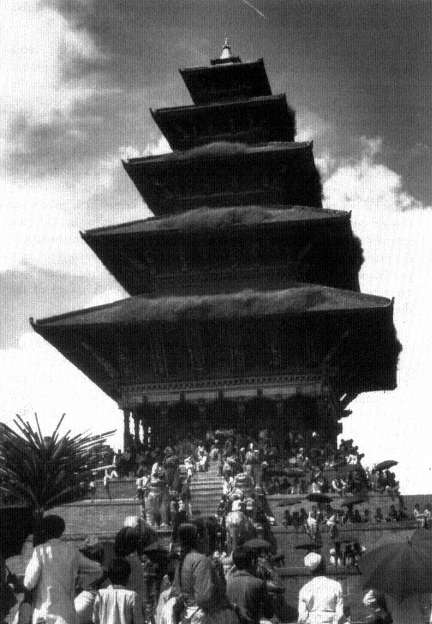
Figure 10.
A Newar-style temple. The Natapwa(n)la temple m Ta:marhi
Square.
through a priestly intermediary from whom, in return, he receives the physical sign of the god's blessings (prasada ). Further, not only is the god within the temple an object of worship so is the temple itself.
The "notable exception" for Bhaktapur includes some of the events at the royal temple complex, Taleju, where large numbers of people are involved as actors and congregation. But Slusser's remarks generally characterize Bhaktapur's other dega: s. In Bhaktapur, as we shall see, the proper loci for "congregations" are in other spaces.