
Metaphors of Transience
Corinth's more than seventy still lifes of this period constitute the single largest category of his paintings during the last seven years of his life and for that reason alone provide the most reliable documentation for the evolution of his late style. From a purely iconographic point of view, there is little change from Corinth's earlier still lifes: most are floral pieces, alternating now and then with game, fish, fruit, vegetables, and confections; and, as earlier, emphasis is on luxuriant arrangements. Conceptually, these works are linked to the probing still lifes immediately following Corinth's stroke, except that the simultaneous allusion to efflorescence and imminent decay is now both more consistent and more insistent (Fig. 162). The flowers are nearly always shown in full bloom. Environmental allusions play a role only to provide an appropriate coloristic touch; even the vases containing the flowers are treated in a cursory way. Light falls on some flowers, allowing them to glow, while others sink into deep shadows. The blossoms are rarely individualized since—as in the Walchensee landscapes—Corinth was seeking to convey the totality of a given experience and expression. Technically, too, these still lifes display the same idiosyncracies as the paintings of the Walchensee. The fluid texture of the example in Düren (see Plate 29), similar to that of the landscapes from the same year, makes it virtually impossible to identify the flowers. They have been trans-
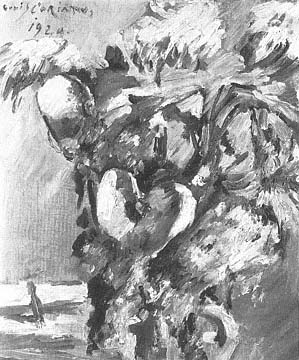
Figure 162
Lovis Corinth, Chrysanthemums and Calla , 1920.
Oil on canvas, 70 × 60 cm, B.-C. 790. Niedersächsisches
Landesmuseum, Landesgalerie, Hannover (KM 147/1949).
formed into an active mass of color. From beneath them a human skull protrudes, a macabre reminder of transience. In the large bouquet of chrysanthemums from 1922 (Fig. 163), slashes of red, white, and green paint cover the picture surface, sometimes flowing into each other, wet on wet, in intermediary shades of violet and gray. Corinth has attacked the canvas here as in a fury, stabbing at it with the palette knife and the brush. In paintings such as these he had reached a point where the process of becoming and the process of dissolution were no longer mutually exclusive.
On three occasions between 1919 and 1923 Corinth dealt with the subject of transience in a more conventional way by juxtaposing lavish arrays of cut flowers with depictions of young women. Two of these paintings (B.-C. 762, XVII) are modern-dress versions of the traditional theme of Flora; the third, and most poignant, is a picture of his eleven-year-old daughter Wilhelmine standing next to a table on which are placed a bronze statuette and several bouquets (see Plate 30). This painting derives from the buoyant still life portrait of Charlotte Berend with game and flowers from 1911 (see Fig. 108). Now, however, the earlier expression of joie de vivre has given way to a mood of
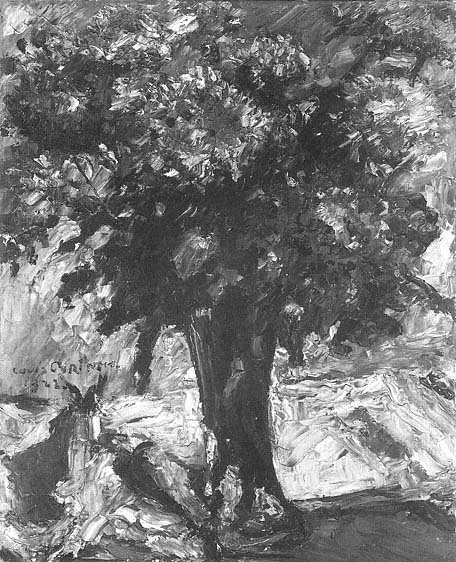
Figure 163
Lovis Corinth, Chrysanthemums , 1922. Oil on canvas, 97 × 78 cm, B.-C. 852.
Hamburger Kunsthalle, Hamburg (5101).
Photo: Ralph Kleinhempel.
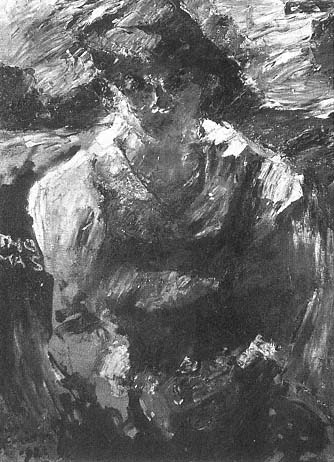
Figure 164
Lovis Corinth, Portrait of the Artist's Son, Thomas , 1921.
Oil on canvas, 87 × 65 cm, B.-C. 835. Staatliche Museen
Preússischer Kulturbesitz, Nationalgalerie, Berlin
(West) (B 549 Kat. 34)
Photo: Jörg P. Anders.
profound melancholy. Except for the large showy blossoms of the amaryllis, the flowers are for the most part appropriate to the girl's own stage of life: clusters of lilacs, a small vase with lilies of the valley, and a pot of red tulips that Wilhelmine holds in her hands. As in the independent still lifes with flowers, the blossoms appear as if dissolved from within, as patches of black paint push through the variegated colors. And as in similar compositions by Degas, the young girl has been relegated to the extreme side of the pictorial space. She gazes earnestly at the beholder; her body and face have been accommodated both coloristically and texturally to the flowers as if to emphasize their common fate.
Similar analogies between the life of nature and human life unify a group of plein air portraits and self-portraits painted at Urfeld (B.-C. 835, 837, 838,
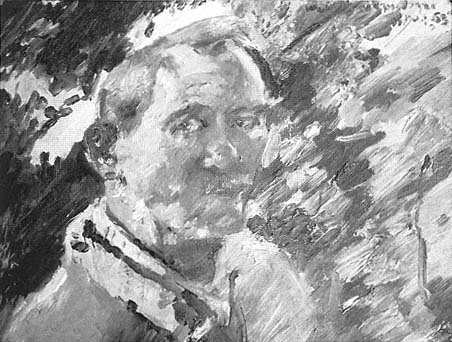
Figure 165
Lovis Corinth, Small Self-Portrait at the Walchensee , 1921. Oil on canvas,
68 × 80 cm, B.-C. 845. Private collection.
Photo courtesy Werner Timm.
845, 863, 871, 925, VII). In these the facial traits of the sitters are, for the most part, subordinated to the all-consuming outdoor light. Even in close-up views, as in the portrait of Thomas from the summer of 1921 (Fig. 164), the colors are freed from their purely descriptive function. Wearing Bavarian lederhosen and a Tyrolean hat, Thomas sits on the terrace of Haus Petermann, enveloped in dazzling light that etches itself into his skin and dissolves his face, hands, and body in a burst of incandescent color. In the still more extreme close-up view of Corinth's self-portrait from the same summer (Fig. 165) the head has been accommodated to the structure of the terrain. The surface of the entire canvas has been transformed seemingly into a molten mass, and the textures are dominated by the tactile character of the paint itself.
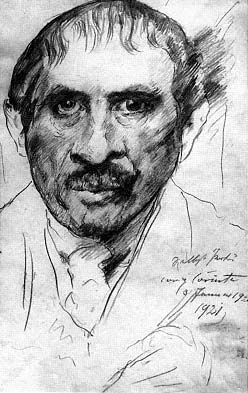
Figure 166
Lovis Corinth, Self-Portrait , 1921. Pencil,
44.5 × 28.0 cm. Kunsthaus Zurich (1924/10).
This painting, executed on Corinth's sixty-third birthday, is only one in a series of self-portraits from 1921 in which he explored with ever new variations the threatening signs of his progressive physical deterioration. Always observed from up close, the face as depicted frequently differs markedly from Corinth's own. Each self-portrait is like a fragmentary thought, determined by the mood of a given hour rather than by any quest for conventional verisimilitude. In that sense, these self-portraits are truly images of Corinth's inner life. As was the case in the development of the Walchensee landscapes, watercolors lead the way. In a sheet from January (see Plate 31) the expression of a moment is reinforced by the asymmetrical placement of the head; the wild, aggressive gaze finds its pictorial equivalent in the tortuous paths of the colors. It is as if Corinth had flung the colors at his mirror image in disgust. Dingy shades of red, green, gray, and brown are enlivened sparingly in the shirt by the white paper ground. The only truly glowing colors are the touches of cobalt blue in the eyes and at the nostrils and the speck of bright red in one corner of the mouth. In a pencil drawing from the same month (Fig. 166) the contemptuous fury of the watercolor has given way to a more controlled ex-
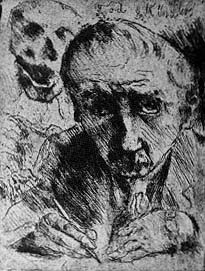
Figure 167
Lovis Corinth, Death and the Artist ,
1920–1921. Soft-ground etching and
drypoint, 28 × 18 cm, M. 546. Staatliche
Museen Preussischer Kulturbesitz,
Kupferstichkabinett, Berlin (West).
Photo: Jörg P. Anders.
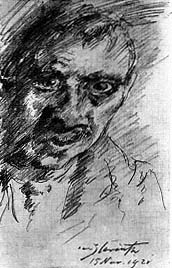
Figure 168
Lovis Corinth, Self-Portrait ,
1921. Pencil, 22 × 14 cm.
Graphische Sammlung
Albertina, Vienna.
pression of resignation and sadness. The head slants toward the left, but the modeling and the emphatic contour around the face are executed with deliberate care. Corinth's gaze is both attentive and distant, intent on grasping the image but also reflective and inward. One eye remains focused on the subject, the other, noticeably enlarged, has an eerie, visionary glow. The drawing is closely related to a similarly poignant etching of about the same time, entitled Death and the Artist (Fig. 167). The print includes a human skull and a more mundane memento mori symbol in the form of a watch prominently displayed on the artist's wrist. The print is the first in a cycle of six etchings that make up Dance of Death (M. 546–551), in which each episode illustrates a prototypical stage of human life: men and women, alone and in pairs, in youth, in the prime of life, and in old age, face the specter of their inevitable mortality. In the self-portrait drawing of November 15 (Fig. 168) the impression is again that of a barely controlled inner crisis. The slashing lines betray considerable agitation. Although the eyes and the nose retain their definition, the right side of the face is distorted as in a curved mirror, and the form begins to scatter with centrifugal force.
These self-portraits indicate Corinth's dread of old age and decrepitude. They are silent moans, similar in their emotional range to the confessions that fill the later pages of his diary. There too, he poured out his fears of impending senility, his intermittent feelings of self-doubt, and his anguish at the political turmoil of the postwar years, although the very uncertainties of the period sometimes also aroused him to bouts of renewed purpose, as if his work could save both himself and the German nation. "As long as I can walk on this earth and am able to work," Corinth wrote in 1922, "I shall go on painting as I always have. I don't think anyone will be able to say that I was untrue to myself. . . . Maybe I will be praised someday as a soldier who has remained steadfast at his post." At the end of the year he laments the loss of the political stability that had prevailed in the old empire: "I have lost the ground from underneath my feet. I am floating on air and don't feel about art as strongly as I used to." But he quickly rallies: "Would energy help? I am determined, and nothing shall prevent me. Germany shall still be proud of me. . . . I can work better and longer than a young man." A paragraph written on January 11, 1923, concludes: "Never will I allow my God-given talent to be destroyed. I am going to stand my ground and still produce so much that the world will be astonished. The country is crushed. 'Let's get on with the work!'" In subsequent entries from 1923 this optimism gives way to despondency and despair:
There has not been a day in my life when I was not tempted to make an end of it. . . . I discovered that my painting is indeed nothing but rubbish. Life is pointless, without any hope, a black curtain. . . . I rage at myself and at my work. Forgetting my better judgment, I feel like screaming forth at the world: What do you see in a wretched fellow like me! Can't you tell that I don't amount to anything —that I am no artist, nothing! I am desperately discouraged—I cannot see a ray of sunshine anywhere around me; my life has been wasted. The thought of putting an end to it haunts me.
But this pessimistic outburst, too, concludes more reasonably:
Paroxysms . . . always abate. It would be terrible otherwise, and as with a convalescent, one's spirits gradually revive. There is soon joy again in working; indeed, in time one rediscovers one's self-respect through one's work and whispers when nobody is listening: "You are quite a fellow."[15]
The extremes of Corinth's emotional life give all his works from these years their true content. Even the late landscapes and still lifes share in this process of self-revelation. Although still dependent on nature, alternately tender, euphoric, and desolate, they owe more to the painter's inner life than to optical verity. For that reason alone his late work cannot be labeled Impressionistic, the more so since the term is hardly applicable to much of his earlier output. At most Corinth sought to reconcile Impressionist techniques with a deliberately conceptual approach. As Bernard Myers so aptly says of these late works, "The representational is only a point of departure for a . . . metaphysical analysis proceeding from the emotions."[16]