
Chapter 6
Zimbabwe:
One-Party State
Independence Day on 18 April 1980 promised great changes in Zimbabwe. The yoke of settler rule had finally been thrown off, Britain's colonial claims withdrawn, and international legitimacy bestowed on the nation. The popularly elected government proclaimed its commitment to create a radically new state and social order based on democracy, social justice, and racial equality.[1] Under the new regime great progress has been made in redressing the inequalities inherent in the old racial order, in universalizing health care, education, employment opportunities, and, of course, the franchise.
The new constitution institutionalized certain political forms (a multiparty system, declaration of rights, reserved white seats in Parliament) but gave the new elite opportunities to initiate changes in other state structures, such as the repressive machinery that had maintained the settler elite in power. During the 1960s and 1970s, black nationalists frequently condemned Rhodesia's security laws and institutions, and many had personally experienced the iron fist of the settler state. They had promised to dissolve this apparatus once they gained power, along with other vestiges of settler domination.
A number of competing perspectives have addressed the impact of a protracted, successful liberation struggle on state structures under the new order. One is the mobilization thesis. Following Fanon, several ana-
[1] Some legislation specifically regulating Africans had been repealed between 1977 and 1979.
lysts have drawn a distinction between "false decolonization" and genuine liberation from colonial domination. Most French and British African colonies underwent relatively peaceful transitions to independence in the 1950s and 1960s. In many cases, the changing of the guard had little impact on the development of democratic institutions; the new state structures displayed remarkable continuity with the old colonial order. Southern Africa did not follow this model of consensual decolonization; the settler and colonial regimes there were prepared to resist the winds of change sweeping the continent and had no intention of voluntarily relinquishing their control for "a thousand years," in Ian Smith's prediction. This intransigence forced African liberation movements underground and set in motion protracted guerrilla campaigns.
Several Africanist scholars greeted the rise of armed struggle and popular mobilization in Angola, Mozambique, Namibia, and Rhodesia with claims that it would lay the basis for a truly democratic postcolonial order. The long campaigns against white rule seemed to contain the seeds of opposition to any system of institutionalized repression under majority rule. For Davidson, popular organization and the creation of an insurgent, shadow "state" in liberated zones during the struggle for independence in southern Africa means that the new rulers have "no need to take over any of the structures and institutions of colonial rule."[2] According to Chabal, "successful people's wars usher in the establishment of states the legitimacy and structure of which owe little, if anything, to their colonial predecessors."[3] The guerrillas' political bodies will replace the old state apparatus and the legacy of popular activism has a democratizing effect on the new order. Chabal suggests that mass mobilization "irrevocably determined" the character of the new order in postcolonial Guinea-Bissau.[4] The mobilization thesis, in short, assumes that the experience of popular rebellion will remain salient and significantly affect the postcolonial polity. This perspective fails to appreciate that the vitality of popular forces during an insurgency often wanes after liberation and that protracted guerrilla wars have rarely resulted in new democratic polities.[5]
[2] Basil Davidson, "The Politics of Armed Struggle," in Southern Africa: The New Politics of Revolution, B. Davidson et al. (Harmondsworth: Penguin, 1976), p. 75.
[3] Patrick Chabal, Amilcar Cabral: Revolutionary Leadership and People's War (Cambridge: Cambridge University Press, 1983), p. 218.
[4] Chabal quotes with approval a leader of that country's liberation movement (ibid., p. 95).
[5] Samuel Huntington, "Will More Countries Become Democratic?" Political Science Quarterly 99, no. 2 (Summer 1984): 213.
A diametrically opposed argument holds that the very process of violent anticolonial struggle so hardens guerrilla forces that they adopt an authoritarian political culture and rely on coercive tactics in eliciting civilian compliance. This insurgent culture of repression is likely to survive after the guerrillas capture state power, particularly if it meshes with the old regime's authoritarian political culture. Sithole argues in this vein:
The liberation struggle also left a significant mark on Zimbabwe's political culture. The commandist nature of mobilization and politicization under clandestine circumstances gave rise to the politics of intimidation and fear. Opponents were viewed in warlike terms, as enemies, and therefore, illegitimate. The culture from the liberation struggle was intolerant and violent.[6]
This heritage may have conditioned the former guerrilla and nationalist leaders who now wield state power to "adopt tactics and attitudes that mirror the oppressors" whom they had fought against and replaced.[7] As Chapter 4 suggests, however, the political culture of the liberation struggle had two dimensions: commandist and democratic. Since 1980 the popular democratic aspect has been eclipsed by the authoritarian, which includes what some call an "aloofness" or "elitism" on the part of state managers.[8] Citizens are routinely exhorted to identify with the ruling party and to endorse state policies after the fact, but their preferences have little impact on the elite's decision making regarding major political and security issues. Mass "departicipation" is common in other newly independent African states but especially striking in Zimbabwe, given the extensive politicization of the populace during the war.[9] In Mozambique, by contrast, state leaders are somewhat more inclined to solicit local input to state policies, although the crippling guerrilla war hampers communication between state managers and masses.[10]
[6] Masipula Sithole, "Zimbabwe: In Search of a Stable Democracy," in Democracy in Developing Countries, vol. 2, Africa, ed. L. Diamond, J. Linz, and S. Lipset (Boulder, Colo.: Lynne Rienner, 1988), p. 248.
[7] David Caute, "Mugabe Moves to One-Party Rule" The Nation, 22 February 1986, p. 204.
[8] André Astrow, Zimbabwe: A Revolution that Lost Its Way? (London: Zed, 1983). An editorial in MOTO (Gweru, Zimbabwe) in February 1983 discerned "a growing gap between the people and the people's Government."
[9] Ruth Collier, Regimes in Tropical Africa (Berkeley: University of California Press, 1982), pp. 144–45; Nelson Kasfir, The Shrinking Political Arena (Berkeley: University of California Press, 1976).
[10] Allen Isaacman and Barbara Isaacman, Mozambique: From Colonialism to Revolution (Boulder, Colo.: Westview, 1982).
A third argument appears in one version of dependency theory, which reduces the practices of the postsettler state to the imperatives of international capital. According to Mandaza, the new state in Zimbabwe is a convenient instrument or "conduit through which the imperialist forces of international finance capital can compromise and control the new state." In order to thwart the anticipated opposition of the masses to imperialism, the postsettler state, now run by a black petit bourgeoisie, "depends on the repressive apparatus which it invariably expands and strengthens."[11] The state's apparent legitimacy masks the fact that, in the final analysis, it depends on the inherited repressive apparatus to contain the popular unrest latent in imperialist economic exploitation. In this reductionist account, the interests and policies of the postsettler state follow only the logic of international capital; they ignore the special political interests of the new power elite and all other domestic factors.
Each of these perspectives portrays the legacy of a liberation war in a one-dimensional fashion. Our analysis of Zimbabwe reveals a more complex reality. The theses of mobilization, authoritarian culture, and imperialism all fail to consider key variables that shape outcomes of transitions. One factor is the strength and resiliency of surviving state institutions, which may sabotage plans for liberalization. Tilly points to the constraints imposed by state organs after a revolution:
Most revolutionaries ... seize a state apparatus without that long preparation of an organizational alternative. In those cases, the already-accrued power of the state affects the probability that fundamental structural change will issue from the revolution much more strongly than does the extent of mobilization during the revolutiond.[12]
A welcome corrective to societally centered models, Tilly's statepower thesis is incomplete; it does not link the inertial tendencies of inherited state organizations to the goals and interests of the new executive and to the balance of forces in civil society, which may be weighted for or against modernization of state structures. These regime and societal variables are central to any understanding of the prospects for change once settler rule has been dislodged.
[11] lbbo Mandaza, introduction to Zimbabwe: The Political Economy of Transition, ed. Ibbo Mandaza (Dakar: CODESRIA, 1986), pp. 14–15; see also his chapter, "The State and Politics in the Post-White Settler Colonial Situation" in ibid.
[12] Charles Tilly, From Mobilization to Revolution (Reading: Addison-Wesley, 1978), p. 222.
The transfer of political power to a popularly elected regime in Zimbabwe did not induce legal and institutional reforms of the internal security system. Instead, core pillars of the new regime rose on the foundations of the old—a pattern many other newly independent African nations followed as they marshaled existing state capacities for authoritarian purposes.[13] Neither the longitudinal continuities between settler and postsettler rule nor the partial convergence with other African polities was inevitable, however, as this chapter shows.
After describing the institutional foundations of state power in Zimbabwe, this chapter applies an explanatory model to the inherited, unreconstructed security system. Our findings suggest that the perpetuation of this system results not simply from the objective security problems facing the country but from four additional factors: (1) the political impotence or acquiescence of groups in civil society; (2) the absence of a democratic political culture; (3) the bureaucratic inertia and repressive proclivities of the security establishment; and (4) the regime's mobilization of institutional capacities to meet special political objectives. The first two factors reflect an absence of constraints on repression; the latter two constitute compelling incentives for repressive outcomes. The findings indicate that the fourth factor has the most power in accounting for the lack of liberalization in the security sector in Zimbabwe. Chapter 7 will explain Northern Ireland's distinctive security patterns, with a different configuration of these variables.
The Internal Security System
The collapse of white settler rule was in itself a profound event in Zimbabwe. The political system opened: outlawed political parties were legalized, universal suffrage announced, procedures for free competitive elections established, and civil and political rights extended to the black majority. Yet an analysis centered on these changes may obscure important political continuities. Formal democratic structures are perhaps less central indicators of the substance of a political order than the sharpness of the state's cutting edge, its structures of coercive control. The literature on decolonization has often overlooked this point.
[13] At the end of 1987, six African nations had military regimes, thirty-five had oneparty systems, and ten had multi-party systems. On variations in authoritarian rule in Africa, see R. Collier, Regimes ; Rhoda Howard, Human Rights in Commonwealth Africa (Totowa, N.J.: Rowman and Littlefield, 1986); Robert H. Jackson and Carl G. Rosberg, Personal Rule in Black Africa (Berkeley: University of California Press, 1982).
There is a basic continuity in the core of state power in Rhodesia and Zimbabwe. The essential features of Rhodesia's internal security apparatus remain: it possesses tremendous power and institutional autonomy, displays a partisan bias against opponents of the regime, and operates in a consistently repressive fashion. In short, the development of internal security structures in Zimbabwe has been a continuous process, punctuated by the transfer of power to a popularly elected government in 1980.
At the same time, the moment of independence signaled its official legitimation. The regime proclaims that the security branch has acquired a universalistic ethos, and it appears to have more extensive popular support.[14] The official doctrine of national security now cites defense of the majoritarian order as a moral basis for Zimbabwe's security institutions and emergency powers. Security of the white minority has given way to security of the majority; the police force is frequently referred to as a "people's police," committed to serving the masses; the army is presented as an "army of the majority" instead of an instrument of domination; and the state of emergency that once protected white supremacy now "comes from the people and is directed to protect their interests."[15] According to the Home Affairs minister, the "state of emergency promotes rather than diminishes our freedom and independence";[16] the oppressive violence of the Rhodesian state has been replaced with the new regime's "transformative violence" in "the service of our people."[17] In a nutshell, the Government uses the language of majoritarian democracy to justify repressive controls.[18]
Zimbabwe's political leaders take an instrumentalist view of the inherited security system. Security legislation and agencies are seen as neutral instruments that are conveniently available and amenable to the incumbent executive, which may use them to foster the "transformation into a just, egalitarian, wealthy society."[19] The contrast with official discourse—and, to some degree, practice—in postcolonial Mozambique
[14] No survey of public attitudes on security laws and practices exists, but impressionistic data suggest that Zimbabwe is building legitimation. My review of the magazine of the Zimbabwe Republic Police, Outpost, from 1980 to 1987 found ministerial comments urging recruits to dispel public mistrust and suspicion of the police, who seem to be associated with the old British South African Police.
[15] Minister of Home Affairs, Assembly Debates, vol. 5, 13 July 1982, col. 627.
[16] Minister of Home Affairs, Assembly Debates, vol. 11, 16 January 1985, col. 1209.
[17] Minister of Home Affairs, Assembly Debates, vol. 6, 19 January 1983, col. 859.
[18] Alves documents a similar disparity in Brazil (Maria Alves, State and Opposition in Military Brazil [Austin: University of Texas Press, 1985], p. 31).
[19] Minister of Home Affairs, Assembly Debates, vol. 7, 13 July 1983, col. 416.
is striking.[20] For example, Mozambique's former president, Samora Machel, declared, "This state, this power, these laws are not neutral techniques or instruments which can be equally well used by the enemy [the Portuguese colonial regime] or by us.... We cannot serve the masses by governing with state powers designed to oppress the masses."[21] According to this essentialist view, security institutions inherited from an authoritarian regime are structurally and ideologically inclined to act repressively.
If the official raison d'être for Zimbabwe's security system has changed since independence, its organization has changed little. The security apparatus remains large, powerful, and insulated. Decision making is dominated by an inner Cabinet;[22] it includes the prime minister (now the president), Minister of State for Security, Minister of State for Defense, and Minister of Home Affairs.[23] They, along with top security officers, constitute the commanding heights of the security core (see Figure 1).
Since independence the ruling party, the Zimbabwe African National Union (ZANU), has held that it is politically supreme. ZANU's 1984 congress established a Politburo and five new standing committees of a Central Committee, whose mandate is to supervise and administer ministries and secure the authority of the party over the Government. In law and in practice, however, ZANU is secondary to the executive branch: the Cabinet determines whether and how party resolutions are to be implemented. President Robert Mugabe himself admitted at the 1988 congress that ZANU's supremacy over the Government "has not been achieved."[24] Supporting evidence can be found in some of the most important policy decisions: against ZANU's wishes, the Cabinet has moved very slowly in resettling peasants on formerly white-owned land;[25] the Government did not abolish the reserved white seats in Parlia-
[20] The pressures of the long and devastating guerrilla war in Mozambique help to explain the emergence of new forms of authoritarianism since independence (see William Finnegan, "The Emergency: II," The New Yorker, 29 May 1989).
[21] Quoted in my article, "In Search of Regime Security: Zimbabwe since Independence," Journal of Modern African Studies 22, no. 4 (December 1984): 555.
[22] Eric Marsden, "Mugabe in 'Super-ZAPU' Clash," Sunday Times, 20 March 1983. The executive consists of a pragmatic technocratic faction and a radical populist one. Libby notes that technocrats have tended to dominate decision making, particularly on economic issues (Ronald T. Libby, "Developmental Strategies and Political Divisions within the Zimbabwean State," in The Political Economy of Zimbabwe, ed. M. Schatzberg [Praeger: New York, 1984]).
[23] Interview with Minister of State for Security, Commerce, April 1983, p. 4.
[24] Quoted in Colin Stoneman and Lionel Cliffe, Zimbabwe: Politics, Economics, and Society (London: Pinter, 1988), p. 80.
[25] By 1988 only 41,000 families had been resettled, out of a target figure of 162,000.
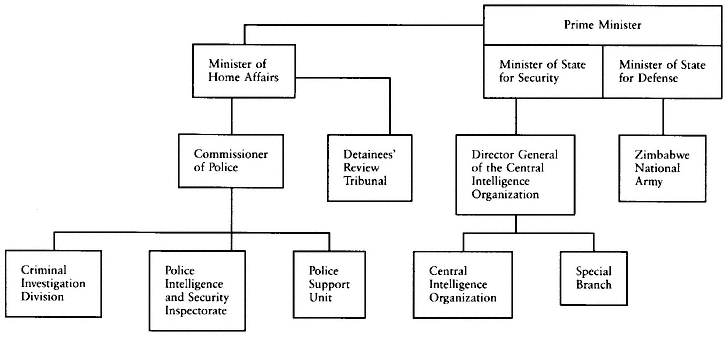
Figure 1.
Structure of the Security System (1987).
ment before the constitutionally stipulated date of 1987; the Government has postponed declaring a one-party state despite sustained party pressure since 1980. Yet relations between party and Government elites are generally harmonious, partly because ZANU's Politburo and standing committees contain prominent ministers and deputy ministers.[26] Their presence suggests that the Politburo combines both groups into a power elite; its overlapping membership helps minimize disagreement in the upper echelons. When these elites conflict with lower-level ZANU cadres over security matters, the Government usually prevails. A former Minister of Home Affairs described a typical exchange.
There have been pressures from the party for the Government to take certain lines of security, but the Government hasn't always done so. There has been tremendous pressure to ban ZAPU [the Zimbabwe African People's Union] and have a one-party state. The Government said it wanted to follow the rules.... Many in the party thought Nkomo [the ZAPU leader] should be detained, but the Government didn't want to. It was a difficult position for the Government to be in.[27]
Following in the footsteps of other African nations, Zimbabwe has progressively Africanized its security system, staffing it largely with members of the Shona ethnic group, which is linked to ZANU. Since independence the number of whites in the police force, military, and intelligence agencies has dwindled to a handful. Members of the Ndebele ethnic group have little better representation. They do not receive promotion to top ranks in the police and very few serve in the intelligence service. The military is roughly one-third Ndebele, but Shona officers hold the command posts.[28]
Africanization has helped to overcome the previous racial configuration of the security branch. But this changing of the guard has had little impact on the system's structure, organizational interests and proclivities, resources, and modus operandi. In other postcolonial states, Africanization has rarely led to the liberalization of institutions of control. In Zimbabwe, two special personnel factors are relevant. The black personnel in the security sector come primarily from the ranks of exguerrillas who fought against the settler regime or "rehabilitated" of-
[26] In the state's first years, the Central Committee met infrequently; there was a "tendency to determine issues in Cabinet" rather than risk debate in the party (Africa Confidential, 3 March 1982; Claire Palley, "What Future for Zimbabwe?" Political Quarterly 51, no. 3 [July 1980]: 294). The growth of greater party influence has been slow (interview with Edgar Tekere, MOTO, July 1984, p. 5).
[27] Interview with author, 10 June 1987.
[28] Africa Confidential, 27 March 1985, p. 4.
ficials who served that regime. It is not uncommon for state personnel to remain after a political transition; many top elites now in the CIO, the Ministry of Home Affairs, and the police are blacks who began their careers in the 1960s or 1970s. They, like the few remaining whites in these departments, apparently see themselves as professionals prepared to serve any government. But neither ex-guerrillas nor officials from the old regime tend to show special sensitivity to standards of human rights. The ex-combatants are war-hardened, and the surviving officials were trained under an authoritarian order. The Government apparently sees the new recruits differently, judging by a comment of the Home Affairs minister: "ex-combatants ... are excellent recruits because they already have military knowledge and the necessary political orientation to police a dynamic and changing society."[29]
The Rhodesian Ministries of Law and Order and Internal Affairs have been dismantled, with their security functions and policing transferred to the Ministry of Home Affairs.[30] Home Affairs operates in a manner reminiscent of the Ministry of Law and Order—in part because it administers many of the same statutes. One former ranking Home Affairs official stated, "In the overall administration of law and order policy, I don't think there has been a great deal of change."[31]
Since independence, the ministry's budget allocation has grown substantially (see Table 2). Absorbing over 90 percent of the funding, the Zimbabwe Republic Police force numbers fifteen thousand, plus three thousand in the Police Support Unit.[32] The former paramilitary role of the regular police has become less prominent, but three units deal with internal security: the Police Intelligence and Security Inspectorate, the Police Support Unit, and the Criminal Investigation Division. Policing features some important continuities with the Rhodesian past, as a former ranking officer in the ministry emphasized: "The machinery of the police and their training goes on much as it did in the past. Training is very similar and police methods are much the same as they were."[33] They enforce, inter alia, the security legislation inherited from the old regime—which partly explains why the force has had difficulty over-
[29] Speech delivered at senior officers' seminar, reprinted in Outpost, September-October 1982, p. 11.
[30] "Ministry of Home Affairs," mimeo, D12/47a (c. 1984), p. 1.
[31] Interview with author, 2 June 1987.
[32] The Military Balance, 1986–1987 (London: International Institute for Strategic Studies, 1986). Increases in expenditure do not necessarily indicate sinister fortification but may stem from organizational rationalization; for the police, some funding is for improved training of personnel, but the bulk is for salaries and allowances.
[33] Former senior Home Affairs official, interview, 2 June 1987.
| ||||||||||||||||||||||||||||||||||||||||||||||||||||||||||||||||||||||||||||||||||||||||||||||||||
coming the punic's suspicion and mistrust and disassociating itself from the old British South African Police.[34]
There is evidence that some priorities of the police have been politically influenced by officials of the ruling party and that the force has become increasingly politicized and deferential to ZANU officials.[35] Party membership may not be a requirement for promotion within the force, but officers are encouraged to become members and ministers sometimes stress the proper political role of the force. One Minister of Home Affairs, for example, told police officers:
[34] The police magazine, Outpost, often reprints official complaints about this problem.
[35] Arnold Woolley, "Recruiting for Trouble" Police Review, 29 August 1986 and 5 September 1986.
the proposition that a police force is neutral and apolitical must be stood on its head.... No army, police, and judiciary are, or can be, apolitical.... Politicization of the police force will enhance the removal of colonial hangover [sic ].[36]
A successor issued similar instructions: "You must make every effort to be fully informed of the government policy and above all Party policy ... and ideology in order to ... implement that policy.[37]
One particularly controversial arm of the police, under the direction of the Home Affairs minister, is the Police Internal Security and Intelligence Unit. It is exclusively concerned with investigating and gathering intelligence on the activities of insurgents and their civilian supporters.[38] This elite unit is known for its mistreatment of suspects in custody and harassment of ZAPU officials.[39]
The quality of policing by regular officers in Matabeleland has also been a problem. According to an Amnesty International report in 1985, "Conditions in police stations in Zimbabwe are reported to be generally poor, with severe overcrowding, poor food, lack of bedding, and no exercise. Prisoners are reported to be beaten [and tortured] both by the police and by CIO interrogators."[40] Incidents of police torture reportedly declined after the appearance of Amnesty's report, due to the circulation throughout the police of instructions forbidding torture; at the same time, however, police posts in Matabeleland were filled with strongly anti-ZAPU officers.[41]
In 1980 the Special Branch of the police was removed from police jurisdiction and fully integrated into the Central Intelligence Organization (CIO). The CIO also lost its direct access to the prime minister and is now accountable to the Minister of State for Security. Most important, the CIO's basic structure and criteria for evaluating threats and making policy recommendations were not overhauled. Initially the Government
[36] Speech delivered at senior officers' seminar, reprinted in Outpost, SeptemberOctober 1982, pp. 10–11.
[37] Speech by the minister reprinted in Outpost, May-June 1986, p. 6.
[38] Assembly Debates, vol. 13, 21 August 1986, cols. 1035–36.
[39] Africa Confidential, 11 December 1985; David Caute, "Mugabe Moves to OneParty Rule," The Nation, 22 February 1986, p. 204.
[40] Amnesty International, Detention without Trial of Political Prisoners in Zimbabwe (London: Amnesty International, September 1985), p. 3; see also Lawyers Committee for Human Rights, Zimbabwe: Wages of War (New York: Lawyers Committee, 1986), pp. 89, 109.
[41] Africa Watch, Zimbabwe: A Break with the Past? (New York: Africa Watch, 1989), pp. 19, 41.
envisioned some change in the organization; these plans never materialized, as the CIO director disclosed:
When Munangagwa [the Security minister] asked me to stay in office for at least the two-year period it would take to reconstruct CIO, I agreed but maintained that there was little need for change.... Munangagwa left the professional control of CIO to me.... This made for very little change in Intelligence functioning, and as far as the rank and file of CIO were concerned there was virtually no change in executive or administrative control.[42]
Modifications in the intelligence apparatus since independence have not liberalized it. Previously the Special Branch would arrest and the CIO would interrogate suspects; today CIO operatives have both powers of arrest and interrogation and often use them with disregard for due process of law. Since independence, the agency has been linked to scores of incidents of torture, political kidnapping, and harsh interrogation practices. The tremendous autonomy and freedom of action that it enjoyed under the Rhodesian state remains.
The CIO's budget climbed from Z$5.7 million in 1980–1981 to an estimated Z$38.3 million in 1986–1987.[43] Parliament does not debate this funding (as it does other departmental budgets); questions that MPs have raised about its allocations have been ruled out of order by the Speaker of the Assembly. Moreover, it is the only part of the budget exempt from auditing by the Comptroller and Auditor General.[44] The quantum jump in the CIO's budget, its merger with the Special Branch, and its prominent role in internal security suggest that the agency may be even more formidable than under settler rule.[45]
What about the military? For one thing, it is larger than that of most other African states, partly because it kept many former guerrillas in uniform after 1980. As of 1986, the army numbered 41,000, the air force 1,000, and paramilitary forces 38,000.[46] Changes within the army have involved Africanizing the force; integrating previously hostile
[42] Ken Flower, Serving Secretly: An Intelligence Chief on Record, London: John Murray, 1987, p. 272. In late 1984 a commission was formed to advise the Government on recruitment, training, and intelligence systems; its recommendations were implemented only to a limited extent (Africa Confidential, 5 September 1984, p. 8; former CIO officer, interview with author, 17 June 1987).
[43] Estimates of Expenditure lists CIO's budget under Special Services, Prime Minister's Office.
[44] Assembly Debates, vol. 12, 1 August 1985, col. 147.
[45] Frederick Ehrenreich, "National Security," in Zimbabwe: A Country Study, ed. H. Nelson (Washington, D.C.: U.S. Government Printing Office, 1983), p. 278.
[46] Military Balance, 1986–1987 . Decidedly pro-ZANU grass-roots "people's militias" (totaling twenty thousand members) have formed and been given paramilitary training to defend their communities against subversives.
armed forces and dismantling the more notorious units of the old regime (like the Selous Scouts and the Special Air Services); and retraining troops by a British advisory team.
The nominal integration of ZANLA, ZIPRA, and the Rhodesian military forces has not produced an ethnically or racially balanced defense force. The military has been Africanized and is now dominated by the Shona ethnic group and staunch ZANU loyalists. Former Rhodesian ofricers have resigned. Although roughly one-third of the rank and file is ex-ZIPRA, the top ranks have been purged of former ZIPRA men (some have been arrested on charges of supporting antigovernment insurgents). The celebrated integration of the three antagonistic forces has, therefore, been more apparent than real.
The retraining of troops by the British Military Advisory and Training Team (BMATT) has centered on converting a guerrilla force with an insurgent ideology and modus operandi into an apolitical, professional force with conventional capabilities. However, the Mugabe Government has moved to politicize the military and to ensure that it is run by ZANU loyalists. Top military officers are members of ZANU's Politburo and Central Committee, helping to make "the military a hidden arm of the party."[47] One of the few solid studies of Zimbabwe's military concludes that the trend toward professionalization cannot compete with that toward sectarianism: there is a "constant tension between military professionals and ethnic praetorians," with the latter acting as "a constant brake on formal professionalism." According to Evans, "comprehensive Western-style professionalization of the armed forces is unlikely to occur."[48] In short, the military has replaced one form of sectarianism with another, moving from white racial to black ethnic commitments. Communal reorientation, not liberalization, has occurred.
Defense expenditure has mushroomed under the new regime, jumping 28 percent from 1985–1986 to 1986–1987 alone. The army absorbs approximately 80 percent of this allocation, with the remainder going to the Ministry of Defense, the air force, and paramilitary forces.[49] Zimbabwe spends around 5 percent of its gross domestic product on defense (3.5 percent is the average for developing countries).[50] Defense expenditure absorbs a growing proportion of the total budget (see Table 2), and
[47] Mike Evans, "Gukurahundi: The Development of the Zimbabwe Defense Forces 1980–1987," Strategic Review for Southern Africa 10, no. 1 (May 1988): 25.
[48] Ibid., pp. 3, 30, 1.
[49] Estimates of Expenditure .
[50] Military Balance; The Economist, 21 April 1984, p. 9.
the defense proportion increasingly approaches that in 1978 and 1979, at the height of the Rhodesian war.
Whereas the first budget (1980–1981) emphasized spending for development and social services, subsequent ones decreased funding for social programs and increased spending for security. Inflation and the cost of demobilizing and supporting thirty-five thousand ex-guerrillas for two years have contributed to the rising security allocations. More recently, a significant proportion of the defense budget—around 7 percent in 1987—has been maintaining from seven thousand to ten thousand troops in Mozambique to protect vital transportation lines from sabotage by guerrillas fighting the Mozambican Government.[51] The overall defense buildup since independence is officially defended in terms of ongoing security problems;[52] but critics, including some officials, contend that actual security requirements do not warrant the magnitude of spending.
One innovation in the area of law and order is the creation of Youth Brigades linked to the ruling party. Under the mantle of building national unity, the paramilitary brigades have been involved in attacks on members of opposition political parties, particularly in 1984 and 1985. Prosecutions have been rare.[53]
Like other organizations, state security agencies have a vested interest in survival, if not expansion. An internal security system inherited from a settler state is structurally conducive to repressive outcomes. Equally important may be a regime's encouragement, for political or other reasons, of these essentialist institutional tendencies. The juncture of independence in Zimbabwe provided a unique opportunity for the system's overhaul, which the new regime did not seize. Instead it fortified these agencies with material resources, personnel, and legal powers; it left them only nominally accountable; it repeatedly praised the activities of the security forces; and it assigned them missions likely to produce repressive outcomes. The following sections examine the legal, intrastate, and societal factors favoring repressive outcomes and the elective affinity between the repressive proclivities of the security sector and the new regime's political agenda.
Repressive Legislation
Chapters 3 and 4 traced the development in Rhodesia of a battery of statutes, used first to preempt or curtail nationalist political opposition
[51] Washington Post, national weekly ed., 11 January 1988.
[52] Minister of Finance, Assembly Debates, vol. 13, 31 July 1986, col. 659.
[53] Lawyers Committee, Zimbabwe, p. 54.
and then to combat guerrilla forces. During the struggle for independence, Rhodesia's African leaders condemned these draconian measures and promised to repeal them once the settler state had dissolved. Since independence, some of these measures have been removed. Martial law and the system of Special Courts were abolished in 1980, and certain emergency regulations (such as those permitting collective punishment and protected villages) have been withdrawn. Yet most of Rhodesia's security legislation has been retained.[54] The availability of such sweeping powers tends to encourage repressive solutions to political and social problems.
The state of emergency has been in effect continuously since 1965. One of its major provisions is executive detention. Under section 17 of the Emergency Powers Regulations the Home Affairs minister may order the indefinite detention of anyone if he believes it to be "expedient in the interests of public safety or public order." Section 21 empowers the police and CIO to detain individuals for up to thirty days on the same grounds as under section 17, and section 53 allows the police to detain anyone for up to thirty days to facilitate an investigation. Anyone held under section 17 is entitled to a review of the grounds for detention within thirty days by the Detainees' Review Tribunal (discussed in the next section). The annual number of persons in detention has not been disclosed, but 1,334 persons were detained from January 1982 to July 1983, most for short periods; considerably fewer were detained after 1986.[55]
Under the Emergency Powers Act, the state may issue regulations that suspend or modify "any law"; from 1980 to 1986 it amended 14 statutes by executive decree. From 1980 to 1985, it introduced 103 new regulations.[56] Many of the regulations bear no relation to emergency requirements: for example, family planning, changes of cities' names, control of goods, services, and prices, state revenue, and labor regulations. Reliance on such decrees is not only expedient but familiar—justified by precedents set under settler rule, as one minister argued: "For many years, both before and since independence, therefore, Governments have used the Emergency Powers Act to deal with situations that do not in-
[54] Some of the following discussion draws on my chapter, "Continuities in the Politics of State Security in Zimbabwe," in The Political Economy of Zimbabwe, ed. M. Schatzberg (New York: Praeger, 1984), and on my article, "Regime Security." See also Jan Raath, "The Eternal Emergency," The Times, 18 July 1986.
[55] John Hatchard, "Emergency Powers in Zimbabwe," ms., Department of Law, University of Zimbabwe, 1986, p. 14; see also his "Detention Without Trial and Constitutional Safeguards in Zimbabwe," Journal of African Law 29, no. 1 (Spring 1985): 38–58.
[56] Hatchard, "Emergency Powers," p. 8.
volve public security." He added that "when this Government uses the Emergency Powers Act in similar situations, it is doing no more than following the example shown by its predecessors."[57]
The state of emergency permits nominal parliamentary control over the promulgation of executive decrees. A new regulation must be laid before the Assembly "as soon as may be" after being made, and the Assembly can annul it within twenty-eight days. This procedure means that important regulations need not be discussed in Parliament or justified by the executive; many such measures have escaped both legislative and public debate.
Since 1980, the Cabinet has been the scene of debate over continuing the state of emergency, but the consensus is that terminating it would be premature.[58] Various justifications have been advanced—domestic insurgency, needs of a socialist society, spillover from the guerrilla war in Mozambique—but a continuing threat from South Africa has been a consistent part of the official rationale. The Minister of Home Affairs underscored the latter: "Until the South African situation is resolved, the state of emergency for this country should remain."[59]
One danger of a protracted state of emergency is that it will be accepted as "normal"; another is that it will be institutionalized in statute law.[60] In the event that the EPA is repealed, legislation now exists to fill the vacuum. The Presidential Powers Act of 1986 allows the president to issue emergency decrees to deal with "situations that have arisen or are likely to arise and that require to be dealt with as a matter of urgency." (Such regulations may be amended or revoked by the Assembly.) This act, in effect, enables the incorporation of emergency regulations into the ordinary law. Tellingly, one minister noted that the act allows for a "mini state of emergency."[61]
The Law and Order (Maintenance) Act of 1960 continues to give the executive enormous powers to harass opponents and criminalize political activity. Similarly, the Unlawful Organizations Act of 1959 remains on the books, providing for the banning of organizations deemed
[57] Minister of Justice, Legal and Parliamentary Affairs, Assembly Debates, vol. 12, 22 January 1986, col. 1476.
[58] Author's interviews with top Government officials, June 1987.
[59] Assembly Debates, 12 July 1988, col. 114.
[60] Clinton Rossiter, Constitutional Dictatorship: Crisis Government in the Modern Democracies (New York: Harcourt, Brace and World, 1948).
[61] Minister of Justice, Legal and Parliamentary Affairs, Assembly Debates, vol. 12, 24 January 1986, col. 1527.
"likely" to disturb public order, public safety, or defense. From time to time authorities have floated the possibility of proscribing opposition parties, but none have been banned since 1980.
Although the 1975 Indemnity and Compensation Act—which gave carte blanche to officials acting "in good faith" to suppress terrorism—was repealed in 1980, new emergency regulations revived the indemnity for the security forces in July 1982 and extended it to the CIO in late 1983. In August 1984, however, the Supreme Court ruled these regulations in contravention of the Declaration of Rights.[62] This important ruling discouraged few abuses at the time, in part because the Government "made little effort to inform rank and file officers of the decision and its implications."[63]
The Absence of Accountability
Huntington argues that "fragile African states" require a concentration of power to maintain order—that "excessive" liberty and the diffusion of power are dangerous to political stability.[64] This formulation ignores other potential consequences: the arbitrary use of concentrated power may itself be highly destabilizing and counterproductive. As Kesselman writes, "political order in developing countries is probably jeopardized more by those in positions of authority than by social mobilization from below."[65] Structures of accountability within the state are absolutely essential to prevent or redress executive abuses of power and, hence, to ensure democratic stability.
Parliament
The steady concentration of state power in the executive branch has impaired the legislature in most African states.[66] In postcolonial Kenya and Tanzania, for example, Parliament is principally a debating forum, allowing members to ventilate grievances and discuss or criticize proposed
[62] Granger v. Minister of State, judgment no. S.C. 83/84, 17 August 1984.
[63] Lawyers Committee, Zimbabwe, p. 101.
[64] He adds, "It is in Moscow and Peking and not Washington that this lesson is to be learned" (Samuel Huntington, Political Order in Changing Societies [New Haven: Yale University Press, 1968], p. 137).
[65] Mark Kesselman, "Order or Movement: The Literature of Political Development as Ideology," World Politics 26 (October 1973): 148.
[66] See the excellent review by Newell Stultz, "Parliaments in Former British Black Africa," Journal of Developing Areas 2 (July 1968): 479–94.
legislation and existing policies. MPs react to bills but do not initiate legislation; they modify few bills during parliamentary debates and hesitate to make (or are discouraged from making) statements that embarrass the Government.[67] The net effect is that many MPs in African legislatures contribute little to debates and consistently defer to the wishes of the executive.
In Zimbabwe, the sweeping executive prerogative permitted under the security legislation and the state of emergency help to marginalize Parliament. Procedural devices curb parliamentary debate on security matters. The Speaker of the Assembly and the president of the Senate have frequently limited even the most innocuous questions and comments regarding security matters. Ministers are often unresponsive to such queries, routinely invoking the blanket notions of "national interest" and "state security" to avoid comment. Persistent questioners have had their patriotism called into question by ministers and other legislators. On the rare occasion when members of Parliament have demanded greater accountability of the executive on security matters, their motives have been similarly impugned. A 1984 motion by ZAPU and the Republican Front that Parliament establish a select committee to investigate security problems in Matabeleland was defeated on grounds that Parliament was not suited to deal with security issues and that the motion was nothing but an effort by the opposition parties to "besmirch Government."[68]
The need for the state of emergency is treated as self-evident, as the Minister of Home Affairs proclaimed:
Clearly we are not going to defend the state of emergency. It is the state of emergency which is going to defend us. Unless we want to start changing the meaning of words, a state of emergency is something that has in itself the reasons for its existence. An emergency does not ask for discussion but for action.[69]
Taking the minister's advice, MPs have faithfully renewed the state of emergency at six-month intervals since 1980. Parliament's role in security matters has been, in short, to rubber-stamp executive policy. Its only distinction from the supine Rhodesian Parliament, and an impor-
[67] Helge Kjekshus, "Parliament in a One-Party State: The Bunge of Tanzania," Journal of Modern African Studies 12, no. 1 (March 1974): 19–43; Newell Stultz, "Parliament in a Tutelary Democracy: A Recent Case of Kenya," Journal of Politics 31, no. 1 (February 1969): 95–118.
[68] Minister of Justice, Legal, and Parliamentary Affairs, Herald (Harare, Zimbabwe), 20 July 1984.
[69] Assembly Debates, vol. 5, 13 July 1982, col. 623.
tant one, is that it no longer reflects the interests of a tiny minority of the population.
One survival from the past is the Senate Legal Committee, which tests legislation against the Declaration of Rights in the constitution. From 1980 to 1985, the committee ruled that seven emergency regulations were in contravention of the declaration and that eight were not. After consultations with governmental legal officers, only two regulations were revoked.[70] Clearly, the committee's impact on security measures has been minimal—as it was in the Rhodesian Senate.
The Judiciary
If Parliament has a marginal role in the vital area of state security, the judiciary is considerably more active in this field than in Rhodesia. The courts are independent of the executive, and judges have manifested a commitment to conduct fair trials and safeguard the rights of suspects. Much to the Government's credit, it has not attempted to pack the bench with political appointees tied to the ruling party. Individual infractions of the Declaration of Rights can now be brought before the courts. Although the continuing state of emergency has suspended important safeguards in the Declaration of Rights, in security cases the courts have ruled against the executive. Not only have they acquitted a number of prominent individuals accused of security offenses, they have reached decisions that have made slight inroads into the emergency laws. The Supreme Court's 1984 decision invalidating the indemnity regulations for the security forces is one case in point. Yet both in defending persons accused of security offenses and in ruling on the constitutionality of security measures, the judicial system presents a very limited check on executive abuses of power.[71]
Although it has secured a number of convictions on security charges, the Government has failed in several critical trials (e.g., of opposition politicians and senior military officers). These defeats have resulted from poor prosecution, denial of legal representation to the accused, insufficient evidence, spurious charges, and the discovery of forced confessions (following threats and torture). In a 1984 case, High Court Justice Tony Smith castigated the CIO for repeatedly denying the accused in se-
[70] Hatchard, "Emergency Powers."
[71] Zimbabwe's courts seem more vibrant than those in many other African states (see Steven Pfeiffer, "The Role of the Judiciary in the Constitutional Systems of East Africa," Journal of Modern African Studies 16, no. 1 [1978]: 33–66).
curity cases access to legal representation: "This court takes a very serious view of such deliberate flouting of the provisions of the Constitution by the CIO officers."[72] Other similarly critical comments have been issued by the bench.
On several occasions, the executive's irritation with judicial decisions has resulted in fierce public attacks on the loyalty and integrity of the courts. The harshest attack was issued by the Minister of Home Affairs on 13 July 1982:
The manner in which our law courts dispense justice is gravely frustrating and undermining the work of law-enforcement agencies like the police. The security of the state is sacrificed on the altar of individual liberties. People who are engaged in activities designed to threaten the welfare and security of the state are either freed by the courts or go off very lightly.... It appears that the courts are sowing seeds of a revolt against the government and encouraging the sudden growth of the dissident element in Matabeleland.... Recalcitrant and reactionary members of the so-called Bench still remain masquerading under our hard won independence as dispensers of justice or, shall I say, injustice by handing down perverted pieces of judgment which smack of subverting the people's government.... Stated differently, what is the use of having good laws, good law enforcement agencies and bad law courts which could be construed as comprising a hostile Bench?[73]
Decisions in security cases unfavorable to the regime have been interpreted by some in the executive as symptomatic of a lack of concern for state security or, worse, support for armed dissidence. The judiciary has been accused of harboring a fundamental disloyalty to the "people's government," a colonial mentality, a "class bias," and using double standards.[74] More common have been complaints that the courts have released "guilty" defendants on legal "technicalities" or procedural "errors."[75] One minister summarized the problem by noting that the courts are "not in tune with the present government."[76] In reference to the wayward courts, he declared, "Until such time as we have all the machinery of state acting in concert for the same ... objectives, it must be neces-
[72] Justice Smith, quoted in John Hatchard, "The Right to Legal Representation Must Be Upheld," MOTO, December 1984-January 1985, p. 23.
[73] Assembly Debates, vol. 5, 13 July 1982, cols. 630–34.
[74] Minister of Home Affairs, quoted in the Times, 9 September 1983 and Herald, 16 February 1983.
[75] Some less influential ministers have been staunch defenders of the independence of the judiciary (Africa Confidential, 17 July 1985, p. 2).
[76] Minister of Home Affairs, Christian Science Monitor, 2 September 1983.
sary to adopt extreme measures for the preservation of the security of the state."[77]
The deviations of the courts in security cases have been used to excuse executive reversals of judicial verdicts, such as the Minister of Home Affairs' immediate redetention of persons acquitted in major security cases. Under emergency regulations the courts may not challenge summary redetention, which has been justified on grounds that "Government has more facts than the Court and some facts derive from our security sources and intelligence sources."[78] The Government's poor record in security cases dealing with prominent political opponents (as distinct from insurgents) seems to have encouraged use of detention without trial.[79] Several opponents languished in detention for periods as long as four years.[80]
A Detainees' Review Tribunal (under the Home Affairs ministry) reviews detention orders every six months. This body is reminiscent in several respects of its Rhodesian counterpart created in 1959: it has meager resources, no permanent staff, operates at a slow pace, meets in camera, and is not "bound by the rules of evidence or procedure applicable to any legal proceedings."[81] Whereas the prosecution in ordinary criminal proceedings must prove a case beyond a reasonable doubt, the tribunal's test is that the detaining authority prove its case on the broader "balance of probabilities." The tribunal formulates its unique rules and procedures, which may vary according to the "peculiarities of each case."[82] It admits a wide range of evidence—information from sources that cannot be revealed, hearsay evidence—in determining whether a detainee is a threat to state security.
[77] Assembly Debates, vol. 5, 13 July 1982, col. 633; emphasis added. Mugabe has made similar statements (Herald, 27 December 1983). In a speech affirming the state's desire for complete unity, the Minister of State for Political Affairs called for positions in the civil service to be "filled by zealous members of the ruling Party" so that "the Party, the Government, and the civil service would be one thing, pursuing the same objectives" (Department of Information press statement, Harare, 29 August 1984).
[78] Prime Minister, Assembly Debates, vol. 7, 13 July 1983, col. 395.
[79] See Assembly Debates, vol. 5, 13 July 1982, col. 631, and "Court in the Middle," MOTO, June 1983.
[80] In December 1986, the Minister of Home Affairs stated that thirty-one persons were in detention (Bulawayo Chronicle, 5 December 1986).
[81] Emergency Powers Regulations (Statutory Instrument 458/83), section 31(4). The tribunal's small annual budget has varied from Z$1,000 to Z$8,000 (Estimates of Expenditure ), similar to its allocations under the Rhodesian state.
[82] Evans and Hartlebury v. Chairman of the Review Tribunal and Minister of Home Affairs, H.C. 2562/3/84, 12 December 1984, Justice Gibson.
In most cases the tribunal has concluded that detention orders are justified. The tribunal's decisions are not binding, however, on the Minister of Home Affairs. Before 1985, the minister complied with the tribunal's recommendations, but since then he has increasingly overridden the board. Clearly this body constitutes a rather limited check on abuses of executive power.
No official, independent oversight bodies routinely monitor the security organs or have power to investigate public complaints in this area. In the courts, however, a number of security officials have appeared on charges of beating, torture, rape, or murder. Independent reports on human rights concluded that "many political killings from 1982–1985 have not been formally investigated and are unlikely to be," and that no progress has been made in locating those who disappeared during the mid1980s.[83]
The evidence thus indicates that the wholesale absence of checks and balances on executive power that characterized the Rhodesian state also typifies the new order. Its few mechanisms of accountability are not effective.
Civil Society at Bay
Pressures from social institutions and voluntary associations may reduce the scope of state power and promote civic accountability. A network of dynamic, democratically oriented groups has been instrumental in frustrating or containing authoritarianism in some African nations, like Nigeria and Ghana.[84] Among those groups are human rights organizations, the churches, the mass media, the legal community, trade unions, professional associations, student groups, and business organizations.
One writer discerns in Zimbabwe a "robustly pluralistic" civic order, which is rooted in the past: "In the event of a one-party state in Zimbabwe, other forms of pluralism would assume degrees of political importance reminiscent of intellectual, religious, and trade union opposition to white supremacy in Rhodesia."[85] Chapters 3 and 4 demonstrated that none of these institutions sustained active resistance to white supremacy in Rhodesia. Now their posture is "reminiscent" of
[83] Department of State, Country Reports on Human Rights Practices for 1986 and Country Reports on Human Rights Practices for 1988 (Washington, D.C.: U.S. Government Printing Office, 1987 and 1989); Africa Watch, Zimbabwe .
[84] See the chapters by Larry Diamond and Naomi Chazan in Democracy in Developing Countries, ed. Diamond, Linz, and Lipset.
[85] Richard Sklar, "Reds and Rights: Zimbabwe's Experiment," Issue 14 (1985): 31.
Rhodesia's tradition of acquiescence. In Zimbabwe they lack the resources, the will, or the interorganizational alliances to challenge abuses of state power.[86] The government-controlled media practice selfcensorship, have rarely taken a critical stand on security issues, and are pro-ZANU in their news coverage and editorials;[87] labor is strictly controlled by the regime;[88] the intelligentsia has taken a low profile; the business community and white commercial farmers have generally supported the regime's security policy; and the handful of voluntary associations with an abiding interest in human rights have had little impact. Unlike its counterpart in Northern Ireland, Zimbabwe's settler population has become relatively marginal on issues of internal security but the views of whites do vary. In rural areas vulnerable to insurgent attacks white residents have supported exceptional security measures; settlers most closely associated with the old Rhodesian Front have opposed such measures, including the state of emergency, as unnecessary. The views of the black population are difficult to gauge, absent public opinion surveys. The electorate's support for the ruling party in the 1985 election cannot be used to infer levels of support for particular policies. But it does appear that public support for the regime's security policies is considerably stronger than in white-ruled Rhodesia, insofar as the population perceives that the security system acts in its interests.
In short, pressure groups rarely organize around issues of law and order in Zimbabwe. Neither urban elites nor grass-roots organizations have consistently pressed for liberalization and instead tend to defer to official interpretations of security requirements. The rare expressions of dissent and organized protests by students, workers, and political parties have been equated with subversion and punished.[89]
If urban groups are atomized and quiescent, what of the rural areas? The mobilization thesis discussed at the beginning of the chapter as-
[86] On other African nations, see Jean François Bayart, "Civil Society in Africa," in Political Domination in Africa, ed. P. Chabal (Cambridge: Cambridge University Press, 1986).
[87] Occasional criticisms of security practices have appeared in the Bulawayo Chronicle, the Financial Gazette, and MOTO .
[88] See Lloyd Sachikonye, "State, Capital, and Trade Unions," in Transition, ed. I. Mandaza; and Ministry of Labour, Manpower Planning, and Social Welfare, Labour and Economy, report of the National Trade Unions Survey (Harare: Government Printer, 1984); see also the restrictive Labor Relations Act of 1985, no. 16.
[89] In 1988 and 1989 university students protesting governmental and party corruption and authoritarianism clashed with police; the Minister of Home Affairs accused the students and faculty of "undermining the state" and "subversion" (Bulawayo Chronicle, 14 October 1988). After the October 1989 confrontation the University of Zimbabwe was closed indefinitely.
sumes that popular activism in the countryside during a successful guerrilla struggle will continue under a new regime. Zimbabwe's political inheritance, according to Cliffe, is "a generation that has been vigorously involved in politics and organizing, has undergone extensive political education and has become used to challenging authority and to making things happen."[90] However accurately it describes rural areas toward the end of the Rhodesian war, this statement has a decidedly hollow ring in contemporary Zimbabwe, mainly because the regime has largely deactivated and marginalized those forces since independence.[91] The contrast with Northern Ireland could not be greater: almost inert in Zimbabwe, civil society is vibrant in Northern Ireland (as Chapter 7 shows).
Since independence, one human rights body has consistently opposed repressive practices: the Catholic Commission for Justice and Peace, which is affiliated with the Catholic Bishops' Conference. Originally working behind the scenes in the 1970s, the commission publicized its findings when it failed to get results through private representations to ministers. Today the commission supports the Government and describes its approach as private constructive engagement with the authorities.
After the commission sent a series of confidential reports on human rights violations to the prime minister, the Government investigated and took corrective action in some particular cases of beating, rape, torture, and killing.[92] In defending human rights, the commission is undoubtedly the most successful private group. Yet it takes a piecemeal approach and has rarely pressed for changes in the agencies responsible for repression or in the arsenal of security legislation.[93] It has had a limited impact overall on human rights in the country.
Reinforcing the acquiescent tendencies of Zimbabwe's civil society is the country's authoritarian political culture, anchored in ninety years of settler rule.[94] Long schooled in intolerance, the population is inclined to suspect opponents and to equate dissent with subversion or treason. This cultural legacy from the old regime meshes with the intolerant side
[90] Lionel Cliffe, "Zimbabwe's Political Inheritance," in Zimbabwe's Inheritance, ed. C. Stoneman (New York: St. Martins, 1981), p. 31.
[91] Astrow, Lost Its Way?
[92] Sunday Mail, 8 June 1986.
[93] One exception was its call in 1982 to repeal regulations indemnifying the security forces (Sunday Mail, 25 July 1982). In 1989, it called for an end to the state of emergency and cited increasing abuses by the police and the Minister of Home Affairs (Financial Gazette, 4 August 1989).
[94] Neera Chandhoke, "The Prospects for Liberal Democracy in Zimbabwe," Indian Political Science Review 17, no. 1 (January 1983): 52–64.
of the political culture that emerged out of the guerrilla campaign and was imported into the state by the new elite.[95] In other words, the marriage of the dominant settler cultural legacy with the insurgent subculture invites authoritarian outcomes under the new order.
Unlike contemporary Northern Ireland where the British Government has sought—albeit unsuccessfully—to nurture a more consensual political culture, Zimbabwe lacks a comparable force. It is not so surprising, therefore, that many of the democratic values and institutions enshrined in the constitution during the Lancaster House settlement have failed to thrive in the existing relatively authoritarian milieu. Instead of tolerance for opposition, disposition to compromise, support for basic political rights, and mutual trust and accommodation among various political, civic, and communal forces, ethnic distrust and intolerance of all opposition have typified the first decade under the new order.
As noted in Chapter 1, revalorizing an inherited political culture and strengthening civil society can promote the process of democratization and help check executive power and repression by the security apparatus. Yet in Zimbabwe this apparatus has been instrumental in ensuring the passivity of civic institutions since 1980. The balance of power between the state and civil society in Northern Ireland is, as we shall see, radically different.
The Magnitude of the Security Problem
Immediately after independence Zimbabwe's future was uncertain, like that of any country emerging from the ruins of a protracted guerrilla war. Managing the fifty thousand ex-guerrillas and fifteen thousand Rhodesian security forces was a delicate undertaking. Would these forces accept the new order or engage in recriminations? White and black political opponents might challenge the new regime. Would the disaffected segments of the white and black communities accept their exclusion from power?[96] Finally, Pretoria's response to ZANU's electoral victory was of concern to the fledgling state. Would South Africa intervene, directly or indirectly, to subvert the new order?
A common problem faced by governments succeeding authoritarian regimes is the residual power of former political and security elites; their
[95] Sithole, "Stable Democracy," p. 248.
[96] To ease the fears of minority groups, the prime minister announced a reconciliation policy, which included the appointment of white and black opposition figures to Cabinet posts.
machinations in many nations have aborted the transition to democracy. This problem might be particularly vexing in postsettler societies where settlers were long accustomed to special rights and privileges. A striking feature of independent Zimbabwe is the political eclipse of the old settler elite; the contrast with Northern Ireland could not be sharper (see Chapter 7). Like their counterparts in postcolonial Kenya, Senegal, and Zambia, Zimbabwe's whites have retained their economic privileges and a measure of economic leverage while losing their previous military and political power.[97] Most of the remaining whites seem reconciled to black majority rule and the demise of the caste system. The level of racial tension is remarkably low, although a significant number of whites disapprove of specific policies, continue to harbor prejudicial attitudes toward blacks, and talk longingly of the Lost Cause.[98] A few whites have been involved in spying and sabotage for South Africa, but generally the white community has presented no threat to Zimbabwe's Government.
Since 1980 the regime has had to contend with a variety of security problems from both domestic sources and the neighboring South African giant. The incidents include an explosion at ZANU party headquarters, the discovery of arms cached on the property of a rival party, an unsuccessful armed attack on the prime minister's residence, incursions by South African-sponsored rebels, desertions from the army by disaffected ex-ZIPRA soldiers, the destruction of aircraft at Thornhill base, and, since June 1987, attacks inside Zimbabwe by rebels fighting the Mozamhican Government (who are retaliating against Zimbabwe for its military aid to the regime in Mozambique).[99]
To destabilize Zimbabwe, South Africa has used economic and military pressure, although its involvement has been minor in comparison to its devastating assaults on Angola and its destabilization of Mozam-
[97] Marshall Murphree, "Whites in Black Africa," Ethnic and Racial Studies 1, no. 2 (April 1978): 154–74. Whites' economic power in Zimbabwe comes from their control of capital, skills, and productive land. In 1987, 60 percent of the economy remained in private, largely white hands, and 34 percent of all farmland was owned by whites (down from 42 percent at independence); only 10 percent of the country's large-scale farmers and about a dozen of the top two hundred business executives were blacks.
[98] These observations are based in part on the author's field research in 1982–1983 and 1987 and articles on Zimbabwe's whites in the Los Angeles Times, 9 September 1985 and the Washington Post, national weekly ed., 7 December 1987; on the "declining significance of race" in Zimbabwe, see Marshall Murphree, "Odds On Zimbabwe," Leadership 5, no. 5 (1986): 24–28; cf. David Caute, Under the Skin: The Death of White Rhodesia (Harmondsworth: Penguin, 1983).
[99] Official figures on casualties from attacks inside Zimbabwe by the Mozambique National Resistance from June 1987 to April 1989:335 civilians killed and 280 wounded; 22 security troops killed and 44 wounded; 29 insurgents killed, 5 wounded, and 45 captured (Washington Post, 5 June 1989).
bique. The regional Leviathan has initiated several commando attacks on offices of the African National Congress (ANC) in Zimbabwe. But its attacks are also designed to punish the Mugabe Government for its strident criticism of apartheid and its demands for international sanctions and more generally to foment insecurity in the country.[100] Pretoria has trained and armed an unknown number of former Rhodesians at bases in the northern Transvaal and has sent some on sabotage missions into Zimbabwe.[101] The most spectacular incident was a commando raid on an office of the ANC in Harare on 19 May 1986.
Low-level insurgency troubled the western region of the country (Matabeleland) from 1982 to 1988—numerous incidents of rape, murder, torture, beating, armed robbery, kidnapping, and the destruction of schools, buses, and state property. Although the insurgents' actions often appeared random, their choice of targets seemed designed to pressure the Government at home and embarrass it abroad. Their victims included ZANU party officials and members, Government officials, white farmers, foreign tourists, and black civilians accused of supporting the regime or informing on the insurgents.[102]
Reliable figures on the extent of rebel activity are difficult to come by. The leading security official in Zimbabwe estimated that the number of insurgents operating in the country dropped from approximately three hundred in 1984 to under thirty by mid-1987.[103] Officials have presented statistics on the incidence of insurgent attacks during parliamentary debates in order to justify renewals of the state of emergency; these figures (in Table 3) should be treated cautiously, since neither the sources nor their method of compilation has been disclosed.
[100] The ANC uses Zimbabwe as a route to infiltrate South Africa but has no military bases in Zimbabwe (Stephen Davis, Apartheid's Rebels [New Haven: Yale University Press, 1987]); see also Joseph Hanlon, Beggar Your Neighbors: Apartheid Power in Southern Africa (Bloomington: Indiana University Press, 1986).
[101] Robert Davies and Dan O'Meara, "Total Strategy in Southern Africa: An Analysis of South African Regional Policy since 1978," Journal of Southern African Studies 11 (April 1985): 195. Zimbabwe's Security minister stated in 1984 that half of the four hundred rebels captured in the previous two years admitted to having been trained in South Africa (Guardian, 1 August 1984).
[102] According to the Security minister, insurgents killed 101 ZANU members from 1982 through October 1985 (Herald, 3 November 1985).
[103] Minister of State for Security, Washington Post, 23 June 1984; Herald, 14 May 1987. Insurgents inside the country during 1982–1983 were estimated to number close to one thousand (Frederick Ehrenreich, "The Zimbabwe Defense Force: Capabilities and Problems" [Paper presented at the African Studies Association meeting, New Orleans, November 1985], p. 30); an estimated eight thousand to twenty-five thousand MNR rebels have been operating in Mozambique.
| ||||||||||||||||||||||||||||||||||||||||||||||||||||||||||||||||||||||||||||||||||||||||||||||||||||||||||||||||||||||||
Any assessment of security threats must take into account the coercive capacities of the parties involved and the scope of popular support for the challengers and the authorities.[104] In the first eight years after Zimbabwe's independence, insurgents failed to penetrate throughout the country or garner widespread support; they had limited material resources, and the destruction and casualties they inflicted were minute compared to those in the final years of the Rhodesian war (when an av-
[104] On the balance between regime and insurgents' capacities, see Ted Robert Gurr, Why Men Rebel (Princeton: Princeton University Press, 1970), chaps. 8 and 9.
erage of five hundred deaths occurred every month).[105] Zimbabwe has hardly faced a crisis "which affects the whole population and constitutes a threat to the organized life of the community," as the Home Affairs minister claimed in 1982.[106] Other officials have frequently echoed such alarmist statements, which still others have contradicted. A 1984 report by ZANU's Central Committee described insurgency as nothing more than an irritant or "military nuisance,"[107] Even at the height of dissident attacks in early 1983 the Security minister dismissed them as mere "teething problems": "This country is already more stable than it was before independence...there are no problems...now which threaten state power."[108] A different impression was left two years later (when the situation had visibly improved), as the Minister of State for Defense told Parliament:
If we were to release to the public [information about] everything that happens in all our operational areas there would be more alarm and despondency among Zimbabweans, and they would think they were living in hell. So we want to keep these things to ourselves.[109]
Government statements have therefore vacillated between assurances of stability and tranquility and attempts to arouse public awareness and vigilance regarding the nefarious elements threatening the nation. The disparity in official comments about the severity of security problems stems from the regime's twin aims of justifying repressive measures and convincing the public that the authorities are in full control.
Intellectuals, church leaders, human rights bodies, and the press have occasionally questioned the need for draconian measures but rarely as incisively as in the Sunday Mail 's editorial of 12 May 1985:
There is visible peace all over the country, even in Matabeleland, despite dissidents and bandits.... The dissidents in this country and their insignificant number are a fleabite compared with insurgents and their activities in many other countries that deal with them by other means than a state of emergency.... In addition, the unpleasant irony and contradiction of a government of former freedom fighters perpetuating the very state of emergency that was contrived and used by a colonial regime to fight against them ... must be brought to an end.
[105] Africa Contemporary Record, 1982–1983, p. B 879.
[106] Assembly Debates, vol. 5, 13 July 1982, col. 629.
[107] Zimbabwe African National Union, "Central Committee Report," presented to the party's second congress, Harare, 8 August 1984, p. 10.
[108] Interview, Commerce, April 1983, p. 5.
[109] Assembly Debates, vol. 12, 13 August 1985, col. 434.
To this logic the Government responded in two ways: the existence and the use of exceptional powers have been responsible for bringing the insurgent problem under control; and such powers remain necessary to ensure that the insurgents "do not become as systematically organized as UNITA [in Angola] and the MNR [in Mozambique]," as Mugabe put it.[110] Reminiscent of the Rhodesian era, the executive uses both increases and decreases in the incidence of insurgent activity to justify the continuance of emergency powers: an increase is a signal to intensify the use of these powers and a decrease is "an indication" that these measures "have been effective."[111]
The Politics of Security
One major theme of this chapter is that the security problems facing the country did not preordain the structure and operations of Zimbabwe's coercive machinery. In fact, without prejudicing national security, liberalization in Zimbabwe could include the following changes:
• ending the protracted state of emergency;
• redrafting security legislation;
• reorganizing the police, military, and intelligence service;
• strengthening Parliament and the judiciary and creating separate oversight bodies to monitor and ensure greater accountability of the security agencies.
Countering this argument, authorities advance a host of security imperatives that necessitate unreconstructed coercive institutions, repressive legislation, and the continued state of emergency. The dominant external imperative is defense of the country against South African aggression. Government ministers maintain that the situation in Zimbabwe will never be normal until the South African conflict is resolved and its threat to Zimbabwe removed. Tampering with the coercive order would only deepen the country's vulnerability to Pretoria. Similarly, domestic conditions serve to justify exceptional arrangements. If not for the state of emergency, a former Minister of Home Affairs told me,
[110] "Interview: Robert Mugabe," Africa Report, January-February 1986, p. 75.
[111] Minister of Home Affairs, Assembly Debates, vol. 11, 13 November 1984, col. 696.
"we'd be forced to act illegally."[112] Analyzing the internal imperatives thesis:
A premature dismantling of the coercive instruments of the former Rhodesian state was ill-advised. Such a step would have created a power vacuum deliciously attractive to the various centers of power already armed to step in. The alternative to maintaining the instruments of the former Rhodesian state was to create new ones in their place.[113]
This argument has several pitfalls. It assumes but does not demonstrate that armed groups such as ZIPRA guerrillas and Rhodesian security forces were in fact prepared to "step in" and overthrow the new regime. Even if this assertion is valid—making a "premature dismantling" of repressive institutions ill advised at the outset of ZANU rule—it does not account for the subsequent preservation and fortification of those institutions. Finally, it fails to distinguish a state's coercive requirements (for domestic order and state survival) from acts of repression designed to achieve various extrasecurity goals.
My critique raises larger analytical issues as well. Frequently proffered in nations with acute or chronic security problems, the security-imperatives thesis has intoxicating appeal. Security exigencies often appear to be an independent influence on, or the driving force of, state action. This formula is unidimensional and deterministic. First, governments facing comparable security threats may respond in markedly different ways.[114] Second, levels of repression do not necessarily correlate with the magnitude of security problems and may instead be inversely related. Cross-national data on the frequency of events of insurgency and governmental sanctions suggest that such inverse relationships are rather common.[115] In some cases the disjunction has been especially wide. In Stalinist Russia, for instance, the epidemic of terror during the Great Purge of the 1930s occurred as stability increased.[116] Some societies facing a mortal threat to national security have responded less repressively than others where the threats have been markedly less serious, as a study of twenty Latin American nations found.
[112] Interview, 10 June 1987.
[113] Sithole, "Stable Democracy," p. 240.
[114] See the analysis of Israel, South Africa, and Northern Ireland in Anthony Mathews, Freedom, State Security, and the Rule of Law: Dilemmas of Apartheid Society (Berkeley: University of California Press, 1986), chap. 12.
[115] C. Taylor and D. Jodice, eds., World Handbook of Political and Social lndicators (New Haven: Yale University Press, 1983).
[116] Carl Friedrich and Zbigniew Brzezinski, Totalitarian Dictatorship and Autocracy (New York: Praeger, 1956), pp. 137ff.
Paraguay ... was one of the least violent nations in Latin America during the fifties and sixties—but it was also the most repressive. Colombia, among the least repressive, was one of the most violent countries.[117]
This divergence suggests that authorities dealing with security problems or political challenges have various options open to them. In dealing with political opponents, elites have "a number of choices, running the gamut from genuine toleration to total suppression. The decision against toleration and the [favoring] of repressive measures are a matter of choice ."[118]
Elites' assessments of threats and decision making often include considerations that have little to do with security requirements per se. Extra-security factors are often decisive and include the bureaucratic interests of the security agencies, the political goals of the executive, and the elites' commitment to human rights.[119] A regime may attempt to convert real or perceived threats into opportunities: it may engage in "exaggerating, dramatizing, and even inventing" problems and threats in order to enhance its authority, generate support for political initiatives, silence dissent, or legitimate the repression of opponents.[120] A graphic illustration of this dynamic is the political purge.[121]
Clearly, a regime may reap political advantages from implementing policies it ascribes to national security. The present discussion centers on the matrix of official perceptions, interests, and goals that shaped the Zimbabwe regime's reactions to actual security problems from 1980 to 1988.
Guerrilla movements are notoriously difficult for state elites to handle both effectively and sensitively. Misperception of the roots of rebellion, poor intelligence, and a blind faith in the wisdom of using the iron fist often characterize a regime's reactions. The standard response to armed challenges is brute force, denial that the insurgents have popular sup-
[117] Ernest Duff and John McCamant, Violence and Repression in Latin America (New York: Free Press, 1976), p. 201.
[118] Otto Kirchheimer, Political Justice (Princeton: Princeton University Press, 1961 ), p. 419.
[119] See Nicole Ball, Security and Economy in the Third World (Princeton: Princeton University Press, 1988), chap. 2.
[120] David Brown, "Sieges and Scapegoats: The Politics of Pluralism in Ghana and Togo," Journal of Modern African Studies 21, no. 3 (September 1983): 459.
[121] See Walter D. Connor, "The Manufacture of Deviance: The Case of the Soviet Purge, 1936–1938," American Sociological Review 37 (August 1972): 403–13; Roy Medvedev, Let History Judge (New York: Vintage, 1973); Sidney Greenblatt, "Campaigns and the Manufacture of Deviance in Chinese Society," in Deviance and Social Control in Chinese Society, ed. A. Wilson, S. Greenblatt, and R. Wilson (New York: Praeger, 1977).
port, and dismissal of their grievances as unfounded or as cloaking ulterior motives.
Initially in Zimbabwe there was some difference of opinion in official circles over the proper response to the rebels in Matabeleland:
A number of [Mugabe's] prominent colleagues argued strongly against using the military in a punitive way, and favoring [sic] continued attempts at political conciliation.... The Army leadership argued the case to put down the insurrection in Matabeleland by all means possible.[122]
The army prevailed, apparently with the help of pressure from ZANU radicals. This resulted, according to Hodder-Williams, in a "conscious, Central Committee approved, policy of confrontation in strength."[123] Political concessions to ZAPU were seen as unwarranted;[124] Mugabe flatly announced, "The solution in Matabeleland is a military one."[125] Some ZANU leaders did continue to favor the use of the carrot to deal with political opponents and armed insurgents, but the hard-liners overshadowed them.[126] After the coercive approach of 1982–1985 had sufficiently subdued the political opposition in Matabeleland, a more conciliatory approach was pursued, culminating in the 1987 unity accord (discussed below).
As in many societies troubled by guerrilla movements, Zimbabwe's opposition parties and their supporters—not the insurgents—suffered most from the regime's counterinsurgency campaign. At the political fringes, members of Bishop Muzorewa's United African National Council and Ian Smith's white Conservative Alliance party were detained and harassed for alleged "subversive activity."[127] Both parties were accused of fomenting dissidence and having suspicious links to South Africa. Increasingly marginalized, the UANC was disbanded in 1986 and in September 1987 Parliament voted—legally, under the constitution—to
[122] Africa Contemporary Record, 1982–1983, p. B 886.
[123] Richard Hodder-Williams, "Conflict in Zimbabwe: The Matabeleland Problem," Conflict Studies, no. 151 (1983): 19, 17; see also Africa Confidential, 11 December 1985.
[124] Michael Clough, "Whither Zimbabwe?" CSIS Africa Notes, 15 November 1983.
[125] The Observer, 15 April 1984; see also his remarks in Parliament (Assembly Debates, vol. 7, 13 July 1983, col. 393). Ironically, Ian Smith criticized the ZANU Government for "falling into the same trap" as his regime did: "The real fault which this Government is making is that they are trying to use military force to solve a political problem.... It did not work before when we were trying to solve our problem" (Assembly Debates, vol. 6, 19 January 1983, col. 872).
[126] Stoneman and Cliffe, Zimbabwe, p. 86.
[127] UANC leader Bishop Abel Muzorewa was detained without charge for ten months in 1983–1984 and released on the recommendation of the Detainees' Review Tribunal.
abolish the twenty reserved white seats. Their vote sounded the death knell of organized white opposition in the country and left only one opposition party, ZAPU.
The Zimbabwe African People's Union was ZANU's traditional rival. The longstanding bitter relations between the two parties stemmed partly from ethnic antagonisms. The ethnic cornerstone of ZANU is the Shona-speaking community; ZAPU derives its support largely from the Ndebele. After ZANU's breakaway from ZAPU in 1963, violence followed for two years and flared sporadically during the guerrilla war in the 1970s. ZAPU had difficulty accepting its defeat in the 1980 election; many within the party believed ZANU won power unfairly. Animosity was particularly acute among former guerrillas of the Zimbabwe People's Revolutionary Army (ZIPRA), linked to ZAPU.
Some analysts claim that this long history of internecine bitterness sentenced ZANU and ZAPU to a confrontation after independence.[128] Yet conflict between the two parties was not inevitable. Their political orientations were not substantially different, and their distinct ethnic bases by no means made political rapprochement impossible. Much depended on the way in which the regime and ZAPU interpreted and handled unfolding events. Immediately after independence in 1980, Mugabe moved to include ZAPU figures in his Cabinet, including the party's leader, Joshua Nkomo, who accepted the post of Minister of Home Affairs.
The initial reconciliation was shattered by a series of events that raised doubts about ZAPU's patriotism and commitment to national unity. First, armed clashes occurred in 1980 and 1981 between former guerrillas of ZIPRA and ZANLA (ZAPU's military wing, the Zimbabwe African National Liberation Army). Approximately three hundred former ZIPRA guerrillas died in one encounter in February 1981 in Bulawayo. Second, both ZANLA and ZIPRA loyalists had hidden arms as an insurance policy against the future; in February 1982 arms caches were discovered on ZAPU property. Alleging that the weapons were intended for a coup, the regime arrested former ZIPRA military officers, fired several ZAPU Cabinet ministers, and confiscated ZAPU-owned properties. According to Evans, the Government "stage-managed" this incident in order to further "ZANU's drive for supremacy" in the military: "the decapitation of the ZAPU-ZIPRA leadership in the Government and the ZNA [Army] had much more in common with the
[128] Sithole, "Stable Democracy."
consolidation of Shona ethnic domination within the military, than with ZANU fear of a Ndebele coup."[129]
The punitive reaction to the arms discovery led four thousand former ZIPRA men to desert from the army and set the stage for the Matabeleland conflict. Shortly after a series of guerrilla attacks in Matabeleland in 1982, ZAPU was accused of creating and commanding the armed resistance. The Minister of State for Defense had no doubts as to the rebels' sponsor: "Dissidents do not operate in a vacuum; they are ex-ZIPRA and their political allegiance is to Nkomo, and their political philosophy is ZAPU." He elaborated:
A systematic programme was launched ... to organize ZAPU followers into actively supporting politically motivated acts of banditry aimed at disrupting civil administration and sabotaging development projects and creating a state of armed revolt in those parts of Zimbabwe where ZAPU had significant political followers.[130]
Most official statements characterized the insurgents as politically motivated. According to the Minister of Home Affairs, "all but a few" were politically inspired and their acts were "aimed at furthering the interests of ZAPU."[131] But the dissidents were also described as antisocial, criminal malcontents. An official publication attempted to depoliticize the problem: "The acts committed are acts against humanity, not against a political enemy. The perpetrators are not political weapons—nor even soldiers. They are criminals committing criminal acts in a law-abiding and constitutionally legitimate country."[132] A revealing statement by the Security minister, however, threw all characterizations into question: "It is, of course, not possible to properly determine the motivation and loyalties of the majority" of dissidents.[133] Whether or not it viewed the insurgents as politically motivated, the Government flatly rejected the legitimacy of their grievances.
Despite considerable speculation, the origins, supply, organization, and objectives of the insurgents remain somewhat obscure. Their resources and external alliances paled by comparison with other armed movements in the region (MNR in Mozambique, UNITA in Angola,
[129] Evans, "Gukurahundi" pp. 13, 14. It has been argued that the caches were made "not as a basis for a coup aimed at overthrowing the government but as an insurance policy against the future" (Hodder-Williams, "Matabeleland," p. 9).
[130] Herald, 4 February 1983, and Sunday Mail, 10 March 1983.
[131] Assembly Debates, vol. 11, 7 May 1985, col. 1939.
[132] Ministry of Information, Posts, and Telecommunications, A Chronicle of Dissidency in Zimbabwe (Harare: Government Printer, August 1984), p. 39.
[133] Herald, 2 February 1984.
ANC in South Africa, SWAPO in Namibia). They operated in small bands loyal to no high command and were divided over the question of accepting South African support. With no single ideological program, they were motivated by a variety of aims and grievances.[134] One writer describes the armed attacks as a "reflex reaction, not a conscious policy with considered aims."[135] The main demands must be distilled from literature these bands distributed in villages or left at the scene of attacks and from comments captured rebels made during interrogations and court trials. Among their grievances were the regime's alleged retrenchment from socialist goals; governmental favoritism of the Shona over the Ndebele; the affluence of white farmers amid landless peasants; and the regime's repression of ZAPU. Their literature declared, "Zimbabwe is still not free" and "Down with ZANU," and announced the existence of a "second liberation war." Generally the grievances revolved around political and economic problems although the insurgents also tried to mobilize and exploit ethnic resentment against the Shona. Still, these rebels made no concerted attempt to organize or politicize the civilian population, which helps to explain why they frequently used brute force to compel villagers' cooperation.
In April 1988 the Government offered insurgents an amnesty—one result of the ZANU-ZAPU unity accord—and 113 accepted the offer. Interviews with a group of 43 former rebels confirmed some of the goals and demands outlined above. In part they opposed the regime's ethnic repression in Matabeleland, as one insurgent commander declared: "We took to the bush to protest the murders and harassment of our people by the [ZANU] party army." Another stated, "Our actions came out of serious crimes committed by the Government."[136] Others demanded land and jobs, the return of confiscated ZIPRA property, an end to official corruption, a more vigorous official commitment to the liberation of South Africa, the release of captured insurgents, stronger Marxist-Leninist policies, and pensions for all former guerrillas. When 64 former dissidents threatened to resume their campaign in June 1988, it was because the Government had failed to meet their grievances: the lack of employment topped the list. One former commander insisted, "If we are not assured of our socio-economic destiny, nothing will stop us
[134] "Bruising the Dissidents," MOTO, March 1983.
[135] Hodder-Williams, "Matabeleland," p. 15.
[136] Quoted in Andrew Meldrum, "An Amnesty for Unity," Africa Report, July-August 1988, p. 41, and Times, 1 June 1988.
from going back to the bush."[137] (Approximately 25,000 former ZIPRA and ZANLA guerrillas were unemployed as of March 1988.)[138]
Among the terms of the amnesty was a pardon to members of the security forces and to ZANU's youth wing, who had been sentenced or convicted of crimes and abuses of human rights; seventy-five security personnel and youth-wing militants were released in June 1988.[139] Government officials told Africa Watch that security forces had to be pardoned in order to defuse discontent in their ranks; but whereas the dissidents who accepted the amnesty had not been charged with offenses, most of the security force members were serving sentences for crimes, some quite serious.[140] A similar pardon was not extended to those serving sentences for dissident-related crimes.
The Pacification of Zapu
Having had little success against the insurgents, the Zimbabwe authorities responded as have many others confronting guerrilla campaigns. They targeted those allegedly giving succor to the rebels: the ZAPU organization, party leaders, supporters, and inhabitants of Matabeleland, the affected area. The fact that the guerrillas operated in an area where ZAPU enjoys overwhelming popular support seemed to lend credence to the view that the party was in league with the rebels.
Prime Minister Mugabe declared that ZAPU, the United African National Council, and the Conservative Alliance "yielded dissident men who have resorted to subversion in order to overthrow ZANU and its Government."[141] He accused ZAPU not simply of giving moral support to the armed insurgents but also of training and funding them. It is significant, however, that the only top ZAPU official prosecuted by the Government (for assisting dissidents and plotting a coup), MP Sydney Malunga, was acquitted in July 1986 (other top ZAPU officials arrested and detained without charge were never brought to court). Instead of prosecuting party members for crimes, the authorities chose to disrupt ZAPU's political activities and stifle dissent. This record throws into question the regime's contention that the ZAPU leadership was involved
[137] Herald, 16 June 1988.
[138] Herald, 21 March 1988.
[139] Times, I July 1988.
[140] Africa Watch, Zimbabwe, pp. 22, 25.
[141] Robert Mugabe, speech to the ZANU Women's League conference, 15 March 1984 (Speeches and Documents of the First ZANU(PF) Women's League Conference, Harare, 1984).
in subversive activities· Shils's study of Asia and Africa suggests that "open opposition parties in the new states are seldom dangerous to the ruling parties, either in open electoral campaigns or in parliamentary voting or in conspiratorial activities." In suppressing opposition parties, what the regime "reacts against is more an imputed subversive intention ... rather than a factual probability of subversion."[142]
One minister argued that the arrest of some ZAPU officers was "evidence enough to warrant banning the party";[143] other officials threatened to ban ZAPU on numerous occasions. Ministers branded ZAPU a "dissident organization" and a "subversive organization," equating it with the South African-sponsored MNR in Mozambique and UNITA in Angola.[144] Why, then, did the Government not proscribe ZAPU? A ranking CIO official stated in 1983: "ZAPU is being left free until something drastic happens.... Banning it now can only unite the people in Matabeleland."[145] One Cabinet minister gave me this explanation in 1987:
The banning of any party has not been on the agenda. Banning is against the spirit of the constitution, the right of political association. Instead we took strong measures against ZAPU leaders, putting pressure on the party as a whole and picking on individuals. We had good security reasons for banning ZAPU and legally good grounds to do it, but politically it's something we didn't want to do.[146]
In addition, a formal ban would almost certainly provoke a domestic outcry and international protests and would perhaps include a suspension of foreign aid and investment in the country. That the banning of a party may be counterproductive was abundantly evidenced in the 1960s and 1970s. Short of outright proscription, the Government made every effort to undermine ZAPU's ability to function as a political party. If sufficiently crippled, ZAPU might cease its opposition and the regime would avoid the possible fallout from a formal banning.
From 1982 to 1986 the Government waged a campaign to undermine ZAPU. Official harassment took various forms and occasionally precipitated freelance violence by militant ZANU supporters, like the Youth Brigades. ZAPU MPs and city councillors were detained or mysteriously disappeared. ZAPU meetings were closed, forcing members to meet in
[142] Edward Shils, "Opposition in the New States of Asia and Africa," in Center and Periphery: Essays in Macrosociology (Chicago: University of Chicago Press, 1975), pp. 428–29, 436.
[143] Minister of Mines, Herald, 7 March 1983.
[144] Herald, 19 September 1985; 27 March and 19 April 1983; 22 September 1987.
[145] CIO official, interview with author, 29 June 1983.
[146] Former Minister of Home Affairs, interview with author, 10 June 1987.
private. Almost every party office was at some point closed by the authorities or torched by ZANU militants. Several ZAPU-linked firms were closed and ZAPU property confiscated without compensation. ZAPU members were forced to attend ZANU rallies and purchase ZANU membership cards.
The strategy of linkage the authorities used to associate ZAPU with the insurgents parallels the "destabilization alliance" it alleged between ZAPU and the South African Government.[147] By dramatizing the alleged connection between internal and external threats, the Zimbabwean regime, like its Rhodesian predecessor and so many others, sought to justify its treatment of domestic elements. One analyst notes that "a great temptation exists for governments to invoke national security in their defense by identifying domestic political opponents with the policies of some foreign state."[148] Although a number of individuals sympathetic to ZAPU have received training, arms, or other aid from within South Africa, the degree of involvement by the Pretoria regime itself remains obscure. The Permanent Secretary of Home Affairs himself made the distinction: "I don't know whether there is a connection between the South African authorities and dissidents, but they are receiving support from within South Africa.... I've never seen direct proof that the South African Government is funding them."[149] Moreover, no hard evidence has been presented to prove any pact between the ZAPU hierarchy and strategists in Pretoria. The CIO conceded in 1983 that "there is no connection between ZAPU as a party and South Africa";[150] none has since been established. Yet ministers persisted in claiming that ZAPU, South Africa, and the insurgents had forged a sinister alliance bent on overthrowing the regime.
For its part, ZAPU repeatedly proclaimed its innocence and condemned insurgents' attacks. Although some dissidents defined themselves as ZAPU's vanguard, this did not mean that they were ZAPU's creation. One observer argues that the "dissidents were not an intrinsic part of ZAPU's organization and strategy,"[151] and another concludes, "It is plain that the dissidents were not operating as part of ZAPU."[152] In
[147] Herald, 26 February 1983.
[148] Barry Buzan, People, States, and Fear: The National Security Problem in International Relations (Chapel Hill: University of North Carolina Press, 1983), p. 59.
[149] Interview with author, 8 June 1987.
[150] CIO official, interview with author, 29 June 1983; emphasis added.
[151] Hodder-Williams, "Matabeleland," p. 20.
[152] Terence Ranger, "Matabeleland since the Amnesty," African Affairs 88 (April 1989): 165.
fact, guerrillas harassed, beat, and killed ZAPU supporters and local party officers.[153]
Some security officials privately conceded that they did not know whether the ZAPU hierarchy gave its blessing to the insurgents;[154] some ministers also raised questions about the ZAPU-dissident link.[155] Yet the dominant official line persisted until the unity talks between the parties in 1986. To help explain the new interparty rapprochement one minister quipped, "ZAPU now realizes that dissident activity doesn't pay."[156] After the unity talks fell apart in 1987, however, the regime once again accused ZAPU of supporting the dissidents. The alleged connection may depend less on hard evidence than on the prevailing relations between ZANU and ZAPU.
ZAPU also experienced violent attacks by ZANU militants like the Youth Brigades.[157] In the months preceding the 1985 election, a wave of mass demonstrations by ZANU loyalists took place; the protesters demanded that ZAPU and UANC be banned and Nkomo hanged, that a one-party state be declared immediately, and that all non-ZANU civil servants be dismissed. The demonstrations frequently ended in vandalism or destruction of ZAPU offices and assaults on ZAPU supporters and officers, sometimes while the police stood by.[158] ZANU zealots also forced their opponents to attend ZANU rallies, and ZAPU supporters had difficulty obtaining permits for their own rallies.
Three years of violence and harassment against ZAPU had a cumulative crippling effect on its ability to organize and campaign in the 1985 election.[159] ZAPU nevertheless won all fifteen seats in Matabeleland. Despite its own strong showing in the election, the ruling party was sur-
[153] One hundred to one hundred fifty ZAPU officials had been killed by mid-1984, as well as sixty-eight ZANU officials (Frank G. Wisner, Senior Deputy Assistant Secretary for African Affairs, Department of State, testimony on 24 May 1984 before the House Subcommittee on Africa, in Zimbabwe: Four Years of Independence [Washington, D.C.: U.S. Government Printing Office, 1984] p. 27).
[154] CIO official, interview with author, June 1983; Permanent Secretary for Home Affairs, interview with author, 8 June 1987.
[155] The Minister of Information, for instance, made the surprising comment in January 1984 that "ZIPRA elements are no longer in the field as bandits. Nor are Nkomo and other ZAPU leaders involved in the second phase of terrorism" (Sunday Mail, 29 January 1984).
[156] Former Minister of Home Affairs, interview with author, 10 June 1987.
[157] Jim Cason and Mike Fleshman, "Zimbabwe: Election Campaign Turns Bloody" Africa News, 28 January 1985.
[158] Ibid.; Michelle Faul, "Mugabe's Election Maneuvers," Africa Report 30, no. 1 (January-February 1985).
[159] International Human Rights Law Group, Zimbabwe: Report on the 1985 General Elections (Washington, D.C.: IHRLG, 1986).
prised and troubled by the remaining bedrock of regional support for ZAPU. After the election both disappearances and arrests of ZAPU supporters and officials accelerated, which encouraged a flood of defections to ZANU. The combination of mob violence, police arrests, and mass defections gave ZAPU little choice but to agree to unity talks with ZANU in late 1985. After the talks broke down in April 1987, all ZAPU meetings were banned and all its offices ordered closed. Now in complete disarray, the party was forced either to accept a merger with ZANU on the latter's terms or to vanish altogether from the political scene. It opted for the former; the two parties united in December 1987.
Repression in the Countryside
Matabeleland is one of the poorest regions in Zimbabwe, and economic conditions there have declined markedly since independence. The region's rate of unemployment is higher than the national rate of 23 percent; economic development schemes have been stalled; and peasants' continuing hunger for land and discontent over the regime's minimalist land-reform policies are acute.[160] These conditions, coupled with the regime's harassment of ZAPU, have alienated the region's population from the central government.
Insurgents typically depend on the local population for food, clothing, shelter, and information. In Matabeleland there was naturally variation in the degree to which Ndebele villagers cooperated with insurgents by choice or by force, and in how they defined or identified with the insurgent cause. Some civilians distinguished "good" from "bad" dissidents, but the rebels' reputation for indiscriminate brutality seems to have discredited their campaign over time.[161] Some officials flatly claimed that villagers were either potential insurgents or voluntarily aided dissidents. Other observers maintained that popular sympathy for the rebels was low, and that civilians were interested primarily in regional peace and development.[162] Even the Home Affairs minister concluded in 1987 that the majority of people in the affected areas did not
[160] Sam Moyo, "The Land Question," in Transition, ed. Mandaza; Nick Davies, "Zimbabwe Torn Apart by Old Issue of Land,' Guardian, 24 March 1983; Fred Barnes, "Search and Destroy," New Statesman, 18 March 1983; Julie Frederikse, "Blood Feud in Zimbabwe," The Progressive, September 1983, pp. 34–36; Africa Confidential, 5 September 1984.
[161] Ranger, "Matabeleland since the Amnesty."
[162] Barnes, "Search and Destroy," p. 15; Financial Times, 18 May 1982; Stoneman and Cliffe, Zimbabwe, p. 47.
support the guerrillas.[163] Yet the actions of the security forces were driven by their presumption of the local population's guilt, rather common in counterinsurgency campaigns.
Like many other counterinsurgency forces operating in an ethnic enclave whose support they lack, the security forces in Matabeleland from 1982 to 1986 treated the civilian population roughly. Abuses by the security forces were often difficult to verify but followed a consistent pattern; independent investigations uncovered "incontrovertible evidence" of security forces' involvement in atrocities.[164] The army and CIO used mass detention, beating and heavy-handed interrogation of civilians, the burning of villagers' houses, arbitrary killing, and rape.[165] Amnesty International reported that many detainees were held for lengthy periods without regard to legal procedures; it also found evidence of "widespread" torture of suspects (e.g., electric shock and suffocation under water) by the police, CIO, and army from 1982 to 1985.[166] In 1989, an investigation by Africa Watch pointed to a "culture of torture" within these agencies, particularly the CIO.[167]
According to the International Commission of Jurists, "over 1,000 people, mostly unarmed civilians, were killed and many more tortured and beaten by the army in January and February" of 1983.[168] Other estimates numbered civilians killed between two thousand and three thousand.[169] According to Father Hebron Wilson, "some villages ... were almost completely annihilated."[170] During this period, the authorities were inundated with detailed reports of brutality by security forces from eyewitnesses, wounded victims, community leaders, medical personnel,
[163] Herald, 14 September 1987.
[164] Zimbabwe Catholic Bishops' Conference statement, Herald, 30 March 1983; see also the citations below.
[165] One local paper condemned "the increasing incidence of rape by soldiers in uniform out on operation" (Bulawayo Chronicle, 29 March 1984).
[166] Amnesty International, Detention ; see also David Caute, "Mugabe Brooks No Opposition," The Nation, 31 August 1985, p. 140; Africa Confidential, 11 December 1985.
[167] Africa Watch, Zimbabwe, pp. 13, 43–54.
[168] International Commission of Jurists, "Zimbabwe," Review of the International Commission of Jurists 30 (July 1983): 29. The figure was based on reports from rural hospitals, missions, and schools.
[169] The U.S. State Department's estimate was more conservative: "Our Embassy provides the informed opinion that between 1,000 and 1,500 people have been killed in Matabeleland over the past three years. In addition, between 4,000 and 6,000 people have been abused in one way or another. Government security forces are probably responsible for the bulk of these depredations, with the dissidents and/or bandits culpable for the remainder" (Wisner, Department of State, Zimbabwe, p. 20).
[170] "Zimbabwe: 5 Years Later," transcript of "60 Minutes" broadcast, CBS Television, 28 April 1985.
teachers, missionaries, and other independent sources. The cumulative weight and consistency of this evidence challenged the regime's denials of culpability. The report of the Zimbabwe Catholic Bishops' Conference stated that the regime had embarked on a "reign of terror":
Methods which should be firm and just have degenerated into brutality and atrocity.... Violent reaction against dissident activity has, to our certain knowledge, brought about the maiming and death of hundreds and hundreds of innocent people who were neither dissidents nor collaborators. We are convinced by incontrovertible evidence that many wanton atrocities have been, and are still being, perpetrated.... It seems that the indemnity regulations issued in July 1982 may have given certain units of the security forces the impression that they are above and outside the law.... The facts point to a reign of terror caused by wanton killings, woundings, beatings, burnings, and rapings.... The innocent have no recourse or redress, for fear of reprisals.[171]
The military campaign of 1982–1983 was followed by a second siege of the region from February to April 1984. Food supplies were cut off to the five hundred thousand residents of southern Matabeleland, and civilians again fell prey to military repression.[172] Despite numerous civilian casualties, one report revealed, "there have been practically no guerrillas killed."[173]
On 2 April 1984, the Catholic Bishops' Conference again sent to Mugabe a detailed report chronicling army atrocities, which commented: "Commanders gave the impression that it is the policy of the army to make all the people in the area suffer because of the dissidents." It recommended that the Government begin "serious dialogue" with ZAPU and other opposition groups.[174]
The military's "reign of terror" in Matabeleland bore striking similarities to the ruthless operations of the Rhodesian forces during the 1970s. As an investigation by the Lawyers Committee for Human Rights concluded, "the Ndebeles have been subjected to a campaign of harassment and repression that has been scarcely distinguishable from the counterinsurgency campaign waged by the old white regime."[175]
The main unit deployed in the region from 1982 to 1984 was the controversial Fifth Brigade; it was supported by the Sixth Brigade, the Police Anti-Terrorist Unit, the commando battalion, and operatives of the Cen-
[171] Herald, 30 March 1983.
[172] Sunday Times, 8 April 1984.
[173] Africa Confidential, 11 April 1984, p. 2.
[174] New York Times, 16 April 1984.
[175] Lawyers Committee, Zimbabwe, p. 2.
tral Intelligence Organization. The Fifth Brigade was highly politicized and loyal to the Government, poorly led, and palpably anti-Ndebele. Civilians, even police officers, and regular soldiers voiced complaints about the brutal exploits of the unit. Eyewitnesses to atrocities implicated the unit in testimony that the perpetrators spoke Shona and wore the brigade's distinctive red berets.[176] Tellingly, British military instructors retrained the discredited brigade in 1984; it was withdrawn from Matabeleland, its commanders replaced, and its troops tamed.
Like many other governments around the world, the Mugabe regime consistently dismissed general criticism of the security forces and reports of specific outrages as the propaganda of disingenuous elements. The prime minister called the allegations of Amnesty International "a heap of rubbish" and labeled the human-rights body "Amnesty Lies International."[177] (Since 1986 Amnesty International has not received permission to operate in Zimbabwe.) In response to criticisms from the Catholic Bishops' Conference, the Minister of Information called the bishops' account "irresponsible, contrived and propagandistic" and the prime minister branded the bishops "sanctimonious prelates" and ZAPU agents.[178] And the Minister of State for Defense labeled as "dissidents" those accusing the army of committing atrocities.[179] These comments reflect the Government's overriding presumption of the security forces' innocence. Mugabe's statement in Parliament in 1983 is telling:
My knowledge is that anyone who is guilty of any irregularity, be it torture or anything, is subject to correction or discipline by his commanders.... In circumstances in which we find ourselves, tempers rise in the police because of the long hours which they work. They find themselves acting rather over-enthusiastically. We must sympathize with them rather than begin to criticize them.... What the courts regard as torture now might not have been torture in the days of Ian Smith ... but because we are more liberal, we have a democratic order, any little scratch ... is interpreted as torture. I think we must feel for those whose duty it is to give maximum security to the nation.[180]
Top officials have responded to the issue of civilian casualties in three ways: they have denied the security forces' culpability, blaming the dissidents instead; they have minimized the problem (e.g., "some innocent civilians get some bruising");[181] or they have suggested that civilians
[176] International Commission of Jurists, "Zimbabwe."
[177] Herald, 21 November 1985.
[178] Herald, 30 March and 6 April 1983; 16 April 1984.
[179] Herald, 25 April 1984.
[180] Assembly Debates, vol. 7, 13 July 1983, cols. 397–98.
[181] Herald, 4 February 1983.
were killed in "the crossfire" between the rebels and security forces. These claims fit the lexicon that the Rhodesian state used to deny wrongdoing and mask indiscriminate shooting. Rarely, however, have officials spoken as bluntly as Mugabe did to a crowd in Matabeleland: "We have to deal with this problem ruthlessly. Don't cry if your relatives get killed in the process."[182]
Internal inquiries by officials in the security forces and Home Affairs exonerated security personnel of wrongdoing.[183] One independent Committee of Inquiry into allegations of atrocities by security forces was appointed by the Government (in June 1983) and received a considerable amount of evidence from local people.[184] It never made its findings or recommendations public and appears to have had little impact on security practices or policy.
Like the Rhodesian Front Government before it, the ZANU regime apparently gave little consideration to the counterproductive effects of military repression in driving a wedge between civilians and the state and contributing to political instability. Military operations brought an atmosphere of fear and bitterness to Matabeleland and discredited the regime throughout the region. One report found the army "extremely unpopular" and another discerned widespread popular "disenchantment" with the central government.[185] ZANU's failure to win a single seat in the region in the 1985 election may be another indicator of popular alienation from the regime.
The intensity and character of state violence in Matabeleland were by no means constant from 1982 to 1987. Instead, cycles of repression and relaxation alternated within the context of an overall decline in violations of human rights. Each year after 1983 registered a lower incidence of repression than the previous year, in part through changing levels of involvement by different security forces. The blanket military violence of 1982–1985 gave way to a more selective approach by police and intelligence operatives in 1986–1987; consequently, abuses were attributed increasingly to the police and the CIO.[186]
[182] Quoted in Africa Contemporary Record, 1982–1983, p. B 882.
[183] Herald, 21 May and 10 April 1984.
[184] Secretary of the Committee of Inquiry, Herald, 29 March 1984.
[185] Africa Confidential, 27 March 1985, p. 5. Tony Rich, "Zimbabwe: Only Teething Troubles?" The World Today 39, no. 12 (December 1983): 501. The military campaign had "the effect of consolidating a divided province into a sullen antagonism to the dominant party and the majority tribe associated with it" (Hodder-Williams, "Matabeleland" p. 20).
[186] Department of State, Country Reports on Human Rights for 1988 .
Entrenching One-Party Rule
Several factors help to account for repressive events in Matabeleland from 1982 to 1988. Part of the explanation centers on the composition and experiences of security personnel assigned to the region. In this category are the military's infrequent direct contact with insurgents, which led to soldiers' vicarious punishment of villagers who seemed uncooperative; the deployment of poorly trained and undisciplined units; and the intense ethnic hostility between primarily Shona military regiments and Ndebele civilians. The Fifth Brigade, in particular, seemed intent on convincing Ndebele villagers of their ethnic inferiority. Later, when Enos Nkala served as Minister of Home Affairs (mid-1985 through 1987), many of the police posts in Matabeleland were assigned to "virulently anti-ZAPU" officers.[187]
Reinforcing these specific contributing conditions is the essentialist factor, documented earlier in the chapter. Inherent systemic characteristics—an illiberal ethos, traditional (Rhodesian) decision-making processes, the lack of accountability—foster repressive outcomes in Zimbabwe.
Another part of the explanation has to do with the activities and signals coming from Government ministers. These elites do not appear to have orchestrated violence per se against ZAPU supporters and civilians; the security forces and ZANU militants acted with considerable autonomy in their encounters with civilians. But the regime was intent on destroying ZAPU, as manifested in the waves of harassment visited on the party: rallies banned, offices closed, leaders arrested. In addition, ministers and top officials in the CIO, police, and army took few steps to stop the violence. Instead, Cabinet members consistently blamed ZAPU and the insurgents for casualties, praised the "sterling" work of security forces, refused to take the initiative in holding security personnel accountable, and reacted bitterly to any public accusations of officially sponsored repression. In addition, the Government consistently encouraged the security agencies to follow a hard line in dealing with political opponents. This encouragement may neither explain particular incidents and waves of state violence nor suggest that top officials were directly responsible for specific abuses of power by rank-and-file personnel, but the regime undoubtedly created a climate that seemed to condone use of the iron fist.
[187] Africa Watch, Zimbabwe, p. 41.
The larger thesis is that law and order has been pursued since independence in a manner consistent with, albeit not reducible to (because of genuine concerns with stability and order), ZANU's central political objectives. The repressive approach to the Matabeleland problem had a purposive dimension, a "conscious ... policy of confrontation in strength" whereby the Government seized on genuine security problems and transformed them into opportunities.[188] One analyst concludes that the military's "brutal actions seemed sufficiently purposeful to indicate an intention to cripple, if not destroy, ZAPU's political infrastructure in Matabeleland."[189] Much of the security program therefore can be explained by the ruling party's grand design: to dominate the political landscape by subduing the opposition. The linchpin of that grand design was the creation of a one-party ZANU state.
Unilateral imposition of one-party rule would have violated the constitutional clause guaranteeing freedom of association, including the right to form and belong to political parties. Under the constitution (sect. 51), this provision was alterable prior to 1990 only with the consent of all one hundred MPs, and the Government waited until 1987 to begin to lay the formal groundwork for the one-party system.
Beginning in October 1985 ZANU and ZAPU held a series of ten meetings, with a view toward unification. Finally on 22 December 1987 the two parties merged under the banner of ZANU. On 31 December, Mugabe became the executive president of the country and Nkomo was appointed a senior minister without portfolio. Zimbabwe became the thirty-fifth African nation to embrace the one-party model, leaving ten multiparty states remaining on the continent.
Just as multiparty systems are not necessarily democratic in practice, a one-party state is not necessarily despotic. There is cross-national variation in one-party regimes, along a continuum from dictatorial to relatively open systems. Inherently restrictive to some degree, they can be structured to allow for the representation of various interests and popular participation. Like other African nations, the Zimbabwe Government maintains that one-party rule will be an unqualified blessing: it will promote genuine democracy, accord with Zimbabwe's traditional values, foster political stability and national unity, and undermine subversive forces. The text of the unity agreement proclaims that the merger of ZANU and ZAPU will promote "national unity, political stability,
[188] Hodder-Williams, "Matabeleland" p. 17.
[189] Rich, "Only Teething Troubles?" p. 501.
peace, law and order, social and economic development."[190] One-party rule has generally failed to produce these benefits elsewhere in postcolonial Africa.[191] How did the ZANU Government envisage its one-party system?
An article of faith in Zimbabwe's ruling circles is that the one-party state will promote national ethnic integration rather than factionalism, which a multiparty system allegedly fosters, particularly where political parties have ethnic, racial, or tribal bases. Yet the record shows that African one-party systems have performed poorly in managing communal divisions and promoting national unity.[192]
New nations commonly define dissent as sedition and criticism of the government as an attack on the nation, rejecting the concept of loyal opposition parties as a contradiction in terms.[193] A multiparty system does give the opposition a public forum within which to challenge government policy and embarrass executive officeholders. In their quest for political unanimity, many African ruling parties are acutely sensitive to such criticism. From 1980 to 1987 the ZANU Government dealt with political opposition in two ways: belittling it as unimportant or exaggerating its dangerousness. Mugabe claimed that under a one-party state, "we would not have this useless quibbling.... We want to avoid that useless exercise of opposing for the sake of opposing."[194] He called interparty rivalry "anathema to democracy"; it reflects "the politics of negativism."[195] Even more troubling, it "creates room for a mixture of subversives-cum-opportunists to plan more disunity and destabilization in the vain hope that one day they will achieve power."[196] One minister stated, "ZANU ... rules this country. Anyone who challenges that is a dissident and should be dealt with."[197] On one occasion the minister
[190] Text of unity agreement, Herald, 23 December 1987.
[191] S. E. Finer, "The One-Party Regimes in Africa," Government and Opposition 2, no. 4 (July-October 1967): 491–509; W. Arthur Lewis, Politics in West Africa (Toronto: Oxford University Press, 1965); Shils, "Opposition"; Aristide Zolberg, Creating Political Order: The Party-States of West Africa (Chicago: Rand McNally, 1966), p. 36. See also James Coleman and Carl Rosberg, eds., Political Parties and National Integration in Tropical Africa (Berkeley: University of California Press, 1964), pp. 655–80.
[192] Finer, "One-Party"
[193] David Apter, "Some Reflections on the Role of a Political Opposition in New Nations;' Comparative Studies in Society and History 4, no. 2 (January 1962): 154–68. It was a feature of early United States history, especially under the Federalist government (Seymour Martin Lipset, The First New Nation: The United States in Historical and Comparative Perspective [New York: Basic, 1963], pp. 39, 43).
[194] Interview with Robert Mugabe, MOTO, October 1984.
[195] Mugabe, speech to Women's Conference; Times, 7 April 1981.
[196] Mugabe, speech to Women's Conference.
[197] Minister of Home Affairs, Christian Science Monitor, 2 October 1987.
drew an explicit connection between opposition to one-party rule and the official labeling of opponents as subversives: "The Ndebeles would benefit more by entering into unity with other tribes because they would no longer be branded dissidents."[198]
Hostility toward political opposition may inhibit a new nation's long-term stability. Responsible opposition parties may assume a positive role: they can provide vital information, represent sectional interests, formulate alternative policies, and thus serve as a unifying, not a divisive, force. These corrective functions are limited within a single-party frame-work.
ZANU identifies itself with "the masses" and claims that "the Party and the people have increasingly become one."[199] Mugabe's logic: "My party is in the majority, so [the electorate] wants a one-party state."[200] Yet one-party rule may have less popular support than Governmental pronouncements suggest. In the only representative opinion poll taken since independence—administered during the 1985 election—55.6 percent favored and 40 percent opposed one-party rule.[201] Among the reasons people cited for opposing the one-party state were fears that it would lead to a dictatorship (13 percent) or be undemocratic (16 percent). One major finding is that a core of opposition to one-party rule exists among the Government's own supporters. In some party strongholds, approximately 30 percent of ZANU supporters rejected one-party rule: 31.5 percent in Mashonaland East, 29.3 percent in Mashonaland West (see Table 4). A more impressionistic 1988 account found "a great lack of enthusiasm for the one-party state" that reflected "an anxiety for the power of the state to be constrained."[202] The 1985 poll also highlighted the degree of political polarization within ZAPU's regional stronghold, Matabeleland, where ZAPU supporters overwhelmingly rejected one-party rule. One alternative—a federal arrangement whereby Government would delegate some regional power to Matabeleland—was never seriously entertained since it might undermine the power and authority of the central state.
[198] Herald, 29 November 1985.
[199] ZANU Party Congress, Resolutions, August 1984. As Shils comments, "in no country in the world are party and people one" ("Opposition," p. 429).
[200] Mugabe, MOTO, October 1984.
[201] 1985 Zimbabwe election survey, conducted by Masipula Sithole, Department of Political and Administrative Studies, University of Zimbabwe, 1985.
[202] Terence Ranger, "Matabeleland Now," Britain-Zimbabwe Society newsletter, 5 October 1988, p. 9.
| ||||||||||||||||||||||||||||||||||||||||||||||||||||||||||||||||||||||
Given the regime's comfortable margin of support in the country—reflected in two national electoral victories—why did it see a one-party system as a panacea, as nothing less than ZANU's "religion"?[203] A de jure one-party state will allow the Government to monopolize political power by right, with no challengers to question ZANU's performance as a political party.
A more important consideration has to do with the question of long-term rule. Dahl argues that democracy may require a system of "mutual guarantees" to competing parties that they will not be annihilated in the event of electoral defeat.[204] Losing an election can mean a regime's final loss of power if its successor is not itself prepared to yield if it loses a competitive election. Replacement by electoral means has, in fact, rarely occurred in postcolonial Africa.
However secure, ZANU's position as ruling party was not permanent under the multiparty order. In the long run, ZANU might deplete its
[203] Mugabe, Assembly Debates, vol. 10, 11 July 1984, col. 248.
[204] Robert Dahl, Polyarchy (New Haven: Yale University Press, 1971).
reservoir of political capital among urban and rural constituents: if socioeconomic problems (such as growing unemployment, rising prices for basic commodities, discontent among the urban working class) intensified or if key Government pledges (e.g., for land reform and resettlement programs) were not redeemed, or for other reasons (elite corruption, officials' detachment or unresponsiveness to popular concerns).[205] The dissolution of the multiparty system removes once and for all the possibility of future electoral defeat. Like other new nations and most independent African states, Zimbabwe has embraced the oneparty system as a vehicle for permanent ZANU rule.[206] The security apparatus has been mobilized to demonstrate the futility of opposition to ZANU's monopoly on state power.
Does the integration of ZANU and ZAPU usher in a "new era" in the country? One observer answers in the affirmative, contending that the change "promises dramatic relief for the nation" and creates a "radically altered political scene" in the country.[207] Another claims that "unity and amnesty in Matabeleland have inaugurated a new era; a second 'miracle' of reconciliation to match that with the whites in 1980." [208] Such predictions may be premature. Whether the accord will be the basis of a fragile coalition of elites or a lasting consociational settlement, it does not present a clean break with the past as much as it reflects the logical culmination of political developments since independence. The formal unity of ZANU and ZAPU does not appreciably alter the previous balance of power, but in removing a key challenger to ZANU it reaffirms ZANU's supremacy.
The manner in which one-party states in Africa have come into being seems to have affected their political stability. A study by Collier found one-party African states imposed by force (by banning opposition parties or prohibiting opponents from contesting elections) to be less stable and more susceptible to military coups than those whose one-party systems were based on electoral victories or the merger of parties.[209] Other
[205] Astrow cites similar reasons for the attractiveness of one-party rule (Lost Its Way? p. 182).
[206] ZANU's elites seem less attached to using their positions for material advantages than is common elsewhere in Africa; in 1989, however, several prominent Cabinet ministers resigned in disgrace after a panel found them guilty of misusing their offices for personal gain ("Corruption Inquiry Condemns Six Harare Ministers," Times, 14 April 1989). On the dominant African pattern of using power for personal enrichment, see Shils, "Opposition"; R. Collier, Regimes ; Howard, Human Rights .
[207] Jan Raath, "Unity Pact Raises Hopes for Peace in Matabeleland," Times, 24 December 1987.
[208] Ranger, "Matabeleland since the Amnesty," p. 173.
[209] R. Collier, Regimes, pp. 100–104.
analysts maintain that elite "pacts" or "settlements" may foster stable democracies.[210] Having traveled this route with the 1987 unity accord, Zimbabwe might be expected to have a stable political future. Yet genuine elite settlements require "the consensual unification of previously disunified elites," and in Zimbabwe this consensus is precarious.[211] Before ZANU and ZAPU united, a leading minister stated: "We believe that everything is right in ZANU ... and, therefore, we see no need for concessions, compromise, and accommodation" [212] ZANU made few concessions indeed in the final agreement. The fact that the merger resulted not from the force of argument but from the argument of force may continue to color politics under the one-party state. Much will depend on the extent of genuine democratic participation within the party and the degree to which former ZAPU leaders and supporters are satisfied with their role in the political process.[213] It is possible that the withering away of ZAPU will lessen the pressure for internal solidarity within ZANU, as Simmel would predict, and open a window of opportunity for internal democratic debate.[214]
Those refusing to join ZANU may find dissent dangerous. When asked in 1984 whether those who disagreed with the party on fundamental issues could participate in politics, Mugabe responded: "They can stand out. We don't say that everybody will be compelled or coerced into joining the ruling party." Yet he added, "Those people who stand out ... certainly will not be friends of Zimbabwe or in keeping with the general spirit of the moment." [215] These incorrigible opponents might also find their activities curtailed by the regime. A case in point is the recently formed (May 1989) Zimbabwe Unity Movement. Critical of government corruption and repression and surprisingly popular, the new party immediately had its rallies banned; several of its members were de-
[210] Elite settlements are "rare events in which warring national elite factions suddenly and deliberately reorganize their relations by negotiating compromises on their most basic disagreements" (Michael G. Burton and John Higley, "Elite Settlements," American Sociological Review 52, no. 3 [June 1987]: 295).
[211] John Higley and Michael G. Burton, "The Elite Variable in Democratic Transitions and Breakdowns," American Sociological Review 54, no. 1 (February 1989): 29.
[212] Herbert Ushewokunze, "Yes to Unity, No to Concessions," Sunday Mail, 19 January 1986.
[213] In early 1989 the press reported "an apparent apathy" toward party integration in Matabeleland (Herald, 10 January 1989).
[214] Georg Simmel, Conflict and the Web of Group-Affiliations (Glencoe, Ill.: Free Press, 1955), pp. 91–98.
[215] Mugabe, MOTO, October 1984, p. 10.
tained without charge in 1989; and the party has repeatedly been accused of being South Africa's pawn.[216]
Conclusion
It is important to appreciate that since 1980 Zimbabwe has experienced significant internal and external problems. But the structure and practice of law and order in the country have a logic that is somewhat independent of actual security requirements; the latter should not be viewed as unmediated "determinants" of official policy. Equally important in explaining the fortification of the inherited security apparatus in postsettler Zimbabwe are two interacting phenomena: the lack of constraints on, and the presence of compelling incentives for, state repression. The absence of constraints is reflected in the country's lack of a deeply rooted democratic political culture and the atomization of civil society. Incentives for the use of repression include the security sector's proclivity toward repressive practices that political elites have mobilized against ZANU's rivals. The master variable in our explanatory model is the regime's interests and capacities. Much depends, therefore, on how a new regime approaches the existing political culture (does it try to revalorize the culture?); how it handles the power and organizational inclinations of the security establishment (does it attempt to curb repressive practices and overhaul structures?); and how it responds to democratic pressures within civil society (does it invite, facilitate, or suppress such activity?).
Zimbabwe's political culture offers little scope for democratic practices and reconstitution of the security apparatus. Reminiscent of the settler order, the relationship between the state and civil society in Zimbabwe has been highly asymmetrical. Civic institutions remain inert, lacking the commitment and the resources (popular support, access to the media, alliances with other elites) to influence official policies on
[216] Before he formed the Zimbabwe Unity Movement in May 1989, Edgar Tekere had been secretary general of ZANU, which expelled him in October 1988 after he accused party leaders of imposing a repressive dictatorship on the country. An outspoken and popular political figure, Tekere had also criticized the "rotten leadership" in the Government and ZANU and the regime's steady centralization of power. He called one-party rule corrupt, inefficient, and nepotistic and criticized executive interference with the judiciary (Bulawayo Chronicle, 15 July 1988; Guardian, 24 October 1988; Times, 11 August 1988; MOTO, August-September 1988). In March 1989 the Government instructed the Bulawayo Chronicle not to publish an interview with Tekere on his intent to campaign against ZANU on a "clean administration" platform (Times, 18 March 1989).
law and order. Occasional public protests and dissent by workers, students, and church groups have been swiftly quashed by the authorities.
A characteristic problem facing a postauthoritarian regime is that of neutralizing or containing the power of old regime protagonists. Modern Latin American history is punctuated by attempts of such loyalists to undermine democratization and plans for institutional liberalization. In Zimbabwe by contrast, the elimination of the settlers' political and military power was remarkably smooth and rapid. Consequently the whites can neither force nor resist change. Their political marginalization removes one obstacle to democratic political development but by no means guarantees it. The case of Zimbabwe thus confirms a larger argument: that the displacement of a former authoritarian elite is not a sufficient condition for genuine democratization or liberalization of a security system.
The evidence presented in this chapter indicates that the essentialist view—that Zimbabwe's security organs function according to an inner dynamic that invites repressive outcomes—should be balanced by factors of external demand. It is true that war-hardened coercive institutions often prove particularly resilient to change, and that their transformation requires determination and resourcefulness on the part of new state managers. In Zimbabwe these elites have done the opposite: they have galvanized the security sector, with legal and extralegal powers, generous material resources, and insulation from effective accountability. Convinced that the inherited system is part of the solution to political and security problems, the Zimbabwe Government has systematically fortified it. There is, in other words, an elective affinity between the institutional predispositions of the security establishment and the goals of the new regime. The two factors positively interact: the regime's plan to crush organized political opposition to ZANU constitutes the driving force behind its activation of the security apparatus inherited from the Rhodesian state.
Authoritarian and repressive practices were not inevitable in independent Zimbabwe. Had the political objectives of the ruling party been different or the determination and organization of democratic social forces stronger, the repressive practices of the security agencies might have been curbed and the process of institutional modernization begun.
Since independence, Zimbabwe has experienced uneven political development. On the one hand, the state is no longer organized around the sectarian interests of a small minority. The franchise has been universalized, procedures for free elections introduced, and civil and politi-
cal rights extended to all. The new regime has formally embraced the interests of the black majority, which settler rule had ignored for ninety years. And the ZANU regime enjoys a much broader base of support than its predecessor.
On the other hand, the protection of minority rights has not had a high priority under the new order. Consequently, the growth of national identity and support for the regime among members of the Ndebele ethnic group have stalled. The coercive cutting edge of the old regime remains, and its operations have had an adverse impact on nation building, political stability, and substantive democratization.[217] In both Rhodesia and Zimbabwe, the police, military, and intelligence forces have been key actors in deepening communal cleavages—racial in Rhodesia, ethnic in Zimbabwe. Majority rule may therefore coexist with repressive security institutions—both of which minority groups may experience as contributing to a tyranny of the majority. Lijphart, for one, singles out "Zimbabwe's majoritarian system as the underlying cause of its civil strife," but our findings suggest additional factors that are central.[218]
The next chapter demonstrates the utility of our model in explaining the partial liberalization of Northern Ireland's security system under British rule.
[217] David Caute, "Zimbabwe: Grim March to a Loss of Liberty," Times, 6 May 1986.
[218] Arend Lijphart, Power-Sharing in South Africa (Berkeley: Institute of International Studies, 1985), p. 21.