
Demonstration
[A] Theorem 2. Let the bodies B and b orbiting on the circumferences of the circles BD and bd describe in the same time the arcs BD and bd. By their innate force alone they would describe the tangent lines BC and bc equal to these arcs .
As in previous examples, the important elements shown in the diagram in figure 4.8 above are the inertial displacements BC and bc , which would have taken place along the tangent lines in the absence of a force, and the arc lengths BD and bd of the actual path. The arc lengths BD or bd in a given time are equal in length to the tangent lengths BC or bc . If the tangent BC were wrapped around the circle, then the end of the tangent C would travel on a curved arc CD (its involute) about B terminating on point D (see fig. 4.9).[22] Thus, the tangent length BC is exactly equal to the arc length BD .
[B] The centripetal forces are those that perpetually draw bodies back from the tangents toward the circumferences [of the circles ], and hence are to each other as the distances CD and cd surmounted by them ,
Or, FC / fc = CD / cd , where FC and f c are the centripetal forces and CD and cd are the deviations from the tangential paths relative to the circular
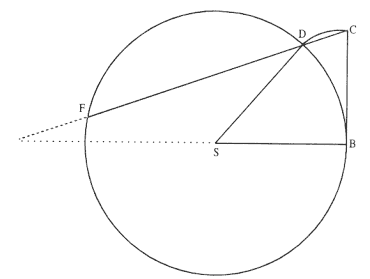
Figure 4.9
The length of the arc BD is equal to the length of the tangent segment
BC .
paths. The deviation CD is the chord of the arc CD about B (see fig. 4.9) and the deviation cd is the chord of the arc cd about b . In his pre-1669 analysis (see chapter 3) Newton spoke of the outward endeavor, and the deviation CD was directed incorrectly along a diameter of the circle, as suggested by the Cartesian terminology. Figure 4.10 is a comparison of the form of the diagram in his pre-1669 analysis of uniform circular motion with the form of the diagram in this post-1679 analysis. Note how in this later figure the deviation CD is not along a diameter but along the chord DF . This change in the slope and location of CD is now determined by the correct requirement in [A] that the tangent length BC must equal the arc length BD (see fig. 4.9). The deviation CD is no longer a potential but impeded outward displacement that acts in a radial direction, as suggested by Descartes. The revision of the diagram does not invalidate Newton's earlier solution because the Euclidean theorem to be employed in the next step is valid for both chords and diameters. The forces in either case are proportional to the deviations DC and dc , or FC / fc = CD / cd , as required.
[C] that is, on producing CD to F and cd to f, as BC2 / CF to bc2 / cf or as BD2 / (1/2)CF to bd2 / (1/2)cf.
Or FC / fc = CD / cd = (BC2 / CF ) / (bc2 / cf ) = (BC2 / (1/2) CF ) / (bc2 / (1/2) cf ). In the earlier pre-1669 drawing (see fig. 4.10), Newton specifically called upon Proposition 36 of Book 3 of Euclid's Elements to relate the lines CB (the tangent), CD (the deviation), and CE (the diameter plus the
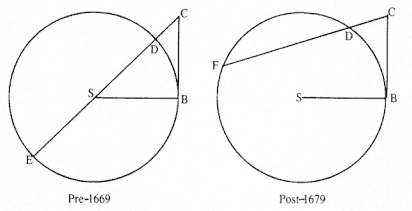
Figure 4.10
A comparison of the pre-1669 diagram with the post-1679 diagram in the
analysis of circular motion.
deviation) as follows: CE / CB = CB / CD . In this later text he did not give a specific reference to Euclid but the same relationship holds for the lines CB, CD , and CF (the chord of the circle plus the deviation) in the revised post-1679 diagram. In figure 4.11A, Euclid's theorem is valid when CF contains any chord of the circle.[23] Thus, in figure 4.11B, the deviation CD (dashed line) is obtained from CD / BC = BC / CF or CD = BC2 / CF . Newton chose to express the results in terms of the radius (1/2) CF rather than the diameter CF . Thus, F / f = CD / cd = (BC2 / CF ) / (bc2 / cf ) = (BC2 / (1/2) CF ) / (bc2 / (1/2)cf ).
[D] I am speaking of the very minute distances BD and bd, to be diminished into infinity, so that in place of (1/2)CF and (1/2)cf, it would be allowed to write the radii SB and sb of the circles. This done, the Proposition will be established .
Or, as point D approaches point B , then line CF approaches line 2SB (see fig. 4.12). And, (1/2) CF can be replaced by the radius SB . Thus, the proposition is demonstrated, and the forces are proportional to the square of their arcs divided by the radii of their circles (i.e., FC / fc = (BC 2 / ((1/2) CF ) / (bc2 / ((1/2) cf ) = (BC2 / SB ) / (bc2 / (sb )).
Corollary 1. [Hence ] the centripetal forces are as the squares of the speeds divided by the radii of the circles .
For uniform circular motion, the arc is proportional to the tangential speed. From [D], the ratios of the forces F1 / F 2 = (arc12 / r 1 ) / (arc22 / r 2 ) and because arc1 / arc2 = v1 / v 2 then F1 / F2 = (v12 / r1 ) / (v22 / r2 ).
Corollary 2. And reciprocally as the squares of the periodic times divided by the radii of the circles .
Or, F1 / F2= (T22/ r2 ) / (T12/ r1 ). The tangential speed v = circumference / period = 2pr / T , thus, v2 / r = 4p 2 (r / T )2 / r . From Corollary 1, F 1 /
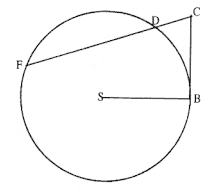
Figure 4.11A
From Proposition 36 of Book 3 of Euclid's
Elements , one has CD / BC = BC / CF .
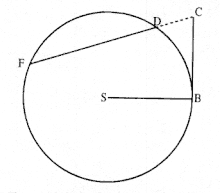
Figure 4.11B
In the diagram for Theorem 2, one has
CD / BC = BC / CF or the deviation
CD = BC2 / CF.
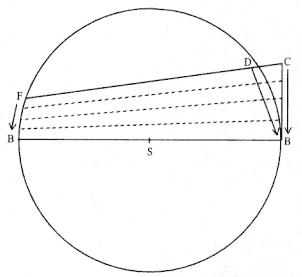
Figure 4.12
As the point D approaches the point B , the line CF
approaches the diameter 2SB .
F2 = (v12 / r1 ) / (v22 / r2 ), which becomes (4p2 (r1 / T1 )2 / r1 ) / (4p2 (r2 /T 2 )2 /r2 ) = (r 1 / T12 ) / (r 2 /T22 ) = (T 22 / r2 ) / (T 12 /r1 ), or the force is reciprocally proportional to the squares of the periods divided by the radii.
Corollary 3. From this, if the squares of the periodic times are as the radii of the circles, [then ] the centripetal forces are equal, and conversely .
If T2 is proportional to r , then (T22/ r 2 ) / (T12/ r 1 ) = 1. From Corollary 2, F 1/ F2= (T22/ r 2 ) / (T12/ r1 ) = 1 and thus F1= F 2 .
Corollary 4. If the squares of the periodic times are as the squares of the radii, [then ] the centripetal forces are reciprocally as the radii, and conversely .
Or, F1/ F2= r 2/r1 . If T2 is proportional to r2 , then from Corollary 2, (T22/ r 1 ) / (T12/ r 2 ) = r2/r1 and thus F1/ F 2= r2/r1 .
Corollary 5. If the squares of the periodic times are as the cubes of the radii, [then] the centripetal forces are reciprocally as the squares of the radii, and conversely .
Or, F1/ F2= r 22/ r12 . If T2 is proportional to r3 , then from Corollary 2, (T22/ r 2 ) / (T12/ r1 ) = r 22/ r12 and thus F1/ F2= r 22/ r12 .
Scholium
The case of the fifth corollary holds true in the celestial bodies. The squares of the periodic times are as the cubes of the distances from the common center around which they revolve. Astronomers already agree that this holds true in the major planets orbiting around the sun and in the minor ones around Jupiter and Saturn .
Newton did not give credit here to Kepler for the relationship in this scholium, but the result is found in Book 5 of Kepler's World Harmony (1619).[24] In Theorem 4 of this tract, Newton demonstrates that for elliptical motion the square of the period is as the cube of the transverse (major) axis of the ellipse.