
From Strike to Street: The 1901 Demonstrations
For obvious reasons, the 1900 conference was stillborn. Although no clear answers emerged to the questions raised by the Kiev United Council and the delegates to the 1900 conference, student protest continued to take its own unpredictable course. On 23 November 1900, a group of Saint Petersburg students disrupted Sons of Israel, an anti-Semitic play being staged at the Malyi Theater.[82] The management knew that it faced trouble and refused to sell tickets to anyone in a student uniform. But enough students made their way into the theater to cause a scene, which led to the suspension of thirty demonstrators by the university administration. Skhodki met in the university to discuss possible student reactions, but the majority of participants rejected a sympathy strike on the grounds that the Malyi Theater demonstration, albeit for a good cause, took place outside the university and did not affect the direct corporate interests of the students.[83] But these November skhodki had an important consequence: the students elected an Organization Committee to direct any future protests by the student body.
In Kiev University, the fall term had seen a number of lively skhodki, none of which appeared to have the sanction of the university's United Council. Politically radical students complained about the "narrow cor-
[81] TsGIA, f. 733, op. 151, d. 72, l. 116.
[82] Hoover Institution, Boris Nikolaevskii Collection, file 109, box 6, packet 60, no. 146.
[83] Ibid.
porate character" of these skhodki .[84] For example, on 13 November 1900, the Kiev students met to discuss two comrades who had allegedly beaten up a cab driver after refusing to pay him. Some students complained that the two had "violated the honor of the student uniform," and the skhodka demanded their expulsion from the university. Other skhodki met to protest the poor lectures of Professor O. O. Eikhelman on the juridical faculty, and the actions of two students who had allegedly stolen a gold ring from a singer at a local restaurant.[85]
The university inspectorate took down the names of several students at the 13 and 15 November skhodki . A university court then sentenced four students to confinement in the kartser, the university jail. Much to the consternation of the district curator, who complained that Russian students lacked the good sportsmanship of their German counterparts (who accepted the kartser as a hallowed part of university life), two students, Tseretelli and Pokotilov, refused to enter the kartser . The authorities then expelled them.[86]
The expulsion touched off an immediate reaction from the Kiev students: a well-attended skhodka took over the main university auditorium on 7 December to demand the return of Pokotilov and Tseretelli and the abolition of the kartser . After the students refused orders to disperse, the Kiev governor-general asked the university rector if he could handle the situation on his own. When he replied that he could not, the governor-general sent an infantry battalion and a Cossack mounted detachment to the university. The students finally left the building after presenting their demands to the rector. The university authorities noted the names of 406 students attending the skhodka . Of these, a special disciplinary board sentenced 183 to immediate military service on the basis of the July 1899 Temporary Rules. Two hundred and seventeen students received less severe punishments.[87]
By applying the July 1899 Temporary Rules for the first time, the government showed the studenchestvo that its new strategy for quelling student disorders was no empty threat. Minister of the Interior Sipiagin clearly expected a lot of trouble when the studenchestvo heard the news from Kiev and seemed to welcome the opportunity to hurl down the
[84] Ibid.
[85] TsGIA, f. 733, op. 151, d. 199 (this file contains the reports of the curator of the Kiev Educational District to the minister of education).
[86] Ibid.
[87] Gusiatnikov, Revoliutsionnoe studencheskoe, p. 45.
gauntlet. In a secret circular issued immediately after the Kiev affair, he warned the local authorities in university towns to quell any street demonstrations as quickly as possible, employing all means up to and including military force.[88]
When the students returned from their Christmas holidays to take stock of the situation, they found themselves caught between their sense of duty to their Kiev comrades and their fear of military induction. Adding to the general feeling of helplessness was the widespread belief that the Russian public would do no more to help the students than it had in 1899. The Kharkov University United Council told the students there that "we can rely only on ourselves," a sentiment echoed practically everywhere else.[89] But alongside the confessions of weakness, two themes emerged in the dozens of hastily prepared proclamations issued in January 1901: moral duty, and comradely solidarity. The Odessa Organization Committee urged the students not to recognize the Temporary Rules, which "deprive us of the right to discuss our corporate concerns and which subject us to demeaning punishment for the expression of comradely and corporate solidarity."[90] A group of Moscow University medical students warned:
If we don't do anything, then both the government and the public will see that all that is needed to extinguish the student movement are the Temporary Rules. Then the government will manage to convince the public that if the Temporary Rules suffice to cow the students, they can't be really serious [about their various demands]. As a result the public will come to think that the whole student movement was nothing more than the work of a few troublemakers. The students would then lose public sympathy, their only hope for eventual success. . . . We must act now.[91]
Another pamphlet, signed by "267 women students," foreshadowed the important role women would play in the student demonstrations that would soon be mounted against the Temporary Rules. The pamphlet echoed once again the common theme that "if in the best years of our lives we think about 'caution and moderation,' then what will we be like later on?" Only the students, not the oppressed masses, could fight against arbitrariness (proizvol ). Moreover, the pamphlet declared, Mos-
[88] TsGAOR, f. DP 00, 3ch. 78/1898, l. 98 (Sipiagin circular of 4 December 1900). Also 1. 107, circular of 27 February 1901.
[89] TsGIA, f. 733, op. 151, d. 64, l. 45.
[90] TsGIA, f. 733, op. 151, d. 64, l. 42.
[91] TsGIA, f. 733, op. 151, d. 241, l. 115.
cow's students faced the moral obligation of "restoring to the studenchestvo the general respect it used to enjoy."[92]
The pamphlets reveal many conflicting emotions: anxiety about the students' public image, loneliness, fear, despair that the public would once again leave the students to fight alone. The students were afraid of fighting but knew that somehow the tradition of the studenchestvo demanded that they must do so. At bottom was the nagging question: if we do not fight now, what will we be like as adults?
About this time a long poem began circulating around Saint Petersburg. Entitled "Togda i Teper'," the poem (quoted at the beginning of Chapter 2) appealed to the students to live up to their traditions.[93] Such appeals had no immediate effect. Most Moscow University students seemed cowed by the Temporary Rules. In the third week of January, skhodki at Kharkov, Kiev, and Moscow universities called for protest strikes, but most students ignored the resolutions and continued to attend classes.[94]
In Saint Petersburg University the Organization Committee elected after the November Malyi Theater incident tried to organize a protest strike. But it ran into the opposition of the kassa, whose current leadership had reverted to the pre-1899 view that student disorders were futile; the Kiev affair proved that they were dangerous as well.[95] When the Organization Committee issued an appeal to the Saint Petersburg public to support the students, the kassa published a counterappeal rejecting the Organization Committee's flirtation with the liberals and its efforts to organize a student protest against the Temporary Rules:
Students! Two hundred of our comrades have been sent into the army. We should protest. But how? We're told to start disorders [bezporiadki ]. But in fact disorders lead to passivity [molchalinstvo ]. The majority participates unwillingly because they are afraid of being called cowards. But they hope to squirm away at the first opportune moment, leaving the most talented and dedicated comrades to bear the brunt of the danger. For most students disorders provide an education in TREACHERY . It is not true that disorders strengthen the oppositional spirit. The latter is the cause, not the result, of disorders and is created by the general conditions of life. The student dis-
[92] TsGAOR, f. 124, op. 10, ed. kh. 441, 1901, l. 55.
[93] Handwritten copy in TsGAOR, f. DO, 3ch. 125t. 1/1898, l. 93a.
[94] Curators' reports and student pamphlets in TsGAOR, f. 124, op. 10, ed. kh. 441, 1901; TsGIA, f. 733, op. 151, d. 64.
[95] For a comment on the mood of Saint Petersburg students and their fear of the Temporary Rules, see POA, XVIb(7), folder 6 (letter of Nikolai Rudevich). See also G. Engel' and V. Gorokhov, Iz istorii studencheskovo dvizheniia 1899–1906 (Moscow, 1908), p. 20.
orders are valves . . . through which the accumulated energy of the students drains away. The proof of this is that even successful disorders, like the Vetrova demonstration and the first 1899 strike, are followed by a period of passivity. . . . The political development of the studenchestvo proceeds not BECAUSE OF BUT DESPITE DISORDERS .[96]
The kassa tried to convince the Saint Petersburg students that the only real beneficiary of the student disorders was the police, who were able to score an impressive series of cheap victories at the expense of the students. It was time to realize that students had to transcend their own corporate concerns and start struggling against the system as a whole.
We should protest not with impotent flickers of rage but with STRUGGLE —struggle against the political system in Russia. . . . Comrades! Is it really true that we can protest only when they beat us or send us into the army? Is it true that we can protect only our own corporate interests and remain indifferent to the sufferings of those who don't wear a student uniform? . . . Is it true that the student with all his bourgeois narrowness can turn a deaf ear to the voice of the times and remain satisfied with the miserable demand that the rule of law should apply only to students? Is it true that the Russian student will not join the general battle for freedom, equality and brotherhood?[97]
The kassa ended its proclamation by reminding students that joining the revolutionary movement was not only most useful but also safest. The chances of being caught by the police and getting sent into the army were much higher for those participating in skhodki or strikes. If students wanted to change their tactics, the kassa suggested, they could make a useful beginning by giving 5 percent of their monthly income to the revolutionary parties.
Although the kassa proclamation was an interesting restatement of the conventional Marxist position on the student movement, its practical effect was small, since most Saint Petersburg students were already too frightened by the Temporary Rules to protest the fate of the Kiev comrades. They had good reason to be afraid. When the Organization Committee called a protest skhodka for 25 January, the administration sentenced twenty-eight ringleaders to varying terms in the army. One of these students, E. K. Proskuriatov, soon committed suicide.[98]
[96] Engel' and Gorokhov, Iz istorii, p. 21.
[97] Ibid.
[98] For a list of the names and social origins of those involved, see TsGIA, f. 733, op. 151, d. 241, l. 110. Of the twenty-eight, nine were sons of civil servants, three sons of priests, two each were sons of doctors, engineers, officers, and teachers, and one each was the son of a lawyer, a mining official, a railroad official, and a feldsher . The social origins of the remaining four students were not indicated. For an illuminating account of what happened to the students during their brief stint in the army, see L. A. Sobolev, "Vospominaniia studenta-soldata," Byloe, no. 5 (1906).
What was left of the Organization Committee issued a frantic appeal on 6 February, entreating the Saint Petersburg University student body to remember the glorious student generation of the 1860s and uphold the traditions of the studenchestvo: "Comrades, we are living through a critical moment! It is now a question of 'to be or not to be' for the Russian studenchestvo which for so many years has been the only vibrant force amid . . . the ugliness of Russian life."[99] But this appeal was no more successful than that of the 25 January skhodka in convincing the student body to strike.
By the beginning of February, some students were writing home that "the time had come to bury the student movement."[100] The Temporary Rules had made their point, and the promising new tactic of 1899, the strike, had failed to mobilize student support for the 210 already drafted into the army. It was at this point that the student movement took another major turn. Since the calls for a strike met with little success, various students trying to organize a protest movement began thinking about street demonstrations against the Temporary Rules. Even if most students stayed away, enough might come to ensure an impressive turnout, especially in large centers such as Saint Petersburg. Furthermore, demonstrations offered the prospect of encouraging other social groups to express solidarity with the students.
As was the case with the 1899 strike, the idea to organize the February and March 1901 demonstrations cannot be traced to any specific individual or group. What is clear is that by the beginning of February the Saint Petersburg University Organization Committee had been able to establish an informal network of student representatives from several men's and women's VUZy in the city.[101] A figure who would play an important part in the organization of the demonstrations was the young Vladimir Levitskii, then beginning his career in the revolutionary movement. Another important participant was Pokotilov, one of the two Kiev students whose refusal to enter the kartser had sparked the crisis.
By Levitskii's account, Pokotilov at this time was a rather neurotic character, an alcoholic whose face was heavily scarred with eczema. Like many others who came to take an active role in the student move-
[99] TsGIA, f. 733, op. 151, d. 242, l. 43.
[100] TsGAOR, f. 102, op. 226, ed. kh. 3ch. 125t. 1-A/1898, l. 48.
[101] TsGAOR, f. 102, op. 226, ed. kh. 3ch. 125t. 1-A/1898, l. 10.
ment, Pokotilov had no clearly formed political views except an obsession with "comradeship."[102] By the beginning of February, Pokotilov had arrived in Saint Petersburg, where he began intense agitation to get the Saint Petersburg students to support their Kiev comrades. At one gathering he took violent exception to those who said that the student movement was finished—leaping onto a chair, he screeched, "We need a demonstration!" and then fell off the chair in hysterics.[103]
In contrast, the hostile stance of the economist Soiuz Bor'by dlia Osvobozhdeniia Rabochevo Klassa, still the largest Social Democratic group in Saint Petersburg, complicated preparations for the demonstration.[104] The Soiuz Bor'by maintained its suspicious attitude toward the student movement and told its members not to cooperate with students who came asking for help in organizing a public demonstration.
Unlike the situation in 1899, however, there was now a new trend in Russian Social Democracy, expressed in the journal Iskra. Iskra welcomed the student movement and urged Social Democrats and workers to ignore the Soiuz Bor'by and give the students active support. The student movement became a focal point in the argument between the Soiuz Bor'by and Iskra . In an important Iskra article entitled "Conscription of the 183 Students," Vladimir Lenin urged Social Democrats and workers to support the student movement:
The working class has already begun the struggle for its liberation. But it should understand that this important struggle carries with it important obligations. The worker cannot free himself without having at the same time liberated all the people from despotism. Above all he must respond to and support every political protest. The best members of our educated classes have proven with the blood of thousands of revolutionaries their willingness to shake off the dust of bourgeois society and join the socialist ranks. That worker who can look on with equanimity as the government uses the army against the students is not worthy of bearing the name socialist . The student has [in the past] gone to the aid of the worker—the worker must go to the aid of the student.[105]
In conclusion, Lenin urged workers to participate in street demonstrations.
[102] V. Levitskii, Za chetvert' veka (Moscow, 1926), pp. 94–96.
[103] Ibid., p. 148.
[104] Ibid., p. 144. See also N. V. Iukhneva, "Studencheskoe dvizhenie v Peterburgskom universitete i pervye demonstratsii 1901 goda," Ocherki po istorii Leningradskovo universiteta (Leningrad, 1962).
[105] "Otdacha v soldaty 183-kh studentov," Iskra, no. 2 (1901).
In January and February 1901 there was as yet no Iskra group in Saint Petersburg. In March two smaller socialist groups, the Rabochee Znamia and Sotsialist, would proclaim their allegiance to the Iskra line, but until then, they too opposed the idea of actively helping the student movement and collaborating in a public demonstration.[106]
Meanwhile, events began to move at a more rapid pace. On 14 February Peter Karpovich, a disgruntled ex-student, showed up for an appointment with Minister of Education Bogolepov, calmly pulled out a revolver, and shot him fatally in the chest. News of the assassination exacerbated the tension in the atmosphere. At the same time certain student members of the Soiuz Bor'by rejected the economists' negative attitude toward the student movement and began agitating for street demonstrations. One such student, A. N. Karasik, founded an organization entitled the Soiuz Spravedlivykh. It consisted of himself and a hectograph machine, but he succeeded in fooling the Okhrana and many students into thinking that there was a formidable organization ready to take the student movement on a new tactical course.[107] Leadership was coming from other sources as well. Vladimir Fridolin, one of the few members of the Saint Petersburg University Organization Committee who had escaped the arrests of late January, started making the rounds of the city's VUZy and recruited a Delegate Conference to discuss tactical options available to the students. Like Pokotilov (who was now working on his own, because other students found him too hysterical to include in their plans), Fridolin had no specific political views. Levitskii described him as "an idealist, a little unworldly, trusting and impractical, burning with the desire to 'suffer' and share the fate of his comrades."[108]
After a few inconclusive meetings, the Delegate Conference met on 16 February to decide whether to call a student demonstration at the Kazan Cathedral for 19 February, the anniversary of the emancipation of the serfs. To reach the apartment where the meeting took place, the sixteen delegates had to pass several cages housing the inmates of a mental institution located on the first floor. To the accompaniment of a strange assortment of sounds, the argument about the demonstration began. V. V. Filatov, the delegate from the Mining Institute, attacked the idea, arguing that the demonstration would fail and demoralize the stu-
[106] Iukhneva, "Studencheskoe dvizhenie"; Levitskii, Za chetvert' veka, p. 144.
[107] Levitskii, Za chetvert' veka, p. 130. One of Karasik's pamphlets can be found in TsGAOR, f. 102, op. 226, ed. kh. 3ch. 125t. 1-A/1898, l. 30.
[108] Levitskii, Za chetvert' veka, p. 130. For a police report on Fridolin, see TsGAOR, f. 102, op. 226, ed. kh. 3ch. 125t. 1-A/1898, l. 30.
denchestvo even further. He counseled abandoning purely student-based protests in favor of working with revolutionary groups. Opposing Filatov was Vasilii Adamov, an army officer and a friend of Fridolin's, who argued that a student street demonstration would have a major impact on the public and would undermine the government's political position.[109]
After long and inconclusive debate, the delegates decided to make a rough count of the students they thought would be ready to take to the streets, two thousand being the agreed-upon minimum necessary to ensure the success of a demonstration. The count came up five hundred short. At that point, the police broke in and led the whole group to jail, past the cages of the screaming inmates.
Much to the surprise of the police, the arrests disrupted but did not cripple the plans for a student demonstration. One student, a certain Baumstein, escaped arrest and distributed flysheets calling for students to assemble at Kazan Square at noon on the nineteenth. Rumors that the demonstrations had been called off kept the turnout low, but about four hundred students, mostly women, assembled at the appointed time. The police ringed the small group (some accounts speak of beatings) and arrested 244 students and onlookers, who were released after the police recorded their names. Of the 244, 128 were female students, 71 were male students, and 45 were nonstudents.[110]
Although the turnout for the 19 February demonstration was relatively small, those student leaders who had managed to escape arrest were encouraged by the public sympathy the demonstration attracted, especially since the demonstration had not been widely publicized and many students erroneously believed it had been postponed at the last minute. After the arrest of the Delegate Conference, the Saint Petersburg University Organization Committee issued an appeal to "all classes of society" to join in a public demonstration in front of Kazan Cathedral on 4 March, a Sunday. The Organization Committee called the demonstration to defend "basic human rights" and invited the public to join forces with the students. One veteran of the student movement noted two distinct tendencies among the proponents of the Sunday demonstration. Whereas the Organization Committee appealed to the middle-class educated public, other students, Marxists who did not agree with the negativism of the Soiuz Bor'by, attempted to win workers' support for the
[109] Levitskii, Za chetvert' veka, pp. 154–155.
[110] TsGAOR, f. 102, op. 226, ed. kh. 3ch. 125t. 1-A/1898, l. 21.
demonstrations.[111] Although these efforts were generally unsuccessful, the students did succeed in publicizing the planned demonstration.
Contemporary police reports, as well as some leading historians, ascribed the major role in the preparation and organization of the 4 March demonstration to the revolutionary movement.[112] But available evidence fails to support this contention.The impetus for the demonstration came from the students. And Iskra itself attacked Social Democratic organizations for not participating in planning the demonstrations—not only in Saint Petersburg, but in Kharkov and Kiev as well.[113]
The 4 March Kazan Square protest, one of the largest street demonstrations the Russian capital had ever seen, made a profound impact on the Russian public and showed once again the ability of the Russian student movement to embarrass the government and raise the political temperature of the nation.
All morning, crowds of students streamed toward Kazan Cathedral. One eyewitness, the writer R. V. Ivanov-Razumnik, who was then a student at Saint Petersburg University, responded to the call of the University Organization Committee to protest the Temporary Rules and made his way to the square:
Time of action—midday on the fourth of March 1901; scene of action—Kazan Cathedral Square in Saint Petersburg. A vast crowd overflows the square: students of every branch of learning, the majority regular members of the university but also including a large number of post-graduates—technologists, mining and railway engineers. There are young girls from the higher courses for women. There are also many ordinary members of the public, not a few of whom are middle-aged. In the crowd I catch sight of the grey-bearded figure of the well-known journalist and writer, N. F. Annensky, with his usual expression of gaiety and enthusiasm. Standing near me are two rising stars of the Marxist firmament, P. B. Struve and Professor M. I. Tugan-Baranovskii of our university. . . . But youth is predominant, thronging the whole huge square in a closely packed mass. Other spectators jostle on the pavements of the Nevskii Prospekt, some simply out of curiosity, some out of secret sympathy. All are aware that exactly at noon, when the cannon fires from the Petropavlovsky fortress, the students are due to march down the Nevskii Prospekt in a demonstration.[114]
[111] Engel' and Gorokhov, Iz istorii, p. 33; Levitskii, Za chetvert' veka, p. 162. According to Levitskii, the Soiuz Bor'by changed its mind at the last minute and decided to support the 4 March demonstration.
[112] For example, see Allan Wildman, The Making of a Workers' Revolution (Chicago, 1967), p. 211; Gusiatnikov, Revoliutsionnoe studencheskoe, p. 56; TsGAOR, f. DP 00, 3ch. 78/1898, l. 160 (Sipiagin circular of 5 December 1901).
[113] Iskra, no. 3 (1901).
[114] R. V. Ivanov-Razumnik, Tiur'my i ssylki (New York, 1953), p. 19.
Another participant in the 4 March demonstration, Ariadna Tyrkova-Williams, recalled nearly fifty years later the deep impression made by the students:
For the first time in my life I saw a large street demonstration. When politics hits the streets, it can produce noisy flashes of human freedom or it can peter out in silence. . . . The beginning of that Sunday was quiet. But as soon as we reached the Nevskii, we could see right away that something had deeply disturbed the life of Saint Petersburg. The gates of all the buildings . . . were shut tight, as if it were the middle of the night. The trams didn't run. From time to time a cab-driver appeared . . . but quickly turned onto a side street. . . . Everybody was heading toward Kazan Cathedral. They went in small groups, composed mainly of students. Their young faces shone with a proud sign: WE ARE GOING TO PROTEST .[115]
Accompanied by the noted economist Mikhail Tugan-Baranovskii, Tyrkova-Williams disregarded the friendly advice of a mounted Cossack to go home. She edged her way through the crowd toward the steps of the cathedral, where students raised a large sign: "Down with the Temporary Rules." The sea of student caps and sheepskin hats, the "unofficial uniform" of the kursistki, left no doubt that the overwhelming majority of the demonstrators were students. Buoyed by the large turnout and rumors of successful student street demonstrations in Moscow and Kharkov, the crowd was in high spirits.[116]
Riding into the crowd without warning, the Cossacks pushed hundreds of people against the steps of the cathedral, blocking all avenues of escape. Then the beatings began. The government communiqué later said that the students started the violence by throwing rocks at the Cossacks' horses, but most onlookers believed that the attack on the crowd was unnecessary and unprovoked.
A girl was hanging on to the bridle of a Cossack horse . . . the rider knocked her hat off with his nagaika . Her hair streamed out around her face, blood flowed down her cheek. Not far away two students were fending off the nagaiki, covering their faces with bloody arms. Two policemen were dragging off a screaming girl.[117]
[115] A. Tyrkova-Williams, Na putiakh k svobode (New York, 1953), pp. 67ff.
[116] Ibid.
[117] Ibid., p. 69. Numerous accounts of the demonstration can be found, including a long pamphlet from the Saint Petersburg University Organization Committee describing the events of 4 March (TsGAOR, f. DO, 3ch. 125t. 1, 1/1898, l. 162). The official government communiqué was issued on 7 March. Long accounts, exaggerating the casualties, can also be found in Iskra and Revoliutsionnaia Rossiia .
As Tyrkova-Williams and her companion watched the chaotic scene, wanting to help but not knowing what to do, Peter Struve, the well-known writer and political thinker, bumped into them. He was waving his arms and yelling frantically:
"The devil take them! How dare they? How dare they hit me on the legs with a nagaika? You understand?—me!" He pounded his coat to show where the nagaika had left its dirty marks. We were . . . horrified by what was going on around us. But life loves to mix tragedy with comedy. As I looked at his dishevelled red hair and red beard . . . and kept hearing his repetitive, disjointed, ridiculous cry, "me! me!" it was all I could do to keep from laughing.[118]
Soon it was over. By the bloodier standards of a later era, the demonstration of 4 March was a tame affair. Although there were wild rumors to the contrary, no one died or even suffered serious wounds. Under police escort, 775 people marched through a cold drizzle to jail. Most of the detainees were students, the numbers almost equally divided between men and women; the Russian kursistka was carrying a disproportionate share of the fight against the Temporary Rules.[119]
Their treatment in prison reflects the curious mixture of deference, paternalism, and repression that marked the old regime's attitude toward the studenchestvo . Ivanov-Razumnik recalls a not unpleasant experience: the jailers allowed the students to organize a theater, give lectures attended by the prison governor, hold chess championships, and receive ample parcels. One student's father, the well-known tobacco manufacturer Shapsal, sent in several shipments of ten thousand cigarettes each. "From the very first days of our stay we took so many liberties with the regulations that our prison life was converted into a kind of student picnic. Every cell resounded with shouts, laughter, songs, and choruses."[120] The prison also allowed the students liberal visiting rights:
Men-students who had no relations in the city were visited by fictitious "fiancées," girl-students had their "fiancés." One of our company was visited by three "fiancées" at one and the same time, whereupon the Chief of Prison sent for the fortunate young man and begged him to state which of his "fiancées" was the real one. But that was the whole difficulty—none of them was. So after that the girls decided they would take turns to visit him. Noise and hilarity prevailed throughout these unusual prison visits.[121]
[118] Tyrkova-Williams, Na putiakh k svobode, p. 70.
[119] A police summary of the arrest list is in TsGAOR, f. 102, op. 226, ed. kh. 3ch. t1LB/1898. Of the arrestees, 349 were male students, 323 were female students, 24 were female teachers, and 79 (50 men and 29 women) were raznochintsy [sic ].
[120] Ivanov-Razumnik, Tiur'my i ssylki, p. 23.
[121] Ibid.; translated and annotated by P. S. Squire as The Memoirs of Ivanov-Razumnik (London, 1965).
But the authorities drew the line when Ivanov-Razumnik asked for an evening's furlough to attend a subscription performance of the Moscow Art Theater. He told the Chief of the Prison that he promised "on his word of honor as a student" to return by midnight.
The Chief of the Prison—a man of some irony—explained with great politeness and every appearance of gravity that he had all possible confidence in Mr. student's word of honor, but did not Mr. student think that out of some hundreds of men and women students there might be dozens whose pockets also contained identical tickets? He would readily release Mr. student on his word of honor, but in that case he would also have to release a whole crowd of people on the same basis. Did not Mr. student think that in many respects this would be inconvenient and for him, the Chief of Prison, even impossible?[122]
After a week all the arrestees appeared for cursory interrogations at which they were asked whether they belonged to revolutionary organizations and why they had participated in the 4 March demonstration. Almost all the students were expelled from their VUZy and forbidden residence in university towns for periods from one to three years.[123] The government was, however, clearly having second thoughts about applying the Temporary Rules. Furthermore, the apparent harshness of the penalties suffered by the Kazan Square demonstrators was mitigated by their speedy annulment. That summer the government allowed most conscripted and expelled students to reenter the VUZy for the fall term.[124]
If the students had wanted to stage a successful demonstration, win public sympathy, and exert pressure on the government to abrogate the Temporary Rules, then they had certainly succeeded. The demonstration proved that even a small minority of students could make an impact on the general public and the government:
Exaggerated rumors flew across the city about a vicious attack by the Cossacks and police on the demonstrators. Saint Petersburg seethed with indignation. Saint Petersburg supported us. This was the first outburst of the liberation movement [obshchestvennovo dvizheniia ]. Especially affected were the central quarters of the city, where the wealthier classes and the intelligentsia lived. We were later told that the workers were also angry. Maybe. I saw no workers either on the square or among the arrestees . . . the demonstration was a student affair, far from the concerns of the workers, but it deeply touched the educated public. Public opinion supported the students so unanimously that the government became confused. It realized that a certain turn-
[122] Ibid., p. 27; trans., Squires, p. 6.
[123] TsGAOR, f. 102, op. 226, ed. kh. 3ch. 125t. 1LB/1898, l. 99.
[124] Ivanov-Razumnik, Tiur'my i ssylki, p. 27; Engel' and Gorokhov, Iz istorii, p. 40.
ing point had been reached on Kazan Square, that the opposition movement had received a new impetus.[125]
The news of the police brutality in Kazan Square, widely disseminated in a series of somewhat exaggerated bulletins put out by the Saint Petersburg University Organization Committee, finally touched off an academic strike in the capital's VUZy .[126] At the same time 150 writers, lawyers, and professional people sent a petition to the Ministry of Justice charging premeditated police brutality and asking for the punishment of those responsible.[127]
The Kazan Square demonstration also intensified conflicts within Russian Social Democracy. Iskra seized on the absence of workers at the demonstration to step up its attacks on economism and press its claims for hegemony in the Russian Social Democratic movement:
There is no doubt that instead of a simple beating of the people by the authorities, the demonstration would have been the scene of a real battle between the people and the government if only the socialist groups . . . had appealed to the workers [to join the demonstration] and organized separate demonstrations on the outskirts of the city. . . . Some workers finally did come but they arrived too late.[128]
Events in other university towns—Moscow, Kharkov, Kiev, Tomsk—followed roughly the same pattern as the development of the student movement in Saint Petersburg. When the majority of students balked at striking to protest the Temporary Rules, a more committed minority embraced the idea of street demonstrations as a way out of a tactical dilemma.[129] Repression of the demonstrations or news of police brutality in other cities then induced the other students to strike. In all these cases there seemed to be no coordination between university towns, no prior plan, and certainly little or no collaboration with revolutionary groups or workers' organizations. Once again the student movement was following its own distinct rhythm.
In Kharkov, for example, the United Council made several unsuccessful appeals in January for a strike to support the drafted Kiev students. After these appeals failed, some radical students planned a street
[125] Tyrkova-Williams, Na putiakh k svobode, p. 73.
[126] Police reports describing the strike are found in TsGAOR, f. DO, 3ch. 125t. 1/1898, l. 161.
[127] TsGAOR, f. DO, 3ch. 125t., 1/1898, l. 198.
[128] Iskra, no. 3 (1901).
[129] Engel' and Gorokhov, Iz istorii, p. 26.31
demonstration on 19 February and secured the support of local Social Democratic groups that were more sympathetic to the Iskra line than were their counterparts in Saint Petersburg.[130] But, as if to underscore the independence of the student movement, the students disregarded the advice of the Social Democrats to hold the demonstration in the evening so that more workers could participate. When a small group of students assembled in front of the main cathedral at noon on the nineteenth, the anniversary of the emancipation of the serfs, they distributed pamphlets couched in remarkably moderate tones: besides demanding the repeal of the Temporary Rules, they praised the "Tsar Liberator" Alexander II. When the small crowd of students started marching to the university, mounted Cossacks encircled and beat them. Pro-strike forces in the university and the Technological Institute began to gain the upper hand, and a strike finally broke out after news of the Kazan Square demonstration reached Kharkov.[131]
In Moscow University an Executive Committee formed at the end of January to direct the student protest against the Temporary Rules. Although this committee included several students who would in later life join the revolutionary movement, it at first proceeded quite cautiously, waiting until events elsewhere made the Moscow students more willing to fight.[132] When news came of the 19 February demonstrations in Saint Petersburg and Kharkov, the Executive Committee distributed a questionnaire asking how many students would appear at a skhodka on 23 February. Nine hundred and seventeen said they would, although far fewer actually came.
As soon as the skhodka began, a large crowd of students and their relatives and friends gathered in front of the university and watched the students inside hang out a large banner proclaiming "Down with the Temporary Rules!" A crowd of gendarmes then stormed into the auditorium and began to escort out the three hundred students who refused to disperse to the Manezh, a large exhibition hall and cavalry barracks across the square from the university. (The authorities hastily cleared out the bird show then running in the hall.) A long chain of police separated the arrested students from the enthusiastic crowd of well-wishers.
[130] On the Kharkov student demonstrations, see the report of the acting minister of education, N. A. Zver'ev, to Tsar Nicholas II, 22 February 1901, in TsGIA, f. 733, op. 151, d. 64, l. 24. See also Iskra, no. 2 (1901).
[131] TsGIA, f. 733, op. 151, d. 64 (report of Kharkov curator to acting minister of education, 13 March 1901).
[132] On the activities of the Moscow University Executive Committee during this period, see the unpublished memoirs of V. I. Orlov in AIISSSR, f. 5, op. 5, ed. kh. 58.
A member of the Executive Committee, N. V. Korshun (a future member of the Social Revolutionary party), climbed a street lamp and called on the students in the crowd to join the group being led to the Manezh. About two hundred students then broke through the police lines and joined their arrested comrades.[133] After a boisterous and rowdy night in the Manezh, where a crowd of sympathizers stayed all night and entertained those inside with choruses of "Nagaechka," "Dubinushka," and other student songs, the police transferred the male students to the Butyrka prison and released the women.
Of the 358 Moscow University students on the arrest list, 32.5 percent were juridical students, 8.6 percent came from the history and philology faculty, 8.6 percent were mathematics students, 24.3 percent were students of the natural sciences, and 26 percent were medical students. (In other terms, 9.8 percent of the students from the history faculty, 6.7 percent of those from mathematics, 13.9 percent from the natural sciences, 6.9 percent of the juridical students, and 8.1 percent of the medical students went to the Manezh.) Of the students' fathers, 15.2 percent were nobles, 22 percent were middle-level civil servants, and 11.3 percent were either lower-level civil servants or civil servants of unspecified rank; 17.2 percent of the arrested students came from the meshchanstvo, 9 percent from the kupechestvo, 7 percent from the priestly estate, 7 percent from the honorary citizenry, and 5 percent from the peasantry.[134] Eighty-six percent had graduated from high schools outside Moscow. Once again the natural sciences faculty was significantly overrepresented, as were students from provincial backgrounds. More than 60 percent were either first-course or second-course students, but this reflected the general proportion of these students in the university population. As was the case in 1899, students from all estates were involved in the movement. The students on the arrest list this time were, however, a smaller proportion of the general student body than in 1899, representing that minority which was clearly ready to defy the express orders of the police and go to jail. Police interrogation reports show that the major reason for these students' decision to protest was comradely solidarity and anger at the Temporary Rules.[135]
[133] Ibid.
[134] These figures are compiled on the basis of the arrest list in TsGAOR, f. 124, op. 10, ed. kh. 441, 1901.
[135] G. A. Vesëlaia, "Massovye obshchestvennye vystupleniia Moskovskovo studenchestva, v kontse 19ovo-nachale 20ovo veka," Kandidat dissertation, Moscow State University, 1974, p. 117.
The events at the Manezh stirred up the city and led to an unexpected but sizable street demonstration the following Sunday, 25 February. Crowds of students gathering in front of the governor-general's house on the Tverskoi Bul'var were soon joined by several hundred onlookers, including a few workers. The crowd marched up and down the central streets of the city, singing songs and ignoring the repeated demands of the police that they disperse.[136] The Executive Committee was heartened by the public support, especially the alleged turnout of "many workers," but obviously felt that the crowds came to support the students' specific grievances rather than to make a general political protest against the regime.[137] The next day the committee asked the students to refrain from further demonstrations, since the public had already shown its sympathy and more street outbursts would only result in needless arrests. This position provoked a sharp retort from Iskra:
These partisans of a "purely student movement" naively assume that the crowd demonstrated, sacrificed itself, and took risks only to . . . influence the government to accept the students' demands and that it will stop its agitation as soon as the students get what they want. . . . The Executive Committee is afraid that the student movement might turn into a political movement.[138]
Why did the nonstudents in fact come? Specific motives are, of course, hard to establish, but the truth lies somewhere between the Iskra position that they came to demonstrate against the government and the Executive Committee view that their main motive was to support the students. As was the case with the Kazan Square demonstration, some of the participants were probably onlookers who got carried away by the excitement of the crowd. It should be remembered that demonstrations on this scale were, to put it mildly, a novelty, especially in the central districts of Russia's major cities. Both the 4 March Kazan Square and the 25 February Moscow demonstrations took place on Sundays on main thoroughfares, the Nevskii Prospekt and the Tverskoi Bul'var. Although these streets were close to the universities and the student districts, they were far removed from the working-class areas. Therefore
[136] TsGAOR, f. 124, op. 10, ed. kh. 441, 1901, l. 105.
[137] For the text of the Moscow Executive Committee bulletin, see TsGIA, f. 733, op. 151, d. 64, l. 236. In his memoirs, S. I. Mitskevich states that "many workers" indeed came to these demonstrations, but he added that these demonstrations were "spontaneous" and that the Moscow Social Democratic Committee had no role in them (Revoliutsionnaia Moskva, 1888–1905 [Moscow, 1940], p. 283).
[138] Iskra, no. 3 (1901).
workers who did come to demonstrate probably had a specific political purpose in doing so. The nonstudents arrested at the Kazan Square demonstration were professionals and intelligentsia, but the profile of the nonstudent arrestees in Moscow is somewhat different. More workers came to the Moscow demonstrations, and even more "employees"—shop clerks and such—nonetheless, to quote one eyewitness, "most workers were untouched by the student demonstrations."[139]
It should be reiterated that, as was the case in Kharkov and Saint Petersburg, the Moscow students were divided into several groups. Most sympathized with the Kiev students drafted into the army but, out of fear, refrained from striking or demonstrating. A smaller number of student activists, quite conscious of the traditions of the student movement, wanted to organize some sort of student protest in reaction to the Kiev incident. At first this group favored the strike, which had enjoyed such success in 1899. But these students soon despaired of convincing their comrades and began to espouse the idea of street demonstrations. When the demonstrations finally began in Moscow, however, they were an unplanned reaction to the arrest of the 23 February skhodka . And although these student activists wanted to attract public support for their demonstrations, they balked at advancing political demands that went beyond the 1899 platform. There was also a smaller group of radical activists who wanted to establish close links between the students and the labor movement. This group was itself split into two factions. One faction recognized the political potential of the student movement, whereas the other faction agreed with the economists that the student movement was useless.[140]
An academic strike broke out in most VUZy by the beginning of March, but this did not happen in Moscow University, mainly because of the intervention of the university's faculty council. The faculty council made a direct appeal to the students to avoid strikes or demonstrations: student disorders were self-defeating. The 1899 strike had produced nothing but the Temporary Rules; by demonstrating against them now, the studenchestvo was backing the government into a corner, forcing the authorities to defend their prestige by retaining the draft. Nor was it appropriate for the students to strike. After all, the faculty council argued, the universities were not factories.[141]
[139] AIISSSR, f. 5, op. 5, ed. kh. 58, l. 13 (V. I. Orlov memoirs).
[140] Ibid.
[141] This appeal can be found in TsGIA, f. 733, op. 151, d. 241, l. 17.
In a sharp reply, the students' Executive Council accused the professors of cowardice; they worried only about keeping their jobs and did little to defend either student or academic interests. "What did you do for us in 1899? Which of you followed the example of Kovalevskii, Menzbir, and Miliukov? . . . How can we see you as 'pillars of science' when your lectures get filtered through ten layers of censorship? How can we believe that you professors are even in a position to help us when your very appeal to us is illegal according to the University Statute?"[142]
What most distinguished Moscow from other universities was the decision of P. A. Nekrasov, the curator of the Moscow educational district, to head off a student strike by allowing the faculty council to appoint a commission to investigate and report on the causes of student unrest. The commission's deliberations mollified most Moscow students, averted a strike, and confirmed that most students would still respond well to any hint of reforms from above.[143]
Tsar Nicholas seemed to be reaching the same conclusions: a change in educational policy might succeed where the Temporary Rules had failed, in ending the student movement. On 16 March the tsar convened an interministerial conference on higher-education policy.[144] Four days later, on 20 March, he wrote a telling letter to his uncle, Grand Duke Sergei Alexandrovich, the Moscow governor-general, sharply disagreeing with the latter's gloomy assessment of the situation created by the student movement. Sergei Alexandrovich, discouraged by the February and March demonstrations, had told Nicholas that he wanted to resign. The tsar was more sanguine. Perhaps the root cause of student unrest was bad educational policy. If so, then the time had come to correct it. "I think a real government is strong when, openly admitting its mistakes, it immediately corrects them without worrying about what others will think or say." Yes, the student movement was troublesome, but the
[142] TsGIA, f. 733, op. 151, d. 242, l. 97.
[143] TsGIA, f. 733, op. 151, d. 242, l. 81.
[144] The tsar asked the assembled ministers whether the time had come to put all VUZy under unified control. Although N. A. Zver'ev, the acting minister of education, liked the idea, Witte argued that the real problem lay in the inability of the Ministry of Education to control the universities, whose students, he asserted, usually took the lead in fomenting student disorders. K. P. Pobedonostsev, the ober-procurator of the Holy Synod, agreed and argued that "the universities were based on Western models . . . which were totally unsuited to Russia's character." The conference also heard suggestions from D. S. Sipiagin, the minister of the interior, on how to relieve the alleged overcrowding of the VUZy . The government, Sipiagin argued, had to reform secondary education so that a high school graduate would not have to go on to higher education in order to obtain social and employment opportunities. See TsGIA, f. 721, op. 2, ed. kh. 295.
vast majority of the population was loyal. "Don't think I am minimizing the importance of these disorders but I sharply distinguish disorders within the universities themselves from street demonstrations. The time has come, though, to reform our entire academic structure . . . things can't get worse." The tsar ended his letter by disclosing that he intended to give the job of reforming Russian education to a "military man": General P. S. Vannovskii.[145]
News of Vannovskii's appointment seemed to restore the faith of most students that the government would abrogate the Temporary Rules and overhaul the whole system of higher education. Indeed, the rescript that accompanied Vannovskii's appointment promised such reforms and a softer line toward the students. The rescript asked teachers and administrators to "enter into close association with the students and . . . further the moral education of youth on the basis of heartfelt concern [serdechnoe popechenie ] for their well-being."[146]
At the beginning of April, Vannovskii announced a thorough review of the University Statute of 1884 as well as a reconsideration of the 29 July Temporary Rules. In fact the government did not apply the rules to the hundreds of students arrested during the spring demonstrations; that August the authorities released the Kiev and Saint Petersburg students who had already been conscripted.
In April it was clear that the spring wave of student protests had run its course. An April skhodka resolution at Saint Petersburg University expressed the general attitude: a 1,675 to 271 vote passed the resolution that "the studenchestvo trusts the good intentions of the government" but asked Vannovskii to put off the spring exams until the fall so that students arrested that spring would not suffer. After some initial reluctance Vannovskii agreed.[147]
As the students went home for summer vacations many pondered the lessons of this latest episode in the student movement. Most agreed on one point: they had won. The Temporary Rules were gone, and Vannovskii promised further reforms. Moreover, it all came as something of a surprise. They had begun the semester frightened of the Temporary Rules, unable to repeat an 1899-style strike in support of their conscripted comrades. But, just as in 1899, an unforeseen tactical inno-
[145] Letter of Tsar Nicholas II to Grand Duke Sergei Alexandrovich, 20 March 1901, TsGAOR, f. 646, ed. kh. 71, l. 55.
[146] Text quoted from M. K. Korbut, Kazanskii Gosudarstvennyi Universitet imeni V. I. Ul'ianova-Lenina za 125 let, 1804/5–1929/30 (Kazan, 1930), vol. 2, p. 146.
[147] Engel' and Gorokbov, Iz istorii, p. 40. Both authors played an active role in the student movement at Saint Petersburg University. Their book is as much a memoir as it is a secondary source.
vation had confounded the pessimists and cynics who denigrated the importance of the student movement.
Compared to the 1899 strike, the 1901 street demonstrations certainly carried some tactical advantages. First, of course, a far lower level of student participation sufficed to convey an illusion of success. Fewer students actually participated in the demonstrations, but the sense of victory was greater. Second, street demonstrations forged links between the student movement and other social groups. The 1901 street disorders were mainly student demonstrations, but they nevertheless made a major impression on Russian urban society and gave students the feeling that the student movement counted after all.
As Allan Wildman has perceptively observed:
The street demonstrations of March 1901 in the major cities of Russia marked the advent of yet another phase in the long conflict of radical society with the prevailing order. The heroism and initiative of the students in combatting the "provisional regulations" of 1899 gave the revolutionary intelligentsia and their liberal fringe a new focal point for their political hopes and helped free them from the spell of the working masses. With the defection of such leading theoreticians as Struve, Tugan-Baranovskii and Bulgakov, the intellectual pre-eminence of Marxism had rapidly dwindled. The once captive authors and scholars, the impressionable ex-Populists and liberals, the Worker-phile students, lawyers and zemstvo employees now responded to new strategies and theoretical justifications for their mounting aspirations for change. In exposing themselves to the blows of Cossack whips, to the dangers of arrest and the loss of social position, they developed a new sense of their own dignity and social import which Marxism had denied them.[148]
As they reflected on the import of the 1901 student demonstrations, many former participants in the student movement believed that the outbreak of student protest also influenced the shift in Russian Social Democracy away from economism. Once again Wildman, a leading historian of Social Democracy during this period, agrees:
To be sure they still regarded the working class and their Social Democratic champions as important "allies" in the shaping struggle, but other social factors now entered their political computations. The overly simple view, so popular a few years before, that the momentum of the workers' movement would of itself burst the shackles of the autocracy, gave place to the feeling that "all live forces" should now join in the battle for political liberty. . . . In response to these events, which momentarily put the workers' movement in the shadow, Russian Social Democracy rapidly completed its shift from "economics" to "politics."[149]
[148] Wildman, The Making of a Workers' Revolution, p. 214.
[149] Ibid., p. 215.
In short, the 1901 spring demonstrations showed the studenchestvo that the student movement could be important. It could influence other social groups and even force the government to meet student demands.
The events of the spring also underscored the key role played by women students, the kursistki, especially in the capitals. Women's higher education was gaining increasing acceptance not only from the elite but also from more conservative merchant groups. In addition to the problems faced by their male counterparts, women students had to contend with special obstacles—their inferior legal status, nettlesome discrimination in employment, government harassment of women's institutions of higher education—which guaranteed a tense relationship with the state. During the 1890s the long battle for women's rights to higher education and the slow development of mutual aid groups and networks finally began to bear fruit. The 1897 Vetrova demonstration made a powerful impression on women students, and the 1899 strike showed that the Russian kursistka was now ready to join her male counterpart in the student movement.[150] In the battle against the Temporary Rules, feelings of comradely solidarity merged with the special nature of the issue. After all, if women were exempted from the draft, it is not illogical to assume that they felt an added responsibility to support their comrades who were not exempt.
Underneath this illusion of victory, the tactical and ideological questions facing the student movement still remained, to reemerge in full force in the following academic year. Tactically, the street demonstration, for all its advantages, had a major drawback. Once demonstrators had made their stand on the street, what could they then do except passively await arrest? And "ideologically" the apparent success of the 1901 demonstrations—Vannovskii's promises of corporate reforms and the de facto abrogation of the Temporary Rules—now raised a new problem for the student movement. Should students accept academic or corporate reforms in isolation, or should they link their own demands to more general political reforms of the autocracy? The relationship of academic to political reforms had surfaced in the 1899 strike. In the fall of 1901 it would become the major issue of the student movement.
[150] A fine treatment of this issue is the Harvard 1986 B.A. thesis of Catherine Schmidt, "Pushed into Politics: The Radicalization of Women Students in Saint Petersburg from 1889 to 1901," esp. pp. 46–56.
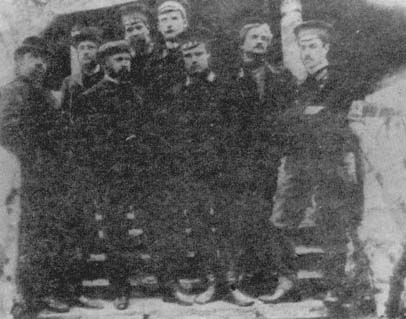
The Kassa Vzaimopomoshchi of Saint Petersburg University, ca. 1900.
(V. V. Mavrodin and V. A. Ezhov, eds., Leningradskii Universitet
v vospominaniiakh sovremennikov, volume 2 [Leningrad, 1982])
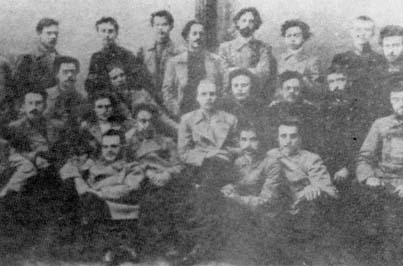
A group of Saint Petersburg University students drafted into the army,
1901. (V. V. Mavrodin and V. A. Ezhov, eds., Leningradskii Universitet
v vospominaniiakh sovremennikov, volume 2 [Leningrad, 1982])
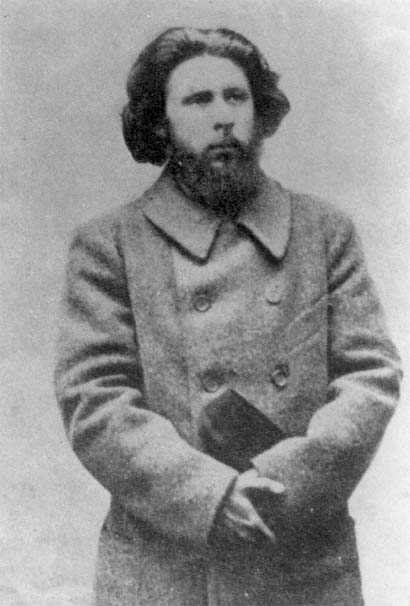
G. I. Chulkov, in student uniform, awaiting transport to Siberia, 1902.
(G. I. Chulkov, Gody stranstvii: Iz knigi vospominanii [Moscow, 1930])
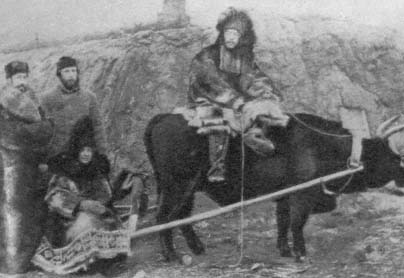
G. I. Chulkov and fellow students in the taiga, 1902. (G. I. Chulkov,
Gody stranstvii: Iz knigi vospominanii [Moscow, 1930])
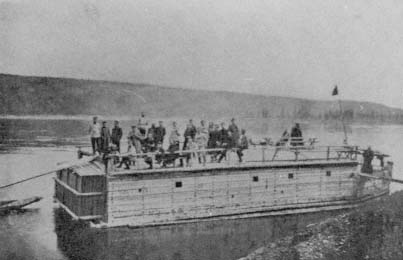
Transporting students by barge up the lenisei, 1902. Note the red flag at the front.
(G. I. Chulkov, Gody stranstvii: Iz knigi vospominanii [Moscow, 1930])
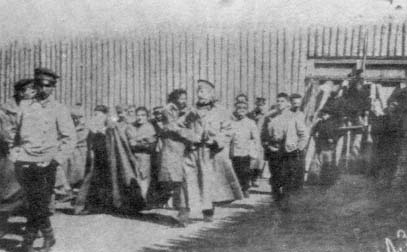
The Moscow Ispolkom and the Saint Petersburg Kassa Radikalov,
Alexandrovsk Central Prison, 1902. (G. I. Chulkov, Gody stranstvii:
Iz knigi vospominanii [Moscow, 1930])
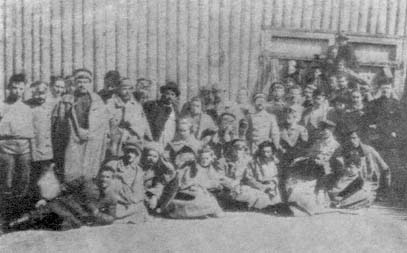
The Alexandrovsk Central Prison, 1902. (G. I. Chulkov, Gody
stranstvii: Iz knigi vospominanii [Moscow, 1930])
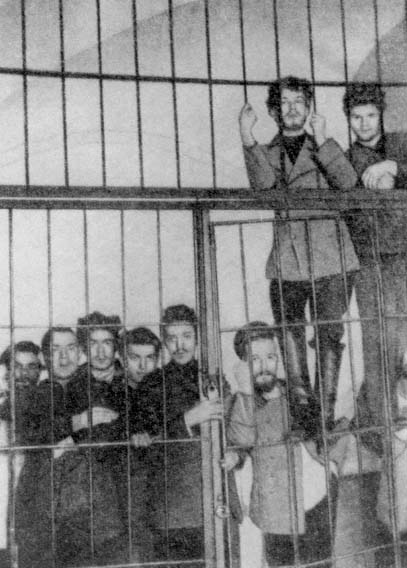
Moscow students in Butyrka Prison, 1902. ( Istoriia Moskovskovo
Universiteta, M. N. Tikhomirov, ed., volume 1 [Moscow, 1955])