
1—
An Empire Nowhere
Some term it Stolida,
And Sordida it name:
And to be plain they do it mock,
As at a foolish game.
—Robert Seall (1563) on a proposed expedition to Florida
Of those that make any thing, some do make much of nothing, as God did in creating the World of naught, and as Poets in some respects also do, whilst they feign fables and make thereof their poesies.
—Thomas Blundeville, The True Order and Methode of Wryting and Reading Hystories (1574)
Renaissance England produced Shakespeare and colonized America. Struck by the coincidence, literary critics have generally assumed that one kind of expansiveness—the discovery and conquest of a new world—helped lead to the other—England's literary renaissance.1 Yet modem historical scholarship has increasingly highlighted what J. H. Elliott calls "one of the most striking features of sixteenth-century intellectual history—the apparent slowness of Europe in making the mental adjustments required to incorporate America within its field of vision";2 and of the major European nations, England was slowest of all. Columbus's first letter describing his discoveries sold throughout the Continent by 1494, but never found an English publisher; in fact, between the time of Columbus's original voyage and Richard Eden's pathbreaking Treatyse of the Newe India (1553), a span of sixty years, only one English work devoted to America seems to have been printed—in Antwerp.3 If England had trouble keeping up with the news about the New World, it had an even harder time
seizing some of that world for its own. The hopes raised early on by the voyages of John Cabot (1497-98) set the tone for English enterprises in America throughout the next century, for they ended in Cabot's disappearance; Cortés conquered Mexico some sixty-five years before Virginia's first colonists gave up and went home.4 The invidious comparison between English and Spanish expansionism did not, however, go unlamented. Richard Hakluyt, the premier colonial advocate of his day, begins the dedication to Sir Philip Sidney of his Divers Voyages Touching the Discovery of America (1582) in dismay:
I marvel not a little (right honorable) that since the discovery of America (which is now full fourscore and ten years), after so great conquests and plantings of the Spaniards and Portingales there, that we of England could never have the grace to set fast footing in such fertile and temperate places as are left as yet unpossessed of them. (8)
One wonders what sort of excitement English writers could have absorbed. And indeed, the three most famous and oft-cited instances of the New World finding its way into English Renaissance literature—More's Utopia , Spenser's Faerie Queene , and Shakespeare's Tempest —seem markedly ambivalent about the very fact of America's discovery. More names his New World explorer Hyth-loday, or Well Learned in Nonsense, and his newfound land Utopia, or Nowhere; Spenser turns Europe's recently corrected ignorance about America into an oddly ironic proof of the existence of Fairyland (FQ 2.proem); while Shakespeare places his American-sounding island in the Old World's Mediterranean, far distant from "the still-vex'd Bermoothes" (Tempest 1.2.229) it appears to represent.
One explanation of this ambivalence would call it avoidance: the English did not want to acknowledge that, in the race for New World land, souls, and gold, they had been massively preempted. Yet Hakluyt's wonder at the thought of England ignoring even "unpossessed" American land suggests that his country is less unnerved by the New World than, oddly, indifferent to it. Such, at least, is the view of England's colonial backwardness that Eden (1555) had earlier adopted, along with an explanation for English apathy that modem historians have by and large endorsed:5
How much I say shall this sound unto our reproach and inexcusable slothfulness and negligence both before god and the world, that so large dominions of such tractable people and pure gentiles, not being hitherto corrupted with any other false religion (and therefore the easier to be allured to embrace ours) are now known unto us, and that we have no respect neither for god's cause nor for our own commodity to attempt some voyages into these coasts, to do for our parts as the Spaniards have done for theirs, and not ever like sheep to haunt one trade. (Decades , 55)
This trade that the English are said to haunt "like sheep" is, of course, a trade in sheep: during the sixteenth century, unfinished woolen cloths increasingly dominated England's list of exports, the woolens market became increasingly centered on the exchange between London and Antwerp, and so English economic interests saw little reason to look for business anywhere but to the east. Moreover, what Eden calls "our parts" of America North America—appeared in any case to lack the great prospects of those other parts that had already been claimed: whereas the Spanish found gold and extensive polities to conquer, the English could discover only timber and fish. And finally, as any student of the period might guess, the struggles over "false religion" within Tudor England provided ample matter to keep English minds busy at home. By these accounts, in other words, the paucity of early English publications on America would no longer seem much wonder at all, nor would another otherwise curious bibliographic fact: that besides being incidental, the first references to the New World printed in England occur not in economic, political, or even geographical tracts but in imaginative literature, and then in association with idleness and folly. For instance, the title character of the interlude Hycke Scorner (c. 1515-16) lies about his travel all over the world, including those to "the new found island" (315) and "the land of women that few men doth find" (323); while Alexander Barclay's translation of Sebastian Brant's Narrenschiff (1494)—The Ship of Folys (1509)—appends a discussion of America as the finishing touch to Brant's account "Of the foolish description and inquisition of diverse countries and regions":
Ferdinandus that late was king of spain
Of land and people hath found plenty and store
Of whom the bidding to us was uncertain
No christian man of them heard tell before
Thus it is folly to tend unto the lore
And unsure science of vain geometry
Since none can know all the world perfitely.
(2.26)6
Born in this context of English indifference to America or satire inspired by it, the "new world" of More's Nowhere (1516) now seems an almost predictable English joke.7
Yet the odd truth about More's apparently dismissive meditation on America is that it contains perhaps the first Tudor attempt to elaborate a theory of colonization—according to D. B. Quinn, More in Utopia even "appears to be the first Englishman to use the word colonia in a Roman [i.e., imperialist] meaning" ("Renaissance Influences," 75).8 And More's Utopian colonial theory, which turns the accusation that a land is "idle and waste" into a justification for colonizing it, came in fact to be repeated time and again in the American propaganda of Renaissance England. But what is perhaps most surprising in regard to More's ostensibly commonplace irony about the New World is the fact that, a year after the publication of Utopia , More's brother-in-law John Rastell actually attempted to colonize America himself. This chapter will take seriously the possibility that More's overtly fictional new world inspired Rastell to seek a real one.9 Moving from More to an imperialist poem by Sir Thomas Wyatt that never even mentions America, I will try to explain how a literary tradition begun by Utopia that seems to reflect what some Tudors considered England's lamentable indifference to the New World10 could nonetheless be taken, and intended, as colonialist propaganda. The paradoxicality of this literature stems from an ambivalent vision not just of distant lands, however, but of England itself. By assigning colonialism to Utopia, More seems to resist a policy that might threaten England's insular integrity. Yet Utopia too is an island, whose other-worldliness recalls not only the New World through which Hythloday first travels but also the New World of the ancients, the English island. I will argue that Utopia represents More's attempt to turn England's classical nowhereness into a way of seeing England and America as destined for each other; but because More cannot conceive of modem England as other-worldly in any positive sense, the utopical conjunction of England and America in Utopia remains obscure. Wyatt is more overtly imperi-
alist, and his poem raises the question of empire in regard to an England even more like the classical view of it than More's England had been, but I will show that he too can only dimly suggest the imperial significance of English insularity: his poem contrasts Spain's golden empire to an island now excluded not only materially but also spiritually from both Old World and New. Finally, I will argue that, in highlighting the unworldliness of the literary as well as the insular medium that they use to signify England's imperial destiny, both More and Wyatt establish literature as a negative incitement to empire not just supplementing but, potentially, rivaling the utopic English isle itself.
I
The first book of Utopia inaugurates this series of expansionist paradoxes in an appropriately skewed way; for when the great debate of book 1 asks what "excellent men" ought to want, no one answers "empire." More the homebody, the counselor, argues for service to one's prince; Hythloday the wanderer, the philosopher, argues for freedom. But Utopia also advocates, as it were in silence, a third pursuit: to travel and serve, the life of More the diplomat whose business takes him to Antwerp, the scene of the debate; or of Vespucci the discoverer who starts Hythloday on his way to Utopia; or of the nameless sea-merchants for whom More negotiates11 and who may own the Portuguese ships that return Hythloday to Europe (51/51). If this alternative seems practically absent from the first book, nowhere directly stated, it emphatically presents itself as soon as Utopia reifies absence, as soon, that is, as the opening debate goes Nowhere: in the second book, what had been fleeting references to travel-as-service in Europe become in Utopia the fully articulated national policy of colonization.
What keeps this alternative from more positive expression? One might assume that the covert presentation of travel-as-service in the first book represents an extremely subtle demonstration of the rhetorical method that More recommends to Hythloday during their debate, the "indirect approach": as More says, his "practical" philosophy gives up dogmatic assertion and instead "tactfully" "adapts itself to the play in hand" (98/99-100/101). Readers like Elizabeth McCutcheon have already found analogies to this "indi-
rect approach" in "the processes of negation and opposites which typify so much of the Utopia "—for example, in recurrent stylistic devices like double negatives (litotes), that "speak of . . . a tendency to see more than one side of a question" ("Denying," 273). The negative presentation of travel-as-service could, in other words, be seen as merely another instance of More's winning urbanity throughout Utopia , of his apparent open-mindedness, moderation, and self-irony.12
Of course, a less sympathetic critic such as Hythloday might simply call it hedging, even though, in the case of travel-as-service, the equivocator would seem to be Hythloday himself. Perhaps the most salient feature of Hythloday's political critique throughout book 1 is his hatred of expansionism: in rejecting More's suggestion that Hythloday "would make an excellent member of any king's council," Hythloday contends that "almost all monarchs" would rather ignore his advice concerning "the honorable activities of peace," for "they care much more how, by hook or crook, they may win fresh kingdoms than how they may administer well what they have got" (U, 56/57).13 Now no one, it seems, could mistake the discoverer for anything but an agent of expansionism; in his first letters patent for John Cabot (5 March 1496), Henry VII licensed Cabot and his sons to "subdue, occupy, and possess, all such towns, cities, castles, and isles, of them found, which they can subdue, occupy, and possess, as our vassals and lieutenants, getting unto us the rule, title, and jurisdiction of the same villages, towns, castles, and firm land so found" (trans. Hakluyt, Divers Voyages , 21). And yet not only is Hythloday strangely silent about this new and far balder kind of land grabbing; he also endorses Vespucci's voyages enough to become "his constant companion in the last three" of them (U, 50/51). Perhaps, as his behavior on the final voyage might lead us to believe, Hythloday truly does not recognize the expansionism in discovery: though he begins his American sojourn in a fort, the foothold of conquest, he soon strikes out with five other Europeans in search of "excellent institutions" (50/51-52/53). But, once again, what appears a blindness to travel-as-service in the first book becomes a vigorous advocacy in the second, when Hythloday praises Utopian colonialism.
The precise terms of Hythloday's praise seem to show, how-
ever, that a European struggle for power and a New World discovery represent, for him, categorically different pursuits. In one of his antiexpansionist diatribes, Hythloday reports how the Achorians won their prince another kingdom, but then "saw they would have no less trouble in keeping it than they had suffered in obtaining it" (88/89). Yet Henry assumed, and Cabot seemed to prove, that the land Cabot's license described as formerly "unknown to all Christians" would be cheap and easy prey: after Cabot's voyage the Milanese ambassador to England wrote home that "his Majesty here has gained a part of Asia, without a stroke of the sword" (Williamson, Cabot Voyages , 209). If Cabot's New World appeared then, to solve the practical problems of expansionism that Hythloday alleges, Vespucci's colonial fort seems intended to circumvent any ethical problem Hythloday might also have, since it apparently lays claim to land "unoccupied" not just by Christians but by anyone: though he befriends natives near the fort, Hythloday must travel "many days" from there before he finds "very populous commonwealths" (U, 50/51-52/53). This reassuring emptiness returns in Utopia's second book as the central feature of the Utopian expansions that Hythloday lauds:
If the population throughout the island should happen to swell above the fixed quotas, they enroll citizens out of every city and, on the mainland nearest them, wherever the natives have much unoccupied and uncultivated land, they found a colony under their own laws . . .. The inhabitants who refuse to live according to their laws, they drive from the territory which they carve out for themselves. If they resist, they wage war against them. They consider it a most just cause for war when a people which does not use its soil but keeps it idle and waste [inane ac uacuum ] nevertheless forbids the use and possession of it to others who by the rule of nature ought to be maintained by it. (U, 136/37)
Yet, instead of canceling the accusation that the colonialism of Utopia is either equivocal or ambivalent, this difference between European and Utopian expansionism seems to confirm the charge. For More advocates colonialism only when it is associated with negatives, when it both derives from Nowhere and seeks, in the Utopian stipulation, land inane ac uacuum , idle and waste. And then not even these two negatives can turn colonialism into a fully English option. The Utopians choose wasteland "on the mainland nearest them"; as the Yale editors of Utopia point out, the nearest
mainland to England was Europe, "but where were the waste places?" (More, CW 4:416). The answer is: in the opposite direction.
We seem back where we began. As at best a negatively positive response to questions concerning the practical and ethical feasibility of New World colonization, Utopia appears almost as resistant to America as the less subtle and extensive contemporary reflections on the subject. Indeed, Utopia's negative formulations of travel-as-service would seem to suggest that More cannot escape questioning the very intelligibility of the idea. His professed distaste for ambassadorships—for example, "I never much liked the position of an envoy"; "You cannot believe how unwillingly I spend my time on [embassies]" (Erasmus, Correspondence 3:234, 5:158)—is a simple case in point. The Achorians reject expansion-ism after deciding that their king, "being distracted [distractus ] with the charge of two kingdoms, could not properly attend to either" (U , 90/91); and in a letter to Erasmus (c. 17 February 1516) bemoaning the ambassadorial mission recalled in Utopia , More complains that an ambassador must prove equally distracted: "When I am away, I have to support two households, one at home and the other abroad" (Erasmus, Correspondence 3:234).14 Such practical problems, and even the inevitable ethical problems of a career dedicated to what More later calls "the busy nothings of princes" (5:158), seem, however, only to exacerbate a more basic anxiety at the heart of ambassadorial life—homesickness: even though "away for a short time" only, ambassadors "are immediately haled back by longing for our wives and families" (3:234).15 When Hythloday decides to travel, he forsakes his patrimony and declares, "From all places it is the same distance to heaven" (U , 50/51); but to travel in the interests of home ideally requires one to believe that one has never quite left it. A Utopian colony, for instance, is supposed to consider itself nothing more than home transplanted:
If ever any misfortune so diminishes the number in any of their cities that it cannot be made up out of other parts of the island without bringing other cities below their proper strength . . .. they are filled up by citizens returning from colonial territory. They would rather that the colonies should perish than that any of the cities of the island should be enfeebled. (136/37)
More's homesickness as he presents it might make it very easy for him to consider any foreign residence temporary, but at the same time it also argues him incapable of adapting very well to such a residence in the first place. In fact, the closest it seems that More can come to feeling at home abroad is when he partakes of the foreign at home, either through news—Giles reports him "always most greedy to hear" of "unknown peoples and lands" (48/49)—or through things: "If he sees anything outlandish or otherwise remarkable, he buys it greedily, and has his house stocked with such things from all sources" (Erasmus to yon Hutten, 23 July 1519, Correspondence 7:19). But why must the foreignness that More as home-body "greedily" consumes be as foreign as possible—not just different from home but opposite to it, its negative, "outlandish" and "unknown"? Insofar as More's conception of home cannot be extended beyond home, the foreign, it would seem, cannot help but figure as radically different—which makes More's residence abroad capable of threatening home not merely financially. In Utopia , talk with foreigners and about foreign lands causes More to forget home: Giles's "delightful society and charming discourse largely took away my nostalgia and made me less conscious than before of the separation from my home, wife, and children to whom I was exceedingly anxious to get back" (U , 48/49). As Utopia opens, in fact, such absentmindedness quickly produces More's own negative, Hythloday, the man who has abandoned his home entirely; and Utopia itself, More's imagination of a new world, appears to have been begun during More's ambassadorial absence from home.16 In other words, if the foreign can only with difficulty be conceived in the image of home, it can easily be imagined as home's replacement, a colony that becomes a home in its own right.
More's professed sedentariness, then, seems necessarily to transform him into only a negative advocate of travel-as-service; yet it would be a mistake to conclude that his temperament alone is what makes him suspect that ambassadors or colonists must always suffer distraction. The discoverers about whom More must have heard and read do not prove More to be needlessly concerned with the relation between travel-as-service and one's sense of home; rather, they simply embrace homelessness as a positive boon. As Vespucci reports in the tract Giles says is read passim , everywhere (everywhere, that is, except in England), Vespucci
came to Iberia originally as a merchant, but soon found himself on the one hand unable to make a good living and on the other aspiring to greater things—not simply large sums of money, as his future lies to some Indians suggest: "When they asked us whence we came, we answered that we had descended from heaven to pay the earth a visit" (Navigationes , 112). A lie about origins, denying both a mean birth and a place of birth, a connection to any earthly polity, this claim to godhead is characteristic of Vespucci not only as a relatively pure form of ambition but also as the kind of deception his ambition requires. For Vespucci did not pursue his discoveries in the name of his original home, nor even consistently in the name of any later one: he undertook his first two voyages for Ferdinand of Spain, his second two for Manuel of Portugal (85). In other words, mobility to Vespucci seems to depend on ambiguity. As he himself presents it, the decision to leave Ferdinand for Manuel looks unaccountable: it "was disapproved of by all those who knew me. For I was leaving Castile, where no small degree of honor had been shown me and where the King himself held me in high esteem. What was even worse was that I departed without taking leave of my host" (134). Yet his new allegiance to Manuel did not stop Vespucci on his third voyage from taking possession of a land "in the name of the most serene King of Castile" (136); the whole travelogue is in the end dedicated to Ferdinand; and, as if to sum up the studied ambiguity of his position, Vespucci concludes by reminding Ferdinand that "I am now living in Lisbon"—Portugal, that is—"not knowing what next your most serene Majesty will plan for me to do" (151).17 In a later edition of the voyages, the one More probably read, Vespucci adds a dedication to still another king—René d'Anjou, King of Jerusalem and Sicily—in which he hopes that the novelty of the voyages (and perhaps of Vespucci's continually recreated affiliations) will afford René a sympathetic freedom from domestic responsibilities: "You will find in these pages no slight relief from the wasting cares and problems of government" (86).
Cabot too sees the gifts that rootlessness can bring. A Venetian in London writes home about his fellow Venetian's great successes away from home: "He is called the Great Admiral and vast honor is paid to him and he goes dressed in silk, and these English run after him like mad, and indeed he can enlist as many of them as
he pleases, and a number of our rogues as well" (Williamson, Cabot Voyages , 208). Nomads in particular become Cabot's disciples: the Milanese envoy to England says he has spoken with a Burgundian who
wants to go back, because the Admiral, which is the name they give to Messer Zoane, has given him an island. He has given another to his barber, a Genoese by birth, and both consider themselves counts, while my lord the Admiral esteems himself at least a prince. (211)
But even mercenaries like these discoverers, turning homelessness to their advantage, cannot master the confusion it creates. Their radical desire not to be tied to any one home must finally be tempered into the desire only to be tied to more homes than one: untrammeled yet still in need of backing, the discoverer ends up not escaping allegiances but multiplying them. As Vespucci juggles Spain and Portugal, so Cabot tries to maintain loyalties to both England and Venice at once: he "planted on the land which he has found a large cross with a banner of England and one of St. Mark, as he is a Venetian" (208). But such attempts to claim more than one home have significant limitations: the Milanese ambassador adds that "this Messer Zoane, as a foreigner and a poor man, would not have obtained credence, had it not been that his companions, who are practically all English and from Bristol, testified that he spoke the truth" (209). Home may seem an arbitrary thing to a discoverer, but not to his patrons, and it therefore complicates travel for homeless and homebound alike.18
Yet even this final motive for More's baffled presentation of travel-as-service, the fact that the discoverer as well as More might find such a life difficult to embrace, cannot fully explain why Utopia seems characteristic of a nation's resistance to New World expansion. If More's apparently profound attachment to home makes his tentativeness concerning the travel in travel-as-service look exceptional, the discoverer's profound estrangement from home, and therefore from service, should render him equally exceptional. More's negativity in Utopia becomes less easily explained as mere eccentricity, however, as soon as one finds the same hesitations in an English contemporary of More who is not only as fully committed to the life of travel and service as a man could be, but is even exhorting his king to empire.
Robert Thorne was an English merchant resident in Spain, an intermediary between the Spanish, Portuguese, and English governments, and an investor in and proponent of discovery.19 His famous letter to Henry VIII (1527) urging him to fund a northwest discovery, the first extant English writing of its kind, begins with very un-More-like directness: "Experience proveth that naturally all Princes be desirous to extend and enlarge their dominions and kingdoms." The corollary to this assertion, however, seems to suggest that the naturalness of the desire does not make it rational or right: "Wherefore it is not to be marveled to see them every day procure the same, not regarding any cost, peril, and labor, that may thereby chance; but rather it is to be marveled if there be any prince content to live quiet within his own dominions." This last evocation of a peaceful monarch is at once encouraged and undercut when Thorne now shifts imperialist desire from a naturally itchy prince to external pressures on him: "For surely the people would think he lacketh the noble courage and spirit of all other [princes]." Whoever does do the desiring, it is undeniable that kings "have in manner turned up and down the world," and what Thorne again calls a "natural inclination" for such troublemaking "is cause that scarcely it may be said there is any kingdom stable, nor king quiet, but that his own imagination, or other Princes his neighbors, do trouble him." If Henry were not at this point feeling queasy enough about his options, the next sentence, also the next topic in Thorne's argument, would clinch the matter: "God and nature hath provided to your Grace, and to your Gracious progenitors, this Realm of England, and set it in so fruitful a place, and within such limits, that it should seem to be a place quiet and aparted from all the foresaid desires" ("Declaration," 27-28)—divided from all the world, so divided from all desire to own it. Exhorting Henry to empire has come to seem instead like exhorting him to rein in his imperialist "imagination."
But the fact that Thorne is indeed exhorting his prince helps explain his wavering and slippery argument here, since Thorne is after all one of those subjects whom the prince must fear, unfavorably comparing Henry's quiescence to the great deeds that Spain and Portugal have already performed, and so politely warning him that "it will seem your Grace's subjects to be without activity or courage in leaving to do this glorious and noble enterprise" (31); Thorne knows that the only way to incite Henry safely is at the
same time to praise him for maintaining England's stability. And it is also true that the more costly and dangerous Thorne makes imperialism look in general, the more his particular argument profits, for the same reason Henry's father, and presumably Hythloday, accepted New World enterprise while rejecting Continental forays: northwest discovery will "amplify and enrich" England "by a godly mean, with little cost, peril, or labor" (Thorne thinks the discovery will be easy, first because the northern route is the shortest to the open seas of the Pacific; second because the English ships will avoid the Atlantic ones of other nations; third because the English will travel in "perpetual clearness of the day" rather than "groping their way" in darkness as voyagers in lower latitudes must; and last—the implied base to all these considerations— because the heathens with whom the English will trade are easy marks).20 These two very calculated motives for Thorne's ambivalence—his need to placate Henry and to make western discovery look more attractive—do not, however, cancel the possibility that Thorne cannot quite shake off a vision of England properly "quiet and aparted" from his own imperialist desires, or that he at least considers the vision to some degree ineradicable from Henry's mind. The next sentence highlights Thorne's dilemma marvelously: "One special cause" why England should seem its own world, uninterested in expansion,
is, for that it is compassed with the Sea: by reason thereof it seems, this notwithstanding, their desires and noble courages have been most commonly like unto others: and with marvelous great labors, costs, and perils, they have traveled and passed the Seas, making war not only with kings and dominions nigh neighbors, but also with them of far countries, and so hath won and conquered many rich and fair Dominions, and amplified this your Grace's Realm with great victory and glory. (28)
"By reason thereof it seems," by reason of England's insularity, "this notwithstanding," notwithstanding England's insularity: to Thorne's mind, the same fact, the sea surrounding England, simultaneously opposes and promotes expansion.21
A Venetian visitor to England around 1500 claims that the English are in general much less ambivalent about their insularity than Thorne, for they "are great lovers of themselves, and of everything belonging to them; they think that there are no other men
than themselves, and no other world but England" (Sneyd, Relation , 20-21). From this perspective, More's sedentariness looks like a national condition; if the English in general seem indifferent to the New World, perhaps that is because their island is all the world they desire. The Utopians, as colonizers, may appear less exclusively attached to their own island, yet it defines their national identity as surely as the Venetian thinks England's geography defines the English.[22] For Utopia becomes a separate world, a negative, a nowhere, only when it also becomes insular: by ordering a fifteen-mile excavation, the ancient conqueror Utopus converted a peninsula named Abraxa into the island of Utopia (U , 112/13). The story seems to glance at an apparently contemporaneous theory that England itself had once been a peninsula,[23] and therefore to hint as well at more extensive parallels between the English and Utopian isles. Erasmus was the first to assert that More in his newfound world "represented the English commonwealth in particular [Britannicam potissimum effinxit ]" (Correspondence 7:23, Opus Epistolarium 4:21). But the very structure of More's work, its first book continually recurring to the subject of England, its second devoted to Utopia, already suggests the relation; and then Utopia's marginal notes make the connection unmistakable: when Hythloday mentions the unusual currents of Anydrus, the river of Utopia's capital city Amaurotum, the note refers the reader to "The Identical Phenomenon on the River Thames in England"; and when Hythloday next describes a fine bridge over that river, the note adds, "In This Feature, Too, London Agrees With Amaurotum" (U, 118/19).[24] Later utopias may prove more explicit about identifying their new worlds with England, as in Joseph Hall's Mundus Alter et Idem (1605), Another World and Yet the Same , but they do not entirely surrender More's allusive manner in such identification, his "indirect approach"; see figure 1. Part of the reason that a utopia would avoid positive comparisons to England is, no doubt, the irony or evasiveness inevitable to a work that affirms the existence of a place it knows does not exist. But More's insistence that special signs of reference to England, such as London-like Amaurotum and Thames-like Anydrus, be negative—"Shadow City" and "Waterless"—also suggests that what Utopia and England share is precisely the negativity constituted in toto by Utopian insularity. And in fact, when in the prefatory material to
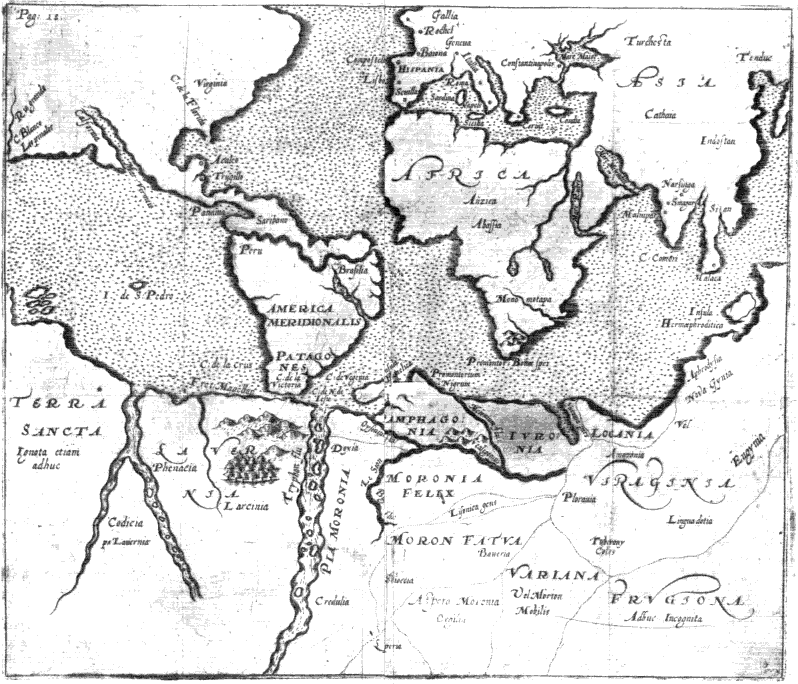
Figure 1.
Map of the world, from Mundus Alter et Idem , by Mercurio Britannico [Joseph Hall], Frankfurt [London], 1605.
The absence of little England from the north yields an enormous new continent in the south.
(By permission of the Houghton Library, Harvard University.)
Utopia "Anemolius" has Utopia say that "the ancients called me Utopia or Nowhere because of my isolation" (20/21), he cannot tightly mean Utopus's Utopia, about which the ancients knew nothing. Rather, he must be alluding to the classical conception of another island he wants to associate with Utopia, an island whose inhabitants Virgil's first eclogue calls penitus toto divisos orbe , wholly divided from all the world—England.[25] What Anemolius implies, in other words, is that "aparted" England has not only found its negative image in Utopia, but refound through Utopia its own negativity as both an island and an old Nowhere itself. "It is one of the curiosities of literary history," Josephine Waters Bennett remarks, "that, at the very time when the New World in the West was being explored, ancient notions about Great Britain as another world beyond the end of the earth caught the fancy" of English writers ("Britain," 114)—as if the discovery of a new New World prompted England only to turn its sights inward and backward, in the hope of "restor[ing] antiquity to Britain, and Britain to his antiquity," of recapturing England's past as the New World of old.[26] Even the Continental writers of the prefatory letters to Utopia seem led by the book to recall England's old otherworldliness: Desmarais praises Utopia as a product of the learning that now flourishes "among the British at the ends of the earth" (U , 26/27); and Busleyden addresses More as the "glory of your Britain and of this world of ours" (36/37).[27] But then, writing the "Letter to Dorp" (1515) while on the embassy depicted in Utopia , More had already styled himself Morus apud toto divisos orbe Britannos , "More among the Britons divided from all the world" (CW 15:126).
A preoccupation with celebrating England's own utopicality would indeed help explain why More has Hythloday so quickly traverse America in search of a utopic island; yet if Utopia indicates that the discovery of America caused More only to recall England's classical other-worldliness, why does More bother with a utopia even farther afield from England than America, and why, moreover, is that gratuitous island a colonialist power? In the Dorp letter, More fancies himself among the separate British while he is actually on the Continent, as if he can appreciate England's other-worldliness only from the external perspective that his Continental admirers possess. Utopia , begun by More while on the Continent and set in the time of his stay there, asks its readers to look west-
ward both to England and beyond, thus highlighting the fact that America and England are equally aparted: each apart from, and between, the Old World setting of book 1 and the Utopia of book 2. More, it would seem, wants England and America to share in an otherness that the Utopian island both demarcates and names.
Later in the history of English imperialism, advocates of New World expansion will repeatedly ask the English to recall their own separateness from the world in order to recognize England's special, even providential incentives for occupying the New World. A broadside of the Virginia Company (1612) defends Virginia by a convenient analogy—"Who knows not England once was like / A Wilderness and savage place" ("Londons Lotterie," 24)—just as William Crashaw (1610) defends Virginia's wild inhabitants:
For the time was when we were savage and uncivil, and worshipped the devil, as now they do, then God sent some to make us civil, others to make us christians. If such had not been sent us we had yet continued wild and uncivil, and worshippers of the devil: for our civility we were beholden to the Romans, for our religion to the Apostles and their disciples. Did we receive this blessing by others, and shall we not be sensible of those that are still as we were then? (Sermon , C4v)[28]
Utopia already does more, however, than suggest terms of relation between England and America that later imperialists will exploit. If More anticipates the notion that a comparable history of other-worldliness or utopicality should inspire England to occupy America, he also highlights the profoundly negative implications of such a claim. For Utopia too may colonize a land as other-worldly as itself, but to be other-worldly in this case is to be vacuous, inane et vacuum , either unreal or waste. And indeed, the imagination of colonies in Utopia's second book seems to follow on, to have required, the imagined wasting of England in the first. One of Hythloday's most celebrated tirades in book 1 concerns the practice of enclosing formerly common land, to which, Hythloday claims, English landowners have grown increasingly addicted: no longer "satisfied with the annual revenues and profits which their predecessors used to derive from their estates," and consequently lusting after the greater returns paid by wool, "they leave no ground to be tilled; they enclose every bit of land for pasture; they pull down houses and destroy towns, leaving only the church to
pen sheep in." In short, they "devastate [uastent ]" the country, turning "all human habitations and all cultivated land into a wilderness" (U , 66/67). Hythloday boasts that such rapacity and misery are unknown in Utopia, where "with equality of distribution, all men have abundance of all things" (202/3); communal ownership even prevents the sort of financial worries about home that make ambassadorships seem to More so heavy a burden (cf. 210/ 11, 238/39). In the narrative, of course, More thoroughly dismisses this glowing account of communism; but again Utopia answers an apparently intractable opposition with an alternative never overtly portrayed as such—property neither private nor communal but vacuous, the common ground that devastated England and empty America share. The unfortunate English tenants evicted by enclosures, the tillers who once caused the English isle to be "counted fortunate in the extreme" (68/69),[29] are not lost to the negative economy of Utopia . Rather, their evacuation is their passport, allowing them to resurface later under a new and more congenial regime—English farmers, coloni (66/67), become the occupants of Utopian colonies, colonias (136/37).[30] By conceiving the fates of England and America as intertwined, More in Utopia both raises and resolves the central problem of travel-as-service—how to leave home while retaining one's allegiance to it—yet he can positively formulate neither the question nor the answer: for Utopia argues that England will no longer seem to constrain, and America no longer seem to estrange, only when the English consider both places Nowhere.
II
Returning home two decades later from the Spanish ambassador-ship for which More had apparently once been considered,[31] Sir Thomas Wyatt (2539) seems particularly determined to express the proper sentiments of an Englishman traveling in the interests of his country:
In Spain
Tagus farewell, that westward with thy streams
Tums up the grains of gold already tried:
With spur and sail for I go seek the Thames
Gainward the sun that showth her wealthy pride
And to the town which Brutus sought by dreams
Like bended moon doth lend her lusty side.
My king, my country, alone for whom I live,
Of mighty love the wings for this me give.
I flee
But Wyatt's apparent zeal is precisely what makes H. A. Mason call this "the strangest poem in the whole extant body of Wyatt's verse," because, as Mason rightly observes, "almost all his other reflections about life at the court of Henry VIII express only slightly less passionate disgust and repulsion" (Wyatt , 220).
At the time Wyatt was writing, of course, he had good personal reasons for sounding patriotic. In June 1538 the Pope had arranged a truce between Charles V of Spain and Francis I of France; in December he excommunicated Henry. As Henry's ambassador to Charles, Wyatt had the impossible task of preventing the alliance between Spain and France that shut England out.[32] Yet Wyatt had more to concern him than his failure: his fellow ambassadors Bonner and Heynes charged that it was deliberate. They claimed, among other things, that Wyatt resented his imprisonment in 1536 when Anne Boleyn and her alleged lovers had been executed; that he cared only "to please the emperor and Granvelle, and to be noted in the emperor's favor, whom he magnifieth above all measure"; and worst of all, when Henry rejected Charles's marriage plans for Henry and the Duchess of Milan, that Wyatt not only expected but desired his king to be "cast out the cart's arse"— expelled from Christendom like a piece of excrement or a criminal to be whipped and hanged.[33] Whether or not the accusations are true, they at least bear witness to the common understanding that Henry was in a bad way and, consequently, that treason was in the air. The arrest for treason soon afterwards of English lords associated with Wyatt signaled that both Henry's fears and Wyatt's own danger were, in fact, steadily increasing.[34]
In the light of these biographical details, it becomes easier to notice that Wyatt's effusion portrays him as overcoming a certain resistance. Wyatt envisions himself traveling not only toward England but away from the Tagus, which flows "westward"—that is, in the direction opposite to both Wyatt's homeward course and, implicitly, the course of the Thames (see figure 2). This curiously
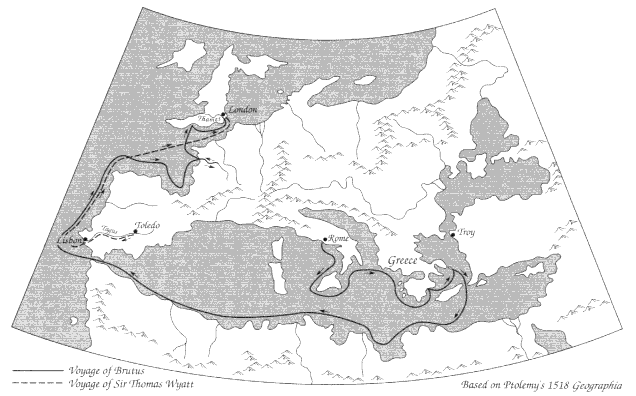
Figure 2.
A portion of the Ptolemaic world, showing England in the
"utmost angle" and tracing the voyages of Wyatt and Brutus.
geographical counterpoint becomes still more mysterious when Wyatt describes his homeward journey in terms that make it seem doubly contrary, not just eastward but "gainward" or against the track of both the Tagus and the sun. In part, this depiction of himself voyaging as it were upstream helps Wyatt dramatize his homesickness: just as his impatience calls for "spur and sail" and finally "wings" to get him home, so it seems to exaggerate the obstacles in his way. But in other works by Wyatt a gainward voyage is a trope not of eagerness but of despair. One love poem, for instance, explicitly regrets the desire that leads, as in the Tagus poem, first to flight and then to a contrary eastward journey—
Sometime I fled the fire that me brent
By sea, by land, by water and by wind;
And now I follow the coals that be quent
From Dover to Calais against my mind.
("Sometime," 1-4)
—while others speak of Wyatt vainly striving "against the stream with all my power."[35] In fact, were the beloved toward whom Wyatt sails not king and country but a woman, one would be surprised to find Wyatt sounding anything but troubled. As even the most casual reader of his love poetry will notice, Wyatt invariably resists presenting his love life as either settled or chosen: instead, Wyatt the lover, like Wyatt the courtier, is constrained either to forsake, flee, or pursue. At the mercy of his "froward master" Cupid ("Mine old dear enemy," l. 1), Wyatt's loving is always thwarted, fromward.
Such is the case in the only other poem of Wyatt's beside "Tagus Farewell" that is headed "In Spain"—the canzone "So feeble is the thread." Wyatt complains in the poem
That, when I think upon the distance and the space
That doth so far divide me from my dear desired face,
I know not how to attain the wings that I require
To lift my weight that it might flee to follow my desire.
(23-26)
Required to erase the distance between Wyatt and his object, the wings of mighty love here are not the only features of the canzone to recur in the different context of the Tagus poem[36] and therefore to cast doubt on Wyatt's desire for consummation in both works:
for when Wyatt in the epigram is finally about to cross the space dividing him from the beloved of his canzone, he abandons her as the professed object of his desire in favor of king and country, as if they reestablished the distance his journey would eliminate.[37] And in fact the Tagus poem imagines England itself as a scene of tantalizing division: though London and the Thames are joined, Wyatt presents their seemingly consummated love as the Thames only "lending" herself, and then only in the guise of a "bended" or crescent—a perpetually unfinished moon.[38] What seems latent in the Tagus poem, in other words, are tokens of a dissatisfaction and resistance elsewhere typical of Wyatt, apparently tempered or suppressed in this case because here, paradoxically, Wyatt truly has reason to worry.
But why, if the poem does covertly manifest Wyatt's political anxieties, should Wyatt choose to associate the most prominent expression of resistance in the poem, his "gainward" voyage, not merely with the homeward direction of his travels but with their eastwardness? Some Tudors argued that every eastward voyage inevitably met resistance, sailing gainward not only the sun but the ocean's own following current;[39] yet why should Wyatt want to represent his political troubles under the guise of such travel difficulties, or conversely, what would make the westward course of the Tagus seem, for not just his oceangoing b t his political career too, the path of least resistance?
As part of his argument to the city of Cordoba for improving navigation along the Tagus's southern competitor, the Guadalquivir, Hernan Perez de Oliva (1524) reminds his readers that, in the beginning, "dominion [el Senorio ]" was held by the East, then by Asia, Persia, Chaldea, Egypt, Greece, Italy, and France; "now step by step approaching the West it appears in Spain [agora de grado en grado viniendo al occidente parecio en España ]" (Obras , 134r). Not just empire, however, but the "world" itself has moved westward, so that "before we occupied the end of the world, and now we are in the middle of it [antes ocupavamos el fin del mundo, y agora estamos en el medio ]" (133v). In other words, a New World has been discovered to the west and at the same time has been placed under the western dominion of the new Rome, Spain; by improving the Guadalquivir, Perez de Oliva maintains, Cordoba will be able to participate in the general good fortune of the empire, for "from
these isles of the west will come so many ships laden with wealth, and so many will sail to them, that I believe they will leave a permanent imprint on the waters of the sea [de estas Islas han de venir tantos navios cargados de riquezas, y tãtos yrã, que pienso que señal hã de hazer enlas aquas dela mar ]" (135v).[40] Though Wyatt may well not have known Perez de Oliva, he could hardly not have heard about America. Towards the end of his ambassadorship, for instance, he had by special courier transmitted Sebastian Cabot's desire to leave his post as Charles's chief pilot and serve Henry instead.[41] But what must have made the New World particularly inescapable for Wyatt was the new Roman emperor's ownership of so much of it. The same month Wyatt left Spain, a triumphal arch in Florence honoring Charles showed him, in Roy Strong's words, "arrayed à l'antique , crowned with laurel and carrying the imperial sceptre, river gods at his feet, flanked, to his right, by the figures of Spain and New Mexico [sic ], followed by Neptune, to show 'that the Western Ocean is dominated by his Majesty'" (Strong, Splendour , 79). Even Wyatt's bidding farewell to the Tagus implies his cognizance of America: since at least Roman times the river had served as a conventional synecdoche for the western bounds of the Ptolemaic world ("before we occupied the end of the world"),[42] yet now America had surpassed the Tagus both geographically and goldenly; and Charles's motto was Plus ultra , More beyond. The combination of map-tracing and resistance in Wyatt's poem begins to make more sense. If eastward for Wyatt is "gain-ward" the superseded Tagus—against the imperial union of gold and the sun that breeds it[43] —then the proper direction for Wyatt's journey must be west, the proper destination the golden Indies. And to turn away from this empire "without end" (Perez de Oliva, Obras , 133v), the plus ultra of an emperor whom Wyatt allegedly "magnifieth above all measure," means to turn instead toward an England excluded from Old and New World alike.
Now, it seems, the country Wyatt wants to "flee" is not Spain but England. This skeptical account of the Tagus poem does, after all, have the virtue of explaining why the poem adopts tropes of resistance from Wyatt's other work that appear to run contrary to the poem's overtly celebratory intentions.[44] Yet such an interpretation must itself suppress a striking feature of Wyatt's epigram— that, with the mention of Brutus dreaming, Wyatt's journey, how-
ever backward, assumes the shape of imperial prophecy. The great-grandson of Aeneas and the eponymous founder of Britain, Brutus in Geoffrey of Monmouth's Historia Regum Britanniae receives his "dreams" from Diana, who tells him that "beyond the setting of the sun" lies his true home, an island that will ultimately prove a second Troy far greater than Rome: "A race of kings will be born there from your stock and the round circle of the whole earth will be subject to them" (Geoffrey, History , 65). One might have thought that, as Waytt prepared to leave the capital of the largest European empire since that of Charlemagne, and to embark from the port to which Columbus's ships had first returned,[45] he would have been tempted to conclude that the Trojan home Diana had prophesied was not the one he would be sailing toward, but rather from. Yet instead, as with More in Utopia , an awareness of westward prospects seems to have led Wyatt back, gainward the sun, first to England's old status as itself a new world and then to a strange presentiment of England's future imperial power. Indeed, the comparison to More helps suggest how Wyatt's apparent negativity could actually represent an imperialist optimism. For if Wyatt's Brutus more directly represents English imperialist ambition than anything in Utopia does, it is also the case that, at the time Wyatt was writing, Utopia's vision of a devastated and therefore potentially colonialist England had been realized in a manner too radical for even More to have imagined: England had been cast out of the community of the faithful, divided from all the Christian world.
In fact, the nearer England comes to seeming not only a separate world but a wasteland, the nearer it approaches the portentous island of Brutus's dreams. For to a degree neither Brutus nor modem commentators recognize, Diana as what Brutus calls the "terror of the forest glades, yet hope of the wild woodlands" (Geoffrey, History , 65)—the goddess of uncultivated ground—directs the course of Brutus's story throughout. Brutus is exiled from Italy for accidentally killing his father, Silvius, during a hunt (55); he aids fellow Trojans who, to escape slavery to the Greek king Pandarus, have fled to the woods (56); he defeats Pandarus in part by ambushing him in the woods (59-60); the first thing the Trojans do when they land at deserted Leogetia, the island where Diana prophesies a British empire, is to kill "all sorts of wild animals
which they had discovered between the forest pastures and the woodlands" (64); trouble starts in Gaul when Corineus and his men go hunting in the king's forest (67); Corineus scatters the Gauls in a final battle by attacking from "a neighboring wood" in which he was concealed (70-71); and, except for "a few giants," Albion proves a deserted wilderness (72).[46] In short, the scene of the patricide continually recurs, each new instance retrospectively clarifying the transcendent rationale behind the original murder. The first stage of Brutus's journey (see figure 2), gainward the sun to Greece, transforms Silvius's death into the death of sylvan Italy as a home not just for the exiled Brutus but for all Troy: Brutus discovers that the woods of the Old World are only where Trojans hide from their conquerors. The trip to Leogetia, an island that "had remained uninhabited since it was laid waste [vastata ] by a piratical attack in ancient times" (64), continues the reversal of Virgil's Trojan history back to the first flight from home; and it is in this setting reminiscent of Troy's ruins that Brutus learns of Diana's plans for a fresh Trojan start not in Italy but on an island "empty [deserta ] and ready for your folk" (65). Surprisingly, the Utopian scruple about colonizing only wasteland turns up at the dawn of English history, when, as in Utopia , a representation of home devastated leads to a vision of new horizons. Here, the virginity of the power guiding Brutus gives this negative colonial connection a special point: Diana's decision to reveal her preference for a deserted island only after Brutus has reached a deserted island suggests that what she dislikes about Rome as a Trojan colony is the marriage of peoples arranged by Venus and then enforced by Juno, who demands that the Trojans mingle with and be submerged in Latin culture (Virgil, Aeneid 12.819-42). Just as Brutus had resisted the temptation to mix with the conquered Pandarus (Geoffrey, History , 62-63), so now, while heading westward (66), his battles with the Gauls end not in settlement but in further voyaging; and when he finally reaches the "promised island" (71) of Albion, only to discover a few giants still living there,[47] he quickly annihilates them. Finishing what the death of Silvius had begun, this murderous evacuation of England is what finally rein-vents Troy's leader as not a wanderer but a founder, not sylvan Silvius but British Brutus. Now the same Trojans who were once forced into "the hidden depths of the forests" to maintain "the
purity [serenitas ] of their noble blood" (56) can truly raise a second Troy—not by escaping the wilderness of their defeat, however, but by embracing it as the positive condition of Troy's rebirth into something purer and thus, presumably, more powerful than the Roman blend. Wyatt, then, recollecting Brutus as he depicts himself sailing backward, pastward, from a new Rome and toward an England once again aparted, could be imagined reviving interest in an old, heroically empty promise still awaiting fulfillment, not "already tried."
Unfortunately, at the time Brutus too was in danger of being cast out the cart's arse. From a fairly canonical acceptance among medieval historians, the founder of Britain had in Tudor days lost much ground, most notoriously as a result of Polydore Vergil's English History , published five years before Wyatt wrote his poem. Much of the controversy surrounding Brutus replicates the political controversy of the day. Vergil the Italian disbelieved the Brutus story, in part because no classical source mentions it; while his critic Leland, an old friend of Wyatt's, considered that omission to be proof of a British history so dazzling that the envious Romans had tried to suppress it.[48] The imperial requirement that Britain be empty when Brutus arrives is, however, just the detail that led even English critics to accuse Geoffrey of lying.[49] In his preface to The Pastyme of People (c. 1530), John Rastell cites the opinion of "diverse great learned men" that, even if Brutus actually occupied Britain, it could not possibly have been uninhabited before him,
considering that the rocks and mountains about Dover be so great and daily openly seen of them of Gallia and so small distance asunder and the sea so narrow that it may well be sailed in less than three hours and this country of Britain so fair so pleasant and so fertile that it is most likely that the people of Gallia should come over either to fish or for desire of knowledge of the land and to make some habitation therein and not to suffer it to be all desolate and unknown till the coming of Brute. (A2r)[50]
Rastell's history proper toys with the issue as it arises in Brutus's story: "Brute took shipping again and so sailing at the last arrived in the isle called Albion inhabited only with Brute beasts and giants where he took possession and called it after his own name Britain" (A2v). The mocking pun on Brute (which, of course, would also obtain in Geoffrey's Latin) suggests that the perfect allegorical
fit between empty island and Trojan destiny is what makes Rastell skeptical; but skeptical about an historical claim, not necessarily about the English ideal represented.[51] A decade earlier, after all, Rastell had been one of the first English writers to discuss the real hidden world strangely anticipated by Geoffrey's fables about Britain: Experience in Rastell's Interlude of the Four Elements speaks of "new lands" found "westward" "that we never heard tell of before this / By writing nor other means" (ll. 737-39). While, unlike Brutus's Albion, these lands look inhabited, Rastell comments that the natives "as yet live all beastly" (780), and his subsequent evocation of an English colony in America demonstrates how, to him, the current brutishness of the natives makes them hardly count as inhabitants at all: after describing how a mutinous crew blocked his own New World voyage in 1517,[52] Rastell exclaims,
O, what a thing had be then,
If that they that be English men
Might have been first of all
That there should have take possession
And made first building and habitation
A memory perpetual!
(762-767)[53]
Yet the English colony that Rastell imagines rising in the wilderness remains as fabled as Brutus's. Alluding to this passage, D. B. Quinn calls Rastell "the first man we know to make a plea for the systematic colonization of North America by Englishmen" (New American World 1:169), but Quinn's assessment mistakes Rastell's profoundly elegiac tone here, his sense that a miraculous English opportunity to give reality to Geoffrey's lie, to "have been first of all," is now forever lost.
Nevertheless, on a voyage to America in 1536, "M. Hore and diverse other gentlemen" ( one of them Rastell's son, whose father died at around the same time in prison) do manage to enact the Brutus allegory, though with consequences far from imperial.[54] Reaching Labrador, apparently, the English look for savages but the savages flee; the New World empties itself to accommodate its conquerors. Unfortunately, the lack of savages means a lack of food, and the English begin to starve. The company mysteriously decreases, "and the officers knew not what was become of them," until
it fortuned that one of the Company driven with hunger to seek abroad for relief found out in the fields the savor of broiled flesh, and fell out with one for that he would suffer him and his fellows to starve, enjoying plenty as he thought: and thus matter growing to cruel speeches, he that had the broiled meat, burst out into these words: If thou wouldst needs know, the broiled meat that I had was such a man's buttock. (PN 8:5-6)
Now the uninhabited land consumes its new possessors, fashions out of the English the brutes they could not find. The captain makes a long "notable Oration" against succumbing to such beastliness, whose only upshot—as famine increases—is that the English draw lots.
And such was the mercy of God, that the same night there arrived a French ship in that port, well furnished with vittle, and such was the policy of the English, that they became masters of the same, and changing ships and vittling them, they set sail to come into England. (6)
It would seem that the arrival of the well-stocked French, who like their Gallic ancestors demonstrate a supposedly new world to have been neither new nor all that alien, knocks the last bit of heroic potential out of the English story, and yet the narrator Hakluyt finds some relief at last in admiring a well-executed piece of English treachery. For as Rastell explains, not to be "beastly" is to be "cunning" (Four Seasons , 873). The only way such a failed confrontation with the wild can hope to call itself heroic, in other words, is in escaping the New World and its beastliness, in returning home.
Back in England, the voyagers recuperate in the civilized security of Sir John Luttrell's castle. A gentleman unhappily associated by name with the memory of American brutishness, one Mr. Butts, "was so changed in the voyage with hunger and misery, that Sir William his father and my Lady his mother knew him not to be their son, until they found a secret mark which was a wart upon one of his knees" (7). This apocryphal-sounding recognition scene seems to have an earlier much-suffering homecomer in mind, though how pathetically even in fabling their rediscovery of England do the English make themselves heroes: the famous boar-scar of Odysseus becomes a wart.[55] With the questionableness of Brutus and the misadventures of Rastell and Hore in mind, it
again seems an indirect mark of dissatisfaction that Wyatt depicts himself as a Brutus going nowhere but to England.
Or at least a mark of half-satisfaction, as the moon of Wyatt's Thames is only half-achieved, lent. Like the other features of the poem that oppose England to Spain's imperial sun, this moon seems from one perspective to betray Wyatt's worries about an England that time has passed by, but from another to extend the imperial argument begun with Brutus, for the goddess of the wastelands who sends Brutus his dreams is also known as the goddess of the moon. Such an unstressed slide in the poem from one aspect of the triple Hecate to another helps account for Wyatt's interest in her: Diana, inhabiting three worlds at once, compensates for the geographical constraint toward which Wyatt drives. Brutus in Geoffrey's History celebrates the goddess for similar reasons; her three homes seem in his mind to qualify her as the best judge in matters of real estate:
O powerful goddess, terror of the forest glades, yet hope of the wild woodlands, you who have the power to go in orbit through the airy heavens and the halls of hell, pronounce a judgment which concerns the earth. Tell me which lands you wish us to inhabit. (65)
But Wyatt's association of the moon with England also reflects an astrological tradition that imagined the moon producing in the English as unfixed a relation to the earth as the "lending" crescent of the Thames has in Wyatt's poem. To all appearances lacking the substance of other planets, made of mutability and borrowed light, the moon supposedly released the English from normal earthly bonds: as John Gower says,
Bot what man under his [the moon's] power
Is bore, he schal his places change
And seche manye londes strange:
And as this condition
The Mones disposicion
Upon the land of Alemaigne
Is set, and ek upon Bretaigne,
Which now is cleped Engelond;
For thei travaile in every lond.[56]
Apparently at odds with the Venetian who scorns England for thinking itself all the world, this astrological theory of English mo-
bility actually follows from the idea of England's apartness also, and thus helps account for Thorne's own both insularist and expansionist view of his native island. England had seemed to the ancients another world—even at first "a fable and a lie" (Plutarch, Lives 5:25)—because it was not only separate from the Continent and barbarously distant from Rome but also too far north; to the ancients, that is, the always unsettled moon presided over a clime that itself appeared unsettleable.[57] If, then, Continental prejudice against England's habitability could explain the "lunatic" wanderlust of the English, even the confutation of this prejudice could also inspire the English to travel, for the mistake about England's habitability—a mistake of course particularly salient to the English—could suggest that other supposedly barren parts of the world would prove habitable too. Thorne, for example, employs such an argument in claiming that the northwest must be livable, and concludes in Utopian fashion, "Nothing in nature is made to be waste [Nihil fit vacuum in rerum natura ]" ("Declaration," 50-51).[58] Again the apartness of England specially prepares it for occupying the American wasteland, and in fact the moon as the genius of this apartness figures even in More. Hythloday says that the island of Utopia, the negative of an older Nowhere, looks like a crescent moon, or more precisely, a moon renascentis , born anew; while its horns enfold "a wide expanse" of bay—that is, a void, an inane (U , 110/11). In Wyatt, the inverse image, the Thames as crescent and London its absent fullness, inscribes this incompleteness in England as the yearning for a consummation made possible only by England becoming less grounded, more moon and water.
Such a desire may look contrary, perverse, even inane, Wyatt's poem suggests, but only by the worldly standards of the Continent. Having explained that the Romans considered England's clime uninhabitable simply "because it was not inhabited [by them] at the time of the division into climes," Robert Anglicus (c. 1271) proceeds to quote Diana's prophecy to Brutus as, it would seem, proof not only that some ancients considered England eminently occupiable anyway ("Now it is empty and ready for your folk"), but also that England's supposed vacuousness at the time actually betokened an imperial promise greater than Rome's (Thorndyke, Sphere , 187/236-37). Three centuries later, Sir George
Peckham (1583) recalls how America too had once been "accounted a fantastical imagination, and a drowsy dream" (True Reporte , 449); here, one might think, was a new world that again argued the Old World nearsighted and at the same time, in fulfillment of Diana's prophecy, seemed to offer itself to the unworldly English as to the only conquerors truly capable of appreciating the sublime potential in vacuousness. Yet Wyatt's very dedication to his homeland, the conspicuous devotion that renders the tropes of resistance in his poem mysterious, seems as in More to keep England's contrary imperial hopes on the level of suggestion and "dreams" only.[59] In altering Wyatt's final line, "Of mighty love the wings for this me give," to "O mighty Jove the winds for this me give" (Tottel's Miscellany 1:81), Richard Tottel (1557) underscores the fact that Wyatt in his poem names no more transcendent a power or ambition than service, and profane service at that—not love of God, nor of Diana, nor of the imperial destiny Brutus's dreams foretold him; indeed, Wyatt never even explains the particular advantages or disadvantages of journeying gainward the sun.[60] Rather, just as Wyatt abandons voyaging westward and turns back within the bounds of the Ptolemaic map, so England's transcendent possibilities, Brutus dreaming, invert to the poet's submissive self—"My king, my country, alone for whom I live."
III
In the prefatory epistles to Utopia , More's Continental admirers describe him as a writer working under serious constraints. "Not only is he married," laments Erasmus,
not only has he family cares to attend to, not only does he hold public office and handle an extraordinary number of legal cases, but he is distracted [distrahitur ] by so many and weighty affairs of the realm that you wonder he finds time even to think of books. (U , 2/3)
Here learning replaces travel as the interest capable of drawing More from home,[61] while home conceived not just as domestic affairs but as aparted England threatens learning: "What would this wonderful, rich nature not have accomplished," Erasmus asks, "if
his talent had been trained in Italy?" Erasmus believes, in short, that home has wasted More's literary powers—yet More has written Utopia , and the genius capable of producing it under such handicaps appears to Erasmus so unaccountable as to seem superhuman, divinum (U , 2/3).[62] The fact that the work thus miraculously produced should concern Nowhere only highlights the paradox of More's ability. More's own prefatory letter repeats the story of his distraction but turns his uncanny self-difference into a joke, his supposed ignorance about the location of the land he has created (38/39-42/43): as a place for which More himself cannot account, Utopia comes to represent, then, the apparent unplaceability of More's surprising powers. But More's invented island does more than register his ability to transcend distraction: it translates the nowhere that distracts into the very expression of More's transcendence. Powers wasted in the ostensible inanity of England not only prove that distraction a source of sublimity, but recreate inanity as itself sublime.
More's critic Germain de Brie (1520) prefers an unreconstructed view of More's own nowhereness: to him, More's Latin poems sound so unclassical and barbarous that they "are more reminiscent of poets indigenous to your Utopia" (CW 3:488/89); and he warns More that if Henry VIII "ever comes to perceive how enfeebled your Muse is in singing his praises, right then and there he will expel you from England and force you to move to Utopia" (494/95). What is interesting about this otherwise inevitable sarcasm[63] is that More's friends and even More himself beat Brie to the punch. In 1517 Richard Pace refers to More as "now I suppose more the Utopian not the Englishman" (Erasmus, Correspondence 5:57); but then More had introduced the idea very shortly after the publication of Utopia . A famous letter to Erasmus (1516) describes More's comical reaction upon hearing that his friend Cuthbert Tunstall admires Utopia :
You can't think how I now fancy myself; I have grown taller, I hold my head higher, for I have continually before my eyes the perpetual office of prince which my Utopians are planning to confer on me. In fact I see myself already crowned with that distinguished diadem of corn-ears, a splendid sight in my Franciscan robe, bearing that venerable scepter consisting of a sheaf of corn, and accompanied by a distinguished company of citizens of Amaurote. (Erasmus, Correspondence 4:163)
This jeu d'esprit on the vanity of Nowhere and Shadow City, then on the vanity of More's pride in them, and finally on the vanity of his Utopian kingship, quickly modulates into an attack borrowed from Utopia on the inanity of real kings:
Thus equipped, at the head of a long procession, I greet the envoys and the rulers of other countries, who are greatly to be pitied compared with us, however much they may foolishly pride themselves on their childish finery and the women's ornaments with which they are bedizened, loaded with chains of contemptible gold and made to look absurd with purple and gems and other such airy nothings [bullatis nugis ].[64]
The sequence urbanely suggests, in other words, that More is specially cognizant of vanity because so elaborately entangled in it.[65] (As "Utopia" does for England, so More's own negative in Utopia names this exceptional inanity—Morus or "Foolish" becomes Hythloday or "Well Learned in Nonsense.")
But the publication of Utopia also makes More's special acuity available to others. Erasmus must have topics like the Utopian reduction of riches to nugis , trifles, in mind when he tells Antonius Clava (1517) that even the reader of Utopia risks becoming a Utopian: "You will feel that you have been transported into another world, everything there is so different" (Correspondence 4:223).[66] A poem "To the Reader" of Utopia by Cornelis de Schrijver takes Erasmus's claim one step further, and imagines the reader learning what it is like to be not simply from another world but other-worldly:
Wilt thou know what wonders strange be in the land that late was
found?
Wilt thou learn thy life to lead by diverse ways that godly be?
Wilt thou of virtue and of vice understand the very ground?
Wilt thou see this wretched world, how full it is of vanity?
(Robinson, trans., Utopia , 141)
"Vanity," inane (U , 30)—a vision of emptiness from emptiness, from the place that is no place. As the conclusion to More's letter is meant to demonstrate, such an airy perspective makes one sublimely liable to contemptus mundi : "I hoped to continue this delirious dream a little longer, but alas, dawn is breaking, and has shattered it and turned me out of my princedom, recalling me to my treadmill in the market-place. My only consolation is that I see
real kingdoms do not last much longer" (Erasmus, Correspondence 4:164).[67]
Now More's detractors, noting how smoothly such contemptus seems to lead him into a political career,[68] may once again call his negativity equivocation; but in fact the relation between More's worldliness and otherworldliness is stronger than the accusation of hypocrisy would allow, since a Utopian seeing the world as vacuous sees it colonizable. Like God when all the earth was inane et vacua (Vulgate Bible, Genesis 1.2), More envisioning the world's vanity does, after all, create his own new world. But then Utopia never escapes the conditions of its birth; rather, as Nowhere, it perpetuates the annihilation that spawned it. This paradox of an ironic detachment that itself falls prey to ironic detachment comes clearer not only in the endless critical debates about which of Utopia's features More seriously recommends but also in More's own assessments of his work. The letter to Erasmus, ostentatiously depicting More's Utopian vanity as modesty, had been anticipated in More's first letter to Erasmus (3 September 1516) on the subject of Utopia : "I send you my book on Nowhere [Nusquamam ], and you will find it is nowhere [nusquam ] well written" (Erasmus, Correspondence 4:66, Opus 2:339). The reply to Tunstall concerning Tunstall's letter of praise similarly stresses Utopia's in anity, calling the book a collection of "trifles [nugas ]" (More, Selected Letters , 82, Correspondence , 85). Nothing, of course, is more traditional than this low estimation of a literary work, which is judged a "trifle" not merely on internal demerits but in its general uselessness to the real world. Sir Thomas Smith (1583), for exam-pie—sounding very much like More scolding Hythloday—laims that his De Republica Anglorum is no mere literary effort, for it anatomizes England
not in that sort as Plato made his common wealth, or Zenophon his kingdom of Persia, nor as Sir Thomas More his Utopia feigned common wealths, such as never was nor never shall be, vain imaginations, fantasies of Philosophers to occupy the time and to exercise their wits: but so as England standeth and is governed at this day the xxviii of March Anno 1565, in the vii year of the reign and administration thereof by the most virtuous and noble Queen Elizabeth , daughter to King Henry the eight, and in the one and li year of mine age, when I was ambassador for her majesty in the court of France, the scepter whereof at that time the noble Prince and of
great hope Charles Maximilian did hold, having then reigned iiii years. (144)
Yet, if it is perfectly conventional for John Marston (1598), say, to imagine some "beard-grave" critic of his verse chiding, "Tut, tut, a toy of an idle empty brain,"[69] More nevertheless embraces this standard insult in a surprisingly thoroughgoing manner, by fashioning the toy of his own inane ac uacuum brain as from the start the "nowhere" vanity it might always be judged. Utopia, that is, also reifies the conventionally impractical or unworldly character of the literary work: in the most extraordinary assessment of his trifle, More (January 1517?) calls it "a book which I think clearly deserves to hide itself away forever in its own island" (Selected Letters, 90, Correspondence , 88). The unworldly (literary) product of an otherworld (England) that self-reflexively takes an otherworld (Utopia) as its subject, Utopia , to More's mind, sublimely mocks the worldly standards that would condemn it, but by the same token acknowledges its sequestration from that world's positive life.
With the slightness and dreaminess of his poem, Wyatt too plays into the hands of graver opponents, his own flight from gold suggesting, however, that, again like More, he disdains such worldly critics in favor of an otherworldly system of value, where "pride" alone is "wealthy." A professed antimaterialism is, of course, a definitive feature of Wyatt's satires and psalms, and in fact the more traditionally spiritual-minded "If thou wilt mighty be" rewrites the Tagus poem's turning from gold and, implicitly, from the New World in no uncertain terms:
All were it so thou had a flood of gold,
Unto thy thirst yet should it not suffice.
And though with Indian stones a thousandfold
More precious than can thyself devise
Ycharged were thy back, thy covetise
And busy biting yet should never let
Thy wretched life, ne do thy death profit.
(15-21)
Such a rejection of "Indian" riches crops up even in the love poems: the lyric "To seek each where," for instance, counterposes the immaterial gift of Wyatt's heart to both "goldsmiths' work" (8)
and treasures for which one would search through "France, Spain, and Ind, and everywhere" (3). But in the Tagus poem, and quite unlike More, Wyatt suggests that he is mysteriously constrained to his otherworldliness, a driven Brutus. In part, I have argued, Wyatt's implied ambivalence mirrors what was a recent clarification of England's apartness, in which England had been cast out the world's arse (hence Wyatt's reluctance) and yet had also positively realized a destiny—and perhaps faith separate from and superior to that world (hence Wyatt's desire). In another poem on his contrariness, however, Wyatt figures himself reluctantly pursuing no longer the trifle England but the trifle poetry, which he imagines an otherworld not merely evoked, like Utopia, but materially presented:
Though I myself be bridled of my mind
Returning me backward by force express,
If thou seek honor to keep thy promise,
Who may thee hold, my heart, but thou thyself
unbind?
Sigh then no more, since no way man may find
Thy virtue to let, though that frowardness
Of fortune me holdeth. And yet as I may guess,
Though other be present, thou art not all behind.
Suffice it then that thou be ready there
At all hours, still under the defence
Of time, truth, and love to save thee from offence,
Crying "I burn in a lovely desire
With my dear master's, that may not follow,
Whereby his absence turneth him to sorrow."
( Collected Poems , 25)
The first two lines nicely capture the mystery of Wyatt's restraint: does "bridled of my mind" mean bridled by my mind, in respect to my mind, or according to my mind? And whose is the "force express"? Still more striking in relation to the Tagus poem is another gainward journey, "Returning me backward"; yet here no geography accounts for Wyatt's awkward trajectory. Instead, the poem offers itself as an image of Wyatt's backwardness, for to be writing a poem—and one, moreover, addressed not to Wyatt's beloved but to his own heart—means that Wyatt must of necessity have turned from his beloved. In fact, the word that announces Wyatt's gainward journey here, returning , figures his
backwardness as the continued poetizing or re-versing constituted by the second line. In place of the Tagus poem's outmoded Old World geography, in other words, is Wyatt's typography, the printed poetry that unaccountably returns backward from the right margin of one line to the left margin of the next; while here the "force" that keeps Wyatt within these strict yet inexplicable bounds—"Imprisoned in liberties" ("It may be good," l. 11)—remains mysterious, unspoken, because it resides in the absence of words, the blank spaces between which the island poem is compressed.
Of course, the poem's margins and allusiveness are, again, wholly traditional features of poetry in general; Bacon (1605) says that "poesy is a part of learning in measure of words for the most part restrained, but in all other points extremely licensed" (Works 3:343).[70] Yet in Wyatt the constrained incompleteness of literary work in this poem and of England in the Tagus poem—an incompleteness as it were more positively or materially (typographically and geographically) realized than in More—inversely suggests the spiritual freedom tacitly identified in the Tagus poem with Diana. The poem about Wyatt's bridling provides simpler explanations of this paradoxical relation between material constraint and spiritual liberty: by its compression and therefore portability the poem is able to speak its heart before the beloved, like the partial heart it bespeaks only a part of Wyatt, yet therefore, in its entire dedication to the beloved, free. More crucially, however, Wyatt constrained to inhabit only these parts of himself suggests more of Wyatt than those parts can bear. And in fact this ennobling frustration appears in the Tagus poem as not just a political but also a poetical submission. For the Tagus traditionally marks the poet's surpassing power also. As the world's golden, westward end, it naturally came to represent the furthest reach of merely earthly good. In perhaps the most famous of the Amores , for example, Ovid declares:
Verse is immortal, and shall ne'er decay.
To verse let kings give place, and kingly shows,
And banks o'er which gold-bearing Tagus flows.
Let base-conceited wits admire vile things,
Fair Phoebus lead me to the Muses' springs.
(1.15.32-36)[71]
In the Tagus poem Wyatt turns away from this king-conquering poetic ambition (warranted by Apollo, the god of poetry and of the sun) just as he does from the New World—or rather, he turns both sublimity and New World within . Since at least the eighteenth century critics have emphasized the unexpressed, esoteric reach of this slight lyric. Sprezzatura —showing what seems to be less than one is capable of so as to hint at the existence of more—is a handy name for the strange mixture in Wyatt of what Tottel called deep-witted and C. S. Lewis considered after-dinner verse;[72] but Wyatt depends for his effect not merely on the effortlessness that Castiglione describes in his Courtier .[73] Rather, Wyatt stresses the gain-wardness of his journey (gainward , incidentally, appears to be his coinage), the need for spur and sail, the resistance encountered by his show of less: as if the plus ultra that might otherwise be thought available to Wyatt—imperial favor, American gold, immortal verse—were less sublime than the inexplicable force that turns Wyatt inward as if against his will, were less a transcendent mystery than his submission and constraint.[74]
In the Wyatt family, Wyatt's father seems to have pioneered this backward mode of self-idealization. The story goes that once, during the two years Richard III imprisoned, and occasionally racked, Sir Henry Wyatt for his allegiance to Henry VIII's father, Richard demanded of him, "Why art thou such a fool? Thou servest for moonshine in the water. Thy master is a beggarly fugitive. Forsake him and become mine. I can reward thee, and I swear unto thee I will" (quoted in Muir, Life and Letters , 1). What is so striking about the analogy between generations is the way Wyatt's poem apparently embraces a Richard-like characterization of loyalty.[75] Returning to his own "beggarly fugitive" of a master, Wyatt imagines the Thames "like bended moon"—like Richard's moonshine in the water; imagines his homeland sought "by dreams"; gives his dreamer, Brutus, a name no more, perhaps, than a fable; and finally consigns this strange expression of his patriotism to frivolous poetry. If, under such constraints, king and country come to resemble the trifles that England's more powerful enemies or a contemptus vision might consider them, Wyatt nevertheless presents himself as not only fleeing with the wings of freedom to their prison but also rediscovering their heroic potentiality. For it is by his submission to England's disappointing limits that Wyatt
apparently hopes to begin translating himself into a Brutus and his aparted home into a limitless empire. Rather than journey beyond the Tagus either to the heavenly riches that one should prefer before "all the gold that the rivers Tagus & pactolus reverse and turn in their red sands,"[76] or to the new world of treasure in America, Wyatt finds his dream of empire arising from an other-worldly island within old-worldly bounds, from desires and powers transcendently constrained to the seemingly empty object of England so as to render them objectless, free, and yet with an object in view. This logic, too, is more familiar as a feature of Wyatt's love poetry. In "Mine old dear enemy," for instance, Wyatt complains of the perversity with which Cupid has afflicted him:
He hath made me regard God much less than I ought,
And to myself to take right little heed,
And for a woman have I set at nought
All other thoughts, in this only to speed.
(29-32)
A Platonic Cupid replies that, on the contrary,
I gave him wings, wherewith he might fly
To honor and fame, and if he would farther,
By mortal things, above the starry sky:
Considering the pleasure that an eye
Might give in earth, by reason of his love,
What should that be that lasteth still above?
(128-33)
To fly "by mortal things, above the starry sky": just as Wyatt finds a new world not outside the old map but within it, so to turn within bounds generally becomes for him the paradoxical means and expression of transcending them.
IV
When a few decades later Diana, or Cynthia, assumes the shape of England's queen, many of her subjects, my next chapter will argue, become far more straightforward than Wyatt in celebrating their confinement Nowhere. One Elizabethan in particular takes
Wyatt's sublime restraint, his trifling, to a positively literal extreme.
The tenth of August [1576] a rare piece of work and almost incredible, was brought to pass by an Englishman born in the city of London named Peter Bales, who by his industry and practice of his pen, contrived and writ within the compass of a penny in Latin, the Lord's prayer, and creed, the ten commandments, a prayer to God, a prayer for the queen, his posy, his name, the day of the month, the year of our Lord, and the reign of the queen. And on the seventeenth of August next following at Hampton court he presented the same to the queen's majesty in the head of a ring of gold, covered with a crystal, and presented therewith an excellent spectacle by him devised for the easier reading thereof: wherewith her majesty read all that was written therein with great admiration, and commended the same to the lords of the council, and the ambassadors, and did wear the same many times upon her finger.[77]
The poor matter of the penny is made to bear the great spirit of religion and majesty; Bales, by his confinement to the penny's trifling bounds, demonstrates an "almost incredible" or nearly otherworldly ability; while he receives in turn, as the sublime correlative to that ability, the "great admiration" of queen, council, and foreign dignitaries. So remarkable a feat looks less exceptional, however, when one turns to the artists who were Bales's contemporaries; as Roy Strong notes, "England's greatest contribution to the art of painting during the Renaissance was the portrait miniature."[78]
If Bales and the miniaturists, then, more dramatically materialize their constraint than Wyatt does, other Elizabethans prove more explicit than Wyatt in discussing the value of such constraint. Roger Ascham (1570), for instance, justifying "why I, a man of good years and of no ill place (I thank God and my prince), do make choice to spend such time in writing of trifles," defends himself by way of a sublime authority who could work almost as well for Bales—"Homer, who, within the compass of a small argument of one harlot and one good wife, did utter so much learning in all kind of sciences as, by the judgment of Quintilian, he deserveth so high a praise that no man yet deserved to sit in the second degree beneath him" (Scholernaster , 54-55).[79] George Chapman reiterates these terms of praise when, like the commenders of More, he labels Homer "our divinest poet" not despite Homer's
constraints but because of them. Describing Homer's poetry on the shield of Achilles as if Homer had literally confined himself to the shield's limits, Chapman (1598) maintains that "nothing can be imagined more full of soul and humane extraction: for what is here prefigured by our miraculous Artist but the universal world, which being so spacious and almost immeasurable, one circlet of a Shield represents and imbraceth?" (Chapman's Homer 1:543). Commenting the same year on his own poetry— his additions to Marlowe's Hero and Leander —Chapman can now overtly articulate the negative self-idealization that Wyatt only suggested: he speaks of himself as "being drawn by strange instigation to employ some of my serious time in so trifling a subject, which yet made the first author, divine Musaeus , eternal" (Poems , 132).
In his own writings Bales himself bears witness to the fact that, for an insular nation governed by a virgin queen, the embracement of restrictions seems to become an especially attractive aesthetic ideal. Elaborating the theory and practice of his alleged invention, "brachygraphy"—that is, shorthand[80] —Bales (1590, 1597) and his own commenders present his minutiae as not just materially but ideally prodigious, as in fact a powerful new form of sprezzatura . "Few words, much sense: few lines, the matter long: / In a little space much stuff contained is" (Arte , A4v), one commendatory poem claims; but Bales's conceits on his trifling are at once more modest and more fulsome: "Be it permitted me the least of thousands through your Honorable course of pardon," he writes Sir Christopher Hatton, "to offer up this small mite, proceeding from my slender capacity" (Writing , A2r, Arte , A2r). Later in the book Bales claims that shorthand paradoxically serves "an infinite number of uses" (Arte , B1v-B2r), one of which in particular will help England too in transforming smallness into magnitude, constraint into expansion: brachygraphy, explains Bales, is "greatly available for Ambassadors; Messengers, and Travelers into far countries, for the ready and speedy description of the place, manners, customs, policy and government of each nation" (Arte , B1v; cf. Writing , C1r). But then the report of Bales's penny in Holinshed had already followed an extraordinary instance of England extending its power by exploiting the ostensibly worthless: one of Martin Frobisher's men returning from their search for the Northwest
passage "brought from thence a piece of a black stone, much like to a seacoal in color, which being brought to certain goldfiners in London, to make a say thereof, found it to hold gold, and that very richly for the quantity" (Chronicles 4:330).[81] In Elizabeth's otherworldly kingdom, what is a trifle to the rest of the world becomes a treasure.
Yet this new pride about trifling also makes the Elizabethans more vulnerable than their predecessors to the charge of mere inanity. Thomas Nashe (1589) sees Bales's penny as an instance of spirit depreciated, a folly more appropriate to the old English world that had been darkened by papistry than to the new one enlightened by truth:
And here I could enter into a large field of invective against our abject abbreviations of Arts, were it not grown to a new fashion among our Nation, to vaunt the pride of contraction in every manuary action: insomuch that the Pater noster , which was wont to fill a sheet of Paper, is written in the compass of a penny: whereupon one merrily affirmed that proverb to be derived, No penny, no pater noster. (Works 3:318)
To Nashe, rather than signal the essential disproportion of matter to spirit, Bales's feat of "contraction" seems on the contrary to insist, in the papist's worldly manner, that spirit be equated with matter, even the least matter possible: no penny, no pater noster. The equivocality in trifling that Nashe highlights, its capacity to exalt but also to debase, can make the Elizabethan expansionist as well seem either wonderfully superior to practical obstacles or ludicrously diminished by them.[82] Frobisher's voyage, for example, ends badly: no more successful a colonizer than Cabot, he soon finds that his miraculous piece of gold really was just a black stone all along; and his most productive behavior toward the natives he encounters is to capture one, who quickly dies.[83] Yet these New World "brutes" whom Rastell considered incapable of real habitation anyway are not so much absent from English colonialist plans as rather the absences upon which those plans depend. Eden (1555) assures his readers that, unlike "the Jews and Turks who are already drowned in their confirmed error," America's Indians are open-minded about Christianity: in fact, "these simple gentiles living only after the law of nature, may well be likened to a smooth and bare table unpainted, or a white paper unwritten,
upon the which you may at first paint or write what you list, as you can not upon tables already painted, unless you raze or blot out the first forms" (Decades , 57).[84] The Indians, that is, are said to possess not only lands but minds that are inane ac uacuum —for the sublimely inane English, special prospects, because truly vacuous and therefore colonizable versions of the poet's idle empty brain.