
Chapter 5—
The Aircraft and Parts Industry
Thus far we have examined the theoretical, geographical and historical framework of high-technology industrial development in general in Southern California. We shall now begin the task of probing into the detailed workings of specific high-technology sectors within the region, and in the next three chapters we look in turn at three major sectors: aircraft and parts, missiles and space equipment, and electronics. These three sectors represent the essential core of the region's high-technology industrial complex.
The discussion that follows is based in part on detailed fieldwork and questionnaire surveys, and—in the interests of scrupulousness—it will be necessary at times to move aside from the main narrative in order to comment on various problems encountered in collecting the data and weighing the evidence.
A Descriptive Overview of the Aircraft and Parts Industry
The Industry in National Context
Figure 5.1 depicts aggregate employment trends in SIC 372 (aircraft and parts) for the whole of the United States from 1950 to 1990. Fortunately, the definition of SIC 372 has remained stable over this entire period of time, and so the employment data graphed in figure 5.1 can be read as one continuous series. Also shown in figure 5.1 are total Department of Defense dollar outlays on aircraft over the same
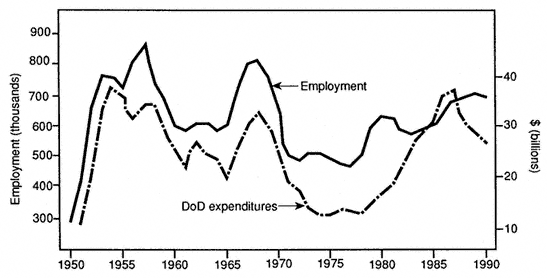
Figure 5.1
U.S. employment in SIC 372 (aircraft and parts) and Department of Defense expenditures (in constant 1990
dollars) for aircraft products and services. (Data from U.S. Department of Labor, Bureau of Labor Statistics,
Employment, Hours and Earnings, United States 1909–90 , Bulletin 2370; and Aerospace Industries
Association of America, Inc., Aerospace Facts and Figures , Washington, D.C., Aerospace Research
Center, Economic Data Service.)
period. The temporal variation in these outlays is clearly mirrored in changes in employment (Clayton 1967; Peck and Scherer 1962; Schiesl 1984). We may note the rising activity coincident upon the Korean War in the early 1950s and the Vietnam War buildup in the late 1960s. Then, in the early 1970s to mid-1970s, a pervasive slowdown in military spending occurred accompanied by the onset of recession in the aircraft industry (State of California 1981). After the late 1970s, the combined effects of civil airline deregulation (in 1978) and expanding Department of Defense procurements resulted in an upswing in employment over much of the 1980s. Since 1987, cutbacks in Department of Defense spending on aircraft are once more beginning to result in employment declines, especially in Southern California.
These ups and downs of the industry are superimposed upon what appears to be a long-term downtrend in employment in SIC 372 from the mid-1950s onwards. This downtrend is in part a reflection of periodic economic crises in the industry, and in part it is a reflection of a long-term process of technological and organizational restructuring. In actual fact, when we look at value of output, the industry appears considerably more healthy than when we just consider employment. Thus, the total value of output from SIC 372 increased by 77.2 percent from $43.6 billion in 1968 (a peak year for employment) to $77.3 billion in 1987, where all monetary values are given in constant 1987 dollars. These statistics are testimony to the ever-increasing complexity of modern aircraft, and this complexity shows up in turn in relative increases in skilled white-collar managerial, scientific, and technical workers in the industry. From 1968 to 1990 when total U.S. employment in SIC 372 decreased from 820,700 employees to 706,0000 employees, the percentage of nonproduction workers in the labor force increased from 40.3 percent to 51.6 percent. These intertwined developments (i.e., general employment decline combined with rising technical sophistication and value of output) have been intensified both by the substitution of guided missiles for aircraft in Department of Defense procurements (Gansler 1980) and labor-saving technological change in the industry. In 1989, military aircraft accounted for 63.7 percent of all aircraft industry sales in the United States.
The Industry in Southern California
The trends that we have observed in the industry at the national level are mirrored in similar trends within Southern California, which has
accounted fairly consistently over the postwar period for about 20 percent to 30 percent of total U.S. employment in SIC 372.
Table 5.1 provides an immediate glimpse of the incidence of the industry in the seven counties of Southern California for the years 1956, 1972, and 1985. Throughout the entire postwar period, employment in SIC 372 in Southern California has been overwhelmingly located in Los Angeles County with San Diego County a distant second. However, both of these primary centers of the industry in the region have experienced much decentralization of employment over recent decades, both to other parts of the region and to other parts of the country.
Figure 4.2, in the previous chapter, shows the location of the industry in Southern California in 1955, and the dominance of Los Angeles County is clearly evident. On closer inspection, the mass of establishments in Los Angeles County disaggregates into three major locational foci, the first close to the city center, the second coinciding with the Burbank-Glendale area to the north, and the third in the west-central area of Los Angeles stretching from Santa Monica and Culver City through Inglewood to El Segundo and Hawthorne. In the mid-1950s, little evidence is to be found of decentralization of the industry, apart from a handful of establishments (small parts manufacturers for the most part) located in the northern half of Orange County.
By 1972, the aircraft and parts industry in Southern California (as in the nation at large) was in a state of some decline. The geographical distribution of the industry in the region is displayed in figure 5.2. Not a great deal seems to have changed in the distribution for 1972 compared with 1955, despite the passage of more than a decade and a half. The body of establishments close to the center of Los Angeles has thinned out and the San Diego outlier has noticeably declined. A very modest acceleration of plant decentralization into Orange, Riverside, and San Bernardino counties is also visible, reflecting the expansion of the urbanized area into these counties.
By 1988, a number of changes in the locational structure of aircraft-assembly plants and parts makers in Southern California is apparent though they are still fairly modest (see fig. 5.3). Some continued erosion of the main nucleus of establishments in Los Angeles County is evident, especially in the west-central area. Los Angeles, nonetheless, remains by far the predominant focus of the industry in Southern California. Additionally, large numbers of small subcontractors now occupy a very evident locational niche in the northern half of Orange County. These subcontractors are linked in part to the thriving
| |||||||||||||||||||||||||||||||||||||||||||||||||||||||||||||||||||||||||||||||||||||||||||
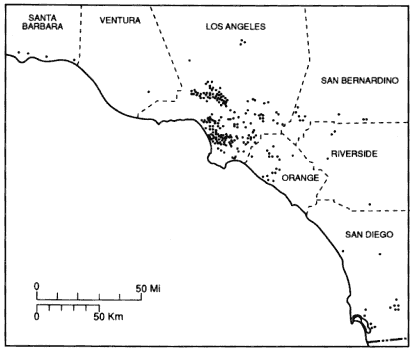
Figure 5.2
The aircraft and parts industry (SIC 372) in Southern California, 1972. One dot
equals one manufacturing establishment.
high-technology industrial complex that has also grown apace in Orange County since the 1960s.
Over the entire postwar period, the aircraft industry in Southern California has been persistently focused on a set of key central locations occupied by major producers (see fig. 5.4). Many of these locations, as already noted, have remained unchanged since the industry was first implanted in the region in the 1920s and 1930s, and such major modern aircraft assemblers as McDonnell Douglas, Northrop, Rockwell North American and General Dynamics Convair still occupy plants that can be traced back to the 1930s and 1940s. Moreover, as the industry has evolved, an elaborate network of labor markets and linkage relationships has been built up, further binding major producers to their established locations. In comparison with the functional and spatial restructuring of many traditional manufacturing sectors in the U.S. economy that has gone on over the period since the late 1960s
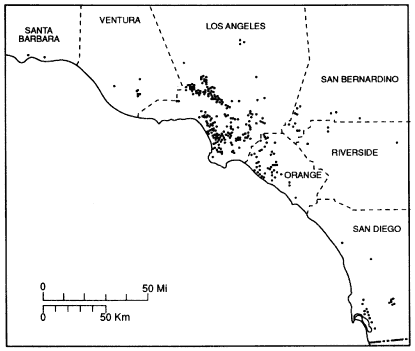
Figure 5.3
The aircraft and parts industry (SIC 372) in Southern California, 1988. One dot
equals one manufacturing establishment.
(in industries such as cars, machinery, electrical appliances, and so on), the aircraft and parts industry in Southern California has been distinctive for its extraordinary locational stability. That said, pressures currently acting on the industry are likely to produce some dramatic restructuring over the 1990s. In the early 1990s, the major Lockheed plant at Burbank closed down and much of its assembly work was transferred to Georgia. In addition, massive layoffs have occurred throughout the aerospace industry in Southern California since 1987 as a consequence of Department of Defense cutbacks.
In order to examine the functional and locational dynamics of the industry in more detail, we need now to consider some of the peculiarities of the local labor markets and interestablishment linkage structures that have taken shape around the industry in Southern California over the last few decades.
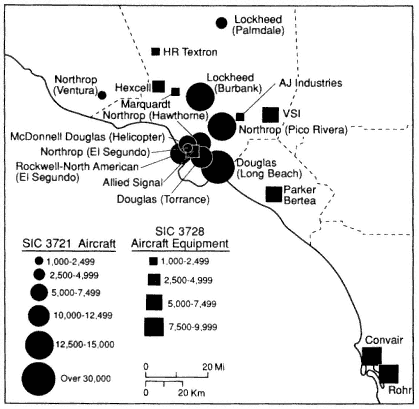
Figure 5.4
Establishments with 1,000 or more workers in SIC 3721 (aircraft) and SIC 3728
(aircraft equipment not elsewhere classified). (Data from various industrial
directories.)
Local Labor Markets
Labor Process and Labor Relations
The core of the modern aircraft industry in Southern California is made up of large final assembly plants or systems houses linked to a wide variety of parts and subassembly manufacturers. In these assembly plants, aircraft are gradually put together along a series of workstations at each of which crews of skilled and semiskilled production workers (sheet metal workers, riveters, metal bonders, lathe operators, boring mill operators, plumbers, painters, upholsterers, and so on) perform designated tasks. These are usually completed over a period
of a few days, after which the semifinished airframe is then moved downline to the next workstation.
The crews that work at different stages on the airframe are for the most part rather different from the quasi–self-managing teams that have emerged in many production sectors as the notion of "responsible autonomy" in industrial relations has gained acceptance (as in neofordist car plants, for example). In a few cases the team concept has been introduced into the Southern Californian aircraft industry, but this is still far from being a general modus operandi . Each worker's activity in any given crew is typically governed by an explicit job description, and rotation between jobs is the exception rather than the rule. Supervision and managerial control of production work tend to be tightly organized, and worker seniority remains the basis for layoff and recall decisions virtually everywhere in the industry. Despite these "fordist" elements in the prevailing labor-relations system, workers are on the whole more skilled than was (and is) the case with workers on the classical fordist assembly line in mass-production industries. In addition to the many blue-collar workers employed in the aircraft industry, large cadres of technicians, engineers, and scientists are also employed and are present in great numbers throughout the Southern Californian labor market.
Workers in most of the large aircraft assembly plants in Southern California are unionized, though parts-producing plants are in general free from union organization. At the present time, two major unions account for the majority of blue-collar workers in the main assembly plants, namely, the International Association of Machinists and Aerospace Workers (IAM), which is present in several of the Lockheed plants as well as McDonnell Douglas (Torrance) and General Dynamics Convair, and the United Automobile, Aerospace, and Agricultural Implement Workers of America (UAW), which is present in McDonnell Douglas (Long Beach), McDonnell Douglas Helicopters, and Rockwell North American (at El Segundo, Palmdale, and Downey). For its part, Northrop has successfully resisted unionization, and it handles worker-management relations through its internal Employee Relations Department. Various professional guilds also exist for the purposes of collective representation of the interests of technicians, engineers and scientists in the industry. The Engineers and Scientists Guild represents professional employees at Lockheed, and the Southern California Professional Engineering Association represents similar
workers at McDonnell Douglas. Both of these guilds are recognized by the National Labor Relations Board as legitimate collective-bargaining units.
The Spatial Structure of Local Labor Markets
We now turn to an analysis of local labor markets, focusing above all on the spatial relations between workers' residences and job locations.
In order to investigate this issue, major aircraft assembly plants were invited to provide simple counts of the number of people they employ by the zip code of employees' places of residence. A positive response to this invitation was received from Lockheed (which provided data on its Burbank, Palmdale, and Rye Canyon plants), McDonnell Douglas (Long Beach, Carson, and Torrance plants), and Rockwell North American (El Segundo and Palmdale plants). Collectively, these eight plants accounted for 56,676 employees, or about half of the total employment in SIC 372 in Southern California in 1988. Maps of the local labor markets surrounding the eight establishments are presented in figures 5.5, 5.6, and 5.7. For ease of exposition, data for different establishments belonging to the same firm are combined together in a single map.
Scrutiny of figures 5.5, 5.6, and 5.7 suggests that the spatial configuration of these local labor markets has been shaped by a powerful gravitational effect focused on individual places of employment. Indeed, each local labor market seems to have been pulled tightly inward to its own central hub, and there is surprisingly little spatial overlap between different labor-market areas in different sections of the metropolis. This island-like character of local labor markets within the same metropolitan area is all the more unexpected in view of the gigantic proportions of some of the core workplaces (e.g., 30,110 employees at McDonnell Douglas Long Beach, and 12,015 at Lockheed Burbank in 1988).
These casual observations may be formalized with the aid of a multinomial logit model. In this model, the probability (pij ) that the ith employee works at the jth establishment is expressed as a positive func-
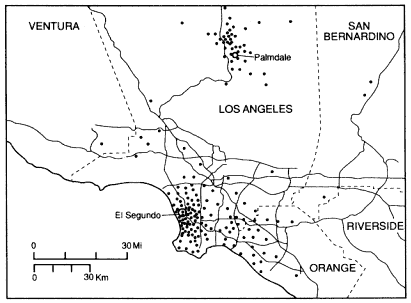
Figure 5.5
Residential locations of workers employed by Rockwell North American
plants at El Segundo and Burbank. Major freeways are shown. Each dot
represents thirty workers. (Permission of Rockwell North American to
publish this information is gratefully acknowledged.)
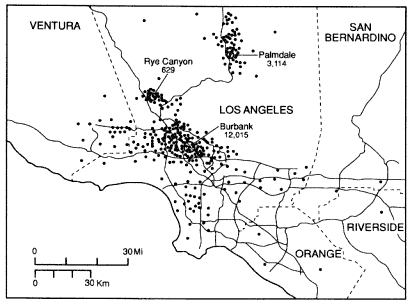
Figure 5.6
Residential locations of workers employed by Lockheed plants at Burbank,
Palmdale, and Rye Canyon. Major freeways are shown. Each dot represents
thirty workers. (Permission of Lockheed to publish this information is
gratefully acknowledged.)
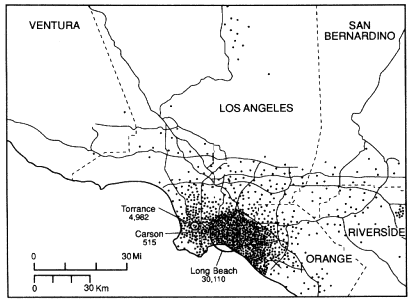
Figure 5.7
Residential locations of workers employed by McDonnell Douglas plants
at Long Beach, Carson, and Torrance. Each dot represents thirty workers.
The number attached to each establishment name represents total
employment at that plant. (Permission of McDonnell Douglas to publish
this information is gratefully acknowledged.)
tion of total employment (Ej ) at j, and as an inverse function of the distance (Dij ) between i and j. Distances were calculated as the number of miles between given employment places and the geometric center of appropriate zip code areas in Southern California. All workers with a residence in any given zip code area were then simply assigned the distance value for that area as a whole. For all 56,676 workers, the computed model is
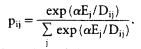
The value of the parameter a was estimated by maximum likelihood methods and is given as 0.000766. The likelihood ratio, r2 , is equal to 0.90, which is highly significant. In the present instance, the likelihood ratio is computed as the value of 1 – (L*/L), where L* is log likelihood of the multinomial model given above, and L is the log likelihood of an alternative minimal model in which pij is simply set equal to Ej /T, where T is the size of the total labor force employed in the eight estab-
| ||||||||||||||||||||||||||||||||||||||||||||||||||||||||||||||||||||||||||||||||||||||||||||||||||||||||||||||||||||||||||||||||||||||||||||
lishments. The latter model would provide an accurate description of the given data if local labor markets for the eight establishments were perfectly fluid over the whole metropolitan area.
The magnitude of the likelihood ratio confirms the notion that the local labor markets of these eight producers are indeed very tightly defined in their geographical organization by establishment size and journey-to-work distances. Moreover, while establishments that are close together clearly share in overlapping local labor-market areas (see fig. 5.7), those that are farther apart appear to be much less in competition with one another, at least in the short run.
This point about the evident disconnectedness of local labor markets in different sections of the metropolis may be driven home by consideration of tables 5.2 and 5.3, which provide information on the spatial distribution of workers' residences in concentric zones centered
| ||||||||||||||||||||||||||||||||||||||||||||||||||||||||||||||||||||||||||||||||||||||||||||||||||||||||||||||||||||||||||||||||||||||||||||||||||||||
on each workplace and inscribed at five-mile intervals. Both tables suggest that the local labor market for any establishment rarely extends much beyond about fifteen or twenty miles in radius from the establishment. In particular, table 5.3 shows that more than 50 percent of each establishment's labor force resides within fifteen miles of the place of work, and in most cases, more than 75 percent resides within twenty miles. The three major employers in our labor-market data set (i.e., Lockheed [Burbank], McDonnell Douglas [Long Beach], and Rockwell North American [El Segundo]) are all at least fourteen miles from one another, which suggests, perhaps, that large plants have at least some tendency to occupy locations where they can build and dominate a stable local labor-market territory beyond the range of effective short-run competition on the part of other major employers.
The same process may also help to explain in part the formation of multiple industrial districts of the same type within a single region (as in the case of the Southern Californian aircraft and parts industry), for beyond a certain size limit, diseconomies of scale may well begin to set in. It seems to be the case, too, that workers are to some degree locked by their place of residence into a particular local labor-market area within the metropolis. If so, do they, when unemployed, restrict their job search to firms within the same local labor-market area, or do they search over a much wider area for alternative employment? If the latter is the case, is there some critical distance (or isochrone) such that they will prefer to shift their residential location rather than endure an extended journey to work? And are there significant differences in these regards between different socioeconomic groups? We shall return to these questions in chapters 8 and 9.
Industrial Organization and Interestablishment Linkages
The aircraft and parts industry in Southern California today forms an extensive complex of activities, interlinked with one another but also connected to a wider circle of establishments in such industries as non-ferrous foundry work, machinery, electronics, instruments, and missiles and space vehicles. As such, there are powerful multiplier effects that flow from the industry (and especially from those segments of the industry that are maintained by military expenditures) into other sectors of the local economy (Bolton 1966; Steiner 1961; Tiebout 1966). All of this interconnection within and between industrial sectors in the region gives rise to a significant stock of agglomeration economies that helps to maintain the economic vigor of the industry. This aspect of the industrial geography of the region is extremely rich and multifarious. To bring the problem within manageable bounds, we shall focus in what follows on the present-day intrasectoral linkages of SIC 372 in Southern California.
Interestablishment Linkage Data
In order to examine linkage patterns in the aircraft and parts industry of Southern California, a mail questionnaire survey of establishments was implemented over the summer of 1988. The questionnaire was
sent out to a total of 986 establishments in Southern California, comprising (a) the 299 establishments shown in figure 5.3, whose addresses are drawn from the 1988 edition of the California Manufacturers Register , plus (b) a further 687 establishments whose addresses were extracted from a variety of other directories, and most importantly from diverse yellow pages telephone directories. County Business Patterns for 1988 records a total of 347 establishments in SIC 372 in Southern California, so it is clear that most of the 986 establishments that were sent a questionnaire would turn out to be engaged in forms of business other than aircraft and parts manufacturing. Unfortunately, the data sources did not always provide enough information to allow effective screening of establishments at an early stage. In fact, out of a total set of 114 questionnaires returned, twenty-one (or 18.8 percent) were from establishments in other SIC categories (mainly wholesaling). In addition, forty-five (39.3 percent) were returned by the post office because the addressee was no longer at the indicated address, two (1.8 percent) came back with the notation that the recipients would not participate in the survey, and just forty-six (40.6 percent) were sent back (filled out in varying degrees of completeness) by bona fide aircraft and parts manufacturers. The final response of forty-six questionnaires is decidedly low, even when we take account of the number of establishments that have gone out of business and those that were erroneously included in the initial list of addresses. No doubt the low response rate can at least in part be attributed to the fact that many of the questions posed were directed toward confidential and proprietary matters. Fortunately, a one-sample Kolmogorov-Smirnov test indicates that the frequency distribution of questionnaire respondents by size class is not significantly different from the expected distribution as recorded in County Business Patterns for 1988 (see table 5.4). Despite the correspondence between the sample and the population, we must still remain alert to the possibility of other biases in the questionnaire data, and we must thus approach our conclusions with due reserve.
General Linkage Structures
As indicated, the questionnaire that was sent out to individual establishments was designed to elicit information on forms of interplant transactions. For each establishment, data were collected on activities
| ||||||||||||||||||||||||||||||||||||
such as sales and marketing, purchasing, subcontracting, modes of transacting, and so on. These data were gathered in order to evaluate the expectation that there exists within any localized industrial complex a critical network of interestablishment transactions helping to hold the complex together as a spatial agglomeration. In particular, as suggested earlier, this critical network may be expected to be primarily composed of rapidly changing and small-scale transactions linking local producers to a mass of small specialized plants providing critical service and subcontracting functions on a custom and semicustom basis. Larger, more standardized and more regular linkages will tend to be directed over longer distances because their associated transactions costs will generally be much lower per unit of interaction. If true, these conjectures imply that small plants will be apt to sell more of their output locally than large plants, and that these local sales will consist of comparatively nonstandardized products.
This problem was broached in the first instance by means of a simple logistic-regression model, which seeks to define the proportion (Ci ) of the ith establishment's customers located in Southern California as a
function of (a) the establishment's total sales (Si ), and (b) the proportion (Ti ) of the establishment's sales that consists of work subcontracted in from other firms. The variable Si tests for the hypothesized scale effect; it is expressed in logarithmic form in the final model because of the disproportionate spread in the sales figures for small and large establishments. The variable Ti is a rough proxy measure of the standardization/variability dimension in linkage structures; it may be contrasted with off-the-shelf sales where output is made to general catalogue specifications. As we shall see, the effects of Ti on linkage patterns (and hence location) are in large degree derived from the intense levels of face-to-face communication that are called for in the subcontracting relation.
The computed logistic-regression model is given as:[1]
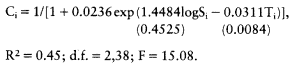
The standard errors of the regression coefficients are shown in parentheses on the line immediately underneath the equation. The regression as a whole and both of the regression coefficients are statistically significant at the 0.01 level. This is an especially encouraging performance because the data on which the model is based refer not to aggregations of observations (such as census areas) but to individual observations (i.e., establishments), which are usually more susceptible to extreme value problems. For this reason, the modest R2 of 0.45 must be seen as being rather convincing (though recall that the sample is biased toward medium-sized establishments). The model tells us that firms with larger sales volumes and/or more standardized outputs are more likely to sell to a wide circle of customers beyond Southern California; conversely, firms that are smaller and/or more dependent on variable subcontract work are more likely to restrict their sales activity to Southern California.
A second means of evaluating the relationship between linkage structure and establishment size draws from information elicited on
[1] To estimate the model by regression methods, it is rearranged in the form: log(Ci – 1) = a + b1 logSi + b2 Ti , where a , b1 and b2 are the numerical parameters. However, in cases where Ci is equal to either zero or unity, computational difficulties are encountered. In order to avoid these difficulties, the following practical rule was applied: (a) if Ci = 0, Ci is set equal to Ci + Î , and (b) if Ci = 1, Ci is set equal to Ci – Î , where Î is any arbitrarily small constant. In the present instance, Î is set equal to 0.000001.
| ||||||||||||||||||||||||||||||||||||||||||||
questionnaire respondents' specific purchasing and contracting arrangements. Establishments were asked to designate their three largest suppliers of inputs (whether standard materials or subcontracted work) over the previous twelve months (table 5.5). In response to this question, a total of thirty-nine establishments reported information on 113 suppliers. Of these, it was possible to determine the locations of ninety-six, and seventy-nine (82.3 percent) of them were found to be located in Southern California. Figure 5.8 delineates the locations of these seventy-nine suppliers, along with the locations of reporting establishments, and it is very evident from this figure that there is a close locational symbiosis between the two sets of establishments. The data set forth in table 5.5 provide further insights into the nature of this symbiosis. Notice that in the table, respondents are grouped into one of two size categories, i.e., those with gross annual sales of less than $2.25 million, and those with gross annual sales greater than $2.25 million, where the figure of $2.25 million represents the median gross annual sales volume of all respondents. A total of twenty-two small respondents reported on fifty-three suppliers with known locations, of which fifty-one (96.2 percent) are in Southern California; and seventeen large respondents reported on forty-three suppliers with known locations, of which twenty-eight (65.1 percent) are in the
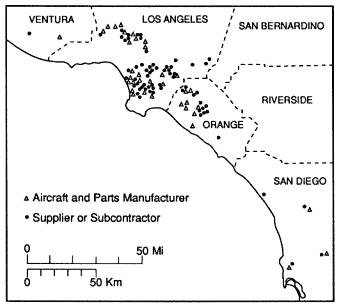
Figure 5.8
A sample of thirty-six aircraft and parts manufacturing
establishments and their suppliers and subcontractors in
Southern California.
region. The statistically significantly higher incidence of short-distance linkages among smaller establishments confirms their disproportionately strong connections to the local industrial complex.
Questionnaire respondents were further asked to list those customers (if any) with whom they had multiyear contracts. The results, broken down as before into two groups based on volume of annual sales, are presented in table 5.6. Of the forty-six aircraft- and parts-manufacturing establishments that completed and returned a questionnaire, thirty-one (67.4 percent) indicated that they had a multiyear contract with one or more customers. Only 56 percent of respondents with annual sales of less than $2.25 million had such arrangements, whereas 81 percent of respondents with annual sales greater than $2.25 million reported having multiyear contracts. This finding is consistent with the notion that smaller producers tend to have less stable external transactional relations than larger producers. When the location of respondents' customers is taken into account, a yet more revealing pattern emerges. Respondents with annual sales of less than $2.25 million maintained 88.5 percent of their multiyear contracts with local customers; establishments with annual sales of more than
| |||||||||||||||||||||||||||||||||||||||||||||||
$2.25 million had multiyear contracts with a more far-flung set of customers, only 49 percent of whom are located in Southern California. Once more, then, it turns out that small establishments are markedly more connected to the local complex than are large. These remarks reinforce the proposition that the aircraft and parts industrial complex in Southern California is to a very significant degree caught up in a dense local web of finely woven transactions-intensive linkages.
Modes and Types of Industrial Interlinkage
The above analyses are fortified by additional data collected in the questionnaire on different modes of transacting within the aircraft and parts industrial complex of Southern California.
Respondents were asked to estimate what percentage of the total time leading up to a sale of output is on average spent in different modes of communication. The modes are (a) telex or fax, (b) tele-
| ||||||||||||||||||
phone, (c) mail, and (d) face-to-face contact. Respondents were also requested to provide this estimate separately for (a) an off-the-shelf sale, and (b) a sale of subcontract work. The results of this phase of the survey reveal patterns confirming the general thrust of the earlier theoretical analysis (see table 5.7). For an off-the-shelf sale, telephone and mail are the two most intensively used modes of transacting, with face-to-face contact a distant third. For a sale of subcontract work, where the need for close contact and consultation between the contracting parties is comparatively high, telephone and face-to-face contact are the most preferred modes of transacting. Symptomatically, the use of telex or fax communication modes is particularly low when subcontracting linkages are at issue.
The other point to remark upon in regard to table 5.7 is that out of a total of forty-four establishments, only twenty-three (52.3 percent) acknowledged that they sold off-the-shelf items, whereas thirty-eight (86.4 percent) claimed that at least part of their business came from work subcontracted to them. Subcontracting was found to be particularly important for establishments with annual sales of less that $2.25 million. For such establishments, subcontracting comprises 79.2 percent of their sales. For establishments with annual sales of more than $2.25 million, subcontracting work accounts for 36.2 percent of their sales—a much lower figure, though one that is still high in absolute terms. This high incidence of subcontracting arrangements, in conjunction with the finding that much of the transacting leading up to a subcontract involves expensive face-to-face communication, helps to
account for the intense levels of locational agglomeration observable within the industry in Southern California (see Harlan 1956). Of course, many of the larger establishments in the complex have significant nationwide and worldwide linkages. However, both large and small establishments are also intertwined with one another in a dense localized network of small-scale and comparatively nonstandardized transactional activities. This phenomenon is expressed in the mutual locational attraction that aircraft assembly and parts manufacturing establishments evidently exert upon one another.
The Role of Large Producers within the Southern Californian Aircraft and Parts Industry
In addition to the above investigations, an effort was made to assess the effects of the major aircraft assembly plants in the region on the structure of interestablishment linkages. It must be pointed out once more that these plants operate intensely over a global level of activity. What, though, is their precise relationship to the Southern California complex?
To answer this question, much useful information was gleaned from questionnaire respondents about their sales to eleven major aircraft assemblers in Southern California, i.e., General Dynamics Convair (San Diego), Lockheed (Burbank), Lockheed (Palmdale), McDonnell Douglas (Long Beach), McDonnell Douglas (Torrance), McDonnell Douglas Helicopter Company (Culver City), Northrop (Hawthorne), Northrop (El Segundo), Northrop (Palmdale), Northrop (Pico Rivera), and Rockwell North American (El Segundo). As it happens, only one of these eleven establishments returned a completed questionnaire, and this establishment has been deleted from the analysis that follows. Two main pieces of information now need to be discussed.
First, questionnaire respondents were asked to specify the value of their annual sales to each of these eleven major producers. Respondents' sales to the major producers as a percent of total revenues were then calculated. Table 5.8 sets out the main summary statistics relating to this operation. For each of two size categories of respondents, table 5.8 shows (a) mean percentage sales to major producers, with the mean for size-category k defined as 100

| |||||||||||||||||
aggregate of respondents' gross annual sales


of forty-four respondents indicated that they had no such agreements whatever.
Second, respondents were also asked to provide data that might enable us to gain some understanding of the informational intensity of their transactional relations with the eleven leading producers. Respondents were queried on face-to-face contact intensity in terms of (a) the number of times over the previous twelve months that their establishment had been visited by a representative of one of the leading producers, and (b) the number of times over the previous twelve months that an employee belonging to their establishment had visited one of the leading producers. These figures were then used to compute both average visits per establishment and the average number of visits to and from the eleven major producers per $10,000 of sales. The results of these computations are arrayed in table 5.9, where, again, establishments are classified by size category. The data show that small establishments, as expected, generate fewer visits than large establishments. When we examine visits per $10,000 of sales, however, small establishments are three times more likely than large to make visits to or receive visits from the leading producers. When we recalculate average visits made and received by weighting the data for each establishment by gross sales we find that small establishments are more likely by a factor of four or five to one to make or receive visits than large. It is thus apparent that small establishments have a much greater propensity (per unit of output) than large to engage in face-to-face contact with representatives of the eleven leading producers. Moreover, the communication between them is very much a two-way street, for representatives of the leading producers are just as likely to visit smaller establishments as the latter are to visit one of the major eleven.
In these ways the transactions-intensive nature of the aircraft and parts manufacturing complex of Southern California is yet further revealed. Most important, the small establishment segment of the complex appears to constitute a finely grained infrastructure of subcontractors providing specialized and critical services to the whole local system of production. This phenomenon reinforces the agglomeration economies that are so strongly evident in the Southern Californian aircraft and parts industrial complex. Even major producers, whose main transactional activity extends far beyond the boundaries of Southern California, seem to be dependent in detailed but critical ways on these same agglomeration economies.
| |||||||||||||||||||||||||||||||||||||||||||||||
Continuity and Change
I have made an effort to shed some light on the multifaceted puzzle of the aircraft and parts industry in Southern California by showing in a very preliminary way how it evolved in the postwar decades, how local labor markets form and are sustained around individual large producers, and how the pattern of intraregional and interestablishment linkages in the industry is organized. The aircraft and parts industry has evolved spatially and temporally in ways that contrast sharply with the patterns of evolution that have characterized both mass-production and craft-industrial activity in the United States. Unlike mass production, the aircraft and parts industry has until recently been largely immune from the traumatic forms of restructuring, rationalization, and deindustrialization that swept across the United States over the 1970s and 1980s (though the immediate future of the industry is now in considerable question). Unlike craft-industrial activity (such as clothing, furniture, or leather goods) the aircraft and parts industry has been a focus of great technological innovation and change focused on giant systems houses, with its outputs becoming steadily more complex over the course of time. Thus the industry has been marked by continual internal transformation, but also by an uncommon geographical stability during most of its existence. Certainly, there has been a steady local decentralization of the industry within Southern California, and many sorts of routine manufacturing processes in the industry have been moved to other parts of the nation and the globe over the last couple of decades. By and large, however, the region's aircraft and parts manufacturing complex weathered remarkably well the ups and downs of the postwar years, and even today its central R&D and prototype-development functions in the region are likely to remain active despite the recent loss of significant portions of the industry's final assembly operations.
The analysis above provides a number of clues as to the sources of this resilience over most of the postwar period and helps us toward a prognostication of possible future trends. Three main points must now be made. First, over the years, the industry has grown in association with dense pools of highly specialized blue-collar and white-collar labor. These labor pools are geographically arranged in ways that make them extremely accessible to producers, and they represent significant positive external economies. Second, as demonstrated, the industry has immediate access within the Southern Californian complex
to a wide variety of specialized input and service providers, yielding a further harvest of external economies. In particular, even though the industry is closely linked to wider national and international markets, the local infrastructure of small producers and subcontractors is undoubtedly a critical element of its functional organization. Third and last, the very presence of these dense webs of external economies in the region is at least in part one of the sources of the industry's notable innovative capacities. The presence of such large numbers of highly qualified personnel in a single region and the well-developed social division of labor (with, as its corollary, intense transactional interchanges between establishments) provide the basic conditions under which continual mutual learning and productive forms of interestablishment cooperation are possible. The effects of these processes mount cumulatively and help to endow the industry with a significant competitive edge. To this competitive edge must be added the major technological and R&D breakthroughs in both civilian and military aircraft production that have characterized the Southern Californian industry since the 1930s, from the Douglas DC-3 and its various descendants through Lockheed's F-104 fighter aircraft (the Starfighter) in the 1950s and 1960s, to Northrop's B2 ("Stealth") bomber today (Miller and Sawers 1968).
That said, it seems that there is currently a twofold danger looming over the industry and the region, and that this danger is sufficiently serious and sufficiently damaging in its implications that it calls for concerted public attention at the local, state, and national levels. On the one hand, military aircraft production is subject to the marked vagaries of defense contracting, and this means that the economy of Southern California is exposed to considerable risk. Since the late 1980s, this theoretical risk has been manifest in tangible job loss throughout the region's high-technology industrial ensemble. On the other hand, civilian aircraft production (and much of the parts-manufacturing sector too) is now facing rapidly increasing competitive pressures on world markets. The recent success of the European Airbus, and the current Japanese effort (orchestrated by MITI) to develop a supersonic transport plane some time in the 1990s are forewarnings that Southern California's competitive edge is now under mounting threat (Seitz and Steele 1985). The urgent need is for effective contingency plans to take up slack as federal defense procurements now begin to taper off, and for policies that help to maintain the technological and commercial primacy of the aircraft and parts in-
dustry in Southern California and the United States as a whole. These issues insistently clamor for attention. In the absence of more active and coherent industrial policies, the aircraft and parts industry may well one day suffer the fate that has already befallen cars, steel, and significant segments of the semiconductor industry in the United States. The consequences for Southern California of such a turn of events would be nothing less than disastrous.