
4
Sobriety, Squalor, and Schooling in the Migrant City
In its ideal form the Russian city of the late nineteenth century was to be both an enlightened and an orderly place. Although facade planning disappeared, the impulse to impose some ideal ordering of public life on the chaotic migrant city did not. Tsarist authorities and many civic leaders possessed a vision of the city as a place that, in one form or another, had to be created—or recreated. They were the heirs of Peter I and Catherine II. The reasons for this common approach to the Russian city are rooted in both Russian authoritarian social practices and culturist views that measured Russian society against Western models. When compared with the West, Russia still seemed to be a borderland and its cities outposts where cultural ideals directly confronted a harsh social reality. The decision of the Ministry of Finance to locate the second national exposition in Nizhny Novgorod in 1896 affirmed the principle that any major Russian city was a place of learning. In this context, enlightenment meant proselytizing for technology, industry, and capitalism in the spirit of Witte's program for national development. It also meant finding a language by which to communicate this message to a diverse and deeply divided population.
The impoverished, poorly educated, and mobile character of most of the urban population challenged the best efforts of those who sought an enlightened city. The problem of cultural change in the city can best be approached in the manner proposed by the sociologist Lyn Lofland. Her conceptual perspective relies heavily on psychology and cultural anthropology. She views the city in modern times as a "problematic world of
strangers" in which groups and individuals that are unknown to one another become aware of one another's existence through encounters in public spaces. On the one hand, the responses to this situation involve efforts to create a place for oneself—to "privatize public space." On the other hand, the responses also engage urban dwellers in a process of learning in which they attempt to acquire skills for living among strangers and for placing these strangers in a familiar, knowable order.[1] Lofland devotes little attention to the importance of power in the ways that these "strangers" interact. Logically, one might expect that those who claim authority and are committed to a reordering of the city would use their positions to try to incorporate the strangers into their own ideal city. Her approach suggests that those who study the history of Russian urbanism must pay close attention to the struggles inherent to the transformation of urban culture. Rival agendas for cultural integration competed against each other, and the proponents of each agenda attempted to communicate with and persuade the migrant masses of the rightness of their cause. "Strangeness" was a barrier to the emergence of a new city.
The encounter between elite and popular cultures was strongly influenced by tsarist suspicion of spontaneous cultural activities, a culturist definition of progress among educated Russians, and by the assumption—shared by both the business and laboring population—that the city was essentially a workplace. Perceptions of strangeness varied greatly and the attempts to deal with this condition can be examined from several points of view. One important dimension is gender. Relations between laboring men and women in the migrant cities were deeply marked by the mobility of the population and the numerical insignificance of settled families. A social dimension is readily visible in the multiplication of voluntary associations among educated townspeople, who turned their attention to opening channels of communication and to spreading learning among the uneducated. An economic element is apparent in the support that municipal dumas and merchant societies lent to the creation of schools to raise the educational level of the urban workforce. The political concerns of Russian conservatives emerged in the campaign to organize officially approved public programs of learning and knowledge that were directed at spreading sobriety and piety among the laboring population. Finally, the cultural ramifications of the encounters among strangers brought a fascination with the exotic "squalor" of the slum-dwellers. In popular literature Khitrovka acquired
[1] Lyn Lofland, A World of Strangers: Order and Action in Urban Public Space (New York, 1973), esp. 15-22.
junglelike qualities and became a sort of "darkest Moscow." The awareness among townspeople that these vast cultural differences existed brought added support for a sustained campaign to spread literacy into those little-known fringes of urban society. The Russian migrant city of the late nineteenth century contained a multitude of competing movements to incorporate the population into an integrated culture. In this chapter I focus on those activities that were directed at the "migrant stranger."
Tavern and Church
The presence of migrants was the dominant social reality of urban Russia. It caused civic leaders and officials to search for the means by which to bring enlightenment and order to their migrant city. Although they often claimed to know the "people," they were aware of a cultural gulf between "society" and the "people" that bred suspicion and made any form of communication a difficult endeavor. The label "migrant" subsumed a variety of social conditions. The occupations of the newcomers varied widely, as did the length of their residence in the city. Although descriptions of housing offer a one-dimensional image of the laboring poor, they provide a general indication of the private places that these strangers occupied in the city. To the extent they can be perceived in contemporary reports, these living conditions help to describe how the world of the migrants was circumscribed with respect to the settled townspeople and how the migrants' efforts to "privatize public space" evolved.
The great disparity between the comfortable housing of the few well-to-do townspeople and the squalid quarters of the poor can be measured using the data gathered in official studies. The distance between the houses in Kiev's center that were classified as "expensive" and the "crowded houses, more like hovels stuck together with mud" (as one medical inspector observed in 1890) on the city's outskirts, where "petty artisans, traders, [and] day laborers" lived, was at once spatial and social.[2] There was no territorial border, however, to separate "decent" from "squalid" rental lodgings; both often existed in the same neighborhood or even next to each other. When in the 1890s the Ministry of Finance introduced a tax on urban renters, it estimated that the floor of the tax on the most "inexpensive" taxable residences excluded three-fourths of all lodgings.[3] This administrative decision gives an indication of the size of the urban poor.
[2] "Sanitarnyi nadzor v Kieve v 1890 godu," Izvestiia Moskovskoi gorodskoi dumy 12 (December 1891):2.
[3] Gosudarstvennyi kvartirnyi nalog (St. Petersburg, 1903), 69 n. 1, 108.
The structures that the fiscal agents left off the tax roles included the ready-made shacks that one traveler found in Volga port cities that landlords constructed to house laborers in the navigation season. He saw "small lots on the outskirts of town that were so crowded" with these structures that "they represent a serious danger in case of fire."[4] In this domain, as in others, the lives of the poor were beyond the reach of official regulations. Building violations could easily be dismissed with a bribe to the neighborhood police officer, who was the only authority to enforce the municipal statutes. A particularly characteristic form of housing for the poor was the "cot-and-corner" (koechno-kamorochnaia ) apartment, which was a residence sublet into as many cots and corners as the market and physical space would permit. At the turn of the century a Moscow survey estimated that such lodgings housed nearly 175,000 people (one-sixth of the total population).[5]
In these conditions the borders between public and private space were difficult to discern. The desperate need for cheap housing was the paramount concern. Observers reported that crowding, fetid air, and the stench from courtyard latrines set these areas apart as places of terrible squalor. Gorky's "lower depths," which he used at the end of the nineteenth century to shock his educated audience, were located in a cellar "cot-and-corner" apartment. The term trushchoba ("slum") had emerged by the mid nineteenth century to designate the areas where this squalid housing was concentrated—at first the streets around Haymarket Square in St. Petersburg, then also the Khitrovka neighborhood of Moscow. Soon it was used to identify places of visible poverty in any town. The term also conveyed a secondary meaning similar to the usage of the word "slum" in the United States in the late nineteenth century: to middle-class Americans, slums were "strange, novel, large places that people visited as a foreign territory." In America as in Russia, the inhabitants of these places became "slum people."[6] In this manner the language of educated Russians identified a different social world within the migrant cities.
[4] E. I. Ragozin, "Puteshestvie po russkim gorodam," Russkoe obozrenie 4, no. 7 (July 1891):255-56.
[5] Moskovskie vedomosti , 14 November 1902; the report was published in Izvestiia Moskovskoi gorodskoi dumy 23 (October 1899). This subterranean housing world (I use the term both figuratively and literally because many such apartments were located in cellars) is explored in detail in Joseph Bradley, Muzhik and Muscovite (Berkeley, 1985), 211-13.
[6] Sam Bass Warner, "Slums and Skyscrapers," in Cities of the Mind: Images and Themes of the City in the Social Sciences , ed. Lloyd Rodwin and Robert Hollister (New York, 1984), 187. The Russian term, which originally designated a thicket in a forest, first appeared in literary works in the 1840s and had a pejorative social meaning; at that time it designated the St. Petersburg slums. See Slovar' sovremennogo russkogo literaturnogo iazyka (Moscow, 1965), 15:1063.
For the residents of these poor neighborhoods such living conditions were part of a network of relations by which they organized their lives in the city. Where peoples of different languages gathered in the same city, ethnic differences to some extent determined the borders between neighborhoods. In Odessa, for example, the ethnic segregation of Russians and Jews led most Jews to reside in the central areas. Russians congregated in the outlying factory districts.[7] Because residential segregation highlighted the cultural barriers that divided Jews and Gentiles (Russians and Ukrainians), they had the effect of turning certain neighborhoods into targets for mobs when anti-Semitic pogroms erupted.
Residential areas of migrant laborers in Russian cities principally housed working-age men who were living apart from their families. According to Joseph Bradley, in Moscow in the early 1880s between one-half and two-thirds of these men were not living with their families, and we can assume that the same condition existed in the other migrant cities.[8] Urban labor was largely male. In the last decades of the nineteenth century most men no longer moved about as part of a work gang (artel' ), but they still frequently changed jobs and residence. They kept the company of fellow migrants both in work and, just as important for their sense of place in the city, in their lives away from work. Thus, places that we might call a "man's world" occupied a visible and important area in the migrant city.
The urban centers where the migrants gathered were "privatized" by their new residents in the sense that Lofland suggests: they sought to find space in the city for their own way of life. In the mid 1890s one young villager, Semen Kanatchikov, entered this world under the protection of his father's village friend, who was a migrant factory worker bringing his own son to Moscow at the same time. In many ways Kanatchikov's story, which he later told in his autobiography, is typical of the migrant laborer. He lived with fifteen other men, who were employed at different trades and worked in different parts of the city; they shared a communal apartment that they collectively rented and for which they hired a cook. He took his meals at the apartment and spent his leisure time in the company of the other migrants who lived there. He ran to fires, read the penny press, joined in collective fistfights, and at payday visited neighboring taverns and brothels.[9] Our
[7] Robert Weinberg, "Worker Organizations and Politics in the Revolution of 1905 in Odessa" (Ph.D. diss., University of California, Berkeley, 1985), 84-85.
[8] Bradley, Muzhik and Muscovite , 217-19.
[9] S. I. Kanatchikov, A Radical Worker in Tsarist Russia , trans. and ed. Reginald Zelnik (Stanford, 1986), 9-13; see also Bradley, Muzhik and Muscovite , 196-211.
meager records suggest that these collective living arrangements, which were termed a residential artel' , were common. According to the 1897 census, in the typical migrant city 6 percent of the population lived in "households without family ties," and this figure is probably artificially low.
Artel' residents came and went; new arrivals at times came from the workplace of one of the members or from the neighborhood. At times the village (or regional) connections provided by the members' zemliachestva furnished new residents. Experienced migrants assisted the move from the village and initiated the newcomer into the ways of the city. Kanatchikov, presumably like many other new arrivals, soon moved on to separate quarters and found comrades in other places. However, at a key moment of transition in his life the artel' had become for him both a refuge and a school in urban living; in personal terms it was as important as his place of work.
The customs and living practices provided by shared housing and comradeship gave migrants, both those employed in factories and those who found work elsewhere, special skills and knowledge that they needed to make some small part of the city their own. The significance that the French writer Michel de Certeau attributes to the everyday practices of residents of modern cities is equally pertinent to the experience of these Russian urban migrants, who were also able to incorporate in the practices of their daily lives "ways of making use of the confining order" in which they found themselves.[10] The large group of married workers in an apartment-commune in St. Petersburg knew that they belonged in the city and their wives and families belonged in the villages. Their life as "temporary bachelors" was forced on them, they explained to a visitor, by their urban transience: "'Today we're here, but God knows where we'll be tomorrow. So that's how we live—each by himself."'[11] But instead of living in disordered solitude, their way of life gave them a special collective place in the city.
The migrant way of life was in many respects repugnant to both civil society and official Russia. The bonds that united the laborers' society were solidified by rituals in work and leisure; these bonds were cemented by regular and heavy consumption of vodka, by masculinity that was proven in organized fistfights, and by casual sex with prostitutes. Educated Russians and workers who aspired to respectability regarded temperance (or at most moderate drinking) as a mark of cultural development. But in the
[10] Michel de Certeau, The Practices of Everyday Life , trans. Steven Rendall (Berkeley, 1984), 76.
[11] P. Timofeev, Chem zhivet zavodskii rabochii? (St. Petersburg, 1906), 13-14.
male brotherhood of laborers, the use of vodka was an essential sign of membership. It celebrated entry into a workplace, it was a reward for a job well done, it commemorated the holidays, and it turned strangers into comrades in the neighborhood tavern. Its use, in the words of one censorious provincial governor, initiated young migrants into the "different style of life of the workers." From his official perspective vodka was the first step toward creating a "riotous" laboring population, which appeared so threatening to public order.[12] If we can believe the tabulations of the municipal statisticians, who were zealous record-keepers of the well-ordered city, in the migrant cities at the turn of the century there were nearly as many taverns per capita as there were churches. Whether it was justified or not, the Russian laborers' reputation of drunkenness made the tavern (traktir ) a particularly odious symbol of squalor and depravity to educated Russians. As in the West, it was the common target of the temperance movement and respectable workers, both of whom held up high standards of moral behavior by which to reform the laboring population.
The prevalence of casual sex in the laboring community added another dimension to the "strangeness" of their part of the city. In this respect the workers in Russian cities resembled those in Western metropolitan centers earlier in the century. Alain Corbin describes what he calls the "quantitative sexual poverty" that labor migration created in large French cities in that period. In these urban centers the "sexual activity of laborers appeared virtually synonymous with prostitution."[13] The tsarist state, like other European states, attempted to regulate prostitution, which according to its problematic records was the occupation of young, female, peasant migrants who either abandoned or were forced out of domestic service.[14] Officials recognized that "secret prostitution" was probably far more prevalent than the legal form. Women in trades such as seamstress, where unemployment was endemic, often turned to prostitution to escape destitution. The evidence that casual sex was widespread in the city is indicated by the far higher rate of illegitimate birth in migrant cities than in the countryside.[15] The assumption among educated observers that laborers were promiscuous helps explain why medical writings tended to attribute the cause of the syphilis epidemic to this particular segment of the urban population. The
[12] "Vsepoddanneishii otchet Ekaterinoslavskoi gubernii za 1898," Tsentral'nyi gosudarstvennyi istoricheskii arkhiv (abbreviated TsGIA), f. 1282, op. 3, d. 3255 (1899), 10.
[13] Alain Corbin, Les filles de noces: misère sexuelle et prostitution au 19e et 20e siècles (Paris, 1978), 276-77.
[14] Prostitutsiia y Rossiiskoi imperii (St. Petersburg, 1890), xii-xxxvi.
[15] A. G. Vishnevskii, "Rannie etapy," in Brachnost', rozhdaemost' i smertnost' v Rossii i v SSSR , ed. A. G. Vishnevskii (Moscow, 1977), 115, table 3.
evidence of male laborers' sexual behavior and the male stereotype to which it gave rise contributed to an image of the migrant city that was very troubling to respectable urban society.
In addition to drunkenness and sex, manliness in the migrant setting found its expression in fighting. Violent behavior among the laboring population assumed a variety of forms, some erupting in deadly earnest but others assuming a spirit of play. As best we can determine, the participants in urban riots were a cross section of the urban laboring population: unskilled laborers and factory workers, shopkeepers and artisans, migrants and townsmen. Similar confusion surrounds the question of who participated in the collective fistfights that were a common affair on the outskirts of major cities and in laboring sections of towns at least until the end of the century. A centuries-old custom, they were banned by the state in the 1832 law code, which stated that "collective fistfights are a harmful pastime and are absolutely forbidden as a violation of public order."[16] Nonetheless, they continued to occur wherever large numbers of male laborers gathered. They pitted neighborhoods against neighborhoods, factories against factories, or workers against peasants. Any holiday was appropriate for this entertainment, although winter Sundays and Christmas and Easter seemed particularly favored moments.
The fights followed a simple, ritualized scenario that new arrivals could easily recognize. Two sides formed "walls" of skirmishing lines to struggle for control of a disputed no-man's-land. The participants relied largely on their fists, although rocks and knives were occasionally used as weapons as well, and fought until one team fled the field. The event usually began with a "young" wall of teenage boys, who were still learning the skills of battle; they were followed by grown men until up to five hundred fighters were present. Enthusiastic onlookers gathered and some placed bets on the outcome. A few well-to-do fight lovers became patrons of champion fighters. The degree of violence occurring in these fights appeared barbaric to both outsiders and those who had passed through this school of manly training before suppressing their fighting skills to adopt respectable behavior. One Moscow businessman later recalled that the fights he participated in as a young man were events where "passions built up [and] men turned into animals; [they] broke each other's ribs, arms, and legs and beat [their opponents'] faces to a bloody pulp."[17] His lurid account probably added
[16] V. Lebedev, "K istorii kulachnykh boev na Rusi," Russkaia starina 44 (August 1913): 337.
[17] I. A. Slonov, Iz zhizni torgovoi Moskvy (Moscow, 1914), 23-24.
more gore to the event than was usually the case; the fights were to him a barbaric remnant of old Russia and had no place in a civilized city.
At the end of the century militant workers also sought to distance themselves from these wild customs. In the opinion of one Marxist worker these fights were the result of cultural backwardness, which stemmed from the fact that "the majority of the factory workers were illiterate and lacked intelligent entertainment in their free time."[18] To any Russian for whom culture meant learning and rational discourse, the fights epitomized the uncultured and backward aspects of popular life. A provincial correspondent for a Moscow paper summed up his report on one collective fistfight in his town by damning the activity as a "form of Asian barbarism [tatarshchina ] that has lost all sense in our time."[19]
What outsiders judged to be uncivilized had a very different meaning to the laboring population. In the conditions of the migrant city the long history of these battles made them a familiar activity to newcomers and residents alike. In the laboring man's world of the late nineteenth century this ritualized conflict was, like the other forms of social conflict studied by the sociologist Lewis Coser, "a means to 'test' and 'know' the previously unknown . . . stranger, [who] may become familiar through one's struggle with him."[20] Although they were bloody and brutal, the collective fistfights created bonds of comradeship that helped the migrants to form a community to which they could turn in times of need; this community gave the migrants a sense of belonging to a place of their own in the city.[21] Thus, the migrants adapted past practices to the needs of their new lives in the city. In doing so, they created another visible indication of the gulf that divided them from the urban elite.
For this reason, in the last decades of the nineteenth century the Moscow slums of Khitrovka acquired a great power of fascination and revulsion for educated Russians. The concentrated misery, squalor, and—to the outsider—depravity in Khitrovka made it emblematic of the conditions in all migrant cities. Lev Tolstoy's traumatic encounter with the Khitrovka area, which occurred while he helped in the 1882 municipal census, inspired him to meditate in general on human misery, although he placed his meditations in what he called the "different world" he had discovered in Moscow's
[18] I. I. Smirnov, "Brianskie zavody v 80-90-kh godakh," Letopis' revoliutsii 4 (1923): 88.
[19] Moskovskii listok , 16 January 1882.
[20] Lewis Coser, The Functions of Social Conflict (New York, 1956), 122-23.
[21] A thoughtful study of this social and cultural world of working men and women is found in Anne Bobroff, "Working Women, Bonding Patterns, and the Politics of Daily Life: Russia at the End of the Old Regime" (Ph.D. diss., University of Michigan, 1982).
slums.[22] The strangeness of Khitrovka's population and its repellent sights, sounds, and smells led writers to use images of exotic and dangerous places to describe their reaction.
In the last decade of the century popular newspapers regularly sent journalists to Khitrovka to write titillating and censorious "eyewitness" accounts. One writer compared it to an "Indian kingdom" in North America's Far West.[23] Exotic comparisons with distant lands, however, were less frequent than those that evoked images of Christian damnation; one popular writer borrowed from Dante in warning his readers that Khitrovka's motto was "All hope abandon, ye who enter here."[24] The journalist Vladimir Giliarovsky, who made something of a profession escorting educated "tourists" into the slums, wrote of the denizens of Khitrovka as if theirs was an anti-society in which the hierarchy, rituals, and honors were a gruesome caricature of respectable society. He portrayed a hierarchy that included lowly beggars and "fences" at the bottom and the lords of the land, that is, the thieves, at the top—all residing in murky taverns or repellent flophouses. Perhaps inspired by thoughts of Hades and the river Styx, he turned Khitrovka's district police sergeant into a sort of border guard who regulated passage between the underworld of the slum and legitimate society beyond.[25] In these popular accounts the masses of migrant workers who gathered at the labor market went unmentioned; they could not satisfy the writers' fascination with depravity and lawlessness. Public interest in Khitrovka was in large measure the result of the implicit challenge that its apparently barbaric ways posed for urban civilization.
The cultural dynamics of Russian urbanism were as contested as the civil public sphere that emerged in the activities of the municipalities. Not one, but several conflicting "common mental pictures" of the city existed among Russian urban dwellers. The "single physical reality" of the urban landscape was interpreted differently by different groups in the population.[26] The public images that civic leaders, intellectuals, and tsarist officials held of urban popular culture made invidious comparisons with an ideal city. For them such comparisons represented a call to action. Tolstoy's encounter with Khitrovka's "different world" is an example of one such moment. Even the penny press, whose commercial needs provided an incentive to take a less activist and more entertaining approach to everyday life in the
[22] L. Tolstoi, What Then Must We Do? trans. Aylmer Maude (London, 1935), 10.
[23] "Khitrovtsy i ee obyvateli," Russkoe slovo , 7 May 1897.
[24] A. Pazukhin, "Khitrovtsy," Moskovskii listok , 18 April 1892.
[25] V. Giliarovskii, Moskva i Moskvichi (Moscow, 1955), 29-30; these writings date from the 1890s.
[26] Kevin Lynch, The Image of the City (Cambridge, Mass., 1960), 7.
city, was drawn into these cultural debates, although its moralizing never satisfied disdainful intellectuals or suspicious tsarist officials.
Learning assumed many forms as the urban population adapted to its needs, real or presumed. Townspeople who identified themselves as enlightened relied on formal education and scientific knowledge in organizing cultural activities for the laboring population. It is tempting to adopt their point of view and to assume that their work alone reshaped Russian urban culture. However, I have sought to avoid this assumption. The public images by which urban dwellers gave meaning to their lives were not the sole product of civic activists. Learning emerged from behavior as well as from texts. In other words, the way of life of the laboring population offered an understandable model to the "strangers," who needed to make a place for themselves in the migrant city. Khitrovka, besides being a den of iniquity, was also a place where migrant laborers learned of work opportunities, found the means if necessary to avoid police patrols, and could hope to establish ties with zemliaki . Similar places existed in other migrant cities. Their practices were not sure protection from misery in an urban world where finding work remained the essential condition for survival. Still, these practices were far more easily learned by the newcomers to the city that the symbolic language and learning of those who defined enlightenment in literary and artistic terms.
The processes of acculturation operated at times independently and at times in competition with the organized programs of instruction. Some cultural activists promoted what they understood to be Russia's traditional order. Others worked within narrowly defined cultural fields. Still others sought to begin a profound, revolutionary reordering of public life. The migrant cities were the principal arena where these programs could be introduced and tested. In cultural activities the Russian city was the principal symbol of the country's future.
Traditional popular rituals associated with Orthodoxy and the autocracy continued to be observed in the postreform years. It is difficult to judge from contemporary reports whether their message of patriotism and piety retained a strong hold over the urban population. Provincial governors invariably stressed the public enthusiasm that greeted official receptions, the canonization of bishops, and celebrations of tsarist holidays, which they extolled as "triumphal" and "magnificent" spectacles. Nicholas II's coronation in 1896 made the union of the Orthodox church and the tsarist state visible in all cathedral towns, where celebrations were held on the designated day of the Moscow pageantry. The bishop of Saratov described with satisfaction the "triumphant bell ringing" in that city that opened the
ceremonies in honor of the tsar's coronation. It was followed by public prayers in the cathedral square, which was "filled by a large crowd of common people, military, and civil servants," and ended with a religious procession. He noted that all schools held their own ceremonies, which were accompanied by "religious and patriotic songs."[27] It would be a mistake to minimize the importance of these popular ceremonies. They had monopolized the public life of Russian cities for generations and continued to figure prominently in urban practices. For example, the movement of pilgrims through religious centers such as Kiev involved hundreds of thousands of people yearly.
Major religious processions (krestnye khody ) occurred regularly in large and small towns as part of Orthodox activities. A Russian ethnographer concludes that such ceremonies were the principal "forms of public activity available to the common people."[28] Some townspeople had recourse to such traditional religious rituals for protection against diseases. In 1892 a Simbirsk physician sarcastically reported that a "large crowd" participated in a religious procession on a hot summer day to appease "God's wrath," which had been manifested in the cholera epidemic that year. Not unexpectedly, at the end of the ceremony the thirsty participants rushed to drink untreated river and well water. The result, he claimed, was a disastrous rise in the number of cholera cases.[29] His obvious disapproval may well have been shared by other urban dwellers who were more inclined to rely on medical expertise than priestly intercession in their daily lives. But the evidence of anticholera riots that year suggests that medical science could not claim to have numerous converts among laborers in provincial towns.
One indication of the decline in the presence of the state and the church in the Russian migrant city is provided by the architectural reordering of urban space. In Alexander II's reign tsarist authorities abandoned the effort to impose a classical order on streets and buildings of the central city. Parade grounds and administrative buildings remained symbols of autocratic magnificence and power, but after the rapid expansion of the migrant cities they held a diminished place in urban life. As business developed and new residential and manufacturing districts appeared on the city outskirts,
[27] "Otchet o sostoianii Saratovskoi eparkhii za 1896," TsGIA, f. 796, op. 442, d. 1639 (1897), 2.
[28] L. A. Anokhina and M. N. Shmeleva, Byt gorodskogo naseleniia srednei polosy RSFSR v proshlom i nastoiashchem (Moscow, 1977), 259.
[29] Cited in Nancy Frieden, "The Russian Cholera Epidemic, 1892-93, and Medical Professionalization," Journal of Social History 10 (June 1977): 546.
the centers of tsarist and church activities ceased being the focal point of the city.
Contemporary writers and artists are eloquent witnesses to the new architectural identity of the city. For Fedor Dostoevsky the effort to make the city conform to a plan represented a product of alienated intellectuals such as Raskolnikov, the protagonist of Crime and Punishment . Living in the Haymarket, Petersburg's worst slum, Raskolnikov dreamed of a "Napoleonic utilitarian plan for rebuilding the city" that would correct the deplorable behavior of the inhabitants.[30] In his journalist's writings of the 1870s the novelist celebrated the "increasingly dynamic life of the city," whose essential qualities were "intensive street movement," crowds, and "an abundance of signs and posters."[31] In words that might be read as the epitaph of the imperially planned city, the poet Vasily Briusov remarked late in the nineteenth century that "because architecture cannot fight life, it must submit to it."[32]
By the close of the century some church leaders were aware that their religious rituals and messages had little influence on the population of the migrant city. Orthodox piety confronted a way of life that was dominated by the workplace and the tavern. Certain Orthodox bishops made this note a prominent feature of their yearly reports to the Holy Synod. The bishop of Ekaterinoslav, one of the industrial centers of the Ukraine, proclaimed in 1902 that "urban civilization" was the enemy. Although he was concerned about those he called "depraved workers," he was particularly outraged at the people who, "calling themselves educated [intelligentnye ], treat questions of faith and related duties often with complete indifference and treat the priesthood with scorn and even hatred."[33]
Vituperative judgments such as his were a condemnation of the social forces that were remaking the city. The 1890 report of the bishop of Kherson province, whose capital was Odessa, portrayed the Russian city in the lurid colors of Sodom and Gomorrah; it was a place where "church holidays, family life, and work" were all neglected. His philippic identified the cause of the decline of Christian morality and social virtue in the very conditions of life in the migrant city, where the "lower [classes], lacking a permanent place of residence," are drawn to "countless numbers of taverns, restaurants, beer halls, [and] bars, [which were all] open until late at
[30] See Adele Lindenmyer, "Raskolnikov's City and the Napoleonic Plan," Slavic Review 35 (March 1976): 46.
[31] E. A. Borisova, Russkaia arkhitektura vtoroi poloviny XIX veka (Moscow, 1979), 166.
[32] Ibid.
[33] "Otchet o sostoianii Ekaterinoslavskoi eparkhii za 1902," TsGIA, f. 796, op. 442, d. 1951, 14.
night."[34] From his spiritual perspective a secular popular culture had become an integral and very undesirable part of the new city. By implication, his message called for new measures of cultural control. Among these measures, schooling occupied first place.
Schooling in the Migrant City
One mark of modernity in the late-nineteenth-century Russian city was literacy, and schooling was the principal tool for its achievement. The assumption that a modern city, in order to function, needed a population that had ready access to print culture was a generally shared culturist attitude among Russian elites.[35] City dwellers occupied a special position in educational affairs because literacy was so closely associated with urban employment and urban cultural activities. In contrast to squalor and drunkenness the urban school represented sobriety and industriousness. In the midst of poverty and insecurity it held out the promise of an improved living and a better social position. In cities that were deeply divided between the Westernized culture of the elites and the folk culture of the migrants, the school appeared to be the means both to open channels of communication between these two cultures and to form a common set of beliefs by which the urban population (or a substantial portion thereof) could find common cause.
Despite fears of the subversive effects of popular schooling, tsarist officials gave strong support to urban elementary and secondary education. Intellectuals volunteered considerable time and effort to spread literacy among the laboring population. The merchant and activist municipal factions, although deeply divided on other issues, united on the urgent need to finance elementary public schooling. This consensus emerged in a Moscow duma motion in 1863. It proclaimed that "there is not a single public need that can compare with the need for public education. Every other need
[34] "Otchet o sostoianii Khersonskoi eparkhii za 1890," TsGIA, f. 796, op. 442, d. 1369, 28-29.
[35] The meaning I give to Russian culturism closely resembles the definition proposed by Jeffrey Brooks, who emphasizes the importance of "shared literary values" in defining a "cultural identity" among educated Russians. For educated Russians service to the people necessarily meant the diffusion of these values and this identity into whatever social context their work took them; see Brooks, When Russia Learned to Read: Literacy and Popular Literature, 1861-1917 (Princeton, 1985), 317-18. My focus on urbanism places special stress on the contentious role of culturism when confronted with other modes of cultural representation in the urban community.
can be postponed for a time in view of the unsatisfactory state of municipal revenues, but this need is not deferable."[36]
In a country where elementary schooling had remained a low priority in public affairs until the mid nineteenth century and where the laboring population of the cities was expanding at a rapid rate, the success of the campaign for mass schooling depended on considerable financial and human investments. In the next half-century the results of urban education did not meet the high expectations of educators. However, we ought to measure the success of this endeavor in terms of popular need as well as in terms of culturist hopes. Efforts to expand and improve urban schooling began in the reform years in both the Ministry of Education and the municipalities. Tsarist urban educational policies changed dramatically in the reign of Alexander II. Under the 1785 statute, municipalities had had the right to fund district schools, but a lack of interest in the inflexible and formalistic study program had made these schools solely a state affair. Urban literacy instruction was carried out in the so-called free schools or by tutoring. These informal measures appear to have been relatively effective in spreading learning among the commercial classes, but could not meet the needs of migrant cities in the industrial age.
Two factors altered this situation in the reform years. First, the Ministry of Education prepared a new statute on urban elementary education. Introduced in 1872, it permitted the formation of several types of schools, which were intended, in the words of the minister, to "satisfy the needs of the local urban population." These schools varied widely in academic rigor and in the number of teachers. The range extended from "one-class" schools offering the most basic program of instruction to the advanced (and expensive) "four-class" schools. The choice of program was intentionally flexible to allow municipalities "in the large and rich cities" to form schools with "a greater number of classes and in the poor and small towns fewer classes."[37] In addition, the ministry proposed that the municipalities assume the funding of the state's schools. Curricular decisions remained the prerogative of the ministry but by comparison with the prereform era the municipalities enjoyed far greater flexibility in choosing the type of elementary school that they judged to be appropriate to their community. In effect, the ministry sought to enroll the best people of the cities in support
[36] Quoted in Walter Hanchett, "Moscow in the Late Nineteenth Century: A Study in Municipal Self-Government" (Ph.D. diss., University of Chicago, 1964), 430.
[37] "Otchet ministerstva narodnogo prosveshcheniia," TsGIA, f. 733, op. 167, d. 62 (1870), 94-96; the discussions leading to the 1872 statute are examined in Allen Sinel, The Classroom and the Chancellery: State Educational Reform in Russia under Count Dimitry Tolstoi (Cambridge, Mass., 1973), 215-25.
of its campaign for schooling and expected these people to find the means to pay for that campaign. The ministry also had need of the participation and funds of other groups, both private and public. In addition to the municipalities, the financial patrons of regular schools included merchant societies, factory owners, and individual businessmen. In the 1880s and 1890s the state made a particular effort to develop the parish schools that were run by the Orthodox church. Culturist critics condemned the elementary schooling of the church for its mediocrity, but it did become a real force in the campaign to spread urban learning.[38]
Second, in the 1860s a spontaneous movement for the expansion of formal elementary schools appeared in provincial towns throughout the country. Even before the ministry altered its statute on urban education, municipalities had begun to fund a large number of new elementary schools; most of these schools were the basic one-class variety; their numbers increased at a rate of thirty to forty per year. The readiness to expand urban schooling continued to the end of the century, although the movement slowed appreciably as a result of the 1880s depression. On average fifty to sixty new one-class schools were added each year (see chart 1).[39] Moscow had fifty-five municipal schools by 1882 and Saratov had a total of twenty. The numbers increased in the late 1890s but comprehensive data are not available for the years after 1893. Kharkov's merchant party, elected in 1893, doubled the number of elementary schools. Saratov's duma, which the provincial governor claimed was filled "primarily with trading people," transformed most of its schools into the elaborate four-class variety and enrolled 4,500 pupils. At the end of the decade one local writer affirmed that 90 percent of school-age children were in the town's schools.[40] Once a distant dream, universal schooling became the official goal of Moscow's duma: in 1896 it passed a resolution in support of universal primary education for the city's children.
The impulse behind the drive for urban schooling was both visionary and practical. By the close of the nineteenth century elementary education appeared to be an essential part of reshaping popular urban culture. In the mid 1890s a Moscow school inspector could hope for widespread support for his call for universal literacy. He claimed that popular ignorance was no
[38] The only balanced study of the parish school movement is Ben Eklof, Russian Peasant Schools (Berkeley, 1986), chap. 6.
[39] The trend for other types of elementary schools would probably vary, but the measure provided by the growth of one-class schools represents the most comprehensive common indicator of increased municipal involvement in public schooling.
[40] "Nachal'noe narodnoe obrazovanie v Saratove," Izvestiia Moskovskoi gorodskoi dumy 21 (1899):52-53.
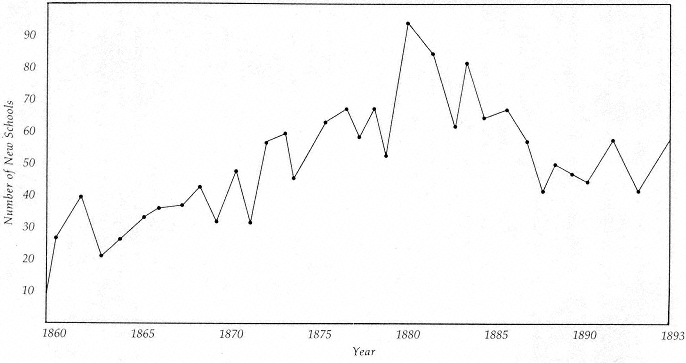
Chart 1.
Growth of Urban Schooling: Number of New Municipal One-Class Schools, 1860-93
Note: In 1856, there were 492 schools; in 1893, 2,227. Source: F. A. Fal'bork and V. I. Charnoluskii, eds.,
Nachal'noe narodnoe obrazovanie v Rossii (St. Petersburg, 1900), l:x, table 1.
longer nourished by "sorcerers, magicians, religious dissenters, [and] wanderers [stranniki , that is, religious zealots]" but warned that it had found new sources in "the taverns, the village kulak, the factory, the inn, and other products of contemporary economic relations." The result, he warned, was "degeneration and decay."[41] His apocalyptic version of modernity echoed the uneasiness among elites in the West and in Russia at the consequences of industrialization and urbanization. As much as the Kherson bishop or the visitors to Khitrovka, this Moscow educator was very aware and fearful of the strangeness of the city that was taking shape about him.
Moscow's duma, like those of other migrant cities, heeded this and similar calls (although we need not presume that it accepted the doomsday part of the argument). Smaller towns, however, lacked the resources and the commitment to undertake an educational crusade. In 1890 the Ministry of Education admitted that nearly half of the old district schools (approximately four hundred) had not been taken over by municipalities. It attributed this failure primarily to the "insufficiency of funds" of many towns.[42] It omitted to mention that the relatively ambitious curriculum of the district schools entailed an expense that the leaders of small towns judged to be an extravagance. The old informal methods, or the simple one-class level of schooling, sufficed for these town elders and presumably for their small electoral constituency.
In the migrant towns, however, economic opportunities provided a powerful incentive for expanded elementary education. There was a strong demand for free public (or parish) schooling. One simple indicator of this demand was the number of unsatisfied school applications in large urban centers. Although the evidence is incomplete, the figures suggest that the interest in elementary schooling was growing rapidly, more so than the financial support that municipalities were willing or able to commit to this activity. In Moscow in 1877 there were six hundred more admission requests than there were openings, and in 1890, despite a sevenfold rise in municipal expenditures on schooling, there were 2,600 excess admission requests. At the end of the 1890s Kharkov's schools, which had doubled
[41] Cited in Eklof, Russian Peasant Schools , 108; as Robert Nye has pointed out, in the late nineteenth century in Western Europe "degeneration" became a very fashionable code word to decry the conditions of the urban masses; see Robert Nye, Crime, Madness, and Politics in Modern France: The Medical Concept of National Decline (Princeton, 1984), esp. 330-32.
[42] Otchet ministerstva narodnogo prosveshcheniia za 1890 (St. Petersburg, 1894), 190-91.
in number since 1893, still had to refuse admission to five hundred children.[43]
The testimony of school directors and instructors, which was collected in a survey by the Petersburg Literacy Committee in 1894-95, reveals the social pressures behind the increase in the number of requests for public schooling. In words that echoed those of many other reports a Moscow priest who directed a large parish school concluded that "the huge demand for the creation of free schools" was caused by the "great size and the poverty of the parish's population."[44] The unstated expectation of the parents who sought to enroll their children was that the basic numeracy and literacy taught by these schools would serve to open access to employment for their offspring. For these parents the city was a place of work, harsh competition for well-paying jobs, and new opportunities for the educated. Second-guild merchants claimed that their "large families and extreme poverty" made financial aid indispensable from their merchant society, to whom they sent many petitions requesting support.[45] Their appeals reveal more about their eagerness for formal learning for their sons than about their standard of living. Their alleged "extreme poverty" bore no resemblance to that of the migrant laborers.
Unsatisfied demands for schooling and appeals for aid are indicators that the settled urban population had new hopes for the future and that these hopes centered on their children's educational preparation for work. Such sentiments probably had more influence on decisions to expand the number of urban schools than the dramatic warnings from the educated elite of the dire effects of ignorance. The combination of popular support and official encouragement brought action from municipal dumas. By the turn of the century several thousand elementary schools (primarily of the one- and two-class variety) with over one-half million pupils existed in urban Russia.[46]
The manner in which learning worked its way from classrooms and instructors into popular culture depended less on curriculum and adminis-
[43] E. A. Pavliuchenko, "Moskovskoe gorodskoe samoupravlenie v 70-80-kh godakh XIX veka" (Kandidat dissertation, Moscow State University, 1956), 217, 255; Novoe vremia , 18 December 1899.
[44] "Anketnye svedeniia o nachal'nykh uchilishchakh," TsGIA, f., 91, op. 3 (1894), d. 575, 321.
[45] Cited in V. I. Laverychev, Krupnaia burzhuaziia v poreformennoi Rossii, 1861-1900 (Moscow, 1974), 65.
[46] Nachal'noe narodnoe obrazovanie v Rossii , ed. F. A. Fal'bork and V. I. Charnoluskii (St. Petersburg, 1900, 1:vii; this four-volume publication summarized the essential quantitative results of the survey (based on over thirty thousand replies) but omitted the perceptive comments of the respondents, which were often included in the completed forms.
trative regulations than on the social dynamics of urban society. Ben Eklof, who has studied Russian peasant schooling, reminds us that the acquisition of literacy and formal schooling are separate phenomena, that the ability to learn is not identical with basic reading, and that parents as well as teachers are influential actors in setting the content and the extent of school learning that is transmitted to the pupils.[47] I take these warnings seriously in examining urban schooling even though there were substantial differences in the social and economic contexts of urban and rural schooling. Our knowledge of the concerns of pupils and parents comes largely from the testimony of teachers and the statistical data that the Ministry of Education collected. The extensive survey of elementary education, which was conducted by mail in 1894 by the Petersburg Literacy Committee, permitted instructors throughout the country to make clear their own ambitious plans as well as the support or opposition they encountered within their communities. These somewhat random clues indicate that at the level of elementary schooling educational authorities and urban parents had substantially different expectations.
Urban schoolteachers were both agents of the tsarist educational system and, to some extent at least, proselytizers in their own right. They created a set of sometimes contradictory objectives for their pupils. Echoes of the values of the Russian intelligentsia sounded in the words of one Moscow school instructor who was an avowed enemy of scholasticism. He defined the goal of teaching, which he presented as the true ambition of his pupils, as "a level of development necessary for an understanding of the surrounding world [priroda ] and for a critical [soznatel'nyi ] understanding of books."[48] His idealism, which supposed that his pupils would become participants in an interactive cultural environment, bore only a remote resemblance to the prescribed curriculum of these schools. It reflected the view, which was widespread in Russia and the West, that cultural uniformity was desirable. Confronting popular dialects and urban jargon, the teachers hoped, in the words of a Moscow girls' school teacher, to teach uncultured youth not only "to speak and write Russian correctly" but also "to understand literary Russian speech."[49] In this sense elementary schooling and literacy meant basic acculturation into the world of the intellectuals.
At another level the teachers' proselytizing sought a unity based on
[47] Eklof, Russian Peasant Schools , esp. chap. 1.
[48] "Anketnye svedeniia o nachal'nykh uchilishchakh," TsGIA, f. 91, op. 3 (1894), d. 575, 158.
[49] Cited in Christine Hinshaw, "The Soul of the School: The Professionalization of Urban Schoolteachers in St. Petersburg and Moscow" (Ph.D. diss., University of California, Berkeley, 1986), 123.
national identity. This political mission, which was also common to public schooling in Western nations, assumed special importance to authorities in the Russian cities because of their fears of social conflict and political subversion. The school curriculum invariably included Orthodox teaching and, usually, elementary Russian history; these were the means to transmit the two official virtues of piety and patriotism. They constituted the essence of learning for the instructor—cleric in a Kiev parish school. He affirmed his commitment to teaching his pupils the "national language" and to conveying to them that "the most holy duty of a well-raised person is faith in God, lofty patriotic sentiment toward the throne and the fatherland, [and] the spirit of love toward one's neighbors and one's family."[50] His language, which sounds stilted and arrogant to our skeptical era, echoed the official nationalism of the tsarist government. Although backed by the power of state and the authority of tradition, it was as remote from the mechanical exercises involved in numeracy and literacy as was the cultural idealism of the Moscow instructor.
Urban social conditions played a decisive role in determining the impact of elementary learning. Schools were part of a community whose members were deeply divided by rank and wealth. Powerful voices among tsarist educators spoke in favor of schooling according to social standing. It was evident in the comments of the director of a Voronezh one-class school, who was convinced that "because almost all the pupils belong to families of artisans and peasants, the students of the school fully satisfy them."[51]
These varied educational objectives provide one indication of the competing cultural agendas for the Russian city. Schooling proposed language skills and basic concepts with which educated Russians (in their capacity as officials, intellectuals, or radicals) could hope to form a common discourse with an urban population whose social conditions and awareness of their own place in society were in rapid flux. At the same time it provided, at a very basic level, practical and vocational skills that offered immediate occupational rewards in economically dynamic urban centers. For many Russian townspeople these two objectives were of unequal importance.
The indirect evidence we possess on popular educational goals suggests that none of these authoritative opinions expressed the dominant attitude of townspeople toward elementary education. When the opportunity arose to place their offspring in more advanced schools, parents seized the chance—very different behavior than most rural families, who appear to
[50] "Anketnye svedeniia o nachal'nykh uchilishchakh," TsGIA, f. 91, op. 3 (1894), d. 445, 82.
[51] Ibid., d. 321, p. 19.
have been convinced for both cultural and economic reasons that only the most essential learning was desirable.[52] By the 1890s a skeletal framework of a "ladder" of urban education was in place. Indicating the openings for his graduates, a Kiev teacher in a one-class school cited an array of possibilities that included "the two-class school, the artisan school, the medical orderly school, and, for the best students, the realshule [technical] secondary school]."[53] That these schools represented real opportunities to townspeople is apparent in the enrollment figures. One of the best networks of secondary technical schools were the railroad institutes: over thirty of these institutes were founded in the 1870s and 1880s. The director of the Kiev railroad school, proud of the fact that all his teachers were gymnazium graduates, remarked in 1894 that every year his institution of 250 pupils had to turn away from fifty to one-hundred applicants.[54]
These figures, although minute in proportion to the population of youth in a city like Kiev, suggest that families in the migrant cities were aware that education promised economic and social advancement. At some level economic need and social constraints led parents to set a limit to such hopes. A note of fatalism appears in the judgment of a Moscow director, whose pupils' future beyond his school appeared determined by the urban world to which they belonged. "The poor parents," he forecast, "will place their boys in apprenticeship, traders will put their boys in commerce, and the well-off [sostoiatel'nye ] will put their children in other educational institutions."[55] Prospects for new and better jobs were present in the migrant cities thanks to the multiplication of public services and economic activities. The inspirational motto for this open door to the future was the urban intellectual's exhortation to his son to "study or you won't find decent work" (at least such was the analysis of a rural schoolteacher contrasting rural and urban attitudes toward schooling).[56] Popular literature imitated and shaped reality in this respect. The success of the Russian translation of Smiles's inspirational book, Self-Help , is one indication. Another indication is found in the popular novels of the late century, which contained, in Jeffrey Brooks's careful reading, a prominent theme of "education for concrete practical aims."[57]
The hope that successful pupils would find "decent jobs" was under-
[52] Eklof, Russian Peasant Schools , 440-41.
[53] "Anketnye svedeniia o nachal'nykh uchilishchakh," TsGIA, f. 91, op. 3 (1894), d. 445, 15.
[54] Ibid., 174-75.
[55] Ibid., d. 575, 193.
[56] Cited in Eklof, Russian Peasant Schools , 253.
[57] Brooks, When Russia Learned to Read , 282.
mined by social conservatism and cultural prejudice. Anti-Semitism restricted to a handful the number of pupils from the Yiddish elementary schools in the Pale of Settlement who could hope to enter more advanced (Russian) public institutions. Urban schooling was as diverse as the population that was moving into and through the cities and was as much subject to these influences as it was a force in its own right. By the late century the composition of urban elementary schools resembled the social profile of the typical migrant city; among the 8,500 pupils in Moscow's schools in the mid-1880s nearly 40 percent came from the petty bourgeoisie and almost as many came from the peasantry.[58] Both families and teachers set clear limits to the formal learning of children from these groups. One cleric-instructor claimed in the mid 1890s that, because his new parish school experienced an "enormous influx of parents seeking to enroll their children," the "common people" [prostoi narod ] were aware of "the necessity of studies."[59] Implicit in his observation was the expectation that education would not alter the lowly social standing of his pupils.
Cultural conservatism and poverty meant that the restrictions on learning for girls were more confining than those for boys. In the mid-1890s Moscow's school population included as many girls as boys, but girls remained tightly bound to the family and there were few occupations for which elementary education could prepare them. An Ekaterinoslav instructor of a one-class girl's school explained that her "poorer" graduates "satisfy themselves with this level of education" but added that those who entered the advanced school in town "take the special sewing section."[60] Employment in positions such as seamstress, governess, or instructor in a girl's school was the best that girls could hope for. The genteel poverty offered by these trades was a more dignified status in the community than that of their families—most schoolgirls were from the petty bourgeoisie—but it represented a paltry reward by comparison to the possibilities increasingly available to boys. Gender was an obstacle to schooling itself; girls continued to assume special family responsibilities. In the opinion of one Moscow teacher, the girls were frequently absent from class because they lacked "warm clothes and [because they had] to replace their mothers in caring for younger brothers and sisters." Another teacher attributed their responsibilities at home to "sick or drunk adult members of the
[58] "Vedomost' o nachal'nykh uchilishchakh," Izvestiia Moskovskoi gorodskoi dumy 3-4 (1886):154-55.
[59] "Anketnye svedeniia o nachal'nykh uchilishchakh," TsGIA, f. 91, op. 3 (1894), d. 575, 211.
[60] Ibid., d. 371, 22.
family."[61] Boys were spared this duty because they were not constrained by the family domain.
The indifference on the part of many parents toward "higher culture" set the limits to the boys' contact with formal schooling. Eklof argues that the low percentage of graduates from rural schools was not the result of the need for child labor but because the full program of studies was irrelevant to peasant occupations.[62] Ironically, a similar condition emerged in the cities, albeit in a very different context and to a lesser degree. Although urban schools were able to attract a large and growing proportion of school-age children, at the end of the century they were nonetheless unable to hold more than half of them until graduation. However, the situation appears to have been an improvement over the 1870s. In 1878 a Ministry of Education survey of urban schools found that the schools in the major cities lost three to six times as many pupils as they graduated.[63] The result was that the large majority of pupils, whose ages clustered between eight and eleven, were in the class sections that covered the first two years of study. In that period they acquired what an educator from the southern Russian town of Rostov-on-Don called "the rudiments of reading and writing."[64] Thus, for many Russian townspeople the urban print culture signified little more than the acquisition of basic numeracy and literacy.
Undoubtedly, parents' decisions to limit their children's education involved calculations of relative opportunity costs. In explaining the high dropout rate, educators and pupils often referred to poverty, but this explanation carried with it the parents' perception of their current needs and the future prospects of their offspring, on whom they relied for security in their old age. When asked why they did not complete their schooling, a majority of young Moscow workers polled at the turn of the century referred to a parental decision; at times they explained the decision on the basis of "poverty," but more often they associated it with the parents' will.[65] As in rural areas, formal elementary schooling in the cities did not by itself disrupt family and social patterns of behavior and attitudes. As a consequence, both the critical reading faculties that the Moscow factory
[61] Ibid., d. 575, 128, 157.
[62] Eklof, Russian Peasant Schools , chaps. 11, 12.
[63] "Otchet ministerstva narodnogo prosveshcheniia," TsGIA, f. 733, op. 117, d. 68 (1878), 311: the end-of-the-century data come primarily from my reworking of the archival data in the 1894 survey for urban schools in Moscow, Ekaterinoslav, Kiev, and Voronezh provinces.
[64] Izvestiia Moskovskoi gorodskoi dumy 25 (January 1903):69.
[65] Cited in Rashin, Formirovanie rabochego klassa Rossii (Moscow, 1958), 592.
instructor sought and the elaborate piety and patriotism that the cleric-teacher preferred had little chance of shaping the malleable minds of their young pupils.
Having acquired the rudiments of reading and writing, town youths had an increasingly diverse and rich print culture available to them. To the extent that publications in the cities were accessible to this minimally educated public—a topic I discuss later—a close tie existed between the learning conveyed by formal schooling and the urban literary culture in the cities. The culturist aspirations of educators worked their influences on youths in school, but an increasingly varied array of readings outside the classroom were also important. When one instructor noted that many of the parents of the pupils in his factory school "subscribe to magazines and newspapers," he unwittingly identified a key explanation for the presence of those pupils in his class.[66] Urban schooling was a part of a larger process of cultural adaptation to the new city. Those families with newspaper and magazine subscriptions had found one means by which to expand their own horizons as well as those of their children. In their own way they had entered the world of print culture; by sending their offspring to the factory school, they were ensuring that their children would be part of that world too.
Those who placed their hopes for the future in an enlightened city promoted cultural activities that made education accessible to adults. The movement for literacy schools, which was directed at the laboring population, was funded and led by volunteers. Like other popular causes in those decades, this movement attracted educated Russians who were aware that their cultural activities were pathetically meager when compared with both the need for action and their own idealistic language. An easy target for cruel satire, their work reveals a great deal about the efforts to reshape urban culture. Volunteer cultural work attracted some of the civic activists, particularly in the field of teaching the skills associated with basic literacy. This area served as a test of the commitment of educated Russians to social progress. In the early 1860s, when municipal support for elementary schooling first appeared, a movement for adult literacy schools also emerged.
This first period of volunteer schooling revealed the traits that would characterize the movement throughout its existence. The campaign was the product of a cultural vision that, in the words of one young idealist, literacy
[66] "Anketnye svedeniia o nachal'nykh uchilishchakh," TsGIA, f. 91, op. 3 (1894), d. 574, 232.
would let a "beneficial light" shine on the people.[67] Just what this light would reveal depended on the political persuasion of the volunteers. Some were openly hostile to the tsarist regime. In 1862 this hostility led the tsarist government to ban the movement it had authorized just two years previously.
During their brief existence the two hundred literacy schools sustained the hope of their own organizers and teachers that this form of idealism met popular needs and united the urban masses and educated society. One of the women teachers recalled later that volunteer teaching of basic numeracy and literacy constituted "the very first outlet for our aspiration for work, the public good, [and] contacts with the people."[68] Although her vision drew no distinctions between classes of people, literacy schools served the laboring population of the capitals and the provincial centers. They met on workers' one free day of the week and received the title of Sunday schools. For their part, the pupils fixed the goal of this schooling as the acquisition as quickly as possible of the "rudimentary skills" for life in the city. The disparity between the idealism of many teachers and the vocational objectives of the students was enormous.
Despite tsarist fears of political subversion, the authorities were not prepared to ban entirely volunteer efforts to raise urban literacy levels. In 1874 the government reauthorized the literacy schools; its readiness to take this step suggests that the tsarist regime placed a high priority on the diffusion of basic literacy skills among the population. The Ministry of Education reorganized the rules on the organization of the schools to control the suspicious enthusiasm of the volunteer teachers while still tolerating their presence. The hostility of the authorities remained a serious obstacle to volunteer schools; in 1889 Moscow's authoritarian governor-general, for reasons that are not clear, forced the city duma to close nine of the existing fifteen adult schools.[69] Sporadic tsarist repression did not dissuade the volunteers, and in fact it may have encouraged them. Both the government and the volunteers shared a conviction that a literacy movement was a necessary part of the campaign to spread elementary education among the population.
Although tsarist regulations made no distinction between city and coun-
[67] TsGIA, f. 1282, op. 1, d. 74 (1862), 191; see also Reginald Zelnik," The Sunday-School Movement in Russia, 1859-62," Journal of Modern History 27 (June 1965): 151-70.
[68] Z. Bazileva, "Arkhiv semei Stasovykh," in Revoliutsionnaia situatsiia (Moscow, 1965), 439.
[69] L. F. Pisar'kova, "Deiatel'nost' Moskovskoi gorodskoi dumy v oblasti meditsiny, narodnogo obrazovaniia i obshchestvennogo prezreniia posle 1892," Problemy istorii SSSR 7 (1978): 137.
tryside, the centers of volunteer work were once again the provincial capitals. At times factory owners promoted adult education for their workers, but most often literacy committees took the initiative. The leader (until its forced reorganization in 1895) was the St. Petersburg Literacy Committee. By the end of the century there were almost three hundred schools in seventy-five cities, and total enrollment was estimated to be fifty thousand pupils. St. Petersburg and Moscow were the most active centers of the literacy movement, each with over twenty schools.[70] The literacy campaign, although numerically small in comparison to public schooling, played a significant role in raising urban literacy and in encouraging hopes for an enlightened urban population.
Idealism was once again a powerful motivation for the organizers and teachers. If the attitude of one participant in the Kharkov literacy committee is representative, to become a volunteer was to prove one's rightful place among "the best representatives of the intelligentsia." In his opinion, "Among former and present inhabitants of Kharkov [every name] known for scientific or public activities" was present on the list of members.[71] The Kharkov committee's membership had known both lean and prosperous years. The latter came at the beginning of its existence and at the end of the century, when it counted almost seven hundred members.[72] Its activities, which were typical of the provincial centers, included the founding of both a men's and a women's school. The women's school was specifically intended for girls working in clothing enterprises "because a large portion of the girls of the poor urban population choose the sewing trade."[73] This type of activity was "small deeds" without bureaucratic interference; it was visible evidence that intellectuals and the urban poor could find a common cause.
The lofty ideals of the organizers of the adult literacy schools were far removed from the practical concerns of the pupils. The evidence suggests that most of the adult pupils shared the same single-minded concern for the acquisition of rudimentary skills that the school children in elementary public schools exhibited. The 1894 survey cited earlier contacted some of these schools. The director of one Moscow women's literacy school made the somewhat disabused judgment that "very many [pupils] are satisfied with acquiring the ability to read 'any' little book, to write notes, to cal-
[70] L. M. Ivanov, "Ideologicheskoe vozdeistvie," in Rossiiskii proletariat: Oblik, bor'ba, gegemoniia , ed. L. Ivanov (Moscow, 1970), 331-32.
[71] A. Didrikhson, Istoricheskii obzor deiatel'nosti Khar'kovskogo obshchestva rasprostraneniia v narode gramotnosti (Kharkov, 1911), 9.
[72] Ibid., 243.
[73] Ibid., 59.
culate bills, [and] to do arithmetic; [they] leave school after one or two years." He also noted that his two hundred pupils were largely migrants (three-fourths belonged to the peasant estate), some working in factories, others in workshops, and that they possessed the rudiments of learning before joining his school.[74] For the migrants, schooling was part of an effort to find for themselves as secure a place as possible in their new urban world. The great majority of the pupils in the literacy schools were young; in the mid 1880s only 15 percent were over seventeen years old.[75] The effort to create an integrated urban literate culture reached those whose first priority was to acquire early in life the skills that would be most useful for a successful career in the city.
The encounter with the volunteer teachers left an abiding impression on a few of the pupils. One worker, who recalled that most of his young Petersburg factory friends preferred recreation to learning, recorded his own astonishment that "people of another world [sreda ]" would "teach for free, that is, solely for the sake of bringing knowledge to the people."[76] In that encounter his search for enlightenment led him into the Marxist revolutionary movement. In the same spirit, another Petersburg worker noted in a school essay that as a result of his education he was able to see "with more open eyes how people of other lands live and work."[77] He expected that this understanding would become a guideline to social and political action. It was a hope that some of their teachers were more than willing to satisfy. These cultural ambitions exceeded by far the goal of most pupils to learn to read "any little book." But both objectives were capable of remaking, in different ways, urban popular culture.
In the last decades of the nineteenth century Russian migrant cities were centers of intensive educational activity. The spread of formal schooling was the most important part of this process. Officials, civic activists, and intellectuals endeavored—albeit with very different goals—to incorporate the largest possible proportion of townspeople into a print culture. The goals of those who organized the campaigns to spread the basic skills of learning are relatively easy to discern. However, it is far more difficult to assess the impact of the acquisition of these new cultural tools on millions of individuals. The subject, one that extends far beyond the scope of this study, is explored very thoughtfully in Eklof's examination of rural school-
[74] "Anketnye svedeniia o nachal'nykh uchilishchakh," TsGIA, f. 91, op. 3 (1894), d. 575, 2-9.
[75] "Vedomost' o nachal'nykh uchilishchakh," Izvestiia Moskovskoi gorodskoi dumy 3-4 (1886): 158-59.
[76] I. V. Babushkin, Vospominaniia (Leningrad, 1925), 35-36.
[77] Cited in I. A. Shuster, Peterburgskie rabochie (Leningrad, 1976), 54-55.
ing. He points out the problematical significance of the simple measure of literacy (that is, the ability to read) in assessing the significance of changes in literacy rates. Nonetheless, literacy figures remain the only quantitative indicators that are capable of summarizing such a massive process.
These indices suggest that by century's end the majority of the urban population had access to some form of print culture. The 1897 census found that 60 percent of the population of migrant cities was literate, a substantial increase from the mid century. Literacy varied enormously among age and social groups. Many adult migrants were illiterate and, especially in the reform years, the intensive migration from the countryside to the cities had undoubtedly slowed the increase in literacy levels. There is good reason to believe, however, that by the close of the nineteenth century rural families understood that basic literacy and numeracy were a valuable skill for urban migration, and many found schooling for their offspring.[78] To judge by the conscription reports and by the factory records of young workers (most of whom were migrants), by the 1890s literacy had spread among almost all young men in the cities.[79] The migrant cities in these crude terms were becoming places where the printed word could reach most of the adult population.
Whether or not this access to the world of print culture entailed a fundamental change in beliefs and learning skills is a question that cannot be answered with certainty. The evidence is scanty and contradictory. Urban daily life offered both practical and leisure-time inducements for the urban population to use the rudimentary skills that they acquired in elementary education. Scholars have subsequently confirmed what firsthand experience revealed, namely, that "achievement in handling the tools of reading and writing is one of the most important axes of social differentiation in modern societies."[80] The retention of literacy and numeracy was a perennial problem among the rural population, but it does not seem to have been an issue among the urban population. The return to the village of the successful urban migrant was potentially an ample reward for literacy. In the city, proof that literacy and numeracy were rewarded in both work and leisure was everywhere available. In this sense cultural modernity was present among the urban population.
Tsarist officials, religious leaders, and educators were deeply divided on
[78] Eklof, Russian Peasant Schools , 268.
[79] "Gramotnost' i stepen' obrazovaniia prizyvnykh," Sbornik statei po voprosam otnosiashchimsia k zhizni russkikh gorodov 11 (1901): 258-61; S. V. Bernstein-Kogan, Chislennost', sostav i polozhenie Peterburgskikh rabochikh (St. Petersburg, 1910), 66.
[80] Jack Goody, "The Consequences of Literacy," in Literacy in Traditional Societies , ed. Jack Goody (Cambridge, Mass., 1968), 58.
the question of the moral efficacy of schooling and literacy. No educated Russian aware of the migrant strangers in their city would mourn the decline of superstition as a result of education (if indeed such were the case), but what was its effect on religious faith? Formal learning had its own practical rewards, but could it counteract the forces of the tavern and the brothel to instill the desirable personal traits of sobriety and industriousness? The debates about learning and popular culture in the cities touched on issues of personal conduct, labor relations, and public morality. Although some cultural leaders found hope in the spread of schools and popular reading materials, others sounded a somber note. They worried that "decay and decadence" would overwhelm their crusade for enlightenment.
More sanguine observers, however, stressed the spiritual benefits of learning. The bishop of Saratov seemed to have constructed his own ideal "city on a hill" when in 1896 he contrasted the "simple, childlike faith" of the "rural, illiterate population" and the heightened "level of religious knowledge" of the Bible, the liturgy, and church ritual that he attributed to the "literate [urban] population."[81] In personal accounts of the impact of schooling on urban youth, some instructors echoed this optimistic view. According to the cleric-instructor in one southern town, the parents of pupils in the parish school were "very pleased that their children can read and sing at church services, and [they] require them to read at home."[82] Thus, learning and urban religious practice were compatible. One instructor of a factory school in a provincial town in Moscow province noted in the 1894 survey that schooling appeared to him to "diminish drunkenness" and to augment his students' interest in "reading more books on religious subjects."[83]
Whatever the veracity of such judgments, they reflected a deeply embedded assumption about print culture. Like the radical intellectual who brought socialist doctrine to pupils in a literacy school or the factory manager who was convinced that literacy, sobriety, and industriousness formed a single personality type, no one spoke out against education; all assumed that the processes of learning were part of the transformation of urban culture as a whole. They were as preoccupied with the moral impact of education as they were concerned about the strange, threatening world
[81] "Otchet o sostoianii Saratovskoi eparkhii za 1896," TsGIA, f. 796, op. 442, d. 1636, 20.
[82] "Anketnye svedeniia o nachal'nykh uchilishchakh," TsGIA, f. 91, op. 3 (1894), d. 448, 3-4.
[83] Ibid., d. 574, 227-28.
of ignorance and decadence in slums such as Khitrovka. Despite evidence that the cultural values and social relations among the urban population could not be controlled, other movements in addition to the campaign for schooling attempted to guide cultural change in the Russian migrant cities.
Sobriety, Learning, and the Penny Press
Although the warnings that a cultural crisis existed in the Russian city of the late nineteenth century were exaggerated, they reflected a widespread consensus that action was necessary. The agreement among cultural activists on the desirability to expand efforts to promote schooling and literacy was in large part produced by these fears. Laments about drunkenness, ignorance, and immorality fit well with contemporary stereotypes of both the "barbarism" of a backward land and the decadence produced by industrialization. The tavern, whose presumed life summed up the nature of the crisis, was the enemy of those who defended godliness, enlightenment, and industriousness. The nascent penny press also appeared to be a nefarious influence on popular culture. Many educated Russians thought that its sensationalist accounts of local events and its emphasis on the "human interest" aspects of urban life were crass commercialism that pandered to base popular tastes. Because of these apprehensions an officially sponsored movement to use the tools of print culture to promote sobriety, moral behavior, and industriousness received strong support in provincial cities. These culturist activities found an audience among the urban population and all to some extent helped to reshape urban culture.
In the last half of the nineteenth century the commercial press became an active cultural force in its own right in the cities. As in Western cities earlier in the century these publications included a national and a penny, or "boulevard," press. Both were commercial operations. The national press, however, set ambitious cultural objectives: it offered an encapsulated version of a "newsworthy" world that extended far beyond the mundane events and ordinary practices of the migrant city. Appealing to a relatively well-to-do public, the commercial success of the national press was assured if it attracted a substantial number of subscriptions, for its sales price was relatively high. The so-called penny press thrived on the commercial formula of low prices, mass sales, and advertising. As a result, it drew its
inspiration from and depended for survival on a large urban reading public.[84]
Both the national and the penny presses were cultural innovations whose essential conditions for survival appeared only in the reform years. In the last half of the nineteenth century, urban education and effective literacy were sufficiently widespread in towns throughout European Russia to create a large market for publications. Public interest in social and political events in Russia was stimulated by the reforms themselves. The government was aware of the need for public and unofficial daily publications, which were conceivable only if they enjoyed relatively few administrative restraints. For all its defects the new censorship statute of 1865 permitted the daily press to become a public forum. Although it set strict limits on the types of events that could be reported, it did not repress the rapid flow of information. It did this in a spirit of what contemporaries called "openness" (glasnost' ). Newspapers could request the right to publish without "preliminary censorship," but remained subject to various penalties (the most potent of which was a temporary ban on public sales) if censors judged articles to be unacceptable. At about the same time the spread of the railway network opened up a larger market: the speed of distribution was crucial to make daily news salable. In effect readership followed the rail lines beyond the city of publication. Finally, the openness instituted by the tsarist reforms made abundant information on public happenings accessible to journalists. The national press created its own blend of news for its propertied, respectable public. The penny press found greater rewards in unusual daily events such as crimes, fires, and collective fistfights. Scorned by the elite, these stories were the kind of titillating and sensational news that attracted a mass audience.
The migrant cities were both the market for the boulevard and national papers and the source of much of the information out of which the editors created their daily text. In their social diversity, economic dynamism, and multitude of personal stories of work, success, and social ambition, the migrant cities became a sort of theater of everyday drama that was often unfamiliar and unsettling, but potentially enthralling for a public that was curious to learn more about the world by means of these immediate daily events. The ways that newspaper stories satisfied their readers is a problem to which historians of urbanization have no definitive answers. Gunther Barth, studying "city people" in the United States in the nineteenth cen-
[84] The distinction between the national and the penny presses is discussed in detail in Louise McReynolds, "News and Society: Russkoe slovo and the Development of a Mass-Circulation Press in Late Imperial Russia" (Ph.D. diss., University of Chicago, 1984), chap. 1.
tury, argues that the market for newspapers was created by "the longing of urban masses for identity." This psychological theory rests on the dubious assumption that the city destroyed both personal and collective identities. The "need for information about a bewildering place" that he finds among U.S. readers can be more readily explained by the cultural unfamiliarity of the peoples and the places that the migrants encountered in the city. In Russia, as in the United States, the movement of migrants into the cities was largely a collective endeavor that involved the assistance of family, fellow villagers, and countrymen. The migrants were nonetheless strangers in the sense that beyond the few known locations of neighborhood, taverns, and workplace they confronted unknown places and people in the city. Similarly, established townspeople observed the rapid growth and transformation of their cities, which offered them a strange spectacle of vast human proportions. In this sense, one might agree with Barth that "modern city life" was potentially "the greatest news story of the nineteenth century."[85]
Finding the subjects and style of these stories was the work of the pioneering editors of the new national and penny presses. The national press took shape in papers such as Novoe vremia (New Times) and Birzhevye vedomosti (Stock Gazette). These papers found a large circulation by appealing to educated readers and to members of the business community in St. Petersburg, where both were published, and beyond. Besides an emphasis on business news, Birzhevye vedomosti also included extensive coverage of European events and even occasional articles titled "What they are thinking and doing in the provinces." Its contents fitted the interests of its national audience so well that by the end of the century its circulation reached 100,000, the first Russian paper to do so.
The national press became a key ingredient in setting the tone of public opinion (obshcestvennost' ). All positioned themselves on a political spectrum from conservative to liberal. In this respect their cultural voices helped to create, in Habermas's terms, a literary public sphere in the same decades that the municipalities and other official and informal institutions were contributing to the rise of a civic public sphere.[86]
The national newspapers were also commercial enterprises whose contents and readers were found largely in the merchant city. Their editors sought to sell a cultural product by appealing to the tastes and interests of the propertied and educated public. Thus, some of the stories were cultural
[85] Gunther Barth, City People: The Rise of Modern City Culture in Nineteenth-Century America (New York, 1980), 59.
[86] Jürgen Habermas, L'espace public , trans. Mare de Launay (Paris, 1978), 189-93.
creations that involved an "imaginary city" in which the readers believed themselves to be at home. This skill in making the city a known place appears clearly in another genre of popular writing that emerged in those decades, namely, the city guides.
The authors of city guides were in their own way engaged in creating an imaginary city. In their case the city was a place of known, tangible locations with which the readers easily identified. They were responding to the practical needs of a reading public that lived in and traveled to the major Russian cities. Implicit in their collection of factual information was a model of the city with concrete spatial and temporal dimensions.[87] Their books provided "mental maps" for readers with the reading skills demanded by such guides, the money to purchase such relatively inexpensive items, and the powers of imagination to locate the city in space and time. The guides were specifically intended to turn the city into a recognizable location for its residents and, particularly, for outsiders. With a guide in hand, its owner would cease to feel like a stranger in the city.
When the guides began to appear in substantial numbers in the 1860s and 1870s, their content and style were calculated to appeal to a public in need of knowledge. Baedeker's series of guides, which had originated earlier in the century, provided the model. The Russian authors repeatedly stressed the importance of the reader in choosing relevant material. As one guide to Moscow stressed, the reader's verdict" will determine the future of the series." Claiming to contain "all necessary information for travelers," this guide contained the "indispensable addresses" to public agencies and services, the "notable sites" where the city's glorious history could be seen, and a special chapter on the marvelous future that the technical and manufacturing exposition, which was being held at the time of publication, promised.[88] The guides became available for an increasing number of provincial cities later in the century. They gave a cultural and "businesslike" description of urban space. They told dramatic historical stories, assigning to cities their own significant role in the national epic. For example, an Odessa guide stressed its rise from a "half-savage Tatar village" to "progressive" city in less than a century.[89] Travel across the territory that separated these Westernized centers presented a real challenge. A guide to the Volga basin warned its readers that "the development of civilization" in
[87] My interpretation of these city guides is inspired by Iurii Lotman, "K probleme prostranstvennoi semiotiki," in Semiotika prostranstva i prostranstvo semiotiki , ed. I. Lotman, Trudy po znakomym sistemam , no. 19 (Tartu, 1986), 1-16.
[88] V. Dolgorukii and V. Anofriev, Putevoditel' po Moskve i ee okrestnostiam (Moscow, 1872), vi.
[89] Putevoditel' po Odesse (Odessa, 1867), 5.
this area, although unlike "southern Africa," had not brought conditions up to the level of Western Europe or the United States.[90] Although somewhat redefined by Russia's entry into the age of steamboats and railroads, the province remained an exotic, backward territory within which the cities were islands of refuge and comfort.
The practical knowledge necessary to survive and prosper in the merchant city assumed an increasingly important place in the guides. By the end of the century the literary-historical themes had dwindled in importance. The city's role in history mattered less to the readers of those years than its sites of administrative and business affairs. The editor of a new guide to Odessa set a businesslike tone to his work by informing his readers that "following the rule that time is money, I tried to avoid wordiness." His book was intended to be a handbook to daily affairs, for its contents were "prepared on the basis of everyday experience" and provided" a rapid familiarization with the city."[91] It omitted any mention of historical events or monuments, for Odessa's time had become businessman's time. For his public, real and imagined, the city's present and future mattered more than its past, and its official and workday practices were more important than the hallowed symbols of cultural glory.
Unlike the earlier fairs, the 1896 national exposition in Nizhny Novgorod was the subject of several guides. They incorporated everything needed for the traveler, including railroad timetables and glowing accounts of the exhibition park, the buildings, and the exhibits. These publications were as important as the reports of journalists in creating an aura of reality around an event that sought to bring the future to the present by constructing an artificial Volga city of technology and industry. Although the guides were perhaps illusory in their depictions, their language of productivity and technology represented only an extreme version of a theme that was of growing importance in other urban guides of the time. For the reading public of these guides the Russian city as workplace assumed the shape and color of industrial modernity.
The intended audience for these guides, like that of the national press, belonged to the Westernized cities of business and public affairs. It was quite different from the presumed readers of the penny press. The images of the city created on the pages of the guides or in the daily articles of the elite newspapers explicitly or implicitly honored the ideals of civilization and enlightenment. In spirit and content they maintained ethical standards
[90] Ia. Kuchin, Putevoditel' po Volge (Saratov, 1865), 1.
[91] Odessa v karmane na 1896 (Odessa, 1896), 1.
of patriotism and propriety. Their writing belonged to the cultural domain of literary Russia; it was satisfying to those educated Russians with a culturist agenda for the new city.
The penny press belonged to a different cultural world. The distinction that Jeffrey Brooks draws between "edifying or instructive publications" and "popular commercial literature" can be applied to the journalistic genres of the national and the penny presses.[92] For boulevard newspapers as for popular fiction, salability largely determined both form and content. Certain writers moved back and forth between the penny press and popular literature because they shared with editors an overriding concern to exploit the topics and themes that would capture a mass reading audience. The boulevard newspapers created a panoramic picture of urban daily life that bears more than a passing resemblance to the issues that emerged in the debates of the municipal dumas. At times their writers and editors addressed civic affairs, speaking in the name of the city and its people. However, publishers put sales before sermonizing. The penny press combined commerce and knowledge in a way that was often judged as scandalous by tsarist officials and urban reformers alike.
Like similar papers in Western cities, the Russian boulevard press represented a new and problematic cultural venture. Their editors abandoned the familiar world of the intellectual and business communities. By seeking to appeal to the popular urban reader, they were forced to invent on the pages of their papers a way of representing the Russian city for which there was no precedent. As in the West, the popular newspaper had to "create itself" before "creating its public."[93] Educated observers saw the triumph of vulgarity over culture in the unintellectual character of these newspapers. When the first one appeared in St. Petersburg in the 1860s, a critic considered it to be an outright rejection of the culturist "heavy journals" that set the tone of intellectual debate in those years. Employing the formulaic social distinctions of urban activists, he explained that "obviously" the literary language and complex subjects of the heavy journals were beyond the grasp of "petty bourgeois, artisans, and the poorest townspeople, who, if they read anything, buy cheap newspapers."[94]
For its commercial survival the penny press had to discover and appeal to the tastes and interests of a large public. Many of its readers probably possessed a level of education not much above the rudimentary knowledge
[92] Brooks, When Russia Learned to Read , 296-97.
[93] Olga Hughes, News and the Human Interest Story (New York, 1940), 7.
[94] Knizhnyi vestnik 13 (1865):254; cited in "Russkaia gazeta vtoroi poloviny XIX veka," by B. Esin (Doctoral dissertation, Moscow State University, 1973), 1:296.
of reading and writing that urban youth sought in primary schools. Social context defined the content and style of the penny press. In the years when a culturist movement was organizing public readings on suitably respectable subjects for a population that the Minister of Education referred to as the "worker estate and the lower levels of society," the penny press was attempting to sell a very different form of print culture to that same public.
In doing so it incorporated into its selection of newsworthy information many scenes from daily life and presented its articles in popular, idiomatic speech. Sometimes, these human interest stories became the centerpiece of the daily news, continuing a practice that editors of culturist publications had already baptized as the fel'eton . Following the model of the French feuilleton , this rubric appeared in the national press in the form of literary criticism or witty stories. In the 1870s Dostoevsky published his Diary of a Writer in a fel'eton format.[95] It reemerged in the penny press in a somewhat new form to designate human interest stories (and occasionally serialized popular fiction) that was written in a "folksy" manner. It avoided the appearance of serious news, using titles such as Mezhdu prochim (Among Other Things) or Tsentki (Little Incidents) and signed with absurd pseudonyms such as "Not I" (the modest writer's ready reply to the query of who had written such trash). The authors adopted an unassuming, "natural" pose; they selected very ordinary but lively topics that were drawn from everyday life and they wrote their stories in an unliterary style. Their articles bore no resemblance to serious literature. Maxim Gorky, who began his writing career in his mid-twenties as a fel'etonist for a provincial paper, soon had moral qualms about this manner of pandering to popular tastes. He later accused such writers of "encumbering the memory of people with the trash of photographic images of their lives."[96] Yet it was just this type of entertaining account of daily life that could assure the commercial success of a boulevard newspaper.
Human interest stories were literary creations that made use of a strong does of imagination and that suspended standards of accuracy to give dramatic significance to their subjects. The formula that produced these stories proved to be very effective, and by the 1890s the fame and commercial success of Russian popular newspapers depended partly on the skill of their fel'etonisty . The authors of the fel'eton were sufficiently influential to shape, as well as to reflect, the views of the mass reading public. In the
[95] Dostoevsky's feuilleton writings are examined from a literary point of view in Gary Saul Morson, The Boundaries of Genre: Dostoevsky's "Diary of a Writer" and the Tradition of Literary Utopia (Austin, Tex., 1981), esp. 14-17.
[96] Maksim Gorkii, "Chitatel'," Sobranie sochinenii (Moscow, 1949), 2:202.
opinion of one American sociologist, similar writers in the American penny press were able to lead their readers "through the human interest in a personal story toward an acquaintanceship with a simplified and trivialized but wider world."[97] In late-century Russia, that wider world was primarily the readers' own city, which was presented to them in a dramatic, imaginative but identifiable form.
The recourse of the penny press to items that respectable society judged to be scandalous made it especially objectionable to critics. By comparison with later boulevard papers, the news that appeared in the first penny press publication. Peterburgskii listok (founded in 1865), was deferential to authority and sober in tone. However, the efforts of its editor to include incidents from the city's daily life, its crimes, and the abusive treatment of its less fortunate population earned the paper the reputation for yellow journalism. The editor was frequently brought to court by readers who accused him of defamation. Most serious of all, the Petersburg Censorship Committee subjected his paper to constant harrassment, periodically banning street sales (once for five years). The committee's hostility seemed to be based as much on its fear of the reading masses as on the paper's content. One censor condemned the editor because he allegedly sought "above all to pander to the crude tastes" of the "Petersburg demimonde [polusvet ]." In the category of "demimonde" the censor included "artisans, tradesmen, and various types of petty individuals [melkie liudi ]" who lacked a "well-developed revulsion against crime."[98] Those who shared the censor's conservative outlook preferred to keep the urban scandals hidden from view. But the penny press needed to keep the city's lower depths on the pages of their papers in order to attract readers.
Despite tsarist censorship, the Petersburg paper proved by the late 1870s that the steady production of popular and scandalous news was a formula for commercial success. Its reading public learned on its pages of both a known and an unknown city. The stories that the paper told relied to a certain extent on popular stereotypes: the drunker trader, the helpless wife, the dangerous tramp, and the greedy Jew. But the paper also told of the new railroads, of curious Western customs, and of a cleaner, healthier city that would be constructed in the future. Its urban drama was both an oft-told tale and an account of the new city.
In the 1880s boulevard newspapers sprang up in other cities, first in Moscow and then in the provinces. The fame—and notoriety—of Mos-
[97] Hughes, News , 277.
[98] "Zhurnal zasedaniia soveta Glavnogo upravleniia po delam pechati," 6 January 1872, TsGIA, f. 776, op. 2, d. 10, 586.
kovskii listok surpassed other similar papers from the time of its founding in 1881 until the last years of the century. Like its Petersburg cousin, it drew its material from the city and the surrounding region, with occasional notes "from the provinces." The politics and diplomacy of European affairs occupied a very small place on its pages, and the affairs of the tsarist state appeared only to the extent that political exigency required. As Jeffrey Brooks emphasizes, the credit for its effectiveness as "the first model of the Moscow street press" belonged to its colorful, self-made editor, N. A. Pastukhov.[99] Although its articles exploited and dramatized events in the daily lives of Muscovites, its popularity among that public assured its commercial success. By transforming the sensational and ephemeral events of the city into a sort of daily street theater, Pastukhov and his writers turned the paper into the popular voice of the migrant city.
Within the limits set by tsarist censorship Moskovskii listok portrayed a city that was divided into, on the one hand, a familiar, and often humorous, cast of characters that consisted largely of propertied, settled Muscovites and, on the other, a violent, sometimes tragic, and sometimes threatening world of the other Moscow of migrants. Its police chronicle offered an ongoing tale of theft, murder, and mayhem from Moscow's taverns and slums. Pastukhov himself entered the ranks of the fel'etonisty when he decided in 1882 to write a serialized bandit story that was drawn from the life of a local worker turned robber. The events contained in the police record, which were uncovered by a young journalist cum research assistant, Vladimir Giliarovsky, bore only a remote resemblance to the fictionalized epic that the author recounted at great length. The tale, Razboinik Churkin (The Bandit Churkin), which was presented in serialized form, gave a brutal yet sympathetic portrait of the hero. Ultimately, the authorities—identified in various accounts as Moscow's governor-general, the censor, or the conservative editor M. N. Katkov—put pressure on the editor-author to bring his hero and tale to a speedy end.[100]
At times the newspaper's tone veered from the comic and adventuresome to the tragic. In May 1882, when a major fire destroyed worker barracks in the nearby textile town of Orekhovo-Zuevo, Pastukhov sent Giliarovsky to write a first-hand account of what the paper would call the "terrible spectacle" and to report the casualties ("at least" fifteen dead and thirty injured). The town's factory owners complained to the authorities that the report provoked the anger of the workers against their bosses. The
[99] Brooks, When Russia Learned to Read , 119-23.
[100] Ibid., 123-25.
specter of urban riots brought the wrath of Moscow's governor-general, Dolgorukii, down on Pastukhov. Summoning the editor to his office, Dolgorukii threatened (or so Giliarovsky later claimed) to have the reporter arrested and exiled. Only Pastukhov's cleverness in hiding his source allegedly spared his young reporter.[101] Tales of fires, banditry, and everyday trivia made Moskovskii listok a commercial success and its editor a millionaire. Urban culture proved to be a very salable commodity.
Despite the risks of censorship and the scorn of many educated Russians, provincial editors sought to imitate the penny press of the capitals. They could not rival the excitement and color of the metropolitan papers, but they made a place for themselves by mixing genres and content. At times they adopted the serious approach of the national press, but invariably they also incorporated the popular feature of the fel'eton stories. By the end of the century three hundred daily newspapers existed in European Russia, a relatively small number by comparison with Western lands but a remarkable increase for a country that had only twelve dailies just forty years before.[102] Their growth provides one indication of the emergence of a mass print culture in Russia.
The editors of the penny press kept clearly in mind the types of readers for whom their papers were destined. In this sense, the reading public was a figment of their imagination, which employed an array of social stereotypes to describe that public. We should be very careful before we accept uncritically their observations in characterizing the actual newspaper readers. For example, Pastukhov is reported to have rejected a manuscript for Moskovskii listok because he found it unsuitable for his paper's supposed reading public of "janitors and shopkeepers." In effect, Pastukhov was inventing an imaginary reader whose essential qualities were rudimentary literacy and unsophisticated cultural tastes.[103] He had no interest in defining precisely the real social identity of his customers. However, he was vitally concerned with defining that public's taste in news. Like other editors of the penny press, he understood that the financial survival of his paper depended on attracting as wide a general public as possible. For two decades Pastukhov was remarkably successful at finding a mass audience.
[101] Written under the pseudonym Svoi chelovek (My own man), the account appeared in the paper on 4 June 1882; in his memoirs Giliarovskii wrote somewhat romanticized accounts of his various adventures with Pastukhov and in "Moi skitaniia" included his own version of the events surrounding the story of the fire; see V. A. Giliarovskii, Izbrannoe (Moscow, 1958), 1:231-32.
[102] Publication figures are found in Daniel Balmuth, Censorship in Russia, 1865-1901 (Washington, D.C., 1969), 113-14.
[103] Cited in Brooks, When Russia Learned to Read , 128.
His paper held pride of place in popular taverns, and his tale of the bandit Churkin was read aloud in factory barracks and the housing communes of laborers.
These editors were aware that the subject of urban squalor was very popular with their public; readers were both repelled by and attracted to the city's lower depths. In 1892 Pastukhov sent one of his star reporters to write about Khitrovka's denizens. Subsequently, provincial papers sought fel'etonisty with similar talents. Gorky developed the theme of squalor while working as a cub reporter for a Samara paper in the mid 1890s. In Rostov-on-Don a young vagabond-journalist named A. Svirskii made a national reputation with tales written for a local paper on what he would later call his urban "slum world."[104] The public that read such articles believed itself to be above the slum dwellers of these squalid places.
Journalistic portraits of the city could arouse a powerful response from the readers, but not the sort that would gratify the culturist elite of urban Russia. Although scorned by intellectuals as a "petty urban intelligentsia [obyvatel'skaia intelligentsiia ]," readers of the boulevard papers were as capable as more sophisticated townspeople of conjuring up an imaginary city whose actors played out a social drama in which justice and injustice each found their emblems. One such example is the memoirs of the worker-militant, Petr Moiseenko, who in the mid 1880s used Pastukhov's "Bandit Churkin" to raise the social consciousness of textile workers in the provincial factory town of Orekovo-Zuevo. He sensed the resonance that this tale of robbery and murder by a worker turned bandit enjoyed among working-class readers and listeners. He overestimated, however, his ability to define the ideological lesson of the tale for his audience. After listening to the tale his audience concluded that because the factory owners "plundered us," the workers ought "to plunder" them.[105] In this reading Churkin became a mixture of Robin Hood and Stenka Razin.
Thus, the authorities were not far wrong in their fears that the sensationalism of the penny press could unwittingly—or intentionally—feed an undercurrent of urban violence. These papers created simplified portraits of social types that included anti-Semitic stereotypes as well as comical figures of merchants. The simplistic official view made scant distinction between information and incitement to action. A police report on Pastukhov's paper
[104] A. Pazukhin, "Khitrovtsy," Moskovskii listok , 18 April 1892; A. Svirskii, Mir trushchobnyi (Rostov, 1898). Svirskii's writings are discussed in Joan Neuberger, "Crime and Culture: Hooliganism in St. Petersburg, 1900-1914" (Ph.D. diss., Stanford University, 1985), 118-40.
[105] P. Moiseenko, Vospominaniia starogo revoliutsionera (Moscow, 1966), 70.
warned that its articles "with information about all kinds of criminal and bloody events in Moscow, the provinces, and other parts of the empire" might spread unrest. The report concluded that these "scandalous elements of the paper undoubtedly have a harmful effect" on "petty traders and the lower levels of society."[106] That the penny press was in close touch with the lower levels of society was a common assumption of censorship and police reports. This thought worried and offended authorities. Because they were a potential menace, the urban masses became the target for a culturist campaign whose goals were orderliness and enlightenment.
When the project first appeared, it bore the marks of an effort to mobilize public support behind an essentially conservative tsarist policy to discipline the lower social orders in the city. In 1872 at the initiative of the St. Petersburg police prefect, the tsar authorized the formation of a commission for public readings. The measure originated in official concern about worker unrest in St. Petersburg. The capital's swelling labor population and sporadic factory disorders were visible signs that the capital had ceased to be only the center of power and a showcase of imperial grandeur. In a spirit reminiscent of the founders of the Salvation Army (which had been founded in London in the previous decade) the city prefect, General A. A. Trepov, advocated public readings of suitably uplifting literature as a means to promote "the struggle against drunkenness, the elimination of coarse manners, and the improvement of the moral and intellectual level of the people."[107]
In his paternalistic manner Trepov attempted to promote culture through the diffusion of officially approved inspirational and entertaining learning. It was never clear how public readings might incite sobriety. The establishment of public readings was an admission that the church lacked the moral authority to combat the tavern and other destructive cultural forces. The boulevard press was proving that print culture was a potent means to reach the masses, and some authorities believed that its scandalous contents called for some official rejoinder. The readings were intended to be attractive educational public gatherings that would win converts to respectability. The organizers of the readings sought to introduce some of the dramatic features that had long been a part of the popular carnival (gulian'e ). Centuries old, the carnival was evolving in the nineteenth cen-
[106] "Politicheskii obzor Moskovskoi gubernii," Tsentral'nyi gosudarstvennyi arkhiv Okt'iabrskoi revoliutsii (abbreviated TsGAOR), f. 203, d. 59, ch. 45 (1883), 9.
[107] Ocherk deiatel'nosti postoiannoi komissii narodnykh chtenii, 1872-1892 (St. Petersburg, 1897), 3, cited in L. Ivanov, "Ideologicheskoe vozdeistivie," 323; this essay contains a detailed study of the history of public readings.
tury through the addition of new attractions, such as the "Petrushka" puppet theater and simple vaudeville shows on patriotic themes.[108] Tsarist authorities closely supervised the public readings. When they began, they included "magic lantern" illustrations to enliven the stories, which were often on historical and patriotic subjects. In this manner, they bore some resemblance to the content of the carnivals. At the same time, however, the readings also sought a tone of moral righteousness and seriousness that was similar in tone to the national theater.
By choice and necessity the audience consisted of townspeople. Setting the guidelines for the choice of readings, the Minister of Education D. M. Tolstoi explained that they should be "adapted to the needs and level of understanding of the people of the worker estate [sic ] and, in general, [to that] of the lower levels of society."[109] The number of authorized readings slowly increased until by the late 1880s some three hundred booklets had been approved by the three central public reading commissions. The printings totaled approximately three million copies. Mainly "religious and informational," the subjects ranged from the discussion of natural phenomena such as thunder to a biography of Peter the Great and an inquiry into the role of women in Christianity.[110] A mixture of old piety, modern nationalism, and rationalist science, the readings tried to embody a form of schooling that would be useful for literates and illiterates alike. The readers of such works spoke from a sort of secular pulpit, attempting to inspire their audience with the virtues of morality and sober living.
That public readings were a means to a much larger end became apparent in the next decades. By the 1890s Trepov's call for a struggle against drunkenness had entered the list of officially supported good causes. So important was this goal that in 1890 the government approved a program for the partial prohibition of alcohol consumption through the opening of state liquor stores and the closing of taverns that sold hard liquor. The campaign, which gradually went into effect over the next decade, was largely the work of the Ministry of Finance. Its responsibilities included the creation of provincial "guardianships of popular sobriety," which were intended to offer cultured alternatives to the tavern. Among these activities were the opening of tearooms (chainiki ) whose strongest beverage was kvass, the sponsorship of decorous carnivals, and, in the spirit of Trepov's stress on
[108] The evolution of the carnivals is the subject of A. F. Nekrylova, Russkie narodnye gorodskie prazdniki, uveseleniia i zrelishcha: Konets XVII-nachala XX veka (Leningrad, 1984).
[109] "Otchet ministerstva narodnogo prosveshcheniia za 1872," TsGIA, f. 733, op. 117, d. 62, 135-36.
[110] Brooks, When Russia Learned to Read , 312-13.
officially sponsored learning, the dissemination of enlightenment through the establishment of reading rooms and the holding of public readings.
The reasons for the prominence of sobriety as a goal are not clear. Nothing in the records suggests that demon liquor had suddenly become a devastating plague. Perhaps an important issue was reducing worker drunkenness on the job in a period of rapid economic expansion. In its immediate political context the crusade against liquor fit well with tsarist efforts to shore up the institutional and ideological foundations of conservatism, giving it (consciously or unconsciously) an up-to-date, "modern" character in keeping with contemporary cultural ideals of industriousness and decorum. Just how popular this crusade was is not clear from the records. With state funding and official patronage a network of "hundreds" of committees (if official claims are to be believed) spread throughout urban Russia.[111] Its members came not only from official and church circles but also from business and intellectual groups. In some cases the local organization grew to an impressive size. The Kazan committee had over 2,500 members by the turn of the century; it had opened a tearoom, a public shelter, and a clinic for alcoholics; and it had also organized a reading room and public readings.[112]
Even if much of the success of the temperance movement was the result of official sponsorship, the vision of a sober, patriotic, industrious, and knowledgeable population attracted many educated Russians. Fears of squalor, ignorance, and decadence aroused widespread concern, especially in urban areas. Drunkenness was only the most visible social evil that was presumed to arise in these conditions of social and cultural backwardness. The program of the temperance movement was formulated in a manner that addressed this larger problem. It struck a responsive chord among the members of the urban elite, who were preoccupied with an ethical campaign in defense of culture in the city.
State patronage remained a factor in public readings and related cultural endeavors, but it became relatively insignificant when voluntary groups became active. Although the choice of nonofficial initiatives was limited by tsarist regulations, in the last decades of the century many such associations emerged in provincial towns. Largely the work of the urban middle classes, their activities ranged from charitable work and artistic endeavors to consumer cooperatives and mutual aid.[113] The character of these organizations
[111] Izvestiia Moskovskoi gorodskoi dumy 24 (May 1902):113.
[112] "Statisticheskie svedeniia po gorodam Kazanskoi gubernii," TsGIA, f. 1290, op. 5 (1904), d. 190, 8.
[113] The question of the importance of these associations in Russian history is addressed in Joseph Bradley, "Voluntary Associations" (paper presented at the conference on Russian Obshchestvennost' , Purdue University, September 1987).
varied enormously. On the one hand, they included groups close in spirit and organization to official Russia, such as the temperance guardianships and the parish brotherhoods. The tsarist government authorized the formation of the brotherhoods in the 1870s and by the end of the century they numbered over one hundred.[114] They were often sponsored by bishops and numbered among their members both monastic and secular clergy. However, secular volunteers constituted the majority of the membership. These people were prepared to participate in charitable activities as well as public readings and the camaign against drunkenness. A few, such as Yaroslavl's Brotherhood of Saint Dmitrii, included several hundred members. Its membership rolls revealed that most volunteers belonged to the petty bourgeois and peasant estates, a fact that suggests that the brotherhood was a fairly representative cross-section of the population of the town.[115]
On the other hand, many of the voluntary associations had no direct ties at all with official Russia. The literacy committees represented one of the most influential movements not so much for their size as for their social prominence and their ability to make visible their activities in their communities. They took a particular interest in finding buildings to house the growing array of urban literary and cultural undertakings. These centers were called "people's clubs" (narodnye doma ) but the leading role played there by culturist activists turned them into urban temples of enlightenment. Creating such centers did not come easily in some cases. At the end of the century Kharkov's committee still lacked a people's club even though they already existed in cities such as Odessa and Tambov. Its chairman prodded his members by conjuring up a vision of Kharkov as a new city. "Is it possible," he asked, "that Kharkov, the center of enlightenment, trade, and industry in southern Russia, is not capable of erecting a building for a people's club?"[116] In his circle of cultural activists, a center of urban culture had as much importance in the life of the city as the presence of a university or the railroad.
The significance of voluntary work was far greater than these small deeds would suggest. Through their activities the voluntary associations contributed to the public life of their towns and, indirectly, to the urban civil public sphere. Some of the activists, together with certain officials, were conscious of the potential anti-tsarist implications of the associations'
[114] A. A. Papkov, Tserkovnye bratstva: Kratkii statisticheskii ocherk (St. Petersburg, 1893), 11.
[115] Otchet Bratstva Sviatitel'ia Dmitriia za 1888 (Yaroslavl, 1889).
[116] Cited in Didrikhson, Istoricheskii obzor , 215.
work. The political connection appeared in what might seem very unusual places, such as Saratov's Society of Lovers of the Fine Arts, which became active in the 1880s. The provincial gendarme officer left a detailed if tendentious description of the society: Its official purpose was to enlarge the community of "the lovers of fine arts" by promoting musical performances, literary readings, and plays that were performed by local talent. Its modest but exalted culturist agenda attracted idealists who were spiritual kin to Chekhov's three sisters. It also provided temporary refuge for radicals such as the populist Mark Natanson, who joined after his return from Siberian exile. The gendarme officer took a very suspicious view of the entire society. He warned his superiors of the possibility that political subversives would exploit their membership in the group in order to "enlarge at will the circle of their acquaintances and entice new people into their movement."[117] Natanson may well have shared the officer's expectation. In this respect, police officials had grounds for concern. The voluntary associations were becoming so prevalent that in their daily affairs they were beyond the control of the authorities.
These cultural activities tell us more about visionary hopes for the city than they reveal about the transformation of urban popular culture. No matter how impressive (and inflated) their statistical claims to success, the public readings were largely an exercise in preaching to the converted. In the mid 1890s the Moscow reading commission claimed that it organized 1,600 readings yearly for approximately three hundred thousand people but noted that at first its public thought the gatherings were "new entertainment where for two or three kopeks they could see a magic lantern show."[118] Moscow was one of the three centers for the writing and distribution of approved materials for public readings. The provinces were less rich in volunteers and financial backing to conduct these public activities. Saratov's readings, which began in 1877, depended on school teachers and the local church brotherhood. They offered a mixture of spiritual tales and "useful knowledge of a secular character."[119] In Saratov the public readings created more intellectual dissonance than clarity.
In the last years of the century the public readings were a regular feature of life in all provincial centers. Their success in those years, however, was in good part the result of the funds that came from the Ministry of Finance
[117] "Politicheskii obzor Saratovskoi gubernii," TsGAOR, f. 102, d. 152 (1887), ch. 35, 4.
[118] "Deiatel'nost' Komissii po ustroistvu v Moskve publichnykh narodnykh chteniia," Sbornik statei po voprosam otnosiashchimsia k zhizni russkikh gorodov 4 (1896):104.
[119] "Svedeniia po Saratovskoi gubernii," TsGAOR, f. 102, d. 67 (1881), 1-2.
through the temperance societies; their audiences were relatively small. Although the campaign sought to reach the laboring population, there is little evidence that either the readings or the other culturist offerings in the cities proved attractive to them. Perhaps in cities such as St. Petersburg a portion of the skilled, urbanized workers were drawn to these alternative leisure activities, but in newer industrial centers in areas such as south Russia, police reports in the mid 1880s noted the "absence of the common and working classes of the population" from the audience.[120] An organizer of the Kharkov literacy committee's readings observed that attendance at the gatherings was "not large" but consisted of "a permanent contingent of listeners who did not miss a single reading."[121] With such a faithful audience frequent readings appeared to reach an impressive number of townspeople. But the frontier between the respectable townsfolk and the "uncultured" laboring population was not bridged when the readings reached the same townspeople time after time.
The popular resistance to state restrictions on the use of vodka was symptomatic of the problems that activists faced when they tried to influence the lives of the urban masses. Although a greater number of places of relaxation may have attracted some laborers away from taverns, greater choice did not necessarily lead to the reduced consumption of vodka. One skeptical traveler through the provinces concluded that frequenting a tearoom might "more often than not" save "the worker several kopeks on tea and snacks [and] give him the chance to drink an extra glass of vodka."[122] Closing taverns hindered the customary social drinking of the former patrons, but in the opinion of St. Petersburg's police prefect it merely moved the drunks into the streets. He found no evidence in the capital that the temperance movement had had any significant effect on drunkenness. He did, however, note a rise in serious wounds to the palms of drinkers' right hands, which was caused when their vigorous efforts to pop corks out of bottles broke the bottle instead.[123] The "men's world" of migrants and laborers did not abandon its customs in the face of idealistic crusades.
The array of educational and preventive measures, however, helped to establish a model of urban "respectability" that stressed sobriety, learning, and industriousness. The distinction was similar to that which in England made clear the difference between the urbanized worker and the "rough"
[120] "Politicheskii obzor," TsGAOR, f. 102, d. 59, ch. 27 (1885), 11-12.
[121] Cited in Didrikhson, Istoricheskii obzor , 204.
[122] A. P. Subbotin, Volga i Volgari: Putevye ocherki , 15.
[123] "Otchet za 1902," TsGIA, f. 1282, op. 3 (1902), d. 545, 105.
laborer.[124] It was, however, only one among many paths to urban acculturation. A model of "petty bourgeois urbanity" [meshchanskaia svetlost' ] also existed. It promised that fine clothing, dancing, and drinking would turn the young migrant into a real city dweller. In a very different spirit, militant workers drew a clear distinction between unpoliticized "gray" fellow workers and "conscious" comrades like themselves. They envisioned a sort of ideal type of proletarian that conveyed what Reginald Zelnik has called "a universalistic though, paradoxically, class-based vision of the future."[125] The migrant city was a world of both learning and work. The voices of those who promoted one form or another of enlightenment—some buttressed by claims to tradition, others by appeals to utopia—had only limited success among an audience that was either indifferent to or suspicious of their message.
By the end of the century learning and schooling had altered both the practices and the culture of the migrant city. The opportunities for economic advancement and social respectability had spread, and the ideals of sobriety and industriousness were a meaningful alternative to the man's world of the migrant laborers. Both tsarist officials and urban activists used a measure of progress that placed special emphasis on orderliness and enlightenment, but their understanding of these goals differed greatly. For each of these groups the world of the migrant represented a challenging and threatening presence that they were scarcely able to touch. The state remained a force for authoritarian control and repression. Its temperance and reading campaigns represented a timid but idealistic attempt to encourage and inspire cultural bonds among the population. Civic activists shared the tsarist officials' fears of the lower orders but were deeply committed to voluntary campaigns to create cultural bonds in urban society. The success of the penny press was not reassuring to those who judged that scandal, crime, and sensationalism were marks of decadence. An underlying current of violence, which was sensed by authorities and intellectuals alike, remained a deeply troubling reality. Like Khitrovka, the inner life of the migrant city remained a mysterious place to those who hoped to guide its future course.
[124] Brian Harrison, "Pubs," in The Victorian City , ed. H. J. Dyos and Michael Wolff (London, 1973), 1:181.
[125] Reginald Zelnik, "Passivity and Protest," Journal of Social History 15 (Summer 1982):504.