
Field Examples
The relationships between hydrofracture features discussed above have been used to interpret tephra-filled fractures surrounding a buried dike that was cored near Obsidian Dome in California (Heiken et al ., 1988). Hulen and Nielson (1988) studied hydrothermal brecciation encountered in a well that was cored on the southern margin of the Valles caldera in New Mexico. These examples illustrate two different approaches to understanding volcanic/hydrothermal fracturing.
The Inyo Domes are a recent chain of rhyolitic tuff rings, phreatic pits, and domes on the edge of Long Valley caldera in eastern California (Miller, 1985). The US Continental Scientific Drilling Program explored the possibility that two of the domes, Obsidian Dome and Glass Creek flow, are connected by a buried dike. In addition to proving the dike hypothesis, the core hole intersected several sets of fractures containing juvenile magmatic fragments at various lateral distances up to 130 m from the dike (Figs. 2.66 and 2.67). The fractures, found in quartz monzonitic country rock, were filled with as much as 20% poorly vesiculated, rhyolitic shards, most of which were <1 mm in diameter. The rest of the fillings were mineral clasts and fragments of the quartz monzonite. The fractures ranged in width from millimeters to 8 cm; 0.4 cm was the average width. The ubiquitous cross bedding of clasts, the likelihood of preexisting sheet fractures, and similarly filled fractures found in bedded basalt intersected by a core hole under Obsidian Dome suggest that these fractures are horizontally oriented (Fig. 2.68).
Heiken et al . (1988) used the analysis of a stress field around a dike (Fig. 2.63), as presented by Pollard et al . (1983), and Eqs. (2-26) through (2-36) to calculate hydrofracture conditions at Obsidian Dome (Fig. 2.69). The calculated overpressures of 5 to 10 MPa and fluid viscosities of 0.20 to 0.8 Pa-s correlate with either phreatomagmatic or magmatic fragmentations that produce slurries of steam, water, and solid-particle mixtures. The overall blocky, poorly vesicular textures of the pyroclasts, their dominantly rhyolitic composition, and surface alteration features strongly support the phreatomagmatic origin: late-stage phreatomagmatic eruptions that preceded dome lava extrusion.
Hulen and Nielson (1988) found breccias at a depth of 826 to 856 m in VC-1 core hole, which is located along the intersection of the Jemez fault zone and the ring-fracture zone of the Valles caldera. The tectonic
breccias are contorted, crushed, and sheared, unlike the hydrothermal breccias, which lack frictional textures but show matrix flow foliation and clast rounding—features characteristic of fluidization (Wolfe, 1980; Kents, 1964)—as well as intense alteration. Evidence of five stages of secondary mineral paragenesis to a quartz-illite-phengite-pyrite assemblage (typical of temperatures in excess of 200°C) and a fluid inclusion homogenization temperature of 189 to 283°C were used to model the hydrothermal brecciation.
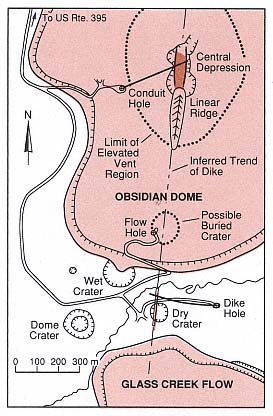
Fig. 2.66
Map of Obsidian Dome scientific drilling project.
Rhyolite lava domes of Obsidian Dome and
Glass Creek Flow are shown in shaded pattern;
lava flow front scarps are designated by
hachured line. The dashed line connecting the
two lava domes is the projection of the dike
found by drilling to pass at depth between
the domes. Core samples and hydrofracture
calculations discussed in the text are for the
(1) dike core hole that is located between the
two domes and slanted down to intersect the
dike at depth, and (2) the conduit core hole
that is slanted down to intersect below
Obsidian Dome's central depression.
(Adapted from Heiken et al ., 1988.)
An extensional state of stress can be inferred for the formation of the VC-1 core hole breccias found along the well-studied Jemez fault zone (Aldrich and Laughlin, 1984; Dey and Kranz, 1988). Hydraulic rupture in such a case is expected where pp exceeds s3 by an amount equal to the rock's tensile strength, as was discussed earlier. Hubbert and Willis (1957) show that this situation can be approximated by

Assuming that ph (hydrostatic pressure) approximates that of the boiling point at depth and that pp = pb (the formation break-down pressure), Hulen and Nielson (1988) estimated pb at 7.5 MPa, which is similar to the fluid injection pressure (ppi ) used in the hot dry rock hydraulic fracturing experiments recently conducted at nearby Fenton Hill (Murphy et al ., 1983). Figure 2.70 shows the results of this model in a plot of depth vs temperature for boiling under hydrostatic and lithostatic loads; this plot also contains the homogenization temperature of fluid inclusions. Either fluid temperature increases or a transient confining pressure decrease during fault movement might cause fluids to reach pb .